WO2012176532A1 - ゲーム装置,プログラムおよびゲーム提供方法 - Google Patents
ゲーム装置,プログラムおよびゲーム提供方法 Download PDFInfo
- Publication number
- WO2012176532A1 WO2012176532A1 PCT/JP2012/059500 JP2012059500W WO2012176532A1 WO 2012176532 A1 WO2012176532 A1 WO 2012176532A1 JP 2012059500 W JP2012059500 W JP 2012059500W WO 2012176532 A1 WO2012176532 A1 WO 2012176532A1
- Authority
- WO
- WIPO (PCT)
- Prior art keywords
- value
- selection
- character
- characters
- owned
- Prior art date
- Legal status (The legal status is an assumption and is not a legal conclusion. Google has not performed a legal analysis and makes no representation as to the accuracy of the status listed.)
- Ceased
Links
Images



Classifications
-
- A—HUMAN NECESSITIES
- A63—SPORTS; GAMES; AMUSEMENTS
- A63F—CARD, BOARD, OR ROULETTE GAMES; INDOOR GAMES USING SMALL MOVING PLAYING BODIES; VIDEO GAMES; GAMES NOT OTHERWISE PROVIDED FOR
- A63F13/00—Video games, i.e. games using an electronically generated display having two or more dimensions
- A63F13/40—Processing input control signals of video game devices, e.g. signals generated by the player or derived from the environment
- A63F13/42—Processing input control signals of video game devices, e.g. signals generated by the player or derived from the environment by mapping the input signals into game commands, e.g. mapping the displacement of a stylus on a touch screen to the steering angle of a virtual vehicle
- A63F13/422—Processing input control signals of video game devices, e.g. signals generated by the player or derived from the environment by mapping the input signals into game commands, e.g. mapping the displacement of a stylus on a touch screen to the steering angle of a virtual vehicle automatically for the purpose of assisting the player, e.g. automatic braking in a driving game
-
- A—HUMAN NECESSITIES
- A63—SPORTS; GAMES; AMUSEMENTS
- A63F—CARD, BOARD, OR ROULETTE GAMES; INDOOR GAMES USING SMALL MOVING PLAYING BODIES; VIDEO GAMES; GAMES NOT OTHERWISE PROVIDED FOR
- A63F13/00—Video games, i.e. games using an electronically generated display having two or more dimensions
- A63F13/70—Game security or game management aspects
- A63F13/79—Game security or game management aspects involving player-related data, e.g. identities, accounts, preferences or play histories
-
- A—HUMAN NECESSITIES
- A63—SPORTS; GAMES; AMUSEMENTS
- A63F—CARD, BOARD, OR ROULETTE GAMES; INDOOR GAMES USING SMALL MOVING PLAYING BODIES; VIDEO GAMES; GAMES NOT OTHERWISE PROVIDED FOR
- A63F13/00—Video games, i.e. games using an electronically generated display having two or more dimensions
- A63F13/55—Controlling game characters or game objects based on the game progress
- A63F13/58—Controlling game characters or game objects based on the game progress by computing conditions of game characters, e.g. stamina, strength, motivation or energy level
-
- A—HUMAN NECESSITIES
- A63—SPORTS; GAMES; AMUSEMENTS
- A63F—CARD, BOARD, OR ROULETTE GAMES; INDOOR GAMES USING SMALL MOVING PLAYING BODIES; VIDEO GAMES; GAMES NOT OTHERWISE PROVIDED FOR
- A63F13/00—Video games, i.e. games using an electronically generated display having two or more dimensions
- A63F13/50—Controlling the output signals based on the game progress
- A63F13/53—Controlling the output signals based on the game progress involving additional visual information provided to the game scene, e.g. by overlay to simulate a head-up display [HUD] or displaying a laser sight in a shooting game
- A63F13/533—Controlling the output signals based on the game progress involving additional visual information provided to the game scene, e.g. by overlay to simulate a head-up display [HUD] or displaying a laser sight in a shooting game for prompting the player, e.g. by displaying a game menu
-
- A—HUMAN NECESSITIES
- A63—SPORTS; GAMES; AMUSEMENTS
- A63F—CARD, BOARD, OR ROULETTE GAMES; INDOOR GAMES USING SMALL MOVING PLAYING BODIES; VIDEO GAMES; GAMES NOT OTHERWISE PROVIDED FOR
- A63F13/00—Video games, i.e. games using an electronically generated display having two or more dimensions
- A63F13/80—Special adaptations for executing a specific game genre or game mode
- A63F13/822—Strategy games; Role-playing games
-
- A—HUMAN NECESSITIES
- A63—SPORTS; GAMES; AMUSEMENTS
- A63F—CARD, BOARD, OR ROULETTE GAMES; INDOOR GAMES USING SMALL MOVING PLAYING BODIES; VIDEO GAMES; GAMES NOT OTHERWISE PROVIDED FOR
- A63F2300/00—Features of games using an electronically generated display having two or more dimensions, e.g. on a television screen, showing representations related to the game
- A63F2300/50—Features of games using an electronically generated display having two or more dimensions, e.g. on a television screen, showing representations related to the game characterized by details of game servers
- A63F2300/53—Features of games using an electronically generated display having two or more dimensions, e.g. on a television screen, showing representations related to the game characterized by details of game servers details of basic data processing
- A63F2300/534—Features of games using an electronically generated display having two or more dimensions, e.g. on a television screen, showing representations related to the game characterized by details of game servers details of basic data processing for network load management, e.g. bandwidth optimization, latency reduction
-
- A—HUMAN NECESSITIES
- A63—SPORTS; GAMES; AMUSEMENTS
- A63F—CARD, BOARD, OR ROULETTE GAMES; INDOOR GAMES USING SMALL MOVING PLAYING BODIES; VIDEO GAMES; GAMES NOT OTHERWISE PROVIDED FOR
- A63F2300/00—Features of games using an electronically generated display having two or more dimensions, e.g. on a television screen, showing representations related to the game
- A63F2300/50—Features of games using an electronically generated display having two or more dimensions, e.g. on a television screen, showing representations related to the game characterized by details of game servers
- A63F2300/55—Details of game data or player data management
- A63F2300/5526—Game data structure
- A63F2300/5533—Game data structure using program state or machine event data, e.g. server keeps track of the state of multiple players on in a multiple player game
Definitions
- the present invention relates to a technique for allowing a user to play a game using a character.
- Non-Patent Document 1 discloses a technique of selecting a desired combination of characters from a plurality of characters owned by a player and causing them to battle with characters of other players.
- Each character is set with a numerical value necessary for selection (hereinafter referred to as “selection required value”) and ability values such as attack power and defense power, and the player gives the total value of the selection required value of each character to himself / herself. It is possible to select a desired character within a range that is less than or equal to the selected selection allowable value.
- the ability value of each character and the selection required value are not necessarily proportional, even when, for example, a predetermined number of characters are selected in descending order of ability values within the range of the selection allowable value, the abilities of a plurality of characters selected by the player
- the total value of the values may not be the maximum value among a plurality of combinations. For example, assuming that the player's selection allowable value is 100, two characters A having an ability value of 60 and a selection requirement value set to 50, and one character having an ability value of 100 and a selection requirement value set to 100 Character B is assumed. When only the ability value is considered, one character B is selected (total ability value: 100), but when two characters A within the selection allowable value range are selected, the total ability value is greater.
- an object of the present invention is to reduce a burden on a player who selects a suitable combination from a plurality of characters.
- a selection required value (R) and a character ability value (PA, PD) necessary for character selection are set for each character, and a plurality of owned characters owned by the player
- a game device (14A, 14B) that provides a game that selects a plurality of target characters and applies them to an event, and a total value (Rsum) of selection required values (R) of the plurality of target characters is given to the player.
- the plurality of target characters to a plurality of target characters so that the total value (TA, TD) of the ability values (PA, PD) of the plurality of target characters is maximized within a range that is equal to or smaller than the selection allowable value (LA, LD).
- the selection part (32) which selects is provided.
- the selection unit (32) calculates an ability value with respect to the unit amount of the selection required value (R) as a unit ability value (UA, UD) for each of a plurality of owned characters. (32, SB1), and for each of the plurality of owned characters, the required value for selecting the owned character (LA, LD) from the ability value (PA, PD) of the owned character and the selection allowable value (LA, LD) given to the player ( R)
- the first selection processing unit (32, SB4, SB5) has the capability index values (XA [n], XD [n]). ) Are sequentially selected in descending order of the ability values indicated, and the accumulated value of the selection required value (R) of the selected owned character is calculated, and the accumulated value is the player's selection allowance (LA, LD). ) Is exceeded, the selection of the last owned character is canceled and the next owned character is selected.
- the selection unit (32) is configured such that the total value (Rsum) of the selection required values (R) of the predetermined number of possessed characters selected in descending order of the ability values (PA, PD) is the selection allowable value.
- a second selection processing unit (32, SA) for selecting the predetermined number of possessed characters as the target character when it is equal to or less than (LA, LD), the first selection processing unit (32, SB4, SB5) The target character corresponding to the ability index value (XA [n], XD [n]) when the total required value (Rsum) of the selection required values (R) of a predetermined number of owned characters exceeds the selection allowable value (LA, LD) Perform selection.
- the selection unit (32) designates a specific character among a plurality of owned characters as a target character, and a total value (Rsum) of required selection values (R) for each target character including the specific character. ) Within a range that is equal to or less than the player's selection allowance (LA, LD), a target character other than the specific character is selected from the plurality of owned characters.
- the specific character is, for example, a possessed character selected by the player.
- the ability values (PA, PD) include a first ability value (PA) and a second ability value (PD), and the selection unit (32) is a first event (for example, a player
- the range in which the total value (Rsum) of the selection required values (R) of the plurality of target characters is equal to or less than the first selection allowable value (LA) of the plurality of target characters applied to the battle event on the attacking side) Are selected so that the total value (TA) of the first ability values (PA) is maximized, and a plurality of target characters to be applied to the second event (for example, a battle event on which the player becomes the defender)
- the total value (TD) of the second ability values (PD) is maximized within a range where the total required value (Rsum) of the target characters (R) is equal to or less than the second selection allowance value (LD) of the player.
- the present invention is also specified as a program (PGM) for causing a computer to function as the game device (14A, 14B) according to each of the above aspects.
- a selection required value (R) necessary for character selection and a character ability value (PA, PD) are set for each character, and a plurality of owned characters owned by the player are selected from a plurality of owned characters.
- the computer uses a selection allowable value (LA, LD) in which a total value (Rsum) of selection required values (R) of a plurality of target characters is given to the player.
- a selection unit (32) that selects a plurality of target characters from a plurality of owned characters so that the total value (TA, TD) of the ability values (PA, PD) of the plurality of target characters is maximized within the following range.
- the program (PGM) of the present invention is provided in a form stored in a computer-readable recording medium and installed in the computer, or is provided in a form distributed via a communication network and installed in the computer.
- the present invention is also specified as a method for providing a game.
- a selection required value (R) and a character ability value (PA, PD) necessary for character selection are set for each character, and a plurality of targets from a plurality of owned characters owned by the player.
- a plurality of target characters are selected from a plurality of owned characters so that the total value (TA, TD) of the ability values (PA, PD) of the plurality of target characters is maximized within a range that is equal to or smaller than the selection allowable value (LA, LD). select.
- FIG. 1 is a block diagram of a game system according to a first embodiment of the present invention. It is a schematic diagram of player information and character information. It is a flowchart of a deck organization process. It is a schematic diagram of unit data in the second embodiment. It is a flowchart of the deck organization process in 2nd Embodiment. It is a block diagram of the game device concerning a 3rd embodiment.
- FIG. 1 is a block diagram of a game system 100 according to the first embodiment of the present invention.
- the game system 100 of the first embodiment includes a terminal device 12 and a game device 14A that communicate with each other via a communication network 16 such as the Internet, and is a communication system that allows a player who owns the terminal device 12 to play a game. is there.
- a communication network 16 such as the Internet
- FIG. 1 Although only one terminal device 12 is shown in FIG. 1 for the sake of convenience, a plurality of terminal devices 12 actually communicate with the game device 14A via the communication network 16.
- the terminal device 12 is a communication terminal such as a mobile phone, a personal digital assistant (PDA) or a personal computer, and includes a display device 22 and an input device 24.
- the display device 22 (for example, a liquid crystal display panel) displays various images such as a game screen.
- the input device 24 is a device for the player to input an instruction to the terminal device 12, and includes, for example, a plurality of operators that the player operates. Note that a touch panel that is configured integrally with the display device 22 and receives an operation from the user, or a microphone that allows the user to input an instruction to the terminal device 12 by voice may be employed as the input device 24.
- the game device 14A of the first embodiment is a web server that provides a browser game to a player who owns the terminal device 12.
- the browser game is a game that can be played by executing a web browser on the terminal device 12 (a game that does not require downloading game-specific software to the terminal device 12).
- the game device 14A executes various processes triggered by a request transmitted from the terminal device 12 in response to an instruction from the player to the input device 24, and a web page (game screen) indicating the processing results. Is displayed on the display device 22 of the terminal device 12.
- an RPG Role-
- an RPG Role-
- owned characters such as monsters given to the player in the game.
- Playing game type social game is provided from the game device 14A to the terminal device 12. Characters assigned to each character can be exchanged among a plurality of players.
- the deck is a set of one or more characters (hereinafter referred to as “target characters”) selected from a plurality of owned characters given to the player with an upper limit of M (M is a natural number).
- M is a natural number
- the attack deck of the player in charge of the attack side and the defense decks of other players in charge of the defense side are organized, and the attack deck and the defense deck battle each other.
- Each player can be both an attacker and defender for each battle event.
- One or more target characters constituting an attack deck when one player is in charge of the attack side, and one or more target characters constituting a defense deck when that player is in charge of the defense side Each can be individually selected and overlap each other.
- the game apparatus 14A includes a control device 32, a storage device 34, and a communication device 36.
- the communication device 36 communicates with the terminal device 12 via the communication network 16.
- the storage device 34 stores a program (game program) PGM executed by the control device 32 and various data used by the control device 32.
- a known recording medium such as a semiconductor recording medium or a magnetic recording medium or a combination of a plurality of types of recording media may be employed as the storage device 34.
- a configuration in which the storage device 34 is installed in an external device (for example, a server device) separate from the game device 14A and the game device 14A acquires information from the storage device 34 via the communication network 16 may be employed. That is, the storage device 34 is not an essential requirement for the game device 14A.
- the storage device 34 (virtual one storage device) can be realized by a plurality of devices configured separately from each other.
- the storage device 34 stores player information D1 and character information D2 corresponding to the progress of the game by the player for each player.
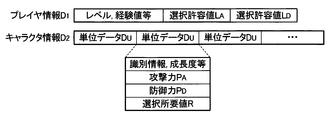
- FIG. 2 is a schematic diagram of the player information D1 and the character information D2.
- the player information D1 specifies the player's own parameters in the game. Specifically, as shown in FIG. 2, the player information D1 includes information such as the level and experience value of the player, an attack deck selection allowable value LA, and a defense deck selection allowable value LD. Is done.
- the selection allowable value LA is a numerical value (capacity value) that defines the limit at which the owned character can be selected as the target character of the attack deck
- the selection allowable value LD is the limit at which the owned character can be selected as the target character of the defense deck.
- the selection allowable value LA and the selection allowable value LD individually increase as the level of the player increases due to achievement of various events in the game.
- the subscript A (Attack) is written together for the elements related to the attack in the battle event, and the subscript D (Defense) is added to the elements related to the defense. It is written together.
- the character information D2 is information related to the owned character given to the player, and includes unit data DU for each owned character of the player as shown in FIG.
- the unit data DU of each owned character includes an attack power PA, a defense power PD, and a selection required value R in addition to the identification information and the degree of growth (level, experience value) of the owned character.
- the attack power PA is an index value of the attacking ability of the owned character
- the defense power PD is an index value of the defense ability of the owned character.
- the attack power PA and the defense power PD increase as the growth degree (level) of the owned character increases due to achievement of various events.
- the selection required value R means the consumption amount of the selection allowable value LA and the selection allowable value LD necessary for selecting the owned character as the target character.
- One or more target characters constituting the attack deck are selected from a plurality of owned characters of the player within a range where the total value Rsum of the selection required value R of each target character is less than or equal to the attack deck selection allowable value LA. Is done. That is, the selection allowable value LA means the upper limit of the total value Rsum of the selection required values R of the target characters constituting the attack deck.
- the target characters constituting the defense deck are selected from a plurality of owned characters of the player within a range where the total value Rsum of the selection required values R of the target characters is less than or equal to the defense allowable selection value LD of the defense deck.
- the selection allowable value LD means the upper limit of the total value Rsum of the selection required values R of the target characters constituting the defense deck.
- the control device 32 in FIG. 1 executes processing according to an instruction from the player with respect to the input device 24 to display a web page as a processing result on the display device 22 of the terminal device 12. For example, when a battle event is instructed by the player, the control device 32 sums up the attack power PA of one or more target characters constituting the attack deck of the attacking player (for example, the player who has instructed the occurrence of the battle event). Value (hereinafter referred to as “total attack power”) TA and the defense power PD of one or more target characters constituting the defense deck of the defending player (for example, the player designated as the battle opponent by the attacking player) The total value (hereinafter referred to as “total defense power”) TD is compared.
- the control device 32 determines that the attacking player wins, and when the total attack power TA falls below the total defense power TD, the control device 32 It is determined that the player has won, and a web page indicating the determination result is displayed on the display device 22 of the terminal device 12 of each player.
- control device 32 of the first embodiment performs a deck organization process for selecting a target character from a plurality of owned characters of each player and knitting an attacking deck of the attacking player and a defense deck of the defending player. Execute. In the deck formation process of the attack deck, the total attack power TA of the attack deck is maximized within a range where the total value Rsum of the target character selection required value R is equal to or less than the selection allowable value LA of the attacking player. This is a process of selecting one or more target characters constituting the attack deck from a plurality of owned characters of the attacking player up to M characters.
- the total defense power TD of the defense deck is the maximum within the range where the total value Rsum of the selection required value R of the target character is equal to or less than the selection allowable value LD of the defending player.
- the control device 32 functions as an element (selection unit) that selects a target character from a plurality of owned characters.
- FIG. 3 is a flowchart of deck organization processing for organizing an attack deck from N owned characters (N is a natural number) owned by the player.
- the process shown in FIG. 3 is executed in response to the occurrence of a battle event with the player as the attacking side or an instruction to form the attack deck by the player.
- the deck organization process in FIG. 3 is divided into a selection process SA and a selection process SB.
- SA selection process
- SB selection process
- the control device 32 determines whether or not the total value Rsum calculated in step SA2 is less than or equal to the player's selection allowable value LA (SA3). If the determination result in step SA3 is affirmative (Rsum ⁇ LA), the control device 32 determines the M characters selected in step SA1 as target characters for the attack deck (SA4), and executes the selection process SB. The deck organization process is terminated without any processing. As understood from the above description, the control device 32 determines that the total value Rsum of the selection required values R of the M owned characters positioned in descending order of the attack power PA among the N owned characters is selected by the player. When it is equal to or less than the allowable value LA, it functions as an element (second selection processing unit) that selects M owned characters that are higher in the attack power PA as target characters.
- SA3 the player's selection allowable value LA
- step SA3 when the determination result of step SA3 is negative (Rsum> LA), the control device 32 starts the selection process SB.
- the control device 32 has the attack power PA of the owned character with respect to the unit amount of the required selection value R (that is, the attack power obtained by consuming the unit amount of the selection allowable value LA).
- the control device 32 functions as an element (ability value analysis unit) for calculating the unit attack power UA for each of the N owned characters.
- the control device 32 specifies the minimum value (hereinafter referred to as “minimum efficiency value”) UA_min among the N unit attack powers UA calculated for each owned character in step SB1 (SB2).
- the minimum efficiency value UA_min is the unit attack power UA of the possessed character having the lowest efficiency that contributes to the increase in the total attack power TA of the attack deck.
- the control device 32 calculates an ability index value XA [n] (XA [1] to XA [N]) for each of the N owned characters (SB3).
- the ability index value XA [n] of the nth owned character is an attack when it is assumed that the entire remaining amount of the selection allowable value LA when the owned character is selected is consumed under the minimum efficiency value UA_min. This corresponds to the total attack power TA of the deck for use, and is calculated, for example, by the following formula (1).
- XA [n] (LA ⁇ R [n]) ⁇ UA_min + PA [n] (1)
- PA [n] in Expression (1) is the attack power PA of the nth owned character among N characters.
- (LA ⁇ R [n]) in Expression (1) means the remaining amount of the selection allowable value LA when it is assumed that the nth owned character (selection required value R [n]) is selected.
- the multiplication value ⁇ (LA ⁇ R [n]) ⁇ UA_min ⁇ of the remaining amount (LA ⁇ R [n]) and the minimum efficiency value UA_min is the minimum efficiency value of the remaining amount (LA ⁇ R [n]).
- This is the attack power that can be obtained when it is assumed that the character has been consumed by selecting the character UA_min.
- the control device 32 functions as an element (index calculation unit) that calculates the capability index value XA [n] for each of the N owned characters.
- the control device 32 selects the possessed character that is higher in the descending order of the attack power (total attack power TA) indicated by the N ability index values XA [1] to XA [N] calculated in step SB3. Is selected within a range where the total value Rsum of the selection required values R is equal to or less than the selection allowable value LA of the player (SB4). Specifically, the control device 32 sequentially selects each owned character in descending order from the possessed character having the maximum ability index value XA [n] and accumulates the required selection value R for each selection. If the accumulated value of R exceeds the selection allowable value LA, the selection of the last selected owned character is canceled and the next owned character is selected.
- the control device 32 attacks the plurality of owned characters selected in step SB4.
- the target character of the deck for use SB5
- the control device 32 targets the possessed character in descending order of the attack power indicated by the ability index value XA [n] within a range where the total value Rsum of the target character selection required value R is equal to or less than the player's selection allowable value LA. It functions as an element (first selection processing unit) to be selected as a character.
- the above is the deck organization process of the attacking deck.
- the deck formation process of the defense deck is also executed in the same procedure as in FIG. That is, in the deck formation process selection process SA (SA1 to SA4) of the defense deck, the control device 32 determines that the total value Rsum of the selection required values R of the M owned characters positioned in the descending order of the defense power PD is If it is below the player's selection allowance LD, the M owned characters that are higher in the defense power PD are selected as the target characters of the defense deck.
- the control device 32 determines the deck of the defense deck.
- the ability index values XD [1] to XD [N] are calculated (SB2, SB3).
- control device 32 selects the possessed character positioned higher in the descending order of the defense strength indicated by the ability index value XD [n] within a range where the total value Rsum of the selection required values R is equal to or less than the selection allowable value LD. (SB4), the possessed character selected in step SB4 is determined as the target character of the defense deck (SB5).
- the total attack that is the total attack power PA of each target character within a range where the total value Rsum of the target character selection required value R is equal to or less than the player's selection allowable value LA.
- the target character of the attack deck is selected from the N owned characters so that the force TA is maximized.
- the target character of the defense deck is also selected in the same procedure. Therefore, according to the first embodiment, it is possible to reduce the burden on the player who selects an appropriate combination from the N owned characters.
- each owned character is sequentially selected in descending order of the ability index value XA [n], and the accumulated value of the selection required value R of the selected owned character is calculated, and the accumulated value is
- the player's selection allowable value LA is exceeded, the selection of the last-owned character is canceled and the next-owned character is selected. Therefore, for example, the total value Rsum of the selection required value R of the target character is sufficiently close to the selection allowable value LA as compared with a configuration in which a predetermined number of owned characters are simply selected in descending order of the ability index value XA [n].
- one or more target characters constituting the attack deck are selected according to the player's selection allowable value LA and the attack power PA of each owned character, and one character constituting the defense deck.
- the above target character is selected according to the selection allowable value LD of the player and the defense power PD of each owned character. That is, a plurality of target characters that are applied to a battle event (first event) on which the player is an attack side and a plurality of target characters that are applied to a battle event (second event) on which the player is a defender are individually It is possible to select.
- control device 32 of the game device 14A automatically selects all the target characters constituting the attack deck or the defense deck.
- a specific character among the plurality of owned characters of the player is preferentially incorporated into the attack deck or the defense deck.
- the player arbitrarily selects one or more characters (hereinafter referred to as “specific characters”) to be preferentially incorporated into the deck among his N owned characters. It is possible to specify.
- the specific character is individually specified for each of the attack deck and the defense deck.
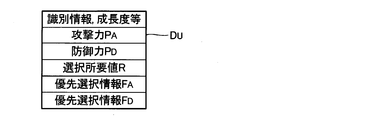
- each unit data DU of the character information D2 stored in the storage device 34 of the game apparatus 14A in the second embodiment is the same information (attack power PA and defense power PD) as in the first embodiment.
- priority selection information F (FA, FD) is included.
- the priority selection information FA is information (for example, a flag) indicating whether or not the owned character is designated as a specific character of the attacking deck (priority state / non-priority state). This is information indicating whether or not a specific character of the defense deck is designated.
- the control device 32 of the game apparatus 14A sets the priority selection information F (FA, FD) of the specific character designated by the player in the priority state.
- special abilities are set for some types of characters.
- the special ability is an ability that is activated with a predetermined probability in an event such as a battle event and advantageously develops the event.
- special abilities that are advantageous in a battle event in which the player becomes the attacking side include the ability to increase the total attack power TA of the attack deck on the player's side and the ability to reduce the total defense power TD of the opponent's defense deck. .
- there is an ability to increase the total defense power TD of the defense deck on the player's side and an ability to decrease the total attack power TA of the attack deck on the opponent's side. is there.
- the control device 32 determines victory or defeat after adjusting the total attack power TA of the attack deck and the total defense power TD of the defense deck according to the special ability of each target character participating in the battle event. Therefore, a player can advantageously develop a battle event by designating a possessed character possessing special abilities among a plurality of his own characters as a specific character and preferentially incorporating it into an attack deck or defense deck. Is possible.
- FIG. 5 is a flowchart of the deck organization process in the second embodiment.
- the attack player's attack deck deck formation process is illustrated, but the defense player's defense deck deck formation process is also executed in the same procedure.
- the control device 32 selects K specific characters (K is a natural number of 1 or more) for which the priority selection information FA is set to the priority state as the target character ( SC1). Then, the control device 32 executes the same deck organization process as in the first embodiment, thereby excluding the K specific characters selected in step SC1 from the N owned characters of the player (NK).
- a target character is selected from the number of owned characters with an upper limit of (M ⁇ K) (that is, the total number of target characters including the specific character is M or less).
- the total value Rsum of the selection required values R of the K specific characters selected in step SC1 and the target character selected in the selection process SA or the selection process SB is equal to or less than the player's selection allowable value LA.
- the target character is selected so that
- the control device 32 selects (M ⁇ K) owned characters in descending order of attack power PA from (N ⁇ K) owned characters other than the specific character (SA1), and (M ⁇ K). ) Whether or not the total value Rsum of the selection required value R of the total M owned characters composed of the number of owned characters and the K specific characters selected in step SC1 is less than or equal to the player's selection allowable value LA. Determine (SA2, SA3). If the determination result of step SA3 is affirmative, the control device 32 determines the total M owned characters selected in step SC1 and step SA1 as target characters of the attack deck (SA4).
- step SA3 determines the unit attack power UA for each of (NK) owned characters other than the specific character, and then determines the minimum value of the unit attack power UA. Is specified as the minimum efficiency value UA_min (SB1, SB2), and the ability index value XA [n] corresponding to the minimum efficiency value UA_min is calculated for each of (NK) owned characters (SB3). Then, the control device 32 determines the possessed character located in the descending order of the ability index value XA [n] among the K specific characters selected in step SC1 and the (NK) owned characters other than the specific character. And sequentially.
- step SB4 is executed so that the total value Rsum of the selection required values R of the selected owned characters is equal to or less than the selection allowable value LA of the player and the total number of owned characters is equal to or less than M. .
- the control device 32 determines the possessed character selected in step SB4 as the target character of the attack deck (SB5).
- the selection of the attack deck is referred to, but each target character constituting the defense deck is also selected in the same manner according to the defense power PD of each owned character and the player's selection allowance LD.
- the second embodiment has an advantage that K specific characters can be preferentially selected as target characters regardless of the ability values (PA, PD) and selection allowance values (LA, LD) of each character.
- K specific characters can be preferentially selected as target characters regardless of the ability values (PA, PD) and selection allowance values (LA, LD) of each character.
- PA, PD ability values
- LA, LD selection allowance values
- the player since the player designates K specific characters, it is possible to organize an attack deck or a defense deck that reflects the player's intention. Further, for example, by specifying a possessed character having special ability as a specific character and incorporating it into an attack deck or a defense deck, the player can advantageously develop a battle event. It is also possible for the player to actively participate in the battle event by designating his / her own favorite character.
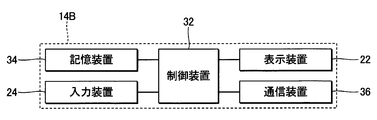
- FIG. 6 is a block diagram of a game apparatus 14B according to the third embodiment.
- the game device 14B is an electronic device that causes a player (owner) to play a game similar to the first embodiment.
- a portable device such as a mobile phone or a portable information terminal is suitable as the game apparatus 14B.
- the game apparatus 14 ⁇ / b> B includes a control device 32, a storage device 34, a communication device 36, a display device 22, and an input device 24.
- the communication device 36 communicates with another game device 14B.
- a battle event or the like between players is realized by communication by the communication device 36.
- the storage device 34 stores the program PGM, player information D1 and character information D2 for each player, as in the first embodiment.
- the control device 32 operates in the same manner as in the first embodiment by executing the program PGM. Specifically, the control device 32 organizes the attack deck or the defense deck by executing the deck organization process of FIG. 3 or FIG.
- the game device 14B of the third embodiment functions as a device that provides the player with the game provided by the game device 14A of the first embodiment alone. Therefore, the third embodiment can achieve the same effect as the first embodiment. Note that the configuration of the second embodiment can also be applied to the third embodiment.
- a configuration in which the attack power PA, defense power PD, and selection required value R of each owned character are stored in the storage device 34 for each player is not essential.
- the identification information of each owned character is stored in the storage device 34 as character information D2 for each player, and the character parameters (attack power PA, defense power PD, selection required value R) are associated with the identification information for each character.
- the character selection requirement value and the character ability value are set for each character, and each parameter of the character is set. It does not matter whether or not is stored for each player.
- a character for example, a monster
- the content and type of the character are arbitrary in the present invention.
- a configuration in which the control device 32 selects an appropriate combination using items such as weapons and armor used by the player in various events as characters may be employed.
- the process of selecting a plurality of target characters is not limited to the selection process SA and the selection process SB exemplified above.
- the processing executed by the control device 32 in each of the above-described forms is the selection allowable values (LA, LD) in which the total value Rsum of the selection required values R of the plurality of target characters is given to the player.
- LA, LD selection allowable values
- TA, TD total value of the ability values
- PA, PD ability values
- the game apparatus 14A is exemplified as one apparatus.
- the function of the game apparatus 14A can be distributed to a plurality of apparatuses.
- a configuration in which the control device 32 and the storage device 34 are installed at different positions on the communication network 16 as separate devices may be employed.
- an authentication device that performs authentication processing or the like of the terminal device 12 between the terminal device 12 and the game device 14A to relay communication between the terminal device 12 and the game device 14A.
Landscapes
- Engineering & Computer Science (AREA)
- Multimedia (AREA)
- Business, Economics & Management (AREA)
- Computer Security & Cryptography (AREA)
- General Business, Economics & Management (AREA)
- Human Computer Interaction (AREA)
- Physics & Mathematics (AREA)
- Optics & Photonics (AREA)
- Theoretical Computer Science (AREA)
- Management, Administration, Business Operations System, And Electronic Commerce (AREA)
- User Interface Of Digital Computer (AREA)
Abstract
ゲーム装置は、プレイヤが所有する複数の所有キャラクタから複数の対象キャラクタを選択してイベントに適用するゲームを提供する。記憶装置は、キャラクタの選択に必要な選択所要値とキャラクタの攻撃力とをキャラクタ毎に記憶する。制御装置は、複数の対象キャラクタの選択所要値の合計値がプレイヤに付与された選択許容値以下となる範囲内で複数の対象キャラクタの攻撃力の合計値である総攻撃力が最大となるように複数の所有キャラクタから対象キャラクタを選択する。
Description
本発明は、キャラクタを使用したゲームを利用者にプレイさせる技術に関する。
プレイヤに付与されたキャラクタ(例えばモンスター)を戦闘等のイベントに使用するゲームが従来から提案されている。例えば非特許文献1には、プレイヤが所有する複数のキャラクタから所望の組合せのキャラクタを選択して他のプレイヤのキャラクタと戦闘させる技術が開示されている。各キャラクタには、選択に必要な数値(以下「選択所要値」という)と攻撃力や防御力等の能力値とが設定され、プレイヤは、各キャラクタの選択所要値の合計値が自身に付与された選択許容値以下となる範囲内で所望のキャラクタを選択することが可能である。
「ソーシャルゲーム総合情報誌 アプリSTYLE Vol.2」,株式会社イースト・プレス,平成23年4月1日,p.26-p.29
ところで、各キャラクタの能力値と選択所要値とは必ずしも比例しないから、例えば選択許容値の範囲内において能力値の降順で所定個のキャラクタを選択した場合でも、プレイヤが選択した複数のキャラクタの能力値の合計値は複数種の組合せのなかで最大値とならない可能性がある。例えば、プレイヤの選択許容値を100と仮定し、能力値が60で選択所要値が50に設定された2個のキャラクタAと、能力値が100で選択所要値が100に設定された1個のキャラクタBとを想定する。能力値のみを加味した場合には1個のキャラクタBが選択されるが(能力値合計:100)、選択許容値の範囲内にある2個のキャラクタAを選択した場合のほうが能力値の合計値(120)は大きく、他のプレイヤとの戦闘のイベントでは有利である。しかし、多数のキャラクタを候補として最適な組合せをプレイヤが把握するのは困難である。以上の事情を考慮して、本発明は、複数のキャラクタから好適な組合せを選択するプレイヤの負担を軽減することを目的とする。
以上の課題を解決するために本発明が採用する手段を以下に説明する。なお、本発明の理解を容易にするために以下では図面の参照符号を便宜的に括弧書で付記するが、本発明を図示の形態に限定する趣旨ではない。
本発明のゲーム装置(14A,14B)は、キャラクタの選択に必要な選択所要値(R)とキャラクタの能力値(PA,PD)とがキャラクタ毎に設定され、プレイヤが所有する複数の所有キャラクタから複数の対象キャラクタを選択してイベントに適用するゲームを提供するゲーム装置(14A,14B)であって、複数の対象キャラクタの選択所要値(R)の合計値(Rsum)がプレイヤに付与された選択許容値(LA,LD)以下となる範囲内で複数の対象キャラクタの能力値(PA,PD)の合計値(TA,TD)が最大となるように複数の所有キャラクタから複数の対象キャラクタを選択する選択部(32)を具備する。
本発明の好適な態様において、選択部(32)は、複数の所有キャラクタの各々について選択所要値(R)の単位量に対する能力値を単位能力値(UA,UD)として算定する能力値解析部(32,SB1)と、複数の所有キャラクタの各々について、当該所有キャラクタの能力値(PA,PD)と、プレイヤに付与された選択許容値(LA,LD)から当該所有キャラクタの選択所要値(R)を減算した残余量に対して単位能力値(UA,UD)の最小値(UA_min,UD_min)を割当てた場合の能力値との合計値に応じた能力指標値(XA[n],XD[n])を算定する指標算定部(32,SB3)と、複数の対象キャラクタの選択所要値(R)の合計値(Rsum)がプレイヤに付与された選択許容値(LA,LD)以下となる範囲内で、各所有キャラクタの能力指標値(XA[n],XD[n])が示す能力値の降順で所有キャラクタを対象キャラクタとして選択する第1選択処理部(32,SB4,SB5)とを含む。
なお、第1選択処理部(32,SB4,SB5)を具備する態様の好適例において、第1選択処理部(32,SB4,SB5)は、能力指標値(XA[n],XD[n])が示す能力値の降順で各所有キャラクタを順次に選択するとともに選択済の所有キャラクタの選択所要値(R)の累算値を算定し、累算値がプレイヤの選択許容値(LA,LD)を超えた場合には最後に選択した所有キャラクタの選択を解除して次位の所有キャラクタを選択する。
本発明の好適な態様において、選択部(32)は、能力値(PA,PD)の降順で選択された所定個の所有キャラクタの選択所要値(R)の合計値(Rsum)が選択許容値(LA,LD)以下である場合に、当該所定個の所有キャラクタを対象キャラクタとして選択する第2選択処理部(32,SA)を含み、第1選択処理部(32,SB4,SB5)は、所定個の所有キャラクタの選択所要値(R)の合計値(Rsum)が選択許容値(LA,LD)を上回る場合に能力指標値(XA[n],XD[n])に応じた対象キャラクタの選択を実行する。
本発明の好適な態様において、選択部(32)は、複数の所有キャラクタのうちの特定キャラクタを対象キャラクタとして指定し、特定キャラクタを含む各対象キャラクタの選択所要値(R)の合計値(Rsum)がプレイヤの選択許容値(LA,LD)以下となる範囲内で、複数の所有キャラクタから特定キャラクタ以外の対象キャラクタを選択する。特定キャラクタは、例えばプレイヤが選択した所有キャラクタである。
本発明の好適な態様において、能力値(PA,PD)は、第1能力値(PA)と第2能力値(PD)とを含み、選択部(32)は、第1イベント(例えばプレイヤが攻撃側となる戦闘イベント)に適用される複数の対象キャラクタを、当該複数の対象キャラクタの選択所要値(R)の合計値(Rsum)がプレイヤの第1選択許容値(LA)以下となる範囲内で第1能力値(PA)の合計値(TA)が最大となるように選択し、第2イベント(例えばプレイヤが防御側となる戦闘イベント)に適用される複数の対象キャラクタを、当該複数の対象キャラクタの選択所要値(R)の合計値(Rsum)がプレイヤの第2選択許容値(LD)以下となる範囲内で第2能力値(PD)の合計値(TD)が最大となるように選択する。
本発明は、以上の各態様に係るゲーム装置(14A,14B)としてコンピュータを機能させるためのプログラム(PGM)としても特定される。本発明のプログラム(PGM)は、キャラクタの選択に必要な選択所要値(R)とキャラクタの能力値(PA,PD)とがキャラクタ毎に設定され、プレイヤが所有する複数の所有キャラクタから複数の対象キャラクタを選択してイベントに適用するゲームを提供するために、コンピュータを、複数の対象キャラクタの選択所要値(R)の合計値(Rsum)がプレイヤに付与された選択許容値(LA,LD)以下となる範囲内で複数の対象キャラクタの能力値(PA,PD)の合計値(TA,TD)が最大となるように複数の所有キャラクタから複数の対象キャラクタを選択する選択部(32)として機能させる。本発明のプログラム(PGM)は、コンピュータが読取可能な記録媒体に格納された形態で提供されてコンピュータにインストールされるほか、通信網を介した配信の形態で提供されてコンピュータにインストールされる。
また、本発明は、ゲームを提供する方法としても特定される。本発明のゲーム提供方法は、キャラクタの選択に必要な選択所要値(R)とキャラクタの能力値(PA,PD)とがキャラクタ毎に設定され、プレイヤが所有する複数の所有キャラクタから複数の対象キャラクタを選択してイベントに適用するゲームを提供する方法であって、ゲーム装置(14A,14B)が、複数の対象キャラクタの選択所要値(R)の合計値(Rsum)がプレイヤに付与された選択許容値(LA,LD)以下となる範囲内で複数の対象キャラクタの能力値(PA,PD)の合計値(TA,TD)が最大となるように複数の所有キャラクタから複数の対象キャラクタを選択する。
<第1実施形態>
図1は、本発明の第1実施形態に係るゲームシステム100のブロック図である。第1実施形態のゲームシステム100は、インターネット等の通信網16を介して相互に通信する端末装置12とゲーム装置14Aとを具備し、端末装置12を所有するプレイヤにゲームをプレイさせる通信システムである。なお、図1では便宜的に1個の端末装置12のみを図示したが、実際には複数の端末装置12が通信網16を介してゲーム装置14Aと通信する。
図1は、本発明の第1実施形態に係るゲームシステム100のブロック図である。第1実施形態のゲームシステム100は、インターネット等の通信網16を介して相互に通信する端末装置12とゲーム装置14Aとを具備し、端末装置12を所有するプレイヤにゲームをプレイさせる通信システムである。なお、図1では便宜的に1個の端末装置12のみを図示したが、実際には複数の端末装置12が通信網16を介してゲーム装置14Aと通信する。
端末装置12は、例えば携帯電話機や携帯情報端末(PDA:Personal Digital Assistant)やパーソナルコンピュータ等の通信端末であり、表示装置22と入力装置24とを含んで構成される。表示装置22(例えば液晶表示パネル)は、ゲーム画面等の各種の画像を表示する。入力装置24は、端末装置12に対する指示をプレイヤが入力するための機器であり、例えばプレイヤが操作する複数の操作子を含んで構成される。なお、表示装置22と一体に構成されて利用者からの操作を受付けるタッチパネルや、端末装置12に対する指示を利用者が音声で入力するためのマイクロホンを入力装置24として採用することも可能である。
第1実施形態のゲーム装置14Aは、端末装置12を所有するプレイヤにブラウザゲームを提供するウェブサーバである。ブラウザゲームは、端末装置12におけるウェブブラウザの実行でプレイすることが可能なゲーム(ゲーム専用のソフトウェアを端末装置12にダウンロードすることが不要なゲーム)である。具体的には、ゲーム装置14Aは、入力装置24に対するプレイヤからの指示に応じて端末装置12から送信される要求を契機として各種の処理を実行し、処理の結果を示すウェブページ(ゲーム画面)を端末装置12の表示装置22に表示させる。第1実施形態では、ゲーム内でプレイヤに付与されたモンスター等の複数のキャラクタ(以下「所有キャラクタ」という)を使用して他のプレイヤとの戦闘等のイベントを実行していくRPG(Role-Playing Game)型のソーシャルゲームがゲーム装置14Aから端末装置12に提供される。各キャラクタに付与されたキャラクタは複数のプレイヤの相互間で授受され得る。
ゲーム内の戦闘イベントには、戦闘相手となるプレイヤ毎に編成されたデッキが適用される。デッキは、プレイヤに付与された複数の所有キャラクタからM個(Mは自然数)を上限として選択された1個以上のキャラクタ(以下「対象キャラクタ」という)の集合である。戦闘イベントでは、攻撃側を担当するプレイヤの攻撃用デッキと、防御側を担当する他のプレイヤの防御用デッキとが編成されて攻撃用デッキと防御用デッキとが戦闘する。各プレイヤは戦闘イベント毎に攻撃側にも防御側にもなり得る。1人のプレイヤが攻撃側を担当する場合の攻撃用デッキを構成する1個以上の対象キャラクタと、そのプレイヤが防御側を担当する場合の防御用デッキを構成する1個以上の対象キャラクタとは、各々が個別に選定されて相互に重複し得る。
図1に示すように、ゲーム装置14Aは、制御装置32と記憶装置34と通信装置36とを含んで構成される。通信装置36は、通信網16を介して端末装置12と通信する。記憶装置34は、制御装置32が実行するプログラム(ゲームプログラム)PGMや制御装置32が使用する各種のデータを記憶する。半導体記録媒体や磁気記録媒体等の公知の記録媒体または複数種の記録媒体の組合せが記憶装置34として採用され得る。なお、ゲーム装置14Aとは別個の外部装置(例えばサーバ装置)に記憶装置34を設置し、ゲーム装置14Aが通信網16を介して記憶装置34から情報を取得する構成も採用され得る。すなわち、記憶装置34はゲーム装置14Aの必須の要件ではない。また、相互に別体に構成された複数の装置で記憶装置34(仮想的な1個の記憶装置)を実現することも可能である。
記憶装置34は、プレイヤによるゲームの進行状況に応じたプレイヤ情報D1およびキャラクタ情報D2をプレイヤ毎に記憶する。図2は、プレイヤ情報D1およびキャラクタ情報D2の模式図である。プレイヤ情報D1は、ゲーム内でのプレイヤ自身のパラメータを指定する。具体的には、プレイヤ情報D1は、図2に示すように、プレイヤのレベルや経験値等の情報と、攻撃用デッキの選択許容値LAおよび防御用デッキの選択許容値LDとを含んで構成される。選択許容値LAは、所有キャラクタを攻撃用デッキの対象キャラクタとして選択できる限度を規定する数値(容量値)であり、選択許容値LDは、所有キャラクタを防御用デッキの対象キャラクタとして選択できる限度を規定する数値である。ゲーム内の各種のイベントの達成によりプレイヤのレベルが上昇することで選択許容値LAおよび選択許容値LDは個別に増加する。なお、選択許容値LAおよび選択許容値LDの表記のように、戦闘イベントでの攻撃に関連する要素には添字A(Attack)を併記し、防御に関連する要素には添字D(Defense)を併記する。
キャラクタ情報D2は、プレイヤに付与された所有キャラクタに関連する情報であり、図2に示すように、そのプレイヤの所有キャラクタ毎に単位データDUを含む。各所有キャラクタの単位データDUは、その所有キャラクタの識別情報および成長度(レベル,経験値)等の情報に加えて、攻撃力PAと防御力PDと選択所要値Rとを含んで構成される。攻撃力PAは、所有キャラクタの攻撃能力の指標値であり、防御力PDは、所有キャラクタの防御能力の指標値である。各種のイベントの達成により所有キャラクタの成長度(レベル)が上昇することで攻撃力PAおよび防御力PDは増加する。
選択所要値Rは、所有キャラクタを対象キャラクタとして選択するために必要な選択許容値LAおよび選択許容値LDの消費量を意味する。攻撃用デッキを構成する1個以上の対象キャラクタは、各対象キャラクタの選択所要値Rの合計値Rsumが攻撃用デッキの選択許容値LA以下となる範囲内で、プレイヤの複数の所有キャラクタから選択される。すなわち、選択許容値LAは、攻撃用デッキを構成する対象キャラクタの選択所要値Rの合計値Rsumの上限を意味する。
同様に、防御用デッキを構成する対象キャラクタは、各対象キャラクタの選択所要値Rの合計値Rsumが防御用デッキの選択許容値LD以下となる範囲内で、プレイヤの複数の所有キャラクタから選択される。すなわち、選択許容値LDは、防御用デッキを構成する対象キャラクタの選択所要値Rの合計値Rsumの上限を意味する。
以上の説明から理解される通り、プレイヤの選択許容値LAが大きいほど、選択所要値Rが大きい多数の所有キャラクタを攻撃用デッキの対象キャラクタとして選択できる可能性が高く、プレイヤの選択許容値LDが大きいほど、選択所要値Rが大きい多数の所有キャラクタを防御用デッキの対象キャラクタとして選択できる可能性が高い。
図1の制御装置32は、入力装置24に対するプレイヤからの指示に応じた処理を実行して処理結果のウェブページを端末装置12の表示装置22に表示させる。例えば戦闘イベントがプレイヤから指示されると、制御装置32は、攻撃側のプレイヤ(例えば戦闘イベントの発生を指示したプレイヤ)の攻撃用デッキを構成する1個以上の対象キャラクタの攻撃力PAの合計値(以下「総攻撃力」という)TAと、防御側のプレイヤ(例えば攻撃側のプレイヤに戦闘相手として指定されたプレイヤ)の防御用デッキを構成する1個以上の対象キャラクタの防御力PDの合計値(以下「総防御力」という)TDとを比較する。そして、制御装置32は、総攻撃力TAが総防御力TDを上回る場合には攻撃側のプレイヤの勝利と判定し、総攻撃力TAが総防御力TDを下回る場合には防御側のプレイヤの勝利と判定して、判定結果を示すウェブページを各プレイヤの端末装置12の表示装置22に表示させる。
また、第1実施形態の制御装置32は、各プレイヤの複数の所有キャラクタから対象キャラクタを選択して攻撃側のプレイヤの攻撃用デッキおよび防御側のプレイヤの防御用デッキを編成するデッキ編成処理を実行する。攻撃用デッキのデッキ編成処理は、対象キャラクタの選択所要値Rの合計値Rsumが攻撃側のプレイヤの選択許容値LA以下となる範囲内で攻撃用デッキの総攻撃力TAが最大となるように、攻撃用デッキを構成する1個以上の対象キャラクタを、M個を限度として攻撃側のプレイヤの複数の所有キャラクタから選択する処理である。同様に、防御用デッキのデッキ編成処理は、対象キャラクタの選択所要値Rの合計値Rsumが防御側のプレイヤの選択許容値LD以下となる範囲内で防御用デッキの総防御力TDが最大となるように、防御用デッキを構成する1個以上の対象キャラクタを、M個を限度として防御側のプレイヤの複数の所有キャラクタから選択する処理である。すなわち、制御装置32は、複数の所有キャラクタから対象キャラクタを選択する要素(選択部)として機能する。
図3は、プレイヤが保有するN個(Nは自然数)の所有キャラクタから攻撃用デッキを編成するデッキ編成処理のフローチャートである。プレイヤを攻撃側とする戦闘イベントの発生やプレイヤによる攻撃用デッキの編成の指示を契機として図3の処理が実行される。図3のデッキ編成処理は、選択処理SAと選択処理SBとに区分される。選択処理SAを開始すると、制御装置32は、プレイヤが所有するN個の所有キャラクタのうち攻撃力PAの降順で上位に位置するM個のキャラクタを選択する(SA1)。そして、制御装置32は、ステップSA1で選択したM個のキャラクタについて選択所要値Rの合計値Rsumを算定する(SA2)。
制御装置32は、ステップSA2で算定した合計値Rsumがプレイヤの選択許容値LA以下であるか否かを判定する(SA3)。ステップSA3の判定結果が肯定である場合(Rsum≦LA)、制御装置32は、ステップSA1で選択したM個のキャラクタを攻撃用デッキの対象キャラクタとして確定し(SA4)、選択処理SBを実行することなくデッキ編成処理を終了する。以上の説明から理解されるように、制御装置32は、N個の所有キャラクタのうち攻撃力PAの降順で上位に位置するM個の所有キャラクタの選択所要値Rの合計値Rsumがプレイヤの選択許容値LA以下である場合に、攻撃力PAの上位のM個の所有キャラクタを対象キャラクタとして選択する要素(第2選択処理部)として機能する。
他方、ステップSA3の判定結果が否定である場合(Rsum>LA)、制御装置32は、選択処理SBを開始する。まず、制御装置32は、プレイヤのN個の所有キャラクタの各々について、選択所要値Rの単位量に対するその所有キャラクタの攻撃力PA(すなわち選択許容値LAの単位量の消費で得られる攻撃力)を単位攻撃力UAとして算定する(SB1)。単位攻撃力UAは、具体的には選択所要値Rに対する攻撃力PAの比(UA=PA/R)であり、所有キャラクタの選択(選択許容値LAの消費)が攻撃用デッキの総攻撃力TAの上昇に寄与する効率を意味する。以上の説明から理解される通り、制御装置32は、N個の所有キャラクタの各々について単位攻撃力UAを算定する要素(能力値解析部)として機能する。
制御装置32は、ステップSB1で各所有キャラクタについて算定したN個の単位攻撃力UAのうちの最小値(以下「最低効率値」という)UA_minを特定する(SB2)。最低効率値UA_minは、攻撃用デッキの総攻撃力TAの上昇に寄与する効率が最も低い所有キャラクタの単位攻撃力UAである。
制御装置32は、N個の所有キャラクタの各々について能力指標値XA[n](XA[1]~XA[N])を算定する(SB3)。第n番目の所有キャラクタの能力指標値XA[n]は、その所有キャラクタを選択したときの選択許容値LAの残余量の全部を最低効率値UA_minのもとで消費したと仮定した場合の攻撃用デッキの総攻撃力TAに相当し、例えば以下の数式(1)の演算で算定される。
XA[n]=(LA-R[n])×UA_min+PA[n] ……(1)
数式(1)のPA[n]は、N個のうち第n番目の所有キャラクタの攻撃力PAである。また、数式(1)の(LA-R[n])は、第n番目の所有キャラクタ(選択所要値R[n])を選択したと仮定した場合の選択許容値LAの残余量を意味し、残余量(LA-R[n])と最低効率値UA_minとの乗算値{(LA-R[n])×UA_min}は、残余量(LA-R[n])の全部を最低効率値UA_minのキャラクタの選択で消費したと仮定した場合に得られる攻撃力である。以上に説明した通り、制御装置32は、N個の所有キャラクタの各々について能力指標値XA[n]を算定する要素(指標算定部)として機能する。
XA[n]=(LA-R[n])×UA_min+PA[n] ……(1)
数式(1)のPA[n]は、N個のうち第n番目の所有キャラクタの攻撃力PAである。また、数式(1)の(LA-R[n])は、第n番目の所有キャラクタ(選択所要値R[n])を選択したと仮定した場合の選択許容値LAの残余量を意味し、残余量(LA-R[n])と最低効率値UA_minとの乗算値{(LA-R[n])×UA_min}は、残余量(LA-R[n])の全部を最低効率値UA_minのキャラクタの選択で消費したと仮定した場合に得られる攻撃力である。以上に説明した通り、制御装置32は、N個の所有キャラクタの各々について能力指標値XA[n]を算定する要素(指標算定部)として機能する。
制御装置32は、ステップSB3で算定したN個の能力指標値XA[1]~XA[N]が示す攻撃力(総攻撃力TA)の降順で上位にある所有キャラクタを、選択済の所有キャラクタの選択所要値Rの合計値Rsumがプレイヤの選択許容値LA以下となる範囲内で選択する(SB4)。具体的には、制御装置32は、能力指標値XA[n]が最大となる所有キャラクタから降順で各所有キャラクタを順次に選択するとともに選択毎に選択所要値Rを累算し、選択所要値Rの累算値が選択許容値LAを超えた場合には最後に選択した所有キャラクタの選択を解除して次位の所有キャラクタを選択する。以上の処理を反復し、選択済の所有キャラクタの総数がM個に到達するかN個の全部の所有キャラクタについて処理が完了すると、制御装置32は、ステップSB4で選択した複数の所有キャラクタを攻撃用デッキの対象キャラクタとして確定する(SB5)。すなわち、制御装置32は、対象キャラクタの選択所要値Rの合計値Rsumがプレイヤの選択許容値LA以下となる範囲内で、能力指標値XA[n]が示す攻撃力の降順で所有キャラクタを対象キャラクタとして選択する要素(第1選択処理部)として機能する。以上が攻撃用デッキのデッキ編成処理である。
防御用デッキのデッキ編成処理も図3と同様の手順で実行される。すなわち、防御用デッキのデッキ編成処理の選択処理SA(SA1~SA4)では、制御装置32は、防御力PDの降順で上位に位置するM個の所有キャラクタの選択所要値Rの合計値Rsumがプレイヤの選択許容値LD以下である場合に、防御力PDの上位のM個の所有キャラクタを防御用デッキの対象キャラクタとして選択する。
また、防御力PDの降順で上位に位置するM個の所有キャラクタの選択所要値Rの合計値Rsumが選択許容値LDを上回る場合(SA3:NO)、制御装置32は、防御用デッキのデッキ編成処理の選択処理SBを実行する。すなわち、制御装置32は、N個の所有キャラクタの各々について、単位防御力UD(UD=PD/R)の算定(SB1)と、単位防御力UDの最小値である最低効率値UD_minに応じた能力指標値XD[1]~XD[N]の算定(SB2,SB3)とを実行する。そして、制御装置32は、能力指標値XD[n]が示す防御力の降順で上位に位置する所有キャラクタを、選択所要値Rの合計値Rsumが選択許容値LD以下となる範囲内で選択し(SB4)、ステップSB4で選択した所有キャラクタを防御用デッキの対象キャラクタとして確定する(SB5)。
以上に説明した通り、第1実施形態では、対象キャラクタの選択所要値Rの合計値Rsumがプレイヤの選択許容値LA以下となる範囲内で各対象キャラクタの攻撃力PAの合計値である総攻撃力TAが最大となるようにN個の所有キャラクタから攻撃用デッキの対象キャラクタが選択される。防御用デッキの対象キャラクタも同様の手順で選択される。したがって、第1実施形態によれば、N個の所有キャラクタから適切な組合せを選択するプレイヤの負担を軽減することが可能である。
第1実施形態では特に、任意の1個の所有キャラクタを選択したうえで選択許容値LAの残余量(LA-R[n])の全部を最低効率値UA_minのもとで消費したと仮定した場合の攻撃用デッキの総攻撃力TAに相当する能力指標値XA[n]が所有キャラクタ毎に算定され、能力指標値XA[n]の降順で上位の所有キャラクタが攻撃用デッキの対象キャラクタとして選択される。したがって、選択許容値LAの消費に対して攻撃用デッキの総攻撃力TAの上昇に寄与する効率が高い所有キャラクタの組合せを適切に選択できるという利点がある。なお、以上の説明では攻撃用デッキに言及したが、防御用デッキについても同様の効果が実現される。
また、第1実施形態では、能力指標値XA[n]の降順で各所有キャラクタが順次に選択されるとともに選択済の所有キャラクタの選択所要値Rの累算値が算定され、累算値がプレイヤの選択許容値LAを超えた場合には、最後に選択した所有キャラクタの選択が解除されたうえで次位の所有キャラクタが選択される。したがって、例えば単純に能力指標値XA[n]の降順で所定個の所有キャラクタを選択する構成と比較して、対象キャラクタの選択所要値Rの合計値Rsumが選択許容値LAに充分に近い数値となるように1個以上の対象キャラクタを攻撃用デッキとして選択できるという利点がある。なお、以上の説明では攻撃用デッキに言及したが、防御用デッキについても同様の効果が実現される。
また、第1実施形態では、攻撃用デッキを構成する1個以上の対象キャラクタがプレイヤの選択許容値LAと各所有キャラクタの攻撃力PAとに応じて選択され、防御用デッキを構成する1個以上の対象キャラクタがプレイヤの選択許容値LDと各所有キャラクタの防御力PDとに応じて選択される。すなわち、プレイヤが攻撃側となる戦闘イベント(第1イベント)に適用される複数の対象キャラクタと、プレイヤが防御側となる戦闘イベント(第2イベント)に適用される複数の対象キャラクタとを個別に選択することが可能である。
<第2実施形態>
本発明の第2実施形態を以下に説明する。なお、以下に例示する各態様において作用や機能が第1実施形態と同等である要素については、以上の説明で参照した符号を流用して各々の詳細な説明を適宜に省略する。
本発明の第2実施形態を以下に説明する。なお、以下に例示する各態様において作用や機能が第1実施形態と同等である要素については、以上の説明で参照した符号を流用して各々の詳細な説明を適宜に省略する。
第1実施形態では、攻撃用デッキまたは防御用デッキを構成する全部の対象キャラクタをゲーム装置14Aの制御装置32が自動的に選択した。第2実施形態では、プレイヤの複数の所有キャラクタのうち特定のキャラクタが優先的に攻撃用デッキまたは防御用デッキに組込まれる。
プレイヤは、端末装置12の入力装置24を適宜に操作することで、自身のN個の所有キャラクタのうちデッキに優先的に組入れるべき1個以上のキャラクタ(以下「特定キャラクタ」という)を任意に指定することが可能である。特定キャラクタは、攻撃用デッキおよび防御用デッキの各々について個別に指定される。
図4に示すように、第2実施形態においてゲーム装置14Aの記憶装置34に格納されるキャラクタ情報D2の各単位データDUは、第1実施形態と同様の情報(攻撃力PAや防御力PD)に加えて優先選択情報F(FA,FD)を含む。優先選択情報FAは、その所有キャラクタが攻撃用デッキの特定キャラクタとして指定されたか否か(優先状態/非優先状態)を示す情報(例えばフラグ)であり、優先選択情報FDは、その所有キャラクタが防御用デッキの特定キャラクタとして指定されたか否かを示す情報である。特定キャラクタの指定が端末装置12から通知されると、ゲーム装置14Aの制御装置32は、プレイヤが指定した特定キャラクタの優先選択情報F(FA,FD)を優先状態に設定する。
第2実施形態では一部の種類のキャラクタに特殊能力が設定される。特殊能力は、戦闘イベント等のイベントにて所定の確率で有効化されてイベントを有利に展開させる能力である。例えばプレイヤが攻撃側となる戦闘イベントで有利な特殊能力としては、自分側の攻撃用デッキの総攻撃力TAを上昇させる能力や相手側の防御用デッキの総防御力TDを低下させる能力がある。また、プレイヤが防御側となる戦闘イベントで有利な特殊能力としては、自分側の防御用デッキの総防御力TDを上昇させる能力や相手側の攻撃用デッキの総攻撃力TAを低下させる能力がある。制御装置32は、戦闘イベントに参加する各対象キャラクタの特殊能力に応じて攻撃用デッキの総攻撃力TAおよび防御用デッキの総防御力TDを調整したうえで勝敗を判定する。したがって、プレイヤは、自身の複数の所有キャラクタのうち特殊能力を保有する所有キャラクタを特定キャラクタとして指定して優先的に攻撃用デッキまたは防御用デッキに組込むことで、戦闘イベントを有利に展開することが可能である。
図5は、第2実施形態におけるデッキ編成処理のフローチャートである。なお、以下の説明では、攻撃側のプレイヤの攻撃用デッキのデッキ編成処理を例示するが、防御側のプレイヤの防御用デッキのデッキ編成処理も同様の手順で実行される。
図5に示すように、デッキ編成処理を開始すると、制御装置32は、優先選択情報FAが優先状態に設定されたK個(Kは1以上の自然数)の特定キャラクタを対象キャラクタとして選択する(SC1)。そして、制御装置32は、第1実施形態と同様のデッキ編成処理を実行することで、プレイヤのN個の所有キャラクタのうちステップSC1で選択したK個の特定キャラクタを除外した(N-K)個の所有キャラクタから(M-K)個を上限として(すなわち、特定キャラクタを含めた対象キャラクタの総数がM個以下となるように)対象キャラクタを選択する。選択処理SAおよび選択処理SBでは、ステップSC1で選択したK個の特定キャラクタと選択処理SAまたは選択処理SBで選択する対象キャラクタとの選択所要値Rの合計値Rsumがプレイヤの選択許容値LA以下となるように対象キャラクタが選択される。
具体的には、制御装置32は、特定キャラクタ以外の(N-K)個の所有キャラクタから攻撃力PAの降順で(M-K)個の所有キャラクタを選択し(SA1)、(M-K)個の所有キャラクタとステップSC1で選択したK個の特定キャラクタとで構成される合計M個の所有キャラクタの選択所要値Rの合計値Rsumがプレイヤの選択許容値LA以下であるか否かを判定する(SA2,SA3)。ステップSA3の判定結果が肯定である場合、制御装置32は、ステップSC1およびステップSA1で選択した合計M個の所有キャラクタを攻撃用デッキの対象キャラクタとして確定する(SA4)。
他方、ステップSA3の判定結果が否定である場合、制御装置32は、特定キャラクタ以外の(N-K)個の所有キャラクタの各々について単位攻撃力UAを選択したうえで単位攻撃力UAの最小値を最低効率値UA_minとして特定し(SB1,SB2)、(N-K)個の所有キャラクタの各々について最低効率値UA_minに応じた能力指標値XA[n]を算定する(SB3)。そして、制御装置32は、ステップSC1で選択したK個の特定キャラクタと、特定キャラクタ以外の(N-K)個の所有キャラクタのうち能力指標値XA[n]の降順で上位に位置する所有キャラクタとを順次に選択する。ただし、選択済の所有キャラクタの選択所要値Rの合計値Rsumがプレイヤの選択許容値LA以下となり、かつ、所有キャラクタの総数がM個以下となるように、ステップSB4での選択は実行される。制御装置32は、ステップSB4で選択した所有キャラクタを攻撃用デッキの対象キャラクタとして確定する(SB5)。なお、以上の説明では攻撃用デッキの選択に言及したが、防御用デッキを構成する各対象キャラクタも各所有キャラクタの防御力PDとプレイヤの選択許容値LDとに応じて同様の方法で選択される。
第2実施形態においても第1実施形態と同様の効果が実現される。また、第2実施形態では、各キャラクタの能力値(PA,PD)および選択許容値(LA,LD)に関わらずK個の特定キャラクタを優先的に対象キャラクタとして選択できるという利点がある。例えば、以上の例示ではプレイヤがK個の特定キャラクタを指定するから、プレイヤの意図を反映した攻撃用デッキまたは防御用デッキを編成することが可能である。また、例えば、特殊能力を持つ所有キャラクタを特定キャラクタとして指定して攻撃用デッキまたは防御用デッキに組込むことで、プレイヤは戦闘イベントを有利に展開できる。プレイヤが自身の好みの所有キャラクタを指定して戦闘イベントに積極的に参加させることも可能である。
<第3実施形態>
図6は、第3実施形態のゲーム装置14Bのブロック図である。ゲーム装置14Bは、第1実施形態と同様のゲームをプレイヤ(所有者)にプレイさせる電子機器である。例えば携帯電話機や携帯情報端末等の携帯機器がゲーム装置14Bとして好適である。図6に示すように、ゲーム装置14Bは、制御装置32と記憶装置34と通信装置36と表示装置22と入力装置24とを具備する。通信装置36は、他のゲーム装置14Bと通信する。通信装置36による通信でプレイヤ間での戦闘イベント等が実現される。
図6は、第3実施形態のゲーム装置14Bのブロック図である。ゲーム装置14Bは、第1実施形態と同様のゲームをプレイヤ(所有者)にプレイさせる電子機器である。例えば携帯電話機や携帯情報端末等の携帯機器がゲーム装置14Bとして好適である。図6に示すように、ゲーム装置14Bは、制御装置32と記憶装置34と通信装置36と表示装置22と入力装置24とを具備する。通信装置36は、他のゲーム装置14Bと通信する。通信装置36による通信でプレイヤ間での戦闘イベント等が実現される。
記憶装置34は、第1実施形態と同様に、プログラムPGMとプレイヤ毎のプレイヤ情報D1およびキャラクタ情報D2とを記憶する。制御装置32は、プログラムPGMを実行することで第1実施形態と同様に動作する。具体的には、制御装置32は、図3または図5のデッキ編成処理を実行することで攻撃用デッキまたは防御用デッキを編成する。
以上の説明から理解される通り、第3実施形態のゲーム装置14Bは、第1実施形態のゲーム装置14Aが提供するゲームを装置単体でプレイヤに提供する機器として機能する。したがって、第3実施形態においても第1実施形態と同様の効果が実現される。なお、第2実施形態の構成を第3実施形態に適用することも可能である。
<変形例>
前述の各形態は多様に変形され得る。具体的な変形の態様を以下に例示する。以下の例示から任意に選択された2以上の態様は相互に矛盾しない範囲で適宜に併合され得る。
前述の各形態は多様に変形され得る。具体的な変形の態様を以下に例示する。以下の例示から任意に選択された2以上の態様は相互に矛盾しない範囲で適宜に併合され得る。
(1)各所有キャラクタの攻撃力PAと防御力PDと選択所要値Rとをプレイヤ毎に記憶装置34に記憶する構成は必須ではない。例えば、各所有キャラクタの識別情報をプレイヤ毎のキャラクタ情報D2として記憶装置34に記憶し、キャラクタのパラメータ(攻撃力PA,防御力PD,選択所要値R)を識別情報に対応させてキャラクタ毎に登録したデータベースをキャラクタ情報D2とは別個に用意した構成でも、データベースを参照することで各プレイヤの所有キャラクタのパラメータを特定することが可能である。以上の説明から理解されるように、本発明の好適な態様では、キャラクタの選択所要値とキャラクタの能力値(例えば攻撃力PAや防御力PD)とがキャラクタ毎に設定され、キャラクタの各パラメータがプレイヤ毎に記憶されるか否かは不問である。
(2)以上の各形態では、戦闘イベントの主体となるキャラクタ(例えばモンスター)を例示したが、キャラクタの内容や種類は本発明において任意である。例えば、各種のイベントでプレイヤが使用する武器や防具等のアイテムをキャラクタとして制御装置32が適切な組合せを選択する構成も採用され得る。
(3)以上の各形態では、選択所要値Rの合計値Rsumがプレイヤの選択許容値LA以下である場合に選択処理SAで対象キャラクタを確定し、合計値Rsumが選択許容値LAを上回る場合に選択処理SBで対象キャラクタを確定したが、選択処理SAのみを実行する構成や選択処理SBのみを実行する構成も採用され得る。なお、第1実施形態から第3実施形態では、攻撃力PAの降順で上位に位置するM個の所有キャラクタの選択所要値Rの合計値Rsumがプレイヤの選択許容値LAを下回る場合には、これらのM個の所有キャラクタが対象キャラクタとして確定され、選択処理SBは省略される。したがって、図3の選択処理SAを実行せずに選択処理SBのみで攻撃用デッキを編成する構成と比較して、制御装置32の処理負荷を軽減できるという利点がある。防御用デッキについても同様の効果が実現される。
また、複数の対象キャラクタを選択する処理は、以上に例示した選択処理SAや選択処理SBに限定されない。以上の例示から理解されるように、前述の各形態における制御装置32が実行する処理は、複数の対象キャラクタの選択所要値Rの合計値Rsumがプレイヤに付与された選択許容値(LA,LD)以下となる範囲内で複数の対象キャラクタの能力値(PA,PD)の合計値(TA,TD)が最大となるように複数の所有キャラクタから複数の対象キャラクタを選択する処理として包括され、具体的な処理内容の如何は不問である。
(4)以上の各形態ではゲーム装置14Aを1個の装置として例示したが、ゲーム装置14Aの機能を複数の装置に分散することも可能である。例えば、制御装置32と記憶装置34とを別個の装置として通信網16上の相異なる位置に設置した構成も採用され得る。また、端末装置12の認証処理等を実行する認証装置を端末装置12とゲーム装置14Aとの間に設置して端末装置12とゲーム装置14Aとの間の通信を中継させることも可能である。
100……ゲームシステム、12……端末装置、14A,14B……ゲーム装置、16……通信網、22……表示装置、24……入力装置、32……制御装置、34……記憶装置、36……通信装置。
Claims (8)
- キャラクタの選択に必要な選択所要値とキャラクタの能力値とがキャラクタ毎に設定され、プレイヤが所有する複数の所有キャラクタから複数の対象キャラクタを選択してイベントに適用するゲームを提供するゲーム装置であって、
前記複数の対象キャラクタの選択所要値の合計値がプレイヤに付与された選択許容値以下となる範囲内で前記複数の対象キャラクタの能力値の合計値が最大となるように前記複数の所有キャラクタから前記複数の対象キャラクタを選択する選択部
を具備するゲーム装置。 - 前記選択部は、
前記複数の所有キャラクタの各々について選択所要値の単位量に対する能力値を単位能力値として算定する能力値解析部と、
前記複数の所有キャラクタの各々について、当該所有キャラクタの能力値と、プレイヤに付与された選択許容値から当該所有キャラクタの選択所要値を減算した残余量に対して前記単位能力値の最小値を割当てた場合の能力値との合計値に応じた能力指標値を算定する指標算定部と、
前記複数の対象キャラクタの選択所要値の合計値がプレイヤに付与された選択許容値以下となる範囲内で、前記各所有キャラクタの能力指標値が示す能力値の降順で所有キャラクタを対象キャラクタとして選択する第1選択処理部とを含む
請求項1のゲーム装置。 - 前記第1選択処理部は、能力指標値が示す能力値の降順で各所有キャラクタを順次に選択するとともに選択済の所有キャラクタの選択所要値の累算値を算定し、前記累算値がプレイヤの選択許容値を超えた場合には最後に選択した所有キャラクタの選択を解除して次位の所有キャラクタを選択する
請求項2のゲーム装置。 - 前記選択部は、
前記能力値の降順で選択された所定個の所有キャラクタの選択所要値の合計値が前記選択許容値以下である場合に、当該所定個の所有キャラクタを対象キャラクタとして選択する第2選択処理部を含み、
前記第1選択処理部は、前記所定個の所有キャラクタの選択所要値の合計値が前記選択許容値を上回る場合に前記能力指標値に応じた対象キャラクタの選択を実行する
請求項2または請求項3のゲーム装置。 - 前記選択部は、
前記複数の所有キャラクタのうちの特定キャラクタを対象キャラクタとして指定し、
前記特定キャラクタを含む各対象キャラクタの選択所要値の合計値がプレイヤの選択許容値以下となる範囲内で、複数の所有キャラクタから前記特定キャラクタ以外の対象キャラクタを選択する
請求項1から請求項4の何れかのゲーム装置。 - 前記能力値は、第1能力値と第2能力値とを含み、
前記選択部は、第1イベントに適用される複数の対象キャラクタを、当該複数の対象キャラクタの選択所要値の合計値がプレイヤの第1選択許容値以下となる範囲内で第1能力値の合計値が最大となるように選択し、第2イベントに適用される複数の対象キャラクタを、当該複数の対象キャラクタの選択所要値の合計値がプレイヤの第2選択許容値以下となる範囲内で第2能力値の合計値が最大となるように選択する
請求項1から請求項5の何れかのゲーム装置。 - キャラクタの選択に必要な選択所要値とキャラクタの能力値とがキャラクタ毎に設定され、プレイヤが所有する複数の所有キャラクタから複数の対象キャラクタを選択してイベントに適用するゲームを提供するために、コンピュータを、
前記複数の対象キャラクタの選択所要値の合計値がプレイヤに付与された選択許容値以下となる範囲内で前記複数の対象キャラクタの能力値の合計値が最大となるように前記複数の所有キャラクタから前記複数の対象キャラクタを選択する選択部
として機能させるプログラム。 - キャラクタの選択に必要な選択所要値とキャラクタの能力値とがキャラクタ毎に設定され、プレイヤが所有する複数の所有キャラクタから複数の対象キャラクタを選択してイベントに適用するゲームを提供する方法であって、
ゲーム装置が、前記複数の対象キャラクタの選択所要値の合計値がプレイヤに付与された選択許容値以下となる範囲内で前記複数の対象キャラクタの能力値の合計値が最大となるように前記複数の所有キャラクタから前記複数の対象キャラクタを選択する
ゲーム提供方法。
Priority Applications (2)
| Application Number | Priority Date | Filing Date | Title |
|---|---|---|---|
| US13/992,153 US20130252682A1 (en) | 2011-06-21 | 2012-04-06 | Game apparatus, program, and game providing method |
| CN201280005539.5A CN103313762B (zh) | 2011-06-21 | 2012-04-06 | 游戏设备和游戏提供方法 |
Applications Claiming Priority (2)
| Application Number | Priority Date | Filing Date | Title |
|---|---|---|---|
| JP2011137241A JP5437320B2 (ja) | 2011-06-21 | 2011-06-21 | ゲーム装置およびプログラム |
| JP2011-137241 | 2011-06-21 |
Publications (1)
| Publication Number | Publication Date |
|---|---|
| WO2012176532A1 true WO2012176532A1 (ja) | 2012-12-27 |
Family
ID=47422379
Family Applications (1)
| Application Number | Title | Priority Date | Filing Date |
|---|---|---|---|
| PCT/JP2012/059500 Ceased WO2012176532A1 (ja) | 2011-06-21 | 2012-04-06 | ゲーム装置,プログラムおよびゲーム提供方法 |
Country Status (4)
| Country | Link |
|---|---|
| US (1) | US20130252682A1 (ja) |
| JP (1) | JP5437320B2 (ja) |
| CN (1) | CN103313762B (ja) |
| WO (1) | WO2012176532A1 (ja) |
Families Citing this family (17)
| Publication number | Priority date | Publication date | Assignee | Title |
|---|---|---|---|---|
| JP5336670B1 (ja) * | 2013-01-16 | 2013-11-06 | 株式会社 ディー・エヌ・エー | 情報処理装置、及び、ゲームプログラム |
| JP5814300B2 (ja) * | 2013-05-31 | 2015-11-17 | 株式会社コナミデジタルエンタテインメント | ゲーム管理装置及びプログラム |
| JP6262528B2 (ja) * | 2013-12-27 | 2018-01-17 | 株式会社バンダイナムコエンターテインメント | プログラム及びサーバシステム |
| JP6092918B2 (ja) * | 2015-03-18 | 2017-03-08 | 株式会社バンダイ | ゲーム装置及びプログラム |
| JP5894332B2 (ja) * | 2015-04-28 | 2016-03-30 | 株式会社コナミデジタルエンタテインメント | ゲーム管理装置及びプログラム |
| JP6494473B2 (ja) * | 2015-09-07 | 2019-04-03 | グリー株式会社 | ゲームシステム、その制御方法及びプログラム |
| JP2017113154A (ja) | 2015-12-22 | 2017-06-29 | 株式会社スクウェア・エニックス | プログラム及びシステム |
| JP6709066B2 (ja) * | 2016-02-19 | 2020-06-10 | 任天堂株式会社 | ゲーム装置、ゲームプログラム、ゲーム方法、及びゲームシステム |
| JP6375351B2 (ja) * | 2016-11-04 | 2018-08-15 | 株式会社バンダイナムコエンターテインメント | プログラム及びゲームシステム |
| JP2019050938A (ja) * | 2017-09-13 | 2019-04-04 | 任天堂株式会社 | 情報処理システム、情報処理装置、情報処理サーバ、情報処理プログラムおよび情報処理方法 |
| JP2018012002A (ja) * | 2017-10-03 | 2018-01-25 | 株式会社バンダイナムコエンターテインメント | プログラム及びゲームシステム |
| JP6588074B2 (ja) * | 2017-12-14 | 2019-10-09 | 株式会社バンダイナムコエンターテインメント | プログラム及びサーバシステム |
| JP2018038895A (ja) * | 2017-12-14 | 2018-03-15 | 株式会社バンダイナムコエンターテインメント | プログラム及びサーバシステム |
| JP6546320B2 (ja) * | 2018-06-28 | 2019-07-17 | 株式会社バンダイナムコエンターテインメント | コンピュータシステム及びプログラム |
| JP6891987B1 (ja) * | 2020-02-10 | 2021-06-18 | 株式会社セガ | プログラム及び情報処理装置 |
| JP6857766B1 (ja) * | 2020-04-30 | 2021-04-14 | 株式会社Cygames | 情報処理プログラム、情報処理方法および情報処理システム |
| JP7551432B2 (ja) * | 2020-10-01 | 2024-09-17 | 株式会社 ディー・エヌ・エー | 電子ゲーム提供装置、電子ゲーム提供プログラム及び電子ゲーム提供方法 |
Citations (4)
| Publication number | Priority date | Publication date | Assignee | Title |
|---|---|---|---|---|
| JP2006149934A (ja) * | 2004-12-01 | 2006-06-15 | Namco Bandai Games Inc | プログラム、情報記憶媒体及びゲーム装置 |
| JP2008212362A (ja) * | 2007-03-02 | 2008-09-18 | Sega Corp | ゲーム装置 |
| JP2008264182A (ja) * | 2007-04-19 | 2008-11-06 | Sega Corp | ネットワークゲームシステム |
| JP2010148781A (ja) * | 2008-12-26 | 2010-07-08 | Sega Corp | ゲーム装置及びゲーム制御方法 |
Family Cites Families (2)
| Publication number | Priority date | Publication date | Assignee | Title |
|---|---|---|---|---|
| JP3249492B2 (ja) * | 1999-06-30 | 2002-01-21 | 株式会社スクウェア | コンピュータ読み取り可能な記録媒体、ゲームの制御方法およびゲーム装置 |
| US20080088088A1 (en) * | 2006-10-17 | 2008-04-17 | Edmund Gress | Role-playing game |
-
2011
- 2011-06-21 JP JP2011137241A patent/JP5437320B2/ja active Active
-
2012
- 2012-04-06 WO PCT/JP2012/059500 patent/WO2012176532A1/ja not_active Ceased
- 2012-04-06 US US13/992,153 patent/US20130252682A1/en not_active Abandoned
- 2012-04-06 CN CN201280005539.5A patent/CN103313762B/zh active Active
Patent Citations (4)
| Publication number | Priority date | Publication date | Assignee | Title |
|---|---|---|---|---|
| JP2006149934A (ja) * | 2004-12-01 | 2006-06-15 | Namco Bandai Games Inc | プログラム、情報記憶媒体及びゲーム装置 |
| JP2008212362A (ja) * | 2007-03-02 | 2008-09-18 | Sega Corp | ゲーム装置 |
| JP2008264182A (ja) * | 2007-04-19 | 2008-11-06 | Sega Corp | ネットワークゲームシステム |
| JP2010148781A (ja) * | 2008-12-26 | 2010-07-08 | Sega Corp | ゲーム装置及びゲーム制御方法 |
Non-Patent Citations (2)
| Title |
|---|
| "Application Style Vol. 2, a social game information magazine", vol. 2, 1 April 2011, EAST PRESS CO. LTD., pages: 26 - 29 |
| YUGEN KAISHA TOKYO TEXT: "SE-MOOK Load of Vermilion II Ultimate Version Official Guidebook", 1ST EDITION, 1ST PRINT, SQUARE ENIX CO., LTD., 29 July 2010 (2010-07-29), pages 8 - 9, 82-83 * |
Also Published As
| Publication number | Publication date |
|---|---|
| CN103313762B (zh) | 2015-04-15 |
| JP5437320B2 (ja) | 2014-03-12 |
| JP2013000498A (ja) | 2013-01-07 |
| CN103313762A (zh) | 2013-09-18 |
| US20130252682A1 (en) | 2013-09-26 |
Similar Documents
| Publication | Publication Date | Title |
|---|---|---|
| JP5437320B2 (ja) | ゲーム装置およびプログラム | |
| JP6095383B2 (ja) | ビデオゲーム処理装置、及びビデオゲーム処理プログラム | |
| JP2018089173A (ja) | 情報処理装置およびゲームプログラム | |
| JPWO2013146804A1 (ja) | ゲームシステム、非一時的記憶媒体、プログラム | |
| JP2022092986A (ja) | ゲームプログラム、ゲーム装置、ゲームシステム | |
| JP2021087504A (ja) | 情報処理システム、情報処理装置、情報処理プログラム、および、情報処理方法 | |
| JP2022027997A (ja) | ゲームプログラムおよびゲームシステム | |
| JP6417144B2 (ja) | プログラム及びゲームシステム | |
| JP2013176624A (ja) | ゲーム装置およびプログラム | |
| JP5676037B1 (ja) | ゲーム管理サーバ装置及びゲーム管理サーバ装置用プログラム | |
| JP2021090678A (ja) | 情報処理装置およびゲームプログラム | |
| JP6373934B2 (ja) | ゲームプログラム及びゲームシステム | |
| JP7488498B2 (ja) | ゲーム装置及びプログラム | |
| JP5227453B2 (ja) | ゲーム装置 | |
| JP6795659B2 (ja) | ビデオゲーム処理プログラム、及びビデオゲーム処理システム | |
| JP2017213401A (ja) | ビデオゲーム処理プログラム、及びビデオゲーム処理システム | |
| JP5244962B2 (ja) | ゲーム装置およびプログラム | |
| JP5820406B2 (ja) | ゲーム装置 | |
| JP6138072B2 (ja) | 情報処理装置、及び、ゲームプログラム | |
| JP6370465B1 (ja) | 情報処理装置、ゲームプログラム、及び、情報処理方法 | |
| JP6189905B2 (ja) | ビデオゲーム処理プログラム、及びビデオゲーム処理システム | |
| JP5883824B2 (ja) | ゲーム装置およびプログラム | |
| JP6431360B2 (ja) | ゲーム管理サーバ装置及びゲーム管理サーバ装置用プログラム | |
| JP6212743B2 (ja) | ゲームシステム及びプログラム | |
| JP2018158217A (ja) | ゲームプログラム及びゲームシステム |
Legal Events
| Date | Code | Title | Description |
|---|---|---|---|
| 121 | Ep: the epo has been informed by wipo that ep was designated in this application |
Ref document number: 12802001 Country of ref document: EP Kind code of ref document: A1 |
|
| WWE | Wipo information: entry into national phase |
Ref document number: 13992153 Country of ref document: US |
|
| WWE | Wipo information: entry into national phase |
Ref document number: 2012802001 Country of ref document: EP |
|
| NENP | Non-entry into the national phase |
Ref country code: DE |