WO2012147668A1 - 崩壊性被膜で被覆された被覆粒状肥料 - Google Patents
崩壊性被膜で被覆された被覆粒状肥料 Download PDFInfo
- Publication number
- WO2012147668A1 WO2012147668A1 PCT/JP2012/060810 JP2012060810W WO2012147668A1 WO 2012147668 A1 WO2012147668 A1 WO 2012147668A1 JP 2012060810 W JP2012060810 W JP 2012060810W WO 2012147668 A1 WO2012147668 A1 WO 2012147668A1
- Authority
- WO
- WIPO (PCT)
- Prior art keywords
- coating
- wax
- granular fertilizer
- coated
- fertilizer
- Prior art date
- Legal status (The legal status is an assumption and is not a legal conclusion. Google has not performed a legal analysis and makes no representation as to the accuracy of the status listed.)
- Ceased
Links
Images


Classifications
-
- C—CHEMISTRY; METALLURGY
- C05—FERTILISERS; MANUFACTURE THEREOF
- C05G—MIXTURES OF FERTILISERS COVERED INDIVIDUALLY BY DIFFERENT SUBCLASSES OF CLASS C05; MIXTURES OF ONE OR MORE FERTILISERS WITH MATERIALS NOT HAVING A SPECIFIC FERTILISING ACTIVITY, e.g. PESTICIDES, SOIL-CONDITIONERS, WETTING AGENTS; FERTILISERS CHARACTERISED BY THEIR FORM
- C05G5/00—Fertilisers characterised by their form
- C05G5/30—Layered or coated, e.g. dust-preventing coatings
- C05G5/37—Layered or coated, e.g. dust-preventing coatings layered or coated with a polymer
Definitions
- Various slow-acting fertilizers have been developed for the purpose of labor saving of fertilizer application or manifesting fertilizer effect according to plant growth.
- a typical slow-acting fertilizer there is a coated fertilizer in which the surface of the fertilizer is coated with various resins or inorganic substances.
- the present invention relates to such a coated granular fertilizer, and the present invention has a good film disintegration property after completion of elution and is excellent in practical physical properties such as elution characteristics and mechanical characteristics, when used in paddy fields. Is a so-called coated granular fertilizer with a low environmental load, in which the coating after elution is less likely to float when scraping.
- JP-A-63-40789 JP-B-2-23517
- JP-A-3-146492 JP-A-8-59382
- JP-A-7 No. 33576 JP-A-7 No. 33576
- Japanese Patent Application Laid-Open No. 2002-242392 discloses that a coated granular fertilizer is produced with a normal coating and then further coated with a hydrophilic substance such as polyvinyl alcohol.
- a hollow particle-shaped coating that is overwhelmingly in the form of a coating that floats at the time of scraping (the coating remains in an almost complete form, and the fertilizer solution in the contents It could not be said that the film could have satisfactory film floating performance because the generation of air intruded into the film after the moisture was removed or the occurrence of moisture could not be completely suppressed.
- Japanese Patent Laid-Open No. 5-201786 Japanese Patent Publication No. 7-91143
- JP 63-17286 JP-B-2-23516
- JP-A-8-59382 JP 63-40789 JP-B-2-23517
- the problem to be solved by the present invention is that, as described above, the mechanical strength necessary for the coated fertilizer, elution controllability, productivity and the like can be satisfied at the same time, and the coating has a rapid disintegration, and the water surface of the paddy field
- Another object of the present invention is to provide a coated granular fertilizer in which the coating is difficult to float.
- the present inventors have used an ⁇ -olefin (co) polymer having a crystallization temperature in a specific range and a wax having a crystallization temperature in a specific range in combination.
- the ⁇ -olefin (co) polymer and wax phase separate in the microstructure of the fertilizer coating, resulting in a finely dispersed structure of the wax.
- the granular fertilizer coated with such a coating solves the above problems.
- the present invention has been completed. That is, the present invention is as follows.
- a coated granular fertilizer characterized in that the polymer (A) and the wax (B) are phase-separated and the wax (B) is finely dispersed.
- the wax (B) in the coating is contained in an amount of 20 to 60% by mass based on the total mass of the ⁇ -olefin (co) polymer (A) and the wax (B), (1) or (2) The coated granular fertilizer described.
- the coated granular fertilizer according to the present invention has a structure in which the ⁇ -olefin (co) polymer (A) and the wax (B) are phase-separated and the wax (B) is finely dispersed in the microstructure of the fertilizer coating. After the internal granular fertilizer is eluted, the coating is rapidly disintegrated, and the formation of a hollow particle coating that causes a problem of floating can be suppressed. Moreover, such a coated granular fertilizer uses an ⁇ -olefin (co) polymer (A) and a wax (B) having a specific crystallization temperature, and further a filler (C).
- the conditions required for conventional coated granular fertilizers such as elution characteristics and coating strength are also satisfied.
- the coated granular fertilizer of the present invention is excellent in manufacturability and excellent in disintegration, and when used in paddy fields, it has three effects that the coating is difficult to float after scratching. It is clear from the results of the examples.
- Example flow sheet of coated granular fertilizer production equipment An example of a drawing disk (orifice) used in the manufacturing apparatus of FIG. TEM images of the cross-sections of the coated granular fertilizers of Example 1 (a), Comparative Example 3 (b), Comparative Example 5 (c) and Comparative Example 6 (d)
- the ⁇ -olefin (co) polymer refers to a homopolymer of ⁇ -olefin or a copolymer of ⁇ -olefin and one or more other vinyl monomers. Specific examples include homopolymers of ⁇ -olefins such as high-density or low-density polyethylene, polypropylene, and poly-1-butene, ethylene / propylene copolymers, ethylene / 1-butene copolymers, ethylene / 1-octene.
- Copolymers copolymers of ⁇ -olefins such as butene / ethylene copolymers and butene / propylene copolymers, ⁇ -olefins such as ethylene / vinyl acetate copolymers and ethylene / carbon monoxide copolymers Examples thereof include vinyl monomers and copolymers with other monomers.
- an ⁇ -olefin (co) polymer having a crystallization temperature of 95 ° C. ⁇ Tcmax ⁇ 115 ° C. is used as the ⁇ -olefin (co) polymer (A).
- the crystallization temperature (Tcmax) in the present invention refers to a value measured by a differential scanning calorimeter (DSC).
- DSC differential scanning calorimeter
- the ⁇ -olefin (co) polymer (A) having a crystallization temperature within the above range is not particularly limited, and is suitable from the ⁇ -olefin (co) polymers (product grade) exemplified above.
- high density or low density polyethylene high pressure method low density polyethylene (LDPE), linear short chain branched polyethylene (LLDPE), medium to low pressure method high density polyethylene (HDPE)) And metallocene-catalyzed linear short chain branched polyethylene (LLDPE) and the like are preferred.
- Low density polyethylene is particularly preferred.
- Polybutene can also be used as the ⁇ -olefin (co) polymer (A). Any one kind of ⁇ -olefin (co) polymer (A) may be used alone, or two or more kinds thereof may be mixed and used.
- the ⁇ -olefin (co) polymer (A) to be blended in the coating is preferably composed only of those satisfying the above conditions relating to the crystallization temperature, but the effect of the present invention relating to the microstructure of the fertilizer coating, etc.
- the ⁇ -olefin (co) polymer that does not satisfy the above-mentioned conditions for the crystallization temperature as an optional component is used in combination with the ⁇ -olefin (co) polymer (A) that satisfies the above-mentioned conditions for the crystallization temperature. It is also acceptable.
- the ⁇ -olefin (co) polymer (A) preferably has a density measured in accordance with JIS K7112 or the like in the range of 0.920 to 0.975 g / cm 3 in the production of a film. Within the above range, coating of the coated granular fertilizer is easy, the solubility in an organic solvent is good, and the coating mixture is easily adjusted.
- the ⁇ -olefin (co) polymer (A) preferably has a weight average molecular weight of 20,000 or more and 250,000 or less, as measured by GPC, from the viewpoint of the strength of the coating, preferably 30,000 or more and 200,000. It is more preferable that it is 000 or less.
- the weight average molecular weight measured by GPC is the same as that of the high temperature GPC apparatus (PL-GPC210 type) manufactured by Polymer Laboratories (PLgel MIXED-B, 2). Is the value measured using the company's standard polyethylene as the calibration curve, oven temperature 140 ° C, and orthodichlorobenzene as the eluent.
- Natural waxes for example, plant waxes such as candelilla wax, carnauba wax, rice wax, tree wax, jojoba oil (hydrogenated); animal waxes such as beeswax, lanolin (hydrogenated), whale wax; montan wax Mineral waxes such as ozokerite and ceresin; paraffin wax (C40, C42), microcrystalline wax, petroleum wax such as petrolactam (soft and hard)), Synthetic waxes (for example, synthetic hydrocarbons such as Fischer-Tropsch wax and polyethylene wax; modified waxes such as montan wax derivatives, paraffin wax derivatives and microcrystalline wax derivatives; hydrogens such as hardened castor oil (caster wax) and hardened castor oil derivatives) Waxes: 12-hydroxystearic acid, 12-hydroxystearic acid amides, 12-hydroxystearic acid esters, fatty acids such as chlorinated hydrocarbons, fatty acid amides or esters, ketones, etc.), Saturated fatty acids
- the hydrogenated wax is also called hardened oil, and is obtained by hydrogenating (hydrogenating) liquid fats and oils at room temperature, increasing the proportion of saturated fatty acids having a higher melting point, and solidifying at room temperature. It is. Of saturated fatty acids, those that are solid at room temperature are also referred to as “solid fatty acids”.
- a wax having a crystallization temperature in the range of 65 ° C. ⁇ Tcmax ⁇ 75 ° C. is used as the wax (B).
- the wax (B) is finely dispersed in the microstructure of the fertilizer coating when used in combination with the ⁇ -olefin (co) polymer (A) having a specific crystallization temperature. Therefore, it is possible to form a film that has good disintegration in a natural environment and can suppress the problem of floating on the water surface.
- the coating film-forming property and the dissolution rate controllability of the coated granular fertilizer are good, and the product quality during storage is small.
- the wax (B) having a crystallization temperature within the above range is not particularly limited, and an appropriate one can be selected and used from the waxes exemplified above (product grade).
- Plant waxes such as carnauba wax and rice wax; mineral waxes such as montan wax, ozokerite and ceresin; petroleum waxes such as paraffin wax (C40, C42); synthetic hydrocarbons such as Fischer-Tropsch wax; montan wax derivatives, etc.
- Modified waxes; hydrogenated waxes (hardened oils) such as hydrogenated castor oil (castor wax); saturated fatty acids (solid fatty acids) such as behenic acid and lignoceric acid are preferred.
- hydrogenated wax such as hydrogenated castor oil (castor wax) and saturated fatty acid (solid fatty acid) such as behenic acid and lignoceric acid are more preferable, and hydrogenated castor oil (castor wax) is particularly preferable.
- the wax (B) any one kind may be used alone, or two or more kinds may be mixed and used.
- the wax (B) to be blended in the coating is preferably composed only of those satisfying the above conditions concerning the crystallization temperature.
- the wax (B) is optional as long as it does not impair the effects of the present invention on the microstructure of the fertilizer coating. It is allowed to use a wax that does not satisfy the above-mentioned condition relating to the crystallization temperature as a component together with the wax (B) that satisfies the above-mentioned condition relating to the crystallization temperature.
- the wax (B) is preferably 20 to 60% by mass and more preferably 30 to 50% by mass with respect to the total mass of the ⁇ -olefin (co) polymer (A) and the wax (B).
- the content is within the above range, the coating property of the coated granular fertilizer and the controllability of the dissolution rate are good, and the disintegration property of the coating in a natural environment is good.
- inorganic fillers and organic fillers can be used.
- examples of the inorganic filler include talc, clay, calcium carbonate, bentonite, silica, diatomaceous earth, metal oxides such as titanium oxide, sulfur powder, and the like.
- talc and clay can be given as preferable examples.
- Organic fillers include starch (such as corn starch) and modified starch, agar, xanthone and the like.
- the content of the filler (C) with respect to the total mass of the coating is preferably 30 to 65% by mass. Within the above range, the coating disintegration and elution controllability are good.
- the disintegration may be insufficient.
- the content is 65% by mass or more, the mechanical strength necessary for the coated fertilizer is insufficient, and the elution control property is insufficient due to the impact on the coating film during production. There is a case.
- a photodegradation accelerator and / or an oxidative degradation accelerator in the coating because a synergistic effect between the degradation by microorganisms, photodegradation, and oxidative degradation can be obtained.
- the photodegradation accelerator include various organometallic compounds.
- organometallic compounds include organometallic complexes and organic acid metal salts. Of these, organometallic complexes and carboxylic acid metal compounds are preferred because the photodegradability can be easily adjusted.
- an organometallic complex containing a metal selected from iron, cobalt, nickel, copper, manganese, silver, palladium, molybdenum, chromium, tungsten, and cerium can be suitably used.
- Preferred complexing agents include acetylacetone and other ⁇ -diketones, ⁇ -ketoesters, and dialkyldithiocarbamates, dialkyldithiophosphates, alkylxanthates, mercaptobenzothiazoles, and more specifically nickel dibutyl Dithiocarbamate, nickel diethyldithiocarbamate, and iron acetylacetoacetone complex are preferably used.
- carboxylic acid metal compound examples include iron compounds such as caprylic acid, capric acid, lauric acid, myristic acid, palmitic acid, stearic acid, isostearic acid, behenic acid, oleic acid, linoleic acid, and linolenic acid. These may be added alone or in combination of two or more. Although it does not specifically limit as an oxidative decomposition accelerator, A various organometallic compound is mentioned. Examples of organometallic compounds include organometallic complexes and organic acid metal salts.
- manganese stearate, cobalt stearate, manganese oleate, cobalt oleate, acetylacetone manganese, acetylacetone cobalt, and the like can be given as an effect of oxidative degradation even in the absence of light as in the soil.
- the ratio of the organometallic compound to the total mass of the coating is preferably 0.0001 to 1% by mass, more preferably 0.001 to 0.5% by mass.
- an organic metal complex as the organometallic compound relative to the entire coating mass, preferably contained 0.02 ⁇ 20 ⁇ 10 -6 mol / g, more preferably 0.1 ⁇ 10 ⁇ 10 - 6 mol / g.
- the content is less than 0.02 ⁇ 10 ⁇ 6 mol / g, the effect of addition is insufficient, and when the content is more than 20 ⁇ 10 ⁇ 6 mol / g, it is not preferable from the viewpoint of economy. If it is said ratio, the disintegration property or decomposability
- the above coating film can contain a surfactant as long as the effect of the present invention is not impaired.
- the surfactant include polyethylene glycol, polypropylene glycol, water-soluble substances such as polyalkylene glycol and polyvinyl alcohol obtained by copolymerization of ethylene glycol and propylene glycol, and ethers such as polyethylene glycol-alkyl ether and polyethylene glycol-branched alkyl ether.
- Type nonionic surfactant, ester type nonionic surfactant such as polyethylene glycol-alkyl ester, polyethylene glycol-branched alkyl ester, cationic surfactant, anionic surfactant, zwitterionic surfactant and These mixtures etc. are mentioned.
- the content of the surfactant is not particularly limited, but is preferably in the range of 0.01 to 10% by mass, more preferably 0.1 to 5% by mass, based on the total mass of the coating. Range.
- Surfactants are useful for improving the dispersibility of fillers in a solution or emulsion in which a coating material or the like is dissolved or dissolved in a solvent. If it is within the above range, the effect is sufficient and affects the dissolution rate control. I don't have to.
- the coated granular fertilizer by adding a coloring agent such as organic pigment, carbon black, titanium white or the like to the coating.
- fertilizer components of granular fertilizer include urea, aldehyde condensed urea, isobutyraldehyde condensed urea, formaldehyde condensed urea, guanyl urea sulfate, nitrogen-containing organic compounds such as oxamide, ammonium nitrate, ammonium dihydrogen phosphate, diammonium hydrogen phosphate, Ammonium salts such as ammonium sulfate and ammonium chloride, nitrate compounds such as sodium nitrate, potassium salts such as potassium nitrate, potassium phosphate, potassium sulfate and potassium chloride, calcium salts such as calcium phosphate, calcium sulfate, calcium nitrate and calcium chloride, magnesium nitrate , Magnesium salts such as magnesium chloride, magnesium phosphate, magnesium sulfate,
- These granular fertilizers may contain conventionally known binders for the purpose of maintaining the granular form and mechanical strength.
- the binder include molasses, lignin sulfonate, and modified products thereof.
- the thickness of the coating can be appropriately selected depending on the type and composition of the coating material, the size of the fertilizer particles for coating, and the intended elution pattern of the fertilizer component, but is preferably 10 to 100 ⁇ m on average and more preferably 20 to 70 ⁇ m. Further, the coverage (ratio of the mass of the coating to the whole coated granular fertilizer) is preferably 1 to 20% by mass, and more preferably 2 to 15% by mass. If it deviates from this lower limit, it may be difficult to control the eluted components as fertilizer. Moreover, when deviating from this upper limit, there may be a problem that the quality of fertilizer is deteriorated.
- the particle size of the coating fertilizer particles of the present invention is not particularly limited, but the average particle size is usually 0.5 to 10 mm, preferably 1 to 5 mm.
- the shape is preferably nearly spherical.
- the sphericity coefficient obtained by the following formula is preferably 0.7 or more, more preferably 0.75 or more, and still more preferably 0.8 or more.
- the maximum value of the circularity coefficient is 1, and as the value approaches 1, the particle approaches a perfect circle, and the circularity coefficient decreases as the particle shape collapses from the perfect circle.
- Circularity coefficient ⁇ (4 ⁇ ⁇ projection area of particle) / (length of contour of particle projection) 2 ⁇
- the coated granular fertilizer of the present invention uses a specific ⁇ -olefin (co) polymer (A), wax (B) and filler (C) as a coating component, but is otherwise the same as a general coated granular fertilizer.
- a production method comprising a step of forming a coating film on the surface of granular fertilizer by supplying a dispersion or solution containing a film constituent component or a molten liquid to the granular fertilizer in a fluid state in a spray state The method is preferably used.
- a production method using a dispersion or a solution is preferable to a production method using a melt because the suppression of initial elution is good.
- the granular fertilizer may be introduced into a jetting device to cause a jet.
- a spout tower type or fluidized bed type apparatus may be used, and a spout tower type is preferable.
- 1 and 2 show schematic views of the jet tower system used in the production method of the present invention.
- the coated granular fertilizer manufactured by the fluidized bed system has a structure in which the ⁇ -olefin (co) polymer A and the wax B are phase-separated and the wax B is finely dispersed in the microstructure of the fertilizer coating. Yes.
- a micro phase separation structure can be confirmed by observation with a TEM (transmission electron microscope) or the like.
- Tcmax The crystallization temperature (Tcmax) of the ⁇ -olefin (co) polymer and the wax of Examples and Comparative Examples was measured by the following measuring method.
- Table 1 shows the abbreviations and crystallization temperatures (Tcmax) of ⁇ -olefin (co) polymers and waxes used in Examples and Comparative Examples.
- PO1 Low density polyethylene Product name “Suntech-LD M2270” (Asahi Kasei Chemicals)
- PO2 Low-density polyethylene Product name “Suntech-LD M2203” (Asahi Kasei Chemicals)
- PO3 Low-density polyethylene Product name “Suntech-LD M2504” (Asahi Kasei Chemicals)
- PO4 Linear low-density polyethylene Product name “NOVATEC-LL UF331” (manufactured by Nippon Polyethylene)
- PO5 High-density polyethylene Product name “Suntech-HD J300” (Asahi Kasei Chemicals)
- PO6 Ethylene / 1-octene copolymer Trade name “Engage 8150” (Dow Chemical Japan)
- the configuration of the coated granular fertilizer manufacturing apparatus 1 used in the examples and comparative examples is the same as that of the flow sheet of FIG. 1, and the spout tower 1 has a tower diameter (inner diameter) of 1,300 mm, a height of 8,500 mm, and a frustum It has a shape of an angle of 50 degrees and has a granular fertilizer inlet 15 and a coated granular fertilizer outlet 13.
- the spray nozzle 2 is a full-contained one-fluid spray nozzle, and 3 is a granular fertilizer (core material).
- 6 is a solid-gas separator and 7 is a condenser.
- 8 is a blower (roots type), and 12 is a heater.
- Reference numeral 14 denotes a guide tube (diameter 300 mm, length 1,760 mm, fluororesin-coated product), and 11 denotes a rectifying can.
- 21 is an aperture disk.
- the diameter is 154 mm
- the inner diameter of the ejection hole 23 is 45 mm
- the number of ejection holes is 4 (aperture ratio 34%)
- the spray nozzle 2 is provided at the center of each ejection hole 23.
- the spray nozzle 2 was arranged on a circle having a diameter of 95 mm with the center of the diaphragm disk 21 as the center.
- a coated granular fertilizer was produced by the following method using the above production apparatus.
- the heated airflow flows from the lower part of the jet tower 1 toward the upper part, passes through the solid-gas separator 6, cools the airflow with the condenser 7, and condenses and recovers the organic solvent.
- the airflow that has passed through the condenser 7 is circulated so as to be heated from the blower 8 through the heater 12 and then led to the jet tower 1 as a high-temperature airflow.
- the granular fertilizer (core material) 3 is introduced from the granular fertilizer input port 15 while sending air held at an airflow temperature of 150 ° C. in the ejection hole 23 to the jet tower 1.
- the flow volume and temperature of the heated airflow were adjusted so that granular fertilizer temperature might be 65 +/- 2 degreeC.
- the flow rate of the air flow was adjusted while measuring with a flow meter installed between the blower 8 and the rectifying can 11, and the temperature of the heated air flow was adjusted while measuring the granular fertilizer temperature and the jet tower outlet temperature.
- the circulating air volume is 3,000 m 3 / h, and the granular fertilizer input is 1,000 kg.
- urea particle size: 3.0 mm to 3.6 mm, average particle size: 3.4 mm
- urea particle size: 3.0 mm to 3.6 mm, average particle size: 3.4 mm
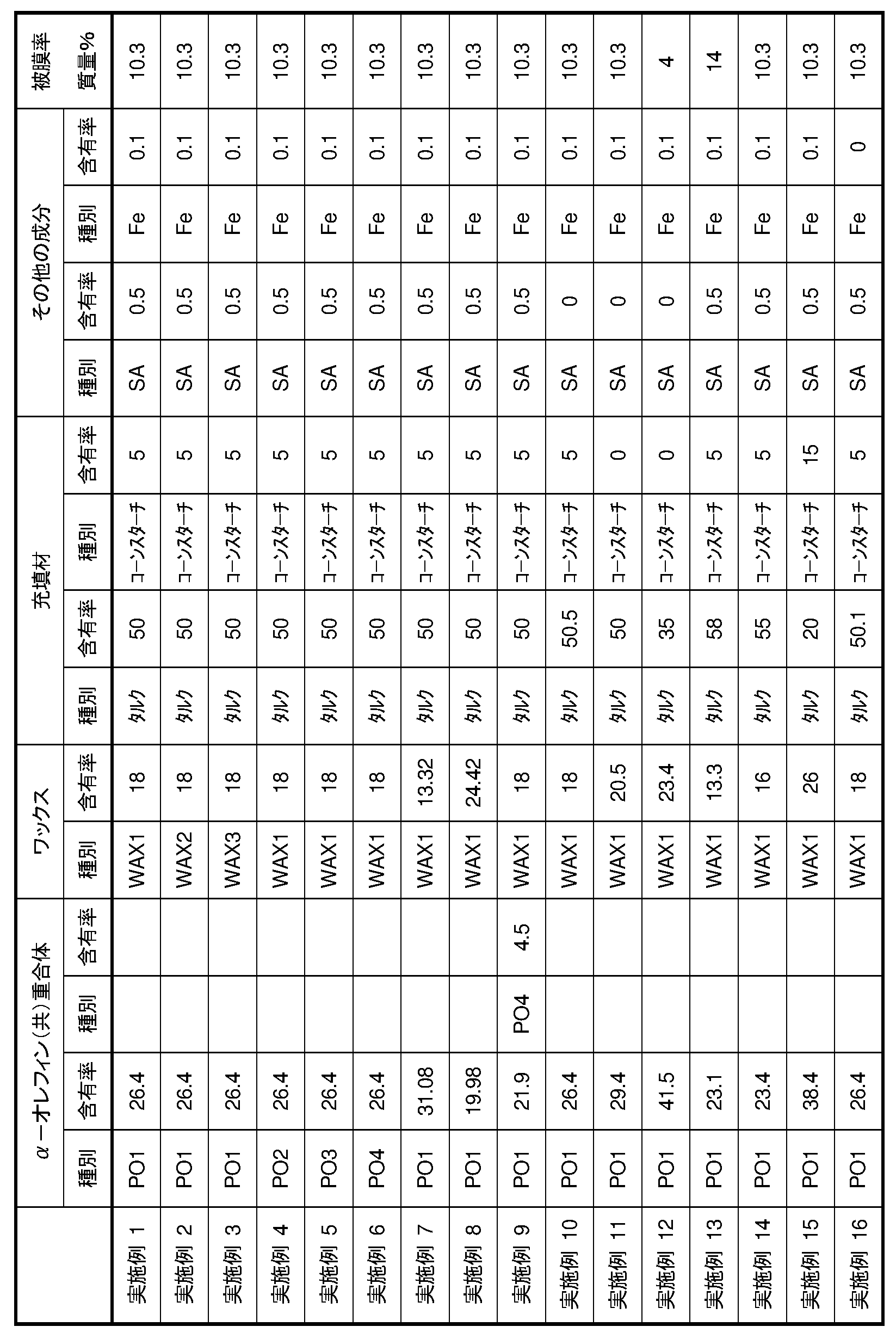
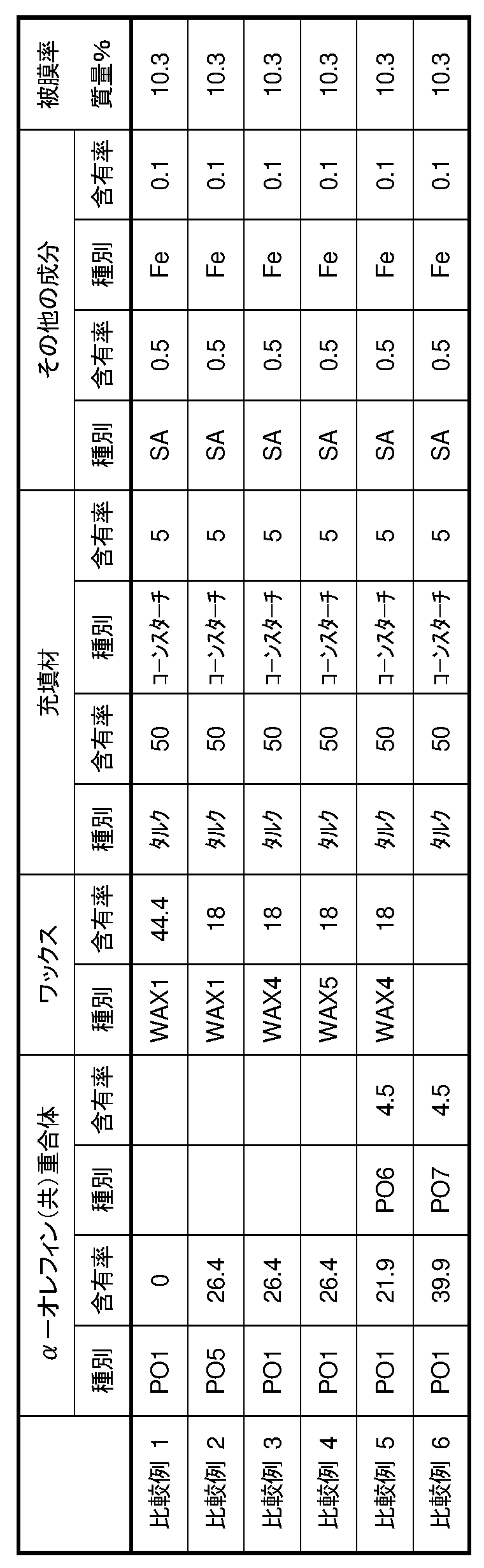
- Examples 1 to 16, Comparative Examples 1 to 6 According to the coating material composition (unit: mass%) and coating mass (mass of coating film with respect to granular fertilizer to be coated) shown in Table 2, coated granular fertilizer was produced using the above production apparatus. As a result, in Examples 1 to 16 and Comparative Examples 1, 3, 5, and 6, there was no problem in manufacturability, and a coated granular fertilizer was obtained. No fertilizer was obtained. Therefore, the following characteristic evaluation was performed using only the coated granular fertilizers obtained in Examples 1 to 16 and Comparative Examples 1, 3, 5, and 6.
- the coated cross section of the coated granular fertilizer of Comparative Example 1 was only WAX1.
- phase separation between PO1 and WAX4 was not observed, and WAX4 was not finely dispersed.
- phase separation of PO1, PO6, and WAX4 was not observed, and PO6 and WAX4 were not finely dispersed.
- no phase separation between PO1 and PO7 was observed, and the structure in which PO7 was finely dispersed was not obtained.
- Example 3A to 3D show TEM images of the cross-sections of the coated granular fertilizers of Example 1, Comparative Example 3, Comparative Example 5 and Comparative Example 6, respectively.
- Example 1 (a), WAX1 is seen as a white circular contrast and is finely dispersed in the matrix (lamellar structure) of PO1.
- Comparative Example 3 Comparative Example 5 and Comparative Example 6 (b, c, d), no phase separation was observed, and only the polyolefin lamella was observed in the image.
- the total nitrogen was measured to calculate the elution rate of each coated granular fertilizer.
- a value obtained by subtracting the dissolution rate of the coated granular fertilizer before the test from the dissolution rate of the coated granular fertilizer after the spreader test was determined to have a coating strength of 10% or less.
- Floating rate after 1 year Number of recovered particles in the first year / Number of fertilized grains per batch x 100
- the field was scratched, the particles that floated were collected, and the 2nd year flying rate was calculated from the following formula.
- Floating rate after 2 years Number of recovered particles in 2nd year / Number of fertilized grains per batch x 100
- Jet tower 2.
- Circulating air flow piping5. 5.
- Mixing supply pipe for coating 6.
- Solid-gas separator Condenser 8.
- Blower 9 Coating mixture preparation tank (dissolution tank) 10.
- Liquid feed pump 11. Rectification can 12.
- Heater 13.
- Granular fertilizer outlet 14.
- Guide tube 15.
Landscapes
- Life Sciences & Earth Sciences (AREA)
- Pest Control & Pesticides (AREA)
- Chemical & Material Sciences (AREA)
- Organic Chemistry (AREA)
- Fertilizers (AREA)
- Glanulating (AREA)
Abstract
Description
天然ワックス(たとえば、キャンデリラワックス、カルナウバワックス、ライスワックス、木ロウ、ホホバ油(水添)などの植物系ワックス;密ロウ、ラノリン(水添)、鯨ロウなどの動物系ワックス;モンタンワックス、オゾケライト、セレシンなどの鉱物系ワックス;パラフィンワックス(C40, C42)、マイクロクリスタリンワックス、ペトロラクタム(軟質、硬質)などの石油ワックス)、
合成ワックス(たとえば、フィッシャー・トロプシュワックス、ポリエチレンワックスなどの合成炭化水素;モンタンワックス誘導体、パラフィンワックス誘導体、マイクロクリスタリンワックス誘導体などの変性ワックス;硬化ヒマシ油(カスターワックス)、硬化ヒマシ油誘導体などの水素化ワックス;12-ヒドロキシステアリン酸、12-ヒドロキシステアリン酸アミド系、12-ヒドロキシステアリン酸エステル系、塩素化炭化水素などの脂肪酸、脂肪酸アミドもしくはエステル、ケトン他)、
飽和脂肪酸(たとえば、カプリル酸、カプリン酸、ラウリン酸、ミリスチン酸、パルミチン酸、ステアリン酸、アラキジン酸、ベヘン酸、リグノセリン酸など)
が含まれる。
円形度係数={(4π×粒子の投影面積)/(粒子投影図の輪郭の長さ)2}
PO1:低密度ポリエチレン 商品名「サンテック-LD M2270」 (旭化成ケミカルズ社製)
PO2:低密度ポリエチレン 商品名「サンテック-LD M2203」 (旭化成ケミカルズ社製)
PO3:低密度ポリエチレン 商品名「サンテック-LD M2504」 (旭化成ケミカルズ社製)
PO4:直鎖状低密度ポリエチレン 商品名「ノバテック-LL UF331」 (日本ポリエチレン社製)
PO5:高密度ポリエチレン 商品名「サンテック-HD J300」 (旭化成ケミカルズ社製)
PO6:エチレン・1-オクテン共重合体 商品名「エンゲージ8150」 (ダウ・ケミカル日本社製)
PO7:エチレン-酢酸ビニル共重合体 商品名「エバフレックス360」 (三井デュポンケミカル社製)
WAX1:カスターワックス 商品名「カスターワックス #100」 (小倉合成工業社製)
WAX2:カスターワックス 商品名「カスターワックスAフレーク」 (日油社製)
WAX3:リグノセリン酸 商品名「試薬 テトラコサン酸」 (関東化学社製)
WAX4:ポリエチレンワックス 商品名 「CPアドワックス CPW90F」 (日祥社製)
WAX5:マイクロクリスタリンワックス「ポリレッツ MPS-75」 (中国精油社製)

タルク:平均粒径10μm
コーンスターチ:粒径12~18μm
SA:ヘキサオキシエチレンノニルフェニルエーテル(界面活性剤)
Fe:ステアリン酸鉄(III)(キシダ化学社製、試薬グレード、純度99%以上)(光分解促進剤)
実施例及び比較例で用いた被覆粒状肥料の製造装置1の構成は、図1のフローシートと同様であり、噴流塔1は塔径(内径)1,300mm、高さ8,500mm、円錘角50度の形状を有し、粒状肥料投入口15及び被覆粒状肥料排出口13を有する。噴霧ノズル2はフルコン型一流体スプレーノズル、3は粒状肥料(芯材)である。6は固気分離器、7は凝縮器である。8はブロワー(ルーツ型)、12はヒーターである。9は攪拌機付の被覆用混合物調製槽(溶解槽)であり、10は送液ポンプ(ダイヤフラム型)である。14はガイド管(直径300mm、長さ1,760mm、フッ素樹脂被覆品)、11は整流缶である。21は絞り円盤である。
上記の製造装置を用いて次の方法により、被覆粒状肥料を製造した。熱せられた気流が噴流塔1の下部から上部に向けて流れ、固気分離器6を通過し、凝縮器7で気流を冷却し、有機溶媒を凝縮回収する。凝縮器7を通過した気流はブロワー8からヒーター12を通過して加熱され高温気流として再度噴流塔1へ導かれるように循環している。まず、ブロワー8を用いて、噴出孔23での気流温度150℃に保持した空気を噴流塔1に送りながら、粒状肥料(芯材)3を粒状肥料投入口15から投入し、粒状肥料3を噴流状態にする。この際、粒状肥料温度が65±2℃になるように、熱せられた気流の流量及び温度を調節した。気流の流量はブロワー8と整流缶11の間に設置した流量計で測定しながら調節し、熱せられた気流の温度は、粒状肥料温度や噴流塔出口温度を測定しながら調節した。循環風量は3,000m3/hであり、粒状肥料投入量は1,000kgである。
表2に示した被膜材料組成(単位は質量%)および被膜質量(被覆される粒状肥料に対する被膜の質量)に従って、上記製造装置を用いて被覆粒状肥料を製造した。その結果、実施例1~16および比較例1,3,5,6については製造性に問題がなく被覆粒状肥料が得られたが、比較例2および4については製造性に問題があり被覆粒状肥料が得られなかった。したがって、以下の特性評価は、実施例1~16および比較例1,3,5,6で得られた被覆粒状肥料のみを用いて行った。
(I)被膜の構造観察
前記実施例および比較例で得られた各被覆粒状肥料について、下記の装置にて被膜断面の構造を観察した。
装置:TEM HITACHI H-7100
条件:125kv
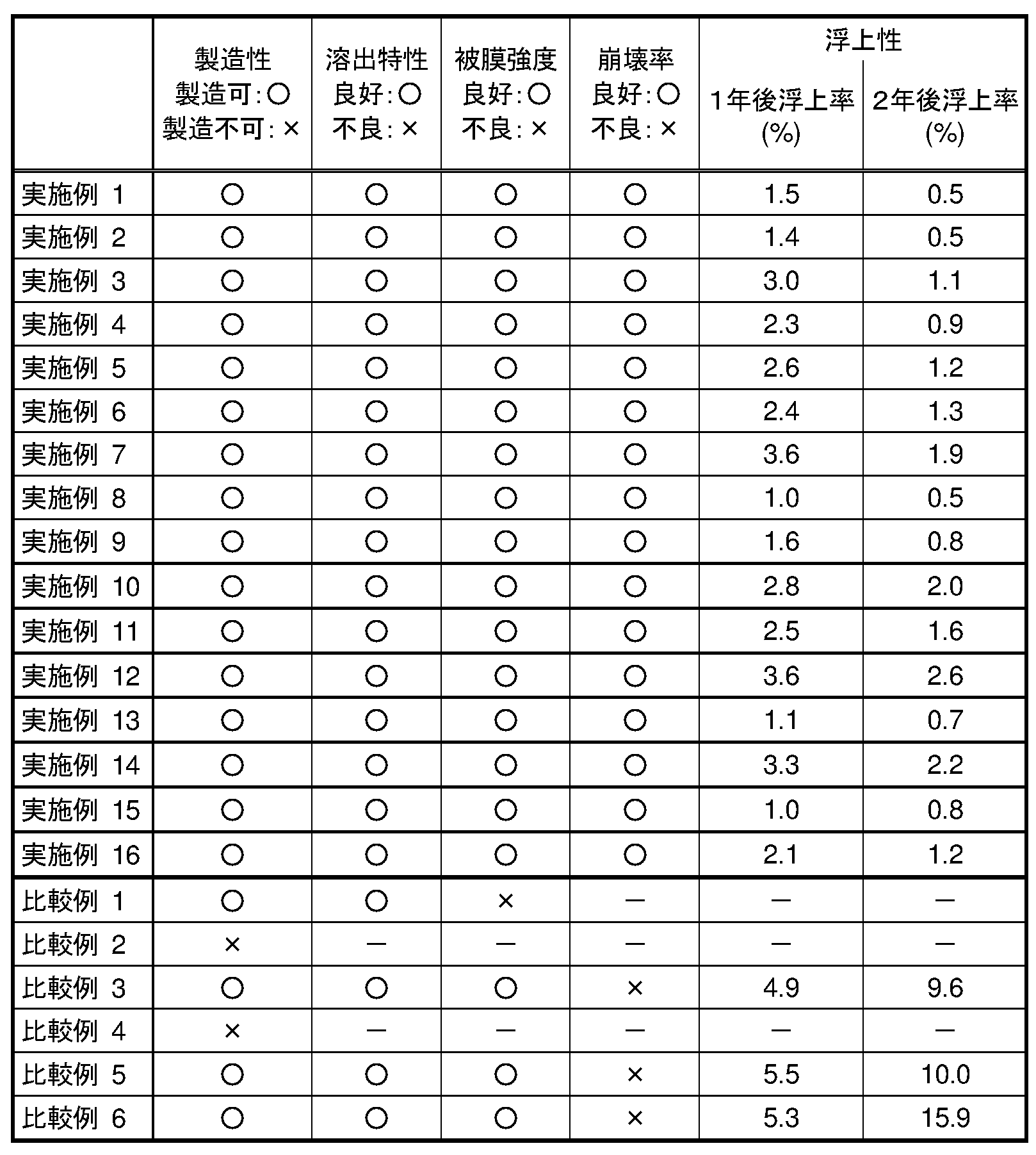
前記実施例および比較例で得られた各被覆粒状肥料5gをポリエチレン製の溶出瓶に入れ、200mlの蒸留水を満たして密栓した。この溶出瓶を25℃のインキュベーターに保存し、7日間経過後に蒸留水に溶けだした全窒素を測定した。被覆粒状肥料の溶出率は、もとの被覆粒状肥料に含まれていた全窒素に対する溶出してきた全窒素の百分率で表示する。上記方法にて得られた溶出率が10%以下のものを溶出特性が良好であると判定した。
背負い型動力散布機(丸山製作所、MDJ60GTS-26)を使用し、エンジンスロットル4、シャッター開度7の条件で、前記実施例および比較例で得られた各被覆粒状肥料500gを噴管先端から吐出散布し、散布された被覆粒状肥料を回収した。試験前の被覆粒状肥料20gと散布機から回収した被覆粒状肥料20gを各々、蒸留水400mlと共にポリエチレン製の溶出瓶に仕込み、25℃のインキュベーターで保管した。10日後に、各々の溶出瓶をインキュベーターから抜き出し、試料液を採取した後、全窒素の測定を行って各々の被覆粒状肥料の溶出率を算出した。散布機試験後の被覆粒状肥料の溶出率から、試験前の被覆粒状肥料の溶出率を差し引いた値が10%以下のものを被膜強度が良好であると判定した。
前記実施例および比較例で得られた各被覆粒状肥料を水中に投入し、肥料成分を溶出させた後、45℃に設定した通風乾燥機内にて1ヶ月間乾燥した。得られた中空の被覆粒子を図3に示すように、300rpmで攪拌中の海砂(20~35メッシュ)に各25粒投入し、5分後に該粒子を回収し、下記式から崩壊率を算出した。
崩壊率=(投入粒子数-回収粒子数)/投入粒子数×100
算出された崩壊率が70%以上を良好とし、70%未満を不良と判定した。
静岡県裾野市岩波区にある圃場にて、前記実施例および比較例で得られた各被覆粒状肥料を用いた水稲栽培を2年連続で実施した。施肥は初年度1回、翌年1回の合計2回実施した。
1年後浮上率=1年目回収粒子数/1回分の施肥粒数×100
2年経過後、圃場の代掻きを実施し、浮上した粒子を回収し、下記式から2年目浮上率を算出した。
2年後浮上率=2年目回収粒子数/1回分の施肥粒数×100
2.噴霧ノズル
3.粒状肥料(芯材)
4.循環気流配管
5.被覆用混合物供給配管
6.固気分離器
7.凝縮器
8.ブロワー
9.被覆用混合物調製槽(溶解槽)
10.送液ポンプ
11.整流缶
12.ヒーター
13.粒状肥料排出口
14.ガイド管
15.粒状肥料投入口
21.絞り円盤
22.円盤主体
23.噴出孔
Claims (4)
- 結晶化温度(Tcmax)が95℃≦Tcmax≦115℃の範囲内である1種以上のα-オレフィン(共)重合体(A)と、結晶化温度が65℃≦Tcmax≦75℃の範囲内である1種以上のワックス(B)と、1種以上のフィラー(C)とを含有する被膜で被覆された粒状肥料であって、肥料被膜のミクロ構造において、α-オレフィン(共)重合体(A)とワックス(B)が相分離し、ワックス(B)が微分散した構造となっている事を特徴とする被覆粒状肥料。
- 結晶化温度が65℃≦Tcmax≦75℃の範囲内であるワックス(B)が硬化油または固形脂肪酸である、請求項1に記載の被覆粒状肥料。
- 被膜中のワックス(B)が、α-オレフィン(共)重合体(A)とワックス(B)の合計質量に対し20~60質量%含有されている、請求項1または2に記載の被覆粒状肥料。
- 結晶化温度(Tcmax)が95℃≦Tcmax≦115℃の範囲内である1種以上のα-オレフィン(共)重合体(A)と、結晶化温度が65℃≦Tcmax≦75℃の範囲内である1種以上のワックス(B)と、1種以上のフィラー(C)とを含有する分散液もしくは溶液または溶融液を、噴流塔方式または流動層方式の装置で、流動状態の粒状肥料に噴霧状で供給することにより粒状肥料の表面に被膜を形成させる工程を含む製造方法によって得られた、請求項1~3のいずれかに記載の被覆粒状肥料。
Priority Applications (3)
| Application Number | Priority Date | Filing Date | Title |
|---|---|---|---|
| JP2013512338A JP5871912B2 (ja) | 2011-04-25 | 2012-04-23 | 崩壊性被膜で被覆された被覆粒状肥料 |
| KR1020137028016A KR101545799B1 (ko) | 2011-04-25 | 2012-04-23 | 붕괴성 피막으로 피복된 피복 입상 비료 |
| CN201280018168.4A CN103619781B (zh) | 2011-04-25 | 2012-04-23 | 由崩解性被膜被覆的被覆粒状肥料 |
Applications Claiming Priority (2)
| Application Number | Priority Date | Filing Date | Title |
|---|---|---|---|
| JP2011-097198 | 2011-04-25 | ||
| JP2011097198 | 2011-04-25 |
Publications (1)
| Publication Number | Publication Date |
|---|---|
| WO2012147668A1 true WO2012147668A1 (ja) | 2012-11-01 |
Family
ID=47072188
Family Applications (1)
| Application Number | Title | Priority Date | Filing Date |
|---|---|---|---|
| PCT/JP2012/060810 Ceased WO2012147668A1 (ja) | 2011-04-25 | 2012-04-23 | 崩壊性被膜で被覆された被覆粒状肥料 |
Country Status (4)
| Country | Link |
|---|---|
| JP (1) | JP5871912B2 (ja) |
| KR (1) | KR101545799B1 (ja) |
| CN (1) | CN103619781B (ja) |
| WO (1) | WO2012147668A1 (ja) |
Cited By (9)
| Publication number | Priority date | Publication date | Assignee | Title |
|---|---|---|---|---|
| JP2019089677A (ja) * | 2017-11-16 | 2019-06-13 | ジェイカムアグリ株式会社 | 被覆粒状肥料および被覆粒状肥料を用いる施肥方法 |
| CN112028694A (zh) * | 2020-09-21 | 2020-12-04 | 河南鄂中肥业有限公司 | 一种具有壮苗促根作用的大蒜专用复合微生物肥料及其制备方法 |
| WO2022036035A1 (en) * | 2020-08-12 | 2022-02-17 | The Mosaic Company | Coating containing micronutrients for fertilizer granules |
| US11427514B2 (en) | 2017-12-14 | 2022-08-30 | Lg Chem, Ltd. | Controlled-release fertilizers |
| WO2024225300A1 (ja) | 2023-04-28 | 2024-10-31 | セントラル硝子株式会社 | 被覆肥料 |
| WO2025094959A1 (ja) * | 2023-10-31 | 2025-05-08 | 住友化学株式会社 | 被覆粒状肥料および被覆粒状肥料の製造方法 |
| US12428303B2 (en) | 2021-05-04 | 2025-09-30 | TMTP Labs, Inc. | Apparatus and method for exfoliating graphite |
| WO2025249305A1 (ja) * | 2024-05-27 | 2025-12-04 | 住友化学株式会社 | 被覆粒状肥料および被覆粒状肥料の製造方法 |
| WO2026009632A1 (ja) * | 2024-07-01 | 2026-01-08 | ジェイカムアグリ株式会社 | 被覆粒状肥料およびその製造方法 |
Families Citing this family (4)
| Publication number | Priority date | Publication date | Assignee | Title |
|---|---|---|---|---|
| CN105819940B (zh) * | 2015-01-04 | 2020-11-03 | 湖北世纪开源化工科技有限公司 | 用脂肪酸黑脚制备的包膜材料及在缓/控释肥料中的应用 |
| CN106396897A (zh) * | 2016-08-30 | 2017-02-15 | 贵州开磷集团股份有限公司 | 一种高粱专用控释肥的制备方法 |
| KR102113261B1 (ko) * | 2018-03-28 | 2020-05-20 | 주식회사 엘지화학 | 용출 제어형 비료 |
| KR102828842B1 (ko) | 2024-09-24 | 2025-07-02 | 송위준 | 입상비료용 착색제 조성물 및 이를 포함하는 착색된 입상비료 |
Citations (5)
| Publication number | Priority date | Publication date | Assignee | Title |
|---|---|---|---|---|
| JPS62197385A (ja) * | 1986-02-20 | 1987-09-01 | 旭化成株式会社 | 被覆粒状肥料 |
| JP2001031489A (ja) * | 1999-07-16 | 2001-02-06 | Asahi Chem Ind Co Ltd | 浮上防止性に優れた分解性被膜被覆肥料 |
| JP2002145691A (ja) * | 2000-06-23 | 2002-05-22 | Ube Ind Ltd | 生分解性被膜で被覆された粒状肥料 |
| JP2006111521A (ja) * | 2004-09-14 | 2006-04-27 | Chisso Corp | 被覆粒状肥料及びその製造方法 |
| JP2008001550A (ja) * | 2006-06-21 | 2008-01-10 | Chisso Asahi Hiryo Kk | 被覆粒状肥料 |
Family Cites Families (12)
| Publication number | Priority date | Publication date | Assignee | Title |
|---|---|---|---|---|
| NZ221198A (en) * | 1986-08-05 | 1990-09-26 | Chisso Corp | Granular fertiliser with poly-3-hydrox-3-alkylpropionic acid coating |
| US5466274A (en) * | 1991-02-14 | 1995-11-14 | Oms Investments, Inc. | Abrasion resistant coatings for fertilizers |
| JPH10231190A (ja) * | 1997-02-20 | 1998-09-02 | Asahi Chem Ind Co Ltd | 被覆肥料とその製造方法 |
| JP2000044377A (ja) * | 1998-05-22 | 2000-02-15 | Sumitomo Chem Co Ltd | 粒状被覆肥料およびその製造方法 |
| MY120571A (en) * | 1998-05-22 | 2005-11-30 | Sumitomo Chemical Co | Granular coated fertilizer and method for producing the same |
| JPH11335193A (ja) * | 1998-05-25 | 1999-12-07 | Asahi Chem Ind Co Ltd | 分解性を有する被覆粒状肥料 |
| JP2000302585A (ja) * | 1999-04-13 | 2000-10-31 | Asahi Chem Ind Co Ltd | 分解性被膜を有する被覆粒状肥料 |
| JP4804632B2 (ja) * | 2001-02-06 | 2011-11-02 | ジェイカムアグリ株式会社 | 被膜分解性のシグモイド溶出型被覆粒状肥料 |
| CN100572335C (zh) * | 2004-09-14 | 2009-12-23 | 智索旭肥科株式会社 | 包覆粒状肥料及其制造方法 |
| JP5068926B2 (ja) * | 2004-09-24 | 2012-11-07 | サンアグロ株式会社 | 安定化された硫黄コーティング肥料の製造方法 |
| JP4864466B2 (ja) * | 2005-01-14 | 2012-02-01 | ジェイカムアグリ株式会社 | 移植用苗床 |
| CN101289350B (zh) * | 2008-05-30 | 2012-10-24 | 山东金正大生态工程股份有限公司 | 水溶性醇酸树脂-蜡复合包膜控释肥料及其制备方法 |
-
2012
- 2012-04-23 KR KR1020137028016A patent/KR101545799B1/ko active Active
- 2012-04-23 WO PCT/JP2012/060810 patent/WO2012147668A1/ja not_active Ceased
- 2012-04-23 JP JP2013512338A patent/JP5871912B2/ja active Active
- 2012-04-23 CN CN201280018168.4A patent/CN103619781B/zh active Active
Patent Citations (5)
| Publication number | Priority date | Publication date | Assignee | Title |
|---|---|---|---|---|
| JPS62197385A (ja) * | 1986-02-20 | 1987-09-01 | 旭化成株式会社 | 被覆粒状肥料 |
| JP2001031489A (ja) * | 1999-07-16 | 2001-02-06 | Asahi Chem Ind Co Ltd | 浮上防止性に優れた分解性被膜被覆肥料 |
| JP2002145691A (ja) * | 2000-06-23 | 2002-05-22 | Ube Ind Ltd | 生分解性被膜で被覆された粒状肥料 |
| JP2006111521A (ja) * | 2004-09-14 | 2006-04-27 | Chisso Corp | 被覆粒状肥料及びその製造方法 |
| JP2008001550A (ja) * | 2006-06-21 | 2008-01-10 | Chisso Asahi Hiryo Kk | 被覆粒状肥料 |
Cited By (11)
| Publication number | Priority date | Publication date | Assignee | Title |
|---|---|---|---|---|
| JP2019089677A (ja) * | 2017-11-16 | 2019-06-13 | ジェイカムアグリ株式会社 | 被覆粒状肥料および被覆粒状肥料を用いる施肥方法 |
| US11427514B2 (en) | 2017-12-14 | 2022-08-30 | Lg Chem, Ltd. | Controlled-release fertilizers |
| WO2022036035A1 (en) * | 2020-08-12 | 2022-02-17 | The Mosaic Company | Coating containing micronutrients for fertilizer granules |
| JP2023538540A (ja) * | 2020-08-12 | 2023-09-08 | ザ・モザイク・カンパニー | 肥料顆粒用の微量栄養素を含むコーティング |
| CN112028694A (zh) * | 2020-09-21 | 2020-12-04 | 河南鄂中肥业有限公司 | 一种具有壮苗促根作用的大蒜专用复合微生物肥料及其制备方法 |
| US12428303B2 (en) | 2021-05-04 | 2025-09-30 | TMTP Labs, Inc. | Apparatus and method for exfoliating graphite |
| WO2024225300A1 (ja) | 2023-04-28 | 2024-10-31 | セントラル硝子株式会社 | 被覆肥料 |
| EP4703339A1 (en) | 2023-04-28 | 2026-03-04 | Central Glass Company, Limited | Coated fertilizer |
| WO2025094959A1 (ja) * | 2023-10-31 | 2025-05-08 | 住友化学株式会社 | 被覆粒状肥料および被覆粒状肥料の製造方法 |
| WO2025249305A1 (ja) * | 2024-05-27 | 2025-12-04 | 住友化学株式会社 | 被覆粒状肥料および被覆粒状肥料の製造方法 |
| WO2026009632A1 (ja) * | 2024-07-01 | 2026-01-08 | ジェイカムアグリ株式会社 | 被覆粒状肥料およびその製造方法 |
Also Published As
| Publication number | Publication date |
|---|---|
| JPWO2012147668A1 (ja) | 2014-07-28 |
| JP5871912B2 (ja) | 2016-03-01 |
| KR101545799B1 (ko) | 2015-08-19 |
| CN103619781A (zh) | 2014-03-05 |
| KR20130133895A (ko) | 2013-12-09 |
| CN103619781B (zh) | 2015-09-16 |
Similar Documents
| Publication | Publication Date | Title |
|---|---|---|
| JP5871912B2 (ja) | 崩壊性被膜で被覆された被覆粒状肥料 | |
| AU727823B2 (en) | Granular fertilizer coated with degradable film and method for producing the same | |
| JP3467978B2 (ja) | 崩壊型被覆粒状肥料 | |
| JP4212677B2 (ja) | 分解性被膜被覆粒状肥料およびその製造方法 | |
| TWI711598B (zh) | 控制釋放型肥料 | |
| JP7788229B2 (ja) | 被覆粒状肥料、配合肥料、その配合肥料を用いる植物の栽培方法 | |
| WO2026009632A1 (ja) | 被覆粒状肥料およびその製造方法 | |
| JP5116220B2 (ja) | 被覆粒状肥料及びその製造方法 | |
| US11370719B2 (en) | Controlled-release type fertilizer with decreased floating property comprising tri-block copolymer and method for preparing the same | |
| JP4804632B2 (ja) | 被膜分解性のシグモイド溶出型被覆粒状肥料 | |
| JP4014699B2 (ja) | 被覆粒状肥料 | |
| JP6929591B2 (ja) | 溶出制御型肥料 | |
| JPH11130576A (ja) | 分解性を有する被覆粒状肥料 | |
| JP7146331B2 (ja) | 溶出制御型肥料 | |
| JP2017137478A (ja) | 複合凝集樹脂粒子群、並びに該粒子群の製造方法および該粒子群を含有する組成物 | |
| TW202535803A (zh) | 被覆粒狀肥料及被覆粒狀肥料之製造方法 | |
| JPH10291880A (ja) | 分解性被膜被覆粒状肥料とその製造方法 | |
| KR20200031471A (ko) | 용출제어형 비료를 위한 광분해성 캡슐 및 이를 포함하는 용출제어형 비료 | |
| JPH11335193A (ja) | 分解性を有する被覆粒状肥料 | |
| WO2019190103A1 (ko) | 용출 제어형 비료 | |
| AU2018332471A1 (en) | A controlled-release type fertilizer with decreased floating property comprising polyoxyethylene alky(-aryl) ether and method for preparing the same | |
| JP2000239090A (ja) | 被膜分解性の被覆粒状肥料 | |
| JPH11322479A (ja) | 被覆粒状肥料 |
Legal Events
| Date | Code | Title | Description |
|---|---|---|---|
| 121 | Ep: the epo has been informed by wipo that ep was designated in this application |
Ref document number: 12777685 Country of ref document: EP Kind code of ref document: A1 |
|
| ENP | Entry into the national phase |
Ref document number: 2013512338 Country of ref document: JP Kind code of ref document: A |
|
| ENP | Entry into the national phase |
Ref document number: 20137028016 Country of ref document: KR Kind code of ref document: A |
|
| NENP | Non-entry into the national phase |
Ref country code: DE |
|
| 122 | Ep: pct application non-entry in european phase |
Ref document number: 12777685 Country of ref document: EP Kind code of ref document: A1 |