WO2012133824A1 - 保水助剤ならびにそれを含む吸収材、吸収体及び吸収性物品 - Google Patents
保水助剤ならびにそれを含む吸収材、吸収体及び吸収性物品 Download PDFInfo
- Publication number
- WO2012133824A1 WO2012133824A1 PCT/JP2012/058686 JP2012058686W WO2012133824A1 WO 2012133824 A1 WO2012133824 A1 WO 2012133824A1 JP 2012058686 W JP2012058686 W JP 2012058686W WO 2012133824 A1 WO2012133824 A1 WO 2012133824A1
- Authority
- WO
- WIPO (PCT)
- Prior art keywords
- water
- water retention
- absorbent
- retention aid
- polysaccharide
- Prior art date
- Legal status (The legal status is an assumption and is not a legal conclusion. Google has not performed a legal analysis and makes no representation as to the accuracy of the status listed.)
- Ceased
Links
Images


Classifications
-
- A—HUMAN NECESSITIES
- A61—MEDICAL OR VETERINARY SCIENCE; HYGIENE
- A61F—FILTERS IMPLANTABLE INTO BLOOD VESSELS; PROSTHESES; DEVICES PROVIDING PATENCY TO, OR PREVENTING COLLAPSING OF, TUBULAR STRUCTURES OF THE BODY, e.g. STENTS; ORTHOPAEDIC, NURSING OR CONTRACEPTIVE DEVICES; FOMENTATION; TREATMENT OR PROTECTION OF EYES OR EARS; BANDAGES, DRESSINGS OR ABSORBENT PADS; FIRST-AID KITS
- A61F13/00—Bandages or dressings; Absorbent pads
- A61F13/15—Absorbent pads, e.g. sanitary towels, swabs or tampons for external or internal application to the body; Supporting or fastening means therefor; Tampon applicators
- A61F13/53—Absorbent pads, e.g. sanitary towels, swabs or tampons for external or internal application to the body; Supporting or fastening means therefor; Tampon applicators characterised by the absorbing medium
- A61F13/534—Absorbent pads, e.g. sanitary towels, swabs or tampons for external or internal application to the body; Supporting or fastening means therefor; Tampon applicators characterised by the absorbing medium having an inhomogeneous composition through the thickness of the pad
- A61F13/537—Absorbent pads, e.g. sanitary towels, swabs or tampons for external or internal application to the body; Supporting or fastening means therefor; Tampon applicators characterised by the absorbing medium having an inhomogeneous composition through the thickness of the pad characterised by a layer facilitating or inhibiting flow in one direction or plane, e.g. a wicking layer
-
- A—HUMAN NECESSITIES
- A61—MEDICAL OR VETERINARY SCIENCE; HYGIENE
- A61F—FILTERS IMPLANTABLE INTO BLOOD VESSELS; PROSTHESES; DEVICES PROVIDING PATENCY TO, OR PREVENTING COLLAPSING OF, TUBULAR STRUCTURES OF THE BODY, e.g. STENTS; ORTHOPAEDIC, NURSING OR CONTRACEPTIVE DEVICES; FOMENTATION; TREATMENT OR PROTECTION OF EYES OR EARS; BANDAGES, DRESSINGS OR ABSORBENT PADS; FIRST-AID KITS
- A61F13/00—Bandages or dressings; Absorbent pads
- A61F13/15—Absorbent pads, e.g. sanitary towels, swabs or tampons for external or internal application to the body; Supporting or fastening means therefor; Tampon applicators
- A61F13/53—Absorbent pads, e.g. sanitary towels, swabs or tampons for external or internal application to the body; Supporting or fastening means therefor; Tampon applicators characterised by the absorbing medium
-
- A—HUMAN NECESSITIES
- A61—MEDICAL OR VETERINARY SCIENCE; HYGIENE
- A61F—FILTERS IMPLANTABLE INTO BLOOD VESSELS; PROSTHESES; DEVICES PROVIDING PATENCY TO, OR PREVENTING COLLAPSING OF, TUBULAR STRUCTURES OF THE BODY, e.g. STENTS; ORTHOPAEDIC, NURSING OR CONTRACEPTIVE DEVICES; FOMENTATION; TREATMENT OR PROTECTION OF EYES OR EARS; BANDAGES, DRESSINGS OR ABSORBENT PADS; FIRST-AID KITS
- A61F13/00—Bandages or dressings; Absorbent pads
- A61F13/15—Absorbent pads, e.g. sanitary towels, swabs or tampons for external or internal application to the body; Supporting or fastening means therefor; Tampon applicators
- A61F13/84—Accessories, not otherwise provided for, for absorbent pads
- A61F13/8405—Additives, e.g. for odour, disinfectant or pH control
-
- A—HUMAN NECESSITIES
- A61—MEDICAL OR VETERINARY SCIENCE; HYGIENE
- A61L—METHODS OR APPARATUS FOR STERILISING MATERIALS OR OBJECTS IN GENERAL; DISINFECTION, STERILISATION OR DEODORISATION OF AIR; CHEMICAL ASPECTS OF BANDAGES, DRESSINGS, ABSORBENT PADS OR SURGICAL ARTICLES; MATERIALS FOR BANDAGES, DRESSINGS, ABSORBENT PADS OR SURGICAL ARTICLES
- A61L15/00—Chemical aspects of, or use of materials for, bandages, dressings or absorbent pads
- A61L15/16—Bandages, dressings or absorbent pads for physiological fluids such as urine or blood, e.g. sanitary towels, tampons
- A61L15/22—Bandages, dressings or absorbent pads for physiological fluids such as urine or blood, e.g. sanitary towels, tampons containing macromolecular materials
- A61L15/225—Mixtures of macromolecular compounds
-
- A—HUMAN NECESSITIES
- A61—MEDICAL OR VETERINARY SCIENCE; HYGIENE
- A61L—METHODS OR APPARATUS FOR STERILISING MATERIALS OR OBJECTS IN GENERAL; DISINFECTION, STERILISATION OR DEODORISATION OF AIR; CHEMICAL ASPECTS OF BANDAGES, DRESSINGS, ABSORBENT PADS OR SURGICAL ARTICLES; MATERIALS FOR BANDAGES, DRESSINGS, ABSORBENT PADS OR SURGICAL ARTICLES
- A61L15/00—Chemical aspects of, or use of materials for, bandages, dressings or absorbent pads
- A61L15/16—Bandages, dressings or absorbent pads for physiological fluids such as urine or blood, e.g. sanitary towels, tampons
- A61L15/42—Use of materials characterised by their function or physical properties
- A61L15/60—Liquid-swellable gel-forming materials, e.g. super-absorbents
-
- C—CHEMISTRY; METALLURGY
- C08—ORGANIC MACROMOLECULAR COMPOUNDS; THEIR PREPARATION OR CHEMICAL WORKING-UP; COMPOSITIONS BASED THEREON
- C08L—COMPOSITIONS OF MACROMOLECULAR COMPOUNDS
- C08L1/00—Compositions of cellulose, modified cellulose or cellulose derivatives
- C08L1/02—Cellulose; Modified cellulose
-
- C—CHEMISTRY; METALLURGY
- C08—ORGANIC MACROMOLECULAR COMPOUNDS; THEIR PREPARATION OR CHEMICAL WORKING-UP; COMPOSITIONS BASED THEREON
- C08L—COMPOSITIONS OF MACROMOLECULAR COMPOUNDS
- C08L1/00—Compositions of cellulose, modified cellulose or cellulose derivatives
- C08L1/08—Cellulose derivatives
- C08L1/26—Cellulose ethers
- C08L1/28—Alkyl ethers
-
- C—CHEMISTRY; METALLURGY
- C08—ORGANIC MACROMOLECULAR COMPOUNDS; THEIR PREPARATION OR CHEMICAL WORKING-UP; COMPOSITIONS BASED THEREON
- C08L—COMPOSITIONS OF MACROMOLECULAR COMPOUNDS
- C08L1/00—Compositions of cellulose, modified cellulose or cellulose derivatives
- C08L1/08—Cellulose derivatives
- C08L1/26—Cellulose ethers
- C08L1/28—Alkyl ethers
- C08L1/284—Alkyl ethers with hydroxylated hydrocarbon radicals
-
- C—CHEMISTRY; METALLURGY
- C08—ORGANIC MACROMOLECULAR COMPOUNDS; THEIR PREPARATION OR CHEMICAL WORKING-UP; COMPOSITIONS BASED THEREON
- C08L—COMPOSITIONS OF MACROMOLECULAR COMPOUNDS
- C08L1/00—Compositions of cellulose, modified cellulose or cellulose derivatives
- C08L1/08—Cellulose derivatives
- C08L1/26—Cellulose ethers
- C08L1/28—Alkyl ethers
- C08L1/286—Alkyl ethers substituted with acid radicals, e.g. carboxymethyl cellulose [CMC]
-
- C—CHEMISTRY; METALLURGY
- C08—ORGANIC MACROMOLECULAR COMPOUNDS; THEIR PREPARATION OR CHEMICAL WORKING-UP; COMPOSITIONS BASED THEREON
- C08L—COMPOSITIONS OF MACROMOLECULAR COMPOUNDS
- C08L5/00—Compositions of polysaccharides or of their derivatives not provided for in groups C08L1/00 or C08L3/00
Definitions
- the present invention relates to a novel water retention aid and an absorbent material, absorber and absorbent article containing the same.
- absorbent articles such as disposable paper diapers and sanitary napkins use absorbents for absorbing excrement, body fluids, and the like.
- the absorbent body is generally composed of an absorbent material and a water-permeable member (pulp fiber or the like) that holds the absorbent material.
- a highly water-absorbing polymer is frequently used as the absorbent material.
- the superabsorbent polymer has the ability to absorb and retain water several tens to several thousand times its own weight, but it has sufficient water retention for liquids containing a large amount of ions such as urine. is not. For this reason, in order to raise water retention, the method of using thickeners, such as polysaccharide, together is proposed.
- an absorbent material obtained by mixing these two components with one or two or more substances selected from guar gum, alginate, and xanthan gum as other components Known (Patent Document 1).
- a body fluid that contains a polysaccharide that can thicken in the presence of a polyvalent metal ion, and that the polysaccharide is present in a state where it can be dissolved or dissociated in the water in the body fluid or excreta, or An excrement thickened article is known (Patent Documents 2 and 3).
- JP 52-59651 A JP 2000-201976 JP 2010-148923
- an object of the present invention is to provide a water retention aid capable of exhibiting excellent water retention while suppressing a significant decrease in absorption rate. Furthermore, this invention aims at providing the absorber and absorber which contain the said water retention aid.
- the present invention relates to the following water retention aids and absorbent materials, absorbent bodies and absorbent articles containing the same.
- a water retention aid contained in an absorbent for absorbing a liquid wherein the water retention aid comprises a polysaccharide (excluding a cellulose compound) and a cellulose compound.
- the water retention aid according to Item 1 wherein 3 to 25 parts by weight of a cellulose-based compound is contained per 100 parts by weight of the polysaccharide.
- the water retention aid according to Item 1 wherein the polysaccharide is a water-soluble polysaccharide. 4).
- the water retention aid according to Item 1 wherein the polysaccharide is at least one of guar gum, xanthan gum, glucomannan, carrageenan, locust bean gum, tamarind seed polysaccharide and pullulan. 5.
- Item 2. The water retention aid according to Item 1, wherein the cellulose compound is at least one of hydroxypropylcellulose, ethylcellulose, carboxymethylcellulose, crystalline cellulose, and methylcellulose. 6).
- Item 2. The water retention aid according to Item 1, wherein the particles have an average particle size of 150 to 550 ⁇ m. 7.
- the water retention aid according to Item 1 comprising particles obtained by granulating a raw material powder containing the polysaccharide and the cellulose-based compound. 9. Item 9. The water retention aid according to Item 8, wherein the particle surface is further coated with a surface treatment agent containing a cellulose compound. 10. Item 10. An absorbent material comprising at least the water retention aid according to any one of Items 1 to 9 and a water absorbent material. 11. An absorbent body for absorbing a liquid, wherein a water retention aid containing a polysaccharide (excluding a cellulose compound) and a cellulose compound is held by a water permeable member. 12 Item 12. The absorbent body according to Item 11, wherein the water-absorbing material is held by the water-permeable member. 13.
- Item 13 The absorbent body according to Item 12, comprising 1) a region containing a water retention aid and not containing a water absorbing material, and 2) a region containing no water retention aid and containing a water absorption material.
- a multilayer structure comprising a water retention aid and an absorbent material, wherein 1) a water retention aid and / or a water absorbing material comprising a polysaccharide (excluding a cellulose compound) and a cellulose compound are disposed on a water permeable member.
- Step and 2) An absorbent body comprising a multilayer structure obtained by a method in which a series of steps including a step of laminating one or two or more water-permeable members is performed once or more. 15.
- a multilayer structure comprising a water retention aid and an absorbent material, comprising 1) placing a water retention aid and a water absorbent material comprising a polysaccharide (excluding a cellulose compound) and a cellulose compound on a water permeable member; 2) a step of laminating one or more water-permeable members from above, 3) a step of arranging a water-absorbing material from above, and 4) one or more layers of water-permeable members from above
- An absorber comprising a multilayer structure obtained by a method including a step of laminating and the step of 3) and / or 4) being performed one or more times. 16. Item 16.
- the water retention aid is a granulated product obtained by granulating a raw material powder containing a polysaccharide (excluding a cellulose compound) and a cellulose compound. body. 17.
- Item 18 An absorbent article comprising the absorber according to any one of Items 11 to 17.
- Water retention aids having such characteristics are absorbent articles for absorbing liquids (especially water or liquids using the same, such as body fluids of humans, animals, blood, excrement, secretions, etc.) It is suitable for uses such as disposable paper diapers, sanitary napkins, cloth diaper liners, panty liners, incontinence pads, surgical blood absorbents and the like.
- FIG. 1A and FIG. 1B are schematic views showing a procedure for producing an absorber in the examples.
- Fig.1 (a) shows the state before laminating a water-permeable member from the top.
- FIG.1 (b) shows the state which laminated
- FIGS. 2A and 2B are schematic views showing the layer structure of the multilayer body and the absorber made of the multilayer structure produced in the examples.
- Fig.2 (a) shows the laminated body before pressing.
- FIG.2 (b) shows the absorber obtained by pressing a laminated body.
- FIGS. 3A and 3B are schematic views showing a procedure for producing an absorber in a comparative example.
- FIGS.3 (a) shows the state before laminating a water-permeable member from the top.
- FIG.3 (b) shows the state which laminated
- FIGS. 4A and 4B are schematic views showing the layer structure of a multilayer body and an absorber having a multilayer structure manufactured in a comparative example.
- Fig.4 (a) shows the laminated body before pressing.
- FIG.4 (b) shows the absorber obtained by pressing a laminated body.
- FIGS. 5A and 5B are schematic views showing the layer structure of the multilayer body and the absorber made of the multilayer structure manufactured in the example.
- Fig.5 (a) shows the laminated body before pressing.
- FIG.5 (b) shows the absorber obtained by pressing a laminated body.
- FIGS. 6A and 6B are schematic views showing a layered structure and a layered structure of an absorbent body having a multilayer structure manufactured in a comparative example.
- Fig.6 (a) shows the laminated body before pressing.
- FIG.6 (b) shows the absorber obtained by pressing a laminated body.
- 7A to 7C are schematic views showing specific examples of the planar structure of the absorber of the present invention.
- FIGS. 8A to 8D are schematic views showing a procedure for manufacturing an absorber in the example.
- FIG. 8A shows a state before the water-permeable member is laminated from above.
- FIG.8 (b) shows the state which laminated
- FIG.8 (c) shows the state which sprinkled the superabsorbent polymer particle uniformly on it.
- FIG.8 (d) shows the state which laminated
- FIGS. 9A and 9B are schematic views showing the layer structure of the multilayer structure and the absorber made of the multilayer structure manufactured in the example.
- Fig.9 (a) shows the laminated body before pressing.
- FIG.9 (b) shows the absorber obtained by pressing a laminated body.
- FIGS. 10A (a) to 10 (d) are schematic views showing a procedure for producing an absorber in the example.
- FIG. 10A (a) shows a state before the water-permeable member is laminated from above.
- FIG. 10A (a) shows a state before the water-permeable member is laminated from above.
- FIG. 10A (b) shows a state where water-permeable members are laminated.
- FIG. 10A (c) shows a state in which the laminated water-permeable member is turned over.
- FIG.10 (d) shows the state which sprinkled the absorber equally on it.
- 10B (e) to (g) are continued from FIG. 10A.
- FIG. 10B (e) shows a state in which a water permeable member is laminated thereon after FIG. 10A (d).
- FIG. 10B (f) shows a state in which the absorbent material is evenly sprinkled thereon.
- FIG. 10B (g) shows a state in which a water-permeable member is further laminated thereon.
- FIGS. 11A and 11B are schematic views showing the layer structure of the multilayer body and the absorber made of the multilayer structure manufactured in the example.
- Fig.11 (a) shows the laminated body before pressing.
- FIG.11 (b) shows the absorber obtained by pressing a laminated body.
- 12 (a) to 12 (c) are schematic views showing the layer structure of the multilayer structure produced in the example and the layer structure of the absorbent article.
- Fig.12 (a) shows the laminated body before pressing.
- FIG.12 (b) shows the laminated body after pressing.
- FIG.12 (c) shows the absorbent article obtained by adding a liquid-permeable sheet and a liquid-impermeable sheet to the pressed laminated body.
- FIG.13 (a) shows the laminated body before pressing.
- FIG.13 (b) shows the laminated body after pressing.
- FIG.13 (c) shows the absorbent article obtained by adding a liquid-permeable sheet and a liquid-impermeable sheet to the pressed laminated body.
- Water retention aid and its production (1) Water retention aid
- the water retention aid of the present invention (hereinafter also referred to as “the present water retention aid") is a water retention aid contained in an absorbent for absorbing a liquid.
- the water retention aid contains polysaccharides (excluding cellulose compounds) and cellulose compounds.
- the “polysaccharide” in the present specification means a polysaccharide excluding a cellulosic compound.
- the water retention aid of the present invention contains a polysaccharide and a cellulose compound.
- the ratio of the total amount of the polysaccharide and the cellulose-based compound in the water retention aid of the present invention is not particularly limited, but it is usually preferably 80 to 100% by weight, particularly 95 to 100% by weight.
- the polysaccharide is not limited, and for example, a known or commercially available polysaccharide can be adopted.
- the polysaccharide is particularly preferably a water-soluble polysaccharide.
- the water-soluble in the present invention means that 0.01% by weight or more dissolves in pure water at 20 ° C.
- Such a water-soluble polysaccharide is not limited, but it is preferable to use at least one of guar gum, xanthan gum, glucomannan, carrageenan, locust bean gum, tamarind seed polysaccharide and pullulan. Among these, at least one of guar gum and xanthan gum is particularly preferable.
- the cellulose compound is not particularly limited, and a known or commercially available cellulose compound can be used.
- a known or commercially available cellulose compound can be used.
- at least one of hydroxypropyl cellulose, ethyl cellulose, carboxymethyl cellulose, crystalline cellulose, and methyl cellulose can be suitably used.
- at least one of hydroxypropyl cellulose and ethyl cellulose is more preferable.
- the ratio of the polysaccharide and the cellulose compound in the water retention aid of the present invention can be appropriately set according to the desired water retention, absorption rate, etc., but preferably the cellulose compound 1 with respect to 100 parts by weight of the polysaccharide. 50 to 50 parts by weight, more preferably 3 to 25 parts by weight of a cellulosic compound per 100 parts by weight of polysaccharide. By setting within such a range, the effect of exhibiting excellent water retention can be more reliably obtained while suppressing a significant decrease in absorption rate.
- the form of the water retention aid of the present invention is not particularly limited, but it is generally desirable to provide it in the form of granules (powder).
- the average particle diameter can be appropriately changed, but it is usually about 100 to 700 ⁇ m, preferably 150 to 550 ⁇ m.
- the water retention aid of the present invention preferably contains particles containing a polysaccharide and a cellulose compound. That is, it is desirable to contain particles containing a polysaccharide and a cellulose compound in one particle. By adopting such particles, it is possible to more reliably obtain the effect of exhibiting excellent water retention while suppressing a significant decrease in absorption rate. As such particles, for example, a granulated product obtained by granulating a raw material powder containing a polysaccharide and a cellulose compound can be obtained.
- the water retention aid of the present invention may contain components other than polysaccharides and cellulose compounds within a range that does not greatly hinder the effects of the present invention, if necessary.
- examples thereof include known additives such as antibacterial agents, adsorbents, pH adjusters, stabilizers, anti-inflammatory agents, coloring agents, and fragrances.
- the water retention aid of the present invention is used in an absorber for absorbing liquid.
- it can be suitably used for absorbent articles for absorbing body fluids such as humans and animals, blood, excrement, secretions and the like.
- the method for producing the water retention aid of the present invention is not particularly limited as long as at least the polysaccharide and the cellulose compound can be uniformly mixed.
- a raw material powder containing the polysaccharide and the cellulose compound is used. It can manufacture suitably by granulating.
- the granulation method is not particularly limited, and a known method can be adopted.
- rolling granulation method, stirring granulation method, fluidized bed granulation method, compression molding method, film forming method, magnetic property processing method, surface modification method, sintering molding method, vibration molding method, pressure swing method Any of vacuum forming methods and the like may be used.
- the granulation can be performed using a known or commercially available granulator.
- the granulation can be suitably performed by a rolling granulation method, a stirring granulation method, a fluidized bed granulation method, or the like.
- the granulation may be either a wet method or a dry method, but in the present invention, it can be suitably granulated particularly by a wet method.
- the type of the solvent is not limited, and a polar solvent can be suitably used.
- the amount of the solvent used is usually about 10 to 300 parts by weight with respect to 100 parts by weight of the raw material powder.
- Granulation is preferably controlled so as to have the predetermined average particle diameter. That is, it is usually about 100 to 700 ⁇ m, particularly preferably 150 to 550 ⁇ m. Moreover, after granulation, according to a well-known method, processes, such as drying, classification, coating, etc., can also be implemented as needed.
- the granulated product obtained by the above granulation may be further subjected to a coating treatment.
- the surface of the granulated product of the water retention aid can be coated with a surface treatment agent containing a cellulose compound.
- the effect of controlling the dissolution of the granulated product can be obtained by coating the granulated product with a surface treatment agent containing a cellulose compound.
- the cellulose compound the same ones as described above can be used. Any known method may be used for the coating treatment.
- any of a method of spraying and drying a solution in which a cellulose compound is dissolved in a solvent a method of spraying a solvent to a mixture of a cellulose compound and a water retention aid, and the like may be used.
- a solution in which a cellulose compound is dissolved in a solvent can be suitably coated by a method of spraying and drying a water retention aid. More specifically, a pan coating method, a fluidized bed coating method, a rolling fluidized bed coating method, a stirring rolling fluidized bed coating method, or the like can be used. The coating can be performed using a known or commercially available coating apparatus.
- the amount of the cellulosic compound used for the coating treatment can be set as appropriate, but may be about 1 to 25 parts by weight of the cellulosic compound with respect to 100 parts by weight of the granulated water retention aid. More preferably, the cellulose compound is used in an amount of about 5 to 15 parts by weight per 100 parts by weight of the granulated water retention aid. 2.
- the present invention includes an absorbent material (hereinafter also referred to as “the present invention absorbent material”) comprising the water retention aid of the present invention and a water absorbent material. That is, the absorbent composition containing the water retention aid of the present invention and a water absorbing material is included.
- the present absorbent material includes a water-absorbing material in addition to the present water retention aid.
- a water absorbing polymer can be preferably used.
- a known or commercially available high water absorbing polymer can be suitably used. More specifically, for example, polyacrylate polymer, starch-acrylate graft polymer, vinyl acetate copolymer, maleic anhydride copolymer, polyvinyl alcohol, CMC, and the like can be mentioned. These can generally be used in the form of powder, fine granules, granules, fibers and the like.
- the content ratio of the water retention aid of the present invention and the water-absorbing material can be appropriately set according to the type of the water-absorbing material to be used, the desired water retention, etc.
- the water retention aid of the present invention is preferably 1 to 10 parts by weight, particularly 2.5 to 7.5 parts by weight, and more preferably 3 to 7 parts by weight with respect to 100 parts by weight of the water-absorbing material. Within this range, even better water retention can be obtained while maintaining the desired absorption rate.
- the water retention aid and absorbent material of the present invention may be contained in the absorber in any form.
- it may be a mixed powder of the powder of the water retention aid of the present invention and the powder of the absorbent material, or a granulated product obtained by granulating a material containing the water retention aid of the present invention and the absorbent material. There may be.
- the absorbent material of the present invention may contain additives as described above as needed in addition to the water retention aid and water absorbent material of the present invention.
- the present invention includes an absorbent body in which at least a water retention aid is held (or fixed) on a water permeable member. Therefore, as an absorbent body of the present invention, for example, 1) an absorbent body in which an absorbent material containing a water retention aid and a water absorbent material is held by a water permeable member, and 2) a material containing the water retention aid and a water absorbent material. Any of the absorbers etc. by which the material to contain is separately hold
- Examples of the absorber 1) include those in which a mixture containing a water retention aid and a water absorbing material is held (fixed) on a water permeable member.
- As the absorber of 2) for example, a material containing a water retention aid and a material containing a water absorbing material are held (fixed) to the water permeable member in a state of being separated by the water permeable member or other materials. And the like.
- the porous material may be any material that allows water or a liquid that uses water as a solvent (medium) to pass therethrough.
- a fibrous sheet, a porous polymer sheet, or the like can be suitably used.
- a fibrous sheet any of a nonwoven fabric, a woven fabric, etc. may be sufficient.
- synthetic fibers other than natural fibers, such as fluff pulp can also be used.
- a porous synthetic resin sheet can be used as the porous polymer sheet. These can also use the material currently used by the well-known or commercially available absorber.
- a fluff pulp laminate composed of natural fibers preferably fluff pulp
- the means for retaining the water retention aid and the like is not particularly limited, and the same method as in the case of a known or commercially available absorber can be employed.
- a method of filling the water permeable member of the bag body with a water retention aid a method of filling the pores (gap) of the water permeable member by pressurizing the water retention aid, etc., an adhesive or an adhesive to the water permeable member.
- Examples thereof include a fixing method and a method of forming after mixing a material capable of constituting a water-permeable member and a water retention aid.
- the content of the water retention aid in the absorber can be appropriately changed according to the desired water absorption and the like.
- the ratio to the water-absorbing material is 2. It is preferable to adjust within the range indicated by.
- the structure of the absorbent body of the present invention is not particularly limited, but preferably has a multilayer structure.
- an absorbent body having a multilayer structure including at least one layer made of a water-permeable member and a water retention aid and / or a water-absorbing material held by the member can be suitably used.
- a multilayer structure for example, a multilayer structure manufactured by the following method can be suitably employed.
- a multilayer structure comprising a water retention aid and an absorbent material, 1) a step of placing a water retention aid and / or a water absorbing material comprising a polysaccharide and a cellulosic compound on the water permeable member, and 2) A multilayer structure obtained by a method in which a series of steps including a step of laminating one layer or two or more layers of a water-permeable member is performed at least once.
- position, or the density in each layer of a water-permeable member can be changed suitably.
- a multilayer structure comprising a water retention aid and an absorbent material, 1) a step of placing a water retention aid and a water absorbent material comprising a polysaccharide and a cellulosic compound on the water permeable member, and 2) from above Including a step of laminating one or more water-permeable members and 3) a step of disposing a water-absorbing material from above, and 4) a step of laminating one or more layers of water-permeable members from above.
- the mixing density of the water retention aid and / or the absorbent material to be mixed or the density in each layer of the water-permeable member can be appropriately changed.
- the amount of the water retention aid and / or absorbent material and the water permeable member to be mixed can be appropriately changed.
- a multilayer structure comprising a water retention aid and an absorbent material, the water retention aid comprising a polysaccharide and a cellulose compound and / or a layer comprising a mixture comprising a water absorbent material and a fibrous material, A step of laminating one layer or two or more layers of a water retention aid and / or a mixture comprising a water-absorbing material and a fibrous material containing a polysaccharide and a cellulose compound, or two or more layers; The resulting multilayer structure.
- the mixing density of the water retention aid and / or the absorbent material to be mixed or the density in each layer of the water-permeable member can be appropriately changed.
- the weight of the water retention aid and / or the absorbent material and the water permeable member to be mixed can be appropriately changed.
- the fibrous material to be used is not limited as long as it is a material that can constitute the water-permeable member, and known or commercially available short fibers or long fibers can be used. More specifically, pulp (fiber) or the like can be used. As the pulp itself, known or commercially available ones can be used.
- the form of the water retention aid and the water-absorbing material is not limited.
- any of powder, granule (granulated product), molded product, etc. Forms can also be employed.
- a powder or granular water retention aid and a powder or granular water-absorbing material can be suitably used.
- the laminate when forming a multilayer structure, can be pressurized as necessary.
- a method of pressurizing a method using a known or commercially available press device or the like can be adopted.
- the water retention aid and / or the water absorbent material is held inside the water permeable member, 2) The water retention aid and / or the water absorbent material is held on the surface of the water permeable member. Any structure such as the case of being included is included.
- each layer contains both a water retention aid and a water absorbing material
- a region that contains a water retention aid and does not contain a water absorbent material a water retention aid region
- no water retention aid a region that contains an absorbent material (absorbent material region) coexists.
- the planar structure of the absorbent body of the present invention is not limited.
- one layer is a layer made of a water retention assistant region or a layer made of an absorbent material region
- FIG. 7 (a) to FIG. As shown, the absorbent material region 72 is disposed in the center, and the water retention aid region 71 is disposed in the whole or a part of the periphery of the absorbent material region (both ends in the longitudinal direction or the short direction).
- a planar structure may be used.
- the structure of the absorber of the present invention By making the structure of the absorber of the present invention a multi-layer structure, the water retention effect is enhanced by arranging at least the water retention aid close to each other, and it is possible to efficiently reduce rewetting. In addition, since the swelling due to the place is easily averaged, it is possible to obtain an effect that the thickness of the absorbent body as a whole is difficult to be uneven. 4).
- Absorbent article TECHNICAL FIELD This invention includes the absorbent article (product) containing an absorber.
- the absorbent article of the present invention can employ a known configuration except that the absorbent body of the present invention is used as the absorbent body.
- these absorbent articles can be manufactured (assembled) by a known method according to the type of each article.
- the absorbent article for example, 1) a liquid-permeable sheet located on the skin contact surface side of the wearer, 2) a liquid-impermeable sheet located on the non-skin contact surface side of the wearer, and 3)
- Examples include an absorbent article including an absorber disposed between the liquid-permeable sheet and the liquid-impermeable sheet.
- liquid permeable sheet those used in known or commercially available absorbent articles can be used.
- a sheet-like material having a structure that allows liquid to permeate such as an apertured film, a woven fabric, and a non-woven fabric.
- the fibers constituting the woven fabric and the nonwoven fabric may be either natural fibers or chemical fibers.
- natural fibers include cellulose such as pulverized pulp and cotton.
- chemical fiber include regenerated cellulose such as rayon and fibril rayon; semi-synthetic cellulose such as acetate and triacetate; thermoplastic hydrophobic chemical fiber and thermoplastic hydrophobic chemical fiber subjected to hydrophilic treatment.
- thermoplastic hydrophobic chemical fiber examples include fibers made of a graft polymer of PE and PP in addition to single fibers such as polyethylene (PE), polypropylene (PP), and polyethylene terephthalate (PET).
- nonwoven fabric examples include air-through nonwoven fabric, spunbond nonwoven fabric, point bond nonwoven fabric, spunlace nonwoven fabric, needle punched nonwoven fabric, melt blown nonwoven fabric, and nonwoven fabrics composed of these combinations (for example, SMS).
- the liquid-impermeable sheet may be any sheet that does not allow liquid to pass through, but is preferably one that allows gas to pass through.
- a film containing PE, PP or the like a resin film having air permeability; a resin film having air permeability bonded to a nonwoven fabric such as spunbond or spunlace; and a multilayer nonwoven fabric such as SMS.
- a low density polyethylene (LDPE) film having a basis weight of about 15 to about 30 g / m 2 is preferable.
- a second sheet can be included as a separate layer between the liquid-permeable sheet and the absorber.
- the same sheet as the liquid permeable sheet can be used.
- the whole or a part of the absorbent body contained in the absorbent article may be covered with a layer (so-called core wrap) having a liquid permeability and a barrier property that the absorbent does not permeate.
- a layer such as core wrap
- a woven fabric or a non-woven fabric can be used as the layer.
- the woven fabric and non-woven fabric include natural fibers, chemical fibers, and tissue paper.
- the absorbent article of the present invention examples include the same uses as known or commercially available absorbent articles. For example, it can be applied to disposable paper diapers, sanitary napkins, cloth diaper liners, panty liners, incontinence pads, surgical blood absorbing materials, and the like.
- the measurement of the average particle diameter in each Example and the comparative example was implemented with the following method. That is, with an automatic dry type sonic sieving measuring instrument (manufactured by Seishin Co., Ltd., ROBOT SIFTER RPS-105), JIS standard sieve opening 710 ⁇ m (22 mesh), opening 500 ⁇ m (30 mesh), opening 425 ⁇ m (36 mesh), eyes By sieving 5 g of sample for 5 minutes using an opening of 355 ⁇ m (42 mesh), an opening of 300 ⁇ m (50 mesh), an opening of 250 ⁇ m (60 mesh), an opening of 180 ⁇ m (83 mesh), and an opening of 106 ⁇ m (140 mesh) The particle size distribution was measured. And the integrated 50 mass% particle diameter in sieving integrated distribution was made into the average particle diameter.
- an automatic dry type sonic sieving measuring instrument manufactured by Seishin Co., Ltd., ROBOT SIFTER RPS-105
- Example 1 After charging 100 parts by weight of commercially available guar gum as a polysaccharide and 3 parts by weight of commercially available hydroxypropyl cellulose as a cellulose compound into a high speed mixer (manufactured by Fukae Pautech), 40 parts by weight of ethanol was used as a solvent. Done the grain. This was dried at 40 ° C. and then classified to produce a water retention assistant comprising granules having an average particle size of about 300 ⁇ m (255 to 350 ⁇ m). Next, 7.5 g of an absorbent was prepared by mixing 0.36 g of the obtained water retention aid with a superabsorbent polymer (Sumitomo Seika Co., Ltd., Aqua Keep SA55SXII).
- the absorbent material (7.5 g) was divided into four equal parts, and an absorbent body was produced according to the procedure shown in FIG. That is, an absorbent material (1.875 g) obtained by dividing the absorbent material composed of the highly water-absorbing polymer particles 3 and the water retention aid particles 4 into four equal parts is shown in FIG. Pulp laminate; basis weight 50 g / m 2 , size 30 cm ⁇ 10 cm, weight of 1.5 g per sheet) was uniformly sprinkled over, and then the pulp layer 5 was placed from above as shown in FIG. . By repeating the steps shown in FIGS. 1A and 1B four times, “pulp layer / absorbent layer / pulp layer / absorbent layer / pulp layer / absorption as shown in FIG.
- a laminate 6 composed of “material layer / pulp layer / absorbent layer / pulp layer” was produced. Thereafter, the laminate 6 is pressed under the conditions of a pressing pressure of 80 kg / cm 2 , a pressing temperature of 30 ° C., a pressing time of 10 to 15 seconds ⁇ 4 times, as shown in FIG.
- a pressing pressure of 80 kg / cm 2 a pressing temperature of 30 ° C.
- a pressing time of 10 to 15 seconds ⁇ 4 times as shown in FIG.
- an absorbent body 7 (15 g) in which the superabsorbent polymer particles 3 and the water retention aid particles 4 constituting the structure were held in the pulp layer 5 was obtained.
- Example 2 A water retention aid, an absorbent material and an absorbent were produced in the same manner as in Example 1 except that 7 parts by weight of hydroxypropylcellulose was used.
- Example 3 A water retention aid, an absorbent material and an absorbent were produced in the same manner as in Example 1 except that 15 parts by weight of hydroxypropylcellulose was used.
- Example 4 A water retention aid, an absorbent material and an absorbent were produced in the same manner as in Example 1 except that 25 parts by weight of hydroxypropylcellulose was used.
- Comparative Example 1 By classifying commercially available guar gum, guar gum powder having an average particle size of about 300 ⁇ m (255 to 350 ⁇ m) was obtained. Next, 0.3 g of guar gum powder obtained in place of the water retention aid was mixed with a superabsorbent polymer similar to that in Example 1 to prepare 7.5 g of an absorbent material. Thus, an absorber was produced.
- Comparative Example 2 Only 7.5 g of the superabsorbent polymer similar to that in Example 1 was used as the absorbent. This was divided into four equal parts, and an absorber was produced according to the procedure shown in FIG. That is, the absorbent material (1.875 g) obtained by dividing the absorbent material composed of the superabsorbent polymer particles 3 into four equal parts is a water-permeable pulp layer 5 (fluff pulp laminate; basis weight) as shown in FIG. 50 g / m 2 , size 30 cm ⁇ 10 cm, weight of 1.5 g per sheet), and then the pulp layer 5 was placed from above as shown in FIG. By repeating the process shown in FIGS.
- FIG. 3A and 3B four times, “pulp layer / absorbent layer / pulp layer / absorbent layer / pulp layer / absorbent layer / shown in FIG.
- a laminate 10 composed of “pulp layer / absorbent layer / pulp layer” was produced. Thereafter, this laminate is pressed under the conditions of a pressing pressure of 80 kg / cm 2 , a pressing temperature of 30 ° C., and a pressing time of 10 to 15 seconds ⁇ 4 times, so that an absorbent material is obtained as shown in FIG.
- An absorbent body 11 (15 g) in which the superabsorbent polymer particles 3 constituting the structure were held in the pulp layer 5 was obtained.
- Test example 1 For the absorbers of Examples and Comparative Examples, the absorption time (the time for which the absorber absorbs a certain amount of artificial urine), rewet (the amount of liquid that reverts when the absorber is loaded with a weight after absorbing artificial urine) and The amount of water retained was measured. The results are shown in Table 1. In addition, the measuring method of each physical property was implemented as follows.
- Comparative Example 1 the result of rewetting was inferior to that of Comparative Example 2, so that the water retention immediately after the liquid was absorbed by the absorber was poor and it was difficult to say that the water retention was sufficiently improved. . Further, it can be seen that in Examples 1 to 4, both rewetting and water retention are superior to those of Comparative Example 1.
- Example 5 A water retention aid, an absorbent and an absorber were prepared in the same manner as in Example 2 except that 100 parts by weight of commercially available xanthan gum was used as the polysaccharide instead of 100 parts by weight of guar gum.
- Test example 2 Tests were carried out in the same manner as in Test Example 1 for the absorbent bodies obtained in Examples 2 and 5 and Comparative Example 2. The results are shown in Table 2.
- Example 2 and Example 5 expresses superior performance as compared with Comparative Example 2. That is, in these examples, water retention is improved immediately after absorbing a large amount of liquid and when time has elapsed after absorption. In general, when the water retention is increased, the absorption rate tends to decrease, but in Examples 2 and 5, it is understood that there is no such decrease phenomenon.
- the water retention aid of the present invention can obtain desired performance without being limited to the type of polysaccharide.
- Example 6 A water retention aid, an absorbent material and an absorbent were prepared in the same manner as in Example 2 except that commercially available ethyl cellulose was used in place of hydroxypropyl cellulose as the cellulose compound.
- Test example 3 Tests were conducted in the same manner as in Test Example 1 for the absorbent bodies obtained in Examples 2 and 6 and Comparative Example 2. The results are shown in Table 3.
- Example 2 and Example 6 exhibits an effect superior to that of Comparative Example 2. That is, in these examples, water retention is improved immediately after absorbing a large amount of liquid and when time has elapsed after absorption. In general, when the water retention is improved, the absorption rate decreases, but from the results of the absorption time, such a decrease is not observed in Example 2 and Example 6.
- the present invention it is possible to provide an absorbent body having excellent water retention without reducing the absorption rate even if the kind of the cellulose-based compound as the water retention aid is changed. That is, with the water retention aid of the present invention, the desired performance can be obtained without being limited to the type of cellulose compound.
- Example 7 A water retention aid, an absorbent material and an absorber were prepared in the same manner as in Example 2 except that the average particle size of the water retention aid was adjusted to 500 ⁇ m (420 to 590 ⁇ m).
- Example 8 A water retention aid, an absorbent material and an absorber were prepared in the same manner as in Example 2 except that the average particle size of the water retention aid was adjusted to 300 ⁇ m (100 to 500 ⁇ m).
- Test example 4 Tests were carried out in the same manner as in Test Example 1 for the absorbent bodies obtained in Examples 2, 7, 8 and Comparative Example 2. The results are shown in Table 4.
- Example 2 and Example 7 exhibits an effect superior to that of Comparative Example 2. That is, in these examples, water retention is improved immediately after absorbing a large amount of liquid and when time has elapsed after absorption. In general, when the water retention is improved, the absorption rate is decreased, but in Examples 2 and 7, the absorption rate is not decreased.
- the present invention even if the average particle size of the water retention aid is changed, it is possible to provide an absorbent body having excellent water retention without decreasing the absorption rate. That is, with the water retention aid of the present invention, desired performance can be obtained without being limited to the size of the particles.
- Example 8 having the same average particle diameter as in Example 2 but having a different particle size distribution.
- Example 9 A water retention aid and absorbent material were used in the same manner as in Example 2 except that 0.36 g of the water retention aid and 7.14 g of the superabsorbent polymer were replaced with 0.22 g of the water retention aid and 7.28 g of the superabsorbent polymer. And the absorber was produced.
- Example 10 A water retention aid and absorbent material were used in the same manner as in Example 2 except that 0.36 g of the water retention aid and 7.14 g of the superabsorbent polymer were replaced with 0.49 g of the water retention aid and 7.01 g of the superabsorbent polymer. And the absorber was produced.
- Test Example 5 Tests were carried out in the same manner as in Test Example 1 for the absorbent bodies obtained in Examples 2, 9, 10 and Comparative Example 2. The results are shown in Table 5.
- an absorbent body having excellent water retention can be provided without decreasing the absorption rate even if the blending ratio of the superabsorbent polymer and the water retention aid in the absorbent material is changed.
- Example 11 A water retention aid, an absorbent material, and an absorbent material were used in the same manner as in Example 2 except that a superabsorbent polymer for water quality test (acrylic acid salt type (193-12453)) manufactured by Wako Pure Chemical Industries, Ltd. was used as the superabsorbent polymer. An absorber was prepared.
- a superabsorbent polymer for water quality test (acrylic acid salt type (193-12453)) manufactured by Wako Pure Chemical Industries, Ltd. was used as the superabsorbent polymer.
- An absorber was prepared.
- Comparative Example 3 An absorbent material and an absorbent body were produced in the same manner as in Comparative Example 2 except that the same superabsorbent polymer as in Example 11 was used as the superabsorbent polymer.
- Test Example 6 Tests were conducted in the same manner as in Test Example 1 for the absorbent bodies obtained in Example 11 and Comparative Example 3. The results are shown in Table 6.
- Example 11 exhibits performance superior to that of Comparative Example 3. That is, in Example 11, water retention is improved immediately after absorbing a large amount of liquid and when time has elapsed after absorption. In general, when the water retention is improved, the absorption rate is decreased, but such a decrease is not observed in Example 11 from the result of the absorption time.
- an absorbent body having excellent water retention can be provided without reducing the absorption rate even if the type of the superabsorbent polymer in the absorbent material is changed. That is, it can be seen that the water retention aid of the present invention can achieve the desired performance regardless of the type of superabsorbent polymer in the absorbent material.
- Example 12 7.5 g of an absorbent material was prepared by mixing 0.36 g of the water retention aid obtained in Example 8 with 7.14 g of the same superabsorbent polymer as in Example 1. Next, the absorbent material (7.5 g) was divided into two equal parts, and an absorbent body was produced according to the procedure shown in FIG. That is, the absorbent material (3.75 g) obtained by dividing the absorbent material composed of the highly water-absorbing polymer particles 3 and the water retention aid particles 4 into two equal parts is obtained as shown in FIG. Pulp laminate; basis weight 50 g / m 2 , size 30 cm ⁇ 10 cm, weight of 1.5 g per sheet) was uniformly sprinkled over, and then the pulp layer 5 was placed from above as shown in FIG. .
- a laminate obtained by repeating the steps shown in FIGS. 1 (a) and (b) twice is separately sandwiched between two sheet-like pulp fibers to obtain “two pulp layers” shown in FIG. 5 (a).
- the laminated body 12 consisting of “/ absorbent layer / one pulp layer / absorbent layer / two pulp layers” was produced. Thereafter, the laminate is pressed under the conditions of a pressing pressure of 80 kg / cm 2 , a pressing temperature of 30 ° C., and a pressing time of 10 to 15 seconds ⁇ 4 times, so that an absorbent material is obtained as shown in FIG.
- An absorbent body 13 (15 g) in which the superabsorbent polymer particles 3 and the water retention aid particles 4 constituting the component were held in the pulp layer 5 was obtained.
- Comparative Example 4 Only 7.5 g of the superabsorbent polymer similar to that in Example 1 was used as the absorbent. This was divided into two equal parts, and an absorbent body was produced according to the procedure shown in FIG. That is, the absorbent material (3.75 g) obtained by dividing the absorbent material composed of the highly water-absorbent polymer particles 3 into four equal parts is a pulp layer 5 (fluff pulp laminate; basis weight) as a water-permeable member as shown in FIG. 50 g / m 2 , size 30 cm ⁇ 10 cm, weight of 1.5 g per sheet), and then the pulp layer 5 was placed from above as shown in FIG. A laminate obtained by repeating the steps shown in FIGS.
- An absorbent body 15 (15 g) in which the superabsorbent polymer particles 3 constituting the structure were held in the pulp layer 5 was obtained.
- Test Example 7 Tests were carried out in the same manner as in Test Example 1 for the absorbent bodies obtained in Examples 8 and 12 and Comparative Examples 2 and 4. The results are shown in Table 7.
- Example 12 From the results of the rewet (2 cycles and 3 cycles) and the amount of water retained in Table 7, it can be seen that the water retention of Example 12 exhibits performance superior to that of Comparative Example 4. That is, it can be seen that water retention is improved immediately after absorbing a large amount of liquid and when time has elapsed after absorption. In general, when the water retention is improved, the absorption rate is decreased, but in Example 12, such a decrease is not observed.
- the water retention aid of the present invention can obtain desired performance without being limited to the structure of the absorber.
- Example 13 After spraying a solution obtained by dissolving 10 parts by weight of hydroxypropyl cellulose in 190 parts by weight of ethanol on 100 parts by weight of the granules obtained in Example 2 using a fluid type coating apparatus (manufactured by POWREC) and drying at 40 ° C. By classifying, a water retention aid comprising granules having an average particle diameter of about 500 ⁇ m was produced. Next, an absorbent material and an absorbent body were produced in the same manner as in Example 1 except that the water retention aid obtained here was used as the water retention aid.
- Test Example 8 Tests were conducted in the same manner as in Test Example 1 for the absorbent bodies obtained in Examples 2 and 13 and Comparative Example 2. The results are shown in Table 8.
- Example 13 is more excellent than that of Comparative Example 2. That is, it can be seen that water retention is improved immediately after absorbing a large amount of liquid and when time has elapsed after absorption. In general, when the water retention is improved, the absorption rate is decreased, but in Example 13, such a decrease is not observed. Thus, in this invention, even if it uses the water retention adjuvant coated with the cellulose compound, the absorber which has the outstanding water retention can be provided, without a rate of absorption decreasing. The absorption time was indicated as A in Table 8, but the absorption rate of Example 13 was superior to that of Example 2.
- Example 14 1.875 g of an absorbent material was prepared by mixing 0.36 g of the water retention aid obtained in Example 2 with the same superabsorbent polymer as in Example 1. Next, the absorber was produced according to the procedure shown in FIG. That is, the absorbent layer (1.875 g) composed of the superabsorbent polymer particles 3 and the water retention auxiliary particles 4 is a pulp layer 5 (fluff pulp laminate; (The amount is 50 g / m 2 , the size is 30 cm ⁇ 10 cm, the weight of one sheet is 1.5 g), and then the pulp layer 5 is placed from above as shown in FIG. On top of this, 1.875 g of the superabsorbent polymer was evenly sprinkled as shown in FIG.
- the laminate 20 is pressed under the conditions of a press pressure of 80 kg / cm 2 , a press temperature of 30 ° C., and a press time of 10 to 15 seconds ⁇ 4 times, as shown in FIG. 9B.
- the superabsorbent polymer particles 3 constituting the absorbent are held in the pulp layer 5 and the superabsorbent polymer particles 3 and the water retention aid particles 4 constituting the absorbent material in the lower layer are held in the pulp layer 5 (15 g )
- Example 15 An absorbent material and an absorbent body were produced in the same manner as in Example 14 except that the water retention aid obtained in Example 13 was used.
- Test Example 9 Tests were conducted in the same manner as in Test Example 1 for the absorbent bodies obtained in Examples 14 and 15 and Comparative Example 2. The results are shown in Table 9.
- Example 16 8.64 g of an absorbent material was prepared by mixing 0.42 g of the water retention aid obtained in Example 13 with the same superabsorbent polymer as in Example 1. Next, the absorbent material (8.64 g) was divided into three equal parts, and an absorbent body was produced according to the procedure shown in FIG. That is, the absorbent material (2.88 g) obtained by dividing the absorbent material composed of the superabsorbent polymer particles 3 and the water retention aid particles 4 into three equal parts is shown in FIG. 10A (a). Pulp laminate; basis weight 75 g / m 2 , size 30 cm ⁇ 12 cm, weight of one piece 2.7 g), and then sprinkled evenly, as shown in FIG.
- the laminate 29 is pressed under the conditions of a press pressure of 10 kg / cm 2 , a press temperature of 30 ° C., and a press time of 10 to 15 seconds ⁇ 4 times, so that an absorbent material is obtained as shown in FIG.
- a press pressure of 10 kg / cm 2 a press temperature of 30 ° C.
- a press time of 10 to 15 seconds ⁇ 4 times a press time of 10 to 15 seconds ⁇ 4 times
- Comparative Example 5 Absorption in which the superabsorbent polymer particles constituting the absorbent material are held by the water-permeable member in the same manner as in Example 13 except that only 8.64 g of the superabsorbent polymer similar to Example 1 was used as the absorbent. The body (about 14.04 g) was obtained.
- Test Example 10 The absorbers obtained in Example 13 and Comparative Example 5 were tested in the same manner as in Test Example 1. The results are shown in Table 10.
- Example 16 exhibits performance superior to that of Comparative Example 5. That is, it can be seen that water retention is improved immediately after absorbing a large amount of liquid and when time has elapsed after absorption. In general, when the water retention is improved, the absorption rate decreases, but in Example 16, such a decrease is not observed. Thus, in the present invention, it is possible to provide an absorbent body having excellent water retention without reducing the absorption rate even when the configuration of the absorbent body is changed.
- Example 17 7.56 g of an absorbent material was prepared by mixing 0.36 g of the water retention aid obtained in Example 2 with the same superabsorbent polymer as in Example 1. Next, the absorbent material (7.56 g) was divided into four equal parts to produce absorbent articles. That is, the absorbent material (1.89 g) obtained by dividing the absorbent material composed of the superabsorbent polymer particles 3 and the water retention aid particles 4 into four equal parts according to the procedure shown in FIG. After evenly sprinkling on a certain pulp layer 5 (fluff pulp laminate; basis weight 50 g / m 2 , size 30 cm ⁇ 10 cm, weight of 1.5 g per sheet), as shown in FIG. A pulp layer 5 was placed. After repeating the steps shown in FIGS.
- a liquid-permeable sheet 35 (through-air nonwoven fabric; basis weight 30 g / m 2 , size 32 cm ⁇ 12 cm, weight of one sheet of about 1.15 g) is formed on the laminate 32, and a liquid-impermeable sheet 36 (ventilated) Film; basis weight 18 g / m 2 , size 32 cm ⁇ 12 cm, weight of one sheet of about 0.69 g), hot melt adhesive was applied in a spiral shape and fixed.
- the superabsorbent polymer particles 3 and the water retention aid constituting the absorbent material covered with the core wrap 34 between the liquid permeable sheet 35 and the liquid impermeable sheet 36.
- Absorbent article 33 (about 17.86 g) containing an absorbent body in which particles 4 were held in pulp layer 5 was obtained.
- Comparative Example 6 Absorption covered with a core wrap between a liquid-permeable sheet and a liquid-impermeable sheet by the same method as in Example 17 except that only 7.56 g of the same superabsorbent polymer as in Example 17 was used as the absorbent.
- An absorbent article (about 17.86 g) including an absorbent body in which the superabsorbent polymer particles and the water retention aid particles constituting the material were held by the water permeable member was obtained.
- Test Example 11 The absorbent articles obtained in Example 17 and Comparative Example 6 were tested in the same manner as in Test Example 1. The results are shown in Table 11.
- Example 17 expresses performance superior to that of Comparative Example 6. That is, it can be seen that water retention is improved immediately after absorbing a large amount of liquid and when time has elapsed after absorption. In general, when the water retention is improved, the absorption rate is decreased, but in Example 17, such a decrease is not observed. Thus, in this invention, it becomes possible to provide the absorbent article which has the outstanding water retention, without reducing an absorption rate by using the water retention aid containing a polysaccharide and a cellulose compound. .
- Example 18 1.86 g of an absorbent material was prepared by mixing 0.36 g of the water retention aid obtained in Example 2 with the same superabsorbent polymer as in Example 1. Next, an absorbent article was produced. That is, according to the procedure shown in FIG. 8, the absorbent material (1.86 g) composed of the superabsorbent polymer particles 3 and the water retention aid particles 4 is converted into a pulp layer which is a water permeable member as shown in FIG. 5 (fluff pulp laminate; basis weight 50 g / m 2 , size 30 cm ⁇ 10 cm, weight 1.5 g of one piece) and then sprinkled on the pulp layer 5 from above as shown in FIG. I put.
- a liquid-permeable sheet 35 (through-air nonwoven fabric; basis weight 30 g / m 2 , size 32 cm ⁇ 12 cm, weight of one sheet of about 1.15 g) is formed on the laminate 38, and a liquid-impermeable sheet 36 (ventilated) Film; basis weight 18 g / m 2 , size 32 cm ⁇ 12 cm, weight of one sheet of about 0.69 g), hot melt adhesive was applied in a spiral shape and fixed.
- the superabsorbent polymer particles 3 constituting the absorbent covered with the core wrap 34 are formed between the liquid-permeable sheet 35 and the liquid-impermeable sheet 36.
- An absorbent article 39 (about 17.86 g) including an absorbent body in which the superabsorbent polymer particles 3 and the water retention aid particles 4 constituting the absorbent in the lower layer and held in the lower layer 5 are held in the pulp layer 5 is obtained. It was.
- Test Example 12 The absorbent articles obtained in Example 18 and Comparative Example 6 were tested in the same manner as in Test Example 1. The results are shown in Table 12.
- Example 18 is significantly better than that of Comparative Example 6. That is, it can be seen that water retention is improved immediately after absorbing a large amount of liquid and when time has elapsed after absorption. In general, when the water retention is improved, the absorption rate is decreased, but in Example 18, such a decrease is not observed. Thus, in this invention, even if it introduce
Landscapes
- Health & Medical Sciences (AREA)
- Chemical & Material Sciences (AREA)
- Veterinary Medicine (AREA)
- Polymers & Plastics (AREA)
- Organic Chemistry (AREA)
- Epidemiology (AREA)
- Life Sciences & Earth Sciences (AREA)
- Animal Behavior & Ethology (AREA)
- General Health & Medical Sciences (AREA)
- Public Health (AREA)
- Engineering & Computer Science (AREA)
- Chemical Kinetics & Catalysis (AREA)
- Medicinal Chemistry (AREA)
- Biomedical Technology (AREA)
- Heart & Thoracic Surgery (AREA)
- Vascular Medicine (AREA)
- Hematology (AREA)
- Materials Engineering (AREA)
- Dispersion Chemistry (AREA)
- Absorbent Articles And Supports Therefor (AREA)
- Coating Of Shaped Articles Made Of Macromolecular Substances (AREA)
- Processes Of Treating Macromolecular Substances (AREA)
- Compositions Of Macromolecular Compounds (AREA)
Abstract
著しい吸収速度の低下を抑えつつ、優れた保水性を発揮する保水助剤を提供する。液体を吸収するための吸収体に含まれる保水助剤であって、前記保水助剤が多糖類(セルロース系化合物を除く。)及びセルロース系化合物を含む保水助剤に係る。
Description
本発明は、新規な保水助剤ならびにそれを含む吸収材、吸収体及び吸収性物品に関する。
例えば、使い捨て紙おむつ、生理用ナプキン等の吸収性物品には、排泄物、体液等を吸収するための吸収体が使用されている。前記吸収体は、一般的には、吸収材及びそれを保持する透水性部材(パルプ繊維等)から構成されている。そして、吸収材として、高吸水性ポリマーが多用されている。
ところが、高吸水性ポリマーは、自重の数十倍から数千倍の水を吸収・保水できる能力をもっているものの、尿のような多量のイオンが含まれている液体に対しての保水性が十分ではない。このため、保水性を高めるため、多糖類等の増粘剤を併用する方法が提案されている。
例えば、「アクリル酸系重合体を一成分とし、グァーガム、アルギン酸塩、及びザンサンガムから選ばれる1種又は2種以上の物質を他の成分として、これらの二成分を混合してなる吸収材」が知られている(特許文献1)。
また例えば、「多価金属イオンの存在下で増粘し得る多糖類を含有し、且つ該多糖類が体液又は排泄物中の水分中に溶解又は解離し得る状態で存在している、体液又は排泄物の増粘処理物品」が知られている(特許文献2、特許文献3)。
しかしながら、これらの従来技術では、液体が吸収体に吸収される速度(吸収速度)が著しく低下するという問題が生じる。他方、吸収速度の低下を抑えるべく、増粘剤の物性又はその添加量を変えると、逆に十分な保水性が得られなくなるという問題が生じる。
従って、本発明は、著しい吸収速度の低下を抑えつつ、優れた保水性を発現させることができる保水助剤を提供すことを目的とする。さらに、本発明は、前記保水助剤を含む吸収材及び吸収体を提供することを目的とする。
本発明者は、従来技術の問題点に鑑みて鋭意研究を重ねた結果、特定の成分を含む組成物が上記目的を達成できることを見出し、本発明を完成するに至った。
すなわち、本発明は、下記の保水助剤ならびにそれを含む吸収材、吸収体及び吸収性物品に係る。
1. 液体を吸収するための吸収体に含まれる保水助剤であって、前記保水助剤が多糖類(セルロース系化合物を除く。)及びセルロース系化合物を含む保水助剤。
2. 多糖類100重量部に対してセルロース系化合物3~25重量部含まれる、前記項1に記載の保水助剤。
3. 前記多糖類が水溶性多糖類である、前記項1に記載の保水助剤。
4. 前記多糖類が、グァーガム、キサンタンガム、グルコマンナン、カラギナン、ローカストビーンガム、タマリンド種子多糖類及びプルランの少なくとも1種である、前記項1に記載の保水助剤。
5. セルロース系化合物が、ヒドロキシプロピルセルロース、エチルセルロース、カルボキシメチルセルロース、結晶セルロース及びメチルセルロースの少なくとも1種である、前記項1に記載の保水助剤。
6. 平均粒子径が150~550μmの顆粒である、前記項1に記載の保水助剤。
7. 前記多糖類及びセルロース系化合物を含む粒子を含有する、前記項1に記載の保水助剤。
8. 前記多糖類及びセルロース系化合物を含む原料粉末を造粒することによって得られた粒子を含む、前記項1に記載の保水助剤。
9. 粒子表面がさらにセルロース系化合物を含む表面処理剤でコーティングされている、前記項8に記載の保水助剤。
10. 少なくとも前記項1~9のいずれかに記載の保水助剤及び吸水性材料を含む吸収材。
11. 液体を吸収するための吸収体であって、多糖類(セルロース系化合物を除く。)及びセルロース系化合物を含む保水助剤が透水性部材に保持されてなる吸収体。
12. さらに吸水性材料が透水性部材に保持されてなる、前記項11に記載の吸収体。
13. 1)保水助剤を含み、吸水性材料を含まない領域と、2)保水助剤を含まず、吸水性材料を含む領域とを有する、前記項12に記載の吸収体。
14. 保水助剤及び吸収性材料を含む多層構造体であって、1)多糖類(セルロース系化合物を除く。)及びセルロース系化合物を含む保水助剤及び/又は吸水性材料を透水性部材に配置する工程及び2)その上から、透水性部材を1層又は2層以上積層する工程を含む一連の工程を1回以上実施する方法によって得られる多層構造体を含む吸収体。
15. 保水助剤及び吸収性材料を含む多層構造体であって、1)多糖類(セルロース系化合物を除く。)及びセルロース系化合物を含む保水助剤及び吸水性材料を透水性部材に配置する工程及び2)その上から、透水性部材を1層又は2層以上積層する工程及び3)その上から、吸水性材料を配置する工程及び4)その上から、透水性部材を1層又は2層以上積層する工程を含み、かつ、前記3)及び/又は前記4)の工程が1回以上実施される方法によって得られる多層構造体を含む吸収体。
16. 保水助剤が、多糖類(セルロース系化合物を除く。)及びセルロース系化合物を含む原料粉末を造粒することによって得られた造粒物である、前記項11~15のいずれかに記載の吸収体。
17. 粒子表面がさらにセルロース系化合物を含む表面処理剤でコーティングされている、請求項16に記載の吸収体。
18. 前記項11~17のいずれかに記載の吸収体を含む吸収性物品。
1. 液体を吸収するための吸収体に含まれる保水助剤であって、前記保水助剤が多糖類(セルロース系化合物を除く。)及びセルロース系化合物を含む保水助剤。
2. 多糖類100重量部に対してセルロース系化合物3~25重量部含まれる、前記項1に記載の保水助剤。
3. 前記多糖類が水溶性多糖類である、前記項1に記載の保水助剤。
4. 前記多糖類が、グァーガム、キサンタンガム、グルコマンナン、カラギナン、ローカストビーンガム、タマリンド種子多糖類及びプルランの少なくとも1種である、前記項1に記載の保水助剤。
5. セルロース系化合物が、ヒドロキシプロピルセルロース、エチルセルロース、カルボキシメチルセルロース、結晶セルロース及びメチルセルロースの少なくとも1種である、前記項1に記載の保水助剤。
6. 平均粒子径が150~550μmの顆粒である、前記項1に記載の保水助剤。
7. 前記多糖類及びセルロース系化合物を含む粒子を含有する、前記項1に記載の保水助剤。
8. 前記多糖類及びセルロース系化合物を含む原料粉末を造粒することによって得られた粒子を含む、前記項1に記載の保水助剤。
9. 粒子表面がさらにセルロース系化合物を含む表面処理剤でコーティングされている、前記項8に記載の保水助剤。
10. 少なくとも前記項1~9のいずれかに記載の保水助剤及び吸水性材料を含む吸収材。
11. 液体を吸収するための吸収体であって、多糖類(セルロース系化合物を除く。)及びセルロース系化合物を含む保水助剤が透水性部材に保持されてなる吸収体。
12. さらに吸水性材料が透水性部材に保持されてなる、前記項11に記載の吸収体。
13. 1)保水助剤を含み、吸水性材料を含まない領域と、2)保水助剤を含まず、吸水性材料を含む領域とを有する、前記項12に記載の吸収体。
14. 保水助剤及び吸収性材料を含む多層構造体であって、1)多糖類(セルロース系化合物を除く。)及びセルロース系化合物を含む保水助剤及び/又は吸水性材料を透水性部材に配置する工程及び2)その上から、透水性部材を1層又は2層以上積層する工程を含む一連の工程を1回以上実施する方法によって得られる多層構造体を含む吸収体。
15. 保水助剤及び吸収性材料を含む多層構造体であって、1)多糖類(セルロース系化合物を除く。)及びセルロース系化合物を含む保水助剤及び吸水性材料を透水性部材に配置する工程及び2)その上から、透水性部材を1層又は2層以上積層する工程及び3)その上から、吸水性材料を配置する工程及び4)その上から、透水性部材を1層又は2層以上積層する工程を含み、かつ、前記3)及び/又は前記4)の工程が1回以上実施される方法によって得られる多層構造体を含む吸収体。
16. 保水助剤が、多糖類(セルロース系化合物を除く。)及びセルロース系化合物を含む原料粉末を造粒することによって得られた造粒物である、前記項11~15のいずれかに記載の吸収体。
17. 粒子表面がさらにセルロース系化合物を含む表面処理剤でコーティングされている、請求項16に記載の吸収体。
18. 前記項11~17のいずれかに記載の吸収体を含む吸収性物品。
本発明によれば、著しい吸収速度の低下を抑えつつ、優れた保水性を発揮する保水助剤を提供することができる。
このような特徴をもつ保水助剤は、液体(特に水又はそれを溶媒とする液体、例えばヒト、動物等の体液、血液、排泄物、分泌物等)を吸収するための吸収性物品、例えば使い捨て紙おむつ、生理用ナプキン、布おむつ用ライナー、パンティライナー、失禁パッド、外科用血液吸収材等の用途に好適である。
1.保水助剤及びその製造
(1)保水助剤
本発明の保水助剤(以下「本発明保水助剤」ともいう。)は、液体を吸収するための吸収体に含まれる保水助剤であって、前記保水助剤が多糖類(セルロース系化合物を除く。)及びセルロース系化合物を含むことを特徴とする。以下、特にことわりのない限り、本明細書における「多糖類」とは、セルロース系化合物を除く多糖類を意味する。
(1)保水助剤
本発明の保水助剤(以下「本発明保水助剤」ともいう。)は、液体を吸収するための吸収体に含まれる保水助剤であって、前記保水助剤が多糖類(セルロース系化合物を除く。)及びセルロース系化合物を含むことを特徴とする。以下、特にことわりのない限り、本明細書における「多糖類」とは、セルロース系化合物を除く多糖類を意味する。
本発明保水助剤は、多糖類及びセルロース系化合物を含む。多糖類及びセルロース系化合物の合計量が本発明保水助剤中に占める割合は特に制限されないが、通常は80~100重量%、特に95~100重量%とすることが望ましい。
多糖類は、限定的ではなく、例えば公知又は市販の多糖類を採用することができる。本発明では、多糖類は、特に水溶性多糖類であることが好ましい。ここで、本発明における水溶性とは、20℃の純水に0.01重量%以上が溶解するものを指す。このような水溶性多糖類としては限定的ではないが、グァーガム、キサンタンガム、グルコマンナン、カラギナン、ローカストビーンガム、タマリンド種子多糖類及びプルランの少なくとも1種を用いることが好ましい。この中でも、特にグァーガム及びキサンタンガムの少なくとも1種がより好ましい。
セルロース系化合物としては、特に制限されず、公知又は市販のセルロース系化合物を用いることができる。特に、ヒドロキシプロピルセルロース、エチルセルロース、カルボキシメチルセルロース、結晶セルロース及びメチルセルロースの少なくとも1種を好適に用いることができる。この中でも、特にヒドロキシプロピルセルロース及びエチルセルロースの少なくとも1種がより好ましい。
本発明保水助剤における多糖類とセルロース系化合物との割合は、所望の保水性、吸収速度等に応じて適宜設定することができるが、好ましくは多糖類100重量部に対してセルロース系化合物1~50重量部、より好ましくは多糖類100重量部に対してセルロース系化合物3~25重量部とする。このような範囲内に設定することによって、著しい吸収速度の低下を抑えつつ、優れた保水性を発揮するという効果をより確実に得ることができる。
本発明保水助剤の形態は特に限定されないが、一般的には顆粒状(粉末状)の形態で提供されることが望ましい。顆粒状の場合、その平均粒子径は適宜変更することができるが、通常は100~700μm程度、特に150~550μmとすることが好ましい。
本発明保水助剤は、多糖類及びセルロース系化合物を含む粒子を含有することが望ましい。すなわち、1つの粒子中に多糖類及びセルロース系化合物を含む粒子を含有することが望ましい。このような粒子を採用することによって、著しい吸収速度の低下を抑えつつ、優れた保水性を発揮するという効果をより確実に得ることができる。このような粒子としては、例えば多糖類及びセルロース系化合物を含む原料粉末を造粒することにより得られる造粒物を得ることができる。
本発明保水助剤は、必要に応じて、本発明の効果を大きく妨げない範囲内で多糖類及びセルロース系化合物以外の成分が含まれていても良い。例えば、抗菌剤、吸着剤、pH調整剤、安定化剤、抗炎症剤、着色料、香料等の公知の添加剤が挙げられる。
本発明保水助剤は、液体を吸収するための吸収体に用いられる。例えば、ヒト、動物等の体液、血液、排泄物、分泌物等を吸収するための吸収性物品に好適に用いることができる。
(2)保水助剤の製造
本発明保水助剤の製造方法としては、少なくとも多糖類及びセルロース系化合物を均一に混合できる限りは特に制限されないが、例えば多糖類及びセルロース系化合物を含む原料粉末を造粒することによって好適に製造することができる。
(2)保水助剤の製造
本発明保水助剤の製造方法としては、少なくとも多糖類及びセルロース系化合物を均一に混合できる限りは特に制限されないが、例えば多糖類及びセルロース系化合物を含む原料粉末を造粒することによって好適に製造することができる。
造粒方法としては、特に制限されず、公知の方法を採用することができる。例えば、転動造粒法、攪拌造粒法、流動層造粒法、圧縮成型法、成膜処理法、磁気特性処理法、表面改質法、焼結成型法、振動成型法、圧力スイング法、真空成型法等のいずれであっても良い。また、造粒に際しては、公知又は市販の造粒装置を用いて実施することができる。これらの造粒方法の中でも、本発明では、転動造粒法、攪拌造粒法、流動層造粒法等により好適に造粒することができる。
造粒は、湿式法又は乾式法のいずれであっても良いが、本発明では特に湿式法により好適に造粒することができる。湿式法により造粒する場合、溶媒の種類は限定的ではなく、極性溶媒を好適に用いることができる。極性溶媒としては、水、水溶性有機溶媒及びこれらの混合液の少なくとも1種が好ましい。より具体的には、水、エタノールのほか、エタノール-水の混合溶媒(体積比でエタノール:水=1:1~5程度)を好適に用いることができる。溶媒の使用量は、原料粉末100重量部に対して通常10~300重量部程度とすれば良い。
造粒は、前記の所定の平均粒子径となるように制御することが好ましい。すなわち、通常は100~700μm程度、特に150~550μmとすることが好ましい。また、造粒後は、公知の方法に従って、例えば乾燥、分級、コーティング等の処理を必要に応じて実施することもできる。
本発明では、前記の造粒によって得られた造粒物をさらにコーティング処理を施しても良い。例えば、保水助剤の造粒物の表面にセルロース系化合物を含む表面処理剤でコーティングすることができる。セルロース系化合物を含む表面処理剤で造粒物を被覆することによって造粒物の溶解をコントロールできるという効果を得ることができる。セルロース系化合物は、前記と同様のものを使用することができる。コーティング処理の方法としては、公知の方法であれば良い。例えば、溶媒にセルロース系化合物が溶解した溶液を噴霧・乾燥する方法、セルロース系化合物と保水助剤を混合したものに溶媒を噴霧する方法等のいずれであっても良い。特に、本発明では、溶媒にセルロース系化合物が溶解した溶液を保水助剤に噴霧・乾燥する方法により好適に被覆することができる。より具体的には、パンコーティング法、流動層コーティング法、転動流動層コーティング法、攪拌転動流動層コーティング法等を用いることができる。コーティングに際しては、公知又は市販のコーティング装置を用いて実施することができる。コーティングの際に使用する上記溶媒は限定されないが、例えば水、水溶性有機溶媒及びこれらの混合液の少なくとも1種が好ましい。より具体的には、水、エタノールのほか、エタノール-水の混合溶媒(体積比でエタノール:水=1:1~5程度)を好適に用いることができる。コーティングの処理に用いるセルロース系化合物の使用量は、適宜設定することができるが、前記で造粒した保水助剤100重量部に対してセルロース系化合物1~25重量部程度とすれば良い。より好ましくは、前記で造粒した保水助剤100重量部に対してセルロース系化合物5~15重量部程度とすれば良い。
2.吸収材
本発明は、本発明保水助剤及び吸水性材料を含む吸収材(以下「本発明吸収材」ともいう。)を包含する。すなわち、本発明保水助剤及び吸水性材料を含む吸収性組成物を包含する。
2.吸収材
本発明は、本発明保水助剤及び吸水性材料を含む吸収材(以下「本発明吸収材」ともいう。)を包含する。すなわち、本発明保水助剤及び吸水性材料を含む吸収性組成物を包含する。
本発明吸収材は、本発明保水助剤のほか、吸水性材料等が含まれている。吸水性材料としては、吸水性高分子を好適に用いることができる。吸水性高分子としては、例えば公知又は市販の高吸水性ポリマーを好適に使用することができる。より具体的には、例えばポリアクリル酸塩系ポリマー、デンプン-アクリル酸塩グラフトポリマー、酢酸ビニル共重合体、無水マレイン酸共重合体、ポリビニルアルコール系、CMC系等を挙げることができる。これらは、一般的には、粉末状、細粒状、顆粒状、繊維状等の形態で使用することができる。
吸水性材料を使用する場合、本発明保水助剤と吸水性材料との含有割合は、用いる吸水性材料の種類、所望の保水性等に応じて適宜設定することができるが、一般的には吸水性材料100重量部に対して本発明保水助剤1~10重量部、特に2.5~7.5重量部、さらには3~7重量部とすることが好ましい。かかる範囲内において、所望の吸収速度を維持しながらも、よりいっそう優れた保水性を得ることができる。
本発明吸収材では、本発明保水助剤及び吸収性材料がどのようなかたちで吸収体に含まれていても良い。例えば、本発明保水助剤の粉末と吸収性材料の粉末との混合粉末であっても良いし、本発明保水助剤と吸収性材料を含む材料を造粒して得られた造粒物であっても良い。
本発明吸収材には、本発明の効果を妨げない限りは、本発明保水助剤及び吸水性材料のほかにも、前記で示したような添加剤が必要に応じて含まれていても良い。
3.吸収体
本発明は、少なくとも保水助剤が透水性部材に保持(又は固定)されてなる吸収体を包含する。従って、本発明の吸収体としては、例えば、1)保水助剤及び吸水性材料を含む吸収材が透水性部材に保持されてなる吸収体、2)保水助剤を含む材料と吸水性材料を含む材料とが別々に透水性部材に保持されてなる吸収体等のいずれも包含する。
3.吸収体
本発明は、少なくとも保水助剤が透水性部材に保持(又は固定)されてなる吸収体を包含する。従って、本発明の吸収体としては、例えば、1)保水助剤及び吸水性材料を含む吸収材が透水性部材に保持されてなる吸収体、2)保水助剤を含む材料と吸水性材料を含む材料とが別々に透水性部材に保持されてなる吸収体等のいずれも包含する。
前記1)の吸収体としては、例えば保水助剤及び吸水性材料を含む混合物が透水性部材に保持(固定)されているもの等が挙げられる。前記2)の吸収体としては、例えば保水助剤を含む材料と吸水性材料を含む材料とが透水性部材又はそれ以外の材料で隔離された状態で透水性部材に保持(固定)されているもの等が挙げられる。
吸収体で使用される透水性部材としては、一部又は全部が多孔質材料で構成されている部材を好適に用いることができる。多孔質材料としては、水又は水を溶媒(媒体)とする液体を透過させる材料であれば良く、例えば繊維質シート、多孔性高分子シート等を好適に用いることができる。繊維質シートとしては、不織布、織布等のいずれであっても良い。また、繊維質シートを構成する繊維としては、フラッフパルプ等の天然繊維のほか、合成繊維を使用することもできる。多孔性高分子シートとしては、例えば多孔性合成樹脂シート等を用いることができる。これらは、公知又は市販の吸収体で使用されている材料を使用することもできる。本発明では、特に天然繊維(好ましくはフラッフパルプ)から構成されるフラッフパルプ積層体を好適に用いることができる。
保水助剤等を保持する手段としては、特に限定的ではなく、公知又は市販の吸収体の場合と同様の方法を採用することができる。例えば、袋体の透水性部材に保水助剤等を充填する方法、透水性部材の気孔(間隙)に保水助剤等を加圧することによって充填する方法、接着剤又は粘着剤で透水性部材に固定する方法、透水性部材を構成し得る材料と保水助剤等を混合した後に成形する方法等が挙げられる。
吸収体における保水助剤の含有量は、所望の吸水性等に応じて適宜変更することができる。ただし、吸水性材料との割合は、前記2.で示した範囲内に調整することが好ましい。
本発明の吸収体の構造は特に限定されないが、多層構造を有するものであることが好ましい。例えば、透水性部材及び当該部材に保持された保水助剤及び/又は吸水性材料からなる層を少なくとも1層を含む多層構造を有する吸収体を好適に用いることができる。
このような多層構造は、例えば次のような方法で製造される多層構造体を好適に採用することができる。
(A)保水助剤及び吸収性材料を含む多層構造体であって、1)多糖類及びセルロース系化合物を含む保水助剤及び/又は吸水性材料を、透水性部材に配置する工程及び2)その上から、透水性部材の1層又は2層以上を積層する工程からなる一連の工程を少なくとも1回以上実施する方法によって得られる多層構造体。なお、配置する保水助剤及び/又は吸収性材料の配置密度又は透水性部材の各層における密度は、適宜変更することができる。配置する保水助剤及び/又は吸収性材料、並びに透水性部材の使用量は適宜変更することができる。
(B)保水助剤及び吸収性材料を含む多層構造体であって、1)多糖類及びセルロース系化合物を含む保水助剤及び吸水性材料を透水性部材に配置する工程及び2)その上から、透水性部材を1層又は2層以上積層する工程及び3)その上から、吸水性材料を配置する工程及び4)その上から、透水性部材を1層又は2層以上積層する工程を含み、かつ、前記3)及び/又は前記4)の工程が1回以上実施される方法によって得られる多層構造体。なお、混合する保水助剤及び/又は吸収性材料の混合密度又は透水性部材の各層における密度は、適宜変更することができる。混合する保水助剤及び/又は吸収性材料、並びに透水性部材の使用量は適宜変更することができる。
(C)保水助剤及び吸収性材料を含む多層構造体であって、多糖類及びセルロース系化合物を含む保水助剤及び/又は吸水性材料と繊維質材料とを含む混合物からなる層に対し、多糖類及びセルロース系化合物を含む保水助剤及び/又は吸水性材料と繊維質材料とを含む混合物からなる層又は透水性部材を1層又は2層以上積層する工程を少なくとも1回以上実施して得られる多層構造。なお、混合する保水助剤及び/又は吸収性材料の混合密度又は透水性部材の各層における密度は、適宜変更することができる。また、混合する保水助剤及び/又は吸収性材料、並びに透水性部材の重量は、適宜変更することができる。
(A)保水助剤及び吸収性材料を含む多層構造体であって、1)多糖類及びセルロース系化合物を含む保水助剤及び/又は吸水性材料を、透水性部材に配置する工程及び2)その上から、透水性部材の1層又は2層以上を積層する工程からなる一連の工程を少なくとも1回以上実施する方法によって得られる多層構造体。なお、配置する保水助剤及び/又は吸収性材料の配置密度又は透水性部材の各層における密度は、適宜変更することができる。配置する保水助剤及び/又は吸収性材料、並びに透水性部材の使用量は適宜変更することができる。
(B)保水助剤及び吸収性材料を含む多層構造体であって、1)多糖類及びセルロース系化合物を含む保水助剤及び吸水性材料を透水性部材に配置する工程及び2)その上から、透水性部材を1層又は2層以上積層する工程及び3)その上から、吸水性材料を配置する工程及び4)その上から、透水性部材を1層又は2層以上積層する工程を含み、かつ、前記3)及び/又は前記4)の工程が1回以上実施される方法によって得られる多層構造体。なお、混合する保水助剤及び/又は吸収性材料の混合密度又は透水性部材の各層における密度は、適宜変更することができる。混合する保水助剤及び/又は吸収性材料、並びに透水性部材の使用量は適宜変更することができる。
(C)保水助剤及び吸収性材料を含む多層構造体であって、多糖類及びセルロース系化合物を含む保水助剤及び/又は吸水性材料と繊維質材料とを含む混合物からなる層に対し、多糖類及びセルロース系化合物を含む保水助剤及び/又は吸水性材料と繊維質材料とを含む混合物からなる層又は透水性部材を1層又は2層以上積層する工程を少なくとも1回以上実施して得られる多層構造。なお、混合する保水助剤及び/又は吸収性材料の混合密度又は透水性部材の各層における密度は、適宜変更することができる。また、混合する保水助剤及び/又は吸収性材料、並びに透水性部材の重量は、適宜変更することができる。
上記(C)の方法において、用いる繊維質材料としては、透水性部材を構成し得る材料であれば限定的でなく、公知又は市販の短繊維又は長繊維を用いることができる。より具体的にはパルプ(繊維)等を用いることができる。パルプ自体は、公知又は市販のものを使用することができる。
前記(A)、(B)及び(C)のいずれの方法においても、保水助剤及び吸水性材料の形態は限定的でなく、例えば粉末、顆粒(造粒物)、成形体等のいずれの形態も採用することができる。例えば、後記の実施例で示すように、粉末ないしは顆粒状の保水助剤と粉末ないしは顆粒状の吸水性材料とを好適に用いることができる。
また、これら(A)、(B)及び(C)の方法において、多層構造を形成するに際し、必要に応じて積層体を加圧することもできる。加圧する方法は、公知又は市販のプレス装置等を用いる方法を採用することができる。
多層構造としては、例えば1)保水助剤及び/又は吸水性材料が透水性部材内部で保持されている場合、2)保水助剤及び/又は吸水性材料が透水性部材表面上で保持されている場合等のいずれの構造も包含する。
例えば、1)各層に保水助剤及び吸水性材料がともに含まれる場合、2)保水助剤を含み、吸水性材料を含まない領域(保水助剤領域)と、保水助剤を含まず、吸水性材料を含む領域(吸収性材料領域)とが併存する場合等のいずれも包含する。
本発明の吸収体の平面構造も限定的ではなく、例えば1つの層が保水助剤領域からなる層又は吸収性材料領域からなる層である場合のほか、図7(a)~(c)に示すように、吸収性材料領域72が中央部に配置され、保水助剤領域71が前記吸収性材料領域の周囲の全体又はその一部(長手方向又は短手方向の両端部)に配置された平面構造であっても良い。
本発明の吸収体の構造を多層構造にすることによって、少なくとも保水助剤を近接して配置することにより保水効果が高まり、効率的にリウェットを低減することが可能になる。また、場所による膨潤が平均化されやすいので、吸収体全体として厚みの偏りができにくいという効果も得ることができる。
4.吸収性物品
本発明は、吸収体を含む吸収性物品(製品)を包含する。本発明の吸収性物品は、その吸収体として本発明の吸収体を使用するほかは、公知の構成を採用することができる。また、これら吸収性物品は、各物品の種類に応じて公知の方法で製造(組み立て)することができる。吸収性物品の具体例としては、例えば1)着用者の肌当接面側に位置する液透過性シート、2)着用者の非肌当接面側に位置する液不透過性シート及び3)前記液透過性シート及び液不透過性シートの間に配置された吸収体を含む吸収性物品が挙げられる。
4.吸収性物品
本発明は、吸収体を含む吸収性物品(製品)を包含する。本発明の吸収性物品は、その吸収体として本発明の吸収体を使用するほかは、公知の構成を採用することができる。また、これら吸収性物品は、各物品の種類に応じて公知の方法で製造(組み立て)することができる。吸収性物品の具体例としては、例えば1)着用者の肌当接面側に位置する液透過性シート、2)着用者の非肌当接面側に位置する液不透過性シート及び3)前記液透過性シート及び液不透過性シートの間に配置された吸収体を含む吸収性物品が挙げられる。
液透過性シートとしては、公知又は市販の吸収性物品で使用されているものを用いることができる。例えば、液体を透過する構造を有するシート状材料、例えば開孔フィルム、織布、不織布等が挙げられる。上記織布及び不織布を構成する繊維は天然繊維及び化学繊維のいずれであっても良い。天然繊維としては、例えば粉砕パルプ、コットン等のセルロースが挙げられる。化学繊維としては、例えばレーヨン、フィブリルレーヨン等の再生セルロース;アセテート、トリアセテート等の半合成セルロース;熱可塑性疎水性化学繊維、並びに親水化処理を施した熱可塑性疎水性化学繊維が挙げられる。上記熱可塑性疎水性化学繊維としては、例えばポリエチレン(PE)、ポリプロピレン(PP)、ポリエチレンテレフタレート(PET)等の単繊維のほか、PE及びPPのグラフト重合物からなる繊維が挙げられる。前記不織布の例としては、例えばエアスルー不織布、スパンボンド不織布、ポイントボンド不織布、スパンレース不織布、ニードルパンチ不織布、メルトブローン不織布、これらの組み合わせからなる不織布(例えば、SMS等)等が挙げられる。
液不透過性シートは、液体を透過させないものであれば良いが、特に気体を透過させるものであることが好ましい。例えば、PE、PP等を含むフィルム;通気性を有する樹脂フィルム;スパンボンド又はスパンレース等の不織布に通気性を有する樹脂フィルムを接合したもの;SMS等の複層不織布等が挙げられる。吸収性物品の柔軟性を考慮すると、例えば、坪量約15~約30g/m2の低密度ポリエチレン(LDPE)フィルムが好ましい。
必要に応じて、液透過性シートと吸収体との間に、別の層としてセカンドシートを含むことができる。上記セカンドシートとしては、前記の液透過性シートと同様のものを使用することができる。
また、吸収性物品に含まれる吸収体の全体又は一部が、液透過性で前記吸収剤が透過しないバリアー性を有する層(いわゆるコアラップ)で覆われていても良い。前記層としては、例えば織布、不織布等を採用することができる。上記織布及び不織布としては、例えば天然繊維、化学繊維、ティッシュペーパー等が挙げられる。
本発明の吸収性物品の用途としては、公知又は市販の吸収性物品と同様の用途が例示できる。例えば、使い捨て紙おむつ、生理用ナプキン、布おむつ用ライナー、パンティライナー、失禁パッド、外科用血液吸収材等に適用することができる。
以下に実施例及び比較例を示し、本発明の特徴をより具体的に説明する。ただし、本発明の範囲は、実施例に限定されない。
なお、各実施例及び比較例における平均粒子径の測定は以下の方法によって実施した。すなわち、自動乾式音波ふるい分け測定器(株式会社セイシン企業製、ROBOT SIFTER RPS-105)によりJIS標準篩目開き710μm(22メッシュ)、目開き500μm(30メッシュ)、目開き425μm(36メッシュ)、目開き355μm(42メッシュ)、目開き300μm(50メッシュ)、目開き250μm(60メッシュ)、目開き180μm(83メッシュ)、目開き106μm(140メッシュ)を用い試料5gを5分間篩分することにより粒度分布を測定した。そして、篩下積算分布における積算50質量%粒子径を平均粒子径とした。
実施例1
多糖類として市販のグァーガム100重量部と、セルロース系化合物として市販のヒドロキシプロピルセルロース3重量部とをハイスピードミキサー(深江パウテック社製)に装填した後、溶媒としてエタノール40重量部を使用して造粒を行った。これを40℃で乾燥させた後、分級することによって、平均粒子径が約300μm(255~350μm)の顆粒からなる保水助剤を製造した。次いで、得られた保水助剤0.36gを高吸水性ポリマー(住友精化株式会社アクアキープSA55SXII)と混合することによって7.5gの吸収材を調製した。次に、前記の吸収材(7.5g)を4等分し、図1に示す手順に従って吸収体を作製した。すなわち、高吸水性ポリマー粒子3及び保水助剤粒子4からなる吸収材を4等分した吸収材(1.875g)を図1(a)に示すように透水性部材であるパルプ層5(フラッフパルプ積層体;坪量50g/m2、大きさ30cm×10cm、1枚の重量1.5g)上に均等に振りかけた後、図1(b)に示すように上からパルプ層5を載せた。この図1(a)及び(b)に示す工程を4回繰り返して行うことによって、図2(a)に示すような「パルプ層/吸収材層/パルプ層/吸収材層/パルプ層/吸収材層/パルプ層/吸収材層/パルプ層」からなる積層体6を作製した。その後、この積層体6をプレス圧80kg/cm2、プレス温度30℃、プレス時間10~15秒×4回という条件下にてプレスすることによって、図2(b)に示すように、吸収材を構成する高吸水性ポリマー粒子3及び保水助剤粒子4がパルプ層5に保持された吸収体7(15g)を得た。
多糖類として市販のグァーガム100重量部と、セルロース系化合物として市販のヒドロキシプロピルセルロース3重量部とをハイスピードミキサー(深江パウテック社製)に装填した後、溶媒としてエタノール40重量部を使用して造粒を行った。これを40℃で乾燥させた後、分級することによって、平均粒子径が約300μm(255~350μm)の顆粒からなる保水助剤を製造した。次いで、得られた保水助剤0.36gを高吸水性ポリマー(住友精化株式会社アクアキープSA55SXII)と混合することによって7.5gの吸収材を調製した。次に、前記の吸収材(7.5g)を4等分し、図1に示す手順に従って吸収体を作製した。すなわち、高吸水性ポリマー粒子3及び保水助剤粒子4からなる吸収材を4等分した吸収材(1.875g)を図1(a)に示すように透水性部材であるパルプ層5(フラッフパルプ積層体;坪量50g/m2、大きさ30cm×10cm、1枚の重量1.5g)上に均等に振りかけた後、図1(b)に示すように上からパルプ層5を載せた。この図1(a)及び(b)に示す工程を4回繰り返して行うことによって、図2(a)に示すような「パルプ層/吸収材層/パルプ層/吸収材層/パルプ層/吸収材層/パルプ層/吸収材層/パルプ層」からなる積層体6を作製した。その後、この積層体6をプレス圧80kg/cm2、プレス温度30℃、プレス時間10~15秒×4回という条件下にてプレスすることによって、図2(b)に示すように、吸収材を構成する高吸水性ポリマー粒子3及び保水助剤粒子4がパルプ層5に保持された吸収体7(15g)を得た。
実施例2
ヒドロキシプロピルセルロースを7重量部用いたほかは、実施例1と同様にして保水助剤、吸収材及び吸収体を作製した。
ヒドロキシプロピルセルロースを7重量部用いたほかは、実施例1と同様にして保水助剤、吸収材及び吸収体を作製した。
実施例3
ヒドロキシプロピルセルロースを15重量部用いたほかは、実施例1と同様にして保水助剤、吸収材及び吸収体を作製した。
ヒドロキシプロピルセルロースを15重量部用いたほかは、実施例1と同様にして保水助剤、吸収材及び吸収体を作製した。
実施例4
ヒドロキシプロピルセルロースを25重量部用いたほかは、実施例1と同様にして保水助剤、吸収材及び吸収体を作製した。
ヒドロキシプロピルセルロースを25重量部用いたほかは、実施例1と同様にして保水助剤、吸収材及び吸収体を作製した。
比較例1
市販のグァーガムを分級することによって、平均粒子径が約300μm(255~350μm)のグァーガム粉末を得た。次いで、保水助剤の代わりに得られたグァーガム粉末0.36gを実施例1と同様の高吸水性ポリマーと混合することによって7.5gの吸収材を調製したほかは、実施例1と同様にして吸収体を作製した。
市販のグァーガムを分級することによって、平均粒子径が約300μm(255~350μm)のグァーガム粉末を得た。次いで、保水助剤の代わりに得られたグァーガム粉末0.36gを実施例1と同様の高吸水性ポリマーと混合することによって7.5gの吸収材を調製したほかは、実施例1と同様にして吸収体を作製した。
比較例2
吸収材として実施例1と同様の高吸水性ポリマー7.5gのみを使用した。これを4等分し、図3に示す手順に従って吸収体を作製した。すなわち、高吸水性ポリマー粒子3からなる吸収材を4等分した吸収材(1.875g)を図3(a)に示すように透水性部材であるパルプ層5(フラッフパルプ積層体;坪量50g/m2、大きさ30cm×10cm、1枚の重量1.5g)上に均等に振りかけた後、図3(b)に示すように上からパルプ層5を載せた。図3(a)及び(b)に示す工程を4回繰り返して行うことによって、図4(a)に示す「パルプ層/吸収材層/パルプ層/吸収材層/パルプ層/吸収材層/パルプ層/吸収材層/パルプ層」からなる積層体10を作製した。その後、この積層体をプレス圧80kg/cm2、プレス温度30℃、プレス時間10~15秒×4回という条件下にてプレスすることによって、図4(b)に示すように、吸収材を構成する高吸水性ポリマー粒子3がパルプ層5に保持された吸収体11(15g)を得た。
吸収材として実施例1と同様の高吸水性ポリマー7.5gのみを使用した。これを4等分し、図3に示す手順に従って吸収体を作製した。すなわち、高吸水性ポリマー粒子3からなる吸収材を4等分した吸収材(1.875g)を図3(a)に示すように透水性部材であるパルプ層5(フラッフパルプ積層体;坪量50g/m2、大きさ30cm×10cm、1枚の重量1.5g)上に均等に振りかけた後、図3(b)に示すように上からパルプ層5を載せた。図3(a)及び(b)に示す工程を4回繰り返して行うことによって、図4(a)に示す「パルプ層/吸収材層/パルプ層/吸収材層/パルプ層/吸収材層/パルプ層/吸収材層/パルプ層」からなる積層体10を作製した。その後、この積層体をプレス圧80kg/cm2、プレス温度30℃、プレス時間10~15秒×4回という条件下にてプレスすることによって、図4(b)に示すように、吸収材を構成する高吸水性ポリマー粒子3がパルプ層5に保持された吸収体11(15g)を得た。
試験例1
実施例及び比較例の吸収体について、吸収時間(吸収体が一定量の人工尿を吸収する時間)、リウェット(人工尿を吸収した後に吸収体に重りを負荷したときに逆戻りする液量)及び保水量を測定した。その結果を表1に示す。なお、各物性の測定方法は、次のように実施した。
実施例及び比較例の吸収体について、吸収時間(吸収体が一定量の人工尿を吸収する時間)、リウェット(人工尿を吸収した後に吸収体に重りを負荷したときに逆戻りする液量)及び保水量を測定した。その結果を表1に示す。なお、各物性の測定方法は、次のように実施した。
(1)吸収時間及びリウェット
a)吸収体の中央に透明の円筒(直径60mm、重さ55g)を配置する。
b)滴下ろうとを用い、円筒内に人工尿80mLを8mL/秒で滴下する。
c)滴下開始から円筒内の人工尿が完全になくなるまでの時間を計測し、これを「吸収時間」とする。
d)人工尿滴下開始5分後、吸収体上にろ紙(No.2、大きさ100mm×100mm、50g)を置き、さらにその上からオモリ(3.5kg、接地面100mm×100mm)を配置する。
e)人工尿滴下開始8分後、オモリを外してろ紙の重量増加分を測定する。その重量増加量(g)を「リウェット」とする。
f)人工尿滴下開始10分後、前記a)~e)を繰り返す。
a)吸収体の中央に透明の円筒(直径60mm、重さ55g)を配置する。
b)滴下ろうとを用い、円筒内に人工尿80mLを8mL/秒で滴下する。
c)滴下開始から円筒内の人工尿が完全になくなるまでの時間を計測し、これを「吸収時間」とする。
d)人工尿滴下開始5分後、吸収体上にろ紙(No.2、大きさ100mm×100mm、50g)を置き、さらにその上からオモリ(3.5kg、接地面100mm×100mm)を配置する。
e)人工尿滴下開始8分後、オモリを外してろ紙の重量増加分を測定する。その重量増加量(g)を「リウェット」とする。
f)人工尿滴下開始10分後、前記a)~e)を繰り返す。
表1の吸収時間については、各サイクルにおける吸収時間の中で最大値が35秒未満であるものを「A」、35秒以上49秒未満のものを「B」、50秒以上のものを「C」と示す。また、リウェットは各サイクルにおける重量をそれぞれ示す。
(2)保水量
a)吸収時間・リウェットを測定する前の吸収体の重量及びナイロンメッシュ袋の重量を測定する。
b)吸収時間・リウェットを測定した後の吸収体をナイロンメッシュ袋に入れる。
c)生理食塩水300mL入りのバットに吸収体を浸漬し、30分間放置する。
d)吸収体を遠心脱水機に入れて、75Gで90秒間脱水した後の吸収体の重量(袋込み)を測定し、下記式により保水量を求める。
保水量=脱水後の吸収体重量(袋込み)-(試験前の吸収体の重量+ナイロンメッシュ袋の重量)
a)吸収時間・リウェットを測定する前の吸収体の重量及びナイロンメッシュ袋の重量を測定する。
b)吸収時間・リウェットを測定した後の吸収体をナイロンメッシュ袋に入れる。
c)生理食塩水300mL入りのバットに吸収体を浸漬し、30分間放置する。
d)吸収体を遠心脱水機に入れて、75Gで90秒間脱水した後の吸収体の重量(袋込み)を測定し、下記式により保水量を求める。
保水量=脱水後の吸収体重量(袋込み)-(試験前の吸収体の重量+ナイロンメッシュ袋の重量)
人工尿
尿素2w/v.%、塩化ナトリウム0.8w/v.%、硫酸マグネシウム0.08w/v.%、塩化カルシウム0.03w/v.%を含む水溶液を人工尿として調製した。
尿素2w/v.%、塩化ナトリウム0.8w/v.%、硫酸マグネシウム0.08w/v.%、塩化カルシウム0.03w/v.%を含む水溶液を人工尿として調製した。

表1のリウェット(2サイクル及び3サイクル)及び保水量の結果からも明らかなように、実施例1~4の保水性は、比較例2と比べて優れた性能を発揮していることがわかる。すなわち、これらの実施例では、多量の液体を吸収した直後及び吸収後に時間が経過した際の保水性が向上している。一般に保水性を向上させると吸収速度が低下するが、実施例1~4ではそのような低下現象が起こらないことがわかる。
一方、比較例1においては、リウェットで比較例2より劣る結果となっているため、液体が吸収体に吸収された直後の保水性が悪く、保水性が十分に向上しているとは言い難い。さらに、実施例1~4においてリウェットと保水量のどちらも比較例1より優れていることがわかる。
このように、多糖類及びセルロース系化合物を含む保水助剤を使用することにより、吸収速度を低下させることなく、優れた保水性を有する吸収体を提供することが可能となる。
実施例5
多糖類としてグァーガム100重量部に代えて市販のキサンタンガム100重量部を用いたほかは、実施例2と同様にして保水助剤、吸収材及び吸収体を作製した。
多糖類としてグァーガム100重量部に代えて市販のキサンタンガム100重量部を用いたほかは、実施例2と同様にして保水助剤、吸収材及び吸収体を作製した。
試験例2
実施例2、5及び比較例2で得られた吸収体について試験例1と同様にして試験を実施した。その結果を表2に示す。
実施例2、5及び比較例2で得られた吸収体について試験例1と同様にして試験を実施した。その結果を表2に示す。
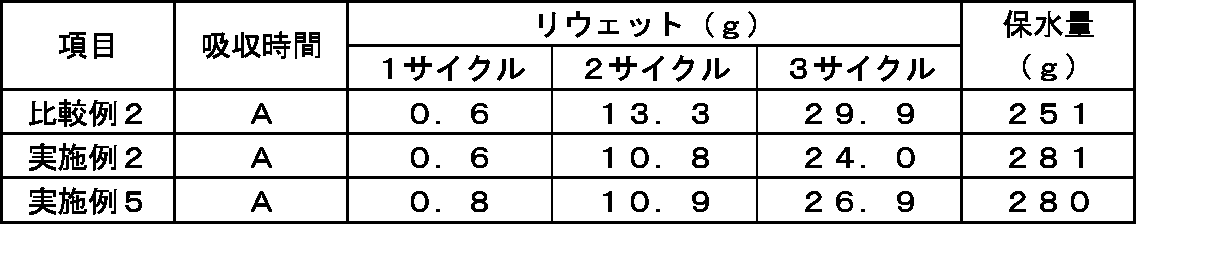
表2のリウェット(2サイクル及び3サイクル)及び保水量からわかるように、実施例2及び実施例5の保水性は、比較例2と比較して優れた性能を発現している。すなわち、これらの実施例では、多量の液体を吸収した直後及び吸収後に時間が経過した際の保水性が向上している。一般に保水性を高めると吸収速度が低下する傾向にあるが、実施例2及び5では、そのような低下現象がないことがわかる。
よって、本発明では、保水助剤の多糖類の種類を変えても、吸収速度が低下することなく優れた保水性を有する吸収体を提供することができる。すなわち、本発明の保水助剤では、多糖類の種類に限定されることなく、所望の性能を得ることができる。
実施例6
セルロース系化合物としてヒドロキシプロピルセルロースに代えて市販のエチルセルロースを用いたほかは、実施例2と同様にして保水助剤、吸収材及び吸収体を作製した。
セルロース系化合物としてヒドロキシプロピルセルロースに代えて市販のエチルセルロースを用いたほかは、実施例2と同様にして保水助剤、吸収材及び吸収体を作製した。
試験例3
実施例2、6及び比較例2で得られた吸収体について試験例1と同様にして試験を実施した。その結果を表3に示す。
実施例2、6及び比較例2で得られた吸収体について試験例1と同様にして試験を実施した。その結果を表3に示す。
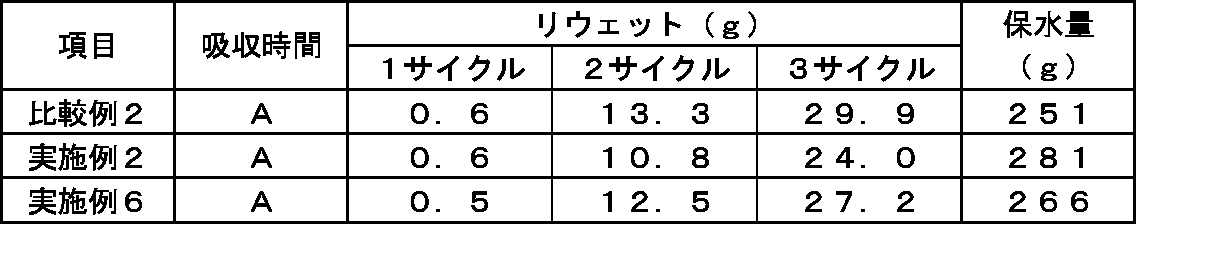
表3のリウェット(2サイクル及び3サイクル)及び保水量の結果より、実施例2及び実施例6の保水性は、比較例2よりも優れた効果を発揮している。すなわち、これらの実施例では、多量の液体を吸収した直後及び吸収後に時間が経過した際の保水性が向上している。一般に保水性が向上すると吸収速度が低下するが、吸収時間の結果から実施例2及び実施例6ではそのような低下が認められない。
よって、本発明では、保水助剤のセルロース系化合物の種類を変えても、吸収速度が低下することなく優れた保水性を有する吸収体を提供することができる。すなわち、本発明の保水助剤では、セルロース系化合物の種類に限定されることなく、所望の性能を得ることができる。
実施例7
保水助剤の平均粒子径を500μm(420~590μm)に調節したほかは、実施例2と同様にして保水助剤、吸収材及び吸収体を作製した。
保水助剤の平均粒子径を500μm(420~590μm)に調節したほかは、実施例2と同様にして保水助剤、吸収材及び吸収体を作製した。
実施例8
保水助剤の平均粒子径を300μm(100~500μm)に調節したほかは、実施例2と同様にして保水助剤、吸収材及び吸収体を作製した。
保水助剤の平均粒子径を300μm(100~500μm)に調節したほかは、実施例2と同様にして保水助剤、吸収材及び吸収体を作製した。
試験例4
実施例2、7、8及び比較例2で得られた吸収体について試験例1と同様にして試験を実施した。その結果を表4に示す。
実施例2、7、8及び比較例2で得られた吸収体について試験例1と同様にして試験を実施した。その結果を表4に示す。

表4のリウェット(2サイクル及び3サイクル)及び保水量から明らかなように、実施例2及び実施例7の保水性は、比較例2よりも優れた効果を発揮している。すなわち、これらの実施例では、多量の液体を吸収した直後及び吸収後に時間が経過した際の保水性が向上している。一般に保水性が向上すると吸収速度が低下するが、実施例2及び実施例7では吸収速度が低下していないことがわかる。
よって、本発明では、保水助剤の平均粒子径を変えても、吸収速度が低下することなく優れた保水性を有する吸収体を提供することができる。すなわち、本発明の保水助剤では、粒子の大きさに限定されることなく、所望の性能を得ることができる。
また、表4の結果からも明らかなように、実施例2と同じ平均粒子径で粒度分布が異なる実施例8においても、同様の効果が得られることがわかる。
実施例9
保水助剤0.36g及び高吸水性ポリマー7.14gに代えて、保水助剤0.22g及び高吸水性ポリマー7.28gとしたほかは、実施例2と同様にして保水助剤、吸収材及び吸収体を作製した。
保水助剤0.36g及び高吸水性ポリマー7.14gに代えて、保水助剤0.22g及び高吸水性ポリマー7.28gとしたほかは、実施例2と同様にして保水助剤、吸収材及び吸収体を作製した。
実施例10
保水助剤0.36g及び高吸水性ポリマー7.14gに代えて、保水助剤0.49g及び高吸水性ポリマー7.01gとしたほかは、実施例2と同様にして保水助剤、吸収材及び吸収体を作製した。
保水助剤0.36g及び高吸水性ポリマー7.14gに代えて、保水助剤0.49g及び高吸水性ポリマー7.01gとしたほかは、実施例2と同様にして保水助剤、吸収材及び吸収体を作製した。
試験例5
実施例2、9、10及び比較例2で得られた吸収体について試験例1と同様にして試験を実施した。その結果を表5に示す。
実施例2、9、10及び比較例2で得られた吸収体について試験例1と同様にして試験を実施した。その結果を表5に示す。
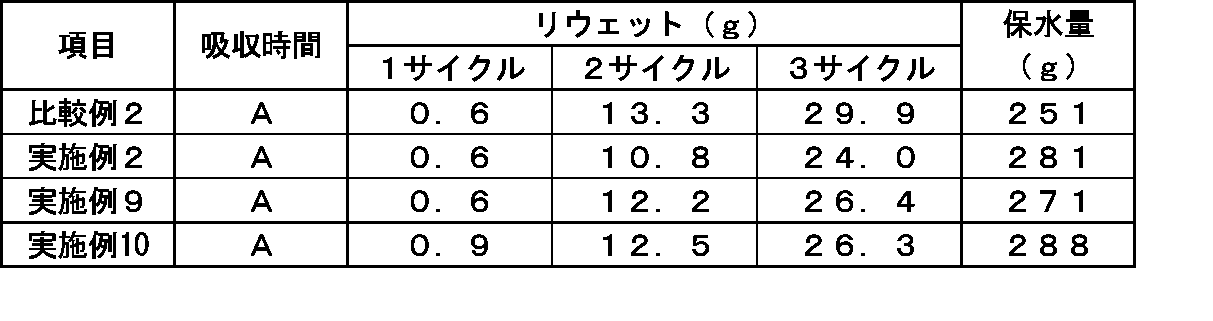
表5のリウェット(2サイクル及び3サイクル)及び保水量の結果より、実施例2、9、10の保水性は、比較例2よりも優れた性能を発揮していることがわかる。すなわち、多量の液体を吸収した直後及び吸収後に時間が経過した際の保水性が向上している。一般的に保水性が向上すると吸収速度が低下するが、実施例2、9、10ではそのような低下が認められない。
よって、本発明では、吸収材における高吸水性ポリマーと保水助剤の配合比を変えても、吸収速度が低下することなく優れた保水性を有する吸収体を提供できることがわかる。
実施例11
高吸水性ポリマーとして和光純薬工業社製の水質試験用高吸水性ポリマー(アクリル酸塩系(193-12453))を用いたほかは、実施例2と同様にして保水助剤、吸収材及び吸収体を作製した。
高吸水性ポリマーとして和光純薬工業社製の水質試験用高吸水性ポリマー(アクリル酸塩系(193-12453))を用いたほかは、実施例2と同様にして保水助剤、吸収材及び吸収体を作製した。
比較例3
高吸水性ポリマーとして実施例11と同様の高吸水性ポリマーを用いたほかは、比較例2と同様にして吸収材及び吸収体を作製した。
高吸水性ポリマーとして実施例11と同様の高吸水性ポリマーを用いたほかは、比較例2と同様にして吸収材及び吸収体を作製した。
試験例6
実施例11及び比較例3で得られた吸収体について試験例1と同様にして試験を実施した。その結果を表6に示す。
実施例11及び比較例3で得られた吸収体について試験例1と同様にして試験を実施した。その結果を表6に示す。

表6のリウェット(2サイクル及び3サイクル)及び保水量の結果からもわかるように、実施例11の保水性は、比較例3よりも優れた性能を発現している。すなわち、実施例11では、多量の液体を吸収した直後及び吸収後に時間が経過した際の保水性が向上している。一般的には、保水性が向上すると吸収速度が低下するが、吸収時間の結果から実施例11ではそのような低下が認められない。
このように、本発明では、吸収材における高吸水性ポリマーの種類を変えても、吸収速度が低下することなく優れた保水性を有する吸収体を提供することができる。すなわち、本発明の保水助剤では、吸収材における高吸水性ポリマーの種類に関係なく、所望の性能が得られることがわかる。
実施例12
実施例8で得られた保水助剤0.36gを実施例1と同様の高吸水性ポリマー7.14gと混合することによって7.5gの吸収材を調製した。次に、前記の吸収材(7.5g)を2等分し、図1に示す手順に従って吸収体を作製した。すなわち、高吸水性ポリマー粒子3及び保水助剤粒子4からなる吸収材を2等分した吸収材(3.75g)を図1(a)に示すように透水性部材であるパルプ層5(フラッフパルプ積層体;坪量50g/m2、大きさ30cm×10cm、1枚の重量1.5g)上に均等に振りかけた後、図1(b)に示すように上からパルプ層5を載せた。図1(a)及び(b)に示す工程を2回繰り返して行って得た積層体を別途シート状パルプ繊維2枚の間に挟み込むことによって、図5(a)に示す「パルプ層2枚/吸収材層/パルプ層1枚/吸収材層/パルプ層2枚」からなる積層体12を作製した。その後、この積層体をプレス圧80kg/cm2、プレス温度30℃、プレス時間10~15秒×4回という条件下にてプレスすることによって、図5(b)に示すように、吸収材を構成する高吸水性ポリマー粒子3及び保水助剤粒子4がパルプ層5に保持された吸収体13(15g)を得た。
実施例8で得られた保水助剤0.36gを実施例1と同様の高吸水性ポリマー7.14gと混合することによって7.5gの吸収材を調製した。次に、前記の吸収材(7.5g)を2等分し、図1に示す手順に従って吸収体を作製した。すなわち、高吸水性ポリマー粒子3及び保水助剤粒子4からなる吸収材を2等分した吸収材(3.75g)を図1(a)に示すように透水性部材であるパルプ層5(フラッフパルプ積層体;坪量50g/m2、大きさ30cm×10cm、1枚の重量1.5g)上に均等に振りかけた後、図1(b)に示すように上からパルプ層5を載せた。図1(a)及び(b)に示す工程を2回繰り返して行って得た積層体を別途シート状パルプ繊維2枚の間に挟み込むことによって、図5(a)に示す「パルプ層2枚/吸収材層/パルプ層1枚/吸収材層/パルプ層2枚」からなる積層体12を作製した。その後、この積層体をプレス圧80kg/cm2、プレス温度30℃、プレス時間10~15秒×4回という条件下にてプレスすることによって、図5(b)に示すように、吸収材を構成する高吸水性ポリマー粒子3及び保水助剤粒子4がパルプ層5に保持された吸収体13(15g)を得た。
比較例4
吸収材として実施例1と同様の高吸水性ポリマー7.5gのみを使用した。これを2等分し、図3に示す手順に従って吸収体を作製した。すなわち、高吸水性ポリマー粒子3からなる吸収材を4等分した吸収材(3.75g)を図3(a)に示すように透水性部材であるパルプ層5(フラッフパルプ積層体;坪量50g/m2、大きさ30cm×10cm、1枚の重量1.5g)上に均等に振りかけた後、図3(b)に示すように上からパルプ層5を載せた。図3(a)及び(b)に示す工程を2回繰り返して行って得た積層体を別途パルプ層2枚の間に挟み込むことによって、図6(a)に示す「パルプ層2枚/吸収材層/パルプ層1枚/吸収材層/パルプ層2枚」からなる積層体14を作製した。その後、この積層体をプレス圧80kg/cm2、プレス温度30℃、プレス時間10~15秒×4回という条件下にてプレスすることによって、図6(b)に示すように、吸収材を構成する高吸水性ポリマー粒子3がパルプ層5に保持された吸収体15(15g)を得た。
吸収材として実施例1と同様の高吸水性ポリマー7.5gのみを使用した。これを2等分し、図3に示す手順に従って吸収体を作製した。すなわち、高吸水性ポリマー粒子3からなる吸収材を4等分した吸収材(3.75g)を図3(a)に示すように透水性部材であるパルプ層5(フラッフパルプ積層体;坪量50g/m2、大きさ30cm×10cm、1枚の重量1.5g)上に均等に振りかけた後、図3(b)に示すように上からパルプ層5を載せた。図3(a)及び(b)に示す工程を2回繰り返して行って得た積層体を別途パルプ層2枚の間に挟み込むことによって、図6(a)に示す「パルプ層2枚/吸収材層/パルプ層1枚/吸収材層/パルプ層2枚」からなる積層体14を作製した。その後、この積層体をプレス圧80kg/cm2、プレス温度30℃、プレス時間10~15秒×4回という条件下にてプレスすることによって、図6(b)に示すように、吸収材を構成する高吸水性ポリマー粒子3がパルプ層5に保持された吸収体15(15g)を得た。
試験例7
実施例8、12及び比較例2、4で得られた吸収体について試験例1と同様にして試験を実施した。その結果を表7に示す。
実施例8、12及び比較例2、4で得られた吸収体について試験例1と同様にして試験を実施した。その結果を表7に示す。
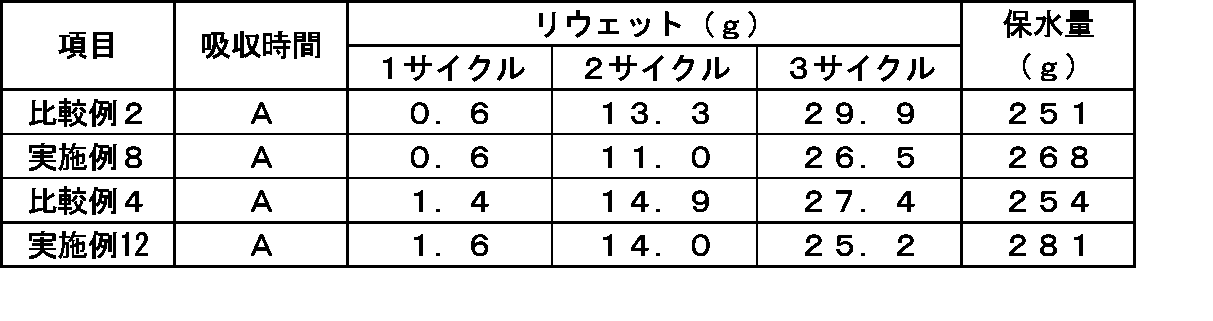
表7のリウェット(2サイクル及び3サイクル)及び保水量の結果より、実施例12の保水性は、比較例4よりも優れた性能を発現していることがわかる。すなわち、多量の液体を吸収した直後及び吸収後に時間が経過した際の保水性が向上していることがわかる。一般的に保水性が向上すると吸収速度が低下するが、実施例12ではそのような低下が見られないことがわかる。
このように、本発明では、吸収体の構造を変えても、吸収速度が低下することなく優れた保水性を有する吸収体を提供することができる。すなわち、本発明の保水助剤では、吸収体の構造に限定されることなく、所望の性能を得ることができる。
実施例13
流動型コーティング装置(パウレック社製)を用いて実施例2で得られた顆粒100重量部にヒドロキシプロピルセルロース10重量部がエタノール190重量部に溶解した溶液を噴霧し、40℃で乾燥させた後、分級することによって、平均粒子径が約500μmの顆粒からなる保水助剤を製造した。次いで、保水助剤としてここで得られた保水助剤を用いたほかは実施例1と同様にして吸収材及び吸収体を作製した。
流動型コーティング装置(パウレック社製)を用いて実施例2で得られた顆粒100重量部にヒドロキシプロピルセルロース10重量部がエタノール190重量部に溶解した溶液を噴霧し、40℃で乾燥させた後、分級することによって、平均粒子径が約500μmの顆粒からなる保水助剤を製造した。次いで、保水助剤としてここで得られた保水助剤を用いたほかは実施例1と同様にして吸収材及び吸収体を作製した。
試験例8
実施例2、13及び比較例2で得られた吸収体について試験例1と同様にして試験を実施した。その結果を表8に示す。
実施例2、13及び比較例2で得られた吸収体について試験例1と同様にして試験を実施した。その結果を表8に示す。

表8のリウェット(2サイクル及び3サイクル)及び保水量の結果より、実施例13の保水性は、比較例2よりも優れた性能を発現していることがわかる。すなわち、多量の液体を吸収した直後及び吸収後に時間が経過した際の保水性が向上していることがわかる。一般的に保水性が向上すると吸収速度が低下するが、実施例13ではそのような低下が見られないことがわかる。このように、本発明では、セルロース系化合物によってコーティングされた保水助剤を用いても、吸収速度が低下することなく優れた保水性を有する吸収体を提供することができる。また、吸収時間については表8ではAと示したが、実施例13の吸収速度は実施例2よりも優れていた。
実施例14
実施例2で得られた保水助剤0.36gを実施例1と同様の高吸水性ポリマーと混合することによって1.875gの吸収材を調製した。次に、図8に示す手順に従って吸収体を作製した。すなわち、前記の高吸水性ポリマー粒子3及び保水助剤粒子4からなる吸収材(1.875g)を図8(a)に示すように透水性部材であるパルプ層5(フラッフパルプ積層体;坪量50g/m2、大きさ30cm×10cm、1枚の重量1.5g)上に均等に振りかけた後、図8(b)に示すように上からパルプ層5を載せた。この上に図8(c)に示すように前記の高吸水性ポリマー1.875gを均等に振りかけた後、図8(d)に示すように上からパルプ層5を載せた。図8(c)及び(d)に示す工程を3回繰り返して行うことによって、図9(a)に示すような「パルプ層/高吸水性ポリマーのみの吸収材層/パルプ層/高吸水性ポリマーのみの吸収材層/パルプ層/高吸水性ポリマーのみの吸収材層/パルプ層/保水助剤及び高吸水性ポリマーを含む吸収材層/パルプ層」からなる積層体20を作製した。その後、この積層体20をプレス圧80kg/cm2、プレス温度30℃、プレス時間10~15秒×4回という条件下にてプレスすることによって、図9(b)に示すように、吸収材を構成する高吸水性ポリマー粒子3がパルプ層5に保持され、且つ下層に吸収材を構成する高吸水性ポリマー粒子3及び保水助剤粒子4がパルプ層5に保持された吸収体21(15g)を得た。
実施例2で得られた保水助剤0.36gを実施例1と同様の高吸水性ポリマーと混合することによって1.875gの吸収材を調製した。次に、図8に示す手順に従って吸収体を作製した。すなわち、前記の高吸水性ポリマー粒子3及び保水助剤粒子4からなる吸収材(1.875g)を図8(a)に示すように透水性部材であるパルプ層5(フラッフパルプ積層体;坪量50g/m2、大きさ30cm×10cm、1枚の重量1.5g)上に均等に振りかけた後、図8(b)に示すように上からパルプ層5を載せた。この上に図8(c)に示すように前記の高吸水性ポリマー1.875gを均等に振りかけた後、図8(d)に示すように上からパルプ層5を載せた。図8(c)及び(d)に示す工程を3回繰り返して行うことによって、図9(a)に示すような「パルプ層/高吸水性ポリマーのみの吸収材層/パルプ層/高吸水性ポリマーのみの吸収材層/パルプ層/高吸水性ポリマーのみの吸収材層/パルプ層/保水助剤及び高吸水性ポリマーを含む吸収材層/パルプ層」からなる積層体20を作製した。その後、この積層体20をプレス圧80kg/cm2、プレス温度30℃、プレス時間10~15秒×4回という条件下にてプレスすることによって、図9(b)に示すように、吸収材を構成する高吸水性ポリマー粒子3がパルプ層5に保持され、且つ下層に吸収材を構成する高吸水性ポリマー粒子3及び保水助剤粒子4がパルプ層5に保持された吸収体21(15g)を得た。
実施例15
実施例13で得られた保水助剤を用いたほかは、実施例14と同様にして吸収材及び吸収体を作製した。
実施例13で得られた保水助剤を用いたほかは、実施例14と同様にして吸収材及び吸収体を作製した。
試験例9
実施例14、15及び比較例2で得られた吸収体について試験例1と同様にして試験を実施した。その結果を表9に示す。
実施例14、15及び比較例2で得られた吸収体について試験例1と同様にして試験を実施した。その結果を表9に示す。
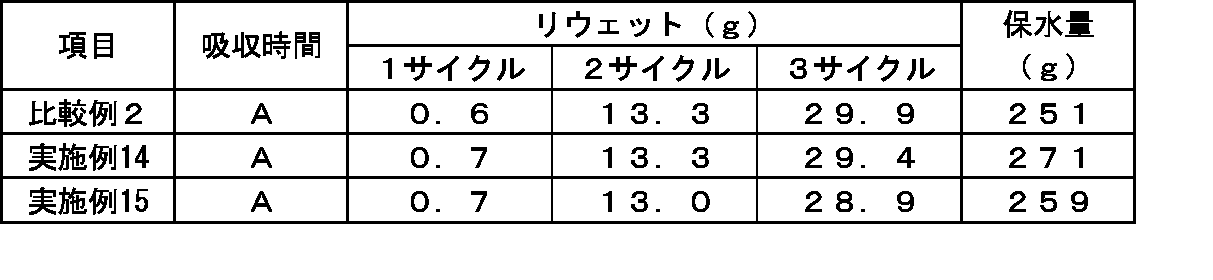
表9の保水量の結果より、実施例14、15の保水性は、比較例2よりも優れた性能を発現していることがわかる。すなわち、多量の液体を吸収後に時間が経過した際の保水性が向上していることがわかる。一般的に保水性が向上すると吸収速度が低下するが、実施例14、15ではそのような低下が見られないことがわかる。このように、本発明では、保水助剤を下層に用いても、吸収速度が低下することなく優れた保水性を有する吸収体を提供することができる。
実施例16
実施例13で得られた保水助剤0.42gを実施例1と同様の高吸水性ポリマーと混合することによって8.64gの吸収材を調製した。次に、前記の吸収材(8.64g)を3等分し、図10に示す手順に従って吸収体を作製した。すなわち、高吸水性ポリマー粒子3及び保水助剤粒子4からなる吸収材を3等分した吸収材(2.88g)を図10A(a)に示すように透水性部材であるパルプ層5(フラッフパルプ積層体;坪量75g/m2、大きさ30cm×12cm、1枚の重量2.7g)上に均等に振りかけた後、図10A(b)に示すように上から透水性部材である不織布層6(不織布(約30cm×12cm))を載せ、図10A(c)に示すようにこれをひっくり返し、図10A(d)に示すようにこの上に吸収材を均等に振りかけた。次いで、図10B(e)に示すように上からパルプ層5を載せ、図10B(f)に示すようにその上に吸収材を均等に振りかけ、さらに図10B(g)に示すように透水性部材である不織布層6(不織布(約30cm×12cm))を載せることによって、図11(a)に示すような「不織布/吸収材層/パルプ層/吸収材層/パルプ層/吸収材層/不織布」からなる積層体29を作製した。その後、この積層体29をプレス圧10kg/cm2、プレス温度30℃、プレス時間10~15秒×4回という条件下にてプレスすることによって、図11(b)に示すように、吸収材を構成する高吸水性ポリマー粒子3及び保水助剤粒子4がパルプ層5に保持された吸収体30(約14.04g)を得た。
実施例13で得られた保水助剤0.42gを実施例1と同様の高吸水性ポリマーと混合することによって8.64gの吸収材を調製した。次に、前記の吸収材(8.64g)を3等分し、図10に示す手順に従って吸収体を作製した。すなわち、高吸水性ポリマー粒子3及び保水助剤粒子4からなる吸収材を3等分した吸収材(2.88g)を図10A(a)に示すように透水性部材であるパルプ層5(フラッフパルプ積層体;坪量75g/m2、大きさ30cm×12cm、1枚の重量2.7g)上に均等に振りかけた後、図10A(b)に示すように上から透水性部材である不織布層6(不織布(約30cm×12cm))を載せ、図10A(c)に示すようにこれをひっくり返し、図10A(d)に示すようにこの上に吸収材を均等に振りかけた。次いで、図10B(e)に示すように上からパルプ層5を載せ、図10B(f)に示すようにその上に吸収材を均等に振りかけ、さらに図10B(g)に示すように透水性部材である不織布層6(不織布(約30cm×12cm))を載せることによって、図11(a)に示すような「不織布/吸収材層/パルプ層/吸収材層/パルプ層/吸収材層/不織布」からなる積層体29を作製した。その後、この積層体29をプレス圧10kg/cm2、プレス温度30℃、プレス時間10~15秒×4回という条件下にてプレスすることによって、図11(b)に示すように、吸収材を構成する高吸水性ポリマー粒子3及び保水助剤粒子4がパルプ層5に保持された吸収体30(約14.04g)を得た。
比較例5
吸収材として実施例1と同様の高吸水性ポリマー8.64gのみを使用したほかは、実施例13と同様の方法により吸収材を構成する高吸水性ポリマー粒子が透水性部材に保持された吸収体(約14.04g)を得た。
吸収材として実施例1と同様の高吸水性ポリマー8.64gのみを使用したほかは、実施例13と同様の方法により吸収材を構成する高吸水性ポリマー粒子が透水性部材に保持された吸収体(約14.04g)を得た。
試験例10
実施例13及び比較例5で得られた吸収体について試験例1と同様にして試験を実施した。その結果を表10に示す。
実施例13及び比較例5で得られた吸収体について試験例1と同様にして試験を実施した。その結果を表10に示す。

表10のリウェット(2サイクル及び3サイクル)及び保水量の結果より、実施例16の保水性は、比較例5よりも優れた性能を発現していることがわかる。すなわち、多量の液体を吸収した直後及び吸収後に時間が経過した際の保水性が向上していることがわかる。一般的に保水性が向上すると吸収速度が低下するが、実施例16ではそのような低下が見られないことがわかる。このように、本発明では、吸収体の構成を変化させても吸収速度が低下することなく優れた保水性を有する吸収体を提供することができる。
実施例17
実施例2で得られた保水助剤0.36gを実施例1と同様の高吸水性ポリマーと混合することによって7.56gの吸収材を調製した。次に、前記の吸収材(7.56g)を4等分し、吸収性物品を作製した。すなわち、図1に示す手順に従って高吸水性ポリマー粒子3及び保水助剤粒子4からなる吸収材を4等分した吸収材(1.89g)を図1(a)に示すように透水性部材であるパルプ層5(フラッフパルプ積層体;坪量50g/m2、大きさ30cm×10cm、1枚の重量1.5g)上に均等に振りかけた後、図1(b)に示すように上からパルプ層5を載せた。図1(a)及び(b)に示す工程を4回繰り返して行った後、図12(a)に示すように、この上下をコアラップ34(ティッシュペーパー;坪量16g/m2、大きさ30cm×10cm、1枚の重量0.48g)で挟むことによって、「コアラップ/パルプ層/吸収材層/パルプ層/吸収材層/パルプ層/吸収材層/パルプ層/吸収材層/パルプ層/コアラップ」からなる積層体31を作製した。その後、この積層体31をプレス圧35kg/cm2、プレス温度30℃、プレス時間5秒×2回という条件下にてプレスすることによって、図12(b)に示す積層体32を得た。さらに、積層体32の上に液透過性シート35(スルーエア不織布;坪量30g/m2、大きさ32cm×12cm、1枚の重量約1.15g)、下に液不透過性シート36(通気フィルム;坪量18g/m2、大きさ32cm×12cm、1枚の重量約0.69g)を配置し、ホットメルト接着剤をスパイラル状に塗工して固定した。これによって、図12(c)に示すように、液透過性シート35及び液不透過性シート36の間に、コアラップ34で覆われた吸収材を構成する高吸水性ポリマー粒子3及び保水助剤粒子4がパルプ層5に保持された吸収体を含む吸収性物品33(約17.86g)を得た。
実施例2で得られた保水助剤0.36gを実施例1と同様の高吸水性ポリマーと混合することによって7.56gの吸収材を調製した。次に、前記の吸収材(7.56g)を4等分し、吸収性物品を作製した。すなわち、図1に示す手順に従って高吸水性ポリマー粒子3及び保水助剤粒子4からなる吸収材を4等分した吸収材(1.89g)を図1(a)に示すように透水性部材であるパルプ層5(フラッフパルプ積層体;坪量50g/m2、大きさ30cm×10cm、1枚の重量1.5g)上に均等に振りかけた後、図1(b)に示すように上からパルプ層5を載せた。図1(a)及び(b)に示す工程を4回繰り返して行った後、図12(a)に示すように、この上下をコアラップ34(ティッシュペーパー;坪量16g/m2、大きさ30cm×10cm、1枚の重量0.48g)で挟むことによって、「コアラップ/パルプ層/吸収材層/パルプ層/吸収材層/パルプ層/吸収材層/パルプ層/吸収材層/パルプ層/コアラップ」からなる積層体31を作製した。その後、この積層体31をプレス圧35kg/cm2、プレス温度30℃、プレス時間5秒×2回という条件下にてプレスすることによって、図12(b)に示す積層体32を得た。さらに、積層体32の上に液透過性シート35(スルーエア不織布;坪量30g/m2、大きさ32cm×12cm、1枚の重量約1.15g)、下に液不透過性シート36(通気フィルム;坪量18g/m2、大きさ32cm×12cm、1枚の重量約0.69g)を配置し、ホットメルト接着剤をスパイラル状に塗工して固定した。これによって、図12(c)に示すように、液透過性シート35及び液不透過性シート36の間に、コアラップ34で覆われた吸収材を構成する高吸水性ポリマー粒子3及び保水助剤粒子4がパルプ層5に保持された吸収体を含む吸収性物品33(約17.86g)を得た。
比較例6
吸収材として実施例17と同様の高吸水性ポリマー7.56gのみを使用したほかは、実施例17と同様の方法により液透過性シート及び液不透過性シートの間にコアラップで覆われた吸収材を構成する高吸水性ポリマー粒子及び保水助剤粒子が透水性部材に保持された吸収体を含む吸収性物品(約17.86g)を得た。
吸収材として実施例17と同様の高吸水性ポリマー7.56gのみを使用したほかは、実施例17と同様の方法により液透過性シート及び液不透過性シートの間にコアラップで覆われた吸収材を構成する高吸水性ポリマー粒子及び保水助剤粒子が透水性部材に保持された吸収体を含む吸収性物品(約17.86g)を得た。
試験例11
実施例17及び比較例6で得られた吸収性物品について、試験例1と同様にして試験を実施した。その結果を表11に示す。
実施例17及び比較例6で得られた吸収性物品について、試験例1と同様にして試験を実施した。その結果を表11に示す。

表11のリウェット(3サイクル)及び保水量の結果より、実施例17の保水性は、比較例6よりも優れた性能を発現していることがわかる。すなわち、多量の液体を吸収した直後及び吸収後に時間が経過した際の保水性が向上していることがわかる。一般的に保水性が向上すると吸収速度が低下するが、実施例17ではそのような低下が見られないことがわかる。このように、本発明では、多糖類及びセルロース系化合物を含む保水助剤を使用することにより、吸収速度を低下させることなく、優れた保水性を有する吸収性物品を提供することが可能となる。
実施例18
実施例2で得られた保水助剤0.36gを実施例1と同様の高吸水性ポリマーと混合することによって1.86gの吸収材を調製した。次に、吸収性物品を作製した。すなわち、図8に示す手順に従って、前記の高吸水性ポリマー粒子3及び保水助剤粒子4からなる吸収材(1.86g)を、図8(a)に示すように透水性部材であるパルプ層5(フラッフパルプ積層体;坪量50g/m2、大きさ30cm×10cm、1枚の重量1.5g)上に均等に振りかけた後、図8(b)に示すように上からパルプ層5を載せた。この上に図8(c)に示すように前記の高吸水性ポリマー1.89gを均等に振りかけた後、図8(d)に示すように上からパルプ層5を載せた。図8(c)及び(d)に示す工程を3回繰り返して行った後、図13(a)に示すように、この上下をコアラップ34(ティッシュペーパー;坪量16g/m2、大きさ30cm×10cm、1枚の重量0.48g)で挟むことによって、「コアラップ/パルプ層/高吸水性ポリマーのみの吸収材層/パルプ層/高吸水性ポリマーのみの吸収材層/パルプ層/高吸水性ポリマーのみの吸収材層/パルプ層/保水助剤及び高吸水性ポリマーを含む吸収材層/パルプ層/コアラップ」からなる積層体37を作製した。その後、この積層体37を、プレス圧35kg/cm2、プレス温度30℃、プレス時間5秒×2回という条件下にてプレスすることによって、図13(b)に示す積層体38を得た。さらに、積層体38の上に液透過性シート35(スルーエア不織布;坪量30g/m2、大きさ32cm×12cm、1枚の重量約1.15g)、下に液不透過性シート36(通気フィルム;坪量18g/m2、大きさ32cm×12cm、1枚の重量約0.69g)を配置し、ホットメルト接着剤をスパイラル状に塗工して固定した。このようにして、図13(c)に示すように、液透過性シート35及び液不透過性シート36の間に、コアラップ34で覆われた吸収材を構成する高吸水性ポリマー粒子3がパルプ層5に保持され、かつ下層に吸収材を構成する高吸水性ポリマー粒子3及び保水助剤粒子4がパルプ層5に保持された吸収体を含む吸収性物品39(約17.86g)を得た。
実施例2で得られた保水助剤0.36gを実施例1と同様の高吸水性ポリマーと混合することによって1.86gの吸収材を調製した。次に、吸収性物品を作製した。すなわち、図8に示す手順に従って、前記の高吸水性ポリマー粒子3及び保水助剤粒子4からなる吸収材(1.86g)を、図8(a)に示すように透水性部材であるパルプ層5(フラッフパルプ積層体;坪量50g/m2、大きさ30cm×10cm、1枚の重量1.5g)上に均等に振りかけた後、図8(b)に示すように上からパルプ層5を載せた。この上に図8(c)に示すように前記の高吸水性ポリマー1.89gを均等に振りかけた後、図8(d)に示すように上からパルプ層5を載せた。図8(c)及び(d)に示す工程を3回繰り返して行った後、図13(a)に示すように、この上下をコアラップ34(ティッシュペーパー;坪量16g/m2、大きさ30cm×10cm、1枚の重量0.48g)で挟むことによって、「コアラップ/パルプ層/高吸水性ポリマーのみの吸収材層/パルプ層/高吸水性ポリマーのみの吸収材層/パルプ層/高吸水性ポリマーのみの吸収材層/パルプ層/保水助剤及び高吸水性ポリマーを含む吸収材層/パルプ層/コアラップ」からなる積層体37を作製した。その後、この積層体37を、プレス圧35kg/cm2、プレス温度30℃、プレス時間5秒×2回という条件下にてプレスすることによって、図13(b)に示す積層体38を得た。さらに、積層体38の上に液透過性シート35(スルーエア不織布;坪量30g/m2、大きさ32cm×12cm、1枚の重量約1.15g)、下に液不透過性シート36(通気フィルム;坪量18g/m2、大きさ32cm×12cm、1枚の重量約0.69g)を配置し、ホットメルト接着剤をスパイラル状に塗工して固定した。このようにして、図13(c)に示すように、液透過性シート35及び液不透過性シート36の間に、コアラップ34で覆われた吸収材を構成する高吸水性ポリマー粒子3がパルプ層5に保持され、かつ下層に吸収材を構成する高吸水性ポリマー粒子3及び保水助剤粒子4がパルプ層5に保持された吸収体を含む吸収性物品39(約17.86g)を得た。
試験例12
実施例18及び比較例6で得られた吸収性物品について、試験例1と同様にして試験を実施した。その結果を表12に示す。
実施例18及び比較例6で得られた吸収性物品について、試験例1と同様にして試験を実施した。その結果を表12に示す。

表12のリウェット(2サイクル及び3サイクル)及び保水量の結果より、実施例18の保水性は、比較例6よりも有意に優れた性能を発現していることがわかる。すなわち、多量の液体を吸収した直後及び吸収後に時間が経過した際の保水性が向上していることがわかる。一般的に保水性が向上すると吸収速度が低下するが、実施例18ではそのような低下が見られないことがわかる。このように、本発明では、保水助剤を下層に導入しても、吸収速度が低下することなく、優れた保水性を有する吸収性物品を提供することが可能となる。
Claims (18)
- 液体を吸収するための吸収体に含まれる保水助剤であって、前記保水助剤が多糖類(セルロース系化合物を除く。)及びセルロース系化合物を含む保水助剤。
- 多糖類100重量部に対してセルロース系化合物3~25重量部含まれる、請求項1に記載の保水助剤。
- 前記多糖類が水溶性多糖類である、請求項1に記載の保水助剤。
- 前記多糖類が、グァーガム、キサンタンガム、グルコマンナン、カラギナン、ローカストビーンガム、タマリンド種子多糖類及びプルランの少なくとも1種である、請求項1に記載の保水助剤。
- セルロース系化合物が、ヒドロキシプロピルセルロース、エチルセルロース、カルボキシメチルセルロース、結晶セルロース及びメチルセルロースの少なくとも1種である、請求項1に記載の保水助剤。
- 平均粒子径が150~550μmの顆粒である、請求項1に記載の保水助剤。
- 前記多糖類及びセルロース系化合物を含む粒子を含有する、請求項1に記載の保水助剤。
- 前記多糖類及びセルロース系化合物を含む原料粉末を造粒することによって得られた粒子を含む、請求項1に記載の保水助剤。
- 粒子表面がさらにセルロース系化合物を含む表面処理剤でコーティングされている、請求項8に記載の保水助剤。
- 少なくとも請求項1~9のいずれかに記載の保水助剤及び吸水性材料を含む吸収材。
- 液体を吸収するための吸収体であって、多糖類(セルロース系化合物を除く。)及びセルロース系化合物を含む保水助剤が透水性部材に保持されてなる吸収体。
- さらに吸水性材料が透水性部材に保持されてなる、請求項11に記載の吸収体。
- 1)保水助剤を含み、吸水性材料を含まない領域と、2)保水助剤を含まず、吸水性材料を含む領域とを有する、請求項12に記載の吸収体。
- 保水助剤及び吸収性材料を含む多層構造体であって、1)多糖類(セルロース系化合物を除く。)及びセルロース系化合物を含む保水助剤及び/又は吸水性材料を透水性部材に配置する工程及び2)その上から、透水性部材を1層又は2層以上積層する工程を含む一連の工程を1回以上実施する方法によって得られる多層構造体を含む吸収体。
- 保水助剤及び吸収性材料を含む多層構造体であって、1)多糖類(セルロース系化合物を除く。)及びセルロース系化合物を含む保水助剤及び吸水性材料を透水性部材に配置する工程及び2)その上から、透水性部材を1層又は2層以上積層する工程及び3)その上から、吸水性材料を配置する工程及び4)その上から、透水性部材を1層又は2層以上積層する工程を含み、かつ、前記3)及び/又は前記4)の工程が1回以上実施される方法によって得られる多層構造体を含む吸収体。
- 保水助剤が、多糖類(セルロース系化合物を除く。)及びセルロース系化合物を含む原料粉末を造粒することによって得られた造粒物である、請求項11~15のいずれかに記載の吸収体。
- 粒子表面がさらにセルロース系化合物を含む表面処理剤でコーティングされている、請求項16に記載の吸収体。
- 請求項11~17のいずれかに記載の吸収体を含む吸収性物品。
Priority Applications (1)
| Application Number | Priority Date | Filing Date | Title |
|---|---|---|---|
| JP2013507815A JP6113069B2 (ja) | 2011-03-30 | 2012-03-30 | 保水助剤ならびにそれを含む吸収材、吸収体及び吸収性物品 |
Applications Claiming Priority (2)
| Application Number | Priority Date | Filing Date | Title |
|---|---|---|---|
| JP2011074706 | 2011-03-30 | ||
| JP2011-074706 | 2011-03-30 |
Publications (1)
| Publication Number | Publication Date |
|---|---|
| WO2012133824A1 true WO2012133824A1 (ja) | 2012-10-04 |
Family
ID=46931518
Family Applications (1)
| Application Number | Title | Priority Date | Filing Date |
|---|---|---|---|
| PCT/JP2012/058686 Ceased WO2012133824A1 (ja) | 2011-03-30 | 2012-03-30 | 保水助剤ならびにそれを含む吸収材、吸収体及び吸収性物品 |
Country Status (2)
| Country | Link |
|---|---|
| JP (1) | JP6113069B2 (ja) |
| WO (1) | WO2012133824A1 (ja) |
Cited By (3)
| Publication number | Priority date | Publication date | Assignee | Title |
|---|---|---|---|---|
| JP2014136797A (ja) * | 2013-01-18 | 2014-07-28 | Uni Charm Corp | 保水助剤ならびにそれを含む吸収材、吸収体及び吸収性物品 |
| FR3016878A1 (fr) * | 2014-01-30 | 2015-07-31 | Liliz | Polymere super absorbant modifie renfermant un engrais |
| WO2018070250A1 (ja) * | 2016-10-12 | 2018-04-19 | 東レ株式会社 | フィルム |
Citations (7)
| Publication number | Priority date | Publication date | Assignee | Title |
|---|---|---|---|---|
| JPH1036162A (ja) * | 1996-07-25 | 1998-02-10 | Shin Etsu Chem Co Ltd | 石膏系組成物 |
| JPH11130905A (ja) * | 1997-10-28 | 1999-05-18 | Mitsui Chem Inc | セルロース系組成物、成形物および成形方法 |
| JP2000248451A (ja) * | 1998-12-28 | 2000-09-12 | Pigeon Corp | 不織布およびその用途 |
| JP2003135030A (ja) * | 2001-11-02 | 2003-05-13 | Asahi Kasei Corp | 微細セルロース含有複合体を配合してなる食品組成物 |
| JP2007525568A (ja) * | 2003-10-31 | 2007-09-06 | ビーエーエスエフ アクチェンゲゼルシャフト | 血液及び/又は体液を吸収するヒドロゲル |
| JP2008048604A (ja) * | 2005-02-02 | 2008-03-06 | Asahi Kasei Chemicals Corp | 水分散性セルロースと多糖類を含有する安定剤 |
| JP2008092914A (ja) * | 2006-10-16 | 2008-04-24 | Asahi Kasei Chemicals Corp | 3成分からなる増粘ゲル化剤 |
Family Cites Families (3)
| Publication number | Priority date | Publication date | Assignee | Title |
|---|---|---|---|---|
| JP3829167B2 (ja) * | 1997-06-02 | 2006-10-04 | 花王株式会社 | 吸収体 |
| JP3090266B2 (ja) * | 1999-01-12 | 2000-09-18 | 株式会社日本吸収体技術研究所 | 複層構造を有する多機能シート状吸収体とそれを一要素とする吸収体製品 |
| WO2010082373A1 (ja) * | 2009-01-19 | 2010-07-22 | 住友精化株式会社 | 吸水シート組成物 |
-
2012
- 2012-03-30 WO PCT/JP2012/058686 patent/WO2012133824A1/ja not_active Ceased
- 2012-03-30 JP JP2013507815A patent/JP6113069B2/ja active Active
Patent Citations (7)
| Publication number | Priority date | Publication date | Assignee | Title |
|---|---|---|---|---|
| JPH1036162A (ja) * | 1996-07-25 | 1998-02-10 | Shin Etsu Chem Co Ltd | 石膏系組成物 |
| JPH11130905A (ja) * | 1997-10-28 | 1999-05-18 | Mitsui Chem Inc | セルロース系組成物、成形物および成形方法 |
| JP2000248451A (ja) * | 1998-12-28 | 2000-09-12 | Pigeon Corp | 不織布およびその用途 |
| JP2003135030A (ja) * | 2001-11-02 | 2003-05-13 | Asahi Kasei Corp | 微細セルロース含有複合体を配合してなる食品組成物 |
| JP2007525568A (ja) * | 2003-10-31 | 2007-09-06 | ビーエーエスエフ アクチェンゲゼルシャフト | 血液及び/又は体液を吸収するヒドロゲル |
| JP2008048604A (ja) * | 2005-02-02 | 2008-03-06 | Asahi Kasei Chemicals Corp | 水分散性セルロースと多糖類を含有する安定剤 |
| JP2008092914A (ja) * | 2006-10-16 | 2008-04-24 | Asahi Kasei Chemicals Corp | 3成分からなる増粘ゲル化剤 |
Cited By (5)
| Publication number | Priority date | Publication date | Assignee | Title |
|---|---|---|---|---|
| JP2014136797A (ja) * | 2013-01-18 | 2014-07-28 | Uni Charm Corp | 保水助剤ならびにそれを含む吸収材、吸収体及び吸収性物品 |
| FR3016878A1 (fr) * | 2014-01-30 | 2015-07-31 | Liliz | Polymere super absorbant modifie renfermant un engrais |
| WO2015114273A1 (fr) * | 2014-01-30 | 2015-08-06 | Liliz | Polymère super absorbant modifié renfermant un engrais |
| WO2018070250A1 (ja) * | 2016-10-12 | 2018-04-19 | 東レ株式会社 | フィルム |
| JPWO2018070250A1 (ja) * | 2016-10-12 | 2019-07-25 | 東レ株式会社 | フィルム |
Also Published As
| Publication number | Publication date |
|---|---|
| JP6113069B2 (ja) | 2017-04-12 |
| JPWO2012133824A1 (ja) | 2014-07-28 |
Similar Documents
| Publication | Publication Date | Title |
|---|---|---|
| CN102170849B (zh) | 流体吸收制品 | |
| KR101335911B1 (ko) | 흡수 코어 | |
| EP2934413B1 (en) | Fluid-absorbent article | |
| US20030119394A1 (en) | Nonwoven web with coated superabsorbent | |
| CN1859932A (zh) | 吸收性材料和制品 | |
| JPH09510889A (ja) | 良好な湿潤一体性を有し、ヒドロゲルを形成する吸収性重合体の濃度が比較的高い、体液用吸収部材 | |
| JP2002509764A (ja) | 折畳んだ吸収性ラミネートにて製造した薄い、吸収性コア | |
| KR20110038123A (ko) | 흡수 코어 | |
| CN1620275A (zh) | 薄的高容量吸湿结构和制造该结构的方法 | |
| JPH01153157A (ja) | 改良された複合吸収性構造物およびこのような構造物を含む吸収性物品 | |
| JPH08511973A (ja) | 良好な流体処理特性を有する吸収コア | |
| JP6113069B2 (ja) | 保水助剤ならびにそれを含む吸収材、吸収体及び吸収性物品 | |
| CN1684718A (zh) | 控制体液产生的恶臭的系统 | |
| JP2003518957A (ja) | 複合流体処理に使用する吸収材 | |
| JP2002165837A (ja) | 吸収性物品 | |
| JP4808011B2 (ja) | 拡散性に優れた体液吸収物品 | |
| JP6105947B2 (ja) | 保水助剤ならびにそれを含む吸収材、吸収体及び吸収性物品 | |
| EP4321141B1 (en) | Absorbent article with improved multi-layered core | |
| JP4868832B2 (ja) | 体液吸収物品 | |
| JP2001198154A (ja) | 体液吸収材 | |
| JP2007135979A (ja) | 尿吸収用材料又は汗吸収用材料 | |
| JP2007143675A (ja) | 高吸収性能体液吸収物品 |
Legal Events
| Date | Code | Title | Description |
|---|---|---|---|
| 121 | Ep: the epo has been informed by wipo that ep was designated in this application |
Ref document number: 12765607 Country of ref document: EP Kind code of ref document: A1 |
|
| ENP | Entry into the national phase |
Ref document number: 2013507815 Country of ref document: JP Kind code of ref document: A |
|
| NENP | Non-entry into the national phase |
Ref country code: DE |
|
| 122 | Ep: pct application non-entry in european phase |
Ref document number: 12765607 Country of ref document: EP Kind code of ref document: A1 |