WO2012132892A1 - 逆浸透膜用スケール防止剤及びスケール防止方法 - Google Patents
逆浸透膜用スケール防止剤及びスケール防止方法 Download PDFInfo
- Publication number
- WO2012132892A1 WO2012132892A1 PCT/JP2012/056500 JP2012056500W WO2012132892A1 WO 2012132892 A1 WO2012132892 A1 WO 2012132892A1 JP 2012056500 W JP2012056500 W JP 2012056500W WO 2012132892 A1 WO2012132892 A1 WO 2012132892A1
- Authority
- WO
- WIPO (PCT)
- Prior art keywords
- scale
- meth
- acid
- water
- reverse osmosis
- Prior art date
- Legal status (The legal status is an assumption and is not a legal conclusion. Google has not performed a legal analysis and makes no representation as to the accuracy of the status listed.)
- Ceased
Links
Images
Classifications
-
- C—CHEMISTRY; METALLURGY
- C02—TREATMENT OF WATER, WASTE WATER, SEWAGE, OR SLUDGE
- C02F—TREATMENT OF WATER, WASTE WATER, SEWAGE, OR SLUDGE
- C02F1/00—Treatment of water, waste water, or sewage
- C02F1/44—Treatment of water, waste water, or sewage by dialysis, osmosis or reverse osmosis
- C02F1/441—Treatment of water, waste water, or sewage by dialysis, osmosis or reverse osmosis by reverse osmosis
-
- B—PERFORMING OPERATIONS; TRANSPORTING
- B01—PHYSICAL OR CHEMICAL PROCESSES OR APPARATUS IN GENERAL
- B01D—SEPARATION
- B01D61/00—Processes of separation using semi-permeable membranes, e.g. dialysis, osmosis or ultrafiltration; Apparatus, accessories or auxiliary operations specially adapted therefor
- B01D61/02—Reverse osmosis; Hyperfiltration ; Nanofiltration
- B01D61/025—Reverse osmosis; Hyperfiltration
-
- B—PERFORMING OPERATIONS; TRANSPORTING
- B01—PHYSICAL OR CHEMICAL PROCESSES OR APPARATUS IN GENERAL
- B01D—SEPARATION
- B01D65/00—Accessories or auxiliary operations, in general, for separation processes or apparatus using semi-permeable membranes
- B01D65/08—Prevention of membrane fouling or of concentration polarisation
-
- C—CHEMISTRY; METALLURGY
- C02—TREATMENT OF WATER, WASTE WATER, SEWAGE, OR SLUDGE
- C02F—TREATMENT OF WATER, WASTE WATER, SEWAGE, OR SLUDGE
- C02F5/00—Softening water; Preventing scale; Adding scale preventatives or scale removers to water, e.g. adding sequestering agents
- C02F5/08—Treatment of water with complexing chemicals or other solubilising agents for softening, scale prevention or scale removal, e.g. adding sequestering agents
- C02F5/10—Treatment of water with complexing chemicals or other solubilising agents for softening, scale prevention or scale removal, e.g. adding sequestering agents using organic substances
-
- C—CHEMISTRY; METALLURGY
- C02—TREATMENT OF WATER, WASTE WATER, SEWAGE, OR SLUDGE
- C02F—TREATMENT OF WATER, WASTE WATER, SEWAGE, OR SLUDGE
- C02F5/00—Softening water; Preventing scale; Adding scale preventatives or scale removers to water, e.g. adding sequestering agents
- C02F5/08—Treatment of water with complexing chemicals or other solubilising agents for softening, scale prevention or scale removal, e.g. adding sequestering agents
- C02F5/10—Treatment of water with complexing chemicals or other solubilising agents for softening, scale prevention or scale removal, e.g. adding sequestering agents using organic substances
- C02F5/12—Treatment of water with complexing chemicals or other solubilising agents for softening, scale prevention or scale removal, e.g. adding sequestering agents using organic substances containing nitrogen
-
- C—CHEMISTRY; METALLURGY
- C23—COATING METALLIC MATERIAL; COATING MATERIAL WITH METALLIC MATERIAL; CHEMICAL SURFACE TREATMENT; DIFFUSION TREATMENT OF METALLIC MATERIAL; COATING BY VACUUM EVAPORATION, BY SPUTTERING, BY ION IMPLANTATION OR BY CHEMICAL VAPOUR DEPOSITION, IN GENERAL; INHIBITING CORROSION OF METALLIC MATERIAL OR INCRUSTATION IN GENERAL
- C23F—NON-MECHANICAL REMOVAL OF METALLIC MATERIAL FROM SURFACE; INHIBITING CORROSION OF METALLIC MATERIAL OR INCRUSTATION IN GENERAL; MULTI-STEP PROCESSES FOR SURFACE TREATMENT OF METALLIC MATERIAL INVOLVING AT LEAST ONE PROCESS PROVIDED FOR IN CLASS C23 AND AT LEAST ONE PROCESS COVERED BY SUBCLASS C21D OR C22F OR CLASS C25
- C23F14/00—Inhibiting incrustation in apparatus for heating liquids for physical or chemical purposes
- C23F14/02—Inhibiting incrustation in apparatus for heating liquids for physical or chemical purposes by chemical means
-
- B—PERFORMING OPERATIONS; TRANSPORTING
- B01—PHYSICAL OR CHEMICAL PROCESSES OR APPARATUS IN GENERAL
- B01D—SEPARATION
- B01D2321/00—Details relating to membrane cleaning, regeneration, sterilization or to the prevention of fouling
- B01D2321/16—Use of chemical agents
- B01D2321/168—Use of other chemical agents
-
- C—CHEMISTRY; METALLURGY
- C02—TREATMENT OF WATER, WASTE WATER, SEWAGE, OR SLUDGE
- C02F—TREATMENT OF WATER, WASTE WATER, SEWAGE, OR SLUDGE
- C02F2303/00—Specific treatment goals
- C02F2303/22—Eliminating or preventing deposits, scale removal, scale prevention
Definitions
- the present invention relates to a scale inhibitor for reverse osmosis membranes and a scale prevention method. More specifically, the present invention relates to a scale inhibitor and a scale prevention method for preventing adhesion of calcium phosphate scale generated in film treatment.
- the scale generated in the heat exchange section causes heat transfer inhibition
- the scale attached to the pipe causes a decrease in flow rate
- the scale attached to the film causes a decrease in flux.
- the generated scale is peeled off, it circulates in the system and causes the pump, the piping and the heat exchanging section to be blocked. Further, along with the blockage, the scaling in the pipe and the heat exchanging section is promoted.
- a similar phenomenon can occur in the reduction well of a geothermal power plant.
- Scale species generated in these aqueous systems include calcium phosphate, calcium carbonate, calcium sulfate, calcium sulfite, calcium silicate, magnesium silicate, magnesium hydroxide, zinc phosphate, zinc hydroxide, and basic zinc carbonate.
- inorganic polyphosphoric acids such as sodium hexametaphosphate and sodium tripolyphosphate
- phosphonic acids such as hydroxyethylidene diphosphonic acid and phosphonobutanetricarboxylic acid
- maleic acid acrylic acid and itaconic acid
- vinyl monomers having sulfonic acid groups such as vinyl sulfonic acid, allyl sulfonic acid and 3-allyloxy-2-hydroxypropane sulfonic acid, and nonionic vinyl monomers such as acrylamide are included
- Copolymers combined according to water quality are used as scale inhibitors.
- examples of the scale species generated in the reverse osmosis membrane (RO membrane) treatment include calcium phosphate, calcium carbonate, calcium sulfate, barium sulfate, strontium sulfate, and magnesium hydroxide.
- the scale inhibitor generally has a relatively low molecular weight and a high scale prevention effect. Therefore, inorganic polyphosphates such as sodium hexametaphosphate and sodium tripolyphosphate, aminomethylphosphonic acid, hydroxyethylidene diphosphonic acid and phosphonobu Materials containing phosphorus such as phosphonic acids such as tantricarboxylic acid are used.
- Patent Document 1 a terpolymer composed of monomers such as polyether polyaminomethylene phosphonate and acrylic acid is combined with hydroxyphosphonoacetic acid
- Patent Document 3 A method using ⁇ -polyaspartic acid has also been proposed (see Patent Document 3).
- a copolymer obtained by polymerizing monomers such as acrylic acid and sulfonic acid is used as a scale inhibitor (see Patent Documents 4 to 6).
- the copolymer used in the scale inhibitors described in Patent Documents 4 to 6 is also free of phosphorus.
- all these conventional scale inhibitors are premised on use in boilers and cooling water systems. It is difficult to say that it is suitable for RO membrane treatment.
- scales generated in cooling water, evaporative concentration, boilers, etc. adhere to the surface of a heat exchanger or the like with a certain thickness, thereby causing heat transfer inhibition or affecting the stabilization of equipment.
- the scale attached to the surface acts as an anticorrosion coating, and therefore some scale generation is allowed.
- a scale inhibitor such as a cooling water system is required to have the ability to suppress the generated scale growth, and can be applied as long as it has a certain precipitation suppressing effect and gelation resistance.
- the range of physical properties (molecular weight, composition, etc.) applicable as a scale inhibitor is wide.
- RO membrane treatment has a small water flow path, and when fine precipitates such as scales and coexisting ions and scale inhibitor gels are formed, the membrane surface is clogged, affecting membrane treatment performance. .
- the scale inhibitor for RO membrane treatment is required not to generate fine precipitates, and even if it is a material that can be applied in cooling water, evaporative concentration, etc., further limited physical property conditions are required. It is necessary to have.
- the temperature at the location where scale should be prevented is lower, the residence time of water is shorter, and generally the concentration of the scale inhibitor added is lower than in the cooling water system.
- the temperature at the place where scale should be prevented is about 10 to 40 ° C. in the RO membrane treatment, whereas it is 50 to 90 ° C. in the cooling water system or the like.
- the residence time of water is about 15 minutes for the RO membrane treatment, whereas it is about 20 to 100 hours for the cooling water system.
- the concentration of the scale inhibitor added is about 1 to 10 mg / L for the RO membrane treatment, whereas it is about 5 to 50 mg / L for the cooling water system.
- the scale inhibitor for RO membrane treatment is different from the scale inhibitor used in other systems such as cooling water system, the processing conditions and required characteristics are different, the scale inhibitor such as cooling water system is treated with RO membrane treatment. Even if it is used, the same effect cannot be obtained.
- the present invention is for a reverse osmosis membrane that can suppress the precipitation of calcium phosphate scale generated in the osmosis membrane treatment without increasing the phosphorus concentration in the waste water, and does not produce a fine precipitate such as a gelled product.
- the main object is to provide a scale inhibitor and a scale prevention method.
- the scale inhibitor for reverse osmosis membrane according to the present invention is a scale inhibitor that suppresses the precipitation of calcium phosphate scale in the reverse osmosis membrane treatment.
- the main component is a unit derived from (meth) acrylic acid and 2- (meta) )
- a structural unit derived from acrylamido-2-methylpropanesulfonic acid, the unit derived from 2- (meth) acrylamido-2-methylpropanesulfonic acid is 10 to 40 mol%, and the mass average molecular weight is
- the water-soluble copolymer is 1 ⁇ 10 4 to 5 ⁇ 10 4 .
- the calcium phosphate scale is mainly composed of a water-soluble copolymer having a main constituent unit of a phosphorus-free monomer such as (meth) acrylic acid and 2- (meth) acrylamide-2-methylpropanesulfonic acid. It has a high prevention effect and does not increase the phosphorus concentration in the wastewater. Further, since the water-soluble copolymer has a mass average molecular weight of 1 ⁇ 10 4 to 5 ⁇ 10 4, it is difficult to produce precipitates such as gelled products. In this scale inhibitor, the water-soluble polymer can be a copolymer of non-phosphorus-containing monomers, that is, not containing phosphorus.
- the reverse osmosis membrane scale prevention method comprises a unit derived from (meth) acrylic acid and a structural unit derived from 2- (meth) acrylamido-2-methylpropanesulfonic acid.
- a scale mainly composed of a water-soluble copolymer having a unit derived from (meth) acrylamide-2-methylpropanesulfonic acid of 10 to 40 mol% and a mass average molecular weight of 1 ⁇ 10 4 to 5 ⁇ 10 4
- An inhibitor is added to the reverse osmosis membrane treated water system.
- a water-soluble copolymer having a molecular weight within a specific range and containing as a main constituent unit a phosphorus-free monomer such as (meth) acrylic acid or 2- (meth) acrylamido-2-methylpropanesulfonic acid. Since the scale inhibitor mainly composed of is used, there is no increase in the phosphorus concentration in the waste water and no precipitation of gelled products, and the effect of suppressing the precipitation of calcium phosphate scale is high.
- the “mass average molecular weight” in the present invention is a value measured by gel permeation chromatography using sodium polyacrylate as a standard substance.
- the main component of the scale inhibitor is a water-soluble copolymer having a unit derived from (meth) acrylic acid and a structural unit derived from 2- (meth) acrylamido-2-methylpropanesulfonic acid. Therefore, precipitation of calcium phosphate scale generated in the reverse osmosis membrane treatment can be suppressed without increasing the phosphorus concentration in the waste water, and fine precipitates such as gelled products are not generated.
- the scale inhibitor of the present embodiment suppresses the precipitation of calcium phosphate scale that occurs in the reverse osmosis membrane treatment and prevents the scale from adhering to the RO membrane or the like, and its main component is (meth) acrylic acid. And a structural unit derived from 2- (meth) acrylamido-2-methylpropanesulfonic acid.
- the water-soluble copolymer that is the main component of the scale inhibitor of the present embodiment is a copolymer of (meth) acrylic acid and 2- (meth) acrylamido-2-methylpropanesulfonic acid or These are copolymers of these with other monomers.
- (meth) acrylic acid means methacrylic acid, acrylic acid or a salt thereof, and these monomers may be used alone or in combination of two or more.
- 2- (Meth) acrylamide-2-methylpropanesulfonic acid means 2-methacrylamide-2-methylpropanesulfonic acid or 2-acrylamido-2-methylpropanesulfonic acid, one or both of which Can be used.
- maleic acid and epoxy succinic acid can be used as the carboxylic acid.
- the monoethylenically unsaturated hydrocarbon is not particularly limited, and may have a linear, branched or cyclic structure, but preferably has 3 to 8 carbon atoms.
- isobutylene or styrene is used. can do.
- the alkyl ester of monoethylenically unsaturated acid preferably has 1 to 8 carbon atoms.
- methyl (meth) acrylate, ethyl (meth) acrylate, isopropyl acrylate, N-butyl acrylate, 2-ethylhexyl acrylate is used. be able to.
- the vinyl ester of monoethylenically unsaturated acid preferably has 1 to 8 carbon atoms, and for example, vinyl acetate and vinyl propionate can be used.
- the substituted acrylamide is preferably one in which acrylamide is substituted with hydrogen and / or an alkyl group having 1 to 4 carbon atoms.
- acrylamide, propylacrylamide, N-isopropylacrylamide, dimethylacrylamide, diethylacrylamide and the like can be used. it can. These monomers may be used alone or in combination.
- the water-soluble copolymer that is the main component of the scale inhibitor of the present embodiment includes a unit derived from (meth) acrylic acid and a structural unit derived from 2- (meth) acrylamido-2-methylpropanesulfonic acid. It is sufficient if it has a low phosphorus content, but is obtained by copolymerizing only (meth) acrylic acid and 2- (meth) acrylamido-2-methylpropanesulfonic acid without using other monomers. Water-soluble copolymers are particularly preferred.
- the water-soluble copolymer that is the main component of the scale inhibitor of the present embodiment has 10 to 40 mol% of sulfonic acid units, that is, structural units derived from 2- (meth) acrylamide-2-methylpropanesulfonic acid. is there.
- sulfonic acid units that is, structural units derived from 2- (meth) acrylamide-2-methylpropanesulfonic acid. is there.
- the strong electrolyte (sulfonic acid group) decreases, so that gelation easily occurs and the scale-preventing effect of calcium phosphate also decreases.
- the water-soluble copolymer that is the main component of the scale inhibitor of the present embodiment has a molecular weight of 1 ⁇ 10 4 to 5 ⁇ 10 4 .
- the molecular weight defined here is a mass average molecular weight measured by gel permeation chromatography using sodium polyacrylate as a standard substance, and the same applies to the following description.
- the gelation resistance can be improved by reducing the molecular weight.
- a water-soluble copolymer having a small molecular weight has a weak calcium phosphate adsorption ability and is inferior in calcium phosphate scale prevention effect.
- a water-soluble polymer having a unit derived from (meth) acrylic acid and a structural unit derived from 2- (meth) acrylamido-2-methylpropanesulfonic acid has a molecular weight of 1 When it is less than 10 4, the effect of suppressing the precipitation of calcium phosphate scale is not sufficiently obtained.
- the molecular weight of the water-soluble polymer is preferably 1.1 ⁇ 10 4 or more.
- the molecular weight of the water-soluble polymer exceeds 5 ⁇ 10 4 , gelation is likely to occur due to binding with cations, and gelation occurs and fine precipitates are generated even in an environment where the concentration of cations is low. Lowers the flux (permeation flow rate).
- the production method of the water-soluble polymer described above is not particularly limited, and various polymerization methods such as solution polymerization, suspension polymerization, emulsion polymerization, and bulk polymerization can be applied. From the viewpoint of ease of solution, solution polymerization is desirable.
- Solution polymerization is performed in an organic solvent system or an aqueous system.
- an organic solvent such as toluene or xylene
- the polymerization initiator can be selected from known peroxides. Examples include dibenzoyl peroxide, tert-butyl peroxybenzoate, dicumyl peroxide, tert-butyl peroxide. Only one type of polymerization initiator may be used, or two or more types may be used.
- the organic solvent-based polymerization can be carried out either batchwise or continuously.
- the polymerization conditions are, for example, a heating temperature of 100 to 200 ° C. and a polymerization time of 2 to 6 hours. After the polymerization, the mixture is allowed to cool to obtain a water-soluble copolymer.
- the organic solvent polymerization conditions are not particularly limited, and the type, polymerization time, temperature, and the like of the organic solvent to be used can be appropriately changed.
- aqueous polymerization method in which the polymerization is carried out in an aqueous system, an aqueous solution or dispersion of the monomer is prepared and the monomer is polymerized.
- the pH of the aqueous monomer solution or aqueous dispersion is adjusted as necessary, the reaction atmosphere is replaced with an inert gas, and then heated to 50 to 100 ° C. in the presence of a water-soluble polymerization initiator.
- the water-soluble polymerization initiator is not particularly limited.
- 2,2-azobis (2-amidinopropane) dihydrochloride azobis-N, N′-dimethyleneisobutylamidine dihydrochloride
- 4,4′-azobis Azo compounds such as 4-cyanovaleric acid
- persulfates such as ammonium persulfate, sodium persulfate and potassium persulfate
- peroxides such as hydrogen peroxide and sodium periodate.
- water-soluble polymerization initiators may be used alone or in combination of two or more.
- the aqueous polymerization is completed, for example, in a polymerization time of 2 to 6 hours, and allowed to cool, whereby an aqueous solution or dispersion of the polymer can be obtained.
- Aqueous polymerization can also be performed in the state which added additives, such as a dispersing agent and surfactant, to aqueous solution or an aqueous dispersion.
- the scale inhibitor of the present embodiment includes a slime control agent, an enzyme, a bactericide, a colorant, a fragrance, a water-soluble organic solvent, and a range that does not impair the object of the present invention.
- An antifoaming agent etc. may be mix
- examples of the slime control agent include quaternary ammonium salts such as alkyldimethylbenzylammonium chloride, chloromethyltrithiazoline, chloromethylisothiazoline, methylisothiazoline, ethylaminoisopropylaminomethylthiatriazine, hypochlorous acid, hypochlorous acid, and hypochlorous acid. Bromic acid, a mixture of hypochlorous acid and sulfamic acid, and the like can be used.
- the scale inhibitor of the present embodiment has a unit derived from (meth) acrylic acid and a structural unit derived from 2- (meth) acrylamido-2-methylpropanesulfonic acid, Since the main component is a water-soluble copolymer having a unit derived from 2- (meth) acrylamido-2-methylpropanesulfonic acid of 10 to 40 mol%, the effect of suppressing precipitation of calcium phosphate scale is excellent.
- this water-soluble copolymer does not contain phosphorus or contains only a small amount of phosphorus, it hardly affects the phosphorus concentration in the waste water. Furthermore, since the water-soluble copolymer that is the main component of the scale inhibitor of the present embodiment has a molecular weight of 1 ⁇ 10 4 to 5 ⁇ 10 4, it is difficult to generate fine precipitates such as gelled products. For this reason, the scale inhibitor of this embodiment is suitable for reverse osmosis membrane treatment. In addition, there is no restriction
- the scale prevention method of the present embodiment is a method for suppressing the precipitation of calcium phosphate scale in the reverse osmosis membrane treatment using the scale inhibitor of the first embodiment described above. That is, the scale prevention method of the present embodiment has a unit derived from (meth) acrylic acid and a structural unit derived from 2- (meth) acrylamido-2-methylpropanesulfonic acid.
- Scale inhibitor comprising a water-soluble copolymer having a unit derived from acrylamido-2-methylpropanesulfonic acid of 10 to 40 mol% and a weight average molecular weight of 1 ⁇ 10 4 to 5 ⁇ 10 4 as a main component Is added to the reverse osmosis membrane treated water system.
- the addition method of the scale inhibitor is not particularly limited, and may be added at a place where scale adhesion is to be prevented or just before the place. Further, the addition amount is not particularly limited and can be appropriately selected according to the water quality of the aqueous system. However, the concentration of the water-soluble copolymer described above is 0.01 to 100 mg / L. In particular, from the viewpoint of prevention of film surface clogging, it is more preferable to add to 0.1 to 10 mg / L.
- the scale prevention method of this embodiment can also use together the scale inhibitor of 1st Embodiment mentioned above and another scale inhibitor.
- the scale inhibitor to be used in combination include polymaleic acid, polyacrylic acid, a copolymer of maleic acid and acrylic acid, a copolymer of maleic acid and isobutylene, a copolymer of maleic acid and sulfonic acid, and other maleic acid.
- examples thereof include a copolymer, a copolymer of acrylic acid and sulfonic acid, a copolymer of acrylic acid and nonionic group-containing monomer, and a copolymer (terpolymer) of acrylic acid, sulfonic acid and nonionic group-containing monomer.
- sulfonic acid examples include sulfonic acid such as vinyl sulfonic acid, allyl sulfonic acid, styrene sulfonic acid, isoprene sulfonic acid, 3-allyloxy-2-hydroxypropane sulfonic acid, 2-acrylamide.
- sulfonic acid such as vinyl sulfonic acid, allyl sulfonic acid, styrene sulfonic acid, isoprene sulfonic acid, 3-allyloxy-2-hydroxypropane sulfonic acid, 2-acrylamide.
- These sulfonic acids may be used alone or in
- Nonionic group-containing monomers include, for example, alkyl amides having 1 to 5 carbon atoms, hydroxyethyl methacrylate, (poly) ethylene / propylene oxide mono (meth) acrylates having 1 to 30 addition moles, and addition moles. Examples thereof include 1 to 30 monovinyl ether ethylene / propylene oxide. These nonionic group containing monomers may use only 1 type, and may use 2 or more types.
- the maleic acid polymer (homopolymer and / or copolymer) is not particularly limited, but preferably contains 50 to 100 mol% of maleic acid units.
- the other monomer to be copolymerized with maleic acid may be a nonionic monomer.
- Nonionic monomers include, for example, monoethylenically unsaturated hydrocarbons, alkyl esters of monoethylenically unsaturated acids, vinyl esters of monoethylenically unsaturated acids, substituted acrylamides, etc.
- 1 to The two can be copolymerized with maleic acid.
- the monoethylenically unsaturated hydrocarbon is preferably a linear, branched or cyclic one having 3 to 8 carbon atoms, such as isobutylene or styrene.
- the alkyl ester of monoethylenically unsaturated acid preferably has 1 to 8 carbon atoms, such as methyl (meth) acrylate, ethyl (meth) acrylate, isopropyl acrylate, N-butyl acrylate, 2-ethylhexyl acrylate, etc. It is.
- the vinyl ester of a monoethylenically unsaturated acid preferably has 1 to 8 carbon atoms, and examples thereof include vinyl acetate and vinyl propionate.
- the substituted acrylamide is preferably one substituted with hydrogen and / or an alkyl group having 1 to 4 carbon atoms, and examples thereof include acrylamide, propylacrylamide, N-isopropylacrylamide, dimethylacrylamide and diethylacrylamide.
- the molecular weight is in a specific range, the unit derived from (meth) acrylic acid, and the structural unit derived from a specific amount of 2- (meth) acrylamido-2-methylpropanesulfonic acid.
- Suppressing the precipitation of calcium phosphate scale produced in reverse osmosis membrane treatment without affecting the phosphorus concentration in the wastewater because it uses a scale inhibitor mainly composed of a water-soluble copolymer containing In addition, fine precipitates such as gelled products are not generated.
- the scale prevention method of this embodiment can suppress the precipitation of scale stably only by adding a small amount of a scale inhibitor to the aqueous system.
- the water quality condition and operation condition of the water system to which the scale prevention method of this embodiment is applied are not particularly limited.
- the configuration and effects other than those described above in the scale prevention method of the present embodiment are the same as those of the first embodiment described above.
- ⁇ Flat membrane test> First, in order to measure the initial performance of the membrane, a 500 mg / L NaCl aqueous solution was passed through a polyamide reverse osmosis membrane (ES20 manufactured by Nitto Denko Corporation) at an operating pressure of 0.75 MPa and a recovery rate of 50%. (Flux) was measured for a predetermined time.
- ES20 polyamide reverse osmosis membrane manufactured by Nitto Denko Corporation
- an aqueous solution containing calcium chloride 500 mg CaCO 3 / L, Examples 1 to 3 and Comparative Examples 1 to 8 scale inhibitors (polymers): 1 mg / L, disodium hydrogen phosphate: 30 mg CaCO 3 / L
- the pH was adjusted to 7.0 with a small amount of aqueous sodium hydroxide and sulfuric acid to prepare a test solution.
- Each test solution was passed through a polyamide reverse osmosis membrane (ES20 manufactured by Nitto Denko Corporation) at an operating pressure of 0.75 MPa and a recovery rate of 50%, and flux was measured for a predetermined time.
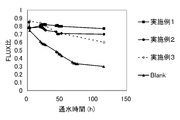
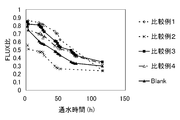
- FIGS. 1 and 2 are graphs showing changes with time in the ratio (flux ratio) to the flux measured with the test solution, where the flux in a 500 mg / L NaCl aqueous solution is 1.
- FIG. Moreover, the blank (Blank) shown in FIG.1 and FIG.2 is a flux ratio when a chemical
- Example 1 when the flux reduction rates of Examples 1 to 3 are compared, it is found that Example 1 ⁇ Example 2 ⁇ Example 3 in order, and Example 1 can most effectively suppress the flux reduction.
- the scale inhibitor of Example 1 using a water-soluble copolymer having a unit derived from 2- (meth) acrylamido-2-methylpropanesulfonic acid in the range of 15 to 25 mol% has reduced flux. was significantly suppressed.
- the scale inhibitors of Comparative Examples 1 and 2 had the same composition of the scale inhibitor and monomer (AA / AMPS) of Example 1, but the flux was reduced. This is because the scale inhibitor of Comparative Example 1 had a molecular weight of the water-soluble copolymer of less than 1 ⁇ 10 4 , so the effect of suppressing the precipitation of scale was low, and the scale inhibitor of Comparative Example 2 was water-soluble. Since the molecular weight of the copolymer exceeded 5 ⁇ 10 4 , it is considered that a gelled product was generated. In particular, in the scale inhibitor of Comparative Example 2, it is considered that the film was clogged by the generated fine precipitate, and the flux decrease was faster than that of Blank.
- the scale inhibitors of Comparative Examples 3 and 4 have a molecular weight of 1 ⁇ 10 4 to 5 ⁇ 10 4 of the water-soluble copolymer, but are units derived from 2- (meth) acrylamido-2-methylpropanesulfonic acid. Was less than 10 mol% or more than 40 mol%, the flux decreased.
Landscapes
- Chemical & Material Sciences (AREA)
- Engineering & Computer Science (AREA)
- Water Supply & Treatment (AREA)
- Chemical Kinetics & Catalysis (AREA)
- Organic Chemistry (AREA)
- Hydrology & Water Resources (AREA)
- Life Sciences & Earth Sciences (AREA)
- Environmental & Geological Engineering (AREA)
- General Chemical & Material Sciences (AREA)
- Nanotechnology (AREA)
- Materials Engineering (AREA)
- Mechanical Engineering (AREA)
- Metallurgy (AREA)
- Separation Using Semi-Permeable Membranes (AREA)
- Addition Polymer Or Copolymer, Post-Treatments, Or Chemical Modifications (AREA)
Abstract
排水中のリン濃度を増加させることなく、逆浸透膜処理において生成するリン酸カルシウムスケールの付着を防止することができ、かつゲル化物などの微小な析出物が生成しない逆浸透膜用スケール防止剤及びスケール防止方法を提供する。 逆浸透膜処理水系に、(メタ)アクリル酸に由来する単位と、2-(メタ)アクリルアミド-2-メチルプロパンスルホン酸に由来する構成単位とを有し、2-(メタ)アクリルアミド-2-メチルプロパンスルホン酸に由来する単位が10~40mol%であり、かつ、質量平均分子量が1×10⁴~5×10⁴である水溶性共重合物を主成分とするスケール防止剤を添加する。
Description
本発明は、逆浸透膜用スケール防止剤及びスケール防止方法に関する。より詳しくは、膜処理において発生するリン酸カルシウムスケールの付着を防止するスケール防止剤及びスケール防止方法に関する。
冷却水系、ボイラ水系、膜処理又は地熱発電所の還元井においては、水と接触する伝熱面、配管或いは膜面に、スケール障害が発生する。特に、省資源・省エネルギーの観点から高濃縮運転をしたとき、また、膜の場合は回収率を高くしたときは、水に溶解している塩類が濃縮されて、難溶性の塩となってスケール化する。
そして、例えば、熱交換部に生成したスケールは伝熱阻害を、配管に付着したスケールは流量低下を、膜に付着したスケールはフラックス低下を、それぞれ引き起こす。また、生成したスケールが剥離すると、系内を循環し、ポンプ、配管及び熱交換部の閉塞を引き起こし、更に、これらの閉塞に伴い、配管及び熱交換部でのスケール化が促進される。同様の現象は、地熱発電所の還元井でも起こり得る。
これらの水系において生成するスケール種としては、リン酸カルシウム、炭酸カルシウム、硫酸カルシウム、亜硫酸カルシウム、ケイ酸カルシウム、ケイ酸マグネシウム、水酸化マグネシウム、リン酸亜鉛、水酸化亜鉛及び塩基性炭酸亜鉛などがある。
また、一般に、カルシウム系スケールに対しては、ヘキサメタリン酸ソーダやトリポリリン酸ソーダなどの無機ポリリン酸類、ヒドロキシエチリデンジホスホン酸やホスホノブタントリカルボン酸などのホスホン酸類、マレイン酸、アクリル酸及びイタコン酸などのカルボキシル基含有素材に、必要に応じてビニルスルホン酸、アリルスルホン酸及び3-アリロキシ-2-ヒドロキシプロパンスルホン酸などのスルホン酸基を有するビニルモノマーや、アクリルアミドなどのノニオン性ビニルモノマーを、対象水質に応じて組み合わせたコポリマーが、スケール防止剤として使用されている。
一方、逆浸透膜(Reverse Osmosis Membrane:RO膜)処理において生成するスケール種としては、リン酸カルシウム、炭酸カルシウム、硫酸カルシウム、硫酸バリウム、硫酸ストロンチウム及び水酸化マグネシウムなどがある。また、そのスケール防止剤としては、一般に、分子量が比較的小さく、スケール防止効果が高いことから、ヘキサメタリン酸ソーダやトリポリリン酸ソーダなどの無機ポリリン酸類、アミノメチルホスホン酸、ヒドロキシエチリデンジホスホン酸やホスホノブタントリカルボン酸などのホスホン酸類といったリンを含む素材が使用されている。
しかしながら、近年、排水中のリン濃度が規制されたことに伴い、リンの含有量を極力減らしたスケール防止剤が望まれている。また、近年、水資源を有効活用するために、排水をRO膜で回収し、使用する場合が増えているが、リン酸を含む水を回収した場合、RO膜にリン酸カルシウムスケールが生成される場合がある。具体的には、RO膜処理の濃縮水のリン酸が、5mg/LasPO4以上となる場合、リン酸カルシウムスケールが発生しやすい。
このようなリン酸カルシウムスケールの析出を抑制する方法としては、例えば、ポリエーテルポリアミノメチレンホスホネートやアクリル酸などのモノマーからなるターポリマーと、ヒドロキシホスホノ酢酸などを組合せて使用する方法がある(特許文献1,2参照)。また、β-ポリアスパラギン酸を使用する方法も提案されている(特許文献3参照)。更に、冷却水系においては、スケール防止剤として、アクリル酸やスルホン酸などのモノマーを重合させた共重合ポリマーが使用されている(特許文献4~6参照)。
しかしながら、前述した従来の技術には、以下に示す問題点がある。即ち、特許文献1、2に記載のスケール防止剤は、リンを含むターポリマーなどを使用するため、排水にリンが含有されることとなる。また、特許文献3に記載の方法で使用されるβ-ポリアスパラギン酸は、リンは非含有であるが、生分解性が高いため、バクテリアや藻類の栄養源となり、スライムの発生を引き起こす可能性がある。
更に、特許文献4~6に記載のスケール防止剤で使用される共重合ポリマーも、リン非含有であるが、これら従来のスケール防止剤はいずれもボイラや冷却水系などでの使用を前提としており、RO膜処理用として適しているとは言い難い。
例えば、冷却水、蒸発濃縮及びボイラなどにおいて生成するスケールは、熱交換機などの表面に一定の厚さとなって付着することにより、伝熱阻害を起こしたり、機器の安定化に影響したりする。その一方で、冷却水系などにおいては、表面に付着したスケールが防食被膜として作用するため、多少のスケール生成は許容される。このため、冷却水系などのスケール防止剤には、生成したスケール成長を抑制する能力が求められ、ある一定の析出抑制効果や耐ゲル化能を有する素材であれば、適用することが可能である。更に、冷却水系などでは、スケール防止剤として適用可能な物性(分子量や組成など)範囲も広い。
これに対して、RO膜処理は、通水流路が小さく、スケール及び共存するイオンとスケール防止剤のゲル化物などの微小な析出物が生成すると、膜面が閉塞し、膜処理性能に影響する。このため、RO膜処理用のスケール防止剤には、微小な析出物を生成させないことが求められ、冷却水や蒸発濃縮などにおいて適用可能な素材であっても、更に、限られた物性条件を有する必要がある。
更に、RO膜処理は、冷却水系などに比べて、スケールを防止すべき箇所の温度が低く、水の滞留時間も短く、一般にスケール防止剤の添加濃度も低い。具体的には、スケールを防止すべき箇所の温度は、RO膜処理が10~40℃程度であるのに対し、冷却水系などでは50~90℃である。また、水の滞留時間は、RO膜処理が15分程度であるのに対し、冷却水系などでは20~100時間程度である。更に、スケール防止剤の添加濃度は、RO膜処理が1~10mg/L程度であるのに対して、冷却水系などでは5~50mg/L程度である。
このように、RO膜処理用スケール防止剤は、冷却水系などの他の系に用いられるスケール防止剤と、処理条件や求められる特性が異なるため、冷却水系などのスケール防止剤を、RO膜処理に用いても、同様の効果は得られない。
そこで、本発明は、排水中のリン濃度を増加させることなく、浸透膜処理において生成するリン酸カルシウムスケールの析出を抑制することができ、かつゲル化物などの微小な析出物が生じない逆浸透膜用スケール防止剤及びスケール防止方法を提供することを主目的とする。
本発明に係る逆浸透膜用スケール防止剤は、逆浸透膜処理においてリン酸カルシウムスケールの析出を抑制するスケール防止剤であり、主成分が、(メタ)アクリル酸に由来する単位と、2-(メタ)アクリルアミド-2-メチルプロパンスルホン酸に由来する構成単位とを有し、2-(メタ)アクリルアミド-2-メチルプロパンスルホン酸に由来する単位が10~40mol%であり、かつ、質量平均分子量が1×10⁴~5×10⁴である水溶性共重合物のものである。
本発明においては、(メタ)アクリル酸及び2-(メタ)アクリルアミド-2-メチルプロパンスルホン酸といったリン非含有モノマーを主な構成単位とする水溶性共重合物を主成分としているため、リン酸カルシウムスケールの防止効果が高く、排水中のリン濃度を増加させることもない。また、水溶性共重合物の質量平均分子量が1×10⁴~5×10⁴であるため、ゲル化物などの析出物を生成しにくい。
このスケール防止剤では、水溶性重合物を非リン含有モノマーの共重合物、すなわち、リンを含有しないものとすることができる。
本発明においては、(メタ)アクリル酸及び2-(メタ)アクリルアミド-2-メチルプロパンスルホン酸といったリン非含有モノマーを主な構成単位とする水溶性共重合物を主成分としているため、リン酸カルシウムスケールの防止効果が高く、排水中のリン濃度を増加させることもない。また、水溶性共重合物の質量平均分子量が1×10⁴~5×10⁴であるため、ゲル化物などの析出物を生成しにくい。
このスケール防止剤では、水溶性重合物を非リン含有モノマーの共重合物、すなわち、リンを含有しないものとすることができる。
本発明に係る逆浸透膜のスケール防止方法は、(メタ)アクリル酸に由来する単位と、2-(メタ)アクリルアミド-2-メチルプロパンスルホン酸に由来する構成単位とを有し、2-(メタ)アクリルアミド-2-メチルプロパンスルホン酸に由来する単位が10~40mol%であり、かつ、質量平均分子量が1×10⁴~5×10⁴である水溶性共重合物を主成分とするスケール防止剤を、逆浸透膜処理水系に添加する。
本発明においては、分子量が特定の範囲内にあり、(メタ)アクリル酸や2-(メタ)アクリルアミド-2-メチルプロパンスルホン酸といったリン非含有モノマーを主な構成単位とする水溶性共重合物を主成分とするスケール防止剤を使用しているため、排水中のリン濃度の増やゲル化物などの析出がなく、更に、リン酸カルシウムスケールの析出抑制効果が高い。
本発明においては、分子量が特定の範囲内にあり、(メタ)アクリル酸や2-(メタ)アクリルアミド-2-メチルプロパンスルホン酸といったリン非含有モノマーを主な構成単位とする水溶性共重合物を主成分とするスケール防止剤を使用しているため、排水中のリン濃度の増やゲル化物などの析出がなく、更に、リン酸カルシウムスケールの析出抑制効果が高い。
なお、本発明における「質量平均分子量」は、ポリアクリル酸ナトリウムを標準物質として用い、ゲル浸透クロマトグラフィにより測定した値である。
本発明によれば、スケール防止剤の主成分を、(メタ)アクリル酸に由来する単位と、2-(メタ)アクリルアミド-2-メチルプロパンスルホン酸に由来する構成単位とを有する水溶性共重合物にしているため、排水中のリン濃度を増加させることなく、逆浸透膜処理において生成するリン酸カルシウムスケールの析出を抑制することができ、更にゲル化物などの微小な析出物も生成しない。
以下、本発明を実施するための形態について、詳細に説明する。なお、本発明は、以下に説明する実施形態に限定されるものではない。
(第1の実施形態)
先ず、本発明の第1の実施形態に係るスケール防止剤について説明する。本実施形態のスケール防止剤は、逆浸透膜処理で発生するリン酸カルシウムスケールの析出を抑制し、RO膜などにスケールが付着することを防止するものであり、その主成分は、(メタ)アクリル酸に由来する単位と、2-(メタ)アクリルアミド-2-メチルプロパンスルホン酸に由来する構成単位とを有する水溶性共重合物である。
先ず、本発明の第1の実施形態に係るスケール防止剤について説明する。本実施形態のスケール防止剤は、逆浸透膜処理で発生するリン酸カルシウムスケールの析出を抑制し、RO膜などにスケールが付着することを防止するものであり、その主成分は、(メタ)アクリル酸に由来する単位と、2-(メタ)アクリルアミド-2-メチルプロパンスルホン酸に由来する構成単位とを有する水溶性共重合物である。
具体的には、本実施形態のスケール防止剤の主成分である水溶性共重合物は、(メタ)アクリル酸と、2-(メタ)アクリルアミド-2-メチルプロパンスルホン酸との共重合体又は、これらと他のモノマーとの共重合体である。ここで、「(メタ)アクリル酸」は、メタクリル酸、アクリル酸又はこれらの塩を意味し、これらのモノマーは、単独で使用しても、2種以上を組み合わせて使用してもよい。また、「2-(メタ)アクリルアミド-2-メチルプロパンスルホン酸」は、2-メタクリルアミド-2-メチルプロパンスルホン酸又は2-アクリルアミド-2-メチルプロパンスルホン酸を意味し、その一方又は両方を使用することができる。
更に、(メタ)アクリル酸及び2-(メタ)アクリルアミド-2-メチルプロパンスルホン酸と共重合可能な他のモノマーは、特に限定されないが、リンを含有しないものが好ましい。これにより、リンを含有しない水溶性共重合物が得られるため、水溶性共重合物をスケール防止剤に使用した場合に、リンが排出されず、環境への影響を少なくすることができる。具体的には、リン非含有モノマーとしては、カルボン酸、モノエチレン性不飽和炭化水素、モノエチレン性不飽和酸のアルキルエステル、モノエチレン性不飽和酸のビニルエステル、置換アクリルアミドなどが挙げられる。
そして、例えば、カルボン酸には、マレイン酸、エポキシコハク酸でなどを使用することができる。モノエチレン性不飽和炭化水素は、特に限定されず、直鎖、分岐、環状のいずれの構造のものを用いてもよいが、炭素数3~8のものが好ましく、例えば、イソブチレン、スチレンを使用することができる。モノエチレン性不飽和酸のアルキルエステルは、炭素数1~8のものが好ましく、例えば、メチル(メタ)アクリレート、エチル(メタ)アクリレート、イソプロピルアクリレート、N-ブチルアクリレート、2-エチルヘキシルアクリレートを使用することができる。
モノエチレン性不飽和酸のビニルエステルは、炭素数1~8のものが好ましく、例えば、酢酸ビニル、プロピオン酸ビニルを使用することができる。置換アクリルアミドは、アクリルアミドが、水素及び/又は炭素数1~4のアルキル基で置換されたものが好ましく、例えば、アクリルアミド、プロピルアクリルアミド、N-イソプロピルアクリルアミド、ジメチルアクリルアミド、ジエチルアクリルアミドなどを使用することができる。なお、これらのモノマーは、単独で使用しても、複数組み合わせて使用してもよい。
本実施形態のスケール防止剤の主成分である水溶性共重合物は、(メタ)アクリル酸に由来する単位と、2-(メタ)アクリルアミド-2-メチルプロパンスルホン酸に由来する構成単位とを有し、リンの含有量が少ないものであればよいが、他のモノマーを用いず、(メタ)アクリル酸及び2-(メタ)アクリルアミド-2-メチルプロパンスルホン酸のみを共重合して得た水溶性共重合物が、特に好適である。
本実施形態のスケール防止剤の主成分である水溶性共重合物は、スルホン酸の単位、即ち、2-(メタ)アクリルアミド-2-メチルプロパンスルホン酸に由来する構成単位が10~40mol%である。2-(メタ)アクリルアミド-2-メチルプロパンスルホン酸の含有量が10mol%未満であると、強電解質(スルホン酸基)が少なくなるため、ゲル化しやすくなる上、リン酸カルシウムのスケール防止効果も低下する。また、2-(メタ)アクリルアミド-2-メチルプロパンスルホン酸の含有量が40mol%を超えると、水溶性共重合物の分子構造の変化により、リン酸カルシウムのスケール防止効果が低下する。なお、2-(メタ)アクリルアミド-2-メチルプロパンスルホン酸に由来する構成単位のより好適な範囲は、15~25molである。
また、本実施形態のスケール防止剤の主成分である水溶性共重合物は、分子量が1×10⁴~5×10⁴である。なお、ここで規定する分子量は、ポリアクリル酸ナトリウムを標準物質として用い、ゲル浸透クロマトグラフィにより測定した質量平均分子量であり、以下の説明においても同様である。一般に、水溶性重合物は、分子量が大きいほどゲル化しやすくなるため、分子量を小さくすることにより、耐ゲル化能を向上させることができる。一方、分子量が小さい水溶性共重合物は、リン酸カルシウムの吸着能が弱く、リン酸カルシウムのスケール防止効果が劣る。
具体的には、(メタ)アクリル酸に由来する単位と、2-(メタ)アクリルアミド-2-メチルプロパンスルホン酸に由来する構成単位とを有する水溶性重合物であっても、その分子量が1×10⁴未満の場合、リン酸カルシウムスケールの析出抑制効果が十分に得られない。なお、スケール防止効果向上の観点から、水溶性重合物の分子量は1.1×10⁴以上であることが好ましい。一方、水溶性重合物の分子量が5×10⁴を超えると、カチオンとの結合によりゲル化が生じやすくなり、カチオンの濃度が低い環境下でも、ゲル化して微小な析出物が生じ、RO膜のフラックス(透過流速)低下を招く。
また、前述した水溶性重合物の製造方法は、特に限定されるものではなく、溶液重合、懸濁重合、乳化重合、塊状重合などの各種重合法を適用することができるが、重合反応の制御しやすさの点で、溶液重合が望ましい。
溶液重合は、有機溶剤系又は水系で行われる。例えば、モノマー材料にマレイン酸を含有させる場合は、トルエンやキシレンなどの有機溶剤中で、モノマー材料を重合させる方法がある(英国特許公報1411063号明細書)。この場合、重合開始剤は、公知の過酸化物から選択して使用することができる。例えば、ジベンゾイルペルオキシド、第三ブチルペルオキシベンゾエート、ジクミルペルオキシド、第三ブチルペルオキドなどがある。重合開始剤は1種類だけを用いてもよいし、2種類以上を用いてもよい。
有機溶剤系の重合は、回分式、連続式のいずれでも行うことができ、重合条件は、例えば、加熱温度100~200℃、重合時間2~6時間である。重合後、放冷し、水溶性共重合物を得ることができる。有機溶剤系の重合条件は特に限定されず、使用する有機溶剤の種類、重合時間、温度などを適宜変更できる。
重合を水系で行う水性重合法は、モノマーの水溶液又は水分散液を作成し、モノマーを重合させる。重合は、例えば、モノマーの水溶液又は水分散液のpHを必要に応じて調整し、不活性ガスにより反応雰囲気を置換したのち、50~100℃に加熱し、水溶性重合開始剤の存在下で行う。
水溶性重合開始剤は特に限定されないが、例えば、2,2-アゾビス(2-アミジノプロパン)二塩酸塩、アゾビス-N,N’-ジメチレンイソブチルアミジン二塩酸塩、4,4’-アゾビス(4-シアノ吉草酸)-2-ナトリウムなどのアゾ化合物、過硫酸アンモニウム、過硫酸ナトリウム、過硫酸カリウムなどの過硫酸塩、過酸化水素水、過ヨウ素酸ナトリウムなどの過酸化物である。これらの水溶性重合開始剤は、1種類だけを用いてもよいし、2種類以上を用いてもよい。
水系の重合は、例えば、重合時間2~6時間で終了し、放冷することにより、重合体の水溶液又は水分散液を得ることができる。水系の重合は、水溶液又は水分散液に、分散剤、界面活性剤などの添加剤を添加した状態で、行うこともできる。
本実施形態のスケール防止剤には、前述した水溶性共重合物に加えて、本発明の目的を阻害しない範囲で、スライムコントロール剤、酵素、殺菌剤、着色剤、香料、水溶性有機溶媒及び消泡剤などが配合されていてもよい。その場合、スライムコントロール剤としては、例えば、アルキルジメチルベンジルアンモニウムクロライドなどの四級アンモニウム塩、クロルメチルトリチアゾリン、クロルメチルイソチアゾリン、メチルイソチアゾリン、エチルアミノイソプロピルアミノメチルチアトリアジン、次亜塩素酸、次亜臭素酸、及び次亜塩素酸とスルファミン酸の混合物などを使用することができる。
以上詳述したように、本実施形態のスケール防止剤は、(メタ)アクリル酸に由来する単位と、2-(メタ)アクリルアミド-2-メチルプロパンスルホン酸に由来する構成単位とを有し、2-(メタ)アクリルアミド-2-メチルプロパンスルホン酸に由来する単位が10~40mol%の水溶性共重合物を主成分としているため、リン酸カルシウムスケールの析出抑制効果が優れている。
また、この水溶性共重合物は、リン非含有か、リンを含有していてもわずかであるため、排水中のリン濃度にはほとんど影響がない。更に、本実施形態のスケール防止剤の主成分である水溶性共重合物は、分子量が1×10⁴~5×10⁴であるため、ゲル化物などの微小な析出物を生成しにくい。このため、本実施形態のスケール防止剤は、逆浸透膜処理に好適である。なお、本実施形態のスケール防止剤を適用する場合の水質条件及び水系の運転条件には、特に制限はない。
(第2の実施形態)
次に、本発明の第2の実施形態に係るスケール防止方法について説明する。本実施形態のスケール防止方法は、前述した第1の実施形態のスケール防止剤を使用して、逆浸透膜処理においてリン酸カルシウムスケールの析出を抑制する方法である。即ち、本実施形態のスケール防止方法は、(メタ)アクリル酸に由来する単位と、2-(メタ)アクリルアミド-2-メチルプロパンスルホン酸に由来する構成単位とを有し、2-(メタ)アクリルアミド-2-メチルプロパンスルホン酸に由来する単位が10~40mol%であり、かつ、質量平均分子量が1×10⁴~5×10⁴である水溶性共重合物を主成分とするスケール防止剤を、逆浸透膜処理水系に添加する。
次に、本発明の第2の実施形態に係るスケール防止方法について説明する。本実施形態のスケール防止方法は、前述した第1の実施形態のスケール防止剤を使用して、逆浸透膜処理においてリン酸カルシウムスケールの析出を抑制する方法である。即ち、本実施形態のスケール防止方法は、(メタ)アクリル酸に由来する単位と、2-(メタ)アクリルアミド-2-メチルプロパンスルホン酸に由来する構成単位とを有し、2-(メタ)アクリルアミド-2-メチルプロパンスルホン酸に由来する単位が10~40mol%であり、かつ、質量平均分子量が1×10⁴~5×10⁴である水溶性共重合物を主成分とするスケール防止剤を、逆浸透膜処理水系に添加する。
本実施形態のスケール防止方法においては、スケール防止剤の添加方法は、特に限定されるものではなく、スケールの付着を防止したい場所やその直前などで添加すればよい。また、その添加量も、特に限定されるものではなく、水系の水質に応じて適宜選択することができるが、上述した水溶性共重合物の濃度が、0.01~100mg/Lとなるように添加することが好ましく、特に、膜面の閉塞防止の観点から、0.1~10mg/Lとなるように添加することがより好ましい。
また、本実施形態のスケール防止方法は、前述した第1の実施形態のスケール防止剤と、他のスケール防止剤とを併用することもできる。併用するスケール防止剤としては、例えば、ポリマレイン酸、ポリアクリル酸、マレイン酸とアクリル酸の共重合体、マレイン酸とイソブチレンの共重合体、マレイン酸とスルホン酸の共重合体、その他のマレイン酸共重合体、アクリル酸とスルホン酸の共重合体、アクリル酸とノニオン基含有モノマーの共重合体、アクリル酸とスルホン酸とノニオン基含有モノマーの共重合体(ターポリマー)などがある。
前述した共重合体などを構成するスルホン酸としては、例えば、スルホン酸は、ビニルスルホン酸、アリルスルホン酸、スチレンスルホン酸、イソプレンスルホン酸、3-アリロキシ-2-ヒドロキシプロパンスルホン酸、2-アクリルアミド-2-メチルプロパンスルホン酸、2-メタクリルアミド-2-メチルプロパンスルホン酸、メタクリル酸-4-スルホブチル、アリルオキシベンゼンスルホン酸、メタリルオキシベンゼンスルホン酸及びそれらの金属塩などが挙げられる。これらのスルホン酸は、1種のみを用いてもよいし、2種以上を用いてもよい。
また、ノニオン基含有モノマーとしては、例えば、炭素数1~5のアルキルアミド、ヒドロキシエチルメタクリレート、付加モル数が1~30の(ポリ)エチレン/プロピレンオキサイドのモノ(メタ)アクリレート及び付加モル数が1~30のモノビニルエーテルエチレン/プロピレンオキサイドなどが挙げられる。これらのノニオン基含有モノマーは、1種のみを用いてもよいし、2種以上を用いてもよい。
前述した共重合体のうち、マレイン酸の重合体(ホモポリマー及び/又はコポリマー)は特に限定されないが、マレイン酸の単位を、50~100mol%含むものが好ましい。マレイン酸の共重合体の場合、マレイン酸と共重合させる他のモノマーは、ノニオン性のモノマーであればよい。ノニオン性モノマーとしては、例えば、モノエチレン性不飽和炭化水素、モノエチレン性不飽和酸のアルキルエステル、モノエチレン性不飽和酸のビニルエステル、置換アクリルアミドなどがあり、これらのモノマーのうち、1~2種を、マレイン酸と共重合させることができる。
モノエチレン性不飽和炭化水素は、炭素数3~8の直鎖、分岐、又は環状のものが好ましく、例えばイソブチレン、スチレンなどである。モノエチレン性不飽和酸のアルキルエステルは、炭素数1~8のものが好ましく、例えば、メチル(メタ)アクリレート、エチル(メタ)アクリレート、イソプロピルアクリレート、N-ブチルアクリレート、2-エチルへキシルアクリレートなどである。モノエチレン性不飽和酸のビニルエステルは、炭素数1~8のものが好ましく、例えば、酢酸ビニル、プロピオン酸ビニルである。置換アクリルアミドは、水素及び/又は炭素数1~4のアルキル基で置換されたものが好ましく、例えば、アクリルアミド、プロピルアクリルアミド、N-イソプロピルアクリルアミド、ジメチルアクリルアミド及びジエチルアクリルアミドである。
本実施形態のスケール防止方法では、分子量が特定の範囲内にあり、(メタ)アクリル酸に由来する単位と、特定量の2-(メタ)アクリルアミド-2-メチルプロパンスルホン酸に由来する構成単位とを有する水溶性共重合物を主成分とするスケール防止剤を使用しているため、排水中のリン濃度に影響を与えずに、逆浸透膜処理において生成するリン酸カルシウムスケールの析出を抑制することができ、更にゲル化物などの微小な析出物も生成しない。また、本実施形態のスケール防止方法は、水系にスケール防止剤を少量添加するだけで、安定してスケールの析出を抑制することが可能である。
なお、本実施形態のスケール防止方法は、適用する水系の水質条件及び運転条件は、特に限定されない。また、本実施形態のスケール防止方法における上記以外の構成及び効果は、前述した第1の実施形態と同様である。
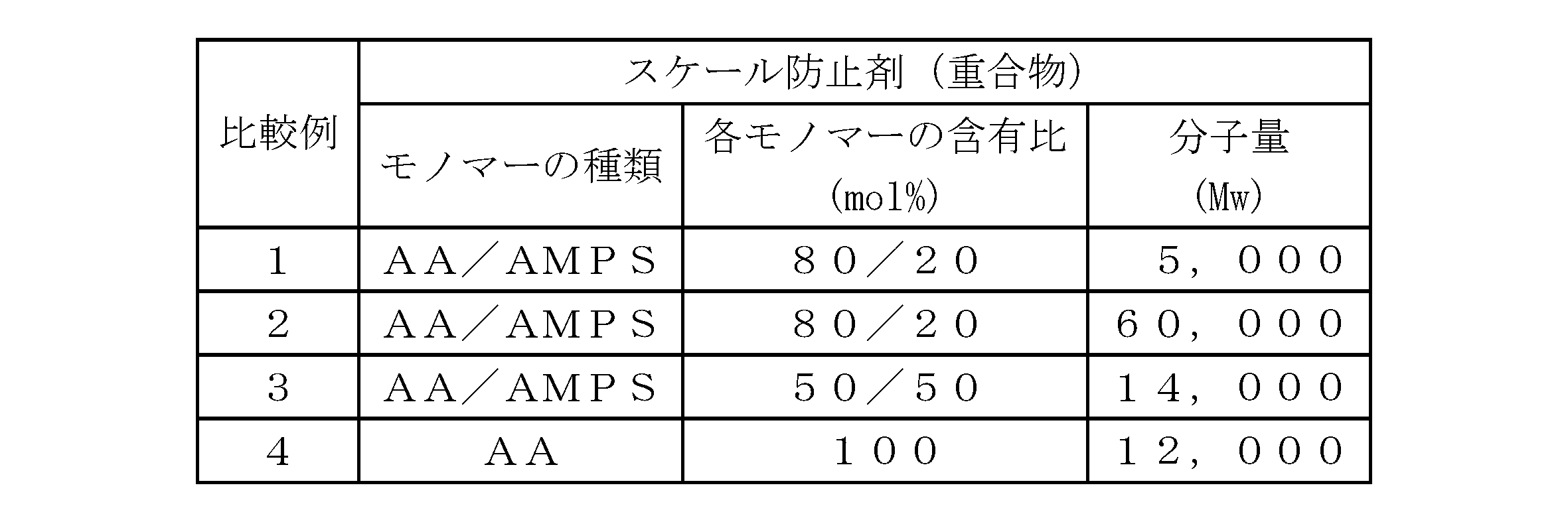
以下、本発明の実施例及び比較例を挙げて、本発明の効果について具体的に説明する。本実施例においては、以下に示す方法で、本発明の範囲内の実施例1~3のスケール防止剤及び本発明の範囲から外れる比較例1~4のスケール防止剤について、その性能を評価した。実施例1~3のスケール防止剤の詳細を下記表1に、比較例1~4のスケール防止剤の詳細を下記表2にそれぞれ示す。なお、下記表1及び表2に示す各モノマーは、AA:アクリル酸、AMPS:2-アクリルアミド-2-メチルプロパンスルホン酸である。

<平膜試験>
先ず、膜の初期性能を測定するため、500mg/LのNaCl水溶液を、ポリアミド逆浸透膜(日東電工社製 ES20)に、操作圧を0.75MPa、回収率を50%として通水し、フラックス(Flux)を所定時間測定した。
先ず、膜の初期性能を測定するため、500mg/LのNaCl水溶液を、ポリアミド逆浸透膜(日東電工社製 ES20)に、操作圧を0.75MPa、回収率を50%として通水し、フラックス(Flux)を所定時間測定した。
次に、塩化カルシウム:500mgCaCO3/L、実施例1~3及び比較例1~8のスケール防止剤(重合物):1mg/L、リン酸水素2ナトリウム:30mgCaCO3/Lを含有する水溶液を調整し、更に、少量の水酸化ナトリウム水溶液と硫酸水溶液でpHを7.0に調製して試験溶液とした。そして、各試験溶液を、ポリアミド逆浸透膜(日東電工社製 ES20)に、操作圧を0.75MPa、回収率を50%として通水し、フラックス(Flux)を所定時間測定した。
その結果を、図1及び図2に示す。なお、図1及び図2は、500mg/LのNaCl水溶液におけるフラックスを1とし、試験溶液で測定したフラックスとの比(フラックス比)の経時変化を示す図である。また、図1及び図2に示すブランク(Blank)は、薬品未添加のときのフラックス比である。
図1に示すように、薬品未添加のBlankでは、フラックスの低下が見られたが、実施例1~3のスケール防止剤を添加したものでは、いずれもフラックスの低下が抑制されていた。これにより、実施例1~3のスケール防止剤を添加した系では、スケールの析出が抑制され、安定した膜処理が可能であることがわかった。
また、実施例1~3のフラックスの低下速度を比較すると、実施例1<実施例2<実施例3の順であり、実施例1が最もフラックス低下を抑制できていることがわかる。特に、2-(メタ)アクリルアミド-2-メチルプロパンスルホン酸に由来する単位が15~25mol%の範囲内にある水溶性共重合物を使用している実施例1のスケール防止剤は、フラックス低下が大幅に抑制されていた。
これに対して、図2に示すように、比較例1~4のスケール防止剤を使用した系では、フラックスの低下が見られた。その低下速度を比較すると、実施例1~3<比較例1<比較例3、4<Blank<比較例2の順であった。
比較例1、2のスケール防止剤は、実施例1のスケール防止剤とモノマー(AA/AMPS)の組成は同じであるが、フラックスが低下していた。これは、比較例1のスケール防止剤は、水溶性共重合物の分子量が1×104未満であったため、スケールの析出抑制効果が低く、また、比較例2のスケール防止剤は、水溶性共重合物の分子量が5×104を超えていたため、ゲル化物が生成したものと考えられる。特に、比較例2のスケール防止剤では、生成した微小な析出物により膜閉塞が生じ、Blankよりもフラックス低下が早くなったと考えられる。
また、比較例3、4のスケール防止剤は、水溶性共重合物の分子量は1×10⁴~5×10⁴あるが、2-(メタ)アクリルアミド-2-メチルプロパンスルホン酸に由来する単位が10mol%未満又は40mol%を超えていたため、フラックスが低下した。
以上の結果から、本発明によれば、排水中のリン濃度を増加させることなく、逆浸透膜処理において生成するリン酸カルシウムスケールの析出を抑制することができ、かつゲル化物などの微小な析出物が生成しない逆浸透膜用スケール防止剤を実現できることが確認された。
Claims (4)
- 逆浸透膜処理においてリン酸カルシウムスケールの析出を抑制するスケール防止剤であって、
主成分が、(メタ)アクリル酸に由来する単位と、2-(メタ)アクリルアミド-2-メチルプロパンスルホン酸に由来する構成単位とを有し、2-(メタ)アクリルアミド-2-メチルプロパンスルホン酸に由来する単位が10~40mol%であり、かつ、質量平均分子量が1×10⁴~5×10⁴である水溶性共重合物である逆浸透膜用スケール防止剤。 - 前記水溶性共重合物は、リンを含有しない請求項1記載の逆浸透膜用スケール防止剤。
- 前記水溶性重合物は、(メタ)アクリル酸と、2-(メタ)アクリルアミド-2-メチルプロパンスルホン酸との共重合体である請求項1又は2に記載の逆浸透膜用スケール防止剤。
- (メタ)アクリル酸に由来する単位と、2-(メタ)アクリルアミド-2-メチルプロパンスルホン酸に由来する構成単位とを有し、2-(メタ)アクリルアミド-2-メチルプロパンスルホン酸に由来する単位が10~40mol%であり、かつ、質量平均分子量が1×10⁴~5×10⁴である水溶性共重合物を主成分とするスケール防止剤を、逆浸透膜処理水系に添加するスケール防止方法。
Priority Applications (2)
| Application Number | Priority Date | Filing Date | Title |
|---|---|---|---|
| JP2012515836A JPWO2012132892A1 (ja) | 2011-03-30 | 2012-03-14 | 逆浸透膜用スケール防止剤及びスケール防止方法 |
| CN2012800154808A CN103476714A (zh) | 2011-03-30 | 2012-03-14 | 反渗透膜用阻垢剂以及阻垢方法 |
Applications Claiming Priority (2)
| Application Number | Priority Date | Filing Date | Title |
|---|---|---|---|
| JP2011-073950 | 2011-03-30 | ||
| JP2011073950 | 2011-03-30 |
Publications (1)
| Publication Number | Publication Date |
|---|---|
| WO2012132892A1 true WO2012132892A1 (ja) | 2012-10-04 |
Family
ID=46930630
Family Applications (1)
| Application Number | Title | Priority Date | Filing Date |
|---|---|---|---|
| PCT/JP2012/056500 Ceased WO2012132892A1 (ja) | 2011-03-30 | 2012-03-14 | 逆浸透膜用スケール防止剤及びスケール防止方法 |
Country Status (3)
| Country | Link |
|---|---|
| JP (1) | JPWO2012132892A1 (ja) |
| CN (1) | CN103476714A (ja) |
| WO (1) | WO2012132892A1 (ja) |
Cited By (9)
| Publication number | Priority date | Publication date | Assignee | Title |
|---|---|---|---|---|
| JP2014079719A (ja) * | 2012-10-18 | 2014-05-08 | Japan Organo Co Ltd | スケール洗浄液組成物およびスケール洗浄方法 |
| WO2014157139A1 (ja) * | 2013-03-29 | 2014-10-02 | 栗田工業株式会社 | スケール防止方法及び逆浸透膜用水酸化マグネシウムスケール防止剤 |
| WO2015136992A1 (ja) * | 2014-03-14 | 2015-09-17 | 栗田工業株式会社 | 冷却排出水の回収方法及び回収装置 |
| CN105169955A (zh) * | 2015-09-24 | 2015-12-23 | 威海翔宇环保科技股份有限公司 | 一种适合反渗透膜中水回用阻垢剂及其制备方法 |
| WO2016047267A1 (ja) * | 2014-09-22 | 2016-03-31 | 東亞合成株式会社 | アクリル酸系共重合体及びその製造方法並びに水処理剤 |
| JP2018149462A (ja) * | 2017-03-09 | 2018-09-27 | アクアス株式会社 | スケール除去剤、および、スケール除去方法 |
| CN114195277A (zh) * | 2021-11-11 | 2022-03-18 | 德蓝(海南)未来之水有限公司 | 一种低磷灰水分散剂及其制备方法 |
| CN114213571A (zh) * | 2021-12-17 | 2022-03-22 | 科威天使环保科技集团股份有限公司 | 一种三元共聚物阻垢剂的制备方法 |
| JP2024027297A (ja) * | 2022-08-17 | 2024-03-01 | オルガノ株式会社 | 水処理方法および水処理装置 |
Families Citing this family (6)
| Publication number | Priority date | Publication date | Assignee | Title |
|---|---|---|---|---|
| CN105441197A (zh) * | 2015-12-29 | 2016-03-30 | 威海翔宇环保科技股份有限公司 | 一种适用于反渗透膜系统离线清洗的清洗剂及其制备方法 |
| JP6779706B2 (ja) * | 2016-08-23 | 2020-11-04 | オルガノ株式会社 | 逆浸透膜を用いる水処理方法 |
| JP6777130B2 (ja) * | 2018-10-05 | 2020-10-28 | 栗田工業株式会社 | 膜用水処理薬品及び膜処理方法 |
| CN115852378B (zh) * | 2022-09-26 | 2025-01-21 | 山东科技大学 | 一种添加阻垢剂的疏水氧化铝纳米孔涂层的制备方法及其应用 |
| CN116875291B (zh) * | 2023-09-06 | 2023-11-07 | 胜利星科石油技术开发(山东)有限公司 | 含丙烯酸脂肪酯-丁烯苯-磺化丙烯酰胺共聚物的复合驱 |
| CN120463366A (zh) * | 2025-05-08 | 2025-08-12 | 广州肆海荟生物科技有限公司 | 一种海洋矿物质的浓缩提取工艺 |
Citations (4)
| Publication number | Priority date | Publication date | Assignee | Title |
|---|---|---|---|---|
| JPS59162999A (ja) * | 1983-03-07 | 1984-09-13 | カルゴン・コ−ポレ−シヨン | カルボン酸/スルホン酸ポリマ−類を含有する相乗効果的なスケ−ルおよび腐食抑制混合剤 |
| JPS63107800A (ja) * | 1986-10-23 | 1988-05-12 | Kurita Water Ind Ltd | 水系用スケ−ル防止剤 |
| JP2001224933A (ja) * | 2000-02-18 | 2001-08-21 | Hakuto Co Ltd | 逆浸透膜表面のスケール抑制方法 |
| WO2010028196A1 (en) * | 2008-09-04 | 2010-03-11 | Nalco Company | Method for inhibiting scale formation and deposition in membrane systems via the use of an aa - amps copolymer |
Family Cites Families (2)
| Publication number | Priority date | Publication date | Assignee | Title |
|---|---|---|---|---|
| CN101652326B (zh) * | 2007-01-24 | 2012-07-04 | 栗田工业株式会社 | 逆渗透膜处理方法 |
| CN101948189B (zh) * | 2010-09-02 | 2012-05-23 | 蓝星环境工程有限公司 | 一种无磷反渗透膜阻垢剂及其制备方法 |
-
2012
- 2012-03-14 WO PCT/JP2012/056500 patent/WO2012132892A1/ja not_active Ceased
- 2012-03-14 JP JP2012515836A patent/JPWO2012132892A1/ja active Pending
- 2012-03-14 CN CN2012800154808A patent/CN103476714A/zh active Pending
Patent Citations (4)
| Publication number | Priority date | Publication date | Assignee | Title |
|---|---|---|---|---|
| JPS59162999A (ja) * | 1983-03-07 | 1984-09-13 | カルゴン・コ−ポレ−シヨン | カルボン酸/スルホン酸ポリマ−類を含有する相乗効果的なスケ−ルおよび腐食抑制混合剤 |
| JPS63107800A (ja) * | 1986-10-23 | 1988-05-12 | Kurita Water Ind Ltd | 水系用スケ−ル防止剤 |
| JP2001224933A (ja) * | 2000-02-18 | 2001-08-21 | Hakuto Co Ltd | 逆浸透膜表面のスケール抑制方法 |
| WO2010028196A1 (en) * | 2008-09-04 | 2010-03-11 | Nalco Company | Method for inhibiting scale formation and deposition in membrane systems via the use of an aa - amps copolymer |
Cited By (14)
| Publication number | Priority date | Publication date | Assignee | Title |
|---|---|---|---|---|
| JP2014079719A (ja) * | 2012-10-18 | 2014-05-08 | Japan Organo Co Ltd | スケール洗浄液組成物およびスケール洗浄方法 |
| WO2014157139A1 (ja) * | 2013-03-29 | 2014-10-02 | 栗田工業株式会社 | スケール防止方法及び逆浸透膜用水酸化マグネシウムスケール防止剤 |
| JP2014195754A (ja) * | 2013-03-29 | 2014-10-16 | 栗田工業株式会社 | スケール防止方法及び逆浸透膜用水酸化マグネシウムスケール防止剤 |
| WO2015136992A1 (ja) * | 2014-03-14 | 2015-09-17 | 栗田工業株式会社 | 冷却排出水の回収方法及び回収装置 |
| CN106574021A (zh) * | 2014-09-22 | 2017-04-19 | 东亚合成株式会社 | 丙烯酸系共聚物及其制造方法以及水处理剂 |
| WO2016047267A1 (ja) * | 2014-09-22 | 2016-03-31 | 東亞合成株式会社 | アクリル酸系共重合体及びその製造方法並びに水処理剤 |
| JPWO2016047267A1 (ja) * | 2014-09-22 | 2017-06-29 | 東亞合成株式会社 | アクリル酸系共重合体及びその製造方法並びに水処理剤 |
| JP2019031689A (ja) * | 2014-09-22 | 2019-02-28 | 東亞合成株式会社 | アクリル酸系共重合体及びその製造方法並びに水処理剤 |
| CN106574021B (zh) * | 2014-09-22 | 2019-05-14 | 东亚合成株式会社 | 丙烯酸系共聚物及其制造方法以及水处理剂 |
| CN105169955A (zh) * | 2015-09-24 | 2015-12-23 | 威海翔宇环保科技股份有限公司 | 一种适合反渗透膜中水回用阻垢剂及其制备方法 |
| JP2018149462A (ja) * | 2017-03-09 | 2018-09-27 | アクアス株式会社 | スケール除去剤、および、スケール除去方法 |
| CN114195277A (zh) * | 2021-11-11 | 2022-03-18 | 德蓝(海南)未来之水有限公司 | 一种低磷灰水分散剂及其制备方法 |
| CN114213571A (zh) * | 2021-12-17 | 2022-03-22 | 科威天使环保科技集团股份有限公司 | 一种三元共聚物阻垢剂的制备方法 |
| JP2024027297A (ja) * | 2022-08-17 | 2024-03-01 | オルガノ株式会社 | 水処理方法および水処理装置 |
Also Published As
| Publication number | Publication date |
|---|---|
| JPWO2012132892A1 (ja) | 2014-07-28 |
| CN103476714A (zh) | 2013-12-25 |
Similar Documents
| Publication | Publication Date | Title |
|---|---|---|
| WO2012132892A1 (ja) | 逆浸透膜用スケール防止剤及びスケール防止方法 | |
| JP5884730B2 (ja) | 逆浸透膜用スケール防止剤及びスケール防止方法 | |
| KR102040143B1 (ko) | 스케일 방지방법 및 스케일 방지제 | |
| JP6255690B2 (ja) | スケール防止方法及び逆浸透膜用水酸化マグネシウムスケール防止剤 | |
| CN103347600A (zh) | 低分子量含磷聚丙烯酸及其在输水体系中作为水垢抑制剂的用途 | |
| WO2014054661A1 (ja) | 冷却水系の処理方法 | |
| KR20140058555A (ko) | 물-공급 시스템에서의 코팅 억제제로서의 중합체 혼합물 | |
| JP2014180649A (ja) | 冷却水系のスケール防止方法及びスケール防止剤 | |
| WO2013147112A1 (ja) | 冷却水系の処理方法 | |
| JP6942975B2 (ja) | リン酸カルシウム系スケール及びシリカ系スケール防止剤 | |
| KR101904716B1 (ko) | 말레산-이소프레놀 공중합체 제조 방법 | |
| CA2844514C (en) | Copolymers of isoprenol, monoethylenically unsaturated monocarboxylic acids and sulphonic acids, methods for production thereof and use thereof as deposit inhibitors in water-bearing systems | |
| JP6340767B2 (ja) | 冷却水系の金属防食処理方法 | |
| JP4654644B2 (ja) | シリカ系汚れの付着防止剤及び付着防止方法 | |
| JP5147271B2 (ja) | シリカ系汚れ防止剤及びシリカ系汚れ防止方法 | |
| US20130180926A1 (en) | Preparing maleic acid-isoprenol copolymers | |
| JP2008036562A (ja) | シリカ系汚れの付着防止剤及び付着防止方法 | |
| JP2006334495A (ja) | シリカ系汚れの付着防止剤、該付着防止剤用共重合体及び付着防止方法 | |
| JP2007038120A (ja) | 亜鉛水酸化物スケール防止剤及び亜鉛水酸化物のスケール防止方法 | |
| JP2015085268A (ja) | 水系のスケール防止剤及びスケール防止方法 |
Legal Events
| Date | Code | Title | Description |
|---|---|---|---|
| ENP | Entry into the national phase |
Ref document number: 2012515836 Country of ref document: JP Kind code of ref document: A |
|
| 121 | Ep: the epo has been informed by wipo that ep was designated in this application |
Ref document number: 12765251 Country of ref document: EP Kind code of ref document: A1 |
|
| NENP | Non-entry into the national phase |
Ref country code: DE |
|
| 122 | Ep: pct application non-entry in european phase |
Ref document number: 12765251 Country of ref document: EP Kind code of ref document: A1 |