WO2012128215A1 - リチウムイオン電池用正極活物質とその製造方法及びリチウムイオン電池用電極並びにリチウムイオン電池 - Google Patents
リチウムイオン電池用正極活物質とその製造方法及びリチウムイオン電池用電極並びにリチウムイオン電池 Download PDFInfo
- Publication number
- WO2012128215A1 WO2012128215A1 PCT/JP2012/056881 JP2012056881W WO2012128215A1 WO 2012128215 A1 WO2012128215 A1 WO 2012128215A1 JP 2012056881 W JP2012056881 W JP 2012056881W WO 2012128215 A1 WO2012128215 A1 WO 2012128215A1
- Authority
- WO
- WIPO (PCT)
- Prior art keywords
- lithium ion
- ion battery
- active material
- electrode active
- positive electrode
- Prior art date
- Legal status (The legal status is an assumption and is not a legal conclusion. Google has not performed a legal analysis and makes no representation as to the accuracy of the status listed.)
- Ceased
Links
Images


Classifications
-
- C—CHEMISTRY; METALLURGY
- C01—INORGANIC CHEMISTRY
- C01B—NON-METALLIC ELEMENTS; COMPOUNDS THEREOF; METALLOIDS OR COMPOUNDS THEREOF NOT COVERED BY SUBCLASS C01C
- C01B25/00—Phosphorus; Compounds thereof
- C01B25/16—Oxyacids of phosphorus; Salts thereof
- C01B25/26—Phosphates
- C01B25/37—Phosphates of heavy metals
-
- H—ELECTRICITY
- H01—ELECTRIC ELEMENTS
- H01M—PROCESSES OR MEANS, e.g. BATTERIES, FOR THE DIRECT CONVERSION OF CHEMICAL ENERGY INTO ELECTRICAL ENERGY
- H01M4/00—Electrodes
- H01M4/02—Electrodes composed of, or comprising, active material
- H01M4/04—Processes of manufacture in general
- H01M4/0471—Processes of manufacture in general involving thermal treatment, e.g. firing, sintering, backing particulate active material, thermal decomposition, pyrolysis
-
- C—CHEMISTRY; METALLURGY
- C01—INORGANIC CHEMISTRY
- C01B—NON-METALLIC ELEMENTS; COMPOUNDS THEREOF; METALLOIDS OR COMPOUNDS THEREOF NOT COVERED BY SUBCLASS C01C
- C01B25/00—Phosphorus; Compounds thereof
- C01B25/16—Oxyacids of phosphorus; Salts thereof
- C01B25/26—Phosphates
- C01B25/45—Phosphates containing plural metal, or metal and ammonium
-
- H—ELECTRICITY
- H01—ELECTRIC ELEMENTS
- H01M—PROCESSES OR MEANS, e.g. BATTERIES, FOR THE DIRECT CONVERSION OF CHEMICAL ENERGY INTO ELECTRICAL ENERGY
- H01M4/00—Electrodes
- H01M4/02—Electrodes composed of, or comprising, active material
- H01M4/04—Processes of manufacture in general
- H01M4/049—Manufacturing of an active layer by chemical means
-
- H—ELECTRICITY
- H01—ELECTRIC ELEMENTS
- H01M—PROCESSES OR MEANS, e.g. BATTERIES, FOR THE DIRECT CONVERSION OF CHEMICAL ENERGY INTO ELECTRICAL ENERGY
- H01M4/00—Electrodes
- H01M4/02—Electrodes composed of, or comprising, active material
- H01M4/36—Selection of substances as active materials, active masses, active liquids
- H01M4/58—Selection of substances as active materials, active masses, active liquids of inorganic compounds other than oxides or hydroxides, e.g. sulfides, selenides, tellurides, halogenides or LiCoFy; of polyanionic structures, e.g. phosphates, silicates or borates
- H01M4/5825—Oxygenated metallic salts or polyanionic structures, e.g. borates, phosphates, silicates, olivines
-
- C—CHEMISTRY; METALLURGY
- C01—INORGANIC CHEMISTRY
- C01B—NON-METALLIC ELEMENTS; COMPOUNDS THEREOF; METALLOIDS OR COMPOUNDS THEREOF NOT COVERED BY SUBCLASS C01C
- C01B25/00—Phosphorus; Compounds thereof
- C01B25/16—Oxyacids of phosphorus; Salts thereof
- C01B25/26—Phosphates
-
- C—CHEMISTRY; METALLURGY
- C01—INORGANIC CHEMISTRY
- C01B—NON-METALLIC ELEMENTS; COMPOUNDS THEREOF; METALLOIDS OR COMPOUNDS THEREOF NOT COVERED BY SUBCLASS C01C
- C01B25/00—Phosphorus; Compounds thereof
- C01B25/16—Oxyacids of phosphorus; Salts thereof
- C01B25/26—Phosphates
- C01B25/38—Condensed phosphates
- C01B25/40—Polyphosphates
- C01B25/41—Polyphosphates of alkali metals
-
- C—CHEMISTRY; METALLURGY
- C01—INORGANIC CHEMISTRY
- C01B—NON-METALLIC ELEMENTS; COMPOUNDS THEREOF; METALLOIDS OR COMPOUNDS THEREOF NOT COVERED BY SUBCLASS C01C
- C01B25/00—Phosphorus; Compounds thereof
- C01B25/16—Oxyacids of phosphorus; Salts thereof
- C01B25/26—Phosphates
- C01B25/455—Phosphates containing halogen
-
- C—CHEMISTRY; METALLURGY
- C01—INORGANIC CHEMISTRY
- C01P—INDEXING SCHEME RELATING TO STRUCTURAL AND PHYSICAL ASPECTS OF SOLID INORGANIC COMPOUNDS
- C01P2006/00—Physical properties of inorganic compounds
- C01P2006/40—Electric properties
-
- H—ELECTRICITY
- H01—ELECTRIC ELEMENTS
- H01M—PROCESSES OR MEANS, e.g. BATTERIES, FOR THE DIRECT CONVERSION OF CHEMICAL ENERGY INTO ELECTRICAL ENERGY
- H01M10/00—Secondary cells; Manufacture thereof
- H01M10/05—Accumulators with non-aqueous electrolyte
- H01M10/052—Li-accumulators
- H01M10/0525—Rocking-chair batteries, i.e. batteries with lithium insertion or intercalation in both electrodes; Lithium-ion batteries
-
- H—ELECTRICITY
- H01—ELECTRIC ELEMENTS
- H01M—PROCESSES OR MEANS, e.g. BATTERIES, FOR THE DIRECT CONVERSION OF CHEMICAL ENERGY INTO ELECTRICAL ENERGY
- H01M10/00—Secondary cells; Manufacture thereof
- H01M10/60—Heating or cooling; Temperature control
-
- H—ELECTRICITY
- H01—ELECTRIC ELEMENTS
- H01M—PROCESSES OR MEANS, e.g. BATTERIES, FOR THE DIRECT CONVERSION OF CHEMICAL ENERGY INTO ELECTRICAL ENERGY
- H01M4/00—Electrodes
- H01M4/02—Electrodes composed of, or comprising, active material
- H01M4/36—Selection of substances as active materials, active masses, active liquids
- H01M4/362—Composites
- H01M4/366—Composites as layered products
-
- H—ELECTRICITY
- H01—ELECTRIC ELEMENTS
- H01M—PROCESSES OR MEANS, e.g. BATTERIES, FOR THE DIRECT CONVERSION OF CHEMICAL ENERGY INTO ELECTRICAL ENERGY
- H01M4/00—Electrodes
- H01M4/02—Electrodes composed of, or comprising, active material
- H01M4/36—Selection of substances as active materials, active masses, active liquids
- H01M4/48—Selection of substances as active materials, active masses, active liquids of inorganic oxides or hydroxides
- H01M4/50—Selection of substances as active materials, active masses, active liquids of inorganic oxides or hydroxides of manganese
-
- H—ELECTRICITY
- H01—ELECTRIC ELEMENTS
- H01M—PROCESSES OR MEANS, e.g. BATTERIES, FOR THE DIRECT CONVERSION OF CHEMICAL ENERGY INTO ELECTRICAL ENERGY
- H01M4/00—Electrodes
- H01M4/02—Electrodes composed of, or comprising, active material
- H01M4/36—Selection of substances as active materials, active masses, active liquids
- H01M4/48—Selection of substances as active materials, active masses, active liquids of inorganic oxides or hydroxides
- H01M4/50—Selection of substances as active materials, active masses, active liquids of inorganic oxides or hydroxides of manganese
- H01M4/505—Selection of substances as active materials, active masses, active liquids of inorganic oxides or hydroxides of manganese of mixed oxides or hydroxides containing manganese for inserting or intercalating light metals, e.g. LiMn2O4 or LiMn2OxFy
-
- Y—GENERAL TAGGING OF NEW TECHNOLOGICAL DEVELOPMENTS; GENERAL TAGGING OF CROSS-SECTIONAL TECHNOLOGIES SPANNING OVER SEVERAL SECTIONS OF THE IPC; TECHNICAL SUBJECTS COVERED BY FORMER USPC CROSS-REFERENCE ART COLLECTIONS [XRACs] AND DIGESTS
- Y02—TECHNOLOGIES OR APPLICATIONS FOR MITIGATION OR ADAPTATION AGAINST CLIMATE CHANGE
- Y02E—REDUCTION OF GREENHOUSE GAS [GHG] EMISSIONS, RELATED TO ENERGY GENERATION, TRANSMISSION OR DISTRIBUTION
- Y02E60/00—Enabling technologies; Technologies with a potential or indirect contribution to GHG emissions mitigation
- Y02E60/10—Energy storage using batteries
-
- Y—GENERAL TAGGING OF NEW TECHNOLOGICAL DEVELOPMENTS; GENERAL TAGGING OF CROSS-SECTIONAL TECHNOLOGIES SPANNING OVER SEVERAL SECTIONS OF THE IPC; TECHNICAL SUBJECTS COVERED BY FORMER USPC CROSS-REFERENCE ART COLLECTIONS [XRACs] AND DIGESTS
- Y02—TECHNOLOGIES OR APPLICATIONS FOR MITIGATION OR ADAPTATION AGAINST CLIMATE CHANGE
- Y02T—CLIMATE CHANGE MITIGATION TECHNOLOGIES RELATED TO TRANSPORTATION
- Y02T10/00—Road transport of goods or passengers
- Y02T10/60—Other road transportation technologies with climate change mitigation effect
- Y02T10/70—Energy storage systems for electromobility, e.g. batteries
Definitions
- the average particle size of the positive electrode active material for a lithium ion battery of the present invention is preferably 10 nm or more and 100 nm or less.
- the electrode for lithium ion batteries of the present invention is characterized by containing the positive electrode active material for lithium ion batteries of the present invention.
- the lithium ion battery of the present invention comprises the lithium ion battery electrode of the present invention.
- LiMnPO 4 particles whose length in the b-axis direction that is suitable for Li diffusion is specifically shortened, high voltage, high energy density, high load characteristics, long-term cycle characteristics stability and safety are excellent.
- a lithium ion battery can be realized.
- FIG. It is a figure which shows the X-ray-diffraction figure of each powder of Example 2 of this invention, and Comparative Examples 1 and 2.
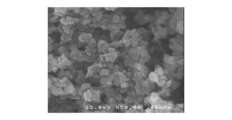
- FIG. It is a scanning electron microscope (SEM) image of the powder of Example 2 of the present invention.
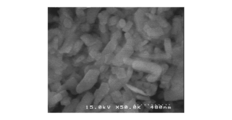
- 2 is a scanning electron microscope (SEM) image of the powder of Comparative Example 1.
- 4 is a scanning electron microscope (SEM) image of the powder of Comparative Example 2.
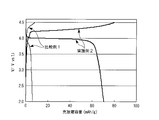
- It is a figure which shows the charging / discharging curve of 0.1CA of Example 2 and Comparative Example 1 of this invention.
- the positive electrode active material for a lithium ion battery of this embodiment has lattice constants a, b, and c calculated from the X-ray diffraction pattern of the positive electrode active material for a lithium ion battery made of LiMnPO 4 having a crystal structure suitable for Li diffusion. It is a positive electrode active material that satisfies 10.41 ⁇ ⁇ a ⁇ 10.43 ⁇ , 6.070 ⁇ ⁇ b ⁇ 6.095 ⁇ , 4.730 ⁇ ⁇ c ⁇ 4.745 ⁇ .
- the values of the lattice constants a, b and c of LiMnPO 4 satisfy the conditions 10.41 ⁇ ⁇ a ⁇ 10.43 ⁇ , 6.070 ⁇ ⁇ b ⁇ 6.095 ⁇ , 4.730 ⁇ ⁇ c ⁇ 4.745 ⁇ .
- this range is a range in which LiMnPO 4 particles having a long length in the a-axis direction and c-axis direction of the crystal lattice of the LiMnPO 4 particles and a short length in the b-axis direction can be realized. is there.
- the average particle diameter of the LiMnPO 4 particles is preferably 10 nm or more and 100 nm or less, more preferably 15 nm or more and 60 nm or less.
- the reason why the average particle size is 10 nm or more and 100 nm or less is that if the average particle size is less than 10 nm, it becomes too fine to keep good crystallinity, and as a result, the a-axis direction of the crystal lattice This is because it is impossible to obtain LiMnPO 4 particles in which the length in the b-axis direction is specifically shortened while keeping the length in the c-axis direction large.
- the average particle diameter exceeds 100 nm the LiMnPO 4 particles are not sufficiently refined, and as a result, very fine and highly crystalline LiMnPO 4 particles cannot be obtained.
- the method for producing a positive electrode active material for a lithium ion battery is a method for producing a positive electrode active material for a lithium ion battery comprising LiMnPO 4 by a hydrothermal synthesis method, wherein the Li source, the P source, and the Mn source are water.
- This is a method of synthesizing under pressure by heating a raw material slurry obtained by mixing with a solvent containing as a main component to a temperature in the range of 100 ° C. or more and 150 ° C. or less.
- Li source examples include hydroxides such as lithium hydroxide (LiOH), lithium carbonate (Li 2 CO 3 ), lithium chloride (LiCl), lithium nitrate (LiNO 3 ), and lithium phosphate (Li 3 PO 4 ).
- Lithium inorganic acid salts such as dilithium hydrogen phosphate (Li 2 HPO 4 ) and lithium dihydrogen phosphate (LiH 2 PO 4 ), lithium such as lithium acetate (LiCH 3 COO) and lithium oxalate ((COOLi) 2 )
- Examples thereof include organic acid salts and hydrates thereof, and one or more selected from these are preferably used.
- Examples of the P source include phosphoric acid such as orthophosphoric acid (H 3 PO 4 ) and metaphosphoric acid (HPO 3 ), ammonium dihydrogen phosphate (NH 4 H 2 PO 4 ), and diammonium hydrogen phosphate ((NH 4 ) 2. HPO 4 ), ammonium phosphate ((NH 4 ) 3 PO 4 ), lithium phosphate (Li 3 PO 4 ), dilithium hydrogen phosphate (Li 2 HPO 4 ), lithium dihydrogen phosphate (LiH 2 PO 4 ) 1 type or 2 types or more selected from phosphates, such as these, and these hydrates are used suitably.
- phosphoric acid such as orthophosphoric acid (H 3 PO 4 ) and metaphosphoric acid (HPO 3 )
- ammonium dihydrogen phosphate NH 4 H 2 PO 4
- diammonium hydrogen phosphate (NH 4 ) 2.
- HPO 4 ammonium phosphate
- Li 3 PO 4 lithium phosphate
- Li 2 HPO 4
- the solvent containing water as a main component is either water alone or an aqueous solvent containing water as a main component and an aqueous solvent such as alcohol as necessary.
- the aqueous solvent is not particularly limited as long as it can dissolve the Li source, the P source, and the Mn source.
- methanol, ethanol, 1-propanol, 2-propanol isopropyl alcohol: IPA
- Alcohols such as butanol, pentanol, hexanol, octanol, diacetone alcohol, ethyl acetate, butyl acetate, ethyl lactate, propylene glycol monomethyl ether acetate, propylene glycol monoethyl ether acetate, esters such as ⁇ -butyrolactone, diethyl ether, Ethylene glycol monomethyl ether (methyl cellosolve), ethylene glycol monoethyl ether (ethyl cellosolve), ethylene glycol monobutyl ether (butyl cellosolve), polyethylene Ethers such as glycol monomethyl ether and diethylene glycol monoethyl ether, ketones such as acetone, methyl ethyl ketone (MEK), methyl isobutyl ketone
- this raw material slurry is put into a pressure vessel, heated to a temperature in the range of 100 ° C. or higher and 150 ° C. or lower, preferably 120 ° C. or higher and 145 ° C. or lower, hydrothermally treated for 1 hour or longer and 48 hours or shorter, 4 particles are obtained.
- the pressure in the pressure resistant container when reaching a temperature in the range of 100 ° C. or higher and 150 ° C. or lower is, for example, 0.1 MPa or higher and 0.7 MPa or lower.
- the particle diameter of the LiMnPO 4 particles can be controlled to a desired size by adjusting the temperature and time during the hydrothermal treatment.
- LiMnPO 4 particles having lattice constants a, b, and c satisfying 10.41 ⁇ ⁇ a ⁇ 10.43 ⁇ , 6.070 ⁇ ⁇ b ⁇ 6.095 ⁇ , 4.730 ⁇ ⁇ c ⁇ 4.745 ⁇ are obtained. be able to.
- a raw material slurry obtained by mixing a Li source, a P source, and a Mn source with a solvent containing water as a main component is 100 ° C. or higher and 150 ° C. It is synthesized under pressure by heating to a temperature in the following range. As a result, it is possible to easily produce very fine LiMnPO 4 particles having a specifically short length in the b-axis direction while keeping the lengths of the crystal lattice in the a-axis direction and c-axis direction large. .
- Example 2 The cake-like substance and powder of Example 2 were obtained according to Example 1, except that the hydrothermal synthesis conditions of the raw slurry were changed to 130 ° C. for 1 hour.
- the average particle size of the powder was measured using a laser diffraction particle size distribution analyzer SALD-2100J (manufactured by Shimadzu Corporation), and found to be 39 nm.
- SALD-2100J manufactured by Shimadzu Corporation
- the X-ray diffraction pattern of the powder of Example 2 is shown in FIG. 1, and the scanning electron microscope (SEM) image is shown in FIG. It should be noted that the JCPDS card no. The position of the diffraction line of LiMnPO 4 described in 33-0804 is shown.
- the shape of the LiMnPO 4 particles observed from the scanning electron microscope (SEM) image of this powder was a columnar crystal.
- An X-ray diffraction pattern of the powder of Comparative Example 1 is shown in FIG. 1, and a scanning electron microscope (SEM) image is shown in FIG.
- this positive electrode plate was punched out into a disk shape having a diameter of 16 mm using a molding machine to obtain a test positive electrode.
- a commercially available Li metal plate is used for the negative electrode, a porous polypropylene membrane is used for the separator, and a 1 mol / L LiPF 6 solution is used for the nonaqueous electrolyte solution, and the solvent for this LiPF 6 solution is used.
- Battery characteristics test The battery characteristics of each of the lithium ion batteries of Examples 1 to 3 and Comparative Example 1 were tested. In this test, the battery was charged at an environmental temperature of 25 ° C. and a charging current of 0.1 CA until the positive electrode potential was 4.5 V with respect to the Li equilibrium potential. Discharge was performed until the voltage reached 2.0V. Table 1 shows the 0.1 C discharge capacity and the 1 C discharge capacity at the environmental temperature of 25 ° C. in each of Examples 1 to 3 and Comparative Example 1. FIG. 5 shows the 0.1 CA charge / discharge curves of Example 2 and Comparative Example 1, respectively.
- a LiPF 6 solution was used as the non-aqueous electrolyte solution, and a solvent having a volume ratio of ethylene carbonate to diethyl carbonate of 1: 1 was used as the solvent of the LiPF 6 solution, but LiBF 4 or LiClO was used instead of LiPF 6.
- LiPF 6 solution was used as the non-aqueous electrolyte solution, and a solvent having a volume ratio of ethylene carbonate to diethyl carbonate of 1: 1 was used as the solvent of the LiPF 6 solution, but LiBF 4 or LiClO was used instead of LiPF 6.
- Four solutions may be used, and propylene carbonate or diethyl carbonate may be used instead of ethylene carbonate.
- LiMnPO 4 particles that are specifically shortened in the b-axis direction suitable for Li diffusion, high voltage, high energy density, high load characteristics, long-term cycle characteristics stability and safety are excellent.
- a lithium ion battery can be realized.
- the present invention can be suitably used for the positive electrode active material for lithium ion batteries consisting of LiMnPO 4.
- the lithium ion battery electrode is produced using the positive electrode active material for the lithium ion battery of the present invention, and the lithium ion battery is produced using the lithium ion battery electrode. It can utilize suitably for an electrode and a lithium ion battery.
- a raw material slurry obtained by mixing a Li source, a P source and a Mn source with a solvent containing water as a main component is 100 ° C. or higher and 150 ° C. or lower. Since the synthesis is performed under pressure by heating to a temperature in the range of LiMnPO 4 , the length in the b-axis direction is specifically short while keeping the lengths of the crystal lattice in the a-axis direction and c-axis direction large. Particles can be easily manufactured. Accordingly, the present invention can be suitably used for the positive electrode active method for producing a material for lithium ion batteries consisting of LiMnPO 4.
Landscapes
- Chemical & Material Sciences (AREA)
- Organic Chemistry (AREA)
- Inorganic Chemistry (AREA)
- General Chemical & Material Sciences (AREA)
- Chemical Kinetics & Catalysis (AREA)
- Electrochemistry (AREA)
- Engineering & Computer Science (AREA)
- Manufacturing & Machinery (AREA)
- Crystallography & Structural Chemistry (AREA)
- Battery Electrode And Active Subsutance (AREA)
- Inorganic Compounds Of Heavy Metals (AREA)
- Materials Engineering (AREA)
Abstract
本発明は、Li拡散に好適な結晶構造のLiMnPO4粒子の結晶形状を制御、さらには平均一次粒子径を制御することにより、高電圧、高エネルギー密度、高負荷特性、長期のサイクル特性の安定性及び安全性を実現することが可能なリチウムイオン電池用正極活物質とその製造方法及びリチウムイオン電池用電極並びにリチウムイオン電池を提供する。本発明のリチウムイオン電池用正極活物質は、LiMnPO4からなるリチウムイオン電池用正極活物質であり、X線回折図形から算出した格子定数a、b及びcの値が、10.41Å<a≦10.43Å、6.070Å<b≦6.095Å、4.730Å<c≦4.745Åを満たしており、平均粒子径は10nm以上かつ100nm以下である。
Description
本発明は、リチウムイオン電池用正極活物質とその製造方法及びリチウムイオン電池用電極並びにリチウムイオン電池に関する。特に詳しくは、本発明は、Li拡散に好適な結晶構造のLiMnPO4粒子の結晶形状を制御、さらには平均一次粒子径を制御することにより、高電圧、高エネルギー密度、高負荷特性、長期のサイクル特性の安定性及び安全性が期待できるリチウムイオン電池用正極活物質とその製造方法、及びこのリチウムイオン電池用正極活物質を用いたリチウムイオン電池用電極並びにリチウムイオン電池に関するものである。
本願は、2011年3月23日に日本に出願された特願2011-064895号に基づき優先権を主張し、その内容をここに援用する。
本願は、2011年3月23日に日本に出願された特願2011-064895号に基づき優先権を主張し、その内容をここに援用する。
近年、小型化、軽量化、高容量化が期待される電池として、リチウムイオン電池等の非水電解液系の二次電池が提案され、実用に供されている。このリチウムイオン電池は、リチウムイオンを可逆的に脱挿入可能な性質を有する正極及び負極と、非水系の電解質とにより構成されている。
リチウムイオン電池は、従来の鉛電池、ニッケルカドミウム電池、ニッケル水素電池等の二次電池と比べて、軽量かつ小型で高エネルギーを有しており、携帯用電話機、ノート型パーソナルコンピュータ等の携帯用電子機器の電源として用いられている。また、近年では、電気自動車、ハイブリッド自動車、電動工具等の高出力電源としても検討されている。これらの高出力電源として用いられる電池の電極活物質には、高速の充放電特性が求められている。
リチウムイオン電池は、従来の鉛電池、ニッケルカドミウム電池、ニッケル水素電池等の二次電池と比べて、軽量かつ小型で高エネルギーを有しており、携帯用電話機、ノート型パーソナルコンピュータ等の携帯用電子機器の電源として用いられている。また、近年では、電気自動車、ハイブリッド自動車、電動工具等の高出力電源としても検討されている。これらの高出力電源として用いられる電池の電極活物質には、高速の充放電特性が求められている。
そこで、上記のような二次電池の高機能化、高容量化、低コスト化、レアメタルフリー等の観点から、正極活物質として様々な材料が検討されている。これらの中でもLiFePO4に代表されるオリビン系リン酸塩系電極活物質は、安全性はもちろんのこと、高資源量及び低コストの電極活物質として注目されている。
このようなリン酸塩系電極活物質のうちでも、アルカリ金属がLiであり、遷移金属がMnであるリン酸マンガンリチウム(LiMnPO4)は、LiFePO4とほぼ同じ約170mAh/gの理論容量を持ちながら、低レート放電条件下にあってもLiFePO4と比べて材料の利用率が非常に悪いという問題点が多くの文献で指摘されてきた(非特許文献1等参照)。
このようなリン酸塩系電極活物質のうちでも、アルカリ金属がLiであり、遷移金属がMnであるリン酸マンガンリチウム(LiMnPO4)は、LiFePO4とほぼ同じ約170mAh/gの理論容量を持ちながら、低レート放電条件下にあってもLiFePO4と比べて材料の利用率が非常に悪いという問題点が多くの文献で指摘されてきた(非特許文献1等参照)。
材料の利用率が悪くなる問題点の1つとして、LiMnPO4のようなリン酸塩系電極活物質の構造に由来する、活物質内部のLi拡散の遅さが挙げられる。
このリン酸塩系電極活物質では、活物質内部のLi拡散は、LiMnPO4とMnPO4の二相の変換を伴いながら結晶格子のb軸方向のみに起こることが知られており(非特許文献2)、リン酸塩系電極活物質は高速の充放電には不利だとされている。
これらの問題点を解決する有効な方法としては、LiMnPO4粒子におけるLi拡散距離を短縮する目的で、この粒子のb軸方向の結晶格子長さを短縮すること、Li拡散スペースを広く確保する目的で、結晶格子のa軸の長さ及びc軸の長さを拡大すること、LiとLiMnPO4粒子の反応面積を増大させる目的で、LiMnPO4粒子を微粒子化すること、等が挙げられる。
このリン酸塩系電極活物質では、活物質内部のLi拡散は、LiMnPO4とMnPO4の二相の変換を伴いながら結晶格子のb軸方向のみに起こることが知られており(非特許文献2)、リン酸塩系電極活物質は高速の充放電には不利だとされている。
これらの問題点を解決する有効な方法としては、LiMnPO4粒子におけるLi拡散距離を短縮する目的で、この粒子のb軸方向の結晶格子長さを短縮すること、Li拡散スペースを広く確保する目的で、結晶格子のa軸の長さ及びc軸の長さを拡大すること、LiとLiMnPO4粒子の反応面積を増大させる目的で、LiMnPO4粒子を微粒子化すること、等が挙げられる。
このLiMnPO4粒子を微粒子化する方法としては、このLiMnPO4粒子を機械的な粉砕により微粒子化する方法が一般的である(特許文献1等参照)。
また、他の方法としては、グリコールやポリオール等の高沸点の多価アルコールを用いた微粒子化方法が提案されている(特許文献2等参照)。
この方法は、十分な量の前駆体をグリコールやポリオール等の高沸点の多価アルコール中で加熱しながら、LiMnPO4粒子を沈澱させる方法である。
また、他の方法としては、グリコールやポリオール等の高沸点の多価アルコールを用いた微粒子化方法が提案されている(特許文献2等参照)。
この方法は、十分な量の前駆体をグリコールやポリオール等の高沸点の多価アルコール中で加熱しながら、LiMnPO4粒子を沈澱させる方法である。
A.K.Padhi,K.S.Nanjundaswamy and J.B.Goodenough,J.Electbrochem.Soc.,Vol.144,No.4,1 30 pp188-1193(1997)
A.Yamada,H.Koizumi,S.Nishimura,N.Sonoyama,R.Kanno,M.Yonemura,T.Nakamura and Y.Kobayashi,Nature Materials 5,pp357-360(2006)
しかしながら、従来の機械的な粉砕により微粒子化する方法では、粒子のb軸方向の結晶格子長さを短縮することは難しく、また、機械的な粉砕では微粒子化に限度があり、目的とする粒子径にまで十分に微粒子化することが難しいという問題点があった。
さらに好ましくないことには、機械的な粉砕がLiMnPO4粒子に歪みや割れ等のダメージを与えてしまうことにより、充放電に不活性なLiMnPO4を生成してしまい、その結果、十分な充放電特性が得られないという問題点があった。
さらに好ましくないことには、機械的な粉砕がLiMnPO4粒子に歪みや割れ等のダメージを与えてしまうことにより、充放電に不活性なLiMnPO4を生成してしまい、その結果、十分な充放電特性が得られないという問題点があった。
一方、高沸点の多価アルコールを用いた微粒子化方法では、機械的な粉砕と比べて微粒子化がなされているものの、得られた粒子は、結晶格子の格子定数bが6.101Åと大きくなる。したがって、粒子のb軸方向の結晶格子長さの短縮化を行うことが難しく、十分な充放電特性を得ることができないという問題点があった。
さらに、リン酸塩系電極活物質の低コスト化の観点から、大量に効率良く生産可能なリン酸塩系電極活物質の製造方法が望まれている。
さらに、リン酸塩系電極活物質の低コスト化の観点から、大量に効率良く生産可能なリン酸塩系電極活物質の製造方法が望まれている。
本発明は、上記の課題を解決するためになされたものであって、Li拡散に好適な結晶構造のLiMnPO4粒子の結晶形状を制御、さらには平均一次粒子径を制御することにより、高電圧、高エネルギー密度、高負荷特性、長期のサイクル特性の安定性及び安全性を実現することが可能なリチウムイオン電池用正極活物質とその製造方法、及びこのリチウムイオン電池用正極活物質を用いたリチウムイオン電池用電極並びにリチウムイオン電池を提供することを目的とする。
本発明者等は、上記課題を解決するために鋭意検討を行った結果、LiMnPO4からなるリチウムイオン電池用正極活物質のX線回折図形から算出した格子定数a、b及びcの値が、10.41Å<a≦10.43Å、6.070Å<b≦6.095Å、4.730Å<c≦4.745Åを満たすこととすれば、結晶格子のa軸方向及びc軸方向の長さを大きく保ったままで、b軸方向の長さが特異的に短いLiMnPO4粒子が実現可能であること、および、このLiMnPO4粒子を用いることで、高電圧、高エネルギー密度、高負荷特性、長期のサイクル特性の安定性及び安全性に優れたリチウムイオン電池を実現することができることを見出し、本発明を完成するに至った。
また、Li源、P源及びMn源を水を主成分とする溶媒と混合して得られた原料スラリーを100℃以上かつ150℃以下の範囲の温度に加熱することで、加圧下にて合成することとすれば、結晶格子のa軸方向及びc軸方向の長さを大きく保ったままで、b軸方向の長さが特異的に短いLiMnPO4粒子を容易に製造することができることを見出し、本発明を完成するに至った。
すなわち、本発明のリチウムイオン電池用正極活物質は、LiMnPO4からなるリチウムイオン電池用正極活物質であって、X線回折図形から算出した格子定数a、b及びcの値が、10.41Å<a≦10.43Å、6.070Å<b≦6.095Å、4.730Å<c≦4.745Åを満たすことを特徴とする。
本発明のリチウムイオン電池用正極活物質の平均粒子径は10nm以上かつ100nm以下であることが好ましい。
本発明のリチウムイオン電池用正極活物質の製造方法は、LiMnPO4からなるリチウムイオン電池用正極活物質を水熱合成法にて製造する方法であって、Li源、P源及びMn源を水を主成分とする溶媒と混合して得られた原料スラリーを100℃以上かつ150℃以下の範囲の温度に加熱することで、加圧下にて合成することを特徴とする。
本発明のリチウムイオン電池用電極は、本発明のリチウムイオン電池用正極活物質を含有してなることを特徴とする。
本発明のリチウムイオン電池は、本発明のリチウムイオン電池用電極を備えてなることを特徴とする。
本発明のリチウムイオン電池は、本発明のリチウムイオン電池用電極を備えてなることを特徴とする。
本発明のリチウムイオン電池用正極活物質によれば、LiMnPO4からなるリチウムイオン電池用正極活物質のX線回折図形から算出した格子定数a、b及びcの値を、10.41Å<a≦10.43Å、6.070Å<b≦6.095Å、4.730Å<c≦4.745Åを満たすこととしたので、LiMnPO4粒子の結晶格子のa軸方向及びc軸方向の長さを大きく保ったままで、b軸方向の長さを特異的に短縮することができる。したがって、Li拡散に好適なb軸方向の長さを特異的に短縮したLiMnPO4粒子を用いることで、高電圧、高エネルギー密度、高負荷特性、長期のサイクル特性の安定性及び安全性に優れたリチウムイオン電池を実現することができる。
本発明のリチウムイオン電池用正極活物質の製造方法によれば、Li源、P源及びMn源を水を主成分とする溶媒と混合して得られた原料スラリーを100℃以上かつ150℃以下の範囲の温度に加熱することで、加圧下にて合成するので、結晶格子のa軸方向及びc軸方向の長さを大きく保ったままで、b軸方向の長さが特異的に短いLiMnPO4粒子を容易に製造することができる。
本発明のリチウムイオン電池用正極活物質とその製造方法及びリチウムイオン電池用電極並びにリチウムイオン電池を実施するための形態について説明する。
なお、この形態は、発明の趣旨をより良く理解させるために具体的に説明するものであり、特に指定のない限り、本発明を限定するものではない。
なお、この形態は、発明の趣旨をより良く理解させるために具体的に説明するものであり、特に指定のない限り、本発明を限定するものではない。
[リチウムイオン電池用正極活物質]
本実施形態のリチウムイオン電池用正極活物質は、Li拡散に好適な結晶構造のLiMnPO4からなるリチウムイオン電池用正極活物質のX線回折図形から算出した格子定数a、b及びcの値が、10.41Å<a≦10.43Å、6.070Å<b≦6.095Å、4.730Å<c≦4.745Åを満たす正極活物質である。
本実施形態のリチウムイオン電池用正極活物質は、Li拡散に好適な結晶構造のLiMnPO4からなるリチウムイオン電池用正極活物質のX線回折図形から算出した格子定数a、b及びcの値が、10.41Å<a≦10.43Å、6.070Å<b≦6.095Å、4.730Å<c≦4.745Åを満たす正極活物質である。
ここで、LiMnPO4の格子定数a、b及びcの値を、10.41Å<a≦10.43Å、6.070Å<b≦6.095Å、4.730Å<c≦4.745Åを満たすこととした理由は、この範囲が、LiMnPO4粒子の結晶格子のa軸方向及びc軸方向の長さが長く、かつb軸方向の長さが特異的に短いLiMnPO4粒子を実現可能な範囲だからである。
このLiMnPO4粒子の平均粒子径は10nm以上かつ100nm以下であることが好ましく、より好ましくは15nm以上かつ60nm以下である。
ここで、平均粒子径を10nm以上かつ100nm以下とした理由は、平均粒子径が10nm未満では、微細になり過ぎて結晶性を良好に保つことが難しくなり、その結果、結晶格子のa軸方向及びc軸方向の長さを大きく保ったままで、b軸方向の長さを特異的に短縮したLiMnPO4粒子が得られなくなるからである。一方、平均粒子径が100nmを超えると、このLiMnPO4粒子の微細化が不十分なものとなり、その結果、非常に微細かつ結晶性の良好なLiMnPO4粒子が得られないので、好ましくない。
ここで、平均粒子径を10nm以上かつ100nm以下とした理由は、平均粒子径が10nm未満では、微細になり過ぎて結晶性を良好に保つことが難しくなり、その結果、結晶格子のa軸方向及びc軸方向の長さを大きく保ったままで、b軸方向の長さを特異的に短縮したLiMnPO4粒子が得られなくなるからである。一方、平均粒子径が100nmを超えると、このLiMnPO4粒子の微細化が不十分なものとなり、その結果、非常に微細かつ結晶性の良好なLiMnPO4粒子が得られないので、好ましくない。
[リチウムイオン電池用正極活物質の製造方法]
本実施形態のリチウムイオン電池用正極活物質の製造方法は、LiMnPO4からなるリチウムイオン電池用正極活物質を水熱合成法にて製造する方法であり、Li源、P源及びMn源を水を主成分とする溶媒と混合して得られた原料スラリーを100℃以上かつ150℃以下の範囲の温度に加熱することで、加圧下にて合成する方法である。
本実施形態のリチウムイオン電池用正極活物質の製造方法は、LiMnPO4からなるリチウムイオン電池用正極活物質を水熱合成法にて製造する方法であり、Li源、P源及びMn源を水を主成分とする溶媒と混合して得られた原料スラリーを100℃以上かつ150℃以下の範囲の温度に加熱することで、加圧下にて合成する方法である。
Li源としては、例えば、水酸化リチウム(LiOH)等の水酸化物、炭酸リチウム(Li2CO3)、塩化リチウム(LiCl)、硝酸リチウム(LiNO3)、リン酸リチウム(Li3PO4)、リン酸水素二リチウム(Li2HPO4)、リン酸二水素リチウム(LiH2PO4)等のリチウム無機酸塩、酢酸リチウム(LiCH3COO)、蓚酸リチウム((COOLi)2)等のリチウム有機酸塩、及びこれらの水和物が挙げられ、これらの中から選択された1種または2種以上が好適に用いられる。
P源としては、オルトリン酸(H3PO4)、メタリン酸(HPO3)等のリン酸、リン酸二水素アンモニウム(NH4H2PO4)、リン酸水素二アンモニウム((NH4)2HPO4)、リン酸アンモニウム((NH4)3PO4)、リン酸リチウム(Li3PO4)、リン酸水素二リチウム(Li2HPO4)、リン酸二水素リチウム(LiH2PO4)等のリン酸塩、及びこれらの水和物の中から選択された1種または2種以上が好適に用いられる。
Mn源としては、Mn塩が好ましく、例えば、塩化マンガン(II)(MnCl2)、硫酸マンガン(II)(MnSO4)、硝酸マンガン(II)(Mn(NO3)2)、酢酸マンガン(II)(Mn(CH3COO)2)及びこれらの水和物の中から選択された1種または2種以上が好ましい。
水を主成分とする溶媒とは、水単独、あるいは水を主成分とし必要に応じてアルコール等の水性溶媒を含む水系溶媒、のいずれかである。
水性溶媒としては、Li源、P源及びMn源を溶解させることのできる溶媒であればよく、特に制限されないが、例えば、メタノール、エタノール、1-プロパノール、2-プロパノール(イソプロピルアルコール:IPA)、ブタノール、ペンタノール、ヘキサノール、オクタノール、ジアセトンアルコール等のアルコール類、酢酸エチル、酢酸ブチル、乳酸エチル、プロピレングリコールモノメチルエーテルアセテート、プロピレングリコールモノエチルエーテルアセテート、γ-ブチロラクトン等のエステル類、ジエチルエーテル、エチレングルコールモノメチルエーテル(メチルセロソルブ)、エチレングルコールモノエチルエーテル(エチルセロソルブ)、エチレングルコールモノブチルエーテル(ブチルセロソルブ)、ジエチレングリコールモノメチルエーテル、ジエチレングリコールモノエチルエーテル等のエーテル類、アセトン、メチルエチルケトン(MEK)、メチルイソブチルケトン(MIBK)、アセチルアセトン、シクロヘキサノン等のケトン類、ジメチルホルムアミド、N,N-ジメチルアセトアセトアミド、N-メチルピロリドン等のアミド類、エチレングリコール、ジエチレングリコール、プロピレングリコール等のグリコール類等を挙げることができる。これらは、1種のみを単独で用いてもよく、2種以上を混合して用いてもよい。
水性溶媒としては、Li源、P源及びMn源を溶解させることのできる溶媒であればよく、特に制限されないが、例えば、メタノール、エタノール、1-プロパノール、2-プロパノール(イソプロピルアルコール:IPA)、ブタノール、ペンタノール、ヘキサノール、オクタノール、ジアセトンアルコール等のアルコール類、酢酸エチル、酢酸ブチル、乳酸エチル、プロピレングリコールモノメチルエーテルアセテート、プロピレングリコールモノエチルエーテルアセテート、γ-ブチロラクトン等のエステル類、ジエチルエーテル、エチレングルコールモノメチルエーテル(メチルセロソルブ)、エチレングルコールモノエチルエーテル(エチルセロソルブ)、エチレングルコールモノブチルエーテル(ブチルセロソルブ)、ジエチレングリコールモノメチルエーテル、ジエチレングリコールモノエチルエーテル等のエーテル類、アセトン、メチルエチルケトン(MEK)、メチルイソブチルケトン(MIBK)、アセチルアセトン、シクロヘキサノン等のケトン類、ジメチルホルムアミド、N,N-ジメチルアセトアセトアミド、N-メチルピロリドン等のアミド類、エチレングリコール、ジエチレングリコール、プロピレングリコール等のグリコール類等を挙げることができる。これらは、1種のみを単独で用いてもよく、2種以上を混合して用いてもよい。
これらLi源、P源及びMn源を、これらのモル比(Li源:P源:Mn源)が3:1:1となるように水を主成分とする溶媒に投入し、撹拌・混合して原料スラリーとする。
これらLi源、P源及びMn源は、均一に混合する点を考慮すると、Li源、P源及びMn源を一旦水溶液の状態とした後、混合することが好ましい。
この原料スラリーにおけるLi源、P源及びMn源のモル濃度は、高純度で結晶性が高くかつ非常に微細なLiMnPO4粒子を得る必要があることから、1.5mol/L以上かつ4mol/L以下が好ましい。
これらLi源、P源及びMn源は、均一に混合する点を考慮すると、Li源、P源及びMn源を一旦水溶液の状態とした後、混合することが好ましい。
この原料スラリーにおけるLi源、P源及びMn源のモル濃度は、高純度で結晶性が高くかつ非常に微細なLiMnPO4粒子を得る必要があることから、1.5mol/L以上かつ4mol/L以下が好ましい。
次いで、この原料スラリーを耐圧容器に入れ、100℃以上かつ150℃以下、好ましくは120℃以上かつ145℃以下の範囲の温度に加熱し、1時間以上かつ48時間以下、水熱処理を行い、LiMnPO4粒子を得る。
この100℃以上かつ150℃以下の範囲の温度に到達したときの耐圧容器内の圧力は、例えば0.1MPa以上かつ0.7MPa以下となる。
この場合、水熱処理時の温度及び時間を調整することにより、LiMnPO4粒子の粒子径を所望の大きさに制御することが可能である。
以上により、格子定数a、b及びcの値が、10.41Å<a≦10.43Å、6.070Å<b≦6.095Å、4.730Å<c≦4.745Åを満たすLiMnPO4粒子を得ることができる。
この100℃以上かつ150℃以下の範囲の温度に到達したときの耐圧容器内の圧力は、例えば0.1MPa以上かつ0.7MPa以下となる。
この場合、水熱処理時の温度及び時間を調整することにより、LiMnPO4粒子の粒子径を所望の大きさに制御することが可能である。
以上により、格子定数a、b及びcの値が、10.41Å<a≦10.43Å、6.070Å<b≦6.095Å、4.730Å<c≦4.745Åを満たすLiMnPO4粒子を得ることができる。
以上説明したように、本実施形態のリチウムイオン電池用正極活物質によれば、LiMnPO4からなるリチウムイオン電池用正極活物質のX線回折図形から算出した格子定数a、b及びcの値が、10.41Å<a≦10.43Å、6.070Å<b≦6.095Å、4.730Å<c≦4.745Åを満たすこととしている。このため、LiMnPO4粒子の結晶格子のa軸方向及びc軸方向の長さを大きく保ったままで、b軸方向の長さを特異的に短縮することができる。したがって、Li拡散に好適となるようにb軸方向の長さを特異的に短縮し、しかも非常に微細なLiMnPO4粒子を用いることで、高電圧、高エネルギー密度、高負荷特性、長期のサイクル特性の安定性及び安全性に優れたリチウムイオン電池を実現することができる。
本実施形態のリチウムイオン電池用正極活物質の製造方法によれば、Li源、P源及びMn源を水を主成分とする溶媒と混合して得られた原料スラリーを100℃以上かつ150℃以下の範囲の温度に加熱することで、加圧下にて合成する。これにより、結晶格子のa軸方向及びc軸方向の長さを大きく保ったままで、b軸方向の長さが特異的に短く、しかも非常に微細なLiMnPO4粒子を容易に製造することができる。
以下、実施例及び比較例により本発明を具体的に説明するが、本発明はこれらの実施例によって限定されるものではない。
「粉体の作製」
(実施例1)
LiMnPO4の合成は以下のようにして行った。
Li源及びP源としてLi3PO4を、Mn源としてMnSO4水溶液を用い、これらをモル比でLi:Mn:P=3:1:1となるように混合して200mlの原料スラリーを作製した。
次いで、この原料スラリーを耐圧容器に入れ、その後、100℃にて1時間、水熱合成を行った。このときの耐圧容器内の圧力は0.1MPaであった。
反応後、室温になるまで冷却し、ケーキ状態の反応生成物の沈殿物を得た。この沈殿物を蒸留水にて計5回十分に水洗し、乾燥しないように含水率30%に保持し、実施例1のケーキ状物質を得た。
(実施例1)
LiMnPO4の合成は以下のようにして行った。
Li源及びP源としてLi3PO4を、Mn源としてMnSO4水溶液を用い、これらをモル比でLi:Mn:P=3:1:1となるように混合して200mlの原料スラリーを作製した。
次いで、この原料スラリーを耐圧容器に入れ、その後、100℃にて1時間、水熱合成を行った。このときの耐圧容器内の圧力は0.1MPaであった。
反応後、室温になるまで冷却し、ケーキ状態の反応生成物の沈殿物を得た。この沈殿物を蒸留水にて計5回十分に水洗し、乾燥しないように含水率30%に保持し、実施例1のケーキ状物質を得た。
次いで、上記の沈殿物から試料を若干量採取し、この試料を70℃にて2時間真空乾燥させ、実施例1の粉体を得た。
この粉体の平均粒子径をレーザー回折式粒度分布測定装置 SALD-2100J(島津製作所社製)を用いて測定したところ、17nmであった。
この粉体をX線回折装置を用いて同定したところ、単相のLiMnPO4が生成していることが確認された。また、この粉体のX線回折図形から算出した格子定数の値は、a=10.419Å、b=6.086Å、c=4.734Åであった。
また、この粉体の走査型電子顕微鏡(SEM)像から観察されるLiMnPO4粒子の形状は、特徴的な板状結晶であった。
さらに、X線回折図形に見られるX線強度のピークのうち、b軸の反射に由来するピークが大きく現れており、板状結晶の厚さ方向はb軸方向であることが分かった。
この粉体の平均粒子径をレーザー回折式粒度分布測定装置 SALD-2100J(島津製作所社製)を用いて測定したところ、17nmであった。
この粉体をX線回折装置を用いて同定したところ、単相のLiMnPO4が生成していることが確認された。また、この粉体のX線回折図形から算出した格子定数の値は、a=10.419Å、b=6.086Å、c=4.734Åであった。
また、この粉体の走査型電子顕微鏡(SEM)像から観察されるLiMnPO4粒子の形状は、特徴的な板状結晶であった。
さらに、X線回折図形に見られるX線強度のピークのうち、b軸の反射に由来するピークが大きく現れており、板状結晶の厚さ方向はb軸方向であることが分かった。
(実施例2)
原料スラリーの水熱合成の条件を130℃にて1時間とした他は、実施例1に準じて実施例2のケーキ状物質及び粉体を得た。
この粉体の平均粒子径をレーザー回折式粒度分布測定装置 SALD-2100J(島津製作所社製)を用いて測定したところ、39nmであった。
この粉体をX線回折装置を用いて同定したところ、単相のLiMnPO4が生成していることが確認された。また、この粉体のX線回折図形から算出した格子定数の値は、a=10.429Å、b=6.085Å、c=4.735Åであった。
また、この粉体の走査型電子顕微鏡(SEM)像から観察されるLiMnPO4粒子の形状は、特徴的な板状結晶であった。
原料スラリーの水熱合成の条件を130℃にて1時間とした他は、実施例1に準じて実施例2のケーキ状物質及び粉体を得た。
この粉体の平均粒子径をレーザー回折式粒度分布測定装置 SALD-2100J(島津製作所社製)を用いて測定したところ、39nmであった。
この粉体をX線回折装置を用いて同定したところ、単相のLiMnPO4が生成していることが確認された。また、この粉体のX線回折図形から算出した格子定数の値は、a=10.429Å、b=6.085Å、c=4.735Åであった。
また、この粉体の走査型電子顕微鏡(SEM)像から観察されるLiMnPO4粒子の形状は、特徴的な板状結晶であった。
さらに、X線回折図形に見られるX線強度のピークのうち、b軸の反射に由来するピークが大きく現れており、板状結晶の厚さ方向はb軸方向であることが分かった。
実施例2の粉体のX線回折図形を図1に、走査型電子顕微鏡(SEM)像を図2に、それぞれ示す。なお、図1の最下段に、JCPDSカードNo.33-0804に記載されているLiMnPO4の回折線の位置を示している。
実施例2の粉体のX線回折図形を図1に、走査型電子顕微鏡(SEM)像を図2に、それぞれ示す。なお、図1の最下段に、JCPDSカードNo.33-0804に記載されているLiMnPO4の回折線の位置を示している。
(実施例3)
原料スラリーの水熱合成の条件を150℃にて1時間とした他は、実施例1に準じて実施例3のケーキ状物質及び粉体を得た。
この粉体の平均粒子径をレーザー回折式粒度分布測定装置 SALD-2100J(島津製作所社製)を用いて測定したところ、78nmであった。
この粉体をX線回折装置を用いて同定したところ、単相のLiMnPO4が生成していることが確認された。また、この粉体のX線回折図形から算出した格子定数の値は、a=10.424Å、b=6.088Å、c=4.739Åであった。
また、この粉体の走査型電子顕微鏡(SEM)像から観察されるLiMnPO4粒子の形状は、特徴的な板状結晶であった。
さらに、X線回折図形に見られるX線強度のピークのうち、b軸の反射に由来するピークが大きく現れており、板状結晶の厚さ方向はb軸方向であることが分かった。
原料スラリーの水熱合成の条件を150℃にて1時間とした他は、実施例1に準じて実施例3のケーキ状物質及び粉体を得た。
この粉体の平均粒子径をレーザー回折式粒度分布測定装置 SALD-2100J(島津製作所社製)を用いて測定したところ、78nmであった。
この粉体をX線回折装置を用いて同定したところ、単相のLiMnPO4が生成していることが確認された。また、この粉体のX線回折図形から算出した格子定数の値は、a=10.424Å、b=6.088Å、c=4.739Åであった。
また、この粉体の走査型電子顕微鏡(SEM)像から観察されるLiMnPO4粒子の形状は、特徴的な板状結晶であった。
さらに、X線回折図形に見られるX線強度のピークのうち、b軸の反射に由来するピークが大きく現れており、板状結晶の厚さ方向はb軸方向であることが分かった。
(比較例1)
原料スラリーの水熱合成の条件を170℃にて1時間とした他は、実施例1に準じて比較例1のケーキ状物質及び粉体を得た。
この粉体の平均粒子径をレーザー回折式粒度分布測定装置 SALD-2100J(島津製作所社製)を用いて測定したところ、132nmであった。
この粉体をX線回折装置を用いて同定したところ、単相のLiMnPO4が生成していることが確認された。また、この粉体のX線回折図形から算出した格子定数の値は、a=10.443Å、b=6.102Å、c=4.748Åであった。
また、この粉体の走査型電子顕微鏡(SEM)像から観察されるLiMnPO4粒子の形状は、柱状の結晶であった。
比較例1の粉体のX線回折図形を図1に、走査型電子顕微鏡(SEM)像を図3に、それぞれ示す。
原料スラリーの水熱合成の条件を170℃にて1時間とした他は、実施例1に準じて比較例1のケーキ状物質及び粉体を得た。
この粉体の平均粒子径をレーザー回折式粒度分布測定装置 SALD-2100J(島津製作所社製)を用いて測定したところ、132nmであった。
この粉体をX線回折装置を用いて同定したところ、単相のLiMnPO4が生成していることが確認された。また、この粉体のX線回折図形から算出した格子定数の値は、a=10.443Å、b=6.102Å、c=4.748Åであった。
また、この粉体の走査型電子顕微鏡(SEM)像から観察されるLiMnPO4粒子の形状は、柱状の結晶であった。
比較例1の粉体のX線回折図形を図1に、走査型電子顕微鏡(SEM)像を図3に、それぞれ示す。
(比較例2)
原料スラリーの水熱合成の条件を90℃にて1時間とした他は、実施例1に準じて比較例2のケーキ状物質及び粉体を得た。
この粉体の平均粒子径をレーザー回折式粒度分布測定装置 SALD-2100J(島津製作所社製)を用いて測定したところ、31nmであった。
この粉体をX線回折装置を用いて同定したところ、単相のLiMnPO4は生成しておらず、Li3PO4とMn2P2O7水和物との混合物が生成していることが確認された。
比較例2の粉体のX線回折図形を図1に、走査型電子顕微鏡(SEM)像を図4に、それぞれ示す。
原料スラリーの水熱合成の条件を90℃にて1時間とした他は、実施例1に準じて比較例2のケーキ状物質及び粉体を得た。
この粉体の平均粒子径をレーザー回折式粒度分布測定装置 SALD-2100J(島津製作所社製)を用いて測定したところ、31nmであった。
この粉体をX線回折装置を用いて同定したところ、単相のLiMnPO4は生成しておらず、Li3PO4とMn2P2O7水和物との混合物が生成していることが確認された。
比較例2の粉体のX線回折図形を図1に、走査型電子顕微鏡(SEM)像を図4に、それぞれ示す。
「リチウムイオン電池の作製」
実施例1~3及び比較例1各々にて得られた各粉体、導電助剤としてアセチレンブラック(AB)、バインダーとしてポリフッ化ビニリデン(PVdF)、溶媒としてN-メチル-2-ピロリジノン(NMP)を用い、これらを混合し、実施例1~3及び比較例1各々の正極材料ペーストを作製した。なお、ペースト中の質量比、すなわち粉体:AB:PVdFは80:10:10であった。
次いで、これらの正極材料ペーストを厚み30μmのアルミニウム(Al)箔上に塗布し、乾燥した。その後、30MPaの圧力にて圧密し、正電極板とした。
実施例1~3及び比較例1各々にて得られた各粉体、導電助剤としてアセチレンブラック(AB)、バインダーとしてポリフッ化ビニリデン(PVdF)、溶媒としてN-メチル-2-ピロリジノン(NMP)を用い、これらを混合し、実施例1~3及び比較例1各々の正極材料ペーストを作製した。なお、ペースト中の質量比、すなわち粉体:AB:PVdFは80:10:10であった。
次いで、これらの正極材料ペーストを厚み30μmのアルミニウム(Al)箔上に塗布し、乾燥した。その後、30MPaの圧力にて圧密し、正電極板とした。
次いで、この正電極板を成形機を用いて直径16mmの円板状に打ち抜き、試験用正電極とした。
一方、負電極には市販のLi金属板を、セパレーターには多孔質ボリプロピレン膜を、非水電解質溶液には1mol/LのLiPF6溶液を、それぞれ用い、また、このLiPF6溶液の溶媒としては、炭酸エチレンと炭酸ジエチルとの体積比が1:1の混合溶液を用い、2032コイン型セルを用いて、実施例1~3及び比較例1各々のリチウムイオン電池を作製した。
一方、負電極には市販のLi金属板を、セパレーターには多孔質ボリプロピレン膜を、非水電解質溶液には1mol/LのLiPF6溶液を、それぞれ用い、また、このLiPF6溶液の溶媒としては、炭酸エチレンと炭酸ジエチルとの体積比が1:1の混合溶液を用い、2032コイン型セルを用いて、実施例1~3及び比較例1各々のリチウムイオン電池を作製した。
「電池特性試験」
実施例1~3及び比較例1各々のリチウムイオン電池の電池特性試験を行った。この試験では、環境温度25℃、充電電流0.1CAで、正電極の電位がLiの平衡電位に対して4.5Vになるまで充電し、1分間休止の後、0.1CAの放電電流で2.0Vになるまで放電を行った。
実施例1~3及び比較例1各々の環境温度25℃における0.1C放電容量及び1C放電容量を表1に示す。また、図5に実施例2及び比較例1各々の0.1CAの充放電曲線を示す。
実施例1~3及び比較例1各々のリチウムイオン電池の電池特性試験を行った。この試験では、環境温度25℃、充電電流0.1CAで、正電極の電位がLiの平衡電位に対して4.5Vになるまで充電し、1分間休止の後、0.1CAの放電電流で2.0Vになるまで放電を行った。
実施例1~3及び比較例1各々の環境温度25℃における0.1C放電容量及び1C放電容量を表1に示す。また、図5に実施例2及び比較例1各々の0.1CAの充放電曲線を示す。
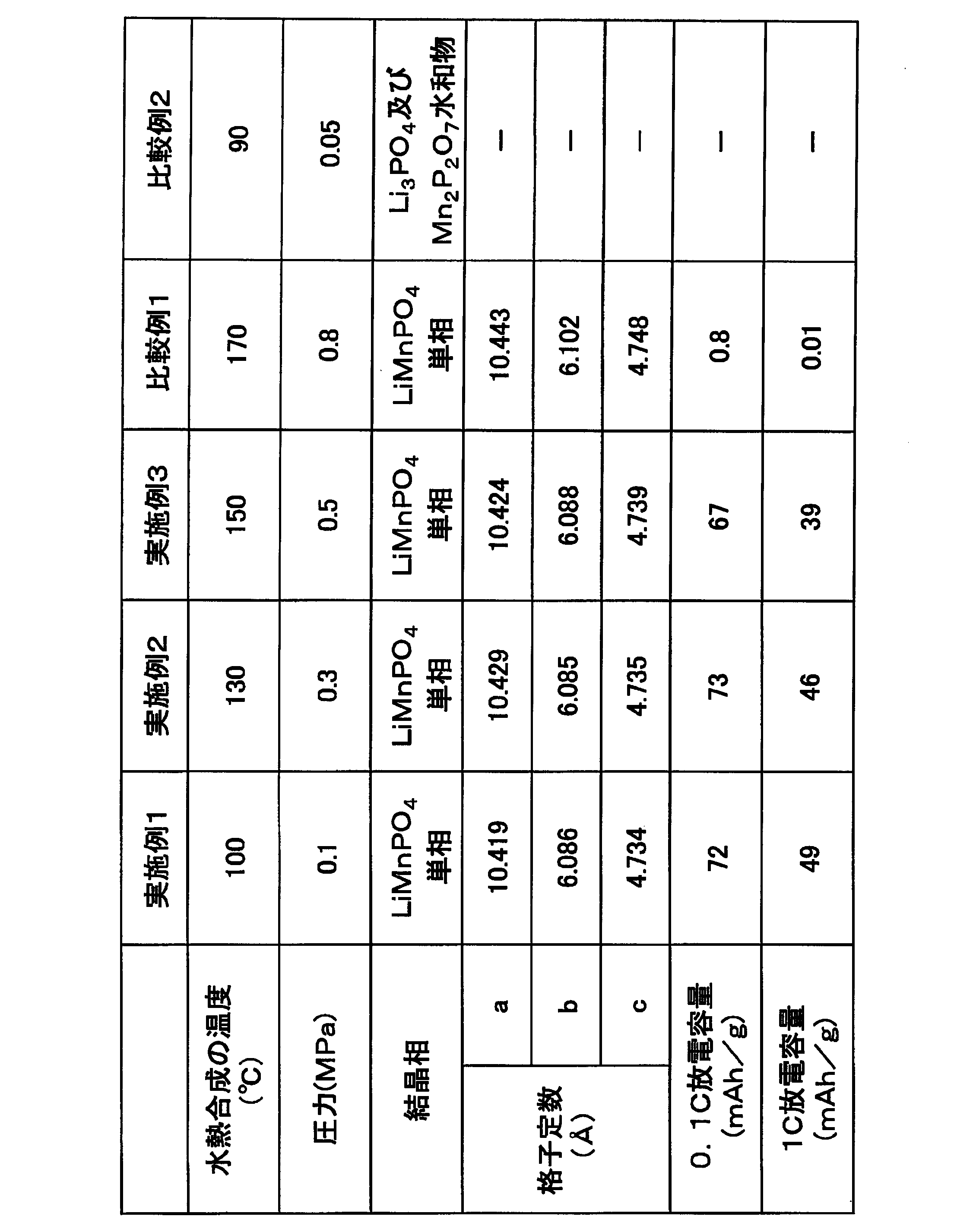
表1に示したとおり、実施例1~3及び比較例1各々にて得られたLiMnPO4粉末のX線回折図形から算出した格子定数を比較してみると、実施例1~3にて得られた粉末のb軸格子定数は、比較例1にて得られた粉末のb軸格子定数に比べて特異的に小さいという結果が得られた。
なお、実施例1~3では、導電助剤としてアセチレンブラックを用いているが、カーボンブラック、グラファイト、ケッチェンブラック、天然黒鉛、人造黒鉛等の炭素材料を用いてもよい。
また、負電極に市販のLi金属板を用いたが、このLi金属板の替わりに天然黒鉛、人造黒鉛、コークス等の炭素材料、リチウム合金、Li4Ti5O12等の負極材料を用いてもよい。
また、負電極に市販のLi金属板を用いたが、このLi金属板の替わりに天然黒鉛、人造黒鉛、コークス等の炭素材料、リチウム合金、Li4Ti5O12等の負極材料を用いてもよい。
また、非水電解質溶液にLiPF6溶液を、このLiPF6溶液の溶媒として炭酸エチレンと炭酸ジエチルとの体積比が1:1のものを、それぞれ用いたが、LiPF6の替わりにLiBF4やLiClO4溶液を用いてもよく、炭酸エチレンの代わりにプロピレンカーボネートやジエチルカーボネートを用いてもよい。
また、電解液とセパレーターの代わりに固体電解質を用いてもよい。
また、電解液とセパレーターの代わりに固体電解質を用いてもよい。
本発明のリチウムイオン電池用正極活物質によれば、LiMnPO4からなるリチウムイオン電池用正極活物質のX線回折図形から算出した格子定数a、b及びcの値を、10.41Å<a≦10.43Å、6.070Å<b≦6.095Å、4.730Å<c≦4.745Åを満たすこととしたので、LiMnPO4粒子の結晶格子のa軸方向及びc軸方向の長さを大きく保ったままで、b軸方向の長さを特異的に短縮することができる。また、Li拡散に好適なb軸方向の長さを特異的に短縮したLiMnPO4粒子を用いることで、高電圧、高エネルギー密度、高負荷特性、長期のサイクル特性の安定性及び安全性に優れたリチウムイオン電池を実現することができる。したがって、本発明は、LiMnPO4からなるリチウムイオン電池用正極活物質に好適に利用することができる。また、本発明のリチウムイオン電池用正極活物質を用いてリチウムイオン電池用電極を作製し、このリチウムイオン電池用電極を用いてリチウムイオン電池を作製することにより、本発明は、リチウムイオン電池用電極及びリチウムイオン電池に好適に利用することができる。
本発明のリチウムイオン電池用正極活物質の製造方法によれば、Li源、P源及びMn源を水を主成分とする溶媒と混合して得られた原料スラリーを100℃以上かつ150℃以下の範囲の温度に加熱することで、加圧下にて合成するので、結晶格子のa軸方向及びc軸方向の長さを大きく保ったままで、b軸方向の長さが特異的に短いLiMnPO4粒子を容易に製造することができる。したがって、本発明は、LiMnPO4からなるリチウムイオン電池用正極活物質の製造方法に好適に利用することができる。
Claims (5)
- LiMnPO4からなるリチウムイオン電池用正極活物質であって、
X線回折図形から算出した格子定数a、b及びcの値が、10.41Å<a≦10.43Å、6.070Å<b≦6.095Å、4.730Å<c≦4.745Åを満たすことを特徴とするリチウムイオン電池用正極活物質。 - 平均粒子径は10nm以上かつ100nm以下であることを特徴とする請求項1記載のリチウムイオン電池用正極活物質。
- LiMnPO4からなるリチウムイオン電池用正極活物質を水熱合成法にて製造する方法であって、
Li源、P源及びMn源を水を主成分とする溶媒と混合して得られた原料スラリーを100℃以上かつ150℃以下の範囲の温度に加熱することで、加圧下にて合成することを特徴とするリチウムイオン電池用正極活物質の製造方法。 - 請求項1または2記載のリチウムイオン電池用正極活物質を含有してなることを特徴とするリチウムイオン電池用電極。
- 請求項4記載のリチウムイオン電池用電極を備えてなることを特徴とするリチウムイオン電池。
Priority Applications (2)
| Application Number | Priority Date | Filing Date | Title |
|---|---|---|---|
| US14/002,016 US9231244B2 (en) | 2011-03-23 | 2012-03-16 | Positive electrode active material for lithium ion battery, method of producing the same, electrode for lithium ion battery, and lithium ion battery |
| US14/952,429 US20160079587A1 (en) | 2011-03-23 | 2015-11-25 | Positive electrode active material for lithium ion battery, method of producing the same, electrode for lithium ion battery, and lithium ion battery |
Applications Claiming Priority (2)
| Application Number | Priority Date | Filing Date | Title |
|---|---|---|---|
| JP2011064895A JP5673275B2 (ja) | 2011-03-23 | 2011-03-23 | リチウムイオン電池用正極活物質とその製造方法及びリチウムイオン電池用電極並びにリチウムイオン電池 |
| JP2011-064895 | 2011-03-23 |
Related Child Applications (2)
| Application Number | Title | Priority Date | Filing Date |
|---|---|---|---|
| US14/002,016 A-371-Of-International US9231244B2 (en) | 2011-03-23 | 2012-03-16 | Positive electrode active material for lithium ion battery, method of producing the same, electrode for lithium ion battery, and lithium ion battery |
| US14/952,429 Division US20160079587A1 (en) | 2011-03-23 | 2015-11-25 | Positive electrode active material for lithium ion battery, method of producing the same, electrode for lithium ion battery, and lithium ion battery |
Publications (1)
| Publication Number | Publication Date |
|---|---|
| WO2012128215A1 true WO2012128215A1 (ja) | 2012-09-27 |
Family
ID=46879362
Family Applications (1)
| Application Number | Title | Priority Date | Filing Date |
|---|---|---|---|
| PCT/JP2012/056881 Ceased WO2012128215A1 (ja) | 2011-03-23 | 2012-03-16 | リチウムイオン電池用正極活物質とその製造方法及びリチウムイオン電池用電極並びにリチウムイオン電池 |
Country Status (4)
| Country | Link |
|---|---|
| US (2) | US9231244B2 (ja) |
| JP (1) | JP5673275B2 (ja) |
| TW (1) | TW201246672A (ja) |
| WO (1) | WO2012128215A1 (ja) |
Cited By (1)
| Publication number | Priority date | Publication date | Assignee | Title |
|---|---|---|---|---|
| CN104701539A (zh) * | 2013-12-07 | 2015-06-10 | 天津赫维科技有限公司 | 一种湿化学法制备磷酸锰锂正极材料的方法 |
Families Citing this family (6)
| Publication number | Priority date | Publication date | Assignee | Title |
|---|---|---|---|---|
| CN104332629B (zh) * | 2014-10-21 | 2016-09-14 | 浙江大学 | 一种磷酸锰锂中空纳米球的制备方法及产品 |
| CA2977349C (en) | 2015-03-31 | 2020-10-06 | Toray Industries, Inc. | Lithium manganese phosphate nanoparticles and method for manufacturing same, carbon-coated lithium manganese phosphate nanoparticles, carbon-coated lithium manganese phosphate nanoparticle granulated body, and lithium ion cell |
| JP5999240B1 (ja) | 2015-09-30 | 2016-09-28 | 住友大阪セメント株式会社 | リチウムイオン二次電池用電極材料およびその製造方法 |
| JP6168224B1 (ja) | 2016-09-30 | 2017-07-26 | 住友大阪セメント株式会社 | リチウムイオン二次電池用電極材料およびその製造方法、リチウムイオン二次電池用電極、リチウムイオン二次電池 |
| CN112789755A (zh) * | 2018-09-27 | 2021-05-11 | 株式会社村田制作所 | 二次电池 |
| CN112018364B (zh) * | 2020-09-05 | 2022-10-04 | 河南科技学院 | 等摩尔水热法制备LiMnPO4复合材料的方法及在锂电池中的应用 |
Citations (3)
| Publication number | Priority date | Publication date | Assignee | Title |
|---|---|---|---|---|
| JP2004039509A (ja) * | 2002-07-05 | 2004-02-05 | Hitachi Maxell Ltd | リチウム二次電池用炭素材料およびそれを負極に用いたリチウム二次電池 |
| JP2006286208A (ja) * | 2005-03-31 | 2006-10-19 | Hitachi Ltd | リチウムイオン二次電池及び正極活物質 |
| JP2007119304A (ja) * | 2005-10-28 | 2007-05-17 | Toyota Motor Corp | LiMnPO4の製造方法 |
Family Cites Families (9)
| Publication number | Priority date | Publication date | Assignee | Title |
|---|---|---|---|---|
| EP1939959B8 (en) | 2005-09-21 | 2012-09-26 | Kanto Denka Kogyo Co., Ltd. | Method of producing positive electrode active material and nonaqueous electrolyte battery using same |
| JP5174803B2 (ja) | 2006-04-06 | 2013-04-03 | ダウ グローバル テクノロジーズ エルエルシー | リチウム二次電池用のリチウム金属リン酸塩正極物質のナノ粒子の合成 |
| EP2015382A1 (en) * | 2007-07-13 | 2009-01-14 | High Power Lithium S.A. | Carbon coated lithium manganese phosphate cathode material |
| US8460573B2 (en) * | 2008-04-25 | 2013-06-11 | Sumitomo Osaka Cement Co., Ltd. | Method for producing cathode active material for lithium ion batteries, cathode active material for lithium ion batteries obtained by the production method, lithium ion battery electrode, and lithium ion battery |
| JP5541560B2 (ja) * | 2008-10-03 | 2014-07-09 | 株式会社Gsユアサ | 正極材料、正極材料の製造方法、及び該製造方法で製造された正極材料が備えられている非水電解質二次電池 |
| KR101135621B1 (ko) * | 2009-01-13 | 2012-04-17 | 한양대학교 산학협력단 | 결정성 이산화티탄 분말의 제조 방법, 음극 활물질의 제조 방법, 음극 활물질 및 리튬 이차 전지 |
| JP5381192B2 (ja) * | 2009-03-16 | 2014-01-08 | Tdk株式会社 | リチウムイオン二次電池用活物質の製造方法 |
| JP5510036B2 (ja) * | 2009-05-28 | 2014-06-04 | Tdk株式会社 | 活物質、活物質の製造方法及びリチウムイオン二次電池 |
| CA2678540A1 (fr) * | 2009-09-15 | 2011-03-15 | Hydro-Quebec | Materiau constitue de particules composites d'oxyde, procede pour sa preparation, et son utilisation comme matiere active d'electrode |
-
2011
- 2011-03-23 JP JP2011064895A patent/JP5673275B2/ja active Active
-
2012
- 2012-03-16 US US14/002,016 patent/US9231244B2/en active Active
- 2012-03-16 WO PCT/JP2012/056881 patent/WO2012128215A1/ja not_active Ceased
- 2012-03-21 TW TW101109617A patent/TW201246672A/zh unknown
-
2015
- 2015-11-25 US US14/952,429 patent/US20160079587A1/en not_active Abandoned
Patent Citations (3)
| Publication number | Priority date | Publication date | Assignee | Title |
|---|---|---|---|---|
| JP2004039509A (ja) * | 2002-07-05 | 2004-02-05 | Hitachi Maxell Ltd | リチウム二次電池用炭素材料およびそれを負極に用いたリチウム二次電池 |
| JP2006286208A (ja) * | 2005-03-31 | 2006-10-19 | Hitachi Ltd | リチウムイオン二次電池及び正極活物質 |
| JP2007119304A (ja) * | 2005-10-28 | 2007-05-17 | Toyota Motor Corp | LiMnPO4の製造方法 |
Cited By (2)
| Publication number | Priority date | Publication date | Assignee | Title |
|---|---|---|---|---|
| CN104701539A (zh) * | 2013-12-07 | 2015-06-10 | 天津赫维科技有限公司 | 一种湿化学法制备磷酸锰锂正极材料的方法 |
| CN104701539B (zh) * | 2013-12-07 | 2017-12-19 | 天津赫维科技有限公司 | 一种湿化学法制备磷酸锰锂正极材料的方法 |
Also Published As
| Publication number | Publication date |
|---|---|
| US20130337333A1 (en) | 2013-12-19 |
| TW201246672A (en) | 2012-11-16 |
| US9231244B2 (en) | 2016-01-05 |
| JP2012204015A (ja) | 2012-10-22 |
| JP5673275B2 (ja) | 2015-02-18 |
| US20160079587A1 (en) | 2016-03-17 |
Similar Documents
| Publication | Publication Date | Title |
|---|---|---|
| JP5509918B2 (ja) | リチウムイオン電池用正極活物質の製造方法とリチウムイオン電池用正極活物質及びリチウムイオン電池用電極並びにリチウムイオン電池 | |
| JP5473894B2 (ja) | Liベースの電池に使用するための室温単相Li挿入/抽出材料 | |
| JP5544934B2 (ja) | リチウムイオン電池用正極活物質の製造方法 | |
| US20160079587A1 (en) | Positive electrode active material for lithium ion battery, method of producing the same, electrode for lithium ion battery, and lithium ion battery | |
| KR20120137357A (ko) | 리튬-함유 인산철 및 탄소를 포함하는 리튬 배터리 | |
| WO2012121110A1 (ja) | 電極活物質およびその製造方法 | |
| JP2008184346A (ja) | オリビン型化合物超微粒子およびその製造方法 | |
| JP5381115B2 (ja) | リン酸リチウム粉体とリン酸リチウム含有スラリー及び電極活物質の製造方法並びにリチウムイオン電池 | |
| CN105470516B (zh) | 电极材料、电极及锂离子电池 | |
| JP2010232091A (ja) | リチウムイオン電池用正極活物質の製造方法とリチウムイオン電池用正極活物質及びリチウムイオン電池用電極並びにリチウムイオン電池 | |
| WO2013099409A1 (ja) | リン酸鉄の製造方法、リン酸鉄リチウム、電極活物質、及び二次電池 | |
| JP2014091657A (ja) | 二次電池正極活物質前駆体の製造方法 | |
| US20170092953A1 (en) | Electrode material for lithium-ion rechargeable battery | |
| US9496554B2 (en) | Positive electrode active material for lithium ion battery, method of producing the same, electrode for lithium ion battery, and lithium ion battery | |
| JP4655721B2 (ja) | リチウムイオン二次電池及び正極活物質 | |
| JP2012018832A (ja) | リチウム二次電池用正極活物質とその製造方法、および該正極活物質の前駆体とその製造方法、ならびに該正極活物質を用いたリチウム二次電池 | |
| KR20110036447A (ko) | 리튬 이차 전지용 양극 활물질, 이의 제조 방법 및 이를 포함하는 리튬 이차 전지 | |
| JP5769140B2 (ja) | リチウム二次電池用正極活物質の製造方法 | |
| JP2013069567A (ja) | 電極活物質及びその製造方法並びにリチウムイオン電池 | |
| JP5195854B2 (ja) | リチウムイオン二次電池 | |
| JP4401833B2 (ja) | リチウム電池用正極活物質の製造方法とリチウム電池用正極活物質及びリチウム電池用電極並びにリチウム電池 | |
| JP5804217B2 (ja) | 電極活物質粒子及び電極並びにリチウムイオン電池 | |
| JP5239153B2 (ja) | 電極材料の複合化方法及び電極並びにリチウムイオン電池 | |
| US9692054B2 (en) | Electrode material for lithium ion secondary battery, electrode for lithium ion secondary battery, and lithium ion secondary battery | |
| US20160190635A1 (en) | Eletrode material for lithium ion secondary battery, electrode for lithium ion secondary battery, and lithium ion secondary battery |
Legal Events
| Date | Code | Title | Description |
|---|---|---|---|
| 121 | Ep: the epo has been informed by wipo that ep was designated in this application |
Ref document number: 12760794 Country of ref document: EP Kind code of ref document: A1 |
|
| WWE | Wipo information: entry into national phase |
Ref document number: 14002016 Country of ref document: US |
|
| NENP | Non-entry into the national phase |
Ref country code: DE |
|
| 122 | Ep: pct application non-entry in european phase |
Ref document number: 12760794 Country of ref document: EP Kind code of ref document: A1 |