WO2012090881A1 - 銅含有組成物、金属銅膜の製造方法、および金属銅膜 - Google Patents
銅含有組成物、金属銅膜の製造方法、および金属銅膜 Download PDFInfo
- Publication number
- WO2012090881A1 WO2012090881A1 PCT/JP2011/079925 JP2011079925W WO2012090881A1 WO 2012090881 A1 WO2012090881 A1 WO 2012090881A1 JP 2011079925 W JP2011079925 W JP 2011079925W WO 2012090881 A1 WO2012090881 A1 WO 2012090881A1
- Authority
- WO
- WIPO (PCT)
- Prior art keywords
- copper
- containing composition
- binder resin
- film according
- producing
- Prior art date
- Legal status (The legal status is an assumption and is not a legal conclusion. Google has not performed a legal analysis and makes no representation as to the accuracy of the status listed.)
- Ceased
Links
Images
Classifications
-
- H—ELECTRICITY
- H01—ELECTRIC ELEMENTS
- H01B—CABLES; CONDUCTORS; INSULATORS; SELECTION OF MATERIALS FOR THEIR CONDUCTIVE, INSULATING OR DIELECTRIC PROPERTIES
- H01B1/00—Conductors or conductive bodies characterised by the conductive materials; Selection of materials as conductors
- H01B1/02—Conductors or conductive bodies characterised by the conductive materials; Selection of materials as conductors mainly consisting of metals or alloys
- H01B1/026—Alloys based on copper
Definitions
- the present invention relates to a copper-containing composition, a method for producing a metal copper film, and a metal copper film.
- the coating agent used in the metal film production by the coating method requires a step of taking out conductive metal fine particles prepared in advance using a polymer protective colloid or the like (for example, see Non-Patent Document 1).
- a composition and a production method for producing a metal film from a metal high valence compound using alcohols and a metal catalyst are disclosed (for example, see Patent Document 1). This method is superior to the conventional manufacturing method from the viewpoint of simplifying the manufacturing process.
- the resistivity of the metal copper film formed by the method described in Patent Document 1 is 20 ⁇ cm or more, and a method for forming a metal copper film having a lower resistance value is required for application to an actual device.
- An object of this invention is to provide the copper containing composition which solves the said subject, the manufacturing method of a metallic copper film, and a metallic copper film.
- a copper inorganic compound, a linear, branched or cyclic alcohol having 1 to 18 carbon atoms, a Group VIII metal catalyst, and a binder resin And a binder resin curing agent and a copper organic complex are applied to form a film comprising the copper-containing composition, and the film is further treated with an inert gas, hydrogen.
- a low resistivity metal copper film can be produced by heating in a mixed gas of an inert gas and hydrogen, and the present invention has been completed.
- the present invention contains a copper inorganic compound, a linear, branched or cyclic alcohol having 1 to 18 carbon atoms, a Group VIII metal catalyst, a binder resin, a binder resin curing agent, and a copper organic complex.
- the present invention relates to a copper-containing composition.
- the present invention forms a coating film comprising the copper-containing composition by applying the copper-containing composition, and further, the coating film in an inert gas, hydrogen, or a mixed gas of inert gas and hydrogen.
- the present invention relates to a method for producing a metallic copper film characterized by heating.
- the present invention also relates to a metal copper film comprising copper, a Group VIII metal catalyst, and a cured binder resin.
- the present invention also provides a copper inorganic compound, a linear, branched or cyclic alcohol having 1 to 18 carbon atoms, a Group VIII metal catalyst, a binder resin, a binder resin curing agent, a copper organic complex, and rheology adjustment. And a copper-containing composition characterized by containing an agent.
- the copper-containing composition is applied to form a film comprising the copper-containing composition, and the film is further formed in an inert gas, hydrogen, or a mixed gas of inert gas and hydrogen,
- the present invention relates to a method for producing a metallic copper film characterized by heating.
- a metal copper film having a low resistivity can be manufactured.
- the obtained metal copper film can be used for a conductive film, a conductive pattern film, an electromagnetic wave shielding film, an antifogging film, and the like.
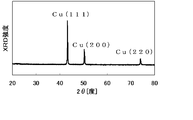
- FIG. 6 is a diagram showing an X-ray diffraction pattern of a film after heating in Example 2.
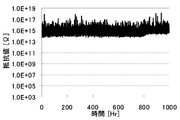
- FIG. It is a figure which shows the time-dependent change of the insulation resistance of Example 13.
- copper inorganic compounds such as (II) or copper (II) nitrate.
- Copper (I) oxide or copper (II) oxide is preferable because the metal copper film can be easily produced.
- these oxides may coat metal copper particles. Copper (I) oxide or copper (II) oxide coated with metal copper particles is more preferable in terms of easy production of the metal copper film.
- the numbers in parentheses represent the valence of copper, and so on.
- the form of a copper inorganic compound a particulate form is preferable at the point which manufactures a metal copper film
- the average particle diameter is preferably 5 nm to 500 ⁇ m, more preferably 10 nm to 100 ⁇ m.
- the thickness of the copper (I) oxide or copper (II) oxide coating coated with the metal copper particles is not particularly limited, but is preferably 1 nm to 100 ⁇ m in terms of easy production of the metal copper film, and 2 nm. To 20 ⁇ m is more preferable.
- the content of the copper inorganic compound in the copper-containing composition of the present invention is preferably 20% by weight to 95% by weight, more preferably 40% by weight to 90% by weight, from the viewpoint of easy production of the metal copper film.
- the alcohol that can be used in the copper-containing composition of the present invention include linear, branched, or cyclic alcohols having 1 to 18 carbon atoms, and more specifically, methanol, ethanol, propanol, 2-propanol, allyl alcohol, butanol, 2-butanol, pentanol, 2-pentanol, 3-pentanol, cyclopentanol, hexanol, 2-hexanol, 3-hexanol, cyclohexanol, heptanol, 2-heptanol, 3 -Heptanol, 4-heptanol, cycloheptanol, octanol, 2-octanol, 3-octanol, 4-
- the alcohol content in the copper-containing composition of the present invention is preferably 0.5% by weight to 80% by weight, and more preferably 1% by weight to 50% by weight from the viewpoint of easy production of the metal copper film.
- a Group VIII metal catalyst in the periodic table
- a Group VIII metal salt, a Group VIII metal complex, a zero-valent Group VIII metal catalyst, or the like can be used.
- Group VIII metal salt examples include ruthenium trichloride, ruthenium tribromide, rhodium trichloride, iridium trichloride, sodium hexachloroiridate, palladium dichloride, potassium tetrachloroparadate, platinum dichloride, potassium tetrachloro.
- Halates such as platinate, nickel dichloride, iron trichloride and cobalt trichloride; acetates such as ruthenium acetate, rhodium acetate and palladium acetate; sulfates such as ferrous sulfate; ruthenium nitrate, rhodium nitrate and cobalt nitrate Nitrates such as nickel nitrate; carbonates such as cobalt carbonate and nickel carbonate; hydroxides such as cobalt hydroxide and nickel hydroxide; tri (acetylacetonato) ruthenium, di (acetylacetonato) nickel, di (acetylacetate) Nato) Acetylacetonate salt such as palladium It is possible.
- Group VIII metal complex examples include triruthenium dodecacarbonyl, tetrahydridotetraruthenium dodecacarbonyl, tetrarhodium dodecacarbonyl, hexarhodium hexadecacarbonyl, tetriridium dodecacarbonyl, hexairidium dodecacarbonyl, and the like; diethylene ( Olefin complexes such as acetylacetonato) rhodium; Diene complexes such as acetonitrile (cyclooctadiene) rhodium, bis (1,5-cyclooctadiene) platinum, bis (1,5-cyclooctadiene) nickel; Chloro ( ⁇ - Allyl) palladium dimer, ⁇ -allyl complexes such as chloro ( ⁇ -allyl) tris (trimethylphosphine) ruthenium; acetonitrile pentakis (trichloro
- Group VIII metal salts and Group VIII metal complexes can also be used in combination with amines or imidazoles.
- amines include ethylenediamine, 1,1,2,2-tetramethylethylenediamine, 1,3-propanediamine, N, N′-disalicylidenetrimethylenediamine, o-phenylenediamine, 1,10-phenanthroline, Examples include 2,2′-bipyridine, pyridine and the like.
- imidazoles include imidazole, 1-phenylimidazole, 1,3-diphenylimidazole, imidazole-4,5-dicarboxylic acid, 1,3-bis [2- (1-methyl) phenyl] imidazole, 1,3-di Mesitylimidazole, 1,3-bis (2,6-diisopropylphenyl) imidazole, 1,3-diadamantylimidazole, 1,3-dicyclohexylimidazole, 1,3-bis (2,6-dimethylphenyl) imidazole, 4 , 5-dihydro-1,3-dimesitylimidazole, 4,5-dihydro-1,3-bis (2,6-diisopropylphenyl) imidazole, 4,5-dihydro-1,3-diadamantylimidazole, 4 , 5-dihydro-1,3-dicyclohexylimidazole,
- the zero-valent group VIII metal catalyst examples include raneruthenium, palladium sponge, platinum sponge, nickel sponge, Raney nickel and the like.
- An example of the alloy is silver-palladium.
- a group VIII metal complex is preferable, and a carbonyl complex is particularly preferable in that a metal copper film can be produced efficiently. More preferred is triruthenium dodecacarbonyl.
- the content of the Group VIII metal catalyst in the copper-containing composition of the present invention is preferably 0.01% by weight to 50% by weight, and 0.01% by weight to 10% by weight from the viewpoint that the copper metal film can be produced efficiently. % Is more preferable.
- Polymer acrylic ester rubber, polyvinyl butyral, acrylonitrile-butadiene copolymer, styrene-isoprene block copolymer, polybutadiene, ethylcellulose, polyester, polyamide, natural rubber, silicone rubber, polychloroprene, polyvinyl ether, methacrylic acid Resin, vinylpyrrolidone-vinyl acetate copolymer, polyvinylpyrrolidone, urethane resin, cyclized rubber, butyl rubber, hydrocarbon resin, ⁇ -methylstyrene-acrylonitrile copolymer, polyester De, chlorosulfonated polyethylene, polyolefin, melamine resins, urea resins, phenolic resins, unsaturated esters of polycarboxylic acids and the like.
- An epoxy resin is preferable in that the metal copper film can be produced efficiently. It is more preferable to mix an epoxy resin with another binder resin, and a nylon
- the content of the binder resin contained in the copper-containing composition of the present invention is preferably 0.05% by weight to 10% by weight, and preferably 0.1% by weight to 5% by weight, from the viewpoint of efficient production of the metal copper film. Is more preferable.
- Binder resin curing agents that can be used in the copper-containing composition of the present invention include tetrahydromethyl phthalic anhydride, 2-ethyl-4-methylimidazole, 2-phenylimidazole, 1-benzyl-2-phenylimidazole, 2, Examples include 3-dihydro-1H-pyrrolobenzimidazole, adipic acid, cresol novolac resin, and the like. Tetrahydromethyl phthalic anhydride or 2-ethyl-4-methylimidazole is preferred from the viewpoint that the copper metal film can be produced efficiently.
- the content of the binder resin curing agent contained in the copper-containing composition of the present invention is preferably 0.005% by weight to 0.1% by weight, and 0.01% by weight to 0.01% by weight from the viewpoint that the binder resin can be cured efficiently. More preferred is 0.08% by weight.
- the content of the copper organic complex contained in the copper-containing composition of the present invention is preferably 0.01% by weight to 1% by weight, and preferably 0.1% by weight to 0.00% in view of efficient production of the copper metal film. 5% by weight is more preferred.
- Examples of the rheology modifier that can be used in the copper-containing composition of the present invention include various polyesters such as “SOLPERSE-32000” (trade name, manufactured by Nippon Lubrizol), “SOLSPERSE-20000” (Nippon Lubrizol Corporation).
- Various polyethers such as “SOLPERSE-76500” (trade name manufactured by Nippon Lubrizol), “DISPERBYK-180” (trade name manufactured by BYK Japan)
- Various commercially available products such as alkylolamine salts of copolymers containing an acid group such as are particularly representative, and these compounds can be used as they are.
- Further examples include oxidized polyolefin amide, fatty acid amide, urea-modified urethane, and the like.
- Polyester is preferable because the copper metal film can be produced efficiently.
- the content of the rheology modifier contained in the copper-containing composition of the present invention is preferably 0.05% by weight to 10% by weight, and preferably 0.1% by weight to 6% by weight from the viewpoint that the copper metal film can be produced efficiently. % Is more preferable.
- membrane of this invention is demonstrated.
- substrate coated with the copper containing composition of this invention Ceramics, glass, a plastics, etc. can be used.
- the method for coating on the substrate include a screen printing method, a spin coating method, a casting method, a dipping method, an ink jet method, and a spray method.
- the composition of the present invention can be used as it is, but it may be optionally diluted with a solvent.
- a dilution solvent having a volume of 0.01 to 10 times the volume of the composition of the present invention.
- Diluent solvents include methanol, ethanol, propanol, 2-propanol, butanol, pentanol, hexanol, cyclohexanol, heptanol, octanol, ethylene glycol, 1,3-propanediol, 1,2-butanediol, 1,3- Alcohol solvents such as butanediol, 1,4-butanediol, 2,3-butanediol, 1,6-hexanediol, glycerin; diethyl ether, tetrahydrofuran, ethylene glycol dimethyl ether, triethylene glycol dimethyl ether, tetraethylene glycol dimethyl ether, Ether solvents such as dioxane, triglyme, tetraglyme; methyl acetate, butyl acetate, benzyl benzoate, dimethyl carbonate, ethylene carbonate, ⁇ Este
- the method for producing a metal copper film of the present invention be carried out in an inert gas such as nitrogen, argon or helium, or in a hydrogen atmosphere. Moreover, you may carry out in the mixed gas atmosphere of these inert gas and hydrogen. It is preferable to carry out in nitrogen or the mixed gas atmosphere of nitrogen and hydrogen at the point from which a low resistivity metallic copper film
- an inert gas such as nitrogen, argon or helium
- the heating temperature in the method for producing a metal copper film of the present invention is preferably a temperature selected from 100 ° C. to 300 ° C., preferably 150 ° C. to 250 ° C., in that a low resistivity metal copper film is obtained. More preferably.
- the metal copper film of desired resistivity can be manufactured by heating for the time according to conditions, such as a composition of a copper containing composition, heating temperature, and heating atmosphere. For example, the range of 1 minute to 2 hours can be given in terms of high productivity.
- the weight ratio of the copper inorganic compound and the binder resin in the copper-containing composition of the present invention is preferably 1: 0.01 to 1: 0.08, more preferably 1: 0.02 to 1: 0.05.
- the weight ratio of the copper inorganic compound and the binder resin curing agent is preferably 1: 0.0003 to 1: 0.002, more preferably 1: 0.0003 to 1: 0.001.
- the weight ratio of the binder resin curing agent is smaller than 1: 0.0003, the binder resin is not sufficiently cured, and when it is larger than 1: 0.002, the resistivity of the metal copper film is deteriorated.
- the metal copper film according to the present invention comprises copper, a Group VIII metal catalyst, and a cured binder resin.
- a film can be obtained by the method for producing a metal copper film of the present invention.
- the cured binder resin is a product obtained by reacting a binder resin and a binder resin curing agent by heating.
- the metal copper film of the present invention preferably has a copper content of 60 to 99% by weight, more preferably 80 to 99% by weight.
- the content of the group VIII metal catalyst is preferably 0.01 to 50% by weight, and more preferably 0.01 to 20% by weight.
- the content of the cured binder resin is preferably 0.01 to 30% by weight, and more preferably 0.01 to 10% by weight.
- the group VIII metal catalyst is preferably triruthenium dodecacarbonyl.
- the binder resin cured product is preferably a reaction product of an epoxy resin and a binder resin curing agent, or a reaction product of an epoxy resin, a nylon resin, and a binder resin curing agent.
- the binder resin curing agent is preferably tetrahydromethyl phthalic anhydride or 2-ethyl-4-methylimidazole.
- the resistivity of the metal copper film of the present invention is preferably 1.7 ⁇ cm to 20 ⁇ cm, and more preferably 1.7 ⁇ cm to 15 ⁇ cm.
- Example 1 A solution (A) in which 0.09 g of triruthenium dodecacarbonyl was dissolved in 20.0 mL of 1,3-butanediol was prepared. In addition, a solution (B) in which 0.5 g of copper (I) 1-butanethiolate was dissolved in 3.0 mL of 1,3-butanediol was prepared.
- Example 2 The copper-containing composition A obtained in Example 1 was printed in a range of 15 mm ⁇ 15 mm on a polyimide substrate by a screen printing method. Next, the temperature was raised to 200 ° C. at 100 ° C./min in a nitrogen atmosphere, followed by heating at 200 ° C. for 1 hour. The obtained copper metal film had a thickness of 8 ⁇ m and a resistivity of 11 ⁇ cm. When the X-ray diffraction pattern of the obtained film was measured, it is shown in FIG.
- Example 3 The same operation as in Example 2 was performed except that the heating was performed at 250 ° C.
- the obtained copper metal film had a thickness of 15 ⁇ m and a resistivity of 11 ⁇ cm.
- Example 4 Tetrahydromethylphthalic anhydride (Dainippon Ink Co., Ltd. grade: EPLICLON B-570H) was replaced with 0.17 mg, but 2-ethyl-4-methylimidazole (Shikoku Kasei Co., Ltd. grade: 2E4MZ) 0.32 mg was mixed. All performed the same operation as Example 1, and obtained the copper containing composition B.
- Example 5 When the same operation as in Example 2 was performed using the composition B for producing a metal copper film obtained in Example 4, the film thickness of the obtained metal copper film was 16 ⁇ m, and the resistivity was 15 ⁇ cm. there were.
- Example 6 The same operation as in Example 2 was performed except that the copper-containing composition A obtained in Example 1 was used and heated in a mixed gas of hydrogen and argon (hydrogen 4%). The obtained copper metal film had a thickness of 12 ⁇ m and a resistivity of 9 ⁇ cm.
- Example 7 Except that the solution (A) was changed to 0.063 g, the same operation as in Example 1 was performed to obtain a copper-containing composition C.
- Example 8 When the same operation as in Example 2 was performed using the copper-containing composition C obtained in Example 7, the thickness of the obtained metal copper film was 9 ⁇ m and the resistivity was 15 ⁇ cm.
- Example 9 Except that tetrahydromethylphthalic anhydride was changed to 0.26 mg, the same operation as in Example 1 was performed to obtain a copper-containing composition D.
- Example 10 When the same operation as in Example 2 was performed using the copper-containing composition D obtained in Example 9, the thickness of the obtained metal copper film was 12 ⁇ m, and the resistivity was 11 ⁇ cm.
- Example 11 A copper-containing composition E was obtained in the same manner as in Example 1 except that the amount of tetrahydromethylphthalic anhydride was changed to 0.06 mg.
- Example 12 When the same operation as in Example 2 was performed using the copper-containing composition E obtained in Example 11, the film thickness of the obtained metal copper film was 13 ⁇ m, and the resistivity was 12 ⁇ cm.
- Example 13 The copper-containing composition A obtained in Example 1 was printed on a polyimide substrate with a comb-shaped electrode film having a line and space of 300 ⁇ m / 300 ⁇ m by a screen printing method in a range of 70 mm ⁇ 70 mm. Next, the temperature was raised to 200 ° C. at 100 ° C./min in a nitrogen atmosphere, followed by heating at 200 ° C. for 1 hour. A voltage of 100 V was applied to both insulated ends of the obtained comb-shaped electrode copper film, and the insulation resistance value was measured while storing in a constant temperature and humidity chamber for 1000 hours. It was stored at a temperature of 25 ° C.
- Example 14 A solution (A) in which 0.09 g of triruthenium dodecacarbonyl was dissolved in 20.0 mL of 1,3-butanediol was prepared. In addition, a solution (B) in which 0.5 g of copper (I) 1-butanethiolate was dissolved in 3.0 mL of 1,3-butanediol was prepared.
- Example 15 When the same operation as in Example 2 was performed using the copper-containing composition F obtained in Example 14, the film thickness of the obtained metal copper film was 10 ⁇ m, and the resistivity was 13 ⁇ cm.
- Example 17 The composition of the metallic copper film obtained in Example 2 was measured by fluorescent X-ray analysis and combustion-infrared absorption method, and was found to be 97.3% by weight of copper, 0.1% by weight of triruthenium dodecacarbonyl, and binder resin cured. The product was 2.6% by weight.
- the copper-containing composition of the present invention can be used for the production of conductive films, conductive pattern films, electromagnetic wave shielding films, antifogging films and the like.
- the entire contents of the specification, claims, drawings, and abstract of Japanese Patent Application No. 2010-292582 filed on Dec. 28, 2010 are cited here as disclosure of the specification of the present invention. Incorporated.
Landscapes
- Paints Or Removers (AREA)
- Electrodes Of Semiconductors (AREA)
- Internal Circuitry In Semiconductor Integrated Circuit Devices (AREA)
- Conductive Materials (AREA)
- Non-Insulated Conductors (AREA)
- Manufacturing Of Electric Cables (AREA)
- Chemically Coating (AREA)
- Compositions Of Macromolecular Compounds (AREA)
Applications Claiming Priority (2)
| Application Number | Priority Date | Filing Date | Title |
|---|---|---|---|
| JP2010292582 | 2010-12-28 | ||
| JP2010-292582 | 2010-12-28 |
Publications (1)
| Publication Number | Publication Date |
|---|---|
| WO2012090881A1 true WO2012090881A1 (ja) | 2012-07-05 |
Family
ID=46382987
Family Applications (1)
| Application Number | Title | Priority Date | Filing Date |
|---|---|---|---|
| PCT/JP2011/079925 Ceased WO2012090881A1 (ja) | 2010-12-28 | 2011-12-22 | 銅含有組成物、金属銅膜の製造方法、および金属銅膜 |
Country Status (3)
| Country | Link |
|---|---|
| JP (1) | JP2012151093A (https=) |
| TW (1) | TW201241840A (https=) |
| WO (1) | WO2012090881A1 (https=) |
Families Citing this family (6)
| Publication number | Priority date | Publication date | Assignee | Title |
|---|---|---|---|---|
| JP5972187B2 (ja) | 2013-02-04 | 2016-08-17 | 富士フイルム株式会社 | 導電膜形成用組成物、導電膜の製造方法 |
| JP2014196384A (ja) * | 2013-03-29 | 2014-10-16 | 富士フイルム株式会社 | 導電膜形成用組成物およびこれを用いる導電膜の製造方法 |
| JP2014196427A (ja) * | 2013-03-29 | 2014-10-16 | 富士フイルム株式会社 | 導電膜形成用組成物およびこれを用いる導電膜の製造方法 |
| JP5993812B2 (ja) * | 2013-07-10 | 2016-09-14 | 富士フイルム株式会社 | 導電膜の製造方法 |
| JP2016079439A (ja) * | 2014-10-14 | 2016-05-16 | 四国化成工業株式会社 | 銅被膜形成剤およびその利用 |
| JP6777548B2 (ja) * | 2015-01-29 | 2020-10-28 | ハリマ化成株式会社 | 導電性ペースト |
Citations (4)
| Publication number | Priority date | Publication date | Assignee | Title |
|---|---|---|---|---|
| JPH1087994A (ja) * | 1996-09-10 | 1998-04-07 | Polymertech Kk | 複合導電性高分子および組成物ならびにその製造方法 |
| WO2003085052A1 (en) * | 2002-04-10 | 2003-10-16 | Fujikura Ltd. | Conductive composition, conductive film, and process for the formation of the film |
| JP2008130301A (ja) * | 2006-11-20 | 2008-06-05 | Sumitomo Bakelite Co Ltd | 導電性銅ペースト |
| JP2010121206A (ja) * | 2008-10-22 | 2010-06-03 | Tosoh Corp | 金属膜製造用組成物、金属膜の製造方法及び金属粉末の製造方法 |
Family Cites Families (1)
| Publication number | Priority date | Publication date | Assignee | Title |
|---|---|---|---|---|
| JPH1060319A (ja) * | 1996-08-22 | 1998-03-03 | Asahi Chem Ind Co Ltd | 導電性ペースト組成物及びそれを用いた配線基板 |
-
2011
- 2011-11-29 JP JP2011260254A patent/JP2012151093A/ja active Pending
- 2011-12-22 WO PCT/JP2011/079925 patent/WO2012090881A1/ja not_active Ceased
- 2011-12-26 TW TW100148606A patent/TW201241840A/zh unknown
Patent Citations (4)
| Publication number | Priority date | Publication date | Assignee | Title |
|---|---|---|---|---|
| JPH1087994A (ja) * | 1996-09-10 | 1998-04-07 | Polymertech Kk | 複合導電性高分子および組成物ならびにその製造方法 |
| WO2003085052A1 (en) * | 2002-04-10 | 2003-10-16 | Fujikura Ltd. | Conductive composition, conductive film, and process for the formation of the film |
| JP2008130301A (ja) * | 2006-11-20 | 2008-06-05 | Sumitomo Bakelite Co Ltd | 導電性銅ペースト |
| JP2010121206A (ja) * | 2008-10-22 | 2010-06-03 | Tosoh Corp | 金属膜製造用組成物、金属膜の製造方法及び金属粉末の製造方法 |
Also Published As
| Publication number | Publication date |
|---|---|
| JP2012151093A (ja) | 2012-08-09 |
| TW201241840A (en) | 2012-10-16 |
Similar Documents
| Publication | Publication Date | Title |
|---|---|---|
| US9624581B2 (en) | Composition for production of metal film, method for producing metal film and method for producing metal powder | |
| WO2012090881A1 (ja) | 銅含有組成物、金属銅膜の製造方法、および金属銅膜 | |
| Jeong et al. | Controlling the thickness of the surface oxide layer on Cu nanoparticles for the fabrication of conductive structures by ink‐jet printing | |
| Kamyshny et al. | Metal-based inkjet inks for printed electronics | |
| TWI357447B (en) | Manufacturing methods for metal clad laminates | |
| JP6354950B2 (ja) | 無電解めっき下地剤 | |
| TWI570097B (zh) | A copper film forming composition, and a method for producing a copper film using the same | |
| KR20110027487A (ko) | 금속 패턴 형성용 조성물 및 이를 이용한 금속 패턴 형성방법 | |
| JP5620795B2 (ja) | 銅膜形成用組成物及び該組成物を用いた銅膜の製造方法 | |
| TWI602947B (zh) | Composition for copper film formation, and the manufacturing method of the copper film using the same | |
| KR101263003B1 (ko) | 도전선 패턴 형성을 위한 은 오르가노 졸 잉크 | |
| JPWO2013073349A1 (ja) | 銅パターン形成用組成物及び銅パターンの製造方法 | |
| KR101836803B1 (ko) | 다공성 금속-유기 구조체 박막 및 이의 제조방법 | |
| US9133349B2 (en) | Zinc oxide film-forming composition, zinc oxide film production method, and zinc compound | |
| Yang et al. | One step preparation of copper–silver self-catalyzed hybrid conductive ink with reduced sintering temperature for flexible electronics | |
| JP6649609B2 (ja) | インクジェット印刷用触媒インク | |
| KR20170128583A (ko) | 이종 복핵 착체를 포함하는 화학 증착용 원료 및 해당 화학 증착용 원료를 사용한 화학 증착법 | |
| JP2008041960A (ja) | 電子回路部品の製造方法 | |
| KR20190031418A (ko) | 광개시제를 이용하는 전도성 금속 인쇄를 위한 분자 유기 반응성 잉크 | |
| TW201036944A (en) | Composition for forming conductor layer and conductor substrate, as well as method for making conductor substrate | |
| KR20140131944A (ko) | 도전성막의 형성 방법 | |
| JP2017001978A (ja) | 銅錯体の製造方法およびこれを含有する導電膜形成用組成物 | |
| KR20110059714A (ko) | 복합나노입자 및 그 제조방법 | |
| KR101583304B1 (ko) | 전도성 금속이온 잉크 조성물 및 이의 제조방법 | |
| KR20100033143A (ko) | 유기금속 전구체 및 이를 이용한 금속 필름 또는 패턴 |
Legal Events
| Date | Code | Title | Description |
|---|---|---|---|
| 121 | Ep: the epo has been informed by wipo that ep was designated in this application |
Ref document number: 11854497 Country of ref document: EP Kind code of ref document: A1 |
|
| NENP | Non-entry into the national phase |
Ref country code: DE |
|
| 122 | Ep: pct application non-entry in european phase |
Ref document number: 11854497 Country of ref document: EP Kind code of ref document: A1 |