WO2012074074A1 - 精製アルカリ金属塩の分離回収方法 - Google Patents
精製アルカリ金属塩の分離回収方法 Download PDFInfo
- Publication number
- WO2012074074A1 WO2012074074A1 PCT/JP2011/077856 JP2011077856W WO2012074074A1 WO 2012074074 A1 WO2012074074 A1 WO 2012074074A1 JP 2011077856 W JP2011077856 W JP 2011077856W WO 2012074074 A1 WO2012074074 A1 WO 2012074074A1
- Authority
- WO
- WIPO (PCT)
- Prior art keywords
- alkali metal
- metal salt
- membrane
- aqueous solution
- separation
- Prior art date
- Legal status (The legal status is an assumption and is not a legal conclusion. Google has not performed a legal analysis and makes no representation as to the accuracy of the status listed.)
- Ceased
Links
Classifications
-
- C—CHEMISTRY; METALLURGY
- C01—INORGANIC CHEMISTRY
- C01D—COMPOUNDS OF ALKALI METALS, i.e. LITHIUM, SODIUM, POTASSIUM, RUBIDIUM, CAESIUM, OR FRANCIUM
- C01D5/00—Sulfates or sulfites of sodium, potassium or alkali metals in general
- C01D5/16—Purification
-
- B—PERFORMING OPERATIONS; TRANSPORTING
- B01—PHYSICAL OR CHEMICAL PROCESSES OR APPARATUS IN GENERAL
- B01D—SEPARATION
- B01D61/00—Processes of separation using semi-permeable membranes, e.g. dialysis, osmosis or ultrafiltration; Apparatus, accessories or auxiliary operations specially adapted therefor
- B01D61/02—Reverse osmosis; Hyperfiltration ; Nanofiltration
- B01D61/027—Nanofiltration
-
- B—PERFORMING OPERATIONS; TRANSPORTING
- B01—PHYSICAL OR CHEMICAL PROCESSES OR APPARATUS IN GENERAL
- B01D—SEPARATION
- B01D69/00—Semi-permeable membranes for separation processes or apparatus characterised by their form, structure or properties; Manufacturing processes specially adapted therefor
- B01D69/02—Semi-permeable membranes for separation processes or apparatus characterised by their form, structure or properties; Manufacturing processes specially adapted therefor characterised by their properties
-
- B—PERFORMING OPERATIONS; TRANSPORTING
- B01—PHYSICAL OR CHEMICAL PROCESSES OR APPARATUS IN GENERAL
- B01D—SEPARATION
- B01D69/00—Semi-permeable membranes for separation processes or apparatus characterised by their form, structure or properties; Manufacturing processes specially adapted therefor
- B01D69/10—Supported membranes; Membrane supports
- B01D69/107—Organic support material
- B01D69/1071—Woven, non-woven or net mesh
-
- B—PERFORMING OPERATIONS; TRANSPORTING
- B01—PHYSICAL OR CHEMICAL PROCESSES OR APPARATUS IN GENERAL
- B01D—SEPARATION
- B01D71/00—Semi-permeable membranes for separation processes or apparatus characterised by the material; Manufacturing processes specially adapted therefor
- B01D71/06—Organic material
- B01D71/56—Polyamides, e.g. polyester-amides
-
- C—CHEMISTRY; METALLURGY
- C01—INORGANIC CHEMISTRY
- C01D—COMPOUNDS OF ALKALI METALS, i.e. LITHIUM, SODIUM, POTASSIUM, RUBIDIUM, CAESIUM, OR FRANCIUM
- C01D15/00—Lithium compounds
- C01D15/04—Halides
-
- C—CHEMISTRY; METALLURGY
- C01—INORGANIC CHEMISTRY
- C01D—COMPOUNDS OF ALKALI METALS, i.e. LITHIUM, SODIUM, POTASSIUM, RUBIDIUM, CAESIUM, OR FRANCIUM
- C01D15/00—Lithium compounds
- C01D15/08—Carbonates; Bicarbonates
-
- C—CHEMISTRY; METALLURGY
- C01—INORGANIC CHEMISTRY
- C01D—COMPOUNDS OF ALKALI METALS, i.e. LITHIUM, SODIUM, POTASSIUM, RUBIDIUM, CAESIUM, OR FRANCIUM
- C01D3/00—Halides of sodium, potassium or alkali metals in general
- C01D3/04—Chlorides
-
- C—CHEMISTRY; METALLURGY
- C01—INORGANIC CHEMISTRY
- C01D—COMPOUNDS OF ALKALI METALS, i.e. LITHIUM, SODIUM, POTASSIUM, RUBIDIUM, CAESIUM, OR FRANCIUM
- C01D3/00—Halides of sodium, potassium or alkali metals in general
- C01D3/14—Purification
-
- C—CHEMISTRY; METALLURGY
- C02—TREATMENT OF WATER, WASTE WATER, SEWAGE, OR SLUDGE
- C02F—TREATMENT OF WATER, WASTE WATER, SEWAGE, OR SLUDGE
- C02F1/00—Treatment of water, waste water, or sewage
- C02F1/26—Treatment of water, waste water, or sewage by extraction
-
- B—PERFORMING OPERATIONS; TRANSPORTING
- B01—PHYSICAL OR CHEMICAL PROCESSES OR APPARATUS IN GENERAL
- B01D—SEPARATION
- B01D2325/00—Details relating to properties of membranes
- B01D2325/20—Specific permeability or cut-off range
-
- B—PERFORMING OPERATIONS; TRANSPORTING
- B01—PHYSICAL OR CHEMICAL PROCESSES OR APPARATUS IN GENERAL
- B01D—SEPARATION
- B01D71/00—Semi-permeable membranes for separation processes or apparatus characterised by the material; Manufacturing processes specially adapted therefor
- B01D71/06—Organic material
- B01D71/66—Polymers having sulfur in the main chain, with or without nitrogen, oxygen or carbon only
- B01D71/68—Polysulfones; Polyethersulfones
-
- C—CHEMISTRY; METALLURGY
- C01—INORGANIC CHEMISTRY
- C01P—INDEXING SCHEME RELATING TO STRUCTURAL AND PHYSICAL ASPECTS OF SOLID INORGANIC COMPOUNDS
- C01P2006/00—Physical properties of inorganic compounds
- C01P2006/80—Compositional purity
-
- C—CHEMISTRY; METALLURGY
- C02—TREATMENT OF WATER, WASTE WATER, SEWAGE, OR SLUDGE
- C02F—TREATMENT OF WATER, WASTE WATER, SEWAGE, OR SLUDGE
- C02F1/00—Treatment of water, waste water, or sewage
- C02F1/26—Treatment of water, waste water, or sewage by extraction
- C02F1/265—Desalination
-
- C—CHEMISTRY; METALLURGY
- C02—TREATMENT OF WATER, WASTE WATER, SEWAGE, OR SLUDGE
- C02F—TREATMENT OF WATER, WASTE WATER, SEWAGE, OR SLUDGE
- C02F2103/00—Nature of the water, waste water, sewage or sludge to be treated
- C02F2103/08—Seawater, e.g. for desalination
-
- Y—GENERAL TAGGING OF NEW TECHNOLOGICAL DEVELOPMENTS; GENERAL TAGGING OF CROSS-SECTIONAL TECHNOLOGIES SPANNING OVER SEVERAL SECTIONS OF THE IPC; TECHNICAL SUBJECTS COVERED BY FORMER USPC CROSS-REFERENCE ART COLLECTIONS [XRACs] AND DIGESTS
- Y02—TECHNOLOGIES OR APPLICATIONS FOR MITIGATION OR ADAPTATION AGAINST CLIMATE CHANGE
- Y02W—CLIMATE CHANGE MITIGATION TECHNOLOGIES RELATED TO WASTEWATER TREATMENT OR WASTE MANAGEMENT
- Y02W10/00—Technologies for wastewater treatment
- Y02W10/30—Wastewater or sewage treatment systems using renewable energies
- Y02W10/37—Wastewater or sewage treatment systems using renewable energies using solar energy
Definitions
- the present invention relates to a method for separating and recovering purified alkali metal salts such as purified lithium salts and purified potassium salts from lake water, groundwater, industrial wastewater, etc., and using a separation membrane having a high permselectivity for a specific compound.
- the present invention relates to a method for efficiently recovering a purified alkali metal salt by removing a purification inhibitor.
- lithium carbonate is used for surface acoustic wave filters in addition to electrode materials for lithium ion batteries and heat-resistant glass additives.
- High purity products are used as filters and transmitters for mobile phones and car navigation systems.
- Lithium bromide is used as a refrigerant absorber for large-scale air-conditioning absorption refrigerators such as buildings and factories.
- Lithium hydroxide is used as a raw material for grease and lithium batteries (primary and secondary) for automobiles.
- Applications of metallic lithium include foil as a negative electrode material for primary batteries and raw materials for butyl lithium for synthetic rubber catalysts.
- salt lake brine and ore it is advantageous to recover resources from salt lake brine in terms of production cost.
- Salt lake brackish water exists mainly in Chile, Peru, and Argentina and has a large reserve.
- Brine is roughly classified into chloride brine, sulfate brine, carbonate brine, and calcium brine.
- sulfate brine which has the largest amount of resources, has poor sulfate solubility during the purification process. Therefore, it was difficult to efficiently recover the salt as a refined salt such as lithium carbonate.
- Patent Documents 1 to 3 Various methods using adsorbents have been proposed as solutions to solve this, but the high cost is difficult, and the purified lithium salt can be recovered stably at a low cost.
- Technology is not established.
- As a conventional low-cost method there is a method of removing the impurities while drying the brine in the sun and concentrating it, but it is difficult to apply when the lithium concentration is low or the alkaline earth metal salt concentration is high. There was a problem.
- electrodialysis and membrane filtration are being studied (Non-Patent Document 1), but they have not been put into practical use.
- potassium which is the same alkali metal
- fertilizers foods, feeds, industrial chemicals, pharmaceuticals, etc.
- its producing countries are limited to Canada, Russia, Belarus and the like.
- it is not currently a serious resource problem like lithium there is a concern about the stable supply of fertilizer components essential for food production and the tight resources due to explosive population growth and economic growth in developing countries .
- An object of the present invention is to provide a method for stably recovering alkali metals such as lithium and potassium from lake water, groundwater, industrial wastewater and the like at low cost.
- the present invention has the following configuration.
- a method for separating and recovering a purified alkali metal salt from an aqueous alkali metal salt solution at 25 ° C., a pH 6.5 1000 ppm glucose aqueous solution and a 25 ° C., pH 6.5 1000 ppm isopropyl alcohol aqueous solution at an operating pressure of 0.75 MPa characterized in that it comprises a treatment step of removing a purification inhibitor from an aqueous alkali metal salt solution in a separation membrane that simultaneously satisfies the following formulas (I) and (II): A method for separating and recovering a purified alkali metal salt.
- alkali metals such as lithium and potassium can be efficiently recovered from an aqueous solution in which various solutes coexist.
- the aqueous alkali metal salt solution of the present invention is preferable as long as it contains at least a lithium salt.
- alkali metals such as sodium, potassium, rubidium, and cesium in addition to lithium.
- At least one metal, alkaline earth metal such as magnesium, calcium, strontium, typical elements (aluminum, tin, lead, etc.), transition elements (iron, copper, cobalt, manganese, etc.), and one or more conjugates
- a compound composed of a salt with a base for example, chloride ion, nitrate ion, sulfate ion, carbonate ion, acetate ion, etc. is dissolved.
- the concentration of each of these components is not particularly limited, but the lithium ion concentration is preferably in the range of 0.5 ppm or more and 10,000 ppm or less, more preferably in the range of 5 ppm or more and 5000 ppm or less, and more preferably, from the viewpoint of the efficiency of separation and recovery.
- the magnesium ion concentration in the alkali metal salt aqueous solution serving as raw water is preferably 1000 times or less as compared with the lithium ion concentration. More preferably, it is efficient when it is 500 times or less, and more preferably 100 times or less.
- the magnesium ion concentration in the aqueous solution containing the alkali metal salt is 7 times or less than the lithium ion concentration in the aqueous solution. It is preferable to perform a removal treatment using a separation membrane. If this ratio exceeds 7 times, the recovery efficiency of the purified alkali metal salt is significantly reduced.
- the weight of the purification inhibiting substance at this time is calculated based on the weight in terms of ions such as magnesium ions and sulfate ions.
- the weight in terms of lithium ion and the weight of the purification inhibitor can be determined by quantifying various ion concentrations in an aqueous solution containing an alkali metal salt, for example, by ion chromatography.
- the content of the purification inhibitor in the raw water is different depending on the composition and concentration of the purification inhibitor depending on the properties of the raw water.
- salt lake brine contains magnesium ions and sulfate ions in the range of 100 ppm to 30,000 ppm.
- the present inventors permeate a 1000 ppm isopropyl alcohol aqueous solution at 25 ° C. and pH 6.5 and a 1000 ppm glucose aqueous solution at 25 ° C. and pH 6.5 respectively, particularly at an operating pressure of 0.75 MPa.
- a nanofiltration membrane that has a glucose removal rate of 90% or higher when the difference between the glucose removal rate and the isopropyl alcohol removal rate is 30% or higher, an alkali metal salt regardless of the total salt concentration,
- the inventors have found that separation of a lithium salt and a purification inhibitor can be achieved with extremely high efficiency, leading to the present invention.
- the purified alkali metal salt can be separated and recovered by a crystallization operation induced by concentration of an aqueous solution, heating, cooling, or addition of a nucleating agent, and so on. It is preferred that the sulfate is removed. Therefore, the removal rate of magnesium sulfate is 90% or more, preferably 95% when passing through a 2000 ppm magnesium sulfate aqueous solution at 25 ° C. and pH 6.5 and a 2000 ppm lithium chloride aqueous solution at 25 ° C. and pH 6.5 at an operating pressure of 0.75 MPa, respectively.
- % Or more more preferably 97% or more, and using a nanofiltration membrane having a lithium chloride removal rate of 70% or less, preferably 50% or less, more preferably 30% or less, depending on the total salt concentration. Separation of lithium salt and purification inhibitor is achieved with extremely high efficiency. Further, it is preferable to recover the purified alkali metal salt by concentration of the alkali metal salt after the step of the separation membrane of the present invention.
- the temperature dependency of the solubility is used, or recovery is performed by a known method of recovering potassium chloride by adding a poor solvent such as ethanol.
- a lithium salt it is recovered as lithium carbonate, for example, by adding a carbonate to an aqueous solution, taking advantage of its low solubility compared to other alkali metal salts. This is because sodium carbonate and potassium carbonate have a sufficiently high solubility in water (20 g or more per 100 mL of water), whereas the solubility of lithium carbonate is only 1.33 g per 100 mL of water at 25 ° C, and the solubility is higher at higher temperatures. It uses the decline.
- the nanofiltration membrane referred to here is a membrane defined by IUPAC as “a pressure-driven membrane in which particles and polymers of a size smaller than 2 nm are blocked”, but is effective for application to the present invention.
- the membrane has a charge on the membrane surface, and has improved ion separation efficiency by a combination of separation by pores (size separation) and electrostatic separation by charge on the membrane surface. It is necessary to apply a nanofiltration membrane capable of removing macromolecules by size separation while separating metal ions and other ions having different charge characteristics by charging.
- the material for the nanofiltration membrane used in the present invention polymer materials such as cellulose acetate polymer, polyamide, sulfonated polysulfone, polyacrylonitrile, polyester, polyimide, vinyl polymer can be used. It is not limited to the film
- the membrane structure has a dense layer on at least one side of the membrane, and on the asymmetric membrane having fine pores gradually increasing from the dense layer to the inside of the membrane or the other side, or on the dense layer of the asymmetric membrane. It may be a composite film having a very thin functional layer formed of another material.
- the composite membrane for example, a composite membrane described in Japanese Patent Application Laid-Open No. 62-201606 in which a nanofilter composed of a functional layer of polyamide is formed on a support membrane made of polysulfone as a membrane material can be used. .
- a composite membrane having a high-pressure resistance, high water permeability, and high solute removal performance and having an excellent potential and a functional layer of polyamide is preferable.
- a structure in which polyamide is used as a functional layer and is held by a support made of a porous membrane or nonwoven fabric is suitable.
- the polyamide semipermeable membrane a composite semipermeable membrane having a functional layer of a crosslinked polyamide obtained by polycondensation reaction of a polyfunctional amine and a polyfunctional acid halide on a support is suitable.
- the polyfunctional amine refers to an amine having at least two primary and / or secondary amino groups in one molecule.
- two amino groups are any of ortho, meta, and para positions.
- an aliphatic polyfunctional amine having 2 to 4 primary and / or secondary amino groups in one molecule is preferable, and higher solute is particularly preferable. It is more preferable to use piperazine or 2,5-dimethylpiperazine, which can obtain a nanofiltration membrane having removal performance and water permeation performance with a wide composition ratio.
- These polyfunctional amines may be used alone or in combination.
- the polyfunctional amine is an amine having two or more amino groups in one molecule, and includes an o-aromatic diamine having two amino groups in the ortho position (o-). Those are preferred. Further, the polyfunctional amines include m-aromatic diamines having two amino groups at the meta position (m-), p-aromatic diamines having two amino groups at the para position (p-), and aliphatic systems. At least one selected from the group consisting of amines and derivatives thereof, and in particular, having a dense and rigid structure, can provide a membrane having excellent blocking performance and water permeability performance, and further excellent durability and particularly heat resistance. It is also preferable that an easy m-aromatic diamine or p-aromatic diamine is contained.
- o-phenylenediamine is preferably used as the o-aromatic diamine.
- m-aromatic diamine m-phenylenediamine is preferable, but 3,5-diaminobenzoic acid, 2,6-diaminopyridine and the like can also be used.
- p-aromatic diamine p-phenylenediamine is preferable, but 2,5-diaminobenzenesulfonic acid, p-xylylenediamine and the like can also be used.
- the molar ratio of these polyfunctional amines in the film-forming stock solution can be appropriately selected depending on the amine and acid halide used. However, the higher the addition ratio of o-aromatic diamine, the better the water permeability. On the other hand, the blocking performance of the entire solute is reduced. Moreover, the separation performance of multivalent ions and monovalent ions is improved by increasing the number of aliphatic polyfunctional amines. This makes it possible to obtain the liquid separation membrane of the present invention that satisfies the desired water permeation performance, ion separation performance, and blocking performance of the entire solute.
- the polyfunctional acid halide is an acid halide or polyfunctional acid anhydride halide having at least two carbonyl halide groups in one molecule, and the separation functional layer of the crosslinked polyamide is formed by reaction with the polyfunctional amine. If it forms, it will not specifically limit.
- trifunctional acid halides include trimesic acid chloride, 1,3,5-cyclohexanetricarboxylic acid trichloride, 1,2,4-cyclobutanetricarboxylic acid trichloride, and bifunctional acid halides include biphenyl dicarboxylic acid.
- Aromatic difunctional acid halides such as acid dichloride, biphenylene carboxylic acid dichloride, azobenzene dicarboxylic acid dichloride, terephthalic acid chloride, isophthalic acid chloride, naphthalene dicarboxylic acid chloride, aliphatic difunctional acid such as adipoyl chloride, sebacoyl chloride Mention may be made of alicyclic bifunctional acid halides such as halides, cyclopentane dicarboxylic acid dichloride, cyclohexane dicarboxylic acid dichloride, tetrahydrofuran dicarboxylic acid dichloride.
- polyfunctional acid halides are preferably polyfunctional acid chlorides, and in view of selective separation of the membrane and heat resistance, 2 to 4 per molecule are considered.
- the polyfunctional aromatic acid chloride having a carbonyl chloride group is preferred. Among them, it is more preferable to use trimesic acid chloride from the viewpoint of easy availability and easy handling.
- These polyfunctional acid halides may be used alone or in combination.
- the polyfunctional acid anhydride halide is a carbonyl halide of benzoic anhydride or phthalic anhydride having one or more acid anhydride moieties and one or more halogenated carbonyl groups in one molecule.
- Trimellitic anhydride halides and derivatives thereof represented by the following general formula [III] are preferably used.
- X1 and X2 are any one of C1-C3 linear or cyclic saturated or unsaturated aliphatic group, H, OH, COOH, SO 3 H, COF, COCl, COBr, COI. To be elected. Alternatively, an acid anhydride may be formed between X1 and X2.
- X3 is selected from any of C1 to C3 linear or cyclic saturated or unsaturated aliphatic groups, H, OH, COOH, SO 3 H, COF, COCl, COBr, and COI.
- Y is selected from H, F, Cl, Br, I or C1-C3 hydrocarbons.
- the alkali metal ion is sodium ion and a considerable amount of 50,000 ppm to 100,000 ppm permeates the nanofiltration membrane
- separation of the alkali metal salt and the purification inhibitor is preferably achieved with high efficiency.
- the activity coefficient decreases under high salt concentration conditions, and the mechanism is not fully elucidated under the condition that the shielding effect of high concentration ions on the charged membrane works. It seems that the size separation effect contributes higher than the affinity with the membrane.
- lithium can be concentrated in the permeated water, which is preferable.
- the present inventors have found that active transport of an easily permeable substance to the permeation side occurs due to the concentration polarization effect on the separation membrane surface under a specific concentration condition.
- the filtration with the nanofiltration membrane is preferably performed by supplying the alkali metal salt aqueous solution to the nanofiltration membrane in a pressure range of 0.1 MPa to 8 MPa. If the pressure is lower than 0.1 MPa, the membrane permeation rate decreases, and if it is higher than 8 MPa, the membrane may be damaged. In addition, if the pressure is supplied at 0.5 MPa or more and 6 MPa or less, the membrane permeation flux is high, so that the aqueous metal salt solution can be efficiently permeated and there is little possibility of affecting the membrane damage. It is more preferable to supply at 1 MPa or more and 4 MPa or less. In the filtration using the nanofiltration membrane, permeation is performed at a pressure lower than the osmotic pressure of the alkali metal salt aqueous solution, thereby reducing the possibility of affecting the membrane damage.
- the permeated water generated by the treatment step of removing the purification inhibitor with a part of the alkali metal salt aqueous solution and the separation membrane so that the metal salt component ratio is suitable for the subsequent step of obtaining the purified alkali metal salt by concentration or the like are preferably mixed.
- the isopropyl alcohol concentration was determined using a gas chromatograph (Shimadzu GC-18A).
- lithium chloride 4.3 kg
- sodium chloride 52.3 g
- sodium tetraborate (10.4 g)
- sodium sulfate 25.3 g
- potassium chloride 61.0 g
- magnesium chloride 51.0 g
- calcium chloride 2.0 g
- lithium chloride 2.1 g
- sodium chloride 46.5 g
- sodium tetraborate 5.2 g
- sodium sulfate 12.6 g
- potassium chloride 30.5 g
- magnesium chloride 25.5 g
- calcium chloride 1.0 g
- Ion removal rate 100 ⁇ ⁇ 1- (salt concentration in permeated water / salt concentration in feed water) ⁇ (Membrane permeation flux) The brine was used as the feed water, and the membrane permeation flux (m 3 / m 2 / day) was determined from the daily water permeability (cubic meter) per square meter of membrane surface.
- microporous support membrane A 15.0 wt% dimethylformamide (DMF) solution of polysulfone was cast on a non-woven fabric made of polyester fibers (air permeability 0.5 to 1 cc / cm 2 / sec) at room temperature (25 ° C.) with a thickness of 180 ⁇ m and immediately purified.
- a microporous support membrane (thickness 150 to 160 ⁇ m) made of a fiber-reinforced polysulfone support membrane was prepared by immersing in water and allowing to stand for 5 minutes.
- the support membrane was slowly pulled up vertically, nitrogen was blown from an air nozzle to remove excess aqueous solution from the surface of the support membrane, and then trimesic acid chloride 0.05
- An n-decane solution containing% by weight was applied so that the surface was completely wetted and allowed to stand for 1 minute.
- the membrane was held vertically for 2 minutes to drain the solution, and dried by blowing a gas at 20 ° C. using a blower.
- the separation membrane thus obtained was treated with an aqueous solution containing 0.7% by weight sodium nitrite and 0.1% by weight sulfuric acid at room temperature for 2 minutes, then immediately washed with water and stored at room temperature. A separation membrane A was obtained.
- the film was vertically held for 1 minute to drain the liquid, and dried by blowing a gas at 20 ° C. using a blower. After drying, the membrane was immediately washed with water and stored at room temperature to obtain separation membrane C.
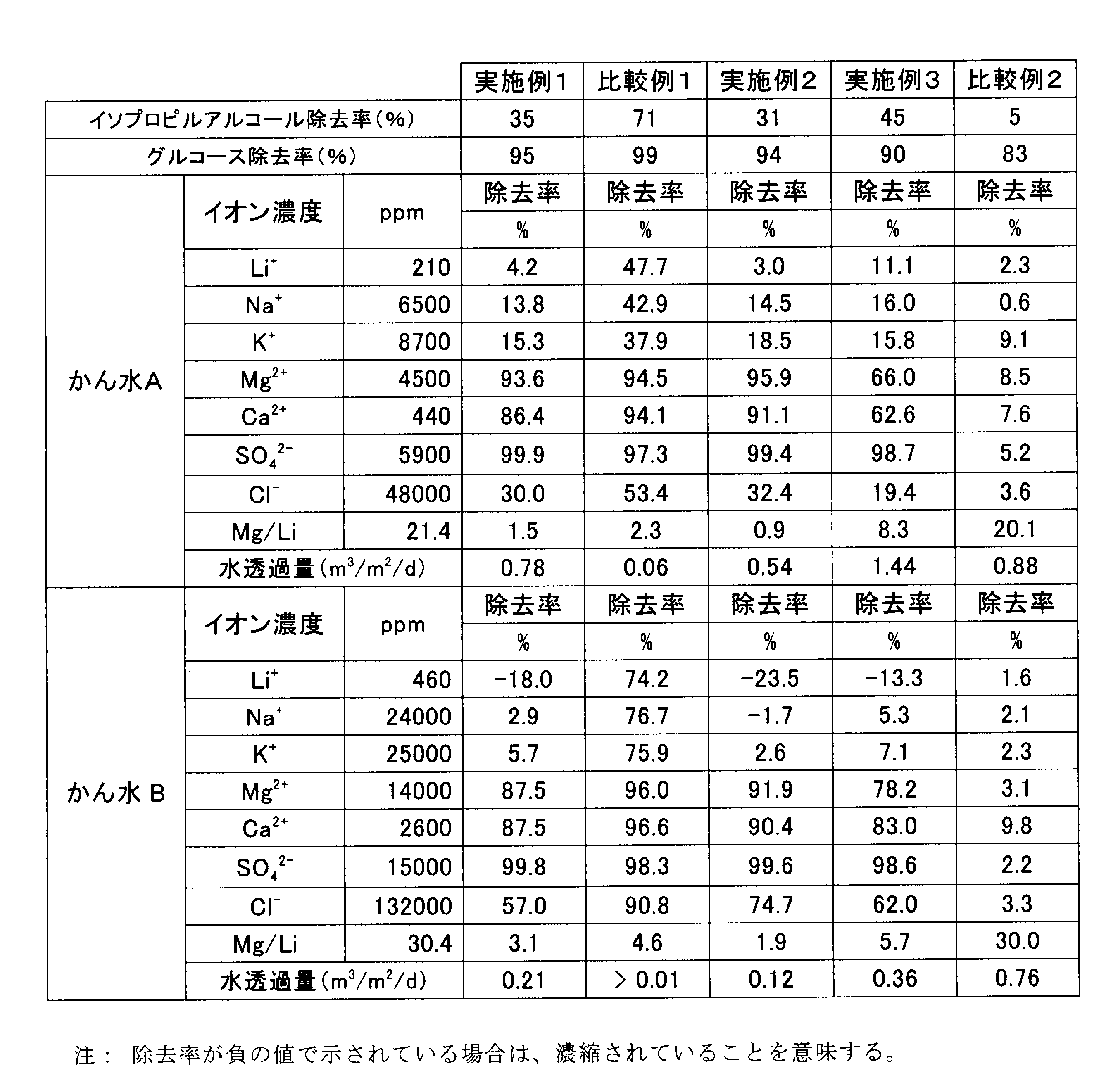
- Example 1 As a separation membrane, UTC-60 (a cross-linked aromatic polyamide nanofiltration membrane manufactured by Toray Industries, Inc.) was used, and the ion removal rate and water permeation performance were evaluated using brines A and B as raw water. The isopropyl alcohol removal rate and glucose removal rate are combined, and the results are shown in Table 1.
- Example 1 The same procedure as in Example 1 was performed except that the separation membrane A was used as the separation membrane. The results are shown in Table 1.
- Example 2 The same operation as in Example 1 was performed except that the separation membrane B was used as the separation membrane. The results are shown in Table 1.
- Example 3 The same procedure as in Example 1 was performed except that the separation membrane C was used as the separation membrane. The results are shown in Table 1.
- Example 2 The same procedure as in Example 1 was performed except that the separation membrane D was used as the separation membrane. The results are shown in Table 1.
- the glucose removal rate As shown in Table 1, it is necessary for the glucose removal rate to be 90% or more in order to exert ion-blocking ability such as magnesium ion and sulfate ion, which is a purification inhibitor, and an appropriate amount of water permeation, In view of the balance of permselectivity (Mg / Li ratio), it became clear that the difference between the glucose removal rate and the isopropyl alcohol removal rate needs to be 30% or more.
- the present invention can be suitably used as a method for efficiently separating and recovering alkali metals such as lithium and potassium from lake water, groundwater, industrial wastewater and the like.
Landscapes
- Chemical & Material Sciences (AREA)
- Engineering & Computer Science (AREA)
- Organic Chemistry (AREA)
- Materials Engineering (AREA)
- Inorganic Chemistry (AREA)
- Chemical Kinetics & Catalysis (AREA)
- Water Supply & Treatment (AREA)
- Nanotechnology (AREA)
- Life Sciences & Earth Sciences (AREA)
- Hydrology & Water Resources (AREA)
- Environmental & Geological Engineering (AREA)
- Separation Using Semi-Permeable Membranes (AREA)
Abstract
Description
グルコース除去率-イソプロピルアルコール除去率≧30% ・・・(II)
(2)前記アルカリ金属塩水溶液中のリチウムイオン濃度が0.5ppm以上10000ppm以下の範囲である(1)に記載の精製アルカリ金属塩の分離回収方法。

分離膜に、温度25℃、pH6.5に調製した1000ppmイソプロピルアルコール水溶液を操作圧力0.75 MPaで供給したときの透過水と供給水のイソプロピルアルコール濃度を比較することにより評価した。すなわち、イソプロピルアルコール除去率(%)=100×(1-(透過水中のイソプロピルアルコール濃度/供給水中のイソプロピルアルコール濃度))で算出した。なお、イソプロピルアルコール濃度はガスクロマトグラフ(島津製作所製GC-18A)を用いて求めた。
分離膜に、温度25℃、pH6.5に調製した1000ppmグルコース水溶液を操作圧力0.75 MPaで供給したときの透過水と供給水のグルコース濃度を比較することにより評価した。すなわち、グルコース除去率(%)=100×(1-(透過水中のグルコース濃度/供給水中のグルコース濃度))で算出した。なお、グルコース濃度は屈折率計(島津製作所製RID-6A)により求めた。
各種金属塩を含む水溶液2種類を以下の条件で調製した。
半透膜に、温度25℃に調整した前記かん水を操作圧力2.0MPaで供給するときの透過水塩濃度をイオンクロマトグラフ測定により、次の式から求めた。
イオン除去率=100×{1-(透過水中の塩濃度/供給水中の塩濃度)}
(膜透過流束)
供給水として前記かん水を使用し、膜面1平方メートル当たり、1日の透水量(立方メートル)から膜透過流束(m3/m2/日)を求めた。
ポリエステル繊維からなる不織布(通気度0.5~1cc/cm2/sec)上にポリスルホンの15.0重量%ジメチルホルムアミド(DMF)溶液を180μmの厚みで室温(25℃)でキャストし、ただちに純水中に浸漬して5分間放置することによって繊維補強ポリスルホン支持膜からなる微多孔性支持膜(厚さ150~160μm)を作製した。
微多孔性支持膜を多官能アミン全体1.5重量%で、メタフェニレンジアミン/1,3,5-トリアミノベンゼン=70/30モル比となるように調製した多官能アミンおよびε-カプロラクタムの3.0重量%を含む水溶液中に2分間浸漬し、該支持膜を垂直方向にゆっくりと引き上げ、エアーノズルから窒素を吹き付け支持膜表面から余分な水溶液を取り除いた後、トリメシン酸クロリド0.05重量%を含むn-デカン溶液を表面が完全に濡れるように塗布して1分間静置した。次に膜から余分な溶液を除去するために、膜を2分間垂直に把持して液切りを行って、送風機を使い20℃の気体を吹き付けて乾燥させた。このようにして得られた分離膜を、0.7重量%の亜硝酸ナトリウム及び0.1重量%の硫酸を含む水溶液により室温で2分間処理した後、直ちに水で洗い、室温にて保存し分離膜Aを得た。
微多孔性支持膜をピペラジン0.25重量%を含む水溶液中に2分間浸漬し、該支持膜を垂直方向にゆっくりと引き上げ、エアーノズルから窒素を吹き付け支持膜表面から余分な水溶液を取り除いた後、トリメシン酸クロリド0.17重量%を含むn-デカン溶液を、160cm3/m2の割合で支持膜表面が完全に濡れるように塗布して1分間静置した。次に膜から余分な溶液を除去するために、膜を1分間垂直に把持して液切りを行って、送風機を使い20℃の気体を吹き付けて乾燥させた。乾燥後、直ちに水で洗い、室温にて保存し分離膜Bを得た。
微多孔性支持膜をピペラジン1.0重量%、リン酸3ナトリウム12水和物1.5重量%、ドデシル硫酸ナトリウム0.5重量%を含む水溶液中に2分間浸漬し、該支持膜を垂直方向にゆっくりと引き上げ、エアーノズルから窒素を吹き付け支持膜表面から余分な水溶液を取り除いた後、トリメシン酸クロリド0.2重量%を含むn-デカン溶液を、160cm3/m2の割合で支持膜表面が完全に濡れるように塗布して1分間静置した。次に膜から余分な溶液を除去するために、膜を1分間垂直に把持して液切りを行って、送風機を使い20℃の気体を吹き付けて乾燥させた。乾燥後、直ちに水で洗い、室温にて保存し分離膜Cを得た。
SCL-100(東レ(株)製 酢酸セルロース逆浸透膜)をpH9に調整した0.1重量%の次亜塩素酸ナトリウム水溶液に室温で24時間処理した後、直ちに水で洗い、室温にて保存して分離膜Dを得た。
分離膜として、UTC-60(東レ(株)製 架橋芳香族ポリアミドナノ濾過膜)を用い、かん水AおよびBそれぞれを原水としてイオン除去率、水透過性能を評価した。イソプロピルアルコール除去率およびグルコース除去率をあわせ、結果を表1に示す。
分離膜として、分離膜Aを用いた以外は実施例1と同様に行った。結果を表1に示す。
分離膜として、分離膜Bを用いた以外は実施例1と同様に行った。結果を表1に示す。
分離膜として、分離膜Cを用いた以外は実施例1と同様に行った。結果を表1に示す。
分離膜として、分離膜Dを用いた以外は実施例1と同様に行った。結果を表1に示す。
本出願は、2010年12月1日出願の日本特許出願2010-268014に基づくものであり、その内容はここに参照として取り込まれる。
Claims (9)
- アルカリ金属塩水溶液から精製アルカリ金属塩を分離回収する方法であって、0.75MPaの操作圧力で25℃、pH6.5の1000ppmグルコース水溶液および25℃、pH6.5の1000ppmイソプロピルアルコール水溶液をそれぞれ透過させた時のグルコース除去率及びイソプロピルアルコール除去率が下式(I)及び(II)を同時に満足する分離膜でアルカリ金属塩水溶液から精製阻害物質を除去する処理工程を含むことを特徴とする、精製アルカリ金属塩の分離回収方法。
グルコース除去率≧90% ・・・(I)
グルコース除去率-イソプロピルアルコール除去率≧30% ・・・(II) - 前記アルカリ金属塩水溶液中のリチウムイオン濃度が0.5ppm以上10000ppm以下の範囲である請求項1に記載の精製アルカリ金属塩の分離回収方法。
- 前記アルカリ金属塩水溶液中のマグネシウムイオン濃度がリチウムイオン濃度に比して1000倍以下である請求項1または2に記載の精製アルカリ金属塩の分離回収方法。
- 前記アルカリ金属塩水溶液の一部と、前記処理工程により生成する透過水を混合する工程を含むことを特徴とする、請求項1~3のいずれか一項に記載の精製アルカリ金属塩の分離回収方法。
- 前記処理工程により、アルカリ金属塩水溶液中の精製阻害物質が除去されると共にリチウムが濃縮される、請求項1~4のいずれか一項に記載の精製アルカリ金属塩の分離回収方法。
- 前記処理工程の後に、アルカリ金属塩の濃縮処理を行う、請求項1~5のいずれか一項に記載の精製アルカリ金属塩の分離回収方法。
- 前記アルカリ金属塩水溶液中のマグネシウムイオン濃度がリチウムイオン濃度に比して7倍以下となるまで、前記処理工程を行う請求項1~6のいずれか一項に記載の精製アルカリ金属塩の分離回収方法。
- 前記精製阻害物質がマグネシウム塩および硫酸塩からなる群から選ばれる少なくとも1つであることを特徴とする、請求項1~7のいずれか一項に記載の精製アルカリ金属塩の分離回収方法。
- 前記処理工程での膜分離操作圧力が、前記アルカリ金属塩水溶液の浸透圧以下であることを特徴とする、請求項1~8のいずれか一項に記載の精製アルカリ金属塩の分離回収方法。
Priority Applications (3)
| Application Number | Priority Date | Filing Date | Title |
|---|---|---|---|
| CN201180058020.9A CN103237760B (zh) | 2010-12-01 | 2011-12-01 | 分离和回收精制碱金属盐的方法 |
| US13/991,046 US20130292333A1 (en) | 2010-12-01 | 2011-12-01 | Method for separating and recovering purified alkali metal salt |
| JP2012515241A JP5842815B2 (ja) | 2010-12-01 | 2011-12-01 | 精製アルカリ金属塩の分離回収方法 |
Applications Claiming Priority (2)
| Application Number | Priority Date | Filing Date | Title |
|---|---|---|---|
| JP2010268014 | 2010-12-01 | ||
| JP2010-268014 | 2010-12-01 |
Publications (1)
| Publication Number | Publication Date |
|---|---|
| WO2012074074A1 true WO2012074074A1 (ja) | 2012-06-07 |
Family
ID=46171999
Family Applications (1)
| Application Number | Title | Priority Date | Filing Date |
|---|---|---|---|
| PCT/JP2011/077856 Ceased WO2012074074A1 (ja) | 2010-12-01 | 2011-12-01 | 精製アルカリ金属塩の分離回収方法 |
Country Status (6)
| Country | Link |
|---|---|
| US (1) | US20130292333A1 (ja) |
| JP (1) | JP5842815B2 (ja) |
| CN (1) | CN103237760B (ja) |
| AR (1) | AR084006A1 (ja) |
| CL (1) | CL2013001560A1 (ja) |
| WO (1) | WO2012074074A1 (ja) |
Cited By (5)
| Publication number | Priority date | Publication date | Assignee | Title |
|---|---|---|---|---|
| CN106006683A (zh) * | 2016-07-19 | 2016-10-12 | 四川思达能环保科技有限公司 | 一种氢氧化锂的净化分离及膜浓缩的方法和系统 |
| JP2017105693A (ja) * | 2015-12-01 | 2017-06-15 | 進 池田 | 金属塩化物製造方法 |
| WO2020137974A1 (ja) | 2018-12-26 | 2020-07-02 | 東レ株式会社 | アルカリ金属塩の製造方法 |
| CN113023751A (zh) * | 2021-05-06 | 2021-06-25 | 神华准能资源综合开发有限公司 | 一种从氯化盐水中回收锂、钠、钾、镁、钙的方法 |
| CN115108567A (zh) * | 2022-07-18 | 2022-09-27 | 中国五环工程有限公司 | 一种联碱法纯碱生产过程中煅烧结晶工段的节能工艺 |
Families Citing this family (8)
| Publication number | Priority date | Publication date | Assignee | Title |
|---|---|---|---|---|
| CN106086405A (zh) * | 2016-07-14 | 2016-11-09 | 四川思达能环保科技有限公司 | 一种高盐含氯体系的净化除杂方法 |
| CN106048218A (zh) * | 2016-07-14 | 2016-10-26 | 四川思达能环保科技有限公司 | 一种氯化锂混合溶液的净化除杂方法 |
| US10450633B2 (en) * | 2017-07-21 | 2019-10-22 | Larry Lien | Recovery of lithium from an acid solution |
| CN110482574A (zh) * | 2019-08-21 | 2019-11-22 | 四川金山制药有限公司 | 光电级硝酸钾提纯工艺 |
| JP7156322B2 (ja) * | 2020-02-17 | 2022-10-19 | 住友金属鉱山株式会社 | 水酸化リチウムの製造方法 |
| KR102528926B1 (ko) | 2020-04-21 | 2023-05-09 | 도레이 카부시키가이샤 | 레어 메탈염의 회수 방법 |
| EP4159303A4 (en) * | 2020-05-29 | 2024-06-19 | Toray Industries, Inc. | Method for separating and recovering cobalt salt and nickel salt |
| CN116116252A (zh) * | 2023-02-01 | 2023-05-16 | 浙江大学 | 一种选择性电渗析离子分离膜的制备及应用方法 |
Citations (3)
| Publication number | Priority date | Publication date | Assignee | Title |
|---|---|---|---|---|
| JP2001508925A (ja) * | 1997-06-23 | 2001-07-03 | パシフィック・リシアム・リミテッド | リチウムの回収および精製 |
| JP2002511379A (ja) * | 1998-04-16 | 2002-04-16 | ピーキュー ホールディング, インコーポレイテッド | アルカリ金属ケイ酸塩溶液の精製方法 |
| JP2009270189A (ja) * | 2008-05-07 | 2009-11-19 | Kee:Kk | 高純度水酸化リチウムの製法 |
Family Cites Families (7)
| Publication number | Priority date | Publication date | Assignee | Title |
|---|---|---|---|---|
| US4636295A (en) * | 1985-11-19 | 1987-01-13 | Cominco Ltd. | Method for the recovery of lithium from solutions by electrodialysis |
| US5587083A (en) * | 1995-04-17 | 1996-12-24 | Chemetics International Company Ltd. | Nanofiltration of concentrated aqueous salt solutions |
| CN100408705C (zh) * | 2003-04-30 | 2008-08-06 | 中国科学院青海盐湖研究所 | 纳滤法从盐湖卤水中分离镁和富集锂的方法 |
| NL1030346C2 (nl) * | 2004-11-15 | 2006-09-20 | Toray Industries | Semipermeabel composietmembraan, productiewerkwijze daarvan, en element, fluïdumscheidingsinstallatie en werkwijze voor behandeling van water onder toepassing van hetzelfde. |
| CN101234295B (zh) * | 2007-02-02 | 2010-10-27 | 天津威德泰科石化科技发展有限公司 | 降低纳滤膜对NaCl脱除率的处理方法 |
| CN101214975B (zh) * | 2008-01-21 | 2010-12-29 | 上海西恩化工设备有限公司 | 卤水深度处理工艺 |
| DK2251427T3 (en) * | 2008-03-05 | 2017-06-06 | Toray Industries | Process for removing fermentation inhibitors with a separation membrane |
-
2011
- 2011-11-25 AR ARP110104410 patent/AR084006A1/es active IP Right Grant
- 2011-12-01 WO PCT/JP2011/077856 patent/WO2012074074A1/ja not_active Ceased
- 2011-12-01 CN CN201180058020.9A patent/CN103237760B/zh active Active
- 2011-12-01 US US13/991,046 patent/US20130292333A1/en not_active Abandoned
- 2011-12-01 JP JP2012515241A patent/JP5842815B2/ja active Active
-
2013
- 2013-05-31 CL CL2013001560A patent/CL2013001560A1/es unknown
Patent Citations (3)
| Publication number | Priority date | Publication date | Assignee | Title |
|---|---|---|---|---|
| JP2001508925A (ja) * | 1997-06-23 | 2001-07-03 | パシフィック・リシアム・リミテッド | リチウムの回収および精製 |
| JP2002511379A (ja) * | 1998-04-16 | 2002-04-16 | ピーキュー ホールディング, インコーポレイテッド | アルカリ金属ケイ酸塩溶液の精製方法 |
| JP2009270189A (ja) * | 2008-05-07 | 2009-11-19 | Kee:Kk | 高純度水酸化リチウムの製法 |
Non-Patent Citations (2)
| Title |
|---|
| WEN-TAO YI ET AL.: "Removal of calcium and magnesium from LiHC03 solutions for preparation of high-purity Li2C03 by ion-exchange resin", DESALINATION, vol. 249, 2009, pages 729 - 735 * |
| X. WEN ET AL.: "Preliminary study on recovering lithium chloride from lithium-containing waters by nanofiltration", SEPARATION AND PURIFICATION TECHNOLOGY, vol. 49, 2006, pages 230 - 236 * |
Cited By (10)
| Publication number | Priority date | Publication date | Assignee | Title |
|---|---|---|---|---|
| JP2017105693A (ja) * | 2015-12-01 | 2017-06-15 | 進 池田 | 金属塩化物製造方法 |
| CN106006683A (zh) * | 2016-07-19 | 2016-10-12 | 四川思达能环保科技有限公司 | 一种氢氧化锂的净化分离及膜浓缩的方法和系统 |
| WO2020137974A1 (ja) | 2018-12-26 | 2020-07-02 | 東レ株式会社 | アルカリ金属塩の製造方法 |
| KR20210107676A (ko) | 2018-12-26 | 2021-09-01 | 도레이 카부시키가이샤 | 알칼리 금속염의 제조 방법 |
| JPWO2020137974A1 (ja) * | 2018-12-26 | 2021-11-04 | 東レ株式会社 | アルカリ金属塩の製造方法 |
| JP7375740B2 (ja) | 2018-12-26 | 2023-11-08 | 東レ株式会社 | アルカリ金属塩の製造方法 |
| KR102887009B1 (ko) * | 2018-12-26 | 2025-11-17 | 도레이 카부시키가이샤 | 알칼리 금속염의 제조 방법 |
| CN113023751A (zh) * | 2021-05-06 | 2021-06-25 | 神华准能资源综合开发有限公司 | 一种从氯化盐水中回收锂、钠、钾、镁、钙的方法 |
| CN113023751B (zh) * | 2021-05-06 | 2022-11-08 | 神华准能资源综合开发有限公司 | 一种从氯化盐水中回收锂、钠、钾、镁、钙的方法 |
| CN115108567A (zh) * | 2022-07-18 | 2022-09-27 | 中国五环工程有限公司 | 一种联碱法纯碱生产过程中煅烧结晶工段的节能工艺 |
Also Published As
| Publication number | Publication date |
|---|---|
| JP5842815B2 (ja) | 2016-01-13 |
| CN103237760A (zh) | 2013-08-07 |
| CL2013001560A1 (es) | 2013-11-08 |
| JPWO2012074074A1 (ja) | 2014-05-19 |
| CN103237760B (zh) | 2016-06-22 |
| AR084006A1 (es) | 2013-04-17 |
| US20130292333A1 (en) | 2013-11-07 |
Similar Documents
| Publication | Publication Date | Title |
|---|---|---|
| JP5842815B2 (ja) | 精製アルカリ金属塩の分離回収方法 | |
| JP2012120943A (ja) | アルカリ金属分離回収方法およびアルカリ金属分離回収装置 | |
| JPWO2013146391A1 (ja) | アルカリ金属分離回収方法およびアルカリ金属分離回収装置 | |
| US10040533B2 (en) | Ballast water treatment apparatus and method for ship using forward osmosis process | |
| ES2230011T3 (es) | Membrana compuesta de osmosis inversa y metodo de produccion de la misma. | |
| WO2012093724A1 (ja) | アルカリ金属分離回収方法およびアルカリ金属分離回収装置 | |
| KR20170071502A (ko) | 리튬 함유 용액의 농축을 위한 정삼투 공정 | |
| Chen et al. | Thin film composite polyesteramide membrane with the incorporation of rigidly-contorted binaphthol-based monomer for enhanced nanofiltration separation performance | |
| WO2013005694A1 (ja) | アルカリ金属分離回収方法およびアルカリ金属分離回収装置 | |
| JP7375740B2 (ja) | アルカリ金属塩の製造方法 | |
| JP2005095856A5 (ja) | ||
| JP5062136B2 (ja) | 複合半透膜の製造方法 | |
| JP2009262089A (ja) | 複合半透膜の製造方法 | |
| JP7626298B1 (ja) | アルカリ金属塩の回収方法およびアルカリ金属塩の回収装置 | |
| CN114642968B (zh) | 具有可溶性中间层的高通量复合纳滤膜、其制法及应用 | |
| WO2021241742A1 (ja) | コバルト塩およびニッケル塩の分離回収方法 | |
| JP7786612B2 (ja) | アルカリ金属イオンおよび水酸化物イオンの回収方法ならびに回収装置 | |
| JP2009220023A (ja) | 複合半透膜の製造方法 | |
| WO2026034628A1 (ja) | アルカリ金属イオンの分離方法、臨界pH決定方法、およびアルカリ金属イオンの分離装置 | |
| JP2004237230A (ja) | 複合半透膜およびその製造方法 |
Legal Events
| Date | Code | Title | Description |
|---|---|---|---|
| WWE | Wipo information: entry into national phase |
Ref document number: 2012515241 Country of ref document: JP |
|
| 121 | Ep: the epo has been informed by wipo that ep was designated in this application |
Ref document number: 11845353 Country of ref document: EP Kind code of ref document: A1 |
|
| WWE | Wipo information: entry into national phase |
Ref document number: 2013001560 Country of ref document: CL |
|
| NENP | Non-entry into the national phase |
Ref country code: DE |
|
| WWE | Wipo information: entry into national phase |
Ref document number: 13991046 Country of ref document: US |
|
| 122 | Ep: pct application non-entry in european phase |
Ref document number: 11845353 Country of ref document: EP Kind code of ref document: A1 |