WO2012040916A1 - 基于递归核主元分析的连续退火过程故障监测方法 - Google Patents
基于递归核主元分析的连续退火过程故障监测方法 Download PDFInfo
- Publication number
- WO2012040916A1 WO2012040916A1 PCT/CN2010/077441 CN2010077441W WO2012040916A1 WO 2012040916 A1 WO2012040916 A1 WO 2012040916A1 CN 2010077441 W CN2010077441 W CN 2010077441W WO 2012040916 A1 WO2012040916 A1 WO 2012040916A1
- Authority
- WO
- WIPO (PCT)
- Prior art keywords
- continuous annealing
- matrix
- annealing process
- model
- sample
- Prior art date
- Legal status (The legal status is an assumption and is not a legal conclusion. Google has not performed a legal analysis and makes no representation as to the accuracy of the status listed.)
- Ceased
Links
Classifications
-
- G—PHYSICS
- G16—INFORMATION AND COMMUNICATION TECHNOLOGY [ICT] SPECIALLY ADAPTED FOR SPECIFIC APPLICATION FIELDS
- G16C—COMPUTATIONAL CHEMISTRY; CHEMOINFORMATICS; COMPUTATIONAL MATERIALS SCIENCE
- G16C20/00—Chemoinformatics, i.e. ICT specially adapted for the handling of physicochemical or structural data of chemical particles, elements, compounds or mixtures
- G16C20/70—Machine learning, data mining or chemometrics
-
- G—PHYSICS
- G05—CONTROLLING; REGULATING
- G05B—CONTROL OR REGULATING SYSTEMS IN GENERAL; FUNCTIONAL ELEMENTS OF SUCH SYSTEMS; MONITORING OR TESTING ARRANGEMENTS FOR SUCH SYSTEMS OR ELEMENTS
- G05B23/00—Testing or monitoring of control systems or parts thereof
- G05B23/02—Electric testing or monitoring
- G05B23/0205—Electric testing or monitoring by means of a monitoring system capable of detecting and responding to faults
- G05B23/0218—Electric testing or monitoring by means of a monitoring system capable of detecting and responding to faults characterised by the fault detection method dealing with either existing or incipient faults
- G05B23/0224—Process history based detection method, e.g. whereby history implies the availability of large amounts of data
- G05B23/024—Quantitative history assessment, e.g. mathematical relationships between available data; Functions therefor; Principal component analysis [PCA]; Partial least square [PLS]; Statistical classifiers, e.g. Bayesian networks, linear regression or correlation analysis; Neural networks
Definitions
- the invention belongs to the technical field of fault monitoring and diagnosis, and proposes a fault monitoring method for continuous annealing process based on recursive kernel principal component analysis.
- the continuous annealing process is a complex time-varying nonlinear process.
- KPCA kernel principal component analysis
- the present invention proposes a continuous annealing process fault monitoring method based on recursive kernel principal component analysis, which realizes the purpose of reducing the false alarm rate when the data is nonlinear and time-varying.
- a method for monitoring a continuous annealing process fault based on a recursion kernel principal component analysis (RKPCA) includes the following steps:
- Step 1 Collect data.
- the collected data includes: collecting the roll speed, current and tension of the inlet loop (ELP), and standardizing the collected data;
- Step 2 Calculate the main factor P of the failure of the continuous annealing process.
- the method is as follows: Using the N sample samples normalized in step 1, establish an initial monitoring model for the continuous annealing process, and a new sampling x in the continuous annealing process to monitor whether it appears. Abnormal, if abnormal, alarm, otherwise go to step 3; Among them, the main factor P is extracted, and the formula is as follows:
- N is the number of sampled samples, and the main factors of the initial monitoring model of the continuous annealing process are adjusted.
- N-1 N-1 The inner product of the matrix, k( ⁇ , Xl ) represents the inner product of X sum, X is the intermediate matrix, ⁇ ( ) represents the inner product of the intermediate matrix, and is the eigenvalue matrix of the covariance of the intermediate matrix.
- 1 is a -1 column unit vector; the transfer factor A of the intermediate matrix of the continuous annealing process is extracted, expressed as:
- Step 3 When the sampling 1 of the continuous annealing process is normal data, the initial monitoring model of the continuous annealing process of step 2 is updated by the recursive kernel principal component analysis method, and the main factor P of the failure of the continuous annealing process after updating the continuous annealing process model is calculated, For
- N(NT) The correction matrix for the main factors of the process update model ⁇ ': ⁇ + AAA r (k(X,x )- ⁇ 3 ⁇ 43 ⁇ 41 ⁇ ), k(X,x_)
- Step 4 Perform fault monitoring on the continuous annealing process
- Hotelling's ⁇ 2 statistics and squared prediction error (SPE) statistics for fault monitoring can determine whether the continuous annealing process fails, when the ⁇ 2 statistics and SPE statistics exceed their respective confidence limits, it is considered that a fault occurs, and vice versa, the whole process Normal, go to step 3 to continue updating the continuous annealing process model.
- SPE squared prediction error
- the initial monitoring model of the continuous annealing process established by the first N sample samples standardized in step 1 described in step 2 includes the following steps:
- N is the number of sampled samples
- e R m _" is the intermediate matrix of the continuous annealing process
- m is the number of sampled variables in the continuous annealing process
- X [ x ] is the update
- the sample matrix of the continuous annealing process after the model, x is continuous
- the new samples in the annealing process are mapped to the high-dimensional feature space by ⁇ and then ⁇ ( ⁇ ), ⁇ () and ⁇ ( ⁇ ), so the mean vector ⁇ ⁇ of the ⁇ ( ⁇ ) and the covariance matrix C F Computable
- ⁇ 3 ⁇ 4 mean vector and covariance matrix, ([ ⁇ X]) as matrix [ Xl projection
- ⁇ 3 ⁇ 4 mean vector and covariance matrix, ([ ⁇ X]) as matrix [ Xl projection
- ⁇ is a row vector composed of N 1s
- ⁇ ( ⁇ ,) is X
- K(X, ) represents the inner product of the sample matrix and the intermediate matrix in the continuous annealing process.
- K (representing the inner product of the intermediate matrix of the continuous annealing process, Xl ) represents the inner product of X1 ;
- A can be calculated by the following formula
- step 2 to establish the main factor P obtained by the initial continuous annealing process monitoring model, the continuous annealing process can be obtained.
- the continuous annealing process updates the correction matrix of the main factors of the monitoring model:
- k( ⁇ x) represents the inner product of the intermediate matrix ⁇ and the new sample X in the continuous annealing process; the fault monitoring, T 2 statistics and squared prediction error using the Hotel ⁇ 2 statistics and the squared prediction error (SPE) statistics described in step 4 (SPE)
- SPE squared prediction error
- SPE 2 [ ⁇ ( ⁇ ) - ⁇ ⁇ ] ⁇ ( ⁇ - ⁇ ⁇ ) [ ⁇ ( ⁇ ) - ⁇ ⁇ ] (25) where ⁇ is the variance matrix of the main element;
- the ⁇ 2 2 and 3 of the new sample z can be obtained by the equations (15) and (16). If the ⁇ 2 2 and SPE 2 statistics are greater than their control lines, the fault is considered to have occurred. Otherwise, Go to step 3;
- the present invention proposes a continuous annealing process fault monitoring method based on recursive kernel principal component analysis, which mainly solves the nonlinearity and time-varying problem of data, and RKPCA calculates the characteristic value and main factor of the training data covariance by recursion.
- the model is updated.
- the process monitoring results using this method show that the method can not only greatly reduce false alarms, but also improve the accuracy of fault monitoring.
- FIG. 1 is a continuous annealing process flow of a continuous annealing process fault monitoring method based on recursive kernel principal component analysis
- FIG. 2 is a general flow chart of a continuous annealing process fault monitoring method based on recursive kernel principal component analysis
- the invention discloses a model flow chart of a continuous annealing process fault monitoring method based on recursive kernel principal component analysis
- FIG. 4 is a T 2 statistic of a continuous annealing process obtained by RKPCA for a continuous annealing process fault monitoring method based on recursive kernel principal component analysis of the present invention; ;
- Fig. 6 is a diagram showing the number of principal elements recursively calculated by the RKPCA in the continuous annealing process fault monitoring method based on the recursive kernel principal component analysis.
- FIG. 8 is a SPE statistic of a continuous annealing process obtained by KPCA for a fault monitoring method for continuous annealing process based on nuclear principal component analysis.
- Fig. 1 The process of the continuous annealing process is shown in Fig. 1, wherein the strip width is 900-1230 and the thickness is 0. 18-0. 55
- the maximum line speed is 880 m/min
- the maximum weight is 26. 5t
- the coil is first unrolled by an unwinder (P0R) and then welded into a continuous strip.
- the strip passes through the No. 1 tensioning roller (1BR), the inlet looper (ELP), and the No. 2 tensioning roller (2BR).
- the No. 1 dancer roll (1DCR) and the No. 3 tension roller (3BR) enter the continuous annealing furnace.
- the continuous annealing furnace adopts the "rapid cooling-reheating-tilting overaging" annealing process, which in turn includes the heating furnace (HF).
- Soaking furnace (SF), slow cooling Furnace (SCF), No. 1 cooling furnace (1C), reheating furnace (RF), overage furnace (OA), No. 2 cooling furnace (2C), strip steel after annealing process passed the No. 4 tension roller (4BR) , Export Loop (DLP), No. 5 tension roller (5BR) and then into the leveling machine (TPM), the strip from the leveling machine passes through the No. 6 tension roller (6BR), No. 2 jump roller (2DCR) , No. 7 tension roller (7BR), and finally into the coiler (TR) curled into steel coil.
- HF heating furnace
- strip steel after annealing process passed the No. 4 tension roller
- the invention discloses a continuous annealing process fault monitoring method based on recursive kernel principal component analysis, as shown in FIG. 2, comprising the following steps: Step 1: collecting data, in the continuous annealing industrial process, the collected data includes: collecting inlet looper (ELP) Roll speed, current and tension, including 37 roll speed variables, 37 current variables, and 2 tension variables on both sides of the ELP, and normalize the collected data;
- ELP inlet looper
- the continuous annealing process includes a total of 76 process variables.
- the training data and the real-time working condition data are collected using a sampling interval of three minutes.
- the training data of each fault is composed of 200 observations
- the real-time working data is composed of 300 observations.
- Using the RKPCA algorithm to build a process monitoring model using 200 samples using 300 samples as the test, in which 99% confidence limit is taken in this simulation, and each sample contains 76 variables.
- This example gives partial sampling data, which are randomly selected.
- Ten sets of data in standard data and real-time working condition data are selected as shown in Table 1 and Table 2:
- Step 2 Using the 200 sample samples normalized in step 1, establish the initial monitoring model of the continuous annealing inlet looper (ELP), calculate the main factor P of the continuous annealing process fault, and determine the confidence Limit, for a new sample in the continuous annealing process, monitor whether it is abnormal, if it is abnormal, then alarm, otherwise go to step 3; take 200 observations in the continuous annealing process as sample data X, to observe the last 199 data of the data For intermediate data X.
- ELP initial monitoring model of the continuous annealing inlet looper
- the transfer factor A of the intermediate matrix is obtained, and the covariance matrix C F and the main factor P of the sample matrix X of the continuous annealing process are calculated according to equations (2) and (10).
- the factor P can be calculated from equations (13) and (14) to obtain the statistics of the newly sampled 7 2 and SP ⁇ in the continuous annealing process, and whether they are greater than the respective confidence limits. This example does not fail by calculation, go to step 3;
- Step 3 In the continuous annealing process, when the new sampling 1 is normal data, the initial monitoring model of the continuous annealing process of step 2 is updated by using the recursive kernel principal component analysis method, and the failure of the continuous annealing process after updating the continuous annealing process model is calculated.
- Main factor expressed as;
- Step 4 Using the updated continuous annealing process model, fault monitoring and diagnosis of the continuous annealing process;
- RKPCA uses the continuous annealing process to build an initial model and can update the model based on 300 test data.
- To monitor the process using ⁇ 2 and SPE statistic, for a new sample Z e 300, its score vector in the feature space. t can be obtained by (23), the statistic of ⁇ 2 and SPE of the new sample z is calculated by equations (24) and (25), and then their confidence limits are determined according to equations (15) and (16).
- ⁇ 2 When the statistics and SPE statistics exceed their respective control limits, it is considered that a fault has occurred. Otherwise, the whole process is normal. Go to step 3 and continue to update the monitoring model.
- ⁇ 2 and SPE are shown in the figure. 7 and Figure 8, at the beginning, due to the unstable operation of the continuous annealing process, ⁇ 2 and SPE temporarily exceeded their respective confidence limits, but after the process was stable, KPCA did not detect the looper failure.
Landscapes
- Engineering & Computer Science (AREA)
- Physics & Mathematics (AREA)
- Artificial Intelligence (AREA)
- Evolutionary Computation (AREA)
- Medical Informatics (AREA)
- Software Systems (AREA)
- Automation & Control Theory (AREA)
- Health & Medical Sciences (AREA)
- Computer Vision & Pattern Recognition (AREA)
- Data Mining & Analysis (AREA)
- Databases & Information Systems (AREA)
- General Health & Medical Sciences (AREA)
- Mathematical Physics (AREA)
- General Physics & Mathematics (AREA)
- Chemical & Material Sciences (AREA)
- Crystallography & Structural Chemistry (AREA)
- Life Sciences & Earth Sciences (AREA)
- Bioinformatics & Cheminformatics (AREA)
- Bioinformatics & Computational Biology (AREA)
- Computing Systems (AREA)
- Theoretical Computer Science (AREA)
- Testing Or Measuring Of Semiconductors Or The Like (AREA)
- Testing And Monitoring For Control Systems (AREA)
- Photometry And Measurement Of Optical Pulse Characteristics (AREA)
Description
基于递归核主元分析的连续退火过程故障监测方法 技术领域
本发明属于故障监测与诊断技术领域, 提出了一种基于递归核主元分析的连续退火过程 故障监测方法。
背景技术
随着现代工业的迅速发展, 现代企业中生产设备日趋大型化、连续化、 高速化和自动化, 设备的结构与组成十分复杂, 生产规模非常庞大, 各部门之间的联系也特别密切。 实际的生 产过程有线性的、 非线性的、 时不变的、 时变的等, 对于不同的生产过程所具有的特征, 应 选用不同的故障监测方法, 这样才能有效地监测到故障。 连续退火过程是一个复杂的时变非 线性过程。
针对工业过程的非线性特性, 一些学者提出了核主元分析 (KPCA) 方法, 核独立成分 分析 (kernel principal component analysis, KPCA) 通过非线性核函数把非线性数据映射到高 维特征空间,然后在特征空间中执行线性 PCA提取特征, KPCA是在高维特征空间中执行 PCA, 所以无需求解非线性优化问题, 并且与其它非线性方法相比, 在建模之前它不需要指定主元 数目, 但是传统 KPCA方法也存在着不足之处, KPCA是一种基于数据协方差结构的方法, 主 元模型一旦建立就是时不变的, 而在实际的工业过程中,由于传感器漂移,设备老化,原材料变 化和催化剂活性降低等原因,使得过程总是在不断地发生缓慢变化,过程变量的均值、方差、相 关结构在正常情况下也会随时间缓慢漂移,同过程故障相比,这种偏移是缓慢的,属于过程正常 运行情况, 将时不变的主元模型应用于时变的过程中,却可能由于时间的累积引起误报警, 所 以需要提出一种可行方法来解决时变非线性的问题。
发明内容
为弥补上述方法之不足, 本发明提出一种基于递归核主元分析的连续退火过程故障监测 方法, 实现在数据是非线性和时变性的情况下, 降低误报警率的目的。
本发明的技术方案是这样实现的: 基于递归核主元分析 (recursion kernel principal component analysis, RKPCA) 的连续退火过程故障监测方法, 包括以下步骤:
步骤 1 :采集数据,在连续退火的工业过程, 采集的数据包括: 采集入口活套 (ELP) 的辊 速, 电流和张力, 并对采集的数据进行标准化处理;
步骤 2: 计算连续退火过程故障的主要因素 P, 方法为: 用步骤 1标准化后的 N个采样样 本, 建立连续退火过程初始的监测模型, 在连续退火过程一个新的采样 x , 监测其是否出 现异常, 如果异常则报警, 否则转到步骤 3;
其中, 提取主要因素 P, 公式如下:

式中, Φ(Χ)为 X = [ , ..., ^]连续退火过程样本矩阵映射到高维特征空间后的矩阵, N 是采样样本个数, 连续退火过程初始监测模型主要因素的调节因子
N-1 - 2Brk(X,Xl) + BrK(X)B, 连续退火过程初始模型主要因素的修正矩阵
N(N-2)
B l^ + AAA^kCX,^) Κ( 1ΛΓ— k(X,Xl)表示 X和 的内积, K(X)表示样
N-1 N-1 本矩阵的内积, k(^,Xl)表示 X和 的内积, X为中间矩阵, κ ( )表示中间矩阵的内积, 为中间矩阵协方差的特征值阵, 为过程变量的特征向量阵, 1为 -1列单位向量; 提取连续退火过程中间矩阵的传输因子 A, 表示为:

步骤 3: 连续退火过程采样1 是正常数据时, 采用递归核主元分析方法更新步骤 2的连 续退火过程初始的监测模型, 并计算更新连续退火过程模型后连续退火过程故障的主要因素 P, 表示为;
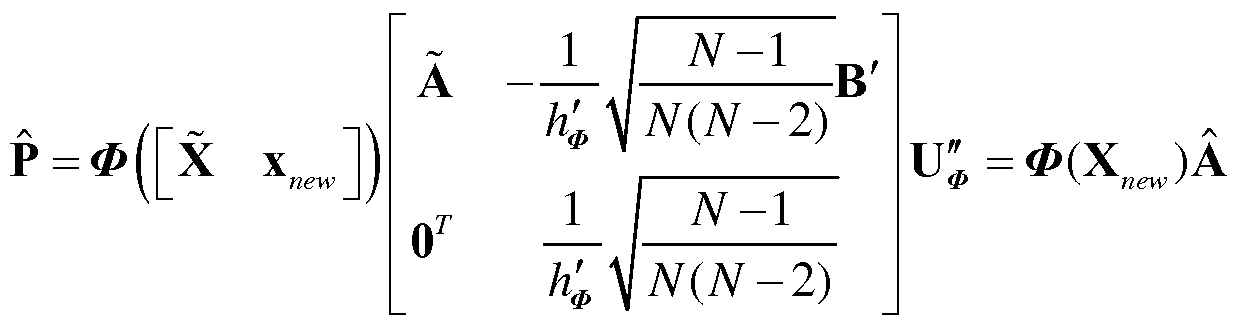
式中, Φ(Χ ) = Φ([Χ x ])为更新样本矩阵映射到高维特征空间后的矩阵, 连续退火
N-1
过程更新监测模型主要因素的调节因子 K. - 2B'rk(X, xnew) + B K(X)B ,连续退火
N(N-T)
过程更新模型主要因素的修正矩阵 Β': ^ + AAAr(k(X,x )-^¾¾1^), k(X,x_)
N_l N_l
表示 和 的内积; 步骤 4: 对连续退火过程进行故障监测;
- 1 - 通过 _ 1
Hotelling的 Γ2统计和平方预测误差 (SPE) 统计进行故障监测, 即可判断出连续退 火过程是否发生故障, 当 Γ2统计和 SPE统计超出各自的置信限时, 认为有故障发生, 反之, 整个过程正常, 转到步骤 3继续更新连续退火过程模型。
步骤 2所述的用步骤 1标准化后的前 N个采样样本, 建立的连续退火过程的初始监测模 型, 包括以下步骤:
本发明所提出的 RKPCA方法, 利用在特征空间中的递归计算来更新样本协方差矩阵的 特征值分解, 令 = [^,^ ,½;|为连续退火过程样本矩阵, ^, ,…,^为连续退火过程采 样样本, N是采样样本个数, = [x2, ½]eRm _"为连续退火过程中间矩阵, m是连续退 火过程采样变量个数, X =[ x ]为更新模型后连续退火过程的样本矩阵, x 为连续
- 1 - _ 1
退火过程中的新样本, 它们被映射 Φ投影到高维特征空间后分别为 Φ(Χ), Φ ( )和 Φ(Χ ), 因此 Φ(Χ)的均值向量 πιφ和协方差矩阵 CF可计算得到
1 .( 、 N_\ ~
111 Φ X, X I — Φ(χ1) + m。 (1)
N N N

(Φ(χ1)-αιφ)(Φ(χ1)-αιφ)1 + )— ιηφ)(Φ(χ!)-ιη,
N-l
N-l N_\ N-l^ 、 N-l .
Φ(Χι)- -m ■Φ^) m„ +
N-l N N N N
Φ(χ ) -ιηφ +— ιηφ -— Φ(χ1) Φ(χ )-ιηφ +— ιηφ -—
' N N ί(Φ(Χι)-ιηφ )(Φ(Χι ) - ώφ f + -ί- X (Φ(χ; )-ιήφ)(Φ(χ;)-ιηφ ):
Ν
- (Φ( : ) ώφ )(Φ(Χι )— ώφ f +―— C

其中, 和^分别表示 Φ(¾的均值向量和协方差矩阵, ([Χι X])为矩阵 [Xl 投影
后去均值的特征矩阵, ^是由 N个 1构成的行向量, Φ(χ,)为 X,投影到高维特征空间的值, 其中 i = L.N, ( 为^投影去均值后的矩阵;
令 Λ和 P分别为 CF的特征值阵和主要因素, λ和 f分别为 0f 的特征值阵和主要因素, 假设 f = ΡΪΙφ , Ι1φ 是一个正交旋转矩阵, 由 Ρ = (Χ)Α , Ρ = Φ(Χ)Α , 这里 A = (I - (1/N) X ΈΝ ) [Y ^I, v2 A/ ,· · ·, ν,/Τ^], 和 v,分别表示 (Χ)ΓΦ(Χ)的第 i个特征值 和特征向量, A = (I— (1/(N— l))xEw— ^[^/^,^/ ^,···,^/^], 和 分别表示 Φ(Χ)ΤΦ(Χ)的第 个特征值和特征向量,将 CF, ^分别对角化得到 I^CFP = A, CFP = A, 由 式 (2) 计 算 得 到 [(N - Ϊ)/(Ν - 2)]Λ - [(Ν - Ϊ)/(Ν(Ν - 2))]g^ = ΦΑ Τ Φ , 其 中 §φ = ΡΓ (Φ(Χι ) - Αφ ) = Ar [k(X, Xl ) - (1/(N - 1))K(X, X)^^ ];
令 8Φ = [(Ν - 1)/(Ν - 2)]Λ - [(Ν - 1)/(Ν(Ν - 2))]gsig^, 则 λ和 分别对应 的特征值阵 与特征向量阵, 由式 (2)可得到式 (3)
pTCFp = _pr (φ(Χι )_Ι¾φ)(Φ(χ1)-Αφ)ΓΡ + PTCFP

I /V― 〜 〜〜〜
= -^Φύ + ArK(X, X) ΑΛΑΓΚ(Χ, X)r A
=Λ
(3) 其中, K(X, )表示连续退火过程样本矩阵与中间矩阵的内积
式 (2)中 ^/1/(N-2) (X)的奇异值分解满足 (Χ) = ΡΣφϋ (4)
Ν-2 其中, f = Φ ( ) 为 的主要因素, £ 为对角阵且满足 έ =入, όφ为对应的右奇异阵 < 根据式 (4)、 式 (2)有


N— l
(Ι-ΡΛΡΓ)(Φ(Χι)-ι¾φ)
N(N-2)
N— l
) - τ^- Φ(^Ν-! - (Χ)Αλλτ (Φ(Χ)Τ Φ(Χι ) - Φ(ΧΥ Φ(Χ) _,)
N(N-2) Ν-1 Ν-1 N-l
( ) - i - Φ(Χ)ΑΛΑΓ (k(X, Xl ) - -—KiX)!^ )
Ν(Ν-2) N— l N— l Ν-1
(Χι)- (Χ)Β|
N(N-2)
(6) N-l - 2Brk(X, X! ) + ΒΓΚ (Χ)Β
N(N-2)

连续退火过程初始模型主要因素的修正矩阵:
(8)

其中 K( 表示连续退火过程中间矩阵的内积, Xl )表示 和 Xl的内积;
令


对\^作奇异值分解得到 V
 为特征向量阵, 为对角阵, 为对应的右奇 异阵, 将\^代入式 (2)有
N-\
为特征向量阵, 为对角阵, 为对应的右奇 异阵, 将\^代入式 (2)有
N-\
(Φ(χι)-ήίφ) -Φ(Χ)
N N-2) N-


则有 CF的主要因素 P可以表示为
Ρ =

又因为 Ρ = Φ(Χ)Α, 所以得到式 11)

根据式 (11), A可由下式计算得到

用步骤 2建立初始连续退火过程监测模型得到的主要因素 P, 可以得到连续退火过程在特
1
t = ΡΓ [Φ(χ_)-ιηφ] = ΑτΦ(Χ)τ[Φ(χ_)--Φ(Χ)1 = Ar[k(X,x_)- K(X)lJ (12) 其中, Ρ = [Ρι,ρ2,···,ρ ], r为保留的核主元数目, k(X,x )表示连续退火过程样本矩阵 X与 新样本1 的内积向量。 新样本 ^的 2和 SPE统计量由式(13)和式 (14) 计算
7 =trA— 4 (13)
SP =[Φ(χ ) ιηφ] (Ι-ΡΡΓ)[Φ(χ_)-ιηφ] (14) 其中, Λ为主元的方差阵。 Γ2满足 F分布:
r(N -l)
T2 F
N(N-r) 其中, W是采样样本的个数, r是保留主元的个数, Γ2统计量的上限为
_ r(N2-l)
(15)
N(N-r) 其中, 为置信度, 而 Q统计量的分布满足 分布, 其控制上限为
Q, =gZ2( ) (16) 其中,

大于它们各自的置信限则报警, 说明连续退火过程中发生了异常, 否则转到步骤 3;
步骤 3所述采用递归核主元分析方法更新步骤 2的连续退火过程初始的监测模型, 并计 算更新后连续退火过程模型的主要因素 , 方法如下: x 为一个连续退火过程中新样本并且可用, Φ(χ )为连续退火过程新样本1 在特征 空间中的投影, Φ(Χ ) = Φ ([ χ ])为更新后的连续退火过程样本矩阵在特征空间中的投 影, 则 Φ(Χ )的均值向量 ώφ和协方差阵 F分别为
Ν ί ~ 1 -. 、
— ΦΙΙ X (17)
Ν
CF =^—Φ{\ X x— ΙΙΦΙΙ X x„
N _\
N-2 N-l
( (Χ,) ώφ) Φ(Χ) (18)
N-l N N-2) N-2

由式 (2) - (9) 我们可以
 对 \作奇异值分解得到 \ 进而可以得到 F的主要因素 和特征值阵入

N-2,
Λ -∑''■ (20)
N-l
其中: 连续退火过程更新监测模型主要因素的调节因子:
N-1
l-2B'rk(X,x ) + Β'ΓΚ(Χ)Β' (21)
N(N-2)
连续退火过程更新监测模型主要因素的修正矩阵:
B' κ(χ) (22)

k(^x )表示连续退火过程中间矩阵 ±和新采样 X 的内积; 步骤 4所述的利用 Hotelling的 Γ2统计和平方预测误差 (SPE) 统计进行故障监测, T2统 计和平方预测误差 (SPE) 确定方法如下: 对于连续退火过程中一个新样本 z, 其在特征空间中的得分向量 te!T为
1
ί = ΡΓ[Φ(ζ)-ιηφ] = ΑΓΦ(Χ_ )τ[Φ(ζ)-- Φ(Χ_ )1, = Ar[k(X_,z)- K(X_)lJ (23) 其中, r为保留的核主元数目, k(X ,z)表示连续退火过程的更新的样本 矩阵 与新样本 z的内积向量。 连续退火过程新样本 z的 Γ2 2和 SPE2统计量由式 (24) 和式
(25)计算

SPE2 = [Φ(ζ) - ώφ ]Γ (Ι - ΡΡΓ) [Φ(ζ) - ώφ ] (25) 其中, Α为主元的方差阵;
新样本 z的 Γ2 2和 3? 统计量的置信限可由式 (15 ) 和式 (16 ) 得到, 若 Γ2 2和 SPE2统计 量大于它们的控制线, 则认为有故障发生报警, 否则转到步骤 3;
本发明优点: 本发明提出了一种基于递归核主元分析的连续退火过程故障监测方法, 主 要解决数据的非线性和时变性问题, RKPCA通过递归计算训练数据协方差的特征值和主要因 素对模型进行更新, 利用此方法进行的过程监测结果表明, 该方法不仅能大大降低误报警, 还提高了故障监测的准确性。
附图说明
图 1为本发明基于递归核主元分析的连续退火过程故障监测方法连续退火工艺流程; 图 2为本发明基于递归核主元分析的连续退火过程故障监测方法的总流程图; 图 3为本发明基于递归核主元分析的连续退火过程故障监测方法的模型流程图; 图 4为本发明基于递归核主元分析的连续退火过程故障监测方法用 RKPCA得出的连续退 火过程的 T2统计量;
图 5为本发明基于递归核主元分析的连续退火过程故障监测方法用 RKPCA得出的连续退 火过程的 SPE统计量;
图 6为本发明基于递归核主元分析的连续退火过程故障监测方法用 RKPCA递归计算的主 元个数。
图 7为本发明基于核主元分析的连续退火过程故障监测方法用 KPCA得出的连续退火过 程的 T2统计量;
图 8为本发明基于核主元分析的连续退火过程故障监测方法用 KPCA得出的连续退火过 程的 SPE统计量。
具体实施方式
下面结合附图和实施例对本发明作进一步详细说明。
连续退火过程的工艺流程如图 1 所示, 其中, 带钢宽度为 900-1230 厚度是 0. 18-0. 55 最大线速度为 880m/min, 最大重量是 26. 5t, 被加热到 710°C, 钢卷首先经过 开卷机 (P0R)开卷,然后焊接成连续的带钢,带钢依次经过 1号张紧辊(1BR)、入口活套 (ELP)、 2号张紧辊 (2BR)、 1号跳动辊(1DCR)、 3号张紧辊 (3BR)后进入连续退火炉, 连续退火炉采用 了 "快速冷却-再加热-倾斜过时效" 的退火工艺, 依次包括加热炉 (HF)、 均热炉 (SF)、 缓冷
炉(SCF)、 1号冷却炉(1C)、 再加热炉(RF)、 过时效炉(OA)、 2号冷却炉(2C), 带钢完成退火 工艺后经过 4号张紧辊 (4BR)、 出口活套 (DLP)、 5号张紧辊 (5BR)后进入平整机 (TPM), 从平 整机出来的带钢经过 6号张紧辊 (6BR)、 2号跳动辊 (2DCR)、 7号张紧辊 (7BR), 最终进入卷取 机 (TR)卷曲成钢卷。
本发明基于递归核主元分析的连续退火过程故障监测方法, 如图 2所示, 包括以下步骤: 步骤 1 : 采集数据,在连续退火的工业过程, 采集的数据包括: 采集入口活套 (ELP) 的 辊速, 电流和张力, 其中, 包括 37个辊速变量, 37个电流变量, 以及 ELP两边 2个张力变 量, 并对采集的数据进行标准化处理;
连续退火过程共包括 76过程变量,对于训练数据和实时工况数据采用了三分钟的采样间 隔采集数据, 每个故障的训练数据由 200个观测数构成, 实时工况数据由 300个观测数构成, 利用 RKPCA算法使用 200个样本建立过程监测模型, 使用 300个样本作为测试, 其中在此 仿真中取 99%的置信限, 每个样本包含 76个变量, 本实例给出部分采样数据, 分别随机选取 了标准数据和实时工况数据中的十组数据如表 1和表 2所示:
表 1. ELP标准数据中的十组数据
1R电流 1R辊速 5R电流 5R辊速 18R电流 18R辊速 TM1张力 TM2张力
1 0.658610 36.4698 38.2673 747.034 31.0010 657.585 6.73518 6.70954
2 0.663005 36.6896 37.6600 746.140 31.4893 658.350 6.66926 6.85237
3 0.670451 36.5461 35.5238 746.864 30.0122 657.606 6.74617 6.69856
4 0.670451 36.1189 39.4514 746.736 30.3754 658.159 7.10506 6.92927
5 0.663493 36.2135 36.8147 746.715 29.6674 657.861 6.65827 6.51179
6 0.664347 36.4179 36.1402 747.034 30.7416 657.904 6.43854 6.73518
7 0.664958 36.2196 38.4047 746.396 31.1139 657.734 6.52277 6.39826
8 0.659953 36.1097 37.1046 746.587 30.7691 658.159 6.45319 6.62898
9 0.662028 36.4332 36.3661 746.162 30.5676 658.201 6.56306 6.39826
10 0.664225 36.1921 37.9866 746.672 30.7416 657.670 6.88167 6.53376 表 2. ELP实时工况数据中的十组数据
L 1R电流 1R辊速 5R电流 5R辊速 18R电流 18R $昆速 TM1张力 TM2张力
NoN
1 0.656535 35.7221 37.8920 745.694 29.9603 657.797 6.37263 6.81941
2 0.624918 35.4292 37.9347 736.379 25.1995 650.845 6.69490 6.61433
3 0.631876 34.9012 41.1604 726.468 27.5799 640.448 6.48249 7.02815
4 0.683879 34.5380 46.0769 720.811 31.4801 631.986 6.30304 6.79377
5 0.649088 34.2237 46.5621 718.833 34.0131 631.178 6.24811 7.06111
6 0.686442 34.2542 50.6851 715.600 35.4231 626.947 6.32135 6.72786
7 0.688273 34.0864 51.7044 716.174 35.5421 627.351 6.39094 6.86336
8 0.687419 34.1535 52.4125 715.919 33.1891 627.372 6.66926 6.72053
9 0.690959 34.2634 53.9841 715.898 33.0396 627.159 6.44587 6.63264
10 0.700481 34.2359 55.3880 715.515 32.2095 627.308 6.50080 6.77546 步骤 2: 用步骤 1标准化后的 200个采样样本, 建立连续退火入口活套 (ELP) 初始的监 测模型, 计算连续退火过程故障的主要因素 P, 并确定置信限, 对于在连续退火过程一个新 的采样 x 监测其是否出现异常, 如果异常则报警, 否则转到步骤 3; 以连续退火过程 200个观测数为样本数据 X,以观测数据的后 199个数据为中间数据 X。 它们被映射 投影到高维特征空间; 求出中间矩阵的传输因子 A, 根据方程 (2) 和 (10), 计算得到连续退火过程样本矩阵 X的协方差矩阵 CF和主要因素 P, 利用主要因素 P可由式 ( 13)和式 (14) 计算得到连续退火过程新采样 的72和 SP^的统计量, 并它们是否大于 各自的置信限。 本实例通过计算没有发生故障, 转到步骤 3;
步骤 3: 在连续退火过程中, 新采样 1 是正常数据时, 采用递归核主元分析方法更新步 骤 2的连续退火过程的初始的监测模型, 并计算更新连续退火过程模型后连续退火过程故障 的主要因素 , 表示为;
1 为连续退火过程观测数中的一个可以用的新样本, 0^ )为连续退火过程新样本
1 在特征空间中的投影, Φ(Χ ) = Φ([Χ 1 ])为连续退火过程更新后的样本矩阵, 则更 新后数据样本协方差的^^的传输因子 Α和特征值阵 Α可以由 (19) 和 (20) 分别求的, 进 而可以得到连续退火过程更新后样本矩阵的主要因素 ^ ; 这里分别随机选取了传输因子 A的 十组数据如表 3所示:
表 3.传输因子 A十组数据
-0.002234 0.116932 0.02946 0.004251 -0.031282 0.00692 -0.14756 -0.000921
0.0202367 -0.00366 0.00288 -0.00933 0.0136258 0.06262 0.073793 -0.040450
0.0326804 -0.05354 -0.0026 0.009399 0.0695079 0.09472 0.082283 -0.057724
-0.025156 -0.00394 0.06529 0.056101 0.0082486 -0.0995 -0.16148 -0.014453
0.0546749 -0.01765 -0.0377 -0.04835 0.0261276 0.05037 0.033161 0.0056228
0.0020289 0.04197 0.01145 -0.02075 -0.075466 -0.1277 -0.15009 0.0565441
0.0031576 -0.12491 -0.0031 0.029215 0.1613627 0.09810 0.067874 -0.1144526
0.0374927 -0.01329 0.03562 -0.00175 -0.031035 -0.09767 -0.10696 0.0197142
0.0436574 -0.07263 0.01474 -1.80547 0.098647 0.038714 -0.01312 -0.0633847
0.0876383 0.048630 -0.01972 -0.10252 -0.01356 0.028529 -0.06496 -0.0162924 步骤 4: 利用更新连续退火过程模型, 对连续退火过程进行故障监测与诊断;
通过 Hotelling的 Γ2统计和平方预测误差 (SPE) 统计进行故障监测, 即可判断出连续退 火过程是否发生故障, 当 Γ2统计和 SPE统计超出各自的控制限时, 认为有故障发生, 反之, 整个过程正常, 转到步骤 3, 继续更新监测模型。
RKPCA使用连续退火过程 200个样本建立初始模型后能够根据 300个测试数据来更新模 型, 为了监测过程, 使用 Γ2和 SPE统计量, 对于一个新样本 Z e 300, 其在特征空间中的得分 向量 t可由 (23) 求的, 新样本 z的 Γ2和 SPE的统计量由式 (24)和式 (25)计算得到, 接着根据 式(15)和式(16)确定它们的置信限, 当 Γ2统计和 SPE统计超出各自的控制限时, 认为有故障 发生, 反之, 整个过程正常, 转到步骤 3, 继续更新监测模型。 通过计算得到改进的 RKPCA 对连续退火过程的监测结果如图 4和图 5所示, 从图中看出 RKPCA所生成的 Γ2和 SPE大约都在 第 175个样本处监测到活套故障, 此仿真结果表明所提出的 RKPCA方法通过模型的递归更新 保证了模型在过程变化时的有效性, 从而及时地监测到连续退火过程故障, 由图 4和图 5可见, 基于 RKPCA模型的递归更新置信限也得到更新, 图 6显示了所保留的主元个数的变化, 与此 对比, KPCA监测连续退火过程时其模型不能采用连续退火测试数据来进行递归更新, 所生 成的 Γ2和 SPE如图 7和图 8所示, 起初阶段, 由于连续退火过程运行不稳定, Γ2和 SPE暂时超过 他们各自的置信限, 但是在过程稳定后, KPCA没有监测到活套故障。
通过上面的仿真实倒, 表明了本发明 基于递归核主元分析的连续退火过程故障监测 方法的有效性, 实现了对连续退火过程的监测诊断。
Claims
权利要求书
1、 一种基于递归核主元分析的连续退火过程故障监测方法, 其特征在于: 包括以下步骤:
步骤 1:采集数据,在连续退火的工业过程中, 采集的数据包括: 采集入口活 套的辊速, 电流和张力, 用均值和标准偏差标准化采集的数据;
步骤 2: 计算连续退火过程故障的主要因素 P, 方法如下: 用步骤 1标准化后 的 N个采样样本, 建立连续退火过程初始的监测模型, 在连续退火过程一个新的 采样 X 监测其是否出现异常, 如果异常则报警, 否则转到步骤 3; 其中, 提取连续退火过程故障主要因素 P, 公式如下:

式中, Φ(Χ)为 X 连续退火样本矩阵映射到高维特征空间后的 阵, N是采样样本个数, 连续退火初始监测模型主要因素的调节因子
Ν-1
l-2Brk(X,Xl) + BrK(X)B, 初始模型主要因素的修正矩阵
N(N-2)
B + ΑΛΑΓ (k(X, x, ) K(X)1„ , ) k(X, Xl )表示 X和 Xl的内积
N-1 N-1
K(X)表示样本矩阵的内积, k ( , Xl)表示 X和 的内积, X为中间矩阵, K( ) 表示中间矩阵的内积, A为中间矩阵协方差的特征值阵, 为过程变量的特征 向量阵, lw— ,为 -1列单位向量; 提取连续退火中间矩阵 A, 公式如下:

步骤 3: 连续退火过程采样 是正常数据时, 采用递归核主元分析方法更
新步骤 2的连续退火过程初始的监测模型,并计算更新连续退火过程模型后连续 退火过程故 , ^表示为:

式中, (Χ,) = 「 为更新样本矩阵映射到高维特征空间后的矩 阵, 连续退火更新监测模型主要因素的调节因子
N-1
h 2B'rk
N(N -2) - ( ,xJ + B'rK( B',连续退火更新模型主要因素的修正
1 1
矩阵 B' V1+AAAJ(k(X,x_) - W , k ( , x )表示 和^的内
N-1 N-1
积;
步骤 4: 对连续退火过程是否发生故障进行监测;
通过 Hotelling的 Γ2统计和平方预测误差 (SPE) 统计进行故障监测, 即可 判断出连续退火过程是否发生故障, 当 T1统计和 SPE统计超出各自的置信限时, 认为有故障发生, 反之, 整个过程正常, 转到步骤 3继续更新连续退火过程模型。
2、 根据权利要求 1所述的基于递归核主元分析的连续退火过程故障监测方 法, 其特征在于: 步骤 2所述的建立连续退火过程初始的监测模型, 方法如下:
本发明所提出的 RKPCA方法,利用在特征空间中的递归计算来更新样本协 方差矩阵的特征值分解, 令 Χ^Χ ^,···^]为连续退火样本矩阵,
为连续退火采样样本, N是采样样本个数, [χ , ,χ^εΙΤ^"4)为连续退火 中间矩阵, m是连续退火采样变量个数, X =[ x ]为更新模型后连续退 火的样本矩阵, x 为连续退火新样本, 它们被映射 Φ投影到高维特征空间后分 别为 Φ(Χ), Φ( 和 Φ(Χ , 因此 Φ(Χ)的均值向量 ιηφ和协方差矩阵 CF可计 算得到

1
Φ χ, X Φ χ, X
N-1
(Φ(χ1)-ηιφ)(Φ(χ1)-ηιφ)τ + ^∑ (Φ(χ, )— ιηφ )(Φ(χ, ) ιηφ )7
1 +
- 1

1
Φ(χί)-ήιφ Φ(Χι) Φ(χ )-ιϊιφ+— m Φ(Χι)
N N
1 1 N
--— (Φ(χ1)-ναφ)(Φ(χ1)-ήιφ)τ +—― Z (Φ(χ; ) - φ )(Φ(χ; )— φ ):
(Φ(Χι )— ώφ )(Φ(Χι )— ώφ )Γ + -— C
N-2 N-1
(Φ(χ1)-ήιφ) Φ(Χ)
-1 Ν(Ν-2) Ν-2

(2)
其中, !^和^分别表示 Φ(Χ)的均值向量和协方差矩阵, Χ」)为矩阵 [Xl X]投影后去均值的特征矩阵, 是由 N个 1 构成的行向量, Φ(χ,)为 X,投影 到高维特征空间的值, 其中 = 1....N, (:¾为^投影去均值后的矩阵,
令 Λ和 p分别为 cF的特征值阵和主要因素, A和 f分别为 的特征值阵和 主要因素,假设 f = ΡΪΙΦ, !^是一个正交旋转矩阵, 由 Ρ = Φ(Χ)Α, Ρ = Φ(Χ)Α , 这里 Α = (Ι (Ι/Λ χΕ^^/ν^,^/Τ^, ',ν,./ν^], ξ! 和 v, 分别表示 Φ(Χ)ΓΦ(Χ) 的 第 个 特 征 值 和 特 征 向 量 , A = (I-(l/(N-l))xEw— ^^/ν^,^Α/ί,···,^/^], ωι 和 Ϋ,分别表示 Φ(Χ)ΤΦ(Χ)的第 个特征值和特征向量,将^, ^分别对角化得到 CFP = A, CFP = A , 由 式 (2) 计 算 得 到
[(N - ί)/(Ν - 2)]Λ - [(Ν - ί)/(Ν(Ν - 2))]§φ§^ = ΦΑ Τ Φ , 其 中
§φ = ΡΓ (Φ(Χι ) - Αφ ) = Ar [k(X, Xl ) - (1/(N - 1))K(X, 丄 ],
令 = [(N - 1)/(N - 2)]Λ - [(N - 1)/(N(N - 2))] s,g^,则 λ和 ϋφ分别对应 的特征值阵与特征向量阵, 由式 (2)可得到式 (3)
FTCFF = FT (φ(Χι ) _ Αφ )(φ(Χι )-Αφ)ΓΡ + PTCFP
= ^Φ +^ΑτΦ(Χ)τΡλΡτΦ(Χ)Α
- +—― ΑΤΦ(Χ)ΤΦ(Χ)ΑΑΑΤΦ(Χ)ΤΦ(Χ)Α

(3) 其中, Κ(Χ, )表示样本矩阵与中间矩阵的内积
式 (2)中>/1/( _2) (:¾)的奇异值分解满足
- (Χ) = ΡΣφϋ (4)
Ν 其中, f = Φ ( ) 为^的主要因素, έ 为对角阵且满足 έ =入, ό 为对应的 右奇异阵, 根据式 (4)、 式 (2)有
N-1
(Φ(χι)-ήιφ) ■Φ(Χ)
-2) Ν

其 模型主要因素的调节因子:

N-l
(I ΡΛΡΓ)(Φ(Χι)— A
N(N-2)
N-l
Φ(Χι)- Φ(Χ)1Ν_1-Φ(Χ)ΑΑΑτ(Φ(Χ)τΦ(χ1) - Φ(Χ)ΤΦ(Χ)1Ν_1)
N(N-2) N-l N-l
N-l
Φ(Χι)- 0(X)1W— i - Φ(Χ)ΑΛΑΓ (k(X, Xl ) - K(X)1W— ,)
N(N-2) N-l N-l

N-l
φ - 2Brk(X, X! ) + ΒΓΚ (X)B
N(N-2)
(6)
N-l (Ι-ΡΛΡΓ)(Φ(Χι)-ιηφ)
N(N-2)

(7) 初始模型主要因素的修正矩阵:
N— \ N-\
(8) 其中 K( 表示中间矩阵的内积, k , Xl )表示 X和 Xl的内积;
令
_ 07

1
(Φ(χ1)-ναφ) (Χ)
Ν Ν-Ί) Ν-2
 (Χ)Α
(Χ)Α
hip\\N{N-2)


(9) 则有 CF的主要因素 Ρ可以表示为

又因为 ρ = Φ(χ)Α, 所以得到式 (11)

根据式 (11), A可由下式计算得到

对于连续退火过程,一个新样本 x ,采集的数据包括:采集入口活套(ELP) 的辊速, 电流和张力, 其中, 包括 37个辊速变量, 37个电流变量, 以及 ELP两边 2个张力变量,
用步骤 2建立初始连续退火监测模型得到的主要因素 P,得到连续退火过程在 特征空间中的得分向量 te!T为 t = ΡΓ [Φ(χ_)-ιηφ] = ΑΓΦ(Χ)Γ[Φ(χ_)--Φ(Χ)1 Ar[k(X,x_)- -K(X)l (12) 其中,
 r为保留的核主元数目, k(X,x )表示连续退火样本矩 阵 X与新样本 x 的内积向量, 新样本 1 的7^2和 SPE统计量由式(13)和式(14) 计算
7 =trA— 4 (13)
SPE1 = [Φ(χ_ )-ιηφ] (Ι-ΡΡΓ)[Φ(χ_)-ιηφ] (14)
其中, Λ为主元的方差阵, Γ2满足 F分布:
r(N -l)
Τ2
N(N-r) 其中, W是采样样本的个数, r是保留主元的个数, Γ2统计量的上限为
r(N2-l)
(15) β ~ N(N-r) ^β 其中, 为置信度, 而 Q统计量的分布满足 分布, 其控制上限为
(16) 其中, g= 2/2 /, h = 2 2/p2 , /与 2分别对应样本 Q统计量的均值和方差, 如果 7 和 SP^大于它们各自的置信限则报警,说明连续退火过程中发生了异常, 否则转到步骤 3。
3、 根据权利要求 1所述的基于递归核主元分析的连续退火过程故障监测方 法,其特征在于: 步骤 3所述采用基于递归核主元分析的更新步骤 2的连续退火 过程初始的监测模型,并计算更新连续退火过程模型后连续退火过程故障的主要 因素 , 方法如下: x 为一个连续退火新样本并且可用, Φ(χ )为连续退火新样本 X 在特征 空间中的投影, Φ(Χ ) = Φ X X 为更新后的连续退火样本矩阵在特征空 间中的投影, 则 Φ(Χ )的均值向量 ώφ和协方差阵 ^分别为
=一 φ X 1)1,

CF =^—Φ(\ Χ x„„.„ ΙΙΦΙΙ X x„
N _\
N-2 N-l
(Φ(χ )-m ■Φ(Χ) (18)
N-l N N-2) N-2

(2) - (9) 我们可以得到:

对 作奇异值分解得到 \
进而可以 cF的主 因素 和特征值阵

N-1
-Vl-2B'rk(X,x_) + B'rK(X)B' (21)
N(N -2)
连续退火更新监测模型主要因素的修正矩阵:
B (22)

Priority Applications (2)
| Application Number | Priority Date | Filing Date | Title |
|---|---|---|---|
| US13/391,775 US9053291B2 (en) | 2010-09-29 | 2010-09-29 | Continuous annealing process fault detection method based on recursive kernel principal component analysis |
| PCT/CN2010/077441 WO2012040916A1 (zh) | 2010-09-29 | 2010-09-29 | 基于递归核主元分析的连续退火过程故障监测方法 |
Applications Claiming Priority (1)
| Application Number | Priority Date | Filing Date | Title |
|---|---|---|---|
| PCT/CN2010/077441 WO2012040916A1 (zh) | 2010-09-29 | 2010-09-29 | 基于递归核主元分析的连续退火过程故障监测方法 |
Publications (1)
| Publication Number | Publication Date |
|---|---|
| WO2012040916A1 true WO2012040916A1 (zh) | 2012-04-05 |
Family
ID=45891815
Family Applications (1)
| Application Number | Title | Priority Date | Filing Date |
|---|---|---|---|
| PCT/CN2010/077441 Ceased WO2012040916A1 (zh) | 2010-09-29 | 2010-09-29 | 基于递归核主元分析的连续退火过程故障监测方法 |
Country Status (2)
| Country | Link |
|---|---|
| US (1) | US9053291B2 (zh) |
| WO (1) | WO2012040916A1 (zh) |
Cited By (17)
| Publication number | Priority date | Publication date | Assignee | Title |
|---|---|---|---|---|
| CN103246277A (zh) * | 2013-03-28 | 2013-08-14 | 杭州电子科技大学 | 基于相对化变换的信息增量矩阵的工业过程监控方法 |
| CN104699077A (zh) * | 2015-02-12 | 2015-06-10 | 浙江大学 | 一种基于嵌套迭代费舍尔判别分析的故障变量隔离方法 |
| CN106093626A (zh) * | 2016-05-31 | 2016-11-09 | 南京航空航天大学 | 一种用于诊断crh5型高铁逆变器的微小故障的方法 |
| CN106647274A (zh) * | 2016-12-28 | 2017-05-10 | 中南大学 | 一种连续生产过程中运行工况稳态判别方法 |
| CN106940808A (zh) * | 2017-04-28 | 2017-07-11 | 宁波大学 | 一种基于改进型主元分析模型的故障检测方法 |
| CN107024915A (zh) * | 2016-02-02 | 2017-08-08 | 同济大学 | 一种电网控制器板卡故障检测系统及检测方法 |
| CN109145256A (zh) * | 2018-11-14 | 2019-01-04 | 南通大学 | 基于规范变量非线性主成分分析的非线性动态过程监测方法 |
| CN111209973A (zh) * | 2020-01-09 | 2020-05-29 | 浙江理工大学 | 基于混合核pca-cca及核密度估计的过程监测方法 |
| CN111368428A (zh) * | 2020-03-04 | 2020-07-03 | 山东科技大学 | 一种基于监控二阶统计量的传感器精度下降故障检测方法 |
| CN111913475A (zh) * | 2020-08-07 | 2020-11-10 | 清华大学 | 动态系统中故障检测方法、检测器以及存储介质 |
| CN112766408A (zh) * | 2021-01-29 | 2021-05-07 | 西北工业大学 | 基于主元分析和多层超限学习机的飞行器微小故障诊断方法 |
| CN113469061A (zh) * | 2021-07-03 | 2021-10-01 | 刘汉有 | 一种基于主成分分析法的燃气轮机故障检测方法 |
| CN114237202A (zh) * | 2021-12-08 | 2022-03-25 | 浙江大学 | 基于fia-cva与迭代增强框架的过程监测方法 |
| CN114611067A (zh) * | 2022-03-11 | 2022-06-10 | 中国石油大学(华东) | 一种基于典型变量相异性分析的化工过程缓变故障检测方法 |
| CN115144182A (zh) * | 2022-09-01 | 2022-10-04 | 杭州景业智能科技股份有限公司 | 轴承健康状态监测方法、装置、计算机设备及存储介质 |
| CN116087787A (zh) * | 2023-01-18 | 2023-05-09 | 华能新能源股份有限公司山西分公司 | 一种基于主成分分析法的电池故障判断方法和系统 |
| CN116501013A (zh) * | 2023-04-28 | 2023-07-28 | 西安理工大学 | 自适应慢特征分析的工业过程故障检测方法 |
Families Citing this family (24)
| Publication number | Priority date | Publication date | Assignee | Title |
|---|---|---|---|---|
| CN103776480B (zh) * | 2014-01-29 | 2016-09-21 | 清华大学 | 基于多次移动平均的微小故障检测方法和装置 |
| CN104182623A (zh) * | 2014-08-12 | 2014-12-03 | 南京工程学院 | 一种基于当量变化率计算的热工过程数据检测方法 |
| CN104731081B (zh) * | 2015-01-14 | 2018-07-06 | 株洲壹星科技股份有限公司 | 用于大功率机车车载数据转储分析的方法及系统装置 |
| CN105759217B (zh) * | 2016-02-26 | 2020-01-07 | 江苏快乐电源(涟水)有限公司 | 一种基于可测数据的铅酸蓄电池组在线故障诊断方法 |
| CN106845826B (zh) * | 2017-01-18 | 2021-02-02 | 西安交通大学 | 一种基于PCA-Cpk的冷连轧生产线服役质量状态评估方法 |
| CN107895224B (zh) * | 2017-10-30 | 2022-03-15 | 北京工业大学 | 一种基于扩展核熵负载矩阵的mkeca发酵过程故障监测方法 |
| CN108563806B (zh) * | 2018-01-05 | 2019-06-14 | 哈尔滨工业大学(威海) | 基于相似性的发动机气路参数长期预测方法及系统 |
| CN108830006B (zh) * | 2018-06-27 | 2022-02-18 | 中国石油大学(华东) | 基于线性评价因子的线性-非线性工业过程故障检测方法 |
| CN109635358A (zh) * | 2018-11-20 | 2019-04-16 | 天津大学 | 一种基于滑动窗口多尺度主元分析的机组故障检测方法 |
| CN109978059B (zh) * | 2019-03-28 | 2024-02-23 | 南京富岛信息工程有限公司 | 一种原油蒸馏过程初馏塔冲塔故障预警方法 |
| CN110738274A (zh) * | 2019-10-26 | 2020-01-31 | 哈尔滨工程大学 | 一种基于数据驱动的核动力装置故障诊断方法 |
| CN111259330B (zh) * | 2020-01-13 | 2023-11-03 | 北京化工大学 | 一种基于振动信号的旋转机械早期预警方法 |
| CN111241633B (zh) * | 2020-01-20 | 2024-05-31 | 中国人民解放军国防科技大学 | 基于主成分分析和双指数模型的斩波器剩余寿命预测方法 |
| CN111680725B (zh) * | 2020-05-28 | 2023-05-05 | 哈尔滨工业大学 | 基于重构贡献的气体传感器阵列多故障隔离算法 |
| CN112982544B (zh) * | 2021-02-24 | 2022-03-29 | 北京科技大学 | 一种基于kpca的地下铲运机故障诊断方法 |
| CN113031566A (zh) * | 2021-03-09 | 2021-06-25 | 上海海事大学 | 基于在线选取主元并加权的pca模型故障检测方法 |
| CN113076211B (zh) * | 2021-03-29 | 2024-02-23 | 中国人民解放军火箭军工程大学 | 一种基于故障重构的质量相关故障诊断及误报警反馈方法 |
| CN114065645A (zh) * | 2021-11-24 | 2022-02-18 | 杭州哲达科技股份有限公司 | 工业设备监测方法、装置和计算机可读存储介质 |
| CN114055251A (zh) * | 2021-12-17 | 2022-02-18 | 沈阳科网通信息技术有限公司 | 一种基于深度分解的电主轴系统早期故障检测方法 |
| CN114492956B (zh) * | 2022-01-07 | 2024-03-12 | 上海烁恒科技有限责任公司 | 基于历史数据搜索的工况预测方法、设备及存储介质 |
| CN115953075B (zh) * | 2023-01-10 | 2025-08-01 | 中国人民解放军火箭军工程大学 | 高效自适应非线性模型更新的关键性能指标过程监测方法 |
| CN116453310B (zh) * | 2023-06-14 | 2023-09-05 | 昆山工业大数据创新中心有限公司 | 一种铜排的温度异常报警方法及装置 |
| CN118100165B (zh) * | 2024-03-05 | 2024-07-26 | 兰州大学 | 一种同化机舱雷达测风资料改进风电功率预测的方法 |
| CN118801358A (zh) * | 2024-07-01 | 2024-10-18 | 西安热工研究院有限公司 | 一种火电厂智慧协同运行方法及相关装置 |
Citations (4)
| Publication number | Priority date | Publication date | Assignee | Title |
|---|---|---|---|---|
| US20050055175A1 (en) * | 2003-09-10 | 2005-03-10 | Jahns Gary L. | Industrial process fault detection using principal component analysis |
| CN1655082A (zh) * | 2005-01-27 | 2005-08-17 | 上海交通大学 | 基于核主元分析的非线性故障诊断的方法 |
| US20070282777A1 (en) * | 2006-05-30 | 2007-12-06 | Honeywell International Inc. | Automatic fault classification for model-based process monitoring |
| CN101446831A (zh) * | 2008-12-30 | 2009-06-03 | 东北大学 | 一种分散的过程监测方法 |
Family Cites Families (7)
| Publication number | Priority date | Publication date | Assignee | Title |
|---|---|---|---|---|
| US7248939B1 (en) * | 2005-01-13 | 2007-07-24 | Advanced Micro Devices, Inc. | Method and apparatus for multivariate fault detection and classification |
| US8620519B2 (en) * | 2005-04-18 | 2013-12-31 | Honeywell International Inc. | Kernel-based fault detection system and method |
| US7421351B2 (en) * | 2006-12-21 | 2008-09-02 | Honeywell International Inc. | Monitoring and fault detection in dynamic systems |
| MX2011005335A (es) * | 2008-11-21 | 2011-10-11 | Precitec Kg | Metodo y dispositivo para monitorear una operacion de procesamiento laser a ser realizada sobre una pieza de trabajo y cabeza de procesamiento laser que tiene dicho dispositivo. |
| US8527223B2 (en) * | 2009-09-11 | 2013-09-03 | University Of Cincinnati | Methods and systems for energy prognosis |
| US8645082B2 (en) * | 2010-09-13 | 2014-02-04 | Mks Instruments, Inc. | Monitoring, detecting and quantifying chemical compounds in a sample |
| CN103384805B (zh) * | 2011-01-31 | 2015-03-25 | 东北大学 | 一种电弧炉运行故障检测装置与方法 |
-
2010
- 2010-09-29 WO PCT/CN2010/077441 patent/WO2012040916A1/zh not_active Ceased
- 2010-09-29 US US13/391,775 patent/US9053291B2/en active Active
Patent Citations (4)
| Publication number | Priority date | Publication date | Assignee | Title |
|---|---|---|---|---|
| US20050055175A1 (en) * | 2003-09-10 | 2005-03-10 | Jahns Gary L. | Industrial process fault detection using principal component analysis |
| CN1655082A (zh) * | 2005-01-27 | 2005-08-17 | 上海交通大学 | 基于核主元分析的非线性故障诊断的方法 |
| US20070282777A1 (en) * | 2006-05-30 | 2007-12-06 | Honeywell International Inc. | Automatic fault classification for model-based process monitoring |
| CN101446831A (zh) * | 2008-12-30 | 2009-06-03 | 东北大学 | 一种分散的过程监测方法 |
Non-Patent Citations (2)
| Title |
|---|
| LI WEIHUA ET AL.: "Recursive PCA for adaptive process monitoring.", JOURNAL OF PROCESS CONTROL., vol. 10, no. 5, October 2000 (2000-10-01), pages 471 - 486 * |
| XIE LEI ET AL.: "Recursive kernel PCA and its application in adaptive monitoring of nonlinear processes.", JOURNAL OF CHEMICAL INDUSTRY AND ENGINEERING (CHINA)., vol. 58, no. 7, July 2007 (2007-07-01), pages 1776 - 1782 * |
Cited By (25)
| Publication number | Priority date | Publication date | Assignee | Title |
|---|---|---|---|---|
| CN103246277A (zh) * | 2013-03-28 | 2013-08-14 | 杭州电子科技大学 | 基于相对化变换的信息增量矩阵的工业过程监控方法 |
| CN104699077A (zh) * | 2015-02-12 | 2015-06-10 | 浙江大学 | 一种基于嵌套迭代费舍尔判别分析的故障变量隔离方法 |
| CN104699077B (zh) * | 2015-02-12 | 2017-06-06 | 浙江大学 | 一种基于嵌套迭代费舍尔判别分析的故障变量隔离方法 |
| CN107024915A (zh) * | 2016-02-02 | 2017-08-08 | 同济大学 | 一种电网控制器板卡故障检测系统及检测方法 |
| CN106093626A (zh) * | 2016-05-31 | 2016-11-09 | 南京航空航天大学 | 一种用于诊断crh5型高铁逆变器的微小故障的方法 |
| CN106647274A (zh) * | 2016-12-28 | 2017-05-10 | 中南大学 | 一种连续生产过程中运行工况稳态判别方法 |
| CN106647274B (zh) * | 2016-12-28 | 2018-05-18 | 中南大学 | 一种连续生产过程中运行工况稳态判别方法 |
| CN106940808A (zh) * | 2017-04-28 | 2017-07-11 | 宁波大学 | 一种基于改进型主元分析模型的故障检测方法 |
| CN109145256B (zh) * | 2018-11-14 | 2022-09-16 | 保控(南通)物联科技有限公司 | 一种基于规范变量非线性主成分分析的过程监测方法 |
| CN109145256A (zh) * | 2018-11-14 | 2019-01-04 | 南通大学 | 基于规范变量非线性主成分分析的非线性动态过程监测方法 |
| CN111209973B (zh) * | 2020-01-09 | 2023-04-07 | 浙江理工大学 | 基于混合核pca-cca及核密度估计的过程监测方法 |
| CN111209973A (zh) * | 2020-01-09 | 2020-05-29 | 浙江理工大学 | 基于混合核pca-cca及核密度估计的过程监测方法 |
| CN111368428A (zh) * | 2020-03-04 | 2020-07-03 | 山东科技大学 | 一种基于监控二阶统计量的传感器精度下降故障检测方法 |
| CN111368428B (zh) * | 2020-03-04 | 2023-06-23 | 山东科技大学 | 一种基于监控二阶统计量的传感器精度下降故障检测方法 |
| CN111913475A (zh) * | 2020-08-07 | 2020-11-10 | 清华大学 | 动态系统中故障检测方法、检测器以及存储介质 |
| CN112766408A (zh) * | 2021-01-29 | 2021-05-07 | 西北工业大学 | 基于主元分析和多层超限学习机的飞行器微小故障诊断方法 |
| CN112766408B (zh) * | 2021-01-29 | 2024-05-14 | 西北工业大学 | 基于主元分析和多层超限学习机的飞行器微小故障诊断方法 |
| CN113469061A (zh) * | 2021-07-03 | 2021-10-01 | 刘汉有 | 一种基于主成分分析法的燃气轮机故障检测方法 |
| CN114237202A (zh) * | 2021-12-08 | 2022-03-25 | 浙江大学 | 基于fia-cva与迭代增强框架的过程监测方法 |
| CN114237202B (zh) * | 2021-12-08 | 2024-04-05 | 浙江大学 | 基于fia-cva与迭代增强框架的过程监测方法 |
| CN114611067A (zh) * | 2022-03-11 | 2022-06-10 | 中国石油大学(华东) | 一种基于典型变量相异性分析的化工过程缓变故障检测方法 |
| CN114611067B (zh) * | 2022-03-11 | 2025-03-04 | 中国石油大学(华东) | 一种基于典型变量相异性分析的化工过程缓变故障检测方法 |
| CN115144182A (zh) * | 2022-09-01 | 2022-10-04 | 杭州景业智能科技股份有限公司 | 轴承健康状态监测方法、装置、计算机设备及存储介质 |
| CN116087787A (zh) * | 2023-01-18 | 2023-05-09 | 华能新能源股份有限公司山西分公司 | 一种基于主成分分析法的电池故障判断方法和系统 |
| CN116501013A (zh) * | 2023-04-28 | 2023-07-28 | 西安理工大学 | 自适应慢特征分析的工业过程故障检测方法 |
Also Published As
| Publication number | Publication date |
|---|---|
| US9053291B2 (en) | 2015-06-09 |
| US20130035910A1 (en) | 2013-02-07 |
Similar Documents
| Publication | Publication Date | Title |
|---|---|---|
| WO2012040916A1 (zh) | 基于递归核主元分析的连续退火过程故障监测方法 | |
| Zhang et al. | Decentralized fault diagnosis of large-scale processes using multiblock kernel partial least squares | |
| CN108075470A (zh) | 一种基于sfr和elm的电网暂态频率特征预测方法 | |
| CN103441495B (zh) | 电力系统元件参数和功率修正系数的辨识方法及系统 | |
| CN101867183B (zh) | 多断面稳定输送水平交互影响的输电极限计算方法 | |
| CN105259895A (zh) | 一种工业过程微小故障的检测和分离方法及其监测系统 | |
| CN112029990A (zh) | 一种冷轧带钢连退加热炉自动纠偏控制方法 | |
| CN113808743B (zh) | 一种电网户外作业人员热应激预警方法及系统 | |
| CN109828548B (zh) | 基于时间序列变化突变点检测的性能退化特征评估方法 | |
| CN102721519A (zh) | 塔型杆系钢结构塔身主杆失稳损伤发生位置两步诊断法 | |
| CN118766430A (zh) | 一种个体化低氧训练动态氧浓度调控系统及方法 | |
| CN107918381A (zh) | 一种基于组合核函数的类均值核主元故障诊断方法 | |
| CN101408940A (zh) | 空间交叉识别多传感器奇异失真数据的方法 | |
| Liu et al. | Quality-relevant monitoring and diagnosis with dynamic concurrent projection to latent structures | |
| CN116483675A (zh) | 一种预测内存故障的方法、系统、设备和存储介质 | |
| Joy et al. | Pattern of external debt and its impact on macroeconomic variables in India | |
| CN103018383B (zh) | 一种油色谱在线监测噪声数据校正方法 | |
| del Portal et al. | Modeling-on-demand-based multivariable control performance monitoring | |
| CN100552574C (zh) | 基于流模型的机器组负载预测控制方法 | |
| CN118412078A (zh) | 基于电池回收正负极材料惰性气体保护干燥系统及方法 | |
| CN114488798B (zh) | 基于数据协调的二次再热机组性能监测与运行优化方法 | |
| CN116881788A (zh) | 一种基于时序特征分析的一段转化炉运行异常检测方法 | |
| KR102045874B1 (ko) | 상태 진단 시스템 및 방법 | |
| CN107862131A (zh) | 一种基于双层法的催化裂化主分馏塔的故障诊断方法 | |
| CN114118485A (zh) | 一种尾撑系统健康监测与预防性维护的方法 |
Legal Events
| Date | Code | Title | Description |
|---|---|---|---|
| WWE | Wipo information: entry into national phase |
Ref document number: 13391775 Country of ref document: US |
|
| 121 | Ep: the epo has been informed by wipo that ep was designated in this application |
Ref document number: 10857679 Country of ref document: EP Kind code of ref document: A1 |
|
| NENP | Non-entry into the national phase |
Ref country code: DE |
|
| 122 | Ep: pct application non-entry in european phase |
Ref document number: 10857679 Country of ref document: EP Kind code of ref document: A1 |