WO2012035673A1 - ポリアミド樹脂組成物、該ポリアミド樹脂組成物の製造方法、および該ポリアミド樹脂組成物を成形して得られた成形体 - Google Patents
ポリアミド樹脂組成物、該ポリアミド樹脂組成物の製造方法、および該ポリアミド樹脂組成物を成形して得られた成形体 Download PDFInfo
- Publication number
- WO2012035673A1 WO2012035673A1 PCT/JP2010/073286 JP2010073286W WO2012035673A1 WO 2012035673 A1 WO2012035673 A1 WO 2012035673A1 JP 2010073286 W JP2010073286 W JP 2010073286W WO 2012035673 A1 WO2012035673 A1 WO 2012035673A1
- Authority
- WO
- WIPO (PCT)
- Prior art keywords
- polyamide resin
- silicone resin
- mass
- resin layer
- polyamide
- Prior art date
- Legal status (The legal status is an assumption and is not a legal conclusion. Google has not performed a legal analysis and makes no representation as to the accuracy of the status listed.)
- Ceased
Links
Classifications
-
- C—CHEMISTRY; METALLURGY
- C08—ORGANIC MACROMOLECULAR COMPOUNDS; THEIR PREPARATION OR CHEMICAL WORKING-UP; COMPOSITIONS BASED THEREON
- C08L—COMPOSITIONS OF MACROMOLECULAR COMPOUNDS
- C08L77/00—Compositions of polyamides obtained by reactions forming a carboxylic amide link in the main chain; Compositions of derivatives of such polymers
-
- C—CHEMISTRY; METALLURGY
- C08—ORGANIC MACROMOLECULAR COMPOUNDS; THEIR PREPARATION OR CHEMICAL WORKING-UP; COMPOSITIONS BASED THEREON
- C08L—COMPOSITIONS OF MACROMOLECULAR COMPOUNDS
- C08L83/00—Compositions of macromolecular compounds obtained by reactions forming in the main chain of the macromolecule a linkage containing silicon with or without sulfur, nitrogen, oxygen or carbon only; Compositions of derivatives of such polymers
- C08L83/04—Polysiloxanes
-
- Y—GENERAL TAGGING OF NEW TECHNOLOGICAL DEVELOPMENTS; GENERAL TAGGING OF CROSS-SECTIONAL TECHNOLOGIES SPANNING OVER SEVERAL SECTIONS OF THE IPC; TECHNICAL SUBJECTS COVERED BY FORMER USPC CROSS-REFERENCE ART COLLECTIONS [XRACs] AND DIGESTS
- Y02—TECHNOLOGIES OR APPLICATIONS FOR MITIGATION OR ADAPTATION AGAINST CLIMATE CHANGE
- Y02P—CLIMATE CHANGE MITIGATION TECHNOLOGIES IN THE PRODUCTION OR PROCESSING OF GOODS
- Y02P20/00—Technologies relating to chemical industry
- Y02P20/141—Feedstock
- Y02P20/143—Feedstock the feedstock being recycled material, e.g. plastics
-
- Y—GENERAL TAGGING OF NEW TECHNOLOGICAL DEVELOPMENTS; GENERAL TAGGING OF CROSS-SECTIONAL TECHNOLOGIES SPANNING OVER SEVERAL SECTIONS OF THE IPC; TECHNICAL SUBJECTS COVERED BY FORMER USPC CROSS-REFERENCE ART COLLECTIONS [XRACs] AND DIGESTS
- Y02—TECHNOLOGIES OR APPLICATIONS FOR MITIGATION OR ADAPTATION AGAINST CLIMATE CHANGE
- Y02W—CLIMATE CHANGE MITIGATION TECHNOLOGIES RELATED TO WASTEWATER TREATMENT OR WASTE MANAGEMENT
- Y02W30/00—Technologies for solid waste management
- Y02W30/50—Reuse, recycling or recovery technologies
- Y02W30/62—Plastics recycling; Rubber recycling
Definitions
- the present invention relates to a polyamide resin composition containing a polyamide resin and a silicone resin. Furthermore, the present invention relates to a method for producing a polyamide resin composition suitable for material recycling of a polyamide resin composite in which a silicone resin layer is formed on the surface of a polyamide resin molded body. Furthermore, it is related with the molded object obtained by shape
- Polyamide resin has long been used as an industrial material. For example, it is used in the form of a fiber, a film, a resin molded body or the like. Among these, polyamide 6 and polyamide 66 are used in a wide range of fields such as automobile parts and OA equipment.
- recycling methods for plastic products such as polyamide resin can be roughly divided into three types. That is, thermal recycling that extracts thermal energy by incineration of plastic products, chemical recycling that chemically decomposes plastic products into raw material monomers, and then repolymerization, material recycling that melts plastic products and remolds them into new products, It can be roughly divided into three types.
- polyamide resin products are often mixed with various additives, surface-treated, or other resin components are formed on the surface thereof. For this reason, it is not easy to take out and recycle a polyamide resin with less impurities from a polyamide resin product.
- the following methods are known as a method for recycling a polyamide resin molded body having other resin components formed on the surface. That is, a method of removing the silicone resin layer on the surface of the scrap fabric by immersing an airbag scrap fabric using polyamide resin as a base fabric in an alkaline solution, dehydrating and stirring in a container has been proposed. (See, for example, Japanese Patent No. 3879348). In addition, a method for removing impurities by heating a polyamide 6 product containing one or more resin components as impurities in an alkaline aqueous solution or an organic solvent has been proposed (see, for example, JP2008-179816A and JP2008-239985A). .
- an object of the present invention is to stably provide a polyamide resin composition in which various mechanical properties and operability are maintained even when a silicone resin as an impurity is contained. . Furthermore, the present invention provides a method for easily separating a silicone resin layer from a polyamide resin composite in order to material-recycle the polyamide resin composite having a silicone resin layer formed on the surface of the polyamide resin molded body. With the goal. Furthermore, an object of the present invention is to provide a method for producing a polyamide resin composition from a polyamide resin molded body in which a silicone resin obtained after separating a silicone resin layer from a polyamide resin composite remains.
- the present inventors have found that the polyamide resin composition in which the content of the silicone resin as an impurity is in a specific range is substantially free of impurities.
- the present inventors have found that a polyamide resin composition in which various mechanical properties and operability of the polyamide resin are maintained as compared with a polyamide resin having no polyamide resin has been achieved.
- the present inventors have found a method for economically producing a polyamide resin composition in which the content of the silicone resin as an impurity is in a specific range by a simple process, and have reached the present invention.
- the present inventors easily separate the silicone resin layer from the polyamide resin composite having the silicone resin layer formed on the surface of the polyamide resin molded body by using a specific alkaline solution.
- the method has been found and the present invention has been reached. That is, the gist of the present invention is the following (1) to (17).
- a polyamide resin composition characterized by being separated so as to remain in an amount of 0.01 to 1.5 parts by mass, and a polyamide resin molded body having a silicone resin remaining on the surface is pulverized or cut and melt-kneaded Manufacturing method.
- the alkali metal hydroxide and / or alkaline earth metal hydroxide is 3 to 40% by mass; In addition, an alkali solution containing 0.5 to 10% by mass of an amine is used, and the temperature of the alkali solution is kept at 100 ° C. or less, and the silicone resin layer is 0.01 to 1. 5.
- a method for separating a silicone resin layer characterized by separating so as to remain 5 parts by mass.
- Polyamide using a pretreatment liquid in which an anionic surfactant or a nonionic surfactant is dissolved in a solvent so as to have a dissolution amount of 0.01 to 5% by mass before using the alkaline liquid The method for separating a silicone resin layer according to (11), wherein the resin composite is pretreated.
- the properties (mechanical strength, rigidity, impact resistance, operability) of the polyamide resin composition of the present invention are maintained even when compared with a polyamide resin substantially free of impurities. Furthermore, since such a polyamide resin composition contains a specific amount of silicone resin, it is excellent in moisture absorption resistance.
- a polyamide resin molded article obtained by separating a silicone resin layer as an impurity from a polyamide resin composite having a silicone resin layer formed on the surface of the polyamide resin molded article, the silicone resin layer remaining on the surface.
- an alkali liquid having a specific composition that is, an alkali metal hydroxide and / or alkaline earth metal hydroxide and an amine at a specific ratio.
- the silicone resin layer can be more easily separated.
- the polyamide resin composition of the present invention contains a silicone resin in a polyamide resin.
- the polyamide resin is mainly composed of aminocarboxylic acid and lactam, diamine and dicarboxylic acid, diamine and dicarboxylic acid as the main raw material, or amide bond with a pair of salts of diamine and dicarboxylic acid as the main raw material. In the main chain.
- the raw material of the polyamide resin include aminocarboxylic acids such as 6-aminocaproic acid, 11-aminoundecanoic acid and 12-aminododecanoic acid; lactams such as ⁇ -caprolactam, ⁇ -undecanolactam and ⁇ -laurolactam; Examples include diamines such as tetramethylene diamine, hexamethylene diamine, undecamethylene diamine, and dodecamethylene diamine; dicarboxylic acids such as adipic acid, suberic acid, sebacic acid, and dodecanedioic acid. These diamines and dicarboxylic acids can also be used as a pair of salts.
- aminocarboxylic acids such as 6-aminocaproic acid, 11-aminoundecanoic acid and 12-aminododecanoic acid
- lactams such as ⁇ -caprolactam, ⁇ -undecanolactam and ⁇ -laurolact
- polyamide resins include polycaproamide (nylon 6), polytetramethylene adipamide (nylon 46), polyhexamethylene adipamide (nylon 66), polycaproamide / polyhexamethylene adipa.
- nylon 6/66 Nylon copolymer
- nylon 6/66 polyundecamide
- nylon 11 polycaproamide / polyundecamide copolymer
- nylon 12 polydodecamide
- nylon 12 polycaproamide / polydodecamide copolymer
- Polyhexamethylene sebacamide nylon 610
- polyhexamethylene dodecamide nylon 612
- polyundecamethylene adipamide nylon 116
- mixtures and copolymers thereof are particularly preferable from the viewpoint of versatility in various applications when used for recycling.
- the relative viscosity which is an index of the molecular weight of the polyamide resin, is not particularly limited, but is preferably 1.5 to 6, more preferably 1.9 to 5, and further preferably 2.3 to 4.
- the relative viscosity is a value measured using 96% by mass concentrated sulfuric acid as a solvent under the conditions of a temperature of 25 ° C. and a concentration of 1 g / dl.
- the relative viscosity is less than 1.5, the strength of the resulting polyamide resin composition may be lowered.
- the melt viscosity of the polyamide resin is low, when the polyamide resin composition is used, sufficient stirring and shearing force cannot be applied, and the dispersibility of the silicone resin in the polyamide resin composition is reduced. There is a case.
- the relative viscosity exceeds 6, when being subjected to melt kneading to obtain a polyamide resin composition, melt kneading becomes difficult and the affinity between the silicone resin and the polyamide resin may be reduced. .
- the silicone resin used in the polyamide resin composition of the present invention is a linear organopolysiloxane having an average composition formula of R 1 m SiO (4-m) / 2 , usually referred to as silicone oil or silicone raw rubber. It is preferable that In the above composition formula, m represents a number of 1.98 to 2.02, and R 1 represents an alkenyl group and an organic group other than the alkenyl group.
- This silicone resin preferably has two or more selected from alkenyl groups and organic groups other than alkenyl groups in one molecule.
- the silicone resin is an organopolysiloxane having an average of two or more selected from alkenyl groups and organic groups other than alkenyl groups in one molecule, in addition to the mechanical properties and heat resistance of the organopolysiloxane itself. There is an advantage that it is excellent in compatibility and adhesion with the polyamide resin.
- Examples of such an alkenyl group include a vinyl group, an allyl group, a butenyl group, a pentenyl group, a hexenyl group, and a heptenyl group.
- vinyl groups are preferred from the viewpoints of vulcanization characteristics and heat resistance of the organopolysiloxane.
- the vinyl group content is usually about 0.03 to 0.3 mol% in 100 mol% of the organopolysiloxane.
- Organic groups other than alkenyl groups are bonded to silicon atoms.
- Examples of such an organic group include alkyl groups such as methyl group, ethyl group, propyl group, butyl group, pentyl group and hexyl group; aryl groups such as phenyl group, tolyl group and xylyl group; 3-chloropropyl group And halogenated alkyl groups such as 3,3,3-trifluoropropyl group.
- alkyl groups such as methyl group, ethyl group, propyl group, butyl group, pentyl group and hexyl group
- aryl groups such as phenyl group, tolyl group and xylyl group
- halogenated alkyl groups such as 3,3,3-trifluoropropyl group.
- a methyl group and a phenyl group are preferred from the viewpoint of excellent balance of organosiloxane
- an organic group other than the above-mentioned alkenyl group may be bonded within a range not impairing the effects of the present invention.
- Examples of the molecular structure of the organopolysiloxane include a straight chain, a partially branched straight chain, a branched chain, and a network.
- organopolysiloxanes examples include dimethylpolysiloxane blocked with dimethylvinylsiloxy group at both ends of the molecular chain, dimethylsiloxane / methylvinylsiloxane copolymer blocked with dimethylvinylsiloxy group at both ends of the molecular chain, and trimethylsiloxy group at both ends of the molecular chain.
- dimethylsiloxane / methylvinylsiloxane copolymer dimethylpolysiloxane / methylvinylsiloxane / phenylmethylpolysiloxane copolymer, alkyl groups such as ethyl group and propyl group in part or all of the methyl groups of these organopolysiloxanes
- alkyl groups such as ethyl group and propyl group in part or all of the methyl groups of these organopolysiloxanes
- An aryl group such as a phenyl group or a tolyl group
- an organopolysiloxane substituted with a halogenated alkyl group such as a 3,3,3-trifluoropropyl group
- a part or all of the vinyl groups of these organopolysiloxanes Allyl group, an organopolysiloxane obtained by substituting alkenyl groups such as propeny
- the degree of polymerization of the organopolysiloxane is preferably 2 or more, more preferably 3 to 300, and further preferably 5 to 200. If the degree of polymerization of the organopolysiloxane is less than 2, functionality such as flexibility of the resulting silicone resin may be lowered. On the other hand, when the degree of polymerization exceeds 300, the dispersibility of the silicone resin is impaired in the polyamide resin composition, and thus the mechanical properties may be impaired when the polyamide resin composition is obtained.
- the compounding amount of the silicone resin needs to be 0.01 to 1.5 parts by mass of the silicone resin with respect to 100 parts by mass of the polyamide resin, and 0.02 to 1.3.
- the amount is preferably part by mass, more preferably 0.03 to 1.0 part by mass.
- the blending amount of the silicone resin with respect to the polyamide resin is less than 0.01 parts by mass, the hygroscopicity of the obtained polyamide resin composition increases.
- the amount of the silicone resin exceeds 1.5 parts by mass, it becomes difficult to disperse the silicone resin in the polyamide resin, and the tensile strength, rigidity, and impact resistance are lowered.
- the silicone resin is not finely dispersed during melt-kneading and is contained as a large mass in the strand, the strand extruded from the die cannot be cut to obtain a polyamide resin composition pellet. Furthermore, the strand is taken up in a state where the silicone resin is not melted and adhered to the surface of the strand, and the rotary blade cannot be sufficiently encroached into the strand during pelletization, resulting in poor cutting of the strand and the pellet of the polyamide resin composition. Can't get. That is, the unmelted silicone resin causes the strands to be cut or obstructs the cutting of the strands, so that the operability is significantly reduced.
- the polyamide resin composition of the present invention preferably further contains a higher fatty acid metal salt in addition to the polyamide resin and the silicone resin.
- a higher fatty acid metal salt By containing the higher fatty acid metal salt, the compatibility between the polyamide resin and the silicone resin can be improved. As a result, the deterioration of the mechanical properties of the obtained polyamide resin composition can be more effectively suppressed as compared with the case where no higher fatty acid metal salt is contained.
- the compounding amount of the higher fatty acid metal salt is preferably 0.01 to 3 parts by mass, more preferably 0.02 to 2.5 parts by mass, and more preferably 0.03 to 2.5 parts by mass with respect to 100 parts by mass of the polyamide resin. More preferably, it is 2.0 parts by mass.
- the compounding amount of the higher fatty acid metal salt is less than 0.01 parts by mass, the effect of improving the compatibility between the polyamide resin and the silicone resin may be poor.
- the blending of the higher fatty acid metal salt exceeds 3 parts by mass, plasticization of the polyamide resin is promoted more than necessary, and the mechanical properties of the resulting polyamide resin composition may be deteriorated.
- higher fatty acid metal salts include stearic acid metal salts, oleic acid metal salts, behenic acid metal salts, and undecylenic acid metal salts.
- metal behenate is preferable from the viewpoint of suppressing a decrease in mechanical properties of the obtained polyamide resin composition.
- the metal species constituting the metal salt include sodium, calcium, magnesium, lithium, aluminum, zinc, and potassium. Among these, sodium, calcium, and magnesium are preferable from the viewpoint of improving the compatibility between the polyamide resin and the silicone resin.
- a heat stabilizer an antioxidant, a coloring inhibitor, a reinforcing material, a pigment, a weathering agent, a light resistant agent, a flame retardant, a plasticizer, and a crystal
- Additives such as a nucleating agent and a release agent may be contained. These additives can be added at any stage in the production of the polyamide resin composition of the present invention.
- heat stabilizers examples include hindered phenols, phosphorus compounds, hindered amines, sulfur compounds, copper compounds, alkali metal halides, and mixtures thereof.
- Reinforcing materials include calcium carbonate, zinc carbonate, wollastonite, silica, alumina, magnesium oxide, calcium silicate, sodium aluminate, sodium aluminosilicate, magnesium silicate, glass balloon, metal fiber, metal whisker, ceramic whisker, titanic acid Potassium whisker, boron nitride, graphite, glass fiber, carbon fiber, talc, kaolin, mica, synthetic fluorine mica, montmorillonite, vermiculite, smectite, zeolite, hydrotalcite and other layered silicates, starch, cellulose fine particles, Examples thereof include naturally occurring polymers such as wood flour, okara, fir shell, bran, kenaf, and modified products thereof. Among these, glass fiber and carbon fiber are preferably used because the mechanical properties of the polyamide resin composition can be easily improved.
- Inorganic pigments such as carbon black, alumina, titanium oxide, chromium oxide, iron oxide, zinc oxide, barium sulfate; azo pigments, phthalocyanine pigments, quinacridone pigments, perylene pigments, anthraquinone pigments, thioindigo pigments
- organic pigments such as pigments and indanthrene pigments.
- flame retardants examples include phosphorus flame retardants and metal hydroxides.
- crystal nucleating agent examples include titanium oxide, talc, kaolin, clay, calcium silicate, silica, sodium citrate, calcium carbonate, diatomaceous earth, calcined perlite, zeolite, bentonite, glass, limestone, calcium sulfate, aluminum oxide, titanium oxide. , Magnesium carbonate, sodium carbonate, ferric carbonate, polytetrafluoroethylene powder and the like.
- weathering agents include benzophenones and benzotriazoles.
- light stabilizer include hindered amine stabilizers.
- plasticizer include octyl p-oxybenzoate and N-butylbenzenesulfonamide.
- release agent include aliphatic amines, fatty acid metal salts, ethylene bisamide compounds, and polyethylene waxes.
- the polyamide resin composition of the present invention may contain a thermoplastic resin other than the polyamide resin as long as the effects of the present invention are not impaired.
- thermoplastic resin include polybutadiene, butadiene / styrene copolymer, acrylic rubber, ethylene / propylene copolymer, ethylene / propylene / butadiene copolymer, chlorinated butyl rubber, chlorinated polyethylene and other elastomers or anhydrous males thereof.
- a thermoplastic resin can be added at any stage in the production of the polyamide resin composition of the present invention.
- the polyamide resin composition of the present invention may contain glass fibers or carbon fibers. Thereby, there exists an advantage that the mechanical characteristic of a polyamide resin composition improves.
- the glass fiber is not particularly limited, and ordinary glass fibers are used.
- the cross section of the glass fiber may be a general round shape, a rectangle, or other irregular cross section.
- Carbon fibers are not particularly limited, and ordinary carbon fibers are used.
- the blending amount is preferably 5 to 200 parts by weight, more preferably 10 to 180 parts by weight with respect to 100 parts by weight of the polyamide resin. If the blending amount is less than 5 parts by mass, sufficient tensile strength may not be obtained. On the other hand, when it exceeds 200 parts by mass, the glass fibers may not be uniformly dispersed in the polyamide resin composition, and melt kneading may be difficult.
- the polyamide resin composition of the present invention can simultaneously contain a silane coupling agent in addition to glass fibers and carbon fibers.
- a silane coupling agent in addition to glass fibers and carbon fibers.
- the blending amount of the silane coupling agent is 0.01 to 3 parts by mass with respect to 100 parts by mass of the polyamide resin. Part is preferable, and 0.02 to 0.9 part by mass is more preferable.
- the blending amount of the silane coupling agent is less than 0.01 parts by mass, the effect of improving the adhesion between the polyamide resin, the glass fiber, and the carbon fiber becomes insufficient, and sufficient tensile strength may not be obtained. .
- the blending amount of the silane coupling agent exceeds 3 parts by mass, not only the effect of improving the adhesion between the polyamide resin and the glass fiber and the carbon fiber is saturated, but also the toughness of the polyamide resin is impaired. Mechanical properties may not be obtained.
- the method for producing a polyamide resin composition of the present invention uses a polyamide resin composite.
- the polyamide resin composite has a silicone resin layer formed on at least a part of the surface of the polyamide resin molded body.
- the silicone resin layer is separated from the polyamide resin composite so that 0.01 to 1.5 parts by mass remains with respect to 100 parts by mass of the polyamide resin.
- This is a method in which a polyamide resin molded body having a silicone resin layer remaining on the surface is pulverized or cut and melt-kneaded.
- the specific method for separating the silicone resin layer from the polyamide resin composite is not particularly limited, and examples thereof include the following methods. That is, a method of swelling and separating the silicone resin layer by immersing a polyamide resin composite having a silicone resin layer formed on the surface of the polyamide resin molded body in an alkali solution and heating as necessary. . Moreover, the separation effect of a silicone resin layer can also be improved more by using together chemical
- the following method is used. That is, as an alkaline liquid in which the polyamide resin composite is immersed, in 100% by mass of the alkaline liquid, 3 to 40% by mass of alkali metal hydroxide and / or alkaline earth metal hydroxide, and 0.5 to 10% by mass of amine.
- a method of performing separation using an alkaline solution containing s is used.
- the silicone resin layer can be easily and efficiently separated from the polyamide resin composite.
- the silicone resin formed on the surface of the polyamide resin molded body is appropriately swollen without completely dissolving it, and separated from the polyamide resin composite in the state of the film. be able to.
- the recovery rate of a silicone resin can be improved by isolate
- a silicone resin is not melt
- the liquid temperature is 100 degreeC from a viewpoint which can isolate
- alkaline solution a strong alkaline solution having a pH of 10 or more is preferable.
- alkali metal hydroxide used in the alkali solution examples include lithium hydroxide, sodium hydroxide, potassium hydroxide and the like.
- alkaline earth metal hydroxide include calcium hydroxide, magnesium hydroxide, barium hydroxide and the like. These may be used singly or in combination of two or more. Of these, alkali metal hydroxides such as lithium hydroxide, sodium hydroxide, and potassium hydroxide are preferable, and sodium hydroxide and potassium hydroxide are particularly preferable.
- liquid temperature of an alkali liquid when using sodium hydroxide as an alkali metal hydroxide, it is preferable to maintain the liquid temperature of an alkali liquid at 60 degrees C or less from a viewpoint of raising the recovery rate of a silicone resin.
- potassium hydroxide when using potassium hydroxide as the alkali metal hydroxide, it is preferable to keep the liquid temperature of the alkali liquid at 100 ° C. or lower from the viewpoint of increasing the recovery rate of the silicone resin.
- the alkali metal hydroxide and / or alkaline earth metal hydroxide is preferably contained in an amount of 3 to 40% by mass, more preferably 5 to 30% by mass in 100% by mass of the alkali liquid. More preferably, it is contained by mass%. If it is less than 3% by mass, the effect of separating the silicone resin layer by the alkali solution is extremely low. On the other hand, when it exceeds 40% by mass, the silicone resin separated from the polyamide resin composite is dissolved in the alkaline solution, and the alkaline solution is contaminated. In addition, the polyamide resin deteriorates due to hydrolysis, and the recyclability decreases. Furthermore, since alkali becomes high concentration, it becomes very dangerous in the working environment.
- Alkaline earth metal hydroxides have lower water solubility than alkali metal hydroxides. Therefore, in order to obtain a high-concentration alkaline aqueous solution using alkaline earth metal hydroxide, it is necessary to heat. For this reason, it is preferable to use an alkali metal hydroxide in a high blend in order to obtain a highly concentrated aqueous alkali solution at room temperature.
- the alkaline liquid is used in comparison with a case where an alkaline liquid using a high blend of alkali metal hydroxide is used.
- the silicone resin layer is separated, it is possible to increase the time for immersing the polyamide resin composite in the alkaline liquid, and to increase the alkali metal hydroxide with a high blend. A separation effect equivalent to that of the separation work can be obtained.
- Examples of amines used in the alkaline solution include the following primary amines and secondary amines.
- Primary amines include propylamine, isopropylamine, butylamine, pentylamine, hexylamine, octylamine, ethylenediamine, trimethylenediamine, tetramethylenediamine, pentamethylenediamine, hexamethylenediamine, heptamethylenediamine, octamethylenediamine, 2-methyl-1,5-pentanediamine, 2,2-dimethyl-1,5-pentanediamine, 2,2-dimethyl-1,3-propanediamine, 2-ethyl-2-methyl-1,3-propane Examples include diamines.
- Secondary amines include dibutylamine, dipentylamine, dihexylamine, diheptylamine, dioctylamine, dinonylamine, didecylamine, N-methylaniline, piperidine, diphenylamine, N-benzylisopropylamine and the like.
- a primary amine in order to improve the reaction between the alkaline liquid and the polyamide resin or the silicone resin, it is preferable to use a primary amine, and the amine is preferably water-soluble.
- the primary amine is further preferably an aliphatic primary amine, more preferably an aliphatic diamine having 2 to 8 carbon atoms, and particularly preferably a linear aliphatic diamine having 2 to 8 carbon atoms. preferable.
- linear aliphatic diamine having 2 to 8 carbon atoms examples include ethylenediamine, trimethylenediamine, tetramethylenediamine, pentamethylenediamine, hexamethylenediamine, heptamethylenediamine, and octamethylenediamine.
- hexamethylenediamine is preferable in terms of affinity with the polyamide resin.
- the compounding amount of the amine is preferably 0.5 to 10% by mass, more preferably 1 to 8% by mass, and further preferably 2 to 5% by mass in 100% by mass of the alkaline liquid. When the amount is less than 0.5% by mass or exceeds 10% by mass, the separation effect of the silicone resin layer may be lowered.
- the alkaline liquid it is preferable to use a surfactant as necessary.
- a surfactant there is an advantage that the separation performance of the silicone resin layer and the recovery rate of the silicone resin are improved as compared with the case where the alkaline liquid is not included. Furthermore, effects such as shortening the time required for separation and lowering the temperature during separation can be expected.
- surfactant examples include anionic surfactants represented by sulfate ester type surfactants, sulfonic acid type surfactants, fatty acid soap type surfactants, and the like; nonionic surfactants.
- anionic surfactants are shown below.
- Sulfate ester type surfactants include lauryl sulfate sodium salt, alkyl sulfate sodium salt, polyoxyethylene lauryl sulfate sodium salt, polyoxyethylene alkyl sulfate sodium salt, alkyl sulfate triethanolamine salt, polyoxyethylene Examples thereof include alkyl sulfate triethanolamine salt and 2-ethylhexyl sulfate sodium salt.
- sulfonic acid type surfactant examples include sodium 1-hexanesulfonate, sodium 1-octanesulfonate, sodium 1-decanesulfonate, sodium 1-dodecanesulfonate, sodium perfluorobutanesulfonate, sodium alkylsulfonate, alkylbenzenesulfone.
- fatty acid soap type surfactants include potassium laurate, potassium coconut fatty acid, potassium myristate, potassium palmitate, potassium stearate, potassium oleate, sodium myristate, sodium stearate, sodium oleate and the like.
- anionic surfactants include N-oleyl-N-methylglycine, N-lauroyl-N-methylglycine sodium salt, and the like.
- nonionic surfactant examples include polyoxylene monoalkylate, sorbitan monoalkylate, glycerol monoalkylate, alkyl acid diethanolamide, polyoxyethylene alkylamine, and dimethylalkylethoxyamine oxide.
- these surfactants sodium dodecylbenzenesulfonate, sodium alkylsulfonate, polyoxyethylene monooleate, fatty acid methyl taurate sodium salt, N-oleyl-N-methylglycine, from the viewpoint of excellent alkaline liquid separation performance, For example, potassium laurate is preferably used.
- a solution obtained by dissolving this surfactant in a solvent such as water or kerosene can be used as a pretreatment liquid.
- the preliminary separation with the pretreatment liquid and the main separation with the alkaline liquid the effect of enhancing the separation performance with the sodium sulfonate surfactant, and the silicone resin Since the effect which improves the separation efficiency of a layer further increases, it is more preferable. Details thereof will be described later.
- the blending amount of the sodium sulfonate surfactant in the alkaline solution is preferably 0.01 to 5% by mass, more preferably 0.01 to 2% by mass in 100% by mass of the alkaline solution. When it is less than 0.01% by mass or exceeds 5% by mass, the separation efficiency of the silicone resin layer from the polyamide resin composite is lowered.
- Such an alkaline solution can be preferably used particularly for a polyamide resin composite in which a silicone resin layer is formed on the surface of a fabric composed of polyamide fibers. That is, such an alkaline liquid can be suitably used for separating a silicone resin layer formed on the surface of the fabric from a fabric composed of polyamide fibers.
- the alkali liquid In order to separate the silicone resin layer, it is necessary for the alkali liquid to penetrate into the interface between the polyamide resin and the silicone resin layer. If it is a fiber or a cloth, the alkaline liquid can easily penetrate and the silicone resin layer can be separated efficiently.
- the use of the fabric include cold protection clothes, waterproof clothes, curtains, ropes, airbags and the like.
- the silicone resin layer is not dissolved in the alkaline solution. And since a silicone resin swells and the adhesiveness of a polyamide resin molding and a silicone resin falls, a silicone resin layer can be isolate
- the method for separating the silicone resin layer formed on the surface of the polyamide resin molded body is not limited to the above method, and the above method may be combined with another method.
- Other methods include, for example, a method of pulverizing a polyamide resin composite and then selecting only the polyamide resin based on a density difference, and a method of removing the silicone resin from the polyamide resin composite using a solution capable of dissolving the silicone resin. Can be mentioned.
- the polyamide resin molded body referred to in the present invention is not particularly limited as long as it is a molded body obtained by melting and molding a polyamide resin, and the form of the molded body is a film, sheet, fiber, woven fabric, knitted fabric, nonwoven fabric. And various molded articles such as bottles and containers. Moreover, as a molding method of a polyamide resin molded body, extrusion molding, injection molding, rolling molding, calendar molding, blow molding, blow molding, etc. can be cited as molding methods for films, sheets, bottles or containers, etc.
- a knitted fabric or a nonwoven fabric for example, melt spinning, shuttle weaving, water jet weaving, air jet weaving, single tricot knitting, single cord knitting, single atlas knitting warp knitting, flat knitting, rubber knitting, pearl knitting etc. And forming methods such as flat knitting, chemical bonding, thermal bonding, needle punching, spunlace, and spunbonding.
- the polyamide resin composite used in the present invention has a silicone resin layer formed on the surface of a polyamide resin molded body as described above.
- Silicone resin layer can be formed by coating methods (knives, kisses, reverses, commas, slot dies, lips, etc.), dipping methods, printing methods (screens, rolls, rotary, gravure, etc.), transfer methods (transfer), laminating.
- coating methods jell, kisses, reverses, commas, slot dies, lips, etc.
- dipping methods printing methods (screens, rolls, rotary, gravure, etc.)
- transfer methods transfer
- laminating For example, a spraying method, a laminating method, and a spraying method.
- typical formation methods include polymer solution, polymer melt coating, and polymer sheet lamination.
- the silicone resin of the silicone resin layer formed on the surface of the polyamide resin molded body is a fiber, woven fabric, knitted fabric. , It will sink into the space between the fibers of the nonwoven fabric. Therefore, when the silicone resin layer is separated from the polyamide resin composite, the silicone resin may sink into the voids between the fibers and remain. Even in such a case, by obtaining a polyamide resin composition in which the content of the silicone resin is within the range specified in the present invention, it is possible to suppress deterioration of mechanical properties and operability, and to be suitable for recycling. It can be set as a resin composition.
- the mass of the silicone resin remaining in the polyamide resin molded body is obtained as follows. That is, a polyamide resin molded body in which a silicone resin layer is not formed and a polyamide resin composite in which a silicone resin layer is formed on the surface of the same polyamide resin molded body as the polyamide resin molded body are prepared. The mass per unit area of the polyamide resin molded body in which the silicone resin layer is not formed and the polyamide resin composite in which the silicone resin layer is formed on the surface of the same polyamide resin molded body as the polyamide resin molded body The residual mass of the silicone resin per unit area can be determined from the difference between the two.
- the separation method described above is used to perform sufficient separation, and if necessary, a plurality of separation methods may be used.
- the polyamide resin molded body with the silicone resin layer completely separated is obtained by repeating the process, the polyamide resin molded body with the silicone resin layer completely separated, and the surface of the same polyamide resin molded body as the polyamide resin molded body You may compare the mass per unit area of the polyamide resin composite in which the silicone resin layer was formed.
- the form of the polyamide resin molded body used in the present invention is a fabric such as a fiber, woven fabric, knitted fabric, or non-woven fabric as described above, as a specific example of the polyamide resin composite, as a clothing article, rain gear, winter clothing, ski Wear, jacket, swimsuit, uniform, etc. are mentioned.
- Industrial products include curtains, carpets, fish nets, marine ropes, airbags, and the like.
- the shape of the polyamide resin molding used in the present invention is other than cloth
- specific examples of the polyamide resin composite in which a silicone resin is formed on the surface of such a polyamide resin molding include electric cables, tubes, hoses, etc. Extrusion molded products, and injection molded products used in electrical and electronic parts such as sensors and connectors.
- the polyamide resin composition of the present invention does not deteriorate its mechanical strength and operability when subjected to recycling compared to a virgin material (polyamide resin substantially free of impurities). Maintained. Therefore, the molded body obtained by molding the polyamide resin composition is suitably used mainly in the fields of building materials, OA equipment, automobile parts, miscellaneous goods and the like.
- Evaluation Method (1) Amount of silicone resin remaining in polyamide resin molded body after separating silicone resin from polyamide resin composite Silicone resin from polyamide resin composite in which silicone resin is formed on surface of polyamide resin molded body (sheet) The sheet with the resin layer separated (that is, the treated sheet) and the same sheet as the sheet used for the polyamide resin composite (that is, the sheet that has not been treated) are cut into a 300 ⁇ 300 mm square size. It was. Each of the cut sheets was accurately weighed. And the residual amount of silicone resin was calculated
- Silicone resin concentration in polyamide resin composition In the test piece used in (3) above, quantitative analysis of silicon atoms was performed using a fluorescent X-ray analyzer (manufactured by Rigaku Corporation, “System 3370E type”). . The X-ray source was Rh-K ⁇ ray, and the output was 50 kV and 50 mA. Here, the silicon atom concentration in the polyamide resin composition was calculated from the silicon atom amount obtained by analysis, assuming that the silicon atom in the polydimethylsiloxane was 37%.
- the separated silicone resin was collected on a wire mesh and dried with hot air at 80 ° C. overnight. The mass after drying was measured, and the deposit recovery rate was calculated by the following formula.
- Silicone resin recovery rate (%) (100 / K) ⁇ (MS / MF) ⁇ 100
- MF represents the mass of the polyamide resin composite before separating the silicone resin layer
- MS represents the mass of the recovered silicone resin after separation and drying.
- K is a variable indicating the mass ratio of the silicone resin coating film to the mass of the polyamide resin.
- the silicone resin recovery rate is preferably 70% or more, and more preferably 80% or more.
- Polyamide resin composite / Polyamide resin composite including polyamide 66 base fabric (a) Polyamide 66 base fabric (flat structure, relative viscosity: 3.1, single yarn denier: 6 denier, total denier: 420 denier, warp density: 45 / ⁇ , weft density: 45 / ⁇ , basis weight: 300 g / m 2 , thickness: 0.35 mm) was used as a polyamide resin molded body.
- a methylvinyl silicone resin (“X-32-1124” manufactured by Shin-Etsu Chemical Co., Ltd.) is used as a cross-linking agent (trade name “CX-32” manufactured by Shin-Etsu Chemical Co., Ltd.).
- 1124 (a copolymer of dimethylpolysiloxane, methylvinylpolysiloxane, phenylmethylpolysiloxane, etc.), a silicone resin formed from a resin composition containing 10 parts by mass is formed to a thickness of 100 ⁇ m using a knife coating method. And dried at 120 ° C. for 1 minute. Thereafter, the mixture was cured at 185 ° C.
- a polyamide resin composite (a) both the warp density and the weft density of the surface of the polyamide 66 base fabric on which the silicone resin layer was formed were 46 / cm2.
- -Polyamide resin composite containing polyamide 46 base fabric (b) instead of a polyamide 66 base fabric, a polyamide 46 base fabric (plain structure, relative viscosity: 3.4, single yarn denier: 6 denier, total denier: 420 denier, warp density: 45 / ⁇ , weft density: 45 Book / claw, basis weight: 300 g / m 2 , thickness: 0.35 mm).
- This silicone resin layer is formed from methylphenyl silicone rubber containing 5 mol% of phenyl groups.
- Sensor parts Use a sensor part with a mass of 20 g with a silicone resin layer formed on the surface of a housing made of polyamide 6 resin (amount of silicone resin layer: 30 parts by mass with respect to 100 parts by mass of polyamide 6 resin housing). It was.
- This silicone resin layer is formed of a sealed silicone resin containing 5% by mass of methylhydrogensiloxane as a curing agent with respect to 95% by mass of dimethylpolysiloxane as a main component.
- Automotive airbags Automotive airbags including a polyamide 66 fabric in which a silicone resin layer made of methyl vinyl silicone resin is formed on the fabric surface (amount of silicone resin layer: 10 parts by mass with respect to 100 parts by mass of fabric)
- the above (a) was defined as (S-1).
- silicone resin layers were formed by changing the coating amount (after drying) of the silicone resin in (a), and (S-2) to (S-4) were obtained.
- the above (b) was defined as (S-5). Table 1 shows the coating amount of the silicone resin layer in the polyamide resin composites (S-1) to (S-5).
- process (X) Put 750 g of sodium hydroxide, 100 g of ethylenediamine, and 4150 ml of water in a glass container with a volume of 8 L to prepare a 15% sodium hydroxide aqueous solution. Warmed up. This process is referred to as process (X).
- the silicone resin layer is separated from the polyamide resin composites (S-1) to (S-5), and the treated sheet (that is, the silicone resin layer is separated from the polyamide resin composite) (R-1) to (R-4) and (R-9), which are polyamide resin molded bodies having a silicone resin remaining on the surface, were obtained.
- the silicone resin layer was separated from the polyamide resin composite (S-3) by performing the same operation as the above treatment (X) except that the liquid temperature during heating was 40 ° C., and the treated sheet (R-5) was obtained. Further, the silicone resin layer was separated from the polyamide resin composites (S-3) and (S-4) by performing the same operation as in the above treatment (X) except that the heating time was 1 hour, and the treatment was performed. The obtained sheets (R-6) and (R-7) were obtained, respectively. Table 2 shows the residual amounts of the silicone resins (R-5) to (R-7). (Production of a sheet from which the silicone resin layer is separated) The five types of polyamide resin composites (S-1) to (S-5) were cut into 300 ⁇ 300 mm square sizes.
- the silicone resin layer is separated from the polyamide resin composites (S-1) to (S-5), and the treated sheet (that is, the silicone resin layer is separated from the polyamide resin composite) (R-10) to (R-13) and (R-18), which are polyamide resin molded products having a silicone resin remaining on the surface, were obtained.
- the silicone resin layer was separated from the polyamide resin composite (S-3) by performing the same operation as in the above treatment (X) except that the liquid temperature at the time of heating was 70 ° C., and the treated sheet (R-14) was obtained. Further, the silicone resin layer was separated from the polyamide resin composites (S-3) and (S-4) by performing the same operation as in the above treatment (X) except that the heating time was 1 hour, and the treatment was performed. Sheets (R-15) and (R-16) were obtained, respectively. Table 3 shows the residual amounts of the silicone resins (R-14) to (R-16).
- Example 1 55 kg of (R-1) was finely cut and melt kneaded using a twin-screw extruder (“TEM37BS” manufactured by Toshiba Machine Co., Ltd.) at a cylinder temperature of 280 ° C. and a production rate of 25 kg / h. Next, it was extruded into a strand shape from a die, cooled and cut to obtain 50 kg of a polyamide resin composition pellet. During this time, the strand was broken three times. Using the obtained polyamide resin composition pellets, with an injection molding machine (trade name “EC-100 N-II” manufactured by Toshiba Machine Co., Ltd.), the resin temperature is 280 ° C., the mold temperature is 80 ° C., and the injection pressure is 100 MPa. Injection molding was performed to obtain a test piece. The obtained test pieces were subjected to various evaluations. The evaluation results are shown in Table 4.
- Example 5 A test piece was obtained in the same manner as in Example 1 except that 0.2 parts by weight of sodium behenate was added to 100 parts by weight of the polyamide resin during melt kneading of the treated sheet. Were subjected to various evaluations. The evaluation results are shown in Table 4.
- Example 6 A test piece was obtained in the same manner as in Example 5 except that calcium stearate was used instead of sodium behenate, and this test piece was subjected to various evaluations. The evaluation results are shown in Table 4.
- Example 7 A test piece was obtained by performing the same operation as in Example 1 except that 43 parts by mass of glass fiber was added to 100 parts by mass of the polyamide resin during melt kneading of the treated sheet, and this test piece was subjected to various evaluations. It was attached. The evaluation results are shown in Table 4.
- Example 8 A test piece was obtained by performing the same operation as in Example 5 except that 43 parts by mass of glass fiber was further added to 100 parts by mass of the polyamide resin during melt kneading of the treated sheet, and subjected to various evaluations. . The evaluation results are shown in Table 4.
- Example 9 Except having replaced sodium behenate with magnesium behenate, a test piece was obtained in the same manner as in Example 5 and subjected to various evaluations. The evaluation results are shown in Table 4.
- Example 10 A test piece was obtained in the same manner as in Example 1 except that (R-8) was used instead of (R-1), and this test piece was subjected to various evaluations. The evaluation results are shown in Table 4.
- Example 11 The same operation as in Example 1 was performed except that (R-9) was used instead of (R-1), and the cylinder temperature during melt-kneading and the resin temperature during injection molding were set to 310 ° C. Test pieces were obtained and subjected to various evaluations. The evaluation results are shown in Table 4.
- Example 12 A connector part was used as a polyamide resin composite. First, 750 g of sodium hydroxide, 100 g of ethylenediamine, and 4150 ml of water were mixed to prepare a 15% aqueous sodium hydroxide solution. The finely ground connector parts were immersed in this aqueous solution and heated for 2 hours while maintaining the liquid temperature at 60 ° C.
- Example 13 The sensor component was used as a polyamide resin composite. The same operation as in Example 12 was performed to separate the silicone resin from the sensor component, and the polyamide resin molded body (polyamide resin casing) in which the silicone resin remained was collected. Using the recovered polyamide resin molded body, the same operation as in Example 1 was performed to obtain a test piece, which was subjected to various evaluations. The evaluation results are shown in Table 4.
- Examples 14 to 26 Except for using (R-10) to (R-13), (R-17), (R-18), connector parts, and sensor parts, the same operations as in Examples 1 to 13 were performed, respectively. Pieces were obtained and the test pieces were subjected to various evaluations. The evaluation results are shown in Table 5.
- Comparative Example 1 A polyamide resin composition was obtained in the same manner as in Example 1, except that (R-5) was used instead of (R-1). In this polyamide resin composition, since the content of the silicone resin was larger than the range specified in the present invention, the operation state at the time of melt kneading was poor, and strands were frequently cut. Polyamide resin composition pellets were obtained, test pieces were obtained, and the test pieces were subjected to various evaluations. The evaluation results are shown in Table 6.
- Comparative Example 2 and Comparative Example 3 A polyamide resin composition was obtained in the same manner as in Example 1, except that (R-6) and (R-7) were used instead of (R-1). In any case, since the content of the silicone resin was larger than the range specified in the present invention, the operation state at the time of melt-kneading was poor, the strand was unmelted silicone resin wrapped around, or the strand was frequently cut, A pellet of the polyamide resin composition could not be obtained. In Comparative Example 2 and Comparative Example 3, since the silicone resin concentration cannot be obtained using the molded body, the silicone resin concentration was obtained using scrap products collected from the extruder. Table 6 shows the evaluation results of the obtained polyamide resin composition.
- Comparative Example 4 A test piece was obtained by performing the same operation as in Example 1 except that the polyamide 66 resin pellet was used alone, and this test piece was subjected to various evaluations. The evaluation results are shown in Table 6. Comparative Examples 5-8 Except for using (R-14) to (R-16), a test piece was obtained in the same manner as in Comparative Examples 1 to 4, and this test piece was subjected to various evaluations. The evaluation results are shown in Table 6.
- the resin compositions obtained in Examples 1 to 26 maintain their mechanical strength and operability as compared with Comparative Example 4 which is a virgin material (polyamide resin substantially free of impurities). It was. Therefore, it was possible to economically obtain a polyamide resin composition suitable for material recycling while suppressing an increase in cost and complication of the process. Furthermore, the resin compositions obtained in Examples 1 to 26 were excellent in hygroscopicity because they contained a specific amount of silicone resin. Furthermore, the separation performance of the silicone resin and the recovery rate of the silicone resin were good.
- Examples 6 and 19 using calcium stearate were more excellent in operability and impact resistance than Examples 1 and 14 not using higher fatty acid metal salts, respectively.
- Examples 8 and 21 in which glass fiber and sodium behenate are used in combination are compared with Examples 7 and 20 in which sodium behenate is not used and Examples 5 and 18 in which glass fiber is not used. The rigidity was improved.
- Examples 10 and 23 in which the separation and removal operation of the silicone resin layer using a 15% sodium hydroxide aqueous solution were repeated twice were compared with Examples 1 and 14 in which the separation and removal operations were performed only once. The remaining amount was reduced, and the operability and impact resistance were improved.
- Comparative Examples 4 and 8 were inferior in hygroscopicity because they did not contain a silicone resin. Moreover, since the polyamide resin which is a virgin material is used as a raw material, it was inferior in recyclability.
- Example 27 In a 200 ml flask, 15 g of sodium hydroxide and 2 g of ethylenediamine were added, and 83 ml of water was added to make 100 g of an alkaline solution. And 5 g of automotive airbags cut into 15 mm ⁇ 15 mm sections were put into the flask containing the alkaline solution and heated at 60 ° C. for 2 hours. In addition, stirring was not performed during the heating.
- Example 7 shows the types and amounts of the alkali metal hydroxide and amine in the alkaline solution, the separation conditions of the silicone resin layer from the automobile airbag, and the evaluation results.
- Examples 28-65 Compared to Example 27, the type and amount of alkali metal hydroxide and / or alkaline earth metal hydroxide in the alkaline solution, the type and amount of amine, and the separation conditions of the silicone resin layer from the automotive airbag Were changed as shown in Tables 7-10. And otherwise, it carried out similarly to Example 27, and performed the isolation
- the evaluation results of Examples 28 to 35 are shown in Table 7, the evaluation results of Examples 36 to 45 are shown in Table 8, the evaluation results of Examples 46 to 55 are shown in Table 9, and the evaluation results of Examples 56 to 65 are shown in Table 10. Shown in Table 7, the evaluation results of Examples 36 to 45 are shown in Table 8, the evaluation results of Examples 46 to 55 are shown in Table 9, and the evaluation results of Examples 56 to 65 are shown in Table 10. Shown in Table 7, the evaluation results of Examples 36 to 45 are shown in Table 8, the evaluation results of Examples 46 to 55 are shown in Table 9, and
- Example 66 As shown in Table 12, compared with Example 27, SA1 which is surfactant was mix
- Examples 67-75, Examples 78-79 As shown in Table 12 or Table 13, the types and blending amounts of the alkali metal hydroxide, amine, and surfactant in the alkaline solution and the separation conditions of the silicone resin layer from the automotive airbag are compared with Example 66. changed. And otherwise, it carried out similarly to Example 66, and performed the isolation
- Table 12 shows the evaluation results of Examples 67 to 75, and Table 13 shows the evaluation results of Examples 78 to 79.
- Example 76 As a pretreatment, an automotive airbag cut to a size of 300 ⁇ 300 mm square was immersed for 1 minute in a solution in which the surfactant (SA1) was blended with kerosene to a blending amount of 0.5% by mass. . Thereafter, an automobile airbag was taken out from the solution. The pretreated automotive airbag was heated at 60 ° C. for 2 hours in the same manner as in Example 27 using the same alkaline solution as in Example 27, and the silicone resin layer was separated. Then, operation similar to Example 1 was performed and the test piece was obtained. The evaluation results are shown in Table 13.
- Example 77 As a pretreatment, an automotive airbag cut to a size of 300 ⁇ 300 mm square was immersed for 1 minute in a solution in which the surfactant (SA1) was blended with kerosene to a blending amount of 0.5% by mass. . Thereafter, an automobile airbag was taken out from the solution. The pretreated automotive airbag was heated at 30 ° C. for 5 hours in the same manner as in Example 38 using the same alkaline solution as in Example 38, and the silicone resin layer was separated. Then, operation similar to Example 1 was performed and the test piece was obtained. The evaluation results are shown in Table 13.
- Comparative Example 18 Separation of the silicone resin layer for 2 hours at a liquid temperature of 60 ° C. using a commercially available alkaline solution (manufactured by Kao Corporation, alkaline cleaner for home use, trade name “Magicrin”; alkylamine oxide 8% solution) as the stock solution. went. However, the separation efficiency of the silicone resin layer from the automobile airbag is low, and the silicone resin cannot be recovered. The evaluation results are shown in Table 13.
- Example 19 Compared to Example 66, the types and blending amounts of the alkali metal hydroxide, amine, and surfactant in the alkaline liquid were changed as shown in Table 13. And otherwise, it carried out similarly to Example 66, and performed the isolation
- the separation operation of the silicone resin layer from the automobile airbag was performed using the alkaline liquid according to a preferred embodiment of the present invention. Therefore, the separation performance of the silicone resin layer from the automobile airbag and the recovery rate of the silicone resin were good. Since the automobile airbag after the separation operation has a small amount of remaining silicone resin, contamination of impurities is suppressed and the airbag can be reused as the polyamide 66. The silicone resin in the alkaline liquid can be efficiently recovered by filtration using a wire mesh and can be reused. Furthermore, operability, tensile strength, rigidity, impact resistance and moisture absorption resistance were also good.
- Example 66 to 75 the surfactant was added to the alkaline solution, so that the separation performance was improved and the recovery rate of the silicone resin was high compared to Examples 27 to 65 in which the surfactant was not added. .
- the recovery rate of the silicone resin in Example 66 was higher than that in Example 27 in which no surfactant was added.
- Example 67 both the separation performance and the silicone recovery rate were increased as compared with Example 32 in which no surfactant was added.
- Examples 68 to 71 when any surfactant was used, both the separation performance and the recovery rate of the silicone resin were increased as compared with Example 38 in which no surfactant was added. Similar results were obtained in Examples 72-75.
- Examples 76 and 77 were pretreated using a pretreatment liquid in which a surfactant was dissolved. Therefore, compared with Examples 27 and 38, the separation performance of the silicone resin was improved, and the recovery rate of the silicone resin was high. Further, Examples 76 and 77 were divided into two liquids, a pretreatment liquid containing a surfactant and an alkali liquid not containing this. Therefore, the recovery rate of the silicone resin was higher than in Examples 66 and 67 in which a surfactant was added to the alkaline liquid, and the separation efficiency could be improved.
- Example 78 the blending amount of the surfactant in the alkaline solution was set to be larger than the preferable range in the present invention. For this reason, there was room for improvement in the recovery rate of the silicone resin, but the silicone resin was sufficiently practical.
- Example 79 in the alkaline solution, the preferred sodium sulfonate surfactant in the present invention was not used, but instead, phosphoric acid surfactant potassium lauryl phosphate (SA5) was blended. For this reason, there was room for improvement in the separability and recovery rate of the silicone resin, but it was sufficiently practical.
- SA5 phosphoric acid surfactant potassium lauryl phosphate
- Comparative Example 11 contained too much alkali metal hydroxide in the alkali solution. Therefore, the separation performance of the silicone resin layer was good, but the separated silicone resin was dissolved in the alkaline liquid, and the recovery rate of the silicone resin was low.
- Comparative Example 12 the blending amount of the alkali metal hydroxide in the alkaline solution was too small. For this reason, the separation performance of the silicone resin layer was poor, and the silicone resin could not be recovered at all.
- Comparative Example 15 an amine was not blended in the alkaline solution, but only an alkali metal hydroxide was blended in excess. As in Comparative Example 9, the silicone resin layer was not removed at all.
- Comparative Examples 16 and 17 were not mixed with alkali metal hydroxide and / or alkaline earth metal hydroxide in the alkaline solution, but only with amine. For this reason, the separation performance of the silicone resin layer was poor, and the silicone resin could not be recovered at all.
- Comparative Example 18 did not use the preferred alkaline solution in the present invention, but performed the separation of the silicone resin layer using a commercially available alkaline detergent as the stock solution. As described above, the separation efficiency of the silicone resin layer from the automobile airbag was low, and the silicone resin could not be recovered.
- Comparative Example 19 only an alkali metal hydroxide and a surfactant were blended in the alkaline solution without mixing the amine. For this reason, the separation performance of the silicone resin layer was poor, and the silicone resin could not be recovered at all.
- a resin composition that can maintain its properties (mechanical strength, rigidity, impact resistance, operability) even when compared with a polyamide resin that is substantially free of impurities can be recycled. It is useful because it can be obtained well.
Landscapes
- Chemical & Material Sciences (AREA)
- Health & Medical Sciences (AREA)
- Chemical Kinetics & Catalysis (AREA)
- Medicinal Chemistry (AREA)
- Polymers & Plastics (AREA)
- Organic Chemistry (AREA)
- Compositions Of Macromolecular Compounds (AREA)
- Separation, Recovery Or Treatment Of Waste Materials Containing Plastics (AREA)
- Chemical Or Physical Treatment Of Fibers (AREA)
- Processes Of Treating Macromolecular Substances (AREA)
Abstract
ポリアミド樹脂100質量部、シリコーン樹脂0.01~1.5質量部を含有するポリアミド樹脂組成物である。シリコーン樹脂は、1分子中に、アルケニル基、およびアルケニル基以外の有機基から選ばれる1種以上を平均2個以上有するオルガノポリシロキサンであることが好ましい。
Description
本発明は、ポリアミド樹脂とシリコーン樹脂を含有するポリアミド樹脂組成物に関するものである。さらに、ポリアミド樹脂成形体の表面にシリコーン樹脂層が形成されたポリアミド樹脂複合体のマテリアルリサイクルに適した、ポリアミド樹脂組成物を製造する方法に関するものである。さらに、該ポリアミド樹脂組成物を成形して得られた成形体に関するものである。
ポリアミド樹脂は古くから工業用材料として使用されている。例えば、繊維、フィルム、樹脂成形体などの形態で使用されている。なかでも、ポリアミド6やポリアミド66は、自動車用部品やOA機器などの、広範な分野で用いられている。
このようなポリアミド樹脂の使用量が増加するに伴い、大量廃棄の問題も表面化している。そのため、廃棄されたポリアミド樹脂成形体をリサイクルする方法が広く研究されている。
一般に、ポリアミド樹脂などのプラスチック製品のリサイクル方法は、3種類に大別することができる。すなわち、プラスチック製品を焼却することにより熱エネルギーを取り出すサーマルリサイクル、プラスチック製品を原料モノマーにまで化学分解した後、再重合するケミカルリサイクル、プラスチック製品を溶融して新たな製品に再び成形するマテリアルリサイクル、の3種類に大別することができる。
ポリアミド樹脂の原料となる石油の枯渇が問題となっている昨今、上記のリサイクル方法のなかでも、資源の再利用という観点からは、ケミカルリサイクルおよびマテリアルリサイクルが好ましいものである。そして、エネルギー消費をより効率よく抑制できるという観点からは、ポリマーをモノマー段階にまで分解して再利用する際に大量のエネルギーを消費するケミカルリサイクルよりも、マテリアルリサイクルがより好ましいものである。
マテリアルリサイクルを行う場合には、リサイクルして得られた製品の外観や各種特性を高品位に保つために、材料としてのプラスチック製品の純度を高める必要がある。しかしながら、ポリアミド樹脂製品は、各種添加剤が配合されたり、表面処理が施されていたり、その表面に他の樹脂成分が形成されたりする場合が多い。そのため、ポリアミド樹脂製品から、不純物のより少ないポリアミド樹脂を取り出してリサイクルすることは容易ではなかった。
表面に他の樹脂成分が形成されたポリアミド樹脂成形体をリサイクルする方法として、以下のような方法が知られている。すなわち、基布としてポリアミド樹脂などが用いられたエアバッグのスクラップ布を、アルカリ液に浸漬後、脱水し容器内で撹拌することで、スクラップ布表面のシリコーン樹脂層を除去する方法が提案されている(例えば、日本国特許第3879348号公報参照)。また、一種以上の樹脂成分を不純物として含むポリアミド6製品を、アルカリ水溶液や有機溶媒中で加熱することで、不純物を除去する方法が提案されている(例えば、JP2008-179816A、JP2008-239985A参照)。
しかしながら、日本国特許第3879348号公報、JP2008-179816AおよびJP2008-239985Aの手法では、ポリアミド樹脂成形体表面に形成されたシリコーン樹脂層を完全に分離することは困難であった。このようなシリコーン樹脂層が完全に分離されないポリアミド樹脂成形体をリサイクルする場合は、リサイクルして得られた製品の機械的特性や操業性が大きく低下するという問題があった。また、シリコーン樹脂層を完全に分離しようとすると、大量の薬剤を用いる必要があり、工程の簡易化やコストの観点からは好ましいものではなかった。
本発明は、上記のような問題に鑑み、不純物としてのシリコーン樹脂が含有されていても、各種機械特性や操業性が維持されたポリアミド樹脂組成物を、安定的に提供することを目的とする。さらに、本発明は、ポリアミド樹脂成形体の表面にシリコーン樹脂層が形成されたポリアミド樹脂複合体をマテリアルリサイクルするために、ポリアミド樹脂複合体から、容易にシリコーン樹脂層を分離する方法を提供することを目的とする。さらに、本発明は、ポリアミド樹脂複合体からシリコーン樹脂層を分離した後に得られるシリコーン樹脂が残存したポリアミド樹脂成形体から、ポリアミド樹脂組成物を製造する方法を提供することを目的とする。
本発明者らは、このような課題を解決するために鋭意研究を重ねた結果、不純物としてのシリコーン樹脂の含有量が特定の範囲であるポリアミド樹脂組成物は、不純物が実質的に含有されていないポリアミド樹脂と比較して、ポリアミド樹脂の各種機械的特性や操業性が維持されたポリアミド樹脂組成物を得ることを見出し、本発明に到達した。
さらに、本発明者らは、不純物としてのシリコーン樹脂の含有量が特定の範囲であるポリアミド樹脂組成物を、簡易な工程で経済的に製造する方法を見出し、本発明に到達した。
さらに、本発明者らは、ポリアミド樹脂成形体の表面にシリコーン樹脂層が形成されたポリアミド樹脂複合体からシリコーン樹脂層を容易に分離するに際し、特定のアルカリ液を用いることにより、容易に分離する方法を見出し、本発明に到達した。
すなわち、本発明は、以下の(1)~(17)を要旨とするものである。
(1)ポリアミド樹脂100質量部、シリコーン樹脂0.01~1.5質量部を含有するポリアミド樹脂組成物。
(2)シリコーン樹脂が、1分子中に、アルケニル基、およびアルケニル基以外の有機基から選ばれる1種以上を平均2個以上有するオルガノポリシロキサンであることを特徴とする(1)のポリアミド樹脂組成物。
(3)アルケニル基がビニル基であり、アルケニル基以外の有機基がメチル基および/またはフェニル基であることを特徴とする(1)のポリアミド樹脂組成物。
(4)さらに、高級脂肪酸金属塩0.01~3質量部を含有する(1)~(3)いずれかのポリアミド樹脂組成物。
(5)高級脂肪酸金属塩が、ベヘン酸金属塩であることを特徴とする(4)のポリアミド樹脂組成物。
(6)(1)~(5)のポリアミド樹脂組成物を製造するに際し、ポリアミド樹脂成形体の表面にシリコーン樹脂層が形成されたポリアミド樹脂複合体から、シリコーン樹脂層をポリアミド樹脂100質量部に対して0.01~1.5質量部残存するように分離し、表面にシリコーン樹脂が残存しているポリアミド樹脂成形体を粉砕または裁断して、溶融混練することを特徴とするポリアミド樹脂組成物の製造方法。
(7)溶融混練時に、高級脂肪酸金属塩を配合することを特徴とする(6)のポリアミド樹脂組成物の製造方法。
(8)高級脂肪酸金属塩が、ベヘン酸金属塩であることを特徴とする(7)のポリアミド樹脂組成物の製造方法。
(9)樹脂成形体の表面にシリコーン樹脂層が形成されたポリアミド樹脂複合体からシリコーン樹脂層を分離するに際し、アルカリ金属水酸化物および/またはアルカリ土類金属水酸化物3~40質量%と、アミン0.5~10質量%とを含むアルカリ液を用い、かつ該アルカリ液の液温を100℃以下に保って、シリコーン樹脂層をポリアミド樹脂100質量部に対して0.01~1.5質量部残存するように分離することを特徴とするシリコーン樹脂層の分離方法。
(10)アルカリ金属水酸化物が水酸化ナトリウムおよび/または水酸化カリウムであることを特徴とする(9)のシリコーン樹脂層の分離方法。
(11)アルカリ液が、アニオン性界面活性剤、またはノニオン性界面活性剤を0.01~5質量%含むものであることを特徴とする(9)または(10)のシリコーン樹脂層の分離方法。
(12)アミンが炭素数2~8の脂肪族ジアミンであることを特徴とする(11)のシリコーン樹脂層の分離方法。
(13)アルカリ金属水酸化物として水酸化ナトリウムを用い、アルカリ液の液温を60℃以下に保つことを特徴とする(11)のシリコーン樹脂層の分離方法。
(14)アルカリ金属水酸化物として水酸化カリウムを用い、アルカリ液の液温を100℃以下に保つことを特徴とする(11)のシリコーン樹脂層の分離方法。
(15)ポリアミド樹脂複合体が、ポリアミド繊維を用いた布帛を含むことを特徴とする(11)のシリコーン樹脂層の分離方法。
(16)アルカリ液を用いる前に溶媒に対しアニオン性界面活性剤、またはノニオン性界面活性剤を溶解量が0.01~5質量%となるように溶解させた前処理液を用いて、ポリアミド樹脂複合体に前処理を施すことを特徴とする(11)のシリコーン樹脂層の分離方法。
(17)(1)~(5)のポリアミド樹脂組成物を成形して得られた成形体。
すなわち、本発明は、以下の(1)~(17)を要旨とするものである。
(1)ポリアミド樹脂100質量部、シリコーン樹脂0.01~1.5質量部を含有するポリアミド樹脂組成物。
(2)シリコーン樹脂が、1分子中に、アルケニル基、およびアルケニル基以外の有機基から選ばれる1種以上を平均2個以上有するオルガノポリシロキサンであることを特徴とする(1)のポリアミド樹脂組成物。
(3)アルケニル基がビニル基であり、アルケニル基以外の有機基がメチル基および/またはフェニル基であることを特徴とする(1)のポリアミド樹脂組成物。
(4)さらに、高級脂肪酸金属塩0.01~3質量部を含有する(1)~(3)いずれかのポリアミド樹脂組成物。
(5)高級脂肪酸金属塩が、ベヘン酸金属塩であることを特徴とする(4)のポリアミド樹脂組成物。
(6)(1)~(5)のポリアミド樹脂組成物を製造するに際し、ポリアミド樹脂成形体の表面にシリコーン樹脂層が形成されたポリアミド樹脂複合体から、シリコーン樹脂層をポリアミド樹脂100質量部に対して0.01~1.5質量部残存するように分離し、表面にシリコーン樹脂が残存しているポリアミド樹脂成形体を粉砕または裁断して、溶融混練することを特徴とするポリアミド樹脂組成物の製造方法。
(7)溶融混練時に、高級脂肪酸金属塩を配合することを特徴とする(6)のポリアミド樹脂組成物の製造方法。
(8)高級脂肪酸金属塩が、ベヘン酸金属塩であることを特徴とする(7)のポリアミド樹脂組成物の製造方法。
(9)樹脂成形体の表面にシリコーン樹脂層が形成されたポリアミド樹脂複合体からシリコーン樹脂層を分離するに際し、アルカリ金属水酸化物および/またはアルカリ土類金属水酸化物3~40質量%と、アミン0.5~10質量%とを含むアルカリ液を用い、かつ該アルカリ液の液温を100℃以下に保って、シリコーン樹脂層をポリアミド樹脂100質量部に対して0.01~1.5質量部残存するように分離することを特徴とするシリコーン樹脂層の分離方法。
(10)アルカリ金属水酸化物が水酸化ナトリウムおよび/または水酸化カリウムであることを特徴とする(9)のシリコーン樹脂層の分離方法。
(11)アルカリ液が、アニオン性界面活性剤、またはノニオン性界面活性剤を0.01~5質量%含むものであることを特徴とする(9)または(10)のシリコーン樹脂層の分離方法。
(12)アミンが炭素数2~8の脂肪族ジアミンであることを特徴とする(11)のシリコーン樹脂層の分離方法。
(13)アルカリ金属水酸化物として水酸化ナトリウムを用い、アルカリ液の液温を60℃以下に保つことを特徴とする(11)のシリコーン樹脂層の分離方法。
(14)アルカリ金属水酸化物として水酸化カリウムを用い、アルカリ液の液温を100℃以下に保つことを特徴とする(11)のシリコーン樹脂層の分離方法。
(15)ポリアミド樹脂複合体が、ポリアミド繊維を用いた布帛を含むことを特徴とする(11)のシリコーン樹脂層の分離方法。
(16)アルカリ液を用いる前に溶媒に対しアニオン性界面活性剤、またはノニオン性界面活性剤を溶解量が0.01~5質量%となるように溶解させた前処理液を用いて、ポリアミド樹脂複合体に前処理を施すことを特徴とする(11)のシリコーン樹脂層の分離方法。
(17)(1)~(5)のポリアミド樹脂組成物を成形して得られた成形体。
本発明のポリアミド樹脂組成物は、不純物が実質的に含有されていないポリアミド樹脂と比較しても、その特性(機械的強度、剛性、耐衝撃性、操業性)が維持されている。そして、さらに、このようなポリアミド樹脂組成物は、特定量のシリコーン樹脂を含有しているため、耐吸湿性に優れている。
さらにまた、ポリアミド樹脂成形体の表面にシリコーン樹脂層が形成されたポリアミド樹脂複合体から不純物としてのシリコーン樹脂層を分離させて得られた、表面にシリコーン樹脂層が残存しているポリアミド樹脂成形体を溶融混練することで、リサイクルに適したポリアミド樹脂組成物を、簡易な工程で経済的に得ることができる。
さらにまた、ポリアミド樹脂複合体からのシリコーン樹脂層の分離に際して、特定の組成を有するアルカリ液(つまり、アルカリ金属水酸化物および/またはアルカリ土類金属水酸化物と、アミンとを特定の割合で含有するアルカリ液)を用い、かつ該アルカリ液の液温を100℃に保った場合は、より容易にシリコーン樹脂層を分離させることができる。
以下、本発明を詳細に説明する。
本発明のポリアミド樹脂組成物は、ポリアミド樹脂にシリコーン樹脂を含有するものである。
ポリアミド樹脂は、アミノカルボン酸、ラクタムを主な原料とするか、ジアミンとジカルボン酸、ジアミンとジカルボン酸を主な原料とするか、あるいはジアミンとジカルボン酸の一対の塩を主たる原料とするアミド結合を主鎖内に有する重合体である。ポリアミド樹脂の原料の具体例としては、6-アミノカプロン酸、11-アミノウンデカン酸、12-アミノドデカン酸等のアミノカルボン酸;ε-カプロラクタム、ω-ウンデカノラクタム、ω-ラウロラクタム等のラクタム;テトラメチレンジアミン、ヘキサメチレンジアミン、ウンデカメチレンジアミン、ドデカメチレンジアミン等のジアミン;アジピン酸、スべリン酸、セバシン酸、ドデカン二酸等のジカルボン酸などが挙げられる。また、これらジアミンとジカルボン酸は、一対の塩として用いることもできる。
このようなポリアミド樹脂の好ましい例としては、ポリカプロアミド(ナイロン6)、ポリテトラメチレンアジパミド(ナイロン46)、ポリヘキサメチレンアジパミド(ナイロン66)、ポリカプロアミド/ポリヘキサメチレンアジパミドコポリマー(ナイロン6/66)、ポリウンデカミド(ナイロン11)、ポリカプロアミド/ポリウンデカミドコポリマー(ナイロン6/11)、ポリドデカミド(ナイロン12)、ポリカプロアミド/ポリドデカミドコポリマー(ナイロン6/12)、ポリヘキサメチレンセバカミド(ナイロン610)、ポリヘキサメチレンドデカミド(ナイロン612)、ポリウンデカメチレンアジパミド(ナイロン116)およびこれらの混合物や共重合体等が挙げられる。中でも、リサイクルに用いられた際の各種の用途における汎用性の観点から、ナイロン6、ナイロン66が特に好ましい。
ポリアミド樹脂の分子量の指標である相対粘度は、特に制限されるものではないが、1.5~6であることが好ましく、より好ましくは1.9~5であり、さらに好ましくは2.3~4である。なお、上記の相対粘度は、96質量%濃硫酸を溶媒とし、温度25℃、濃度1g/dlの条件で測定した値である。
相対粘度が1.5未満であると、得られるポリアミド樹脂組成物の強度が低下する場合がある。加えて、ポリアミド樹脂の溶融粘度が低くなるため、ポリアミド樹脂組成物とする場合に、十分な攪拌・剪断力を与えることができず、シリコーン樹脂のポリアミド樹脂組成物中での分散性が低下する場合がある。一方、相対粘度が6を越えると、ポリアミド樹脂組成物を得るために溶融混練に付する場合に、溶融混練が困難となるばかりか、シリコーン樹脂とポリアミド樹脂との親和性が低下することがある。
本発明のポリアミド樹脂組成物で用いるシリコーン樹脂は、通常シリコーンオイル又はシリコーン生ゴムと称されている、平均組成式がR1
mSiO(4-m)/2で示される直鎖状のオルガノポリシロキサンであることが好ましい。上記組成式中、mは1.98~2.02の数を示し、R1はアルケニル基、およびアルケニル基以外の有機基を示す。このシリコーン樹脂は、1分子中に、アルケニル基、およびアルケニル基以外の有機基から選ばれる1種以上を2個以上有するものであることが好ましい。
シリコーン樹脂が、1分子中に、アルケニル基、およびアルケニル基以外の有機基から選ばれる1種以上を平均2個以上有するオルガノポリシロキサンであると、オルガノポリシロキサン自体の機械特性、耐熱性に加え、ポリアミド樹脂との相溶性、密着性に優れるという利点がある。
このようなアルケニル基としては、例えば、ビニル基、アリル基、ブテニル基、ペンテニル基、ヘキセニル基、ヘプテニル基を挙げることができる。なかでも、オルガノポリシロキサンの加硫特性、耐熱性の観点から、ビニル基が好ましい。なお、ビニル基の含有量は、通常、オルガノポリシロキサン100mol%中、0.03~0.3mol%程度である。
アルケニル基以外の有機基は、ケイ素原子に結合するものである。このような有機基としては、例えば、メチル基、エチル基、プロピル基、ブチル基、ペンチル基、ヘキシル基などのアルキル基;フェニル基、トリル基、キシリル基などのアリール基;3-クロロプロピル基、3,3,3-トリフルオロプロピル基などのハロゲン化アルキル基を挙げることができる。なかでも、オルガノシロキサンの性能のバランスに優れ、かつ耐寒性に優れる観点から、メチル基、フェニル基が好ましい。
シリコーン樹脂であるオルガノポリシロキサンにおいては、本発明の効果を損なわない範囲内で、上述のアルケニル基以外の有機基が結合していてもよい。
オルガノポリシロキサンの分子構造としては、例えば、直鎖状、一部分枝を有する直鎖状、分枝鎖状、網状が挙げられる。
このようなオルガノポリシロキサンとしては、例えば、分子鎖両末端ジメチルビニルシロキシ基封鎖ジメチルポリシロキサン、分子鎖両末端ジメチルビニルシロキシ基封鎖ジメチルシロキサン・メチルビニルシロキサン共重合体、分子鎖両末端トリメチルシロキシ基封鎖ジメチルシロキサン・メチルビニルシロキサン共重合体、ジメチルポリシロキサン・メチルビニルシロキサン・フェニルメチルポリシロキサン共重合体、これらのオルガノポリシロキサンのメチル基の一部または全部をエチル基、プロピル基などのアルキル基;フェニル基、トリル基などのアリール基;3,3,3-トリフルオロプロピル基などのハロゲン化アルキル基で置換したオルガノポリシロキサン、これらのオルガノポリシロキサンのビニル基の一部または全部をアリル基、プロペニル基などのアルケニル基で置換したオルガノポリシロキサン、およびこれらのオルガノポリシロキサンの2種以上の混合物を挙げることができる。
オルガノポリシロキサンの重合度は、2以上であることが好ましく、3~300であることがより好ましく、5~200であることがさらに好ましい。オルガノポリシロキサンの重合度が2未満であると、得られるシリコーン樹脂の柔軟性などの機能性が低下する場合がある。一方、重合度300を越えると、ポリアミド樹脂組成物中において、シリコーン樹脂の分散性が損なわれるため、ポリアミド樹脂組成物とした場合に、機械特性が損なわれる場合がある。
本発明のポリアミド樹脂組成物において、シリコーン樹脂の配合量は、ポリアミド樹脂100質量部に対し、シリコーン樹脂0.01~1.5質量部であることが必要であり、0.02~1.3質量部であることが好ましく、0.03~1.0質量部であることがより好ましい。ポリアミド樹脂に対するシリコーン樹脂の配合量が0.01質量部未満であると、得られるポリアミド樹脂組成物の吸湿性が増大する。また、シリコーン樹脂の配合が1.5質量部を越えるとポリアミド樹脂中にシリコーン樹脂を分散させることが困難となり、引張強度、剛性、耐衝撃性が低下する。加えて、溶融混練時にシリコーン樹脂が細かく分散せず、ストランド中に大きな固まりとして内包されるため、ダイより押出したストランドが切断してポリアミド樹脂組成物のペレットを得ることができない。さらに、シリコーン樹脂が未溶融でストランド表面に付着した状態でストランドが引き取られ、ペレタイズ時に回転刃を十分にストランドに食込ませずことができず、ストランドのカッティング不良となりポリアミド樹脂組成物のペレットを得ることができない。つまり、未溶融シリコーン樹脂は、ストランドの切断の原因となったり、ストランドのカッティングの障害になったりするため、操業性が顕著に低下する。
本発明のポリアミド樹脂組成物には、上記ポリアミド樹脂、シリコーン樹脂に加えて、さらに、高級脂肪酸金属塩を含有することが好ましい。高級脂肪酸金属塩を含有することで、ポリアミド樹脂とシリコーン樹脂の相溶性を向上させることができる。その結果、得られるポリアミド樹脂組成物の機械的特性の低下を、高級脂肪酸金属塩を含有しない場合と比較してより効果的に抑制することができる。
高級脂肪酸金属塩の配合量は、ポリアミド樹脂100質量部に対し、0.01~3質量部であることが好ましく、0.02~2.5質量部であることがより好ましく、0.03~2.0質量部であることがさらに好ましい。高級脂肪酸金属塩の配合量が0.01質量部未満であると、ポリアミド樹脂とシリコーン樹脂の相溶性を向上させる効果に乏しい場合がある。一方、高級脂肪酸金属塩の配合が3質量部を越えるとポリアミド樹脂の可塑化が必要以上に促進されるため、得られるポリアミド樹脂組成物の機械的特性が低下する場合がある。
高級脂肪酸金属塩としては、ステアリン酸金属塩、オレイン酸金属塩、ベヘン酸金属塩、ウンデシレン酸金属塩などを挙げることができる。なかでも、得られるポリアミド樹脂組成物の機械的特性の低下を抑制する観点からは、ベヘン酸金属塩が好ましい。金属塩を構成する金属種は、ナトリウム、カルシウム、マグネシウム、リチウム、アルミニウム、亜鉛、カリウムなどを挙げることができる。中でも、ポリアミド樹脂とシリコーン樹脂の相溶性を向上させる観点からは、ナトリウム、カルシウム、マグネシウムが好ましい。
本発明のポリアミド樹脂組成物においては、本発明の効果を損なわない限りにおいて、熱安定剤、酸化防止剤、着色防止剤、強化材、顔料、耐候剤、耐光剤、難燃剤、可塑剤、結晶核剤、離型剤等などの添加剤が含有されていてもよい。これらの添加剤は、本発明のポリアミド樹脂組成物の製造における任意の段階で添加されることができる。
熱安定剤、酸化防止剤、着色防止剤としては、例えばヒンダードフェノール類、リン化合物、ヒンダードアミン類、イオウ化合物、銅化合物、アルカリ金属のハロゲン化物あるいはこれらの混合物が挙げられる。
強化材としては、炭酸カルシウム、炭酸亜鉛、ワラストナイト、シリカ、アルミナ、酸化マグネシウム、珪酸カルシウム、アルミン酸ナトリウム、アルミノ珪酸ナトリウム、珪酸マグネシウム、ガラスバルーン、金属繊維、金属ウィスカー、セラミックウィスカー、チタン酸カリウムウィスカー、窒化ホウ素、グラファイト、ガラス繊維、炭素繊維、さらには、タルク、カオリン、雲母、合成フッ素雲母、モンモリロナイト、バーミキュライト、スメクタイト、ゼオライト、ハイドロタルサイト等の層状ケイ酸塩、澱粉、セルロース微粒子、木粉、おから、モミ殻、フスマ、ケナフ等の天然に存在するポリマーやこれらの変性品が挙げられる。中でも、ガラス繊維、炭素繊維は、ポリアミド樹脂組成物の機械的特性を容易に向上させることができるため好ましく用いられる。
顔料としては、カーボンブラック、アルミナ、酸化チタン、酸化クロム、酸化鉄、酸化亜鉛、硫酸バリウムなどの無機顔料;アゾ系顔料、フタロシアニン系顔料、キナクリドン系顔料、ペリレン系顔料、アントラキノン系顔料、チオインジゴ系顔料、インダンスレン系顔料などの有機顔料が挙げられる。
難燃剤としては、例えば、リン系難燃剤や水酸化金属などが挙げられる。
結晶核剤としては、例えば、酸化チタン、タルク、カオリン、クレー、珪酸カルシウム、シリカ、クエン酸ソーダ、炭酸カルシウム、珪藻土、焼成パーライト、ゼオライト、ベントナイト、ガラス、石灰石、硫酸カルシウム、酸化アルミニウム、酸化チタン、炭酸マグネシウム、炭酸ナトリウム、炭酸第二鉄、ポリテトラフルオロエチレン粉末等が挙げられる。
耐候剤としては、例えば、ベンゾフェノン類、ベンゾトリアゾール類が挙げられる。耐光剤としては、例えば、ヒンダードアミン系安定剤が挙げられる。可塑剤としては、例えば、p-オキシ安息香酸オクチル、N-ブチルベンゼンスルホンアミドが挙げられる。離型剤としては、例えば、脂肪族アミン、脂肪酸の金属塩、エチレンビスアミド化合物、ポリエチレンワックスが挙げられる。
さらに、本発明のポリアミド樹脂組成物においては、本発明の効果を損なわない限りにおいて、ポリアミド樹脂以外の熱可塑性樹脂が含有されていてもよい。熱可塑性樹脂としては、例えばポリブタジエン、ブタジエン/スチレン共重合体、アクリルゴム、エチレン/プロピレン共重合体、エチレン/プロピレン/ブタジエン共重合体、塩素化ブチルゴム、塩素化ポリエチレン等のエラストマーまたはこれらの無水マレイン酸等による変性物、スチレン/無水マレイン酸共重合体、スチレン/フェニルマレイミド共重合体、ポリエチレン、ポリプロピレン、ブタジエン/アクリロニトリル共重合体、ポリ塩化ビニル、ポリエチレンテレフタレート、ポリアセタール、ポリフッ化ビニリデン、ポリスルホン、ポリフェニレンサルファイド、ポリエーテルスルホン、フェノキシ樹脂、ポリフェニレンエーテル、ポリメチルメタクリレート、ポリエーテルケトン、ポリカーボネート、ポリテトラフルオロエチレン、ポリアリレート等が挙げられる。このような熱可塑性樹脂は、本発明のポリアミド樹脂組成物の製造における任意の段階で添加されることができる。
本発明のポリアミド樹脂組成物には、ガラス繊維や炭素繊維が含有されていてもよい。これにより、ポリアミド樹脂組成物の機械的特性が向上するという利点がある。ガラス繊維としては、特に限定されず、通常のものが用いられる。ガラス繊維の断面は、一般的な丸形状や、長方形や、それ以外の異形断面であってもよい。炭素繊維としては、特に限定されず、通常のものが用いられる。
ガラス繊維や炭素繊維を配合する場合、その配合量は、ポリアミド樹脂100質量部に対して、5~200質量部であることが好ましく、10~180質量部であることがより好ましい。配合量が5質量部未満であると、十分な引張強度が得られない場合がある。一方、200質量部を超えると、ポリアミド樹脂組成物中にガラス繊維が均一に分散せず、溶融混練が困難となる場合がある。
本発明のポリアミド樹脂組成物は、ガラス繊維や炭素繊維に加えて、シランカップリング剤を同時に含有することもできる。ガラス繊維および/または炭素繊維とシランカップリング剤とを併用することにより、ポリアミド樹脂と、ガラス繊維および炭素繊維との密着性を向上させ、引張強度を向上することができるという利点がある。
本発明のポリアミド樹脂組成物に、ガラス繊維や炭素繊維とシランカップリング剤とを併用する場合において、シランカップリング剤の配合量は、ポリアミド樹脂100質量部に対して、0.01~3質量部であることが好ましく、0.02~0.9質量部であることがより好ましい。シランカップリング剤の配合量が0.01質量部未満であると、ポリアミド樹脂と、ガラス繊維および炭素繊維との密着性向上の効果が不十分となり、十分な引張強度が得られない場合がある。一方、シランカップリング剤の配合量が3質量部を超えると、ポリアミド樹脂と、ガラス繊維および炭素繊維の密着性向上の効果が飽和するばかりでなく、ポリアミド樹脂の靭性が損なわれるため、十分な機械特性が得られない場合がある。
本発明のポリアミド樹脂組成物の製造方法について、以下に説明する。
本発明のポリアミド樹脂組成物の製造方法は、ポリアミド樹脂複合体を用いるものである。ポリアミド樹脂複合体は、ポリアミド樹脂成形体表面の少なくとも一部にシリコーン樹脂層が形成されたものである。
具体的には、本発明のポリアミド樹脂組成物の製造方法は、ポリアミド樹脂複合体からシリコーン樹脂層をポリアミド樹脂100質量部に対して0.01~1.5質量部残存するように分離し、シリコーン樹脂層が表面に残存しているポリアミド樹脂成形体を粉砕または裁断して、溶融混練する方法である。
本発明のポリアミド樹脂組成物をこのように製造することで、不純物としてのシリコーン樹脂が含有されていても、各種機械特性や操業性が低下することなく、安定的にマテリアルリサイクルされうるポリアミド樹脂組成物を得ることが可能となる。
ポリアミド樹脂複合体から、シリコーン樹脂層を分離する具体的な方法としては、特に制限されないが、以下のような方法が挙げられる。すなわち、ポリアミド樹脂成形体の表面にシリコーン樹脂層が形成されたポリアミド樹脂複合体をアルカリ液に浸漬し、必要に応じて加温することで、シリコーン樹脂層を膨潤させ、分離する方法が挙げられる。また、アルカリ液以外の薬剤を併用することにより、シリコーン樹脂層の分離効果をより向上させることもできる。
なかでも、ポリアミド樹脂複合体からシリコーン樹脂層をポリアミド樹脂100質量部に対して0.01~1.5質量部残存するように分離するためには、以下のような方法が用いられる。すなわち、ポリアミド樹脂複合体を浸漬するアルカリ液として、アルカリ液100質量%中、アルカリ金属水酸化物および/またはアルカリ土類金属水酸化物3~40質量%、およびアミン0.5~10質量%を含むアルカリ液を用いて、分離を行う方法が用いられる。
上記のようなアルカリ液を用いることで、シリコーン樹脂層を、ポリアミド樹脂複合体から、容易にかつ効率よく分離することができる。そして、このようなアルカリ液を用いることで、ポリアミド樹脂成形体の表面に形成されたシリコーン樹脂を完全に溶解させることなく、適度に膨潤させ、被膜の状態のまま、ポリアミド樹脂複合体から分離することができる。被膜のまま分離することで、シリコーン樹脂の回収率を向上させることができるという利点がある。シリコーン樹脂が膨潤し、分離される状況に応じて、アルカリ液のpH、温度を制御することで、ポリアミド樹脂100質量部に対して、シリコーン樹脂を0.01~1.5質量部残存させることができる。
上記のアルカリ液としては、シリコーン樹脂を完全に溶解させず適度に膨潤し、ポリアミド樹脂複合体からのシリコーン樹脂層を被膜の状態のまま、分離することができる観点から、その液温が100℃以下であるものが好ましい。
さらに、アルカリ液としては、pHが10以上の強アルカリ液が好ましい。
アルカリ液においてに用いられるアルカリ金属水酸化物としては、水酸化リチウム、水酸化ナトリウム、水酸化カリウム等が挙げられる。アルカリ土類金属水酸化物としては、水酸化カルシウム、水酸化マグネシウム、水酸化バリウム等が挙げられる。これらは単独で使用してもよいし、あるいは2種以上を混合して使用してもよい。これらのうち、水酸化リチウム、水酸化ナトリウム、水酸化カリウム等のアルカリ金属水酸化物が好ましく、なかでも水酸化ナトリウム、水酸化カリウムが特に好ましい。
なお、アルカリ金属水酸化物として水酸化ナトリウムを用いる場合、アルカリ液の液温は、シリコーン樹脂の回収率を高めるという観点から、60℃以下に保つことが好ましい。アルカリ金属水酸化物として水酸化カリウムを用いる場合、アルカリ液の液温は、シリコーン樹脂の回収率を高めるという観点から、100℃以下に保つことが好ましい。
アルカリ金属水酸化物および/またはアルカリ土類金属水酸化物は、アルカリ液100質量%中に3~40質量%含まれることが好ましく、5~30質量%含まれることがより好ましく、10~20質量%含まれることがさらに好ましい。3質量%未満であると、アルカリ液によるシリコーン樹脂層を分離する効果が極めて低い。反対に40質量%を超えると、ポリアミド樹脂複合体から分離したシリコーン樹脂がアルカリ液中に溶解し、アルカリ液が汚染してしまう。そのうえ、ポリアミド樹脂が加水分解により劣化してリサイクル性が低下してしまう。さらにはアルカリが高濃度となるために、作業環境上非常に危険になる。
アルカリ土類金属水酸化物は、アルカリ金属水酸化物に比べ、水に対する溶解度が低い。そのため、アルカリ土類金属水酸化物を用いて高濃度のアルカリ水溶液とするには、加温する必要がある。このため、常温で高濃度のアルカリ水溶液とするためには、アルカリ金属水酸化物を高配合で用いることが好ましい。これに対し、アルカリ土類金属水酸化物を高配合で用いたアルカリ液を使って分離を行う場合は、アルカリ金属水酸化物を高配合で用いたアルカリ液を使う場合に比べ、アルカリ液を適宜加温したり、また、シリコーン樹脂層の分離の際に、ポリアミド樹脂複合体をアルカリ液に浸漬させる時間を長めにしたりすることで、アルカリ金属水酸化物を高配合で用いたアルカリ液での分離作業と同等の分離効果を得ることが出来る。
アルカリ液に用いられるアミンとしては、以下のような1級アミン、2級アミンを挙げることができる。
1級アミンとしては、プロピルアミン、イソプロピルアミン、ブチルアミン、ペンチルアミン、ヘキシルアミン、オクチルアミン、エチレンジアミン、トリメチレンジアミン、テトラメチレンジアミン、ペンタメチレンジアミン、ヘキサメチレンジアミン、へプタメチレンジアミン、オクタメチレンジアミン、2-メチル-1,5-ペンタンジアミン、2,2-ジメチル-1,5-ペンタンジアミン、2,2-ジメチル-1,3-プロパンジアミン、2-エチル-2-メチル-1,3-プロパンジアミン等が挙げられる。
2級アミンとしては、ジブチルアミン、ジペンチルアミン、ジヘキシルアミン、ジヘプチルアミン、ジオクチルアミン、ジノニルアミン、ジデシルアミン、N-メチルアニリン、ピペリジン、ジフェニルアミン、N-ベンジルイソプロピルアミン等が挙げられる。
中でも、アルカリ液と、ポリアミド樹脂またはシリコーン樹脂との反応を向上させるためには、1級アミンを用いることが好ましく、そのアミンが水溶性であることが好ましい。1級アミンは、さらに、脂肪族1級アミンであることが好ましく、炭素数2~8の脂肪族ジアミンであることがより好ましく、炭素数2~8の直鎖脂肪族ジアミンであることが特に好ましい。
炭素数2~8の直鎖脂肪族ジアミンの具体例としては、エチレンジアミン、トリメチレンジアミン、テトラメチレンジアミン、ペンタメチレンジアミン、ヘキサメチレンジアミン、へプタメチレンジアミン、オクタメチレンジアミンが挙げられる。中でも、ポリアミド樹脂との親和性の点で、ヘキサメチレンジアミンが好適である。
アミンの働きについて、以下に説明する。アルカリ液を用いてポリアミド樹脂複合体からシリコーン樹脂層を分離する場合において、ポリアミド樹脂複合体とシリコーン樹脂層との界面に、アルカリ液が浸透すると、アルカリ液中のアミンが、ポリアミド樹脂複合体とシリコーン樹脂層との間の化学的結合力や物理的結合力を低下させる傾向がある。このため、ポリアミド樹脂複合体からのシリコーン樹脂層の分離、除去を容易に行うことができる。
アミンの配合量は、アルカリ液100質量%中に0.5~10質量%であることが好ましく、1~8質量%であることがより好ましく、2~5質量%であることがさらに好ましい。0.5質量%未満であったり、または10質量%を超えたりする場合には、シリコーン樹脂層の分離効果が低くなる場合がある。
アルカリ液には、必要に応じて、界面活性剤を用いることが好ましい。アルカリ液が界面活性剤を含む場合は、これを含まない場合に比べて、シリコーン樹脂層の分離性能や、シリコーン樹脂の回収率が向上するという利点がある。さらには、分離に要する時間を短縮したり、分離時の温度を下げたりすることが可能であるなどの効果を期待できる。
前記界面活性剤としては、硫酸エステル塩型界面活性剤、スルホン酸型界面活性剤、または脂肪酸石鹸型界面活性剤などに代表されるアニオン性界面活性剤;ノニオン性界面活性剤が挙げられる。
アニオン性界面活性剤の具体例を以下に示す。
硫酸エステル塩型界面活性剤としては、ラウリル硫酸エステルナトリウム塩、アルキル硫酸ナトリウム塩、ポリオキシエチレンラウリル硫酸エステルナトリウム塩、ポリオキシエチレンアルキル硫酸エステルナトリウム塩、アルキル硫酸エステルトリエタノールアミン塩、ポリオキシエチレンアルキル硫酸エステルトリエタノールアミン塩、2-エチルヘキシル硫酸エステルナトリウム塩等が挙げられる。
スルホン酸型界面活性剤としては、1-ヘキサンスルホン酸ナトリウム、1-オクタンスルホン酸ナトリウム、1-デカンスルホン酸ナトリウム、1-ドデカンスルホン酸ナトリウム、ペルフルオロブタンスルホン酸ナトリウム、アルキルスルホン酸ナトリウム、アルキルベンゼンスルホン酸ナトリウム、ドデシルベンゼンスルホン酸ナトリウム、トルエンスルホン酸ナトリウム、クメンスルホン酸ナトリウム、オクチルベンゼンスルホン酸ナトリウム、ナフタレンスルホン酸ナトリウム、ナフタレンジスルホン酸二ナトリウム、ナフタレントリスルホン酸三ナトリウム、ブチルナフタレンスルホン酸ナトリウム、ジ2-エチルヘキシルスルホコハク酸ナトリウム、脂肪酸メチルタウリン酸ナトリウム、牛脂アルキルメチルタウリン酸ナトリウム塩、N-デカノイル-N-メチルタウリン酸ナトリウム塩、α-スルホ脂肪酸メチルエステルナトリウム塩、脂肪酸アミドエーテル硫酸エステルナトリウム塩等が挙げられる。
脂肪酸石鹸型界面活性剤としては、ラウリン酸カリウム、ヤシ脂肪酸カリウム、ミリスチン酸カリウム、パルミチン酸カリウム、ステアリン酸カリウム、オレイン酸カリウム、ミリスチン酸ナトリウム、ステアリン酸ナトリウム、オレイン酸ナトリウム等が挙げられる。
その他のアニオン性界面活性剤としては、N-オレイル-N-メチルグリシン、N-ラウロイル-N-メチルグリシンナトリウム塩等が挙げられる。
ノニオン性界面活性剤の具体例を以下に示す。ノニオン性界面活性剤としては、ポリオキシレンモノアルキレート、ソルビタンモノアルキレート、グリセロールモノアルキレート、アルキル酸ジエタノールアミド、ポリオキシエチレンアルキルアミン、ジメチルアルキルエトキシアミンオキシド等が挙げられる。
これら界面活性剤のうち、アルカリ液の分離性能に優れる観点から、ドデシルベンゼンスルホン酸ナトリウム、アルキルスルホン酸ナトリウム、ポリオキシエチレンモノオレート、脂肪酸メチルタウリン酸ナトリウム塩、N-オレイル-N-メチルグリシン、ラウリン酸カリウムなどが好適に用いられる。
これら界面活性剤のうち、アルカリ液の分離性能に優れる観点から、ドデシルベンゼンスルホン酸ナトリウム、アルキルスルホン酸ナトリウム、ポリオキシエチレンモノオレート、脂肪酸メチルタウリン酸ナトリウム塩、N-オレイル-N-メチルグリシン、ラウリン酸カリウムなどが好適に用いられる。
また、この界面活性剤を水または灯油などの溶媒に溶解させたものを、前処理液として使用することもできる。本発明において、シリコーン樹脂層の分離を、前処理液による予備分離とアルカリ液による本分離との二つに分けて行うと、スルホン酸ナトリウム系界面活性剤による分離性能を高める効果や、シリコーン樹脂層の分離効率を高める効果が更に高まるので、より好ましい。その詳細は後述する。
アルカリ液におけるスルホン酸ナトリウム系界面活性剤の配合量は、アルカリ液100質量%中に0.01~5質量%であることが好ましく、0.01~2質量%であることがさらに好ましい。0.01質量%未満であったり、または5質量%を超えたりすると、ポリアミド樹脂複合体からのシリコーン樹脂層の分離効率が低くなる。
このようなアルカリ液は、特に、ポリアミド繊維で構成される布帛の表面にシリコーン樹脂層が形成されたポリアミド樹脂複合体に好ましく用いることができる。つまり、このようなアルカリ液は、ポリアミド繊維で構成される布帛から、この布帛の表面に形成されたシリコーン樹脂層を分離するために好適に用いることができる。シリコーン樹脂層の分離には、ポリアミド樹脂とシリコーン樹脂層との界面へのアルカリ液の浸透が必要である。繊維または布帛であればアルカリ液が浸透しやすく、効率よくシリコーン樹脂層の分離を行うことができる。布帛の用途としては、防寒着、防水着、カーテン、ロープ、エアバッグなどが挙げられる。
シリコーン樹脂層は、上記アルカリ液に溶解することはない。そして、シリコーン樹脂が膨潤し、ポリアミド樹脂成形体とシリコーン樹脂との密着性が低下することにより、容易にシリコーン樹脂層を分離(剥離)することができる。分離に際しては、必要に応じて攪拌等の操作を行い、シリコーン樹脂層の分離を促進することができる。
なお、ポリアミド樹脂成形体の表面に形成されたシリコーン樹脂層の分離方法は、上記方法に限定されることはなく、上記方法と、他の方法を組み合わせてもよい。他の方法としては、例えば、ポリアミド樹脂複合体を粉砕した後、密度差によりポリアミド樹脂のみを選り分ける方法、シリコーン樹脂を溶解できる溶液を用いてポリアミド樹脂複合体からシリコーン樹脂を除去する方法などが挙げられる。
本発明でいうポリアミド樹脂成形体とは、ポリアミド樹脂を溶融、成形して得られる成形体であれば、特に限定されず、成形体の形態としては、フィルム、シート、繊維、織物、編物、不織布、ボトル、容器などの各種成形体が挙げられる。また、ポリアミド樹脂成形体の成形方法としては、フィルム、シート、ボトルまたは容器などの成形方法として押出成形、射出成形、圧延成形、カレンダー成形、ブロー成形、吹込成形などが挙げられ、繊維、織物、編物または不織布などの成形方法として、(溶融紡糸、シャトル織、ウォータージェット織、エアージェット織、シングルトリコット編、シングルコード編、シングルアトラス編等のたて編、平編、ゴム編、パール編等の横編、ケミカルボンド、サーマルボンド、ニードルパンチ、スパンレース、スパンボンドなどの成形方法が挙げられる。
本発明で用いられるポリアミド樹脂複合体は、上述のように、シリコーン樹脂層がポリアミド樹脂成形体の表面上に形成されているものである。シリコーン樹脂層の形成方法は、コーティング法(ナイフ、キス、リバース、コンマ、スロットダイおよびリップなど)、浸漬法、印捺法(スクリーン、ロール、ロータリーおよびグラビアなど)、転写法(トランスファー)、ラミネート法、積層法、およびスプレーなどにて噴霧する方法などがあげられる。中でも、ポリマー溶液、ポリマー融液のコーティングやポリマーシートの積層が代表的な形成方法である。
本発明で用いられるポリアミド樹脂成形体が、繊維、織物、編物、不織布等の形態で取り扱われる場合においては、ポリアミド樹脂成形体表面に形成されたシリコーン樹脂層のシリコーン樹脂が、繊維、織物、編物、不織布の繊維間の空隙に潜り込んでしまう。そのため、ポリアミド樹脂複合体からシリコーン樹脂層を分離する場合に、シリコーン樹脂が繊維間の空隙に潜り込み、残存する場合がある。このような場合であっても、シリコーン樹脂の含有量が本願発明で規定する範囲内であるポリアミド樹脂組成物を得ることで、機械的特性や操業性の低下を抑制し、リサイクルに適したポリアミド樹脂組成物とすることができる。
本発明において、ポリアミド樹脂成形体に残存するシリコーン樹脂の質量は、以下のようにして求められる。すなわち、シリコーン樹脂層が形成されていないポリアミド樹脂成形体と、このポリアミド樹脂成形体と同一のポリアミド樹脂成形体の表面にシリコーン樹脂層が形成されたポリアミド樹脂複合体とを準備する。そして、該シリコーン樹脂層が形成されていないポリアミド樹脂成形体と、このポリアミド樹脂成形体と同一のポリアミド樹脂成形体の表面にシリコーン樹脂層が形成されたポリアミド樹脂複合体の単位面積あたりの質量を求め、両者の差より、単位面積あたりのシリコーン樹脂残存質量を知ることができる。シリコーン樹脂層が形成されていない同一のポリアミド樹脂成形体の準備が困難である場合は、上記の分離方法を用いて、十分に分離を行うか、また、必要に応じて、上記分離方法を複数回繰り返すことで、完全にシリコーン樹脂層を分離したポリアミド樹脂成形体を得、該シリコーン樹脂層が完全に分離されたポリアミド樹脂成形体と、このポリアミド樹脂成形体と同一のポリアミド樹脂成形体の表面にシリコーン樹脂層が形成されたポリアミド樹脂複合体の単位面積あたりの質量を比較してもよい。
なお、ポリアミド樹脂成形体表面から、シリコーン樹脂層が完全に除去できたことを確認するためには、核磁気共鳴法、誘導結合プラズマ法、X線光電子分光法、蛍光X線分析法、電子線マイクロアナライザ法などの分析手法を用いることができる。このような方法により、シリコーン樹脂に起因するシリコン原子の検出量によって、シリコーン樹脂層が完全に除去できたことを確認することができる。
本発明で用いるポリアミド樹脂成形体の形態は、上述のように繊維、織物、編物、不織布などの布帛である場合、ポリアミド樹脂複合体の具体例として、衣料用品としては、雨具、防寒着、スキーウェア、ジャケット、水着、ユニフィーム等が挙げられる。また、工業用品としては、カーテン、カーペット、魚網、船舶用ロープ、エアバッグ等が挙げられる。
本発明で用いるポリアミド樹脂成形体の形状が布帛以外である場合、このようなポリアミド樹脂成形体の表面にシリコーン樹脂が形成されたポリアミド樹脂複合体の具体例としては、電線ケーブル、チューブ、ホース等の押出成形品、センサー、コネクタ等の電気、電子部品で用いられる射出成形品などが挙げられる。
また、本発明のポリアミド樹脂組成物は、バージン材(不純物を実質的に含有していないポリアミド樹脂)と比較して、その機械的強度や、リサイクルに付される際の操業性が低下せず維持されている。そのため、該ポリアミド樹脂組成物を成形して得られた成形体は、主に建材、OA機器、自動車部品、雑貨等の分野において、好適に用いられる。
以下、実施例により本発明を具体的に説明する。本発明はこれらの実施例により限定されない。
1.評価方法
(1)ポリアミド樹脂複合体からシリコーン樹脂を分離した後の、ポリアミド樹脂成形体に残存するシリコーン樹脂量
ポリアミド樹脂成形体(シート)の表面にシリコーン樹脂が形成されたポリアミド樹脂複合体からシリコーン樹脂層の分離がなされたシート(つまり、処理されたシート)、および上記のポリアミド樹脂複合体に用いられるシートと同一のシート(つまり、処理されていないシート)について、300×300mm角サイズに切り出した。該切断されたシートの質量を、それぞれ正確に秤量した。そして、処理されたシートと処理されていないシートの質量差より、シリコーン樹脂残存量を求めた。なお、秤量は5回行い、5回における平均値を、処理されたシートと処理されていないシートにおける平均シリコーン樹脂量として算出した。また、射出成形品においては、上記方法による残存するシリコーン樹脂量の算出が困難なため、下記(7)の方法で得た結果をもって、シリコーン樹脂残存量とした。
(2)操業性
(2-1)ストランドのカッティング性
2軸押出機(東芝機械製、商品名「TEM37BS」)を用いて、シリンダー温度280℃、生産量25kg/hの条件で、50kgの処理後シートを溶融混練し、ペレット化した。ダイから押し出されたストランド表面に未溶融シリコーン樹脂が付着し、ストランドのカッティングの障害になっているか、またその障害によってストランドが1個1個の樹脂ペレットに切断されず、つながった状態になっていないかを目視で観察した。
(2-2)ストランド切れの回数
2軸押出機(東芝機械製、商品名「TEM37BS」)を用いて、シリンダー温度280℃、生産量25kg/hの条件で、50kgの処理後シートを溶融混練した後にストランド状に押し出し、冷却、カッティングをおこなってペレットを得た。この間にストランドが切れた回数を計測した。
(2-3)生産安定性
上記(2-1)および(2-2)の結果を用いて、以下の基準で評価した。
○:シリコーン樹脂の付着が無く、かつストランド切れの回数が5回以下である。
×:シリコーン樹脂の付着が有り、および/またはストランド切れの回数が5回を超える。
(3)引張強度、引張伸度(機械的強度)
ISO527-1、ISO527-2に従って測定した。
(4)曲げ強度、曲げ弾性率(剛性)
ISO178に従って測定した。
(5)シャルピー衝撃強度(耐衝撃性)
ISO179-1に従って測定した。
(6)成形体の相対粘度
上記(3)で用いた試験片から、それぞれ適当な大きさ(例えば、3×3mm程度のサイズ)に切片を切り出した。この切片を、96質量%濃硫酸中に濃度が1g/dlになるように溶解させ、G-3ガラスフィルターにより不溶成分を濾別した後、測定に供した。測定はウベローデ型粘度計を用い、25℃で行った。本発明においては、成形体の相対粘度が3.0以上である場合、実用に耐えうるものであるとした。
(7)ポリアミド樹脂組成物中のシリコーン樹脂濃度
上記(3)で用いた試験片において、蛍光X線分析装置(理学電機社製、「System3370E型」)を用い、シリコン原子の定量分析を行った。なお、X線源はRh-Kα線、出力は50kV、50mAで測定を行った。ここで、ポリジメチルシロキサン中のシリコン原子が37%であるとし、分析により得られたシリコン原子量より、ポリアミド樹脂組成物中のシリコーン樹脂濃度を算出した。
(8)耐吸湿性
成形機(東芝機械社製、商品名「EC-100 N-II」)を用いて、50×70×2mmサイズの試験片を成形した直後、該試験片の質量であるW0を測定した。そして、該試験片の23℃、50%RHで1000時間処理した後の質量であるWを測定した。下記式により吸湿率を算出し、以下の基準で評価した。
吸水率(%)=(W-W0)/W0×100
○:吸湿率が1.5%未満である。
×:吸湿率が1.5%を超える。
(9)分離性能
シリコーン樹脂層を分離した後の、ポリアミド成形体表面におけるシリコーン樹脂層の残存の有無を目視で判断し、以下の基準で評価した。
優秀(◎):シリコーン樹脂層が分離されている。
良好(○):シリコーン樹脂層表面に残存してはいるが、水洗するかまたはブラシで擦ると容易に分離できる。
不良(×):シリコーン樹脂層を水洗してもまたはブラシで擦っても完全に分離されない。
(10)ポリアミド布帛におけるシリコーン樹脂の回収率
ポリアミド布帛においては、ポリアミド樹脂に対するシリコーン樹脂の質量比が既知であるので、下記式により算出した。
(1)ポリアミド樹脂複合体からシリコーン樹脂を分離した後の、ポリアミド樹脂成形体に残存するシリコーン樹脂量
ポリアミド樹脂成形体(シート)の表面にシリコーン樹脂が形成されたポリアミド樹脂複合体からシリコーン樹脂層の分離がなされたシート(つまり、処理されたシート)、および上記のポリアミド樹脂複合体に用いられるシートと同一のシート(つまり、処理されていないシート)について、300×300mm角サイズに切り出した。該切断されたシートの質量を、それぞれ正確に秤量した。そして、処理されたシートと処理されていないシートの質量差より、シリコーン樹脂残存量を求めた。なお、秤量は5回行い、5回における平均値を、処理されたシートと処理されていないシートにおける平均シリコーン樹脂量として算出した。また、射出成形品においては、上記方法による残存するシリコーン樹脂量の算出が困難なため、下記(7)の方法で得た結果をもって、シリコーン樹脂残存量とした。
(2)操業性
(2-1)ストランドのカッティング性
2軸押出機(東芝機械製、商品名「TEM37BS」)を用いて、シリンダー温度280℃、生産量25kg/hの条件で、50kgの処理後シートを溶融混練し、ペレット化した。ダイから押し出されたストランド表面に未溶融シリコーン樹脂が付着し、ストランドのカッティングの障害になっているか、またその障害によってストランドが1個1個の樹脂ペレットに切断されず、つながった状態になっていないかを目視で観察した。
(2-2)ストランド切れの回数
2軸押出機(東芝機械製、商品名「TEM37BS」)を用いて、シリンダー温度280℃、生産量25kg/hの条件で、50kgの処理後シートを溶融混練した後にストランド状に押し出し、冷却、カッティングをおこなってペレットを得た。この間にストランドが切れた回数を計測した。
(2-3)生産安定性
上記(2-1)および(2-2)の結果を用いて、以下の基準で評価した。
○:シリコーン樹脂の付着が無く、かつストランド切れの回数が5回以下である。
×:シリコーン樹脂の付着が有り、および/またはストランド切れの回数が5回を超える。
(3)引張強度、引張伸度(機械的強度)
ISO527-1、ISO527-2に従って測定した。
(4)曲げ強度、曲げ弾性率(剛性)
ISO178に従って測定した。
(5)シャルピー衝撃強度(耐衝撃性)
ISO179-1に従って測定した。
(6)成形体の相対粘度
上記(3)で用いた試験片から、それぞれ適当な大きさ(例えば、3×3mm程度のサイズ)に切片を切り出した。この切片を、96質量%濃硫酸中に濃度が1g/dlになるように溶解させ、G-3ガラスフィルターにより不溶成分を濾別した後、測定に供した。測定はウベローデ型粘度計を用い、25℃で行った。本発明においては、成形体の相対粘度が3.0以上である場合、実用に耐えうるものであるとした。
(7)ポリアミド樹脂組成物中のシリコーン樹脂濃度
上記(3)で用いた試験片において、蛍光X線分析装置(理学電機社製、「System3370E型」)を用い、シリコン原子の定量分析を行った。なお、X線源はRh-Kα線、出力は50kV、50mAで測定を行った。ここで、ポリジメチルシロキサン中のシリコン原子が37%であるとし、分析により得られたシリコン原子量より、ポリアミド樹脂組成物中のシリコーン樹脂濃度を算出した。
(8)耐吸湿性
成形機(東芝機械社製、商品名「EC-100 N-II」)を用いて、50×70×2mmサイズの試験片を成形した直後、該試験片の質量であるW0を測定した。そして、該試験片の23℃、50%RHで1000時間処理した後の質量であるWを測定した。下記式により吸湿率を算出し、以下の基準で評価した。
吸水率(%)=(W-W0)/W0×100
○:吸湿率が1.5%未満である。
×:吸湿率が1.5%を超える。
(9)分離性能
シリコーン樹脂層を分離した後の、ポリアミド成形体表面におけるシリコーン樹脂層の残存の有無を目視で判断し、以下の基準で評価した。
優秀(◎):シリコーン樹脂層が分離されている。
良好(○):シリコーン樹脂層表面に残存してはいるが、水洗するかまたはブラシで擦ると容易に分離できる。
不良(×):シリコーン樹脂層を水洗してもまたはブラシで擦っても完全に分離されない。
(10)ポリアミド布帛におけるシリコーン樹脂の回収率
ポリアミド布帛においては、ポリアミド樹脂に対するシリコーン樹脂の質量比が既知であるので、下記式により算出した。
分離したシリコーン樹脂を金網上に回収し、80℃で一晩熱風乾燥させた。乾燥後の質量を測定し、下記式で付着物回収率を算出した。
シリコーン樹脂回収率(%)=(100/K)×(MS/MF)×100
ここで、MFはシリコーン樹脂層を分離する前のポリアミド樹脂複合体の質量、MSは分離、乾燥後の回収されたシリコーン樹脂の質量をそれぞれ示す。また、Kはポリアミド樹脂の質量に対するシリコーン樹脂塗膜の質量割合を示す変数である。
ここで、MFはシリコーン樹脂層を分離する前のポリアミド樹脂複合体の質量、MSは分離、乾燥後の回収されたシリコーン樹脂の質量をそれぞれ示す。また、Kはポリアミド樹脂の質量に対するシリコーン樹脂塗膜の質量割合を示す変数である。
なお、シリコーン樹脂回収率は70%以上であることが好ましく、80%以上であることがさらに好ましい。
実施例および比較例にて使用した材料を、以下に示す。
(1)ポリアミド樹脂複合体
・ポリアミド66基布を含むポリアミド樹脂複合体(a)
ポリアミド66製基布(平組織、相対粘度:3.1、単糸デニール:6デニール、トータルデニール:420デニール、経密度:45本/吋、緯密度:45本/吋、目付:300g/m2、厚さ:0.35mm)をポリアミド樹脂成形体とした。
(1)ポリアミド樹脂複合体
・ポリアミド66基布を含むポリアミド樹脂複合体(a)
ポリアミド66製基布(平組織、相対粘度:3.1、単糸デニール:6デニール、トータルデニール:420デニール、経密度:45本/吋、緯密度:45本/吋、目付:300g/m2、厚さ:0.35mm)をポリアミド樹脂成形体とした。
該ポリアミド樹脂成形体の片面に、メチルビニル系シリコーン樹脂(信越化学社製、「X-32-1124」)100質量部に対して、架橋剤(信越化学社製、商品名「CX-32-1124」)(ジメチルポリシロキサン・メチルビニルポリシロキサン・フエニルメチルポリシロキサン等の共重合体)を10質量部含有した樹脂組成物から形成されたシリコーン樹脂を、ナイフコーテイング法を用いて100μmの厚さに付与し、120℃で1分間乾燥した。その後、185℃で2分間のキユアリングを行って、ポリアミド樹脂成形体の表面にシリコーン樹脂層を形成し、ポリアミド樹脂複合体(a)とした。このポリアミド樹脂複合体(a)における、シリコーン樹脂層が形成されたポリアミド66基布の表面の経密度、緯密度共に46本/吋であった。
・ポリアミド46基布を含むポリアミド樹脂複合体(b)
ポリアミド66製基布の代わりに、ポリアミド46製基布(平組織、相対粘度:3.4、単糸デニール:6デニール、トータルデニール:420デニール、経密度:45本/吋、緯密度:45本/吋、目付:300g/m2、厚さ:0.35mm)を用いた。それ以外は、上記(a)と同様の操作をおこなって、ポリアミド樹脂複合体(b)を得た。
・コネクタ部品
タルク30質量%が配合されたポリアミド66樹脂成形体の表面に、シリコーン樹脂層が形成された質量15gのコネクタ部品(シリコーン樹脂層の量:ポリアミド66樹脂成形体100質量部に対して、30質量部)を用いた。なお、このシリコーン樹脂層は、フェニル基を5モル%含有するメチルフェニルシリコーンゴムから形成されたものである。
・センサー部品
ポリアミド6樹脂からなる筺体の表面に、シリコーン樹脂層が形成された質量20gのセンサー部品(シリコーン樹脂層の量:ポリアミド6樹脂筐体100質量部に対して、30質量部)を用いた。なお、このシリコーン樹脂層は、主剤としてジメチルポリシロキサン95質量%に対して硬化剤としてメチルハイドロジェンシロキサン5質量%を含有し、封止がなされたシリコーン樹脂から形成されたものである。
・自動車用エアバック
布帛表面にメチルビニル系シリコーン樹脂からなるシリコーン樹脂層が形成されたポリアミド66製布帛を含む自動車用エアバック(シリコーン樹脂層の量:布帛100質量部に対して10質量部)
上記(a)を(S-1)とした。さらに、表1に示すように、上記(a)におけるシリコーン樹脂の塗布量(乾燥後)を変更してシリコーン樹脂層を形成し、(S-2)~(S-4)を得た。上記(b)を(S-5)とした。ポリアミド樹脂複合体(S-1)~(S-5)におけるシリコーン樹脂層の塗布量を表1に示す。
・ポリアミド46基布を含むポリアミド樹脂複合体(b)
ポリアミド66製基布の代わりに、ポリアミド46製基布(平組織、相対粘度:3.4、単糸デニール:6デニール、トータルデニール:420デニール、経密度:45本/吋、緯密度:45本/吋、目付:300g/m2、厚さ:0.35mm)を用いた。それ以外は、上記(a)と同様の操作をおこなって、ポリアミド樹脂複合体(b)を得た。
・コネクタ部品
タルク30質量%が配合されたポリアミド66樹脂成形体の表面に、シリコーン樹脂層が形成された質量15gのコネクタ部品(シリコーン樹脂層の量:ポリアミド66樹脂成形体100質量部に対して、30質量部)を用いた。なお、このシリコーン樹脂層は、フェニル基を5モル%含有するメチルフェニルシリコーンゴムから形成されたものである。
・センサー部品
ポリアミド6樹脂からなる筺体の表面に、シリコーン樹脂層が形成された質量20gのセンサー部品(シリコーン樹脂層の量:ポリアミド6樹脂筐体100質量部に対して、30質量部)を用いた。なお、このシリコーン樹脂層は、主剤としてジメチルポリシロキサン95質量%に対して硬化剤としてメチルハイドロジェンシロキサン5質量%を含有し、封止がなされたシリコーン樹脂から形成されたものである。
・自動車用エアバック
布帛表面にメチルビニル系シリコーン樹脂からなるシリコーン樹脂層が形成されたポリアミド66製布帛を含む自動車用エアバック(シリコーン樹脂層の量:布帛100質量部に対して10質量部)
上記(a)を(S-1)とした。さらに、表1に示すように、上記(a)におけるシリコーン樹脂の塗布量(乾燥後)を変更してシリコーン樹脂層を形成し、(S-2)~(S-4)を得た。上記(b)を(S-5)とした。ポリアミド樹脂複合体(S-1)~(S-5)におけるシリコーン樹脂層の塗布量を表1に示す。
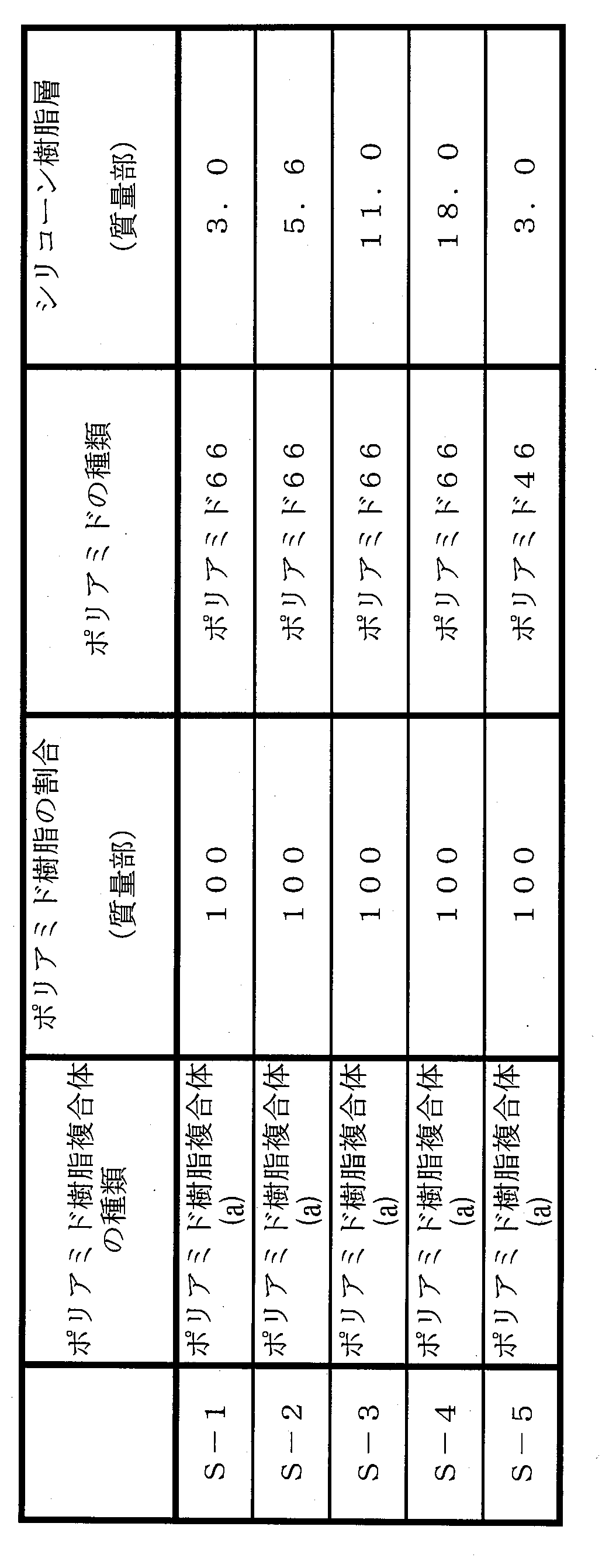
(2)高級脂肪酸金属塩
・ベヘン酸ナトリウム(試薬)(以下、「Bh-Na」と称する場合がある)
・ベヘン酸マグネシウム(試薬)(以下、「Bh-Mg」と称する場合がある)
・ステアリン酸カルシウム(試薬)(以下、「St-Ca」と称する場合がある)
(3)ガラス繊維
・チョップドストランドガラス繊維(日東紡社製、商品名「CS3H459」)(ガラス繊維径10μm、繊維長3mm)(以下、「GF-1」と称する場合がある)
(4)アルカリ金属水酸化物
・水酸化ナトリウム(NaOH)
・水酸化カリウム(KOH)
(5)アルカリ土類金属水酸化物
・水酸化バリウム[Ba(OH)2]
(6)アミン
・エチレンジアミン(EDA)
・トリメチレンジアミン(TMDA)
・ヘキサメチレンジアミン(HMDA)
・ブチルアミン(BA)
・ジブチルアミン(DBA)
(7)界面活性剤
・ドデシルベンゼンスルホン酸ナトリウム(SA1)(東京化成社製)
・アルキル(C10-C60)スルホン酸ナトリウム(SA2)(竹本油脂社製)
・アルキル(C12)ジフェニルエーテルジスルホン酸ナトリウム(SA3)(竹本油脂社製)
・N-オレイル-N-メチルグリシン(SA4)(日油化学社製)
・トルブチルベンジルアンモニウムクロライド(SA5)(竹本油脂社製)
(シリコーン樹脂層を分離したシートの作製)
上記5種のポリアミド樹脂複合体(S-1)~(S-5)を、300×300mm角サイズに切り出した。容積8Lのガラス製容器に水酸化ナトリウム750g、エチレンジアミン100g、水4150mlを入れ15%水酸化ナトリウム水溶液を作成し、この水溶液中に、上記切片をそれぞれ浸漬させ、液温60℃を保って2時間加温した。この処理を処理(X)とする。
・ベヘン酸ナトリウム(試薬)(以下、「Bh-Na」と称する場合がある)
・ベヘン酸マグネシウム(試薬)(以下、「Bh-Mg」と称する場合がある)
・ステアリン酸カルシウム(試薬)(以下、「St-Ca」と称する場合がある)
(3)ガラス繊維
・チョップドストランドガラス繊維(日東紡社製、商品名「CS3H459」)(ガラス繊維径10μm、繊維長3mm)(以下、「GF-1」と称する場合がある)
(4)アルカリ金属水酸化物
・水酸化ナトリウム(NaOH)
・水酸化カリウム(KOH)
(5)アルカリ土類金属水酸化物
・水酸化バリウム[Ba(OH)2]
(6)アミン
・エチレンジアミン(EDA)
・トリメチレンジアミン(TMDA)
・ヘキサメチレンジアミン(HMDA)
・ブチルアミン(BA)
・ジブチルアミン(DBA)
(7)界面活性剤
・ドデシルベンゼンスルホン酸ナトリウム(SA1)(東京化成社製)
・アルキル(C10-C60)スルホン酸ナトリウム(SA2)(竹本油脂社製)
・アルキル(C12)ジフェニルエーテルジスルホン酸ナトリウム(SA3)(竹本油脂社製)
・N-オレイル-N-メチルグリシン(SA4)(日油化学社製)
・トルブチルベンジルアンモニウムクロライド(SA5)(竹本油脂社製)
(シリコーン樹脂層を分離したシートの作製)
上記5種のポリアミド樹脂複合体(S-1)~(S-5)を、300×300mm角サイズに切り出した。容積8Lのガラス製容器に水酸化ナトリウム750g、エチレンジアミン100g、水4150mlを入れ15%水酸化ナトリウム水溶液を作成し、この水溶液中に、上記切片をそれぞれ浸漬させ、液温60℃を保って2時間加温した。この処理を処理(X)とする。
上記処理(X)によって、ポリアミド樹脂複合体(S-1)~(S-5)からシリコーン樹脂層の分離をおこない、処理されたシート(つまり、ポリアミド樹脂複合体からシリコーン樹脂層が分離され、表面にシリコーン樹脂が残存するポリアミド樹脂成形体)である、(R-1)~(R-4)、(R-9)を得た。
さらに、(S-1)において、上記処理(X)を終えた後、一旦15%水酸化ナトリウム水溶液から引き上げ、再び新たな15%水酸化ナトリウム水溶液を用いて上記処理(X)と同様にして、シリコーン樹脂層の分離をおこなって[つまり、上記処理(X)を2回行って]、処理されたシートである(R-8)を得た。(R-1)~(R-4)、(R-8)、(R-9)のシリコーン樹脂残存量を表2に示す。
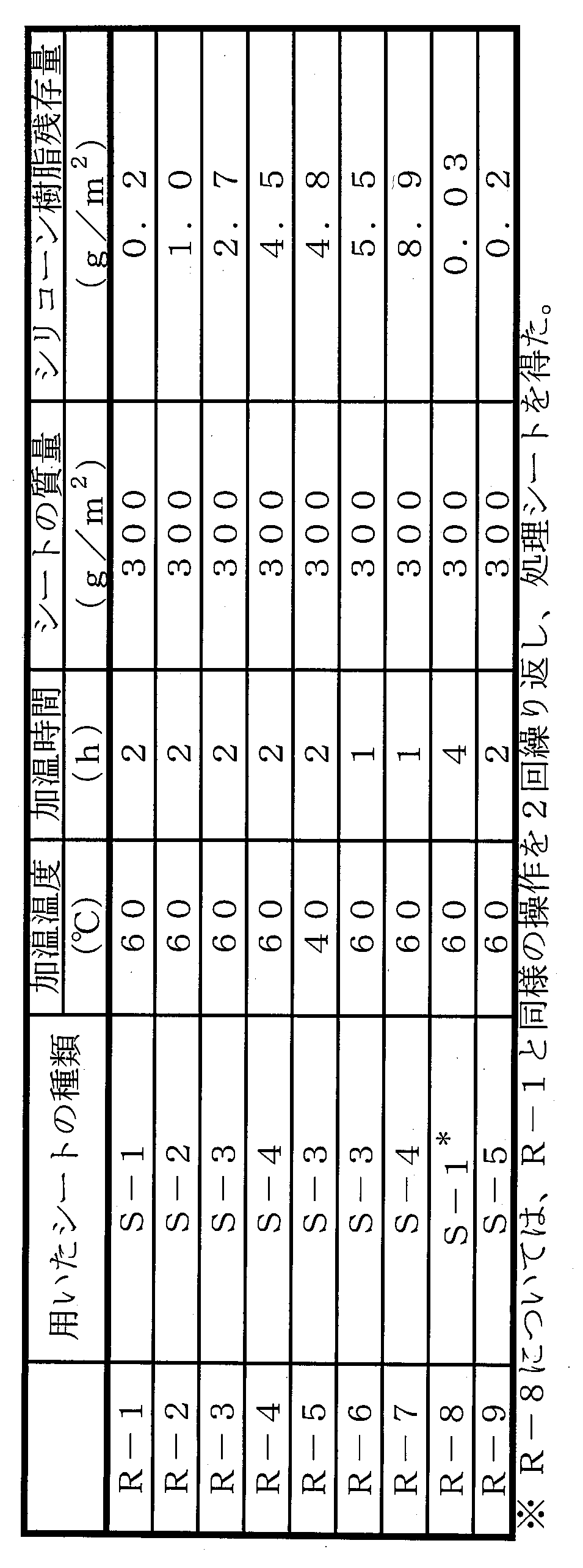
また、加温時の液温を40℃とした以外は、上記処理(X)と同様の操作をおこなって、ポリアミド樹脂複合体(S-3)からシリコーン樹脂層を分離し、処理されたシート(R-5)を得た。さらに、加温時間を1時間とした以外は、上記処理(X)と同様の操作をおこなって、ポリアミド樹脂複合体(S-3)および(S-4)からシリコーン樹脂層を分離し、処理されたシート(R-6)および(R-7)をそれぞれ得た。(R-5)~(R-7)のシリコーン樹脂残存量を表2に示す。
(シリコーン樹脂層を分離したシートの作製)
上記5種のポリアミド樹脂複合体(S-1)~(S-5)を、300×300mm角サイズに切り出した。容積8Lのガラス製容器に水酸化カリウム750g、エチレンジアミン100g、水4150mlを入れ15%水酸化ナトリウム水溶液を作成し、この水溶液中に、上記切片をそれぞれ浸漬させ、液温90℃を保って2時間加温した。この処理を処理(Y)とする。
(シリコーン樹脂層を分離したシートの作製)
上記5種のポリアミド樹脂複合体(S-1)~(S-5)を、300×300mm角サイズに切り出した。容積8Lのガラス製容器に水酸化カリウム750g、エチレンジアミン100g、水4150mlを入れ15%水酸化ナトリウム水溶液を作成し、この水溶液中に、上記切片をそれぞれ浸漬させ、液温90℃を保って2時間加温した。この処理を処理(Y)とする。
上記処理(Y)によって、ポリアミド樹脂複合体(S-1)~(S-5)からシリコーン樹脂層の分離をおこない、処理されたシート(つまり、ポリアミド樹脂複合体からシリコーン樹脂層が分離され、表面にシリコーン樹脂が残存するポリアミド樹脂成形体)である、(R-10)~(R-13)、(R-18)を得た。
さらに、(S-1)において、上記処理(Y)を終えた後、一旦15%水酸化カリウム水溶液から引き上げ、再び新たな15%水酸化カリウム水溶液を用いて上記処理(Y)と同様にして、シリコーン樹脂層の分離をおこなって[つまり、上記処理(Y)を2回行って]、処理されたシートである(R-17)を得た。(R-10)~(R-13)、(R-17)、(R-18)のシリコーン樹脂残存量を表3に示す。

また、加温時の液温を70℃とした以外は、上記処理(X)と同様の操作をおこなって、ポリアミド樹脂複合体(S-3)からシリコーン樹脂層を分離し、処理されたシート(R-14)を得た。さらに、加温時間を1時間とした以外は、上記処理(X)と同様の操作をおこなって、ポリアミド樹脂複合体(S-3)および(S-4)からシリコーン樹脂層を分離し、処理されたシート(R-15)および(R-16)をそれぞれ得た。(R-14)~(R-16)のシリコーン樹脂残存量を表3に示す。
実施例1
55kgの(R-1)を細かく裁断し、2軸押出機(東芝機械社製、「TEM37BS」)を用いて、シリンダー温度280℃、生産量25kg/hの条件で溶融混練した。次いで、ダイよりストランド状に押出し、冷却、カッティングを行い、50kgのポリアミド樹脂組成物のペレットを得た。この間にストランドが切れたのは3回であった。得られたポリアミド樹脂組成物ペレットを用いて、射出成形機(東芝機械社製、商品名「EC-100 N-II」)にて、樹脂温度280℃、金型温度80℃、射出圧力100MPaで射出成形を行い、試験片を得た。得られた試験片を各種評価に付した。その評価結果を表4に示す。
55kgの(R-1)を細かく裁断し、2軸押出機(東芝機械社製、「TEM37BS」)を用いて、シリンダー温度280℃、生産量25kg/hの条件で溶融混練した。次いで、ダイよりストランド状に押出し、冷却、カッティングを行い、50kgのポリアミド樹脂組成物のペレットを得た。この間にストランドが切れたのは3回であった。得られたポリアミド樹脂組成物ペレットを用いて、射出成形機(東芝機械社製、商品名「EC-100 N-II」)にて、樹脂温度280℃、金型温度80℃、射出圧力100MPaで射出成形を行い、試験片を得た。得られた試験片を各種評価に付した。その評価結果を表4に示す。
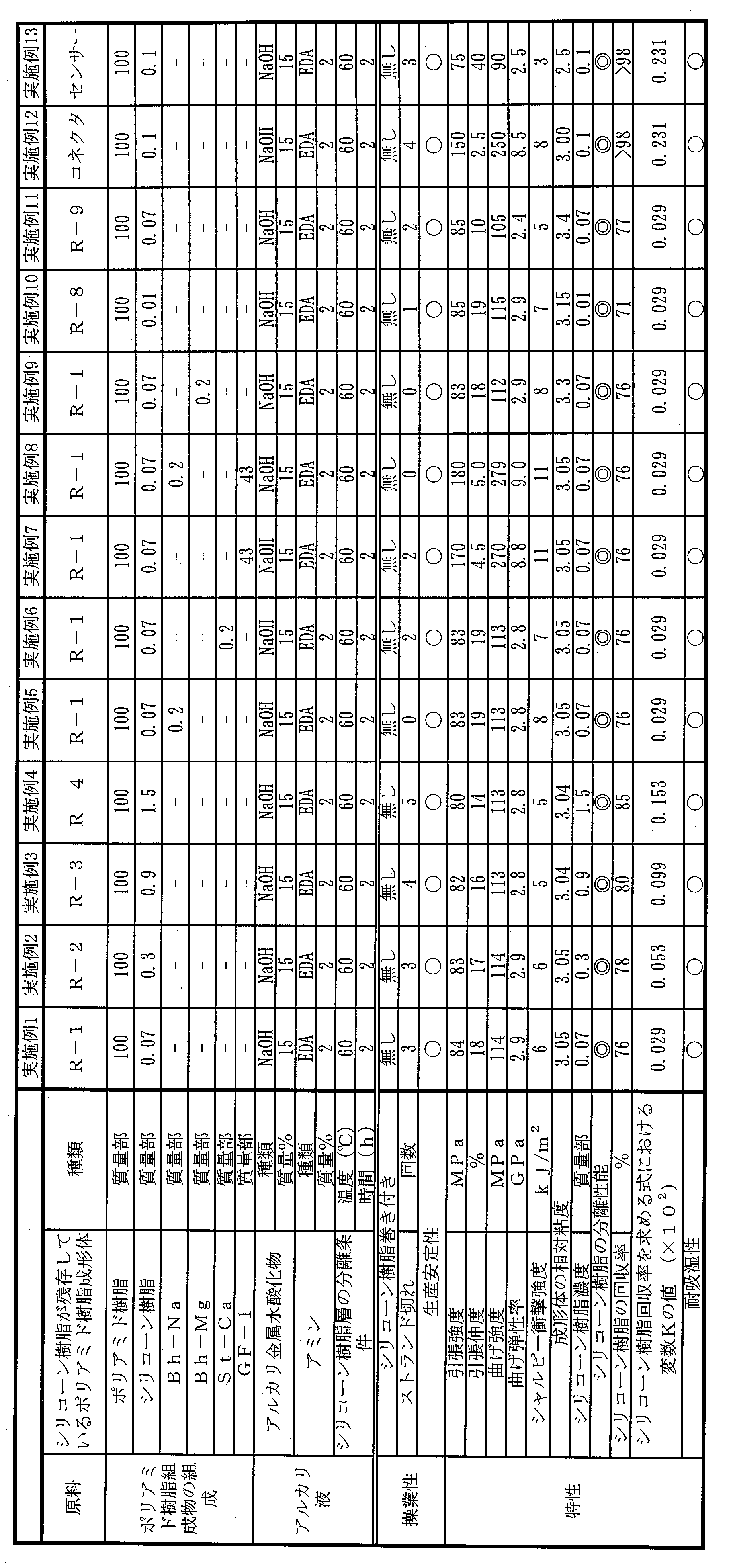
実施例2~4
(R-1)に代えて、(R-2)~(R-4)を用いた以外は、実施例1と同様の操作を行って、(R-2)~(R-4)から試験片を得、この試験片を各種評価に付した。その評価結果を表4に示す。
(R-1)に代えて、(R-2)~(R-4)を用いた以外は、実施例1と同様の操作を行って、(R-2)~(R-4)から試験片を得、この試験片を各種評価に付した。その評価結果を表4に示す。
実施例5
処理シートの溶融混練時に、ポリアミド樹脂100質量部に対して、0.2質量部のベヘン酸ナトリウムを添加した以外は、実施例1と同様の操作を行って、試験片を得、この試験片を各種評価に付した。その評価結果を表4に示す。
処理シートの溶融混練時に、ポリアミド樹脂100質量部に対して、0.2質量部のベヘン酸ナトリウムを添加した以外は、実施例1と同様の操作を行って、試験片を得、この試験片を各種評価に付した。その評価結果を表4に示す。
実施例6
ベヘン酸ナトリウムに変えてステアリン酸カルシウムを用いた以外は、実施例5と同様の操作を行って、試験片を得、この試験片を各種評価に付した。その評価結果を表4に示す。
ベヘン酸ナトリウムに変えてステアリン酸カルシウムを用いた以外は、実施例5と同様の操作を行って、試験片を得、この試験片を各種評価に付した。その評価結果を表4に示す。
実施例7
処理シートの溶融混練時に、ポリアミド樹脂100質量部に対して、43質量部のガラス繊維を添加した以外は、実施例1と同様の操作を行って試験片を得、この試験片を各種評価に付した。その評価結果を表4に示す。
処理シートの溶融混練時に、ポリアミド樹脂100質量部に対して、43質量部のガラス繊維を添加した以外は、実施例1と同様の操作を行って試験片を得、この試験片を各種評価に付した。その評価結果を表4に示す。
実施例8
処理シートの溶融混練時に、ポリアミド樹脂100質量部に対して、さらに、43質量部のガラス繊維を添加した以外は、実施例5と同様の操作を行って試験片を得、各種評価に付した。その評価結果を表4に示す。
実施例9
ベヘン酸ナトリウムをベヘン酸マグネシウムに代えた以外は、実施例5と同様の操作を行って試験片を得、各種評価に付した。その評価結果を表4に示す。
実施例10
(R-1)に代えて、(R-8)を用いた以外は、実施例1と同様の操作を行って試験片を得、この試験片を各種評価に付した。その評価結果を表4に示す。
実施例11
(R-1)に代えて、(R-9)を用い、溶融混練時のシリンダー温度、および射出成形時の樹脂温度としては310℃とした以外は、実施例1と同様の操作を行って試験片を得て各種評価に付した。その評価結果を表4に示す。
実施例12
ポリアミド樹脂複合体としてコネクタ部品を使用した。まず、水酸化ナトリウム750g、エチレンジアミン100g、水4150mlを混合し、15%水酸化ナトリウム水溶液を作成した。この水溶液中に細かく粉砕したコネクタ部品を浸漬し、液温60℃を保って2時間加温した。コネクタ部品からシリコーン樹脂層の分離を行い、シリコーン樹脂が残存するポリアミド樹脂成形体を回収した。回収したポリアミド樹脂成形体を用い、実施例1と同様の操作を行って試験片を得、この試験片を各種評価に付した。その評価結果を表4に示す。
実施例13
ポリアミド樹脂複合体としてセンサー部品を使用した。実施例12と同様の操作をおこなって、センサー部品からシリコーン樹脂を分離し、シリコーン樹脂が残存するポリアミド樹脂成形体(ポリアミド樹脂の筐体)を回収した。回収したポリアミド樹脂成形体を用い、実施例1と同様の操作をおこなって試験片を得、この試験片を各種評価に付した。その評価結果を表4に示す。
実施例14~26
(R-10)~(R-13)、(R-17)、(R-18)、コネクタ部品、センサー部品を用いた以外は、それぞれ、実施例1~13と同様の操作を行って試験片を得、この試験片を各種評価に付した。その評価結果を表5に示す。
処理シートの溶融混練時に、ポリアミド樹脂100質量部に対して、さらに、43質量部のガラス繊維を添加した以外は、実施例5と同様の操作を行って試験片を得、各種評価に付した。その評価結果を表4に示す。
実施例9
ベヘン酸ナトリウムをベヘン酸マグネシウムに代えた以外は、実施例5と同様の操作を行って試験片を得、各種評価に付した。その評価結果を表4に示す。
実施例10
(R-1)に代えて、(R-8)を用いた以外は、実施例1と同様の操作を行って試験片を得、この試験片を各種評価に付した。その評価結果を表4に示す。
実施例11
(R-1)に代えて、(R-9)を用い、溶融混練時のシリンダー温度、および射出成形時の樹脂温度としては310℃とした以外は、実施例1と同様の操作を行って試験片を得て各種評価に付した。その評価結果を表4に示す。
実施例12
ポリアミド樹脂複合体としてコネクタ部品を使用した。まず、水酸化ナトリウム750g、エチレンジアミン100g、水4150mlを混合し、15%水酸化ナトリウム水溶液を作成した。この水溶液中に細かく粉砕したコネクタ部品を浸漬し、液温60℃を保って2時間加温した。コネクタ部品からシリコーン樹脂層の分離を行い、シリコーン樹脂が残存するポリアミド樹脂成形体を回収した。回収したポリアミド樹脂成形体を用い、実施例1と同様の操作を行って試験片を得、この試験片を各種評価に付した。その評価結果を表4に示す。
実施例13
ポリアミド樹脂複合体としてセンサー部品を使用した。実施例12と同様の操作をおこなって、センサー部品からシリコーン樹脂を分離し、シリコーン樹脂が残存するポリアミド樹脂成形体(ポリアミド樹脂の筐体)を回収した。回収したポリアミド樹脂成形体を用い、実施例1と同様の操作をおこなって試験片を得、この試験片を各種評価に付した。その評価結果を表4に示す。
実施例14~26
(R-10)~(R-13)、(R-17)、(R-18)、コネクタ部品、センサー部品を用いた以外は、それぞれ、実施例1~13と同様の操作を行って試験片を得、この試験片を各種評価に付した。その評価結果を表5に示す。
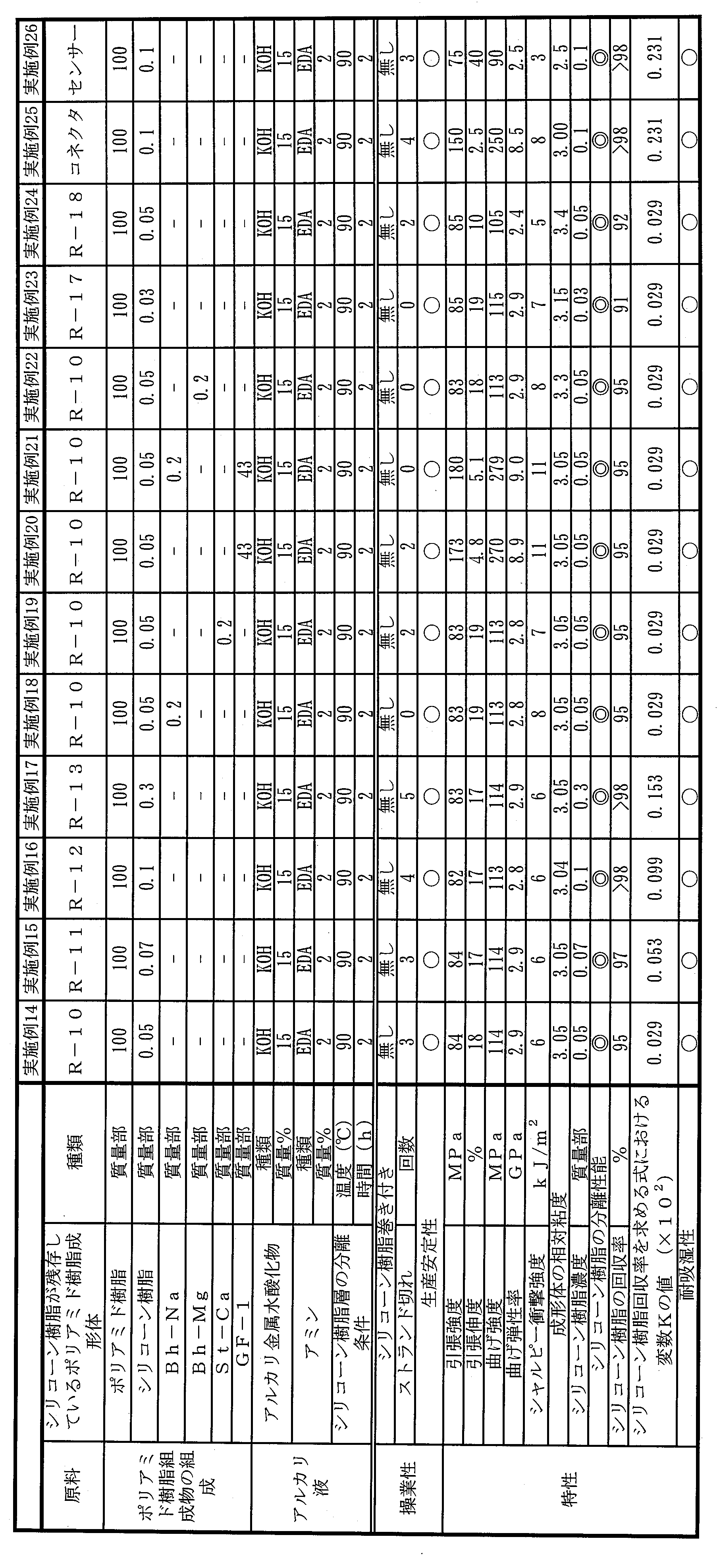
比較例1
(R-1)に代えて、(R-5)を用いた以外は、実施例1と同様の操作を行って、ポリアミド樹脂組成物を得た。このポリアミド樹脂組成物においては、シリコーン樹脂の含有量が本発明において規定する範囲よりも多かったため、溶融混練時の操業状態が悪く、ストランドの切断が多発した。ポリアミド樹脂組成物ペレットを得て、試験片を得、この試験片を各種評価に付した。その評価結果を表6に示す。
(R-1)に代えて、(R-5)を用いた以外は、実施例1と同様の操作を行って、ポリアミド樹脂組成物を得た。このポリアミド樹脂組成物においては、シリコーン樹脂の含有量が本発明において規定する範囲よりも多かったため、溶融混練時の操業状態が悪く、ストランドの切断が多発した。ポリアミド樹脂組成物ペレットを得て、試験片を得、この試験片を各種評価に付した。その評価結果を表6に示す。

比較例2、比較例3
(R-1)に代えて、(R-6)、(R-7)をそれぞれ用いた以外は、実施例1と同様の操作を行って、ポリアミド樹脂組成物を得た。いずれも、シリコーン樹脂の含有量が本発明において規定する範囲よりも多かったため、溶融混練時の操業状態が悪く、ストランドに未溶融シリコーン樹脂が巻き付いたり、ストランドの切断が多発したりした状態となり、ポリアミド樹脂組成物のペレットを得ることができなかった。なお、比較例2および比較例3においては、成形体を用いてシリコーン樹脂濃度を求めることができないため、押出機から回収したスクラップ品を用いて、シリコーン樹脂濃度を求めた。得られたポリアミド樹脂組成物の評価結果を表6に示す。
(R-1)に代えて、(R-6)、(R-7)をそれぞれ用いた以外は、実施例1と同様の操作を行って、ポリアミド樹脂組成物を得た。いずれも、シリコーン樹脂の含有量が本発明において規定する範囲よりも多かったため、溶融混練時の操業状態が悪く、ストランドに未溶融シリコーン樹脂が巻き付いたり、ストランドの切断が多発したりした状態となり、ポリアミド樹脂組成物のペレットを得ることができなかった。なお、比較例2および比較例3においては、成形体を用いてシリコーン樹脂濃度を求めることができないため、押出機から回収したスクラップ品を用いて、シリコーン樹脂濃度を求めた。得られたポリアミド樹脂組成物の評価結果を表6に示す。
比較例4
ポリアミド66樹脂ペレットを単独で用いた以外は、実施例1と同様の操作を行って試験片を得、この試験片を各種評価に付した。その評価結果を表6に示す。
比較例5~8
(R-14)~(R-16)を用いた以外は、比較例1~4と同様の操作を行って試験片を得、この試験片を各種評価に付した。その評価結果を表6に示す。
ポリアミド66樹脂ペレットを単独で用いた以外は、実施例1と同様の操作を行って試験片を得、この試験片を各種評価に付した。その評価結果を表6に示す。
比較例5~8
(R-14)~(R-16)を用いた以外は、比較例1~4と同様の操作を行って試験片を得、この試験片を各種評価に付した。その評価結果を表6に示す。
実施例1~26で得られた樹脂組成物は、バージン材(不純物を実質的に含有していないポリアミド樹脂)である比較例4と比較して、その機械的強度や操業性を維持していた。よって、コストアップや工程の煩雑化を抑制しつつ、マテリアルリサイクルに適したポリアミド樹脂組成物を、簡易な工程で経済的に得ることができた。さらに、実施例1~26で得られた樹脂組成物は、特定量のシリコーン樹脂を含有しているため、吸湿性にも優れるものであった。さらに、シリコーン樹脂の分離性能や、シリコーン樹脂の回収率も良好であった。
ベヘン酸ナトリウムを用いた実施例5や18、およびベヘン酸マグネシウムを用いた実施例9や実施例12は、高級脂肪酸金属塩を用いていない実施例1や14や、ステアリン酸カルシウムを用いた実施例6や19と比較すると、それぞれ操業性、耐衝撃性により優れるものであった。
ステアリン酸カルシウムを用いた実施例6や19は、高級脂肪酸金属塩を用いていない実施例1や14と比較すると、それぞれ操業性、耐衝撃性により優れるものであった。
ガラス繊維を用いた実施例7や20は、ガラス繊維を用いていない実施例1や14と比較すると、それぞれ操業性、引張強度、剛性、耐衝撃性が顕著に向上していた。
ガラス繊維とベヘン酸ナトリウムを併用した実施例8や21は、ベヘン酸ナトリウムが用いられていない実施例7および20や、ガラス繊維が用いられていない実施例5や18と比較すると、それぞれ引張強度、剛性が向上していた。
15%水酸化ナトリウム水溶液を用いたシリコーン樹脂層の分離、除去操作を2回繰り返した実施例10や23は、分離、除去操作を1回しか行っていない実施例1や14に比べ、シリコーン樹脂残存量は少なくなり、また、操業性、耐衝撃性が向上していた。
比較例1、比較例5においては、シリコーン樹脂の含有量が過多であった。そのため、操業性が悪く、また引張強度、剛性、耐衝撃性が劣っていた。
比較例2、3、6および7においては、シリコーン樹脂の含有量が過多であった。そのため、成形体を得ることができず、操業性に著しく劣るものであった。この結果から、シリコーン樹脂層を全く除去せずにリサイクルに付した場合は、リサイクルが困難であることが明らかである。
比較例4や8においては、シリコーン樹脂を含有していないため、吸湿性に劣るものであった。また、原料として、バージン材であるポリアミド樹脂を用いているため、リサイクル性に劣っていた。
以下の実施例27~79、比較例9~19においては、ポリアミド樹脂複合体として、シリコーン樹脂層が形成された上述の自動車用エアバックを用いた。
実施例27
200mlフラスコ中に、水酸化ナトリウム15gと、エチレンジアミン2gとを入れ、水83mlを加えることで、アルカリ液100gを作成した。そして、15mm×15mmの切片に裁断された自動車用エアバック5gを、上記のアルカリ液の入ったフラスコ中に投入して、60℃で2時間加熱した。なお、加熱中、攪拌は行わなかった。
200mlフラスコ中に、水酸化ナトリウム15gと、エチレンジアミン2gとを入れ、水83mlを加えることで、アルカリ液100gを作成した。そして、15mm×15mmの切片に裁断された自動車用エアバック5gを、上記のアルカリ液の入ったフラスコ中に投入して、60℃で2時間加熱した。なお、加熱中、攪拌は行わなかった。
その後、自動車用エアバックをフラスコから取り出して別の容器内で水洗した。水洗後の自動車用エアバックに対して、実施例1と同様の操作をおこなって試験片を得た。アルカリ液におけるアルカリ金属水酸化物およびアミン種類と配合量、自動車用エアバックからのシリコーン樹脂層の分離条件、およびその評価結果を表7に示す。

実施例28~65
実施例27と比べて、アルカリ液におけるアルカリ金属水酸化物および/またはアルカリ土類金属水酸化物の種類と配合量、アミンの種類と配合量、自動車用エアバックからのシリコーン樹脂層の分離条件を、表7~表10に示す通りに変更した。そして、それ以外は実施例27と同様として、自動車用エアバックからのシリコーン樹脂層の分離作業を行った。その後、実施例1と同様の操作をおこなって、試験片を得た。実施例28~35の評価結果を表7に、実施例36~45の評価結果を表8に、実施例46~55の評価結果を表9に、実施例56~65の評価結果を表10に示す。
実施例27と比べて、アルカリ液におけるアルカリ金属水酸化物および/またはアルカリ土類金属水酸化物の種類と配合量、アミンの種類と配合量、自動車用エアバックからのシリコーン樹脂層の分離条件を、表7~表10に示す通りに変更した。そして、それ以外は実施例27と同様として、自動車用エアバックからのシリコーン樹脂層の分離作業を行った。その後、実施例1と同様の操作をおこなって、試験片を得た。実施例28~35の評価結果を表7に、実施例36~45の評価結果を表8に、実施例46~55の評価結果を表9に、実施例56~65の評価結果を表10に示す。
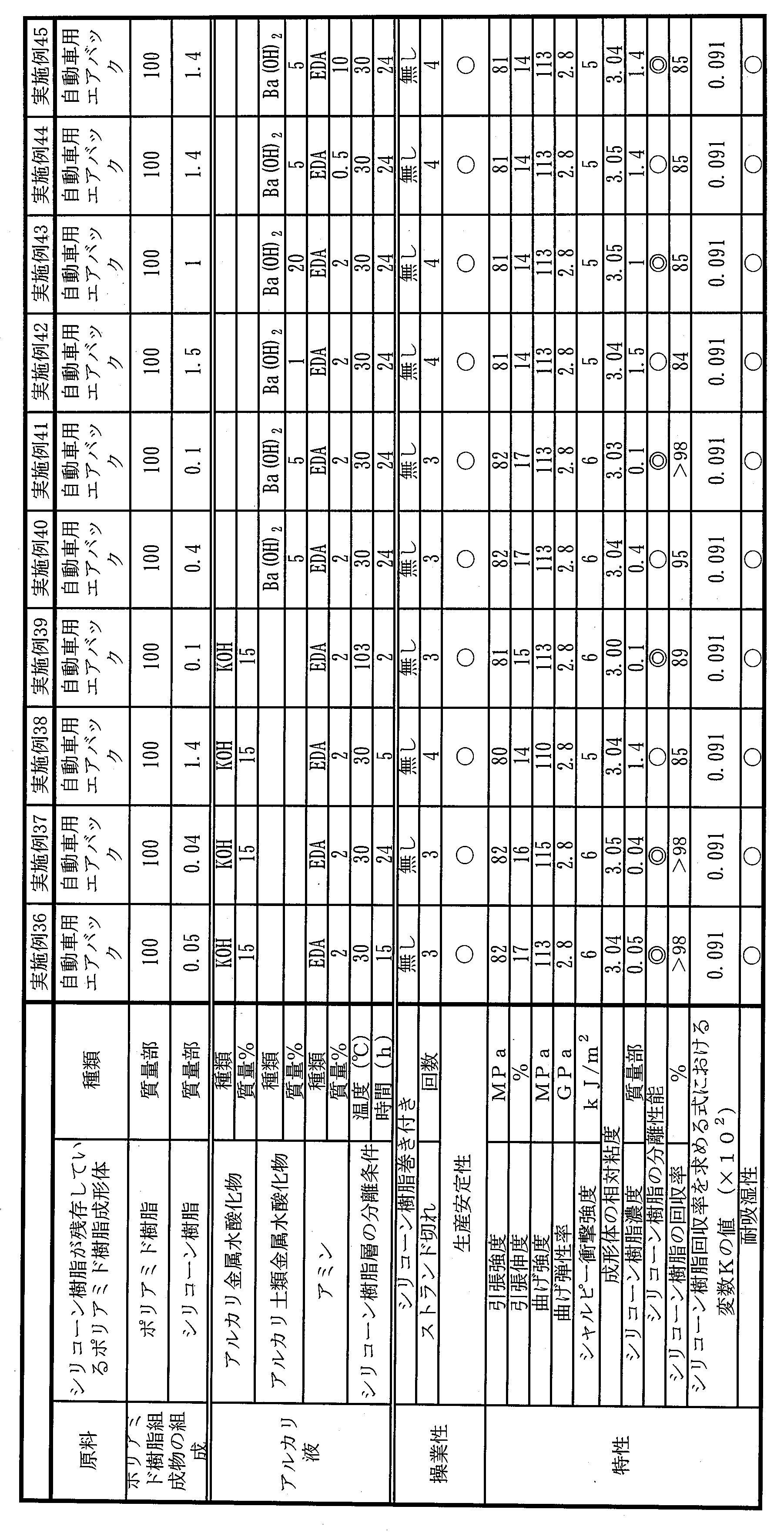


比較例9~17
実施例27と比べて、アルカリ液におけるアルカリ金属水酸化物の種類と配合量、アミンの配合量、自動車用エアバックからのシリコーン樹脂層の分離条件を、表11に示す通りに変更した。そして、それ以外は実施例27と同様として、自動車用エアバックからのシリコーン樹脂層の分離作業を行った。その後、実施例1と同様の操作をおこなって、試験片を得た。その評価結果を表11に示す。
実施例27と比べて、アルカリ液におけるアルカリ金属水酸化物の種類と配合量、アミンの配合量、自動車用エアバックからのシリコーン樹脂層の分離条件を、表11に示す通りに変更した。そして、それ以外は実施例27と同様として、自動車用エアバックからのシリコーン樹脂層の分離作業を行った。その後、実施例1と同様の操作をおこなって、試験片を得た。その評価結果を表11に示す。
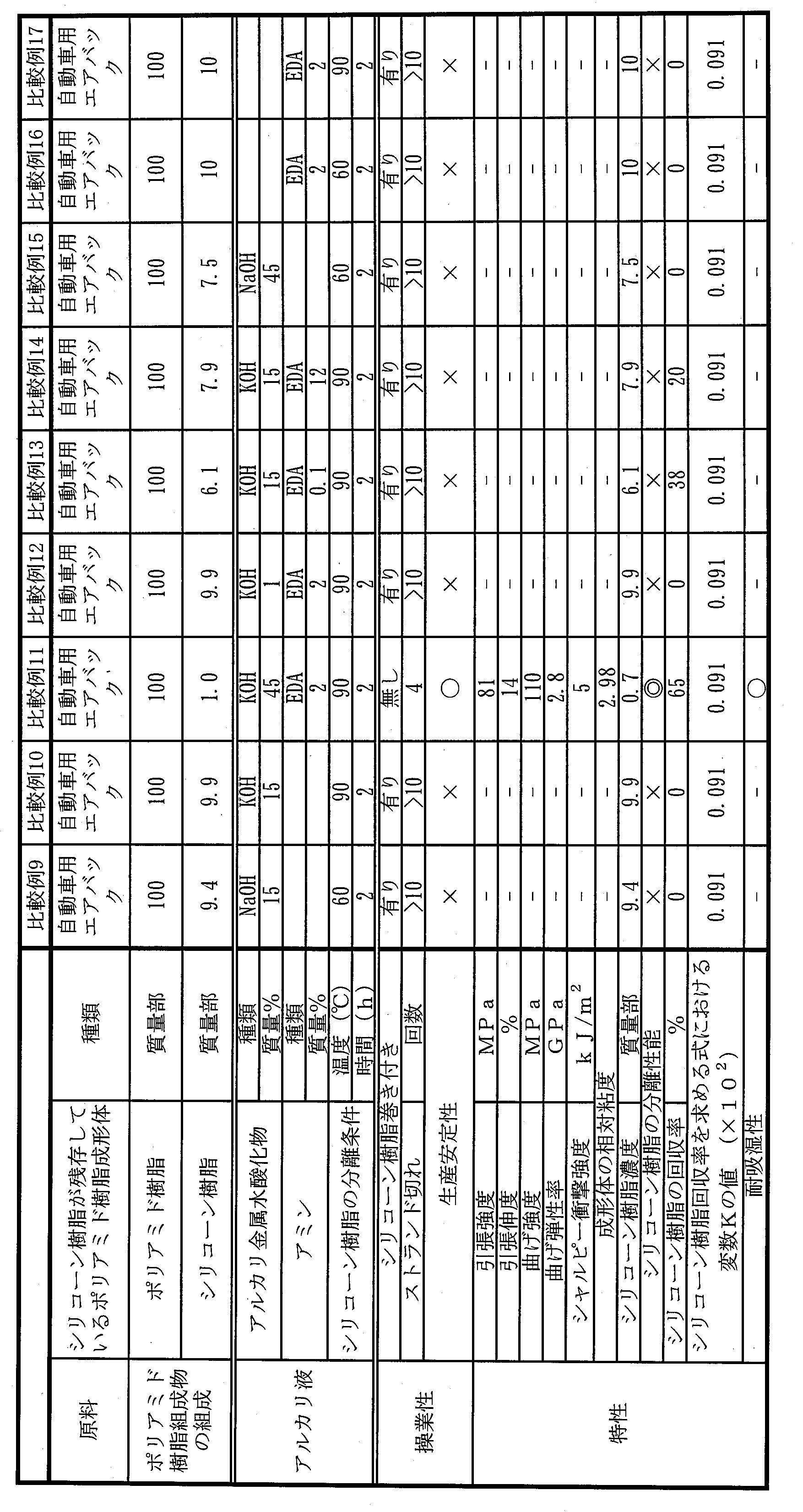
実施例66
表12に示すように、実施例27に比べて、アルカリ液に界面活性剤であるSA1を配合した。そして、それ以外は実施例27と同様として、自動車用エアバックからのシリコーン樹脂層の分離作業を行った。その後、実施例1と同様の操作をおこなって、試験片を得た。その評価結果を表12に示す。
表12に示すように、実施例27に比べて、アルカリ液に界面活性剤であるSA1を配合した。そして、それ以外は実施例27と同様として、自動車用エアバックからのシリコーン樹脂層の分離作業を行った。その後、実施例1と同様の操作をおこなって、試験片を得た。その評価結果を表12に示す。
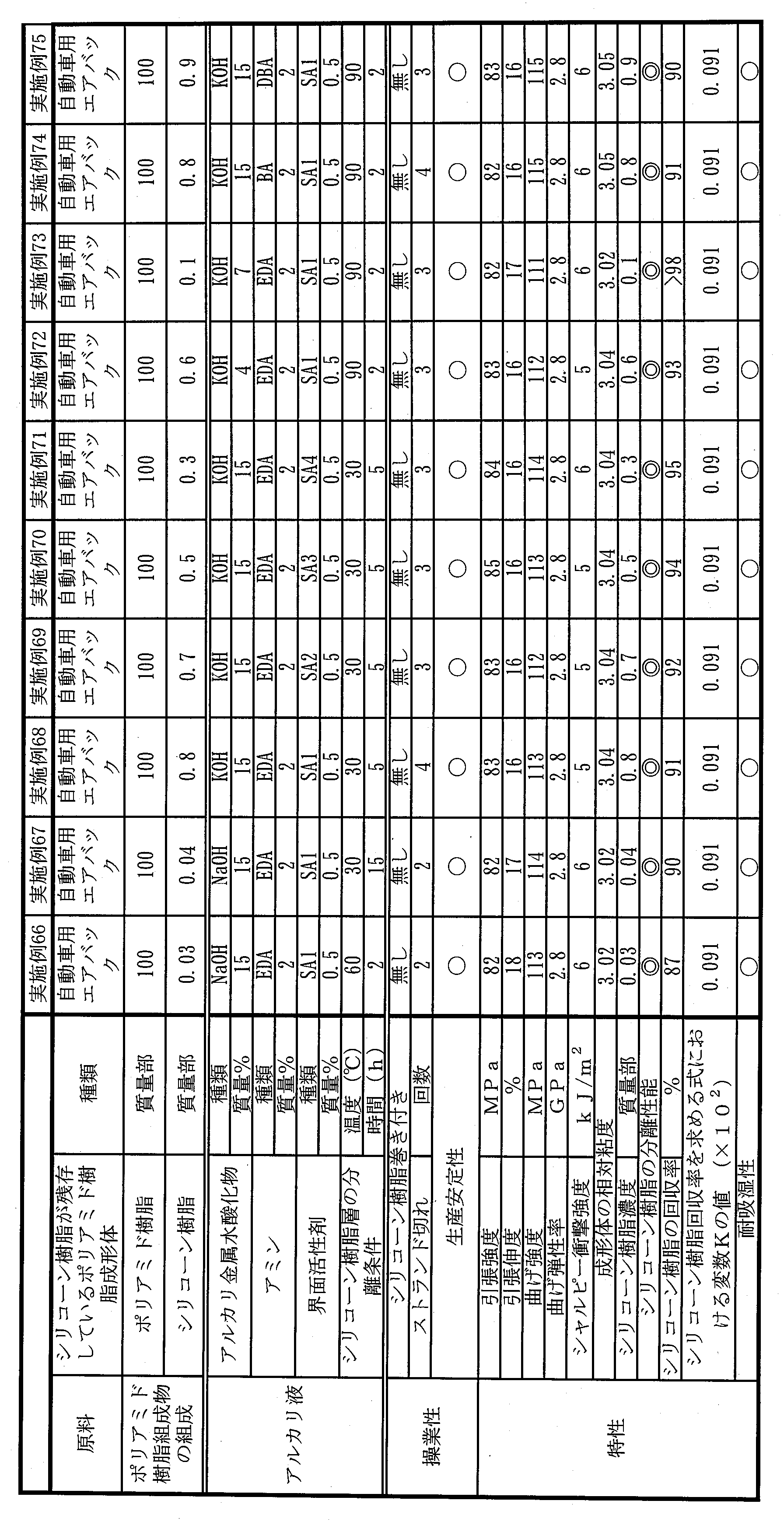
実施例67~75、実施例78~79
実施例66と比べて、アルカリ液におけるアルカリ金属水酸化物とアミンと界面活性剤の種類と配合量、自動車用エアバックからのシリコーン樹脂層の分離条件を、表12または表13に示す通りに変更した。そして、それ以外は実施例66と同様として、自動車用エアバックからのシリコーン樹脂層の分離作業を行った。その後、実施例1と同様の操作をおこなって、試験片を得た。実施例67~75の評価結果を表12に、実施例78~79の評価結果を表13に示す。
実施例66と比べて、アルカリ液におけるアルカリ金属水酸化物とアミンと界面活性剤の種類と配合量、自動車用エアバックからのシリコーン樹脂層の分離条件を、表12または表13に示す通りに変更した。そして、それ以外は実施例66と同様として、自動車用エアバックからのシリコーン樹脂層の分離作業を行った。その後、実施例1と同様の操作をおこなって、試験片を得た。実施例67~75の評価結果を表12に、実施例78~79の評価結果を表13に示す。
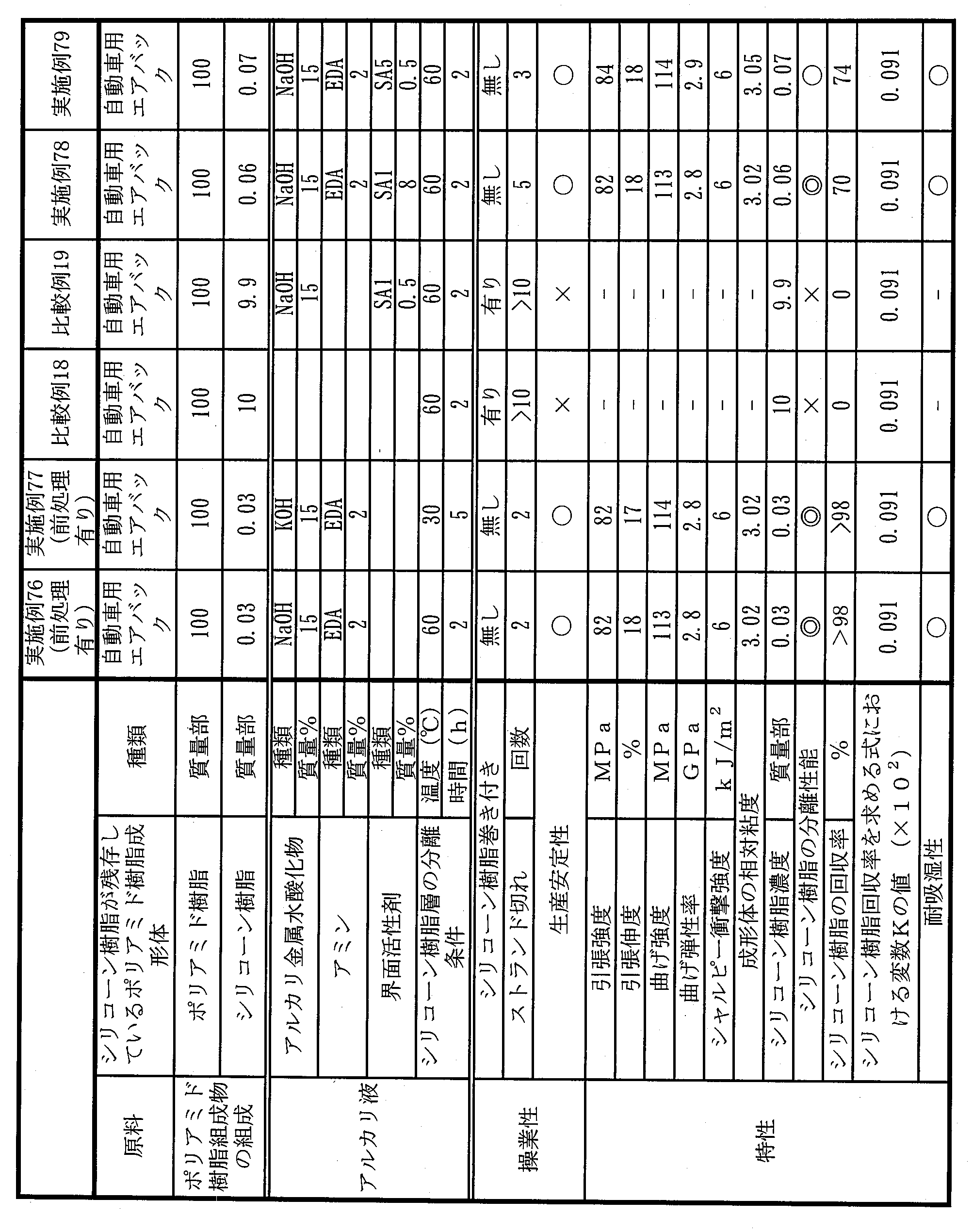
実施例76
前処理として、灯油に界面活性剤である(SA1)を配合してその配合量を0.5質量%とした溶液に、300×300mm角のサイズに裁断した自動車用エアバックを1分間浸漬した。その後、その溶液から自動車用エアバックを取り出した。この前処理した自動車用エアバックを、実施例27と同様のアルカリ液を用いて、実施例27と同様に60℃で2時間加熱し、シリコーン樹脂層の分離作業を行った。その後、実施例1と同様の操作をおこなって、試験片を得た。その評価結果を表13に示す。
実施例77
前処理として、灯油に界面活性剤である(SA1)を配合してその配合量を0.5質量%とした溶液に、300×300mm角のサイズに裁断した自動車用エアバックを1分間浸漬した。その後、その溶液から自動車用エアバックを取り出した。この前処理した自動車用エアバックを実施例38と同様のアルカリ液を用いて、実施例38と同様に30℃で5時間加熱し、シリコーン樹脂層の分離作業を行った。その後、実施例1と同様の操作をおこなって、試験片を得た。その評価結果を表13に示す。
前処理として、灯油に界面活性剤である(SA1)を配合してその配合量を0.5質量%とした溶液に、300×300mm角のサイズに裁断した自動車用エアバックを1分間浸漬した。その後、その溶液から自動車用エアバックを取り出した。この前処理した自動車用エアバックを、実施例27と同様のアルカリ液を用いて、実施例27と同様に60℃で2時間加熱し、シリコーン樹脂層の分離作業を行った。その後、実施例1と同様の操作をおこなって、試験片を得た。その評価結果を表13に示す。
実施例77
前処理として、灯油に界面活性剤である(SA1)を配合してその配合量を0.5質量%とした溶液に、300×300mm角のサイズに裁断した自動車用エアバックを1分間浸漬した。その後、その溶液から自動車用エアバックを取り出した。この前処理した自動車用エアバックを実施例38と同様のアルカリ液を用いて、実施例38と同様に30℃で5時間加熱し、シリコーン樹脂層の分離作業を行った。その後、実施例1と同様の操作をおこなって、試験片を得た。その評価結果を表13に示す。
比較例18
市販のアルカリ液(花王社製、住宅用アルカリ洗浄剤、商品名「マジックリン」;アルキルアミンオキサイド8%溶液)を原液で用いて、液温60℃で2時間、シリコーン樹脂層の分離作業を行った。しかしながら、自動車用エアバックからのシリコーン樹脂層の分離効率は低く、シリコーン樹脂の回収ができなかった。その評価結果を表13に示す。
市販のアルカリ液(花王社製、住宅用アルカリ洗浄剤、商品名「マジックリン」;アルキルアミンオキサイド8%溶液)を原液で用いて、液温60℃で2時間、シリコーン樹脂層の分離作業を行った。しかしながら、自動車用エアバックからのシリコーン樹脂層の分離効率は低く、シリコーン樹脂の回収ができなかった。その評価結果を表13に示す。
比較例19
実施例66と比べて、アルカリ液におけるアルカリ金属水酸化物とアミンと界面活性剤の種類と配合量を、表13に示す通りに変更した。そして、それ以外は実施例66と同様として、自動車用エアバックからのシリコーン樹脂層の分離作業を行った。その後、実施例1と同様の操作をおこなって、試験片を得た。その評価結果を表13に示す。
実施例66と比べて、アルカリ液におけるアルカリ金属水酸化物とアミンと界面活性剤の種類と配合量を、表13に示す通りに変更した。そして、それ以外は実施例66と同様として、自動車用エアバックからのシリコーン樹脂層の分離作業を行った。その後、実施例1と同様の操作をおこなって、試験片を得た。その評価結果を表13に示す。
実施例27~79では、本発明における好ましい態様のアルカリ液を用いて、自動車用エアバックからのシリコーン樹脂層の分離作業を行った。そのため、自動車用エアバックからのシリコーン樹脂層の分離性能およびシリコーン樹脂の回収率が良好であった。分離作業後の自動車用エアバックは、残存するシリコーン樹脂が少ないため、不純物の混入が抑制され、ポリアミド66として再利用することが可能であった。アルカリ液中のシリコーン樹脂は、金網を用いて濾別することで、効率よく回収でき、その再利用が可能であった。さらに、操業性、引張強度、剛性、耐衝撃性および耐吸湿性も良好であった。
特に、実施例66~75では、アルカリ液へ界面活性剤を配合したため、界面活性剤を配合しなかった実施例27~65に比べ、分離性能は向上し、またシリコーン樹脂の回収率も高かった。詳細には、実施例66では界面活性剤を配合しなかった実施例27よりもシリコーン樹脂の回収率が高まった。また、実施例67では界面活性剤を配合しなかった実施例32と比べて分離性能およびシリコーン回収率ともに高まった。実施例68~71では、何れの界面活性剤を用いた場合でも、界面活性剤を配合しなかった実施例38と比べて、分離性能、シリコーン樹脂の回収率ともに高まった。実施例72~75においても、同様な結果が得られた。
実施例76、77は、界面活性剤を溶解させた前処理液を用いて前処理を行った。そのため、実施例27、38と比べて、シリコーン樹脂の分離性能は向上し、またシリコーン樹脂の回収率も高かった。さらに、実施例76、77は、界面活性剤を配合した前処理液と、これを配合しないアルカリ液との2液に分けた。そのため、アルカリ液に界面活性剤を配合した実施例66、67よりもシリコーン樹脂の回収率が高まり、分離効率の向上を図ることができた。
実施例78は、アルカリ液において、界面活性剤の配合量を本発明における好ましい範囲よりも過剰とした。そのため、シリコーン樹脂の回収率において改善の余地があったが、十分に実用に耐えうるものであった。
実施例79は、アルカリ液において、本発明における好ましいスルホン酸ナトリウム系界面活性剤を用いず、代わりにリン酸系界面活性剤であるラウリルリン酸カリウム(SA5)を配合した。このため、シリコーン樹脂の分離性と回収率において改善の余地があったが、十分に実用に耐えうるものであった。
比較例9、10は、アルカリ液にアミンを配合しなかったため、シリコーン樹脂は全く除去されなかった。
比較例11は、アルカリ液中のアルカリ金属水酸化物の配合量が多過ぎた。そのため、シリコーン樹脂層の分離性能は良好であったが、分離されたシリコーン樹脂がアルカリ液に溶解してしまい、シリコーン樹脂の回収率が低かった。
比較例12は、アルカリ液中のアルカリ金属水酸化物の配合量が少な過ぎた。そのため、シリコーン樹脂層の分離性能が悪く、またシリコーン樹脂を全く回収することができなかった。
比較例13は、アルカリ液中のアミンの配合量が少な過ぎたために、シリコーン樹脂層の分離性能が悪く、またシリコーン樹脂の回収率が低かった。
比較例14は、アルカリ液中のアミンの配合量が多過ぎたために、シリコーン樹脂層の分離性能が悪く、またシリコーン樹脂の回収率が低かった。
比較例15は、アルカリ液において、アミンの配合は行わず、アルカリ金属水酸化物のみを過剰量配合した。比較例9と同様にシリコーン樹脂層は全く除去されなかった。
比較例16、17は、アルカリ液において、アルカリ金属水酸化物および/またはアルカリ土類金属水酸化物の配合は行わず、アミンのみを配合した。そのため、シリコーン樹脂層の分離性能が悪く、またシリコーン樹脂を全く回収することができなかった。
比較例18は、本発明における好ましいアルカリ液を用いず、市販のアルカリ洗浄剤を原液で用いてシリコーン樹脂層の分離作業を行った。上述のように、自動車用エアバックからのシリコーン樹脂層の分離効率は低く、シリコーン樹脂の回収ができなかった。
比較例19は、アルカリ液において、アミンの配合は行わず、アルカリ金属水酸化物と界面活性剤だけを配合した。そのため、シリコーン樹脂層の分離性能が悪く、またシリコーン樹脂を全く回収することができなかった。
本発明によれば、不純物が実質的に含有されていないポリアミド樹脂と比較しても、その特性(機械的強度、剛性、耐衝撃性、操業性)を維持しうる樹脂組成物を、リサイクル性よく得ることができるため有用である。
Claims (17)
- ポリアミド樹脂100質量部、シリコーン樹脂0.01~1.5質量部を含有するポリアミド樹脂組成物。
- シリコーン樹脂が、1分子中に、アルケニル基、およびアルケニル基以外の有機基から選ばれる1種以上を平均2個以上有するオルガノポリシロキサンであることを特徴とする請求項1に記載のポリアミド樹脂組成物。
- アルケニル基がビニル基であり、アルケニル基以外の有機基がメチル基および/またはフェニル基であることを特徴とする請求項1に記載のポリアミド樹脂組成物。
- さらに、高級脂肪酸金属塩0.01~3質量部を含有する請求項1~3のいずれかに記載のポリアミド樹脂組成物。
- 高級脂肪酸金属塩が、ベヘン酸金属塩であることを特徴とする請求項4に記載のポリアミド樹脂組成物。
- 請求項1~5のいずれかに記載のポリアミド樹脂組成物を製造するに際し、ポリアミド樹脂成形体の表面にシリコーン樹脂層が形成されたポリアミド樹脂複合体から、シリコーン樹脂層をポリアミド樹脂100質量部に対して0.01~1.5質量部残存するように分離し、表面にシリコーン樹脂が残存しているポリアミド樹脂成形体を粉砕または裁断して、溶融混練することを特徴とするポリアミド樹脂組成物の製造方法。
- 溶融混練時に、高級脂肪酸金属塩を配合することを特徴とする請求項6に記載のポリアミド樹脂組成物の製造方法。
- 高級脂肪酸金属塩が、ベヘン酸金属塩であることを特徴とする請求項7に記載のポリアミド樹脂組成物の製造方法。
- 樹脂成形体の表面にシリコーン樹脂層が形成されたポリアミド樹脂複合体からシリコーン樹脂層を分離するに際し、アルカリ金属水酸化物および/またはアルカリ土類金属水酸化物3~40質量%と、アミン0.5~10質量%とを含むアルカリ液を用い、かつ該アルカリ液の液温を100℃以下に保って、シリコーン樹脂層をポリアミド樹脂100質量部に対して0.01~1.5質量部残存するように分離することを特徴とするシリコーン樹脂層の分離方法。
- アルカリ金属水酸化物が水酸化ナトリウムおよび/または水酸化カリウムであることを特徴とする請求項9に記載のシリコーン樹脂層の分離方法。
- アルカリ液が、アニオン性界面活性剤、またはノニオン性界面活性剤を0.01~5質量%含むものであることを特徴とする請求項9または10に記載のシリコーン樹脂層の分離方法。
- アミンが炭素数2~8の脂肪族ジアミンであることを特徴とする請求項11に記載のシリコーン樹脂層の分離方法。
- アルカリ金属水酸化物として水酸化ナトリウムを用い、アルカリ液の液温を60℃以下に保つことを特徴とする請求項11に記載のシリコーン樹脂層の分離方法。
- アルカリ金属水酸化物として水酸化カリウムを用い、アルカリ液の液温を100℃以下に保つことを特徴とする請求項11に記載のシリコーン樹脂層の分離方法。
- ポリアミド樹脂複合体が、ポリアミド繊維を用いた布帛を含むことを特徴とする請求項11に記載のシリコーン樹脂層の分離方法。
- アルカリ液を用いる前に溶媒に対しアニオン性界面活性剤、またはノニオン性界面活性剤を溶解量が0.01~5質量%となるように溶解させた前処理液を用いて、ポリアミド樹脂複合体に前処理を施すことを特徴とする請求項11に記載のシリコーン樹脂層の分離方法。
- 請求項1~5に記載のポリアミド樹脂組成物を成形して得られた成形体。
Priority Applications (1)
| Application Number | Priority Date | Filing Date | Title |
|---|---|---|---|
| JP2011521401A JP4827997B1 (ja) | 2010-09-17 | 2010-12-24 | シリコーン樹脂層の分離方法 |
Applications Claiming Priority (2)
| Application Number | Priority Date | Filing Date | Title |
|---|---|---|---|
| JP2010208663 | 2010-09-17 | ||
| JP2010-208663 | 2010-09-17 |
Publications (1)
| Publication Number | Publication Date |
|---|---|
| WO2012035673A1 true WO2012035673A1 (ja) | 2012-03-22 |
Family
ID=45831169
Family Applications (1)
| Application Number | Title | Priority Date | Filing Date |
|---|---|---|---|
| PCT/JP2010/073286 Ceased WO2012035673A1 (ja) | 2010-09-17 | 2010-12-24 | ポリアミド樹脂組成物、該ポリアミド樹脂組成物の製造方法、および該ポリアミド樹脂組成物を成形して得られた成形体 |
Country Status (2)
| Country | Link |
|---|---|
| JP (2) | JP4827997B1 (ja) |
| WO (1) | WO2012035673A1 (ja) |
Cited By (8)
| Publication number | Priority date | Publication date | Assignee | Title |
|---|---|---|---|---|
| CN111100452A (zh) * | 2019-12-30 | 2020-05-05 | 张立连 | 一种聚酰胺工程塑料的制备方法 |
| JP2021115862A (ja) * | 2020-01-27 | 2021-08-10 | 東レ株式会社 | フィルムの再利用方法および再生フィルム |
| JP7024038B1 (ja) | 2020-10-30 | 2022-02-22 | 豊田通商株式会社 | シリコーンを除去する方法及びリサイクルポリアミド製品の製造方法 |
| JP7024037B1 (ja) | 2020-10-30 | 2022-02-22 | 豊田通商株式会社 | ポリアミド繊維の回収方法、リサイクルポリアミド製品の製造方法、及びシリコーンの溶解液 |
| JP7118485B1 (ja) | 2022-02-28 | 2022-08-16 | リファインバース株式会社 | エアバッグの処理システムおよびエアバッグの処理方法 |
| JP7276731B1 (ja) * | 2022-01-18 | 2023-05-18 | 東レ株式会社 | ポリアミド樹脂組成物およびそれを成形してなる成形品並びにそれらの製造方法 |
| WO2023140043A1 (ja) | 2022-01-18 | 2023-07-27 | 東レ株式会社 | ポリアミド樹脂組成物およびそれを成形してなる成形品並びにそれらの製造方法 |
| WO2023189625A1 (ja) * | 2022-03-31 | 2023-10-05 | 日東電工株式会社 | 機能層除去方法および機能層除去装置 |
Families Citing this family (4)
| Publication number | Priority date | Publication date | Assignee | Title |
|---|---|---|---|---|
| JP2013081448A (ja) | 2011-05-02 | 2013-05-09 | Arkray Inc | 遺伝子変異検出用プローブ |
| AU2013331112A1 (en) * | 2012-10-19 | 2015-04-09 | Invista Technologies S.A.R.L. | Thermoplastic-poly (dihydrocarbylsiloxane) compositions, and fibers, and processes for making fibers |
| EP3501775A1 (en) * | 2017-12-22 | 2019-06-26 | Rhodia Operations | Method of separating materials from an object |
| WO2024095932A1 (ja) * | 2022-10-31 | 2024-05-10 | 旭化成株式会社 | ケイ素低含有ポリアミド組成物及びその製造方法、並びに繊維、織布、エアバッグ |
Citations (6)
| Publication number | Priority date | Publication date | Assignee | Title |
|---|---|---|---|---|
| JP2001011307A (ja) * | 1998-10-26 | 2001-01-16 | Toray Ind Inc | 溶着用樹脂組成物、その製造方法、及び溶着樹脂成形体 |
| JP2004115582A (ja) * | 2002-09-24 | 2004-04-15 | Asahi Kasei Chemicals Corp | 難燃性ポリアミド樹脂組成物 |
| JP3879348B2 (ja) * | 1999-12-24 | 2007-02-14 | タカタ株式会社 | エアバッグスクラップ布のシリコン除去方法 |
| JP2008179816A (ja) * | 2006-12-28 | 2008-08-07 | Toray Ind Inc | ナイロン6製品のリサイクル方法 |
| JP2008239985A (ja) * | 2007-02-28 | 2008-10-09 | Toray Ind Inc | ナイロン6製品のリサイクル方法 |
| WO2008126381A1 (ja) * | 2007-03-30 | 2008-10-23 | Mitsui Chemicals, Inc. | 難燃性ポリアミド組成物 |
Family Cites Families (9)
| Publication number | Priority date | Publication date | Assignee | Title |
|---|---|---|---|---|
| JPS619500A (ja) * | 1984-06-22 | 1986-01-17 | 旭電化工業株式会社 | 洗浄剤組成物 |
| JPH0381365A (ja) * | 1989-08-25 | 1991-04-05 | Ube Ind Ltd | ポリアミド樹脂組成物 |
| JPH03247634A (ja) * | 1990-02-27 | 1991-11-05 | Nissei Asb Mach Co Ltd | 容器の再利用方法 |
| JP3004415B2 (ja) * | 1991-09-12 | 2000-01-31 | アサヒビール株式会社 | プラスチック製容器、その再利用化方法及び表面処理剤 |
| JP2000344960A (ja) * | 1999-03-31 | 2000-12-12 | Chisso Corp | 難燃性樹脂組成物、それを用いた難燃性シートおよびフィルム成形物 |
| JP2004083880A (ja) * | 2002-06-28 | 2004-03-18 | Mitsui Chemicals Inc | ポリアミド樹脂組成物およびその成形品 |
| FR2901278B1 (fr) * | 2006-05-22 | 2008-07-04 | Rhodia Recherches & Tech | Procede de traitement d'un article comprenant un materiau plastique recouvert par un materiau silicone |
| JP5202440B2 (ja) * | 2009-05-26 | 2013-06-05 | 株式会社椿本チエイン | チェーン |
| JP4841660B2 (ja) * | 2009-06-26 | 2011-12-21 | ユニチカ株式会社 | ポリアミド樹脂成形体用洗浄液およびそれを用いた洗浄方法 |
-
2010
- 2010-12-24 JP JP2011521401A patent/JP4827997B1/ja not_active Expired - Fee Related
- 2010-12-24 WO PCT/JP2010/073286 patent/WO2012035673A1/ja not_active Ceased
-
2011
- 2011-07-08 JP JP2011151321A patent/JP4959849B2/ja not_active Expired - Fee Related
Patent Citations (6)
| Publication number | Priority date | Publication date | Assignee | Title |
|---|---|---|---|---|
| JP2001011307A (ja) * | 1998-10-26 | 2001-01-16 | Toray Ind Inc | 溶着用樹脂組成物、その製造方法、及び溶着樹脂成形体 |
| JP3879348B2 (ja) * | 1999-12-24 | 2007-02-14 | タカタ株式会社 | エアバッグスクラップ布のシリコン除去方法 |
| JP2004115582A (ja) * | 2002-09-24 | 2004-04-15 | Asahi Kasei Chemicals Corp | 難燃性ポリアミド樹脂組成物 |
| JP2008179816A (ja) * | 2006-12-28 | 2008-08-07 | Toray Ind Inc | ナイロン6製品のリサイクル方法 |
| JP2008239985A (ja) * | 2007-02-28 | 2008-10-09 | Toray Ind Inc | ナイロン6製品のリサイクル方法 |
| WO2008126381A1 (ja) * | 2007-03-30 | 2008-10-23 | Mitsui Chemicals, Inc. | 難燃性ポリアミド組成物 |
Cited By (18)
| Publication number | Priority date | Publication date | Assignee | Title |
|---|---|---|---|---|
| CN111100452A (zh) * | 2019-12-30 | 2020-05-05 | 张立连 | 一种聚酰胺工程塑料的制备方法 |
| JP2021115862A (ja) * | 2020-01-27 | 2021-08-10 | 東レ株式会社 | フィルムの再利用方法および再生フィルム |
| JP2022073181A (ja) * | 2020-10-30 | 2022-05-17 | 豊田通商株式会社 | ポリアミド繊維の回収方法、リサイクルポリアミド製品の製造方法、及びシリコーンの溶解液 |
| JP7024037B1 (ja) | 2020-10-30 | 2022-02-22 | 豊田通商株式会社 | ポリアミド繊維の回収方法、リサイクルポリアミド製品の製造方法、及びシリコーンの溶解液 |
| WO2022092196A1 (ja) * | 2020-10-30 | 2022-05-05 | 豊田通商株式会社 | シリコーンを除去する方法及びリサイクルポリアミド製品の製造方法 |
| WO2022092195A1 (ja) * | 2020-10-30 | 2022-05-05 | 豊田通商株式会社 | ポリアミド繊維の回収方法、リサイクルポリアミド製品の製造方法、及びシリコーンの溶解液 |
| JP2022073182A (ja) * | 2020-10-30 | 2022-05-17 | 豊田通商株式会社 | シリコーンを除去する方法及びリサイクルポリアミド製品の製造方法 |
| JP7024038B1 (ja) | 2020-10-30 | 2022-02-22 | 豊田通商株式会社 | シリコーンを除去する方法及びリサイクルポリアミド製品の製造方法 |
| TWI815205B (zh) * | 2020-10-30 | 2023-09-11 | 日商豐田通商股份有限公司 | 聚醯胺纖維的回收方法、再循環聚醯胺製品的製造方法及聚矽氧的溶解液 |
| KR20240105474A (ko) | 2022-01-18 | 2024-07-05 | 도레이 카부시키가이샤 | 폴리아미드 수지 조성물 및 그것을 성형하여 이루어지는 성형품 및 그것들의 제조 방법 |
| JP7276731B1 (ja) * | 2022-01-18 | 2023-05-18 | 東レ株式会社 | ポリアミド樹脂組成物およびそれを成形してなる成形品並びにそれらの製造方法 |
| WO2023140043A1 (ja) | 2022-01-18 | 2023-07-27 | 東レ株式会社 | ポリアミド樹脂組成物およびそれを成形してなる成形品並びにそれらの製造方法 |
| CN118556107B (zh) * | 2022-01-18 | 2025-08-12 | 东丽株式会社 | 聚酰胺树脂组合物和将其成型而得到的成型品以及它们的制造方法 |
| CN118556107A (zh) * | 2022-01-18 | 2024-08-27 | 东丽株式会社 | 聚酰胺树脂组合物和将其成型而得到的成型品以及它们的制造方法 |
| JP7118485B1 (ja) | 2022-02-28 | 2022-08-16 | リファインバース株式会社 | エアバッグの処理システムおよびエアバッグの処理方法 |
| JP2023125970A (ja) * | 2022-02-28 | 2023-09-07 | リファインバース株式会社 | エアバッグの処理システムおよびエアバッグの処理方法 |
| WO2023162287A1 (ja) * | 2022-02-28 | 2023-08-31 | リファインバース株式会社 | エアバッグの処理システムおよびエアバッグの処理方法 |
| WO2023189625A1 (ja) * | 2022-03-31 | 2023-10-05 | 日東電工株式会社 | 機能層除去方法および機能層除去装置 |
Also Published As
| Publication number | Publication date |
|---|---|
| JPWO2012035673A1 (ja) | 2014-01-20 |
| JP2012082391A (ja) | 2012-04-26 |
| JP4827997B1 (ja) | 2011-11-30 |
| JP4959849B2 (ja) | 2012-06-27 |
Similar Documents
| Publication | Publication Date | Title |
|---|---|---|
| WO2012035673A1 (ja) | ポリアミド樹脂組成物、該ポリアミド樹脂組成物の製造方法、および該ポリアミド樹脂組成物を成形して得られた成形体 | |
| JP7518566B2 (ja) | 炭素繊維及び炭素繊維強化樹脂組成物の製造方法 | |
| JP4841660B2 (ja) | ポリアミド樹脂成形体用洗浄液およびそれを用いた洗浄方法 | |
| US10040938B2 (en) | Moulding compound based on a partially aromatic copolyamide | |
| EP3130627B1 (en) | Polyamide resin composition | |
| CN104647842B (zh) | 一种复合土工布及其制备方法 | |
| KR101511877B1 (ko) | 재활용 폴리아미드 에어백 | |
| US20150086738A1 (en) | Moulding compound based on a partially aromatic copolyamide | |
| CN117651732A (zh) | 玻璃纤维增强再生聚苯硫醚树脂组合物的制造方法、及将玻璃纤维增强再生聚苯硫醚树脂组合物成型而成的成型品 | |
| KR20170007143A (ko) | 열가소성 성형 재료 | |
| CN114206579A (zh) | 注射成型品 | |
| KR20210154432A (ko) | 에어백 기포지 재활용 | |
| HK1043600A1 (zh) | 鏈支化聚酰胺的製造方法 | |
| JPS63308065A (ja) | ガラス繊維で補強された安定化されたポリアミド成形用組成物 | |
| JP2013166312A (ja) | シリコーンゴム粉砕物の製造方法 | |
| WO2023140043A1 (ja) | ポリアミド樹脂組成物およびそれを成形してなる成形品並びにそれらの製造方法 | |
| KR101144035B1 (ko) | 폐 에어백 기포지의 재활용 방법 | |
| JP7276731B1 (ja) | ポリアミド樹脂組成物およびそれを成形してなる成形品並びにそれらの製造方法 | |
| JP2005008809A (ja) | 再生ポリエステル樹脂組成物の製造方法 | |
| CN112341812B (zh) | 一种自组装网络聚酰胺组合物及其制备方法和应用 | |
| JP7087716B2 (ja) | ポリアミド樹脂製複合成形品およびその製造方法 | |
| CN116348533A (zh) | 含有聚醚嵌段酰胺和空心玻璃增强物的低密度组合物及其用途 | |
| CN105086143B (zh) | 一种回收聚丙烯‑聚偏二氯乙烯复合材料及其制备方法 | |
| JP6505530B2 (ja) | ポリアミド樹脂組成物及びその製造方法 | |
| JP2018058947A (ja) | 繊維強化樹脂用組成物、繊維強化樹脂及び成形体 |
Legal Events
| Date | Code | Title | Description |
|---|---|---|---|
| WWE | Wipo information: entry into national phase |
Ref document number: 2011521401 Country of ref document: JP |
|
| 121 | Ep: the epo has been informed by wipo that ep was designated in this application |
Ref document number: 10857306 Country of ref document: EP Kind code of ref document: A1 |
|
| NENP | Non-entry into the national phase |
Ref country code: DE |
|
| 122 | Ep: pct application non-entry in european phase |
Ref document number: 10857306 Country of ref document: EP Kind code of ref document: A1 |