WO2012018037A1 - 共重合ポリエステル樹脂を含む樹脂組成物 - Google Patents
共重合ポリエステル樹脂を含む樹脂組成物 Download PDFInfo
- Publication number
- WO2012018037A1 WO2012018037A1 PCT/JP2011/067739 JP2011067739W WO2012018037A1 WO 2012018037 A1 WO2012018037 A1 WO 2012018037A1 JP 2011067739 W JP2011067739 W JP 2011067739W WO 2012018037 A1 WO2012018037 A1 WO 2012018037A1
- Authority
- WO
- WIPO (PCT)
- Prior art keywords
- resin
- resin composition
- acid
- polyester resin
- component
- Prior art date
- Legal status (The legal status is an assumption and is not a legal conclusion. Google has not performed a legal analysis and makes no representation as to the accuracy of the status listed.)
- Ceased
Links
- 0 *P(c1ccccc1)(c1ccccc1)=O Chemical compound *P(c1ccccc1)(c1ccccc1)=O 0.000 description 1
Classifications
-
- C—CHEMISTRY; METALLURGY
- C08—ORGANIC MACROMOLECULAR COMPOUNDS; THEIR PREPARATION OR CHEMICAL WORKING-UP; COMPOSITIONS BASED THEREON
- C08G—MACROMOLECULAR COMPOUNDS OBTAINED OTHERWISE THAN BY REACTIONS ONLY INVOLVING UNSATURATED CARBON-TO-CARBON BONDS
- C08G63/00—Macromolecular compounds obtained by reactions forming a carboxylic ester link in the main chain of the macromolecule
- C08G63/02—Polyesters derived from hydroxycarboxylic acids or from polycarboxylic acids and polyhydroxy compounds
- C08G63/12—Polyesters derived from hydroxycarboxylic acids or from polycarboxylic acids and polyhydroxy compounds derived from polycarboxylic acids and polyhydroxy compounds
- C08G63/52—Polycarboxylic acids or polyhydroxy compounds in which at least one of the two components contains aliphatic unsaturation
-
- C—CHEMISTRY; METALLURGY
- C08—ORGANIC MACROMOLECULAR COMPOUNDS; THEIR PREPARATION OR CHEMICAL WORKING-UP; COMPOSITIONS BASED THEREON
- C08F—MACROMOLECULAR COMPOUNDS OBTAINED BY REACTIONS ONLY INVOLVING CARBON-TO-CARBON UNSATURATED BONDS
- C08F136/00—Homopolymers of compounds having one or more unsaturated aliphatic radicals, at least one having two or more carbon-to-carbon double bonds
- C08F136/02—Homopolymers of compounds having one or more unsaturated aliphatic radicals, at least one having two or more carbon-to-carbon double bonds the radical having only two carbon-to-carbon double bonds
- C08F136/04—Homopolymers of compounds having one or more unsaturated aliphatic radicals, at least one having two or more carbon-to-carbon double bonds the radical having only two carbon-to-carbon double bonds conjugated
- C08F136/14—Homopolymers of compounds having one or more unsaturated aliphatic radicals, at least one having two or more carbon-to-carbon double bonds the radical having only two carbon-to-carbon double bonds conjugated containing elements other than carbon and hydrogen
-
- B—PERFORMING OPERATIONS; TRANSPORTING
- B29—WORKING OF PLASTICS; WORKING OF SUBSTANCES IN A PLASTIC STATE IN GENERAL
- B29C—SHAPING OR JOINING OF PLASTICS; SHAPING OF MATERIAL IN A PLASTIC STATE, NOT OTHERWISE PROVIDED FOR; AFTER-TREATMENT OF THE SHAPED PRODUCTS, e.g. REPAIRING
- B29C45/00—Injection moulding, i.e. forcing the required volume of moulding material through a nozzle into a closed mould; Apparatus therefor
-
- C—CHEMISTRY; METALLURGY
- C08—ORGANIC MACROMOLECULAR COMPOUNDS; THEIR PREPARATION OR CHEMICAL WORKING-UP; COMPOSITIONS BASED THEREON
- C08G—MACROMOLECULAR COMPOUNDS OBTAINED OTHERWISE THAN BY REACTIONS ONLY INVOLVING UNSATURATED CARBON-TO-CARBON BONDS
- C08G63/00—Macromolecular compounds obtained by reactions forming a carboxylic ester link in the main chain of the macromolecule
- C08G63/02—Polyesters derived from hydroxycarboxylic acids or from polycarboxylic acids and polyhydroxy compounds
- C08G63/12—Polyesters derived from hydroxycarboxylic acids or from polycarboxylic acids and polyhydroxy compounds derived from polycarboxylic acids and polyhydroxy compounds
- C08G63/52—Polycarboxylic acids or polyhydroxy compounds in which at least one of the two components contains aliphatic unsaturation
- C08G63/54—Polycarboxylic acids or polyhydroxy compounds in which at least one of the two components contains aliphatic unsaturation the acids or hydroxy compounds containing carbocyclic rings
-
- C—CHEMISTRY; METALLURGY
- C08—ORGANIC MACROMOLECULAR COMPOUNDS; THEIR PREPARATION OR CHEMICAL WORKING-UP; COMPOSITIONS BASED THEREON
- C08G—MACROMOLECULAR COMPOUNDS OBTAINED OTHERWISE THAN BY REACTIONS ONLY INVOLVING UNSATURATED CARBON-TO-CARBON BONDS
- C08G63/00—Macromolecular compounds obtained by reactions forming a carboxylic ester link in the main chain of the macromolecule
- C08G63/68—Polyesters containing atoms other than carbon, hydrogen and oxygen
- C08G63/692—Polyesters containing atoms other than carbon, hydrogen and oxygen containing phosphorus
-
- C—CHEMISTRY; METALLURGY
- C08—ORGANIC MACROMOLECULAR COMPOUNDS; THEIR PREPARATION OR CHEMICAL WORKING-UP; COMPOSITIONS BASED THEREON
- C08G—MACROMOLECULAR COMPOUNDS OBTAINED OTHERWISE THAN BY REACTIONS ONLY INVOLVING UNSATURATED CARBON-TO-CARBON BONDS
- C08G63/00—Macromolecular compounds obtained by reactions forming a carboxylic ester link in the main chain of the macromolecule
- C08G63/68—Polyesters containing atoms other than carbon, hydrogen and oxygen
- C08G63/692—Polyesters containing atoms other than carbon, hydrogen and oxygen containing phosphorus
- C08G63/6924—Polyesters containing atoms other than carbon, hydrogen and oxygen containing phosphorus derived from polycarboxylic acids and polyhydroxy compounds
- C08G63/6926—Dicarboxylic acids and dihydroxy compounds
-
- C—CHEMISTRY; METALLURGY
- C08—ORGANIC MACROMOLECULAR COMPOUNDS; THEIR PREPARATION OR CHEMICAL WORKING-UP; COMPOSITIONS BASED THEREON
- C08L—COMPOSITIONS OF MACROMOLECULAR COMPOUNDS
- C08L67/00—Compositions of polyesters obtained by reactions forming a carboxylic ester link in the main chain; Compositions of derivatives of such polymers
- C08L67/02—Polyesters derived from dicarboxylic acids and dihydroxy compounds
Definitions
- the present invention relates to a resin composition containing a copolyester resin. Specifically, it is a copolyester resin containing dimer acid as an acid component and 1,4-butanediol and polybutadiene glycols as a glycol component, and has flexibility, adhesiveness, wet heat durability, etc.
- the present invention relates to a resin composition containing an excellent copolyester resin.
- Polyesters particularly copolyesters having polyethylene terephthalate (hereinafter abbreviated as PET) units or polybutylene terephthalate (hereinafter abbreviated as PBT) units as main components and copolymerized with aliphatic dicarboxylic acids or various diols are known. ing. Since this copolymer polyester has excellent heat resistance, weather resistance, solvent resistance, flexibility and the like, it is widely used as a film, fiber, sheet, various molded articles, and adhesives.
- PET polyethylene terephthalate
- PBT polybutylene terephthalate
- the above copolyester is fragile because it lacks flexibility at low or normal temperatures when used in applications requiring high flexibility. For this reason, the above-mentioned copolymer polyester has a limit in the use which can be used.
- a polyester-polyether block copolymer having a polyether compound as a soft segment has a low glass transition point of the resin, high fluidity, and the resin is flexible even when the molecular weight is lowered. For this reason, it is widely used as a molding material used for electric / electronic parts, automobile parts and the like.
- Such a polyester-polyether block copolymer is disclosed in Patent Document 1, for example.
- polyester-polyether block copolymer is prone to hydrolysis due to the ester bond of the hard segment. Furthermore, since the polyether compound, which is a soft segment, easily undergoes oxidative decomposition, thermal decomposition, etc. when exposed to high temperatures, there is a problem with the wet heat durability of the copolymer itself.
- Patent Document 2 describes a polyester resin and a resin composition suitable for molding.
- the resin described in Patent Document 2 is suitable for molding applications for electric and electronic parts, and is described as being excellent in waterproofness, durability, fuel resistance, and the like.
- the main object of the present invention is to provide a polyester resin composition that is excellent in flexibility at room temperature, has improved the problem of brittleness, and is excellent in adhesion and wet heat durability. . More specifically, the main object is to provide a resin composition containing a copolyester resin suitable for hot melt molding applications such as electrical and electronic parts, potting applications and the like.
- this invention relates to the resin composition containing the following copolyester resin.
- It contains aromatic dicarboxylic acid and dimer acid as the acid component, 1,4-butanediol and polybutadiene glycols as the glycol component, and the content of dimer acid in the acid component is 10 to 50 mol%.
- Item 2 Item 2.
- the organic polyester compound having two or more ester-forming functional groups is copolymerized in the copolymerized polyester resin, and the phosphorus atom content in the resin is 500 to 20000 mass ppm.
- Resin composition. 3. Item 2. The resin composition according to Item 1, wherein the Young's modulus at 20 ° C is 100 MPa or less. 4). Item 2. The resin composition according to Item 1, wherein the Shore D hardness at 20 ° C is 50 or less. 5. Item 2. The resin composition according to Item 1, wherein the oxygen index in the combustion test is 27 or more. 6).
- a method for producing a resin molded product comprising a step of obtaining a resin molded product by molding the resin composition according to Item 1 at a pressure of 5 MPa or less. 7.
- the step is a step of obtaining a resin molded product including the industrial part by injecting and injecting the resin composition according to claim 1 into a mold in which the industrial part is previously arranged.
- the above item 6 is a step of obtaining a resin molded product including an industrial part by injecting or dripping the resin composition according to claim 1 into a housing or a substrate in which the industrial part is arranged in advance. The method described in 1.
- the resin composition of the present invention is particularly excellent in flexibility at room temperature because it is mainly composed of a copolyester resin containing a dimer acid as an acid component and a specific amount of polybutadiene glycol as a glycol component. It has moderate hardness, has improved the brittleness problem, and can exhibit excellent adhesion and wet heat durability. For this reason, the resin composition of the present invention can be used as, for example, a film, a fiber, a sheet, and other various molded products, and can also be used as an adhesive. Further, since the resin composition of the present invention is excellent in fluidity at the time of melting and can be injection-molded at a low pressure, it is possible to provide a molded product having a thin part or a complicated shape by melt molding.
- the resin composition of the present invention can be suitably used for hot melt molding applications in which insert molding of delicate electronic parts and the like is performed. Moreover, it can use suitably also for the potting use which places components in a housing or on a board
- the copolymerized polyester resin as the main component of the resin composition of the present invention comprises an acid component containing an aromatic dicarboxylic acid and a dimer acid as a copolymer component, and 1,4- It consists of a glycol component containing butanediol and polybutadiene glycol.
- Copolyester resin (1-1) Acid component First, the acid component will be described.
- the aromatic dicarboxylic acid for example, terephthalic acid, isophthalic acid, 5-sodium sulfoisophthalic acid, phthalic anhydride, naphthalenedicarboxylic acid, and the like, and ester-forming derivatives of these acids may be used. These may be used alone or in combination of two or more.
- the aromatic dicarboxylic acid contributes to increasing the melting point of the copolyester, imparting heat resistance, and increasing mechanical strength. From this viewpoint, in the present invention, at least one of terephthalic acid and isophthalic acid is preferable as the aromatic dicarboxylic acid.
- the content of the aromatic dicarboxylic acid in the acid component is not particularly limited, but is preferably 50 to 90 mol%, more preferably 60 to 85 mol%.
- the content of the aromatic dicarboxylic acid is less than 50 mol%, the melting point of the copolyester becomes low, the heat resistance is inferior, and the mechanical strength tends to be low.
- it exceeds 90 mol% the ratio of dimer acid decreases, and the flexibility of the copolyester resin tends to be poor.
- the dimer acid in the present invention is, for example, an unsaturated fatty acid obtained by thermal polymerization of an unsaturated fatty acid such as a refined vegetable fatty acid obtained from drying oil, semi-drying oil, or the like, or partially or completely hydrogenated. It refers to the saturated fatty acid obtained.
- These dimer acids are mainly composed of dimers of unsaturated fatty acids or hydrogenated products thereof, but also include trimers and tetramers. These may be known or commercially available products.
- Examples of commercially available products that can be used include “Pripole”, “Pliplast” (manufactured by Croda), “Empor”, “Sobamol” (manufactured by Cognis), “Unidim” (manufactured by Arizona Chemical), and the like.
- the content of the dimer acid in the acid component is required to be 10 to 50 mol%, and more preferably 15 to 40 mol%.
- dimer acid as a copolymerization component
- the resulting copolymerized polyester resin is excellent in flexibility and wet heat durability is also improved.
- the content of the dimer acid in the acid component is less than 10 mol%, it becomes difficult to impart flexibility to the resulting copolymerized polyester resin, and the effect of improving wet heat durability becomes poor.
- the content of the dimer acid exceeds 50 mol%, the resulting copolymerized polyester has a low melting point or becomes amorphous, so that the heat resistance is poor and the mechanical strength tends to be low.
- the copolymerized polyester resin of the present invention contains the aromatic dicarboxylic acid and dimer acid as described above in the acid component, but other components are copolymerized as long as the effects of the present invention are not impaired. It may be contained as a component. Examples of such other components include succinic acid, adipic acid, azelaic acid, sebacic acid, dodecanedioic acid, and eicosanedioic acid.
- the copolymerized polyester resin of the present invention contains 1,4-butanediol as the glycol component.
- the content of 1,4-butanediol in the glycol component needs to be 50 mol% or more, more preferably 60 to 98 mol%, and even more preferably 80 to 98 mol%. Is most preferred.
- the copolymer polyester resin obtained has a high melting point, excellent heat resistance, and improved moldability. In particular, when used for molding applications, it is preferably 80 to 98 mol%.
- polybutadiene glycols are contained in the glycol component of the copolyester resin of the present invention.
- the content of polybutadiene glycol in the glycol component is required to be 0.5 to 20 mol%, more preferably 2 to 18 mol%, and further preferably 3 to 16 mol%. Is most preferred.
- the polybutadiene glycol When the polybutadiene glycol is contained in the glycol component, excellent flexibility and wet heat durability can be imparted to the obtained copolymer polyester resin.
- the proportion of polybutadiene glycol is less than 0.5 mol%, it is difficult to make the resulting copolymer polyester resin excellent in flexibility and wet heat durability.
- the proportion of polybutadiene glycol exceeds 20 mol%, the melting point of the resulting copolymer polyester is lowered, the heat resistance is inferior, and the mechanical strength tends to be lowered.
- the polybutadiene glycols preferably have an average molecular weight of 350 to 6000, more preferably 500 to 4500.
- the average molecular weight of the polybutadiene glycol exceeds 6000, the compatibility is deteriorated and copolymerization tends to be difficult.
- the molecular weight is less than 350, it tends to be difficult to improve the flexibility of the resulting copolymerized polyester resin.
- polybutadiene glycols 1,2-polybutadiene glycol, 1,4-polybutadiene glycol, and the like, as well as hydrogenated polybutadiene glycol obtained by hydrogen reduction of these can be used. More specifically, for example, a diol obtained by polymerizing butadiene by anionic polymerization and introducing a hydroxyl group or a group having a hydroxyl group at both ends by terminal treatment, a diol obtained by hydrogen reduction of these double bonds (hydrogen Additive type polybutadiene glycol) and the like.
- polybutadiene glycols known products or commercially available products can be used. Specifically, hydroxylated polybutadiene mainly having 1,4-repeating units (for example, “Poly bd R-45HT”, “Poly bd R-15HT” manufactured by Idemitsu Kosan Co., Ltd.), 1,2-repeating units Mainly hydroxylated polybutadiene (for example, “G-1000”, “G-2000”, “G-3000” manufactured by Nippon Soda Co., Ltd.), hydroxylated polybutadiene (for example, “GI-1000” manufactured by Nippon Soda Co., Ltd.), “GI-2000”, “GI-3000”) and the like.
- 1,4-repeating units for example, “Poly bd R-45HT”, “Poly bd R-15HT” manufactured by Idemitsu Kosan Co., Ltd.
- 1,2-repeating units Mainly hydroxylated polybutadiene (for example, “G-1000”, “G
- hydrogenated polybutadiene glycol is preferable. Since hydrogenated polybutadiene glycol is less likely to cause side reactions during the polycondensation reaction, it is possible to obtain a copolyester resin having better flexibility, wet heat durability, and the like.
- the copolymer polyester resin of the present invention contains components other than 1,4-butanediol and polybutadiene glycols as glycol components (copolymerization components) as long as the effects of the present invention are not impaired. Also good.
- examples of such other components include ethylene glycol, propylene glycol, 1,3-propanediol, 1,5-pentanediol, 1,6-hexanediol, neopentyl glycol, bisphenol A ethylene oxide adduct and propylene oxide.
- examples include adducts, polyethylene glycol, polypropylene glycol, polytetramethylene glycol and the like.
- (1-3) Flame Retardant Component Furthermore, in order to impart flame retardancy to the copolymer polyester resin of the present invention, an organic phosphorus compound having two or more ester-forming functional groups is used as a flame retardant component. It is preferable that the phosphorus atom content in the copolymerized polyester resin is 500 to 20000 mass ppm.
- examples of the ester-forming functional group include a carboxyl group and a hydroxyl group.
- the organophosphorus compound does not have an ester-forming functional group, it is not copolymerized with the polyester chain, so that it is likely to be scattered during polycondensation, and sufficient flame retardancy may not be exhibited.
- a single ester-forming functional group is not preferable because the polycondensation reaction is hindered and the degree of polymerization does not increase. For this reason, two or more ester-forming functional groups are required, and in particular, two to three are preferable.
- the phosphorus atom content in the copolyester resin is 500 to 20000 mass ppm, and more preferably 2000 to 18000 mass ppm.
- the flame retardant performance of the copolyester resin becomes insufficient, and it may be difficult to use in applications where high flame retardant performance is required.
- it exceeds 20000 ppm by mass the melting point of the copolyester resin becomes low or becomes amorphous, which may result in poor heat resistance.
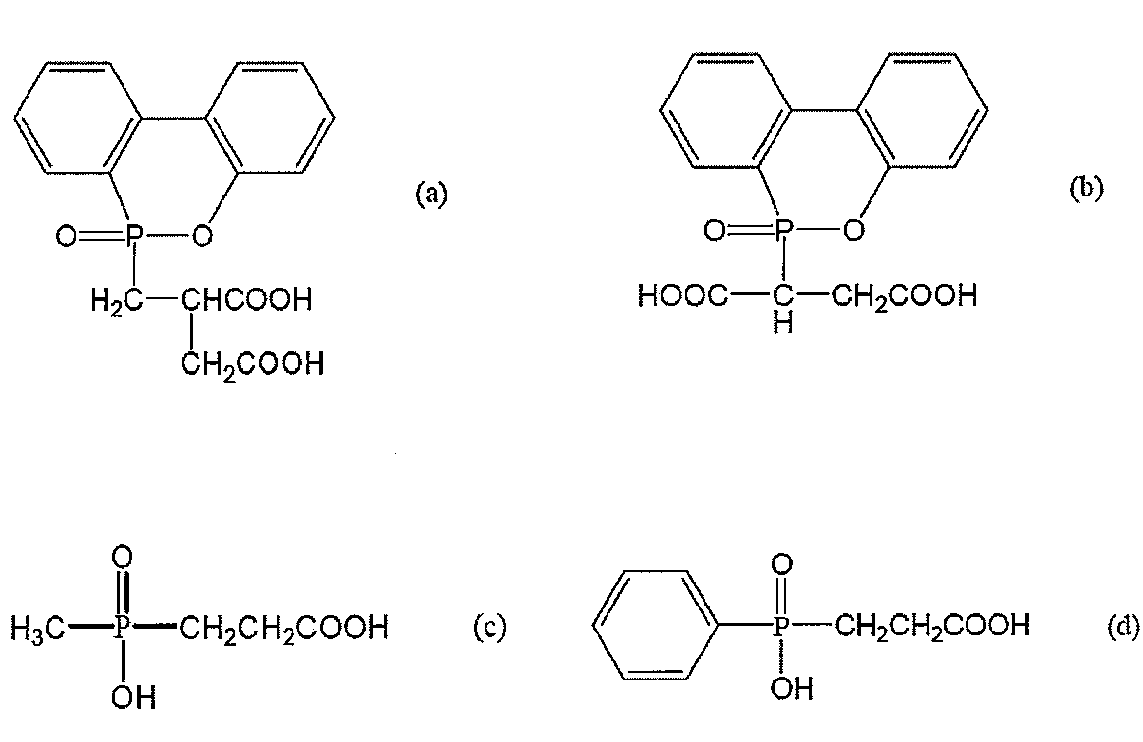
- a compound represented by the following formula (1) is preferable from the viewpoint of the reactivity of the polycondensation reaction, the residual rate of the organic phosphorus compound, and the like.
- R 1 represents an alkyl group or aryl group having 1 to 12 carbon atoms
- R 2 represents an alkyl group, aryl group, monohydroxyalkyl group, or a cyclic body or hydrogen atom via R 1 having 1 to 18 carbon atoms
- R 3 represents an alkyl group having 1 to 18 carbon atoms, an aryl group, a monohydroxyalkyl group or a hydrogen atom
- A represents a divalent or higher valent hydrocarbon group.
- N represents a number obtained by subtracting 1 from the valence of A.
- organophosphorus compound represented by the above formula (1) include the following structural formulas (a) to (d).
- the resin composition of the present invention contains the above-mentioned copolymerized polyester resin.
- the content of the copolyester resin can be appropriately set according to, for example, the type of copolyester resin, a predetermined use, etc., but generally 30 to 100% by mass, particularly 50 to 100% in the resin composition. It is preferable that the content be 70% by mass, more preferably 70 to 100% by mass. That is, the resin composition of the present invention includes not only the case of 100% by mass of the copolyester resin but also the case of containing the copolyester resin and other components. When the content of the copolyester resin is less than 100% by mass, additives, resin components and the like as shown below may be included.
- additives examples include known additives such as pigments, heat stabilizers, antioxidants, weathering agents, flame retardants, plasticizers, lubricants, mold release agents, antistatic agents, fillers, and crystal nucleating agents.
- known additives such as pigments, heat stabilizers, antioxidants, weathering agents, flame retardants, plasticizers, lubricants, mold release agents, antistatic agents, fillers, and crystal nucleating agents.
- a resin composition containing the copolymerized polyester resin of the present invention can be prepared using these additives and the like.
- a specific organic phosphorus compound is copolymerized in order to impart flame retardancy.
- a flame retardant as shown below may be contained.
- flame retardants include phosphorus-based flame retardants, hydrated metal compounds (aluminum hydroxide, magnesium hydroxide, etc.), nitrogen-containing compounds (melamine-based, guanidine-based), inorganic compounds (borates, Mo compounds, etc.) ).
- phosphorus-based flame retardants include phosphorus-based flame retardants, hydrated metal compounds (aluminum hydroxide, magnesium hydroxide, etc.), nitrogen-containing compounds (melamine-based, guanidine-based), inorganic compounds (borates, Mo compounds, etc.) ).
- a brominated aromatic compound a brominated aromatic compound, an antimony oxide compound, and the like is preferable.
- a brominated aromatic compound and an antimony oxide compound it is preferable to use both compounds in combination.
- the brominated aromatic compound for example, a brominated epoxy resin is preferable
- the antimony oxide compound for example, antimony trioxide (Sb 2 O 3 ) is preferable.
- the content of these flame retardants is preferably 2 to 30 parts by mass with respect to 100 parts by mass of the copolyester resin.
- the copolymer polyester resin of the present invention is heated. It is preferable to impart conductivity. Specifically, it is preferable to add a heat conductive filler to the copolymer polyester resin of the present invention.
- thermally conductive filler examples include flaky graphite, flaky boron nitride having a hexagonal crystal structure, aluminum oxide, magnesium carbonate, zinc oxide, talc and the like.
- the content of these fillers is not particularly limited, but is preferably 50 to 150 parts by volume, more preferably 60 to 120 parts by volume with respect to 100 parts by volume of the copolyester resin.
- heat stabilizer or antioxidant examples include hindered phenols, phosphorus compounds, hindered amines, sulfur compounds, copper compounds, and alkali metal halides.
- the method of making the resin composition of this invention contain the above additives is not specifically limited.
- the resin composition of the present invention may contain a resin component other than the copolymerized polyester resin of the present invention as long as the effect is not impaired.
- a resin component other than the copolymerized polyester resin of the present invention for example, polyethylene, polypropylene, polybutadiene, polystyrene, AS resin, ABS resin, poly (acrylic acid), poly (acrylic acid ester), poly (methacrylic acid), poly (methacrylic acid ester), polyethylene terephthalate, polyethylene naphthalate, polycarbonate, Further, a resin such as a copolymer thereof may be added and used.
- the resin composition of the present invention can be applied to molding methods similar to those of known resin compositions, but is particularly suitable for injection molding at relatively low pressures. can do. Specifically, it is optimal for molding at a pressure of 0.1 to 5 MPa, particularly 0.1 to 3 MPa. In this case, the temperature (melting temperature) varies depending on the type of resin component and the like, but is generally about 180 to 240 ° C. Therefore, the resin composition of the present invention is suitable for the hot melt molding method or the potting method.
- the hot melt molding method referred to in the present invention is a method in which a resin composition is melted without using a solvent, and an industrial part (particularly an electronic part) (hereinafter also referred to as “part”) is placed in advance in a mold.
- the molten resin composition is injected and injected at a low pressure (preferably 0.1 to 3 MPa), and the resin composition is molded (so-called insert molding) as a housing or case for the part.
- the present invention relates to a method for producing a resin molded product comprising a step of obtaining a resin molded product including an industrial part by injecting the resin composition of the present invention into a mold in which the industrial part is previously disposed. Is included.
- the potting method in the present invention refers to placing a part in a housing or on a substrate in advance and injecting or dropping the molten resin composition at a low pressure (preferably 1 MPa or less) to integrate the housing or the substrate and the part.
- a low pressure preferably 1 MPa or less
- the present invention provides a resin molded product including a step of obtaining a resin molded product including an industrial part by injecting or dripping the resin composition of the present invention into a housing or a substrate on which the industrial part is previously disposed. Includes methods.
- the resin composition of the present invention is excellent in flexibility, adhesiveness, wet heat durability, etc., when it is used for hot melt molding or potting, not only has good moldability but also a product (parts) to be obtained. ) Is excellent in adhesion between the electronic component to be inserted and the resin. Moreover, the copolyester resin of the present invention is excellent in flexibility, wet heat durability and the like. For this reason, separation between the resin and the electronic component hardly occurs. In particular, even when used in a harsh environment for a long period of time, the resin and the electronic component do not peel off, and the resin portion is less likely to crack or crack.
- the resin composition of the present invention when imparted with flame retardancy by a specific organophosphorus compound or other flame retardant, it can be suitably used in applications where flame retardancy is required. It becomes possible.
- the resin composition of the present invention (molded product comprising a resin composition) is excellent in flexibility since it contains a copolymer polyester resin containing a specific amount of dimer acid in the acid component and polybutadiene glycol in the glycol component. ing.
- the Young's modulus at 20 ° C. is preferably 100 MPa or less, and particularly preferably 60 MPa or less.
- the Young's modulus is obtained by melting the resin composition of the present invention at a temperature 50 ° C. higher than the melting point and injection-molding the melt at a pressure of 1 MPa using an injection molding machine “PS20E2ASE” manufactured by Nissei Plastic Industry Co., Ltd.
- a molded sample having a thickness of 1 mm and a width of 3 mm is prepared, and the sample is measured using a tensile tester “Tensilon” (UTM-4-100 manufactured by Orientec Co., Ltd.) at 20 ° C. and a tensile speed of 10 mm / min. It is.
- the resin composition of the present invention (molded product comprising the resin composition) can have excellent flexibility by having the above composition, and at the same time has an appropriate hardness and improved brittleness. It has been done.
- the Shore D hardness at 20 ° C. is preferably 50 or less, and more preferably 45 or less.
- the Shore D hardness is obtained by melting the resin composition of the present invention at a temperature 50 ° C. higher than the melting point, and using an injection molding machine “PS20E2ASE” manufactured by Nissei Plastic Industry Co., Ltd., and injection-molding the melt at a pressure of 1 MPa.
- a molded sample having a thickness of 3 mm and a width of 20 mm is prepared, and two of these samples are overlapped and measured at 20 ° C. using a Shore D hardness meter (WESTOP WR-105D).
- WESTOP WR-105D Shore D hardness meter
- the resin composition of the present invention tends to be poor in flexibility.
- the Shore D hardness at 20 ° C. exceeds 50, the resin composition of the present invention is insufficient in hardness and brittle, and is likely to be difficult to use for a wide variety of applications.
- the resin composition containing the copolymerized polyester resin of the present invention (molded article made of the resin composition) has excellent flexibility, moderate hardness, and improved brittleness. Both the Young's modulus and the Shore D hardness at 20 ° C. are preferably within the above ranges.
- the resin composition of the present invention is excellent in wet heat durability by having the above composition.
- the strain retention shown below is preferably 80% or more, more preferably 85% or more, and further preferably 90% or more.
- the strain retention is less than 80%, the strength of the resin is greatly reduced by wet heat treatment, and a molded body using such a resin composition is inferior in shape stability. That is, it becomes inferior to wet heat durability.
- the strain retention rate in the present invention is calculated as follows.
- the resin composition of the present invention was melted at a temperature 50 ° C. higher than the melting point, and the melt was injection molded into a mold at a pressure of 1 MPa using an injection molding machine “PS20E2ASE” manufactured by Nissei Plastic Industry Co., Ltd.
- a molded sample having a width of 1 mm and a width of 3 mm is prepared, and tensile fracture strain is measured according to the method described in ISO standard 527-2 (tensile fracture strain before treatment).
- a thermo-hygrostat IG400 manufactured by Yamato Scientific Co., Ltd.
- the obtained molded sample is stored for 200 hours in an environment of a temperature of 60 ° C.
- the resin composition of the present invention When the resin composition of the present invention has been given flame retardancy by a specific organic phosphorus compound or other flame retardant, the resin composition of the present invention is compliant with JIS K7201 as an indicator of flame retardancy.
- the oxygen index (hereinafter abbreviated as OI) is preferably 27 or more, and more preferably 28 or more. If the OI value is less than 27, the flame retardancy is insufficient, and it is not suitable for electric / electronic component applications, which is not preferable.
- the resin composition of the present invention is also excellent in heat resistance.
- the melting point of the copolyester resin and the resin composition of the present invention is preferably 115 to 180 ° C., more preferably 130 to 170 ° C. If the melting point is lower than 115 ° C., the heat resistance is poor, and there is a possibility that the application to be used is limited. On the other hand, if it exceeds 180 ° C., it is necessary to increase the processing temperature at the time of molding, which is disadvantageous in terms of cost, and at the same time, thermal degradation of the resin may increase.
- the melting point is measured by using a diamond DSC manufactured by Perkin Elmer Co., Ltd., raising and lowering the temperature at 10 ° C./min, and measuring the melting peak temperature.
- the resin composition of the present invention is excellent in adhesiveness, and is excellent in adhesiveness with various resins, metals constituting electric and electronic parts and the like. Especially, it is excellent in adhesiveness with PET, PBT, or polyphenylene sulfide.
- the resin composition of the present invention preferably has a melt viscosity at 200 ° C. of 1 Pa ⁇ s to 300 Pa ⁇ s, more preferably 3 to 150 Pa ⁇ s.
- the melt viscosity is within this range, molding at a low pressure is possible, which is suitable for hot melt molding or potting.
- the melt viscosity exceeds 300 Pa ⁇ s, the fluidity is lowered, and molding at low pressure may be difficult.
- the melting temperature is increased in order to reduce the melt viscosity, the load on the apparatus is increased and the thermal deterioration of the copolyester resin becomes remarkable.
- the melt viscosity is less than 1 Pa ⁇ s, the strength of the copolymerized polyester resin composition (resin molded product) tends to be low.
- the melt viscosity is measured with a flow tester (manufactured by Shimadzu Corporation, model CFT-500) using a nozzle having a nozzle diameter of 1.0 mm and a nozzle length of 10 mm and a shear rate of 1000 sec ⁇ 1. is there.
- the method for producing the copolyester resin is not particularly limited as long as the above-described components can be used for copolymerization. Therefore, the same conditions as the production conditions of the known copolyester resin can be adopted except that the respective components described above are used in a predetermined ratio.
- the above acid component and glycol component are esterified at 150 to 250 ° C., and then reduced in the presence of a polycondensation reaction catalyst (preferably atmospheric pressure).
- the copolymerized polyester resin of the present invention can be obtained by polycondensation at 230 to 300 ° C. while reducing the pressure to about 10 to 30 Pa.
- a derivative such as dimethyl ester of aromatic dicarboxylic acid and a glycol component are transesterified at 150 ° C. to 250 ° C., and then reduced in pressure in the presence of a polycondensation reaction catalyst (preferably from atmospheric pressure to 10 to 30 Pa).
- the copolyester resin of the present invention can be obtained by polycondensation at 230 ° C. to 300 ° C. under reduced pressure.
- an organophosphorus compound having two or more ester-forming functional groups is added, and esterification is performed under the same conditions as described above.
- esterification is performed under the same conditions as described above.
- the resin composition can be obtained by uniformly mixing an additive, other resin components and the like (hereinafter referred to as “additive etc.”) as necessary with the copolymerized polyester resin obtained above.
- additive etc. examples of methods for adding additives and other resin components (hereinafter referred to as “additives”) to the copolyester include: 1) Add the copolyester resin and additives simultaneously using a screw type extruder. And batch blending method in which the mixture is melted, kneaded and pelletized. 2) After the copolymerized polyester resin is melted and kneaded, an additive is supplied from the other supply port of the extruder, and melted and kneaded to be pelletized. Any of the division blending methods and the like may be adopted.
- the resin composition of the present invention is suitable for the hot melt molding method and the potting method, but can be used in various forms in the same manner as known polyester resin compositions.
- it can be used as various molded products such as films, fibers and sheets, and can also be used as an adhesive.
- a film, fiber, or the like when obtained, it can be produced using a known method, apparatus, or the like.
- seat or a molded object when obtaining a sheet
- it can be used as an adhesive agent by forming it into a desired shape such as a sheet and then performing a heat treatment.
- the measurement and evaluation methods for various characteristic values in the examples are as follows. (1) Melting point, melt viscosity Measured in the same manner as above. (2) Polymer composition The obtained copolymer polyester resin was dissolved in a mixed solvent having a volume ratio of 1/20 of deuterated hexafluoroisopropanol and deuterated chloroform, and the LA-400 NMR apparatus manufactured by JEOL Ltd. was used. 1H-NMR was measured and determined from the integrated intensity of the proton peak of each copolymer component in the obtained chart. (3) Content of phosphorus atom in copolyester resin Measured with a fluorescent X-ray spectrometer model 3270 manufactured by Rigaku Corporation.
- a heat treatment was performed at a pressure of 0.2 MPa for 30 seconds to produce a sample having a width of 15 mm and a length of 100 mm.
- the sample was peeled off at a peeling speed of 50 mm / min according to JIS K-6854 using a tensile tester “Tensilon” (UTM-4-100 type manufactured by Orientec Co., Ltd.).
- the adhesion was evaluated in the following three stages.
- ⁇ ⁇ ⁇ ⁇ Peel strength is 10N / 15mm or more ⁇ ⁇ ⁇ ⁇ Peel strength is less than 10N / 15mm to 5N / 15mm or more ⁇ ⁇ ⁇ ⁇ Peel strength is less than 5N / 15mm (8)
- Formability 1 Hot melt molding
- the obtained copolyester resin (or resin composition) was melted at a temperature higher by 50 ° C. than the melting point, and injection molding was performed at a pressure of 1 MPa using “PS20E2ASE” manufactured by Nissei Plastic Industries.
- the copolymer polyester resin (or resin composition) and the circuit board Obtained an integrated electrical component.
- Formability at the time of obtaining a part was evaluated in the following three stages according to the time (release time) in which the mold can be released. ⁇ : The mold release time was within 10 seconds. ⁇ : The mold release time exceeded 10 seconds and was within 20 seconds. X: The mold release time exceeded 20 seconds.
- Insulation property is broken. In the circuit board, the soldered portions (two locations) of the two lead wires are not connected. Therefore, normally, electricity does not flow between the lead wires (insulation is maintained). If water enters between the resin and the circuit board after the wet heat treatment, the water becomes a conductor and current flows between the lead wires (insulation is broken). (9) Formability 2 (potting) The obtained copolyester resin (or resin composition) was melted at a temperature 50 ° C. higher than the melting point.
- the same circuit board as that used for moldability 1 is placed in the housing (container type), and a molten copolymerized polyester resin (or resin composition) is injected into the housing at a pressure of 0.5 MPa, and the housing
- the resin and the circuit board were integrated to obtain an electrical component.
- the moldability at the time of obtaining parts was visually evaluated in the following three stages. ⁇ : The resin flows into the entire part, and there are no irregularities on the surface. ⁇ : Resin flows into the entire part, but irregularities are seen in the shape. X: The resin flow is insufficient and a part of the circuit board is exposed. For parts with the above-mentioned formability, when the parts are obtained (before processing), the parts are left in an environment of 80 ° C.
- Thermal conductivity ⁇ was calculated by the following formula as a product of the thermal diffusivity ⁇ , the density ⁇ , and the specific heat Cp obtained by the following method.
- ⁇ ⁇ Cp ⁇ : thermal conductivity (W / (m ⁇ K))
- ⁇ Thermal diffusivity (m 2 / sec)
- ⁇ Density (g / m 3 )
- Cp Specific heat (J / (g ⁇ K))
- the thermal diffusivity ⁇ is obtained by laser flashing a sample obtained by molding the obtained copolyester resin-based resin composition into a disk shape having a diameter of 30 mm using an injection molding machine and cutting the molded product into a predetermined size.
- Measurement was performed by a laser flash method using a method thermal constant measuring apparatus TC-7000 (manufactured by ULVAC-RIKO).
- the density ⁇ was measured using an electronic hydrometer ED-120T (manufactured by Mirage Trading Co.).
- the specific heat Cp was measured using a differential scanning calorimeter DSC-7 (manufactured by Perkin Elmer Co.) at a temperature rising rate of 10 ° C./min.
- Example 1-1 As an acid component, 60 parts by weight of terephthalic acid, 9 parts by weight of isophthalic acid, 60 parts by weight of hydrogenated dimer acid having 36 carbon atoms (Pripol 1009, manufactured by Croder Japan), and 58 parts by weight of 1,4-butanediol as a diol component Using 78 parts by mass of polybutadiene glycol (hydroxylated hydrogenated polybutadiene mainly containing 1,2-repeat units; “GI-1000” manufactured by Nippon Soda Co., Ltd.) and heating to 240 ° C. to carry out the esterification reaction It was.
- polybutadiene glycol hydroxylated hydrogenated polybutadiene mainly containing 1,2-repeat units
- Examples 1-2 to 1-8, Comparative Examples 1-1 to 2, 1-4 to 1-6 Example 1 except that the types and addition amounts of terephthalic acid, isophthalic acid, hydrogenated dimer acid, 1,4-butanediol, and polybutadiene glycol were changed to the compositions (contents) shown in Table 1. 1 was performed to obtain a copolyester resin.
- Example 1-7 “GI-2000” (hydroxylated hydrogenated polybutadiene mainly containing 1,2-repeating units) manufactured by Nippon Soda Co., Ltd. was used as the polybutadiene glycol.
- the dimer acid a dimer acid having 36 carbon atoms (manufactured by Croder Japan, Pripol) 1013) was used.
- Example 1-9 A copolymerized polyester was prepared in the same manner as in Example 1-1 except that 1,4-butanediol and 1,6-hexanediol were used as the glycol components and the composition (content) shown in Table 1 was used. A resin was obtained.
- Comparative Example 1-3 A copolymer polyester resin was obtained in the same manner as in Example 1-1 except that only 1,6-hexanediol was used as the glycol component and the composition (content) shown in Table 1 was used.
- Table 1 shows the compositions, characteristic values, and evaluation results of the copolyester resins obtained in Examples 1-1 to 1-9 and Comparative Examples 1-1 to 1-6.
- the copolymer polyester resins obtained in Examples 1-1 to 1-9 had a composition satisfying the present invention, so that the Young's modulus at 20 ° C. was 55 MPa or less, 20 The Shore D hardness at 45 ° C. was 45 or less, excellent flexibility, moderate hardness, and improved brittleness. And it was excellent in adhesiveness, and also had a high tensile fracture strain value and a high retention rate, and was excellent in strength and wet heat durability.
- the copolyester resins obtained in Examples 1-1 to 1-8 are excellent in moldability when a molded product is obtained by hot melt molding or potting. It had sufficient insulation properties both after wet heat treatment. That is, the molded product obtained by both methods has good adhesion between the resin and the part, and can be used for a long time even in a harsh environment.
- the copolymer polyester resin obtained in Comparative Example 1-1 had a low content of dimer acid in the acid component, and therefore had a high Shore D hardness, Young's modulus, and poor flexibility. The adhesiveness was also poor. Furthermore, since the strain retention was low and the wet heat durability was poor, the obtained molded product after the wet heat treatment did not have insulating properties.
- the copolymerized polyester resin obtained in Comparative Example 1-2 had a high content of dimer acid in the acid component and a low content of aromatic dicarboxylic acid, so the melting point could not be measured (amorphous) It was inferior in heat resistance and in moldability. Moreover, the tensile strength was also inferior.
- the copolymerized polyester resin obtained in Comparative Example 1-3 did not contain 1,4-butanediol as a diol component and was mainly composed of 1,6-hexanediol. It was inferior in moldability and inferior in moldability.
- the copolymer polyester resin obtained in Comparative Example 1-4 did not contain polybutadiene glycol as a glycol component
- the copolymer polyester resin obtained in Comparative Example 1-5 had a content of polybutadiene glycol as a glycol component. Both had high Young's modulus and Shore D hardness, poor flexibility, and poor adhesion. Furthermore, since the strain retention was low and the wet heat durability was poor, the obtained molded product after wet heat treatment did not have insulating properties.
- the copolymerized polyester resin obtained in Comparative Example 1-6 had a low melting point, poor heat resistance and poor moldability because of the excessive content of polybutadiene glycol as a glycol component. Moreover, the tensile strength was also inferior.
- Example 2-1 As the organophosphorus compound, the organophosphorus compound represented by the structural formula (a) described above was used.
- an acid component 58 parts by mass of terephthalic acid, 7 parts by mass of isophthalic acid, a hydrogenated dimer acid having 36 carbon atoms (manufactured by Croder Japan, Pripol) 1009) 73 parts by mass, as a diol component, 60 parts by mass of 1,4-butanediol, polybutadiene glycol (hydroxylated hydrogenated polybutadiene mainly containing 1,2-repetitive units; “GI-1000” manufactured by Nippon Soda Co., Ltd.) Using 57 parts by mass and 9 parts by mass of the organophosphorus compound (a), the mixture was heated to 240 ° C.
- Example 2-10 A copolymerized polyester was prepared in the same manner as in Example 2-1, except that 1,4-butanediol and 1,6-hexanediol were used as the glycol components, and the composition (content) was as shown in Table 2. A system resin composition was obtained.
- Comparative Example 2-3 A copolymer polyester resin composition was obtained in the same manner as in Example 2-1, except that only 1,6-hexanediol was used as the glycol component and the composition (content) shown in Table 2 was obtained. It was.
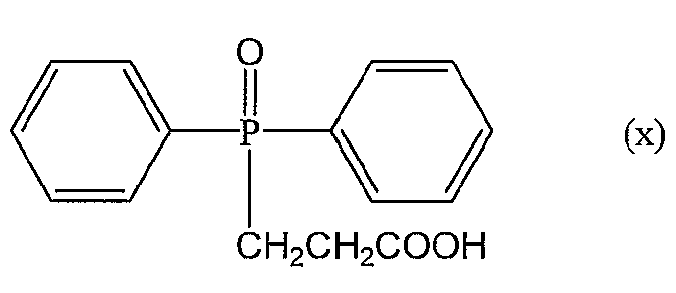
- Comparative Example 2-9 A copolymer polyester resin composition was obtained in the same manner as in Example 2-1, except that an organic phosphorus compound represented by the following structural formula (x) was used as the organic phosphorus compound.
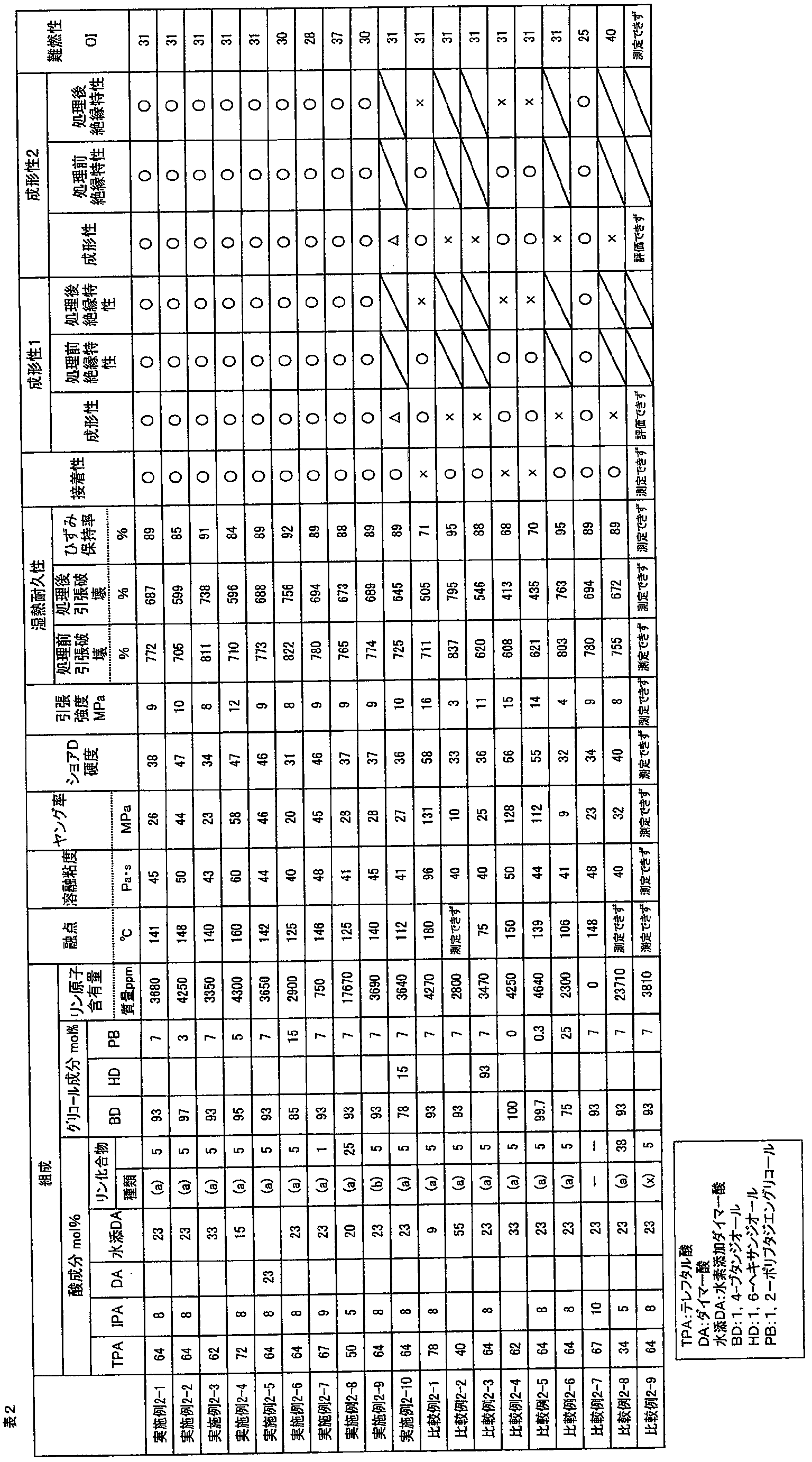
- Table 2 shows the compositions, characteristic values, and evaluation results of the copolyester resin compositions obtained in Examples 2-1 to 2-10 and Comparative Examples 2-1 to 2-9.
- the copolymerized polyester resin compositions obtained in Examples 2-1 to 2-10 were compositions satisfying the present invention. It had hardness and improved brittleness. And it was excellent in adhesiveness, and also had a high tensile fracture strain value and a high retention rate, and was excellent in strength and wet heat durability. Furthermore, the OI value was 28 or more, and it had sufficient flame retardancy.
- the copolymerized polyester resin compositions obtained in Examples 2-1 to 2-9 are excellent in moldability when a molded product is obtained by hot melt molding or potting, and the obtained molded product is molded. Sometimes it had sufficient insulating properties both after wet heat treatment. That is, the molded product obtained by both methods has good adhesion between the resin and the part, and can be used for a long time even in a harsh environment.
- the copolymerized polyester resin composition obtained in Comparative Example 2-1 had a low content of dimer acid in the acid component, and therefore had high Shore D hardness and Young's modulus and poor flexibility. In addition, the adhesiveness was inferior. Furthermore, since the strain retention was low and the wet heat durability was poor, the obtained molded product after the wet heat treatment did not have insulating properties.
- the copolymerized polyester resin composition obtained in Comparative Example 2-2 had a high content of dimer acid in the acid component and a low content of aromatic dicarboxylic acid component, so the melting point could not be measured. It was inferior in heat resistance and inferior in moldability. Moreover, the tensile strength was also inferior.
- the copolymerized polyester resin composition obtained in Comparative Example 2-3 did not contain 1,4-butanediol as a diol component, and was mainly composed of 1,6-hexanediol. It was low, inferior in heat resistance and inferior in moldability.
- the copolyester resin composition obtained in Comparative Example 2-4 did not contain polybutadiene glycol as a glycol component
- the copolyester resin resin composition obtained in Comparative Example 2-5 was a glycol component. Since the content of polybutadiene glycol as a component was small, both the Shore D hardness and Young's modulus were high and the flexibility was poor, and the adhesiveness was also poor. Furthermore, since the strain retention was low and the wet heat durability was poor, the obtained molded product after the wet heat treatment did not have insulating properties.
- the copolymerized polyester resin composition obtained in Comparative Example 2-6 had an excessively high content of polybutadiene glycol as a glycol component, and therefore had a low melting point, poor heat resistance and poor moldability. Moreover, the tensile strength was also inferior.
- the copolymerized polyester resin composition obtained in Comparative Example 2-7 did not contain an organic phosphorus compound, and therefore had a low OI value and poor flame retardancy.
- the copolymerized polyester resin composition obtained in Comparative Example 2-8 was amorphous because the content of the organophosphorus compound was too large (melting point could not be measured), and was inferior in heat resistance. In addition, the moldability was poor.
- Example 3-1 Copolymerized polyester resin obtained in Example 1-1 and thermal conductive filler as talc [K-1 manufactured by Nippon Talc Co., average particle size 8 ⁇ m, thermal conductivity 10 W / (m ⁇ K), density 2 0.7 g / cm 3 ], 100 parts by volume of copolyester resin and 80 parts by volume of heat conductive filler are supplied to the main hopper of a twin-screw extruder (manufactured by Toshiba Machine Co., Ltd .: TEM26SS, screw diameter 26 mm). And kneaded at a temperature of 200 ° C. And after extruding to strand shape and cooling and solidifying, it cut
- talc manufactured by Nippon Talc Co., average particle size 8 ⁇ m, thermal conductivity 10 W / (m ⁇ K), density 2 0.7 g / cm 3 ]
- Example 3-2 Example 3 except that aluminum oxide (manufactured by Denki Kagaku Kogyo Co., Ltd., average particle size 10 ⁇ m, thermal conductivity 38 W / (m ⁇ K), density 3.97 g / cm 3 ) was used as the heat conductive filler. In the same manner as in Example 1, a copolymerized polyester resin composition was obtained.
- aluminum oxide manufactured by Denki Kagaku Kogyo Co., Ltd., average particle size 10 ⁇ m, thermal conductivity 38 W / (m ⁇ K), density 3.97 g / cm 3 .
- Example 3-3 Example 3-1 except that magnesium carbonate [manufactured by Kamishima Chemical Co., Ltd., average particle size of 10 ⁇ m, thermal conductivity of 15 W / (m ⁇ K), density of 3.05 g / cm 3 ] was used as the thermally conductive filler. In the same manner as above, a copolyester resin composition was obtained.
- Example 3-4 A copolymer polyester resin composition was obtained in the same manner as in Example 3-1, except that the copolymer polyester resin obtained in Example 1-3 was used.
- Example 3-5 A copolymerized polyester resin composition was obtained in the same manner as in Example 3-2 except that the copolymerized polyester resin obtained in Example 1-3 was used.
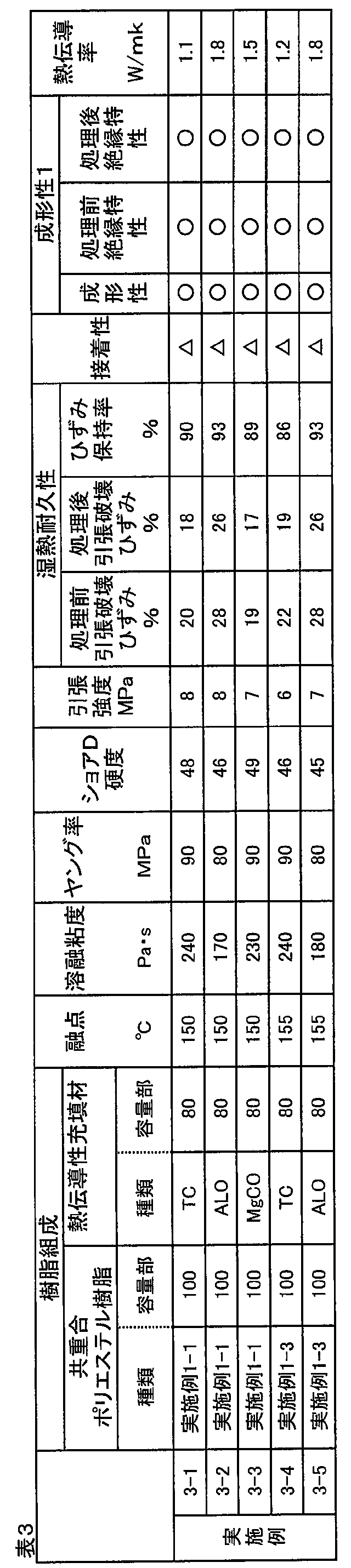
- Table 3 shows the compositions, characteristic values, and evaluation results of the copolyester resin compositions obtained in Examples 3-1 to 3-5.
- the copolymerized polyester resin compositions obtained in Examples 3-1 to 3-5 contain a large amount of a heat conductive filler and have a high melt viscosity. It was difficult to use. For this reason, evaluation of formability 2 was not performed.
- the copolymer polyester resin compositions obtained in Examples 3-1 to 3-5 contain a heat conductive filler in the copolymer polyester resin having a composition satisfying the present invention. Therefore, the thermal conductivity was imparted while having the excellent points of the copolyester resin obtained in Example 1-1 or Example 1-3 as described above. For this reason, in various electronic parts etc., it can be used suitably also in the use for which the heat countermeasure which dissipates the generated heat
- the thermal conductivity of the copolyester resin obtained in Example 1-1 (containing no thermal conductive filler) was 0.1 W / mk.
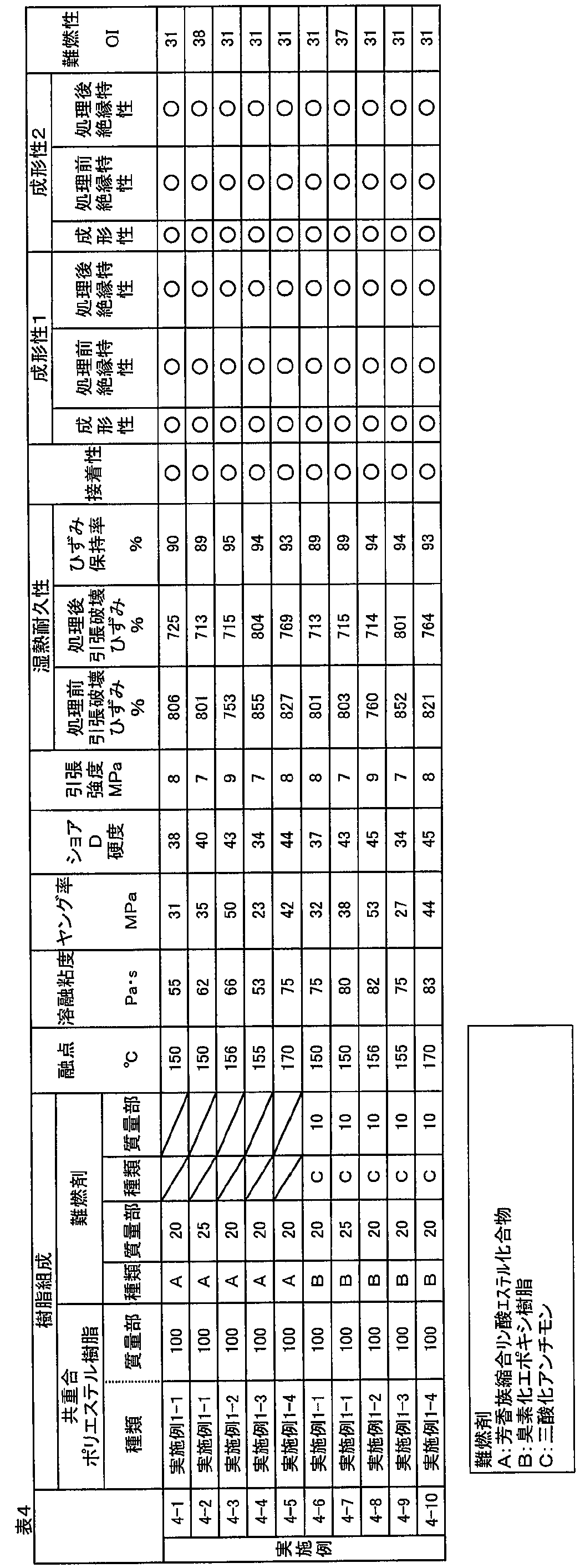
- Example 4-1 Using the copolymer polyester resin obtained in Example 1-1 and an aromatic condensed phosphate ester compound (PX200 manufactured by Daihachi Chemical Industry Co., Ltd.) as a flame retardant, a twin-screw extruder (manufactured by Nippon Steel Works, Model TEX30C) In addition, 100 parts by mass of a copolyester resin and 20 parts by mass of a flame retardant were supplied to a screw diameter of 30 mm, and melt kneaded at a constant temperature of 255 ° C. and a screw rotation speed of 200 rpm. And after extruding in the strand form and cooling and solidifying, it cut
- an aromatic condensed phosphate ester compound PX200 manufactured by Daihachi Chemical Industry Co., Ltd.
- Examples 4-2 to 4-5 As shown in Table 4, a copolymer polyester resin composition was obtained in the same manner as in Example 4-1, except that the type of copolymer polyester resin used and the amount of flame retardant added were changed.
- Example 4-6 A copolymerized polyester resin composition was obtained in the same manner as in Example 4-1, except that 20 parts by mass of brominated epoxy resin and 10 parts by mass of antimony trioxide were used as the flame retardant.
- Examples 4-7 to 4-10 As shown in Table 4, a copolymer polyester resin composition was obtained in the same manner as in Example 4-6, except that the type of copolymer polyester resin used and the amount of flame retardant added were changed.
- Table 4 shows the compositions, characteristic values, and evaluation results of the copolyester resin compositions obtained in Examples 4-1 to 4-10.
- the copolymer polyester resin compositions obtained in Examples 4-1 to 4-10 were used as aromatic flame retardants as a flame retardant for the copolymer polyester resin having a composition satisfying the present invention. Since it contains an acid ester compound, a brominated aromatic compound, or an antimony oxide compound, it has excellent points of the copolymer polyester resin obtained in Examples 1-1 to 1-4 as described above. However, flame retardancy was imparted. For this reason, in various electronic parts etc., it could be used suitably also in the use for which a flame retardance is calculated
Landscapes
- Chemical & Material Sciences (AREA)
- Health & Medical Sciences (AREA)
- Chemical Kinetics & Catalysis (AREA)
- Medicinal Chemistry (AREA)
- Polymers & Plastics (AREA)
- Organic Chemistry (AREA)
- Engineering & Computer Science (AREA)
- Manufacturing & Machinery (AREA)
- Mechanical Engineering (AREA)
- Polyesters Or Polycarbonates (AREA)
- Compositions Of Macromolecular Compounds (AREA)
Abstract
Description
1. 酸成分として、芳香族ジカルボン酸とダイマー酸とを含有し、グリコール成分として、1,4-ブタンジオールとポリブタジエングリコール類とを含有し、酸成分中のダイマー酸の含有量が10~50モル%であり、グリコール成分中の1,4-ブタンジオールの含有量が50モル%以上であり、グリコール成分中のポリブタジエングリコール類の含有量が0.5~20モル%である共重合ポリエステル樹脂を含む樹脂組成物。
2. 共重合ポリエステル樹脂中に、エステル形成性の官能基を2個以上有する有機リン化合物が共重合しており、当該樹脂中のリン原子含有量が500~20000質量ppmである、前記項1に記載の樹脂組成物。
3. 20℃でのヤング率が100MPa以下である、前記項1に記載の樹脂組成物。
4. 20℃でのショアD硬度が50以下である、前記項1に記載の樹脂組成物。
5. 燃焼試験における酸素指数が27以上である、前記項1に記載の樹脂組成物。
6. 前記項1に記載の樹脂組成物を圧力5MPa以下で成形することによって樹脂成形品を得る工程を含む、樹脂成形品の製造方法。
7. 前記工程が、予め工業用部品が配置された金型内に請求項1に記載の樹脂組成物を射出注入することによって、工業用部品を含む樹脂成形品を得る工程である、前記項6に記載の方法。
8. 前記工程が、予め工業用部品が配置されたハウジング又は基板に請求項1に記載の樹脂組成物を注入又は滴下することによって、工業用部品を含む樹脂成形品を得る工程である、前記項6に記載の方法。
このため、本発明の樹脂組成物は、例えばフィルム、繊維、シート、その他の各種の成形品として使用できるほか、接着剤等としても用いることができる。
また、本発明の樹脂組成物は、溶融時の流動性に優れ、低圧での射出成形が可能であるため、薄肉部位又は複雑な形状を有する成形品を溶融成形によって提供することが可能である。
さらに、本発明の樹脂組成物は、デリケートな電子部品等のインサート成型を行うホットメルトモールディング用途にも好適に用いることができる。また、ハウジング内又は基板上に部品を置き、これに樹脂を注型し、樹脂組成物を用いてハウジング又は基板と部品とを一体化させるポッティング用途にも好適に用いることができる。
そして、本発明の樹脂組成物は、湿熱耐久性にも優れていることから、上記のように電子部品をインサート成型して得られた電気・電子部品等は、過酷な環境で長期間使用することが可能となる。
以下、本発明の共重合ポリエステル樹脂を含む樹脂組成物(本発明の樹脂組成物)について詳細に説明する。本発明の樹脂組成物の主成分となる共重合ポリエステル樹脂(本発明の共重合ポリエステル樹脂)は、共重合成分として、芳香族ジカルボン酸とダイマー酸とを含有する酸成分と、1,4-ブタンジオールとポリブタジエングリコールとを含有するグリコール成分とからなるものである。
(1-1)酸成分
まず、酸成分について説明する。芳香族ジカルボン酸としては、例えばテレフタル酸、イソフタル酸、5-ナトリウムスルホイソフタル酸、無水フタル酸、ナフタレンジカルボン酸等のほか、これらの酸のエステル形成性誘導体を使用しても良い。これらは単独で使用しても良いし、これらを2種類以上併用しても良い。芳香族ジカルボン酸は、共重合ポリエステルの融点を上げ、耐熱性を付与するとともに機械的強度を上げることに寄与するものである。かかる見地より、本発明では、芳香族ジカルボン酸としてテレフタル酸及びイソフタル酸の少なくとも1種が好ましい。
本発明の共重合ポリエステル樹脂は、グリコール成分として、1,4-ブタンジオールを含有するものである。グリコール成分中の1,4-ブタンジオールの含有量は、50モル%以上であることが必要であり、特に60~98モル%であることがより好ましく、さらには80~98モル%であることが最も好ましい。グリコール成分として、1,4-ブタンジオールを50モル%以上含有することにより、得られる共重合ポリエステル樹脂は、融点が高くなり、耐熱性に優れるとともに、成形性も向上する。特に成形させる用途に用いる場合には、80~98モル%とすることが好ましい。1,4-ブタンジオール以外のジオールを使用しても所望の効果を得ることは困難である。例えば、1,4-ブタンジオールに代えて、1,2-エチレングリコールを用いると、得られる共重合ポリエステル樹脂は、結晶化速度が遅くなり成形性が悪いものとなる。また、1,4-ブタンジオールに代えて、1,6-ヘキサンジオールを用いると、得られる共重合ポリエステルは、融点が低くなり、耐熱性に劣るものとなる。
さらに、本発明の共重合ポリエステル樹脂に難燃性能を付与するためには、難燃化成分としてエステル形成性の官能基を2個以上有する有機リン化合物が共重合しており、共重合ポリエステル樹脂中のリン原子含有量が500~20000質量ppmであることが好ましい。

(2-1)樹脂組成物の組成
本発明の樹脂組成物は、前記の共重合ポリエステル樹脂を含有するものである。共重合ポリエステル樹脂の含有量は、例えば共重合ポリエステル樹脂の種類、所定の用途等に応じて適宜設定することができるが、一般的には樹脂組成物中30~100質量%、特に50~100質量%、さらには70~100質量%とすることが好ましい。すなわち、本発明の樹脂組成物は、共重合ポリエステル樹脂100質量%の場合のほか、共重合ポリエステル樹脂と他の成分とを含む場合も包含する。共重合ポリエステル樹脂の含有量が100質量%未満である場合は、下記に示すような添加剤、樹脂成分等が含まれていても良い。
本発明の樹脂組成物は、公知の樹脂組成物と同様の成形方法を適用することができるが、特に比較的低圧での射出成形に好適に利用することができる。具体的には、圧力0.1~5MPa、特に0.1~3MPaでの成形に最適である。この場合の温度(溶融温度)は、樹脂成分の種類等によって異なるが、一般的には180~240℃程度とすれば良い。従って、本発明の樹脂組成物は、ホットメルトモールディング法又はポッティング法に好適である。
ひずみ保持率(%)=〔(処理後の引張破壊ひずみ)/(処理前の引張破壊ひずみ)〕×100
なお、融点は、パーキンエルマー社製ダイヤモンドDSCを使用し、10℃/分で昇温、降温し、融解ピークの温度で測定するものである。
まず、本発明の共重合ポリエステル樹脂の製造方法について説明する。共重合ポリエステル樹脂の製造方法としては、前記の各成分を用いて共重合させることができる限り、特に制限されない。従って、前記の各成分を所定割合で用いるほかは、公知の共重合ポリエステル樹脂の製造条件と同様の条件を採用することもできる。
(1)融点、溶融粘度
上記と同様の方法で測定した。
(2)ポリマー組成
得られた共重合ポリエステル樹脂を重水素化ヘキサフルオロイソプロパノールと重水素化クロロホルムとの容量比1/20の混合溶媒に溶解させ、日本電子社製LA-400型NMR装置にて1H-NMRを測定し、得られたチャートの各共重合成分のプロトンのピークの積分強度から求めた。
(3)共重合ポリエステル樹脂中のリン原子の含有量
リガク社製蛍光X線スペクトロメータ3270型にて測定した。
(4)ショアD硬度、ヤング率
上記と同様の方法で測定した。
(5)引張破壊ひずみ、ひずみ保持率(湿熱耐久性)
上記と同様の方法で測定した。
(6)引張強度
(5)の測定において得られた成型サンプルと同様のものを用い、引張試験機「テンシロン」(オリエンテック社製UTM-4-100型)を用いて、20℃にて引張速度10mm/分で測定するものである。
(7)接着性
得られた共重合ポリエステル樹脂(又は樹脂組成物)を厚さ50μmのシート状とし、厚さ100μmのポリフェニレンサルファイドのシートの間にはさんで、融点よりも50℃高い温度、圧力0.2MPaで、30秒間熱処理し、幅15mm、長さ100mmのサンプルを作製した。サンプルを、引張試験機「テンシロン」(オリエンテック社製UTM-4-100型)を用い、JIS K-6854に従って、剥離速度50mm/分で剥離を行った。接着性を以下の3段階で評価した。
○・・・剥離強度が10N/15mm以上
△・・・剥離強度が10N/15mm未満~5N/15mm以上
×・・・剥離強度が5N/15mm未満
(8)成形性1(ホットメルトモールディング)
得られた共重合ポリエステル樹脂(又は樹脂組成物)を融点よりも50℃高い温度で溶融し、日精樹脂工業社製「PS20E2ASE」を用い、圧力1MPaにて射出成形を行った。このとき、被モールディング材料として塩化ビニル製のリード線2本をハンダ付けした回路基板を用い、アルミニウム製金型を用いてインサート成型することで、共重合ポリエステル樹脂(又は樹脂組成物)と回路基板が一体化された電気部品を得た。
部品を得る際の成形性を、金型から離型可能となる時間(離型時間)にて以下の3段階で評価した。
○・・・離型時間が10秒以内であった。
△・・・離型時間が10秒を超え20秒以内であった。
×・・・離型時間が20秒を超えていた。
上記の成形性が○の部品について、部品を得た際(処理前)、部品を80℃、95%の環境下で500時間放置した後(湿熱処理後)の両方の場合において、回路基板内の絶縁特性について以下のように評価した。
○・・・絶縁性が保持されている。
×・・・絶縁性が破られている。
なお、回路基板において、2本のリード線のハンダ付けした箇所(2箇所)はつながっていない。したがって、通常ではリード線間で電気は流れない(絶縁性が保たれている)。湿熱処理後、樹脂と回路基板の間に水が入り込むと、水が導体となってリード線間に電流が流れる(絶縁性が破られる)こととなる。
(9)成形性2(ポッティング)
得られた共重合ポリエステル樹脂(又は樹脂組成物)を融点よりも50℃高い温度で溶融した。そして、ハウジング(容器型のもの)内に成形性1で使用したものと同じ回路基板を置き、これに溶融した共重合ポリエステル樹脂(又は樹脂組成物)を圧力0.5MPaにて注入し、ハウジングと樹脂と回路基板を一体化させて電気部品を得た。
部品を得る際の成形性を目視にて以下の3段階で評価した。
○・・・樹脂が部品全体に流れ込んでおり、表面に凹凸が見られない。
△・・・樹脂が部品全体に流れこんでいるが、形状に凹凸が見られる。
×・・・樹脂の流れこみが不十分で、回路基板の一部が露出している。
上記の成形性が○の部品について、部品を得た際(処理前)、部品を80℃、95%の環境下で500時間放置した後(湿熱処理後)の両方の場合において、回路基板内の絶縁特性について以下のように評価した。
○・・・絶縁性が保持されている。
×・・・絶縁性が破られている。
なお、回路基板において、2本のリード線のハンダ付けした箇所(2箇所)はつながっていない。従って、通常ではリード線間で電気は流れない(絶縁性が保たれている)。湿熱処理後、樹脂と回路基板の間に水が入り込むと、水が導体となってリード線間に電流が流れる(絶縁性が破られる)こととなる。
(10)酸素指数(OI)
JIS K7201に記載の燃焼試験を行い、OIを求めた。27以上を合格とした。
(11)熱伝導率
熱伝導率λは、熱拡散率α、密度ρ、比熱Cpを下記方法により求め、その積として次式で算出した。
λ=αρCp
λ:熱伝導率(W/(m・K))
α:熱拡散率(m2/sec)
ρ:密度(g/m3)
Cp:比熱(J/(g・K))
熱拡散率αは、得られた共重合ポリエステル樹脂系樹脂組成物を射出成形機にて直径30mmの円板状に成形し、得られた成形品から所定のサイズに切り出した試料について、レーザーフラッシュ法熱定数測定装置TC-7000(アルバック理工社製)を用い、レーザーフラッシュ法にて測定した。密度ρは、電子比重計ED-120T(ミラージュ貿易社製)を用いて測定した。比熱Cpは、示差走査熱量計DSC-7(パーキンエルマー社製)を用い、昇温速度10℃/分の条件で測定した。
酸成分として、テレフタル酸60質量部、イソフタル酸9質量部、炭素数36の水素添加ダイマー酸(クローダージャパン社製、Pripol 1009)60質量部、ジオール成分として、1,4-ブタンジオール58質量部、ポリブタジエングリコール(1,2-繰り返し単位を主に有する水酸基化水素化ポリブタジエン;日本曹達社製、「GI-1000」)78質量部を用い、240℃に加熱して、エステル化反応を行った。次に、触媒としてテトラ-n-ブチルチタネート0.1質量部を添加し、温度240℃にて60分間で徐々に真空度を上げながら10~30Paの高真空までもっていき、その後4時間重縮合反応を行い、表1に示す組成を有する共重合ポリエステル樹脂を得た。
テレフタル酸、イソフタル酸、水素添加ダイマー酸、1,4-ブタンジオール、ポリブタジエングリコールの種類や添加量を変更し、表1に示す組成(含有量)となるようにした以外は、実施例1-1と同様に行い、共重合ポリエステル樹脂を得た。なお、実施例1-7では、ポリブタジエングリコールとして、日本曹達社製「GI-2000」(1,2-繰り返し単位を主に有する水酸基化水素化ポリブタジエン)を使用した。また、実施例1-8では、ダイマー酸として、炭素数36のダイマー酸(クローダージャパン社製、Pripol
1013)を使用した。
グリコール成分として、1,4-ブタンジオールと1,6-ヘキサンジオールを用い、表1に示す組成(含有量)となるようにした以外は、実施例1-1と同様に行い、共重合ポリエステル樹脂を得た。
グリコール成分として、1,6-ヘキサンジオールのみを用い、表1に示す組成(含有量)となるようにした以外は、実施例1-1と同様に行い、共重合ポリエステル樹脂を得た。

有機リン化合物として、前記した構造式(a)で示される有機リン化合物を用いた。まず、酸成分として、テレフタル酸58質量部、イソフタル酸7質量部、炭素数36の水素添加ダイマー酸(クローダージャパン社製、Pripol
1009)73質量部、ジオール成分として、1,4-ブタンジオール60質量部、ポリブタジエングリコール(1,2-繰り返し単位を主に有する水酸基化水素化ポリブタジエン;日本曹達社製、「GI-1000」)57質量部、また、有機リン化合物(a)9質量部を用い、240℃に加熱して、エステル化反応を行った。次に、触媒としてテトラ-n-ブチルチタネート0.1質量部を添加し、温度240℃にて60分間で徐々に真空度を上げながら最終的に0.4hPaの高真空までもっていき、その後4時間重縮合反応を行い、表2に示す組成の共重合ポリエステル系樹脂組成物を得た。
テレフタル酸、イソフタル酸、水素添加ダイマー酸、1,4-ブタンジオール、ポリブタジエングリコール、有機リン化合物の種類及び添加量を変更し、表2に示す組成(含有量)となるようにした以外は、実施例2-1と同様に行い、共重合ポリエステル系樹脂組成物を得た。
グリコール成分として、1,4-ブタンジオールと1,6-ヘキサンジオールを用い、表2に示す組成(含有量)となるようにした以外は、実施例2-1と同様に行い、共重合ポリエステル系樹脂組成物を得た。
グリコール成分として、1,6-ヘキサンジオールのみを用い、表2に示す組成(含有量)となるようにした以外は、実施例2-1と同様に行い、共重合ポリエステル系樹脂組成物を得た。
有機リン化合物として、下記の構造式(x)で示される有機リン化合物を用いた以外は実施例2-1と同様にして、共重合ポリエステル系樹脂組成物を得た。
実施例1-1で得られた共重合ポリエステル樹脂と、熱伝導性充填材として、タルク〔日本タルク社製 K-1、平均粒径8μm、熱伝導率10W/(m・K)、密度2.7g/cm3〕を用い、二軸押出機(東芝機械社製:TEM26SS、スクリュー径26mm)の主ホッパーに、共重合ポリエステル樹脂100容量部と、熱伝導性充填材80容量部とを供給し、温度200℃で溶融混練した。そしてストランド状に押出して冷却固化した後、ペレット状に切断して、共重合ポリエステル系樹脂組成物を得た。
熱伝導性充填材として、酸化アルミニウム〔電気化学工業社製、平均粒径10μm、熱伝導率38W/(m・K)、密度3.97g/cm3〕を用いた以外は、実施例3-1と同様にして共重合ポリエステル系樹脂組成物を得た。
熱伝導性充填材として、炭酸マグネシウム〔神島化学社製、平均粒径10μm、熱伝導率15W/(m・K)、密度3.05g/cm3〕を用いた以外は、実施例3-1と同様にして共重合ポリエステル系樹脂組成物を得た。
実施例1-3で得られた共重合ポリエステル樹脂を用いた以外は、実施例3-1と同様にして共重合ポリエステル系樹脂組成物を得た。
実施例1-3で得られた共重合ポリエステル樹脂を用いた以外は、実施例3-2と同様にして共重合ポリエステル系樹脂組成物を得た。
なお、実施例1-1で得られた共重合ポリエステル樹脂(熱伝導性充填材を含有しないもの)の熱伝導率は、0.1W/mkであった。
実施例1-1で得られた共重合ポリエステル樹脂と、難燃剤として芳香族縮合リン酸エステル化合物(大八化学工業社製PX200)を用い、二軸押出機(日本製鋼所社製、型式TEX30C、スクリュー径30mm)に、共重合ポリエステル樹脂100質量部と、難燃剤20質量部を供給し、定温度255℃、スクリュー回転数200rpmで溶融混練した。そして、ストランド状に押出して冷却固化した後、ペレット状に切断して、共重合ポリエステル系樹脂組成物を得た。
表4に示すように、用いる共重合ポリエステル樹脂の種類、難燃剤の添加量を変更した以外は、実施例4-1と同様にして共重合ポリエステル系樹脂組成物を得た。
難燃剤として、臭素化エポキシ樹脂20質量部と三酸化アンチモン10質量部を用いた以外は、実施例4-1と同様にして共重合ポリエステル系樹脂組成物を得た。
表4に示すように、用いる共重合ポリエステル樹脂の種類、難燃剤の添加量を変更した以外は、実施例4-6と同様にして共重合ポリエステル系樹脂組成物を得た。
Claims (8)
- 酸成分として、芳香族ジカルボン酸とダイマー酸とを含有し、グリコール成分として、1,4-ブタンジオールとポリブタジエングリコール類とを含有し、酸成分中のダイマー酸の含有量が10~50モル%であり、グリコール成分中の1,4-ブタンジオールの含有量が50モル%以上であり、グリコール成分中のポリブタジエングリコール類の含有量が0.5~20モル%である共重合ポリエステル樹脂を含む樹脂組成物。
- 共重合ポリエステル樹脂中に、エステル形成性の官能基を2個以上有する有機リン化合物が共重合しており、当該樹脂中のリン原子含有量が500~20000質量ppmである、請求項1に記載の樹脂組成物。
- 20℃でのヤング率が100MPa以下である、請求項1に記載の樹脂組成物。
- 20℃でのショアD硬度が50以下である、請求項1に記載の樹脂組成物。
- 燃焼試験における酸素指数が27以上である、請求項1に記載の樹脂組成物。
- 請求項1に記載の樹脂組成物を圧力5MPa以下で成形することによって樹脂成形品を得る工程を含む、樹脂成形品の製造方法。
- 前記工程が、予め工業用部品が配置された金型内に請求項1に記載の樹脂組成物を射出注入することによって、工業用部品を含む樹脂成形品を得る工程である、請求項6に記載の方法。
- 前記工程が、予め工業用部品が配置されたハウジング又は基板に請求項1に記載の樹脂組成物を注入又は滴下することによって、工業用部品を含む樹脂成形品を得る工程である、請求項6に記載の方法。
Priority Applications (4)
| Application Number | Priority Date | Filing Date | Title |
|---|---|---|---|
| US13/813,904 US9034988B2 (en) | 2010-08-04 | 2011-08-03 | Resin composition containing copolymerized polyester resin |
| KR1020137005375A KR20130103717A (ko) | 2010-08-04 | 2011-08-03 | 공중합 폴리에스테르 수지를 포함하는 수지 조성물 |
| CN201180038264.0A CN103108897B (zh) | 2010-08-04 | 2011-08-03 | 含有共聚聚酯树脂的树脂组合物 |
| JP2012512094A JP5111685B2 (ja) | 2010-08-04 | 2011-08-03 | 共重合ポリエステル樹脂を含む樹脂組成物 |
Applications Claiming Priority (8)
| Application Number | Priority Date | Filing Date | Title |
|---|---|---|---|
| JP2010-175405 | 2010-08-04 | ||
| JP2010175405 | 2010-08-04 | ||
| JP2010226629 | 2010-10-06 | ||
| JP2010-226629 | 2010-10-06 | ||
| JP2011115834 | 2011-05-24 | ||
| JP2011-115834 | 2011-05-24 | ||
| JP2011-146028 | 2011-06-30 | ||
| JP2011146028 | 2011-06-30 |
Publications (1)
| Publication Number | Publication Date |
|---|---|
| WO2012018037A1 true WO2012018037A1 (ja) | 2012-02-09 |
Family
ID=45559533
Family Applications (1)
| Application Number | Title | Priority Date | Filing Date |
|---|---|---|---|
| PCT/JP2011/067739 Ceased WO2012018037A1 (ja) | 2010-08-04 | 2011-08-03 | 共重合ポリエステル樹脂を含む樹脂組成物 |
Country Status (6)
| Country | Link |
|---|---|
| US (1) | US9034988B2 (ja) |
| JP (4) | JP2013032447A (ja) |
| KR (1) | KR20130103717A (ja) |
| CN (1) | CN103108897B (ja) |
| TW (1) | TW201211153A (ja) |
| WO (1) | WO2012018037A1 (ja) |
Cited By (2)
| Publication number | Priority date | Publication date | Assignee | Title |
|---|---|---|---|---|
| JP2012158691A (ja) * | 2011-02-01 | 2012-08-23 | Alps Electric Co Ltd | 封止材 |
| JP2022166838A (ja) * | 2021-04-21 | 2022-11-02 | 三菱ケミカル株式会社 | 粘着剤組成物、粘着剤、粘着剤層、粘着シート、積層体および接着剤組成物 |
Families Citing this family (4)
| Publication number | Priority date | Publication date | Assignee | Title |
|---|---|---|---|---|
| JP2013032447A (ja) * | 2010-08-04 | 2013-02-14 | Unitika Ltd | 共重合ポリエステル樹脂組成物 |
| JP7322462B2 (ja) * | 2019-03-29 | 2023-08-08 | 東レ株式会社 | ポリブチレンテレフタレート樹脂製結束バンド |
| JP7433653B2 (ja) * | 2020-11-06 | 2024-02-20 | 北川工業株式会社 | 熱伝導部材 |
| JP7743050B2 (ja) * | 2021-10-29 | 2025-09-24 | エス・ケー・ファイン株式会社 | 難燃助剤顆粒、該顆粒の製造方法及び該顆粒を含む難燃剤配合樹脂組成物 |
Citations (5)
| Publication number | Priority date | Publication date | Assignee | Title |
|---|---|---|---|---|
| JPH10110040A (ja) * | 1996-10-04 | 1998-04-28 | Nippon Synthetic Chem Ind Co Ltd:The | 成形物 |
| JP2000319369A (ja) * | 1999-05-14 | 2000-11-21 | Nippon Ester Co Ltd | 難燃性ホットメルト接着剤用ポリエステル |
| JP2003176341A (ja) * | 2001-09-18 | 2003-06-24 | Toyobo Co Ltd | モールディング用ポリエステル樹脂、樹脂組成物及びそれを用いた成型品 |
| JP2008110369A (ja) * | 2006-10-30 | 2008-05-15 | Arakawa Chem Ind Co Ltd | クリームはんだ用フラックスおよびクリームはんだ |
| JP2010077333A (ja) * | 2008-09-29 | 2010-04-08 | Fuji Electric Fa Components & Systems Co Ltd | 難燃性樹脂組成物 |
Family Cites Families (7)
| Publication number | Priority date | Publication date | Assignee | Title |
|---|---|---|---|---|
| US4157436A (en) * | 1975-10-14 | 1979-06-05 | Toyo Boseki Kabushiki Kaisha | Phosphorus-containing polyesters |
| JPS6239680A (ja) * | 1985-08-14 | 1987-02-20 | Unitika Ltd | ホツトメルト接着剤 |
| JPH023429A (ja) | 1988-06-16 | 1990-01-09 | Kanegafuchi Chem Ind Co Ltd | ポリエステルエーテル共重合体の製造法 |
| JP2002047471A (ja) * | 2000-08-01 | 2002-02-12 | Nippon Ester Co Ltd | 難燃性ホットメルト接着剤用ポリエステル |
| EP1293526B1 (en) * | 2001-09-18 | 2005-07-06 | Toyo Boseki Kabushiki Kaisha | Low Pressure Injection Molding Method for Polyester Resin and Resin Composition |
| JP4249964B2 (ja) * | 2002-09-17 | 2009-04-08 | ティケイディ株式会社 | 開閉器用ばね操作器 |
| JP2013032447A (ja) * | 2010-08-04 | 2013-02-14 | Unitika Ltd | 共重合ポリエステル樹脂組成物 |
-
2011
- 2011-08-02 JP JP2011169361A patent/JP2013032447A/ja not_active Withdrawn
- 2011-08-02 JP JP2011169360A patent/JP2013032446A/ja not_active Withdrawn
- 2011-08-03 TW TW100127573A patent/TW201211153A/zh unknown
- 2011-08-03 CN CN201180038264.0A patent/CN103108897B/zh not_active Expired - Fee Related
- 2011-08-03 KR KR1020137005375A patent/KR20130103717A/ko not_active Withdrawn
- 2011-08-03 JP JP2012512094A patent/JP5111685B2/ja not_active Expired - Fee Related
- 2011-08-03 US US13/813,904 patent/US9034988B2/en not_active Expired - Fee Related
- 2011-08-03 WO PCT/JP2011/067739 patent/WO2012018037A1/ja not_active Ceased
-
2012
- 2012-08-30 JP JP2012190711A patent/JP5860366B2/ja not_active Expired - Fee Related
Patent Citations (5)
| Publication number | Priority date | Publication date | Assignee | Title |
|---|---|---|---|---|
| JPH10110040A (ja) * | 1996-10-04 | 1998-04-28 | Nippon Synthetic Chem Ind Co Ltd:The | 成形物 |
| JP2000319369A (ja) * | 1999-05-14 | 2000-11-21 | Nippon Ester Co Ltd | 難燃性ホットメルト接着剤用ポリエステル |
| JP2003176341A (ja) * | 2001-09-18 | 2003-06-24 | Toyobo Co Ltd | モールディング用ポリエステル樹脂、樹脂組成物及びそれを用いた成型品 |
| JP2008110369A (ja) * | 2006-10-30 | 2008-05-15 | Arakawa Chem Ind Co Ltd | クリームはんだ用フラックスおよびクリームはんだ |
| JP2010077333A (ja) * | 2008-09-29 | 2010-04-08 | Fuji Electric Fa Components & Systems Co Ltd | 難燃性樹脂組成物 |
Cited By (2)
| Publication number | Priority date | Publication date | Assignee | Title |
|---|---|---|---|---|
| JP2012158691A (ja) * | 2011-02-01 | 2012-08-23 | Alps Electric Co Ltd | 封止材 |
| JP2022166838A (ja) * | 2021-04-21 | 2022-11-02 | 三菱ケミカル株式会社 | 粘着剤組成物、粘着剤、粘着剤層、粘着シート、積層体および接着剤組成物 |
Also Published As
| Publication number | Publication date |
|---|---|
| TW201211153A (en) | 2012-03-16 |
| JP2013032446A (ja) | 2013-02-14 |
| US9034988B2 (en) | 2015-05-19 |
| US20130274418A1 (en) | 2013-10-17 |
| KR20130103717A (ko) | 2013-09-24 |
| CN103108897B (zh) | 2015-06-10 |
| JP5111685B2 (ja) | 2013-01-09 |
| JP2013032447A (ja) | 2013-02-14 |
| JP5860366B2 (ja) | 2016-02-16 |
| JPWO2012018037A1 (ja) | 2013-10-03 |
| JP2013032528A (ja) | 2013-02-14 |
| CN103108897A (zh) | 2013-05-15 |
Similar Documents
| Publication | Publication Date | Title |
|---|---|---|
| JP5860366B2 (ja) | 共重合ポリエステル樹脂を含む樹脂組成物 | |
| JP6038429B2 (ja) | ポリブチレンテレフタレート樹脂組成物及び成形品 | |
| JP6269783B2 (ja) | 電気電子部品封止用樹脂組成物、電気電子部品封止体の製造方法および電気電子部品封止体 | |
| WO2009081573A1 (ja) | ポリブチレンテレフタレート樹脂組成物 | |
| CN103415586A (zh) | 电气·电子部件封装材料用聚酯树脂组合物、封装体及其制造方法 | |
| JP5894452B2 (ja) | 共重合ポリエステル樹脂 | |
| JP5005204B2 (ja) | 電子部品を収容するケース、カバー又はハウジング成形品 | |
| JP6506306B2 (ja) | ポリアルキレンテレフタレート樹脂組成物 | |
| JP5894453B2 (ja) | 共重合ポリエステル樹脂 | |
| KR20140058437A (ko) | 전기 전자 부품 밀봉용 수지 조성물, 전기 전자 부품 밀봉체의 제조 방법 및 전기 전자 부품 밀봉체 | |
| JP2013159701A (ja) | 共重合ポリエステル樹脂組成物 | |
| JP2013159702A (ja) | 共重合ポリエステル樹脂組成物 | |
| CN114466894A (zh) | 热塑性树脂组合物和由其制造的模制品 | |
| HK1181797A (en) | Resin composition containing a copolymerized polyester resin | |
| JPH06145486A (ja) | ポリブチレンテレフタレート系樹脂組成物および成形体 | |
| JP2013035987A (ja) | 共重合ポリエステル樹脂 | |
| JP3302191B2 (ja) | 半導体素子運搬容器用樹脂組成物 | |
| JP2013159700A (ja) | 共重合ポリエステル樹脂組成物 | |
| JP2012255100A (ja) | 共重合ポリエステル樹脂 | |
| TW202237742A (zh) | 樹脂組成物及電氣電子零件封裝體 | |
| TW202239867A (zh) | 樹脂組成物及電氣電子零件封裝體 | |
| JP2015042722A (ja) | 共重合ポリエステル樹脂組成物 | |
| JP2007332167A (ja) | ポリエステル樹脂組成物、その製造方法、およびポリエステル成形体 | |
| JP2000248162A (ja) | 難燃性樹脂組成物 | |
| JP2007211123A (ja) | 熱可塑性樹脂組成物および樹脂成形品 |
Legal Events
| Date | Code | Title | Description |
|---|---|---|---|
| WWE | Wipo information: entry into national phase |
Ref document number: 201180038264.0 Country of ref document: CN |
|
| WWE | Wipo information: entry into national phase |
Ref document number: 2012512094 Country of ref document: JP |
|
| 121 | Ep: the epo has been informed by wipo that ep was designated in this application |
Ref document number: 11814662 Country of ref document: EP Kind code of ref document: A1 |
|
| NENP | Non-entry into the national phase |
Ref country code: DE |
|
| ENP | Entry into the national phase |
Ref document number: 20137005375 Country of ref document: KR Kind code of ref document: A |
|
| WWE | Wipo information: entry into national phase |
Ref document number: 13813904 Country of ref document: US |
|
| 122 | Ep: pct application non-entry in european phase |
Ref document number: 11814662 Country of ref document: EP Kind code of ref document: A1 |