WO2012011464A1 - 磁性体材料および磁性体材料の製造方法 - Google Patents
磁性体材料および磁性体材料の製造方法 Download PDFInfo
- Publication number
- WO2012011464A1 WO2012011464A1 PCT/JP2011/066341 JP2011066341W WO2012011464A1 WO 2012011464 A1 WO2012011464 A1 WO 2012011464A1 JP 2011066341 W JP2011066341 W JP 2011066341W WO 2012011464 A1 WO2012011464 A1 WO 2012011464A1
- Authority
- WO
- WIPO (PCT)
- Prior art keywords
- weight
- parts
- magnetic material
- main component
- sample
- Prior art date
- Legal status (The legal status is an assumption and is not a legal conclusion. Google has not performed a legal analysis and makes no representation as to the accuracy of the status listed.)
- Ceased
Links
Images


Classifications
-
- H—ELECTRICITY
- H01—ELECTRIC ELEMENTS
- H01F—MAGNETS; INDUCTANCES; TRANSFORMERS; SELECTION OF MATERIALS FOR THEIR MAGNETIC PROPERTIES
- H01F1/00—Magnets or magnetic bodies characterised by the magnetic materials therefor; Selection of materials for their magnetic properties
- H01F1/01—Magnets or magnetic bodies characterised by the magnetic materials therefor; Selection of materials for their magnetic properties of inorganic materials
- H01F1/03—Magnets or magnetic bodies characterised by the magnetic materials therefor; Selection of materials for their magnetic properties of inorganic materials characterised by their coercivity
- H01F1/12—Magnets or magnetic bodies characterised by the magnetic materials therefor; Selection of materials for their magnetic properties of inorganic materials characterised by their coercivity of soft-magnetic materials
- H01F1/34—Magnets or magnetic bodies characterised by the magnetic materials therefor; Selection of materials for their magnetic properties of inorganic materials characterised by their coercivity of soft-magnetic materials non-metallic substances, e.g. ferrites
- H01F1/342—Oxides
- H01F1/344—Ferrites, e.g. having a cubic spinel structure (X2+O)(Y23+O3), e.g. magnetite Fe3O4
-
- C—CHEMISTRY; METALLURGY
- C01—INORGANIC CHEMISTRY
- C01G—COMPOUNDS CONTAINING METALS NOT COVERED BY SUBCLASSES C01D OR C01F
- C01G49/00—Compounds of iron
- C01G49/0018—Mixed oxides or hydroxides
- C01G49/0054—Mixed oxides or hydroxides containing one rare earth metal, yttrium or scandium
-
- C—CHEMISTRY; METALLURGY
- C01—INORGANIC CHEMISTRY
- C01G—COMPOUNDS CONTAINING METALS NOT COVERED BY SUBCLASSES C01D OR C01F
- C01G51/00—Compounds of cobalt
- C01G51/40—Complex oxides containing cobalt and at least one other metal element
- C01G51/66—Complex oxides containing cobalt and at least one other metal element containing alkaline earth metals, e.g. SrCoO3
-
- C—CHEMISTRY; METALLURGY
- C04—CEMENTS; CONCRETE; ARTIFICIAL STONE; CERAMICS; REFRACTORIES
- C04B—LIME, MAGNESIA; SLAG; CEMENTS; COMPOSITIONS THEREOF, e.g. MORTARS, CONCRETE OR LIKE BUILDING MATERIALS; ARTIFICIAL STONE; CERAMICS; REFRACTORIES; TREATMENT OF NATURAL STONE
- C04B35/00—Shaped ceramic products characterised by their composition; Ceramics compositions; Processing powders of inorganic compounds preparatory to the manufacturing of ceramic products
- C04B35/01—Shaped ceramic products characterised by their composition; Ceramics compositions; Processing powders of inorganic compounds preparatory to the manufacturing of ceramic products based on oxide ceramics
- C04B35/26—Shaped ceramic products characterised by their composition; Ceramics compositions; Processing powders of inorganic compounds preparatory to the manufacturing of ceramic products based on oxide ceramics based on ferrites
- C04B35/2608—Compositions containing one or more ferrites of the group comprising manganese, zinc, nickel, copper or cobalt and one or more ferrites of the group comprising rare earth metals, alkali metals, alkaline earth metals or lead
- C04B35/2633—Compositions containing one or more ferrites of the group comprising manganese, zinc, nickel, copper or cobalt and one or more ferrites of the group comprising rare earth metals, alkali metals, alkaline earth metals or lead containing barium, strontium or calcium
-
- H—ELECTRICITY
- H01—ELECTRIC ELEMENTS
- H01F—MAGNETS; INDUCTANCES; TRANSFORMERS; SELECTION OF MATERIALS FOR THEIR MAGNETIC PROPERTIES
- H01F1/00—Magnets or magnetic bodies characterised by the magnetic materials therefor; Selection of materials for their magnetic properties
- H01F1/01—Magnets or magnetic bodies characterised by the magnetic materials therefor; Selection of materials for their magnetic properties of inorganic materials
- H01F1/03—Magnets or magnetic bodies characterised by the magnetic materials therefor; Selection of materials for their magnetic properties of inorganic materials characterised by their coercivity
- H01F1/12—Magnets or magnetic bodies characterised by the magnetic materials therefor; Selection of materials for their magnetic properties of inorganic materials characterised by their coercivity of soft-magnetic materials
- H01F1/34—Magnets or magnetic bodies characterised by the magnetic materials therefor; Selection of materials for their magnetic properties of inorganic materials characterised by their coercivity of soft-magnetic materials non-metallic substances, e.g. ferrites
- H01F1/36—Magnets or magnetic bodies characterised by the magnetic materials therefor; Selection of materials for their magnetic properties of inorganic materials characterised by their coercivity of soft-magnetic materials non-metallic substances, e.g. ferrites in the form of particles
-
- C—CHEMISTRY; METALLURGY
- C01—INORGANIC CHEMISTRY
- C01P—INDEXING SCHEME RELATING TO STRUCTURAL AND PHYSICAL ASPECTS OF SOLID INORGANIC COMPOUNDS
- C01P2002/00—Crystal-structural characteristics
- C01P2002/50—Solid solutions
- C01P2002/52—Solid solutions containing elements as dopants
-
- C—CHEMISTRY; METALLURGY
- C01—INORGANIC CHEMISTRY
- C01P—INDEXING SCHEME RELATING TO STRUCTURAL AND PHYSICAL ASPECTS OF SOLID INORGANIC COMPOUNDS
- C01P2002/00—Crystal-structural characteristics
- C01P2002/70—Crystal-structural characteristics defined by measured X-ray, neutron or electron diffraction data
- C01P2002/72—Crystal-structural characteristics defined by measured X-ray, neutron or electron diffraction data by d-values or two theta-values, e.g. as X-ray diagram
-
- C—CHEMISTRY; METALLURGY
- C01—INORGANIC CHEMISTRY
- C01P—INDEXING SCHEME RELATING TO STRUCTURAL AND PHYSICAL ASPECTS OF SOLID INORGANIC COMPOUNDS
- C01P2004/00—Particle morphology
- C01P2004/01—Particle morphology depicted by an image
- C01P2004/03—Particle morphology depicted by an image obtained by SEM
-
- C—CHEMISTRY; METALLURGY
- C01—INORGANIC CHEMISTRY
- C01P—INDEXING SCHEME RELATING TO STRUCTURAL AND PHYSICAL ASPECTS OF SOLID INORGANIC COMPOUNDS
- C01P2006/00—Physical properties of inorganic compounds
- C01P2006/42—Magnetic properties
-
- C—CHEMISTRY; METALLURGY
- C04—CEMENTS; CONCRETE; ARTIFICIAL STONE; CERAMICS; REFRACTORIES
- C04B—LIME, MAGNESIA; SLAG; CEMENTS; COMPOSITIONS THEREOF, e.g. MORTARS, CONCRETE OR LIKE BUILDING MATERIALS; ARTIFICIAL STONE; CERAMICS; REFRACTORIES; TREATMENT OF NATURAL STONE
- C04B2235/00—Aspects relating to ceramic starting mixtures or sintered ceramic products
- C04B2235/02—Composition of constituents of the starting material or of secondary phases of the final product
- C04B2235/30—Constituents and secondary phases not being of a fibrous nature
- C04B2235/32—Metal oxides, mixed metal oxides, or oxide-forming salts thereof, e.g. carbonates, nitrates, (oxy)hydroxides, chlorides
- C04B2235/3205—Alkaline earth oxides or oxide forming salts thereof, e.g. beryllium oxide
- C04B2235/3215—Barium oxides or oxide-forming salts thereof
-
- C—CHEMISTRY; METALLURGY
- C04—CEMENTS; CONCRETE; ARTIFICIAL STONE; CERAMICS; REFRACTORIES
- C04B—LIME, MAGNESIA; SLAG; CEMENTS; COMPOSITIONS THEREOF, e.g. MORTARS, CONCRETE OR LIKE BUILDING MATERIALS; ARTIFICIAL STONE; CERAMICS; REFRACTORIES; TREATMENT OF NATURAL STONE
- C04B2235/00—Aspects relating to ceramic starting mixtures or sintered ceramic products
- C04B2235/02—Composition of constituents of the starting material or of secondary phases of the final product
- C04B2235/30—Constituents and secondary phases not being of a fibrous nature
- C04B2235/32—Metal oxides, mixed metal oxides, or oxide-forming salts thereof, e.g. carbonates, nitrates, (oxy)hydroxides, chlorides
- C04B2235/327—Iron group oxides, their mixed metal oxides, or oxide-forming salts thereof
- C04B2235/3272—Iron oxides or oxide forming salts thereof, e.g. hematite, magnetite
-
- C—CHEMISTRY; METALLURGY
- C04—CEMENTS; CONCRETE; ARTIFICIAL STONE; CERAMICS; REFRACTORIES
- C04B—LIME, MAGNESIA; SLAG; CEMENTS; COMPOSITIONS THEREOF, e.g. MORTARS, CONCRETE OR LIKE BUILDING MATERIALS; ARTIFICIAL STONE; CERAMICS; REFRACTORIES; TREATMENT OF NATURAL STONE
- C04B2235/00—Aspects relating to ceramic starting mixtures or sintered ceramic products
- C04B2235/02—Composition of constituents of the starting material or of secondary phases of the final product
- C04B2235/30—Constituents and secondary phases not being of a fibrous nature
- C04B2235/32—Metal oxides, mixed metal oxides, or oxide-forming salts thereof, e.g. carbonates, nitrates, (oxy)hydroxides, chlorides
- C04B2235/327—Iron group oxides, their mixed metal oxides, or oxide-forming salts thereof
- C04B2235/3275—Cobalt oxides, cobaltates or cobaltites or oxide forming salts thereof, e.g. bismuth cobaltate, zinc cobaltite
-
- C—CHEMISTRY; METALLURGY
- C04—CEMENTS; CONCRETE; ARTIFICIAL STONE; CERAMICS; REFRACTORIES
- C04B—LIME, MAGNESIA; SLAG; CEMENTS; COMPOSITIONS THEREOF, e.g. MORTARS, CONCRETE OR LIKE BUILDING MATERIALS; ARTIFICIAL STONE; CERAMICS; REFRACTORIES; TREATMENT OF NATURAL STONE
- C04B2235/00—Aspects relating to ceramic starting mixtures or sintered ceramic products
- C04B2235/02—Composition of constituents of the starting material or of secondary phases of the final product
- C04B2235/30—Constituents and secondary phases not being of a fibrous nature
- C04B2235/32—Metal oxides, mixed metal oxides, or oxide-forming salts thereof, e.g. carbonates, nitrates, (oxy)hydroxides, chlorides
- C04B2235/3298—Bismuth oxides, bismuthates or oxide forming salts thereof, e.g. zinc bismuthate
-
- C—CHEMISTRY; METALLURGY
- C04—CEMENTS; CONCRETE; ARTIFICIAL STONE; CERAMICS; REFRACTORIES
- C04B—LIME, MAGNESIA; SLAG; CEMENTS; COMPOSITIONS THEREOF, e.g. MORTARS, CONCRETE OR LIKE BUILDING MATERIALS; ARTIFICIAL STONE; CERAMICS; REFRACTORIES; TREATMENT OF NATURAL STONE
- C04B2235/00—Aspects relating to ceramic starting mixtures or sintered ceramic products
- C04B2235/02—Composition of constituents of the starting material or of secondary phases of the final product
- C04B2235/30—Constituents and secondary phases not being of a fibrous nature
- C04B2235/34—Non-metal oxides, non-metal mixed oxides, or salts thereof that form the non-metal oxides upon heating, e.g. carbonates, nitrates, (oxy)hydroxides, chlorides
- C04B2235/3418—Silicon oxide, silicic acids or oxide forming salts thereof, e.g. silica sol, fused silica, silica fume, cristobalite, quartz or flint
Definitions
- the present invention relates to a magnetic material and a method for manufacturing the magnetic material, and more particularly to a ferrite-based magnetic material used for applications such as an inductor core member and a method for manufacturing the magnetic material.
- coil components such as inductors are increasingly required to cope with higher frequencies.
- Patent Document 1 the following ferrite-based materials and manufacturing methods thereof have been proposed (see Patent Document 1 and Patent Document 2).
- Patent Document 1 a powder in which a raw material powder is blended so that the composition formula is Ba 3 Co (2-X) Fe x Fe 24 O 41 (where 0 ⁇ X ⁇ 1.2) is included in the composition.
- a method for producing a Z-type hexagonal barium ferrite which is fired in an atmosphere adjusted to a predetermined oxygen partial pressure selected accordingly.
- a hexagonal Z-type barium having the characteristics that a Z-type single phase is stably generated, the real part of the complex permeability is 3.5 or more at 1 GHz, and the peak of the imaginary part exceeds 0.5 GHz. Ferrite is said to be obtained (paragraph 0012).
- the calcining temperature is as high as 1300 ° C. (paragraphs 0021, 0028, and 0031).
- the calcining temperature is as high as 1300 ° C. (paragraphs 0021, 0028, and 0031).
- the obtained calcined product (calcined powder) is strongly solidified and difficult to break, so that there is a problem that pulverization is difficult, and further in the next calcining step Since the crystal grain size becomes large, it is difficult to obtain a Z-type hexagonal ferrite having a high Q in this respect as well.
- Patent Document 2 discloses a barium carbonate particle powder, a strontium carbonate particle powder, or a powder of both carbonate particles, compared to a soft magnetic hexagonal ferrite particle powder mainly composed of Z-type ferrite, Y-type ferrite, or W-type ferrite.
- Soft magnetic hexagonal ferrite containing 0.3 to 7 parts by weight, silicon dioxide particle powder 0.1 to 5 parts by weight, bismuth oxide particle powder 1 to 20 parts by weight, and copper oxide particle powder 0.3 to 7 parts by weight
- a composite powder has been proposed (claim 1).
- the optimum firing temperature (calcination temperature) for obtaining soft magnetic hexagonal ferrite particle powder having Z-type ferrite as the main phase is 1250 ° C. (paragraph 0030). Since the firing temperature is high as in the case of No. 1, the same problem as in the case of Patent Document 1 described above occurs.
- JP 2000-331816 A Japanese Patent No. 4045410
- the present invention solves the above-described problems, and provides a Z-type ferrite-based magnetic material that can be synthesized at a low temperature, and a method of manufacturing a magnetic material that can efficiently manufacture the magnetic material.
- the purpose is to provide.
- the magnetic material of the present invention is: Main component 100 represented by a composition formula Ba 3 + X Co 2 + Y Fe 24 O 41- ⁇ (0 ⁇ X ⁇ 0.8, ⁇ 0.3 ⁇ Y ⁇ 0.3, ⁇ represents an oxygen defect) Parts by weight, 0.1 to 1.0 parts by weight of Bi converted to Bi 2 O 3 , Si is contained in an amount of 0.1 to 2.0 parts by weight in terms of SiO 2 .
- Co with at least one element of Cu and Zn within a range of 1 mol or less.
- the above “Co in the range of 1 mol or less” means that the number of Co atoms “(2 + Y)” in the composition formula Ba 3 + X Co 2 + Y Fe 24 O 41- ⁇ is Cu, Zn. It means in a range from being substituted with at least one element to become “(2 + Y) ⁇ 1”.
- Zr in a ratio of 0.5 parts by weight or less in terms of ZrO 2 with respect to 100 parts by weight of the main component.
- the magnetic material of the present invention preferably has an average crystal grain size of 0.05 to 3.0 ⁇ m.
- the method for producing the magnetic material of the present invention includes: Bi is converted to Bi 2 O 3 with respect to the main component represented by the composition formula Ba 3 + X Co 2 + Y Fe 24 O 41- ⁇ ( ⁇ represents an oxygen defect) and 100 parts by weight of the main component.
- the second compound is obtained by blending Si in a proportion of 0.1 to 2 parts by weight in terms of SiO 2 with respect to 100 parts by weight of the main component in the calcined product.
- Product preparation process And a firing step of firing the second compound.
- the method for producing the magnetic material of the present invention includes: Bi is converted to Bi 2 O 3 with respect to the main component represented by the composition formula Ba 3 + X Co 2 + Y Fe 24 O 41- ⁇ ( ⁇ represents an oxygen defect) and 100 parts by weight of the main component.
- the second compound is obtained by blending Si in a proportion of 0.1 to 2 parts by weight in terms of SiO 2 with respect to 100 parts by weight of the main component in the calcined product.
- Product preparation process A molding step of molding the second composition to obtain a molded body; And a firing step of firing the molded body.
- the calcining temperature in the calcining step is preferably 1000 to 1200 ° C.
- the firing temperature in the firing step is preferably 1050 to 1200 ° C.
- the magnetic material of the present invention includes a first compound in which Bi is blended at the predetermined ratio with respect to 100 parts by weight of the main component represented by the composition formula Ba 3 + X Co 2 + Y Fe 24 O 41- ⁇ . Since calcination is performed, for example, by calcination at a relatively low temperature such as 1150 to 1200 ° C., a Z-type ferrite crystal phase can be efficiently generated. Moreover, grain growth can be suppressed by calcining at a low temperature.
- calcining is performed at a low temperature, it becomes possible to obtain a calcined material (calcined powder) that can be easily pulverized, and in a state where the calcined material is sufficiently pulverized, Si is added at the predetermined ratio. Since it can be added and the subsequent firing step can be performed, grain growth in the firing step can be suppressed, and as a result, a high Q can be obtained.
- the generation ratio of the Z-type ferrite crystal phase in the calcination step is high, and further, the Z-type ferrite crystal phase is also generated in the firing step after adding Si at the predetermined ratio. After the process is performed, the generation rate of the Z-type ferrite crystal phase becomes almost 100%, and a large magnetic permeability can be obtained.
- a Z-type hexagonal ferrite system having excellent characteristics such as a magnetic permeability of 5 or more, Q of 30 or more (more preferably, a temperature characteristic of ⁇ 1000 to +1000 ppm / ° C.). It is possible to obtain a magnetic material.
- the magnetic material of the present invention (Claim 1) is obtained as described above, and can be synthesized at a low temperature, and can realize a magnetic material having high magnetic permeability and high Q. it can.
- Co is replaced with at least one element of Cu and Zn within a range of 1 mol or less, thereby reducing the temperature change rate of the magnetic permeability, that is, improving the temperature characteristics. It becomes possible. If the amount of replacing Co with Cu or Zn exceeds 1 mol, other characteristics such as magnetic permeability and Q may be affected. Therefore, the amount of replacing Co is preferably 1 mol or less.
- the average crystal grain size is 0.05 to 3.0 ⁇ m
- the average crystal grain size be 0.05 to 3.0 ⁇ m. It is not easy to manufacture the average crystal grain size to 0.05 ⁇ m or less, and further improvement in characteristics is expected. This is because it is difficult to form, and when the average crystal grain size exceeds 3.0 ⁇ m, the decrease in Q becomes remarkable.
- the method for producing a magnetic material according to the present invention includes a main component represented by the composition formula Ba 3 + X Co 2 + Y Fe 24 O 41- ⁇ ( ⁇ represents an oxygen defect), and 100 parts by weight of the main component.
- a main component represented by the composition formula Ba 3 + X Co 2 + Y Fe 24 O 41- ⁇ ( ⁇ represents an oxygen defect) 100 parts by weight of the main component.
- the calcined product obtained by calcining is calcined. Since the second compound in which Si is blended at a ratio of 0.1 to 2 parts by weight in terms of SiO 2 with respect to 100 parts by weight of the main component is fired, the calcining process is low as described above.
- a magnetic material according to the present invention since the molded body formed by molding the second compound is fired, firing is performed at a low firing temperature, for example, a predetermined member such as a core member of an inductor.
- a predetermined member such as a core member of an inductor.
- a Z-type ferrite-based magnetic material (magnetic sintered body) having a shape and excellent characteristics can be efficiently produced.
- calcining can be carried out at a relatively low temperature of 1000 to 1200 ° C., thereby suppressing the grain growth and high formation rate of Z-type ferrite crystal phase and easy pulverization. Can be reliably obtained, and the present invention can be more effectively realized.
- the obtained calcined product (calcined powder) is as shown in Table 1 with respect to 100 parts by weight of the main component (substance represented by Ba 3.1 Co 2.0 Fe 24 O 41- ⁇ ).
- SiO 2 was blended at a proper ratio, and the obtained second blend was placed in a ball mill together with pure water and PSZ balls, and mixed and ground in a wet manner for 30 to 100 hours.
- a predetermined amount of PVA (polyvinyl alcohol) as a binder was further added to the mixed and pulverized second blend, and further mixed and pulverized, and then spray dried to obtain a granulated body.
- the obtained sintered body was processed into a ring shape having an outer diameter of 10 mm, an inner diameter of 6 mm, and a thickness of 2 mm as shown in the appendix of JIS standard C-2560-2.
- the obtained ring-shaped workpiece was used as a sample for characteristic evaluation.
- the sintered body obtained in the above step (4) was polished and thermally etched at 1000 ° C., and then the surface was observed with an SEM.
- the major axis of JIS standard R1670 was determined as the crystal grain size. The results are also shown in Table 1.
- the magnetic permeability ⁇ ′ (real part) and ⁇ ′′ (imaginary part) are measured using an impedance analyzer (model number HP4291A) manufactured by Agilent Technologies.
- FIG. 1 shows the X-ray diffraction result of the sample No. 6 that satisfies the requirements of the present invention, and also shows the X-ray diffraction result of the sample No. 2 that is a comparative sample that does not satisfy the requirements of the present invention. It is shown in 2.
- Sample No. 1 in Table 1 does not contain Bi 2 O 3 at the time of blending, so it needs to be calcined at a high temperature and is calcined at a high temperature of 1300 ° C.
- the formation ratio of the Z-type crystal phase was as low as 50%, and it was confirmed that the Q was low because grain growth occurred in the calcination stage.
- the generation ratio of the Z-type ferrite crystal phase in the calcining process is 50% or more. It was confirmed that the Z-type ferrite crystal phase generated after the above was used as a nucleus, and further the Z-type ferrite crystal phase was generated, so that the generation ratio of the Z-type ferrite crystal phase after firing was 90% or more.
- FIG. 1 which shows the result of the X-ray diffraction about the sample of the sample number 6 which satisfy
- Example 1 As in Example 1, raw material powders of BaCO 3 , Co 3 O 4 , Fe 2 O 3 , Bi 2 O 3 , and SiO 2 having a specific surface area of 2 to 20 m 2 / g were prepared, and the composition
- the values of (3 + X) and (2 + Y) in the main component represented by the formula Ba 3 + X Co 2 + Y Fe 24 O 41- ⁇ ( ⁇ represents an oxygen defect) are as shown in Table 2.
- Each raw material powder was weighed.
- Bi 2 O 3 is added at a ratio of 0.5 part by weight to 100 parts by weight of the main component represented by the composition formula Ba 3 + X Co 2 + Y Fe 24 O 41- ⁇ .
- a formulation was obtained.
- this first compound is put into a ball mill together with pure water and PSZ balls, mixed and pulverized in a wet manner for 8 hours, evaporated to dryness, and the dried powder is calcined at a temperature of 1150 ° C. for 1 to 10 hours.
- a calcined product (calcined powder) was obtained.
- SiO 2 is added in an amount of 0.1% to 100 parts by weight of the main component (a substance represented by Ba 3.1 Co 2.0 Fe 24 O 41- ⁇ ).
- the mixture was blended at a ratio of 5 parts by weight, and the resulting second blend was placed in a ball mill together with pure water and PSZ balls, and mixed and ground in a wet manner for 30 to 100 hours.
- a predetermined amount of PVA polyvinyl alcohol
- the obtained granulated body was press-molded and fired at 1000 to 1200 ° C. for 1 to 10 hours to obtain a sintered body.
- the obtained sintered body is processed into a ring shape having an outer diameter of 10 mm, an inner diameter of 6 mm, and a thickness of 2 mm as shown in the annex of JIS standard C-2560-2, and the characteristics are evaluated.
- a sample was prepared. Note that the sample No. 23 in Table 2 is the same as the sample No. 6 in Table 1.
- a raw material powder of BaCO 3 , Co 3 O 4 , CuO, ZnO, Fe 2 O 3 , Bi 2 O 3 , SiO 2 having a specific surface area of 2 to 20 m 2 / g is prepared, and the composition formula Ba 3 + X (Co 2-Z + Y Me Z ) Fe 24 O 41- ⁇ (Me is at least one of Cu and Zn, and ⁇ represents an oxygen defect), (3 + X), (2 + Y), Me and A sample for property evaluation was prepared in the same manner as in Example 2 except that Z was weighed so as to have the value shown in Table 3.
- the sample No. 50 in Table 3 has a main component represented by Ba 3.1 Co 1.6 Cu 0.2 Zn 0.2 Fe 24 O 41- ⁇
- the sample No. 51 has a Ba 3.1 Co main component. It means that it is represented by 1.0 Cu 0.5 Zn 0.5 Fe 24 O 41- ⁇ .
- the sample number 41 in Table 3 is the same as the sample number 6 in Table 1 and the sample number 23 in Table 2.
- ⁇ ′ in a temperature range of 25 to 85 ° C. was measured using a temperature vessel and an impedance analyzer, and the rate of change of ⁇ ′ (25 ° C. standard) was obtained from the following equation.
- ⁇ ′ / ⁇ ′ ⁇ ′ (85 ° C.) ⁇ ⁇ ′ (25 ° C.) ⁇ / ⁇ ′ (25 ° C.) ⁇ 10 6 (ppm / ° C.)
- Table 3 also shows the values of the change rate of ⁇ ′ ( ⁇ ′ / ⁇ ′) obtained as described above.
- a raw material powder of BaCO 3 , Co 3 O 4 , CuO, ZnO, Fe 2 O 3 , Bi 2 O 3 , SiO 2 , ZrO 2 having a specific surface area of 2 to 20 m 2 / g is prepared and is a main component. It was weighed so that substances represented by the composition formulas Ba 3.1 Co 2.0 Fe 24 O 41- ⁇ and Ba 3.1 (Co 1.5 Cu 0.5 ) Fe 24 O 41- ⁇ ( ⁇ represents an oxygen defect) were obtained. Then, with respect to the 100 parts by weight of the main component, the Bi 2 O 3 in proportions of 0.5 parts by weight, further, the first formulation was added to ZrO 2 to be a ratio of Table 4 Preparation did. In other respects, a sample for characteristic evaluation was produced in the same manner as in Example 2.
- the sample number 61 in Table 4 is the same as the sample number 6 in Table 1, the sample number 23 in Table 2, and the sample number 41 in Table 3.
- the sample number 65 in Table 4 is the same as the sample number 47 in Table 3, and the sample number 67 is the same as the sample number 43 in Table 3.
- Table 4 also shows the values of the change rate of ⁇ ′ ( ⁇ ′ / ⁇ ′), which were examined by the same method as in Example 3.
- the magnetic material of the present invention has a high magnetic permeability, a high Q, and a low change rate of the magnetic permeability, an inductor having good characteristics can be obtained by using, for example, a core member of the inductor. It is possible and particularly meaningful.
- the second compound after blending SiO 2 is molded and used for the firing step. In some cases, the second compound is fired without molding. It is also possible to obtain a powdery magnetic material.
- the present invention is not limited to the above-described examples in other respects, and the type of raw material powder used for the production of the magnetic material, the specific calcination process in the production process, and the concrete in the subsequent firing process Various applications and modifications can be made within the scope of the invention with respect to the specific structure of the coil component when the magnetic material of the present invention is used as a core member of the coil component, for example.
Landscapes
- Chemical & Material Sciences (AREA)
- Engineering & Computer Science (AREA)
- Organic Chemistry (AREA)
- Dispersion Chemistry (AREA)
- Inorganic Chemistry (AREA)
- Geology (AREA)
- Life Sciences & Earth Sciences (AREA)
- General Life Sciences & Earth Sciences (AREA)
- Power Engineering (AREA)
- Ceramic Engineering (AREA)
- Manufacturing & Machinery (AREA)
- Materials Engineering (AREA)
- Structural Engineering (AREA)
- Magnetic Ceramics (AREA)
- Soft Magnetic Materials (AREA)
Abstract
低温で合成することが可能なZ型フェライト系の磁性体材料および該磁性体材料を効率よく製造することが可能な磁性体材料の製造方法を提供する。 組成式Ba3+XCo2+YFe24O41-δ(δは酸素欠陥を表す)で表される主成分と、主成分100重量部に対し、BiをBi2O3で換算して0.1~1.0重量部の割合で配合した第1配合物を仮焼した後、仮焼することにより得られた仮焼物に対し、仮焼物中の上記主成分100重量部に対しSiをSiO2換算で0.1~2重量部の割合で配合し、得られた配合物を焼成する。 仮焼温度を1000~1200℃(より好ましくは1050~1200℃)とする。 Coを1mol以下の範囲でCuおよび/またはZnにより置換する。 主成分100重量部に対し、ZrをZrO2に換算して、0.5重量部以下の割合で含有させる。
Description
本発明は、磁性体材料および磁性体材料の製造方法に関し、詳しくは、インダクタのコア部材などの用途に用いられるフェライト系の磁性体材料および磁性体材料の製造方法に関する。
近年、電子機器の高周波化にともない、その構成部品についても高周波化への対応が求められている。
このような構成部品の中で、インダクタなどのコイル部品においても高周波化への対応の必要性が強まっている。
そして、高周波化への対応性に優れたインダクタのコア部材用材料として、高周波数領域で透磁率(実部)が低下しない磁性体材料が望まれている。そこで、このような要求に応える材料として、六方晶系酸化物磁性体材料、たとえば、Z型六方晶フェライトが検討されている。
しかし、Z型六方晶フェライトを合成する場合、その生成温度が高温であるため、異相のY型、M型などの六方晶フェライトが生成しやすいという問題点がある。また、Y型、M型などの結晶相が生成すると、透磁率が低下するという問題点がある。
このような状況下、下記のような、フェライト系材料およびその製造方法が提案されている(特許文献1および特許文献2参照)。
まず、特許文献1には、組成式がBa3Co(2-X)FeXFe24O41(但し、0<X≦1.2)となるように原料粉末を配合した粉末を、組成に応じて選定する所定の酸素分圧に調整した雰囲気で焼成するようにした、Z型六方晶系バリウムフェライトの製造方法が提案されている。
この方法によれば、Z型単相が安定して生成し、複素透磁率の実数部が1GHzで3.5以上、虚数部のピークが0.5GHzを超える特性を有する六方晶系Z型バリウムフェライトが得られるとされている(段落0012)。
しかし、Z型六方晶フェライトの生成温度が高いため、仮焼温度は1300℃と高く(段落0021,0028,0031)、このように高温で熱処理を行った場合、仮焼中に粒成長を起こし、Qの高いZ型六方晶フェライトを得ることができなくなるという問題点がある。
また、高温で仮焼した場合、得られる仮焼物(仮焼粉)が強く凝固し、壊れにくいものになってしまうため、粉砕が困難であるという問題点があるとともに、次の焼成工程においてさらに結晶粒径が大きくなってしまうため、この点でもQの高いZ型六方晶フェライトを得ることが困難になるという問題点がある。
また、特許文献2には、Z型フェライト、Y型フェライトまたはW型フェライトを主相とする軟磁性六方晶フェライト粒子粉末に対し、炭酸バリウム粒子粉末または炭酸ストロンチウム粒子粉末若しくは当該両炭酸塩粒子粉末0.3~7重量部と二酸化ケイ素粒子粉末0.1~5重量部、酸化ビスマス粒子粉末1~20重量部および酸化銅粒子粉末0.3~7重量部とを配合した軟磁性六方晶フェライト複合粉末が提案されている(請求項1)。
しかし、この特許文献2において、Z型フェライトを主相とする軟磁性六方晶フェライト粒子粉末を得るのに最適な焼成温度(仮焼温度)は1250℃とされており(段落0030)、特許文献1の場合と同様に焼成温度が高いため、上述の特許文献1の場合と同様の問題が発生する。
本発明は、上記課題を解決するものであり、低温で合成することが可能なZ型フェライト系の磁性体材料、該磁性体材料を効率よく製造することが可能な磁性体材料の製造方法を提供することを目的とする。
上記課題を解決するため、本発明の磁性体材料は、
組成式Ba3+XCo2+YFe24O41-δ(0<X≦0.8,-0.3≦Y≦0.3,δは酸素欠陥を表す)で表される主成分100重量部と、
BiをBi2O3に換算して0.1~1.0重量部と、
SiをSiO2に換算して0.1~2.0重量部と
を含有することを特徴としている。
組成式Ba3+XCo2+YFe24O41-δ(0<X≦0.8,-0.3≦Y≦0.3,δは酸素欠陥を表す)で表される主成分100重量部と、
BiをBi2O3に換算して0.1~1.0重量部と、
SiをSiO2に換算して0.1~2.0重量部と
を含有することを特徴としている。
本発明の磁性体材料においては、Coを1mol以下の範囲で、Cu,Znの少なくとも一種の元素で置換することが好ましい。
なお、上記の「Coを1mol以下の範囲で」とは、上記の組成式Ba3+XCo2+YFe24O41-δにおける、Coの原子数「(2+Y)」がCu,Znの少なくとも一種の元素で置換されて、「(2+Y)-1」になるまでの範囲でという意味である。
なお、上記の「Coを1mol以下の範囲で」とは、上記の組成式Ba3+XCo2+YFe24O41-δにおける、Coの原子数「(2+Y)」がCu,Znの少なくとも一種の元素で置換されて、「(2+Y)-1」になるまでの範囲でという意味である。
また、主成分100重量部に対し、ZrをZrO2に換算して、0.5重量部以下の割合で含有することが好ましい。
本発明の磁性体材料は、平均結晶粒径が0.05~3.0μmであることが好ましい。
また、本発明の磁性体材料の製造方法は、
組成式Ba3+XCo2+YFe24O41-δ(δは酸素欠陥を表す)で表される主成分と、前記主成分100重量部に対し、BiをBi2O3で換算して0.1~1.0重量部の割合で配合して第1配合物を得る第1配合物調製工程と、
前記第1配合物を仮焼して仮焼物を得る仮焼工程と、
前記仮焼物に対し、前記仮焼物中の前記主成分100重量部に対し、SiをSiO2に換算して0.1~2重量部の割合で配合して第2配合物を得る第2配合物調製工程と、
前記第2配合物を焼成する焼成工程と
を備えることを特徴としている。
組成式Ba3+XCo2+YFe24O41-δ(δは酸素欠陥を表す)で表される主成分と、前記主成分100重量部に対し、BiをBi2O3で換算して0.1~1.0重量部の割合で配合して第1配合物を得る第1配合物調製工程と、
前記第1配合物を仮焼して仮焼物を得る仮焼工程と、
前記仮焼物に対し、前記仮焼物中の前記主成分100重量部に対し、SiをSiO2に換算して0.1~2重量部の割合で配合して第2配合物を得る第2配合物調製工程と、
前記第2配合物を焼成する焼成工程と
を備えることを特徴としている。
また、本発明の磁性体材料の製造方法は、
組成式Ba3+XCo2+YFe24O41-δ(δは酸素欠陥を表す)で表される主成分と、前記主成分100重量部に対し、BiをBi2O3で換算して0.1~1.0重量部の割合で配合して第1配合物を得る第1配合物調製工程と、
前記第1配合物を仮焼して仮焼物を得る仮焼工程と、
前記仮焼物に対し、前記仮焼物中の前記主成分100重量部に対し、SiをSiO2に換算して0.1~2重量部の割合で配合して第2配合物を得る第2配合物調製工程と、
前記第2配合物を成型して成型体を得る成型工程と、
前記成型体を焼成する焼成工程と
を備えることを特徴としている。
組成式Ba3+XCo2+YFe24O41-δ(δは酸素欠陥を表す)で表される主成分と、前記主成分100重量部に対し、BiをBi2O3で換算して0.1~1.0重量部の割合で配合して第1配合物を得る第1配合物調製工程と、
前記第1配合物を仮焼して仮焼物を得る仮焼工程と、
前記仮焼物に対し、前記仮焼物中の前記主成分100重量部に対し、SiをSiO2に換算して0.1~2重量部の割合で配合して第2配合物を得る第2配合物調製工程と、
前記第2配合物を成型して成型体を得る成型工程と、
前記成型体を焼成する焼成工程と
を備えることを特徴としている。
前記仮焼工程における仮焼温度は1000~1200℃とすることが好ましい。
また、前記焼成工程における焼成温度は1050~1200℃とすることが好ましい。
本発明の磁性体材料は、組成式Ba3+XCo2+YFe24O41-δで表される主成分100重量部に対し、Biを上記所定の割合で配合した第1配合物を仮焼するようにしているので、例えば、1150~1200℃というような比較的低い温度で仮焼することにより、Z型フェライト結晶相を効率よく生成させることができる。また、低い温度で仮焼することにより、粒成長を抑制することができる。
さらに、低い温度で仮焼するようにしているので、粉砕が容易な仮焼物(仮焼粉)を得ることが可能になり、仮焼物を十分に粉砕した状態で、Siを上記所定の割合で添加して、その後の焼成工程を実施することができるため、焼成工程での粒成長を抑制することが可能になり、結果的に高いQを得ることができる。
さらに、低い温度で仮焼するようにしているので、粉砕が容易な仮焼物(仮焼粉)を得ることが可能になり、仮焼物を十分に粉砕した状態で、Siを上記所定の割合で添加して、その後の焼成工程を実施することができるため、焼成工程での粒成長を抑制することが可能になり、結果的に高いQを得ることができる。
また、上述のように、仮焼工程におけるZ型フェライト結晶相の生成比率が高く、さらに、Siを上記所定の割合で添加した後の焼成工程においてもZ型フェライト結晶相が生成するので、焼成工程の実施後にはZ型フェライト結晶相の生成割合がほぼ100%となり、大きい透磁率を得ることが可能になる。
したがって、本発明によれば、例えば、透磁率が5以上、Qが30以上、(さらに好ましくは、温度特性が-1000~+1000ppm/℃)というような、特性に優れたZ型六方晶フェライト系の磁性体材料を得ることが可能になる。
本発明(請求項1)の磁性体材料は、上述のようにして得られるものであり、低温で合成することが可能で、透磁率が大きく、高いQを有する磁性体材料を実現することができる。
また、本発明の磁性体材料においては、Coを1mol以下の範囲で、Cu,Znの少なくとも一種の元素で置換することにより、透磁率の温度変化率を低くする、すなわち、温度特性を向上させることが可能になる。
なお、CoをCu,Znで置換する量が1molを超えると、透磁率やQなどの他の特性に影響を与える場合があるため、Coを置換する量は1mol以下にすることが望ましい。
なお、CoをCu,Znで置換する量が1molを超えると、透磁率やQなどの他の特性に影響を与える場合があるため、Coを置換する量は1mol以下にすることが望ましい。
また、主成分100重量部に対し、ZrをZrO2に換算して、0.5重量部以下の割合で含有させることにより、透磁率の温度変化率をさらに低くすることが可能になる。ZrO2に換算したZrの割合が0.5重量部を超えた場合にも、透磁率やQなどの他の特性に影響を与える場合がある。したがって、ZrをZrO2に換算して、0.5重量部以下の割合で含有させることが望ましい。
本発明の磁性体材料のように、平均結晶粒径を0.05~3.0μmとすることにより、Qを高めることが可能になり有意義である。
なお、平均結晶粒径を0.05~3.0μmとすることが望ましいのは、平均結晶粒径を0.05μm以下にすることは製造上容易ではなく、また、さらなる特性向上の効果も期待しにくいこと、平均結晶粒径が3.0μmを超えるとQの低下が顕著になることなどの理由による。
なお、平均結晶粒径を0.05~3.0μmとすることが望ましいのは、平均結晶粒径を0.05μm以下にすることは製造上容易ではなく、また、さらなる特性向上の効果も期待しにくいこと、平均結晶粒径が3.0μmを超えるとQの低下が顕著になることなどの理由による。
また、本発明の磁性体材料の製造方法は、組成式Ba3+XCo2+YFe24O41-δ(δは酸素欠陥を表す)で表される主成分と、主成分100重量部に対しBiをBi2O3で換算して0.1~1.0重量部の割合で配合した第1配合物を仮焼するとともに、仮焼することにより得られる仮焼物に対し、仮焼物中の上記主成分100重量部に対しSiをSiO2換算で0.1~2重量部の割合で配合した第2配合物を焼成するようにしているので、上述の通り、仮焼工程を低い温度で実施して、粒成長を抑制しつつZ型フェライト結晶相を効率よく生成させることが可能になるとともに、その後の焼成工程でも、粒成長を抑制しつつ、さらにZ型フェライト結晶相を生成させることが可能になるため、透磁率が大きく、Qの高い、高特性のZ型フェライト系の磁性体材料を効率よく製造することができる。
また、本発明の磁性体材料の製造方法は、第2配合物を成型してなる成型体を焼成するようにしているので、低い焼成温度で焼成して、例えばインダクタのコア部材などの所定の形状を有し、特性に優れたZ型フェライト系の磁性体材料(磁性体焼結体)を効率よく製造することができる。
本発明においては、1000~1200℃の比較的低い温度で仮焼することが可能で、これにより、粒成長を抑制しつつ、Z型フェライト結晶相の生成率が高く、粉砕が容易な仮焼物を確実に得ることが可能になり、本発明をより実効あらしめることができる。
また、本発明においては、1050~1200℃の比較的低い温度で焼成することにより、粒成長を抑制しつつ、さらにZ型フェライト結晶相を生成させることが可能になり、本発明をさらに実効あらしめることができる。
以下に本発明の実施の形態を示して、本発明の特徴とするところをさらに詳しく説明する。
[試料の作製]
(1)比表面積が2~20m2/gであるBaCO3,Co3O4,Fe2O3,Bi2O3,SiO2の原料粉末を準備し、主成分がBa3.1Co2.0Fe24O41-δ(δは酸素欠陥を表す)となるように秤量して主成分原料粉末とした。
(1)比表面積が2~20m2/gであるBaCO3,Co3O4,Fe2O3,Bi2O3,SiO2の原料粉末を準備し、主成分がBa3.1Co2.0Fe24O41-δ(δは酸素欠陥を表す)となるように秤量して主成分原料粉末とした。
(2)それから、上記主成分原料粉末中の主成分(Ba3.1Co2.0Fe24O41-δで表される物質)100重量部に対して、表1に示すような割合でBi2O3を添加することにより第1配合物を得た。それから、この第1配合物を純水およびPSZ(部分安定化ジルコニア)ボールと共にボールミルに入れ、湿式で8時間混合粉砕した。そして、これを蒸発乾燥させた後、表1に示す温度で1~10時間仮焼することにより、仮焼物(仮焼粉)を得た。
(3)次に、得られた仮焼物(仮焼粉)に、その主成分(Ba3.1Co2.0Fe24O41-δで表される物質)100重量部に対して、表1に示すような割合でSiO2を配合し、得られた第2配合物を、純水およびPSZボールと共にボールミルに入れ、湿式で30~100時間混合粉砕した。
それから、混合粉砕された第2配合物に、さらにバインダーとしてPVA(ポリビニルアルコール)を所定量添加して、さらに混合粉砕した後、スプレー乾燥し、造粒体を得た。
それから、混合粉砕された第2配合物に、さらにバインダーとしてPVA(ポリビニルアルコール)を所定量添加して、さらに混合粉砕した後、スプレー乾燥し、造粒体を得た。
(4)次に、得られた造粒体をプレス成型して、表1に示すような温度で1~10時間焼成することにより、焼結体を得た。
(5)得られた焼結体をJIS規格C-2560-2の附属書に示されているように、外径が10mm、内径が6mm、厚みが2mmのリング形状に加工した。そして、得られたリング形状の加工物を特性評価用の試料とした。
[特性の評価]
上記(2)の工程で得た仮焼粉末を少量分取し、乳鉢で粉砕して、X線回折を行った。そして、測定データをリートベルト解析することにより、仮焼粉末の結晶構造の成分比を算出し、Z型フェライト結晶相の生成比率(Z型生成比率)を求めた。その結果を表1に併せて示す。
上記(2)の工程で得た仮焼粉末を少量分取し、乳鉢で粉砕して、X線回折を行った。そして、測定データをリートベルト解析することにより、仮焼粉末の結晶構造の成分比を算出し、Z型フェライト結晶相の生成比率(Z型生成比率)を求めた。その結果を表1に併せて示す。
また、上記(5)の工程で得た焼結体についても、X線回折を行った。そして、測定データをリートベルト解析することにより、焼結体の結晶構造の成分比を算出し、Z型フェライト結晶相の生成比率(Z型生成比率)を求めた。その結果を表1に併せて示す。
また、上記(4)の工程で得た焼結体を研磨し、1000℃で熱エッチングした後、表面をSEM観察した。そして、JIS規格R1670の長径を結晶粒径として求めた。その結果を表1に併せて示す。
さらに、上記(5)の工程で得たリング状の試料について、アジレント・テクノロジー社製のインピーダンスアナライザ(型番HP4291A)を用いて透磁率μ’(実部)、μ”(虚部)の測定を行った。また、各試料の透磁率μ’(実部)、μ”(虚部)の値からQ値(=μ’/μ”)を求めた。
周波数250MHzのときの透磁率μ’と、Q(=μ’/μ”)を表1に併せて示す。
周波数250MHzのときの透磁率μ’と、Q(=μ’/μ”)を表1に併せて示す。

また、本発明の要件を満たす試料番号6の試料のX線回折結果を図1に示すとともに、本発明の要件を満たさない比較用の試料である試料番号2の試料のX線回折結果を図2に示す。
表1の試料番号1の試料は、調合時にBi2O3を添加していないことから、高温で仮焼することが必要で、1300℃の高温で仮焼したにもかかわらず、仮焼粉末のZ型結晶相の生成比率(Z型生成比率)は50%と低く、また、仮焼段階で粒成長してしまうためQが低いことが確認された。
また、調合時にBi2O3を含まない試料番号2の試料、および、Bi2O3の添加量が少ない試料番号3の試料の場合、1150℃と低い温度で実施された仮焼工程では、Z型フェライト結晶相の生成比率が十分ではないばかりでなく、その後の焼成工程においてもZ型フェライト結晶相は生成せず(試料番号2)、または生成比率が低く(試料番号3)、Y,M型フェライト結晶相が主体となることから、透磁率μ’が小さく、好ましくないことが確認された。
なお、試料番号2の試料の場合、図2に示すように、X線回折の結果からも、Y,M型結晶相が主体となっていることがわかる。
なお、試料番号2の試料の場合、図2に示すように、X線回折の結果からも、Y,M型結晶相が主体となっていることがわかる。
また、Bi2O3の添加量が1.5重量部と本発明の範囲を超える試料である試料番号9の試料の場合、Bi2O3自体が異相となり、粒成長してしまうため、Qが低下することが確認された。但し、Bi2O3はガラス相のため、X線回折では検出はできない。
また、仮焼後にSiO2を添加していない試料番号10の試料、および、SiO2の添加量が少ない試料番号11の試料の場合、粒成長を抑制する効果が不十分になり、焼成工程で粒成長してしまうため、Qが低下することが確認された。
また、SiO2の添加量が本発明の範囲を超える試料番号17の試料の場合、SiO2自体が異相となり、透磁率μ’が小さくなるとともに、Qが低くなることが確認された。
これに対し、本発明の要件を満たす試料番号4~8,12~16の試料では、仮焼工程でのZ型フェライト結晶相の生成比率が50%以上であり、焼成工程では、仮焼工程で生成したZ型フェライト結晶相を核にして、さらにZ型フェライト結晶相が生成するため、焼成後のZ型フェライト結晶相の生成比率は90%以上となることが確認された。
なお、本発明の要件を満たす試料番号6の試料についてのX線回折の結果を示す図1からも、焼成工程を実施した後のZ型フェライト結晶相の生成比率が高いことがわかる。
なお、本発明の要件を満たす試料番号6の試料についてのX線回折の結果を示す図1からも、焼成工程を実施した後のZ型フェライト結晶相の生成比率が高いことがわかる。
また、表1に示すように、本発明の要件を満たす試料番号4~8,12~16の試料では、仮焼後にSiO2を所定量添加しているので、焼成段階での粒成長が、結晶粒径3μm以下に抑制される。その結果、透磁率μ’が大きく(≧5)、Qの高い(≧30)、高特性の磁性体材料(フェライト磁器)が得られることが確認された。
なお、試料番号6の試料のSEM像を示す図3からも、本発明の要件を満たすことにより、粒成長が抑制されることがわかる。
なお、試料番号6の試料のSEM像を示す図3からも、本発明の要件を満たすことにより、粒成長が抑制されることがわかる。
(1)実施例1と同じように、比表面積が2~20m2/gであるBaCO3,Co3O4,Fe2O3,Bi2O3,SiO2の原料粉末を準備し、組成式Ba3+XCo2+YFe24O41-δ(δは酸素欠陥を表す)で表される主成分における(3+X)および(2+Y)の値が表2に示すような値となるように各原料粉末を秤量した。
さらに、組成式Ba3+XCo2+YFe24O41-δで表される主成分100重量部に対して、Bi2O3を0.5重量部の割合で添加することにより第1配合物を得た。
さらに、組成式Ba3+XCo2+YFe24O41-δで表される主成分100重量部に対して、Bi2O3を0.5重量部の割合で添加することにより第1配合物を得た。
(2)それから、この第1配合物を純水およびPSZボールと共にボールミルに入れ、湿式で8時間混合粉砕し、蒸発乾燥させた後、乾燥粉末を1150℃の温度で1~10時間仮焼することにより、仮焼物(仮焼粉)を得た。
(3)次に、得られた仮焼物(仮焼粉)に、その主成分(Ba3.1Co2.0Fe24O41-δで表される物質)100重量部に対して、SiO2を0.5重量部の割合で配合し、得られた第2配合物を、純水およびPSZボールと共にボールミルに入れ、湿式で30~100時間混合粉砕した。
それから、さらにバインダーとしてPVA(ポリビニルアルコール)を所定量添加して、さらに混合粉砕した後、スプレー乾燥し、造粒体を得た。
それから、さらにバインダーとしてPVA(ポリビニルアルコール)を所定量添加して、さらに混合粉砕した後、スプレー乾燥し、造粒体を得た。
(4)次に、得られた造粒体をプレス成型して、1000~1200℃で1~10時間焼成することにより、焼結体を得た。
(5)得られた焼結体をJIS規格C-2560-2の附属書に示されているように、外径が10mm、内径が6mm、厚みが2mmのリング形状に加工して、特性評価用の試料とした。
なお、表2の試料番号23の試料は、表1の試料番号6の試料と同じものである。
なお、表2の試料番号23の試料は、表1の試料番号6の試料と同じものである。
[特性の評価]
上述のようにして作製したリング状の試料について、上記実施例1の場合と同じ方法で、透磁率μ’(実部)、μ”(虚部)の測定を行った。また、各試料の透磁率μ’(実部)、μ”(虚部)の値からQ値(=μ’/μ”)を求めた。
周波数250MHzのときの透磁率μ’と、Q(=μ’/μ”)を表2に併せて示す。
上述のようにして作製したリング状の試料について、上記実施例1の場合と同じ方法で、透磁率μ’(実部)、μ”(虚部)の測定を行った。また、各試料の透磁率μ’(実部)、μ”(虚部)の値からQ値(=μ’/μ”)を求めた。
周波数250MHzのときの透磁率μ’と、Q(=μ’/μ”)を表2に併せて示す。
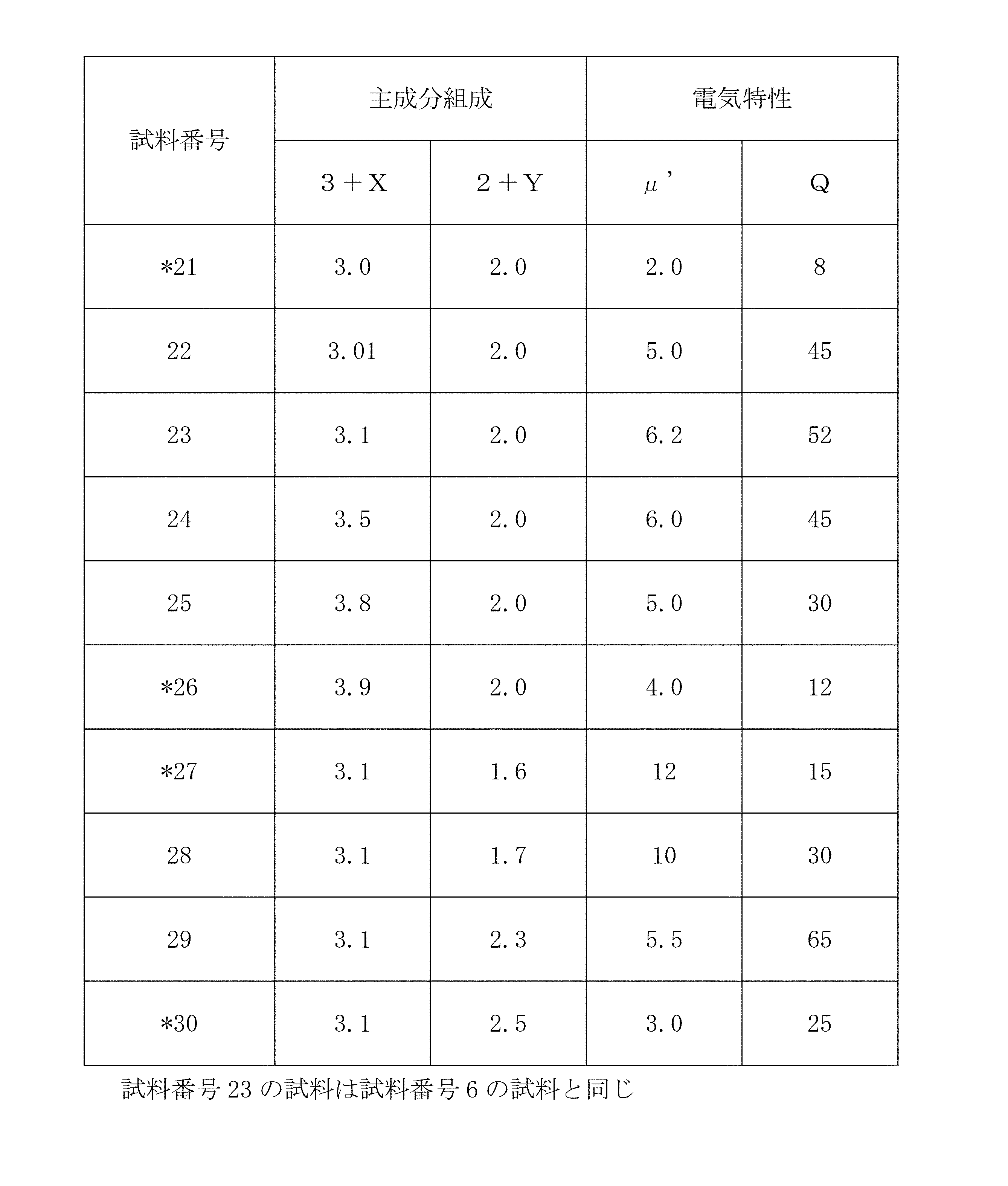
表2の試料番号21の試料のように、(3+X)が本発明の範囲を下回る試料の場合、透磁率μ’が小さく、Qも低いことが確認された。
また、表2の試料番号26の試料のように、(3+X)が本発明の範囲を超える試料の場合、透磁率μ’は少し小さい程度であるが、Qが12と低いことが確認された。
また、表2の試料番号27の試料のように、(2+Y)が本発明の範囲を下回る試料の場合、透磁率μ’は大きいが、Qが15と低いことが確認された。
また、表2の試料番号30の試料のように、(2+Y)が本発明の範囲を超える試料の場合、透磁率μ’が小さく、Qもやや低いことが確認された。
これに対し、(3+X)および(2+Y)が本発明の範囲にあり、本発明の要件を満たす試料(表2の試料番号22~25,28,29)の場合、透磁率μ’が大きく、かつ、Qも高いことが確認された。
比表面積が2~20m2/gであるBaCO3,Co3O4,CuO,ZnO,Fe2O3,Bi2O3,SiO2の原料粉末を準備し、組成式Ba3+X(Co2-Z+YMeZ)Fe24O41-δ(MeはCu、Znのうち少なくとも一種、δは酸素欠陥を表す)で表される主成分において、(3+X),(2+Y),MeおよびZを表3の値となるように秤量した以外は、実施例2と同じようにして特性評価用の試料を作製した。
なお、表3の試料番号50の試料は、主成分がBa3.1Co1.6Cu0.2Zn0.2Fe24O41-δで表されるものであり、試料番号51の試料は、主成分がBa3.1Co1.0Cu0.5Zn0.5Fe24O41-δで表されるものであることを意味する。
なお、表3の試料番号41の試料は、表1の試料番号6、表2の試料番号23の試料と同じものである。
なお、表3の試料番号41の試料は、表1の試料番号6、表2の試料番号23の試料と同じものである。
[特性の評価]
上述のようにして作製した試料について、上記実施例1の場合と同じ方法で、透磁率μ’(実部)、μ”(虚部)の測定を行った。また、各試料の透磁率μ’(実部)、μ”(虚部)の値からQ値(=μ’/μ”)を求めた。
周波数250MHzのときの透磁率μ’と、Q(=μ’/μ”)を表3に併せて示す。
上述のようにして作製した試料について、上記実施例1の場合と同じ方法で、透磁率μ’(実部)、μ”(虚部)の測定を行った。また、各試料の透磁率μ’(実部)、μ”(虚部)の値からQ値(=μ’/μ”)を求めた。
周波数250MHzのときの透磁率μ’と、Q(=μ’/μ”)を表3に併せて示す。
また、温度槽とインピーダンスアナライザを用いて、25~85℃の温度範囲におけるμ'を測定し、μ’の変化率(25℃基準)を以下の式より求めた。
Δμ'/μ'={μ’(85℃)-μ’(25℃)}/μ'(25℃)×106(ppm/℃)
上述のようにして求めたμ’の変化率(Δμ'/ μ')の値を表3に併せて示す。
Δμ'/μ'={μ’(85℃)-μ’(25℃)}/μ'(25℃)×106(ppm/℃)
上述のようにして求めたμ’の変化率(Δμ'/ μ')の値を表3に併せて示す。
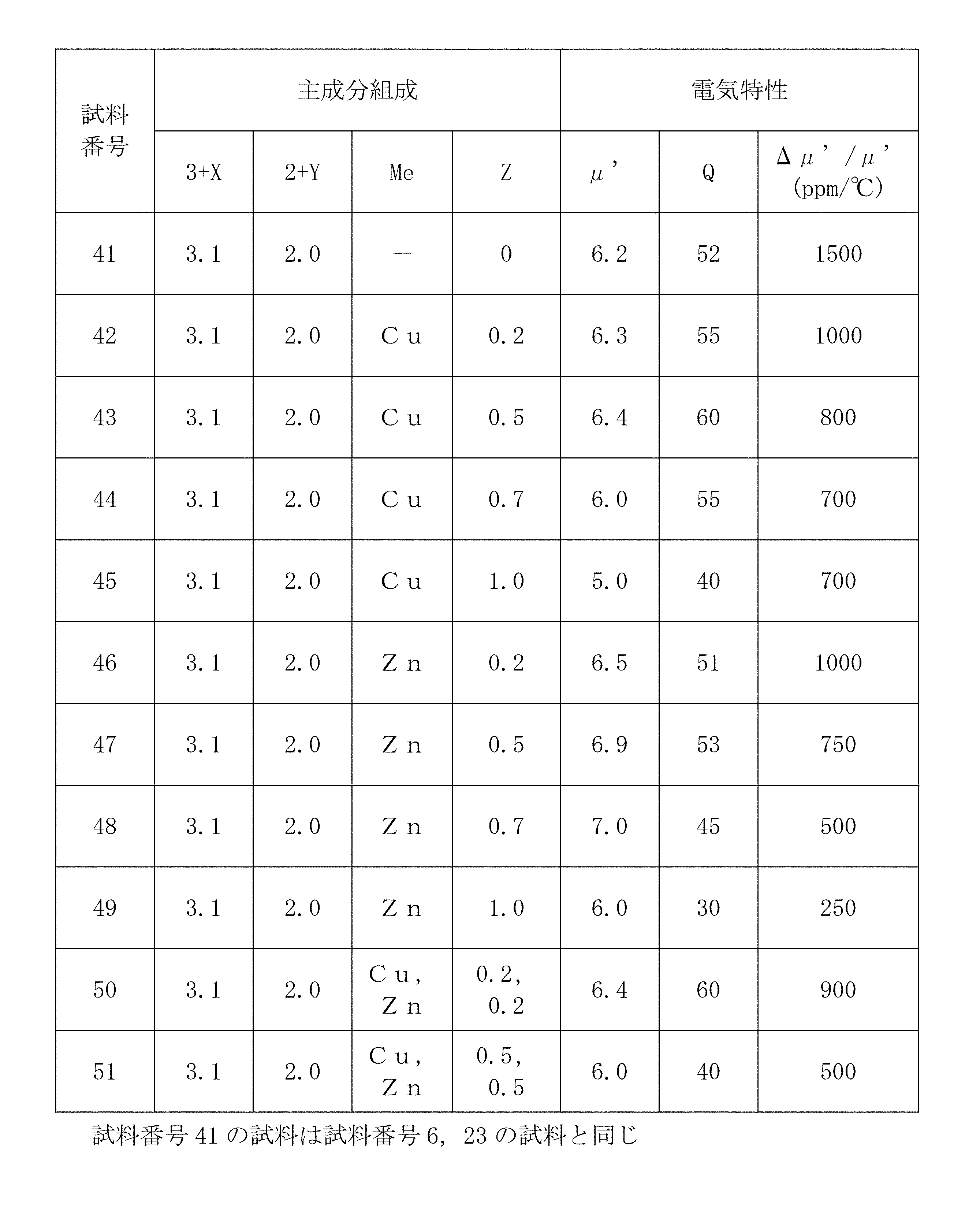
表3に示すように、CoをZ=0.2~1.0の範囲で、CuまたはZnの少なくとも一方で置換することにより、温度特性(μ’の変化率)が1000ppm/℃以下となることが確認された。
なお、CoをCuまたはZnで置換していない試料番号41の試料は、実用可能な範囲ではあるが、CoをCuまたはZnの少なくとも一方で置換した試料番号42~51の試料に比べて、温度特性が1500ppm/℃と少し大きいことが確認された。
比表面積が2~20m2/gであるBaCO3,Co3O4,CuO,ZnO,Fe2O3,Bi2O3,SiO2,ZrO2の原料粉末を準備し、主成分である、組成式Ba3.1Co2.0Fe24O41-δ、およびBa3.1(Co1.5Cu0.5)Fe24O41-δ(δは酸素欠陥を表す)で表される物質が得られるように秤量した。そして、上記主成分100重量部に対して、Bi2O3を0.5重量部の割合で配合し、さらに、ZrO2を表4の比率になるように添加して第1配合物を調製した。そして、それ以外の点においては、実施例2の場合と同じ方法で、特性評価用の試料を作製した。
なお、表4の試料番号61の試料は、表1の試料番号6、表2の試料番号23、表3の試料番号41の試料と同じものである。
また、表4の試料番号65の試料は、表3の試料番号47の試料と同じものであり、試料番号67の試料は、表3の試料番号43の試料と同じものである。
また、表4の試料番号65の試料は、表3の試料番号47の試料と同じものであり、試料番号67の試料は、表3の試料番号43の試料と同じものである。
[特性の評価]
上述のようにして作製した試料について、上記実施例1の場合と同じ方法で求めた周波数250MHzのときの透磁率μ’と、Q(=μ’/μ”)を表4に併せて示す。
上述のようにして作製した試料について、上記実施例1の場合と同じ方法で求めた周波数250MHzのときの透磁率μ’と、Q(=μ’/μ”)を表4に併せて示す。
また、上記実施例3の場合と同じ方法で調べた、μ’の変化率(Δμ'/ μ')の値を表4に併せて示す。

表4より、ZrO2を0.5重量部以下の範囲で含有させることにより、さらに温度特性を向上させる(すなわち、透磁率μ’の変化率(Δμ'/ μ')を小さくできる)ことが確認された。
なお、本発明の磁性体材料は、透磁率が大きく、高いQを有し、かつ透磁率の変化率が小さいことから、例えば、インダクタのコア部材として用いることにより、特性の良好なインダクタを得ることが可能になり、特に有意義である。
また、上記の各実施例では、SiO2を配合した後の第2配合物を成型して、焼成工程に供するようにしているが、場合によっては、第2配合物を成型せずに焼成して、粉末状の磁性体材料を得るように構成することも可能である。
また、上記の各実施例では、SiO2を配合した後の第2配合物を成型して、焼成工程に供するようにしているが、場合によっては、第2配合物を成型せずに焼成して、粉末状の磁性体材料を得るように構成することも可能である。
本発明は、さらにその他の点においても、上記実施例に限定されるものではなく、磁性体材料の製造に用いられる原料粉末の種類、製造工程における仮焼工程やその後の焼成工程における具体的な条件、本発明の磁性体材料を例えばコイル部品のコア部材として用いる場合におけるコイル部品の具体的な構造などに関し、発明の範囲内において、種々の応用、変形を加えることが可能である。
Claims (8)
- 組成式Ba3+XCo2+YFe24O41-δ(0<X≦0.8,-0.3≦Y≦0.3,δは酸素欠陥を表す)で表される主成分100重量部と、
BiをBi2O3に換算して0.1~1.0重量部と、
SiをSiO2に換算して0.1~2.0重量部と
を含有することを特徴とする磁性体材料。 - Coを1mol以下の範囲で、Cu,Znの少なくとも一種の元素で置換したことを特徴とする請求項1の磁性体材料。
- 主成分100重量部に対し、ZrをZrO2に換算して、0.5重量部以下の割合で含有することを特徴とする請求項1または2記載の磁性体材料。
- 平均結晶粒径が0.05~3.0μmであることを特徴とする請求項1~3のいずれかに記載の磁性体材料。
- 組成式Ba3+XCo2+YFe24O41-δ(δは酸素欠陥を表す)で表される主成分と、前記主成分100重量部に対し、BiをBi2O3で換算して0.1~1.0重量部の割合で配合して第1配合物を得る第1配合物調製工程と、
前記第1配合物を仮焼して仮焼物を得る仮焼工程と、
前記仮焼物に対し、前記仮焼物中の前記主成分100重量部に対し、SiをSiO2に換算して0.1~2重量部の割合で配合して第2配合物を得る第2配合物調製工程と、
前記第2配合物を焼成する焼成工程と
を備えることを特徴とする磁性体材料の製造方法。 - 組成式Ba3+XCo2+YFe24O41-δ(δは酸素欠陥を表す)で表される主成分と、前記主成分100重量部に対し、BiをBi2O3で換算して0.1~1.0重量部の割合で配合して第1配合物を得る第1配合物調製工程と、
前記第1配合物を仮焼して仮焼物を得る仮焼工程と、
前記仮焼物に対し、前記仮焼物中の前記主成分100重量部に対し、SiをSiO2に換算して0.1~2重量部の割合で配合して第2配合物を得る第2配合物調製工程と、
前記第2配合物を成型して成型体を得る成型工程と、
前記成型体を焼成する焼成工程と
を備えることを特徴とする磁性体材料の製造方法。 - 前記仮焼工程における仮焼温度を1000~1200℃とすることを特徴とする請求項5または6記載の磁性体材料の製造方法。
- 前記焼成工程における焼成温度を1050~1200℃とすることを特徴とする請求項5~7のいずれかに記載の磁性体材料の製造方法。
Priority Applications (1)
| Application Number | Priority Date | Filing Date | Title |
|---|---|---|---|
| JP2012525395A JP5440704B2 (ja) | 2010-07-23 | 2011-07-19 | 磁性体材料の製造方法 |
Applications Claiming Priority (2)
| Application Number | Priority Date | Filing Date | Title |
|---|---|---|---|
| JP2010-165882 | 2010-07-23 | ||
| JP2010165882 | 2010-07-23 |
Publications (1)
| Publication Number | Publication Date |
|---|---|
| WO2012011464A1 true WO2012011464A1 (ja) | 2012-01-26 |
Family
ID=45496884
Family Applications (1)
| Application Number | Title | Priority Date | Filing Date |
|---|---|---|---|
| PCT/JP2011/066341 Ceased WO2012011464A1 (ja) | 2010-07-23 | 2011-07-19 | 磁性体材料および磁性体材料の製造方法 |
Country Status (2)
| Country | Link |
|---|---|
| JP (1) | JP5440704B2 (ja) |
| WO (1) | WO2012011464A1 (ja) |
Cited By (2)
| Publication number | Priority date | Publication date | Assignee | Title |
|---|---|---|---|---|
| WO2014061671A1 (ja) * | 2012-10-18 | 2014-04-24 | 株式会社村田製作所 | 酸化物セラミックス、及びセラミック電子部品 |
| JP2015040152A (ja) * | 2013-08-22 | 2015-03-02 | 株式会社村田製作所 | 酸化物セラミックス、及びセラミック電子部品 |
Citations (5)
| Publication number | Priority date | Publication date | Assignee | Title |
|---|---|---|---|---|
| JPH1092624A (ja) * | 1996-07-26 | 1998-04-10 | Tdk Corp | 六方晶z型磁性酸化物焼結体、その製造方法およびインピーダンス素子 |
| JP2000235916A (ja) * | 1999-02-17 | 2000-08-29 | Nobuyuki Hiratsuka | 高周波用磁性材料 |
| JP2002362968A (ja) * | 2001-03-30 | 2002-12-18 | Tdk Corp | 六方晶フェライト焼結体の製造方法 |
| JP2004014620A (ja) * | 2002-06-04 | 2004-01-15 | Sanyo Electric Co Ltd | 酸化物磁性材料及びその製造方法 |
| WO2004097863A1 (ja) * | 2003-05-01 | 2004-11-11 | Juridical Foundation Osaka Industrial Promotion Organization | 磁性材料 |
-
2011
- 2011-07-19 JP JP2012525395A patent/JP5440704B2/ja active Active
- 2011-07-19 WO PCT/JP2011/066341 patent/WO2012011464A1/ja not_active Ceased
Patent Citations (5)
| Publication number | Priority date | Publication date | Assignee | Title |
|---|---|---|---|---|
| JPH1092624A (ja) * | 1996-07-26 | 1998-04-10 | Tdk Corp | 六方晶z型磁性酸化物焼結体、その製造方法およびインピーダンス素子 |
| JP2000235916A (ja) * | 1999-02-17 | 2000-08-29 | Nobuyuki Hiratsuka | 高周波用磁性材料 |
| JP2002362968A (ja) * | 2001-03-30 | 2002-12-18 | Tdk Corp | 六方晶フェライト焼結体の製造方法 |
| JP2004014620A (ja) * | 2002-06-04 | 2004-01-15 | Sanyo Electric Co Ltd | 酸化物磁性材料及びその製造方法 |
| WO2004097863A1 (ja) * | 2003-05-01 | 2004-11-11 | Juridical Foundation Osaka Industrial Promotion Organization | 磁性材料 |
Cited By (4)
| Publication number | Priority date | Publication date | Assignee | Title |
|---|---|---|---|---|
| WO2014061671A1 (ja) * | 2012-10-18 | 2014-04-24 | 株式会社村田製作所 | 酸化物セラミックス、及びセラミック電子部品 |
| JP5884917B2 (ja) * | 2012-10-18 | 2016-03-15 | 株式会社村田製作所 | 酸化物セラミックス、及びセラミック電子部品 |
| US9815742B2 (en) | 2012-10-18 | 2017-11-14 | Murata Manufacturing Co., Ltd. | Oxide ceramic and ceramic electronic component |
| JP2015040152A (ja) * | 2013-08-22 | 2015-03-02 | 株式会社村田製作所 | 酸化物セラミックス、及びセラミック電子部品 |
Also Published As
| Publication number | Publication date |
|---|---|
| JPWO2012011464A1 (ja) | 2013-09-09 |
| JP5440704B2 (ja) | 2014-03-12 |
Similar Documents
| Publication | Publication Date | Title |
|---|---|---|
| KR101607353B1 (ko) | 개선된 육방정계 페라이트 재료 및 그 제조 방법 및 용도 | |
| Mürbe et al. | Ni-Cu-Zn Ferrites for low temperature firing: II. Effects of powder morphology and Bi2O3 addition on microstructure and permeability | |
| KR101339613B1 (ko) | 유전체 세라믹 물질 및 관련 방법 | |
| CN112005324A (zh) | 结构化的平面m型六方晶系铁氧体及其使用方法 | |
| Dong et al. | Preparation and microwave dielectric properties of Li (Mg1–xCox) PO4 ceramics for low-temperature cofired ceramic applications | |
| CN109111229B (zh) | 一种高温烧结微波介质陶瓷材料及其制备方法 | |
| CN101037326B (zh) | 铁氧体烧结体和其制造方法 | |
| JP5728875B2 (ja) | 六方晶フェライト材料の製造方法 | |
| JP5440704B2 (ja) | 磁性体材料の製造方法 | |
| JP2003055039A (ja) | マイクロ波誘電体組成物及びその製造方法 | |
| JP5871017B2 (ja) | 磁性体材料およびそれを用いて形成したコアを備える巻線型コイル部品 | |
| JP5224495B2 (ja) | 高周波用フェライトの製造方法 | |
| JP2005272199A (ja) | 低温焼成磁器組成物およびその製造方法 | |
| CN103492346B (zh) | 介电陶瓷及具备其的介质滤波器 | |
| JP5741098B2 (ja) | 複合酸化物粉末およびその製造方法 | |
| CN110357628B (zh) | 一种Ca5Mg4-xCox(VO4)6低温烧结微波陶瓷材料及其制备方法 | |
| JP4461276B2 (ja) | 磁性粉末の製造方法 | |
| JP2010111545A (ja) | フェライト組成物及びインダクタ | |
| JP5159961B2 (ja) | 誘電体セラミックスおよびこれを用いた誘電体フィルタ | |
| JP5541475B2 (ja) | フェライト焼結体およびその製造方法並びに電子部品 | |
| JP5580961B2 (ja) | 酸化磁性材料およびその製造方法 | |
| JP2010215453A (ja) | NiCuZnフェライト | |
| JP2010120802A (ja) | チタン酸バリウム粉末の製造方法 | |
| JP2004040053A (ja) | 磁性体複合材料及び高周波フェライト材料の製造方法 | |
| JP4934947B2 (ja) | セラミック磁器組成物及びその製造方法 |
Legal Events
| Date | Code | Title | Description |
|---|---|---|---|
| 121 | Ep: the epo has been informed by wipo that ep was designated in this application |
Ref document number: 11809634 Country of ref document: EP Kind code of ref document: A1 |
|
| WWE | Wipo information: entry into national phase |
Ref document number: 2012525395 Country of ref document: JP |
|
| NENP | Non-entry into the national phase |
Ref country code: DE |
|
| 122 | Ep: pct application non-entry in european phase |
Ref document number: 11809634 Country of ref document: EP Kind code of ref document: A1 |