WO2011114692A1 - 樹脂組成物シートおよびその成形方法 - Google Patents
樹脂組成物シートおよびその成形方法 Download PDFInfo
- Publication number
- WO2011114692A1 WO2011114692A1 PCT/JP2011/001476 JP2011001476W WO2011114692A1 WO 2011114692 A1 WO2011114692 A1 WO 2011114692A1 JP 2011001476 W JP2011001476 W JP 2011001476W WO 2011114692 A1 WO2011114692 A1 WO 2011114692A1
- Authority
- WO
- WIPO (PCT)
- Prior art keywords
- resin composition
- weight
- composition sheet
- parts
- resin
- Prior art date
- Legal status (The legal status is an assumption and is not a legal conclusion. Google has not performed a legal analysis and makes no representation as to the accuracy of the status listed.)
- Ceased
Links
Images

Classifications
-
- C—CHEMISTRY; METALLURGY
- C08—ORGANIC MACROMOLECULAR COMPOUNDS; THEIR PREPARATION OR CHEMICAL WORKING-UP; COMPOSITIONS BASED THEREON
- C08L—COMPOSITIONS OF MACROMOLECULAR COMPOUNDS
- C08L69/00—Compositions of polycarbonates; Compositions of derivatives of polycarbonates
-
- B—PERFORMING OPERATIONS; TRANSPORTING
- B29—WORKING OF PLASTICS; WORKING OF SUBSTANCES IN A PLASTIC STATE IN GENERAL
- B29C—SHAPING OR JOINING OF PLASTICS; SHAPING OF MATERIAL IN A PLASTIC STATE, NOT OTHERWISE PROVIDED FOR; AFTER-TREATMENT OF THE SHAPED PRODUCTS, e.g. REPAIRING
- B29C35/00—Heating, cooling or curing, e.g. crosslinking or vulcanising; Apparatus therefor
- B29C35/02—Heating or curing, e.g. crosslinking or vulcanizing during moulding, e.g. in a mould
-
- C—CHEMISTRY; METALLURGY
- C08—ORGANIC MACROMOLECULAR COMPOUNDS; THEIR PREPARATION OR CHEMICAL WORKING-UP; COMPOSITIONS BASED THEREON
- C08J—WORKING-UP; GENERAL PROCESSES OF COMPOUNDING; AFTER-TREATMENT NOT COVERED BY SUBCLASSES C08B, C08C, C08F, C08G or C08H
- C08J5/00—Manufacture of articles or shaped materials containing macromolecular substances
- C08J5/18—Manufacture of films or sheets
-
- C—CHEMISTRY; METALLURGY
- C08—ORGANIC MACROMOLECULAR COMPOUNDS; THEIR PREPARATION OR CHEMICAL WORKING-UP; COMPOSITIONS BASED THEREON
- C08K—Use of inorganic or non-macromolecular organic substances as compounding ingredients
- C08K3/00—Use of inorganic substances as compounding ingredients
- C08K3/34—Silicon-containing compounds
-
- C—CHEMISTRY; METALLURGY
- C08—ORGANIC MACROMOLECULAR COMPOUNDS; THEIR PREPARATION OR CHEMICAL WORKING-UP; COMPOSITIONS BASED THEREON
- C08L—COMPOSITIONS OF MACROMOLECULAR COMPOUNDS
- C08L67/00—Compositions of polyesters obtained by reactions forming a carboxylic ester link in the main chain; Compositions of derivatives of such polymers
- C08L67/02—Polyesters derived from dicarboxylic acids and dihydroxy compounds
-
- B—PERFORMING OPERATIONS; TRANSPORTING
- B65—CONVEYING; PACKING; STORING; HANDLING THIN OR FILAMENTARY MATERIAL
- B65D—CONTAINERS FOR STORAGE OR TRANSPORT OF ARTICLES OR MATERIALS, e.g. BAGS, BARRELS, BOTTLES, BOXES, CANS, CARTONS, CRATES, DRUMS, JARS, TANKS, HOPPERS, FORWARDING CONTAINERS; ACCESSORIES, CLOSURES, OR FITTINGS THEREFOR; PACKAGING ELEMENTS; PACKAGES
- B65D2213/00—Safety means
- B65D2213/02—Means for preventing buil-up of electrostatic charges
-
- C—CHEMISTRY; METALLURGY
- C08—ORGANIC MACROMOLECULAR COMPOUNDS; THEIR PREPARATION OR CHEMICAL WORKING-UP; COMPOSITIONS BASED THEREON
- C08J—WORKING-UP; GENERAL PROCESSES OF COMPOUNDING; AFTER-TREATMENT NOT COVERED BY SUBCLASSES C08B, C08C, C08F, C08G or C08H
- C08J2367/00—Characterised by the use of polyesters obtained by reactions forming a carboxylic ester link in the main chain; Derivatives of such polymers
- C08J2367/02—Polyesters derived from dicarboxylic acids and dihydroxy compounds
-
- C—CHEMISTRY; METALLURGY
- C08—ORGANIC MACROMOLECULAR COMPOUNDS; THEIR PREPARATION OR CHEMICAL WORKING-UP; COMPOSITIONS BASED THEREON
- C08J—WORKING-UP; GENERAL PROCESSES OF COMPOUNDING; AFTER-TREATMENT NOT COVERED BY SUBCLASSES C08B, C08C, C08F, C08G or C08H
- C08J2369/00—Characterised by the use of polycarbonates; Derivatives of polycarbonates
-
- C—CHEMISTRY; METALLURGY
- C08—ORGANIC MACROMOLECULAR COMPOUNDS; THEIR PREPARATION OR CHEMICAL WORKING-UP; COMPOSITIONS BASED THEREON
- C08K—Use of inorganic or non-macromolecular organic substances as compounding ingredients
- C08K3/00—Use of inorganic substances as compounding ingredients
- C08K3/02—Elements
- C08K3/04—Carbon
-
- C—CHEMISTRY; METALLURGY
- C08—ORGANIC MACROMOLECULAR COMPOUNDS; THEIR PREPARATION OR CHEMICAL WORKING-UP; COMPOSITIONS BASED THEREON
- C08K—Use of inorganic or non-macromolecular organic substances as compounding ingredients
- C08K3/00—Use of inorganic substances as compounding ingredients
- C08K3/34—Silicon-containing compounds
- C08K3/36—Silica
Definitions
- the present invention relates to a resin composition sheet.
- the present invention also relates to a method for molding a resin composition sheet.
- a sheet-like material formed from a blend of an amorphous polyester resin and a polycarbonate resin has been proposed (see, for example, JP-A-2004-91691). Then, when such a sheet-like material is used for the manufacture of an article container such as a carrier tape, the molding temperature can be lowered from about 260-280 ° C. to about 200-250 ° C. Users can contribute to reducing energy consumption.
- a release film for example, Teflon (registered trademark) tape attached to a heating plate of the contact-type heating device
- Etc. Teflon (registered trademark) tape attached to a heating plate of the contact-type heating device
- An object of the present invention is to reduce the molding temperature from about 260 to 280 ° C. to about 200 to 250 ° C. in the case of being used for the production of an article container such as a carrier tape, and through a release film.
- An object of the present invention is to provide a resin composition sheet in which appearance defects due to shape transfer of a release film hardly occur even when heated at a relatively high temperature by a contact-type heating device.
- the resin composition sheet according to one aspect of the present invention contains a polycarbonate resin, an amorphous polyester resin, and a silicate compound filler.
- the molding temperature is lowered from about 260 to 280 ° C. to about 200 to 250 ° C. when the resin composition sheet is used for manufacturing an article container such as a carrier tape.
- the shape transfer of the release film is less likely to occur on the resin composition sheet. be able to.
- the silicate compound filler is added in an amount of 1 part by weight or more and 3 parts by weight or less when the total weight of the polycarbonate resin and the amorphous polyester resin is 100 parts by weight. It is preferable.
- the addition amount of the silicate compound filler is as described above, even if the resin composition sheet is heated at a relatively high temperature by a contact-type heating device via a release film, the resin composition The shape transfer of the release film can be made difficult to occur on the sheet, the appearance of the article container such as the carrier tape can be kept good, and the flexibility of the article container such as the carrier tape can be kept good. .
- the polycarbonate resin is added in an amount of 30 parts by weight or more and 80 parts by weight or less when the total weight of the polycarbonate resin and the amorphous polyester resin is 100 parts by weight. It is preferable.
- the article container such as a carrier tape obtained from the resin composition sheet sufficiently satisfies the necessary physical properties.
- the amorphous polyester resin is at least one dicarboxylic acid selected from the group consisting of units derived from terephthalic acid and units derived from terephthalic acid derivatives. It is preferably composed of an acid-derived unit and a glycol-derived unit containing less than 50 mol% of 1,4-cyclohexanedimethanol-derived unit.
- an article container such as a carrier tape obtained from the resin composition sheet exhibits excellent physical properties.
- the amorphous polyester resin is at least one dicarboxylic acid selected from the group consisting of units derived from terephthalic acid and units derived from terephthalic acid derivatives. It is preferably composed of an acid-derived unit and a glycol-derived unit containing 50 mol% or more of 1,4-cyclohexanedimethanol-derived unit.
- an article container such as a carrier tape obtained from the resin composition sheet exhibits excellent physical properties.
- the resin composition sheet according to any one of the above (1) to (5) preferably further contains conductive carbon black.
- the conductive carbon black, oil absorption is at 130 cm 3/100 g or more, and a pH of 8 or more.
- the conductive carbon black is present in the resin composition sheet in a state of being dispersed in a blend of a polycarbonate resin and an amorphous polyester resin.
- the oil absorption amount of conductive carbon black is the oil absorption amount of dibutyl phthalate (DBP) measured in accordance with JIS K6221, JIS K6217 or ASTM D2414, or measured in accordance with ASTM D2414.
- the pH value of conductive carbon black is obtained by measuring a mixed solution of conductive carbon black and distilled water with a glass electrode pH meter.
- the conductive carbon black having the above physical properties is dispersed in the resin composition sheet, not only can the conductivity be imparted to the resin composition sheet, but also the moisture absorption amount of the resin composition sheet can be kept low.
- the composition sheet is used for manufacturing an article container such as a carrier tape, the appearance of the article container is good.
- the conductive carbon black preferably has a volatile content of 0.3% by weight or less.
- the volatile content of the conductive carbon black is obtained by measuring the weight loss when the conductive carbon black is heated at 950 ° C. for 7 minutes.
- the conductive carbon black having the above physical properties is dispersed in the resin composition sheet, not only can the conductivity be imparted to the resin composition sheet, but also the moisture absorption amount of the resin composition sheet can be kept low.
- the composition sheet is used for manufacturing an article container such as a carrier tape, foaming on the surface of the resin sheet can be reduced, and the appearance of the article container can be improved.
- the conductive carbon black is 5 parts by weight or more and 25 parts by weight when the total weight of the polycarbonate resin and the amorphous polyester resin is 100 parts by weight. The following are added.
- the molding method of the resin composition sheet according to another aspect of the present invention includes a heating step and a molding step.
- the resin composition sheet is heated by contacting the above-described resin composition sheet with a heating medium via a release film.
- the resin composition sheet heated in the heating step is molded into a predetermined shape.
- a resin composition sheet is shape
- the molding temperature of the resin composition sheet can be lowered from about 260 to 280 ° C. to about 200 to 250 ° C., and the shape of the release film with respect to the resin composition sheet Transfer can be made difficult to occur.
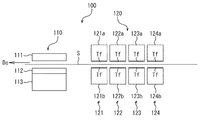
- FIG. 1 It is a typical perspective view of the carrier tape manufacturing apparatus which concerns on one Embodiment of this invention. It is a typical side view of the carrier tape manufacturing apparatus concerning one embodiment of the present invention. It is a figure which shows the corner
- FIG. 1 It is a typical perspective view of the carrier tape manufacturing apparatus which concerns on one Embodiment of this invention. It is a typical side view of the carrier tape manufacturing apparatus concerning one embodiment of the present invention. It is a figure which shows the corner
- the resin composition sheet according to the embodiment of the present invention is used for manufacturing an article container such as a carrier tape, and is mainly composed of a polycarbonate resin, an amorphous polyester resin, and a silicate compound filler.
- This resin composition sheet can also be said to be formed from a blend of a polycarbonate resin and an amorphous polyester resin to which a silicate compound filler is added.
- the surface specific resistance value of the resin composition sheet is preferably 10 2 to 10 12 ⁇ .
- polycarbonate resins examples include aromatic polycarbonate resins, aliphatic polycarbonate resins, and aromatic-aliphatic polycarbonates.
- an aromatic polycarbonate resin is suitable.
- the polycarbonate resin may be a kind of polycarbonate resin or a blend of a plurality of kinds of polycarbonate resins.
- Aromatic polycarbonate resins are derived from aromatic dihydroxy compounds.
- aromatic dihydroxy compound examples include bis (hydroxyaryl) alkanes such as 1,1-bis (4-hydroxy-t-butylphenyl) propane and 2,2-bis (4-hydroxyphenyl) propane, Bis (hydroxyaryl) cycloalkanes such as 1-bis (4-hydroxyphenyl) cyclopentane and 1,1-bis (4-hydroxyphenyl) cyclohexane, 4,4'-dihydroxydiphenyl ether, 4,4'-dihydroxy- Dihydroxyaryl ethers such as 3,3'-dimethylphenyl ether, dihydroxyaryl sulfides such as 4,4'-dihydroxydiphenyl sulfide, 4,4'-dihydroxy-3,3'-dimethylphenyl sulfide, 4,4 ' -Dihydroxydiphenylsulfoxy Dihydroxyaryl sulfoxides such as 4,4'-dihydroxy-3,3'-dimethylphenylsulfoxide, dihydroxy such as 4,4'-
- aromatic dihydroxy compounds 2,2-bis (4-hydroxyphenyl) propane (commonly known as bisphenol A) is particularly preferable. These aromatic dihydroxy compounds may be used alone or in combination of two or more.
- the aromatic polycarbonate resin is a known method, for example, a method of reacting an aromatic dihydroxy compound and a carbonate precursor, for example, an aromatic dihydroxy compound and a carbonate precursor (for example, phosgene) with an aqueous sodium hydroxide solution and methylene chloride. It can be obtained by interfacial polymerization method (for example, phosgene method) in the presence of a solvent, transesterification method (melting method), phosgene method or melting method in which an aromatic dihydroxy compound and a carbonic acid diester (for example, diphenyl carbonate) are reacted.
- the crystallized carbonate prepolymer can be produced by a method such as solid phase polymerization (Japanese Patent Application Laid-Open Nos. 1-158033, 1-271426, and 3-68627).
- Amorphous polyester resin examples include at least one dicarboxylic acid-derived unit selected from the group consisting of terephthalic acid-derived units and terephthalic acid derivative-derived units, and 1,4-cyclohexane. At least one selected from the group consisting of an amorphous polyester resin (PETG) composed of glycol-derived units containing less than 50 mol% of dimethanol-derived units, and units derived from terephthalic acid and terephthalic acid derivatives An amorphous polyester resin (PCTG) composed of a dicarboxylic acid-derived unit and a glycol-derived unit containing 50 mol% or more of a 1,4-cyclohexanedimethanol-derived unit can be used.
- PETG amorphous polyester resin
- PCTG amorphous polyester resin
- the dicarboxylic acid-derived unit of the above-described amorphous polyester resin includes an isophthalic acid-derived unit, a naphthalenedicarboxylic acid-derived unit, a diphenyldicarboxylic acid-derived unit, an adipic acid-derived unit, and sebacin as long as the gist of the present invention is not impaired.
- An acid-derived unit, trimesic acid-derived unit, trimellitic acid-derived unit, and the like may be included.
- glycol-derived units other than 1,4-cyclohexanedimethanol-derived units in the amorphous polyester resin described above examples include ethylene glycol-derived units, propylene glycol-derived units, tetramethylene glycol-derived units, and hexamethylene glycol-derived units. It is done.
- the addition amount of the amorphous polyester resin is preferably 20 parts by weight or more and 90 parts by weight or less when the total weight of the polycarbonate resin and the amorphous polyester resin is 100 parts by weight. 30 parts by weight or more and 80 parts by weight or less is more preferable, and 40 parts by weight or more and 70 parts by weight or less is more preferable.
- silicate compound filler examples include, for example, talc, mica, wollastonite, zonotlite, kaolin clay, montmorillonite, bentonite, sepiolite, imogolite, sericite, lawsonite, smectite and the like. Can be mentioned.
- the silicate compound filler may be a natural product, an artificial synthetic product, or a mixture of a natural product and an artificial synthetic product. Of the silicate compound fillers, talc and mica are most preferable. Moreover, the said silicate compound filler may be used independently and may be used in combination of 2 or more type.
- the silicate compound filler can be of any shape (plate, needle, granular, fiber, etc.), but is preferably plate or needle, and more preferably plate.
- the average particle size of the silicate compound filler is preferably from 0.1 to 500 ⁇ m, more preferably from 0.5 to 100 ⁇ m, even more preferably from 1 to 50 ⁇ m, and from 2 to 30 ⁇ m. Is more preferably 3 to 20 ⁇ m.
- the addition amount of the silicate compound filler is preferably 1 part by weight or more and 3 parts by weight or less when the total weight of the polycarbonate resin and the amorphous polyester resin is 100 parts by weight. More preferably, it is 5 parts by weight or more and 2.5 parts by weight or less.
- Conductive filler examples include carbon black and carbon fiber.
- Examples of carbon black include furnace black, channel black, ketjen black, and acetylene black.
- the furnace black for example, Timcal Co. Ensako 250G (oil absorption: 190cm 3 / 100g, pH: 8 ⁇ 11, volatiles: Up to 0.2 wt.%), Manufactured by Mitsubishi Chemical Corporation 3400 b (DBP oil absorption: 175cm 3 /100g,pH:6.2, volatiles: 1.0% by weight) and 3050B (DBP oil absorption: 175cm 3 /100g,pH:7.0, volatiles: 0.5 wt%), Tokai carbon # 4500 Co., Ltd.
- Ketjen Black EC (DBP oil absorption: 360cm 3 /100g,pH:9.0, volatiles: 0.5 wt%), and the like.
- the acetylene black for example, Denki Kagaku Denka Black Co., Ltd. (DBP oil absorption: 160cm 3 / 100g, pH: 9 ⁇ 10, volatiles: 0.16 wt%), and the like.
- carbon blacks and a DBP oil absorption 130 cm 3/100 g or more
- the carbon black the commercially available pH of 8 or more, Denki Kagaku Kogyo Denka Black Co., Ltd., Ketchen Ketjen Black EC manufactured by Chain Black International and Ensaco 250G manufactured by Timcal Co.
- carbon black having a volatile content of 0.3% by weight or less in the above-mentioned commercially available products, Denka Black manufactured by Denki Kagaku Kogyo Co., Ltd.
- the DBP oil absorption is measured in accordance with JIS K6221, JIS K6217, or ASTM D2414
- the paraffin oil absorption is measured in accordance with ASTM D2414
- the pH value is determined by conducting carbon black and distillation.
- the mixture with water is obtained by measuring with a glass electrode pH meter
- the volatile content is obtained by measuring the weight loss when the conductive carbon black is heated at 950 ° C. for 7 minutes.
- Carbon black is preferably added to a blend of a polycarbonate resin and an amorphous polyester resin after sufficiently drying.
- the amount of the conductive filler added is preferably 5 parts by weight or more and 50 parts by weight or less when the total weight of the polycarbonate resin and the amorphous polyester resin is 100 parts by weight. It is more preferably 25 parts by weight or less, and further preferably 8 parts by weight or more and 20 parts by weight or less.
- the resin composition sheet according to the present embodiment includes components other than those described above as necessary, for example, flame retardants, anti-dripping agents, dyes and pigments, heat stabilizers, ultraviolet absorbers, fluorescent enhancers. Whitening agents, lubricants, plasticizers, processing aids, dispersants, mold release agents, thickeners, antioxidants, antistatic agents and the like may be added.
- ⁇ Method for producing resin composition sheet> In the resin composition sheet according to the embodiment of the present invention, all or part of the above-described components are mixed with a premixing device such as a Banbury mixer, a tumbler, a ribbon blender, a super mixer, a gravimetric feeder, a single-screw extruder, or two After kneading and pelletizing using a melt kneader such as a screw extruder or a kneader, it can be produced using a known method such as extrusion molding or calendar molding.
- a premixing device such as a Banbury mixer, a tumbler, a ribbon blender, a super mixer, a gravimetric feeder, a single-screw extruder, or two
- the carrier tape uses a known molding method such as vacuum molding, press molding, pressure molding, or plug assist molding after the above-described resin composition sheet is heated and softened by a contact-type heating device. Can be manufactured.
- the carrier tape manufacturing apparatus 100 will be described as follows.
- the carrier tape manufacturing apparatus 100 mainly includes a contact heater 120 and a vacuum forming apparatus 110. Note that the contact heater 120 is disposed on the upstream side of the resin composition sheet feeding direction Ds of the vacuum forming apparatus 110.
- the four hot platen devices 121, 122, 123, 124 are arranged at substantially equal intervals along the resin composition sheet feeding direction Ds. Is arranged.
- the hot platen devices 121, 122, 123, and 124 are mainly composed of movable hot plates 121a, 122a, 123a, and 124a, and fixed hot plates 121b, 122b, 123b, and 124b.
- a release sheet Tf is attached to the opposing surfaces of the movable heat plates 121a, 122a, 123a, 124a and the fixed heat plates 121b, 122b, 123b, 124b.
- the four movable heating plates 121a, 122a, 123a, and 124a move toward the fixed heating plates 121b, 122b, 123b, and 124b synchronously at predetermined time intervals, and the resin composition sheet By contacting S, the resin composition sheet S is heated and softened.
- the resin composition sheet S is intermittently sent in the resin composition sheet feeding direction Ds by a distance corresponding to two hot platen apparatuses 121, 122, 123, and 124. That is, in the contact heater 120, the resin composition sheet S is heated twice by the hot platen apparatuses 121, 122, 123, and 124.
- the vacuum forming apparatus 110 mainly includes a movable mold 111, a fixed mold 112, and a pressure reducing apparatus 113.
- the movable mold 111 is provided with a protrusion (not shown), and the fixed mold 112 is provided with a recess (not shown) that fits into the protrusion of the movable mold 111.
- the decompression device 113 is provided in the lower part of the fixed mold 112, and can reduce the internal space of the recess through an opening formed in the wall of the recess of the fixed mold 112.
- the movable mold 111 moves toward the fixed mold 112 in synchronization with the movable heating plates 121a, 122a, 123a, 124a.
- pellets 80 parts by weight of polycarbonate resin (aromatic polycarbonate E-2000F manufactured by Mitsubishi Engineering Plastics), 20 parts by weight of amorphous polyester resin (PCTG) (SKYGREEN J2003 manufactured by SK Chemical Co., Ltd.), 10 carbon black parts (Ketjen black International Ketjen black EC (DBP oil absorption: 360cm 3 /100g,pH:9.0, volatiles: 0.5 wt%)) and 1 part by weight of talc (Hayashi Kasei Talcan powder PK-C) was put into a twin screw extruder with a cylinder diameter of 45 mm and kneaded to prepare pellets.
- polycarbonate resin aromatic polycarbonate E-2000F manufactured by Mitsubishi Engineering Plastics
- PCTG amorphous polyester resin
- SKYGREEN J2003 manufactured by SK Chemical Co., Ltd. 10 carbon black parts
- Ketjen black International Ketjen black EC DBP oil absorption: 360cm 3 /100g,p
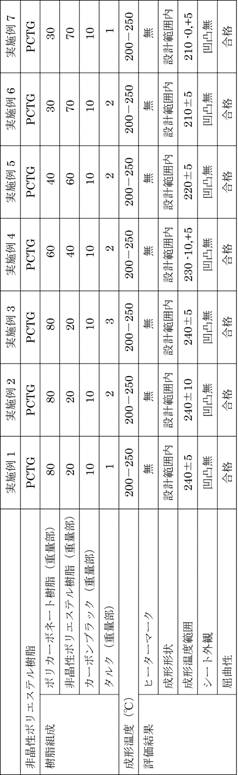
- the molding temperature range of the carrier tape obtained as described above was 240 ° C. ⁇ 5 ° C. (see Table 1).
- a carrier tape was prepared in the same manner as in Example 1 except that the amount of talc was changed to 2 parts by weight, and the molding temperature range and the carrier tape were evaluated. The evaluation results were as follows (see Table 1). -Heater mark: None-Molding shape: Within the design range-Molding temperature range: 240 ° C ⁇ 10 ° C ⁇ Appearance: No unevenness ⁇ Flexibility: Pass
- a carrier tape was prepared in the same manner as in Example 1 except that the amount of talc was changed to 3 parts by weight, and the molding temperature range and the carrier tape were evaluated. The evaluation results were as follows (see Table 1). -Heater mark: None-Molding shape: Within the design range-Molding temperature range: 240 ° C ⁇ 5 ° C ⁇ Appearance: No unevenness ⁇ Flexibility: Pass
- Example 1 except that the amount of polycarbonate resin was changed to 60 parts by weight, the amount of amorphous polyester resin (PCTG) was changed to 40 parts by weight, and the amount of talc was changed to 2 parts by weight.
- a carrier tape was prepared, and the molding temperature range and the carrier tape were evaluated. The evaluation results were as follows (see Table 1). ⁇ Heater mark: None ⁇ Molding shape: Within design range ⁇ Molding temperature range: 230 °C -10, + 5 °C ⁇ Appearance: No unevenness ⁇ Flexibility: Pass
- Example 1 except that the amount of polycarbonate resin was changed to 40 parts by weight, the amount of amorphous polyester resin (PCTG) was changed to 60 parts by weight, and the amount of talc was changed to 2 parts by weight.
- a carrier tape was prepared, and the molding temperature range and the carrier tape were evaluated. The evaluation results were as follows (see Table 1). -Heater mark: None-Molding shape: Within the design range-Molding temperature range: 220 ° C ⁇ 5 ° C ⁇ Appearance: No unevenness ⁇ Flexibility: Pass
- Example 2 The same procedure as in Example 1 was performed except that the amount of polycarbonate resin was changed to 30 parts by weight, the amount of amorphous polyester resin (PCTG) was changed to 70 parts by weight, and the amount of talc was changed to 2 parts by weight.
- a carrier tape was prepared, and the molding temperature range and the carrier tape were evaluated. The evaluation results were as follows (see Table 1). -Heater mark: None-Molding shape: Within the design range-Molding temperature range: 210 ° C ⁇ 5 ° C ⁇ Appearance: No unevenness ⁇ Flexibility: Pass
- a carrier tape was prepared in the same manner as in Example 1 except that the amount of the polycarbonate resin was changed to 30 parts by weight and the amount of the amorphous polyester resin (PCTG) was changed to 70 parts by weight.
- the carrier tape was evaluated. The evaluation results were as follows (see Table 1). ⁇ Heater mark: None ⁇ Molding shape: Within design range ⁇ Molding temperature range: 210 °C -0, + 5 °C ⁇ Appearance: No unevenness ⁇ Flexibility: Pass
- Example 1 except that the amount of polycarbonate resin was changed to 30 parts by weight, the amount of amorphous polyester resin (PCTG) was changed to 70 parts by weight, and the amount of talc was changed to 3 parts by weight.
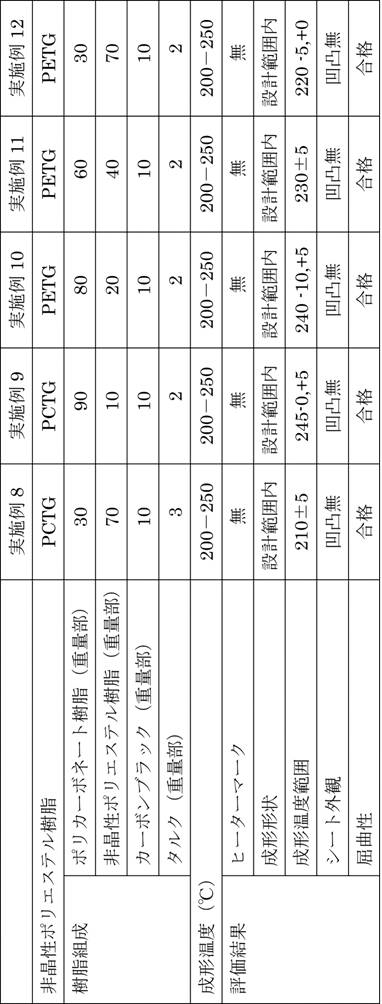
- a carrier tape was prepared, and the molding temperature range and the carrier tape were evaluated. The evaluation results were as follows (see Table 2). Heater mark: None Molding shape: Within design range Molding temperature range: 210 ° C ⁇ 5 ° C Appearance: No unevenness Flexibility: Pass
- Example 1 except that the amount of polycarbonate resin was changed to 90 parts by weight, the amount of amorphous polyester resin (PCTG) was changed to 10 parts by weight, and the amount of talc was changed to 2 parts by weight.
- a carrier tape was prepared, and the molding temperature range and the carrier tape were evaluated. The evaluation results were as follows (see Table 2). Heater mark: None Molding shape: Within design range Molding temperature range: 245 °C -0, + 5 °C Appearance: No unevenness Flexibility: Pass
- amorphous polyester resin (PCTG) was replaced with the amorphous polyester resin (PETG) (SKYGREEN K2012 manufactured by SK Chemical Co., Ltd.), and the amount of talc was changed to 2 parts by weight.
- Carrier tapes were prepared and the molding temperature range and carrier tape were evaluated. The evaluation results were as follows (see Table 2). Heater mark: None Molding shape: Within design range Molding temperature range: 240 °C -10, + 5 °C Appearance: No unevenness Flexibility: Pass
- the blending amount of the polycarbonate resin is changed to 60 parts by weight, and the amorphous polyester resin (PCTG) is replaced with the amorphous polyester resin (PETG) (SKYGREEN K2012 manufactured by SK Chemical Co., Ltd.) and the blending amount of the amorphous polyester resin is changed.
- a carrier tape was prepared in the same manner as in Example 1 except that the amount of talc was changed to 2 parts by weight instead of 40 parts by weight, and the molding temperature range and the carrier tape were evaluated. The evaluation results were as follows (see Table 2). Heater mark: None Molding shape: Within design range Molding temperature range: 230 ° C ⁇ 5 ° C Appearance: No unevenness Flexibility: Pass
- the blending amount of the polycarbonate resin is changed to 30 parts by weight, the amorphous polyester resin (PCTG) is replaced with the amorphous polyester resin (PETG) (SKYGREEN K2012 manufactured by SK Chemical Co., Ltd.) and the blending amount of the amorphous polyester resin is changed.
- a carrier tape was prepared in the same manner as in Example 1 except that the amount of talc was changed to 2 parts by weight instead of 70 parts by weight, and the molding temperature range and the carrier tape were evaluated. The evaluation results were as follows (see Table 2). Heater mark: None Molding shape: Within design range Molding temperature range: 220 ° C-5, + 0 ° C Appearance: No unevenness Flexibility: Pass
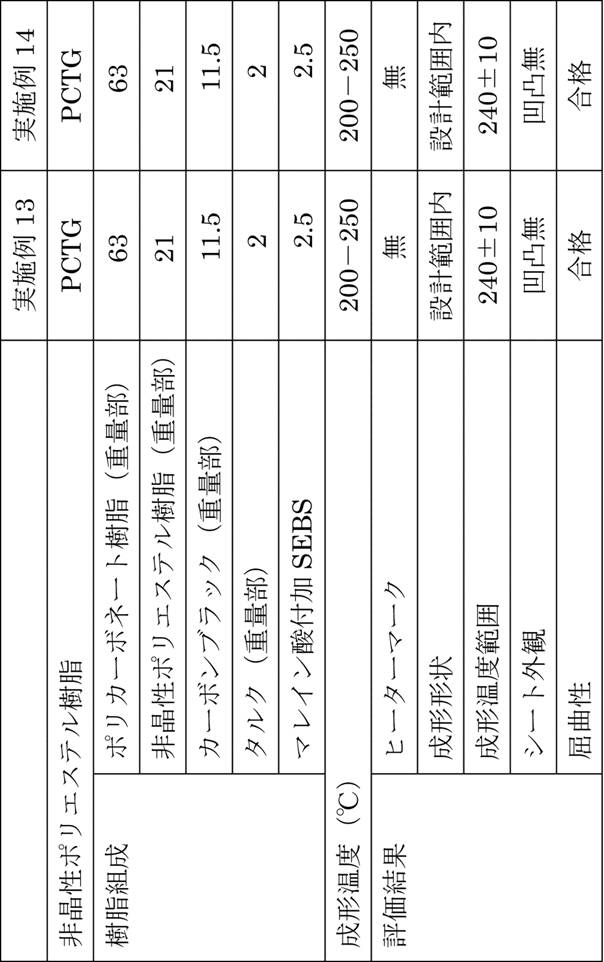
- the amount of polycarbonate resin added was changed to 63 parts by weight, the amount of amorphous polyester resin (PCTG) added was changed to 21 parts by weight, 10 parts by weight of carbon black was changed to 11.5 parts by weight of carbon black (Tescal Co., Ltd. 250G (oil absorption: 190cm 3 / 100g, pH: 8 ⁇ 11, volatiles: up to 0.2 wt%) instead), the amount of talc in place of 2 parts by weight, 2.5 parts by weight of maleic acid addition
- a carrier tape was prepared in the same manner as in Example 1 except that SEBS (Tuftec M1913 manufactured by Asahi Kasei Chemicals Corporation) was further added, and the molding temperature range and the carrier tape were evaluated. The evaluation results were as follows (see Table 3).
- -Heater mark None-Molding shape: Within the design range-Molding temperature range: 240 ° C ⁇ 10 ° C ⁇ Appearance: No unevenness ⁇ Flexibility: Pass
- a carrier tape was prepared in the same manner as in Example 1 except that SEBS (Tuftec M1913 manufactured by Asahi Kasei Chemicals Corporation) was further added, and the molding temperature range and the carrier tape were evaluated. The evaluation results were as follows (see Table 3). -Heater mark: None-Molding shape: Within the design range-Molding temperature range: 240 ° C ⁇ 10 ° C -Appearance: No unevenness-Flexibility: Pass (Comparative Example 1)
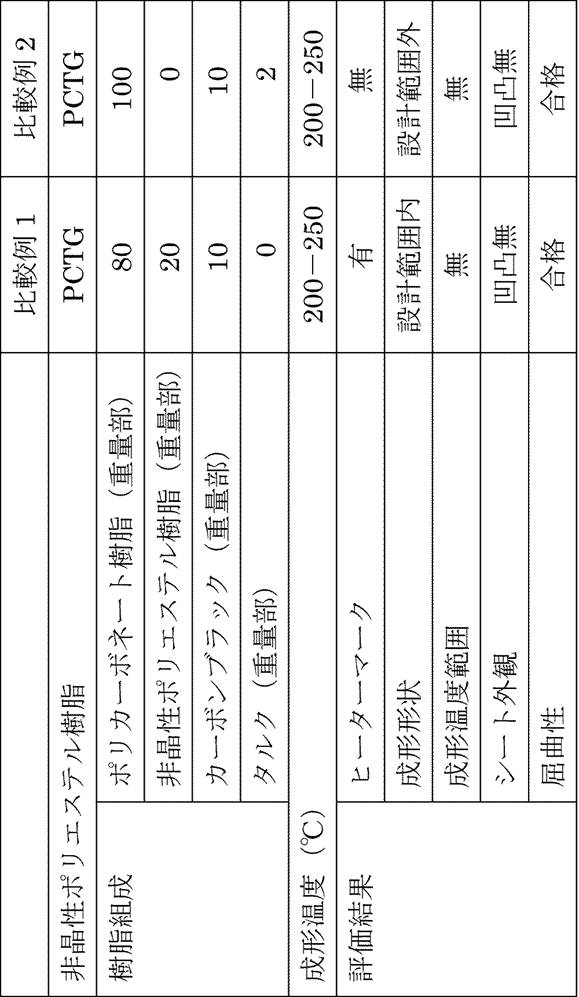
- a carrier tape was produced in the same manner as in Example 1 except that talc was not blended, and the molding temperature range and the carrier tape were evaluated. The evaluation results were as follows (see Table 4). Heater mark: Existing Molding shape: Within the design range Molding temperature range: None Appearance: No irregularities Flexibility: Pass
- Example 1 except that the amount of polycarbonate resin was changed to 100 parts by weight, the amount of amorphous polyester resin (PCTG) was changed to 0 parts by weight, and the amount of talc was changed to 2 parts by weight.
- a carrier tape was prepared, and the molding temperature range and the carrier tape were evaluated. The evaluation results were as follows (see Table 4). Heater mark: None Molding shape: Out of design range Molding temperature range: None Appearance: No unevenness Flexibility: Pass
- the resin composition sheet according to the present invention is capable of lowering the molding temperature from about 260 to 280 ° C. to about 200 to 250 ° C. when being used for the production of an article container such as a carrier tape, and releasing the mold. Even when heated at a relatively high temperature by a contact-type heating device via a film, it has the feature that it is difficult to cause the shape transfer of the release film, and in particular, a carrier tape and an injection tray It is useful as a raw material for an article container such as a vacuum forming tray or a magazine.
Landscapes
- Chemical & Material Sciences (AREA)
- Health & Medical Sciences (AREA)
- Organic Chemistry (AREA)
- Chemical Kinetics & Catalysis (AREA)
- Medicinal Chemistry (AREA)
- Polymers & Plastics (AREA)
- Manufacturing & Machinery (AREA)
- Engineering & Computer Science (AREA)
- Materials Engineering (AREA)
- Physics & Mathematics (AREA)
- Oral & Maxillofacial Surgery (AREA)
- Thermal Sciences (AREA)
- Compositions Of Macromolecular Compounds (AREA)
- Wrappers (AREA)
- Packaging Frangible Articles (AREA)
- Laminated Bodies (AREA)
Abstract
Description
本発明の一局面に係る樹脂組成物シートは、ポリカーボネート樹脂、非晶性ポリエステル樹脂およびケイ酸塩化合物フィラーを含有する。
上記(1)の局面に係る樹脂組成物シートにおいて、ケイ酸塩化合物フィラーは、ポリカーボネート樹脂および非晶性ポリエステル樹脂の合計重量を100重量部としたとき、1重量部以上3重量部以下添加されているのが好ましい。
上記(1)または(2)の局面に係る樹脂組成物シートにおいて、ポリカーボネート樹脂は、ポリカーボネート樹脂および非晶性ポリエステル樹脂の合計重量を100重量部としたとき、30重量部以上80重量部以下添加されているのが好ましい。
上記(1)から(3)のいずれかの局面に係る樹脂組成物シートにおいて、非晶性ポリエステル樹脂は、テレフタル酸由来単位およびテレフタル酸誘導体由来単位からなる群より選択される少なくとも1種のジカルボン酸由来単位と、1,4-シクロヘキサンジメタノール由来単位を50モル%未満含有するグリコール由来単位とから構成されるのが好ましい。
上記(1)から(3)のいずれかの局面に係る樹脂組成物シートにおいて、非晶性ポリエステル樹脂は、テレフタル酸由来単位およびテレフタル酸誘導体由来単位からなる群より選択される少なくとも1種のジカルボン酸由来単位と、1,4-シクロヘキサンジメタノール由来単位を50モル%以上含有するグリコール由来単位とから構成されるのが好ましい。
上記(1)から(5)のいずれかの局面に係る樹脂組成物シートは、導電性カーボンブラックをさらに含有するのが好ましい。ただし、この導電性カーボンブラックは、吸油量が130cm3/100g以上であり、pHが8以上である。なお、この導電性カーボンブラックは、ポリカーボネート樹脂と非晶性ポリエステル樹脂とのブレンド物に分散された状態で樹脂組成物シート中に存在する。また、本発明において、導電性カーボンブラックの吸油量とは、JIS K6221、JIS K6217若しくはASTM D2414に準拠して測定されるフタル酸ジブチル(DBP)の吸油量、又は、ASTM D2414に準拠して測定されるパラフィンオイルの吸油量である。また、本発明において、導電性カーボンブラックのpH値は、導電性カーボンブラックと蒸留水との混合液をガラス電極pHメーターで測定することにより得られる。
上記(6)の局面に係る樹脂組成物シートにおいて、導電性カーボンブラックは、揮発分が0.3重量%以下であるのが好ましい。なお、本発明において、導電性カーボンブラックの揮発分は、導電性カーボンブラックを950℃で7分間加熱した際の減量分を測定することによって得られる。
上記(6)または(7)の局面に係る樹脂組成物シートにおいて、導電性カーボンブラックは、ポリカーボネート樹脂および非晶性ポリエステル樹脂の合計重量を100重量部としたとき、5重量部以上25重量部以下添加されている。
本発明の他の局面に係る樹脂組成物シートの成形方法は、加熱工程および成形工程を備える。加熱工程では、上述の樹脂組成物シートに、離型フィルムを介して加熱媒体が接触されることにより樹脂組成物シートが加熱される。成形工程では、加熱工程において加熱された樹脂組成物シートが所定の形状に成形される。なお、樹脂組成物シートがキャリアテープに成形される場合、成形工程では、樹脂組成物シートに凹部が形成されることになる。
110 真空成形装置
111 可動成形型
112 固定成形型
113 減圧装置
120 接触式ヒータ装置
121~124 熱盤装置
121a~124a 可動熱盤
121b~124b 固定熱盤
Ds 樹脂組成物シート送り方向
<樹脂組成物シートの構成成分>
ポリカーボネート樹脂としては、例えば、芳香族ポリカーボネート樹脂、脂肪族ポリカーボネート樹脂、芳香族-脂肪族ポリカーボネート等が挙げられる。なお、本実施の形態では、芳香族ポリカーボネート樹脂が好適である。また、本実施の形態において、ポリカーボネート樹脂は、一種のポリカーボネート樹脂であってもよいし、複数種のポリカーボネート樹脂のブレンド物であってもよい。
芳香族ポリカーボネート樹脂は、芳香族ジヒドロキシ化合物より誘導される。
非晶性ポリエステル樹脂としては、例えば、テレフタル酸由来単位およびテレフタル酸誘導体由来単位からなる群より選択される少なくとも1種のジカルボン酸由来単位と、1,4-シクロヘキサンジメタノール由来単位を50モル%未満含有するグリコール由来単位とから構成される非晶性ポリエステル樹脂(PETG)や、テレフタル酸由来単位およびテレフタル酸誘導体由来単位からなる群より選択される少なくとも1種のジカルボン酸由来単位と、1,4-シクロヘキサンジメタノール由来単位を50モル%以上含有するグリコール由来単位とから構成される非晶性ポリエステル樹脂(PCTG)等が挙げられる。
ケイ酸塩化合物フィラーの具体例としては、例えば、タルク、マイカ、ワラストナイト、ゾノトライト、カオリンクレー、モンモリロナイト、ベントナイト、セピオライト、イモゴライト、セリサイト、ローソナイト、スメクタイト等が挙げられる。なお、ケイ酸塩化合物フィラーは、天然物であってもよいし、人工合成物であってもよいし、天然物と人工合成物との混合物であってもよい。また、上記ケイ酸塩化合物フィラーのうち、タルク、マイカが最も好ましい。また、上記ケイ酸塩化合物フィラーは、単独で使用されてもよいし、2種以上組み合わせて使用されてもよい。
導電性フィラーとしては、例えば、カーボンブラックやカーボンファイバー等が挙げられる。カーボンブラックとしては、例えば、ファーネスブラック、チャンネルブラック、ケッチェンブラック、アセチレンブラック等が挙げられる。ファーネスブラックとしては、例えば、ティムカル社製エンサコ250G(吸油量:190cm3/100g,pH:8~11,揮発分:最大0.2重量%)、三菱化学株式会社製の3400B(DBP吸油量:175cm3/100g,pH:6.2,揮発分:1.0重量%)及び3050B(DBP吸油量:175cm3/100g,pH:7.0,揮発分:0.5重量%)、東海カーボン株式会社製の#4500(DBP吸油量:168cm3/100g,pH:6.0,揮発分:0.6重量%)及び#5500(DBP吸油量:155cm3/100g,pH:6.0,揮発分:1.4重量%)並びに旭カーボン株式会社製のF200(DBP吸油量:180cm3/100g,pH:6.5,揮発分:0.7重量%)及びAX-015(DBP吸油量:147cm3/100g,pH:6.5,揮発分:1.5重量%)等が挙げられる。ケッチェンブラックとしては、例えば、ケッチェンブラックインターナショナル製のケッチェンブラックEC(DBP吸油量:360cm3/100g,pH:9.0,揮発分:0.5重量%)等が挙げられる。アセチレンブラックとしては、例えば、電気化学工業株式会社製のデンカブラック(DBP吸油量:160cm3/100g,pH:9~10,揮発分:0.16重量%)等が挙げられる。なお、これらのカーボンブラックの中でも、DBP吸油量が130cm3/100g以上であり、且つ、pHが8以上であるカーボンブラック(上記市販品の中では、電気化学工業株式会社製のデンカブラック、ケッチェンブラックインターナショナル製のケッチェンブラックEC及びティムカル社製エンサコ250Gが該当する)が特に好ましい。このようなカーボンブラックは、性質上、吸湿量が十分に低いため、特別な乾燥処理を施す必要がないからである。また、上記の中でも揮発分が0.3重量%以下であるカーボンブラック(上記市販品の中では、電気化学工業株式会社製のデンカブラック及びティムカル社製エンサコ250Gが該当する)はさらに好ましい。なお、本願において、DBP吸油量は、JIS K6221、JIS K6217又はASTM D2414に準拠して測定され、パラフィンオイル吸油量は、ASTM D2414に準拠して測定され、pH値は、導電性カーボンブラックと蒸留水との混合液をガラス電極pHメーターで測定することにより得られ、揮発分は、導電性カーボンブラックを950℃で7分間加熱した際の減量分を測定することによって得られる。また、カーボンブラックは、十分、乾燥した後に、ポリカーボネート樹脂と非晶性ポリエステル樹脂とのブレンド物に添加されるのが好ましい。
本実施の形態に係る樹脂組成物シートには、必要に応じて上記以外の成分、例えば、難燃剤、滴下防止剤、染顔料、熱安定剤、紫外線吸収剤、蛍光増白剤、滑剤、可塑剤、加工助剤、分散剤、離型剤、増粘剤、酸化防止剤、帯電防止剤などが添加されてもかまわない。
本発明の実施の形態に係る樹脂組成物シートは、上述の成分全て又は一部を、バンバリーミキサー、タンブラー、リボンブレンダー、スーパーミキサー等の予備混合装置、重量式供給機、単軸押出機や二軸押出機、コニーダー等の溶融混練装置等を用いて混練、ペレット化した後、公知の方法、例えば、押出成形やカレンダー成形などを利用して製造することができる。
本実施の形態において、キャリアテープは、上述の樹脂組成物シートを接触式加熱装置により加熱して軟化させた後、真空成形、プレス成形、圧空成形、プラグアシスト成形等の公知の成形方法を利用して製造することができる。
80重量部のポリカーボネート樹脂(三菱エンジニアリングプラスチック株式会社製芳香族ポリカーボネートE-2000F)、20重量部の非晶性ポリエステル樹脂(PCTG)(SKケミカル株式会社製SKYGREEN J2003)、10重量部のカーボンブラック(ケッチェンブラックインターナショナル製ケッチェンブラックEC(DBP吸油量:360cm3/100g,pH:9.0,揮発分:0.5重量%))および1重量部のタルク(林化成株式会社製タルカンパウダーPK-C)を、シリンダー径45mmの二軸押出機に投入して混練し、ペレットを作製した。
上述のようにして得られたペレットを、シリンダー径50mmの一軸押出機に投入して混練しながらペレットの溶融物を押出し、その溶融物を冷却しながら引取機により引き取り、300μm厚のシートを作製した。その後、そのシートを所定幅に切断してキャリアテープ原反とした。
上述の図1および図2に示されるようなキャリアテープ製造装置に、上述のキャリアテープ原反を供給して、目的のキャリアテープを製造した。なお、本実施例では、キャリアテープ原反の成形温度範囲を評価するために、接触式ヒータ装置の熱盤の設定温度を200℃から250℃まで5℃刻みで逐次、変更した。
上述のようにして得られたキャリアテープに離型シート(テフロン(登録商標)テープ)の形状(以下「ヒーターマーク」と称する)が転写されていないか否かを目視で確認したところ、キャリアテープにヒーターマークは確認されなかった(表1参照)。
上述のようにして得られたキャリアテープの凹部(収容ポケット部)の形状が設計範囲内に収まっているか否かを確認したところ、キャリアテープの凹部の形状は設計範囲内に収まっていた(表1参照)。
上述の通り、本実施例では、接触式ヒータ装置の熱盤の設定温度を、200℃から250℃まで5℃刻みで逐次、変更してキャリアテープを製造した。そして、キャリアテープにヒーターマークが付かず、凹部(収容ポケット部)の角部の形状がR0.3mm以下となった設定温度範囲を成形温度範囲とした。
上述のようにして得られたキャリアテープに許容レベル外の凹凸(発泡部分を含む)がないか否かを目視で確認したところ、キャリアテープに許容レベル外の凹凸は確認されなかった(表1参照)。
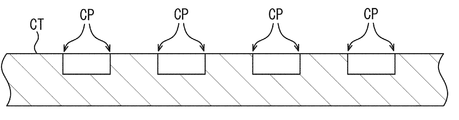
上述のようにして得られたキャリアテープCT(図3参照)の角部分CPに対して180°繰り返し曲げ試験を行い、繰り返し回数5回以上で破断したものと合格とし、繰り返し回数5回未満で破断したものを不合格とした。
・ヒーターマーク :無
・成形形状 :設計範囲内
・成形温度範囲 :240℃±10℃
・外観 :凹凸無
・屈曲性 :合格
・ヒーターマーク :無
・成形形状 :設計範囲内
・成形温度範囲 :240℃±5℃
・外観 :凹凸無
・屈曲性 :合格
なお、評価結果は以下の通りであった(表1参照)。
・ヒーターマーク :無
・成形形状 :設計範囲内
・成形温度範囲 :230℃-10,+5℃
・外観 :凹凸無
・屈曲性 :合格
なお、評価結果は以下の通りであった(表1参照)。
・ヒーターマーク :無
・成形形状 :設計範囲内
・成形温度範囲 :220℃±5℃
・外観 :凹凸無
・屈曲性 :合格
なお、評価結果は以下の通りであった(表1参照)。
・ヒーターマーク :無
・成形形状 :設計範囲内
・成形温度範囲 :210℃±5℃
・外観 :凹凸無
・屈曲性 :合格
・ヒーターマーク :無
・成形形状 :設計範囲内
・成形温度範囲 :210℃-0,+5℃
・外観 :凹凸無
・屈曲性 :合格
ヒーターマーク :無
成形形状 :設計範囲内
成形温度範囲 :210℃±5℃
外観 :凹凸無
屈曲性 :合格
なお、評価結果は以下の通りであった(表2参照)。
ヒーターマーク :無
成形形状 :設計範囲内
成形温度範囲 :245℃-0,+5℃
外観 :凹凸無
屈曲性 :合格
ヒーターマーク :無
成形形状 :設計範囲内
成形温度範囲 :240℃-10,+5℃
外観 :凹凸無
屈曲性 :合格
ヒーターマーク :無
成形形状 :設計範囲内
成形温度範囲 :230℃±5℃
外観 :凹凸無
屈曲性 :合格
ヒーターマーク :無
成形形状 :設計範囲内
成形温度範囲 :220℃-5,+0℃
外観 :凹凸無
屈曲性 :合格
・ヒーターマーク :無
・成形形状 :設計範囲内
・成形温度範囲 :240℃±10℃
・外観 :凹凸無
・屈曲性 :合格
・ヒーターマーク :無
・成形形状 :設計範囲内
・成形温度範囲 :240℃±10℃
・外観 :凹凸無
・屈曲性 :合格
(比較例1)
ヒーターマーク :有
成形形状 :設計範囲内
成形温度範囲 :無
外観 :凹凸無
屈曲性 :合格
(比較例2)
ヒーターマーク :無
成形形状 :設計範囲外
成形温度範囲 :無
外観 :凹凸無
屈曲性 :合格
Claims (9)
- ポリカーボネート樹脂と、
非晶性ポリエステル樹脂と、
ケイ酸塩化合物フィラーと
を含有する、樹脂組成物シート。 - 前記ケイ酸塩化合物フィラーは、前記ポリカーボネート樹脂および前記非晶性ポリエステル樹脂の合計重量を100重量部としたとき、1重量部以上3重量部以下添加されている
請求項1に記載の樹脂組成物シート。 - 前記ポリカーボネート樹脂は、前記ポリカーボネート樹脂および前記非晶性ポリエステル樹脂の合計重量を100重量部としたとき、30重量部以上80重量部以下添加されている
請求項1または2に記載の樹脂組成物シート。 - 前記非晶性ポリエステル樹脂は、テレフタル酸由来単位およびテレフタル酸誘導体由来単位からなる群より選択される少なくとも1種のジカルボン酸由来単位と、1,4-シクロヘキサンジメタノール由来単位を50モル%未満含有するグリコール由来単位とから構成される
請求項1から3のいずれかに記載の樹脂組成物シート。 - 前記非晶性ポリエステル樹脂は、テレフタル酸由来単位およびテレフタル酸誘導体由来単位からなる群より選択される少なくとも1種のジカルボン酸由来単位と、1,4-シクロヘキサンジメタノール由来単位を50モル%以上含有するグリコール由来単位とから構成される
請求項1から3のいずれかに記載の樹脂組成物シート。 - 吸油量が130cm3/100g以上であり、pH値が8以上である導電性カーボンブラックをさらに含有する
請求項1から5のいずれかに記載の樹脂組成物シート。 - 前記導電性カーボンブラックは、揮発分が0.3重量%以下である
請求項6に記載の樹脂組成物シート。 - 前記導電性カーボンブラックは、前記ポリカーボネート樹脂および前記非晶性ポリエステル樹脂の合計重量を100重量部としたとき、5重量部以上25重量部以下添加されている
請求項6または7に記載の樹脂組成物シート。 - 請求項1から8のいずれかに記載の樹脂組成物シートに、離型フィルムを介して加熱媒体を接触させることにより前記樹脂組成物シートを加熱する加熱工程と、
前記加熱工程において加熱された前記樹脂組成物シートを所定の形状に成形する成形工程と
を備える、樹脂組成物シートの成形方法。
Priority Applications (6)
| Application Number | Priority Date | Filing Date | Title |
|---|---|---|---|
| SG2012067583A SG184028A1 (en) | 2010-03-16 | 2011-03-14 | Resin composition sheet, and method for production thereof |
| PH1/2012/501682A PH12012501682A1 (en) | 2010-03-16 | 2011-03-14 | Resin composition sheet, and method for molding thereof |
| JP2012505500A JP5610377B2 (ja) | 2010-03-16 | 2011-03-14 | 樹脂組成物シートおよびその成形方法 |
| US13/634,702 US20130069277A1 (en) | 2010-03-16 | 2011-03-14 | Resin composition sheet and method for molding thereof |
| CN201180014392.1A CN102812085B (zh) | 2010-03-16 | 2011-03-14 | 树脂组合物片及其成形方法 |
| KR1020127020256A KR101463668B1 (ko) | 2010-03-16 | 2011-03-14 | 수지 조성물 시트 및 그 성형 방법 |
Applications Claiming Priority (2)
| Application Number | Priority Date | Filing Date | Title |
|---|---|---|---|
| JP2010-058894 | 2010-03-16 | ||
| JP2010058894 | 2010-03-16 |
Publications (1)
| Publication Number | Publication Date |
|---|---|
| WO2011114692A1 true WO2011114692A1 (ja) | 2011-09-22 |
Family
ID=44648804
Family Applications (1)
| Application Number | Title | Priority Date | Filing Date |
|---|---|---|---|
| PCT/JP2011/001476 Ceased WO2011114692A1 (ja) | 2010-03-16 | 2011-03-14 | 樹脂組成物シートおよびその成形方法 |
Country Status (9)
| Country | Link |
|---|---|
| US (1) | US20130069277A1 (ja) |
| JP (1) | JP5610377B2 (ja) |
| KR (1) | KR101463668B1 (ja) |
| CN (1) | CN102812085B (ja) |
| MY (1) | MY153955A (ja) |
| PH (1) | PH12012501682A1 (ja) |
| SG (1) | SG184028A1 (ja) |
| TW (1) | TWI488915B (ja) |
| WO (1) | WO2011114692A1 (ja) |
Cited By (4)
| Publication number | Priority date | Publication date | Assignee | Title |
|---|---|---|---|---|
| JP2013071318A (ja) * | 2011-09-28 | 2013-04-22 | Sumitomo Bakelite Co Ltd | 多層シートおよびその成形方法 |
| WO2014108867A1 (en) * | 2013-01-11 | 2014-07-17 | Sabic Innovative Plastics Ip B.V. | Polycarbonate compositions for reduced splay in combination with sustained or improved impact resistance |
| JP2016098242A (ja) * | 2014-11-18 | 2016-05-30 | 三菱エンジニアリングプラスチックス株式会社 | ポリカーボネート樹脂組成物および成形品 |
| WO2022039113A1 (ja) * | 2020-08-20 | 2022-02-24 | 住友ベークライト株式会社 | 遮光フィルム、筐体、機器および移動体 |
Families Citing this family (2)
| Publication number | Priority date | Publication date | Assignee | Title |
|---|---|---|---|---|
| DE102015101668A1 (de) * | 2015-02-05 | 2016-08-11 | Benteler Automobiltechnik Gmbh | Zweifach fallendes Heiz- und Formwerkzeug sowie Verfahren zur Herstellung warmumgeformter und pressgehärteter Kraftfahrzeugbauteile |
| US10716595B1 (en) | 2017-03-30 | 2020-07-21 | Peter Situ | Foot exfoliator |
Citations (12)
| Publication number | Priority date | Publication date | Assignee | Title |
|---|---|---|---|---|
| JP2000044779A (ja) * | 1998-08-03 | 2000-02-15 | Toray Ind Inc | 熱可塑性樹脂組成物およびそれからなるシートまたはカード |
| JP2000226507A (ja) * | 1998-12-02 | 2000-08-15 | Toray Ind Inc | シートまたはカード用熱可塑性樹脂組成物 |
| JP2000313058A (ja) * | 1999-04-30 | 2000-11-14 | Kodama Chemical Industry Co Ltd | 熱成形用シート・フィルム素材の加熱装置 |
| JP2001347614A (ja) * | 2000-04-05 | 2001-12-18 | Toray Ind Inc | 多層シートおよびそれからなるカード |
| JP2002001891A (ja) * | 2000-04-05 | 2002-01-08 | Toray Ind Inc | 多層ポリエステルシートおよびそれからなるカード |
| JP2002121365A (ja) * | 2000-10-19 | 2002-04-23 | Toray Ind Inc | 熱可塑性樹脂組成物、その製造方法、シートおよびカード |
| JP2003118059A (ja) * | 2001-10-10 | 2003-04-23 | Sumitomo Bakelite Co Ltd | カード |
| JP2003119354A (ja) * | 2001-10-10 | 2003-04-23 | Sumitomo Bakelite Co Ltd | 耐熱カード |
| JP2003118057A (ja) * | 2001-10-15 | 2003-04-23 | Sumitomo Bakelite Co Ltd | 耐熱カード |
| JP2004091691A (ja) * | 2002-09-02 | 2004-03-25 | Denki Kagaku Kogyo Kk | 樹脂組成物、シート及びその成形品 |
| JP2004255782A (ja) * | 2003-02-27 | 2004-09-16 | Sumitomo Bakelite Co Ltd | 耐熱カード |
| JP2005054179A (ja) * | 2003-07-23 | 2005-03-03 | Sumitomo Bakelite Co Ltd | カード用コアシート及びそれを用いた耐熱カード |
Family Cites Families (9)
| Publication number | Priority date | Publication date | Assignee | Title |
|---|---|---|---|---|
| JPS55120656A (en) * | 1979-03-09 | 1980-09-17 | Toray Silicone Co Ltd | Curable liquid organopolysiloxane composition |
| US4740583A (en) * | 1984-05-11 | 1988-04-26 | General Electric Company | Method for converting cyclic polycarbonate oligomer mixtures to linear polycarbonate, and composition resulting therefrom |
| MY101701A (en) * | 1986-12-23 | 1991-12-31 | Nitto Electric Ind Co | Mold-releasing sheet and method for applying mold- releasing agent onto mold surface using said sheet. |
| US4970044A (en) * | 1988-03-30 | 1990-11-13 | General Electric Company | Compression molding using insulating films |
| KR100451997B1 (ko) * | 1996-08-05 | 2004-10-08 | 도레 고세이 필름 가부시키가이샤 | 열가소성 수지 조성물, 및 그것으로 만든 시트 및 카드 |
| JPH111607A (ja) * | 1997-04-18 | 1999-01-06 | Toray Ind Inc | 熱可塑性樹脂組成物およびそれからなるシートまたはカード |
| JP3985942B2 (ja) * | 2001-10-17 | 2007-10-03 | 住友ベークライト株式会社 | エンボス付きキャリアテープの製造方法 |
| US20040211942A1 (en) * | 2003-04-28 | 2004-10-28 | Clark Darren Cameron | Electrically conductive compositions and method of manufacture thereof |
| US7985827B2 (en) * | 2005-06-17 | 2011-07-26 | Eastman Chemical Company | Polyester compositions which comprise cyclobutanediol having certain cis/trans ratios |
-
2011
- 2011-03-14 SG SG2012067583A patent/SG184028A1/en unknown
- 2011-03-14 US US13/634,702 patent/US20130069277A1/en not_active Abandoned
- 2011-03-14 PH PH1/2012/501682A patent/PH12012501682A1/en unknown
- 2011-03-14 JP JP2012505500A patent/JP5610377B2/ja not_active Expired - Fee Related
- 2011-03-14 CN CN201180014392.1A patent/CN102812085B/zh not_active Expired - Fee Related
- 2011-03-14 MY MYPI2012003551A patent/MY153955A/en unknown
- 2011-03-14 WO PCT/JP2011/001476 patent/WO2011114692A1/ja not_active Ceased
- 2011-03-14 KR KR1020127020256A patent/KR101463668B1/ko not_active Expired - Fee Related
- 2011-03-15 TW TW100108783A patent/TWI488915B/zh not_active IP Right Cessation
Patent Citations (12)
| Publication number | Priority date | Publication date | Assignee | Title |
|---|---|---|---|---|
| JP2000044779A (ja) * | 1998-08-03 | 2000-02-15 | Toray Ind Inc | 熱可塑性樹脂組成物およびそれからなるシートまたはカード |
| JP2000226507A (ja) * | 1998-12-02 | 2000-08-15 | Toray Ind Inc | シートまたはカード用熱可塑性樹脂組成物 |
| JP2000313058A (ja) * | 1999-04-30 | 2000-11-14 | Kodama Chemical Industry Co Ltd | 熱成形用シート・フィルム素材の加熱装置 |
| JP2001347614A (ja) * | 2000-04-05 | 2001-12-18 | Toray Ind Inc | 多層シートおよびそれからなるカード |
| JP2002001891A (ja) * | 2000-04-05 | 2002-01-08 | Toray Ind Inc | 多層ポリエステルシートおよびそれからなるカード |
| JP2002121365A (ja) * | 2000-10-19 | 2002-04-23 | Toray Ind Inc | 熱可塑性樹脂組成物、その製造方法、シートおよびカード |
| JP2003118059A (ja) * | 2001-10-10 | 2003-04-23 | Sumitomo Bakelite Co Ltd | カード |
| JP2003119354A (ja) * | 2001-10-10 | 2003-04-23 | Sumitomo Bakelite Co Ltd | 耐熱カード |
| JP2003118057A (ja) * | 2001-10-15 | 2003-04-23 | Sumitomo Bakelite Co Ltd | 耐熱カード |
| JP2004091691A (ja) * | 2002-09-02 | 2004-03-25 | Denki Kagaku Kogyo Kk | 樹脂組成物、シート及びその成形品 |
| JP2004255782A (ja) * | 2003-02-27 | 2004-09-16 | Sumitomo Bakelite Co Ltd | 耐熱カード |
| JP2005054179A (ja) * | 2003-07-23 | 2005-03-03 | Sumitomo Bakelite Co Ltd | カード用コアシート及びそれを用いた耐熱カード |
Cited By (9)
| Publication number | Priority date | Publication date | Assignee | Title |
|---|---|---|---|---|
| JP2013071318A (ja) * | 2011-09-28 | 2013-04-22 | Sumitomo Bakelite Co Ltd | 多層シートおよびその成形方法 |
| WO2014108867A1 (en) * | 2013-01-11 | 2014-07-17 | Sabic Innovative Plastics Ip B.V. | Polycarbonate compositions for reduced splay in combination with sustained or improved impact resistance |
| KR20150104629A (ko) * | 2013-01-11 | 2015-09-15 | 사빅 글로벌 테크놀러지스 비.브이. | 지속적 또는 개선된 내충격성과 함께 감소된 스플레이를 위한 폴리카보네이트 조성물 |
| CN104918999A (zh) * | 2013-01-11 | 2015-09-16 | 沙特基础全球技术有限公司 | 用于减小的斜削以及持续的或改进的耐冲击性的聚碳酸酯组合物 |
| CN104918999B (zh) * | 2013-01-11 | 2017-04-26 | 沙特基础全球技术有限公司 | 用于减小的斜削以及持续的或改进的耐冲击性的聚碳酸酯组合物 |
| US9790367B2 (en) | 2013-01-11 | 2017-10-17 | Sabic Global Technologies B.V. | Polycarbonate compositions for reduced splay in combination with sustained or improved impact resistance |
| KR102030581B1 (ko) | 2013-01-11 | 2019-11-18 | 사빅 글로벌 테크놀러지스 비.브이. | 지속적 또는 개선된 내충격성과 함께 감소된 스플레이를 위한 폴리카보네이트 조성물 |
| JP2016098242A (ja) * | 2014-11-18 | 2016-05-30 | 三菱エンジニアリングプラスチックス株式会社 | ポリカーボネート樹脂組成物および成形品 |
| WO2022039113A1 (ja) * | 2020-08-20 | 2022-02-24 | 住友ベークライト株式会社 | 遮光フィルム、筐体、機器および移動体 |
Also Published As
| Publication number | Publication date |
|---|---|
| JPWO2011114692A1 (ja) | 2013-06-27 |
| CN102812085B (zh) | 2015-08-05 |
| TW201139554A (en) | 2011-11-16 |
| JP5610377B2 (ja) | 2014-10-22 |
| KR101463668B1 (ko) | 2014-11-19 |
| SG184028A1 (en) | 2012-10-30 |
| TWI488915B (zh) | 2015-06-21 |
| KR20130006430A (ko) | 2013-01-16 |
| PH12012501682A1 (en) | 2015-10-09 |
| MY153955A (en) | 2015-04-20 |
| US20130069277A1 (en) | 2013-03-21 |
| CN102812085A (zh) | 2012-12-05 |
Similar Documents
| Publication | Publication Date | Title |
|---|---|---|
| JP5610377B2 (ja) | 樹脂組成物シートおよびその成形方法 | |
| CN101948614B (zh) | 由导电性树脂组合物形成的成型品 | |
| JP7400809B2 (ja) | 3次元造形用フィラメント、巻回体、及び3次元プリンター用カートリッジ | |
| JP4907899B2 (ja) | カーボンナノチューブを含有する樹脂組成物、およびカーボンナノチューブ配合用濃縮物 | |
| JP2009197056A (ja) | 導電性樹脂成形用材料 | |
| US20140356579A1 (en) | Polycarbonate-Based Resin Composition for Carrier Tape Having Excellent Electric Conductivity | |
| US20190283381A1 (en) | Multilayer Sheet for Thermoforming Having Improved Sagging Resistance | |
| JPH0668069B2 (ja) | カーボン含有成形体の製造方法 | |
| KR101170533B1 (ko) | 폴리카보네이트 난연 필름용 수지 조성물, 이를 이용한 폴리카보네이트 난연 필름 제조 방법 및 그 방법에 의해 제조된 폴리카보네이트 난연 필름 | |
| KR20180078908A (ko) | 폴리카보네이트 수지 조성물 및 이로부터 형성된 성형품 | |
| JP5831097B2 (ja) | 多層シートおよびその成形方法 | |
| JP6526988B2 (ja) | ポリアリーレンスルフィド樹脂組成物 | |
| JPH07286103A (ja) | 導電性樹脂マスターバッチペレット及び導電性熱可塑性樹脂製品 | |
| KR20140105119A (ko) | 전기전도성 및 내충격성이 우수한 열가소성 수지조성물 | |
| JPS60137960A (ja) | 熱可塑性ポリカ−ボネ−ト−ポリスルホンカ−ボネ−ト成形用組成物 | |
| HK1175489A (en) | Resin composition sheet, and method for production thereof | |
| KR102018716B1 (ko) | 수지 조성물 및 이로부터 제조된 성형품 | |
| WO2019181828A1 (ja) | 導電性樹脂組成物及びその製造方法 | |
| JP4592273B2 (ja) | 難燃性樹脂組成物及び成形体 | |
| JP3790742B2 (ja) | 導電性ポリカーボネート樹脂組成物及びそれからなる成形品 | |
| JP2574076B2 (ja) | 導電性熱可塑性樹脂組成物 | |
| CN103183878A (zh) | 耐磨损性突出的永久性抗静电苯乙烯类树脂复合物 | |
| JP3288552B2 (ja) | 導電性樹脂組成物の製造方法 | |
| JP4300822B2 (ja) | 導電性樹脂組成物 | |
| JP2005171183A (ja) | 導電性樹脂組成物 |
Legal Events
| Date | Code | Title | Description |
|---|---|---|---|
| WWE | Wipo information: entry into national phase |
Ref document number: 201180014392.1 Country of ref document: CN |
|
| 121 | Ep: the epo has been informed by wipo that ep was designated in this application |
Ref document number: 11755883 Country of ref document: EP Kind code of ref document: A1 |
|
| WWE | Wipo information: entry into national phase |
Ref document number: 2012505500 Country of ref document: JP |
|
| ENP | Entry into the national phase |
Ref document number: 20127020256 Country of ref document: KR Kind code of ref document: A |
|
| WWE | Wipo information: entry into national phase |
Ref document number: 12012501682 Country of ref document: PH |
|
| WWE | Wipo information: entry into national phase |
Ref document number: 13634702 Country of ref document: US |
|
| WWE | Wipo information: entry into national phase |
Ref document number: 1201004746 Country of ref document: TH |
|
| NENP | Non-entry into the national phase |
Ref country code: DE |
|
| 122 | Ep: pct application non-entry in european phase |
Ref document number: 11755883 Country of ref document: EP Kind code of ref document: A1 |