WO2011099192A1 - アクセス制御システム、アクセス制御方法およびサーバ - Google Patents
アクセス制御システム、アクセス制御方法およびサーバ Download PDFInfo
- Publication number
- WO2011099192A1 WO2011099192A1 PCT/JP2010/065937 JP2010065937W WO2011099192A1 WO 2011099192 A1 WO2011099192 A1 WO 2011099192A1 JP 2010065937 W JP2010065937 W JP 2010065937W WO 2011099192 A1 WO2011099192 A1 WO 2011099192A1
- Authority
- WO
- WIPO (PCT)
- Prior art keywords
- user
- access
- contact
- virtual
- server
- Prior art date
- Legal status (The legal status is an assumption and is not a legal conclusion. Google has not performed a legal analysis and makes no representation as to the accuracy of the status listed.)
- Ceased
Links
Images


















Classifications
-
- G—PHYSICS
- G06—COMPUTING OR CALCULATING; COUNTING
- G06Q—INFORMATION AND COMMUNICATION TECHNOLOGY [ICT] SPECIALLY ADAPTED FOR ADMINISTRATIVE, COMMERCIAL, FINANCIAL, MANAGERIAL OR SUPERVISORY PURPOSES; SYSTEMS OR METHODS SPECIALLY ADAPTED FOR ADMINISTRATIVE, COMMERCIAL, FINANCIAL, MANAGERIAL OR SUPERVISORY PURPOSES, NOT OTHERWISE PROVIDED FOR
- G06Q10/00—Administration; Management
- G06Q10/10—Office automation; Time management
-
- H—ELECTRICITY
- H04—ELECTRIC COMMUNICATION TECHNIQUE
- H04L—TRANSMISSION OF DIGITAL INFORMATION, e.g. TELEGRAPHIC COMMUNICATION
- H04L67/00—Network arrangements or protocols for supporting network services or applications
- H04L67/01—Protocols
- H04L67/131—Protocols for games, networked simulations or virtual reality
-
- G—PHYSICS
- G06—COMPUTING OR CALCULATING; COUNTING
- G06Q—INFORMATION AND COMMUNICATION TECHNOLOGY [ICT] SPECIALLY ADAPTED FOR ADMINISTRATIVE, COMMERCIAL, FINANCIAL, MANAGERIAL OR SUPERVISORY PURPOSES; SYSTEMS OR METHODS SPECIALLY ADAPTED FOR ADMINISTRATIVE, COMMERCIAL, FINANCIAL, MANAGERIAL OR SUPERVISORY PURPOSES, NOT OTHERWISE PROVIDED FOR
- G06Q30/00—Commerce
- G06Q30/02—Marketing; Price estimation or determination; Fundraising
- G06Q30/0241—Advertisements
-
- H—ELECTRICITY
- H04—ELECTRIC COMMUNICATION TECHNIQUE
- H04L—TRANSMISSION OF DIGITAL INFORMATION, e.g. TELEGRAPHIC COMMUNICATION
- H04L63/00—Network architectures or network communication protocols for network security
- H04L63/10—Network architectures or network communication protocols for network security for controlling access to devices or network resources
- H04L63/107—Network architectures or network communication protocols for network security for controlling access to devices or network resources wherein the security policies are location-dependent, e.g. entities privileges depend on current location or allowing specific operations only from locally connected terminals
-
- H—ELECTRICITY
- H04—ELECTRIC COMMUNICATION TECHNIQUE
- H04L—TRANSMISSION OF DIGITAL INFORMATION, e.g. TELEGRAPHIC COMMUNICATION
- H04L67/00—Network arrangements or protocols for supporting network services or applications
- H04L67/14—Session management
- H04L67/141—Setup of application sessions
-
- H—ELECTRICITY
- H04—ELECTRIC COMMUNICATION TECHNIQUE
- H04W—WIRELESS COMMUNICATION NETWORKS
- H04W12/00—Security arrangements; Authentication; Protecting privacy or anonymity
- H04W12/08—Access security
- H04W12/084—Access security using delegated authorisation, e.g. open authorisation [OAuth] protocol
-
- H—ELECTRICITY
- H04—ELECTRIC COMMUNICATION TECHNIQUE
- H04W—WIRELESS COMMUNICATION NETWORKS
- H04W4/00—Services specially adapted for wireless communication networks; Facilities therefor
- H04W4/02—Services making use of location information
- H04W4/021—Services related to particular areas, e.g. point of interest [POI] services, venue services or geofences
Definitions
- the present invention can be used when, for example, persons who meet for the first time can contact each other, or attendees who attend an event such as an exhibition or concert venue and the organizer or attendees
- the present invention relates to an access control system, an access control method, and a server for making contact possible without revealing personal information as much as possible when making contact later.
- the present invention relates to an access control system, an access control method, and a server used when accessing a specific access target via a network by operating a user terminal operated by a user.
- a method that allows people to meet each other for the first time after meeting each other, or attendees who attended events such as exhibitions and concert venues and organizers or attendees later contact each other As a method for making it possible to do so, for example, in a state where it is possible to contact the other party by informing the other party of the e-mail address or phone number of his / her mobile phone. It is a conventional method that is called “state”. Then, a mobile phone has been proposed in which the e-mail address of the other party that has been acquired can be stored in the address book of his / her mobile phone and displayed in a list according to the user's operation (for example, Patent Document 1).
- Patent Document 1 Japanese Patent No. 4256374
- Patent Document 1 Japanese Patent No. 4256374
- the ideal state of contact is that contact can be made later without notifying each other's personal information, and someone other than the other party impersonates the other party. This is a state where inconvenience can be prevented.
- the positions of mobile phones of people in the real world are measured by GPS or the like, and their avatars are displayed at the positions of the virtual world corresponding to the measured positions.
- This avatar preferably has an agent function.
- the avatar corresponding to the real world person can act as a pipe that connects the virtual world and the real world, and exchange between the virtual world and the real world is possible.
- a place can be moved instantaneously, so that the user can instantly move to a desired place and contact a person at that place.
- the present invention has been conceived in view of such circumstances, and an object of the present invention is to provide an access control system and an access control method capable of providing means for constructing the above-described ideal accessible state. is there.
- the present invention relates to specific persons (for example, users who have met in the real world, users who have met in the virtual world, real worlds, etc.) via a network by operating a user terminal (for example, the mobile phone 2) operated by the user.
- the access control system that is used when contacts between the users and the users who entered the virtual world, event organizers and event participants)
- a predetermined geographical area for example, in the real world, within the range where infrared communication by the mobile phone 2 is possible, within the communicable area between the wireless LAN 7 and the mobile phone 2 that covers the event venue as a communicable area, in the virtual world
- the avatar (agent) of the user who entered the virtual world and the current position of the user in the real world within the area where the avatar (agent) of each user who entered has been able to talk to each other (for example, within 10 meters) or within the virtual event venue Confirm that the person who is in a conversational area (for example, within 10 meters) with the user's avatar (agent) displayed
- the confirmation generated by the confirmation unit is confirmed (for example, the sharing generated through S15, S16, S16a to S16d)
- Virtual tags that are displayed only to those who have agreed on (provided that an access request to the shared virtual tag in S85 based on an access operation to the shared virtual tag has been sent)
- Access control means for example, S86, S87, S91 for permitting access to the shared page for contact.
- the user moves in a digitalized virtual space corresponding to a landscape of the real world (for example, the real world shown in the upper half of FIGS. 1 and 2) (for example, FIG. 1, the virtual world shown in the lower half of Fig. 2)
- the confirmation means enters the virtual space and within a predetermined geographical area in the virtual space (for example, within an area where conversations between avatars (agents) of users who have entered the virtual world are possible (for example, a range of 10 meters) )
- a predetermined geographical area in the virtual space for example, within an area where conversations between avatars (agents) of users who have entered the virtual world are possible (for example, a range of 10 meters)
- In-virtual area confirmation function for example, avatar of a user who has entered the virtual world (agent) to confirm that consent has been obtained for enabling contact between persons in a conversation area (for example, within 10 meters) ) And avatars (agents) And also in the real world of the user, also has a determining S15, S16, S16a ⁇ S16d) whether a geographic area.
- contact between persons who entered the virtual space can be made later without contacting the other person with personal information in order to make contact with the other party.
- the confirmation means includes a person who enters the virtual space and is in a predetermined geographical area in the virtual space, and a predetermined geographical area in the real world corresponding to the predetermined geographical area in the virtual space.
- a virtual inter-realistic confirmation function that confirms that an agreement has been made with a person who is in a contactable state (for example, the avatar (agent) of a user who has entered the virtual world and the current position of the user in the real world) S15, S16, and S16a to S16d) that also determine whether or not the user's avatar (agent) displayed at the corresponding virtual world position is within a conversational area (for example, within a range of 10 meters).
- the confirmation means includes A contact consent signal indicating that the consent transmitted in accordance with the operation of the user terminal has been obtained (for example, the transmission signal in which the variable shared virtual tag ID of the other party's agreed party received by infrared communication in S3 is transmitted in S9.
- In-area determination means for example, S16, S16a to S16d for determining that the position at the time of consent of the user who has obtained the consent is within the predetermined geographical area, The consent of the person in the predetermined geographical area, provided that it is determined by the in-area determination means that it is located within the predetermined geographical area (for example, if YES is determined in S16d) (For example, it is confirmed that the agreement has been obtained by determining YES in S16d, and the process proceeds to the shared virtual tag generation processing in and after S17).
- In-area determination means for example, S16, S16a to S16d
- the consent of the person in the predetermined geographical area is obtained on the condition that the position at the time of the consent of the user who has given the consent is determined to be within the predetermined geographical area. Therefore, more reliable confirmation is possible, and for example, contact due to impersonation can be prevented as much as possible.
- the in-area determination means is Position information acquisition means (for example, S16a, S16c) for acquiring position information of the user terminal; Determination means (for example, S16d) for determining whether or not the user terminal is located in the predetermined geographical area based on the position information acquired by the position information acquisition means, On the condition that the determination means determines that the user terminal is located within the predetermined geographical area (for example, on the condition that YES is determined in S16d), the position of the user terminal at the consent point is the predetermined geographical area. It is determined that it is in the area (for example, by determining YES in S16d, it is determined that the position at the time of consent is within the predetermined geographical area, and the process proceeds to the shared virtual tag generation processing in S17 and thereafter. To do).
- Position information acquisition means for example, S16a, S16c
- Determination means for example, S16d
- the position of the user terminal at the consent point is the predetermined geographical area. It is determined that it is in the area (for example
- the position information of the user terminal is acquired, and it is determined whether or not the user terminal is located within a predetermined geographical area based on the position information. Based on a reliable determination of whether or not it is located within a specific area, confirmation is made that the consent of a person within a given geographical area has been obtained, so a more reliable confirmation is possible, for example, impersonation Can be prevented as much as possible.
- the user terminal has a communication function within a limited range (for example, infrared communication between the mobile phones 2 and wireless communication using the wireless LAN access point 7) capable of communicating only within the range of the predetermined geographical area.
- the in-area determination means includes communication information (for example, variable shared virtual tag ID) from the user terminal communicated by the communication function within the limited range in the contact consent signal received by the consent signal receiving means.
- the user terminal's point-in-time position is within the predetermined geographical area.
- the process of S10 is executed and the processes after S17 are executed).
- the user terminal is provided on the condition that the communication information from the user terminal communicated by the communication function within the limited range that can be communicated only within the range of the predetermined geographical area is included.
- the position at the time of consent is determined to be within a predetermined geographical area, and it is confirmed that the consent of the person in the predetermined geographical area has been obtained by a relatively simple and simple determination method. For example, contact due to impersonation can be prevented as much as possible.
- the confirmation by the confirmation means has been confirmed (for example, a shared virtual tag generated through S15, S16, S16a to S16d and displayed only to those who have agreed.
- an access request to the shared virtual tag is sent in S85 based on an access operation to the shared virtual tag that is not performed
- a predetermined geography in the digitalized virtual space corresponding to the real world landscape Access point generation means for example, S17 to S19 or S17, S200
- an access point for example, a shared virtual tag dedicated to the agreed party, which is accessed for contact between the agreed parties in the target area , S201, S18, S19
- the access point generated by the access point generating means is dedicated to the person who made the access request
- the generated access point (for example, the shared virtual tag corresponding to the user ID transmitted in S81) is displayed to the access requester together with the video of the virtual space
- the access point generated exclusively for the person who made the access request is displayed to the access requester together with the video of the virtual space corresponding to the geographical position where the access point is generated. Even without knowing the personal information of the contact partner, the memory of the partner can be revived from the video in the virtual space corresponding to the geographical location.
- the confirmation means confirms that an agreement has been obtained for enabling contact between the event organizer side and the participants in the event (for example, a shared virtual tag for business use).
- the confirmation means confirms that an agreement has been obtained for enabling contact between the event organizer side and the participants in the event (for example, a shared virtual tag for business use).
- S15, S16, S16a to S16d In the generation process, S15, S16, S16a to S16d).
- Another aspect of the present invention is that specific users (for example, users who met in the real world, users who have met in the virtual world) via a network by operating a user terminal (for example, the mobile phone 2) operated by the user.
- An access control system used when contacts between the real world user and the user who entered the virtual world, event organizers and event participants)
- a predetermined geographical area for example, in the real world, within the range where infrared communication by the mobile phone 2 is possible, within the communicable area between the wireless LAN 7 and the mobile phone 2 that covers the event venue as a communicable area, in the virtual world
- the avatar (agent) of the user who entered the virtual world and the current position of the user in the real world within the area where the avatar (agent) of each user who entered has been able to talk to each other (for example, within 10 meters) or within the virtual event venue Confirm that the person who is in a conversational area (for example, within 10 meters) with the user's avatar (agent) displayed at the virtual world position
- In-area determination means for example, S16, S16a to S16d for determining that the position at the time of consent of the user who has obtained the consent is within the predetermined geographical area, The consent of the person in the predetermined geographical area, provided that it is determined by the in-area determination means that it is located within the predetermined geographical area (for example, if YES is determined in S16d) (For example, it is confirmed that the agreement has been obtained by determining YES in S16d, and the process proceeds to the shared virtual tag generation processing in and after S17).
- In-area determination means for example, S16, S16a to S16d
- Another aspect of the present invention is that specific users (for example, users who met in the real world, users who have met in the virtual world) via a network by operating a user terminal (for example, the mobile phone 2) operated by the user.
- the access control method used when contacts between the real world user and the user who entered the virtual world, event organizers and event participants) within a predetermined geographical area (for example, in the real world, within the range where infrared communication by the mobile phone 2 is possible, within the communicable area between the wireless LAN 7 and the mobile phone 2 that covers the event venue as a communicable area, in the virtual world
- the avatar (agent) of the user who entered the virtual world and the current position of the user in the real world within the area where the avatar (agent) of each user who entered has been able to talk to each other (for example, within 10 meters) or within the virtual event venue Confirm that the person who is in a conversational area (for example, within 10 meters) with the user's avatar (agent) displayed at the virtual world position
- a shared page generating means for example, S91, S437) for generating a contact shared page for contact (for example, a web page corresponding to a shared virtual tag, a business shared virtual tag, or a community virtual tag);
- Position information storage means for example, user database 11 and user four-dimensional coordinate database 11a for storing position information of the user terminal;
- the access request receiving means (S81 and S90) for receiving an access request to the contact shared page (for example, a web page corresponding to a shared virtual tag, a business shared virtual tag, or a community virtual tag).
- the shared page generating means generates a shared page regarding an event (for example, total solar eclipse, tornado, guerrilla live) that occurred in a predetermined geographical area in a predetermined time zone (for example, S410 to S416, S421 to S423, S437)
- the location information storage means stores a history of location information of the user terminal that changes over time (for example, location information x, y, z along the time axis w is stored in the user four-dimensional coordinate database 11a according to S30 to S32).
- the access control means searches for the location information stored in the location information storage means, so that the user terminal that requested the access occurred in a time zone when an event relating to the contact shared page to be accessed occurred. It is determined whether or not it exists in the selected geographical area, and access control to the contact shared page is performed according to the determination result (for example, S433 to S436).
- the access control to the shared page regarding the event depends on whether or not there is a user terminal requesting access to the generated geographical area in the time zone when the event occurred. To do so, it is possible to make a difference in access restrictions between users who have encountered an event and those who have not, such as a community area limited to users who have encountered a shared page.
- Another aspect of the present invention is a server (for example, server 10) used when specific persons contact each other via a network,
- An interface unit for example, interface 58 for inputting / outputting signals to / from the outside;
- a processing unit for example, CPU 50 for performing processing using data stored in a storage unit (for example, user database 11, user four-dimensional coordinate database 11a),
- the processor is
- a contact shared page for contact (for example, a web page corresponding to a shared virtual tag, a business shared virtual tag, a community virtual tag, etc.) is generated (for example, S91, S437), Storing the location information of the user terminal in the storage unit (for example, S30 to S32);
- the interface unit receiveives data transmitted in S81 and S90, S432
- the user terminal that requested the access has a predetermined position.
- the access control to the contact shared page is performed in accordance with whether or not it is present (for example, S86, S87, S91, S
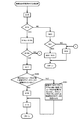
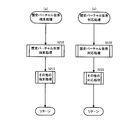
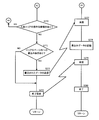
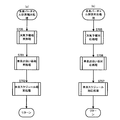
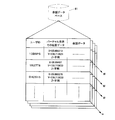
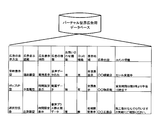
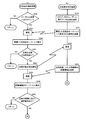
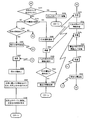
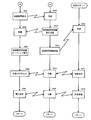
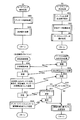
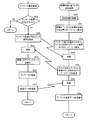
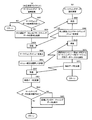
- FIG. 1 is a system diagram showing an overall configuration of an access control system. It is a figure which shows the memory data of a user database. It is a block diagram which shows the control circuit of a mobile telephone. It is a block diagram which shows the control circuit of a server. It is a flowchart which shows the production
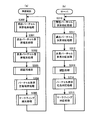
- FIG. 6 is a flowchart showing a subroutine program for contract authentication request processing and contract authentication processing on the server side corresponding thereto. It is a flowchart which shows the subroutine program of DRM request processing and DRM processing. It is a flowchart which shows the specific control content of a content reproduction
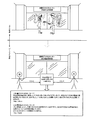
- FIG. 1 shows an example of constructing a contactable state when people meet in the real world.
- This shared virtual tag is a tag that is created and displayed at a location in the virtual world that corresponds to the location where both people meet. It can be contacted.
- This virtual world is a digitalized metaverse that corresponds to the real world landscape. As described above, for example, Google Street View is used. Alternatively, instead of using an existing one, it may be a newly created digital image imitating the real world landscape.
- FIG. 1 shows that the shared virtual tag was created at 14:03 on October 15, 2009.
- FIG. 2 shows an example in which a shared virtual tag is generated by contacting a person in the real world from the virtual world.
- the virtual world it is possible to move instantaneously to a desired place.
- the travel destination is accessed in advance from the virtual world, and the local residents are contacted to collect local raw information.
- Others you later realize that you left something in a school classroom, and immediately go to the location corresponding to that classroom in the virtual world, and then contact people in the classroom in the real world, For example, you may have a temporary deposit and contact you later.
- a particularly important situation is when an emergency such as a disaster occurs.
- FIG. 2 shows an example in which assistance is provided by rushing from the virtual world to a disaster-stricken area.
- FIG. 2 shows a state in which Mr. D who sees the earthquake news uses his mobile phone to access the earthquake occurrence area in the virtual world.
- the avatar C of the resident is displayed at the position of the virtual world corresponding to the current location specified by the GPS function or the like.
- the avatar C is composed of an agent that is independent and has a certain level of conversation ability.
- Mr. D who has accessed the virtual world corresponding to the earthquake-stricken area has a conversation with the avatar C displayed at that location and creates a virtual tag.
- the avatar C that has received this proposal notifies the corresponding mobile phone 2 of that person.
- Mr. C who is the owner of the notified mobile phone agrees with it and notifies the avatar C of an instruction to that effect.
- Mr. D is informed that Avatar C has agreed, and a shared virtual tag between Mr. C and Mr. D is created at that location in the virtual world.
- Mr. D and Mr. C can exchange information as shown in FIG. Efficient relief can be performed.
- the shared virtual tag with a voice virtual tag, which will be described later, the user can leave a message in the tag by voice from a mobile phone, which is effective as an emergency message input method.
- FIG. 3 is a system diagram showing the overall configuration of the human connection support system of the present invention.
- the mobile phone 2 receives GPS (Global Positioning System) information from the satellite 1, and the radio wave from the base station 3 connected to the mobile phone network 4 and the radio wave from the wireless LAN (Local Area Network) access point 7. Is received by the mobile phone 2. Based on these radio waves, the mobile phone 2 identifies the current position.
- the mobile phone 2 is configured to be accessible to the server 10 of the service provider 8 via the base station 3, the mobile phone network 4, the gateway 5, and the Internet 6.
- the service provider 8 is a supplier that provides a service that supports the connection of people.
- the user who is the owner of the mobile phone 2 is a member of the service of the service provider 8, and a user ID is set at the time of the member.
- the service provider 8 is provided with a server 10, a user database 11 that stores data of affiliated users, and a virtual tag database 9 that stores virtual tag data.
- the virtual world provider 20 connected to the Internet 6 is a service provider that provides images of the virtual world (Metabars), which is a 360-degree panoramic image of any place in the real world.
- a virtual world database 22 is connected to the server 21 of the virtual world provider 20.
- the virtual world database 22 stores virtual world 3D data obtained by digitizing 360-degree panoramic images in the real world. For example, Google Street View 3D data can be used.
- This virtual world 3D data uses Flash, which was developed as an animation creation tool (animation authoring tool), and can express interactively by writing scripts.
- This flash is a type of program that controls characters and images that you want to move.
- Action Script scripts can realize complex interactions like games.
- an agent avatar
- an agent corresponding to the user can be moved and displayed at the same corresponding position in the virtual world as the user moves in the real world. be able to.
- the position data is stored in association with each area corresponding to the real world address in the virtual world 3D data.
- the position data (Shibuya-ku 1-1-1) is associated with the location of the virtual world 3D data corresponding to the address of Shibuya-ku 1-1-1. It is remembered.
- the virtual world 3D data portion corresponding to the specified position data is read out and the user terminal (cell phone 2 or the like) is read out. ) Is displayed.
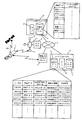
- FIG. 4 is a diagram for explaining data stored in the user database 11 of the service provider 8.
- An agent ID for specifying each member user's agent (avatar) is stored in association with each user ID.
- GPS data specifying the current position is transmitted to the server 10 of the service provider 8 from the user who has turned on the GPS function of the mobile phone 2.
- the server 10 converts the transmitted GPS data into coordinate data composed of latitude and longitude, and stores them in the storage area of the current position GPS data of the corresponding user ID in the user database 11.
- the latitude is 35.669299 and the longitude is 139.713655 as the current position GPS data.
- the server 10 stores the position data obtained by converting the current position GPS data (latitude and longitude) into position data including addresses and the like in the position data storage area of the user database 11.
- the virtual tag database 9 stores a user ID and the position data, virtual tag display data, virtual tag type, and virtual tag creation date / time in association with the user ID.
- the position data is data for indicating the location where the virtual tag is generated.
- the virtual tag display data is data for displaying a virtual tag in the virtual world, and is composed of text data, image data, and the like.
- the virtual tag type is data indicating the type of virtual tag to be displayed, and includes a voice virtual tag, an advertisement virtual tag, a shared virtual tag, and the like.
- the shared virtual tag is the one described with reference to FIGS.
- the voice virtual tag is a virtual tag that can convey a message by voice.
- the advertisement virtual tag is a virtual tag for advertisement created by an advertising agency. Virtual tags other than the shared virtual tag can be freely accessed by anyone other than the creator of the virtual tag.
- the shared virtual tag shown in FIG. 2 can be constituted by a voice virtual tag. Then, Mr. C and Mr. D can input a message by voice without key input, and there is an advantage that quick input can be performed in an emergency.
- the creation date and time is data indicating the date and time when the virtual tag was created. For example, when the user ID is 13B9PS, it is 0902190921, which means 09:21 on Feb. 19, 2009.
- the server 10 of the service provider 8 uses a virtual world that has been mashed up with street view or the like as a 3D virtual world on the net that accurately copies the real world.
- the server 10 specifies the current location of the member user in the real world using the mobile phone 2 of the member user, and displays the avatar (agent) of the member user at a location in the virtual world corresponding to the current location.
- the member user and the avatar (agent) can communicate with each other.
- the conversation via the avatar in the virtual world is a well-known and commonly used technique in the 3D virtual world such as Second Life, and this well-known and commonly used technique is used.
- an avatar is an agent having a certain level of conversation ability, such as the aforementioned CLON
- a user in the real world can leave a conversation to his / her avatar to some extent, and the conversation contents can be transferred to a mobile phone. Talk to the person on your own only when you need it.
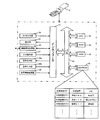
- FIG. 5 is a block diagram of the hardware configuration of the mobile phone 2.
- the mobile phone 2 includes a CPU (Central Processing Unit) 31 for controlling the entire mobile phone 2 including line connection processing and data communication processing, and a ROM (Read Only Member) that stores programs for executing various functions. 32.
- a camera input unit 34 comprising a CCD (Charge Coupled Device) image pickup device for photographing the surrounding scenery, and at least one still image data obtained by photographing with the camera input unit 34 is stored.
- CCD Charge Coupled Device
- RAM (Random Access Memory) 33 including a memory for displaying, a display unit 35 for outputting an image such as a liquid crystal display panel, a wireless communication processing unit 36 for communicating via the Internet 6, and a user of the mobile phone 2
- the input operation unit 37 is configured to cause the CPU 31 to execute a desired function.
- the input operation unit 37 includes a touch pen, a jog dial, a keyboard, a micro switch, and the like.
- the interface 41 performs interface processing to the internal bus 40 of various circuits and devices.
- the mobile phone 2 includes a voice output unit 38a, a voice input unit 38b, an EEPROM (ElectronicallynErasable and Programmable Read Only Memory) 42, and a position information acquisition unit 39 for a user to make a voice call.
- the position information acquisition unit 39 acquires the current position based on the GPS information from the satellite 1, the radio wave from the base station 3, and the radio wave from the wireless LAN access point 7.
- the EEPROM 42 stores a list of shared virtual tags generated by the user in the past. In this list, the geographical position (address) where the shared virtual tag is created and the user's memo are stored in association with each shared virtual tag. In the example of memo writing in FIG. 5, good young people, friendly, intelligent, etc. are stored as impressions of the other party of the shared virtual tag.
- a list of shared virtual tags stored in the EEPROM 42 is displayed on the display unit 35 in accordance with the operation of the input operation unit 37 of the mobile phone 2 by the user. The user selects and clicks the shared virtual tag to be accessed with reference to the creation position and the note. Then, the clicked shared virtual tag is displayed together with the virtual world of the generated geographical position by the processing of S80 to S88 described later (see FIG. 2).
- the user can confirm the scenery around the displayed shared virtual tag with the video of the virtual world, confirm the place where he / she met the partner, and restore the partner's memory from that place. Thereby, it is possible to restore the memory of the partner who has met without knowing the personal information of the partner, and then determine whether or not to access the shared virtual tag. If the user clicks on the shared virtual tag to access, the web page for contact is displayed and can be written and viewed by the processing of S90 to S94 described later.
- the functions of the CPU 50, the ROM 51, and the RAM 52 are the same as those described above for the mobile phone 2.
- the servers 10 and 21 have storage units (not shown).
- the storage unit is a storage device that stores various programs and files, information and data including large-capacity images, and can read them appropriately. These data and programs can be written into the RAM 52 as needed to perform various types of information processing.
- the input unit 55 includes a keyboard, a mouse, and the like, and gives commands for causing the servers 10 and 21 to perform various information processing.
- the interface 58 performs interface processing to the internal bus 57 of various circuits and devices.
- the display unit 54 is configured by a CRT, LCD, or the like, and displays characters, figures, and images.
- the communication control unit 53 manages a communication function for transmitting and receiving data and the like via the Internet 6.
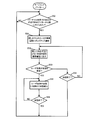
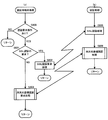
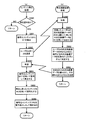
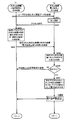
- FIG. 7 shows a flowchart for generating the above-described shared virtual tag.
- users in the real world can generate a shared virtual tag in the virtual world using the mobile phone A and the mobile phone B, but also users in the real world enter the virtual world and use their mobile phones. It can be used to generate virtual world agents (avatars) and shared virtual tags. A shared virtual tag can also be generated between agents (avatars). Furthermore, users who have entered the virtual world can generate a shared virtual tag via their agents (avatars). In this way, the agent (avatar) is also stored in the user database 11 as an independent member user so that the agent (avatar) can generate the shared virtual tag independently of the user. For example, as shown in FIG.
- the user agent ID corresponding to 13B9PS as the user ID is ⁇ 42S15, and this agent (avatar) is also stored in the user database 11 as an independent member user.
- the agent ID of ⁇ 42S15 is stored in the user ID storage area of the user database 11 and the agent with that agent ID has created a shared virtual tag by itself, the shared virtual tag ID AP81K7 is the user.
- the virtual tag database 9 also stores position data, virtual tag display data, virtual tag type, and creation date / time as data of the user ID of ⁇ 42S15.
- one of the parties that generates the shared virtual tag transmits data (variable shared virtual tag ID) specifying its own shared virtual tag ID to the mobile phone of the other party, and the other party Mobile phone transmits its own user ID and received variable shared virtual tag ID to the server 10, whereby the server 10 identifies the party that generates the shared virtual tag and shares it for that party
- data variable shared virtual tag ID
- the server 10 identifies the party that generates the shared virtual tag and shares it for that party
- step S a process of calling up the own shared virtual tag ID is performed in step S (hereinafter simply referred to as S) 1.
- the shared virtual tag ID is stored in a built-in memory in the case of the mobile phone A, and is stored as knowledge data for the agent in the case of the agent A.
- a process for generating a variable shared virtual tag ID using the time information of the atomic clock included in the GPS radio wave received from the satellite 1 is performed.
- a variable shared virtual tag ID is generated by performing a process such as adding the GPS time information to the shared virtual tag ID called in S1 and encrypting it.
- the generated variable shared virtual tag ID is transmitted to the mobile phone B by infrared communication.
- the variable shared virtual tag ID is notified to Agent B in the virtual world without using infrared communication.
- the shared virtual tag ID is stolen to others as a variable shared virtual tag ID that has undergone processing such as encryption. Can be prevented as much as possible.
- mobile phone B or agent B it is determined whether or not to access server 10 in S4.
- the user ID of mobile phone B or agent B is set in S5.
- a process of transmitting the personal authentication data including the data to the server 10 is performed.
- the server 10 confirms the identity of the server 10 based on the transmitted data in S6, and returns an access permission to the mobile phone B or the agent B in S7 when the identity is confirmed.
- the shared virtual tag generation request operation is performed in S8, and the current position data and the variable shared virtual tag ID transmitted in S3 are transmitted to the server 10 in accordance with the operation.
- a shared virtual tag generation request is made (S9).
- the server 10 performs a process of generating a shared virtual tag in the virtual world in S10.
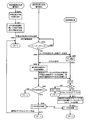
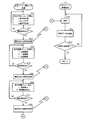
- FIG. 8 shows a flowchart of a subroutine program for the shared virtual tag generation process shown in S10.
- the process of extracting the shared virtual tag ID and time information by combining the received variable shared virtual tag ID and returning it to the original plain text is performed in S15.
- This time information is the GPS time information added to the shared virtual tag ID in S2 described above.
- S16 it is determined whether or not the extracted time information is within an allowable error range compared to the current time.
- S20 a process of searching the virtual tag database 9 for the extracted shared virtual tag ID having the same creation date and time as the extracted time information is performed.
- S21 it is determined whether or not there is a corresponding item. If there is a corresponding item, the user ID (two or more) of the corresponding shared virtual tag is specified in S22, and in S23. Then, a process for requesting the mobile carrier to identify and deal with the person corresponding to the identified user ID is performed.
- the mobile carrier that has received this request specifies the person and sends a warning to the person, or cancels the contract when the person is too malicious.
- the control proceeds to S16a, and a further security check is performed based on whether the current position of the party generating the shared virtual tag is approximate. Specifically, the process of obtaining the position of the requester of the shared virtual tag generation is performed in S16a.
- the current position of the mobile phone B or the agent B is acquired.
- the agent (avatar) is the requester of the shared virtual tag generation
- the real world position corresponding to the current position of the agent (avatar) in the virtual world is acquired as the current position.
- the process of specifying the user ID from the shared virtual tag ID extracted in S15 is performed in S16b.
- S16c a process for acquiring the current position information of the user ID is performed.
- the current position information indicates the predetermined position in the real world corresponding to the predetermined position in the virtual world. Obtained as location information.
- the user ID specified from the shared virtual tag ID is that of an agent (avatar)
- the real world position corresponding to the current position of the agent (avatar) in the virtual world is set as the current position. To be acquired.
- the predetermined distance is a distance at which communication for obtaining an agreement for generating the shared virtual tag at this location is possible, for example, a distance of about 10 meters.
- the shared virtual tag ID of another person other than the current person who generates the current shared virtual tag is illegally obtained, and the shared virtual tag ID of the other person is obtained.
- An illegal act can be considered, such as when a variable shared virtual tag ID using GPS time information is abused and transmitted.
- a determination of NO is made in S16d, and the control proceeds to S24, and as described above, a request for identifying and dealing with the user who has performed such an illegal act is sent to the mobile carrier. Do it.
- the process proceeds to S17 to search the user database 11 and specify the user ID from the shared virtual tag ID.
- the virtual tag database 9 is specified.
- the stored user ID and the user ID received at the time of access are stored, and the data of the shared virtual tag is stored in association with the user ID.
- the state stored in S18 is the data of the shared virtual tag corresponding to the user IDs A4VZ12 and B27FH8 in the virtual tag database 9 of FIG.
- the first stage security check using the times of S16, S20 to S24, and the person at the time of shared virtual tag generation shown in S16a to S16d and S24
- the second stage security check based on the current position of the camera is performed, and high security can be ensured by the double security check.
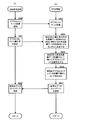
- FIG. 9 is a flowchart showing a virtual world display process performed by the server 10 of the service provider 8.
- S30 it is determined whether or not the user ID and the GPS data are received. If it has not been received, the control proceeds to S33, where it is determined whether or not a user ID and an access position have been input. If not, the process returns to S30 again.
- the member user turns on the GPS function of his / her mobile phone 2 in the course of the loop of S30 ⁇ S33 ⁇ S30
- the user ID and the GPS data indicating the current position from the mobile phone 2 are stored in the service provider 8. It is sent to the server 10.
- a determination of YES is made in S30, and the control advances to S31, and a process of converting the received GPS data (coordinate data composed of latitude and longitude) of the current position into position data composed of an address is performed.
- the user database 11 is searched to update the GPS data and the position data corresponding to the received user ID, and the control advances to S33.
- the control may advance to S ⁇ b> 31 only after an operation of displaying his / her avatar (agent) in the virtual world.
- the access position and the user ID are the service provider 8. Sent to the server 10.
- the access position is not only when the user operates the mobile phone 2 to input an address (position data) that the user wants to access, but also displays the shared virtual tag created by the user in the past and the created position on the mobile phone 2. By displaying a list and selecting and clicking the shared virtual tag that the user wants to access from the tag list, the position data of the shared virtual tag (see “position data” in the virtual tag database 9 in FIG. 3) is automatically obtained. It may be input.
- control proceeds to S34, and it is determined whether or not the input user ID is registered in the user database 11. If it is not registered, since it is not a member user, control is performed to display the display of NG on the mobile phone 2 in S35.
- the control advances to S36, and the input access position is transmitted to the server 21 of the virtual world provider 20.
- the server 21 of the virtual world provider 20 searches the virtual world database 22 to read out the virtual world 3D data portion corresponding to the access position (position data), and sends it to the server 10 of the service provider 8.
- the server 10 acquires the virtual world 3D data corresponding to the transmitted access position (S37), searches the user database 11 by S38, determines an agent (avatar) near the access position, and acquires the acquired virtual Control is performed to overlay and display the agent on the world 3D data.
- an agent avatar
- S39 a process of searching the virtual tag database 9 and reading the position data of the shared virtual tag corresponding to the input user ID is performed.
- the process proceeds to S40, and it is determined whether or not the position data read out in S39 is included in the currently displayed virtual world 3D area. If not included, control returns to S30. On the other hand, if it is included, the process proceeds to S41, and control is performed to read out the shared virtual tag determined to be included from the virtual tag database 9 and to display it overlaid on the virtual world 3D.
- S42 an access process to the shared virtual tag is executed, and the process returns to S30.
- FIG. 10 shows a flowchart of access processing to this shared virtual tag.
- a determination of YES is made in S80.
- the authentication data including the user ID in S81 is transmitted to the server 10.
- the server 10 that has received it confirms the identity in S82.
- an access request to the shared virtual tag in S85 is transmitted to the server 10.
- the server 10 performs the processing of S86 and S87, and as a result, only the shared virtual tag corresponding to the user ID of the accessing person, that is, the user's own shared virtual tag is displayed on the mobile phone 2 by S88. Is done. Therefore, it is possible to prevent access by anyone other than the creator of the shared virtual tag. If the shared virtual tag corresponding to the user ID is not stored in the virtual tag database as a result of the search in S86, a message indicating that access is not possible is returned to the mobile phone 2 or the agent.
- FIG. 10 shows an example in which the display of the shared virtual tag is performed not only in the virtual world but also in the real world, as indicated by S87 and S88.
- a display method of the shared virtual tag in the virtual world for example, a method in which the shared virtual tag is displayed at a predetermined position by looking into the real world through a camera function of a mobile phone can be considered (Sekai Camera ( Registered trademark)).
- the plurality of shared virtual tags and their creation positions are displayed in a list in time series, and the share selected and clicked by the user from the tag list If it is possible to jump and move to the virtual world to which the virtual tag is attached, the convenience for the user is enhanced.
- FIG. 11 is a flowchart showing the operation of the agent (avatar).
- S50 it is determined whether or not another avatar has spoken in the vicinity of the user (agent) in the 3D virtual world, and the process waits until the voice is spoken. If it is spoken, the control proceeds to S51, and a process of pop-up notification to the corresponding mobile phone 2 of the user is performed. Next, the process proceeds to S52, in which a conversation corresponding to the story is performed, and the content of the conversation is displayed on the mobile phone 2.
- S53 it is determined whether or not the user himself wishes to talk. This is determined based on whether or not the user has performed his / her intention to display a conversation by operating his / her mobile phone 2. If the user himself / herself does not wish to have a conversation, a determination is made in S54 as to whether or not the conversation has ended. If the conversation has not yet ended, the control returns to S52.
- control proceeds to S55, and control is performed to switch to the user's own conversation and continue the conversation.
- S56 it is determined whether or not the conversation has ended. If the conversation has not ended, the processing in S55 is continued. Then, when the conversation is finished, the process returns to S50.
- the agent may be a resident agent resident in the user terminal (for example, the mobile phone 2).
- it may be a mobile agent that is usually stored in the database of the service provider 8 (for example, the user database 11) or the user terminal and moves to a necessary place as necessary.
- agents displayed in the virtual world.
- the virtual world geographical position corresponding to the current position of the user in the real world is displayed, and the first person who has the ability to talk to the virtual world and the virtual world, and the virtual world intruder are indicated as the entry position. It is the 2nd agent for displaying by.
- the first agent and the second agent can be visually distinguished.
- the agent (avatar) is the agent of the user in the real world (avatar) or the agent of the intruder in the virtual world (avatar) This is to distinguish whether to speak and to select the content of the talk.
- FIG. 12 is a flowchart showing generation control of a shared virtual tag for business use.
- This business-use shared virtual tag is used to generate a community in which attendees who have visited an event venue such as an exhibition or concert can be contacted later by the organizer or attendees.
- the “event” in the present invention is a wide concept including various promotions, concerts, live performances, etc. as well as an exhibition, and a concept including all events where a large number of people gather. In addition, not only events held in the real world but also events held in the virtual world are included.
- a shared virtual tag In the case of an event held in the real world, when creating a shared virtual tag (community) between the organizer and each attendee, a mobile phone is used as the terminal for each attendee, and the organizer As a terminal on the side, a shared virtual tag (community) is generated using a wireless LAN access point 7 that covers the event venue as a communication area.
- a shared virtual tag In the case of an event held in the virtual world, a shared virtual tag (community) is generated by communication between the agent (avatar) of each attendee and the venue agent constituting the virtual event venue.
- FIG. 12 performs control similar to that of FIG. 7 described above, and the differences will be mainly described here.
- steps similar to those in FIG. 7 are denoted by the same step numbers.
- the wireless LAN access point 7 or the venue agent on the event organizer side determines whether or not the event start time is reached, and waits until the event start time is reached.
- personal authentication data including the user ID of the user (organizer side) is transmitted to the server 10.
- the server 10 confirms the identity based on the received data in the same manner as in FIG. 7, and returns an access permission on the condition that the confirmation has been made (S7).
- the wireless LAN access point 7 or the venue agent transmits the scheduled start time and scheduled end time of the event to the server 10 in S101.
- the server 10 stores the scheduled start time and scheduled end time of the received event (S102).
- a participant who agrees to generate a shared virtual tag (community) with the organizer performs the processes of S1 to S3 by the mobile phone 2 or the agent (avatar) as in FIG. Since the processing of S1 to S3 is executed by each mobile phone 2 (or agent) of the participant who has agreed to generate the shared virtual tag (community), it is repeatedly executed by the number of participants who have agreed. (S103).
- the server ID is transmitted to the server 10 to request generation of a shared virtual tag (community) (S9).
- the server 10 determines whether or not the reception time is between the scheduled start time and the scheduled end time received in S102, that is, within the event holding time (S104). If it is determined that it is not within the event holding time, the control ends without generating a business-use shared virtual tag. On the other hand, if it is determined that it is within the event holding time, a business-use shared virtual tag generation process is executed in S105.
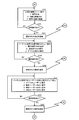
- FIG. 12 is a flowchart of the subroutine program for the business-use shared virtual tag generation process.
- the flowchart in FIG. 12 is similar to the flowchart in FIG. 8, and the same control steps are denoted by the same step numbers and the contents of the steps are omitted.
- Steps S15, S16, S16a, S16b, S16c, S16d, and S17 to S24 are the same as the control content of each step shown in FIG.
- S16d of FIG. 8 it was determined whether it was within a predetermined distance or not within a range of about 10 meters, but in this business-use shared virtual tag generation process, it is within the range of the event venue. Judge by distance.
- the control proceeds to S200, and it is determined whether or not the specified user ID (host ID on the sponsor side) is already stored in the virtual tag database 9. If it has not been stored yet, that is, if it is the first generation request for a business-use shared virtual tag (community), control proceeds to S18.
- the shared virtual including all the participants who agreed to generate the business shared virtual tag within the event opening time and performed the tag generation operation and the organizer side
- a tag is generated.
- a community page generated in advance by the organizer is displayed, and various notifications and messages from the organizer are displayed on the participant side.
- a writing page on the participant's side is also prepared, and when the participant writes there, communication between the participants and between the participant and the organizer becomes possible.
- the advantage of the virtual world that the user can freely move to a desired place at any time is utilized.
- the advantage of the virtual world is not exhaustive.
- various virtual tags see FIG. 3
- the virtual world is not just a three-dimensional spatial spread, but a so-called four-dimensional space-time world where data can be stored and viewed along the time axis.
- an avatar (agent) as a user's alternation corresponding to the user is shown.
- an independent character (agent) that does not correspond to any user is added to the virtual world. You may let them live.
- This character (agent) is composed of an intelligent agent programmed to talk to and interact with a user who has entered the virtual world, and each character (agent) has its own individuality. A user who enters the virtual world finds the character (agent) that best matches him and performs intellectual exchanges within the virtual world. This is also a modification of the second embodiment described later.
- a shared virtual tag is created by two people has been shown, but the number of people created is not limited to this, and may be three or more.
- a third party who is allowed access by all the parties creating the shared virtual tag may access the shared virtual tag later.
- access control first, the third party notifies the shared virtual tag creator of the exact location and date and time of creation of the shared virtual tag. This information is necessary to specify the shared virtual tag that is the access permission target.
- the variable shared virtual tag ID is notified from all the creating parties as evidence that access is permitted from all the creating parties of the shared virtual tag. Then, the notified information is transmitted to the server 10 for permission of access.
- a memo function that only one sharer of the shared virtual tag can write and view may be provided.
- this memo function for example, you can write down (write and record) things you do not want to be read by the other party, such as the first impression of the other party, the opportunity you met, the situation at that time, etc. It is possible to use the virtual tag to determine whether or not to contact the other party.
- the shared virtual tag is displayed in the virtual world.
- the present invention is not limited to this, and the virtual world can be eliminated so that the user terminal can directly access the shared page for contact. Good.
- the mobile phone of the user ID specified from the received variable shared virtual tag ID and the mobile phone of the shared virtual tag generation requester instead of the step of S19, “the mobile phone of the user ID specified from the received variable shared virtual tag ID and the mobile phone of the shared virtual tag generation requester”
- the step “send shared virtual tag to phone” is used.
- the shared virtual tag is stored in the terminal of the party (such as a mobile phone) instead of in the virtual world. If the party selects and clicks on the shared virtual tag stored in his / her mobile phone to be accessed, the designation of the clicked shared virtual tag is transmitted to the server 10 by the above-described S90, and after S91 Control is executed.
- the shared virtual tag is not displayed in the virtual world of a predetermined geographical position such as a place where it meets, it becomes impossible to meet from that geographical position and trace the memory at that time. Therefore, the shared virtual tag is preferably displayed on the mobile phone together with information (address or the like) that can specify the geographical position where the shared virtual tag is generated.
- the shared virtual tag may be canceled by one party.
- the server 10 that has received the cancellation request information (including the user ID of the person in question) from the mobile phone 2 searches the virtual tag database 9 and stores the cancellation information (flag or the like) in association with the received user ID. As a result, even if the canceled shared virtual tag is written from the other party, control is performed so that the pop-up notification to the mobile phone 2 of the canceller is not performed.
- a means for preventing a stalker act that misuses the virtual world such as following a certain user moving in the real world in the virtual world, may be adopted.
- a specific area such as the vicinity of the home or the workplace in the user database 11 of the service provider 8 and displays an avatar (agent) as an overlay on the virtual world in S38
- Control is performed so that an avatar (agent) is not displayed in the registered specific area.
- the partner search is based on the history data of the position data and the time data stored in the user database 11 and identifies the partner of the history data that matches the geographical location and time specified by the contact offerer. .
- the user operates the mobile phone 2 to register with the mobile phone 2 itself or to register with the user database 11 by the server 10.
- the registration time may be any convenient time for searching for a partner such as an arbitrary time during the meeting with the partner, a time separated from the meeting time, or a time meeting the separated time.
- This encounter time registration is preferably registered in the user database 11 by the server 10 at the time of encounter so as to prevent contact offers due to impersonation or the like.
- the steps S4 to S7 and S8 described above are changed to “Meeting point registration request operation”, and the step S9 is changed to “Request for meeting point registration by transmitting geographical location data and time data that have been met” , S10 is changed to “Meeting point registration process”.
- the meeting time registration process the current position of the meeting point registration requester is acquired based on the transmitted user ID, and the transmitted geographical position data is within a predetermined distance (for example, within 10 meters). And the transmitted geographical data and time data are registered in the user database 11 in association with the user ID on condition that the transmitted time data and the current time are within an allowable range. To do.
- the shared virtual tag is generated at the location where the other party has met. If it is desired to notify the telephone number and the offerer of the shared virtual tag generation agrees with it, the email address and the telephone number may be exchanged with each other, and it is not always necessary to generate the shared virtual tag.
- the virtual world in the first embodiment described above mainly targets only the current virtual world, which will be described below.
- the second embodiment not only the current virtual world but also the past virtual world and the future virtual world are targeted.
- control flowcharts of various computers such as a police server, an advertiser client, an advertiser server, and a store vendor client are described. Yes.
- the hardware configurations of various computers that appear for the first time in the second embodiment are the same as those described with reference to FIG. 6 in the first embodiment. Therefore, in the second embodiment, the hardware configurations of the various computers described above are used. The description of the hardware configuration is not repeated.
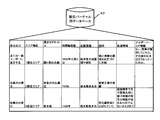
- This user four-dimensional coordinate database 11a is a modification of the user database 11 shown in FIG. 4 in the first embodiment.
- differences from the first embodiment will be mainly described.
- the user four-dimensional coordinate database 11a stores user ID, shared virtual tag ID, agent ID, current position (GPS data, etc.), position data, and schedule data.
- the schedule is data in which the user himself / herself operates the mobile phone 2 and inputs a future schedule, and is future data. For example, if you plan to participate in a XX event at a certain date and time, the user inputs the XX event, date and location data from the mobile phone 2, and the data corresponds to the user ID in the user four-dimensional coordinate database 11a. It is memorized.
- the z data is a height specified from the access point 7 when the mobile phone 2 receives a radio wave from the access point 7 installed on the floor of the building when the user enters, for example, a high-rise building. (Elevation) data.
- Eletitude the altitude
- This data of the current position changes as the user moves.
- the history of the change is stored retrospectively along the time axis w.
- this user four-dimensional coordinate database stores three-dimensional data of x, y, and z and history data that changes along w, which is the time axis, thereby storing the four-dimensional coordinate data.
- the position information (x, y, z) is stored in the user four-dimensional coordinate database 11a according to the above-described S30 to S32.
- the user four-dimensional coordinate database 11a also stores the past position information (x, y, z) cumulatively. Therefore, the position information x, y, z along the time axis w is stored in the user four-dimensional coordinate database 11a.
- the user ID “ ⁇ 42S15” is the user's own ID for handling the agent itself as a user, as described in the first embodiment.
- the current virtual world terminal process is executed in S300
- the past virtual world terminal process is executed in S301
- the future virtual world terminal process is executed in S302
- the authentication is performed in S303.
- Terminal processing is executed
- virtual world advertising terminal processing is executed in S304
- marketing terminal processing is executed in S305, and then the process returns to control S300.
- the current virtual world handling process is executed in S310, the past virtual world handling process is executed in S311, the future virtual world handling process is executed in S312, and authentication is performed in S313.
- the process is executed, the virtual world advertisement handling process is executed in S314, the marketing handling process is executed in S315, and then the control returns to S310.
- the current virtual world terminal processing and the current world virtual world processing are processes that provide various services using the current virtual world.
- the past virtual world terminal process and the past virtual world support process are processes that provide various services using the past virtual world as a stage.
- Future virtual world terminal processing and future virtual world compatible processing are processes that provide various services using the future of the virtual world as a stage.
- the authentication terminal process and the authentication process are processes for performing authentication by utilizing the four-dimensional coordinate data stored in the user four-dimensional coordinate database of FIG.
- the virtual world advertising terminal process and the virtual world advertisement handling process display an advertisement in the virtual world and enable monetization by using revenue from the advertiser.
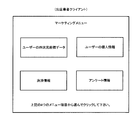
- the marketing terminal process and the marketing-compatible process are processes for collecting history data of user behavior (location of time and time) in the virtual world (four-dimensional space-time) and utilizing it for marketing. Details of these processes will be described later.
- FIG. 16A is a flowchart showing a subroutine program of the current virtual world terminal process shown in S300 of FIG. 15A.
- shared virtual tag terminal processing is performed in S320
- virtual world display terminal processing is performed in S321
- emergency terminal processing is performed in S322, and S323.
- the disaster terminal processing is performed
- the cyber special zone terminal processing is performed in S324
- the common point search request processing is performed in S325
- the community virtual tag terminal processing is performed in S326, and the link source designation terminal processing is performed in S327. Is called.
- FIG. 16B is a flowchart showing a subroutine program of the current virtual world corresponding process shown in S310 of FIG. 15B.
- a common virtual tag handling process is executed in S330
- a virtual world display handling process is executed in S331
- an emergency handling process is executed in S332.
- Disaster response processing is executed in S333
- cyber special zone response processing is executed in S334
- common point search processing is executed in S335
- community virtual tag response processing is executed in S336, and user four-dimensional coordinate search processing is executed in S337. Is executed, and link source designation corresponding processing is executed in S338.
- the shared virtual tag terminal process and the shared virtual tag handling process are specifically the controls shown in FIGS. 7, 8, and 10 to 13.
- the virtual world terminal process and the virtual world display corresponding process are processes for displaying a virtual world corresponding to a place and time when the user enters the virtual world and enters the virtual world.
- the virtual world display correspondence processing will be described later with reference to FIG.
- the emergency terminal process and the emergency response process are processes for displaying a message such as “Please help!” In the virtual world corresponding to the current location of the user when an emergency occurs and the user is requested for help. It is.
- a message “Please help!” May be displayed as a virtual tag in the real world at the current position of the user. Then, when the user moves, the mobile phone 2 possessed by the user also moves, and the message in the virtual world and the real world is also moved and displayed as the mobile phone 2 moves.
- the server 10 may detect it and control it to automatically report to the police, the security organization, the medical institution, or the like.
- an emergency shelter (a public facility such as a convenience store, a gas station, or a police fire station) may be displayed on the mobile phone 2 of a user who has performed an operation for executing emergency terminal processing. .
- Disaster terminal processing and disaster response processing are processing for controlling the display of the location required in the event of a disaster such as a shelter, hospital, fire department, or police in the virtual world.
- This position display process uses a virtual tag dedicated to disasters that is different from a normal virtual tag.
- the system independently operates as a disaster information providing system, and provides information, contacts, messages, etc., and displays them by a virtual tag dedicated to disaster. Thereby, it is possible to avoid the confusion of information in an emergency, and to provide information at the time of an appropriate disaster.
- the information to be provided includes the provision of information on victims in hospitals and shelters, the provision of comprehensive information regarding disasters, the display of emergency messages at shelters, etc. Do.
- Cyber special zone terminal processing and cyber special zone response processing are control processing in cyber space determined by the government to apply special rules different from social rules applied to the real world.
- the virtual world that the user can enter is composed of multiple layers, the first layer is a cyber space to which the same social rules as the real world are applied, and the second layer is a high consumption tax rate (for example, 20%) This is a cyber space where social rules are applied and the social welfare associated therewith is substantial, and the third layer is configured as, for example, a cyber space to which a symbiotic economy is applied (symbiotic economic cyber space).
- symbiotic economic cyber special zone a solid economic zone independent of the yen-based monetary economy is established through solidarity, participation, and collaboration.
- “respect figures” in the respect market may be introduced in addition to issuing virtual currency.
- the “respect value” is value information representing respect for the other party. At least a part of the original function of money (exchange value and value standard (measure)) is recognized in the “respect figures” accumulated from others. This can provide motivation other than economic benefits for developing a voluntary economy.
- the common point search request process and the common point search process are processes for searching for a common point such as an action place between a certain user and another user. Details will be described later with reference to FIG.
- Community virtual tag terminal processing and community virtual tag handling processing are virtual worlds in which community virtual tags for exchanging opinions on events that occurred in the real world (for example, guerrilla live or total solar eclipse) correspond to the location of the event. It is a process for generating in the real world. Details will be described later with reference to FIGS.
- the link source designation terminal process and the link source designation corresponding process are when the user describes a blog or the like based on the user's conversation or action history stored as a history in the virtual world (on the four-dimensional coordinates).
- the trackback process for attaching a hyperlink to the action history that is the basis of the action history is performed. Details will be described later with reference to FIGS.
- the user four-dimensional coordinate search process is a process for searching for a user located in a certain closed space in a four-dimensional coordinate from a predetermined organization such as the police. For example, when a murder occurs at a certain place at a certain time, the occurrence time of the murder case that should be investigated and the user (eyewitness etc.) in the vicinity of the occurrence place are searched and indexed. Use it sometimes. Details will be described with reference to FIG.
- FIG. 17 is a flowchart showing a subroutine program of the common point search request process shown in S325 of FIG. 16 and the common point search process shown in S335.
- the common point search request process searches for a geographical common point in the behavior between users, and is executed between the user's mobile phone A or B or the agent A or B.
- a determination is made as to whether or not a common point search operation has been performed in S370. If there is an operation for searching for mutual common points, a determination of YES is made in S370, the process proceeds to S371, and a process of reading the shared virtual tag ID is performed. This is a process of reading the shared virtual tag ID stored in the EEPROM 42 in the case of the mobile phone A, and in the case of the agent A, the shared virtual tag ID stored as knowledge data by the agent A is used. This is a reading process.
- S373 processing for transmitting the variable shared virtual tag ID to the mobile phone B or the agent B is performed.
- S376 it is determined whether or not there is a common point search operation. If there is no common point search operation, this subroutine program ends. If there is, the mobile phone A or the agent B ends in S377.
- the variable shared virtual tag ID transmitted from A is received.
- S378 it is determined whether or not to access the server 10, and the process waits until access.
- the server 10 receives it (S384), confirms the identity in S385, and transmits the access permission to the mobile phone B or the agent B in S386.
- S378, S379, and S384 to S386 are the same as the processes of S4 to S7 in FIG. 7, and detailed description thereof will not be repeated here.
- the mobile phone B or agent B receives the access permission transmitted from the server 10 (S380), and for S381, the current location data of the mobile phone B or agent B and the variable shared virtual tag of the mobile phone A or agent A A process of transmitting the ID to the server 10 and requesting a search for common points is performed.
- the server 10 receives it (S387), and executes the processing of the same steps as S16, S16a to S16c, S16d, and S20 to S24 shown in FIG.
- S387 if YES is determined in S16d, the control proceeds to S388, where both the mobile phones A and B or the agents A and B are searched for the user four-dimensional coordinate database 11a, and the data that is common only to both positions is searched. And data having a common position and time.
- step S389 the specified data is transmitted to the mobile phone A or agent A and the mobile phone B or agent B.
- the mobile phone A or the agent A receives it (S374) and displays the received data (S375).
- the mobile phone B or the agent B receives the data transmitted in S389 (S382) and displays the received data (S383).
- This control makes it possible to confirm that the owner of the mobile phone A and the owner of the mobile phone B or the agent A and the agent B are geographically common to each other in their actions. For example, it is possible to confirm common points such as having watched the 2010 FIFA World Cup with each other and frequently going to the same restaurant, and can provide materials useful for subsequent communication.
- FIGS. 18 to 20 are flowcharts showing a subroutine program of the community virtual tag terminal process shown in S326 of FIG. 16 and the community virtual tag corresponding process shown in S336.
- the server 10 it is determined whether or not an event input operation has been performed in S410, and if not, the process proceeds to S412. For example, when an event such as a total solar eclipse, a tornado, or a guerrilla live by a famous entertainer occurs, the employee (operator) of the service provider 8 informs the server 10 of the occurrence location and occurrence time of the events considered to be important. input.
- an event such as a total solar eclipse, a tornado, or a guerrilla live by a famous entertainer occurs
- the employee (operator) of the service provider 8 informs the server 10 of the occurrence location and occurrence time of the events considered to be important. input.
- the mobile phone 2 it is determined whether or not the operation of the community virtual tag has been performed in S400. If not, the control proceeds to S424 shown in FIG. If the determination is not made, the community virtual tag terminal processing subroutine program ends.
- the user operates the mobile phone 2 and inputs an operation of the community virtual tag
- a determination of YES is made in S400, and the process proceeds to S401 to determine whether or not there is an operation of storing the current position and time. If not, it is determined in S403 whether or not a community virtual tag generation operation has been performed. If not, the subroutine program for the community virtual tag terminal processing is terminated.
- the mobile phone 2 when the user accidentally encounters a guerrilla live or a tornado, the mobile phone 2 performs an operation of storing the current location and current time of the encounter location. Then, a determination of YES is made in S401, and in S402, the current position and time, that is, the position (x, y, z) where the guerrilla live or tornado is encountered and the time (w) are stored in the EEPROM 42.
- a determination of YES is made in S403, the control proceeds to S404, and the stored information stored in S402 is selected. It is determined whether or not an operation for performing designation has been input. If no operation has been performed, it is determined in S405 whether or not an input operation for an access position and time has been performed. If not, the process returns to S404. , S404 ⁇ S405 ⁇ S404 loop.
- S404 ⁇ S405 ⁇ S404 loop.
- a user encounters an event (for example, guerrilla live or tornado) but does not store the current position and time at the time of the encounter, he / she wants to generate a community virtual tag for that event
- the position and time of the encounter are manually input to the mobile phone 2 based on the memory of the user.
- a determination of YES is made in S405, and the control advances to S406.
- the input position and time and the user ID are transmitted to the server 10 to request generation of a community virtual tag.
- the server 10 receives the generation request for the community virtual tag from the mobile phone 2 (S412), and determines whether or not a community virtual tag has already been generated at the received position and time through S413. If it has been generated, the control advances to S414, and the fact that it has already been generated is returned to the mobile phone 2. The user can access the already generated community virtual tag.
- control proceeds to S415, and it is determined whether or not there is already an event corresponding to the received position and time. This is a determination as to whether or not the event name, the occurrence location, and the occurrence time have already been stored in S411 described above, and the event has already been stored when the employee of the service provider 8 operates the server 10. If so, control proceeds to S416, a community virtual tag is generated at the location where the event occurred, the event occurrence time is displayed on the community virtual tag, and the community name entered by the employee of service provider 8 Is displayed, and the subroutine program of the process corresponding to the community virtual tag is completed.
- a community name for example, “Mr. XX will perform a guerrilla live at Shibuya Dogenzaka!
- S415 if NO is determined in S415, the control proceeds to S421.
- S ⁇ b> 421 a process of transmitting an event occurrence time input request to the mobile phone 2 is performed.
- the mobile phone 2 receives it (S417), displays an event occurrence time input screen at S418, determines at S419 whether or not the user has input the occurrence time, and waits until there is. Note that not only the occurrence time of the event but also a community name input screen may be displayed and the community name may be input by the user.
- the control proceeds to S420, and processing for transmitting the input time to the server 10 is performed.
- the server 10 receives it (S422), and then the control advances to 423, a community virtual tag is generated at the position received in S412 and the time received in S422 is displayed as the occurrence time of the event. .
- the control advances to S425, and processing for transmitting the information specifying the access destination community virtual tag and the user ID to the server 10 is performed. Is called.
- information specifying the community virtual tag of the access destination for example, data specifying the place where the community virtual tag is generated or the location and time can be considered.
- the community virtual tag is stored in the EEPROM 42 in the same manner as the shared virtual tag, and the user performs an operation to display a list of community virtual tags, and displays the list display. By selecting and clicking a community virtual tag to be accessed from the inside, the clicked community virtual tag may be automatically designated and transmitted to the server 10.
- the server 10 receives the information transmitted in S425 (S432), and in S433 searches the community virtual tag database (not shown) and extracts the location of the designated community virtual tag and the occurrence time of the event.
- the control proceeds to S434, where the user's four-dimensional coordinate data (w, x, y, z) specified from the user ID received in S432 and the position (x, y, z) of the extracted community virtual tag. And the process which collates with generation
- S435 it is determined whether or not they match. If they do not match, an access refusal is returned to the mobile phone 2 in S436. On the other hand, if it is determined in S435 that the two match, the control proceeds to S437, and the page of the accessed community virtual tag is transmitted to the mobile phone 2 so that the mobile phone 2 displays the page. .
- the mobile phone 2 receives the access denial or community virtual tag page at S426, determines whether the access denial is received at S427, and if the access denial is received, carries the access denial by S428. On the other hand, if it is displayed on the telephone 2 and it is not reception of access refusal, the process proceeds to S429, and processing for extracting and browsing the community virtual tag page is performed.
- S430 when the user writes a message or text in the page, a process of transmitting the written information to the server 10 is performed.
- the process of storing the write information in the community virtual tag database is performed in S438. Specifically, the write information is stored in association with the corresponding community virtual tag.
- the end operation signal is transmitted to the server 10, and the end process of the community virtual tag corresponding process in the server 10 is performed in S439.
- FIG. 21 is a flowchart showing a subroutine program of the user four-dimensional coordinate search process shown in S337 of FIG.
- the process of requesting a user four-dimensional coordinate search is executed.
- the personal authentication data is transmitted to the server 10 and a search request is made.
- This personal authentication data is composed of, for example, an electronic certificate (or attribute certificate) issued by a predetermined certification authority that has been authenticated as a police server.
- the server 10 receives the search request (S454), and after confirming that it is a legitimate police server in S455, returns the permission to the police server.
- the police server receives it (S451), and transmits the next data as the search target range through S452.
- the server 10 receives this data (S456), and in S457, the user existing in the received search target range is displayed in the user four-dimensional coordinate database. A process of searching from 11a is performed. Next, in S458, the search result is transmitted to the police server, and the police server receives it in S453.
- FIG. 22 is a flowchart showing a subroutine program of the link source designation terminal process shown in S327 of FIG. 16 and the link source designation corresponding process shown in S338.
- the mobile phone 2 determines whether or not a link source designation operation has been performed, and if not, the subroutine program of the link source designation terminal process ends. For example, a user enters the virtual world of the time and place where an indiscriminate murder occurred in order to report on a certain theme such as an indiscriminate murder, and talks to the user's avatar (agent) in the vicinity. If you want to embed a hyperlink in your blog using the interview site (contents of the conversation in the virtual world, etc.) as the link source and track back to the link source.
- the user operates the mobile phone 2 to perform a link source designation operation. Specifically, the four-dimensional coordinates (w, x, y, z) at the start of the conversation by the interview are entered. Then, a determination of YES is made in S460, and the input start point coordinate data of the link source space-time is transmitted to the server 10 in S461.
- the server 10 receives it (S467), and performs a process of storing a URL for specifying the time and space of the designated four-dimensional coordinates in the hyperlink database 60 (see FIG. 23) through S468.
- the four-dimensional coordinates (w, x, y, z) at the end of the interview (conversation) are input in S462. Then, a process of transmitting the input coordinate data (w, x, y, z) specifying the end point of the link source space-time to the server 10 is performed.
- the server 10 receives it (S469), and performs a process of storing in the hyperlink database 60 a URL that specifies the space-time of the specified four-dimensional coordinates of the end point in S470.
- the server 10 performs processing for transmitting the start point URL stored in the hyperlink database 60 (see FIG. 23) to the mobile phone 2.
- the mobile phone 2 receives it (S463), and the process of embedding the received start point URL in the linked content (for example, a blog) is performed in S464.
- S465 it is determined whether or not the user has performed a trackback operation.
- the control proceeds to S466, and the URL of the link destination content (blog or the like) is tracked back. Is transmitted to the server 10.
- the server 10 receives it (S472), and in S473, the received URL is stored in the hyperlink database 60 (see FIG. 23) as a link destination URL.
- FIG. 23 is a diagram for explaining data stored in the hyperlink database 60.
- the hyperlink database 60 is installed in the service provider 8, and data is written and read by the server 10.
- the hyperlink database 60 stores start point URL, end point URL, link destination URL, and comment data.
- http: // abc is stored as the start point URL
- http: // opq is stored as the end point URL
- http: // hij is stored as the link destination URL.
- http: // abc is transmitted to the mobile phone 2 as the start point URL, and the user embeds the received http: // abc in the content (blog or the like). If another person accesses the content (such as a blog) and clicks http: // abc, which is the embedded start point URL, it jumps (moves) to the virtual space (four-dimensional coordinate space) specified by the URL And can be accessed.
- the conversation such as the user's interview contents is displayed over time in the virtual space. It becomes. Then, another person who sees the exchange of the conversation contents can post a comment at a desired location during the conversation or at the end of the conversation.
- the link source designation control described based on FIGS. 22 and 23 basically has a relay function that links (bridges) the virtual world (four-dimensional space-time) and cyberspace such as a blog or SNS (Social Networking Service).
- the connection target may be anything as long as it is a virtual world (four-dimensional space-time), such as the above-mentioned community virtual tag, the writing page linked to it, the cyber special zone, each area of the historical virtual world described later (see S231), etc. Anything is acceptable.
- ranking is performed based on the number of links, etc. You may control so that it may reflect in a display order.
- FIG. 24A shows a subroutine program of the past virtual world terminal process shown in S301 of FIG. 15A
- FIG. 24B shows a past virtual world shown in S311 of FIG. It is a flowchart which shows the subroutine program of a corresponding
- the history virtual world terminal process of S210 and the history virtual world support process of S220 are processes that provide a history-related service using a virtual world that is a four-dimensional space-time.
- the other terminal processing of S210 and the other corresponding processing of S221 are, for example, generating a memorial virtual tag at a memorable place and time such as the place where the proposal was made and the time, and displaying a memorable photograph or word at that time.
- a service such as recording and saving on a page corresponding to a memorial virtual tag.
- the service is such that the contents of pages corresponding to a plurality of memorial virtual tags of a user from the time of birth to the present can be edited and displayed in a time series, and the user's own history can be created.
- FIG. 25A is a flowchart showing a subroutine program of the history virtual world terminal process shown in S210 of FIG. 24A
- FIG. 25B is a history virtual shown in S220 of FIG. 24B. It is a flowchart which shows the subroutine program of a world corresponding
- the history virtual world terminal process it is determined in S230 whether or not there has been an access operation to the history virtual world. If there is no access, the subroutine program ends. On the other hand, if the user performs an access operation to the historical virtual world using the mobile phone 2, the control proceeds to S ⁇ b> 231, and a process of accepting an operation for entering each area into the historical virtual world is executed.
- Each area of the historical virtual world has four areas: “history area”, “hypothesis area”, “another world area”, and “information exchange area”, and the user operates the mobile phone 2 to select one of these four areas. Choose one.
- “Historic area” is an area where you can view detailed data on various times such as the 3D of the scene at that time, the flat display function and voice guidance, the age of history, and the whereabouts afterwards.
- the “hypothesis area” is an area that provides information that is challenged differently from the official history. For example, source Yoshitsune played an active role as Genghis Khan without being killed. Provide information such as.
- “Another World Area” is an area where you can browse information such as what happened to the world after this person was not killed at that time.
- An “information exchange area” is an area in a historical virtual world such as the current SNS where users can participate freely in the community and exchange information about their buildings and people. is there.
- “History area” is information provided by the service provider 8 or a service provider specialized in history. In other “hypothesis areas”, “another world areas”, and “information exchange areas”, the basic information is provided by the service provider 8 or a service provider specializing in history, but the user himself / herself leads the information and thoughts. It is a mechanism that can do.
- control advances to S232, and a process of transmitting the user ID and the selected area of the historical virtual world to the server 10 is performed.
- the server 10 receives it in S238, and performs a process of determining whether or not the user is a paying member user based on the received ID in S239.
- the server 10 stores data for specifying whether or not the user is a paying member in association with the user ID. If it is determined in S240 that the member is a paying member, a history virtual world display process is executed in S241. On the other hand, if it is determined that the member is a general member who is not a paying member, the control advances to S242, and it is determined whether or not the area selected by the user is a general user display area according to S231.
- the server 10 is connected to a history virtual database 62 to be described later with reference to FIG.
- the history virtual database 62 stores data so that it can be distinguished whether the area can be browsed by a general user or can be browsed only by a paying member user.
- the server 10 searches the history virtual database 62 to determine whether or not the selected area is a general user display area. If the selected area is a general user display area, control is performed in step S241. However, if it is not an area for displaying general users, that is, if it is an area that can be viewed only by paying members, the control advances to S243 and returns to the mobile phone 2 that it cannot be displayed because it is not a paying member.
- the cellular phone 2 receives it in S233, and executes a process of displaying that it cannot be displayed because it is not a paid member in S234.
- FIG. 26B is a flowchart showing a subroutine program of the history virtual world display process shown in S241 of FIG.
- S258 a process of searching for a history tag near the current position of the user in the area selected in accordance with S231 is performed.
- the "user's current position” here is the user's entry position in the virtual world if the user has entered the virtual world, and real if the user has not entered the virtual world.
- the “history tag” is a virtual tag that is displayed in the virtual world and in the real world. When the user clicks the history tag, the history explanation data or the 3D display data stored in association with the history tag is stored. Is a tag for displaying to the user.
- the title of the history tag is stored in the history virtual database 62 in association with each area information.
- the history tag is displayed to the user together with the title.
- control proceeds to S259, where it is determined whether or not there are a plurality of history tags in time series. That is, it is determined whether or not there are a plurality of history tags searched in S258 in the vicinity of the current position of the user in time series. For example, if the user's current location is Sekigahara-cho, Fuwa-gun, Gifu Prefecture, in the case of FIG. 28, a history tag titled Sekigahara Battle exists on the time axis (w 1/10/1600).
- the history tag will be displayed, but if there is a history tag corresponding to another history area on the different time axis w (period) in Sekigahara-cho, Fuwa-gun, Gifu Prefecture, YES in S259 Is determined, the control advances to S260, and a process of transmitting the plurality of history tags to the mobile phone 2 is performed.
- the mobile phone 2 receives it in S245, and controls to display the received history tags in S246.
- S247 it is determined whether or not a history tag selection operation has been performed by the user, and the process waits until it is present. If there is a selection operation, a process of transmitting the selected history tag to the server 10 is performed through S248.
- the server 10 receives it through S261.
- control is performed to display the received history tag or one history tag searched in S258 in the real world or the virtual world near the current position of the user.
- the selected history tag is displayed in S249, and in S250, it is determined whether or not the displayed history tag has been clicked, and the loop of S249 ⁇ S250 ⁇ S249 is performed until it is. Patrol.
- control to transmit a click signal of the history tag to the server 10 is performed in S251.
- the server 10 it is received in S 263, and the history description data and 3D display data corresponding to the clicked history tag are specified and transmitted to the mobile phone 2 in S 264.
- the server 10 searches the history virtual database 62 of FIG. 28 and stores history explanation data 3D stored in correspondence with the history area stored in correspondence with the title of the clicked history tag.
- the display data is searched, and the searched data is transmitted to the mobile phone 2. Specifically, when a history tag titled “Sekigahara Battle” is clicked, the history explanation data “3D display data” that is stored in association with “Ikeyasu Tokugawa's hegemony” is stored. Is specified, and the data is transmitted to the mobile phone 2.
- S252 it is received in S252, and the received history explanation data and 3D display data are controlled in S253.
- S254 it is determined whether or not a switching operation has been performed on another history tag among a plurality of history tags existing in time series. If not, control proceeds to S270, but the switching operation is performed. In the case of the change, the control returns to S246, and a plurality of history tags existing in time series are displayed again, and an operation of selecting a history tag from among them is performed. As a result, it is possible to reselect another history tag from among a plurality of history tags that exist in time series, and to display and browse history explanation data and 3D display data corresponding thereto.
- the server 10 receives it in S277 and performs control to store the written data in the history virtual database 62.
- the written data For example, as another world information, “If the Western army was victorious, what happened to Japan after that?” As hypothetical information, “The Toyokawa Ieyasu treasure map was stolen during the loss of the castle tower in the Southwest War. The user writes data such as “It is supposed to be ...” and the written data is written and stored in the history virtual database 62.
- the end operation signal is transmitted to the server 10, it is received by S279, and the end process is executed by S280.
- FIG. 29A shows a subroutine program for future virtual world terminal processing shown in S302 of FIG. 15, and FIG. 29B shows a subroutine program for future virtual world correspondence processing shown in S312 of FIG. Yes.
- the weather forecast terminal process is executed in S700
- the future dating terminal process is executed in S701
- the future schedule terminal process is executed in S702.
- the weather forecast correspondence processing is executed in S705
- the future dating correspondence processing is executed in S706
- the future schedule correspondence processing is executed in S707.
- the weather forecast terminal process and the weather forecast handling process are to display the virtual world according to the past current weather and the future weather forecast. For example, when the current weather in Tokyo is raining, a rainy landscape is displayed when the user enters the virtual world and accesses the current Tokyo.
- the future schedule terminal process and the future schedule handling process display the user's avatar in the future virtual world based on the user's schedule described with reference to FIG. For example, referring to FIG. 14, when the user ID is 13B9PS, it is a schedule to participate in the XX event as a future schedule. If this XX event is held in Shibuya Dogenzaka from 1 to 3 pm tomorrow, the 13B9PS user avatar (agent) will continue in Shibuya Dogenzaka tomorrow from 1 to 3 pm in the virtual world. Will be displayed.
- FIG. 30 is a flowchart showing a subroutine program for the future schedule terminal process shown in S700 and the future schedule handling process shown in S707.
- a schedule input operation has been performed in S710. If there is no schedule input operation, it is determined in S714 whether or not a future virtual world display operation has been performed.
- the subroutine program ends.
- the control proceeds to S711, and the input schedule including time and place is stored in the mobile phone 2, for example, in the EEPROM 42. Processing is performed.
- S712 it is determined whether or not to notify the server 10, and if not notified to the server 10, the process proceeds to S714.
- the control proceeds to S 713, and a process of transmitting the input schedule and user ID including the time and place to the server 10 is performed.
- the server 10 performs processing for storing the received schedule including the time and place in the user four-dimensional coordinate database 11a in association with the user ID.
- a determination of YES is made in S714 and the process proceeds to S715, where a process of transmitting the user ID, the access position, and the future access date and time to the server 10 is performed.
- the user operates the mobile phone 2 to input a position (place) to be accessed in the future virtual world and a future date and time to be accessed, and the input data is transmitted to the server 10 in S715.
- the server 10 executes the processes of S34 to S37 shown in FIG. 9, and then searches the user four-dimensional coordinate database 11a through S722 to receive the future access received near the received access position.
- An avatar (agent) scheduled to be in the day and time is indexed and displayed in an overlay on the virtual world 3D data.
- the processes of S39 to S42 are executed.
- FIG. 31 is a flowchart showing a subroutine program of the virtual world display corresponding processing shown in S331 of FIG.
- the server 10 performs the same steps as S30 to S32 shown in FIG. 9, and it is determined whether or not the user ID, access position, and access time have been transmitted from the mobile phone 2 through S480.
- The When the access position, access time, and user ID of the virtual world that the user wants to access are transmitted from the mobile phone 2 to the server 10, a determination of YES is made in S480, and the same processing as S34 and S35 in FIG. Then, the same processing as S36 is executed, and then the same processing as S37 is executed.
- step S481 the user four-dimensional coordinate database 11a is searched, the users near the access time (w) and the access position (x, y, z) are determined, and the conversation data with the agent (avatar) is virtualized. A process of overlaying and displaying the world 3D data is performed.
- This conversation data is stored in a conversation database 61, which will be described later with reference to FIG. 32.
- the link destination URL is a link destination URL stored in the hyperlink database 60 described with reference to FIG.
- the progress control (step control) of time w in S487 advances the virtual world at the same progress speed as the normal time progress speed in the real world, but is faster or slower than the real world. It is also possible for the user to freely select the traveling speed and make a request to the server 10 like the speed. In the server 10, the time w is step-controlled in S487 according to the requested traveling speed. In addition, it may be possible to control to reverse the time axis w at a speed specified in the reverse direction.
- step S486 control is performed to move the access position by sliding the three-dimensional coordinates (x, y, z) in the virtual world. Thereafter, the control returns to S36.
- FIG. 32 is a diagram for explaining the data stored in the conversation database 61.
- the conversation database 61 is installed in the service provider 8, and data can be written and read by the server 10.
- the conversation database 60 stores a user ID and position data and conversation data in the virtual world in which the conversation is performed in association with the user ID.
- the position data and the conversation data in the virtual world change according to the time axis w, and the position data and the conversation data in the virtual world at that time are stored in the conversation database 61 according to the change of the time axis w.
- the conversation database 61 stores conversation data in the form of four-dimensional coordinate data, similar to the user four-dimensional coordinate database 11a shown in FIG.
- w, x, y, and z change with the movement.
- the talked four-dimensional coordinates (w, x, y, z) also vary depending on the user.
- Such variation data is stored as four-dimensional coordinate data in association with each user ID. That is, since each user has a different entry location, entry time (era), and movement mode, the time axis w is also set for each user (each user ID). That is, the time axis w is set by the number of users (user IDs).
- FIG. 33 is a flowchart showing a subroutine program for the authentication terminal process shown in S303 of FIG. 15 and the authentication process shown in S313.
- an authentication terminal process it is determined in S800 whether or not an authentication request operation has been performed. If the user operates the mobile phone 2 to perform an authentication request operation, a determination of YES is made in S800, and the control advances to S801 to determine whether the operation is a request for SSL (Secure Socket Layer) authentication.
- SSL Secure Socket Layer
- FIG. 34 is a flowchart showing a subroutine program of the four-dimensional coordinate request process shown in S803.
- the user's mobile phone 2 displays an authentication menu.
- the menu items displayed by this authentication menu display are “contract authentication item”, “four-dimensional coordinate electronic certificate item”, and “other authentication items”.
- “contract authentication item” is selected.
- the user wants to issue an electronic certificate for proving that he / she was at a certain place (on a certain four-dimensional coordinate) at a certain time select “four-dimensional coordinate electronic certificate item”. .
- control advances to S835, and the contract authentication request process is executed.
- the control proceeds to S836, and the four-dimensional coordinate electronic certificate issuance request process is executed. If the user selects another item, control proceeds to S834, and other authentication request processing is executed.
- the four-dimensional coordinate authentication process on the server 10 side shown in S806 described above also includes a subroutine program for a contract authentication process corresponding to S835 and a four-dimensional coordinate electronic certificate issuance process corresponding to S836.
- FIG. 35 is a flowchart showing a subroutine program of the contract authentication request process shown in S835 and the corresponding contract authentication process on the server 10 side.
- the contracted parties that is, the mobile phones 2 of the obligor A and the creditor B jointly request the server 10 to generate a shared virtual tag for contract, and the contract authentication in the server 10 A shared virtual tag for contract is generated by processing.
- DRM Digital Rights Management
- the debtor A's mobile phone 2 performs a process of reading the shared virtual tag ID from the EEPROM.
- processing for generating a variable shared virtual tag ID using GPS time information is performed. This process is the same as the process described based on S2 in FIG. 7, and a description thereof will not be repeated here.
- processing for transmitting the variable shared virtual tag ID to the creditor B's mobile phone 2 using infrared communication or the like is performed.
- the creditor B's mobile phone 2 determines whether or not to access the server 10 in S863. If the debtor B inputs an operation to access the server 10 by operating the mobile phone 2, a determination of YES is made in S863, and the user ID of the debtor B (user ID stored in the EEPROM 42) is obtained in S864. A process of transmitting the personal authentication data including the data to the server 10 is performed. In response to this, the server 10 confirms the identity in S869, and returns an access permission to the mobile phone 2 of the debtor B in S870. The processes of S864 to S870 are the same as the processes of S5 to S7 in FIG. 7, and detailed description thereof will not be repeated here.
- a contract shared virtual tag generation request operation is performed in S 865, and in response to the operation, the current position data of the creditor B's mobile phone 2 and the debtor A in S 866.
- the variable shared virtual tag ID and the contractor data are transmitted to the server 10 to request generation of the contract shared virtual tag.
- the server 10 Upon receiving this, the server 10 performs the processing of S15, S16, S20 to S24, S16a to S16a, and S17 to S19 described with reference to FIG.
- the “shared virtual tag” in the processing of each step described with reference to FIG. 8 is “contract virtual shared tag” in FIG.
- processing for storing the contract document data and the payment page data displayed on the contract shared virtual tag page is performed.
- the debtor A or creditor B operates the mobile phone 2 to access the shared virtual tag for contract generated in the virtual world and clicks on it
- the page of the shared virtual tag for contract is displayed.
- a contract signed between the obligor A and the creditor B is displayed, and a payment page for installments is also displayed.
- the debtor A can access the payment page and make payment (payment of debt) by a credit card or the like according to the payment page.
- the DRM request process is performed in S868 on the creditor B's mobile phone 2, and the server 10 that has received the request executes the DRM process in S872 Is done.
- encrypted digital content is returned from the server 10 to the creditor B's mobile phone 2, and the creditor B's mobile phone 2 receives the encrypted digital content in accordance with S 873. Is transmitted to the mobile phone 2 of the debtor A.
- FIG. 36 is a flowchart showing a subroutine program of the DRM request process shown in S868 and the DRM process shown in S872.
- a process of transmitting digital content to the server 10 is performed in S820.
- the server 10 receives the digital content in S823.
- the creditor B's mobile phone 2 transmits data for designating the digital content purchaser (obligor A) to the server 10 in S821.
- the designation data of the digital content purchaser is, for example, the variable shared virtual tag ID of the debtor A's mobile phone 2.
- the server 10 performs a process of randomly determining the four-dimensional coordinate data to be used for the DRM from the designated purchaser's four-dimensional coordinate data (see FIG.
- the digital content is encrypted using the determined four-dimensional coordinate data as the key K1.
- a process of embedding the random number R1 as an electronic watermark in the encrypted digital content is performed.
- the encrypted digital content is returned to the creditor B's mobile phone 2.
- the creditor B's mobile phone 2 receives the encrypted digital content in S822.
- FIG. 37 the contents reproduction process on the mobile phone 2 side and the authentication process at the time of reproduction on the server 10 side used when reproducing the digital content purchased by the debtor A, that is, the encrypted digital content transmitted according to S873, are shown.
- mobile phone 2 it is determined whether or not a reproduction operation has been performed in S880. If the purchaser (debtor A) operates the mobile phone 2 to perform the content reproduction operation, a determination of YES is made in S880, and a process of extracting the random number R1 from the encrypted content is performed in S881. This is a process of extracting the random number R1 embedded in the encrypted content with a digital watermark. In S882, a process of transmitting the user ID and the extracted random number R1 to the server 10 is performed.
- S892 the process of randomly determining the four-dimensional coordinate data used for the DRM from the four-dimensional coordinate data of the user ID using the random number R2.
- the processing in S892 is the same as the processing in S824 described above, and detailed description thereof will not be repeated here.
- S893 the determined four-dimensional coordinate data is set as the key K2, and the key K2, the key K1 determined in S891, and the random number R2 are transmitted to the mobile phone 2.
- the cellular phone 2 receives it (S883), and decrypts and reproduces the encrypted content using the received key K1.
- the content that has been reproduced is encrypted using the key K2
- the random number R2 is embedded in the encrypted content as a digital watermark.
- the mobile phone 2 overwrites and saves the new encrypted content in which the random number R2 is embedded.
- the old encrypted content in which R1 is embedded is erased, and the new encrypted content in which R2 is embedded is stored.
- the key and random number are updated, and a new random number is embedded, such as key K2 ⁇ key K3 ⁇ key K4..., R2 ⁇ R3 ⁇ R4.
- the new encrypted content is overwritten and saved.
- FIG. 38 is a flowchart showing a subroutine program of the four-dimensional coordinate electronic certificate issuance request process shown in S836 of FIG. 34 and the corresponding four-dimensional coordinate electronic certificate issuance process in the server 10.
- the mobile phone 2 transmits the personal authentication data including the user ID in S840, and the server 10 that receives the authentication confirms the identity in S841, and returns an access permission to the mobile phone 2 in S842. Since the processes of S840 to S842 are the same as the processes of S5 to S7 shown in FIG. 7, the detailed description is not repeated here.
- the mobile phone 2 that has received the access permission receives a designation operation for specifying the four-dimensional coordinates (time w designation, latitude x and longitude y designation, etc.) desired to be certified in S843.
- the designated four-dimensional coordinates and a four-dimensional coordinate electronic certificate issuance request request are transmitted to the server 10.
- the server 10 determines whether or not the person exists at the designated four-dimensional coordinates in S845, and if it is determined in S846 that the person does not exist, rejects the proof rejection due to the absence of the mobile phone. The process of returning to 2 is performed.
- step S846 if it is determined in S846 that the digital certificate is created in S847, a digital signature is added to the person's four-dimensional coordinate data determined to exist, and an electronic certificate is created.
- This digital signature is a digital signature by the service provider 8 in which the server 10 is installed. Specifically, using the private key of the service provider 8, the digital signature is surely present in the user four-dimensional coordinate database. And the like, and the decrypted data is used as a digital signature.
- step S848 the electronic certificate is transmitted to the mobile phone 2.
- the transmitted electronic certificate is stored in the EEPROM 42 or the like and stored.
- the stored electronic certificate is read from the EEPROM 42 and presented. For example, if you prove that you attended a class at a university and earn credits, or if you encounter a case in the real world, write a blog about the case, and the location of the case at the time of the case A method of using such as presenting an electronic certificate to verify that the user has been on the blog can be considered.
- the user authentication is performed between the mobile phone 2 and the user who is the owner. It is necessary to carry out. For example, it is conceivable to enter a password or personal identification number into the mobile phone 2 to perform personal authentication, or to make the mobile phone 2 read the user's fingerprint or the like to perform biometric authentication.
- the access control to the shared virtual tag for contract may be the same as the access control to the shared virtual tag described in the first embodiment, but the following control may be used.
- a user ID is transmitted from the mobile phone 2 of the user who has performed an access operation by clicking the contract shared virtual tag to the server 10, and the server 10 searches the user four-dimensional database 11a and associates it with the user ID.
- the user's stored four-dimensional coordinate data is determined, and it is determined whether or not the user has contracted at the location and time (w, x, y, z). Allow.
- authentication can be performed while keeping personal identification information such as the user's name and e-mail address secret, and specific authentication can be performed while protecting the user's privacy.
- advanced cryptographic techniques such as group signatures are used.
- FIGS. 33 to 38 there is an advantage that it is not necessary to make full use of advanced encryption technology, and an effect similar to anonymous authentication or attribute authentication can be realized by a simple method.
- FIG. 39A shows a subroutine program of the virtual world advertisement terminal processing shown in S304 of FIG. 15A
- FIG. 39B shows the virtual world advertisement shown in S314 of FIG. 15B. It is a flowchart which shows the subroutine program of a corresponding
- the advertisement display terminal process is performed in S500.
- This advertisement display terminal process is a process for displaying the advertisement display prepared in the virtual world on the mobile phone 2.
- the display advertisement setting handling process is performed in S503, and the advertisement display handling process is executed in S504.
- the display advertisement setting handling process of S503 is a process for accepting an advertisement setting operation to be displayed in the virtual world by an advertiser client, which will be described later, and setting and storing an advertisement that the advertiser wants to display in the virtual world.
- the advertisement display corresponding process of S504 is a process on the server side 10 corresponding to the advertisement display terminal process of S500, and is a process for transmitting an advertisement prepared in the virtual world to the mobile phone 2 for display.
- FIG. 39C is a flowchart showing a subroutine program of display advertisement setting operation processing executed by the advertiser client
- FIG. 39D shows a subroutine program of display advertisement setting corresponding processing shown in S503. It is a flowchart.
- control for transmitting the authentication data of the advertiser client to the server 10 is performed in S511.
- the server 10 receives the authentication in S515, and confirms the identity authentication based on the authentication data based on the authentication data to confirm whether the advertiser client is a proper regular advertiser client rather than impersonation.
- control which transmits advertisement menu data to an advertiser client is performed.
- the advertiser client receives it in S512, and performs an advertisement menu selection input process in S513.
- the server 10 receives the transmitted data, and the input menu registration process is executed in S517.
- FIG. 40 (a), 41, and 42 are flowcharts showing a subroutine program of the advertisement menu selection input process shown in S513, and FIG. 40 (b) is a subroutine of the input menu registration process shown in S517. It is a flowchart which shows a program.
- the advertisement display method menu (S520), the display distance menu (S523), the display time menu (S526), the advertisement type menu (S535), the display classification menu in the virtual world (S538), the virtual Eight types are prepared: a display classification menu for users in the world (S541), a menu display when there is a mutual function (S546), and a display area selection menu (S549).
- a menu related to a method for displaying an advertisement is displayed on the advertiser client.
- the constant display type is an advertisement that is always displayed regardless of whether the advertisement is updated.
- the pop-up type when an advertisement is updated, a pop-up display to that effect is made and the newly updated advertisement is displayed.
- the selection-type advertisement is an advertisement that matches a user or an advertisement selected by the user from among a plurality of types of advertisements.
- S521 it is determined whether or not a menu item selection operation has been performed. If not, the display process in S520 is performed. If the user performs a selection operation using the mobile phone 2, a determination of YES is made in S521, the control advances to S522, and processing for transmitting the selected menu item to the server 10 is performed.
- the server 10 receives it in S530 and performs processing for registering the received data in the virtual world advertisement database 63 (see FIG. 43).
- S532 it is determined whether or not all registration of the advertisement menu has been completed. If it has not been completed yet, the process returns to S530, and the loop of S530 ⁇ S531 ⁇ S532 ⁇ S530 is circulated.
- the advertiser client performs control to display the menu item of the display distance of the advertisement to the user who has entered the virtual world in S523.
- display distance menus there are three types of display distance menus: a long distance type, a medium distance type, and a short distance type.
- the advertiser client determines whether or not the display distance menu item has been selected in S524, and if not, the display process in S523 is continued.
- the control advances to S525, and processing for transmitting the selected menu item to the server 10 is performed.
- control is performed to receive it in S 530 and register the received data in the virtual world advertisement database 63 in S 531.
- the advertiser client controls to display the display time menu item in S526. Specifically, items of constant display and time limited display are displayed.
- the constant display is an advertisement that is always displayed for 24 hours
- the limited time display is an advertisement that is displayed by limiting a predetermined time such as only during the daytime or only during the nighttime. It is determined whether or not a selection operation has been performed in S527, and the display processing in S526 is continued until there is a selection operation. If there is a selection operation by the advertiser client, the selected item is transmitted to the server 10 in S528.
- the server 10 receives the information in S530 and performs control to register the received data in the virtual world advertisement database 63.
- step S535 the advertiser client controls to display the advertisement type menu.
- advertisements based only on audio There are three types of advertisements: advertisements based only on audio, advertisements based only on moving images and images, and advertisements based on sound + videos and images.
- S536 it is determined whether or not a selection operation has been performed. If there is no selection operation, the display control in S535 is continued. If there is a selection operation by the advertiser client, a process of transmitting the selected menu item to the server 10 is performed in S537. The server 10 receives it in S530, and controls to register the received data in the virtual world advertisement database 63 in S532.
- a menu display indicating the display category of the advertisement in the virtual world is performed.
- advertisement display classifications there are three types of advertisement display classifications: advertisements that are displayed only in the current world, advertisements that are displayed only in the past world, and advertisements that are displayed in all times including the future. If it is not determined in S539 whether or not a menu item selection operation has been performed, the display in S538 is continued. If there is a selection operation by the advertiser client, processing for transmitting the selected item to the server 10 is performed in S540. The server 10 receives it in S530 and performs processing for registering the received data in the virtual world advertisement database 63 in S531.
- the advertiser client further displays a menu that indicates the display category for the user in the virtual world. Specifically, four types of display to the user are displayed: advertisements to be displayed to all users, advertisements to be displayed only to limited users, advertisements to be displayed only to terminal users, and advertisements to be displayed only to Web users. ing. As a limited user, for example, a user who registers a paying member can be considered. It is determined whether or not a selection operation has been performed in S542. If no operation has been performed, the display control in S541 is continued. If there is a selection operation by the advertiser client, control of transmitting the selected menu item to the server 10 is performed in S543.
- the server 10 receives it in S530 and performs processing for registering the received data in the virtual world advertisement database 63 in S531. Further, in the advertiser client, a menu is displayed in S546 when the advertisement has a mutual function. . Specifically, three types of inquiry function type, word-of-mouth function type, and street sales function type are prepared.
- the inquiry function type is an advertisement that allows a user to ask an advertiser a question.
- the word-of-mouth function type is an advertisement that allows a user to view reviews already written on a product or the like to be advertised and write a new word of mouth.
- the street sales function type is an advertisement that allows an advertiser to display a store at the entry position of the user in the virtual world and sell the product there when the user who sees the advertisement wants to purchase the product to be advertised.
- S547 it is determined whether or not a selection operation has been performed. If not, display control in S546 is continued. If there is a selection operation by the advertiser client, a process of transmitting the selected item to the server 10 is performed in S548. The server 10 receives it in S530 and registers the received data in the virtual world advertisement database 63 in S531.
- the selection menu for the area where the advertisement is displayed is further displayed in S549.
- S550 it is determined whether or not a selection operation has been performed.
- the name of a display target is selected in the case of selection of 2, that is, in the case of nationwide display, and in the case of selection of 3, that is,
- control for selecting and inputting the area to be displayed is performed.
- an advertisement at the time of area limited display for example, an advertisement peculiar to the area rooted in the area where the advertisement is displayed is displayed.
- advertisements limited to Nishijin in Kyoto
- advertisements such as Nishijin Ori shops are displayed.
- an advertisement limited to the location of the store in the virtual world corresponding to a certain store
- an advertisement of the product or service content of the store is performed.
- a selection operation it is determined whether or not a selection operation has been performed in S550, and if there is a selection operation, in S551, a country name to be displayed is selected in the case of selection of 2, that is, in the case of nationwide display. In the case of limited display, control for selecting and inputting a display target area is performed. Next, in S552, control for transmitting the selected item to the server 10 is performed. The server 10 receives it in S530, and controls to register the received data in the virtual world advertisement database 63 in S531.
- the advertiser client determines whether or not there has been an operation for inputting advertisement contents and comment information.
- the advertisement content for example, referring to FIG. 43, it is a display showing the advertisement content of XX glasses store, XX product building, etc.
- comment information during sales, business hours are from 9:00 am to 10:00 pm Please do not hesitate to consult with us. Message content. If there is an operation for inputting the advertisement content and the comment information, the control advances to S554, and processing for transmitting the input information to the server 10 is performed.
- the server 10 receives it in S530 and registers the received data in the virtual world advertisement database 63 in S531.
- FIG. 43 is a diagram showing information stored in the virtual world advertisement database 63 connected to the server 10. As described in S520 to S553, the virtual world advertisement database 63 stores various types of information. In FIG. 43, only representative ones are illustrated.
- FIG. 44 (a) is a flowchart showing a subroutine program of the advertisement display terminal process shown in S500
- FIG. 44 (b) is a flowchart showing a subroutine program of the advertisement display corresponding process shown in S504.
- the advertisement display terminal process it is determined in S558 whether or not the user is logged in to the virtual world by the mobile phone 2, and if not logged in, this subroutine program is terminated.
- the server 10 controls to display an advertisement shown to the logged-in user in S570. Specifically, the server 10 searches the virtual world advertisement database 63 and selects an advertisement to be displayed to the user from advertisements stored in the virtual world advertisement database 63.
- step S571 a signal for overlaying the selected advertisement on the virtual world and displaying it on the user's mobile phone 2 is transmitted.
- the mobile phone 2 receives it in S559, and controls to display the received advertisement as an overlay in S560.
- step S561 it is determined whether or not the user has performed an operation of watching the advertisement. This is, for example, an operation of displaying the advertisement in the center of the screen and zooming the advertisement.
- control for notifying the server 10 of the watched advertisement is performed in S562.
- the server 10 receives it in S572, and in S573, searches the virtual world advertisement database 63 for the detailed information such as the advertisement content and comment information about the notified advertisement, and indexes it to the mobile phone 2. Control is performed.
- the cellular phone 2 receives it in S563, and performs overlay display of the detailed information received in S564.
- S565 it is determined whether or not a selection operation corresponding to the type of advertisement has been performed. If there is an operation, the control advances to S577, and it is determined whether or not the operation is a click operation for the link destination of the advertisement.
- a URL specifying an inquiry destination to the advertiser is embedded as a hyperlink. If the URL of the link destination is clicked, it moves to the advertiser's homepage in S578.
- the mobile phone 2 receives it in S581, and controls to display the received written reception information in S582. Next, in S583, it is determined whether or not a word-of-mouth writing operation has been performed. If the user performs an operation of writing a word of mouth using the mobile phone 2, the written information is transmitted to the server 10 in S584. The server 10 receives it in S586 and stores it in the virtual world advertisement database 63 as written word-of-mouth information in S597.
- the process proceeds to S602. If there is an inquiry operation, the inquiry signal is transmitted to the server 10 in S586. The server 10 receives it at S598, and transmits the inquiry field to the mobile phone 2 at S599.
- the mobile phone 2 receives the inquiry field in S587, displays the received inquiry field in S588, writes the inquiry about the advertisement in the inquiry field in S589, and the URL of the advertiser embedded in the inquiry field An operation to click is accepted.
- S590 the page moves to the advertiser's page, and the written inquiry is notified to the advertiser. Then, control is performed to wait for the advertiser's response and display the received advertiser's response when the advertiser's response is received.
- the mobile phone 2 transmits a street sales request to the server 10 in S602.
- the server 10 receives it at S609, and transmits a signal for displaying the street sales store to the mobile phone 2 at S610.
- the mobile phone 2 receives it in S603, and controls to display the street sales store overlaid on the virtual world in S604.
- the server 10 transmits a display control signal of the street sales store to the mobile phone 2, and then transmits to the advertiser server that there is a request for street sales in S611.
- the advertiser server receives it in S616, and performs customer service processing in the store in S617.
- a customer-facing process signal is relayed in S612 and transmitted to the mobile phone 2, and the mobile phone 2 can perform an exchange operation with a store clerk in S605.
- the mobile phone 2 exchanges signals with the store clerk and the customer response process of S617 by the advertiser server via S612.
- the purchase operation signal is transmitted to the advertiser server via S613, and the advertiser server performs a settlement process at S618.
- FIG. 47 (a) is a flowchart showing a subroutine program for the marketing terminal process shown in S305 of FIG. 15 (a), and FIG. 47 (b) shows the marketing correspondence process shown in S315 of FIG. 15 (b). It is a flowchart which shows a subroutine program.
- a questionnaire terminal process is executed in S900, and a settlement operation process is executed in S901.
- the questionnaire terminal process is a process in which a user answers a questionnaire
- the payment operation process is a process in which the user performs a payment operation on a purchased product or the like using the mobile phone 2.
- a virtual world store acceptance process is executed in S905
- a payment data collection process is executed in S906
- a marketing data providing process is executed in S907.
- the virtual world store acceptance process is a process of accepting a store establishment request to the virtual world by a store establishment client through a store establishment client.
- the payment agency collects the payment data, and the payment data collected by the payment agency is transmitted to the server 10 to receive the server 10.
- the marketing data providing process is a process for providing the collected marketing data to a store opening company or the like.
- FIG. 47 (c) is a flowchart showing a subroutine program showing a store opening request process by a store operator client (not shown), and FIG. 47 (d) is a flowchart showing a subroutine program of the virtual world store acceptance process shown in S905.
- a store opening request is transmitted to the server 10 in S910.
- the server 10 receives it in S917, and transmits a store opening application page to the store vendor client in S918.
- step S911 the store opening client receives the information
- step S912 the received store opening application page is filled with the address, the name of the store, the store opening location, and the presence / absence of the questionnaire, and is sent back to the server 10.
- the server 10 receives it in S919 and determines whether or not there is a questionnaire in S920. This determination is made based on whether or not “Survey is present” is entered in the data received in S919. If it is determined that there is a questionnaire, the control for transmitting the questionnaire page to the store vendor client is performed in S921. In step S913, the store opening client receives the information, and in step S914, the questionnaire is filled in the questionnaire and the control is performed to return to the server 10. The server 10 receives it in S922, and performs store opening processing based on the received content in S923.
- FIG. 48 (a) is a flowchart showing a subroutine program for the questionnaire terminal process shown in S900
- FIG. 48 (b) is a flowchart showing a subroutine program for the store opening process based on the received contents shown in S923.
- the process of registering the received content in the marketing database 64 is performed in S934. This received content is the content received in S919 and the content received in S922.
- the marketing database 64 is connected to the server 10, and stores a user ID, user sex, four-dimensional coordinate data, questionnaire information, settlement information, and the like.
- the user ID corresponds to the user ID, the user gender that is the gender of the user, the latitude x, longitude y, altitude (altitude above sea level) z, entry in the virtual world when the user enters the virtual world using the mobile phone 2
- the four-dimensional coordinate data consisting of the era (time) w, the questionnaire information that the user answered to the questionnaire, and the payment information are stored.
- w, x, y, and z vary with the movement.
- Such variation data is stored as four-dimensional coordinate data in association with each user ID. That is, since each user has a different entry location, entry time (era), and movement mode, the time axis w is also set for each user (each user ID). That is, the time axis w is set by the number of users (user IDs).
- the payment information includes payment NO, payment type, product, amount, store information, and the like.
- the payment type the type of payment used by the user such as credit payment or cash payment (using a point card) is stored.
- the product for example, general names of purchased products such as books, polo shirts, personal computers, and DVDs purchased by the user are stored. Note that “product” is a broad concept including services such as services.
- the amount of money the purchase amount of the product is stored.
- Store information stores the name of the store where the product was purchased.
- the server performs control for overlaying the virtual store on the corresponding position in the virtual world and displaying it on the mobile phone 2 in S935.
- S936 when there is a questionnaire, control for overlaying a questionnaire virtual tag corresponding to the questionnaire to be displayed on the mobile phone 2 is performed.
- the mobile phone 2 it is determined whether or not the questionnaire virtual tag has been clicked in S928, and if clicked, the click signal of the questionnaire virtual tag is transmitted to the server 10 in S929.
- the server 10 receives it in S937, and in S938, performs a process of transmitting a questionnaire page corresponding to the clicked questionnaire virtual tag to the mobile phone 2.
- the mobile phone 2 receives it in S930, and controls to display the received questionnaire page in S931. Next, in S932, a process of accepting an operation to be answered by the user through the displayed questionnaire is performed, and in S933, a process of transmitting the response data to the server 10 is performed.
- the server 10 receives it in S939, and in S940, the received questionnaire response data is registered in the marketing database 64 as questionnaire information.
- FIG. 49A is a flowchart of the payment data provision process executed by the store vendor client
- FIG. 49B is a flowchart showing the subroutine program of the payment data collection process shown in S906.
- step S945 the store vendor client determines whether or not the settlement data has been updated.
- the settlement data is transmitted to the store vendor, and the settlement data is updated at the store vendor. It is.
- a determination of YES is made in S945, and data for authenticating the identity of the store vendor client is transmitted to the server 10 in S946, and processing for accessing the server 10 is performed.
- the server 10 receives it in S950, and returns the access permission to the store operator client after confirming the identity in S951.
- the store vendor client receives it in S947, and controls to transmit the settlement update data to the server 10 in S948.
- the server 10 receives it in S952, and in S953, processing for updating the payment information (settlement data) in the marketing database 64 is performed based on the received data.
- FIG. 51A is a flowchart of the marketing data acquisition process executed by the store vendor client
- FIG. 51B is a flowchart showing the subroutine program of the marketing data providing process shown in S907.
- the store vendor client it is determined whether or not a marketing data acquisition operation has been performed in S957. If the operator performs the marketing data acquisition operation in the store vendor client, a determination of YES is made in S957, and control for transmitting a request for marketing data to the server 10 together with data for authenticating the store vendor client is performed in S958. .
- the server 10 receives it in S968, and controls to send the marketing menu to the store vendor client after confirming the identity in S969.
- the store vendor client receives it in S959, and controls to display the received marketing menu in S960.
- a display screen of the marketing menu according to S960 is shown in FIG.
- the marketing menu is composed of four menu items of user's four-dimensional coordinate data, user's personal information, payment information, and questionnaire information, and a desired one is selected and clicked from these four menu items. Then, the menu item selected in S961 is transmitted to the server 10.
- the server 10 receives it in S970, and in S971, the marketing data corresponding to the selected menu item is extracted from the marketing database 64, and in S972, the extracted data is transmitted to the store vendor client.
- the store vendor client receives it in S962, stores the received data in S963, and determines whether or not the marketing data display operation has been performed by the operator in S964. If there is an operation for displaying marketing data, control for displaying the stored marketing data is performed in S965.
- the server 10 may be composed of a plurality of dedicated servers according to various control contents. For example, a server dedicated to the current virtual world processing (S310), a server dedicated to the past virtual world processing (S311), a server dedicated to the future virtual world processing (S312), a server dedicated to the authentication processing (S313), a virtual world advertisement A dedicated server for the response process (S314), a dedicated server for the marketing process (S315), and the like. This is also a modification of the first embodiment described above.
- the search targets include conversations in the virtual world (in 4D space-time), community virtual tags and related pages, cyber special zones, historical virtual world areas (see S231), shared virtual tags, It is a writing page associated with it.
- a virtual space with access restrictions for example, a shared virtual tag or a write page associated therewith, a community virtual tag or a write page associated therewith
- the access method to the shared virtual tag described with reference to FIG. 5 is not limited to the shared virtual tag, but other tags such as history tags, community virtual tags, contract shared virtual tags, business It may be applied to a shared virtual tag for use.
Landscapes
- Engineering & Computer Science (AREA)
- Computer Security & Cryptography (AREA)
- Computer Networks & Wireless Communication (AREA)
- Signal Processing (AREA)
- Business, Economics & Management (AREA)
- Strategic Management (AREA)
- Entrepreneurship & Innovation (AREA)
- Physics & Mathematics (AREA)
- General Business, Economics & Management (AREA)
- Development Economics (AREA)
- Human Resources & Organizations (AREA)
- Finance (AREA)
- Accounting & Taxation (AREA)
- Theoretical Computer Science (AREA)
- Economics (AREA)
- Marketing (AREA)
- General Physics & Mathematics (AREA)
- Data Mining & Analysis (AREA)
- Tourism & Hospitality (AREA)
- Computing Systems (AREA)
- Game Theory and Decision Science (AREA)
- General Engineering & Computer Science (AREA)
- Operations Research (AREA)
- Quality & Reliability (AREA)
- Computer Hardware Design (AREA)
- Information Transfer Between Computers (AREA)
- Management, Administration, Business Operations System, And Electronic Commerce (AREA)
- User Interface Of Digital Computer (AREA)
- Telephonic Communication Services (AREA)
- Information Retrieval, Db Structures And Fs Structures Therefor (AREA)
- Mobile Radio Communication Systems (AREA)
- Processing Or Creating Images (AREA)
Priority Applications (1)
| Application Number | Priority Date | Filing Date | Title |
|---|---|---|---|
| JP2011553710A JP5211401B2 (ja) | 2010-02-15 | 2010-09-15 | アクセス制御システム、アクセス制御方法およびサーバ |
Applications Claiming Priority (2)
| Application Number | Priority Date | Filing Date | Title |
|---|---|---|---|
| JP2010029795 | 2010-02-15 | ||
| JP2010-029795 | 2010-02-15 |
Publications (1)
| Publication Number | Publication Date |
|---|---|
| WO2011099192A1 true WO2011099192A1 (ja) | 2011-08-18 |
Family
ID=44367487
Family Applications (1)
| Application Number | Title | Priority Date | Filing Date |
|---|---|---|---|
| PCT/JP2010/065937 Ceased WO2011099192A1 (ja) | 2010-02-15 | 2010-09-15 | アクセス制御システム、アクセス制御方法およびサーバ |
Country Status (2)
| Country | Link |
|---|---|
| JP (21) | JP5211401B2 (https=) |
| WO (1) | WO2011099192A1 (https=) |
Cited By (13)
| Publication number | Priority date | Publication date | Assignee | Title |
|---|---|---|---|---|
| JP2016201125A (ja) * | 2010-02-15 | 2016-12-01 | 豊 塚本 | コンピュータシステムおよびプログラム |
| CN112256460A (zh) * | 2020-11-24 | 2021-01-22 | 北京元心科技有限公司 | 进程间通信方法、装置、电子设备及计算机可读存储介质 |
| CN112284409A (zh) * | 2020-10-23 | 2021-01-29 | 上海博泰悦臻网络技术服务有限公司 | 基于社交软件分享信息进行导航的方法、系统及存储介质 |
| JP2022096865A (ja) * | 2020-12-18 | 2022-06-30 | 株式会社ゼンリンデータコム | 付加画像表示装置及び付加画像表示方法 |
| JP7299371B1 (ja) | 2022-03-31 | 2023-06-27 | Kddi株式会社 | 情報処理装置及び情報処理方法 |
| JP7329114B1 (ja) | 2022-09-16 | 2023-08-17 | Kddi株式会社 | 情報処理装置、情報処理方法及びプログラム |
| JP2023138242A (ja) * | 2022-03-17 | 2023-10-02 | Zeta有限会社 | 現実世界と仮想世界とをリンクさせるための方法、システム、およびプログラム |
| JP7381680B1 (ja) | 2022-09-16 | 2023-11-15 | Kddi株式会社 | 情報処理装置、情報処理方法及びプログラム |
| ES2966200A1 (es) * | 2022-09-20 | 2024-04-18 | Olibo Ortiz Andres | Procedimiento de comunicación anónima |
| WO2024247336A1 (ja) * | 2023-05-30 | 2024-12-05 | Kddi株式会社 | 情報処理装置及び情報処理方法 |
| JP7685191B1 (ja) * | 2025-01-22 | 2025-05-29 | 株式会社Godot | 情報処理装置、情報処理方法及びプログラム |
| JP7702704B1 (ja) * | 2025-04-02 | 2025-07-04 | 株式会社Godot | 情報処理装置、情報処理方法及びプログラム |
| WO2026069911A1 (ja) * | 2024-09-24 | 2026-04-02 | 株式会社Jvcケンウッド | 仮想空間制御システムおよび仮想空間制御方法 |
Families Citing this family (9)
| Publication number | Priority date | Publication date | Assignee | Title |
|---|---|---|---|---|
| JP5467171B1 (ja) * | 2013-09-13 | 2014-04-09 | 高部 英明 | 住所コード管理装置及び住所コード管理システム |
| JP6325321B2 (ja) * | 2014-04-09 | 2018-05-16 | 株式会社東芝 | 電子機器、方法、及びプログラム |
| CN108604259A (zh) * | 2015-09-17 | 2018-09-28 | 项目遗产私人有限公司 | 发现感兴趣的人或目标的系统和方法 |
| JP7620099B2 (ja) * | 2020-11-26 | 2025-01-22 | アニペン インコーポレイテッド | 使用者間の経験の共有を支援するための方法、システムおよび非一過性のコンピュータ読み取り可能記録媒体 |
| JP7116200B2 (ja) * | 2021-01-06 | 2022-08-09 | 株式会社三井住友銀行 | Arプラットフォームシステム、方法およびプログラム |
| JP2024043615A (ja) * | 2022-09-20 | 2024-04-02 | Lineヤフー株式会社 | 情報処理装置、情報処理方法、及び情報処理プログラム |
| CN118259799A (zh) * | 2022-12-26 | 2024-06-28 | 北京字跳网络技术有限公司 | 基于虚拟资源对象的交互方法、装置、设备及存储介质 |
| CN116186426B (zh) * | 2022-12-29 | 2025-07-15 | 同济大学 | 元宇宙信息四维时空结构聚合平台 |
| JP7780162B1 (ja) * | 2025-04-09 | 2025-12-04 | 株式会社Koiniwa | 情報処理装置、情報処理方法及びプログラム |
Citations (1)
| Publication number | Priority date | Publication date | Assignee | Title |
|---|---|---|---|---|
| JPH07306875A (ja) * | 1994-05-02 | 1995-11-21 | Ubique Ltd | 共存データ検索システム |
Family Cites Families (47)
| Publication number | Priority date | Publication date | Assignee | Title |
|---|---|---|---|---|
| JP4020466B2 (ja) * | 1997-09-22 | 2007-12-12 | 富士通株式会社 | 情報サービスシステム、情報サービス提供装置、及び記録媒体 |
| JPH11175628A (ja) * | 1997-12-15 | 1999-07-02 | Casio Comput Co Ltd | サイバースペースシステムおよびユーザ端末にサイバースペースを提供するプログラムを格納した記録媒体 |
| JPH11185053A (ja) * | 1997-12-25 | 1999-07-09 | Casio Comput Co Ltd | サイバースペースシステムおよびユーザ端末にサイバースペースを提供するプログラムを格納した記録媒体 |
| JP2000353253A (ja) * | 1999-06-10 | 2000-12-19 | Nippon Telegr & Teleph Corp <Ntt> | 3次元協調仮想空間における映像表示方法 |
| US6901379B1 (en) * | 2000-07-07 | 2005-05-31 | 4-D Networks, Inc. | Online shopping with virtual modeling and peer review |
| JP2002083320A (ja) | 2000-09-07 | 2002-03-22 | Sony Corp | 仮想会話支援システム及び仮想会話支援、並びに記憶媒体 |
| JP2002082893A (ja) * | 2000-09-07 | 2002-03-22 | Hiroyuki Tarumi | チャット手段を有する端末装置、編集装置、チャットサーバ、および記録媒体 |
| JP2002132806A (ja) * | 2000-10-18 | 2002-05-10 | Fujitsu Ltd | サーバシステム及び情報提供サービスシステム並びに情報提供サービス方法 |
| JP2002202971A (ja) * | 2000-12-28 | 2002-07-19 | Osaka Gas Co Ltd | 情報掲示方法、情報掲示システム、中央装置、及び記録媒体 |
| JP2002297618A (ja) * | 2001-01-24 | 2002-10-11 | Toshiba Corp | 人物情報検索方法 |
| JPWO2002065399A1 (ja) * | 2001-02-02 | 2004-06-17 | シャープ株式会社 | アニメーションデータ生成方法、アニメーションデータ生成装置、端末装置、アニメーションデータ生成プログラムを記録したコンピュータ読取可能な記録媒体およびアニメーションデータ生成プログラム |
| JP2003058482A (ja) * | 2001-08-14 | 2003-02-28 | Fujitsu Ltd | エリアチャットルーム提供方法,端末側エリアチャット処理方法,エリアチャットルーム提供処理プログラム記録媒体,エリアチャットルーム提供装置 |
| JP2003076906A (ja) | 2001-08-31 | 2003-03-14 | Sony Corp | コミュニティ・サービス提供方法、コミュニティ・サービス提供装置、プログラム格納媒体およびプログラム |
| JP4062908B2 (ja) * | 2001-11-21 | 2008-03-19 | 株式会社日立製作所 | サーバ装置および画像表示装置 |
| JP2003186816A (ja) * | 2001-12-14 | 2003-07-04 | Square Co Ltd | オンラインゲームシステム用サーバ装置、チャット管理方法、チャット管理プログラム、及びチャット管理プログラムを記録した記録媒体 |
| JP4092682B2 (ja) * | 2001-12-25 | 2008-05-28 | マツダ株式会社 | 情報通信支援サーバ |
| JP2003256608A (ja) * | 2002-03-01 | 2003-09-12 | Nippon Telegr & Teleph Corp <Ntt> | ユーザ行動履歴収集方法、サーバ、ユーザ行動履歴収集プログラム、および記録媒体 |
| JP2003316709A (ja) * | 2002-04-22 | 2003-11-07 | Admiral Syst:Kk | メッセンジャー機能を有するグループウエアプログラムおよびグループウエアシステム |
| JP2004054340A (ja) * | 2002-07-16 | 2004-02-19 | Netyear Group Corp | インスタントメッセージング装置、インスタントメッセージングシステム、インスタントメッセージング方法、プログラム及び記録媒体 |
| JP4196399B2 (ja) * | 2002-12-18 | 2008-12-17 | カシオ計算機株式会社 | 携帯情報端末、メッセージデータ表示方法および位置情報取得プログラム |
| JP2004312331A (ja) * | 2003-04-07 | 2004-11-04 | Nippon Telegr & Teleph Corp <Ntt> | ピアツーピア通信接続制御方法,ピアツーピア通信接続制御装置,ピアツーピア通信接続制御プログラムおよびそのプログラムの記録媒体 |
| JP3625212B1 (ja) * | 2003-09-16 | 2005-03-02 | 独立行政法人科学技術振興機構 | 3次元仮想空間シミュレータ、3次元仮想空間シミュレーションプログラム、およびこれを記録したコンピュータ読み取り可能な記録媒体 |
| JP2005275985A (ja) | 2004-03-25 | 2005-10-06 | Dainippon Printing Co Ltd | 情報伝達システムおよび情報伝達方法 |
| JP2005276103A (ja) * | 2004-03-26 | 2005-10-06 | Seiko Epson Corp | 聞き手感情推定装置、聞き手感情推定方法、及びプログラム |
| JP2005276105A (ja) * | 2004-03-26 | 2005-10-06 | Fujitsu Ltd | 仲介システム |
| JP4061290B2 (ja) * | 2004-06-01 | 2008-03-12 | 大日本印刷株式会社 | 通信ネットワークを利用したコミュニケーションシステム、イベントサーバおよびコミュニケーション方法 |
| JP2006072812A (ja) * | 2004-09-03 | 2006-03-16 | Nippon Telegr & Teleph Corp <Ntt> | コミュニケーションシステムおよびその方法、プログラムおよび記録媒体 |
| KR100698112B1 (ko) * | 2004-09-08 | 2007-03-26 | 엘지전자 주식회사 | 위치정보 기반서비스 기능을 적용한 단 방향 통신 시스템 및 통신 방법 |
| US7353034B2 (en) * | 2005-04-04 | 2008-04-01 | X One, Inc. | Location sharing and tracking using mobile phones or other wireless devices |
| JP4661314B2 (ja) * | 2005-04-04 | 2011-03-30 | ソニー株式会社 | 情報処理装置および方法、記録媒体、並びにプログラム |
| JP4781743B2 (ja) * | 2005-05-06 | 2011-09-28 | 任天堂株式会社 | 通信ゲームシステム |
| US20070043828A1 (en) * | 2005-08-16 | 2007-02-22 | Toshiba America Research, Inc. | Ghost messaging |
| JP2007079799A (ja) * | 2005-09-13 | 2007-03-29 | Sony Computer Entertainment Inc | 仮想空間表示装置および仮想空間表示方法 |
| JP2007183801A (ja) * | 2006-01-06 | 2007-07-19 | Nec Corp | グループ管理支援装置及びグループ管理装置並びにグループ管理支援方法及びグループ管理方法 |
| JP4932272B2 (ja) * | 2006-02-13 | 2012-05-16 | Necエンジニアリング株式会社 | チャットシステム |
| JP2007328750A (ja) * | 2006-06-07 | 2007-12-20 | Asama Denshi Shuppan Kk | 複合文書作成方法およびブログへの登録方法 |
| JP2008152589A (ja) * | 2006-12-19 | 2008-07-03 | National Institute Of Advanced Industrial & Technology | 実店舗指向コミュニティサービスシステム |
| JP2008160529A (ja) * | 2006-12-25 | 2008-07-10 | Pioneer Electronic Corp | 携帯端末装置、サーバ及びプログラム |
| JP2008176406A (ja) * | 2007-01-16 | 2008-07-31 | Casio Comput Co Ltd | 情報管理装置および情報照会装置 |
| JP2008282127A (ja) * | 2007-05-09 | 2008-11-20 | Nikon Corp | オンライン情報提供方法 |
| WO2009060880A1 (ja) * | 2007-11-08 | 2009-05-14 | Nec Corporation | コミュニケーションシステム、方法、及び、プログラム |
| JP4900290B2 (ja) * | 2008-03-10 | 2012-03-21 | 日本電気株式会社 | 検索システム、検索方法および検索プログラム |
| JP4770866B2 (ja) * | 2008-04-14 | 2011-09-14 | 株式会社ニコン | 画像検索装置および画像検索プログラム |
| JP2009259135A (ja) * | 2008-04-21 | 2009-11-05 | Tetsuo Kamei | ネットワーク型リアルタイムコミュニケーションシステム |
| JP5106240B2 (ja) * | 2008-05-15 | 2012-12-26 | オリンパスイメージング株式会社 | 画像処理装置および画像処理サーバー |
| US20100004995A1 (en) | 2008-07-07 | 2010-01-07 | Google Inc. | Claiming Real Estate in Panoramic or 3D Mapping Environments for Advertising |
| WO2011099192A1 (ja) * | 2010-02-15 | 2011-08-18 | 石井 美恵子 | アクセス制御システム、アクセス制御方法およびサーバ |
-
2010
- 2010-09-15 WO PCT/JP2010/065937 patent/WO2011099192A1/ja not_active Ceased
- 2010-09-15 JP JP2011553710A patent/JP5211401B2/ja active Active
-
2013
- 2013-03-04 JP JP2013041636A patent/JP2013168157A/ja not_active Withdrawn
- 2013-06-09 JP JP2013121366A patent/JP5347210B2/ja active Active
- 2013-08-24 JP JP2013174028A patent/JP5527751B2/ja active Active
-
2014
- 2014-06-17 JP JP2014124026A patent/JP5665067B2/ja not_active Expired - Fee Related
- 2014-10-08 JP JP2014207079A patent/JP5975430B2/ja not_active Expired - Fee Related
-
2016
- 2016-07-10 JP JP2016136473A patent/JP6089190B2/ja not_active Expired - Fee Related
- 2016-12-24 JP JP2016250281A patent/JP6142406B2/ja not_active Expired - Fee Related
-
2017
- 2017-04-18 JP JP2017081698A patent/JP6221028B2/ja active Active
- 2017-06-23 JP JP2017123111A patent/JP6186668B1/ja not_active Expired - Fee Related
- 2017-07-15 JP JP2017138651A patent/JP6206897B1/ja not_active Expired - Fee Related
- 2017-07-15 JP JP2017138648A patent/JP6304640B2/ja not_active Expired - Fee Related
- 2017-09-05 JP JP2017169897A patent/JP6384977B2/ja not_active Expired - Fee Related
-
2018
- 2018-03-01 JP JP2018036819A patent/JP6456005B2/ja active Active
- 2018-08-03 JP JP2018146718A patent/JP2018200709A/ja active Pending
- 2018-12-17 JP JP2018235274A patent/JP6474117B1/ja active Active
-
2019
- 2019-01-21 JP JP2019007412A patent/JP6485848B1/ja active Active
- 2019-02-13 JP JP2019023329A patent/JP6694221B2/ja active Active
-
2020
- 2020-04-09 JP JP2020070520A patent/JP7041835B2/ja active Active
-
2022
- 2022-02-22 JP JP2022025184A patent/JP7121880B2/ja active Active
- 2022-07-02 JP JP2022107411A patent/JP7523152B2/ja active Active
Patent Citations (1)
| Publication number | Priority date | Publication date | Assignee | Title |
|---|---|---|---|---|
| JPH07306875A (ja) * | 1994-05-02 | 1995-11-21 | Ubique Ltd | 共存データ検索システム |
Non-Patent Citations (1)
| Title |
|---|
| NORIHIKO MATSUURA ET AL.: "A Proposal of a Informal Communication Support Interface Realizing Virtual Encounters", THE TRANSACTIONS OF THE INSTITUTE OF ELECTRONICS, INFORMATION AND COMMUNICATION ENGINEERS, vol. J77-D-II, no. 2, 25 February 1994 (1994-02-25), pages 388 - 396 * |
Cited By (22)
| Publication number | Priority date | Publication date | Assignee | Title |
|---|---|---|---|---|
| JP2016201125A (ja) * | 2010-02-15 | 2016-12-01 | 豊 塚本 | コンピュータシステムおよびプログラム |
| CN112284409B (zh) * | 2020-10-23 | 2024-03-08 | 上海博泰悦臻网络技术服务有限公司 | 基于社交软件分享信息进行导航的方法、系统及存储介质 |
| CN112284409A (zh) * | 2020-10-23 | 2021-01-29 | 上海博泰悦臻网络技术服务有限公司 | 基于社交软件分享信息进行导航的方法、系统及存储介质 |
| CN112256460A (zh) * | 2020-11-24 | 2021-01-22 | 北京元心科技有限公司 | 进程间通信方法、装置、电子设备及计算机可读存储介质 |
| JP7555258B2 (ja) | 2020-12-18 | 2024-09-24 | 株式会社ゼンリンデータコム | 付加画像表示装置及び付加画像表示方法 |
| JP2022096865A (ja) * | 2020-12-18 | 2022-06-30 | 株式会社ゼンリンデータコム | 付加画像表示装置及び付加画像表示方法 |
| JP2023138242A (ja) * | 2022-03-17 | 2023-10-02 | Zeta有限会社 | 現実世界と仮想世界とをリンクさせるための方法、システム、およびプログラム |
| JP7678200B2 (ja) | 2022-03-31 | 2025-05-15 | Kddi株式会社 | 情報処理装置及び情報処理方法 |
| JP2023151115A (ja) * | 2022-03-31 | 2023-10-16 | Kddi株式会社 | 情報処理装置及び情報処理方法 |
| JP2023153120A (ja) * | 2022-03-31 | 2023-10-17 | Kddi株式会社 | 情報処理装置及び情報処理方法 |
| JP7299371B1 (ja) | 2022-03-31 | 2023-06-27 | Kddi株式会社 | 情報処理装置及び情報処理方法 |
| JP7522265B2 (ja) | 2022-03-31 | 2024-07-24 | Kddi株式会社 | 情報処理装置及び情報処理方法 |
| JP2024129163A (ja) * | 2022-03-31 | 2024-09-26 | Kddi株式会社 | 情報処理装置及び情報処理方法 |
| JP7381680B1 (ja) | 2022-09-16 | 2023-11-15 | Kddi株式会社 | 情報処理装置、情報処理方法及びプログラム |
| JP2024042772A (ja) * | 2022-09-16 | 2024-03-29 | Kddi株式会社 | 情報処理装置、情報処理方法及びプログラム |
| JP2024042771A (ja) * | 2022-09-16 | 2024-03-29 | Kddi株式会社 | 情報処理装置、情報処理方法及びプログラム |
| JP7329114B1 (ja) | 2022-09-16 | 2023-08-17 | Kddi株式会社 | 情報処理装置、情報処理方法及びプログラム |
| ES2966200A1 (es) * | 2022-09-20 | 2024-04-18 | Olibo Ortiz Andres | Procedimiento de comunicación anónima |
| WO2024247336A1 (ja) * | 2023-05-30 | 2024-12-05 | Kddi株式会社 | 情報処理装置及び情報処理方法 |
| WO2026069911A1 (ja) * | 2024-09-24 | 2026-04-02 | 株式会社Jvcケンウッド | 仮想空間制御システムおよび仮想空間制御方法 |
| JP7685191B1 (ja) * | 2025-01-22 | 2025-05-29 | 株式会社Godot | 情報処理装置、情報処理方法及びプログラム |
| JP7702704B1 (ja) * | 2025-04-02 | 2025-07-04 | 株式会社Godot | 情報処理装置、情報処理方法及びプログラム |
Also Published As
Similar Documents
| Publication | Publication Date | Title |
|---|---|---|
| JP6485848B1 (ja) | コンピュータシステムおよびプログラム | |
| JP2017059192A (ja) | マイナンバーを利用したマッチングシステムおよびマッチング方法 | |
| JP7569543B2 (ja) | コンピュータシステム及びサービス提供方法 | |
| CN113011926A (zh) | 信息推送方法和装置、信息接收方法和装置 | |
| Ozer | No Such Thing as" Free" Internet: Safeguarding Privacy and Free Speech in Municipal Wireless Systems | |
| HK40045990A (en) | Method and device for pushing information, and method and device for receiving information | |
| KR20130094458A (ko) | 스마트 졸업앨범 | |
| Ozer | No Such Thing as |
Legal Events
| Date | Code | Title | Description |
|---|---|---|---|
| 121 | Ep: the epo has been informed by wipo that ep was designated in this application |
Ref document number: 10845784 Country of ref document: EP Kind code of ref document: A1 |
|
| WWE | Wipo information: entry into national phase |
Ref document number: 2011553710 Country of ref document: JP |
|
| NENP | Non-entry into the national phase |
Ref country code: DE |
|
| 122 | Ep: pct application non-entry in european phase |
Ref document number: 10845784 Country of ref document: EP Kind code of ref document: A1 |