WO2011089765A1 - 空間表面の殺菌方法及び殺菌システム - Google Patents
空間表面の殺菌方法及び殺菌システム Download PDFInfo
- Publication number
- WO2011089765A1 WO2011089765A1 PCT/JP2010/068111 JP2010068111W WO2011089765A1 WO 2011089765 A1 WO2011089765 A1 WO 2011089765A1 JP 2010068111 W JP2010068111 W JP 2010068111W WO 2011089765 A1 WO2011089765 A1 WO 2011089765A1
- Authority
- WO
- WIPO (PCT)
- Prior art keywords
- space
- sterilization
- sterilizing
- concentration
- sterilizing agent
- Prior art date
- Legal status (The legal status is an assumption and is not a legal conclusion. Google has not performed a legal analysis and makes no representation as to the accuracy of the status listed.)
- Ceased
Links
Images


Classifications
-
- A—HUMAN NECESSITIES
- A61—MEDICAL OR VETERINARY SCIENCE; HYGIENE
- A61L—METHODS OR APPARATUS FOR STERILISING MATERIALS OR OBJECTS IN GENERAL; DISINFECTION, STERILISATION OR DEODORISATION OF AIR; CHEMICAL ASPECTS OF BANDAGES, DRESSINGS, ABSORBENT PADS OR SURGICAL ARTICLES; MATERIALS FOR BANDAGES, DRESSINGS, ABSORBENT PADS OR SURGICAL ARTICLES
- A61L9/00—Disinfection, sterilisation or deodorisation of air
- A61L9/14—Disinfection, sterilisation or deodorisation of air using sprayed or atomised substances including air-liquid contact processes
-
- B—PERFORMING OPERATIONS; TRANSPORTING
- B29—WORKING OF PLASTICS; WORKING OF SUBSTANCES IN A PLASTIC STATE IN GENERAL
- B29C—SHAPING OR JOINING OF PLASTICS; SHAPING OF MATERIAL IN A PLASTIC STATE, NOT OTHERWISE PROVIDED FOR; AFTER-TREATMENT OF THE SHAPED PRODUCTS, e.g. REPAIRING
- B29C49/00—Blow-moulding, i.e. blowing a preform or parison to a desired shape within a mould; Apparatus therefor
- B29C49/42—Component parts, details or accessories; Auxiliary operations
- B29C49/4252—Auxiliary operations prior to the blow-moulding operation not otherwise provided for
-
- A—HUMAN NECESSITIES
- A61—MEDICAL OR VETERINARY SCIENCE; HYGIENE
- A61L—METHODS OR APPARATUS FOR STERILISING MATERIALS OR OBJECTS IN GENERAL; DISINFECTION, STERILISATION OR DEODORISATION OF AIR; CHEMICAL ASPECTS OF BANDAGES, DRESSINGS, ABSORBENT PADS OR SURGICAL ARTICLES; MATERIALS FOR BANDAGES, DRESSINGS, ABSORBENT PADS OR SURGICAL ARTICLES
- A61L2209/00—Aspects relating to disinfection, sterilisation or deodorisation of air
- A61L2209/10—Apparatus features
- A61L2209/14—Filtering means
-
- A—HUMAN NECESSITIES
- A61—MEDICAL OR VETERINARY SCIENCE; HYGIENE
- A61L—METHODS OR APPARATUS FOR STERILISING MATERIALS OR OBJECTS IN GENERAL; DISINFECTION, STERILISATION OR DEODORISATION OF AIR; CHEMICAL ASPECTS OF BANDAGES, DRESSINGS, ABSORBENT PADS OR SURGICAL ARTICLES; MATERIALS FOR BANDAGES, DRESSINGS, ABSORBENT PADS OR SURGICAL ARTICLES
- A61L2209/00—Aspects relating to disinfection, sterilisation or deodorisation of air
- A61L2209/20—Method-related aspects
- A61L2209/21—Use of chemical compounds for treating air or the like
- A61L2209/211—Use of hydrogen peroxide, liquid and vaporous
-
- B—PERFORMING OPERATIONS; TRANSPORTING
- B29—WORKING OF PLASTICS; WORKING OF SUBSTANCES IN A PLASTIC STATE IN GENERAL
- B29C—SHAPING OR JOINING OF PLASTICS; SHAPING OF MATERIAL IN A PLASTIC STATE, NOT OTHERWISE PROVIDED FOR; AFTER-TREATMENT OF THE SHAPED PRODUCTS, e.g. REPAIRING
- B29C49/00—Blow-moulding, i.e. blowing a preform or parison to a desired shape within a mould; Apparatus therefor
- B29C49/42—Component parts, details or accessories; Auxiliary operations
- B29C49/42414—Treatment of preforms, e.g. cleaning or spraying water for improved heat transfer
- B29C49/42416—Purging or cleaning the preforms
- B29C49/42418—Purging or cleaning the preforms for sterilizing
-
- B—PERFORMING OPERATIONS; TRANSPORTING
- B65—CONVEYING; PACKING; STORING; HANDLING THIN OR FILAMENTARY MATERIAL
- B65B—MACHINES, APPARATUS OR DEVICES FOR, OR METHODS OF, PACKAGING ARTICLES OR MATERIALS; UNPACKING
- B65B55/00—Preserving, protecting or purifying packages or package contents in association with packaging
- B65B55/02—Sterilising, e.g. of complete packages
- B65B55/04—Sterilising wrappers or receptacles prior to, or during, packaging
- B65B55/10—Sterilising wrappers or receptacles prior to, or during, packaging by liquids or gases
Definitions
- the present invention relates to a sterilization method and system for sterilizing a space surface with a sterilizing agent in a space where sterilization or cleaning is required in a manufacturing facility such as sanitary bottles for aseptic filling lines for beverages, foods, etc. About.
- Spatial surface sterilization technology is an indispensable technology especially for manufacturing sanitary bottles for aseptic filling, etc., and is an old and new technology. It is one of the important technical issues that must be overcome at the manufacturing site.
- the space surface sterilization technology seems simple at first glance, but (1) the selection of an appropriate disinfectant according to the bacteria to be sterilized to obtain the desired sterilization effect, (2) the health and environment of the worker (3) Cost of sterilization equipment, (4) Cost of labor cost, (5) Effect on efficiency of production line such as sterilization time, (6) Consideration of effects on product, etc.
- the conventional space surface sterilization technique has advantages and disadvantages, and a method that satisfies all the conditions has not been proposed yet.
- a method in which a disinfectant such as alcohol is immersed in a cloth and wiped with the cloth is used.
- Alcohol disinfectants are effective for general disinfection but have no problem for spore bacteria, and the problem (1) arises depending on the object to be disinfected.
- this method requires a long time for the wiping process when the space is large, and the labor cost is high.
- it is difficult to sufficiently wipe the surface of the narrow micro space. There's a problem.
- hydrogen peroxide solution or peracetic acid aqueous solution has been conventionally used as a sterilizing agent against spore bacteria.
- hydrogen peroxide used for surface sterilization is generally 35% hydrogen peroxide water.
- 35% hydrogen peroxide aqueous solution and sterile air are injected from a two-fluid nozzle in a sterile chamber.
- a method in which heated sterile air is fed for 30 minutes and the bactericidal agent is removed by evaporation (Patent Document 1), or a hydrogen peroxide mist condensed by vaporizing 35% hydrogen peroxide solution is forcibly filled in the room.
- a stirring method see Patent Documents 2 to 4
- a method of filling a vaporized gas of hydrogen peroxide in the processing space Patent Documents 5 and 6
- the present invention is to provide a spatial sterilization method that can solve the problems (1) to (5) in the conventional spatial surface sterilization method, and reduces sterilization time and labor, In addition, it is safe for the human body and effective for spore sterilization, and it is not necessary to use an expensive hydrogen peroxide water gas device, etc., does not require advanced shielding of the sterilization space, does not require huge capital investment, and is inexpensive.
- An object of the present invention is to provide a spatial surface sterilization method and a sterilization system capable of efficiently sterilizing a spatial surface with simple equipment.
- the present inventor has atomized a low-concentration bactericidal agent that was not considered in the conventional sense of the conventional surface sterilization method, adhered to the surface of the space, and then dried ( The present inventors have found that the sterilization effect can be safely sterilized in a short time by air-drying, which is inferior to the case of using a conventional high-concentration bactericidal agent.
- the space surface sterilization method of the present invention that solves the above problems is characterized by atomizing a sterilizing agent adjusted to a low concentration, spraying and adhering to the sterilizing space, and then drying the sterilizing agent. It is.
- the sterilization space adjusted to a low concentration is atomized and adhered to the surface to be sterilized and dried. The surface of the space can be sterilized without the need to shield it into a sealed space.
- an aqueous solution of hydrogen peroxide having a concentration of 1 to 10% by weight, an aqueous solution of peracetic acid having a concentration of 0.1 to 1% by weight, or an aqueous solution of hypochlorous acid having a concentration of 0.01 to 0.1% by weight Either can be adopted.
- the present invention has made it possible to disinfect the space at an extremely low concentration.
- the sterilization of the sterilizing agent is preferably performed by mixing the sterilizing agent and air at room temperature.
- the average particle diameter is preferably 1 to 500 ⁇ m, preferably 1 to 100 ⁇ m, more preferably 1 to 30 ⁇ m. If the average particle size is smaller than 1 ⁇ m, it is difficult to adhere to the surface to be sterilized, so there is no sterilizing effect. If the average particle size is larger than 500 ⁇ m, the sterilizing agent comes out where the particles are connected to form a film. Since it becomes difficult to dry, the bactericidal effect is not improved, which is not preferable.
- the drying of the sterilizing agent is preferably carried out in a positive pressure environment by blowing air, so-called air drying is desirable.
- air drying By performing the positive pressure environment, it is possible to prevent the inflow of bacteria from the outside into the sterilization space, and the sterilization surface Can be efficiently dried in a short time without affecting the heat.
- the sterilizing effect is higher than when the sterilizing agent is attached and dried naturally, and even at low concentrations, the sterilizing effect
- the spore bacteria can be sterilized in a short time.
- the air used for drying the surface of the sterilization space is preferably sterilized.
- the air used for drying does not need to be sterilized, but the use of sterilized air minimizes the entry of new contaminants from the outside. Can be limited.
- the amount of the sterilizing agent attached to the surface of the sterilizing space is preferably 1 to 3 mg / cm 2 .
- a sterilization effect can be raised more effectively by attaching a suitable amount of bactericides to the surface of a sterilization space.
- the humidity, temperature and drying time of the sterilizing space In order to efficiently dry the surface of the sterilizing space of the sterilizing agent, it is preferable to adjust the humidity, temperature and drying time of the sterilizing space. By adjusting the humidity and temperature of the surrounding environment of the sterilization space, drying of the surface of the sterilization space can be accelerated.
- the humidity and temperature of the surrounding environment of the sterilization space By adjusting the humidity and temperature of the surrounding environment of the sterilization space, drying of the surface of the sterilization space can be accelerated.
- the surface of the sterilization space should be dried. It is more effective because the article can be sent to the next process in a dry state while being accelerated.
- the humidity of the sterilization space to 20 to 60% RH, the temperature to 25 to 50 ° C., and the drying time to 5 to 60 minutes.
- the surface of the sterilization space is a surface of an article and equipment in a stretch blow molding process such as a preform supply line for stretch blow molding of a bottle or stretch blow molding
- a stretch blow molding process such as a preform supply line for stretch blow molding of a bottle or stretch blow molding
- the sanitary bottle beverage and the like can be supplied online to the aseptic filling line.
- the space surface sterilization system of the present invention that solves the above-mentioned problems includes a sterilizing means for spraying a sterilizing agent sprayed in the sterilizing space (3 in FIG. 1 to be described later), a means for sterilizing the outside air supplied to the sterilizing space, and a sterilizing system. It comprises air conditioning means for controlling the humidity and temperature of the space, and the fungicide atomized by the atomizing means is dried in a positive pressure atmosphere.
- the positive pressure atmosphere condition is preferably 1 to 100 pa. According to the space surface sterilization system of the present invention, the space surface can be sterilized efficiently and reliably with inexpensive equipment.
- the exhaust treatment means By disposing the exhaust treatment means between the sterilization space and the air conditioning means, the positive pressure by the outside air in the sterilization space and the concentration control of the sterilizing agent can be easily performed. Further, since the exhaust treatment means has the sterilizing agent decomposing means, the sterilizing agent discharged from the sterilizing space is decomposed and removed, and exhausted into the atmosphere or circulated through the air conditioning means and supplied to the sterilizing space. It becomes possible.
- Aseptic means for sterilizing the outside air to be supplied to the sterilization space is provided with a sterilizing means (4 in FIG. 1 to be described later) and spraying the sterilizing means on the sterilizing means, thereby sterilizing the sterilizing means. Can be easily held.
- a sterilizing means (4 in FIG. 1 to be described later) and spraying the sterilizing means on the sterilizing means, thereby sterilizing the sterilizing means.
- the atomization means is a two-fluid spray nozzle of a bactericide and air, so that the bactericide can be easily atomized and adhered to the surface of the space.
- the method for sterilizing a space surface of the present invention it is possible to significantly reduce the number of workers and man-hours compared to the conventional ethanol wiping sterilization method, and also for spore bacteria that cannot be sterilized by alcohol sterilization.
- a sterilizing effect of 2D or more can be obtained, and a sufficient sterilizing effect can be obtained at a particularly low concentration as compared with the conventional sterilizing agent concentration. it can. That is, as the bactericidal agent, an extremely low concentration bactericidal agent can be used, and accordingly, the cost of the bactericidal agent can be reduced, the influence on the human body and the environment can be reduced, and handling is easy, which is the most difficult problem in the past.
- the drying can be performed by air drying, and by performing the positive pressure, the drying can be performed while preventing the entry of new contaminating bacteria from the outside.
- the space surface sterilization system of the present invention it is possible to sterilize the space surface efficiently and reliably with inexpensive equipment.
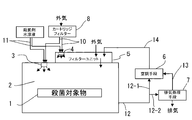
- FIG. 1 is a block diagram showing a spatial surface sterilization method and a spatial surface sterilization system according to an embodiment of the present invention.
- This system comprises a first atomizing means for sterilizing agent sprayed in the sterilizing space, an sterilizing means for external air supplied to the sterilizing space, and an air conditioning means for controlling the temperature and humidity of the sterilizing space.
- the sterilizing agent atomized by the first atomizing means and dried on the surface of the space is dried in a pressurized atmosphere, and has a sterilizing agent spraying step and a sterilizing agent drying / sterilizing step.
- the sterilizing space 2 in which the sterilizing object 1 such as an apparatus is disposed is enclosed (non-sealed) and sterilized at a lower concentration than the two-fluid spray nozzle 3 which is the first atomizing means of the sterilizing agent.
- the agent aqueous solution is atomized and sprayed.
- the two-fluid spray nozzle 3 for example, a known air-assisted internal mixing spray nozzle can be adopted, which is connected to an air (outside air) supply path 10 and a bactericide aqueous solution supply path 11, and a bactericide aqueous solution supplied in a pressurized state and Air is mixed and the germicidal aqueous solution is atomized and sprayed.
- the 1st 2 fluid spray nozzle 3 has an automation function, the nozzle which can change an angle and can apply
- the air (outside air) supplied to the first two-fluid spray nozzle 3 is purified through a filter of the cartridge filter 8 which is a purification means.
- the drying / sterilizing process of the sterilizing agent is performed by supplying outside air (air) to the sterilizing space 2, using the filter unit 5, the air conditioning unit 6, and the exhaust processing unit 7 arranged outside the sterilizing space 2.
- Outside air (air) used for drying and sterilization is supplied to the sterilization space 2 through a filter unit 5 which is a sterilization means.
- this filter unit 5 preferably incorporates a filter layer composed of a prefilter, a medium performance filter, a high performance filter or a prefilter, a medium performance filter, and an ultra high performance filter from the outer layer side. By passing through these filter layers, the air is sterilized and enters the sterilization space 2.
- the upper part of the filter unit 5 is similar to the two-fluid spray nozzle 3 serving as the first atomization means described above on the surface of the filter layer in contact with the inlet surface of the outermost filter.
- a second two-fluid spray nozzle 4 that is a second atomizing means of the disinfectant is arranged to atomize the disinfectant and spray it on the outermost filter.
- circulation paths 12 and 13 for air supplied to the sterilization space 2 through the filter unit 5 as shown in FIG. , 14 are formed.
- the circulation path 12 branches from the sterilization space 2 into a branch path 12-1 communicating with the air conditioning means 6 and a branch path 12-2 communicating with the exhaust treatment means 7.
- the air supplied to the sterilization space 2 via the filter unit 5 can be selectively sent to the air conditioning means 6 and the exhaust treatment means 7 via the circulation paths 12, 13, and 14 to be circulated as will be described later. It has become.
- the air-conditioning means 6 has a function of controlling the humidity and temperature and blowing air
- the exhaust treatment means 7 is an exhaust amount with respect to the amount of air entering the sterilization space 2 and the positive pressure of the sterilization space 2. And controlling the concentration of the bactericide in the air.
- the exhaust treatment means 7 is installed in communication with the sterilization space 2 and the air conditioning means 6, and preferably has a sterilizing agent decomposing means for decomposing and removing the sterilizing agent in the air.
- the disinfectant in the exhaust gas discharged from the exhaust gas is decomposed and removed, exhausted into the atmosphere, or circulated through the air conditioning means 6 and the filter unit 5 through the circulation paths 13 and 14 and supplied to the sterilization space.
- the disinfectant decomposing means for example, a known disinfectant decomposing means for decomposing and removing the disinfectant in the air, such as ceramic mixed with a metal as a catalyst, can be employed.
- the air starts to enter the outside air (air) through the filter unit 5 immediately after spraying the sterilizing agent and starts the drying / sterilizing process.
- the air starts to enter the outside air (air) through the filter unit 5 immediately after spraying the sterilizing agent and starts the drying / sterilizing process.
- the concentration of the sterilizing agent in the sterilizing space 2 is high, it is preferable to return to the filter unit 5 from the exhaust processing unit 7 through the air conditioning unit 6 and to enter the air again in order to dry and sterilize the sterilizing space 2.
- the running cost can be reduced because the filter layer can be used longer than when the outside air (air) is always introduced and discharged.
- the air conditioning means may be circulated from the disinfection space 2. Even in this case, it is preferable to pass through the exhaust treatment means 7 before the completion of the drying / sterilization step.
- the combination of the air circulation paths of the sterilization space in this system is (1) sterilization space 2 ⁇ exhaust treatment means 7 ⁇ air conditioning means 6 ⁇ filter unit 5 ⁇ sterilization space 2, and (2) sterilization space 2 ⁇ air conditioning means 6 ⁇ There are three paths: filter unit 5 ⁇ sterilization space 2, (3) sterilization space 2 ⁇ exhaust treatment means 7 ⁇ exhaust, all these circulation paths are stopped during the sterilizing agent spraying process, By appropriately combining the paths and controlling the air circulation and exhaust, the sterilization space can be dried and sterilized more efficiently.
- the exhaust treatment means has a sterilizing agent decomposing means
- the sterilization space 2 is preferably sealed.
- the air (outside air) supplied to the first second fluid spray nozzle 3 and the second second fluid spray nozzle 4 is preferably cleaned through a filter of a cartridge filter 8 which is a purifying means, and sprayed to the sterilization space 2. Further sterilization of the sterilizing agent and the filter unit 5 which is a means for sterilizing the outside air supplied to the sterilizing space 2 is achieved.
- the sterilizing agent may be finely divided as long as the sterilizing agent and air can be mixed and adhered, such as a micronization method using ultrasonic vibration.
- the air used for drying does not necessarily need to be sterilized by the environment of the sterilization space 2 or the bacterial species to be sterilized. In this case, the filter unit 5 and the cartridge filter 8 are unnecessary.
- a miniaturized drug spraying device that has a mechanism for taking in a bactericide aqueous solution and air (outside air), and sprays the drug by a two-fluid spray nozzle
- a disinfectant may be sprayed into the sterilization space.
- Example 1 The present inventor conducted the following experiment in order to confirm the relationship between the concentration of the aqueous hydrogen peroxide solution and the sterilizing effect in the method for sterilizing the space surface by the vaporization drying method after spraying the aqueous hydrogen peroxide solution. As shown in Table 1, six types of aqueous hydrogen peroxide solutions having concentrations different from 0.1% by weight, 0.3% by weight, 1% by weight, 3% by weight, 10% by weight, and 30% by weight were prepared.
- test piece Bacillus subtilis is inoculated and dried on one side of a 10 mm ⁇ 10 mm aluminum plate to form a test piece (test piece), and the adjusted aqueous hydrogen peroxide solution is sprayed twice with an atomizer from a distance of 100 mm from the test piece. And attached.
- the fine particle diameter of the bactericide was in the range of 1 to 30 ⁇ m, and the adhesion amount was 1 mg / cm 2 .
- FIG. 2 is an enlarged photograph of the test piece, and what appears to be granular is the disinfectant. As shown in FIG. 2, it was observed that the hydrogen peroxide aqueous solution was uniformly attached to the test piece without excess or deficiency.
- the Bacillus subtilis spore which is a test bacterium, can be used as long as the hydrogen peroxide aqueous solution concentration is 1% by weight or higher, even if the hydrogen peroxide aqueous solution concentration is not 30% by weight or higher, which is the conventional high concentration.
- a sterilization effect of 2D (sterilization rate 99%) or more was confirmed, and sufficient sterilization practically applicable was achieved.
- 0.1% by weight and 0.3% by weight had survival bacteria, and a sufficient bactericidal effect was not recognized.
- Example 2 Furthermore, the following experiment was conducted to measure the hydrogen peroxide gas concentration during air-drying in order to confirm the safety for sterilized workers by spraying with hydrogen peroxide solution.
- Spraying place Clean bench (made by AIR TECH) Blowing speed: Approximately 0.45 m / sec Size: 1,260mm x 650mm Hydrogen peroxide concentration: 3% by weight
- Experimental method After spraying diagonally from a distance of 100 mm from the workbench so that a 3 wt% aqueous hydrogen peroxide solution is attached to the entire clean bench workbench at a distance of 1 mg / cm 2 (bactericidal agent is sprayed uniformly over the workbench.
- the elapsed time after spraying the aqueous hydrogen peroxide solution and the measurement results of the hydrogen peroxide gas concentration are shown in FIG.
- the hydrogen peroxide gas concentration in the atmosphere in the clean bench increased / decreased with time, became 0 ppm 36 minutes after spraying, and was almost dry.
- ACGIH American Occupational Health Council
- OSHA American Occupational Safety and Health Administration
- TWA Time Weighted Average Allowable Exposure Limit
- the “IDLH (escape limit concentration)” of hydrogen peroxide proposed by NISH (National Institute for Occupational Safety and Health) and OSHA (US Occupational Safety and Health Administration) is 75 ppm, which is one of the maximum concentrations IDLH in this experiment. / 4 or less. Even if the hydrogen peroxide spray concentration is 10% by weight, it is below IDHL, but for safety reasons, do not enter the spray area during drying, and during spraying, masks, protective glasses, etc. It is preferable to wear protective equipment.
- the concentration of hydrogen peroxide remaining on the sprayed surface after spraying and drying the 10 wt% aqueous hydrogen peroxide solution was 0.1 ppm.
- the FDA (USA) has determined that hydrogen peroxide is not more than 0.5 ppm in the analysis immediately after distilled water filled and sealed under manufacturing conditions for the residual standard for hydrogen peroxide. That condition is met. From the results of the hydrogen peroxide concentration during spraying and after drying, according to this experiment, even when sterilized using a 10% by weight aqueous hydrogen peroxide solution, if the sterilization environment does not enter, the sterilization environment is sealed. Even if not, it was confirmed that it was safe without affecting the human body.
- Example 3 An experiment was conducted to confirm the effective concentration for obtaining the bactericidal effect depending on the type of drug.
- Spray solution Hydrogen peroxide aqueous solution, peracetic acid aqueous solution, sodium hypochlorite aqueous solution
- Test bacteria Bacillus subtilis Method: Each test substance was sprayed on each side of a 10 mm ⁇ 10 mm aluminum plate (test piece) after inoculating the test bacteria and dried to adhere 1 mg / cm 2. Soaked and cultured. In addition, the dry state of the chemical
- the hydrogen peroxide aqueous solution has a concentration of 1 to 10% by weight
- the peracetic acid aqueous solution has a concentration of 0.1 to 1% by weight
- the hypochlorous acid aqueous solution has a concentration of 0.01 to 0.1% by weight. It was confirmed that the desired bactericidal effect was obtained.
- the hydrogen peroxide aqueous solution has a drug concentration of 1 to 5% by weight
- the peracetic acid aqueous solution has 0.1 to 0.5% by weight
- hypochlorous acid is preferably selected to have a concentration in the range of 0.01 to 0.05% by weight.
- aqueous hydrogen peroxide solution With respect to the aqueous hydrogen peroxide solution, if it exceeds 6% by weight, it corresponds to “a non-medicinal deleterious substance”. Therefore, it is preferable to adjust to a lower concentration of 5% by weight or less from this point.
- Example 4 The relationship between the concentration and the amount of the bactericide, the bactericidal effect and the dry state was confirmed.
- Disinfectant hydrogen peroxide solution (concentration: 1%, 3%, 5%, 10%)
- Test bacteria Bacillus subtilis Method: Inoculate the test bacteria on one side of a 10 mm x 10 mm aluminum plate (test piece), spray the test piece while changing the amount of drug attached, and after drying at different times, immerse the test piece in the medium. Cultured. In addition, the dry state of the chemical
- drying with an appropriate amount of adhesion is effective for increasing the bactericidal effect.
- spraying a low concentration hydrogen peroxide aqueous solution of 1 to 10% by weight, and drying for 30 minutes with an extremely small amount of drug attached of 1 to 3 mg / cm 2 the spore bacteria are provided. 99% of the test bacteria were killed and the surface of the object to be sterilized could be dried.
- the humidity of the space and the dry state of the bactericide are correlated, and the lower the humidity, the easier the drying, and the adhesion amount of 1 to 3 mg / cm 2 described in Experimental Example 4 is 30 minutes It can be seen that the humidity needs to be adjusted to 20-60% RH in order to dry. Therefore, it was confirmed that the humidity is preferably kept at 60% or less when the adhesion amount is 1 to 3 mg / cm 2 .
- the temperature is preferably 25 to 50 ° C. from the viewpoint of energy efficiency, and more preferably 25 to 35 ° C., which does not require temperature adjustment even in a space where heat is generated by a machine such as a container production line.
- the drying time is preferably 5 to 60 minutes in order to obtain a sterilizing effect by sufficiently drying and to avoid drying due to excessive energy consumption.
- Experimental Example 4 in a space of humidity 60% RH and temperature 25 ° C., if the amount of the sterilizing agent attached is 1 mg / cm 2 , the sterilizing agent is dried in 20 minutes and is confirmed to have a sterilizing effect.
- the sterilizing agent can be controlled by lowering the humidity and increasing the temperature, for example, increasing the humidity of the sterilization space to 20% RH or less and increasing the temperature to 40 to 50 ° C. What is necessary is just to combine the conditions to dry in a timely manner. As described above, by appropriately adjusting the humidity, temperature, and drying time, it is possible to obtain a high sterilizing effect even when a low concentration bactericide is used.
- the sterilization effect when the sterilization space contains a complicated shape when atomizing the sterilization agent adjusted to a low concentration and spraying and attaching it to the sterilization space, the sterilization effect
- the low-concentration bactericidal agent may be dipped in a cloth or the like and wiped with the cloth, and the bactericidal agent may be dried.
- the space surface is a preform supply line for stretch blow molding a bottle, and a stretch blow molding process such as preform heating, stretch blow molding, and bottle inspection.
- a stretch blow molding process such as preform heating, stretch blow molding, and bottle inspection.
- a high bactericidal effect is obtained against spore bacteria using a low concentration bactericidal agent on the surface of the space, and the safety to the human body and the environment is high.
- a sterilization method using a spraying device can be achieved, and it is represented by a space where there are facilities for manufacturing sanitary bottles and other containers for aseptic filling of beverages, foods, etc., manufacturing facilities in the medical product manufacturing field, and hospital facilities. It can be widely applied to spaces that require sanitary conditions such as medical-related spaces, nursing homes, restaurants, and laboratories, and it is preferable to maintain sanitary spaces, and industrial applicability is high.
Landscapes
- Health & Medical Sciences (AREA)
- Epidemiology (AREA)
- Life Sciences & Earth Sciences (AREA)
- Animal Behavior & Ethology (AREA)
- General Health & Medical Sciences (AREA)
- Public Health (AREA)
- Veterinary Medicine (AREA)
- Engineering & Computer Science (AREA)
- Manufacturing & Machinery (AREA)
- Mechanical Engineering (AREA)
- Apparatus For Disinfection Or Sterilisation (AREA)
- Disinfection, Sterilisation Or Deodorisation Of Air (AREA)
- Blow-Moulding Or Thermoforming Of Plastics Or The Like (AREA)
Abstract
Description
本発明によれば、低濃度に調整した殺菌剤を微粒化して殺菌空間の殺菌対象面に付着、乾燥させることにより、人体に直接触れても影響なく、環境への影響も少なく、殺菌空間をシールドして密閉空間にする必要もなく空間表面を殺菌できる。
また、本発明の空間表面の殺菌システムによれば、安価な設備で、効率的に且つ確実に空間表面の殺菌を行うことができる。
2 殺菌空間
3 第1二流体噴霧ノズル
4 第2二流体噴霧ノズル
5 フィルターユニット(無菌化手段)
6 空調手段
7 排気処理手段
8 カートリッジフィルター(浄化手段)
10 エアー供給路
11 殺菌剤水溶液供給路
12、13、14 エアーの循環経路
12-1、12-2 分岐経路
図1は、本発明の実施形態に係る空間表面の殺菌方法及び空間表面の殺菌システムを示すブロック線図である。
本システムは、殺菌空間に噴霧する殺菌剤の第1微粒化手段、殺菌空間に供給する外気の無菌化手段、及び殺菌空間の温度、湿度のコントロールを行う空調手段から成り、前記殺菌空間の陽圧雰囲気下で前記第1微粒化手段により微粒化されて空間表面に付着した殺菌剤の乾燥を行うことを特徴とし、殺菌剤噴霧工程、殺菌剤の乾燥・殺菌工程を有している。
乾燥・殺菌に用いる外気(エアー)は、無菌化手段であるフィルターユニット5を介して殺菌空間2に供給される。このフィルターユニット5は、図示しないが、外層側からプレフィルター、中性能フィルター、高性能フィルター、あるいはプレフィルター、中性能フィルター、超高性能フィルターで構成されたフィルター層を組み込むことが好ましい。これらフィルター層を介することによりエアーは無菌化され、殺菌空間2に入気される。また、本実施形態ではフィルターユニット5の上部には、前記フィルター層のうち、最外層のフィルターの入気面と接する表面に、前述した第1微粒化手段である二流体噴霧ノズル3と同様な殺菌剤の第2微粒化手段である第2二流体噴霧ノズル4を配置し、殺菌剤を微粒子化して最外層のフィルターに噴霧するようにしている。殺菌剤を満遍なく噴霧し殺菌するためには、前記第2二流体噴霧ノズル4を複数個配置することが好ましい。このように、最外層のフィルターの殺菌を行うことにより、フィルターユニット5の外気等による細菌汚染を防止する。
尚、前記殺菌剤の微粒子化は二流体噴霧ノズル以外に、超音波振動による微細化法など、殺菌剤とエアーを混合・付着が可能であれば良い。また、乾燥に用いるエアーは、殺菌空間2の環境や殺菌対象となる菌種により必ずしも無菌化されてなくても良く、この場合、前記フィルターユニット5やカートリッジフィルター8は不要である。
本発明者は、過酸化水素水溶液の噴霧後の気化乾燥方法による空間表面の殺菌方法において、過酸化水素水溶液の濃度と殺菌効果の関係を確認するために次の実験を行なった。
表1に示すように、0.1重量%,0.3重量%,1重量%,3重量%,10重量%,30重量%と濃度が異なる6種類の過酸化水素水溶液を調整した。10mm×10mmのアルミニウム板の片面に供試菌Bacillus subtilisを植菌・乾燥して試験片(テストピース)とし、前記調整した過酸化水素水溶液を試験片から100mm離れた距離からアトマイザーで2回噴霧して付着させた。殺菌剤の微粒子径は、1~30μmの範囲で、付着量は1mg/cm2とした。図2はテストピースの拡大写真であり、粒状に見えるものが殺菌剤である。図2で示すように、テストピースには過酸化水素水溶液が過不足なく満遍に付着していることが観測された。それをクリーンベンチ内で温度35℃、湿度60%RH雰囲気で風乾により30分(乾燥状態を目視で確認)乾燥させた。その後、それらのテストピースをデキストローストリプトンブロス培地に浸漬して、35℃で7日間培養して、殺菌効果を確認した。その結果を表1に示す。

さらに、過酸化水素水溶液噴霧による殺菌中の作業者への安全を確認するため、風乾中の過酸化水素ガス濃度を測定する次の実験を行なった。
噴霧場所:クリーンベンチ(AIR TECH製)の作業台
吹出速度:約0.45m/sec
大きさ: 1,260mm×650mm
過酸化水素濃度: 3重量%
実験方法:クリーンベンチ作業台全体に3重量%過酸化水素水溶液を1mg/cm2の付着量になるよう、作業台から100mmの距離から斜めに噴霧後(作業台一面に殺菌剤が均一に噴霧された状態を目視で確認)、風乾させ、過酸化水素濃度測定器(ドレーゲル)を作業台におき、30秒ごとにクリーンベンチ内雰囲気中の過酸化水素ガス濃度を記録した。
乾燥条件:クリーンベンチの前扉を閉じ乾燥(湿度60%RH、温度28℃)
また、図3に示すように、乾燥中のクリーンベンチ内雰囲気中の過酸化水素ガス濃度は、最大18ppmまで増加している。NIOSH(米国国立労働安全衛生研究所)やOSHA(米国労働安全衛生庁)が提案している過酸化水素の「IDLH(脱出限界濃度)」は75ppmであり、本実験での最大濃度IDLHの1/4以下である。仮に過酸化水素水噴霧濃度が10重量%であってもIDHL以下であるが、安全を期するためには、乾燥中は噴霧場所に立ち入らず、また、噴霧時は、マスク、保護メガネなどの保護具をすることが好ましい。
残留濃度測定方法:噴霧した過酸化水素水溶液を乾燥後、作業台(噴霧表面)にイオン交換水5mlを滴下し、前記イオン交換水中の残留過酸化水素濃度を残留過酸化水素濃度測定器(リフレクトクワント)で測定した。
その結果を表2に示す。

これら噴霧中・乾燥後の過酸化水素濃度の結果から、本実験によれば、10重量%過酸化水素水溶液を用い殺菌した場合においても、乾燥殺菌環境中に立ち入らなければ、殺菌環境を密閉しなくても人体に影響を及ぼすことがなく、安全であることが確認された。
薬剤の種類による殺菌効果を得るための有効濃度を確認する実験を行なった。
噴霧液: 過酸化水素水溶液、過酢酸水溶液、次亜塩素酸ナトリウム水溶液
供試菌: Bacillus subtilis
方法 : 10mm×10mmのアルミ板(試験片)の片面に供試菌を植菌し乾燥した各試験片に上記各薬剤をそれぞれ噴霧して1mg/cm2付着させて乾燥後、試験片を培地に浸漬し、培養した。尚、薬剤の乾燥状態は、目視で確認した。
乾燥条件:クリーンベンチの前扉を閉じ乾燥(湿度60%RH、温度25℃)
乾燥時間:30分
培養条件:デキストローストリプトンブロス培地、35℃培養
その結果を表3に示す。
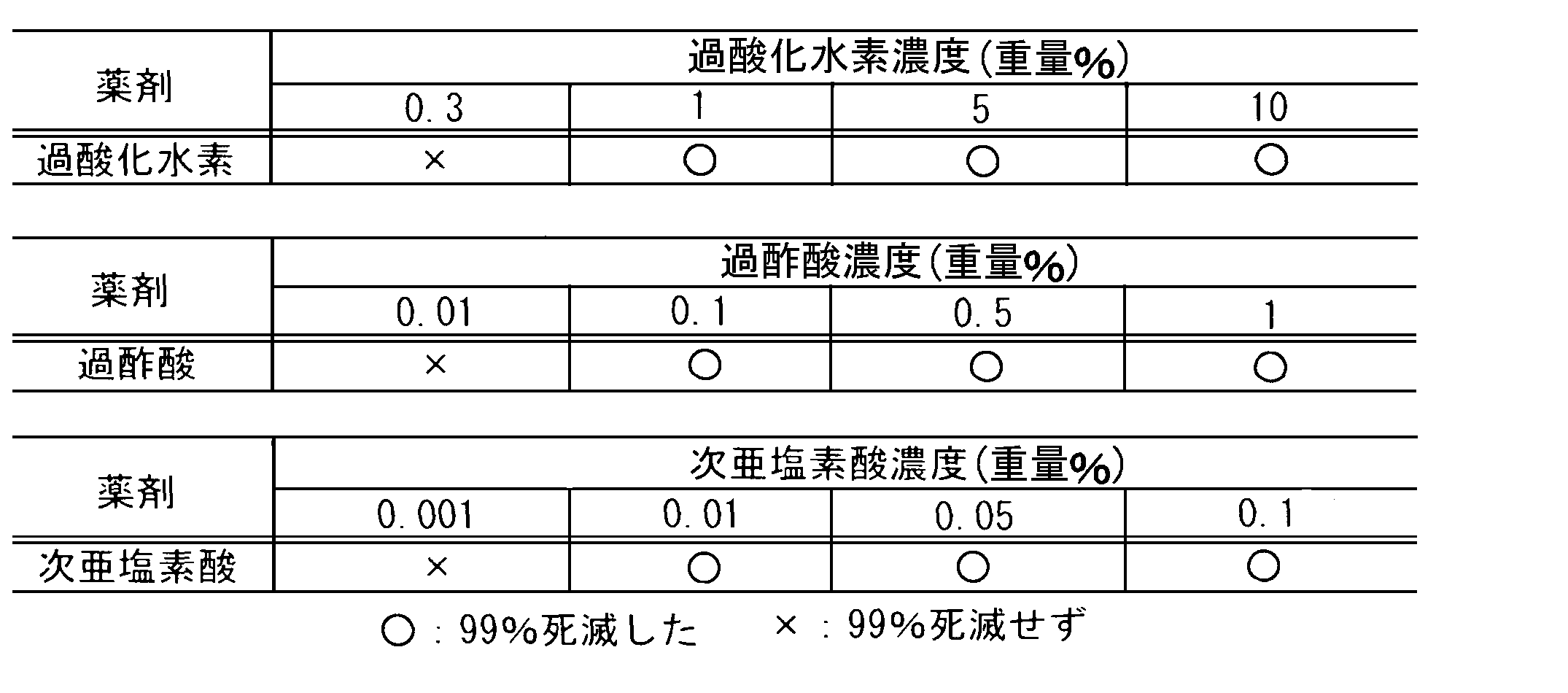
尚、薬剤量の削減及び、より一層の人体への影響を加味すると、過酸化水素水溶液は薬剤濃度1~5重量%、過酢酸水溶液は0.1~0.5重量%、次亜塩素酸水溶液は0.01~0.05重量%の範囲の濃度を選択することが好ましい。
過酸化水素水溶液に関しては、6重量%を超えると「医薬用外劇物」に該当するため、この点からも、5重量%以下のより低濃度に調整することが好ましい。
殺菌剤の濃度、付着量と殺菌効果・乾燥状態の関係を確認した。
殺菌剤 :過酸化水素水溶液
(濃度:1重量%,3重量%,5重量%,10重量%)
供試菌 :Bacillus subtilis
方法 :10mm×10mmのアルミニウム板(試験片)の片面に供試菌を植菌し、試験片に薬剤の付着量を変えて噴射し、時間を変えて乾燥後、試験片を培地に浸漬し培養した。尚、薬剤の乾燥状態は、目視で確認した。
乾燥条件:クリーンベンチの前扉を閉じ乾燥(湿度60%RH、温度25℃)
培養条件:デキストローストリプトンブロス培地、35℃培養
その結果を表4に示す。

本実験例では、1~10重量%の低濃度の過酸化水素水溶液を噴霧し、付着量1~3mg/cm2という極めて少ない薬剤の付着量で、30分乾燥させることで芽胞菌である供試菌の99%が死滅し、かつ殺菌対象物の表面を乾燥させることができた。そのことは、人体や環境に弊害をもたらさない低濃度の薬剤で、かつ少量の付着量で殺菌効果を挙げることができ、30分という短時間での乾燥が可能であることが確認された。
次に、殺菌空間の湿度が空間表面の乾燥状態に及ぼす影響を確認するために、1重量%濃度の過酸化水素水溶液を使用して、付着量と湿度を変えて乾燥状態を確認した。
方法:10mm×10mmのアルミ板(試験片)の片面に、1重量%濃度の過酸化水素水溶液を噴霧して乾燥させ、目視で乾燥状態を確認した。
乾燥条件:クリーンベンチの前扉を閉じ乾燥(温度28℃)
乾燥時間:30分
その結果を表5に示す。

また、温度は、エネルギー効率の観点から25~50℃、より好ましくは容器等製造ラインのように機械による発熱がある空間でも温度調節の必要がない25~35℃とするのが好ましい。乾燥時間は、乾燥を十分に行って殺菌効果を得ること、また、過剰なエネルギー消費による乾燥を避けることから、5~60分とするのが好ましい。前記実験例4では湿度60%RH、温度25℃の空間においては、殺菌剤の付着量が1mg/cm2であれば殺菌剤は20分で乾燥し、殺菌効果があることが確認されているが、乾燥時間をより短時間にしたい場合は、例えば、殺菌空間の湿度を20%RH以下、温度を40~50℃まであげるといったように、湿度を低く、温度を高く調節するなど、殺菌剤が乾燥する条件を適時組み合わせれば良い。
このように、前記した湿度及び温度、乾燥時間を適宜調整することにより、低濃度の殺菌剤を用いた場合でも高い殺菌効果を得ることが可能となる。
このため、飲料水、果汁飲料、茶類、コーヒー類等の飲料をPETボトルに代表されるポリエステルボトルに無菌充填するための無菌充填システムに、前記延伸ブロー成形をオンサイトで適用することにより、ボトルの製造からボトルへの飲料等の無菌充填,殺菌済みキャップによる密封までの無菌充填システムを極めて容易に構築することができる。
Claims (14)
- 殺菌空間の表面を殺菌する方法において、低濃度に調整した殺菌剤を微粒化して殺菌空間に付着させた後、前記殺菌剤を乾燥させることを特徴とする空間表面の殺菌方法。
- 前記低濃度殺菌剤は、1~10重量%濃度の過酸化水素水溶液、0.1~1重量%濃度の過酢酸水溶液、又は0.01~0.1重量%濃度の次亜塩素酸水溶液の何れかである請求項1に記載の空間表面の殺菌方法。
- 前記殺菌剤の微粒化は、前記殺菌剤とエアーを混合して噴霧することにより行なう請求項1に記載の空間表面の殺菌方法。
- 前記殺菌剤の乾燥は、エアーを送風して陽圧環境下で行なう請求項1に記載の空間表面の殺菌方法。
- 前記殺菌空間の表面の乾燥に用いるエアーは、無菌化されていることを特徴とする請求項4に記載の空間表面の殺菌方法。
- 前記殺菌空間の表面における殺菌剤の付着量を1~3mg/cm2とすることを特徴とする請求項1に記載の空間表面の殺菌方法。
- 前記殺菌剤の乾燥は、前記殺菌空間の湿度及び温度と乾燥時間を調整して行うことを特徴とする請求項1に記載の空間表面の殺菌方法。
- 前記殺菌空間の表面が、ボトルの延伸ブロー成形工程における物品及び設備の表面である請求項1に記載の空間表面殺菌方法。
- 殺菌空間に噴霧する殺菌剤の微粒化手段、殺菌空間に供給する外気の無菌化手段、及び殺菌空間の湿度、温度のコントロールを行う空調手段から成り、前記微粒化手段により微粒化されて空間表面に付着した殺菌剤の乾燥を陽圧雰囲気下で行うことを特徴とする空間表面の殺菌システム。
- 前記殺菌空間と空調手段の間に排気処理手段を配設したことを特徴する請求項9に記載の空間表面の殺菌システム。
- 前記排気処理手段が殺菌剤分解手段を有する請求項10に記載の空間表面の殺菌システム。
- 前記殺菌空間に供給する外気の無菌化手段に殺菌剤の微粒化手段を設け、前記無菌化手段へ殺菌剤を噴霧することを特徴とする請求項9に記載の空間表面の殺菌システム。
- 前記微粒化手段に供給する外気の浄化手段を設けたことを特徴とする請求項9に記載の空間表面の殺菌システム。
- 前記微粒化手段が、殺菌剤とエアーの二流体噴霧ノズルであることを特徴とする請求項13に記載の空間表面の殺菌システム。
Priority Applications (2)
| Application Number | Priority Date | Filing Date | Title |
|---|---|---|---|
| US13/522,811 US9050381B2 (en) | 2010-01-22 | 2010-10-15 | Method for sterilizing surface of space and sterilization system |
| CN201080061687.XA CN102711845B (zh) | 2010-01-22 | 2010-10-15 | 空间表面的杀菌方法及杀菌系统 |
Applications Claiming Priority (2)
| Application Number | Priority Date | Filing Date | Title |
|---|---|---|---|
| JP2010012556A JP5831673B2 (ja) | 2010-01-22 | 2010-01-22 | 空間表面の殺菌方法 |
| JP2010-012556 | 2010-01-22 |
Publications (1)
| Publication Number | Publication Date |
|---|---|
| WO2011089765A1 true WO2011089765A1 (ja) | 2011-07-28 |
Family
ID=44306581
Family Applications (1)
| Application Number | Title | Priority Date | Filing Date |
|---|---|---|---|
| PCT/JP2010/068111 Ceased WO2011089765A1 (ja) | 2010-01-22 | 2010-10-15 | 空間表面の殺菌方法及び殺菌システム |
Country Status (4)
| Country | Link |
|---|---|
| US (1) | US9050381B2 (ja) |
| JP (1) | JP5831673B2 (ja) |
| CN (1) | CN102711845B (ja) |
| WO (1) | WO2011089765A1 (ja) |
Cited By (1)
| Publication number | Priority date | Publication date | Assignee | Title |
|---|---|---|---|---|
| JP2013236927A (ja) * | 2012-04-19 | 2013-11-28 | Ena Co Ltd | 窒素酸化物による滅菌法及び滅菌装置 |
Families Citing this family (37)
| Publication number | Priority date | Publication date | Assignee | Title |
|---|---|---|---|---|
| FR2961125B1 (fr) * | 2010-06-10 | 2012-07-13 | Sidel Participations | Procede de recyclage d'air comportant un agent sterilisant et installation de fabrication de recipients comportant un circuit de recyclage d'air |
| JP6067384B2 (ja) * | 2013-01-22 | 2017-01-25 | ファーマバイオ株式会社 | 超音波除染装置 |
| JP5969404B2 (ja) * | 2013-01-23 | 2016-08-17 | ファーマバイオ株式会社 | 除染装置 |
| US8992830B2 (en) * | 2013-03-15 | 2015-03-31 | The Boeing Company | High temperature decontamination of aircraft compartments |
| JP6439920B2 (ja) * | 2013-11-14 | 2018-12-19 | 大日本印刷株式会社 | ボトルの殺菌方法及び装置 |
| WO2015109282A1 (en) * | 2014-01-20 | 2015-07-23 | Weiler Engineering, Inc. | Sterilization system for a blow/fill/seal machine |
| JP6222312B2 (ja) * | 2014-02-19 | 2017-11-01 | 大日本印刷株式会社 | ブロー成形機及びその殺菌方法 |
| JP6102904B2 (ja) * | 2014-02-19 | 2017-03-29 | 大日本印刷株式会社 | ブロー成形機及びその殺菌方法 |
| CN110721383B (zh) | 2014-06-18 | 2022-07-26 | 费雪派克医疗保健有限公司 | 患者接口和零部件 |
| JP6661905B2 (ja) * | 2014-07-08 | 2020-03-11 | 株式会社大林組 | 除菌処理方法及び除菌処理装置 |
| JP6250491B2 (ja) * | 2014-07-18 | 2017-12-20 | ファーマバイオ株式会社 | 超音波除染装置 |
| US10005579B2 (en) * | 2014-12-24 | 2018-06-26 | Laurent Robert BRONNER | System and method for aseptic and sterile packaging of low acid liquids |
| BR112017025129A2 (pt) * | 2015-05-24 | 2019-11-12 | LivOnyx Inc. | sistemas e métodos para higienizar superfícies |
| JP6411286B2 (ja) * | 2015-06-02 | 2018-10-24 | 日本エアーテック株式会社 | 過酸化水素ガス除去装置 |
| CN104906611A (zh) * | 2015-06-12 | 2015-09-16 | 常州大学 | 一种塑料包装容器消毒杀菌的方法和装置 |
| PH12019500361B1 (en) * | 2016-09-27 | 2023-03-24 | Orihiro Eng Co Ltd | Aseptic filling and packaging apparatus, and method of aseptically filling plastic film package bag with material |
| WO2018061946A1 (ja) | 2016-09-28 | 2018-04-05 | 大日本印刷株式会社 | プリフォームの加熱装置及び加熱方法、無菌ブロー成形機及び無菌ブロー成形方法 |
| JP6369515B2 (ja) * | 2016-09-28 | 2018-08-08 | 大日本印刷株式会社 | 無菌ブロー成形機及び無菌ブロー成形方法 |
| JP6373951B2 (ja) * | 2016-12-21 | 2018-08-15 | ファーマバイオ株式会社 | 超音波除染装置 |
| JP6285060B1 (ja) * | 2017-01-31 | 2018-02-28 | Sdバイオシステム株式会社 | 除染装置及び当該除染装置を使用した除染方法 |
| CN110248684B (zh) * | 2017-02-20 | 2021-07-27 | 大日本印刷株式会社 | 杀菌剂气化装置及杀菌剂气化装置的洗净方法 |
| JP6859740B2 (ja) * | 2017-02-22 | 2021-04-14 | 東洋製罐株式会社 | 無菌充填システムおよび無菌充填方法 |
| JP2018177263A (ja) | 2017-04-07 | 2018-11-15 | 大日本印刷株式会社 | 無菌充填方法及び無菌充填機 |
| JP6455574B1 (ja) * | 2017-09-05 | 2019-01-23 | 大日本印刷株式会社 | ブロー成形機の殺菌方法及びブロー成形機 |
| DE102017124331A1 (de) * | 2017-10-18 | 2019-04-18 | Krones Ag | Blasformmaschine mit Reinraum und Ausschleusung von Behältnissen |
| JP6614271B2 (ja) * | 2018-04-25 | 2019-12-04 | 大日本印刷株式会社 | プリフォームの殺菌方法及び装置 |
| CN108543102B (zh) * | 2018-07-02 | 2023-12-12 | 安徽省食品药品检验研究院 | 一种用于洁净工作间的灭菌系统及灭菌方法 |
| JP6729671B2 (ja) | 2018-12-12 | 2020-07-22 | 大日本印刷株式会社 | 無菌充填機チャンバー内の殺菌方法 |
| US20200345021A1 (en) * | 2019-05-02 | 2020-11-05 | Tomi Environmental Solutions, Inc. | Method and system for enhancing the efficacy using ionized/aerosolized hydrogen peroxide in reducing microbial populations, method of use thereof |
| CN110448711B (zh) * | 2019-08-20 | 2020-06-02 | 北京戴纳实验科技有限公司 | 一种实验室灭菌系统及其灭菌方法 |
| JP2021040736A (ja) * | 2019-09-06 | 2021-03-18 | セッツ株式会社 | 食肉加工で使用される物品の消毒方法 |
| EP3834937A1 (de) * | 2019-12-10 | 2021-06-16 | Skan Ag | Aufbau eines containments mit einer aseptischen arbeitskammer |
| CN111231273B (zh) * | 2020-01-19 | 2021-06-18 | 江苏新美星包装机械股份有限公司 | 一种预型件消毒方法及制瓶设备 |
| CN111392221B (zh) * | 2020-04-02 | 2021-09-14 | 上海久正医用包装材料有限公司 | 一种药用包装袋及其生产工艺 |
| JP6875612B1 (ja) * | 2021-01-21 | 2021-05-26 | 功憲 末次 | 除菌装置及び除菌方法 |
| CN115234999B (zh) * | 2021-04-23 | 2023-06-20 | 重庆美的制冷设备有限公司 | 杀菌控制方法、杀菌模块和空气处理装置 |
| JP2023010133A (ja) * | 2021-07-09 | 2023-01-20 | パナソニックIpマネジメント株式会社 | 空間噴霧装置 |
Citations (3)
| Publication number | Priority date | Publication date | Assignee | Title |
|---|---|---|---|---|
| JPS55110555A (en) * | 1979-02-19 | 1980-08-26 | Dainippon Printing Co Ltd | Sterilizer |
| JPH0430783A (ja) * | 1990-05-29 | 1992-02-03 | Mitsubishi Heavy Ind Ltd | 食品容器類の殺菌方法 |
| JP2008543619A (ja) * | 2005-06-24 | 2008-12-04 | スィデル・パルティスィパスィヨン | 殺菌消毒されたプリフォームをブロー成形することにより殺菌消毒されたボトルを製造するための設備 |
Family Cites Families (20)
| Publication number | Priority date | Publication date | Assignee | Title |
|---|---|---|---|---|
| US4296068A (en) * | 1979-02-19 | 1981-10-20 | Dai Nippon Insatsu Kabushiki Kaisha | Apparatus for sterilizing a succession of food containers or the like |
| JPH01267131A (ja) | 1988-04-13 | 1989-10-25 | Toppan Printing Co Ltd | 殺菌方法 |
| JP2006248617A (ja) | 1991-01-14 | 2006-09-21 | Dainippon Printing Co Ltd | 包装材料の殺菌方法 |
| JPH0565148A (ja) | 1991-01-14 | 1993-03-19 | Dainippon Printing Co Ltd | 包装材料の殺菌方法および殺菌装置 |
| JP2002193220A (ja) | 1991-01-14 | 2002-07-10 | Dainippon Printing Co Ltd | 包装材料の殺菌方法 |
| JPH0958631A (ja) * | 1995-08-14 | 1997-03-04 | Toppan Printing Co Ltd | 包装材料の殺菌方法及び殺菌装置 |
| JPH1147242A (ja) * | 1997-07-31 | 1999-02-23 | Dainippon Printing Co Ltd | 包装材料の殺菌装置及びその殺菌方法 |
| FR2774912B1 (fr) * | 1998-02-16 | 2000-09-01 | Sidel Sa | Procede pour steriliser des corps creux et dispositif pour la mise en oeuvre |
| US6120730A (en) * | 1998-06-26 | 2000-09-19 | Tetra Laval Holdings & Finance, Sa | Heat and hydrogen peroxide gas sterilization of container |
| JP2000203535A (ja) * | 1999-01-12 | 2000-07-25 | Shikoku Kakoki Co Ltd | 食品包装材料の殺菌方法及びその装置 |
| AU2004311432A1 (en) * | 2003-12-30 | 2005-07-21 | Oculus Innovative Sciences, Inc. | Oxidative reductive potential water solution, processes for producing same and methods of using the same |
| JP2006036341A (ja) * | 2004-07-30 | 2006-02-09 | Toppan Printing Co Ltd | 噴霧殺菌装置および噴霧殺菌方法 |
| JP2006288647A (ja) | 2005-04-08 | 2006-10-26 | Daikin Ind Ltd | 滅菌システム |
| JP2006288624A (ja) | 2005-04-08 | 2006-10-26 | Daikin Ind Ltd | 滅菌システム |
| JP5013036B2 (ja) * | 2005-05-17 | 2012-08-29 | 岩崎電気株式会社 | ホルムアルデヒド含有ガスの浄化方法及びホルムアルデヒド含有ガスの浄化装置 |
| FR2887526B1 (fr) * | 2005-06-24 | 2007-09-07 | Sidel Sas | Procede de sterilisation de preformes et installation produisant des bouteilles steriles a partir de ces preformes |
| ES2398533T3 (es) * | 2005-08-04 | 2013-03-20 | Saban Ventures Pty Limited | Desinfección de espacios |
| CN101472618B (zh) * | 2006-06-27 | 2013-05-22 | 东洋制罐株式会社 | 清洁空气供给装置中的灭菌方法以及清洁空气供给装置 |
| JP4657180B2 (ja) * | 2006-09-05 | 2011-03-23 | 三洋電機株式会社 | 冷却塔の除菌装置 |
| JP5286929B2 (ja) * | 2008-05-20 | 2013-09-11 | 大日本印刷株式会社 | 容器の殺菌方法及び装置 |
-
2010
- 2010-01-22 JP JP2010012556A patent/JP5831673B2/ja active Active
- 2010-10-15 WO PCT/JP2010/068111 patent/WO2011089765A1/ja not_active Ceased
- 2010-10-15 US US13/522,811 patent/US9050381B2/en active Active
- 2010-10-15 CN CN201080061687.XA patent/CN102711845B/zh not_active Expired - Fee Related
Patent Citations (3)
| Publication number | Priority date | Publication date | Assignee | Title |
|---|---|---|---|---|
| JPS55110555A (en) * | 1979-02-19 | 1980-08-26 | Dainippon Printing Co Ltd | Sterilizer |
| JPH0430783A (ja) * | 1990-05-29 | 1992-02-03 | Mitsubishi Heavy Ind Ltd | 食品容器類の殺菌方法 |
| JP2008543619A (ja) * | 2005-06-24 | 2008-12-04 | スィデル・パルティスィパスィヨン | 殺菌消毒されたプリフォームをブロー成形することにより殺菌消毒されたボトルを製造するための設備 |
Cited By (1)
| Publication number | Priority date | Publication date | Assignee | Title |
|---|---|---|---|---|
| JP2013236927A (ja) * | 2012-04-19 | 2013-11-28 | Ena Co Ltd | 窒素酸化物による滅菌法及び滅菌装置 |
Also Published As
| Publication number | Publication date |
|---|---|
| CN102711845A (zh) | 2012-10-03 |
| JP5831673B2 (ja) | 2015-12-09 |
| US9050381B2 (en) | 2015-06-09 |
| CN102711845B (zh) | 2014-12-03 |
| JP2011147673A (ja) | 2011-08-04 |
| US20120288406A1 (en) | 2012-11-15 |
Similar Documents
| Publication | Publication Date | Title |
|---|---|---|
| JP5831673B2 (ja) | 空間表面の殺菌方法 | |
| EP1919520B1 (en) | Space disinfection | |
| US6645429B1 (en) | Sterilization system and method for food packaging | |
| CN102112374B (zh) | 无菌填充系统的“容器的无菌性级别”验证方法以及无菌填充系统 | |
| CN101460263A (zh) | 对用于处理和/或灌装及封闭容器的清洁室消毒的方法 | |
| WO2018186484A1 (ja) | 無菌充填方法及び無菌充填機 | |
| JP7276732B2 (ja) | 内容物充填システム及び殺菌方法 | |
| WO2023063419A1 (ja) | 内容物充填システム及び殺菌方法 | |
| Von Bockelmann et al. | Aseptic packaging of liquid food products: a literature review | |
| EP4091794B1 (en) | Preform disinfection method and bottle manufacturing device | |
| JP4566823B2 (ja) | 飲料容器の殺菌ノズル、飲料容器の殺菌方法、及び飲料容器の殺菌装置 | |
| JP7233505B1 (ja) | 水殺菌機及び内容物充填システム | |
| JP7245453B1 (ja) | 内容物充填システム及び殺菌方法 | |
| CN213219516U (zh) | 一种次氯酸消毒通道 | |
| JP2003175917A (ja) | 物品の殺菌方法 | |
| CN205515679U (zh) | 一种杀菌除异味喷雾消毒系统 | |
| JP7245454B1 (ja) | 内容物充填システム及び殺菌方法 | |
| JP2019059554A (ja) | ボトルの殺菌方法及び装置 | |
| JP6820713B2 (ja) | 殺菌装置 | |
| US7988910B2 (en) | Method of disinfecting and wetting the interior of a building | |
| JP7324438B2 (ja) | 水殺菌機及び内容物充填システム | |
| KR20090019834A (ko) | 청정공기 공급장치에 있어서의 멸균 방법 및 청정공기 공급장치 |
Legal Events
| Date | Code | Title | Description |
|---|---|---|---|
| WWE | Wipo information: entry into national phase |
Ref document number: 201080061687.X Country of ref document: CN |
|
| 121 | Ep: the epo has been informed by wipo that ep was designated in this application |
Ref document number: 10843929 Country of ref document: EP Kind code of ref document: A1 |
|
| WWE | Wipo information: entry into national phase |
Ref document number: 13522811 Country of ref document: US |
|
| WWE | Wipo information: entry into national phase |
Ref document number: 1201003634 Country of ref document: TH |
|
| NENP | Non-entry into the national phase |
Ref country code: DE |
|
| 122 | Ep: pct application non-entry in european phase |
Ref document number: 10843929 Country of ref document: EP Kind code of ref document: A1 |