WO2011007750A1 - リチウム二次電池用正極活物質、その製造方法及びリチウム二次電池 - Google Patents
リチウム二次電池用正極活物質、その製造方法及びリチウム二次電池 Download PDFInfo
- Publication number
- WO2011007750A1 WO2011007750A1 PCT/JP2010/061754 JP2010061754W WO2011007750A1 WO 2011007750 A1 WO2011007750 A1 WO 2011007750A1 JP 2010061754 W JP2010061754 W JP 2010061754W WO 2011007750 A1 WO2011007750 A1 WO 2011007750A1
- Authority
- WO
- WIPO (PCT)
- Prior art keywords
- positive electrode
- active material
- electrode active
- atom
- lithium
- Prior art date
- Legal status (The legal status is an assumption and is not a legal conclusion. Google has not performed a legal analysis and makes no representation as to the accuracy of the status listed.)
- Ceased
Links
Images


Classifications
-
- H—ELECTRICITY
- H01—ELECTRIC ELEMENTS
- H01M—PROCESSES OR MEANS, e.g. BATTERIES, FOR THE DIRECT CONVERSION OF CHEMICAL ENERGY INTO ELECTRICAL ENERGY
- H01M4/00—Electrodes
- H01M4/02—Electrodes composed of, or comprising, active material
- H01M4/36—Selection of substances as active materials, active masses, active liquids
-
- H—ELECTRICITY
- H01—ELECTRIC ELEMENTS
- H01M—PROCESSES OR MEANS, e.g. BATTERIES, FOR THE DIRECT CONVERSION OF CHEMICAL ENERGY INTO ELECTRICAL ENERGY
- H01M4/00—Electrodes
- H01M4/02—Electrodes composed of, or comprising, active material
- H01M4/36—Selection of substances as active materials, active masses, active liquids
- H01M4/48—Selection of substances as active materials, active masses, active liquids of inorganic oxides or hydroxides
- H01M4/52—Selection of substances as active materials, active masses, active liquids of inorganic oxides or hydroxides of nickel, cobalt or iron
- H01M4/525—Selection of substances as active materials, active masses, active liquids of inorganic oxides or hydroxides of nickel, cobalt or iron of mixed oxides or hydroxides containing iron, cobalt or nickel for inserting or intercalating light metals, e.g. LiNiO2, LiCoO2 or LiCoOxFy
-
- H—ELECTRICITY
- H01—ELECTRIC ELEMENTS
- H01M—PROCESSES OR MEANS, e.g. BATTERIES, FOR THE DIRECT CONVERSION OF CHEMICAL ENERGY INTO ELECTRICAL ENERGY
- H01M10/00—Secondary cells; Manufacture thereof
- H01M10/05—Accumulators with non-aqueous electrolyte
- H01M10/052—Li-accumulators
-
- H—ELECTRICITY
- H01—ELECTRIC ELEMENTS
- H01M—PROCESSES OR MEANS, e.g. BATTERIES, FOR THE DIRECT CONVERSION OF CHEMICAL ENERGY INTO ELECTRICAL ENERGY
- H01M4/00—Electrodes
- H01M4/02—Electrodes composed of, or comprising, active material
- H01M4/36—Selection of substances as active materials, active masses, active liquids
- H01M4/362—Composites
- H01M4/364—Composites as mixtures
-
- H—ELECTRICITY
- H01—ELECTRIC ELEMENTS
- H01M—PROCESSES OR MEANS, e.g. BATTERIES, FOR THE DIRECT CONVERSION OF CHEMICAL ENERGY INTO ELECTRICAL ENERGY
- H01M4/00—Electrodes
- H01M4/02—Electrodes composed of, or comprising, active material
- H01M4/36—Selection of substances as active materials, active masses, active liquids
- H01M4/48—Selection of substances as active materials, active masses, active liquids of inorganic oxides or hydroxides
-
- H—ELECTRICITY
- H01—ELECTRIC ELEMENTS
- H01M—PROCESSES OR MEANS, e.g. BATTERIES, FOR THE DIRECT CONVERSION OF CHEMICAL ENERGY INTO ELECTRICAL ENERGY
- H01M4/00—Electrodes
- H01M4/02—Electrodes composed of, or comprising, active material
- H01M4/36—Selection of substances as active materials, active masses, active liquids
- H01M4/48—Selection of substances as active materials, active masses, active liquids of inorganic oxides or hydroxides
- H01M4/485—Selection of substances as active materials, active masses, active liquids of inorganic oxides or hydroxides of mixed oxides or hydroxides for inserting or intercalating light metals, e.g. LiTi2O4 or LiTi2OxFy
-
- H—ELECTRICITY
- H01—ELECTRIC ELEMENTS
- H01M—PROCESSES OR MEANS, e.g. BATTERIES, FOR THE DIRECT CONVERSION OF CHEMICAL ENERGY INTO ELECTRICAL ENERGY
- H01M4/00—Electrodes
- H01M4/02—Electrodes composed of, or comprising, active material
- H01M4/36—Selection of substances as active materials, active masses, active liquids
- H01M4/48—Selection of substances as active materials, active masses, active liquids of inorganic oxides or hydroxides
- H01M4/50—Selection of substances as active materials, active masses, active liquids of inorganic oxides or hydroxides of manganese
- H01M4/505—Selection of substances as active materials, active masses, active liquids of inorganic oxides or hydroxides of manganese of mixed oxides or hydroxides containing manganese for inserting or intercalating light metals, e.g. LiMn2O4 or LiMn2OxFy
-
- Y—GENERAL TAGGING OF NEW TECHNOLOGICAL DEVELOPMENTS; GENERAL TAGGING OF CROSS-SECTIONAL TECHNOLOGIES SPANNING OVER SEVERAL SECTIONS OF THE IPC; TECHNICAL SUBJECTS COVERED BY FORMER USPC CROSS-REFERENCE ART COLLECTIONS [XRACs] AND DIGESTS
- Y02—TECHNOLOGIES OR APPLICATIONS FOR MITIGATION OR ADAPTATION AGAINST CLIMATE CHANGE
- Y02E—REDUCTION OF GREENHOUSE GAS [GHG] EMISSIONS, RELATED TO ENERGY GENERATION, TRANSMISSION OR DISTRIBUTION
- Y02E60/00—Enabling technologies; Technologies with a potential or indirect contribution to GHG emissions mitigation
- Y02E60/10—Energy storage using batteries
Definitions
- the present invention relates to a positive electrode active material for a lithium secondary battery, a manufacturing method thereof, and particularly a lithium secondary battery excellent in cycle characteristics.
- lithium cobaltate has been used as a positive electrode active material for lithium secondary batteries.
- cobalt is a rare metal
- lithium nickel cobalt manganese based composite oxides having a low cobalt content see, for example, Patent Documents 1 to 3 have been developed.
- This lithium nickel cobalt manganese complex oxide as a positive electrode active material can be manufactured at low cost by adjusting the atomic ratio of nickel, manganese and cobalt contained in the complex oxide. Although it is known that it will also be excellent with respect to the property requirement, it is further desired to have excellent cycle characteristics.
- lithium secondary batteries using a positive electrode active material containing lithium nickel cobalt manganese based composite oxide having a specific composition and LiBiO 2 are particularly cycled.
- the inventors have found that the characteristics are excellent and have completed the present invention.
- an object of the present invention is to provide a positive electrode active material for a lithium secondary battery using a lithium nickel cobalt manganese based composite oxide capable of imparting particularly excellent cycle characteristics to the lithium secondary battery, and the positive electrode active material.
- An object of the present invention is to provide a lithium secondary battery using a method that is industrially advantageous and a particularly excellent cycle characteristic using the positive electrode active material.
- the first invention to be provided by the present invention is the following general formula (1).
- Li x Ni 1-yz Co y Mn z O 2 (1) (Wherein x represents 0.98 ⁇ x ⁇ 1.20, y represents 0 ⁇ y ⁇ 0.5, and z represents 0 ⁇ z ⁇ 0.5, where y + z ⁇ 1).
- a positive electrode active material for a lithium secondary battery characterized by containing lithium composite oxide and LiBiO 2 .
- the second invention to be provided by the present invention provides (a) a lithium compound, (b) a nickel atom, a cobalt atom and a manganese atom in an atomic ratio of 0.1 to 1 cobalt atom per 1 mol of nickel atom. 0.0, a compound containing 0.1 to 1.0 manganese atoms, and (c) a bismuth compound at an atomic ratio of lithium atom to nickel atom, cobalt atom, manganese atom and bismuth atom (Li / ⁇ Ni + Co + Mn + Bi ⁇ ).
- a method for producing a positive electrode active material for a lithium secondary battery comprising a second step of obtaining a positive electrode active material containing lithium composite oxide and LiBiO 2 .
- the third invention to be provided by the present invention is a lithium secondary battery using the positive electrode active material for a lithium secondary battery according to the first invention.
- a lithium secondary battery having particularly excellent cycle characteristics can be provided using a positive electrode active material made of a lithium nickel cobalt manganese based composite oxide. Moreover, according to the manufacturing method of this positive electrode active material for lithium secondary batteries, this positive electrode active material can be manufactured by an industrially advantageous method.
- the positive electrode active material for a lithium secondary battery according to the present invention (hereinafter simply referred to as “positive electrode active material” unless otherwise specified) is represented by the following general formula (1).
- Li x Ni 1-yz Co y Mn z O 2 (1) (Wherein x represents 0.98 ⁇ x ⁇ 1.20, y represents 0 ⁇ y ⁇ 0.5, and z represents 0 ⁇ z ⁇ 0.5, where y + z ⁇ 1).
- Lithium composite oxide hereinafter also referred to simply as “lithium composite oxide”
- LiBiO 2 LiBiO 2
- the positive electrode active material having such a structure includes the positive electrode active material.
- Particularly excellent cycle characteristics can be imparted to a lithium secondary battery using a substance.
- X in the formula of the lithium composite oxide represented by the general formula (1) is 0.98 or more and 1.20 or less, and particularly in the formula, x is in the range of 1.00 or more and 1.10 or less. This is particularly preferable because the initial discharge capacity of the lithium secondary battery tends to be high.
- y is greater than 0 and 0.5 or less, and it is particularly preferable that y in the formula is in the range of greater than 0 and 0.4 or less from the viewpoint of the safety of the lithium secondary battery.
- Z in the formula is greater than 0 and less than or equal to 0.5, and particularly when z in the formula is greater than 0 and less than or equal to 0.4, the initial discharge capacity of the lithium secondary battery tends to increase. Is particularly preferred.
- x in the formula is 1.00 or more and 1.05 or less
- y is 0.1 or more and 0.3 or less
- z is 0.1 or more. 0.3 or less.
- the lithium composite oxide represented by the general formula (1) has good dispersibility in the paint when the aggregated lithium composite oxide is formed by aggregating primary particles to form secondary particles.
- the average particle size of primary particles obtained by observation with a scanning electron microscope is 0.2 to 4 ⁇ m, preferably 0.5 to 2 ⁇ m. It is preferable in that the cycle characteristics of the secondary battery are good.
- the coating properties and the coating film properties are good, and further, lithium using the positive electrode active material This is preferable in that the cycle characteristics of the secondary battery are also improved.
- the physical property of LiBiO 2 as one component is not particularly limited, but a finer one than the lithium composite oxide represented by the general formula (1) is preferable because it can be uniformly dispersed with the lithium composite oxide.
- “finer than the lithium composite oxide represented by the general formula (1)” means that the average particle diameter is smaller than the secondary particles of the lithium composite oxide represented by the general formula (1).
- the LiBiO 2 content is 0.2 to 7.0% by weight, preferably 1.0 to 4.0% by weight as Bi atoms in the positive electrode active material. preferable.
- the reason for this is less than 0.2 wt% content of LiBiO 2 as a Bi atom, a lithium secondary battery using the positive electrode active material tends to be not sufficient cycle characteristics can not be obtained, whereas, the LiBiO 2 This is because if the content exceeds 7.0% by weight as Bi atoms, there is a tendency that sufficient initial discharge capacity cannot be obtained in a lithium secondary battery using the positive electrode active material.
- the presence state of LiBiO 2 may be present as fine particles on the surface of the lithium composite oxide particles, and in the case of the aggregate lithium composite oxide, the aggregate lithium It may exist in the state taken in the particle
- FIG. 1 illustrates a cross section inside the aggregated lithium composite oxide particle in a state where LiBiO 2 is taken into the aggregated lithium composite oxide particle.
- fine lithium composite oxide primary particles (2) and LiBiO 2 particles (3) are aggregated to form aggregated lithium composite oxide particles.
- At least LiBiO 2 is present in a state of being incorporated in the particles of the aggregated lithium composite oxide represented by the general formula (1).
- the secondary battery is particularly preferable from the viewpoint of excellent cycle characteristics.
- the positive electrode active material of the present invention comprises (a) a lithium compound, (b) a compound containing a nickel atom, a cobalt atom and a manganese atom, and (c) a bismuth compound, a lithium atom with respect to the nickel atom, cobalt atom, manganese atom and bismuth atom.
- the atomic ratio (Li / ⁇ Ni + Co + Mn + Bi ⁇ ) is 0.95 or more, preferably 1.00 to 1.10, and the resulting mixture is preferably 950 ° C. or less, particularly preferably 850 to 940 ° C.
- the positive electrode active material obtained by such a manufacturing method exists in a state where LiBiO 2 is incorporated inside the particles of the aggregated lithium composite oxide, and the lithium secondary battery using the positive electrode active material is particularly Excellent cycle characteristics.
- preferred physical properties of the positive electrode active material existing in a state where LiBiO 2 is incorporated inside the particles of the aggregated lithium composite oxide represented by the general formula (1) are the above-described general formula (1).
- the cycle characteristics are excellent. That is, the average primary particle size determined from observation with a scanning electron microscope is 0.2 to 4 ⁇ m, preferably 0.5 to 2 ⁇ m, and the average secondary particle size determined by the laser particle size distribution measurement method is 4. It is ⁇ 25 ⁇ m, preferably 5 to 20 ⁇ m.
- the BET specific surface area of the positive electrode active material is 0.2 to 0.8 m 2 / g, preferably 0.3 to 0.7 m 2 / g.
- the remaining LiOH is 0.1% by weight or less, preferably 0.05% by weight or less, and the remaining Li 2 CO 3 is 0.5% by weight or less, preferably 0.8%.
- the content of 3% by weight or less is particularly preferable from the viewpoint of suppressing gelation of the paint and suppressing battery swelling.
- the positive electrode active material according to the present invention is an oxide such as nickel, cobalt, manganese, etc. that is irreversibly mixed in the manufacturing method as a component other than the lithium composite oxide represented by the general formula (1) and LiBiO 2 .
- the positive electrode active material for a lithium secondary battery of the present invention comprises (a) a lithium compound, (b) a nickel atom, a cobalt atom, and a manganese atom in an atomic ratio of 0.1 to 1.0 cobalt atoms per 1 mol of nickel atoms.
- lithium compound (a) lithium compound according to the first step examples include lithium oxide, hydroxide, carbonate, nitrate, and organic acid salt. Among these, lithium carbonate is inexpensive and has excellent productivity. Are particularly preferably used.
- the lithium compound has an average particle size determined from a laser particle size distribution measurement method of 1 to 100 ⁇ m, and preferably 5 to 80 ⁇ m, because of good reactivity.
- a composite hydroxide, a composite oxyhydroxide, a composite carbonate or a composite oxide is preferably used as the compound (b) containing a nickel atom, a cobalt atom and a manganese atom according to the first step.
- the composite hydroxide can be prepared, for example, by a coprecipitation method. Specifically, a composite hydroxide can be coprecipitated by mixing an aqueous solution containing the nickel atom, cobalt atom and manganese atom, an aqueous solution of a complexing agent, and an aqueous solution of an alkali (Japanese Patent Application Laid-Open No. Hei. No.
- the composite oxide can be obtained by obtaining a composite hydroxide precipitate in accordance with the coprecipitation operation, followed by heat treatment at 200 to 500 ° C., for example.
- an aqueous solution containing the nickel atom, cobalt atom and manganese atom and an aqueous solution of a complexing agent are prepared in the same manner as in the coprecipitation operation described above, and the alkaline aqueous solution is converted to an alkali carbonate or carbonate carbonate.
- a composite carbonate can be obtained by mixing this as an aqueous solution of hydrogen alkali.
- the compound containing a nickel atom, a cobalt atom and a manganese atom is preferably a composite hydroxide containing these atoms from the viewpoint of (a) high reactivity with the lithium compound.
- the compound containing nickel atoms, cobalt atoms, and manganese atoms when an aggregate in which primary particles aggregate to form secondary particles is used, the target LiBiO 2 retains the shape of the aggregate. Is preferable in that a lithium secondary battery in which cycle characteristics are improved can be obtained by using the aggregated lithium composite oxide.
- the compound containing agglomerated nickel atom, cobalt atom and manganese atom has an average primary particle size of 0.2 to 4 ⁇ m, preferably 0.5 to 2 ⁇ m, as determined by scanning electron microscope observation.
- the resulting positive electrode active material has good coating properties and coating film properties, and further the positive electrode active material It is preferable in that the cycle characteristics of a lithium secondary battery using the lithium ion battery are also good.
- the composition of the compound containing nickel atom, cobalt atom and manganese atom is within the range of molar ratio of nickel atom, cobalt atom and manganese atom in the formula of the lithium composite oxide represented by the general formula (1). It is. That is, the cobalt atom is 0.1 to 1.0, preferably 0.2 to 0.7, and the manganese atom is 0.1 to 1.0, preferably 0.2 to 0.7, per 1 mol of nickel atom. .
- oxides, sulfates, nitrates, chlorides and the like can be used as the (c) bismuth compound according to the first step.
- bismuth oxide is particularly preferably used from the viewpoint that (a) the reactivity with the lithium compound is high and that a positive electrode active material in which LiBiO 2 is incorporated into the particles of the aggregated lithium composite oxide is easily obtained.
- the bismuth compound has an average particle size determined by a laser light scattering method of 5 to 50 ⁇ m, preferably 10 to 40 ⁇ m, and (a) it is particularly preferable from the viewpoint that it easily reacts uniformly with the lithium compound.
- the raw material (a) lithium compound, (b) compound containing nickel atom, cobalt atom and manganese atom and (c) bismuth compound are as impurities as possible to produce a high purity positive electrode active material. Those having a low content are preferred.
- the compounding ratio of (a) lithium compound, (b) compound containing nickel atom, cobalt atom and manganese atom and (c) bismuth compound is the atomic ratio of lithium atom to nickel atom, cobalt atom, manganese atom and bismuth atom (Li / ⁇ Ni + Co + Mn + Bi ⁇ ) is 0.95 or more, preferably 1.00 to 1.10, which is one important requirement for obtaining a positive electrode active material having excellent cycle characteristics. This is because when the atomic ratio of lithium atoms to nickel atoms, cobalt atoms, manganese atoms, and bismuth atoms is smaller than 0.95, the cycle characteristics are good in the lithium secondary battery using the positive electrode active material obtained by the method. Furthermore, it is because a product having a sufficient initial discharge capacity cannot be obtained.
- the compounding ratio of (b) a compound containing nickel atom, manganese atom and cobalt atom and (c) bismuth compound is 0 in terms of atomic ratio of bismuth atom to nickel atom, cobalt atom and manganese atom (Bi / ⁇ Ni + Co + Mn ⁇ ).
- a lithium secondary battery using a positive electrode active material obtained by the above method having both excellent initial discharge capacity and cycle characteristics is 0.001 to 0.03, preferably 0.005 to 0.02. It is particularly preferable from the viewpoint of.
- the cycle characteristics of the lithium secondary battery using the positive electrode active material obtained by the method are deteriorated.
- the atomic ratio (Bi / ⁇ Ni + Co + Mn ⁇ ) of bismuth atoms to nickel atoms, cobalt atoms, and manganese atoms is greater than 0.03, the lithium secondary battery using the positive electrode active material obtained by the method The initial discharge capacity tends to decrease, which is not preferable.
- the mixing may be either a dry method or a wet method, but a dry method is preferable because of easy production. In the case of dry mixing, it is preferable to use a blender or the like that uniformly mixes the raw materials.
- the mixture obtained by uniformly mixing the raw materials obtained in the first step is then subjected to a second step to obtain a positive electrode active material containing the lithium composite oxide represented by the general formula (1) and LiBiO 2 .
- a positive electrode active material containing a lithium composite oxide represented by the general formula (1) and LiBiO 2 is obtained by firing the mixture in which the raw materials obtained in the first step are uniformly mixed. It is a process to obtain.
- the firing temperature in the second step is 950 ° C. or lower, preferably 850 to 940 ° C. This is because when the firing temperature is higher than 950 ° C., the initial discharge capacity and cycle characteristics of the lithium secondary battery using the positive electrode active material obtained by the method tend to be lowered.
- the firing is preferably performed while appropriately adjusting the temperature rising rate until the predetermined firing temperature is reached. That is, the temperature is raised from room temperature (25 ° C.) to 600 ° C. at 400 to 800 ° C./hr, preferably 500 to 700 ° C./hr, and then to a predetermined firing temperature of 50 to 150 ° C./hr, preferably 75 to 125 ° C. It is preferable to raise the temperature at / hr from the viewpoint of good production efficiency and, in particular, a lithium secondary battery using a positive electrode active material obtained by the method, which has excellent cycle characteristics.
- the firing is preferably performed in the air or in an oxygen atmosphere for 1 to 30 hours.
- the fired material may be pulverized and then refired. After firing, the cathode active material of the present invention can be obtained by appropriately cooling and grinding if necessary.
- the remaining LiOH and / or LiCO is further performed by performing a third step of washing the obtained positive electrode active material with a solvent, and then performing a fourth step of annealing the positive electrode active material after the washing treatment.
- 3 can be reduced, and the coating properties and coating film characteristics can be further improved, and a positive electrode active material in which the battery swelling of the lithium secondary battery is further suppressed can be obtained.
- the obtained positive electrode active material contains residual LiOH in an amount greater than 0.1% by weight and Li 2 CO 3 in an amount greater than 0.5% by weight.
- the remaining LiOH is 0.1 wt% or less, preferably 0.05 wt% or less, and Li 2 CO 3 is 0.5 wt% or less, preferably 0.4 wt% or less.
- a positive electrode active material that is reduced and substantially free of LiOH and Li 2 CO 3 is obtained.
- the positive electrode active material which does not substantially contain LiOH and Li 2 CO 3 can suppress gelation during kneading with a binder resin when producing the positive electrode material, and can improve the coating property.
- the solvent according to the third step for example, water, warm water, ethanol, methanol, acetone or the like can be used as one or two or more mixed solvents.
- water is preferable from the viewpoint of low cost and high cleaning efficiency.
- cleaning method in a 3rd process The method of making a solvent and a positive electrode active material contact under stirring, or usual methods, such as a repulp, can be used.
- the positive electrode active material subjected to the cleaning process is annealed in the fourth step.
- the lithium secondary battery using the positive electrode active material subjected to the annealing treatment has improved initial discharge capacity and cycle characteristics compared to the lithium secondary battery using the positive electrode active material subjected only to the cleaning treatment.
- the positive electrode active material subjected to the annealing treatment can further suppress the battery swelling of the lithium secondary battery.
- the annealing conditions are 400 to 800 ° C, preferably 500 to 700 ° C.
- the reason for this is that if the heat treatment temperature is less than 400 ° C., sufficient cycle characteristics tend not to be obtained in the lithium secondary battery using the positive electrode active material obtained by the method, while if it exceeds 800 ° C., In a lithium secondary battery using a positive electrode active material obtained by the method, the initial discharge capacity tends to decrease, which is not preferable.
- the atmosphere in which the annealing treatment is performed is not particularly limited, and may be either in the air or in an oxygen atmosphere.
- the annealing treatment time is usually 3 hours or more, preferably 5 to 10 hours. Further, the annealing treatment may be performed as many times as desired. Alternatively, for the purpose of making the powder characteristics uniform, the one that has been annealed may be pulverized and then reannealed. After the annealing treatment is completed, crushing or pulverization is performed as necessary, followed by classification to obtain a product.
- a lithium secondary battery according to the present invention uses the positive electrode active material for a lithium secondary battery, and includes a positive electrode, a negative electrode, a separator, and a nonaqueous electrolyte containing a lithium salt.
- the positive electrode is formed, for example, by applying and drying a positive electrode mixture on a positive electrode current collector, and the positive electrode mixture includes a positive electrode active material, a conductive agent, a binder, and a filler added as necessary. Consists of.
- the positive electrode active material containing the lithium composite oxide represented by the general formula (1) of the present invention and LiBiO 2 is uniformly applied to the positive electrode. For this reason, the lithium secondary battery according to the present invention is particularly excellent in cycle characteristics.
- the content of the positive electrode active material contained in the positive electrode mixture is 70 to 100% by weight, preferably 90 to 98% by weight.
- the positive electrode current collector is not particularly limited as long as it is an electronic conductor that does not cause a chemical change in the constituted battery.
- the surface include carbon, nickel, titanium, and silver surface-treated. The surface of these materials may be oxidized and used, or the current collector surface may be provided with irregularities by surface treatment.
- the current collector include foils, films, sheets, nets, punched ones, lath bodies, porous bodies, foam bodies, fiber groups, nonwoven fabric molded bodies, and the like.
- the thickness of the current collector is not particularly limited, but is preferably 1 to 500 ⁇ m.
- the conductive agent is not particularly limited as long as it is an electron conductive material that does not cause a chemical change in a configured battery.
- graphite such as natural graphite and artificial graphite, carbon black, acetylene black, ketjen black, channel black, furnace black, lamp black, carbon black such as thermal black
- conductive fibers such as carbon fiber and metal fiber
- Examples include metal powders such as carbon fluoride, aluminum and nickel powder, conductive whiskers such as zinc oxide and potassium titanate, conductive metal oxides such as titanium oxide, and conductive materials such as polyphenylene derivatives.
- graphite include scaly graphite, scaly graphite, and earthy graphite. These can be used alone or in combination of two or more.
- the blending ratio of the conductive agent is 1 to 50% by weight, preferably 2 to 30% by weight in the positive electrode mixture.
- binder examples include starch, polyvinylidene fluoride, polyvinyl alcohol, carboxymethylcellulose, hydroxypropylcellulose, regenerated cellulose, diacetylcellulose, polyvinylpyrrolidone, tetrafluoroethylene, polyethylene, polypropylene, ethylene-propylene-diene terpolymer ( EPDM), sulfonated EPDM, styrene butadiene rubber, fluoro rubber, tetrafluoroethylene-hexafluoroethylene copolymer, tetrafluoroethylene-hexafluoropropylene copolymer, tetrafluoroethylene-perfluoroalkyl vinyl ether copolymer, fluorinated Vinylidene-hexafluoropropylene copolymer, vinylidene fluoride-chlorotrifluoroethylene copolymer, ethylene-tetraf Oroethylene copolymer, polychlorotrifluoroethylene
- the compound containing a functional group which reacts with lithium like a polysaccharide it is preferable to add the compound like an isocyanate group and to deactivate the functional group, for example.
- the blending ratio of the binder is 1 to 50% by weight, preferably 5 to 15% by weight in the positive electrode mixture.
- the filler suppresses the volume expansion of the positive electrode in the positive electrode mixture, and is added if necessary.
- any fibrous material can be used as long as it does not cause a chemical change in the constructed battery.
- olefinic polymers such as polypropylene and polyethylene, and fibers such as glass and carbon are used.
- the addition amount of the filler is not particularly limited, but is preferably 0 to 30% by weight in the positive electrode mixture.
- the negative electrode is formed by applying and drying a negative electrode material on the negative electrode current collector.
- the negative electrode current collector is not particularly limited as long as it is an electronic conductor that does not cause a chemical change in a configured battery.
- stainless steel, nickel, copper, titanium, aluminum, calcined carbon, copper or stainless steel examples include carbon, nickel, titanium, silver surface-treated, and an aluminum-cadmium alloy. Further, the surface of these materials may be used after being oxidized, or the surface of the current collector may be provided with irregularities by surface treatment.
- Examples of the current collector include foils, films, sheets, nets, punched ones, lath bodies, porous bodies, foam bodies, fiber groups, nonwoven fabric molded bodies, and the like.
- the thickness of the current collector is not particularly limited, but is preferably 1 to 500 ⁇ m.
- the negative electrode material is not particularly limited, and examples thereof include carbonaceous materials, metal composite oxides, lithium metals, lithium alloys, silicon-based alloys, tin-based alloys, metal oxides, conductive polymers, and chalcogen compounds. And Li—Co—Ni-based materials.
- Examples of the carbonaceous material include non-graphitizable carbon materials and graphite-based carbon materials.
- Examples of the metal composite oxide include Sn P (M 1 ) 1-p (M 2 ) q Or (wherein M 1 represents one or more elements selected from Mn, Fe, Pb and Ge, M 2 represents one or more elements selected from Al, B, P, Si, Group 1, Group 2, Group 3 and a halogen element in the periodic table, and 0 ⁇ p ⁇ 1, 1 ⁇ q ⁇ 3 ,. showing a 1 ⁇ r ⁇ 8), Li x Fe 2 O 3 (0 ⁇ x ⁇ 1), Li x WO 2 (0 ⁇ x ⁇ 1), include compounds of lithium titanate.
- the metal oxide GeO, GeO 2, SnO, SnO 2, PbO, PbO 2, Pb 2 O 3, Pb 3 O 4, Sb 2 O 3, Sb 2 O 4, Sb 2 O 5, Bi 2 O 3 Bi 2 O 4 , Bi 2 O 5 and the like.
- the conductive polymer include polyacetylene and poly-p-phenylene.
- an insulating thin film having a large ion permeability and a predetermined mechanical strength is used.
- Sheets and non-woven fabrics made of olefin polymers such as polypropylene, glass fibers or polyethylene are used because of their organic solvent resistance and hydrophobicity.
- the pore diameter of the separator may be in a range generally useful for batteries, for example, 0.01 to 10 ⁇ m.
- the thickness of the separator may be in a range for a general battery, for example, 5 to 300 ⁇ m.
- the solid electrolyte such as a polymer is used as the electrolyte described later, the solid electrolyte may also serve as a separator.
- the non-aqueous electrolyte containing a lithium salt is composed of a non-aqueous electrolyte and a lithium salt.
- a non-aqueous electrolyte a non-aqueous electrolyte, an organic solid electrolyte, or an inorganic solid electrolyte is used.
- Non-aqueous electrolytes include, for example, N-methyl-2-pyrrolidinone, propylene carbonate, ethylene carbonate, butylene carbonate, dimethyl carbonate, diethyl carbonate, ⁇ -butyrolactone, 1,2-dimethoxyethane, tetrahydroxyfuran, 2-methyl Tetrahydrofuran, dimethyl sulfoxide, 1,3-dioxolane, formamide, dimethylformamide, dioxolane, acetonitrile, nitromethane, methyl formate, methyl acetate, phosphate triester, trimethoxymethane, dioxolane derivatives, sulfolane, methylsulfolane, 3-methyl -2-oxazolidinone, 1,3-dimethyl-2-imidazolidinone, propylene carbonate derivative, tetrahydrofuran derivative, diethyl ether, 1,3- Ropansaruton, methyl propionate, and a solvent
- organic solid electrolyte examples include a polyethylene derivative, a polyethylene oxide derivative or a polymer containing the same, a polypropylene oxide derivative or a polymer containing the same, a phosphate ester polymer, polyphosphazene, polyaziridine, polyethylene sulfide, polyvinyl alcohol, polyvinylidene fluoride, Examples thereof include a polymer containing an ionic dissociation group such as polyhexafluoropropylene, and a mixture of a polymer containing an ionic dissociation group and the above non-aqueous electrolyte.
- Li nitride, halide, oxyacid salt, sulfide and the like can be used, for example, Li 3 N, LiI, Li 5 NI 2 , Li 3 N—LiI—LiOH, LiSiO 4.
- the inorganic solid electrolyte is amorphous (glass), lithium phosphate (Li 3 PO 4 ), lithium oxide (Li 2 O), lithium sulfate (Li 2 SO 4 ), phosphorus oxide (P 2 O 5) ), Compounds containing oxygen such as lithium borate (Li 3 BO 3 ), Li 3 PO 4-x N 2x / 3 (x is 0 ⁇ x ⁇ 4), Li 4 SiO 4-x N 2x / 3 (x is Nitrogen such as 0 ⁇ x ⁇ 4), Li 4 GeO 4-x N 2x / 3 (x is 0 ⁇ x ⁇ 4), Li 3 BO 3-x N 2x / 3 (x is 0 ⁇ x ⁇ 3)
- the compound to be contained can be contained in the inorganic solid electrolyte.
- lithium salt those dissolved in the non-aqueous electrolyte are used.
- the following compounds can be added to the non-aqueous electrolyte for the purpose of improving discharge, charge characteristics, and flame retardancy.
- pyridine triethyl phosphite, triethanolamine, cyclic ether, ethylenediamine, n-glyme, hexaphosphoric triamide, nitrobenzene derivative, sulfur, quinoneimine dye, N-substituted oxazolidinone and N, N-substituted imidazolidine, ethylene glycol dialkyl ether , Ammonium salt, polyethylene glycol, pyrrole, 2-methoxyethanol, aluminum trichloride, conductive polymer electrode active material monomer, triethylenephosphonamide, trialkylphosphine, morpholine, aryl compound with carbonyl group, hexamethylphosphine
- Examples include hollic triamide and 4-alkylmorpholine, bicyclic tertiary amines, oils, phosphonium salts and
- a halogen-containing solvent such as carbon tetrachloride or ethylene trifluoride can be included in the electrolyte.
- carbon dioxide gas can be included in the electrolytic solution in order to make it suitable for high-temperature storage.
- the lithium secondary battery according to the present invention is a lithium secondary battery excellent in battery performance, particularly in cycle characteristics, and the shape of the battery may be any shape such as a button, a sheet, a cylinder, a corner, or a coin type.
- the use of the lithium secondary battery according to the present invention is not particularly limited.
- electronic devices such as memory cards and video movies, and consumer electronic devices such as automobiles, electric vehicles, and game machines.
- the positive electrode active material in which LiBiO 2 which is a preferable positive electrode active material is incorporated into the particles of the aggregated lithium composite oxide is, for example, a compound containing a nickel atom, a cobalt atom and a manganese atom. It is obtained when the reaction is carried out using an aggregate having a particle shape and using bismuth oxide as the bismuth compound. This is because bismuth oxide and lithium compounds have a lower melting point than compounds containing agglomerated nickel, cobalt and manganese atoms, and contain agglomerated nickel, cobalt and manganese atoms above a certain temperature.
- Bismuth atoms diffuse into the particles of the compound containing aggregated nickel, cobalt, and manganese atoms from the gaps between the primary particles of the compound to be produced, and LiBiO 2 formation reaction takes place first in the particles of the aggregate. Then, it is considered that the compound containing nickel atom, cobalt atom and manganese atom and the unreacted lithium atom are dissolved and reacted while maintaining the shape of the aggregate.
- Ni: Co: Mn molar ratio in composite hydroxide 0.60: 0.20: 0.20
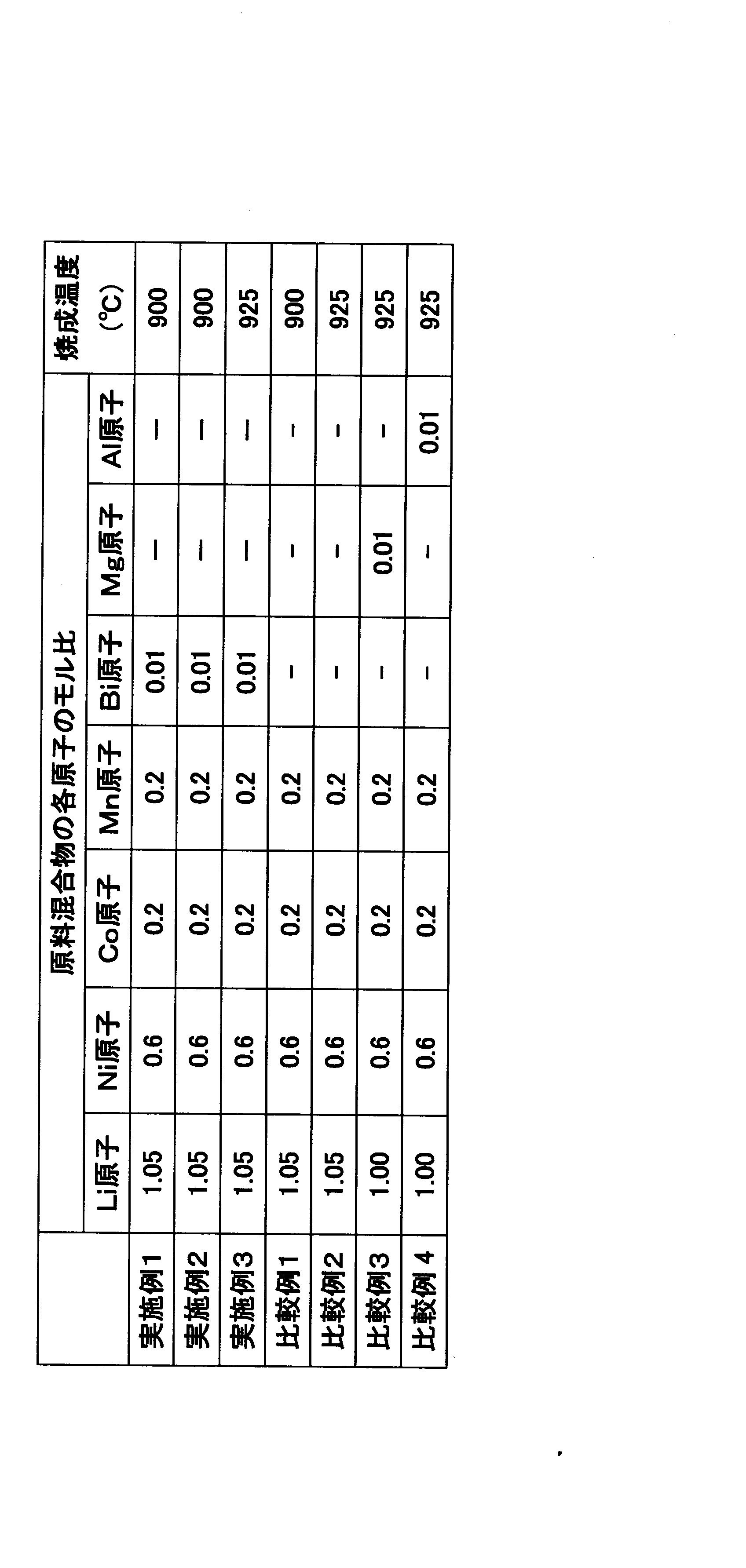
- Table 1 shows lithium carbonate (average particle: 7 ⁇ m), aggregated composite hydroxide containing nickel atom, cobalt atom and manganese atom and bismuth oxide (average particle size: 28.2 ⁇ m, manufactured by Wako Pure Chemical Industries, Ltd.). The indicated amount was added and mixed thoroughly to obtain a uniform mixture of these raw materials. Next, the temperature was raised to 600 ° C. over 1 hour, further raised to 900 ° C. over 3 hours, then held at 900 ° C. for 10 hours and fired in the air. After the firing, the fired product obtained by cooling was pulverized to obtain a positive electrode active material sample.
- the particle shape of the positive electrode active material sample was an aggregate.
- the average primary particle size determined by scanning electron microscope observation is 0.5 ⁇ m
- the secondary particle average particle size determined by the laser particle size distribution measurement method is 13.7 ⁇ m
- the BET specific surface area. was 0.64 m 2 / g.
- the average particle diameter of primary particles was calculated
- An SEM photograph of the positive electrode active material sample is shown in FIG.
- the positive electrode active material sample obtained in the reference experiment was subjected to X-ray diffraction analysis using CuK ⁇ rays.
- X-ray diffraction analysis using CuK ⁇ rays.
- LiBiO 2 diffraction peaks were confirmed at 40.13 °, 41.48 °, 46.29 °, 47.65 ° and 57.31 ° (see FIG. 3).
- the obtained positive electrode active material sample was cut as aggregated particles, and the particle cross section was measured using EPMA (device name; field emission electron probe microanalyzer (manufactured by JEOL JEOL Datum Co., Ltd., measurement conditions; acceleration voltage 15 kV, magnification 3000).
- Bi was subjected to mapping analysis with an irradiation current of 4.861e-08A), (a) in Fig. 4 shows an SEM image, and a lump in the SEM image of (a) in Fig. 4 represents one aggregated particle. Accordingly, several aggregated particles are included in (a) in Fig. 4. Also, (b) in Fig. 4 is a Bi mapping image, white in (b) in Fig. 4.
- Table 2 shows lithium carbonate (average particle: 7 ⁇ m), aggregated composite hydroxide containing nickel atom, cobalt atom and manganese atom and bismuth oxide (average particle diameter: 28.2 ⁇ m, manufactured by Wako Pure Chemical Industries, Ltd.). The indicated amount was added and mixed thoroughly to obtain a uniform mixture of these raw materials. Next, the temperature was raised to 600 ° C. over 1 hour, further raised to 900 ° C. over 3 hours, then held at 900 ° C. for 10 hours and fired in the air. After the firing, the fired product obtained by cooling was pulverized to obtain a positive electrode active material sample (A) present in a state where LiBiO 2 was taken into the particles of the aggregated lithium composite oxide.
- A positive electrode active material sample
- Example 2 ⁇ ⁇ 3rd process and 4th process 18 parts by weight of the positive electrode active material sample (A) obtained in Example 1 and 45 parts by weight of pure water were charged into a beaker, and the mixture was stirred at room temperature (25 ° C.) for 15 minutes for washing treatment. After the washing, solid-liquid separation was performed by a conventional method, and the positive electrode active material sample (B) was collected in a wet state. Next, the positive electrode active material sample (B) in the wet state is heat-treated at 600 ° C.
- a positive electrode active material sample (C2) was obtained in a state in which LiBiO 2 was incorporated into.
- An SEM photograph of the positive electrode active material sample is shown in FIG.
- Example 3 In the second step, Example 1 and Example 2 except that the temperature was raised to 600 ° C. over 1 hour, further raised to 925 ° C. over 3 hours, then held at 925 ° C. for 10 hours and fired in the air.
- the first to fourth steps were carried out in the same manner as described above to obtain a positive electrode active material sample (C3) present in a state where LiBiO 2 was taken into the particles of the aggregated lithium composite oxide.
- ⁇ Comparative Example 4 ⁇ Lithium carbonate (average particle: 7 ⁇ m), aggregated complex oxide containing nickel atom, cobalt atom and manganese atom and aluminum hydroxide (average particle size: 1.4 ⁇ m) were added in the amounts shown in Table 2 and fully dry. To obtain a uniform mixture of these raw materials. Next, the temperature was raised to 600 ° C. over 1 hour, further raised to 925 ° C. over 3 hours, then held at 925 ° C. for 10 hours and fired in the atmosphere. After the firing, the fired product obtained by cooling was pulverized to obtain a positive electrode active material sample (a4) composed of an aggregated lithium composite oxide containing Al atoms as a solid solution.
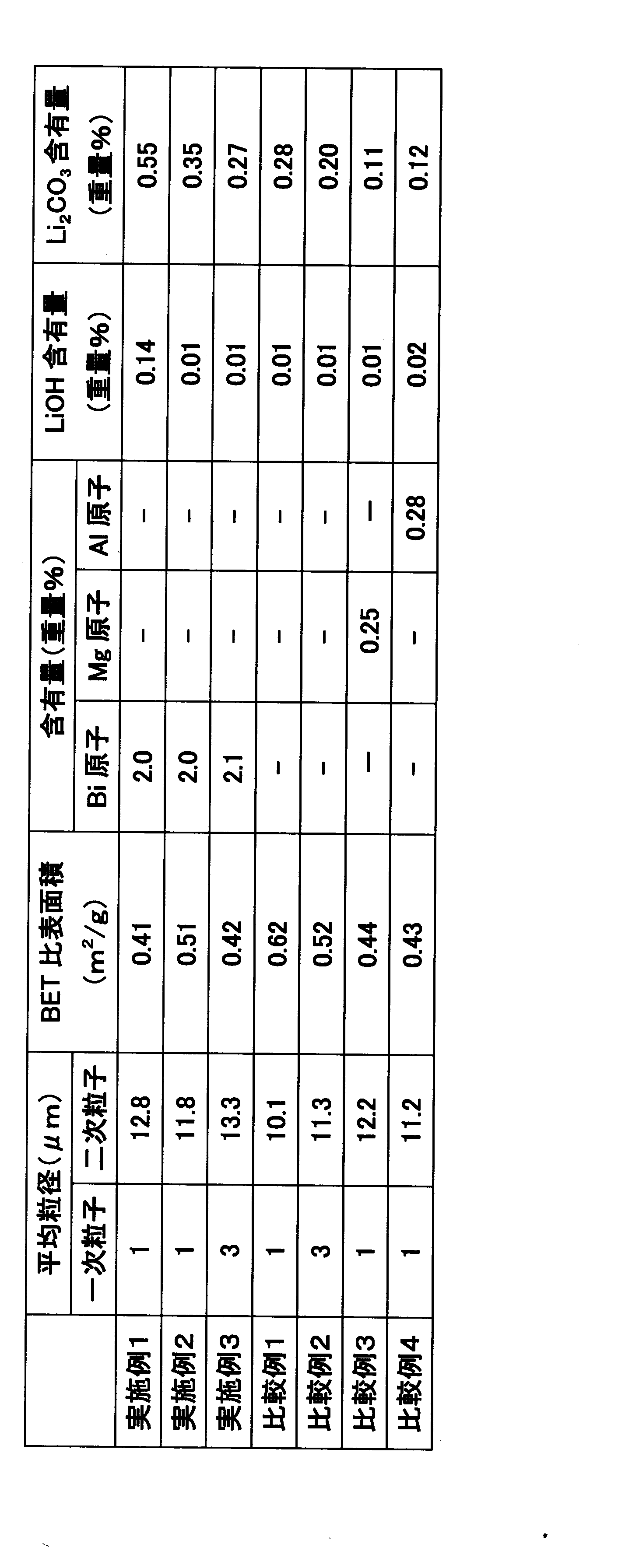
- the average particle size of primary particles, the average particle size of secondary particles, the BET specific surface area, the content of LiBiO 2 , the amount of remaining LiOH and Li 2 CO 2 were determined.
- the particle shape of the obtained positive electrode active material was determined by observation with a scanning electron microscope.
- the average particle diameter of the primary particles was measured by observation with a scanning electron microscope as an average value of 100 aggregated particles arbitrarily extracted.
- the average particle size of the secondary particles was determined by a laser particle size distribution measurement method.
- the amount of Bi atoms was determined by ICP emission analysis.
- the Mg content and Al content were also determined by ICP emission analysis. (Evaluation of LiOH and Li 2 CO 3 content) 5 g of sample and 100 g of pure water are measured in a beaker and dispersed for 5 minutes using a magnetic stirrer. The dispersion was then filtered, and 30 ml of the filtrate was titrated with 0.1 N HCl with an automatic titrator (model COMMITITE-2500) to calculate residual LiOH and Li 2 CO 3 .
- a lithium secondary battery was manufactured using each member such as a separator, a negative electrode, a positive electrode, a current collector plate, a mounting bracket, an external terminal, and an electrolytic solution.
- a metal lithium foil was used for the negative electrode, and 1 mol of LiPF 6 dissolved in 1 liter of a 1: 1 kneaded solution of ethylene carbonate and methyl ethyl carbonate was used for the electrolyte.
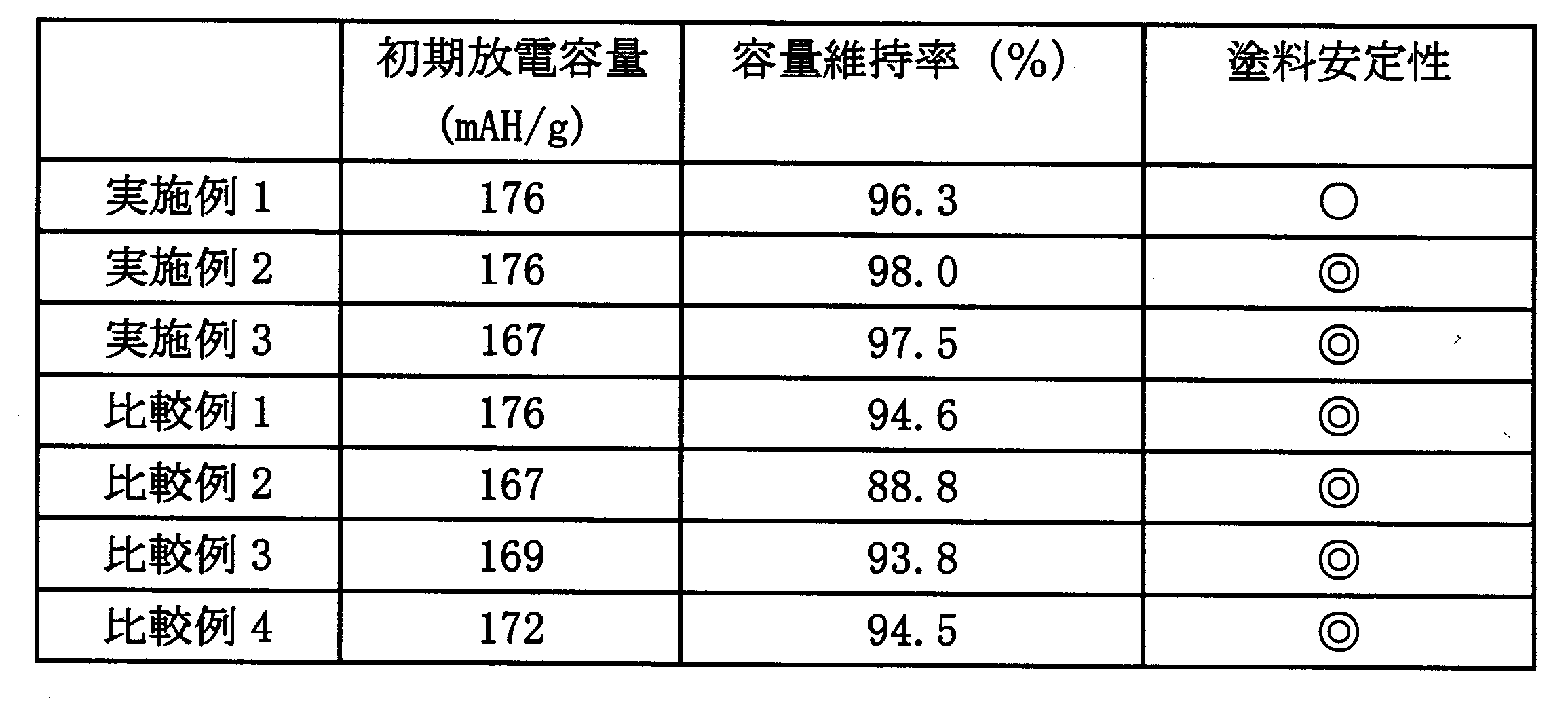
- the lithium secondary battery using the positive electrode active material of the present invention has particularly excellent cycle characteristics, and the initial discharge capacity is the same as that of Comparative Example 1 in which LiBiO 2 was not contained in Example 2.
- Example 3 it can be seen that the practical range is the same as Comparative Example 2 in which LiBiO 2 was not contained.
- the third step and a positive electrode active material is substantially free of LiOH and Li 2 CO 3 obtained by performing the fourth step (Example 2 and Example 3), the coating property is improved I understand.
- a lithium secondary battery having particularly excellent cycle characteristics can be provided using a positive electrode active material made of a lithium nickel cobalt manganese based composite oxide. Moreover, according to the manufacturing method of this positive electrode active material for lithium secondary batteries, this positive electrode active material can be manufactured by an industrially advantageous method.
Landscapes
- Chemical & Material Sciences (AREA)
- Chemical Kinetics & Catalysis (AREA)
- Electrochemistry (AREA)
- General Chemical & Material Sciences (AREA)
- Inorganic Chemistry (AREA)
- Engineering & Computer Science (AREA)
- Manufacturing & Machinery (AREA)
- Composite Materials (AREA)
- Battery Electrode And Active Subsutance (AREA)
- Secondary Cells (AREA)
Abstract
Description
LixNi1-y-zCoyMnzO2 (1)
(式中、xは0.98≦x≦1.20、yは0<y≦0.5、zは0<z≦0.5を示し、但し、y+z<1を示す。)で表されるリチウム複合酸化物と、LiBiO2を含有することを特徴とするリチウム二次電池用正極活物質である。
LixNi1-y-zCoyMnzO2 (1)
(式中、xは0.98≦x≦1.20、yは0<y≦0.5、zは0<z≦0.5を示し、但し、y+z<1を示す。)で表されるリチウム複合酸化物と、LiBiO2を含有する正極活物質を得る第2工程を有することを特徴とするリチウム二次電池用正極活物質の製造方法である。
また、該リチウム二次電池用正極活物質の製造方法によれば、該正極活物質を工業的に有利な方法で製造することができる。
本発明に係るリチウム二次電池用正極活物質(以下、特に断らない限りは単に「正極活物質」と呼ぶ。)は、下記一般式(1)
LixNi1-y-zCoyMnzO2 (1)
(式中、xは0.98≦x≦1.20、yは0<y≦0.5、zは0<z≦0.5を示し、但し、y+z<1を示す。)で表されるリチウム複合酸化物(以下、単に「リチウム複合酸化物」と呼ぶこともある。)と、LiBiO2を含有することを特徴とするものであり、かかる構成を有する正極活物質は、該正極活物質を用いたリチウム二次電池に、特に優れたサイクル特性を付与することができる。
前記一般式(1)で表されるリチウム複合酸化物において、特に好ましくは式中のxが1.00以上1.05以下、yが0.1以上0.3以下、zが0.1以上0.3以下である。
該凝集状リチウム複合酸化物は、走査型電子顕微鏡観察から求められる一次粒子の平均粒径が0.2~4μm、好ましくは0.5~2μmであると、該正極活物質を用いたリチウム二次電池のサイクル特性が良好となる点で好ましい。更に、レーザー法粒度分布測定法から求められる二次粒子の平均粒径が4~25μm、好ましくは5~20μmであると、塗布性及び塗膜特性が良く、更に該正極活物質を用いたリチウム二次電池のサイクル特性も良好になる点で好ましい。
本発明のリチウム二次電池用正極活物質は、(a)リチウム化合物、(b)ニッケル原子、コバルト原子及びマンガン原子を原子比でニッケル原子1モルに対してコバルト原子0.1~1.0、マンガン原子0.1~1.0含む化合物及び(c)ビスマス化合物とを、ニッケル原子、コバルト原子、マンガン原子及びビスマス原子に対するリチウム原子の原子比(Li/{Ni+Co+Mn+Bi})で0.95以上で混合物する第1工程、次いで、得られる混合物を焼成して前記一般式(1)で表されるリチウム複合酸化物と、LiBiO2を含有する正極活物質を得る第2工程を有することにより、工業的に有利に製造することが出来る。
なお、本発明において、ニッケル原子、コバルト原子及びマンガン原子を含む化合物は、これらの各原子を含む複合水酸化物であることが(a)リチウム化合物との反応性が高い観点から好ましい。
また、このビスマス化合物はレーザー光散乱法から求められる平均粒径が5~50μm、好ましくは10~40μmであると(a)リチウム化合物と均一に反応し易いという観点から特に好ましい。
一方、ニッケル原子、コバルト原子及びマンガン原子に対するビスマス原子の原子比(Bi/{Ni+Co+Mn})が0.001未満では、該方法により得られる正極活物質を用いたリチウム二次電池のサイクル特性が低下する傾向があり、ニッケル原子、コバルト原子及びマンガン原子に対するビスマス原子の原子比(Bi/{Ni+Co+Mn})が0.03より大きくなると、該方法により得られる正極活物質を用いたリチウム二次電池の初期放電容量が低下する傾向があり、好ましくない。
第2工程のおける焼成温度は950℃以下、好ましくは850~940℃である。この理由は、焼成温度が950℃より大きくなると、該方法により得られる正極活物質を用いたリチウム二次電池の初期放電容量及びサイクル特性が低下する傾向があるためである。
また、焼成は、大気中又は酸素雰囲気中で、1~30時間焼成することが好ましい。
焼成後、適宜冷却し、必要に応じ粉砕すると、本発明の正極活物質が得られる。
該LiOH及びLi2CO3を実質的に含有しない正極活物質は、正極材を製造する際のバインダー樹脂との混練の際のゲル化を抑制し、塗布性を向上させることができる。
このアニール処理により、該アニール処理を施した正極活物質を用いたリチウム二次電池は、洗浄処理のみを施した正極活物質を用いたリチウム二次電池に比べ、初期放電容量及びサイクル特性が向上し、また、該アニール処理を施した正極活物質は、リチウム二次電池の電池膨れを更に抑制することができる。
アニール処理終了後は、必要により解砕或いは粉砕を行い、次いで分級を行って製品とする。
<ニッケル原子、コバルト原子及びマンガン原子を含む複合水酸化物の調製>
本発明の実施例においては、下記諸物性を有する市販のニッケル原子、コバルト原子及びマンガン原子を含む凝集状複合水酸化物(田中化学研究所製)を用いた。なお、一次粒子の平均粒径は、任意に抽出した100個の凝集粒子について、走査型電子顕微鏡観察により求めた。また、二次粒子の平均粒子はレーザー法粒度分布測定方法により求めた。複合酸化物中のNi:Co:Mnのモル比は、ICPによりNi原子、Co原子及びMn原子の含有量を測定し、その測定値から算出した。
複合水酸化物の物性
(1)複合水酸化物中のNi:Co:Mnのモル比=0.60:0.20:0.20
(2)複合水酸化物の一次粒子の平均粒径;0.2μm
(3)複合水酸化物の二次粒子の平均粒径;10.9μm
(4)複合水酸化物のBET比表面積;2.3m2/g
炭酸リチウム(平均粒子;7μm)、前記ニッケル原子、コバルト原子及びマンガン原子を含む凝集状複合水酸化物及び酸化ビスマス(平均粒径;28.2μm、和光純薬工業社製)とを表1に示す量添加し、十分乾式で混合して、これら原料の均一混合物を得た。次いで600℃まで1時間で昇温、更に900℃まで3時間で昇温し、次に900℃で10時間保持し大気中で焼成した。焼成終了後、冷却し得られた焼成物を粉砕し、正極活物質試料を得た。該正極活物質を走査型電子顕微鏡観察を行った結果、該正極活物質試料の粒子形状は凝集体であることが確認された。なお、走査型電子顕微鏡観察から求められる一次粒子の平均粒径は0.5μmで、レーザー法粒度分布測定法により求められる二次粒子の平均粒径が13.7μmであり、また、BET比表面積は0.64m2/gであった。なお、一次粒子の平均粒径は、任意に抽出した100個の凝集粒子の平均値として求めた。
また、該正極活物質試料のSEM写真を図2に示す。

更に、得られた正極活物質試料を凝集粒子のままカットして粒子断面をEPMA(装置名;フィールドエミッション電子プローブマイクロアナライザ(JEOL 日本電子データム株式会社製、測定条件;加速電圧15kV、倍率3000、照射電流4.861e-08A)でBiをマッピング分析した。図4中の(a)はSEM像を示す。図4中の(a)のSEM像にある塊状のものは1個の凝集粒子を示し、従って、図4中の(a)中には数個の凝集粒子が含まれている。また、図4中の(b)はBiマッピング像である。図4中の(b)の白い点状物はBi原子を示す。
EPMAのマッピング分析の結果、凝集粒子の内部にBi原子が存在していることが確認できた。
上記の結果から、本発明の製法で得られる正極活物質は、図1に示すようなリチウム複合酸化物の一次粒子(2)が集合して二次粒子(1)を形成し、少なくとも凝集状リチウム複合酸化物の粒子内部にLiBiO2(3)が取り込まれた状態で存在するものであることが分かる。
<第1工程・第2工程>
炭酸リチウム(平均粒子;7μm)、前記ニッケル原子、コバルト原子及びマンガン原子を含む凝集状複合水酸化物及び酸化ビスマス(平均粒径;28.2μm、和光純薬工業社製)とを表2に示す量添加し、十分乾式で混合して、これら原料の均一混合物を得た。次いで600℃まで1時間で昇温、更に900℃まで3時間で昇温し、次に900℃で10時間保持し大気中で焼成した。焼成終了後、冷却し得られた焼成物を粉砕し、凝集状リチウム複合酸化物の粒子内部にLiBiO2が取り込まれた状態で存在する正極活物質試料(A)を得た。
<第3工程・第4工程>
実施例1で得られた正極活物質試料(A)を18重量部及び純水45重量部をビーカーに仕込み、室温(25℃)で15分間攪拌を行って洗浄処理を行った。
洗浄終了後、常法により固液分離して正極活物質試料(B)をウェト状態で回収した。
次いで、ウェト状態の正極活物質試料(B)をウェト状態のまま、600℃で5時間、大気雰囲気で加熱処理し、加熱処理品を粉砕、次いで分級して凝集状リチウム複合酸化物の粒子内部にLiBiO2が取り込まれた状態で存在する正極活物質試料(C2)を得た。
また、該正極活物質試料のSEM写真を図5に示す。
第2工程において、焼成を600℃まで1時間で昇温、更に925℃まで3時間で昇温し、次に925℃で10時間保持し大気中で焼成した以外は実施例1及び実施例2と同様にして第1工程~第4工程を実施して凝集状リチウム複合酸化物の粒子内部にLiBiO2が取り込まれた状態で存在する正極活物質試料(C3)を得た。
酸化ビスマスを添加しない以外は、実施例2と同様にして第1工程及び第2工程を実施し、更に実施例2と同様にして第3工程~第4工程を実施し、凝集状リチウム複合酸化物からなる正極活物質試料(c1)を得た。
酸化ビスマスを添加しない以外は、実施例3と同様にして第1工程及び第2工程を実施し、更に実施例3と同様にして第3工程~第4工程を実施し、凝集状リチウム複合酸化物からなる正極活物質試料(c2)を得た。
<第1工程・第2工程>
炭酸リチウム(平均粒子;7μm)、前記ニッケル原子、コバルト原子及びマンガン原子を含む凝集状複合酸化物及び酸化マグネシウム(平均粒径;5.3μm)とを表2に示す量添加し、十分乾式で混合して、これら原料の均一混合物を得た。次いで600℃まで1時間で昇温、更に925℃まで3時間で昇温し、次に925℃で10時間保持し大気中で焼成した。焼成終了後、冷却し得られた焼成物を粉砕し、Mg原子が固溶して含有された凝集状リチウム複合酸化物からなる正極活物質試料(a3)を得た。
<第3工程・第4工程>
得られた正極活物質試料(a3)を18重量部及び純水45重量部をビーカーに仕込み、室温(25℃)で15分間攪拌を行って洗浄処理を行った。
洗浄終了後、常法により固液分離して正極活物質試料(b3)をウェト状態で回収した。
次いで、ウェト状態の正極活物質試料(b3)をウェト状態のまま、600℃で5時間、大気雰囲気で加熱処理し、加熱処理後、粉砕、次いで分級して正極活物質試料(c3)を得た。
<第1工程・第2工程>
炭酸リチウム(平均粒子;7μm)、前記ニッケル原子、コバルト原子及びマンガン原子を含む凝集状複合酸化物及び水酸化アルミニウム(平均粒径;1.4μm)とを表2に示す量添加し、十分乾式で混合して、これら原料の均一混合物を得た。次いで600℃まで1時間で昇温、更に925℃まで3時間で昇温し、次に925℃で10時間保持し大気中で焼成した。焼成終了後、冷却し得られた焼成物を粉砕し、Al原子が固溶して含有された凝集状リチウム複合酸化物からなる正極活物質試料(a4)を得た。
<第3工程・第4工程>
得られた正極活物質試料(a4)を18重量部及び純水45重量部をビーカーに仕込み、室温(25℃)で15分間攪拌を行って洗浄処理を行った。
洗浄終了後、常法により固液分離して正極活物質試料(b4)をウェト状態で回収した。
次いで、ウェト状態の正極活物質試料(b4)をウェト状態のまま、600℃で5時間、大気雰囲気で加熱処理し、加熱処理後、粉砕、次いで分級して正極活物質試料(c4)を得た。
上記で得られた正極活物質について、一次粒子の平均粒径、二次粒子の平均粒径、BET比表面積、LiBiO2の含有量、残存するLiOH及びLi2CO2の量を求めた。なお、得られた正極活物質の粒子形状は、走査型電子顕微鏡観察から求めた。
(平均粒径の評価)
一次粒子の平均粒径は、任意に抽出した100個の凝集粒子の平均値として、走査型電子顕微鏡観察により測定した。また、二次粒子の平均粒径はレーザー粒度分布測定法により求めた。
(LiBiO2含有量、Mg及びAl含有量の評価)
ICP発光分析法によりBi原子の量として求めた。なお、Mg含量量と、Al含有量もICP発光分析法により求めた。
(LiOH、Li2CO3含有量の評価)
試料5g、純水100gをビーカーに計り採りマグネチックスターラーを用いて5分間分散させる。次いでこの分散液をろ過し、そのろ液30mlを自動滴定装置(型式COMTITE-2500)にて0.1N-HClで滴定し残留LiOH及びLi2CO3を算出した。

(1)リチウム二次電池の作成
実施例1~3及び比較例1~4で得られた正極活物質95重量%、黒鉛粉末2.5重量%、ポリフッ化ビニリデン2.5重量%を混合して正極剤とし、これをN-メチル-2-ピロリジノンに分散させて混練ペーストを調製した。該混練ペーストをアルミ箔に塗布したのち乾燥、プレスして直径15mmの円盤に打ち抜いて正極板を得た。
この正極板を用いて、セパレーター、負極、正極、集電板、取り付け金具、外部端子、電解液等の各部材を使用してリチウム二次電池を製作した。このうち、負極は金属リチウム箔を用い、電解液にはエチレンカーボネートとメチルエチルカーボネートの1:1混練液1リットルにLiPF61モルを溶解したものを使用した。
作製したリチウム二次電池を室温(25℃)で下記条件で作動させ、下記の電池性能を評価した。
<サイクル特性の評価>
正極に対して定電流電圧(CCCV)充電により1.0Cで5時間かけて、4.3Vまで充電した後、放電レート0.2Cで2.7Vまで放電させる充放電を行い、これらの操作を1サイクルとして1サイクル毎に放電容量を測定した。このサイクルを20サイクル繰り返し、1サイクル目と20サイクル目のそれぞれの放電容量から、下記式により容量維持率を算出した。なお、1サイクル目の放電容量を初期放電容量とした。結果を表5に示す。
容量維持率(%)=(20サイクル目の放電容量/1サイクル目の放電容量)×100
実施例1~3及び比較例1~4で得られた正極活物質95重量%、黒鉛粉末2.5重量%、ポリフッ化ビニリデン2.5重量%を混合して正極剤とし、これをN-メチル-2-ピロリジノンに分散させて混練ペーストを調製した。この混錬ペーストを、斜めにしたガラス板に落としゲル化の指標となる流動性について下記に沿って目視で評価した。その結果を表5に併記した。
塗料安定性の評価基準
評価 流動性
◎・・・良好
○・・・やや良好
×・・・不良
また、該リチウム二次電池用正極活物質の製造方法によれば、該正極活物質を工業的に有利な方法で製造することができる。
2.リチウム複合酸化物の一次粒子
3.LiBiO2
Claims (13)
- 下記一般式(1)
LixNi1-y-zCoyMnzO2 (1)
(式中、xは0.98≦x≦1.20、yは0<y≦0.5、zは0<z≦0.5を示し、但し、y+z<1を示す。)で表されるリチウム複合酸化物と、LiBiO2を含有することを特徴とするリチウム二次電池用正極活物質。 - 前記リチウム複合酸化物は、一次粒子が集合して二次粒子を形成した凝集状リチウム複合酸化物であることを特徴とする請求項1記載のリチウム二次電池用正極活物質。
- 前記LiBiO2は、少なくとも凝集状リチウム複合酸化物の粒子内部に取り込まれて存在することを特徴とする請求項2記載のリチウム二次電池用正極活物質。
- (a)リチウム化合物、(b)ニッケル原子、コバルト原子及びマンガン原子を含む化合物及び(c)ビスマス化合物とを、ニッケル原子、コバルト原子、マンガン原子及びビスマス原子に対するリチウム原子の原子比(Li/{Ni+Co+Mn+Bi})で0.95以上で混合し、得られた混合物を焼成して生成されたものであることを特徴とする請求項1乃至3記載のリチウム二次電池用正極活物質。
- 前記LiBiO2の含有量がBi原子として0.2~7.0重量%であることを特徴とする請求項1乃至4記載のリチウム二次電池用正極活物質。
- 残存するLiOHが0.1重量%以下で、且つ残存するLi2CO3が0.5重量%以下であることを特徴とする請求項1乃至5記載のリチウム二次電池用正極活物質。
- (a)リチウム化合物、(b)ニッケル原子、コバルト原子及びマンガン原子を原子比でニッケル原子1モルに対してコバルト原子0.1~1.0、マンガン原子0.1~1.0含む化合物及び(c)ビスマス化合物とを、ニッケル原子、コバルト原子、マンガン原子及びビスマス原子に対するリチウム原子の原子比(Li/{Ni+Co+Mn+Bi})で0.95以上で混合物する第1工程、次いで、得られる混合物を焼成して下記一般式(1)
LixNi1-y-zCoyMnzO2 (1)
(式中、xは0.98≦x≦1.20、yは0<y≦0.5、zは0≦z≦0.5を示し、但し、y+z<1を示す。)で表されるリチウム複合酸化物と、LiBiO2を含有する正極活物質を得る第2工程を有することを特徴とするリチウム二次電池用正極活物質の製造方法。 - 前記第2工程の焼成は950℃以下で行うことを特徴とする請求項7記載のリチウム二次電池用正極活物質の製造方法。
- 前記ニッケル原子、マンガン原子及びコバルト原子を含む化合物が凝集状複合水酸化物であることを特徴とする請求項7記載のリチウム二次電池用正極活物質の製造方法。
- 更に、得られた正極活物質を溶媒で洗浄処理する第3工程、次いで、洗浄処理後の正極活物質をアニール処理する第4工程を有することを特徴とする請求項7記載のリチウム二次電池用正極活物質の製造方法。
- 前記溶媒が水であることを特徴とする請求項10記載のリチウム二次電池用正極活物質の製造方法。
- 前記アニール処理は400~800℃で行うことを特徴とする請求項10記載のリチウム二次電池用正極活物質の製造方法。
- 請求項1乃至6の何れか1項に記載のリチウム二次電池用正極活物質を用いたことを特徴とするリチウム二次電池。
Priority Applications (1)
| Application Number | Priority Date | Filing Date | Title |
|---|---|---|---|
| CN2010800407272A CN102498598A (zh) | 2009-07-13 | 2010-07-12 | 锂二次电池用正极活性物质、其制造方法及锂二次电池 |
Applications Claiming Priority (2)
| Application Number | Priority Date | Filing Date | Title |
|---|---|---|---|
| JP2009-164541 | 2009-07-13 | ||
| JP2009164541A JP5490457B2 (ja) | 2009-07-13 | 2009-07-13 | リチウム二次電池用正極活物質、その製造方法及びリチウム二次電池 |
Publications (1)
| Publication Number | Publication Date |
|---|---|
| WO2011007750A1 true WO2011007750A1 (ja) | 2011-01-20 |
Family
ID=43449358
Family Applications (1)
| Application Number | Title | Priority Date | Filing Date |
|---|---|---|---|
| PCT/JP2010/061754 Ceased WO2011007750A1 (ja) | 2009-07-13 | 2010-07-12 | リチウム二次電池用正極活物質、その製造方法及びリチウム二次電池 |
Country Status (4)
| Country | Link |
|---|---|
| JP (1) | JP5490457B2 (ja) |
| KR (1) | KR20120042837A (ja) |
| CN (1) | CN102498598A (ja) |
| WO (1) | WO2011007750A1 (ja) |
Cited By (4)
| Publication number | Priority date | Publication date | Assignee | Title |
|---|---|---|---|---|
| CN102683671A (zh) * | 2012-05-07 | 2012-09-19 | 宁德新能源科技有限公司 | 层状锂镍系复合氧化物正极材料 |
| WO2019057536A1 (en) * | 2017-09-20 | 2019-03-28 | Basf Se | PROCESS FOR PRODUCING ELECTRODE ACTIVE MATERIAL |
| EP3641028A4 (en) * | 2017-10-19 | 2020-06-03 | LG Chem, Ltd. | CATHODE MATERIAL FOR A LITHIUM SECONDARY BATTERY, PRODUCTION METHOD THEREFOR, CATHODE THEREFOR FOR A LITHIUM SECONDARY BATTERY AND LITHIUM SECONDARY BATTERY |
| JP2025071524A (ja) * | 2023-10-23 | 2025-05-08 | トヨタ自動車株式会社 | リチウムイオン電池用複合正極活物質粒子、正極活物質層、及びリチウムイオン電池、並びにリチウムイオン電池用複合正極活物質粒子の製造方法 |
Families Citing this family (7)
| Publication number | Priority date | Publication date | Assignee | Title |
|---|---|---|---|---|
| KR102379798B1 (ko) * | 2014-05-29 | 2022-03-28 | 스미또모 가가꾸 가부시끼가이샤 | 리튬 이차 전지용 정극 활물질, 리튬 이차 전지용 정극 및 리튬 이차 전지 |
| JP6554725B2 (ja) * | 2015-08-10 | 2019-08-07 | 株式会社東芝 | 非水電解質電池 |
| JP6733140B2 (ja) * | 2015-08-27 | 2020-07-29 | 住友金属鉱山株式会社 | 非水系電解質二次電池用正極活物質の製造方法 |
| JP6733139B2 (ja) | 2015-08-27 | 2020-07-29 | 住友金属鉱山株式会社 | 非水系電解質二次電池用正極活物質の製造方法 |
| JP7262418B2 (ja) * | 2020-04-28 | 2023-04-21 | 住友金属鉱山株式会社 | 非水系電解質二次電池用正極活物質、および非水系電解質二次電池 |
| WO2022097653A1 (ja) | 2020-11-05 | 2022-05-12 | 日本化学工業株式会社 | 改質リチウムニッケルマンガンコバルト複合酸化物粒子の製造方法 |
| JP7538170B2 (ja) | 2022-04-26 | 2024-08-21 | 日本化学工業株式会社 | リチウム二次電池用正極活物質、その製造方法及びリチウム二次電池 |
Citations (3)
| Publication number | Priority date | Publication date | Assignee | Title |
|---|---|---|---|---|
| JPH0855624A (ja) * | 1994-03-07 | 1996-02-27 | Tdk Corp | 層状構造酸化物および二次電池 |
| JP2005038629A (ja) * | 2003-07-15 | 2005-02-10 | Mitsubishi Chemicals Corp | リチウム二次電池用正極活物質、リチウム二次電池用正極及びそれを用いたリチウム二次電池 |
| JP2005251717A (ja) * | 2003-05-13 | 2005-09-15 | Mitsubishi Chemicals Corp | リチウム二次電池正極材料用層状リチウムニッケル系複合酸化物粉体及びその製造方法、リチウム二次電池用正極並びにリチウム二次電池 |
Family Cites Families (3)
| Publication number | Priority date | Publication date | Assignee | Title |
|---|---|---|---|---|
| CN1263184C (zh) * | 2001-11-20 | 2006-07-05 | Tdk株式会社 | 电极活性材料及其制法、电极、锂离子二次电池及其制法 |
| WO2003083969A1 (en) * | 2002-03-28 | 2003-10-09 | Mitsubishi Chemical Corporation | Positive electrode material for lithium secondary cell and secondary cell using the same, and method for producing positive electrode material for lithium secondary cell |
| CN100338801C (zh) * | 2003-05-13 | 2007-09-19 | 三菱化学株式会社 | 层状锂镍系复合氧化物粉末及其制造方法 |
-
2009
- 2009-07-13 JP JP2009164541A patent/JP5490457B2/ja active Active
-
2010
- 2010-07-12 KR KR1020127000887A patent/KR20120042837A/ko not_active Withdrawn
- 2010-07-12 WO PCT/JP2010/061754 patent/WO2011007750A1/ja not_active Ceased
- 2010-07-12 CN CN2010800407272A patent/CN102498598A/zh active Pending
Patent Citations (3)
| Publication number | Priority date | Publication date | Assignee | Title |
|---|---|---|---|---|
| JPH0855624A (ja) * | 1994-03-07 | 1996-02-27 | Tdk Corp | 層状構造酸化物および二次電池 |
| JP2005251717A (ja) * | 2003-05-13 | 2005-09-15 | Mitsubishi Chemicals Corp | リチウム二次電池正極材料用層状リチウムニッケル系複合酸化物粉体及びその製造方法、リチウム二次電池用正極並びにリチウム二次電池 |
| JP2005038629A (ja) * | 2003-07-15 | 2005-02-10 | Mitsubishi Chemicals Corp | リチウム二次電池用正極活物質、リチウム二次電池用正極及びそれを用いたリチウム二次電池 |
Cited By (5)
| Publication number | Priority date | Publication date | Assignee | Title |
|---|---|---|---|---|
| CN102683671A (zh) * | 2012-05-07 | 2012-09-19 | 宁德新能源科技有限公司 | 层状锂镍系复合氧化物正极材料 |
| WO2019057536A1 (en) * | 2017-09-20 | 2019-03-28 | Basf Se | PROCESS FOR PRODUCING ELECTRODE ACTIVE MATERIAL |
| EP3641028A4 (en) * | 2017-10-19 | 2020-06-03 | LG Chem, Ltd. | CATHODE MATERIAL FOR A LITHIUM SECONDARY BATTERY, PRODUCTION METHOD THEREFOR, CATHODE THEREFOR FOR A LITHIUM SECONDARY BATTERY AND LITHIUM SECONDARY BATTERY |
| US11450846B2 (en) | 2017-10-19 | 2022-09-20 | Lg Energy Solution, Ltd. | Positive electrode material for lithium secondary battery, method of preparing the same, and positive electrode for lithium secondary battery and lithium secondary battery which includes the positive electrode material |
| JP2025071524A (ja) * | 2023-10-23 | 2025-05-08 | トヨタ自動車株式会社 | リチウムイオン電池用複合正極活物質粒子、正極活物質層、及びリチウムイオン電池、並びにリチウムイオン電池用複合正極活物質粒子の製造方法 |
Also Published As
| Publication number | Publication date |
|---|---|
| CN102498598A (zh) | 2012-06-13 |
| JP5490457B2 (ja) | 2014-05-14 |
| JP2011023120A (ja) | 2011-02-03 |
| KR20120042837A (ko) | 2012-05-03 |
Similar Documents
| Publication | Publication Date | Title |
|---|---|---|
| JP5490458B2 (ja) | リチウム二次電池用正極活物質、その製造方法及びリチウム二次電池 | |
| JP5341325B2 (ja) | リチウム二次電池用正極活物質、その製造方法及びリチウム二次電池 | |
| JP5584456B2 (ja) | リチウム二次電池用正極活物質、その製造方法及びリチウム二次電池 | |
| JP5172231B2 (ja) | リチウム二次電池用正極活物質、その製造方法及びリチウム二次電池 | |
| JP5490457B2 (ja) | リチウム二次電池用正極活物質、その製造方法及びリチウム二次電池 | |
| JP5732351B2 (ja) | コバルト酸リチウムの製造方法 | |
| JP5749650B2 (ja) | リチウム二次電池用正極活物質、その製造方法及びリチウム二次電池 | |
| JP5897356B2 (ja) | リチウム二次電池用正極活物質の製造方法 | |
| WO2011065391A1 (ja) | リチウム二次電池用正極活物質、その製造方法及びリチウム二次電池 | |
| JP2012113823A (ja) | リチウム二次電池用正極活物質、その製造方法及びリチウム二次電池 | |
| JP4968872B2 (ja) | リチウム二次電池正極活物質、その製造方法及びリチウム二次電池 | |
| JP2014041710A (ja) | リチウムイオン二次電池用正極活物質及びリチウムイオン二次電池 | |
| JP5897357B2 (ja) | リチウム二次電池正極活物質の製造方法、リチウム二次電池用正極活物質及びリチウム二次電池 | |
| JP5134292B2 (ja) | リチウム二次電池用正極活物質、その製造方法及びリチウム二次電池 | |
| JP4754209B2 (ja) | リチウムコバルト系複合酸化物粉末の製造方法 | |
| JP4271488B2 (ja) | リチウムコバルト系複合酸化物、その製造方法、リチウム二次電池正極活物質及びリチウム二次電池 | |
| JP5508322B2 (ja) | リチウムコバルト系複合酸化物粉末、リチウム二次電池正極活物質及びリチウム二次電池 | |
| JP4748706B2 (ja) | リチウムマンガン系複合酸化物粉末、その製造方法、リチウム二次電池用正極活物質及びリチウム二次電池 | |
| WO2021246215A1 (ja) | リチウム二次電池用正極活物質、その製造方法及びリチウム二次電池 |
Legal Events
| Date | Code | Title | Description |
|---|---|---|---|
| WWE | Wipo information: entry into national phase |
Ref document number: 201080040727.2 Country of ref document: CN |
|
| 121 | Ep: the epo has been informed by wipo that ep was designated in this application |
Ref document number: 10799808 Country of ref document: EP Kind code of ref document: A1 |
|
| ENP | Entry into the national phase |
Ref document number: 20127000887 Country of ref document: KR Kind code of ref document: A |
|
| NENP | Non-entry into the national phase |
Ref country code: DE |
|
| 122 | Ep: pct application non-entry in european phase |
Ref document number: 10799808 Country of ref document: EP Kind code of ref document: A1 |