WO2010131775A1 - 耐汚染性に優れるプレコート金属板及びその製造方法ならびに表面処理液 - Google Patents
耐汚染性に優れるプレコート金属板及びその製造方法ならびに表面処理液 Download PDFInfo
- Publication number
- WO2010131775A1 WO2010131775A1 PCT/JP2010/058485 JP2010058485W WO2010131775A1 WO 2010131775 A1 WO2010131775 A1 WO 2010131775A1 JP 2010058485 W JP2010058485 W JP 2010058485W WO 2010131775 A1 WO2010131775 A1 WO 2010131775A1
- Authority
- WO
- WIPO (PCT)
- Prior art keywords
- film
- layer
- metal plate
- group
- photocatalyst
- Prior art date
- Legal status (The legal status is an assumption and is not a legal conclusion. Google has not performed a legal analysis and makes no representation as to the accuracy of the status listed.)
- Ceased
Links
Classifications
-
- C—CHEMISTRY; METALLURGY
- C23—COATING METALLIC MATERIAL; COATING MATERIAL WITH METALLIC MATERIAL; CHEMICAL SURFACE TREATMENT; DIFFUSION TREATMENT OF METALLIC MATERIAL; COATING BY VACUUM EVAPORATION, BY SPUTTERING, BY ION IMPLANTATION OR BY CHEMICAL VAPOUR DEPOSITION, IN GENERAL; INHIBITING CORROSION OF METALLIC MATERIAL OR INCRUSTATION IN GENERAL
- C23C—COATING METALLIC MATERIAL; COATING MATERIAL WITH METALLIC MATERIAL; SURFACE TREATMENT OF METALLIC MATERIAL BY DIFFUSION INTO THE SURFACE, BY CHEMICAL CONVERSION OR SUBSTITUTION; COATING BY VACUUM EVAPORATION, BY SPUTTERING, BY ION IMPLANTATION OR BY CHEMICAL VAPOUR DEPOSITION, IN GENERAL
- C23C26/00—Coating not provided for in groups C23C2/00 - C23C24/00
-
- B—PERFORMING OPERATIONS; TRANSPORTING
- B32—LAYERED PRODUCTS
- B32B—LAYERED PRODUCTS, i.e. PRODUCTS BUILT-UP OF STRATA OF FLAT OR NON-FLAT, e.g. CELLULAR OR HONEYCOMB, FORM
- B32B15/00—Layered products comprising a layer of metal
- B32B15/04—Layered products comprising a layer of metal comprising metal as the main or only constituent of a layer, which is next to another layer of the same or of a different material
- B32B15/08—Layered products comprising a layer of metal comprising metal as the main or only constituent of a layer, which is next to another layer of the same or of a different material of synthetic resin
-
- B—PERFORMING OPERATIONS; TRANSPORTING
- B05—SPRAYING OR ATOMISING IN GENERAL; APPLYING FLUENT MATERIALS TO SURFACES, IN GENERAL
- B05D—PROCESSES FOR APPLYING FLUENT MATERIALS TO SURFACES, IN GENERAL
- B05D5/00—Processes for applying liquids or other fluent materials to surfaces to obtain special surface effects, finishes or structures
-
- B—PERFORMING OPERATIONS; TRANSPORTING
- B05—SPRAYING OR ATOMISING IN GENERAL; APPLYING FLUENT MATERIALS TO SURFACES, IN GENERAL
- B05D—PROCESSES FOR APPLYING FLUENT MATERIALS TO SURFACES, IN GENERAL
- B05D7/00—Processes, other than flocking, specially adapted for applying liquids or other fluent materials to particular surfaces or for applying particular liquids or other fluent materials
- B05D7/14—Processes, other than flocking, specially adapted for applying liquids or other fluent materials to particular surfaces or for applying particular liquids or other fluent materials to metal, e.g. car bodies
- B05D7/16—Processes, other than flocking, specially adapted for applying liquids or other fluent materials to particular surfaces or for applying particular liquids or other fluent materials to metal, e.g. car bodies using synthetic lacquers or varnishes
-
- B—PERFORMING OPERATIONS; TRANSPORTING
- B05—SPRAYING OR ATOMISING IN GENERAL; APPLYING FLUENT MATERIALS TO SURFACES, IN GENERAL
- B05D—PROCESSES FOR APPLYING FLUENT MATERIALS TO SURFACES, IN GENERAL
- B05D7/00—Processes, other than flocking, specially adapted for applying liquids or other fluent materials to particular surfaces or for applying particular liquids or other fluent materials
- B05D7/50—Multilayers
- B05D7/56—Three layers or more
- B05D7/58—No clear coat specified
-
- C—CHEMISTRY; METALLURGY
- C09—DYES; PAINTS; POLISHES; NATURAL RESINS; ADHESIVES; COMPOSITIONS NOT OTHERWISE PROVIDED FOR; APPLICATIONS OF MATERIALS NOT OTHERWISE PROVIDED FOR
- C09D—COATING COMPOSITIONS, e.g. PAINTS, VARNISHES OR LACQUERS; FILLING PASTES; CHEMICAL PAINT OR INK REMOVERS; INKS; CORRECTING FLUIDS; WOODSTAINS; PASTES OR SOLIDS FOR COLOURING OR PRINTING; USE OF MATERIALS THEREFOR
- C09D5/00—Coating compositions, e.g. paints, varnishes or lacquers, characterised by their physical nature or the effects produced; Filling pastes
- C09D5/16—Antifouling paints; Underwater paints
-
- C—CHEMISTRY; METALLURGY
- C09—DYES; PAINTS; POLISHES; NATURAL RESINS; ADHESIVES; COMPOSITIONS NOT OTHERWISE PROVIDED FOR; APPLICATIONS OF MATERIALS NOT OTHERWISE PROVIDED FOR
- C09D—COATING COMPOSITIONS, e.g. PAINTS, VARNISHES OR LACQUERS; FILLING PASTES; CHEMICAL PAINT OR INK REMOVERS; INKS; CORRECTING FLUIDS; WOODSTAINS; PASTES OR SOLIDS FOR COLOURING OR PRINTING; USE OF MATERIALS THEREFOR
- C09D5/00—Coating compositions, e.g. paints, varnishes or lacquers, characterised by their physical nature or the effects produced; Filling pastes
- C09D5/16—Antifouling paints; Underwater paints
- C09D5/1606—Antifouling paints; Underwater paints characterised by the anti-fouling agent
- C09D5/1612—Non-macromolecular compounds
- C09D5/1618—Non-macromolecular compounds inorganic
-
- C—CHEMISTRY; METALLURGY
- C09—DYES; PAINTS; POLISHES; NATURAL RESINS; ADHESIVES; COMPOSITIONS NOT OTHERWISE PROVIDED FOR; APPLICATIONS OF MATERIALS NOT OTHERWISE PROVIDED FOR
- C09D—COATING COMPOSITIONS, e.g. PAINTS, VARNISHES OR LACQUERS; FILLING PASTES; CHEMICAL PAINT OR INK REMOVERS; INKS; CORRECTING FLUIDS; WOODSTAINS; PASTES OR SOLIDS FOR COLOURING OR PRINTING; USE OF MATERIALS THEREFOR
- C09D5/00—Coating compositions, e.g. paints, varnishes or lacquers, characterised by their physical nature or the effects produced; Filling pastes
- C09D5/16—Antifouling paints; Underwater paints
- C09D5/1656—Antifouling paints; Underwater paints characterised by the film-forming substance
- C09D5/1662—Synthetic film-forming substance
- C09D5/1675—Polyorganosiloxane-containing compositions
-
- C—CHEMISTRY; METALLURGY
- C09—DYES; PAINTS; POLISHES; NATURAL RESINS; ADHESIVES; COMPOSITIONS NOT OTHERWISE PROVIDED FOR; APPLICATIONS OF MATERIALS NOT OTHERWISE PROVIDED FOR
- C09D—COATING COMPOSITIONS, e.g. PAINTS, VARNISHES OR LACQUERS; FILLING PASTES; CHEMICAL PAINT OR INK REMOVERS; INKS; CORRECTING FLUIDS; WOODSTAINS; PASTES OR SOLIDS FOR COLOURING OR PRINTING; USE OF MATERIALS THEREFOR
- C09D5/00—Coating compositions, e.g. paints, varnishes or lacquers, characterised by their physical nature or the effects produced; Filling pastes
- C09D5/16—Antifouling paints; Underwater paints
- C09D5/1693—Antifouling paints; Underwater paints as part of a multilayer system
-
- C—CHEMISTRY; METALLURGY
- C09—DYES; PAINTS; POLISHES; NATURAL RESINS; ADHESIVES; COMPOSITIONS NOT OTHERWISE PROVIDED FOR; APPLICATIONS OF MATERIALS NOT OTHERWISE PROVIDED FOR
- C09D—COATING COMPOSITIONS, e.g. PAINTS, VARNISHES OR LACQUERS; FILLING PASTES; CHEMICAL PAINT OR INK REMOVERS; INKS; CORRECTING FLUIDS; WOODSTAINS; PASTES OR SOLIDS FOR COLOURING OR PRINTING; USE OF MATERIALS THEREFOR
- C09D7/00—Features of coating compositions, not provided for in group C09D5/00; Processes for incorporating ingredients in coating compositions
- C09D7/40—Additives
- C09D7/60—Additives non-macromolecular
- C09D7/61—Additives non-macromolecular inorganic
-
- C—CHEMISTRY; METALLURGY
- C09—DYES; PAINTS; POLISHES; NATURAL RESINS; ADHESIVES; COMPOSITIONS NOT OTHERWISE PROVIDED FOR; APPLICATIONS OF MATERIALS NOT OTHERWISE PROVIDED FOR
- C09D—COATING COMPOSITIONS, e.g. PAINTS, VARNISHES OR LACQUERS; FILLING PASTES; CHEMICAL PAINT OR INK REMOVERS; INKS; CORRECTING FLUIDS; WOODSTAINS; PASTES OR SOLIDS FOR COLOURING OR PRINTING; USE OF MATERIALS THEREFOR
- C09D7/00—Features of coating compositions, not provided for in group C09D5/00; Processes for incorporating ingredients in coating compositions
- C09D7/40—Additives
- C09D7/70—Additives characterised by shape, e.g. fibres, flakes or microspheres
-
- C—CHEMISTRY; METALLURGY
- C08—ORGANIC MACROMOLECULAR COMPOUNDS; THEIR PREPARATION OR CHEMICAL WORKING-UP; COMPOSITIONS BASED THEREON
- C08G—MACROMOLECULAR COMPOUNDS OBTAINED OTHERWISE THAN BY REACTIONS ONLY INVOLVING UNSATURATED CARBON-TO-CARBON BONDS
- C08G77/00—Macromolecular compounds obtained by reactions forming a linkage containing silicon with or without sulfur, nitrogen, oxygen or carbon in the main chain of the macromolecule
- C08G77/04—Polysiloxanes
- C08G77/14—Polysiloxanes containing silicon bound to oxygen-containing groups
-
- C—CHEMISTRY; METALLURGY
- C08—ORGANIC MACROMOLECULAR COMPOUNDS; THEIR PREPARATION OR CHEMICAL WORKING-UP; COMPOSITIONS BASED THEREON
- C08K—Use of inorganic or non-macromolecular organic substances as compounding ingredients
- C08K3/00—Use of inorganic substances as compounding ingredients
- C08K3/34—Silicon-containing compounds
Definitions
- the present invention further comprises at least two layers of a photocatalytic activity film on the surface of a pre-coated metal plate having an organic resin coating layer as a substrate (hereinafter referred to as “substrate pre-coated metal plate”), and is resistant to contamination.
- substrate pre-coated metal plate having an organic resin coating layer as a substrate
- the present invention relates to a precoated metal plate having excellent properties, a method for producing the same, and a surface treatment liquid for suitably producing the precoated metal plate. More specifically, the present invention provides a surface of at least two or more layers containing a substance having photocatalytic activity, an inorganic-organic composite resin that is less deteriorated by the photocatalyst, and inorganic tabular particles that enhance adhesion.
- the present invention relates to a precoated metal sheet that can provide photocatalytic activity over a long period of time and is excellent in weather resistance and film adhesion and a method for producing the same. Further, the present invention relates to a surface treatment liquid for suitably producing the precoated metal plate.
- Metal materials typified by iron are generally used for the purpose of improving durability or for the purpose of obtaining a beautiful appearance.
- the photocatalytic technology is a technology for hydrophilizing the surface using the photocatalytic activity of the photocatalyst particles, and a technology for decomposing / removing pollutants centering on organic substances.
- Precoated metal plates have excellent photocatalytic activity. By dispersing and including the particles in the surface film, contamination resistance and a self-cleaning effect are expected. With this technology, it is possible to obtain an excellent effect on the decomposition and removal of contaminants on the surface.
- the photocatalyst particles are dispersed in an organic resin-based coating film, or the photocatalytic coating film is an organic resin-based coating film. When formed on the surface, the organic resin-based coating film gradually decomposes due to the photocatalytic effect, and the deterioration proceeds, so that it was difficult to use for a long period of time.
- Patent Documents 1 and 2 disclose a method using an inorganic component as a resin constituting the film. Further, among organic resins, a fluororesin is relatively stable with respect to a photocatalyst, and therefore a method of using this as a film component has been disclosed (Patent Document 3). In particular, for pre-coated metal plates, high stability and processability with respect to photocatalysts are required. For this purpose, a method using a silica-organosilane resin as a film component is an acrylic resin and an organo resin.
- Patent Document 4 Methods using alkyl silicate obtained by polymerization reaction with alkoxysilane as a film component are disclosed in Patent Document 4 and Patent Document 5, respectively. Further, Patent Document 6 discloses a method using a vinylidene fluoride resin and an acrylic resin.
- Patent Documents 7 to 9 The inventors have also proposed a coating resin component that satisfies a high level of stability against photocatalysts that can be used for pre-coated metal plates having an organic resin coating film, that is, excellent weather resistance and processability. . (Patent Documents 7 to 9)
- the organic resin coating film has been prevented from deteriorating by interposing a protective layer not containing the photocatalytic substance between the coating layer containing the photocatalytic substance and the lower organic resin coating film layer.
- Japanese Patent Laid-Open No. 07-113272 Japanese Patent Laid-Open No. 08-164334 Japanese Patent Laid-Open No. 07-171408 JP-A-10-225658 JP 2000-317393 A JP 2000-063733 A JP 2006-192716 A JP 2006-192717 A JP 2007-268761 A
- photocatalytic film the film having photocatalytic activity (hereinafter referred to as “photocatalytic film”) deteriorates due to photocatalytic action, and choking. Since (chalking) occurs, it will gradually wear out. As a result, it was found that when the photocatalytic film on the surface disappeared, the photocatalytic function was lost, and the contamination property and the self-cleaning performance were significantly reduced.
- the post-coating method has been the main method for forming a photocatalytic film. Therefore, after processing a metal material into the shape of the final product, and for building materials and outdoor structures, it is common to form a photocatalytic film at the time of construction on site.
- the coating is applied after the shape of the final product is applied, or the coating is performed locally, so there are no restrictions on the resin that forms the coating, the coating thickness, etc. It was possible to form a film.
- pre-coated metal sheets that are pre-painted and used by customers that is, in the state of being coated up to the outermost surface, form a film with a certain thickness or more from the viewpoint of workability restrictions and cost.
- a pre-coated metal plate that can maintain stain resistance and self-cleaning properties over a long period of time.
- the type and amount of the photocatalytic active substance depending on the material of the organic resin coating layer (undercoat layer) on the surface of the precoated metal plate, the type and amount of the photocatalytic active substance, the adhesion between the photocatalyst film and the undercoat layer is poor, and sufficient self-cleaning performance May not be obtained.
- the adhesiveness is inferior at the bent portion and sufficient self-cleaning property cannot be obtained over a long period of time.
- the present invention has been made to solve this problem, and is a precoat capable of maintaining the contamination resistance due to the photocatalyst and the self-cleaning function over a long period of time in the presence of restrictions such as the film thickness.
- a metal plate is provided. It is another object of the present invention to provide a method and a surface treatment liquid for producing the above precoated metal plate suitably.
- a precoated metal plate having an organic resin coating layer is used as a base material, and the photocatalytic activity of the inorganic-organic composite resin is provided on the surface of the base material precoated metal plate.
- the present inventors have found that the problem can be solved by a pre-coated metal plate having at least two layers of a film containing the material having the above and inorganic tabular grains, and have completed the present invention.
- the pre-coated metal plate of the present invention adds a photocatalyst to a conventional protective layer provided between the photocatalyst film and the organic resin film in order to protect the organic resin film under the photocatalyst film, And it is the precoat metal plate which added the inorganic type tabular particle in the photocatalyst membrane
- the adhesion between the photocatalyst film layer and the organic resin coating film is improved, and a film having an ultraviolet shielding effect is formed on the surface.
- the gist of the present invention is as follows.
- a precoated metal plate in which a coating having at least two layers of photocatalytic activity is formed on a base metal precoated metal plate having a base metal plate and an organic resin coating layer on the surface thereof, and the photocatalytic activity of the at least two layers An alkoxysilane having an organic group selected from the group consisting of an alkyl group having 1 to 12 carbon atoms, an aryl group, a carboxyl group, a hydroxyl group, and combinations thereof, an alkoxysilane having an epoxy group, and an amino group Containing an inorganic-organic composite resin composed of a condensate of alkoxysilane selected from the group consisting of alkoxysilanes having an organic group, tetraalkoxysilanes, and combinations thereof, a substance having photocatalytic activity, and inorganic tabular particles
- the content of the substance having photocatalytic activity is the highest in the film located in the outermost layer, Precoated metal sheet characterized by containing as less
- the precoated metal sheet according to (1) wherein the organic group contained in the inorganic-organic composite resin is a methyl group or a phenyl group.
- (4) Any one of the above (1) to (3), wherein the content of the photocatalytic substance in the innermost layer-side film in contact with the organic resin coating layer is 0.05% to 25% of the total mass of the film The precoat metal plate as described in 2.
- the precoated metal sheet according to any one of (1) to (4), wherein the substance having photocatalytic activity is titanium oxide including an anatase type structure.
- the content of the inorganic tabular particles in each layer of the coating is 0.05% to 30% of the total mass of the coating, according to any one of (1) to (5) above Pre-coated metal plate.
- the base metal plate is selected from a steel plate, a stainless steel plate, a titanium plate, a titanium alloy plate, an aluminum plate, an aluminum alloy plate or a plated metal plate plated on these metal plates.
- the precoat metal plate as described in any one.
- (9) having an alkoxy group having an organic group selected from the group consisting of an alkyl group having 1 to 12 carbon atoms, an aryl group, a carboxyl group, a hydroxyl group, and combinations thereof, an alkoxysilane having an epoxy group, and an amino group Alkoxysilane (a1) selected from the group consisting of alkoxysilane, tetraalkoxysilane, and combinations thereof, hydrolyzate (a2) of alkoxysilane (a1) and / or condensate of alkoxysilane (a1) ( A surface treatment liquid comprising an inorganic-organic composite resin raw material containing a3), a substance having photocatalytic activity, and inorganic tabular particles.
- (10) (a) preparing a base material pre-coated metal plate having a metal layer and an organic resin coating layer on the surface thereof; (B) applying a first surface treatment liquid, which is the surface treatment liquid according to (9) above, onto the base material pre-coated metal plate to form an uncured first surface coating layer; (C) curing the uncured first surface coating layer by heating to form a first surface film; (D) applying a second surface treatment liquid, which is the surface treatment liquid described in (9) above, onto the first surface film to form an uncured second surface coating layer; and (e ) Step of curing the uncured second surface coating layer by heating to form a second surface film on the first surface film:
- the manufacturing method of the precoat metal plate characterized by including.
- (11) (a) preparing a base material pre-coated metal plate having a metal layer and an organic resin coating layer on the surface thereof; (B) applying a first surface treatment liquid, which is the surface treatment liquid according to (9) above, onto the base material pre-coated metal plate to form an uncured first surface coating layer; (C) A step of applying the second surface treatment liquid, which is the surface treatment liquid according to (9) above, onto the uncured first surface coating layer to form an uncured second surface coating layer. And (d) curing the uncured first surface coating layer and the uncured second surface coating layer by heating to form a first surface coating and a second surface coating:
- the manufacturing method of the precoat metal plate characterized by including.
- precoat metal plate capable of maintaining and continuing the contamination resistance due to the photocatalyst and the self-cleaning function over a long period of time.
- said precoat metal plate can be suitably manufactured by using the manufacturing method and surface treatment liquid of this invention.
- the pre-coated metal plate excellent in stain resistance according to the present invention further exhibits at least two layers of stain resistance on a painted surface of a general pre-coated metal plate having an organic resin coating on the surface of the metal plate.
- This is a precoated metal plate provided with a coating film.
- Each layer of the further coating film contains a predetermined inorganic-organic composite resin, a substance having photocatalytic activity, and inorganic tabular particles.
- the expression of stain resistance due to the further paint film is due to the fact that each layer contains a substance (photocatalytic substance) having a photocatalytic activity that exhibits an excellent effect on the decomposition and removal of contaminants on the surface. .
- the inorganic tabular particles contained in each layer of the additional coating film contribute to improving the adhesion of the film to the underlying organic resin coating layer and the corrosion resistance of the pre-coated metal sheet, and the underlying organic resin coating by the ultraviolet light shielding effect. In addition to protecting the layer, it contributes to the suppression of deterioration caused by the photocatalyst of the coating itself.
- each layer of the further paint film which is one of the features of the present invention, contains a photocatalytic substance.
- a precoated metal plate having a layer structure in which an additional coating film layer that contributes to contamination resistance by including a photocatalytic substance is provided on the painted surface of a precoated metal plate has been known.
- the coating layer containing the photocatalytic substance is in contact with the coating layer of the base pre-coated metal plate generally formed of an organic resin-based material, and the base pre-coated metal is formed by the photocatalytic effect of the photocatalytic substance. Since the coating layer of the plate gradually decomposes and deteriorates, it is difficult to use it for a long period of time.
- a protective layer not containing a photocatalytic substance has been interposed between a film layer containing a photocatalytic substance and a lower organic resin coating layer.
- the photocatalyst layer and the protective layer are generally composed mainly of an inorganic component in order to ensure photocatalytic resistance.
- the film thickness is set to a certain level or more. Is difficult. For this reason, this method has the disadvantage that the photocatalyst layer has to be thinned by an amount corresponding to the formation of the protective layer film, and the contamination resistance and the self-cleaning property are shortened.
- the present invention adds a photocatalyst less than the content of the upper photocatalytic substance to the protective layer that has been used for the purpose of avoiding direct contact between the film layer containing the photocatalytic substance and the lower organic resin coating layer.
- a layer (photocatalyst layer) containing a photocatalyst material is directly provided on the organic resin coating layer, and (2) a photocatalytic material on the organic resin coating layer.
- the pre-coated metal plate has been successfully maintained in the stain resistance (for example, compared with Example 7).
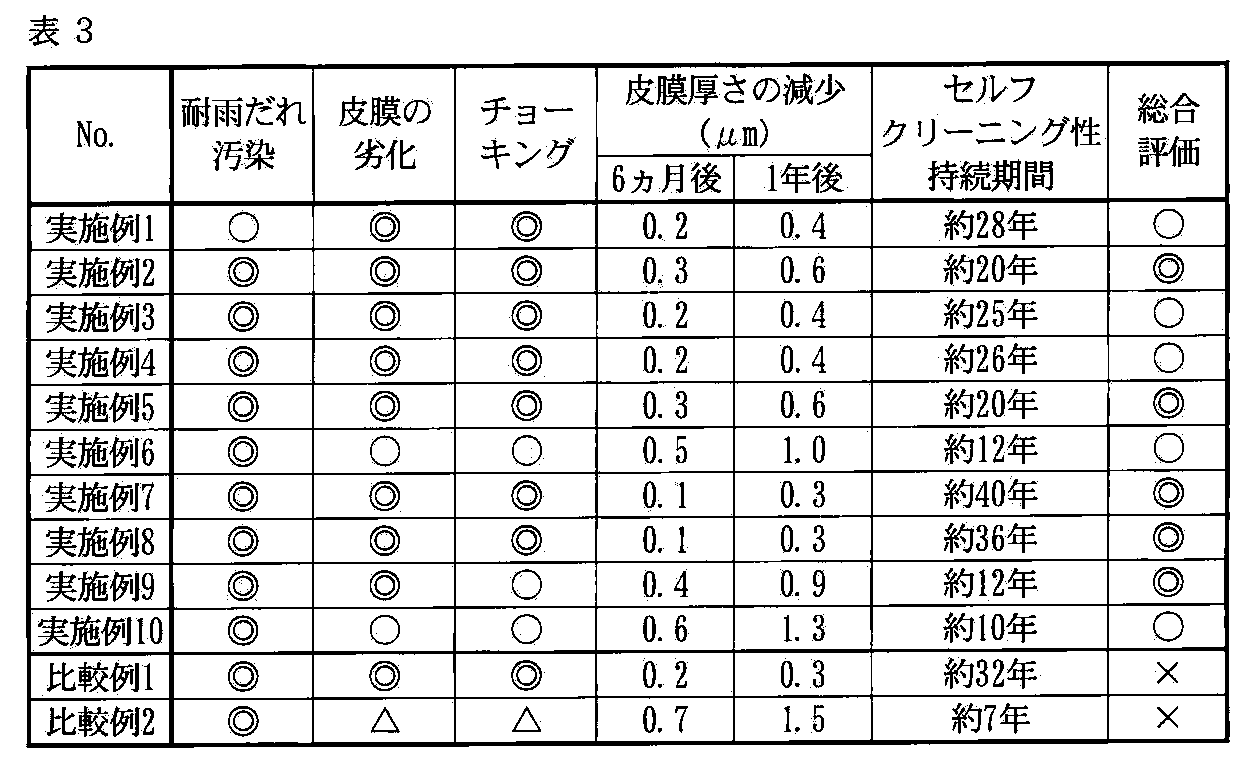
- the duration of the contamination resistance effect of Example 1 is about 40 years and about 32 years, respectively (see “Self-cleaning duration” in Table 3).
- the present invention aims to avoid the direct contact of the photocatalytic substance with the aim of avoiding the photocatalytic effect of the coating layer containing the photocatalytic substance to reach the lower organic resin coating layer. It is based on a unique finding that the duration of the antifouling effect can be increased by adding a photocatalytic substance to the protective layer that was interposed between them. It is a thing.
- Pre-coated metal sheets that are shipped in a painted state and are processed without requiring painting by customers are limited by the overall coating thickness from the viewpoint of workability. According to the present invention, which can extend the duration of the stain resistance effect as compared with the prior art, it is possible to provide a precoated metal sheet having a more excellent stain resistance effect within the limit of the coating film thickness. Is possible.
- the reason why the antifouling effect is extended by providing at least two layers containing a photocatalytic substance in the precoated metal plate according to the present invention can be considered as follows.
- the typical coating composition of the pre-coated metal sheet exhibiting the anti-contamination function by the photocatalytic effect is as follows: (1) Photocatalyst directly on the organic resin-based coating layer of the substrate pre-coated metal sheet There are known a layer provided with a layer and (2) a substrate pre-coated metal plate provided with a protective layer containing no photocatalytic substance between the organic resin-based coating layer and the photocatalyst layer.
- the photocatalyst layer deteriorates due to its own photocatalytic action, and as a result, the period A until the photocatalyst layer disappears due to depletion, and the surface of the organic resin coating film of the substrate precoated metal plate in contact with the photocatalyst layer The period B until the photocatalytic effect is degraded by the photocatalytic effect is examined.
- the photocatalyst layer is in direct contact with the organic resin coating layer of the base material (in this case, the pre-coated metal plate composed of the base metal plate and the organic resin coating layer formed on the surface).
- the period B1 until the surface of the organic resin coating film deteriorates due to the photocatalytic effect is shorter than the period A1 until the deteriorated photocatalyst layer disappears due to wear, that is, A1> B1. It has become a relationship.
- the period B2 until the surface of the organic resin coating is deteriorated by the photocatalytic effect is the period until the deteriorated photocatalytic layer disappears due to wear. It is significantly longer than A2, that is, A2 ⁇ B2. For this reason, the contamination resistance by the photocatalyst and the duration of the self-cleaning function are governed by B1 in the case of (1) and A2 in the case of (2).
- the photocatalyst is also added to the conventional protective layer film, it is possible to satisfy A3 ⁇ B3 by adjusting the photocatalyst addition amount and the film thickness (where A3 is deteriorated).
- B3 is a period until the photocatalyst layer disappears due to depletion, and B3 is a period until the surface of the organic resin coating film is deteriorated by the photocatalytic effect). That is, when compared with a film having an equivalent thickness provided on the organic resin coating film, according to the present invention, compared to the above (1) and (2), the resistance to photocatalytic effect over the longest period. Contamination and a self-cleaning effect will be sustained, and an excellent effect can be brought about in a pre-coated metal sheet subjected to coating thickness restrictions.
- the following effects can also be expected by adding a photocatalyst to the conventional protective layer.
- the uppermost photocatalyst layer gradually wears out due to the effect of the photocatalyst, but it does not necessarily wear out uniformly.
- a protective layer is provided under the photocatalytic film, when the photocatalytic film is depleted and the interface with the protective layer is exposed, the protective layer does not have a self-cleaning effect, so a certain percentage of the protective layer is exposed.
- the self-cleaning property is remarkably lowered.
- the protective layer in which a photocatalyst is also added to the protective layer, the protective layer can also have a self-cleaning function, so that excellent self-cleaning properties can be maintained even after the protective layer is exposed. it can.
- the self-cleaning property is reduced due to the exposure of the protective layer even when the uppermost photocatalyst layer remains.
- the surface-treated precoated metal plate of the present invention in which a photocatalyst is also added to the protective layer sufficient self-cleaning properties can be obtained while the photocatalytic film including the protective layer film remains.
- the organic resin coating film tends to deteriorate as compared with the conventional precoated metal plate in which the photocatalyst is not added to the protective layer.
- the amount of the photocatalyst added to the protective layer in contact with the organic resin coating film is smaller than that of the upper photocatalyst layer, and the deterioration of the organic resin coating film due to the photocatalyst in the protective layer is small.
- another coating film (photocatalytic film), which is another feature of the present invention, contains inorganic tabular grains.
- the photocatalytic film on the surface of the precoated metal plate of the present invention contains inorganic tabular particles.
- One of the advantages of adding these particles is that excellent adhesion and corrosion resistance can be secured. Since the particles to be added have a flat plate shape, the photocatalytic film and the organic resin coating layer on the surface of the base precoated metal plate are aligned with the surface of the base precoated metal plate in the film, and the photocatalytic film It is possible to improve the adhesion between the layers constituting the. In particular, it is possible to improve the adhesion of the bent portion, which is the biggest problem in the precoated metal plate.
- the mechanism for orienting the particles in the film has a flat plate shape with a large aspect ratio.
- the dip coating method, spray coating method, bar coating method, roll coating method, spin coating method, curtain When coating is performed by a coating method or the like, the particles are oriented parallel to the metal surface and stacked. Thereafter, drying and baking are performed to form a film, but the tabular grains are maintained as they are, and the orientation and the laminated state are maintained even after the film is finally formed.
- the coating layer on the inner layer side of the photocatalyst coating is in close contact with the base material pre-coated metal plate, the coating can remain even when the outer coating layer is cracked by bending.
- the pre-coated metal plate of the present invention capable of exhibiting a self-cleaning function due to the presence of the photocatalytic film is self-cleaning due to the presence of the photocatalytic film on the surface of the metal plate even if the film is cracked. Function can be expressed.
- the second advantage of adding tabular grains is that, as described above, in the film, the grains are oriented parallel to the surface of the base material pre-coated metal plate, and thus have an ultraviolet light shielding effect. .
- the coating on the inner layer side is less likely to receive light, and can effectively protect the organic resin layer on the surface of the substrate precoated metal plate, and can also improve the photocatalytic resistance of the photocatalytic coating itself. Since the substance having a predetermined amount of photocatalytic activity is present together with the tabular grains on the surface of the photocatalytic film, the surface self-cleaning function is not particularly impaired. Further, since the tabular grains are inorganic grains, there is no fear of deterioration due to the photocatalyst. That is, by adding inorganic tabular particles to the photocatalyst film, the lifetime can be extended without deteriorating the self-cleaning performance.
- Yet another important advantage is that it can effectively suppress cracking when the photocatalyst film is dried and heated and solidified.
- an inorganic resin is often used for the photocatalyst film, but the inorganic resin has a drawback that it tends to crack when the coating amount is increased once. For this reason, ingenuity is usually taken such as avoiding an extreme thick coating or securing a predetermined film thickness by a plurality of coatings. Since the present invention relates to a pre-coated metal plate, there is no aspect of remarkably thick coating, and there is an advantage that a coating having a desired thickness can be formed without cracks in a single coating process. is doing.
- the adhesion between the photocatalyst film and the base material pre-coated metal plate and the layers constituting the photocatalyst film can be improved. Can be improved significantly.
- the characteristic shape of a flat plate can be expected to shield ultraviolet light, and at the same time, it is possible to effectively prevent cracking when forming a film. By these effects, the self-cleaning effect resulting from the substance having photocatalytic activity can be maintained for a long time.
- the self-cleaning duration of about 32 years shown in Comparative Example 1 is considered to be about 40 years in Example 7, which is considered to have achieved a dramatic increase in service life.
- the film on the surface of the precoated metal plate of the present invention has a component and a structure that hardly deteriorate even if it contains a substance having photocatalytic activity (hereinafter referred to as “photocatalyst”).
- the surface film has a multilayer structure in which the content of the photocatalyst is the largest in the outermost layer film and decreases as the inner layer film becomes, and the alkyl group, aryl group, carboxyl group having 1 to 12 carbon atoms, Alkoxy silanes having an organic group selected from the group consisting of hydroxyl groups and combinations thereof, alkoxy silanes having epoxy groups, alkoxy silanes having amino groups, tetraalkoxy silanes, and alkoxy selected from the group consisting of combinations thereof It contains an inorganic-organic composite resin made of a silane condensate.
- the alkoxysilane condensate is produced by hydrolyzing the alkoxysilane used as a raw material to form a hydrolyzate, and then condensing it in a dry baking (heat treatment) process when forming a film. It is.
- the material constituting the matrix of the surface film is an organic resin blended with an inorganic resin mainly composed of silicon, the surface film has excellent stability and weather resistance against photocatalysts. The film has excellent workability.
- examples of the alkyl group having 1 to 12 carbon atoms include a methyl group, an ethyl group, a propyl group, a butyl group, a hexyl group, a 2-ethylhexyl group, and a dodecyl group.
- a phenyl group, a tolyl group, A xylyl group, a naphthyl group, etc. are mentioned.
- a carboxyl group refers to —COOH
- an amino group refers to —NH 2
- a hydroxyl group refers to —OH.
- a methyl group or a phenyl group is particularly preferably used as the organic group of the present invention.
- the organic component used by this invention can also use two or more types of things simultaneously.
- the surface-treated precoated metal plate of the present invention has at least two layers of a film containing a photocatalyst (herein referred to as “photocatalyst film”) on the surface thereof.
- photocatalyst film a film containing a photocatalyst
- This is intended to maintain the contamination resistance by the photocatalyst or the self-cleaning effect over a long period of time.
- the self-cleaning property deteriorates remarkably and rapidly at the stage where the organic resin coating layer having no photocatalytic function of the base material is exposed due to deterioration of the photocatalyst film or choking.
- the precoated metal plate of the present invention at least two layers of the photocatalyst film are formed, and both of them contain the photocatalyst, so that the self-cleaning property by the photocatalyst can be maintained for a long time.
- the photocatalyst film of at least two layers has a smaller photocatalyst content as the film on the inner layer side closer to the base material pre-coated metal plate, Although not as remarkable as the initial state, the necessary and sufficient self-cleaning property can be obtained over a long period of time.
- the multi-layer photocatalyst film of the present invention can also suppress deterioration of the photocatalyst film layer itself, it is possible to obtain a pre-coated metal plate that is free from contamination over a long period of time.
- a typical example of a substance having photocatalytic activity used in the present invention is a photocatalyst particle.
- a photocatalyst particle in the precoated metal plate of the present invention, not only particles but also sol-like substances and metal complexes that are not particles can be heated.
- the produced substance can be used as well.
- the content of the photocatalyst contained in the two or more layers of the film is the largest in the outermost layer film and decreases as the inner layer film is formed. This is intended to develop stain resistance and self-cleaning properties over a long period of time by balancing the maintenance of the photocatalytic effect and the wear of the film.
- titanium oxide containing an anatase type structure is famous, and is most preferably used as the photocatalyst of the present invention.
- the photocatalyst of the present invention is not limited to anatase-type titanium oxide, and other photocatalysts such as TiO 3 , SrTiO 3 , FeTiO 3 , WO 3 , SnO 2 , Bi 2 O 3 , In 2 O 3 , ZnO, Fe 2 O 3 , RuO 2 , CdO, CdFeO 3 , LaRhO 3 , Nb 2 O 5 , ZrO 2 , Ta 2 O 5, etc. are also preferably used and should be selected as appropriate according to the required performance. Can do.
- photocatalyst particles are generally used as the photocatalyst, but the properties of the photocatalyst particles used in the present invention are not particularly limited. However, it is preferable to use as fine particles as possible in order to obtain high catalytic activity.
- the size of the photocatalyst particles is preferably 0.5 ⁇ m or less, more preferably 0.1 ⁇ m or less, and still more preferably 0.05 ⁇ m or less in terms of primary particle size.
- the lower limit of the particle size is not particularly limited, but it is difficult to handle even if it is too fine, and usually a primary particle size of 5 nm or more is preferably used.
- the photocatalytic substance in the film is uniformly dispersed, but it is not always necessary to pursue perfect uniformity and homogeneity.
- the case where aggregates are formed, the case where the content concentration of particles is different between the outermost surface portion and the inside, the case where the content concentration is inclined, etc. can be mentioned. Even in the state, it can be suitably used.
- the amount of the photocatalyst contained in the film is not particularly limited, and can be appropriately determined within a range in which a desired effect can be obtained.
- the mass ratio with respect to the entire film is usually 50% or less, preferably 40% or less, and more preferably 30% or less so as not to impair the uniformity and smoothness of the film.
- the lower limit of the addition amount is not particularly limited, and is usually 0.1% or more, preferably 0.5% or more by mass ratio with respect to the entire film.
- the amount of photocatalyst contained in at least two layers of the photocatalyst film used in the present invention is the largest in the outermost layer film and is decreased as the inner layer film is formed.
- a contamination effect can be expected, and an excellent stain resistance and self-cleaning effect can be obtained over a long period of time until the surface of the pre-coated metal plate as a substrate is exposed.
- the photocatalyst content is gradually reduced, the coating on the inner layer side is suppressed from being deteriorated, and the excellent self-cleaning property is maintained for a very long time.
- the amount of the photocatalyst in the film in which the content of the photocatalyst is changed is not particularly limited, and can be appropriately determined within the range of the amount of the photocatalyst described above.
- the combination of the photocatalytic amounts of the surface coating and the inner coating is set to 50% / 20%, 35% / 10%, 20% / 5%, or the like in terms of the mass ratio with respect to the entire coating. be able to.
- the combination of the photocatalyst material of the surface coating, intermediate coating, and innermost coating is 50% / 30% / 10%, 35% / 20% / 10% in terms of mass ratio to the entire coating.
- it can be set to 20% / 15% / 1%.
- the content of the photocatalyst in the innermost layer side coating is preferably 0.05% to 30% by mass ratio with respect to the entire innermost layer side coating.
- the innermost layer film is in contact with a film mainly composed of an organic resin such as polyester, urethane, acrylic, or epoxy formed on the surface of the base material precoated metal plate, it is desirable that the innermost layer film does not contain a photocatalyst more than necessary.
- the preferable amount of photocatalyst in the innermost layer side film is 0.05% to 25%, more preferably 0.05% to 20%, still more preferably 0.1% to 15% in terms of mass ratio with respect to the entire innermost layer side film. It is.
- the substance having photocatalytic activity exists in the film as it is and can be used, but it can also be used while being supported on the surface of the carrier.
- the carrier By using the carrier, it is possible to reduce the area where the photocatalyst and the matrix constituting the film are in direct contact with each other, and therefore it is possible to suppress the wear and deterioration of the film due to the photocatalyst.
- a film having a more excellent photocatalyst dispersion state can be obtained by selecting an appropriate material as a carrier.
- the carrier inorganic oxides that are stable against the photocatalyst, particularly silicon oxide, aluminum oxide, magnesium oxide, zirconium oxide, iron oxide, calcium oxide, and the like are preferably used.
- the thickness of the photocatalyst film used in the present invention can be determined independently for each of two or more films. Although it varies depending on required properties or applications, it is preferably 0.05 ⁇ m or more and 15 ⁇ m or less, more preferably 0.1 ⁇ m or more and 10 ⁇ m or less per one layer of film. Furthermore, when the restriction
- the photocatalytic film on the surface of the precoated metal plate of the present invention is characterized by containing inorganic tabular grains.
- the effects and advantages of adding this substance are as described above.
- the form of the tabular grains is preferably 5 or more, more preferably 30 or more, and still more preferably 60 or more, obtained by dividing the average particle diameter in the plane direction by the average thickness.
- the size of the contained particles can be used if it is not significantly large, but considering the thickness of the photocatalyst film, the particle size in the plane direction is preferably 120 ⁇ m or less, more preferably 60 ⁇ m or less, and further Preferably it is 30 micrometers or less. Adhesion is ensured by laminating the above tabular grains in a layer in the film, an ultraviolet light shielding effect is generated, cracks generated during drying are suppressed, and corrosion resistance is prevented by preventing water penetration. Will be secured.
- the “average particle diameter in the plane direction” here is the average value of the value converted from the area of the flat plate surface (the area on the projection surface when the projected area of the particle is maximum) to the equivalent circle diameter. Yes, it can be obtained by observing the particles in the shape of a flat plate with an electron microscope.
- the “average thickness” is the average value of the thickness of tabular grains (maximum grain size in the direction perpendicular to the projection plane when the grain projection area is maximized). It is determined by observing.
- the “average particle diameter in the plane direction” and the “average thickness value” it is desirable to observe as many particles as possible, but according to the inventors' investigation, about 50 or more particles were observed. In some cases, it has been found to be almost the same as the result of observing many particles. That is, in this method, the “average particle diameter in the plane direction” and the “average thickness value” can be represented by the result of observing 50 particles.
- the tabular grains are preferably contained in a mass ratio of 0.05 to 30%, more preferably 0.05 to 25%, and still more preferably 0.1 to The range is 20%.
- the content is less than the above range, sufficient adhesion cannot be ensured, and cracks during film formation cannot be suppressed, and sufficient effects on corrosion resistance may not be obtained.
- the amount exceeds the above range, there are too many additive particles in the film, so a film with a good appearance cannot be obtained, and film properties such as adhesion, hardness and strength are insufficient. It becomes.
- the tabular grains to be added are preferably selected from clay minerals, graphite, and graphitized carbon black, and particularly preferably selected from clay minerals.
- One kind of particles may be added, and two or more kinds of particles may be added in combination.
- the clay mineral refers to all layered silicate minerals, and kaolin, mica, pyrophyllite, smectite, vermiculite, hydrotalcite and the like are known. Of these, mica is particularly preferably used as the tabular grains of the present invention.
- the film of the present invention contains Si as a metal component of the inorganic-organic composite resin, but other elements are selected from B, Al, Ge, Ti, Y, Zr, Nb, Ta and the like. One or more metal elements can be added. Among these, Al, Ti, Nb, and Ta show a catalytic function for completing the solidification of the film at a low temperature or in a short time when an acid is added as a catalyst. When these metal alkoxides are added using an acid as a catalyst, the ring-opening speed of the epoxy is increased, and the film can be cured at a low temperature in a short time.
- Ti alkoxides such as Ti-ethoxide and Ti-isopropoxide are used as raw materials.
- Ti alkoxides such as Ti-ethoxide and Ti-isopropoxide are used as raw materials.
- the alkali resistance of the film is remarkably improved in a system to which Zr is added, it is preferably used in applications that require alkali resistance.
- any material can be suitably used for the pre-coated metal plate as the base material of the pre-coated metal plate of the present invention regardless of the material.
- a steel material, stainless steel, titanium, aluminum, an aluminum alloy, or a material obtained by performing plating on these and further coating with an organic resin can be used.
- particularly preferred precoated metal plates include stainless steel plates, titanium plates, aluminum plates, aluminum alloy plates or those obtained by forming an organic coating on the surface of a plated metal plate obtained by plating these.
- galvanized steel sheet As galvanized steel sheet, galvanized steel sheet, zinc-iron alloy plated steel sheet, zinc-nickel alloy plated steel sheet, zinc-chromium alloy plated steel sheet, zinc-aluminum alloy plated steel sheet, aluminum-plated steel sheet, zinc-aluminum-magnesium alloy-plated steel sheet, zinc -Aluminum-magnesium-silicon alloy plated steel sheet, aluminum-silicon alloy plated steel sheet, galvanized stainless steel sheet, aluminum plated stainless steel sheet and the like.
- the stainless steel plate include a ferritic stainless steel plate, a martensitic stainless steel plate, and an austenitic stainless steel plate.
- the thickness of the stainless steel sheet ranges from a thickness of about 10 mm to a so-called stainless steel foil that is thinned to about 10 ⁇ m by rolling.
- the surface of the stainless steel plate and the stainless foil may be subjected to a surface treatment such as bright annealing or buffing.
- As the aluminum alloy plate JIS 1000 series (pure Al series), JIS 2000 series (Al-Cu series), JIS 3000 series (Al-Mn series), JIS 4000 series (Al-Si series), JIS 5000 series (Al--) Mg series), JIS6000 series (Al-Mg-Si series), JIS7000 series (Al-Zn series), and the like.
- the treatment liquid for suitably producing the precoated metal sheet of the present invention has an organic group selected from the group consisting of alkyl groups having 1 to 12 carbon atoms, aryl groups, carboxyl groups, hydroxyl groups, and combinations thereof.
- An alkoxysilane (a1) selected from the group consisting of an alkoxysilane, an alkoxysilane having an epoxy group, an alkoxysilane having an amino group, a tetraalkoxysilane, and combinations thereof, and a hydrolyzate (a2) of the alkoxysilane (a1) )
- an inorganic-organic composite resin material containing the condensate (a3) of the alkoxysilane (a1), a substance having photocatalytic activity, and inorganic tabular particles.
- alkoxysilane having an alkyl group having 1 to 12 carbon atoms examples include methyltrimethoxysilane, dimethyldimethoxysilane, methyltriethoxysilane, dimethyldiethoxysilane, hexyltrimethoxysilane, hexyltriethoxysilane, decyltrimethoxysilane, and decyl. Examples include triethoxysilane. Examples of the alkoxysilane having an aryl group include phenyltrimethoxysilane, diphenyldimethoxysilane, phenyltriethoxysilane, and diphenyldiethoxysilane.
- alkoxysilane having an epoxy group examples include ⁇ -glycidoxypropyltrimethoxysilane, ⁇ -glycidoxypropyltriethoxysilane, ⁇ -glycidoxypropyltripropoxysilane, ⁇ -glycidoxypropyltributoxysilane, 3 , 4-epoxycyclohexylmethyltrimethoxysilane, 3,4-epoxycyclohexylmethyltriethoxysilane, ⁇ - (3,4-epoxycyclohexyl) ethyltrimethoxysilane, ⁇ - (3,4-epoxycyclohexyl) ethyltriethoxysilane Are preferably used, and ⁇ -glycidoxypropyltriethoxysilane is particularly preferably used in terms of ease of handling, reactivity, and the like.
- alkoxysilane having an amino group examples include aminopropyltrimethoxysilane, aminopropyltriethoxysilane, ( ⁇ -aminoethyl) - ⁇ -aminopropyltrimethoxysilane, and ( ⁇ -aminoethyl) - ⁇ -aminopropylmethyldimethoxysilane. , ( ⁇ -aminoethyl) - ⁇ -aminopropyltrimethoxysilane and the like are preferably used, and aminopropyltriethoxysilane is particularly preferably used from the viewpoint of easy handling.
- tetraalkoxysilane examples include tetramethoxysilane, tetraethoxysilane, tetrapropoxysilane, and tetrabutoxysilane.
- the merit of blending an alkoxysilane having an epoxy group and an alkoxysilane having an amino group is that the adhesion between the photocatalyst film and the pre-coated metal plate serving as a substrate and the stability of the photocatalyst film to the photocatalyst are improved.
- the details of this reason have not been clarified, but by adding an epoxy group or amino group, a strong bond is formed between the photocatalyst film and the organic resin layer on the surface of the base pre-coated metal plate. It is estimated that the adhesion is improved, and as a result, the film is less likely to be choked and peeled, and the stability of the film is improved.
- the treatment liquid of the present invention contains a substance having photocatalytic activity.
- the substance having photocatalytic activity used in the present invention is not particularly limited, and includes sol-like substances that cannot be said to be particles, such as the above-mentioned photocatalyst particles, and substances such as metal complexes. Can be used.
- the sol-like substance means a precipitate generated by hydrolysis of a metal alkoxide in a treatment liquid, or an extremely fine colloid dispersed and stabilized in water or an organic solvent.
- anatase-type titanium oxide particles can be particularly preferably used.
- the properties of the photocatalyst particles are not particularly limited, but it is preferable to use particles having a diameter as small as possible in order to obtain high catalytic activity.
- the preferable size of the photocatalyst particles is 0.5 ⁇ m or less, more preferably 0.1 ⁇ m or less, and still more preferably 0.05 ⁇ m or less.
- the lower limit of the particle size is not particularly limited, but it is difficult to handle even if it is too fine, and usually a primary particle size of 5 nm or more is used.
- the amount of the photocatalytic substance contained in the treatment liquid is not particularly limited, and can be appropriately determined within a range in which a desired effect can be obtained when a film is formed.
- the mass ratio with respect to the entire nonvolatile content in the processing liquid, except for the processing liquid for forming the innermost layer side film Is 50% or less, preferably 40% or less, and more preferably 30% or less.
- the lower limit of the addition amount is not particularly limited, and is usually 0.5% or more, preferably 1.0% or more by mass ratio with respect to the solid content contained in the treatment liquid.
- the amount of the photocatalytic substance is 25% or less, preferably 20% or less, more preferably 15% or less by mass ratio with respect to the entire nonvolatile content in the treatment liquid in the case of the treatment liquid for forming the innermost layer-side film. % Or less is good.
- the lower limit of the addition amount is not particularly limited, and is usually 0.05% or more by mass ratio with respect to the solid content contained in the treatment liquid.
- the treatment liquid of the present invention contains inorganic tabular grains.
- the type of tabular grains is preferably selected from clay minerals, graphite, and graphitized carbon black, and particularly preferably selected from clay minerals.
- One kind of particles may be added, and two or more kinds of particles may be added in combination.
- the clay mineral refers to all layered silicate minerals, and kaolin, mica, pyrophyllite, smectite, vermiculite, hydrotalcite and the like are known. Of these, mica is particularly preferably used as the tabular grains of the present invention.
- the tabular grains are preferably contained in a mass ratio of 0.05 to 30%, more preferably 0.05 to 25%, and still more preferably 0.1% by mass relative to the entire nonvolatile content in the treatment liquid. It is in the range of ⁇ 20%.
- the content is less than the above range, sufficient adhesion as a film on the surface of the precoated metal sheet of the present invention cannot be secured, and sufficient effects on corrosion resistance cannot be obtained, and cracking during film formation is suppressed. Inconveniences such as inability to occur may occur.
- the amount exceeds the above range, there are too many tabular grains in the film, so a film with a good appearance cannot be obtained, and film properties such as adhesion, hardness, and strength are insufficient. It becomes.
- an alkoxide of a metal component other than alkoxysilane can be used as an additive as necessary.
- an alkoxide of at least one metal selected from Ti, Al, Ta, and Nb is added and acetic acid is used as an acid catalyst, the ring opening speed of the epoxy group is increased, and the effect of low temperature and short time curing is obtained.
- all or part of the alkoxy group may be hydrolyzed.
- the treatment liquid of the present invention may contain a zirconium compound such as zirconium alkoxide, a hydrolyzate thereof, or a zirconium oxide (zirconia) sol, if necessary.
- This component is a component that improves the alkali chemical resistance of the treatment liquid of the present invention. The mechanism by which alkali resistance is improved by adding this component has not been clarified, but Zr is substituted at the position of Si constituting the siloxane bond, focusing on silica and zirconium. This is thought to be because a network is formed and stabilized against alkali. Moreover, inorganic particles other than zirconia sol can be added as needed.
- coloring pigment, extender pigment, catalyst, rust preventive pigment, metal powder, high frequency loss agent, Aggregates can also be added.
- coloring pigments examples include oxides such as Ti and Al, composite oxides, metal powders such as Zn powder, and Al powder.
- rust preventive pigment it is preferable to use nonchromic pigments such as calcium molybdate, calcium phosphomolybdate and aluminum phosphomolybdate, which contain no environmental pollutants, such as phosphates, calcium salts and aluminum salts.
- nonchromic pigments such as calcium molybdate, calcium phosphomolybdate and aluminum phosphomolybdate, which contain no environmental pollutants, such as phosphates, calcium salts and aluminum salts.
- the high frequency loss agent examples include Zn-Ni ferrite, and examples of the aggregate include potassium titanate fiber.
- an acid catalyst can be added to the treatment liquid of the present invention as necessary.
- the acid catalyst include organic acids such as formic acid, maleic acid, and benzoic acid, and inorganic acids such as hydrochloric acid and nitric acid.
- Acetic acid is particularly preferably used.
- a leveling effect agent an antioxidant, an ultraviolet absorber, a stabilizer, a plasticizer, a wax, an additive type ultraviolet stabilizer and the like can be mixed and used as additives.
- a resin-based paint such as a fluororesin, a polyester resin, or a urethane resin may be included as long as the heat resistance of the film is not impaired or the deterioration due to the photocatalyst is not caused.
- additives may be used alone or in combination of two or more.
- the treatment liquid of the present invention is selected from the group consisting of alkyl groups having 1 to 12 carbon atoms, aryl groups, carboxyl groups, hydroxyl groups, and combinations thereof in an organic solvent capable of suitably dispersing and dissolving the target substance.
- An alkoxysilane (a1) selected from the group consisting of an alkoxysilane having an organic group, an alkoxysilane having an epoxy group, an alkoxysilane having an amino group, a tetraalkoxysilane, and a combination thereof is added, and hydrolyzed as necessary. It can be prepared by condensation polymerization.
- organic solvent for example, various alcohols such as methanol, ethanol, propanol and butanol, and aromatic organic solvents such as acetone, benzene, toluene, xylene and ethylbenzene are preferably used alone or in combination.
- a surface treatment liquid is prepared by adding a photocatalytic activity substance and inorganic tabular particles to this organic solvent solution.
- the prepared surface treatment liquid can be diluted with an organic solvent or water so as to match the required film thickness.
- dilution is performed so that the film thickness obtained by one coating is in the range of 0.2 to 5 ⁇ m.
- the treatment liquid of the present invention contains inorganic tabular grains, a thicker film can be formed.
- a coating film having a thickness greater than that can be formed by multiple coatings it is also possible to apply after a part of alcohol used as a solvent or generated by hydrolysis is distilled off under normal pressure or reduced pressure.
- the photocatalytic film on the surface of the precoated metal plate of the present invention can be formed by applying the above-mentioned surface treatment liquid to the surface of the precoated metal plate serving as a substrate, followed by drying and curing. Application is performed by a dip coating method, a spray coating method, a bar coating method, a roll coating method, a spin coating method, or the like.
- the coating film formed with the treatment liquid of the present invention is usually cured by heating.
- a standard heating condition it is preferable to perform a heat treatment for about one hour to several seconds in a temperature range from 150 ° C. to 400 ° C.
- the heat treatment temperature is high, the film can be cured in a short heat treatment time, and when the heat treatment temperature is low, a long treatment is required.
- sufficient temperature and time cannot be taken for drying or heat treatment, after drying and baking and curing, it can be left at room temperature for 1 to 5 days as necessary.
- the effect that the hardness of a coating film becomes high immediately after coating film formation can be expected.
- the film of two or more layers having different photocatalytic amounts according to the present invention can be obtained by sequentially applying and curing two or more kinds of surface treatment liquids having different photocatalyst contents according to the present invention on a substrate precoated metal plate.
- two or more kinds of surface treatment liquids having different photocatalyst contents are simultaneously applied to the surface of the substrate precoated metal plate, and then simultaneously dried and baked, so that the two layers having different photocatalytic activity content on the precoated metal plate surface
- a multilayer coating in which the above coatings are laminated can be formed.
- the paint (X) containing an organic resin and a photocatalyst containing By simultaneously applying and baking two types of surface treatment liquids (A) and (B) having different amounts, it is possible to form a film having three or more layers.
- a method using a multilayer curtain coater or the like is preferably used.
- Examples 1 to 10 Comparative Examples 1 and 2
- GPTES ⁇ -glycidoxypropyltriethoxysilane
- PhTES phenyltriethoxysilane
- TEOS tetraethoxysilane
- TE titanium tetraethoxide
- hydrolysis was carried out under acetic acid acidity using distilled water diluted with ethanol.
- Aminopropyltriethoxysilane (APTES) was added thereto, followed by hydrolysis using a distilled water / ethanol mixed solution to prepare a coating solution containing an inorganic-organic composite resin as a main component.
- a sufficient amount of water was added to the hydrolysis so that the coating solution had a solid content concentration of 20% by mass when dried at 150 ° C.
- mica was added as photocatalyst particles and inorganic tabular particles shown in Table 1 to prepare a surface treatment solution for coating.
- the amount of photocatalyst added was such that the amount of photocatalyst in the inner layer-side film was 1 ⁇ 2 of the amount of photocatalyst in the outer layer-side film.
- the addition amount of the photocatalyst particles and mica in Table 1 is a mass ratio with respect to the entire solid content contained in the surface treatment liquid.
- the used photocatalyst particles have a particle diameter of about 60 nm for ZnO and about 10 nm for TiO 2 .
- the precoated metal sheet on which the photocatalytic film of Examples 1 to 10 was formed was prepared using a 0.6 mm thick precoated steel sheet coated with a melamine-crosslinked polyester film with a thickness of about 15 ⁇ m on the surface of the galvanized steel sheet.
- the first layer (inner layer side) film of the two-layer photocatalyst film is obtained by applying a surface treatment solution for the inner layer side film to the base material pre-coated metal plate with a bar coater, and after 50 seconds, the plate temperature is 250 ° C. A heat treatment was performed at a maximum temperature of 210 ° C. using such temperature rising conditions.
- the thickness of the formed film was about 3 ⁇ m.
- the coating of the second layer was applied so that the surface treatment solution for the outer layer side coating was applied to the surface on which the first layer coating was formed with a bar coater, and the plate temperature reached 250 ° C. after 50 seconds. It was formed by performing heat treatment at a maximum temperature of 250 ° C. using the conditions. The thickness of the formed film was about 3 ⁇ m.
- the evaluation test of the precoated metal plate on which the photocatalytic film was formed was performed by the following method. (1) An outdoor exposure test was conducted to evaluate raindrop contamination. The test piece was placed so that the surface on which the photocatalytic film was formed was directed to the south side and was perpendicular to the ground.
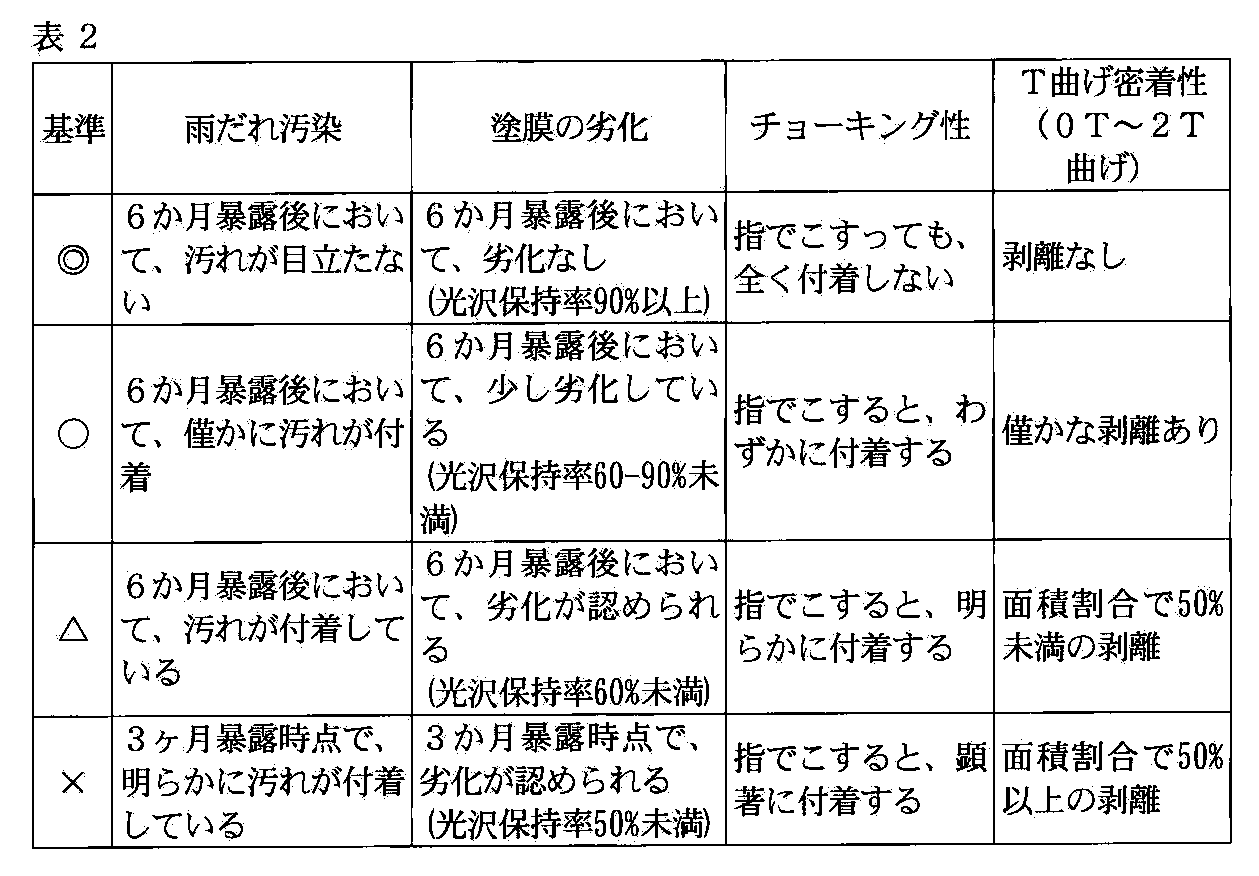
- test results was made into four stages of ⁇ , ⁇ , ⁇ , and ⁇ in order from the highest, except for the decrease in film thickness and the duration of the self-cleaning function.
- the criteria for each evaluation are shown in Table 2.
- Example 7 Comparative Example 1 in which tabular grains were not added, the appearance change such as self-cleaning (rain-stain resistance) resistance, coating deterioration, and choking property was the same as in Example 7, but the coating thickness The decrease is large compared to the example, and as a result, the self-cleaning duration is shorter than that of the example 7.
- a 0T, 1T, and 2T bending test was performed, cracking and peeling of the film were observed in 2T bending, and it was found that the bending workability was inferior to that of Example 7.
- Comparative Example 2 has a shorter self-cleaning property duration than Comparative Example 10 as in Comparative Example 1. Further, in the bending test, it was found that the precoated metal plate of Comparative Example 2 was also inferior in bending workability as compared with Example 10 because the film cracking and peeling were observed by 2T bending.
- Example 7 and Comparative Example 1 and Example 10 and Comparative Example 2 the addition of inorganic tabular grains increases the ultraviolet light shielding effect of the film, and the self-cleaning property.
- the duration can be increased.
- the adhesion of the film at the bent portion can be enhanced. This effect can be obtained regardless of the amount of photocatalyst content and the amount of tabular grain added.
- Example 3 and Example 4 are compared, the adhesiveness of Example 3 is slightly inferior. It has been suggested that when the amount of the particles added is small, the above-mentioned self-cleaning property can be prolonged and the effect of improving adhesion can be reduced.
- the sol-state photocatalyst and inorganic tabular particles in the amounts shown in Table 5 were added to prepare surface treatment solutions A to D for coating.
- the addition amount of the photocatalyst is calculated based on the solid content as the photocatalyst contained in the sol, and is a mass ratio with respect to the entire solid content contained in the coating solution.
- the base material pre-coated metal plate of the example was prepared by using a 0.5 mm thick stainless steel plate (SUS430) as a base metal and forming a silicon acrylic film on the surface thereof.
- the surface treatment liquid D was applied to the surface of the base material pre-coated metal plate using a bar coater, and then heated to 210 ° C. to form a fourth layer film (innermost layer film).
- a third layer film and a second layer film were formed on the surface in the order of the surface treatment liquid C and the surface treatment liquid B by the same procedure and method as the surface treatment liquid D.
- the surface treatment liquid A was applied to the surface with a bar coater and then heated to 250 ° C.
- a precoated metal sheet was obtained in which four layers of photocatalytic films having different photocatalyst contents (three layers in Examples 11 to 14) were formed on the surface of the base material precoated metal sheet.
- the thickness of the coating was 4 ⁇ m for each coating layer in any of the examples.
- precoated metal plates on which a photocatalytic film was formed were prepared in the same procedure as in Examples 11 to 18.
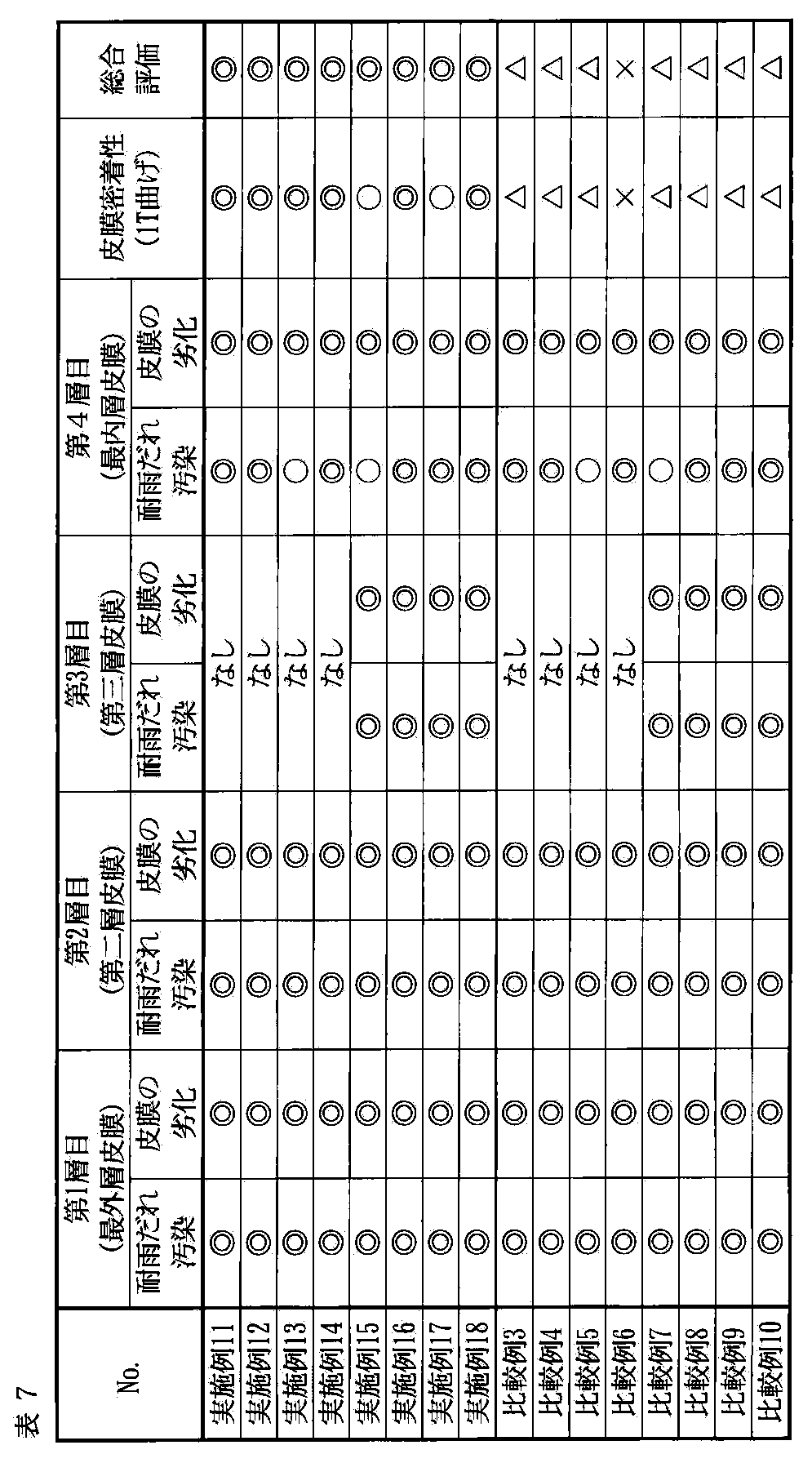
- the performance evaluation test of the pre-coated metal plate on which the photocatalytic film was formed was carried out by the same method as in Example 1 with regard to raindrop resistance, film deterioration and 1T bending adhesion. As in Example 1, the results were evaluated in four stages: ⁇ , ⁇ , ⁇ , and ⁇ . The criteria for each evaluation are as shown in Table 2.
- the surface-treated pre-coated metal plates of Examples 11 to 18 are excellent in that both the outermost layer coating and the innermost layer coating are excellent in raindrop contamination and, in addition, have a three-layer or four-layer structure. From the fact that it is possible to maintain long-term contamination resistance, and there is little deterioration of the coating film (organic resin film of the base material pre-coated metal plate) due to the photocatalytic effect, and it has photocatalytic resistance. It can be seen that it is possible to maintain excellent contamination resistance with little film deterioration over a long period of time. Moreover, when 1T bending test was done and bending workability (film
- the pre-coated metal plates of Comparative Examples 3 to 10 had the same results as the examples in terms of rainproof stain resistance and coating deterioration, but the adhesion was inferior, and the adhesion evaluated in the 1T bending test was Was also ⁇ ⁇ ⁇ .
- a plurality of coatings containing a predetermined amount of photocatalyst particles and inorganic tabular particles can be formed on the surface of a precoated stainless steel plate having a silicon acrylic coating.
- the obtained surface-treated precoated stainless steel sheet has excellent contamination resistance over a long period of time, based on the evaluation results of the contamination resistance of each film and the deterioration of the coating film (organic resin film of the base material precoated metal sheet). It was found that this is a precoated stainless steel sheet that provides self-cleaning properties, has little deterioration of the film, and has excellent film adhesion.
- Example 19 A surface-treatment liquid having a blending ratio described in Example 1 in Table 1 is a precoat in which a 0.6 mm-thick galvanized steel sheet is used as a base material and a melamine-crosslinked polyester film is coated on the outermost surface with a thickness of about 15 ⁇ m.
- a steel sheet surface was coated by the following method to form a two-layer photocatalytic film (Example 19).
- the surface treatment liquid of the mixture ratio described in Example 9 of Table 1 was applied to the same precoated steel plate surface as described above by the following method to form a two-layer photocatalytic film (Example 20).
- the photocatalytic film was formed by simultaneously applying a treatment liquid for two layers with a slit curtain coater and then heating and curing at 250 ° C.
- the appearance of the prepared surface-treated precoated metal plate was satisfactory without any problems.
- the thicknesses of the formed films were about 3 ⁇ m for the inner layer film and about 4 ⁇ m for the outer layer film.
- the surface-treated precoated metal sheet thus prepared was evaluated in the same manner as in Example 1 for raindrop contamination, film deterioration (damage), and choking in the outdoor exposure test. In addition, the approximate duration of the self-cleaning function was estimated.
- Example 19 obtained the same test results as Example 1 shown in Table 2, and Example 20 obtained the same test results as Example 9 shown in Table 2. It was.
- the estimated duration of the self-cleaning function was about 35 years for the surface-treated steel sheet of Example 19 and about 18 years for the surface-treated steel sheet of Example 28.
- the precoated metal sheet of the present invention can be produced without any problems even by the multilayer simultaneous coating method. Moreover, it turned out that the performance does not change at all when the film of each layer is formed independently. That is, even in the surface-treated precoated metal sheet produced by the method described in Examples 19 and 20, the surface-treated precoated metal film that has good stain resistance and self-cleaning properties for a long period of time and has little film deterioration due to the photocatalyst. It was found that a metal plate was obtained.
Landscapes
- Chemical & Material Sciences (AREA)
- Engineering & Computer Science (AREA)
- Organic Chemistry (AREA)
- Materials Engineering (AREA)
- Life Sciences & Earth Sciences (AREA)
- Wood Science & Technology (AREA)
- Mechanical Engineering (AREA)
- Metallurgy (AREA)
- Chemical Kinetics & Catalysis (AREA)
- Inorganic Chemistry (AREA)
- Catalysts (AREA)
- Laminated Bodies (AREA)
- Paints Or Removers (AREA)
- Application Of Or Painting With Fluid Materials (AREA)
Abstract
Description
(1)下地金属板及びその表面に有機樹脂被覆層を有する基材プレコート金属板上に、少なくとも2層の光触媒活性を有する皮膜を形成したプレコート金属板であって、該少なくとも2層の光触媒活性を有する皮膜が、炭素数1以上12以下のアルキル基、アリール基、カルボキシル基、水酸基、及びそれらの組み合わせからなる群から選択される有機基を有するアルコキシシラン、エポキシ基を有するアルコキシシラン、アミノ基を有するアルコキシシラン、テトラアルコキシシラン、並びにそれらの組み合わせからなる群から選択されるアルコキシシランの縮合物からなる無機−有機複合体樹脂と、光触媒活性を有する物質と、無機系平板状粒子とを含有し、かつ光触媒活性を有する物質の含有量が最外層に位置する皮膜で最も多く、内層側の皮膜ほど少なくなるように含有していることを特徴とするプレコート金属板。
(2)前記無機−有機複合体樹脂に含まれる有機基がメチル基、またはフェニル基である上記(1)に記載のプレコート金属板。
(3)前記皮膜の各層中の光触媒活性を有する物質の含有量が、各層の全質量の0.1%~50%である上記(1)または(2)に記載のプレコート金属板。
(4)有機樹脂被覆層に接する最も内層側皮膜中の光触媒物質の含有量が、当該皮膜の全質量の0.05%~25%である上記(1)~(3)のいずれか1つに記載のプレコート金属板。
(5)前記光触媒活性を有する物質がアナターゼ型の構造を含む酸化チタンである上記(1)~(4)のいずれか1つに記載のプレコート金属板。
(6)前記皮膜の各層中の無機系平板状粒子の含有量が、当該皮膜の全質量の0.05%~30%である上記(1)~(5)のいずれか1つに記載のプレコート金属板。
(7)前記無機系平板状粒子が、マイカを含むものである上記(1)~(6)のいずれか1つに記載のプレコート金属板。
(8)前記下地金属板が、鋼板、ステンレス鋼板、チタン板、チタン合金板、アルミニウム板、アルミニウム合金板又はこれら金属板にめっき処理しためっき金属板から選ばれる上記(1)~(7)のいずれか1つに記載のプレコート金属板。
(9)炭素数1以上12以下のアルキル基、アリール基、カルボキシル基、水酸基、及びそれらの組み合わせからなる群から選択される有機基を有するアルコキシシラン、エポキシ基を有するアルコキシシラン、アミノ基を有するアルコキシシラン、テトラアルコキシシラン、及びそれらの組み合わせからなる群から選択されるアルコキシシラン(a1)、当該アルコキシシラン(a1)の加水分解物(a2)並びに/又は当該アルコキシシラン(a1)の縮合物(a3)を含む無機−有機複合樹脂原料と、光触媒活性を有する物質と、無機系平板状粒子と、を含有することを特徴とする表面処理液。
(10)(a)金属層、及びその表面に有機樹脂被覆層を有する基材プレコート金属板を準備するステップ;
(b)上記(9)に記載の表面処理液である第1の表面処理液を、前記基材プレコート金属板上に適用し、未硬化の第1の表面被覆層を形成するステップ;
(c)加熱により、前記未硬化の第1の表面被覆層を硬化させ、第1の表面皮膜を形成するステップ;
(d)上記(9)に記載の表面処理液である第2の表面処理液を、第1の表面皮膜上に適用し、未硬化の第2の表面被覆層を形成するステップ;そして
(e)加熱により、前記未硬化の第2の表面被覆層を硬化させ、第1の表面皮膜上に第2の表面皮膜を形成するステップ:
を含むことを特徴とする、プレコート金属板の製造方法。
(11)(a)金属層、及びその表面に有機樹脂被覆層を有する基材プレコート金属板を準備するステップ;
(b)上記(9)に記載の表面処理液である第1の表面処理液を、前記基材プレコート金属板上に適用し、未硬化の第1の表面被覆層を形成するステップ;
(c)上記(9)に記載の表面処理液である第2の表面処理液を、未硬化の第1の表面被覆層上に適用し、未硬化の第2の表面被覆層を形成するステップ;そして
(d)加熱により、前記未硬化の第1の表面被覆層及び前記未硬化の第2の表面被覆層を硬化させ、第1の表面皮膜及び第2の表面皮膜を形成するステップ:
を含むことを特徴とする、プレコート金属板の製造方法。
表1に示した割合で配合したγ−グリシドキシプロピルトリエトキシシラン(GPTES)、フェニルトリエトキシシラン(PhTES)、テトラエトキシシラン(TEOS)、チタニウムテトラエトキシド(TE)を十分に撹拌した後、エタノールで希釈した蒸留水を用いて酢酸酸性下で加水分解を行った。ここにアミノプロピルトリエトキシシラン(APTES)を加え、さらに蒸留水/エタノール混合溶液を用いて加水分解を行い、無機−有機複合樹脂を主成分とする塗布液を調製した。加水分解には十分な量の水を添加し、塗布液は150℃で乾燥させたときの固形分濃度が20質量%となるようにした。この塗布液に、表1に示した光触媒粒子と無機系平板状粒子としてマイカを添加し、コーティング用の表面処理液を作製した。光触媒の添加量は、内層側皮膜の光触媒量が、外層側皮膜の光触媒量の1/2となるようにした。表1中の光触媒粒子とマイカの添加量は、表面処理液に含まれる固形分全体に対する質量割合である。用いた光触媒粒子の粒子径は、ZnOが約60nm、TiO2が約10nmである。マイカの平均粒子径は約5.0μm、厚さは約0.05μm(平均粒子径/厚さ平均値=100)である。
(1)屋外での暴露試験を行い、雨だれ汚染性を評価した。試験片は光触媒皮膜を形成した面を南側に向け、地面に対して垂直となるように設置した。
(4)6ヶ月経過ごとに、皮膜断面を観察し、皮膜厚さの減少を測定することにより、セルフクリーニング機能のおよその持続期間を推定した。
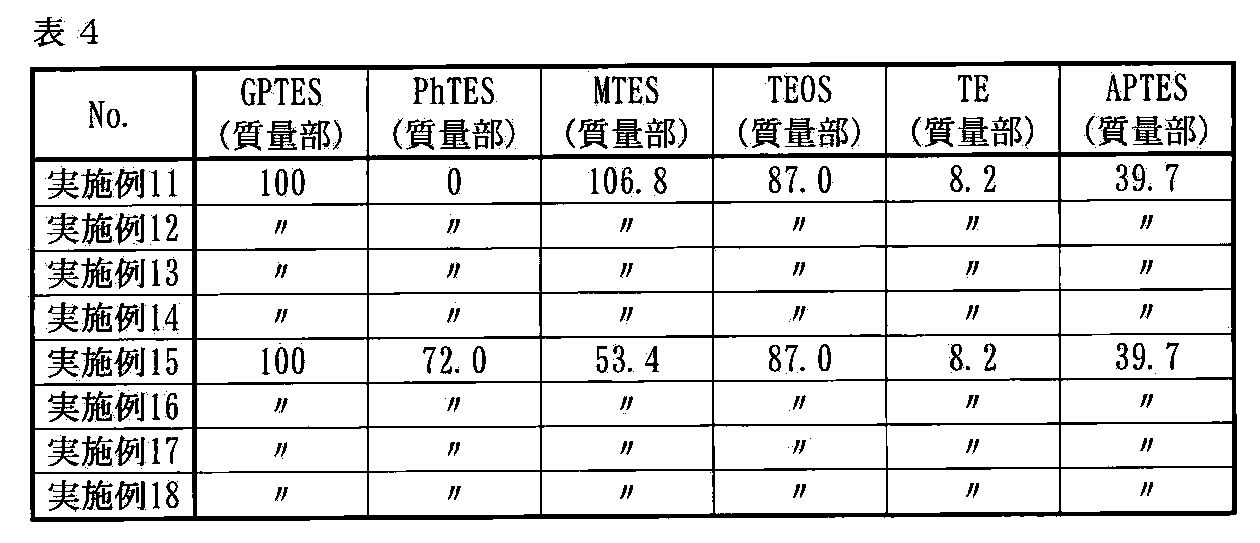
表4に示した割合で配合したγ−グリシドキシプロピルトリエトキシシラン(GPTES)、フェニルトリエトキシシラン(PhTES)、メチルトリエトキシシラン(MTES)、テトラエトキシシラン(TEOS)、チタニウムテトラエトキシド(TE)を十分に撹拌した後、エタノールで希釈した蒸留水を用いて酢酸酸性下で加水分解を行った。ここにアミノプロピルトリエトキシシラン(APTES)を加え、さらに蒸留水/エタノール混合溶液を用いて加水分解を行い、無機−有機複合樹脂を主成分とする塗布液を調製した。加水分解には十分な量の水を添加し、塗布液は150℃で乾燥させたときの固形分濃度が15質量%となるようにした。この塗布液に、表5に示した量のゾル状態の光触媒と無機系平板状粒子を添加し、コーティング用の表面処理液A~Dを作製した。光触媒の添加量は、ゾル中に含まれる光触媒としての固形分で換算したものであり、塗布液に含まれる固形分全体に対する質量割合とした。用いた光触媒粒子の粒子径はZnOが約60nm、TiO2が約10nm、マイカの平均粒子径は5.0μm、厚さは0.05μm(平均粒子径/厚さ平均値=100)、ハイドロタルサイトの平均粒子径は4.5μm、厚さは0.15μm(平均粒子径/厚さ平均値=30)である。
表1中の実施例1に記載した配合割合の表面処理液を、0.6mm厚の亜鉛めっき鋼板を基材とし、その最表面にメラミン架橋のポリエステル皮膜を約15μmの厚さで塗装したプレコート鋼板表面に下記の方法によって塗装し、2層からなる光触媒皮膜を形成した(実施例19)。また、表1の実施例9に記載した配合割合の表面処理液を上記と同じプレコート鋼板表面に下記の方法によって塗装し、2層の光触媒皮膜を形成した(実施例20)。



Claims (11)
- 下地金属板及びその表面に有機樹脂被覆層を有する基材プレコート金属板上に、少なくとも2層の光触媒活性を有する皮膜を形成したプレコート金属板であって、該少なくとも2層の光触媒活性を有する皮膜が、炭素数1以上12以下のアルキル基、アリール基、カルボキシル基、水酸基、及びそれらの組み合わせからなる群から選択される有機基を有するアルコキシシラン、エポキシ基を有するアルコキシシラン、アミノ基を有するアルコキシシラン、テトラアルコキシシラン、並びにそれらの組み合わせからなる群から選択されるアルコキシシランの縮合物からなる無機−有機複合体樹脂と、光触媒活性を有する物質と、無機系平板状粒子とを含有し、かつ光触媒活性を有する物質の含有量が最外層に位置する皮膜で最も多く、内層側の皮膜ほど少なくなるように含有していることを特徴とするプレコート金属板。
- 前記無機−有機複合体樹脂に含まれる有機基がメチル基、またはフェニル基である請求項1に記載のプレコート金属板。
- 前記皮膜の各層中の光触媒活性を有する物質の含有量が、各層の全質量の0.1%~50%である請求項1または2に記載のプレコート金属板。
- 有機樹脂被覆層に接する最も内層側皮膜中の光触媒物質の含有量が、当該皮膜の全質量の0.05%~25%である請求項1~3のいずれか1項に記載のプレコート金属板。
- 前記光触媒活性を有する物質がアナターゼ型の構造を含む酸化チタンである請求項1~4のいずれか1項に記載のプレコート金属板。
- 前記皮膜の各層中の無機系平板状粒子の含有量が、当該皮膜の全質量の0.05%~30%である請求項1~5のいずれか1項に記載のプレコート金属板。
- 前記無機系平板状粒子が、マイカを含むものである請求項1~6のいずれか1項に記載のプレコート金属板。
- 前記下地金属板が、鋼板、ステンレス鋼板、チタン板、チタン合金板、アルミニウム板、アルミニウム合金板又はこれら金属板にめっき処理しためっき金属板から選ばれる請求項1~7のいずれか1項に記載のプレコート金属板。
- 炭素数1以上12以下のアルキル基、アリール基、カルボキシル基、水酸基、及びそれらの組み合わせからなる群から選択される有機基を有するアルコキシシラン、エポキシ基を有するアルコキシシラン、アミノ基を有するアルコキシシラン、テトラアルコキシシラン、及びそれらの組み合わせからなる群から選択されるアルコキシシラン(a1)、当該アルコキシシラン(a1)の加水分解物(a2)並びに/又は当該アルコキシシラン(a1)の縮合物(a3)を含む無機−有機複合樹脂原料と、光触媒活性を有する物質と、無機系平板状粒子と、を含有することを特徴とする表面処理液。
- (a)金属層、及びその表面に有機樹脂被覆層を有する基材プレコート金属板を準備するステップ;
(b)請求項9に記載の表面処理液である第1の表面処理液を、前記基材プレコート金属板上に適用し、未硬化の第1の表面被覆層を形成するステップ;
(c)加熱により、前記未硬化の第1の表面被覆層を硬化させ、第1の表面皮膜を形成するステップ;
(d)請求項9に記載の表面処理液である第2の表面処理液を、第1の表面皮膜上に適用し、未硬化の第2の表面被覆層を形成するステップ;そして
(e)加熱により、前記未硬化の第2の表面被覆層を硬化させ、第1の表面皮膜上に第2の表面皮膜を形成するステップ:
を含むことを特徴とする、プレコート金属板の製造方法。 - (a)金属層、及びその表面に有機樹脂被覆層を有する基材プレコート金属板を準備するステップ;
(b)請求項9に記載の表面処理液である第1の表面処理液を、前記基材プレコート金属板上に適用し、未硬化の第1の表面被覆層を形成するステップ;
(c)請求項9に記載の表面処理液である第2の表面処理液を、未硬化の第1の表面被覆層上に適用し、未硬化の第2の表面被覆層を形成するステップ;そして
(d)加熱により、前記未硬化の第1の表面被覆層及び前記未硬化の第2の表面被覆層を硬化させ、第1の表面皮膜及び第2の表面皮膜を形成するステップ:
を含むことを特徴とする、プレコート金属板の製造方法。
Priority Applications (3)
| Application Number | Priority Date | Filing Date | Title |
|---|---|---|---|
| KR1020117020636A KR101387127B1 (ko) | 2009-05-14 | 2010-05-13 | 내오염성이 우수한 프리코트 금속판과 그의 제조 방법 및 표면 처리액 |
| JP2010546755A JP5208222B2 (ja) | 2009-05-14 | 2010-05-13 | 耐汚染性に優れるプレコート金属板及びその製造方法ならびに表面処理液 |
| CN201080008665.7A CN102325649B (zh) | 2009-05-14 | 2010-05-13 | 耐污染性优异的预涂金属板及其制造方法以及表面处理液 |
Applications Claiming Priority (2)
| Application Number | Priority Date | Filing Date | Title |
|---|---|---|---|
| JP2009117686 | 2009-05-14 | ||
| JP2009-117686 | 2009-05-14 |
Publications (1)
| Publication Number | Publication Date |
|---|---|
| WO2010131775A1 true WO2010131775A1 (ja) | 2010-11-18 |
Family
ID=43085140
Family Applications (1)
| Application Number | Title | Priority Date | Filing Date |
|---|---|---|---|
| PCT/JP2010/058485 Ceased WO2010131775A1 (ja) | 2009-05-14 | 2010-05-13 | 耐汚染性に優れるプレコート金属板及びその製造方法ならびに表面処理液 |
Country Status (5)
| Country | Link |
|---|---|
| JP (1) | JP5208222B2 (ja) |
| KR (1) | KR101387127B1 (ja) |
| CN (1) | CN102325649B (ja) |
| TW (1) | TWI495758B (ja) |
| WO (1) | WO2010131775A1 (ja) |
Cited By (6)
| Publication number | Priority date | Publication date | Assignee | Title |
|---|---|---|---|---|
| CN102582158A (zh) * | 2011-01-08 | 2012-07-18 | 北京航空航天大学 | 自清洁铝板的制备方法 |
| JPWO2010095756A1 (ja) * | 2009-02-18 | 2012-08-30 | 新日本製鐵株式会社 | 表面処理プレコート金属板およびその製造方法ならびに表面処理液 |
| JP2014004829A (ja) * | 2012-05-31 | 2014-01-16 | Nippon Steel & Sumitomo Metal | 耐汚染性に優れるプレコート金属板 |
| JP2014022651A (ja) * | 2012-07-20 | 2014-02-03 | Hitachi Chemical Co Ltd | 光半導体装置、その製造方法、その製造に用いる基体およびリフレクタ成型体 |
| JP2019056070A (ja) * | 2017-09-22 | 2019-04-11 | シャープ株式会社 | 水系光触媒塗料および浄化方法 |
| US11993056B2 (en) * | 2019-12-11 | 2024-05-28 | Posco | Metal-plastic composite material and method for manufacturing same |
Families Citing this family (5)
| Publication number | Priority date | Publication date | Assignee | Title |
|---|---|---|---|---|
| JP5301738B2 (ja) | 2011-06-17 | 2013-09-25 | 新日鐵住金株式会社 | 表面処理金属及びその製造方法 |
| KR101350961B1 (ko) * | 2012-09-26 | 2014-01-17 | 포항공과대학교 산학협력단 | 금속 기판의 코팅방법 및 이에 의해 제조되는 금속 기판 |
| EP2743374A1 (de) * | 2012-12-11 | 2014-06-18 | AMAG rolling GmbH | Verfahren zur Behandlung der Oberfläche eines metallischen Substrats aus Aluminium oder einer Aluminiumlegierung |
| KR101736623B1 (ko) | 2015-12-18 | 2017-05-17 | 주식회사 포스코 | 중공구조를 가지는 광촉매 입자, 그 제조방법, 이를 포함하는 코팅 조성물, 상기 코팅 조성물에 의한 강판 및 강판의 코팅방법 |
| CN115613022B (zh) * | 2022-09-28 | 2024-08-16 | 湖南金裕环保科技有限公司 | 铝及铝合金无铬本色钝化剂及其制备方法 |
Citations (3)
| Publication number | Priority date | Publication date | Assignee | Title |
|---|---|---|---|---|
| JP2005290369A (ja) * | 2004-03-10 | 2005-10-20 | Central Japan Railway Co | 酸化チタンコーティング剤、及び酸化チタン塗膜形成方法 |
| JP2006522199A (ja) * | 2003-04-03 | 2006-09-28 | ダウ・コーニング・コーポレイション | 湿気硬化型オルガノシロキサン組成物 |
| JP2008516023A (ja) * | 2004-10-08 | 2008-05-15 | フオルクスワーゲン・アクチエンゲゼルシヤフト | 金属表面の被覆方法 |
Family Cites Families (7)
| Publication number | Priority date | Publication date | Assignee | Title |
|---|---|---|---|---|
| JP2002200696A (ja) * | 2000-12-28 | 2002-07-16 | Mitsubishi Plastics Ind Ltd | 化粧金属板 |
| DE50311900D1 (de) * | 2002-07-09 | 2009-10-22 | Leibniz Inst Neue Materialien | Substrat mit photokatalytischer tio2-schicht |
| JP4324775B2 (ja) * | 2003-10-08 | 2009-09-02 | Jsr株式会社 | 光触媒含有塗膜の下塗り用コーティング組成物および構造体 |
| JP2006192716A (ja) * | 2005-01-13 | 2006-07-27 | Nippon Steel Corp | 表面処理金属,その製造方法および表面処理液 |
| TW200631899A (en) * | 2005-03-09 | 2006-09-16 | Tokai Ryokaku Tetsudo Kk | Titanium oxide-coating agent, and forming method for titanium oxide-coating film |
| JP2007144864A (ja) * | 2005-11-29 | 2007-06-14 | Sanyo Electric Co Ltd | 積層構造体およびそれを用いた冷凍装置 |
| JP4777171B2 (ja) * | 2006-07-20 | 2011-09-21 | 新日本製鐵株式会社 | 塗装板およびその製造方法 |
-
2010
- 2010-05-13 KR KR1020117020636A patent/KR101387127B1/ko active Active
- 2010-05-13 CN CN201080008665.7A patent/CN102325649B/zh active Active
- 2010-05-13 WO PCT/JP2010/058485 patent/WO2010131775A1/ja not_active Ceased
- 2010-05-13 JP JP2010546755A patent/JP5208222B2/ja active Active
- 2010-05-14 TW TW099115470A patent/TWI495758B/zh active
Patent Citations (3)
| Publication number | Priority date | Publication date | Assignee | Title |
|---|---|---|---|---|
| JP2006522199A (ja) * | 2003-04-03 | 2006-09-28 | ダウ・コーニング・コーポレイション | 湿気硬化型オルガノシロキサン組成物 |
| JP2005290369A (ja) * | 2004-03-10 | 2005-10-20 | Central Japan Railway Co | 酸化チタンコーティング剤、及び酸化チタン塗膜形成方法 |
| JP2008516023A (ja) * | 2004-10-08 | 2008-05-15 | フオルクスワーゲン・アクチエンゲゼルシヤフト | 金属表面の被覆方法 |
Cited By (7)
| Publication number | Priority date | Publication date | Assignee | Title |
|---|---|---|---|---|
| JPWO2010095756A1 (ja) * | 2009-02-18 | 2012-08-30 | 新日本製鐵株式会社 | 表面処理プレコート金属板およびその製造方法ならびに表面処理液 |
| CN102582158A (zh) * | 2011-01-08 | 2012-07-18 | 北京航空航天大学 | 自清洁铝板的制备方法 |
| JP2014004829A (ja) * | 2012-05-31 | 2014-01-16 | Nippon Steel & Sumitomo Metal | 耐汚染性に優れるプレコート金属板 |
| JP2014022651A (ja) * | 2012-07-20 | 2014-02-03 | Hitachi Chemical Co Ltd | 光半導体装置、その製造方法、その製造に用いる基体およびリフレクタ成型体 |
| JP2019056070A (ja) * | 2017-09-22 | 2019-04-11 | シャープ株式会社 | 水系光触媒塗料および浄化方法 |
| JP7034644B2 (ja) | 2017-09-22 | 2022-03-14 | シャープ株式会社 | 水系光触媒塗料および浄化方法 |
| US11993056B2 (en) * | 2019-12-11 | 2024-05-28 | Posco | Metal-plastic composite material and method for manufacturing same |
Also Published As
| Publication number | Publication date |
|---|---|
| TWI495758B (zh) | 2015-08-11 |
| JPWO2010131775A1 (ja) | 2012-11-08 |
| JP5208222B2 (ja) | 2013-06-12 |
| CN102325649B (zh) | 2014-03-12 |
| TW201104016A (en) | 2011-02-01 |
| CN102325649A (zh) | 2012-01-18 |
| KR20110111537A (ko) | 2011-10-11 |
| KR101387127B1 (ko) | 2014-04-21 |
Similar Documents
| Publication | Publication Date | Title |
|---|---|---|
| JP5208222B2 (ja) | 耐汚染性に優れるプレコート金属板及びその製造方法ならびに表面処理液 | |
| WO2010095756A1 (ja) | 表面処理プレコート金属板およびその製造方法ならびに表面処理液 | |
| JP5301738B2 (ja) | 表面処理金属及びその製造方法 | |
| TWI411702B (zh) | A non-chromium rust-preventive surface treatment agent for a metal member having a zinc surface, and a metal member having a zinc surface coated with the rust preventive coating | |
| CN107034466B (zh) | 腐蚀控制涂层 | |
| JP4995428B2 (ja) | 酸化チタン塗膜形成方法 | |
| WO2006095464A1 (ja) | 酸化チタンコーティング剤、及び酸化チタン塗膜形成方法 | |
| CN104968740A (zh) | 一次防锈涂料组合物及涂装该组合物而成的涂装钢结构物 | |
| JP6046436B2 (ja) | 防汚塗膜の形成方法及び防汚塗装物 | |
| JP5304803B2 (ja) | 表面処理金属 | |
| JP5314547B2 (ja) | 金属材料用表面処理剤、表面処理方法、および表面処理金属材料 | |
| JP4681483B2 (ja) | 表面処理金属 | |
| JP2006192716A (ja) | 表面処理金属,その製造方法および表面処理液 | |
| JP2003026959A (ja) | 無機塗料 | |
| JP2018104783A (ja) | 亜鉛系メッキ鋼板用表面処理剤 | |
| JP2006192717A (ja) | 表面処理金属,その製造方法および表面処理液 | |
| JP2014004829A (ja) | 耐汚染性に優れるプレコート金属板 | |
| JP2005113023A (ja) | 光触媒含有ケイ素組成物 | |
| JP4641263B2 (ja) | 塗装金属板 | |
| JPH11615A (ja) | 防食被覆方法 | |
| JP3468413B2 (ja) | 光触媒含有塗膜の形成方法 | |
| JP2025069874A (ja) | 塗膜構成体、コーティング組成物及び建築資材 | |
| JP5330881B2 (ja) | 硬化性組成物、硬化物及び積層体 |
Legal Events
| Date | Code | Title | Description |
|---|---|---|---|
| WWE | Wipo information: entry into national phase |
Ref document number: 201080008665.7 Country of ref document: CN |
|
| ENP | Entry into the national phase |
Ref document number: 2010546755 Country of ref document: JP Kind code of ref document: A |
|
| 121 | Ep: the epo has been informed by wipo that ep was designated in this application |
Ref document number: 10775025 Country of ref document: EP Kind code of ref document: A1 |
|
| ENP | Entry into the national phase |
Ref document number: 20117020636 Country of ref document: KR Kind code of ref document: A |
|
| NENP | Non-entry into the national phase |
Ref country code: DE |
|
| 122 | Ep: pct application non-entry in european phase |
Ref document number: 10775025 Country of ref document: EP Kind code of ref document: A1 |