WO2010106768A1 - 非水電解質二次電池用正極、それを用いた非水電解質二次電池、およびその製造方法 - Google Patents
非水電解質二次電池用正極、それを用いた非水電解質二次電池、およびその製造方法 Download PDFInfo
- Publication number
- WO2010106768A1 WO2010106768A1 PCT/JP2010/001740 JP2010001740W WO2010106768A1 WO 2010106768 A1 WO2010106768 A1 WO 2010106768A1 JP 2010001740 W JP2010001740 W JP 2010001740W WO 2010106768 A1 WO2010106768 A1 WO 2010106768A1
- Authority
- WO
- WIPO (PCT)
- Prior art keywords
- positive electrode
- active material
- electrolyte secondary
- secondary battery
- lithium
- Prior art date
- Legal status (The legal status is an assumption and is not a legal conclusion. Google has not performed a legal analysis and makes no representation as to the accuracy of the status listed.)
- Ceased
Links
Images

Classifications
-
- H—ELECTRICITY
- H01—ELECTRIC ELEMENTS
- H01M—PROCESSES OR MEANS, e.g. BATTERIES, FOR THE DIRECT CONVERSION OF CHEMICAL ENERGY INTO ELECTRICAL ENERGY
- H01M4/00—Electrodes
- H01M4/02—Electrodes composed of, or comprising, active material
- H01M4/13—Electrodes for accumulators with non-aqueous electrolyte, e.g. for lithium-accumulators; Processes of manufacture thereof
- H01M4/131—Electrodes based on mixed oxides or hydroxides, or on mixtures of oxides or hydroxides, e.g. LiCoOx
-
- H—ELECTRICITY
- H01—ELECTRIC ELEMENTS
- H01M—PROCESSES OR MEANS, e.g. BATTERIES, FOR THE DIRECT CONVERSION OF CHEMICAL ENERGY INTO ELECTRICAL ENERGY
- H01M4/00—Electrodes
- H01M4/02—Electrodes composed of, or comprising, active material
- H01M4/13—Electrodes for accumulators with non-aqueous electrolyte, e.g. for lithium-accumulators; Processes of manufacture thereof
- H01M4/139—Processes of manufacture
- H01M4/1391—Processes of manufacture of electrodes based on mixed oxides or hydroxides, or on mixtures of oxides or hydroxides, e.g. LiCoOx
-
- H—ELECTRICITY
- H01—ELECTRIC ELEMENTS
- H01M—PROCESSES OR MEANS, e.g. BATTERIES, FOR THE DIRECT CONVERSION OF CHEMICAL ENERGY INTO ELECTRICAL ENERGY
- H01M4/00—Electrodes
- H01M4/02—Electrodes composed of, or comprising, active material
- H01M4/36—Selection of substances as active materials, active masses, active liquids
- H01M4/48—Selection of substances as active materials, active masses, active liquids of inorganic oxides or hydroxides
- H01M4/50—Selection of substances as active materials, active masses, active liquids of inorganic oxides or hydroxides of manganese
- H01M4/505—Selection of substances as active materials, active masses, active liquids of inorganic oxides or hydroxides of manganese of mixed oxides or hydroxides containing manganese for inserting or intercalating light metals, e.g. LiMn2O4 or LiMn2OxFy
-
- H—ELECTRICITY
- H01—ELECTRIC ELEMENTS
- H01M—PROCESSES OR MEANS, e.g. BATTERIES, FOR THE DIRECT CONVERSION OF CHEMICAL ENERGY INTO ELECTRICAL ENERGY
- H01M4/00—Electrodes
- H01M4/02—Electrodes composed of, or comprising, active material
- H01M4/36—Selection of substances as active materials, active masses, active liquids
- H01M4/48—Selection of substances as active materials, active masses, active liquids of inorganic oxides or hydroxides
- H01M4/52—Selection of substances as active materials, active masses, active liquids of inorganic oxides or hydroxides of nickel, cobalt or iron
- H01M4/525—Selection of substances as active materials, active masses, active liquids of inorganic oxides or hydroxides of nickel, cobalt or iron of mixed oxides or hydroxides containing iron, cobalt or nickel for inserting or intercalating light metals, e.g. LiNiO2, LiCoO2 or LiCoOxFy
-
- Y—GENERAL TAGGING OF NEW TECHNOLOGICAL DEVELOPMENTS; GENERAL TAGGING OF CROSS-SECTIONAL TECHNOLOGIES SPANNING OVER SEVERAL SECTIONS OF THE IPC; TECHNICAL SUBJECTS COVERED BY FORMER USPC CROSS-REFERENCE ART COLLECTIONS [XRACs] AND DIGESTS
- Y02—TECHNOLOGIES OR APPLICATIONS FOR MITIGATION OR ADAPTATION AGAINST CLIMATE CHANGE
- Y02E—REDUCTION OF GREENHOUSE GAS [GHG] EMISSIONS, RELATED TO ENERGY GENERATION, TRANSMISSION OR DISTRIBUTION
- Y02E60/00—Enabling technologies; Technologies with a potential or indirect contribution to GHG emissions mitigation
- Y02E60/10—Energy storage using batteries
-
- Y—GENERAL TAGGING OF NEW TECHNOLOGICAL DEVELOPMENTS; GENERAL TAGGING OF CROSS-SECTIONAL TECHNOLOGIES SPANNING OVER SEVERAL SECTIONS OF THE IPC; TECHNICAL SUBJECTS COVERED BY FORMER USPC CROSS-REFERENCE ART COLLECTIONS [XRACs] AND DIGESTS
- Y02—TECHNOLOGIES OR APPLICATIONS FOR MITIGATION OR ADAPTATION AGAINST CLIMATE CHANGE
- Y02P—CLIMATE CHANGE MITIGATION TECHNOLOGIES IN THE PRODUCTION OR PROCESSING OF GOODS
- Y02P70/00—Climate change mitigation technologies in the production process for final industrial or consumer products
- Y02P70/50—Manufacturing or production processes characterised by the final manufactured product
Definitions
- the present invention relates to a nonaqueous electrolyte secondary battery, and more particularly to a positive electrode including a lithium-containing composite oxide containing nickel as an active material, and a method for manufacturing the same.
- a lithium-containing composite oxide containing nickel is used as a positive electrode active material.
- the positive electrode is manufactured as follows.
- the positive electrode active material, the binder, and the conductive agent are mixed in the presence of a predetermined dispersion medium to prepare a positive electrode slurry.
- the positive electrode slurry is applied to a positive electrode core material made of an aluminum foil or the like and dried to form a positive electrode mixture layer to obtain a positive electrode precursor. Thereafter, the positive electrode precursor is rolled with a roll. In this way, a positive electrode is obtained.
- the lithium-containing composite oxide particles containing nickel have a weak bonding force. For this reason, the active material particles are cracked during rolling, and the oxidation reaction of the nonaqueous electrolyte is likely to occur on the active surface caused by the cracking.
- the present invention provides a method for producing a positive electrode capable of suppressing cracking of active material particles during rolling of the positive electrode precursor, and a positive electrode obtained by the method.
- this invention provides the nonaqueous electrolyte secondary battery excellent in the high temperature storage characteristic and charging / discharging cycling characteristics using the positive electrode obtained by the said manufacturing method.
- the positive electrode for a non-aqueous electrolyte secondary battery of the present invention has a positive electrode core material and a positive electrode mixture layer formed on the surface of the positive electrode core material.
- the positive electrode mixture layer includes a positive electrode active material and a binder.
- the positive electrode active material includes a lithium-containing composite oxide containing nickel, and the positive electrode active material has an average particle diameter of secondary particles of 5 ⁇ m or more, and the positive electrode mixture layer is 1 cm. It is characterized by containing 3.5 g or more per 3 .
- a non-aqueous electrolyte secondary battery of the present invention includes the above-described positive electrode, a negative electrode including a negative electrode active material, a separator interposed between the positive electrode and the negative electrode, and a non-aqueous electrolyte.
- the method for producing a positive electrode for a non-aqueous electrolyte secondary battery includes: (1) a positive electrode active material comprising a lithium-containing composite oxide containing nickel, wherein the average particle diameter of secondary particles is 8 ⁇ m or more in the positive electrode core material; Applying a positive electrode slurry containing a binder and a conductive agent and drying to form a positive electrode mixture layer to obtain a positive electrode precursor; and (2) rolling the positive electrode precursor while heating.
- the method for producing the positive electrode for a non-aqueous electrolyte secondary battery of the present invention is as follows. (1) Apply a positive electrode slurry containing a positive electrode active material composed of a lithium-containing composite oxide containing nickel, a binder, and a conductive agent to the positive electrode core material, the average particle diameter of secondary particles being 8 ⁇ m or more, Drying to form a positive electrode mixture layer and obtaining a positive electrode precursor; (2) By rolling the positive electrode precursor while heating, the positive electrode active material is contained in an amount of 3.5 g or more per 1 cm 3 of the positive electrode mixture layer, and the average particle diameter of secondary particles of the positive electrode active material is 5 ⁇ m. Obtaining the positive electrode as described above.
- the secondary particles are secondary particles having a particle size of 1 to 30 ⁇ m, in which primary particles having a particle size of less than 1 ⁇ m are aggregated in the positive electrode active material particle group.
- Said average particle diameter is a volume-based average particle diameter (D50).
- the positive electrode precursor In the conventional method in which the positive electrode precursor is rolled once without heating, it is necessary to perform rolling with a large linear pressure in order to ensure the binding property of the positive electrode mixture layer.
- the amount of the positive electrode active material contained per 1 cm 3 of the positive electrode mixture layer is increased to about 3.5 g, the positive electrode active material having a weak binding force is finely broken to an average particle diameter of about 4 ⁇ m of the secondary particles, and the active surface Many are formed. As a result, the amount of gas generated increases and the battery may swell.
- the pressure applied to the positive electrode precursor during rolling can be reduced to such an extent that particle cracking can be suppressed, and the binder is easily deformed, so The binding property is greatly improved, and the positive electrode mixture layer can be integrated with the positive electrode core material.
- a positive electrode mixture layer having a desired positive electrode thickness and active material density in one rolling process and excellent in binding property between active material particles can be obtained easily and reliably. Even when the amount of the positive electrode active material contained per 1 cm 3 of the positive electrode mixture layer is 3.5 g or more, particle cracking is suppressed, and the average particle diameter of the secondary particles of the positive electrode active material in the positive electrode is 5 ⁇ m or more. Can be maintained.
- the packing density of the positive electrode active material is very high, and a high capacity positive electrode is obtained.
- an extremely high active material packing density in which the amount of the positive electrode active material contained per 1 cm 3 of the positive electrode mixture layer, which could not be obtained by the conventional method, is 3.6 g or more can be realized.
- the average particle diameter of the secondary particles of the positive electrode active material is 5 ⁇ m or more, particle cracking and the active surface generated thereby are greatly reduced, so that gas generation accompanying the oxidation reaction on the active surface is greatly suppressed.
- the average particle diameter of secondary particles of the positive electrode active material after step (2) is set to 5 ⁇ m or more by using a positive electrode active material in which the average particle diameter of secondary particles is 8 ⁇ m or more. It is possible.
- the lithium-containing composite oxide (positive electrode active material) used in step (1) is, for example, a mixture of a lithium salt such as LiOH and an oxide or hydroxide containing nickel as a raw material in an oxygen atmosphere (oxygen content). Obtained by firing at a pressure of 0.19 to 1 atm.
- the lithium-containing composite oxide synthesized by this method secondary particles in which primary particles having an average particle diameter of about 500 nm are aggregated and sintered are formed, but the bonding force between the primary particles is weak.
- the size of the secondary particles of the lithium-containing composite oxide to be synthesized varies depending on the particle size of the oxide or hydroxide containing nickel.
- the average particle size of the lithium-containing composite oxide is 8 ⁇ m during the synthesis of the lithium-containing composite oxide.
- the oxide or hydroxide containing nickel having a large particle size as described above is preferably used.
- the average particle size is preferably 8 to 12 ⁇ m. In this case, the average particle diameter of the secondary particles of the nickel-based lithium-containing composite oxide to be synthesized is 8 to 12 ⁇ m.
- the average particle diameter of the secondary particles of the positive electrode active material used in the step (1) is preferably 25 ⁇ m or less.
- coarse powder A having an average particle diameter of secondary particles of 18 to 25 ⁇ m and an average particle diameter of secondary particles are set. It is preferable to use a mixture with fine powder B of 5 to 10 ⁇ m.
- the mixing weight ratio of the coarse powder A and the fine powder B is preferably 90 to 60:10 to 40.
- the amount of positive electrode active material contained per 1 cm 3 of the positive electrode mixture layer is 3.9 g. It is possible to increase to the extent.
- step (2) even when lithium-containing composite oxide particles containing nickel having weak bonding strength are used as the positive electrode active material, particle cracking of the active material is suppressed during rolling of the positive electrode precursor. Since there are few active surfaces generated by particle cracking of the active material, gas generation accompanying an oxidation reaction on the active surface is suppressed during high temperature storage and charge / discharge cycles. Because the binder is easily deformed by heating during the rolling of the positive electrode precursor, the binder can easily enter between the active material particles even at a low pressure (slidability is improved), and the binding property between the active material particles Will improve.
- Step (2) is, for example, a step of pressing the positive electrode precursor using a hot plate or a step of passing the positive electrode precursor between a pair of heat rolls. By carrying out this process once, the positive electrode mixture layer and the positive electrode core material can be brought into close contact and integrated.
- the total thickness of the positive electrode obtained in step (2) (the thickness of the positive electrode core material and the positive electrode mixture layer provided on both surfaces of the positive electrode core material) is, for example, 80 to 200 ⁇ m.
- the thickness of the positive electrode mixture layer (one surface) provided on the positive electrode core material is, for example, 32.5 to 92.5 ⁇ m.
- the rolling rate in step (2) (ratio of the thickness of the positive electrode mixture layer in the positive electrode after rolling to the thickness of the positive electrode mixture layer in the positive electrode precursor before rolling) Is 60 to 80%.
- the reduction rate of the average particle diameter of the secondary particles of the positive electrode active material in step (2) is preferably 30 to 60%, more preferably 30 to 50. %.
- the reduction rate means the average particle diameter D1 of secondary particles in the positive electrode active material before the heat rolling (after the step (1) and before the step (2)), after the heat rolling (after the step (2)).
- the linear pressure applied to the positive electrode precursor during rolling in the step (2) is 1.0 ⁇ 10 3 to 1.4 ⁇ 10 3 kgf / cm.
- the positive electrode precursor is preferably rolled while being heated at a temperature such that the elastic modulus of the binder is 70% or less of the elastic modulus at 25 ° C. of the binder.
- the elastic modulus is an index indicating the difficulty of deformation. When the elastic modulus decreases, the elastic modulus is easily deformed. When the positive electrode precursor is rolled while being heated to the above temperature, the binder is easily deformed, the binder is likely to enter between the active material particles, and the binding property between the active material particles is greatly improved.
- the temperature at which the elastic modulus of the binder is 70% or less of the elastic modulus at 25 ° C. of the binder is 60 to 140 ° C.
- the positive electrode precursor is changed to 60 to 140 ° C. It is preferable to roll while heating to 140 ° C. It is preferable to heat polyvinylidene fluoride (hereinafter referred to as PVDF) in the above temperature range.
- PVDF polyvinylidene fluoride
- the elastic modulus of PVDF can be reduced to 70% or less of the elastic modulus at 25 ° C.
- the positive electrode active material after the rolling in step (2) has an average particle diameter of secondary particles. It is preferably 12 ⁇ m or less. Since the swelling of the battery is significantly suppressed, the positive electrode active material after rolling in the step (2) is more preferably an average particle diameter of secondary particles of 7 ⁇ m or more.
- the amount of the positive electrode active material contained per 1 cm 3 of the positive electrode mixture layer is preferably 3.6 g or more, more preferably 3.7 g or more.
- the amount of the positive electrode active material contained per 1 cm 3 of the positive electrode mixture layer is preferably 3.9 g or less, more preferably 3.8 g or less. In this case, when the electrode group composed of the positive electrode, the negative electrode, and the separator is wound, the positive electrode is not broken.
- the nickel-based lithium-containing composite oxide preferably has a hexagonal crystal structure, and the nickel content in all metal elements other than lithium is preferably 60 to 90 mol%. More preferably, the nickel content is 70 to 85 mol%. When the nickel content is less than 60 mol%, the effects (high capacity, etc.) due to nickel are reduced. When the nickel content is more than 90 mol%, the effect of a metal element other than lithium (element M described later) is not sufficiently exhibited.
- the nickel-based lithium-containing composite oxide has a general formula: Li a Ni 1-x M x O 2 + b (M is selected from the group consisting of Co, Fe, Cu, Mn, Al, Mg, Ti, Zr, Ce, and Y) And preferably a compound represented by 0.1 ⁇ x ⁇ 0.4, 0.97 ⁇ a ⁇ 1.05, ⁇ 0.1 ⁇ b ⁇ 0.1).
- a represents an initial value at the time of battery configuration.
- the binder content in the positive electrode mixture layer is preferably 1 to 3 parts by weight per 100 parts by weight of the positive electrode active material.
- the conductive agent content in the positive electrode mixture layer is preferably 1 to 3 parts by weight per 100 parts by weight of the positive electrode active material.
- thermoplastic resin is used as the binder.
- a thermoplastic resin is used as the binder.
- PVDF and derivatives thereof preferably have a weight average molecular weight of 300,000 to 1,000,000 and a crystallinity of 30 to 50%.
- the ratio of the vinylidene fluoride component in the PVDF derivative is preferably 50 to 95% by weight.
- Examples of the conductive agent include natural graphite, artificial graphite, carbon black, carbon fiber, and metal fiber.
- carbon black include acetylene black, ketjen black, furnace black, lamp black, and thermal black.
- a metal foil such as an aluminum foil or an aluminum alloy foil is used. The thickness of the metal foil is, for example, 10 to 20 ⁇ m.
- the nonaqueous electrolyte secondary battery of the present invention includes the above positive electrode, a negative electrode including a negative electrode active material capable of electrochemically inserting and extracting Li, a separator interposed between the positive electrode and the negative electrode, and a nonaqueous electrolyte It comprises. Thereby, gas generation is suppressed during charge / discharge cycles or during high-temperature storage, battery swelling is suppressed, and reliability is improved.
- the present invention is applicable to non-aqueous electrolyte secondary batteries having various shapes such as a cylindrical shape, a flat shape, a coin shape, a square shape, and a laminate shape, and the shape of the battery is not particularly limited.
- the negative electrode active material for example, a carbon material such as natural graphite, artificial graphite, acetylene black, or ketjen black is used.
- the negative electrode is obtained, for example, by applying a negative electrode slurry containing a carbon material and a binder to a negative electrode current collector such as a copper foil, drying, and rolling.
- lithium metal or a lithium alloy is used for the negative electrode active material.
- the lithium alloy includes, for example, Li and at least one element selected from the group consisting of Si, Sn, Al, Zn, and Mg.
- the negative electrode is formed by, for example, applying a negative electrode slurry containing lithium metal or lithium alloy as a negative electrode active material, a conductive agent, and a binder to a negative electrode current collector such as a copper foil, drying, and rolling. can get.
- a liquid electrolyte comprising a non-aqueous solvent and a lithium salt dissolved therein is preferable.
- a non-aqueous solvent a mixed solvent of a cyclic carbonate such as ethylene carbonate or propylene carbonate and a chain carbonate such as dimethyl carbonate, diethyl carbonate, or ethyl methyl carbonate is generally used. Further, ⁇ -butyrolactone, dimethoxyethane and the like are also used.
- lithium salts include inorganic lithium fluorides and lithium imide compounds. Examples of the inorganic lithium fluoride include LiPF 6 and LiBF 4. Examples of the lithium imide compound include LiN (CF 3 SO 2 ) 3. Etc.
- a microporous film made of polyethylene, polypropylene or the like is generally used as the separator.
- the thickness of the separator is, for example, 10 to 30 ⁇ m.
- Example 1 Preparation of positive electrode active material 3.2 kg of a mixture of nickel sulfate, cobalt sulfate and aluminum sulfate mixed so that the molar ratio of Ni atom, Co atom and Al atom is 80: 15: 5 A raw material solution was obtained by dissolving in water. 400 g of sodium hydroxide was added to the raw material solution to form a precipitate. The precipitate was sufficiently washed with water and dried to obtain a coprecipitated hydroxide.
- Lithium hydroxide (784 g) was mixed with 3 kg of the obtained Ni—Co—Al coprecipitated hydroxide and calcined for 10 hours at a synthesis temperature of 750 ° C. in an oxidizing atmosphere having an oxygen partial pressure of 0.5 atm. Containing composite oxide (LiNi 0.8 Co 0.15 Al 0.05 O 2 ) was obtained.
- the obtained lithium-containing composite oxide was observed with an electron microscope, secondary particles were formed by aggregation and sintering of the primary particles. As a result of measuring the average particle diameter of the secondary particles, it was 12 ⁇ m.
- a laser diffraction type particle size distribution measuring apparatus LA-920, manufactured by Horiba, Ltd.
- the average particle size of the secondary particles of the lithium-containing composite oxide can be adjusted by changing the average particle size of the Ni—Co—Al coprecipitated hydroxide and lithium hydroxide.
- This positive electrode slurry was applied to both surfaces of a positive electrode core material made of an aluminum foil having a thickness of 15 ⁇ m and dried to obtain a positive electrode precursor. Thereafter, the positive electrode precursor was passed between a pair of heat rollers and rolled. The number of times of rolling was one. More specifically, the positive electrode precursor layer was rolled at a linear pressure of 0.8 ⁇ 10 3 kgf / cm while heating the positive electrode precursor to 60 ° C. with a heat roller to form a positive electrode mixture layer on the surface of the positive electrode core material. . At this time, the thickness of the positive electrode decreased from 185 ⁇ m to 130 ⁇ m. In this way, a positive electrode having a total thickness of 130 ⁇ m was obtained. The positive electrode was cut into a strip having a width of 43 mm.
- nonaqueous electrolyte LiPF LiPF at a concentration of 1 mol / liter in a mixed solvent of ethylene carbonate (EC), dimethyl carbonate (DMC) and ethyl methyl carbonate (EMC) in a volume ratio of 1: 1: 1. 6 was dissolved to prepare a non-aqueous electrolyte.
- the non-aqueous electrolyte contained 3% by weight of vinylene carbonate.
- Battery assembly A square lithium ion secondary battery as shown in FIG. 1 was produced.
- the electrode group 1 was accommodated in a square battery can 2 made of aluminum.
- the battery can 2 has a bottom part and a side wall, the top part is opened, and the shape thereof is substantially rectangular. Thereafter, an insulator 7 for preventing a short circuit between the battery can 2 and the positive electrode lead 3 or the negative electrode lead 4 was disposed on the upper part of the electrode group 1.
- a rectangular sealing plate 5 having a negative electrode terminal 6 surrounded by an insulating gasket 8 at the center was disposed in the opening of the battery can 2.
- the negative electrode lead 4 was connected to the negative electrode terminal 6.
- the positive electrode lead 3 was connected to the lower surface of the sealing plate 5.
- the end of the opening of the battery can 2 and the sealing plate 5 were welded by laser to seal the opening of the battery can 2. Thereafter, 2.5 g of nonaqueous electrolyte was injected into the battery can 2 from the injection hole of the sealing plate 5.
- liquid injection hole was closed by welding with a plug 9 to complete a prismatic lithium ion secondary battery having a height of 50 mm, a width of 34 mm, a thickness of about 5.4 mm, and a design capacity of 850 mAh.
- step (2) except that the positive electrode precursor was rolled at a linear pressure of 1.6 ⁇ 10 3 kgf / cm without heating so that the total thickness (active material density) was the same as that of the positive electrode of Example 1, A positive electrode was produced in the same manner as in Example 1. Using this positive electrode, a nonaqueous electrolyte secondary battery was produced in the same manner as in Example 1.
- a positive electrode was produced in the same manner as in Example 1 except that the positive electrode precursor was rolled without heating. At this time, the total thickness of the positive electrode was 137 ⁇ m. Using this positive electrode, a nonaqueous electrolyte secondary battery was produced in the same manner as in Example 1.
- the weight of the positive electrode active material contained per 1 cm 3 of the positive electrode mixture layer and the average particle diameter of secondary particles of the positive electrode active material were measured by the following methods.
- the active material density was calculated
- Active material density (g / cm 3 ) positive electrode active material amount (g) / volume of positive electrode mixture layer (cm 3 )
- Rolling rate Reduction rate of thickness of positive electrode mixture layer in rolling process
- Comparative Example 2 since the positive electrode precursor is not heated at the time of rolling, if the rolling is performed at the same linear pressure as Example 1, the binder of Comparative Example 2 does not sufficiently enter the active material particles. Compared with the positive electrode, the binding property between the active material particles in the positive electrode mixture layer was lowered.
- Example 2 A positive electrode was produced in the same manner as in Example 1 except that the linear pressure and the heating temperature were changed to the values shown in Table 3 in the step (2). Using this positive electrode, a battery was produced in the same manner as in Example 1. The positive electrode and the battery were evaluated by the above method. The evaluation results are shown in Table 3.
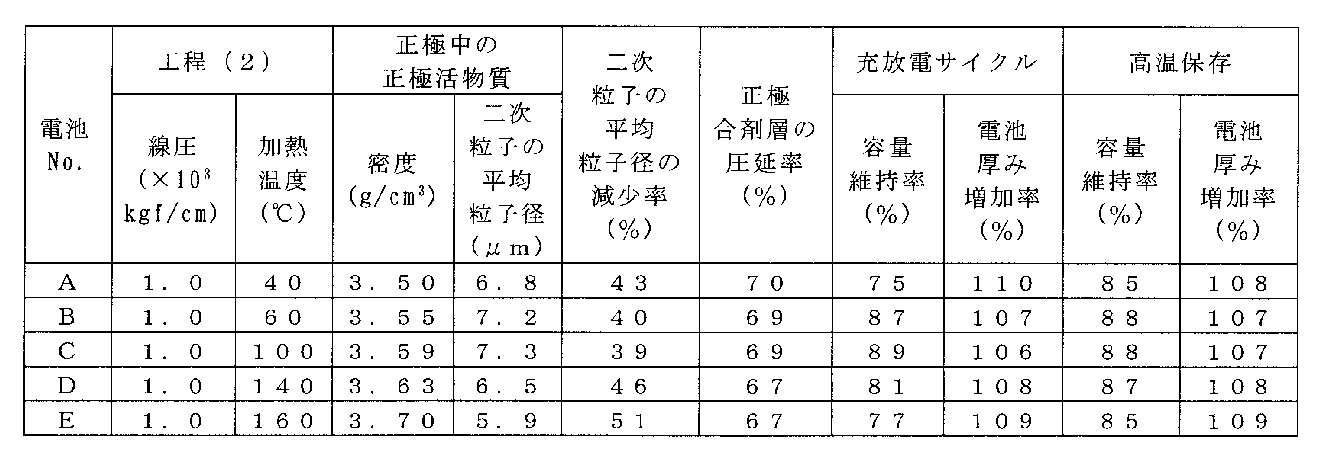
- Each positive electrode had an active material density of 3.5 g / cm 3 or more and an average particle diameter of secondary particles of the active material of 5 ⁇ m or more, and all the batteries exhibited good charge / discharge cycle characteristics and high-temperature storage characteristics.
- the heating temperature in the step (2) was preferably 60 to 140 ° C.
- Example 3 A positive electrode was produced in the same manner as in Example 1, except that the linear pressure and heating temperature in step (2) were changed to the values shown in Table 4.
- a battery was produced in the same manner as in Example 1 using this positive electrode. The positive electrode and the battery were evaluated by the above method. The evaluation results are shown in Table 4.
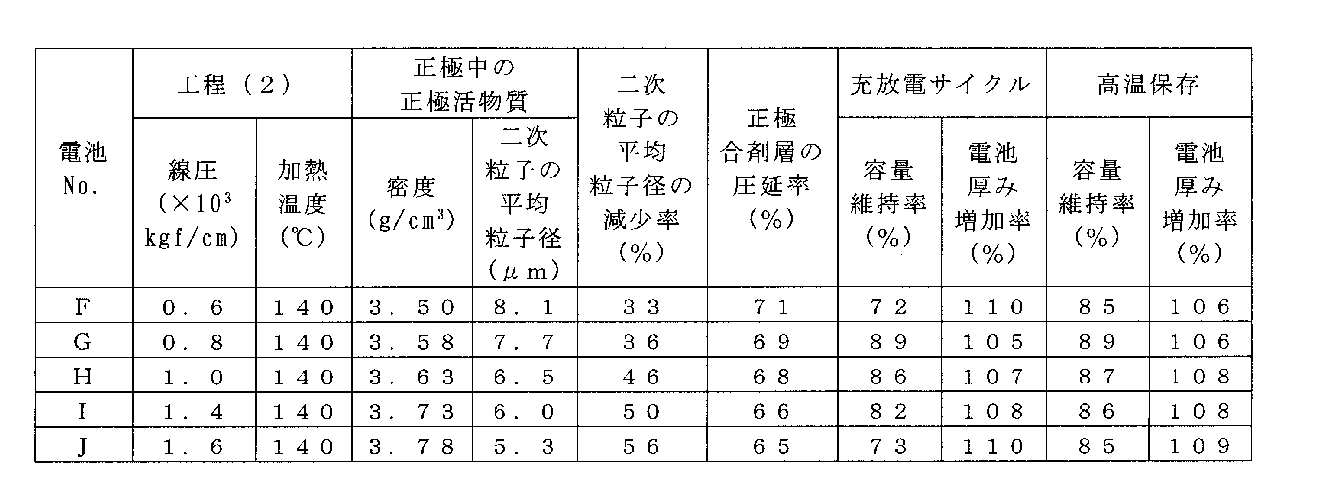
- Each positive electrode had an active material density of 3.5 g / cm 3 or more and an average particle diameter of secondary particles of the active material of 5 ⁇ m or more, and all the batteries exhibited good charge / discharge cycle characteristics and high-temperature storage characteristics.
- the linear pressure in the step (2) is preferably 0.8 ⁇ 10 3 to 1.4 ⁇ 10 3 kgf / cm. all right.
- Example 4 Lithium-containing composite oxide (LiNi 0.8 Co 0.15 Al 0.05 O 2 ) coarse powder A in which the average particle size of secondary particles is 23 ⁇ m, and lithium content in which the average particle size of secondary particles is 7 ⁇ m A positive electrode active material in which fine powder B of composite oxide (LiNi 0.8 Co 0.15 Al 0.05 O 2 ) is mixed at a weight ratio of 80:20, and the average particle diameter of secondary particles is 20 ⁇ m. A powder of material was obtained. The average particle diameter of the secondary particles of the coarse powder A and the fine powder B is the same as that of Example 1 in the production of the lithium-containing composite oxide. Adjustment was made by changing the average particle size of lithium hydroxide.
- a positive electrode was produced in the same manner as in Example 1 except that the linear pressure in step (2) was 1.4 ⁇ 10 3 kgf / cm and the heating temperature was 140 ° C. .
- a battery was produced in the same manner as in Example 1 using this positive electrode. The positive electrode and the battery were evaluated by the above method. The evaluation results are shown in Table 5.
- the positive electrode of the present invention is suitably used for a cylindrical or square nonaqueous electrolyte secondary battery. Since the nonaqueous electrolyte secondary battery of the present invention has excellent charge / discharge cycle characteristics and high temperature storage characteristics, it is suitably used as a power source for electronic equipment such as information equipment.
Landscapes
- Chemical & Material Sciences (AREA)
- Chemical Kinetics & Catalysis (AREA)
- Electrochemistry (AREA)
- General Chemical & Material Sciences (AREA)
- Engineering & Computer Science (AREA)
- Inorganic Chemistry (AREA)
- Materials Engineering (AREA)
- Manufacturing & Machinery (AREA)
- Battery Electrode And Active Subsutance (AREA)
Abstract
Description
そこで、本発明は、正極前駆体の圧延時における活物質粒子の割れを抑制することが可能な正極の製造方法およびその方法で得られる正極を提供する。また、本発明は、上記製造方法で得られた正極を用いて、高温保存特性および充放電サイクル特性に優れた非水電解質二次電池を提供する。
本発明の新規な特徴を添付の請求の範囲に記述するが、本発明は、構成および内容の両方に関し、本発明の他の目的および特徴と併せ、図面を照合した以下の詳細な説明によりさらによく理解されるであろう。
(1)正極芯材に、二次粒子の平均粒子径が8μm以上である、ニッケルを含むリチウム含有複合酸化物からなる正極活物質、結着剤、および導電剤を含む正極スラリーを塗布し、乾燥させて、正極合剤層を形成し、正極前駆体を得る工程と、
(2)前記正極前駆体を加熱しながら圧延することにより、前記正極活物質が、正極合剤層1cm3あたり3.5g以上含まれ、前記正極活物質の二次粒子の平均粒子径が5μm以上である正極を得る工程と、を含む。
上記の二次粒子は、正極活物質粒子群における、粒径1μm未満の一次粒子が凝集した、粒径1~30μmの二次粒子である。上記の平均粒子径は、体積基準の平均粒子径(D50)である。
正極活物質の二次粒子の平均粒子径が5μm以上であると、粒子割れおよびそれにより生じる活性面が大幅に減少しているため、活性面での酸化反応に伴うガス発生が大幅に抑制される。
工程(1)で用いられるリチウム含有複合酸化物(正極活物質)は、例えば、原料として、LiOH等のリチウム塩、およびニッケルを含む酸化物または水酸化物の混合物を、酸素雰囲気下(酸素分圧0.19~1気圧)、600~1000℃で焼成することにより得られる。この方法で合成されたリチウム含有複合酸化物では、平均粒子径500nm程度の一次粒子が凝集して焼結した二次粒子が形成されているが、一次粒子同士の結合力は弱い。合成されるリチウム含有複合酸化物の二次粒子のサイズは、ニッケルを含む酸化物または水酸化物の粒子サイズにより変わる。
上記原料の混合物を焼成する際、リチウム含有複合酸化物の合成反応を、ニッケルを含む酸化物または水酸化物の粒子内部まで速やかに進行させるためには、ニッケルを含む酸化物または水酸化物の平均粒子径は8~12μmが好ましい。この場合、合成されるニッケル系リチウム含有複合酸化物の二次粒子の平均粒子径は8~12μmである。
正極活物質の充填性をさらに高めるためには、工程(1)で用いる正極活物質として、二次粒子の平均粒子径が18~25μmである粗粉末Aと、二次粒子の平均粒子径が5~10μmである微粉末Bとの混合物を用いるのが好ましい。粗粉末Aおよび微粉末Bの混合重量比は、90~60:10~40が好ましい。
正極前駆体を加熱しながら圧延する手法を用いる際、上記のような充填性の高い粉末形態の正極活物質を用いると、正極合剤層1cm3あたりに含まれる正極活物質量を3.9g程度まで高めることが可能である。
活物質の粒子割れにより生じる活性面が少ないため、高温保存時および充放電サイクル時において、活性面での酸化反応に伴うガス発生が抑制される。
正極前駆体の圧延時の加熱により結着剤が変形し易くなるため、低い圧力でも活物質粒子間に結着剤が入り込み易くなり(すべり性が改善し)、活物質粒子間の結着性が向上する。
工程(2)で得られる正極の総厚み(正極芯材および正極芯材の両面に設けられた正極合剤層の厚み)は、例えば、80~200μmである。正極芯材に設けられる正極合剤層(片面)の厚みは、例えば、32.5~92.5μmである。
正極芯材の両面に正極合剤層を設ける場合、工程(2)における圧延率(圧延前の正極前駆体における正極合剤層の厚みに対する圧延後の正極における正極合剤層の厚みの割合)は、60~80%である。
ここで減少率とは、加熱圧延前(工程(1)の後かつ工程(2)の前)の正極活物質における二次粒子の平均粒子径D1、加熱圧延後(工程(2)の後)の正極活物質における二次粒子の平均粒子径D2として、下記式により求められる。
正極活物質の二次粒子の平均粒子径の減少率(%)=(D1-D2)/D1×100
弾性率は、変形し難さを表す指標であり、弾性率が低下すると、変形し易くなる。正極前駆体を上記温度に加熱しながら圧延すると、結着剤が変形し易くなり、活物質粒子間に結着剤が入り込み易くなり、活物質粒子間の結着性が大幅に向上する。
結着剤の弾性率が、当該結着剤の25℃における弾性率の70%以下となるような温度は、60~140℃であるため、工程(2)において、正極前駆体を、60~140℃に加熱しながら圧延するのが好ましい。ポリフッ化ビニリデン(以下、PVDF)を上記温度範囲で加熱するのが好ましい。PVDFを60~140℃に加熱すると、PVDFの弾性率を、25℃における弾性率の70%以下に低下させることが可能である。
また、正極合剤層1cm3あたりに含まれる正極活物質量は、好ましくは3.9g以下、より好ましくは3.8g以下である。
この場合、正極、負極、およびセパレータからなる電極群を捲回する場合において、正極が破断することがない。
Niの一部を異種元素Mで置換することにより、充放電サイクル特性および高温保存特性が向上する。xが0.1未満であると、Niの一部を異種元素のMで置換する効果が小さくなる。xが0.4超であると、リチウム含有複合酸化物中におけるNiの割合が少なくなり、Niによる効果(高容量等)が十分に得られない。
結着性および弾性の観点から、PVDFの誘導体(フッ化ビニリデンと、他のモノマーとの共重合体)におけるフッ化ビニリデン成分の比率は、50~95重量%が好ましい。
正極芯材としては、例えば、アルミニウム箔、アルミニウム合金箔等の金属箔が用いられる。金属箔の厚みは、例えば10~20μmである。
等が挙げられる。
《実施例1》
(1)正極活物質の作製
Ni原子とCo原子とAl原子とのモル比が80:15:5になるように混合した硫酸ニッケルと硫酸コバルトと硫酸アルミニウムとの混合物3.2kgを、10Lの水に溶解させて、原料溶液を得た。原料溶液に、水酸化ナトリウムを400g加えて、沈殿を生成させた。沈殿を十分に水洗し、乾燥させ、共沈水酸化物を得た。
正極活物質3kgと、(株)クレハ製のPVDF#7208(PVDFを8重量%含むN-メチル-2-ピロリドン(以下、NMPと略記)溶液)0.6kgと、アセチレンブラック90gと、適量のNMPとを、双腕式練合機で攪拌し、正極スラリーを調製した。
このPVDFは、重量平均分子量63万、結晶化度45%であった。
PVDFの25℃の弾性率に対する各温度でのPVDFの弾性率の比率を表1に示す。なお、表1中の弾性率は、貯蔵弾性率である。

人造黒鉛3kgと、日本ゼオン(株)製のBM-400B(変性スチレンブタジエンゴムを40重量%含む水性分散液)75gと、カルボキシメチルセルロース(CMC)30gと、適量の水とを、双腕式練合機で攪拌し、負極スラリーを調製した。この負極スラリーを厚さ10μmの銅箔からなる負極集電体の両面に塗布し、乾燥し、圧延して、負極合剤層を形成し、総厚が140μmの負極を得た。負極は45mm幅の帯状に裁断した。
エチレンカーボネート(EC)と、ジメチルカーボネート(DMC)と、エチルメチルカーボネート(EMC)との体積比1:1:1の混合溶媒に、1モル/リットルの濃度でLiPF6を溶解させて非水電解質を調製した。非水電解質には3重量%のビニレンカーボネートを含ませた。
図1に示すような角型リチウムイオン二次電池を作製した。
負極と正極と、これらの間に介在させた厚さ20μmのポリエチレン製の微多孔質フィルムからなるセパレータ(セルガード(株)製のA089(商品名))を捲回し、断面が略楕円形の電極群1を構成した。電極群1はアルミニウム製の角型の電池缶2に収容した。電池缶2は、底部と、側壁とを有し、上部は開口しており、その形状は略矩形である。その後、電池缶2と正極リード3または負極リード4との短絡を防ぐための絶縁体7を、電極群1の上部に配置した。次に、絶縁ガスケット8で囲まれた負極端子6を中央に有する矩形の封口板5を、電池缶2の開口に配置した。負極リード4は、負極端子6と接続した。正極リード3は、封口板5の下面と接続した。電池缶2の開口の端部と封口板5とをレーザで溶接し、電池缶2の開口を封口した。その後、封口板5の注液孔から2.5gの非水電解質を電池缶2に注入した。最後に、注液孔を封栓9で溶接により塞ぎ、高さ50mm、幅34mm、厚み約5.4mm、設計容量850mAhの角型リチウムイオン二次電池を完成させた。
工程(2)において、実施例1の正極と総厚み(活物質密度)が同じになるように、正極前駆体を加熱せずに線圧1.6×10³kgf/cmで圧延した以外、実施例1と同様の方法により正極を作製した。この正極を用いて、実施例1と同様の方法により、非水電解質二次電池を作製した。
工程(2)において、正極前駆体を加熱せずに圧延した以外、実施例1と同様の方法により正極を作製した。このとき、正極の総厚みは137μmであった。この正極を用いて、実施例1と同様の方法により、非水電解質二次電池を作製した。
[正極の評価]
正極合剤層1cm3あたりに含まれる正極活物質の重量(以下、活物質密度)、および正極活物質の二次粒子の平均粒子径を以下の方法で測定した。
(1)活物質密度の測定
正極合剤層の寸法(縦、横、および厚み)および正極活物質量より、下記式を用いて活物質密度を求めた。
活物質密度(g/cm3)=正極活物質量(g)/正極合剤層の体積(cm3)
正極合剤層の断面を、走査型電子顕微鏡(SEM)を用いて観察した。このとき、SEM像における100×100μmの領域内にて、無作為に選定した50個の正極活物質粒子(二次粒子)の最大径を測定し、その平均値を求めた。一次粒子が凝集した、粒子径が1~30μmの粒子を二次粒子として測定し、粒子径が1μm未満の粒子は、一次粒子として測定の対象から除外した。
正極活物質の圧延前後の二次粒子の平均粒子径より、下記式を用いて二次粒子の平均粒子径の減少率を求めた。ここで減少率とは、加熱圧延前(工程(1)の後かつ工程(2)の前)の正極活物質における二次粒子の平均粒子径D1、加熱圧延後(工程(2)の後)の正極活物質における二次粒子の平均粒子径D2として、下記式により求められる。
正極活物質の二次粒子の平均粒子径の減少率(%)=(D1-D2)/D1×100
正極活物質の圧延前後の正極合剤層の厚みを測定し、下記式により圧延率を求めた。
圧延率(%)=圧延後の正極合剤層の厚み/圧延前の正極合剤層の厚み×100
(1)充放電サイクル特性の評価
20℃環境下で、下記条件で充放電し、初期容量を求めた。その後、20℃環境下で、下記条件で、充放電を500サイクル繰り返し、500サイクル目の放電容量を求めた。下記式により、サイクル容量維持率を求めた。
サイクル容量維持率(%)=500サイクル目の放電容量/初期の放電容量×100
定電流充電:充電電流値850mA、充電終止電圧4.2V
定電圧充電:充電電圧値4.2V、充電終止電流100mA
定電流放電:放電電流値850mA、放電終止電圧3V
電池厚みの増加率(%)=500サイクル後の電池厚み/初期の電池厚み×100
20℃環境下で、上記条件で充放電し、初期の放電容量を求めた。その後、80℃で2日間保存した。保存後、同条件で充放電し、保存後の放電容量を求めた。下記式により、保存容量維持率を求めた。
保存容量維持率(%)=保存後の放電容量/保存前の放電容量×100
電池厚みの増加率(%)=保存後の電池厚み/保存前の電池厚み×100
上記の評価結果を表2に示す。
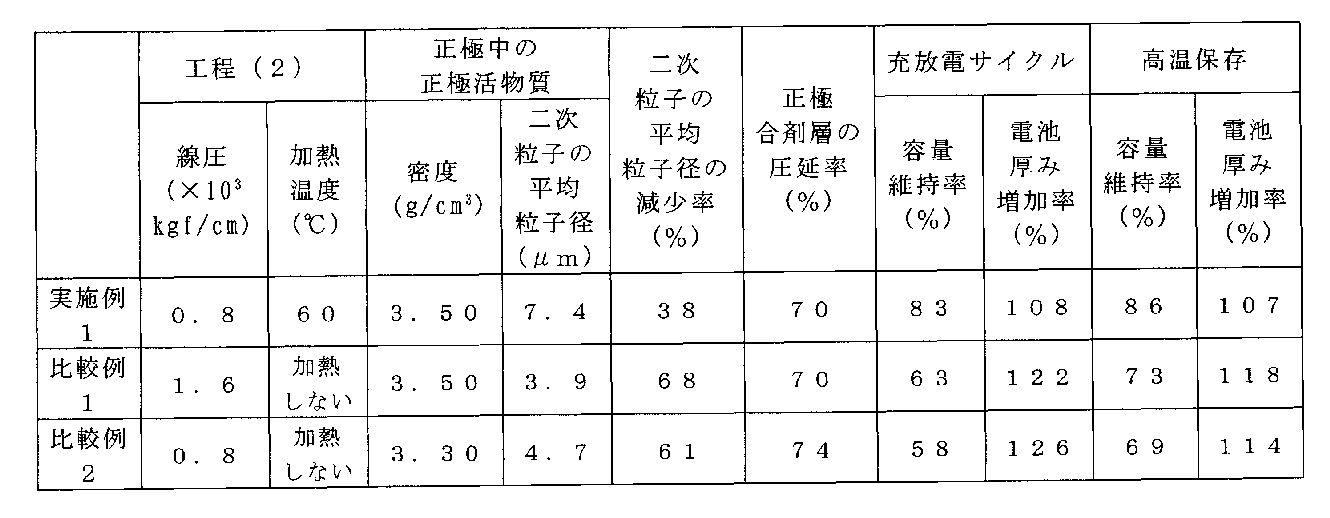
比較例1では、圧延時に正極前駆体を加熱しないため、実施例1と同じ圧延率となるように圧延すると、比較例1の圧延時の線圧は実施例1の圧延時の線圧よりも高い値となった。その結果、活物質粒子の割れが生じ易くなり、活物質の二次粒子の平均粒子径が小さくなった。
比較例2では、圧延時に正極前駆体を加熱しないため、実施例1と同じ線圧で圧延すると、比較例2の正極では、活物質粒子間に結着剤が十分に入り込まず、実施例1の正極と比べて、正極合剤層中の活物質粒子間の結着性が低下した。
工程(2)において線圧および加熱温度を表3に示す値に変えた以外、実施例1と同様の方法により正極を作製した。この正極を用いて、実施例1と同様の方法により電池を作製した。上記方法により正極および電池を評価した。評価結果を表3に示す。
工程(2)における線圧および加熱温度を表4に示す値に変えた以外、実施例1と同等の方法により正極を作製した。この正極を用いて実施例1と同様の方法により電池を作製した。上記方法により正極および電池を評価した。評価結果を表4に示す。
二次粒子の平均粒子径が23μmであるリチウム含有複合酸化物(LiNi0.8Co0.15Al0.05O2)の粗粉末Aと、二次粒子の平均粒子径が7μmのリチウム含有複合酸化物(LiNi0.8Co0.15Al0.05O2)の微粉末Bとを、重量比80:20の割合で混合し、二次粒子の平均粒子径が20μmである正極活物質の粉末を得た。
粗粉末Aおよび微粉末Bの二次粒子の平均粒子径は、実施例1と同じリチウム含有複合酸化物の作製において、リチウム含有複合酸化物の合成に用いるNi-Co-Al共沈水酸化物および水酸化リチウムの平均粒径を変えることにより調整した。

Claims (10)
- 正極芯材、および前記正極芯材の表面に形成された正極合剤層を有し、
前記正極合剤層は、正極活物質、結着剤、および導電剤を含み、
前記正極活物質は、ニッケルを含むリチウム含有複合酸化物を含み、
前記正極活物質は、二次粒子の平均粒子径が5μm以上であり、かつ前記正極合剤層1cm3あたり3.5g以上含まれていることを特徴とする非水電解質二次電池用正極。 - 前記リチウム含有複合酸化物は、六方晶の結晶構造を有し、
リチウム以外の全金属元素に占めるニッケル含有量が60~90モル%である請求項1記載の非水電解質二次電池用正極。 - 前記リチウム含有複合酸化物は、一般式:LiaNi1-xMxO2+b(式中、Mは、Co、Fe、Cu、Mn、Al、Mg、Ti、Zr、CeおよびYからなる群より選択される少なくとも1種であり、0.1≦x≦0.4、0.97≦a≦1.05、-0.1≦b≦0.1)で表される請求項1記載の非水電解質二次電池用正極。
- 請求項1記載の正極、負極活物質を含む負極、前記正極と負極との間に介在するセパレータ、および非水電解質を備える非水電解質二次電池。
- (1)正極芯材に、二次粒子の平均粒子径が8μm以上である、ニッケルを含むリチウム含有複合酸化物からなる正極活物質、結着剤、および導電剤を含む正極スラリーを塗布し、乾燥させて、正極合剤層を形成し、正極前駆体を得る工程と、
(2)前記正極前駆体を加熱しながら圧延することにより、前記正極活物質が、正極合剤層1cm3あたり3.5g以上含まれ、前記正極活物質の二次粒子の平均粒子径が5μm以上である正極を得る工程と、
を含むことを特徴とする非水電解質二次電池用正極の製造方法。 - 前記工程(2)において、前記正極活物質の二次粒子の平均粒子径は、前記正極前駆体の圧延前に対して30~60%減少する請求項5記載の非水電解質二次電池用正極の製造方法。
- 前記工程(2)の圧延時に、前記正極前駆体に、0.8×10³~1.4×10³kgf/cmの線圧を加える請求項5記載の非水電解質二次電池用正極の製造方法。
- 前記工程(2)において、前記正極前駆体を、前記結着剤の弾性率が当該結着剤の25℃における弾性率の70%以下となるような温度で加熱しながら圧延する請求項5記載の非水電解質二次電池用正極の製造方法。
- 前記工程(2)において、前記正極前駆体を、60~140℃に加熱しながら圧延する請求項5記載の非水電解質二次電池用正極の製造方法。
- 請求項5記載の製造方法により得られた非水電解質二次電池用正極。
Priority Applications (3)
| Application Number | Priority Date | Filing Date | Title |
|---|---|---|---|
| CN201080001664XA CN102047474A (zh) | 2009-03-18 | 2010-03-11 | 非水电解质二次电池用正极、采用该正极的非水电解质二次电池、及其制造方法 |
| US12/992,245 US9379376B2 (en) | 2009-03-18 | 2010-03-11 | Positive electrode containing lithium nickel composite oxide for non-aqueous electrolyte secondary battery, non-aqueous electrolyte secondary battery using the same, and method for producing the same |
| JP2011504739A JPWO2010106768A1 (ja) | 2009-03-18 | 2010-03-11 | 非水電解質二次電池用正極、それを用いた非水電解質二次電池、およびその製造方法 |
Applications Claiming Priority (2)
| Application Number | Priority Date | Filing Date | Title |
|---|---|---|---|
| JP2009-066399 | 2009-03-18 | ||
| JP2009066399 | 2009-03-18 |
Publications (1)
| Publication Number | Publication Date |
|---|---|
| WO2010106768A1 true WO2010106768A1 (ja) | 2010-09-23 |
Family
ID=42739435
Family Applications (1)
| Application Number | Title | Priority Date | Filing Date |
|---|---|---|---|
| PCT/JP2010/001740 Ceased WO2010106768A1 (ja) | 2009-03-18 | 2010-03-11 | 非水電解質二次電池用正極、それを用いた非水電解質二次電池、およびその製造方法 |
Country Status (5)
| Country | Link |
|---|---|
| US (1) | US9379376B2 (ja) |
| JP (1) | JPWO2010106768A1 (ja) |
| KR (1) | KR20110025678A (ja) |
| CN (1) | CN102047474A (ja) |
| WO (1) | WO2010106768A1 (ja) |
Cited By (6)
| Publication number | Priority date | Publication date | Assignee | Title |
|---|---|---|---|---|
| JP2012114048A (ja) * | 2010-11-26 | 2012-06-14 | Toyota Motor Corp | リチウム二次電池及びその製造方法 |
| WO2012101970A1 (ja) * | 2011-01-24 | 2012-08-02 | パナソニック株式会社 | リチウム二次電池およびその製造方法 |
| WO2019097951A1 (ja) * | 2017-11-17 | 2019-05-23 | パナソニックIpマネジメント株式会社 | 非水電解質二次電池用正極活物質及び非水電解質二次電池 |
| JP2019140054A (ja) * | 2018-02-15 | 2019-08-22 | Tdk株式会社 | 正極及び非水電解液二次電池 |
| JP2019169412A (ja) * | 2018-03-26 | 2019-10-03 | 住友金属鉱山株式会社 | 高強度リチウムイオン二次電池用正極活物質、及び、該正極活物質を用いたリチウムイオン二次電池 |
| WO2023190422A1 (ja) | 2022-03-31 | 2023-10-05 | 株式会社Gsユアサ | 非水電解質蓄電素子用の正極及びこれを備える非水電解質蓄電素子 |
Families Citing this family (7)
| Publication number | Priority date | Publication date | Assignee | Title |
|---|---|---|---|---|
| WO2013132657A1 (ja) * | 2012-03-09 | 2013-09-12 | 株式会社日立製作所 | 非水電解質二次電池 |
| CN106104870B (zh) * | 2014-03-17 | 2020-06-09 | 三洋电机株式会社 | 非水电解质二次电池 |
| US10096829B2 (en) * | 2014-03-27 | 2018-10-09 | Sanyo Electric Co., Ltd. | Nonaqueous electrolyte secondary batteries |
| KR101737207B1 (ko) | 2014-07-11 | 2017-05-29 | 주식회사 엘지화학 | 이차전지의 양극재 및 그 제조방법 |
| JP6733796B2 (ja) | 2018-10-03 | 2020-08-05 | ダイキン工業株式会社 | 正極構造体および二次電池 |
| KR20220160531A (ko) * | 2020-03-31 | 2022-12-06 | 도레이 카부시키가이샤 | 다공성 필름, 2차전지용 세퍼레이터 및 2차전지 |
| KR102339704B1 (ko) * | 2020-06-18 | 2021-12-15 | 주식회사 에코프로비엠 | 양극 활물질 및 이를 포함하는 리튬 이차전지 |
Citations (6)
| Publication number | Priority date | Publication date | Assignee | Title |
|---|---|---|---|---|
| JP2001015168A (ja) * | 1999-06-25 | 2001-01-19 | Shin Kobe Electric Mach Co Ltd | リチウム二次電池 |
| JP2001223011A (ja) * | 2000-02-10 | 2001-08-17 | Daikin Ind Ltd | 非水電解液電池用結着剤およびそれを用いた電池電極合剤、並びに非水電解液電池 |
| JP2002170566A (ja) * | 2000-12-04 | 2002-06-14 | Yuasa Corp | リチウム二次電池 |
| JP2006156021A (ja) * | 2004-11-26 | 2006-06-15 | Toshiba Corp | 非水電解質二次電池 |
| WO2006080259A1 (ja) * | 2005-01-27 | 2006-08-03 | Kureha Corporation | フッ化ビニリデン系コア/シェル型重合体およびその非水系電気化学素子における利用 |
| JP2008536285A (ja) * | 2005-04-15 | 2008-09-04 | エナーセラミック インコーポレイテッド | フッ素化合物でコーティングされたリチウム二次電池用正極活物質及びその製造方法 |
Family Cites Families (5)
| Publication number | Priority date | Publication date | Assignee | Title |
|---|---|---|---|---|
| JP4061648B2 (ja) | 2003-04-11 | 2008-03-19 | ソニー株式会社 | 非水電解質二次電池用正極活物質及びそれを用いた非水電解質二次電池 |
| CN100589273C (zh) * | 2005-03-23 | 2010-02-10 | 日立麦克赛尔株式会社 | 非水电解质电池及其制造方法 |
| DE602006017836D1 (de) * | 2005-06-02 | 2010-12-09 | Panasonic Corp | Elektrode für eine sekundärbatterie mit wasserfreiem elektrolyt, sekundärbatterie mit wasserfreiem elektrolyt und damit ausgestattetes automobil, elektrowerkzeug oder stationäre einrichtung |
| JP4581888B2 (ja) | 2005-07-25 | 2010-11-17 | Tdk株式会社 | 電気化学素子用電極の製造方法および電気化学素子の製造方法 |
| JP5110556B2 (ja) * | 2006-03-27 | 2012-12-26 | 日立マクセルエナジー株式会社 | 非水二次電池およびその使用方法 |
-
2010
- 2010-03-11 JP JP2011504739A patent/JPWO2010106768A1/ja active Pending
- 2010-03-11 CN CN201080001664XA patent/CN102047474A/zh active Pending
- 2010-03-11 KR KR1020107029926A patent/KR20110025678A/ko not_active Abandoned
- 2010-03-11 US US12/992,245 patent/US9379376B2/en active Active
- 2010-03-11 WO PCT/JP2010/001740 patent/WO2010106768A1/ja not_active Ceased
Patent Citations (6)
| Publication number | Priority date | Publication date | Assignee | Title |
|---|---|---|---|---|
| JP2001015168A (ja) * | 1999-06-25 | 2001-01-19 | Shin Kobe Electric Mach Co Ltd | リチウム二次電池 |
| JP2001223011A (ja) * | 2000-02-10 | 2001-08-17 | Daikin Ind Ltd | 非水電解液電池用結着剤およびそれを用いた電池電極合剤、並びに非水電解液電池 |
| JP2002170566A (ja) * | 2000-12-04 | 2002-06-14 | Yuasa Corp | リチウム二次電池 |
| JP2006156021A (ja) * | 2004-11-26 | 2006-06-15 | Toshiba Corp | 非水電解質二次電池 |
| WO2006080259A1 (ja) * | 2005-01-27 | 2006-08-03 | Kureha Corporation | フッ化ビニリデン系コア/シェル型重合体およびその非水系電気化学素子における利用 |
| JP2008536285A (ja) * | 2005-04-15 | 2008-09-04 | エナーセラミック インコーポレイテッド | フッ素化合物でコーティングされたリチウム二次電池用正極活物質及びその製造方法 |
Cited By (11)
| Publication number | Priority date | Publication date | Assignee | Title |
|---|---|---|---|---|
| JP2012114048A (ja) * | 2010-11-26 | 2012-06-14 | Toyota Motor Corp | リチウム二次電池及びその製造方法 |
| WO2012101970A1 (ja) * | 2011-01-24 | 2012-08-02 | パナソニック株式会社 | リチウム二次電池およびその製造方法 |
| CN103329330A (zh) * | 2011-01-24 | 2013-09-25 | 松下电器产业株式会社 | 锂二次电池及其制造方法 |
| JP5555334B2 (ja) * | 2011-01-24 | 2014-07-23 | パナソニック株式会社 | リチウム二次電池およびその製造方法 |
| WO2019097951A1 (ja) * | 2017-11-17 | 2019-05-23 | パナソニックIpマネジメント株式会社 | 非水電解質二次電池用正極活物質及び非水電解質二次電池 |
| JPWO2019097951A1 (ja) * | 2017-11-17 | 2020-11-19 | パナソニックIpマネジメント株式会社 | 非水電解質二次電池用正極活物質及び非水電解質二次電池 |
| JP7289058B2 (ja) | 2017-11-17 | 2023-06-09 | パナソニックIpマネジメント株式会社 | 非水電解質二次電池用正極活物質及び非水電解質二次電池 |
| US11742480B2 (en) | 2017-11-17 | 2023-08-29 | Panasonic Intellectual Property Management Co., Ltd. | Positive electrode active material for nonaqueous electrolyte secondary batteries, and nonaqueous electrolyte secondary battery |
| JP2019140054A (ja) * | 2018-02-15 | 2019-08-22 | Tdk株式会社 | 正極及び非水電解液二次電池 |
| JP2019169412A (ja) * | 2018-03-26 | 2019-10-03 | 住友金属鉱山株式会社 | 高強度リチウムイオン二次電池用正極活物質、及び、該正極活物質を用いたリチウムイオン二次電池 |
| WO2023190422A1 (ja) | 2022-03-31 | 2023-10-05 | 株式会社Gsユアサ | 非水電解質蓄電素子用の正極及びこれを備える非水電解質蓄電素子 |
Also Published As
| Publication number | Publication date |
|---|---|
| US20110104569A1 (en) | 2011-05-05 |
| KR20110025678A (ko) | 2011-03-10 |
| US9379376B2 (en) | 2016-06-28 |
| JPWO2010106768A1 (ja) | 2012-09-20 |
| CN102047474A (zh) | 2011-05-04 |
Similar Documents
| Publication | Publication Date | Title |
|---|---|---|
| JP7503863B2 (ja) | 正極活物質、その製造方法、及びそれを含む正極を含むリチウム二次電池 | |
| KR102325727B1 (ko) | 리튬 이차전지용 양극재, 이의 제조방법, 이를 포함하는 리튬 이차전지용 양극 및 리튬 이차전지 | |
| JP7632940B2 (ja) | リチウム二次電池用正極材、この製造方法、これを含むリチウム二次電池用正極、及びリチウム二次電池 | |
| JP7535329B2 (ja) | リチウム二次電池用正極活物質、その製造方法及びそれを含むリチウム二次電池 | |
| US9379376B2 (en) | Positive electrode containing lithium nickel composite oxide for non-aqueous electrolyte secondary battery, non-aqueous electrolyte secondary battery using the same, and method for producing the same | |
| JP4183472B2 (ja) | 非水電解質二次電池 | |
| JP7357994B2 (ja) | 二次電池用正極活物質の製造方法 | |
| RU2540072C1 (ru) | Активный материал положительного электрода для литий-ионной вторичной батареи | |
| JP7597921B2 (ja) | 正極活物質およびこれを含むリチウム二次電池 | |
| CN112242505B (zh) | 非水电解质二次电池 | |
| JP2002110253A (ja) | 非水電解質二次電池 | |
| JP2010129471A (ja) | 正極活物質および非水電解質電池 | |
| WO2015125444A1 (ja) | 非水電解質二次電池用正極活物質 | |
| JP2008153017A (ja) | 非水電解液二次電池用正極活物質 | |
| JP7760758B2 (ja) | 過リチウムマンガン系酸化物を含むリチウム二次電池の製造方法 | |
| JP2012146590A (ja) | 非水電解質二次電池用正極、その正極の製造方法、及び非水電解質二次電池 | |
| JPWO2010146832A1 (ja) | 非水電解質二次電池用負極の製造方法、負極、およびそれを用いた非水電解質二次電池 | |
| JP2011014254A (ja) | 非水電解質二次電池の製造方法 | |
| CN112242509B (zh) | 非水电解质二次电池 | |
| JP7551212B2 (ja) | ガス発生量が低減された犠牲正極材およびこれを含むリチウム二次電池 | |
| JP3996554B2 (ja) | リチウム二次電池 | |
| JP2006294482A (ja) | リチウムイオン二次電池 | |
| JP5626035B2 (ja) | リチウムイオン二次電池の前処理方法及び使用方法 | |
| CN115207301A (zh) | 正极和具备其的二次电池 | |
| JP4794192B2 (ja) | 非水電解質二次電池及びその充電方法 |
Legal Events
| Date | Code | Title | Description |
|---|---|---|---|
| WWE | Wipo information: entry into national phase |
Ref document number: 201080001664.X Country of ref document: CN |
|
| 121 | Ep: the epo has been informed by wipo that ep was designated in this application |
Ref document number: 10753265 Country of ref document: EP Kind code of ref document: A1 |
|
| WWE | Wipo information: entry into national phase |
Ref document number: 12992245 Country of ref document: US |
|
| WWE | Wipo information: entry into national phase |
Ref document number: 2011504739 Country of ref document: JP |
|
| ENP | Entry into the national phase |
Ref document number: 20107029926 Country of ref document: KR Kind code of ref document: A |
|
| NENP | Non-entry into the national phase |
Ref country code: DE |
|
| 122 | Ep: pct application non-entry in european phase |
Ref document number: 10753265 Country of ref document: EP Kind code of ref document: A1 |