WO2010087215A1 - 茶エキス及びその製造方法 - Google Patents
茶エキス及びその製造方法 Download PDFInfo
- Publication number
- WO2010087215A1 WO2010087215A1 PCT/JP2010/050104 JP2010050104W WO2010087215A1 WO 2010087215 A1 WO2010087215 A1 WO 2010087215A1 JP 2010050104 W JP2010050104 W JP 2010050104W WO 2010087215 A1 WO2010087215 A1 WO 2010087215A1
- Authority
- WO
- WIPO (PCT)
- Prior art keywords
- extract
- tea
- tea extract
- brix
- manufactured
- Prior art date
- Legal status (The legal status is an assumption and is not a legal conclusion. Google has not performed a legal analysis and makes no representation as to the accuracy of the status listed.)
- Ceased
Links
Classifications
-
- A—HUMAN NECESSITIES
- A23—FOODS OR FOODSTUFFS; TREATMENT THEREOF, NOT COVERED BY OTHER CLASSES
- A23F—COFFEE; TEA; THEIR SUBSTITUTES; MANUFACTURE, PREPARATION, OR INFUSION THEREOF
- A23F3/00—Tea; Tea substitutes; Preparations thereof
- A23F3/16—Tea extraction; Tea extracts; Treating tea extract; Making instant tea
-
- A—HUMAN NECESSITIES
- A23—FOODS OR FOODSTUFFS; TREATMENT THEREOF, NOT COVERED BY OTHER CLASSES
- A23F—COFFEE; TEA; THEIR SUBSTITUTES; MANUFACTURE, PREPARATION, OR INFUSION THEREOF
- A23F3/00—Tea; Tea substitutes; Preparations thereof
- A23F3/16—Tea extraction; Tea extracts; Treating tea extract; Making instant tea
- A23F3/166—Addition of, or treatment with, enzymes or microorganisms
-
- A—HUMAN NECESSITIES
- A23—FOODS OR FOODSTUFFS; TREATMENT THEREOF, NOT COVERED BY OTHER CLASSES
- A23F—COFFEE; TEA; THEIR SUBSTITUTES; MANUFACTURE, PREPARATION, OR INFUSION THEREOF
- A23F3/00—Tea; Tea substitutes; Preparations thereof
- A23F3/16—Tea extraction; Tea extracts; Treating tea extract; Making instant tea
- A23F3/30—Further treatment of dried tea extract; Preparations produced thereby, e.g. instant tea
Definitions
- the present invention relates to a tea extract with enhanced aroma obtained by allowing an enzyme to act during or after extraction of a tea extract.
- a quality improvement method using an enzyme for tea beverage and tea extract for example, a method for producing a beverage in which a green tea extract is treated with ⁇ -mannanase for the purpose of preventing precipitation (Patent Document 1), and a green tea extract is treated with hemicellulase.
- Patent Document 2 The manufacturing method of the drink processed by is disclosed.
- Patent Document 3 a method for extracting tea leaf raw materials in the presence of protease and tannase
- Patent Document 3 a method for extracting tea leaf raw materials in the presence of protease and tannase
- Patent Document 5 A method for performing enzymatic degradation extraction (Patent Document 4) and a method for producing a tea extract (Patent Document 5) in which enzymatic degradation is performed using a saccharide-degrading enzyme during and / or after extraction of tea raw materials are disclosed.
- Teas are roughly classified into three types according to the degree of fermentation during the manufacturing process: non-fermented tea, typically green tea, semi-fermented tea, typically oolong tea, and fully fermented tea, typically black tea. Widely used.
- tea beverages in which an extract of tea is placed in a container have been developed. These tea beverages are mainly subjected to a process in which tea leaves are extracted with hot water or hot water to obtain an extract, which is diluted to a beverage concentration and then sterilized before or after filling into cans or PET bottles. Manufactured.
- An object of the present invention is to provide a method for obtaining a tea extract with enhanced aroma using an inexpensive enzyme without preparing a chemically synthesized aroma substance.
- the present invention is a method for producing a tea extract that is subjected to a polysaccharide-degrading enzyme treatment when and / or after extraction of a tea extract from raw tea, and the pH of the tea extract during the polysaccharide-degrading enzyme treatment Is 3 to 7 and the processing time is 3 to 48 hours.
- the present invention is a tea extract that has been subjected to a polysaccharide-degrading enzyme treatment when extracting a tea extract from raw teas and / or after extraction, wherein the content of methyl salicylate per 1% Brix is 40 ppb or more.
- the tea extract is provided.
- this invention provides the container-packed tea drink obtained by mix
- a tea extract with enhanced aroma can be obtained at low cost without preparing a chemically synthesized aroma substance.
- the method for producing a tea extract of the present invention is characterized in that a polysaccharide-degrading enzyme treatment is performed when and / or after extracting a tea extract from raw teas.
- a polysaccharide-degrading enzyme treatment is performed when and / or after extracting a tea extract from raw teas.
- any tea made from buds and leaves of camellia plant tea (scientific name Camellia sinensis) can be used as a raw tea without limitation.
- Tea includes Chinese varieties (Camellia sinensis var sinensis), Assam varieties (Camellia sinensis var assamica), Cambodian varieties (Camellia sinensis var ssp. Lasiocalyx), and any of them can be used in the present invention.
- non-fermented tea sencha, kabuse tea, gyokuro, strawberry tea, matcha tea, tama green tea, sayha, hojicha, kama fried tea, etc.
- semi-fermented tea packed tea, iron kannon tea, oolong tea, etc.
- fermentation Tea black tea, Awaban tea, Goishi tea, Toyama black tea, coffee tea, pu-erh tea, etc.
- the above raw tea leaves may be extracted by a general method.
- a method of preparing tea leaves in an extraction kettle and then immersing them in a predetermined amount of water for a certain period of time to remove the tea husks to obtain an extract, or feeding a constant flow of water after filling the extraction tank with tea leaves Examples thereof include a method for obtaining a quantitative extract.
- water used for extraction include tap water, ion exchange water, distilled water, natural water, natural mineral water, deaerated water, ascorbic acid-dissolved water, pH-adjusted water (including a buffer solution), and the like.
- the amount of water used in the extraction is not particularly limited as long as the raw tea leaves are sufficiently immersed, but is preferably 5 times or more, more preferably 10 to 50 times the mass of the raw tea leaves used normally. The amount is more preferably 10 to 25 times.
- the temperature of water used for extraction is not particularly limited as long as it can be extracted, but is usually about 4 to 95 ° C, and particularly preferably 30 to 90 ° C.
- the extraction time is not particularly limited, but is usually about 1 minute to 12 hours, and particularly preferably 5 minutes to 6 hours.
- any polysaccharide-degrading enzyme may be used as long as it has an ability to generate aroma and is inexpensive, but a large amount of enzyme is required to generate methyl salicylate to a target concentration.
- the amount of the enzyme used is further increased and the cost is increased.
- the amount of enzyme used is reduced, the reaction time must be significantly increased.
- the polysaccharide degrading enzyme is preferably one having strong activity and low cost. Specific examples include pectinase, hemicellulase, mannanase, cellulase, xylanase, and arabanase, which are widely used industrially as polysaccharide degrading enzymes.
- the amount of polysaccharide-degrading enzyme used varies depending on the titer and the reaction conditions. For example, it can be added in the range of 0.001 to 10% by mass based on the mass of the solution to be reacted.
- polysaccharide degrading enzymes may be used alone or in combination of two or more.
- the pH of the tea extract during the polysaccharide-degrading enzyme treatment is 3 to 7, preferably 4 to 5.5.
- the treatment time for the polysaccharide-degrading enzyme treatment is 3 to 48 hours, preferably 10 to 24 hours.
- the treatment temperature for the polysaccharide-degrading enzyme treatment is preferably 10 to 60 ° C, more preferably 20 to 50 ° C. If the treatment conditions are within the above range, a sufficient amount of methyl salicylate can be efficiently generated.
- Pectinase is also called polygalacturonase, pectin enzyme, polymethylgalacturonase, and pectin depolymerase, and is an enzyme that hydrolyzes ⁇ (1-4) bonds such as pectinic acid, pectin, and pectic acid.
- pectinase also includes pectin methylesterase that hydrolyzes the methyl ester of the carboxyl group of galacturonic acid.
- pectinases obtained from organisms including these can be widely used. A commercially available pectinase preparation may also be used.
- pectinase preparations examples include sucrase (manufactured by Sankyo), pectinex ultra SP-L (manufactured by Novozymes), mecerase (manufactured by Meiji Seika Co., Ltd.), ultrazyme (manufactured by Novozymes), pectinase G “Amano”, Examples include pectinase PL “Amano”, Newase F (manufactured by Amano Enzyme Inc.), Sumiteam MC (manufactured by Shin Nippon Chemical Industry Co., Ltd.), and the like.
- Cellulase is an enzyme having an activity of hydrolyzing cellulose.
- Cellulose is a major component of plant cell walls and is highly hydrophilic but insoluble in water.
- Cellulase is not particularly limited as long as it has an activity of degrading cellulose, and any cellulase can be used.
- cellulase preparations examples include cellulase T “Amano”, cellulase A “Amano” ( As above, manufactured by Amano Enzyme Co., Ltd.), Doricerase KSM, Multifect A40, Cellulase GC220 (manufactured by Genencor Kyowa Co., Ltd.), Cellulase GODO-TCL, Cellulase GODO-TCD-H, Besselex, Cellulase GODO-ACD (manufactured by Godo Shusei Co., Ltd.), Cellulase (manufactured by Toyobo Co., Ltd.), cell riser, cellulase XL-522 (manufactured by Nagase ChemteX), cell soft, Denimax (manufactured by Novozymes), cellulosin AC40, cellulosin AL, cellulosin T2 (manufactured by HI Corporation
- Hemicellulase is an enzyme that performs a reaction to hydrolyze the glycosidic bond of hemicellulose.
- Hemicellulose is a general term for polysaccharides insoluble in water in plant tissues, excluding cellulose, and includes xylan, mannan, araban, and the like. Enzymes that degrade xylan are called xylanases, enzymes that degrade mannan are called mannanases, enzymes that degrade araban are called arabanases, and a group of these is called hemicellulase.
- the origin of the enzyme used in the present invention is not particularly limited, and it can be used even if it is a purified product or an unpurified one.
- preparations generally referred to as hemicellulase, mannanase, xylanase, and arabanase may be used in the food industry.
- the tea extract obtained by the method of the present invention can be used for various foods and beverages (especially in containers) such as beverages, alcoholic beverages, frozen confectionery / desserts, baked confectionery, tablet confectionery, and gum.
- tea drinks green tea, oolong tea, black tea, mixed tea, etc.
- milk drinks sports drinks, near water, energy drinks, carbonated drinks and other beverages, sparkling liquors, cocktails and other alcoholic beverages, pudding, bavalois
- frozen desserts and desserts such as jelly, yogurt, sherbet and ice cream
- baked confectionery such as cookies and biscuits
- tablet confections such as candy and tablets, and gums.
- Example 1 0.1 g of vitamin C was added to 100 g of green tea extract A to make Brix 5.1% and pH 5.1. Next, 0.5 g of pectinase G “Amano” (manufactured by Amano Enzyme) was added and reacted at 40 ° C. for 18 hours, and then the pH was adjusted to 6.0 with sodium bicarbonate. This extract was filtered through filter paper and then sterilized at 80 ° C. for 10 minutes to obtain an extract having Brix 5.2% and pH 6.0.
- Example 2 In Example 1, instead of pectinase G “Amano”, treatment was performed in the same manner as in Example 1 except that 0.5 g of cellulosin AC40 (cellulase) (manufactured by HIBI) was added to obtain an extract having Brix 5.3% and pH 6.0. .
- Example 3 In Example 1, instead of pectinase G “Amano”, treatment was performed in the same manner as in Example 1 except that 0.5 g of hemicellulase “Amano” 90 (manufactured by Amano Enzyme) was added, and Brix 5.6%, pH 6.0 extract was obtained. Obtained.
- Example 4 In Example 1, instead of pectinase G “Amano”, treatment was performed in the same manner as in Example 1 except that 0.5 g of cellulosin GM5 (mannanase) (manufactured by HIBI) was added to obtain an extract having Brix 5.3% and pH 6.0. .
- Example 5 Treatment was carried out in the same manner as in Example 1 except that 0.5 g of cellulosin HC (xylanase) (manufactured by HIBI) was used instead of pectinase G “Amano” to obtain an extract of Brix 5.4%, pH 6.0. .
- cellulosin HC xylanase
- green tea extract A green tea extracts obtained in Examples 1 to 5 and Comparative Examples 1 to 5, 3 g of sodium chloride was dissolved in 10 g of each sample and extracted with 1 ml of hexane. After separating into an aqueous layer and an organic layer, the organic layer was recovered and subjected to gas chromatography analysis under the following conditions.
- the product of the present invention has a dramatic increase in the concentration of methyl salicylate compared to the green tea extract A and the comparative example. It was. Under the reaction conditions of the comparative example, the concentration of methyl salicylate did not change, and the sensation was not satisfactory.
- ⁇ Oolong tea extract A> The column was filled with 4.0 kg of oolong tea, 36 kg of ion exchange water at 70 ° C. was passed from the bottom of the column, and the extract was recovered from the top of the column to obtain 24 kg of Brix 5.0% extract. This extract was subjected to solid-liquid separation by filtration with filter paper, and then sterilized at 95 ° C. for 30 seconds to obtain 20 kg of Brix 5.0%, pH 5.2 extract.
- Example 6 0.5 g of pectinase G “Amano” (manufactured by Amano Enzyme) was added to 100 g of Oolong tea extract A and reacted at 50 ° C. for 18 hours. The extract was then filtered through filter paper and sterilized at 80 ° C. for 10 minutes to obtain an extract having Brix 4.7% and pH 5.0.
- Example 7 In Example 6, instead of pectinase G “Amano”, treatment was performed in the same manner as in Example 6 except that 0.5 g of cellulosin AC40 (cellulase) (manufactured by IB Corporation) was added to obtain an extract having Brix 5.2% and pH 4.9. .
- Example 8 In Example 6, instead of pectinase G “Amano”, treatment was performed in the same manner as in Example 6 except that 0.5 g of hemicellulase “Amano” 90 (manufactured by Amano Enzyme) was added, and an extract with Brix 5.4% and pH 4.8 was obtained. Obtained.
- Example 9 In Example 6, instead of pectinase G “Amano”, treatment was performed in the same manner as in Example 6 except that 0.5 g of cellulosin GM5 (mannanase) (manufactured by HIBI) was added to obtain an extract having Brix 5.2% and pH 4.8. .
- Example 10 In Example 6, instead of pectinase G “Amano”, treatment was performed in the same manner as in Example 6 except that 0.5 g of cellulosin HC (xylanase) (manufactured by HIBI) was added to obtain an extract having Brix 5.4% and pH 5.0. .
- cellulosin HC xylanase
- Oolong tea extract A Oolong tea extracts obtained in Examples 6 to 10 and Comparative Examples 6 to 10 were subjected to aroma analysis and sensory evaluation.
- the analysis method and sensory evaluation criteria were in accordance with Examples 1-5.
- ⁇ Tea Extract A> The column was filled with 4.0 kg of black tea, 36 kg of ion exchanged water at 70 ° C. was passed from the bottom of the column, and the extract was recovered from the top of the column to obtain 24 kg of an extract with Brix 5.0% and pH 4.7. This extract was subjected to solid-liquid separation by filtration with filter paper and sterilized at 95 ° C. for 30 seconds to obtain 20 kg of Brix 5.0% extract.
- Example 11 0.5 g of pectinase G “Amano” (manufactured by Amano Enzyme) was added to 100 g of black tea extract A, and reacted at 50 ° C. for 18 hours. The extract was then filtered through filter paper and sterilized at 80 ° C. for 10 minutes to obtain an extract of Brix 4.7% and pH 4.7.
- Example 12 In Example 11, instead of pectinase G “Amano”, treatment was performed in the same manner as in Example 11 except that 0.5 g of cellulosin AC40 (cellulase) (manufactured by HIBI) was added to obtain an extract of Brix 5.1%, pH 4.6. .
- Example 13 In Example 11, instead of pectinase G “Amano”, treatment was carried out in the same manner as in Example 11 except that 0.5 g of hemicellulase “Amano” 90 (manufactured by Amano Enzyme) was added, and an extract of Brix 5.1%, pH 4.6 was obtained. Obtained.
- Example 14 In Example 11, instead of pectinase G “Amano”, treatment was performed in the same manner as in Example 11 except that 0.5 g of cellulosin GM5 (mannanase) (manufactured by HIBI) was added to obtain an extract having Brix 5.0% and pH 4.6. .
- Example 15 Treatment was carried out in the same manner as in Example 11 except that 0.5 g of cellulosin HC (xylanase) (manufactured by HIBI) was used instead of pectinase G “Amano” to obtain an extract of Brix 5.4%, pH 4.6. .
Landscapes
- Life Sciences & Earth Sciences (AREA)
- Chemical & Material Sciences (AREA)
- Engineering & Computer Science (AREA)
- Food Science & Technology (AREA)
- Polymers & Plastics (AREA)
- Microbiology (AREA)
- Tea And Coffee (AREA)
- Preparation Of Compounds By Using Micro-Organisms (AREA)
Abstract
Description
また、旨味やコクを増加させる方法として茶葉原料をプロテアーゼ及びタンナーゼの存在下に抽出する方法(特許文献3)、また、セルラーゼ、ヘミセルラーゼ、ペクチナーゼ及びプロトペクチナーゼを少なくとも有する酵素群を用い、茶葉を酵素分解抽出処理する方法(特許文献4)、茶類原料の抽出時および/または抽出後に糖類分解酵素を用いて酵素分解処理する茶エキスの製造方法(特許文献5)が開示されている。
しかし、これらの製法は長期保管における沈殿の発生の防止、旨味の増強、渋味の低減などを目的とした製法であり、香りの観点では満足の出来るものではなかった。
また、茶類の香気を酵素によって高める方法として、緑茶の抽出液に配糖体分解酵素を作用させる製法(特許文献6)、茶葉にタンナーゼ処理時又は処理後に配糖体分解酵素を作用させる製法(特許文献7)、微生物由来のジグリコシダーゼを作用させる方法(特許文献8)が知られている。
しかし、これらの製法で使用される配糖体分解酵素は非常に高価であり、工業的に利用することに問題があった。
製造中、保存中の香りの損失を補うべく、化学的に合成された香気物質を調合して得る香料を添加する場合もあるが、近年の食品の安全性への消費者意識の高まり、天然志向の高まりから、特に茶系飲料への香料の使用は敬遠される傾向があった。
すなわち、本発明は、原料茶類から茶エキスを抽出する時及び/又は抽出した後、多糖類分解酵素処理を行う茶エキスの製造方法であって、多糖類分解酵素処理時の茶エキスのpHが3~7であり、処理時間が3~48時間である、前記製造方法を提供する。
また、本発明は、原料茶類から茶エキスを抽出する時及び/又は抽出した後に多糖類分解酵素処理した茶エキスであって、Brix 1%当たりのサリチル酸メチルの含有量が40ppb以上である、前記茶エキスを提供する。
さらに、本発明は、上記製造方法により得られる茶エキス又は上記茶エキスを配合して得られる容器詰茶飲料を提供する。
本発明においては、ツバキ科の植物チャ(学術名Camellia sinensis)の芽及び葉を原料とする茶であれば原料茶類として限定なく用いることができる。茶には、中国種(Camellia sinensis var sinensis)、アッサム種(Camellia sinensis var assamica)、カンボジア種(Camellia sinensis var ssp. lasiocalyx)などがあり、本発明ではそのいずれも用いることができる。具体的には、不醗酵茶(煎茶、かぶせ茶、玉露、碾茶、抹茶、玉緑茶、番茶、ほうじ茶、釜炒茶など)、半醗酵茶(包種茶、鉄観音茶、ウーロン茶など)、醗酵茶(紅茶、阿波番茶、碁石茶、富山黒茶、磚茶、プーアール茶など)が挙げられる。上記の茶を複数種適度な割合でブレンドしたものを用いてもよい。
多糖類分解酵素処理時の茶エキスのpHは、3~7であり、好ましくは4~5.5である。多糖類分解酵素処理の処理時間は、3~48時間であり、好ましくは10~24時間である。多糖類分解酵素処理の処理温度は、好ましくは10~60℃であり、より好ましくは20℃~50℃である。処理条件が上記範囲内であれば、サリチル酸メチルを効率よく充分量発生させることができる。
緑茶葉3.3kgをカラムに充填し、32℃のイオン交換水40kgをカラム下部より通液し、カラム上部より抽出液を回収、Brix 5.0%の抽出液を19.8kg得た。
この抽出液をろ紙ろ過により固液分離した後、95℃で30秒間殺菌し、Brix 5.0%、pH 6.0のエキスを15.8kg得た。
100gの緑茶エキスAにビタミンCを0.1g添加し、Brix 5.1%、pH 5.1とした。次いでペクチナーゼG「アマノ」(天野エンザイム社製)を0.5g添加し、40℃で18時間反応させ、次いで重曹にてpHを6.0に調製した。このエキスをろ紙ろ過した後、80℃で10分間殺菌し、Brix 5.2%、pH 6.0のエキスを得た。
実施例1において、ペクチナーゼG「アマノ」の代わりにセルロシンAC40(セルラーゼ)(エイチビィアイ社製)を0.5g添加した以外は実施例1と同様に処理し、Brix 5.3%、pH 6.0のエキスを得た。
実施例1において、ペクチナーゼG「アマノ」の代わりにヘミセルラーゼ「アマノ」90(天野エンザイム社製)を0.5g添加した以外は実施例1と同様に処理し、Brix 5.6%、pH 6.0のエキスを得た。
実施例1において、ペクチナーゼG「アマノ」の代わりにセルロシンGM5(マンナナーゼ)(エイチビィアイ社製)を0.5g添加した以外は実施例1と同様に処理し、Brix 5.3%、pH 6.0のエキスを得た。
実施例1において、ペクチナーゼG「アマノ」の代わりにセルロシンHC(キシラナーゼ)(エイチビィアイ社製)を0.5g添加した以外は実施例1と同様に処理し、Brix 5.4%、pH 6.0のエキスを得た。
緑茶エキスAに、ペクチナーゼG「アマノ」(天野エンザイム社製)を0.1g添加し、40℃で1時間反応させ、これをろ過した後、80℃で10分間殺菌し、Brix 5.0%、pH 6.0のエキスを得た。
緑茶エキスAに、セルロシンAC40(セルラーゼ)(エイチビィアイ社製)を0.1g添加し、40℃で1時間反応させ、これをろ過した後、80℃で10分間殺菌し、Brix 5.0%、pH 6.0のエキスを得た。
緑茶エキスAに、ヘミセルラーゼ「アマノ」90(天野エンザイム社製)を0.1g添加し、40℃で1時間反応させ、これをろ過した後、80℃で10分間殺菌し、Brix 5.0%、pH 6.0のエキスを得た。
緑茶エキスAに、セルロシンGM5(マンナナーゼ)(エイチビィアイ社製)を0.1g添加し、40℃で1時間反応させ、これをろ過した後、80℃で10分間殺菌し、Brix 5.0%、pH 6.0のエキスを得た。
緑茶エキスAに、セルロシンHC(キシラナーゼ)(エイチビィアイ社製)を0.1g添加し、40℃で1時間反応させ、これをろ過した後、80℃で10分間殺菌し、Brix 5.0%、pH 6.0のエキスを得た。
緑茶エキスA、実施例1~5及び比較例1~5で得られた緑茶エキスについて、各々の試料10gそれぞれに塩化ナトリウム3gを溶解し、1mlのヘキサンにて抽出した。水層と有機層に分離した後、有機層を回収し、下記の条件でガスクロマトグラフィー分析を行った。
ガスクロマトグラフィー条件:
機種:ジーエルサイエンス GC390
カラム:ジーエルサイエンス TC-WAX 30m×0.25mm
カラム温度:60℃~230℃
昇温速度:4℃/分
注入温度:250℃
検出温度:250℃
キャリアガス:N2
上記条件にて求められたサリチル酸メチル濃度を各エキスのBrixの値で除し、Brix 1%当たりのサリチル酸メチル濃度を調べた。
緑茶エキスA、実施例1~5、比較例1~5で得られた緑茶エキスの香りの強さを比較した。各エキスをBrix 0.2%に希釈し、良く訓練されたパネラー5名により評価した。評価基準は以下の通り。
香り:
5 非常に強い、
4 強い、
3 どちらでもない、
2 弱い、
1 非常に弱い

烏龍茶4.0kgをカラムに充填し、70℃のイオン交換水36kgをカラム下部より通液し、カラム上部より抽出液を回収、Brix 5.0%の抽出液を24kg得た。
この抽出液をろ紙ろ過により固液分離した後、95℃で30秒間殺菌し、Brix 5.0%、pH 5.2のエキス20kgを得た。
100gの烏龍茶エキスAにペクチナーゼG「アマノ」(天野エンザイム社製)を0.5g添加し、50℃で18時間反応させた。次いでこのエキスをろ紙ろ過した後、80℃で10分間の殺菌を行い、Brix 4.7%、pH 5.0のエキスを得た。
実施例6において、ペクチナーゼG「アマノ」の代わりにセルロシンAC40(セルラーゼ)(エイチビィアイ社製)を0.5g添加した以外は実施例6と同様に処理し、Brix 5.2%、pH 4.9のエキスを得た。
実施例6において、ペクチナーゼG「アマノ」の代わりにヘミセルラーゼ「アマノ」90(天野エンザイム社製)を0.5g添加した以外は実施例6と同様に処理し、Brix 5.4%、pH 4.8のエキスを得た。
実施例6において、ペクチナーゼG「アマノ」の代わりにセルロシンGM5(マンナナーゼ)(エイチビィアイ社製)を0.5g添加した以外は実施例6と同様に処理し、Brix 5.2%、pH 4.8のエキスを得た。
実施例6において、ペクチナーゼG「アマノ」の代わりにセルロシンHC(キシラナーゼ)(エイチビィアイ社製)を0.5g添加した以外は実施例6と同様に処理し、Brix 5.4%、pH 5.0のエキスを得た。
烏龍茶エキスAに、ペクチナーゼG「アマノ」(天野エンザイム社製)を0.1g添加し、40℃で1時間反応させ、これをろ過した後、80℃で10分間殺菌し、Brix 5.0%、pH 5.0のエキスを得た。
烏龍茶エキスAに、セルロシンAC40(セルラーゼ)(エイチビィアイ社製)を0.1g添加し、40℃で1時間反応させ、これをろ過した後、80℃で10分間殺菌し、Brix 5.0%、pH 5.0のエキスを得た。
烏龍茶エキスAに、ヘミセルラーゼ「アマノ」90(天野エンザイム社製)を0.1g添加し、40℃で1時間反応させ、これをろ過した後、80℃で10分間殺菌し、Brix 5.0%、pH 5.0のエキスを得た。
烏龍茶エキスAに、セルロシンGM5(マンナナーゼ)(エイチビィアイ社製)を0.1g添加し、40℃で1時間反応させ、これをろ過した後、80℃で10分間殺菌し、Brix 5.0%、pH 5.0のエキスを得た。
烏龍茶エキスAに、セルロシンHC(キシラナーゼ)(エイチビィアイ社製)を0.1g添加し、40℃で1時間反応させ、これをろ過した後、80℃で10分間殺菌し、Brix 5.0%、pH 5.0のエキスを得た。
烏龍茶エキスA、実施例6~10及び比較例6~10で得られた烏龍茶エキスについて、香気分析及び官能評価を行った。分析方法及び官能評価基準は実施例1~5に従った。
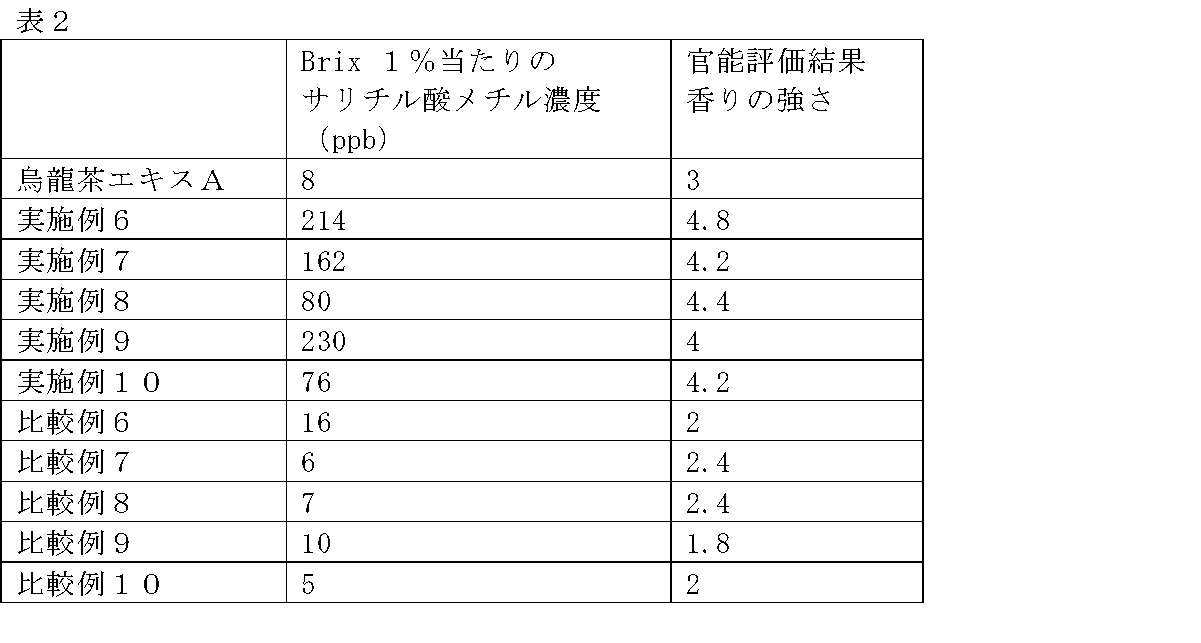
紅茶4.0kgをカラムに充填し、70℃のイオン交換水36kgをカラム下部より通液し、カラム上部より抽出液を回収、Brix 5.0%、pH 4.7の抽出液を24kg得た。
この抽出液をろ紙ろ過により固液分離した後、95℃で30秒間殺菌し、Brix 5.0%のエキス20kgを得た。
100gの紅茶エキスAにペクチナーゼG「アマノ」(天野エンザイム社製)を0.5g添加し、50℃で18時間反応させた。次いでこのエキスをろ紙ろ過した後、80℃で10分間殺菌し、Brix 4.7%、pH 4.7のエキスを得た。
実施例11において、ペクチナーゼG「アマノ」の代わりにセルロシンAC40(セルラーゼ)(エイチビィアイ社製)を0.5g添加した以外は実施例11と同様に処理し、Brix 5.1%、pH 4.6のエキスを得た。
実施例11において、ペクチナーゼG「アマノ」の代わりにヘミセルラーゼ「アマノ」90(天野エンザイム社製)を0.5g添加した以外は実施例11と同様に処理し、Brix 5.1%、pH 4.6のエキスを得た。
実施例11において、ペクチナーゼG「アマノ」の代わりにセルロシンGM5(マンナナーゼ)(エイチビィアイ社製)を0.5g添加した以外は実施例11と同様に処理し、Brix 5.0%、pH 4.6のエキスを得た。
実施例11において、ペクチナーゼG「アマノ」の代わりにセルロシンHC(キシラナーゼ)(エイチビィアイ社製)を0.5g添加した以外は実施例11と同様に処理し、Brix 5.4%、pH 4.6のエキスを得た。
紅茶エキスAに、ペクチナーゼG「アマノ」(天野エンザイム社製)を0.1g添加し、40℃で1時間反応させ、これをろ過した後、80℃で10分間殺菌し、Brix 5.0%、pH 4.6のエキスを得た。
紅茶エキスAに、セルロシンAC40(セルラーゼ)(エイチビィアイ社製)を0.1g添加し、40℃で1時間反応させ、これをろ過した後、80℃で10分間殺菌し、Brix 5.0%、pH 4.7のエキスを得た。
紅茶エキスAに、ヘミセルラーゼ「アマノ」90(天野エンザイム社製)を0.1g添加し、40℃で1時間反応させ、これをろ過した後、80℃で10分間殺菌し、Brix 5.0%、pH 4.7のエキスを得た。
紅茶エキスAに、セルロシンGM5(マンナナーゼ)(エイチビィアイ社製)を0.1g添加し、40℃で1時間反応させ、これをろ過した後、80℃で10分間の殺菌を行い、Brix 5.0%、pH 4.6のエキスを得た。
紅茶エキスAに、セルロシンHC(キシラナーゼ)(エイチビィアイ社製)を0.1g添加し、40℃で1時間反応させ、これをろ過した後、80℃で10分間殺菌し、Brix 5.0%、pH 4.6のエキスを得た。
紅茶エキスA、実施例11~15及び比較例11~15で得られた紅茶エキスについて、香気分析及び官能評価を行った。分析方法及び官能評価基準は実施例1~5に従った。

Claims (5)
- 原料茶類から茶エキスを抽出する時及び/又は抽出した後、多糖類分解酵素処理を行う茶エキスの製造方法であって、多糖類分解酵素処理時の茶エキスのpHが3~7であり、処理時間が3~48時間である、前記製造方法。
- 多糖類分解酵素がペクチナーゼ、セルラーゼ、ヘミセルラーゼ、マンナナーゼ、キシラナーゼ、アラバナーゼ及びこれらの混合物からなる群より選ばれる、請求項1記載の製造方法。
- 多糖類分解酵素処理の処理温度が10~60℃であり、処理時間が10~24時間である、請求項1又は2に記載の製造方法。
- 原料茶類から茶エキスを抽出する時及び/又は抽出した後に多糖類分解酵素処理した茶エキスであって、Brix 1%当たりのサリチル酸メチルの含有量が40ppb以上である、前記茶エキス。
- 請求項1~3のいずれか1項記載の製造方法により得られる茶エキス又は請求項4記載の茶エキスを配合して得られる容器詰茶飲料。
Priority Applications (2)
| Application Number | Priority Date | Filing Date | Title |
|---|---|---|---|
| CN2010800086229A CN102325462A (zh) | 2009-01-29 | 2010-01-07 | 茶提取物及其制造方法 |
| US13/145,672 US20110280992A1 (en) | 2009-01-29 | 2010-01-07 | Tea extract and method for producing same |
Applications Claiming Priority (2)
| Application Number | Priority Date | Filing Date | Title |
|---|---|---|---|
| JP2009018286A JP2010172258A (ja) | 2009-01-29 | 2009-01-29 | 茶エキス及びその製造方法 |
| JP2009-018286 | 2009-01-29 |
Publications (1)
| Publication Number | Publication Date |
|---|---|
| WO2010087215A1 true WO2010087215A1 (ja) | 2010-08-05 |
Family
ID=42395477
Family Applications (1)
| Application Number | Title | Priority Date | Filing Date |
|---|---|---|---|
| PCT/JP2010/050104 Ceased WO2010087215A1 (ja) | 2009-01-29 | 2010-01-07 | 茶エキス及びその製造方法 |
Country Status (6)
| Country | Link |
|---|---|
| US (1) | US20110280992A1 (ja) |
| JP (1) | JP2010172258A (ja) |
| KR (1) | KR20110110227A (ja) |
| CN (1) | CN102325462A (ja) |
| TW (1) | TW201032725A (ja) |
| WO (1) | WO2010087215A1 (ja) |
Cited By (3)
| Publication number | Priority date | Publication date | Assignee | Title |
|---|---|---|---|---|
| WO2013035860A1 (ja) * | 2011-09-08 | 2013-03-14 | サントリーホールディングス株式会社 | 茶酵素処理エキス及び茶飲料 |
| JP2013055906A (ja) * | 2011-09-08 | 2013-03-28 | Suntory Holdings Ltd | 茶飲料 |
| JP2013055905A (ja) * | 2011-09-08 | 2013-03-28 | Suntory Holdings Ltd | 茶酵素処理エキスの製造方法 |
Families Citing this family (11)
| Publication number | Priority date | Publication date | Assignee | Title |
|---|---|---|---|---|
| JP6525492B2 (ja) * | 2013-03-28 | 2019-06-05 | ポッカサッポロフード&ビバレッジ株式会社 | ウーロン茶飲料及びその製造方法 |
| CN103300184B (zh) * | 2013-05-30 | 2014-10-22 | 深圳市深宝华城科技有限公司 | 一种高效的茶提取物的制备方法 |
| TWI621400B (zh) * | 2014-06-03 | 2018-04-21 | 財團法人食品工業發展研究所 | Tea manufacturing method |
| CN104351402B (zh) * | 2014-10-23 | 2017-01-25 | 中国农业科学院茶叶研究所 | 一种改善茶饮料回甘滋味的加工方法 |
| CN104489150A (zh) * | 2014-12-24 | 2015-04-08 | 大闽食品(漳州)有限公司 | 一种利用复合酶制剂解决绿茶浓缩液冷后浑的方法 |
| TWI569729B (zh) * | 2015-03-27 | 2017-02-11 | 統一企業股份有限公司 | 兒茶素之萃取方法 |
| JP2018139510A (ja) * | 2017-02-27 | 2018-09-13 | 不二製油グループ本社株式会社 | カカオ酵素処理物の製造方法 |
| JP7077055B2 (ja) * | 2018-02-19 | 2022-05-30 | 高砂香料工業株式会社 | 茶類抽出物 |
| JP2018108109A (ja) * | 2018-03-09 | 2018-07-12 | ポッカサッポロフード&ビバレッジ株式会社 | ウーロン茶飲料、ウーロン茶飲料の製造方法、及び油脂感が低減する感覚等の持続性向上方法 |
| JP6684946B1 (ja) * | 2019-06-10 | 2020-04-22 | サントリーホールディングス株式会社 | 乳成分とサリチル酸メチルを含有する茶飲料 |
| WO2020250877A1 (ja) * | 2019-06-10 | 2020-12-17 | サントリーホールディングス株式会社 | 乳成分を含有する茶飲料 |
Citations (3)
| Publication number | Priority date | Publication date | Assignee | Title |
|---|---|---|---|---|
| WO2008001848A1 (fr) * | 2006-06-30 | 2008-01-03 | Kirin Beverage Company, Limited | Procédé destiné au traitement enzymatique de feuilles de thé vert |
| JP2008086280A (ja) * | 2006-10-04 | 2008-04-17 | Ogawa & Co Ltd | 茶類エキスの製造方法 |
| JP2008259457A (ja) * | 2007-04-12 | 2008-10-30 | Kirin Beverage Corp | 旨味に優れた高香味茶抽出液の製造方法 |
Family Cites Families (2)
| Publication number | Priority date | Publication date | Assignee | Title |
|---|---|---|---|---|
| US6024991A (en) * | 1996-06-19 | 2000-02-15 | Thomas J. Lipton Co., | Tea concentrate prepared by enzymatic extraction and containing xanthan gum which is stable at ambient temperature |
| CN1269977A (zh) * | 2000-02-03 | 2000-10-18 | 安徽农业大学 | 天然高香速溶、液体茶的制备方法 |
-
2009
- 2009-01-29 JP JP2009018286A patent/JP2010172258A/ja not_active Withdrawn
- 2009-12-28 TW TW098145252A patent/TW201032725A/zh unknown
-
2010
- 2010-01-07 WO PCT/JP2010/050104 patent/WO2010087215A1/ja not_active Ceased
- 2010-01-07 KR KR1020117017403A patent/KR20110110227A/ko not_active Withdrawn
- 2010-01-07 US US13/145,672 patent/US20110280992A1/en not_active Abandoned
- 2010-01-07 CN CN2010800086229A patent/CN102325462A/zh active Pending
Patent Citations (3)
| Publication number | Priority date | Publication date | Assignee | Title |
|---|---|---|---|---|
| WO2008001848A1 (fr) * | 2006-06-30 | 2008-01-03 | Kirin Beverage Company, Limited | Procédé destiné au traitement enzymatique de feuilles de thé vert |
| JP2008086280A (ja) * | 2006-10-04 | 2008-04-17 | Ogawa & Co Ltd | 茶類エキスの製造方法 |
| JP2008259457A (ja) * | 2007-04-12 | 2008-10-30 | Kirin Beverage Corp | 旨味に優れた高香味茶抽出液の製造方法 |
Cited By (4)
| Publication number | Priority date | Publication date | Assignee | Title |
|---|---|---|---|---|
| WO2013035860A1 (ja) * | 2011-09-08 | 2013-03-14 | サントリーホールディングス株式会社 | 茶酵素処理エキス及び茶飲料 |
| JP2013055906A (ja) * | 2011-09-08 | 2013-03-28 | Suntory Holdings Ltd | 茶飲料 |
| JP2013055905A (ja) * | 2011-09-08 | 2013-03-28 | Suntory Holdings Ltd | 茶酵素処理エキスの製造方法 |
| AU2012305254B2 (en) * | 2011-09-08 | 2016-05-19 | Suntory Holdings Limited | Enzyme-treated tea extract, and tea beverage |
Also Published As
| Publication number | Publication date |
|---|---|
| TW201032725A (en) | 2010-09-16 |
| KR20110110227A (ko) | 2011-10-06 |
| JP2010172258A (ja) | 2010-08-12 |
| US20110280992A1 (en) | 2011-11-17 |
| CN102325462A (zh) | 2012-01-18 |
Similar Documents
| Publication | Publication Date | Title |
|---|---|---|
| WO2010087215A1 (ja) | 茶エキス及びその製造方法 | |
| JP5411748B2 (ja) | 茶類エキスの製造方法 | |
| JP5079693B2 (ja) | 緑茶葉酵素処理法 | |
| JP6294676B2 (ja) | 茶抽出液の製造方法 | |
| JP5981234B2 (ja) | 茶含有飲食品用呈味改善剤 | |
| JP6338918B2 (ja) | 緑茶エキスの製造方法 | |
| JP5649789B2 (ja) | 茶類エキス及びその製造方法 | |
| JP2013252112A (ja) | コーヒー含有飲食品用呈味改善剤 | |
| CN102006781A (zh) | 发酵茶饮料的制造方法 | |
| JP6392226B2 (ja) | 茶類抽出物の製造方法 | |
| EP2826381A1 (en) | Beverage containing tea leaf pectins | |
| CN101980614B (zh) | 富含茶黄素类的发酵茶饮料的制造方法 | |
| JP5396547B2 (ja) | 茶類エキスの製造方法 | |
| JP4630295B2 (ja) | 茶抽出物の製造方法 | |
| JPWO2019044474A1 (ja) | 脱色された茶抽出液およびその製造方法 | |
| CN105368637B (zh) | 一种风味绿茶酒 | |
| JP5400970B2 (ja) | 茶類エキス | |
| JP5396546B2 (ja) | 茶類エキスの製造方法 | |
| JP3628605B2 (ja) | 緑茶飲料及びその製造法 | |
| JP5400971B2 (ja) | 茶類エキス | |
| EP2754352B1 (en) | Enzyme-treated tea extract, and tea beverage | |
| JP2007195479A (ja) | 緑茶エキスの製造方法 | |
| HK1212161B (zh) | 绿茶提取物的制备方法 |
Legal Events
| Date | Code | Title | Description |
|---|---|---|---|
| WWE | Wipo information: entry into national phase |
Ref document number: 201080008622.9 Country of ref document: CN |
|
| 121 | Ep: the epo has been informed by wipo that ep was designated in this application |
Ref document number: 10735685 Country of ref document: EP Kind code of ref document: A1 |
|
| WWE | Wipo information: entry into national phase |
Ref document number: 13145672 Country of ref document: US |
|
| ENP | Entry into the national phase |
Ref document number: 20117017403 Country of ref document: KR Kind code of ref document: A |
|
| NENP | Non-entry into the national phase |
Ref country code: DE |
|
| WWE | Wipo information: entry into national phase |
Ref document number: 5809/DELNP/2011 Country of ref document: IN |
|
| 122 | Ep: pct application non-entry in european phase |
Ref document number: 10735685 Country of ref document: EP Kind code of ref document: A1 |