WO2010067489A1 - 光学材料用重合性組成物、光学材料および光学材料の製造方法 - Google Patents
光学材料用重合性組成物、光学材料および光学材料の製造方法 Download PDFInfo
- Publication number
- WO2010067489A1 WO2010067489A1 PCT/JP2009/004279 JP2009004279W WO2010067489A1 WO 2010067489 A1 WO2010067489 A1 WO 2010067489A1 JP 2009004279 W JP2009004279 W JP 2009004279W WO 2010067489 A1 WO2010067489 A1 WO 2010067489A1
- Authority
- WO
- WIPO (PCT)
- Prior art keywords
- group
- optical material
- bis
- carbon atoms
- polymerizable composition
- Prior art date
- Legal status (The legal status is an assumption and is not a legal conclusion. Google has not performed a legal analysis and makes no representation as to the accuracy of the status listed.)
- Ceased
Links
Classifications
-
- C—CHEMISTRY; METALLURGY
- C08—ORGANIC MACROMOLECULAR COMPOUNDS; THEIR PREPARATION OR CHEMICAL WORKING-UP; COMPOSITIONS BASED THEREON
- C08L—COMPOSITIONS OF MACROMOLECULAR COMPOUNDS
- C08L75/00—Compositions of polyureas or polyurethanes; Compositions of derivatives of such polymers
- C08L75/04—Polyurethanes
-
- C—CHEMISTRY; METALLURGY
- C08—ORGANIC MACROMOLECULAR COMPOUNDS; THEIR PREPARATION OR CHEMICAL WORKING-UP; COMPOSITIONS BASED THEREON
- C08G—MACROMOLECULAR COMPOUNDS OBTAINED OTHERWISE THAN BY REACTIONS ONLY INVOLVING UNSATURATED CARBON-TO-CARBON BONDS
- C08G18/00—Polymeric products of isocyanates or isothiocyanates
- C08G18/06—Polymeric products of isocyanates or isothiocyanates with compounds having active hydrogen
- C08G18/28—Polymeric products of isocyanates or isothiocyanates with compounds having active hydrogen characterised by the compounds used containing active hydrogen
- C08G18/30—Low-molecular-weight compounds
- C08G18/38—Low-molecular-weight compounds having heteroatoms other than oxygen
- C08G18/3855—Low-molecular-weight compounds having heteroatoms other than oxygen having sulfur
- C08G18/3876—Low-molecular-weight compounds having heteroatoms other than oxygen having sulfur containing mercapto groups
-
- C—CHEMISTRY; METALLURGY
- C08—ORGANIC MACROMOLECULAR COMPOUNDS; THEIR PREPARATION OR CHEMICAL WORKING-UP; COMPOSITIONS BASED THEREON
- C08G—MACROMOLECULAR COMPOUNDS OBTAINED OTHERWISE THAN BY REACTIONS ONLY INVOLVING UNSATURATED CARBON-TO-CARBON BONDS
- C08G18/00—Polymeric products of isocyanates or isothiocyanates
- C08G18/06—Polymeric products of isocyanates or isothiocyanates with compounds having active hydrogen
- C08G18/28—Polymeric products of isocyanates or isothiocyanates with compounds having active hydrogen characterised by the compounds used containing active hydrogen
- C08G18/30—Low-molecular-weight compounds
- C08G18/38—Low-molecular-weight compounds having heteroatoms other than oxygen
-
- C—CHEMISTRY; METALLURGY
- C08—ORGANIC MACROMOLECULAR COMPOUNDS; THEIR PREPARATION OR CHEMICAL WORKING-UP; COMPOSITIONS BASED THEREON
- C08G—MACROMOLECULAR COMPOUNDS OBTAINED OTHERWISE THAN BY REACTIONS ONLY INVOLVING UNSATURATED CARBON-TO-CARBON BONDS
- C08G18/00—Polymeric products of isocyanates or isothiocyanates
- C08G18/06—Polymeric products of isocyanates or isothiocyanates with compounds having active hydrogen
- C08G18/70—Polymeric products of isocyanates or isothiocyanates with compounds having active hydrogen characterised by the isocyanates or isothiocyanates used
- C08G18/72—Polyisocyanates or polyisothiocyanates
- C08G18/74—Polyisocyanates or polyisothiocyanates cyclic
- C08G18/76—Polyisocyanates or polyisothiocyanates cyclic aromatic
- C08G18/7614—Polyisocyanates or polyisothiocyanates cyclic aromatic containing only one aromatic ring
-
- C—CHEMISTRY; METALLURGY
- C08—ORGANIC MACROMOLECULAR COMPOUNDS; THEIR PREPARATION OR CHEMICAL WORKING-UP; COMPOSITIONS BASED THEREON
- C08G—MACROMOLECULAR COMPOUNDS OBTAINED OTHERWISE THAN BY REACTIONS ONLY INVOLVING UNSATURATED CARBON-TO-CARBON BONDS
- C08G18/00—Polymeric products of isocyanates or isothiocyanates
- C08G18/06—Polymeric products of isocyanates or isothiocyanates with compounds having active hydrogen
- C08G18/70—Polymeric products of isocyanates or isothiocyanates with compounds having active hydrogen characterised by the isocyanates or isothiocyanates used
- C08G18/72—Polyisocyanates or polyisothiocyanates
- C08G18/74—Polyisocyanates or polyisothiocyanates cyclic
- C08G18/76—Polyisocyanates or polyisothiocyanates cyclic aromatic
- C08G18/7614—Polyisocyanates or polyisothiocyanates cyclic aromatic containing only one aromatic ring
- C08G18/7621—Polyisocyanates or polyisothiocyanates cyclic aromatic containing only one aromatic ring being toluene diisocyanate including isomer mixtures
-
- C—CHEMISTRY; METALLURGY
- C08—ORGANIC MACROMOLECULAR COMPOUNDS; THEIR PREPARATION OR CHEMICAL WORKING-UP; COMPOSITIONS BASED THEREON
- C08G—MACROMOLECULAR COMPOUNDS OBTAINED OTHERWISE THAN BY REACTIONS ONLY INVOLVING UNSATURATED CARBON-TO-CARBON BONDS
- C08G18/00—Polymeric products of isocyanates or isothiocyanates
- C08G18/06—Polymeric products of isocyanates or isothiocyanates with compounds having active hydrogen
- C08G18/70—Polymeric products of isocyanates or isothiocyanates with compounds having active hydrogen characterised by the isocyanates or isothiocyanates used
- C08G18/72—Polyisocyanates or polyisothiocyanates
- C08G18/74—Polyisocyanates or polyisothiocyanates cyclic
- C08G18/76—Polyisocyanates or polyisothiocyanates cyclic aromatic
- C08G18/7657—Polyisocyanates or polyisothiocyanates cyclic aromatic containing two or more aromatic rings
- C08G18/7664—Polyisocyanates or polyisothiocyanates cyclic aromatic containing two or more aromatic rings containing alkylene polyphenyl groups
- C08G18/7671—Polyisocyanates or polyisothiocyanates cyclic aromatic containing two or more aromatic rings containing alkylene polyphenyl groups containing only one alkylene bisphenyl group
-
- C—CHEMISTRY; METALLURGY
- C08—ORGANIC MACROMOLECULAR COMPOUNDS; THEIR PREPARATION OR CHEMICAL WORKING-UP; COMPOSITIONS BASED THEREON
- C08K—Use of inorganic or non-macromolecular organic substances as compounding ingredients
- C08K5/00—Use of organic ingredients
- C08K5/49—Phosphorus-containing compounds
- C08K5/50—Phosphorus bound to carbon only
-
- C—CHEMISTRY; METALLURGY
- C08—ORGANIC MACROMOLECULAR COMPOUNDS; THEIR PREPARATION OR CHEMICAL WORKING-UP; COMPOSITIONS BASED THEREON
- C08K—Use of inorganic or non-macromolecular organic substances as compounding ingredients
- C08K5/00—Use of organic ingredients
- C08K5/49—Phosphorus-containing compounds
- C08K5/51—Phosphorus bound to oxygen
-
- C—CHEMISTRY; METALLURGY
- C08—ORGANIC MACROMOLECULAR COMPOUNDS; THEIR PREPARATION OR CHEMICAL WORKING-UP; COMPOSITIONS BASED THEREON
- C08K—Use of inorganic or non-macromolecular organic substances as compounding ingredients
- C08K5/00—Use of organic ingredients
- C08K5/49—Phosphorus-containing compounds
- C08K5/51—Phosphorus bound to oxygen
- C08K5/53—Phosphorus bound to oxygen bound to oxygen and to carbon only
- C08K5/5397—Phosphine oxides
-
- G—PHYSICS
- G02—OPTICS
- G02B—OPTICAL ELEMENTS, SYSTEMS OR APPARATUS
- G02B1/00—Optical elements characterised by the material of which they are made; Optical coatings for optical elements
- G02B1/04—Optical elements characterised by the material of which they are made; Optical coatings for optical elements made of organic materials, e.g. plastics
-
- G—PHYSICS
- G02—OPTICS
- G02B—OPTICAL ELEMENTS, SYSTEMS OR APPARATUS
- G02B1/00—Optical elements characterised by the material of which they are made; Optical coatings for optical elements
- G02B1/04—Optical elements characterised by the material of which they are made; Optical coatings for optical elements made of organic materials, e.g. plastics
- G02B1/041—Lenses
Definitions
- the present invention relates to a polymerizable composition for an optical material, and more particularly to a polymerizable composition for an optical material containing an aromatic isocyanate, a specific polythiol compound, and a specific phosphorus-containing compound. Moreover, this invention relates to the optical material obtained from this polymeric composition for optical materials, and the manufacturing method of this optical material.
- plastic materials have been used as an alternative to inorganic materials in optical component applications.
- a plastic material is suitably used because it is lighter, hard to break, and can be dyed as compared with inorganic materials that have been used so far.
- a plastic material having a high refractive index is desired as an optical component such as a lens.
- a sulfur-containing urethane described in Patent Documents 1 and 2 is used as such a plastic material having a high refractive index.
- (Thiourethane) based resins have been proposed. JP-A-2-270859 Chinese Patent Application Publication No. 1405198 Specification
- a molded body made of a thiourethane resin is colored although it has a high refractive index, it is difficult to put it into practical use from the viewpoint of hue.
- a molded product is colored in advance with a colorant such as a bluing agent to make the coloration caused by the thiourethane resin inconspicuous.
- a colorant such as a bluing agent
- the inventors of the present invention can obtain a molded article having a high refractive index and suppressed coloring by a polymerizable composition containing an aromatic isocyanate, a specific polythiol compound, and a specific phosphorus-containing compound.
- the headline and the present invention were completed.
- n an integer of 0 or 1.
- X is a substituted or unsubstituted linear or branched alkyl group having 1 to 6 carbon atoms, a linear or branched alkoxy group having 1 to 6 carbon atoms, a linear or branched alkenyl group having 1 to 6 carbon atoms, A linear or branched alkynyl group having 1 to 6 carbon atoms, a cycloalkyl group having 3 to 6 carbon atoms, a phenyl group, a biphenyl group, a naphthyl group, a phenoxy group, or a heterocyclic group is represented.
- a polymerizable composition for optical materials comprising:
- Polythiol compound (b1) is 4-mercaptomethyl-1,8-dimercapto-3,6-dithiaoctane, 4,8 or 4,7 or 5,7-dimercaptomethyl-1,11-dimercapto-3 , 6,9-trithiaundecane, pentaerythritol tetrakismercaptoacetate, pentaerythritol tetrakismercaptopropionate, 2,5-bis (mercaptomethyl) -1,4-dithiane, bis (mercaptoethyl) sulfide, 1,1, 3,3-tetrakis (mercaptomethylthio) propane, 4,6-bis (mercaptomethylthio) -1,3-dithiane, 2- (2,2-bis (mercaptomethylthio) ethyl) -1,3-dithietane, 1, 1,2,2-tetrakis (mercaptomethylthio) ethane and 3-mer
- (Poly) hydroxy (poly) mercapto compound (b2) contains 2-mercaptoethanol, 3-mercapto-1,2-propanedithiol, 1,3-dimercapto-2-propanol, 2,3-dimercapto-1 -Propanol, 1,2-dimercapto-1,3-butanediol, pentaerythritol mono (3-mercaptopropionate), pentaerythritol bis (3-mercaptopropionate), pentaerythritol tris (3-mercaptopropionate) ), Pentaerythritol tris (thioglycolate) and glycerin bis (mercaptoacetate), 4-mercaptophenol and 2,4-dimercaptophenol (3) or (4 ) Optical materials Polymerizable composition.
- the group in which the phosphorus-containing compound (c) represented by the general formula (1) is composed of triphenylphosphine, tris (1,3-dichloropropan-2-yl) phosphate, triphenylphosphite or triphenylphosphate
- the present invention it is possible to provide a polymerizable composition for an optical material from which an optical material having a high refractive index and further suppressed coloring can be obtained, and an optical material obtained from the polymerizable composition.
- X is a substituted or unsubstituted linear or branched alkyl group having 1 to 6 carbon atoms, a linear or branched alkoxy group having 1 to 6 carbon atoms, a linear or branched alkenyl group having 1 to 6 carbon atoms, A linear or branched alkynyl group having 1 to 6 carbon atoms, a cycloalkyl group having 3 to 6 carbon atoms, a phenyl group, a biphenyl group, a naphthyl group, a phenoxy group, or a heterocyclic group is represented.
- the substituent is a halogen atom, an alkyl group having 1 to 6 carbon atoms, an alkoxy group having 1 to 6 carbon atoms, an alkenyl group having 1 to 6 carbon atoms, or an alkyl group having 1 to 6 carbon atoms.
- a phosphorus-containing compound represented by:
- the polymerizable composition for an optical material of the present invention has a high refractive index due to the composition containing the phosphorus-containing compound (c) that is a coloring inhibitor, and is further attributed to the thiourethane resin.
- An optical material in which coloring is suppressed can be provided.
- Aromatic isocyanate (a) As the aromatic isocyanate (a) used in the present invention, tolylene diisocyanate, 4,4′-diphenylmethane diisocyanate or phenylene diisocyanate can be used.
- isocyanate (a) In addition to the above aromatic isocyanate (a), the following other isocyanate compounds can also be used.
- other isocyanate compounds for example, Hexamethylene diisocyanate, 2,2,4-trimethylhexamethylene diisocyanate, 2,4,4-trimethylhexamethylene diisocyanate, lysine diisocyanatomethyl ester, lysine triisocyanate, m-xylylene diisocyanate, ⁇ , ⁇ , ⁇ ', ⁇ '-tetramethylxylylene diisocyanate, bis (isocyanatomethyl) naphthalene, mesitylylene triisocyanate, bis (isocyanatomethyl) sulfide, bis (isocyanatoethyl) sulfide, bis (isocyanatomethyl) disulfide, bis (isocyanate) Natoethyl) disulfide, bis (isocyanatomethylthi
- examples include those in which a part of the isocyanate group of the isocyanate compound exemplified above is changed to an isothiocyanate group, but are not limited thereto.
- an isothiocyanate compound for example, Hexamethylene diisothiocyanate, lysine diisothiocyanate methyl ester, lysine triisothiocyanate, m-xylylene diisothiocyanate, bis (isothiocyanatomethyl) sulfide, bis (isothiocyanatoethyl) sulfide, bis (isothiocyanatoethyl) Aliphatic polyisothiocyanate compounds such as disulfides; Isophorone diisothiocyanate, bis (isothiocyanatomethyl) cyclohexane, dicyclohexylmethane diisothiocyanate, cyclohexane diisothiocyanate, methylcyclohexane diisothiocyanate, 2,5-bis (isothiocyanatomethyl) bicyclo- [2.2.1 ] -Heptane, 2,6-bis (isothi
- halogen-substituted products such as chlorine-substituted products and bromine-substituted products of these isocyanate compounds, alkyl-substituted products, alkoxy-substituted products, nitro-substituted products, prepolymer-modified products with polyhydric alcohols, carbodiimide-modified products, and urea-modified products.
- Biuret-modified products or dimerization reaction products can also be used as other isocyanate compounds.
- These isocyanate compounds can be used alone or in combination of two or more.
- mercapto group-containing compound (b) As the mercapto group-containing compound (b) used in the present embodiment, “polythiol compound (b1)” having two or more mercapto groups, “(poly (thiol compound) having one or more hydroxy groups and one or more mercapto groups” ) Hydroxy (poly) mercapto compound (b2) ", which can be used alone or in combination of two or more.
- the polythiol compound (b1) used in the present embodiment is 4-mercaptomethyl-1,8-dimercapto-3,6-dithiaoctane, 4,8 or 4,7 or 5,7-dimercaptomethyl-1,11- Dimercapto-3,6,9-trithiaundecane, pentaerythritol tetrakismercaptoacetate, pentaerythritol tetrakismercaptopropionate, 2,5-bis (mercaptomethyl) -1,4-dithiane, bis (mercaptoethyl) sulfide, 1 , 1,3,3-tetrakis (mercaptomethylthio) propane, 4,6-bis (mercaptomethylthio) -1,3-dithiane, 2- (2,2-bis (mercaptomethylthio) ethyl) -1,3-dithietane 1,1,2,2-tetrakis (mer
- polythiol compounds such as the following can also be used, for example: Methanedithiol, 1,2-ethanedithiol, 1,2,3-propanetrithiol, 1,2-cyclohexanedithiol, bis (2-mercaptoethyl) ether, tetrakis (mercaptomethyl) methane, diethylene glycol bis (2-mercaptoacetate) ), Diethylene glycol bis (3-mercaptopropionate), ethylene glycol bis (2-mercaptoacetate), ethylene glycol bis (3-mercaptopropionate), trimethylolpropane tris (2-mercaptoacetate), trimethylolpropane tris (3-mercaptopropionate), trimethylolethane tris (2-mercaptoacetate), trimethylolethane tris (3-mercaptopropionate), bis (mercaptomethyl) sulfide, bi (Mercaptomethyl) disulfide, bis (mercaptoethyl) disulfide,
- polythiol compound (b1) oligomers of other polythiol compounds, and halogen-substituted products such as chlorine-substituted products and bromine-substituted products may be used as other polythiol compounds. These compounds can be used alone or in combination of two or more.
- examples of the (poly) hydroxy (poly) mercapto compound (b2) include 2-mercaptoethanol, 3-mercapto-1,2-propanedithiol, 1,3-dimercapto-2-propanol, and 2,3-dimercapto-1-propanol Aliphatic compounds such as 1,2-dimercapto-1,3-butanediol; Pentaerythritol mono (3-mercaptopropionate), pentaerythritol bis (3-mercaptopropionate), pentaerythritol tris (3-mercaptopropionate), pentaerythritol tris (thioglycolate), glycerin bis (mercaptoacetate) (Poly) hydroxy (poly) mercapto compounds having an ester group such as (Poly) hydroxy (poly) mercapto compounds having an aromatic ring such as 4-
- aromatic isocyanate (a) used in the present embodiment and other isocyanate compounds are polythiol compounds (b1), (poly) hydroxy ( A poly) mercapto compound (b2) and optionally a part of another polythiol compound (hereinafter referred to as “thiols”) may be preliminarily reacted.
- thiols polythiol compounds used in the present invention may be those obtained by preliminarily reacting a part of isocyanate compounds.
- n PX 3 The phosphorus-containing compound (c) used in the present embodiment can be represented by the following general formula (1).
- (O ) n PX 3 (1)
- n represents an integer of 0 or 1.
- X is a substituted or unsubstituted linear or branched alkyl group having 1 to 6 carbon atoms, a linear or branched alkoxy group having 1 to 6 carbon atoms, a linear or branched alkenyl group having 1 to 6 carbon atoms, A linear or branched alkynyl group having 1 to 6 carbon atoms, a cycloalkyl group having 3 to 6 carbon atoms, a phenyl group, a biphenyl group, a naphthyl group, a phenoxy group, or a heterocyclic group is represented.
- the substituent is a halogen atom (F, Cl, Br), an alkyl group having 1 to 6 carbon atoms, an alkoxy group having 1 to 6 carbon atoms, or an alkenyl group having 1 to 6 carbon atoms.
- heterocyclic group pyridyl group, pyrimidinyl group, pyridazyl group, pyrazyl group, furyl group, thienyl group, oxazolyl group, isoxazolyl group, oxadiazolyl group, thiazolyl group, isothiazolyl group, imidazolyl group, triazolyl group, pyrrole group, pyrazolyl group Or a tetrazolyl group.
- Ar 1 and Ar 2 represent a substituted or unsubstituted phenyl group, biphenyl group, naphthyl group, or heterocyclic group.
- a plurality of Ar 1 or Ar 2 present in the formula may be the same or different.
- the substituent is a halogen atom (F, Cl, Br), an alkyl group having 1 to 6 carbon atoms, an alkoxy group having 1 to 6 carbon atoms, or 1 to 6 alkenyl groups, alkynyl groups having 1 to 6 carbon atoms, cycloalkyl groups having 3 to 6 carbon atoms, amino groups, alkylamino groups having 1 to 6 carbon atoms, nitro groups, phenyl groups, biphenyl groups, naphthyl groups, phenoxy groups Group, a heterocyclic group.
- n represents an integer of 0 or 1.
- R 1 represents a substituted or unsubstituted linear or branched alkyl group having 1 to 6 carbon atoms, a linear or branched alkenyl group having 1 to 6 carbon atoms, or 1 to 6 carbon atoms.
- a plurality of R 1 present in the general formula (3) may be the same or different.
- the substituent is a halogen atom (F, Cl, Br), an alkyl group having 1 to 6 carbon atoms, an alkoxy group having 1 to 6 carbon atoms, or an alkenyl group having 1 to 6 carbon atoms.
- alkynyl group having 1 to 6 carbon atoms cycloalkyl group having 3 to 6 carbon atoms, amino group, alkylamino group having 1 to 6 carbon atoms, nitro group, phenyl group, biphenyl group, naphthyl group, phenoxy group, complex It is a cyclic group.
- Examples of the phosphorus-containing compound (c) represented by the general formula (2) include triphenylphosphine, sodium diphenylphosphinobenzene-3-sulfonate, dimethylaminophenyldiphenylphosphine, diphenylphosphinobenzoic acid, tris (methoxyphenyl) Phosphine, Tris (methylphenyl) phosphine, Tris (dimethoxyphenyl) phosphine, Tris (dimethylphenyl) phosphine, Tris (trimethoxyphenyl) phosphine, Tris (trimethylphenyl) phosphine, Tris (pentafluorophenyl) phosphine, Triphenylphosphine oxide And triphenylphosphine is preferable.
- Triphenylphosphine is 1 ⁇ 10 2 ppm or more, preferably 1 ⁇ 10 2 ppm or more, 5 ⁇ 10 4 ppm or less, more preferably 1 ⁇ 10 2 ppm or more, 3 ⁇ 10 3 in the polymerizable composition for optical materials. It is contained in an amount of 4 ppm or less, particularly preferably 3 ⁇ 10 2 ppm or more and 1 ⁇ 10 4 ppm or less.
- the polymerizable composition for an optical material containing the addition amount of triphenylphosphine in the above amount while maintaining heat resistance, it effectively suppresses coloring caused by the thiourethane-based resin and is particularly excellent in hue. Material can be obtained.
- Examples of the phosphorus-containing compound (c) represented by the general formula (3) include tris (1,3-dichloropropan-2-yl) phosphate, tris (2-chloroethyl) phosphate, trisphosphate (1H, 1H, 5H). -Octafluoro-n-pentyl) and the like, and tris (1,3-dichloropropan-2-yl) phosphate is preferred.
- Tris (1,3-dichloropropan-2-yl) phosphate is 1 ⁇ 10 2 ppm or more, preferably 1 ⁇ 10 2 ppm or more, more preferably 5 ⁇ 10 4 ppm or less, more preferably in the polymerizable composition for optical materials. Is contained in an amount of 1 ⁇ 10 2 ppm or more and 3 ⁇ 10 4 ppm or less, particularly preferably 3 ⁇ 10 2 ppm or more and 1 ⁇ 10 4 ppm or less.
- the phosphorus-containing compound (c) represented by the general formula (4) includes triphenyl phosphite, triphenyl phosphate, tris (methylphenyl) phosphite, tris (di-t-butylphenyl) phosphite, phosphoric acid Examples include cresyl diphenyl, tricresyl phosphate, and tris (4-nitrophenyl) phosphate. Triphenyl phosphite and triphenyl phosphate are preferred.
- Triphenyl phosphite, triphenyl phosphate is, 1 ⁇ 10 2 ppm or more in the polymerizable composition for an optical material, preferably 1 ⁇ 10 2 ppm or more, 5 ⁇ 10 4 ppm or less, more preferably 1 ⁇ 10 2 It is contained in an amount of not less than ppm and not more than 3 ⁇ 10 4 ppm, particularly preferably not less than 3 ⁇ 10 2 ppm and not more than 1 ⁇ 10 4 ppm.
- a polymerizable composition for an optical material comprising one or more compounds selected from the group consisting of tris (1,3-dichloropropan-2-yl) phosphate, triphenyl phosphite and triphenyl phosphate in the above amounts. According to this, coloring due to the thiourethane resin can be suppressed, and an optical material excellent in hue can be obtained.
- the polymerizable composition for an optical material of the present embodiment may contain a polyhydroxy compound as a resin modifier.
- the polyhydroxy compound used in the present embodiment is a compound having two or more hydroxy groups and no mercapto group.
- the polyhydroxy compound has the effect of adjusting or improving the physical properties such as the refractive index, Abbe number, heat resistance, specific gravity, and mechanical strength such as impact resistance of the thiourethane-based resin, and also reduces the manufacturing cost. Is preferable.
- Polyhydroxy compounds include ethylene glycol, 1,3-propanediol, 1,4-butanediol, 1,5-pentanediol, 1,6-hexanediol, diethylene glycol, propylene glycol, dipropylene glycol, triethylene glycol Butylene glycol, glycerin, trimethylol ethane, trimethylol propane, pentaerythritol, sorbitol, erythritol, xylitol, mannitol, polycaprolactone diol, polyethylene glycol, bisphenol A, bisphenol F, bisphenol A-bis (2-hydroxyethyl ether), Tetrabromobisphenol A, tetrabromophenol A-bis (2-hydroxyethyl ether), pyrogallol, etc. It can be used alone or in combination of two or more thereof.
- olefin compounds including epoxy compounds, episulfide compounds, organic acids and anhydrides thereof, (meth) acrylate compounds, etc. may be added as resin modifiers other than polyhydroxy compounds.
- the resin modifier is a compound that adjusts or improves the physical properties such as refractive index, Abbe number, heat resistance, specific gravity and mechanical strength such as impact resistance of the thiourethane resin.
- a phenolic epoxy compound obtained by a condensation reaction of a polyhydric phenol compound such as bisphenol A glycidyl ether and an epihalohydrin compound Alcoholic epoxy compounds obtained by condensation of polyhydric alcohol compounds such as hydrogenated bisphenol A glycidyl ether and epihalohydrin compounds; A glycidyl ester epoxy compound obtained by condensation of a polyvalent organic acid compound such as 3,4-epoxycyclohexylmethyl-3 ′, 4′-epoxycyclohexanecarboxylate and an epihalohydrin compound; Amine-based epoxy compounds obtained by condensation of primary and secondary diamine compounds with epihalohydrin compounds; Aliphatic polyvalent epoxy compounds such as vinylcyclohexene diepoxide; and the like can be mentioned, but are not limited to these exemplified compounds.
- an episulfide compound that can be added as a resin modifier for example, Bis (2,3-epithiopropylthio) sulfide, bis (2,3-epithiopropylthio) disulfide, bis (2,3-epithiopropylthio) methane, 1,2-bis (2,3-epi Chain aliphatic 2,3-epithiopropylthio compounds such as thiopropylthio) ethane and 1,5-bis (2,3-epithiopropylthio) -3-thiapentane; Cycloaliphatic such as 1,3-bis (2,3-epithiopropylthio) cyclohexane, 2,5-bis (2,3-epithiopropylthiomethyl) -1,4-dithiane, 2 having a heterocyclic ring , 3-epithiopropylthio compounds; Aromatic 2,3-epithio
- Thiodiglycolic acid thiodipropionic acid
- dithiodipropionic acid phthalic anhydride
- hexahydrophthalic anhydride methylhexahydrophthalic anhydride
- methyltetrahydrophthalic anhydride methyltetrahydrophthalic anhydride
- maleic anhydride trimellitic anhydride
- pyromellitic anhydride pyromellitic anhydride
- olefin compound that can be added as a resin modifier for example, Benzyl acrylate, benzyl methacrylate, cyclohexyl acrylate, cyclohexyl methacrylate, 2-hydroxyethyl acrylate, 2-hydroxymethyl methacrylate, glycidyl acrylate, glycidyl methacrylate, phenoxyethyl acrylate, phenoxyethyl methacrylate, phenyl methacrylate, ethylene glycol diacrylate, ethylene glycol dimethacrylate , Diethylene glycol diacrylate, diethylene glycol dimethacrylate, triethylene glycol diacrylate, triethylene glycol dimethacrylate, neopentyl glycol diacrylate, neopentyl glycol dimethacrylate, ethylene glycol bisglycidyl acrylate, ethylene glycol Coal bisglycidyl methacrylate, bisphenol A diacrylate, bisphenol A di
- resin modifiers can be used alone or in combination of two or more.
- the use ratio of isocyanate compounds, thiols, phosphorus-containing compounds and polyhydroxy compounds (hereinafter referred to as “active hydrogen compounds”) used in the present invention is such that the functional group molar ratio of (NCO + NCS) / (SH + OH) is Usually, it is in the range of 0.8 to 1.5, preferably in the range of 0.9 to 1.2.
- the polymerizable composition according to the present invention may contain a bluing agent as necessary.
- the bluing agent has an absorption band in the wavelength range from orange to yellow in the visible light region, and has a function of adjusting the hue of the optical material made of resin. More specifically, the bluing agent contains a substance exhibiting a blue to purple color.
- the bluing agent used in the polymerizable composition of the present invention is not particularly limited, and specific examples include dyes, fluorescent whitening agents, fluorescent pigments, and inorganic pigments. Of those that can be used, it is appropriately selected according to the physical properties and resin hue required for the optical component. These bluing agents may be used alone or in combination of two or more.
- dyes are preferred from the viewpoint of solubility in the polymerizable composition and the transparency of the resulting optical material.
- a dye containing one or more dyes selected from blue dyes and violet dyes is preferable, but in some cases, other color dyes may be mixed and used.
- blue and violet dyes gray, brown, red and orange dyes can also be used.
- Specific examples of such a combination of bluing agents include a combination of a blue dye and a red dye, and a combination of a violet dye and a red dye.
- a dye having a maximum absorption wavelength of 520 nm to 600 nm is preferable, and a dye having a maximum absorption wavelength of 540 nm to 580 nm is more preferable.
- anthraquinone dyes are preferable.
- dyes include “PS Blue RR”, “PS Violet RC”, “PET Blue 2000”, “PS Brilliant Red HEY”, and “MLP Red V-1” (each trade name of Dystar Japan). ), “Plast Blue 8514”, “Plast Red 8380” (each trade name of Arimoto Chemical Co., Ltd.), and the like.
- the amount of blueing agent used varies depending on the type of monomer, the presence or absence of various additives, the type and amount of additives used, the polymerization method, and the polymerization conditions. Used at a ratio of 0.001 ppm to 500 ppm, preferably 0.005 ppm to 100 ppm, more preferably 0.01 ppm to 10 ppm, based on the total weight of the polymerizable compound contained in the product.
- the amount of the bluing agent added is too large, the entire optical component may become too blue, which may be undesirable. If it is too small, the hue improving effect may not be sufficiently exerted, which may be undesirable.
- the method for adding the bluing agent is not particularly limited, and it is desirable to add it to the monomer system in advance.
- a method for this a method of dissolving in a monomer, or a method of preparing a master solution containing a high concentration of bluing agent and diluting the master solution with a monomer or other additive to be added.
- Various methods can be adopted.
- the composition containing the aromatic isocyanate (a), mercapto group-containing compound (b) and phosphorus-containing compound (c) as essential components as described above has a viscosity that does not hinder handling properties.
- the viscosity can be evaluated by, for example, the viscosity of the monomer mixture at 20 ° C. measured with a B-type viscometer. From the viscosity immediately after the composition is prepared, the defoaming treatment and other steps under reduced pressure are performed.
- the viscosity immediately after preparation of the composition is 100 mPa ⁇ s or less, preferably 50 mPa ⁇ s or less. More preferably, it is 30 mPa ⁇ s or less.
- the viscosity at the time of injection is preferably 200 mPa ⁇ s or less as a measured value at 20 ° C., especially for the production of a lens having a very thin center thickness. Therefore, a further low viscosity, for example, 100 mPa ⁇ s or less is more preferable.
- this invention provides the optical material obtained by hardening
- Such an optical material is excellent in hue because coloring is suppressed.
- the hue can be evaluated by a measured value of yellowness (hereinafter referred to as “YI”).
- the refractive index of the optical material can be adjusted by the type and composition ratio of the isocyanate compound and the active hydrogen compound in the polymerizable composition as desired.
- the optical material of the present embodiment is required to have a high refractive index.
- the refractive index measured by e-line is usually 1.55 or more, preferably 1.59 or more, and more preferably. Is preferably a combination of isocyanate compounds and active hydrogen compounds and a composition ratio thereof, from which a resin having a refractive index of 1.65 or more can be obtained.
- a method for producing an optical material for curing the polymerizable composition for example, a method for producing an optical material for molding the polymerizable composition by cast polymerization using a lens casting mold.
- the type of ultraviolet absorber used may be a benzotriazole type, such as 2- [2-hydroxy-3- (dimethylbenzyl) -5- (1,1,3,3-tetramethylbutyl). Phenyl] -2H-benzotriazole, isooctyl-3- (3- (2H-benzotriazol-2-yl) -5-tert-butyl-4-hydroxyphenylpropionate, 2- (3,5-di-t- Butyl-2-hydroxyphenyl) benzotriazole, 2- (3,5-di-t-pentyl-2-hydroxyphenyl) benzotriazole, 2- [2-hydroxy-3,5-bis (dimethylbenzyl) phenyl]- 2H-benzotriazole, 2- (3,5-di-t-butyl-2-hydroxyphenyl) -5-chlorobenzotriazole, 2- (2-hydride) Carboxymethyl -5-t-octylphenyl) benzotriazo
- the addition amount of the ultraviolet absorber in the present invention determines the type and addition amount of the ultraviolet absorber according to the desired ultraviolet cut rate, but is usually 0.03 to 1.5% by weight based on the polymerizable composition. In some cases, more preferable results may be obtained at 0.05 to 0.5% by weight.
- the addition of catalysts, release agents, and other additives involves adding isocyanate compounds and active hydrogen compounds. Depending on the solubility in the compound, it may be added and dissolved in the isocyanate compound in advance, or may be added and dissolved in the active hydrogen compound, or may be added and dissolved in the mixture of the isocyanate compound and the active hydrogen compound. Good. Alternatively, a master liquid may be prepared by dissolving in a part of the isocyanate compound or active hydrogen compound to be used, and then this may be added. The order of addition is not limited to these exemplified methods, and is appropriately selected in consideration of operability, safety, convenience and the like.
- Mixing is usually performed at a temperature of 30 ° C. or lower. From the viewpoint of the pot life of the mixture, it may be preferable to lower the temperature further. If additives such as catalysts and mold release agents do not show good solubility in isocyanate compounds and active hydrogen compounds, they are preheated to obtain isocyanate compounds, active hydrogen compounds and their It may be dissolved in the mixture. Furthermore, depending on the physical properties required for the obtained plastic lens, it is often preferable to perform a defoaming treatment under reduced pressure, a filtration treatment under pressure, reduced pressure, or the like, if necessary.
- a lens casting mold on which a polarizing film into which a mixture of isocyanate compounds and active hydrogen compounds is injected is fixed is heated for several hours to several tens in a predetermined temperature program in a heatable apparatus such as an oven or water. Heat and cure over time.
- the polymerization curing temperature is not limited because the conditions vary depending on the composition of the mixture, the type of catalyst, the shape of the mold, etc., but is approximately 1 to 100 hours at a temperature of ⁇ 50 to 200 ° C. In general, it is common to start at a temperature in the range of 5 ° C. to 40 ° C., then gradually raise the temperature to the range of 80 ° C. to 130 ° C. and heat at that temperature for 1 to 4 hours.
- a plastic lens can be obtained by taking out from the lens casting mold after completion of the curing molding.
- the annealing temperature is usually in the range of 80 to 150 ° C., preferably in the range of 100 to 130 ° C., more preferably in the range of 110 to 130 ° C.
- the annealing time is usually in the range of 0.5 to 5 hours, preferably in the range of 1 to 4 hours.
- the plastic lens obtained from the optical material of the present embodiment is used with a coating layer on one side or both sides as required.
- the coating layer include a primer layer, a hard coat layer, an antireflection film layer, an antifogging coat layer, a stainproof layer, and a water repellent layer. These coating layers may be used singly or in a multilayered form. When a coating layer is applied to both sides, a similar coating layer or a different coating layer may be applied to each surface.
- These coating layers are for the purpose of protecting the lens and eyes from ultraviolet rays, respectively, the ultraviolet absorbers used in the aforementioned polymerizable composition for optical materials, the infrared absorbers for protecting the eyes from infrared rays, and the weather resistance of the lenses.
- Light stabilizers and antioxidants for the purpose of improving the properties, dyes and pigments for the purpose of enhancing the fashionability of the lenses, photochromic dyes and photochromic pigments, antistatic agents, and other known additives for the purpose of enhancing the performance of the lenses May be used in combination.
- Various leveling agents may be used for the purpose of improving coatability.
- the primer layer is generally a lens substrate (an optical material obtained from the polymerizable composition of the present embodiment) and a hard coat layer for the purpose of improving the adhesion of the hard coat layer and the impact resistance of the plastic lens.
- the film thickness is usually about 0.1 to 10 ⁇ m.
- the primer layer is formed by, for example, a coating method or a dry method.
- a primer layer is formed by applying the primer composition by a known application method such as spin coating or dip coating, followed by solidification.
- the dry method it is formed by a known dry method such as a CVD method or a vacuum deposition method.
- the surface of the lens may be subjected to pretreatment such as alkali treatment, plasma treatment, or ultraviolet treatment as necessary for the purpose of improving adhesion.
- the primer composition is preferably a material in which the solidified primer layer has high adhesion to the lens substrate (an optical material obtained from the polymerizable composition of the present embodiment), and is usually a urethane resin, an epoxy resin, or a polyester resin.
- a primer composition mainly composed of resin, melanin resin, polyvinyl acetal, or the like is used.
- the primer composition can be used in the absence of a solvent, but an appropriate solvent that does not affect the lens may be used for the purpose of adjusting the viscosity of the composition.
- the hard coat layer is a coating layer intended to give the lens surface functions such as scratch resistance, abrasion resistance, moisture resistance, warm water resistance, heat resistance, weather resistance, etc. It is about 0.3 to 30 ⁇ m.
- the hard coat layer is usually formed by applying a hard coat composition by a known application method such as spin coating or dip coating, followed by curing. Examples of the curing method include thermal curing, a curing method by irradiation with energy rays such as ultraviolet rays and visible rays, and the like.
- the coated surface (lens substrate or primer layer) may be subjected to pretreatment such as alkali treatment, plasma treatment, and ultraviolet treatment as necessary for the purpose of improving adhesion. .
- hard coat compositions generally, there are curable organosilicon compounds and fine oxide particles such as Si, Al, Sn, Sb, Ta, Ce, La, Fe, Zn, W, Zr, In, and Ti. A mixture of (including complex oxide fine particles) is often used.
- amines, amino acids, metal acetylacetonate complexes, organic acid metal salts, perchloric acids, perchloric acid salts, acids, metal chlorides and polyfunctional epoxy compounds may also be used. Good.
- the hard coat composition can be used without a solvent, but an appropriate solvent that does not affect the lens may be used.
- the antireflection layer is usually formed on the hard coat layer as necessary.
- the antireflection layer includes an inorganic type and an organic type.
- an inorganic type generally, an inorganic oxide such as SiO 2 or TiO 2 is used for vacuum deposition, sputtering, ion plating, ion It is often formed by a dry method such as a beam assist method or a CVD method.
- an organic type generally, it is often formed by a wet process using a composition containing an organosilicon compound and silica-based fine particles having internal cavities.
- the antireflection layer may be a single layer or a multilayer, but when used as a single layer, the refractive index is preferably at least 0.1 lower than the refractive index of the hard coat layer. In order to effectively exhibit the antireflection function, it is preferable to use a multilayer antireflection film. In that case, a low refractive index film and a high refractive index film are usually laminated alternately. Also in this case, the refractive index difference between the low refractive index film and the high refractive index film is preferably 0.1 or more.
- Examples of the high refractive index film include ZnO, TiO 2 , CeO 2 , Sb 2 O 5 , SnO 2 , ZrO 2 , and Ta 2 O 5
- examples of the low refractive index film include an SiO 2 film. It is done. The film thickness is usually about 50 to 150 nm.
- the plastic lens obtained from the optical material of the present embodiment may be subjected to back surface polishing, antistatic treatment, dyeing treatment, light control treatment, and the like, if necessary. Since such a plastic lens can be reduced in thickness, it is useful as a lens for eyeglasses, particularly as a vision correction lens.
- the present invention will be described in more detail below with reference to examples, but the present invention is not limited to these examples.
- the lens obtained by polymerization was evaluated by performing a performance test.
- the refractive index / Abbe number, heat resistance, and strength were evaluated by the following test methods.
- Hue A resin flat plate having a thickness of 9 mm was prepared, and the yellowness (YI) was measured with a color difference meter (CR-200 manufactured by Minolta).
- Abbe number ( ⁇ e) Measured at 20 ° C. using a Purfrich refractometer KPR-30 manufactured by Shimadzu Corporation.
- TMA-60 manufactured by Shimadzu Corporation was used, and Tg by the TMA penetration method (50 g load, pin tip 0.5 mm ⁇ ) was regarded as heat resistance.
- Specific gravity Measured by Archimedes method at 20 ° C.
- Example 1 34.65 g of tolylene diisocyanate and 14.34 g of hexamethylene diisocyanate are mixed and dissolved, 0.0075 g of dimethyltin dichloride as a curing catalyst, 0.05 g of biosorb 583 as an ultraviolet absorber, and Zelec UN (acid phosphorus) as an internal mold release agent. Acid ester) 0.05 g was added and mixed and dissolved at 20 ° C. Further, 0.01 g of triphenylphosphine (hereinafter referred to as TPPN) was added and mixed and dissolved at 20 ° C.
- TPPN triphenylphosphine
- Example 2 30.68 g of tolylene diisocyanate and 15.95 g of hexamethylene diisocyanate are mixed and dissolved, 0.005 g of dimethyltin dichloride as a curing catalyst, 0.05 g of biosorb 583 as an ultraviolet absorber, and Zelec UN (acid phosphorus) as an internal mold release agent. Acid ester) 0.05 g was added and mixed and dissolved at 20 ° C. Further, 0.01 g of TPPN was added and mixed and dissolved at 20 ° C.
- Example 3 44.45 g of tolylene diisocyanate, 0.005 g of dimethyltin dichloride as a curing catalyst, 0.05 g of biosorb 583 as a UV absorber, Zelec UN (acid phosphate ester: registered trademark, manufactured by Stepan) 0 as an internal mold release agent .05 g was added and mixed and dissolved at 20 ° C. Further, 0.50 g of TPPN was added and mixed and dissolved at 20 ° C.
- the mold was removed from the oven and released to obtain a resin.
- the obtained resin was further annealed at 120 ° C. for 4 hours.
- the obtained resin had a YI value of 5.1, a refractive index (ne) of 1.660, an Abbe number ( ⁇ e) of 27, a heat resistance of 136 ° C., and a resin specific gravity of 1.38.
- Example 4 40.56 g of diphenylmethane diisocyanate and 14.68 g of hexamethylene diisocyanate are mixed and dissolved, 0.0075 g of dimethyltin dichloride as a curing catalyst, 0.05 g of Biosorb 583 as an ultraviolet absorber, and Zelec UN (acidic phosphoric acid) as an internal mold release agent Ester) 0.05 g was added and mixed and dissolved at 20 ° C. Further, 0.50 g of TPPN was added and mixed and dissolved at 20 ° C.
- Example 5 36.24 g of diphenylmethane diisocyanate and 16.24 g of hexamethylene diisocyanate are mixed and dissolved, 0.0050 g of dimethyltin dichloride as a curing catalyst, 0.05 g of Biosorb 583 as an ultraviolet absorber, and Zelec UN (acidic phosphoric acid) as an internal mold release agent. Ester) 0.05 g was added and mixed and dissolved at 20 ° C. Further, 0.50 g of TPPN was added and mixed and dissolved at 20 ° C.
- Example 6 Preparation, polymerization, and annealing were performed in the same manner as in Example 1 except that the amount of TPPN used was 1 g.
- the obtained resin had a YI value of 4.8, a refractive index (ne) of 1.670, an Abbe number ( ⁇ e) of 28, a heat resistance of 111 ° C., and a resin specific gravity of 1.35.
- Example 7 Preparation, polymerization, and annealing were performed in the same manner as in Example 2 except that the amount of TPPN used was 1 g.
- the obtained resin had a YI value of 5.3, a refractive index (ne) of 1.668, an Abbe number ( ⁇ e) of 29, a heat resistance of 119 ° C., and a resin specific gravity of 1.36.
- Example 8 Preparation, polymerization, and annealing were performed in the same manner as in Example 1 except that the amount of TPPN used was 2 g.
- the obtained resin had a YI value of 4.8, a refractive index (ne) of 1.668, an Abbe number ( ⁇ e) of 28, a heat resistance of 109 ° C., and a resin specific gravity of 1.35.
- Example 9 Preparation, polymerization, and annealing were performed in the same manner as in Example 2 except that the amount of TPPN used was 2 g.
- the obtained resin had a YI value of 5.0, a refractive index (ne) of 1.669, an Abbe number ( ⁇ e) of 28, a heat resistance of 120 ° C., and a resin specific gravity of 1.35.
- Example 10 Preparation, polymerization, and annealing were performed in the same manner as in Example 1 except that the amount of TPPN used was 5 g.
- the obtained resin had a YI value of 5.4, a refractive index (ne) of 1.669, an Abbe number ( ⁇ e) of 27, a heat resistance of 107 ° C., and a resin specific gravity of 1.34.
- Example 11 Preparation, polymerization, and annealing were performed in the same manner as in Example 2 except that the amount of TPPN used was 5 g.
- the obtained resin had a YI value of 6.0, a refractive index (ne) of 1.670, an Abbe number ( ⁇ e) of 28, a heat resistance of 117 ° C., and a resin specific gravity of 1.35.
- Example 12 Preparation, polymerization, and annealing were performed in the same manner as in Example 1 except that 0.03 g of tris (1,3-dichloropropan-2-yl) phosphate (hereinafter referred to as PTDCP) was used instead of TPPN. .
- PTDCP tris (1,3-dichloropropan-2-yl) phosphate
- the obtained resin had a YI value of 11.5, a refractive index (ne) of 1.668, an Abbe number ( ⁇ e) of 28, heat resistance of 109 ° C., and a resin specific gravity of 1.35.
- Example 13 Preparation, polymerization, and annealing were performed in the same manner as in Example 2 except that 0.03 g of PTDCP was used instead of TPPN.
- the obtained resin had a YI value of 10.0, a refractive index (ne) of 1.668, an Abbe number ( ⁇ e) of 29, a heat resistance of 118 ° C., and a resin specific gravity of 1.36.
- Example 14 Preparation, polymerization, and annealing were performed in the same manner as in Example 1 except that 0.50 g of PTDCP was used instead of TPPN.
- the obtained resin had a YI value of 8.8, a refractive index (ne) of 1.668, an Abbe number ( ⁇ e) of 28, a heat resistance of 109 ° C., and a resin specific gravity of 1.35.
- Example 15 Preparation, polymerization, and annealing were performed in the same manner as in Example 2 except that 0.50 g of PTDCP was used instead of TPPN.
- the obtained resin had a YI value of 8.8, a refractive index (ne) of 1.668, an Abbe number ( ⁇ e) of 29, a heat resistance of 119 ° C., and a resin specific gravity of 1.36.
- Example 16 Preparation, polymerization, and annealing were performed in the same manner as in Example 1 except that 1 g of PTDCP was used instead of TPPN.
- the obtained resin had a YI value of 9.1, a refractive index (ne) of 1.667, an Abbe number ( ⁇ e) of 28, a heat resistance of 109 ° C., and a resin specific gravity of 1.35.
- Example 17 Preparation, polymerization, and annealing were performed in the same manner as in Example 2 except that 1 g of PTDCP was used instead of TPPN.
- the obtained resin had a YI value of 9.5, a refractive index (ne) of 1.668, an Abbe number ( ⁇ e) of 29, a heat resistance of 115 ° C., and a resin specific gravity of 1.36.
- Example 18 Preparation, polymerization, and annealing were performed in the same manner as in Example 1 except that 5 g of PTDCP was used instead of TPPN.
- the obtained resin had a YI value of 11.9, a refractive index (ne) of 1.663, an Abbe number ( ⁇ e) of 28, a heat resistance of 101 ° C., and a resin specific gravity of 1.36.
- Example 19 Preparation, polymerization, and annealing were performed in the same manner as in Example 2 except that 5 g of PTDCP was used instead of TPPN.
- the obtained resin had a YI value of 11.0, a refractive index (ne) of 1.663, an Abbe number ( ⁇ e) of 29, a heat resistance of 111 ° C., and a resin specific gravity of 1.37.
- Example 20 Preparation, polymerization, and annealing were performed in the same manner as in Example 1 except that 0.03 g of triphenyl phosphite (hereinafter, TPP) was used instead of TPPN.
- TPP triphenyl phosphite
- the obtained resin had a YI value of 11.6, a refractive index (ne) of 1.668, an Abbe number ( ⁇ e) of 28, a heat resistance of 108 ° C., and a resin specific gravity of 1.35.
- Example 21 Preparation, polymerization, and annealing were performed in the same manner as in Example 2 except that 0.03 g of TPP was used instead of TPPN.
- the obtained resin had a YI value of 10.4, a refractive index (ne) of 1.668, an Abbe number ( ⁇ e) of 29, a heat resistance of 118 ° C., and a resin specific gravity of 1.36.
- Example 22 Preparation, polymerization, and annealing were performed in the same manner as in Example 1 except that 0.5 g of TPP was used instead of TPPN.
- the obtained resin had a YI value of 9.1, a refractive index (ne) of 1.668, an Abbe number ( ⁇ e) of 28, heat resistance of 107 ° C., and a resin specific gravity of 1.35.
- Example 23 Preparation, polymerization, and annealing were performed in the same manner as in Example 2 except that 0.5 g of TPP was used instead of TPPN.
- the obtained resin had a YI value of 8.8, a refractive index (ne) of 1.668, an Abbe number ( ⁇ e) of 29, a heat resistance of 113 ° C., and a resin specific gravity of 1.36.
- Example 24 Preparation, polymerization, and annealing were performed in the same manner as in Example 1 except that 1 g of TPP was used instead of TPPN.
- the obtained resin had a YI value of 9.4, a refractive index (ne) of 1.668, an Abbe number ( ⁇ e) of 28, a heat resistance of 104 ° C., and a resin specific gravity of 1.35.
- Example 25 Preparation, polymerization, and annealing were performed in the same manner as in Example 2 except that 1 g of TPP was used instead of TPPN.
- the obtained resin had a YI value of 9.1, a refractive index (ne) of 1.669, an Abbe number ( ⁇ e) of 29, a heat resistance of 111 ° C., and a resin specific gravity of 1.36.
- Example 26 Preparation, polymerization, and annealing were performed in the same manner as in Example 2 except that 5 g of TPP was used instead of TPPN.
- the obtained resin had a YI value of 11.4, a refractive index (ne) of 1.667, an Abbe number ( ⁇ e) of 28, a heat resistance of 105 ° C., and a resin specific gravity of 1.35.
- Example 27 Preparation, polymerization, and annealing were performed in the same manner as in Example 1 except that 0.03 g of triphenyl phosphate (hereinafter referred to as TPPA) was used instead of TPPN.
- TPPA triphenyl phosphate
- the obtained resin had a YI value of 12.1, a refractive index (ne) of 1.668, an Abbe number ( ⁇ e) of 28, a heat resistance of 115 ° C., and a resin specific gravity of 1.35.
- Example 28 Preparation, polymerization, and annealing were performed in the same manner as in Example 2 except that 0.03 g of TPPA was used instead of TPPN.
- the obtained resin had a YI value of 10.7, a refractive index (ne) of 1.668, an Abbe number ( ⁇ e) of 29, heat resistance of 121 ° C., and a resin specific gravity of 1.36.
- Example 29 Preparation, polymerization, and annealing were performed in the same manner as in Example 1 except that 0.50 g of TPPA was used instead of TPPN.
- the obtained resin had a YI value of 8.9, a refractive index (ne) of 1.668, an Abbe number ( ⁇ e) of 28, a heat resistance of 110 ° C., and a resin specific gravity of 1.35.
- Example 30 Preparation, polymerization, and annealing were performed in the same manner as in Example 2 except that 0.50 g of TPPA was used instead of TPPN.
- the obtained resin had a YI value of 9.1, a refractive index (ne) of 1.668, an Abbe number ( ⁇ e) of 28, a heat resistance of 119 ° C., and a resin specific gravity of 1.36.
- Example 31 Preparation, polymerization, and annealing were performed in the same manner as in Example 1 except that 1 g of TPPA was used instead of TPPN.
- the obtained resin had a YI value of 8.9, a refractive index (ne) of 1.668, an Abbe number ( ⁇ e) of 28, a heat resistance of 110 ° C., and a resin specific gravity of 1.35.
- Example 32 Preparation, polymerization, and annealing were performed in the same manner as in Example 2 except that 1 g of TPPA was used instead of TPPN.
- the obtained resin had a YI value of 9.0, a refractive index (ne) of 1.669, an Abbe number ( ⁇ e) of 29, a heat resistance of 119 ° C., and a resin specific gravity of 1.36.
- Example 33 Preparation, polymerization, and annealing were performed in the same manner as in Example 1 except that 5 g of TPPA was used instead of TPPN.
- the obtained resin had a YI value of 11.2, a refractive index (ne) of 1.664, an Abbe number ( ⁇ e) of 28, a heat resistance of 97 ° C., and a resin specific gravity of 1.35.
- Example 34 Preparation, polymerization, and annealing were performed in the same manner as in Example 2 except that 5 g of TPPA was used instead of TPPN.
- the obtained resin had a YI value of 11.4, a refractive index (ne) of 1.667, an Abbe number ( ⁇ e) of 28, a heat resistance of 105 ° C., and a resin specific gravity of 1.35.
- Example 1 Preparation, polymerization, and annealing were performed in the same manner as in Example 1 except that TPPN was not used.
- the obtained resin had a YI value of 12.1, a refractive index (ne) of 1.669, an Abbe number ( ⁇ e) of 28, a heat resistance of 110 ° C., and a resin specific gravity of 1.35.
- Example 3 Preparation, polymerization, and annealing were performed in the same manner as in Example 3 except that TPPN was not used.
- the obtained resin had a YI value of 11.0, a refractive index (ne) of 1.659, an Abbe number ( ⁇ e) of 27, a heat resistance of 138 ° C., and a resin specific gravity of 1.38.
- Example 5 Preparation, polymerization, and annealing were performed in the same manner as in Example 5 except that TPPN was not used.
- the obtained resin had a YI value of 7.3, a refractive index (ne) of 1.664, an Abbe number ( ⁇ e) of 27, a heat resistance of 125 ° C., and a resin specific gravity of 1.33.
- polythiol compound A After removing the solvent to remove chloroform and low-boiling components, 340.0 g of polythiol compound A was obtained after filtration through a 3 ⁇ m Teflon (registered trademark) filter. Two components of polythiol compound were detected by LC analysis of polythiol compound A (9.8% and 9.8% in chromatogram area ratio, respectively). When these components were purified and analyzed by preparative LC, 4,6-bis (mercaptomethylthio) -1,3-dithiane, 2- (2,2-bis (mercaptomethylthio) ethyl) -1,3- Dithietan. The analysis results are shown below.
- the SHV of polythiol compound A was measured by the following method.
- a 0.05 mol / L iodine solution was gradually added dropwise to a mixed solvent solution of 95.1 mg of polythiol compound A in 30 ml of chloroform and 30 ml of methanol.
- 9.7 ml was added dropwise, the brown color of the dropped iodine did not disappear, and the amount of SH groups contained in the polythiol compound A was calculated using this point as the equivalent point, resulting in 9.64 meq / g.
- Example 35 To 45.2 g of m-phenylene diisocyanate, 0.01 g of dimethyltin dichloride as a curing catalyst, 0.05 g of Biosorb 583 as an ultraviolet absorber, and 0.05 g of Zelec UN (acidic phosphate ester) as an internal mold release agent are added. And dissolved at 20 ° C. Further, 0.50 g of phosphorus-containing compound TPPN was added and mixed and dissolved at 20 ° C. After dissolution, 52.9 g of 4-mercaptomethyl-1,8-dimercapto-3,6-dithiaoctane was added, mixed and dissolved to obtain a uniform solution.
- TPPN phosphorus-containing compound
- This uniform solution was defoamed at 600 Pa for 1 hour, filtered through a 1 ⁇ m Teflon (registered trademark) filter, and then poured into a mold composed of a glass mold and a tape.
- This mold was put into an oven and polymerized by gradually raising the temperature from 25 ° C. to 120 ° C. over about 24 hours. After completion of the polymerization, the mold was removed from the oven and released to obtain a resin. The obtained resin was further annealed at 120 ° C. for 4 hours.
- the obtained resin had a YI value of 4.0, a refractive index (ne) of 1.711, an Abbe number ( ⁇ e) of 24, a heat resistance of 136 ° C., and a resin specific gravity of 1.42.
- Example 36 35.2 g of tolylene diisocyanate and 18.3 g of hexamethylene diisocyanate are mixed and dissolved, 0.010 g of dimethyltin dichloride as a curing catalyst, 0.05 g of biosorb 583 as an ultraviolet absorber, and Zelec UN (acid phosphorus) as an internal release agent. 0.10 g of acid ester) was added and mixed and dissolved at 20 ° C. Further, 0.50 g of phosphorus-containing compound PTDCP was added and mixed and dissolved at 20 ° C.
- Example 37 31.8 g of m-phenylene diisocyanate and 6.0 g of m-xylylene diisocyanate are mixed and dissolved, 0.020 g of dimethyltin dichloride as a curing catalyst, 1.00 g of Biosorb 583 as an ultraviolet absorber, and Zelec UN as an internal mold release agent. (Acid phosphate ester) 0.06 g was added and mixed and dissolved at 20 ° C. Further, 0.50 g of phosphorus-containing compound TPPA was added and mixed and dissolved at 20 ° C.
- the obtained resin was further annealed at 120 ° C. for 4 hours.
- the obtained resin had a YI value of 12.8, a refractive index (ne) of 1.731, an Abbe number ( ⁇ e) of 24, a heat resistance of 109 ° C., and a resin specific gravity of 1.48.
- Example 38 31.8 g of m-phenylene diisocyanate and 6.0 g of m-xylylene diisocyanate are mixed and dissolved, 0.020 g of dimethyltin dichloride as a curing catalyst, 1.00 g of Biosorb 583 as an ultraviolet absorber, and Zelec UN as an internal mold release agent. (Acid phosphate ester) 0.06 g was added and mixed and dissolved at 20 ° C. Further, 0.50 g of phosphorus-containing compound PTDCP was added and mixed and dissolved at 20 ° C.
- the obtained resin was further annealed at 120 ° C. for 4 hours.
- the obtained resin had a YI value of 12.9, a refractive index (ne) of 1.736, an Abbe number ( ⁇ e) of 24, a heat resistance of 110 ° C., and a resin specific gravity of 1.48.
- Example 8 Preparation, polymerization, and annealing were performed in the same manner as in Example 37, except that no phosphorus-containing compound was used.
- the obtained resin had a YI value of 14.2, a refractive index (ne) of 1.735, an Abbe number ( ⁇ e) of 24, a heat resistance of 108 ° C., and a resin specific gravity of 1.48.
Landscapes
- Chemical & Material Sciences (AREA)
- Health & Medical Sciences (AREA)
- Chemical Kinetics & Catalysis (AREA)
- Medicinal Chemistry (AREA)
- Polymers & Plastics (AREA)
- Organic Chemistry (AREA)
- Physics & Mathematics (AREA)
- General Physics & Mathematics (AREA)
- Optics & Photonics (AREA)
- Polyurethanes Or Polyureas (AREA)
- Compositions Of Macromolecular Compounds (AREA)
Abstract
Description
(b)メルカプト基含有化合物と、
(c)下記一般式(1)
(O=)nP-X3 (1)
(式中、nは0または1の整数を表す。
Xは置換または無置換の、炭素数1~6の直鎖または分岐のアルキル基、炭素数1~6の直鎖または分岐のアルコキシ基、炭素数1~6の直鎖または分岐のアルケニル基、炭素数1~6の直鎖または分岐のアルキニル基、炭素数3~6のシクロアルキル基、フェニル基、ビフェニル基、ナフチル基、フェノキシ基、複素環基を表す。
Xが置換された基である場合の置換基は、ハロゲン原子、炭素数1~6のアルキル基、炭素数1~6のアルコキシ基、炭素数1~6のアルケニル基、炭素数1~6のアルキニル基、炭素数3~6のシクロアルキル基、アミノ基、炭素数1~6のアルキルアミノ基、ニトロ基、フェニル基、ビフェニル基、ナフチル基、フェノキシ基、複素環基である。)
で表されるリン含有化合物と、
を含むことを特徴とする光学材料用重合性組成物。
本実施形態の光学材料用重合性組成物は、
(a)芳香族イソシアネートと、
(b)メルカプト基含有化合物と、
(c)下記一般式(1)
(O=)nP-X3 (1)
(式中、nは0または1の整数を表す。
Xは置換または無置換の、炭素数1~6の直鎖または分岐のアルキル基、炭素数1~6の直鎖または分岐のアルコキシ基、炭素数1~6の直鎖または分岐のアルケニル基、炭素数1~6の直鎖または分岐のアルキニル基、炭素数3~6のシクロアルキル基、フェニル基、ビフェニル基、ナフチル基、フェノキシ基、複素環基を表す。
Xが置換された基である場合の置換基は、ハロゲン原子、炭素数1~6のアルキル基、炭素数1~6のアルコキシ基、炭素数1~6のアルケニル基、炭素数1~6のアルキニル基、炭素数3~6のシクロアルキル基、アミノ基、炭素数1~6のアルキルアミノ基、ニトロ基、フェニル基、ビフェニル基、ナフチル基、フェノキシ基、複素環基である。)
で表されるリン含有化合物と、を含む。
本発明に用いられる芳香族イソシアネート(a)としては、トリレンジイソシアネート、4,4'-ジフェニルメタンジイソシアネートまたはフェニレンジイソシアネートを用いることができる。
他のイソシアネート化合物としては、例えば、
ヘキサメチレンジイソシアネート、2,2,4-トリメチルヘキサメチレンジイソシアネート、2,4,4-トリメチルヘキサメチレンジイソシアネート、リジンジイソシアナトメチルエステル、リジントリイソシアネート、m-キシリレンジイソシアネート、α,α,α′,α′-テトラメチルキシリレンジイソシアネート、ビス(イソシアナトメチル)ナフタリン、メシチリレントリイソシアネート、ビス(イソシアナトメチル)スルフィド、ビス(イソシアナトエチル)スルフィド、ビス(イソシアナトメチル)ジスルフィド、ビス(イソシアナトエチル)ジスルフィド、ビス(イソシアナトメチルチオ)メタン、ビス(イソシアナトエチルチオ)メタン、ビス(イソシアナトエチルチオ)エタン、ビス(イソシアナトメチルチオ)エタン等の脂肪族ポリイソシアネート化合物;
イソホロンジイソシアネート、ビス(イソシアナトメチル)シクロヘキサン、ジシクロヘキシルメタンジイソシアネート、シクロヘキサンジイソシアネート、メチルシクロヘキサンジイソシアネート、ジシクロヘキシルジメチルメタンイソシアネート、2,5-ビス(イソシアナトメチル)ビシクロ-[2.2.1]-ヘプタン、2,6-ビス(イソシアナトメチル)ビシクロ-[2.2.1]-ヘプタン、3,8-ビス(イソシアナトメチル)トリシクロデカン、3,9-ビス(イソシアナトメチル)トリシクロデカン、4,8-ビス(イソシアナトメチル)トリシクロデカン、4,9-ビス(イソシアナトメチル)トリシクロデカン等の脂環族ポリイソシアネート化合物;
ジフェニルスルフィド-4,4-ジイソシアネート等の芳香族ポリイソシアネート化合物;
2,5-ジイソシアナトチオフェン、2,5-ビス(イソシアナトメチル)チオフェン、2,5-ジイソシアナトテトラヒドロチオフェン、2,5-ビス(イソシアナトメチル)テトラヒドロチオフェン、3,4-ビス(イソシアナトメチル)テトラヒドロチオフェン、2,5-ジイソシアナト-1,4-ジチアン、2,5-ビス(イソシアナトメチル)-1,4-ジチアン、4,5-ジイソシアナト-1,3-ジチオラン、4,5-ビス(イソシアナトメチル)-1,3-ジチオラン等の複素環ポリイソシアネート化合物;等を挙げることができるが、これら例示化合物のみに限定されるものではない。
ヘキサメチレンジイソチオシアネート、リジンジイソチオシアネートメチルエステル、リジントリイソチオシアネート、m-キシリレンジイソチオシアネート、ビス(イソチオシアナトメチル)スルフィド、ビス(イソチオシアナトエチル)スルフィド、ビス(イソチオシアナトエチル)ジスルフィド等の脂肪族ポリイソチオシアネート化合物;
イソホロンジイソチオシアネート、ビス(イソチオシアナトメチル)シクロヘキサン、ジシクロヘキシルメタンジイソチオシアネート、シクロヘキサンジイソチオシアネート、メチルシクロヘキサンジイソチオシアネート、2,5-ビス(イソチオシアナトメチル)ビシクロ-[2.2.1]-ヘプタン、2,6-ビス(イソチオシアナトメチル)ビシクロ-[2.2.1]-ヘプタン、3,8-ビス(イソチオシアナトメチル)トリシクロデカン、3,9-ビス(イソチオシアナトメチル)トリシクロデカン、4,8-ビス(イソチオシアナトメチル)トリシクロデカン、4,9-ビス(イソチオシアナトメチル)トリシクロデカン等の脂環族ポリイソチオシアネート化合物;
トリレンジイソチオシアネート、4,4-ジフェニルメタンジイソチオシアネート、ジフェニルジスルフィド-4,4-ジイソチオシアネート等の芳香族ポリイソチオシアネート化合物;
2,5-ジイソチオシアナトチオフェン、2,5-ビス(イソチオシアナトメチル)チオフェン、2,5-イソチオシアナトテトラヒドロチオフェン、2,5-ビス(イソチオシアナトメチル)テトラヒドロチオフェン、3,4-ビス(イソチオシアナトメチル)テトラヒドロチオフェン、2,5-ジイソチオシアナト-1,4-ジチアン、2,5-ビス(イソチオシアナトメチル)-1,4-ジチアン、4,5-ジイソチオシアナト-1,3-ジチオラン、4,5-ビス(イソチオシアナトメチル)-1,3-ジチオラン等の含硫複素環ポリイソチオシアネート化合物等を挙げることができるが、これら例示化合物のみに限定されるものではない。
本実施形態において用いられる、メルカプト基含有化合物(b)としては、メルカプト基を2個以上有する「ポリチオール化合物(b1)」、ヒドロキシ基を1個以上有しメルカプト基を1個以上有する「(ポリ)ヒドロキシ(ポリ)メルカプト化合物(b2)」を挙げることができ、1種または2種以上組み合わせて用いることができる。
本実施形態において用いられるポリチオール化合物(b1)は、4-メルカプトメチル-1,8-ジメルカプト-3,6-ジチアオクタン、4,8または4,7または5,7-ジメルカプトメチル-1,11-ジメルカプト-3,6,9-トリチアウンデカン、ペンタエリスリトールテトラキスメルカプトアセテート、ペンタエリスリトールテトラキスメルカプトプロピオネート、2,5-ビス(メルカプトメチル)-1,4-ジチアン、ビス(メルカプトエチル)スルフィド、1,1,3,3-テトラキス(メルカプトメチルチオ)プロパン、4,6-ビス(メルカプトメチルチオ)-1,3-ジチアン、2-(2,2-ビス(メルカプトメチルチオ)エチル)-1,3-ジチエタン、1,1,2,2-テトラキス(メルカプトメチルチオ)エタン、3-メルカプトメチル-1,5-ジメルカプト-2,4-ジチアペンタンを挙げることができ、1種または2種以上組み合わせて用いることができる。
メタンジチオール、1,2-エタンジチオール、1,2,3-プロパントリチオール、1,2-シクロヘキサンジチオール、ビス(2-メルカプトエチル)エーテル、テトラキス(メルカプトメチル)メタン、ジエチレングリコールビス(2-メルカプトアセテート)、ジエチレングリコールビス(3-メルカプトプロピオネート)、エチレングリコールビス(2-メルカプトアセテート)、エチレングリコールビス(3-メルカプトプロピオネート)、トリメチロールプロパントリス(2-メルカプトアセテート)、トリメチロールプロパントリス(3-メルカプトプロピオネート)、トリメチロールエタントリス(2-メルカプトアセテート)、トリメチロールエタントリス(3-メルカプトプロピオネート)、ビス(メルカプトメチル)スルフィド、ビス(メルカプトメチル)ジスルフィド、ビス(メルカプトエチル)ジスルフィド、ビス(メルカプトプロピル)スルフィド、ビス(メルカプトメチルチオ)メタン、ビス(2-メルカプトエチルチオ)メタン、ビス(3-メルカプトプロピルチオ)メタン、1,2-ビス(メルカプトメチルチオ)エタン、1,2-ビス(2-メルカプトエチルチオ)エタン、1,2-ビス(3-メルカプトプロピルチオ)エタン、1,2,3-トリス(メルカプトメチルチオ)プロパン、1,2,3-トリス(2-メルカプトエチルチオ)プロパン、1,2,3-トリス(3-メルカプトプロピルチオ)プロパン、テトラキス(メルカプトメチルチオメチル)メタン、テトラキス(2-メルカプトエチルチオメチル)メタン、テトラキス(3-メルカプトプロピルチオメチル)メタン、ビス(2,3-ジメルカプトプロピル)スルフィド、2,5-ジメルカプト-1,4-ジチアン、2,5-ジメルカプトメチル-2,5-ジメチル-1,4-ジチアン、及びこれらのチオグリコール酸およびメルカプトプロピオン酸のエステル、ヒドロキシメチルスルフィドビス(2-メルカプトアセテート)、ヒドロキシメチルスルフィドビス(3-メルカプトプロピオネート)、ヒドロキシエチルスルフィドビス(2-メルカプトアセテート)、ヒドロキシエチルスルフィドビス(3-メルカプトプロピオネート)、ヒドロキシメチルジスルフィドビス(2-メルカプトアセテート)、ヒドロキシメチルジスルフィドビス(3-メルカプトプロピオネート)、ヒドロキシエチルジスルフィドビス(2―メルカプトアセテート)、ヒドロキシエチルジスルフィドビス(3―メルカプトプロピネート)、2-メルカプトエチルエーテルビス(2-メルカプトアセテート)、2-メルカプトエチルエーテルビス(3-メルカプトプロピオネート)、チオジグリコール酸ビス(2-メルカプトエチルエステル)、チオジプロピオン酸ビス(2-メルカプトエチルエステル)、ジチオジグリコール酸ビス(2-メルカプトエチルエステル)、ジチオジプロピオン酸ビス(2-メルカプトエチルエステル)、1,1,3,3-テトラキス(メルカプトメチルチオ)プロパン、1,1,2,2-テトラキス(メルカプトメチルチオ)エタン、4,6-ビス(メルカプトメチルチオ)-1,3-ジチアシクロヘキサン、トリス(メルカプトメチルチオ)メタン、トリス(メルカプトエチルチオ)メタン等の脂肪族ポリチオール化合物;
1,2-ジメルカプトベンゼン、1,3-ジメルカプトベンゼン、1,4-ジメルカプトベンゼン、1,2-ビス(メルカプトメチル)ベンゼン、1,3-ビス(メルカプトメチル)ベンゼン、1,4-ビス(メルカプトメチル)ベンゼン、1,2-ビス(メルカプトエチル)ベンゼン、1,3-ビス(メルカプトエチル)ベンゼン、1,4-ビス(メルカプトエチル)ベンゼン、1,3,5-トリメルカプトベンゼン、1,3,5-トリス(メルカプトメチル)ベンゼン、1,3,5-トリス(メルカプトメチレンオキシ)ベンゼン、1,3,5-トリス(メルカプトエチレンオキシ)ベンゼン、2,5-トルエンジチオール、3,4-トルエンジチオール、1,5-ナフタレンジチオール、2,6-ナフタレンジチオール等の芳香族ポリチオール化合物;
2-メチルアミノ-4,6-ジチオール-sym-トリアジン、3,4-チオフェンジチオール、ビスムチオール、4,6-ビス(メルカプトメチルチオ)-1,3-ジチアン、2-(2,2-ビス(メルカプトメチルチオ)エチル)-1,3-ジチエタン等の複素環ポリチオール化合物;等を挙げることができるが、これら例示化合物のみに限定されるものではない。
(ポリ)ヒドロキシ(ポリ)メルカプト化合物(b2)としては、2-メルカプトエタノール、3-メルカプト-1,2-プロパンジチオール、1,3-ジメルカプト-2-プロパノール、2,3-ジメルカプト-1-プロパノール、1,2-ジメルカプト-1,3-ブタンジオール等の脂肪族化合物;
ペンタエリスリトールモノ(3-メルカプトプロピオネート)、ペンタエリスリトールビス(3-メルカプトプロピオネート)、ペンタエリスリトールトリス(3-メルカプトプロピオネート)、ペンタエリスリトールトリス(チオグリコレート)、グルセリンビス(メルカプトアセテート)等のエステル基を有する(ポリ)ヒドロキシ(ポリ)メルカプト化合物;
4-メルカプトフェノール、2,4-ジメルカプトフェノール等の芳香環を有する(ポリ)ヒドロキシ(ポリ)メルカプト化合物;
等が挙げられ、また、これら化合物のオリゴマ-や塩素置換体、臭素置換体等のハロゲン置換体を使用しても良い。これらの1種または2種以上組み合わせて用いることができる。
本実施形態で用いられるリン含有化合物(c)は、下記一般式(1)で表すことができる。
(O=)nP-X3 (1)
式中、nは0または1の整数を表す。
Xは置換または無置換の、炭素数1~6の直鎖または分岐のアルキル基、炭素数1~6の直鎖または分岐のアルコキシ基、炭素数1~6の直鎖または分岐のアルケニル基、炭素数1~6の直鎖または分岐のアルキニル基、炭素数3~6のシクロアルキル基、フェニル基、ビフェニル基、ナフチル基、フェノキシ基、複素環基を表す。
Xが置換された基である場合の置換基は、ハロゲン原子(F、Cl,Br)、炭素数1~6のアルキル基、炭素数1~6のアルコキシ基、炭素数1~6のアルケニル基、炭素数1~6のアルキニル基、炭素数3~6のシクロアルキル基、アミノ基、炭素数1~6のアルキルアミノ基、ニトロ基、フェニル基、ビフェニル基、ナフチル基、フェノキシ基、複素環基である。
(O=)nP-Ar1 3 (2)
O=P-(OR1)3 (3)
(O=)nP-(OAr2)3 (4)
Ar1,Ar2が置換された基である場合の置換基は、ハロゲン原子(F、Cl,Br)、炭素数1~6のアルキル基、炭素数1~6のアルコキシ基、炭素数1~6のアルケニル基、炭素数1~6のアルキニル基、炭素数3~6のシクロアルキル基、アミノ基、炭素数1~6のアルキルアミノ基、ニトロ基、フェニル基、ビフェニル基、ナフチル基、フェノキシ基、複素環基である。
一般式(2)および式(4)中、nは0または1の整数を表す。
R1が置換された基である場合の置換基は、ハロゲン原子(F、Cl,Br)、炭素数1~6のアルキル基、炭素数1~6のアルコキシ基、炭素数1~6のアルケニル基、炭素数1~6のアルキニル基、炭素数3~6のシクロアルキル基、アミノ基、炭素数1~6のアルキルアミノ基、ニトロ基、フェニル基、ビフェニル基、ナフチル基、フェノキシ基、複素環基である。
トリフェニルホスフィンは、光学材料用重合性組成物中に1×10²ppm以上、好ましくは1×10²ppm以上、5×10⁴ppm以下、より好ましくは1×10²ppm以上、3×10⁴ppm以下、特に好ましくは3×10²ppm以上、1×10⁴ppm以下の量で含まれる。
トリス(1,3-ジクロロプロパン-2-イル)ホスファートは、光学材料用重合性組成物中に1×10²ppm以上、好ましくは1×10²ppm以上、5×10⁴ppm以下、より好ましくは1×10²ppm以上、3×10⁴ppm以下、特に好ましくは3×10²ppm以上、1×10⁴ppm以下の量で含まれる。
本実施形態の光学材料用重合性組成物は、樹脂改質剤としてポリヒドロキシ化合物を含んでいてもよい。本実施形態で用いられるポリヒドロキシ化合物は、ヒドロキシ基を2個以上有し、メルカプト基を含まない化合物である。ポリヒドロキシ化合物は、チオウレタン系樹脂の屈折率、アッベ数、耐熱性、比重等の物性や耐衝撃性等の機械強度等を調整あるいは向上させる効果があり、また、製造コストを低減するとの観点において好ましい。
ビスフェノールAグリシジルエーテル等の多価フェノール化合物とエピハロヒドリン化合物との縮合反応により得られるフェノール系エポキシ化合物;
水添ビスフェノールAグリシジルエーテル等の多価アルコール化合物とエピハロヒドリン化合物との縮合により得られるアルコール系エポキシ化合物;
3,4-エポキシシクロヘキシルメチル-3',4'-エポキシシクロヘキサンカルボキシレート等の多価有機酸化合物とエピハロヒドリン化合物との縮合により得られるグリシジルエステル系エポキシ化合物;
一級及び二級ジアミン化合物とエピハロヒドリン化合物との縮合により得られるアミン系エポキシ化合物;
ビニルシクロヘキセンジエポキシド等の脂肪族多価エポキシ化合物;等を挙げることができるが、これら例示化合物のみに限定されるものではない。
ビス(2,3-エピチオプロピルチオ)スルフィド、ビス(2,3-エピチオプロピルチオ)ジスルフィド、ビス(2,3-エピチオプロピルチオ)メタン、1,2-ビス(2,3-エピチオプロピルチオ)エタン、1,5-ビス(2,3-エピチオプロピルチオ)-3-チアペンタン等の鎖状脂肪族の2,3-エピチオプロピルチオ化合物;
1,3-ビス(2,3-エピチオプロピルチオ)シクロヘキサン、2,5-ビス(2,3-エピチオプロピルチオメチル)-1,4-ジチアン等の環状脂肪族、複素環を有する2,3-エピチオプロピルチオ化合物;
1,3-ビス(2,3-エピチオプロピルチオ)ベンゼン、1,4-ビス(2,3-エピチオプロピルチオ)ベンゼン等の芳香族2,3-エピチオプロピルチオ化合物;等を挙げることができるが、これら例示化合物のみに限定されるものではない。
チオジグリコール酸、チオジプロピオン酸、ジチオジプロピオン酸、無水フタル酸、ヘキサヒドロ無水フタル酸、メチルヘキサヒドロ無水フタル酸、メチルテトラヒドロ無水フタル酸、無水マレイン酸、無水トリメリット酸、無水ピロメリット酸等を挙げることができるが、これら例示化合物のみに限定されるものではない。
ベンジルアクリレート、ベンジルメタクリレート、シクロヘキシルアクリレート、シクロヘキシルメタクリレート、2-ヒドロキシエチルアクリレート、2-ヒドロキシメチルメタクリレート、グリシジルアクリレート、グリシジルメタクリレート、フェノキシエチルアクリレート、フェノキシエチルメタクリレート、フェニルメタクリレート、エチレングリコールジアクリレート、エチレングリコールジメタクリレート、ジエチレングリコールジアクリレート、ジエチレングリコールジメタクリレート、トリエチレングリコールジアクリレート、トリエチレングリコールジメタクリレート、ネオペンチルグリコールジアクリレート、ネオペンチルグリコールジメタクリレート、エチレングリコールビスグリシジルアクリレート、エチレングリコールビスグリシジルメタクリレート、ビスフェノールAジアクリレート、ビスフェノールAジメタクリレート、ビスフェノールFジアクリレート、ビスフェノールFジメタクリレート、トリメチロールプロパントリアクリレート、トリメチロールプロパントリメタクリレート、グリセロールジアクリレート、グリセロールジメタクリレート、ペンタエリスリトールトリアクリレート、ペンタエリスリトールテトラアクリレート、ペンタエリスリトールテトラメタクリレート、キシリレンジチオールジアクリレート、キシリレンジチオールジメタクリレート、メルカプトエチルスルフィドジアクリレート、メルカプトエチルスルフィドジメタクリレート等の(メタ)アクリレート化合物;
アリルグリシジルエーテル、ジアリルフタレート、ジアリルテレフタレート、ジアリルイソフタレート、ジエチレングリコールビスアリルカーボネート等のアリル化合物;
スチレン、クロロスチレン、メチルスチレン、ブロモスチレン、ジブロモスチレン、ジビニルベンゼン、3,9-ジビニルスピロビ(m-ジオキサン)等のビニル化合物;等を挙げることができるが、これら例示化合物のみに限定されるものではない。
また、化合物の構造の観点からは、アントラキノン系染料が好ましい。
このような光学材料は、着色が抑制され色相に優れる。ここで色相は、黄色度(以下、「YI」という)の測定値で評価することができる。
本発明における紫外線吸収剤の添加量は、所望する紫外線カット率に合わせて紫外線吸収剤の種類および添加量を決定するが、通常は重合性組成物に対し、0.03~1.5重量%が好ましく、0.05~0.5重量%でさらに好ましい結果が得られる場合がある。
更に、得られるプラスチックレンズに要求される物性によっては、必要に応じて、減圧下での脱泡処理や加圧、減圧等での濾過処理等を行うことが好ましい場合が多い。
重合硬化の温度は、混合物の組成、触媒の種類、モールドの形状等によって条件が異なるため限定できないが、およそ、-50~200℃の温度で1~100時間かけて行われる。
通常、5℃から40℃の範囲の温度で開始し、その後徐々に80℃から130℃の範囲にまで昇温させ、その温度で1時間から4時間加熱するのが一般的である。
硬化成形終了後、レンズ注型用鋳型から取り出すことで、プラスチックレンズを得ることができる。
プライマー層は、例えば、塗布法や乾式法にて形成される。塗布法では、プライマー組成物をスピンコート、ディップコートなど公知の塗布方法で塗布した後、固化させることによりプライマー層が形成される。乾式法では、CVD法や真空蒸着法などの公知の乾式法で形成される。プライマー層を形成するに際し、密着性の向上を目的として、必要に応じて、レンズの表面をアルカリ処理、プラズマ処理、紫外線処理などの前処理を行ってもよい。
プライマー組成物としては、固化したプライマー層がレンズ基材(本実施形態の重合性組成物から得られる光学材料)と密着性の高い素材が好ましく、通常、ウレタン系樹脂、エポキシ系樹脂、ポリエステル系樹脂、メラニン系樹脂、ポリビニルアセタールを主成分とするプライマー組成物などが使用される。プライマー組成物は、無溶剤での使用も可能であるが、組成物の粘度を調整する等の目的でレンズに影響を及ぼさない適当な溶剤を用いてもよい。
ハードコート層は、通常、ハードコート組成物をスピンコート、ディップコートなど公知の塗布方法で塗布した後、硬化して形成される。硬化方法としては、熱硬化、紫外線や可視光線などのエネルギー線照射による硬化方法等が挙げられる。ハードコート層を形成するに際し、密着性の向上を目的として、必要に応じて、被覆表面(レンズ基材あるいはプライマー層)を、アルカリ処理、プラズマ処理、紫外線処理などの前処理を行ってもよい。
ハードコート組成物としては、一般的には、硬化性を有する有機ケイ素化合物とSi,Al,Sn,Sb,Ta,Ce,La,Fe,Zn,W,Zr,InおよびTi等の酸化物微粒子(複合酸化物微粒子を含む)の混合物が使用されることが多い。更にこれらの他に、アミン類、アミノ酸類、金属アセチルアセトネート錯体、有機酸金属塩、過塩素酸類、過塩素酸類の塩、酸類、金属塩化物および多官能性エポキシ化合物等を使用してもよい。ハードコート組成物は、無溶剤での使用も可能であるが、レンズに影響を及ぼさない適当な溶剤を用いてもよい。
反射防止層は単層であっても多層であってもよいが、単層で用いる場合はハードコート層の屈折率よりも屈折率が少なくとも0.1以上低くなることが好ましい。効果的に反射防止機能を発現するには多層膜反射防止膜とすることが好ましく、その場合、通常は、低屈折率膜と高屈折率膜とを交互に積層する。この場合も低屈折率膜と高屈折率膜との屈折率差は0.1以上であることが好ましい。高屈折率膜としては、例えば、ZnO、TiO2、CeO2、Sb2O5、SnO2、ZrO2、Ta2O5等の膜が、低屈折率膜としては、SiO2膜等が挙げられる。膜厚は、通常、50~150nm程度である。
このようなプラスチックレンズは、薄型化が可能であることから、メガネ用のレンズ、特に視力補正用レンズとして有用である。
重合により得られたレンズは性能試験を行い評価した。性能試験は屈折率・アッベ数、耐熱性、強度とし、以下の試験法により評価した。
・ 色相:厚さ9mmの樹脂平板を作製し、色彩色差計(ミノルタ社製CR-200)において黄色度(YI)を測定した。
・ 屈折率(ne)アッベ数(νe): 島津製作所製プルフリッヒ屈折計KPR-30を用いて、20℃で測定した。
・ 耐熱性: 島津製作所製TMA-60を使用し、TMAペネトレーション法(50g荷重、ピン先0.5mmφ)でのTgを耐熱性とした。
・ 比重:20℃にてアルキメデス法により測定した。
トリレンジイソシアネート34.65gとヘキサメチレンジイソシアネート14.34gを混合溶解させ、硬化触媒としてジメチル錫ジクロライド0.0075gと、紫外線吸収剤としてバイオソーブ583を0.05g、内部離型剤としてゼレックUN(酸性リン酸エステル)0.05gを添加し、20℃で混合溶解させた。更に、トリフェニルホスフィン(以下、TPPN)を0.01g添加し、20℃で混合溶解させた。溶解後、4-メルカプトメチル-1,8-ジメルカプト-3,6-ジチアオクタン51.01gを加え、混合溶解させ均一溶液とした。この均一溶液を、600Paにて1時間脱泡を行った後、1μmテフロン(登録商標)フィルターにてろ過を行った後、ガラスモールドとテープからなるモールド型へ注入した。このモールド型をオーブンへ投入し、25℃~120℃までおよそ24時間かけて徐々に昇温して重合した。重合終了後、オーブンからモールド型を取り出し、離型して樹脂を得た。得られた樹脂を更に120℃において4時間アニールを行った。得られた樹脂は、YI値9.0、屈折率(ne)1.669、アッベ数(νe)28、耐熱性111℃、樹脂比重1.35であった。
トリレンジイソシアネート30.68gとヘキサメチレンジイソシアネート15.95gを混合溶解させ、硬化触媒としてジメチル錫ジクロライド0.005gと、紫外線吸収剤としてバイオソーブ583を0.05g、内部離型剤としてゼレックUN(酸性リン酸エステル)0.05gを添加し、20℃で混合溶解させた。更に、TPPNを0.01g添加し、20℃で混合溶解させた。溶解後、4,8または4,7または5,7-ジメルカプトメチル-1,11-ジメルカプト-3,6,9-トリチアウンデカン53.37gを加え、混合溶解させ均一溶液とした。この均一溶液を、600Paにて1時間脱泡を行った後、1μmテフロン(登録商標)フィルターにてろ過を行った後、ガラスモールドとテープからなるモールド型へ注入した。このモールド型をオーブンへ投入、25℃~120℃までおよそ24時間かけて徐々に昇温して重合した。重合終了後、オーブンからモールド型を取り出し、離型して樹脂を得た。得られた樹脂を更に120℃において4時間アニールを行った。得られた樹脂は、YI値8.7、屈折率(ne)1.669、アッベ数(νe)28、耐熱性121℃、樹脂比重1.36であった。
トリレンジイソシアネート44.45gに硬化触媒としてジメチル錫ジクロライド0.005gと、紫外線吸収剤としてバイオソーブ583を0.05g、内部離型剤としてZelec UN(酸性リン酸エステル:登録商標、Stepan社製)0.05gを添加し、20℃で混合溶解させた。更に、TPPNを0.50g添加し、20℃で混合溶解させた。溶解後、ペンタエリスリトールテトラキスメルカプトプロピオネート22.91gと、4,8または4,7または5,7-ジメルカプトメチル-1,11-ジメルカプト-3,6,9-トリチアウンデカン32.64gを加え、混合溶解させ均一溶液とした。この均一溶液を、600Paにて1時間脱泡を行った後、1μmテフロン(登録商標)フィルターにてろ過を行った後、ガラスモールドとテープからなるモールド型へ注入した。このモールド型をオーブンへ投入、25℃~120℃までおよそ24時間かけて徐々に昇温して重合した。重合終了後、オーブンからモールド型を取り出し、離型して樹脂を得た。得られた樹脂を更に120℃において4時間アニールを行った。得られた樹脂は、YI値5.1、屈折率(ne)1.660、アッベ数(νe)27、耐熱性136℃、樹脂比重1.38であった。
ジフェニルメタンジイソシアネート40.56gとヘキサメチレンジイソシアネート14.68gを混合溶解させ、硬化触媒としてジメチル錫ジクロライド0.0075gと、紫外線吸収剤としてバイオソーブ583を0.05g、内部離型剤としてゼレックUN(酸性リン酸エステル)0.05gを添加し、20℃で混合溶解させた。更にTPPNを0.50g添加し、20℃で混合溶解させた。溶解後、4-メルカプトメチル-1,8-ジメルカプト-3,6-ジチアオクタン44.76gを加え、混合溶解させ均一溶液とした。この均一溶液を、600Paにて1時間脱泡を行った後、1μmテフロン(登録商標)フィルターにてろ過を行った後、ガラスモールドとテープからなるモールド型へ注入した。このモールド型をオーブンへ投入、25℃~120℃までおよそ24時間かけて徐々に昇温して重合した。重合終了後、オーブンからモールド型を取り出し、離型して樹脂を得た。得られた樹脂を更に120℃において4時間アニールを行った。得られた樹脂は、YI値4.8、屈折率(ne)1.674、アッベ数(νe)26、耐熱性111℃、樹脂比重1.33であった。
ジフェニルメタンジイソシアネート36.24gとヘキサメチレンジイソシアネート16.24gを混合溶解させ、硬化触媒としてジメチル錫ジクロライド0.0050gと、紫外線吸収剤としてバイオソーブ583を0.05g、内部離型剤としてゼレックUN(酸性リン酸エステル)0.05gを添加し、20℃で混合溶解させた。更にTPPNを0.50g添加し、20℃で混合溶解させた。溶解後、4,8または4,7または5,7-ジメルカプトメチル-1,11-ジメルカプト-3,6,9-トリチアウンデカン47.52gを加え、混合溶解させ均一溶液とした。この均一溶液を、600Paにて1時間脱泡を行った後、1μmテフロン(登録商標)フィルターにてろ過を行った後、ガラスモールドとテープからなるモールド型へ注入した。このモールド型をオーブンへ投入、25℃~120℃までおよそ24時間かけて徐々に昇温して重合した。重合終了後、オーブンからモールド型を取り出し、離型して樹脂を得た。得られた樹脂を更に120℃において4時間アニールを行った。得られた樹脂は、YI値5.1、屈折率(ne)1.672、アッベ数(νe)27、耐熱性122℃、樹脂比重1.33であった。
TPPNの使用量を1gにした以外は、実施例1と同様な方法で調合及び、重合、アニールを行った。得られた樹脂は、YI値4.8、屈折率(ne)1.670、アッベ数(νe)28、耐熱性111℃、樹脂比重1.35であった。
TPPNの使用量を1gにした以外は、実施例2と同様な方法で調合及び、重合、アニールを行った。得られた樹脂は、YI値5.3、屈折率(ne)1.668、アッベ数(νe)29、耐熱性119℃、樹脂比重1.36であった。
TPPNの使用量を2gにした以外は、実施例1と同様な方法で調合及び、重合、アニールを行った。得られた樹脂は、YI値4.8、屈折率(ne)1.668、アッベ数(νe)28、耐熱性109℃、樹脂比重1.35であった。
TPPNの使用量を2gにした以外は、実施例2と同様な方法で調合及び、重合、アニールを行った。得られた樹脂は、YI値5.0、屈折率(ne)1.669、アッベ数(νe)28、耐熱性120℃、樹脂比重1.35であった。
TPPNの使用量を5gにした以外は、実施例1と同様な方法で調合及び、重合、アニールを行った。得られた樹脂は、YI値5.4、屈折率(ne)1.669、アッベ数(νe)27、耐熱性107℃、樹脂比重1.34であった。
TPPNの使用量を5gにした以外は、実施例2と同様な方法で調合及び、重合、アニールを行った。得られた樹脂は、YI値6.0、屈折率(ne)1.670、アッベ数(νe)28、耐熱性117℃、樹脂比重1.35であった。
TPPNの代わりに、トリス(1,3-ジクロロプロパン-2-イル)ホスファート(以下、PTDCP)を0.03g使用した以外は、実施例1と同様な方法で調合及び、重合、アニールを行った。得られた樹脂は、YI値11.5、屈折率(ne)1.668、アッベ数(νe)28、耐熱性109℃、樹脂比重1.35であった。
TPPNの代わりに、PTDCPを0.03g使用した以外は、実施例2と同様な方法で調合及び、重合、アニールを行った。得られた樹脂は、YI値10.0、屈折率(ne)1.668、アッベ数(νe)29、耐熱性118℃、樹脂比重1.36であった。
TPPNの代わりに、PTDCPを0.50g使用した以外は、実施例1と同様な方法で調合及び、重合、アニールを行った。得られた樹脂は、YI値8.8、屈折率(ne)1.668、アッベ数(νe)28、耐熱性109℃、樹脂比重1.35であった。
TPPNの代わりに、PTDCPを0.50g使用した以外は、実施例2と同様な方法で調合及び、重合、アニールを行った。得られた樹脂は、YI値8.8、屈折率(ne)1.668、アッベ数(νe)29、耐熱性119℃、樹脂比重1.36であった。
TPPNの代わりに、PTDCPを1g使用した以外は、実施例1と同様な方法で調合及び、重合、アニールを行った。得られた樹脂は、YI値9.1、屈折率(ne)1.667、アッベ数(νe)28、耐熱性109℃、樹脂比重1.35であった。
TPPNの代わりに、PTDCPを1g使用した以外は、実施例2と同様な方法で調合及び、重合、アニールを行った。得られた樹脂は、YI値9.5、屈折率(ne)1.668、アッベ数(νe)29、耐熱性115℃、樹脂比重1.36であった。
TPPNの代わりに、PTDCPを5g使用した以外は、実施例1と同様な方法で調合及び、重合、アニールを行った。得られた樹脂は、YI値11.9、屈折率(ne)1.663、アッベ数(νe)28、耐熱性101℃、樹脂比重1.36であった。
TPPNの代わりに、PTDCPを5g使用した以外は、実施例2と同様な方法で調合及び、重合、アニールを行った。得られた樹脂は、YI値11.0、屈折率(ne)1.663、アッベ数(νe)29、耐熱性111℃、樹脂比重1.37であった。
TPPNの代わりに、トリフェニルホスファイト(以下、TPP)を0.03g使用した以外は、実施例1と同様な方法で調合及び、重合、アニールを行った。得られた樹脂は、YI値11.6、屈折率(ne)1.668、アッベ数(νe)28、耐熱性108℃、樹脂比重1.35であった。
TPPNの代わりに、TPPを0.03g使用した以外は、実施例2と同様な方法で調合及び、重合、アニールを行った。得られた樹脂は、YI値10.4、屈折率(ne)1.668、アッベ数(νe)29、耐熱性118℃、樹脂比重1.36であった。
TPPNの代わりに、TPPを0.5g使用した以外は、実施例1と同様な方法で調合及び、重合、アニールを行った。得られた樹脂は、YI値9.1、屈折率(ne)1.668、アッベ数(νe)28、耐熱性107℃、樹脂比重1.35であった。
TPPNの代わりに、TPPを0.5g使用した以外は、実施例2と同様な方法で調合及び、重合、アニールを行った。得られた樹脂は、YI値8.8、屈折率(ne)1.668、アッベ数(νe)29、耐熱性113℃、樹脂比重1.36であった。
TPPNの代わりに、TPPを1g使用した以外は、実施例1と同様な方法で調合及び、重合、アニールを行った。得られた樹脂は、YI値9.4、屈折率(ne)1.668、アッベ数(νe)28、耐熱性104℃、樹脂比重1.35であった。
TPPNの代わりに、TPPを1g使用した以外は、実施例2と同様な方法で調合及び、重合、アニールを行った。得られた樹脂は、YI値9.1、屈折率(ne)1.669、アッベ数(νe)29、耐熱性111℃、樹脂比重1.36であった。
TPPNの代わりに、TPPを5g使用した以外は、実施例2と同様な方法で調合及び、重合、アニールを行った。得られた樹脂は、YI値11.4、屈折率(ne)1.667、アッベ数(νe)28、耐熱性105℃、樹脂比重1.35であった。
TPPNの代わりに、トリフェニルホスファート(以下、TPPA)を0.03g使用した以外は、実施例1と同様な方法で調合及び、重合、アニールを行った。得られた樹脂は、YI値12.1、屈折率(ne)1.668、アッベ数(νe)28、耐熱性115℃、樹脂比重1.35であった。
TPPNの代わりに、TPPAを0.03g使用した以外は、実施例2と同様な方法で調合及び、重合、アニールを行った。得られた樹脂は、YI値10.7、屈折率(ne)1.668、アッベ数(νe)29、耐熱性121℃、樹脂比重1.36であった。
TPPNの代わりに、TPPAを0.50g使用した以外は、実施例1と同様な方法で調合及び、重合、アニールを行った。得られた樹脂は、YI値8.9、屈折率(ne)1.668、アッベ数(νe)28、耐熱性110℃、樹脂比重1.35であった。
TPPNの代わりに、TPPAを0.50g使用した以外は、実施例2と同様な方法で調合及び、重合、アニールを行った。得られた樹脂は、YI値9.1、屈折率(ne)1.668、アッベ数(νe)28、耐熱性119℃、樹脂比重1.36であった。
TPPNの代わりに、TPPAを1g使用した以外は、実施例1と同様な方法で調合及び、重合、アニールを行った。得られた樹脂は、YI値8.9、屈折率(ne)1.668、アッベ数(νe)28、耐熱性110℃、樹脂比重1.35であった。
TPPNの代わりに、TPPAを1g使用した以外は、実施例2と同様な方法で調合及び、重合、アニールを行った。得られた樹脂は、YI値9.0、屈折率(ne)1.669、アッベ数(νe)29、耐熱性119℃、樹脂比重1.36であった。
TPPNの代わりに、TPPAを5g使用した以外は、実施例1と同様な方法で調合及び、重合、アニールを行った。得られた樹脂は、YI値11.2、屈折率(ne)1.664、アッベ数(νe)28、耐熱性97℃、樹脂比重1.35であった。
TPPNの代わりに、TPPAを5g使用した以外は、実施例2と同様な方法で調合及び、重合、アニールを行った。得られた樹脂は、YI値11.4、屈折率(ne)1.667、アッベ数(νe)28、耐熱性105℃、樹脂比重1.35であった。
TPPNを使用しなかった以外は、実施例1と同様な方法で調合及び、重合、アニールを行った。得られた樹脂は、YI値12.1、屈折率(ne)1.669、アッベ数(νe)28、耐熱性110℃、樹脂比重1.35であった。
TPPNを使用しなかった以外は、実施例2と同様な方法で調合及び、重合、アニールを行った。得られた樹脂は、YI値12.9、屈折率(ne)1.669、アッベ数(νe)29、耐熱性120℃、樹脂比重1.36であった。
TPPNを使用しなかった以外は、実施例3と同様な方法で調合及び、重合、アニールを行った。得られた樹脂は、YI値11.0、屈折率(ne)1.659、アッベ数(νe)27、耐熱性138℃、樹脂比重1.38であった。
TPPNを使用しなかった以外は、実施例4と同様な方法で調合及び、重合、アニールを行った。得られた樹脂は、YI値9.0、屈折率(ne)1.674、アッベ数(νe)26、耐熱性112℃、樹脂比重1.33であった。
TPPNを使用しなかった以外は、実施例5と同様な方法で調合及び、重合、アニールを行った。得られた樹脂は、YI値7.3、屈折率(ne)1.674、アッベ数(νe)27、耐熱性125℃、樹脂比重1.33であった。


特開2004-2820製造例2記載の方法に準拠して、1,1,3,3-テトラキス(メルカプトメチルチオ)プロパンを主成分として含むポリチオール化合物Aを合成した。
攪拌羽根、温度計、蒸留塔、窒素導入用キャピラリーを設置した2リットル底抜きコック付きフラスコに、1,1,3,3-テトラメトキシプロパン164.2 g(1 mol)、アセチルチオメチルチオール488.8 g(4 mol)およびパラトルエンスルホン酸7.6 g(0.04 mol)を加え、1kPa以下の真空度を保ち且つ攪拌しながら40℃に加熱した。メタノールの留出が停止するまで18時間程加熱を続けた。冷却後、真空を解除し、蒸留塔の代わりにコンデンサーを取り付けた後、メタノール400mlとクロロホルム400mlおよび36%塩酸200mlを加え、60℃に加熱してアルコリシスを行い、目的化合物である1,1,3,3-テトラキス(メルカプトメチルチオ)プロパンを主成分として含むポリチオール化合物Aを合成した。
適量の水およびクロロホルムを加えて分液させ、クロロホルム層を数回水洗した。脱溶媒してクロロホルムおよび低沸分を除いた後、3μmテフロン(登録商標)フィルターで濾過後340.0 gのポリチオール化合物Aを得た。ポリチオール化合物AのLC分析により、ポリチオール化合物成分が2成分検出された(クロマトグラム面積比でそれぞれ9.8%、9.8%)。これらの成分を分取LCによって精製し分析したところ、それぞれ4,6-ビス(メルカプトメチルチオ)-1,3-ジチアン、2-(2,2-ビス(メルカプトメチルチオ)エチル)-1,3-ジチエタンであった。以下に分析結果を示す。
また、ポリチオール化合物A(上記副生物2成分を含む)のSHVを以下の方法により測定した。ポリチオール化合物A 95.1 mgのクロロホルム30ml、メタノール30ml混合溶媒溶液に0.05mol/Lヨウ素溶液を徐々に滴下した。9.7mlを滴下した時点で、滴下したヨウ素の褐色が消失しなくなり、この点を当量点としてポリチオール化合物Aに含まれるSH基の量を算出した結果、9.64meq/gであった。
1H-NMR δ(CDCl3):2.18(t, 4H)、2.49(t, 2H)、3.78-3.90(m, 8H)、4.64(t, 2H)
13C-NMR δ(CDCl3):26.7, 41.3, 48.7
FT-IR :538cm-1
MS :m/z=356(M+)
1H-NMR δ(CDCl3):2.02(t, 2H)、2.56(t, 2H)、3.77-3.91(m, 8H)、3.97(s, 2H)、4.66(t, 2H)
13C-NMR δ(CDCl3):27.1, 28.8, 38.1, 44.6
FT-IR :2538cm-1
MS:m/z=276(M+)
1H-NMR δ(CDCl3):2.03(t, 2H)、2.13-2.21(m, 1H)、2.75-2.80(m, 1H)、3.79-3.84(m, 1H)、3.90-3.96(m, 3H)、4.32-4.35(m, 2H)
13C-NMR δ(CDCl3):27.2, 32.3, 38.9, 46.2
FT-IR:2538cm-1
MS :m/z=276(M+)
m-フェニレンジイソシアネート45.2gに、硬化触媒としてジメチル錫ジクロライド0.01gと、紫外線吸収剤としてバイオソーブ583を0.05g、内部離型剤としてゼレックUN(酸性リン酸エステル)0.05gを添加し、20℃で混合溶解させた。更に、リン含有化合物TPPNを0.50g添加し、20℃で混合溶解させた。溶解後、4-メルカプトメチル-1,8-ジメルカプト-3,6-ジチアオクタン52.9gを加え、混合溶解させ均一溶液とした。この均一溶液を、600Paにて1時間脱泡を行った後、1μmテフロン(登録商標)フィルターにてろ過を行った後、ガラスモールドとテープからなるモールド型へ注入した。このモールド型をオーブンへ投入、25℃~120℃までおよそ24時間かけて徐々に昇温して重合した。重合終了後、オーブンからモールド型を取り出し、離型して樹脂を得た。得られた樹脂を更に120℃において4時間アニールを行った。得られた樹脂は、YI値4.0、屈折率(ne)1.711、アッベ数(νe)24、耐熱性136℃、樹脂比重1.42であった。
リン含有化合物であるTPPNを使用しなかった以外は、実施例35と同様な方法で調合及び、重合、アニールを行った。得られた樹脂は、YI値10.4、屈折率(ne)1.712、アッベ数(νe)24、耐熱性140℃、樹脂比重1.42であった。
トリレンジイソシアネート35.2gとヘキサメチレンジイソシアネート18.3gを混合溶解させ、硬化触媒としてジメチル錫ジクロライド0.010gと、紫外線吸収剤としてバイオソーブ583を0.05g、内部離型剤としてゼレックUN(酸性リン酸エステル)0.10gを添加し、20℃で混合溶解させた。更に、リン含有化合物PTDCPを0.50g添加し、20℃で混合溶解させた。溶解後、2-メルカプトエタノール14.6gとペンタエリスリトールテトラキスメルカプトプロピオネート31.9gを加え、混合溶解させ均一溶液とした。この均一溶液を、600Paにて1時間脱泡を行った後、1μmテフロン(登録商標)フィルターにてろ過を行った後、ガラスモールドとテープからなるモールド型へ注入した。このモールド型をオーブンへ投入し、25℃~120℃までおよそ24時間かけて徐々に昇温して重合した。重合終了後、オーブンからモールド型を取り出し、離型して樹脂を得た。得られた樹脂を更に120℃において4時間アニールを行った。得られた樹脂は、YI値4.5、屈折率(ne)1.600、アッベ数(νe)31、耐熱性106℃、樹脂比重1.33であった。
リン含有化合物であるPTDCPを使用しなかった以外は、実施例36と同様な方法で調合及び、重合、アニールを行った。得られた樹脂は、YI値4.7、屈折率(ne)1.601、アッベ数(νe)31、耐熱性106℃、樹脂比重1.33であった。
m-フェニレンジイソシアネート31.8gとm-キシリレンジイソシアネート6.0gを混合溶解させ、硬化触媒としてジメチル錫ジクロライド0.020gと、紫外線吸収剤としてバイオソーブ583を1.00g、内部離型剤としてゼレックUN(酸性リン酸エステル)0.06gを添加し、20℃で混合溶解させた。更に、リン含有化合物TPPAを0.50g添加し、20℃で混合溶解させた。溶解後、製造例1で得たポリチオール62.2gを加え、混合溶解させ均一溶液とした(モノマー混合物中のメルカプト基とイソシアナト基のモル比は、SH/NCO=1.3)。この均一溶液を、600Paにて1時間脱泡を行った後、1μmテフロン(登録商標)フィルターにてろ過を行った後、ガラスモールドとテープからなるモールド型へ注入した。このモールド型をオーブンへ投入し、25℃~120℃までおよそ24時間かけて徐々に昇温して重合した。重合終了後、オーブンからモールド型を取り出し、離型して樹脂を得た。得られた樹脂を更に120℃において4時間アニールを行った。得られた樹脂は、YI値12.8、屈折率(ne)1.731、アッベ数(νe)24、耐熱性109℃、樹脂比重1.48であった。
m-フェニレンジイソシアネート31.8gとm-キシリレンジイソシアネート6.0gを混合溶解させ、硬化触媒としてジメチル錫ジクロライド0.020gと、紫外線吸収剤としてバイオソーブ583を1.00g、内部離型剤としてゼレックUN(酸性リン酸エステル)0.06gを添加し、20℃で混合溶解させた。更に、リン含有化合物PTDCPを0.50g添加し、20℃で混合溶解させた。溶解後、製造例1で得たポリチオール62.2gを加え、混合溶解させ均一溶液とした(モノマー混合物中のメルカプト基とイソシアナト基のモル比は、SH/NCO=1.3)。この均一溶液を、600Paにて1時間脱泡を行った後、1μmテフロン(登録商標)フィルターにてろ過を行った後、ガラスモールドとテープからなるモールド型へ注入した。このモールド型をオーブンへ投入し、25℃~120℃までおよそ24時間かけて徐々に昇温して重合した。重合終了後、オーブンからモールド型を取り出し、離型して樹脂を得た。得られた樹脂を更に120℃において4時間アニールを行った。得られた樹脂は、YI値12.9、屈折率(ne)1.736、アッベ数(νe)24、耐熱性110℃、樹脂比重1.48であった。
リン含有化合物を使用しなかった以外は、実施例37と同様な方法で調合及び、重合、アニールを行った。得られた樹脂は、YI値14.2、屈折率(ne)1.735、アッベ数(νe)24、耐熱性108℃、樹脂比重1.48であった。
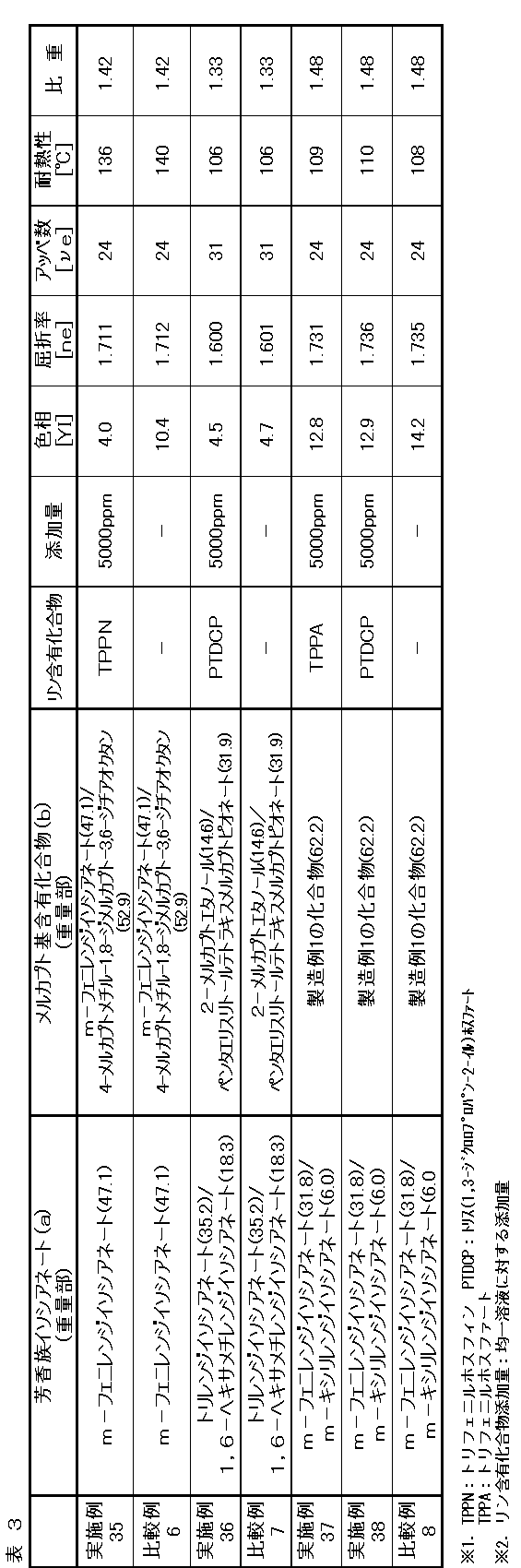
Claims (14)
- (a)芳香族イソシアネートと、
(b)メルカプト基含有化合物と、
(c)下記一般式(1)
(O=)nP-X3 (1)
(式中、nは0または1の整数を表す。
Xは置換または無置換の、炭素数1~6の直鎖または分岐のアルキル基、炭素数1~6の直鎖または分岐のアルコキシ基、炭素数1~6の直鎖または分岐のアルケニル基、炭素数1~6の直鎖または分岐のアルキニル基、炭素数3~6のシクロアルキル基、フェニル基、ビフェニル基、ナフチル基、フェノキシ基、複素環基を表す。
Xが置換された基である場合の置換基は、ハロゲン原子、炭素数1~6のアルキル基、炭素数1~6のアルコキシ基、炭素数1~6のアルケニル基、炭素数1~6のアルキニル基、炭素数3~6のシクロアルキル基、アミノ基、炭素数1~6のアルキルアミノ基、ニトロ基、フェニル基、ビフェニル基、ナフチル基、フェノキシ基、複素環基である。)
で表されるリン含有化合物と、
を含むことを特徴とする光学材料用重合性組成物。 - 芳香族イソシアネート(a)は、トリレンジイソシアネート、4,4'-ジフェニルメタンジイソシアネート、またはフェニレンジイソシアネートである、請求項1に記載の光学材料用重合性組成物。
- メルカプト基含有化合物(b)は、ポリチオール化合物(b1)および/または(ポリ)ヒドロキシ(ポリ)メルカプト化合物(b2)であることを特徴とする請求項1または2に記載の光学材料用重合性組成物。
- ポリチオール化合物(b1)は、4-メルカプトメチル-1,8-ジメルカプト-3,6-ジチアオクタン、4,8または4,7または5,7-ジメルカプトメチル-1,11-ジメルカプト-3,6,9-トリチアウンデカン、ペンタエリスリトールテトラキスメルカプトアセテート、ペンタエリスリトールテトラキスメルカプトプロピオネート、2,5-ビス(メルカプトメチル)-1,4-ジチアン、ビス(メルカプトエチル)スルフィド、1,1,3,3-テトラキス(メルカプトメチルチオ)プロパン、4,6-ビス(メルカプトメチルチオ)-1,3-ジチアン、2-(2,2-ビス(メルカプトメチルチオ)エチル)-1,3-ジチエタン、1,1,2,2-テトラキス(メルカプトメチルチオ)エタンおよび3-メルカプトメチル-1,5-ジメルカプト-2,4-ジチアペンタンよりなる群から1種以上選択されることを特徴とする請求項3に記載の光学材料用重合性組成物。
- (ポリ)ヒドロキシ(ポリ)メルカプト化合物(b2)は、2-メルカプトエタノール、3-メルカプト-1,2-プロパンジチオール、1,3-ジメルカプト-2-プロパノール、2,3-ジメルカプト-1-プロパノール、1,2-ジメルカプト-1,3-ブタンジオール、ペンタエリスリトールモノ(3-メルカプトプロピオネート)、ペンタエリスリトールビス(3-メルカプトプロピオネート)、ペンタエリスリトールトリス(3-メルカプトプロピオネート)、ペンタエリスリトールトリス(チオグリコレート)およびグルセリンビス(メルカプトアセテート)、4-メルカプトフェノールおよび2,4-ジメルカプトフェノールよりなる群から1種以上選択されることを特徴とする請求項3または4に記載の光学材料用重合性組成物。
- 一般式(1)で表されるリン含有化合物(c)がトリフェニルホスフィン、トリス(1,3-ジクロロプロパン-2-イル)ホスファート、トリフェニルホスファイトまたはトリフェニルホスファートよりなる群から選択される1種以上のリン含有化合物である、請求項1乃至5のいずれかに記載の光学材料用重合性組成物。
- トリフェニルホスフィンを1×10²ppm以上の量で含んでなる請求項1乃至6のいずれかに記載の光学材料用重合性組成物。
- トリフェニルホスフィンを1×10²ppm以上、5×10⁴ppm以下の量で含んでなる請求項6に記載の光学材料用重合性組成物。
- トリス(1,3-ジクロロプロパン-2-イル)ホスファート、トリフェニルホスファイトおよびトリフェニルホスファートよりなる群から選択される1種以上を1×10²ppm以上の量で含んでなる請求項6に記載の光学材料用重合性組成物。
- 請求項1乃至9のいずれかに記載の光学材料用重合性組成物を重合して得られる光学材料用樹脂。
- 請求項10に記載の光学材料用樹脂を含む光学用透明部材。
- 請求項11に記載の光学用透明部材からなる光学材料。
- 請求項1乃至9のいずれかに記載の光学材料用重合性組成物を硬化する光学材料の製造方法。
- 請求項13に記載の製造方法において、注型重合により前記光学材料用重合性組成物を成形することを特徴とする光学材料の製造方法。
Priority Applications (6)
| Application Number | Priority Date | Filing Date | Title |
|---|---|---|---|
| KR1020117013090A KR101378626B1 (ko) | 2008-12-08 | 2009-09-01 | 광학 재료용 중합성 조성물, 광학 재료 및 광학 재료의 제조 방법 |
| EP09831598.9A EP2357207B1 (en) | 2008-12-08 | 2009-09-01 | Polymeric composition for optical material, optical material, and optical material manufacturing method |
| US13/131,170 US20110224371A1 (en) | 2008-12-08 | 2009-09-01 | Polymerizable composition for optical materials, optical material and method for manufacturing optical material |
| BRPI0922680A BRPI0922680A2 (pt) | 2008-12-08 | 2009-09-01 | composição polimerizável para materiais ópticos, material óptico e método para fabricar o mesmo |
| CN200980149291.8A CN102245666B (zh) | 2008-12-08 | 2009-09-01 | 光学材料用聚合性组合物、光学材料及光学材料的制造方法 |
| JP2010541961A JP5444251B2 (ja) | 2008-12-08 | 2009-09-01 | 光学材料用重合性組成物、光学材料および光学材料の製造方法 |
Applications Claiming Priority (2)
| Application Number | Priority Date | Filing Date | Title |
|---|---|---|---|
| JP2008311983 | 2008-12-08 | ||
| JP2008-311983 | 2008-12-08 |
Publications (1)
| Publication Number | Publication Date |
|---|---|
| WO2010067489A1 true WO2010067489A1 (ja) | 2010-06-17 |
Family
ID=42242488
Family Applications (1)
| Application Number | Title | Priority Date | Filing Date |
|---|---|---|---|
| PCT/JP2009/004279 Ceased WO2010067489A1 (ja) | 2008-12-08 | 2009-09-01 | 光学材料用重合性組成物、光学材料および光学材料の製造方法 |
Country Status (7)
| Country | Link |
|---|---|
| US (1) | US20110224371A1 (ja) |
| EP (1) | EP2357207B1 (ja) |
| JP (2) | JP5444251B2 (ja) |
| KR (1) | KR101378626B1 (ja) |
| CN (1) | CN102245666B (ja) |
| BR (1) | BRPI0922680A2 (ja) |
| WO (1) | WO2010067489A1 (ja) |
Cited By (11)
| Publication number | Priority date | Publication date | Assignee | Title |
|---|---|---|---|---|
| JP2012181268A (ja) * | 2011-02-28 | 2012-09-20 | Hoya Corp | プラスチックレンズ |
| WO2013103276A1 (ko) * | 2012-01-06 | 2013-07-11 | 주식회사 케이오씨솔루션 | 티오에폭시 화합물, 폴리이소시아네이트 화합물 및 폴리티올 화합물을 포함하는 고굴절 광학렌즈용 공중합체 조성물과 광학렌즈의 제조방법 |
| WO2014084360A1 (ja) * | 2012-11-29 | 2014-06-05 | Hoya株式会社 | プラスチックレンズの製造方法 |
| JP2016026260A (ja) * | 2010-09-17 | 2016-02-12 | Hoya株式会社 | ウレタン系光学部材の製造方法 |
| WO2016052120A1 (ja) * | 2014-09-30 | 2016-04-07 | ホヤ レンズ タイランド リミテッド | 重合性組成物、透明樹脂、光学材料、プラスチックレンズおよび透明樹脂の製造方法 |
| WO2016052121A1 (ja) * | 2014-09-30 | 2016-04-07 | ホヤ レンズ タイランド リミテッド | 重合性組成物、透明樹脂、光学材料、プラスチックレンズおよび透明樹脂の製造方法 |
| WO2017077927A1 (ja) * | 2015-11-04 | 2017-05-11 | 三菱レイヨン株式会社 | 硬化性組成物、接着剤、コーティング層を有する物品、繊維強化複合材料および硬化性組成物キット |
| WO2019009230A1 (ja) | 2017-07-03 | 2019-01-10 | 三井化学株式会社 | 光学材料用重合性組成物および成形体 |
| WO2020218508A1 (ja) * | 2019-04-26 | 2020-10-29 | 三井化学株式会社 | 光学材料用チオール含有組成物、光学材料用重合性組成物 |
| EP3896497A1 (en) | 2020-03-31 | 2021-10-20 | Hoya Lens Thailand Ltd. | Method for producing polymerizable composition for optical materials, method for producing transparent resin, and method for producing lens base material |
| EP3910382A1 (en) | 2020-03-31 | 2021-11-17 | Hoya Lens Thailand Ltd. | Method for producing polymerizable composition for optical materials, method for producing transparent resin, and method for producing lens base material |
Families Citing this family (6)
| Publication number | Priority date | Publication date | Assignee | Title |
|---|---|---|---|---|
| BR112012002657A2 (pt) * | 2009-08-05 | 2016-03-22 | Mitsui Chemicals Inc | composição polimerizável para material ótico, material ótico e processo para produção de material ótico |
| JP6306102B2 (ja) * | 2016-07-29 | 2018-04-04 | ホヤ レンズ タイランド リミテッドHOYA Lens Thailand Ltd | 樹脂組成物 |
| KR101935031B1 (ko) | 2017-12-28 | 2019-01-03 | 에스케이씨 주식회사 | 플라스틱 광학 렌즈용 폴리티올 조성물 |
| CN110511343B (zh) * | 2019-09-05 | 2020-08-07 | 山东益丰生化环保股份有限公司 | 一种光学树脂及其制备方法和应用 |
| CN116606414B (zh) * | 2023-05-29 | 2026-04-10 | 益丰新材料股份有限公司 | 一种光学材料组合物、光学材料和光学透镜 |
| KR20260031189A (ko) * | 2024-08-28 | 2026-03-09 | 한화솔루션 주식회사 | 자일릴렌 디이소시아네이트 조성물 및 이를 포함하는 비-폼 수지 |
Citations (8)
| Publication number | Priority date | Publication date | Assignee | Title |
|---|---|---|---|---|
| JPH02270859A (ja) | 1988-12-22 | 1990-11-05 | Mitsui Toatsu Chem Inc | メルカプト化合物及びその製造方法 |
| JP2002121379A (ja) * | 2000-10-19 | 2002-04-23 | Seiko Epson Corp | プラスチックレンズの製造方法 |
| CN1405198A (zh) | 2002-11-05 | 2003-03-26 | 浙江大学 | 一种制备聚硫代氨基甲酸酯光学塑料的方法 |
| JP2003128668A (ja) * | 2001-10-22 | 2003-05-08 | Mitsui Chemicals Inc | 新規なポリチオール |
| JP2004002820A (ja) | 2002-04-19 | 2004-01-08 | Mitsui Chemicals Inc | チオウレタン系光学材料 |
| JP2004500447A (ja) * | 1999-11-18 | 2004-01-08 | ピーピージー・インダストリーズ・オハイオ・インコーポレイテッド | 光学重合体の調製方法 |
| JP2008143872A (ja) * | 2006-12-13 | 2008-06-26 | Mitsui Chemicals Inc | ビス(イソシアナトメチル)ノルボルナンの安定化方法。 |
| JP2008255353A (ja) * | 2007-03-15 | 2008-10-23 | Ube Ind Ltd | ポリチオウレタンポリチオールおよびこれを用いた重合硬化物の製造方法 |
Family Cites Families (13)
| Publication number | Priority date | Publication date | Assignee | Title |
|---|---|---|---|---|
| JP3390307B2 (ja) * | 1996-09-09 | 2003-03-24 | 三井化学株式会社 | ウレタン系プラスチックレンズ用組成物、それよりなるプラスチックレンズおよびその製造方法 |
| FR2773162B1 (fr) * | 1997-12-29 | 2000-02-11 | Essilor Int | Composition photopolymerisable a base de monomeres polyiso (thio)cyanates et de monomeres a proton labile, comprenant un agent photoamorceur et un agent d'activation de la photopolymerisation et artciles d'optique obtenus |
| US5932681A (en) * | 1998-03-09 | 1999-08-03 | Ppg Industries Ohio, Inc. | Method of preparing an optical polymerizate |
| JP2001131257A (ja) * | 1999-11-09 | 2001-05-15 | Mitsubishi Gas Chem Co Inc | 樹脂用組成物 |
| US7098290B1 (en) * | 1999-11-18 | 2006-08-29 | Ppg Industries Ohio, Inc. | Method of preparing an optical polymerizate |
| JP2001174601A (ja) * | 1999-12-17 | 2001-06-29 | Hoya Corp | 光学製品 |
| TW593450B (en) * | 2001-03-21 | 2004-06-21 | Hoya Corp | Transparent molded articles, optical components, plastic lenses and preparation method thereof |
| JP3982377B2 (ja) * | 2002-10-08 | 2007-09-26 | Jsr株式会社 | 光硬化性樹脂組成物及び光学部材 |
| JP2005298736A (ja) * | 2004-04-14 | 2005-10-27 | Idemitsu Kosan Co Ltd | 硫黄含有化合物、その製造方法および含硫黄重合体並びに光学材料 |
| WO2006001341A1 (ja) * | 2004-06-23 | 2006-01-05 | Mitsubishi Gas Chemical Company, Inc. | 重合性組成物 |
| JP4804135B2 (ja) * | 2005-01-25 | 2011-11-02 | 東海光学株式会社 | 生産性良く製造できる眼鏡用プラスチックレンズの製造方法 |
| JP2007246690A (ja) * | 2006-03-16 | 2007-09-27 | Seiko Epson Corp | 光学基材の製造方法 |
| EP2014700B1 (en) * | 2006-03-31 | 2012-06-13 | Mitsui Chemicals, Inc. | Polymerizable composition, resin using the same and optical component |
-
2009
- 2009-09-01 EP EP09831598.9A patent/EP2357207B1/en active Active
- 2009-09-01 CN CN200980149291.8A patent/CN102245666B/zh active Active
- 2009-09-01 KR KR1020117013090A patent/KR101378626B1/ko active Active
- 2009-09-01 WO PCT/JP2009/004279 patent/WO2010067489A1/ja not_active Ceased
- 2009-09-01 JP JP2010541961A patent/JP5444251B2/ja active Active
- 2009-09-01 BR BRPI0922680A patent/BRPI0922680A2/pt not_active Application Discontinuation
- 2009-09-01 US US13/131,170 patent/US20110224371A1/en not_active Abandoned
-
2013
- 2013-10-01 JP JP2013206473A patent/JP5658808B2/ja active Active
Patent Citations (8)
| Publication number | Priority date | Publication date | Assignee | Title |
|---|---|---|---|---|
| JPH02270859A (ja) | 1988-12-22 | 1990-11-05 | Mitsui Toatsu Chem Inc | メルカプト化合物及びその製造方法 |
| JP2004500447A (ja) * | 1999-11-18 | 2004-01-08 | ピーピージー・インダストリーズ・オハイオ・インコーポレイテッド | 光学重合体の調製方法 |
| JP2002121379A (ja) * | 2000-10-19 | 2002-04-23 | Seiko Epson Corp | プラスチックレンズの製造方法 |
| JP2003128668A (ja) * | 2001-10-22 | 2003-05-08 | Mitsui Chemicals Inc | 新規なポリチオール |
| JP2004002820A (ja) | 2002-04-19 | 2004-01-08 | Mitsui Chemicals Inc | チオウレタン系光学材料 |
| CN1405198A (zh) | 2002-11-05 | 2003-03-26 | 浙江大学 | 一种制备聚硫代氨基甲酸酯光学塑料的方法 |
| JP2008143872A (ja) * | 2006-12-13 | 2008-06-26 | Mitsui Chemicals Inc | ビス(イソシアナトメチル)ノルボルナンの安定化方法。 |
| JP2008255353A (ja) * | 2007-03-15 | 2008-10-23 | Ube Ind Ltd | ポリチオウレタンポリチオールおよびこれを用いた重合硬化物の製造方法 |
Non-Patent Citations (1)
| Title |
|---|
| See also references of EP2357207A4 |
Cited By (20)
| Publication number | Priority date | Publication date | Assignee | Title |
|---|---|---|---|---|
| JP2016026260A (ja) * | 2010-09-17 | 2016-02-12 | Hoya株式会社 | ウレタン系光学部材の製造方法 |
| JP2012181268A (ja) * | 2011-02-28 | 2012-09-20 | Hoya Corp | プラスチックレンズ |
| WO2013103276A1 (ko) * | 2012-01-06 | 2013-07-11 | 주식회사 케이오씨솔루션 | 티오에폭시 화합물, 폴리이소시아네이트 화합물 및 폴리티올 화합물을 포함하는 고굴절 광학렌즈용 공중합체 조성물과 광학렌즈의 제조방법 |
| WO2014084360A1 (ja) * | 2012-11-29 | 2014-06-05 | Hoya株式会社 | プラスチックレンズの製造方法 |
| US10465036B2 (en) | 2014-09-30 | 2019-11-05 | Hoya Lens Thailand Ltd. | Polymerizable composition, transparent resin, optical material, plastic lens, and method for manufacturing transparent resin |
| US10106640B2 (en) | 2014-09-30 | 2018-10-23 | Hoya Lens Thailand Ltd. | Polymerizable composition, transparent resin, optical material, plastic lens, and method for manufacturing transparent resin |
| WO2016052121A1 (ja) * | 2014-09-30 | 2016-04-07 | ホヤ レンズ タイランド リミテッド | 重合性組成物、透明樹脂、光学材料、プラスチックレンズおよび透明樹脂の製造方法 |
| WO2016052120A1 (ja) * | 2014-09-30 | 2016-04-07 | ホヤ レンズ タイランド リミテッド | 重合性組成物、透明樹脂、光学材料、プラスチックレンズおよび透明樹脂の製造方法 |
| KR102058892B1 (ko) | 2015-11-04 | 2019-12-26 | 미쯔비시 케미컬 주식회사 | 경화성 조성물, 접착제, 코팅층을 갖는 물품, 섬유 강화 복합 재료 및 경화성 조성물 키트 |
| JPWO2017077927A1 (ja) * | 2015-11-04 | 2017-11-02 | 三菱ケミカル株式会社 | 硬化性組成物、接着剤、コーティング層を有する物品、繊維強化複合材料および硬化性組成物キット |
| WO2017077927A1 (ja) * | 2015-11-04 | 2017-05-11 | 三菱レイヨン株式会社 | 硬化性組成物、接着剤、コーティング層を有する物品、繊維強化複合材料および硬化性組成物キット |
| US10730992B2 (en) | 2015-11-04 | 2020-08-04 | Mitsubishi Chemical Corporation | Curable composition, adhesive, article having coating layer, fiber-reinforced composite material and curable composition kit |
| WO2019009230A1 (ja) | 2017-07-03 | 2019-01-10 | 三井化学株式会社 | 光学材料用重合性組成物および成形体 |
| WO2020218508A1 (ja) * | 2019-04-26 | 2020-10-29 | 三井化学株式会社 | 光学材料用チオール含有組成物、光学材料用重合性組成物 |
| JPWO2020218508A1 (ja) * | 2019-04-26 | 2020-10-29 | ||
| JP2020181127A (ja) * | 2019-04-26 | 2020-11-05 | 三井化学株式会社 | 光学材料用チオール含有組成物、光学材料用重合性組成物 |
| JP7250911B2 (ja) | 2019-04-26 | 2023-04-03 | 三井化学株式会社 | 光学材料用チオール含有組成物、光学材料用重合性組成物 |
| JP7250911B6 (ja) | 2019-04-26 | 2023-04-25 | 三井化学株式会社 | 光学材料用チオール含有組成物、光学材料用重合性組成物 |
| EP3896497A1 (en) | 2020-03-31 | 2021-10-20 | Hoya Lens Thailand Ltd. | Method for producing polymerizable composition for optical materials, method for producing transparent resin, and method for producing lens base material |
| EP3910382A1 (en) | 2020-03-31 | 2021-11-17 | Hoya Lens Thailand Ltd. | Method for producing polymerizable composition for optical materials, method for producing transparent resin, and method for producing lens base material |
Also Published As
| Publication number | Publication date |
|---|---|
| EP2357207A1 (en) | 2011-08-17 |
| JP5658808B2 (ja) | 2015-01-28 |
| JP2014015624A (ja) | 2014-01-30 |
| US20110224371A1 (en) | 2011-09-15 |
| CN102245666A (zh) | 2011-11-16 |
| EP2357207B1 (en) | 2018-11-07 |
| BRPI0922680A2 (pt) | 2016-01-05 |
| KR101378626B1 (ko) | 2014-03-26 |
| JPWO2010067489A1 (ja) | 2012-05-17 |
| CN102245666B (zh) | 2014-07-30 |
| JP5444251B2 (ja) | 2014-03-19 |
| EP2357207A4 (en) | 2016-11-16 |
| KR20110091005A (ko) | 2011-08-10 |
Similar Documents
| Publication | Publication Date | Title |
|---|---|---|
| JP5658808B2 (ja) | 光学材料用重合性組成物、光学材料および光学材料の製造方法 | |
| JP5226016B2 (ja) | 光学材料用重合性組成物、光学材料および光学材料の製造方法 | |
| JP5782494B2 (ja) | 光学材料用重合性組成物、光学材料および光学材料の製造方法 | |
| JP6335274B2 (ja) | 光学材料の製造方法 | |
| EP3103822A1 (en) | Polymerizable composition for optical material, and optical material and plastic lens obtained from said composition | |
| JP6043434B2 (ja) | エピスルフィド化合物の保管方法、及び該エピスルフィド化合物を用いたチオエポキシ系光学材料の製造方法 | |
| JP6691990B1 (ja) | 光学材料用チオール含有組成物、光学材料用重合性組成物 | |
| WO2015088011A1 (ja) | 光学材料用重合性組成物、光学材料およびその用途 | |
| KR20130086007A (ko) | 티오에폭시계 공중합체 조성물과 티오에폭시계 광학재료의 제조방법 | |
| HK1156647A (en) | Polymeric composition for optical material, optical material, and optical material manufacturing method | |
| HK1156647B (en) | Polymeric composition for optical material, optical material, and optical material manufacturing method | |
| HK1163142A (en) | Polymeric composition for optical material, optical material, and optical material manufacturing method | |
| HK1148296A (en) | Polymerizable composition for optical material, optical material and method for producing optical material | |
| HK1148296B (en) | Polymerizable composition for optical material, optical material and method for producing optical material |
Legal Events
| Date | Code | Title | Description |
|---|---|---|---|
| WWE | Wipo information: entry into national phase |
Ref document number: 200980149291.8 Country of ref document: CN |
|
| 121 | Ep: the epo has been informed by wipo that ep was designated in this application |
Ref document number: 09831598 Country of ref document: EP Kind code of ref document: A1 |
|
| WWE | Wipo information: entry into national phase |
Ref document number: 2010541961 Country of ref document: JP |
|
| WWE | Wipo information: entry into national phase |
Ref document number: 13131170 Country of ref document: US |
|
| REEP | Request for entry into the european phase |
Ref document number: 2009831598 Country of ref document: EP |
|
| WWE | Wipo information: entry into national phase |
Ref document number: 2009831598 Country of ref document: EP |
|
| ENP | Entry into the national phase |
Ref document number: 20117013090 Country of ref document: KR Kind code of ref document: A |
|
| NENP | Non-entry into the national phase |
Ref country code: DE |
|
| WWE | Wipo information: entry into national phase |
Ref document number: 4300/DELNP/2011 Country of ref document: IN |
|
| ENP | Entry into the national phase |
Ref document number: PI0922680 Country of ref document: BR Kind code of ref document: A2 Effective date: 20110608 |