WO2010055802A1 - ゲーム装置、操作評価方法、情報記録媒体、および、プログラム - Google Patents
ゲーム装置、操作評価方法、情報記録媒体、および、プログラム Download PDFInfo
- Publication number
- WO2010055802A1 WO2010055802A1 PCT/JP2009/068888 JP2009068888W WO2010055802A1 WO 2010055802 A1 WO2010055802 A1 WO 2010055802A1 JP 2009068888 W JP2009068888 W JP 2009068888W WO 2010055802 A1 WO2010055802 A1 WO 2010055802A1
- Authority
- WO
- WIPO (PCT)
- Prior art keywords
- target object
- unit
- effective width
- player
- game
- Prior art date
- Legal status (The legal status is an assumption and is not a legal conclusion. Google has not performed a legal analysis and makes no representation as to the accuracy of the status listed.)
- Ceased
Links
Images








Classifications
-
- A63F13/10—
-
- A—HUMAN NECESSITIES
- A63—SPORTS; GAMES; AMUSEMENTS
- A63F—CARD, BOARD, OR ROULETTE GAMES; INDOOR GAMES USING SMALL MOVING PLAYING BODIES; VIDEO GAMES; GAMES NOT OTHERWISE PROVIDED FOR
- A63F13/00—Video games, i.e. games using an electronically generated display having two or more dimensions
- A63F13/50—Controlling the output signals based on the game progress
- A63F13/53—Controlling the output signals based on the game progress involving additional visual information provided to the game scene, e.g. by overlay to simulate a head-up display [HUD] or displaying a laser sight in a shooting game
- A63F13/537—Controlling the output signals based on the game progress involving additional visual information provided to the game scene, e.g. by overlay to simulate a head-up display [HUD] or displaying a laser sight in a shooting game using indicators, e.g. showing the condition of a game character on screen
- A63F13/5375—Controlling the output signals based on the game progress involving additional visual information provided to the game scene, e.g. by overlay to simulate a head-up display [HUD] or displaying a laser sight in a shooting game using indicators, e.g. showing the condition of a game character on screen for graphically or textually suggesting an action, e.g. by displaying an arrow indicating a turn in a driving game
-
- A—HUMAN NECESSITIES
- A63—SPORTS; GAMES; AMUSEMENTS
- A63F—CARD, BOARD, OR ROULETTE GAMES; INDOOR GAMES USING SMALL MOVING PLAYING BODIES; VIDEO GAMES; GAMES NOT OTHERWISE PROVIDED FOR
- A63F13/00—Video games, i.e. games using an electronically generated display having two or more dimensions
- A63F13/45—Controlling the progress of the video game
-
- A—HUMAN NECESSITIES
- A63—SPORTS; GAMES; AMUSEMENTS
- A63F—CARD, BOARD, OR ROULETTE GAMES; INDOOR GAMES USING SMALL MOVING PLAYING BODIES; VIDEO GAMES; GAMES NOT OTHERWISE PROVIDED FOR
- A63F13/00—Video games, i.e. games using an electronically generated display having two or more dimensions
- A63F13/80—Special adaptations for executing a specific game genre or game mode
- A63F13/814—Musical performances, e.g. by evaluating the player's ability to follow a notation
-
- A—HUMAN NECESSITIES
- A63—SPORTS; GAMES; AMUSEMENTS
- A63F—CARD, BOARD, OR ROULETTE GAMES; INDOOR GAMES USING SMALL MOVING PLAYING BODIES; VIDEO GAMES; GAMES NOT OTHERWISE PROVIDED FOR
- A63F2300/00—Features of games using an electronically generated display having two or more dimensions, e.g. on a television screen, showing representations related to the game
- A63F2300/30—Features of games using an electronically generated display having two or more dimensions, e.g. on a television screen, showing representations related to the game characterized by output arrangements for receiving control signals generated by the game device
- A63F2300/303—Features of games using an electronically generated display having two or more dimensions, e.g. on a television screen, showing representations related to the game characterized by output arrangements for receiving control signals generated by the game device for displaying additional data, e.g. simulating a Head Up Display
- A63F2300/305—Features of games using an electronically generated display having two or more dimensions, e.g. on a television screen, showing representations related to the game characterized by output arrangements for receiving control signals generated by the game device for displaying additional data, e.g. simulating a Head Up Display for providing a graphical or textual hint to the player
-
- A—HUMAN NECESSITIES
- A63—SPORTS; GAMES; AMUSEMENTS
- A63F—CARD, BOARD, OR ROULETTE GAMES; INDOOR GAMES USING SMALL MOVING PLAYING BODIES; VIDEO GAMES; GAMES NOT OTHERWISE PROVIDED FOR
- A63F2300/00—Features of games using an electronically generated display having two or more dimensions, e.g. on a television screen, showing representations related to the game
- A63F2300/80—Features of games using an electronically generated display having two or more dimensions, e.g. on a television screen, showing representations related to the game specially adapted for executing a specific type of game
- A63F2300/8047—Music games
Definitions
- the present invention relates to a game device, an operation evaluation method, an information recording medium, and a program capable of prompting progress while feeling fun even when an infant or the like plays.
- music games including dance games and the like
- This music game is a type of game in which a player competes for a high score by performing an operation that matches the rhythm or musical scale of a musical piece to be played with good timing.
- a plurality of moving lanes connecting the upper and lower portions of the screen with straight lines are arranged in parallel.
- a target object that appears as appropriate from the starting point of each moving lane moves toward the end point of the moving lane according to the music to be played.
- the target object is a symbol image or the like for designating a player's operation (for example, a controller button operation), and a different type is assigned to each moving lane.
- a determination area is provided so as to cross each moving lane, and is represented by a straight line or an object.
- a suitable button operation (the type of the target object or the pressing of the button corresponding to the moving lane) is performed by the player.
- a score can be obtained. That is, the player is required to perform a correct button operation with good timing while following the target object that moves according to the music.
- Patent Document 1 an invention of a game device capable of changing the degree of difficulty according to the game situation of the player is disclosed (for example, see Patent Document 1).
- the difficulty level of the game can be set, and in the case of an unfamiliar player or the like, the difficulty level can be lowered and played.
- the threshold time for determining success or failure of the button operation is set longer, and even when the timing of the button operation by the player is shifted, the threshold time is not exceeded. If so, it is evaluated as an effective operation.
- the present invention was made to solve such a problem, and even when an infant or the like plays, a game device, an operation evaluation method, an information recording medium, and an information recording medium capable of prompting progress while feeling interesting
- the purpose is to provide a program.
- a game device is a game device that evaluates a player's operation performed on a target object moved and displayed on a screen, and includes an image generation unit, an object control unit, a calculation unit, and an operation. It includes a reception unit and an evaluation unit.
- the image generation unit generates a game image in which a movement path (for example, a plurality of movement lanes) of the target object and a determination area for indicating operation timing on the movement path are defined.
- the object control unit sequentially causes the target objects to appear from the starting point of the movement path, and moves the target objects that have appeared to move toward the end point of the movement path, for example, in accordance with the rhythm of the music being played.
- the calculation unit calculates an effective width corresponding to the interval between each target object and another target object. For example, the calculation unit calculates the effective width obtained by dividing the interval between the other two target objects before and after at a predetermined ratio.
- the operation reception unit receives a player's operation (for example, button operation) performed on any target object. In response to this operation, the evaluation unit evaluates the player's operation based on whether or not the prescribed determination area is included in the effective width area based on the current position of the target object.
- the effective width of each target object is calculated according to the interval with other target objects. For example, when the interval is divided in half, the effective width is a wide range extending to the middle of the interval with other target objects. Then, the player's operation is evaluated depending on whether or not the position of the determination area is included in the area corresponding to the effective width of the target object. For this reason, even when an infant or the like plays, even if the timing of the operation is shifted, the ratio that is evaluated as an effective operation is increased, and it can be interesting. As a result, even when an infant or the like plays, it is possible to promote progress while feeling interesting.
- the calculation unit may obtain two points obtained by dividing the interval between the other two target objects before and after the target object by a predetermined ratio, and may calculate the range between the two points as an effective width.
- the effective width of each target object is, for example, between points obtained by dividing the interval between the other two target objects before and after, for example, in half, and they are arranged without gaps along the time axis (moving axis). It will be. For this reason, the effective width of the target area overlaps with the determination area at any point in time, and even if the timing of the operation is shifted when an infant or the like plays, the rate of effective evaluation is high. It can make you feel interesting.
- the effective width instead of simply widening the effective width, the effective width also changes according to the order of the target objects in the time axis, so appropriate evaluation is performed according to the actual display order of target objects (degree of difficulty). can do.
- the game apparatus further includes an analysis unit that counts the evaluated player operations and analyzes the deviation in the front-rear direction at the operation timing. For each target object, the calculation unit obtains two points obtained by dividing the interval between the other two target objects before and after by a ratio (ratio) according to the analyzed deviation in the front-rear direction, and the range between the two points May be calculated as the effective range. In this case, the effective width of each target object is shifted back and forth in consideration of a shift in the operation timing, and even when an infant or the like who has a tendency to operate too early or too late plays. The rate at which effective evaluations are made is high, and it can be interesting.
- the calculation unit may calculate an effective width obtained by expanding the target object next to the target object that has been evaluated so as to include the effective width of the target object that has been evaluated. In this case, since the effective width of the target object next to the target object that has been evaluated is extended, even if the timing of operation is shifted when an infant or the like plays, the proportion of effective evaluation is increased. It can make you feel interesting.
- An operation evaluation method is an operation evaluation method in a game device having an image generation unit, an object control unit, a calculation unit, an operation reception unit, and an evaluation unit, wherein the image generation step, the object A control step, a calculation step, an operation reception step, and an evaluation step are included.
- a game image in which a movement path (for example, a plurality of movement lanes) of the target object and a determination area for indicating operation timing on the movement path are defined is generated.
- the target objects appear sequentially from the starting point of the movement path, and the appearing target objects are moved toward the end point of the movement path, for example, in accordance with the rhythm of the music to be played.
- an effective width corresponding to the interval with other target objects is calculated. For example, in the calculation step, an effective width is calculated by dividing the interval between the other two target objects before and after the predetermined ratio.
- a player's operation for example, a button operation
- the evaluation step in response to this operation, the player's operation is evaluated based on whether or not the prescribed determination area is included in the effective width area based on the current position of the target object.
- the effective width of each target object is calculated according to the interval with other target objects. For example, when the interval is divided in half, the effective width is a wide range extending to the middle of the interval with other target objects. Then, the player's operation is evaluated depending on whether or not the position of the determination area is included in the area corresponding to the effective width of the target object. For this reason, even when an infant or the like plays, even if the timing of the operation is shifted, the ratio that is evaluated as an effective operation is increased, and it can be interesting. As a result, even when an infant or the like plays, it is possible to promote progress while feeling interesting.
- the information recording medium records a program for causing a computer (including an electronic device) to function as the above game device.
- the program according to the fourth aspect of the present invention is configured to cause a computer (including an electronic device) to function as the above game device.
- This program can be recorded on a computer-readable information recording medium such as a compact disk, flexible disk, hard disk, magneto-optical disk, digital video disk, magnetic tape, and semiconductor memory.
- a computer-readable information recording medium such as a compact disk, flexible disk, hard disk, magneto-optical disk, digital video disk, magnetic tape, and semiconductor memory.
- the above program can be distributed and sold via a computer communication network independently of the computer on which the program is executed.
- the information recording medium can be distributed and sold independently of the computer.
- Embodiments of the present invention will be described below.
- an embodiment in which the present invention is applied to a game device will be described.
- the present invention can be similarly applied to information processing devices such as various computers, PDAs, and mobile phones. it can. That is, the embodiment described below is for explanation, and does not limit the scope of the present invention. Therefore, those skilled in the art can employ embodiments in which each or all of these elements are replaced with equivalent ones, and these embodiments are also included in the scope of the present invention.
- FIG. 1 is a schematic diagram showing a schematic configuration of a typical information processing device in which a game device according to an embodiment of the present invention is realized.
- a description will be given with reference to FIG.
- the information processing apparatus 100 includes a CPU (Central Processing Unit) 101, a ROM (Read Only Memory) 102, a RAM (Random Access Memory) 103, an interface 104, a controller 105, an external memory 106, and a DVD (Digital Versatile). Disk) -ROM drive 107, image processing unit 108, audio processing unit 109, and NIC (Network Interface Card) 110.
- CPU Central Processing Unit
- ROM Read Only Memory
- RAM Random Access Memory
- controller 105 an external memory
- DVD Digital Versatile
- Disk Disk
- image processing unit 108 image processing unit
- audio processing unit 109 audio processing unit
- NIC Network Interface Card
- the CPU 101 controls the overall operation of the information processing apparatus 100 and is connected to each component to exchange control signals and data.
- the ROM 102 records an IPL (Initial Program Loader) that is executed immediately after the power is turned on, and when this is executed, the program recorded on the DVD-ROM is read into the RAM 103 and the execution by the CPU 101 is started.
- the ROM 102 stores an operating system program and various data necessary for operation control of the entire information processing apparatus 100.
- the RAM 103 is for temporarily storing data and programs, and holds programs and data read from the DVD-ROM and other data necessary for game progress and chat communication.
- the controller 105 connected via the interface 104 receives an operation input performed when the user executes the game.
- the controller 105 accepts input of a character string (message) or the like according to the operation input.
- the external memory 106 detachably connected via the interface 104 stores data indicating the progress of the game, chat communication log (record) data, and the like in a rewritable manner.
- the user can record these data in the external memory 106 as appropriate by inputting an instruction via the controller 105.
- a DVD-ROM mounted on the DVD-ROM drive 107 stores a program for realizing the game and image data and sound data associated with the game. Under the control of the CPU 101, the DVD-ROM drive 107 performs a reading process on the DVD-ROM loaded therein, reads out necessary programs and data, and these are temporarily stored in the RAM 103 or the like.
- the image processing unit 108 processes the data read from the DVD-ROM by the CPU 101 or an image arithmetic processor (not shown) included in the image processing unit 108, and then processes the processed data in a frame memory ( (Not shown).
- Image information recorded in the frame memory is converted into a video signal (video signal) at a predetermined synchronization timing, and is output to a monitor (display 290 described later) connected to the image processing unit 108. Thereby, various image displays are possible.
- the image calculation processor can execute a two-dimensional image overlay calculation, a transmission calculation such as ⁇ blending, and various saturation calculations at high speed.
- the polygon information arranged in the virtual three-dimensional space and added with various kinds of texture information is rendered by the Z buffer method, and a rendered image is obtained by overlooking the polygon arranged in the virtual three-dimensional space from a predetermined viewpoint position. High speed execution of the obtained operation is also possible.
- the CPU 101 and the image arithmetic processor work together to draw a character string as a two-dimensional image in the frame memory or on each polygon surface according to the font information that defines the character shape. is there.
- the font information is recorded in the ROM 102, but it is also possible to use dedicated font information recorded in the DVD-ROM.
- the audio processing unit 109 converts audio data read from the DVD-ROM into an analog audio signal, and supplies the analog audio signal to an external speaker (a speaker of a display 290 described later) to output the audio.
- an external speaker a speaker of a display 290 described later
- the sound processing unit 109 generates sound effects and music data to be generated while the game is in progress, and outputs sound corresponding to the sound from the speaker.
- the NIC 110 is used to connect the information processing apparatus 100 to a computer communication network (not shown) such as the Internet, and is used in configuring a LAN (Local Area Network). 10BASE-T / 100BASE-T standard Or modems that connect to the Internet using telephone lines, ISDN (Integrated Services Digital Network) modems, ADSL (Asymmetric Digital Subscriber Line) modems, cables to connect to the Internet using cable television lines It comprises a modem, etc., and an interface (not shown) that mediates between them and the CPU 101.
- a computer communication network such as the Internet
- LAN Local Area Network
- 10BASE-T / 100BASE-T standard Or modems that connect to the Internet using telephone lines
- ISDN Integrated Services Digital Network
- ADSL Asymmetric Digital Subscriber Line
- the information processing apparatus 100 uses a large-capacity external storage device such as a hard disk to perform the same function as the ROM 102, RAM 103, external memory 106, DVD-ROM attached to the DVD-ROM drive 107, and the like. You may comprise. Further, it is possible to adopt a form in which a keyboard for accepting a character string editing input from a user, a mouse for accepting various position designations and selection inputs, and the like are connected.
- a general computer can be used as a game apparatus.
- a general computer like the information processing apparatus 100, includes a CPU, RAM, ROM, DVD-ROM drive, and NIC, and an image processing unit that has a simpler function than the information processing apparatus 100.
- a hard disk as an external storage device
- a flexible disk a magneto-optical disk, a magnetic tape, and the like can be used.
- a keyboard, a mouse or the like is used as an input device instead of a controller. Then, after the game program is installed, when the program is executed, it functions as a game device.
- FIG. 2 is a schematic diagram showing a schematic configuration of the game device according to the present embodiment.
- this game apparatus is a game apparatus that executes a music game, and an object (a target object described later) is moved and displayed on the screen in accordance with the music to be played. Evaluate the operation.
- this game apparatus is a game apparatus that executes a music game, and an object (a target object described later) is moved and displayed on the screen in accordance with the music to be played. Evaluate the operation.
- a description will be given with reference to FIG.
- the game device 200 includes an object information storage unit 210, an image generation unit 220, an operation reception unit 230, a processing control unit 240, a music information storage unit 250, and a music playback unit 260.
- the object information storage unit 210 stores information (image information, position information, and the like) of various objects that constitute the display image of the music game. For example, information on various objects such as a target object for designating a player's operation (for example, a button operation), a movement lane serving as a movement path of the target object, and a determination area serving as a guide for the player's operation timing are stored. . Since the target object is controlled by the processing control unit 240 (an object control unit 241 described later) to move on the moving lane in synchronization with the rhythm of the music, the position information is appropriately updated. It is like. Note that the DVD-ROM and the RAM 103 mounted on the DVD-ROM drive 107 described above can function as such an object information storage unit 210.
- the image generation unit 220 is controlled by the processing control unit 240 and generates a display image (game image) of the music game. For example, the image generation unit 220 appropriately reads information on various objects stored in the object information storage unit 210 and generates a game image.
- the image generation unit 220 generates a game image as shown in FIG. 3A.
- a plurality of types of target objects OBJ objects with arrows in different directions
- the movement of each target object OBJ is controlled by the processing control unit 240 (an object control unit 241 described later). That is, the appearance of each target object OBJ from the lower end (starting point) of the moving lane La, the movement on the moving lane La, and the disappearance from the upper end (ending point) of the moving lane La are appropriately controlled.
- the determination area HA an area in which an object having the same shape as the target object OBJ is fixedly arranged
- the button corresponding to the type the direction of the arrow
- pressing of the corresponding button is requested at the timing when the objects are exactly overlapped in the determination area HA.
- the game image of FIG. 3A shows a case where the target object OBJ moves from the lower side to the upper side of the screen, but the movement direction of the target object OBJ is not limited to this and is arbitrary.
- the screen may be moved from the upper side to the lower side, or may be moved in the horizontal direction (from the right side to the left side of the screen or from the left side to the right side of the screen).
- a determination line orthogonal to the moving lane La may be displayed and used as the determination area.
- the moving lane La may be hidden in the game image.
- the shape of the target object OBJ is an example, and may be another shape.
- the image generation unit 220 may generate a target object OBJ having another shape as shown in FIGS. 3B to 3D and move and display it.
- the image processing unit 108 can function as such an image generation unit 220.
- the operation receiving unit 230 receives various operations by the player.
- the operation reception unit 230 receives an operation for setting (changing) various modes of the music game. Specifically, an operation for setting an “infant mode” suitable for an infant or a completely new game player to play a music game, an “ordinary mode” for a normal player, and the like is accepted.
- the operation receiving unit 230 sequentially receives button operations performed by the player after the music game is started. In other words, during the play in which the game image as shown in FIG. 3A is displayed, the player expects to reach the determination area HA while following the target object OBJ that moves according to the music to be played.
- the operation receiving unit 230 sequentially receives such player button operations. Then, when accepting such a button operation, the operation accepting unit 230 supplies operation information indicating the content (which button has been pressed, etc.) to the processing control unit 240. Note that the controller 105 described above can function as such an operation receiving unit 230.
- the process control unit 240 controls the entire game device 200. That is, the image generation unit 220 is controlled to generate a game image or the like, and the music playback unit 260 is controlled to play back the music sound that accompanies the music game. Then, the player's operation performed during the game is evaluated.
- the process control unit 240 includes an object control unit 241, a calculation unit 242, and an evaluation unit 243.
- the object control unit 241 moves and displays a predetermined object so as to synchronize with the rhythm or the like of the music while playing the music game. Specifically, as shown in the game image of FIG. 3A described above, the object control unit 241 causes the target object OBJ to appear from the starting point of the movement lane La (below the screen), and the rhythm of the music or the like on the movement lane La And move toward the end point (upper part of the screen). Then, the target object OBJ that has moved to the end point of the movement lane La is erased (disappears) from the game image.
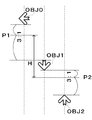
- the calculating unit 242 calculates the effective width of the object to be moved. For example, for each target object OBJ in the game image of FIG. 3A described above, an effective width for evaluating success or failure of the player's operation is calculated. Specifically, in the “normal mode” described above, the calculating unit 242 calculates the range of the height of the target object OBJ as the effective width H as it is, as shown in FIG. 4A. On the other hand, in the above-described “infant mode”, the calculation unit 242 divides two points obtained by dividing the distance between the other two target objects OBJ whose positions are before and after (the distance in the vertical direction along the moving lane La) in half. The range of these two points is calculated as the effective width.
- the calculation unit 242 obtains a point P1 obtained by dividing the interval with the immediately preceding (immediately) target object OBJ0 in half.
- a point P2 is obtained by dividing the interval with the target object OBJ2 (immediately below) in half.
- a range connecting these points P1 and P2 is calculated as an effective width H.
- 4B shows the case where the two target objects (OBJ0, OBJ2) before and after are different types (different moving lanes), the target objects immediately before and immediately after are the same type (same moving lane). Even in the case of an object, similarly, the distance between points divided by half is calculated as an effective width.
- the interval may be an interval in an oblique direction connecting the target objects with a straight line instead of such a vertical direction. Even in this case, if the interval in the oblique direction is divided in half, it becomes the same as that in which the interval in the vertical direction is divided, and the effective width H is not changed.
- the calculation unit 242 calculates the effective widths for other target objects in the same manner.
- the evaluation unit 243 evaluates the operation based on the positional relationship between the area corresponding to the calculated effective width of the target object and the determination area at the timing when the operation of the player is received. . That is, when the evaluation unit 243 receives a player's button operation, the evaluation unit 243 determines whether or not the position of the determination area is included (overlaps) in the area corresponding to the effective width of the target object corresponding to the button operation. Evaluate the operation. For example, an area corresponding to the effective width is obtained based on the current position of the target object corresponding to the button operation accepted this time. When the area overlaps the determination area, the evaluation unit 243 evaluates the player's operation as “effective operation”. Note that when the obtained area (area corresponding to the effective width of the target object) does not overlap the determination area, the evaluation unit 243 evaluates the player's operation as an “invalid operation”.
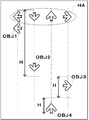
- the evaluation unit 243 receives the button operation in the above-described “general mode” in the situation illustrated in FIG. 5A.
- the evaluation unit 243 evaluates as “effective operation”. If the button operation is for other target objects (target objects OBJ2 to OBJ4), the area corresponding to any effective width H does not overlap with the determination area HA. ".
- the timing of accepting the button operation in the “infant mode” described above is the situation shown in FIG. 5B.
- the evaluation unit 243 evaluates as “effective operation”. Even in this case, if the button operation is for other target objects (target objects OBJ2 to 4), the area corresponding to any effective width H does not overlap with the determination area HA. Evaluate as "invalid operation”.
- the effective width H in the “general mode” in FIG. 5A is compared with the effective width H in the “infant mode” in FIG. 5B, the “infant mode” is closer to the other target objects before and after. It is getting wider.
- the effective width H of the “infant mode” is set without a gap along the time axis (movement axis). Therefore, in the “infant mode”, the region corresponding to the effective width H of any target object overlaps the determination area HA at any time. Therefore, if even the button operation is not mistaken, even if the timing of the operation is shifted, the ratio that is evaluated as an effective operation increases. That is, taking the situation of FIG. 5B as an example, if the button operation is for the target object OBJ1, the interval between the target object OBJ2 and the other target object OBJ2 may be increased even if the operation timing is too early or too late. As long as the middle is not exceeded, it will be evaluated as “effective operation”.
- the CPU 101 described above can function as the processing control unit 240 having such a configuration.
- the music information storage unit 250 stores a plurality of pieces of music information to be played as accompaniment to the music game. For example, music information in a predetermined format such as MIDI (Musical Instrument Digital Interface) data is stored. The player can select a favorite music piece and play a music game in accordance with the reproduced sound (musical sound).
- the music information storage unit 250 also stores music related information such as rhythm (tempo) and playback time for each music. Note that the DVD-ROM and the RAM 103 mounted on the DVD-ROM drive 107 described above can function as such a music information storage unit 250.
- the music playback unit 260 is controlled by the processing control unit 240 and plays back the music sound of the music game.
- the music playback unit 260 reads the music information selected by the player from the music information storage unit 250 before the game starts (before play), and plays back this music information after the game starts (during play). Output the music sound.
- the music reproduction method is not limited to this, and is arbitrary.
- the music information may be reproduced while being read sequentially during play.
- the audio processing unit 109 described above can function as such a music playback unit 260.
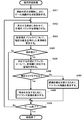
- FIG. 6 is a flowchart showing a flow of operation evaluation processing executed during the play of the music game. This operation evaluation process is executed with the start of the music game.
- the game apparatus 200 starts playing a music piece and starts generating a game image (step S301). That is, the music playback unit 260 reads the music information selected by the player from the music information storage unit 250 and plays back the music sound. Further, the image generation unit 220 reads out various objects constituting the game image from the object information storage unit 210, and generates a game image as shown in FIG. 3A described above.
- the game device 200 moves the target object according to the music to be played (step S302). That is, the process control unit 240 moves and displays the target object so as to synchronize with the rhythm or the like of the music to be reproduced. Specifically, as shown in the above-described game image of FIG. 3A, the object control unit 241 causes the target object OBJ to appear from the starting point of the moving lane La, and the moving lane La is set as the end point according to the rhythm of the music. Move towards. Then, the target object OBJ that has moved to the end point of the movement lane La is deleted from the game image.
- the game device 200 calculates an effective width based on the current position for each target object (step S303). That is, the process control unit 240 calculates an effective width for evaluating the success or failure of the player's operation for each moving target object.
- the calculation unit 242 obtains two points obtained by dividing the interval between the two other target objects whose positions are before and after by half, and calculates a range connecting the two points as an effective width. More specifically, when calculating the effective width of the target object OBJ1 in FIG. 4B described above, the calculation unit 242 calculates the point P1 that divides the interval from the immediately preceding target object OBJ0 in half and the immediately following target object OBJ2. And a point P2 obtained by dividing the interval between and by half. The range connecting these points P1 and P2 is calculated as the effective width H.
- the game device 200 determines whether or not there is an operation by the player (step S304). That is, the operation reception unit 230 determines whether or not the player's button operation has been received. If the game device 200 determines that there is no operation by the player (step S304; No), the process proceeds to step S309 described later.
- step S304 the game device 200 obtains an area corresponding to the effective width for the corresponding target object (step S305). That is, the evaluation unit 243 obtains a region corresponding to the effective width with reference to the current position of the target object corresponding to the button operation (pressed button) received by the operation receiving unit 230.
- the game device 200 determines whether or not the obtained area overlaps with the determination area (step S306). Specifically, the evaluation unit 243 determines whether the area corresponding to the effective width H overlaps the determination area HA if the button operation is for the target object OBJ1 in the situation shown in FIG. 5B described above. To do.
- the game apparatus 200 When determining that the obtained area does not overlap with the determination area (step S306; No), the game apparatus 200 adds the number of erroneous operations and displays an announcement image (step S307). That is, since the button operated by the player is not correct, the game apparatus 200 adds the number of erroneous operations, and synthesizes and displays the announcement image that notifies the erroneous operation on the game image. Note that the game device 200 may end the game halfway when the number of erroneous operations becomes equal to or greater than a specified number.
- step S306 when it is determined that the obtained area overlaps the determination area (step S306; Yes), the game device 200 adds the score and displays the announcement image (step S308). That is, since the button operated by the player is correct, the game apparatus 200 adds a score and synthesizes and displays the announcement image for notifying the effective operation on the game image.
- step S309 determines whether or not the game has ended. That is, it is determined whether or not the music game for one time (one music) is finished. If it is determined that the game has not ended (step S309; No), the game device 200 returns the process to step S302 described above. Then, the processes in steps S302 to S309 are repeatedly executed. On the other hand, when it is determined that the game has ended (step S309; Yes), the game device 200 ends the operation evaluation process after displaying a predetermined end message, a total score, and the like.
- the effective width H of each target object OBJ is calculated, and the player's operation is evaluated.
- the effective width H of these target objects OBJ is widened according to the distance from the other target objects.
- these effective widths H are set with no gap along the time axis. Therefore, at any point in time, for any target object, the area corresponding to the effective width H overlaps the determination area HA. Therefore, if even the button operation is not mistaken, even if the timing of the operation is shifted, the ratio that is evaluated as an effective operation increases.
- the button operation is performed on the target object OBJ closest to the determination area HA, even if the operation timing is too early or conversely too late, it does not exceed the middle of the interval with other target objects OBJ. As long as it is, it will be evaluated as an “effective operation”.
- the effective width H does not simply increase, but the effective width H also changes according to the arrangement of the target objects OBJ on the time axis. That is, when the distance between the target objects is far, the effective width is widened. Conversely, when the distance between the target objects is close, the effective width is narrowed. Therefore, it is possible to appropriately evaluate according to the arrangement (degree of difficulty) of the target objects OBJ that are actually displayed. As a result, even when an infant or the like plays, it is possible to promote progress while feeling interesting.
- the game apparatus 400 includes an object information storage unit 210, an image generation unit 220, an operation reception unit 230, a processing control unit 440, a music information storage unit 250, and a music playback unit 260.
- an object information storage unit 210 to the operation reception unit 230, the music information storage unit 250, and the music playback unit 260 have the same configuration as the game device 200 of FIG.
- the processing control unit 440 includes an object control unit 241, a calculation unit 242, an evaluation unit 243, and an analysis unit 441. That is, the process control unit 440 has a configuration in which the analysis unit 441 is added to the configuration of the process control unit 240 in the game device 200 of FIG. 2 described above.
- the analysis unit 441 aggregates the button operations performed by the evaluation unit 243, and analyzes the deviation (fast / slow) in the front-rear direction at the operation timing of the player. As an example, the analysis unit 441 determines whether the timing of the player's button operation is shifted forward or backward from the display position of the target object with respect to the determination area when it is evaluated as “effective operation”. Determine and aggregate. It should be noted that, when there is a target object operated by the player before and after when it is evaluated as “invalid operation” (except for a case where a complete pressing error is made), the timing of the player's button operation is determined from the context. It may be determined whether or not is shifted forward or rearward and then counted. Then, when it is determined from the predetermined number of counting results that the tendency to shift forward or the tendency to shift backward is high, the analysis unit 441 supplies information on the tendency of shift to the calculation unit 242.
- the calculation unit 242 that has received the information on the tendency of the shift shifts the effective width according to the tendency of the shift. That is, the point that divides the interval from another target object is moved back and forth from the middle according to the tendency of deviation. More specifically, when the tendency to shift forward is high, the calculation unit 242, as shown in FIG. 8A, the point P1 obtained by dividing the interval between the target object OBJ0 and the target object OBJ0 immediately before the target object OBJ1 at a ratio of 3: 1. And the point P2 obtained by dividing the interval with the immediately following target object OBJ2 at a ratio of 3: 1. The range connecting P1 and P2 is calculated as the effective width H. On the other hand, when the tendency to shift backward is high, as shown in FIG.
- the calculation unit 242 as shown in FIG. 8B, the point P3 obtained by dividing the interval between the target object OBJ0 and the target object OBJ0 immediately before by the ratio of 1: 3
- the point P4 is obtained by dividing the interval with the target object OBJ2 by a ratio of 1: 3. Then, the range connecting these P3 and P4 is calculated as the effective width H.
- the ratio of “3: 1” and “1: 3” is an example and can be changed as appropriate.
- the player's button operation is evaluated, so it is evaluated as “effective operation”.
- the ratio can be increased.
- the effective width may be shifted immediately when the timing of the previous button operation is earlier (slower) than a predetermined reference value. At that time, the effective width may be shifted with the operation timing shift time as an offset.
- the target object that has been evaluated is not particularly considered, but the target object that has been evaluated may be excluded from the target.
- the effective width of the target object that has been evaluated may be added to the target object immediately after (immediately below), and the effective width of the target object that is the next target may be extended.
- the player performs a button operation in the state shown in FIG. 9A, whether or not the button operation is for the target object OBJ1 is determined and evaluated. In this way, the effective width of the target object OBJ1 that has been evaluated is deleted.
- the calculation unit 242 expands the effective width H of the target object OBJ2 to include the original effective width of the target object OBJ1.
- the target object that has been evaluated is not targeted again, and is included in the effective width of the next target object, and then expanded, and then the player's button operation is evaluated. Can be high.
- the evaluation is performed according to the operation by the player.
- the evaluation is not performed in a situation where the player does not perform an operation. Therefore, in consideration of the situation where the player is not operated, the presence or absence of an operation during the movement (disappearance) of the target object closest to the determination area may be determined in parallel. Even if there is an operation, if it is evaluated as “invalid operation”, evaluation of a new operation may be repeated while moving to the end point. Then, when the user moves to the end point or is evaluated as “effective operation”, the next (immediately below) target object becomes an evaluation target. That is, the determination may be continued sequentially until the target moves to the next target object.
- the operation of the player is not limited to such a button operation of the controller, but is arbitrary. For example, even when a player's operation is performed by stepping on the mat using a commercially available game mat, the player's operation can be similarly evaluated.
- the present invention it is possible to provide a game device, an operation evaluation method, an information recording medium, and a program capable of prompting progress while feeling fun even when an infant or the like plays. .
- Information processing apparatus 101
- CPU 102
- ROM 103
- RAM 104
- Controller 106
- External Memory 107
- DVD-ROM Drive 108
- Image Processing Unit 109
- Audio Processing Unit 110
- Game device 210
- Image generation unit 230
- Operation reception unit 240,440 Processing control unit 250
- Music information storage unit 260
- Music reproduction unit
Landscapes
- Engineering & Computer Science (AREA)
- Multimedia (AREA)
- Physics & Mathematics (AREA)
- Optics & Photonics (AREA)
- Processing Or Creating Images (AREA)
Abstract
画像生成部(220)は、ゲーム画像を構成する各種オブジェクトをオブジェクト情報記憶部(210)から読み出してゲーム画像を生成する。楽曲再生部(260)は、プレイヤにより選択された楽曲情報を楽曲情報記憶部(250)から読み出して楽曲音を再生する。オブジェクト制御部(241)は、再生する楽曲のリズム等と同調するように、目標オブジェクトを移動させて表示する。算定部(242)は、各目標オブジェクトについて、位置が前後する他の2つの目標オブジェクトとの間隔をそれぞれ半分に区切った地点間を、有効幅として算定する。評価部(243)は、プレイヤの操作に応答して、対応する目標オブジェクトの有効幅に、判定エリアが含まれているか否かに基づいて、その操作を評価する。
Description
本発明は、幼児等がプレイする場合でも、面白みを感じさせながら上達を促すことのできるゲーム装置、操作評価方法、情報記録媒体、および、プログラムに関する。
従来より、業務用や家庭用のゲーム装置にて実行されるゲーム(ソフトウェア等)が種々開発されている。中でも、音楽ゲーム(ダンスゲーム等も含まれる)と総称されるゲームは、根強い人気があり、幅広い年齢層のプレイヤから支持されている。
この音楽ゲームは、演奏される楽曲のリズムや音階に符合する操作をプレイヤがタイミングよく行うことにより、高得点を競うタイプのゲームである。
この音楽ゲームは、演奏される楽曲のリズムや音階に符合する操作をプレイヤがタイミングよく行うことにより、高得点を競うタイプのゲームである。
一例を挙げて具体的に説明すると、音楽ゲームでは、画面の上方と下方とを直線で結ぶ複数の移動レーンがそれぞれ平行に配置されている。そして、各移動レーンの起点から適宜出現する目標オブジェクトが、演奏される楽曲に合わせて移動レーンの終点に向けて移動するようになっている。この目標オブジェクトは、プレイヤの操作(例えば、コントローラのボタン操作)を指定するためのシンボル画像等であり、移動レーン毎に異なる種類が割り当てられている。また、各移動レーンを横断するように、判定エリアが設けられており、直線やオブジェクトにて表されている。
そして、移動レーン上を移動するこのような目標オブジェクトが判定エリアに到達したタイミングで、適合するボタン操作(目標オブジェクトの種類や、移動レーンに対応したボタンの押下)が、プレイヤによってなされると、得点が得られるようになっている。
つまりプレイヤには、楽曲に合わせて移動する目標オブジェクトを目で追いながら、正しいボタン操作をタイミング良く行うことが求められている。
そして、移動レーン上を移動するこのような目標オブジェクトが判定エリアに到達したタイミングで、適合するボタン操作(目標オブジェクトの種類や、移動レーンに対応したボタンの押下)が、プレイヤによってなされると、得点が得られるようになっている。
つまりプレイヤには、楽曲に合わせて移動する目標オブジェクトを目で追いながら、正しいボタン操作をタイミング良く行うことが求められている。
このような音楽ゲームの一例として、プレイヤのゲーム状況等に応じて難易度を変更することのできるゲーム装置の発明が開示されている(例えば、特許文献1参照)。
上述した音楽ゲームでは、ゲームの難易度を設定可能となっており、不慣れなプレイヤ等の場合、難易度を下げてプレイすることができるようになっている。例えば、特許文献1の発明のように、難易度を下げることにより、ボタン操作の成否を判定する際の閾時間が長く設定され、プレイヤによるボタン操作のタイミングがずれた場合でも、この閾時間内であれば、有効な操作として評価される。
それでも、幼児や全くのゲーム初心者等がプレイする場合では、この難易度を最も下げて設定していても、多くのボタン操作が誤操作(無効な操作)として評価されてしまう。これは幼児等がプレイする際には、音楽ゲームの要領を十分に理解していないこともあり、ボタン操作のタイミングが極端に大きくずれてしまうことが多いためである。そのため、例え、難易度を下げて閾時間を最も長くしていたとしても、タイミングのずれが閾時間を上回ってしまうことが多くなり、そのようなボタン操作が、誤操作として評価されてしまっていた。
このような状況で幼児等が、音楽ゲームをプレイしても、カウントされる誤操作の数がゲームの許容回数を直ぐに上回ってしまい、途中でゲームが打ち切られてしまうことになる。そのため、幼児等は、このような音楽ゲームをほとんど楽しむことができないのが現状であった。
このような状況で幼児等が、音楽ゲームをプレイしても、カウントされる誤操作の数がゲームの許容回数を直ぐに上回ってしまい、途中でゲームが打ち切られてしまうことになる。そのため、幼児等は、このような音楽ゲームをほとんど楽しむことができないのが現状であった。
このようなことから、幼児等がプレイする際に、誤操作の許容回数を無制限にしたり、ボタン操作の評価を全く行わないようにするなどして、ゲームが途中で打ち切られないようにすることも考えられる。つまり、最後までゲームを続けられるようにすることで、幼児等に、音楽ゲームに慣れてもらうというものである。
しかしながら、このようにして単純に音楽ゲームを続けられるようにしても、幼児等は、実際にゲームを楽しむことができず、また、ゲームの上達も望めないと予想される。つまり、誤操作の許容回数を無制限にしてプレイしても、ボタン操作の多くが誤操作と評価される状況には変わりなく、その誤操作を知らせる音や表示が出され続けることになるため、幼児等は、焦燥感等を強く感じてしまうことになる。また、ボタン操作の評価を全く行わないようにしてプレイしても、反応のないデモ画面を操作しているのと大差ないため、幼児等にとって、面白みが感じられず、また、自己のボタン操作の適否が全く判らないため、上達のきっかけにすらなり得ないことになる。
そのため、このような音楽ゲームにおいて、幼児等がプレイする場合であっても、ゲームを楽しむことができ、また、ゲームの上達を助けることのできる技術が求められていた。
本発明は、このような課題を解決するためになされたもので、幼児等がプレイする場合でも、面白みを感じさせながら上達を促すことのできるゲーム装置、操作評価方法、情報記録媒体、および、プログラムを提供することを目的とする。
本発明の第1の観点に係るゲーム装置は、画面に移動表示される目標オブジェクトに対してなされるプレイヤの操作を評価するゲーム装置であって、画像生成部、オブジェクト制御部、算定部、操作受付部、及び、評価部を含んで構成される。
まず、画像生成部は、目標オブジェクトの移動経路(例えば、複数の移動レーン)と、この移動経路上にて操作タイミングを示すための判定エリアとが規定されたゲーム画像を生成する。また、オブジェクト制御部は、目標オブジェクトを移動経路の起点から順次出現させ、出現させた目標オブジェクトを、例えば、演奏される楽曲のリズムに合わせて、移動経路の終点に向けてそれぞれ移動させる。算定部は、各目標オブジェクトのそれぞれについて、他の目標オブジェクトとの間隔に応じた有効幅を算定する。例えば、算定部は、前後する他の2つの目標オブジェクトとの間隔を所定の割合で区分けした有効幅を算定する。操作受付部は、何れかの目標オブジェクトに対してなされるプレイヤの操作(例えば、ボタン操作)を受け付ける。そして、評価部は、この操作に応答して、目標オブジェクトの現在位置を基準とした有効幅の領域に、規定された判定エリアが含まれるか否かに基づいて、プレイヤの操作を評価する。
すなわち、各目標オブジェクトの有効幅は、他の目標オブジェクトとの間隔に応じて算定される。例えば、間隔を半分に区切る場合、有効幅は、他の目標オブジェクトとの間隔の中間までに及ぶ広い範囲となる。そして、このような目標オブジェクトの有効幅に対応する領域内に、判定エリアの位置が含まれるかどうかによって、プレイヤの操作が評価される。
このため、幼児等がプレイする際に、操作のタイミングがずれた場合でも、有効な操作と評価される割合が高くなり、面白みを感じさせることができる。
この結果、幼児等がプレイする場合でも、面白みを感じさせながら上達を促すことができる。
このため、幼児等がプレイする際に、操作のタイミングがずれた場合でも、有効な操作と評価される割合が高くなり、面白みを感じさせることができる。
この結果、幼児等がプレイする場合でも、面白みを感じさせながら上達を促すことができる。
算定部は、各目標オブジェクトについて、前後する他の2つの目標オブジェクトとの間隔をそれぞれ所定の割合で区切った2地点を求め、当該2地点間の範囲を有効幅として算定してもよい。
この場合、各目標オブジェクトの有効幅は、前後する他の2つの目標オブジェクトとの間隔を、例えば半分に区切った地点間となり、しかも、それらが時間軸(移動軸)に沿って、隙間無く並ぶことになる。
そのため、どの時点においても、判定エリアと何れかの目標オブジェクトの有効幅が重なることになり、幼児等がプレイする際に、操作のタイミングがずれた場合でも、有効な評価がなされる割合が高くなり、面白みを感じさせることができる。
しかも、単純に有効幅を広くするのではなく、目標オブジェクトの時間軸における並びに応じて、有効幅も変化するので、実際に表示される目標オブジェクトの並び(難易度)に応じて、適切に評価することができる。
この場合、各目標オブジェクトの有効幅は、前後する他の2つの目標オブジェクトとの間隔を、例えば半分に区切った地点間となり、しかも、それらが時間軸(移動軸)に沿って、隙間無く並ぶことになる。
そのため、どの時点においても、判定エリアと何れかの目標オブジェクトの有効幅が重なることになり、幼児等がプレイする際に、操作のタイミングがずれた場合でも、有効な評価がなされる割合が高くなり、面白みを感じさせることができる。
しかも、単純に有効幅を広くするのではなく、目標オブジェクトの時間軸における並びに応じて、有効幅も変化するので、実際に表示される目標オブジェクトの並び(難易度)に応じて、適切に評価することができる。
上記ゲーム装置は、評価されたプレイヤの操作を集計し、操作タイミングにおける前後方向のずれを分析する分析部を更に備え、
算定部は、各目標オブジェクトについて、前後する他の2つの目標オブジェクトとの間隔を、分析された前後方向のずれに応じた比率(割合)で区切った2地点を求め、当該2地点間の範囲を有効幅として算定してもよい。
この場合、各目標オブジェクトの有効幅は、操作タイミングのずれを考慮して前後にシフトすることになり、操作タイミングが早すぎたり、又は、遅すぎたりする傾向を有する幼児等がプレイする場合でも、有効な評価がなされる割合が高くなり、面白みを感じさせることができる。
算定部は、各目標オブジェクトについて、前後する他の2つの目標オブジェクトとの間隔を、分析された前後方向のずれに応じた比率(割合)で区切った2地点を求め、当該2地点間の範囲を有効幅として算定してもよい。
この場合、各目標オブジェクトの有効幅は、操作タイミングのずれを考慮して前後にシフトすることになり、操作タイミングが早すぎたり、又は、遅すぎたりする傾向を有する幼児等がプレイする場合でも、有効な評価がなされる割合が高くなり、面白みを感じさせることができる。
算定部は、評価を終えた目標オブジェクトの次の目標オブジェクトについて、当該評価を終えた目標オブジェクトの有効幅を含めるように伸張させた有効幅を算定してもよい。
この場合、評価を終えた目標オブジェクトの次の目標オブジェクトの有効幅が伸張されるため、幼児等がプレイする際に、操作のタイミングがずれた場合でも、有効な評価がなされる割合が高くなり、面白みを感じさせることができる。
この場合、評価を終えた目標オブジェクトの次の目標オブジェクトの有効幅が伸張されるため、幼児等がプレイする際に、操作のタイミングがずれた場合でも、有効な評価がなされる割合が高くなり、面白みを感じさせることができる。
本発明の第2の観点に係る操作評価方法は、画像生成部、オブジェクト制御部、算定部、操作受付部、及び、評価部を有するゲーム装置における操作評価方法であって、画像生成ステップ、オブジェクト制御ステップ、算定ステップ、操作受付ステップ、及び、評価ステップを含んで構成される。
まず、画像生成ステップでは、目標オブジェクトの移動経路(例えば、複数の移動レーン)と、この移動経路上にて操作タイミングを示すための判定エリアとが規定されたゲーム画像を生成する。また、オブジェクト制御ステップでは、目標オブジェクトを移動経路の起点から順次出現させ、出現させた目標オブジェクトを、例えば、演奏される楽曲のリズムに合わせて、移動経路の終点に向けてそれぞれ移動させる。算定ステップでは、各目標オブジェクトのそれぞれについて、他の目標オブジェクトとの間隔に応じた有効幅を算定する。例えば、算定ステップでは、前後する他の2つの目標オブジェクトとの間隔を所定の割合で区分けした有効幅を算定する。操作受付ステップでは、何れかの目標オブジェクトに対してなされるプレイヤの操作(例えば、ボタン操作)を受け付ける。そして、評価ステップでは、この操作に応答して、目標オブジェクトの現在位置を基準とした有効幅の領域に、規定された判定エリアが含まれるか否かに基づいて、プレイヤの操作を評価する。
すなわち、各目標オブジェクトの有効幅は、他の目標オブジェクトとの間隔に応じて算定される。例えば、間隔を半分に区切る場合、有効幅は、他の目標オブジェクトとの間隔の中間までに及ぶ広い範囲となる。そして、このような目標オブジェクトの有効幅に対応する領域内に、判定エリアの位置が含まれるかどうかによって、プレイヤの操作が評価される。
このため、幼児等がプレイする際に、操作のタイミングがずれた場合でも、有効な操作と評価される割合が高くなり、面白みを感じさせることができる。
この結果、幼児等がプレイする場合でも、面白みを感じさせながら上達を促すことができる。
このため、幼児等がプレイする際に、操作のタイミングがずれた場合でも、有効な操作と評価される割合が高くなり、面白みを感じさせることができる。
この結果、幼児等がプレイする場合でも、面白みを感じさせながら上達を促すことができる。
本発明の第3の観点に係る情報記録媒体は、コンピュータ(電子機器を含む。)を、上記のゲーム装置として機能させるためのプログラムを記録する。
本発明の第4の観点に係るプログラムは、コンピュータ(電子機器を含む。)を、上記のゲーム装置として機能させるように構成する。
このプログラムは、コンパクトディスク、フレキシブルディスク、ハードディスク、光磁気ディスク、ディジタルビデオディスク、磁気テープ、半導体メモリ等のコンピュータ読取可能な情報記録媒体に記録することができる。
上記プログラムは、当該プログラムが実行されるコンピュータとは独立して、コンピュータ通信網を介して配布・販売することができる。また、上記情報記録媒体は、当該コンピュータとは独立して配布・販売することができる。
本発明によれば、幼児等がプレイする場合でも、面白みを感じさせながら上達を促すことができる。
以下に本発明の実施形態を説明する。以下では、理解を容易にするため、ゲーム装置に本発明が適用される実施形態を説明するが、各種のコンピュータ、PDA、携帯電話などの情報処理装置においても同様に本発明を適用することができる。すなわち、以下に説明する実施形態は説明のためのものであり、本願発明の範囲を制限するものではない。したがって、当業者であればこれらの各要素または全要素をこれと均等なものに置換した実施形態を採用することが可能であるが、これらの実施形態も本発明の範囲に含まれる。
(実施形態1)
図1は、本発明の実施の形態に係るゲーム装置が実現される典型的な情報処理装置の概要構成を示す模式図である。以下、本図を参照して説明する。
図1は、本発明の実施の形態に係るゲーム装置が実現される典型的な情報処理装置の概要構成を示す模式図である。以下、本図を参照して説明する。
情報処理装置100は、CPU(Central Processing Unit)101と、ROM(Read Only Memory)102と、RAM(Random Access Memory)103と、インターフェース104と、コントローラ105と、外部メモリ106と、DVD(Digital Versatile Disk)-ROMドライブ107と、画像処理部108と、音声処理部109と、NIC(Network Interface Card)110と、を備える。
なお、ゲーム用のプログラムおよびデータを記憶したDVD-ROMをDVD-ROMドライブ107に装着して、情報処理装置100の電源を投入することにより、当該プログラムが実行され、本実施形態のゲーム装置が実現される。
CPU 101は、情報処理装置100全体の動作を制御し、各構成要素と接続され制御信号やデータをやりとりする。
ROM 102には、電源投入直後に実行されるIPL(Initial Program Loader)が記録され、これが実行されることにより、DVD-ROMに記録されたプログラムをRAM 103に読み出してCPU 101による実行が開始される。また、ROM 102には、情報処理装置100全体の動作制御に必要なオペレーティングシステムのプログラムや各種のデータが記録される。
RAM 103は、データやプログラムを一時的に記憶するためのもので、DVD-ROMから読み出したプログラムやデータ、その他ゲームの進行やチャット通信に必要なデータが保持される。
インターフェース104を介して接続された、コントローラ105は、ユーザがゲーム実行の際に行う操作入力を受け付ける。たとえば、コントローラ105は、操作入力に従って、文字列(メッセージ)等の入力を受け付ける。
インターフェース104を介して着脱自在に接続された外部メモリ106には、ゲームの進行状態を示すデータ、チャット通信のログ(記録)のデータなどが書き換え可能に記憶される。ユーザは、コントローラ105を介して指示入力を行うことにより、これらのデータを適宜外部メモリ106に記録することができる。
DVD-ROMドライブ107に装着されるDVD-ROMには、ゲームを実現するためのプログラムとゲームに付随する画像データや音声データが記録される。CPU 101の制御によって、DVD-ROMドライブ107は、これに装着されたDVD-ROMに対する読み出し処理を行って、必要なプログラムやデータを読み出し、これらはRAM 103等に一時的に記憶される。
画像処理部108は、DVD-ROMから読み出されたデータをCPU 101や画像処理部108が備える画像演算プロセッサ(図示せず)によって加工処理した後、これを画像処理部108が備えるフレームメモリ(図示せず)に記録する。フレームメモリに記録された画像情報は、所定の同期タイミングでビデオ信号(映像信号)に変換され画像処理部108に接続されるモニタ(後述するディスプレイ290)へ出力される。これにより、各種の画像表示が可能となる。
なお、画像演算プロセッサは、2次元の画像の重ね合わせ演算やαブレンディング等の透過演算、各種の飽和演算を高速に実行できる。
また、仮想3次元空間に配置され、各種のテクスチャ情報が付加されたポリゴン情報を、Zバッファ法によりレンダリングして、所定の視点位置から仮想3次元空間に配置されたポリゴンを俯瞰したレンダリング画像を得る演算の高速実行も可能である。
また、仮想3次元空間に配置され、各種のテクスチャ情報が付加されたポリゴン情報を、Zバッファ法によりレンダリングして、所定の視点位置から仮想3次元空間に配置されたポリゴンを俯瞰したレンダリング画像を得る演算の高速実行も可能である。
さらに、CPU 101と画像演算プロセッサが協調動作することにより、文字の形状を定義するフォント情報にしたがって、文字列を2次元画像としてフレームメモリへ描画したり、各ポリゴン表面へ描画することが可能である。フォント情報は、ROM 102に記録されているが、DVD-ROMに記録された専用のフォント情報を利用することも可能である。
音声処理部109は、DVD-ROMから読み出した音声データをアナログ音声信号に変換し、外部のスピーカ(後述するディスプレイ290のスピーカ)に供給して音声を出力させる。例えば、音声処理部109は、CPU 101による制御の下、ゲームの進行中に発生させるべき効果音や楽曲データを生成し、これに対応した音声をスピーカから出力させる。
NIC 110は、情報処理装置100をインターネット等のコンピュータ通信網(図示せず)に接続するためのものであり、LAN(Local Area Network)を構成する際に用いられる10BASE-T/100BASE-T規格に従うものや、電話回線を用いてインターネットに接続するためのアナログモデム、ISDN(Integrated Services Digital Network)モデム、ADSL(Asymmetric Digital Subscriber Line)モデム、ケーブルテレビジョン回線を用いてインターネットに接続するためのケーブルモデム等と、これらとCPU 101との仲立ちを行うインターフェース(図示せず)により構成される。
このほか、情報処理装置100は、ハードディスク等の大容量外部記憶装置を用いて、ROM 102、RAM 103、外部メモリ106、DVD-ROMドライブ107に装着されるDVD-ROM等と同じ機能を果たすように構成してもよい。
また、ユーザからの文字列の編集入力を受け付けるためのキーボードや、各種の位置の指定および選択入力を受け付けるためのマウスなどを接続する形態も採用することができる。
また、ユーザからの文字列の編集入力を受け付けるためのキーボードや、各種の位置の指定および選択入力を受け付けるためのマウスなどを接続する形態も採用することができる。
また、本実施形態の情報処理装置100にかえて、一般的なコンピュータ(汎用のパーソナルコンピュータ等)をゲーム装置として利用することもできる。たとえば、一般的なコンピュータは、上記情報処理装置100と同様に、CPU、RAM、ROM、DVD-ROMドライブ、および、NICを備え、情報処理装置100よりも簡易な機能となる画像処理部を備え、外部記憶装置としてハードディスクを有する他、フレキシブルディスク、光磁気ディスク、磁気テープ等が利用できるようになっている。また、コントローラではなく、キーボードやマウスなどを入力装置として利用する。そして、ゲームプログラムをインストールした後に、そのプログラムを実行させると、ゲーム装置として機能する。
(ゲーム装置の概要構成)
図2は、本実施形態に係るゲーム装置の概要構成を示す模式図である。このゲーム装置は、一例として、音楽ゲームを実行するゲーム装置であって、演奏する楽曲に合わせて画面上にオブジェクト(後述する目標オブジェクト)を移動させて表示し、このオブジェクトに対してなされるプレイヤの操作を評価する。以下、本図を参照して説明する。
図2は、本実施形態に係るゲーム装置の概要構成を示す模式図である。このゲーム装置は、一例として、音楽ゲームを実行するゲーム装置であって、演奏する楽曲に合わせて画面上にオブジェクト(後述する目標オブジェクト)を移動させて表示し、このオブジェクトに対してなされるプレイヤの操作を評価する。以下、本図を参照して説明する。
ゲーム装置200は、オブジェクト情報記憶部210と、画像生成部220と、操作受付部230と、処理制御部240と、楽曲情報記憶部250と、楽曲再生部260とを備える。
まず、オブジェクト情報記憶部210は、音楽ゲームの表示画像を構成する種々のオブジェクトの情報(画像情報や位置情報等)を記憶する。
例えば、プレイヤの操作(一例として、ボタン操作)を指定するための目標オブジェクトや、目標オブジェクトの移動経路となる移動レーンや、プレイヤの操作タイミングの目安となる判定エリアといった種々オブジェクトの情報を記憶する。
なお、目標オブジェクトは、処理制御部240(後述するオブジェクト制御部241)によって、楽曲のリズム等と同調させて移動レーン上を移動するように制御されるため、その位置情報は、適宜更新される様になっている。
なお、上述したDVD-ROMドライブ107に装着されるDVD-ROM及び、RAM 103が、このようなオブジェクト情報記憶部210として機能しうる。
例えば、プレイヤの操作(一例として、ボタン操作)を指定するための目標オブジェクトや、目標オブジェクトの移動経路となる移動レーンや、プレイヤの操作タイミングの目安となる判定エリアといった種々オブジェクトの情報を記憶する。
なお、目標オブジェクトは、処理制御部240(後述するオブジェクト制御部241)によって、楽曲のリズム等と同調させて移動レーン上を移動するように制御されるため、その位置情報は、適宜更新される様になっている。
なお、上述したDVD-ROMドライブ107に装着されるDVD-ROM及び、RAM 103が、このようなオブジェクト情報記憶部210として機能しうる。
画像生成部220は、処理制御部240に制御され、音楽ゲームの表示画像(ゲーム画像)を生成する。
例えば、画像生成部220は、オブジェクト情報記憶部210に記憶された各種オブジェクトの情報等を適宜読み出し、ゲーム画像を生成する。
例えば、画像生成部220は、オブジェクト情報記憶部210に記憶された各種オブジェクトの情報等を適宜読み出し、ゲーム画像を生成する。
具体的に画像生成部220は、図3Aに示すようなゲーム画像を生成する。この図3Aでは、複数種類の目標オブジェクトOBJ(異なる向きの矢印のオブジェクト)が、演奏される楽曲のリズム等に同調して、移動レーンLa(オブジェクトの種類に応じたレーン)に沿って、下方から順次現れてそれぞれ上方まで移動して消えて行く様子を示している。
なお、各目標オブジェクトOBJの移動等は、処理制御部240(後述するオブジェクト制御部241)によって制御される。つまり、各目標オブジェクトOBJの移動レーンLaの下端(起点)からの出現、移動レーンLa上の移動、及び、移動レーンLaの上端(終点)からの消滅が適宜制御される。そして、プレイヤには、いずれかの目標オブジェクトOBJ(複数の場合もあり)が判定エリアHA(目標オブジェクトOBJと同じ形状のオブジェクトを固定して配置したエリア)に到達したタイミングにて、そのオブジェクトの種類(矢印の向き)に対応したボタンの押下が要求される。つまり、判定エリアHAにてオブジェクト同士がピッタリ重なったタイミングにて、対応するボタンの押下が求められている。
ところで、図3Aのゲーム画像では、目標オブジェクトOBJが画面の下方から上方へ移動する場合を示しているが、目標オブジェクトOBJの移動方向はこれに限られず任意である。例えば、画面の上方から下方へ移動させてもよく、他にも、横方向(画面の右側から左側、又は、画面の左側から右側)等へ移動させてもよい。また、判定エリアHAの代わりに、移動レーンLaと直交する判定ラインを表示し、判定のエリアとして用いてもよい。また、移動レーンLaは、ゲーム画像において非表示としてもよい。
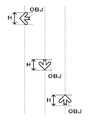
更に、目標オブジェクトOBJの形状は、一例であり、他の形状であってもよい。例えば、画像生成部220は、図3B~図3Dに示すような他の形状の目標オブジェクトOBJを生成して、移動表示させてもよい。
そして、画像処理部108が、このような画像生成部220として機能しうる。
なお、各目標オブジェクトOBJの移動等は、処理制御部240(後述するオブジェクト制御部241)によって制御される。つまり、各目標オブジェクトOBJの移動レーンLaの下端(起点)からの出現、移動レーンLa上の移動、及び、移動レーンLaの上端(終点)からの消滅が適宜制御される。そして、プレイヤには、いずれかの目標オブジェクトOBJ(複数の場合もあり)が判定エリアHA(目標オブジェクトOBJと同じ形状のオブジェクトを固定して配置したエリア)に到達したタイミングにて、そのオブジェクトの種類(矢印の向き)に対応したボタンの押下が要求される。つまり、判定エリアHAにてオブジェクト同士がピッタリ重なったタイミングにて、対応するボタンの押下が求められている。
ところで、図3Aのゲーム画像では、目標オブジェクトOBJが画面の下方から上方へ移動する場合を示しているが、目標オブジェクトOBJの移動方向はこれに限られず任意である。例えば、画面の上方から下方へ移動させてもよく、他にも、横方向(画面の右側から左側、又は、画面の左側から右側)等へ移動させてもよい。また、判定エリアHAの代わりに、移動レーンLaと直交する判定ラインを表示し、判定のエリアとして用いてもよい。また、移動レーンLaは、ゲーム画像において非表示としてもよい。
更に、目標オブジェクトOBJの形状は、一例であり、他の形状であってもよい。例えば、画像生成部220は、図3B~図3Dに示すような他の形状の目標オブジェクトOBJを生成して、移動表示させてもよい。
そして、画像処理部108が、このような画像生成部220として機能しうる。
図2に戻って、操作受付部230は、プレイヤによる各種操作を受け付ける。
例えば、操作受付部230は、音楽ゲームの各種モードを設定(変更)するための操作を受け付ける。具体的には、幼児や全くのゲーム初心者が音楽ゲームをプレイする場合に好適な「幼児モード」や、通常のプレイヤ用の「通常モード」等を設定するための操作を受け付ける。
また、操作受付部230は、音楽ゲームが開始した後に、プレイヤによりなされるボタン操作を順次受け付ける。つまり、上述した図3Aのようなゲーム画像が表示されるプレイ中において、プレイヤは、演奏される楽曲に応じて移動する目標オブジェクトOBJを目で追いながら、判定エリアHAに到達するのを見計らって、そのオブジェクトの種類(矢印の向き)に応じたボタンを押下することになる。そのため、操作受付部230は、このようなプレイヤのボタン操作を順次受け付ける。
そして、操作受付部230は、このようなボタン操作を受け付けると、その内容(どのボタンが押下されたのか等)を示す操作情報を、処理制御部240に供給する。
なお、上述したコントローラ105が、このような操作受付部230として機能しうる。
例えば、操作受付部230は、音楽ゲームの各種モードを設定(変更)するための操作を受け付ける。具体的には、幼児や全くのゲーム初心者が音楽ゲームをプレイする場合に好適な「幼児モード」や、通常のプレイヤ用の「通常モード」等を設定するための操作を受け付ける。
また、操作受付部230は、音楽ゲームが開始した後に、プレイヤによりなされるボタン操作を順次受け付ける。つまり、上述した図3Aのようなゲーム画像が表示されるプレイ中において、プレイヤは、演奏される楽曲に応じて移動する目標オブジェクトOBJを目で追いながら、判定エリアHAに到達するのを見計らって、そのオブジェクトの種類(矢印の向き)に応じたボタンを押下することになる。そのため、操作受付部230は、このようなプレイヤのボタン操作を順次受け付ける。
そして、操作受付部230は、このようなボタン操作を受け付けると、その内容(どのボタンが押下されたのか等)を示す操作情報を、処理制御部240に供給する。
なお、上述したコントローラ105が、このような操作受付部230として機能しうる。
処理制御部240は、ゲーム装置200全体を制御する。つまり、画像生成部220を制御してゲーム画像等を生成させ、また、楽曲再生部260を制御して、音楽ゲームの伴奏となる楽曲音を再生させる。そして、ゲーム中になされるプレイヤの操作を評価する。
具体的に処理制御部240は、オブジェクト制御部241、算定部242、及び、評価部243を含んで構成される。
具体的に処理制御部240は、オブジェクト制御部241、算定部242、及び、評価部243を含んで構成される。
オブジェクト制御部241は、音楽ゲームのプレイ中において、楽曲のリズム等と同調するように、所定のオブジェクトを移動させて表示する。具体的にオブジェクト制御部241は、上述した図3Aのゲーム画像に示すように、目標オブジェクトOBJを、移動レーンLaの起点(画面の下方)から出現させ、その移動レーンLa上を楽曲のリズム等に合わせて終点(画面の上方)に向けて移動させる。そして、移動レーンLaの終点まで移動した目標オブジェクトOBJを、ゲーム画像から消去する(消滅させる)。
算定部242は、移動させるオブジェクトの有効幅を算定する。例えば、上述した図3Aのゲーム画像における各目標オブジェクトOBJについて、プレイヤの操作の成否を評価するための有効幅を算定する。
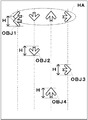
具体的には、上述した「通常モード」において、算定部242は、図4Aに示すように、目標オブジェクトOBJの高さの範囲を、そのまま有効幅Hとして算定する。
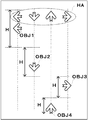
一方、上述した「幼児モード」において、算定部242は、位置が前後する他の2つの目標オブジェクトOBJとの間隔(移動レーンLaに沿った垂直方向の間隔)をそれぞれ半分に区切った2地点を求め、これら2地点の範囲を有効幅として算定する。一例として、図4Bに示す目標オブジェクトOBJ1の有効幅を求める場合について説明すると、算定部242は、直前の(直上の)目標オブジェクトOBJ0との間隔を半分に区切った地点P1を求め、また、直後の(直下の)目標オブジェクトOBJ2との間隔を半分に区切った地点P2を求める。そして、これら地点P1-P2間を結ぶ範囲を、有効幅Hとして算定する。
なお、図4Bでは、前後する2つの目標オブジェクト(OBJ0,OBJ2)が異なる種類(異なる移動レーン)のオブジェクトの場合を示しているが、直前や直後の目標オブジェクトが同じ種類(同じ移動レーン)のオブジェクトであっても、同様に、間隔を半分に区切った地点間を、有効幅として算定する。
また、間隔は、このような垂直方向の代わりに、例えば、目標オブジェクト間を直線で結んだ斜め方向の間隔であってもよい。この場合でも、斜め方向の間隔を半分に区切れば、垂直方向の間隔を区切ったものと同じになり、有効幅Hにも変わらないためである。
算定部242は、他の目標オブジェクトについても、同様にして有効幅をそれぞれ算定する。
具体的には、上述した「通常モード」において、算定部242は、図4Aに示すように、目標オブジェクトOBJの高さの範囲を、そのまま有効幅Hとして算定する。
一方、上述した「幼児モード」において、算定部242は、位置が前後する他の2つの目標オブジェクトOBJとの間隔(移動レーンLaに沿った垂直方向の間隔)をそれぞれ半分に区切った2地点を求め、これら2地点の範囲を有効幅として算定する。一例として、図4Bに示す目標オブジェクトOBJ1の有効幅を求める場合について説明すると、算定部242は、直前の(直上の)目標オブジェクトOBJ0との間隔を半分に区切った地点P1を求め、また、直後の(直下の)目標オブジェクトOBJ2との間隔を半分に区切った地点P2を求める。そして、これら地点P1-P2間を結ぶ範囲を、有効幅Hとして算定する。
なお、図4Bでは、前後する2つの目標オブジェクト(OBJ0,OBJ2)が異なる種類(異なる移動レーン)のオブジェクトの場合を示しているが、直前や直後の目標オブジェクトが同じ種類(同じ移動レーン)のオブジェクトであっても、同様に、間隔を半分に区切った地点間を、有効幅として算定する。
また、間隔は、このような垂直方向の代わりに、例えば、目標オブジェクト間を直線で結んだ斜め方向の間隔であってもよい。この場合でも、斜め方向の間隔を半分に区切れば、垂直方向の間隔を区切ったものと同じになり、有効幅Hにも変わらないためである。
算定部242は、他の目標オブジェクトについても、同様にして有効幅をそれぞれ算定する。
図2に戻って、評価部243は、プレイヤの操作を受け付けたタイミングにて、目標オブジェクトの算定された有効幅に対応する領域と、判定エリアとの位置関係に基づいて、その操作を評価する。
つまり、評価部243は、プレイヤのボタン操作を受け付けた際に、そのボタン操作に対応する目標オブジェクトの有効幅に対応する領域内に、判定エリアの位置が含まれる(重なる)かどうかによって、プレイヤの操作を評価する。
例えば、今回受け付けたボタン操作に対応する目標オブジェクトの現在位置を基準として、有効幅に対応する領域を求める。そして、その領域が、判定エリアと重なっている場合に、評価部243は、プレイヤの操作を「有効な操作」と評価する。なお、求めた領域(目標オブジェクトの有効幅に対応する領域)が、判定エリアと重なっていない場合に、評価部243は、プレイヤの操作を「無効な操作」と評価する。
つまり、評価部243は、プレイヤのボタン操作を受け付けた際に、そのボタン操作に対応する目標オブジェクトの有効幅に対応する領域内に、判定エリアの位置が含まれる(重なる)かどうかによって、プレイヤの操作を評価する。
例えば、今回受け付けたボタン操作に対応する目標オブジェクトの現在位置を基準として、有効幅に対応する領域を求める。そして、その領域が、判定エリアと重なっている場合に、評価部243は、プレイヤの操作を「有効な操作」と評価する。なお、求めた領域(目標オブジェクトの有効幅に対応する領域)が、判定エリアと重なっていない場合に、評価部243は、プレイヤの操作を「無効な操作」と評価する。
具体的に評価部243は、上述した「一般モード」時において、ボタン操作を受け付けたタイミングが、図5Aに示す状況であったとする。この状況では、ボタン操作が目標オブジェクトOBJ1に対するものであれば、その有効幅Hに対応する領域が判定エリアHAと重なっているため、評価部243は、「有効な操作」と評価する。なお、ボタン操作が他の目標オブジェクト(目標オブジェクトOBJ2~4)に対するものであれば、何れの有効幅Hに対応する領域も、判定エリアHAと重ならないため、評価部243は、「無効な操作」と評価する。
一方、上述した「幼児モード」時において、ボタン操作を受け付けたタイミングが、図5Bに示す状況であったとする。この状況では、ボタン操作が目標オブジェクトOBJ1に対するものであれば、その有効幅Hに対応する領域が判定エリアHAと重なっているため、評価部243は、「有効な操作」と評価する。なお、この場合でも、ボタン操作が他の目標オブジェクト(目標オブジェクトOBJ2~4)に対するものであれば、何れの有効幅Hに対応する領域も、判定エリアHAと重ならないため、評価部243は、「無効な操作」と評価する。
ここで、図5Aの「一般モード」における有効幅Hと、図5Bの「幼児モード」における有効幅Hとを比較すると、「幼児モード」の方が、前後する他の目標オブジェクトとの間隔に応じて広くなっている。しかも、「幼児モード」の有効幅Hは、時間軸(移動軸)に沿って、隙間無く設定されている。そのため、「幼児モード」の場合では、どの時点においても、何れかの目標オブジェクトについて、その有効幅Hに対応する領域が判定エリアHAと重なることになる。そのため、ボタン操作さえ間違えなければ、操作のタイミングがずれた場合でも、有効な操作と評価される割合が高くなる。
すなわち、図5Bの状況を一例とすると、ボタン操作が目標オブジェクトOBJ1に対するものであれば、その操作タイミングが早すぎたり、逆に、遅すぎたりしても、他の目標オブジェクトOBJ2との間隔の中間を超えない限りにおいて、「有効な操作」と評価されることになる。
そして、上述したCPU 101が、このような構成からなる処理制御部240として機能しうる。
一方、上述した「幼児モード」時において、ボタン操作を受け付けたタイミングが、図5Bに示す状況であったとする。この状況では、ボタン操作が目標オブジェクトOBJ1に対するものであれば、その有効幅Hに対応する領域が判定エリアHAと重なっているため、評価部243は、「有効な操作」と評価する。なお、この場合でも、ボタン操作が他の目標オブジェクト(目標オブジェクトOBJ2~4)に対するものであれば、何れの有効幅Hに対応する領域も、判定エリアHAと重ならないため、評価部243は、「無効な操作」と評価する。
ここで、図5Aの「一般モード」における有効幅Hと、図5Bの「幼児モード」における有効幅Hとを比較すると、「幼児モード」の方が、前後する他の目標オブジェクトとの間隔に応じて広くなっている。しかも、「幼児モード」の有効幅Hは、時間軸(移動軸)に沿って、隙間無く設定されている。そのため、「幼児モード」の場合では、どの時点においても、何れかの目標オブジェクトについて、その有効幅Hに対応する領域が判定エリアHAと重なることになる。そのため、ボタン操作さえ間違えなければ、操作のタイミングがずれた場合でも、有効な操作と評価される割合が高くなる。
すなわち、図5Bの状況を一例とすると、ボタン操作が目標オブジェクトOBJ1に対するものであれば、その操作タイミングが早すぎたり、逆に、遅すぎたりしても、他の目標オブジェクトOBJ2との間隔の中間を超えない限りにおいて、「有効な操作」と評価されることになる。
そして、上述したCPU 101が、このような構成からなる処理制御部240として機能しうる。
図2に戻って、楽曲情報記憶部250は、音楽ゲームの伴奏として演奏される楽曲情報を複数記憶する。例えば、MIDI(Musical Instrument Digital Interface)データのような所定形式の楽曲情報を記憶する。そして、プレイヤは、好みの楽曲を選んで、その再生音(楽曲音)に合わせて音楽ゲームをプレイできるようになっている。
また、楽曲情報記憶部250は、各楽曲について、リズム(テンポ)や再生時間等のような楽曲の関連情報も記憶している。
なお、上述したDVD-ROMドライブ107に装着されるDVD-ROM及び、RAM 103が、このような楽曲情報記憶部250として機能しうる。
また、楽曲情報記憶部250は、各楽曲について、リズム(テンポ)や再生時間等のような楽曲の関連情報も記憶している。
なお、上述したDVD-ROMドライブ107に装着されるDVD-ROM及び、RAM 103が、このような楽曲情報記憶部250として機能しうる。
楽曲再生部260は、処理制御部240に制御され、音楽ゲームの楽曲音を再生する。
例えば、楽曲再生部260は、ゲーム開始前(プレイ前)に、プレイヤによって選曲された楽曲情報を楽曲情報記憶部250から読み出しておき、ゲーム開始後(プレイ中)に、この楽曲情報を再生して楽曲音を出力する。
なお、楽曲の再生手法はこれに限られず任意である。例えば、楽曲情報を、プレイ中に順次読み出しながら再生するようにしてもよい。
そして、上述した音声処理部109が、このような楽曲再生部260として機能しうる。
例えば、楽曲再生部260は、ゲーム開始前(プレイ前)に、プレイヤによって選曲された楽曲情報を楽曲情報記憶部250から読み出しておき、ゲーム開始後(プレイ中)に、この楽曲情報を再生して楽曲音を出力する。
なお、楽曲の再生手法はこれに限られず任意である。例えば、楽曲情報を、プレイ中に順次読み出しながら再生するようにしてもよい。
そして、上述した音声処理部109が、このような楽曲再生部260として機能しうる。
(ゲーム装置の動作の概要)
以下、このような構成のゲーム装置200の動作について図面を参照して説明する。一例として、上述した「幼児モード」時におけるゲーム装置の動作について、図6等を参照して説明する。この図6は、音楽ゲームのプレイ中に実行される操作評価処理の流れを示すフローチャートである。この操作評価処理は、音楽ゲームの開始に伴って実行される。
以下、このような構成のゲーム装置200の動作について図面を参照して説明する。一例として、上述した「幼児モード」時におけるゲーム装置の動作について、図6等を参照して説明する。この図6は、音楽ゲームのプレイ中に実行される操作評価処理の流れを示すフローチャートである。この操作評価処理は、音楽ゲームの開始に伴って実行される。
まず、ゲーム装置200は、楽曲の再生を開始し、また、ゲーム画像の生成を開始する(ステップS301)。
つまり、楽曲再生部260は、プレイヤにて選択された楽曲情報を楽曲情報記憶部250から読み出して楽曲音を再生する。また、画像生成部220は、ゲーム画像を構成する種々のオブジェクトをオブジェクト情報記憶部210から読み出し、上述した図3Aに示すようなゲーム画像を生成する。
つまり、楽曲再生部260は、プレイヤにて選択された楽曲情報を楽曲情報記憶部250から読み出して楽曲音を再生する。また、画像生成部220は、ゲーム画像を構成する種々のオブジェクトをオブジェクト情報記憶部210から読み出し、上述した図3Aに示すようなゲーム画像を生成する。
ゲーム装置200は、再生する楽曲に合わせて目標オブジェクトを移動させる(ステップS302)。
つまり、処理制御部240は、再生する楽曲のリズム等と同調するように、目標オブジェクトを移動させて表示する。具体的にオブジェクト制御部241は、上述した図3Aのゲーム画像に示すように、目標オブジェクトOBJを、移動レーンLaの起点から出現させ、その移動レーンLa上を楽曲のリズム等に合わせて終点に向けて移動させる。そして、移動レーンLaの終点まで移動した目標オブジェクトOBJを、ゲーム画像から消去する。
つまり、処理制御部240は、再生する楽曲のリズム等と同調するように、目標オブジェクトを移動させて表示する。具体的にオブジェクト制御部241は、上述した図3Aのゲーム画像に示すように、目標オブジェクトOBJを、移動レーンLaの起点から出現させ、その移動レーンLa上を楽曲のリズム等に合わせて終点に向けて移動させる。そして、移動レーンLaの終点まで移動した目標オブジェクトOBJを、ゲーム画像から消去する。
ゲーム装置200は、各目標オブジェクトについて、現在位置を基準とした有効幅を算定する(ステップS303)。
つまり、処理制御部240は、移動している各目標オブジェクトについて、プレイヤの操作の成否を評価するための有効幅を算定する。すなわち、算定部242は、位置が前後する他の2つの目標オブジェクトとの間隔をそれぞれ半分に区切った2地点を求め、この2地点を結ぶ範囲を有効幅として算定する。
より詳細には、上述した図4Bにて目標オブジェクトOBJ1の有効幅を算定する場合に、算定部242は、直前の目標オブジェクトOBJ0との間隔を半分に区切った地点P1と、直後の目標オブジェクトOBJ2との間隔を半分に区切った地点P2とを求める。そして、これら地点P1-P2間を結ぶ範囲を有効幅Hとして算定する。
つまり、処理制御部240は、移動している各目標オブジェクトについて、プレイヤの操作の成否を評価するための有効幅を算定する。すなわち、算定部242は、位置が前後する他の2つの目標オブジェクトとの間隔をそれぞれ半分に区切った2地点を求め、この2地点を結ぶ範囲を有効幅として算定する。
より詳細には、上述した図4Bにて目標オブジェクトOBJ1の有効幅を算定する場合に、算定部242は、直前の目標オブジェクトOBJ0との間隔を半分に区切った地点P1と、直後の目標オブジェクトOBJ2との間隔を半分に区切った地点P2とを求める。そして、これら地点P1-P2間を結ぶ範囲を有効幅Hとして算定する。
ここで、上述した図3Aに示すようなゲーム画像が表示されている状況で、一般的なプレイヤは、移動する各目標オブジェクトOBJを目で追いながら、何れかの(複数の場合もあり)目標オブジェクトOBJが判定エリアHAに到達したタイミングを見計らって、対応するボタンの押下(ボタン操作)を行うことになる。
それでも、幼児等がプレイする場合では、ゲームの要領を十分に理解していない場合が多いため、このようなボタン操作のタイミングが前後に大きくずれることが多い。
そのため、幼児等がプレイする場合、ゲーム装置200は、このようなタイミングが大きくずれたボタン操作を順次受け付けることになる。
それでも、幼児等がプレイする場合では、ゲームの要領を十分に理解していない場合が多いため、このようなボタン操作のタイミングが前後に大きくずれることが多い。
そのため、幼児等がプレイする場合、ゲーム装置200は、このようなタイミングが大きくずれたボタン操作を順次受け付けることになる。
ゲーム装置200は、プレイヤの操作があったか否かを判別する(ステップS304)。つまり、操作受付部230にて、プレイヤのボタン操作を受け付けたかどうかを判別する。
ゲーム装置200は、プレイヤの操作がなかったと判別すると(ステップS304;No)、後述するステップS309に処理を進める。
ゲーム装置200は、プレイヤの操作がなかったと判別すると(ステップS304;No)、後述するステップS309に処理を進める。
一方、プレイヤの操作があったと判別した場合(ステップS304;Yes)、ゲーム装置200は、対応する目標オブジェクトについて、有効幅に対応する領域を求める(ステップS305)。
すなわち、評価部243は、操作受付部230にて受け付けたボタン操作(押下されたボタン)に対応する目標オブジェクトの現在位置を基準として、有効幅に対応する領域を求める。
すなわち、評価部243は、操作受付部230にて受け付けたボタン操作(押下されたボタン)に対応する目標オブジェクトの現在位置を基準として、有効幅に対応する領域を求める。
ゲーム装置200は、求めた領域が判定エリアと重なるか否かを判別する(ステップS306)。
具体的に評価部243は、上述した図5Bに示すような状況で、ボタン操作が目標オブジェクトOBJ1に対するものであれば、その有効幅Hに対応する領域が、判定エリアHAと重なるかどうかを判別する。
具体的に評価部243は、上述した図5Bに示すような状況で、ボタン操作が目標オブジェクトOBJ1に対するものであれば、その有効幅Hに対応する領域が、判定エリアHAと重なるかどうかを判別する。
ゲーム装置200は、求めた領域が判定エリアと重なっていないと判別すると(ステップS306;No)、誤操作数を加算すると共に、アナウンス画像を表示する(ステップS307)。
つまり、ゲーム装置200は、プレイヤの操作したボタンが正しくないため、誤操作の数を加算し、その誤操作を報知するアナウンス画像をゲーム画像に合成して表示する。
なお、ゲーム装置200は、誤操作数が規定数以上となった場合に、ゲームを途中で終了してもよい。
つまり、ゲーム装置200は、プレイヤの操作したボタンが正しくないため、誤操作の数を加算し、その誤操作を報知するアナウンス画像をゲーム画像に合成して表示する。
なお、ゲーム装置200は、誤操作数が規定数以上となった場合に、ゲームを途中で終了してもよい。
一方、求めた領域が判定エリアと重なっていると判別した場合に(ステップS306;Yes)、ゲーム装置200は、得点を加算すると共に、アナウンス画像を表示する(ステップS308)。
つまり、ゲーム装置200は、プレイヤが操作したボタンが正しいため、得点を加算し、有効操作を報知するアナウンス画像をゲーム画像に合成して表示する。
つまり、ゲーム装置200は、プレイヤが操作したボタンが正しいため、得点を加算し、有効操作を報知するアナウンス画像をゲーム画像に合成して表示する。
そして、ゲーム装置200は、ゲームが終了したかどうかを判別する(ステップS309)。つまり、1回(1曲分)の音楽ゲームが終了したかどうかを判別する。
ゲーム装置200は、ゲームが終了していないと判別すると(ステップS309;No)、上述したステップS302に処理を戻す。そして、ステップS302~S309の処理を繰り返し実行する。
一方、ゲームが終了したと判別した場合に(ステップS309;Yes)、ゲーム装置200は、所定の終了メッセージや総合得点等を表示した後、操作評価処理を終える。
ゲーム装置200は、ゲームが終了していないと判別すると(ステップS309;No)、上述したステップS302に処理を戻す。そして、ステップS302~S309の処理を繰り返し実行する。
一方、ゲームが終了したと判別した場合に(ステップS309;Yes)、ゲーム装置200は、所定の終了メッセージや総合得点等を表示した後、操作評価処理を終える。
このような操作評価処理において、上述した図5Bに示すように、各目標オブジェクトOBJの有効幅Hがそれぞれ算定され、プレイヤの操作が評価される。これら目標オブジェクトOBJの有効幅Hは、前後する他の目標オブジェクトとの間隔に応じて広くなっている。しかも、これらの有効幅Hが時間軸に沿って、隙間無く設定されている。そのため、どの時点においても、何れかの目標オブジェクトについて、その有効幅Hに対応する領域が判定エリアHAと重なることになる。そのため、ボタン操作さえ間違えなければ、操作のタイミングがずれた場合でも、有効な操作と評価される割合が高くなる。
すなわち、判定エリアHAに最も近い目標オブジェクトOBJへのボタン操作であれば、その操作タイミングが早すぎたり、逆に、遅すぎたりしても、他の目標オブジェクトOBJとの間隔の中間を超えない限りにおいて、「有効な操作」と評価されることになる。
すなわち、判定エリアHAに最も近い目標オブジェクトOBJへのボタン操作であれば、その操作タイミングが早すぎたり、逆に、遅すぎたりしても、他の目標オブジェクトOBJとの間隔の中間を超えない限りにおいて、「有効な操作」と評価されることになる。
このため、幼児等がプレイする際に、操作のタイミングがずれた場合でも、「有効な操作」と評価される割合が高くなり、面白みを感じさせることができる。しかも、単純に有効幅Hを広くするのではなく、目標オブジェクトOBJの時間軸における並びに応じて、有効幅Hも変化する。つまり、目標オブジェクト同士の間隔が離れていると有効幅が広がり、逆に、目標オブジェクト同士の間隔が近いと有効幅が狭まることになる。そのため、実際に表示される目標オブジェクトOBJの並び(難易度)に応じて、適切に評価することができる。
この結果、幼児等がプレイする場合でも、面白みを感じさせながら上達を促すことができる。
この結果、幼児等がプレイする場合でも、面白みを感じさせながら上達を促すことができる。
(他の実施形態)
上記の実施形態では、有効幅を算定する際に、各目標オブジェクトについて、位置が前後する他の2つの目標オブジェクトとの間隔をそれぞれ半分に区切った2地点を求めたが、他の目標オブジェクトとの間隔を区切る地点は、このような半分に限られず、適宜変更可能である。
例えば、プレイヤによるボタン操作のタイミングが、前にずれたり(早すぎたり)、又は、後ろにずれたり(遅すぎたり)するようなずれの傾向がある場合に、そのずれの傾向に応じて、他の目標オブジェクトとの間隔を区切る地点を変更するようにしてもよい。
以下、プレイヤによる操作タイミングのずれの傾向に応じて有効幅をシフトさせることを特徴とした本発明の他の実施形態に係るゲーム装置について、図7を参照して説明する。
上記の実施形態では、有効幅を算定する際に、各目標オブジェクトについて、位置が前後する他の2つの目標オブジェクトとの間隔をそれぞれ半分に区切った2地点を求めたが、他の目標オブジェクトとの間隔を区切る地点は、このような半分に限られず、適宜変更可能である。
例えば、プレイヤによるボタン操作のタイミングが、前にずれたり(早すぎたり)、又は、後ろにずれたり(遅すぎたり)するようなずれの傾向がある場合に、そのずれの傾向に応じて、他の目標オブジェクトとの間隔を区切る地点を変更するようにしてもよい。
以下、プレイヤによる操作タイミングのずれの傾向に応じて有効幅をシフトさせることを特徴とした本発明の他の実施形態に係るゲーム装置について、図7を参照して説明する。
図7に示すように、ゲーム装置400は、オブジェクト情報記憶部210と、画像生成部220と、操作受付部230と、処理制御部440と、楽曲情報記憶部250と、楽曲再生部260とを備える。
なお、オブジェクト情報記憶部210~操作受付部230、楽曲情報記憶部250、及び、楽曲再生部260は、上述した図2のゲーム装置200と同じ構成となっている。
なお、オブジェクト情報記憶部210~操作受付部230、楽曲情報記憶部250、及び、楽曲再生部260は、上述した図2のゲーム装置200と同じ構成となっている。
処理制御部440は、オブジェクト制御部241、算定部242、評価部243、及び、分析部441を含んで構成される。
つまり、処理制御部440は、上述した図2のゲーム装置200における処理制御部240の構成に分析部441を加えた構成となっている。
つまり、処理制御部440は、上述した図2のゲーム装置200における処理制御部240の構成に分析部441を加えた構成となっている。
分析部441は、評価部243の行ったボタン操作を集計し、プレイヤの操作タイミングにおける前後方向のずれ(早い/遅い)を分析する。
一例として、分析部441は、「有効な操作」と評価された際に、判定エリアに対する目標オブジェクトの表示位置から、プレイヤのボタン操作のタイミングが前にずれているのか後ろにずれているのかを判別して集計する。なお、「無効な操作」と評価された際に、前後にプレイヤが操作した目標オブジェクトがある場合に限り(完全な押し間違えの場合を除くため)、その前後関係から、プレイヤのボタン操作のタイミングが前にずれているのか後ろにずれているのかを判別して集計してもよい。
そして、所定数の集計結果から、前にずれている傾向や、後ろにずれている傾向が高いと判断される場合に、分析部441は、ずれの傾向の情報を算定部242に供給する。
一例として、分析部441は、「有効な操作」と評価された際に、判定エリアに対する目標オブジェクトの表示位置から、プレイヤのボタン操作のタイミングが前にずれているのか後ろにずれているのかを判別して集計する。なお、「無効な操作」と評価された際に、前後にプレイヤが操作した目標オブジェクトがある場合に限り(完全な押し間違えの場合を除くため)、その前後関係から、プレイヤのボタン操作のタイミングが前にずれているのか後ろにずれているのかを判別して集計してもよい。
そして、所定数の集計結果から、前にずれている傾向や、後ろにずれている傾向が高いと判断される場合に、分析部441は、ずれの傾向の情報を算定部242に供給する。
ずれの傾向の情報を受信した算定部242は、そのずれの傾向に応じて、有効幅をシフトさせる。つまり、ずれの傾向に応じて、他の目標オブジェクトとの間隔を区切る地点を中間より前後に移動させる。
具体的に説明すると、前にずれる傾向が高い場合に、算定部242は、図8Aに示すように、目標オブジェクトOBJ1の直前の目標オブジェクトOBJ0との間隔を3:1の比率で区切った地点P1と、直後の目標オブジェクトOBJ2との間隔を3:1の比率で区切った地点P2と求める。そして、これらP1-P2間を結ぶ範囲を有効幅Hとして算定する。
一方、後ろにずれる傾向が高い場合に、算定部242は、図8Bに示すように、目標オブジェクトOBJ1の直前の目標オブジェクトOBJ0との間隔を1:3の比率で区切った地点P3と、直後の目標オブジェクトOBJ2との間隔を1:3の比率で区切った地点P4と求める。そして、これらP3-P4間を結ぶ範囲を有効幅Hとして算定する。
なお、これら「3:1」や「1:3」の比率は、一例であり、適宜変更可能である。
具体的に説明すると、前にずれる傾向が高い場合に、算定部242は、図8Aに示すように、目標オブジェクトOBJ1の直前の目標オブジェクトOBJ0との間隔を3:1の比率で区切った地点P1と、直後の目標オブジェクトOBJ2との間隔を3:1の比率で区切った地点P2と求める。そして、これらP1-P2間を結ぶ範囲を有効幅Hとして算定する。
一方、後ろにずれる傾向が高い場合に、算定部242は、図8Bに示すように、目標オブジェクトOBJ1の直前の目標オブジェクトOBJ0との間隔を1:3の比率で区切った地点P3と、直後の目標オブジェクトOBJ2との間隔を1:3の比率で区切った地点P4と求める。そして、これらP3-P4間を結ぶ範囲を有効幅Hとして算定する。
なお、これら「3:1」や「1:3」の比率は、一例であり、適宜変更可能である。
この場合、ボタン操作のタイミングがずれる傾向を得て、その傾向の高い方(前方又は後方)へ有効幅をシフトさせた後に、プレイヤのボタン操作を評価するため、「有効な操作」と評価される割合を高くすることができる。
なお、所定数の集計結果から、ずれの傾向を判断する代わりに、直前のボタン操作のタイミングが所定の基準値よりも早い(遅い)場合に、直ちに有効幅をシフトさせてもよい。その際、操作タイミングのずれ時間をオフセットとして、有効幅をシフトさせてもよい。
なお、所定数の集計結果から、ずれの傾向を判断する代わりに、直前のボタン操作のタイミングが所定の基準値よりも早い(遅い)場合に、直ちに有効幅をシフトさせてもよい。その際、操作タイミングのずれ時間をオフセットとして、有効幅をシフトさせてもよい。
上記の実施形態では、評価を終えた目標オブジェクトについて特に考慮していないが、評価を終えた目標オブジェクトを対象から外すようにしてもよい。
例えば、評価を終えた目標オブジェクトの有効幅を、直後(直下)の目標オブジェクトに加えるようにして、次に対象となる目標オブジェクトの有効幅を伸張させてもよい。
具体的には、図9Aに示す状態で、プレイヤのボタン操作が行われると、そのボタン操作が、目標オブジェクトOBJ1に対するものであるかどうかが判別され、評価される。このように、評価を終えた目標オブジェクトOBJ1の有効幅は、消去される。
そして、算定部242は、図9Bに示すように、目標オブジェクトOBJ2の有効幅Hを、目標オブジェクトOBJ1の元の有効幅まで含めるように伸張する。
例えば、評価を終えた目標オブジェクトの有効幅を、直後(直下)の目標オブジェクトに加えるようにして、次に対象となる目標オブジェクトの有効幅を伸張させてもよい。
具体的には、図9Aに示す状態で、プレイヤのボタン操作が行われると、そのボタン操作が、目標オブジェクトOBJ1に対するものであるかどうかが判別され、評価される。このように、評価を終えた目標オブジェクトOBJ1の有効幅は、消去される。
そして、算定部242は、図9Bに示すように、目標オブジェクトOBJ2の有効幅Hを、目標オブジェクトOBJ1の元の有効幅まで含めるように伸張する。
この場合、評価を終えた目標オブジェクトを再び対象とせずに、次の目標オブジェクトの有効幅に含めて伸張させた後に、プレイヤのボタン操作を評価するため、「有効な操作」と評価される割合を高くすることができる。
上記の実施形態では、プレイヤによる操作に応じて、評価を行う場合について説明した。この場合、プレイヤが操作を行わない状況では、評価がなされないことになる。そのため、プレイヤの操作がなされない状況も考慮して、判定エリアに最も近い目標オブジェクトについて、終点まで移動する(消滅する)間における操作の有無を並行して判定するようにしてもよい。また、操作があっても、「無効な操作」と評価された場合では、引き続き、終点まで移動する間に、新たな操作の評価を繰り返してもよい。そして、終点まで移動したり、「有効な操作」と評価されると、次の(直下の)目標オブジェクトが評価の対象となる。
つまり、次の目標オブジェクトに対象が移るまで、判定を順次続けるようにしてもよい。
つまり、次の目標オブジェクトに対象が移るまで、判定を順次続けるようにしてもよい。
上記の実施形態では、プレイヤの操作が一度に1つずつ行われる場合について説明したが、2つの(複数の)目標オブジェクトが、同時に判定エリアに到達するような場合には、プレイヤに同時押し(複数のボタンの同時操作)が求められる。
このような状況では、2つの目標オブジェクトについて、それぞれ同じ有効幅が算定され、プレイヤが同時押しを行った際に、処理制御部240は、各操作について、上記と同様に評価を行う。
なお、同時押しが求められていない状況で、プレイヤが同時押しを行った場合には、どちらか一方でも、「有効な操作」と評価されるならば、同時押し自体も、「有効な操作」と評価するようにしてもよい。
このような状況では、2つの目標オブジェクトについて、それぞれ同じ有効幅が算定され、プレイヤが同時押しを行った際に、処理制御部240は、各操作について、上記と同様に評価を行う。
なお、同時押しが求められていない状況で、プレイヤが同時押しを行った場合には、どちらか一方でも、「有効な操作」と評価されるならば、同時押し自体も、「有効な操作」と評価するようにしてもよい。
上記の実施形態では、プレイヤがコントローラ105等を操作する場合について説明したが、プレイヤの操作は、このようなコントローラのボタン操作に限られず任意である。例えば、市販のゲーム用マットを用いて、プレイヤの操作がマットの踏み動作により行われる場合でも、同様にプレイヤの操作を評価することができる。
なお、本願については、日本国特許願 特願2008-289006号 を基礎とする優先権を主張し、当該基礎出願の内容をすべて本願にとりこむものとする。
以上説明したように、本発明によれば、幼児等がプレイする場合でも、面白みを感じさせながら上達を促すことを可能とするゲーム装置、操作評価方法、情報記録媒体、および、プログラムを提供できる。
100 情報処理装置
101 CPU
102 ROM
103 RAM
104 インターフェース
105 コントローラ
106 外部メモリ
107 DVD-ROMドライブ
108 画像処理部
109 音声処理部
110 NIC
200,400 ゲーム装置
210 オブジェクト情報記憶部
220 画像生成部
230 操作受付部
240,440 処理制御部
250 楽曲情報記憶部
260 楽曲再生部
101 CPU
102 ROM
103 RAM
104 インターフェース
105 コントローラ
106 外部メモリ
107 DVD-ROMドライブ
108 画像処理部
109 音声処理部
110 NIC
200,400 ゲーム装置
210 オブジェクト情報記憶部
220 画像生成部
230 操作受付部
240,440 処理制御部
250 楽曲情報記憶部
260 楽曲再生部
Claims (7)
- 画面に移動表示される目標オブジェクトに対してなされるプレイヤの操作を評価するゲーム装置であって、
目標オブジェクトの移動経路と当該移動経路上の判定エリアとが規定されたゲーム画像を生成する画像生成部(220)と、
目標オブジェクトを当該移動経路の起点から順次出現させ、出現させた目標オブジェクトを当該移動経路の終点に向けてそれぞれ移動させるオブジェクト制御部(241)と、
各目標オブジェクトのそれぞれについて、他の目標オブジェクトとの間隔に応じた有効幅を算定する算定部(242)と、
何れかの目標オブジェクトに対してなされるプレイヤの操作を受け付ける操作受付部(230)と、
受け付けた当該操作に応答して、目標オブジェクトの現在位置を基準とした当該有効幅の領域に、規定された当該判定エリアが含まれるか否かに基づいて、プレイヤの操作を評価する評価部(243)と、を備える、
ことを特徴とするゲーム装置。 - 請求項1に記載されたゲーム装置であって、
前記算定部(242)は、各目標オブジェクトについて、前後する他の2つの目標オブジェクトとの間隔をそれぞれ所定の割合で区切った2地点を求め、当該2地点間の範囲を有効幅として算定する、
ことを特徴とするゲーム装置。 - 請求項1に記載されたゲーム装置であって、
評価されたプレイヤの操作を集計し、操作タイミングにおける前後方向のずれを分析する分析部(441)を更に備え、
前記算定部(242)は、各目標オブジェクトについて、前後する他の2つの目標オブジェクトとの間隔を、分析された前後方向のずれに応じた比率で区切った2地点を求め、当該2地点間の範囲を有効幅として算定する、
ことを特徴とするゲーム装置。 - 請求項1に記載されたゲーム装置であって、
前記算定部(242)は、評価を終えた目標オブジェクトの次の目標オブジェクトについて、当該評価を終えた目標オブジェクトの有効幅を含めるように伸張させた有効幅を算定する、
ことを特徴とするゲーム装置。 - 画像生成部(220)、オブジェクト制御部(241)、算定部(242)、操作受付部(230)、及び、評価部(243)を有するゲーム装置における操作評価方法であって、
前記画像生成部(220)が、目標オブジェクトの移動経路と当該移動経路上の判定エリアとが規定されたゲーム画像を生成する画像生成ステップと、
前記オブジェクト制御部(241)が、目標オブジェクトを当該移動経路の起点から順次出現させ、出現させた目標オブジェクトを当該移動経路の終点に向けてそれぞれ移動させるオブジェクト制御ステップと、
前記算定部(242)が、各目標オブジェクトのそれぞれについて、他の目標オブジェクトとの間隔に応じた有効幅を算定する算定ステップと、
前記操作受付部(230)が、何れかの目標オブジェクトに対してなされるプレイヤの操作を受け付ける操作受付ステップと、
前記評価部(243)が、受け付けた当該操作に応答して、目標オブジェクトの現在位置を基準とした当該有効幅の領域に、規定された当該判定エリアが含まれるか否かに基づいて、プレイヤの操作を評価する評価ステップと、を備える、
ことを特徴とする操作評価方法。 - コンピュータを、
目標オブジェクトの移動経路と当該移動経路上の判定エリアとが規定されたゲーム画像を生成する画像生成部(220)、
目標オブジェクトを当該移動経路の起点から順次出現させ、出現させた目標オブジェクトを当該移動経路の終点に向けてそれぞれ移動させるオブジェクト制御部(241)、
各目標オブジェクトのそれぞれについて、他の目標オブジェクトとの間隔に応じた有効幅を算定する算定部(242)、
何れかの目標オブジェクトに対してなされるプレイヤの操作を受け付ける操作受付部(230)、
受け付けた当該操作に応答して、目標オブジェクトの現在位置を基準とした当該有効幅の領域に、規定された当該判定エリアが含まれるか否かに基づいて、プレイヤの操作を評価する評価部(243)、
として機能させることを特徴とするプログラムを記録した情報記録媒体。 - コンピュータを、
目標オブジェクトの移動経路と当該移動経路上の判定エリアとが規定されたゲーム画像を生成する画像生成部(220)、
目標オブジェクトを当該移動経路の起点から順次出現させ、出現させた目標オブジェクトを当該移動経路の終点に向けてそれぞれ移動させるオブジェクト制御部(241)、
各目標オブジェクトのそれぞれについて、他の目標オブジェクトとの間隔に応じた有効幅を算定する算定部(242)、
何れかの目標オブジェクトに対してなされるプレイヤの操作を受け付ける操作受付部(230)、
受け付けた当該操作に応答して、目標オブジェクトの現在位置を基準とした当該有効幅の領域に、規定された当該判定エリアが含まれるか否かに基づいて、プレイヤの操作を評価する評価部(243)、
として機能させることを特徴とするプログラム。
Applications Claiming Priority (2)
| Application Number | Priority Date | Filing Date | Title |
|---|---|---|---|
| JP2008-289006 | 2008-11-11 | ||
| JP2008289006A JP4847997B2 (ja) | 2008-11-11 | 2008-11-11 | ゲーム装置、操作評価方法、および、プログラム |
Publications (1)
| Publication Number | Publication Date |
|---|---|
| WO2010055802A1 true WO2010055802A1 (ja) | 2010-05-20 |
Family
ID=42169937
Family Applications (1)
| Application Number | Title | Priority Date | Filing Date |
|---|---|---|---|
| PCT/JP2009/068888 Ceased WO2010055802A1 (ja) | 2008-11-11 | 2009-11-05 | ゲーム装置、操作評価方法、情報記録媒体、および、プログラム |
Country Status (3)
| Country | Link |
|---|---|
| JP (1) | JP4847997B2 (ja) |
| TW (1) | TW201032872A (ja) |
| WO (1) | WO2010055802A1 (ja) |
Cited By (2)
| Publication number | Priority date | Publication date | Assignee | Title |
|---|---|---|---|---|
| CN102671373A (zh) * | 2011-03-08 | 2012-09-19 | 科乐美数码娱乐株式会社 | 游戏系统及用于该游戏系统的控制方法 |
| CN116139477A (zh) * | 2022-12-16 | 2023-05-23 | 网易(杭州)网络有限公司 | 信息处理方法、装置和电子设备 |
Families Citing this family (4)
| Publication number | Priority date | Publication date | Assignee | Title |
|---|---|---|---|---|
| JP2012029763A (ja) * | 2010-07-29 | 2012-02-16 | Konami Digital Entertainment Co Ltd | ゲーム装置、ゲームシステム、ゲーム制御方法、ならびに、プログラム |
| JP6145783B1 (ja) * | 2016-02-16 | 2017-06-14 | 株式会社コナミデジタルエンタテインメント | ゲーム機及びそのコンピュータプログラム |
| JP6123059B1 (ja) | 2016-02-16 | 2017-05-10 | 株式会社コナミデジタルエンタテインメント | ゲーム機及びそのコンピュータプログラム |
| JP6864794B2 (ja) * | 2017-10-27 | 2021-04-28 | 株式会社コナミアミューズメント | ゲームシステム及びそのコンピュータプログラム |
Citations (3)
| Publication number | Priority date | Publication date | Assignee | Title |
|---|---|---|---|---|
| JP2003290543A (ja) * | 2002-04-01 | 2003-10-14 | Konami Co Ltd | ゲーム運用システム |
| JP3579042B1 (ja) * | 2003-03-28 | 2004-10-20 | コナミ株式会社 | ゲーム装置、ゲーム方法、ならびに、プログラム |
| JP2007125251A (ja) * | 2005-11-04 | 2007-05-24 | Konami Sports & Life Co Ltd | 動き情報処理システム、該システムに使用される端末装置、及び該端末装置の充電装置 |
-
2008
- 2008-11-11 JP JP2008289006A patent/JP4847997B2/ja active Active
-
2009
- 2009-11-05 WO PCT/JP2009/068888 patent/WO2010055802A1/ja not_active Ceased
- 2009-11-09 TW TW098137960A patent/TW201032872A/zh unknown
Patent Citations (3)
| Publication number | Priority date | Publication date | Assignee | Title |
|---|---|---|---|---|
| JP2003290543A (ja) * | 2002-04-01 | 2003-10-14 | Konami Co Ltd | ゲーム運用システム |
| JP3579042B1 (ja) * | 2003-03-28 | 2004-10-20 | コナミ株式会社 | ゲーム装置、ゲーム方法、ならびに、プログラム |
| JP2007125251A (ja) * | 2005-11-04 | 2007-05-24 | Konami Sports & Life Co Ltd | 動き情報処理システム、該システムに使用される端末装置、及び該端末装置の充電装置 |
Cited By (2)
| Publication number | Priority date | Publication date | Assignee | Title |
|---|---|---|---|---|
| CN102671373A (zh) * | 2011-03-08 | 2012-09-19 | 科乐美数码娱乐株式会社 | 游戏系统及用于该游戏系统的控制方法 |
| CN116139477A (zh) * | 2022-12-16 | 2023-05-23 | 网易(杭州)网络有限公司 | 信息处理方法、装置和电子设备 |
Also Published As
| Publication number | Publication date |
|---|---|
| JP4847997B2 (ja) | 2011-12-28 |
| TW201032872A (en) | 2010-09-16 |
| JP2010115257A (ja) | 2010-05-27 |
Similar Documents
| Publication | Publication Date | Title |
|---|---|---|
| JP3962059B2 (ja) | ゲーム装置、ゲーム制御方法及びプログラム | |
| JP4848000B2 (ja) | ゲーム装置、ゲーム処理方法、ならびに、プログラム | |
| JP2012208622A (ja) | 選択装置、選択方法、ならびに、プログラム | |
| JP4847997B2 (ja) | ゲーム装置、操作評価方法、および、プログラム | |
| JP3950142B2 (ja) | ゲーム装置、ゲーム制御方法及びプログラム | |
| JP5124513B2 (ja) | ゲーム装置、テンポ報知方法、および、プログラム | |
| JP2012187207A (ja) | ゲーム装置、ゲーム装置の制御方法、及びプログラム | |
| WO2010010834A1 (ja) | ゲーム装置、ゲーム制御方法、情報記録媒体、ならびに、プログラム | |
| JP2011048088A (ja) | 選択装置、選択方法、および、プログラム | |
| JP5480183B2 (ja) | ゲーム装置、画像生成方法、および、プログラム | |
| JP2011039895A (ja) | 仮想空間表示装置、視点設定方法、および、プログラム | |
| JP5189561B2 (ja) | ゲーム装置、ゲーム制御方法、及び、プログラム | |
| JP4607210B2 (ja) | 再生装置、再生方法、ならびに、プログラム | |
| JP4361592B1 (ja) | ゲーム装置、ゲーム制御方法、及び、プログラム | |
| JP5222978B2 (ja) | ゲーム装置、ゲーム装置の制御方法、ならびに、プログラム | |
| JP5535127B2 (ja) | ゲーム装置、ならびに、プログラム | |
| TWI300002B (ja) | ||
| JP5406604B2 (ja) | ゲーム装置、ゲーム制御方法、ならびに、プログラム | |
| JP6625779B1 (ja) | プログラム、情報処理装置、及び情報処理システム | |
| JP5374442B2 (ja) | ゲーム装置、進行制御方法、および、プログラム | |
| JP4071130B2 (ja) | 制御装置、キャラクタ制御方法、ならびに、プログラム | |
| JP2007175513A (ja) | ゲーム装置及び情報記憶媒体 | |
| JP5535168B2 (ja) | ゲーム装置、および、プログラム | |
| JP4825273B2 (ja) | ゲーム装置、ゲーム装置の制御方法、ならびに、プログラム | |
| JP2011024648A (ja) | ゲーム装置、ゲーム制御方法、ならびに、プログラム |
Legal Events
| Date | Code | Title | Description |
|---|---|---|---|
| 121 | Ep: the epo has been informed by wipo that ep was designated in this application |
Ref document number: 09826052 Country of ref document: EP Kind code of ref document: A1 |
|
| NENP | Non-entry into the national phase |
Ref country code: DE |
|
| 122 | Ep: pct application non-entry in european phase |
Ref document number: 09826052 Country of ref document: EP Kind code of ref document: A1 |