WO2007015396A1 - フレキシブル金属張積層板 - Google Patents
フレキシブル金属張積層板 Download PDFInfo
- Publication number
- WO2007015396A1 WO2007015396A1 PCT/JP2006/314728 JP2006314728W WO2007015396A1 WO 2007015396 A1 WO2007015396 A1 WO 2007015396A1 JP 2006314728 W JP2006314728 W JP 2006314728W WO 2007015396 A1 WO2007015396 A1 WO 2007015396A1
- Authority
- WO
- WIPO (PCT)
- Prior art keywords
- film
- polyimide film
- clad laminate
- range
- flexible metal
- Prior art date
- Legal status (The legal status is an assumption and is not a legal conclusion. Google has not performed a legal analysis and makes no representation as to the accuracy of the status listed.)
- Ceased
Links
Classifications
-
- B—PERFORMING OPERATIONS; TRANSPORTING
- B32—LAYERED PRODUCTS
- B32B—LAYERED PRODUCTS, i.e. PRODUCTS BUILT-UP OF STRATA OF FLAT OR NON-FLAT, e.g. CELLULAR OR HONEYCOMB, FORM
- B32B15/00—Layered products comprising a layer of metal
- B32B15/04—Layered products comprising a layer of metal comprising metal as the main or only constituent of a layer, which is next to another layer of the same or of a different material
- B32B15/08—Layered products comprising a layer of metal comprising metal as the main or only constituent of a layer, which is next to another layer of the same or of a different material of synthetic resin
- B32B15/088—Layered products comprising a layer of metal comprising metal as the main or only constituent of a layer, which is next to another layer of the same or of a different material of synthetic resin comprising polyamides
-
- H—ELECTRICITY
- H05—ELECTRIC TECHNIQUES NOT OTHERWISE PROVIDED FOR
- H05K—PRINTED CIRCUITS; CASINGS OR CONSTRUCTIONAL DETAILS OF ELECTRIC APPARATUS; MANUFACTURE OF ASSEMBLAGES OF ELECTRICAL COMPONENTS
- H05K1/00—Printed circuits
- H05K1/02—Details
- H05K1/03—Use of materials for the substrate
- H05K1/0313—Organic insulating material
- H05K1/032—Organic insulating material consisting of one material
- H05K1/0346—Organic insulating material consisting of one material containing N
-
- B—PERFORMING OPERATIONS; TRANSPORTING
- B32—LAYERED PRODUCTS
- B32B—LAYERED PRODUCTS, i.e. PRODUCTS BUILT-UP OF STRATA OF FLAT OR NON-FLAT, e.g. CELLULAR OR HONEYCOMB, FORM
- B32B15/00—Layered products comprising a layer of metal
- B32B15/04—Layered products comprising a layer of metal comprising metal as the main or only constituent of a layer, which is next to another layer of the same or of a different material
- B32B15/08—Layered products comprising a layer of metal comprising metal as the main or only constituent of a layer, which is next to another layer of the same or of a different material of synthetic resin
-
- C—CHEMISTRY; METALLURGY
- C08—ORGANIC MACROMOLECULAR COMPOUNDS; THEIR PREPARATION OR CHEMICAL WORKING-UP; COMPOSITIONS BASED THEREON
- C08G—MACROMOLECULAR COMPOUNDS OBTAINED OTHERWISE THAN BY REACTIONS ONLY INVOLVING UNSATURATED CARBON-TO-CARBON BONDS
- C08G73/00—Macromolecular compounds obtained by reactions forming a linkage containing nitrogen with or without oxygen or carbon in the main chain of the macromolecule, not provided for in groups C08G12/00 - C08G71/00
- C08G73/06—Polycondensates having nitrogen-containing heterocyclic rings in the main chain of the macromolecule
- C08G73/10—Polyimides; Polyester-imides; Polyamide-imides; Polyamide acids or similar polyimide precursors
- C08G73/1067—Wholly aromatic polyimides, i.e. having both tetracarboxylic and diamino moieties aromatically bound
-
- C—CHEMISTRY; METALLURGY
- C08—ORGANIC MACROMOLECULAR COMPOUNDS; THEIR PREPARATION OR CHEMICAL WORKING-UP; COMPOSITIONS BASED THEREON
- C08J—WORKING-UP; GENERAL PROCESSES OF COMPOUNDING; AFTER-TREATMENT NOT COVERED BY SUBCLASSES C08B, C08C, C08F, C08G or C08H
- C08J5/00—Manufacture of articles or shaped materials containing macromolecular substances
- C08J5/18—Manufacture of films or sheets
-
- C—CHEMISTRY; METALLURGY
- C08—ORGANIC MACROMOLECULAR COMPOUNDS; THEIR PREPARATION OR CHEMICAL WORKING-UP; COMPOSITIONS BASED THEREON
- C08L—COMPOSITIONS OF MACROMOLECULAR COMPOUNDS
- C08L79/00—Compositions of macromolecular compounds obtained by reactions forming in the main chain of the macromolecule a linkage containing nitrogen with or without oxygen or carbon only, not provided for in groups C08L61/00 - C08L77/00
- C08L79/04—Polycondensates having nitrogen-containing heterocyclic rings in the main chain; Polyhydrazides; Polyamide acids or similar polyimide precursors
- C08L79/08—Polyimides; Polyester-imides; Polyamide-imides; Polyamide acids or similar polyimide precursors
-
- C—CHEMISTRY; METALLURGY
- C23—COATING METALLIC MATERIAL; COATING MATERIAL WITH METALLIC MATERIAL; CHEMICAL SURFACE TREATMENT; DIFFUSION TREATMENT OF METALLIC MATERIAL; COATING BY VACUUM EVAPORATION, BY SPUTTERING, BY ION IMPLANTATION OR BY CHEMICAL VAPOUR DEPOSITION, IN GENERAL; INHIBITING CORROSION OF METALLIC MATERIAL OR INCRUSTATION IN GENERAL
- C23C—COATING METALLIC MATERIAL; COATING MATERIAL WITH METALLIC MATERIAL; SURFACE TREATMENT OF METALLIC MATERIAL BY DIFFUSION INTO THE SURFACE, BY CHEMICAL CONVERSION OR SUBSTITUTION; COATING BY VACUUM EVAPORATION, BY SPUTTERING, BY ION IMPLANTATION OR BY CHEMICAL VAPOUR DEPOSITION, IN GENERAL
- C23C14/00—Coating by vacuum evaporation, by sputtering or by ion implantation of the coating forming material
- C23C14/06—Coating by vacuum evaporation, by sputtering or by ion implantation of the coating forming material characterised by the coating material
- C23C14/14—Metallic material, boron or silicon
- C23C14/20—Metallic material, boron or silicon on organic substrates
- C23C14/205—Metallic material, boron or silicon on organic substrates by cathodic sputtering
-
- H—ELECTRICITY
- H05—ELECTRIC TECHNIQUES NOT OTHERWISE PROVIDED FOR
- H05K—PRINTED CIRCUITS; CASINGS OR CONSTRUCTIONAL DETAILS OF ELECTRIC APPARATUS; MANUFACTURE OF ASSEMBLAGES OF ELECTRICAL COMPONENTS
- H05K1/00—Printed circuits
- H05K1/02—Details
- H05K1/03—Use of materials for the substrate
-
- H—ELECTRICITY
- H05—ELECTRIC TECHNIQUES NOT OTHERWISE PROVIDED FOR
- H05K—PRINTED CIRCUITS; CASINGS OR CONSTRUCTIONAL DETAILS OF ELECTRIC APPARATUS; MANUFACTURE OF ASSEMBLAGES OF ELECTRICAL COMPONENTS
- H05K1/00—Printed circuits
- H05K1/02—Details
- H05K1/0213—Electrical arrangements not otherwise provided for
- H05K1/0237—High frequency adaptations
- H05K1/024—Dielectric details, e.g. changing the dielectric material around a transmission line
-
- H—ELECTRICITY
- H05—ELECTRIC TECHNIQUES NOT OTHERWISE PROVIDED FOR
- H05K—PRINTED CIRCUITS; CASINGS OR CONSTRUCTIONAL DETAILS OF ELECTRIC APPARATUS; MANUFACTURE OF ASSEMBLAGES OF ELECTRICAL COMPONENTS
- H05K1/00—Printed circuits
- H05K1/02—Details
- H05K1/03—Use of materials for the substrate
- H05K1/0393—Flexible materials
-
- H—ELECTRICITY
- H05—ELECTRIC TECHNIQUES NOT OTHERWISE PROVIDED FOR
- H05K—PRINTED CIRCUITS; CASINGS OR CONSTRUCTIONAL DETAILS OF ELECTRIC APPARATUS; MANUFACTURE OF ASSEMBLAGES OF ELECTRICAL COMPONENTS
- H05K2201/00—Indexing scheme relating to printed circuits covered by H05K1/00
- H05K2201/01—Dielectrics
- H05K2201/0137—Materials
- H05K2201/0154—Polyimide
-
- Y—GENERAL TAGGING OF NEW TECHNOLOGICAL DEVELOPMENTS; GENERAL TAGGING OF CROSS-SECTIONAL TECHNOLOGIES SPANNING OVER SEVERAL SECTIONS OF THE IPC; TECHNICAL SUBJECTS COVERED BY FORMER USPC CROSS-REFERENCE ART COLLECTIONS [XRACs] AND DIGESTS
- Y10—TECHNICAL SUBJECTS COVERED BY FORMER USPC
- Y10T—TECHNICAL SUBJECTS COVERED BY FORMER US CLASSIFICATION
- Y10T428/00—Stock material or miscellaneous articles
- Y10T428/31504—Composite [nonstructural laminate]
- Y10T428/31678—Of metal
- Y10T428/31681—Next to polyester, polyamide or polyimide [e.g., alkyd, glue, or nylon, etc.]
Definitions
- the present invention relates to a flexible metal-clad laminate in which the occurrence of defects during the formation of a conductor layer is suppressed by improving the transportability of a polyimide film.
- the flexible printed wiring board has a structure in which a circuit that also serves as a metal foil is formed on an insulating film.
- a flexible metal-clad laminate that is the basis of the flexible wiring board is generally formed of various insulating materials, and a flexible insulating film is used as a substrate, and various adhesive materials are interposed on the surface of the substrate.
- the metal foil is manufactured by a method of bonding by heating and pressure bonding.
- a polyimide film or the like is preferably used as the insulating film.
- thermosetting adhesives such as epoxy and acrylic are generally used (FPC using these thermosetting adhesives is hereinafter referred to as three-layer FPC).
- FPC FPC
- a metal layer is directly provided on an insulating film or a thermoplastic polyimide is used for an adhesive layer.
- This two-layer FPC has better characteristics than the three-layer FPC, and demand is expected to grow in the future.
- a casting method in which polyamic acid, which is a precursor of polyimide, is cast on a metal foil, applied, and then imidized, vapor deposition, sputtering, and plating are used.
- a metallizing method in which a metal layer is directly formed on a polyimide film by a method described above, or a laminating method in which a polyimide film and a metal foil are bonded via a thermoplastic polyimide.
- the casting method and the laminating method use metal foil, so that the metal foil surface irregularities are bonded in a state of being bitten into the polyimide layer.
- the metalizing method does not use metal foil, so the metal layer does not bite into the insulating layer. For this reason, it is suitable for forming fine wiring that hardly causes etching residue.
- a non-thermoplastic polyimide film is preferably used in view of various properties.
- non-thermoplastic polyimides need to be imidized under very high temperature conditions, which causes strong stress on the film.
- the obtained film is slack, it may be stretched. If the film is stretched, it is inferior in transportability, so when performing metallization in the roll-to-roll process, unevenness occurs in the formed metal layer due to the meandering of the film. Sputtering failure may occur, and the characteristics of the obtained flexible metal-clad laminate may be deteriorated.
- Patent Document 1 Japanese Patent Laid-Open No. 2004-346210
- the present invention has been made in view of the above-mentioned problems, and the object thereof is to obtain a polyimide film in which the slackening is suppressed, and the occurrence of defects during the formation of the metal layer can be suppressed. Another object is to provide a flexible metal-clad laminate.
- the storage elastic modulus at 400 ° C is 0.5 GPa to 1 .5 GPa
- a flexible metal-clad laminate characterized by satisfying all requirements.
- the flexible metal-clad laminate of the present invention uses a polyimide film with an optimized storage elastic modulus, so that the film can be prevented from slackening and the film transportability when forming a metal layer can be improved. It is possible to make it. Therefore, it is possible to suppress the occurrence of defects when forming the metal layer, and it can be suitably used for FPC for forming fine wiring.
- the film can be prevented from being stretched by the metalizing method. It is possible to effectively suppress the formation failure of the metal layer that occurs when manufacturing a laminated plate.
- the storage elastic modulus at 400 ° C is 0.5 GPa to 1 .5 GPa
- the inflection point of the storage elastic modulus will be described.
- the inflection point of the storage elastic modulus needs to be in the range of 270 to 340 ° C, preferably 290 to 320 ° C, from the viewpoint of relaxation of thermal stress in the hot stove where imidization is performed.
- the inflection point of the storage elastic modulus is lower than the above range, the heat resistance and dimensional stability upon heating of the resulting polyimide film may be lowered.
- the temperature is higher than the above range, the temperature at which softening starts is high, so that the thermal stress is not sufficiently relaxed, and the slackness of the obtained film may not be improved.
- the peak top of tan ⁇ which is a value obtained by dividing the loss elastic modulus by the storage elastic modulus, must be 320 ° C to 410 ° C or higher, preferably 330 ° C to 400 ° C. It is. If the peak top of tan ⁇ is lower than the above range, the temperature at which tan ⁇ begins to increase will be around 250 ° C or lower, and the core layer may begin to soften during dimensional change measurement. There is a possibility that the dimensional change during heating will deteriorate. On the other hand, if the peak top of tan ⁇ is higher than the above range, the temperature at which softening starts is high, so that the thermal stress is not sufficiently relaxed, and the elongation of the obtained film may not be improved.
- the storage elastic modulus force at 400 ° C is in the range of 0.5 to 1.5 GPa, preferably 0.6 to 1.3 GPa, more preferably 0.7 to 1.2 GPa. . If the storage stability at 400 ° C is lower than the above range, the film becomes too soft in the furnace and the self-supporting property is reduced. The film appearance may be deteriorated, waviness and the like may occur, and the film appearance may deteriorate. On the other hand, if it is higher than the above range, the film does not soften to a level at which thermal stress can be easily relaxed.
- the inventors of the present invention have a storage elastic modulus a (GPa) at the inflection point and storage at 400 ° C.
- the degree of decrease in storage modulus is small, so that the relaxation effect is not sufficiently exhibited, and the looseness of the resulting film is not improved.
- the film cannot maintain its self-supporting property, which causes the productivity of the film to deteriorate and the appearance of the resulting polyimide film to deteriorate.
- a polyimide film satisfying all the above four conditions is required.
- the polyimide film of the present invention can also obtain a solution strength of polyamic acid which is a precursor of polyimide.
- the polyamic acid is usually prepared by dissolving an aromatic diamine and an aromatic dianhydride in an organic solvent so as to have a substantially equal molar amount, and controlling the resulting polyamic acid organic solvent solution. And stirring under the temperature conditions until the polymerization of the acid dianhydride and diamine is completed.
- These polyamic acid solutions are usually obtained at a concentration of 5 to 35 wt%, preferably 10 to 30 wt%. When the concentration is within this range, an appropriate molecular weight and solution viscosity are obtained.
- the polyimide film of the present invention can control various physical properties by controlling not only the structure of diamine and acid dianhydride, which are raw material monomers, but also the order of monomer addition. Therefore, in order to obtain the polyimide film of the present invention, it is preferable to imidize the polyamic acid solution obtained through the following steps (a) to (c).
- Aromatic diamines that can be used include 4,4'-diaminodiphenylpropan, 4,4'-diaminodiphenylmethane, benzidine, 3,3'-dichlorobenzidine, 3,3'-dimethylbenzidine, 2 , 2'-dimethylbenzidine, 3,3'-dimethoxybenzidine, 2,2'-dimethoxybenzidine, 4,4'-diaminodiphenylsulfide, 3,3'-diaminodiphenylsulfone, 4,4'-diaminodiphenylsulfone 4,4'-diaminodiphenyl ether, 3,3'-diaminodiphenyl ether, 3,4'-diaminodiphenyl ether, 1,5-di
- the step (a) it is preferable to obtain a prepolymer that forms a block component derived from thermoplastic polyimide.
- a prepolymer that forms a block component derived from thermoplastic polyimide it is preferable to react a flexible diamine with an acid dianhydride.
- the block component derived from thermoplastic polyimide refers to a component that melts when heated to a film strength of 00 ° C. and does not maintain the shape of the film.
- the polyimide obtained by equimolar reaction of the aromatic diamine compound and aromatic acid anhydride component used in step (a) does not melt at the above temperature or maintain the shape of the film.
- the flexible diamine is a diamine having a diamine flexible structure having a flexible structure such as an ether group, a sulfone group, a ketone group, or a sulfide group, and preferably has the following general formula (1 ).
- [0027] is a divalent organic group represented by a group force selected, and R in the formula is the same or
- the polyimide film strength obtained through the above process has not yet been clarified why it exhibits high adhesion without treatment. It can be considered that the bending sites scattered in the molecular chain inhibit the formation of the surface fragile layer or have some involvement in the adhesion with the adhesive layer.
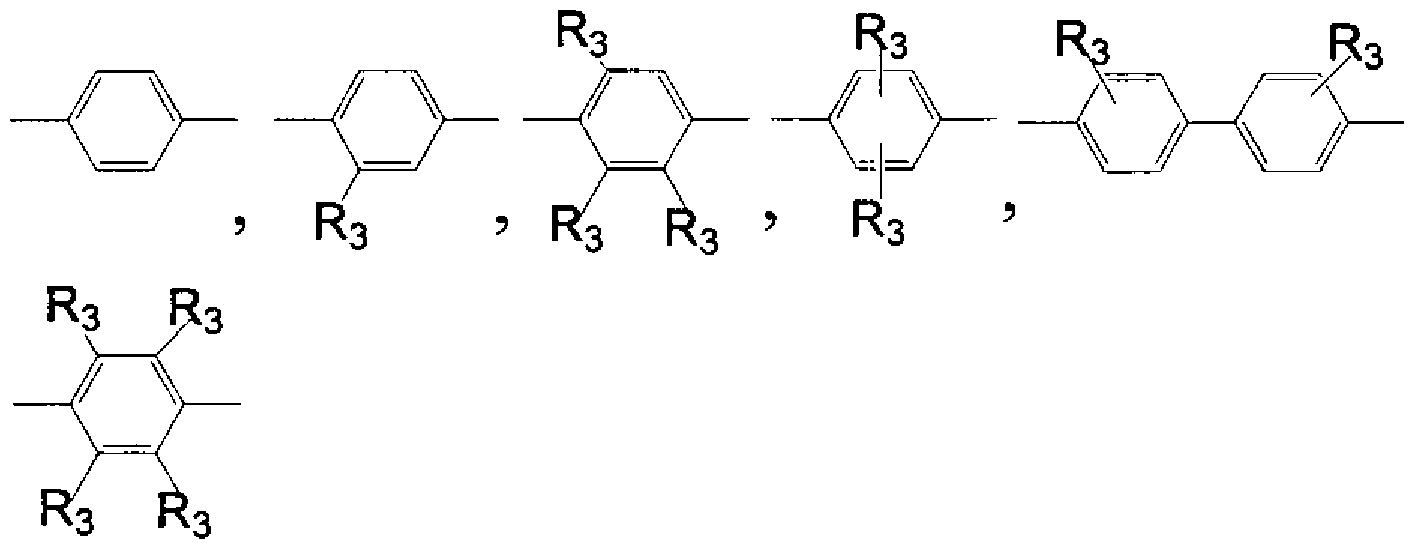
- the diamine component used in the step (b) is a rigid structure diamine, since the film finally obtained can be made non-thermoplastic.
- the jamin having a rigid structure is:
- R2 in the formula is
- the use ratio of the rigid and flexible (flexible) amines is 80:20 to 20:80, more preferably 70:30 to 30:70, especially in terms of molar ratio. Is preferably in the range of 60:40 to 40:60.
- the ratio of rigid-structured jamin exceeds the above range, the glass transition temperature of the resulting film becomes too high, and the storage elastic modulus in the high temperature region hardly decreases! ⁇ If the linear expansion coefficient becomes too small! ⁇ ⁇ There may be harmful effects. On the other hand, if it falls below this range, the opposite adverse effects may occur.
- the flexible structure and rigid structure diamine may be used in combination of two or more kinds.
- 3, 4'-diaminodiphenyl ether is used as the flexible structure diamine. It is particularly preferred.
- 3,4'-diaminodiphenyl ether Since 3,4'-diaminodiphenyl ether has only one ether bond at the bending site, it exhibits intermediate properties between the above two kinds of diamines. That is, it has the effect of reducing the storage elastic modulus, but does not increase the linear expansion coefficient so much.
- the amount of 3,4'-diaminodiphenyl ether used is preferably at least 10 mol% of the total diamine component, more preferably at least 15 mol%. If it is less than this, the above effects may not be sufficiently exhibited. On the other hand, the upper limit, preferably 50 mol% or less tool 4 0 mole 0/0 or less is more preferable. If it is more than this, the resulting polyimide film may have a low tensile elastic modulus.
- Acid dianhydrides that can be used as a raw material monomer for the polyimide film of the present invention include pyromellitic dianhydride, 2, 3, 6, 7 naphthalenetetracarboxylic dianhydride, 3, 3 ', 4 , 4'-biphenyltetracarboxylic dianhydride, 1, 2, 5, 6 naphthalenetetracarboxylic dianhydride, 2, 2 ', 3, 3'-biphenyltetracarboxylic dianhydride, 3, 3 ', 4, 4'-Benzophenone tetracarboxylic dianhydride, 2, 2', 3, 3'-benzophenone tetracarboxylic dianhydride, 4, 4 'oxyphthalic dianhydride, 3, 4 'oxyphthalic dianhydride, 2, 2 bis (3,4 dicarboxyphenol) propane dianhydride, 3, 4, 9, 10 perylene tetracarboxylic dianhydride, bis (3,4
- Acid dianhydrides are also classified into a flexible structure and a rigid structure, and the former is used in step (a) and the latter is used in step (c).
- Acid dianhydride used in step Preferred examples include benzophenone tetracarboxylic dianhydrides, oxyphthalic dianhydrides, and biphenyl tetracarboxylic dianhydrides.
- a preferred example of the acid dianhydride used in step (C) is pyromellitic dianhydride.
- the preferred amount of Le tetracarboxylic dianhydrides is 10 with respect to the total acid dianhydride 50 mole 0/0, more preferably 15 to 45 mole 0/0, particularly preferably 20 to 40 mole 0 / 0 .
- the soft transition diamine alone may cause the resulting polyimide film to have an excessively high glass transition temperature, or the storage elastic modulus in the high temperature region may not be sufficiently lowered.
- the amount is larger than the above range, the glass transition temperature may be too low, or the storage elastic modulus in the high temperature region may be too low to make film formation difficult.
- the preferred amount is 40 to: LOO mol%, more preferably 50 to 90 mol%, particularly preferably 60 to 80 mol%.
- the polyimide film according to the present invention uses the aromatic dianhydride and aromatic diamine within the above-mentioned ranges by determining the type and blending ratio, thereby obtaining a desired glass transition temperature and high temperature range.
- the tensile elastic modulus is 6. OGPa or higher 6.5, more preferably 5 GPa or higher.
- the upper limit of the tensile modulus is preferably lOGPa or less. 9. OGPa or less is more preferable. If it is larger than the above value, the stiffness may be too strong, which may cause problems in handling.
- the tensile modulus increases as the ratio of rigid structure diamine or dianhydride increases, and decreases as the ratio decreases.
- the linear expansion coefficient force of the obtained polyimide film at 100 ° C. to 200 ° C. is preferably 20 ppm mZ ° C. or less, more preferably 16 ppm Z ° C. or less.
- the lower limit of the linear expansion coefficient is preferably 7 ppmZ ° C, more preferably 9 ppmZ ° C.
- the linear expansion coefficient of the polyimide film can be adjusted by the mixing ratio of the flexible structure component and the rigid structure component.
- the preferred solvent for synthesizing the polyamic acid is a power amide-based solvent, ie, N, N-dimethylformamide, N, N-dimethylacetamide, as long as it is a solvent that dissolves the polyamic acid.
- N-methyl-2-pyrrolidone, and N, N-dimethylformamide and N, N-dimethylacetamide can be used particularly preferably.
- Fillers can also be added for the purpose of improving various film properties such as slidability, thermal conductivity, conductivity, corona resistance, and loop stiffness. Any filler may be used, but preferred examples include silica, titanium oxide, alumina, silicon nitride, boron nitride, calcium hydrogen phosphate, calcium phosphate, mica and the like.
- the particle size of the filler is not particularly limited because it is determined by the film characteristics to be modified and the type of filler to be added, but generally the average particle size is 0.05 to 100 m. It is preferably 0.1 to 75 m, more preferably 0.1 to 50 m, and particularly preferably 0.1 to 25 / ⁇ ⁇ . If the particle size is below this range, the modification effect appears. If the particle size is above this range, the surface properties may be greatly impaired, or the mechanical properties may be greatly deteriorated. Further, the number of fillers added is not particularly limited because the film characteristics to be modified are determined by the filler particle size and the like.
- the amount of filler added is 0.01 to 100 parts by weight of polyimide, LOO weight is preferably ⁇ 0.01 to 90 parts, more preferably 0.02 to 80 parts by weight. It is. If the amount of filler added is below this range, the effect of modification by the filler is difficult to appear. If this range is exceeded, the mechanical properties of the film may be greatly impaired. Filling the filler,
- a method of kneading the filler using three rolls 3.
- the method of mixing immediately before film formation is preferable because contamination by the filler in the production line is minimized.
- a dispersant, a thickener and the like can be used within a range not affecting the film physical properties.
- thermal imidization method is a method in which the imidization reaction proceeds only by heating without the action of a dehydrating ring-closing agent or the like, and the chemical imidization method acts on a polyamic acid solution by using a chemical conversion agent and Z or a catalyst. This is a method for promoting imidization.
- the chemical conversion agent means a dehydrating ring-closing agent for polyamic acid.
- aliphatic acid anhydride aromatic acid anhydride, N, N'-dialkylcarbodiimide, low halogenated grade.
- aliphatic acid anhydrides such as acetic anhydride, propionic anhydride, and latacic anhydride, or a mixture of two or more thereof can be preferably used.
- the catalyst means a component having an effect of promoting the dehydration ring-closing action on the polyamic acid, and examples thereof include aliphatic tertiary amines, aromatic tertiary amines, and heterocyclic tertiary amines. Used. Among them, those selected from heterocyclic tertiary amine forces are particularly preferably used from the viewpoint of reactivity as a catalyst. Specifically, quinoline, isoquinoline, ⁇ -picoline, pyridine and the like are preferably used.
- Either method can be used to produce a film, but imidization by the chemical imidization method makes it easier to obtain a polyimide film having various properties that are preferably used in the present invention. It is in.
- the polyimide film production process is particularly preferred.
- a curing agent containing a dehydrating agent typified by an acid anhydride such as acetic anhydride and an imido catalyst typified by a tertiary amine such as isoquinoline, ⁇ -picoline or pyridine is used. May be.
- a preferred embodiment of the present invention a chemical imidization method, will be described as an example to describe the process for producing a polyimide film.
- the present invention is not limited to the following examples.
- the film forming conditions and heating conditions can vary depending on the type of polyamic acid, the thickness of the film, and the like.
- a film forming dope is obtained by mixing a dehydrating agent and an imido catalyst in a polyamic acid solution at a low temperature.
- this film-forming dope is cast into a film on a support such as a glass plate, an aluminum foil, an endless stainless steel belt or a stainless drum, and 80 ° C to 200 ° C, preferably 100 ° C on the support.
- Heating in a temperature range of ⁇ 180 ° C partially activates the dehydrating agent and imido catalyst, and then partially hardens and Z or dries, then the support strength peels off and forms a polyamic acid film (hereinafter referred to as gel film). And get u).
- the gel film is in the middle stage of curing to polyamic acid polyimide and has a self-supporting property (formula 2)
- a and B represent the following.
- the calculated volatile content is also in the range of 5 to 500% by weight, preferably 5 to 200% by weight, more preferably 5 to 150% by weight. It is preferable to use a film in this range, and if a film not included in this range is used, problems such as film breakage, uneven color tone of the film due to uneven drying, and characteristic variations may occur during the baking process. [0054]
- a preferable amount of the dehydrating agent is 0.5 to 5 mol, preferably 1.0 to 4 mol, per 1 mol of the amic acid unit in the polyamic acid.
- the preferred amount of the imido catalyst is based on 1 mol of the amic acid unit in the polyamic acid.
- the imidity imidity may be insufficient, and may break during firing or mechanical strength may decrease. In addition, if these amounts exceed the above range, imidization proceeds too quickly, and it may be difficult to cast into a film form.
- the polyimide film having a flexible structure and a rigid structure as described above is unknown for the exact reason, but imidization is performed at a relatively low temperature compared to a general non-thermoplastic polyimide film. Since it can be completed and the thermal stress applied to the film can be reduced, it is easy to improve the appearance of the resulting film.
- heat treatment can be performed under the minimum tension necessary for transporting the film.
- This heat treatment may be performed in the film manufacturing process, or may be provided separately.
- the heating conditions vary depending on the film characteristics and the equipment used, and therefore cannot be determined in general. Generally 200 ° C to 500 ° C, preferably 250 ° C to 500 ° C, particularly preferred
- the internal stress can be relieved by heat treatment at a temperature of 300 ° C. or higher and 450 ° C. or lower for 1 to 300 seconds, preferably 2 to 250 seconds, and particularly preferably 5 to 200 seconds.
- the method and conditions for providing a metal layer on the polyimide film by a metallization method are not particularly limited, and any method of vapor deposition, sputtering, and plating may be used. Also this You can combine these methods.
- the flexible metal-clad laminate according to the present invention implements various miniaturized and high-density parts by etching a metal foil to form a desired pattern wiring. It can be used as a flexible wiring board.
- the use of the present invention is not limited to this, and it goes without saying that it can be used for various purposes as long as it is a laminate including a metal foil.
- the storage elastic modulus was measured by DMS6100 manufactured by SII Nanotechnology. The measurement was performed in the MD direction of the core film.
- Sample measurement range width 9mm, distance between grips 20mm
- the tensile modulus was measured according to ASTM D882. The measurement was performed in the MD direction of the core film.
- Sample measurement range width 15mm, distance between grips 100mm
- the amount of film slack is based on JPCA-BM01, and the polyimide film obtained in the example is hung on two rolls installed at a distance, one end is fixed, and the other end is loaded.
- the sag difference between the horizontal line forces in the width direction (TD) of the film was measured at a weight of 5 g.
- the load was 3kgZm and the distance between rolls was 2m.
- the measurement points of the slack value were measured at intervals of 50 mm starting from 10 mm from the film edge in the width direction, and measured from the other film edge to a position of 10 mm. The largest of these values was taken as the amount of slack.
- the obtained polyimide film was cut into a size of 500 mm in the width direction (TD) and 6 m in the transport direction (MD) to obtain a strip-like film.
- the obtained film was placed on a flat surface, and a straight line connecting both ends of one side in the conveying direction was drawn.
- a straight line was drawn at the center (3m) in the transport direction so as to be parallel to the width direction. The distance from the intersection of the two straight lines to the point where it intersects the latter linear force S film was taken as the single elongation value.
- the linear expansion coefficient of the polyimide film is as follows: Thermomechanical analyzer manufactured by SII Nanotechnology Co., Ltd. Product name: TMA / SS6100 is used to raise the temperature from 0 ° C to 400 ° C and then cool to 10 ° C. Furthermore, the temperature was raised at 10 ° C / min, and the average value in the range of 100 to 200 ° C at the second temperature rise was obtained. Measurements were made in the MD direction and TD direction of the core film. Sample shape: width 3mm, length 10mm
- Measurement temperature range 0 to 460 ° C
- Samples were prepared according to JIS C6471 “6.5 Peeling strength”, 5 mm wide metal foil was peeled off at 90 ° peel angle and 50 mmZ, and the load was measured.
- the sample for evaluating the adhesive strength is 3 points in the width direction of the metal-clad laminate and 6 points in the transport direction. A total of 18 samples were collected, and the adhesive strength was the average value.
- the appearance of the metal-clad laminate was evaluated by visual inspection using a magnifying glass. And sheet Wa in the region of 100 m 2, sputtering, ⁇ where pinholes plated failure of 2 or less, 3-5 where ⁇ , the case of six or more and the X.
- N, N dimethylformamide (hereinafter also referred to as DMF), 3, 4 'diaminodiphenyl ether (hereinafter referred to as 3, 4'-00 8) and bis ⁇ 4 mono (4-aminophenoxy) phenol ⁇ propane (hereinafter also referred to as BAPP) was added at the mole ratio shown in Table 1 and stirred.
- BAPP bis ⁇ 4 mono (4-aminophenoxy) phenol ⁇ propane
- pyromellitic dianhydride hereinafter also referred to as PMDA
- p-PDA p-phenylenediamine
- acetic anhydride Z isoquinoline ZDMF weight ratio 2.0 / 0. 3/4.
- Imidic wrinkle accelerator which also has strength, is added at a weight ratio of 45% with respect to the polyamic acid solution, continuously stirred with a mixer, and the T die force is also extruded on a stainless steel endless belt running 20 mm below the die. It was cast into.
- the ⁇ film peeled self-supporting gel film from end-less belt after heating at 130 ° CX 100 seconds (volatile content 30 weight 0/0) is fixed to the tenter clips, 250 ° CX 100 seconds, The film was dried and imidized at 360 ° CX for 120 seconds and 450 ° CX for 110 seconds, and a polyimide film having a thickness of 35 ⁇ m was wound up.
- the thickness A metal laminate was prepared by laminating 50 angstroms of nickel by sputtering and further laminating copper on 2000 angstroms of nickel. Furthermore, a copper plating layer was laminated on the surface using a sulfuric acid electrolytic copper plating (cathode current density 2A / dm2, plating thickness 20 m, 20 to 25 ° C.) to produce a metal laminate.
- N, N-dimethylformamide hereinafter also referred to as DMF
- 4,4'-diaminodiphenyl ether hereinafter 4,4'-ODA
- PMDA 4,4'-diaminodiphenyl ether
- 3 mol 0/0 min the solution was prepared in DMF so that the solid content concentration of 7% PMDA, slowly the solution to the reaction solution being careful to viscosity increase ⁇ Ka ⁇ The polymerization was terminated when the viscosity at 20 ° C reached 4000 boise.
- Imidic wrinkle accelerator which also has strength, is added at a weight ratio of 45% with respect to the polyamic acid solution, continuously stirred with a mixer, and the T die force is also extruded on a stainless steel endless belt running 20 mm below the die. It was cast into.
- the ⁇ film peeled self-supporting gel film from end-less belt after heating at 130 ° CX 100 seconds (volatile content 30 weight 0/0) is fixed to the tenter clips, 300 ° CX 100 ⁇ The film was dried at 450 ° CX for 120 ° and 500 ° CX for 110 °, and a polyimide film having a thickness of 35 ⁇ m was wound up.
- Example 2 In the same procedure as in Example 1, the raw materials were reacted at a molar ratio shown in Table 1 to obtain a polyamic acid solution, and a polyimide film having a thickness of 35 m was obtained using the polyamic acid solution.
- Tables 2 and 3 show the evaluation results of the properties of the polyimide films and metal laminates obtained in each of the examples and comparative examples.
- the metal laminated plate has no problem in both adhesive strength and appearance.
- the flexible metal-clad laminate of the present invention is a polyimide film with an optimized storage elastic modulus.
- a film By using a film, it is possible to suppress film elongation and to reduce film elongation and to improve film transportability when forming a metal layer. Therefore, it is possible to suppress the occurrence of defects when forming the metal layer, and it can be suitably used for FPC for forming fine wiring.
Landscapes
- Chemical & Material Sciences (AREA)
- Organic Chemistry (AREA)
- Chemical Kinetics & Catalysis (AREA)
- Engineering & Computer Science (AREA)
- Polymers & Plastics (AREA)
- Medicinal Chemistry (AREA)
- Health & Medical Sciences (AREA)
- Materials Engineering (AREA)
- Microelectronics & Electronic Packaging (AREA)
- Metallurgy (AREA)
- Mechanical Engineering (AREA)
- Manufacturing & Machinery (AREA)
- Laminated Bodies (AREA)
- Macromolecular Compounds Obtained By Forming Nitrogen-Containing Linkages In General (AREA)
- Manufacture Of Macromolecular Shaped Articles (AREA)
- Other Surface Treatments For Metallic Materials (AREA)
- Physical Vapour Deposition (AREA)
Abstract
Description




Claims
Priority Applications (3)
| Application Number | Priority Date | Filing Date | Title |
|---|---|---|---|
| US11/989,851 US20100143729A1 (en) | 2005-08-04 | 2006-07-26 | Flexible Metal-Clad Laminate Plate |
| JP2007529220A JP4951513B2 (ja) | 2005-08-04 | 2006-07-26 | フレキシブル金属張積層板 |
| CN2006800281615A CN101232996B (zh) | 2005-08-04 | 2006-07-26 | 柔性覆金属层合板 |
Applications Claiming Priority (2)
| Application Number | Priority Date | Filing Date | Title |
|---|---|---|---|
| JP2005-226242 | 2005-08-04 | ||
| JP2005226242 | 2005-08-04 |
Publications (1)
| Publication Number | Publication Date |
|---|---|
| WO2007015396A1 true WO2007015396A1 (ja) | 2007-02-08 |
Family
ID=37708675
Family Applications (1)
| Application Number | Title | Priority Date | Filing Date |
|---|---|---|---|
| PCT/JP2006/314728 Ceased WO2007015396A1 (ja) | 2005-08-04 | 2006-07-26 | フレキシブル金属張積層板 |
Country Status (6)
| Country | Link |
|---|---|
| US (1) | US20100143729A1 (ja) |
| JP (1) | JP4951513B2 (ja) |
| KR (1) | KR101210739B1 (ja) |
| CN (1) | CN101232996B (ja) |
| TW (1) | TWI387406B (ja) |
| WO (1) | WO2007015396A1 (ja) |
Cited By (2)
| Publication number | Priority date | Publication date | Assignee | Title |
|---|---|---|---|---|
| JP2007169494A (ja) * | 2005-12-22 | 2007-07-05 | Du Pont Toray Co Ltd | 芳香族ポリイミドフィルム、カバーレイフイルムおよびフレキシブル積層板 |
| JP2010006854A (ja) * | 2008-06-24 | 2010-01-14 | Du Pont Toray Co Ltd | ポリイミドフィルムおよびその製造方法 |
Families Citing this family (1)
| Publication number | Priority date | Publication date | Assignee | Title |
|---|---|---|---|---|
| JP5595376B2 (ja) * | 2009-03-04 | 2014-09-24 | 三井化学株式会社 | ポリアミド酸およびポリイミド、それらの製造方法、組成物ならびに用途 |
Citations (2)
| Publication number | Priority date | Publication date | Assignee | Title |
|---|---|---|---|---|
| JPH11335555A (ja) * | 1998-05-27 | 1999-12-07 | Nippon Steel Chem Co Ltd | シロキサン変性ポリイミド系樹脂組成物及びその硬化物 |
| JP2002338930A (ja) * | 2001-05-22 | 2002-11-27 | Toray Ind Inc | 半導体装置用接着材料および樹脂付き金属箔ならびに配線板 |
Family Cites Families (15)
| Publication number | Priority date | Publication date | Assignee | Title |
|---|---|---|---|---|
| US4535105A (en) * | 1983-03-08 | 1985-08-13 | Ube Industries, Ltd. | Wholly aromatic polyamic acid solution composition |
| US5202412A (en) * | 1990-10-02 | 1993-04-13 | E. I. Du Pont De Nemours And Company | Polyimide copolymer precursors |
| JPH04207094A (ja) * | 1990-11-30 | 1992-07-29 | Kanegafuchi Chem Ind Co Ltd | フレキシブルプリント基板およびその製造方法 |
| US5196500A (en) * | 1990-12-17 | 1993-03-23 | E. I. Du Pont De Nemours And Company | Tetrapolyimide film containing benzophenone tetracarboxylic dianhydride |
| US6277495B1 (en) * | 1997-07-18 | 2001-08-21 | E. I. Du Pont De Nemours And Company | Polyimide film, a method for its manufacture and a polyimide film containing metal laminated plate |
| TW531547B (en) * | 1998-08-25 | 2003-05-11 | Kaneka Corp | Polyimide film and process for producing the same |
| KR20000035259A (ko) * | 1998-11-05 | 2000-06-26 | 다케다 마사토시 | 폴리이미드 필름 및 이를 사용한 전기/전자 기기용 기판 |
| US6146480A (en) * | 1999-03-12 | 2000-11-14 | Ga-Tek Inc. | Flexible laminate for flexible circuit |
| JP3494098B2 (ja) * | 1999-12-20 | 2004-02-03 | ソニーケミカル株式会社 | フレキシブルプリント基板 |
| JP4460192B2 (ja) | 2001-05-17 | 2010-05-12 | 株式会社ニフコ | クリップ |
| JP4456836B2 (ja) * | 2002-09-13 | 2010-04-28 | 株式会社カネカ | ポリイミドフィルム及びその製造方法並びにその利用 |
| US7267883B2 (en) * | 2002-09-25 | 2007-09-11 | Kaneka Corporation | Polyimide film and laminate having metal layer and same |
| JP3534405B1 (ja) * | 2002-11-28 | 2004-06-07 | 鐘淵化学工業株式会社 | 耐熱性フレキシブル積層板の製造方法およびこれにより製造される耐熱性フレキシブル積層板 |
| JP2005178242A (ja) * | 2003-12-22 | 2005-07-07 | Kaneka Corp | 寸法安定性を向上させたフレキシブル金属張積層板の製造方法 |
| JP2005199481A (ja) * | 2004-01-13 | 2005-07-28 | Kaneka Corp | 接着フィルムならびにそれから得られる寸法安定性を向上させたフレキシブル金属張積層板 |
-
2006
- 2006-07-26 JP JP2007529220A patent/JP4951513B2/ja active Active
- 2006-07-26 US US11/989,851 patent/US20100143729A1/en not_active Abandoned
- 2006-07-26 WO PCT/JP2006/314728 patent/WO2007015396A1/ja not_active Ceased
- 2006-07-26 KR KR1020087003872A patent/KR101210739B1/ko active Active
- 2006-07-26 CN CN2006800281615A patent/CN101232996B/zh active Active
- 2006-07-27 TW TW95127493A patent/TWI387406B/zh active
Patent Citations (2)
| Publication number | Priority date | Publication date | Assignee | Title |
|---|---|---|---|---|
| JPH11335555A (ja) * | 1998-05-27 | 1999-12-07 | Nippon Steel Chem Co Ltd | シロキサン変性ポリイミド系樹脂組成物及びその硬化物 |
| JP2002338930A (ja) * | 2001-05-22 | 2002-11-27 | Toray Ind Inc | 半導体装置用接着材料および樹脂付き金属箔ならびに配線板 |
Cited By (2)
| Publication number | Priority date | Publication date | Assignee | Title |
|---|---|---|---|---|
| JP2007169494A (ja) * | 2005-12-22 | 2007-07-05 | Du Pont Toray Co Ltd | 芳香族ポリイミドフィルム、カバーレイフイルムおよびフレキシブル積層板 |
| JP2010006854A (ja) * | 2008-06-24 | 2010-01-14 | Du Pont Toray Co Ltd | ポリイミドフィルムおよびその製造方法 |
Also Published As
| Publication number | Publication date |
|---|---|
| KR101210739B1 (ko) | 2012-12-10 |
| CN101232996A (zh) | 2008-07-30 |
| JP4951513B2 (ja) | 2012-06-13 |
| US20100143729A1 (en) | 2010-06-10 |
| JPWO2007015396A1 (ja) | 2009-02-19 |
| TW200715920A (en) | 2007-04-16 |
| TWI387406B (zh) | 2013-02-21 |
| CN101232996B (zh) | 2011-10-05 |
| KR20080034945A (ko) | 2008-04-22 |
Similar Documents
| Publication | Publication Date | Title |
|---|---|---|
| WO2006033267A1 (ja) | 新規なポリイミドフィルム並びにそれを用いて得られる接着フィルム、フレキシブル金属張積層板 | |
| JP5694891B2 (ja) | 高い接着性を有するポリイミドフィルムおよびその製造方法 | |
| TWI417323B (zh) | 新穎之聚醯亞胺膜及其用途 | |
| JP5254752B2 (ja) | 多層ポリイミドフィルム | |
| JP5069847B2 (ja) | 新規なポリイミドフィルム並びにそれを用いて得られる接着フィルム、フレキシブル金属張積層板 | |
| JP5049594B2 (ja) | 接着性の改良された新規なポリイミドフィルム | |
| JP2008188954A (ja) | 片面金属張積層板用基材及び片面金属張積層板の製造方法 | |
| US20070260036A1 (en) | High Adhesive Polyimide Film and Method for Producing Same | |
| JP7039390B2 (ja) | 多層ポリイミドフィルム | |
| KR100981852B1 (ko) | 높은 접착성을 갖는 폴리이미드 필름의 제조 방법 | |
| JP5069846B2 (ja) | 新規なポリイミドフィルム並びにそれを用いて得られる接着フィルム、フレキシブル金属張積層板 | |
| JP4901509B2 (ja) | ポリイミド前駆体溶液の多層膜、多層ポリイミドフィルム、片面金属張積層板、および多層ポリイミドフィルムの製造方法 | |
| JP2008188843A (ja) | ポリイミド前駆体溶液の多層膜、多層ポリイミドフィルム、片面金属張積層板、および多層ポリイミドフィルムの製造方法 | |
| TWI392699B (zh) | 接著性經改良之新穎聚醯亞胺膜 | |
| WO2006038533A1 (ja) | 接着シートおよび銅張り積層板 | |
| WO2007029609A1 (ja) | 耐熱性接着シート | |
| JP4951513B2 (ja) | フレキシブル金属張積層板 | |
| JP2023149882A (ja) | 多層ポリイミドフィルム | |
| JP4630121B2 (ja) | 積層体及びプリント配線板 | |
| JP5069844B2 (ja) | プリント配線板用絶縁フィルムの製造方法、ポリイミド/銅積層体及びプリント配線板 | |
| JP2006316232A (ja) | 接着フィルムおよびその製造方法 |
Legal Events
| Date | Code | Title | Description |
|---|---|---|---|
| WWE | Wipo information: entry into national phase |
Ref document number: 200680028161.5 Country of ref document: CN |
|
| 121 | Ep: the epo has been informed by wipo that ep was designated in this application | ||
| WWE | Wipo information: entry into national phase |
Ref document number: 2007529220 Country of ref document: JP |
|
| WWE | Wipo information: entry into national phase |
Ref document number: 11989851 Country of ref document: US |
|
| NENP | Non-entry into the national phase |
Ref country code: DE |
|
| WWE | Wipo information: entry into national phase |
Ref document number: 1020087003872 Country of ref document: KR |
|
| 122 | Ep: pct application non-entry in european phase |
Ref document number: 06781640 Country of ref document: EP Kind code of ref document: A1 |