WO2004077145A1 - ハロゲン化銀写真感光材料 - Google Patents
ハロゲン化銀写真感光材料 Download PDFInfo
- Publication number
- WO2004077145A1 WO2004077145A1 PCT/JP2003/002353 JP0302353W WO2004077145A1 WO 2004077145 A1 WO2004077145 A1 WO 2004077145A1 JP 0302353 W JP0302353 W JP 0302353W WO 2004077145 A1 WO2004077145 A1 WO 2004077145A1
- Authority
- WO
- WIPO (PCT)
- Prior art keywords
- silver halide
- silver
- average
- grains
- halide grains
- Prior art date
- Legal status (The legal status is an assumption and is not a legal conclusion. Google has not performed a legal analysis and makes no representation as to the accuracy of the status listed.)
- Ceased
Links
Classifications
-
- G—PHYSICS
- G03—PHOTOGRAPHY; CINEMATOGRAPHY; ANALOGOUS TECHNIQUES USING WAVES OTHER THAN OPTICAL WAVES; ELECTROGRAPHY; HOLOGRAPHY
- G03C—PHOTOSENSITIVE MATERIALS FOR PHOTOGRAPHIC PURPOSES; PHOTOGRAPHIC PROCESSES, e.g. CINE, X-RAY, COLOUR, STEREO-PHOTOGRAPHIC PROCESSES; AUXILIARY PROCESSES IN PHOTOGRAPHY
- G03C1/00—Photosensitive materials
- G03C1/005—Silver halide emulsions; Preparation thereof; Physical treatment thereof; Incorporation of additives therein
- G03C1/035—Silver halide emulsions; Preparation thereof; Physical treatment thereof; Incorporation of additives therein characterised by the crystal form or composition, e.g. mixed grain
-
- G—PHYSICS
- G03—PHOTOGRAPHY; CINEMATOGRAPHY; ANALOGOUS TECHNIQUES USING WAVES OTHER THAN OPTICAL WAVES; ELECTROGRAPHY; HOLOGRAPHY
- G03C—PHOTOSENSITIVE MATERIALS FOR PHOTOGRAPHIC PURPOSES; PHOTOGRAPHIC PROCESSES, e.g. CINE, X-RAY, COLOUR, STEREO-PHOTOGRAPHIC PROCESSES; AUXILIARY PROCESSES IN PHOTOGRAPHY
- G03C1/00—Photosensitive materials
- G03C1/005—Silver halide emulsions; Preparation thereof; Physical treatment thereof; Incorporation of additives therein
- G03C1/035—Silver halide emulsions; Preparation thereof; Physical treatment thereof; Incorporation of additives therein characterised by the crystal form or composition, e.g. mixed grain
- G03C2001/03564—Mixed grains or mixture of emulsions
Definitions
- the present invention relates to a novel silver halide photographic light-sensitive material, and more particularly, to a high sensitivity silver halide photographic light-sensitive material having good graininess and high sensitivity.
- the technology for increasing the sensitivity of silver halide emulsions i.e., sensitization technology relates to the method of manufacturing silver halide emulsions, relates to chemical sensitivity of silver halide emulsions, relates to spectral sensitivity of silver halide emulsions, and relates to halogens.
- Various methods are known, such as a method based on a method for designing a silver halide photographic material and a method relating to a development process for a silver halide photographic material.
- the most preferable and essential method is a silver halide crystal. Is to reduce the inefficiency in the photo-sensitive process and improve the quantum efficiency.
- Patent Document 1 There has been proposed a method of improving the exposure latitude by using a mixture of silver halide grains of 5 m or less (see, for example, Patent Document 1).
- a method has been proposed in which a non-photosensitive silver halide emulsion is added in an amount of 3 to 10 mol% with respect to the photosensitive silver halide to improve color reproduction and storage stability (eg, See Patent Document 2.).
- fine silver halide grains are added to an adjacent non-photosensitive layer in addition to a silver halide emulsion layer.
- silver halide grains having an average silver iodide content of 1.2 mol% or less and an aspect ratio of 3 or more in a silver halide emulsion.
- silver bromochloride fine particles having an average volume particle size of 0.3 m or less and a silver iodide content of 90 mol% or more on the entire grain surface are added to provide a high sensitivity
- a silver halide photographic light-sensitive material having an improved silver tone has been proposed (for example, see Patent Document 3).
- non-photosensitive fine silver halide particles are added to the protective layer in order to suppress fluctuations in photographic performance due to fluctuations in the composition of the developing solution.
- It is known in the art to contain silver genide see, for example, Patent Document 4).
- a non-photosensitive fine grain silver halide having a concentration of not more than 0.04 ⁇ is added to the protective layer, and its high surface area makes it possible to particularly control the development inhibitory component such as an inhibitor present in the developing solution.
- the suppression components generated by the development reaction from flowing out and accumulating in the developing solution.
- an object of the present invention is to provide a silver halide photographic light-sensitive material having good graininess and high sensitivity.
- Patent Document 3 Patent Document 3
- Patent Document 4 JP 2000-199932A (Claims) Disclosure of the Invention
- a silver halide photographic material having a silver halide emulsion layer on a support at least one of the silver halide emulsion layers has two or more kinds of silver halide grains having different average grain sizes.
- the difference between the silver halide grains A having the minimum cubic equivalent average grain size and the silver halide grains B having the maximum cubic equivalent average grain size is 0.3 ⁇ m or more.
- the content of the silver halide grains A having the minimum cubic equivalent average grain size contained in the silver halide emulsion layer is 2.0- of the total silver amount contained in the silver halide emulsion layer.
- (1) or (2), wherein the silver halide photographic light-sensitive material is 15.0%.
- the average iodine content of the silver halide grains A having the minimum cubic equivalent average grain size is IA (mo 1%)
- the average iodine content of the silver halide grains B having the largest cubic equivalent average grain size is IA.
- IB- I a ⁇ halogenation according to any one of to satisfy the 6 mo 1% of relationships (1) to (5) Silver photographic material.
- the average aspect ratio of the silver halide grain A having the minimum cubic equivalent average grain size is AR A
- the average aspect ratio of the silver halide grain B having the largest cubic equivalent average grain size is A A.
- the present inventor has conducted intensive studies in view of the above problems, and as a result, in a silver halide photographic light-sensitive material having a silver halide emulsion layer on a support, at least one of the silver halide emulsion layers has at least one of the silver halide emulsion layers. , Containing two or more types of silver halide grains having different average grain sizes, the average silver development rate (DA g A ) of silver halide grains A having the smallest cubic equivalent average grain size, and the largest cubic grains.
- silver halide grains B which are main grains, together with silver halide grains having a higher silver development rate, that is, silver halide grains having a higher development rate, the dissolution physical developability is promoted, and the host halide grains are formed. This achieves higher sensitivity of silver particles B.
- silver halide grains A having the smallest cubic equivalent average grain size used in combination are smaller in grain size than silver halide grains B, with a difference of 0.3 m or more and 1.2 m or less.
- the content is 2.0 to 15.0% of the total silver content in the silver halide emulsion layer, the average silver development rate (DA is 25% or more, Assuming that the minimum cubic equivalent particle size of silver particles A is r (, «m) and the average iodine content is IA (m 0 1%), satisfy the relationship of r XI A ⁇ l.
- the iodine content should be 6mo 1% or more lower than the average iodine content of the Haguchi silver halide grain B, and should be 3.0 or more higher than the average aspect ratio of the silver halide grain B. It is preferable that no sensitizing dye is adsorbed on the surface of the particles, that is, it is preferable that these particles have a high silver development rate. Silver halide grains A can be obtained, which is preferable.
- At least one of the silver halide emulsion layers contains two or more kinds of silver halide grains having different average grain sizes, and the smallest cube among them Difference between the average silver development rate (A g A) of silver halide grains A having a reduced average grain size and the average silver development rate (DA g B ) of silver halide grains B having the largest cubic mean grain size ( ⁇ DAg) is 15% or more.
- the silver development rate of the silver halide grains referred to in the present invention is defined as silver coated silver fiAg! When processed under the specified standard development conditions of a silver halide photographic light-sensitive material using the target silver halide grains.
- (g / m 2 ) means the ratio of the developed silver amount A g 2 (g / m 2 ) reduced to metallic silver, and is obtained by the following equation.
- Designated standard development refers to the processing conditions specified or recommended by the manufacturer for color negative film, color reversal film, monochrome film, X-ray film, photosensitive material for printing, etc. Composition, development time, development temperature, etc.).
- the following is an example of a measurement method when silver halide particles are used in a green photosensitive layer of a power negative film.
- the target silver halide emulsion was coated on a triacetyl cell orifice film provided with a 125-m-thick subbing layer under the following conditions using a well-known coating device and dried. Make it.
- the silver halide emulsion 4. 0 g / m 2 Magenta Coupler (M- 1) 6. 0 X 1 0- 4 mo 1 / m high boiling point organic solvent (OIL- 1) 0. 42 g / m 2 Gelatin 4.53 g / m 2
- Two kinds of polyvinylpyrrolidone (AF-1, AF-1) having a surfactant (SU-3), a weight average molecular weight of 100,000 and a weight average molecular weight: 100,000 Add appropriate amounts of AF-2) and hardener (H-2) to prepare coating solution
- the above evaluation samples are subjected to white light exposure at 10,000 cd ⁇ m ⁇ s, and then subjected to the following development processing.
- the development processing is performed except for the bleaching step in order to leave the developed silver generated in the color development processing step.
- the development process can be performed in a bright room, it is possible to prevent the generation of printout silver due to external light and improve the measurement accuracy. For this purpose, it is preferable to carry out in a semi-dark room.
- the development time is the development time corresponding to the photosensitive layer in which the silver halide emulsion is used.
- the difference (ADA g) between the average silver development rate (DA g A) of the silver halide grains A and the average silver development rate (DA g B ) of the silver halide grains B obtained by the above method is determined. , 15% or more, preferably 15 to 30%.
- the silver halide grains B as host grains will be described.
- the silver halide grain B according to the present invention may be a silver halide having an arbitrary composition, for example, silver bromide, silver chloride, silver iodobromide, silver chlorobromide, silver chloroiodide, chloroiodide. Any of silver bromide may be used.
- the shape of the silver halide grain B according to the present invention may be a cube, an octahedron, a tetrahedron composed of a mixture of (100) and (111) planes, a shape having a (110) plane, a sphere, or a flat plate.
- the shape may be any of the above, but it is particularly preferably tabular grains.
- the grain size distribution of the silver halide grains may be a monodisperse emulsion having the same grain size and crystal habit, or an emulsion having no grain size or crystal habit. Monodisperse silver halide silver halide emulsions are preferred.
- twins are crystallographically classified as twins.
- a twin is a silver halide crystal having one or more twin planes in one grain.
- the twin morphology is classified according to Klein and Moiser's Photographishe K. orrespondenz) 99 :, p100, ibid., 100, p57.
- the tabular grains in the present invention have two twin planes parallel to the main plane. Twin planes can be observed with a transmission electron microscope.
- the aspect ratio of the tabular grains according to the present invention is preferably 1 to 100.
- the particle size of the tabular grains in the present invention is represented by a cubic equivalent diameter, preferably from 0.1 to 5.0 m, more preferably from 0.5 to 3.0;
- the silver halide grains B according to the present invention are preferably monodisperse grains.
- the monodispersed silver halide grains are those in which the mass of silver halide contained within a grain size range of ⁇ 20% around the average grain size r is 6 °% or more of the mass of all silver halide grains. Is more preferable, more preferably 70% or more, and still more preferably 80% or more.
- the breadth of the distribution is defined by, it is less than 20%, more preferably less than 16%.
- the average particle diameter and the standard deviation are determined from the particle diameter ri defined above.
- the average silver iodide content of the silver halide grains B according to the present invention is not particularly limited, but is preferably 7.0 mol 1 or more higher than the silver halide grains A, and specifically 1 mol% or more. Is preferably, more preferably 1 to 20 mol%, and still more preferably 2 to 10 mol%.
- the silver halide grains B according to the present invention are preferably emulsions mainly containing silver iodobromide, and the distribution state of silver iodide in the silver halide grains should be detected by various physical measurement methods. For example, it can be measured by low-temperature luminescence measurement, EPMA method, or X-ray diffraction method, as described in the Abstracts of Annual Meeting of the Photographic Society of Japan-198 Annual Meeting.
- the silver iodide content and the average silver iodide content of individual silver halide grains can be determined by using the EPMA method (Electron Probe Micro Analyzer).
- This method makes it possible to prepare a sample in which emulsion grains are well dispersed so that they do not come into contact with each other, and to perform elemental analysis of a very small part by X-ray analysis using electron beam irradiation that irradiates an electron beam.
- the halogen composition of each grain can be determined. If the silver iodide content of at least 50 grains is determined by the EPMA method, the average silver iodide content can be determined from the average thereof.
- the silver halide grains B according to the present invention preferably have a more uniform silver iodide content distribution among the grains.
- the relative standard deviation is preferably 30% or less, more preferably 20% or less.
- core Z shell type grains can also be preferably used.
- the core Z seal type particles are particles composed of a core and a seal covering the core, and the seal is formed by one or more layers.
- the silver iodide content of the core and the shell are preferably different from each other.
- the silver halide grains B according to the present invention preferably have dislocation lines.
- the dislocation lines of the silver halide grains are, for example, J. F. Hami 1 ton, P hot o. S ci. Eng., 11 (1967), 57, and T. Shiozawa, J. S oc ⁇ P hot .S ci .J apan, 35 (1972), 2
- a method for introducing dislocation lines into silver halide grains for example, a method of adding an aqueous solution containing iodine ion such as potassium iodide and a water-soluble silver salt solution by double jet, or including silver iodide
- a method of adding a fine grain emulsion, a method of adding only a solution containing iodide ions, and a method of adding iodine as described in JP-A-6-11781 A known method such as a method using an on-releasing agent can be used to form a dislocation as a source of a dislocation line at a desired position.
- a method of adding a fine grain emulsion containing silver iodide and a method of using an iodide ion releasing agent are particularly preferable.
- an iodide ion releasing agent sodium p-doacetamidobenzenesulfonate, 2-iodoethanol, 2-iodoacetamide and the like can be preferably used.
- the silver halide grains B according to the present invention may be either grains whose latent image is mainly formed on the surface or grains mainly formed inside the grain.
- the silver halide grains B according to the present invention are produced in the presence of a dispersion medium, that is, in a solution containing the dispersion medium.
- a dispersion medium that is, in a solution containing the dispersion medium.
- the aqueous solution containing a dispersion medium refers to an aqueous solution in which a protective colloid is formed in an aqueous solution by gelatin or another substance (such as a substance that can be a binder) that can constitute a hydrophilic colloid.
- gelatin when gelatin is used as the above-mentioned protective colloid, gelatin may be either lime-treated or acid-treated. Details of the method for producing gelatin are described in Arthur Guice's The Macromolecular—Chemistry-of-Geob (Academic Press, published in 1964).
- hydrophilic colloids other than gelatin examples include, for example, gelatin derivatives, graft polymers of gelatin and other macromolecules, proteins such as albumin, casein, etc .; Cellulose derivatives such as methylcellulose and cellulose sulfates, sugar derivatives such as sodium alginate and starch derivatives; polyvinyl alcohol, polyvinyl alcohol Nyl alcohol partial acetal, poly-N-vinylpyrrolidone, polyacrylic acid, polymethacrylic acid, polyacrylamide, polyvinylimidazole, polyvinylvinylazole, etc. There are high molecular substances.
- the silver halide grains B according to the present invention can be used in the step of forming grains and in the step of growing or growing Z in the form of potassium salt, zinc salt, lead salt, thallium salt, iron salt, rhodium salt, iridium salt, indium salt.
- a complex salt at least one selected from the group consisting of a metal salt and a metal ion can be added to the inside of the particle and Z or the surface of the particle to contain the metal element.
- the silver halide grains B As a means for forming the silver halide grains B according to the present invention, various methods well known in the art can be used. In other words, any combination of the single-jet method, the control-nore-double-jet method, the controlled-triple-jet method, etc. can be used, but in order to obtain advanced monodisperse particles, It is important to control the p Ag in the liquid phase in which the silver grains are formed in accordance with the growth rate of the silver halide grains. As the pAg value, a range of 7.0 to 12 can be used, and preferably a range of 7.5 to 11 can be used.
- JP-A-54-48521 and JP-A-58-49938 can be referred to.
- the step of preparing the silver halide grains B according to the present invention is roughly classified into a nucleation step, a ripening step (nuclei ripening step) and a subsequent growing step. It is also possible to separately grow a preformed nuclear emulsion (or seed emulsion).
- the growth process may include several stages, such as a first growth process and a second growth process.
- Book The tabular grain growth process of the invention means all the growth processes from the nucleus (or seed) formation to the end of grain growth, and the start of growth refers to the start of the growth process.
- the tabular grains of the present invention can contain at least one or more polyvalent metal compounds in the peripheral area of the grains.
- the tabular grains in the present invention may be those obtained by removing unnecessary soluble salts after the growth of the silver halide grains is completed, or may be those containing them. Further, desalting can be carried out at any point during the growth of silver halide, as in the method described in JP-A-60-138585. The removal of the salts can be carried out according to the method described in Reseach's Disclosure (ResealckD ⁇ sc1osure), No. 1,164,113. In the present invention, it is also preferable to use a concentration method by an ultrafiltration method in the particle growth process.
- the silver halide grains B according to the present invention can be chemically sensitized by a conventional method. That is, sulfur sensitization, selenium sensitization, noble metal sensitization using gold or another noble metal compound, or the like can be used alone or in combination.
- the silver halide grains B according to the present invention can be optically sensitized to a desired wavelength region using a dye known as a sensitizing dye in the photographic industry.
- the dyes may be used alone or in combination of two or more.
- the silver halide grains A according to the present invention are different from the silver halide grains B described above in terms of silver. It is characterized in that the development rate is higher by 15% or more, and the average silver development rate (DA g A ) of the silver halide grains A is preferably 25% or more, more preferably 25 to 7%. It is 5%, more preferably 25-5%.
- the silver halide grains A according to the present invention are preferably fine grain silver halide grains having an average cubic equivalent particle diameter of 0.3 to 1.2 m with respect to the silver halide grains B.
- the silver content is preferably in the range of 2.0 to 15. Q% of the total silver.
- the minimum cubic equivalent average grain size of silver halide grains A is r ( ⁇ average iodine content is IA (mo 1%))
- IA mo 1%)
- the average iodide content IA (m 0 1%) of silver halide grains A should be at least 6 m 0 1% lower than the average iodine content IB (m 0 1%) of silver halide grains B.
- the content is lower by 6 to 10 mol% or more.
- the silver halide grains A are preferably not color sensitized.
- the average cubic equivalent particle size of the silver halide grains A according to the present invention is preferably 1.0 m or less, more preferably 0.01 to 1.0 ⁇ m, and still more preferably 0.01 to 1.0 ⁇ m. 0.5 j ⁇ m.
- the proportion of coarse particles having a particle size of 0.1 m or more is preferably 5% or less, more preferably 1% or less, and further preferably 0.1% or less.
- the cubic equivalent particle size referred to here is J.F.H amilton, P h ot o.S ci.Eng., 11 (1967), 57 and T.S hioz awa, J.S ci.Phot.S ci.Japan, 35 (1972), 213 Observation and photographing using a transmission electron microscope at a low temperature, and when the projected image of the particles is converted into a cube of the same volume by the method described in U.S. Patent No. 4,434,226. The diameter is measured, and the average value of all measured particles is obtained.
- the coefficient of variation is preferably 30% or less, more preferably 20% or less. Preferably it is 15% or less.
- the halide composition of silver halide grains A is preferably silver iodobromide or silver chloroiodobromide, and the average silver iodide content is preferably 10 mol% or less, and 0 mol or less. % Or more and 5 mol% or less.
- the halogen composition in the particles can be determined by X-ray diffraction, composition analysis using EPMA, etc.
- the method for producing silver halide grains according to the present invention can be prepared in the same manner as the method for producing silver halide particles B described above.
- silver halide grains A nucleation and Z
- the emulsion is first concentrated, then washing water is added, and after the completion of washing, the emulsion is further concentrated to a desired volume, and then gelatin having an average molecular weight of 80,000 or more is concentrated. It is preferable that the emulsion be added to set the emulsion.
- the molecular weight distribution and average molecular weight of gelatin can be measured by a general method, for example, gel filtration chromatography.
- Control of the molecular weight of gelatin is generally known, such as hydrolysis by acid or acid, enzymatic degradation, coacervation, cleavage of cross-links by ultrasonic irradiation, etc. Can be done in a way. Enzymatic digestion cuts the specific binding position of the gelatin molecular chain, so it is possible to obtain low molecular weight gelatin with a relatively narrow molecular weight distribution, and the average molecular weight can be adjusted by the enzymatic digestion time. Is preferred. For enzymatic degradation, see R.J.Cox; P hotographlc Gelatin II, Academic Press, Shiondon, 1976, pp.233-251, pp.335-346, and for the coacervation method, Pourairdir. J. Chem. Phys. 47, 391, 49, 85, etc. can be referred to.
- gelatin may be lime-treated or acid-treated, and may be modified gelatin, typified by phthalated gelatin and acetylated gelatin.
- the gelatin according to the present invention may have been deionized with an ion exchange resin or the like.
- the gelatin according to the present invention may be oxidized with hydrogen peroxide or another oxidizing agent.
- gelatin having an average molecular weight of 80,000 or more is preferably oxidized in order to maintain good particle storability and coating film properties.
- the amount of hydrogen peroxide to be added is preferably 25 g / kg.os or more, more preferably 50 gZkg.os or more.
- the structure or morphology of the fine grain silver halide contained in the emulsion of the present invention is not particularly limited. However, tabular grains are preferred.
- the particles may be core / shell particles having different halogen compositions in the core layer and the seal layer.
- the protective colloid must be enhanced to avoid particle aggregation.
- the amount of gelatin is increased to increase the protective colloid, the viscosity of the reaction mother liquor during nucleation increases, and the particles aggregate instead.
- nuclei in an aqueous solution containing gelatin having a molecular weight of 30,000 or less in order to maintain the reaction mother liquor at a low viscosity while enhancing the protective colloid property.
- the content of gelatin is preferably 1.6% by mass or more based on the reaction mother liquor.
- alkali-treated gelatin is usually used, but other acid-treated gelatin, ion-exchanged gelatin, modified gelatin (phthalated gelatin, etc.), and gelatin made from fish can also be used.
- the temperature at the time of nucleation is preferably 25 or less.
- a silver halide emulsion which has been subjected to physical ripening is desalted by a flocculation method.
- desalting is preferably performed by ultrafiltration to prevent aggregation of fine particles.
- the ultrafiltration of the present invention will be described.
- the term “ultrafiltration” was used in accordance with the definition given in M. Cheyan, “U 1 trafi 1 tration H andbook” (Technical Publishing Company, published in 1986).
- This filtration method generally uses a membrane, which allows the passage of unwanted substances.
- a purification method using a membrane that passes unnecessary salts and the like without passing through a necessary substance such as colloidal silver is preferably 60 or less, more preferably 20 to 50 ° C.
- the total time required from the start to the end of concentration / desalting is preferably 210 minutes or less, more preferably 190 minutes or less.
- a filtrate containing excess salts is taken out, and the drainage rate is preferably at least 15 ml / min, more preferably at least 17 ml / min, more preferably at least 17 ml / min, per mol of silver.
- the silver halide grain A can be produced, for example, by a so-called control, which is one of the simultaneous mixing method, the double jet method, and the simultaneous mixing method, in which the pAg in the liquid phase in which silver halide is formed is kept constant.
- a double jet method and a triple jet method in which soluble silver halides having different compositions are independently added can also be used.
- a forward mixing method can be used, and a method of forming grains in the presence of excess silver ions (a so-called reverse mixing method) can also be used.
- a silver halide solvent can be used if necessary. Frequently used silver halide solvents include ammonia, titanium, and thioureas.
- the mixing method is not particularly limited, and a neutral method using no ammonia, an ammonia method, an acidic method, or the like can be used.
- the silver halide grains A according to the present invention contain iodide ions.
- the method of adding iodide ions in the grain growth is not particularly limited, and iodide ions may be contained in the reaction mother liquor. Alternatively, iodide ions may be contained in the addition solution.
- the silver halide grains A according to the present invention can be produced in the course of forming grains by using cadmium salts, zinc salts, lead salts, thallium salts, iridium salts (including complex salts), rhodium salts (including complex salts), and iron salts (including complex salts). And at least one metal ion selected from the group consisting of the above-mentioned compounds and adding these metal elements inside the particles and / or in the particle surface layer.
- the pH, pAg, temperature, etc. in the reaction vessel are controlled, for example, as described in JP-A-54-4852-1. Adjustment methods such as sequentially and simultaneously injecting and mixing silver ions and halide ions commensurate with the growth rate of the silver halide grains are used.
- the lower limit of PAg during crystal growth in order to stabilize the particle size and particle size distribution of the fine particles, it is preferable to control the lower limit of PAg during crystal growth to be 7.8 or more and 8.5 or less.
- the P Ag after the growth is completed and before washing with water is preferably adjusted to 8.6 or more and 9.3 or less, more preferably 8.8 or more and 9.1 or less.
- Halogen composition is not uniform 9 9 3 I — B term
- Halogen combine a 9 9 4 I-C
- UV absorber 100 3 VIII—I UV absorber 100 3 VIII—I
- Couplers can be used in the photosensitive layer according to the present invention, and specific examples thereof are described in the above RD. The relevant sections are described below.
- Each of the above additives can be added by a dispersion method described in RD 308 119 XIV.
- the silver halide photographic light-sensitive material according to the present invention may be provided with an auxiliary layer such as a filter layer or an intermediate layer described in RD 3081, 19VII-K.
- the silver halide photographic light-sensitive material according to the present invention can have various layer constitutions such as a forward layer, an inverse layer, and a unity constitution described in the above-mentioned RD 308 1 19VII-K.
- TH Jiemuzu Theory of the Photographic Process 4th Edition (T heheoryofhe P hotographic Pro 5th Process Edition)
- the known developers described on pages 291 to 334 and in Journal of the American Chemical Society, Vol. 73, No. 3, page 100 (1951) are used. Can be used. Further, development processing can be carried out by a usual method described in RD 17643, pp. 28-29, RD 18716, 61015 and RD 308 119 XIX.
- silver halide emulsions A-1, A-2, B-1, B-1 having the following characteristics were prepared. — 2, B—3 were prepared. Further, the silver halide emulsion A-3 was prepared by preparing the emulsion EM-1 described in Example 1 of Japanese Patent Application Laid-Open No.
- Silver halide emulsion A-4 was prepared according to the method for preparing emulsion Em-1 described in Example 1 of JP-A-2000-199932.
- the silver development rates shown in the table below were measured according to the method described above, with a development time of 2 minutes and 50 seconds in the color development process.
- Silver halide average grain size Aspect average iodine I r XI Silver development rate Emulsion r ⁇ m) Ratio mo 1%) (%) (%)
- a coating solution having the following composition was formed on a 125-m-thick triacetyl cell orifice film support provided with an undercoat layer and halogenated.
- Sample 101 which is a silver halide photographic material, was prepared. The amount of each material added below are expressed in grams per 1 m 2. However, silver halide and colloidal silver were converted to the amount of silver, and the sensitizing dye (indicated by SD) was shown as the number of moles per mole of silver.
- the silver halide emulsion A- 1 is ⁇ dye ⁇ beauty Chio sodium sulfate pentahydrate 5.
- Two types of polyvinylpyrrolidone (AF-1, AF-2), calcium chloride, inhibitors AF-3, AF-4, AF-5, AF-5 with average molecular weight: 10,000 and weight average molecular weight: 100,000 6 ⁇ AF-7, hardener H_1, H-2 and preservative Ase-1 were added as appropriate.
- n degree of polymerization Ase-1 (mixture of the following 3 components)
- Samples 102 to 112 were prepared in the same manner as in Sample 101 above, except that the types and combinations of silver halide emulsions were changed according to the following table. Was prepared. The silver halide emulsions A-1 to A-4 were used without any chemical ripening or coloration after the preparation of the silver halide emulsion.
- Granularity was evaluated by RMS granularity.
- RMS granularity with green light, a minimum density +0. 2 parts of sample to be measured portion, the micro densitometry opening scan area 1800 m 2 (slits width 10 ⁇ Itaiota, slit length 180 ⁇ m) One hundred scans were performed, and 100 times the standard deviation of the variation of the concentration value for concentration measurement sampling of 1 000 or more was determined. The smaller the value, the better the graininess.
- the addition amount described in the table is based on the addition amount of silver halide emulsion B-1 of sample 101 ( ⁇ .50). g / m 2 ) is set to 100 and described as a relative value.
- a coating solution having the following composition was formed on a 125-m-thick triacetyl cell-to-film support provided with an undercoat layer.
- Sample 201 which is a silver halide photographic light-sensitive material was prepared. The amount of each material added below are expressed in grams per 1 m 2. However, silver halide and colloidal silver were converted to the amount of silver, and the sensitizing dye (indicated by SD) was shown as the number of moles per mole of silver.
- the silver halide emulsion B- 4 is Natoriumu ⁇ dye ⁇ beauty Chio sulfate according to the following table pentahydrate 5.
- AF-1, AF-2 polyvinylpyrrolidone
- Samples 202 to 205 were prepared in the same manner as in Sample 201 except that the types and combinations of silver halide emulsions were changed according to the following table.
- the reciprocal of the exposure required to obtain a density of +0.10 from the minimum density is defined as the sensitivity, and the relative sensitivity with the sensitivity of sample 201 as 100 I asked.
- Granularity was evaluated by RMS granularity.
- RMS granularity with blue light, the minimum concentration +0. 2 parts of sample to be measured portion, opening the scanning area 1800 m 2 (scan Li Tsu preparative width 10 ⁇ m, slit preparative length 180 ⁇ m) Scanning was performed with a microdensitometer, and the concentration measurement sampling was determined to be 1000 times the standard deviation of concentration value fluctuations of 1000 or more. The smaller the value, the better the graininess.
- the amount of addition in the table is based on the addition of silver halide emulsion B—4 of sample 201.
- the amount (0.28 g Zm 2 ) was described as a relative value with respect to 100.
- a silver halide photographic light-sensitive material having good graininess and high sensitivity could be provided.
Landscapes
- Chemical & Material Sciences (AREA)
- Crystallography & Structural Chemistry (AREA)
- Chemical Kinetics & Catalysis (AREA)
- Engineering & Computer Science (AREA)
- Materials Engineering (AREA)
- Physics & Mathematics (AREA)
- General Physics & Mathematics (AREA)
- Silver Salt Photography Or Processing Solution Therefor (AREA)
Abstract
本発明は、粒状性が良好で、かつ高感度のハロゲン化銀写真感光材料を提供する。このハロゲン化銀写真感光材料は、支持体上にハロゲン化銀乳剤層を有するハロゲン化銀写真感光材料において、該ハロゲン化銀乳剤層の少なくとも1層が、平均粒径の異なる2種以上のハロゲン化銀粒子を含有し、その中で最小の立方体換算平均粒径を有するハロゲン化銀粒子Aの平均銀現像率(DAgA)と、最大の立方体換算平均粒径を有するハロゲン化銀粒子Bの平均銀現像率(DAgB)との差(ΔDAg)が、15%以上であることを特徴とする。
Description
ハロゲン化銀写真感光材料 技術分野
本発明は、 新規のハロゲン化銀写真感光材料に関し、 詳しくは、 粒状性が良 好で、 かつ高感度のハ口ゲン化銀写真感光材料に関する。 背景技術
ハロゲン化銀写真感光材料、 とりわけハロゲン化銀カラー写真感光材料は、 極めて完成度の高い成熟製品と言われている一方、要求される性能は、高感度、 高画質に加えて、 保存条件による性能変動が少ない等多岐にわたり、 更に今後 は現像処理時間を短縮した迅速処理適性を加味する必要があり、 その要求レべ ルは近年益々高まってきている。
特に、 高感度化という点では、 昨今のデジタルカメラの技術進歩により、 ハ 口ゲン化銀力ラー写真感光材料の優位性を保持するためには、 力ブリを低く抑 えたまま、 かつ保存性と両立する更なる高感度化が必要である。
ハ口ゲン化銀乳剤の高感度化技術、 すなわち増感技術はハロゲン化銀乳剤の 製造方法に関するもの、 ハロゲン化銀乳剤の化学增感に関するもの、 ハロゲン 化銀乳剤の分光增感に関するもの、 ハロゲン化銀写真感光材料の設計方法によ るもの、 ハロゲン化銀感光材料の現像プロセスに関するもの等々、 各種の方法 が知られているが、 その中でも最も好ましく且つ本質的な方法は、 ハロゲン化 銀結晶の感光過程での非効率を軽減させ、 量子効率を向上させることである。
上記課題に対し、 ハロゲン化銀写真感光材料の粒子形状を工夫する方法、 ハ ロゲン化銀乳剤の組成や粒子内の構造(例えば、 コアシェル構造を有し、 ハロ ゲン組成を精緻にコントロールした粒子設計) に関し、 様々に工夫した方法に 関し数多くの提案がなされている。
例えば、米国特許第 4, 4 3 4 , 2 2 6号、 同 4 , 4 3 9 , 5 2 0号、 同 4,
4 1 4 , 3 1 0号、 同 4 , 4 3 3 , 0 4 8号、 同 4 , 4 1 4 , 3 0 6号及び同 4 , 4 5 9 , 3 5 3号等には、 平板状のハロゲン化銀粒子(以下、 単に平板状 粒子とも言う) を使用した技術が開示されており、 増感色素による色增感効率 の向上を含む感度の向上、 感度 Z粒状性の改良、 平板状粒子の特異的な光学的 性質によるシャ一プネスの向上、 力バーリングパヮ一の向上などの利点が知ら れている。 しかしながら、 近年の高水準の要求に応えるには不十分であり、 よ り一層の性能向上が望まれている。
一方、 ホストのハロゲン化銀粒子と共に、 より微小なハロゲン化銀乳剤を併 せて、 ハロゲン化銀写真感光材料の諸性能を改良する試みがなされている。 例 えば、高ァスぺクト比の 0 . 5〃 m以上の平板状粒子と、低ァスぺクト比の 0 .
5 m以下とのハロゲン化銀粒子とを混合して用いて、 露光ラチチュードを改 良する方法が提案されている (例えば、 特許文献 1参照。)。 また、 感光性ハロ ゲン化銀に対し、 非感光性ハ口ゲン化銀乳剤を 3〜 1 0モル%添加して、 色再 現性、 保存安定性を改良する方法が提案されている (例えば、 特許文献 2参 照。)。
また、 ハロゲン化銀乳剤層の他に、 隣接する非感光性層等に微粒子ハロゲン 化銀粒子を添加する方法が知られている。 例えば、 ハロゲン化銀乳剤に平均沃 化銀含有量が 1 . 2モル%以下で、 アスペクト比が 3以上のハロゲン化銀粒子
を含有し、 隣接する層に平均体積粒径が 0 . 3 m以下で、 全粒子表面の沃化 銀含有率が 9 0モル%以上の塩臭化銀微粒子を添加して、 高感度で、 銀色調が 改良されたハロゲン化銀写真感光材料が提案されている (例えば、 特許文献 3 参照。)。一方、特に、多層からなるハロゲン化銀カラ一写真感光材料において、 非感光性の微粒子ハロゲン化銀を、 現像処理液の組成の変動による写真性能の 変動を抑えるために、 保護層に微粒子ハ口ゲン化銀を含有させることが当業界 では知られている (例えば、 特許文献 4参照。)。 この方法は、 保護層に、 0. 0 4 ιη以下の非感光性微粒子ハロゲン化銀を添加し、その高い表面積により、 特に、 現像処理液中に存在する抑制剤等の現像抑制成分のカラ一感光材料への 拡散を防止すると共に、 現像反応により発生する抑制成分の現像処理液中への 流失、 蓄積を防止するものである。
しかし、いずれに提案されている方法についても、高感度化という観点では、 未だ十分でなく、 また各ハロゲン化銀乳剤の銀現像特性に関しては、 いずれも 言及がなされていない。
よって、 本発明の目的は、 粒状性が良好で、 かつ高感度のハ口ゲン化銀写真 感光材料を提供することにある。
(特許文献 1 )
特開平 7— 1 5 2 1 0 2号公報 (特許請求の範囲)
(特許文献 2 )
特開平 1 0— 2 0 7 0 0 0号公報 (特許請求の範囲)
(特許文献 3 )
特開平 7— 3 1 1 4 3 0号公報 (特許請求の範囲)
(特許文献 4 )
特開 2000- 199932号公報 (特許請求の範囲) 発明の開示
本発明の上記目的は、 以下の各々の構成により達成される。
( 1 ) 支持体上にハロゲン化銀乳剤層を有するハロゲン化銀写真感光材料に おいて、 該ハロゲン化銀乳剤層の少なくとも 1層が、 平均粒径の異なる 2種以 上のハロゲン化銀粒子を含有し、 その中で最小の立方体換算平均粒径を有する ハロゲン化銀粒子 Aの平均銀現像率(DA g A)と、最大の立方体換算平均粒径 を有するハロゲン化銀粒子 Bの平均銀現像率( D A gB)との差( ADA g )が、 1 5%以上であることを特徴とするハロゲン化銀写真感光材料。
( 2 ) 前記最小の立方体換算平均粒径を有するハロゲン化銀粒子 Aと、 最大 の立方体換算平均粒径を有するハロゲン化銀粒子 Bとの立方体換算平均粒径差 が、 0. 3 β m以上、 1. 2〃m以下であることを特徴とする ( 1 ) に記載の ハ口ゲン化銀写真感光材料。
( 3 ) 前記ハロゲン化銀乳剤層に含有される最小の立方体換算平均粒径を有 するハロゲン化銀粒子 Aの含有量が、 該ハロゲン化銀乳剤層に含まれる総銀量 の 2. 0—1 5. 0%であることを特徴とする ( 1 ) または ( 2 ) に記載の/、 ロゲン化銀写真感光材料。
( ) 前記最小の立方体換算平均粒径を有するハロゲン化銀粒子 Aの平均銀 現像率(DA gA)が、 25%以上であることを特徴とする ( 1 )乃至( 3 ) の いずれか 1項に記載のハ口ゲン化銀写真感光材料。
( 5 ) 前記ハロゲン化銀粒子 Aの最小の立方体換算平均粒径を r ( in)、 平 均沃度含有率を I A ( m 0 1 %) としたとき、 r X I Aく 1. 1の関係を満たす
ことを特徴とする ( 1 )乃至( 4 ) のいずれか 1項に記載のハロゲン化銀写真 感光材料。
( 6 ) 前記最小の立方体換算平均粒径を有するハロゲン化銀粒子 Aの平均沃 度含有率を I A ( m o 1 %)、 最大の立方体換算平均粒径を有するハロゲン化銀 粒子 Bの平均沃度含有率を I B ( tn o 1 % )としたとき、 I B— I A≥ 6 m o 1 % の関係を満たすことを特徴とする ( 1 )乃至( 5 ) のいずれか 1項に記載のハ ロゲン化銀写真感光材料。
( 7 ) 前記最小の立方体換算平均粒径を有するハロゲン化銀粒子 Aの平均ァ スぺクト比を ARA、最大の立方体換算平均粒径を有するハロゲン化銀粒子 Bの 平均ァスぺクト比を A RBとしたとき、 A RA- A RB≥ 3. 0の関係を満たすこ とを特徴とする ( 1 )乃至( 6 ) のいずれか 1項に記載のハ口ゲン化銀写真感 光材料。
( 8 ) 前記最小の立方体換算平均粒径を有するハロゲン化銀粒子 Aが、 色増 慼されていないことを特徴とする ( 1 ) 乃至( 7 ) のいずれか 1項に記載のハ ロゲン化銀写真感光材料。 発明を実施するための最良の形態
本発明者は、 上記課題に鑑み鋭意検討を行った結果、 支持体上にハロゲン化 銀乳剤層を有するハ口ゲン化銀写真感光材料において、 該ハ口ゲン化銀乳剤層 の少なくとも 1層が、平均粒径の異なる 2種以上のハロゲン化銀粒子を含有し、 その中で最小の立方体換算平均粒径を有するハロゲン化銀粒子 Aの平均銀現像 率( D A g A )と、最大の立方体換算平均粒径を有するハロゲン化銀粒子 Bの平 均銀現像率( DA gB) との差( ADA g )が、 1 5%以上とすることにより、
高感度で、 かつ粒状性に優れたハロゲン化銀写真感光材料が得られることを見 出し本発明に至つた次第である。
すなわち、 メイン粒子であるハロゲン化銀粒子 Bに対し、 それよりも銀現像 率の高い、 すなわち現像速度の速いハロゲン化銀を併用することにより、 溶解 物理現像性を促進し、 ホストであるハロゲン化銀粒子 Bの高感度化を達成する ものである。
更に、 併用する最小の立方体換算平均粒径を有するハロゲン化銀粒子 Aの特 性として、 ハロゲン化銀粒子 Bより小粒径で、 その差が 0. 3 «m以上、 1. 2〃m以下であること、 含有量がハロゲン化銀乳剤層に含まれる総銀量の 2. 0〜15. 0 %であること、平均銀現像率( D A 、が 25%以上であること、 ハ口ゲン化銀粒子 Aの最小の立方体換算平均粒径を r ( ,« m )、平均沃度含有率 を I A ( m 0 1 %) としたとき、 r X I A< l. 1の関係を満たすこと、 平均沃 度含有率として、 ハ口ゲン化銀粒子 Bの平均沃度含有率より 6mo 1 %以上低 沃度であること、 ハロゲン化銀粒子 Bの平均アスペク ト比より 3. 0以上高い こと、 色增感されていないこと、 すなわち粒子表面に増感色素が吸着していな いことが好ましく、 これらの粒子特性とすることにより、 銀現像率が高いハロ ゲン化銀粒子 Aを得ることができ好ましい。
以下、 本発明の詳細について説明する。
本発明のハ口ゲン化銀写真感光材料においては、 ハロゲン化銀乳剤層の少な くとも 1層が、 平均粒径の異なる 2種以上のハロゲン化銀粒子を含有し、 その 中で最小の立方体換算平均粒径を有するハロゲン化銀粒子 Aの平均銀現像率 ( A g A)と、最大の立方体換算平均粒径を有するハロゲン化銀粒子 Bの平均 銀現像率( D A g B ) との差( Δ D A g )が、 1 5 %以上であることが特徴であ
る o
はじめに、 本発明で定義する銀現像率の詳細について説明する。
本発明でいうハロゲン化銀粒子の銀現像率とは、 対象のハ口ゲン化銀粒子を 用いるハロゲン化銀写真感光材料の指定標準現像条件で処理したときの塗布銀 fiA g! ( g/m2) に対する金属銀に還元された現像銀量 A g 2 ( g/m2) の 比率を意味し、 下式で求められる。
銀現像率 = A g 2/A g iX 1 00 ( % )
指定標準現像とは、カラーネガティブフィルム、カラ一リバ一サルフィルム、 モノクロフィルム、 X—レイフィルム、 印刷用感光材料等について、 それぞれ 製造メーカーより指定あるいは推奨されている現像処理条件 (例えば、 処理液 組成、 現像時間、 現像温度等) をいう。
以下に、 ハ口ゲン化銀粒子を力ラーネガテイブフィルムの緑感光性層で用い た際の測定方法を例示する。
対象となるハロゲン化銀乳剤を、 下記の条件で厚さ 1 25 mの下引層を設 けたトリァセチルセル口一スフィルム上に、 公知の塗布装置を用いて塗布、 乾 燥して、 評価試料を作製する。
〔塗布液組成〕
ハロゲン化銀乳剤 4. 0 g/m2 マゼンタカプラー (M— 1 ) 6. 0 X 1 0— 4m o 1 / m 高沸点有機溶媒( O I L— 1 ) 0. 42 g/m2 ゼラチン 4. 53 g/m2 上記各組成物に、 界面活性剤( S U - 3 )、 重量平均分子量: 1 0, 000及 び重量平均分子量: 1 00, 000の 2種のポリビニルピロリ ドン( A F— 1、
A F— 2 )、 硬膜剤(H— 2 ) を適量添加して、 塗布液を調製する


CH2COOCH2CH(C2Hg)C Hg
CHCOOCH2CH(C2Hg)C4H9
S03Na
H— 2
ONa
N人 N
CI人 N人 CI 上記評価試料に、 1万 c d · m · sで白色光露光を施した後、 下記の現像処 理を行う。現像処理は、発色現像処理工程で生成した現像銀を残留させるため、 漂白工程を除いて行う。 なお、 現像処理については、 明室で行うことも可能で はあるが、 外光によるプリントアウト銀の生成を防止し、 測定精度を高めるた
めには、 半暗室状態で行うことが好ましい。
〔現像処理〕
下記の各処理液組成は、 特開平 10— 1 23652号公報の段落番号( 02 20 )〜同 ( 0227 ) に記載の処理液を用いる。 処理工程 処理液 処理時間 処理温度 発色現像工程 発色現像液 氺 1 38°C
停止工程 酢酸停止液( * 2 ) 1分 00秒 38°C
定着工程 4分 20秒 38 °C
安定化工程 1分 05秒 38 °C
水洗工程 水 1分 05秒 38°C
* 1 :現像時間はハロゲン化銀乳剤が使用される感光性層に該当する現像時 間とする。
* 2 :写真工業出版社刊の最新写真処方便覧記載のコダック S B— 1 上記現像処理した試料と、 未現像処理試料について、 銀量を蛍光 X線銀量分 析装置(理学電機工業 (株)製) により定量し、 前記式に従って銀現像率を求 めることができる。
本発明においては、上記方法で求めたハロゲン化銀粒子 Aの平均銀現像率( D A g A)と、ハロゲン化銀粒子 Bの平均銀現像率(DA g B) との差( ADA g ) が、 15%以上であることが特徴であるが、 好ましくは 15〜30 %である。
次いで、 ホスト粒子であるハロゲン化銀粒子 Bについて説明する。
本発明に係るハロゲン化銀粒子 Bは、 任意のハ口ゲン組成のハ口ゲン化銀、 例えば、 臭化銀、 塩化銀、 沃臭化銀、 塩臭化銀、 塩沃化銀、 塩沃臭化銀のいず れであってもよい。
また、本発明に係るハロゲン化銀粒子 Bの形状は、立方体、八面体、( 100 ) 面と ( 1 1 1 )面の混合から成る 14面体、 ( 1 10 )面を有する形状、 球状、 平板状等の何れであってもよいが、 特に平板状粒子であることが好ましい。 ハ 口ゲン化銀粒子の粒径分布は、 粒径及び晶癖が揃つた単分散乳剤でもよいし、 粒径或いは晶癖が Mつていない乳剤でもよいが、 粒径及び晶癖の揃つた単分散 性ハ口ゲン化銀乳剤が好ましい。
以下、 本発明で好ましく用いられる平板粒子について説明する。
平板粒子とは、 結晶学的には双晶に分類される。 双晶とは、 一つの粒子内に 一つ以上の双晶面を有するハロゲン化銀結晶であるが、 双晶の形態の分類はク ラインとモイザ一による幸 文フオ トグラフイ ツシヱ コレスポンデンッ ( P h o t o g r a p h i s h e K o r r e s p o n d e n z ) 第 99: 、 p 10 0、 同第 100巻、 p 57に詳しく述べられている。
本発明における平板粒子は、 主平面に平行な双晶面を 2枚有する。 双晶面は 透過型電子顕微鏡により観察することができる。
本発明に係る平板粒子は、 アスペク ト比 (粒径 Z粒子厚さ) は 1〜100で あることが好ましい。
本発明における平板粒子の粒径は立方体相当直径で示されるが、 0. 1〜5. 0〃 mが好ましく、 更に好ましくは 0. 5〜3. 0 ;«mである。
本癸明に係るハロゲン化銀粒子 Bは、 単分散粒子であることが好ましい。 こ
こで単分散のハロゲン化銀粒子としては、 平均粒径 rを中心に ±20%の粒径 範囲内に含まれるハロゲン化銀質量が、 全ハロゲン化銀粒子質量の 6◦%以上 であるものが好ましく、 より好ましくは 70 %以上、 更に好ましくは 80%以 上である。
本発明の高度の単分散乳剤は、
(標準偏差 Z平均粒径) X 100 =粒径の変動係数(% )
によって分布の広さを定義したとき、 20%以下のものであり、 更に好ましく は 16%以下のものである。 ここに平均粒径および標準偏差は、 上記定義した 粒径 r iから求めるものとする。
本発明に係るハ口ゲン化銀粒子 Bの平均沃化銀含有率は、特に制限はないが、 ハロゲン化銀粒子 Aに対し 7. 0 m o 1以上高いことが好ましく、 詳しくは 1 モル%以上が好ましく、 より好ましくは 1〜20モル%であり、 更に好ましく は 2〜 10モル%である。
本発明に係るハロゲン化銀粒子 Bは沃臭化銀を主として含有する乳剤である ことが好ましく、 ハロゲン化銀粒子における沃化銀の分布状態は、 各種の物理 的測定法によつて検知することができ、 例えば日本写真学会 - 198 1年度年 次大会講演要旨集に記載されているような、 低温でのルミネッセンスの測定や E PMA法、 X線回折法によって調べることができる。
本発明において、 個々のハロゲン化銀粒子の沃化銀含有率及び平均沃化銀含 有率は、 E P M A法 ( E l e c t r o n P r o b e M i c r o A n a l y z e r法) を用いることにより求めることが可能である。 この方法は、 乳剤 粒子が互いに接触しないように良く分散したサンプルを作製し、 電子ビームを 照射する電子線励起による X線分析より極微小な部分の元素分析が行える。 こ
の方法により、 各粒子から放射される銀及び沃度の特性 X線強度を求めること により、 個々の粒子のハロゲン組成が決定できる。 少なくとも 50個の粒子に ついて EPM A法により沃化銀含有率を求めれば、 それらの平均から平均沃化 銀含有率が求められる。
本発明に係るハロゲン化銀粒子 Bは、 粒子間の沃化銀含有率分布がより均一 になっていることが好ましい。 E PMA法により粒子間の沃化銀含有率の分布 を測定した時に、 相対標準偏差が 30 %以下、 更に 20 %以下であることが好 よし ヽ o
本発明に係るハロゲン化銀写真乳剤に含まれるハロゲン化銀粒子 Bにおいて は、 コア Zシヱル型粒子も好ましく用いることができる。 該コア Zシヱル型粒 子とは、 コアと該コアを被覆するシヱルとから構成される粒子であり、 シヱル は 1層あるいはそれ以上の層によって形成される。 コアとシェルの沃化銀含有 率はそれぞれ異なることが好ましい。
本発明に係るハロゲン化銀粒子 Bにおいては、 転位線を有していることが好 ましい。 ハ口ゲン化銀粒子が有する転位線は、 例えば J . F. H a m i 1 t o n、 P h o t o. S c i . E n g., 1 1 ( 1967 ), 57や、 T. S h i o z a w a , J . S o c · P h o t . S c i . J a p a n, 35 ( 1972 ), 2
1 3に記載の、 低温での透過型電子顕微鏡を用いた直接的な方法により観察で さる o
ハロゲン化銀粒子への転位線の導入法としては、 例えば、 沃化カ リウムのよ うな沃素ィォンを含む水溶液と水溶性銀塩溶液をダブルジェッ トで添加する方 法、 もしくは沃化銀を含む微粒子乳剤を添加する方法、 沃素イオンを含む溶液 のみを添加する方法、 特開平 6— 1 178 1号に記載されているような沃素ィ
オン放出剤を用いる方法等の、 公知の方法を使用して所望の位置で転位線の起 源となる転位を形成することができる。 これらの方法の中では、 沃化銀を含む 微粒子乳剤を添加する方法や沃素イオン放出剤を用いる方法が特に好ましい。 沃素イオン放出剤を用いる場合は、 p—ョ一ドアセトアミ ドベンゼンスルホ ン酸ナト リウム、 2—ョードエタノール、 2—ョ一ドアセトアミ ドなどを好ま しく用いる事ができる。
本発明に係るハロゲン化銀粒子 Bは、 潜像が主として表面に形成される粒子 あるいは主として粒子内部に形成される粒子のいずれであっても良い。
本癸明に係るハロゲン化銀粒子 Bは、 分散媒の存在下に即ち、 分散媒を含む 溶液中で製造される。 ここで、 分散媒を含む水溶液とは、 ゼラチンその他の親 水性コロイ ドを構成し得る物質 (バインダ一となり得る物質など) により保護 コロイ ドが水溶液中に形成されているものをいい、 好ましくはコロイ ド状の保 護ゼラチンを含有する水溶液である o
本発明を実施する際、 上記保護コロイ ドとしてゼラチンを用いる場合は、 ゼ ラチンは石灰処理されたものでも、 酸を使用して処理されたものでもどちらで もよい。 ゼラチンの製法の詳細はアーサー · グアイス著、 ザ · マクロモレキュ ラ—— ケミストリ一 ·ォブ ·ゼラチン (ァカデミ ック · プレス、 1 9 6 4年発 行) に記載がある。
保護コロイ ドとして用いることができるゼラチン以外の親水性コロイ ドとし ては、 例えばゼラチン誘導体、 ゼラチンと他の高分子とのグラフ トポリマー、 アルブミ ン、 カゼィ ン等の蛋白質; ヒ ドロキシェチルセルロース、 カルボキシ メチルセルロース、 セルロース硫酸エステル類等の如きセルロース誘導体、 ァ ルギン酸ソ一ダ、 澱粉誘導体などの糖誘導体; ポリ ビニルアルコール、 ポリビ
ニルアルコール部分ァセタール、 ポリ一 N—ビニルピロリ ドン、 ポリアクリル 酸、 ポリメタクリル酸、 ポリアクリルアミ ド、 ポリビニルイ ミダゾ一ル、 ポリ ビニルビラゾール等の単一あるいは共重合体の如き多種の合成親水性高分子物 質がある。
本発明に係るハロゲン化銀粒子 Bは、 粒子を形成する過程および Zまたは成 長させる過程で、 力 ドミゥム塩、 亜鉛塩、 鉛塩、 タリウム塩、 鉄塩、 ロジウム 塩、 イ リジウム塩、 インジウム塩(錯塩を含む) から選ばれる少なく とも 1種 を用いて金属イオンを添加し、 粒子内部及び Z又は粒子表面にこれらの金属元 素を含有させることができる。
本発明に係るハロゲン化銀粒子 Bの形成手段としては、 当該分野でよく知ら れている種々の方法を用いることができる。すなわち、シングル ·ジヱッ ト法、 コントローノレド - ダブルジヱッ ト法、 コントロールド · トリプルジヱッ ト法等 を任意に組み合わせて使用することができるが、 高度な単分散粒子を得るため には、 ハ口ゲン化銀粒子の生成される液相中の p A gをハロゲン化銀粒子の成 長速度に合わせてコントロールすることが重要である。 p A g値としては 7 . 0〜1 2の領域を使用し、 好ましくは 7 . 5〜1 1の領域を使用することがで きる。
添加速度の決定にあたっては、 特開昭 5 4— 4 8 5 2 1号、 特開昭 5 8 - 4 9 9 3 8号に記載の技術を参考にできる。
本発明に係るハロゲン化銀粒子 Bの調製工程は、 核形成工程、 熟成工程 (核 の熟成工程) とそれに続く成長工程に大別される。 また、 予め造り置いた核乳 剤 (或いは種乳剤) を別途成長させることも可能である。 該成長工程は、 第 1 成長工程、 第 2成長工程、 というようにいくつかの段階を含む場合もある。 本
発明の平板粒子の成長過程とは、 核(或いは種)形成後から粒子成長終了まで の全ての成長工程を意味し、 成長開始時とは成長工程の開始時点を言う。
本発明の平板粒子は、 粒子外周領域に少なくとも 1種以上の多価金属化合物 を含有させることができる。
本発明における平板粒子は、 ハロゲン化銀粒子の成長終了後に、 不要な可溶 性塩類を除去したものであってもよいし、 あるいは含有させたままのものでも 良い。 また、 特開昭 6 0— 1 3 8 5 3 8号記載の方法のように、 ハロゲン化銀 成長の任意の点で脱塩を行なう事も可能である。 該塩類を除去する場合には、 リサ一チ 'ディスクロージャー ( R e s e a r c h D ί s c 1 o s u r e ) 1 7 6 4 3号 1 1項に記載の方法に基づいて行なうことができる。 また、 本発明 において、 粒子成長過程において限外濾過法による濃縮法を用いることも好ま しい。
本発明に係るハロゲン化銀粒子 Bは、常法により化学増感することができる。 すなわち、 硫黄增感、 セレン増感、 金その他の貴金属化合物を用いる貴金属増 感法などを単独でまたは組み合わせて用いることができる。
本発明に係るハロゲン化銀粒子 Bは、 写真業界において増感色素として知ら れている色素を用いて所望の波長域に光学的に増感できる。 增感色素は、 単独 で用いてもよいが 2種類以上を組み合わせて用いても良い。 增感色素と共にそ れ自身分光増感作用をもたない色素、 あるいは可視光を実質的に吸収しない化 合物であって、 増感色素の増感作用を強める強色增感剤を乳剤中に含有させて も良い。
次いで、 本発明に係るハロゲン化銀粒子 Aについて説明する。
本発明に係るハロゲン化銀粒子 Aは、 前述のハロゲン化銀粒子 Bに対し、 銀
現像率が 1 5 %以上高いことが特徴であり、 また、 ハロゲン化銀粒子 Aの平均 銀現像率( D A g A) としては 2 5 %以上であることが好ましく、 より好ましく は 2 5〜7 5 %、 更に好ましくは 2 5〜5◦ %である。
加えて、 本発明に係るハロゲン化銀粒子 Aは、 立方体換算平均粒径がハロゲ ン化銀粒子 Bに対し、 0. 3〜1. 2 mの範囲の微粒子ハロゲン化銀粒子で あることが好ましく、 またハロゲン化銀粒子 Aが存在するハ口ゲン化銀乳剤層 において、 総銀量の 2. 0— 1 5. Q %の範囲 使用することが好ましい。 また、ハロゲン化銀粒子 Aの最小の立方体換算平均粒径を r ( β ΐη 平均沃 度含有率を I A ( m o 1 % ) としたとき、 r X I A< l . 1の関係を満たすこと が好ましく、 より好ましくは 0. 1 < r X I Λ < 1. 1である。
また、 ハロゲン化銀粒子 Aの平均沃度含有率 I A ( m 0 1 % )は、 ハロゲン化 銀粒子 Bの平均沃度含有率 I B ( m 0 1 % )より 6 m 0 1 %以上低いことが好ま しく、 より好ましくは 6〜1 0 m o l %以上低いことである。
また、ハロゲン化銀粒子 Aの平均ァスぺク ト比 A R ま、ハロゲン化銀粒子 B の平均ァスぺク ト比 ARBより 3. 0以上高いことが好ましく、 より好ましくは 3. 0— 1 0. 0である。
また、 ハロゲン化銀粒子 Aは、 色増感されていないことが好ましい。
本発明に係るハロゲン化銀粒子 Aの立方体換算平均粒径は、 1. 0 m以下 であることが好ましく、 より好ましくは 0. 0 1〜1. 0〃m、 更に好ましく は 0. 0 1〜0. 5 j« mである。
また、 0. 1 « m以上の粗大粒子比率は個数にして 5 %以下が好ましく、 よ り好ましくは 1 %以下、 さらに好ましくは 0. 1 %以下である。
ここで言うところの立方体換算粒径とは、 J . F. H a m i l t o n、 P h
o t o. S c i . E n g.、 1 1 ( 1967 )、 57や T. S h i o z aw a、 J. S c i . P h o t. S c i . J a p a n、 35 ( 1972 )、 2 13に記載 の方法、 即ち低温での透過型電子顕微鏡を用いて観察、 撮影を行い、 米国特許 第 4, 434, 226号に記載の方法で粒子の投影像を、 同体積の立方体に換 算したときの直径を測定し、全測定粒子についての平均値をとつたものである。 本発明に係るハロゲン化銀粒子 Aのサイズ分布は、 変動係数(直径の標準偏 差を平均直径で割ったもの) が 30%以下であることが好ましく、 より好まし くは 20%以下、 更に好ましくは 15 %以下である。
ハロゲン化銀粒子 Aのハ口ゲン組成としては、 沃臭化銀または塩沃臭化銀で あることが好ましく、 平均沃化銀含有率は 10モル%以下であることが好まし く、 0モル%以上、 5モル%以下であることがより好ましい。 粒子内のハロゲ ン組成は、 X線回折法、 E PM Aによる組成分析法等により調べることができ る
また、 本発明に係るハロゲン化銀粒子の製造方法は、 前述のハロゲン化銀粒 子 Bの製造方法と同様の方法で調製することができるが、 ハロゲン化銀粒子 A においては、 核生成及び Zまたは結晶成長終了後の限外濾過において、 まず乳 剤を濃縮し、 その後水洗水を添加し、 水洗終了後にさらに目的の容量になるま で乳剤を濃縮し、 その後平均分子量 8万以上のゼラチンを添加して、 乳剤をセ ッ トさせることが好ましい。
ゼラチンの分子量分布および平均分子量は一般的な方法、 例えば、 ゲル濾過 クロマトグラフィ一等によって測定する事が出来る。
ゼラチン分子量のコントロールは、酸、アル力リによる加水分解、酵素分解、 コアセルべーション法、 超音波照射による架橋の切断など一般に知られている
方法で行うことができる。酵素分解は、 ゼラチン分子鎖の特定結合位置を切断 するため、 比較的分子量分布の狭い低分子量ゼラチンを得ることができ、 また 酵素分解時間で平均分子量を調整できる(時間を長くすれば,低分子量化する ) ため好ましい。 酵素分解については、 R. J . C o x ; P h o t o g r a p h l c G e l a t i n II、 A c a d e m i c P r e s s、 し o n d o n、 1976年、 233〜 25 1頁、 335〜346頁を、 コアセルべーシヨン法 については、 P o u r a d i r ; J . C h e m. P h y s . 47卷、 39 1頁、 49卷、 85頁などに記載されている方法を参考にできる。
その他写真用ゼラチンの一般的な製法は、 例えば日本写真学会編『写真工学 の基礎 ·銀塩写真編』(コロナ社) 1 22〜1 24頁、 アーサ一 ·グアイス著、 ザ ·マクロモレキュラー ' ケミストリー 'オフ'、 ·ゼラチン (ァカデミ ック · プ レス、 1964年刊) 等に詳しく記載されている。
本発明を実施する際、 ゼラチンは石灰処理したものでも酸処理したものでも よく、 また、 フタル化ゼラチン、 ァセチル化ゼラチンに代表される修飾ゼラチ ンであつてもよい。
また、 本発明に係るゼラチンは、 イオン交換樹脂などにより脱イオン処理さ れていてもよい。 また、 本発明に係るゼラチンは、 過酸化水素その他の酸化剤 により酸化処理されていてもよい。 特に粒子保存性、 塗膜物性を良好に保った めには、 平均分子量 8万以上のゼラチンについては、 酸化処理されている事が 好ましい。 過酸化水素の添加により酸化処理する場合、 過酸化水素の添加量は 25 g/k g. o s以上が好ましく、 より好ましくは 50 gZk g. o s以上 である。
本発明の乳剤に含有する微粒子ハロゲン化銀の構造または形態に特に制限は
ないが、 平板状粒子であることが好ましい。 粒子はコア層とシヱル層でハロゲ ン組成の異なるコア/シヱル粒子であつてもかまわない。
一般に核生成の際、 粒子の凝集を避けるためには保護コロイ ド性を高めなく てはならない。しかし、保護コロイ ド性を高めるべくゼラチン量を増加すると、 核生成中の反応母液が高粘度化し、 かえって粒子は凝集してしまう。
本発明において核生成の際、 保護コロイ ド性を高めつつ反応母液を低粘度に 保っために、 分子量 3万以下のゼラチンを含有した水溶液中で核生成すること が好ましい。 ゼラチンの含有量は反応母液に対して 1 . 6質量%以上が好まし い。 ゼラチンの種類としては、 通常アルカリ処理ゼラチンが用いられるが、 そ の他酸処理ゼラチン、 ィォン交換処理ゼラチン、 修飾ゼラチン (フタル化ゼラ チン等)、 魚から作製したゼラチンも用いる事が出来る。
本発明においてより小粒径の微粒子を得るために、 核形成時の温度は 2 5で 以下が好ましい。
一般に、 物理熟成を終了したハロゲン化銀乳剤は、 フロキユレーシヨン法に よる脱塩が行われる。 しかし、 微粒子の場合、 粒径が小さくなる程に凝集しや すくなり、 現像処理時の現像ムラが発生しやすくなる。 本発明においては、 限 外濾過法で脱塩を行い、 微粒子の凝集を防ぐことが好ましい。
本発明の限外濾過について説明する。『限外濾過』の用語は M. C h e y a n 著『U 1 t r a f i 1 t r a t i o n H a n d b o o k』(テクノ ミック出版 社、 1 9 8 6年刊) 中に与えられた定義に従って用いた。 この濾過法では一般 に膜が用いられ、 この膜は不要の物質を通過させる。 例えば、 コロイ ド銀分散 物の精製では、 コロイ ド銀の如き必要な物質は通過させることなく、 不要な塩 類などを通過させる膜を用いる精製法である。
限外濾過法で濃縮、 脱塩を行う際、 温度は 6 0で以下が好ましく、 より好ま しくは 2 0 °C以上 5 0 °C以下である。
また、 限外濾過法で濃縮、 脱塩を行った際、 濃縮/脱塩開始から終了までに かかる時間は合計 2 1 0分以下が好ましく、 より好ましくは 1 9 0分以下であ る。 その際、 余分な塩類を含む濾過液が取り出されるが、 その排液速度は銀 1 m o 1に対し毎分 1 5 m 1以上が好ましく、より好ましくは毎分 1 7 m l以上、 さらに好ましくは毎分 2 0 m 1以上である。
ハロゲン化銀粒子 Aの製法としては、 例えば、 同時混合法、 ダブルジェッ ト 法、 同時混合法のひとつの形式であるハロゲン化銀の生成される液相中の p A gを一定に保ついわゆるコントロールダブルジヱッ ト法、 異なる組成の可溶性 ハロゲン化銀をそれぞれ独立に添加する ト リプルジエツ ト法も用いる事ができ る。 順混合法を用いることもでき、 また粒子を銀イオン過剰の下において形成 する方法 (いわゆる逆混合法) を用いることもできる。 必要に応じてハロゲン 化銀溶剤を用いることができる。 しばしば用いられるハロゲン化銀溶剤として は、 アンモニア、 チォェ一テル、 チォ尿素類を挙げることができる。 チォェ一 テルに関しては、米国特許第 3, 2 7 1 , 1 5 7号、 同 3, 7 9 0 , 3 8 7号、 同 3 , 5 7 4 , 6 2 8号等を参考にすることができる。 また、 混合法としては 特に限定はなく、 アンモニアを使わない中性法、 アンモニア法、 酸性法などを 用いることができる。
本発明に係るハロゲン化銀粒子 Aは、 沃素イオンを含有するが、 この場合粒 子成長において、 沃素イオンの添加方法に特に限定はなく、 反応母液中に沃化 物イオンを含有させてもよく、 添加溶液中に沃化物イオンを含有させて添加し てもよい。
本発明に係るハロゲン化銀粒子 Aは、粒子を形成する過程で、カドミゥム塩、 亜鉛塩、 鉛塩、 タリウム塩、 ィリジゥム塩(錯塩を含む)、 ロジウム塩(錯塩を 含む) 及び鉄塩(錯塩を含む) から選ばれる少なくとも 1種の金属イオンを添 加し、 粒子内部に及び/または粒子表面層にこれらの金属元素を含有させるこ よができる。
ハロゲン化銀粒子を成長させる場合 (種粒子の製造も含む) に、 反応釜内の p H、 p A g、 温度などをコントロールし、 例えば、 特開昭 54-4852 1 号に記載されているようなハロゲン化銀粒子の成長速度に見合った銀イオン、 ハラィ ドイオンを、 逐次同時に注入混入するなどの調整法が用いられる。
本発明においては、 微粒子の粒径ならびに粒径分布を安定化させる為に、 結 晶成長時の P A gの下限が 7. 8以上 8. 5以下であるよう制御するのが好ま しい。 成長終了後水洗前の P A gは 8. 6以上 9. 3以下に調整するのが好ま しく、 更に好ましくは 8. 8以上 9. 1以下である。
所定の粒子条件を備え終わつた仕上がり乳剤については、 ハロゲン化銀粒子 形成後ゼラチンを母液とする凝集ゼラチン剤などの高分子凝集剤を用いて凝析 水洗、 あるいは限外濾過による水洗が行われる。
次いで、 本発明のハロゲン化銀写真感光材料の感光性層のその他の構成要素 について、 以下説明する。
本発明に係るハロゲン化銀乳剤の調製については、 R e s e a r c h D i s c 1 o s u r e (以降、 RDと略す) N o. 308 1 19に記載されている 各項目に記載されているものを用いることができる。
以下に記載箇所を示す。
〔項目〕 〔RD 308 1 1 9の頁〕
沃度組成 993 I一 A項
製造方法 9 9 3 I一 A項
曰曰病 IL¾t m 9 9 3 I一 A項
晶癖 双晶 9 9 3 I —A項
ェピタキシャル 9 9 3 I一 A項
ハロゲン組成一様 9 9 3 I — B項
ハロゲン組成一様でない 9 9 3 I — B項
ハロゲンコンバ一ジ aン 9 9 4 I - C項
ハロゲン置換 9 9 4 I - c項
金属含有 9 9 4 I一 D項
単分散 9 9 5 I - F項
溶媒添加 9 9 5 I — F項
潜像形成位置 表面 9 9 5 I一 >J項
潜像形成位置 内部 9 9 5 I一 G項
適用ハ口ゲン化銀写真感光材料ネガ 9 9 5 I一 H項
ポジ (内部カプリ粒子含) 9 9 5 I一 H項
乳剤を混合している 9 9 5 I - J項
脱塩 9 9 5 II — A項
本発明においては、 ハロゲン化銀乳剤に関して、 物理熟成、 化学熟成及び分 光増感を行ったものを使用する。 この様な工程で使用される添加剤は、 RDN 0 . 17643、 N o. 187 16及び N o. 3◦ 81 19に記載されている。 以下に記載箇所を示す。
〔項目〕 〔 RD 3081 19の;!:〕 〔RD 17643〕〔 RD 18716〕
化学増感剤 996 III- - A項 23 648 分光增感剤 9 9 6 IV- A Aヽ
B、 C、 D、 2 3〜24 648〜649
H、 Iヽ J項
強色增感剤 9 9 6 IV- A— E:、 J項
2 3〜24 648〜649 力ブリ防止剤 9 9 8 VI 2 4〜25 649 安定剤 9 9 8 VI 2 4〜25 649 本発明のハロゲン化銀カラ一写真感光材料に使用できる公知の写真用添加剤 も、 上記 RDに記載されている。 以下に関連のある記載箇所を示す。
〔項目〕 〔RD 3 0 8 1 19の頁〕〔 RD 1 7643 ] [RD 187 色濁り防止剤 1 0 0 2 VII— I項 25 650 色素画像安定剤 1 0 0 1 VII— J項
増白剤 9 9 8 V 24
紫外線吸収剤 1 0 0 3 VIII— I項、
XIII— C項 25〜26
光吸収剤 1 0 0 3 VIII 25〜26
光散乱剤 1 0 0 3 VIII
フィルター染料 1 0 0 3 VIII 25〜26
バイ ンダー 1 0 0 3 IX 26 6 スタチック防止剤 1 0 0 6XIII 27 6 硬膜剤 1 0 0 4 X 26 6 可塑剤 1 0 0 6XII 27 6
潤滑剤 1 006 XI I 27 650 活性剤 ·塗布助剤 1005X1 26〜27 650 マッ ト剤 1007XVI
現像剤 (ハロゲン化銀カラー写真感光材料に含有)
1001 XXB項
本発明に係る感光性層には、 種々のカプラーを使用することが出来、 その具 体例は、 上記 RDに記載されている。 以下に関連のある記載箇所を示す。
〔項目〕 〔 RD 30 8 1 19の頁〕 〔 RD 17643〕 イェローカプラー 100 1 VII— D項 VIIC〜G項 マゼン夕カプラー 100 1 VII— D項 VIIC〜G項 シァンカブラ一 100 1 VII— D項 VIIC〜G項 カラ一ドカプラー 100 2 VII— G項 VIIG項
D I Rカプラー 100 1 VII— F項 VIIF項
B A Rカプラー 100 2VII— F項
その他の有用残基放出 100 1 VII— F項
カプラー
アル力リ可溶力ブラ一 100 1 VII— E項
上記各添加剤は、 RD 308 1 19 XIVに記載されている分散法などにより、 添加することが出来る。
本発明に係るハロゲン化銀写真感光材料には、前述 RD 3081 19VII-K 項に記載されているフィルター層や中間層等の補助層を設けることも出来る。 本発明に係るハロゲン化銀写真感光材料は、前述 RD 308 1 19VII— K項 に記載されている順層、 逆層、 ュニッ ト構成等の様々な層構成をとることが出
来
本発明に係るハロゲン化銀写真感光材料を現像処理するには、 例えば、 T. H. ジヱ一ムズ著、 セォリイ ォブ ザ ホトグラフィック プロセス第 4版 ( T h e h e o r y o f h e P h o t o g r a p h i c P r o 5 c e s s F o r t h E d i t i o n )第 29 1〜 334頁及びジャーナル ォブ ザ アメ リカン ケミカル ソサエティ ( J o u r n a l o f t h e Am e r i c a n C h e m i c a l S o c i e t y )第 73卷、 N o . 3、 100頁( 195 1 ) に記載されている公知の現像剤を使用すること ができる。 また、 前述の RD 1 7643の 28〜 29頁、 RD 187 16の 6 10 1 5頁及び RD 308 1 19 XIXに記載された通常の方法によって、現像処理す ることができる。
以下、 実施例により本発明を更に具体的に説明するが、 本発明の実施態様は これらに限定されるものではない。
実施例 1
15 《ハ口ゲン化銀乳剤の調製》
特開平 1 1一 1 19359号公報の実施例 1に記載の乳剤 EM— 1の調製方 法に準じて、 下記の特性からなるハロゲン化銀乳剤 A— 1、 A— 2、 B— 1、 B— 2、 B— 3を調製した。 また、 ハロゲン化銀乳剤 A— 3は、 特開平 1 1一 2 1 2201号公報の実施例 1に記載の乳剤 EM— 1の調製 (核形成工程及び
20熟成工程) に従って調製した。 また、 ハロゲン化銀乳剤 A— 4は、 特開 200 0 - 199932号公報の実施例 1に記載の乳剤 E m— 1の調製方法に準じて 調製した。 なお、 下表に記載の銀現像率は、 前述の方法に従って、 発色現像ェ 程の現像時間 2分 50秒で行って測定した。
ハロゲン化銀 平均粒径 アスペク ト 平均沃度 I r X I 銀現像率 乳剤 r ^ m ) 比 m o 1 % ) (%)
A— 1 0 . 5 5. 6 3. 7 1. 67 20
A- 2 0 . 27 1. 2 2. 0 0. 54 3 1
A— 3 0 . 23 5. 1 2. 0 0. 46 34
A-4 0 . 05 1. 0 2. 0 0. 10 38
B- 1 . 1 . 00 7. 0 3. 6 3. 60 9
B— 2 0 . 70 6. 5 3. 6 2. 52 15
B- 3 0 . 70 6. 5 9. 6 6. 72 1 1
《ハ口ゲン化銀写真感光材料の作製〉〉
〔試料 10 1の作製〕
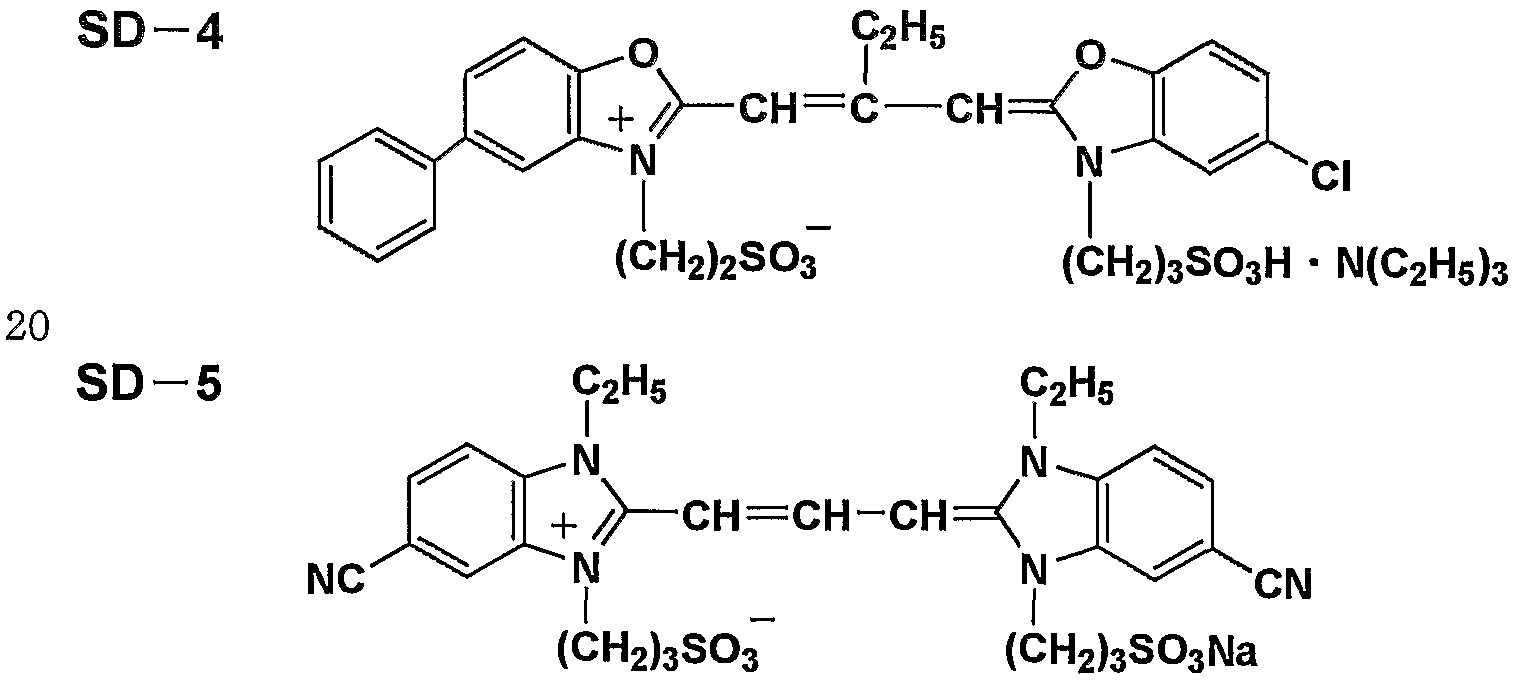
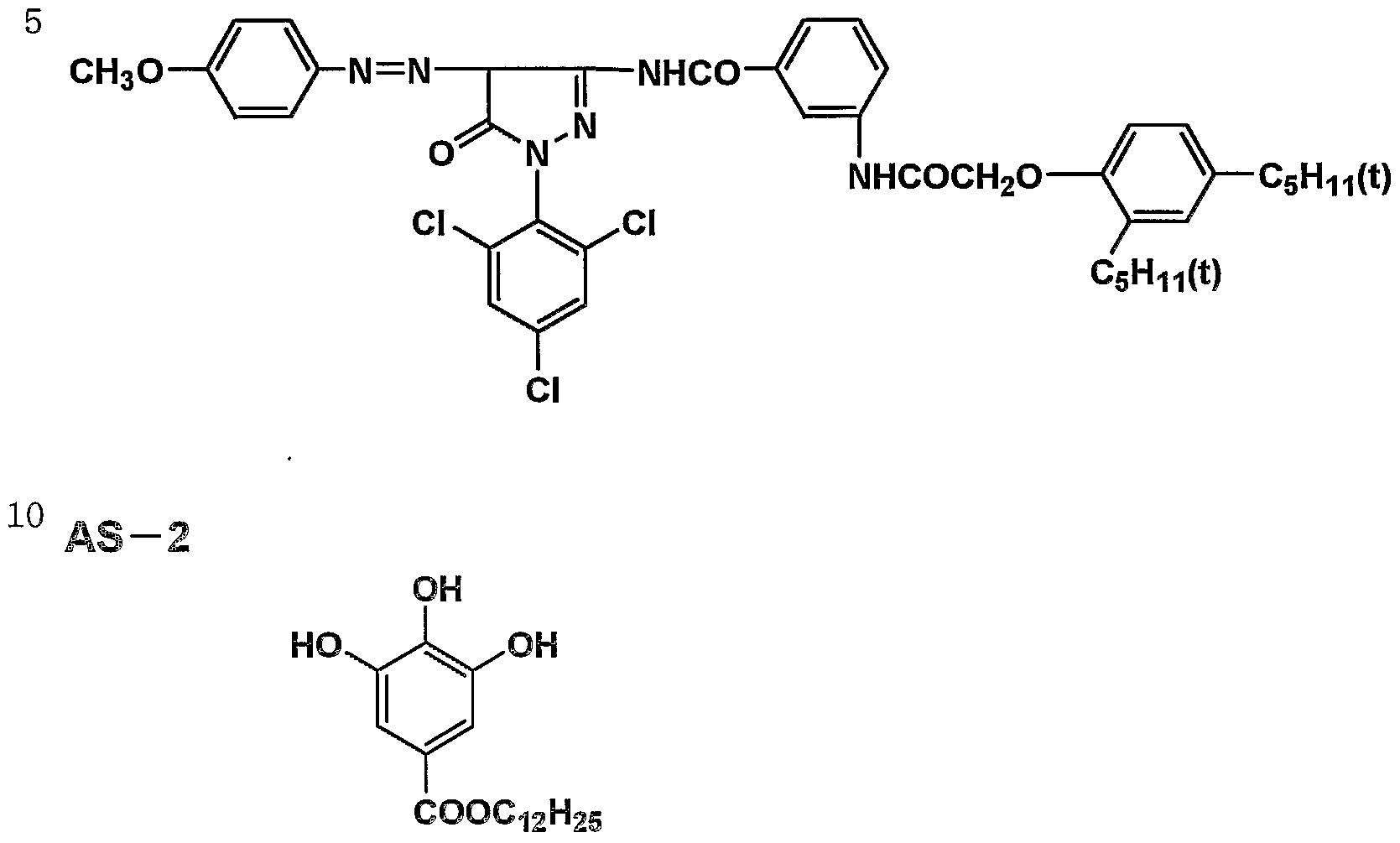
上記調製したハロゲン化銀乳剤 B— 1を用いて、 下記の構成からなる塗布液 を、 下引き層を施した厚さ 1 25〃 mのト リァセチルセル口一スフィルム支持 体上に形成してハロゲン化銀写真感光材料である試料 10 1を作製した。 下記の各素材の添加量は 1 m2当たりのグラム数で表す。但し、ハロゲン化銀 とコロイ ド銀は銀の量に換算し、 增感色素 ( S Dで示す) は銀 1モル当たりの モル数で示した。 なお、 ハロゲン化銀乳剤 A— 1は、 下表に記載の增感色素及 びチォ硫酸ナトリウム五水塩 5. 0 X 10— 6モル、 トリフヱニルフォスフィン セレニ ド 6. 0 X 10_6モル、 塩化金酸 3. 2 X 10 モルとチォシアン酸力 リウム 3. 5 X 10— 4モルの混合液を用いて化学増感を施した。
塗布液組成)
ハロゲン化銀乳剤 B— 1 0 . 50
S D— 4 1. 00 X 10- 4
S D— 5 3. 50 X l O-5 S D- 6 6. 00 X 10— 6
M- 1 0. 058
CM— 1 0. 029
A S - 2 0. 00 1
X- 2 0. 015 A S - 3 0. 007
0 I L - 1 0. 1 1 また、 上記の組成物の他に、 塗布助剤 S U— 2、 S U— 3、 分散助剤 S U— 4、 粘度調整剤 V - 1、 安定剤 S T - 1、 重量平均分子量: 10, 000及び 重量平均分子量: 100, 000の 2種のポリ ビニルピロリ ドン ( A F— 1、 AF— 2 )、塩化カルシウム、抑制剤 A F— 3、 AF— 4、 AF— 5、 AF— 6ヽ AF— 7、 硬膜剤 H_ 1、 H— 2及び防腐剤 A s e - 1を適宜添加した。

CM-1
AS-3


n:重合度
 Ase一 1 (下記 3成分の混合物)
JL N zN、
CI 、S^ 、CH3 s CH3

(成分 A) (成分 B) (成分 C)
成分 A:成分 B:成分 C=50:46:4(モル比)
H-1
CH2=CHS02— CH2CONHC2H4NHCOCH2— S02CH = CH2
X-2 /~
H29C14OOCH4C2— N N— C2H4COOC14H29
\ / 〔試料 10 2〜; L 1 1の作製〕 上記試料 1 0 1において、 下表に従つてハロゲン化銀乳剤の種類及び組み合 わせを変更した以外は同様にして、 試料 102〜1 12を作製した。 なお、 ハ 口ゲン化銀乳剤 A— 1〜 A— 4については、 ハロゲン化銀乳剤調製後、 化学熟 成及び色增慼を施さないで、 そのまま使用した。
《各試料の評価》
(露光及び現像)
以上のようにして作製した各試料を、 J I S K 76 14— 198 1に準 じて、 ゥヱッジを介して露光を行った後、 特開平 10- 1 23652号公報の 段落番号〔 0220〕 〜同 〔 0227〕 に記載の現像処理方法に従つてカラ一 発色現像処理を行った。 なお、 発色現像工程の現像時間は、 2分 50秒で行つ た。
(特性評価)
上記方法でカラ一発色現像処理を行つた各試料について、 透過型濃度計であ
る X— r i t e社製濃度計によりマゼンタの透過 S t a t u s M濃度の測定を 行い、 各写真用 D— L o g E特性曲線を作成した。
く感度の測定〉
上記作成した写真用 D— L o g E特性曲線において、 最小濃度から + 0. 1 0の濃度を得るのに要する露光量の逆数を感度と定義し、 試料 10 1の感度を 100とする相対感度を求めた。
く粒状性の評価〉
粒状性は、 RMS粒状度により評価した。 RMS粒状度は、 緑色光を用い、 試料の最小濃度 +0. 2の部分を被測定部とし、開口走査面積 1800 m2 (ス リット巾 10〃 ηι、 スリット長 180〃 m ) のマイクロデンシトメ一ターで走 査し、 濃度測定サンプリング 1 000以上の濃度値の変動の標準偏差の 1 00 0倍値を求め、 試料 10 1を 100とした相対値で示した。 数値が小さいほど 粒状性が優れていることを示す。
以上により得られた結果を、 下表に示す。
乳剤 A 乳剤 B 感度 粒状性 番号 種類 添加量 顧 添加:里
5 1 0 1 ― ― B— 1 1 0 0 1 0 0 1 0 0 比較例
10 2 ― ― B- 1 1 0 5 1 0 5 1 0 5 比較例
1 0 3 A— 1 5 B— 1 1 0 0 1 0 1 9 8 比較例
10 4 A- 2 5 B— 1 1 0 0 1 2 0 9 1 本発明
1 0 5 A— 3 5 B— 1 1 0 0 1 3 0 8 8 本発明
10 10 6 一 ― B - 2 1 0 0 1 0 5 1 0 8 比較例
10 7 ― ― B - 2 1 0 5 1 0 7 1 1 2 比較例
10 8 ― ― B- 3 1 0 5 9 2 9 5 比較例
10 9 A- 1 5 B— 2 1 0 0 1 0 7 1 0 6 比較例
1 1 0 5 B— 2 1 0 0 1 3 0 8 2 本発明
15 1 1 1 A- 4 5 B - 2 1 0 0 1 4 0 7 7 本発明
1 1 2 A - 4 5 B— 3 1 0 0 1 3 8 7 4 本発明 なお、 表中に記載の添加量は、 試料 1 0 1のハロゲン化銀乳剤 B— 1の添加 量(◦. 50 g/m2) を 100とした相対値として記載した。 実施例 2
《ハロゲン化銀乳剤の調製》
特開平 5— 173272号公報の実施例 1に記載の乳剤 EM— 1の調製方法
に準じて下記の特性からなる A— 5、 B— 4を、 また特開平 1 1— 6 5 0 1 5 号公報の実施例 1に記載のハロゲン化銀乳剤の調製方法に準じて下記の特性か らなる A— 6を調製した。 なお、 下表に記載の銀現像率は、 前述の方法に従つ て発色現像工程の現像時間 3分 1 5秒で行って測定した。 ハロゲン化銀 平均粒径 アスペク ト 平均沃度 I. r X I 銀現像率 乳剤 r \ νη. ) 比 、 m o 1 % ) (%)
A— 5 0 . 6 0 3. 1 8. 0 4. 8 0 3 1
A- 6 0 . 44 6. 3 4. 0 0. 54 43
A- 3 0 . 2 3 5. 1 2. 0 0. 4 6 48
B- 4 1 . 2 0 2. 6 8. 5 3. 6 0 1 8
《ハ口ゲン化銀写真感光材料の作製》
〔試料 2 0 1の作製〕
上記調製したハロゲン化銀乳剤 B— 4を用いて、 下記の構成からなる塗布液 を、 下引き層を施した厚さ 1 2 5〃mのト リァセチルセル口一スフ ィルム支持 体上に形成してハロゲン化銀写真感光材料である試料 2 0 1を作製した。 下記の各素材の添加量は 1 m 2当たりのグラム数で表す。但し、ハロゲン化銀 とコロイ ド銀は銀の量に換算し、 增感色素 ( S Dで示す) は銀 1モル当たりの モル数で示した。 なお、 ハロゲン化銀乳剤 B— 4は、 下表に記載の增感色素及 びチォ硫酸ナトリゥム五水塩 5. 0 X 1 0— 6モル、 トリフヱニルフォスフィ ン セレニド 6. 0 X 1 CD—6モル、 塩化金酸 3. 2 X 1 0—5モルとチォシアン酸力
リウム 3. 5 X 10— 4モルの混合液を用いて化学増感を施した。
(塗布液組成)
ハロゲン化銀乳剤 B— 4 0. 28
S D- 7 2. 78 X 10—5 S D- 8 1. 83 X 10
Y— 1 0. 078
A S - 2 0. 00 1
D - 4 0. 038
0 I L - 1 0. 047 ゼラチン 0. 6 1 また、 上記の組成物の他に、 塗布助剤 S U— 2、 S U— 3、 分散助剤 S U— 4、 粘度調整剤 V— 1、 安定剤 S T_ 1、 重量平均分子量: 10, 000及び 重量平均分子量: 100, 000の 2種のポリビニルピロリ ドン ( AF— 1、 A F— 2 )、塩化カルシウム、抑制剤 A F— 3、 AF— 4、 AF— 5、 AF— 6、 AF— 7、 硬膜剤 H— 1、 H— 2及び防腐剤 A s e - 1を適宜添加した。


〔試料 202〜205の作製〕
上記試料 201において、 下表に従ってハロゲン化銀乳剤の種類及び組み合 わせを変更した以外は同様にして、 試料 202〜205を作製した。
《各試料の評価》
(露光及び現像)
以上のようにして作製した各試料を、 J I S K 76 14- 198 1に準 じて、 ゥヱッジを介して露光を行った後、 特開平 10 - 1 23652号公報の 段落番号〔 0220〕 〜同 〔 0227〕 に記載の現像処理方法に従つてカラー 発色現像処理を行つた。なお、発色現像工程の現像時間は 3分 15秒で行つた。
(特性評価)
上記方法でカラー発色現像処理を行つた各試料について、 透過型濃度計であ る X— r i t e社製濃度計によりイエローの透過 S t a t u s M濃度の測定を 行い、 各写真用 D— L o g E特性曲線を作成した。
〈感度の測定〉
上記作成した写真用 D— L o g E特性曲線において、 最小濃度から + 0. 1 0の濃度を得るのに要する露光量の逆数を感度と定義し、 試料 20 1の感度を 100とする相対感度を求めた。
〈粒状性の評価〉
粒状性は、 RMS粒状度により評価した。 RMS粒状度は、 青色光を用い、 試料の最小濃度 +0. 2の部分を被測定部とし、開口走査面積 1800 m2 (ス リ ッ ト巾 10〃 m、 スリッ ト長 180〃 m ) のマイクロデンシトメータ一で走 査し、 濃度測定サンプリング 1000以上の濃度値の変動の標準偏差の 100 0倍値を求め、 試料 20 1を 100とした相対値で示した。 数値が小さいほど 粒状性が優れていることを示す。
以上により得られた結果を、 下表に示す。 料 乳剤 A 乳剤 B 感度 粒状性 備考 番号 種類 添加量 種類 添加量
201 一 B - 4 100 100 100 比較例
202 ― B - 4 1 10 106 104 比較例
203 A— 5 1 0 B-4 100 101 97 比較例 204 A— 6 10 B-4 100 1 26 88 本発明
205 A— 3 10 B-4 100 1 5 79 本発明 なお、 表中に記載の添加量は、 試料 20 1のハロゲン化銀乳剤 B— 4の添加
量( 0. 28 gZm2) を 100とした相対値として記載した。 産業上の利用の可能性
以上のように、 本発明の構成により、 粒状性が良好で、 かつ高感度のハロゲ ン化銀写真感光材料を提供することができた。
Claims
1. 支持体上にハ口ゲン化銀乳剤層を有するハロゲン化銀写真感光材料におい て、 該ハロゲン化銀乳剤層の少なくとも 1層が、 平均粒径の異なる 2種以上の ハロゲン化銀粒子を含有し、 その中で最小の立方体換算平均粒径を有するハロ ゲン化銀粒子 Aの平均銀現像率(DA gA)と、最大の立方体換算平均粒径を有 するハロゲン化銀粒子 Bの平均銀現像率( D A g B) との差( Δ DA g )が、 1 5 %以上であることを特徴とするハロゲン化銀写真感光材料。
2. 前記最小の立方体換算平均粒径を有するハロゲン化銀粒子 Aと、 最大の立 方体換算平均粒径を有するハロゲン化銀粒子 Bとの立方体換算平均粒径差が、
0. 3 ni以上、 1. 2 m以下であることを特徴とする請求の範囲第 1項に 記載のハ口ゲン化銀写真感光材料。
3. 前記ハロゲン化銀乳剤層に含有される最小の立方体換算平均粒径を有する ハ口ゲン化銀粒子 Aの含有量が、該ハ口ゲン化銀乳剤層に含まれる総銀量の 2. 0— 1 5. 0 %であることを特徴とする請求の範囲第 1項または第 2項に記載 のハロゲン化銀写真感光材料。
4. 前記最小の立方体換算平均粒径を有するハロゲン化銀粒子 Aの平均銀現像 率( D A g A )が、 2 5 %以上であることを特徴とする請求の範囲第 1項乃至第 3項のいずれか 1項に記載のハ口ゲン化銀写真感光材料。
5. 前記ハロゲン化銀粒子 Aの最小の立方体換算平均粒径を r ( m)、平均沃 度含有率を I A ( m o 1 %) としたとき、 r X I Aく 1. 1の関係を満たすこと を特徴とする請求の範囲第 1項乃至第 4項のいずれか 1項に記載のハロゲン化 銀写真感光材料。
6. 前記最小の立方体換算平均粒径を有するハロゲン化銀粒子 Aの平均沃度含 有率を I A ( m o 1 %)、 最大の立方体換算平均粒径を有するハロゲン化銀粒子 Bの平均沃度含有率を I B ( m o 1 % )としたとき、 I B— I A≥ 6 m o 1 %の関 係を満たすことを特徴とする請求の範囲第 1項乃至第 5項のいずれか 1項に記 載のハロゲン化銀写真感光材料。
7. 前記最小の立方体換算平均粒径を有するハロゲン化銀粒子 Aの平均ァスぺ クト比を A R A、最大の立方体換算平均粒径を有するハロゲン化銀粒子 Bの平均 ァスぺクト比を ARBとしたとき、 ARA— ARB≥ 3. 0の関係を満たすことを 特徴とする請求の範囲第 1項乃至第 6項のいずれか 1項に記載のハロゲン化銀 写真感光材料。
8. 前記最小の立方体換算平均粒径を有するハロゲン化銀粒子 Aが、 色増感さ れていないことを特徴とする請求の範囲第 1項乃至第 7項のいずれか 1項に記 載のハ口ゲン化銀写真感光材料。
Priority Applications (1)
| Application Number | Priority Date | Filing Date | Title |
|---|---|---|---|
| PCT/JP2003/002353 WO2004077145A1 (ja) | 2003-02-28 | 2003-02-28 | ハロゲン化銀写真感光材料 |
Applications Claiming Priority (1)
| Application Number | Priority Date | Filing Date | Title |
|---|---|---|---|
| PCT/JP2003/002353 WO2004077145A1 (ja) | 2003-02-28 | 2003-02-28 | ハロゲン化銀写真感光材料 |
Publications (1)
| Publication Number | Publication Date |
|---|---|
| WO2004077145A1 true WO2004077145A1 (ja) | 2004-09-10 |
Family
ID=32923124
Family Applications (1)
| Application Number | Title | Priority Date | Filing Date |
|---|---|---|---|
| PCT/JP2003/002353 Ceased WO2004077145A1 (ja) | 2003-02-28 | 2003-02-28 | ハロゲン化銀写真感光材料 |
Country Status (1)
| Country | Link |
|---|---|
| WO (1) | WO2004077145A1 (ja) |
Citations (4)
| Publication number | Priority date | Publication date | Assignee | Title |
|---|---|---|---|---|
| JPH11174608A (ja) * | 1997-12-16 | 1999-07-02 | Konica Corp | ハロゲン化銀カラー写真感光材料 |
| US5932403A (en) * | 1998-03-05 | 1999-08-03 | Eastman Kodak Company | Silver halide photographic light sensitive material having silver halide emulsion blends in the fast layer |
| JPH11212199A (ja) * | 1998-01-27 | 1999-08-06 | Konica Corp | ハロゲン化銀写真感光材料 |
| JP2001002128A (ja) * | 1999-06-23 | 2001-01-09 | Toppan Printing Co Ltd | バッグインボックス |
-
2003
- 2003-02-28 WO PCT/JP2003/002353 patent/WO2004077145A1/ja not_active Ceased
Patent Citations (4)
| Publication number | Priority date | Publication date | Assignee | Title |
|---|---|---|---|---|
| JPH11174608A (ja) * | 1997-12-16 | 1999-07-02 | Konica Corp | ハロゲン化銀カラー写真感光材料 |
| JPH11212199A (ja) * | 1998-01-27 | 1999-08-06 | Konica Corp | ハロゲン化銀写真感光材料 |
| US5932403A (en) * | 1998-03-05 | 1999-08-03 | Eastman Kodak Company | Silver halide photographic light sensitive material having silver halide emulsion blends in the fast layer |
| JP2001002128A (ja) * | 1999-06-23 | 2001-01-09 | Toppan Printing Co Ltd | バッグインボックス |
Similar Documents
| Publication | Publication Date | Title |
|---|---|---|
| JPH1138539A (ja) | ハロゲン化銀写真乳剤、その製造方法およびハロゲン化銀写真感光材料 | |
| JPH07146522A (ja) | ハロゲン化銀乳剤 | |
| JPH04276737A (ja) | ハロゲン化銀写真要素の作製方法 | |
| WO2004077145A1 (ja) | ハロゲン化銀写真感光材料 | |
| JP2961579B2 (ja) | ハロゲン化銀カラー写真感光材料 | |
| JPS63301038A (ja) | ハロゲン化銀写真感光材料 | |
| JP3012093B2 (ja) | ハロゲン化銀写真乳剤及びそれを用いたハロゲン化銀写真感光材料 | |
| JP3561862B2 (ja) | ハロゲン化銀カラー写真感光材料 | |
| JP3637475B2 (ja) | ハロゲン化銀写真感光材料 | |
| JP3388914B2 (ja) | ハロゲン化銀乳剤 | |
| JP3191190B2 (ja) | ハロゲン化銀写真乳剤の製造方法 | |
| JP3395014B2 (ja) | ハロゲン化銀乳剤 | |
| JP3674285B2 (ja) | ハロゲン化銀写真感光材料 | |
| JPH04338744A (ja) | ハロゲン化銀写真乳剤及び写真感光材料 | |
| JPH11190886A (ja) | ハロゲン化銀乳剤及びそれを用いるハロゲン化銀カラー写真感光材料 | |
| JPH03263029A (ja) | 写真用エマルジョン | |
| JPH06308638A (ja) | ハロゲン化銀写真乳剤の製造方法 | |
| JPH0341441A (ja) | スポット故障の改良されたハロゲン化銀写真感光材料 | |
| JPH07261299A (ja) | ハロゲン化銀写真乳剤及びハロゲン化銀写真感光材料 | |
| JP2001337428A (ja) | ハロゲン化銀写真感光材料 | |
| JPH0882883A (ja) | ハロゲン化銀粒子の製造方法およびハロゲン化銀乳剤 | |
| JPH05210186A (ja) | ハロゲン化銀乳剤及びハロゲン化銀カラー写真感光材料 | |
| JPH11271906A (ja) | ハロゲン化銀カラ―写真感光材料 | |
| JPH11119359A (ja) | ハロゲン化銀乳剤およびハロゲン化銀カラー写真感光材料 | |
| JP2000275795A (ja) | ハロゲン化銀カラー写真感光材料 |
Legal Events
| Date | Code | Title | Description |
|---|---|---|---|
| AK | Designated states |
Kind code of ref document: A1 Designated state(s): BR CN ID IN JP KR MX PH PL RU SG US VN |
|
| AL | Designated countries for regional patents |
Kind code of ref document: A1 Designated state(s): AT BE BG CH CY CZ DE DK EE ES FI FR GB GR HU IE IT LU MC NL PT SE SI SK TR |
|
| 121 | Ep: the epo has been informed by wipo that ep was designated in this application | ||
| 122 | Ep: pct application non-entry in european phase | ||
| NENP | Non-entry into the national phase |
Ref country code: JP |
|
| WWW | Wipo information: withdrawn in national office |
Country of ref document: JP |