US9853283B2 - Rechargeable alkaline metal and alkaline earth electrodes having controlled dendritic growth and methods for making and using the same - Google Patents
Rechargeable alkaline metal and alkaline earth electrodes having controlled dendritic growth and methods for making and using the same Download PDFInfo
- Publication number
- US9853283B2 US9853283B2 US13/474,179 US201213474179A US9853283B2 US 9853283 B2 US9853283 B2 US 9853283B2 US 201213474179 A US201213474179 A US 201213474179A US 9853283 B2 US9853283 B2 US 9853283B2
- Authority
- US
- United States
- Prior art keywords
- metal
- battery cell
- anode
- lithium
- dendrite
- Prior art date
- Legal status (The legal status is an assumption and is not a legal conclusion. Google has not performed a legal analysis and makes no representation as to the accuracy of the status listed.)
- Active, expires
Links
Images


Classifications
-
- H—ELECTRICITY
- H01—ELECTRIC ELEMENTS
- H01M—PROCESSES OR MEANS, e.g. BATTERIES, FOR THE DIRECT CONVERSION OF CHEMICAL ENERGY INTO ELECTRICAL ENERGY
- H01M50/00—Constructional details or processes of manufacture of the non-active parts of electrochemical cells other than fuel cells, e.g. hybrid cells
- H01M50/40—Separators; Membranes; Diaphragms; Spacing elements inside cells
- H01M50/409—Separators, membranes or diaphragms characterised by the material
- H01M50/431—Inorganic material
-
- H—ELECTRICITY
- H01—ELECTRIC ELEMENTS
- H01M—PROCESSES OR MEANS, e.g. BATTERIES, FOR THE DIRECT CONVERSION OF CHEMICAL ENERGY INTO ELECTRICAL ENERGY
- H01M4/00—Electrodes
- H01M4/02—Electrodes composed of, or comprising, active material
- H01M4/13—Electrodes for accumulators with non-aqueous electrolyte, e.g. for lithium-accumulators; Processes of manufacture thereof
- H01M4/139—Processes of manufacture
- H01M4/1395—Processes of manufacture of electrodes based on metals, Si or alloys
-
- B—PERFORMING OPERATIONS; TRANSPORTING
- B82—NANOTECHNOLOGY
- B82Y—SPECIFIC USES OR APPLICATIONS OF NANOSTRUCTURES; MEASUREMENT OR ANALYSIS OF NANOSTRUCTURES; MANUFACTURE OR TREATMENT OF NANOSTRUCTURES
- B82Y30/00—Nanotechnology for materials or surface science, e.g. nanocomposites
-
- H—ELECTRICITY
- H01—ELECTRIC ELEMENTS
- H01M—PROCESSES OR MEANS, e.g. BATTERIES, FOR THE DIRECT CONVERSION OF CHEMICAL ENERGY INTO ELECTRICAL ENERGY
- H01M10/00—Secondary cells; Manufacture thereof
- H01M10/05—Accumulators with non-aqueous electrolyte
- H01M10/056—Accumulators with non-aqueous electrolyte characterised by the materials used as electrolytes, e.g. mixed inorganic/organic electrolytes
- H01M10/0564—Accumulators with non-aqueous electrolyte characterised by the materials used as electrolytes, e.g. mixed inorganic/organic electrolytes the electrolyte being constituted of organic materials only
- H01M10/0566—Liquid materials
-
- H01M2/164—
-
- H01M2/1686—
-
- H—ELECTRICITY
- H01—ELECTRIC ELEMENTS
- H01M—PROCESSES OR MEANS, e.g. BATTERIES, FOR THE DIRECT CONVERSION OF CHEMICAL ENERGY INTO ELECTRICAL ENERGY
- H01M50/00—Constructional details or processes of manufacture of the non-active parts of electrochemical cells other than fuel cells, e.g. hybrid cells
- H01M50/40—Separators; Membranes; Diaphragms; Spacing elements inside cells
- H01M50/409—Separators, membranes or diaphragms characterised by the material
- H01M50/443—Particulate material
-
- H—ELECTRICITY
- H01—ELECTRIC ELEMENTS
- H01M—PROCESSES OR MEANS, e.g. BATTERIES, FOR THE DIRECT CONVERSION OF CHEMICAL ENERGY INTO ELECTRICAL ENERGY
- H01M50/00—Constructional details or processes of manufacture of the non-active parts of electrochemical cells other than fuel cells, e.g. hybrid cells
- H01M50/40—Separators; Membranes; Diaphragms; Spacing elements inside cells
- H01M50/409—Separators, membranes or diaphragms characterised by the material
- H01M50/449—Separators, membranes or diaphragms characterised by the material having a layered structure
- H01M50/451—Separators, membranes or diaphragms characterised by the material having a layered structure comprising layers of only organic material and layers containing inorganic material
-
- H—ELECTRICITY
- H01—ELECTRIC ELEMENTS
- H01M—PROCESSES OR MEANS, e.g. BATTERIES, FOR THE DIRECT CONVERSION OF CHEMICAL ENERGY INTO ELECTRICAL ENERGY
- H01M50/00—Constructional details or processes of manufacture of the non-active parts of electrochemical cells other than fuel cells, e.g. hybrid cells
- H01M50/40—Separators; Membranes; Diaphragms; Spacing elements inside cells
- H01M50/46—Separators, membranes or diaphragms characterised by their combination with electrodes
-
- H—ELECTRICITY
- H01—ELECTRIC ELEMENTS
- H01M—PROCESSES OR MEANS, e.g. BATTERIES, FOR THE DIRECT CONVERSION OF CHEMICAL ENERGY INTO ELECTRICAL ENERGY
- H01M10/00—Secondary cells; Manufacture thereof
- H01M10/05—Accumulators with non-aqueous electrolyte
- H01M10/052—Li-accumulators
-
- Y—GENERAL TAGGING OF NEW TECHNOLOGICAL DEVELOPMENTS; GENERAL TAGGING OF CROSS-SECTIONAL TECHNOLOGIES SPANNING OVER SEVERAL SECTIONS OF THE IPC; TECHNICAL SUBJECTS COVERED BY FORMER USPC CROSS-REFERENCE ART COLLECTIONS [XRACs] AND DIGESTS
- Y02—TECHNOLOGIES OR APPLICATIONS FOR MITIGATION OR ADAPTATION AGAINST CLIMATE CHANGE
- Y02E—REDUCTION OF GREENHOUSE GAS [GHG] EMISSIONS, RELATED TO ENERGY GENERATION, TRANSMISSION OR DISTRIBUTION
- Y02E60/00—Enabling technologies; Technologies with a potential or indirect contribution to GHG emissions mitigation
- Y02E60/10—Energy storage using batteries
-
- Y02E60/122—
-
- Y—GENERAL TAGGING OF NEW TECHNOLOGICAL DEVELOPMENTS; GENERAL TAGGING OF CROSS-SECTIONAL TECHNOLOGIES SPANNING OVER SEVERAL SECTIONS OF THE IPC; TECHNICAL SUBJECTS COVERED BY FORMER USPC CROSS-REFERENCE ART COLLECTIONS [XRACs] AND DIGESTS
- Y02—TECHNOLOGIES OR APPLICATIONS FOR MITIGATION OR ADAPTATION AGAINST CLIMATE CHANGE
- Y02P—CLIMATE CHANGE MITIGATION TECHNOLOGIES IN THE PRODUCTION OR PROCESSING OF GOODS
- Y02P70/00—Climate change mitigation technologies in the production process for final industrial or consumer products
- Y02P70/50—Manufacturing or production processes characterised by the final manufactured product
Definitions
- Lithium metal as an anode to build a rechargeable Lithium cell or battery system with the highest anode-specific capacity has long been desired.
- the growth of Li-metal dendrites gives rise to serious technical barriers for developing such a battery.
- modified versions of the Li metal battery, such as the Lithium ion battery have been introduced with some success.
- the current modified versions possess limitations and inefficiencies that would not arise with a cell that uses Lithium metal as an anode.
- a Lithium metal cell typically includes an anode and a cathode separated by an electrically insulating barrier or ‘separator’ and operationally connected by an electrolyte solution.
- the positively charged lithium ions move from the cathode, through the permeable separator, to the anode and reduce into Li metal.
- the Li metal is oxidized to positively charged lithium ions which move from the anode, through the separator, and onto the cathode, while electrons move through an external load from the anode to the cathode, yielding current and providing power for the load.
- Lithium dendrites begin to grow from on the surface of the anode.
- Dendritic lithium deposits sometimes called mossy lithium, eventually tear through the separator and reach the cathode causing an internal short and rendering the cell inoperable.
- Lithium dendrite formation is inherently unavoidable during the charging and discharging processes of Li-metal cells.
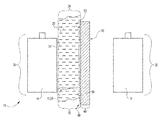
- FIG. 1 is schematic view of a lithium ion cell according to a first embodiment of the present novel technology.
- FIG. 2A is a perspective view of the separator of FIG. 1 .
- FIG. 2B is an exploded view of the separator surface of FIG. 2 .
- FIG. 3A is a first perspective view of a composite electrode of FIG. 1 .
- FIG. 3B is a second perspective view of a composite electrode of FIG. 1 .
- FIG. 3D is a fourth perspective view of a composite electrode of FIG. 1 .
- FIG. 4 is a perspective view of a second embodiment coin cell implementation of the present novel technology.
- FIG. 5 is an enlarged elevation view of a dendrite growing from an electrode surface of FIG. 1 .
- FIG. 6 is an exploded view of the surface of the separator of FIG. 1 as partially coated with FNC.
- FIG. 7 is a process diagram a third embodiment of the present novel technology, showing of a method to form dendrite seeding material.
- FIG. 8 is a process diagram a fourth embodiment of the present novel technology, showing of a method of controlling metal dendrite growth.
- FIG. 9 is a process diagram a fifth embodiment of the present novel technology, showing of a method of extending the life a cell.
- FIG. 10 is a process diagram a sixth embodiment of the present novel technology, showing of a method of producing an FNC-coated separator.
- the present novel technology relates to a rechargeable lithium metal electrochemical storage cell 10 having lithium metal electrodes 20 .
- a rechargeable lithium electrode cell 10 is shown with a Li metal cathode portion 12 and Li-metal anode portion 14 .
- Separator 50 is positioned between the anode 14 and cathode 12 .
- Separator 50 is typically coated with a layer 80 of functionalized nanocarbons particles 40 .
- Separator 50 includes an anode facing side 53 and a cathode facing side 52 , and is typically coated with a thin or very thin film 80 of the functionalized nanocarbon (FNC) particles 40 , more typically about 0.1 ⁇ m thick, and typically oriented facing the surface 70 of the Li-metal electrode 20 .
- Gap 26 is filled with an electrolyte 25 positioned between the Li-metal electrode 20 and the FNC-coated separator 60 .
- the functionalized nanocarbon particles 40 typically have Li+ ions immobilized on the surface 65 of the layer 80 of nanocarbon particles 40 .
- the FNC film 80 is electrically connected to the Li-metal electrode 20 .
- Li dendrites 11 extend from the surface 70 of the Li metal electrode 20 toward the FNC-coated separator 60 .
- dendrites 55 extend from the surface 65 of the FNC film 80 toward the surface 70 of the Li-metal electrode 20 .
- the dendrites 55 grow in the through plane direction 94 of the Li metal electrode 20 and FNC coated separator 60 .
- dendrites 11 , 55 growth of dendrites 11 , 55 is driven by the potential difference ( ⁇ E) between the tip (Et) 59 and the base (Eb) 57 of the respective dendrites 11 , 55 .
- ⁇ E potential difference
- dendrites 11 , 55 continue extending toward each other; eventually, the dendrites 11 , 55 touch each other and the potential difference ( ⁇ E) dendrite 11 , 55 is approximately zero because the FNC film 80 and the Li-metal electrode 20 have the same potential. Consequently, dendrite 11 , 55 growth is retarded or stopped along the through plane direction 94 .
- dendrites 11 , 55 may grow in a direction perpendicular to the major axis of the respective dendrite 11 , 55 and parallel to the plane of the Li-metal electrode 20 , also referred as the in-plane direction 84 , which prevents dendrites 11 , 55 from piercing through permeable or selectively permeable membrane 50 , as shown in FIGS. 3A-3D .
- a Li secondary surface 70 may form, from the intersection of the Li dendrites 11 , 55 .
- a composite Li metal electrode 20 is formed in which an Li electrode 20 is assembled with the thin carbon layer 80 .
- the storage cell 10 may alternately include other alkaline earth and/or alkaline metal elements and combinations thereof as the electrode materials.
- the symmetric cell 400 provides a better medium for Li-metal dendrite growth and can accelerate the cycle testing, while the asymmetric cell 500 better approximates field applications.
- Dendrite growth is fundamentally unavoidable because the metallurgic characteristics of Li-metal surfaces result in surface imperfections of Li-metal electrodes after the application of either mechanical stress or the plating/stripping cycles. While configurations known in the art focus solely on stopping dendrite 11 growth, the novel cell design 10 focuses on controlling the direction of the Li-metal dendrite 11 , 55 growth.
- one implementation 800 of the novel electrode 20 may have a carbon-coated layer of functionalized nanocarbon particles (FNC) 80 on a separator 50 that is positioned 801 in an electrolyte 25 and grows 803 Li dendrites 11 , 55 simultaneously from the surface 51 of the Li metal electrode 20 and the surface 65 of the FNC coated separator 60 .
- An electrolyte 25 is placed 802 in the gap 26 the between the electrode 20 and FNC-coated separator 60 .
- the dendrites 11 , 55 grow 803 after repeated charging and discharging 804 of the cell 10 .
- Dendrites 11 , 55 contact each other 805 and when contact occurs, the dendrites 11 , 55 stop extending in the through plane direction 94 due to the zero potential difference that results from contact.
- the control of dendrite growth direction 800 occurs by contact 805 between the FNC coated separator dendrites 55 and the electrode dendrites 11 . After multiple combinations of dendrites 11 , 55 the formation 806 of a Li-secondary Li surface 70 results.
- the rechargeable Li-metal electrode 20 may be implemented in many kinds of Li batteries including Li-polymer, Li-air and Li-metal oxide cells and battery systems as well as any other cells or battery systems in which Li metal anodes 14 are used, and yield benefits for electronics, electric vehicles and hybrid electric vehicles, large-scale energy storage and the like.
- Li-metal electrode 20 has an inherent metallurgic tendency to form dendrites 11 , and dendrite 11 growth is driven by the potential difference between the base 57 and the dendrite tip 59 .
- Li electrode dendrite 11 growth is unavoidable.
- the instant system 800 incorporates, rather than avoids, the dendrite growth mechanism.
- a rechargeable Li-metal electrode 220 is used in other Li battery systems, such as Li-polymer and Li-air and may be fabricated by coating the FNC layers 280 on the polymer electrolyte membranes 200 , which are used as the electrolyte 225 in both Li-polymer batteries and Li-air batteries. These FNC-coated polymer electrolytes 225 are typically incorporated as the interlayer 280 and assembled into a soft packed Li-air cell 285 .
- Such polymer electrolyte membranes 260 may include those of poly(ethylene oxide) (PEO), poly(vinylidene fluoride) (PVdF), poly(acrylonitrile) (PAN), and the other polymer electrolytes, which are widely used for both Li-polymer batteries and Li-air batteries.
- PEO poly(ethylene oxide)
- PVdF poly(vinylidene fluoride)
- PAN poly(acrylonitrile)
- other polymer electrolytes which are widely used for both Li-polymer batteries and Li-air batteries.
- the FNC layer 80 plays a role in the novel Li-metal electrode 20 because the immobilized Li+ ions 30 in the FNC layer 80 serve as ‘seeds’ 31 for Li-metal dendrite 55 formation on the FNC layer 80 .
- the FNC layer 80 is typically porous, allowing the FNC aggregates to be bonded 605 together by the binder network 604 to form a rigid structure 606 to hold 607 the integrity of the layer 80 .
- the layer 80 is typically very thin with four main properties: 1) good pore structure to facilitate the passage of Li+ ions therethrough, 2) high electric conductivity to reduce internal impedance, 3) high coverage of Li+ ions 30 over the nanocarbon surface 65 for easy formation of Li metal dendrites 55 , and 4) good adhesion to a polymer separator 50 or a polymer electrolyte membrane. All of these properties are similar to those for the catalyst layer in the fuel cell, (i.e. a porous layer for gas and water diffusion, electric conductivity necessitated for gas reactions, SO 3 — coverage for proton conduction, and good adhesion of the catalyst layer on the polymer electrolyte membrane for durability). The thinner the FNC layer 80 , the less the loss of specific capacity of the Li-metal electrode 20 .
- the morphology of the FNC layer 80 depends on how the layer is fabricated 600 . Such techniques of applying 609 the layer 80 include (1) spraying, (2) machine blade-coating, (3) brush hand-painting, and the like. Carbons may be selected from sources including carbon blacks, nanographites, graphenes, and the like. It has been found that the higher the degree of graphitization, the higher the chemical stability.
- the nanocarbon particles 40 may be made from carbon black, which is inexpensive, but is an amorphous structure rather than a graphite structure. Graphene may also be used and possesses unique properties such as high electronic conductivity, high modulus, and high surface area.
- the morphology of the FNC layer 80 is also influenced by the ink formulation.
- the first step is to mix 601 the carbon source with solvents to make a uniformly dispersed suspension 603 .
- solvent type is carefully selected based on polarity (i.e. dielectric constant) and their hydrophobicity in order to match those of the carbon aggregates and the binders.
- This mixture 602 is also called ‘ink formulation’.
- the type of carbons and solvents in an ink will affect the morphology of the thin FNC layer 80 .
- the type of binder 33 also affects the adhesion of the carbon layer 80 on the separator 50 .
- the binder 33 has a similar chemical structure to the separator/electrolyte membrane 50 so that they can be fused together 605 through hot pressing or other techniques to form a well-bonded interface 62 between the carbon layer 80 and the separator/electrolyte membrane 50 .
- the immobilized Li+ ions 30 over the surface of nanocarbon particles 40 serve as the ‘seeds’ 31 for Li dendrite 55 formation on the FNC-coated separator 60 .
- Immobilization of the Li+ ions 30 is carried out by formation 900 of a dendrite seeding material 61 , such as by diazonium reaction or similar means 902 on an appropriate 901 carbon separator 50 to chemically attach an SO3H group 902 onto the carbon surface 65 , allowing the carbon separator 50 to become functionalized 903 .
- a dendrite seeding material 61 is formed 907 .
- the dendrite seeding material 61 is typically carbonaceous, but may also be a metal substrate, such as Li, Na, K, Al, Ni, Ti, Cu, Ag, Au, and combinations thereof.
- the seeding material 61 may also be a functionalized metal substrate, such as a self-assembled monolayer structure comprised of Au with a thiol-terminated organic molecule that contains at least one function group, such as SO3-M+, COO-M+, and NR3+X—, an electrically conductive organic polymer, such as polyacetylene, polyphenylene vinylene, polypyrrole, polythiophene, polyaniline, and plypohenylene sulfide, or a functionalized electrically conductive organic polymer, wherein the functional groups are chemically bound to the polymer.
- These materials 61 may be deposited using conventional physical deposition techniques, such as mechanical layering, or physical vapor deposition techniques, such a sputtering, or the like.
- the novel technology allows attachment 903 of different functional groups to the carbon surface 65 , such as through the diazonium reaction and the like.
- Such a catalyst layer can withstand several thousand hours of long-term durability testing due, in part to the binder 33 in maintaining 607 the FNC layer 80 bound to the separator/electrolyte membrane 50 .
- a TEM observation of such this catalyst/membrane interface 62 would show little or no delamination after approximately 2000 hours of durability testing.
- Hot pressing is one of techniques for fabrication, and the parameters of the hot pressing technique (i.e. temperature, pressure, and time) allow systematic control of the process.
- the morphology (i.e. surface area, pore structure, and geometry) of the FNC layer 80 on the membrane 50 has a significant impact on the performance of the novel metal electrode 20 .
- the FNC layer 80 porosimetry 81 i.e. pore size, pore size distribution and pore volume
- the pore structure typically allows metal ions 30 to pass through smoothly during cycling 704 , but not to form dendrites inside the pores that would block the diffusion of the metal ions 30 .
- determining 701 and production 702 of an appropriate FNC layer 80 with porosimetry 81 is useful in allowing for dendrite 11 , 55 presence 706 and eventual formation 707 of a secondary metal layer 70 .
- the FNC layer 80 has to adhere to a separator/electrolyte membrane 50 and the diffusion barrier (if there is any) from the formed interface 62 should be minimized.
- the specific capacity of the rechargeable metal electrode 20 may be affected by varying the thickness 89 of the FNC film 80 against the thickness 29 of the Li metal electrode 20 .
- the examples herein relate to the novel technology and various embodiments, and are not intended to limit the scope of the present novel technology to those modes and embodiments discussed herein.
- the effect of the different carbon-coated layers on the specific capacity of the Li metal composite electrode 20 was approximately calculated and is shown in Table 1. For instance, for the carbon-coated layer 80 with the 0.1 ⁇ m thickness, the corresponding specific capacity loss of Li metal electrode 20 is only 0.026%. Even for the thick FNC film 80 , 4 ⁇ m, the corresponding loss of specific capacity is only 0.53%. Thus, the effects of the carbon-coated layer 80 on the specific capacity of the Li metal electrode 20 are negligible. The thin carbon-coated layer 80 retains the advantage of the high specific capacity of Li metal electrodes.
- EMC ethylene carbonate/ethyl-methyl carbonate
- One concern for using such a carbon coating layer 380 is whether the addition of the FNC layer 380 on the separator 350 would result in the increased internal impedance from the carbon layer 380 blocking the pores of the separator 350 , thus hindering the diffusion of Li+ ions 330 through and, consequently, reducing the power performance of the cell 300 .
- coating the carbon layer 380 on the separator 350 did not cause an increase in the internal impedance of the cell 300 , but instead gave rise to a slight impedance reduction.
- the Li/FNC cell 300 possesses a slightly higher discharge voltage than the baseline Li cell. Even after five hundred cycles, the same trend was observed. Noise was observed for the baseline cell, which was attributed to the formation of dendrites 355 .
- the same phenomenon of reduction of internal impedance has been observed during the charging process.
- the cell 300 was not balanced for capacity, and the capacity of the cell 300 was limited by the LiPFeO 4 cathode 312 ; a much higher capacity of the cell 300 is expected if an appropriate high energy density cathode is used (such as a V 2 O 5 aerogel or an air cathode).
- the Li metal electrode 314 using an FNC layer 380 showed excellent cycleablity, approximately 84% capacity after 500 cycles.
- the estimated capacity decay rate of the novel Li metal electrode cell 300 after the first 45 cycles is only 0.026%/cycle. Based on this decay rate, the cycle life of such a cell can typically achieve at least 500, more typically at least 725 cycles, and still more typically at least 1000 cycles, with 80% capacity (death definition of a battery in electric vehicle (EV) applications).
- This decay rate (0.026%/cycle) of the novel Li metal electrode 320 in the coin cell 300 may be caused by the degradation of the LiFePO 4 cathode 312 because the coin cells 300 are sealed in ambient atmospheric pressure, which may allow the introduction of moisture into the cell 300 .
- the moisture reacts with LiPF 6 to produce HF, which can react with LiFePO 4 , causing the degradation. Therefore, the true decay rate of the novel Li metal electrode 320 should be much lower than 0.026%/cycle if the coin cell 300 is sealed, such as inside an Argon filled glovebox.
- an FNC-coated separator 60 was examined via SEM analysis after repeated cycling. Li metal dendrites 55 were observed on the surface 65 of the FNC-coated separator 60 facing the surface of the Li metal electrode 20 . Moreover, the Li dendrites 55 formed a unitary layer instead of aggregating as loosely arranged dendrites. The thickness 89 of the FNC layer 80 was measured to be about 3 ⁇ m, while the Li dendrite 70 layer was around 20 ⁇ m thick. Referring to FIG. 6 , and to further illustrate the function of the FNC layer 80 for inducing Li metal dendrite 55 formation, the separator 50 was coated with an FNC layer 80 on half the area of the surface, while the other half was not coated.
- the layer 80 formed over the electrochemical separator 50 to enable dendritic growth toward the metal anode 14 is a thin metallic layer 80 .
- the dendrites 55 growing from the separator 50 contact dendrites 11 growing from the metal anode 14 , shorting the circuit and thus preventing the dendrites 11 growing from the anode 14 toward the separator 50 to reach and pierce the separator 50 .
- the anode 14 is typically lithium, but may likewise be sodium or the like.
- the metal layer 80 on the separator 50 is typically lithium, but may also be sodium or another electrically conductive metal, electrically conducting polymer, an organometallic matrix, functionalized electrically conducting polymer, or the like.
- the layer 80 is a non-reactive metal, such as Ni.
- the metal layer 80 on the separator 50 is typically formed thin enough such that its electrical resistivity is high, typically high enough such that the layer 80 is not easily electrically or otherwise degraded.
- the thin metal layer 80 may be functionalized after deposition onto the separator 50 .
Landscapes
- Chemical & Material Sciences (AREA)
- Chemical Kinetics & Catalysis (AREA)
- Electrochemistry (AREA)
- General Chemical & Material Sciences (AREA)
- Engineering & Computer Science (AREA)
- Manufacturing & Machinery (AREA)
- Inorganic Chemistry (AREA)
- General Physics & Mathematics (AREA)
- Condensed Matter Physics & Semiconductors (AREA)
- Physics & Mathematics (AREA)
- Nanotechnology (AREA)
- Materials Engineering (AREA)
- Composite Materials (AREA)
- Crystallography & Structural Chemistry (AREA)
- Secondary Cells (AREA)
- Battery Electrode And Active Subsutance (AREA)
- Cell Separators (AREA)
Priority Applications (3)
| Application Number | Priority Date | Filing Date | Title |
|---|---|---|---|
| US13/474,179 US9853283B2 (en) | 2011-05-17 | 2012-05-17 | Rechargeable alkaline metal and alkaline earth electrodes having controlled dendritic growth and methods for making and using the same |
| US15/788,384 US11127943B2 (en) | 2011-05-17 | 2017-10-19 | Rechargeable alkaline metal and alkaline earth electrodes having controlled dendritic growth and methods for making and using same |
| US17/479,881 US20220255056A1 (en) | 2011-05-17 | 2021-09-20 | Rechargeable Alkaline Metal And Alkaline Earth Electrodes Having Controlled Dendritic Growth And Methods For Making And Using Same |
Applications Claiming Priority (4)
| Application Number | Priority Date | Filing Date | Title |
|---|---|---|---|
| US201161486946P | 2011-05-17 | 2011-05-17 | |
| US201161498192P | 2011-06-17 | 2011-06-17 | |
| US201161565101P | 2011-11-30 | 2011-11-30 | |
| US13/474,179 US9853283B2 (en) | 2011-05-17 | 2012-05-17 | Rechargeable alkaline metal and alkaline earth electrodes having controlled dendritic growth and methods for making and using the same |
Related Child Applications (1)
| Application Number | Title | Priority Date | Filing Date |
|---|---|---|---|
| US15/788,384 Continuation US11127943B2 (en) | 2011-05-17 | 2017-10-19 | Rechargeable alkaline metal and alkaline earth electrodes having controlled dendritic growth and methods for making and using same |
Publications (2)
| Publication Number | Publication Date |
|---|---|
| US20120295149A1 US20120295149A1 (en) | 2012-11-22 |
| US9853283B2 true US9853283B2 (en) | 2017-12-26 |
Family
ID=47175144
Family Applications (4)
| Application Number | Title | Priority Date | Filing Date |
|---|---|---|---|
| US13/474,179 Active 2034-08-10 US9853283B2 (en) | 2011-05-17 | 2012-05-17 | Rechargeable alkaline metal and alkaline earth electrodes having controlled dendritic growth and methods for making and using the same |
| US13/474,174 Active 2034-10-01 US9590236B2 (en) | 2011-05-17 | 2012-05-17 | Rechargeable alkaline metal and alkaline earth electrodes having controlled dendritic growth and methods for making and using the same |
| US15/788,384 Active US11127943B2 (en) | 2011-05-17 | 2017-10-19 | Rechargeable alkaline metal and alkaline earth electrodes having controlled dendritic growth and methods for making and using same |
| US17/479,881 Abandoned US20220255056A1 (en) | 2011-05-17 | 2021-09-20 | Rechargeable Alkaline Metal And Alkaline Earth Electrodes Having Controlled Dendritic Growth And Methods For Making And Using Same |
Family Applications After (3)
| Application Number | Title | Priority Date | Filing Date |
|---|---|---|---|
| US13/474,174 Active 2034-10-01 US9590236B2 (en) | 2011-05-17 | 2012-05-17 | Rechargeable alkaline metal and alkaline earth electrodes having controlled dendritic growth and methods for making and using the same |
| US15/788,384 Active US11127943B2 (en) | 2011-05-17 | 2017-10-19 | Rechargeable alkaline metal and alkaline earth electrodes having controlled dendritic growth and methods for making and using same |
| US17/479,881 Abandoned US20220255056A1 (en) | 2011-05-17 | 2021-09-20 | Rechargeable Alkaline Metal And Alkaline Earth Electrodes Having Controlled Dendritic Growth And Methods For Making And Using Same |
Country Status (14)
| Country | Link |
|---|---|
| US (4) | US9853283B2 (es) |
| EP (3) | EP3696881B1 (es) |
| JP (3) | JP6215819B2 (es) |
| KR (1) | KR101970840B1 (es) |
| CN (2) | CN103703587B (es) |
| AU (2) | AU2012255242B2 (es) |
| BR (1) | BR112013029242B1 (es) |
| CA (1) | CA2836466C (es) |
| CO (1) | CO6821922A2 (es) |
| FI (1) | FI3696881T3 (es) |
| MX (1) | MX350778B (es) |
| RU (1) | RU2601548C2 (es) |
| SG (2) | SG10201405466RA (es) |
| WO (1) | WO2012158924A2 (es) |
Cited By (1)
| Publication number | Priority date | Publication date | Assignee | Title |
|---|---|---|---|---|
| US11563231B2 (en) | 2015-07-03 | 2023-01-24 | Semiconductor Energy Laboratory Co., Ltd. | Lithium-ion storage battery and electronic device |
Families Citing this family (35)
| Publication number | Priority date | Publication date | Assignee | Title |
|---|---|---|---|---|
| US20140045065A1 (en) * | 2012-08-09 | 2014-02-13 | Nanjing University | Li-ion battery electrodes having nanoparticles in a conductive polymer matrix |
| CN104103791A (zh) * | 2013-04-08 | 2014-10-15 | 中国科学院金属研究所 | 一种电池复合隔膜及其制备方法 |
| FR3004580B1 (fr) | 2013-04-10 | 2016-11-04 | Thales Sa | Ensemble electrode-electrolyte gel comprenant un materiau carbone poreux et obtenu par voie radicalaire |
| JP6629549B2 (ja) * | 2014-08-26 | 2020-01-15 | ロッキード マーティン コーポレイションLockheed Martin Corporation | 電気装置及びデンドライト検知方法 |
| CN104852004A (zh) * | 2014-11-14 | 2015-08-19 | 中国科学院深圳先进技术研究院 | 二次电池复合隔膜及其制备方法和二次电池 |
| KR101790840B1 (ko) * | 2015-01-21 | 2017-10-26 | 주식회사 엘지화학 | 리튬 공기 전지 |
| CN105140449A (zh) * | 2015-08-14 | 2015-12-09 | 中国人民解放军63971部队 | 一种保护锂硫电池负极的方法 |
| KR102603763B1 (ko) | 2016-06-03 | 2023-11-16 | 에스케이온 주식회사 | 리튬 이차전지용 전극 집전체 및 그 제조방법 |
| CN107438917B (zh) | 2016-07-01 | 2019-09-10 | 深圳市大疆创新科技有限公司 | 金属电池及其电池管理系统、控制方法 |
| EP3316351A1 (en) * | 2016-10-27 | 2018-05-02 | Lithium Energy and Power GmbH & Co. KG | A system and a method for testing a battery cell |
| FR3059837B1 (fr) * | 2016-12-06 | 2019-10-18 | Commissariat A L'energie Atomique Et Aux Energies Alternatives | Accumulateur electrochimique metal-ion, comprenant un separateur regenerateur de capacite, procedes de realisation de separateur associes |
| DE112017006205T5 (de) * | 2016-12-09 | 2019-08-29 | Semiconductor Energy Laboratory Co., Ltd. | Sekundärbatterie und Herstellungsverfahren dafür |
| EP3367483A1 (de) * | 2017-02-23 | 2018-08-29 | Alevo International, S.A. | Wiederaufladbare batteriezelle mit einem separator |
| KR102268175B1 (ko) | 2017-03-15 | 2021-06-22 | 주식회사 엘지에너지솔루션 | 리튬 이차전지용 음극, 이의 제조방법 및 이를 포함하는 리튬 이차전지 |
| JP6791104B2 (ja) * | 2017-11-29 | 2020-11-25 | トヨタ自動車株式会社 | 蓄電デバイスの評価方法、蓄電デバイスの製造方法、および試験システム |
| US10637100B2 (en) * | 2018-04-20 | 2020-04-28 | Ut-Battelle, Llc | Fabrication of films and coatings used to activate shear thickening, impact resistant electrolytes |
| US20210273268A1 (en) * | 2018-07-13 | 2021-09-02 | Nanyang Technological University | Electrochemically active interlayers for rechargeable batteries |
| CN109449352B (zh) * | 2018-10-12 | 2020-04-28 | 西安交通大学 | 锂电池隔膜及其制备方法、及使用该隔膜的锂电池 |
| US11545722B2 (en) * | 2019-03-15 | 2023-01-03 | Purdue Research Foundation | Separators for electrochemical cells and methods of making the same |
| KR102810362B1 (ko) | 2019-04-18 | 2025-05-19 | 주식회사 엘지에너지솔루션 | 전고체 전지용 전해질막 및 이를 포함하는 전고체 전지 |
| KR102827262B1 (ko) | 2019-04-19 | 2025-06-27 | 주식회사 엘지에너지솔루션 | 전고체 전지용 전해질막 및 이를 포함하는 전고체 전지 |
| ES2973131T3 (es) * | 2019-05-30 | 2024-06-18 | Acondicionamiento Tarrasense | Anodo de litio funcionalizado para baterías |
| US12412901B2 (en) | 2019-07-29 | 2025-09-09 | TeraWatt Technology Inc. | Interfacial bonding layer for an anode-free solid-state-battery |
| US12125975B2 (en) | 2019-07-29 | 2024-10-22 | TeraWatt Technology Inc. | Phase-change electrolyte separator for a solid-state battery |
| US12406997B2 (en) | 2019-07-29 | 2025-09-02 | TeraWatt Technology Inc. | Anode-free solid state battery having a pseudo-solid lithium gel layer |
| KR102908657B1 (ko) * | 2019-12-06 | 2026-01-06 | 현대자동차주식회사 | 무음극 전고체 전지 |
| CN110911741B (zh) * | 2019-12-10 | 2021-05-25 | 中国石油大学(北京) | 氧化碳球掺杂的固态聚合物电解质膜及其制备方法和应用 |
| KR102804538B1 (ko) | 2019-12-20 | 2025-05-07 | 주식회사 엘지에너지솔루션 | 이차전지용 음극, 이의 제조 방법, 및 이를 포함하는 리튬 금속 이차전지 |
| JP7359491B2 (ja) * | 2020-06-01 | 2023-10-11 | TeraWatt Technology株式会社 | 電池及びその製造方法 |
| KR102953711B1 (ko) * | 2020-11-20 | 2026-04-15 | 삼성전자주식회사 | 이차전지 |
| US11355781B1 (en) * | 2021-06-08 | 2022-06-07 | WATTRII, Inc. | Solid-state electrolytes and solid-state electrochemical cells having solid-state electrolytes |
| SE2250046A1 (en) * | 2022-01-19 | 2023-07-20 | Northvolt Ab | Separator for a secondary cell |
| CN115832608B (zh) * | 2023-02-22 | 2023-07-04 | 东营昆宇电源科技有限公司 | 一种mof凝胶电解质隔膜及其制备方法和钠离子电池 |
| US12567600B2 (en) | 2023-12-14 | 2026-03-03 | Safire Technology Group, Inc. | Systems and methods for enhancing safety of electrochemical cells via electrolyte thickening |
| US12595103B2 (en) | 2024-08-19 | 2026-04-07 | Energizer Brands, Llc | Blister package preventing colorant transfer |
Citations (27)
| Publication number | Priority date | Publication date | Assignee | Title |
|---|---|---|---|---|
| US4298697A (en) | 1979-10-23 | 1981-11-03 | Diamond Shamrock Corporation | Method of making sheet or shaped cation exchange membrane |
| US4622277A (en) | 1985-09-30 | 1986-11-11 | Duracell Inc. | Electrochemical cells |
| JPH0652891A (ja) | 1992-07-29 | 1994-02-25 | Shin Kobe Electric Mach Co Ltd | リチウム二次電池 |
| JPH0714608A (ja) | 1993-06-24 | 1995-01-17 | Yuasa Corp | 電 池 |
| US5427872A (en) | 1993-11-17 | 1995-06-27 | The United States Of America As Represented By The Administrator Of The National Aeronautics And Space Administration | Dendrite preventing separator for secondary lithium batteries |
| US5434021A (en) | 1994-08-12 | 1995-07-18 | Arthur D. Little, Inc. | Secondary electrolytic cell and electrolytic process |
| JPH10312827A (ja) | 1997-05-14 | 1998-11-24 | Nec Corp | リチウム二次電池 |
| WO2001063687A1 (en) | 2000-02-24 | 2001-08-30 | Japan Storage Battery Co., Ltd. | Nonaqueous electrolyte secondary cell |
| US20020031701A1 (en) | 1992-11-30 | 2002-03-14 | Soichiro Kawakami | High energy density secondary battery for repeated use |
| JP2002343437A (ja) | 2001-05-22 | 2002-11-29 | Japan Storage Battery Co Ltd | 非水電解質電池 |
| US20020182499A1 (en) | 2001-04-19 | 2002-12-05 | Michael Cheiky | Battery separator with copper-containing inorganic salt |
| US20030157408A1 (en) | 2001-12-28 | 2003-08-21 | Luying Sun | Microporous membrane and its uses thereof |
| US20040167014A1 (en) | 2002-11-13 | 2004-08-26 | The Regents Of The Univ. Of California, Office Of Technology Transfer, University Of California | Nanostructured proton exchange membrane fuel cells |
| US20050008920A1 (en) | 2003-05-21 | 2005-01-13 | Katsuhiko Kohyama | Membrane electrode assembly for polymer electrolyte fuel cell |
| US20060078784A1 (en) | 2004-09-29 | 2006-04-13 | Han Liu | Gas diffusion electrode and method of making the same |
| US20060093885A1 (en) | 2004-08-20 | 2006-05-04 | Krusic Paul J | Compositions containing functionalized carbon materials |
| RU2279159C1 (ru) | 2004-10-21 | 2006-06-27 | Федеральное государственное унитарное предприятие "Всероссийский научно-исследовательский институт авиационных материалов" (ФГУП "ВИАМ") | Композиционный материал для сепараторов щелочных аккумуляторных батарей и способ его получения |
| JP2008276989A (ja) | 2007-04-25 | 2008-11-13 | Toshiba Corp | 膜電極接合体、燃料電池および膜電極接合体の製造方法 |
| WO2008149815A1 (ja) | 2007-06-04 | 2008-12-11 | Kuraray Co., Ltd. | 高分子電解質、高分子電解質膜、膜-電極接合体及び固体高分子型燃料電池 |
| WO2009124893A1 (en) | 2008-04-10 | 2009-10-15 | Toyota Jidosha Kabushiki Kaisha | Electrode material comprising partially incorporated nanotubes |
| CN101680106A (zh) | 2007-05-09 | 2010-03-24 | 株式会社昆腾14 | 硅基材的加工方法、基加工品和加工装置 |
| US20100099838A1 (en) | 2005-08-03 | 2010-04-22 | Hisashi Takeda | Polyolefin microporous film |
| US20100193365A1 (en) | 2009-02-04 | 2010-08-05 | Applied Materials, Inc. | Porous three dimensional copper, tin, copper-tin, copper-tin-cobalt, and copper-tin-cobalt-titanium electrodes for batteries and ultra capacitors |
| JP2010199083A (ja) | 2010-04-28 | 2010-09-09 | Sharp Corp | リチウム二次電池 |
| JP2010219012A (ja) | 2009-03-19 | 2010-09-30 | Toyota Motor Corp | 電池用セパレータ、これを用いた電池、及びこれを用いた車両及び電池搭載機器 |
| US20100266901A1 (en) | 2009-04-13 | 2010-10-21 | Excellatron Solid State, Llc | Lithium Oxygen Battery Having Enhanced Anode Environment |
| US20100323269A1 (en) | 2007-02-07 | 2010-12-23 | Kuraray Co., Ltd. | Catalyst layer and preparation process thereof, and membrane-electrode assembly and polymer electrolyte fuel cell using the catalyst layer |
Family Cites Families (7)
| Publication number | Priority date | Publication date | Assignee | Title |
|---|---|---|---|---|
| JP2943127B2 (ja) * | 1992-11-30 | 1999-08-30 | キヤノン株式会社 | 二次電池 |
| CN1218986C (zh) * | 2001-12-28 | 2005-09-14 | 多能电池技术公司 | 可热活化的微孔膜以及它在电池中的应用 |
| KR20120056900A (ko) | 2004-03-15 | 2012-06-04 | 캐보트 코포레이션 | 개질 탄소 제품 및 이의 응용 |
| KR100950038B1 (ko) | 2006-02-20 | 2010-03-29 | 주식회사 엘지화학 | 과충전에 대한 안전성이 향상된 리튬 이차전지 |
| US8486562B2 (en) * | 2009-02-25 | 2013-07-16 | Applied Materials, Inc. | Thin film electrochemical energy storage device with three-dimensional anodic structure |
| KR20120062713A (ko) | 2009-08-19 | 2012-06-14 | 미쓰비시 쥬시 가부시끼가이샤 | 비수계 전해액 2 차 전지용 세퍼레이터 및 비수계 전해액 2 차 전지 |
| US8236452B2 (en) * | 2009-11-02 | 2012-08-07 | Nanotek Instruments, Inc. | Nano-structured anode compositions for lithium metal and lithium metal-air secondary batteries |
-
2012
- 2012-05-17 US US13/474,179 patent/US9853283B2/en active Active
- 2012-05-17 RU RU2013155897/07A patent/RU2601548C2/ru active
- 2012-05-17 KR KR1020137033351A patent/KR101970840B1/ko active Active
- 2012-05-17 US US13/474,174 patent/US9590236B2/en active Active
- 2012-05-17 FI FIEP20160559.9T patent/FI3696881T3/fi active
- 2012-05-17 CN CN201280035599.1A patent/CN103703587B/zh active Active
- 2012-05-17 EP EP20160559.9A patent/EP3696881B1/en active Active
- 2012-05-17 JP JP2014511540A patent/JP6215819B2/ja active Active
- 2012-05-17 CA CA2836466A patent/CA2836466C/en active Active
- 2012-05-17 EP EP17203731.9A patent/EP3367467B1/en active Active
- 2012-05-17 WO PCT/US2012/038360 patent/WO2012158924A2/en not_active Ceased
- 2012-05-17 BR BR112013029242-3A patent/BR112013029242B1/pt not_active IP Right Cessation
- 2012-05-17 AU AU2012255242A patent/AU2012255242B2/en not_active Ceased
- 2012-05-17 CN CN201610671707.4A patent/CN106252566B/zh active Active
- 2012-05-17 EP EP12786692.9A patent/EP2710653B1/en not_active Not-in-force
- 2012-05-17 SG SG10201405466RA patent/SG10201405466RA/en unknown
- 2012-05-17 MX MX2013013449A patent/MX350778B/es active IP Right Grant
- 2012-05-17 SG SG2013081104A patent/SG194742A1/en unknown
-
2013
- 2013-11-28 CO CO13280262A patent/CO6821922A2/es active IP Right Grant
-
2017
- 2017-08-15 AU AU2017216465A patent/AU2017216465B2/en not_active Ceased
- 2017-09-21 JP JP2017180838A patent/JP6514290B2/ja not_active Expired - Fee Related
- 2017-10-19 US US15/788,384 patent/US11127943B2/en active Active
-
2019
- 2019-04-11 JP JP2019075622A patent/JP6916830B2/ja not_active Expired - Fee Related
-
2021
- 2021-09-20 US US17/479,881 patent/US20220255056A1/en not_active Abandoned
Patent Citations (35)
| Publication number | Priority date | Publication date | Assignee | Title |
|---|---|---|---|---|
| US4298697A (en) | 1979-10-23 | 1981-11-03 | Diamond Shamrock Corporation | Method of making sheet or shaped cation exchange membrane |
| US4622277A (en) | 1985-09-30 | 1986-11-11 | Duracell Inc. | Electrochemical cells |
| JPH0652891A (ja) | 1992-07-29 | 1994-02-25 | Shin Kobe Electric Mach Co Ltd | リチウム二次電池 |
| US20020031701A1 (en) | 1992-11-30 | 2002-03-14 | Soichiro Kawakami | High energy density secondary battery for repeated use |
| US20070180688A1 (en) | 1992-11-30 | 2007-08-09 | Canon Kabushiki Kaisha | Method for producing a lithium secondary battery |
| JPH0714608A (ja) | 1993-06-24 | 1995-01-17 | Yuasa Corp | 電 池 |
| US5427872A (en) | 1993-11-17 | 1995-06-27 | The United States Of America As Represented By The Administrator Of The National Aeronautics And Space Administration | Dendrite preventing separator for secondary lithium batteries |
| US5434021A (en) | 1994-08-12 | 1995-07-18 | Arthur D. Little, Inc. | Secondary electrolytic cell and electrolytic process |
| JPH10312827A (ja) | 1997-05-14 | 1998-11-24 | Nec Corp | リチウム二次電池 |
| WO2001063687A1 (en) | 2000-02-24 | 2001-08-30 | Japan Storage Battery Co., Ltd. | Nonaqueous electrolyte secondary cell |
| CN1363124A (zh) | 2000-02-24 | 2002-08-07 | 日本电池株式会社 | 非水电解质二次电池 |
| US20030124429A1 (en) | 2000-02-24 | 2003-07-03 | Mikio Okada | Nonaqueous electrolyte secondary cell |
| US6777135B2 (en) | 2000-02-24 | 2004-08-17 | Japan Storage Battery Co., Ltd. | Nonaqueous electrolyte secondary cell |
| US20020182499A1 (en) | 2001-04-19 | 2002-12-05 | Michael Cheiky | Battery separator with copper-containing inorganic salt |
| US6558849B2 (en) | 2001-04-19 | 2003-05-06 | Zinc Matrix Power, Inc. | Battery separator with copper-containing inorganic salt |
| JP2002343437A (ja) | 2001-05-22 | 2002-11-29 | Japan Storage Battery Co Ltd | 非水電解質電池 |
| US20030157408A1 (en) | 2001-12-28 | 2003-08-21 | Luying Sun | Microporous membrane and its uses thereof |
| US20040167014A1 (en) | 2002-11-13 | 2004-08-26 | The Regents Of The Univ. Of California, Office Of Technology Transfer, University Of California | Nanostructured proton exchange membrane fuel cells |
| US20050008920A1 (en) | 2003-05-21 | 2005-01-13 | Katsuhiko Kohyama | Membrane electrode assembly for polymer electrolyte fuel cell |
| US20060093885A1 (en) | 2004-08-20 | 2006-05-04 | Krusic Paul J | Compositions containing functionalized carbon materials |
| US20060078784A1 (en) | 2004-09-29 | 2006-04-13 | Han Liu | Gas diffusion electrode and method of making the same |
| RU2279159C1 (ru) | 2004-10-21 | 2006-06-27 | Федеральное государственное унитарное предприятие "Всероссийский научно-исследовательский институт авиационных материалов" (ФГУП "ВИАМ") | Композиционный материал для сепараторов щелочных аккумуляторных батарей и способ его получения |
| US20100099838A1 (en) | 2005-08-03 | 2010-04-22 | Hisashi Takeda | Polyolefin microporous film |
| US20100323269A1 (en) | 2007-02-07 | 2010-12-23 | Kuraray Co., Ltd. | Catalyst layer and preparation process thereof, and membrane-electrode assembly and polymer electrolyte fuel cell using the catalyst layer |
| JP2008276989A (ja) | 2007-04-25 | 2008-11-13 | Toshiba Corp | 膜電極接合体、燃料電池および膜電極接合体の製造方法 |
| US20100193362A1 (en) | 2007-05-09 | 2010-08-05 | Terunori Warabisako | Method for processing silicon base material, article processed by the method, and processing apparatus |
| CN101680106A (zh) | 2007-05-09 | 2010-03-24 | 株式会社昆腾14 | 硅基材的加工方法、基加工品和加工装置 |
| CN101682048A (zh) | 2007-06-04 | 2010-03-24 | 株式会社可乐丽 | 聚合物电解质、聚合物电解质膜、膜电极组件和聚合物电解质燃料电池 |
| US20100159353A1 (en) | 2007-06-04 | 2010-06-24 | Kuraray Co., Ltd | Polymer electrolyte, polymer electrolyte membrane, membrane-electrode assembly and polymer electrolyte fuel cell |
| WO2008149815A1 (ja) | 2007-06-04 | 2008-12-11 | Kuraray Co., Ltd. | 高分子電解質、高分子電解質膜、膜-電極接合体及び固体高分子型燃料電池 |
| WO2009124893A1 (en) | 2008-04-10 | 2009-10-15 | Toyota Jidosha Kabushiki Kaisha | Electrode material comprising partially incorporated nanotubes |
| US20100193365A1 (en) | 2009-02-04 | 2010-08-05 | Applied Materials, Inc. | Porous three dimensional copper, tin, copper-tin, copper-tin-cobalt, and copper-tin-cobalt-titanium electrodes for batteries and ultra capacitors |
| JP2010219012A (ja) | 2009-03-19 | 2010-09-30 | Toyota Motor Corp | 電池用セパレータ、これを用いた電池、及びこれを用いた車両及び電池搭載機器 |
| US20100266901A1 (en) | 2009-04-13 | 2010-10-21 | Excellatron Solid State, Llc | Lithium Oxygen Battery Having Enhanced Anode Environment |
| JP2010199083A (ja) | 2010-04-28 | 2010-09-09 | Sharp Corp | リチウム二次電池 |
Non-Patent Citations (22)
| Title |
|---|
| Australian Patent Office, Patent Examination Report No. 1 for AU Application No. 2012255242, issued on Sep. 2, 2016, 5 pages. |
| B. Kumar, and J. Kumar,-Cathodes for Solid-State Lithium-Oxygen Cells: Roles of Nasicon Glass-Ceramics ∥, J. Electrochem. Soc., 157, 5, A611-616, (2010). |
| B. Kumar, and J. Kumar,—Cathodes for Solid-State Lithium-Oxygen Cells: Roles of Nasicon Glass-Ceramics ∥, J. Electrochem. Soc., 157, 5, A611-616, (2010). |
| B. Kumar, J. Kumar, R. Leese, J. P. Fellner, S. J. Rodrigues, and K. M. Abraham,-A Solid-State, Rechargeable, Long Cycle Life Lithium-Air Battery ∥, J. Electrochem. Soc., 157, 1, A50-A54, (2010). |
| B. Kumar, J. Kumar, R. Leese, J. P. Fellner, S. J. Rodrigues, and K. M. Abraham,—A Solid-State, Rechargeable, Long Cycle Life Lithium-Air Battery ∥, J. Electrochem. Soc., 157, 1, A50-A54, (2010). |
| Chinese Office Action issued in corresponding CN Application No. 201280035599.1 on Jun. 26, 2015, 38 pages (with English-language translation). |
| Columbian Office Action (English translation), Application No. 13-280262, Sep. 10, 2014, 12 pages. |
| Columbian Office Action (English translation), Resolution No. 2744, Application No. 13-280262, Jan. 30, 2015, 15 pages. |
| Columbian Patent Office, Direction of New Creations Official Action, Columbian Patent Application National Phase No. 15-049.680, issued on May 17, 2016, 18 pages. |
| Columbian Patent Office, English Translation of Direction of New Creations, Columbian Patent Application No. 14-250.445, issued May 23, 2016, 11 pages. |
| European Patent Office, Communication pursuant to Article 94(3) EPC, Application No. 12 786 692.9, Feb. 12, 2015 4 pages. |
| European Patent Office, Communication pursuant to Article 94(3) EPC, Application No. 12 786,692.9, Oct. 8, 2015, 4 pages. |
| Fish & Richardson, Responsive to the Communication dated Feb. 12, 2015, Application No. 12 786 692.9, Jun. 10, 2015, 11 pages. |
| Gireaud, L.; Grugeon, S.; Laruelle, S.; Yrieix, B.; Tarascon, J.-M. Electrochemistry Communications (2006), 8(10), 1639-1649. |
| Intellectual Property Office of Singapore Search Report issued in Application No. 10201405466R on Dec. 10, 2015, 9 pages. |
| Japan Patent Office, English translation of Notice of Reasons for Rejection issued in corresponding Japanese Patent Application No. 2014-511540 on Mar. 23, 2016, 10 pages. |
| Japan Patent Office, English translation of the Notice of Reasons for Rejection issued in corresponding Appl. No. 2014-511540 on Nov. 8, 2016, 6 pages. |
| Russian Federation Patent Office, Federal Service on Industrial Property, English Translation of the Notification of violation of the requirement of unity of invention, Russian Patent Application No. 2013155897/07(087169), issued Apr. 14, 2016, 4 pages. |
| Russian Patent office, English Translation of Decision on Grant for Application No. 2013155897, issued on Jul. 26, 2016, 19 pages. |
| T. Zhang, N. Imanishi, S. Hasegawa, A. Hirano, J. Xie, Y. Takeda, O. Yamamoto, and N. Sammesb,-Li/Polymer Electrolyte/Water Stable Lithium-Conducting Glass Ceramics Composite for Lithium-Air Secondary Batteries with an Aqueous Electrolyte ∥, J. Electrochem. Soc., 155(12)A965-A969, (2008). |
| T. Zhang, N. Imanishi, S. Hasegawa, A. Hirano, J. Xie, Y. Takeda, O. Yamamoto, and N. Sammesb,—Li/Polymer Electrolyte/Water Stable Lithium-Conducting Glass Ceramics Composite for Lithium-Air Secondary Batteries with an Aqueous Electrolyte ∥, J. Electrochem. Soc., 155(12)A965-A969, (2008). |
| Vietnamese Office Action, with English translation, Application No. 1-2013-03802, mailed Jan. 16, 2014, 2 pages. |
Cited By (2)
| Publication number | Priority date | Publication date | Assignee | Title |
|---|---|---|---|---|
| US11563231B2 (en) | 2015-07-03 | 2023-01-24 | Semiconductor Energy Laboratory Co., Ltd. | Lithium-ion storage battery and electronic device |
| US12388106B2 (en) | 2015-07-03 | 2025-08-12 | Semiconductor Energy Laboratory Co., Ltd. | Lithium-ion storage battery and electronic device |
Also Published As
Similar Documents
| Publication | Publication Date | Title |
|---|---|---|
| US20220255056A1 (en) | Rechargeable Alkaline Metal And Alkaline Earth Electrodes Having Controlled Dendritic Growth And Methods For Making And Using Same | |
| Zhang et al. | A carbon-based 3D current collector with surface protection for Li metal anode | |
| JP6367390B2 (ja) | 大容量プリズムリチウムイオン合金アノードの製造 | |
| JP2014517473A5 (es) | ||
| US9249522B2 (en) | Electrophoretic deposition of thin film batteries | |
| US10109852B2 (en) | Electrodes for energy storage devices and methods for their preparation | |
| CN115548262A (zh) | 一种负极极片、二次电池及用电设备 | |
| US12500244B2 (en) | Microgradient patterned carbon coated current collector for alkali metal battery and method of preparation thereof | |
| KR102557568B1 (ko) | 고이온전도성 고체전해질과 표면이 조면화된 음극 집전체를 포함하는 음극 무함유 전고체 전지 | |
| HK1196029A (en) | Rechargeable alkaline metal and alkaline earth electrodes having controlled dendritic growth and methods for making and using the same | |
| Gao | TAILORING ASSEMBLY OF LITHIATED GRAPHENE BY AIR-CONTROLLED ELECTROSPRAY FOR LITHIUM METAL BATTERY ANODE |
Legal Events
| Date | Code | Title | Description |
|---|---|---|---|
| AS | Assignment |
Owner name: INDIANA UNIVERSITY RESEARCH AND TECHNOLOGY CORPORA Free format text: ASSIGNMENT OF ASSIGNORS INTEREST;ASSIGNOR:XIE, JIAN;REEL/FRAME:028272/0459 Effective date: 20120525 |
|
| STCF | Information on status: patent grant |
Free format text: PATENTED CASE |
|
| FEPP | Fee payment procedure |
Free format text: MAINTENANCE FEE REMINDER MAILED (ORIGINAL EVENT CODE: REM.); ENTITY STATUS OF PATENT OWNER: SMALL ENTITY |
|
| FEPP | Fee payment procedure |
Free format text: SURCHARGE FOR LATE PAYMENT, SMALL ENTITY (ORIGINAL EVENT CODE: M2554); ENTITY STATUS OF PATENT OWNER: SMALL ENTITY |
|
| MAFP | Maintenance fee payment |
Free format text: PAYMENT OF MAINTENANCE FEE, 4TH YR, SMALL ENTITY (ORIGINAL EVENT CODE: M2551); ENTITY STATUS OF PATENT OWNER: SMALL ENTITY Year of fee payment: 4 |
|
| MAFP | Maintenance fee payment |
Free format text: PAYMENT OF MAINTENANCE FEE, 8TH YR, SMALL ENTITY (ORIGINAL EVENT CODE: M2552); ENTITY STATUS OF PATENT OWNER: SMALL ENTITY Year of fee payment: 8 |