US8097099B2 - High toughness abrasion resistant steel with little change in hardness during use and method of production of same - Google Patents
High toughness abrasion resistant steel with little change in hardness during use and method of production of same Download PDFInfo
- Publication number
- US8097099B2 US8097099B2 US11/991,592 US99159206A US8097099B2 US 8097099 B2 US8097099 B2 US 8097099B2 US 99159206 A US99159206 A US 99159206A US 8097099 B2 US8097099 B2 US 8097099B2
- Authority
- US
- United States
- Prior art keywords
- steel
- abrasion resistant
- hardness
- resistant steel
- high toughness
- Prior art date
- Legal status (The legal status is an assumption and is not a legal conclusion. Google has not performed a legal analysis and makes no representation as to the accuracy of the status listed.)
- Expired - Fee Related, expires
Links
Images

Classifications
-
- C—CHEMISTRY; METALLURGY
- C21—METALLURGY OF IRON
- C21D—MODIFYING THE PHYSICAL STRUCTURE OF FERROUS METALS; GENERAL DEVICES FOR HEAT TREATMENT OF FERROUS OR NON-FERROUS METALS OR ALLOYS; MAKING METAL MALLEABLE, e.g. BY DECARBURISATION OR TEMPERING
- C21D8/00—Modifying the physical properties of ferrous metals or ferrous alloys by deformation combined with, or followed by, heat treatment
-
- C—CHEMISTRY; METALLURGY
- C21—METALLURGY OF IRON
- C21D—MODIFYING THE PHYSICAL STRUCTURE OF FERROUS METALS; GENERAL DEVICES FOR HEAT TREATMENT OF FERROUS OR NON-FERROUS METALS OR ALLOYS; MAKING METAL MALLEABLE, e.g. BY DECARBURISATION OR TEMPERING
- C21D8/00—Modifying the physical properties of ferrous metals or ferrous alloys by deformation combined with, or followed by, heat treatment
- C21D8/02—Modifying the physical properties of ferrous metals or ferrous alloys by deformation combined with, or followed by, heat treatment during manufacturing of plates or strips
- C21D8/0247—Modifying the physical properties of ferrous metals or ferrous alloys by deformation combined with, or followed by, heat treatment during manufacturing of plates or strips characterised by the heat treatment
- C21D8/0263—Modifying the physical properties of ferrous metals or ferrous alloys by deformation combined with, or followed by, heat treatment during manufacturing of plates or strips characterised by the heat treatment following hot rolling
-
- C—CHEMISTRY; METALLURGY
- C22—METALLURGY; FERROUS OR NON-FERROUS ALLOYS; TREATMENT OF ALLOYS OR NON-FERROUS METALS
- C22C—ALLOYS
- C22C38/00—Ferrous alloys, e.g. steel alloys
- C22C38/002—Ferrous alloys, e.g. steel alloys containing In, Mg, or other elements not provided for in one single group C22C38/001 - C22C38/60
-
- C—CHEMISTRY; METALLURGY
- C22—METALLURGY; FERROUS OR NON-FERROUS ALLOYS; TREATMENT OF ALLOYS OR NON-FERROUS METALS
- C22C—ALLOYS
- C22C38/00—Ferrous alloys, e.g. steel alloys
- C22C38/005—Ferrous alloys, e.g. steel alloys containing rare earths, i.e. Sc, Y, Lanthanides
-
- C—CHEMISTRY; METALLURGY
- C22—METALLURGY; FERROUS OR NON-FERROUS ALLOYS; TREATMENT OF ALLOYS OR NON-FERROUS METALS
- C22C—ALLOYS
- C22C38/00—Ferrous alloys, e.g. steel alloys
- C22C38/02—Ferrous alloys, e.g. steel alloys containing silicon
-
- C—CHEMISTRY; METALLURGY
- C22—METALLURGY; FERROUS OR NON-FERROUS ALLOYS; TREATMENT OF ALLOYS OR NON-FERROUS METALS
- C22C—ALLOYS
- C22C38/00—Ferrous alloys, e.g. steel alloys
- C22C38/04—Ferrous alloys, e.g. steel alloys containing manganese
-
- C—CHEMISTRY; METALLURGY
- C22—METALLURGY; FERROUS OR NON-FERROUS ALLOYS; TREATMENT OF ALLOYS OR NON-FERROUS METALS
- C22C—ALLOYS
- C22C38/00—Ferrous alloys, e.g. steel alloys
- C22C38/06—Ferrous alloys, e.g. steel alloys containing aluminium
-
- C—CHEMISTRY; METALLURGY
- C22—METALLURGY; FERROUS OR NON-FERROUS ALLOYS; TREATMENT OF ALLOYS OR NON-FERROUS METALS
- C22C—ALLOYS
- C22C38/00—Ferrous alloys, e.g. steel alloys
- C22C38/18—Ferrous alloys, e.g. steel alloys containing chromium
- C22C38/22—Ferrous alloys, e.g. steel alloys containing chromium with molybdenum or tungsten
-
- C—CHEMISTRY; METALLURGY
- C22—METALLURGY; FERROUS OR NON-FERROUS ALLOYS; TREATMENT OF ALLOYS OR NON-FERROUS METALS
- C22C—ALLOYS
- C22C38/00—Ferrous alloys, e.g. steel alloys
- C22C38/18—Ferrous alloys, e.g. steel alloys containing chromium
- C22C38/24—Ferrous alloys, e.g. steel alloys containing chromium with vanadium
-
- C—CHEMISTRY; METALLURGY
- C22—METALLURGY; FERROUS OR NON-FERROUS ALLOYS; TREATMENT OF ALLOYS OR NON-FERROUS METALS
- C22C—ALLOYS
- C22C38/00—Ferrous alloys, e.g. steel alloys
- C22C38/18—Ferrous alloys, e.g. steel alloys containing chromium
- C22C38/26—Ferrous alloys, e.g. steel alloys containing chromium with niobium or tantalum
-
- C—CHEMISTRY; METALLURGY
- C22—METALLURGY; FERROUS OR NON-FERROUS ALLOYS; TREATMENT OF ALLOYS OR NON-FERROUS METALS
- C22C—ALLOYS
- C22C38/00—Ferrous alloys, e.g. steel alloys
- C22C38/18—Ferrous alloys, e.g. steel alloys containing chromium
- C22C38/28—Ferrous alloys, e.g. steel alloys containing chromium with titanium or zirconium
-
- C—CHEMISTRY; METALLURGY
- C22—METALLURGY; FERROUS OR NON-FERROUS ALLOYS; TREATMENT OF ALLOYS OR NON-FERROUS METALS
- C22C—ALLOYS
- C22C38/00—Ferrous alloys, e.g. steel alloys
- C22C38/18—Ferrous alloys, e.g. steel alloys containing chromium
- C22C38/32—Ferrous alloys, e.g. steel alloys containing chromium with boron
Definitions
- the present invention relates to an abrasion resistant steel having the hardness of HB400 to HB520 required in construction machinery, industrial machinery, etc., having little change in hardness during use, and superior in toughness and to a method of production of the same.
- Abrasion resistant steel needless to say, is required to have abrasion resistance property stable over a long term and to be able to withstand long term use.
- previous inventions have disclosed improvement in the delayed cracking resistance and hot cracking resistance and furthermore the low temperature toughness envisioning use at low temperatures etc.
- the above inventions are superior inventions in line with their objectives, but no invention can be found at present able to maintain a hardness stable over a long period of time, the most basic property expected from general abrasion resistant steel, that is, taking note of the change of hardness of a material used for a long period at close to room temperature.
- abrasion resistant steel is used in various abrasive environments, but even in environments of use at room temperature, it is known that the abrasive surface is exposed to room temperature to 100° C. or so over a long period of time due to the heat of abrasion.
- the change in the properties of abrasion resistant steel in a temperature region slightly higher than room temperature in this way, in particular the hardness has not been investigated much at all.
- the present invention has as its object the provision of a high toughness abrasion resistant steel with little change in hardness during long term use under this environment and a method of production of the same.
- the present invention was made to solve this problem and provide the necessary technology for maintaining a hardness stable over a long period of time in abrasion resistant steel and has as its framework:
- a high toughness abrasion resistant steel with little change in hardness during use as set forth in the above (1) characterized by further containing one or more of V: 0.01 to 0.1%, Nb: 0.005 to 0.05%, Ti: 0.005 to 0.03%, Ca: 0.0005 to 0.05%, Mg: 0.0005 to 0.05%, and REM: 0.001 to 0.1%.
- a method of production of high toughness abrasion resistant steel plate with little change in hardness during use characterized by heating steel having the chemical ingredients as set forth in the above (1) or (2) to 1000° C. to 1270° C., then hot rolling it at a temperature of 850° C. or more, then after finishing it immediately quenching the steel.
- the present invention discovered the range of ingredients for preventing a change in hardness during long term use and the M value serving as an indicator in alloy design in abrasion resistant steel used in general at room temperature and thereby can provide steel plate able to remarkably improve the abrasion life.
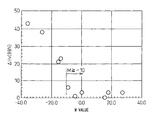
- FIG. 1 is a view showing the effects of alloy elements on changes in hardness after holding at 150° C. for 10 hours.
- FIG. 2 is a view showing the effects of alloy elements on the Charpy absorption energy at ⁇ 20° C. after holding at 150° C. for 10 hours.
- Si This is effective as a deoxidizing material and an element suppressing a drop in hardness during use. With addition of 0.30% or more, a remarkable effect is observed, but if over 1.00% is added, the toughness is liable to be impaired, so 1.00% or less is made the upper limit.
- Mn This element is effective mainly for raising the hardenability. 0.32% or more is necessary. It promotes the formation of cementite in the martensite at a low temperature, so acts to drop in hardness during use. Addition of a large amount is not desirable, so the range is made 0.32% to 0.70%.
- Mo acts to improve the hardenability and simultaneously suppresses any change of hardness while being used for a long period of time. Addition of 0.1% or more is required, but if over 1.0% is added, the toughness is liable to be impaired, so the upper limit is made 1.0%.
- Al This is added as a deoxidizing element into the steel. 0.01% or more is necessary, but addition over 0.1% tends to obstruct the toughness, so the upper limit is made 0.1%.
- N If this is added in a large amount into steel, it causes the toughness to drop, so the less the better.
- the upper limit of content is made 0.01% or less.
- the present invention may further have added to it V, Nb, and Ti as elements improving the hardness and toughness of the matrix material and one or more of Ca, Mg, and REMs for the purpose of improvement of ductility and toughness.
- V This element improves the hardenability and contributes to improvement of the hardness. Addition of 0.01% or more is necessary, but excessive addition impairs the toughness, so the upper limit is made 0.1%.
- Nb and Ti are elements which can improve the toughness by increasing the fineness of the crystal grains of the matrix material. An effect is obtained with addition of 0.005% of either of these, but remarkable addition is liable to impair the toughness through the formation of carbonitrides or other coarse precipitates, so the amounts of addition are made the ranges of Nb: 0.005 to 0.05% and Ti: 0.005 to 0.03%.
- Ca, Mg, and REMs are effective as elements preventing a drop in ductility due to the stretching of the sulfides during the hot rolling.
- Ca and Mg exhibit this effect when added in amounts of 0.0005% or more, while REMs exhibit this effect when added in amounts of 0.001% or more, but excessive addition may cause coarsening of the sulfides and simultaneously formation of coarse oxides at the time of melting. Therefore, the ranges of addition are Ca: 0.0005 to 0.05%, Mg: 0.0005 to 0.05%, and REMs: 0.001 to 0.1%.
- FIG. 1 plots the difference between the hardness after quenching the hot rolled steel plate, which contains; 0.23-0.26% C ⁇ 0.20-0.80% Si ⁇ 0.35-1.23% Mn ⁇ 0.45-1% Cr ⁇ 0.2-0.5% Mo ⁇ 0-0.105% V having plate thickness of 25 mm, and the hardness after holding this at 150° C. for 10 hours on the ordinate, and plots the M value calculated from the amount of the alloy elements on the abscissa. Holding at 150° C.
- FIG. 2 shows the Charpy absorption energy value at ⁇ 20° C. at that time on the ordinate.
- the steel according to the present invention can be particularly suitably used for bucket members of power shovels or vessel members of dump trucks. If used for these members, since the hardness will not be reduced during long term use, the abrasion of the member will be remarkably reduced over the long term and the usage life can be improved at least 1.4-fold.
- a steel slab having the above ingredients is used as a starting material and is heated, rolled, and heat treated.
- the steel slab is produced by adjusting and melting the ingredients in a converter or electric furnace, then casting them by the continuous casting method or ingot-casting and blooming method etc.
- the steel slab is heated, then hot rolled to the target plate thickness, then reheated to a temperature of the Ac 3 point or more, then quenched.
- the heating temperature and rolling conditions of the steel slab and the conditions at the time of quenching may be the usually generally used conditions.
- the heating temperature of the steel slab at this time is 1000° C. to 1250° C. If the finishing temperature at the time of hot rolling is 850° C. or more, there is no problem with the properties after direct quenching. Regarding the limits on the heating temperature of the steel slab, if less than 1000° C., the alloy elements included will not solubilize and a drop in hardness is liable to be caused, while if a temperature over 1270° C., the old austenite crystal grains will become coarser at the time of heating and the toughness is liable to fall, so this condition was set.
- the limits on the finishing temperature at the time of hot rolling were provided so as to secure the temperature at the time of direct quenching performed thereafter. If the finish rolling temperature becomes less than 850° C., the hardness after direct quenching is liable to fall, so a temperature of 850° C. or more is made the lower limit of the finishing temperature.
- Table 1 shows the chemical ingredients of test steels produced as examples of the present invention.
- the test steels were produced as steel materials by the ingot-casting and blooming method or the continuous casting method.
- the Steels A to I have the chemical ingredients in the scope of the present invention, while the Steels J to P were ones produced outside the scope of chemical ingredients of the present invention.
- the steel slabs shown in Table 1 were heated and hot rolled under the production conditions shown in Table 2, with some heat treated, to produce steel plates having plate thicknesses of 25 to 50 mm. After this, the plates were measured for Brinell hardness 0.5 mm right under the surface layer parts. Furthermore, parts of the steel plates were cut out, heat treated at 150° C. for 10 hours, then measured for Brinell hardness (HB) at the part 0.5 mm below the surfaces of the steel plates. Further, Charpy test pieces were taken (in longitudinal direction of rolling) from parts of 1 ⁇ 4t of the plate thicknesses and tested at ⁇ 20° C. The results are shown in Table 2.
- the Steel 10 to Steel 18 are cases where one of the chemical ingredients or production conditions of the steel plate is outside the scope of the present invention.
- the Steel 10 to Steel 16 are cases where the chemical ingredients are outside the scope of the present invention. That is, the Steel 10 and Steel 11 have amounts of C outside the scope of the present invention. As a result, the Steel 11 is the case where the amount of C is 0.19% or lower than the scope of the present invention, but the matrix material falls in hardness to HB382. On the other hand, the Steel 11 is the case where conversely the amount of C is higher than the scope, but the matrix material remarkably rises in hardness to HB563 and is also low in toughness.
- the Steel 12 is an example where the amount of addition of Si is higher than the scope of the present invention. In this case, the hardness of the matrix material rises and as a result the toughness becomes low.
- the Steel 13 is an example where the amount of addition of Mn is higher than the scope of the present invention. As a result, the change in hardness ⁇ HB becomes a somewhat large 15 or so and is low in toughness.
- the Steels 14 and 15 have high amounts of Cr and Mo outside the scope of the present invention. In this case, the change in hardness ⁇ HB is small, but the toughness is remarkably low.
- the Steel 16 is the case where the M value is outside the scope of the present invention. In this case, the toughness is good, but the change in hardness ⁇ HB becomes an extremely large 31.
- the Steel 17 and Steel 18 are cases produced under conditions outside the scope of the present invention in the scope of ingredients and production conditions. That is, the Steels 17 and 18 have ingredient systems with amounts of Mn higher than the scope of the invention, the Steel 17 is the case of heating with a quenching temperature after rolling of the Ac 3 transformation point or less, while the Steel 18 is the case where the finish rolling temperature is lower than the 850° C. or more of the scope of the present invention in the direct quenching process.
- Each has a hardness of the matrix material of HB400 or less and does not have the target hardness.
- the present invention enables a remarkable reduction in the change in hardness during use—extremely important in the characteristics of abrasion resistant steel.
Landscapes
- Chemical & Material Sciences (AREA)
- Engineering & Computer Science (AREA)
- Mechanical Engineering (AREA)
- Materials Engineering (AREA)
- Metallurgy (AREA)
- Organic Chemistry (AREA)
- Physics & Mathematics (AREA)
- Thermal Sciences (AREA)
- Crystallography & Structural Chemistry (AREA)
- Heat Treatment Of Steel (AREA)
Applications Claiming Priority (3)
| Application Number | Priority Date | Filing Date | Title |
|---|---|---|---|
| JP2005262297A JP4846308B2 (ja) | 2005-09-09 | 2005-09-09 | 使用中の硬さ変化が少ない高靭性耐摩耗鋼およびその製造方法 |
| JP2005-262297 | 2005-09-09 | ||
| PCT/JP2006/316657 WO2007029515A1 (ja) | 2005-09-09 | 2006-08-18 | 使用中の硬さ変化が少ない高靭性耐摩耗鋼およびその製造方法 |
Publications (2)
| Publication Number | Publication Date |
|---|---|
| US20100059150A1 US20100059150A1 (en) | 2010-03-11 |
| US8097099B2 true US8097099B2 (en) | 2012-01-17 |
Family
ID=37835638
Family Applications (1)
| Application Number | Title | Priority Date | Filing Date |
|---|---|---|---|
| US11/991,592 Expired - Fee Related US8097099B2 (en) | 2005-09-09 | 2006-08-18 | High toughness abrasion resistant steel with little change in hardness during use and method of production of same |
Country Status (7)
| Country | Link |
|---|---|
| US (1) | US8097099B2 (de) |
| EP (1) | EP1930459A4 (de) |
| JP (1) | JP4846308B2 (de) |
| KR (1) | KR20080034987A (de) |
| CN (1) | CN101258257B (de) |
| BR (1) | BRPI0615885B1 (de) |
| WO (1) | WO2007029515A1 (de) |
Cited By (2)
| Publication number | Priority date | Publication date | Assignee | Title |
|---|---|---|---|---|
| US9816165B2 (en) | 2012-07-31 | 2017-11-14 | Baoshan Iron & Steel Co., Ltd. | Ultrahigh-strength, high-toughness, wear-resistant steel plate and manufacturing method thereof |
| US9982331B2 (en) | 2012-09-19 | 2018-05-29 | Jfe Steel Corporation | Abrasion resistant steel plate having excellent low-temperature toughness and excellent corrosive wear resistance |
Families Citing this family (23)
| Publication number | Priority date | Publication date | Assignee | Title |
|---|---|---|---|---|
| JP5089224B2 (ja) | 2007-03-30 | 2012-12-05 | 株式会社神戸製鋼所 | オンライン冷却型高張力鋼板の製造方法 |
| JP5145804B2 (ja) * | 2007-07-26 | 2013-02-20 | Jfeスチール株式会社 | 耐低温焼戻し脆化割れ特性に優れた耐磨耗鋼板 |
| JP5323552B2 (ja) * | 2008-03-31 | 2013-10-23 | 株式会社神戸製鋼所 | スポット溶接継手の十字引張強度に優れた焼入れ用鋼板 |
| JP4659142B2 (ja) * | 2009-03-27 | 2011-03-30 | 新日本製鐵株式会社 | 浸炭焼入れ性の優れた炭素鋼板およびその製造方法 |
| CN101691640B (zh) * | 2009-09-01 | 2011-09-07 | 东北大学 | 一种高强度低合金耐磨钢板及其制造方法 |
| CN102134682B (zh) * | 2010-01-22 | 2013-01-02 | 宝山钢铁股份有限公司 | 一种耐磨钢板 |
| JP5655356B2 (ja) * | 2010-04-02 | 2015-01-21 | Jfeスチール株式会社 | 低温焼戻脆化割れ性に優れた耐摩耗鋼板 |
| JP2012031511A (ja) * | 2010-06-30 | 2012-02-16 | Jfe Steel Corp | 多層盛溶接部靭性と耐遅れ破壊特性に優れた耐磨耗鋼板 |
| JP5866820B2 (ja) * | 2010-06-30 | 2016-02-24 | Jfeスチール株式会社 | 溶接部靭性および耐遅れ破壊特性に優れた耐磨耗鋼板 |
| JP5609602B2 (ja) * | 2010-12-06 | 2014-10-22 | 新日鐵住金株式会社 | 細粒鉄源運搬部材及びこれを用いたベッセル等 |
| DE212010000038U1 (de) * | 2010-12-23 | 2011-11-28 | Advanced Manufacture Technology Center Camtc | Ein Formstahl |
| BR112013025040B1 (pt) | 2011-03-29 | 2018-11-06 | Jfe Steel Corporation | chapa de aço resistente à abrasão tendo resistência a fragilização por corrosão sob tensão, e método para produção da mesma |
| US9879334B2 (en) | 2011-03-29 | 2018-01-30 | Jfe Steel Corporation | Abrasion resistant steel plate or steel sheet excellent in resistance to stress corrosion cracking and method for manufacturing the same |
| CN102345071B (zh) * | 2011-07-08 | 2013-07-17 | 南阳汉冶特钢有限公司 | 一种合金用结构钢30CrMo加B钢板及其生产方法 |
| CN102337455A (zh) * | 2011-09-05 | 2012-02-01 | 内蒙古包钢钢联股份有限公司 | 一种稀土处理的高韧性耐磨钢板 |
| CN102912239A (zh) * | 2012-03-06 | 2013-02-06 | 泰州市永昌冶金科技有限公司 | 一种高温耐磨钢 |
| CN103103448A (zh) * | 2012-12-29 | 2013-05-15 | 内蒙古包钢钢联股份有限公司 | 一种低合金高强韧性耐磨钢板 |
| CN103834877B (zh) * | 2014-03-26 | 2015-11-18 | 武汉钢铁(集团)公司 | 一种薄板坯生产切割鞋模用钢及其制备方法 |
| CN103993246B (zh) * | 2014-04-23 | 2016-07-20 | 中建材宁国新马耐磨材料有限公司 | 一种低合金球磨机耐磨衬板及其制备方法 |
| JP6350340B2 (ja) * | 2015-03-04 | 2018-07-04 | Jfeスチール株式会社 | 耐摩耗鋼板およびその製造方法 |
| CN107746935B (zh) * | 2017-10-26 | 2019-06-28 | 河钢股份有限公司 | 一种高强度耐磨钢板及其生产工艺 |
| CN109609839B (zh) * | 2018-11-16 | 2021-03-02 | 邯郸钢铁集团有限责任公司 | 高延伸性能的低合金高强耐磨钢nm450及其生产方法 |
| EP4563714A4 (de) * | 2022-07-29 | 2025-11-26 | Baoshan Iron & Steel | Korrosionsbeständige und verschleissfeste stahlplatte und herstellungsverfahren dafür |
Citations (8)
| Publication number | Priority date | Publication date | Assignee | Title |
|---|---|---|---|---|
| JPS6059019A (ja) | 1983-09-13 | 1985-04-05 | Sumitomo Metal Ind Ltd | 耐遅れ破壊性の優れた耐摩耗性鋼板の製造法 |
| JPS63317623A (ja) | 1987-06-19 | 1988-12-26 | Kobe Steel Ltd | 耐遅れ割れ性の優れた耐摩耗用鋼板の製造方法 |
| JPH01149921A (ja) | 1987-12-04 | 1989-06-13 | Kawasaki Steel Corp | 耐遅れ割れ性の優れた直接焼入れ型高強度鋼の製造方法 |
| JPH01172514A (ja) | 1987-12-25 | 1989-07-07 | Nippon Steel Corp | 耐熱亀裂性に優れた高硬度高靭性耐摩耗鋼の製造法 |
| JPH09118950A (ja) | 1995-10-24 | 1997-05-06 | Nippon Steel Corp | 厚手高硬度高靱性耐摩耗鋼およびその製造方法 |
| JP2001049387A (ja) | 1999-08-03 | 2001-02-20 | Nippon Steel Corp | 高靭性厚手高温耐摩耗鋼 |
| JP2004010996A (ja) | 2002-06-10 | 2004-01-15 | Jfe Steel Kk | 低温靭性に優れた耐摩耗鋼およびその製造方法 |
| JP2005179783A (ja) | 2000-12-27 | 2005-07-07 | Jfe Steel Kk | 耐摩耗鋼板及びその製造方法 |
Family Cites Families (2)
| Publication number | Priority date | Publication date | Assignee | Title |
|---|---|---|---|---|
| US5853502A (en) * | 1995-08-11 | 1998-12-29 | Sumitomo Metal Industries, Ltd. | Carburizing steel and steel products manufactured making use of the carburizing steel |
| US5900077A (en) * | 1997-12-15 | 1999-05-04 | Caterpillar Inc. | Hardness, strength, and fracture toughness steel |
-
2005
- 2005-09-09 JP JP2005262297A patent/JP4846308B2/ja not_active Expired - Fee Related
-
2006
- 2006-08-18 US US11/991,592 patent/US8097099B2/en not_active Expired - Fee Related
- 2006-08-18 CN CN2006800329559A patent/CN101258257B/zh active Active
- 2006-08-18 KR KR1020087005588A patent/KR20080034987A/ko not_active Ceased
- 2006-08-18 BR BRPI0615885-4A patent/BRPI0615885B1/pt active IP Right Grant
- 2006-08-18 WO PCT/JP2006/316657 patent/WO2007029515A1/ja not_active Ceased
- 2006-08-18 EP EP06796763A patent/EP1930459A4/de not_active Withdrawn
Patent Citations (8)
| Publication number | Priority date | Publication date | Assignee | Title |
|---|---|---|---|---|
| JPS6059019A (ja) | 1983-09-13 | 1985-04-05 | Sumitomo Metal Ind Ltd | 耐遅れ破壊性の優れた耐摩耗性鋼板の製造法 |
| JPS63317623A (ja) | 1987-06-19 | 1988-12-26 | Kobe Steel Ltd | 耐遅れ割れ性の優れた耐摩耗用鋼板の製造方法 |
| JPH01149921A (ja) | 1987-12-04 | 1989-06-13 | Kawasaki Steel Corp | 耐遅れ割れ性の優れた直接焼入れ型高強度鋼の製造方法 |
| JPH01172514A (ja) | 1987-12-25 | 1989-07-07 | Nippon Steel Corp | 耐熱亀裂性に優れた高硬度高靭性耐摩耗鋼の製造法 |
| JPH09118950A (ja) | 1995-10-24 | 1997-05-06 | Nippon Steel Corp | 厚手高硬度高靱性耐摩耗鋼およびその製造方法 |
| JP2001049387A (ja) | 1999-08-03 | 2001-02-20 | Nippon Steel Corp | 高靭性厚手高温耐摩耗鋼 |
| JP2005179783A (ja) | 2000-12-27 | 2005-07-07 | Jfe Steel Kk | 耐摩耗鋼板及びその製造方法 |
| JP2004010996A (ja) | 2002-06-10 | 2004-01-15 | Jfe Steel Kk | 低温靭性に優れた耐摩耗鋼およびその製造方法 |
Cited By (2)
| Publication number | Priority date | Publication date | Assignee | Title |
|---|---|---|---|---|
| US9816165B2 (en) | 2012-07-31 | 2017-11-14 | Baoshan Iron & Steel Co., Ltd. | Ultrahigh-strength, high-toughness, wear-resistant steel plate and manufacturing method thereof |
| US9982331B2 (en) | 2012-09-19 | 2018-05-29 | Jfe Steel Corporation | Abrasion resistant steel plate having excellent low-temperature toughness and excellent corrosive wear resistance |
Also Published As
| Publication number | Publication date |
|---|---|
| BRPI0615885A2 (pt) | 2011-05-31 |
| CN101258257B (zh) | 2011-01-19 |
| KR20080034987A (ko) | 2008-04-22 |
| WO2007029515A1 (ja) | 2007-03-15 |
| JP4846308B2 (ja) | 2011-12-28 |
| US20100059150A1 (en) | 2010-03-11 |
| JP2007070713A (ja) | 2007-03-22 |
| CN101258257A (zh) | 2008-09-03 |
| BRPI0615885B1 (pt) | 2015-08-04 |
| EP1930459A1 (de) | 2008-06-11 |
| EP1930459A4 (de) | 2012-01-11 |
Similar Documents
| Publication | Publication Date | Title |
|---|---|---|
| US8097099B2 (en) | High toughness abrasion resistant steel with little change in hardness during use and method of production of same | |
| JP6850890B2 (ja) | 高硬度耐摩耗鋼及びその製造方法 | |
| KR101656980B1 (ko) | 스테인리스강제 브레이크 디스크와 그 제조 방법 | |
| JP3273404B2 (ja) | 厚手高硬度高靱性耐摩耗鋼の製造方法 | |
| US10526687B2 (en) | Ultra-high-strength steel sheet having excellent delayed fracture resistance at cut end thereof | |
| EP3859040A1 (de) | Verschleissfester stahl mit ausgezeichneter härte und schlagzähigkeit und verfahren zur herstellung davon | |
| EP3339464B1 (de) | Verfahren zur herstellung eines hochfestes stahlblechs | |
| CN104769144A (zh) | 耐热性优良的铁素体系不锈钢板 | |
| CN111479945A (zh) | 具有优秀硬度和冲击韧性的耐磨损钢及其制造方法 | |
| KR102164092B1 (ko) | 버링성이 우수한 고강도 냉연강판 및 합금화 용융아연도금강판 | |
| KR102009630B1 (ko) | 강판 | |
| KR101736632B1 (ko) | 항복강도 및 연성이 우수한 고강도 냉연강판 및 그 제조방법 | |
| KR102805613B1 (ko) | 강도 및 내식성이 향상된 마르텐사이트계 스테인리스강 및 이의 제조 방법 | |
| JP6798557B2 (ja) | 鋼 | |
| EP3633060B1 (de) | Stahlplatte und verfahren zur herstellung derselben | |
| KR102164088B1 (ko) | 버링성이 우수한 고강도 냉연강판 및 그 제조방법 | |
| EP3467130B1 (de) | Stahlplatte mit hoher zugfestigkeit und ausgezeichneter tieftemperaturzähigkeit | |
| JP7180147B2 (ja) | 耐食性耐摩耗鋼板 | |
| KR20220089396A (ko) | 가공성이 우수한 고인성 고탄소 냉연강판 및 그 제조방법 | |
| KR102498150B1 (ko) | 저온 충격인성이 우수한 고경도 방탄강 및 이의 제조방법 | |
| KR102209569B1 (ko) | 고강도 고연성 강판 및 그 제조방법 | |
| KR20260014723A (ko) | 마르텐사이트계 스테인리스강 및 그 제조방법 | |
| KR20250093734A (ko) | 냉연강판 및 그 제조방법 | |
| KR20250092957A (ko) | 마르텐사이트계 스테인리스강 및 그 제조방법 | |
| KR20230102795A (ko) | 후판 및 그 제조방법 |
Legal Events
| Date | Code | Title | Description |
|---|---|---|---|
| AS | Assignment |
Owner name: NIPPON STEEL CORPORATION,JAPAN Free format text: ASSIGNMENT OF ASSIGNORS INTEREST;ASSIGNORS:SAITOH, NAOKI;KUMAGAI, TATSUYA;KUREBAYASHI, KATSUMI;AND OTHERS;REEL/FRAME:020668/0940 Effective date: 20080213 Owner name: NIPPON STEEL CORPORATION, JAPAN Free format text: ASSIGNMENT OF ASSIGNORS INTEREST;ASSIGNORS:SAITOH, NAOKI;KUMAGAI, TATSUYA;KUREBAYASHI, KATSUMI;AND OTHERS;REEL/FRAME:020668/0940 Effective date: 20080213 |
|
| ZAAA | Notice of allowance and fees due |
Free format text: ORIGINAL CODE: NOA |
|
| ZAAB | Notice of allowance mailed |
Free format text: ORIGINAL CODE: MN/=. |
|
| STCF | Information on status: patent grant |
Free format text: PATENTED CASE |
|
| FPAY | Fee payment |
Year of fee payment: 4 |
|
| MAFP | Maintenance fee payment |
Free format text: PAYMENT OF MAINTENANCE FEE, 8TH YEAR, LARGE ENTITY (ORIGINAL EVENT CODE: M1552); ENTITY STATUS OF PATENT OWNER: LARGE ENTITY Year of fee payment: 8 |
|
| FEPP | Fee payment procedure |
Free format text: MAINTENANCE FEE REMINDER MAILED (ORIGINAL EVENT CODE: REM.); ENTITY STATUS OF PATENT OWNER: LARGE ENTITY |
|
| LAPS | Lapse for failure to pay maintenance fees |
Free format text: PATENT EXPIRED FOR FAILURE TO PAY MAINTENANCE FEES (ORIGINAL EVENT CODE: EXP.); ENTITY STATUS OF PATENT OWNER: LARGE ENTITY |
|
| STCH | Information on status: patent discontinuation |
Free format text: PATENT EXPIRED DUE TO NONPAYMENT OF MAINTENANCE FEES UNDER 37 CFR 1.362 |
|
| FP | Lapsed due to failure to pay maintenance fee |
Effective date: 20240117 |