US10035869B2 - Copolymer, aqueous ink, and ink cartridge - Google Patents
Copolymer, aqueous ink, and ink cartridge Download PDFInfo
- Publication number
- US10035869B2 US10035869B2 US15/547,668 US201615547668A US10035869B2 US 10035869 B2 US10035869 B2 US 10035869B2 US 201615547668 A US201615547668 A US 201615547668A US 10035869 B2 US10035869 B2 US 10035869B2
- Authority
- US
- United States
- Prior art keywords
- pigment
- copolymer
- ink
- general formula
- aqueous
- Prior art date
- Legal status (The legal status is an assumption and is not a legal conclusion. Google has not performed a legal analysis and makes no representation as to the accuracy of the status listed.)
- Active
Links
- 0 *CC(=O)OCCNC(=O)O*C.C1=CC2=C(C=C1)C=CC=C2.CCC1=CC=CC=C1.COC(=O)CCC(=O)OC Chemical compound *CC(=O)OCCNC(=O)O*C.C1=CC2=C(C=C1)C=CC=C2.CCC1=CC=CC=C1.COC(=O)CCC(=O)OC 0.000 description 13
- LDCRTTXIJACKKU-ARJAWSKDSA-N COC(=O)/C=C\C(=O)OC Chemical compound COC(=O)/C=C\C(=O)OC LDCRTTXIJACKKU-ARJAWSKDSA-N 0.000 description 3
- MUXOBHXGJLMRAB-UHFFFAOYSA-N COC(=O)CCC(=O)OC Chemical compound COC(=O)CCC(=O)OC MUXOBHXGJLMRAB-UHFFFAOYSA-N 0.000 description 2
- BMRZHZNNXFWKPN-UHFFFAOYSA-N C=C(C)C(=O)OCCNC(=O)OC1=CC2=C(C=CC=C2)C=C1 Chemical compound C=C(C)C(=O)OCCNC(=O)OC1=CC2=C(C=CC=C2)C=C1 BMRZHZNNXFWKPN-UHFFFAOYSA-N 0.000 description 1
- BTXLBXOGQFHUID-UHFFFAOYSA-N C=C(C)C(=O)OCCNC(=O)OCCCCCC Chemical compound C=C(C)C(=O)OCCNC(=O)OCCCCCC BTXLBXOGQFHUID-UHFFFAOYSA-N 0.000 description 1
- NFCAOOVYOWQBQO-UHFFFAOYSA-N C=C(C)C(=O)OCCNC(=O)OCCCCCCCCCCCCCCCCOC(=O)C1=CC2=C(C=CC=C2)C=C1 Chemical compound C=C(C)C(=O)OCCNC(=O)OCCCCCCCCCCCCCCCCOC(=O)C1=CC2=C(C=CC=C2)C=C1 NFCAOOVYOWQBQO-UHFFFAOYSA-N 0.000 description 1
- VHXCEAIXEROMBY-UHFFFAOYSA-N C=C(C)C(=O)OCCNC(=O)OCCCCCCOC(=O)C1=CC2=C(C=CC=C2)C=C1 Chemical compound C=C(C)C(=O)OCCNC(=O)OCCCCCCOC(=O)C1=CC2=C(C=CC=C2)C=C1 VHXCEAIXEROMBY-UHFFFAOYSA-N 0.000 description 1
- VCSMOBRIKOJCIQ-UHFFFAOYSA-N C=C(C)C(=O)OCCNC(=O)OCCOC(=O)C1=CC2=C(C=CC=C2)C=C1 Chemical compound C=C(C)C(=O)OCCNC(=O)OCCOC(=O)C1=CC2=C(C=CC=C2)C=C1 VCSMOBRIKOJCIQ-UHFFFAOYSA-N 0.000 description 1
- JAFGHLSAWHYNQF-UHFFFAOYSA-N C=CC(=O)OCCNC(=O)OCCCCCCCCCCCCOC(=O)C1=CC2=C(C=CC=C2)C=C1 Chemical compound C=CC(=O)OCCNC(=O)OCCCCCCCCCCCCOC(=O)C1=CC2=C(C=CC=C2)C=C1 JAFGHLSAWHYNQF-UHFFFAOYSA-N 0.000 description 1
- ZQJOIJBDUIZIBN-UHFFFAOYSA-N NC1=CC=C(C(=O)NC(P(=O)(O)O)P(=O)(O)O)C=C1 Chemical compound NC1=CC=C(C(=O)NC(P(=O)(O)O)P(=O)(O)O)C=C1 ZQJOIJBDUIZIBN-UHFFFAOYSA-N 0.000 description 1
Images


Classifications
-
- B—PERFORMING OPERATIONS; TRANSPORTING
- B41—PRINTING; LINING MACHINES; TYPEWRITERS; STAMPS
- B41J—TYPEWRITERS; SELECTIVE PRINTING MECHANISMS, i.e. MECHANISMS PRINTING OTHERWISE THAN FROM A FORME; CORRECTION OF TYPOGRAPHICAL ERRORS
- B41J2/00—Typewriters or selective printing mechanisms characterised by the printing or marking process for which they are designed
- B41J2/005—Typewriters or selective printing mechanisms characterised by the printing or marking process for which they are designed characterised by bringing liquid or particles selectively into contact with a printing material
- B41J2/01—Ink jet
- B41J2/015—Ink jet characterised by the jet generation process
- B41J2/04—Ink jet characterised by the jet generation process generating single droplets or particles on demand
-
- C—CHEMISTRY; METALLURGY
- C08—ORGANIC MACROMOLECULAR COMPOUNDS; THEIR PREPARATION OR CHEMICAL WORKING-UP; COMPOSITIONS BASED THEREON
- C08F—MACROMOLECULAR COMPOUNDS OBTAINED BY REACTIONS ONLY INVOLVING CARBON-TO-CARBON UNSATURATED BONDS
- C08F220/00—Copolymers of compounds having one or more unsaturated aliphatic radicals, each having only one carbon-to-carbon double bond, and only one being terminated by only one carboxyl radical or a salt, anhydride ester, amide, imide or nitrile thereof
- C08F220/02—Monocarboxylic acids having less than ten carbon atoms; Derivatives thereof
- C08F220/10—Esters
- C08F220/34—Esters containing nitrogen, e.g. N,N-dimethylaminoethyl (meth)acrylate
- C08F220/36—Esters containing nitrogen, e.g. N,N-dimethylaminoethyl (meth)acrylate containing oxygen in addition to the carboxy oxygen, e.g. 2-N-morpholinoethyl (meth)acrylate or 2-isocyanatoethyl (meth)acrylate
-
- C—CHEMISTRY; METALLURGY
- C08—ORGANIC MACROMOLECULAR COMPOUNDS; THEIR PREPARATION OR CHEMICAL WORKING-UP; COMPOSITIONS BASED THEREON
- C08F—MACROMOLECULAR COMPOUNDS OBTAINED BY REACTIONS ONLY INVOLVING CARBON-TO-CARBON UNSATURATED BONDS
- C08F220/00—Copolymers of compounds having one or more unsaturated aliphatic radicals, each having only one carbon-to-carbon double bond, and only one being terminated by only one carboxyl radical or a salt, anhydride ester, amide, imide or nitrile thereof
- C08F220/02—Monocarboxylic acids having less than ten carbon atoms; Derivatives thereof
- C08F220/10—Esters
- C08F220/34—Esters containing nitrogen, e.g. N,N-dimethylaminoethyl (meth)acrylate
- C08F220/36—Esters containing nitrogen, e.g. N,N-dimethylaminoethyl (meth)acrylate containing oxygen in addition to the carboxy oxygen, e.g. 2-N-morpholinoethyl (meth)acrylate or 2-isocyanatoethyl (meth)acrylate
- C08F220/365—Esters containing nitrogen, e.g. N,N-dimethylaminoethyl (meth)acrylate containing oxygen in addition to the carboxy oxygen, e.g. 2-N-morpholinoethyl (meth)acrylate or 2-isocyanatoethyl (meth)acrylate containing further carboxylic moieties
-
- C—CHEMISTRY; METALLURGY
- C08—ORGANIC MACROMOLECULAR COMPOUNDS; THEIR PREPARATION OR CHEMICAL WORKING-UP; COMPOSITIONS BASED THEREON
- C08F—MACROMOLECULAR COMPOUNDS OBTAINED BY REACTIONS ONLY INVOLVING CARBON-TO-CARBON UNSATURATED BONDS
- C08F222/00—Copolymers of compounds having one or more unsaturated aliphatic radicals, each having only one carbon-to-carbon double bond, and at least one being terminated by a carboxyl radical and containing at least one other carboxyl radical in the molecule; Salts, anhydrides, esters, amides, imides, or nitriles thereof
- C08F222/02—Acids; Metal salts or ammonium salts thereof, e.g. maleic acid or itaconic acid
-
- C—CHEMISTRY; METALLURGY
- C09—DYES; PAINTS; POLISHES; NATURAL RESINS; ADHESIVES; COMPOSITIONS NOT OTHERWISE PROVIDED FOR; APPLICATIONS OF MATERIALS NOT OTHERWISE PROVIDED FOR
- C09D—COATING COMPOSITIONS, e.g. PAINTS, VARNISHES OR LACQUERS; FILLING PASTES; CHEMICAL PAINT OR INK REMOVERS; INKS; CORRECTING FLUIDS; WOODSTAINS; PASTES OR SOLIDS FOR COLOURING OR PRINTING; USE OF MATERIALS THEREFOR
- C09D11/00—Inks
- C09D11/02—Printing inks
- C09D11/10—Printing inks based on artificial resins
- C09D11/106—Printing inks based on artificial resins containing macromolecular compounds obtained by reactions only involving carbon-to-carbon unsaturated bonds
-
- C—CHEMISTRY; METALLURGY
- C09—DYES; PAINTS; POLISHES; NATURAL RESINS; ADHESIVES; COMPOSITIONS NOT OTHERWISE PROVIDED FOR; APPLICATIONS OF MATERIALS NOT OTHERWISE PROVIDED FOR
- C09D—COATING COMPOSITIONS, e.g. PAINTS, VARNISHES OR LACQUERS; FILLING PASTES; CHEMICAL PAINT OR INK REMOVERS; INKS; CORRECTING FLUIDS; WOODSTAINS; PASTES OR SOLIDS FOR COLOURING OR PRINTING; USE OF MATERIALS THEREFOR
- C09D11/00—Inks
- C09D11/02—Printing inks
- C09D11/10—Printing inks based on artificial resins
- C09D11/106—Printing inks based on artificial resins containing macromolecular compounds obtained by reactions only involving carbon-to-carbon unsaturated bonds
- C09D11/107—Printing inks based on artificial resins containing macromolecular compounds obtained by reactions only involving carbon-to-carbon unsaturated bonds from unsaturated acids or derivatives thereof
-
- C—CHEMISTRY; METALLURGY
- C09—DYES; PAINTS; POLISHES; NATURAL RESINS; ADHESIVES; COMPOSITIONS NOT OTHERWISE PROVIDED FOR; APPLICATIONS OF MATERIALS NOT OTHERWISE PROVIDED FOR
- C09D—COATING COMPOSITIONS, e.g. PAINTS, VARNISHES OR LACQUERS; FILLING PASTES; CHEMICAL PAINT OR INK REMOVERS; INKS; CORRECTING FLUIDS; WOODSTAINS; PASTES OR SOLIDS FOR COLOURING OR PRINTING; USE OF MATERIALS THEREFOR
- C09D11/00—Inks
- C09D11/30—Inkjet printing inks
-
- C—CHEMISTRY; METALLURGY
- C09—DYES; PAINTS; POLISHES; NATURAL RESINS; ADHESIVES; COMPOSITIONS NOT OTHERWISE PROVIDED FOR; APPLICATIONS OF MATERIALS NOT OTHERWISE PROVIDED FOR
- C09D—COATING COMPOSITIONS, e.g. PAINTS, VARNISHES OR LACQUERS; FILLING PASTES; CHEMICAL PAINT OR INK REMOVERS; INKS; CORRECTING FLUIDS; WOODSTAINS; PASTES OR SOLIDS FOR COLOURING OR PRINTING; USE OF MATERIALS THEREFOR
- C09D11/00—Inks
- C09D11/30—Inkjet printing inks
- C09D11/32—Inkjet printing inks characterised by colouring agents
- C09D11/322—Pigment inks
-
- C—CHEMISTRY; METALLURGY
- C09—DYES; PAINTS; POLISHES; NATURAL RESINS; ADHESIVES; COMPOSITIONS NOT OTHERWISE PROVIDED FOR; APPLICATIONS OF MATERIALS NOT OTHERWISE PROVIDED FOR
- C09D—COATING COMPOSITIONS, e.g. PAINTS, VARNISHES OR LACQUERS; FILLING PASTES; CHEMICAL PAINT OR INK REMOVERS; INKS; CORRECTING FLUIDS; WOODSTAINS; PASTES OR SOLIDS FOR COLOURING OR PRINTING; USE OF MATERIALS THEREFOR
- C09D11/00—Inks
- C09D11/30—Inkjet printing inks
- C09D11/32—Inkjet printing inks characterised by colouring agents
- C09D11/324—Inkjet printing inks characterised by colouring agents containing carbon black
- C09D11/326—Inkjet printing inks characterised by colouring agents containing carbon black characterised by the pigment dispersant
-
- C—CHEMISTRY; METALLURGY
- C08—ORGANIC MACROMOLECULAR COMPOUNDS; THEIR PREPARATION OR CHEMICAL WORKING-UP; COMPOSITIONS BASED THEREON
- C08F—MACROMOLECULAR COMPOUNDS OBTAINED BY REACTIONS ONLY INVOLVING CARBON-TO-CARBON UNSATURATED BONDS
- C08F212/00—Copolymers of compounds having one or more unsaturated aliphatic radicals, each having only one carbon-to-carbon double bond, and at least one being terminated by an aromatic carbocyclic ring
- C08F212/02—Monomers containing only one unsaturated aliphatic radical
- C08F212/04—Monomers containing only one unsaturated aliphatic radical containing one ring
- C08F212/06—Hydrocarbons
- C08F212/08—Styrene
-
- C08F2220/365—
Definitions
- the present disclosure relates to novel copolymers, aqueous inks, and ink cartridges.
- Ink jet recording methods have become popular because compared to other recording methods, the ink jet recording methods are advantageous in that they proceed with processes with ease and form full color images in a more simple manner, and that images having high resolution can be obtained with devices having simple configurations. Therefore, the ink recording methods have found applications not only in personal use but also in uses in offices, commercial printings, and industrial printings.
- an aqueous ink composition containing an aqueous dye as a colorant is mainly used, but it is poor in water resistance and light resistance. Therefore, a pigment ink containing a water-insoluble pigment has been developed instead of the aqueous dye.
- plain paper In the inkjet printing used for offices, plain paper is mainly used as a recording medium, and there is a need for attainment of high image density.
- the pigment does not remain on the surface of the paper, and penetrates into the paper. Therefore, a concentration of the pigment on the surface of the paper is low, which leads to reduction in image density.
- the concentration of the pigment in the ink is high, high image density can be obtained, but a viscosity of the ink becomes high, which leads to reduction in ejection stability.
- an aqueous pigment ink containing a pigment as a colorant is poor in color density on plain paper, particularly white plain paper compared to a dye ink in cases where the aqueous pigment ink is used for writing tools such as felt-tipped markers, ballpoint pens, and plotter pens.
- an aqueous pigment ink containing urea or derivatives thereof, water, a pigment, an aqueous resin, phosphoric acid ester surfactant, and an O/W type emulsion of copolymer of water-insoluble (meth) acrylic resin and/or stylene-(meth)acrylic acid, which has an average particle diameter in a range of from 50 nm through 200 nm and has a minimum filming forming temperature of 50 degrees Celsius or more (see PTL 3).
- an effect of improving color density is not sufficiently obtained.
- a graft polymer containing an aromatic ring at a side chain of the polymer is proposed (see PTL 4).
- a hydrophilic organic solvent may be added to the aqueous ink, in order to prevent plain paper from causing curl generated during printing on the plain paper, or in order to improve permeability of the ink to be quickly dried, and to prevent occurrence of beading in cases where the ink is printed on coated paper or art paper.
- a hydrophilic organic solvent may be added to the aqueous ink, in order to prevent plain paper from causing curl generated during printing on the plain paper, or in order to improve permeability of the ink to be quickly dried, and to prevent occurrence of beading in cases where the ink is printed on coated paper or art paper.
- the present invention has an object to provide a novel copolymer that is useful for a binder resin and a pigment dispersing agent of an aqueous ink.
- a copolymer of the present invention includes a structural unit represented by the following General Formula (1), a structural unit expressed by the following Structural Formula (1), and a structural unit represented by the following General Formula (2).
- X represents a hydrogen atom or a cation.
- R is a hydrogen atom or a methyl group
- L is a single bond or —(CH 2 ) n —O—CO— where n is an integer in a range of from 2 through 18, and a carbonyl carbon atom in the —(CH 2 ) n —O—CO— is bound to naphthyl.
- a novel copolymer that is useful for a binder resin and a pigment dispersing agent of an aqueous ink can be provided.
- FIG. 1 is a view illustrating one example of an ink cartridge of the present invention.
- FIG. 2 is an explanation view illustrating the ink cartridge illustrated in FIG. 1 and a casing of the ink cartridge.
- FIG. 3 is a graph illustrating an IR spectrum of the copolymer obtained in Example 1.
- FIG. 4 is a graph illustrating an IR spectrum of the copolymer obtained in Example 6.
- FIG. 5 is a graph illustrating an IR spectrum of the copolymer obtained in Example 9.
- FIG. 6 is a schematic view illustrating one example of an inkjet recording device of the present invention.
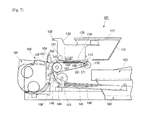
- FIG. 7 is a schematic view illustrating one example of configuration of a main body of the device illustrated in FIG. 6 .
- a copolymer of the present invention contains a structural unit represented by the following General Formula (1), a structural unit expressed by the following Structural Formula (1), and
- X represents a hydrogen atom or a cation.
- R is a hydrogen atom or a methyl group
- L is a single bond or —(CH 2 ) n —O—CO— where n is an integer in a range of from 2 through 18, and a carbonyl carbon atom in the —(CH 2 ) n —O—CO— is bound to naphthyl.
- a copolymer of the present invention When a copolymer of the present invention is used as a binder resin of an aqueous ink, an image having high resolution and high definition can be obtained on various recording media, even if the resultant ink is printed at high speed.
- the copolymer of the present invention when used as a pigment dispersing agent, a pigment dispersing element having high dispersibility and long-term stability can be obtained.
- X is a hydrogen atom or a cation.
- oxygen adjacent to the cation exists as O ⁇ .
- the cation include a sodium ion, a potassium ion, a lithium ion, a tetramethyl ammonium ion, a tetraethyl ammonium ion, a tetrapropyl ammonium ion, a tetrabutyl ammonium ion, a tetrapentyl ammonium ion, a tetrahexyl ammonium ion, a triethylmethyl ammonium ion, a tributylmethyl ammonium ion, a trioctylmethyl ammonium ion, a 2-hydroxy ethyltrimethyl ammonium ion, a tris(2-hydroxy ethyl)methyl ammonium ion, a
- R is a hydrogen atom or a methyl group
- L is a single bond or —(CH 2 ) n —O—CO— where n is an integer in a range of from 2 through 18.
- L is the —(CH 2 ) n —O—CO—
- a carbonyl carbon atom in the —(CH 2 ) n —O—CO— is bound to naphthyl.
- a naphtyl group present at the end of the chain through the L has excellent adsorptive property to the pigment due to a ⁇ - ⁇ stacking with the pigment that is the colorant in the aqueous ink. Therefore, the naphtyl group is bound to the pigment on a recording medium during printing, and thus the pigment particles can cause rapid aggregation on the surface of the recording medium, which can prevent occurrence of beading.
- the Structural Formula (1), and the General Formula (2) typically the structural units represented by the General Formula (1), the Structural Formula (1), and the General Formula (2) may be a main chain of the copolymer containing a pendant group such as the end naphthyl group and the side chain carboxyl group, each of which is a pendant through the L.
- a pendant group such as the end naphthyl group and the side chain carboxyl group, each of which is a pendant through the L.
- the cases where the structural units represented by the General Formula (1), the Structural Formula (1), and the General Formula (2) are partially contained in a side chain of the copolymer are not excluded.
- a copolymer of the present invention when used to prepare a pigment dispersing element obtained by dispersing a pigment in water, the naphthyl group is present at the end of the side chain of the copolymer, and thus is easily adsorbed to the surface of the pigment, and has high adsorptive property to the pigment. Therefore, a dispersion element having high dispersiveness and long-term stability can be obtained.
- An amount of the structural unit represented by the General Formula (2) in the copolymer is preferably in a range of from 20 mol % through 80 mol %, more preferably in a range of from 35 mol % through 80 mol %, in terms of adsorbing a pigment.
- the amount of the structural unit represented by the General Formula (2) is in a range of from 20 mol % through 80 mol %, the copolymer is improved in adsorbing a pigment, a speed of condensing the pigment on a recording medium rises, and the recording medium is prevented from causing beading (spots).
- the copolymer is used as a pigment dispersing agent, dispersion stability is improved.
- the total amount of the structural unit represented by the General Formula (1) and the structural unit expressed by the following Structural Formula (1) in the copolymer is preferably in a range of from 20 mol % through 80 mol %, more preferably in a range of from 50 mol % through 70 mol %.
- a copolymer of the present invention is preferably formed through polymerization of a compound represented by the following General Formula (3), a compound expressed by the following Structural Formula (2), and a compound represented by the following General Formula (4).
- X is a hydrogen atom or a cation.
- R is a hydrogen atom or a methyl group
- L is a single bond or —(CH 2 ) n —O—CO— where n is an integer in a range of from 2 through 18, and a carbonyl carbon atom in the —(CH 2 ) n —O—CO— is bound to naphthyl.
- the compound expressed by the Structural Formula (2) that is an electron-donating monomer is preferably allowed to polymerize with the compound represented by the General Formula (3) that is an electron-accepting monomer, in such amount that an amount of the compound expressed by the Structural Formula (2) is equivalent or more to an amount of the compound represented by the General Formula (3) by mole.
- an amount of the structural unit represented by the following General Formula (1) in the copolymer is preferably within such a range that the copolymer is easily dissolved in water, more preferably 20 mol % or more, still more preferably 30 mol % or more.
- a number average molecular weight of the copolymer of the present invention is in a range of from 500 through 10,000, and a weight average molecular weight of the copolymer of the present invention is in a range of from 1,500 through 30,000.
- Another polymerizable monomer in the structural unit derived from another polymerizable monomer is not particularly limited and may be appropriately selected depending on the intended purpose.
- Examples of the another polymerizable monomer include a polymerizable hydrophobic monomer, a polymerizable hydrophilic monomer, and a polymerizable surfactant.
- polymerizable hydrophobic monomer examples include: an unsaturated ethylene monomer containing an aromatic ring such as alpha-methylstylene, 4-t-butyl stylene, and 4-chloromethylstylene; (meth)alkyl acrylate such as (meth)methyl acrylate, (meth)ethyl acrylate, (meth)acrylic acid-n-butyl, maleic acid dimethyl, itaconic acid dimethyl, fumaric acid dimethyl, (meth)lauryl acrylate (C12), (meth)acrylic acidtridecyl (C13), (meth)acrylic acid tetradecyl (C14), (meth)acrylic acid pentadecyl (C15), (meth)acrylic acid hexadecyl (C16), (meth)acrylic acid heptadecyl (C17), (meth)acrylic acid nonadecyl (C19), (meth)acrylic acide
- polymerizable hydrophilic monomer examples include: an anionic unsaturated ethylene monomer such as maleic acid monomethyl, itaconic acid, itaconic acid monomethyl, fumaric acid, 4-stylene sulfonic acid, 2-acrylamide-2-methlypropane sulfonic acid, and an unsaturated ethylene monomer containing phosphate, phosphonic acid, alendronic acid, or etidronic acid; and a nonionic unsaturated ethylene monomer such as (meth)acrylic acid-2-hydroxy ethyl, diethylene glycol mono (meth)acrylate, triethylene glycol mono (meth)acrylate, tetraethylene glycol mono (meth)acrylate, polyethylene glycol mono (meth)acrylate, (meth)acrylamide, N-methylol (meth)acrylamide, N-vinyl formamide, N-vinyl acetamide, N-vinyl pyrrolidone, acrylamide, N,N-di
- the total amount of the polymerizable hydrophobic monomer and the polymerizable hydrophilic monomer is not particularly limited and may be appropriately selected depending on the intended purpose, but it is preferably in a range of from 5% by mass through 100% by mass relative to the total amount of the monomer.
- the polymerizable surfactant is an anionic surfactant or a nonionic surfactant having at least one radical-porimerizable, unsaturated double bond group in the molecule.
- anionic surfactant examples include a hydrocarbon compound containing a sulfate group such as an ammonium sulfate group (—SO 3 ⁇ NH 4 + ) and an allyl group (—CH 2 —CH ⁇ CH 2 ), a hydrocarbon compound containing a sulfate group such as an ammonium sulfate group (—SO 3 ⁇ NH 4 +) and a methacryl group [—CO—C(CH 3 ) ⁇ CH 2 ], and an aromatic hydrocarbon compound containing a sulfate group such as an ammonium sulfate group (—SO 3 ⁇ NH 4 + ) and a 1-propenyl group (—CH ⁇ CH 2 CH 3 ).
- a hydrocarbon compound containing a sulfate group such as an ammonium sulfate group (—SO 3 ⁇ NH 4 + ) and an allyl group (—CH 2 —CH ⁇ CH 2 )
- the polymerizable surfactant a commercially available product can be used.
- the commercially available product of the polymerizable surfactant include: ELEMINOL series (JS-20 and RS-300, both products of Sanyo Chemical Industries, Ltd.); and AQUALON KH-10, AQUALON KH-1025, AQUALON KH-05, AQUALON HS-10, AQUALON HS-1025, AQUALON BC-0515, AQUALON BC-10, AQUALON BC-1025, AQUALON BC-20, and AQUALON BC-2020 (all products of DKS Co. Ltd.). These may be used alone or in combination thereof.
- nonionic surfactant examples include a hydrocarbon compound and an aromatic hydrocarbon compound, each of which contains a 1-propenyl group (—CH ⁇ CH 2 CH 3 ) and a polyoxyethylene group [—(C 2 H 4 O) n —H].
- nonionic surfactant a commercially available product can be used.
- examples of the commercially available product of the nonionic surfactant include: AQUALON RN-20, AQUALON RN-2025, AQUALON RN-30, and AQUALON RN-50 (all products of DKS Co. Ltd.); and LATEMUL PD-104, LATEMUL PD-420, LATEMUL PD-430, and LATEMUL PD-450 (all products of Kao Corporation). These may be used alone or in combination thereof.
- An amount of the polymerizable surfactant is not particularly limited and may be appropriately selected depending on the intended purpose, but it is preferably in a range of from 0.1% by mass through 10% by mass, relative to the total amount of the monomer.
- the copolymer of the present invention can be obtained as follows. First, naphthalene carbonyl chloride (A-1) and an excess amount of a diol component (note that, in the following reaction formulas, L′ represents an alkylene group) are allowed to react through condensation reaction in the presence of an acid accepting agent such as amine or pyridine, to obtain naphthalenecarboxylic acid hydroxy alkyl ester (A-2). Next, 2-methacryloyloxyethyl isocyanate (A-3) and the (A-2) are allowed to react, to obtain monomer (A-4).
- the monomer (A-4) is allowed to copolymerize with stylene monomer (A-5) and maleic acid monomer (A-6) in the presence of a radical polymerization initiator, to obtain a copolymer (A-7) of the present invention.
- a weight average molecular weight of the monomer (A-4) is in a range of from 357 through 596 because L in the General Formula (3) is an alkylene group having 2 through 18 carbon atoms, and R in the General Formula (3) is a hydrogen atom or a methyl group.
- the radical polymerization initiator is not particularly limited and may be appropriately selected depending on the intended purpose.
- examples of the radical polymerization initiator include peroxy ketal, hydroperoxide, dialkyl peroxide, diacyl peroxide, peroxydicarbonate, peroxy ester, cyano azobis isobutyronitrile, azobis(2-methyl butyronitrile), azobis(2,2′-isovaleronitrile), and non-cyano dimethyl 2,2′-azobis isobutyrate. These may be used alone or in combination thereof. Among them, an organic peroxide and an azo-compound are preferable, an azo-compound is particularly preferable, because a molecular weight is easy to control and decomposition temperature is low.
- An amount of the radical polymerization initiator is not particularly limited and may be appropriately selected depending on the intended purpose, but it is preferably in a range of from 1% by mass through 10% by mass relative to the total amount of the porimerizable monomer.
- a proper amount of a chain transfer agent may be added to the copolymer.
- chain transfer agent examples include mercaptoacetic acid, mercapto propionic acid, 2-propanethiol, 2-mercaptoethanol, thiophenol, dodecyl mercaptan, 1-dodecanethiol, and thioglycerol.
- a polymerization temperature is not particularly limited and may be appropriately selected depending on the intended purpose, but it is preferably in a range of from 50 degrees Celsius through 150 degrees Celsius, more preferably in a range of from 60 degrees Celsius through 100 degrees Celsius.
- a polymerization time is not particularly limited and may be appropriately selected depending on the intended purpose, but it is preferably in a range of from 3 hours through 48 hours.
- An aqueous ink of the present invention contains water, a colorant, and the copolymer of the present invention, preferably contains an aqueous organic solvent and a surfactant, further contains other components, if necessary.
- the aqueous ink of the present invention that contains a copolymer of the present invention is recorded on plain paper, high image density can be obtained. Moreover, the aqueous ink is excellent in storage stability, and does not cause beading (spots) during high-speed printing.
- a pigment or a dye can be used as the colorant.
- a pigment is preferable because it is more excellent in adsorbing the copolymer to the colorant, and is more excellent in water resistance and light resistance than a dye.
- the pigment is not particularly limited and may be appropriately selected depending on the intended purpose.
- examples of the pigment include an inorganic pigment and an organic pigment for black or colors. These may be used alone or in combination thereof.
- titanium oxide, iron oxide, calcium carbonate, aluminum oxide, barium sulfate, aluminum hydroxide, barium yellow, cadmium red, chrome yellow, and carbon black produced by a known method such as a contact method, a furnace method, and a thermal method can be used.
- Examples of the pigment for black include: carbon black (C.I. Pigment Black 7) such as furnace black, lamp black, acetylene black, and channel black; a metal such as copper and iron (C.I. Pigment Black 11); a metal oxide compound, such as titanium oxide; and an organic pigment such as aniline black (C.I. Pigment Black 1).
- the carbon black is preferably produced by a furnace method or a channel method.
- a primary particle diameter of the carbon black is preferably in a range of from 15 nm through 40 nm.
- a specific surface area of the carbon black is preferably in a range of from 50 m 2 /g through 300 m 2 /g as measured based on BET method.
- a DBP oil absorption of the carbon black is preferably in a range of from 40 mL/100 g through 150 mL/100 g.
- a volatile matter content in the carbon black is preferably in a range of from 0.5% through 10%.
- a pH of the carbon black is preferably in a range of from 2 through 9.
- the organic pigment examples include: an azo pigment (e.g., azo lake, an insoluble azo pigment, a condensed azo pigment, and a chelate azo pigment); a polycyclic pigment (e.g., a phthalocyanine pigment, a perylene pigment, a perynone pigment, an anthraquinone pigment, a quinacridone pigment, a dioxazine pigment, an indigo pigment, a thioindigo pigment, an isoindolinone pigment, and a quinophthalone pigment); and a dye chelate (e.g., a basic dye chelate and an acid dye chelate); a nitro pigment; a nitroso pigment; and aniline black.
- an azo pigment e.g., azo lake, an insoluble azo pigment, a condensed azo pigment, and a chelate azo pigment
- a polycyclic pigment e.g., a phthalocyanine pigment,
- azo pigment examples include azo lake, an insoluble azo pigment, a condensed azo pigment, and a chelate azo pigment.
- polycyclic pigment examples include a phthalocyanine pigment, a perylene pigment, a perynone pigment, an anthraquinone pigment, a quinacridone pigment, a dioxazine pigment, an indigo pigment, a thioindigo pigment, an isoindolinone pigment, a quinophthalone pigment, and Rhodamine B Lake pigment.
- Examples of the dye chelate include a basic dye chelate and an acid dye chelate.
- a pigment for yellow is not particularly limited and may be appropriately selected depending on the intended purpose.
- the pigment for yellow include C.I. Pigment Yellow 1, C.I. Pigment Yellow 2, C.I. Pigment Yellow 3, C.I. Pigment Yellow 12, C.I. Pigment Yellow 13, C.I. Pigment Yellow 14, C.I. Pigment Yellow 16, C.I. Pigment Yellow 17, C.I. Pigment Yellow 73, C.I. Pigment Yellow 74, C.I. Pigment Yellow 75, C.I. Pigment Yellow 83, C.I. Pigment Yellow 93, C.I. Pigment Yellow 95, C.I. Pigment Yellow 97, C.I. Pigment Yellow 98, C.I. Pigment Yellow 114, C.I. Pigment Yellow 120, C.I.
- a pigment for magenta is not particularly limited and may be appropriately selected depending on the intended purpose.
- the pigment for magenta include C.I. Pigment Red 5, C.I. Pigment Red 7, C.I. Pigment Red 12, C.I. Pigment Red 48 (Ca), C.I. Pigment Red 48 (Mn), C.I. Pigment Red 57 (Ca), C.I. Pigment Red 57:1, C.I. Pigment Red 112, C.I. Pigment Red 122, C.I. Pigment Red 123, C.I. Pigment Red 146, C.I. Pigment Red 168, C.I. Pigment Red 176, C.I. Pigment Red 184, C.I. Pigment Red 185, C.I. Pigment Red 202, and Pigment Violet 19.
- a pigment for cyan is not particularly limited and may be appropriately selected depending on the intended purpose.
- the pigment for cyan include C.I. Pigment Blue 1, C.I. Pigment Blue 2, C.I. Pigment Blue 3, C.I. Pigment Blue 15, C.I. Pigment Blue 15:3, C.I. Pigment Blue 15:4, C.I. Pigment Blue 15:34, C.I. Pigment Blue 16, C.I. Pigment Blue 22, C.I. Pigment Blue 60, C.I. Pigment Blue 63, C.I. Pigment Blue 66; C.I. Vat Blue 4, and C.I. Vat Blue 60.
- the aqueous ink contains: C.I. Pigment Yellow 74 as the yellow pigment; C.I. Pigment Red 122 and C.I. Pigment Violet 19 as the magenta pigment; and C.I. Pigment Blue 15:3 as the cyan pigment, the well-balanced aqueous ink excellent in color tone and light resistance can be obtained.
- a colorant newly produced for the present invention can be used for the aqueous ink of the present invention.
- a self-dispersible pigment may be used in the aqueous ink, an anionic self-dispersible pigment is preferably used.
- the anionic self-dispersible pigment is a pigment in which an anionic functional group is introduced to the surface of the pigment directly or via another atom group, to be stably dispersed.
- pigment before such a treatment for stabilization in dispersion for example, various known pigments as described in WO2009/014242 can be used.
- the anionic functional group is a functional group where more than half of the hydrogen ions are disassociated at pH 7.0.
- the anionic functional group include a carboxyl group, a sulfo group, and a phosphonic acid group. Among them, a carboxyl group and a phosphonic acid group are preferable because optical density of the obtained image can be improved.
- a method for introducing the anionic functional group to the surface of the pigment a method for applying oxidation treatment to carbon black can be used.
- Examples of the method for applying oxidation treatment include a method for treating the pigment with hypochlorite acid, ozone water, hydrogen peroxide, chlorite, or nitric acid; and a method for treating the surface of the pigment using diazonium salt as described in Japanese Patent No. 3808504, Japanese Translation of PCT International Application Publication Nos. JP-T-2009-515007 and 2009-506196.
- Examples of a commercially available pigment obtained by introducing a hydrophilic functional group to the surface of the pigment include CW-1, CW-2, and CW-3 (all products of ORIENT CHEMICAL INDUSTRIES CO., LTD.); and CAB-O-JET 200, CAB-O-JET 300, and CAB-O-JET 400 (all products of Cabot).
- An amount of the pigment in the aqueous ink is not particularly limited and may be appropriately selected depending on the intended purpose, but it is preferably in a range of from 0.5% by mass through 20% by mass, more preferably in a range of from 1% by mass through 10% by mass.
- dyes such as an acid dye, a direct dye, a basic dye, a reactive dye, a food color classified in the color index can be used.
- Examples of the acid dye and the food color include: C.I. Acid Black series (1, 2, 7, 24, 26, and 94); C.I. Acid Yellow series (17, 23, 42, 44, 79, and 142); C.I. Acid Blue series (9, 29, 45, 92, and 249); C.I. Acid Red series (1, 8, 13, 14, 18, 26, 27, 35, 37, 42, 52, 82, 87, 89, 92, 97, 106, 111, 114, 115, 134, 186, 249, 254, and 289); C.I. Food Black series (1 and 2); C.I. Food Yellow series (3 and 4); and C.I. Food Red series (7, 9, and 14).
- Examples of the direct dye include: C.I. Direct Black series (19, 22, 32, 38, 51, 56, 71, 74, 75, 77, 154, (168), and 171); C.I. Direct Yellow series (1, 12, 24, 26, 33, 44, 50, 86, 120, 132, 142, and 144); C.I. Direct Blue series (1, 2, 6, 15, 22, 25, 71, 76, 79, 86, 87, 90, 98, 163, 165, 199, and 202); C.I. Direct Red series (1, 4, 9, 13, 17, 20, 28, 31, 39, 80, 81, 83, 89, 225, and 227); and C.I. Direct Orange series (26, 29, 62, and 102).
- Examples of the basic dye include: C.I. Basic Black series (2 and 8); C.I. Basic Yellow series (1, 2, 11, 13, 14, 15, 19, 21, 23, 24, 25, 28, 29, 32, 36, 40, 41, 45, 49, 51, 53, 63, 64, 65, 67, 70, 73, 77, 87, and 91); C.I. Basic Blue series (1, 3, 5, 7, 9, 21, 22, 26, 35, 41, 45, 47, 54, 62, 65, 66, 67, 69, 75, 77, 78, 89, 92, 93, 105, 117, 120, 122, 124, 129, 137, 141, 147, and 155); and C.I.
- Examples of the reactive dye include: C.I. Reactive Black series (3, 4, 7, 11, 12, and 17); C.I. Reactive Yellow series (1, 5, 11, 13, 14, 20, 21, 22, 25, 40, 47, 51, 55, 65, and 67); C.I. Reactive Blue series (1, 2, 7, 14, 15, 23, 32, 35, 38, 41, 63, 80, and 95); and C.I. Reactive Red series (1, 14, 17, 25, 26, 32, 37, 44, 46, 55, 60, 66, 74, 79, 96, and 97).
- water examples include pure water such as ion-exchanged water and distilled water, and ultrapure water.
- the aqueous ink of the present invention preferably contains an aqueous organic solvent in order to improve permeability to plain paper or coated paper, to prevent occurrence of beading, and to prevent the ink from drying through a moistening effect.
- the aqueous organic solvent is not particularly limited and may be appropriately selected depending on the intended purpose.
- aqueous organic solvent examples include: polyvalent alcohols such as ethylene glycol, diethylene glycol, triethylene glycol, tetraethylene glycol, polyethylene glycol, propylene glycol, dipropylene glycol, tripropylene glycol, polypropylene glycol, 1,3-butanediol, 3-methyl-1,3-butanediol, trimethylolethane, trimethylolpropane, 1,5-pentanediol, 1,6-hexanediol, hexylene glycol, glycerin, 1,2,3-butanetriol, 1,2,4-butanetriol, 1,2,6-hexanetriol, isopropylidene glycerol, and 3-methylpentane-1,3,5-triol; polyvalent alcohol alkyl ethers such as ethylene glycol monoethyl ether, ethylene glycol monobutyl ether, diethylene glycol monomethyl ether, diethylene glycol monoeth
- 3-ethly-3-hydroxy methyloxetan, isopropylidene glycerol, N,N-dimethyl beta-methoxypropionamide, and N,N-dimethyl beta-butoxypropionamide are preferable because these compounds prevent plain paper from causing curl.
- diethylene glycol, triethylene glycol, 1,3-butanediol, 2,2,4-trimethyl-1,3-pentanediol, and glycerin are excellent because the resultant ink is prevented from ejection failure.
- Examples of an aqueous organic solvent having relatively low wettability and having permeability include 2-ethyl-1,3-hexanediol [solubility: 4.2% (25 degrees Celsius)], and 2,2,4-trimethyl-1,3-pentanediol [solubility: 2.0% (25 degrees Celsius)].
- an aqueous organic solvent other than the aforementioned aqueous organic solvents examples include aliphatic diols such as 2-ethyl-2-methyl-1,3-propanediol, 2,2-diethyl-1,3-propanediol, 2-methyl-2-propyl-1,3-propanediol, 3,3-dimethyl-1,2-butanediol, 2,4-dimethyl-2,4-pentanediol, 2,5-dimethyl-2,5-hexanediol, and 5-hexene-1,2-diol.
- aliphatic diols such as 2-ethyl-2-methyl-1,3-propanediol, 2,2-diethyl-1,3-propanediol, 2-methyl-2-propyl-1,3-propanediol, 3,3-dimethyl-1,2-butanediol, 2,4-dimethyl-2,4-
- aqueous organic solvents examples include alkyl of polyvalent alcohol and aryl ethers such as diethylene glycol monobutyl ether, propylene glycol monobutyl ether, ethylene glycol monophenyl ether, diethylene glycol monophenyl ether, ethylene glycol monoaryl ether, and tetraethylene glycol chlorophenyl ether; and lower alcohols such as ethanol.
- alkyl of polyvalent alcohol and aryl ethers such as diethylene glycol monobutyl ether, propylene glycol monobutyl ether, ethylene glycol monophenyl ether, diethylene glycol monophenyl ether, ethylene glycol monoaryl ether, and tetraethylene glycol chlorophenyl ether
- aryl ethers such as diethylene glycol monobutyl ether, propylene glycol monobutyl ether, ethylene glycol monophenyl ether, diethylene glycol monophenyl ether, ethylene glycol monoary
- the aqueous ink of the present invention preferably contains a surfactant in order to improve wettability and permeability to plain paper and coated paper, and to prevent an image from causing beading.
- the surfactant examples include a fluorine surfactant, a silicone surfactant, an anionic surfactant, a nonionic surfactant, and a betaine surfactant. These may be used alone or in combination thereof. Among them, a fluorine surfactant and a silicone surfactant are preferable because the surface tension can be reduced to be 30 mN/m or less.
- the fluorine surfactant examples include a nonionic fluorine surfactant, an anionic fluorine surfactant, an amphoteric fluorine surfactant, and an oligomer fluorine surfactant.
- the number of carbons substituted with fluorine is in a range of from 2 through 16, more preferably in a range of from 4 through 16. When the number of carbons substituted with fluorine is 2 to 16, characteristic effects of the fluorine surfactant can be obtained and storage ability of the ink can be improved.
- nonionic fluorine surfactant examples include a perfluoroalkyl phosphoric acid ester compound, a perfluoroalkyl ethylene oxide adduct, and a polyoxyalkylene ether polymer compound containing a perfluoro alkylether group at a side chain of the polymer.
- a polyoxyalkylene ether polymer compound containing a perfluoro alkylether group at a side chain of the polymer is preferable in terms of low foaming property, and a fluorine surfactant represented by the following General Formula (5) is more preferable.
- anionic fluorine surfactant examples include a perfluoroalkyl sulfonic acid compound, a perfluoroalkyl carboxylic acid compound, a perfluoroalkyl phosphoric acid ester compound, and a polyoxyalkylene ether polymer compound containing a perfluoproalkyl ether group at a side chain of the polymer.
- perfluoroalkyl sulfonic acid compound examples include perfluoroalkyl sulfonic acid and perfluoroalkyl sulfonic acid salt.
- perfluoroalkyl carboxylic acid compound examples include perfluoroalkyl carboxylic acid and perfluoroalkyl carboxylic acid salt.
- perfluoroalkyl phosphoric acid ester compound examples include perfluoroalkyl phosphoric acid ester and perfluoroalkyl phosphoric acid ester salt.
- polyoxyalkylene ether polymer compound containing a perfluoproalkyl ether group at a side chain of the polymer examples include polyoxyalkylene ether polymer containing a perfluoroalkylether group at a side chain of the polymer, sulfuric ester salt of polyoxyalkylene ether polymer containing a perfluoroalkyl ether group at a side chain of the polymer, and polyoxyalkylene ether polymer salt containing a perfluoalkyl ether group at a side chain of the polymer.
- Examples of a counter ion of the salt in the fluorine surfactant include Li, Na, K, NH 4 , NH 3 CH 2 CH 2 OH, NH 2 (CH 2 CH 2 OH) 2 , and NH(CH 2 CH 2 OH) 3 .
- Examples of commercially available products of the fluorine surfactant include: SURFLON series (S-111, S-112, S-113, S-121, S-131, S-132, S-141, and S-145, all products of AGC Seimi Chemical Co., Ltd.); FLUORAD series (FC-93, FC-95, FC-98, FC-129, FC-135, FC-170C, FC-430, and FC-431, all products of Sumitomo 3M limited); MEGAFACE series (F-470, F-1405, and F-474, all products of DIC Corporation); ZONYL series (TBS, FSP, FSA, FSN-100, FSN, FSO-100, FSO, FS-300, and UR, all products of Du Pont Kabushiki Kaisha); FTERGENT series (FT-110, FT-250, FT-251, FT-4005, FT-150, and FT-400SW, all products of NEOS COMPANY LIMITED); and POLYFOX series (PF-136
- FS-300 product of Du Pont Kabushiki Kaisha
- FT-110, FT-250, FT-251, FT-4005, FT-150, and FT-400SW all products of NEOS COMPANY LIMITED
- POLYFOX PF-151N product of Omnova Solutions, Inc.
- the silicone surfactant is not particularly limited and may be appropriately selected depending on the intended purpose.
- examples of the silicone surfactant include side chain-modified polydimethylsiloxane, both terminals-modified polydimethylsiloxane, one terminal-modified polydimethylsiloxane, and side chain both terminals-modified polydimethylsiloxane.
- a polyether-modified silicone surfactant containing a polyoxyethylene group or a polyoxyethylene polyoxypropylene group as a modified group because it exhibits good properties as an aqueous surfactant.
- silicone surfactant Commercially available products of the silicone surfactant can be obtained from BYK Japan K.K., Shin-Etsu Chemical Co., Ltd., Dow Corning Toray Co., Ltd., Nihon Emulsion Co., Ltd., and Kyoeisha Chemical Co., Ltd.
- anionic surfactant examples include polyoxyethylene alkylether acetate, dodecylbenzenesulfonate, lauric acid salt, and polyoxyethylene alkylether sulfate salt.
- nonionic surfactant examples include polyoxyethylene alkylether, polyoxypropylene alkylether, polyoxyethylene alkyl ester, polyoxyethylene sorbitan fatty acid ester, polyoxyethylene alkyl phenyl ether, polyoxyethylene alkyl amine, and polyoxyethylene alkylamide.
- a pH adjuster an antiseptic mildewproofing agent, an anti-rust agent, an antioxidant, an ultraviolet absorber, an oxygen absorber, and a light stabilizer can be added, if necessary.
- the pH adjuster is not particularly limited and may be appropriately selected depending on the intended purpose, so long as the pH adjuster can adjust pH to a range of from 8.5 through 11 without adversely influencing the ink to be blended.
- Examples of the pH adjuster include alcohol amines, hydroxides of alkali metal elements, hydroxides of ammonium, hydroxides of phosphonium, and carbonates of alkali metal elements.
- alcohol amines examples include diethanol amine, triethanol amine, and 2-amino-2-ethyl-1,3-propanediol.
- hydroxides of alkali metal elements examples include lithium hydroxide, sodium hydroxide, and potassium hydroxide.
- hydroxides of ammonium examples include ammonium hydroxide and tertiary ammonium hydroxide.
- hydroxides of phosphonium examples include tertiary phosphonium hydroxide.
- Examples of the carbonates of alkali metal elements include lithium carbonate, sodium carbonate, and potassium carbonate.
- antiseptic mildewproofing agent examples include sodium dehydroacetate, sodium sorbate, 2-pyridinethiol-1-oxide sodium, sodium benzoate, and sodium pentachlorophenolate.
- anti-rust agent examples include acid sulfite salt, sodium thiosulfate, ammonium thiodiglycolate, diisopropyl ammonium nitrate, pentaerythritol tetranitrate, and dicyclohexyl ammonium nitrate.
- antioxidant examples include a phenol antioxidant (including hindered phenol antioxidant), an amine antioxidant, a sulfer antioxidant, and a phosphorus antioxidant.
- the ultraviolet absorber examples include a benzophenone ultraviolet absorber, a benzotriazole ultraviolet absorber, a salicylate ultraviolet absorber, a cyanoacrylate ultraviolet absorber, and a nickel complex salt ultraviolet absorber.
- the aqueous ink of the present invention can be produced by dispersing or dissolving, in an aqueous medium, the water, the colorant, and the copolymer; preferably the aqueous organic solvent and the surfactant; and the other components, if necessary, to stir and mix the resultant solution.
- the copolymer may be used to prepare the pigment dispersing element.
- the dispersing can be performed by a sand mill, a homogenizer, a ball mill, a paint shaker, or an ultrasonic disperser.
- the stirring and mixing can be performed by a stirrer with a typical stirring blade, a magnetic stirrer, or a high speed disperser.
- a filter or a centrifuge device is preferably used to filtrate coarse particles for degassing.
- aqueous ink of the present invention are not particularly limited and may be appropriately selected depending on the intended purpose, but a viscosity and a surface tension of the aqueous ink are preferably within the following ranges.
- a viscosity of the aqueous ink is preferably in a range of from 3 mPa ⁇ s through 20 mPa ⁇ s at 25 degrees Celsius.
- the viscosity of the aqueous ink is 3 mPa ⁇ s or more, an effect of improvement in printing density and character quality can be obtained.
- the viscosity of the aqueous ink is 20 mPa ⁇ s or less, ejection property of the ink can be ensured.
- the viscosity of the aqueous ink can be measured at 25 degrees Celsius using, for example, a viscometer (RE 80L, product of Toki Sangyo Co., Ltd.).
- a surface tension of the aqueous ink is preferably 40 mN/m or less at 25 degrees Celsius.
- An ink cartridge of the present invention contains a container and the aqueous ink housed in the container, and contains other members that are appropriately selected, if necessary.
- the container is not particularly limited, and a shape, a structure, a size, and a material of the container can be appropriately selected depending on the intended purpose.
- the container having an ink bag made of an aluminum laminated film or a resin film is preferable.
- the ink cartridge will be described with reference to FIG. 1 and FIG. 2 .
- FIG. 1 is a view illustrating one example of an ink cartridge of the present invention.
- FIG. 2 is a view illustrating the ink cartridge illustrated in FIG. 1 and a case (exterior) of the ink cartridge.
- an ink cartridge 200 an ink bag 241 is filled with ink via an ink inlet 242 , the air is discharged from the ink bag 241 , and then the ink inlet 242 is sealed by welding.
- the ink bag 241 is made of a packing member such as an aluminum laminated film with no air permeability. As illustrated in FIG. 2 , this ink bag 241 is housed in a cartridge case 244 made of plastic, and is configured to be detachably mounted on various inkjet recording devices.
- An inkjet recording method of the present invention includes an ink jetting step, and further includes a heating step and other steps, if necessary.
- An inkjet recording device of the present invention includes an ink jetting unit, and further includes a heating unit and other units, if necessary.
- the inkjet recording method of the present invention can be suitably performed by the inkjet recording device of the present invention.
- the ink jetting step can be suitably performed by the ink jetting unit.
- the heating step can be suitably performed by the heating unit.
- the aforementioned other steps can be performed by the aforementioned other units.
- the ink jetting step is a step of applying a stimulus (energy) to the ink of the present invention to allow the ink to jet from various nozzles for ejecting the ink, to form an image on a recording medium.
- the ink jetting unit is a unit configured to apply a stimulus (energy) to the ink of the present invention to allow the ink to jet from various nozzles for ejecting the ink, to form an image on a recording medium.
- the stimulus is not particularly limited and may be appropriately selected depending on the intended purpose.
- Examples of the stimulus include heat (temperature), pressure, vibration, and light. These may be used alone or in combination thereof. Among them, heat and pressure are suitable.
- the piezoelectric method is a method where a shape of a vibrating plate constituting a wall of an ink channel is deformed to change volume in the ink channel using piezo elements as a pressure generating unit configured to apply pressure to the ink in the ink channel, to eject ink droplets (see, Japanese Examined Patent Publication No. 02-51734).
- the thermal method is a method where ink is heated using a heating resistor in an ink channel for generating bubbles to eject ink droplets (see, Japanese Examined Patent Publication No. 61-59911).
- the electrostatic method is a method where a vibrating plate and an electrode, both of which constitute a wall of an ink channel, are disposed so as to face each other, a shape of the vibrating plate is deformed by electrostatic force generated between the vibration plate and the electrode, and then volume in the ink channel is changed to eject ink droplets (see, Japanese Unexamined Patent Application Publication No. 06-71882).
- a size of a droplet of the ink to be jetted is preferably in a range of from 3 pL through 40 pL.
- a speed of ejecting and spaying the ink droplets to be jetted is preferably in a range of from 5 m/s through 20 m/s.
- a drive frequency of the ink droplets to be jetted is preferably 1 kHz or more.
- a resolution of the ink droplets is preferably 300 dpi or more.
- the heating step is a step of heating the recording medium on which an image is recorded.
- the heating unit is a unit configured to heat the recording medium on which an image is recorded.
- the inkjet recording method and the inkjet recording device can record an image having high quality on a non-penetrant recording medium.
- the non-penetrant recording medium is preferably heated after printing.
- the recording medium is subjected to the heating step after recording an image, and then a resin contained in the ink is improved in forming a film, which leads to improvement of image density of the recorded matter.
- the device used for the heating step various known devices can be used.
- the device used for the heating step include devices for forced-air heating, radiation heating, conduction heating, high-frequency wave drying, or micro-wave drying. These may be used alone or in combination thereof.
- a temperature of the heating can be changed depending on the kind of the organic solvent contained in the ink, an amount of the organic solvent contained in the ink, and a minimum film forming temperature of a resin emulsion to be added, and can be further changed depending on the kind of recording medium to be printed.
- the temperature of the heating is preferably high in terms of drying property and a temperature of forming a film, but it is preferably in a range of from 40 degrees Celsius through 120 degrees Celsius, more preferably in a range of from 40 degrees Celsius through 100 degrees Celsius, still more preferably in a range of from 50 degrees Celsius through 90 degrees Celsius.
- FIG. 6 is a schematic view illustrating one example of a serial type inkjet recording device of the present invention.
- FIG. 7 is a schematic view illustrating configuration of a main body of the device illustrated in FIG. 6 .
- the inkjet recording device includes a device main body 101 , a paper feeding tray 102 disposed in the device main body 101 , a paper discharging tray 103 , and an ink cartridge loading section 104 .
- a control section 105 such as operation keys and a display is disposed on the upper surface of the ink cartridge loading section 104 .
- the ink cartridge loading section 104 includes a front cover 115 that can be opened and closed for attaching or detaching the ink cartridge 201 .
- the reference numeral 111 is a head cover and the reference numeral 112 is a front cover of the device main body.
- a carriage 133 is slidably maintained in a main-scanning direction by a guide rod 131 and a stay 132 , where the guide rod 131 is a guide member bridged between left and right side plates (not illustrated).
- the carriage 133 is moved for scanning by a main scanning motor (not illustrated).
- a recording head 134 is composed of four inkjet recording heads, each of which is configured to eject ink droplets of yellow (Y), cyan (C), magenta (M) and black (Bk), and is installed in the carriage 133 such that a plurality of ink ejection outlets are aligned in the direction intersecting the main-scanning direction and that a direction of the ink droplet ejection faces downward.
- the inkjet recording heads constituting the recording head 134 it is possible to use, for example, a head provided with any of the following energy-generating units for ejecting ink: a piezoelectric actuator such as a piezoelectric element; a thermal actuator utilizing a phase change due to film boiling of liquid caused by using an electric-heat transducer such as a heat element; a shape memory alloy actuator utilizing a metal phase change due to a temperature change; and an electrostatic actuator utilizing electrostatic force.
- a piezoelectric actuator such as a piezoelectric element
- a thermal actuator utilizing a phase change due to film boiling of liquid caused by using an electric-heat transducer such as a heat element
- a shape memory alloy actuator utilizing a metal phase change due to a temperature change
- an electrostatic actuator utilizing electrostatic force.
- the carriage 133 is provided with sub-tanks 135 for each color configured to supply each color ink to the recording head 134 .
- Each sub-tank 135 is supplied and replenished with the ink from the ink cartridge 201 loaded into the ink cartridge loading section 104 , via an ink supply tube (not illustrated).
- a paper feeding section configured to feed sheets of recording medium 142 loaded on a recording medium loading section (pressure plate) 141 of the paper feed tray 102
- a half-moon roller paper feeding roller 143
- a separation pad 144 which faces the paper feeding roller 143 and is formed of a material with a large friction coefficient.
- the separation pad 144 is biased toward the paper feeding roller 143 side.
- a conveyance belt 151 configured to convey the sheet of recording medium 142 by electrostatic attraction
- a counter roller 152 configured to convey the sheet of recording medium 142 , which is fed from the paper feeding section via a guide 145 , while the recording medium is sandwiched between the counter roller and the conveyance belt 151
- a conveyance guide 153 configured to make the sheet of recording medium 142 , which is fed upward in the substantially vertical direction, change its direction by approximately 90° and thusly run along the conveyance belt 151 ; and an end pressurizing roller 155 biased toward the conveyance belt 151 side by a pressing member 154 .
- a charging roller 156 as a charging unit configured to charge the surface of the conveyance belt 151 is provided.
- the conveyance belt 151 is an endless belt; and is capable of rotating around in a belt conveyance direction by stretching between a heater-type conveyance roller 157 and a tension roller 158 .
- the conveyance belt 151 includes, for example, a surface layer serving as a paper adsorbing surface, which is formed of a resinous material such as an ethylene-tetrafluoroethylene copolymer (ETFE) having a thickness of approximately 40 mm for which resistance control has not been conducted; and a back layer (intermediate resistance layer, ground layer) which is formed of the same material as the surface layer, and for which resistance control has been conducted using carbon.
- ETFE ethylene-tetrafluoroethylene copolymer
- a heater-type guide member 161 is placed correspondingly to a region where printing is carried out by the recording head 134 .
- a paper discharge section configured to discharge the recording medium 142 on which an image has been recorded by the recording head 134
- a separation claw 171 configured to separate the recording medium 142 from the conveyance belt 151 , a paper discharge roller 172 , and a paper discharge roller 173 .
- the recording medium 142 is dried with heated air by a fan heater (not illustrated), and then is discharged to the paper discharging tray 103 placed below the paper discharge roller 172 .
- a double-sided paper feeding unit 181 is detachably mounted on a rear surface portion of the device main body 101 .
- the double-sided paper feeding unit 181 takes in the recording medium 142 returned by rotation of the conveyance belt 151 in the opposite direction and reverses it, then refeeds it between the counter roller 152 and the conveyance belt 151 .
- a manual paper feeding section 182 is provided on an upper surface of the double-sided paper feeding unit 181 .
- the recording medium 142 are fed one by one from the paper feeding section, and the recording medium 142 fed upward in the substantially vertical direction is guided by the guide 145 and conveyed with being sandwiched between the conveyance belt 151 and the counter roller 152 . Further, an end of the sheet of paper is guided by the conveyance guide 153 and pressed onto the conveyance belt 151 by the end pressurizing roller 155 , so that the conveyance direction of the sheet of paper is changed by approximately 90°. On this occasion, the conveyance belt 151 is charged by the charging roller 156 , and the sheet of paper 142 is electrostatically attracted to be conveyed onto the conveyance belt 151 .
- the recording head 134 is driven according to an image signal while moving the carriage 133 , ink droplets are ejected onto the stopped recording medium to perform recording for one line, the recording medium is conveyed by a predetermined distance, and then recording for next line is performed.
- recording completion signal or a signal indicating that a rear end of the recording medium 142 reaches a recording region recording operation is finished, and the recording medium 142 is discharged onto the paper discharge tray 103 .
- a recorded matter of the present invention contains an image recorded with the ink on a recording medium.
- the recording medium is not particularly limited and may be appropriately selected depending on the intended purpose.
- Examples of the recording medium include plain paper, glossy paper, special paper, cloth, and non-permeable recording medium.
- a copolymer having a concentration of 0.5% (1 mL) was charged into the above device to measure the copolymer under the above condition.
- a number average molecular weight (Mn) and a weight average molecular weight (Mw) of the copolymer were calculated using a calibration curve of the molecular weight prepared from monodispersed polystyrene standard sample in the molecular weight distribution.
- the residue was purified by silica gel column chromatography using a mixture solvent of methylene chloride/methanol (volume ratio: 98/2) as an eluent, to obtain 52.5 g of 2-naphthoic acid-6-hydroxyhexyl ester.
- copolymer CP-1 weight average molecular weight (Mw): 11,000, number average molecular weight (Mn): 6,500).
- Mw weight average molecular weight
- Mn number average molecular weight
- the residue was purified by silica gel column chromatography using a mixture solvent of methylene chloride/methanol (volume ratio: 97/3) as an eluent, to obtain 6.88 g of 2-naphthoic acid-2-hydroxy ethyl ester.
- copolymer CP-2 was dissolved in an aqueous solution of tetraethylammonium hydroxide so that a concentration of the copolymer was 2.38% and that a pH of the aqueous solution was 8.0, to obtain an aqueous solution of copolymer CP-2 for dispersing pigment.
- the residue was purified by silica gel column chromatography using a mixture solvent of methylene chloride/methanol (volume ratio: 97/3) as an eluent, to obtain 6.90 g of 2-naphthoic acid-16-hydroxy hexadodecyl ester.
- copolymer CP-6 weight average molecular weight (Mw): 11,000, number average molecular weight (Mn): 6,500).
- An IR spectrum of the copolymer CP-6 obtained in Example 6 is given in FIG. 4 .
- copolymer CP-7 2.00 g was dissolved in an aqueous solution of tetraethylammonium hydroxide so that a concentration of the copolymer was 2.38% and that a pH of the aqueous solution was 8.0, to obtain an aqueous solution of copolymer CP-7 for dispersing pigment.
- copolymer CP-9 weight average molecular weight (Mw): 13,000, number average molecular weight (Mn): 9,000).
- An IR spectrum of the copolymer CP-9 obtained in Example 9 is given in FIG. 5 .
- Example 10 An IR spectrum of the copolymer CP-10 obtained in Example 10 was similar to the IR spectrum of the copolymer CP-1 obtained in Example 1.
- the pigment dispersing element PD-1 (45.0 parts), 10.0 parts of 1,3-butanediol, 10.0 parts of glycerin, 10.0 parts of 3-methoxy-N,N-dimethyl propionamide, 1.0 part of ZONYL FS-300 (product of DuPont, fluorine surfactant, 40% of solid content), and 24.0 parts of ion-exchanged water were mixed, stirred for 1 hour, and filtrated through a membrane filter having a pore diameter of 1.2 micro meters, to obtain aqueous ink GJ-1 of Example 21.
- Pigment dispersing element PD-2 was obtained in the same manner as in Example 21 except that the aqueous solution of copolymer CP-1 was changed to the aqueous solution of copolymer CP-2.
- Aqueous ink GJ-2 of Example 22 was obtained in the same manner as in Example 21 except that the pigment dispersing element PD-1 was changed to the obtained pigment dispersing element PD-2.
- Pigment dispersing element PD-3 was obtained in the same manner as in Example 21 except that the aqueous solution of copolymer CP-1 was changed to the aqueous solution of copolymer CP-3.
- Aqueous ink GJ-3 of Example 23 was obtained in the same manner as in Example 21 except that the pigment dispersing element PD-1 was changed to the obtained pigment dispersing element PD-3.
- Pigment dispersing element PD-4 was obtained in the same manner as in Example 21 except that the aqueous solution of copolymer CP-1 was changed to the aqueous solution of copolymer CP-4.
- Aqueous ink GJ-4 of Example 24 was obtained in the same manner as in Example 21 except that the pigment dispersing element PD-1 was changed to the obtained pigment dispersing element PD-4
- Pigment dispersing element PD-5 was obtained in the same manner as in Example 21 except that the aqueous solution of copolymer CP-1 was changed to the aqueous solution of copolymer CP-5.
- Aqueous ink GJ-5 of Example 25 was obtained in the same manner as in Example 21 except that the pigment dispersing element PD-1 was changed to the obtained pigment dispersing element PD-5.
- Pigment dispersing element PD-6 was obtained in the same manner as in Example 21 except that the aqueous solution of copolymer CP-1 was changed to the aqueous solution of copolymer CP-6.
- Aqueous ink GJ-6 of Example 26 was obtained in the same manner as in Example 21 except that the pigment dispersing element PD-1 was changed to the obtained pigment dispersing element PD-6.
- Pigment dispersing element PD-7 was obtained in the same manner as in Example 21 except that the aqueous solution of copolymer CP-1 was changed to the aqueous solution of copolymer CP-7.
- Aqueous ink GJ-7 of Example 27 was obtained in the same manner as in Example 21 except that the pigment dispersing element PD-1 was changed to the obtained pigment dispersing element PD-7.
- Pigment dispersing element PD-8 was obtained in the same manner as in Example 21 except that the aqueous solution of copolymer CP-1 was changed to the aqueous solution of copolymer CP-8.
- Aqueous ink GJ-8 of Example 28 was obtained in the same manner as in Example 21 except that the pigment dispersing element PD-1 was changed to the obtained pigment dispersing element PD-8.
- Pigment dispersing element PD-9 was obtained in the same manner as in Example 21 except that the aqueous solution of copolymer CP-1 was changed to the aqueous solution of copolymer CP-9.
- Aqueous ink GJ-9 of Example 29 was obtained in the same manner as in Example 21 except that the pigment dispersing element PD-1 was changed to the obtained pigment dispersing element PD-9.
- Pigment dispersing element PD-10 was obtained in the same manner as in Example 21 except that the aqueous solution of copolymer CP-1 was changed to the aqueous solution of copolymer CP-10.
- Aqueous ink GJ-10 of Example 30 was obtained in the same manner as in Example 21 except that the pigment dispersing element PD-1 was changed to the obtained pigment dispersing element PD-10.
- Pigment dispersing element PD-11 was obtained in the same manner as in Example 21 except that carbon black (NIPEX150, product of Degussa) used in the preparation of pigment dispersing elements was changed to Pigment Blue 15:3 (CHROMOFINE BLUE cyan pigment, product of Dainichiseika Color & Chemicals Mfg. Co., Ltd.), and that a solid content concentration was changed to 20.0%.
- carbon black NIPEX150, product of Degussa
- Pigment Blue 15:3 (CHROMOFINE BLUE cyan pigment, product of Dainichiseika Color & Chemicals Mfg. Co., Ltd.)
- Pigment dispersing element PD-12 was obtained in the same manner as in Example 21 except that carbon black (NIPEX 150, product of Degussa) used in the preparation of pigment dispersing element was changed to Pigment Red 122 (product of Clariant (Japan) K.K., toner magenta EO02 magenta pigment), and that a solid content concentration was changed to 20.0%.
- carbon black NIPEX 150, product of Degussa
- Pigment Red 122 product of Clariant (Japan) K.K., toner magenta EO02 magenta pigment
- Aqueous ink GJ-12 of Example 32 was obtained in the same manner as in Example 21 except that the pigment dispersing element PD-1 was changed to the obtained pigment dispersing element PD-12.
- Pigment dispersing element PD-13 was obtained in the same manner as in Example 21 except that carbon black (NIPEX150, product of Degussa) used in the preparation of pigment dispersing element was changed to Pigment Yellow (Dainichiseika Color & Chemicals Mfg. Co., Ltd., FAST YELLOW 531 yellow pigment), and that a solid content concentration was changed to 20.0%.
- carbon black NIPEX150, product of Degussa
- Pigment Yellow Dainichiseika Color & Chemicals Mfg. Co., Ltd., FAST YELLOW 531 yellow pigment
- Aqueous ink GJ-13 was obtained in the same manner as in Example 31 except that the pigment dispersing element PD-11 was changed to the obtained pigment dispersing element PD-13 of Example 33.
- a solution obtained by dissolving 4.5 g of p-aminobenzoic acid in 15 g of ion-exchanged water was added, followed by mixing at 8,500 rpm and 65 degrees Celsius for 3 hours.
- the obtained reaction solution was filtrated through a mesh (200 nm), and was washed with water.
- the obtained cyan pigment was dispersed in water.
- the dispersed solution was subjected to centrifugation to remove coarse particles.
- ion-exchanged water was added to the resultant solution so that a solid content concentration was 20.0%, to obtain cyan pigment dispersing element CB-C, which had undergone the surface treatment with p-aminobenzoic acid.
- Aqueous solution 1 was prepared in the same manner as in Example 34.
- sulfanilic acid was added to 150 g of ion-exchanged water heated to 60 degrees Celsius, followed by mixing at 8,000 rpm for 10 minutes.
- a solution obtained by dissolving 1.80 g of sodium nitrite in 15 g of ion-exchanged water was added, immediately after that, 20 g of magenta pigment PR122 (product of Sun Chemical) was added, followed by mixing at 8,500 rpm for 1 hours.
- a solution obtained by dissolving 4.5 g of sulfanilic acid in 15 g of ion-exchanged water was added thereto, followed by mixing at 8,500 rpm and 65 degrees Celsius for 3 hours.
- the obtained reaction mixture was filtrated through a mesh (200 nm), and washed with water. Then, the obtained magenta pigment was dispersed in water. The dispersed solution was subjected to centrifugation to remove coarse particles. Then, ion-exchanged water was added to the resultant solution so that a solid content concentration was 20.0%, to obtain magenta pigment dispersing element CB-M, which had undergone the surface treatment with sulfanilic acid.
- Aqueous solution 2 was prepared in the same manner as in Example 35, and then 22.50 parts of the cyan pigment dispersing element PD-11 (solid content: 20.0%) was added to the aqueous solution 2 prepared in Example 31. Then, the resultant solution was stirred for 30 minutes, and 6.67 parts of the copolymer CP-12 (solid content concentration: 30%) was added thereto, followed by stirring for 30 minutes. Next, the resultant solution was filtrated through a membrane filter having a pore diameter of 1.2 micro meters, to obtain aqueous ink GJ-17 of Example 37.
- a copolymer (4.82 g) (weight average molecular weight (Mw): 9,000, number average molecular weight (Mn): 4,500) was obtained in the same manner as in Example 1 except that the monomer M-1 of Example 1 was changed to the monomer RM-1.
- Example 21 Comparative pigment dispersing element RPD-1 was obtained in the same manner as in Example 21 except that the copolymer CP-1 used in the preparation of pigment dispersing element of Example 21 was changed to the comparative copolymer RCP-1.
- comparative aqueous ink RGJ-1 was obtained in the same manner as in Example 21 except that the pigment dispersing element PD-1 used for preparing the aqueous ink of Example 21 was changed to the comparative pigment dispersing element RPD-1.
- Comparative pigment dispersing element RPD-2 was obtained in the same manner as in Example 31 except that the copolymer CP-1 used in the preparation of pigment dispersing element of Example 31 was changed to the comparative copolymer RCP-1.
- comparative aqueous ink RGJ-2 was obtained in the same manner as in Example 31 except that the pigment dispersing element PD-11 used in the preparation of the aqueous ink of Example 31 was changed to the comparative pigment dispersing element RPD-2.
- Comparative pigment dispersing element RPD-3 was obtained in the same manner as in Example 32 except that the copolymer CP-1 used in the preparation of Example 32 was changed to the comparative copolymer RCP-1.
- comparative aqueous ink RGJ-3 was obtained in the same manner as in Example 32 except that the pigment dispersing element PD-12 used in the preparation of the aqueous ink of Example 32 was changed to the comparative pigment dispersing element RPD-3.
- Comparative pigment dispersing element RPD-4 was obtained in the same manner as in Example 33 except that the copolymer CP-1 used in the preparation of pigment dispersing element of Example 33 was changed to the comparative copolymer RCP-1.
- comparative aqueous ink RGJ-4 was obtained in the same manner as in Example 33 except that the pigment dispersing element PD-13 used in the preparation of the aqueous ink of Example 33 was changed to the comparative pigment dispersing element RPD-4.
- the resultant solution was heated to 50 degrees Celsius, and was allowed to react for 2.5 hours. Then, the resultant solution was purified through reprecipitation with a mixture solvent of methanol and water, to obtain 71 g of macromonomer MM-1 (weight average molecular weight (Mw): 4,000, number average molecular weight (Mn): 1,900).
- Mw weight average molecular weight
- Mn number average molecular weight
- comparative pigment dispersing element RPD-5 was obtained in the same manner as in Example 21 except that the copolymer CP-1 used in the preparation of the pigment dispersing element of Example 21 was changed to the comparative copolymer RCP-2.
- comparative aqueous ink RGJ-5 was obtained in the same manner as in Example 21 except that the pigment dispersing element PD-1 used in the preparation of the aqueous ink of Example 21 was changed to the comparative pigment dispersing element RPD-5.
- Comparative Example 6 Preparation of Comparative Aqueous Ink RGJ-6
- Comparative copolymer RCP-3 (solid content concentration: 30%) was obtained in the same manner as in Example 12 except that the monomer M-1 used in Example 12 was changed to the monomer RM-1.
- Aqueous solution 2 was prepared in the same manner as in Example 35. Then, 22.50 parts of the cyan pigment dispersing element CB-C (solid content concentration: 20.0%) prepared in Example 35 was added to the aqueous solution 2, the resultant solution was stirred for 30 minutes, and then 6.67 parts of the comparative copolymer RCP-3 (solid content concentration: 30%) was added thereto, followed by stirring for 30 minutes.
- Aqueous solution 1 was prepared in the same manner as in Example 36. Then, 37.50 parts of the magenta pigment dispersing element CB-M (solid content concentration: 20.0%) prepared in Example 36 was added to the aqueous solution 1, and the resultant solution was stirred for 30 minutes. Then, 6.67 parts of the comparative copolymer RCP-3 (solid content concentration: 30%) was added thereto, followed by stirring for 30 minutes. Then, the resultant solution was filtrated through a membrane filter having a pore diameter of 1.2 micro meters, to obtain comparative aqueous ink RGJ-7.
- Comparative aqueous ink RGJ-8 was obtained in the same manner as in Example 37 except that the cyan pigment dispersing element PD-11 used for preparing the aqueous ink of Example 37 was changed to the comparative pigment dispersing element RPD-2 (i.e., dispersion element formed of the comparative copolymer RCP-1), and that the copolymer CP-12 was changed to the comparative copolymer RCP-3.
- the cyan pigment dispersing element PD-11 used for preparing the aqueous ink of Example 37 was changed to the comparative pigment dispersing element RPD-2 (i.e., dispersion element formed of the comparative copolymer RCP-1), and that the copolymer CP-12 was changed to the comparative copolymer RCP-3.
- Results of the pigment dispersing elements are summarized and given in Table 3.
- Results of the aqueous inks are summarized and given in Tables 4 and 5.
- a viscometer (RE80L, product of Toki Sangyo Co., Ltd) was used to measure a viscosity of the pigment dispersing element at 25 degrees Celsius at the number of rotations of 50 rpm.
- a change of viscosity is in a range of from minus 5% through plus 5%.
- a change of viscosity is minus 8% or more but less than minus 5%, or more than plus 5% but plus 8% or less.
- a change of viscosity is minus 10% or more but less than minus 8%, or more than plus 8% but plus 10% or less.
- a change of viscosity is minus 30% or more but less than minus 10%, or more than plus 10% but plus 30% or less.
- a change of viscosity is more than minus 30%, or more than plus 30% (the pigment dispersing element cannot be evaluated because of gelation).
- Each of the inks was filled in the ink cartridge, and was stored at 70 degrees Celsius for one week.
- a change of the viscosity of the ink after storage to the viscosity of the ink before storage was determined according to the following formula, and was evaluated based on the following criteria.
- Change of the viscosity (%) (viscosity of ink after storage/viscosity of ink before storage) ⁇ 100
- a viscometer (RE80L, product of Toki Sangyo Co., Ltd) was used to measure a viscosity of the ink at 25 degrees Celsius at the number of rotations of 50 rpm.
- a change of viscosity is in a range of from minus 5% through plus 5%.
- a change of viscosity is minus 8% or more but less than minus 5%, or more than plus 5% but plus 8% or less.
- a change of viscosity is minus 10% or more but less than minus 8%, or more than plus 8% but plus 10% or less.
- a change of viscosity is minus 30% or more but less than minus 10%, or more than plus 10% but plus 30% or less.
- a change of viscosity is more than minus 30%, or more than plus 30% (the pigment dispersing element cannot be evaluated because of gelation).
- Each of the inks was filled in an ink jet printer (product of Ricoh Company, Ltd., IPSIO GX5000) in an environment of 23 degrees Celsius and 50% RH.
- a chart including a 64-point general symbol according to JIS X 0208 (1997), 2223 using Microsoft Word 2000 (product of Microsoft) was printed on plain paper 1 (XEROX4200, product of XEROX) and plain paper 2 (MYPAPER, product of Ricoh Company, Ltd.).
- Each of the colors of the general symbols printed on the surface of the paper was measured by X-RITE 938 (product of X-Rite), and the results were evaluated based on the following evaluation criteria.
- a printing mode of the inkjet printer was set to “No Color-Correction” obtained by modifying “Plain Paper-Normal High Speed” by using a printer driver attached to the printer by a user setting of plain paper.
- E Pigment is not dispersed in the ink and an image is not printed because the pigment forms gel.
- a printing paper Lumi Art Gloss 90GSM registered trademark (registered trademark) (product of Stora Enso) was used to print a general symbol of JIS X 0208 (1997), 2223, in the same manner as in the measurement of the image density except that the printing mode was changed to “Gloss Paper-High Speed”. Then, the printed image was evaluated based on the following criteria.
- Beading does not occur at all, or beading occurs in less than 10% of the total image.
- Beading occurs in 20% or more but less than 40% of the total image.
- the pigment dispersing elements prepared using the copolymer containing the naphthyl group at the end of the side chain of the polymer described in Examples 21 to 33 are excellent in storage stability compared to the pigment dispersing elements prepared using the copolymer containing no naphthyl group at the end of the side chain of the polymer described in Comparative Examples 1 to 5. As this reason, it is thought that the ⁇ - ⁇ interaction between the naphthyl group of the copolymer and the pigment improves ability to adsorb the pigment.
- the ink prepared using the dispersion element that contains the copolymer containing no naphthyl group at the end of the side chain to be adsorbed compared to the ink prepared using the dispersion element that contains the copolymer containing no naphthyl group at the end of the side chain to be adsorbed, the ink prepared using the dispersion element that contains the copolymer containing the naphthyl group at the end of the side chain of the polymer described in Examples 21 to 33, and Example 37 exhibited higher storage stability, and further exhibited excellence in image density and beading.
- Each of the inks prepared by adding the emulsion that contains copolymer containing the naphthyl group at the end of the side chain of the polymer described in Examples 34 to 37 is particularly excellent in terms of beading compared to each of the ink prepared by adding the emulsion that contains the copolymer containing no naphthyl group at the end of the side chain of the polymer described in Comparative Examples 6 to 8. As this reason, it is thought that the ⁇ - ⁇ interaction between the naphthyl group present in the emulsion and the pigment in the ink caused rapid aggregation on the surface of the recording medium during printing, which can prevent occurrence of beading.
- a copolymer including:
- X represents a hydrogen atom or a cation
- R is a hydrogen atom or a methyl group
- L is a single bond or —(CH 2 ) n —O—CO— where n is an integer in a range of from 2 through 18, and a carbonyl carbon atom in the —(CH 2 ) n —O—CO— is bound to naphthyl.
- R is a hydrogen atom or a methyl group
- L is a single bond or —(CH 2 ) n —O—CO— where n is an integer in a range of from 2 through 18, and a carbonyl carbon atom in the —(CH 2 ) n —O—CO— is bound to naphthyl.
- X is a hydrogen atom or a cation
- R is a hydrogen atom or a methyl group
- L is a single bond or —(CH 2 ) n —O—CO— where n is an integer in a range of from 2 through 18, and a carbonyl carbon atom in the —(CH 2 ) n —O—CO— is bound to naphthyl.
- R is a hydrogen atom or a methyl group
- L is a single bond or —(CH 2 ) n —O—CO— where n is an integer in a range of from 2 through 18, and a carbonyl carbon atom in the —(CH 2 ) n —O—CO— is bound to naphthyl.
- aqueous ink including: water; a colorant; and a copolymer, wherein the copolymer is the copolymer according to any one of ⁇ 1> to ⁇ 4>.
- ⁇ 6> The aqueous ink according to ⁇ 5>, wherein the colorant includes a pigment.
- ⁇ 7> The aqueous ink according to ⁇ 5> or ⁇ 6>, further including at least one selected from the group consisting of water-soluble organic solvents and surfactants.
- An ink cartridge including: a container; and the aqueous ink according to any one of ⁇ 5> to ⁇ 7> stored in the container.
- An inkjet recording device including: an ink jetting unit configured to apply a stimulus to the aqueous ink according to any one of ⁇ 5> to ⁇ 7> to jet the aqueous ink and record an image on a recording medium.
- An inkjet recording method including: applying a stimulus to the aqueous ink according to any one of ⁇ 5> to ⁇ 7> to jet the aqueous ink and record an image on a recording medium.
- a recorded matter including: an image recorded by the aqueous ink according to any one of ⁇ 5> to ⁇ 7>.
- copolymer according to any one of ⁇ 1> to ⁇ 4>, the aqueous ink according to any one of ⁇ 5> to ⁇ 7>, the ink cartridge according to ⁇ 8>, the inkjet recording device according to ⁇ 9>, the inkjet recording method according to ⁇ 10>, and the recorded matter according to ⁇ 11> can resolve the conventional problems and can achieve an object of the present invention.
Landscapes
- Chemical & Material Sciences (AREA)
- Organic Chemistry (AREA)
- Wood Science & Technology (AREA)
- Life Sciences & Earth Sciences (AREA)
- Engineering & Computer Science (AREA)
- Materials Engineering (AREA)
- Chemical Kinetics & Catalysis (AREA)
- Medicinal Chemistry (AREA)
- Polymers & Plastics (AREA)
- Health & Medical Sciences (AREA)
- Inks, Pencil-Leads, Or Crayons (AREA)
- Ink Jet Recording Methods And Recording Media Thereof (AREA)
- Ink Jet (AREA)
- Addition Polymer Or Copolymer, Post-Treatments, Or Chemical Modifications (AREA)
Applications Claiming Priority (5)
| Application Number | Priority Date | Filing Date | Title |
|---|---|---|---|
| JP2015-018161 | 2015-02-02 | ||
| JP2015018161 | 2015-02-02 | ||
| JP2015179957A JP6838266B2 (ja) | 2015-02-02 | 2015-09-11 | 新規共重合体、水性インク、及びインクカートリッジ |
| JP2015-179957 | 2015-09-11 | ||
| PCT/JP2016/000454 WO2016125473A1 (en) | 2015-02-02 | 2016-01-28 | Novel copolymer, aqueous ink, and ink cartridge |
Publications (2)
| Publication Number | Publication Date |
|---|---|
| US20180002469A1 US20180002469A1 (en) | 2018-01-04 |
| US10035869B2 true US10035869B2 (en) | 2018-07-31 |
Family
ID=56686103
Family Applications (1)
| Application Number | Title | Priority Date | Filing Date |
|---|---|---|---|
| US15/547,668 Active US10035869B2 (en) | 2015-02-02 | 2016-01-28 | Copolymer, aqueous ink, and ink cartridge |
Country Status (4)
| Country | Link |
|---|---|
| US (1) | US10035869B2 (enExample) |
| EP (1) | EP3253808B1 (enExample) |
| JP (1) | JP6838266B2 (enExample) |
| CN (1) | CN107250182B (enExample) |
Families Citing this family (10)
| Publication number | Priority date | Publication date | Assignee | Title |
|---|---|---|---|---|
| JP6687898B2 (ja) * | 2016-08-31 | 2020-04-28 | 株式会社リコー | インク及びその製造方法、並びにインク収容容器、インクジェット記録方法、インクジェット記録装置、及び記録物 |
| JP6941269B2 (ja) * | 2016-10-17 | 2021-09-29 | 株式会社リコー | インク吐出装置及びインク吐出方法 |
| GB2592298B (en) * | 2016-10-31 | 2022-09-28 | Cabot Corp | Polymers for inkjet ink compositions |
| JP6900720B2 (ja) * | 2017-03-16 | 2021-07-07 | 株式会社リコー | インク、インク収容容器、インクジェット記録装置および印刷物の製造方法 |
| JP6988567B2 (ja) * | 2017-06-20 | 2022-01-05 | 株式会社リコー | インク、インク収容容器、画像形成方法、及び画像形成装置 |
| CN110194912B (zh) * | 2018-02-27 | 2022-03-29 | 株式会社理光 | 墨水、墨水收纳容器、图像形成方法及图像形成装置 |
| JP7006488B2 (ja) * | 2018-04-27 | 2022-01-24 | 株式会社リコー | インク、インク収容容器、記録装置、記録方法、及び記録物 |
| JP7300081B2 (ja) | 2019-02-14 | 2023-06-29 | 株式会社リコー | インク、インク収容容器、記録方法、記録装置、及びインクの製造方法 |
| JP2020139090A (ja) | 2019-02-28 | 2020-09-03 | 株式会社リコー | インク、インク収容容器、記録装置、記録方法、及び記録物 |
| JP7767759B2 (ja) * | 2021-07-29 | 2025-11-12 | 株式会社リコー | 分散剤、液体組成物、電極、電気化学素子、電極の製造方法、及び電気化学素子の製造方法 |
Citations (33)
| Publication number | Priority date | Publication date | Assignee | Title |
|---|---|---|---|---|
| JPH0480212A (ja) | 1990-07-23 | 1992-03-13 | Seiko Epson Corp | プラスチックレンズ用組成物 |
| JP2867491B2 (ja) | 1989-11-17 | 1999-03-08 | セイコーエプソン株式会社 | 画像記録用インク |
| JP3256568B2 (ja) | 1992-02-19 | 2002-02-12 | 株式会社トクヤマ | 2官能(メタ)アクリレート |
| US20050206703A1 (en) | 2004-03-22 | 2005-09-22 | Guo Dennis Z | Ink system containing polymer binders |
| US20070100024A1 (en) | 2005-10-31 | 2007-05-03 | Feng Gu | Modified colorants and inkjet ink compositions comprising modified colorants |
| JP2008285468A (ja) | 2006-12-25 | 2008-11-27 | Osaka Gas Co Ltd | フルオレン骨格を有するウレタン(メタ)アクリレートおよびその硬化物 |
| US7946698B2 (en) * | 2006-09-28 | 2011-05-24 | Fujifilm Corporation | Ink jet recording method and ink jet recording device |
| JP4687110B2 (ja) | 2005-01-07 | 2011-05-25 | コニカミノルタホールディングス株式会社 | インクジェットインク及びインクジェット記録方法 |
| JP2011105866A (ja) | 2009-11-18 | 2011-06-02 | Fujifilm Corp | グラフトポリマー、水性分散物および水性インク組成物 |
| JP4722462B2 (ja) | 2003-12-03 | 2011-07-13 | 株式会社サクラクレパス | 水性顔料インキ組成物 |
| JP2012052027A (ja) | 2010-09-01 | 2012-03-15 | Ricoh Co Ltd | 水性インクジェットインク組成物及びインクジェット画像形成装置 |
| US8147921B2 (en) * | 2007-03-30 | 2012-04-03 | Fujifilm Corporation | Ink set for inkjet recording and inkjet recording method |
| JP4956666B2 (ja) | 2010-08-04 | 2012-06-20 | 大日本印刷株式会社 | インクジェット記録方法 |
| JP2012158740A (ja) | 2010-07-23 | 2012-08-23 | Fujifilm Corp | 色素化合物、ジピロメテン金属錯体化合物の製造方法、色素多量体の製造方法、および置換ピロール化合物 |
| JP2013159687A (ja) | 2012-02-03 | 2013-08-19 | Nippon A&L Inc | 共重合体ラテックス及び該共重合体ラテックスを含有する紙塗工用組成物 |
| US20140072779A1 (en) | 2012-09-10 | 2014-03-13 | Akihiko Matsuyama | Inkjet ink, ink cartridge, inkjet recording device, and inkjet printed matter |
| US20140120331A1 (en) | 2012-10-31 | 2014-05-01 | Yuusuke Koizuka | Ink for inkjet recording |
| US20140141209A1 (en) | 2012-11-19 | 2014-05-22 | Yuusuke Koizuka | Ink for inkjet recording, and ink cartridge, inkjet recording method, inkjet recorder and ink-recorder matter using the ink |
| EP2754679A1 (en) | 2013-01-15 | 2014-07-16 | Ricoh Company, Ltd. | Copolymer, aqueous ink, and ink cartridge |
| US8960885B2 (en) | 2013-01-17 | 2015-02-24 | Ricoh Company, Ltd. | Ink for inkjet recording, and ink cartridge, inkjet recording method, inkjet recorder, ink-recorded matter and method of producing the ink-recorded matter using the ink |
| US20150056425A1 (en) | 2013-08-26 | 2015-02-26 | Ricoh Company, Ltd. | Ink for inkjet recording |
| JP2015040234A (ja) | 2013-08-21 | 2015-03-02 | 株式会社リコー | 共重合体 |
| US20150064425A1 (en) | 2013-09-04 | 2015-03-05 | Akihiko Matsuyama | Ink composition, ink cartridge, inkjet recording device, and inkjet printed matter |
| US20150064418A1 (en) | 2013-09-02 | 2015-03-05 | Ricoh Company, Ltd. | Ink composition, ink cartridge, inkjet recording device, and inkjet printed matter |
| US8974895B2 (en) | 2013-02-27 | 2015-03-10 | Ricoh Company, Ltd. | Inkjet ink, ink storage container, inkjet recording device, and recorded matter |
| US20150109382A1 (en) | 2013-10-21 | 2015-04-23 | Mitsuru Naruse | Ink for inkjet recording, ink container, inkjet recorder and recorded matter |
| US20150116421A1 (en) | 2013-10-31 | 2015-04-30 | Masayasu Nonogaki | Inkjet recording ink, ink cartridge using the ink, and inkjet recording device using the ink |
| WO2015076314A1 (ja) | 2013-11-20 | 2015-05-28 | 大阪有機化学工業株式会社 | クリヤーコート組成物 |
| US20150252203A1 (en) | 2014-03-06 | 2015-09-10 | Ricoh Company, Ltd. | Ink composition, ink cartridge, ink recording device, and recorded matter |
| US20150259555A1 (en) | 2014-03-12 | 2015-09-17 | Ricoh Company, Ltd | Ink for inkjet recording, ink container, and inkjet recording device |
| US20150291817A1 (en) | 2014-04-15 | 2015-10-15 | Keita Katoh | Ink for inkjet recording, ink cartridge, and ink-recorded matter |
| US20150307734A1 (en) | 2014-04-24 | 2015-10-29 | Masayasu Nonogaki | Inkjet ink, method of manufacturing inkjet ink, ink cartridge, and inkjet recording device |
| US20160017075A1 (en) | 2014-07-16 | 2016-01-21 | Shigeyuki Harada | Copolymer, aqueous ink, and ink cartridge |
Family Cites Families (2)
| Publication number | Priority date | Publication date | Assignee | Title |
|---|---|---|---|---|
| JP5942535B2 (ja) * | 2012-03-28 | 2016-06-29 | 株式会社リコー | インクジェット記録用インク、インクカートリッジ、インクジェット記録装置、画像形成物 |
| JP6536943B2 (ja) * | 2015-01-29 | 2019-07-03 | 株式会社リコー | インク、インク収容容器、インクジェット記録装置、記録物 |
-
2015
- 2015-09-11 JP JP2015179957A patent/JP6838266B2/ja active Active
-
2016
- 2016-01-28 US US15/547,668 patent/US10035869B2/en active Active
- 2016-01-28 EP EP16746306.6A patent/EP3253808B1/en active Active
- 2016-01-28 CN CN201680008015.XA patent/CN107250182B/zh active Active
Patent Citations (43)
| Publication number | Priority date | Publication date | Assignee | Title |
|---|---|---|---|---|
| JP2867491B2 (ja) | 1989-11-17 | 1999-03-08 | セイコーエプソン株式会社 | 画像記録用インク |
| JPH0480212A (ja) | 1990-07-23 | 1992-03-13 | Seiko Epson Corp | プラスチックレンズ用組成物 |
| JP3256568B2 (ja) | 1992-02-19 | 2002-02-12 | 株式会社トクヤマ | 2官能(メタ)アクリレート |
| JP4722462B2 (ja) | 2003-12-03 | 2011-07-13 | 株式会社サクラクレパス | 水性顔料インキ組成物 |
| US20050206703A1 (en) | 2004-03-22 | 2005-09-22 | Guo Dennis Z | Ink system containing polymer binders |
| JP4687110B2 (ja) | 2005-01-07 | 2011-05-25 | コニカミノルタホールディングス株式会社 | インクジェットインク及びインクジェット記録方法 |
| JP2008536963A (ja) | 2005-03-14 | 2008-09-11 | ヒューレット−パッカード デベロップメント カンパニー エル.ピー. | 高分子バインダーを含有するインクシステム |
| JP5001291B2 (ja) | 2005-10-31 | 2012-08-15 | キャボット コーポレイション | 改質着色剤及び当該改質着色剤を含むインクジェットインク組成物 |
| US20070100023A1 (en) | 2005-10-31 | 2007-05-03 | Burns Elizabeth G | Modified colorants and inkjet ink compositions comprising modified colorants |
| US20070100024A1 (en) | 2005-10-31 | 2007-05-03 | Feng Gu | Modified colorants and inkjet ink compositions comprising modified colorants |
| US7946698B2 (en) * | 2006-09-28 | 2011-05-24 | Fujifilm Corporation | Ink jet recording method and ink jet recording device |
| JP2008285468A (ja) | 2006-12-25 | 2008-11-27 | Osaka Gas Co Ltd | フルオレン骨格を有するウレタン(メタ)アクリレートおよびその硬化物 |
| US8147921B2 (en) * | 2007-03-30 | 2012-04-03 | Fujifilm Corporation | Ink set for inkjet recording and inkjet recording method |
| JP2011105866A (ja) | 2009-11-18 | 2011-06-02 | Fujifilm Corp | グラフトポリマー、水性分散物および水性インク組成物 |
| JP2012158740A (ja) | 2010-07-23 | 2012-08-23 | Fujifilm Corp | 色素化合物、ジピロメテン金属錯体化合物の製造方法、色素多量体の製造方法、および置換ピロール化合物 |
| JP4956666B2 (ja) | 2010-08-04 | 2012-06-20 | 大日本印刷株式会社 | インクジェット記録方法 |
| US20140055520A1 (en) | 2010-08-04 | 2014-02-27 | Dnp Fine Chemicals Co., Ltd. | Inkjet recording method |
| JP2012052027A (ja) | 2010-09-01 | 2012-03-15 | Ricoh Co Ltd | 水性インクジェットインク組成物及びインクジェット画像形成装置 |
| JP2013159687A (ja) | 2012-02-03 | 2013-08-19 | Nippon A&L Inc | 共重合体ラテックス及び該共重合体ラテックスを含有する紙塗工用組成物 |
| US20150247049A1 (en) | 2012-09-10 | 2015-09-03 | Akihiko Matsuyama | Inkjet ink, ink cartridge, inkjet recording device, and inkjet printed matter |
| US20140072779A1 (en) | 2012-09-10 | 2014-03-13 | Akihiko Matsuyama | Inkjet ink, ink cartridge, inkjet recording device, and inkjet printed matter |
| US20140120331A1 (en) | 2012-10-31 | 2014-05-01 | Yuusuke Koizuka | Ink for inkjet recording |
| US20140141209A1 (en) | 2012-11-19 | 2014-05-22 | Yuusuke Koizuka | Ink for inkjet recording, and ink cartridge, inkjet recording method, inkjet recorder and ink-recorder matter using the ink |
| US20140198160A1 (en) | 2013-01-15 | 2014-07-17 | Ricoh Company, Ltd. | Copolymer, aqueous ink, and ink cartridge |
| US8998400B2 (en) | 2013-01-15 | 2015-04-07 | Ricoh Company, Ltd. | Copolymer, aqueous ink, and ink cartridge |
| EP2754679A1 (en) | 2013-01-15 | 2014-07-16 | Ricoh Company, Ltd. | Copolymer, aqueous ink, and ink cartridge |
| US8960885B2 (en) | 2013-01-17 | 2015-02-24 | Ricoh Company, Ltd. | Ink for inkjet recording, and ink cartridge, inkjet recording method, inkjet recorder, ink-recorded matter and method of producing the ink-recorded matter using the ink |
| US20150125672A1 (en) | 2013-01-17 | 2015-05-07 | Ricoh Company, Ltd. | Ink for inkjet recording, and ink cartridge, inkjet recording method, inkjet recorder, ink-recorded matter and method of producing the ink-recorded matter using the ink |
| US8974895B2 (en) | 2013-02-27 | 2015-03-10 | Ricoh Company, Ltd. | Inkjet ink, ink storage container, inkjet recording device, and recorded matter |
| JP2015040234A (ja) | 2013-08-21 | 2015-03-02 | 株式会社リコー | 共重合体 |
| US20150056425A1 (en) | 2013-08-26 | 2015-02-26 | Ricoh Company, Ltd. | Ink for inkjet recording |
| US20150064418A1 (en) | 2013-09-02 | 2015-03-05 | Ricoh Company, Ltd. | Ink composition, ink cartridge, inkjet recording device, and inkjet printed matter |
| US20150064425A1 (en) | 2013-09-04 | 2015-03-05 | Akihiko Matsuyama | Ink composition, ink cartridge, inkjet recording device, and inkjet printed matter |
| US20150109382A1 (en) | 2013-10-21 | 2015-04-23 | Mitsuru Naruse | Ink for inkjet recording, ink container, inkjet recorder and recorded matter |
| US20150116421A1 (en) | 2013-10-31 | 2015-04-30 | Masayasu Nonogaki | Inkjet recording ink, ink cartridge using the ink, and inkjet recording device using the ink |
| WO2015076314A1 (ja) | 2013-11-20 | 2015-05-28 | 大阪有機化学工業株式会社 | クリヤーコート組成物 |
| US20160297984A1 (en) | 2013-11-20 | 2016-10-13 | Osaka Organic Chemical Industry Ltd. | Clear coating composition |
| US20150252203A1 (en) | 2014-03-06 | 2015-09-10 | Ricoh Company, Ltd. | Ink composition, ink cartridge, ink recording device, and recorded matter |
| US20150259555A1 (en) | 2014-03-12 | 2015-09-17 | Ricoh Company, Ltd | Ink for inkjet recording, ink container, and inkjet recording device |
| US20150291817A1 (en) | 2014-04-15 | 2015-10-15 | Keita Katoh | Ink for inkjet recording, ink cartridge, and ink-recorded matter |
| US20150307734A1 (en) | 2014-04-24 | 2015-10-29 | Masayasu Nonogaki | Inkjet ink, method of manufacturing inkjet ink, ink cartridge, and inkjet recording device |
| US20160017075A1 (en) | 2014-07-16 | 2016-01-21 | Shigeyuki Harada | Copolymer, aqueous ink, and ink cartridge |
| JP2016196621A (ja) | 2014-07-16 | 2016-11-24 | 株式会社リコー | 新規共重合体、水性インク及びインクカートリッジ |
Non-Patent Citations (1)
| Title |
|---|
| International Search Report and Written Opinion dated Apr. 5. 2016 in PCT/JP2016/000454 filed Jan. 28, 2016. |
Also Published As
| Publication number | Publication date |
|---|---|
| EP3253808B1 (en) | 2018-10-31 |
| EP3253808A4 (en) | 2017-12-20 |
| JP6838266B2 (ja) | 2021-03-03 |
| JP2016145322A (ja) | 2016-08-12 |
| EP3253808A1 (en) | 2017-12-13 |
| CN107250182A (zh) | 2017-10-13 |
| US20180002469A1 (en) | 2018-01-04 |
| CN107250182B (zh) | 2019-05-17 |
Similar Documents
| Publication | Publication Date | Title |
|---|---|---|
| EP3253808B1 (en) | Novel copolymer, aqueous ink, and ink cartridge | |
| JP6680381B2 (ja) | インクジェット記録装置及びインク入りカートリッジ | |
| US8998400B2 (en) | Copolymer, aqueous ink, and ink cartridge | |
| US8974895B2 (en) | Inkjet ink, ink storage container, inkjet recording device, and recorded matter | |
| US9896530B2 (en) | Copolymer, coloring material dispersion, ink, and ink store container | |
| US8888269B2 (en) | Inkjet recording method | |
| JP6425190B2 (ja) | 新規共重合体、水性インク、及びインクカートリッジ | |
| US10370548B2 (en) | Copolymer, ink including copolymer, and ink-stored container | |
| JP6115110B2 (ja) | 顔料分散剤、顔料分散体、インクジェット記録用インク、インクカートリッジ、インクジェット記録方法、及びインクジェット記録装置 | |
| JP2015108114A (ja) | インクジェット記録用インク、インク収容容器、インクジェット記録装置、記録物 | |
| JP6032069B2 (ja) | インクジェット記録用インク、インク収容容器、インクジェット記録装置、記録物、及び該記録物の製造方法 | |
| JP6255922B2 (ja) | インクジェット記録用インク、インクジェット記録用インクの製造方法、インク収容容器、インクジェット記録装置、記録物の製造方法及び記録物 | |
| JP6032071B2 (ja) | インクジェット記録用インク、インク収容容器、インクジェット記録装置、記録物の製造方法、記録物 | |
| JP6701572B2 (ja) | インク、収容容器、画像形成方法及び画像形成装置 | |
| JP2020139090A (ja) | インク、インク収容容器、記録装置、記録方法、及び記録物 | |
| WO2016125473A1 (en) | Novel copolymer, aqueous ink, and ink cartridge | |
| JP2012241015A (ja) | インクジェット記録用インク、インクジェット記録用インクセット、インクカートリッジ、インクジェット記録方法と記録装置 | |
| JP2016169338A (ja) | インク、インクの製造方法、インク収納容器、インクジェット記録装置 | |
| JP6197628B2 (ja) | インクジェットインク及びその製造方法 | |
| JP2016124902A (ja) | インクジェット記録用インク、インクカートリッジ、及びインクジェット記録装置 | |
| JP6197634B2 (ja) | インクジェットインク及びその製造方法 | |
| JP6197636B2 (ja) | インクジェットインク及びその製造方法 | |
| JP2012017389A (ja) | インクジェット記録用インク、並びにインクカートリッジ、インクジェット記録装置、インクジェット記録方法、及びインク記録物 |
Legal Events
| Date | Code | Title | Description |
|---|---|---|---|
| AS | Assignment |
Owner name: RICOH COMPANY, LTD., JAPAN Free format text: ASSIGNMENT OF ASSIGNORS INTEREST;ASSIGNORS:HARADA, SHIGEYUKI;YANAGAWA, YOSHIKI;KATOH, KEITA;AND OTHERS;SIGNING DATES FROM 20170712 TO 20170713;REEL/FRAME:043146/0352 |
|
| STCF | Information on status: patent grant |
Free format text: PATENTED CASE |
|
| MAFP | Maintenance fee payment |
Free format text: PAYMENT OF MAINTENANCE FEE, 4TH YEAR, LARGE ENTITY (ORIGINAL EVENT CODE: M1551); ENTITY STATUS OF PATENT OWNER: LARGE ENTITY Year of fee payment: 4 |
|
| MAFP | Maintenance fee payment |
Free format text: PAYMENT OF MAINTENANCE FEE, 8TH YEAR, LARGE ENTITY (ORIGINAL EVENT CODE: M1552); ENTITY STATUS OF PATENT OWNER: LARGE ENTITY Year of fee payment: 8 |