EP4552702A1 - Zusammensetzung zur uv-absorption und verfahren zur herstellung davon - Google Patents
Zusammensetzung zur uv-absorption und verfahren zur herstellung davon Download PDFInfo
- Publication number
- EP4552702A1 EP4552702A1 EP23835089.6A EP23835089A EP4552702A1 EP 4552702 A1 EP4552702 A1 EP 4552702A1 EP 23835089 A EP23835089 A EP 23835089A EP 4552702 A1 EP4552702 A1 EP 4552702A1
- Authority
- EP
- European Patent Office
- Prior art keywords
- absorption
- composition
- quantum dot
- carbon
- surfactant
- Prior art date
- Legal status (The legal status is an assumption and is not a legal conclusion. Google has not performed a legal analysis and makes no representation as to the accuracy of the status listed.)
- Pending
Links
Images



Classifications
-
- A—HUMAN NECESSITIES
- A61—MEDICAL OR VETERINARY SCIENCE; HYGIENE
- A61K—PREPARATIONS FOR MEDICAL, DENTAL OR TOILETRY PURPOSES
- A61K8/00—Cosmetics or similar toiletry preparations
- A61K8/18—Cosmetics or similar toiletry preparations characterised by the composition
- A61K8/19—Cosmetics or similar toiletry preparations characterised by the composition containing inorganic ingredients
-
- A—HUMAN NECESSITIES
- A61—MEDICAL OR VETERINARY SCIENCE; HYGIENE
- A61K—PREPARATIONS FOR MEDICAL, DENTAL OR TOILETRY PURPOSES
- A61K8/00—Cosmetics or similar toiletry preparations
- A61K8/18—Cosmetics or similar toiletry preparations characterised by the composition
- A61K8/30—Cosmetics or similar toiletry preparations characterised by the composition containing organic compounds
- A61K8/31—Hydrocarbons
-
- A—HUMAN NECESSITIES
- A61—MEDICAL OR VETERINARY SCIENCE; HYGIENE
- A61K—PREPARATIONS FOR MEDICAL, DENTAL OR TOILETRY PURPOSES
- A61K8/00—Cosmetics or similar toiletry preparations
- A61K8/18—Cosmetics or similar toiletry preparations characterised by the composition
- A61K8/30—Cosmetics or similar toiletry preparations characterised by the composition containing organic compounds
- A61K8/33—Cosmetics or similar toiletry preparations characterised by the composition containing organic compounds containing oxygen
-
- A—HUMAN NECESSITIES
- A61—MEDICAL OR VETERINARY SCIENCE; HYGIENE
- A61K—PREPARATIONS FOR MEDICAL, DENTAL OR TOILETRY PURPOSES
- A61K8/00—Cosmetics or similar toiletry preparations
- A61K8/18—Cosmetics or similar toiletry preparations characterised by the composition
- A61K8/30—Cosmetics or similar toiletry preparations characterised by the composition containing organic compounds
- A61K8/33—Cosmetics or similar toiletry preparations characterised by the composition containing organic compounds containing oxygen
- A61K8/37—Esters of carboxylic acids
-
- A—HUMAN NECESSITIES
- A61—MEDICAL OR VETERINARY SCIENCE; HYGIENE
- A61K—PREPARATIONS FOR MEDICAL, DENTAL OR TOILETRY PURPOSES
- A61K8/00—Cosmetics or similar toiletry preparations
- A61K8/18—Cosmetics or similar toiletry preparations characterised by the composition
- A61K8/30—Cosmetics or similar toiletry preparations characterised by the composition containing organic compounds
- A61K8/40—Cosmetics or similar toiletry preparations characterised by the composition containing organic compounds containing nitrogen
- A61K8/41—Amines
- A61K8/416—Quaternary ammonium compounds
-
- A—HUMAN NECESSITIES
- A61—MEDICAL OR VETERINARY SCIENCE; HYGIENE
- A61Q—SPECIFIC USE OF COSMETICS OR SIMILAR TOILETRY PREPARATIONS
- A61Q17/00—Barrier preparations; Preparations brought into direct contact with the skin for affording protection against external influences, e.g. sunlight, X-rays or other harmful rays, corrosive materials, bacteria or insect stings
- A61Q17/04—Topical preparations for affording protection against sunlight or other radiation; Topical sun tanning preparations
-
- A—HUMAN NECESSITIES
- A61—MEDICAL OR VETERINARY SCIENCE; HYGIENE
- A61K—PREPARATIONS FOR MEDICAL, DENTAL OR TOILETRY PURPOSES
- A61K2800/00—Properties of cosmetic compositions or active ingredients thereof or formulation aids used therein and process related aspects
- A61K2800/40—Chemical, physico-chemical or functional or structural properties of particular ingredients
- A61K2800/41—Particular ingredients further characterized by their size
- A61K2800/413—Nanosized, i.e. having sizes below 100 nm
Definitions
- the present invention relates to a composition for UV absorption that can be used for products such as cosmetics, a method for manufacturing the same, and a UV absorption method using the same.
- UV rays namely, electromagnetic waves (light) in a region of about 10 to 400 nm cause not only sunburn but also "photoaging" (a phenomenon in which normal regeneration of the skin cannot proceed in time due to DNA damage or destruction of connective tissue caused by UV rays, and aging proceeds) on our skin.
- the sunlight includes UV rays called UVA (wavelength: 315 to 380 nm), UVB (wavelength: 280 to 315 nm), and UVC (wavelength: 200 to 280 nm).
- the UVC having a short wavelength hardly reaches the ground surface, but the UVA and the UVB reach the ground surface. As a result, an aged appearance over age appears on the skin, and a future risk of skin cancer is also included.
- Titanium oxide particularly reflects UV rays having a wavelength of 260 to 400 nm mainly including UVB (wavelength: 280 to 315 nm).
- Zinc oxide reflects the same wavelength as the above, but is superior in reflection of UVA (wavelength: 315 to 380 nm) to titanium oxide. Therefore, the two have been mixed and used as an inorganic UV reflector.
- Patent Document 1 discloses a UV absorber in which the surface of a flaky substrate is coated with ultrafine zinc oxide particles having an average particle size of 100 nm or less and which has high transparency and superior dispersibility.
- Patent Document 2 discloses a sunscreen aerosol cosmetic containing ethylhexyl methoxycinnamate and the like as an organic UV absorber.
- an inorganic UV reflector for example, there is the sunscreen containing an organic UV absorber in Patent Document 2.
- organic UV absorbers There are many types of organic UV absorbers, but they are different in wavelength range of rays which the organic UV absorbers can absorb, and therefore a wide range cannot be covered by a single component. Therefore, it is necessary to mix at least about three types thereof and the work is complicated, so that there is room for further improvement.
- an object of the present invention is to provide a composition for UV absorption that has a superior UV absorption function, and is superior in dispersibility while absorbing, in particular, UVA (wavelength: 315 to 380 nm) and UVB (wavelength: 280 to 315 nm), a method for manufacturing the same, and a UV absorption method using the same.
- the present inventors have extensively conducted studies for achieving the above object, and resultantly have found that when a carbon-based quantum dot is well dispersed in an oily base or a hydrophilic base, a superior UV absorption function is exhibited, leading to accomplishment of the present invention.
- the present invention includes the following aspects.
- composition for UV absorption of the present invention it is possible to provide a composition for UV absorption being superior in dispersibility while having a superior UV absorption function.
- the method for manufacturing a composition for UV absorption of the present invention it is possible to obtain a composition for UV absorption being superior in dispersibility while having a superior UV absorption function.
- the UV absorption method of the present invention it is possible to provide a UV absorption method using a composition for UV absorption being superior in dispersibility while having a superior UV absorption function.
- a composition for UV absorption of the present invention contains a carbon-based quantum dot, an aqueous solvent, a surfactant, and an oily base.
- Another composition for UV absorption of the present invention contains a carbon-based quantum dot, an aqueous solvent, and a hydrophilic base.
- the compositions for UV absorption of the present invention can be used for products such as cosmetics. In the following, modes for carrying out the present invention will be described in detail. The present invention, however, is not limited to the following embodiments.
- a composition for UV absorption of the present invention contains a carbon-based quantum dot.
- a quantum dot refers to any nanoscale particle having unique optical characteristics following quantum chemistry and quantum mechanics, and has characteristic emission characteristics depending on the particle size because the optical characteristics can be adjusted by the particle size.
- a carbon-based quantum dot having light emission characteristics depending on the particle size due to a ⁇ bond between carbon atoms can be used.
- Examples of the carbon-based quantum dot include graphene quantum dots, which have a graphene structure, carbon quantum dots, which do not have a graphene structure, and quantum dots obtained by chemically modifying these. From the viewpoint of practical use, one or more members selected from the group consisting of graphene quantum dots and carbon quantum dots are preferable.
- carbon-based quantum dots are commercially available from Sigma-Aldrich, Fuji Pigment Co., Ltd., GS Alliance Co., Ltd., Funakoshi Co., Ltd., Kishida Chemical Co., Ltd., and so on, and any of them can be used. From the viewpoint of practicality, it is preferable to use those in the form of an aqueous dispersion in which a carbon-based quantum dot is dispersed in an aqueous solvent described later, and those in such a form can also be obtained as commercial products.
- a content of the carbon-based quantum dot based on an overall amount of the composition is not particularly limited at the time of use as a raw material, but is preferably 0.001 w/w% or more and 10 w/w% or less, more preferably 0.01 w/w% or more and 8 w/w% or less, still more preferably 0.05 w/w% or more and 6 w/w% or less, particularly preferably 0.1 w/w% or more and 5 w/w% or less, and especially preferably 0.1 w/w% or more and 3.5 w/w% or less based on the overall amount of the composition from the viewpoint of obtaining appropriate absorbance and practical use.
- the unit of content "w/w%” is synonymous with w/w% meaning "g/100 g”.
- the content of the carbon-based quantum dot at the time of processing into a preparation is preferably the concentration described above, but the concentration at the time of being a raw material may be either equal to the concentration at the time of formulation or higher than that.
- a graphene quantum dot includes a non-functionalized graphene quantum dot, a functionalized graphene quantum dot, a pristine graphene quantum dot, and a combination thereof.
- the functionalized graphene quantum dot may have been functionalized with one or more functional groups.
- the functional groups include an oxygen group, a carboxyl group, a carbonyl group, amorphous carbon, a hydroxy group, an alkyl group, an aryl group, an ester, an amine, an amide, a polymer, poly(propylene oxide), and a combination thereof.
- the graphene quantum dot also includes a functionalized graphene quantum dot that is functionalized with one or more alkyl groups.
- the alkyl groups include a methyl group, an ethyl group, a propyl group, a butyl group, a pentyl group, a hexyl group, a heptyl group, an octyl group, a nonyl group, a decyl group, an undecyl group, and a combination thereof.
- the alkyl groups include an octyl group (for example, octylamine).
- the graphene quantum dot may be functionalized with one or more types of polymer precursors.
- the graphene quantum dot may be functionalized with one or more types of monomers (for example, vinyl monomers).
- the graphene quantum dot can form a polymer-functionalized graphene quantum dot via functionalization with a polymer precursor to be polymerized. For example, via functionalization of ends of a graphene quantum dot with a polymer precursor to be polymerized, an end-functionalized polyvinyl adduct can be formed.
- the graphene quantum dot includes a functionalized graphene quantum dot functionalized with one or more types of hydrophilic functional groups.
- the hydrophilic functional groups include a carboxyl group, a carbonyl group, a hydroxy group, hydroxyalkyl groups, poly(ethylene glycol), poly(vinyl alcohol), poly(acrylic acid), and a combination thereof.
- the graphene quantum dot includes a functionalized graphene quantum dot functionalized with one or more types of hydrophobic functional groups.
- the hydrophobic functional groups include an alkyl group, an aryl group, and a combination thereof.
- the hydrophobic functional groups include one or more types of alkylamides or arylamides.
- the graphene quantum dot includes an end-functionalized graphene quantum dot.
- the end-functionalized graphene quantum dot contains the one or more types of hydrophobic functional groups described above.
- the end-functionalized graphene quantum dot contains one or more types of hydrophobic functional groups such as those described above.
- the end-functionalized graphene quantum dot also contains one or more types of hydrophilic functional groups such as those described above.
- the end-functionalized graphene quantum dot includes one or more types of oxygen adducts located on their ends.
- the end-functionalized graphene quantum dot includes one or more types of amorphous carbon adducts located on their edges.
- the graphene quantum dot is functionalized at ends thereof with one or more types of alkyl groups or aryl groups of alkylamides or arylamides.
- the end functionalization of the graphene quantum dot using alkyl groups or aryl groups is performed via a reaction of a carboxylic acid with an alkylamide or an arylamide at the ends of the graphene quantum dot.
- the graphene quantum dot includes a pristine graphene quantum dot.
- the pristine graphene quantum dot includes a graphene quantum dot remaining untreated after synthesis.
- the pristine graphene quantum dot includes a graphene quantum dot that has not subjected to any additional surface modification after synthesis.
- the graphene quantum dot can be obtained from a variety of sources.
- the graphene quantum dot includes a graphene quantum dot derived from coal, a graphene quantum dot derived from coke, and a combination thereof.
- the graphene quantum dot includes a graphene quantum dot derived from coke.
- the graphene quantum dot includes a graphene quantum dot derived from coal.
- Examples of coal include, but are not limited to, anthracite, bituminous coal, sub-bituminous coal, modified bituminous coal, asphaltene, asphalt, peat, lignite, boiler coal, petrified oil, carbon black, activated carbon, and a combination thereof.
- the carbon source is bituminous coal. Carbon includes bituminous coal.
- the graphene quantum dot can have various diameters.
- the graphene quantum dot preferably has a diameter in the range of about 1 nm to about 100 nm, more preferably have a diameter in the range of about 1 nm to about 50 nm, and still more preferably have a diameter in the range of about 1 nm to about 20 nm.
- the graphene quantum dot can also have various structures.
- the graphene quantum dot may have a crystalline structure, for example, a crystalline hexagonal structure.
- the graphene quantum dot may have a single layer or multiple layers, for example, the graphene quantum dot has approximately two layers to approximately four layers.
- the graphene quantum dot can also have various quantum yields.
- the graphene quantum dot preferably has a quantum yield in the range of from about 30 to 80%.
- the emission wavelength is preferably 380 nm to 650 nm for at least any wavelength of 300 nm to 420 nm of excitation light.
- the graphene quantum dot may be in the form of powder or in the form of pellets.
- the graphene quantum dot may be in a liquid state, a dispersion, a solution, or a molten state.
- the graphene quantum dot is preferably in the form of an aqueous dispersion in which the graphene quantum dot is dispersed in an aqueous solvent described later, and a graphene quantum dot in such a form can be obtained also as a commercially available product.
- the process of forming a graphene quantum dot may involve exposing a carbon source to an oxidizing agent, resulting in forming a graphene quantum dot.
- the carbon source includes coal, coke, and a combination thereof.
- the oxidizing agent includes an acid, and the acid includes sulfuric acid, nitric acid, phosphoric acid, hypophosphorous acid, fuming sulfuric acid, hydrochloric acid, oleum, chlorosulfonic acid, and a combination thereof.
- the oxidizing agent also includes potassium permanganate, sodium permanganate, hypophosphorous acid, nitric acid, sulfuric acid, hydrogen peroxide, and a combination thereof.
- a preferred oxidizing agent is a mixture of potassium permanganate, sulfuric acid and hypophosphorous acid.
- the carbon source By sonicating the carbon source in the presence of an oxidizing agent, the carbon source is exposed to the oxidizing agent. Heating the carbon source in the presence of an oxidizing agent is included. The heating is performed at a temperature of at least about 100°C.
- a carbon quantum dot is a quantum dot having no cyclic structure like graphene.
- the carbon quantum dot is more easily affected by the pH value than the graphene quantum dot, and has a property that the emission intensity and the peak position vary.
- the carbon quantum dot can have various diameters.
- the carbon quantum dot preferably has a diameter in the range of about 1 nm to about 100 nm, more preferably have a diameter in the range of about 1 nm to about 50 nm, and still more preferably have a diameter in the range of about 1 nm to about 30 nm.
- the carbon quantum dot can also have various quantum yields.
- the carbon quantum dot preferably has a quantum yield in the range of from about 20 to 50%.
- the emission wavelength is preferably 380 nm to 600 nm for at least any wavelength of 300 nm to 420 nm of excitation light.
- the method for manufacturing the carbon quantum dot is not much different from the method for manufacturing the graphene quantum dot, and only the difference is whether or not the raw materials to be used and the manufacturing conditions are easy to form a graphene structure.
- the carbon-based quantum dot including both types can be manufactured, for example, by a method in which a carbon target is laser-ablated and then subjected to a chemical treatment ( JP-A-2012-501863 ), a method in which carbon-based quantum dots are manufactured from soot of candles ( H. Liu, et al., Angew. Chem. Int. Ed. 2007, 46, 6473-6475 .), a method in which carbon-based quantum dots are manufactured by chemically treating a graphite oxide ( G. Eda, et al., Adv. Mater.
- carbon-based quantum dots can also be manufactured by a method for manufacturing carbon quantum dots, including the steps of: mixing a carbon material with hydrogen peroxide to make carbon to undergo a decomposition reaction by hydrogen peroxide, thereby preparing a carbon quantum dot generation liquid; and separating carbon quantum dots and hydrogen peroxide in the carbon quantum dot generation liquid from each other to stop the decomposition reaction and obtain carbon quantum dots ( JP-A-2014-133685 ).
- the carbon quantum dot may be in the form of powder or in the form of pellets.
- the carbon quantum dot may be in a liquid state, a dispersion, a solution, or a molten state.
- the carbon quantum dot is preferably in the form of an aqueous dispersion in which the carbon quantum dot is dispersed in an aqueous solvent described later, and a carbon quantum dot in such a form can be obtained also as a commercially available product.
- the composition for UV absorption of the present invention contains an aqueous solvent. It is preferable for the aqueous solvent in the present invention to be water or to mainly contain water in consideration of the influence on the environment and the human body.
- the content of water based on the overall amount of the aqueous solvent is preferably 80 w/w% or more and 100 w/w% or less, more preferably 85 w/w% or more and 99.9 w/w% or less, and still more preferably 90 w/w% or more and 99.5 w/w% or less based on the overall amount of the aqueous solvent.
- the water to be used in the present invention is not particularly limited, and examples thereof include tap water, purified water, distilled water, ion-exchanged water, pure water, and ultrapure water.
- the aqueous solvent in the present invention may contain conventional well-known optional components without particular limitation, and may contain, for example, an optional substance such as a dispersant, an acid, a salt, or an organic solvent.
- the organic solvent preferably include organic solvents that are miscible with water, and examples thereof include methanol, ethanol, isopropanol, acetone, acetonitrile, propionitrile, tetrahydrofuran, 1,4-dioxane, methyl isobutyl ketone, methyl ethyl ketone, ⁇ -butyl lactone, propylene carbonate, sulfolane, nitromethane, N,N-dimethylformamide, N-methylacetamide, dimethyl sulfoxide, dimethyl sulfone, N-methylpyrrolidone, benzene, toluene, xylene, methylene chloride, chloroform, and dichloroethane.
- the content of the aqueous solvent based on the overall amount of the composition is not particularly limited, but even in the case of using an oily base in the composition or even in the case of using a hydrophilic base in the composition, the content of the aqueous solvent is preferably 0.01 w/w% or more and 50 w/w% or less, more preferably 0.05 w/w% or more and 40 w/w% or less, and still more preferably 0.1 w/w% or more and 30 w/w% or less based on the overall amount of the composition.
- a form of an aqueous dispersion containing the above-described carbon-based quantum dot and the above-described aqueous solvent is preferable, and as described above, one commercially available as an aqueous dispersion can be used as it is.
- the aqueous dispersion may be further diluted with the above-described aqueous solvent to adjust the concentration of the carbon-based quantum dot before use.
- the content of the carbon-based quantum dot based on the overall amount of the aqueous dispersion is preferably 1 w/w% or more and 30 w/w% or less, and more preferably 5 w/w% or more and 20 w/w% or less based on the overall amount of the aqueous dispersion from the viewpoint of production efficiency and workability.
- the aqueous dispersion may contain conventional well-known optional components without particular limitation, and may contain an optional substance such as a dispersant, an acid, a salt, or an organic solvent.
- the aqueous dispersion in the present invention can be manufactured, for example, by mixing and stirring the carbon-based quantum dot, an aqueous solvent, and other optional components, as necessary, by a method commonly used in the art.
- the composition for UV absorption of the present invention contains a surfactant when an oily base is used in the composition.
- a surfactant when an oily base is used in a composition, the composition also may contain a surfactant.
- the surfactant in the present invention is not particularly limited, and those well-known in the art can be used, but from the viewpoint of improving dispersibility, the surfactant is preferably one or more members selected from the group consisting of a nonionic surfactant, an anionic surfactant, a cationic surfactant, and an amphoteric surfactant.
- the nonionic surfactant is not particularly limited, and those well-known in the art can be used, and examples thereof include polyoxyalkylene alkyl ethers, polyoxyalkylene alkenyl ethers, alkyl glyceryl ethers, alkenyl glyceryl ethers, fatty acid sucrose esters, glycerin fatty acid esters, polyglycerin fatty acid esters, polyethylene glycol fatty acid esters, propylene glycol fatty acids, ester higher fatty acids, sorbitan fatty acid esters, polyoxyethylene sorbitan fatty acid esters, polyoxyethylene sorbitol fatty acid esters, polyoxyethylene fatty acid esters, mono- or diethanolamides, polyoxyethylene hydrogenated castor oils, alkylsaccharides, alkylamine oxides, alkylamidoamine oxides, polyoxyalkylene-modified silicones, polyoxyalkylene-modified organopolysiloxanes, and polyoxyal
- an ether-type nonionic surfactant such as a polyoxyalkylene alkyl ether, a polyoxyalkylene alkenyl ether, an alkyl glyceryl ether, or an alkenyl glyceryl ether, or an ester-type nonionic surfactant such as a fatty acid sucrose ester, a glycerin fatty acid ester, a polyglycerin fatty acid ester, a polyethylene glycol fatty acid ester, a propylene glycol fatty acid, an ester higher fatty acid, a sorbitan fatty acid ester, a polyoxyethylene sorbitan fatty acid ester, a polyoxyethylene sorbitol fatty acid ester, or a polyoxyethylene fatty acid ester.
- a fatty acid sucrose ester such as a glycerin fatty acid ester, a polyglycerin fatty acid ester, a polyethylene glycol fatty acid ester,
- sorbitan fatty acid ester examples include sorbitan monopalmitate, sorbitan monostearate, sorbitan monooleate, sorbitan sesquioleate, sorbitan coconut-oil fatty acid, and sorbitan tristearate.
- RHEODOL SP-P10 as sorbitan monopalmitate
- RHEODOL SP-S10 V as sorbitan monostearate
- RHEODOL SP-O10V and RHEODOL AO-10V as sorbitan monooleate
- RHEODOL AO-15V as sorbitan sesquioleate
- RHEODOL SP-L10 as sorbitan coconut-oil fatty acid
- SP-S30 V as sorbitan tristearate (all manufactured by Kao Corporation).
- the anionic surfactant is not particularly limited, and those well-known in the art can be used, and examples thereof include sulfuric acid-based surfactants, sulfonic acid-based surfactants, carboxylic acid-based surfactants, and phosphoric acid-based surfactants.
- sulfuric acid-based surfactants include alkyl sulfates, polyoxyalkylene alkyl ether sulfates, polyoxyalkylene alkenyl ether sulfates, and sulfosuccinic acid alkylene alkyl phenyl ether sulfates.
- the sulfonic acid-based surfactants include alkanesulfonic acid salts.
- carboxylic acid-based surfactants examples include alkyl ether carboxylic acids or salts thereof, and polyoxyethylene alkyl ether carboxylic acids or salts thereof.
- phosphoric acid-based surfactants examples include monoalkyl phosphates. These may be used singly or two or more of them may be used in combination.
- polyoxyethylene alkyl ether carboxylic acid or a salt thereof specifically, one or two or more selected from among polyoxyethylene lauryl ether carboxylic acid or a salt thereof, polyoxyethylene myristyl ether carboxylic acid or a salt thereof, and polyoxyethylene palmityl ether carboxylic acid or a salt thereof are preferably contained.
- examples of commercially available products thereof include KAO AKYPO RLM-45NV, KAO AKYPO RLM-45, KAO AKYPO RLM-100NV, and KAO AKYPO RLM-100 (all manufactured by Kao Corporation).
- the cationic surfactant is not particularly limited, and those well-known in the art can be used, and examples thereof include quaternary ammonium salts and alkylamine salts. These may be used singly or two or more of them may be used in combination.
- quaternary ammonium salts examples include lauryltrimethylammonium chloride, cetyltrimethylammonium chloride, stearyltrimethylammonium chloride, distearyldimethylammonium chloride, alkyl(having 11 or more and 23 or less carbon atoms)benzyldimethylammonium chloride, alkyltrimethylammonium salts, dialkyldimethylammonium salts, and alkylbenzyldimethylammonium salts.
- Examples of these commercially available products include QUARTAMIN 24P, QUARTAMIN 60W, QUARTAMIN 86P CONC, QUARTAMIN 86W, QUARTAMIN D86P, SANISOL C, and SANISOL B-50 (all manufactured by Kao Corporation).
- alkylamine salts examples include alkylamine salts having an alkyl group having 11 or more and 23 or less carbon atoms (for example, the salts are acetates).
- Specific examples of the alkylamine salts include coconut amine acetate and stearyl amine acetate. Examples of these commercially available products include ACETAMIN 24 and ACETAMIN 86 (both manufactured by Kao Corporation).
- amphoteric surfactant is not particularly limited, and those well-known in the art can be used, and examples thereof include betaine acetate-type surfactants such as betaine lauryldimethylaminoacetate, amine oxide-type surfactants such as lauryldimethylamine oxide, imidazolinium betaine-type surfactants such as 2-alkyl-N-carboxymethyl-N-hydroxyethyl imidazolinium betaine, amidobetaine-type surfactants such as amidopropyl betaine laurate, and sulfobetaine-type surfactants such as lauryl hydroxysulfobetaine. These may be used singly or two or more of them may be used in combination.
- the surfactant in the present invention surfactants like those described above may be used singly or two or more of them may be used in combination.
- the content of the surfactant based on the overall amount of the composition is preferably 0.01 w/w% or more and 5.0 w/w% or less, more preferably 0.1 w/w% or more and 4.5 w/w% or less, and still more preferably 0.5 w/w% or more and 4.0 w/w% or less based on the overall amount of the composition from the viewpoint of improving dispersibility.
- a surfactant may be added, and in this case, the content of the surfactant is not particularly limited, but may be adjusted to the amount described above.
- the blending amount ratio of the surfactant to the carbon-based quantum dot is preferably 0.01 parts by mass or more and 20.0 parts by mass or less, and more preferably 0.1 parts by mass or more and 10.0 parts by mass or less, to 1 part by mass of the overall content of the carbon-based quantum dot.
- the composition for UV absorption of the present invention preferably contains an oily base.
- oily base in the present description, is not particularly limited, and those well-known in the art can be used, and examples thereof include hydrocarbons, fatty acids, higher alcohol, ester oil, fat and oil, wax, siloxane, and silicone.
- the oily base is preferably one or more members selected from the group consisting of hydrocarbon, fatty acids, higher alcohol, ester oil, fat and oil, wax, siloxane, and silicone.
- hydrocarbon examples include paraffin, isoparaffin, liquid paraffin, liquid isoparaffin, squalane, petrolatum, ⁇ -olefin oligomer, light liquid paraffin, and light liquid isoparaffin. These may be used singly or two or more of them may be used in combination.
- Petrolatum is generally obtained by decoloring and purifying a mixture of hydrocarbons obtained from petroleum, and most of petrolatum contains paraffin having a branched chain (isoparaffin, etc.) and alicyclic hydrocarbon (cycloparaffin, naphthene, etc.).
- fatty acids examples include lauric acid, myristic acid, palmitic acid, stearic acid, behenic acid, isostearic acid, and oleic acid. These may be used singly or two or more of them may be used in combination.
- the term "higher alcohol” means an alcohol having 10 or more and 30 or less carbon atoms.
- the higher alcohol include cetanol, stearyl alcohol, cetostearyl alcohol, lauryl alcohol, oleyl alcohol, isostearyl alcohol, behenyl alcohol, cholesterol, and phytosterol. These may be used singly or two or more of them may be used in combination.
- ester oil examples include isopropyl myristate, cetyl octoate, octyldodecyl myristate, isopropyl palmitate, isopropyl isostearate, octyl palmitate, diisopropyl adipate, diisopropyl sebacate, isononyl isononanoate, isotridecyl isononanoate, cetyl lactate, isostearyl isostearate, cholesteryl 12-hydroxystearate, cholesteryl oleate, macadamia nut fatty acid phytosteryl ester, phytosteryl oleate, dextrin palmitate, stearoyl inulin, hydrogenated jojoba oil, dipentaerythritol fatty acid ester, neopentyl glycol dicaprate, cyclohexane-1,4-dicarboxylic acid bisethoxy diglycol, tri(
- fat and oil examples include vegetable fats and oils such as avocado oil, macadamia nut oil, corn oil, olive oil, jojoba oil, grape seed oil, sunflower oil, almond oil, sesame oil, cacao butter, soybean oil, peanut oil, evening primrose oil, rapeseed oil, cottonseed oil, palm oil, palm kernel oil, coconut oil, sunflower oil, and safflower oil, and animal fats and oils such as beef tallow, lard, fish oil, milk fat, horse fat, egg yolk oil, mink oil, and turtle oil. These may be used singly or two or more of them may be used in combination.
- vegetable fats and oils such as avocado oil, macadamia nut oil, corn oil, olive oil, jojoba oil, grape seed oil, sunflower oil, almond oil, sesame oil, cacao butter, soybean oil, peanut oil, evening primrose oil, rapeseed oil, cottonseed oil, palm oil, palm kernel oil, coconut oil, sunflower oil, and safflower oil
- wax examples include candelilla wax, carnauba wax, beeswax, spermaceti wax, and orange roughly oil. These may be used singly or two or more of them may be used in combination.
- siloxane examples include methylpolysiloxane, methylphenylpolysiloxane, decamethylcyclopentasiloxane, methylcyclopentasiloxane, highly polymerized methylpolysiloxane, octamethylcyclotetrasiloxane, methylhydrogenpolysiloxane, and crosslinked methylpolysiloxane. These may be used singly or two or more of them may be used in combination.
- silicone examples include alkyl-modified silicones such as methyl trimethicone, dimethiconol, dimethiconol crosspolymer, and caprylyl methicone, crosslinked alkyl-modified silicones, acrylic silicones, silicone resins, and cyclic silicones. These may be used singly or two or more of them may be used in combination.
- oily bases like those described above may be used singly or two or more of them may be used in combination.
- the content of the oily base based on the overall amount of the composition is preferably 50 w/w% or more and 99 w/w% or less, more preferably 60 w/w% or more and 97 w/w% or less, and still more preferably 70 w/w% or more and 95 w/w% or less based on the overall amount of the composition from the viewpoint of improving dispersibility.
- the blending amount ratio of the oily base to the carbon-based quantum dot is preferably 5 parts by mass or more and 700 parts by mass or less, more preferably 7 parts by mass or more and 650 parts by mass or less, and still more preferably 10 parts by mass or more and 600 parts by mass or less, to 1 part by mass of the overall content of the carbon-based quantum dot.
- the composition for UV absorption of the present invention preferably contains a hydrophilic base.
- hydrophilic means that the solubility in water is more than 50 w/w%.
- the hydrophilic base in the present invention is not particularly limited, and those well-known in the art can be used, and examples thereof include saccharides, water-soluble polymer, polyhydric alcohol, cellulose derivative, glycol ether, and lower alcohol.
- the hydrophilic base is preferably one or more members selected from the group consisting of saccharides, water-soluble polymer, polyhydric alcohol, cellulose derivative, glycol ether, and lower alcohol.
- saccharides examples include glucose, sucrose, fructose, sorbitol, maltitol, pentaerythritol, xylitol, trehalose, glucosyltrehalose, and carrageenan. These may be used singly or two or more of them may be used in combination.
- water-soluble polymer examples include polyvinylpyrrolidone, ethylene glycol triisostearate, polyoxyethylene (20) methyl glucoside triisostearate, bentonite, macrogol, and casein sodium. These may be used singly or two or more of them may be used in combination.
- polyhydric alcohol examples include glycerin and polyglycerin (for example, diglycerin and tetraglycerin).
- polyhydric alcohol also include glycols such as ethylene glycol, diethylene glycol, triethylene glycol, polyethylene glycol, propanediol, propylene glycol, dipropylene glycol, polypropylene glycol, isoprene glycol, and butylene glycol. These may be used singly or two or more of them may be used in combination. These may be used singly or two or more of them may be used in combination.
- cellulose derivative examples include ethyl cellulose, hydroxypropyl cellulose, and hydroxypropyl methyl cellulose. These may be used singly or two or more of them may be used in combination.
- glycol ether examples include ethylene glycol monomethyl ether, ethylene glycol monoethyl ether, ethylene glycol monopropyl ether, diethylene glycol monomethyl ether, diethylene glycol monoethyl ether (ethoxy diglycol), diethylene glycol monopropyl ether, diethylene glycol monobutyl ether, propylene glycol monoethyl ether, propylene glycol monopropyl ether, dipropylene glycol monoethyl ether, and dipropylene glycol monopropyl ether. These may be used singly or two or more of them may be used in combination.
- lower alcohol means a monohydric alcohol having 1 to 6 carbon atoms.
- the lower alcohols include ethanol, propanol, isopropanol, n-butyl alcohol, s-butyl alcohol, t-butyl alcohol, isobutyl alcohol, pentyl alcohol, and hexyl alcohol. These may be used singly or two or more of them may be used in combination.
- hydrophilic bases like those described above may be used singly or two or more of them may be used in combination.
- the content of the hydrophilic base based on the overall amount of the composition is preferably 70 w/w% or more and 99 w/w% or less, more preferably 80 w/w% or more and 97 w/w% or less, and still more preferably 85 w/w% or more and 95 w/w% or less based on the overall amount of the composition from the viewpoint of improving dispersibility.
- the blending amount ratio of the hydrophilic base to the carbon-based quantum dot is preferably 400 parts by mass or more and 700 parts by mass or less, and more preferably 500 parts by mass or more and 600 parts by mass or less, to 1 part by mass of the overall content of the carbon-based quantum dot.
- the composition for UV absorption of the present invention may contain, in addition to the components described above, additives that are commonly used in cosmetics, quasi-drugs, and the like as long as the effects of the present invention are not impaired.
- additives for example, a pH adjuster, a humectant, a thickener, a stabilizer, a chelating agent, a preservative, a fragrance, an antioxidant, a whitening agent, an antiinflammatory agent, a coloring agent, or a use feeling improver may be appropriately blended, as necessary.
- additives may be used singly or two or more of them may be used in combination.
- the content of the additives is not particularly limited as long as a desired UV absorption function can be obtained, but is preferably 0.01 w/w% or more and 20 w/w% or less, and more preferably 0.05 w/w% or more and 15 w/w% or less based on the overall amount of the composition.
- composition for UV absorption of the present invention is processed into a preparation
- a preparation is not particularly limited, and may be arbitrarily chosen according to the application of the composition, and examples thereof include solution, suspension, emulsion, cream, ointment, gel, liniment, spray, aerosol, cataplasm, sheet, powder, and lotion.
- the form of the composition is preferably one or more members selected from the group consisting of solution, suspension, emulsion, cream, ointment, gel, liniment, spray, aerosol, cataplasm, sheet, powder, and lotion.
- Such preparations can be prepared by methods conventional in the art.
- the content of the carbon-based quantum dot is preferably adjusted such that a desired UV absorption effect is obtained, and the content of the carbon-based quantum dot is preferably adjusted so as to afford an absorbance of 3.0 or more at a wavelength of 350 nm where the absorbance of petrolatum (control) is 1.
- a container having a known shape can be used without any limitations.
- the material of the container is also not particularly limited, and for example, the composition for UV absorption of the present invention can be provided with the composition filled in a container made of such a material as plastic such as polyethylene terephthalate, polyethylene naphthalate, polyarylate, polycarbonate, polyethylene, or polypropylene, or glass.
- the composition for UV absorption of the present invention is superior in UV absorption function and dispersibility, the composition for UV absorption can be used for various applications in which these properties are required.
- the composition for UV absorption of the present invention can be used for cosmetics, paints, lubricating oils, or agricultural chemicals.
- the composition for UV absorption of the present invention may be blended, or the components may be individually blended without preparing the composition for UV absorption.
- the cosmetic of the present invention can be widely applied as sunscreen cosmetics, makeup cosmetics, skin cleansers, skin care products, hair cosmetics, and the like, but sunscreen cosmetics and makeup cosmetics are preferable from the viewpoint of having a superior UV absorption function.
- the sunscreen cosmetic may also have a function as a makeup cosmetic like a base cosmetic.
- More specific examples include base cosmetics; skin cosmetics such as powder foundation, liquid foundation, cream foundation, stick foundation, concealer, loose powder, presto powder, blusher, lipstick, lip gloss, lip liner, lip cream, lip balm, lip stick, eyebrow pencil, eyebrow powder, pencil eye liner, liquid eye liner, mascara, mascara base, eyelash serum, eye shadow, nail color, nail care cosmetic, nail remover, solid soap, face washing foam, face washing powder, cleansing gel, cleansing cream, cleansing oil, point makeup remover, cosmetic water, milky lotion, gel cosmetic liquid, oil, cream, massage cream, hand cream, body cream, pack, peel-off pack, wipe-off/rinse-off pack, gollibe, eye care cosmetic, lip care cosmetic, body cleanser, bath agent, body milk, body lotion, hand milk, and hand lotion; and hair cosmetics such as shampoo,, hair treatment, hair styling agent, hair color, and perm solution.
- skin cosmetics such as powder foundation, liquid foundation, cream foundation, stick foundation, concealer, loose powder, presto powder, blusher, lipstick
- the method for manufacturing a composition for UV absorption of the present invention includes a step of mixing an aqueous dispersion containing a carbon-based quantum dot and an aqueous solvent, a surfactant, and an oily base.
- the method for manufacturing a composition for UV absorption of the present invention includes a step of mixing an aqueous dispersion containing a carbon-based quantum dot and an aqueous solvent, and a hydrophilic base. Note that description of contents similar to those described above may be omitted here.
- the aqueous dispersion containing the carbon-based quantum dot and the aqueous solvent is commercially available as described above, and these can be used as received.
- the method for manufacturing a composition for UV absorption of the present invention preferably include a dilution step of further diluting the aqueous dispersion with an aqueous solvent or the like such that the content of the carbon-based quantum dot based on the overall amount of the aqueous dispersion is preferably 0.15 w/w% or more and 10 w/w% or less, and more preferably 0.5 w/w% or more and 5 w/w% or less based on the overall amount of the aqueous dispersion.
- the method for manufacturing a composition for UV absorption includes a step of mixing an aqueous dispersion containing a carbon-based quantum dot and an aqueous solvent, a surfactant, and an oily base.
- a hydrophilic base is used in the composition
- the method for manufacturing a composition for UV absorption of the present invention includes a step of mixing an aqueous dispersion containing a carbon-based quantum dot and an aqueous solvent, and a hydrophilic base. Such a mixing step can be performed by a method commonly used in the art.
- the surfactant described above is added to the aqueous dispersion containing the carbon-based quantum dot, as necessary, followed by sufficient stirring, and then the oily base (or hydrophilic base) described above is added, whereby the respective components can be uniformly mixed.
- mixing conditions it is preferable to perform mixing for about 10 minutes to 3 hours with a stirrer while heating to preferably 40 to 100°C, more preferably 50 to 80°C.
- the concentration of the carbon-based quantum dot in the final composition can be adjusted by the addition amount of the oily base (or hydrophilic base), and the oily base (or hydrophilic base) or the like can be added such that the content of the carbon-based quantum dot based on the overall amount of the composition is preferably 0.001 w/w% or more and 10 w/w% or less, more preferably 0.01 w/w% or more and 8 w/w% or less, still more preferably 0.05 w/w% or more and 6 w/w% or less, particularly preferably 0.1 w/w% or more and 5 w/w% or less, and especially preferably 0.1 w/w% or more and 3.5 w/w% or less.
- an optional substance such as a dispersant, an acid, a salt, or an organic solvent may be included.
- the cosmetic of the present invention can be manufactured by a method commonly used in the art, for example, by mixing and stirring the composition for UV absorption described above with other components.
- a UV absorption method of the present invention involves the use of a composition for UV absorption containing a carbon-based quantum dot, an aqueous solvent, a surfactant, and an oily base.
- another UV absorption method of the present invention involves the use of a composition for UV absorption containing a carbon-based quantum dot, an aqueous solvent, and a hydrophilic base. Since the details are as described above, the description thereof is omitted here.
- Fig. 4 is a graph showing the results measured as follows.
- the aqueous QD dispersion (QD concentration: 1.5 w/w%) used in Example 1 was further diluted, in a state before being dispersed in petrolatum, with a purified water into the final QD concentrations given in the graph, namely, concentrations of 0.0025 w/w% to 0.10 w/w%, and thereby samples were prepared.
- the samples were measured using a 1-cm quartz cell with the measuring device and conditions disclosed above.
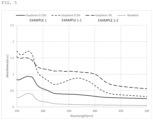
- Fig. 5 is a graph showing the result measured as follows.
- the aqueous QD dispersion (QD concentration: 1.5 w/w%) used in Example 1 was processed to adjust the amount of petrolatum such that the final QD concentration reached the concentrations of 0.15 w/w% to 3 w/w%, which are given in the graph (in the case of 3 w/w%, dilution to the QD concentration of 1.5 w/w% was not performed and a QD concentration of 15 w/w% was used), whereby samples were prepared.
- Each of the samples was applied to a polyethylene film so as to have a thickness of 25 ⁇ m, and then measured with the measuring device and conditions disclosed above.
- petrolatum alone was measured in the same manner.
- Fig. 6 is similar to Fig. 5 , and the absorption spectrum was measured for a sample having lapsed 2 months.
- the absorption spectrum of the sample having lapsed 2 months is a measurement result of a sample stored without sealing or the like although the sample is in a state in which foreign matters such as dust do not adhere in the state of the preparation thereof.
- Absorption of 0.5 to 1.0 was confirmed in the range of 300 nm to 450 nm, and deterioration of the UV absorption action was not observed.
- the absorption was larger than that at the time of the preparation, but it is considered that this is because moisture was removed and the QD concentration was increased because sealing had not been performed.
- the measured value is not described, it is confirmed that the weight of the sample after a lapse of 2 months has decreased as compared with the sample at the time of preparation.
- compositions for UV absorption were manufactured under the same conditions as in Example 1 except that in Example 1, the components were prepared so as to have the concentrations given in Table 1.
- a composition for UV absorption was manufactured under the same conditions as in Example 1 except that in Example 1, an aqueous dispersion of carbon quantum dots (FUJI QD CARBON 308 manufactured by Fuji Pigment Co., Ltd., QD concentration: 15 w/w%) was used instead of the aqueous dispersion of graphene quantum dots (FUJI QD GRAPHENE 818 manufactured by Fuji Pigment Co., Ltd., QD concentration: 15 w/w%).
- an aqueous dispersion of carbon quantum dots (FUJI QD CARBON 308 manufactured by Fuji Pigment Co., Ltd., QD concentration: 15 w/w%) was used instead of the aqueous dispersion of graphene quantum dots (FUJI QD GRAPHENE 818 manufactured by Fuji Pigment Co., Ltd., QD concentration: 15 w/w%).
- a composition for UV absorption was manufactured under the same conditions as in Example 1 except that in Example 1, a surfactant (KAO AKYPO RLM-100NV (anionic surfactant) manufactured by Kao Corporation) was used instead of the surfactant (RHEODOL AO-10V (nonionic surfactant) manufactured by Kao Corporation).
- a surfactant KAO AKYPO RLM-100NV (anionic surfactant) manufactured by Kao Corporation
- RHEODOL AO-10V nonionic surfactant
- a composition for UV absorption was manufactured under the same conditions as in Example 1 except that in Example 1, a surfactant (ACETAMIN 86 (cationic surfactant) manufactured by Kao Corporation) was used instead of the surfactant (RHEODOL AO-10V (nonionic surfactant) manufactured by Kao Corporation).
- ACETAMIN 86 cationic surfactant
- RVODOL AO-10V nonionic surfactant
- a composition for UV absorption was manufactured under the same conditions as in Example 1 except that in Example 1, the surfactant (RHEODOL AO-10V (nonionic surfactant) manufactured by Kao Corporation) was not used and glycerin (commercially available as Glycerin from FUJIFILM Wako Pure Chemical Corporation) was used instead of the petrolatum (LOSHI BABY WASERIN Pure N manufactured by Cosmetex Roland Co., Ltd.).
- the surfactant RHEODOL AO-10V (nonionic surfactant) manufactured by Kao Corporation
- glycerin commercially available as Glycerin from FUJIFILM Wako Pure Chemical Corporation
- petrolatum LOSHI BABY WASERIN Pure N manufactured by Cosmetex Roland Co., Ltd.
- compositions for UV absorption were manufactured under the same conditions as in Example 5 except that in Example 5, the components were prepared so as to have the concentrations given in Table 2.
- a composition for UV absorption was manufactured under the same conditions as in Example 5 except that in Example 5, ethoxy diglycol (commercially available as 2-(2-Ethoxyethoxy)ethanol from FUJIFILM Wako Pure Chemical Corporation) was used instead of the glycerin (commercially available as Glycerin from FUJIFILM Wako Pure Chemical Corporation).
- ethoxy diglycol commercially available as 2-(2-Ethoxyethoxy)ethanol from FUJIFILM Wako Pure Chemical Corporation
- glycerin commercially available as Glycerin from FUJIFILM Wako Pure Chemical Corporation
- a composition for UV absorption was manufactured under the same conditions as in Example 5 except that in Example 5, ethanol (commercially available as Ethanol from FUJIFILM Wako Pure Chemical Corporation) was used instead of the glycerin (commercially available as Glycerin from FUJIFILM Wako Corporation).
- a composition for UV absorption was manufactured under the same conditions as in Example 1 except that in Example 1, the amounts of graphene quantum dots, water, and the surfactant (RHEODOL AO-10V (nonionic surfactant) manufactured by Kao Corporation) were increased and the amount of the petrolatum was reduced so as to be the amounts given in Table 1.
- RHEODOL AO-10V nonionic surfactant
- a composition for UV absorption was manufactured under the same conditions as in Example 1 except that in Example 1, the surfactant (RHEODOL AO-10V (nonionic surfactant) manufactured by Kao Corporation) was not used.
- the surfactant RHEODOL AO-10V (nonionic surfactant) manufactured by Kao Corporation
- Example 1 Example 1-1 Example 1-2 Example 2 Example 3 Example 4 Example 8 Comparative Example 1 Comparative Example 2 Type of QD Graphene Graphene Graphene Carbon Graphene Graphene Graphene Graphene - w/w% of QD (based on overall amount of composition) 0.15 0.3 3 0.15 0.15 0.15 6 0.15 - Water ⁇ ⁇ ⁇ ⁇ ⁇ ⁇ ⁇ ⁇ w/w% of water (based on overall amount of composition) 10 10 20 10 10 10 10 40 10 10 10 Surfactant "RHEODOL AO-10V” manufactured by Kao Corporation "RHEODOL AO-10V” manufactured by Kao Corporation "RHEODOL AO-10V” manufactured by Kao Corporation "RHEODOL AO-10V” manufactured by Kao Corporation "KAO AKYPO RLM-100NV” manufactured by Kao Corporation "ACETA
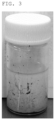
- Example 1 a composition superior in both dispersibility and UV absorption function was obtained as shown in Table 1. Specifically, through the visual confirmation of the dispersibility of Example 1, it was found as shown in Figs. 1 and 2 that the dispersibility was good both immediately after the filling ( Fig. 1 ) and one month after the filling ( Fig. 2 ), and the whole of the sample was in a uniform state and remained in that state. This is considered to be caused by the surfactant action derived from the addition of the surfactant though petrolatum is oily and the aqueous QD dispersion is hydrophilic, and therefore the petrolatum and the QD aqueous dispersion are immiscible with each other as they are.
- Comparative Example 1 in Table 1 is "-" (bar), but as described above, complete precipitate occurred, so that it is considered that the sample clearly does not have a UV absorption function even if measured. Therefore, comparison between Example 1 and Comparative Example 1 showed that addition of a surfactant is necessary in order to have superior dispersibility and a superior UV absorption function when an oily base is used.
- Example 2 the type of quantum dots was changed from graphene to carbon in Example 2, but a composition having the same performance as in Example 1 was obtained.
- the surfactant was changed from a nonionic surfactant to an anionic surfactant and a cationic surfactant, respectively, but it has been found that even when the type of surfactant was changed, compositions having a UV absorption function while maintaining good dispersibility were obtained.
- Example 8 it has been shown that thanks to the addition of a surfactant in an amount of about 1/10 of the added amount of water, a composition having a UV absorption function while maintaining dispersibility was obtained even when the amount of the carbon-based quantum dots was increased.
- Comparative Example 2 no carbon-based quantum dots were added. Comparison between Example 1 and Comparative Example 2 has shown that the presence of carbon-based quantum dots was necessary to have a superior UV absorption function. The above facts have shown that to obtain a composition superior in both UV absorption function and dispersibility using an oily base, the presence of a carbon-based quantum dot dispersion (solvent: aqueous solvent) and a surfactant is necessary.
- solvent aqueous solvent
- surfactant a surfactant
- petrolatum was used for all the oily bases in Examples and Comparative Examples described in Table 1, since the aqueous dispersion of QD can be dispersed in a base with an extremely low polarity such as petrolatum, it is considered that any base having a higher polarity allows easy dispersed in the base.
- the aqueous QD dispersion used in Example 1 (QD concentration: 1.5 w/w%) was further diluted with purified water into the QD concentrations of 0.0025 w/w% to 0.10 w/w% indicated in the graph, and change in absorption at various QD concentrations was examined. It has been confirmed that a desired UV absorption effect can be exhibited at what QD concentration at the time of manufacturing a preparation. As a result, the change in absorption at a wavelength of 300 nm to 400 nm has shown that the QD concentration of the aqueous QD dispersion is preferably 0.01 w/w% or more.
- organic UV absorbers used in commercially available sunscreens and the like cannot cover a wide range of wavelengths by a single component, it has been found that use of the QD in the present invention allows a wide range of wavelengths such as 300 nm to 400 nm to be covered without blending a plurality of components.
- Fig. 5 is a graph showing the result measured as follows.
- the aqueous QD dispersion (QD concentration: 1.5 w/w%) used in Example 1 was processed to adjust the amount of petrolatum such that the final QD concentration reached the concentrations of 0.15 w/w% to 3 w/w%, which are given in the graph (in the case of 3 w/w%, a QD concentration of 15 w/w% was used without temporarily achieving a QD concentration of 1.5 w/w%), whereby samples were prepared.
- Each of the samples was applied to a polyethylene film so as to have a thickness of about 25 ⁇ m, followed by drying, and then measured with the measuring device and conditions disclosed above (corresponding to Examples 1, 1-1, and 1-2).
- Fig. 6 is similar to Fig. 5 , and the absorption spectrum was measured for a sample having lapsed 2 months (corresponding to Examples 1, 1-1, and 1-2).
- the absorption spectrum of the sample having lapsed 2 months is a measurement result of a sample stored without sealing or the like although the sample is in a state in which foreign matters such as dust do not adhere in the state of the preparation thereof.
- Absorption of 0.5 to 1.0 was confirmed in the range of 300 nm to 450 nm, and deterioration of the UV absorption action was not observed.
- the absorption was larger than that at the time of the preparation, but it is considered that this is because moisture was removed and the QD concentration was increased because sealing had not been performed.
- the measured value is not described, it is confirmed that the weight of the sample after a lapse of 2 months has decreased as compared with the sample at the time of preparation.
- Example 5 a composition superior in both dispersibility and UV absorption function was obtained.
- Example 6 and 7 the hydrophilic base was changed from glycerin to ethoxy diglycol and ethanol, respectively, but compositions maintaining dispersibility and UV absorption function were obtained.
- the above facts have suggested that even if an oily base is exchanged to a hydrophilic base, the UV absorption function of QD is not destroyed, and even when various types (Examples 5, 6 and 7) or various concentrations (Examples 5, 5-1 and 5-2) of the hydrophilic base are examined, neither dispersibility nor UV absorption function is affected.
Landscapes
- Health & Medical Sciences (AREA)
- Life Sciences & Earth Sciences (AREA)
- Veterinary Medicine (AREA)
- Animal Behavior & Ethology (AREA)
- General Health & Medical Sciences (AREA)
- Public Health (AREA)
- Birds (AREA)
- Epidemiology (AREA)
- Dermatology (AREA)
- Chemical & Material Sciences (AREA)
- Inorganic Chemistry (AREA)
- Emergency Medicine (AREA)
- Cosmetics (AREA)
- Carbon And Carbon Compounds (AREA)
Applications Claiming Priority (2)
| Application Number | Priority Date | Filing Date | Title |
|---|---|---|---|
| JP2022110409 | 2022-07-08 | ||
| PCT/JP2023/005774 WO2024009548A1 (ja) | 2022-07-08 | 2023-02-17 | 紫外線吸収用組成物、及びその製造方法 |
Publications (1)
| Publication Number | Publication Date |
|---|---|
| EP4552702A1 true EP4552702A1 (de) | 2025-05-14 |
Family
ID=89453218
Family Applications (1)
| Application Number | Title | Priority Date | Filing Date |
|---|---|---|---|
| EP23835089.6A Pending EP4552702A1 (de) | 2022-07-08 | 2023-02-17 | Zusammensetzung zur uv-absorption und verfahren zur herstellung davon |
Country Status (5)
| Country | Link |
|---|---|
| US (1) | US20250381105A1 (de) |
| EP (1) | EP4552702A1 (de) |
| JP (1) | JPWO2024009548A1 (de) |
| CN (1) | CN119365174A (de) |
| WO (1) | WO2024009548A1 (de) |
Family Cites Families (13)
| Publication number | Priority date | Publication date | Assignee | Title |
|---|---|---|---|---|
| JP3506349B2 (ja) * | 1996-04-11 | 2004-03-15 | 株式会社資生堂 | サンケア用化粧組成物 |
| JP4251685B2 (ja) | 1998-04-22 | 2009-04-08 | メルク株式会社 | 紫外線吸収剤 |
| CN102144279A (zh) | 2008-09-03 | 2011-08-03 | 爱默蕾大学 | 量子点、制造量子点的方法以及使用量子点的方法 |
| JP5557090B2 (ja) * | 2010-03-05 | 2014-07-23 | 一般財団法人ファインセラミックスセンター | 発光体、発光体の製造方法、照明装置および化粧品用紫外線遮蔽材 |
| JP5516392B2 (ja) | 2010-12-24 | 2014-06-11 | 株式会社豊田中央研究所 | カーボン蛍光体及び蛍光体分散液 |
| JP6085880B2 (ja) | 2013-01-11 | 2017-03-01 | 国立研究開発法人産業技術総合研究所 | 炭素量子ドットの製造方法及び炭素量子ドット |
| JP6233219B2 (ja) * | 2014-07-14 | 2017-11-22 | 住友金属鉱山株式会社 | 紫外線遮蔽性粉末とその製造方法 |
| KR101710907B1 (ko) * | 2015-06-12 | 2017-02-28 | 한국과학기술원 | 자외선 차단 기능이 부여된 화장료 조성물 및 이의 제조 방법 |
| JP2018203630A (ja) * | 2017-05-30 | 2018-12-27 | ビタミンC60バイオリサーチ株式会社 | 化粧料用フラーレン含有組成物とそれを用いた化粧料 |
| CN107714493A (zh) * | 2017-11-28 | 2018-02-23 | 拜东辰 | 一种抗菌防紫外线防腐材料在日用化妆品中的应用 |
| KR102239987B1 (ko) * | 2019-07-09 | 2021-04-14 | 코스맥스 주식회사 | 그래핀 양자점을 유효성분으로 함유하는 화장료 조성물 |
| JP7269570B2 (ja) * | 2019-11-18 | 2023-05-09 | 冨士色素株式会社 | 蛍光体組成物、及びその製造方法 |
| JP7387405B2 (ja) | 2019-11-19 | 2023-11-28 | 株式会社ナリス化粧品 | 日焼け止めエアゾール化粧料 |
-
2023
- 2023-02-17 EP EP23835089.6A patent/EP4552702A1/de active Pending
- 2023-02-17 WO PCT/JP2023/005774 patent/WO2024009548A1/ja not_active Ceased
- 2023-02-17 US US18/877,236 patent/US20250381105A1/en active Pending
- 2023-02-17 JP JP2024531916A patent/JPWO2024009548A1/ja active Pending
- 2023-02-17 CN CN202380049661.0A patent/CN119365174A/zh active Pending
Also Published As
| Publication number | Publication date |
|---|---|
| US20250381105A1 (en) | 2025-12-18 |
| JPWO2024009548A1 (de) | 2024-01-11 |
| CN119365174A (zh) | 2025-01-24 |
| WO2024009548A1 (ja) | 2024-01-11 |
Similar Documents
| Publication | Publication Date | Title |
|---|---|---|
| CN102906024B (zh) | 微球体和包含它的光防护性个人护理组合物 | |
| DE69104154T2 (de) | Produkte auf Basis von Melaninpigment enthaltenden plättchenförmigen Partikeln und Verfahren zu ihrer Herstellung. | |
| DE69206628T2 (de) | Feine dispersion von melaninpigmente, seine herstellung sowie seine verwendung in die kosmetik. | |
| EP0587908A1 (de) | Neues kosmetisches präparat | |
| JPH08506327A (ja) | 無機微小顔料を含有する化粧品的または皮膚科学的日焼け止め配合物 | |
| CN1273525A (zh) | 含有阴离子表面活性剂、紫外线辐射滤除化合物和阳离子或两性离子两亲化合物的防晒组合物及其用途 | |
| EP0930866A1 (de) | Kosmetische oder dermatologische gele auf der basis von mikroemulsionen | |
| CN111182884B (zh) | 涂覆有羟基肉桂酸酯和硅烷醇的加合物的无机防晒剂 | |
| JP5540243B2 (ja) | 日焼け止め化粧料 | |
| JPH11507392A (ja) | TiO▲下2▼ナノ顔料と変形可能な中空ミクロスフィアを含有する無水化粧品組成物 | |
| AU2026201014A1 (en) | Low viscosity nonaqueous metal oxide particle dispersions and processes for preparing same | |
| DE69800513T2 (de) | Zusammensetzung, die ein Dibenzoylmethanderivat und ein Polyaminpolymer enthält | |
| CN108348426A (zh) | 含壬酸酯的水性化妆品组合物 | |
| US20250381105A1 (en) | Composition for uv absorption and method for manufacturing same | |
| CN102781403A (zh) | 耐光遮光组合物 | |
| RU2392921C2 (ru) | Улучшенная доставка агентов, полезных для кожи | |
| KR102340304B1 (ko) | 자외선 차단용 실리카 나노입자 조성물 및 그 제조방법 | |
| US8481007B2 (en) | Compositions and methods for providing ultraviolet radiation protection | |
| JP2003267854A (ja) | 美白化粧料 | |
| KR101970949B1 (ko) | 징크 옥사이드 무기분체를 이용한 유무기 복합체 및 이를 포함하는 화장료 조성물 및 이의 제조 방법 | |
| JP2010030933A (ja) | 皮膚外用剤 | |
| JP3052259B2 (ja) | 化粧料 | |
| EP1022017A2 (de) | Kosmetische oder pharmazeutische Zubereitungen für die topische Verabreichung mit verbesserter Stabilität | |
| JP2003048811A (ja) | 化粧品用配合剤 | |
| FR2850865A1 (fr) | Utilisation de solutions de fullerenes pour le conditionnement des cheveux |
Legal Events
| Date | Code | Title | Description |
|---|---|---|---|
| STAA | Information on the status of an ep patent application or granted ep patent |
Free format text: STATUS: THE INTERNATIONAL PUBLICATION HAS BEEN MADE |
|
| PUAI | Public reference made under article 153(3) epc to a published international application that has entered the european phase |
Free format text: ORIGINAL CODE: 0009012 |
|
| STAA | Information on the status of an ep patent application or granted ep patent |
Free format text: STATUS: REQUEST FOR EXAMINATION WAS MADE |
|
| 17P | Request for examination filed |
Effective date: 20241121 |
|
| AK | Designated contracting states |
Kind code of ref document: A1 Designated state(s): AL AT BE BG CH CY CZ DE DK EE ES FI FR GB GR HR HU IE IS IT LI LT LU LV MC ME MK MT NL NO PL PT RO RS SE SI SK SM TR |
|
| DAV | Request for validation of the european patent (deleted) | ||
| DAX | Request for extension of the european patent (deleted) |