EP4541237A2 - Dispositif de cuisson et ses composants - Google Patents
Dispositif de cuisson et ses composants Download PDFInfo
- Publication number
- EP4541237A2 EP4541237A2 EP25162645.3A EP25162645A EP4541237A2 EP 4541237 A2 EP4541237 A2 EP 4541237A2 EP 25162645 A EP25162645 A EP 25162645A EP 4541237 A2 EP4541237 A2 EP 4541237A2
- Authority
- EP
- European Patent Office
- Prior art keywords
- cooking
- lid
- connector
- pressure
- housing
- Prior art date
- Legal status (The legal status is an assumption and is not a legal conclusion. Google has not performed a legal analysis and makes no representation as to the accuracy of the status listed.)
- Pending
Links
Images






Classifications
-
- A—HUMAN NECESSITIES
- A47—FURNITURE; DOMESTIC ARTICLES OR APPLIANCES; COFFEE MILLS; SPICE MILLS; SUCTION CLEANERS IN GENERAL
- A47J—KITCHEN EQUIPMENT; COFFEE MILLS; SPICE MILLS; APPARATUS FOR MAKING BEVERAGES
- A47J27/00—Cooking-vessels
-
- A—HUMAN NECESSITIES
- A47—FURNITURE; DOMESTIC ARTICLES OR APPLIANCES; COFFEE MILLS; SPICE MILLS; SUCTION CLEANERS IN GENERAL
- A47J—KITCHEN EQUIPMENT; COFFEE MILLS; SPICE MILLS; APPARATUS FOR MAKING BEVERAGES
- A47J27/00—Cooking-vessels
- A47J27/08—Pressure-cookers; Lids or locking devices specially adapted therefor
- A47J27/086—Pressure-cookers; Lids or locking devices specially adapted therefor with built-in heating means
-
- A—HUMAN NECESSITIES
- A47—FURNITURE; DOMESTIC ARTICLES OR APPLIANCES; COFFEE MILLS; SPICE MILLS; SUCTION CLEANERS IN GENERAL
- A47J—KITCHEN EQUIPMENT; COFFEE MILLS; SPICE MILLS; APPARATUS FOR MAKING BEVERAGES
- A47J27/00—Cooking-vessels
- A47J27/08—Pressure-cookers; Lids or locking devices specially adapted therefor
-
- A—HUMAN NECESSITIES
- A47—FURNITURE; DOMESTIC ARTICLES OR APPLIANCES; COFFEE MILLS; SPICE MILLS; SUCTION CLEANERS IN GENERAL
- A47J—KITCHEN EQUIPMENT; COFFEE MILLS; SPICE MILLS; APPARATUS FOR MAKING BEVERAGES
- A47J27/00—Cooking-vessels
- A47J27/08—Pressure-cookers; Lids or locking devices specially adapted therefor
- A47J27/0802—Control mechanisms for pressure-cookers
-
- A—HUMAN NECESSITIES
- A47—FURNITURE; DOMESTIC ARTICLES OR APPLIANCES; COFFEE MILLS; SPICE MILLS; SUCTION CLEANERS IN GENERAL
- A47J—KITCHEN EQUIPMENT; COFFEE MILLS; SPICE MILLS; APPARATUS FOR MAKING BEVERAGES
- A47J36/00—Parts, details or accessories of cooking-vessels
-
- A—HUMAN NECESSITIES
- A47—FURNITURE; DOMESTIC ARTICLES OR APPLIANCES; COFFEE MILLS; SPICE MILLS; SUCTION CLEANERS IN GENERAL
- A47J—KITCHEN EQUIPMENT; COFFEE MILLS; SPICE MILLS; APPARATUS FOR MAKING BEVERAGES
- A47J37/00—Baking; Roasting; Grilling; Frying
- A47J37/06—Roasters; Grills; Sandwich grills
-
- G—PHYSICS
- G01—MEASURING; TESTING
- G01K—MEASURING TEMPERATURE; MEASURING QUANTITY OF HEAT; THERMALLY-SENSITIVE ELEMENTS NOT OTHERWISE PROVIDED FOR
- G01K1/00—Details of thermometers not specially adapted for particular types of thermometer
- G01K1/02—Means for indicating or recording specially adapted for thermometers
- G01K1/024—Means for indicating or recording specially adapted for thermometers for remote indication
-
- G—PHYSICS
- G01—MEASURING; TESTING
- G01K—MEASURING TEMPERATURE; MEASURING QUANTITY OF HEAT; THERMALLY-SENSITIVE ELEMENTS NOT OTHERWISE PROVIDED FOR
- G01K2207/00—Application of thermometers in household appliances
- G01K2207/02—Application of thermometers in household appliances for measuring food temperature
- G01K2207/06—Application of thermometers in household appliances for measuring food temperature for preparation purposes
Definitions
- Embodiments of the present disclosure relates generally to a cooking device and components thereof, and more specifically, a multifunction device configured to perform the operation of a plurality of distinct cooking devices, the multifunctional cooking device optionally employing various components for cooking in the distinct cooking modes.
- Conventional cooking devices such as pressure cookers and air fryers each perform a single cooking operation, and as such, these devices employ different components and method for cooking food items. As such, multiple devices are required to perform various cooking operations. For consumers that wish to enjoy food cooked in different ways via different operations, an accumulation of these devices can occur. Such an accumulation of cooking devices is often prohibitive from a standpoint of cost and storage space. For at least these reasons, it would be desirable to integrate the functionality of several cooking devices into a single user-friendly cooking device.
- a cooking system for cooking food includes a housing defining a hollow chamber configured to receive the food, a lid movable relative to said housing between an open position and a closed position to form a pressure-tight cooking volume between said hollow chamber and said lid, at least one heating element associated with at least one of said housing and said lid, and a temperature probe positionable within said pressure-tight cooking volume.
- the cooking system is operable in a pressure cooking mode and during said pressure cooking mode.
- the temperature probe is operable to detect a temperature of the food in said pressure-tight cooking volume.
- a pressure of said cooking volume is at least 40 kPa.
- said pressure of said cooking volume is between 40 kPa and 100kPa.
- said pressure of said cooking volume is at least 70kPa.
- said pressure of said cooking volume is between 70 kPa and 100kPa.
- said pressure of said cooking volume is at least 100kPa.
- said temperature probe is permanently affixed to one of said housing and said lid.
- said temperature probe is removably connectable to one of said housing and said lid.
- said second connector is mounted to said lid.
- said first connector is a male connector and said second connector is a female connector.
- said first connector has a shaft and a first housing and said second connector has a second housing including a central opening, and both said shaft and said first housing being receivable within said central opening.
- said first connector has a shaft and a first housing and said second connector has a second housing including a central opening, wherein said shaft is receivable within said central opening and said first housing is received about an outer periphery of said second housing.
- a seal is formed at an interface between said first connector and said second connector.
- a temperature measurement system for measuring food temperature includes a temperature probe including a probe end insertable into the food and a data transmission end and a connector including a data receiving orifice.
- the data transmission end of said temperature probe is insertable into said data receiving orifice
- An interior of said connector is sealed from an environment surrounding said connector.
- said connector is an encapsulated socket.
- the temperature measurement system is installed within a cooking system, the cooking system including: a housing defining a hollow chamber configured to receive food, a lid movable relative to said housing between an open position and a closed position to define a cooking volume between said hollow chamber and said lid, and at least one heating element associated with at least one of said housing and said lid .
- said connector is located remotely from said cooking volume.
- said connector is mounted within an interior of said lid.
- a pressure within said interior of said connector is equal to a pressure of said cooking volume when said data transmission end of said temperature probe is not inserted within said data receiving orifice.
- a pressure within said interior of said connector is equal to a pressure of said cooking volume when said data transmission end of said temperature probe is inserted within said data receiving orifice.
- said data transmission end is insertable into said data receiving orifice to seal said interior of said socket from said cooking volume.
- said temperature probe is operable during a pressure cooking mode of the cooking system.
- a pressure of said cooking volume is at least 40 kPa.
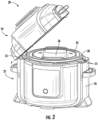
- the cooking system 20 includes a base 22 and a lid 24 permanently or removable attached to the base 22.
- the base 22 includes a housing 26 made of any suitable material, such as glass, aluminum, plastic, or stainless steel for example.
- a bottom of the housing 26 of the cooking system 20 may be supported on a surface by one or more feet 28, which may include shock absorbing pads 28a (of a material such as but not limited to rubber) at a bottom surface thereof.
- the feet 28 may extend from the housing 26 to define a surface on which the cooking system 20 may contact an adjacent supporting surface, such as a countertop for example.
- the bottom surface of the feet 28 or pads 28a may be flush with, or alternatively, may extend out of plane from the bottom surface 29 of the housing 26.
- the housing 26 includes two feet 28 arranged on opposing sides of the housing 26; however, it should be understood that a housing having any suitable number of feet 28 is within the scope of the disclosure.
- a liner 30 may be disposed within the hollow interior 32 of the housing 26.
- the liner 30 may be formed from any suitable conductive material, such as aluminum for example.
- the liner 30 forms an interior surface of the housing 26 and thereby defines the hollow interior 32 of the housing 26.
- the liner 30 may be offset from the interior surface of the housing 26.
- other components of the cooking system 20, or surfaces thereof may also define the hollow interior 32.
- a cooking container 34 is receivable within the hollow interior 32 of the housing 26.
- the cooking container 34 is described herein as being removable from the housing 26 of the base 22, embodiments where the cooking container 34 is integrally formed with the housing 26 are also contemplated herein. Spacing components, such as silicone bumpers (not shown) may be disposed along the inner surface of the liner 30 to keep the cooking container 34 aligned properly within the hollow interior 32 during cooking
- the cooking container 34 has an interior 36 designed to receive and retain one or more consumable products, such as food products for example, therein.
- food products suitable for use with the cooking system 20 include but are not limited to, meats, fish, poultry, bread, rice, grains, pasta, vegetables, fruits, and dairy products, among others.
- the cooking container 34 may be a pot formed from a ceramic, metal, or die cast aluminum material.
- an interior surface of the cooking container 34 includes a nano-ceramic coating and an exterior surface of the cooking container 34 includes a silicone epoxy material.
- one or more handles may be associated with the cooking container 34 to allow a user to easily grasp and manipulate the cooking container 34 relative to the housing 26.
- One or more accessories may be compatible for use with the cooking system 20.
- accessories include, but are not limited to, a diffuser, a crisping insert , grill plate, and a griddle for example.
- the accessories may be receivable within the hollow interior 32 of the housing 26, or alternatively, within the interior 36 of the cooking container 34.
- the lid 24 is connectable to a surface of the cooking container 34 and/or housing 26 to close off entry to the interior 36 of the cooking container 34. Accordingly, a cooking volume may be defined between the interior 36 of the cooking container 34 and the closed lid 24, such as the bottom surface of the closed lid, or alternatively, between the hollow interior 32 defined by the housing 26 and the closed lid 24.
- a diameter of the lid 24 is generally complementary to a diameter of the housing 26 such that the lid 24 covers not only the cooking container 34, but also an upper surface 38 of the housing 26.
- the lid 24 is movable relative to the base 22 between an open position, in which the cooking container 34 is accessible, and a closed position to selectively cover the hollow interior 32 and interior 36.
- the lid 24 may be distinct and separable from the base 22, or alternatively, the lid 24 may be movably connected to the base 22.
- the lid 24 is pivotable or rotatable relative to the base 22 via a hinge, such that the lid is rotatable about a pivot axis P.
- other types or movement of the lid 24 are also within the scope of the disclosure.
- One or more fastening mechanisms may but need not be used to secure the lid 24 or a portion thereof to the base 22 when the lid 24 is in the closed position.
- the fastening mechanism is selectively engaged when the lid 24 is in the closed position, or alternatively in some embodiments based on a selected cooking operation, such as pressure cooking for example, of the system 20. Any suitable type of fastening mechanism capable of withstanding the heat and pressure associated with the cooking system 20 is considered within the scope of the disclosure.
- the cooking system 20 additionally includes a secondary lid 40 configured to removably couple to the housing 26 and/or cooking container 34 to seal the hollow interior 32.
- the secondary lid 40 may be press-fit onto an upper surface 38 of the housing 26 or directly to the cooking container 34, or alternatively, may be configured to threadably couple to the upper surface 38 of the housing 26 or the cooking container 34.
- the secondary lid 40 is configured to couple to at least one of the housing 26 and cooking container 34 in another suitable manner, such as via a pressure tight mechanism for example, are also contemplated herein.
- the secondary lid 40 can be made of any suitable material, such as glass, aluminum, plastic, or stainless steel, or any combination thereof for example.
- the secondary lid 40 is formed from a stamped stainless steel material and may have a decorative plastic exterior.
- the secondary lid 40 may, but need not, include one or more handles, such as handle 42 for removably coupling the secondary lid 40 to the cooking system 20.
- the handle 42 may be integrally formed with the secondary lid 40, such as via a molding process, or may be a separate component coupled to the secondary lid 40.
- the secondary lid 40 is a pressure lid. That is, the secondary lid 40 is connectable to the housing 26 in a manner that creates a pressure tight seal with an upper portion of the cooking container 34. This seal can be achieved by locking or fastening the lid to the housing 26, while a component of the secondary lid 40, such as a flexible/resilient gasket, forms the pressure tight seal with the upper portion of the cooking container 34.
- This gasket may be made of rubber, silicone, or other similar materials.
- a pressure-tight cooking volume may be defined between the interior 36 of the cooking container 34 and the closed secondary lid 40.
- a high pressure cooking environment is achievable, with pressure levels reaching at least 40kPa, and in some instances at least 70kPa.
- Pressure ranges between 40kPa and 100kPa, as well as between 70kPa and 100kPa are contemplated, and may reach a threshold of 100kPa, 200kPa, 300kPa, 400kPa, 500kPa, or even greater.
- the lid 24 To couple the secondary lid 40 to the housing 26, the lid 24 must be in an open position (see FIG. 4 ). Further, in an embodiment, the lid 24 is not movable to the closed position relative to the housing 26 when the secondary lid 40 is affixed thereto. This may be due to the outer diameter of the secondary lid 40, or alternatively, because one or more components extending upwardly from the secondary lid 40, such as handle 42, would interfere with a portion of the lid 24. However, in other embodiments, at least a portion of the secondary lid 40 may be nestable or receivable within the lid 24. In such embodiments, the outer diameter of the secondary lid 40 may be smaller than the inner diameter of the lid 24, such that the lid 24 substantially surrounds the secondary lid 40 when in the closed position. Accordingly, the enclosure defined by the hollow interior 36 of the cooking container 34 and the secondary lid 40 is smaller than the enclosure formed by the hollow interior 36 of the cooking container 34 and the lid 24.
- the lid 24 is the only lid connectable to the housing 26 and/or the cooking container 34 during all modes of operation of the cooking system 20.
- the lid includes a generally convex outer lid or lid housing 44 made from any suitable material.
- at least a portion of the material of the lid housing 44 may be substantially identical to the material of the housing 26.
- An inner lid liner (or sealing liner) 45 is arranged within the hollow interior 46 of the lid housing 44.
- the inner lid liner 45 is illustrated as also having a generally convex shape, embodiments where the shape of the inner lid liner 45 is different than the shape of the lid housing 44 are also within the scope of the disclosure.
- the inner lid liner 45 can be made of any suitable material, such as glass, aluminum, plastic, or stainless steel, or any combination thereof for example.
- the inner lid liner 45 may but need not be made from the same material as the lid housing 44.
- a sealing surface 47 of the lid 24 is connectable to the upper surface 38 of the housing 26 or directly to the cooking container 34 to form a pressure-tight seal between the lid 24 and the cooking container 34 or housing 26.
- an interior surface 48 of the inner lid liner 45 defines a relatively upper boundary of a heating volume through which a fluid can circulate.
- the sealing surface 47 is arranged at the end of the inner lid liner 45 adjacent to the cooking container 34.
- the sealing surface 47 may be formed by a portion of the inner lid liner 45 itself, or as best shown in the FIG. 7 , a flexible/resilient gasket 49 connected to a portion of the inner lid liner 45, such as the end thereof, may define the sealing surface 47.
- This gasket 49 may be made of rubber, silicone, or other similar materials, and may include a flange that is received within an interior of the cooking container 34. It should be appreciated that the pressure tight seal formed between the lid 24 and the cooking container 34 or housing 26 may occur during all cooking modes, or just select cooking modes such as those modes that involve pressure or conductive cooking. In embodiments wherein the pressure tight seal is just formed in select cooking modes, this seal may not be formed in air fry or convection modes, and the lid 24 may simply rest on the upper surface 38 of the housing or the cooking container 34 when the lid 24 is closed.
- the system 20 may also include embodiments wherein additional steps beyond simply closing the lid 24 may have to be taken in order to form the pressure tight seal. In other words, closing the lid 24 relative to the base 22 may not automatically form a pressure-tight seal there between.
- the lid 24 additionally includes a lid lock 50.
- the lid lock 50 is arranged within the interior of the lid housing 44, such as generally concentrically with a portion of the inner lid liner 45 relative to a central axis of the lid 24.
- the lid lock 50 has a ring shaped or annular body aligned with a bottom surface of the lid housing 44 and/or the inner lid liner 45.
- An inner surface 51 of the lid lock 50 may be positioned generally adjacent to or in directly contact with an exterior surface 52 of the inner lid liner 45.
- the lid lock 50 is movable, such as rotatable about an axis relative to the lid housing 44 and the inner lid liner 45, to selectively apply a pressure to move the sealing surface 47 into engagement with the cooking container 34 to form a pressure-tight seal therebetween.
- closing the lid 24 relative to the base 22 may form a pressure-tight press-fit connection between the sealing surface 47 and/or the cooking container 34.
- the lid lock 50 is operable as a locking mechanism that retains or locks the lid 24 in the closed position relative to the base 22.
- the lid lock 50 may include a first portion of a bayonet locking system such that by rotating the lid lock 50, one or more engagement members 54 (see FIG. 9 ) formed on the lid lock 50 abut or intermesh with one or more engagement members 55 ( FIG. 3 ) of a complementary second portion of the bayonet locking system extending from an upper portion of the housing 26 to restrict movement of the sealing surface 47 away from the cooking container 34 in response to an increased pressure within the heating volume.
- another locking mechanism, distinct from the lid lock 50 may be operable to maintain the sealing surface 47 in sealing engagement with the cooking container 34 once a pressurized environment is generated.
- the lid lock 50 may be accessible at an exterior surface of the cooking system 20 for manipulation by a user to selectively lock the lid 24 to the base 22 so as to form and/or maintain a pressure-tight heating volume defined between the interior surface 48 of the inner lid liner 45 and the cooking chamber of the cooking container 34 (to be described in more detail below).
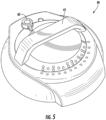
- the lid lock 50 includes an outwardly extending protrusion in the form of a mode selector 56, also referred to herein as a mode selector, arranged within an opening 58, for example a slot, formed at an exterior surface of the lid housing 44.
- a user may transform the lid lock 50 between locked and unlocked configurations by translating the mode selector 56 within the opening 58 between a first position and a second position.
- the inner lid liner 45 is described herein as being stationary and the lid lock 50 is described as being movable relative to the inner lid liner 45, embodiments where the inner lid liner 45 is coupled to or is formed as a unitary body with the lid lock 50, such that both the inner lid liner 45 and the lid lock 50 are movable relative to the lid housing 44 in unison are also within the scope of the disclosure.
- the lid 24, or the secondary lid 40 in embodiments including a distinct lid for a pressure cooking application may additionally include a pressure relief mechanism 60, such as a vent or valve.
- the pressure relief mechanism 60 may be configured to automatically open to release air from within the heating volume formed between the interior 48 of the inner lid liner 45 and the cooking container 34 or between the secondary lid 40 and the cooking container 34 when the pressure therein exceeds a predetermined threshold, such as during operation of the cooking system in a first cooking mode performing a pressure cooking operation.
- the pressure relief mechanism 60 is manually operable, such as rotatable about a vertically oriented axis for example, to release air from within the chamber.
- the pressure relief mechanism 60 prevents steam (or air and/or other fluids) from leaving the interior 36 of the cooking container 34. In an open position, the pressure relief mechanism 60 allows steam (or air and/or other fluids) to exit the interior 36 of the cooking container 34.
- the cooking system 20 includes at least one heating element operable to impart heat to the cooking volume during one or more of a plurality of cooking modes of the cooking system 20.
- a first heating element 62 is positioned generally at or above an upper extent of the cooking container 34, such as proximate a center of the interior 36 of the cooking container 34 for example.
- the at least one first heating element 62 is mounted within the lid 24, and therefore completely outside of the cooking container 34, and vertically offset from the upper extent thereof.
- the first heating element 62 is arranged within the interior 63 of the inner lid liner 45.
- a second heating element 64 may be disposed within the housing 26, generally adjacent the bottom 66 of the cooking container 34.
- a heating element is arranged at another location within the base 22 and/or the lid 24 are also contemplated herein.
- the at least one first and second heating element 62, 64 may be capable of performing any suitable type of heat generation.
- a first and second heating element 62, 64 configured to heat the cooking container 34 or one or more food items located within the interior 36 of the cooking container 34 via conduction, convection, radiation, and induction are all within the scope of the disclosure.
- the first heating element 62 is operable to cook food within the cooking container 34 via a non-contact cooking operation.
- non-contact cooking operation includes any cooking operation where a heating element or heat source is not arranged in direct or indirect contact with a food item, such as, but not limited to, convective and radiant heating.
- the cooking system 20 additionally includes an air movement device, such as a fan 68 for example, operable to circulate air within the cooking volume.
- the air is heated as it flows along its path of circulation, such as by flowing over a portion of the at least one first heating element 62.
- the fan 68 is arranged within the interior 63 of the lid 24, downstream from the first heating element 62 relative to the path of circulation of the air.
- the fan 68 is driven by a motor 70 having a separate cooling mechanism coupled thereto.
- the second heating element 64 is operable to cook food within the cooking container 34 via a contact cooking operation.
- contact cooking operation includes a cooking operation where heat is transmitted via direct or indirect contact between a heating element or heat source and a food item, such as, but not limited to, conductive and inductive cooking.
- first heating element 62 is operable to perform a contact cooking operation
- second heating element 64 is operable to perform a non-contact cooking operation are also within the scope of the disclosure.
- first heating element 62 and second heating element 64 may be operable independently or in combination to apply one or more predetermined power settings to cook the food products within the cooking container.
- the first and second heating elements 62, 64 may be capable of cooking the food independent of the loading of the food.
- the first and second heating elements 62, 64 may be capable of cooking the food independent of the amount of food within the cooking container 34.
- the cooking operations that may be performed by the cooking system 20 include but are not limited to pressure cooking, steam cooking, slow cooking, searing, sautéing air frying, broiling, baking/roasting, dehydrating, and grilling. Parameters associated with the various described, non-limiting cooking modes are shown at FIG. 17 .
- the lid 24 may include a fan cover 72 that protects a user from the first heating element 62 and fan 68 and protects the first heating element 62 and fan 68 from the areas of the cooking system 20 where food is cooked.
- the cover 72 is mounted within the lid 24, such as adjacent, and more specifically upstream from, the first heating element 62 relative to an air flow.
- the cover 72 generally includes a body having formed from any suitable heat-resistant material. The body of the cover 72 has a plurality of openings (not shown) formed therein to allow hot air circulating within the chamber of the cooking container 34 to pass there through.
- the cover 72 has a nano-ceramic coating and is mounted via any suitable mounting mechanism, such as via one or more fasteners for example, and may be removably or permanently arranged therein.
- the cover 72 may be sized to substantially overlap, and therefore protect, the entire surface of the first heating element 62 facing the cooking volume.
- a contour of the cover 72 is generally complementary to the shape of the first heating element 62 to protect the surface of the first heating element 62 closest to the cooking volume.
- the contour of the cover 72 may be complementary to the interior of the lid 24. Accordingly, when the lid 24 is in the closed position, the cover 72 is arranged generally above the first open end of the cooking container 34.
- the cooking system 20 may additionally include a temperature measurement system 80 for monitoring a temperature within the cooking chamber during a cooking operation, such as during a pressure cooking operation for example.
- the temperature measurement system 80 is used to measure the environment within the cooking chamber.
- the temperature measurement system 80 may be used to measure the temperature of a food item or a liquid within the cooking chamber.
- the temperature measurement system 80 includes a positionable temperature probe 82.
- a temperature probe 82 including any suitable type of temperature sensor (not shown), such as a thermometer, a thermistor, a thermocouple, or a resistance temperature detector for example, is within the scope of the disclosure.
- the temperature probe 82 is removably connectable to a portion of the cooking system 20, such as the lid 24 or the secondary lid 40 for example.
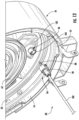
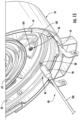
- the temperature measurement system 80 includes a first connector 84, such as a male connector, associated with the temperature probe 82, and a second connector 86, such as a female connector, mounted to the cooking system 20 and configured to couple to the first connector 84.
- a portion of the temperature measurement system 80 such as the temperature probe 82 for example, may be permanently affixed to cooking system 20 at a fixed point, such as located at the lid 40 or the lid housing 44 or inner lid liner 45 for example.
- the temperature probe 82 When a portion of the temperature measurement system 80 is affixed to the system 20 at the fixed point, the temperature probe 82 may be movable relative to the fixed point, such as via a cable 100 extending between the temperature probe 82 and the fixed point. In such embodiments, the permanent connection between the cable and the fixed point may be used in place of the first and second connectors 84, 8 526.
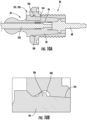
- the first connector 84 which defines a data transmission end opposite the probe end of the temperature probe 82, includes a shaft 88 divided into a plurality of sections, such as including a sleeve 90 and a tip 92.
- the shaft 88 additionally includes at least one ring 94 disposed between the sleeve 90 and the tip 92.
- the first connector 84 may include one or more contactors 96 (see FIG. 10A ) corresponding to each of the sleeve 90, tip 92, and at least one ring 94 of the shaft 88.
- the first connector 84 additionally includes a housing 98 within which a portion of the shaft 88 is located.
- This housing 98 is typically formed from an insulating, non-conductive material, such as a polymer for example, and is contoured to provide strain relief at the first connector 84.
- the sleeve 90, tip 92, and at least one ring 94 extend beyond an end of the housing 98, such as at a center thereof.
- a protective or insulative cable 100 connected to or integrally formed with the housing 98 extends from the housing 98 to an end of the temperature probe 82.
- One or more wires (not shown) positioned within the cable 100 may be electrically connected to the one or more contactors 96 associated with or connected to the shaft 88, as well as to the temperature sensor or another component within the temperature probe 82.
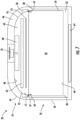
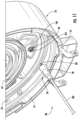
- the second connector 86 is arranged at a surface 102 of the cooking system 20, such as at the lid 24 or 40 for example.
- surface 102 is the interior surface 48 of the inner lid liner 45 of lid 24. It should be understood that in other embodiments, surface 102 may be the interior surface of lid 40. Further, it should be understood that the second connector 86 may be located at any location about the interior of the cooking system 20, including a portion of the base 22.
- the second connector 86 has a central opening 104 within which the shaft 88 of the first connector 84 is receivable.
- the second connector 86 defines a data receiving orifice configured to receive the data transmission end of the temperature probe 82.
- a contour of the exterior of the housing 98 of the first connector 84 is complementary in size and shape to the central opening 104 formed in the second connector 86. Accordingly, when the first connector 84 and the second connector 86 are coupled, both the shaft 88 and a portion of the housing 98 are received within opening 104 of the second connector 86.
- the housing 98 of the first connector 84 may include a radially outwardly extending protrusion or flange 106 receivable within a corresponding groove 108 formed at an interior surface of the second connector 86. This interface between the protrusion 106 and the groove 108 not only restricts movement of the first connector 84 relative to the second connector 86 but also forms a seal between the first and second connector 84, 86.
- the shaft 88 of the first connector 84 is receivable within the opening 104 of the second connector 86.
- the housing 98 of the first connector 84 is receivable about an outer periphery of the second connector 86.
- the exterior of a housing 110 of the second connector 86 includes a first plurality of threads 112 and the first connector 84 includes a coupling component 114 mounted concentrically about the shaft 88, having a second plurality of threads 116.
- an o-ring, gasket, or other sealing mechanism 118 is additionally formed at a face of the coupling component 114 configured to abut the surface 102 adjacent to the second connector 86. Inclusion of this sealing mechanism 118 prevents air from passing between the end of the first connector 84 and the lid 24.
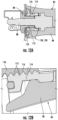
- the second connector 86 includes a coupling component 120 that extends substantially perpendicular to the surface 102 of the lid 24.
- an end of the cable 100 includes a cable housing 122 arranged within the interior of the housing 98, and the shaft 88 may be directly coupled to the inner cable housing 122 rather than housing 98.
- a clearance 124 is defined between an exterior surface of the inner cable housing 122 and an interior surface of the housing 98.
- the inner cable housing 122 includes a radially outwardly extending protrusion or flange 126 receivable within a corresponding groove 128 formed at an interior surface of the coupling component 120. This interface between the protrusion 126 and the groove 128 restricts movement of the first connector 84 relative to the second connector 86 and forms a seal there between. Further, in each of the embodiments of FIGS. 8-14B , the increased pressure present within the cooking chamber during a pressure cooking operation exerts a force on the first connector 84, facilitating the formation of a seal at the interface between the first connector 84 and the second connector 86.
- the second connector 86 includes a housing 110 including a first portion 130 arranged adjacent the surface 102 of the inner lid liner 45 and a second portion 132 arranged adjacent an opposite side of the lid inner lid liner 45.
- the second portion 132 of the housing 110 of the second connector 86 includes an at least partially hollow encapsulated socket.
- the interior of the encapsulated socket is constructed to have its own pressurized environment that is separate from and unaffected by the pressure of the surrounding environment within the lid.
- the central opening 104 formed in the first portion 130 of the housing 110 is axially aligned with an opening or orifice (not shown) formed in the second portion 132 of the housing 110. Accordingly, the interior of the encapsulated socket is arranged in fluid communication with the cooking volume. As a result, regardless of the cooking operation being performed, a pressure within the interior of the encapsulated socket may be equal to the pressure within the cooking volume when the temperature probe 82 is not connected to the lid.
- the data transmission end 84 of the temperature probe 82 is insertable into the encapsulated socket via the data receiving orifice 86. When the temperature probe 82 is coupled to the encapsulated socket, the pressure within the encapsulated socket may remain equal to the pressure within the cooking volume. However, it should be understood that in other embodiments, insertion of the temperature probe 82 into the encapsulated socket may seal off the interior of the socket from the cooking volume.
- the second portion 132 of the housing 110 includes a face element 134 arranged in contact with the inner lid liner 45.
- the face element 134 is functions as a shield and is configured to prevent debris from entering into the interior of the encapsulated socket.
- the face element 134 may be formed from a plurality of layers of material.
- the face element 134 may include at least one layer of a low friction material 136, such as polyethylene terephthalate (PET), to facilitate insertion of the shaft into the second portion 132 of the housing 110.
- PET polyethylene terephthalate
- the face element 134 may include one or more layers of resilient material 138, such as elastic or silicone for example, to allow the face element 134 to recover in response to insertion or removal of the shaft 88.
- the layer of low friction material 136 is illustrated as being positioned between the layer of resilient material 138 and the inner lid liner 45, embodiments where the layer of resilient material 138 is disposed between the layer of low friction material 136 and the inner lid liner 45are also contemplated herein.
- the temperature probe 82 When the temperature probe 82 is affixed to the cooking system 20, the temperature probe may be configured to communicate with a controller of the cooking system 20. In some embodiments, the temperature may be sensed by the temperature sensor within the probe 82 using firmware, and/or the communication between the temperature probe 82 and the controller will occur via a hardwired connection, for example including one or more wires embedded within the lid. In other embodiments, the temperature measurement system 80 may be configured to communicate wirelessly with the controller. In such embodiments, the temperature measurement system 80 may communicate via any suitable communication protocol including but not limited to, a wireless network, bluetooth, or near field communication.
Landscapes
- Engineering & Computer Science (AREA)
- Food Science & Technology (AREA)
- Physics & Mathematics (AREA)
- General Physics & Mathematics (AREA)
- Cookers (AREA)
- Electric Ovens (AREA)
Applications Claiming Priority (3)
| Application Number | Priority Date | Filing Date | Title |
|---|---|---|---|
| US17/139,490 US12070146B2 (en) | 2020-12-31 | 2020-12-31 | Cooking device and components thereof |
| EP21916251.8A EP4271229B1 (fr) | 2020-12-31 | 2021-12-22 | Dispositif de cuisson et ses éléments constitutifs |
| PCT/US2021/064836 WO2022146820A1 (fr) | 2020-12-31 | 2021-12-22 | Dispositif de cuisson et ses éléments constitutifs |
Related Parent Applications (1)
| Application Number | Title | Priority Date | Filing Date |
|---|---|---|---|
| EP21916251.8A Division EP4271229B1 (fr) | 2020-12-31 | 2021-12-22 | Dispositif de cuisson et ses éléments constitutifs |
Publications (2)
| Publication Number | Publication Date |
|---|---|
| EP4541237A2 true EP4541237A2 (fr) | 2025-04-23 |
| EP4541237A3 EP4541237A3 (fr) | 2025-06-25 |
Family
ID=75585402
Family Applications (2)
| Application Number | Title | Priority Date | Filing Date |
|---|---|---|---|
| EP25162645.3A Pending EP4541237A3 (fr) | 2020-12-31 | 2021-12-22 | Dispositif de cuisson et ses composants |
| EP21916251.8A Active EP4271229B1 (fr) | 2020-12-31 | 2021-12-22 | Dispositif de cuisson et ses éléments constitutifs |
Family Applications After (1)
| Application Number | Title | Priority Date | Filing Date |
|---|---|---|---|
| EP21916251.8A Active EP4271229B1 (fr) | 2020-12-31 | 2021-12-22 | Dispositif de cuisson et ses éléments constitutifs |
Country Status (4)
| Country | Link |
|---|---|
| US (2) | US12070146B2 (fr) |
| EP (2) | EP4541237A3 (fr) |
| CN (2) | CN114680591A (fr) |
| WO (1) | WO2022146820A1 (fr) |
Families Citing this family (3)
| Publication number | Priority date | Publication date | Assignee | Title |
|---|---|---|---|---|
| US12070146B2 (en) * | 2020-12-31 | 2024-08-27 | Sharkninja Operating Llc | Cooking device and components thereof |
| US20230346161A1 (en) * | 2022-04-29 | 2023-11-02 | Quan Trinh | Novel Roasting Pan with Temperature Probe |
| USD1114552S1 (en) | 2023-10-09 | 2026-02-24 | Lagom Kitchen Co. | Cookware appliance or cookware |
Family Cites Families (166)
| Publication number | Priority date | Publication date | Assignee | Title |
|---|---|---|---|---|
| GB811055A (en) | 1956-08-22 | 1959-03-25 | Westinghouse Electric Int Co | Improvements in or relating to cooking apparatus |
| GB1491739A (en) | 1974-02-27 | 1977-11-16 | Gen Electric | Apparatus for monitoring the internal temperature of food in a microwave oven |
| US3974696A (en) | 1974-02-27 | 1976-08-17 | General Electric Company | Food thermometer for microwave oven |
| US4081645A (en) | 1975-10-30 | 1978-03-28 | Litton Systems, Inc. | Temperature controlled microwave oven |
| US4086813A (en) | 1975-12-22 | 1978-05-02 | General Electric Company | Microwave oven food temperature sensing probe assembly including a reflector |
| US4036995A (en) | 1975-12-29 | 1977-07-19 | Food Automation Service Techniques, Inc. | Oven cooking monitor for uniformly cooking a plurality of food items requiring different cooking times |
| GB1548805A (en) | 1976-07-20 | 1979-07-18 | Matsushita Electric Industrial Co Ltd | Temperature detecting units for microwave ovens |
| US4217477A (en) | 1976-11-30 | 1980-08-12 | Sharp Kabushiki Kaisha | Food temperature control in a microwave oven |
| US4233478A (en) | 1977-08-12 | 1980-11-11 | Bunker Ramo Corporation | Circuit transfer apparatus |
| JPS5568298U (fr) | 1978-11-06 | 1980-05-10 | ||
| CA1137174A (fr) | 1978-12-19 | 1982-12-07 | Keiichiro Doi | Systeme d'alarme pour four micor-ondes |
| DE3104926C2 (de) | 1981-02-11 | 1983-02-24 | Bosch-Siemens Hausgeräte GmbH, 7000 Stuttgart | Steuereinrichtung für Koch-, Brat- oder Backvorgänge mit einem Speisethermometer |
| US4617441A (en) | 1983-07-08 | 1986-10-14 | Sanyo Electric Co., Ltd. | Temperature controlled induction heating and cooking apparatus |
| GB8708406D0 (en) | 1987-04-08 | 1987-05-13 | Ti Creda Mfg | Cooking ovens |
| DE4217943A1 (de) | 1992-05-30 | 1993-12-02 | Miele & Cie | Backofen oder Mikrowellenofen mit Temperatursonde |
| DE69619701T2 (de) | 1995-07-12 | 2002-08-01 | Matsushita Electric Ind Co Ltd | Verfahren zur gleichmässigen erhitzung von lebensmitteln und kochvorrichtung |
| EP0921708A1 (fr) | 1997-11-19 | 1999-06-09 | Therma Grossküchen Produktion AG | Cuisinière inductive pour un récipient de cuisson ferromagnétique |
| DE10061821C2 (de) | 2000-12-12 | 2002-11-28 | Rational Ag | Verfahren zum Führen eines Garprozesses mit einem Garprozeßfühler |
| US7128466B2 (en) | 2001-07-09 | 2006-10-31 | Ewig Industries Co., Ltd. | Dual thermometer system |
| DE10211643A1 (de) | 2002-03-15 | 2003-10-23 | Rational Ag | Verfahren zum Führen eines Garprozesses mit einem Garprozeßfühler |
| DE20221151U1 (de) | 2002-09-19 | 2005-04-07 | Rational Ag | Vorrichtung zum Führen eines Garprozesses unter Einsatz eines Garprozeßfühlers |
| US7516692B2 (en) | 2003-02-18 | 2009-04-14 | Therm-Omega-Tech, Inc. | Method and apparatus for slow cooking |
| US20040170214A1 (en) | 2003-02-27 | 2004-09-02 | Richard Rund | Food safety thermometer |
| ATE384461T1 (de) | 2003-10-20 | 2008-02-15 | Bsh Bosch Siemens Hausgeraete | Dampfgargerät |
| US7102107B1 (en) | 2004-08-20 | 2006-09-05 | Maverick Industries, Inc. | Method, apparatus and system for predicting cooking completion time of food |
| US20060222050A1 (en) | 2005-03-31 | 2006-10-05 | Robertshaw Controls Company | Ceramic receptacle for temperature probes and the like |
| ITPN20050058A1 (it) | 2005-08-23 | 2007-02-24 | Electrolux Professional Spa | "forno a microonde con sonda perfezionata" |
| SE529587C2 (sv) | 2005-10-21 | 2007-09-25 | Hans-Goeran Aahlander | En matlagningsanordning med sensorinrättning och ett matlagningskärl |
| US7605349B2 (en) | 2006-02-28 | 2009-10-20 | Hamilton Beach Brands, Inc. | Slow cooker and method of operation |
| US20080043809A1 (en) | 2006-08-18 | 2008-02-21 | Herbert Curtis B | Thermometer |
| EP1927810B1 (fr) | 2006-11-24 | 2012-04-18 | Electrolux Home Products Corporation N.V. | Procédé et appareil permettant de déterminer le temps résiduel dans un procédé de cuisson |
| ES2328769B1 (es) | 2007-01-24 | 2010-08-30 | Pointjust, S.L. | Dispositivo y metodo para el control de la coccion de alimentos. |
| DE102007039027A1 (de) | 2007-08-17 | 2009-02-26 | Rational Ag | Verfahren zur Bestimmung der Kerntemperatur eines Garguts und Gargerät zur Durchführung solch eines Verfahrens |
| WO2009070274A1 (fr) * | 2007-11-28 | 2009-06-04 | Steve Hoffman | Four de cuisson pressurisé |
| KR20090059200A (ko) | 2007-12-06 | 2009-06-11 | 엘지전자 주식회사 | 오븐레인지의 온도 제어장치 및 방법 |
| US8766144B2 (en) | 2008-07-11 | 2014-07-01 | Electrolux Home Products, Inc. | Cooking appliance and method of cooking a food item |
| US8931400B1 (en) | 2009-05-28 | 2015-01-13 | iDevices. LLC | Remote cooking systems and methods |
| TWI418255B (zh) | 2009-11-09 | 2013-12-01 | Delta Electronics Inc | 智慧型加熱裝置與溫度量測裝置 |
| WO2011100008A1 (fr) | 2010-02-09 | 2011-08-18 | Sunbeam Products, Inc. | Système de commande adaptatif en boucle fermée pour appareil de cuisson |
| DE102010010497B4 (de) | 2010-03-06 | 2013-06-20 | Wmf Württembergische Metallwarenfabrik Ag | Dampfkochgefäß |
| DE102010010498B4 (de) | 2010-03-06 | 2013-06-13 | Wmf Württembergische Metallwarenfabrik Ag | Dampfkochgefäß |
| CN201727388U (zh) | 2010-06-24 | 2011-02-02 | 美的集团有限公司 | 一种用于烤箱的传感器 |
| EP2592974B1 (fr) | 2010-07-15 | 2019-09-11 | Breville PTY Limited | Multicuiseur |
| DE102011079689B4 (de) | 2011-07-22 | 2014-07-03 | E.G.O. Elektro-Gerätebau GmbH | Temperaturmessung im Kochgefäß |
| US9427107B2 (en) | 2011-09-13 | 2016-08-30 | Iot Controls Llc | Automated temperature control system for a solid-fueled cooker |
| DE102011085521B4 (de) | 2011-10-31 | 2014-04-10 | Wmf Württembergische Metallwarenfabrik Ag | Steuerungs-, Regelungs- und Bedienvorrichtung für ein Gargerät |
| EP2606776B1 (fr) | 2011-12-23 | 2014-05-21 | Katrin Schmidt | Cuiseur à vapeur pressurisé |
| US20130291740A1 (en) | 2012-05-04 | 2013-11-07 | Accutemp Products, Inc. | Connector for a harsh environment |
| EP3248516B1 (fr) | 2012-05-04 | 2019-09-04 | Electrolux Home Products Corporation N.V. | Ensemble de détection de température et système de détection de température correspondant pour un récipient de cuisson |
| DE102012011679A1 (de) | 2012-06-14 | 2013-12-19 | MKN Maschinenfabrik Kurt Neubauer GmbH & Co. KG | Gargerät zum Garen einer flüssigen oder einer einen hohen Flüssigkeitsanteil enthaltenden Speise und Verfahren zum Betreiben eines solchen Gargeräts |
| CN104640484B (zh) | 2012-07-31 | 2016-12-07 | 布瑞威利私人有限公司 | 真空低温烹饪装置 |
| CN202751199U (zh) | 2012-08-29 | 2013-02-27 | 广东伊立浦电器股份有限公司 | 烹任器具 |
| US9398640B2 (en) | 2012-12-21 | 2016-07-19 | Halliburton Energy Services, Inc. | Digital multi-use thermo-cup |
| US9927304B2 (en) | 2012-12-27 | 2018-03-27 | Koninklijke Philips N.V. | Apparatus and method for determining core temperature of food |
| US9203199B2 (en) * | 2013-03-15 | 2015-12-01 | Aqua Products, Inc. | Waterproof separable swivel connector |
| WO2014182909A1 (fr) | 2013-05-09 | 2014-11-13 | Knowles Capital Formation Inc. | Antenne planaire à aile en f inversé d'appareils culinaires sans fil |
| AU2014268532A1 (en) | 2013-05-23 | 2015-12-10 | Meyer Intellectual Properties Ltd. | Low-pressure cooking method and cookware vessel adapted for the same |
| US10130205B2 (en) | 2013-08-02 | 2018-11-20 | Conair Corporation | Temperature sensing system for a cooking appliance |
| CN203555603U (zh) | 2013-09-27 | 2014-04-23 | 美的集团股份有限公司 | 用于烹饪器具的温度检测装置及具有其的烹饪器具 |
| FR3014304B1 (fr) | 2013-12-05 | 2016-01-01 | Seb Sa | Recipient de cuisson muni d'un capteur de temperature et de moyens d'identification d'une zone de cuisson |
| DE202014001825U1 (de) | 2014-02-26 | 2014-04-29 | Wika Alexander Wiegand Se & Co. Kg | Messgerät und Verbindung für eine Heizung |
| US9980321B2 (en) | 2014-03-14 | 2018-05-22 | Spectrum Brands, Inc. | Wirelessly operable cooking appliance |
| EP2950067B1 (fr) | 2014-05-26 | 2017-08-23 | Electrolux Appliances Aktiebolag | Appareil ménager pourvu d'une sonde pour aliments et d'un mécanisme de rappel de cordon |
| JP2017517322A (ja) | 2014-06-06 | 2017-06-29 | コーニンクレッカ フィリップス エヌ ヴェKoninklijke Philips N.V. | 調理装置、及び、食品コア温度の予測に基づく食品調理方法 |
| US10085584B2 (en) | 2014-06-09 | 2018-10-02 | Whirlpool Corporation | Method of regulating temperature for sous vide cooking and apparatus therefor |
| EP2980549A1 (fr) | 2014-07-28 | 2016-02-03 | Electrolux Appliances Aktiebolag | Appareil de cuisson comprenant un adaptateur électrique |
| CN204133140U (zh) | 2014-10-27 | 2015-02-04 | 佛山市顺德区美的电热电器制造有限公司 | 电饭煲 |
| EP3758443B1 (fr) | 2014-11-07 | 2023-06-07 | Breville PTY Limited | Table de cuisson |
| US9474413B2 (en) | 2015-03-06 | 2016-10-25 | Hamilton Beach Brands, Inc. | Kitchen appliance with an improved temperature probe jack receiver cover |
| US9644847B2 (en) | 2015-05-05 | 2017-05-09 | June Life, Inc. | Connected food preparation system and method of use |
| CN204633037U (zh) | 2015-05-13 | 2015-09-09 | 深圳市通茂电子有限公司 | 一种探针连接器组合 |
| CN204722859U (zh) | 2015-05-13 | 2015-10-28 | 广东顺德果儿电器科技有限公司 | 一种电炊具的食物检测装置及使用食物检测装置的电锅 |
| EP3108774B1 (fr) | 2015-06-24 | 2021-01-13 | Electrolux Appliances Aktiebolag | Recipient de cuisson pour la cavite d'un four de cuisson |
| KR101737844B1 (ko) | 2015-07-09 | 2017-05-19 | 엘지전자 주식회사 | 조리기기, 주방기기와 조리기기의 연동 시스템 및 주방기기와 연계하는 조리기기의 제어방법 |
| DE102015112504A1 (de) | 2015-07-30 | 2017-02-02 | Frima International Ag | Gargerätdeckel und Verfahren zu seiner Herstellung |
| US11388788B2 (en) * | 2015-09-10 | 2022-07-12 | Brava Home, Inc. | In-oven camera and computer vision systems and methods |
| AT517611B1 (de) | 2015-09-15 | 2017-03-15 | Fluxron Solutions Ag | Kochhilfsvorrichtung |
| US10837651B2 (en) * | 2015-09-24 | 2020-11-17 | Whirlpool Corporation | Oven cavity connector for operating power accessory trays for cooking appliance |
| PL3153080T3 (pl) | 2015-10-09 | 2021-01-11 | Vorwerk & Co. Interholding Gmbh | Napędzane elektrycznie urządzenie kuchenne |
| US10444080B2 (en) | 2015-11-17 | 2019-10-15 | Haier Us Appliance Solutions, Inc. | Thermal management for a wireless cooking probe |
| CN106786268A (zh) | 2015-11-23 | 2017-05-31 | 江苏大全封闭母线有限公司 | 绝缘式母线外壳测温安装结构 |
| EP3184978B1 (fr) | 2015-12-22 | 2020-02-12 | Electrolux Appliances Aktiebolag | Sonde pour aliments permettant de déterminer la température à l'intérieur d'aliments |
| CN105628252A (zh) | 2015-12-24 | 2016-06-01 | 北京小焙科技有限公司 | 一种食物温度传感器、电烤箱和电烤箱的控制方法 |
| US10412064B2 (en) | 2016-01-11 | 2019-09-10 | Centurylink Intellectual Property Llc | System and method for implementing secure communications for internet of things (IOT) devices |
| WO2017143224A1 (fr) | 2016-02-18 | 2017-08-24 | Meyer Intellectual Properties Limited | Bouton auxiliaire pour système de cuisson |
| US10674854B2 (en) | 2016-02-26 | 2020-06-09 | Zezhi Intellectual Property Service | Cooking device with sealing unit |
| US10674853B2 (en) | 2016-02-26 | 2020-06-09 | Zezhi Intellectual Property Service | Cooking device with multiple heating units |
| US10694882B2 (en) | 2016-02-26 | 2020-06-30 | Zezhi Intellectual Property Service | Cooking device with image detection sensor |
| US10599168B2 (en) | 2016-06-06 | 2020-03-24 | Alto-Shaam, Inc. | Food service oven with multipoint temperature monitoring |
| KR101820113B1 (ko) | 2016-06-27 | 2018-01-23 | 김차식 | 온도센서 및 자동개폐장치가 구비된 전기조리기구 |
| US10551893B2 (en) | 2016-07-01 | 2020-02-04 | Weber-Stephen Products Llc | Digital power supply with wireless monitoring and control |
| CN206007016U (zh) | 2016-07-05 | 2017-03-15 | 浙江艾克米信息科技有限公司 | 一种应用于电烤箱的温度传感器 |
| CN206381055U (zh) | 2016-08-10 | 2017-08-08 | 戴智 | 一种电饭煲或电加热锅的热敏传感器结构 |
| EP3308683B1 (fr) | 2016-10-11 | 2020-07-01 | Electrolux Appliances Aktiebolag | Recipient de cuisson pour la cavite d'un four de cuisson |
| CN206714607U (zh) | 2016-10-28 | 2017-12-08 | 佛山市顺德区爱德电气有限公司 | 一种带辅助加热器的电压力锅 |
| KR102540026B1 (ko) | 2016-11-15 | 2023-06-05 | 엘지전자 주식회사 | 취사기 및 그를 갖는 조리기기 |
| EP3324163B1 (fr) | 2016-11-22 | 2025-01-29 | Whirlpool Corporation | Sonde de température pour four domestique et four domestique utilisant une telle sonde |
| EP3333488B1 (fr) | 2016-12-07 | 2020-04-08 | Whirlpool Corporation | Four domestique avec sonde de température |
| US11000151B2 (en) | 2016-12-15 | 2021-05-11 | Medela Holding Ag | Device for bringing baby food to a certain temperature |
| CN108354435A (zh) | 2017-01-23 | 2018-08-03 | 上海长膳智能科技有限公司 | 自动烹调设备与利用其进行烹调的方法 |
| US10527290B2 (en) | 2017-01-27 | 2020-01-07 | Haier Us Appliance Solutions, Inc. | Oven appliance and methods of operation |
| CN206496849U (zh) | 2017-02-07 | 2017-09-15 | 佛山市顺德区美的电热电器制造有限公司 | 温控器、盖子及电器 |
| RU2770440C2 (ru) | 2017-02-17 | 2022-04-18 | Конинклейке Филипс Н.В. | Устройство для регулирования температуры, устройство для приготовления пищи и способ управления нагревательным блоком для приготовления пищи |
| CN106821017A (zh) | 2017-02-24 | 2017-06-13 | 广东美的厨房电器制造有限公司 | 温度探针、烹饪器具及加热控制方法 |
| CN206557593U (zh) | 2017-03-20 | 2017-10-13 | 东莞市力铖机械设备有限公司 | 一种工业烤箱温度检测装置 |
| CN207370549U (zh) | 2017-04-10 | 2018-05-18 | 浙江绍兴苏泊尔生活电器有限公司 | 烹饪器具 |
| EP3616572B1 (fr) | 2017-05-12 | 2021-05-26 | Foshan Shunde Midea Electrical Heating Appliances Manufacturing Co., Limited | Appareil de cuisson |
| IT201700055958A1 (it) | 2017-05-23 | 2018-11-23 | De Longhi Appliances Srl | Apparato di cottura |
| CN207081498U (zh) | 2017-06-21 | 2018-03-09 | 惠州市鑫永盛电子有限公司 | 一种高灵敏度防水食品温度传感器 |
| PT3420864T (pt) | 2017-06-29 | 2020-10-08 | Vorwerk Co Interholding | Aparelho de cozinha com um copo de medição com sensores para determinar um estado de funcionamento |
| DE102017006451A1 (de) | 2017-07-07 | 2019-01-24 | Gustatus Holding Gmbh | Gargerät mit einer Vorrichtung zum Druckabbau mittels eines kondensatseitig angebrachten Stellventils und das Verfahren damit |
| CN110291370A (zh) | 2017-07-13 | 2019-09-27 | 玛斯塔公司 | 无线温度探头 |
| CN109247817A (zh) | 2017-07-14 | 2019-01-22 | 惠阳亚伦塑胶电器实业有限公司 | 一种新型电蒸煲 |
| CN110200516A (zh) | 2017-08-09 | 2019-09-06 | 沙克忍者运营有限责任公司 | 烹饪系统 |
| CN207163585U (zh) | 2017-08-17 | 2018-03-30 | 深圳市益凯尔电子有限公司 | 一种适用于食物温度计的测温探头 |
| US10732054B2 (en) | 2017-10-02 | 2020-08-04 | NGT Enterprises, LLC | Temperature gauge systems for remotely monitoring cooking sessions and methods thereto |
| CN109691877A (zh) | 2017-10-24 | 2019-04-30 | 佛山市顺德区美的电热电器制造有限公司 | 压力锅的煲汤控制方法、压力锅及计算机可读存储介质 |
| CN110129706A (zh) | 2018-02-05 | 2019-08-16 | 美的集团股份有限公司 | 接触式测温传感器及其制备方法和烹饪设备 |
| CN110146183A (zh) | 2018-02-13 | 2019-08-20 | 万丰发展有限公司 | 用于食物的无线探头以及无线温度实时监测系统 |
| US11346552B2 (en) | 2018-03-06 | 2022-05-31 | Boneless Grills Sl | Universal device for the automation of gas powered ovens, barbecues and devices |
| CN208582194U (zh) | 2018-03-09 | 2019-03-08 | 中山凯富电器有限公司 | 新型可精确控温煮食炉具 |
| CN110313807B (zh) | 2018-03-29 | 2021-05-07 | 佛山市顺德区美的电热电器制造有限公司 | 用于压力烹饪器具的控制设备、方法及压力烹饪器具 |
| US20190327795A1 (en) | 2018-04-24 | 2019-10-24 | Haier Us Appliance Solutions, Inc. | Oven appliance with direct temperature measurement and related methods |
| US20190327796A1 (en) | 2018-04-24 | 2019-10-24 | Haier Us Appliance Solutions, Inc. | Oven appliance and a method for operating an oven appliance for customized cooking outcome |
| CN108506975B (zh) | 2018-04-26 | 2024-03-29 | 广东美的厨房电器制造有限公司 | 低温烹饪装置、温度控制方法、微波炉、终端及存储介质 |
| WO2019214043A1 (fr) | 2018-05-09 | 2019-11-14 | 广东伊莱特电器有限公司 | Pot ayant une structure de détection de température au niveau d'une partie supérieure de celui-ci |
| US11910949B2 (en) | 2018-05-18 | 2024-02-27 | Wood Stone Corporation | Boiling point detection and heating system |
| CN110507198B (zh) * | 2018-05-21 | 2024-06-25 | 佛山市顺德区美的电热电器制造有限公司 | 烹饪设备 |
| DE102018209566A1 (de) | 2018-06-14 | 2019-12-19 | BSH Hausgeräte GmbH | Verfahren zum Betreiben eines Gargeräts und Gargerät |
| CN112312809A (zh) | 2018-06-29 | 2021-02-02 | 布瑞威利私人有限公司 | 用于厨房装置的温度监测和控制系统 |
| DE102018211981A1 (de) | 2018-07-18 | 2020-01-23 | BSH Hausgeräte GmbH | Kochsystem und Verfahren zum Steuern einer Kocheinrichtung |
| CN108844654A (zh) | 2018-08-06 | 2018-11-20 | 广东美的厨房电器制造有限公司 | 无线温度探测器和烹饪电器 |
| KR102484163B1 (ko) | 2018-08-24 | 2023-01-02 | 포샨 순더 메이디 일렉트리컬 히팅 어플라이언시스 메뉴팩쳐링 코., 리미티드 | 압력 조리 기구 및 그 제어 방법, 장치 |
| US11035742B2 (en) | 2018-09-19 | 2021-06-15 | Nuwave, Llc | Wired temperature probe for cooking appliance |
| CN109276147B (zh) | 2018-09-21 | 2020-09-29 | 珠海格力电器股份有限公司 | 一种获得食物内部温度的方法及烹饪器具 |
| CN209629504U (zh) | 2018-10-08 | 2019-11-15 | 亿兆丰有限公司 | 一种智能烤箱 |
| WO2020074476A1 (fr) | 2018-10-10 | 2020-04-16 | BSH Hausgeräte GmbH | Appareil domestique de cuisson à la vapeur et procédé pour faire fonctionner un appareil domestique de cuisson à la vapeur |
| EP3653089A1 (fr) | 2018-11-15 | 2020-05-20 | Koninklijke Philips N.V. | Appareil et procédé de cuisson à la vapeur |
| CN210354389U (zh) | 2018-12-21 | 2020-04-21 | 广东伊莱特电器有限公司 | 一种具有可拆式外置温度传感结构的锅 |
| CN109770724A (zh) | 2018-12-21 | 2019-05-21 | 广东伊莱特电器有限公司 | 一种具有外置式温度传感的锅 |
| WO2020145758A1 (fr) | 2019-01-11 | 2020-07-16 | 엘지전자 주식회사 | Appareil de cuisson |
| WO2020149281A1 (fr) | 2019-01-17 | 2020-07-23 | シャープ株式会社 | Appareil de cuisson et procédé de cuisson |
| US10397989B1 (en) | 2019-01-18 | 2019-08-27 | King Saud University | Oven with temperature probe |
| CN209214800U (zh) | 2019-01-18 | 2019-08-06 | 深圳市深新晖电子有限公司 | 一种多探针自检测温度的烧烤温度计 |
| CN113557411A (zh) | 2019-01-30 | 2021-10-26 | 布瑞威利美国公司 | 如与烹饪器具一起使用的秤 |
| US11666170B2 (en) | 2019-02-08 | 2023-06-06 | Lexmark International, Inc. | Cooking device having a cooking vessel and a ceramic heater |
| WO2020163711A1 (fr) | 2019-02-08 | 2020-08-13 | Sharkninja Operating Llc | Dispositif de cuisson et composants associés |
| IT201900002861A1 (it) | 2019-02-27 | 2020-08-27 | Giannantonio Spotorno | Apparato per la cottura automatica e veloce di cibi |
| CN111657741B (zh) | 2019-03-05 | 2022-03-22 | 佛山市顺德区美的电热电器制造有限公司 | 烹饪器具 |
| EP3714747B1 (fr) | 2019-03-29 | 2024-02-21 | Vorwerk & Co. Interholding GmbH | Robot de cuisine à détection du point d'ébullition |
| CN110279292A (zh) | 2019-07-18 | 2019-09-27 | 陈忠杰 | 电压力锅泄压装置 |
| CN210697198U (zh) | 2019-07-18 | 2020-06-09 | 陈忠杰 | 电压力锅泄压装置 |
| CN110454822A (zh) | 2019-07-29 | 2019-11-15 | 中国船舶重工集团公司第七一九研究所 | 基于温差取电的无源分离式无线电磁炉智能控温方法 |
| CN110432751B (zh) | 2019-08-07 | 2021-12-21 | 广州同飞家电有限公司 | 一种基于慢煮原理的烹饪装置及方法 |
| CN110584489A (zh) | 2019-08-16 | 2019-12-20 | 华帝股份有限公司 | 一种食物探针、家用电器及控制方法 |
| CN110849499B (zh) | 2019-10-22 | 2022-05-06 | 深圳市敏杰电子科技有限公司 | 耐高温带手柄单芯钢网编织线的高灵敏度防水食品探针 |
| CN110793657B (zh) | 2019-11-26 | 2021-09-24 | 广东美的厨房电器制造有限公司 | 探针装置、烹饪设备及其控制方法、烹饪系统和存储介质 |
| CN110973981A (zh) | 2019-12-27 | 2020-04-10 | 珠海格力电器股份有限公司 | 烹饪器具 |
| CN211534043U (zh) | 2019-12-30 | 2020-09-22 | 佛山市顺德区美的电热电器制造有限公司 | 用于烹饪器具的锅盖组件和具有其的烹饪器具 |
| DE202020101605U1 (de) | 2020-03-25 | 2020-04-01 | MKN Maschinenfabrik Kurt Neubauer GmbH & Co. KG | Druckgargerät für Großküchen |
| CN111297226A (zh) | 2020-03-30 | 2020-06-19 | 苏州加益不锈钢制品有限公司 | 一种测温锅具 |
| CN111366262B (zh) | 2020-03-31 | 2025-06-13 | 惠而浦(中国)股份有限公司 | 探针、具有探针的智能烤箱以及烹饪方法 |
| CN211717659U (zh) | 2020-03-31 | 2020-10-20 | 惠而浦(中国)股份有限公司 | 探针和具有探针的智能烤箱 |
| CN111631597A (zh) | 2020-06-18 | 2020-09-08 | 广东美的厨房电器制造有限公司 | 烹饪器具和控制方法、计算机可读存储介质 |
| CN111700508B (zh) | 2020-06-28 | 2022-02-11 | 广东美的厨房电器制造有限公司 | 烹饪器具的控制方法、烹饪器具和计算机可读存储介质 |
| US12070146B2 (en) * | 2020-12-31 | 2024-08-27 | Sharkninja Operating Llc | Cooking device and components thereof |
-
2020
- 2020-12-31 US US17/139,490 patent/US12070146B2/en active Active
-
2021
- 2021-03-03 CN CN202110236428.6A patent/CN114680591A/zh active Pending
- 2021-03-03 CN CN202120460592.0U patent/CN215993623U/zh active Active
- 2021-12-22 WO PCT/US2021/064836 patent/WO2022146820A1/fr not_active Ceased
- 2021-12-22 EP EP25162645.3A patent/EP4541237A3/fr active Pending
- 2021-12-22 EP EP21916251.8A patent/EP4271229B1/fr active Active
-
2024
- 2024-07-30 US US18/788,980 patent/US20240382031A1/en active Pending
Also Published As
| Publication number | Publication date |
|---|---|
| CN215993623U (zh) | 2022-03-11 |
| EP4271229A1 (fr) | 2023-11-08 |
| US20240382031A1 (en) | 2024-11-21 |
| US12070146B2 (en) | 2024-08-27 |
| US20210120997A1 (en) | 2021-04-29 |
| EP4271229B1 (fr) | 2025-03-12 |
| EP4271229A4 (fr) | 2024-05-01 |
| CN114680591A (zh) | 2022-07-01 |
| EP4541237A3 (fr) | 2025-06-25 |
| WO2022146820A1 (fr) | 2022-07-07 |
Similar Documents
| Publication | Publication Date | Title |
|---|---|---|
| US11647861B2 (en) | Cooking device and components thereof | |
| US20240382031A1 (en) | Cooking device and components thereof | |
| US11304561B2 (en) | Cooking device and components thereof | |
| CN215650498U (zh) | 烹饪系统 |
Legal Events
| Date | Code | Title | Description |
|---|---|---|---|
| PUAI | Public reference made under article 153(3) epc to a published international application that has entered the european phase |
Free format text: ORIGINAL CODE: 0009012 |
|
| STAA | Information on the status of an ep patent application or granted ep patent |
Free format text: STATUS: THE APPLICATION HAS BEEN PUBLISHED |
|
| AC | Divisional application: reference to earlier application |
Ref document number: 4271229 Country of ref document: EP Kind code of ref document: P |
|
| AK | Designated contracting states |
Kind code of ref document: A2 Designated state(s): AL AT BE BG CH CY CZ DE DK EE ES FI FR GB GR HR HU IE IS IT LI LT LU LV MC MK MT NL NO PL PT RO RS SE SI SK SM TR |
|
| REG | Reference to a national code |
Ref country code: DE Ref legal event code: R079 Free format text: PREVIOUS MAIN CLASS: A47J0027080000 Ipc: A47J0027086000 |
|
| PUAL | Search report despatched |
Free format text: ORIGINAL CODE: 0009013 |
|
| P01 | Opt-out of the competence of the unified patent court (upc) registered |
Free format text: CASE NUMBER: APP_21126/2025 Effective date: 20250505 |
|
| STAA | Information on the status of an ep patent application or granted ep patent |
Free format text: STATUS: REQUEST FOR EXAMINATION WAS MADE |
|
| AK | Designated contracting states |
Kind code of ref document: A3 Designated state(s): AL AT BE BG CH CY CZ DE DK EE ES FI FR GB GR HR HU IE IS IT LI LT LU LV MC MK MT NL NO PL PT RO RS SE SI SK SM TR |
|
| RIC1 | Information provided on ipc code assigned before grant |
Ipc: A47J 27/08 20060101ALI20250516BHEP Ipc: A47J 27/086 20060101AFI20250516BHEP |
|
| 17P | Request for examination filed |
Effective date: 20250606 |
|
| GRAP | Despatch of communication of intention to grant a patent |
Free format text: ORIGINAL CODE: EPIDOSNIGR1 |
|
| STAA | Information on the status of an ep patent application or granted ep patent |
Free format text: STATUS: GRANT OF PATENT IS INTENDED |
|
| RIC1 | Information provided on ipc code assigned before grant |
Ipc: A47J 27/086 20060101AFI20251010BHEP Ipc: A47J 27/08 20060101ALI20251010BHEP Ipc: G01K 1/024 20210101ALN20251010BHEP |
|
| RIC1 | Information provided on ipc code assigned before grant |
Ipc: A47J 27/086 20060101AFI20251105BHEP Ipc: A47J 27/08 20060101ALI20251105BHEP Ipc: G01K 1/024 20210101ALN20251105BHEP |
|
| INTG | Intention to grant announced |
Effective date: 20251117 |
|
| GRAJ | Information related to disapproval of communication of intention to grant by the applicant or resumption of examination proceedings by the epo deleted |
Free format text: ORIGINAL CODE: EPIDOSDIGR1 |
|
| STAA | Information on the status of an ep patent application or granted ep patent |
Free format text: STATUS: REQUEST FOR EXAMINATION WAS MADE |
|
| GRAP | Despatch of communication of intention to grant a patent |
Free format text: ORIGINAL CODE: EPIDOSNIGR1 |
|
| STAA | Information on the status of an ep patent application or granted ep patent |
Free format text: STATUS: GRANT OF PATENT IS INTENDED |
|
| INTC | Intention to grant announced (deleted) | ||
| RIC1 | Information provided on ipc code assigned before grant |
Ipc: A47J 27/086 20060101AFI20260323BHEP Ipc: A47J 27/08 20060101ALI20260323BHEP Ipc: G01K 1/024 20210101ALN20260323BHEP |
|
| RIC1 | Information provided on ipc code assigned before grant |
Ipc: A47J 27/086 20060101AFI20260330BHEP Ipc: A47J 27/08 20060101ALI20260330BHEP Ipc: G01K 1/024 20210101ALN20260330BHEP |
|
| INTG | Intention to grant announced |
Effective date: 20260413 |