EP4301233B1 - Systems for vascular image co-registration - Google Patents
Systems for vascular image co-registration Download PDFInfo
- Publication number
- EP4301233B1 EP4301233B1 EP22711755.3A EP22711755A EP4301233B1 EP 4301233 B1 EP4301233 B1 EP 4301233B1 EP 22711755 A EP22711755 A EP 22711755A EP 4301233 B1 EP4301233 B1 EP 4301233B1
- Authority
- EP
- European Patent Office
- Prior art keywords
- extravascular
- imaging
- image
- intravascular
- anatomical landmark
- Prior art date
- Legal status (The legal status is an assumption and is not a legal conclusion. Google has not performed a legal analysis and makes no representation as to the accuracy of the status listed.)
- Active
Links
Images







Classifications
-
- G—PHYSICS
- G06—COMPUTING OR CALCULATING; COUNTING
- G06T—IMAGE DATA PROCESSING OR GENERATION, IN GENERAL
- G06T7/00—Image analysis
- G06T7/30—Determination of transform parameters for the alignment of images, i.e. image registration
- G06T7/38—Registration of image sequences
-
- A—HUMAN NECESSITIES
- A61—MEDICAL OR VETERINARY SCIENCE; HYGIENE
- A61B—DIAGNOSIS; SURGERY; IDENTIFICATION
- A61B8/00—Diagnosis using ultrasonic, sonic or infrasonic waves
- A61B8/46—Ultrasonic, sonic or infrasonic diagnostic devices with special arrangements for interfacing with the operator or the patient
- A61B8/461—Displaying means of special interest
- A61B8/463—Displaying means of special interest characterised by displaying multiple images or images and diagnostic data on one display
-
- A—HUMAN NECESSITIES
- A61—MEDICAL OR VETERINARY SCIENCE; HYGIENE
- A61B—DIAGNOSIS; SURGERY; IDENTIFICATION
- A61B6/00—Apparatus or devices for radiation diagnosis; Apparatus or devices for radiation diagnosis combined with radiation therapy equipment
- A61B6/12—Arrangements for detecting or locating foreign bodies
-
- A—HUMAN NECESSITIES
- A61—MEDICAL OR VETERINARY SCIENCE; HYGIENE
- A61B—DIAGNOSIS; SURGERY; IDENTIFICATION
- A61B6/00—Apparatus or devices for radiation diagnosis; Apparatus or devices for radiation diagnosis combined with radiation therapy equipment
- A61B6/44—Constructional features of apparatus for radiation diagnosis
- A61B6/4417—Constructional features of apparatus for radiation diagnosis related to combined acquisition of different diagnostic modalities
-
- A—HUMAN NECESSITIES
- A61—MEDICAL OR VETERINARY SCIENCE; HYGIENE
- A61B—DIAGNOSIS; SURGERY; IDENTIFICATION
- A61B6/00—Apparatus or devices for radiation diagnosis; Apparatus or devices for radiation diagnosis combined with radiation therapy equipment
- A61B6/46—Arrangements for interfacing with the operator or the patient
- A61B6/461—Displaying means of special interest
- A61B6/463—Displaying means of special interest characterised by displaying multiple images or images and diagnostic data on one display
-
- A—HUMAN NECESSITIES
- A61—MEDICAL OR VETERINARY SCIENCE; HYGIENE
- A61B—DIAGNOSIS; SURGERY; IDENTIFICATION
- A61B6/00—Apparatus or devices for radiation diagnosis; Apparatus or devices for radiation diagnosis combined with radiation therapy equipment
- A61B6/48—Diagnostic techniques
- A61B6/481—Diagnostic techniques involving the use of contrast agents
-
- A—HUMAN NECESSITIES
- A61—MEDICAL OR VETERINARY SCIENCE; HYGIENE
- A61B—DIAGNOSIS; SURGERY; IDENTIFICATION
- A61B6/00—Apparatus or devices for radiation diagnosis; Apparatus or devices for radiation diagnosis combined with radiation therapy equipment
- A61B6/50—Apparatus or devices for radiation diagnosis; Apparatus or devices for radiation diagnosis combined with radiation therapy equipment specially adapted for specific body parts; specially adapted for specific clinical applications
- A61B6/504—Apparatus or devices for radiation diagnosis; Apparatus or devices for radiation diagnosis combined with radiation therapy equipment specially adapted for specific body parts; specially adapted for specific clinical applications for diagnosis of blood vessels, e.g. by angiography
-
- A—HUMAN NECESSITIES
- A61—MEDICAL OR VETERINARY SCIENCE; HYGIENE
- A61B—DIAGNOSIS; SURGERY; IDENTIFICATION
- A61B6/00—Apparatus or devices for radiation diagnosis; Apparatus or devices for radiation diagnosis combined with radiation therapy equipment
- A61B6/52—Devices using data or image processing specially adapted for radiation diagnosis
- A61B6/5211—Devices using data or image processing specially adapted for radiation diagnosis involving processing of medical diagnostic data
- A61B6/5229—Devices using data or image processing specially adapted for radiation diagnosis involving processing of medical diagnostic data combining image data of a patient, e.g. combining a functional image with an anatomical image
-
- A—HUMAN NECESSITIES
- A61—MEDICAL OR VETERINARY SCIENCE; HYGIENE
- A61B—DIAGNOSIS; SURGERY; IDENTIFICATION
- A61B8/00—Diagnosis using ultrasonic, sonic or infrasonic waves
- A61B8/12—Diagnosis using ultrasonic, sonic or infrasonic waves in body cavities or body tracts, e.g. by using catheters
-
- A—HUMAN NECESSITIES
- A61—MEDICAL OR VETERINARY SCIENCE; HYGIENE
- A61B—DIAGNOSIS; SURGERY; IDENTIFICATION
- A61B8/00—Diagnosis using ultrasonic, sonic or infrasonic waves
- A61B8/44—Constructional features of the ultrasonic, sonic or infrasonic diagnostic device
- A61B8/4416—Constructional features of the ultrasonic, sonic or infrasonic diagnostic device related to combined acquisition of different diagnostic modalities, e.g. combination of ultrasound and X-ray acquisitions
-
- A—HUMAN NECESSITIES
- A61—MEDICAL OR VETERINARY SCIENCE; HYGIENE
- A61B—DIAGNOSIS; SURGERY; IDENTIFICATION
- A61B8/00—Diagnosis using ultrasonic, sonic or infrasonic waves
- A61B8/48—Diagnostic techniques
- A61B8/481—Diagnostic techniques involving the use of contrast agents, e.g. microbubbles introduced into the bloodstream
-
- A—HUMAN NECESSITIES
- A61—MEDICAL OR VETERINARY SCIENCE; HYGIENE
- A61B—DIAGNOSIS; SURGERY; IDENTIFICATION
- A61B8/00—Diagnosis using ultrasonic, sonic or infrasonic waves
- A61B8/52—Devices using data or image processing specially adapted for diagnosis using ultrasonic, sonic or infrasonic waves
- A61B8/5215—Devices using data or image processing specially adapted for diagnosis using ultrasonic, sonic or infrasonic waves involving processing of medical diagnostic data
- A61B8/5238—Devices using data or image processing specially adapted for diagnosis using ultrasonic, sonic or infrasonic waves involving processing of medical diagnostic data for combining image data of patient, e.g. merging several images from different acquisition modes into one image
-
- G—PHYSICS
- G06—COMPUTING OR CALCULATING; COUNTING
- G06T—IMAGE DATA PROCESSING OR GENERATION, IN GENERAL
- G06T7/00—Image analysis
- G06T7/0002—Inspection of images, e.g. flaw detection
- G06T7/0012—Biomedical image inspection
- G06T7/0014—Biomedical image inspection using an image reference approach
-
- A—HUMAN NECESSITIES
- A61—MEDICAL OR VETERINARY SCIENCE; HYGIENE
- A61B—DIAGNOSIS; SURGERY; IDENTIFICATION
- A61B90/00—Instruments, implements or accessories specially adapted for surgery or diagnosis and not covered by any of the groups A61B1/00 - A61B50/00, e.g. for luxation treatment or for protecting wound edges
- A61B90/39—Markers, e.g. radio-opaque or breast lesions markers
- A61B2090/3966—Radiopaque markers visible in an X-ray image
-
- G—PHYSICS
- G06—COMPUTING OR CALCULATING; COUNTING
- G06T—IMAGE DATA PROCESSING OR GENERATION, IN GENERAL
- G06T2207/00—Indexing scheme for image analysis or image enhancement
- G06T2207/10—Image acquisition modality
- G06T2207/10016—Video; Image sequence
-
- G—PHYSICS
- G06—COMPUTING OR CALCULATING; COUNTING
- G06T—IMAGE DATA PROCESSING OR GENERATION, IN GENERAL
- G06T2207/00—Indexing scheme for image analysis or image enhancement
- G06T2207/30—Subject of image; Context of image processing
- G06T2207/30004—Biomedical image processing
- G06T2207/30101—Blood vessel; Artery; Vein; Vascular
Definitions
- the present disclosure pertains to medical imaging, and systems and methods for medical imaging. More particularly, the present disclosure pertains to systems and methods for vascular imaging including intravascular imaging and extravascular imaging and co-registration.
- a wide variety of medical imaging systems and methods have been developed for medical use, for example, use in imaging vascular anatomy. Some of these systems and methods include intravascular imaging modalities and extravascular imaging modalities for imaging vasculature. These systems and methods include various configurations and may operate or be used according to any one of a variety of methods. Of the known vascular imaging systems and methods, each has certain advantages and disadvantages. Accordingly, there is an ongoing need to provide alternative systems and methods for vascular imaging and assessment, and co-registration of imaging.
- US 2012/004529 A1 relates to apparatus and methods for use with an endoluminal data-acquisition device that acquires a set of endoluminal data-points of a lumen of a subject's body at respective locations inside the lumen, a second endoluminal device, and a display configured to display images.
- At least one processor includes location-association functionality that associates a given data point acquired by the endoluminal data-acquisition device with a given location within the lumen.
- Location-determination functionality determines, by means of image processing, in an extraluminal image of the second endoluminal device, a current location of at least a portion of the second endoluminal device.
- Display-driving functionality drives the display to display an indication of the endoluminal data point associated with the location, in response to determining that the portion of the second device is currently at the location.
- An example includes a method for vascular imaging co-registration.
- the method comprises obtaining extravascular imaging data of a portion of a blood vessel.
- the extravascular imaging data includes an extravascular image showing an intravascular imaging device disposed within the vessel, with an imaging element of the intravascular imaging device disposed at a starting location for a translation procedure during which the imaging element is translated within the blood vessel from the starting location to an ending location.
- the extravascular image also includes an extravascular contrast image showing the portion of the blood vessel with contrast and showing a visualized anatomical landmark.
- the method also comprises obtaining intravascular imaging data from the intravascular imaging device during the translation procedure, the intravascular imaging data including one or more intravascular images showing a detected anatomical landmark.
- the method also comprises marking the starting location and the ending location of the imaging element on the extravascular imaging data; marking a predicted location of the detected anatomical landmark on the extravascular imaging data; and aligning the predicted location of the detected anatomical landmark with the visualized anatomical landmark.
- the extravascular imaging data includes one or both angiographic image data and fluoroscopic image data.
- the angiographic data is selected from one or more of two-dimensional angiographic image data; three-dimensional angiographic image data; or computer tomography angiographic image data.
- the extravascular imaging data is video including the extravascular image showing the intravascular imaging device and the extravascular contrast image showing the portion of the blood vessel with contrast.
- extravascular imaging data is a series of images including the extravascular image showing the intravascular imaging device and the extravascular contrast image showing the portion of the blood vessel with contrast.
- intravascular imaging data is selected from one or more of intravascular ultrasound data and optical coherence tomography data.
- marking the starting location and the ending location includes using image pattern recognition software.
- marking the starting location and the ending location includes allowing a user to manually mark the starting location and the ending location.
- identifying the visualized anatomical landmark on the extravascular imaging data includes using image pattern recognition software.
- identifying the visualized anatomical landmark on the extravascular imaging data includes allowing a user to manually mark the visualized anatomical landmark on the extravascular imaging data.
- identifying the visualized anatomical landmark on the extravascular imaging data includes the image pattern recognition software marking the visualized anatomical landmark on the extravascular imaging data.
- marking the predicted location of the detected anatomical landmark on the extravascular imaging data includes using image pattern recognition software.
- marking the predicted location of the detected anatomical landmark on the extravascular imaging data includes allowing a user to manually mark the predicted location of the detected anatomical landmark on the extravascular imaging data.
- aligning the predicted location of the detected anatomical landmark with the visualized anatomical landmark is performed automatically using software.
- aligning the predicted location of the detected anatomical landmark with the visualized anatomical landmark includes allowing a user to manually align the predicted location of the detected anatomical landmark with the visualized anatomical landmark.
- the imaging element is translated within the blood vessel from the starting location to the ending location at a known speed
- marking the predicted location of the detected anatomical landmark on the extravascular imaging data includes: calculating a path on the extravascular imaging data that the imaging element of the intravascular imaging device will travel during the translation procedure from the starting location to the ending location; and determining the predicted location of the detected anatomical landmark on the extravascular imaging data using the known speed that the imaging element is translated within the blood vessel from the starting location to the ending location.
- the visual indicator includes one or more color coded indicators.
- the extravascular imaging data further includes an intermediate extravascular image obtained during the translation procedure showing the intravascular imaging device disposed within the vessel with the imaging element disposed at an intermediate location during the translation procedure between the starting location the ending location; and the method further includes marking the intermediate location of the imaging element on the extravascular imaging data.
- marking the intermediate location of the imaging element on the extravascular imaging data includes using image pattern recognition software.
- marking the intermediate location of the imaging element on the extravascular imaging data includes allowing a user to manually mark the intermediate location of the imaging element on the extravascular imaging data.
- the extravascular contrast image also shows a second visualized anatomical landmark
- the intravascular imaging data includes one or more additional intravascular images showing a second detected anatomical landmark
- the method further including: marking a predicted location of the second detected anatomical landmark on the extravascular imaging data; and aligning the predicted location of the second detected anatomical landmark with the second visualized anatomical landmark.
- the extravascular contrast image also shows a third visualized anatomical landmark
- the intravascular imaging data includes one or more additional intravascular images showing a third detected anatomical landmark
- the method further including: marking a predicted location of the third detected anatomical landmark on the extravascular imaging data; and aligning the predicted location of the third detected anatomical landmark with the third visualized anatomical landmark.
- the extravascular contrast image also shows a fourth visualized anatomical landmark
- the intravascular imaging data includes one or more additional intravascular images showing a fourth detected anatomical landmark
- the method further including: marking a predicted location of the fourth detected anatomical landmark on the extravascular imaging data; and aligning the predicted location of the fourth detected anatomical landmark with the fourth visualized anatomical landmark.
- a computer readable medium having stored thereon in a non-transitory state a program code for use by a computing device, the program code causing the computing device to execute the method of any one of the embodiments above.
- a system for vascular imaging co-registration comprising: one or more input port for receiving imaging data; one or more output port; a controller in communication with the input port and the output port, the controller configured to execute the method any one of the embodiments above.
- the input port can support one or more of live video and DICOM.
- the output port is configured to output to one or more of a display and a data archive.
- a system for intravascular imaging registration comprising: an intravascular imaging device; a computer; and a computer readable medium having stored thereon in a non-transitory state a program code for use by the computing device, the program code causing the computing device to execute the method of any one of the embodiments above.
- a controller comprising; a processor; and memory including instructions executable by the processor to perform the method of any one of the embodiments above.
- references in the specification to "an embodiment”, “some embodiments”, “other embodiments”, etc., indicate that the embodiment described may include one or more particular features, structures, or characteristics. However, such recitations do not necessarily mean that all embodiments include the particular features, structures, or characteristics. Additionally, when particular features, structures, or characteristics are described in connection with one embodiment, it should be understood that such features, structures, or characteristics may also be used connection with other embodiments whether or not explicitly described unless clearly stated to the contrary.
- Extravascular imaging modalities such as various forms of radiological imaging, provide extravascular imaging data of a portion of a blood vessel.
- Some examples include angiography or fluoroscopy imaging modalities, such as two-dimensional angiography/fluoroscopy; three-dimensional angiography/fluoroscopy; or computer tomography angiography/fluoroscopy.
- Angiography typically involves rendering a radiological view of one or more blood vessels, often with the use of radiopaque contrast media.
- An angiographic image can also be viewed real time by fluoroscopy.
- fluoroscopy uses less radiation than angiography, and is often used to guide medical devices including radiopaque markers within or through vessels.
- Extravascular imaging data of blood vessels may provide useful information about the blood vessel, the anatomy or the location or positioning of devices within the blood vessel or anatomy.
- extravascular imaging data e.g. angiograms
- extravascular imaging data may provide a comprehensive overall image or series of images or a video of the blood vessel(s) of interest, and may provide a "roadmap" with a good temporal resolution for the general assessment of the blood vessel(s) or navigation of devices within blood vessels.
- Intravascular imaging modalities provide intravascular imaging data of a portion of a blood vessel.
- intravascular imaging modalities include intravascular ultrasound (IVUS) and optical coherence tomography (OCT). These modalities typically include imaging the vessel itself using a device-mounted intravascular probe including an imaging element disposed within the vessel.
- IVUS intravascular ultrasound
- OCT optical coherence tomography
- IVUS intravascular ultrasound
- OCT optical coherence tomography
- intravascular device-mounted probes including an imaging element are moved along a blood vessel in the region where imaging is desired.
- sets of intravascular image data are obtained that correspond to a series of "slices" or cross-sections of the vessel, the lumen, and surrounding tissue.
- These devices may include radiopaque material or markers. Such markers are generally positioned near a distal tip or near or on the probe. Therefore, the approximate location of the imaging probe or imaging element can be discerned by observing the procedure on either a fluoroscope or an angiographic image or images.
- imaging devices are connected to a dedicated processing unit or control module, including processing hardware and software, and a display. The raw image data is received by the console, processed to render an image including features of concern, and rendered on the display device.
- Intravascular imaging data of blood vessels may provide useful information about the blood vessel that is different from or in addition to the information provided by the extravascular imaging data.
- intravascular imaging data may provide data regarding the cross-section of the lumen, the thickness of deposits on a vessel wall, the diameter of the non-diseased portion of a vessel, the length of diseased sections, the makeup of deposits or plaque on the wall of the vessel, assessment of plaque burden or assessment of stent deployment.
- imaging modalities provide different imaging data, and therefore may be complimentary to each other. As such, in certain circumstances, it may be desirable to provide or use both general types of medical imaging modalities to evaluate or treat blood vessels. Additionally, it may be useful for the locations of the acquired intravascular imaging data/images to be correlated with their locations on the vessel roadmap obtained by the extravascular imaging data/images. It may be useful to coordinate or "register” (e.g. co-register) the imaging data rendered by the two different modalities. It may also be useful to display the co-registered extravascular imaging data and intravascular imaging data together, for example, on a common display monitor. Some example embodiments disclosed herein may include or relate to some or all of these aspects.
- example method(s), system(s), device(s), or software are described herein. These examples include image data acquisition equipment and data/image processors, and associated software, for obtaining and registering (e.g. co-registering) imaging data rendered by the two distinct imaging modalities (e.g. extravascular imaging data and intravascular imaging data). Additionally, or alternatively, example method(s), system(s) or software may generate views on a single display that simultaneously provides extravascular images with positional information and intravascular images associated with an imaging probe (e.g., an IVUS or OCT probe) mounted upon an intravascular device.
- an imaging probe e.g., an IVUS or OCT probe
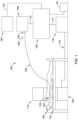
- FIG. 1 is schematic depiction of an exemplary system 102 that may be used in conjunction with carrying out an embodiment of the present disclosure through obtaining and co-registering extravascular image data (e.g. angiogram/fluoroscopy) and intravascular image data (e.g. IVUS or OCT images).
- the system 102 may include an extravascular imaging system/sub-system 104 (e.g. angiography/fluoroscopy system) for obtaining/generating extravascular imaging data.
- the system 102 may also include an intravascular imaging system/sub-system 106 (e.g. IVUS or OCT) for obtaining/generating intravasular imaging data.
- the system 102 may include a computer system/sub-system 130 including one or more controller or processor, memory and/or software configured to execute a method for vascular imaging registration of the obtained extravascular imaging data and the obtained intravascular imaging data.
- the extravascular imaging data may be radiological image data obtained by the angiography/fluoroscopy system 104.
- the angiography/fluoroscopy system 104 may include an angiographic table 110 that may be arranged to provide sufficient space for the positioning of an angiography/fluoroscopy unit c-arm 114 in an operative position in relation to a patient 100 on the table 110.
- Raw radiological image data acquired by the angiography/fluoroscopy c-arm 114 may be passed to an extravascular data input port 118 via a transmission cable 116.
- the input port 118 may be a separate component or may be integrated into or be part of the computer system/sub-system 130.
- the angiography/fluoroscopy input port 118 may include a processor that converts the raw radiological image data received thereby into extravascular image data (e.g angiographic/fluoroscopic image data), for example, in the form of live video, DICOM, or a series of individual images.
- extravascular image data may be initially stored in memory within the input port 118, or may be stored within the computer 130. If the input port 118 is a separate component from the computer 130, the extravascular image data may be transferred to the computer 130 through the cable 117 and into an input port in the computer 130.
- the communications between the devices or processors may be carried out via wireless communication, rather than by cables.
- the intravascular imaging data may be, for example, IVUS data or OCT data obtained by the intravascular imaging system/sub-system 106 (e.g. an IVUS or OCT system).
- the intravascular sub-system 106 may include an intravascular imaging device such as an imaging catheter 120, for example an IVUS or OCT catheter.
- the imaging device 120 is configured to be inserted within the patient 100 so that its distal end, including a diagnostic assembly or probe 122 (e.g. an IVUS or OCT probe), is in the vicinity of a desired imaging location of a blood vessel.
- a radiopaque material or marker 123 located on or near the probe 122 may provide indicia of a current location of the probe 122 in a radiological image.
- the diagnostic probe 122 in the case of IVUS intravascular imaging data, the diagnostic probe 122 generates ultrasound waves, and receives ultrasound echoes representative of a region proximate the diagnostic probe 122.
- the probe 122 or catheter 120 may convert the ultrasound echoes into corresponding signals, such as electrical or optical signals.
- the corresponding signals are transmitted along the length of the imaging catheter 120 to a proximal connector 124.
- the proximal connector 124 of the catheter 120 is communicatively coupled to processing unit or control module 126.
- IVUS versions of the probe 122 come in a variety of configurations including single and multiple transducer element arrangements. It should be understood that in the context of IVUS, a transducer may be considered an imaging element.
- an array of transducers is potentially arranged: linearly along a lengthwise axis of the imaging catheter 120, curvilinearly about the lengthwise axis of the catheter 120, circumferentially around the lengthwise axis, etc.
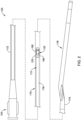
- the imaging catheter 120 may include an elongate shaft 170 having a proximal end region 172 and a distal end region 174.
- the proximal hub or connector 124 may be coupled to or otherwise disposed adjacent to the proximal end region 172.
- a tip member 176 may be coupled to or otherwise disposed adjacent to the distal end region 174.
- the tip member 176 may include a guidewire lumen, an atraumatic distal end, one or more radiopaque markers, or other features.
- An imaging assembly 177 may be disposed within the shaft 170.
- the imaging assembly 177 (which may include an imaging probe 122 including an imaging element182) may be used to capture/generate images of a blood vessel.
- the medical device may include devices or features similar to those disclosed in U.S. Patent Application Pub. No. US 2012/0059241 and U.S. Patent Application Pub. No. US 2017/0164925 .
- the medical device 120 may resemble or include features that resemble the OPTICROSS TM Imaging Catheter, commercially available from BOSTON SCIENTIFIC, Marlborough, MA.
- the imaging assembly 177 may include a drive cable or shaft 178, an imaging probe 122 including a housing 180 and an imaging element or transducer 182.
- the imaging probe 122 or housing 180 may be coupled to the drive cable 178.
- the transducer 182 may be rotatable or axially translatable relative to the shaft 170.
- the drive cable 178 may be rotated or translated in order to rotate or translate the transducer 182.
- the probe 122 or housing 180 may include or be made of a radiopaque material or marker 123, which may provide indicia of a current location of the probe 122 in a radiological image.
- the device 120 may be an OCT catheter used to collect OCT intravascular data.
- the OTC catheter 120 may include a diagnostic probe 122 that generates or propagates a light beam that is directed at tissue, and a portion of this light that reflects from sub-surface features is collected and is representative of a region proximate the diagnostic probe 122.
- the diagnostic probe 122 will include an optical imager for delivery and collection of the light. It should be understood that in the context of OCT, the optical imager in the probe 122 may be considered an imaging element.
- a technique called interferometry may be used to record the optical path length of received photons allowing rejection of most photons that scatter multiple times before detection.
- the probe 122 or catheter 120 may transmit the optical or light signals along the shaft, or may convert light signals into corresponding signals, such as electrical or optical signals, that may be transmitted along the length of the imaging catheter 120 to a proximal connector 124.
- the proximal connector 124 of the catheter 120 is communicatively coupled to a processing unit or control module 126.
- the probe 122 or housing 180 may include or be made of a radiopaque material or marker 123, which may provide indicia of a current location of the probe 122 in a radiological image
- Raw intravascular image data may be acquired by the imaging catheter 120 and may be passed to the control module 126, for example via connector 124.
- the control module 126 may be a separate component or may be integrated into or be part of the computer system/sub-system 130.
- the control module 126 may include a processor that converts or is configured to convert the raw intravascular image data received via the catheter 120 into intravascular image data (e.g IVUS or OCT image data), for example, in the form of live video, DICOM, or a series of individual images.
- the intravascular imaging data may include transverse cross-sectional images of vessel segments. Additionally, the intravascular imaging data may include longitudinal cross-sectional images corresponding to slices of a blood vessel taken along the blood vessel's length.
- the control module 126 may be considered an input port for the computer system/subsystem 130, or may be considered to be connected to an input port of the computer 130, for example, via cable 119 or a wireless connection.
- the intravascular image data may be initially stored in memory within the control module 126, or may be stored within memory in the computer system/subsystem 130. If the control module 126 is a separate component from the computer system/sub-system 130, the intravascular image data may be transferred to the computer 130, for example through the cable 119, and into an input port in the computer 130. Alternatively, the communications between the devices or processors may be carried out via wireless communication, rather than by cable 119.
- the control module 126 may also include one or more components that may be configured to operate the imaging device 120 or control the collection of intravascular imaging data.
- the control module 126 may include one or more of a processor, a memory, a pulse generator, a motor drive unit, or a display.
- the control module 126 may include one or more of a processor, a memory, a light source, an interferometer, optics, a motor drive unit, or a display.
- the control module 126 may be or include a motor drive unit that is configured to control movement of the imaging catheter 120. Such a motor drive unit may control rotation or translation of the imaging catheter 120 or components thereof.
- control module 126 or motor drive unit may include an automatic translation system that may be configured to translate the imaging catheter 120 in a controlled/measured matter within the patient 100.
- an automatic translation system may be used such that during a translation procedure, the imaging catheter 120 (including an imaging element) is translated within the blood vessel from a starting location to an ending location at a constant or known speed. (e.g. the imaging catheter 120 is translated at a specific rate for a known amount of time).
- the translation may be done manually. Translation procedures may be, for example, a "pullback" procedure (where the catheter 120 is pulled through the vessel) or a "push-through” procedure (where the catheter 120 is pushed through the vessel).
- the control module 126 may also be configured from or include hardware and software configured to control intravascular imaging and data collection.
- the control module 126 may include control features to turn on/off imaging or data collection from/to the catheter 120.
- the computer system/sub-system 130 can include one or more controller or processor, one or more memory, one or more input port, one or more output port and/or one or more user interface.
- the computer 130 obtains or is configured to obtain intravascular image data from or through the intravascular imaging system/sub-system 106 (e.g. IVUS or OCT) and extravascular image data from or through the extravascular imaging system/sub-system 104 (e.g. angiography/fluoroscopy system).
- the computer 130, or the components thereof can include software and hardware designed to be integrated into standard catheterization procedures and automatically acquire both extravascular imaging data (e.g. angiography/fluoroscopy) and intravascular imaging data (e.g. IVUS or OCT) through image or video acquisition.
- the computer system/sub-system 130 can include software or hardware that is configured to execute a method for vascular imaging co-registration of the obtained extravascular imaging data and the obtained intravascular imaging data.
- the computer 130 may include computer readable instructions or software to execute the method for vascular imaging co-registration as disclosed herein.
- the computer may include a processor or a memory which includes software including program code causing the computer to execute the method for vascular imaging co-registration as disclosed herein.
- the computer/computing device can include a processor or memory including instructions executable by the processor to perform the method for vascular imaging co-registration as disclosed herein.
- a computer readable medium having stored thereon in a non-transitory state a program code for use by the computer/computing device 130, the program code causing the computing device 130 to execute the method for vascular imaging co-registration as disclosed herein.
- the computer/computing device 130 may be part of or include a system for intravascular imaging registration that includes one or more input port for receiving imaging data; one or more output port; and a controller in communication with the input port and the output port, the controller configured to execute the method for intravascular imaging registration as disclosed herein.
- the computer system/sub-system 130 can also include software and hardware that is configured for rendering or displaying imaging, including, for example, extravascular imaging or intravascular imaging derived from the received image data or co-registration method.
- the computer 130 or software can be configured to render both extravascular imaging and intravascular imaging on a single display.
- the system may include a display 150 configured for simultaneously displaying extravascular image data and intravascular image data rendered by the computer 130.
- the display 150 may be part of the computer system 130 or may be a separate component in communication with the computer system 130, for example through an output port on the computer 130 and a transmission cable 121. In some other cases, however, the communication through the output port may be wireless, rather than by cable.
- the computer 130 or display 150 may be configured to simultaneously provide an angiogram, an IVUS transverse plane view, and an IVUS longitudinal plane view, which may or may not all be co-registered.
- the display may be configured to simultaneously provide an angiogram, an OCT transverse plane view, and an OCT longitudinal plane view, which may or may not be co-registered.
- the computer system/sub-system 130 can also include one or more additional output ports for transferring data to other devices.
- the computer can include an output port to transfer data to a data archive or memory 131.
- the computer system/sub-system 130 can also include a user interface that may include software and hardware that is configured for allowing an operator to use or interact with the system.
- the components of the system 102 may be used cooperatively during a vascular imaging method or procedure that involves the collection of extravascular imaging data and intravascular imaging data during a translation procedure.
- a vascular imaging method or procedure that involves the collection of extravascular imaging data and intravascular imaging data during a translation procedure.
- an example method for intravascular imaging registration may be executed or performed.
- the patient 100 may be arranged on the table 110 for extravascular imaging of a portion of a blood vessel of interest.
- the patient 100 or the table may be arranged or adjusted to provide for the desired view of the vessel of interest, in preparation for the collection of extravascular imaging data.
- the intravascular imaging catheter 120 may be introduced intravascularly into the portion of the blood vessel of interest, in preparation for a translation procedure to collect intravascular imaging data.
- the intravascular imaging catheter 120 can be navigated, and positioned (often under fluoroscopy) within the vessel such that the imaging element is located at a desired starting location for the translation procedure.
- a guide catheter may be used to aid in navigation.
- a translation procedure may be executed or performed.
- requisite extravascular and intravascular imaging data may be obtained.
- an example method for vascular imaging co-registration or registration may be executed or performed.
- One aspect of the example method for vascular imaging co-registration includes obtaining extravascular imaging data of a portion of the blood vessel.
- One component of the obtained extravascular imaging data includes an extravascular image showing the intravascular imaging device disposed within the vessel.
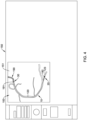
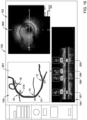
- FIG. 4 shows an angiographic/fluoroscopic image 151 generated by the angiography/fluoroscopy system 104 and obtained by the computer 130, and displayed on an image output 153 in the upper left portion of the display 150.
- the image 151 may be part of a video stream or series of images displayed on the screen of the display 150 at image output 153.
- the individually rendered frames may be appropriately tagged (e.g., frame number, time stamp, sequence number, etc.) which may be useful to correlate image data frames.
- the obtained imaging data can include an extravascular image 151 showing the intravascular imaging device 120 disposed within the vessel 10 (vessel shown in phantom), with an imaging element 182 of the intravascular imaging device 120 disposed at a starting location 20 for the translation procedure. (e.g. sometimes referred to as the "extravascular device image 151").
- This extravascular device image 151 may be obtained and recorded under fluoroscopy, through which the radiopaque marker 123 on the device 120 may be used to locate/visualize the location of the imaging element 182 or the starting location 20 of the imaging element 182.
- the starting location 20 has been determined by identifying the actual location from the extravascular image 151, it is an image showing the actual/known location of the intravascular imaging device 120 disposed within the vessel 10 at a particular time, and may be useful during registration.
- the image 151 may be obtained without contrast (e.g. under fluoroscopy) and as such, the anatomy of the vessel 10 may be difficult to discern/visualize (which is why it is shown in phantom).
- the imaging element 182 will be translated within the blood vessel 10 from the starting location 20 to an ending location 30.
- This extravascular image 151 may also show the ending location 30 for the translation procedure.
- a guide catheter 190 including a distal end 191 may be used during the procedure.
- the distal end 191 may include a radiopaque material or marker, and may be visualized or shown on the obtained extravascular image 151, and used as the ending location for the translation procedure.
- the ending location 30 has been determined by identifying the actual location from the obtained angiographic/fluoroscopic image 151, it is also an actual/known location within the vessel 10, and may also be useful during registration.
- other references points shown on the extravascular image 151 may be used to define the starting or ending locations.
- other devices, stents, anatomical markers, etc, that are shown on the extravascular image 151 may be used.
- the obtained extravascular imaging data may also include an extravascular contrast image showing the portion of the blood vessel with contrast and showing one or more visualized anatomical landmark(s).
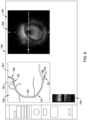
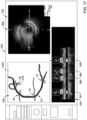
- FIG. 5 shows an extravascular contrast image 251 (e.g. an angiogram taken with contrast media within the vessel 10) generated by the angiography/fluoroscopy system 104 and obtained by the computer 130, and displayed on display 150 at image output 153.
- the image 251 may be part of the same video stream or series of images as device image 151, and displayed on the screen of the display at image output 153.
- the obtained data can include the extravascular contrast image 251 showing the portion of the blood vessel 10 with contrast and showing one or more visualized anatomical landmark(s) (e.g.
- the one or more visualized landmarks include vessel side branches 12, 14, 16, 18, other anatomical landmarks are contemplated and may be shown/used.
- Some examples of other visualized anatomical landmark that may be shown/used may include: stents, identifiable changes in the size or shape of the vessel 10, such as curves, narrowing, widenings, or the like, or other identifiable anatomical landmark(s) that may be visualized on the extravascular contrast image 251.
- the obtained extravascular imaging data may include video data including both the extravascular device image 151 (e.g. image showing the starting position of the intravascular imaging device 120), and the extravascular contrast image 251 (e.g. the "roadmap").
- the extravascular device image 151 and the extravascular contrast image 251 may be separate individual images that may be combined or superimposed. These images may be obtained automatically by the system as part of a program, which may be initiated by a user, or may be manually requested or obtained by a user interacting with the system, for example, through a user interface.
- the order in which the extravascular imaging data is obtained may also vary. For example, as in the shown embodiment of FIGS. 4 and 5 , the imaging device 120 may be first navigated to the desired starting location, and the extravascular device image 151 (e.g FIG. 4 ) may be obtained first. Thereafter, the extravascular contrast image 251 (e.g. FIG. 5 ) may be obtained, with the imaging device 120 already in or remaining in the blood vessel 10 when the contrast image 251 is taken. In other embodiments, it is contemplated that the order may be reversed. For example, the extravascular contrast image 251 may be obtained first, without the intravascular imaging device in the blood vessel 10.
- the imaging device 120 may be navigated to the desired starting location, and the extravascular device image 151 showing the device 120 in the starting location may be obtained.
- the extravascular imaging data may include one or both angiographic image data and fluoroscopic image data. Additionally, as disclosed herein, the extravascular imaging data can be selected from one or more of two-dimensional angiographic image data; three-dimensional angiographic image data; or computer tomography angiographic image data.
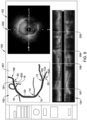
- FIGS. 6-8 is a series of figures which each show intravascular imaging data represented by a video or a series of intravascular images obtained during the progression of the translation procedure.
- the system may include software that is configured to initiate or perform or facilitate the translation procedure.
- the translation procedure may be initiated by a user interacting with the system, for example, through a user interface. (e.g.: click on a "begin pullback procedure" button to start the translation). Additionally, the translation procedure may be performed using an automated pullback system, for example, at a known speed, as discussed herein.
- the translation procedure is a pullback, where the imaging element 182 is translated within the blood vessel from the starting location 20 to the ending location 30.
- the intravascular imaging data is intravascular ultrasound data (IVUS).
- the intravascular imaging data may be generated using other intravascular modalities, for example, optical coherence tomography (OCT), or the like.
- OCT optical coherence tomography
- the obtained intravascular imaging data in the form of video or a series of images, will include, over the progression of the translation procedure, one or more intravascular images that show one or more detected anatomical landmark.
- the individually rendered intravascular image frames may be appropriately tagged (e.g., frame number, pullback distance, time stamp, sequence number, etc.) which may be useful to help correlate image data frames, for example, to correlate intravascular image frames and corresponding extravascular (e.g. radiopaque marker) image data frames or to correlate longitudinal cross-sectional intravascular images with transverse cross-sectional intravascular images.
- the detected anatomical landmarks that will be detected on IVUS include the four side branches that were shown in the angiogram of this portion of the vessel (e.g. side branches 12, 14, 16, 18 on the angiogram in FIG. 5 ). However, other detected anatomical landmarks are contemplated and may be shown/used.
- detected anatomical landmark examples include: stents, identifiable changes in the size or shape of the vessel 10, such as curves, narrowing, widenings, or the like, or other detectable anatomical landmark(s) that may be detected with one or more intravascular images obtained during the translation procedure.
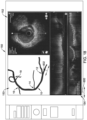
- FIGS. 6-8 show in the lower portion of the display 150 an image output 154 on the screen including intravascular imaging data including/representing a series of images generated by the intravascular imaging system/sub-system 106, obtained by the computer 130, and displayed on display 150.
- the intravascular images shown in the image output 154 may include a plurality of longitudinal cross-sectional images corresponding to slices of the blood vessel taken along the blood vessel's length during the translation procedure.
- the intravascular images shown in the image output 154 are obtained during the translation procedure and may be recorded as part of a video or a series of intravascular images.
- the intravascular imaging data, shown in the image output 154 may be progressively populated with additional intravascular images as they are generated.
- intravascular images This is represented, for example, by viewing the progression/lengthening of the image output 154 from FIG. 6 through FIG. 8 , where additional intravascular images are progressively being added to the intravascular imaging data 154 on the display 150 as the translation procedure proceeds.
- One or more of these intravascular images will show one or more detected anatomical landmark(s) (as discussed in further detail herein).
- each of FIGS. 6-8 show in the upper right portion of the display 150 an image output 152 on the screen including intravascular imaging data including/representing a series of transverse cross-sectional images of vessel segments.
- These transverse cross-sectional images are included in the imaging data generated by the intravascular imaging system/sub-system 106 and obtained by the computer 130, and displayed at the image output 152 on display 150.
- These transverse cross-sectional intravascular images shown in the image output 152 are progressively obtained during the translation procedure and may be part of or recorded as an intravascular imaging video or series of intravascular images.
- the transverse cross-sectional image shown in the image output 152 may correspond to the longitudinal cross-sectional image last added to the intravascular imaging output 154.
- the particular transverse cross-sectional image displayed in the image output 152 and the corresponding longitudinal cross-sectional image added at the same time at the end of the image output 154 may be different cross-sectional intravascular images/views, but are taken at the same time/location in the vessel.
- intermediate extravascular imaging data may also be optionally/periodically obtained, for example, to track the actual progression of the intravascular imaging device 120 during the translation procedure.
- These intermediate extravascular image(s) may be obtained during the translation procedure, and may show the actual/known location of the intravascular imaging device 120 disposed within the vessel 10 with the imaging element disposed at an intermediate location during the translation procedure, between the starting location 20 the ending location 30.
- the angiography/fluoroscopy system 104 may be activated (e.g. fluoroscopy may be activated) either manually, or automatically, to generate one or more intermediate angiographic/fluoroscopic images, which are obtained by the computer 130, and displayed at that time in the image output 153 on display 150.
- the translation procedure or the collection of intravascular images or the co-registration method may occur free of continuous angiography/fluoroscopy.
- the angiography/fluoroscopy system 104 may be periodically activated, but significant portion or periods of the translation may be performed without active angiography/fluoroscopy.
- the actual/known location of the intravascular imaging device 120 is not continuously tracked under angiography/fluoroscopy during the translation procedure.
- FIGS. 6-8 show such intermediate/periodically obtained extravascular images in the upper left portion in the image output 153 of the display 150.
- such intermediate extravascular images will show the imaging element 182 disposed at an actual/known intermediate location within the vessel 10, at a particular time during the translation procedure.
- the corresponding longitudinal cross-sectional image for that particular intermediate location within the vessel will be shown as the last image added in the intravascular imaging output 153.
- the transverse cross-sectional image shown in the image output 152 at that time will also correspond to the particular intermediate location within the vessel 10.
- FIG. 6 shows intravascular images taken near the beginning of the translation procedure. Because it is early in the translation procedure, the image output 154 on the bottom of the screen is relatively short, showing the relatively few longitudinal cross-sectional intravascular images obtained thus far in the translation procedure. In the upper right portion of the display 150, image output 152 shows a corresponding intravascular transverse cross-sectional image 252 of vessel at this location. FIG. 6 also shows an intermediate extravascular imagine 351 in the image output 153 on display 150.
- the intermediate extravascular imagine 351 may be obtained by brief activation of the fluoroscope to discern the actual/known location of the intravascular imaging device 120 at this time in the translation procedure, which in this instance, shows the imaging element disposed closer to the starting location 20 than to the ending location 30.
- FIG. 7 shows intravascular images taken near the middle of the translation procedure.
- the image output 154 on the bottom of the screen is growing (as compared to FIG. 6 ), showing the addition of more longitudinal cross-sectional intravascular images obtained as the translation procedure progresses.
- one or more of these intravascular images will show one or more detected anatomical landmark(s).
- the detected anatomical landmarks are detected side branches of the vessel 10.
- these intravascular images showing the first two side branches are marked with lines 197 and 198.
- the detected anatomical landmark may be detected or marked automatically by the system.
- the computer 130 may include software or hardware that is configured to perform image processing and image-recognition.
- the system may perform image processing and image-recognition to identify or mark the images including the detected anatomical landmarks 197/197.
- the images including the detected anatomical landmarks may be identified or marked manually by a user, for example, through a user interface.
- the image output 152 shows a corresponding intravascular transverse cross-sectional image 352 of vessel at this location.
- FIG. 7 also shows a second intermediate extravascular imagine 451 in the image output 153 on display 150.
- the intermediate extravascular imagine 451 may be obtained by brief activation of the fluoroscope to discern the actual/known location of the intravascular imaging device 120 at this time in the translation procedure, which in this instance, shows the imaging element disposed about half way between the starting location 20 and the ending location 30.
- FIG. 8 shows intravascular images taken as the translation procedure is approaching an end or has ended.
- the image output 154 on the bottom of the screen has grown across the display (as compared to FIGS. 6 and 7 ), showing the addition of yet more longitudinal cross-sectional intravascular images obtained through the complete translation procedure (from start to end). It may also be appreciated that one or more of these intravascular images in the image output 154 on display 150 will show one or more detected anatomical landmark(s) (e.g. detected side branches of the vessel).
- intravascular images showing the first two detected side branches are again marked with lines 197 and 198 (as in FIG. 7 ).
- Two additional intravascular images showing a third and fourth detected side branches are now also obtained during the ladder half of the translation procedure, and are marked with lines 199 and 200.
- the images including the detected anatomical landmark may be identified or marked automatically, for example, using image processing and image-recognition, or may be identified or marked manually by a user, for example, through a user interface.
- image output 152 shows a corresponding intravascular transverse cross-sectional image 452 of vessel that corresponds to the ending location in the vessel.
- FIG. 8 also shows an additional (e.g. third) intermediate extravascular imagine 551 in the image output 153 on display 150.
- the extravascular imagine 551 may be obtained by brief activation of the fluoroscope to discern the actual/known location of the intravascular imaging device 120, which at the end of the translation procedure, is shown with the imaging element 182 disposed at the ending location 30.
- translation procedure can be stopped, as the imaging element 182 has reached the ending location 30. This may be done automatically by the system, or may be done manually by a user interacting with the system.
- Another aspect of the example method for vascular imaging co-registration includes marking the extravascular imaging data for registration.
- the extravascular imaging data may be marked with actual/known registration points.
- some embodiments involve marking the starting location 20 and/or the ending location 30 of the translation procedure on the extravascular imaging data.
- the obtained extravascular imaging data includes an extravascular image 151 (e.g. FIG. 4 ) and also an extravascular contrast image 251 (e.g. FIG. 5 ).
- the extravascular image 151 was obtained under fluoroscopy, and shows the starting location 20 and/or the ending location 30 for a translation procedure, which were discerned and identified using positions or radiopaque markers of the devices 120/190 identified under fluoroscopy. These are examples of actual/known locations or registration points.
- the vessel lumen or anatomical landmarks, such as side branches may not be readily discernable/identifiable in image 151, due to the absence of contrast flow. (but they are shown in phantom in FIG. 4 for reference).
- the extravascular contrast image 251 FIG.
- angiogram with contrast is an angiogram with contrast, thus showing the portion of the blood vessel with contrast and showing one or more visualized anatomical landmark(s).
- the visualized anatomical landmarks e.g. side branches
- the position of the devices or radiopaque markers of the devices 120/190 are less discernable or not identifiable in the extravascular contrast image 251. This makes it difficult or impossible to see or identify, for example, actual/known locations or registration points, such as the starting location 20 and the ending location 30 for a translation procedure.
- the data from the extravascular image 151 may be combined with or superimposed onto the extravascular contrast image 251.
- this process may be done automatically by the system.
- the computer 130 may include software or hardware that is configured to perform image processing and image-recognition designed to combined or superimpose the data in images.
- the images may be combined or superimposed manually by a user, for example, through a user interface.
- the result of combining or overlaying/superimposing the data from extravascular image 151 (e.g. fluoroscopy image) with the data from extravascular contrast image 251 (e.g. angiogram with contrast) may result in a combined or enhanced extravascular image 651 (e.g. enhanced angiogram), which is extravascular imaging data that is or can be marked.
- extravascular image 651 e.g. enhanced angiogram
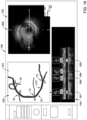
- FIG. 9 shows an extravascular image 651 generated by the computer 130, and displayed on the image output 153 in the upper left portion of the display 150.
- the starting location 20 or the ending location 30 are identified on the extravascular image 651 and may be marked on the extravascular imaging data.
- the starting location 20 may be marked with a marker 620 on the extravascular image 651.
- the ending location 30 may be marked with a marker 630 on the extravascular image 651.
- this identification or marking process may be done automatically by the system.
- the computer 130 may include software or hardware that is configured to perform image processing and image-recognition configured to identify and mark the starting location 20 or the ending location 30 (or other actual/known locations or registration points).
- marking the starting location 20 or the ending location 30 (or other actual/known locations or registration points) be done manually by a user, for example, through a user interface.
- extravascular data or images including or showing other actual/known locations of the imaging element of the intravascular imaging device 120 during the translation procedure may also be combined with or superimposed onto the extravascular contrast image 251 or the extravascular image 651.
- other extravascular images such as intermediate extravascular image 351 ( FIG. 6 ) or intermediate extravascular image 451 ( FIG. 7 ) or intermediate extravascular image 551 ( FIG. 8 ) were also each obtained under fluoroscopy during the translation procedure, with each including an actual/known location of the imaging element 182 (due to radiopaque marker 123) of the intravascular imaging device 120 at a certain point during the translation procedure.
- Combining or superimposing the data from one or more of these additional extravascular images with the contrast image 251 or the extravascular image 651 may add extra reference points, and may help to enhance accuracy.
- the process of combining or superimposing the data may be done as discussed above, for example, automatically by the system or manually by a user. Additionally, the particular actual/known location(s) of the imaging element 182 may also be marked on the extravascular imaging data, with the marking occurring similar to as discussed above.
- FIG. 9 also shows intravascular images taken as the translation procedure is approaching an end or has ended.
- the image output 154 on the bottom of the screen shows longitudinal cross-sectional intravascular images obtained during the translation procedure (from start to end).
- the image output 154 includes intravascular images showing the four detected anatomical landmarks (e.g. side branches) which are again marked with lines 197, 198, 199 and 200 respectively.
- image output 152 shows a corresponding intravascular transverse cross-sectional image 552 of vessel that corresponds to the ending location in the vessel.
- the angiography/fluoroscopy system 104 may not be, or only periodically be activated during the translation procedure, for example to obtain actual/known locations. But significant portion or periods may be performed without angiography/fluoroscopy. In such cases, the actual/known location of the intravascular imaging device 120 is not continuously tracked under angiography/fluoroscopy during the translation procedure.
- the system may be configured to calculate an approximate or predicted location of the imaging element 182 (e.g. due to the radiopaque marker 123) for those portions of the translation procedure when the angiography/fluoroscopy is inactive. For example, such calculations may be based upon its last registered position/location (e.g. last registered actual/known location of the imaging element 182) and other indicators of catheter movement or location, such as a known pullback distance and speed, a calculated path, or other non-visual position data, or the like, etc.
- last registered position/location e.g. last registered actual/known location of the imaging element 182
- other indicators of catheter movement or location such as a known pullback distance and speed, a calculated path, or other non-visual position data, or the like, etc.
- the calculated/predicted location will be a distance from the initial location along the path of travel, and is represented by the product of the pullback rate and the time period.
- the computer 130 can include software or hardware designed to make such calculations, and output the results, for example showing or marking the calculated/predicted location on displayed images, as desired.
- a calculated/predicted location for a particular point during the translation procedure may be superimposed upon the extravascular image 651 or a co-registered image such as that shown in FIG. 18 , and may represent the calculated/predicted location of the probe 122 or imaging element 182 at that point in the translation procedure.
- a calculated path that the imaging element 182 takes may be determined or used or displayed.
- a predicted/calculated path may extend between the starting location 20 and the ending location 30, and may generally extend along the imaged vessel lumen shown on extravascular contrast imaging data. Data regarding the calculated path may also be used or considered when calculating an approximate or predicted location of the imaging element 182.
- Some examples of methods that may be used to determine a calculated path include: user-specified points or manual path specification; image pattern recognition; automated two-dimensional and three-dimensional path calculations; user assisted automated path calculations; and combinations of manual and automated calculations of a path.
- the computer 130 can include software or hardware designed to make or facilitate such calculations, and output the results, for example showing or marking the calculated path on displayed images, as desired.
- the calculated path may be superimposed upon the extravascular image 651 or a co-registered image such as that shown in FIG. 18 , and may represent the projected path of the probe 122 or imaging element 182 during the translation procedure.
- the calculated/predicted location there may be error between the calculated/predicted location and the actual/known location. For example, it is expected that at certain periods during which fluoroscopy is inactive, foreshortening issues may be present and cause error between the calculated/predicted location and the actual/known location, especially in a tortuous/winding vessel. However, each subsequent time that the fluoroscope is activated and actual/known location data is acquired and presented to the processor, error between the actual/known location and the predicted/calculated location may be reduced or eliminated by replacing the calculated/predicted position with the actual/known location.
- another aspect of the example method for vascular imaging co-registration disclosed herein includes aligning the predicted location of a particular detected anatomical landmark with a corresponding visualized anatomical landmark, as will be discussed in more detail below. This aspect may also help to alleviate or reduce error/misalignment.
- Another aspect of the example method for vascular imaging co-registration includes marking a predicted location of detected anatomical landmark(s) on the extravascular imaging data.
- the intravascular imaging data obtained during the translation procedure will include one or more intravascular images showing one or more detected anatomical landmarks.
- these intravascular images showing the detected anatomical landmarks are included in the intravascular imaging data, obtained using the intravascular imaging device during the translation procedure.
- the location of these detected anatomical landmark e.g. from IVUS or OCT data
- will be correspondingly identified and/or marked and/or registered on the extravascular imaging data e.g. the angiography/fluoroscopy data).
- the imaging element 182 of the intravascular imaging device 120 it is useful to know the location (either actual/known location or calculated/predicted location) of the imaging element 182 of the intravascular imaging device 120 when it detected a particular detected anatomical landmark during the translation procedure, which can then be used to mark and/or register that location (of the detected anatomical landmark) on the extravascular imaging data (e.g. the angiography/fluoroscopy data).
- the extravascular imaging device angiography/fluoroscopy
- the imaging element 182 detects a particular detected anatomical landmark
- the location of the detected anatomical landmark is actual/known.
- the location of that particular detected anatomical landmark can be marked and/or registered at that location on the extravascular imaging data, using the actual/known location provided by the extravascular imaging.
- the actual/known location of the imaging element 182 on the intravascular imaging device 120 as it detects a particular detected anatomical landmark during the translation procedure will not be known.
- a calculated/predicted location of the imaging element 182 on intravascular imaging device 120 as it detects a particular detected anatomical landmark during the translation procedure will be used. Methods and/or systems for determining the calculated/predicted location of the imaging element 182 are described above, and may be used in this context.
- the predicted location of detected anatomical landmark(s) are then marked on the extravascular imaging data.
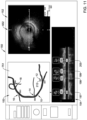
- FIG. 10 shows extravascular imaging data, in this case an extravascular image 751, which may be created in a similar manner, and be similar in form and function to the extravascular image 651 of FIG. 9 .
- the extravascular image 751 shows the visualized anatomical landmarks, in this case, side branches 12, 14, 16, and 18.
- the predicted location of detected anatomical landmark 197 e.g. the first side branch
- the predicted location of the detected anatomical landmark 197 is then marked on the extravascular imaging data (e.g. the extravascular image 751) with marker arrow 212.
- the extravascular imaging data e.g. the extravascular image 751
- marker arrow 212 As can be appreciated, in this instance, there is some misalignment/error/discrepancy between the predicted and marked location 212 for the first side branch, and the visualized anatomical landmark 12 on the extravascular imaging data.
- the visualized anatomical landmarks are identified and/or identifiable - either manually or by the system.
- the visualized anatomical landmarks may simply be identified manually by a user, for example, by the user evaluating the image on the screen.
- the visualized anatomical landmarks may be identified automatically by the system.
- the computer 130 may include software or hardware that is configured to perform image processing and image-recognition. Using the extravascular image data (e.g. angiographic data), the system may perform image processing and image-recognition to identify the visualized anatomical landmarks (e.g. side branches 12, 14, 16, 18).
- the visualized anatomical landmarks may also be marked on the extravascular imaging data.
- the visualized anatomical landmarks e.g. side branches 12, 14, 16, 18
- side branch 12 is marked as SB1
- side branch 14 is marked as SB2
- side branch 16 is marked as SB3
- side branch 18 is marked as SB4.
- this identification or marking process may be done automatically by the system.
- the computer 130 may include software or hardware that is configured to perform image processing and image-recognition configured to identify and mark the visualized anatomical landmarks.
- marking the visualized anatomical landmarks may be done manually by a user, for example, through a user interface.
- FIG. 10 also shows intravascular images taken during the translation procedure.
- the image output 154 on the bottom of the screen shows longitudinal cross-sectional intravascular images obtained during the translation procedure (from start to end).
- the image output 154 includes intravascular images showing the four detected anatomical landmarks (e.g. side branches) which are again identified and then marked with lines 197, 198, 199 and 200, as elsewhere herein.
- lines 197, 198, 199 and 200 now bear labels and/or flags.
- lines 197 now bears label SB1, line 198 now bear label SB2, line 199 now bears label SB3, and line 200 now bears label SB4.
- the markings/text/symbols on the labels denoting the four detected anatomical landmarks e.g.
- each of the detected anatomical landmarks now also bear an additional label showing a small representation of the corresponding intravascular transverse cross-sectional image for that particular detected anatomical landmark.
- These small images of the corresponding intravascular transverse cross-sectional images can be seen above each text labels for each detected anatomical landmark.
- these marking/labels may be applied automatically by the system.
- the computer 130 may include software or hardware that is configured to perform image processing and image-recognition configured to identify and marking/labels the landmarks accordingly. In other cases, marking/labeling may be done manually by a user, for example, through a user interface.
- these lines/markings/labels may be interactive. For example, through a user interface, a user may actuate one of the lines/markings/labels, and the lines/markings/labels may become highlighted and/or activated.
- a line/marking/label for a particular detected anatomical landmark is highlighted or activated, the corresponding marked predicted location of for that particular detected anatomical landmark is shown on the extravascular imaging data (e.g. the extravascular image 751), and the corresponding intravascular transverse cross-sectional image for that particular detected anatomical landmark is shown in the image output 152 in the upper right portion of the display 150.
- the extravascular imaging data e.g. the extravascular image 751
- the corresponding intravascular transverse cross-sectional image for that particular detected anatomical landmark is shown in the image output 152 in the upper right portion of the display 150.
- the label SB1 (designating detected anatomical landmark 197) is shown being activated/highlighted, as is represented by the downward arrow above this label.
- Marker arrow 212 designating the predicted location of the detected anatomical landmark 197 on the extravascular imaging data is then shown on the extravascular image 751.
- the corresponding intravascular transverse cross-sectional image for detected anatomical landmark 197 is shown in the image output 152.
- Each of the other labels may be similarly activated to show corresponding information.
- Another aspect of the example method for vascular imaging co-registration includes aligning the predicted location of the detected anatomical landmark with the visualized anatomical landmark.
- the visualized anatomical landmark(s) are identified and/or identifiable on the extravascular imaging data - either manually or automatically by the system.
- the visualized anatomical landmarks may also, optionally, be marked on the extravascular imaging data - either manually or by the system.
- the predicted location(s) of detected anatomical landmark(s) may be calculated and marked on the extravascular imaging data - either manually or automatically by the system.
- the disclosed method for vascular imaging co-registration may include aligning the predicted location of the detected anatomical landmark with the visualized anatomical landmark, and may help to alleviate this misalignment/error/discrepancy.
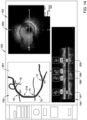
- FIG. 10 shows the display including extravascular imaging data, in this case an extravascular image 751, which shows the visualized anatomical landmark 12.
- Landmark 12 is identified and labeled SB1 (e.g. side branch 1) on the extravascular image 751.
- the predicted location of detected anatomical landmark 197 (also labeled SB1) from the intravascular images 154 was calculated/predicted and is marked with marker arrow 212 on the extravascular image 751.
- the method and system disclosed herein provides for aligning the predicted location 212 with the visualized anatomical landmark 12.
- the alignment is typically done by moving or dragging the indicator representing the predicted location 212 on the screen such that it aligns with the visualized anatomical landmark 12.
- this alignment process may be done automatically by the system.
- the computer 130 may include software or hardware that is configured to automatically align the predicted location 212 with the corresponding visualized anatomical landmark 12. This may be the done at the instruction of a user, or may be done automatically if/when misalignment is detected.
- the alignment may be performed manually by a user, for example, through a user interface. Some examples of manual alignment may include the use of the interactive lables discussed above.
- a user may highlight/actuate the label corresponding to the detected anatomical landmark of interest - in this case detected anatomical landmark 197 bearing label SB1.
- the label for detected anatomical landmark is highlighted/activated, the corresponding marked predicted location of for that particular detected anatomical landmark is then shown on the extravascular imaging data - in this case marker arrow 212, designating the predicted location of the detected anatomical landmark 197.
- the user may then manually move/drag the marker arrow 212 into alignment with the corresponding visualized anatomical landmark - in this case, visualized anatomical landmark 12.
- the user may then inactivate the label, for example to thereby saving the alignment.
- FIG. 11 shows a screen with same imaging data as shown in FIG. 10 , but after aligning the predicted location 212 with the visualized anatomical landmark 12.
- a similar alignment steps may also be done for any other predicted locations of additional detected anatomical landmark and corresponding visualized anatomical landmarks that are misaligned.
- FIG. 12 shows the display including extravascular imaging data, in this case an extravascular image 851 which is basically the same as extravascular image 751, but with a focus on visualized anatomical landmark 14 and the corresponding predicted location of detected anatomical landmark 198.
- Landmark 14 is identified and labeled SB2 (e.g. side branch 2) on the extravascular image 851.
- SB2 e.g. side branch 2
- the predicted location of detected anatomical landmark 198 (also labeled SB2) from the intravascular images 154 was calculated/predicted and is marked with marker arrow 214 on the extravascular imaging image 851.
- marker arrow 214 on the extravascular imaging image 851.
- the method and system disclosed herein also provides for aligning the predicted location 214 with the visualized anatomical landmark 14 in a similar manner as discussed above for aligning the predicted location 212 with the visualized anatomical landmark 12.
- FIG. 13 shows a screen with same imaging data as shown in FIG. 12 , but after aligning the predicted location 214 with the visualized anatomical landmark 14.
- FIGS. 14 shows the display including extravascular imaging data, in this case an extravascular image 951 which is basically the same as extravascular images 751 and 851, but with a focus on visualized anatomical landmark 16 and the corresponding predicted location of detected anatomical landmark 199.
- Landmark 16 is identified and labeled SB3 (e.g. side branch 3) on the extravascular image 951.
- SB3 e.g. side branch 3
- the predicted location of detected anatomical landmark 199 (also labeled SB3) from the intravascular images 154 was calculated/predicted and is marked with marker arrow 216 on the extravascular imaging image 951.
- FIG. 15 shows a screen with same imaging data as shown in FIG. 14 , but after aligning the predicted location 216 with the visualized anatomical landmark 16.
- FIGS. 16 shows the display including extravascular imaging data, in this case an extravascular image 1051 which is basically the same as extravascular images 751, 851 and 951, but with a focus on visualized anatomical landmark 18 and the corresponding predicted location of detected anatomical landmark 200.
- Landmark 18 is identified and labeled SB4 (e.g. side branch 4) on the extravascular image 1051.
- SB4 e.g. side branch 4
- the predicted location of detected anatomical landmark 200 (also labeled SB4) from the intravascular images 154 was calculated/predicted and is marked with marker arrow 218 on the extravascular imaging image 1051.
- FIG. 17 shows a screen with same imaging data as shown in FIG. 16 , but after aligning the predicted location 218 with the visualized anatomical landmark 18.
- the intravascular images generated by the intravascular catheter during the translation procedure are co-registered to the extravascular images, so that every intravascular image (e.g. IVUS or OCT image) is linked to its corresponding location on the extravascular image (e.g. an angiographic image).
- the resulting co-registered images can be used to render and present a co-registered display including both the extravascular images and the corresponding intravascular images.
- the co-registered extravascular and intravascular images can be simultaneously displayed, along-side one another, upon the display 150.
- the co-registered image data may also be stored in the computer 130 or in a long-term storage device 131 for later review, for example in a session separate from the procedure that acquired the extravascular and intravascular image data.
- the co-registered display may also be rendered in playback mode.
- FIG. 18 shows and example of such a resulting co-registered display including both the extravascular images and the corresponding intravascular images.
- the co-registered extravascular and intravascular images can be simultaneously displayed, along-side one another, upon the display 150.
- the display 150 includes image output 153 in the upper left portion for showing co-registered extravascular imaging data, image output 154 along the bottom for showing co-registered longitudinal cross-sectional intravascular images obtained during the translation procedure (e.g. from start to end), and image output 152 in the upper right portion for showing corresponding co-registered transverse cross-sectional intravascular images obtained during the translation procedure.
- the system may include software or hardware that is configured to allow a user to scroll and/or track through the series of co-registered images.
- the system may include a configuration that allows a user to scroll through one of the sets of co-registered images, and as the scrolling occurs, the processor acquires and displays corresponding co-registered images for the other sets of images.
- a slider bar/cursor 600 may be displayed/overlaid on the image output 154, which shows the series of intravascular images obtained during the translation procedure. Additionally, corresponding slider bar/cursor 602 may be displayed on the image output 153 along the extravascular image of the vessel.
- the two bar/cursors 600/6012 may be associated and/or linked, such that when a user selects and drags the slider bar/cursor 602 along the path of the vessel (e.g. a calculated path) on the co-registered extravascular image shown in the image output 153, the bar/cursor 600 correspondingly slides along the corresponding/co-registered images shown in the image output 154. Similarly, when a user selects and drags the slider bar/cursor 600 along the co-registered images shown in the image output 154, the bar/cursor 602 slides along the path of the vessel (e.g. a calculated path) on the co-registered extravascular image shown in the image output 153. Additionally, when the user moves either bar/cursor 600/602, a corresponding transverse cross-sectional images of vessel segment will be displayed in the image output 152 on the screen.
- Another aspect of the method for vascular imaging co-registration may include estimating the accuracy of the imaging registration. As discussed herein, there may be some misalignment/error/discrepancy between the predicted and marked location(s) of detected anatomical landmark(s) on the extravascular imaging data, and the corresponding visualized anatomical landmark on the extravascular imaging data. As disclosed herein, one aspect of the method for vascular imaging co-registration may include aligning the predicted location of the detected anatomical landmark with the visualized anatomical landmark, and this may help alleviate some of this misalignment/error/discrepancy in the co-registration. However, the fact that this misalignment/error/discrepancy occurred in the first place (e.g.
- the system may include software or hardware that is configured to estimate the accuracy of the co-registration, and in some cases, display and/or otherwise indicate an estimated level of accuracy for portions of or all of the co-registration.
- the error between predicted locations of detected anatomical landmark and the corresponding visualized anatomical landmarks can be measured, either individually, in groups, or as a whole over the entire co-registration.
- the magnitude these measurements may indicate an estimated level of accuracy of parts or all of the co-registration. For example, if the magnitude of measured error is large and/or exceeds certain predetermined thresholds, the predicted level of accuracy of the co-registration may be low. On the other hand, if the magnitude these measurements is large and/or exceeds certain predetermined thresholds, the predicted level of accuracy of the co-registration may be low.
- Other example factors that may be used in estimating the accuracy of the co-registration may include: the total number actual/known locations or registration points used in the co-registration (e.g. obtained via fluoroscopy); the distance between actual/known locations or registration points; the total number of alignments performed (e.g. aligning a predicted location of the detected anatomical landmark with a visualized anatomical landmark); the distance between the performed alignments; and the degree of tortuosity of the vessel being analyze.
- Other methods of estimating accuracy may involve using curve based algorithms or formulas, foreshortening predictions formulas or models, and the like.
- the estimated level of accuracy of the co-registration may be performed for all, or portions of co-registration and/or over all or segments of the portion of the vessel being analyzed. Once an estimated level of accuracy is determined, the estimated level of accuracy for all, or portions of co-registration be displayed.
- the system may include software or hardware that is configured to generating a visual indicator representing the estimated accuracy of the imaging co-registration.
- the visual indicator may be displayed and/or overlaid on all or portions of the illustrated blood vessel on the extravascular imaging data.
- the visual characteristic may include color, symbol, intensity, or the like, and may be overlaid/superimposed on or associated with segments of the vessel shown.
- different colors, symbols, intensity levels may be coded and/or used to indicate the level of accuracy. For example, if the level of accuracy is determined to be high for a particular segment, one color (e.g. green) may be overlaid on that segment. If alternatively, the level of accuracy is determined to be low for another particular segment, another color (e.g. red) may be overlaid on that segment.
- one color e.g. green
- another color e.g. red
- these are given by way of example only, and a broad variety of other configurations are contemplated.
- an error between an actual/known location and a calculated location there may be error between an actual/known location and a calculated location, and this error may be determined or measured. In some embodiments, this error may be taken into account and used to adjust the co-registration. For example, an error/total travel distance ratio may be used as a scaling factor to recalculate and adjust previously calculated/predicted positions on the extravascular image (e.g. angiograph) for the entire preceding period in which the fluoroscope was inactive.
Landscapes
- Health & Medical Sciences (AREA)
- Life Sciences & Earth Sciences (AREA)
- Engineering & Computer Science (AREA)
- Medical Informatics (AREA)
- Physics & Mathematics (AREA)
- General Health & Medical Sciences (AREA)
- Nuclear Medicine, Radiotherapy & Molecular Imaging (AREA)
- Radiology & Medical Imaging (AREA)
- Veterinary Medicine (AREA)
- Animal Behavior & Ethology (AREA)
- Public Health (AREA)
- Surgery (AREA)
- Molecular Biology (AREA)
- Biophysics (AREA)
- Pathology (AREA)
- Biomedical Technology (AREA)
- Heart & Thoracic Surgery (AREA)
- Optics & Photonics (AREA)
- High Energy & Nuclear Physics (AREA)
- Computer Vision & Pattern Recognition (AREA)
- Theoretical Computer Science (AREA)
- General Physics & Mathematics (AREA)
- Quality & Reliability (AREA)
- Hematology (AREA)
- Vascular Medicine (AREA)
- Dentistry (AREA)
- Oral & Maxillofacial Surgery (AREA)
- Human Computer Interaction (AREA)
- Ultra Sonic Daignosis Equipment (AREA)
- Endoscopes (AREA)
Priority Applications (1)
| Application Number | Priority Date | Filing Date | Title |
|---|---|---|---|
| EP25183308.3A EP4640158A3 (en) | 2022-03-02 | Systems and methods for vascular image co-registration |
Applications Claiming Priority (2)
| Application Number | Priority Date | Filing Date | Title |
|---|---|---|---|
| US202163157427P | 2021-03-05 | 2021-03-05 | |
| PCT/US2022/018456 WO2022187318A1 (en) | 2021-03-05 | 2022-03-02 | Systems and methods for vascular image co-registration |
Related Child Applications (1)
| Application Number | Title | Priority Date | Filing Date |
|---|---|---|---|
| EP25183308.3A Division EP4640158A3 (en) | 2022-03-02 | Systems and methods for vascular image co-registration |
Publications (3)
| Publication Number | Publication Date |
|---|---|
| EP4301233A1 EP4301233A1 (en) | 2024-01-10 |
| EP4301233C0 EP4301233C0 (en) | 2025-06-18 |
| EP4301233B1 true EP4301233B1 (en) | 2025-06-18 |
Family
ID=80819788
Family Applications (1)
| Application Number | Title | Priority Date | Filing Date |
|---|---|---|---|
| EP22711755.3A Active EP4301233B1 (en) | 2021-03-05 | 2022-03-02 | Systems for vascular image co-registration |
Country Status (5)
| Country | Link |
|---|---|
| US (2) | US12087000B2 (enExample) |
| EP (1) | EP4301233B1 (enExample) |
| JP (2) | JP7719201B2 (enExample) |
| CN (1) | CN117255651A (enExample) |
| WO (1) | WO2022187318A1 (enExample) |
Families Citing this family (2)
| Publication number | Priority date | Publication date | Assignee | Title |
|---|---|---|---|---|
| WO2024238616A1 (en) * | 2023-05-15 | 2024-11-21 | Spectrawave | System, method and computer-accessible medium for providing automated image path registration |
| CN119949771B (zh) * | 2025-03-12 | 2026-01-06 | 中国科学院苏州生物医学工程技术研究所 | 基于光学低相干干涉场的多模态成像系统与方法 |
Family Cites Families (242)
| Publication number | Priority date | Publication date | Assignee | Title |
|---|---|---|---|---|
| US3273447A (en) | 1963-08-26 | 1966-09-20 | Franklin Institute | Detection and measurement device having a small flexible fiber transmission line |
| GB1440761A (en) | 1972-09-08 | 1976-06-23 | Nat Res Dev | Pressure transducer |
| US3963323A (en) | 1974-12-23 | 1976-06-15 | International Telephone And Telegraph Corporation | Fiber optic connector with protective cable sleeves |
| US4112941A (en) | 1977-01-06 | 1978-09-12 | Minnesota Mining And Manufacturing Company | Electrode and magnetic connector assembly |
| JPS53141644A (en) | 1977-05-17 | 1978-12-09 | Fujitsu Ltd | Optical connector |
| US4487206A (en) | 1982-10-13 | 1984-12-11 | Honeywell Inc. | Fiber optic pressure sensor with temperature compensation and reference |
| US4893630A (en) | 1984-04-06 | 1990-01-16 | Trinity Computing Systems, Inc. | Apparatus and method for analyzing physiological conditions within an organ of a living body |
| GB8603672D0 (en) | 1986-02-14 | 1986-03-19 | British Telecomm | Reducing splice loss between dissimilar fibres |
| US4711246A (en) | 1986-09-02 | 1987-12-08 | Fiberoptic Sensor Technologies, Inc. | Fiber optic coupled pressure transducer using single fiber and method of fabrication |
| US4771782A (en) | 1986-11-14 | 1988-09-20 | Millar Instruments, Inc. | Method and assembly for introducing multiple catheters into a biological vessel |
| US5005584A (en) | 1987-06-15 | 1991-04-09 | Mnm Enterprises, Inc. | Fiber optic pressure transducer |
| US4953553A (en) | 1989-05-11 | 1990-09-04 | Advanced Cardiovascular Systems, Inc. | Pressure monitoring guidewire with a flexible distal portion |
| CA1321089C (en) | 1988-05-06 | 1993-08-10 | Adc Telecommunications, Inc. | Optical switch |
| US5178159A (en) | 1988-11-02 | 1993-01-12 | Cardiometrics, Inc. | Torqueable guide wire assembly with electrical functions, male and female connectors rotatable with respect to one another |
| US5779698A (en) | 1989-01-18 | 1998-07-14 | Applied Medical Resources Corporation | Angioplasty catheter system and method for making same |
| US5313957A (en) | 1990-01-05 | 1994-05-24 | Medamicus, Inc. | Guide wire mounted pressure transducer |
| US5238004A (en) | 1990-04-10 | 1993-08-24 | Boston Scientific Corporation | High elongation linear elastic guidewire |
| US5135503A (en) | 1990-05-16 | 1992-08-04 | Advanced Cardiovascular Systems, Inc. | Shaping ribbon for guiding members |
| US5106455A (en) | 1991-01-28 | 1992-04-21 | Sarcos Group | Method and apparatus for fabrication of micro-structures using non-planar, exposure beam lithography |
| AU660444B2 (en) | 1991-02-15 | 1995-06-29 | Ingemar H. Lundquist | Torquable catheter and method |
| CA2117088A1 (en) | 1991-09-05 | 1993-03-18 | David R. Holmes | Flexible tubular device for use in medical applications |
| US5280786A (en) | 1992-01-21 | 1994-01-25 | Fiberoptic Sensor Technologies, Inc. | Fiberoptic blood pressure and oxygenation sensor |
| US5437288A (en) | 1992-09-04 | 1995-08-01 | Mayo Foundation For Medical Education And Research | Flexible catheter guidewire |
| US5425371A (en) | 1992-10-05 | 1995-06-20 | Metatech Corporation | Fiberoptic pressure transducer |
| US5414507A (en) | 1993-04-01 | 1995-05-09 | Hughes Aircraft Company | Fiber optics pressure sensor transducer having a temperature compensator |
| US5450853A (en) | 1993-10-22 | 1995-09-19 | Scimed Life Systems, Inc. | Pressure sensor |
| US5873835A (en) | 1993-04-29 | 1999-02-23 | Scimed Life Systems, Inc. | Intravascular pressure and flow sensor |
| US5772609A (en) | 1993-05-11 | 1998-06-30 | Target Therapeutics, Inc. | Guidewire with variable flexibility due to polymeric coatings |
| US5438873A (en) | 1993-07-01 | 1995-08-08 | Fiberoptic Sensor Technologies, Inc. | Fiberoptic sensor using tapered and bundled fibers |
| US5421195A (en) | 1993-07-01 | 1995-06-06 | Wlodarczyk; Marek T. | Fiber optic microbend sensor for engine knock and misfire detection |
| US5427114A (en) | 1993-08-19 | 1995-06-27 | Fiberoptic Sensor Technologies, Inc. | Dual pressure sensing catheter |
| US6139510A (en) | 1994-05-11 | 2000-10-31 | Target Therapeutics Inc. | Super elastic alloy guidewire |
| EP1658808A1 (en) | 1994-09-02 | 2006-05-24 | Volcano Corporation | Microminiature pressure sensor and guidewire using the same |
| US5797856A (en) | 1995-01-05 | 1998-08-25 | Cardiometrics, Inc. | Intravascular guide wire and method |
| EP0827383B1 (en) | 1995-02-28 | 2007-05-30 | Boston Scientific Corporation | Polymer implements for torque transmission |
| JPH08257128A (ja) | 1995-03-24 | 1996-10-08 | Piolax Inc | 医療用チューブ |
| US5748819A (en) | 1995-04-05 | 1998-05-05 | Siecor Corporation | Field installable optical fiber connector and an associated method of fabrication |
| EP0738495B1 (en) | 1995-04-18 | 2002-06-26 | Schneider (Europe) GmbH | Pressure measuring guide wire |
| GB2300978A (en) | 1995-04-19 | 1996-11-20 | Smiths Industries Plc | Shutter for connector |
| SE9600333D0 (sv) | 1995-06-22 | 1996-01-30 | Radi Medical Systems | Sensor arrangement |
| EP0750879B1 (en) | 1995-06-29 | 2000-11-29 | Schneider (Europe) GmbH | A medical appliance for pressure measurement in a blood vessel |
| US5865801A (en) | 1995-07-18 | 1999-02-02 | Houser; Russell A. | Multiple compartmented balloon catheter with external pressure sensing |
| US20030069522A1 (en) | 1995-12-07 | 2003-04-10 | Jacobsen Stephen J. | Slotted medical device |
| US5633963A (en) | 1995-12-12 | 1997-05-27 | Raytheon Company | Optical rotary joint for single and multimode fibers |
| JP3737553B2 (ja) | 1996-01-09 | 2006-01-18 | 株式会社東海理化電機製作所 | センサ機能を備えたカテーテル |
| US5964714A (en) | 1996-03-07 | 1999-10-12 | Scimed Life Systems, Inc. | Pressure sensing guide wire |
| US6014919A (en) | 1996-09-16 | 2000-01-18 | Precision Vascular Systems, Inc. | Method and apparatus for forming cuts in catheters, guidewires, and the like |
| US5902248A (en) | 1996-11-06 | 1999-05-11 | Millar Instruments, Inc. | Reduced size catheter tip measurement device |
| US5872879A (en) | 1996-11-25 | 1999-02-16 | Boston Scientific Corporation | Rotatable connecting optical fibers |
| EP0968547B1 (en) | 1997-03-25 | 2005-08-10 | Radi Medical Systems Ab | Female connector |
| US6248083B1 (en) | 1997-03-25 | 2001-06-19 | Radi Medical Systems Ab | Device for pressure measurements |
| EP0879615A1 (en) | 1997-05-21 | 1998-11-25 | Schneider (Europe) GmbH | Pressure monitoring guide wire |
| EP0879617B1 (en) | 1997-05-21 | 2003-04-16 | Schneider (Europe) GmbH | Pressure monitoring guide wire and method for manufacturing such a guide wire |
| ES2268552T3 (es) | 1997-05-28 | 2007-03-16 | United States Surgical Corporation | Sistema de obturacion para trocar. |
| US6120457A (en) | 1997-07-02 | 2000-09-19 | Johnson & Johnson Professional, Inc. | In vivo zeroing of catheter pressure sensor |
| JPH1172399A (ja) | 1997-08-29 | 1999-03-16 | Mitsubishi Cable Ind Ltd | 光ファイバ圧力センサ |
| US5938624A (en) | 1997-09-10 | 1999-08-17 | Radi Medical Systems Ab | Male connector with a continous surface for a guide wire and method therefor |
| NO306427B1 (no) | 1998-03-06 | 1999-11-01 | Leiv Eiriksson Nyfotek As | Optisk trykksensor |
| JPH11258476A (ja) | 1998-03-09 | 1999-09-24 | Yasuhiro Koike | 光学的接続用樹脂材 |
| US6162182A (en) | 1998-08-26 | 2000-12-19 | Becton, Dickinson And Company | Pressure tip cannula |
| GB2347685B (en) | 1998-11-06 | 2002-12-18 | Furukawa Electric Co Ltd | NiTi-based medical guidewire and method of producing the same |
| US6312380B1 (en) | 1998-12-23 | 2001-11-06 | Radi Medical Systems Ab | Method and sensor for wireless measurement of physiological variables |
| EP1479407B1 (en) | 1998-12-23 | 2006-03-01 | Radi Medical Systems Ab | Sensor and guide wire assembly |
| EP1039321A2 (en) | 1999-03-24 | 2000-09-27 | Lucent Technologies Inc. | Optical fiber ferrule apparatus |
| US6409677B1 (en) | 1999-05-27 | 2002-06-25 | Radi Medical Systems Ab | Method for temperature compensation in a combined pressure and temperature sensor |
| US6265792B1 (en) | 1999-09-08 | 2001-07-24 | Endosonics Corporation | Medical device having precision interconnect |
| US6394986B1 (en) | 1999-11-06 | 2002-05-28 | Millar Instruments, Inc. | Pressure sensing module for a catheter pressure transducer |
| US6579484B1 (en) | 1999-12-16 | 2003-06-17 | Advanced Cardiovascular Systems, Inc. | Co-extruded taper shaft |
| US6579246B2 (en) | 1999-12-22 | 2003-06-17 | Sarcos, Lc | Coronary guidewire system |
| US6506313B1 (en) | 2000-02-01 | 2003-01-14 | Pacific Wave Industries, Inc. | Ultraminiature fiber optic pressure transducer and method of fabrication |
| US6776720B2 (en) | 2000-02-04 | 2004-08-17 | Gkn Technology, Ltd. | Tripode constant velocity joint |
| US6589164B1 (en) | 2000-02-15 | 2003-07-08 | Transvascular, Inc. | Sterility barriers for insertion of non-sterile apparatus into catheters or other medical devices |
| EP1136036B1 (en) | 2000-03-21 | 2003-02-19 | Radi Medical Systems Ab | Resonance based pressure transducer system |
| ATE249167T1 (de) | 2000-03-21 | 2003-09-15 | Radi Medical Systems | Vorrichtung zur messung von physikalischen grössen eines lebenden körpers |
| US6615067B2 (en) | 2000-03-21 | 2003-09-02 | Radi Medical Systems Ab | Method and device for measuring physical characteristics in a body |
| WO2001088584A1 (fr) | 2000-05-12 | 2001-11-22 | Takeo Inagaki | Connecteur de fibres optiques |
| US6565514B2 (en) | 2000-08-25 | 2003-05-20 | Radi Medical Systems Ab | Method and system for determining physiological variables |
| US6398738B1 (en) | 2000-09-25 | 2002-06-04 | Millar Instruments, Inc. | Method and apparatus for reconstructing a high fidelity pressure waveform with a balloon catheter |
| US6585660B2 (en) | 2001-05-18 | 2003-07-01 | Jomed Inc. | Signal conditioning device for interfacing intravascular sensors having varying operational characteristics to a physiology monitor |
| US7532920B1 (en) | 2001-05-31 | 2009-05-12 | Advanced Cardiovascular Systems, Inc. | Guidewire with optical fiber |
| US7329223B1 (en) | 2001-05-31 | 2008-02-12 | Abbott Cardiovascular Systems Inc. | Catheter with optical fiber sensor |
| US6918882B2 (en) | 2001-10-05 | 2005-07-19 | Scimed Life Systems, Inc. | Guidewire with stiffness blending connection |
| DE60208057T2 (de) | 2001-10-05 | 2006-06-29 | Boston Scientific Ltd. | Kompositführungsdraht |
| US6908442B2 (en) | 2001-11-07 | 2005-06-21 | Radi Medical Systems Ab | Bending resistant male connector for a guide wire |
| US7736301B1 (en) | 2001-12-18 | 2010-06-15 | Advanced Cardiovascular Systems, Inc. | Rotatable ferrules and interfaces for use with an optical guidewire |
| US8668650B2 (en) | 2001-12-20 | 2014-03-11 | Boston Scientific Scimed, Inc. | Pressure-sensing guidewire and sheath |
| US6868736B2 (en) | 2002-02-22 | 2005-03-22 | Sentec Corporation | Ultra-miniature optical pressure sensing system |
| US6663570B2 (en) | 2002-02-27 | 2003-12-16 | Volcano Therapeutics, Inc. | Connector for interfacing intravascular sensors to a physiology monitor |
| US7134994B2 (en) | 2002-05-20 | 2006-11-14 | Volcano Corporation | Multipurpose host system for invasive cardiovascular diagnostic measurement acquisition and display |
| US7071197B2 (en) | 2002-06-14 | 2006-07-04 | Recordati S.A. | N,N-disubstituted diazocycloalkanes |
| US7288244B2 (en) | 2002-07-02 | 2007-10-30 | Nv Thermocore Medical Systems Sa | Determining vulnerable plaque in blood vessels |
| CA2493013C (en) | 2002-07-25 | 2011-07-19 | Boston Scientific Limited | Medical device for navigation through anatomy and method of making same |
| WO2004018031A2 (en) | 2002-08-22 | 2004-03-04 | William A. Cook Australia Pty. Ltd. | Guide wire |
| US6918873B1 (en) | 2002-09-19 | 2005-07-19 | Millar Instruments, Inc. | Inverted sensor module |
| WO2006086578A1 (en) | 2002-10-02 | 2006-08-17 | Alfred E. Mann Institute For Biomedical Engineering At The University Of Southern California | Internal biochemical sensing device |
| US6984077B2 (en) | 2003-03-25 | 2006-01-10 | Aurora Instruments, Inc. | System for joining polarization-maintaining optical fiber waveguides |
| US6993974B2 (en) | 2003-07-02 | 2006-02-07 | Radi Medical Systems Ab | Sensor and guide wire assembly |
| JP2005189332A (ja) | 2003-12-24 | 2005-07-14 | Three M Innovative Properties Co | 光コネクタ、コネクタ付き光ファイバ、光ファイバ接続装置及び光ファイバ接続方法 |
| JP2005291945A (ja) | 2004-03-31 | 2005-10-20 | Masaki Esashi | センサ装置 |
| US7187453B2 (en) | 2004-04-23 | 2007-03-06 | Opsens Inc. | Optical MEMS cavity having a wide scanning range for measuring a sensing interferometer |
| US20060052700A1 (en) | 2004-09-08 | 2006-03-09 | Radi Medical Systems Ab | Pressure measurement system |
| US7259862B2 (en) | 2004-09-20 | 2007-08-21 | Opsens Inc. | Low-coherence interferometry optical sensor using a single wedge polarization readout interferometer |
| US8277386B2 (en) | 2004-09-27 | 2012-10-02 | Volcano Corporation | Combination sensor guidewire and methods of use |
| WO2006058423A1 (en) | 2004-11-30 | 2006-06-08 | Opsens Inc. | Birefringent optical temperature sensor and method |
| US7689071B2 (en) | 2004-12-22 | 2010-03-30 | Opsens Inc. | Fiber optic pressure sensor for catheter use |
| JP5345782B2 (ja) | 2005-01-11 | 2013-11-20 | ヴォルケイノウ・コーポレーション | 血管情報取得装置 |
| US8491484B2 (en) | 2005-04-12 | 2013-07-23 | Scimed Life Systems, Inc. | Forward looking imaging guidewire |
| WO2007002685A2 (en) | 2005-06-24 | 2007-01-04 | Volcano Corporation | Co-registration of graphical image data representing three-dimensional vascular features |
| US7162926B1 (en) | 2005-08-04 | 2007-01-16 | Kavlico Corporation | Lead embedded pressure sensor |
| CA2618685C (en) | 2005-08-12 | 2015-02-03 | Fiso Technologies Inc. | Single piece fabry-perot optical sensor and method of manufacturing the same |
| JP3987078B2 (ja) | 2005-08-31 | 2007-10-03 | 日本電信電話株式会社 | 光コネクタ |
| US7530954B2 (en) | 2005-09-08 | 2009-05-12 | The Vlahos Family Trust | Method and apparatus for identifying the valid systolic blood pressure of a person with hardened arteries |
| SE531740C2 (sv) | 2005-11-21 | 2009-07-28 | Samba Sensors Ab | Anordning för mätning av fysisk storhet i ett anatomiskt organ |
| US7759633B2 (en) | 2006-03-13 | 2010-07-20 | Opsens Inc. | Optical sensor for monitoring electrical current or power |
| US7331236B2 (en) | 2006-03-21 | 2008-02-19 | Radi Medical Systems Ab | Pressure sensor |
| US7766896B2 (en) | 2006-04-25 | 2010-08-03 | Boston Scientific Scimed, Inc. | Variable stiffness catheter assembly |
| US8200201B2 (en) | 2006-07-12 | 2012-06-12 | Nec Corporation | Mobile telephone apparatus and call reception history producing method used by the same |
| JP2010503484A (ja) | 2006-09-13 | 2010-02-04 | ボストン サイエンティフィック リミテッド | 横断ガイドワイヤ |
| CN101616940B (zh) | 2006-09-20 | 2012-06-20 | 东丽株式会社 | 热塑性共聚物的制造方法 |
| US8029447B2 (en) | 2006-10-10 | 2011-10-04 | Volcano Corporation | Multipurpose host system for invasive cardiovascular diagnostic measurement acquisition including an enhanced dynamically configured graphical display |
| US8174395B2 (en) | 2006-11-20 | 2012-05-08 | St. Jude Medical Systems Ab | Transceiver unit in a measurement system |
| US7724148B2 (en) | 2006-11-20 | 2010-05-25 | Radi Medical Systems Ab | Transceiver unit in a pressure measurement system |
| US8461997B2 (en) | 2006-11-20 | 2013-06-11 | St. Jude Medical Systems Ab | Transceiver unit in a measurement system |
| EP1927316B1 (en) | 2006-12-01 | 2012-10-17 | Radi Medical Systems Ab | Sensor and guide wire assembly |
| US8556914B2 (en) | 2006-12-15 | 2013-10-15 | Boston Scientific Scimed, Inc. | Medical device including structure for crossing an occlusion in a vessel |
| US7946997B2 (en) | 2007-02-16 | 2011-05-24 | Radi Medical Systems Ab | Measurement system to measure a physiological condition in a body |
| JP5639764B2 (ja) | 2007-03-08 | 2014-12-10 | シンク−アールエックス,リミティド | 運動する器官と共に使用するイメージング及びツール |
| US9629571B2 (en) | 2007-03-08 | 2017-04-25 | Sync-Rx, Ltd. | Co-use of endoluminal data and extraluminal imaging |
| US8542900B2 (en) | 2007-03-08 | 2013-09-24 | Sync-Rx Ltd. | Automatic reduction of interfering elements from an image stream of a moving organ |
| US9375164B2 (en) | 2007-03-08 | 2016-06-28 | Sync-Rx, Ltd. | Co-use of endoluminal data and extraluminal imaging |
| US10716528B2 (en) * | 2007-03-08 | 2020-07-21 | Sync-Rx, Ltd. | Automatic display of previously-acquired endoluminal images |
| US8050523B2 (en) | 2007-04-20 | 2011-11-01 | Koninklijke Philips Electronics N.V. | Optical fiber shape sensing systems |
| JP2008304731A (ja) | 2007-06-08 | 2008-12-18 | Ntt Advanced Technology Corp | 光通信用フェルール及び光コネクタ |
| JP4941127B2 (ja) | 2007-06-28 | 2012-05-30 | コニカミノルタホールディングス株式会社 | 光共振器 |
| US8216151B2 (en) | 2007-09-25 | 2012-07-10 | Radi Medical Systems Ab | Pressure wire assembly |
| US9289137B2 (en) | 2007-09-28 | 2016-03-22 | Volcano Corporation | Intravascular pressure devices incorporating sensors manufactured using deep reactive ion etching |
| CN101424683A (zh) | 2007-10-31 | 2009-05-06 | 株式会社精工技研 | 生物传感器及其制造方法,以及传感器检测系统 |
| US9095685B2 (en) | 2008-01-23 | 2015-08-04 | Mediguide Ltd. | Sensor mounted flexible guidewire |
| IL196659A (en) | 2008-01-23 | 2014-12-31 | Mediguide Ltd | Install a conductor catheter connection |
| US8734437B2 (en) | 2008-07-23 | 2014-05-27 | Boston Scientific Scimed, Inc. | Catheter having electrically conductive pathways |
| PL2334227T3 (pl) | 2008-09-11 | 2022-09-12 | Acist Medical Systems, Inc. | Urządzenie dostarczające czujnik fizjologiczny i układ do iniekcji płynu |
| US8764666B2 (en) | 2008-10-28 | 2014-07-01 | The Regents Of The University Of California | Ultrasound guided optical coherence tomography, photoacoustic probe for biomedical imaging |
| CA2778218A1 (en) | 2008-10-31 | 2010-05-06 | Vascular Imaging Corporation | Optical imaging probe connector |
| US11064903B2 (en) | 2008-11-18 | 2021-07-20 | Sync-Rx, Ltd | Apparatus and methods for mapping a sequence of images to a roadmap image |
| US9095313B2 (en) | 2008-11-18 | 2015-08-04 | Sync-Rx, Ltd. | Accounting for non-uniform longitudinal motion during movement of an endoluminal imaging probe |
| US10362962B2 (en) | 2008-11-18 | 2019-07-30 | Synx-Rx, Ltd. | Accounting for skipped imaging locations during movement of an endoluminal imaging probe |
| US8855744B2 (en) | 2008-11-18 | 2014-10-07 | Sync-Rx, Ltd. | Displaying a device within an endoluminal image stack |
| US8795254B2 (en) | 2008-12-10 | 2014-08-05 | Boston Scientific Scimed, Inc. | Medical devices with a slotted tubular member having improved stress distribution |
| JP5591906B2 (ja) | 2009-03-17 | 2014-09-17 | オプセンス インコーポレイテッド | ガイドワイヤに互換性がある偏心配置の圧力測定用カテーテル |
| JP5347656B2 (ja) | 2009-03-31 | 2013-11-20 | 日本ゼオン株式会社 | カテーテル |
| US11490826B2 (en) | 2009-07-14 | 2022-11-08 | The General Hospital Corporation | Apparatus, systems and methods for measuring flow and pressure within a vessel |
| US10463838B2 (en) | 2009-08-19 | 2019-11-05 | Medline Industries, Inc | Vascular access methods and devices |
| WO2011027282A1 (en) | 2009-09-04 | 2011-03-10 | Medlight S.A. | Fibre optic light delivery device with a glass fibre and a plastic fibre at its distal part |
| US9301699B2 (en) | 2009-09-18 | 2016-04-05 | St. Jude Medical Coordination Center Bvba | Device for acquiring physiological variables measured in a body |
| US8478384B2 (en) | 2010-01-19 | 2013-07-02 | Lightlab Imaging, Inc. | Intravascular optical coherence tomography system with pressure monitoring interface and accessories |
| WO2011088572A1 (en) | 2010-01-22 | 2011-07-28 | Opsens Inc. | Outside casing conveyed low flow impedance sensor gauge system and method |
| US8579518B2 (en) | 2010-03-19 | 2013-11-12 | Corning Incorporated | Optical receptacles and systems and devices including optical receptacles |
| US8551021B2 (en) | 2010-03-31 | 2013-10-08 | Boston Scientific Scimed, Inc. | Guidewire with an improved flexural rigidity profile |
| SE535022C2 (sv) | 2010-06-30 | 2012-03-20 | St Jude Medical Systems Ab | Sensorguidewire innefattande en sensorkapsel med multipla hål |
| US8966988B2 (en) | 2010-08-03 | 2015-03-03 | University Of Maryland | Ultra-miniature fiber-optic pressure sensor system and method of fabrication |
| JP5273820B2 (ja) | 2010-08-10 | 2013-08-28 | 朝日インテック株式会社 | ガイドワイヤ |
| US20120059241A1 (en) | 2010-09-08 | 2012-03-08 | Boston Scientific Scimed, Inc. | Systems and methods for making and using a steerable imaging system configured and arranged for insertion into a patient |
| US8393802B2 (en) | 2010-09-30 | 2013-03-12 | Apple Inc. | Cleanable and self-cleaning fiber optic connector |
| US9248257B2 (en) | 2010-09-30 | 2016-02-02 | Covidien Lp | Tunneler device and method of use |
| WO2012061935A1 (en) | 2010-11-09 | 2012-05-18 | Opsens Inc. | Guidewire with internal pressure sensor |
| DE102010043795A1 (de) | 2010-11-11 | 2012-05-16 | Kaltenbach & Voigt Gmbh | Zahnärztliches Gerät mit handgehaltenem Instrument und Lichtquelle |
| WO2012090210A1 (en) | 2010-12-28 | 2012-07-05 | The Scecretary, Department Of Atomic Enrgy, Govt. Of India | Micromachined metal diaphragm based fabry-perot fiberoptic sensor system and data processing involving the same |
| US8764683B2 (en) | 2010-12-29 | 2014-07-01 | Mediguide Ltd. | Medical device guidewire with a position sensor |
| GB201100137D0 (en) | 2011-01-06 | 2011-02-23 | Davies Helen C S | Apparatus and method of assessing a narrowing in a fluid tube |
| GB201100136D0 (en) | 2011-01-06 | 2011-02-23 | Davies Helen C S | Apparatus and method of characterising a narrowing in a filled tube |
| AU2012214727B2 (en) | 2011-01-30 | 2015-10-29 | Guided Interventions, Inc. | System for detection of blood pressure using a pressure sensing guide wire |
| US8752435B2 (en) | 2011-03-09 | 2014-06-17 | Claude Belleville | Miniature high sensitivity pressure sensor |
| US20120245457A1 (en) | 2011-03-25 | 2012-09-27 | Crowley Robert J | Ultrasound imaging catheters and guidewires with non-interfering and coordinated position and orientation sensors |
| US8795253B2 (en) | 2011-04-05 | 2014-08-05 | Sorin Group Italia S.R.L. | Bi-directional perfusion cannula |
| CN103607961B (zh) | 2011-04-14 | 2016-12-14 | 圣犹达医疗用品卢森堡控股有限公司 | 用于导管的紧凑型力传感器 |
| JP5863790B2 (ja) | 2011-06-13 | 2016-02-17 | 日星電気株式会社 | ガイドワイヤのための樹脂製チューブ、ガイドワイヤのための樹脂製チューブの製造方法及びガイドワイヤ |
| CA2846058A1 (en) | 2011-08-20 | 2013-02-28 | Volcano Corporation | Devices, systems, and methods for visually depicting a vessel and evaluating treatment options |
| US10888232B2 (en) | 2011-08-20 | 2021-01-12 | Philips Image Guided Therapy Corporation | Devices, systems, and methods for assessing a vessel |
| US9339348B2 (en) | 2011-08-20 | 2016-05-17 | Imperial Colege of Science, Technology and Medicine | Devices, systems, and methods for assessing a vessel |
| US8936401B2 (en) | 2011-08-30 | 2015-01-20 | Claude Belleville | Method for disposable guidewire optical connection |
| WO2013033592A1 (en) | 2011-08-31 | 2013-03-07 | Volcano Corporation | Optical-electrical rotary joint and methods of use |
| US20140243688A1 (en) | 2011-10-28 | 2014-08-28 | Three Rivers Cardiovascular Systems Inc. | Fluid temperature and flow sensor apparatus and system for cardiovascular and other medical applications |
| JP5929178B2 (ja) | 2011-12-27 | 2016-06-01 | ブラザー工業株式会社 | 画像記録装置 |
| US10736519B2 (en) | 2012-01-19 | 2020-08-11 | Philips Image Guided Therapy Corporation | Interface devices, systems, and methods for use with intravascular pressure monitoring devices |
| CN104053471B (zh) | 2012-01-23 | 2016-08-31 | 泰尔茂株式会社 | 医疗用管、导管以及医疗用管的制造方法 |
| US9010286B2 (en) | 2012-01-24 | 2015-04-21 | Robert J. Novak | Internal combustion engine and compressor or pump with rotor and piston construction, and electrical generator pneumatically driven by same |
| DE102012207049A1 (de) | 2012-04-27 | 2015-08-13 | Abiomed Europe Gmbh | Intravasale rotationsblutpumpe |
| WO2013164682A1 (en) | 2012-05-03 | 2013-11-07 | St. Jude Medical Systems Ab | Tube and sensor guide wire comprising tube |
| EP2856098B1 (en) | 2012-05-25 | 2019-10-16 | Vascular Imaging Corporation | Optical fiber pressure sensor |
| WO2014005095A1 (en) | 2012-06-29 | 2014-01-03 | Boston Scientific Scimed, Inc. | Pressure sensing guidewire |
| WO2014013817A1 (ja) | 2012-07-18 | 2014-01-23 | 古野電気株式会社 | 波形トラッキング装置、超音波診断装置、及び波形トラッキング方法 |
| WO2014025255A1 (en) | 2012-08-06 | 2014-02-13 | Wellinq Medical B.V. | Pressure sensor catheter and associated method |
| CN104582572B (zh) | 2012-08-16 | 2018-04-13 | 东芝医疗系统株式会社 | 图像处理装置、医用图像诊断装置以及血压监视器 |
| EP2887863B1 (en) | 2012-08-27 | 2019-11-27 | Boston Scientific Scimed, Inc. | Pressure-sensing medical device system |
| JP5780557B2 (ja) | 2012-08-27 | 2015-09-16 | 朝日インテック株式会社 | センサ付きガイドワイヤ |
| JP6041427B2 (ja) | 2012-08-31 | 2016-12-07 | 朝日インテック株式会社 | センサ付きガイドワイヤ |
| US9645336B2 (en) | 2012-09-10 | 2017-05-09 | Corning Optical Communications LLC | Optical connections having magnetic coupling |
| CA2882944A1 (en) | 2012-09-17 | 2014-03-20 | Boston Scientific Scimed, Inc. | Pressure sensing guidewire |
| US20140180028A1 (en) | 2012-12-21 | 2014-06-26 | Volcano Corporation | Guidewire with adjustable tip |
| WO2014106186A1 (en) | 2012-12-31 | 2014-07-03 | Volcano Corporation | Devices, systems, and methods for assessment of vessels |
| US8757893B1 (en) | 2013-01-29 | 2014-06-24 | Corning Cable Systems Llc | Optical connector assemblies having alignment components |
| WO2014120143A1 (en) | 2013-01-30 | 2014-08-07 | Hewlett-Packard Development Company, L.P. | Optical connector having a cleaning element |
| US9351698B2 (en) | 2013-03-12 | 2016-05-31 | Lightlab Imaging, Inc. | Vascular data processing and image registration systems, methods, and apparatuses |
| CA2905203C (en) | 2013-03-12 | 2019-07-30 | Lightlab Imaging, Inc. | Vascular data processing and image registration systems, methods, and apparatuses |
| US20140275996A1 (en) | 2013-03-12 | 2014-09-18 | Volcano Corporation | Systems and methods for constructing an image of a body structure |
| US10028666B2 (en) | 2013-03-15 | 2018-07-24 | Boston Scientific Scimed, Inc. | Pressure sensing guidewire |
| CN105208923B (zh) | 2013-03-15 | 2019-02-05 | 火山公司 | 用于与脉管内压力监测设备一起使用的接口设备、系统和方法 |
| JP6492061B2 (ja) | 2013-05-22 | 2019-03-27 | ボストン サイエンティフィック サイムド,インコーポレイテッドBoston Scientific Scimed,Inc. | 血圧測定用医療装置システムおよび心筋血流予備量比の判定システム |
| US9507095B2 (en) | 2013-06-27 | 2016-11-29 | Corning Optical Communications LLC | Expanded beam optical connectors and methods for using the same |
| WO2015010027A1 (en) | 2013-07-19 | 2015-01-22 | Volcano Corporation | Devices, systems, and methods for assessment of vessels |
| WO2015013134A2 (en) | 2013-07-19 | 2015-01-29 | Volcano Corporation | Devices. systems. and methods for assessing a vessel with automated drift correction |
| JP6189540B2 (ja) | 2013-07-26 | 2017-08-30 | ボストン サイエンティフィック サイムド,インコーポレイテッドBoston Scientific Scimed,Inc. | 応力誘起圧力オフセットを最小限にするffrセンサ・ヘッド設計 |
| US10835182B2 (en) | 2013-08-14 | 2020-11-17 | Boston Scientific Scimed, Inc. | Medical device systems including an optical fiber with a tapered core |
| US9176288B2 (en) | 2013-09-13 | 2015-11-03 | Corning Optical Communications LLC | Optical plug connector having an optical body with a lens on a reflective surface |
| US20150112210A1 (en) | 2013-10-17 | 2015-04-23 | Abbott Cardiovascular Systems Inc. | Lumen based pressure measurement guide wire system for measuring pressure in a body lumen |
| EP3060129B1 (en) | 2013-10-25 | 2022-04-06 | Philips Image Guided Therapy Corporation | Systems for vessel assessment |
| DE102013111817A1 (de) | 2013-10-25 | 2015-04-30 | Raoul Hecker | Druckmessvorrichtung |
| US10130269B2 (en) | 2013-11-14 | 2018-11-20 | Medtronic Vascular, Inc | Dual lumen catheter for providing a vascular pressure measurement |
| TWI522669B (zh) | 2014-01-15 | 2016-02-21 | 光興國際股份有限公司 | 光連接器、光傳輸裝置與光傳輸裝置之組裝方法 |
| US9974443B2 (en) | 2014-02-20 | 2018-05-22 | Koninklijke Philips N.V. | Devices, systems, and methods and associated display screens for assessment of vessels |
| US9429713B2 (en) | 2014-04-17 | 2016-08-30 | Boston Scientific Scimed, Inc. | Self-cleaning optical connector |
| US20150305633A1 (en) | 2014-04-23 | 2015-10-29 | Medtronic Vascular Galway | Catheter With Inner Surface Pressure Sensor for Providing a Vascular Pressure Measurement for Determining Fractional Flow Reserve |
| JP6564014B2 (ja) | 2014-07-11 | 2019-08-21 | コーニンクレッカ フィリップス エヌ ヴェKoninklijke Philips N.V. | 導管の治療のための装置、システム、及び方法 |
| WO2016038493A1 (en) | 2014-09-11 | 2016-03-17 | Koninklijke Philips N.V. | Bedside controller for assessment of vessels and associated devices, systems, and methods |
| US10271910B2 (en) | 2014-10-16 | 2019-04-30 | Corindus, Inc. | Robotic catheter system with FFR integration |
| JP6692809B2 (ja) | 2014-11-14 | 2020-05-13 | コーニンクレッカ フィリップス エヌ ヴェKoninklijke Philips N.V. | 経皮的冠動脈インターベンション計画インタフェース、並びに関連するデバイス、システム、及び方法 |
| WO2016075601A1 (en) | 2014-11-14 | 2016-05-19 | Koninklijke Philips N.V. | Percutaneous coronary intervention (pci) planning interface with pressure data and vessel data and associated devices, systems, and methods |
| CN106999053B (zh) | 2014-12-08 | 2020-10-16 | 皇家飞利浦有限公司 | 用于经皮冠状动脉介入治疗的患者教育 |
| JP6925268B2 (ja) | 2014-12-08 | 2021-08-25 | コーニンクレッカ フィリップス エヌ ヴェKoninklijke Philips N.V. | 血管内デバイスによって測定されたコレジストレーションされた血管造影画像及び生理学的情報に基づいて診断処置を推奨するためのデバイス及び方法 |
| WO2016092420A1 (en) | 2014-12-08 | 2016-06-16 | Koninklijke Philips N.V. | Devices, systems, and methods for vessel assessment and intervention recommendation |
| CN106999076B (zh) | 2014-12-08 | 2021-10-22 | 皇家飞利浦有限公司 | 脉管内损害的自动识别和分类 |
| WO2016092422A1 (en) | 2014-12-08 | 2016-06-16 | Koninklijke Philips N.V. | Bedside interface for percutaneous coronary intervention planning |
| JP7023715B2 (ja) | 2015-05-17 | 2022-02-22 | ライトラボ・イメージング・インコーポレーテッド | 血管内のステントストラットカバレッジを決定するためのシステムの作動方法及びステント留置された領域を検出するための血管内画像化システムのプログラム可能なプロセッサベースのコンピュータ装置 |
| JP6917976B2 (ja) | 2015-07-17 | 2021-08-11 | コーニンクレッカ フィリップス エヌ ヴェKoninklijke Philips N.V. | 脈管を評価付けするためのデバイス、システム、及び方法 |
| JP6582129B2 (ja) | 2015-09-04 | 2019-09-25 | ボストン サイエンティフィック サイムド,インコーポレイテッドBoston Scientific Scimed,Inc. | 医療装置および圧力感知ガイドワイヤ |
| EP3355771B1 (en) | 2015-09-29 | 2020-11-11 | Imperial Innovations Ltd | System for coronary intervention assessment, planning, and treatment based on desired outcome |
| EP4505946A3 (en) | 2015-10-09 | 2025-02-26 | Boston Scientific Scimed Inc. | Intravascular ultrasound systems and catheters with a manual pullback arrangement |
| EP3979189A1 (en) | 2015-11-18 | 2022-04-06 | Lightlab Imaging, Inc. | X-ray image feature detection and registration systems and methods |
| JP6923549B2 (ja) | 2016-03-15 | 2021-08-18 | エピックス セラピューティクス,インコーポレイテッド | 灌注式焼灼のための改良されたシステム |
| JP6981807B2 (ja) | 2016-10-04 | 2021-12-17 | キヤノンメディカルシステムズ株式会社 | 医用情報処理装置、x線ct装置、医用情報処理プログラム、医用情報処理方法及び医用情報処理システム |
| US10524865B2 (en) | 2016-12-16 | 2020-01-07 | General Electric Company | Combination of 3D ultrasound and computed tomography for guidance in interventional medical procedures |
| US11065746B2 (en) | 2017-06-13 | 2021-07-20 | General Electric Company | Method for clamped joint seating detection |
-
2022
- 2022-02-25 US US17/680,482 patent/US12087000B2/en active Active
- 2022-03-02 WO PCT/US2022/018456 patent/WO2022187318A1/en not_active Ceased
- 2022-03-02 JP JP2023553748A patent/JP7719201B2/ja active Active
- 2022-03-02 EP EP22711755.3A patent/EP4301233B1/en active Active
- 2022-03-02 CN CN202280032492.5A patent/CN117255651A/zh active Pending
-
2024
- 2024-08-09 US US18/799,180 patent/US20240404087A1/en active Pending
-
2025
- 2025-06-12 JP JP2025098579A patent/JP2025128320A/ja active Pending
Also Published As
| Publication number | Publication date |
|---|---|
| US12087000B2 (en) | 2024-09-10 |
| US20220284606A1 (en) | 2022-09-08 |
| EP4301233C0 (en) | 2025-06-18 |
| JP7719201B2 (ja) | 2025-08-05 |
| CN117255651A (zh) | 2023-12-19 |
| EP4301233A1 (en) | 2024-01-10 |
| JP2024510575A (ja) | 2024-03-08 |
| WO2022187318A1 (en) | 2022-09-09 |
| JP2025128320A (ja) | 2025-09-02 |
| US20240404087A1 (en) | 2024-12-05 |
| EP4640158A2 (en) | 2025-10-29 |
Similar Documents
| Publication | Publication Date | Title |
|---|---|---|
| EP1835855B1 (en) | Vascular image co-registration | |
| JP6581598B2 (ja) | カテーテルの特定の位置を決定するための装置 | |
| US20160206267A1 (en) | Image processing apparatus, image display system, imaging system, image processing method, and program | |
| US20240404087A1 (en) | Systems and methods for vascular image co-registration | |
| JP5394930B2 (ja) | X線の経脈管的に収集されたデータとの結合 | |
| US20200375576A1 (en) | Co-registration systems and methods fo renhancing the quality of intravascular images | |
| EP3876148A1 (en) | Co-use of endoluminal data and extraluminal imaging | |
| US20140276085A1 (en) | Coregistered intravascular and angiographic images | |
| JP2018519019A (ja) | 血管内画像化システムインターフェイス及び影検出方法 | |
| EP3071103A1 (en) | Tracking an intraluminal catheter | |
| JP6284944B2 (ja) | 画像診断装置及びその作動方法及び記憶媒体 | |
| CN111163700A (zh) | 引导血管内us导管 | |
| US12495974B2 (en) | Systems and methods for vascular image co-registration | |
| CN119278466A (zh) | 实况血管造影配准 | |
| EP4623809A2 (en) | Systems and methods for vascular image co-registration | |
| WO2025038968A1 (en) | Intravascular imaging system and method | |
| CN118714977A (zh) | 用于血管图像共配准的系统和方法 | |
| EP4625434A1 (en) | Supporting an interventional procedure | |
| Strommer et al. | Fluoroscopy-free navigation of Guided–Stent using Medical Positioning System and 3D Guided–IVUS (GIVUS™) image |
Legal Events
| Date | Code | Title | Description |
|---|---|---|---|
| STAA | Information on the status of an ep patent application or granted ep patent |
Free format text: STATUS: UNKNOWN |
|
| STAA | Information on the status of an ep patent application or granted ep patent |
Free format text: STATUS: THE INTERNATIONAL PUBLICATION HAS BEEN MADE |
|
| PUAI | Public reference made under article 153(3) epc to a published international application that has entered the european phase |
Free format text: ORIGINAL CODE: 0009012 |
|
| STAA | Information on the status of an ep patent application or granted ep patent |
Free format text: STATUS: REQUEST FOR EXAMINATION WAS MADE |
|
| 17P | Request for examination filed |
Effective date: 20231005 |
|
| AK | Designated contracting states |
Kind code of ref document: A1 Designated state(s): AL AT BE BG CH CY CZ DE DK EE ES FI FR GB GR HR HU IE IS IT LI LT LU LV MC MK MT NL NO PL PT RO RS SE SI SK SM TR |
|
| DAV | Request for validation of the european patent (deleted) | ||
| DAX | Request for extension of the european patent (deleted) | ||
| GRAP | Despatch of communication of intention to grant a patent |
Free format text: ORIGINAL CODE: EPIDOSNIGR1 |
|
| STAA | Information on the status of an ep patent application or granted ep patent |
Free format text: STATUS: GRANT OF PATENT IS INTENDED |
|
| RIC1 | Information provided on ipc code assigned before grant |
Ipc: A61B 6/46 20240101ALI20241126BHEP Ipc: A61B 6/50 20240101ALI20241126BHEP Ipc: A61B 6/00 20240101ALI20241126BHEP Ipc: A61B 6/12 20060101ALI20241126BHEP Ipc: A61B 8/12 20060101ALI20241126BHEP Ipc: A61B 8/08 20060101ALI20241126BHEP Ipc: A61B 90/00 20160101ALI20241126BHEP Ipc: A61B 8/00 20060101AFI20241126BHEP |
|
| INTG | Intention to grant announced |
Effective date: 20241206 |
|
| GRAJ | Information related to disapproval of communication of intention to grant by the applicant or resumption of examination proceedings by the epo deleted |
Free format text: ORIGINAL CODE: EPIDOSDIGR1 |
|
| STAA | Information on the status of an ep patent application or granted ep patent |
Free format text: STATUS: REQUEST FOR EXAMINATION WAS MADE |
|
| GRAP | Despatch of communication of intention to grant a patent |
Free format text: ORIGINAL CODE: EPIDOSNIGR1 |
|
| STAA | Information on the status of an ep patent application or granted ep patent |
Free format text: STATUS: GRANT OF PATENT IS INTENDED |
|
| INTC | Intention to grant announced (deleted) | ||
| GRAS | Grant fee paid |
Free format text: ORIGINAL CODE: EPIDOSNIGR3 |
|
| INTG | Intention to grant announced |
Effective date: 20250410 |
|
| GRAA | (expected) grant |
Free format text: ORIGINAL CODE: 0009210 |
|
| STAA | Information on the status of an ep patent application or granted ep patent |
Free format text: STATUS: THE PATENT HAS BEEN GRANTED |
|
| AK | Designated contracting states |
Kind code of ref document: B1 Designated state(s): AL AT BE BG CH CY CZ DE DK EE ES FI FR GB GR HR HU IE IS IT LI LT LU LV MC MK MT NL NO PL PT RO RS SE SI SK SM TR |
|
| REG | Reference to a national code |
Ref country code: GB Ref legal event code: FG4D |
|
| REG | Reference to a national code |
Ref country code: CH Ref legal event code: EP |
|
| REG | Reference to a national code |
Ref country code: DE Ref legal event code: R096 Ref document number: 602022016095 Country of ref document: DE |
|
| REG | Reference to a national code |
Ref country code: CH Ref legal event code: EP |
|
| REG | Reference to a national code |
Ref country code: IE Ref legal event code: FG4D |
|
| U01 | Request for unitary effect filed |
Effective date: 20250630 |
|
| U07 | Unitary effect registered |
Designated state(s): AT BE BG DE DK EE FI FR IT LT LU LV MT NL PT RO SE SI Effective date: 20250704 |
|
| PG25 | Lapsed in a contracting state [announced via postgrant information from national office to epo] |
Ref country code: NO Free format text: LAPSE BECAUSE OF FAILURE TO SUBMIT A TRANSLATION OF THE DESCRIPTION OR TO PAY THE FEE WITHIN THE PRESCRIBED TIME-LIMIT Effective date: 20250918 Ref country code: GR Free format text: LAPSE BECAUSE OF FAILURE TO SUBMIT A TRANSLATION OF THE DESCRIPTION OR TO PAY THE FEE WITHIN THE PRESCRIBED TIME-LIMIT Effective date: 20250919 |
|
| PG25 | Lapsed in a contracting state [announced via postgrant information from national office to epo] |
Ref country code: HR Free format text: LAPSE BECAUSE OF FAILURE TO SUBMIT A TRANSLATION OF THE DESCRIPTION OR TO PAY THE FEE WITHIN THE PRESCRIBED TIME-LIMIT Effective date: 20250618 |
|
| PG25 | Lapsed in a contracting state [announced via postgrant information from national office to epo] |
Ref country code: RS Free format text: LAPSE BECAUSE OF FAILURE TO SUBMIT A TRANSLATION OF THE DESCRIPTION OR TO PAY THE FEE WITHIN THE PRESCRIBED TIME-LIMIT Effective date: 20250918 |
|
| PG25 | Lapsed in a contracting state [announced via postgrant information from national office to epo] |
Ref country code: IS Free format text: LAPSE BECAUSE OF FAILURE TO SUBMIT A TRANSLATION OF THE DESCRIPTION OR TO PAY THE FEE WITHIN THE PRESCRIBED TIME-LIMIT Effective date: 20251018 |