EP4201702B1 - Reifen - Google Patents
Reifen Download PDFInfo
- Publication number
- EP4201702B1 EP4201702B1 EP22197301.9A EP22197301A EP4201702B1 EP 4201702 B1 EP4201702 B1 EP 4201702B1 EP 22197301 A EP22197301 A EP 22197301A EP 4201702 B1 EP4201702 B1 EP 4201702B1
- Authority
- EP
- European Patent Office
- Prior art keywords
- belt
- tire
- core
- cross
- cord
- Prior art date
- Legal status (The legal status is an assumption and is not a legal conclusion. Google has not performed a legal analysis and makes no representation as to the accuracy of the status listed.)
- Active
Links
Images


Classifications
-
- D—TEXTILES; PAPER
- D07—ROPES; CABLES OTHER THAN ELECTRIC
- D07B—ROPES OR CABLES IN GENERAL
- D07B1/00—Constructional features of ropes or cables
- D07B1/06—Ropes or cables built-up from metal wires, e.g. of section wires around a hemp core
- D07B1/0606—Reinforcing cords for rubber or plastic articles
- D07B1/062—Reinforcing cords for rubber or plastic articles the reinforcing cords being characterised by the strand configuration
-
- B—PERFORMING OPERATIONS; TRANSPORTING
- B60—VEHICLES IN GENERAL
- B60C—VEHICLE TYRES; TYRE INFLATION; TYRE CHANGING; CONNECTING VALVES TO INFLATABLE ELASTIC BODIES IN GENERAL; DEVICES OR ARRANGEMENTS RELATED TO TYRES
- B60C9/00—Reinforcements or ply arrangement of pneumatic tyres
- B60C9/18—Structure or arrangement of belts or breakers, crown-reinforcing or cushioning layers
- B60C9/1821—Structure or arrangement of belts or breakers, crown-reinforcing or cushioning layers comprising discrete fibres or filaments
-
- B—PERFORMING OPERATIONS; TRANSPORTING
- B60—VEHICLES IN GENERAL
- B60C—VEHICLE TYRES; TYRE INFLATION; TYRE CHANGING; CONNECTING VALVES TO INFLATABLE ELASTIC BODIES IN GENERAL; DEVICES OR ARRANGEMENTS RELATED TO TYRES
- B60C9/00—Reinforcements or ply arrangement of pneumatic tyres
- B60C2009/0071—Reinforcements or ply arrangement of pneumatic tyres characterised by special physical properties of the reinforcements
- B60C2009/0092—Twist structure
-
- B—PERFORMING OPERATIONS; TRANSPORTING
- B60—VEHICLES IN GENERAL
- B60C—VEHICLE TYRES; TYRE INFLATION; TYRE CHANGING; CONNECTING VALVES TO INFLATABLE ELASTIC BODIES IN GENERAL; DEVICES OR ARRANGEMENTS RELATED TO TYRES
- B60C9/00—Reinforcements or ply arrangement of pneumatic tyres
- B60C9/18—Structure or arrangement of belts or breakers, crown-reinforcing or cushioning layers
- B60C2009/1828—Structure or arrangement of belts or breakers, crown-reinforcing or cushioning layers characterised by special physical properties of the belt ply
-
- B—PERFORMING OPERATIONS; TRANSPORTING
- B60—VEHICLES IN GENERAL
- B60C—VEHICLE TYRES; TYRE INFLATION; TYRE CHANGING; CONNECTING VALVES TO INFLATABLE ELASTIC BODIES IN GENERAL; DEVICES OR ARRANGEMENTS RELATED TO TYRES
- B60C9/00—Reinforcements or ply arrangement of pneumatic tyres
- B60C9/18—Structure or arrangement of belts or breakers, crown-reinforcing or cushioning layers
- B60C9/20—Structure or arrangement of belts or breakers, crown-reinforcing or cushioning layers built-up from rubberised plies each having all cords arranged substantially parallel
- B60C2009/2074—Physical properties or dimension of the belt cord
-
- B—PERFORMING OPERATIONS; TRANSPORTING
- B60—VEHICLES IN GENERAL
- B60C—VEHICLE TYRES; TYRE INFLATION; TYRE CHANGING; CONNECTING VALVES TO INFLATABLE ELASTIC BODIES IN GENERAL; DEVICES OR ARRANGEMENTS RELATED TO TYRES
- B60C9/00—Reinforcements or ply arrangement of pneumatic tyres
- B60C9/0057—Reinforcements comprising preshaped elements, e.g. undulated or zig-zag filaments
-
- D—TEXTILES; PAPER
- D07—ROPES; CABLES OTHER THAN ELECTRIC
- D07B—ROPES OR CABLES IN GENERAL
- D07B1/00—Constructional features of ropes or cables
- D07B1/06—Ropes or cables built-up from metal wires, e.g. of section wires around a hemp core
- D07B1/0606—Reinforcing cords for rubber or plastic articles
- D07B1/062—Reinforcing cords for rubber or plastic articles the reinforcing cords being characterised by the strand configuration
- D07B1/0626—Reinforcing cords for rubber or plastic articles the reinforcing cords being characterised by the strand configuration the reinforcing cords consisting of three core wires or filaments and at least one layer of outer wires or filaments, i.e. a 3+N configuration
-
- D—TEXTILES; PAPER
- D07—ROPES; CABLES OTHER THAN ELECTRIC
- D07B—ROPES OR CABLES IN GENERAL
- D07B2201/00—Ropes or cables
- D07B2201/20—Rope or cable components
- D07B2201/2001—Wires or filaments
- D07B2201/2002—Wires or filaments characterised by their cross-sectional shape
- D07B2201/2003—Wires or filaments characterised by their cross-sectional shape flat
-
- D—TEXTILES; PAPER
- D07—ROPES; CABLES OTHER THAN ELECTRIC
- D07B—ROPES OR CABLES IN GENERAL
- D07B2201/00—Ropes or cables
- D07B2201/20—Rope or cable components
- D07B2201/2015—Strands
- D07B2201/2016—Strands characterised by their cross-sectional shape
- D07B2201/2018—Strands characterised by their cross-sectional shape oval
-
- D—TEXTILES; PAPER
- D07—ROPES; CABLES OTHER THAN ELECTRIC
- D07B—ROPES OR CABLES IN GENERAL
- D07B2201/00—Ropes or cables
- D07B2201/20—Rope or cable components
- D07B2201/2015—Strands
- D07B2201/2023—Strands with core
-
- D—TEXTILES; PAPER
- D07—ROPES; CABLES OTHER THAN ELECTRIC
- D07B—ROPES OR CABLES IN GENERAL
- D07B2201/00—Ropes or cables
- D07B2201/20—Rope or cable components
- D07B2201/2047—Cores
- D07B2201/2048—Cores characterised by their cross-sectional shape
-
- D—TEXTILES; PAPER
- D07—ROPES; CABLES OTHER THAN ELECTRIC
- D07B—ROPES OR CABLES IN GENERAL
- D07B2201/00—Ropes or cables
- D07B2201/20—Rope or cable components
- D07B2201/2047—Cores
- D07B2201/2052—Cores characterised by their structure
- D07B2201/2059—Cores characterised by their structure comprising wires
-
- D—TEXTILES; PAPER
- D07—ROPES; CABLES OTHER THAN ELECTRIC
- D07B—ROPES OR CABLES IN GENERAL
- D07B2201/00—Ropes or cables
- D07B2201/20—Rope or cable components
- D07B2201/2047—Cores
- D07B2201/2052—Cores characterised by their structure
- D07B2201/2059—Cores characterised by their structure comprising wires
- D07B2201/206—Cores characterised by their structure comprising wires arranged parallel to the axis
Definitions
- the present invention relates to a tire including a belt layer.
- a prior art tire is known from document JP 3 276612 B2 . This document discloses the features of the preamble of claim 1.
- Japanese Laid-Open Patent Publication No. 2015-171864 describes a heavy duty pneumatic tire including a belt that has a ply including cords each having a single-strand structure.
- the present invention has been made in view of the above circumstances, and the object of the present invention is to provide a tire that can have improved combined performance of ride comfort and durability.
- the object of the invention is achieved by a tire according to claim 1.
- Advantageous embodiments are carried out according to the dependent claims.
- the present invention is directed to a tire including a belt layer, wherein the belt layer includes at least one belt ply in which belt cords are arranged, the belt cords each have an N + M structure including N core(s) and M sheaths, each core has a cross-section having a flattened shape having a long diameter d1 and a short diameter d2, and a value (d2/d1/L1) obtained by dividing a flatness ratio d2/d1 of the core by a shortest distance L1 (mm) in a tire radial direction from a ground-contact surface of a tread portion to a center of the belt cord in a tire meridian cross-section is not greater than 0.07 (1/mm).
- the tire of the present invention can have improved combined performance of ride comfort and durability.
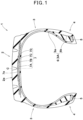
- FIG. 1 shows a tire meridian cross-sectional view of a tire 1 of the present embodiment of the invention in a normal state, including the rotation axis of the tire 1.
- the "normal state” is a state where: the tire 1 is fitted on a normal rim and adjusted to a normal internal pressure; and no load is applied to the tire 1.
- dimensions and the like of components of the tire 1 are values measured in the normal state.
- the "normal rim” is a rim that is defined, in a standard system including a standard on which the tire 1 is based, by the standard for each tire, and is, for example, the "standard rim” in the JATMA standard, the "Design Rim” in the TRA standard, or the “Measuring Rim” in the ETRTO standard.
- the "normal internal pressure” is an air pressure that is defined, in a standard system including a standard on which the tire 1 is based, by the standard for each tire, and is the “maximum air pressure” in the JATMA standard, the maximum value indicated in the table "TIRE LOAD LIMITS AT VARIOUS COLD INFLATION PRESSURES" in the TRA standard, or the “INFLATION PRESSURE” in the ETRTO standard.
- the tire 1 is suitably used, for example, as a heavy duty tire used for a truck or a bus.
- the tire 1 is not specified as a heavy duty tire, and can be applied to various tires including, for example, pneumatic tires such as a tire for a passenger car, a tire for a motorcycle, and a tire for racing, a non-pneumatic tire the interior of which is not filled with pressurized air, etc.
- the tire 1 of the present embodiment of the invention includes a tread portion 2 annularly extending, a pair of sidewall portions 3 extending on both sides of the tread portion 2, and a pair of bead portions 4 extending so as to be connected to the sidewall portions 3.
- the tire 1 also includes, for example, a toroidal carcass 6 extending on and between bead cores 5 of the pair of bead portions 4, and a belt layer 7 disposed outward of the carcass 6 in the tire radial direction and inward of the tread portion 2 in the tire radial direction.
- the carcass 6 is composed of, for example, one carcass ply 6A.
- the carcass ply 6A includes carcass cords and a topping rubber covering the carcass cords.
- the carcass cords are, for example, arranged so as to be tilted at an angle of 75 to 90° with respect to the tire circumferential direction.
- a to B indicates "not less than A and not greater than B".
- each carcass cord for example, a steel cord or a cord made of an organic fiber such as nylon, polyester, or rayon is suitably used.
- a steel cord is preferably used as each carcass cord.
- the carcass 6 may be composed of, for example, two or more carcass plies 6A.
- the carcass ply 6A includes, for example, a body portion 6a and turned-up portions 6b.
- the body portion 6a preferably extends from the tread portion 2 through each sidewall portion 3 to the bead core 5 of each bead portion 4.
- Each turned-up portion 6b is connected to the body portion 6a, is turned up around the bead core 5 from the inner side to the outer side in the tire axial direction, and extends outward in the tire radial direction.
- a so-called ultra-highly turned-up structure in which an end portion of each turned-up portion 6b extends to between the body portion 6a and the belt layer 7 may be employed.
- the belt layer 7 includes at least one belt ply.
- the belt layer 7 includes four belt plies 7A, 7B, 7C, and 7D.
- the belt layer 7 preferably includes two or more belt plies 7A, 7B, 7C, and 7D adjacent to each other in the tire radial direction.
- the multiple belt plies 7A, 7B, 7C, and 7D of such a belt layer 7 cooperate to improve the stiffness of the tread portion 2, and serve to improve the durability of the tire 1.
- the belt plies 7A, 7B, 7C, and 7D preferably have the same configuration. Such belt plies 7A, 7B, 7C, and 7D can be produced and managed as one belt ply 7a, so that the production cost can be reduced.
- the belt plies 7A, 7B, 7C, and 7D may have different configurations, for example.
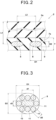
- FIG. 2 is an enlarged cross-sectional view, of the tread portion 2, orthogonal to the longitudinal direction of belt cords 8.
- the belt ply 7a includes, for example, belt cords 8 arranged so as to be tilted relative to the tire circumferential direction, and a covering layer 9 covering the belt cords 8.
- Each belt cord 8 is preferably arranged so as to be tilted at an angle of 10 to 45° with respect to the tire circumferential direction.
- the same belt cords 8 and the same covering layer 9 are preferably included.
- the belt plies 7A, 7B, 7C, and 7D have different configurations, for example, at least either the belt cords 8 or the covering layer 9 is different.
- FIG. 3 is a schematic cross-sectional view, of the belt cord 8, orthogonal to the longitudinal direction of the belt cord 8.
- each belt cord 8 of the present embodiment of the invention has an N + M structure including N cores 10 and M sheaths 11.
- FIG. 3 shows a 1 + 8 structure including one core 10 and eight sheaths 11.
- Such a belt cord 8 can exhibit high stiffness and serves to improve the durability of the tire 1.
- Each sheath 11 may be, for example, a monofilament cord composed of a single filament, or a cord obtained by twisting a plurality of filaments together.
- a cord composed of a single filament and a cord obtained by twisting a plurality of filaments together may be combined and used.
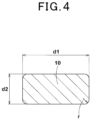
- FIG. 4 is an enlarged view of the core 10 in FIG. 3 .
- the core 10 of the present embodiment of the invention has a cross-section having a flattened shape having a long diameter d1 and a short diameter d2.
- the core 10 has, for example, a substantially rectangular cross-section.
- Such a core 10 can flatten the entire belt cord 8 and can moderately alleviate the stiffness in the short diameter direction of the belt cord 8, thereby improving the ride comfort of the tire 1.
- the cross-sectional shape of the core 10 is not limited to such a mode, and may be, for example, an elliptical shape or a polygonal shape such as a hexagonal shape, as long as the cross-sectional shape is a flattened shape.
- the core 10 may be, for example, a monofilament cord composed of a single filament, or a cord obtained by twisting a plurality of filaments together.
- a monofilament cord is preferably used from the viewpoint of improving combined performance of ride comfort and durability.
- the long diameter d1 and the short diameter d2 of the core 10 are the largest straight line and the smallest straight line, respectively, among straight lines that pass through the center of a cross-section of the core cord and intersect the contour of the core cord. These axes can be obtained by performing measurement with calipers or the like being applied to the core 10, taken out from the belt cord 8, in a direction perpendicular to the longitudinal direction of the core 10.
- a value (d2/d1/L1) obtained by dividing a flatness ratio d2/d1 of the core 10 by a shortest distance L1 (mm) in the tire radial direction from a ground-contact surface 2a of the tread portion 2 to the center of the belt cord 8 in a tire meridian cross-section is not greater than 0.07 (1/mm).
- the tread portion 2 when the shortest distance L1 is smaller, the flatness ratio d2/d1 of the core 10 also becomes smaller, so that the stiffness in the short diameter direction of the belt cord 8 can be reduced. Accordingly, the tread portion 2 can improve followability to a road surface, so that the ride comfort of the tire 1 can be improved. In addition, such a tread portion 2 can also cause flexible movement in response to stretch of the sheaths 11 arranged around the core 10, so that the combined performance of the ride comfort and the durability of the tire 1 can be improved.
- the shortest distance L1 in the tire radial direction from the ground-contact surface 2a to the center of the belt cord 8 is the shortest distance from the outermost surface in the tire radial direction on a tire equator C to the center of the belt cord 8 of the belt ply 7a on the outermost side in the tire radial direction.
- the outermost surface in the tire radial direction on the tire equator C in the case where a groove is formed on the tire equator C is defined as the point of intersection of the tire equator C and a straight line connecting the outermost edges in the tire radial direction of both side walls of the groove on the tire equator C.
- the center of the belt cord 8 in the case where no belt cord 8 is present on the tire equator C is defined as the point of intersection of the tire equator C and a straight line connecting the centers of a pair of the belt cords 8 adjacent to the tire equator C.
- the shortest distance L1 is preferably a value measured in the normal state as described above, and can be obtained, for example, by a computer tomography method using X-rays.
- the shortest distance L1 may be measured, for example, in a simplified manner with the bead portions 4 in a cross-section portion cut out from a part of the tire 1 along a tire meridian, being matched with the width of the normal rim.
- Such a belt cord 8 can be easily stretched by increasing the length of each sheath 11 relative to the core 10, and flexibly follows deformation, so that the durability of the tire 1 can be improved. Therefore, the tire 1 of the present embodiment of the invention can have improved combined performance of ride comfort and durability.
- the value (d2/d1/L1) is more preferably not greater than 0.065 (1/mm) and further preferably not greater than 0.05 (1/mm).
- the lower limit of the value (d2/d1/L1) is not particularly limited, but the value (d2/d1/L1) is preferably not less than 0.01 (1/mm), more preferably not less than 0.02 (1/mm), and further preferably not less than 0.03 (1/mm).
- examples of the covering layer 9 of the belt ply 7a include a rubber composition and a thermoplastic elastomer composition.
- a rubber composition is preferably used from the viewpoint of forming a chemical network and firmly adhering the belt cord 8 and the covering layer 9.
- a thermoplastic elastomer composition is preferably used from the viewpoint of recyclability.
- the covering layer 9 is a rubber composition
- examples of the rubber component include isoprene-based rubbers, butadiene-based rubbers, styrene-butadiene rubber, and chloroprene rubber.
- the covering layer 9 preferably contains an isoprene-based rubber.
- examples of the isoprene-based rubber include natural rubber and synthetic isoprene rubber.
- the rubber composition of the covering layer 9 may contain a reinforcing filler, for example.
- a reinforcing filler examples include carbon black, silica, calcium carbonate, talc, alumina, clay, aluminum hydroxide, and mica.
- the amount of the filler per 100 parts by mass of the rubber component is preferably not less than 30 parts by mass.
- the amount of the filler is preferably not greater than 65 parts by mass.
- the rubber composition of the covering layer 9 preferably contains carbon black among the fillers.
- the amount of the carbon black per 100 parts by mass of the rubber component is preferably not less than 10 parts by mass.
- the amount of the carbon black is preferably not greater than 65 parts by mass.
- the carbon black is not particularly limited, and examples of the carbon black include: furnace black (furnace carbon black) such as SAF, ISAF, HAF, MAF, FEF, SRF, GPF, APF, FF, CF, SCF, and ECF; acetylene black (acetylene carbon black); thermal black (thermal carbon black) such as FT and MT; channel black (channel carbon black) such as EPC, MPC, and CC;
- the rubber composition of the covering layer 9 may contain a plasticizer, for example.
- the plasticizer include oils and resin components.
- the amount of the plasticizer per 100 parts by mass of the rubber component is preferably greater than 0.5 parts by mass and less than 10 parts by mass.
- the rubber composition of the covering layer 9 may contain cobalt element in the rubber, for example.
- cobalt element examples include organic acid cobalt salts such as cobalt stearate, cobalt naphthenate, cobalt neodecanoate, and cobalt boron neodecanoate.
- the rubber composition of the covering layer 9 may contain a curable resin component, for example.
- the curable resin component include modified resorcinol resins and modified phenol resins.
- the amount of the curable resin component per 100 parts by mass of the rubber component is preferably not less than 1 part by mass and more preferably not less than 2 parts by mass.
- the amount of the curable resin component is preferably not greater than 10 parts by mass and more preferably not greater than 8 parts by mass.
- the rubber composition of the covering layer 9 contains a curable resin component
- the rubber composition preferably also contains a resin curing agent.
- the resin curing agent include methylene donors such as hexamethylenetetramine (HMT), hexamethoxy methylol melamine (HMMM), and hexamethylol melamine pentamethyl ether (HMMPME).
- HMT hexamethylenetetramine
- HMMM hexamethoxy methylol melamine
- HMMPME hexamethylol melamine pentamethyl ether
- the amount of the resin curing agent per 100 parts by mass of the curable resin component is preferably not less than 5 parts by mass.
- the rubber composition of the covering layer 9 may contain, for example, an antioxidant, zinc oxide, sulfur, a vulcanization accelerator, a crosslinking agent, etc., as other components.
- the surface of the belt cord 8 is preferably plated.
- the type of the plating layer include a plating layer of two elements using copper and zinc and a plating layer of three elements using copper, zinc, and cobalt.
- an inter-center distance L2 between a pair of the belt cords 8 adjacent to each other in the width direction of the belt ply 7a is preferably not greater than 170% of a long diameter D1 of the belt cord 8.
- Such a belt ply 7a can increase the in-plane stiffness and suppress occurrence of belt looseness, so that the durability of the tire 1 can be improved.
- the inter-center distance L2 between the belt cords 8 is obtained as the average of the inter-center distances L2 between the five belt cords 8 on each of both sides in the tire axial direction of the tire equator C.
- the inter-center distance L2 in the case where the belt cord 8 is present on the tire equator C is preferably obtained as the average of the inter-center distances L2 between a total of eleven belt cords 8 including the belt cord 8 on the tire equator C and the five belt cords 8 on each of both sides.
- the inter-center distance L2 is preferably a value measured in the normal state as described above, and can be obtained, for example, by a computer tomography method using X-rays.
- the inter-center distance L2 may be measured, for example, in a simplified manner with the bead portions 4 in a cross-section portion cut out from a part of the tire 1 along a tire meridian, being matched with the width of the normal rim.
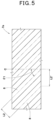
- FIG. 5 is a schematic cross-sectional view of the belt ply 7a.
- the inter-center distance L2 between the belt cords 8 in the case where the belt cords 8 are arranged so as to be tilted at an angle ⁇ 1 with respect to the tire circumferential direction can be obtained on the basis of the following equation (1) from an inter-center distance L2' between the belt cords 8 in a tire meridian cross-section.
- L 2 L2 ′ cos ⁇ 1
- a thickness T of the belt ply 7a is preferably 160% to 200% of a short diameter D2 of the belt cord 8.
- a holding force by the belt ply 7a can be exerted while allowing stretch of the sheaths 11, so that the ride comfort and the durability of the tire 1 can be improved.
- the thickness T of the belt ply 7a is a thickness T of the belt ply 7a in the tire radial direction at the tire equator C in the normal state, and can be obtained, for example, by a computer tomography method using X-rays.
- the thickness T of the belt ply 7a may be measured, for example, in a simplified manner with the bead portions 4 in a cross-section portion cut out from a part of the tire 1 along a tire meridian, being matched with the width of the normal rim.
- a cross-sectional area S1 of the belt cord 8 within the belt ply 7a is preferably not greater than 30%, more preferably not greater than 29%, and further preferably not greater than 28%, of a cross-sectional area S2 of the belt ply 7a.
- the cross-sectional area S1 of the belt cord 8 is preferably not less than 20%, more preferably not less than 22%, and further preferably not less than 23%.
- Such a belt ply 7a can increase the in-plane stiffness and suppress occurrence of belt looseness, so that the durability of the tire 1 can be improved and the ride comfort of the tire 1 can also be improved.
- the cross-sectional area S2 of the belt ply 7a is obtained as the product (L2 ⁇ T) of the inter-center distance L2 between the belt cords 8 and the thickness T of the belt ply 7a.
- the cross-sectional area S1 of the belt cord 8 is obtained as the average of the cross-sectional areas S1 of the five belt cords 8 on each of both sides in the tire axial direction of the tire equator C.
- the cross-sectional area S1 in the case where the belt cord 8 is present on the tire equator C is preferably obtained as the average of the cross-sectional areas S1 of a total of eleven belt cords 8 including the belt cord 8 on the tire equator C and the five belt cords 8 on each of both sides.
- the long diameter D1 of the belt cord 8 is preferably not less than 1.10 mm, more preferably not less than 1.12 mm, and further preferably not less than 1.14 mm.
- the long diameter D1 of the belt cord 8 is preferably not greater than 1.80 mm, more preferably not greater than 1.70 mm, and further preferably not greater than 1.50 mm.
- the short diameter D2 of the belt cord 8 is preferably not less than 0.90 mm, more preferably not less than 0.94 mm, and further preferably not less than 0.97 mm.
- the short diameter D2 of the belt cord 8 is preferably not greater than 1.20 mm, more preferably not greater than 1.10 mm, and further preferably not greater than 1.00 mm. It should be noted that the short diameter D2 of the belt cord 8 is less than the long diameter D1 of the belt cord 8.
- Such a belt cord 8 can provide followability to a road surface while maintaining the stiffness in the width direction of the belt ply 7a, and serves to improve the combined performance of the ride comfort and the durability of the tire 1.
- the belt cords 8 are preferably arranged in the belt ply 7a such that the long diameter directions thereof form the same plane.
- a belt ply 7a can reduce the stiffness in the thickness direction while maintaining the stiffness in the width direction, so that the combined performance of the ride comfort and the durability of the tire 1 can be improved.
- the long diameter directions thereof forming the same plane means that the relative angles of the long diameter directions are within 10°.
- the flatness ratio d2/d1 of the core 10 is preferably not greater than 70%, more preferably not greater than 68%, and further preferably not greater than 65%.
- a core 10 reliably allows the belt cord 8 to be formed in a flattened shape, and serves to improve followability to a road surface while maintaining the stiffness in the width direction of the belt ply 7a.
- the lower limit of the flatness ratio d2/d1 of the core 10 is not particularly limited, but the flatness ratio d2/d1 of the core 10 is preferably not less than 30%, more preferably not less than 45%, and further preferably not less than 55%.
- the long diameter d1 of the core 10 is preferably not less than 0.30 mm, more preferably not less than 0.35 mm, and further preferably not less than 0.38 mm.
- the long diameter d1 of the core 10 is preferably not greater than 0.50 mm, more preferably not greater than 0.45 mm, and further preferably not greater than 0.43 mm.
- the short diameter d2 of the core 10 is preferably not less than 0.15 mm, more preferably not less than 0.20 mm, and further preferably not less than 0.22 mm.
- the short diameter d2 of the core 10 is preferably not greater than 0.42 mm, more preferably not greater than 0.40 mm, and further preferably not greater than 0.38 mm. It should be noted that the short diameter d2 of the core 10 is less than the long diameter d1 of the core 10.
- Such a core 10 achieves both stiffness in the long diameter direction and flexibility in the short diameter direction of the belt cord 8, and serves to improve the combined performance of the ride comfort and the durability of the tire 1.
- each corner portion of the substantially rectangular cross-section of the core 10 is formed, for example, in an arc shape.
- a radius r of the arc shape of each corner portion of the core 10 is preferably not less than 0.07 mm.
- the radius r of the arc shape of each corner portion of the core 10 is preferably not greater than 0.15 mm.
- FIG. 6 is a schematic cross-sectional view of a belt cord 12 of another embodiment of the invention.
- the belt cord 12 in FIG. 6 has a 3 + 12 structure including three cores 10 and twelve sheaths 11.
- the belt cords 8 and 12 each preferably include an untwisted core(s) 10 composed of one to three single steel wires.
- FIG. 3 shows a configuration including one core 10
- FIG. 6 shows a configuration including three cores 10.
- Such belt cords 8 and 12 serve to improve followability to a road surface while maintaining moderate stiffness.
- the belt cords 8 and 12 each preferably include five to twelve sheaths 11 each having a circular cross-sectional shape.
- FIG. 3 shows a configuration including eight sheaths 11, and
- FIG. 6 shows a configuration including twelve sheaths 11.
- Such belt cords 8 and 12 can cause stretch while maintaining moderate stiffness, and serve to improve the durability of the tire 1.
- the circular cross-sectional shape means that a cross-sectional shape orthogonal to the longitudinal direction of the sheath 11 is a circular shape, and refers to a shape having a flatness ratio of not greater than 1.05.
- a diameter d3 of each sheath 11 of the present embodiment of the invention is smaller than the long diameter d1 of the core 10.
- the diameter d3 of each sheath 11 is preferably equal to the short diameter d2 of the core 10 or larger than the short diameter d2.
- Such a sheath 11 serves to achieve both the stiffness and stretch of the belt cord 8 or 12.
- the diameter d3 of each sheath 11 is preferably 0.30 to 0.37 mm. When the diameter d3 of each sheath 11 is not less than 0.30 mm, good stiffness of the belt cord 8 or 12 can be maintained. When the diameter d3 of each sheath 11 is not greater than 0.37 mm, good stretch of the belt cord 8 or 12 can be maintained.
- the sheaths 11 are preferably twisted helically around the core(s) 10.
- the twisting pitch of the sheaths 11 is not particularly limited, but is preferably not less than the product of the diameter d3 of the sheath 11 and the number of the sheaths 11.
- the twisting pitch of the sheaths 11 is more preferably 1.05 to 4.00 times the product of the diameter d3 of the sheath 11 and the number of the sheaths 11.
- the cores 10 are preferably arranged such that the long diameter directions thereof form the same plane.
- Such cores 10 reliably allow the belt cord 12 to be formed in a flattened shape, and serve to reduce the weight of the belt ply 7a while maintaining the stiffness in the width direction of the belt ply 7a.
- FIG. 7 is a schematic cross-sectional view of a belt ply 7b of another embodiment of the invention.
- the cores 10 may be arranged such that the long diameter direction of the core 10 has an angle ⁇ 2 with respect to the width direction of the belt ply 7b.
- the long diameter directions of the cores 10 are preferably directed at an angle of 30° or less with respect to the width direction of the belt ply 7b.
- Such a belt ply 7b can exhibit the same effect as one in which the longitudinal directions of the belt cords 8 are directed so as to form the same plane, and the production process can be simplified, so that the production cost can be reduced.
- Tires (11R22.5 14PR) having the basic structure shown in FIG. 1 were produced as test tires based on specifications in Table 1 and Table 2. Using the produced test tires, ride comfort and durability were tested, and the combined performance thereof was evaluated.
- the production and test methods are as follows.
- each blending material shown below was prepared, and mixed with a 270-L Banbury mixer to obtain a covering layer rubber composition.
- belt cords shown in Table 1 and Table 2 were prepared, the prepared belt cords were arranged so as to have inter-center distances L2 between the belt cords shown in Table 1 and Table 2, and covering layers were press-bonded to the belt cords from above and below to obtain belt plies.
- the obtained belt plies were shaped together with inner liners, carcass plies, sidewall rubbers, bead apexes, bead cores, chafer rubbers, tread rubbers, etc., to obtain unvulcanized tires.
- the obtained unvulcanized tires were vulcanized at 160°C for 40 minutes to obtain test tires.
- the shortest distance L1 between the ground-contact surface of the tread portion and the belt cord center was adjusted by changing the thickness of the tread rubber.
- confirmation tires were produced with the same specifications as those of the test tires. Destructive inspection was performed on the confirmation tires, and the dimensions of each component of the test tires were confirmed from a tire meridian cross-section, a cross-section orthogonal to the longitudinal direction of the belt cords, and the arrangement state of the belt cords when the tread portion was peeled off.
- the produced test tires were mounted to all the wheels of test vehicles that were large trucks, and ride comfort when each vehicle was caused to run on a test course having a paved road including straight, curved, and meandering sections was evaluated on a 5 point scale with 5 being the maximum score through sensory evaluation by the test driver.
- the same test was made by 20 test drivers, and the total of scores by the test drivers was calculated.
- the results are represented as indexes with the total score of Comparative Example 1 being regarded as 100. A higher value indicates that the ride comfort is better.
- the produced test tires were fitted onto normal rims, adjusted to a normal internal pressure at an oxygen concentration of 90%, and thermally deteriorated in an oven at 70°C for 6 weeks. Then, each of the thermally deteriorated tires was mounted on a drum tester, and was caused to run based on the test conditions of the load/speed endurance test of the technical inspection standards and conformity inspection of the Ministry of Land, Infrastructure, Transport and Tourism until swelling occurred in the tread portion, and the running time was measured. The results are represented as indexes with the result of Comparative Example 1 being regarded as 100. A higher value indicates that the running time is longer and the durability is better.
- the tires of Examples have better ride comfort and durability than those of Comparative Examples, and also has better combined performance determined as the sum of the respective performances than that of Comparative Examples, so that it is confirmed that the tires of Examples have improved combined performance of ride comfort and durability.
Landscapes
- Engineering & Computer Science (AREA)
- Mechanical Engineering (AREA)
- Tires In General (AREA)
- Ropes Or Cables (AREA)
Claims (10)
- Reifen (1) mit einer Karkassenschicht (7), wobei
die Karkassenschicht (7) mindestens eine Karkassenlage (7A, 7B, 7C, 7D, 7a, 7b) hat, in der Karkassenkorde (8) angeordnet sind,die Karkassenkorde (8, 12) jeweils eine N+M-Struktur mit N Kern(en) (10) und M Hüllen (11) aufweisen, und
jeder Kern (10) einen Querschnitt mit einer abgeflachten Form mit einem langen Durchmesser d1 und einem kurzen Durchmesser d2 aufweist,dadurch gekennzeichnet, dass
ein Wert (d2/d1/L1), der durch Dividieren eines Flachheitsverhältnisses d2/d1 des Kerns (10) durch einen kürzesten Abstand L1 (mm) in einer radialen Richtung des Reifens von einer Berührungsoberfläche (2a) eines Abschnitts der Lauffläche (2) zu einem Mittelpunkt des Karkassenkords (8, 12) in einem meridianen Querschnitt des Reifens erhalten wird, nicht größer als 0,07 (1/mm) ist. - Reifen (1) gemäß Anspruch 1, wobei das Flachheitsverhältnis d2/d1 des Kerns (10) nicht größer als 70 % ist.
- Reifen (1) gemäß Anspruch 1 oder 2, wobei der kurze Durchmesser d2 des Kerns (10) 0,15 bis 0,42 mm beträgt.
- Reifen (1) gemäß einem der Ansprüche 1 bis 3, wobei die Karkassenkorde (8, 12) jeweils den ungedrehten Kern (10) haben, der aus einem bis drei einzelnen Stahldrähten besteht.
- Reifen (1) gemäß einem der Ansprüche 1 bis 4, wobei die Karkassenkorde (8, 12) jeweils fünf bis zwölf der Ummantelungen (11) haben, die jeweils eine kreisförmige Querschnittsform aufweisen.
- Reifen (1) gemäß einem der Ansprüche 1 bis 5, wobei die Gürtelschicht (7) zwei oder mehr der Gürtellagen (7a) hat, die in radialer Richtung des Reifens aneinander angrenzen.
- Reifen (1) gemäß einem der Ansprüche 1 bis 6, wobei eine Dicke T der Gürtellage (7a) 160 % bis 200 % eines kurzen Durchmessers D2 des Karkassenkords (8) beträgt.
- Reifen (1) gemäß einem der Ansprüche 1 bis 7, wobei in einem Querschnitt senkrecht zu einer Längsrichtung der Karkassenkorde (8) ein Abstand L2 zwischen den Mittelpunkten eines Paars von Karkassenkorden (8), die in einer Breitenrichtung der Karkassenlage (7a) benachbart sind, nicht größer als 170 % eines langen Durchmessers D1 des Karkassenkords (8) ist.
- Reifen (1) gemäß einem der Ansprüche 1 bis 8, wobei in einem Querschnitt senkrecht zur Längsrichtung der Karkassenkorde (8) eine Querschnittsfläche (S1) des Karkassenkords (8) 20 % bis 30 % einer Querschnittsfläche (S2) der Karkassenlage (7a) beträgt.
- Reifen (1) gemäß einem der Ansprüche 1 bis 9, wobei in einem Querschnitt senkrecht zur Längsrichtung der Karkassenkorde (8) eine Richtung des langen Durchmessers jedes Kerns (10) in einem Winkel von 30° oder weniger mit Bezug auf die Breitenrichtung der Gürtellage (7b) ausgerichtet ist.
Applications Claiming Priority (1)
| Application Number | Priority Date | Filing Date | Title |
|---|---|---|---|
| JP2021209801A JP2023094366A (ja) | 2021-12-23 | 2021-12-23 | タイヤ |
Publications (2)
| Publication Number | Publication Date |
|---|---|
| EP4201702A1 EP4201702A1 (de) | 2023-06-28 |
| EP4201702B1 true EP4201702B1 (de) | 2024-11-13 |
Family
ID=83439036
Family Applications (1)
| Application Number | Title | Priority Date | Filing Date |
|---|---|---|---|
| EP22197301.9A Active EP4201702B1 (de) | 2021-12-23 | 2022-09-23 | Reifen |
Country Status (3)
| Country | Link |
|---|---|
| EP (1) | EP4201702B1 (de) |
| JP (1) | JP2023094366A (de) |
| CN (1) | CN116330891A (de) |
Families Citing this family (2)
| Publication number | Priority date | Publication date | Assignee | Title |
|---|---|---|---|---|
| CA2876297C (en) * | 2012-06-15 | 2019-02-26 | Case Western Reserve University | Therapy delivery devices and methods for non-damaging neural tissue conduction block |
| US20250206064A1 (en) * | 2023-12-21 | 2025-06-26 | The Goodyear Tire & Rubber Company | Shearband with oblong cords for non-pneumatic tires |
Family Cites Families (20)
| Publication number | Priority date | Publication date | Assignee | Title |
|---|---|---|---|---|
| JPH07115561B2 (ja) * | 1986-08-20 | 1995-12-13 | 横浜ゴム株式会社 | ラジアルタイヤ |
| JPH02164605A (ja) * | 1988-12-16 | 1990-06-25 | Sumitomo Rubber Ind Ltd | 空気入りラジアルタイヤ |
| JP2889283B2 (ja) * | 1989-08-24 | 1999-05-10 | 株式会社ブリヂストン | 高性能空気入りタイヤ |
| JPH05238202A (ja) * | 1992-02-27 | 1993-09-17 | Yokohama Rubber Co Ltd:The | 乗用車用空気入りラジアルタイヤ |
| JP3354654B2 (ja) * | 1993-09-28 | 2002-12-09 | 横浜ゴム株式会社 | 乗用車用空気入りタイヤ |
| JP2904688B2 (ja) * | 1993-10-20 | 1999-06-14 | 横浜ゴム株式会社 | 重荷重用空気入りラジアルタイヤ |
| JP3391568B2 (ja) * | 1994-07-29 | 2003-03-31 | 住友ゴム工業株式会社 | 自動二輪車用ラジアルタイヤ |
| JPH08132820A (ja) * | 1994-11-07 | 1996-05-28 | Bridgestone Corp | 重荷重用空気入りラジアルタイヤ |
| JP3111379B2 (ja) * | 1996-07-15 | 2000-11-20 | 東京製綱株式会社 | ゴム補強用スチールコードおよびラジアルタイヤ |
| AU6507596A (en) * | 1996-07-22 | 1998-02-10 | Goodyear Tire And Rubber Company, The | A tire tread having flow-through grooves |
| JP3276612B2 (ja) * | 1999-03-19 | 2002-04-22 | 東京製綱株式会社 | スチールコード及びラジアルタイヤ |
| JP2001199205A (ja) * | 2000-01-17 | 2001-07-24 | Sumitomo Rubber Ind Ltd | 空気入りタイヤ |
| JP2001234486A (ja) * | 2000-02-25 | 2001-08-31 | Tokyo Seiko Co Ltd | スチールコード及びゴム複合体 |
| JP2004058707A (ja) * | 2002-07-24 | 2004-02-26 | Toyo Tire & Rubber Co Ltd | 空気入りラジアルタイヤ |
| CN102482844B (zh) * | 2009-09-11 | 2015-08-12 | 贝卡尔特公司 | 带有椭圆钢丝的椭圆钢绳 |
| KR101523429B1 (ko) * | 2013-09-06 | 2015-05-27 | 한국타이어 주식회사 | 타이어 보강용 스틸코드 및 이를 적용한 래디얼 타이어 |
| JP6302297B2 (ja) | 2014-03-12 | 2018-03-28 | 住友ゴム工業株式会社 | 重荷重用空気入りタイヤ |
| JP6848319B2 (ja) * | 2016-10-06 | 2021-03-24 | 横浜ゴム株式会社 | 空気入りタイヤ |
| JP7820902B2 (ja) * | 2019-10-29 | 2026-02-26 | 住友ゴム工業株式会社 | タイヤ |
| JP7574535B2 (ja) * | 2019-12-25 | 2024-10-29 | 住友ゴム工業株式会社 | タイヤ及びベルト層 |
-
2021
- 2021-12-23 JP JP2021209801A patent/JP2023094366A/ja active Pending
-
2022
- 2022-08-19 CN CN202211003405.1A patent/CN116330891A/zh active Pending
- 2022-09-23 EP EP22197301.9A patent/EP4201702B1/de active Active
Also Published As
| Publication number | Publication date |
|---|---|
| CN116330891A (zh) | 2023-06-27 |
| JP2023094366A (ja) | 2023-07-05 |
| EP4201702A1 (de) | 2023-06-28 |
Similar Documents
| Publication | Publication Date | Title |
|---|---|---|
| EP4180243B1 (de) | Schwerlastluftreifen | |
| EP4201702B1 (de) | Reifen | |
| US20090188600A1 (en) | Pneumatic tire | |
| EP4371785B1 (de) | Flugzeugradialreifen | |
| US20120145302A1 (en) | Pneumatic tire | |
| EP3305551B1 (de) | Verstärkungselement für reifen und reifen mit verwendung davon | |
| JP4481776B2 (ja) | 空気入りタイヤ | |
| EP4450298A1 (de) | Luftreifen | |
| EP3378677B1 (de) | Luftreifen | |
| JP5740932B2 (ja) | 空気入りタイヤ | |
| EP3581400A1 (de) | Reifen | |
| EP3643515A1 (de) | Reifen | |
| US20200307317A1 (en) | Tire | |
| EP2777948B1 (de) | Radialer Reifen für Motorrad | |
| EP2808178B1 (de) | Reifenverstärkungselement und luftreifen damit | |
| WO2020121731A1 (ja) | タイヤ | |
| WO2018097084A1 (ja) | タイヤ | |
| WO2018097083A1 (ja) | タイヤ | |
| JPH11310014A (ja) | 乗用車用空気入りタイヤ | |
| JP7801654B2 (ja) | タイヤ | |
| JP2024060484A (ja) | 空気入りタイヤ | |
| WO2018230265A1 (ja) | タイヤ | |
| US20200164690A1 (en) | Tire | |
| JP2019104277A (ja) | タイヤ |
Legal Events
| Date | Code | Title | Description |
|---|---|---|---|
| PUAI | Public reference made under article 153(3) epc to a published international application that has entered the european phase |
Free format text: ORIGINAL CODE: 0009012 |
|
| STAA | Information on the status of an ep patent application or granted ep patent |
Free format text: STATUS: THE APPLICATION HAS BEEN PUBLISHED |
|
| AK | Designated contracting states |
Kind code of ref document: A1 Designated state(s): AL AT BE BG CH CY CZ DE DK EE ES FI FR GB GR HR HU IE IS IT LI LT LU LV MC MK MT NL NO PL PT RO RS SE SI SK SM TR |
|
| STAA | Information on the status of an ep patent application or granted ep patent |
Free format text: STATUS: REQUEST FOR EXAMINATION WAS MADE |
|
| 17P | Request for examination filed |
Effective date: 20230630 |
|
| P01 | Opt-out of the competence of the unified patent court (upc) registered |
Effective date: 20240327 |
|
| GRAP | Despatch of communication of intention to grant a patent |
Free format text: ORIGINAL CODE: EPIDOSNIGR1 |
|
| STAA | Information on the status of an ep patent application or granted ep patent |
Free format text: STATUS: GRANT OF PATENT IS INTENDED |
|
| RIC1 | Information provided on ipc code assigned before grant |
Ipc: D07B 1/06 20060101ALN20240705BHEP Ipc: B60C 9/20 20060101ALI20240705BHEP Ipc: D02G 3/48 20060101ALI20240705BHEP Ipc: B60C 9/00 20060101AFI20240705BHEP |
|
| INTG | Intention to grant announced |
Effective date: 20240717 |
|
| GRAS | Grant fee paid |
Free format text: ORIGINAL CODE: EPIDOSNIGR3 |
|
| GRAA | (expected) grant |
Free format text: ORIGINAL CODE: 0009210 |
|
| STAA | Information on the status of an ep patent application or granted ep patent |
Free format text: STATUS: THE PATENT HAS BEEN GRANTED |
|
| AK | Designated contracting states |
Kind code of ref document: B1 Designated state(s): AL AT BE BG CH CY CZ DE DK EE ES FI FR GB GR HR HU IE IS IT LI LT LU LV MC MK MT NL NO PL PT RO RS SE SI SK SM TR |
|
| REG | Reference to a national code |
Ref country code: GB Ref legal event code: FG4D |
|
| REG | Reference to a national code |
Ref country code: CH Ref legal event code: EP |
|
| REG | Reference to a national code |
Ref country code: IE Ref legal event code: FG4D |
|
| REG | Reference to a national code |
Ref country code: DE Ref legal event code: R096 Ref document number: 602022007666 Country of ref document: DE |
|
| REG | Reference to a national code |
Ref country code: LT Ref legal event code: MG9D |
|
| REG | Reference to a national code |
Ref country code: NL Ref legal event code: MP Effective date: 20241113 |
|
| PG25 | Lapsed in a contracting state [announced via postgrant information from national office to epo] |
Ref country code: HR Free format text: LAPSE BECAUSE OF FAILURE TO SUBMIT A TRANSLATION OF THE DESCRIPTION OR TO PAY THE FEE WITHIN THE PRESCRIBED TIME-LIMIT Effective date: 20241113 Ref country code: PT Free format text: LAPSE BECAUSE OF FAILURE TO SUBMIT A TRANSLATION OF THE DESCRIPTION OR TO PAY THE FEE WITHIN THE PRESCRIBED TIME-LIMIT Effective date: 20250313 Ref country code: IS Free format text: LAPSE BECAUSE OF FAILURE TO SUBMIT A TRANSLATION OF THE DESCRIPTION OR TO PAY THE FEE WITHIN THE PRESCRIBED TIME-LIMIT Effective date: 20250313 |
|
| PG25 | Lapsed in a contracting state [announced via postgrant information from national office to epo] |
Ref country code: NL Free format text: LAPSE BECAUSE OF FAILURE TO SUBMIT A TRANSLATION OF THE DESCRIPTION OR TO PAY THE FEE WITHIN THE PRESCRIBED TIME-LIMIT Effective date: 20241113 Ref country code: FI Free format text: LAPSE BECAUSE OF FAILURE TO SUBMIT A TRANSLATION OF THE DESCRIPTION OR TO PAY THE FEE WITHIN THE PRESCRIBED TIME-LIMIT Effective date: 20241113 |
|
| REG | Reference to a national code |
Ref country code: AT Ref legal event code: MK05 Ref document number: 1741424 Country of ref document: AT Kind code of ref document: T Effective date: 20241113 |
|
| PG25 | Lapsed in a contracting state [announced via postgrant information from national office to epo] |
Ref country code: BG Free format text: LAPSE BECAUSE OF FAILURE TO SUBMIT A TRANSLATION OF THE DESCRIPTION OR TO PAY THE FEE WITHIN THE PRESCRIBED TIME-LIMIT Effective date: 20241113 |
|
| PG25 | Lapsed in a contracting state [announced via postgrant information from national office to epo] |
Ref country code: ES Free format text: LAPSE BECAUSE OF FAILURE TO SUBMIT A TRANSLATION OF THE DESCRIPTION OR TO PAY THE FEE WITHIN THE PRESCRIBED TIME-LIMIT Effective date: 20241113 |
|
| PG25 | Lapsed in a contracting state [announced via postgrant information from national office to epo] |
Ref country code: NO Free format text: LAPSE BECAUSE OF FAILURE TO SUBMIT A TRANSLATION OF THE DESCRIPTION OR TO PAY THE FEE WITHIN THE PRESCRIBED TIME-LIMIT Effective date: 20250213 |
|
| PG25 | Lapsed in a contracting state [announced via postgrant information from national office to epo] |
Ref country code: LV Free format text: LAPSE BECAUSE OF FAILURE TO SUBMIT A TRANSLATION OF THE DESCRIPTION OR TO PAY THE FEE WITHIN THE PRESCRIBED TIME-LIMIT Effective date: 20241113 Ref country code: AT Free format text: LAPSE BECAUSE OF FAILURE TO SUBMIT A TRANSLATION OF THE DESCRIPTION OR TO PAY THE FEE WITHIN THE PRESCRIBED TIME-LIMIT Effective date: 20241113 Ref country code: GR Free format text: LAPSE BECAUSE OF FAILURE TO SUBMIT A TRANSLATION OF THE DESCRIPTION OR TO PAY THE FEE WITHIN THE PRESCRIBED TIME-LIMIT Effective date: 20250214 |
|
| PG25 | Lapsed in a contracting state [announced via postgrant information from national office to epo] |
Ref country code: PL Free format text: LAPSE BECAUSE OF FAILURE TO SUBMIT A TRANSLATION OF THE DESCRIPTION OR TO PAY THE FEE WITHIN THE PRESCRIBED TIME-LIMIT Effective date: 20241113 |
|
| PG25 | Lapsed in a contracting state [announced via postgrant information from national office to epo] |
Ref country code: RS Free format text: LAPSE BECAUSE OF FAILURE TO SUBMIT A TRANSLATION OF THE DESCRIPTION OR TO PAY THE FEE WITHIN THE PRESCRIBED TIME-LIMIT Effective date: 20250213 |
|
| PG25 | Lapsed in a contracting state [announced via postgrant information from national office to epo] |
Ref country code: SM Free format text: LAPSE BECAUSE OF FAILURE TO SUBMIT A TRANSLATION OF THE DESCRIPTION OR TO PAY THE FEE WITHIN THE PRESCRIBED TIME-LIMIT Effective date: 20241113 |
|
| PG25 | Lapsed in a contracting state [announced via postgrant information from national office to epo] |
Ref country code: DK Free format text: LAPSE BECAUSE OF FAILURE TO SUBMIT A TRANSLATION OF THE DESCRIPTION OR TO PAY THE FEE WITHIN THE PRESCRIBED TIME-LIMIT Effective date: 20241113 |
|
| PG25 | Lapsed in a contracting state [announced via postgrant information from national office to epo] |
Ref country code: EE Free format text: LAPSE BECAUSE OF FAILURE TO SUBMIT A TRANSLATION OF THE DESCRIPTION OR TO PAY THE FEE WITHIN THE PRESCRIBED TIME-LIMIT Effective date: 20241113 |
|
| PG25 | Lapsed in a contracting state [announced via postgrant information from national office to epo] |
Ref country code: RO Free format text: LAPSE BECAUSE OF FAILURE TO SUBMIT A TRANSLATION OF THE DESCRIPTION OR TO PAY THE FEE WITHIN THE PRESCRIBED TIME-LIMIT Effective date: 20241113 |
|
| PG25 | Lapsed in a contracting state [announced via postgrant information from national office to epo] |
Ref country code: SK Free format text: LAPSE BECAUSE OF FAILURE TO SUBMIT A TRANSLATION OF THE DESCRIPTION OR TO PAY THE FEE WITHIN THE PRESCRIBED TIME-LIMIT Effective date: 20241113 |
|
| PG25 | Lapsed in a contracting state [announced via postgrant information from national office to epo] |
Ref country code: CZ Free format text: LAPSE BECAUSE OF FAILURE TO SUBMIT A TRANSLATION OF THE DESCRIPTION OR TO PAY THE FEE WITHIN THE PRESCRIBED TIME-LIMIT Effective date: 20241113 |
|
| PG25 | Lapsed in a contracting state [announced via postgrant information from national office to epo] |
Ref country code: IT Free format text: LAPSE BECAUSE OF FAILURE TO SUBMIT A TRANSLATION OF THE DESCRIPTION OR TO PAY THE FEE WITHIN THE PRESCRIBED TIME-LIMIT Effective date: 20241113 |
|
| REG | Reference to a national code |
Ref country code: DE Ref legal event code: R097 Ref document number: 602022007666 Country of ref document: DE |
|
| PG25 | Lapsed in a contracting state [announced via postgrant information from national office to epo] |
Ref country code: SE Free format text: LAPSE BECAUSE OF FAILURE TO SUBMIT A TRANSLATION OF THE DESCRIPTION OR TO PAY THE FEE WITHIN THE PRESCRIBED TIME-LIMIT Effective date: 20241113 |
|
| PLBE | No opposition filed within time limit |
Free format text: ORIGINAL CODE: 0009261 |
|
| STAA | Information on the status of an ep patent application or granted ep patent |
Free format text: STATUS: NO OPPOSITION FILED WITHIN TIME LIMIT |
|
| PGFP | Annual fee paid to national office [announced via postgrant information from national office to epo] |
Ref country code: DE Payment date: 20250730 Year of fee payment: 4 |
|
| PGFP | Annual fee paid to national office [announced via postgrant information from national office to epo] |
Ref country code: FR Payment date: 20250808 Year of fee payment: 4 |
|
| 26N | No opposition filed |
Effective date: 20250814 |