EP4176786A2 - Staubsauger - Google Patents
Staubsauger Download PDFInfo
- Publication number
- EP4176786A2 EP4176786A2 EP22202108.1A EP22202108A EP4176786A2 EP 4176786 A2 EP4176786 A2 EP 4176786A2 EP 22202108 A EP22202108 A EP 22202108A EP 4176786 A2 EP4176786 A2 EP 4176786A2
- Authority
- EP
- European Patent Office
- Prior art keywords
- pivotal
- locking block
- vacuum cleaner
- upper housing
- brush
- Prior art date
- Legal status (The legal status is an assumption and is not a legal conclusion. Google has not performed a legal analysis and makes no representation as to the accuracy of the status listed.)
- Granted
Links
Images




Classifications
-
- A—HUMAN NECESSITIES
- A47—FURNITURE; DOMESTIC ARTICLES OR APPLIANCES; COFFEE MILLS; SPICE MILLS; SUCTION CLEANERS IN GENERAL
- A47L—DOMESTIC WASHING OR CLEANING; SUCTION CLEANERS IN GENERAL
- A47L9/00—Details or accessories of suction cleaners, e.g. mechanical means for controlling the suction or for effecting pulsating action; Storing devices specially adapted to suction cleaners or parts thereof; Carrying-vehicles specially adapted for suction cleaners
- A47L9/02—Nozzles
- A47L9/04—Nozzles with driven brushes or agitators
- A47L9/0461—Dust-loosening tools, e.g. agitators, brushes
- A47L9/0466—Rotating tools
- A47L9/0477—Rolls
-
- A—HUMAN NECESSITIES
- A47—FURNITURE; DOMESTIC ARTICLES OR APPLIANCES; COFFEE MILLS; SPICE MILLS; SUCTION CLEANERS IN GENERAL
- A47L—DOMESTIC WASHING OR CLEANING; SUCTION CLEANERS IN GENERAL
- A47L5/00—Structural features of suction cleaners
- A47L5/12—Structural features of suction cleaners with power-driven air-pumps or air-compressors, e.g. driven by motor vehicle engine vacuum
- A47L5/22—Structural features of suction cleaners with power-driven air-pumps or air-compressors, e.g. driven by motor vehicle engine vacuum with rotary fans
- A47L5/28—Suction cleaners with handles and nozzles fixed on the casings, e.g. wheeled suction cleaners with steering handle
- A47L5/30—Suction cleaners with handles and nozzles fixed on the casings, e.g. wheeled suction cleaners with steering handle with driven dust-loosening tools, e.g. rotating brushes
-
- A—HUMAN NECESSITIES
- A47—FURNITURE; DOMESTIC ARTICLES OR APPLIANCES; COFFEE MILLS; SPICE MILLS; SUCTION CLEANERS IN GENERAL
- A47L—DOMESTIC WASHING OR CLEANING; SUCTION CLEANERS IN GENERAL
- A47L9/00—Details or accessories of suction cleaners, e.g. mechanical means for controlling the suction or for effecting pulsating action; Storing devices specially adapted to suction cleaners or parts thereof; Carrying-vehicles specially adapted for suction cleaners
- A47L9/0009—Storing devices ; Supports, stands or holders
- A47L9/0054—Stands or the like for temporary interruption of work
Definitions
- the present invention relates to a vacuum cleaner comprising a handpiece, a brush, a rod, and a pivotal assembly that connects the handpiece and the brush.
- the pivotal assembly makes the vacuum cleaner self-standing without leaning against an external object, for example, a wall.
- Vacuum cleaners are well known, among which upright and cylinder vacuum cleaners, especially, are increasingly popular with consumers because they are easy to operate and recovery containers are separable from the vacuum cleaners.
- a cylinder vacuum cleaner comprises a front brush for cleaning a floor to be cleaned, movable joints or pivotal members being usually provided between the front brush and the rod as well as the handle grip, so that the user can change the cleaning direction anytime and anywhere as needed, thus cleaning the floor conveniently.
- Such movable joints or pivotal members while greatly improving the cleaning experience of the user, are so flexible that it is difficult to lock the handpiece to the brush on the floor, because such a movable joint or pivotal member may topple over leftward, rightward, forward, or backward under the gravity of the handpiece.
- a cylinder vacuum cleaner rather than being placed integrally on the floor, usually needs to be disassembled for storage or integrally hung on a wall, which causes considerable inconveniences in storage.
- the vacuum cleaner needs to be disassembled and mounted because it cannot be placed integrally on the floor, and when the user proceeds with the cleaning with the cylinder vacuum cleaner after handling the matter, he/she needs to perform a lot of disassembly steps, which take a long time, creating an unpleasant cleaning experience.
- An objective of the present invention is to provide an improved vacuum cleaner that remains self-standing without leaning against any external objects, such as a wall.
- a vacuum cleaner comprising a handpiece, a brush, a rod, and a pivotal assembly that connects the handpiece and the brush
- the pivotal assembly comprises a pivotal tube and a pivotal saddle, the pivotal saddle being pivotally connected to the brush about a first axis such that the pivotal saddle is turnable back and forth relative to the brush; and the pivotal tube and the pivotal saddle are pivotally connected about a second axis, the pivotal tube being provided with a joint portion, the brush being provided with a fitting portion, the joint portion and the fitting portion being capable of engaging with each other, so that the pivotal tube is locked and not pivotable about the second axis.
- the brush is configured to engage with the pivotal tube such that the pivotal tube is locked in place.
- This enables the vacuum cleaner to remain self-standing, without the need to lean against any external objects, such as a wall.
- the user can place the vacuum cleaner on the floor at any time with the handpiece remaining upright on the front brush attachment, without the need to perform any additional steps, such as disassembly and mounting.
- the fitting portion comprises a groove adjacent to an end of the pivotal tube
- the joint portion comprises a dovetail portion at the lower end of the pivotal tube, the dovetail portion being configured to be insertable into the groove.
- the pivotal tube comprises a pivotal portion at the lower end thereof and the groove opens vertically upward, so that the dovetail portion is insertable into the groove when the pivotal tube is in a vertical plane passing through the pivotal portion.
- the pivotal tube comprises a pivotal portion at the lower end thereof, the pivotal portion comprising a pivotal slope
- the pivotal saddle comprises another pivotal portion at the upper end thereof, said other pivotal portion comprising another pivotal slope, wherein the pivotal slope and said other pivotal slope form an included angle between 30 degrees and 40 degrees when the pivotal tube is pivotally connected to the pivotal saddle.
- the included angle is more preferably 37 degrees.
- the brush is formed with a support surface on both sides of the groove, the dovetail portion comprising protrusions extending outwardly on both sides thereof, the support surface being configured to abut the protrusions of the dovetail portion.
- the groove is provided with a slope at the entrance thereof, which makes it easier to insert the dovetail portion.
- the support surface is an inclined plane that tilts slightly forward.
- the brush comprises two front wheels and two rear wheels arranged adjacent to the pivotal saddle, and the center of gravity of the handpiece is between the front wheels and the rear wheels.
- a cam is fixedly connected to the pivotal saddle, and an elastic piece is fixed to the brush, the cam being lockable into the elastic piece to prevent the pivotal saddle from pivoting backward.
- the cam comprises a projection protruding radially outward, and the elastic piece is formed with an elastic piece groove for engaging with the projection of the cam.
- the fitting portion comprises a dovetail portion adjacent to one end of the pivotal tube
- the joint portion comprises a groove at the lower end of the pivotal tube, the dovetail portion being configured to be insertable into the groove.
- the brush comprises an upper housing and a locking block, the locking block being slidable on the upper housing, the locking block comprising a locking groove as the fitting portion, wherein, when the pivotal tube is pivoted to an upright position, the joint portion comes into contact with the locking block and causes the locking block to slide, thus facilitating the engagement of the joint portion into the locking groove.
- an elastic biasing element is provided between the upper housing and the locking block, the elastic biasing element being configured to bias the locking block away from the upper housing, the elastic biasing element being preferably a spring.
- the locking block is provided with an angled guide surface for guiding the joint portion into the locking groove.
- shape-fitting structures are provided on the lower surface of the locking block and on the upper surface of the upper housing so that the locking block is slidable on the upper housing.
- the locking block comprises a rail
- the upper housing comprises a chute
- the locking block comprises a stop structure configured to abut the upper housing to prevent an elastic biasing element from pushing the locking block further away on the upper housing, the stop structure preferably being a lug on a lateral surface of the locking block.
- the front end of the locking block is provided with a protrusion to receive one end of the spring thereon, the protrusion preferably having the shape of a cross.
- the locking block is made of a high-hardness plastic or metal material, for example, ultrahigh molecular weight polyethylene or polyetherketoneketone (PEKK).
- PEKK ultrahigh molecular weight polyethylene or polyetherketoneketone
- the maximum sliding stroke of the locking block on the upper housing is greater than the maximum actual pushing stroke in the front-rear direction when the joint portion pivots relative to the brush.
- the brush further comprises an upper housing cover fixed on the upper housing, the locking block being accommodated in the upper housing and the upper housing cover.
- the locking block preferably comprises an angled guide surface, lugs provided on lateral surfaces thereof, and shape-fitting structures provided on the lower surface of the locking block and on the upper surface of the upper housing, all of which are designs that help to better absorb the positional deviation between the dovetail portion and the locking groove when the pivotal tube or the handpiece is locked relative to the brush or the upper housing, reducing the damage caused between the dovetail portion and the locking groove or the locking block, wherein, compared with a case where no locking block is present, since the locking block is movable forward relative to the lower housing to reduce the frictional force generated when the pivotal member is inserted into the upper housing, risks of possible breakage of any parts due to misalignment are reduced or avoided.
- connection and other terms should be understood in a broad sense, which, for example, may be a fixed connection, a detachable connection, or an integrated connection; a mechanical connection or an electrical connection; a direct connection or a connection established through an intermediate medium.
- connection and other terms should be understood in a broad sense, which, for example, may be a fixed connection, a detachable connection, or an integrated connection; a mechanical connection or an electrical connection; a direct connection or a connection established through an intermediate medium.
- orientations or positional relationships indicated by terms such as “central”, “longitudinal”, “lateral”, “upper”, “lower”, “front”, “rear”, “left”, “right”, “vertical”, “horizontal”, “top”, “bottom”, “inner”, “outer”, “axial”, “radial”, and “circumferential” are usually based on the orientations or positional relationships shown in the drawings, are only intended for convenience of describing the present invention and brevity of description, rather than indicating or implying that the device or element referred to necessarily has a specific orientation or is constructed and operated in a specific orientation, and therefore should not be understood as a limitation of the protection scope of the present invention.
- Fig. 1 is a perspective view of a vacuum cleaner 100 according to an embodiment of the present application.
- Fig. 2 is an exploded perspective view of the brush 1 and the pivotal assembly for the vacuum cleaner 100 according to an embodiment of the present application.
- Fig. 3 is a bottom view of the vacuum cleaner 100 of an embodiment of the present application.
- the user cleans the floor by holding the vacuum cleaner 100 behind the vacuum cleaner 100 and causing the handpiece to form an obtuse angle with the brush 1 as shown in Fig. 1 , which means that the user stands behind the vacuum cleaner when operating it, with the front, rear, left, and right directions indicated relative to where the user stands.
- the vacuum cleaner 100 comprises a handpiece, a brush 1, a rod 11, and a pivotal assembly that connects the handpiece and the brush 1.
- the brush 1 may comprise: a bottom assembly 2, the bottom assembly comprising a brush roll 21, a brush roll compartment 22 for accommodating the brush roll 21, and a dust suction hose 23 in communication with the brush roll compartment 22 (see Fig. 2-3 ); and an upper housing 3 and a lower housing 4 (see Fig. 3 ), the upper housing 3 and the lower housing 4 enclosing the bottom assembly.
- the pivotal assembly may comprise a pivotal tube 6 and a pivotal saddle 5, the pivotal saddle 5 being pivotally connected to the brush 1 about a first axis X, so that the pivotal saddle 5 is turnable back and forth relative to the brush 1.
- the pivotal tube 6 is pivotally connected to the pivotal saddle 5 about a second axis Y, the pivotal tube 6 being provided with a joint portion that is preferably a dovetail portion, the brush being provided with a fitting portion that is preferably a groove, and the joint portion and the fitting portion can engage with each other so that the pivotal tube is locked and not pivotable about the second axis.
- the pivotal assembly comprises: a pivotal saddle 5 pivotally connected to the lower housing 4 about the first axis X so that the pivotal saddle 5 is turnable back and forth relative to the bottom assembly; and a pivotal tube 6, the pivotal tube 6 being inserted downward into the bottom assembly 2 and accommodating the dust suction hose 23 therein, the pivotal tube 6 being pivotally connected to the pivotal saddle 5 about the second axis Y.
- the second axis Y is perpendicular to the first axis X, and the pivotal tube 6 is used to connect to the operating rod and handle grip for dust suction.
- the upper housing 3 is configured to engage with the pivotal tube 6 such that the pivotal tube 6 is locked in place, thereby enabling the vacuum cleaner to remain self-standing without the need to lean against any external objects, such as a wall. Therefore, the user can place the vacuum cleaner on the floor at any time, with the handpiece remaining upright on the floor, without the need to perform any additional steps, such as disassembly and mounting.
- the vacuum cleaner 100 comprises a handpiece, a brush 1, a rod 11, and a pivotal assembly that connects the handpiece and the brush 1.
- the handpiece comprises a handle grip 12 connected to the rod 11, a recovery container 13, and a vacuum generator (not shown), the recovery container 13 being detachably mounted on the rod 11 or the handle grip 12 and in fluid communication with the dust suction hose to store the dirt conveyed by the dust suction hose into the recovery container.
- the brush comprises a plurality of front wheels 24 provided as auxiliary wheels adjacent to the brush roller 21 and a plurality of rear wheels 25 provided as main wheels adjacent to the pivotal saddle 5.
- the brush comprises two symmetrically arranged front wheels 24 and two symmetrically arranged rear wheels 25.
- a distance between the two rear wheels 25 is about 150 mm
- a longitudinal distance between the front wheels 24 and the rear wheels 25 is about 160 mm.
- Fig. 4 is a perspective view of a portion of the brush 1 for the vacuum cleaner 100 of an embodiment of the present application, in which the upper housing 3, the pivotal saddle 5, and the pivotal tube 6 are assembled together.
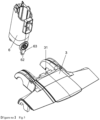
- Fig. 5 is an exploded perspective view of the upper housing 3 and the pivotal tube 6 of an embodiment of the present application.
- the pivotal tube 6 comprises a dovetail portion 62 in a lower part of the pivotal portion 61 thereof, and the upper housing 3 comprises a groove 31 that opens upward.
- the groove 31 is located at the end of the upper housing 3 that is adjacent to the pivotal tube 6.
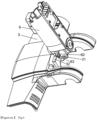
- Fig. 6 is a perspective view of an embodiment of the present application with the upper housing 3 and the pivotal tube 6 assembled together, wherein the pivotal tube 6, through the dovetail portion 62 thereof, is inserted into in the groove 31 of the upper housing 3.
- the groove opens vertically upward, so that the dovetail portion 62 is insertable into the groove 31 when the pivotal tube 6 is in a vertical plane passing through the pivotal portion 61.
- the user needs to pivot the rod and the handle grip about the second axis Y to an intermediate position, so that the pivotal tube 6 is pivoted together with the pivotal saddle 5 forward about the first axis X to insert the dovetail portion 62 into the groove 31. If the rod and the handle grip are tilted to the left or right, then the dovetail portion 62 is not insertable into the groove 31. After the dovetail portion 62 is inserted into the groove 31, the pivotal tube 6 is locked in the upper housing 3, thereby preventing the pivotal tube and the handpiece from swaying from side to side.
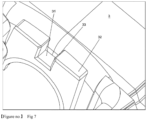
- Fig. 7 is a partially enlarged view of the groove 31 of the upper housing 3 according to an embodiment of the present application, showing the structure of the groove 31 in detail.
- the upper housing 3 is formed with support surfaces 32 on both sides of the groove 31, and the dovetail portion 62 comprises protrusions 63 extending outward on both sides thereof, the support surfaces 32 being configured to abut the protrusions 63 of the dovetail portion 62 and more specifically abut the lower surfaces of the protrusions 63.
- the supporting surface 32 is an inclined plane that tilts slightly forward, for example, tilting forward by 1-2 degrees.
- the rod and the handle grip tilt slightly forward by 1-2 degrees relative to a fully upright direction to prevent the rod, the handle grip, and the recovery container from toppling over backward, which means that the handpiece as a whole is prevented from toppling over backward, so that the self-standing structure becomes more stable.
- the groove 31 is provided with a slope 33 at the entrance thereof, which makes it easier to insert the dovetail portion 62.
- the dovetail portion is provided on the upper housing and the groove is provided on the pivotal tube.
- the pivotal tube is provided with a groove as a joint portion
- the brush is provided with a dovetail portion as a fitting portion
- the joint portion and the fitting portion are capable of engaging with each other, so that the pivotal tube is locked and not pivotable about a second axis.
- Fig. 8 is a perspective view of an embodiment of the present application with the pivotal tube 6 and the pivotal saddle 5 assembled together, wherein the pivotal tube 6 and the pivotal saddle 5 are vertically aligned to facilitate insertion of the dovetail portion 62 into the upper housing 3.
- the pivotal tube 6 comprises a pivotal portion 61 at the lower end thereof, the pivotal portion comprising a pivotal slope
- the pivotal saddle 5 comprises another pivotal portion 51 at the upper end thereof, said other pivotal portion 51 comprising another pivotal slope, wherein the pivotal slope and said other pivotal slope form a certain included angle when the pivotal tube 6 is pivotally connected to the pivotal saddle 5.
- the included angle is preferably in the range of 30 degrees to 40 degrees.
- the included angle is up to 37 degrees, which means that the rod and the handle grip are tiltable to the left by up to 18.5 degrees and that likewise the rod and the handle grip are tiltable to the right by up to 18.5 degrees.
- Fig. 9 is an exploded perspective view of the pivotal saddle 5 and the lower housing 4 of an embodiment of the present application, wherein the pivotal saddle 5 is fixedly connected to a cam 7 on both sides thereof, the cam 7 comprising a projection 71 that protrudes radially outward, an elastic piece 8 being fixed to the lower housing 4.
- the cam 7 is lockable into the elastic piece 8 to prevent the pivotal saddle from pivoting backward.
- Fig. 10 is a perspective view of the cam 7 and the elastic piece 8 of an embodiment of the present application, the elastic piece 8 being formed with an elastic piece groove 81 for engaging with the projection 71 of the cam 7.
- the cam 7 comprises a projection 71 that protrudes radially outward
- the elastic piece 8 is formed with an elastic piece groove 81 for engaging with the projection 71 of the cam 7.
- a vacuum cleaner of a substitute embodiment of the present application is shown, wherein similar reference signs are used to denote the same or corresponding parts, and descriptions of corresponding parts are omitted to ensure brevity and conciseness of the description.
- the upper housing is provided with a locking block slidable thereon, the locking block being configured to engage with the joint portion of the pivotal tube.
- Fig. 11 is an exploded perspective view of a portion of a vacuum cleaner of a substitute embodiment of the present application.
- the vacuum cleaner comprises an upper housing 103, a pivotal tube 106, and a pivotal saddle 105.
- an upper housing cover 1031 on the upper housing 103 is removed to expose the locking block 110 provided under the upper housing cover 1031.
- the upper housing cover 1031 is disposed on the locking block 110 to prevent the locking block 110 from being detached from or leaving the upper housing 103 when sliding.
- the upper housing 103 and the upper housing cover 1031 accommodate the locking block 110 therein.
- the locking block 110 when the pivotal tube 106 is pivoted to stand upright on the brush, especially on the upper housing 103, and engage therewith, the locking block 110 is slidable on the upper housing 103, thereby making it easier to lock the handle grip or the handpiece to the brush.
- the locking block 110 is configured to engage with the joint portion of the pivotal tube 106, preferably to engage with the dovetail portion 162 of the pivotal tube 106 (see Fig. 12 ).
- the locking block is made of a high-hardness plastic material, for example, ultrahigh molecular weight polyethylene or polyetherketoneketone (PEKK), or of a metal material.
- the locking block 110 since the locking block 110 slidable on the upper housing 103 is provided, even if the user has not aligned the dovetail portion 162 of the pivotal tube 106 with the locking groove 131 of the locking block, when the pivotal tube or the handpiece is pivoted to assume an almost upright position, the locking block 110 is subjected to an engagement force exerted by the dovetail portion 162, and the locking block 110 is pushed forward by the joint portion or dovetail portion to overcome the compressive force exerted by the spring, so that the spring 120 is compressed and the locking block 110 moves forward, thereby preventing the dovetail portion 162 from being subjected to forced resistance (if no locking block is provided, the dovetail portion is subjected to the forced resistance from the supporting surfaces 32 on both sides of the groove 31 of the upper housing), which thus lowers risks of possible breakage of the dovetail portion 162 caused by this forced resistance, improving the safety and durability of the vacuum cleaner.
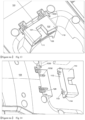
- Fig. 12 is a partially enlarged view of a portion of a vacuum cleaner of a substitute embodiment of the present application, showing more clearly the engagement between the locking block 110 slidably disposed on the upper housing 103 and the joint portion of the pivotal tube 106.
- Fig. 12 shows the state in which the dovetail portion 162 of the pivotal tube 106 is engaged in the locking block 110 when the handpiece assumes an upright, self-standing position.
- Fig. 13 is a partial perspective view of the upper housing 103 and the locking block 110 of a substitute embodiment of the present application, wherein an elastic biasing element, preferably a coil spring 120, is provided between the upper housing 103 and the locking block 110, the elastic biasing element being configured to bias the locking block 110 away from the upper housing 103.
- an elastic biasing element preferably a coil spring 120
- the locking block 110 is located on the upper housing 103, and the upper surface of the locking block 110 is substantially flush with the upper surface of the upper housing 103, so that the upper housing cover 1031 is conveniently fixed to the upper housing 103 from above and constrains the locking block 110.
- the locking block 110 is provided on the upper housing 103 to be slidable back and forth only on the upper housing 103. Such back-and-forth sliding motions are made possible by a shape-fitting structure between the lower surface of the locking block and the upper surface of the upper housing 103, which will be illustrated in Fig. 14 .
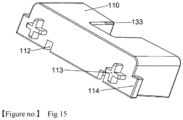
- a protrusion 113 (see Fig. 15 ) is provided at the front end of the locking block 110, the protrusion 113 preferably having the shape of a cross, so as to receive one end of the spring 120 thereon and constrain the spring 120.
- the locking block 110 in a central position thereof, is provided with a locking groove 131, the locking groove 131 being configured for the insertion of the joint portion or the dovetail portion 162 of the pivotal tube 106 therein.
- a support surface 132 is formed on the upper surface of the locking block 110, and the dovetail portion 162 comprises protrusions extending outward on both sides thereof, the support surface 132 being configured to abut the protrusions of the dovetail portion 162 (see Fig. 6 ) and more specifically abut the lower surfaces of the protrusions (see the embodiment shown in Fig. 6 and 7 ).
- an extension part of the dovetail portion 162 fits the locking groove 131, and the protrusions abut the supporting surface 132, so that the pivotal tube 106 is effectively prevented from turning from side to side relative to the upper housing.
- the locking groove 131 is provided with a slope 133 at the entrance thereof, which makes it easier to insert the dovetail portion 162.
- an angled guide surface 111 is provided at the rear end of the locking block 110 for guiding the joint portion into the locking groove 131.
- the guide surface 111 provides sliding contact with the pivotal member.
- the angled surface 111 helps guide or push the joint portion or the dovetail portion 162 into the locking groove 131 when the handle grip or the handpiece is pivoted closer to or near an upright position. Once the joint portion or the dovetail portion 162 is aligned with the locking groove 131, the joint portion or the dovetail portion 162 is pushable fully into the locking groove to keep the handle grip or the handpiece in an upright position, so that the vacuum cleaner is self-standing on the floor.
- An angle formed by the angled surface 111 may be in the range of 0-45 degrees, preferably in the range of 5-15 degrees.
- the locking block is slidable on the upper housing by overcoming a force exerted by the spring.
- the maximum distance over which the locking block 110 is slidable on the upper housing 103 is shown with reference sign "L", and this distance may be referred to as the sliding stroke of the locking block 110.
- the dovetail portion 162 comes into contact with the locking block to temporarily displace the locking block and make it easier to assemble the dovetail portion 162 into the locking groove of the locking block.
- Making the locking block movable relative to the lower housing 103 helps better absorb the positional deviation between them when the pivotal member is locked relative to the upper housing, reducing damage caused between the dovetail portion and the groove or the locking block, because, compared with a case where no locking block is present and there is rigid contact between the dovetail portion and the groove, the locking block is movable relative to the lower housing to reduce the frictional force generated when the pivotal member is inserted into the upper housing, thus avoiding possible damage caused by misalignment.
- the maximum actual pushing stroke of the dovetail portion 162 during the pivoting process is denoted by reference sign "S".
- the sliding stroke of the locking block 110 is about 5 mm, while the actual pushing stroke of the joint portion or the dovetail portion 162 is about 4.4 mm.
- the sliding stroke of the locking block 110 is greater than the actual pushing stroke of the joint portion or the dovetail portion 162, so that when the joint portion or the dovetail portion 162 is placed upright, the joint portion will not be pushed so far that the locking block 110 reaches its maximum stroke to get the locking block 110 stuck.
- the maximum sliding stroke of the locking block 110 on the upper housing is greater than the maximum pushing stroke in the front-rear direction when the joint portion or the dovetail portion 162 pivots relative to the brush, and the block 110 in the present application has an angled guide surface 111 at the rear end thereof to help guide the joint portion or the dovetail portion 162 on the locking block 110, which are designs that help ensure that the pivotal tube 106 or the dovetail portion 162 thereof safely and freely enters the locking block 110, more specifically entering the locking groove 131 of the locking block 110.
- Fig. 14 is a partially enlarged exploded perspective view of the upper housing and locking block of a substitute embodiment of the present application.
- Fig. 15 is a perspective view of a locking block of a substitute embodiment of the present application.
- the locking block 110 is provided on the upper housing 103 to be slidable back and forth only on the upper housing 103.
- shape-fitting structures are provided on the lower surface of the locking block and on the upper surface of the upper housing 103.
- the upper housing 103 is provided with a rail 1032
- the lower surface of the locking block 110 is provided with a chute 112 (see Fig.
- the locking block 110 is slidable on the upper housing 103 by causing the chute 112 to slide on the rail 1032.
- the upper housing 103 is provided with a guide groove
- the lower surface of the locking block 110 is provided with a raised guide rail configured to slide in the guide groove, so that the locking block 110 is slidable back and forth on the upper housing 103.
- the locking block 110 further comprises a stop structure configured to abut the upper housing to prevent an elastic biasing element from pushing the locking block 110 further away on the upper housing 103.
- the stop structure comprises lugs 114 on both lateral surfaces of the locking block 110, the lugs 114 being provided away from the guide surface, in particular being provided adjacent to the front end of the locking block on both sides thereof.
- the upper housing 103 further comprises a corresponding stop surface 1033 (see Fig. 13 and 14 ) configured to prevent the locking block 110 (more specifically, the lug 114) from moving beyond its stroke L, thus ensuring that the locking block 110 does not slide out of the upper housing 103.
- the locking block 110 since the locking block 110 slidable on the upper housing 103 is provided, even if the user has not aligned the dovetail portion 162 of the pivotal tube 106 with the locking groove 131 of the locking block, when the pivotal tube or the handpiece is pivoted to assume an almost upright position, the locking block 110 is subjected to an engagement force exerted by the dovetail portion 162, and the locking block 110 is pushed forward by the joint portion or dovetail portion to overcome the compressive force exerted by the spring, so that the spring 120 is compressed and the locking block 110 moves forward, thereby preventing the dovetail portion 162 from being subjected to forced resistance (if no locking block is provided, the dovetail portion is subjected to the forced resistance from the supporting surfaces 32 on both sides of the groove 31 of the upper housing), which thus lowers risks of possible breakage of the dovetail portion 162 caused by this forced resistance, improving the safety and durability of the vacuum cleaner.
- the locking block 110 preferably comprises an angled guide surface 111, lugs 114 provided on lateral surfaces thereof, and shape-fitting structures provided on the lower surface of the locking block 111 and on the upper surface of the upper housing 103, all of which are designs that help to better absorb the positional deviation between the dovetail portion and the locking groove when the pivotal tube or the handpiece is locked relative to the brush or the upper housing, reducing the damage caused between the dovetail portion and the locking groove or the locking block, wherein, compared with a case where no locking block is present, since the locking block is movable forward relative to the lower housing to reduce the frictional force generated when the pivotal member is inserted into the upper housing, risks of breakage of any parts due to misalignment are reduced or avoided.
Landscapes
- Engineering & Computer Science (AREA)
- Mechanical Engineering (AREA)
- Nozzles For Electric Vacuum Cleaners (AREA)
- Addition Polymer Or Copolymer, Post-Treatments, Or Chemical Modifications (AREA)
- Filters For Electric Vacuum Cleaners (AREA)
Applications Claiming Priority (2)
| Application Number | Priority Date | Filing Date | Title |
|---|---|---|---|
| CN202122670688 | 2021-11-03 | ||
| CN202210498029.1A CN116058706A (zh) | 2021-11-03 | 2022-05-09 | 真空吸尘器 |
Publications (4)
| Publication Number | Publication Date |
|---|---|
| EP4176786A2 true EP4176786A2 (de) | 2023-05-10 |
| EP4176786A3 EP4176786A3 (de) | 2023-06-21 |
| EP4176786B1 EP4176786B1 (de) | 2026-01-21 |
| EP4176786C0 EP4176786C0 (de) | 2026-01-21 |
Family
ID=83903320
Family Applications (1)
| Application Number | Title | Priority Date | Filing Date |
|---|---|---|---|
| EP22202108.1A Active EP4176786B1 (de) | 2021-11-03 | 2022-10-18 | Staubsauger |
Country Status (3)
| Country | Link |
|---|---|
| US (2) | US12419475B2 (de) |
| EP (1) | EP4176786B1 (de) |
| AU (1) | AU2022256089A1 (de) |
Cited By (2)
| Publication number | Priority date | Publication date | Assignee | Title |
|---|---|---|---|---|
| WO2025022213A1 (en) * | 2023-07-24 | 2025-01-30 | Dyson Technology Limited | A floor cleaner |
| WO2025120490A1 (en) * | 2023-12-08 | 2025-06-12 | Zhejiang Shaoxing Supor Domestic Electrical Appliance Co., Ltd. | A floor brush structure and a cleaning device |
Families Citing this family (1)
| Publication number | Priority date | Publication date | Assignee | Title |
|---|---|---|---|---|
| USD1106627S1 (en) * | 2024-09-19 | 2025-12-16 | Bissell Inc. | Cleaning foot for a floor cleaner |
Family Cites Families (101)
| Publication number | Priority date | Publication date | Assignee | Title |
|---|---|---|---|---|
| NL80873C (de) | 1950-12-12 | |||
| US2740983A (en) | 1951-06-22 | 1956-04-10 | Hoover Co | Converter arrangement for suction cleaners |
| US4095304A (en) | 1976-02-10 | 1978-06-20 | Mamoru Shinozaki | Hand sweeper |
| US4129920A (en) | 1977-12-12 | 1978-12-19 | Consolidated Foods Corporation | Hose coupling for upright vacuum cleaner |
| US4423534A (en) * | 1981-12-14 | 1984-01-03 | Whirlpool Corporation | Vacuum cleaner handle lock |
| US5323510A (en) | 1993-07-09 | 1994-06-28 | Redding Glenn K | Vacuum cleaner having improved steering features |
| US6006401A (en) | 1997-01-22 | 1999-12-28 | Bissell Homecare, Inc. | Vacuum cleaner having a handle release thereon |
| JP3609582B2 (ja) | 1997-06-23 | 2005-01-12 | 三洋電機株式会社 | 電気掃除機 |
| US6055703A (en) | 1997-10-14 | 2000-05-02 | Oreck Holdings Llc | Upright vacuum cleaner having improved steering apparatus with a lock out feature |
| GB2355391A (en) | 1999-10-20 | 2001-04-25 | Notetry Ltd | Cyclonic vacuum cleaner with a horizontal, or substantially horizontal, separator |
| CN1332625C (zh) | 2000-01-31 | 2007-08-22 | 松下电器产业株式会社 | 电动吸尘器 |
| JP2001269294A (ja) | 2000-03-23 | 2001-10-02 | Sharp Corp | 電気掃除機 |
| JP3457639B2 (ja) * | 2000-05-04 | 2003-10-20 | エルジー電子株式会社 | 真空掃除機 |
| US6832409B2 (en) | 2001-09-18 | 2004-12-21 | The Hoover Company | Wet/dry floor cleaning unit and method of cleaning |
| US6823559B2 (en) | 2002-02-07 | 2004-11-30 | Wessel-Werk Gmbh | Front brush attachment device for vacuum cleaner |
| KR100474087B1 (ko) | 2003-06-26 | 2005-03-14 | 삼성광주전자 주식회사 | 업라이트형 진공청소기 |
| KR101115344B1 (ko) | 2003-08-22 | 2012-03-06 | 비쎌 홈케어, 인크. | 맨 바닥면 습건식 청소기 |
| US7665172B1 (en) | 2004-03-19 | 2010-02-23 | Bissell Homecare, Inc. | Sweeper |
| JP2006034720A (ja) | 2004-07-28 | 2006-02-09 | Sanyo Electric Co Ltd | 携帯型電気掃除機 |
| DE102004052306A1 (de) | 2004-10-16 | 2006-04-20 | Stein & Co Gmbh | Vorrichtung zur Anordnung eines Saugvorsatzes |
| CN1768660A (zh) | 2004-11-05 | 2006-05-10 | 乐金电子(天津)电器有限公司 | 立式真空吸尘器 |
| JP2008526449A (ja) | 2005-01-18 | 2008-07-24 | エレクトラックス ホーム ケア プロダクツ,リミテッド | 折りたたみハンドルを有する掃除機 |
| DE102005032488A1 (de) * | 2005-07-04 | 2007-01-11 | Alfred Kärcher Gmbh & Co. Kg | Fahrbares Bodenreinigungsgerät |
| KR100778690B1 (ko) | 2005-08-18 | 2007-11-22 | 주식회사 대우일렉트로닉스 | 업라이트형 진공 청소기의 각도조절장치 |
| DE102005045658B3 (de) | 2005-09-13 | 2006-10-12 | Alfred Kärcher Gmbh & Co. Kg | Fahrbares Kehrgerät |
| GB2433425B (en) | 2005-12-23 | 2010-11-17 | Cassidy Brothers Plc | Improvements relating to vacuum cleaners |
| US8402600B2 (en) | 2006-12-13 | 2013-03-26 | Ab Electrolux | Vacuum cleaner nozzle and roller |
| GB2448745A (en) | 2007-04-27 | 2008-10-29 | Hoover Ltd | An upright vacuum cleaner |
| DE102007040958A1 (de) | 2007-08-30 | 2009-03-05 | Miele & Cie. Kg | Upright-Staubsauger |
| DE102007040961A1 (de) | 2007-08-30 | 2009-03-05 | Miele & Cie. Kg | Upright-Staubsauger |
| GB2452549B (en) | 2007-09-08 | 2012-03-21 | Dyson Technology Ltd | A surface treating appliance |
| GB2452548B (en) | 2007-09-08 | 2011-11-30 | Dyson Technology Ltd | A surface treating appliance |
| US7789922B1 (en) | 2009-04-09 | 2010-09-07 | Lau Ying Wai | Cyclonic chamber for air filtration devices |
| CA2674763A1 (en) | 2009-07-30 | 2011-01-30 | G.B.D. Corp. | Surface cleaning apparatus |
| CA2953105C (en) | 2009-07-30 | 2020-02-11 | Omachron Intellectual Property Inc. | Surface cleaning apparatus |
| GB2474464B (en) | 2009-10-15 | 2013-11-20 | Dyson Technology Ltd | A surface treating appliance |
| GB2474472B (en) | 2009-10-15 | 2013-10-23 | Dyson Technology Ltd | A surface treating appliance |
| GB2474466B (en) | 2009-10-15 | 2014-03-05 | Dyson Technology Ltd | A surface treating appliance |
| GB2474465B (en) | 2009-10-15 | 2013-10-23 | Dyson Technology Ltd | A surface treating appliance |
| GB2474470B (en) | 2009-10-15 | 2013-10-23 | Dyson Technology Ltd | A surface treating appliance |
| GB2474473B (en) | 2009-10-15 | 2013-10-23 | Dyson Technology Ltd | A surface treating appliance |
| GB0918027D0 (en) | 2009-10-15 | 2009-12-02 | Dyson Technology Ltd | A surface trating appliance |
| GB2474471B (en) | 2009-10-15 | 2013-10-23 | Dyson Technology Ltd | A surface treating appliance |
| US8082624B2 (en) | 2009-11-10 | 2011-12-27 | Oreck Holdings Llc | Rotatable coupling for steering vacuum cleaner |
| US8875340B2 (en) | 2010-03-12 | 2014-11-04 | G.B.D. Corp. | Surface cleaning apparatus with enhanced operability |
| US8448295B2 (en) | 2010-03-12 | 2013-05-28 | Electrolux Home Care Products, Inc. | Vacuum cleaner with rotating handle |
| US8528166B2 (en) | 2010-04-30 | 2013-09-10 | Techtronic Floor Care Technology Limited | Upright vacuum with floating head |
| WO2012051550A1 (en) | 2010-10-15 | 2012-04-19 | Techtronic Floor Care Technology Limited | Steering assembly for surface cleaning device |
| GB2485401B (en) | 2010-11-15 | 2015-04-01 | Hoover Ltd | Locking coupling for a vacuum cleaner |
| GB2486666B (en) | 2010-12-22 | 2012-11-07 | Grey Technology Ltd | Vacuum cleaner |
| KR101208556B1 (ko) | 2011-01-18 | 2012-12-05 | 엘지전자 주식회사 | 업라이트형 진공 청소기 |
| US8627545B2 (en) | 2011-03-18 | 2014-01-14 | Panasonic Corporation Of North America | Vacuum cleaner with enhanced maneuverability |
| WO2013055364A1 (en) | 2011-10-14 | 2013-04-18 | Techtronic Floor Care Technology Limited | Steering assembly for surface cleaning device |
| US9282862B2 (en) | 2011-10-14 | 2016-03-15 | Techtronic Floor Care Technology Limited | Steering assembly for surface cleaning device |
| US20140331445A1 (en) | 2011-12-14 | 2014-11-13 | Euro-Pro Operating Llc | Surface cleaning apparatus with a sideways pivoting handle |
| US10016107B2 (en) | 2011-12-14 | 2018-07-10 | Sharkninja Operating Llc | Surface cleaning apparatus with a sideways pivoting handle |
| CN104271020B (zh) | 2012-03-19 | 2017-04-05 | 伊莱克斯公司 | 具有支撑件的直立式真空吸尘器 |
| US20130315653A1 (en) * | 2012-05-25 | 2013-11-28 | Euro-Pro Operating Llc | Floor treatment appliance arrangement |
| CN102688001B (zh) | 2012-06-07 | 2015-02-04 | 苏州诚河清洁设备有限公司 | 地刷本体与手柄组件之间的锁定机构及清洁设备 |
| US20140041149A1 (en) | 2012-08-09 | 2014-02-13 | Techtronic Floor Care Technology Limited | Vacuum cleaner including a removable canister assembly |
| US9215960B2 (en) | 2013-02-28 | 2015-12-22 | Omachron Intellectual Property Inc. | Surface cleaning apparatus |
| US9456721B2 (en) | 2013-02-28 | 2016-10-04 | Omachron Intellectual Property Inc. | Surface cleaning apparatus |
| US9060665B2 (en) | 2013-03-01 | 2015-06-23 | Euro-Pro Operating Llc | Floor cleaning appliance |
| US9924842B2 (en) | 2014-06-30 | 2018-03-27 | Bissell Homecare, Inc. | Vacuum cleaner |
| KR102238138B1 (ko) | 2014-08-27 | 2021-04-09 | 삼성전자주식회사 | 거치대 및 이를 포함하는 진공청소기 |
| KR102268576B1 (ko) | 2014-08-29 | 2021-06-24 | 삼성전자주식회사 | 진공청소기 |
| KR101637684B1 (ko) | 2014-09-26 | 2016-07-07 | 엘지전자 주식회사 | 진공 청소기 |
| JP6129811B2 (ja) * | 2014-12-01 | 2017-05-17 | 日立アプライアンス株式会社 | 電気掃除機 |
| US20160157690A1 (en) | 2014-12-05 | 2016-06-09 | Panasonic Corporation Of North America | Upright vacuum cleaner with swivel connection between nozzle and handle assemblies |
| DE102015102587B4 (de) | 2015-02-24 | 2019-10-17 | Vorwerk & Co. Interholding Gmbh | Als Vorsatzgerät ausgebildete Saugdüse für einen Staubsauger |
| EP3264959B1 (de) | 2015-03-06 | 2019-05-29 | Alfred Kärcher SE & Co. KG | Staubsauger |
| JP2017000393A (ja) | 2015-06-09 | 2017-01-05 | シャープ株式会社 | 電気掃除機 |
| US10188247B2 (en) * | 2015-12-10 | 2019-01-29 | Jiangsu Midea Cleaning Appliances Co., Ltd. | Upright vacuum cleaner |
| WO2017124627A1 (zh) | 2016-01-20 | 2017-07-27 | 江苏美的清洁电器股份有限公司 | 吸尘器 |
| GB201616598D0 (en) | 2016-09-30 | 2016-11-16 | Grey Technology Limited | Cleaning head for a vacuum cleaner |
| GB2559379A (en) | 2017-02-03 | 2018-08-08 | Tti Macao Commercial Offshore Ltd | A tool for a surface cleaning apparatus |
| CN207492730U (zh) | 2017-03-04 | 2018-06-15 | 卓力电器集团有限公司 | 一种二合一吸尘器 |
| CN207429046U (zh) | 2017-04-28 | 2018-06-01 | 江苏美的清洁电器股份有限公司 | 立式吸尘器 |
| KR102372897B1 (ko) * | 2017-08-22 | 2022-03-11 | 삼성전자주식회사 | 청소기 |
| AU2018101205A4 (en) | 2017-08-28 | 2018-09-20 | Bissell Inc. | Vacuum cleaner |
| US11234567B2 (en) | 2017-09-01 | 2022-02-01 | Sharkninja Operating Llc | Vacuum cleaner tool having a rotatable duct for moving between a use position and storage position on a vacuum cleaner |
| EP3723572A1 (de) * | 2017-12-15 | 2020-10-21 | Aktiebolaget Electrolux | Bodenwerkzeugeinheit, oberflächenbehandlungsgerät und staubsauger |
| WO2019157638A1 (zh) | 2018-02-13 | 2019-08-22 | 深圳市赫兹科技有限公司 | 清洁装置 |
| CN208582323U (zh) | 2018-03-20 | 2019-03-08 | 苏州百特电器有限公司 | 一种立式吸尘器 |
| CN209529024U (zh) | 2018-05-07 | 2019-10-25 | 天佑电器(苏州)有限公司 | 吸尘器 |
| CN110448218B (zh) | 2018-05-07 | 2024-08-09 | 天佑电器(苏州)有限公司 | 吸尘器 |
| WO2019233554A1 (en) | 2018-06-05 | 2019-12-12 | Aktiebolaget Electrolux | Self-stand mode for stick vacuum cleaner |
| CN209346879U (zh) | 2018-07-11 | 2019-09-06 | 尚科宁家(香港)股份有限公司 | 一种清洁装置 |
| CN108903838B (zh) | 2018-07-18 | 2020-09-25 | 江苏美的清洁电器股份有限公司 | 具有转动限位结构的擦地装置 |
| CN111358340B (zh) | 2018-12-25 | 2022-01-28 | 江苏美的清洁电器股份有限公司 | 清洁设备 |
| CN111358339B (zh) | 2018-12-25 | 2021-07-30 | 江苏美的清洁电器股份有限公司 | 清洁设备 |
| CN110876579A (zh) | 2018-12-29 | 2020-03-13 | 尚科宁家(中国)科技有限公司 | 一种吸尘器 |
| CA3072142C (en) | 2019-02-12 | 2023-01-10 | Bissell Inc. | Floor cleaning apparatus with cleaning fluid delivery system |
| CN210249724U (zh) | 2019-06-04 | 2020-04-07 | 北京海纳世纪科技有限公司 | 一种清洗装置 |
| CN210871317U (zh) | 2019-07-31 | 2020-06-30 | 苏州索发电机有限公司 | 一种电动擦拖地机 |
| CN210871345U (zh) | 2019-07-31 | 2020-06-30 | 苏州索发电机有限公司 | 一种带锁止结构的万向节 |
| CN216393939U (zh) | 2020-04-13 | 2022-04-29 | 尚科宁家运营有限公司 | 与表面清洁设备一起使用的管嘴以及表面清洁设备 |
| CN213910036U (zh) | 2020-07-02 | 2021-08-10 | 帝舍智能科技(武汉)有限公司 | 基于水尘环流的铰链结构、清洁头及清洁工具 |
| KR20220012727A (ko) * | 2020-07-23 | 2022-02-04 | 엘지전자 주식회사 | 진공청소기 |
| CN215016701U (zh) | 2020-12-10 | 2021-12-07 | 博西华电器(江苏)有限公司 | 吸尘器 |
| DE102021116685B3 (de) * | 2021-06-29 | 2022-08-25 | Hako Gmbh | Bodenreinigungsmaschine |
-
2022
- 2022-07-19 US US17/868,392 patent/US12419475B2/en active Active
- 2022-10-17 AU AU2022256089A patent/AU2022256089A1/en active Pending
- 2022-10-18 EP EP22202108.1A patent/EP4176786B1/de active Active
-
2025
- 2025-09-15 US US19/328,895 patent/US20260007284A1/en active Pending
Cited By (2)
| Publication number | Priority date | Publication date | Assignee | Title |
|---|---|---|---|---|
| WO2025022213A1 (en) * | 2023-07-24 | 2025-01-30 | Dyson Technology Limited | A floor cleaner |
| WO2025120490A1 (en) * | 2023-12-08 | 2025-06-12 | Zhejiang Shaoxing Supor Domestic Electrical Appliance Co., Ltd. | A floor brush structure and a cleaning device |
Also Published As
| Publication number | Publication date |
|---|---|
| EP4176786B1 (de) | 2026-01-21 |
| US20260007284A1 (en) | 2026-01-08 |
| EP4176786A3 (de) | 2023-06-21 |
| AU2022256089A1 (en) | 2023-05-18 |
| US20230140788A1 (en) | 2023-05-04 |
| EP4176786C0 (de) | 2026-01-21 |
| US12419475B2 (en) | 2025-09-23 |
Similar Documents
| Publication | Publication Date | Title |
|---|---|---|
| EP4176786A2 (de) | Staubsauger | |
| US9155431B2 (en) | Vacuum cleaner arrangement | |
| CN216135773U (zh) | 表面清洁设备 | |
| KR102238138B1 (ko) | 거치대 및 이를 포함하는 진공청소기 | |
| US8468646B2 (en) | Vacuum cleaner for using in both upright form and canister form | |
| EP3753462B1 (de) | Reinigerhalter | |
| US7979953B2 (en) | Vacuum cleaner | |
| US7681279B2 (en) | Vacuum cleaner | |
| US10610075B2 (en) | Cleaner holder | |
| CN107105951A (zh) | 能构造成处于储存位置的表面清洁设备 | |
| KR20200131203A (ko) | 청소기의 거치대 및 청소기 유닛 | |
| US9009915B2 (en) | Upright type vacuum cleaner | |
| CN116058706A (zh) | 真空吸尘器 | |
| AU2011225870B2 (en) | A vacuum cleaner arrangement | |
| JPH11276389A (ja) | 掃除機 | |
| JP3036213B2 (ja) | 電気掃除機 | |
| JP2003153832A (ja) | 電気掃除機 | |
| JPH07236600A (ja) | 電気掃除機 | |
| JP2000271046A (ja) | 電気掃除機 | |
| JP2002209807A (ja) | 電気掃除機 | |
| JP2014200471A (ja) | 電気掃除機 |
Legal Events
| Date | Code | Title | Description |
|---|---|---|---|
| PUAI | Public reference made under article 153(3) epc to a published international application that has entered the european phase |
Free format text: ORIGINAL CODE: 0009012 |
|
| STAA | Information on the status of an ep patent application or granted ep patent |
Free format text: STATUS: THE APPLICATION HAS BEEN PUBLISHED |
|
| AK | Designated contracting states |
Kind code of ref document: A2 Designated state(s): AL AT BE BG CH CY CZ DE DK EE ES FI FR GB GR HR HU IE IS IT LI LT LU LV MC ME MK MT NL NO PL PT RO RS SE SI SK SM TR |
|
| PUAL | Search report despatched |
Free format text: ORIGINAL CODE: 0009013 |
|
| AK | Designated contracting states |
Kind code of ref document: A3 Designated state(s): AL AT BE BG CH CY CZ DE DK EE ES FI FR GB GR HR HU IE IS IT LI LT LU LV MC ME MK MT NL NO PL PT RO RS SE SI SK SM TR |
|
| RIC1 | Information provided on ipc code assigned before grant |
Ipc: A47L 9/00 20060101ALI20230516BHEP Ipc: A47L 5/30 20060101AFI20230516BHEP |
|
| STAA | Information on the status of an ep patent application or granted ep patent |
Free format text: STATUS: REQUEST FOR EXAMINATION WAS MADE |
|
| 17P | Request for examination filed |
Effective date: 20231219 |
|
| RBV | Designated contracting states (corrected) |
Designated state(s): AL AT BE BG CH CY CZ DE DK EE ES FI FR GB GR HR HU IE IS IT LI LT LU LV MC ME MK MT NL NO PL PT RO RS SE SI SK SM TR |
|
| GRAP | Despatch of communication of intention to grant a patent |
Free format text: ORIGINAL CODE: EPIDOSNIGR1 |
|
| STAA | Information on the status of an ep patent application or granted ep patent |
Free format text: STATUS: GRANT OF PATENT IS INTENDED |
|
| INTG | Intention to grant announced |
Effective date: 20250826 |
|
| GRAS | Grant fee paid |
Free format text: ORIGINAL CODE: EPIDOSNIGR3 |
|
| GRAA | (expected) grant |
Free format text: ORIGINAL CODE: 0009210 |
|
| STAA | Information on the status of an ep patent application or granted ep patent |
Free format text: STATUS: THE PATENT HAS BEEN GRANTED |
|
| AK | Designated contracting states |
Kind code of ref document: B1 Designated state(s): AL AT BE BG CH CY CZ DE DK EE ES FI FR GB GR HR HU IE IS IT LI LT LU LV MC ME MK MT NL NO PL PT RO RS SE SI SK SM TR |
|
| REG | Reference to a national code |
Ref country code: CH Ref legal event code: F10 Free format text: ST27 STATUS EVENT CODE: U-0-0-F10-F00 (AS PROVIDED BY THE NATIONAL OFFICE) Effective date: 20260121 |
|
| REG | Reference to a national code |
Ref country code: DE Ref legal event code: R096 Ref document number: 602022028768 Country of ref document: DE |
|
| REG | Reference to a national code |
Ref country code: IE Ref legal event code: FG4D |
|
| U01 | Request for unitary effect filed |
Effective date: 20260219 |