EP4166366A1 - Klappeneinheit für eine öffnung an einem fahrzeug und fahrzeug - Google Patents
Klappeneinheit für eine öffnung an einem fahrzeug und fahrzeug Download PDFInfo
- Publication number
- EP4166366A1 EP4166366A1 EP22192150.5A EP22192150A EP4166366A1 EP 4166366 A1 EP4166366 A1 EP 4166366A1 EP 22192150 A EP22192150 A EP 22192150A EP 4166366 A1 EP4166366 A1 EP 4166366A1
- Authority
- EP
- European Patent Office
- Prior art keywords
- panel
- frame
- opening
- flap unit
- screen
- Prior art date
- Legal status (The legal status is an assumption and is not a legal conclusion. Google has not performed a legal analysis and makes no representation as to the accuracy of the status listed.)
- Granted
Links
Images

Classifications
-
- E—FIXED CONSTRUCTIONS
- E05—LOCKS; KEYS; WINDOW OR DOOR FITTINGS; SAFES
- E05F—DEVICES FOR MOVING WINGS INTO OPEN OR CLOSED POSITION; CHECKS FOR WINGS; WING FITTINGS NOT OTHERWISE PROVIDED FOR, CONCERNED WITH THE FUNCTIONING OF THE WING
- E05F1/00—Closers or openers for wings, not otherwise provided for in this subclass
- E05F1/08—Closers or openers for wings, not otherwise provided for in this subclass spring-actuated, e.g. for horizontally sliding wings
- E05F1/10—Closers or openers for wings, not otherwise provided for in this subclass spring-actuated, e.g. for horizontally sliding wings for swinging wings, e.g. counterbalance
-
- B—PERFORMING OPERATIONS; TRANSPORTING
- B60—VEHICLES IN GENERAL
- B60K—ARRANGEMENT OR MOUNTING OF PROPULSION UNITS OR OF TRANSMISSIONS IN VEHICLES; ARRANGEMENT OR MOUNTING OF PLURAL DIVERSE PRIME-MOVERS IN VEHICLES; AUXILIARY DRIVES FOR VEHICLES; INSTRUMENTATION OR DASHBOARDS FOR VEHICLES; ARRANGEMENTS IN CONNECTION WITH COOLING, AIR INTAKE, GAS EXHAUST OR FUEL SUPPLY OF PROPULSION UNITS IN VEHICLES
- B60K15/00—Arrangement in connection with fuel supply of combustion engines or other fuel consuming energy converters, e.g. fuel cells; Mounting or construction of fuel tanks
- B60K15/03—Fuel tanks
- B60K15/04—Tank inlets
- B60K15/05—Inlet covers
-
- E—FIXED CONSTRUCTIONS
- E05—LOCKS; KEYS; WINDOW OR DOOR FITTINGS; SAFES
- E05B—LOCKS; ACCESSORIES THEREFOR; HANDCUFFS
- E05B83/00—Vehicle locks specially adapted for particular types of wing or vehicle
- E05B83/28—Locks for glove compartments, console boxes, fuel inlet covers or the like
- E05B83/34—Locks for glove compartments, console boxes, fuel inlet covers or the like for fuel inlet covers essentially flush with the vehicle surface
-
- B—PERFORMING OPERATIONS; TRANSPORTING
- B60—VEHICLES IN GENERAL
- B60K—ARRANGEMENT OR MOUNTING OF PROPULSION UNITS OR OF TRANSMISSIONS IN VEHICLES; ARRANGEMENT OR MOUNTING OF PLURAL DIVERSE PRIME-MOVERS IN VEHICLES; AUXILIARY DRIVES FOR VEHICLES; INSTRUMENTATION OR DASHBOARDS FOR VEHICLES; ARRANGEMENTS IN CONNECTION WITH COOLING, AIR INTAKE, GAS EXHAUST OR FUEL SUPPLY OF PROPULSION UNITS IN VEHICLES
- B60K15/00—Arrangement in connection with fuel supply of combustion engines or other fuel consuming energy converters, e.g. fuel cells; Mounting or construction of fuel tanks
- B60K15/03—Fuel tanks
- B60K15/04—Tank inlets
- B60K15/05—Inlet covers
- B60K2015/0515—Arrangements for closing or opening of inlet cover
- B60K2015/053—Arrangements for closing or opening of inlet cover with hinged connection to the vehicle body
-
- B—PERFORMING OPERATIONS; TRANSPORTING
- B60—VEHICLES IN GENERAL
- B60K—ARRANGEMENT OR MOUNTING OF PROPULSION UNITS OR OF TRANSMISSIONS IN VEHICLES; ARRANGEMENT OR MOUNTING OF PLURAL DIVERSE PRIME-MOVERS IN VEHICLES; AUXILIARY DRIVES FOR VEHICLES; INSTRUMENTATION OR DASHBOARDS FOR VEHICLES; ARRANGEMENTS IN CONNECTION WITH COOLING, AIR INTAKE, GAS EXHAUST OR FUEL SUPPLY OF PROPULSION UNITS IN VEHICLES
- B60K15/00—Arrangement in connection with fuel supply of combustion engines or other fuel consuming energy converters, e.g. fuel cells; Mounting or construction of fuel tanks
- B60K15/03—Fuel tanks
- B60K15/04—Tank inlets
- B60K15/05—Inlet covers
- B60K2015/0561—Locking means for the inlet cover
-
- E—FIXED CONSTRUCTIONS
- E05—LOCKS; KEYS; WINDOW OR DOOR FITTINGS; SAFES
- E05F—DEVICES FOR MOVING WINGS INTO OPEN OR CLOSED POSITION; CHECKS FOR WINGS; WING FITTINGS NOT OTHERWISE PROVIDED FOR, CONCERNED WITH THE FUNCTIONING OF THE WING
- E05F15/00—Power-operated mechanisms for wings
- E05F15/60—Power-operated mechanisms for wings using electrical actuators
- E05F15/603—Power-operated mechanisms for wings using electrical actuators using rotary electromotors
- E05F15/611—Power-operated mechanisms for wings using electrical actuators using rotary electromotors for swinging wings
-
- E—FIXED CONSTRUCTIONS
- E05—LOCKS; KEYS; WINDOW OR DOOR FITTINGS; SAFES
- E05Y—INDEXING SCHEME ASSOCIATED WITH SUBCLASSES E05D AND E05F, RELATING TO CONSTRUCTION ELEMENTS, ELECTRIC CONTROL, POWER SUPPLY, POWER SIGNAL OR TRANSMISSION, USER INTERFACES, MOUNTING OR COUPLING, DETAILS, ACCESSORIES, AUXILIARY OPERATIONS NOT OTHERWISE PROVIDED FOR, APPLICATION THEREOF
- E05Y2201/00—Constructional elements; Accessories therefor
- E05Y2201/40—Motors; Magnets; Springs; Weights; Accessories therefor
- E05Y2201/47—Springs
-
- E—FIXED CONSTRUCTIONS
- E05—LOCKS; KEYS; WINDOW OR DOOR FITTINGS; SAFES
- E05Y—INDEXING SCHEME ASSOCIATED WITH SUBCLASSES E05D AND E05F, RELATING TO CONSTRUCTION ELEMENTS, ELECTRIC CONTROL, POWER SUPPLY, POWER SIGNAL OR TRANSMISSION, USER INTERFACES, MOUNTING OR COUPLING, DETAILS, ACCESSORIES, AUXILIARY OPERATIONS NOT OTHERWISE PROVIDED FOR, APPLICATION THEREOF
- E05Y2900/00—Application of doors, windows, wings or fittings thereof
- E05Y2900/50—Application of doors, windows, wings or fittings thereof for vehicles
- E05Y2900/53—Type of wing
- E05Y2900/534—Fuel lids, charger lids
-
- Y—GENERAL TAGGING OF NEW TECHNOLOGICAL DEVELOPMENTS; GENERAL TAGGING OF CROSS-SECTIONAL TECHNOLOGIES SPANNING OVER SEVERAL SECTIONS OF THE IPC; TECHNICAL SUBJECTS COVERED BY FORMER USPC CROSS-REFERENCE ART COLLECTIONS [XRACs] AND DIGESTS
- Y02—TECHNOLOGIES OR APPLICATIONS FOR MITIGATION OR ADAPTATION AGAINST CLIMATE CHANGE
- Y02T—CLIMATE CHANGE MITIGATION TECHNOLOGIES RELATED TO TRANSPORTATION
- Y02T10/00—Road transport of goods or passengers
- Y02T10/60—Other road transportation technologies with climate change mitigation effect
- Y02T10/70—Energy storage systems for electromobility, e.g. batteries
-
- Y—GENERAL TAGGING OF NEW TECHNOLOGICAL DEVELOPMENTS; GENERAL TAGGING OF CROSS-SECTIONAL TECHNOLOGIES SPANNING OVER SEVERAL SECTIONS OF THE IPC; TECHNICAL SUBJECTS COVERED BY FORMER USPC CROSS-REFERENCE ART COLLECTIONS [XRACs] AND DIGESTS
- Y02—TECHNOLOGIES OR APPLICATIONS FOR MITIGATION OR ADAPTATION AGAINST CLIMATE CHANGE
- Y02T—CLIMATE CHANGE MITIGATION TECHNOLOGIES RELATED TO TRANSPORTATION
- Y02T10/00—Road transport of goods or passengers
- Y02T10/60—Other road transportation technologies with climate change mitigation effect
- Y02T10/7072—Electromobility specific charging systems or methods for batteries, ultracapacitors, supercapacitors or double-layer capacitors
-
- Y—GENERAL TAGGING OF NEW TECHNOLOGICAL DEVELOPMENTS; GENERAL TAGGING OF CROSS-SECTIONAL TECHNOLOGIES SPANNING OVER SEVERAL SECTIONS OF THE IPC; TECHNICAL SUBJECTS COVERED BY FORMER USPC CROSS-REFERENCE ART COLLECTIONS [XRACs] AND DIGESTS
- Y02—TECHNOLOGIES OR APPLICATIONS FOR MITIGATION OR ADAPTATION AGAINST CLIMATE CHANGE
- Y02T—CLIMATE CHANGE MITIGATION TECHNOLOGIES RELATED TO TRANSPORTATION
- Y02T90/00—Enabling technologies or technologies with a potential or indirect contribution to GHG emissions mitigation
- Y02T90/10—Technologies relating to charging of electric vehicles
- Y02T90/14—Plug-in electric vehicles
Definitions
- the invention relates to a flap unit for covering an opening, in particular a loading opening or tank opening on a vehicle. Furthermore, the invention relates to a vehicle with such a flap unit.
- Flaps are for example from the DE 10 2020 207 669 A1 or DE 10 2012 009 018 A1 known.
- the object of the present invention is to provide a flap unit for covering an opening in a vehicle, which is simple in construction and easy to operate.
- a flap unit is to be specified which is held sufficiently tightly in a closed position even with a large, in particular long, screen.
- the first-mentioned object is achieved according to the invention by a flap unit having the features of patent claim 1.
- the object is achieved according to the invention with the features of patent claim 10.
- the aperture is set up in such a way that it can be operated both electrically and manually.
- the advantages achieved with the invention are, in particular, that by means of the partially raised intermediate position of the panel, for example during the closing movement, a holding end of the panel facing away from the drive first makes contact with the frame, so that during a further closing movement this holding end of the panel facing away from the drive can be positively locked into the closed, in particular locking, position can be brought and then a drive end of the panel is flush and sealingly against the frame.
- This enables a higher sealing force of the panel on the frame, since the driving force, in particular a motor force, acts on the drive end and a counter bearing is formed on the holding end of the panel facing away from the drive.
- such a flap unit with a drive end or drive side and a locking counter bearing on the drive-remote holding end of the panel allows increased security against vandalism, since the panel abuts positively on both sides or ends and is locked.
- a flush alignment of the panel on the frame is made possible by means of a wedge-shaped undercut on the holding end of the panel facing away from the drive.
- the raised intermediate position allows the drive end of the panel to be raised first and the holding end facing away from the drive to be opened later, in particular pivoted outwards into the open position.
- an ice breaking force is increased.
- this is made possible by a fore-run on the drive end, which is first raised to the intermediate position, with the non-driven retaining end of the bezel still contacting the frame.
- the screen is not rigidly attached to the frame and is not removed from the frame at the same time and in parallel.
- a further aspect provides that when the panel is moved from the raised intermediate position to the open position and vice versa, the panel can be pivoted about the first axis of rotation together with the adjustment mechanism.
- the panel is moved relative to the frame and, for example, to a vehicle outer skin in which the frame is mounted, and is thereby opened or closed.
- the adjustment mechanism is arranged between the panel and the frame.
- the adjusting mechanism is arranged at the drive end of the movable panel between the panel and the frame.
- the panel can be positioned by means of the adjustment mechanism in the partially tensioned, raised intermediate position relative to the frame in such a way that the drive end of the panel can be raised or raised, in particular can be raised or raised at a distance from the frame, and the opposite end of the panel facing away from the drive makes contact with the frame.
- a further exemplary embodiment provides that the panel can be releasably locked on the holding end, in particular on the side of the panel facing away from the drive, by means of a locking mechanism on the frame.
- the closure mechanism is designed as a latching mechanism, in particular a positive latching connection. In the closed position of the Abutment for the drive end of the diaphragm is thus provided on the holding end of the diaphragm facing away from the drive.
- the adjustment mechanism comprises a double swivel joint.
- the double pivot joint comprises a first pivot joint, which is pivoted on the frame, and is connected via a connecting link to a second pivot joint, which is pivoted on the panel.
- the adjustment mechanism of the present panel includes an additional rotary joint.
- the connecting member is designed in particular as a pivoting lever, coupling lever or adjusting lever or pivoting arm, coupling arm or adjusting arm.
- the connecting member in particular the adjusting lever, is coupled to the panel on the one hand and is mounted on the frame on the other hand so that it can pivot about the first axis of rotation by means of the first pivot joint.
- the adjusting lever is designed, for example, in such a way that it moves the panel out of the plane of the frame, in particular initially pivots and lifts it into the raised intermediate position and then pivots it into the open position.
- the adjusting lever can be designed in one piece.
- the adjustment mechanism has a joint socket arranged on the frame for the first pivot joint.
- the bezel also includes an inner bearing member for the second pivot.
- the screen can be formed in one piece.
- the panel can be made in several parts, in particular in two parts.
- the panel can be actuated and/or adjusted manually, for example by means of pressure actuation and manual adjustment movement, or electrically, for example by means of an electrically movable panel.
- the adjustment mechanism can, for example, be coupled to an actuating mechanism for the diaphragm.
- An electrical actuation mechanism is coupled directly to the adjustment mechanism and can be designed, for example, as a motor drive, in particular a spindle drive or a gear drive.
- a manual actuation mechanism is coupled directly to the panel and can be designed, for example, as a pressure actuation, in particular a so-called push-push mechanism.
- a spring element can be provided in particular on the drive end of the panel, in particular in the area of the second pivot joint, by means of which the panel is held tensioned in the closed position in the direction of the frame.
- the spring element is designed as a bistable torsion spring.
- the axes of rotation of the first pivot joint and the second pivot joint are arranged parallel to one another. Depending on the opening direction of the panel, vertically or horizontally opening, the axes of rotation can run horizontally or vertically accordingly.
- the connecting member in particular designed as an adjustment lever, pivoted lever or coupling lever, is configured in such a way that it moves on the first pivot joint about the first axis of rotation in a first arc.
- the screen in particular a closure cover, is configured in such a way that it moves at the second pivot joint about the second axis of rotation in a second arc.
- a vehicle according to the invention comprises an opening, in particular a loading opening or tank opening, and the flap unit described above for covering the opening.
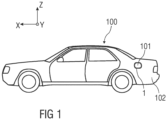
- FIG 1 shows a vehicle 100 with an opening 101 in a vehicle outer skin 102.
- the opening 101 is, for example, a tank opening or loading opening.
- the opening 101 is, for example, by means of a flap unit 1 covered, which is described in more detail below.
- the flap unit 1 can be installed in the area of the opening 101 in the outer skin 102 of the vehicle.
- a valve unit 1 is described below in a Cartesian coordinate system defined by three mutually perpendicular spatial directions.
- a longitudinal direction X is substantially horizontal to and preferably parallel to a longitudinal direction of the vehicle 100, which corresponds to the usual direction of travel of the vehicle 100.
- a transverse direction Y which runs perpendicular to the longitudinal direction X, is likewise oriented horizontally in the vehicle 100 and runs parallel to a transverse direction Y of the vehicle 100.
- a vertical direction Z runs perpendicular to the longitudinal direction X and perpendicular to the transverse direction Y.
- a vertical arrangement should be understood to mean an arrangement parallel to the vertical Z direction.
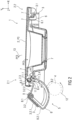
- figure 2 shows a schematic sectional view of a first embodiment of a flap unit 1 with a screen 2.
- the flap unit 1 comprises at least the screen 2 and a frame 3 .
- the screen 2 is arranged within a peripheral area of the frame 3 .
- the flap unit 1 is inserted with the frame 3 into the opening 101 in the vehicle outer skin 102 and fixed there.
- the frame 3 forms an edge of the opening 101, for example.
- figure 2 shows the screen 2 in a closed position P0, in which the screen 2 terminates flush with the frame 3 in particular.
- the panel 2 is used to cover an opening 101, in particular a loading opening or tank opening, of a vehicle 100, not shown that the panel 2 terminates flush with the frame 3 as well as flush with the outer skin 102 of the vehicle.
- the panel 2 is a movable panel 2 and is designed, for example, as a closure cover or a closure flap for the loading opening or tank opening.
- the panel 2 can be cup-shaped as shown.
- the aperture 2 can be disc-shaped. Facing away from the frame 3, the panel 2 has a surface shape that corresponds to a vehicle outer skin 102, in particular a largely flat or slightly curved shape.
- the aperture 2 is set up in such a way that it can be actuated and/or adjusted both electrically and manually.
- the aperture 2 can be adjusted electrically.
- An electric drive mechanism 4 is coupled, for example, to an adjusting mechanism 5 for the panel 2 and can be designed, for example, as a motor drive, in particular a spindle drive or a gear drive.
- the drive mechanism 4 and the adjustment mechanism 5 are arranged on a drive end 2.1 of the panel 2 and coupled to it.
- the screen On a holding end 2.2 of the screen 2 opposite the drive end 2.1, the screen is provided with a locking mechanism 6, for example a locking hook 6.1.
- the panel 2 can be releasably locked to the frame 3 by means of the locking mechanism 6 .
- the closure mechanism 6 is designed as a latching mechanism, in particular a positive latching connection. In the closed position P0 of the diaphragm 2, a counter bearing for the drive end 2.1 of the diaphragm 2 is thus formed on the holding end 2.2 of the diaphragm 2 facing away from the drive.
- the latching hook 6.1 engages, for example, in the closed position P0 of the panel 2 in an undercut 3.1 of the frame 3 in a releasably locking manner.
- the cover 2 is provided on the inside with a seal 7, for example a sealing ring, sealing lips and/or sealing strip.
- a seal 7 in the direction of the panel 2, in particular a sealing ring, sealing lips and/or sealing strip.
- the adjustment mechanism 5 can alternatively be coupled to a manual actuating mechanism for the panel 2, which is not shown in detail.
- a manual actuation mechanism is in particular coupled directly to the panel 2 and can be designed, for example, as a pressure actuation, in particular a so-called push-push mechanism, on the panel 2 .
- the shutter 2 can be moved both during an opening movement of the shutter 2 from the closed position P0 to an open position P2 (shown in Fig figure 5 ) as well as during a closing movement of the panel 2 from the open position P2 into the closed position P0 about a first axis of rotation 9, wherein the panel 2 can be pivoted about a second axis of rotation 10 relative to the adjustment mechanism 5 and at least partially translationally into a partially raised intermediate position P1 (shown in figure 3 ) is movable.
- the panel 2 When the panel 2 is moved from the partially raised intermediate position P1 to the open position P2 and vice versa, the panel 2 can be pivoted about the first axis of rotation 9 together with the adjustment mechanism 5 .
- the adjusting mechanism 5 can be designed as a double swivel joint 8 .
- the double swivel joint 8 comprises a first swivel joint 8.1, which is articulated to the frame 3 and is connected to a second swivel joint 8.3, which is articulated to the panel 2, via a connecting member 8.2.
- the adjusting mechanism 5 of the present panel 2 includes an additional joint, in particular the second pivot joint 8.3.
- the connecting member 8.2 is designed in particular as a pivoting lever, coupling lever or adjusting lever or pivoting arm, coupling arm or adjusting arm.
- the connecting member 8.2 is coupled on the one hand to the screen 2 and on the other hand is mounted on the frame 3 such that it can pivot about the first axis of rotation 9 by means of the first pivot joint 8.1.
- the panel 2 is pivotally mounted relative to the frame 3 by means of the pivotally mounted connecting member 8.2.
- the connecting link 8.2 can be made in one piece.
- the adjustment mechanism 5 has a joint socket 3.2 arranged on the frame 3 for the first pivot joint 8.1.
- the joint socket 3.2 is formed in the area of the drive end 2.1.
- the connecting link 8.2 is designed in section as a 2-legged, L-shaped, hook-shaped or arc-shaped pivoting lever.
- the connecting member 8.2 has the first rotary joint 8.1 on one end facing the frame 3, in particular the joint socket 3.2, and an adjusting pin 8.4 on one end facing the panel 2.
- the first rotary joint 8.1 is sleeve-shaped or cylindrical or spherical.
- Two stop arms 3.2.1 and 3.2.2 protrude from the joint socket 3.2 and serve as end stops for the adjusting mechanism 5 of the panel 2, in particular for the double swivel joint 8, for example for its connecting link 8.2.
- the stop arms 3.2.1 and 3.2.2 protrude from the socket 3.2 in such a way that the pivoting movement of the shutter 2 between the closed position P0 and the open position P2 (shown in Fig figure 5 ) is limited.
- at least one leg 8.2.1 of the connecting link 8.2 strikes the stop arm 3.2.1 (shown in Fig figure 2 ) and in the open position P2 on the stop arm 3.2.2 (shown in figure 5 ) at.
- the panel 2 also has an inner bearing element 2.3 for the second pivot joint 8.3.
- the panel 2 is pivotally mounted by means of the second pivot joint 8.3 about the second axis of rotation 10 relative to the frame 3 and to the connecting member 8.2.
- the panel 2 can be formed in one piece.
- the panel 2 can be made in several parts, in particular in two parts.
- a spring element 11 can be provided on the drive side, the drive end 2.1, of the panel 2, in particular in the area of the second pivot joint 8.3.
- the shutter 2 is held on the frame 3 in a prestressed manner in the closed position P0 by means of the spring element 11 .
- the greatest possible sealing pressure can be generated in the closed position P0 when the spring element 11 is tensioned, so that the screen 2 is flush with the frame 3 and is in sealing contact with the frame 3 by means of the seals 7.
- the spring element 11 is designed as a bistable torsion spring.
- the spring element 11 has two spring arms 11.1, 11.2. In the closed position P0 of the screen 2, the spring element 11 is tensioned. The spring force of the spring element 11 pulls the two spring arms 11.1 and 11.2 towards one another, as shown by the arrows PF1. As a result, both the aperture pin 2.4 and the adjustment pin 8.4 are subjected to an associated spring force of the relevant spring arm 11.1 or 11.2. As a result of this spring force of spring element 11, panel 2 is pulled in the direction of frame 3 according to arrow PF2, so that panel 2 rests against frame 3 in a form-fitting and sealing manner.
- first axis of rotation 9 of the first pivot joint 8.1 and the second axis of rotation 10 of the second pivot joint 8.3 are parallel arranged to each other.
- the axes of rotation 9, 10 can run vertically or horizontally depending on the opening direction of the panel 2, correspondingly horizontally or vertically.
- the axes of rotation 9, 10 run vertically and the panel 2 can be opened in the horizontal direction according to arrow PF3.
- the connecting link 8.2 in particular designed as an adjusting lever, pivoting lever or coupling lever, is configured in such a way that it moves on the first rotary joint 8.1 about its first axis of rotation 9 in a first arc 12.
- the panel 2, in particular a closure cover, is configured in such a way that it moves on the second rotary joint 8.3 about its second axis of rotation 10 in a second arc 13 according to arrow PF3.
- the shutter 2 can be moved into the partially raised intermediate position P1, which is shown in figure 3 is shown.
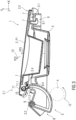
- figure 3 shows a sectional view of the flap unit 1 with the screen 2 in the partially raised intermediate position P1, in which the screen 2 contacts the frame 3 at least in certain areas.
- the panel 2 can be positioned or positioned in relation to the frame 3 by means of the adjustment mechanism 5 in the partially raised intermediate position P1 in such a way that the drive end 2.1 of the panel 2 is raised and spaced from the frame 3 and the opposite drive-remote holding end 2.2 of the panel 2 with the frame 3 continues to be contacted, with the panel 2 already being unlocked.
- the latching hook 6.1 is disengaged from the undercut 3.1, which is designed as a latching projection on the frame 3, for example.
- the adjusting mechanism 5 is designed, for example, in such a way that it moves the panel 2 out of the plane of the frame 3, in particular initially pivots it into the raised intermediate position P1.
- the adjustment mechanism 5 is set up such that the panel 2 is first moved in the first arc 12 about the first axis of rotation 9, so that the drive end 2.1 is raised relative to the frame 3 and the vehicle outer skin 102 and the holding end 2.2 is unlocked.
- the opposite holding end 2.2 remains in contact with the frame 3.
- the flap unit 1 can be designed without a frame.
- the panel 2 continues to contact the vehicle outer skin 102 with its holding end 2.2.
- the spring element 11 relaxes, with the spring arm 11.2 being moved in the direction of the panel 2 according to the arrow PF4, so that the panel 2 pivots relative to the adjustment mechanism 5 about the second axis of rotation 10 in a second arc 13 according to the arrow PF3 and at least partially translationally according to the arrow PF5 is moved so that the drive end 2.1 of the panel 2 is raised and the panel 2 is unlocked, in particular the latching hook 6.1 disengages from the undercut 3.1.
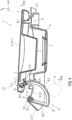
- figure 4 shows a sectional view of the flap unit 1 with the screen 2 in a completely raised intermediate position P1.1, in particular completely spaced apart from the frame 3, in which the holding end 2.2 of the screen 2 no longer makes contact with the frame 3.
- the panel 2 reaches this fully raised intermediate position P1.1 by further movement of the adjustment mechanism 5, in particular of the connecting member 8.2, about the first axis of rotation 9 according to arrow PF6.
- the screen 2 is pivoted about the first axis of rotation 9 together with the connecting member 8.2.
- the spring element 11 remains relaxed.
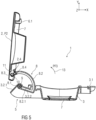
- figure 5 shows a sectional view of the flap unit 1 with the panel 2 in the open position P2.
- the screen 2 is positioned largely perpendicular to the frame 3.
- the spring element 11 remains relaxed.
- the Aperture 2 has been pivoted together with the adjusting mechanism 5 about the first axis of rotation 9 according to arrow PF 3 into the open position P2.
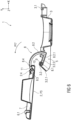
- figure 6 shows a sectional view of the flap unit 1 with the panel 2 in a misuse position P3.
- the diaphragm 2 was manually actuated, in particular pivoted, relative to the adjustment mechanism 5 about the second axis of rotation 10 according to arrow PF7.
- the adjusting mechanism 5 is fixed due to the impact of the leg 8.2.1 on the stop arm 3.2.2 of the frame 3.
- the panel 2 can thus be pivoted about the second axis of rotation 10 relative to the frame 3 and to the adjustment mechanism 5 by means of the second rotary joint 8.3.
- the spring element 11 is tensioned in that the diaphragm pin 2.4 entrains the corresponding spring arm 11.1 during the pivoting movement of the diaphragm 2 according to arrow PF7. If the shutter 2 is no longer actuated, then due to the relaxation of the spring element 11 it is automatically returned to the open position P2 and further until the spring element 11 is relaxed.
- figure 7 shows a sectional view of the flap unit 1 with the panel 2 during a closing movement of the panel 2 as a result of the relaxation of the spring element 11 according to arrow PF8.
Landscapes
- Engineering & Computer Science (AREA)
- Life Sciences & Earth Sciences (AREA)
- Sustainable Development (AREA)
- Sustainable Energy (AREA)
- Chemical & Material Sciences (AREA)
- Combustion & Propulsion (AREA)
- Transportation (AREA)
- Mechanical Engineering (AREA)
- Cooling, Air Intake And Gas Exhaust, And Fuel Tank Arrangements In Propulsion Units (AREA)
- Power-Operated Mechanisms For Wings (AREA)
- Superstructure Of Vehicle (AREA)
- Specific Sealing Or Ventilating Devices For Doors And Windows (AREA)
Abstract
- einen Rahmen (3), und
- eine bewegbare Blende (2) umfasst, die innerhalb eines Umfangsbereichs des Rahmens (3) angeordnet ist,
wobei die Blende (2) zwischen einer geschlossenen Position (P0), in welcher die Blende (2) bündig mit dem Rahmen (3) abschließt und gehalten ist, und einer geöffneten Position (P2) bewegbar ist, und
wobei die Blende (2) sowohl bei einer Öffnungsbewegung aus der geschlossenen Position (P0), als auch bei einer Schließbewegung aus der geöffneten Position (P2), in eine teilweise angehobene Zwischenposition (P1) bewegbar ist.
Description
- Die Erfindung betrifft eine Klappeneinheit zur Abdeckung einer Öffnung, insbesondere einer Ladeöffnung oder Tanköffnung an einem Fahrzeug. Des Weiteren betrifft die Erfindung ein Fahrzeug mit einer solchen Klappeneinheit.
- An Fahrzeugen werden Öffnungen in der Fahrzeugkarosserie, wie zum Beispiel eine Ladeöffnung oder Tanköffnung, mittels einer Blende oder Klappe (auch Verschlussdeckel genannt) verschlossen, um eine Verschmutzung und einen Missbrauch zu verhindern. Klappen sind beispielsweise aus der
DE 10 2020 207 669 A1 oderDE 10 2012 009 018 A1 bekannt. - Aufgabe der vorliegenden Erfindung ist es, eine Klappeneinheit zur Abdeckung einer Öffnung an einem Fahrzeug bereitzustellen, welche einfach aufgebaut und einfach zu bedienen ist. Insbesondere soll eine Klappeneinheit angegeben werden, welche auch bei einer großen, insbesondere langen, Blende hinreichend dicht in einer geschlossenen Stellung gehalten ist. Des Weiteren ist es Aufgabe der Erfindung, ein Fahrzeug mit einer verbesserten Klappeneinheit anzugeben.
- Die erstgenannte Aufgabe wird erfindungsgemäß gelöst durch eine Klappeneinheit mit den Merkmalen des Patentanspruchs 1. Hinsichtlich des Fahrzeugs wird die Aufgabe erfindungsgemäß mit den Merkmalen des Patentanspruchs 10 gelöst.
- Vorteilhafte Weiterbildungen sind Gegenstand der abhängigen Patentansprüche.
- Die erfindungsgemäße Klappeneinheit zur Abdeckung einer Öffnung, insbesondere eine Ladeöffnung oder Tanköffnung, eines Fahrzeugs, umfasst zumindest einen Rahmen und eine Blende, zum Beispiel einen Verschlussdeckel oder eine Verschlussklappe, die an dem Rahmen mittels eines Verstellmechanismus bewegbar angeordnet ist, wobei die Blende zwischen einer geschlossenen Position und einer geöffneten Position bewegbar ist, und wobei sowohl bei einer Öffnungsbewegung der Blende aus der geschlossenen Position in die geöffnete Position als auch bei einer Schließbewegung der Blende aus der geöffneten Position in die geschlossene Position der Verstellmechanismus um eine erste Drehachse schwenkbar ist und die Blende gegenüber dem Verstellmechanismus um eine zweite Drehachse schwenkbar und zumindest anteilig translatorisch in eine, insbesondere teilweise, angehobene Zwischenposition bewegbar ist. Die Blende ist dabei insbesondere derart kombiniert schwenk- und anteilig translatorisch in die angehobene Zwischenposition bewegbar, dass die Blende entriegelt ist.
- Die Blende ist derart eingerichtet, dass diese sowohl elektrisch als auch manuell betätigt werden kann.
- Die mit der Erfindung erzielten Vorteile bestehen insbesondere darin, dass mittels der teilweise angehobenen Zwischenposition der Blende zum Beispiel bei der Schließbewegung zunächst ein antriebsabgewandtes Halteende der Blende mit dem Rahmen kontaktiert, so dass bei einer weiteren Schließbewegung dieses antriebsabgewandte Halteende der Blende formschlüssig in die geschlossene, insbesondere verriegelnde, Position gebracht werden kann und sich danach ein Antriebsende der Blende flächenbündig und dichtend an den Rahmen legt. Somit ist eine höhere Dichtungskraft der Blende am Rahmen ermöglicht, da auf dem Antriebsende die Antriebskraft, insbesondere eine Motorkraft, wirkt und auf dem antriebsabgewandten Halteende der Blende ein Gegenlager gebildet ist.
- Darüber hinaus ermöglicht eine solche Klappeneinheit mit Antriebsende oder Antriebsseite und verriegelndem Gegenlager auf dem antriebsabgewandten Halteende der Blende eine erhöhte Sicherheit gegen Vandalismus, da die Blende auf beiden Seiten beziehungsweise Enden formschlüssig anliegt und verriegelt wird. Darüber hinaus ist eine flächenbündige Ausrichtung der Blende am Rahmen mittels eines keilförmigen Hinterschnitts am antriebsabgewandten Halteende der Blende ermöglicht.
- Bei einer Öffnungsbewegung der Blende hingegen ermöglicht die angehobene Zwischenposition, dass das Antriebsende der Blende zunächst angehoben wird und das antriebsabgewandte Halteende erst später geöffnet, insbesondere nach außen in die geöffnete Position geschwenkt, wird. Hierdurch ist eine Eisaufbrechkraft erhöht. Beispielsweise wird dies durch einen Vorlauf auf dem Antriebsende, welches zuerst in die Zwischenposition angehoben wird, ermöglicht, wobei das antriebsabgewandte Halteende der Blende weiterhin mit dem Rahmen kontaktiert. Somit ist die Blende nicht starr am Rahmen angebunden und wird nicht zeitgleich und parallel vom Rahmen entfernt.
- Ein weiterer Aspekt sieht vor, dass beim Bewegen der Blende von der angehobenen Zwischenposition in die geöffnete Position und umgekehrt die Blende gemeinsam mit dem Verstellmechanismus um die erste Drehachse schwenkbar ist. Hierbei wird die Blende relativ zum Rahmen und beispielsweise zu einer Fahrzeugaußenhaut, in welcher der Rahmen montiert ist, bewegt und dabei geöffnet oder geschlossen.
- Eine Weiterbildung sieht vor, dass der Verstellmechanismus zwischen Blende und Rahmen angeordnet ist. Insbesondere ist der Verstellmechanismus an dem Antriebsende der bewegbaren Blende zwischen Blende und Rahmen angeordnet.
- Insbesondere ist die Blende mittels des Verstellmechanismus in der teilweise gespannten angehobenen Zwischenposition derart zum Rahmen positionierbar, dass das Antriebsende der Blende anhebbar oder angehoben ist, insbesondere zum Rahmen hin beabstandet anhebbar oder angehoben ist, und das gegenüberliegende antriebsabgewandte Ende der Blende mit dem Rahmen kontaktiert.
- Ein weiteres Ausführungsbeispiel sieht vor, dass die Blende an dem Halteende, insbesondere auf der antriebsabgewandten Seite der Blende, mittels eines Verschlussmechanismus am Rahmen lösbar verriegelbar ist. Beispielsweise ist der Verschlussmechanismus als ein Rastmechanismus, insbesondere eine formschlüssige Rastverbindung, ausgebildet. In der geschlossenen Position der Blende ist somit an dem antriebsabgewandten Halteende der Blende ein Gegenlager für das Antriebsende der Blende gegeben.
- In einem weiteren Ausführungsbeispiel umfasst der Verstellmechanismus ein Doppeldrehgelenk. Beispielsweise umfasst das Doppeldrehgelenk ein erstes Drehgelenk, welches an dem Rahmen angelenkt ist, und über ein Verbindungsglied mit einem zweiten Drehgelenk verbunden ist, welches an der Blende angelenkt ist. Mit anderen Worten: Gegenüber einer herkömmlichen Verstellvorrichtung für eine Blende umfasst der Verstellmechanismus der vorliegenden Blende ein zusätzliches Drehgelenk. Das Verbindungsglied ist insbesondere als ein Schwenkhebel, Koppelhebel oder Verstellhebel oder Schwenkarm, Koppelarm oder Verstellarm ausgebildet.
- Das Verbindungsglied, insbesondere der Verstellhebel, ist einerseits mit der Blende gekoppelt und andererseits an dem Rahmen um die erste Drehachse mittels des ersten Drehgelenks schwenkbar gelagert. Der Verstellhebel ist beispielsweise derart ausgebildet, dass dieser die Blende aus der Ebene des Rahmens bewegt, insbesondere zunächst in die angehobene Zwischenposition schwenkt und hebt und anschließend in die geöffnete Position schwenkt.
- Dabei kann der Verstellhebel einteilig ausgebildet sein. Der Verstellmechanismus weist eine am Rahmen angeordnete Gelenkpfanne für das erste Drehgelenk auf. Die Blende umfasst darüber hinaus ein inneres Lagerelement für das zweite Drehgelenk.
- Die Blende kann in einer möglichen Ausführungsform einteilig ausgebildet sein. Alternativ kann die Blende mehrteilig, insbesondere zweigeteilt, ausgebildet sein.
- Die Betätigung und/oder Verstellung der Blende kann manuell, zum Beispiel mittels Druckbetätigung und manueller Verstellbewegung, oder elektrisch, zum Beispiel mittels einer elektrisch bewegbaren Blende, erfolgen.
- Der Verstellmechanismus kann beispielsweise mit einem Betätigungsmechanismus für die Blende gekoppelt sein. Ein elektrischer Betätigungsmechanismus ist direkt mit dem Verstellmechanismus gekoppelt und kann beispielsweise als ein Motorantrieb, insbesondere ein Spindelantrieb oder Zahnradantrieb, ausgebildet sein. Ein manueller Betätigungsmechanismus ist direkt mit der Blende gekoppelt und kann beispielsweise als eine Druckbetätigung, insbesondere eine sogenannte Push-Push-Mechanik, ausgebildet sein.
- Zusätzlich kann insbesondere an dem Antriebsende der Blende, insbesondere im Bereich des zweiten Drehgelenks, ein Federelement vorgesehen sein, mittels dessen die Blende in Richtung des Rahmens gespannt in der geschlossenen Position gehalten ist. Insbesondere bei einer großflächigen Blende kann bei gespannter Feder in der geschlossenen Position ein größtmöglicher Dichtungsdruck erzeugt werden, so dass die Blende bündig mit dem Rahmen abschließt und dichtend am Rahmen anliegt. Beispielsweise ist das Federelement als eine bistabile Schenkelfeder ausgebildet.
- In einem einfachen Ausführungsbeispiel sind die Drehachsen des ersten Drehgelenks und des zweiten Drehgelenks parallel zueinander angeordnet. Dabei können je nach Öffnungssinn der Blende, vertikal oder horizontal öffnend, die Drehachsen entsprechend horizontal beziehungsweise vertikal verlaufen.
- Das Verbindungsglied, insbesondere ausgebildet als ein Verstellhebel, Schwenkhebel oder Koppelhebel, ist derart konfiguriert, dass es sich an dem ersten Drehgelenk um die erste Drehachse in einem ersten Bogen bewegt. Die Blende, insbesondere ein Verschlussdeckel, ist derart konfiguriert, dass sie sich an dem zweiten Drehgelenk um die zweite Drehachse in einem zweiten Bogen bewegt.
- Ein erfindungsgemäßes Fahrzeug umfasst eine Öffnung, insbesondere eine Ladeöffnung oder Tanköffnung, und die zuvor beschriebene Klappeneinheit zum Abdecken der Öffnung.
- Ausführungsbeispiele der Erfindung werden anhand von Zeichnungen näher erläutert. Dabei zeigen:
- Figur 1
- ein Fahrzeug mit einer Öffnung und einer Klappeneinheit zum Abdecken der Öffnung,
- Figur 2
- eine Schnittdarstellung einer Klappeneinheit mit einer Blende in einer geschlossenen Position,
- Figur 3
- eine Schnittdarstellung einer Klappeneinheit mit einer Blende in einer angehobenen Zwischenposition, in welcher die Blende zumindest bereichsweise mit dem Rahmen kontaktiert,
- Figur 4
- eine Schnittdarstellung einer Klappeneinheit mit einer Blende in einer angehobenen und zum Rahmen beabstandete Zwischenposition,
- Figur 5
- eine Schnittdarstellung einer Klappeneinheit mit einer Blende in einer geöffneten Position,
- Figur 6
- eine Schnittdarstellung einer Klappeneinheit mit einer Blende in einer Missbrauchsposition, und
- Figur 7
- eine Schnittdarstellung einer Klappeneinheit mit einer Blende in einer Schließbewegung.
- Einander entsprechende Teile sind in allen Figuren mit den gleichen Bezugszeichen versehen.
-
Figur 1 zeigt ein Fahrzeug 100 mit einer Öffnung 101 in einer Fahrzeugaußenhaut 102. Die Öffnung 101 ist beispielsweise eine Tanköffnung oder Ladeöffnung. Die Öffnung 101 ist beispielsweise mittels einer Klappeneinheit 1 abdeckbar, die nachfolgend näher beschrieben wird. Die Klappeneinheit 1 ist dazu im Bereich der Öffnung 101 in die Fahrzeugaußenhaut 102 montierbar. - Unter Bezugnahme auf die Zeichnungen ist nachstehend eine Klappeneinheit 1 in einem kartesischen Koordinatensystem beschrieben, das durch drei zueinander senkrechte räumliche Richtungen definiert ist. Wenn die Klappeneinheit 1 in dem Fahrzeug 100 installiert ist, verläuft eine Längsrichtung X im Wesentlichen horizontal zu und vorzugsweise parallel mit einer Längsrichtung des Fahrzeugs 100, die der gewöhnlichen Fahrtrichtung des Fahrzeugs 100 entspricht. Eine Querrichtung Y, die senkrecht zu der Längsrichtung X verläuft, ist gleichermaßen horizontal im Fahrzeug 100 orientiert und verläuft parallel zu einer Querrichtung Y des Fahrzeugs 100. Eine vertikale Richtung Z verläuft senkrecht zu der Längsrichtung X und senkrecht zu der Querrichtung Y. Eine vertikale Anordnung sollte so verstanden werden, dass damit eine Anordnung gemeint ist, die parallel zu der vertikalen Richtung Z verläuft.
-
Figur 2 zeigt schematisch in Schnittdarstellung eine erste Ausführungsform einer Klappeneinheit 1 mit einer Blende 2. - Die Klappeneinheit 1 umfasst zumindest die Blende 2 und einen Rahmen 3. Die Blende 2 ist innerhalb eines Umfangsbereichs des Rahmens 3 angeordnet. Die Klappeneinheit 1 ist mit dem Rahmen 3 in die Öffnung 101 in der Fahrzeugaußenhaut 102 eingesetzt und dort fixiert. Der Rahmen 3 bildet beispielsweise einen Rand der Öffnung 101 aus.
-
Figur 2 zeigt die Blende 2 in einer geschlossenen Position P0, in welcher die Blende 2 insbesondere bündig mit dem Rahmen 3 abschließt. Die Blende 2 dient der Abdeckung einer Öffnung 101, insbesondere einer Ladeöffnung oder Tanköffnung, eines nicht dargestellten Fahrzeugs 100. Hierzu ist die Klappeneinheit 1 mittels des Rahmens 3 beispielsweise in einer nicht dargestellten Aufnahme einer Fahrzeugaußenhaut 102 entsprechend angeordnet und montiert, so dass die Blende 2 sowohl bündig mit dem Rahmen 3 als auch bündig mit der Fahrzeugaußenhaut 102 abschließt. - Die Blende 2 ist eine bewegbare Blende 2 und zum Beispiel als ein Verschlussdeckel oder eine Verschlussklappe für die Ladeöffnung oder Tanköffnung ausgebildet. Die Blende 2 kann wie dargestellt topfförmig ausgebildet sein. Alternativ kann die Blende 2 scheibenförmig ausgebildet sein. Vom Rahmen 3 weggewandt weist die Blende 2 eine mit einer Fahrzeugaußenhaut 102 korrespondierende Oberflächenform, insbesondere eine weitgehend ebene oder leicht gewölbte Form, auf.
- Die Blende 2 ist derart eingerichtet, dass diese sowohl elektrisch als auch manuell betätigt und/oder verstellt werden kann.
- Die Verstellung der Blende 2 kann elektrisch erfolgen. Ein elektrischer Antriebsmechanismus 4 ist zum Beispiel mit einem Verstellmechanismus 5 für die Blende 2 gekoppelt und kann beispielsweise als ein Motorantrieb, insbesondere ein Spindelantrieb oder Zahnradantrieb, ausgebildet sein. Der Antriebsmechanismus 4 und der Verstellmechanismus 5 sind an einem Antriebsende 2.1 der Blende 2 angeordnet und mit dieser gekoppelt.
- An einem dem Antriebsende 2.1 gegenüberliegenden Halteende 2.2 der Blende 2 ist diese mit einem Verschlussmechanismus 6, zum Beispiel einem Rasthaken 6.1, versehen. Die Blende 2 ist mittels des Verschlussmechanismus 6 am Rahmen 3 lösbar verriegelbar ist. Beispielsweise ist der Verschlussmechanismus 6 als ein Rastmechanismus, insbesondere eine formschlüssige Rastverbindung, ausgebildet. In der geschlossenen Position P0 der Blende 2 ist somit auf dem antriebsabgewandten Halteende 2.2 der Blende 2 ein Gegenlager für das Antriebsende 2.1 der Blende 2 gebildet.
- Der Rasthaken 6.1 greift beispielsweise in der geschlossenen Position P0 der Blende 2 in einen Hinterschnitt 3.1 des Rahmens 3 lösbar verriegelnd ein.
- Die Blende 2 ist in Richtung des Rahmens 3 innenseitig mit einer Dichtung 7, zum Beispiel einem Dichtungsring, Dichtungslippen und/oder Dichtungsstrang, versehen. Zusätzlich oder alternativ kann der Rahmen 3 in Richtung der Blende 2 mit einer Dichtung 7, insbesondere einem Dichtungsring, Dichtungslippen und/oder Dichtungsstrang, versehen sein.
- Der Verstellmechanismus 5 kann alternativ mit einem manuellen, nicht näher dargestellten Betätigungsmechanismus für die Blende 2 gekoppelt sein. Ein solcher manueller Betätigungsmechanismus ist insbesondere direkt mit der Blende 2 gekoppelt und kann beispielsweise als eine Druckbetätigung, insbesondere eine sogenannte Push-Push-Mechanik, an der Blende 2 ausgebildet sein.
- Mittels des Verstellmechanismus 5 ist die Blende 2 sowohl bei einer Öffnungsbewegung der Blende 2 aus der geschlossenen Position P0 in eine geöffnete Position P2 (dargestellt in
Figur 5 ) als auch bei einer Schließbewegung der Blende 2 aus der geöffneten Position P2 in die geschlossene Position P0 um eine erste Drehachse 9 schwenkbar, wobei die Blende 2 gegenüber dem Verstellmechanismus 5 um eine zweite Drehachse 10 schwenkbar und zumindest anteilig translatorisch in eine teilweise angehobene Zwischenposition P1 (dargestellt inFigur 3 ) bewegbar ist. - Beim Bewegen der Blende 2 von der teilweise angehobenen Zwischenposition P1 in die geöffnete Position P2 und umgekehrt ist die Blende 2 gemeinsam mit dem Verstellmechanismus 5 um die erste Drehachse 9 schwenkbar.
- Der Verstellmechanismus 5 kann als ein Doppeldrehgelenk 8 ausgebildet sein. Beispielsweise umfasst das Doppeldrehgelenk 8 ein erstes Drehgelenk 8.1, welches an dem Rahmen 3 angelenkt ist, und über ein Verbindungsglied 8.2 mit einem zweiten Drehgelenk 8.3 verbunden ist, welches an der Blende 2 angelenkt ist.
- Gegenüber einer herkömmlichen Verstellvorrichtung für eine Blende 2 umfasst der Verstellmechanismus 5 der vorliegenden Blende 2 ein zusätzliches Gelenk, insbesondere das zweite Drehgelenk 8.3.
- Das Verbindungsglied 8.2 ist insbesondere als ein Schwenkhebel, Koppelhebel oder Verstellhebel oder Schwenkarm, Koppelarm oder Verstellarm ausgebildet.
- Das Verbindungsglied 8.2 ist einerseits mit der Blende 2 gekoppelt und andererseits an dem Rahmen 3 um die erste Drehachse 9 mittels des ersten Drehgelenks 8.1 schwenkbar gelagert. Die Blende 2 ist mittels des schwenkbar gelagerten Verbindungsglieds 8.2 relativ zum Rahmen 3 schwenkbar gelagert.
- Das Verbindungsglied 8.2 kann einteilig ausgebildet sein. Der Verstellmechanismus 5 weist eine am Rahmen 3 angeordnete Gelenkpfanne 3.2 für das erste Drehgelenk 8.1 auf. Die Gelenkpfanne 3.2 ist im Bereich des Antriebsende 2.1 ausgebildet. Das Verbindungsglied 8.2 ist im Schnitt als ein 2-schenkliger, L-förmiger, hakenförmiger oder bogenförmiger Schwenkhebel ausgebildet. Das Verbindungsglied 8.2 weist an einem dem Rahmen 3, insbesondere der Gelenkpfanne 3.2, zugewandten Ende das erste Drehgelenk 8.1 und an einem der Blende 2 zugewandten Ende einen Verstellzapfen 8.4 auf. Das erste Drehgelenk 8.1 ist hülsenförmig oder zylindrisch oder kugelförmig ausgebildet.
- Von der Gelenkpfanne 3.2 stehen zwei Anschlagsarme 3.2.1 und 3.2.2 ab, welche als Endanschläge für den Verstellmechanismus 5 der Blende 2, insbesondere für das Doppeldrehgelenk 8, beispielsweise für dessen Verbindungsglied 8.2, dienen. Die Anschlagsarme 3.2.1 und 3.2.2 stehen derart von der Gelenkpfanne 3.2 ab, dass die Schwenkbewegung der Blende 2 zwischen der geschlossenen Position P0 und der geöffneten Position P2 (dargestellt in
Figur 5 ) begrenzt wird. Dazu schlägt zumindest ein Schenkel 8.2.1 des Verbindungsgliedes 8.2 in der geschlossenen Position P0 an dem Anschlagarm 3.2.1 (dargestellt inFigur 2 ) und in der geöffneten Position P2 an dem Anschlagarm 3.2.2 (dargestellt inFigur 5 ) an. - Die Blende 2 weist darüber hinaus ein inneres Lagerelement 2.3 für das zweite Drehgelenk 8.3 auf. Die Blende 2 ist mittels des zweiten Drehgelenks 8.3 um die zweite Drehachse 10 relativ zum Rahmen 3 und zum Verbindungsglied 8.2 schwenkbar gelagert.
- Die Blende 2 kann in einer möglichen Ausführungsform einteilig ausgebildet sein. Alternativ kann die Blende 2 mehrteilig, insbesondere zweigeteilt, ausgebildet sein.
- Zusätzlich kann auf der Antriebsseite, dem Antriebsende 2.1, der Blende 2, insbesondere im Bereich des zweiten Drehgelenks 8.3, ein Federelement 11 vorgesehen sein. Mittels des Federelements 11 ist die Blende 2 vorgespannt in der geschlossenen Position P0 an dem Rahmen 3 gehalten.
- Insbesondere bei einer großflächigen Blende 2 kann in der geschlossenen Position P0 bei gespanntem Federelement 11 ein größtmöglicher Dichtungsdruck erzeugt werden, so dass die Blende 2 bündig mit dem Rahmen 3 abschließt und mittels der Dichtungen 7 dichtend am Rahmen 3 anliegt. Beispielsweise ist das Federelement 11 als eine bistabile Schenkelfeder ausgebildet.
- Das Federelement 11 weist zwei Federarme 11.1, 11.2 auf. In der geschlossenen Position P0 der Blende 2 ist das Federelement 11 gespannt. Die Federkraft des Federelements 11 zieht die beiden Federarme 11.1 und 11.2 zueinander, wie anhand der Pfeile PF1 gezeigt. Hierdurch werden sowohl der Blendenzapfen 2.4 als auch der Verstellzapfen 8.4 mit einer zugehörigen Federkraft des betreffenden Federarms 11.1 beziehungsweise 11.2 beaufschlagt. Infolge dieser Federkraft des Federelements 11 wird die Blende 2 gemäß Pfeil PF2 in Richtung des Rahmens 3 gezogen, so dass die Blende 2 formschlüssig und dichtend an dem Rahmen 3 anliegt.
- In einem einfachen Ausführungsbeispiel sind die erste Drehachse 9 des ersten Drehgelenks 8.1 und die zweite Drehachse 10 des zweiten Drehgelenks 8.3 parallel zueinander angeordnet. Dabei können die Drehachsen 9, 10 je nach Öffnungssinn der Blende 2, vertikal oder horizontal öffnend, entsprechend horizontal beziehungsweise vertikal verlaufen. Im Ausführungsbeispiel verlaufen die Drehachsen 9, 10 vertikal und die Blende 2 kann in horizontaler Richtung gemäß Pfeil PF3 geöffnet werden.
- Das Verbindungsglied 8.2, insbesondere ausgebildet als ein Verstellhebel, Schwenkhebel oder Koppelhebel, ist derart konfiguriert, dass es sich an dem ersten Drehgelenk 8.1 um dessen erste Drehachse 9 in einem ersten Bogen 12 bewegt. Die Blende 2, insbesondere ein Verschlussdeckel, ist derart konfiguriert, dass er sich an dem zweiten Drehgelenk 8.3 um dessen zweite Drehachse 10 in einem zweiten Bogen 13 gemäß Pfeil PF3 bewegt.
- Sowohl bei einer Öffnungsbewegung aus der geschlossenen Position P0 der Blende 2 als auch bei einer Schließbewegung aus der geöffneten Position P2 der Blende 2 ist die Blende 2 jeweils in die teilweise angehobene Zwischenposition P1 bewegbar, die in
Figur 3 dargestellt ist. -
Figur 3 zeigt eine Schnittdarstellung der Klappeneinheit 1 mit der Blende 2 in der teilweise angehobenen Zwischenposition P1, in welcher die Blende 2 zumindest bereichsweise mit dem Rahmen 3 kontaktiert. - Insbesondere ist die Blende 2 mittels des Verstellmechanismus 5 in der teilweise angehobenen Zwischenposition P1 derart zum Rahmen 3 positionierbar oder positioniert, dass das Antriebsende 2.1 der Blende 2 angehoben und von dem Rahmen 3 beabstandet ist und das gegenüberliegende antriebsabgewandte Halteende 2.2 der Blende 2 mit dem Rahmen 3 weiterhin kontaktiert, wobei die Blende 2 bereits entriegelt ist. Der Rasthaken 6.1 ist außer Eingriff von dem Hinterschnitt 3.1 gelangt, der beispielsweise als ein Rastvorsprung am Rahmen 3 ausgebildet ist.
- Der Verstellmechanismus 5 ist beispielsweise derart ausgebildet, dass dieser die Blende 2 aus der Ebene des Rahmens 3 bewegt, insbesondere zunächst in die angehobene Zwischenposition P1 schwenkt. Beispielsweise ist der Verstellmechanismus 5 derart eingerichtet, dass die Blende 2 zunächst in dem ersten Bogen 12 um die erste Drehachse 9 bewegt wird, so dass das Antriebsende 2.1 gegenüber dem Rahmen 3 und der Fahrzeugaußenhaut 102 angehoben wird und das Halteende 2.2 entriegelt wird. Dabei bleibt das gegenüber liegende Halteende 2.2 weiterhin in Kontakt mit dem Rahmen 3. Alternativ kann die Klappeneinheit 1 rahmenlos ausgebildet sein. In einem solchen alternativen Ausführungsbeispiel kontaktiert die Blende 2 mit ihrem Halteende 2.2 weiterhin die Fahrzeugaußenhaut 102.
- Zusätzlich entspannt das Federelement 11, wobei der Federarm 11.2 in Richtung der Blende 2 gemäß Pfeil PF4 bewegt wird, so dass die Blende 2 relativ zum Verstellmechanismus 5 um die zweite Drehachse 10 in einem zweiten Bogen 13 gemäß Pfeil PF3 schwenkt und zumindest anteilig translatorisch gemäß Pfeil PF5 bewegt wird, so dass das Antriebsende 2.1 der Blende 2 angehoben und die Blende 2 entriegelt wird, insbesondere der Rasthaken 6.1 außer Eingriff vom Hinterschnitt 3.1 gelangt.
-
Figur 4 zeigt eine Schnittdarstellung der Klappeneinheit 1 mit der Blende 2 in einer vollständig angehobenen, insbesondere zum Rahmen 3 vollständig beabstandete Zwischenposition P1.1, in welcher das Halteende 2.2 der Blende 2 nicht mehr mit dem Rahmen 3 kontaktiert. In diese vollständig angehobene Zwischenposition P1.1 gelangt die Blende 2 durch weitere Bewegung des Verstellmechanismus 5, insbesondere des Verbindungsgliedes 8.2, um die erste Drehachse 9 gemäß Pfeil PF6. Dabei wird die Blende 2 gemeinsam mit dem Verbindungsglied 8.2 um die erste Drehachse 9 geschwenkt. Das Federelement 11 bleibt entspannt. -
Figur 5 zeigt eine Schnittdarstellung der Klappeneinheit 1 mit der Blende 2 in der geöffneten Position P2. In der geöffneten Position P2 ist die Blende 2 weitgehend senkrecht zum Rahmen 3 gestellt. Das Federelement 11 bleibt entspannt. Die Blende 2 ist gemeinsam mit dem Verstellmechanismus 5 um die erste Drehachse 9 gemäß Pfeil PF 3 in die geöffnete Position P2 geschwenkt worden. -
Figur 6 zeigt eine Schnittdarstellung der Klappeneinheit 1 mit der Blende 2 in einer Missbrauchsposition P3. Dabei wurde die Blende 2 relativ zum Verstellmechanismus 5 um die zweite Drehachse 10 gemäß Pfeil PF7 manuell betätigt, insbesondere geschwenkt. Der Verstellmechanismus 5 ist aufgrund des Anschlagens des Schenkels 8.2.1 am Anschlagarm 3.2.2 des Rahmens 3 festgestellt. Somit kann die Blende 2 mittels des zweiten Drehgelenks 8.3 relativ zum Rahmen 3 und zum Verstellmechanismus 5 um die zweite Drehachse 10 geschwenkt werden. Das Federelement 11 wird dabei gespannt, indem der Blendenzapfen 2.4 bei der Schwenkbewegung der Blende 2 gemäß Pfeil PF7 den entsprechenden Federarm 11.1 mitnimmt. Wird nun die Blende 2 nicht mehr betätigt, so wird diese aufgrund der Entspannung des Federelements 11 selbsttätig in die geöffnete Position P2 und weiter zurückgestellt bis das Federelement 11 entspannt ist. -
Figur 7 zeigt eine Schnittdarstellung der Klappeneinheit 1 mit der Blende 2 bei einer Schließbewegung der Blende 2 infolge der Entspannung des Federelements 11 gemäß Pfeil PF8. -
- 1
- Klappeneinheit
- 2
- Blende
- 2.1
- Antriebsende
- 2.2
- Halteende
- 2.3
- Lagerelement
- 2.4
- Blendenzapfen
- 3
- Rahmen
- 3.1
- Hinterschnitt
- 3.2
- Gelenkpfanne
- 3.2.1,3.2.2
- Anschlagarm
- 4
- Antriebsmechanismus
- 5
- Verstellmechanismus
- 6
- Verschlussmechanismus
- 6.1
- Rasthaken
- 7
- Dichtung
- 8
- Doppeldrehgelenk
- 8.1
- erstes Drehgelenk
- 8.2
- Verbindungsglied
- 8.2.1
- Schenkel
- 8.3
- zweites Drehgelenk
- 8.4
- Verstellzapfen
- 9
- erste Drehachse
- 10
- zweite Drehachse
- 11
- Federelement
- 11.1, 11.2
- Federarme
- 12
- erster Bogen
- 13
- zweiter Bogen
- 100
- Fahrzeug
- 101
- Öffnung
- 102
- Fahrzeugaußenhaut
- PF1-PF8
- Pfeile
- P0
- geschlossene Position
- P1
- teilweise angehobene Zwischenposition
- P1.1
- vollständig angehobene Zwischenposition
- P2
- geöffnete Position
- X
- Längsrichtung
- Y
- Querrichtung
- Z
- vertikale Richtung
Claims (11)
- Klappeneinheit (1) zur Abdeckung einer Öffnung (101), insbesondere eine Ladeöffnung oder Tanköffnung, eines Fahrzeugs (100), wobei die Klappeneinheit (1) zumindest:- einen Rahmen (3), und- eine Blende (2) umfasst, die am Rahmen (3) mittels eines Verstellmechanismus (5) bewegbar angeordnet ist,wobei die Blende (2) zwischen einer geschlossenen Position (P0) und einer geöffneten Position (P2) bewegbar ist, undwobei die Blende (2) in der geschlossenen Position (P0) verriegelbar oder verriegelt ist, undwobei sowohl bei einer Öffnungsbewegung der Blende (2) aus der geschlossenen Position (P0) in die geöffnete Position (P2), als auch bei einer Schließbewegung der Blende (2) aus der geöffneten Position (P2) in die geschlossene Position (P0), der Verstellmechanismus (5) um eine erste Drehachse (9) schwenkbar ist und die Blende (2) gegenüber dem Verstellmechanismus (5) um eine zweite Drehachse (10) schwenkbar und zumindest anteilig translatorisch in eine teilweise angehobene Zwischenposition (P1) bewegbar ist
undwobei die Blende (2) mittels des Verstellmechanismus (5) in der teilweise angehobenen Zwischenposition (P1) derart zum Rahmen (3) positionierbar oder positioniert ist, dass ein Antriebsende (2.1) der Blende (2) vom Rahmen (3) beabstandet angehoben ist und ein gegenüberliegendes antriebsabgewandtes Halteende (2.2) der Blende (2) mit dem Rahmen (3) kontaktiert. - Klappeneinheit (1) nach Anspruch 1, wobei beim Bewegen der Blende (2) von der Zwischenposition (P1) in die geöffnete Position (P2) und umgekehrt die Blende (2) gemeinsam mit dem Verstellmechanismus (5) um die erste Drehachse (9) schwenkbar ist.
- Klappeneinheit (1) nach Anspruch 1 oder 2, wobei der Verstellmechanismus (5) zwischen Blende (2) und Rahmen (3) angeordnet ist.
- Klappeneinheit (1) nach einem der vorhergehenden Ansprüche, wobei die Blende (2) an dem Halteende (2.2) mittels eines Verschlussmechanismus (6) an dem Rahmen (3) lösbar verriegelbar ist.
- Klappeneinheit (1) nach einem der vorhergehenden Ansprüche, wobei der Verstellmechanismus (5) ein Doppeldrehgelenk (8) umfasst, wobei ein erstes Drehgelenk (8.1) an dem Rahmen (3) angelenkt ist und über ein Verbindungsglied (8.2) mit einem zweiten Drehgelenk (8.3) verbunden ist, welches an der Blende (2) angelenkt ist.
- Klappeneinheit (1) nach Anspruch 5, wobei im Bereich des zweiten Drehgelenks (8.3) ein Federelement (11) vorgesehen ist, mittels dessen die Blende (2) in Richtung des Rahmens (3) gespannt in der geschlossenen Position (P0) gehalten ist.
- Klappeneinheit (1) nach Anspruch 6, wobei das Federelement (11) als eine bistabile Schenkelfeder ausgebildet ist.
- Klappeneinheit (1) nach einem der Ansprüche 5 bis 7, wobei das Verbindungsglied (8.2) konfiguriert ist, sich an dem ersten Drehgelenk (8.1) um die erste Drehachse (9) in einem ersten Bogen (12) zu bewegen.
- Klappeneinheit (1) nach einem der Ansprüche 5 bis 8, wobei die Blende (2) konfiguriert ist, sich an dem zweiten Drehgelenk (8.3) um die zweite Drehachse (10) in einem zweiten Bogen (13) zu bewegen.
- Fahrzeug (100) mit einer Öffnung (101) und einer Klappeneinheit (1) nach einem der vorhergehenden Ansprüche zum Abdecken der Öffnung (101).
- Fahrzeug (100) nach Anspruch 10, wobei die Öffnung (101) eine Ladeöffnung oder eine Tanköffnung ist.
Applications Claiming Priority (1)
| Application Number | Priority Date | Filing Date | Title |
|---|---|---|---|
| DE102021209348.5A DE102021209348A1 (de) | 2021-08-25 | 2021-08-25 | Klappeneinheit für eine Öffnung an einem Fahrzeug |
Publications (2)
| Publication Number | Publication Date |
|---|---|
| EP4166366A1 true EP4166366A1 (de) | 2023-04-19 |
| EP4166366B1 EP4166366B1 (de) | 2024-03-13 |
Family
ID=83112454
Family Applications (1)
| Application Number | Title | Priority Date | Filing Date |
|---|---|---|---|
| EP22192150.5A Active EP4166366B1 (de) | 2021-08-25 | 2022-08-25 | Klappeneinheit für eine öffnung an einem fahrzeug und fahrzeug |
Country Status (4)
| Country | Link |
|---|---|
| US (1) | US12146358B2 (de) |
| EP (1) | EP4166366B1 (de) |
| CN (1) | CN115891629B (de) |
| DE (1) | DE102021209348A1 (de) |
Families Citing this family (6)
| Publication number | Priority date | Publication date | Assignee | Title |
|---|---|---|---|---|
| CN116136140A (zh) * | 2021-11-18 | 2023-05-19 | 伊利诺斯工具制品有限公司 | 用于锁定充电、加油或检修翻盖的锁定装置 |
| US12533946B2 (en) * | 2022-04-27 | 2026-01-27 | Illinois Tool Works Inc. | Charge, fuel, or service recess for a vehicle |
| JP2025091732A (ja) * | 2023-12-07 | 2025-06-19 | トヨタ自動車株式会社 | 充電リッド構造 |
| DE102024138952A1 (de) * | 2024-02-06 | 2025-08-07 | Illinois Tool Works Inc. | Betätigungsmechanismus zum betätigen einer insbesondere als klappe ausgeführten lade-, tank- oder serviceabdeckung eines fahrzeugs |
| DE102024103356A1 (de) * | 2024-02-07 | 2025-08-07 | Bos Gmbh & Co. Kg | Ladeklappenanordnung für ein Kraftfahrzeug |
| JP2026002698A (ja) * | 2024-06-21 | 2026-01-08 | 株式会社ユーシン | リッド開閉装置 |
Citations (6)
| Publication number | Priority date | Publication date | Assignee | Title |
|---|---|---|---|---|
| DE19919251A1 (de) * | 1999-04-28 | 2000-11-02 | Bayerische Motoren Werke Ag | Verschlußeinrichtung für einen Kraftstoffbehälter eines Kraftfahrzeuges |
| DE102012009018A1 (de) | 2012-05-05 | 2013-11-07 | Volkswagen Aktiengesellschaft | Schwenkbar gelagerte Klappe an einem Fahrzeug sowie Fahrzeug |
| DE202016105735U1 (de) * | 2016-10-13 | 2016-10-26 | Dr. Schneider Kunststoffwerke Gmbh | Einrichtung zum Öffnen und Schließen einer Tankklappe |
| DE102017223396A1 (de) * | 2017-12-20 | 2019-06-27 | Bayerische Motoren Werke Aktiengesellschaft | Abdeckungssystem sowie Fahrzeug |
| CZ2019398A3 (cs) * | 2019-06-20 | 2021-01-13 | Brano A.S. | Nabíjecí modul automobilu |
| DE102020207669A1 (de) | 2020-06-22 | 2021-12-23 | Bos Gmbh & Co. Kg | Tankklappenanordnung für ein Kraftfahrzeug |
Family Cites Families (11)
| Publication number | Priority date | Publication date | Assignee | Title |
|---|---|---|---|---|
| DE3702903A1 (de) * | 1987-01-31 | 1988-08-11 | Porsche Ag | Klappe zum verschliessen einer karosseriemulde |
| DE19517705C2 (de) | 1995-05-13 | 1998-11-05 | Itw Ateco Gmbh | Tankmulde |
| DE19604959A1 (de) | 1996-02-10 | 1997-08-14 | Webasto Karosseriesysteme | Verschlußkappe für Karosserieöffnungen |
| DE19650594C2 (de) * | 1996-12-06 | 1998-09-17 | Bayerische Motoren Werke Ag | Anordnung einer Tankklappe an einem Kraftfahrzeug |
| KR20010053834A (ko) * | 1999-12-02 | 2001-07-02 | 이계안 | 연료 필러 도어의 결합 구조 |
| KR100513884B1 (ko) * | 2003-11-18 | 2005-09-09 | 현대자동차주식회사 | 자동차 연료주입구의 개폐구조 |
| DE102004010294B4 (de) * | 2004-03-03 | 2007-05-03 | Itw Automotive Products Gmbh & Co. Kg | Tankmulde für Automobile |
| JP2005343367A (ja) * | 2004-06-04 | 2005-12-15 | Nissan Motor Co Ltd | フューエルリッドの取付構造 |
| JP6788938B2 (ja) * | 2016-11-18 | 2020-11-25 | 株式会社Fts | 給油口蓋の取付構造 |
| DE102020120242B4 (de) * | 2020-07-31 | 2026-06-11 | Illinois Tool Works Inc. | Mechanismus zum verschwenken einer lade- oder tankklappe, anordnung aus einer lade- oder tankmulde, mindestens einer lade- oder tankklappe und mindestens einem solchen mechanismus sowie fahrzeug mit mindestens einer solchen anordnung |
| US11548379B2 (en) * | 2021-02-03 | 2023-01-10 | Ford Global Technologies, Llc | Electrified vehicle including remote terminals accessible via charging port door |
-
2021
- 2021-08-25 DE DE102021209348.5A patent/DE102021209348A1/de active Pending
-
2022
- 2022-08-25 US US17/822,149 patent/US12146358B2/en active Active
- 2022-08-25 EP EP22192150.5A patent/EP4166366B1/de active Active
- 2022-08-25 CN CN202211023656.6A patent/CN115891629B/zh active Active
Patent Citations (6)
| Publication number | Priority date | Publication date | Assignee | Title |
|---|---|---|---|---|
| DE19919251A1 (de) * | 1999-04-28 | 2000-11-02 | Bayerische Motoren Werke Ag | Verschlußeinrichtung für einen Kraftstoffbehälter eines Kraftfahrzeuges |
| DE102012009018A1 (de) | 2012-05-05 | 2013-11-07 | Volkswagen Aktiengesellschaft | Schwenkbar gelagerte Klappe an einem Fahrzeug sowie Fahrzeug |
| DE202016105735U1 (de) * | 2016-10-13 | 2016-10-26 | Dr. Schneider Kunststoffwerke Gmbh | Einrichtung zum Öffnen und Schließen einer Tankklappe |
| DE102017223396A1 (de) * | 2017-12-20 | 2019-06-27 | Bayerische Motoren Werke Aktiengesellschaft | Abdeckungssystem sowie Fahrzeug |
| CZ2019398A3 (cs) * | 2019-06-20 | 2021-01-13 | Brano A.S. | Nabíjecí modul automobilu |
| DE102020207669A1 (de) | 2020-06-22 | 2021-12-23 | Bos Gmbh & Co. Kg | Tankklappenanordnung für ein Kraftfahrzeug |
Also Published As
| Publication number | Publication date |
|---|---|
| DE102021209348A1 (de) | 2023-03-02 |
| EP4166366B1 (de) | 2024-03-13 |
| US12146358B2 (en) | 2024-11-19 |
| CN115891629B (zh) | 2025-09-23 |
| US20230061574A1 (en) | 2023-03-02 |
| CN115891629A (zh) | 2023-04-04 |
Similar Documents
| Publication | Publication Date | Title |
|---|---|---|
| EP4166366B1 (de) | Klappeneinheit für eine öffnung an einem fahrzeug und fahrzeug | |
| EP3612697B1 (de) | Schloss für ein kraftfahrzeug | |
| DE102016120760B4 (de) | Tank- oder Ladeklappenanordnung für ein Fahrzeug | |
| DE102004010294B4 (de) | Tankmulde für Automobile | |
| EP1717392B1 (de) | Zusatzschlossanordnung für Schiebetür eines Kraftfahrzeuges | |
| EP2020328A1 (de) | Tankklappeneinheit | |
| EP0222160A2 (de) | Betätigungsvorrichtung für ein Frachtladetor | |
| DE102019132107A1 (de) | Fahrzeugverriegelung mit schnappverbindungsmerkmal mit integrierter dichtungsfunktion | |
| DE102009018188A1 (de) | Vorrichtung zum automatischen Schließen einer Fahrzeugtür | |
| EP3277899B1 (de) | Türgriffanordnung für ein kraftfahrzeug | |
| DE102013218388A1 (de) | Fahrzeug mit zumindest einem Fensterausschnitt für eine Fensterscheibe | |
| EP1920962A2 (de) | Verdeck für ein Kraftfahrzeug, insbesondere Cabriolet-Fahrzeug, mit einem faltbaren Dach | |
| DE10153724A1 (de) | Fahrzeugklappe | |
| DE112022004551T5 (de) | Vorrichtung zum öffnen und schliessen eines deckels | |
| DE102005033098B4 (de) | Heckklappe für ein Kraftfahrzeug | |
| DE102009001227A1 (de) | Heckklappenanordnung für ein Kraftfahrzeug | |
| DE10117769B4 (de) | Vorrichtung zur Unterstützung einer Öffnungsbewegung einer Fahrzeugklappe | |
| DE102011054407A1 (de) | Ver- und Entriegelungssystem | |
| DE202023107341U1 (de) | Schloss mit Schwenkriegel | |
| DE102023127353A1 (de) | Klappenanordnung, Automobil mit einer solchen Klappenanordnung sowie Verfahren zum Freigeben oder Verschließen einer Öffnung | |
| DE3419543C2 (de) | Verschluß für Seitentüren von Kraftfahrzeugen | |
| DE102022115500A1 (de) | Kraftfahrzeug-Schließeinrichtung | |
| DE102021214238A1 (de) | Klappeneinheit für eine Öffnung an einem Fahrzeug und Fahrzeug | |
| DE69009190T2 (de) | Schlossdichtung. | |
| DE10359144B4 (de) | Vorrichtung zur gemeinsamen elektromechanischen Steuerung mehrerer technischer Einrichtungen |
Legal Events
| Date | Code | Title | Description |
|---|---|---|---|
| PUAI | Public reference made under article 153(3) epc to a published international application that has entered the european phase |
Free format text: ORIGINAL CODE: 0009012 |
|
| STAA | Information on the status of an ep patent application or granted ep patent |
Free format text: STATUS: THE APPLICATION HAS BEEN PUBLISHED |
|
| AK | Designated contracting states |
Kind code of ref document: A1 Designated state(s): AL AT BE BG CH CY CZ DE DK EE ES FI FR GB GR HR HU IE IS IT LI LT LU LV MC MK MT NL NO PL PT RO RS SE SI SK SM TR |
|
| STAA | Information on the status of an ep patent application or granted ep patent |
Free format text: STATUS: REQUEST FOR EXAMINATION WAS MADE |
|
| 17P | Request for examination filed |
Effective date: 20230613 |
|
| RBV | Designated contracting states (corrected) |
Designated state(s): AL AT BE BG CH CY CZ DE DK EE ES FI FR GB GR HR HU IE IS IT LI LT LU LV MC MK MT NL NO PL PT RO RS SE SI SK SM TR |
|
| GRAP | Despatch of communication of intention to grant a patent |
Free format text: ORIGINAL CODE: EPIDOSNIGR1 |
|
| STAA | Information on the status of an ep patent application or granted ep patent |
Free format text: STATUS: GRANT OF PATENT IS INTENDED |
|
| INTG | Intention to grant announced |
Effective date: 20230911 |
|
| P01 | Opt-out of the competence of the unified patent court (upc) registered |
Effective date: 20231006 |
|
| GRAS | Grant fee paid |
Free format text: ORIGINAL CODE: EPIDOSNIGR3 |
|
| GRAA | (expected) grant |
Free format text: ORIGINAL CODE: 0009210 |
|
| STAA | Information on the status of an ep patent application or granted ep patent |
Free format text: STATUS: THE PATENT HAS BEEN GRANTED |
|
| AK | Designated contracting states |
Kind code of ref document: B1 Designated state(s): AL AT BE BG CH CY CZ DE DK EE ES FI FR GB GR HR HU IE IS IT LI LT LU LV MC MK MT NL NO PL PT RO RS SE SI SK SM TR |
|
| REG | Reference to a national code |
Ref country code: GB Ref legal event code: FG4D Free format text: NOT ENGLISH |
|
| REG | Reference to a national code |
Ref country code: CH Ref legal event code: EP |
|
| REG | Reference to a national code |
Ref country code: DE Ref legal event code: R096 Ref document number: 502022000606 Country of ref document: DE |
|
| REG | Reference to a national code |
Ref country code: IE Ref legal event code: FG4D Free format text: LANGUAGE OF EP DOCUMENT: GERMAN |
|
| PG25 | Lapsed in a contracting state [announced via postgrant information from national office to epo] |
Ref country code: LT Free format text: LAPSE BECAUSE OF FAILURE TO SUBMIT A TRANSLATION OF THE DESCRIPTION OR TO PAY THE FEE WITHIN THE PRESCRIBED TIME-LIMIT Effective date: 20240313 |
|
| REG | Reference to a national code |
Ref country code: LT Ref legal event code: MG9D |
|
| PG25 | Lapsed in a contracting state [announced via postgrant information from national office to epo] |
Ref country code: GR Free format text: LAPSE BECAUSE OF FAILURE TO SUBMIT A TRANSLATION OF THE DESCRIPTION OR TO PAY THE FEE WITHIN THE PRESCRIBED TIME-LIMIT Effective date: 20240614 |
|
| REG | Reference to a national code |
Ref country code: NL Ref legal event code: MP Effective date: 20240313 |
|
| PG25 | Lapsed in a contracting state [announced via postgrant information from national office to epo] |
Ref country code: HR Free format text: LAPSE BECAUSE OF FAILURE TO SUBMIT A TRANSLATION OF THE DESCRIPTION OR TO PAY THE FEE WITHIN THE PRESCRIBED TIME-LIMIT Effective date: 20240313 Ref country code: RS Free format text: LAPSE BECAUSE OF FAILURE TO SUBMIT A TRANSLATION OF THE DESCRIPTION OR TO PAY THE FEE WITHIN THE PRESCRIBED TIME-LIMIT Effective date: 20240613 |
|
| PG25 | Lapsed in a contracting state [announced via postgrant information from national office to epo] |
Ref country code: ES Free format text: LAPSE BECAUSE OF FAILURE TO SUBMIT A TRANSLATION OF THE DESCRIPTION OR TO PAY THE FEE WITHIN THE PRESCRIBED TIME-LIMIT Effective date: 20240313 |
|
| PG25 | Lapsed in a contracting state [announced via postgrant information from national office to epo] |
Ref country code: RS Free format text: LAPSE BECAUSE OF FAILURE TO SUBMIT A TRANSLATION OF THE DESCRIPTION OR TO PAY THE FEE WITHIN THE PRESCRIBED TIME-LIMIT Effective date: 20240613 Ref country code: NO Free format text: LAPSE BECAUSE OF FAILURE TO SUBMIT A TRANSLATION OF THE DESCRIPTION OR TO PAY THE FEE WITHIN THE PRESCRIBED TIME-LIMIT Effective date: 20240613 Ref country code: LT Free format text: LAPSE BECAUSE OF FAILURE TO SUBMIT A TRANSLATION OF THE DESCRIPTION OR TO PAY THE FEE WITHIN THE PRESCRIBED TIME-LIMIT Effective date: 20240313 Ref country code: HR Free format text: LAPSE BECAUSE OF FAILURE TO SUBMIT A TRANSLATION OF THE DESCRIPTION OR TO PAY THE FEE WITHIN THE PRESCRIBED TIME-LIMIT Effective date: 20240313 Ref country code: GR Free format text: LAPSE BECAUSE OF FAILURE TO SUBMIT A TRANSLATION OF THE DESCRIPTION OR TO PAY THE FEE WITHIN THE PRESCRIBED TIME-LIMIT Effective date: 20240614 Ref country code: FI Free format text: LAPSE BECAUSE OF FAILURE TO SUBMIT A TRANSLATION OF THE DESCRIPTION OR TO PAY THE FEE WITHIN THE PRESCRIBED TIME-LIMIT Effective date: 20240313 Ref country code: ES Free format text: LAPSE BECAUSE OF FAILURE TO SUBMIT A TRANSLATION OF THE DESCRIPTION OR TO PAY THE FEE WITHIN THE PRESCRIBED TIME-LIMIT Effective date: 20240313 Ref country code: BG Free format text: LAPSE BECAUSE OF FAILURE TO SUBMIT A TRANSLATION OF THE DESCRIPTION OR TO PAY THE FEE WITHIN THE PRESCRIBED TIME-LIMIT Effective date: 20240313 |
|
| PG25 | Lapsed in a contracting state [announced via postgrant information from national office to epo] |
Ref country code: SE Free format text: LAPSE BECAUSE OF FAILURE TO SUBMIT A TRANSLATION OF THE DESCRIPTION OR TO PAY THE FEE WITHIN THE PRESCRIBED TIME-LIMIT Effective date: 20240313 Ref country code: LV Free format text: LAPSE BECAUSE OF FAILURE TO SUBMIT A TRANSLATION OF THE DESCRIPTION OR TO PAY THE FEE WITHIN THE PRESCRIBED TIME-LIMIT Effective date: 20240313 |
|
| PG25 | Lapsed in a contracting state [announced via postgrant information from national office to epo] |
Ref country code: NL Free format text: LAPSE BECAUSE OF FAILURE TO SUBMIT A TRANSLATION OF THE DESCRIPTION OR TO PAY THE FEE WITHIN THE PRESCRIBED TIME-LIMIT Effective date: 20240313 |
|
| PG25 | Lapsed in a contracting state [announced via postgrant information from national office to epo] |
Ref country code: NL Free format text: LAPSE BECAUSE OF FAILURE TO SUBMIT A TRANSLATION OF THE DESCRIPTION OR TO PAY THE FEE WITHIN THE PRESCRIBED TIME-LIMIT Effective date: 20240313 |
|
| PG25 | Lapsed in a contracting state [announced via postgrant information from national office to epo] |
Ref country code: IS Free format text: LAPSE BECAUSE OF FAILURE TO SUBMIT A TRANSLATION OF THE DESCRIPTION OR TO PAY THE FEE WITHIN THE PRESCRIBED TIME-LIMIT Effective date: 20240713 |
|
| PG25 | Lapsed in a contracting state [announced via postgrant information from national office to epo] |
Ref country code: PT Free format text: LAPSE BECAUSE OF FAILURE TO SUBMIT A TRANSLATION OF THE DESCRIPTION OR TO PAY THE FEE WITHIN THE PRESCRIBED TIME-LIMIT Effective date: 20240715 Ref country code: SM Free format text: LAPSE BECAUSE OF FAILURE TO SUBMIT A TRANSLATION OF THE DESCRIPTION OR TO PAY THE FEE WITHIN THE PRESCRIBED TIME-LIMIT Effective date: 20240313 |
|
| PG25 | Lapsed in a contracting state [announced via postgrant information from national office to epo] |
Ref country code: EE Free format text: LAPSE BECAUSE OF FAILURE TO SUBMIT A TRANSLATION OF THE DESCRIPTION OR TO PAY THE FEE WITHIN THE PRESCRIBED TIME-LIMIT Effective date: 20240313 Ref country code: CZ Free format text: LAPSE BECAUSE OF FAILURE TO SUBMIT A TRANSLATION OF THE DESCRIPTION OR TO PAY THE FEE WITHIN THE PRESCRIBED TIME-LIMIT Effective date: 20240313 |
|
| PG25 | Lapsed in a contracting state [announced via postgrant information from national office to epo] |
Ref country code: PL Free format text: LAPSE BECAUSE OF FAILURE TO SUBMIT A TRANSLATION OF THE DESCRIPTION OR TO PAY THE FEE WITHIN THE PRESCRIBED TIME-LIMIT Effective date: 20240313 |
|
| PG25 | Lapsed in a contracting state [announced via postgrant information from national office to epo] |
Ref country code: SK Free format text: LAPSE BECAUSE OF FAILURE TO SUBMIT A TRANSLATION OF THE DESCRIPTION OR TO PAY THE FEE WITHIN THE PRESCRIBED TIME-LIMIT Effective date: 20240313 |
|
| PG25 | Lapsed in a contracting state [announced via postgrant information from national office to epo] |
Ref country code: SM Free format text: LAPSE BECAUSE OF FAILURE TO SUBMIT A TRANSLATION OF THE DESCRIPTION OR TO PAY THE FEE WITHIN THE PRESCRIBED TIME-LIMIT Effective date: 20240313 Ref country code: SK Free format text: LAPSE BECAUSE OF FAILURE TO SUBMIT A TRANSLATION OF THE DESCRIPTION OR TO PAY THE FEE WITHIN THE PRESCRIBED TIME-LIMIT Effective date: 20240313 Ref country code: RO Free format text: LAPSE BECAUSE OF FAILURE TO SUBMIT A TRANSLATION OF THE DESCRIPTION OR TO PAY THE FEE WITHIN THE PRESCRIBED TIME-LIMIT Effective date: 20240313 Ref country code: PT Free format text: LAPSE BECAUSE OF FAILURE TO SUBMIT A TRANSLATION OF THE DESCRIPTION OR TO PAY THE FEE WITHIN THE PRESCRIBED TIME-LIMIT Effective date: 20240715 Ref country code: PL Free format text: LAPSE BECAUSE OF FAILURE TO SUBMIT A TRANSLATION OF THE DESCRIPTION OR TO PAY THE FEE WITHIN THE PRESCRIBED TIME-LIMIT Effective date: 20240313 Ref country code: IS Free format text: LAPSE BECAUSE OF FAILURE TO SUBMIT A TRANSLATION OF THE DESCRIPTION OR TO PAY THE FEE WITHIN THE PRESCRIBED TIME-LIMIT Effective date: 20240713 Ref country code: EE Free format text: LAPSE BECAUSE OF FAILURE TO SUBMIT A TRANSLATION OF THE DESCRIPTION OR TO PAY THE FEE WITHIN THE PRESCRIBED TIME-LIMIT Effective date: 20240313 Ref country code: CZ Free format text: LAPSE BECAUSE OF FAILURE TO SUBMIT A TRANSLATION OF THE DESCRIPTION OR TO PAY THE FEE WITHIN THE PRESCRIBED TIME-LIMIT Effective date: 20240313 |
|
| PG25 | Lapsed in a contracting state [announced via postgrant information from national office to epo] |
Ref country code: IT Free format text: LAPSE BECAUSE OF FAILURE TO SUBMIT A TRANSLATION OF THE DESCRIPTION OR TO PAY THE FEE WITHIN THE PRESCRIBED TIME-LIMIT Effective date: 20240313 |
|
| REG | Reference to a national code |
Ref country code: DE Ref legal event code: R097 Ref document number: 502022000606 Country of ref document: DE |
|
| PG25 | Lapsed in a contracting state [announced via postgrant information from national office to epo] |
Ref country code: IT Free format text: LAPSE BECAUSE OF FAILURE TO SUBMIT A TRANSLATION OF THE DESCRIPTION OR TO PAY THE FEE WITHIN THE PRESCRIBED TIME-LIMIT Effective date: 20240313 |
|
| PG25 | Lapsed in a contracting state [announced via postgrant information from national office to epo] |
Ref country code: DK Free format text: LAPSE BECAUSE OF FAILURE TO SUBMIT A TRANSLATION OF THE DESCRIPTION OR TO PAY THE FEE WITHIN THE PRESCRIBED TIME-LIMIT Effective date: 20240313 |
|
| PLBE | No opposition filed within time limit |
Free format text: ORIGINAL CODE: 0009261 |
|
| STAA | Information on the status of an ep patent application or granted ep patent |
Free format text: STATUS: NO OPPOSITION FILED WITHIN TIME LIMIT |
|
| PG25 | Lapsed in a contracting state [announced via postgrant information from national office to epo] |
Ref country code: DK Free format text: LAPSE BECAUSE OF FAILURE TO SUBMIT A TRANSLATION OF THE DESCRIPTION OR TO PAY THE FEE WITHIN THE PRESCRIBED TIME-LIMIT Effective date: 20240313 |
|
| 26N | No opposition filed |
Effective date: 20241216 |
|
| PG25 | Lapsed in a contracting state [announced via postgrant information from national office to epo] |
Ref country code: LU Free format text: LAPSE BECAUSE OF NON-PAYMENT OF DUE FEES Effective date: 20240825 |
|
| PG25 | Lapsed in a contracting state [announced via postgrant information from national office to epo] |
Ref country code: SI Free format text: LAPSE BECAUSE OF FAILURE TO SUBMIT A TRANSLATION OF THE DESCRIPTION OR TO PAY THE FEE WITHIN THE PRESCRIBED TIME-LIMIT Effective date: 20240313 Ref country code: MC Free format text: LAPSE BECAUSE OF FAILURE TO SUBMIT A TRANSLATION OF THE DESCRIPTION OR TO PAY THE FEE WITHIN THE PRESCRIBED TIME-LIMIT Effective date: 20240313 |
|
| REG | Reference to a national code |
Ref country code: BE Ref legal event code: MM Effective date: 20240831 |
|
| PG25 | Lapsed in a contracting state [announced via postgrant information from national office to epo] |
Ref country code: BE Free format text: LAPSE BECAUSE OF NON-PAYMENT OF DUE FEES Effective date: 20240831 |
|
| PG25 | Lapsed in a contracting state [announced via postgrant information from national office to epo] |
Ref country code: IE Free format text: LAPSE BECAUSE OF NON-PAYMENT OF DUE FEES Effective date: 20240825 |
|
| PGFP | Annual fee paid to national office [announced via postgrant information from national office to epo] |
Ref country code: DE Payment date: 20250819 Year of fee payment: 4 |
|
| PGFP | Annual fee paid to national office [announced via postgrant information from national office to epo] |
Ref country code: AT Payment date: 20251020 Year of fee payment: 4 Ref country code: FR Payment date: 20250821 Year of fee payment: 4 |
|
| PG25 | Lapsed in a contracting state [announced via postgrant information from national office to epo] |
Ref country code: CY Free format text: LAPSE BECAUSE OF FAILURE TO SUBMIT A TRANSLATION OF THE DESCRIPTION OR TO PAY THE FEE WITHIN THE PRESCRIBED TIME-LIMIT; INVALID AB INITIO Effective date: 20220825 |
|
| PG25 | Lapsed in a contracting state [announced via postgrant information from national office to epo] |
Ref country code: HU Free format text: LAPSE BECAUSE OF FAILURE TO SUBMIT A TRANSLATION OF THE DESCRIPTION OR TO PAY THE FEE WITHIN THE PRESCRIBED TIME-LIMIT; INVALID AB INITIO Effective date: 20220825 |
|
| REG | Reference to a national code |
Ref country code: CH Ref legal event code: H13 Free format text: ST27 STATUS EVENT CODE: U-0-0-H10-H13 (AS PROVIDED BY THE NATIONAL OFFICE) Effective date: 20260324 |
|
| PG25 | Lapsed in a contracting state [announced via postgrant information from national office to epo] |
Ref country code: CH Free format text: LAPSE BECAUSE OF NON-PAYMENT OF DUE FEES Effective date: 20250831 |
|
| PG25 | Lapsed in a contracting state [announced via postgrant information from national office to epo] |
Ref country code: TR Free format text: LAPSE BECAUSE OF FAILURE TO SUBMIT A TRANSLATION OF THE DESCRIPTION OR TO PAY THE FEE WITHIN THE PRESCRIBED TIME-LIMIT Effective date: 20240313 |
|
| PG25 | Lapsed in a contracting state [announced via postgrant information from national office to epo] |
Ref country code: CH Free format text: THE PATENT HAS BEEN ANNULLED BY A DECISION OF A NATIONAL AUTHORITY Effective date: 20250831 |