EP4156213B1 - Herstellungsverfahren eines hochtemperaturbeständigen magneten - Google Patents
Herstellungsverfahren eines hochtemperaturbeständigen magneten Download PDFInfo
- Publication number
- EP4156213B1 EP4156213B1 EP22190798.3A EP22190798A EP4156213B1 EP 4156213 B1 EP4156213 B1 EP 4156213B1 EP 22190798 A EP22190798 A EP 22190798A EP 4156213 B1 EP4156213 B1 EP 4156213B1
- Authority
- EP
- European Patent Office
- Prior art keywords
- diffusion
- magnet
- ndfeb
- performance
- high temperature
- Prior art date
- Legal status (The legal status is an assumption and is not a legal conclusion. Google has not performed a legal analysis and makes no representation as to the accuracy of the status listed.)
- Active
Links
Images
Classifications
-
- H—ELECTRICITY
- H01—ELECTRIC ELEMENTS
- H01F—MAGNETS; INDUCTANCES; TRANSFORMERS; SELECTION OF MATERIALS FOR THEIR MAGNETIC PROPERTIES
- H01F1/00—Magnets or magnetic bodies characterised by the magnetic materials therefor; Selection of materials for their magnetic properties
- H01F1/01—Magnets or magnetic bodies characterised by the magnetic materials therefor; Selection of materials for their magnetic properties of inorganic materials
- H01F1/03—Magnets or magnetic bodies characterised by the magnetic materials therefor; Selection of materials for their magnetic properties of inorganic materials characterised by their coercivity
- H01F1/032—Magnets or magnetic bodies characterised by the magnetic materials therefor; Selection of materials for their magnetic properties of inorganic materials characterised by their coercivity of hard-magnetic materials
- H01F1/04—Magnets or magnetic bodies characterised by the magnetic materials therefor; Selection of materials for their magnetic properties of inorganic materials characterised by their coercivity of hard-magnetic materials metals or alloys
- H01F1/047—Alloys characterised by their composition
- H01F1/053—Alloys characterised by their composition containing rare earth metals
- H01F1/055—Alloys characterised by their composition containing rare earth metals and magnetic transition metals, e.g. SmCo5
- H01F1/057—Alloys characterised by their composition containing rare earth metals and magnetic transition metals, e.g. SmCo5 and IIIa elements, e.g. Nd2Fe14B
- H01F1/0571—Alloys characterised by their composition containing rare earth metals and magnetic transition metals, e.g. SmCo5 and IIIa elements, e.g. Nd2Fe14B in the form of particles, e.g. rapid quenched powders or ribbon flakes
- H01F1/0575—Alloys characterised by their composition containing rare earth metals and magnetic transition metals, e.g. SmCo5 and IIIa elements, e.g. Nd2Fe14B in the form of particles, e.g. rapid quenched powders or ribbon flakes pressed, sintered or bonded together
- H01F1/0577—Alloys characterised by their composition containing rare earth metals and magnetic transition metals, e.g. SmCo5 and IIIa elements, e.g. Nd2Fe14B in the form of particles, e.g. rapid quenched powders or ribbon flakes pressed, sintered or bonded together sintered
-
- B—PERFORMING OPERATIONS; TRANSPORTING
- B22—CASTING; POWDER METALLURGY
- B22F—WORKING METALLIC POWDER; MANUFACTURE OF ARTICLES FROM METALLIC POWDER; MAKING METALLIC POWDER; APPARATUS OR DEVICES SPECIALLY ADAPTED FOR METALLIC POWDER
- B22F3/00—Manufacture of workpieces or articles from metallic powder characterised by the manner of compacting or sintering; Apparatus specially adapted therefor ; Presses and furnaces
- B22F3/02—Compacting only
- B22F3/04—Compacting only by applying fluid pressure, e.g. by cold isostatic pressing [CIP]
-
- B—PERFORMING OPERATIONS; TRANSPORTING
- B22—CASTING; POWDER METALLURGY
- B22F—WORKING METALLIC POWDER; MANUFACTURE OF ARTICLES FROM METALLIC POWDER; MAKING METALLIC POWDER; APPARATUS OR DEVICES SPECIALLY ADAPTED FOR METALLIC POWDER
- B22F3/00—Manufacture of workpieces or articles from metallic powder characterised by the manner of compacting or sintering; Apparatus specially adapted therefor ; Presses and furnaces
- B22F3/10—Sintering only
-
- B—PERFORMING OPERATIONS; TRANSPORTING
- B22—CASTING; POWDER METALLURGY
- B22F—WORKING METALLIC POWDER; MANUFACTURE OF ARTICLES FROM METALLIC POWDER; MAKING METALLIC POWDER; APPARATUS OR DEVICES SPECIALLY ADAPTED FOR METALLIC POWDER
- B22F3/00—Manufacture of workpieces or articles from metallic powder characterised by the manner of compacting or sintering; Apparatus specially adapted therefor ; Presses and furnaces
- B22F3/24—After-treatment of workpieces or articles
-
- B—PERFORMING OPERATIONS; TRANSPORTING
- B22—CASTING; POWDER METALLURGY
- B22F—WORKING METALLIC POWDER; MANUFACTURE OF ARTICLES FROM METALLIC POWDER; MAKING METALLIC POWDER; APPARATUS OR DEVICES SPECIALLY ADAPTED FOR METALLIC POWDER
- B22F9/00—Making metallic powder or suspensions thereof
- B22F9/02—Making metallic powder or suspensions thereof using physical processes
- B22F9/023—Hydrogen absorption
-
- B—PERFORMING OPERATIONS; TRANSPORTING
- B22—CASTING; POWDER METALLURGY
- B22F—WORKING METALLIC POWDER; MANUFACTURE OF ARTICLES FROM METALLIC POWDER; MAKING METALLIC POWDER; APPARATUS OR DEVICES SPECIALLY ADAPTED FOR METALLIC POWDER
- B22F9/00—Making metallic powder or suspensions thereof
- B22F9/02—Making metallic powder or suspensions thereof using physical processes
- B22F9/04—Making metallic powder or suspensions thereof using physical processes starting from solid material, e.g. by crushing, grinding or milling
-
- B—PERFORMING OPERATIONS; TRANSPORTING
- B22—CASTING; POWDER METALLURGY
- B22F—WORKING METALLIC POWDER; MANUFACTURE OF ARTICLES FROM METALLIC POWDER; MAKING METALLIC POWDER; APPARATUS OR DEVICES SPECIALLY ADAPTED FOR METALLIC POWDER
- B22F9/00—Making metallic powder or suspensions thereof
- B22F9/02—Making metallic powder or suspensions thereof using physical processes
- B22F9/06—Making metallic powder or suspensions thereof using physical processes starting from liquid material
- B22F9/08—Making metallic powder or suspensions thereof using physical processes starting from liquid material by casting, e.g. through sieves or in water, by atomising or spraying
-
- C—CHEMISTRY; METALLURGY
- C22—METALLURGY; FERROUS OR NON-FERROUS ALLOYS; TREATMENT OF ALLOYS OR NON-FERROUS METALS
- C22C—ALLOYS
- C22C38/00—Ferrous alloys, e.g. steel alloys
- C22C38/002—Ferrous alloys, e.g. steel alloys containing In, Mg, or other elements not provided for in one single group C22C38/001 - C22C38/60
-
- C—CHEMISTRY; METALLURGY
- C22—METALLURGY; FERROUS OR NON-FERROUS ALLOYS; TREATMENT OF ALLOYS OR NON-FERROUS METALS
- C22C—ALLOYS
- C22C38/00—Ferrous alloys, e.g. steel alloys
- C22C38/005—Ferrous alloys, e.g. steel alloys containing rare earths, i.e. Sc, Y, Lanthanides
-
- C—CHEMISTRY; METALLURGY
- C22—METALLURGY; FERROUS OR NON-FERROUS ALLOYS; TREATMENT OF ALLOYS OR NON-FERROUS METALS
- C22C—ALLOYS
- C22C38/00—Ferrous alloys, e.g. steel alloys
- C22C38/06—Ferrous alloys, e.g. steel alloys containing aluminium
-
- C—CHEMISTRY; METALLURGY
- C22—METALLURGY; FERROUS OR NON-FERROUS ALLOYS; TREATMENT OF ALLOYS OR NON-FERROUS METALS
- C22C—ALLOYS
- C22C38/00—Ferrous alloys, e.g. steel alloys
- C22C38/10—Ferrous alloys, e.g. steel alloys containing cobalt
-
- C—CHEMISTRY; METALLURGY
- C22—METALLURGY; FERROUS OR NON-FERROUS ALLOYS; TREATMENT OF ALLOYS OR NON-FERROUS METALS
- C22C—ALLOYS
- C22C38/00—Ferrous alloys, e.g. steel alloys
- C22C38/16—Ferrous alloys, e.g. steel alloys containing copper
-
- H—ELECTRICITY
- H01—ELECTRIC ELEMENTS
- H01F—MAGNETS; INDUCTANCES; TRANSFORMERS; SELECTION OF MATERIALS FOR THEIR MAGNETIC PROPERTIES
- H01F41/00—Apparatus or processes specially adapted for manufacturing or assembling magnets, inductances or transformers; Apparatus or processes specially adapted for manufacturing materials characterised by their magnetic properties
- H01F41/02—Apparatus or processes specially adapted for manufacturing or assembling magnets, inductances or transformers; Apparatus or processes specially adapted for manufacturing materials characterised by their magnetic properties for manufacturing cores, coils, or magnets
- H01F41/0253—Apparatus or processes specially adapted for manufacturing or assembling magnets, inductances or transformers; Apparatus or processes specially adapted for manufacturing materials characterised by their magnetic properties for manufacturing cores, coils, or magnets for manufacturing permanent magnets
- H01F41/0266—Moulding; Pressing
-
- H—ELECTRICITY
- H01—ELECTRIC ELEMENTS
- H01F—MAGNETS; INDUCTANCES; TRANSFORMERS; SELECTION OF MATERIALS FOR THEIR MAGNETIC PROPERTIES
- H01F41/00—Apparatus or processes specially adapted for manufacturing or assembling magnets, inductances or transformers; Apparatus or processes specially adapted for manufacturing materials characterised by their magnetic properties
- H01F41/02—Apparatus or processes specially adapted for manufacturing or assembling magnets, inductances or transformers; Apparatus or processes specially adapted for manufacturing materials characterised by their magnetic properties for manufacturing cores, coils, or magnets
- H01F41/0253—Apparatus or processes specially adapted for manufacturing or assembling magnets, inductances or transformers; Apparatus or processes specially adapted for manufacturing materials characterised by their magnetic properties for manufacturing cores, coils, or magnets for manufacturing permanent magnets
- H01F41/0293—Apparatus or processes specially adapted for manufacturing or assembling magnets, inductances or transformers; Apparatus or processes specially adapted for manufacturing materials characterised by their magnetic properties for manufacturing cores, coils, or magnets for manufacturing permanent magnets diffusion of rare earth elements, e.g. Tb, Dy or Ho, into permanent magnets
-
- B—PERFORMING OPERATIONS; TRANSPORTING
- B22—CASTING; POWDER METALLURGY
- B22F—WORKING METALLIC POWDER; MANUFACTURE OF ARTICLES FROM METALLIC POWDER; MAKING METALLIC POWDER; APPARATUS OR DEVICES SPECIALLY ADAPTED FOR METALLIC POWDER
- B22F3/00—Manufacture of workpieces or articles from metallic powder characterised by the manner of compacting or sintering; Apparatus specially adapted therefor ; Presses and furnaces
- B22F3/24—After-treatment of workpieces or articles
- B22F2003/241—Chemical after-treatment on the surface
-
- B—PERFORMING OPERATIONS; TRANSPORTING
- B22—CASTING; POWDER METALLURGY
- B22F—WORKING METALLIC POWDER; MANUFACTURE OF ARTICLES FROM METALLIC POWDER; MAKING METALLIC POWDER; APPARATUS OR DEVICES SPECIALLY ADAPTED FOR METALLIC POWDER
- B22F3/00—Manufacture of workpieces or articles from metallic powder characterised by the manner of compacting or sintering; Apparatus specially adapted therefor ; Presses and furnaces
- B22F3/24—After-treatment of workpieces or articles
- B22F2003/248—Thermal after-treatment
-
- B—PERFORMING OPERATIONS; TRANSPORTING
- B22—CASTING; POWDER METALLURGY
- B22F—WORKING METALLIC POWDER; MANUFACTURE OF ARTICLES FROM METALLIC POWDER; MAKING METALLIC POWDER; APPARATUS OR DEVICES SPECIALLY ADAPTED FOR METALLIC POWDER
- B22F9/00—Making metallic powder or suspensions thereof
- B22F9/02—Making metallic powder or suspensions thereof using physical processes
- B22F9/04—Making metallic powder or suspensions thereof using physical processes starting from solid material, e.g. by crushing, grinding or milling
- B22F2009/041—Making metallic powder or suspensions thereof using physical processes starting from solid material, e.g. by crushing, grinding or milling by mechanical alloying, e.g. blending, milling
-
- B—PERFORMING OPERATIONS; TRANSPORTING
- B22—CASTING; POWDER METALLURGY
- B22F—WORKING METALLIC POWDER; MANUFACTURE OF ARTICLES FROM METALLIC POWDER; MAKING METALLIC POWDER; APPARATUS OR DEVICES SPECIALLY ADAPTED FOR METALLIC POWDER
- B22F9/00—Making metallic powder or suspensions thereof
- B22F9/02—Making metallic powder or suspensions thereof using physical processes
- B22F9/04—Making metallic powder or suspensions thereof using physical processes starting from solid material, e.g. by crushing, grinding or milling
- B22F2009/044—Making metallic powder or suspensions thereof using physical processes starting from solid material, e.g. by crushing, grinding or milling by jet milling
-
- B—PERFORMING OPERATIONS; TRANSPORTING
- B22—CASTING; POWDER METALLURGY
- B22F—WORKING METALLIC POWDER; MANUFACTURE OF ARTICLES FROM METALLIC POWDER; MAKING METALLIC POWDER; APPARATUS OR DEVICES SPECIALLY ADAPTED FOR METALLIC POWDER
- B22F2202/00—Treatment under specific physical conditions
- B22F2202/05—Use of magnetic field
-
- B—PERFORMING OPERATIONS; TRANSPORTING
- B22—CASTING; POWDER METALLURGY
- B22F—WORKING METALLIC POWDER; MANUFACTURE OF ARTICLES FROM METALLIC POWDER; MAKING METALLIC POWDER; APPARATUS OR DEVICES SPECIALLY ADAPTED FOR METALLIC POWDER
- B22F2301/00—Metallic composition of the powder or its coating
- B22F2301/35—Iron
- B22F2301/355—Rare Earth - Fe intermetallic alloys
-
- B—PERFORMING OPERATIONS; TRANSPORTING
- B22—CASTING; POWDER METALLURGY
- B22F—WORKING METALLIC POWDER; MANUFACTURE OF ARTICLES FROM METALLIC POWDER; MAKING METALLIC POWDER; APPARATUS OR DEVICES SPECIALLY ADAPTED FOR METALLIC POWDER
- B22F2998/00—Supplementary information concerning processes or compositions relating to powder metallurgy
- B22F2998/10—Processes characterised by the sequence of their steps
-
- B—PERFORMING OPERATIONS; TRANSPORTING
- B22—CASTING; POWDER METALLURGY
- B22F—WORKING METALLIC POWDER; MANUFACTURE OF ARTICLES FROM METALLIC POWDER; MAKING METALLIC POWDER; APPARATUS OR DEVICES SPECIALLY ADAPTED FOR METALLIC POWDER
- B22F2999/00—Aspects linked to processes or compositions used in powder metallurgy
-
- C—CHEMISTRY; METALLURGY
- C22—METALLURGY; FERROUS OR NON-FERROUS ALLOYS; TREATMENT OF ALLOYS OR NON-FERROUS METALS
- C22C—ALLOYS
- C22C2202/00—Physical properties
- C22C2202/02—Magnetic
Definitions
- the invention relates to the technical field of sintered type NdFeB permanent magnets, in particular to a high temperature resistant magnet.
- NdFeB sintered permanent magnets are widely used in high-tech fields such as electronic information, medical equipment, new energy vehicles, household appliances, robots, etc.
- NdFeB permanent magnets have been rapidly developed, and the residual magnetic properties have basically reached the theoretical limit.
- the gap between the coercive force and the theoretical value is still very large, so improving the coercive force of the magnet is a major research hotspot.
- NdFeB products can reach about 90% of the theoretical saturation magnetization of Nd2Fe14B, but the coercivity is still difficult to reach one third of the theoretical value without addition of heavy rare earth elements.
- Substitution of heavy rare earth elements can significantly improve coercivity of neodymium iron boron magnets.
- heavy rare earths are expensive and have fewer resources. In order to reduce the cost of raw materials and reduce the usage of heavy rare earth, optimizing the manufacturing process should be taken into consideration.
- Patent literature US 2018/247743 A1 and US 2013/195710 Al disclose that mixing the pulverized magnetic powder with a non-magnetic low melting point (LMP) alloy powder are consolidated or sintered into a bulk magnet. Firstly, the method is easy to result in inhomogeneous distribution of the NdFeB. Secondly, the RM alloy is well known to the skilled person. The ratio of RM alloy to the NdFeB is the difficult point and the method applied also is critical.
- LMP non-magnetic low melting point
- the traditional method of mixing the pulverized magnetic powder with RM alloy powder can not get low melting point grain boundaries uniformly. And the diffusion source is diffused into the magnet unevenly and results in the poor performance of NdFeB. Designing magnets with low melting point grain boundaries and coordinating with multiple diffusion sources is important. Thirdly, the low melting point grain boundaries of NdFeB have poor high temperature resistance. So overcoming the shortcomings of low melting point magnet having poor high temperature resistance is very important.
- Tb or Dy may be directly added to the composition for forming the magnet.
- Tb or Dy may be directly added to the composition for forming the magnet.
- Tb or Dy consumes large amounts of Tb or Dy, which significantly increases the manufacturing costs.
- the content of heavy rare earths can be greatly reduced by the grain boundary diffusion technology, the costs are still very high with the current soaring price of heavy rare earth elements Tb or Dy. Therefore, it is still important to continuously reduce the content of these heavy rare earth elements.
- CN112735717A discloses magnets coated with heavy rare earth Tb and Dy by diffusion and that aging can further improve the coercivity.
- CN105513734A shows that magnetic performance is enhanced by diffusion of light and heavy rare earth mixtures. But the homogeneity of the mixture is insufficient, so it is not suitable as a diffusion source. In addition, the high-temperature resistance of the magnet is poor, i.e. the residual magnetism and coercivity are low at high temperatures.
- the present invention provides a method of making a high temperature resistant magnet.
- a method of preparing a high temperature resistant NdFeB magnet as defined in claim 1. comprises the following steps:
- a high temperature resistant magnet is provided, which is obtained by the above-mentioned method.
- the present invention has at least the following beneficial effects:
- a grain boundary magnet with a low melting point is provided and thus only low amounts of heavy rare earth material is required for the diffusion process.
- a low-heavy rare earth NdFeB magnet with specific grain boundary structure is obtained by diffusion and, if necessary, aging treatment.
- the coercivity of the magnet is greatly improved.
- the coercivity increase after diffusion Dy alloy can reach 636.8-835.8 kA/m.
- the magnet has high temperature resistance, overcoming the shortcomings of common low melting point magnets having poor high temperature resistance.
- the diffusion magnet matrix contains NdCu, NdAl and NdGa of the low melting point phase, which is assumed to increasing the diffusion coefficient of the magnet grain boundary, thereby improving the diffusion efficiency of the diffusion source.
- the diffusion source not only enables the low melting point phase and the heavy rare earth to enter the magnet at the same time, can greatly improve the high temperature resistance of the magnet, but also can form a shell with magnetic isolation effect, thereby improving the coercivity.
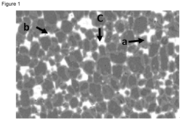
- Figure 1 shows a schematic diagram of test sample with SEM using ZISS electron microscopy (SEM images of the microstructure of Nd-Fe-B permanent magnets after diffusion using backscattered electron (BSE) contrast).
- a method of preparing a high temperature resistant NdFeB magnet comprises the following steps:
- the total weight content of Cu, Al and Ga in the mixture may be in the range of 0.1 to 3.0 wt.%, preferably 0.4 to 1.5 wt.%.
- the weight content of Al in the mixture is in the range of 0.2 to 1.0 wt.%
- the weight content of Cu in the mixture is in the range of 0.1 to 0.5 wt.%
- the weight content of Ga in the mixture is in the range of 0.05 to 0.4 wt.%.
- the low melting point powder may have an average particle size D50 in the range of 200 nm to 4 ⁇ m.
- the average particle diameter (D50) of the particles may be measured by laser diffraction (LD).
- the method may be performed according to ISO 13320-1. According to the IUPAC definition, the equivalent diameter of a non-spherical particle is equal to a diameter of a spherical particle that exhibits identical properties to that of the investigated non-spherical particle.
- NdFeB magnet also known as NIB or Neo magnet
- NIB Neo magnet
- NIB neodymium, iron, and boron to form the Nd2Fe14B tetragonal crystalline structure as a main phase.
- the microstructure of Nd-Fe-B magnets includes usually a Nd-rich phase.
- the alloy may include further elements in addition to or partly substituting neodymium and iron.
- the alloy raw material may be composed of 28% ⁇ R ⁇ 30%, 0.8% ⁇ B ⁇ 1.2%, 0% ⁇ M ⁇ 3% in weight percentages, the remainder is Fe, R including at least two elements of Nd, Pr, Ce, La, Tb, Dy, Ho, and Gd; and M including at least one element of Co, Mg, Ti, Zr, and Nb.
- step (S2) the dehydrogenation temperature is 400-600 °C.
- the sintering temperature may be 980-1060 °C for 6-15h.
- step (S3) after the sintering a primary aging treatment and secondary aging treatment may be performed.
- the composition of the heavy rare earth diffusion source film may be R1xR2yHzM1-x-y-z, wherein R1 is at least one of Nd and Pr, the weight percentage of R1 is 15% ⁇ x ⁇ 50%, R2 is at least one of Ho and Gd, the weight percentage of R2 is 0% ⁇ y ⁇ 10%, H is at least one of Tb and Dy, the weight percentage of H is 40% ⁇ z ⁇ 70%, M is at least one of Al, Cu, Ga, Ti, Co, Mg, Zn, and Sn, the weight percentage of M is 1-x-y-z.
- the diffusion temperature of NdFeB magnets may be 850-930 °C and the diffusion time is 6-30h.
- a high temperature resistant magnet can be obtained by the above-mentioned method.
- the grain boundary structure of the magnet may comprise a main phase structure, an R shell, a transition metal shell and a triangular region.
- the R shell is at least one of Nd, Pr, Ho, and Gd.
- the transition metal shell layer is at least one of Cu, Al, and Ga.
- the triangular zone or region may comprise at least one of Component I, Component II, and Component III.
- Component I is Nd a Fe b R c M d , with R including at least one element of Pr, Ce, and La and M including at least three elements of Al, Cu, Ga, Ti, Co, Mg, Zn, Sn and Zr.
- the weight percentage of Nd is 30% ⁇ a ⁇ 70%
- the weight percentage of Fe is 5% ⁇ b ⁇ 40%
- the weight percentage of R is 5% ⁇ c ⁇ 35%
- the weight percentage of M is 0 ⁇ d ⁇ 15%.
- Component II is Nd e Fe f R g H h K i M j , with R including at least one element of Pr, Ce, and La, H including at least one element of Dy and Tb, K including at least one element of Ho and Gd, and M including at least three elements of Al, Cu, Ga, Ti, Co, Mg, Zn, Sn and Zr.
- the weight percentage of Nd is e, 25% ⁇ e ⁇ 65%
- the weight percentage of Fe is f, 5% ⁇ f ⁇ 35%
- the weight percentage of R is g, 5% ⁇ g ⁇ 30%
- the weight percentage of H is h, 5% ⁇ h ⁇ 30%
- the weight percentage of K is i, 1% ⁇ i ⁇ 12%
- the weight percentage of M is j, 0% ⁇ j ⁇ 10%.
- Component III is Nd k Fe l R m D n M o , with R including at least one element of Pr, Ce, and La, D including at least one element of Al, Cu, Ga, and M including at least one element of Ti, Co, Mg, Zn, Sn, and Zr.
- the weight percentage of Nd is k, 30% ⁇ k ⁇ 70%
- the weight percentage of Fe is I, 5% ⁇ l ⁇ 35%
- the weight percentage of R is m, 5% ⁇ m ⁇ 35%
- the weight percentage of D is n, 5% ⁇ n ⁇ 25%
- the weight percentage of M is o, 0% ⁇ o ⁇ 10%.
- a thickness of magnet may be 0.3-6 mm.
- a method of preparing the high temperature resistant magnet may be performed in the following exemplary way:
- the low melting point powder comprises at least one of NdCu, NdAl and NdGa, and its weight percentage is 0% ⁇ NdCu ⁇ 3%, 0% ⁇ NdAl ⁇ 3%, 0% ⁇ NdGa ⁇ 3%, and the size of low melting point powders is 200 nm-4 ⁇ m.
- step (S3) after sintering, the magnet cooled in an argon stream, and then a primary aging treatment and secondary aging treatment is carried out.
- the sintering temperature is 980-1060 °C, and the sintering time is 6-15h.
- the first-level aging temperature is 850 °C, and the first-level aging time is 3h.
- the second-stage aging temperature is 450-660 °C, and the second-stage aging time is 3h.
- the diffusion temperature of NdFeB magnets is 850-930 °C, the diffusion time is 6-30h, the aging temperature is 420-680 °C, and the aging time is 3-10h.
- the aging temperature of the NdFeB magnet is heated at a rate of 1-5°C/min, and the cooling rate is 5-20°C/min.
- the method of manufacturing a high-temperature-resistant magnet comprises the following steps:
- the alloy powders after the air flow grinding is oriented molding and pressed into the blank by isostatic pressure.
- the pressing blank is sintered in vacuum, and quickly cooled with argon, and then a primary aging treatment and a secondary aging treatment are carried out, the magnets performance is tested.
- the process conditions and magnet characteristics are summarized in Table 2.
- the diffusion sources contained Ho or Gd. Each process condition of the embodiment is shown in Table 3, correspondingly, the proportional process conditions are shown in Table 4. Table 3 shows diffusion sources, process conditions and properties. Table 1 Magnet composition of alloy flakes, low melting point powder and lubricant mixed. Magnet composition No.
- Example Diffusion Source Size Diffusion Temp. holding time Aging Temp. holding time Heating rate Cooling rate Performance after Diffusion ⁇ Hcj mm °C hours °C hours °C/min °C/min Br(T) Hcj (kA/m) Hk/Hcj 150°C 1 PrHoDyCu 10*10*3 850 30 420 10 5 5 1.432 1982.04 0.97 -0.500% 2 PrHoDyCu 10*10*3 850 30 480 7 5 5 1.36 2053.68 0.97 -0.495% 3 PrHoDyCu 10*10*3 850 30 500 5 5 10 1.293 2189.00 0.96 -0.450% 4 PrHoDyCu 10*10*3 880 20 450 8 5 15 1.33 2029.80 0.96 -0.497% 5 NdHoDyCu 10*10*4 880 20 500 6 3 15 1.34 2117.36 0.96 -0.490% 6 NdHoDyCu 10*10*4 880 20 600 5
- the NdCu or NdAl or NdGa phase powders are added to the grain boundary of the NdFeB alloy flakes, whose grain boundary has a low melting point.
- the grain boundary channel of NdFeB permanent magnets are suitable for the diffusion especially the diffusion source of heavy rare earth Dy alloys.
- the coercivity is increased significantly get ⁇ Hcj > 597 kA/m after diffusion, and the high temperature coefficient of coercivity is significantly better than the proportionality.
- Example 1 The performance of example 1 by diffusion PrHoDyCu decreased by 0.023 T of Br, increased by 844.6 kA/m of Hcj, and the coefficient of high temperature resistance of the magnet's 150 °C coercivity was -0.50% compared with the pre-diffusion performance of NdFeB magnet.
- the performance of the proportional 1 by diffusion PrDyCu decreased by 0.02 T, of Br, increased by 812.7 kA/m of Hcj, and the coefficient of high temperature resistance of the magnet's 150 °C coercivity was -0.53%.
- the advantages of Example 1 are obvious.
- Example 2 The same NdFeB magnet and size, the same diffusion temperature and aging temperature, etc., the performance of example 2 by diffusion PrHoDyCu decreased by 0.026 T of Br, increased by 722.8 kA/m of Hcj, and the coefficient of high temperature resistance of the magnet's 150 °C coercivity was -0.495% compared with the pre-diffusion performance of NdFeB magnet. The performance of the proportional 2 by diffusion PrDyCu decreased by 0.024 T of Br, increased by 698.9 kA/m of Hcj, and the coefficient of high temperature resistance of the magnet's 150 °C coercivity was -0.51%. The advantages of Example 2 are obvious.
- Example 3 The same NdFeB magnet and size, the same diffusion temperature and aging temperature, etc., the performance of example 3 by diffusion PrHoDyCu decreased by 0.024 T of Br, increased by 643.2 kA/m of Hcj, and the coefficient of high temperature resistance of the magnet's 150 °C coercivity was -0.45% compared with the pre-diffusion performance of NdFeB magnet. The performance of the proportional 3 by diffusion PrDyCu decreased by 0.022 T of Br, increased by 603.4 kA/m of Hcj, and the coefficient of high temperature resistance of the magnet's 150 °C coercivity was -0.51%. The advantages of Example 3 are obvious.
- Example 4 The same NdFeB magnet and size, the same diffusion temperature and aging temperature, etc., the performance of example 4 by diffusion PrHoDyCu decreased by 0.026 T of Br, increased by 638.4 kA/m of Hcj, and the coefficient of high temperature resistance of the magnet's 150 °C coercivity was -0.497% compared with the pre-diffusion performance of NdFeB magnet. The performance of the proportional 4 by diffusion PrDyCu decreased by 0.024 T of Br, increased by 598.6 kA/m of Hcj, and the coefficient of high temperature resistance of the magnet's 150 °C coercivity was -0.52%. The advantages of Example 4 are obvious.
- Example 5 The same NdFeB magnet and size, the same diffusion temperature and aging temperature, etc., the performance of example 5 by diffusion NdHoDyCu decreased by 0.027 T of Br, increased by 804.7 kA/m of Hcj, and the coefficient of high temperature resistance of the magnet's 150 °C coercivity was -0.49% compared with the pre-diffusion performance of NdFeB magnet. The performance of the proportional 5 by diffusion NdDyCu decreased by 0.025 T of Br, increased by 757 kA/m of Hcj, and the coefficient of high temperature resistance of the magnet's 150 °C coercivity was -0.51%. The advantages of Example 5 are obvious.
- Example 6 The same NdFeB magnet and size, the same diffusion temperature and aging temperature, etc., the performance of example 6 by diffusion NdHoDyCu decreased by 0.025 T of Br, increased by 693.3 kA/m of Hcj, and the coefficient of high temperature resistance of the magnet's 150 °C coercivity was -0.492% compared with the pre-diffusion performance of NdFeB magnet. The performance of the proportional 6 by diffusion NdDyCu decreased by 0.023 T of Br, increased by 661.5 kA/m of Hcj, and the coefficient of high temperature resistance of the magnet's 150 °C coercivity was -0.52%. The advantages of Example 6 are obvious.
- Example 7 The same NdFeB magnet and size, the same diffusion temperature and aging temperature, etc., the performance of example 7 by diffusion NdHoDyCu decreased by 0.024 T of Br, increased by 741.9 kA/m of Hcj, and the coefficient of high temperature resistance of the magnet's 150 °C coercivity was -0.482% compared with the pre-diffusion performance of NdFeB magnet. The performance of the proportional 7 by diffusion NdDyCu decreased by 0.022 T of Br, increased by 702.1 kA/m of Hcj, and the coefficient of high temperature resistance of the magnet's 150 °C coercivity was -0.515%. The advantages of Example 7 are obvious.
- Example 8 The same NdFeB magnet and size, the same diffusion temperature and aging temperature, etc., the performance of example 8 by diffusion PrGdDyCu decreased by 0.026 T of Br, increased by 784.06 kA/m of Hcj, and the coefficient of high temperature resistance of the magnet's 150 °C coercivity was -0.49% compared with the pre-diffusion performance of NdFeB magnet. The performance of the proportional 8 by diffusion PrDyCu decreased by 0.021 T of Br, increased by 744.3 kA/m of Hcj, and the coefficient of high temperature resistance of the magnet's 150 °C coercivity was -0.51%. The advantages of Example 8 are obvious.
- Example 9 The same NdFeB magnet and size, the same diffusion temperature and aging temperature, etc., the performance of example 9 by diffusion PrGdDyCu decreased by 0.024 T of Br, increased by 776.1 kA/m of Hcj, and the coefficient of high temperature resistance of the magnet's 150 °C coercivity was -0.47% compared with the pre-diffusion performance of NdFeB magnet. The performance of the proportional 9 by diffusion PrDyCu decreased by 0.024 T of Br, increased by 744.26 kA/m of Hcj, and the coefficient of high temperature resistance of the magnet's 150 °C coercivity was -0.5%. The advantages of Example 9 are obvious.
- Example 10 The same NdFeB magnet and size, the same diffusion temperature and aging temperature, etc., the performance of example 10 by diffusion PrGdDyCu decreased by 0.027 T of Br, increased by 866.05 kA/m of Hcj, and the coefficient of high temperature resistance of the magnet's 150 °C coercivity was -0.48% compared with the pre-diffusion performance of NdFeB magnet.
- the performance of the proportional 10 by diffusion PrDyCu decreased by 0.022 T of Br, increased by 786.45 kA/m of Hcj, and the coefficient of high temperature resistance of the magnet's 150 °C coercivity was -0.515%.
- the advantages of Example 10 are obvious.
- Example 11 The same NdFeB magnet and size, the same diffusion temperature and aging temperature, etc., the performance of example 11 by diffusion PrGdDyCu decreased by 0.021 T of Br, increased by 655.9 kA/m of Hcj, and the coefficient of high temperature resistance of the magnet's 150 °C coercivity was -0.49% compared with the pre-diffusion performance of NdFeB magnet. The performance of the proportional 11 by diffusion PrDyCu decreased by 0.021 T of Br, increased by 616.1 kA/m of Hcj, and the coefficient of high temperature resistance of the magnet's 150 °C coercivity was -0.525%. The advantages of Example 11 are obvious.
- Example 12 The same NdFeB magnet and size, the same diffusion temperature and aging temperature, etc., the performance of example 12 by diffusion PrGdDyCu decreased by 0.027 T of Br, increased by 644.76 kA/m of Hcj, and the coefficient of high temperature resistance of the magnet's 150 °C coercivity was -0.457% compared with the pre-diffusion performance of NdFeB magnet.
- the performance of the proportional 12 by diffusion PrDyCu decreased by 0.022 T of Br, increased by 604.96 kOe of Hcj, and the coefficient of high temperature resistance of the magnet's 150 °C coercivity was -0.51%.
- the advantages of Example 12 are obvious.
- Example 13 The same NdFeB magnet and size, the same diffusion temperature and aging temperature, etc., the performance of example 13 by diffusion PrHoDyCuGa decreased by 0.025 T of Br, increased by 628.84 kA/m of Hcj, and the coefficient of high temperature resistance of the magnet's 150 °C coercivity was -0.46% compared with the pre-diffusion performance of NdFeB magnet.
- the performance of the proportional 13 by diffusion PrDyCuGa decreased by 0.025 T of Br, increased by 604.96 kA/m of Hcj, and the coefficient of high temperature resistance of the magnet's 150 °C coercivity was -0.51%.
- the advantages of Example 13 are obvious.
- Example 14 The same NdFeB magnet and size, the same diffusion temperature and aging temperature, etc., the performance of example 14 by diffusion PrHoDyCuGa decreased by 0.027 T of Br, increased by 704.46 kA/m of Hcj, and the coefficient of high temperature resistance of the magnet's 150 °C coercivity was -0.47% compared with the pre-diffusion performance of NdFeB magnet.
- the performance of the proportional 14 by diffusion PrDyCuGa decreased by 0.022 T of Br, increased by 656.7 kA/m of Hcj, and the coefficient of high temperature resistance of the magnet's 150 °C coercivity was -0.52%.
- the advantages of Example 14 are obvious.
- Example 15 The same NdFeB magnet and size, the same diffusion temperature and aging temperature, etc., the performance of example 15 by diffusion PrHoDyCuGa decreased by 0.027 T of Br, increased by 754.61 kA/m of Hcj, and the coefficient of high temperature resistance of the magnet's 150 °C coercivity was -0.46% compared with the pre-diffusion performance of NdFeB magnet.
- the performance of the proportional 15 by diffusion PrDyCuGa decreased by 0.025 T of Br, increased by 714.8 kA/m of Hcj, and the coefficient of high temperature resistance of the magnet's 150 °C coercivity was -0.505%.
- the advantages of Example 15 are obvious.
- Example 16 The same NdFeB magnet and size, the same diffusion temperature and aging temperature, etc., the performance of example 16 by diffusion PrHoDyCuAl decreased by 0.026 T of Br, increased by 751.4 kA/m of Hcj, and the coefficient of high temperature resistance of the magnet's 150 °C coercivity was -0.47% compared with the pre-diffusion performance of NdFeB magnet. The performance of the proportional 16 by diffusion PrDyCuAl decreased by 0.02 T of Br, increased by 812.7 kA/m of Hcj, and the coefficient of high temperature resistance of the magnet's 150 °C coercivity was -0.51%. The advantages of Example 16 are obvious.
- Example 17 The same NdFeB magnet and size, the same diffusion temperature and aging temperature, etc., the performance of example 17 by diffusion PrHoDyCuAl decreased by 0.02 T of Br, increased by 698.1 kA/m of Hcj, and the coefficient of high temperature resistance of the magnet's 150 °C coercivity was -0.48% compared with the pre-diffusion performance of NdFeB magnet. The performance of the proportional 17 by diffusion PrDyCuAl decreased by 0.02 T of Br, increased by 812.7 kA/m of Hcj, and the coefficient of high temperature resistance of the magnet's 150 °C coercivity was -0.52%. The advantages of Example 17 are obvious.
- Example 18 The same NdFeB magnet and size, the same diffusion temperature and aging temperature, etc., the performance of example 18 by diffusion PrHoDyCuAl decreased by 0.028 T of Br, increased by 724.4 kA/m of Hcj, and the coefficient of high temperature resistance of the magnet's 150 °C coercivity was -0.49% compared with the pre-diffusion performance of NdFeB magnet. The performance of the proportional 18 by diffusion PrDyCuAl decreased by 0.026 T of Br, increased by 684.56 kA/m of Hcj, and the coefficient of high temperature resistance of the magnet's 150 °C coercivity was -0.505%. The advantages of Example 18 are obvious.
- Example 19 The same NdFeB magnet and size, the same diffusion temperature and aging temperature, etc., the performance of example 19 by diffusion PrGdDyCu decreased by 0.03 T of Br, increased by 724.36 kA/m of Hcj, and the coefficient of high temperature resistance of the magnet's 150 °C coercivity was -0.47% compared with the pre-diffusion performance of NdFeB magnet. The performance of the proportional 19 by diffusion PrDyCu decreased by 0.02 T of Br, increased by 812.7 kA/m of Hcj, and the coefficient of high temperature resistance of the magnet's 150 °C coercivity was -0.53%. The advantages of Example 19 are obvious.
- Example 20 The same NdFeB magnet and size, the same diffusion temperature and aging temperature, etc., the performance of example 20 by diffusion PrGdDyCu decreased by 0.02 T of Br, increased by 612.92 kA/m of Hcj, and the coefficient of high temperature resistance of the magnet's 150 °C coercivity was -0.475% compared with the pre-diffusion performance of NdFeB magnet. The performance of the proportional 20 by diffusion PrDyCu decreased by 0.02 T of Br, increased by 597 kA/m of Hcj, and the coefficient of high temperature resistance of the magnet's 150 °C coercivity was -0.5%. The advantages of Example 20 are obvious.
- Example 21 The same NdFeB magnet and size, the same diffusion temperature and aging temperature, etc., the performance of example 21 by diffusion PrGdDyCu decreased by 0.025 T of Br, increased by 780.08 kA/m of Hcj, and the coefficient of high temperature resistance of the magnet's 150 °C coercivity was -0.46% compared with the pre-diffusion performance of NdFeB magnet. The performance of the proportional 21 by diffusion PrDyCu decreased by 0.025 T of Br, increased by 756.2 kA/m of Hcj, and the coefficient of high temperature resistance of the magnet's 150 °C coercivity was -0.51%. The advantages of Example 21 are obvious.
- Example 22 The same NdFeB magnet and size, the same diffusion temperature and aging temperature, etc., the performance of example 22 by diffusion PrGdDyCu decreased by 0.022 T of Br, increased by 628.84 kA/m of Hcj, and the coefficient of high temperature resistance of the magnet's 150 °C coercivity was -0.455% compared with the pre-diffusion performance of NdFeB magnet. The performance of the proportional 22 by diffusion PrDyCu decreased by 0.02 T of Br, increased by 597 kA/m of Hcj, and the coefficient of high temperature resistance of the magnet's 150 °C coercivity was -0.51%. The advantages of Example 22 are obvious.
- the magnets after diffusion of heavy rare earth alloys were subjected to microstructure determination.
- the tests were mainly carried out using ZISS electron microscopy for SEM and Oxford EDS for the elemental composition of the sample magnets. It was found that the rare earth shell (i.e. the R shell) is more than 60% around the grain and the transition metal shell is more than 40% around the grain.
- three points a, b, and c of the SEM sample are sampling points at different locations and the range of sampling points summarized as Component I,
- the small triangle area with a size ⁇ 1 ⁇ m is characterized by a 6:14 Cu rich phase type, that is, the chemical formula of EDS is: Fe 30-51 (NdPr) 45-60 Cu 2-15 Ga 0-5 Co 0-5 or Fe 30-51 (NdPr) 45-60 Dy 2-15 Cu 2-15 Ga 0-5 Co 0-5 (weight percentage of the elements).
- the three points a, b, and c are shown in Figure 1 .
- the R shell and the transition metal shell, the three points a, b, and c are statistically analyzed as follows:
- the magnet after diffusion with PrHoDyCu the magnet has the following microstructure: Pr, Dy, Ho rare earth shell and transition metal shell Cu, and the formation of sampling composition 1: Nd 50-70 Fe 10-30 Pr 10-20 Cu 0-5
- sampling component 2 Nd 50-55 Fe 10-30 Pr 5-15 Dy 5-15 Ho 2-9 Cu 0-5
- sampling composition 3 Nd 50-70 Fe 10-35 Pr 10-20 Cu 10-20 Co 0-5 .
- Example 2 after diffusion with PrHoDyCu the magnet has the following microstructure: Pr, Dy, Ho rare earth shell and transition metal shell Cu, and the formation of sampling composition 1: Nd 50-65 Fe 10-30 Pr 10-25 Cu 0-5 Ga 0-5 Al 0-3 , sampling component 2: Nd 50-55 Fe 10-30 Pr 5-15 Dy 5-15 Ho 3-10 Cu 0-5 , sampling composition 3: Nd 50-70 Fe 10-35 Pr 10-20 Cu 10-15 Co 0-5 .
- Example 3 after diffusion with PrHoDyCu the magnet has the following microstructure: Pr, Dy, Ho rare earth shell and transition metal shell Cu, and the formation of sampling composition 1: Nd 45-65 Fe 10-35 Pr 10-25 Cu 0-5 Ga 0-5 Al 3-5 , sampling component 2: Nd 45-55 Fe 10-30 Pr 5-20 Dy 5-10 Ho 3-8 Cu 0-5 , sampling composition 3: Nd 50-65 Fe 10-35 Pr 10-20 Cu 10-15 Co 0-5 Al 0-5 .
- Example 4 after diffusion with PrHoDyCu the magnet has the following microstructure: Pr, Dy, Ho rare earth shell and transition metal shell Cu and Al, and the formation of sampling composition 1: Nd 45-60 Fe 10-35 Pr 10-20 Cu 3-8 Ga 0-5 Al 3-5 , sampling component 2: Nd 45-55 Fe 10-30 Pr 5-20 Dy 5-10 Ho 3-6 Cu 2-5 Al 2-10 , sampling composition 3: Nd 45-65 Fe 0-30 Pr 10-20 Cu 10-25 Co 0-5 Al 0-5 .
- Example 5 after diffusion with NdHoDyCu the magnet has the following microstructure: Nd, Dy, Ho rare earth shell and transition metal shell Cu, and the formation of sampling composition 1: Nd 50-65 Pr 10-15 Fe 10-30 Cu 2-6 Go 0-5 , sampling component 2: Nd 45-60 Fe 5-30 Pr 5-15 Dy 5-15 Ho 3-10 , sampling composition 3: Nd 45-60 Pr 10-20 Fe 5-30 Cu 10-20 Co 0-5 .
- Example 6 after diffusion with NdHoDyCu the magnet has the following microstructure: Nd, Dy, Ho rare earth shell and transition metal shell Cu, and the formation of sampling composition 1: Nd 45-60 Pr 10-20 Fe 10-30 Cu 2-5 Ga 0-5 , sampling component 2: Nd 45-60 Fe 5-25 Pr 5-12 Dy 5-20 Ho 2-9 , sampling composition 3: Nd 50-60 Pr 10-15 Fe 5-25 Cu 5-25 Co 0-5 .
- Example 7 after diffusion with NdHoDyCu the magnet has the following microstructure: Nd, Dy, Ho rare earth shell and transition metal shell Cu and Al, and the formation of sampling composition 1: Nd 50-65 Pr 10-15 Fe 10-40 Cu 5-10 Al 0-5 , sampling component 2: Nd 50-60 Fe 5-30 Pr 5-15 Dy 5-25 Ho 3-12 Al 2-10 , sampling composition 3: Nd 50-60 Pr 10-15 Fe 5-25 Cu 5-15 Co 0-5 Al 0-5 .
- Example 8 after diffusion with PrGdDyCu the magnet has the following microstructure: Pr, Dy, Gd rare earth shell and transition metal shell Cu, and the formation of sampling composition 1: Nd 40-65 Pr 20-35 Fe 10-25 Cu 5-10 , sampling component 2: Nd 25-40 Fe 10-30 Pr 10-25 Dy 15-20 Gd 1-7 Co 0-5 Cu 0-5 , sampling composition 3: Nd 35-45 Pr 15-35 Fe 5-25 Cu 10-25 Co 0-5 .
- Example 9 after diffusion with PrGdDyCu the magnet has the following microstructure: Pr, Dy, Gd rare earth shell and transition metal shell Cu, and the formation of sampling composition 1: Nd 40-60 Pr 20-30 Fe 10-30 Cu 3-8 , sampling component 2: Nd 35-45 Fe 10-30 Pr 10-25 Dy 5-25 Gd 2-12 Co 0-5 Cu 0-5 , sampling composition 3: Nd 35-50 Pr 15-30 Fe 5-25 Cu 5-20 Co 0-5 .
- Example 10 after diffusion with PrGdDyCu the magnet has the following microstructure: Pr, Dy, Gd rare earth shell and transition metal shell Cu, and the formation of sampling composition 1: Nd 40-60 Pr 20-35 Fe 10-30 Cu 0-5 , sampling component 2: Nd 25-40 Fe 10-30 Pr 10-25 Dy 5-15 Gd 2-7 Co 0-5 Cu 0-5 , sampling composition 3: Nd 35-45 Pr 15-35 Fe 5-30 Cu 5-20 Co 0-5 .
- Example 11 after diffusion with PrGdDyCu the magnet has the following microstructure: Pr, Dy, Gd rare earth shell and transition metal shell Cu, and the formation of sampling composition 1: Nd 50-65 Fe 10-25 Pr 10-20 Cu 0-5 Ga 0-5 Al 0-5 , sampling component 2: Nd 45-55 Fe 10-30 Pr 5-20 Dy 5-20 Gd 3-9 Cu 0-5 , sampling composition 3: Nd 45-70 Fe 10-30 Pr 10-25 Cu 10-25 Co 0-5 Ga 0-5 .
- Example 12 after diffusion with PrGdDyCu the magnet has the following microstructure: Pr, Dy, Gd rare earth shell and transition metal shell Cu, and the formation of sampling composition 1: Nd 50-65 Fe 10-30 Pr 10-25 Cu 0-5 Ga 2-7 Al 3-7 , sampling component 2: Nd 45-55 Fe 10-30 Pr 5-20 Dy 5-10 Gd 2-5 Cu 0-5 Ga 0-5 , sampling composition 3: Nd 50-65 Fe 10-35 Pr 5-20 Cu 10-20 Co 0-5 Al 0-5 .
- Example 13 after diffusion with PrHoDyCuGa the magnet has the following microstructure: Pr, Dy, Ho rare earth shell and transition metal shell Cu and Ga, and the formation of sampling composition 1: Nd 45-55 Pr 20-25 Fe 15-30 Ga 2-10 Cu 3-5 , sampling component 2: Nd 30-45 Fe 5-25 Pr 25-30 Dy 5-20 Ho 1-10 Cu 0-5 , sampling composition 3: Nd 35-45 Pr 20-35 Fe 10-35 Cu 5-15 Ga 5-10 Co 2-5 .
- Example 14 after diffusion with PrHoDyCuGa the magnet has the following microstructure: Pr, Dy, Ho rare earth shell and transition metal shell Cu and Ga, and the formation of sampling composition 1: Nd 40-55 Pr 20-30 Fe 15-30 Ga 2-10 Cu 3-5 , sampling component 2: Nd 30-40 Fe 5-25 Pr 25-30 Dy 5-15 Ho 2-9 Cu 0-5 , sampling composition 3: Nd 30-50 Pr 25-30 Fe 10-30 Cu 5-10 Ga 5-10 Co 2-5 .
- Example 15 after diffusion with PrHoDyCuGa the magnet has the following microstructure: Pr, Dy, Ho rare earth shell and transition metal shell Cu and Ga, and the formation of sampling composition 1: Nd 40-55 Pr 20-30 Fe 15-25 Ga 5-10 Cu 3-10 , sampling component 2: Nd 30-40 Fe 5-25 Pr 15-30 Dy 5-20 Ho 3-12 Cu 0-5 , sampling composition 3: Nd 30-45 Pr 25-35 Fe 10-30 Cu 5-10 Ga 5-10 Co 2-5 .
- Example 16 after diffusion with PrHoDyCuAl the magnet has the following microstructure: Pr, Dy, Ho rare earth shell and transition metal shell Cu and Al, and the formation of sampling composition 1: Nd 45-65 Fe 10-35 Pr 5-15 Cu 5-15 Al 5-10 , sampling component 2: Nd 45-65 Fe 5-30 Pr 5-20 Dy 5-10 Ho 2-11 Cu 5-11 Al 2-10 , sampling composition 3: Nd 50-65 Fe 10-20 Pr 10-15 Cu 10-25 Al 0-5 .
- Example 17 after diffusion with PrHoDyCuAl the magnet has the following microstructure: Pr, Dy, Ho rare earth shell and transition metal shell Cu and Al, and the formation of sampling composition 1: Nd 45-55 Fe 10-30 Pr 5-20 Cu 5-10 Al 2-5 , sampling component 2: Nd 45-60 Fe 5-25 Pr 5-25 Dy 5-15 Ho 2-10 Cu 5-10 Al 3-5 , sampling composition 3: Nd 45-60 Fe 10-20 Pr 10-20 Cu 10-20 Ga 0-5 Al 0-5 .
- Example 18 after diffusion with PrHoDyCuAl the magnet has the following microstructure: Pr, Dy, Ho rare earth shell and transition metal shell Cu and Al, and the formation of sampling composition 1: Nd 50-65 Fe 10-30 Pr 5-20 Cu 5-10 Al 2-5 , sampling component 2: Nd 45-60 Fe 10-25 Pr 10-20 Cu 10-20 Ga 0-5 Al 0-5 , sampling composition 3: Nd 45-65 Fe 5-30 Pr 5-20 Dy 5-15 Ho 1-6 Cu 5-10 Al 5-10 .
- Example 19 after diffusion with PrGdDyCu the magnet has the following microstructure: Pr, Dy, Gd rare earth shell and transition metal shell Cu, and the formation of sampling composition 1: Nd 45-55 Fe 5-30 Pr 20-35 Cu 0-5 , sampling component 2: Nd4 5-55 Fe 5-10 Pr 10-30 Dy 5-20 Gd 2-8 Cu 0-5 , sampling composition 3: Nd 35-55 Fe 5-30 Pr 10-35 Cu 5-10 Ga 0-5 Co 0-5 .
- Example 20 after diffusion with PrGdDyCu the magnet has the following microstructure: Pr, Dy, Gd rare earth shell and transition metal shell Cu, and the formation of sampling composition 1: Nd 35-50 Fe 15-40 Pr 15-30 Cu 0-10 Ga 0-3 Al 0-3 , sampling component 2: Nd 40-60 Fe 3-30 Pr 10-20 Gd 1-7 Dy 5-25 , sampling composition 3: Nd 40-55 Fe 5-35 Pr 15-30 Cu 5-25 Ga 0-5 Co 0-5 .
- Example 21 after diffusion with PrGdDyCu the magnet has the following microstructure: Pr, Dy, Gd rare earth shell and transition metal shell Cu, and the formation of sampling composition 1: Nd 30-45 Fe 10-30 Pr 20-25 Cu 5-10 Ga 0-5 Co 0-5 Ti 0-5 , sampling component 2: Nd 30-40 Fe 5-25 Pr 10-15 Dy 10-30 Gd 2-6 Ho 3-9 , sampling composition 3: Nd 35-45 Fe 5-30 Pr 15-30 Cu 5-25 Ga 0-3 Co 0-5 .
- Example 22 after diffusion with PrGdDyCu the magnet has the following microstructure: Pr, Dy, Gd rare earth shell and transition metal shell Cu, and the formation of sampling composition 1: Nd 25-35 Fe 20-30 Pr 20-30 Cu 0-10 Ga 0-5 , sampling component 2: Nd 45-55 Fe 10-20 Pr 20-30 Dy 5-20 Gd 4-10 , sampling composition 3: Nd 40-55 Fe 10-25 Pr 15-40 Cu 5-20 Ga 0-10 Co 0-5 .
Landscapes
- Engineering & Computer Science (AREA)
- Chemical & Material Sciences (AREA)
- Power Engineering (AREA)
- Mechanical Engineering (AREA)
- Manufacturing & Machinery (AREA)
- Materials Engineering (AREA)
- Metallurgy (AREA)
- Organic Chemistry (AREA)
- Crystallography & Structural Chemistry (AREA)
- Inorganic Chemistry (AREA)
- Physics & Mathematics (AREA)
- Fluid Mechanics (AREA)
- Hard Magnetic Materials (AREA)
- Manufacture Of Metal Powder And Suspensions Thereof (AREA)
- Powder Metallurgy (AREA)
- Manufacturing Cores, Coils, And Magnets (AREA)
Claims (9)
- Verfahren zur Herstellung eines hochtemperaturbeständigen NdFeB-Magneten, wobei das Verfahren die folgenden Schritte umfasst:(S1) Herstellen von NdFeB-Legierungsflocken aus einem Rohmaterial des NdFeB-Magneten durch Bandgießen;(S2) Herstellen einer Mischung der NdFeB-Legierungsflocken und eines Pulvers mit niedrigem Schmelzpunkt, dann Durchführen einer Wasserstoffdekrepitation der Mischung, gefolgt von Strahlmahlen, um ein NdFeB-Pulver zu erhalten, wobei die Dehydrierungs-Temperatur 400-600 °C beträgt, wobei das Pulver mit niedrigem Schmelzpunkt mindestens eines von NdCu, NdAI und NdGa umfasst;(S3) kaltisostatisches Pressen des Legierungspulvers zu einem Grünling während des Anlegens eines Magnetfeldes;(S4) Sintern des Grünlings, um einen NdFeB-Magneten zu erhalten; und(S5) Aufbringen eines schweren Seltenerd-Diffusionsmaterials auf die Oberfläche des NdFeB-Magneten und Durchführen eines thermischen Diffusionsverfahrens, um den hochtemperaturbeständigen NdFeB-Magneten zu erhalten.
- Verfahren nach Anspruch 1, wobei in Schritt (S2) der Gesamtgewichtsgehalt von Cu, Al und Ga in der Mischung im Bereich von 0,1 bis 3,0 Gew.-%, vorzugsweise von 0,4 bis 1,5 Gew.-%, liegt.
- Verfahren nach Anspruch 1 oder 2, wobei in Schritt (S2) der Gewichtsgehalt von Al in der Mischung im Bereich von 0,2 bis 1,0 Gew.-% liegt, der Gewichtsgehalt von Cu in der Mischung im Bereich von 0,1 bis 0,5 Gew.-% liegt und der Gewichtsgehalt von Ga in der Mischung im Bereich von 0,05 bis 0,4 Gew.-% liegt.
- Verfahren nach einem der vorhergehenden Ansprüche, wobei in Schritt (S2) das Pulver mit niedrigem Schmelzpunkt eine durchschnittliche Teilchengröße D50 im Bereich von 200 nm bis 4 µm aufweist.
- Verfahren nach einem der vorhergehenden Ansprüche, wobei in Schritt (S1) das Legierungsrohmaterial aus 28%≤R≤30%, 0,8%≤B≤1,2%, 0%≤M≤3% in Gewichtsprozenten besteht, der Rest Fe ist, R mindestens zwei Elemente aus Nd, Pr, Ce, La, Tb, Dy, Ho und Gd enthält; und M mindestens ein Element aus Co, Mg, Ti, Zr und Nb enthält.
- Verfahren nach einem der vorhergehenden Ansprüche, wobei in Schritt (S3) die Sintertemperatur 980-1060 °C für 6-15 h beträgt.
- Verfahren nach einem der vorhergehenden Ansprüche, wobei in Schritt (S3) nach dem Sintern eine primäre Alterungsbehandlung und eine sekundäre Alterungsbehandlung durchgeführt wird.
- Verfahren nach einem der vorhergehenden Ansprüche, wobei in Schritt (S4) die Zusammensetzung des schweren Seltenerd-Diffusionsquellenfilms R1xR2yHzM1-x-y-z ist, wobei R1 mindestens eines von Nd und Pr ist, der Gewichtsprozentsatz von R1 15%<x<50% ist, R2 mindestens eines von Ho und Gd ist, der Gewichtsprozentsatz von R2 0%<y≤10% ist, H mindestens eines von Tb und Dy ist, der Gewichtsprozentsatz von H 40%≤z≤70% ist, M mindestens eines von Al, Cu, Ga, Ti, Co, Mg, Zn und Sn ist, der Gewichtsprozentsatz von M 1-x-y-z ist.
- Verfahren nach einem der vorhergehenden Ansprüche, wobei in Schritt (S5) die Diffusionstemperatur der NdFeB-Magnete 850-930 °C und die Diffusionszeit 6-30 h beträgt.
Applications Claiming Priority (1)
| Application Number | Priority Date | Filing Date | Title |
|---|---|---|---|
| CN202111120165.9A CN113871121B (zh) | 2021-09-24 | 2021-09-24 | 耐高温磁体及其制造方法 |
Publications (2)
| Publication Number | Publication Date |
|---|---|
| EP4156213A1 EP4156213A1 (de) | 2023-03-29 |
| EP4156213B1 true EP4156213B1 (de) | 2025-05-21 |
Family
ID=78993669
Family Applications (1)
| Application Number | Title | Priority Date | Filing Date |
|---|---|---|---|
| EP22190798.3A Active EP4156213B1 (de) | 2021-09-24 | 2022-08-17 | Herstellungsverfahren eines hochtemperaturbeständigen magneten |
Country Status (4)
| Country | Link |
|---|---|
| US (1) | US20250201455A1 (de) |
| EP (1) | EP4156213B1 (de) |
| JP (1) | JP7450321B2 (de) |
| CN (1) | CN113871121B (de) |
Families Citing this family (4)
| Publication number | Priority date | Publication date | Assignee | Title |
|---|---|---|---|---|
| CN114373593B (zh) * | 2022-03-18 | 2022-07-05 | 宁波科宁达工业有限公司 | 一种r-t-b磁体及其制备方法 |
| CN116453792A (zh) * | 2023-04-29 | 2023-07-18 | 福建省长汀金龙稀土有限公司 | 钕铁硼基材 |
| CN116487141A (zh) * | 2023-04-29 | 2023-07-25 | 福建省长汀金龙稀土有限公司 | 钕铁硼磁体 |
| CN116403823A (zh) * | 2023-04-29 | 2023-07-07 | 福建省长汀金龙稀土有限公司 | 制备钕铁硼磁体的方法 |
Family Cites Families (24)
| Publication number | Priority date | Publication date | Assignee | Title |
|---|---|---|---|---|
| JP4338468B2 (ja) * | 2003-07-28 | 2009-10-07 | 三菱電機株式会社 | 希土類磁石及びその製造方法 |
| JP2010114200A (ja) * | 2008-11-05 | 2010-05-20 | Daido Steel Co Ltd | 希土類磁石の製造方法 |
| WO2011070827A1 (ja) * | 2009-12-09 | 2011-06-16 | 愛知製鋼株式会社 | 希土類異方性磁石とその製造方法 |
| JP5757394B2 (ja) * | 2010-07-30 | 2015-07-29 | 日立金属株式会社 | 希土類永久磁石の製造方法 |
| JP5640954B2 (ja) * | 2011-11-14 | 2014-12-17 | トヨタ自動車株式会社 | 希土類磁石の製造方法 |
| JP5742813B2 (ja) * | 2012-01-26 | 2015-07-01 | トヨタ自動車株式会社 | 希土類磁石の製造方法 |
| DE112014003688T5 (de) * | 2013-08-09 | 2016-04-28 | Tdk Corporation | Sintermagnet auf R-T-B-Basis und Motor |
| US10079084B1 (en) * | 2014-11-06 | 2018-09-18 | Ford Global Technologies, Llc | Fine-grained Nd—Fe—B magnets having high coercivity and energy density |
| WO2016093379A1 (ko) * | 2014-12-08 | 2016-06-16 | 엘지전자 주식회사 | 비자성 합금을 포함하는 열간가압변형 자석 및 이의 제조방법 |
| CN105513734B (zh) | 2015-12-18 | 2018-04-20 | 江西金力永磁科技股份有限公司 | 钕铁硼磁体用轻重稀土混合物、钕铁硼磁体及其制备方法 |
| JP6760160B2 (ja) * | 2016-03-29 | 2020-09-23 | 日立金属株式会社 | R−t−b系焼結磁石の製造方法 |
| CN107256795A (zh) * | 2017-06-27 | 2017-10-17 | 北京科技大学 | 利用两步晶界扩散工艺制备高性能烧结钕铁硼磁体的方法 |
| JP6922616B2 (ja) * | 2017-09-28 | 2021-08-18 | 日立金属株式会社 | 拡散源 |
| CN108183021B (zh) * | 2017-12-12 | 2020-03-27 | 安泰科技股份有限公司 | 稀土永磁材料及其制备方法 |
| CN109192426B (zh) * | 2018-09-05 | 2020-03-10 | 福建省长汀金龙稀土有限公司 | 含有Tb和Hf的R-Fe-B系烧结磁体及其制备方法 |
| JP7371108B2 (ja) * | 2019-02-01 | 2023-10-30 | 天津三環楽喜新材料有限公司 | 希土類拡散磁石の製造方法と希土類拡散磁石 |
| CN110767402B (zh) * | 2019-11-06 | 2021-02-26 | 有研稀土新材料股份有限公司 | 一种异方性粘结磁粉及其制备方法 |
| CN111326307B (zh) * | 2020-03-17 | 2021-12-28 | 宁波金鸡强磁股份有限公司 | 一种渗透磁体用的涂覆材料及高矫顽力钕铁硼磁体的制备方法 |
| CN111916284B (zh) * | 2020-08-08 | 2022-05-24 | 烟台首钢磁性材料股份有限公司 | 一种高矫顽力烧结钕铁硼磁体的制备方法 |
| CN112133552B (zh) * | 2020-09-29 | 2022-05-24 | 烟台首钢磁性材料股份有限公司 | 一种晶界可调控的钕铁硼磁体制备方法 |
| CN112735717B (zh) | 2020-12-25 | 2023-08-01 | 福建省长汀金龙稀土有限公司 | 一种钕铁硼材料及其制备方法 |
| CN112863848B (zh) * | 2021-01-15 | 2023-04-11 | 烟台东星磁性材料股份有限公司 | 高矫顽力烧结钕铁硼磁体的制备方法 |
| CN112941457B (zh) * | 2021-01-21 | 2022-09-20 | 华南理工大学 | 一种钕铁硼磁体用合金复合晶界扩散剂及其制备方法与应用 |
| CN113035558A (zh) * | 2021-03-12 | 2021-06-25 | 清华大学 | 热变形钕铁硼磁体及其制备方法 |
-
2021
- 2021-09-24 CN CN202111120165.9A patent/CN113871121B/zh active Active
-
2022
- 2022-08-17 EP EP22190798.3A patent/EP4156213B1/de active Active
- 2022-09-02 JP JP2022139896A patent/JP7450321B2/ja active Active
- 2022-09-23 US US17/951,138 patent/US20250201455A1/en active Pending
Also Published As
| Publication number | Publication date |
|---|---|
| CN113871121A (zh) | 2021-12-31 |
| EP4156213A1 (de) | 2023-03-29 |
| CN113871121B (zh) | 2024-12-03 |
| JP7450321B2 (ja) | 2024-03-15 |
| JP2023047306A (ja) | 2023-04-05 |
| US20250201455A1 (en) | 2025-06-19 |
Similar Documents
| Publication | Publication Date | Title |
|---|---|---|
| EP4156213B1 (de) | Herstellungsverfahren eines hochtemperaturbeständigen magneten | |
| EP4156214B1 (de) | Herstellungsverfahren eines seltenerdmagneten mit geringen schweren seltenerden | |
| JP7379362B2 (ja) | 低B含有R-Fe-B系焼結磁石及び製造方法 | |
| CN111223624B (zh) | 一种钕铁硼磁体材料、原料组合物及制备方法和应用 | |
| CN103824668B (zh) | 一种低重稀土高矫顽力烧结钕铁硼磁体及其制备方法 | |
| CN100334663C (zh) | R-t-b系稀土类永磁体及其制造方法 | |
| CN115798853A (zh) | 一种烧结钕铁硼磁体及其制备方法 | |
| EP4016559B1 (de) | Neodym-eisen-bor-magnetmaterial, rohstoffzusammensetzung, verfahren zu ihrer herstellung und ihre verwendung | |
| EP3955267B1 (de) | Ndfeb-legierungspulver zur herstellung von gesinterten ndfeb-magneten hoher koerzitivkraft und verwendung davon | |
| CN111243807B (zh) | 一种钕铁硼磁体材料、原料组合物及制备方法和应用 | |
| CN109935432B (zh) | R-t-b系永久磁铁 | |
| CN111312461B (zh) | 一种钕铁硼磁体材料、原料组合物及制备方法和应用 | |
| EP4287220B1 (de) | Verfahren zur herstellung eines ndfeb-magneten und damit hergestellter ndfeb-magnet | |
| CN115410786B (zh) | 一种烧结R-Fe-B永磁体及其制备方法和应用 | |
| US11710587B2 (en) | R-T-B based permanent magnet | |
| US12057263B2 (en) | Low-cost rare earth magnet and corresponding manufacturing method thereof | |
| JP2023177261A (ja) | 希土類磁性体及びその製造方法 | |
| CN112086255A (zh) | 一种高矫顽力、耐高温烧结钕铁硼磁体及其制备方法 | |
| CN111378907A (zh) | 一种提高钕铁硼永磁材料矫顽力的辅助合金及应用方法 | |
| JP2024519242A (ja) | 粒界拡散材料、ネオジム鉄ホウ素磁石およびその製造方法、並びに応用 | |
| EP4216239A1 (de) | Gesinterter ndfeb-permanentmagnet und herstellungsverfahren dafür | |
| CN112750586B (zh) | 混合稀土烧结钕铁硼永磁体及其制备方法 | |
| CN111477446A (zh) | 一种钕铁硼系烧结磁体及其制备方法 | |
| JP7748212B2 (ja) | R-t-b系永久磁石およびモータ | |
| WO2022257285A1 (zh) | 钕铁硼磁体及其制备方法 |
Legal Events
| Date | Code | Title | Description |
|---|---|---|---|
| PUAI | Public reference made under article 153(3) epc to a published international application that has entered the european phase |
Free format text: ORIGINAL CODE: 0009012 |
|
| STAA | Information on the status of an ep patent application or granted ep patent |
Free format text: STATUS: REQUEST FOR EXAMINATION WAS MADE |
|
| 17P | Request for examination filed |
Effective date: 20220817 |
|
| AK | Designated contracting states |
Kind code of ref document: A1 Designated state(s): AL AT BE BG CH CY CZ DE DK EE ES FI FR GB GR HR HU IE IS IT LI LT LU LV MC MK MT NL NO PL PT RO RS SE SI SK SM TR |
|
| GRAP | Despatch of communication of intention to grant a patent |
Free format text: ORIGINAL CODE: EPIDOSNIGR1 |
|
| STAA | Information on the status of an ep patent application or granted ep patent |
Free format text: STATUS: GRANT OF PATENT IS INTENDED |
|
| INTG | Intention to grant announced |
Effective date: 20241220 |
|
| RIN1 | Information on inventor provided before grant (corrected) |
Inventor name: DING, KAIHONG Inventor name: YANG, KUNKUN Inventor name: PENG, ZHONGJIE Inventor name: WANG, CHUANSHEN |
|
| GRAS | Grant fee paid |
Free format text: ORIGINAL CODE: EPIDOSNIGR3 |
|
| GRAA | (expected) grant |
Free format text: ORIGINAL CODE: 0009210 |
|
| STAA | Information on the status of an ep patent application or granted ep patent |
Free format text: STATUS: THE PATENT HAS BEEN GRANTED |
|
| AK | Designated contracting states |
Kind code of ref document: B1 Designated state(s): AL AT BE BG CH CY CZ DE DK EE ES FI FR GB GR HR HU IE IS IT LI LT LU LV MC MK MT NL NO PL PT RO RS SE SI SK SM TR |
|
| REG | Reference to a national code |
Ref country code: GB Ref legal event code: FG4D |
|
| REG | Reference to a national code |
Ref country code: CH Ref legal event code: EP |
|
| REG | Reference to a national code |
Ref country code: DE Ref legal event code: R096 Ref document number: 602022014876 Country of ref document: DE |
|
| REG | Reference to a national code |
Ref country code: IE Ref legal event code: FG4D |
|
| REG | Reference to a national code |
Ref country code: NL Ref legal event code: MP Effective date: 20250521 |
|
| PG25 | Lapsed in a contracting state [announced via postgrant information from national office to epo] |
Ref country code: PT Free format text: LAPSE BECAUSE OF FAILURE TO SUBMIT A TRANSLATION OF THE DESCRIPTION OR TO PAY THE FEE WITHIN THE PRESCRIBED TIME-LIMIT Effective date: 20250922 Ref country code: ES Free format text: LAPSE BECAUSE OF FAILURE TO SUBMIT A TRANSLATION OF THE DESCRIPTION OR TO PAY THE FEE WITHIN THE PRESCRIBED TIME-LIMIT Effective date: 20250521 Ref country code: FI Free format text: LAPSE BECAUSE OF FAILURE TO SUBMIT A TRANSLATION OF THE DESCRIPTION OR TO PAY THE FEE WITHIN THE PRESCRIBED TIME-LIMIT Effective date: 20250521 |
|
| PGFP | Annual fee paid to national office [announced via postgrant information from national office to epo] |
Ref country code: DE Payment date: 20250624 Year of fee payment: 4 |
|
| REG | Reference to a national code |
Ref country code: LT Ref legal event code: MG9D |
|
| PG25 | Lapsed in a contracting state [announced via postgrant information from national office to epo] |
Ref country code: GR Free format text: LAPSE BECAUSE OF FAILURE TO SUBMIT A TRANSLATION OF THE DESCRIPTION OR TO PAY THE FEE WITHIN THE PRESCRIBED TIME-LIMIT Effective date: 20250822 Ref country code: NO Free format text: LAPSE BECAUSE OF FAILURE TO SUBMIT A TRANSLATION OF THE DESCRIPTION OR TO PAY THE FEE WITHIN THE PRESCRIBED TIME-LIMIT Effective date: 20250821 |
|
| PG25 | Lapsed in a contracting state [announced via postgrant information from national office to epo] |
Ref country code: NL Free format text: LAPSE BECAUSE OF FAILURE TO SUBMIT A TRANSLATION OF THE DESCRIPTION OR TO PAY THE FEE WITHIN THE PRESCRIBED TIME-LIMIT Effective date: 20250521 Ref country code: PL Free format text: LAPSE BECAUSE OF FAILURE TO SUBMIT A TRANSLATION OF THE DESCRIPTION OR TO PAY THE FEE WITHIN THE PRESCRIBED TIME-LIMIT Effective date: 20250521 |
|
| PG25 | Lapsed in a contracting state [announced via postgrant information from national office to epo] |
Ref country code: BG Free format text: LAPSE BECAUSE OF FAILURE TO SUBMIT A TRANSLATION OF THE DESCRIPTION OR TO PAY THE FEE WITHIN THE PRESCRIBED TIME-LIMIT Effective date: 20250521 |
|
| PG25 | Lapsed in a contracting state [announced via postgrant information from national office to epo] |
Ref country code: HR Free format text: LAPSE BECAUSE OF FAILURE TO SUBMIT A TRANSLATION OF THE DESCRIPTION OR TO PAY THE FEE WITHIN THE PRESCRIBED TIME-LIMIT Effective date: 20250521 |
|
| PGFP | Annual fee paid to national office [announced via postgrant information from national office to epo] |
Ref country code: FR Payment date: 20250701 Year of fee payment: 4 |
|
| PG25 | Lapsed in a contracting state [announced via postgrant information from national office to epo] |
Ref country code: RS Free format text: LAPSE BECAUSE OF FAILURE TO SUBMIT A TRANSLATION OF THE DESCRIPTION OR TO PAY THE FEE WITHIN THE PRESCRIBED TIME-LIMIT Effective date: 20250821 |
|
| PG25 | Lapsed in a contracting state [announced via postgrant information from national office to epo] |
Ref country code: IS Free format text: LAPSE BECAUSE OF FAILURE TO SUBMIT A TRANSLATION OF THE DESCRIPTION OR TO PAY THE FEE WITHIN THE PRESCRIBED TIME-LIMIT Effective date: 20250921 |
|
| PG25 | Lapsed in a contracting state [announced via postgrant information from national office to epo] |
Ref country code: LV Free format text: LAPSE BECAUSE OF FAILURE TO SUBMIT A TRANSLATION OF THE DESCRIPTION OR TO PAY THE FEE WITHIN THE PRESCRIBED TIME-LIMIT Effective date: 20250521 |
|
| REG | Reference to a national code |
Ref country code: AT Ref legal event code: MK05 Ref document number: 1797531 Country of ref document: AT Kind code of ref document: T Effective date: 20250521 |
|
| PG25 | Lapsed in a contracting state [announced via postgrant information from national office to epo] |
Ref country code: DK Free format text: LAPSE BECAUSE OF FAILURE TO SUBMIT A TRANSLATION OF THE DESCRIPTION OR TO PAY THE FEE WITHIN THE PRESCRIBED TIME-LIMIT Effective date: 20250521 Ref country code: AT Free format text: LAPSE BECAUSE OF FAILURE TO SUBMIT A TRANSLATION OF THE DESCRIPTION OR TO PAY THE FEE WITHIN THE PRESCRIBED TIME-LIMIT Effective date: 20250521 Ref country code: SM Free format text: LAPSE BECAUSE OF FAILURE TO SUBMIT A TRANSLATION OF THE DESCRIPTION OR TO PAY THE FEE WITHIN THE PRESCRIBED TIME-LIMIT Effective date: 20250521 |
|
| PG25 | Lapsed in a contracting state [announced via postgrant information from national office to epo] |
Ref country code: CZ Free format text: LAPSE BECAUSE OF FAILURE TO SUBMIT A TRANSLATION OF THE DESCRIPTION OR TO PAY THE FEE WITHIN THE PRESCRIBED TIME-LIMIT Effective date: 20250521 |
|
| PG25 | Lapsed in a contracting state [announced via postgrant information from national office to epo] |
Ref country code: EE Free format text: LAPSE BECAUSE OF FAILURE TO SUBMIT A TRANSLATION OF THE DESCRIPTION OR TO PAY THE FEE WITHIN THE PRESCRIBED TIME-LIMIT Effective date: 20250521 |
|
| PG25 | Lapsed in a contracting state [announced via postgrant information from national office to epo] |
Ref country code: SK Free format text: LAPSE BECAUSE OF FAILURE TO SUBMIT A TRANSLATION OF THE DESCRIPTION OR TO PAY THE FEE WITHIN THE PRESCRIBED TIME-LIMIT Effective date: 20250521 |
|
| PG25 | Lapsed in a contracting state [announced via postgrant information from national office to epo] |
Ref country code: IT Free format text: LAPSE BECAUSE OF FAILURE TO SUBMIT A TRANSLATION OF THE DESCRIPTION OR TO PAY THE FEE WITHIN THE PRESCRIBED TIME-LIMIT Effective date: 20250521 |
|
| PG25 | Lapsed in a contracting state [announced via postgrant information from national office to epo] |
Ref country code: RO Free format text: LAPSE BECAUSE OF FAILURE TO SUBMIT A TRANSLATION OF THE DESCRIPTION OR TO PAY THE FEE WITHIN THE PRESCRIBED TIME-LIMIT Effective date: 20250521 |
|
| REG | Reference to a national code |
Ref country code: CH Ref legal event code: H13 Free format text: ST27 STATUS EVENT CODE: U-0-0-H10-H13 (AS PROVIDED BY THE NATIONAL OFFICE) Effective date: 20260324 |
|
| PLBE | No opposition filed within time limit |
Free format text: ORIGINAL CODE: 0009261 |
|
| STAA | Information on the status of an ep patent application or granted ep patent |
Free format text: STATUS: NO OPPOSITION FILED WITHIN TIME LIMIT |