EP4131900B1 - Faltvorrichtung und elektronische vorrichtung - Google Patents
Faltvorrichtung und elektronische vorrichtung Download PDFInfo
- Publication number
- EP4131900B1 EP4131900B1 EP21788497.2A EP21788497A EP4131900B1 EP 4131900 B1 EP4131900 B1 EP 4131900B1 EP 21788497 A EP21788497 A EP 21788497A EP 4131900 B1 EP4131900 B1 EP 4131900B1
- Authority
- EP
- European Patent Office
- Prior art keywords
- rotation
- arm
- shaft assembly
- main shaft
- fastening bracket
- Prior art date
- Legal status (The legal status is an assumption and is not a legal conclusion. Google has not performed a legal analysis and makes no representation as to the accuracy of the status listed.)
- Active
Links
Images















Classifications
-
- H—ELECTRICITY
- H04—ELECTRIC COMMUNICATION TECHNIQUE
- H04M—TELEPHONIC COMMUNICATION
- H04M1/00—Substation equipment, e.g. for use by subscribers
- H04M1/02—Constructional features of telephone sets
- H04M1/0202—Portable telephone sets, e.g. cordless phones, mobile phones or bar type handsets
- H04M1/0206—Portable telephones comprising a plurality of mechanically joined movable body parts, e.g. hinged housings
- H04M1/0208—Portable telephones comprising a plurality of mechanically joined movable body parts, e.g. hinged housings characterized by the relative motions of the body parts
- H04M1/0214—Foldable telephones, i.e. with body parts pivoting to an open position around an axis parallel to the plane they define in closed position
-
- H—ELECTRICITY
- H04—ELECTRIC COMMUNICATION TECHNIQUE
- H04M—TELEPHONIC COMMUNICATION
- H04M1/00—Substation equipment, e.g. for use by subscribers
- H04M1/02—Constructional features of telephone sets
- H04M1/0202—Portable telephone sets, e.g. cordless phones, mobile phones or bar type handsets
- H04M1/0206—Portable telephones comprising a plurality of mechanically joined movable body parts, e.g. hinged housings
- H04M1/0208—Portable telephones comprising a plurality of mechanically joined movable body parts, e.g. hinged housings characterized by the relative motions of the body parts
- H04M1/0214—Foldable telephones, i.e. with body parts pivoting to an open position around an axis parallel to the plane they define in closed position
- H04M1/0216—Foldable in one direction, i.e. using a one degree of freedom hinge
- H04M1/022—The hinge comprising two parallel pivoting axes
-
- H—ELECTRICITY
- H04—ELECTRIC COMMUNICATION TECHNIQUE
- H04M—TELEPHONIC COMMUNICATION
- H04M1/00—Substation equipment, e.g. for use by subscribers
- H04M1/02—Constructional features of telephone sets
- H04M1/0202—Portable telephone sets, e.g. cordless phones, mobile phones or bar type handsets
- H04M1/0206—Portable telephones comprising a plurality of mechanically joined movable body parts, e.g. hinged housings
- H04M1/0208—Portable telephones comprising a plurality of mechanically joined movable body parts, e.g. hinged housings characterized by the relative motions of the body parts
- H04M1/0214—Foldable telephones, i.e. with body parts pivoting to an open position around an axis parallel to the plane they define in closed position
- H04M1/0216—Foldable in one direction, i.e. using a one degree of freedom hinge
-
- F—MECHANICAL ENGINEERING; LIGHTING; HEATING; WEAPONS; BLASTING
- F16—ENGINEERING ELEMENTS AND UNITS; GENERAL MEASURES FOR PRODUCING AND MAINTAINING EFFECTIVE FUNCTIONING OF MACHINES OR INSTALLATIONS; THERMAL INSULATION IN GENERAL
- F16C—SHAFTS; FLEXIBLE SHAFTS; ELEMENTS OR CRANKSHAFT MECHANISMS; ROTARY BODIES OTHER THAN GEARING ELEMENTS; BEARINGS
- F16C11/00—Pivots; Pivotal connections
- F16C11/04—Pivotal connections
-
- G—PHYSICS
- G06—COMPUTING OR CALCULATING; COUNTING
- G06F—ELECTRIC DIGITAL DATA PROCESSING
- G06F1/00—Details not covered by groups G06F3/00 - G06F13/00 and G06F21/00
- G06F1/16—Constructional details or arrangements
- G06F1/1613—Constructional details or arrangements for portable computers
- G06F1/1633—Constructional details or arrangements of portable computers not specific to the type of enclosures covered by groups G06F1/1615 - G06F1/1626
- G06F1/1637—Details related to the display arrangement, including those related to the mounting of the display in the housing
- G06F1/1652—Details related to the display arrangement, including those related to the mounting of the display in the housing the display being flexible, e.g. mimicking a sheet of paper, or rollable
-
- G—PHYSICS
- G06—COMPUTING OR CALCULATING; COUNTING
- G06F—ELECTRIC DIGITAL DATA PROCESSING
- G06F1/00—Details not covered by groups G06F3/00 - G06F13/00 and G06F21/00
- G06F1/16—Constructional details or arrangements
- G06F1/1613—Constructional details or arrangements for portable computers
- G06F1/1633—Constructional details or arrangements of portable computers not specific to the type of enclosures covered by groups G06F1/1615 - G06F1/1626
- G06F1/1675—Miscellaneous details related to the relative movement between the different enclosures or enclosure parts
- G06F1/1681—Details related solely to hinges
-
- H—ELECTRICITY
- H04—ELECTRIC COMMUNICATION TECHNIQUE
- H04M—TELEPHONIC COMMUNICATION
- H04M1/00—Substation equipment, e.g. for use by subscribers
- H04M1/02—Constructional features of telephone sets
- H04M1/0202—Portable telephone sets, e.g. cordless phones, mobile phones or bar type handsets
- H04M1/026—Details of the structure or mounting of specific components
- H04M1/0266—Details of the structure or mounting of specific components for a display module assembly
- H04M1/0268—Details of the structure or mounting of specific components for a display module assembly including a flexible display panel
Definitions
- This application relates to the field of foldable electronic product technologies, and in particular, to a folding apparatus and an electronic device.
- the foldable electronic device further includes a folding apparatus configured to carry the flexible display.
- the folding apparatus generally includes two housings and a rotation mechanism connected between the two housings. The two housings are folded or unfolded relative to each other through deformation of the rotation mechanism, and drive the flexible display to be folded or unfolded.
- a current rotation mechanism usually uses a multi-section chain hinged structure. This structure can meet a bending requirement, but has a very poor effect of supporting the flexible display. As a result, when the flexible display is subjected to an external force (for example, a user presses the flexible display or holds the electronic device), the flexible display is easily dented.
- US 2020/103935 A1 discloses a folding structure comprises a supporting plate 332 and a first curved rail 331, wherein the supporting plate 332 is connected to one end of a first curved rail 331, wherein the first curved rail 331 correspondingly accommodated to the curved guiding slot 325 of the first sliding block 322.
- US 2019/391618 A1 discloses a a hinge device, comprising a first rotating member 10 , a second rotating member 20 , and a first movable plate 30 and a second movable plate 40 symmetrically provided.
- the first rotating member 10 includes a first seat body 12 .
- the second rotating member 20 includes a second seat body 22 .
- the first movable plate 30 and the second movable plate 40 are respectively provided with a first plate leg 31 and a second plate leg 41 , and these plate legs both have arc segments 32 , 42 and one end thereof is a free end; wherein the free end of the first plate leg 31 is guided into the first seat body 12 , and the arc segment 32 of the first plate leg 31 is located on the first curved guiding channel 13 to move. The free end of the second plate leg 41 is guided into the second seat body 22 .
- CN 110 445 913 A discloses a folding assembly 20 includes a first housing 1, a second housing 2, and a hinge assembly 3, the first housing 1 includes a first main housing portion 11 and a first supporting portion 12.
- the first supporting portion 12 is connected to a side, of the first main housing portion 11, that is close to the hinge assembly 3.
- the second housing 2 includes a second main housing portion 21 and a second supporting portion 22.
- the second supporting portion 22 is connected to a side, of the second main housing portion 21, that is close to the hinge assembly 3.
- WO 2019/120167 A1 discloses a rotating mechanism includes a guide shaft, at least two rotating parts, and at least two constant-length units.
- the rotating parts are disposed on two sides of the guide shaft.
- An arc-shaped slot is disposed on the guide shaft.
- An arc-shaped part is disposed on the rotating part, and the arc-shaped part is disposed in the arc-shaped slot in a sliding manner.
- the constant-length unit is a long strip that has a fixed length and can be bent.
- EP4 216 520 A1 discloses a hinge structure include a rotary member 230, a rotary plate 262 may be coupled to a guide member 250, and the rotary plate 262 moves together wth the guide member 250 rotates relative to the rotary member 230.
- EP 4 089 990 A1 discloses a folding mechanism includes a bracket and two support assemblies, with the two support assemblies respectively located on two sides of the bracket in a width direction.
- the support assembly includes a first support, a second support, and a swing arm, with the second support and the swing arm located on a same side of the first support.
- the second support is pivotally connected to the bracket and is slidably connected to the first support.
- One end of the swing arm is pivotally connected to the bracket, and the other end of the swing arm is pivotally connected to the first support.
- An axis around which the swing arm is pivotally connected to the bracket is spaced apart from an axis around which the second support is pivotally connected to the bracket.
- the present invention is defined by the rotation mechanism of independent claim 1 and by the electronic device of independent claim 12. Additional features of the invention are presented in the dependent claims. In the following, parts of the description and drawing referring to embodiments, which are not covered by the claims are not presented as embodiments of the invention, but as examples useful for understanding the invention.
- An objective of this application is to provide a folding apparatus and an electronic device.
- the folding apparatus is configured to carry a flexible display.
- a bending mechanism of the folding apparatus can strongly support the flexible display, so that the flexible display has high reliability and a long service life.
- this application provides a folding apparatus.
- the folding apparatus may be applied to an electronic device, and is configured to carry a flexible display of the electronic device.
- the folding apparatus includes a first housing, a rotation mechanism, and a second housing that are sequentially connected.
- the rotation mechanism can deform, to enable the first housing and the second housing to be folded or unfolded relative to each other.
- the rotation mechanism includes a main shaft assembly, a first fastening bracket, a first transmission arm, a first rotation arm, a first support plate, a second fastening bracket, a second transmission arm, a second rotation arm, and a second support plate.
- the first fastening bracket is fastened to the first housing.
- the first transmission arm includes a sliding end and a rotation end, the sliding end of the first transmission arm is slidably connected to the first fastening bracket, and the rotation end of the first transmission arm is rotatably connected to the main shaft assembly.
- One end of the first rotation arm is rotatably connected to the first fastening bracket, and the other end is rotatably connected to the main shaft assembly.
- the second fastening bracket is fastened to the second housing.
- the second transmission arm includes a sliding end and a rotation end, the sliding end of the second transmission arm is slidably connected to the second fastening bracket, and the rotation end of the second transmission arm is rotatably connected to the main shaft assembly.
- One end of the second rotation arm is rotatably connected to the second fastening bracket, and the other end is rotatably connected to the main shaft assembly.
- the first support plate is lapped between the first fastening bracket and the main shaft assembly, and is fixedly connected to the first rotation arm.
- the second support plate is lapped between the second fastening bracket and the main shaft assembly, and is fixedly connected to the second rotation arm.
- the first support plate is fixedly connected to the first rotation arm, and is lapped between the first fastening bracket and the main shaft assembly.
- the second support plate is fixedly connected to the second rotation arm, and is connected between the second fastening bracket and the main shaft assembly. Therefore, the first support plate can move with the first rotation arm, and the second support plate can move with the second rotation arm.
- strong support for a bending part of the flexible display can be formed together with the main shaft assembly, so that the flexible display is not easily damaged under an external force, reliability of the flexible display is improved, and a service life of the flexible display and a service life of the electronic device are prolonged.
- the first rotation arm can directly control a movement track of the first support plate
- the second rotation arm can directly control a movement track of the second support plate.
- a movement process of the first support plate and the second support plate is high in control precision with a small hysteresis error, and therefore, the rotation mechanism can better meet a support requirement of the flexible display.
- the rotation mechanism jointly controls a movement track of the first fastening bracket and a movement track of the first housing by using the first transmission arm and the first rotation arm, and jointly controls a movement track of the second fastening bracket and a movement track of the second housing by using the second transmission arm and the second rotation arm, so that in a process in which the first housing and the second housing are folded relative to each other, the first fastening bracket drives the first housing to move in a direction close to the main shaft assembly, and the second fastening bracket drives the second housing to move in a direction close to the main shaft assembly.
- the first fastening bracket drives the first housing to move in a direction away from the main shaft assembly
- the second fastening bracket drives the second housing to move in a direction away from the main shaft assembly. That is, the rotation mechanism can implement in-pull movement of the housing in a process in which the folding apparatus changes from the unfolded state to the closed state, and out-push movement of the housing in a process in which the folding apparatus changes from the closed state to the unfolded state, so that the folding apparatus can implement a deformation movement in a process of unfolding or folding by using the flexible display as a neutral surface. This reduces a risk of pulling or squeezing the flexible display to protect the flexible display and improve reliability of the flexible display, so that the flexible display and the electronic device each have a long service life.
- the folding apparatus implements self-shielding because of a complete appearance.
- An electronic device to which the folding apparatus is applied has a complete appearance, which helps improve product reliability and user experience.
- first transmission arm is rotatably connected to the main shaft assembly and is slidably connected to the first fastening bracket, to form a connecting rod slider structure.
- the first rotation arm is rotatably connected to the main shaft assembly and is rotatably connected to the first fastening bracket, to form a connecting rod structure.
- the second transmission arm is rotatably connected to the main shaft assembly and is slidably connected to the second fastening bracket, to form a connecting rod slider structure.
- the second rotation arm is rotatably connected to the main shaft assembly, and is rotatably connected to the second fastening bracket to form a connecting rod structure.
- the rotation mechanism implements a connection between the housing and the main shaft assembly by using the connecting rod slider structure and the connecting rod structure.
- the rotation mechanism has a few constituent parts with a simple fitting relationship and simple fitting locations.
- the constituent components are easy to manufacture and assemble, thereby facilitating mass production.
- the rotation mechanism has good mechanism tensile resistance and mechanism extrusion resistance.
- the main shaft assembly has a support surface, and the support surface of the main shaft assembly is exposed relative to the first support plate and the second support plate.
- the support surface of the main shaft assembly includes a first arc surface region, a plane region, and a second arc surface region that are sequentially arranged in a direction from the first support plate to the second support plate.
- the first arc surface region is located between the first support plate and the plane region
- the second arc surface region is located between the plane region and the second support plate.
- the plane region of the support surface of the main shaft assembly can provide flat strong support for the flexible display when the folding apparatus is in the unfolded state, to improve press touch experience of the flexible display.
- the first arc surface region and the second arc surface region of the support surface of the main shaft assembly can separately form a smooth transition with the first support plate and the second support plate when the folding apparatus is in the intermediate state and the closed state, so that the main shaft assembly, the first support plate, and the second support plate can jointly provide a smooth support surface for the bending part of the flexible display. Therefore, the rotation mechanism has a good support effect for the flexible display.
- a support surface of the first support plate and a support surface of the second support plate are parallel to a plane region of a support surface of the main shaft assembly.
- the support surface of the first support plate is inclined relative to the plane region of the support surface of the main shaft assembly
- the support surface of the second support plate is inclined relative to the plane region of the support surface of the main shaft assembly
- the support surface of the first support plate and the support surface of the second support plate are away from each other in a direction away from the support surface of the main shaft assembly.
- the first support plate and the second support plate can form a three-segment wrapper together with the main outer shaft, to provide substantially arc-shaped strong support for the bending part of the flexible display.
- a closed form of the bending part of the flexible display can be close to an ideal closed form. Therefore, the folding apparatus can provide more optimized support for the flexible display in the closed form.
- the main shaft assembly includes a main inner shaft and a main outer shaft fastened to the main inner shaft, and the main outer shaft is partially exposed relative to the first support plate and the second support plate.
- a rotation center in which the first transmission arm rotates relative to the main shaft assembly is close to the main inner shaft and away from the main outer shaft, and a rotation center in which the first rotation arm rotates relative to the main shaft assembly is close to the main outer shaft and away from the main inner shaft.
- a rotation center in which the second transmission arm rotates relative to the main shaft assembly is close to the main inner shaft and away from the main outer shaft, and a rotation center in which the second rotation arm rotates relative to the main shaft assembly is close to the main outer shaft and away from the main inner shaft.
- positions of the rotation centers in which the first transmission arm, the first rotation arm, the second transmission arm and the second rotation arm rotate relative to the main shaft assembly are disposed, so that the rotation mechanism easily implements in-pull movement of the housing in a process in which the folding apparatus changes from the unfolded state to the closed state and out-push movement of the housing in a process in which the folding apparatus changes from the closed state to the unfolded state.
- a plurality of three-dimensional space structures are disposed on both the main inner shaft and the main outer shaft. These structures are designed, so that after the main inner shaft and the main outer shaft are assembled, a plurality of movement spaces can be formed together.
- a mechanical part of the rotation mechanism is movably disposed in the plurality of movement spaces of the main shaft assembly. This implements a connection to the main shaft assembly.
- the main inner shaft and the main outer shaft are separately designed. This helps reduce a difficulty of making the main shaft assembly, and improve precision of making the main shaft assembly and a product yield rate.
- the main inner shaft and the main outer shaft jointly enclose a plurality of arc grooves.
- the rotation end of the first transmission arm is in an arc shape and is disposed in one of the arc grooves
- the end that is of the first rotation arm and that is rotatably connected to the main shaft assembly is in an arc shape and is disposed in another one of the arc grooves.
- the rotation end of the second transmission arm is in an arc shape and is disposed in another one of the arc grooves
- the end that is of the second rotation arm and that is rotatably connected to the main shaft assembly is in an arc shape and is disposed in another one of the arc grooves.
- the first transmission arm, the first rotation arm, the second transmission arm, and the second rotation arm are all connected to the main shaft assembly by using a virtual shaft.
- a rotatable connection structure is simple, and occupies small space. This helps reduce a thickness of the rotation mechanism, so that the folding apparatus and the electronic device are lighter and thinner.
- the first fastening bracket has a first sliding slot, a first concave region, and a second concave region. Both the first concave region and the second concave region communicate with the first sliding slot, and the first concave region is located between the main shaft assembly and the second concave region.
- the rotation mechanism further includes a first stopper, the first stopper is disposed on the sliding end of the first transmission arm, and the sliding end of the first transmission arm is disposed in the first sliding slot.
- a relative position relationship between the first transmission arm and the first fastening bracket can be limited, so that the first transmission arm and the first fastening bracket can maintain a preset relative position relationship without a large external force.
- the rotation mechanism can stay at a preset angle.
- a rotation mechanism can maintain the unfolded state or the closed state, to improve user experience of the folding apparatus and the electronic device.
- the sliding end of the first transmission arm includes a first flange located on a peripheral side.
- the sliding end of the first transmission arm is disposed in the first sliding slot of the first fastening bracket, and the first flange is disposed in guide space of the first sliding slot.
- the guide space of the first sliding slot cooperates with the first flange of the first transmission arm, so that the sliding end of the first transmission arm can be guided in a sliding direction of the first sliding slot. In this way, a relative sliding action between the first transmission arm and the first fastening bracket is easy to implement with high control precision.
- the sliding end of the first transmission arm has a first accommodating groove
- the first stopper is disposed in the first accommodating groove.
- the first stopper includes a first bracket and a first elastic part.
- the first bracket includes a control portion and an abutment portion.
- One end of the first elastic part is disposed on the control portion of the first bracket, and the other end abuts against a groove wall of the first accommodating groove. The abutment portion of the first bracket is clamped into the first fastening bracket.
- the first elastic part of the first stopper can deform under an external force, so that the first stopper can smoothly move between the first concave region and the second concave region relative to the first fastening bracket. This improves limiting reliability between the first stopper and the sliding end of the first transmission arm.
- the first stopper may further include a first buffer part, and the first buffer part is disposed on the abutment portion of the first bracket.
- the first buffer part may be made of a material (for example, rubber) with small stiffness, so that when being subjected to an external force, the first buffer part can absorb an impact force through deformation, thereby implementing buffering. Because the first buffer part sleeves the abutment portion of the first bracket, the first stopper abuts against the first fastening bracket by using the first buffer part with a buffer function. This helps reduce a risk of wear between the first bracket and the first fastening bracket in a long-time relative movement process, improve limiting reliability of the first stopper, and improve reliability of the rotation mechanism.
- the first fastening bracket has a first arc groove, and the end that is of the first rotation arm and that is rotatably connected to the first fastening bracket is in an arc shape and is disposed in the first arc groove.
- the second fastening bracket has a second arc groove, and the end that is of the second rotation arm and that is rotatably connected to the second fastening bracket is in an arc shape and is disposed in the second arc groove.
- the first rotation arm is connected to the first fastening bracket by using a virtual shaft
- the second rotation arm is connected to the second fastening bracket by using a virtual shaft.
- a rotatable connection structure is simple, and occupies small space. This helps reduce a thickness of the rotation mechanism, so that the folding apparatus and the electronic device are lighter and thinner.
- the first fastening bracket includes a first fastening base and a first snapping part.
- the first snapping part is fastened to the first fastening base, and the first snapping part and the first fastening base jointly enclose a first arc groove.
- a processing manner in which the first fastening base and the first snapping part are separately manufactured, and then the first fastening base and the first snapping part are assembled into the first fastening bracket helps reduce a processing difficulty of the first fastening bracket, and improve a product yield rate of the first fastening bracket.
- the second fastening bracket includes a second fastening base and a second snapping part.
- the second snapping part is fastened to the second fastening base, and the second snapping part and the second fastening base jointly enclose a second arc groove.
- a processing manner in which the second fastening base and the second snapping part are separately manufactured, and then the second fastening base and the second snapping part are assembled into the second fastening bracket helps reduce a processing difficulty of the second fastening bracket, and improve a product yield rate of the second fastening bracket.
- the first rotation arm includes a first rotation part and a second rotation part.
- the first rotation part includes a fixed portion and a rotation portion. The end that is of the first rotation arm and that is rotatably connected to the first fastening bracket is formed on the rotation portion of the first rotation part, and the fixed portion of the first rotation part is fastened to the first support plate.
- the second rotation part includes a fixed portion and a rotation portion. The end that is of the first rotation arm and that is rotatably connected to the main shaft assembly is formed on the rotation portion of the second rotation part, and the fixed portion of the second rotation part is fastened to the first support plate.
- the second rotation part and the first rotation part are fastened to each other.
- the second rotation part and the first rotation part are jointly equivalent to a mechanical part that can transfer force and movement, so that the first rotation arm can transfer force and movement between the main shaft assembly and the first fastening bracket.
- the first rotation arm includes a first rotation part, a second rotation part, and a first fastening part.
- the first rotation part includes a fixed portion and a rotation portion. The end that is of the first rotation arm and that is rotatably connected to the first fastening bracket is formed on the rotation portion of the first rotation part, and the fixed portion of the first rotation part is fastened to the first fastening part.
- the second rotation part includes a fixed portion and a rotation portion. The end that is of the first rotation arm and that is rotatably connected to the main shaft assembly is formed on the rotation portion of the second rotation part, and the fixed portion of the second rotation part is fastened to the first fastening part.
- the first fastening part is fixedly connected to the first support plate.
- a plurality of mechanical parts of the first rotation arm may be first assembled to form a modular structure, and then assembled with the first support plate. This helps improve assembly precision of the rotation mechanism.
- the first rotation arm is an integrally formed mechanical part.
- the first rotation arm includes a first rotation portion, a fixed portion, and a second rotation portion that are sequentially arranged.
- the end that is of the first rotation arm and that is rotatably connected to the first fastening bracket is formed on the first rotation portion of the first rotation arm.
- the end that is of the first rotation arm and that is rotatably connected to the main shaft assembly is formed on the second rotation portion of the first rotation arm.
- the first support plate is fastened to the fixed portion of the first rotation arm.
- the integrally formed first rotation arm can simplify an assembly process of the rotation mechanism.
- the rotation mechanism further includes a first shielding plate and a second shielding plate.
- the first shielding plate is located on a side that is of the first transmission arm and that is away from the first support plate, and is fixedly connected to the sliding end of the first transmission arm.
- the second shielding plate is located on a side that is of the second transmission arm and that is away from the second support plate, and is fixedly connected to the sliding end of the second transmission arm.
- the first shielding plate When the first housing and the second housing are unfolded relative to each other to the unfolded state, the first shielding plate is flush with the second shielding plate, the first shielding plate is lapped between the first fastening bracket and the main shaft assembly, and the second shielding plate is lapped between the second fastening bracket and the main shaft assembly.
- the first shielding plate When the first housing and the second housing are folded relative to each other to the closed state, the first shielding plate is located between the first fastening bracket and the first housing, and the second shielding plate is located between the second fastening bracket and the second housing.
- the first shielding plate is fastened to the sliding end of the first transmission arm, the first shielding plate moves along with the sliding end of the first transmission arm, the second shielding plate is fastened to the sliding end of the second transmission arm, and the second shielding plate moves along with the sliding end of the second transmission arm. Therefore, when the first housing and the second housing are unfolded relative to each other to the unfolded state, the first shielding plate extends out of the first housing along with the first transmission arm, the first shielding plate is lapped between the first fastening bracket and the main shaft assembly, and can shield a gap between the first fastening bracket and the main shaft assembly. The second shielding plate extends out of the second housing along with the second transmission arm.
- the second shielding plate is lapped between the second fastening bracket and the main shaft assembly, and can shield a gap between the second fastening bracket and the main shaft assembly. Therefore, the folding apparatus can implement self-shielding, which helps improve appearance integrity, can also reduce a risk of external dust and foreign matters entering the rotation mechanism, to ensure reliability of the folding apparatus.
- the first shielding plate follows the first transmission arm to approach the first housing, so that the first shielding plate can be folded between the first fastening bracket and the first housing.
- the second shielding plate follows the second transmission arm to approach the second housing, so that the second shielding plate can be folded between the second fastening bracket and the second housing, to implement avoidance. In this way, the folding apparatus can be smoothly folded to a closed form, and reliability of the mechanism is high.
- the first transmission arm can directly control a movement track of the first shielding plate
- the second transmission arm can directly control a movement track of the second shielding plate.
- a movement process of the first shielding plate and the second shielding plate is high in control precision with a small hysteresis error, so that the first shielding plate and the second shielding plate accurately extend or retract in a rotation process of the folding apparatus to meet a self-shielding requirement of the flexible display.
- the main shaft assembly has a shielding surface.
- the shielding surface of the main shaft assembly is exposed relative to the first shielding plate and the second shielding plate. Therefore, the rotation mechanism can jointly shield a gap between the first housing and the second housing by using the first shielding plate, the main shaft assembly, and the second shielding plate in the unfolded state, thereby implementing self-shielding.
- the main shaft assembly further includes a shielding plate, and the shielding plate is fastened to a side that is of the main inner shaft and that is away from the main outer shaft.
- the shielding surface of the main shaft assembly is formed on the shielding plate, and is disposed away from the main outer shaft.
- the shielding plate may be mutually fastened to the main inner shaft in an assembly manner.
- the shielding plate and the main inner shaft may alternatively be an integrally formed mechanical part.
- the rotation mechanism further includes a third fastening bracket, a fourth fastening bracket, a first synchronous swing arm, and a second synchronous swing arm.
- the third fastening bracket is fastened to the first housing
- the fourth fastening bracket is fastened to the second housing.
- the first synchronous swing arm includes a rotation end and a movable end, the rotation end of the first synchronous swing arm is rotatably connected to the main shaft assembly, and the movable end of the first synchronous swing arm is movably connected to the third fastening bracket. In a process in which the first housing and the second housing are folded or unfolded relative to each other, the movable end of the first synchronous swing arm slides and rotates relative to the third fastening bracket.
- the second synchronous swing arm includes a rotation end and a movable end, the rotation end of the second synchronous swing arm is rotatably connected to the main shaft assembly, the rotation end of the second synchronous swing arm is engaged with the rotation end of the first synchronous swing arm, and the movable end of the second synchronous swing arm is movably connected to the fourth fastening bracket.
- the movable end of the second synchronous swing arm slides and rotates relative to the fourth fastening bracket.
- both the rotation end of the first synchronous swing arm and the rotation end of the second synchronous swing arm are rotatably connected to the main shaft assembly
- the movable end of the first synchronous swing arm is movably connected to the third fastening bracket
- the movable end of the second synchronous swing arm is movably connected to the fourth fastening bracket. Therefore, in the process in which the first housing and the second housing are unfolded or folded relative to each other, the first synchronous swing arm and the second synchronous swing arm can control a rotation angle of the third fastening bracket and a rotation angle of the fourth fastening bracket relative to the main shaft assembly to be consistent.
- a rotation action of the first housing and a rotation action of the second housing are synchronous and consistent, and symmetry between a folding action and an unfolding action of the folding apparatus is good. This helps improve user experience.
- the first synchronous swing arm is rotatably connected to the main shaft assembly, and is slidably and rotatably connected to the third fastening bracket, that is, a connecting rod slider structure is formed.
- the second synchronous swing arm is rotatably connected to the main shaft assembly, and is slidably and rotatably connected to the fourth fastening bracket, that is, a connecting rod slider structure is formed.
- the two connecting rod slider structures that are engaged with each other can well control synchronization and consistency of the rotation action of the first housing and the rotation action of the second housing.
- a first fastening groove is disposed on a side that is of the first housing and that is close to the rotation mechanism.
- the first fastening bracket and the third fastening bracket are disposed and fastened to the first fastening groove, and a gap is formed between each of the first fastening bracket and the third fastening bracket and a groove bottom wall of the first fastening groove.
- the gap is configured to provide accommodation and movement space for the first shielding plate.
- the first housing moves along with the first fastening bracket, and the rotation mechanism can control the movement track of the first housing by controlling the movement track of the first fastening bracket.
- the first housing has a first support surface, and a top surface of the first fastening bracket is flush with the first support surface, to jointly support the flexible display.
- this application further provides an electronic device, including a flexible display and the folding apparatus according to any one of the foregoing implementations.
- the flexible display includes a first non-bending part, a bending part, and a second non-bending part that are sequentially arranged.
- the first non-bending part is fastened to the first housing
- the second non-bending part is fastened to the second housing
- the bending part deforms in the process in which the first housing and the second housing are folded or unfolded relative to each other.
- the flexible display can be unfolded or folded with the folding apparatus.
- the flexible display When the electronic device is in an unfolded state, the flexible display is in an unfolded form, and can perform full-screen display, so that the electronic device has a large display area, to improve viewing experience of a user.
- the electronic device When the electronic device is in a closed state, a planar size of the electronic device is small, so that it is convenient for a user to carry and place the electronic device.
- the first support plate, the main shaft assembly, and the second support plate of the rotation mechanism of the folding apparatus can jointly provide strong support for the flexible display in various forms, so that the flexible display is not easily dented under an external force. This helps reduce a risk of damage to the display, improve reliability of the flexible display, and enable the flexible display and the electronic device to have a long service life respectively.
- Embodiments of this application provide a folding apparatus and an electronic device.
- the electronic device includes a folding apparatus and a flexible display fastened to the folding apparatus.
- the folding apparatus may be unfolded to an unfolded state, or may be folded to a closed state, or may be in an intermediate state between the unfolded state and the closed state.
- the flexible display is unfolded and folded with the folding apparatus.
- a first support plate, a main shaft assembly, and a second support plate of a rotation mechanism of the folding apparatus can jointly provide strong support for the flexible display in various forms, so that the flexible display is not easily dented under an external force. This helps reduce a risk of damage to the display, improve reliability of the flexible display, and enable the flexible display and the electronic device to have a long service life each.
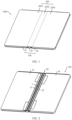
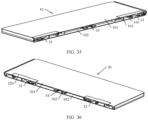
- FIG. 1 is a schematic diagram of a structure of an electronic device 1000 in an unfolded state according to an embodiment of this application.
- FIG. 2 is a schematic diagram of a structure of a folding apparatus 100 of the electronic device 1000 shown in FIG. 1 .
- FIG. 3 is a schematic diagram of a structure of the electronic device 1000 shown in FIG. 1 in an intermediate state.
- FIG. 4 is a schematic diagram of a structure of a folding apparatus 100 of the electronic device 1000 shown in FIG. 3 .
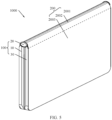
- FIG. 5 is a schematic diagram of a structure of the electronic device 1000 shown in FIG. 1 in a closed state.
- FIG. 6 is a schematic diagram of a structure of a folding apparatus 100 of the electronic device 1000 shown in FIG. 5 .
- the electronic device 1000 may be a product such as a mobile phone, a tablet computer, or a notebook computer. This embodiment is described by using an example in which the electronic device 1000 is a mobile phone.
- the electronic device 1000 includes a folding apparatus 100 and a flexible display 200.
- the folding apparatus 100 includes a first housing 10, a rotation mechanism 20, and a second housing 30 that are sequentially connected.
- the rotation mechanism 20 can deform, to enable the first housing 10 and the second housing 30 to be folded or unfolded relative to each other.
- the first housing 10 and the second housing 30 can be unfolded relative to each other to an unfolded state, so that the electronic device 1000 is in the unfolded state.
- an included angle between the first housing 10 and the second housing 30 may be substantially 180° (a slight deviation is allowed, for example, the included angle is 165°, 177°, or 185°).
- the first housing 10 and the second housing 30 can rotate (unfold or fold) relative to each other to an intermediate state, so that the electronic device 1000 is in the intermediate state.
- the first housing 10 and the second housing 30 can be folded relative to each other to a closed state, so that the electronic device 1000 is in the closed state.
- the first housing 10 and the second housing 30 can be totally closed to be parallel to each other (a slight deviation is allowed).
- the intermediate state shown in FIG. 3 and FIG. 4 may be any state between the unfolded state and the closed state. Therefore, the electronic device 1000 may switch between the unfolded state and the closed state through deformation of the rotation mechanism 20.
- the flexible display 200 is configured to display an image.
- the flexible display 200 may be an organic light-emitting diode (OLED) display, an active-matrix organic light-emitting diode (AMOLED) display, a mini light-emitting diode display, a micro light-emitting diode display, a micro organic light-emitting diode display, or a quantum dot light-emitting diode (QLED) display.
- OLED organic light-emitting diode
- AMOLED active-matrix organic light-emitting diode
- mini light-emitting diode display a micro light-emitting diode display
- a micro organic light-emitting diode display a micro organic light-emitting diode display
- QLED quantum dot light-emitting diode
- the flexible display 200 includes a first non-bending part 2001, a bending part 2002, and a second non-bending part 2003 that are sequentially arranged.
- the flexible display 200 is fastened to the folding apparatus 100.
- the flexible display 200 may be bonded to the folding apparatus 100 by using an adhesive layer.
- the first non-bending part 2001 of the flexible display 200 is fastened to the first housing 10, and the second non-bending part 2003 is fastened to the second housing 30.
- the bending part 2002 deforms.
- FIG. 1 when the first housing 10 and the second housing 30 are in an unfolded state, the flexible display 200 is in an unfolded form.
- FIG. 1 when the first housing 10 and the second housing 30 are in an unfolded state
- the flexible display 200 when the first housing 10 and the second housing 30 are in an intermediate state, the flexible display 200 is in an intermediate form between an unfolded form and a closed form. As shown in FIG. 5 , when the first housing 10 and the second housing 30 are in a closed state, the flexible display 200 is in a closed form. When the electronic device 1000 is in the closed state, the flexible display 200 is located on an outer side of the folding apparatus 100, and the flexible display 200 may be roughly in a U shape.
- the flexible display 200 can be unfolded or folded with the folding apparatus 100.
- the flexible display 200 is in the unfolded form, and can perform full-screen display, so that the electronic device 1000 has a large display area, to improve viewing experience of a user.
- a plane size of the electronic device 1000 is small (with a small width size), so that it is convenient for the user to carry and place the electronic device 1000.
- a rotation center of the electronic device 1000 is parallel to a width direction of the electronic device 1000" .
- the electronic device 1000 can rotate leftward and rightward, and folding and unfolding of the electronic device 1000 affect a width size of the electronic device 1000.
- a rotation center of the electronic device 1000 may alternatively be parallel to a length direction of the electronic device 1000. In this case, the electronic device 1000 can rotate up and down, and folding and unfolding of the electronic device 1000 affect a length size of the electronic device 1000.
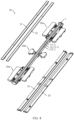
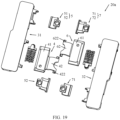
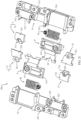
- FIG. 7 is a schematic exploded view of a partial structure of the folding apparatus 100 shown in FIG. 2 .
- FIG. 8 is a schematic exploded view of a partial structure of the rotation mechanism 20 shown in FIG. 7 .
- a fastener in the folding apparatus 100 is not shown in the accompanying drawings of this application, so as to simplify the drawings and show a main structure of the folding apparatus 100 more clearly.
- the rotation mechanism 20 of the folding apparatus 100 includes a main shaft assembly 1, end connection components 20a, a synchronous connection component 20b, a first support plate 21, a second support plate 22, a first shielding plate 23, and a second shielding plate 24.
- the main shaft assembly 1 is located between the first housing 10 and the second housing 30.
- the end connection components 20a are connected to the first housing 10, the main shaft assembly 1, and the second housing 30.
- There are two end connection components 20a, and the two end connection components 20a are arranged at intervals in an axial direction of the main shaft assembly 1, for example, may be respectively connected to a top and a bottom of the main shaft assembly 1.
- the synchronous connection component 20b is connected to the first housing 10, the main shaft assembly 1, and the second housing 30.
- the synchronous connection component 20b is located between the two end connection components 20a.
- the first support plate 21 and the second support plate 22 are located on one side of the plurality of connection components (that is, the two end connection components 20a and the synchronous connection component 20b), and the first shielding plate 23 and the second shielding plate 24 are located on the other side of the plurality of connection components (20a and 20b).
- the first support plate 21 is located on a side that is of the main shaft assembly 1 and that faces the first housing 10, and the first support plate 21 connects the two end connection components 20a.
- the second support plate 22 is located on a side that is of the main shaft assembly 1 and that faces the second housing 30, and the second support plate 22 connects the two end connection components 20a.
- the main shaft assembly 1 has a support surface 11, and the support surface 11 of the main shaft assembly 1 is partially exposed relative to the first support plate 21 and the second support plate 22.
- the support surface 11 of the main shaft assembly 1 is configured to support the flexible display 200.
- the first support plate 21 and the second support plate 22 move along with the end connection components 20a, so that when the first housing 10 and the second housing 30 are in an unfolded state, an intermediate state, and a closed state, the first support plate 21 and the second support plate 22 can provide strong support for the bending part 2002 of the flexible display 200 together with the main shaft assembly 1. In this way, the flexible display 200 is not easily damaged due to touching by an external force, reliability of the flexible display 200 is improved, and a service life of the flexible display 200 is long.
- the support surface 11 of the main shaft assembly 1 includes a first arc surface region 111, a plane region 112, and a second arc surface region 113 that are sequentially arranged in a direction from the first support plate 21 to the second support plate 22.
- the direction from the first support plate 21 to the second support plate 22 is perpendicular to an extension direction of the main shaft assembly 1.
- the first arc surface region 111 is located between the first support plate 21 and the plane region 112
- the second arc surface region 113 is located between the plane region 112 and the second support plate 22.
- the plane region 112 of the support surface 11 of the main shaft assembly 1 can provide flat strong support for the flexible display 200 when the folding apparatus 100 is in the unfolded state, to improve press touch experience of the flexible display 200.
- the first arc surface region 111 and the second arc surface region 113 of the support surface 11 of the main shaft assembly 1 can respectively form a smooth transition with the first support plate 21 and the second support plate 22 when the folding apparatus 100 is in the intermediate state and the closed state. In this way, the main shaft assembly 1, the first support plate 21, and the second support plate 22 can jointly provide a smooth support surface for the bending part 2002 of the flexible display 200. Therefore, the rotation mechanism 20 has a good support effect for the flexible display 200.
- the support surface 11 of the main shaft assembly 1 may alternatively have another shape.
- the support surface 11 of the main shaft assembly 1 is in an arc shape.
- the support surface 11 of the main shaft assembly 1 is disposed in a semi-ellipse shape, so as to reduce a width of the folding apparatus 100 in the closed state. In this way, the folding apparatus 100 is easy to carry and place.
- a shape of the support surface 11 of the main shaft assembly 1 is not strictly limited in this embodiment of this application.
- the first housing 10 has a first support surface 101, and the first support surface 101 is configured to support the flexible display 200.
- the second housing 30 has a second support surface 301, and the second support surface 301 is configured to support the flexible display 200.
- the first support surface 101 is flush with the second support surface 301, to well support the flexible display 200. In this way, the flexible display 200 is more flat, thereby improving user experience.
- the two end connection components 20a may be of a mirror symmetric structure, and the symmetry mirror is perpendicular to a circumferential direction of the main shaft assembly 1.
- the rotation mechanism 20 has a simple overall structure and low processing costs.
- stress between the two end connection components 20a and the main shaft assembly 1, the first housing 10, and the second housing 30 is uniform. This helps improve reliability of the folding apparatus 100.
- a structure of one end connection component 20a is mainly used for description.
- structures of the two end connection components may alternatively be different. It may be understood that a structure of the rotation mechanism 20 may have a plurality of combination and deformation manners. This is not strictly limited in this embodiment of this application.
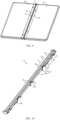
- FIG. 9 is a schematic diagram of a structure of the folding apparatus 100 shown in FIG. 2 from another angle.
- a field of view of the folding apparatus 100 in FIG. 9 is a field of view obtained after the field of view in FIG. 2 is flipped.
- the first shielding plate 23 is located on a side that is of the main shaft assembly 1 and that faces the first housing 10, and the first shielding plate 23 connects the two end connection components 20a.
- the second shielding plate 24 is located on a side that is of the main shaft assembly 1 and that faces the second housing 30, and the second shielding plate 24 connects the two end connection components 20a.
- the main shaft assembly 1 has a shielding surface 12.
- the first shielding plate 23 is located between the first housing 10 and the main shaft assembly 1, and can shield a gap between the first housing 10 and the main shaft assembly 1.
- the second shielding plate 24 is located between the second housing 30 and the main shaft assembly 1, and can shield a gap between the second housing 30 and the main shaft assembly 1. Therefore, the rotation mechanism 20 can shield, in the unfolded state, a gap between the first housing 10 and the second housing 30 by using the first shielding plate 23, the main shaft assembly 1, and the second shielding plate 24 together. This implements self-shielding, improves appearance integrity, and reduces a risk of external dust and foreign matters entering the rotation mechanism 20, to ensure reliability of the folding apparatus 100.
- FIG. 10 is a partial schematic exploded view of a partial structure of the folding apparatus 100 shown in FIG. 2 .
- FIG. 11 is a schematic exploded view of a structure of the main shaft assembly 1 shown in FIG. 10 .
- FIG. 12 is a schematic diagram of a structure of the main outer shaft 14 shown in FIG. 11 from another angle.
- the main shaft assembly 1 includes a main outer shaft 14, a main inner shaft 15, and a shielding plate 16.
- the main outer shaft 14 is fastened to one side of the main inner shaft 15, and the shielding plate 16 is fastened to the other side of the main inner shaft 15.
- the support surface 11 of the main shaft assembly 1 is formed on the main outer shaft 14, and is disposed away from the main inner shaft 15.
- the shielding surface 12 of the main shaft assembly 1 is formed on the shielding plate 16, and is disposed away from the main outer shaft 14.
- the main inner shaft 15 may include a plurality of portions, and the plurality of portions are respectively fastened to the main outer shaft 14.
- the main inner shaft 15 may alternatively be an integrally formed structure.
- the shielding plate 16 may be mutually fastened to the main inner shaft 15 in an assembly manner.
- the shielding plate 16 and the main inner shaft 15 may alternatively be integrally formed mechanical parts.
- a plurality of three-dimensional space structures are disposed on both the main inner shaft 15 and the main outer shaft 14. These structures are designed, so that after the main inner shaft 15 and the main outer shaft 14 are assembled, a plurality of movement spaces can be formed together, and mechanical parts of the plurality of connection components (20a and 20b) are movably disposed in the plurality of movement spaces of the main shaft assembly 1. This implements a connection to the main shaft assembly 1.
- the main inner shaft 15 and the main outer shaft 14 are separately designed. This helps reduce a difficulty of making the main shaft assembly 1, and improve precision of making the main shaft assembly 1 and a product yield rate.
- a rotation center of the rotation mechanism 20 is integrally parallel to an axial direction of the main shaft assembly 1, and the main shaft assembly 1 extends in the axial direction thereof.
- the main inner shaft 15 includes a first portion 15a, a second portion 15b, and a third portion 15c.
- the third portion 15c and the first portion 15a may be of a mirror symmetric structure, and the second portion 15b is located between the third portion 15c and the first portion 15a.
- the first portion 15a of the main inner shaft 15 includes a body 151 and a plurality of grooves 152, a plurality of bumps 153, and a plurality of fastening holes 154 that are formed on the body 151.
- the plurality of grooves 152 and the plurality of bumps 153 are mutually combined to form a plurality of three-dimensional space structures.
- the second portion 15b of the main inner shaft 15 includes a body 155 and two grooves 156, two bumps 157, and two fastening holes 158 that are formed on the body 155.
- the two grooves 156 and the two bumps 157 are mutually combined to form a three-dimensional space structure.
- reference numerals of some grooves 152, some bumps 153, some fastening holes 154, some grooves 156, some bumps 157, and some fastening holes 158 are schematically marked.
- the main outer shaft 14 includes a main outer shaft body 141, two end stoppers, a plurality of grooves 143, a plurality of bumps 144, and a plurality of fastening holes 145.
- the two end stoppers are respectively fastened at two ends of the main outer shaft body 141.
- the plurality of bumps 144 are formed on the main outer shaft body 141, and the plurality of grooves 143 and the plurality of fastening holes 145 are formed on the main outer shaft body 141 and/or the bumps 144.
- the plurality of grooves 143 and the plurality of bumps 144 are mutually combined to form a plurality of three-dimensional space structures. Reference numerals of some grooves 143, some bumps 144, and some fastening holes 145 are schematically marked in FIG. 12 .
- the main outer shaft body 141 and the main inner shaft body 151 are in contact with each other, the end stopper 142 of the main outer shaft 14 is exposed, and the plurality of fastening holes 145 of the main outer shaft 14 are aligned with the plurality of fastening holes (154, 158) of the main inner shaft 15.
- the main inner shaft 15 and the main outer shaft 14 are fastened by using a fastener (not shown in the figure).
- the fastener includes but is not limited to a screw, a bolt, a rivet, a pin, and the like.
- the plurality of three-dimensional space structures of the main outer shaft 14 and the plurality of three-dimensional space structures of the main inner shaft 15 jointly form a plurality of movement spaces of the main shaft assembly 1.
- some of the plurality of movement spaces are the same in structure, and some of the plurality of movement spaces are different in structure.
- Movement spaces with different structures are used to cooperate with mechanical parts with different structures, so that a connection structure between the main shaft assembly 1 and the plurality of connection components (20a and 20b) is more flexible and diversified.
- the movement space having a same structure is used to cooperate with the mechanical part having a same structure. This helps reduce design difficulty and costs of the main shaft assembly 1 and the connection component.
- limiting grooves 1431 are disposed on groove walls of some grooves 143 of the main outer shaft 14, to limit, in an axial direction of the main shaft assembly 1, a mechanical part disposed in a corresponding movement space, so as to improve reliability of a connection structure.
- some bumps 144 of the main outer shaft 14 have a limiting function. These bumps 144 are located in the movement space of the main shaft assembly 1, and are configured to limit the mechanical part of the connection component, so as to prevent the mechanical part from accidentally detaching from the main shaft assembly 1. This improves reliability of connection and movement between the connection component and the main shaft assembly 1, so that reliability of the rotation mechanism 20 and the folding apparatus 100 is high. It may be understood that, the main shaft assembly 1 may also be provided with a bump for positioning or limiting on the main inner shaft 15.
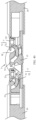
- FIG. 13 is a schematic diagram of a structure of the main shaft assembly 1 shown in FIG. 10 that is cut along a line A-A.
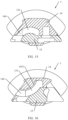
- FIG. 14 is a schematic diagram of a structure of the main shaft assembly 1 shown in FIG. 10 that is cut along a line B-B.
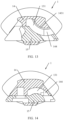
- FIG. 15 is a schematic diagram of a structure of the main shaft assembly 1 shown in FIG. 10 that is cut along a line C-C.
- FIG. 16 is a schematic diagram of a structure of the main shaft assembly 1 shown in FIG. 10 that is cut along a D-D line.
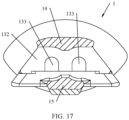
- FIG. 17 is a schematic diagram of a structure of the main shaft assembly 1 shown in FIG. 10 that is cut along a line E-E.
- the main shaft assembly 1 forms a plurality of movement spaces, and the plurality of movement spaces are used to cooperate with different mechanical parts of the connection component.
- the main outer shaft 14 and the main inner shaft 15 jointly enclose an arc groove 131.
- a circle center of the arc groove 131 is close to the main outer shaft 14 and away from the main inner shaft 15, to form a movement space.
- the movement space may further include a limiting groove 1431 connected to the arc groove 131, and the limiting groove 1431 is formed on the main outer shaft 14.
- the main outer shaft 14 may further include a bump 144 having a limiting function, and the bump 144 extends into the arc groove 131, to limit the mechanical part disposed in the movement space.
- the main outer shaft 14 and the main inner shaft 15 jointly enclose an arc groove 131.
- a circle center of the arc groove 131 is close to the main inner shaft 15 and away from the main outer shaft 14, to form a movement space.
- the main outer shaft 14 may further include a bump 144 having a limiting function, and the bump 144 extends into the arc groove 131, to limit the mechanical part disposed in the movement space.
- the main outer shaft 14 and the main inner shaft 15 jointly enclose an arc groove 131.
- a circle center of the arc groove 131 is close to the main inner shaft 15 and away from the main outer shaft 14, to form a movement space.
- the main outer shaft 14 may further include a bump 144 having a limiting function, and the bump 144 extends into the arc groove 131, to limit the mechanical part disposed in the movement space.
- the movement space shown in FIG. 15 and the movement space shown in FIG. 14 are disposed in pairs.
- the main outer shaft 14 and the main inner shaft 15 jointly enclose an arc groove 131.
- a circle center of the arc groove 131 is close to the main outer shaft 14 and away from the main inner shaft 15, to form a movement space.
- the movement space may further include a limiting groove 1431 connected to the arc groove 131, and the limiting groove 1431 is formed on the main outer shaft 14.
- the main outer shaft 14 may further include a bump 144 having a limiting function, and the bump 144 extends into the arc groove 131, to limit the mechanical part disposed in the movement space.
- the movement space shown in FIG. 16 and the movement space shown in FIG. 13 are disposed in pairs.
- the main outer shaft 14 and the main inner shaft 15 jointly enclose an M-shaped groove 132.
- Two concave grooves 133 disposed at intervals are formed on a side wall of the M-shaped groove 132, and the M-shaped groove 132 and the two concave grooves 133 jointly form a movement space.
- main shaft assembly 1 in this embodiment of this application may alternatively have another structure. This is not strictly limited in this application.
- FIG. 18 is a schematic diagram of a structure of the end connection component 20a shown in FIG. 10 from another angle.
- FIG. 19 is a schematic exploded view of a partial structure of the end connection component 20a shown in FIG. 18 .
- FIG. 20 is a schematic diagram of a structure of the end connection component 20a shown in FIG. 10 from still another angle.
- FIG. 21 is a schematic exploded view of a partial structure of the end connection component 20a shown in FIG. 20 .
- a field of view shown in FIG. 20 is flipped relative to a field of view shown in FIG. 18 .
- the end connection component 20a of the rotation mechanism 20 includes a first fastening bracket 31, a first transmission arm 4, a first rotation arm 5, a second fastening bracket 32, a second transmission arm 6, and a second rotation arm 7.
- the first rotation arm 5 includes a first rotation part 51 and a second rotation part 52, and the second rotation part 52 and the first rotation part 51 are two mechanical parts independent of each other.
- the second rotation arm 7 includes a third rotation part 71 and a fourth rotation part 72, and the fourth rotation part 72 and the third rotation part 71 are two mechanical parts independent of each other.
- the first fastening bracket 31 is fastened to the first housing 10.
- the first transmission arm 4 includes a sliding end 41 and a rotation end 42.
- the sliding end 41 of the first transmission arm 4 is slidably connected to the first fastening bracket 31, and the rotation end 42 of the first transmission arm 4 is rotatably connected to the main shaft assembly 1.
- the first rotation arm 5 is rotatably connected to the first fastening bracket 31 by using the first rotation part 51, and is rotatably connected to the main shaft assembly 1 by using the second rotation part 52. That is, one end of the first rotation arm 5 is rotatably connected to the first fastening bracket 31, and the other end is rotatably connected to the main shaft assembly 1.
- the second fastening bracket 32 is fastened to the second housing 30.
- the second transmission arm 6 includes a sliding end 61 and a rotation end 62, the sliding end 61 of the second transmission arm 6 is slidably connected to the second fastening bracket 32, and the rotation end 62 of the second transmission arm 6 is rotatably connected to the main shaft assembly 1.
- the second rotation arm 7 is rotatably connected to the second fastening bracket 31 by using the third rotation part 71, and is rotatably connected to the main shaft assembly 1 by using the fourth rotation part 72.
- One end of the second rotation arm 7 is rotatably connected to the second fastening bracket 32, and the other end is rotatably connected to the main shaft assembly 1.
- FIG. 22 is a schematic diagram of an exploded structure of a first fastening bracket 31 of the end connection component 20a shown in FIG. 21 .
- the first fastening bracket 31 includes a first fastening base 311 and a first snapping part 312.
- the first snapping part 312 is fastened to the first fastening base 311, and the first snapping part 312 and the first fastening base 311 jointly enclose a first arc groove 313.
- the first snapping part 312 may be mutually fastened to the first fastening base 311 by using a fastener.
- a processing manner in which the first fastening base 311 and the first snapping part 312 are separately manufactured, and then the first fastening base 311 and the first snapping part 312 are assembled into the first fastening bracket 31 helps reduce a processing difficulty of the first fastening bracket 31, and improve a product yield rate of the first fastening bracket 31.
- the first fastening bracket 31 may alternatively be an integrally formed structure.
- the first fastening base 311 of the first fastening bracket 31 may further have a first sliding slot 314.
- a side wall of the first sliding slot 314 may have concave guide space 3141.
- the first fastening base 311 may further have a first concave region 315 and a second concave region 316, and both the first concave region 315 and the second concave region 316 communicate with the first sliding slot 314.
- the first concave region 315 is located on a side that is of the second concave region 316 and that is close to the second fastening bracket 32. Refer to FIG. 8 , the first concave region 315 is located between the main shaft assembly 1 and the second concave region 316.
- the first fastening base 311 of the first fastening bracket 31 has a plurality of fastening holes 3111.
- the rotation mechanism 20 may fasten the first fastening bracket 31 to the first housing 10 by using a plurality of fasteners.
- the first snapping part 312 has a fastening hole 3121, configured to align with some fastening holes 3111 of the first fastening base 311, so as to mutually lock and fasten the first snapping part 312 and the first fastening base 311 by using a fastener.
- FIG. 23 is a schematic diagram of an exploded structure of a second fastening bracket 32 of the end connection component 20a shown in FIG. 21 .
- the second fastening bracket 32 includes a second fastening base 321 and a second snapping part 322.
- the second snapping part 322 is fastened to the second fastening base 321, and the second snapping part 322 and the second fastening base 321 jointly enclose a second arc groove 323.
- the second fastening base 321 of the second fastening bracket 32 may further have a second sliding slot 324.
- a side wall of the second sliding slot 324 may have concave guide space 3241.
- the second fastening base 321 may further have a third concave region 325 and a fourth concave region 326, and both the third concave region 325 and the fourth concave region 326 communicate with the second sliding slot 324.
- the third concave region 325 is located on a side that is of the fourth concave region 326 and that is close to the first fastening bracket 31. Refer to FIG. 8 , the third concave region 325 is located between the main shaft assembly 1 and the fourth concave region 326.
- the rotation end 42 of the first transmission arm 4 is in an arc shape.
- the rotation end 42 of the first transmission arm 4 may be disposed in one arc groove 131 of the main shaft assembly 1, so that the first transmission arm 4 is rotatably connected to the main shaft assembly 1.
- a rotation center in which the first transmission arm 4 rotates relative to the main shaft assembly 1 is close to the main inner shaft 15 and is away from the main outer shaft 14.
- the first transmission arm 4 is connected to the main shaft assembly 1 by using a virtual shaft.
- a rotatable connection structure is simple, and occupies small space.
- the first transmission arm 4 and the main shaft assembly 1 may alternatively be connected by using a real shaft. This is not strictly limited in this embodiment of this application.
- the rotation end 42 of the first transmission arm 4 may include a limiting bump 422, and the limiting bump 422 is formed at an end position of the rotation end 42.
- the limiting bump 422 is configured to cooperate with a bump 144 having a limiting function of the main shaft assembly 1, to prevent the first transmission arm 4 from accidentally detaching from the main shaft assembly 1.
- the sliding end 41 of the first transmission arm 4 includes a first flange 413 located on a peripheral side.
- the sliding end 41 of the first transmission arm 4 is disposed in the first sliding slot 314 of the first fastening bracket 31, and the first flange 413 is disposed in the guide space 3141 of the first sliding slot 314.
- the guide space 3141 of the first sliding slot 314 cooperates with the first flange 413 of the first transmission arm 4, so that the sliding end 41 of the first transmission arm 4 can be guided in a sliding direction of the first sliding slot 314. In this way, a relative sliding action between the first transmission arm 4 and the first fastening bracket 31 is easy to implement with high control precision.
- the rotation mechanism 20 further includes a first stopper 81, and the first stopper 81 is disposed on the sliding end 41 of the first transmission arm 4.
- the first stopper 81 is clamped into the first fastening bracket 31.
- a relative position relationship between the first transmission arm 4 and the first fastening bracket 31 can be limited, so that the first transmission arm 4 and the first fastening bracket 31 can maintain a preset relative position relationship without a large external force, the rotation mechanism 20 can stay at a preset angle, and a rotation mechanism can maintain an unfolded state or a closed state.
- the first stopper 81 when the first housing 10 and the second housing 30 are unfolded relative to each other to an unfolded state, the first stopper 81 is partially clamped into the first concave region 315. When the first housing 10 and the second housing 30 are folded relative to each other to a closed state, the first stopper 81 is partially clamped into the second concave region 316.
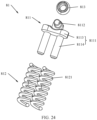
- FIG. 24 is a schematic diagram of an exploded structure of a first stopper 81 of the end connection component 20a shown in FIG. 21 .
- the first stopper 81 includes a first bracket 811 and a first elastic part 812.
- the first bracket 811 is of a rigid structure, and is not prone to deformation under an external force.
- the first bracket 811 includes a control portion 8111 and an abutment portion 8112.
- the abutment portion 8112 is configured to abut against an external mechanical part, to limit the mechanical part.
- the control portion 8111 is configured to control a position of the abutment portion 8112.
- the control portion 8111 includes a substrate 8113 and a plurality of guide posts 8114, and the plurality of guide posts 8114 are fastened to one side of the substrate 8113 at intervals.
- the abutment portion 8112 is fastened to the other side of the substrate 8113.
- the first elastic part 812 is of an elastic structure, and is prone to deformation under an external force.
- One end of the first elastic part 812 is disposed on the control portion 8111 of the first bracket 811.
- the first elastic part 812 may include a plurality of springs 8121, and the plurality of springs 8121 sleeve the plurality of guide posts 8114 in a one-to-one correspondence.
- the sliding end 41 of the first transmission arm 4 has a first accommodating groove 411, and the first stopper 81 is disposed in the first accommodating groove 411.
- the other end (that is, an end away from the control portion 8111) of the first elastic part 812 abuts against a groove wall of the first accommodating groove 411, the first elastic part 812 is in a compressed state, and the abutment portion 8112 of the first bracket 811 is clamped into the first fastening bracket 31.
- the first elastic part 812 of the first stopper 81 can deform under an external force, so that the first stopper 81 can smoothly move between the first concave region 315 and the second concave region 316 relative to the first fastening bracket 31. This improves limiting reliability between the first stopper 81 and the sliding end 41 of the first transmission arm 4.
- the first stopper 81 may further include a first buffer part 813, and the first buffer part 813 is disposed on the abutment portion 8112 of the first bracket 811.
- the first buffer part 813 may be made of a material (for example, rubber) with small stiffness, so that when being subjected to an external force, the first buffer part 813 can absorb an impact force through deformation, thereby implementing buffering.
- the first stopper 81 can buffer stress between the abutment portion 8112 and the mechanical part by disposing the first buffer part 813. Therefore, reliability of a limiting structure is improved.
- the first stopper 81 abuts against the first fastening bracket 31 by using the first buffer part 813 having a buffer function. This helps reduce a risk of wear between the first bracket 811 and the first fastening bracket 31 in a long-time relative movement process, improve limiting reliability of the first stopper 81, and improve reliability of the rotation mechanism 20.
- the rotation end 62 of the second transmission arm 6 is in an arc shape.
- the rotation end 62 of the second transmission arm 6 may be disposed in one arc groove 131 of the main shaft assembly 1, so that the second transmission arm 6 is rotatably connected to the main shaft assembly 1.
- a rotation center in which the second transmission arm 6 rotates relative to the main shaft assembly 1 is close to the main inner shaft 15 and is away from the main outer shaft 14.
- the second transmission arm 6 is connected to the main shaft assembly 1 by using a virtual shaft.
- a rotatable connection structure is simple, and occupies small space.
- the second transmission arm 6 and the main shaft assembly 1 may alternatively be connected by using a real shaft. This is not strictly limited in this embodiment of this application.
- the rotation end 62 of the second transmission arm 6 may include a limiting bump 622, and the limiting bump 622 is formed at an end position of the rotation end 62.
- the limiting bump 622 is configured to cooperate with a bump having a limiting function of the main shaft assembly 1, to prevent the second transmission arm 6 from accidentally detaching from the main shaft assembly 1.
- the sliding end 61 of the second transmission arm 6 includes a second flange 613 located on a peripheral side.
- the sliding end 61 of the second transmission arm 6 is disposed in the second sliding slot 324 of the second fastening bracket 32, and the second flange 613 is disposed in the guide space 3241 of the second sliding slot 324.
- the guide space 3241 of the second sliding slot 324 cooperates with the second flange 613 of the second transmission arm 6, so that the sliding end 61 of the second transmission arm 6 can be guided in a sliding direction of the first sliding slot 314. In this way, a relative sliding action between the first transmission arm 4 and the first fastening bracket 31 is easy to implement, and high in control precision.
- the rotation mechanism 20 further includes a second stopper 82, and the second stopper 82 is disposed on the sliding end 61 of the second transmission arm 6.
- the second stopper 82 is clamped into the second fastening bracket 32.
- a relative position relationship between the second transmission arm 6 and the second fastening bracket 32 can be limited, so that the second transmission arm 6 and the second fastening bracket 32 can maintain a preset relative position relationship without a large external force.
- the rotation mechanism 20 can stay at a preset angle, and a rotation mechanism can maintain an unfolded state or a closed state, to improve user experience of the folding apparatus 100 and the electronic device 1000.
- a rotation mechanism can maintain an unfolded state or a closed state, to improve user experience of the folding apparatus 100 and the electronic device 1000.
- the second stopper 82 when the first housing 10 and the second housing 30 are unfolded relative to each other to an unfolded state, the second stopper 82 is partially clamped into the third concave region 325.
- the second stopper 82 is partially clamped into the fourth concave region 326.
- a structure of the second stopper 82 may be the same as a structure of the first stopper 81, to simplify material types of the rotation mechanism 20, and reduce design difficulty and costs of the rotation mechanism 20.
- a structure of the second stopper 82 is not described in detail in this embodiment of this application.
- FIG. 25 is a schematic diagram of a partial structure of the rotation mechanism 20 shown in FIG. 7 .
- FIG. 26 is a schematic diagram of a structure of the first support plate 21 shown in FIG. 25.
- FIG. 25 shows structures of the first support plate 21, the first rotation part 51, and the second rotation part 52 of the rotation mechanism 20.
- the first rotation part 51 of the first rotation arm 5 includes a fixed portion 511 and a rotation portion 512.
- the rotation portion 512 of the first rotation part 51 is fastened to the fixed portion 511 of the first rotation part 51, and the first rotation part 51 may be an integrally formed mechanical part.
- the second rotation part 52 of the first rotation arm 5 includes a fixed portion 521 and a rotation portion 522.
- the rotation portion 522 of the second rotation part 52 is fastened to the fixed portion 521 of the second rotation part 52, and the second rotation part 52 may be an integrally formed mechanical part.
- the fixed portion 511 of the first rotation part 51 is fastened to the first support plate 21.
- the fixed portion 521 of the second rotation part 52 is fastened to the first support plate 21.
- the rotation portion 512 of the first rotation part 51 and the rotation portion 522 of the second rotation part 52 respectively extend towards two sides of the first support plate 21. In other words, the first support plate 21 is fixedly connected to the first rotation arm 5.
- the first support plate 21 includes a plate body 211 and a first fastening block 212, a first positioning block 213, a second fastening block 214, and a second positioning block 215 that are fastened to the plate body 211.
- the first support plate 21 may be an integrally formed mechanical part.
- the fixed portion 511 of the first rotation part 51 is fastened to the first fastening block 212, and abuts against the first positioning block 213.
- the fixed portion 521 of the second rotation part 52 is fastened to the second fastening block 214, and abuts against the second positioning block 215.
- the fixed portion 511 of the first rotation part 51 may sleeve on the outside of the first fastening block 212, and fastening holes are disposed in both the fixed portion 511 and the first fastening block 212, so as to mutually lock and fasten the fixed portion 511 and the first fastening block 212 by using a fastener.
- the fixed portion 521 of the second rotation part 52 may sleeve on the outside of the second fastening block 214, and fastening holes are disposed in both the fixed portion 521 and the second fastening block 214, so as to mutually lock and fasten the fixed portion 521 and the second fastening block 214 by using a fastener.
- the fixed portion 511 of the first rotation part 51 and the fixed portion 521 of the second rotation part 52 may also be fastened to the first support plate 21 by bonding or the like.
- the second rotation part 52 and the first rotation part 51 are fastened to each other, and the second rotation part 52 and the first rotation part 51 are equivalent to a mechanical part that can transmit force and movement.
- An end that is of the first rotation arm 5 and that is rotatably connected to the first fastening bracket 31 is formed on the rotation portion 512 of the first rotation part 51, and the rotation portion 512 of the first rotation part 51 is rotatably connected to the first fastening bracket 31.
- the rotation portion 512 of the first rotation part 51 is in an arc shape, and the rotation portion 512 of the first rotation part 51 is disposed in the first arc groove 313 of the first fastening bracket 31.
- the end that is of the first rotation arm 5 and that is rotatably connected to the first fastening bracket 31 is in an arc shape and is disposed in the first arc groove 313.
- the first rotation arm 5 is connected to the first fastening bracket 31 by using a virtual shaft.
- a rotatable connection structure is simple, and occupies small space. This helps reduce a thickness of the rotation mechanism 20, so that the folding apparatus 100 and the electronic device 1000 are lighter and thinner.
- the first rotation arm 5 and the first fastening bracket 31 may alternatively be connected by using a real shaft. This is not strictly limited in this embodiment of this application.
- An end that is of the first rotation arm 5 and that is rotatably connected to the main shaft assembly 1 is formed on the rotation portion 522 of the second rotation part 52, and the rotation portion 522 of the second rotation part 52 is rotatably connected to the main shaft assembly 1.
- the rotation portion 522 of the second rotation part 52 is in an arc shape, and the rotation portion 522 of the second rotation part 52 can be disposed in the movement space of the main shaft assembly 1 (as shown in FIG. 16 ), so as to be rotatably connected to the main shaft assembly 1.
- the end that is of the first rotation arm 5 and that is rotatably connected to the main shaft assembly 1 is in an arc shape and is disposed in one arc groove 131 of the main shaft assembly 1.
- a rotation center in which the first rotation arm 5 rotates relative to the main shaft assembly 1 is close to the main outer shaft 14 and away from the main inner shaft 15.
- the first rotation arm 5 is connected to the main shaft assembly 1 by using a virtual shaft.
- a rotatable connection structure is simple, and occupies small space. This helps reduce a thickness of the rotation mechanism 20, so that the folding apparatus 100 and the electronic device 1000 are lighter and thinner.
- the first rotation arm 5 and the main shaft assembly 1 may alternatively be connected by using a real shaft. This is not strictly limited in this embodiment of this application.
- the first rotation arm 5 including the first rotation part 51 and the second rotation part 52 can transfer force and movement between the main shaft assembly 1 and the first fastening bracket 31.
- the first transmission arm 4 is also configured to transfer force and movement between the main shaft assembly 1 and the first fastening bracket 31, the rotation mechanism 20 controls relative movement between the first fastening bracket 31 and the main shaft assembly 1 by using both the first transmission arm 4 and the first rotation arm 5.
- FIG. 27 is a schematic diagram of another partial structure of the rotation mechanism 20 shown in FIG. 7 .
- FIG. 27 shows structures of the second support plate 22, the third rotation part 71, and the fourth rotation part 72 of the rotation mechanism 20.
- the third rotation part 71 of the second rotation arm 7 includes a fixed portion 711 and a rotation portion 712.
- the rotation portion 712 of the third rotation part 71 is fastened to the fixed portion 711 of the third rotation part 71, and the third rotation part 71 may be an integrally formed mechanical part.
- the fourth rotation part 72 of the second rotation arm 7 includes a fixed portion 721 and a rotation portion 722.
- the rotation portion 722 of the fourth rotation part 72 is fastened to the fixed portion 721 of the fourth rotation part 72, and the fourth rotation part 72 may be an integrally formed mechanical part.
- the fixed portion 711 of the third rotation part 71 is fastened to the second support plate 22.
- the fixed portion 721 of the fourth rotation part 72 is fastened to the second support plate 22.
- the rotation portion 712 of the third rotation part 71 and the rotation portion 722 of the fourth rotation part 72 respectively extend to two sides of the second support plate 22.
- the second support plate 22 is fixedly connected to the second rotation arm 7.
- a structure of the second support plate 22 may be similar to a structure of the first support plate 21.
- a fastening structure of the third rotation part 71 and the fourth rotation part 72 to the second support plate 22 may also be similar to a fastening structure of the first rotation part 51 and the second rotation part 52 to the first support plate 21. Details are not described in this embodiment of this application.
- the fourth rotation part 72 and the third rotation part 71 are fastened to each other, and the fourth rotation part 72 and the third rotation part 71 are jointly equivalent to a mechanical part that can transfer force and movement.
- An end that is of the second rotation arm 7 and that is rotatably connected to the second fastening bracket 32 is formed on the rotation portion 712 of the third rotation part 71, and the rotation portion 712 of the third rotation part 71 is rotatably connected to the second fastening bracket 32.
- the rotation portion 712 of the third rotation part 71 is in an arc shape, and the rotation portion 712 of the third rotation part 71 is disposed in the second arc groove 323 of the second fastening bracket 32.
- the end that is of the second rotation arm 7 and that is rotatably connected to the second fastening bracket 32 is in an arc shape and is disposed in the second arc groove 323.
- the second rotation arm 7 is connected to the second fastening bracket 32 by using a virtual shaft.
- a rotatable connection structure is simple, and occupies small space. This helps reduce a thickness of the rotation mechanism 20, so that the folding apparatus 100 and the electronic device 1000 are lighter and thinner.
- the second rotation arm 7 and the second fastening bracket 32 may alternatively be connected by using a real shaft. This is not strictly limited in this embodiment of this application.
- An end that is of the second rotation arm 7 and that is rotatably connected to the main shaft assembly 1 is formed on the rotation portion 722 of the fourth rotation part 72, and the rotation portion 722 of the fourth rotation part 72 is rotatably connected to the main shaft assembly 1.
- the rotation portion 722 of the fourth rotation part 72 is in an arc shape, and the rotation portion 722 of the fourth rotation part 72 can be disposed in the movement space of the main shaft assembly 1 (as shown in FIG. 13 ), so as to be rotatably connected to the main shaft assembly 1.
- the end that is of the second rotation arm 7 and that is rotatably connected to the main shaft assembly 1 is in an arc shape and is disposed in one arc groove 131 of the main shaft assembly 1.
- a rotation center in which the second rotation arm 7 rotates relative to the main shaft assembly 1 is close to the main outer shaft 14 and away from the main inner shaft 15.
- the second rotation arm 7 is connected to the main shaft assembly 1 by using a virtual shaft.
- a rotatable connection structure is simple, and occupies small space. This helps reduce a thickness of the rotation mechanism 20, so that the folding apparatus 100 and the electronic device 1000 are lighter and thinner.
- the second rotation arm 7 and the main shaft assembly 1 may alternatively be connected by using a real shaft. This is not strictly limited in this embodiment of this application.
- the second rotation arm 7 including the third rotation part 71 and the fourth rotation part 72 can transfer force and movement between the main shaft assembly 1 and the second fastening bracket 32.
- the rotation mechanism 20 controls relative movement between the second fastening bracket 32 and the main shaft assembly 1 by using both the second transmission arm 6 and the second rotation arm 7.
- the first rotation arm 5 can directly control a movement track of the first support plate 21, and the second rotation arm 7 can directly control a movement track of the second support plate 22.
- a movement process of the first support plate 21 and the second support plate 22 is high in control precision with a small hysteresis error, and therefore, the rotation mechanism 20 can meet a support requirement of the flexible display 200.
- first rotation arm 5 and the second rotation arm 7 may have another implementation.
- FIG. 28 is a schematic diagram of a structure of the first rotation arm 5 shown in FIG. 21 in some other embodiments.
- the first rotation arm 5 may further include a first fastening part 53. That is, the first rotation arm 5 includes the first rotation part 51, the second rotation part 52, and the first fastening part 53.
- the fixed portion 511 of the first rotation part 51 is fastened to the first fastening part 53
- the fixed portion 521 of the second rotation part 52 is fastened to the first fastening part 53.
- a fastening structure of the fixed portion 511 of the first rotation part 51 to the first fastening part 53 refer to the fastening structure of the fixed portion 511 of the first rotation part 51 to the first support plate 21.
- the first fastening part 53 is fixedly connected to the first support plate 21.
- the first fastening part 53 and the first support plate 21 may be fastened in a manner of bonding, fastener connection, or the like.
- a plurality of mechanical parts of the first rotation arm 5 may be first assembled to form a modular structure, and then assembled with the first support plate 21. This helps improve assembly precision.
- first fastening bracket 31 and the main shaft assembly 1 that cooperate with the first fastening part 53 refer to the foregoing embodiments.
- the second rotation arm 7 further includes a second fastening part. That is, the second rotation arm 7 includes the third rotation part 71, the fourth rotation part 72, and the second fastening part.
- the fixed portion 711 of the third rotation part 71 is fixedly connected to the second fastening part
- the fixed portion 721 of the fourth rotation part 72 is fixedly connected to the second fastening part
- the second fastening part is fixedly connected to the second support plate 22.
- Other details of the second rotation arm 7 are not described in this embodiment of this application.
- FIG. 29 is a schematic diagram of a structure of the first rotation arm 5 shown in FIG. 21 in still some other embodiments.
- the first rotation arm 5 is an integrally formed mechanical part.
- the first rotation arm 5 includes a first rotation portion 54, a fixed portion 55, and a second rotation portion 56 that are sequentially arranged, and the first rotation portion 54 and the second rotation portion 56 extend in different directions.
- An end that is of the first rotation arm 5 and that is rotatably connected to the first fastening bracket 31 is formed on the first rotation portion 54 of the first rotation arm 5
- an end that is of the first rotation arm 5 and that is rotatably connected to the main shaft assembly 1 is formed on the second rotation portion 56 of the first rotation arm 5
- the first support plate 21 is fastened to the fixed portion 55 of the first rotation arm 5.
- the first rotation portion 54 is rotatably connected to the first fastening bracket 31, and the second rotation portion 56 is rotatably connected to the main shaft assembly 1.
- first rotation portion 54 refers to the structure of the rotation portion 512 of the first rotation part 51 in the foregoing embodiment.
- second rotation portion 56 refer to the structure of the rotation portion 522 of the second rotation part 52 in the foregoing embodiment.
- the fixed portion 55 of the first rotation arm 5 and the first support plate 21 may be connected by using a fastener, bonding, or the like.
- the integrally formed first rotation arm 5 can simplify an assembly process of the rotation mechanism 20. Structures of the first fastening bracket 31 and the main shaft assembly 1 that cooperate with the first rotation arm 5 are adaptively adjusted, including but not limited to a position, a shape, and the like of a groove structure. A structure of the second rotation arm 7 may be disposed with reference to a structure of the first rotation arm 5.
- the second rotation arm 7 includes a first rotation portion, a fixed portion, and a second rotation portion that are sequentially arranged, and the first rotation portion and the second rotation portion extend in different directions.
- An end that is of the second rotation arm 7 and that is rotatably connected to the second fastening bracket 32 is formed on the first rotation portion of the second rotation arm 7, an end that is of the second rotation arm 7 and that is rotatably connected to the main shaft assembly 1 is formed on the second rotation portion of the second rotation arm 7, and the second support plate 22 is fastened to the fixed portion of the second rotation arm 7.
- Other details of the second rotation arm 7 are not described in this embodiment of this application.
- FIG. 30 is a schematic diagram of still another partial structure of the rotation mechanism 20 shown in FIG. 7 .
- FIG. 30 shows structures of the first shielding plate 23, the second shielding plate 24, the first transmission arm 4, and the second transmission arm 6 of the rotation mechanism 20.
- the first shielding plate 23 is fixedly connected to the sliding end 41 of the first transmission arm 4, and the second shielding plate 24 is fixedly connected to the sliding end 61 of the second transmission arm 6.
- the first transmission arm 4 can directly control a movement track of the first shielding plate 23, and the second transmission arm 6 can directly control a movement track of the second shielding plate 24.
- a movement process of the first shielding plate 23 and the second shielding plate 24 is high in control precision with a small hysteresis error, so that the first shielding plate 23 and the second shielding plate 24 accurately extend or retract in a rotation process of the folding apparatus 100, to meet a self-shielding requirement of the flexible display 200.
- FIG. 31 is a schematic diagram of a structure of the first shielding plate 23 and a structure of the second shielding plate 24 shown in FIG. 7 .
- the first shielding plate 23 includes a plate body 231, a first fastening block 232 fastened to the plate body 231, and a first limiting groove 233 formed on the plate body 231.
- the second shielding plate 24 includes a plate body 241, a second fastening block 242 fastened to the plate body 241, and a second limiting groove 243 formed on the plate body 241.
- the sliding end 41 of the first transmission arm 4 is fixedly connected to the first fastening block 232.
- Fastening holes may be disposed at both the sliding end 41 of the first transmission arm 4 and the first fastening block 232, so as to lock and fasten the sliding end 41 and the first fastening block 232 by using a fastener.
- the sliding end 41 of the first transmission arm 4 abuts against the plate body 231 of the first shielding plate 23, and partially extends into the first limiting groove 233, to well mutually limit the first transmission arm 4 and the first shielding plate 23, so that stability of a connection structure is good.
- the sliding end 61 of the second transmission arm 6 is fixedly connected to the second fastening block 242.
- Fastening holes may be disposed at both the sliding end 61 of the second transmission arm 6 and the second fastening block 242, so as to lock and fasten the sliding end 61 and the second fastening block 242 by using a fastener.
- the sliding end 61 of the second transmission arm 6 abuts against the plate body 241 of the second shielding plate 24, and partially extends into the second limiting groove 243, to well mutually limit the second transmission arm 6 and the second shielding plate 24, so that stability of a connection structure is good.
- FIG. 32 is a schematic diagram of a structure of a synchronous connection component 20b of the rotation mechanism 20 shown in FIG. 8 .
- FIG. 33 is a schematic diagram of an exploded structure of the synchronous connection component 20b shown in FIG. 32 .
- FIG. 34 is a schematic diagram of a structure of the synchronous connection component 20b shown in FIG. 33 from another angle. A field of view shown in FIG. 34 is flipped relative to a field of view shown in FIG. 33 .
- the rotation mechanism 20 further includes a third fastening bracket 33, a fourth fastening bracket 34, a first synchronous swing arm 91, and a second synchronous swing arm 92.
- the third fastening bracket 33 is fastened to the first housing 10, and the fourth fastening bracket 34 is fastened to the second housing 30.
- the third fastening bracket 33 has a third sliding slot 331, and a side wall of the third sliding slot 331 may have concave guide space 3311.
- the fourth fastening bracket 34 has a fourth sliding slot 341, and a side wall of the fourth sliding slot 341 may have concave guide space 3411.
- the first synchronous swing arm 91 includes a rotation end 911 and a movable end 912.
- the rotation end 911 of the first synchronous swing arm 91 is rotatably connected to the main shaft assembly 1.
- the movable end 912 of the first synchronous swing arm 91 is movably connected to the third fastening bracket 33.
- the movable end 912 of the first synchronous swing arm 91 slides and rotates relative to the third fastening bracket 33.
- the second synchronous swing arm 92 includes a rotation end 921 and a movable end 922.
- the rotation end 921 of the second synchronous swing arm 92 is rotatably connected to the main shaft assembly 1, the rotation end 921 of the second synchronous swing arm 92 is engaged with the rotation end 911 of the first synchronous swing arm 91, and the movable end 922 of the second synchronous swing arm 92 is movably connected to the fourth fastening bracket 34.
- the movable end 922 of the second synchronous swing arm 92 slides and rotates relative to the fourth fastening bracket 34.
- both the rotation end 911 of the first synchronous swing arm 91 and the rotation end 921 of the second synchronous swing arm 92 are rotatably connected to the main shaft assembly 1
- the movable end 912 of the first synchronous swing arm 91 is movably connected to the third fastening bracket 33
- the movable end 922 of the second synchronous swing arm 92 is movably connected to the fourth fastening bracket 34.
- the first synchronous swing arm 91 and the second synchronous swing arm 92 can control a rotation angle of the third fastening bracket 33 relative to the main shaft assembly 1 to be consistent with a rotation angle of the fourth fastening bracket 34 relative to the main shaft assembly 1.
- a rotation action of the third fastening bracket 33 and a rotation action of the fourth fastening bracket 34 are synchronous and consistent, and symmetry between a folding action and an unfolding action of the rotation mechanism 20 is good. This helps improve user experience.
- the first synchronous swing arm 91 is rotatably connected to the main shaft assembly 1, and is slidably and rotatably connected to the third fastening bracket 33, that is, a connecting rod slider structure is formed.
- the second synchronous swing arm 92 is rotatably connected to the main shaft assembly 1, and is slidably and rotatably connected to the fourth fastening bracket 34, that is, a connecting rod slider structure is formed.
- the two connecting rod slider structures that are engaged with each other can well control synchronization and consistency of rotation actions of the first housing 10 and the second housing 30.
- the rotation end 911 of the first synchronous swing arm 91 includes a first rotation body 9111, a first rotation shaft 9112, and a first gear 9113.
- the first rotation body 9111 includes a front face, a back face, and a peripheral side face that is connected between the front face and the back face.
- the first gear 9113 is fastened to the peripheral side surface of the first rotation body 9111.
- the first rotation shaft 9112 is fastened to the front face and/or back face of the first rotation body 9111.
- "A and/or B" includes three cases: “A", "B", and "A and B".
- the first rotation shaft 9112 includes two portions, which are respectively fastened to the front face and the back face of the first rotation body 9111, so that the first synchronous swing arm 91 has better balance and stability when the first synchronous swing arm 91 is rotatably connected to another structure by using the first rotation shaft 9112.
- the first rotation shaft 9112 includes one portion, and the first rotation shaft 9112 is fastened to the front face or the back face of the first rotation body 9111, so as to reduce an accommodating space requirement of the first synchronous swing arm 91.
- the first rotation shaft 9112 is rotatably connected to the main shaft assembly 1.
- the first synchronous swing arm 91 may be disposed in one of the M-shaped grooves 132 (as shown in FIG.
- the rotation end 911 of the first synchronous swing arm 91 and the main shaft assembly 1 are rotatably connected by using a real shaft.
- the rotation end 911 of the first synchronous swing arm 91 and the main shaft assembly 1 may alternatively be rotatably connected by using a virtual shaft. This is not strictly limited in this embodiment of this application.
- the rotation end 921 of the second synchronous swing arm 92 includes a second rotation body 9211, a second rotation shaft 9212, and a second gear 9213.
- the second rotation shaft 9212 is fastened to a front face and/or a back face of the second rotation body 9211, and the second gear 9213 is fastened to a peripheral side face of the second rotation body 9211.
- the rotation end 921 of the second synchronous swing arm 92 may be disposed in one of the M-shaped grooves 132 (as shown in FIG. 17 ) of the main shaft assembly 1, and the second rotation shaft 9212 is disposed in another concave groove 133 of the M-shaped groove 132.
- the second rotation shaft 9212 is rotatably connected to the main shaft assembly 1, and the second gear 9213 is engaged with the first gear 9113.
- the synchronous connection component 20b formed by the first synchronous swing arm 91 and the second synchronous swing arm 92 has a simple structure, and an easy-to-control movement process with high accuracy.
- the movable end 912 of the first synchronous swing arm 91 includes a third rotation body 9121 and a third rotation shaft 9122, and the third rotation shaft 9122 is fastened to a front face and/or a back face of the third rotation body 9121.
- the movable end 912 of the first synchronous swing arm 91 may be disposed in the third sliding slot 331 of the third fastening bracket 33, and the third rotation shaft 9122 may be disposed in the guide space 3311 of the third sliding slot 331.
- the guide space 3311 of the third sliding slot 331 cooperates with the first rotation shaft 9112 of the first synchronous swing arm 91, so that the movable end 912 of the first synchronous swing arm 91 can be guided in a sliding direction of the third sliding slot 331.
- a relative movement action between the first synchronous swing arm 91 and the third fastening bracket 33 is easy to implement and high in control precision.
- the movable end 922 of the second synchronous swing arm 92 has a fourth rotation shaft 9221, the second synchronous swing arm 92 is disposed in the fourth sliding slot 341, and the fourth rotation shaft 9221 is disposed in the guide space 3411 of the fourth sliding slot 341.
- the guide space 3411 of the fourth sliding slot 341 cooperates with the fourth rotation shaft 9221 of the second synchronous swing arm 92, so that the movable end 922 of the second synchronous swing arm 92 can be guided in a sliding direction of the fourth sliding slot 341.
- a relative movement action between the second synchronous swing arm 92 and the fourth fastening bracket 34 is easy to implement with high control precision.
- the first synchronous swing arm 91 may alternatively be connected to the third fastening bracket 33 by using an adapter
- the second synchronous swing arm 92 may alternatively be connected to the fourth fastening bracket 34 by using an adapter.
- the rotation mechanism 20 further includes a first adapter and a second adapter.
- the first adapter is slidably disposed in the guide space 3311 of the third sliding slot 331.
- the first rotation shaft 9112 is rotatably connected to the first adapter.
- the second adapter is slidably disposed in the guide space 3411 of the fourth sliding slot 341.
- the second rotation shaft 9212 is rotatably connected to the second adapter.
- a structure of the second synchronous swing arm 92 may be substantially the same as a structure of the first synchronous swing arm 91, to simplify material types of the rotation mechanism 20, and reduce design difficulty and costs of the rotation mechanism 20.
- a structure difference between the second synchronous swing arm 92 and the first synchronous swing arm 91 lies in that the first gear 9113 and the second gear 9213 are arranged at different angles, so as to facilitate engagement with each other.
- a structure of the second fastening bracket 32 of the rotation mechanism 20 may be the same as a structure of the first fastening bracket 31, and/or a structure of the second transmission arm 6 may be the same as a structure of the first transmission arm 4, and/or a structure of the second rotation arm 7 may be the same as a structure of the first rotation arm 5, and/or a structure of the third fastening bracket 33 may be the same as a structure of the fourth fastening bracket 34. This simplifies material types of the rotation mechanism 20, and reduces design difficulty and costs of the rotation mechanism 20.
- FIG. 35 is a schematic diagram of a partial structure of the folding apparatus 100 shown in FIG. 2 .
- the structure shown in FIG. 30 includes the first housing 10, the first fastening bracket 31 for two end connection components 20a, and the third fastening bracket 33 for the synchronous connection component 20b.
- a first fastening groove 102 is disposed on a side that is of the first housing 10 and that is close to the rotation mechanism 20.
- the first fastening bracket 31 and the third fastening bracket 33 are disposed in and fastened to the first fastening groove 102, and a gap 103 is formed between each of the first fastening bracket 31 and the third fastening bracket 33 and a groove bottom wall of the first fastening groove 102.
- the gap 103 is configured to provide accommodation and movement space for the first shielding plate 23.
- the first housing 10 moves along with the first fastening bracket 31, and the rotation mechanism 20 can control a movement track of the first housing 10 by controlling a movement track of the first fastening bracket 31.
- the first housing 10 has the first support surface 101, and a top surface 310 of the first fastening bracket 31 is flush with the first support surface 101, to jointly support the flexible display 200.
- FIG. 36 is a schematic diagram of another partial structure of the folding apparatus 100 shown in FIG. 2 .
- the structure shown in FIG. 36 includes a second housing 30, the second fastening bracket 32 for two end connection components 20a, and a fourth fastening bracket 34 for the synchronous connection component 20b.
- a second fastening groove 302 is disposed on a side that is of the second housing 30 and that is close to the rotation mechanism 20, the second fastening bracket 32 and the fourth fastening bracket 34 are disposed in and fastened to the second fastening groove 302, and a gap 303 is formed between each of the second fastening bracket 32 and the fourth fastening bracket 34 and a groove bottom wall of the second fastening groove 302.
- the gap 303 is configured to provide accommodation and movement space for the second shielding plate 24.
- the second housing 30 moves along with the second fastening bracket 32, and the rotation mechanism 20 can control a movement track of the second housing 30 by controlling a movement track of the second fastening bracket 32.
- the second housing 30 has the second support surface 301, and a top surface 320 of the second fastening bracket 32 is flush with the second support surface 301, to jointly support the flexible display 200.
- FIG. 37 is a schematic diagram of another partial structure of the folding apparatus 100 shown in FIG. 2 .
- FIG. 38 is a schematic diagram of another partial structure of the folding apparatus 100 shown in FIG. 2 .
- a structure shown in FIG. 37 includes the first housing 10 and the first shielding plate 23, and a structure shown in FIG. 38 includes the second housing 30 and the second shielding plate 24.
- the first shielding plate 23 further includes two middle sliders 233 and two end sliders 234 that are fastened to the plate body 231, and the two middle sliders 233 are located between the two end sliders 234.
- the second shielding plate 24 further includes two middle sliders 243 and two end sliders 244 that are fastened to the plate body 241, and the two middle sliders 243 are located between the two end sliders 244.
- the middle sliders 233 of the first shielding plate 23 are slidably connected to the first housing 10
- the end sliders 234 of the first shielding plate 23 are slidably connected to the first housing 10
- the first shielding plate 23 can slide relative to the first housing 10, to extend into the first fastening groove 102 or partially extend out of the first fastening groove 102.
- the first shielding plate 23 is slidably connected to the first housing 10, so that the first shielding plate 23 can extend or retract better relative to the first housing 10 under control of the rotation mechanism 20, to meet a self-shielding requirement of the folding apparatus 100.
- the middle sliders 243 of the second shielding plate 24 are slidably connected to the second housing 30, the end sliders 244 of the second shielding plate 24 are slidably connected to the second housing 30, and the second shielding plate 24 can slide relative to the second housing 30, to extend into the second fastening groove 302 or partially extend out of the second fastening groove 302.
- the second shielding plate 24 is slidably connected to the second housing 30, so that the second shielding plate 24 can extend or retract better relative to the second housing 30 under control of the rotation mechanism 20, to meet a self-shielding requirement of the folding apparatus 100.
- the following describes a structure of the folding apparatus 100 with reference to a plurality of internal structural diagrams of the folding apparatus 100 in an unfolded state, an intermediate state, and a closed state respectively.
- FIG. 39 is a schematic diagram of a sectional structure of the folding apparatus 100 shown in FIG. 2 at a position corresponding to a first transmission arm 4.
- FIG. 40 is a schematic diagram of a sectional structure of the folding apparatus 100 shown in FIG. 2 at a position corresponding to a first rotation part 51 and a fourth rotation part 72.
- FIG. 41 is a schematic diagram of a sectional structure of the folding apparatus 100 shown in FIG. 2 at a position corresponding to a second rotation part 52 and a third rotation part 71.
- FIG. 42 is a schematic diagram of a sectional structure of the folding apparatus 100 shown in FIG. 2 at a position corresponding to a second transmission arm 6.
- the structures shown in FIG. 39 to FIG. 42 correspond to the unfolded state of the folding apparatus 100.
- the first transmission arm 4 is substantially parallel to the main shaft assembly 1, the rotation end 42 of the first transmission arm 4 is at a rotation-in position relative to the main shaft assembly 1, the sliding end 41 of the first transmission arm 4 is at a sliding-out position relative to the first fastening bracket 31, the first transmission arm 4 is away from the first fastening bracket 31 and the first housing 10, and the first fastening bracket 31 and the first housing 10 are away from the main shaft assembly 1.
- the main outer shaft 14 and the shielding plate 16 of the main shaft assembly 1 are respectively fastened to two sides of the main inner shaft 15.
- a rotation center 4C in which the first transmission arm 4 rotates relative to the main shaft assembly 1 is close to the main inner shaft 15 and away from the main outer shaft 14.
- the first support plate 21 is lapped between the first fastening bracket 31 and the main shaft assembly 1, and the second support plate 22 is lapped between the second fastening bracket 32 and the main shaft assembly 1.
- the main outer shaft 14 of the main shaft assembly 1 is partially exposed relative to the first support plate 21 and the second support plate 22.
- the first support plate 21 is flush with the second support plate 22.
- the support surface 210 of the first support plate 21 and the support surface 220 of the second support plate 22 are parallel to the plane region 112 of the support surface 11 of the main shaft assembly 1.
- the plane region 112 of the support surface 11 of the main shaft assembly 1 may be lower than the support surface 210 of the first support plate 21 and the support surface 220 of the second support plate 22, so that an adhesive layer used to bond the flexible display 200 is disposed in the plane region 112 of the support surface 11 of the main shaft assembly 1.
- the first shielding plate 23 is located on a side that is of the first transmission arm 4 and that is away from the first support plate 21. In other words, the first shielding plate 23 and the first support plate 21 are separately located on two sides of the first transmission arm 4.
- the first shielding plate 23 is lapped between the first fastening bracket 31 and the main shaft assembly 1.
- the second shielding plate 24 is lapped between the second fastening bracket 32 and the main shaft assembly 1. The second shielding plate 24 is flush with the first shielding plate 23.
- the first rotation part 51 is at a rotation-out position relative to the first fastening bracket 31.
- the first support plate 21 is fixedly connected to the first rotation part 51.
- the fourth rotation part 72 is at a rotation-out position relative to the main shaft assembly 1.
- the second support plate 22 is fixedly connected to the fourth rotation part 72.
- the second rotation part 52 is at a rotation-out position relative to the main shaft assembly 1.
- the first support plate 21 is fixedly connected to the second rotation part 52.
- the third rotation part 71 is at a rotation-out position relative to the second fastening bracket 32.
- the second support plate 22 is fixedly connected to the third rotation part 71.
- first rotation arm 5 when the first housing 10 and the second housing 30 are unfolded relative to each other to an unfolded state, one end of the first rotation arm 5 is at a rotation-out position relative to the first fastening bracket 31, the other end is at a rotation-out position relative to the main shaft assembly 1, one end of the second rotation arm 7 is at a rotation-out position relative to the second fastening bracket 32, and the other end is at a rotation-out position relative to the main shaft assembly 1.
- a rotation center 5C in which the first rotation arm 5 rotates relative to the main shaft assembly 1 is close to the main outer shaft 14 and away from the main inner shaft 15, and a rotation center 7C in which the second rotation arm 7 rotates relative to the main shaft assembly 1 is close to the main outer shaft 14 and away from the main inner shaft 15.
- the second transmission arm 6 is substantially parallel to the main shaft assembly 1, the rotation end 62 of the second transmission arm 6 is at a rotation-in position relative to the main shaft assembly 1, the sliding end 61 of the second transmission arm 6 is at a sliding-out position relative to the second fastening bracket 32, the second transmission arm 6 is away from the second fastening bracket 32 and the second housing 30, and the second fastening bracket 32 and the second housing 30 are away from the main shaft assembly 1.
- a rotation center 6C in which the second transmission arm 6 rotates relative to the main shaft assembly 1 is close to the main inner shaft 15 and away from the main outer shaft 14.
- the second shielding plate 24 is located on a side that is of the second transmission arm 6 and that is away from the second support plate 22. In other words, the second shielding plate 24 and the second support plate 22 are separately located on two sides of the second transmission arm 6.
- the first transmission arm 4 when the first housing 10 and the second housing 30 are in an intermediate state, the first transmission arm 4 is inclined relative to the main shaft assembly 1, the rotation end 42 of the first transmission arm 4 is at a partial rotation-out/partial rotation-in position relative to the main shaft assembly 1, and the sliding end 41 of the first transmission arm 4 is at a partial sliding-in/partial sliding-out position relative to the first fastening bracket 31.
- the first transmission arm 4 gradually approaches the first fastening bracket 31 and the first housing 10, and the first fastening bracket 31 and the first housing 10 gradually approach the main shaft assembly 1.
- the first rotation part 51 is at a partial rotation-out/partial rotation-in position relative to the first fastening bracket 31.
- the fourth rotation part 72 is at a partial rotation-out/partial rotation-in position relative to the main shaft assembly 1.
- the second rotation part 52 is at a partial rotation-out/partial rotation-in position relative to the main shaft assembly 1.
- the third rotation part 71 is at a partial rotation-out/partial rotation-in position relative to the second fastening bracket 32.
- the second transmission arm 6 when the first housing 10 and the second housing 30 are in an intermediate state, the second transmission arm 6 is inclined relative to the main shaft assembly 1, the rotation end 62 of the second transmission arm 6 is at a partial rotation-out/partial rotation-in position relative to the main shaft assembly 1, and the sliding end 61 of the second transmission arm 6 is at a partial sliding-in/partial sliding-out position relative to the second fastening bracket 32.
- the second transmission arm 6 gradually approaches the second fastening bracket 32 and the second housing 30, and the second fastening bracket 32 and the second housing 30 gradually approach the main shaft assembly 1.
- the first support plate 21 rotates with the first rotation arm 5 relative to the main shaft assembly 1 to an inclined position, and is lapped between the first fastening bracket 31 and the main shaft assembly 1, so that the first fastening bracket 31 and the main shaft assembly 1 can be smoothly transited.
- the second support plate 22 rotates with the second rotation arm 7 relative to the main shaft assembly 1 to an inclined position, and is lapped between the second fastening bracket 32 and the main shaft assembly 1, so that the second fastening bracket 32 and the main shaft assembly 1 can be smoothly transited.
- the support surface 210 of the first support plate 21 is inclined relative to the plane region 112 of the support surface 11 of the main shaft assembly 1.
- the support surface 220 of the second support plate 22 is inclined relative to the plane region 112 of the support surface 11 of the main shaft assembly 1.
- the support surface 210 of the first support plate 21 and the support surface 220 of the second support plate 22 are away from each other in a direction away from the support surface 11 of the main shaft assembly 1.
- the first shielding plate 23 rotates with the first transmission arm 4 relative to the main shaft assembly 1 and moves relative to the first housing 10.
- the first shielding plate 23 partially retracts into the first housing 10, and is located between the first fastening bracket 31 and the first housing 10.
- the second shielding plate 24 rotates with the second transmission arm 6 relative to the main shaft assembly 1 and moves relative to the second housing 30.
- the second shielding plate 24 partially retracts into the second housing 30, and is located between the second fastening bracket 32 and the second housing 30.
- FIG. 47 is a schematic diagram of a sectional structure of the folding apparatus 100 shown in FIG. 6 at a position corresponding to a first transmission arm 4.
- FIG. 48 is a schematic diagram of a sectional structure of the folding apparatus 100 shown in FIG. 6 at a position corresponding to a first rotation part 51 and a fourth rotation part 72.
- FIG. 49 is a schematic diagram of a sectional structure of the folding apparatus 100 shown in FIG. 6 at a position corresponding to a second rotation part 52 and a third rotation part 71.
- FIG. 50 is a schematic diagram of a sectional structure of the folding apparatus 100 shown in FIG. 6 at a position corresponding to a second transmission arm 6.
- the structures shown in FIG. 47 to FIG. 50 correspond to a closed state of the folding apparatus 100.
- the first transmission arm 4 is substantially perpendicular to the main shaft assembly 1, the rotation end 42 of the first transmission arm 4 is at a rotation-out position relative to the main shaft assembly 1, and the sliding end 41 of the first transmission arm 4 is at a sliding-in position relative to the first fastening bracket 31.
- the first transmission arm 4 is close to first fastening bracket 31 and the first housing 10, and the first fastening bracket 31 and the first housing 10 are close to the main shaft assembly 1.
- the first rotation part 51 is at a rotation-in position relative to the first fastening bracket 31.
- the fourth rotation part 72 is at a rotation-in position relative to the main shaft assembly 1.
- the second rotation part 52 is at a rotation-in position relative to the main shaft assembly 1.
- the third rotation part 71 is at a rotation-in position relative to the second fastening bracket 32.
- one end of the first rotation arm 5 is at a rotation-in position relative to the first fastening bracket 31, the other end is at a rotation-in position relative to the main shaft assembly 1, one end of the second rotation arm 7 is at a rotation-in position relative to the second fastening bracket 32, and the other end is at a rotation-in position relative to the main shaft assembly 1.
- the second transmission arm 6 is substantially parallel to the main shaft assembly 1, the rotation end 62 of the second transmission arm 6 is at a rotation-out position relative to the main shaft assembly 1, and the sliding end 61 of the second drive arm 6 is at a sliding-in position relative to the second fastening bracket 32.
- the second transmission arm 6 is close to the second fastening bracket 32 and the second housing 30, and the second fastening bracket 32 and the second housing 30 are close to the main shaft assembly 1.
- the first support plate 21 rotates with the first rotation arm 5 relative to the main shaft assembly 1, and the first support plate 21 is lapped between the first fastening bracket 31 and the main shaft assembly 1, so that the first fastening bracket 31 and the main shaft assembly 1 can be smoothly transited.
- the second support plate 22 rotates with the second rotation arm 7 relative to the main shaft assembly 1, and the second support plate 22 is disposed between the second fastening bracket 32 and the main shaft assembly 1, so that the second fastening bracket 32 and the main shaft assembly 1 can be smoothly transited.
- the support surface 210 of the first support plate 21 is inclined relative to the plane region 112 of the support surface 11 of the main shaft assembly 1.
- the support surface 220 of the second support plate 22 is inclined relative to the plane region 112 of the support surface 11 of the main shaft assembly 1.
- the support surface 210 of the first support plate 21 and the support surface 220 of the second support plate 22 are away from each other in a direction away from the support surface 11 of the main shaft assembly 1.
- the first shielding plate 23 rotates with the first transmission arm 4 relative to the main shaft assembly 1 and moves relative to the first housing 10.
- the first shielding plate 23 retracts into the first housing 10, and is located between the first fastening bracket 31 and the first housing 10.
- the second shielding plate 24 rotates with the second transmission arm 6 relative to the main shaft assembly 1 and moves relative to the second housing 30.
- the second shielding plate 24 retracts into the second housing 30, and is located between the second fastening bracket 32 and the second housing 30.
- the rotation mechanism 20 jointly controls a movement track of the first fastening bracket 31 and the first housing 10 by using the first transmission arm 4 and the first rotation arm 5, and jointly controls a movement track of the second fastening bracket 32 and the second housing 30 by using the second transmission arm 6 and the second rotation arm 7.
- the first fastening bracket 31 drives the first housing 10 to move towards the main shaft assembly 1
- the second fastening bracket 32 drives the second housing 30 to move towards the main shaft assembly 1.
- the rotation mechanism 20 can implement in-pull movement of the housing in a process in which the folding apparatus 100 changes from the unfolded state to the closed state, and out-push movement of the housing in a process in which the folding apparatus 100 changes from the closed state to the unfolded state, so that the folding apparatus 100 can implement deformation movement in a process of unfolding or folding by using the flexible display 200 as a neutral surface. This reduces a risk of pulling or squeezing the flexible display 200 to protect the flexible display 200 and improve reliability of the flexible display 200, so that the flexible display 200 and the electronic device 1000 each have a long service life.
- the folding apparatus 100 implements self-shielding because of a complete appearance.
- the electronic device 1000 to which the folding apparatus 100 is applied has a complete appearance, which helps improve product reliability and user experience.
- first transmission arm 4 is rotatably connected to the main shaft assembly 1 and slidably connected to the first fastening bracket 31 to form a connecting rod slider structure.
- the first rotation arm 5 is rotatably connected to the main shaft assembly 1 and is rotatably connected to the first fastening bracket 31 to form a connecting rod structure.
- the second transmission arm 6 is rotatably connected to the main shaft assembly 1 and slidably connected to the second fastening bracket 32 to form a connecting rod slider structure.
- the second rotation arm 7 is rotatably connected to the main shaft assembly 1 and is rotatably connected to the second fastening bracket 32 to form a connecting rod structure.
- the rotation mechanism 20 implements connection between the housing and the main shaft assembly 1 by using the connecting rod slider structure and the connecting rod structure, and has a few constituent parts with a simple fitting relationship and simple fitting locations.
- the constituent components are easy to manufacture and assemble, thereby facilitating mass production.
- the rotation mechanism 20 has good mechanism tensile resistance and mechanism extrusion resistance.
- the rotation center 4C in which the first transmission arm 4 rotates relative to the main shaft assembly 1 is close to the main inner shaft 15 and away from the main outer shaft 14
- the rotation center 5C in which the first rotation arm 5 rotates relative to the main shaft assembly 1 is close to the main outer shaft 14 and away from the main inner shaft 15.
- the rotation center 6C in which the second rotation arm 6 rotates relative to the main shaft assembly 1 is close to the main inner shaft 15 and away from the main outer shaft 14
- the rotation center 7C in which the second rotation arm 7 rotates relative to the main shaft assembly 1 is close to the main outer shaft 14 and away from the main inner shaft 15.
- the rotation mechanism 20 By setting a position of the rotation center 4C, a position of the rotation center 5C, a position of the rotation center 6C, and a position of the rotation center 7C, the rotation mechanism 20 easily implements the in-pull movement of the housing in the process in which the folding apparatus 100 changes from the unfolded state to the closed state and the out-push movement of the housing in the process in which the folding apparatus 100 changes from the closed state to the unfolded state.
- the first support plate 21 is fixedly connected to the first rotation arm 5 and is lapped between the first fastening bracket 31 and the main shaft assembly 1
- the second support plate 22 is fixedly connected to the second rotation arm 7 and is connected between the second fastening bracket 32 and the main shaft assembly 1. Therefore, the first support plate 21 can move with the first rotation arm 5, and the second support plate 22 can move with the second rotation arm 7.
- strong support for the bending part 2002 of the flexible display 200 can be formed together with the main shaft assembly 1, so that the flexible display 200 is not easily damaged under an external force, reliability of the flexible display 200 is improved, and a service life of the flexible display 200 and a service life of the electronic device 1000 are prolonged.
- the first support plate 21 and the second support plate 22 can form a three-segment wrapper together with the main outer shaft 14, to provide substantially arc-shaped strong support for the bending part 2002 of the flexible display 200.
- a closed form of the bending part 2002 of the flexible display 200 can be close to an ideal closed form. Therefore, the folding apparatus 100 can provide more optimized support for the flexible display 200 in the closed form.
- the first shielding plate 23 is fastened to the sliding end 41 of the first transmission arm 4, the first shielding plate 23 moves along with the sliding end 41 of the first transmission arm 4, the second shielding plate 24 is fastened to the sliding end 61 of the second transmission arm 6, and the second shielding plate 24 moves along with the sliding end 61 of the second transmission arm 6. Therefore, when the first housing 10 and the second housing 30 are unfolded relative to each other to the unfolded state, the first shielding plate 23 extends out of the first housing 10 along with the first transmission arm 4, the first shielding plate 23 is lapped between the first fastening bracket 31 and the main shaft assembly 1, and can shield a gap between the first fastening bracket 31 and the main shaft assembly 1.
- the second shielding plate 24 extends out of the second housing 30 along with the second transmission arm 6.
- the second shielding plate 24 is lapped between the second fastening bracket 32 and the main shaft assembly 1, and can shield a gap between the second fastening bracket 32 and the main shaft assembly 1. Therefore, the folding apparatus 100 can implement self-shielding, which helps improve appearance integrity, can also reduce a risk of external dust and foreign matters entering the rotation mechanism 20, to ensure reliability of the folding apparatus 100.
- the first shielding plate 23 follows the first transmission arm 4 to approach the first housing 10, so that the first shielding plate 23 can be folded between the first fastening bracket 31 and the first housing 10.
- the second shielding plate 24 follows the second transmission arm 6 to approach the second housing 30, so that the second shielding plate 24 can be folded between the second fastening bracket 32 and the second housing 30, to implement avoidance. In this way, the folding apparatus 100 can be smoothly folded to a closed form, and reliability of the mechanism is high.
- FIG. 51 is a schematic diagram of a sectional structure of the folding apparatus 100 shown in FIG. 2 at a position corresponding to a first synchronous swing arm 91 and a second synchronous swing arm 92.
- FIG. 52 is a schematic diagram of a sectional structure of the folding apparatus 100 shown in FIG. 6 at a position corresponding to a first synchronous swing arm 91 and a second synchronous swing arm 92.
- the first synchronous swing arm 91 and the second synchronous swing arm 92 are in an unfolded state.
- the first synchronous swing arm 91 is at an extended-out position relative to the third fastening bracket 33, so that the first synchronous swing arm 91 is away from the third fastening bracket 33 and the first housing 10.
- the second synchronous swing arm 92 is at an extended-out position relative to the fourth fastening bracket 34, so that the second synchronous swing arm 92 is away from the fourth fastening bracket 34 and the second housing 30.
- the first synchronous swing arm 91 and the second synchronous swing arm 92 are in a folded state.
- the first synchronous swing arm 9 is at a retracted position relative to the third fastening bracket 33, so that the first synchronous swing arm 91 is close to the third fastening bracket 33 and the first housing 10.
- the second synchronous swing arm 92 is at a retracted position relative to the fourth fastening bracket 34, so that the second synchronous swing arm 92 is close to the fourth fastening bracket 34 and the second housing 30.
- both the rotation end 911 of the first synchronous swing arm 91 and the rotation end 921 of the second synchronous swing arm 92 are rotatably connected to the main shaft assembly 1
- the movable end 912 of the first synchronous swing arm 91 is movably connected to the third fastening bracket 33
- the movable end 922 of the second synchronous swing arm 92 is movably connected to the fourth fastening bracket 34.
- the first synchronous swing arm 91 and the second synchronous swing arm 92 can control a rotation angle of the third fastening bracket 33 relative to the main shaft assembly 1 to be consistent with a rotation angle of the fourth fastening bracket 34 relative to the main shaft assembly 1.
- a rotation action of the first housing 10 and a rotation action of the second housing 30 are synchronous and consistent, and symmetry between a folding action and an unfolding action of the folding apparatus 100 is good. This helps improve user experience.
- the first synchronous swing arm 91 is rotatably connected to the main shaft assembly 1, and is slidably and rotatably connected to the third fastening bracket 33, that is, a connecting rod slider structure is formed.
- the second synchronous swing arm 92 is rotatably connected to the main shaft assembly 1, and is slidably and rotatably connected to the fourth fastening bracket 34, that is, a connecting rod slider structure is formed.
- the two connecting rod slider structures that are engaged with each other can well control synchronization and consistency of rotation actions of the first housing 10 and the second housing 30.
- the first support plate 21, the main shaft assembly 1, and the second support plate 22 of the rotation mechanism 20 of the folding apparatus 100 can jointly provide strong support for the flexible display 200 in various forms, so that the flexible display 200 is not easily dented under an external force. This helps reduce a risk of damage to the display, improve reliability of the flexible display 200, and enable the flexible display 200 and the electronic device 1000 to have a long service life each.
Landscapes
- Engineering & Computer Science (AREA)
- Computer Hardware Design (AREA)
- Theoretical Computer Science (AREA)
- Signal Processing (AREA)
- General Engineering & Computer Science (AREA)
- Human Computer Interaction (AREA)
- Physics & Mathematics (AREA)
- General Physics & Mathematics (AREA)
- Mechanical Engineering (AREA)
- Telephone Set Structure (AREA)
- Devices For Indicating Variable Information By Combining Individual Elements (AREA)
- Pivots And Pivotal Connections (AREA)
- Casings For Electric Apparatus (AREA)
- Vending Machines For Individual Products (AREA)
- Folding Of Thin Sheet-Like Materials, Special Discharging Devices, And Others (AREA)
- Control Of Vending Devices And Auxiliary Devices For Vending Devices (AREA)
Claims (14)
- Drehmechanismus (20), umfassend eine Hauptwellenbaugruppe (1), einen ersten Befestigungsbügel (31), einen ersten Übertragungsarm (4), einen ersten Dreharm (5), eine erste Stützplatte (21), einen zweiten Befestigungsbügel (32), einen zweiten Übertragungsarm (6), einen zweiten Dreharm (7) und eine zweite Stützplatte (22);wobei der erste Übertragungsarm (4) ein gleitend verschiebbares Ende (41) und ein Drehende (42) umfasst, das gleitend verschiebbare Ende (41) des ersten Übertragungsarms (4) gleitend verschiebbar mit dem ersten Befestigungsbügel (31) verbunden ist, das Drehende (42) des ersten Übertragungsarms (4) drehbar mit der Hauptwellenbaugruppe (1) verbunden ist, ein Ende des ersten Dreharms (5) drehbar mit dem ersten Befestigungsbügel (31) verbunden ist, das andere Ende des ersten Dreharms (5) drehbar mit der Hauptwellenbaugruppe (1) verbunden ist und die erste Stützplatte (21) zwischen dem ersten Befestigungsbügel (31) und der Hauptwellenbaugruppe (1) eingeklemmt ist und mit dem ersten Dreharm (5) fest verbunden ist;wobei der erste Dreharm (5) einen ersten Drehteil (51) und einen zweiten Drehteil (52) beinhaltet, der erste Drehteil 51 einen ersten festen Abschnitt (511) und einen ersten Drehabschnitt (512) beinhaltet, der zweite Drehteil (52) einen zweiten festen Abschnitt (521) und einen zweiten Drehabschnitt (522) beinhaltet, der erste feste Abschnitt (511) und der zweite feste Abschnitt (521) an der ersten Stützplatte (21) befestigt sind; das eine Ende des ersten Dreharms (5) drehbar mit dem ersten Befestigungsbügel (31) verbunden ist, das andere Ende des ersten Dreharms (5) drehbar mit der Hauptwellenbaugruppe (1) verbunden ist, Folgendes umfassend: der erste Dreharm (5) ist unter Verwendung des ersten Drehabschnitts (512) drehbar mit dem ersten Befestigungsbügel (31) verbunden und der erste Dreharm (5) ist unter Verwendung des zweiten Drehabschnitts (522) drehbar mit der Hauptwellenbaugruppe (1) verbunden;der zweite Übertragungsarm (6) ein gleitend verschiebbares Ende (61) und ein Drehende (62) umfasst, wobei das gleitend verschiebbare Ende (61) des zweiten Übertragungsarms (6) gleitend verschiebbar mit dem zweiten Befestigungsbügel (32) verbunden ist, das Drehende (62) des zweiten Übertragungsarms (6) drehbar mit der Hauptwellenbaugruppe (1) verbunden ist, ein Ende des zweiten Dreharms (7) drehbar mit dem zweiten Befestigungsbügel (32) verbunden ist, das andere Ende drehbar mit der Hauptwellenbaugruppe (1) verbunden ist und die zweite Stützplatte (22) zwischen dem zweiten Befestigungsbügel (32) und der Hauptwellenbaugruppe (1) eingeklemmt ist und fest mit dem zweiten Dreharm (7) verbunden ist;wobei der zweite Dreharm (7) einen dritten Drehteil (71) und einen vierten Drehteil (72) beinhaltet, der dritte Drehteil (71) einen dritten festen Abschnitt (711) und einen dritten Drehabschnitt (712) beinhaltet, das vierte Drehteil (72) einen vierten festen Abschnitt (721) und einen vierten Drehabschnitt (722) beinhaltet, wobei der dritte feste Abschnitt (711) und der vierte feste Abschnitt (721) an der zweiten Stützplatte (22) befestigt sind; unddas eine Ende des zweiten Dreharms (7) drehbar mit dem zweiten Befestigungsbügel (32) verbunden ist, das andere Ende des zweiten Dreharms (7) drehbar mit der Hauptwellenbaugruppe (1) verbunden ist, Folgendes umfassend: der zweite Dreharm (7) ist unter Verwendung des dritten Drehabschnitts (712) drehbar mit dem zweiten Befestigungsbügel (32) verbunden und der zweite Dreharm (7) ist unter Verwendung des vierten Drehabschnitts (722) drehbar mit der Hauptwellenbaugruppe (1) verbunden.
- Drehmechanismus (20) nach Anspruch 1, wobei das Drehende (42) des ersten Übertragungsarms (4) durch eine erste Bogennut drehbar mit der Hauptwellenbaugruppe (1) verbunden ist, das Drehende (62) des zweiten Übertragungsarms (6) durch eine zweite Bogennut drehbar mit der Hauptwellenbaugruppe (1) verbunden ist.
- Drehmechanismus (20) nach Anspruch 1 oder 2, wobeidas eine Ende des ersten Dreharms (5) durch eine virtuelle Welle oder eine reale Welle drehbar mit dem ersten Befestigungsbügel (31) verbunden ist,das eine Ende des zweiten Dreharms (7) durch eine virtuelle Welle oder eine reale Welle drehbar mit dem zweiten Befestigungsbügel (32) verbunden ist,das andere Ende des ersten Dreharms (5) durch eine virtuelle Welle oder eine reale Welle drehbar mit der Hauptwellenbaugruppe (1) verbunden ist,das andere Ende des zweiten Dreharms (7) durch eine virtuelle Welle oder eine reale Welle drehbar mit der Hauptwellenbaugruppe (1) verbunden ist; wobei:das eine Ende des ersten Dreharms (5) durch eine virtuelle Welle drehbar mit dem ersten Befestigungsbügel (31) verbunden ist, Folgendes umfassend: das eine Ende des ersten Dreharms (5) ist durch eine Bogennut drehbar mit dem ersten Befestigungsbügel (31) verbunden;das eine Ende des zweiten Dreharms (7) durch eine virtuelle Welle drehbar mit dem zweiten Befestigungsbügel (32) verbunden ist, Folgendes umfassend: das eine Ende des zweiten Dreharms (7) ist durch eine Bogennut drehbar mit dem zweiten Befestigungsbügel (32) verbunden;das andere Ende des ersten Dreharms (5) durch eine virtuelle Welle drehbar mit der Hauptwellenbaugruppe (1) verbunden ist, Folgendes umfassend: das andere Ende des ersten Dreharms (5) ist durch eine Bogennut drehbar mit der Hauptwellenbaugruppe (1) verbunden; unddas andere Ende des zweiten Dreharms (7) durch eine virtuelle Welle drehbar mit der Hauptwellenbaugruppe (1) verbunden ist, Folgendes umfassend: das andere Ende des zweiten Dreharms (7) ist durch eine Bogennut drehbar mit der Hauptwellenbaugruppe (1) verbunden.
- Drehmechanismus (20) nach einem der Ansprüche 1 bis 3, wobei: das eine Ende des ersten Dreharms (5) und das andere Ende des ersten Dreharms (5) ein einstückig ausgebildeter mechanischer Teil sind; oder das eine Ende des ersten Dreharms (5) und das andere Ende des ersten Dreharms (5) zwei voneinander unabhängige mechanische Teile sind.
- Drehmechanismus (20) nach einem der Ansprüche 1 bis 4, wobei die Hauptwellenbaugruppe (1) eine Stützfläche aufweist, die Stützfläche der Hauptwellenbaugruppe (1) relativ zu der ersten Stützplatte (21) und der zweiten Stützplatte (22) freiliegt und die Stützfläche der Hauptwellenbaugruppe (1) einen ersten Bogenflächenbereich, einen ebenen Bereich und einen zweiten Bogenflächenbereich umfasst, die in einer Richtung von der ersten Stützplatte (21) zu der zweiten Stützplatte (22) hin nacheinander angeordnet sind.
- Drehmechanismus (20) nach Anspruch 5, wobei eine Stützfläche der ersten Stützplatte (21) und eine Stützfläche der zweiten Stützplatte (22) bei Entfaltung des Drehmechanismus (20) in einen entfalteten Zustand parallel zu einem ebenen Bereich von einer Stützfläche der Hauptwellenbaugruppe (1) verlaufen;
und
bei Faltung des Drehmechanismus in einen geschlossenen Zustand, die Stützfläche der ersten Stützplatte (21) relativ zu dem ebenen Bereich der Stützfläche der Hauptwellenbaugruppe (1) geneigt ist, die Stützfläche der zweiten Stützplatte (22) relativ zu dem ebenen Bereich der Stützfläche der Hauptwellenbaugruppe (1) geneigt ist und die Stützfläche der ersten Stützplatte (21) und die Stützfläche der zweiten Stützplatte (22) in einer Richtung von der Stützfläche der Hauptwellenbaugruppe (1) weg voneinander entfernt sind. - Drehmechanismus (20) nach einem der Ansprüche 1 bis 6, wobei die Hauptwellenbaugruppe (1) eine Hauptinnenwelle und eine an der Hauptinnenwelle befestigte Hauptaußenwelle umfasst und die Hauptaußenwelle teilweise relativ zu der ersten Stützplatte (21) und der zweiten Stützplatte (22) freigelegt ist;der erste Übertragungsarm (4) und die Hauptwellenbaugruppe (1) dazu geeignet sind, sich relativ zu einem ersten Drehzentrum zu drehen, wobei ein Abstand zwischen dem ersten Drehzentrum und der Hauptinnenwelle geringer als ein Abstand zwischen dem ersten Drehzentrum und der Hauptaußenwelle ist;der erste Dreharm (5) und die Hauptwellenbaugruppe (1) dazu geeignet sind, sich relativ zu einem zweiten Drehzentrum zu drehen, wobei ein Abstand zwischen dem zweiten Drehzentrum und der Hauptaußenwelle geringer als ein Abstand zwischen dem zweiten Drehzentrum und der Hauptinnenwelle ist;der zweite Übertragungsarm (6) und die Hauptwellenbaugruppe (1) dazu geeignet sind, sich relativ zu einem dritten Drehzentrum zu drehen, wobei ein Abstand zwischen dem dritten Drehzentrum und der Hauptinnenwelle geringer als ein Abstand zwischen dem dritten Drehzentrum und der Hauptaußenwelle ist;der zweite Dreharm (7) und die Hauptwellenbaugruppe (1) dazu geeignet sind, sich relativ zu einem vierten Drehzentrum zu drehen, wobei ein Abstand zwischen dem vierten Drehzentrum und der Hauptaußenwelle geringer als ein Abstand zwischen dem vierten Drehzentrum und der Hauptinnenwelle ist.
- Drehmechanismus (20) nach Anspruch 7, wobei die Hauptinnenwelle und die Hauptaußenwelle gemeinsam eine Vielzahl von Bogennuten einschließen;das Drehende (42) des ersten Übertragungsarms (4) bogenförmig ist und in einer ersten Bogennut der Vielzahl von Bogennuten angeordnet ist, und das Ende, das von dem ersten Dreharm (5) ist und das drehbar mit der Hauptwellenbaugruppe (1) verbunden ist, bogenförmig ist und in einer zweiten Bogennut der Vielzahl von Bogennuten angeordnet ist; unddas Drehende (62) des zweiten Übertragungsarms (6) bogenförmig ist und in einer dritten Bogennut der Vielzahl von Bogennuten angeordnet ist, und das Ende, das von dem zweiten Dreharm (7) ist und das drehbar mit der Hauptwellenbaugruppe (1) verbunden ist, bogenförmig ist und in einer vierten Bogennut der Vielzahl von Bogennuten angeordnet ist.
- Drehmechanismus (20) nach einem der Ansprüche 1 bis 8, wobei:die erste Stützplatte (21) unter Verwendung eines ersten Befestigungselements an einem festen Abschnitt des ersten Dreharms (5) befestigt ist;die zweite Stützplatte (22) unter Verwendung eines zweiten Befestigungselements an einem festen Abschnitt des zweiten Dreharms (7) befestigt ist.
- Drehmechanismus (20) nach einem der Ansprüche 1 bis 9, wobei der Drehmechanismus (20) ferner eine erste Abschirmplatte und eine zweite Abschirmplatte umfasst, sich die erste Abschirmplatte auf einer Seite befindet, die von dem ersten Übertragungsarm (4) ist und von der ersten Stützplatte (21) entfernt ist sowie fest mit dem gleitend verschiebbaren Ende (41) des ersten Übertragungsarms (4) verbunden ist, und sich die zweite Abschirmplatte auf einer Seite befindet, die von dem zweiten Übertragungsarm (6) ist und von der zweiten Stützplatte (22) entfernt ist sowie fest mit dem gleitend verschiebbaren Ende (61) des zweiten Übertragungsarms (6) verbunden ist;bei Entfaltung des Drehmechanismus (20) in den entfalteten Zustand, die erste Abschirmplatte mit der zweiten Abschirmplatte bündig ist, die erste Abschirmplatte zwischen dem ersten Befestigungsbügel (31) und der Hauptwellenbaugruppe (1) eingeklemmt ist und die zweite Abschirmplatte zwischen dem zweiten Befestigungsbügel (32) und der Hauptwellenbaugruppe (1) eingeklemmt ist; undbei Faltung des Drehmechanismus in den geschlossenen Zustand, sich die erste Abschirmplatte zwischen dem ersten Befestigungsbügel und einem ersten Gehäuse befindet und sich die zweite Abschirmplatte zwischen dem zweiten Befestigungsbügel und einem zweiten Gehäuse befindet.
- Drehmechanismus (20) nach einem der Ansprüche 1 bis 10, wobei der Drehmechanismus (20) ferner einen dritten Befestigungsbügel, einen vierten Befestigungsbügel, einen ersten Synchronschwingarm und einen zweiten Synchronschwingarm umfasst;der erste Synchronschwingarm ein Drehende und ein bewegliches Ende umfasst, das Drehende des ersten Synchronschwingarms drehbar mit der Hauptwellenbaugruppe (1) verbunden ist, das bewegliche Ende des ersten Synchronschwingarms beweglich mit dem dritten Befestigungsbügel verbunden ist; undder zweite Synchronschwingarm ein Drehende und ein bewegliches Ende umfasst, das Drehende des zweiten Synchronschwingarms drehbar mit der Hauptwellenbaugruppe (1) verbunden ist, das Drehende des zweiten Synchronschwingarms mit dem Drehende des ersten Synchronschwingarms in Eingriff steht, das bewegliche Ende des zweiten Synchronschwingarms beweglich mit dem vierten Befestigungsbügel verbunden ist.
- Elektronische Vorrichtung, umfassend ein erstes Gehäuse, ein zweites Gehäuse, eine flexible Anzeige und den Drehmechanismus (20) nach einem der Ansprüche 1 bis 11, wobei der erste Befestigungsbügel (31) an dem ersten Gehäuse befestigt ist und der zweite Befestigungsbügel (32) an dem zweiten Gehäuse befestigt ist;
die flexible Anzeige einen ersten nicht biegsamen Teil, einen biegsamen Teil und einen zweiten nicht biegsamen Teil umfasst, die nacheinander angeordnet sind, der erste nicht biegsame Teil an dem ersten Gehäuse befestigt ist, der zweite nicht biegsame Teil an dem zweiten Gehäuse befestigt ist und der biegsame Teil geeignet ist, sich in einem Prozess zu verformen, bei welchem das erste Gehäuse und das zweite Gehäuse relativ zueinander gefaltet oder entfaltet werden. - Elektronische Vorrichtung nach Anspruch 12, wobei sich die flexible Anzeige an einer Außenseite der elektronischen Vorrichtung befindet, wenn sich die elektronische Vorrichtung in einem gefalteten Zustand befindet.
- Elektronische Vorrichtung nach Anspruch 12 oder 13, wobei bei Faltung des Drehmechanismus (20) in den geschlossenen Zustand, sich die erste Abschirmplatte zwischen dem ersten Befestigungsbügel (31) und dem ersten Gehäuse befindet und sich die zweite Abschirmplatte zwischen dem zweiten Befestigungsbügel (32) und dem zweiten Gehäuse befindet.
Applications Claiming Priority (2)
| Application Number | Priority Date | Filing Date | Title |
|---|---|---|---|
| CN202010296050.4A CN111614806B (zh) | 2020-04-15 | 2020-04-15 | 折叠装置及电子设备 |
| PCT/CN2021/087484 WO2021209001A1 (zh) | 2020-04-15 | 2021-04-15 | 折叠装置及电子设备 |
Publications (3)
| Publication Number | Publication Date |
|---|---|
| EP4131900A1 EP4131900A1 (de) | 2023-02-08 |
| EP4131900A4 EP4131900A4 (de) | 2023-09-13 |
| EP4131900B1 true EP4131900B1 (de) | 2024-11-06 |
Family
ID=72203868
Family Applications (1)
| Application Number | Title | Priority Date | Filing Date |
|---|---|---|---|
| EP21788497.2A Active EP4131900B1 (de) | 2020-04-15 | 2021-04-15 | Faltvorrichtung und elektronische vorrichtung |
Country Status (8)
| Country | Link |
|---|---|
| US (1) | US20230075646A1 (de) |
| EP (1) | EP4131900B1 (de) |
| JP (1) | JP7495521B2 (de) |
| KR (1) | KR102673807B1 (de) |
| CN (3) | CN111614806B (de) |
| AU (1) | AU2021255553B2 (de) |
| BR (1) | BR112022020661A2 (de) |
| WO (1) | WO2021209001A1 (de) |
Families Citing this family (71)
| Publication number | Priority date | Publication date | Assignee | Title |
|---|---|---|---|---|
| PL4411511T3 (pl) * | 2019-12-13 | 2025-12-22 | Huawei Technologies Co., Ltd. | Konstrukcja wałka obrotowego i urządzenie elektroniczne |
| CN112995368B (zh) * | 2019-12-13 | 2021-12-21 | 华为技术有限公司 | 一种铰链和移动终端 |
| CN114338864A (zh) * | 2020-09-30 | 2022-04-12 | 华为技术有限公司 | 折叠装置及电子设备 |
| CN113542457B (zh) | 2020-04-15 | 2022-10-11 | 华为技术有限公司 | 折叠装置及电子设备 |
| CN111614806B (zh) * | 2020-04-15 | 2021-04-09 | 华为技术有限公司 | 折叠装置及电子设备 |
| CN113542456B (zh) * | 2020-04-15 | 2022-09-23 | 华为技术有限公司 | 折叠装置及电子设备 |
| KR102956473B1 (ko) * | 2020-05-07 | 2026-04-24 | 삼성디스플레이 주식회사 | 표시 장치 |
| CN112901643B (zh) * | 2020-09-14 | 2022-05-24 | 华为技术有限公司 | 折叠装置及电子设备 |
| CN115665292A (zh) | 2020-10-29 | 2023-01-31 | 华为技术有限公司 | 壳体装置及电子设备 |
| CN114449072B (zh) * | 2020-10-31 | 2023-03-28 | 华为技术有限公司 | 折叠机构及电子设备 |
| CN114449067B (zh) * | 2020-10-31 | 2025-06-03 | 华为技术有限公司 | 折叠装置及可折叠电子设备 |
| CN112333308B (zh) * | 2020-11-03 | 2022-09-09 | Oppo广东移动通信有限公司 | 折叠装置、折叠机壳及移动终端 |
| CN113923279B (zh) * | 2021-01-14 | 2022-11-29 | 荣耀终端有限公司 | 折叠组件及可折叠电子设备 |
| CN114793251B (zh) * | 2021-01-25 | 2024-11-05 | 成都拓米双都光电有限公司 | 适用于搭载显示屏且可360°旋转的铰链机构及移动终端 |
| CN113067923B (zh) * | 2021-03-19 | 2023-11-14 | 维沃移动通信有限公司 | 折叠机构及电子设备 |
| CN113163030B (zh) * | 2021-03-19 | 2023-05-16 | 维沃移动通信有限公司 | 折叠机构、支架结构和电子设备 |
| CN113067924B (zh) * | 2021-03-19 | 2023-05-23 | 维沃移动通信有限公司 | 折叠机构、支架结构和电子设备 |
| CN115150486B (zh) * | 2021-03-31 | 2024-03-26 | 华为技术有限公司 | 折叠电子设备 |
| CN115217837B (zh) * | 2021-04-14 | 2024-04-19 | Oppo广东移动通信有限公司 | 转轴模组、壳体组件及电子装置 |
| CN115355238B (zh) * | 2021-05-17 | 2025-03-28 | 深圳市富世达通讯有限公司 | 双轴同步式铰链 |
| CN113194183B (zh) * | 2021-05-21 | 2023-08-22 | 维沃移动通信有限公司 | 折叠机构及电子设备 |
| CN116095208A (zh) * | 2021-05-27 | 2023-05-09 | 荣耀终端有限公司 | 一种转动机构、支撑装置和电子设备 |
| CN114466092B (zh) * | 2021-05-27 | 2023-01-13 | 荣耀终端有限公司 | 一种转动机构、支撑装置和电子设备 |
| CN113315860B (zh) * | 2021-06-11 | 2024-09-20 | 维沃移动通信有限公司 | 折叠机构及电子设备 |
| CN115480618B (zh) * | 2021-06-15 | 2025-03-25 | 华为技术有限公司 | 铰链组件及可折叠的电子设备 |
| CN115480617B (zh) * | 2021-06-15 | 2025-08-08 | 华为技术有限公司 | 铰链组件及可折叠的电子设备 |
| TWM627920U (zh) * | 2021-06-17 | 2022-06-01 | 信錦企業股份有限公司 | 支撐架 |
| CN115492841B (zh) * | 2021-06-17 | 2025-06-13 | 华为技术有限公司 | 折叠装置及电子设备 |
| CN115529372B (zh) * | 2021-06-25 | 2025-05-23 | 华为技术有限公司 | 电子设备、折叠组件及折叠装置 |
| CN115596759B (zh) * | 2021-07-08 | 2026-03-27 | Oppo广东移动通信有限公司 | 转轴模组、折叠组件及电子设备 |
| CN115695595B (zh) * | 2021-07-21 | 2025-09-12 | 华为技术有限公司 | 折叠机构及电子设备 |
| CN115076218B (zh) * | 2021-08-03 | 2023-04-07 | 华为技术有限公司 | 电子设备和折叠装置 |
| CN114500699B (zh) * | 2021-08-20 | 2023-03-07 | 荣耀终端有限公司 | 转动机构和可折叠终端 |
| KR20230036267A (ko) * | 2021-09-07 | 2023-03-14 | 삼성전자주식회사 | 힌지 어셈블리 및 이를 포함하는 전자 장치 |
| EP4332721A4 (de) | 2021-09-07 | 2024-08-21 | Samsung Electronics Co., Ltd. | Scharnieranordnung und elektronische vorrichtung damit |
| CN115875356B (zh) * | 2021-09-28 | 2026-05-05 | 华为技术有限公司 | 折叠装置和电子设备 |
| CN115789073B (zh) | 2021-09-30 | 2023-08-25 | 荣耀终端有限公司 | 可折叠式移动终端 |
| CN114001088B (zh) * | 2021-10-12 | 2024-04-26 | 江西海威智能装备有限公司 | 一种记忆合金防松连接紧固件 |
| CN115995181B (zh) * | 2021-10-19 | 2025-08-29 | 华为技术有限公司 | 可折叠的电子设备、转轴组件以及壳体装置 |
| CN115996257A (zh) * | 2021-10-19 | 2023-04-21 | 华为技术有限公司 | 电子设备、折叠组件及壳体装置 |
| CN116048193A (zh) * | 2021-10-28 | 2023-05-02 | 华为终端有限公司 | 一种可折叠的电子设备、折叠组件及壳体装置 |
| CN116055591A (zh) * | 2021-10-28 | 2023-05-02 | 华为终端有限公司 | 电子设备、折叠组件及壳体装置 |
| CN114125109B (zh) * | 2021-11-26 | 2023-10-17 | 维沃移动通信有限公司 | 折叠支撑装置和电子设备 |
| CN114244937B (zh) * | 2021-12-29 | 2024-03-22 | 维沃移动通信有限公司 | 电子设备 |
| CN121814882A (zh) * | 2022-01-18 | 2026-04-07 | 荣耀终端股份有限公司 | 电子设备 |
| CN120120324B (zh) * | 2022-01-30 | 2026-03-03 | 华为技术有限公司 | 一种转轴机构及电子设备 |
| CN117242270A (zh) * | 2022-02-22 | 2023-12-15 | 京东方科技集团股份有限公司 | 铰链及显示装置 |
| CN114776694B (zh) * | 2022-02-28 | 2023-11-24 | 京东方科技集团股份有限公司 | 转轴机构及电子设备 |
| CN116838701B (zh) * | 2022-03-23 | 2025-10-24 | 荣耀终端股份有限公司 | 转动机构和可折叠电子设备 |
| CN116838699B (zh) | 2022-03-23 | 2025-06-06 | 荣耀终端股份有限公司 | 转动机构和可折叠电子设备 |
| CN116838706A (zh) * | 2022-03-24 | 2023-10-03 | 华为技术有限公司 | 折叠装置和电子设备 |
| CN118842858B (zh) * | 2022-03-31 | 2025-11-25 | 荣耀终端股份有限公司 | 可折叠机构和可折叠终端 |
| CN114876944A (zh) * | 2022-05-05 | 2022-08-09 | 东莞斯蒙奇智能科技有限公司 | 一种柔性屏的内折叠铰链 |
| CN117119083A (zh) * | 2022-05-16 | 2023-11-24 | 华为技术有限公司 | 转轴机构及可折叠设备 |
| CN117373340A (zh) * | 2022-07-01 | 2024-01-09 | 华为技术有限公司 | 转轴组件及可折叠的电子设备 |
| WO2024039106A1 (ko) * | 2022-08-16 | 2024-02-22 | 삼성전자 주식회사 | 폴더블 디스플레이 파손 방지 구조를 포함하는 전자 장치 |
| CN117677094A (zh) * | 2022-09-06 | 2024-03-08 | 华为技术有限公司 | 折叠组件及电子设备 |
| CN117834763A (zh) * | 2022-09-29 | 2024-04-05 | 华为技术有限公司 | 电子设备及折叠组件 |
| CN117857672A (zh) * | 2022-09-30 | 2024-04-09 | 华为技术有限公司 | 电子设备和折叠机构 |
| CN116658512B (zh) * | 2022-10-27 | 2024-03-29 | 荣耀终端有限公司 | 转动机构和可折叠电子设备 |
| CN115889668B (zh) * | 2022-12-21 | 2025-12-12 | 北京航星机器制造有限公司 | 一种转动机构高精度铆接方法 |
| CN118257779A (zh) * | 2022-12-27 | 2024-06-28 | 华为技术有限公司 | 一种可折叠的电子设备及其转轴机构 |
| CN118274021A (zh) * | 2022-12-31 | 2024-07-02 | 华为技术有限公司 | 一种转轴机构及电子设备 |
| CN118855841A (zh) * | 2023-04-27 | 2024-10-29 | 华为技术有限公司 | 一种转轴机构及电子设备 |
| CN219975126U (zh) * | 2023-05-18 | 2023-11-07 | 荣耀终端有限公司 | 转轴机构、折叠装置及终端设备 |
| CN119163682B (zh) * | 2023-06-20 | 2025-11-04 | 华为技术有限公司 | 一种转轴机构及电子设备 |
| CN119479473A (zh) * | 2023-08-10 | 2025-02-18 | 广东小天才科技有限公司 | 折叠装置、显示屏组件及智能终端设备 |
| CN120212142A (zh) * | 2023-11-14 | 2025-06-27 | 荣耀终端股份有限公司 | 转轴机构和可折叠电子设备 |
| CN120075338B (zh) * | 2023-11-29 | 2025-12-12 | 华为技术有限公司 | 折叠机构及电子设备 |
| CN118573760A (zh) * | 2024-04-22 | 2024-08-30 | 荣耀终端有限公司 | 转轴组件及可折叠电子设备 |
| CN121640817A (zh) * | 2024-08-28 | 2026-03-10 | 华为技术有限公司 | 折叠机构及电子设备 |
Family Cites Families (24)
| Publication number | Priority date | Publication date | Assignee | Title |
|---|---|---|---|---|
| KR102426694B1 (ko) * | 2017-05-02 | 2022-07-29 | 삼성전자주식회사 | 플렉서블 디스플레이를 포함하는 전자 장치 |
| CN206738384U (zh) * | 2017-05-10 | 2017-12-12 | 新日兴股份有限公司 | 枢纽器与使用其的电子装置 |
| CN207782858U (zh) * | 2017-06-06 | 2018-08-28 | 杭州安费诺飞凤通信部品有限公司 | 柔性屏移动终端铰链及柔性屏移动终端 |
| JP7024991B2 (ja) * | 2017-09-21 | 2022-02-24 | 株式会社ナチュラレーザ・ワン | 開閉装置、及び端末装置 |
| CN107610598A (zh) * | 2017-11-10 | 2018-01-19 | 武汉华星光电半导体显示技术有限公司 | 可折叠显示设备及可折叠显示设备的制作方法 |
| CN109936648B (zh) * | 2017-12-18 | 2020-08-07 | 华为技术有限公司 | 转动机构及折叠终端 |
| TWI673598B (zh) * | 2018-06-21 | 2019-10-01 | 兆利科技工業股份有限公司 | 轉軸裝置 |
| CN208421695U (zh) * | 2018-07-13 | 2019-01-22 | Oppo广东移动通信有限公司 | 电子设备 |
| CN110719346A (zh) * | 2018-07-13 | 2020-01-21 | Oppo广东移动通信有限公司 | 可折叠电子设备 |
| CN208689844U (zh) * | 2018-07-13 | 2019-04-02 | Oppo广东移动通信有限公司 | 电子设备 |
| JP2020027246A (ja) * | 2018-08-08 | 2020-02-20 | スガツネ工業株式会社 | 折畳み可能な表示装置 |
| CN108953364B (zh) * | 2018-09-14 | 2020-06-19 | 维沃移动通信有限公司 | 移动终端及铰链机构 |
| TWI687795B (zh) * | 2018-09-27 | 2020-03-11 | 兆利科技工業股份有限公司 | 折疊式裝置的轉軸模組 |
| CN209373959U (zh) * | 2018-10-26 | 2019-09-10 | Oppo广东移动通信有限公司 | 电子设备 |
| CN209402552U (zh) * | 2018-10-26 | 2019-09-17 | Oppo广东移动通信有限公司 | 折叠式电子设备转轴连接件、壳体组件以及电子设备 |
| CN209375705U (zh) * | 2018-10-26 | 2019-09-10 | Oppo广东移动通信有限公司 | 转轴机构及可折叠电子设备 |
| CN209517203U (zh) * | 2018-10-26 | 2019-10-18 | Oppo广东移动通信有限公司 | 折叠装置及电子设备 |
| CN209710124U (zh) * | 2018-11-06 | 2019-11-29 | Oppo广东移动通信有限公司 | 电子设备 |
| CN113366927A (zh) * | 2019-07-15 | 2021-09-07 | 深圳市柔宇科技股份有限公司 | 折叠装置及电子设备 |
| CN110445913B (zh) * | 2019-07-31 | 2024-07-30 | 华为技术有限公司 | 折叠组件及电子设备 |
| CN210168069U (zh) * | 2019-07-31 | 2020-03-20 | 华为技术有限公司 | 折叠组件及电子设备 |
| CN111614806B (zh) * | 2020-04-15 | 2021-04-09 | 华为技术有限公司 | 折叠装置及电子设备 |
| EP4216520B1 (de) * | 2021-01-05 | 2026-01-28 | Samsung Electronics Co., Ltd. | Elektronische vorrichtung mit scharnierstruktur |
| CN114095592B (zh) * | 2021-03-15 | 2022-11-25 | 荣耀终端有限公司 | 折叠机构和移动终端 |
-
2020
- 2020-04-15 CN CN202010296050.4A patent/CN111614806B/zh active Active
- 2020-04-15 CN CN202110362165.3A patent/CN113225412B/zh active Active
-
2021
- 2021-04-15 EP EP21788497.2A patent/EP4131900B1/de active Active
- 2021-04-15 BR BR112022020661A patent/BR112022020661A2/pt unknown
- 2021-04-15 KR KR1020227039457A patent/KR102673807B1/ko active Active
- 2021-04-15 CN CN202180026283.5A patent/CN115486055A/zh active Pending
- 2021-04-15 US US17/919,011 patent/US20230075646A1/en active Pending
- 2021-04-15 JP JP2022562866A patent/JP7495521B2/ja active Active
- 2021-04-15 AU AU2021255553A patent/AU2021255553B2/en active Active
- 2021-04-15 WO PCT/CN2021/087484 patent/WO2021209001A1/zh not_active Ceased
Also Published As
| Publication number | Publication date |
|---|---|
| EP4131900A1 (de) | 2023-02-08 |
| WO2021209001A1 (zh) | 2021-10-21 |
| KR20220166864A (ko) | 2022-12-19 |
| KR102673807B1 (ko) | 2024-06-07 |
| CN113225412B (zh) | 2022-10-25 |
| CN113225412A (zh) | 2021-08-06 |
| EP4131900A4 (de) | 2023-09-13 |
| JP2023521481A (ja) | 2023-05-24 |
| AU2021255553A1 (en) | 2022-11-17 |
| CN111614806B (zh) | 2021-04-09 |
| US20230075646A1 (en) | 2023-03-09 |
| BR112022020661A2 (pt) | 2022-11-29 |
| AU2021255553B2 (en) | 2024-09-05 |
| CN115486055A (zh) | 2022-12-16 |
| JP7495521B2 (ja) | 2024-06-04 |
| CN111614806A (zh) | 2020-09-01 |
Similar Documents
| Publication | Publication Date | Title |
|---|---|---|
| AU2021255553B2 (en) | Folding apparatus and electronic device | |
| CN113542457B (zh) | 折叠装置及电子设备 | |
| CN113542456B (zh) | 折叠装置及电子设备 | |
| KR102908852B1 (ko) | 폴딩 장치 및 전자 디바이스 | |
| CN114338864A (zh) | 折叠装置及电子设备 | |
| CN115150486B (zh) | 折叠电子设备 | |
| WO2023001105A1 (zh) | 折叠机构及电子设备 | |
| JP7709613B2 (ja) | 回転シャフト機構および電子デバイス | |
| EP4382756A1 (de) | Faltvorrichtung und elektronische vorrichtung | |
| CN116838702B (zh) | 转动机构和可折叠电子设备 | |
| US20260016862A1 (en) | Hinge and foldable display device | |
| WO2025060731A1 (zh) | 转轴组件及可折叠电子设备 | |
| HK40057930B (en) | Folding device and electronic equipment | |
| KR102966535B1 (ko) | 회전 샤프트 메커니즘 및 전자 장치 | |
| RU2809924C1 (ru) | Складывающее устройство и электронное устройство | |
| WO2025148541A1 (zh) | 一种转动机构及可折叠电子设备 | |
| CN117826938A (zh) | 铰链组件及可折叠的电子设备 | |
| CN118008940A (zh) | 转轴总成及可折叠的电子设备 |
Legal Events
| Date | Code | Title | Description |
|---|---|---|---|
| STAA | Information on the status of an ep patent application or granted ep patent |
Free format text: STATUS: THE INTERNATIONAL PUBLICATION HAS BEEN MADE |
|
| PUAI | Public reference made under article 153(3) epc to a published international application that has entered the european phase |
Free format text: ORIGINAL CODE: 0009012 |
|
| STAA | Information on the status of an ep patent application or granted ep patent |
Free format text: STATUS: REQUEST FOR EXAMINATION WAS MADE |
|
| 17P | Request for examination filed |
Effective date: 20221027 |
|
| AK | Designated contracting states |
Kind code of ref document: A1 Designated state(s): AL AT BE BG CH CY CZ DE DK EE ES FI FR GB GR HR HU IE IS IT LI LT LU LV MC MK MT NL NO PL PT RO RS SE SI SK SM TR |
|
| DAV | Request for validation of the european patent (deleted) | ||
| DAX | Request for extension of the european patent (deleted) | ||
| A4 | Supplementary search report drawn up and despatched |
Effective date: 20230814 |
|
| RIC1 | Information provided on ipc code assigned before grant |
Ipc: G06F 1/16 20060101ALI20230808BHEP Ipc: H04M 1/02 20060101AFI20230808BHEP |
|
| GRAP | Despatch of communication of intention to grant a patent |
Free format text: ORIGINAL CODE: EPIDOSNIGR1 |
|
| STAA | Information on the status of an ep patent application or granted ep patent |
Free format text: STATUS: GRANT OF PATENT IS INTENDED |
|
| INTG | Intention to grant announced |
Effective date: 20240307 |
|
| RIC1 | Information provided on ipc code assigned before grant |
Ipc: G06F 1/16 20060101ALI20240223BHEP Ipc: H04M 1/02 20060101AFI20240223BHEP |
|
| GRAJ | Information related to disapproval of communication of intention to grant by the applicant or resumption of examination proceedings by the epo deleted |
Free format text: ORIGINAL CODE: EPIDOSDIGR1 |
|
| STAA | Information on the status of an ep patent application or granted ep patent |
Free format text: STATUS: REQUEST FOR EXAMINATION WAS MADE |
|
| GRAP | Despatch of communication of intention to grant a patent |
Free format text: ORIGINAL CODE: EPIDOSNIGR1 |
|
| STAA | Information on the status of an ep patent application or granted ep patent |
Free format text: STATUS: GRANT OF PATENT IS INTENDED |
|
| INTC | Intention to grant announced (deleted) | ||
| P01 | Opt-out of the competence of the unified patent court (upc) registered |
Effective date: 20240514 |
|
| INTG | Intention to grant announced |
Effective date: 20240604 |
|
| GRAS | Grant fee paid |
Free format text: ORIGINAL CODE: EPIDOSNIGR3 |
|
| GRAA | (expected) grant |
Free format text: ORIGINAL CODE: 0009210 |
|
| STAA | Information on the status of an ep patent application or granted ep patent |
Free format text: STATUS: THE PATENT HAS BEEN GRANTED |
|
| AK | Designated contracting states |
Kind code of ref document: B1 Designated state(s): AL AT BE BG CH CY CZ DE DK EE ES FI FR GB GR HR HU IE IS IT LI LT LU LV MC MK MT NL NO PL PT RO RS SE SI SK SM TR |
|
| REG | Reference to a national code |
Ref country code: GB Ref legal event code: FG4D |
|
| REG | Reference to a national code |
Ref country code: CH Ref legal event code: EP |
|
| REG | Reference to a national code |
Ref country code: DE Ref legal event code: R096 Ref document number: 602021021525 Country of ref document: DE |
|
| REG | Reference to a national code |
Ref country code: IE Ref legal event code: FG4D |
|
| REG | Reference to a national code |
Ref country code: LT Ref legal event code: MG9D |
|
| REG | Reference to a national code |
Ref country code: NL Ref legal event code: MP Effective date: 20241106 |
|
| PG25 | Lapsed in a contracting state [announced via postgrant information from national office to epo] |
Ref country code: PT Free format text: LAPSE BECAUSE OF FAILURE TO SUBMIT A TRANSLATION OF THE DESCRIPTION OR TO PAY THE FEE WITHIN THE PRESCRIBED TIME-LIMIT Effective date: 20250306 Ref country code: HR Free format text: LAPSE BECAUSE OF FAILURE TO SUBMIT A TRANSLATION OF THE DESCRIPTION OR TO PAY THE FEE WITHIN THE PRESCRIBED TIME-LIMIT Effective date: 20241106 Ref country code: IS Free format text: LAPSE BECAUSE OF FAILURE TO SUBMIT A TRANSLATION OF THE DESCRIPTION OR TO PAY THE FEE WITHIN THE PRESCRIBED TIME-LIMIT Effective date: 20250306 |
|
| PG25 | Lapsed in a contracting state [announced via postgrant information from national office to epo] |
Ref country code: FI Free format text: LAPSE BECAUSE OF FAILURE TO SUBMIT A TRANSLATION OF THE DESCRIPTION OR TO PAY THE FEE WITHIN THE PRESCRIBED TIME-LIMIT Effective date: 20241106 Ref country code: NL Free format text: LAPSE BECAUSE OF FAILURE TO SUBMIT A TRANSLATION OF THE DESCRIPTION OR TO PAY THE FEE WITHIN THE PRESCRIBED TIME-LIMIT Effective date: 20241106 |
|
| REG | Reference to a national code |
Ref country code: AT Ref legal event code: MK05 Ref document number: 1740656 Country of ref document: AT Kind code of ref document: T Effective date: 20241106 |
|
| PG25 | Lapsed in a contracting state [announced via postgrant information from national office to epo] |
Ref country code: BG Free format text: LAPSE BECAUSE OF FAILURE TO SUBMIT A TRANSLATION OF THE DESCRIPTION OR TO PAY THE FEE WITHIN THE PRESCRIBED TIME-LIMIT Effective date: 20241106 |
|
| PG25 | Lapsed in a contracting state [announced via postgrant information from national office to epo] |
Ref country code: ES Free format text: LAPSE BECAUSE OF FAILURE TO SUBMIT A TRANSLATION OF THE DESCRIPTION OR TO PAY THE FEE WITHIN THE PRESCRIBED TIME-LIMIT Effective date: 20241106 |
|
| PG25 | Lapsed in a contracting state [announced via postgrant information from national office to epo] |
Ref country code: NO Free format text: LAPSE BECAUSE OF FAILURE TO SUBMIT A TRANSLATION OF THE DESCRIPTION OR TO PAY THE FEE WITHIN THE PRESCRIBED TIME-LIMIT Effective date: 20250206 |
|
| PG25 | Lapsed in a contracting state [announced via postgrant information from national office to epo] |
Ref country code: LV Free format text: LAPSE BECAUSE OF FAILURE TO SUBMIT A TRANSLATION OF THE DESCRIPTION OR TO PAY THE FEE WITHIN THE PRESCRIBED TIME-LIMIT Effective date: 20241106 Ref country code: GR Free format text: LAPSE BECAUSE OF FAILURE TO SUBMIT A TRANSLATION OF THE DESCRIPTION OR TO PAY THE FEE WITHIN THE PRESCRIBED TIME-LIMIT Effective date: 20250207 Ref country code: AT Free format text: LAPSE BECAUSE OF FAILURE TO SUBMIT A TRANSLATION OF THE DESCRIPTION OR TO PAY THE FEE WITHIN THE PRESCRIBED TIME-LIMIT Effective date: 20241106 |
|
| PG25 | Lapsed in a contracting state [announced via postgrant information from national office to epo] |
Ref country code: PL Free format text: LAPSE BECAUSE OF FAILURE TO SUBMIT A TRANSLATION OF THE DESCRIPTION OR TO PAY THE FEE WITHIN THE PRESCRIBED TIME-LIMIT Effective date: 20241106 |
|
| PG25 | Lapsed in a contracting state [announced via postgrant information from national office to epo] |
Ref country code: RS Free format text: LAPSE BECAUSE OF FAILURE TO SUBMIT A TRANSLATION OF THE DESCRIPTION OR TO PAY THE FEE WITHIN THE PRESCRIBED TIME-LIMIT Effective date: 20250206 |
|
| P04 | Withdrawal of opt-out of the competence of the unified patent court (upc) registered |
Free format text: CASE NUMBER: APP_19070/2025 Effective date: 20250422 |
|
| PG25 | Lapsed in a contracting state [announced via postgrant information from national office to epo] |
Ref country code: SM Free format text: LAPSE BECAUSE OF FAILURE TO SUBMIT A TRANSLATION OF THE DESCRIPTION OR TO PAY THE FEE WITHIN THE PRESCRIBED TIME-LIMIT Effective date: 20241106 |
|
| PGFP | Annual fee paid to national office [announced via postgrant information from national office to epo] |
Ref country code: DE Payment date: 20250305 Year of fee payment: 5 |
|
| PG25 | Lapsed in a contracting state [announced via postgrant information from national office to epo] |
Ref country code: DK Free format text: LAPSE BECAUSE OF FAILURE TO SUBMIT A TRANSLATION OF THE DESCRIPTION OR TO PAY THE FEE WITHIN THE PRESCRIBED TIME-LIMIT Effective date: 20241106 |
|
| PG25 | Lapsed in a contracting state [announced via postgrant information from national office to epo] |
Ref country code: EE Free format text: LAPSE BECAUSE OF FAILURE TO SUBMIT A TRANSLATION OF THE DESCRIPTION OR TO PAY THE FEE WITHIN THE PRESCRIBED TIME-LIMIT Effective date: 20241106 |
|
| PG25 | Lapsed in a contracting state [announced via postgrant information from national office to epo] |
Ref country code: RO Free format text: LAPSE BECAUSE OF FAILURE TO SUBMIT A TRANSLATION OF THE DESCRIPTION OR TO PAY THE FEE WITHIN THE PRESCRIBED TIME-LIMIT Effective date: 20241106 |
|
| PG25 | Lapsed in a contracting state [announced via postgrant information from national office to epo] |
Ref country code: SK Free format text: LAPSE BECAUSE OF FAILURE TO SUBMIT A TRANSLATION OF THE DESCRIPTION OR TO PAY THE FEE WITHIN THE PRESCRIBED TIME-LIMIT Effective date: 20241106 |
|
| PG25 | Lapsed in a contracting state [announced via postgrant information from national office to epo] |
Ref country code: CZ Free format text: LAPSE BECAUSE OF FAILURE TO SUBMIT A TRANSLATION OF THE DESCRIPTION OR TO PAY THE FEE WITHIN THE PRESCRIBED TIME-LIMIT Effective date: 20241106 |
|
| REG | Reference to a national code |
Ref country code: DE Ref legal event code: R097 Ref document number: 602021021525 Country of ref document: DE |
|
| PG25 | Lapsed in a contracting state [announced via postgrant information from national office to epo] |
Ref country code: SE Free format text: LAPSE BECAUSE OF FAILURE TO SUBMIT A TRANSLATION OF THE DESCRIPTION OR TO PAY THE FEE WITHIN THE PRESCRIBED TIME-LIMIT Effective date: 20241106 |
|
| PLBE | No opposition filed within time limit |
Free format text: ORIGINAL CODE: 0009261 |
|
| STAA | Information on the status of an ep patent application or granted ep patent |
Free format text: STATUS: NO OPPOSITION FILED WITHIN TIME LIMIT |
|
| 26N | No opposition filed |
Effective date: 20250807 |
|
| REG | Reference to a national code |
Ref country code: CH Ref legal event code: H13 Free format text: ST27 STATUS EVENT CODE: U-0-0-H10-H13 (AS PROVIDED BY THE NATIONAL OFFICE) Effective date: 20251125 |
|
| PG25 | Lapsed in a contracting state [announced via postgrant information from national office to epo] |
Ref country code: LU Free format text: LAPSE BECAUSE OF NON-PAYMENT OF DUE FEES Effective date: 20250415 |
|
| PG25 | Lapsed in a contracting state [announced via postgrant information from national office to epo] |
Ref country code: MC Free format text: LAPSE BECAUSE OF FAILURE TO SUBMIT A TRANSLATION OF THE DESCRIPTION OR TO PAY THE FEE WITHIN THE PRESCRIBED TIME-LIMIT Effective date: 20241106 |
|
| REG | Reference to a national code |
Ref country code: BE Ref legal event code: MM Effective date: 20250430 |
|
| PG25 | Lapsed in a contracting state [announced via postgrant information from national office to epo] |
Ref country code: FR Free format text: LAPSE BECAUSE OF NON-PAYMENT OF DUE FEES Effective date: 20250430 |
|
| PG25 | Lapsed in a contracting state [announced via postgrant information from national office to epo] |
Ref country code: BE Free format text: LAPSE BECAUSE OF NON-PAYMENT OF DUE FEES Effective date: 20250430 |
|
| PG25 | Lapsed in a contracting state [announced via postgrant information from national office to epo] |
Ref country code: CH Free format text: LAPSE BECAUSE OF NON-PAYMENT OF DUE FEES Effective date: 20250430 |
|
| PGFP | Annual fee paid to national office [announced via postgrant information from national office to epo] |
Ref country code: GB Payment date: 20260310 Year of fee payment: 6 |
|
| PG25 | Lapsed in a contracting state [announced via postgrant information from national office to epo] |
Ref country code: IE Free format text: LAPSE BECAUSE OF NON-PAYMENT OF DUE FEES Effective date: 20250415 |
|
| PGFP | Annual fee paid to national office [announced via postgrant information from national office to epo] |
Ref country code: IT Payment date: 20260320 Year of fee payment: 6 |