EP4129936B1 - Herstellungsverfahren für gebogenes glas - Google Patents
Herstellungsverfahren für gebogenes glas Download PDFInfo
- Publication number
- EP4129936B1 EP4129936B1 EP22764639.5A EP22764639A EP4129936B1 EP 4129936 B1 EP4129936 B1 EP 4129936B1 EP 22764639 A EP22764639 A EP 22764639A EP 4129936 B1 EP4129936 B1 EP 4129936B1
- Authority
- EP
- European Patent Office
- Prior art keywords
- glass
- curved
- temperature
- curved glass
- product
- Prior art date
- Legal status (The legal status is an assumption and is not a legal conclusion. Google has not performed a legal analysis and makes no representation as to the accuracy of the status listed.)
- Active
Links
Images




Classifications
-
- C—CHEMISTRY; METALLURGY
- C03—GLASS; MINERAL OR SLAG WOOL
- C03B—MANUFACTURE, SHAPING, OR SUPPLEMENTARY PROCESSES
- C03B11/00—Pressing molten glass or performed glass reheated to equivalent low viscosity without blowing
- C03B11/06—Construction of plunger or mould
- C03B11/10—Construction of plunger or mould for making hollow or semi-hollow articles
-
- C—CHEMISTRY; METALLURGY
- C03—GLASS; MINERAL OR SLAG WOOL
- C03B—MANUFACTURE, SHAPING, OR SUPPLEMENTARY PROCESSES
- C03B19/00—Other methods of shaping glass
- C03B19/02—Other methods of shaping glass by casting molten glass, e.g. injection moulding
-
- C—CHEMISTRY; METALLURGY
- C03—GLASS; MINERAL OR SLAG WOOL
- C03B—MANUFACTURE, SHAPING, OR SUPPLEMENTARY PROCESSES
- C03B11/00—Pressing molten glass or performed glass reheated to equivalent low viscosity without blowing
- C03B11/12—Cooling, heating, or insulating the plunger, the mould, or the glass-pressing machine; cooling or heating of the glass in the mould
- C03B11/122—Heating
-
- C—CHEMISTRY; METALLURGY
- C03—GLASS; MINERAL OR SLAG WOOL
- C03B—MANUFACTURE, SHAPING, OR SUPPLEMENTARY PROCESSES
- C03B25/00—Annealing glass products
-
- C—CHEMISTRY; METALLURGY
- C03—GLASS; MINERAL OR SLAG WOOL
- C03B—MANUFACTURE, SHAPING, OR SUPPLEMENTARY PROCESSES
- C03B32/00—Thermal after-treatment of glass products not provided for in groups C03B19/00, C03B25/00 - C03B31/00 or C03B37/00, e.g. crystallisation, eliminating gas inclusions or other impurities; Hot-pressing vitrified, non-porous, shaped glass products
-
- C—CHEMISTRY; METALLURGY
- C03—GLASS; MINERAL OR SLAG WOOL
- C03B—MANUFACTURE, SHAPING, OR SUPPLEMENTARY PROCESSES
- C03B32/00—Thermal after-treatment of glass products not provided for in groups C03B19/00, C03B25/00 - C03B31/00 or C03B37/00, e.g. crystallisation, eliminating gas inclusions or other impurities; Hot-pressing vitrified, non-porous, shaped glass products
- C03B32/02—Thermal crystallisation, e.g. for crystallising glass bodies into glass-ceramic articles
-
- C—CHEMISTRY; METALLURGY
- C03—GLASS; MINERAL OR SLAG WOOL
- C03C—CHEMICAL COMPOSITION OF GLASSES, GLAZES OR VITREOUS ENAMELS; SURFACE TREATMENT OF GLASS; SURFACE TREATMENT OF FIBRES OR FILAMENTS MADE FROM GLASS, MINERALS OR SLAGS; JOINING GLASS TO GLASS OR OTHER MATERIALS
- C03C10/00—Devitrified glass ceramics, i.e. glass ceramics having a crystalline phase dispersed in a glassy phase and constituting at least 50% by weight of the total composition
- C03C10/0018—Devitrified glass ceramics, i.e. glass ceramics having a crystalline phase dispersed in a glassy phase and constituting at least 50% by weight of the total composition containing SiO2, Al2O3 and monovalent metal oxide as main constituents
- C03C10/0027—Devitrified glass ceramics, i.e. glass ceramics having a crystalline phase dispersed in a glassy phase and constituting at least 50% by weight of the total composition containing SiO2, Al2O3 and monovalent metal oxide as main constituents containing SiO2, Al2O3, Li2O as main constituents
-
- C—CHEMISTRY; METALLURGY
- C03—GLASS; MINERAL OR SLAG WOOL
- C03B—MANUFACTURE, SHAPING, OR SUPPLEMENTARY PROCESSES
- C03B2215/00—Press-moulding glass
- C03B2215/02—Press-mould materials
- C03B2215/08—Coated press-mould dies
- C03B2215/10—Die base materials
- C03B2215/11—Metals
-
- C—CHEMISTRY; METALLURGY
- C03—GLASS; MINERAL OR SLAG WOOL
- C03B—MANUFACTURE, SHAPING, OR SUPPLEMENTARY PROCESSES
- C03B2215/00—Press-moulding glass
- C03B2215/02—Press-mould materials
- C03B2215/08—Coated press-mould dies
- C03B2215/14—Die top coat materials, e.g. materials for the glass-contacting layers
- C03B2215/22—Non-oxide ceramics
-
- C—CHEMISTRY; METALLURGY
- C03—GLASS; MINERAL OR SLAG WOOL
- C03B—MANUFACTURE, SHAPING, OR SUPPLEMENTARY PROCESSES
- C03B2215/00—Press-moulding glass
- C03B2215/02—Press-mould materials
- C03B2215/08—Coated press-mould dies
- C03B2215/14—Die top coat materials, e.g. materials for the glass-contacting layers
- C03B2215/24—Carbon, e.g. diamond, graphite, amorphous carbon
-
- C—CHEMISTRY; METALLURGY
- C03—GLASS; MINERAL OR SLAG WOOL
- C03B—MANUFACTURE, SHAPING, OR SUPPLEMENTARY PROCESSES
- C03B2215/00—Press-moulding glass
- C03B2215/66—Means for providing special atmospheres, e.g. reduced pressure, inert gas, reducing gas, clean room
-
- C—CHEMISTRY; METALLURGY
- C03—GLASS; MINERAL OR SLAG WOOL
- C03B—MANUFACTURE, SHAPING, OR SUPPLEMENTARY PROCESSES
- C03B2215/00—Press-moulding glass
- C03B2215/69—Controlling the pressure applied to the glass via the dies
-
- Y—GENERAL TAGGING OF NEW TECHNOLOGICAL DEVELOPMENTS; GENERAL TAGGING OF CROSS-SECTIONAL TECHNOLOGIES SPANNING OVER SEVERAL SECTIONS OF THE IPC; TECHNICAL SUBJECTS COVERED BY FORMER USPC CROSS-REFERENCE ART COLLECTIONS [XRACs] AND DIGESTS
- Y02—TECHNOLOGIES OR APPLICATIONS FOR MITIGATION OR ADAPTATION AGAINST CLIMATE CHANGE
- Y02P—CLIMATE CHANGE MITIGATION TECHNOLOGIES IN THE PRODUCTION OR PROCESSING OF GOODS
- Y02P40/00—Technologies relating to the processing of minerals
- Y02P40/50—Glass production, e.g. reusing waste heat during processing or shaping
- Y02P40/57—Improving the yield, e-g- reduction of reject rates
Definitions
- This application relates to the technical field of electronic products, and in particular, to a preparation method for curved glass.
- curved glass is widely applied to electronic devices.
- the curved glass may be used as a cover plate in a terminal product (such as a mobile phone or a tablet computer).
- CN109626816A describes a process method which comprises the steps of matching material melting, primary compression molding, three-step method chemical strengthening treatment, and obtaining of the mobile phone cover plate glass.
- US2020/115268 describes a production apparatus for making continuously curved crystalline glass as a cover or container, which includes a melting device, a drainage device, a molding device, and a crystallizing device.
- the melting device melts glass raw material to form a glass melt.
- the drainage device drains the glass melt to the molding device.
- the molding device includes a rotating table and a plurality of molding molds thereon.
- a main purpose of this application is to provide a preparation method for a curved glass.
- a molding process from a high temperature to a low temperature can be reduced, and a preparation process can be shortened. Therefore, a resource waste caused by a high temperature to a low temperature in a related technology can be reduced, and manufacturing costs are reduced.
- the present invention is in a first aspect a method as defined in claim 1.
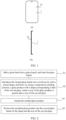
- a glass melt is directly introduced into a mold, and a 3D form required for curved glass is prepared by a compression molding process, and then gradually cooled to a room temperature.
- the cooled 3D glass can be machined subsequently to obtain curved glass.
- a resource waste caused by a high temperature to a low temperature can be reduced because a forming process of the plate glass from a high temperature to a low temperature is omitted, and production costs of the curved glass can be reduced.
- a difference between a temperature of the cleared glass liquid and a temperature of the mold is greater than or equal to 250°C and less than or equal to 500°C.
- the difference between the temperature of the cleared glass liquid and the temperature of the mold is controlled within the foregoing range, so as to avoid that when the glass liquid is cooled too fast, glass is broken due to a glass tensile stress caused by cooling, and when the glass liquid is cooled too slow, there is a risk that glass devitrification loses transparency.
- the curved glass is glass ceramics; the glass batch further includes a nucleation agent; and after the introducing the cleared glass liquid into a mold cavity with a preset shape, and forming, by using a compression molding process, a glass product with a shape corresponding to that of the curved glass, and before the annealing the molded glass product, the method further includes: performing crystallization on the molded glass product. After 3D glass is formed in the mold, crystallization may be directly performed on the glass product, thereby improving preparation efficiency.
- a nucleation agent to the glass batch, it is more conducive to controlling a crystallization process, to obtain glass ceramics with a relatively high crystallinity degree, which can increase a crystallization rate.
- a difference between a temperature of the cleared glass liquid and a temperature of the mold is greater than or equal to 500°C and less than or equal to 800°C. Since the curved glass is glass ceramics, the difference between the temperature of the cleared glass liquid and the temperature of the mold is controlled within the foregoing range, which is different from the case that the curved glass is base glass and glass breaking due to too fast cooling of the glass liquid does not to be considered. On the contrary, glass devitrification is easy to occur when the glass liquid is cooled too slow, and the crystal nucleus grows rapidly, which makes the glass easy to break. In addition, same as the case that the curved glass is base glass, there exists a problem that glass devitrification loses transparency due to a failure to effectively control a glass devitrification condition when the glass liquid is cooled too slow.
- the temperature of the cleared glass liquid is 950°C-1300°C, and the temperature of the mold is 250°C-500°C.
- the glass batch may include silicon sand (silicon dioxide or quartz sand), phosphorus pentoxide, alumina, boron oxide, lithium carbonate, sodium carbonate, potassium carbonate, magnesium carbonate, calcium carbonate, and zirconium oxide for preparing curved glass ceramics.
- the performing crystallization on the molded glass product includes: performing heat treatment on the molded glass product, so that a split phase is generated, a crystal nucleus is formed, and a crystal is grown in the molded glass product.
- the performing heat treatment on the molded glass product includes: placing the molded glass product in a heating cavity, and performing heat treatment on the heating cavity; or successively transferring the molded glass product to a plurality of heating cavities whose temperatures gradually increase, and insulating the molded glass product for a preset time in each heating cavity, so as to perform heat treatment on the molded glass product.
- a temperature change range of the heat treatment is from a first temperature to a second temperature; and the first temperature is a temperature of a mold corresponding to the molded glass product, and a difference between the second temperature and the first temperature is greater than or equal to 100°C and less than or equal to 400°C.
- a temperature condition required for crystal growth in the glass ceramics can be met, and a crystallinity degree can be increased.
- the annealing the molded glass product includes: performing programmed cooling on the molded glass product, so that the molded glass product is cooled to a room temperature.
- Programmed cooling is a process of cooling through program control.
- a programmed heating cavity setting program may be used to reduce the glass product from a temperature after demolding to the room temperature, so that slow cooling and releasing thermal stress to the room temperature can be implemented.
- the performing programmed cooling on the molded glass product, so that the molded glass product is cooled to a room temperature includes: placing the molded glass product in a heating cavity, and performing programmed cooling on the heating cavity; or successively transferring the molded glass product to a plurality of heating cavities whose temperatures gradually decrease, and insulating the molded glass product for a preset time in each heating cavity, so as to perform programmed cooling on the molded glass product.
- a speed of the programmed cooling is 1°C/min-100°C/min.
- a difference between a size of a die clearance and a thickness of the curved glass at a corresponding position is greater than or equal to 0 and less than or equal to 0.1 mm. Uniformity of the die clearance can be kept as far as possible, so as to prevent a case in which the die clearance is too large or too small.
- molding pressure is 0.1 Mpa-0.5 MPa. Molding quality can be improved.
- a working environment of molding is a vacuum or inert gas protection atmosphere.
- a difference between the size of the glass product and the size of the curved glass is greater than or equal to 0.02 mm and less than or equal to 0.5 mm.
- the size and the shape of the glass product may be changed by means of CNC (Computerized Numerical Control, computerized numerical control) precision machining, to obtain curved glass with stable processing quality, high processing precision, and high repetition precision, which can be used for batch production.
- the curved glass may meet a design requirement of a cover plate of an electronic device, and a crystallinity degree of curved glass ceramics may meet an application requirement.
- a Vickers hardness of the curved glass is 550 kgf/mm 2 -650 kgf/mm 2 ; and when the curved glass is glass ceramics, a Vickers hardness of the curved glass is 650 kgf/mm 2 -750 kgf/mm 2 .
- the curved glass has an approximately equivalent hardness to that of the curved glass prepared in the related technology, and can meet an application requirement.
- a Young's modulus of the curved glass is 70 Gpa-90 Gpa; and when the curved glass is glass ceramics, a Young's modulus of the curved glass is 90 Gpa-105 Gpa. Under a same test condition, the curved glass has an approximately equivalent Young's modulus to that of the curved glass prepared in the related technology, and can meet an application requirement.
- a density of the curved glass is 2.4 g/cm 3- 2.5 g/cm 3 ; and when the curved glass is glass ceramics, a density of the curved glass is 2.45 g/cm 3 -2.65 g/cm 3 . Under a same test condition, the density of the curved glass is approximately the same as a density of the curved glass prepared in the related technology, and can meet an application requirement.
- a thermal expansion coefficient of the curved glass is 60 ⁇ 10 -7 /°C-110 ⁇ 10 -7 /°C; and when the curved glass is glass ceramics, a thermal expansion coefficient of the curved glass is 100 ⁇ 10 -7 /°C-110 ⁇ 10 -7 /°C.
- the thermal expansion coefficient of the curved glass 1 is equivalent to a thermal expansion coefficient of the curved glass prepared in the related technology, and can meet an application requirement.
- a crystallinity degree of the curved glass is 75wt%-90wt%; and when the principal crystalline phase of the curved glass is lithium metasilicate or cordierite, a crystallinity degree of the curved glass is 30wt%-50wt%.
- the curved glass has a crystallinity degree and a principal crystalline phase that are approximately the same as those of the curved glass prepared in the related technology.
- An electronic device including the curved glass described above.
- This application provides a preparation method for curved glass.
- the shape and size of the cooled 3D glass are trimmed by using CNC machining to obtain curved glass.
- a resource waste caused by a high temperature to a low temperature can be reduced because a forming process of the plate glass from a high temperature to a low temperature is omitted, and production costs of the curved glass can be reduced.
- the electronic device may also be referred to as an electronic product or a terminal, and may include a mobile phone, a mobile computer, an electronic book, a portable android device (portable android device, Pad), a smart television, a personal digital assistant (Personal Digital Assistant, PDA), a wearable intelligent product, and the like.
- the wearable intelligent product may include but is not limited to a media player, a smart watch, smart glasses, a smart band, and the like.
- the curved glass is described relative to plate glass. According to whether one surface of the curved glass is a curved surface or both surfaces thereof are curved surfaces, the curved glass may include single-curved glass and double-curved glass.
- the electronic device may be a mobile phone, a tablet computer, or a wearable intelligent product.
- a paint layer and/or a fingerprint-proof layer may further be disposed on a surface 1a of the curved glass 1.
- the base glass has dual characteristics of glass and ceramics.
- the base glass is more transparent than ceramics, has a stronger toughness than the glass, has a better application prospect, and can be used as a mechanical structure material, an electronic and electrical insulation material, a base plate material of a large-scale integrated circuit, a microwave furnace heat-resisting device, a chemical and corrosion-resisting material, and a mine wear-resisting material.
- the base glass has a high mechanical strength, an excellent insulation property, a low dielectric loss, and a stable dielectric constant.
- a thermal expansion coefficient of the base glass can be adjusted within a large range, and the base glass has advantages of chemical corrosion resistance, wear resistance, good thermal stability, and a high use temperature.
- the curved glass 1 is glass ceramics.
- the glass ceramics is obtained by crystallizing the base glass.
- the base glass is an amorphous solid. From a thermodynamical point of view, the base glass is in a metastable state (that is, a material is present in a state of free energy higher than an equilibrium state and is in a non-equilibrium metastable state), and has higher internal energy than a crystal. Therefore, in a specific condition, the base glass can be converted to a crystalline state. From a dynamics point of view, during a cooling process, a viscosity of a glass melt (that is, the glass liquid obtained by melting) increases rapidly, thus formation of a crystal nucleus and growth of a crystal are suppressed, and growth of a crystalline solid is prevented.
- a viscosity of a glass melt that is, the glass liquid obtained by melting
- a nucleation agent When a nucleation agent is not added, by using a heterogeneous crystallizing mechanism, a thermodynamically possibility and kinetic suppression are fully used, and in a specific condition, a new balance is formed in physical processes that are complementary to each other, to obtain glass ceramics. However, in this manner, the heterogeneous crystallizing mechanism is used to obtain glass ceramics with relatively poor uniformity.
- a nucleation agent When a nucleation agent is added, a crystal nucleus is formed in the base glass, and then the crystal nucleus is grown by heat treatment, to obtain uniformly distributed glass ceramics.
- the glass batch of the curved glass 1 further includes a nucleation agent such as zirconia.
- a molar percentage of zirconia in the glass batch may be greater than 0 and less than or equal to 10%.
- the glass batch is decomposed (gasified) at a high temperature to generate a gas.
- a clarifying agent added to the glass liquid, bubbles in the glass liquid can be eliminated, and a viscosity of the glass liquid can be reduced.
- a molar percentage of SiO 2 , Al 2 O 3 , P 2 O and B 2 O 3 may be 70%-85%
- a molar percentage of Li 2 O, Na 2 O and K 2 O may be 7%-30%
- a molar percentage of MgO and CaO may be 0%-8%.
- a molar percentage of SiO 2 , Al 2 O 3 , P 2 O and B 2 O 3 may be 70%-85%
- a molar percentage of Li 2 O, Na 2 O and K 2 O may be 7%-24%
- a molar percentage of MgO and CaO may be 0%-6%
- a molar percentage of zirconia may be 0%-10%.
- a molar percentage of zirconia is 1%-10%. That is, the molar percentage of zirconia is greater than or equal to 1%.
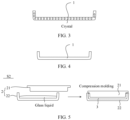
- the cleared glass liquid is introduced into the mold 2 cavity with a preset shape, and the temperature of the mold 2 is controlled. Under pressurization, the cleared glass liquid is cooled from a molten state to a glass state in a cooling process, to obtain a glass product 3 whose appearance is approximately the same as that of the mold 2 cavity.
- the preset shape of the mold 2 cavity may be approximately the same as that of the curved glass 1. In this way, the glass product 3 whose shape is approximately the same as that of the curved glass 1 can be obtained.
- the curved glass 1 may be obtained by controlling a size of the glass product 3 to be greater than the size of the curved glass 1 and further processing (such as cutting and polishing) the glass product 3.
- a glass state material has relatively high internal energy than a crystalline state material, and energy of the glass state material is between that of the molten state and that of the crystalline state, and belongs to a metastable state. From a mechanical point of view, glass is in an unstable high energy state, for example, there is a tendency of low energy state conversion, that is, there is a tendency of devitrification.
- a temperature difference between the cleared glass liquid and the mold 2 is greater than or equal to 500°C and less than or equal to 800°C.
- the temperature of the cleared glass liquid may be 950°C-1300°C, and the temperature of the mold 2 may be 450°C-800°C. That is, when the curved glass 1 is base glass, the difference between the temperature of the cleared glass liquid and the temperature of the mold 2 is greater than or equal to 250°C and less than or equal to 500°C.
- the glass batch of the curved glass 1 includes silicon sand (silicon dioxide or quartz sand), phosphorus pentoxide, alumina, boron oxide, lithium carbonate, sodium carbonate, potassium carbonate, magnesium carbonate, calcium carbonate, and the like, and the curved glass 1 is glass ceramics
- the temperature of the cleared glass liquid may be 950°C-1300°C
- the temperature of the mold 2 may be 250°C-500°C. That is, since in the present invention the curved glass 1 is glass ceramics, the difference between the temperature of the cleared glass liquid and the temperature of the mold 2 is greater than or equal to 500°C and less than or equal to 800°C.
- the temperature of the mold 2 may be any value from 250°C (950 minus 700)-500°C (950 minus 450); when the temperature of the cleared glass liquid is 1300°C, the temperature of the mold 2 may be 500°C (1300 minus 800); when the temperature of the cleared glass liquid is 1200°C, the temperature of the mold 2 may be any value from 400°C (1200 minus 800)-700°C (1200 minus 500); when the temperature of the cleared glass liquid is 1100°C, the temperature of the mold 2 may be any value from 300°C (1100 minus 800)-500°C (1100 minus 600); and when the temperature of the cleared glass liquid is 1000°C, the temperature of the mold 2 may be any value from 250°C (1000 minus 750)-500°C (1000 minus 500).
- the cleared glass liquid is introduced into the mold 2 cavity, and then is pressurized by combined molds, so that the glass liquid is solidified to a glass product 3 having a substantially same appearance as a surface shape of the cavity.
- the temperature of the mold 2 is a compression molding temperature
- a compression molding time may be a time required for cooling the temperature of the cleared glass liquid to the same temperature as the mold 2.
- a too large or too small die clearance affects product molding.
- the product may be incomplete.
- the product may have too many burrs and trimmings. Therefore, the die clearance should not be too large or too small.
- the compression molding pressure is 0.1 Mpa-0.5 Mpa. Molding quality can be improved.
- a working environment of compression molding is a vacuum or inert gas protection atmosphere. Molding may be performed in a molding machine.
- the inert gas may be nitrogen, argon, or the like.
- a material of the mold is not specifically limited. Because a preparation process needs to be performed in a high-temperature and high-pressure environment, in some embodiments, the material of the mold 2 may be a superhard alloy material or a graphite material, a surface of the superhard alloy material may be plated with a superhard coating (such as titanium nitride or a diamond-like film), and the superhard alloy material may be steel. A surface of the graphite material may be plated with silicon carbide or the like.
- the difference between the size of the glass product 3 and the size of the curved glass 1 is not specifically limited, provided that the size of the glass product 3 is greater than the size of the curved glass 1, and the glass product 3 can be machined into the curved glass 1 by means of subsequent mechanical processing or the like.
- a difference between the size of the glass product 3 and the size of the curved glass 1 is greater than or equal to 0.02 mm and less than or equal to 0.5 mm.
- the size and the shape of the glass product 3 may be changed by means of CNC (Computerized Numerical Control, computerized numerical control) precision machining, to obtain curved glass 1 with stable processing quality, high processing precision, and high repetition precision, which can be used for batch production.
- the glass product 3 After the glass product 3 is demolded, a temperature is relatively high. If the glass product 3 is directly cooled naturally at a room temperature, it is easy to crack, and consequently, the glass product 3 is broken. Therefore, the glass product 3 needs to release thermal stress to the room temperature by means of slow cooling, that is, the glass product 3 may be annealed. In the annealing process, the glass product 3 may be still placed in a mold.
- Annealing is a heat treatment process for a material, including a metal material and a non-metal material.
- annealing is a process in which the glass product is slowly heated to a specific temperature, maintained for a sufficient period of time, and then cooled at a proper rate (usually slow cooling, sometimes controlled cooling).
- Curved glass prepared by using the foregoing preparation method for curved glass is also described.
- the curved glass has a same technical effect as the foregoing preparation method for curved glass, and details are not described herein again.
- the Vickers hardness may be obtained by testing the curved glass 1 by using a Vickers hardmeter.
- a Young's modulus of the curved glass when the curved glass is base glass, a Young's modulus of the curved glass is 70 Gpa-90 Gpa; and when the curved glass is glass ceramics, a Young's modulus of the curved glass is 90 Gpa-105 Gpa.
- a Young's modulus of a material A size of the Young's modulus indicates rigidity of a material. A larger Young's modulus indicates less deformation.
- a principal crystalline phase of the glass ceramics is one of cordierite or lithium silicate, and a crystallinity degree is 30wt%-50wt%, a Young's modulus of the curved glass 1 is 90 Gpa-95 Gpa.
- the principal crystalline phase of the glass ceramics is one or two of petalite and lithium disilicate, and the crystallinity degree is 75wt%-90wt%, the Young's modulus of the curved glass 1 is 95 Gpa-105 Gpa.
- a density of the curved glass when the curved glass is base glass, a density of the curved glass is 2.4 g/cm 3- 2.5 g/cm 3 ; and when the curved glass is glass ceramics, a density of the curved glass is 2.45 g/cm 3 -2.65 g/cm 3 .
- the density can be measured by using a drainage method.
- the density of the curved glass 1 under a same test condition, the density of the curved glass 1 is approximately the same as a density of the curved glass prepared in the related technology, and can meet an application requirement.
- a thermal expansion coefficient of the curved glass when the curved glass is base glass, a thermal expansion coefficient of the curved glass is 60 ⁇ 10 -7 /°C-110 ⁇ 10 -7 /°C; and when the curved glass is glass ceramics, a thermal expansion coefficient of the curved glass is 100 ⁇ 10 -7 /°C-110 ⁇ 10 -7 /°C.
- the thermal expansion coefficient is an expansion and contraction phenomenon of an object due to a temperature change.
- the thermal expansion coefficient represents a change in a length quantity value caused by a change in a unit temperature.
- a linear expansion coefficient is used as an example.
- a principal crystalline phase of the glass ceramics is one or two of petalite and lithium disilicate, and a crystallinity degree is 75wt%-90wt%
- the thermal expansion coefficient of the curved glass 1 is 100 ⁇ 10 -7 /°C-105 ⁇ 10 -7 /°C.
- the principal crystalline phase of the glass ceramics is lithium silicate and the crystallinity degree is 30wt%-50wt%
- the thermal expansion coefficient of the curved glass 1 is 105 ⁇ 10 -7 /°C-110 ⁇ 10 -7 /°C.
- the following several experimental solutions are set to describe in detail the preparation method for the curved glass 1, which are respectively described as Solution 1, Solution 2, and Solution 3.
- composition of all glass batches of the curved glass is the same and includes silicon sand, phosphorus pentoxide, alumina, boron oxide, lithium carbonate, sodium carbonate, and potassium carbonate.
- the curved glass 1 is base glass, and an appearance shape of the curved glass is a shape required for use as a rear cover of a mobile phone.
- the steps in Solution 2 are basically the same as those in Solution 1. A difference is that in Solution 2, a temperature of the cleared glass liquid obtained in step 2) is 1300°C, a molar percentage of SiO 2 , Al 2 O 3 , P 2 O 5 and B 2 O 3 is 85%, a molar percentage of Li 2 O, Na 2 O and K 2 O is 7%, and a molar percentage of MgO and CaO is 8% in the glass liquid; in step 3), a temperature of the mold is 800°C; and in step 5), pressure of compression molding is 0.5 Mpa, and a slow cooling speed is 100°C/min.
- the steps in Solution 5 are basically the same as those in Solution 4. A difference is that in Solution 5, a temperature of the cleared glass liquid obtained in step 2) is 1300°C, a molar percentage of SiO 2 , Al 2 O 3 , P 2 O 5 and B 2 O 3 is 75%, a molar percentage of Li 2 O, Na 2 O and K 2 O is 18%, a molar percentage of MgO and CaO is 6%, and a molar percentage of zirconia is 1% in the glass liquid; in step 3), a temperature of the mold is 800°C; in step 5), pressure of compression molding is 0.5 Mpa, and an insulating time (that is, a heat treatment time) of devitrification is 5 min; and in step 6), a cooling speed is 100°C/min, and in Solution 5, a principal crystalline phase is lithium silicate, and a crystallinity degree is 30wt%.
- the steps in Solution 6 are basically the same as those in Solution 4. A difference is that in Solution 6, a temperature of the cleared glass liquid obtained in step 2) is 1000°C, a molar percentage of SiO 2 , Al 2 O 3 , P 2 O 5 and B 2 O 3 is 85%, a molar percentage of Li 2 O, Na 2 O and K 2 O is 7%, a molar percentage of MgO and CaO is 4%, and a molar percentage of zirconia is 4% in the glass liquid; in step 3), a temperature of the mold is 800°C; in step 5), pressure of compression molding is 0.5 Mpa, and an insulating time (that is, a heat treatment time) of devitrification is 10h; and in step 6), a cooling speed is 50°C/min, and in Solution 6, a principal crystalline phase is cordierite, and a crystallinity degree is 45wt%.
- Each curved glass 1 obtained in the foregoing experimental example 1 and experimental example 2 meets a design requirement of a rear cover of a mobile phone, and a crystallinity degree of curved glass ceramics may be 30wt% or more, and may be up to 90wt%. Therefore, the curved glass ceramics can meet an application requirement.
- a glass melt is directly introduced into a mold 2, and a 3D form required for the curved glass 1 is prepared by a compression molding process, and then gradually cooled to a room temperature.
- the shape and size of the cooled 3D glass are trimmed by using CNC machining to obtain the curved glass 1.
- a related technology in which the curved glass 1 is formed from plate glass by means of hot bending because a forming process of the plate glass from a high temperature to a low temperature is omitted, a molding process from a high temperature to a low temperature can be reduced, and a preparation process can be shortened. Therefore, a resource waste caused from a high temperature to a low temperature in the related technology can be reduced, and manufacturing costs are reduced.
- the obtained curved glass has same physical and chemical performance as that prepared by using the preparation method provided in the related technology, and can meet a cover requirement of an electronic device.
Landscapes
- Chemical & Material Sciences (AREA)
- Engineering & Computer Science (AREA)
- Materials Engineering (AREA)
- Organic Chemistry (AREA)
- Manufacturing & Machinery (AREA)
- Crystallography & Structural Chemistry (AREA)
- Thermal Sciences (AREA)
- Physics & Mathematics (AREA)
- Ceramic Engineering (AREA)
- Dispersion Chemistry (AREA)
- Life Sciences & Earth Sciences (AREA)
- Chemical Kinetics & Catalysis (AREA)
- General Chemical & Material Sciences (AREA)
- Geochemistry & Mineralogy (AREA)
- Re-Forming, After-Treatment, Cutting And Transporting Of Glass Products (AREA)
Claims (8)
- Ein Verfahren zur Herstellung von gebogenem Glas (1), umfassend:Schmelzen (S1) einer Glascharge zu einer Glasflüssigkeit und Klären der Glasflüssigkeit;Einführen (S2) der geklärten Glasflüssigkeit in eine Form (2) mit einer vorgegebenen Form und Formen eines Glasprodukts (3) mit einer Form, die der des gebogenen Glases entspricht, mittels eines Pressformverfahrens, wobei die Größe des Glasprodukts größer ist als die Größe des gebogenen Glases, wobei das gebogene Glas (1) Glaskeramik ist und die Differenz zwischen der Temperatur der geklärten Glasflüssigkeit und der Temperatur der Form größer oder gleich 500°C und kleiner oder gleich 800°C ist;wobei die Glascharge weiterhin ein Nukleierungsmittel umfasst; undnach dem Einführen der geklärten Glasflüssigkeit in eine Form mit einer vorgegebenen Form und dem Formen eines Glasprodukts mit einer Form, die der des gebogenen Glases entspricht, umfasst das Verfahren weiterhin:Durchführen einer Kristallisation des geformten Glasprodukts;nach dem Durchführen der Kristallisation des geformten Glasprodukts, Glühen (S3) des geformten Glasprodukts; undBearbeiten (S4) des geglühten Glasprodukts zu dem gebogenen Glas (1) basierend auf der Form und der Größe des gebogenen Glases.
- Das Verfahren zur Herstellung von gebogenem Glas gemäß Anspruch 1, wobei
die Temperatur der geklärten Glasflüssigkeit 950°C-1300°C beträgt und die Temperatur der Form 250°C-500°C beträgt. - Das Verfahren zur Herstellung von gebogenem Glas gemäß einem der Ansprüche 1 bis 2, wobei
das Glühen des geformten Glasprodukts (3) umfasst:
Durchführen einer programmierten Abkühlung des geformten Glasprodukts (3), sodass das geformte Glasprodukt auf Raumtemperatur abgekühlt wird. - Das Verfahren zur Herstellung von gebogenem Glas gemäß Anspruch 3, wobei
das Durchführen einer programmierten Abkühlung des geformten Glasprodukts, sodass das geformte Glasprodukt auf Raumtemperatur abgekühlt wird, umfasst:Platzieren des geformten Glasprodukts (3) in einer Heizkammer und Durchführen einer programmierten Abkühlung der Heizkammer;
odernacheinander Überführen des geformten Glasprodukts in mehrere Heizkammern, deren Temperaturen allmählich abnehmen, und Isolieren des geformten Glasprodukts für eine vorgegebene Zeit in jeder Heizkammer, um eine programmierte Abkühlung des geformten Glasprodukts durchzuführen. - Das Verfahren zur Herstellung von gebogenem Glas gemäß Anspruch 3, wobei
eine Geschwindigkeit der programmierten Abkühlung 1°C/min-100°C/min beträgt. - Das Verfahren zur Herstellung von gebogenem Glas gemäß einem der Ansprüche 1 bis 2, wobei
im Kompressionsformungsprozess der Kompressionsformungsdruck 0,1 MPa-0,5 MPa beträgt. - Das Verfahren zur Herstellung von gebogenem Glas gemäß einem der Ansprüche 1 bis 2, wobei
im Kompressionsformungsprozess eine Arbeitsumgebung der Kompressionsformung ein Vakuum oder eine Schutzatmosphäre aus Inertgas ist. - Das Verfahren zur Herstellung von gebogenem Glas gemäß einem der Ansprüche 1 bis 2, wobei
ein Unterschied zwischen der Größe des Glasprodukts (3) und der Größe des gebogenen Glases (1) größer oder gleich 0,02 mm und kleiner oder gleich 0,5 mm ist.
Applications Claiming Priority (2)
| Application Number | Priority Date | Filing Date | Title |
|---|---|---|---|
| CN202110656751.9A CN115466039A (zh) | 2021-06-11 | 2021-06-11 | 曲面玻璃及其制备方法和电子设备 |
| PCT/CN2022/078502 WO2022257509A1 (zh) | 2021-06-11 | 2022-02-28 | 曲面玻璃及其制备方法和电子设备 |
Publications (3)
| Publication Number | Publication Date |
|---|---|
| EP4129936A1 EP4129936A1 (de) | 2023-02-08 |
| EP4129936A4 EP4129936A4 (de) | 2023-09-06 |
| EP4129936B1 true EP4129936B1 (de) | 2025-07-09 |
Family
ID=84047612
Family Applications (1)
| Application Number | Title | Priority Date | Filing Date |
|---|---|---|---|
| EP22764639.5A Active EP4129936B1 (de) | 2021-06-11 | 2022-02-28 | Herstellungsverfahren für gebogenes glas |
Country Status (5)
| Country | Link |
|---|---|
| US (1) | US12559404B2 (de) |
| EP (1) | EP4129936B1 (de) |
| JP (1) | JP7490081B2 (de) |
| CN (1) | CN115466039A (de) |
| WO (1) | WO2022257509A1 (de) |
Families Citing this family (1)
| Publication number | Priority date | Publication date | Assignee | Title |
|---|---|---|---|---|
| CN119638193B (zh) * | 2024-12-30 | 2025-08-22 | 有研国晶辉新材料有限公司 | 一种大尺寸高均匀化红外硫系玻璃及其制备方法和应用 |
Family Cites Families (24)
| Publication number | Priority date | Publication date | Assignee | Title |
|---|---|---|---|---|
| US4046540A (en) * | 1973-02-19 | 1977-09-06 | Imperial Chemical Industries Limited | Glass injection moulding process |
| US3874777A (en) * | 1973-04-26 | 1975-04-01 | American Optical Corp | Multifocal lens blanks |
| US5588979A (en) * | 1993-11-08 | 1996-12-31 | Kabushiki Kaisya Ohara | Apparatus for continuously forming and processing a glass-ceramic |
| US6426311B1 (en) | 2000-02-01 | 2002-07-30 | Kabushiki Kaisha Ohara | Glass-ceramics |
| JPWO2014050376A1 (ja) | 2012-09-25 | 2016-08-22 | コニカミノルタ株式会社 | ガラス部品の製造方法 |
| JP2014091655A (ja) | 2012-11-05 | 2014-05-19 | Konica Minolta Inc | ガラス成形品の製造方法および製造装置 |
| FR3009226B1 (fr) | 2013-08-01 | 2016-01-01 | Michelin & Cie | Procede de fabrication d’un monobrin en composite verre-resine |
| JP2016003171A (ja) | 2014-06-18 | 2016-01-12 | コニカミノルタ株式会社 | ガラス成形体の製造装置およびガラス成形体の製造方法 |
| CN105293901A (zh) | 2014-07-01 | 2016-02-03 | 科立视材料科技有限公司 | 化学强化碱铝硅酸盐玻璃用玻璃组合物及其制造方法 |
| JP6765748B2 (ja) | 2015-06-04 | 2020-10-07 | 株式会社オハラ | 結晶化ガラス及び結晶化ガラス基板 |
| CN116395986B (zh) | 2016-10-18 | 2025-09-12 | Agc株式会社 | 化学强化用玻璃、化学强化玻璃以及化学强化玻璃的制造方法 |
| CN106830650A (zh) | 2016-12-23 | 2017-06-13 | 江西沃格光电股份有限公司 | 曲面玻璃的制备方法 |
| WO2019167850A1 (ja) | 2018-02-27 | 2019-09-06 | Agc株式会社 | 3次元形状の結晶化ガラス、3次元形状の化学強化ガラスおよびそれらの製造方法 |
| CN110372216B (zh) * | 2018-04-12 | 2022-05-03 | 重庆鑫景特种玻璃有限公司 | 平面玻璃、钢化玻璃、3d曲面微晶玻璃及其制备工艺 |
| CN117069372A (zh) | 2018-06-01 | 2023-11-17 | 日本电气硝子株式会社 | 强化玻璃以及强化用玻璃 |
| CN108821574A (zh) | 2018-07-13 | 2018-11-16 | 河北省沙河玻璃技术研究院 | 一种应用于5g通信移动终端的微晶玻璃制备方法 |
| CN109095755A (zh) * | 2018-08-16 | 2018-12-28 | 中国建筑材料科学研究总院有限公司 | 玻璃预形件的加工方法 |
| CN109320056A (zh) * | 2018-10-15 | 2019-02-12 | 基智精密科技(深圳)有限公司 | 玻璃生产设备及玻璃制备方法 |
| CN111268913B (zh) * | 2018-10-26 | 2022-07-29 | 成都光明光电股份有限公司 | 电子设备盖板用微晶玻璃制品和微晶玻璃 |
| CN109626816B (zh) * | 2019-01-28 | 2022-07-22 | 咸宁南玻光电玻璃有限公司 | 满足5g通信和3d模压成型的手机盖板玻璃及工艺方法 |
| JP7351334B2 (ja) | 2019-04-05 | 2023-09-27 | Agc株式会社 | 結晶化ガラス及び化学強化ガラス並びにそれらの製造方法 |
| CN112897863B (zh) | 2019-12-04 | 2022-10-11 | 北京小米移动软件有限公司 | 曲面玻璃的制备方法、曲面玻璃及移动终端 |
| CN110963709B (zh) | 2019-12-26 | 2020-10-23 | 深圳市汇隆源科技有限公司 | 一种精密3d玻璃板的制造方法 |
| CN111320391B (zh) * | 2020-03-04 | 2021-09-24 | 景德镇陶瓷大学 | 一种无色透明堇青石微晶玻璃及其制备方法 |
-
2021
- 2021-06-11 CN CN202110656751.9A patent/CN115466039A/zh active Pending
-
2022
- 2022-02-28 JP JP2022566256A patent/JP7490081B2/ja active Active
- 2022-02-28 WO PCT/CN2022/078502 patent/WO2022257509A1/zh not_active Ceased
- 2022-02-28 EP EP22764639.5A patent/EP4129936B1/de active Active
- 2022-02-28 US US17/910,559 patent/US12559404B2/en active Active
Also Published As
| Publication number | Publication date |
|---|---|
| EP4129936A1 (de) | 2023-02-08 |
| US20240294414A1 (en) | 2024-09-05 |
| CN115466039A (zh) | 2022-12-13 |
| JP7490081B2 (ja) | 2024-05-24 |
| US12559404B2 (en) | 2026-02-24 |
| WO2022257509A1 (zh) | 2022-12-15 |
| JP2023534353A (ja) | 2023-08-09 |
| EP4129936A4 (de) | 2023-09-06 |
Similar Documents
| Publication | Publication Date | Title |
|---|---|---|
| CN113248152B (zh) | 一种三维微晶玻璃及其制备方法 | |
| CN110372216B (zh) | 平面玻璃、钢化玻璃、3d曲面微晶玻璃及其制备工艺 | |
| KR102291897B1 (ko) | 곡면 형상을 갖는 결정화 유리 부재의 제조 방법 | |
| CN111348834B (zh) | 一种3d微晶玻璃及其制备方法 | |
| CN111592225A (zh) | 锂铝硅酸盐纳米晶透明陶瓷、其制备方法及产品 | |
| CN111763012B (zh) | 微晶玻璃及其钢化方法和应用 | |
| CN112723736B (zh) | 玻璃、强化玻璃及其制备方法和电子产品 | |
| CN113149444A (zh) | 一种一步法化学强化钠霞石微晶玻璃的方法及化学强化钠霞石微晶玻璃 | |
| CN113620608A (zh) | 一种锂铝硅酸透明微晶玻璃及其制备方法 | |
| HK1219941A1 (zh) | 化学强化碱铝硅酸盐玻璃用玻璃组合物及其制造方法 | |
| EP4129936A1 (de) | Gebogenes glas und herstellungsverfahren dafür sowie elektronische vorrichtung | |
| CN110156333A (zh) | 晶体有序生长的微晶玻璃的制备方法 | |
| CN111116040A (zh) | 一种具有非单一表面压应力斜率的钢化玻璃制品及其制备方法 | |
| CN111170642A (zh) | 一种高强高韧的低膨胀锂铝硅系透明微晶玻璃及其制备方法 | |
| CN113831021B (zh) | 微晶玻璃及其制备方法、玻璃保护层、玻璃盖板与电子器件 | |
| CN108083641B (zh) | 一种高力学性能的微晶玻璃的制备方法 | |
| HK40079050A (en) | Curved glass and preparation method thereof and electronic device | |
| CN115259844B (zh) | 一种陶瓷材料及其制备方法和应用 | |
| CN118026535A (zh) | 一种透明微晶玻璃及其制备方法和应用 | |
| CN116409936B (zh) | 玻璃陶瓷模具及其制备方法 | |
| CN117105525A (zh) | 钢化玻璃及其制备方法 | |
| CN119898961B (zh) | 一种微晶玻璃及其制作方法、壳体及电子设备 | |
| JP2016040222A (ja) | 高周波用結晶化ガラスセラミックス誘電体およびその製造方法 | |
| CN114315158B (zh) | 陶瓷玻璃、强化陶瓷玻璃制品及其制备方法 | |
| CN118164680B (zh) | 一种尖晶石微晶玻璃及其制备方法和应用 |
Legal Events
| Date | Code | Title | Description |
|---|---|---|---|
| STAA | Information on the status of an ep patent application or granted ep patent |
Free format text: STATUS: UNKNOWN |
|
| STAA | Information on the status of an ep patent application or granted ep patent |
Free format text: STATUS: THE INTERNATIONAL PUBLICATION HAS BEEN MADE |
|
| PUAI | Public reference made under article 153(3) epc to a published international application that has entered the european phase |
Free format text: ORIGINAL CODE: 0009012 |
|
| STAA | Information on the status of an ep patent application or granted ep patent |
Free format text: STATUS: REQUEST FOR EXAMINATION WAS MADE |
|
| 17P | Request for examination filed |
Effective date: 20220913 |
|
| AK | Designated contracting states |
Kind code of ref document: A1 Designated state(s): AL AT BE BG CH CY CZ DE DK EE ES FI FR GB GR HR HU IE IS IT LI LT LU LV MC MK MT NL NO PL PT RO RS SE SI SK SM TR |
|
| RIN1 | Information on inventor provided before grant (corrected) |
Inventor name: DONG, CHANGFU Inventor name: LIU, KUN Inventor name: XU, WENBIN |
|
| A4 | Supplementary search report drawn up and despatched |
Effective date: 20230807 |
|
| RIC1 | Information provided on ipc code assigned before grant |
Ipc: C03C 10/04 20060101ALI20230801BHEP Ipc: C03B 11/00 20060101ALI20230801BHEP Ipc: C03B 19/02 20060101AFI20230801BHEP |
|
| STAA | Information on the status of an ep patent application or granted ep patent |
Free format text: STATUS: EXAMINATION IS IN PROGRESS |
|
| 17Q | First examination report despatched |
Effective date: 20240314 |
|
| DAV | Request for validation of the european patent (deleted) | ||
| DAX | Request for extension of the european patent (deleted) | ||
| GRAP | Despatch of communication of intention to grant a patent |
Free format text: ORIGINAL CODE: EPIDOSNIGR1 |
|
| STAA | Information on the status of an ep patent application or granted ep patent |
Free format text: STATUS: GRANT OF PATENT IS INTENDED |
|
| INTG | Intention to grant announced |
Effective date: 20250203 |
|
| GRAS | Grant fee paid |
Free format text: ORIGINAL CODE: EPIDOSNIGR3 |
|
| GRAA | (expected) grant |
Free format text: ORIGINAL CODE: 0009210 |
|
| STAA | Information on the status of an ep patent application or granted ep patent |
Free format text: STATUS: THE PATENT HAS BEEN GRANTED |
|
| AK | Designated contracting states |
Kind code of ref document: B1 Designated state(s): AL AT BE BG CH CY CZ DE DK EE ES FI FR GB GR HR HU IE IS IT LI LT LU LV MC MK MT NL NO PL PT RO RS SE SI SK SM TR |
|
| REG | Reference to a national code |
Ref country code: GB Ref legal event code: FG4D |
|
| REG | Reference to a national code |
Ref country code: CH Ref legal event code: EP |
|
| REG | Reference to a national code |
Ref country code: IE Ref legal event code: FG4D |
|
| REG | Reference to a national code |
Ref country code: DE Ref legal event code: R096 Ref document number: 602022017400 Country of ref document: DE |
|
| REG | Reference to a national code |
Ref country code: NL Ref legal event code: FP |
|
| PG25 | Lapsed in a contracting state [announced via postgrant information from national office to epo] |
Ref country code: PT Free format text: LAPSE BECAUSE OF FAILURE TO SUBMIT A TRANSLATION OF THE DESCRIPTION OR TO PAY THE FEE WITHIN THE PRESCRIBED TIME-LIMIT Effective date: 20251110 |
|
| REG | Reference to a national code |
Ref country code: AT Ref legal event code: MK05 Ref document number: 1811728 Country of ref document: AT Kind code of ref document: T Effective date: 20250709 |
|
| PG25 | Lapsed in a contracting state [announced via postgrant information from national office to epo] |
Ref country code: IS Free format text: LAPSE BECAUSE OF FAILURE TO SUBMIT A TRANSLATION OF THE DESCRIPTION OR TO PAY THE FEE WITHIN THE PRESCRIBED TIME-LIMIT Effective date: 20251109 |
|
| PG25 | Lapsed in a contracting state [announced via postgrant information from national office to epo] |
Ref country code: NO Free format text: LAPSE BECAUSE OF FAILURE TO SUBMIT A TRANSLATION OF THE DESCRIPTION OR TO PAY THE FEE WITHIN THE PRESCRIBED TIME-LIMIT Effective date: 20251009 |
|
| REG | Reference to a national code |
Ref country code: LT Ref legal event code: MG9D |
|
| PG25 | Lapsed in a contracting state [announced via postgrant information from national office to epo] |
Ref country code: AT Free format text: LAPSE BECAUSE OF FAILURE TO SUBMIT A TRANSLATION OF THE DESCRIPTION OR TO PAY THE FEE WITHIN THE PRESCRIBED TIME-LIMIT Effective date: 20250709 |
|
| PG25 | Lapsed in a contracting state [announced via postgrant information from national office to epo] |
Ref country code: FI Free format text: LAPSE BECAUSE OF FAILURE TO SUBMIT A TRANSLATION OF THE DESCRIPTION OR TO PAY THE FEE WITHIN THE PRESCRIBED TIME-LIMIT Effective date: 20250709 |
|
| PG25 | Lapsed in a contracting state [announced via postgrant information from national office to epo] |
Ref country code: HR Free format text: LAPSE BECAUSE OF FAILURE TO SUBMIT A TRANSLATION OF THE DESCRIPTION OR TO PAY THE FEE WITHIN THE PRESCRIBED TIME-LIMIT Effective date: 20250709 |
|
| PG25 | Lapsed in a contracting state [announced via postgrant information from national office to epo] |
Ref country code: GR Free format text: LAPSE BECAUSE OF FAILURE TO SUBMIT A TRANSLATION OF THE DESCRIPTION OR TO PAY THE FEE WITHIN THE PRESCRIBED TIME-LIMIT Effective date: 20251010 |
|
| PG25 | Lapsed in a contracting state [announced via postgrant information from national office to epo] |
Ref country code: SE Free format text: LAPSE BECAUSE OF FAILURE TO SUBMIT A TRANSLATION OF THE DESCRIPTION OR TO PAY THE FEE WITHIN THE PRESCRIBED TIME-LIMIT Effective date: 20250709 |
|
| PG25 | Lapsed in a contracting state [announced via postgrant information from national office to epo] |
Ref country code: LV Free format text: LAPSE BECAUSE OF FAILURE TO SUBMIT A TRANSLATION OF THE DESCRIPTION OR TO PAY THE FEE WITHIN THE PRESCRIBED TIME-LIMIT Effective date: 20250709 |
|
| PG25 | Lapsed in a contracting state [announced via postgrant information from national office to epo] |
Ref country code: PL Free format text: LAPSE BECAUSE OF FAILURE TO SUBMIT A TRANSLATION OF THE DESCRIPTION OR TO PAY THE FEE WITHIN THE PRESCRIBED TIME-LIMIT Effective date: 20250709 Ref country code: BG Free format text: LAPSE BECAUSE OF FAILURE TO SUBMIT A TRANSLATION OF THE DESCRIPTION OR TO PAY THE FEE WITHIN THE PRESCRIBED TIME-LIMIT Effective date: 20250709 |
|
| PG25 | Lapsed in a contracting state [announced via postgrant information from national office to epo] |
Ref country code: RS Free format text: LAPSE BECAUSE OF FAILURE TO SUBMIT A TRANSLATION OF THE DESCRIPTION OR TO PAY THE FEE WITHIN THE PRESCRIBED TIME-LIMIT Effective date: 20251009 |
|
| PG25 | Lapsed in a contracting state [announced via postgrant information from national office to epo] |
Ref country code: ES Free format text: LAPSE BECAUSE OF FAILURE TO SUBMIT A TRANSLATION OF THE DESCRIPTION OR TO PAY THE FEE WITHIN THE PRESCRIBED TIME-LIMIT Effective date: 20250709 |
|
| PGFP | Annual fee paid to national office [announced via postgrant information from national office to epo] |
Ref country code: NL Payment date: 20260106 Year of fee payment: 5 |
|
| PG25 | Lapsed in a contracting state [announced via postgrant information from national office to epo] |
Ref country code: SM Free format text: LAPSE BECAUSE OF FAILURE TO SUBMIT A TRANSLATION OF THE DESCRIPTION OR TO PAY THE FEE WITHIN THE PRESCRIBED TIME-LIMIT Effective date: 20250709 |
|
| PGFP | Annual fee paid to national office [announced via postgrant information from national office to epo] |
Ref country code: GB Payment date: 20260106 Year of fee payment: 5 |
|
| PG25 | Lapsed in a contracting state [announced via postgrant information from national office to epo] |
Ref country code: DK Free format text: LAPSE BECAUSE OF FAILURE TO SUBMIT A TRANSLATION OF THE DESCRIPTION OR TO PAY THE FEE WITHIN THE PRESCRIBED TIME-LIMIT Effective date: 20250709 |
|
| PGFP | Annual fee paid to national office [announced via postgrant information from national office to epo] |
Ref country code: DE Payment date: 20260102 Year of fee payment: 5 |
|
| PG25 | Lapsed in a contracting state [announced via postgrant information from national office to epo] |
Ref country code: IT Free format text: LAPSE BECAUSE OF FAILURE TO SUBMIT A TRANSLATION OF THE DESCRIPTION OR TO PAY THE FEE WITHIN THE PRESCRIBED TIME-LIMIT Effective date: 20250709 |
|
| PG25 | Lapsed in a contracting state [announced via postgrant information from national office to epo] |
Ref country code: CZ Free format text: LAPSE BECAUSE OF FAILURE TO SUBMIT A TRANSLATION OF THE DESCRIPTION OR TO PAY THE FEE WITHIN THE PRESCRIBED TIME-LIMIT Effective date: 20250709 |
|
| PG25 | Lapsed in a contracting state [announced via postgrant information from national office to epo] |
Ref country code: EE Free format text: LAPSE BECAUSE OF FAILURE TO SUBMIT A TRANSLATION OF THE DESCRIPTION OR TO PAY THE FEE WITHIN THE PRESCRIBED TIME-LIMIT Effective date: 20250709 Ref country code: SK Free format text: LAPSE BECAUSE OF FAILURE TO SUBMIT A TRANSLATION OF THE DESCRIPTION OR TO PAY THE FEE WITHIN THE PRESCRIBED TIME-LIMIT Effective date: 20250709 |
|
| PLBE | No opposition filed within time limit |
Free format text: ORIGINAL CODE: 0009261 |
|
| STAA | Information on the status of an ep patent application or granted ep patent |
Free format text: STATUS: NO OPPOSITION FILED WITHIN TIME LIMIT |