EP4126548B1 - Lithographiedruckplattenvorläufer und verfahren zur herstellung einer lithographischen druckplatte - Google Patents
Lithographiedruckplattenvorläufer und verfahren zur herstellung einer lithographischen druckplatte Download PDFInfo
- Publication number
- EP4126548B1 EP4126548B1 EP21717612.2A EP21717612A EP4126548B1 EP 4126548 B1 EP4126548 B1 EP 4126548B1 EP 21717612 A EP21717612 A EP 21717612A EP 4126548 B1 EP4126548 B1 EP 4126548B1
- Authority
- EP
- European Patent Office
- Prior art keywords
- infrared radiation
- lithographic printing
- printing plate
- recording layer
- sensitive image
- Prior art date
- Legal status (The legal status is an assumption and is not a legal conclusion. Google has not performed a legal analysis and makes no representation as to the accuracy of the status listed.)
- Active
Links
Classifications
-
- B—PERFORMING OPERATIONS; TRANSPORTING
- B41—PRINTING; LINING MACHINES; TYPEWRITERS; STAMPS
- B41C—PROCESSES FOR THE MANUFACTURE OR REPRODUCTION OF PRINTING SURFACES
- B41C1/00—Forme preparation
- B41C1/10—Forme preparation for lithographic printing; Master sheets for transferring a lithographic image to the forme
- B41C1/1008—Forme preparation for lithographic printing; Master sheets for transferring a lithographic image to the forme by removal or destruction of lithographic material on the lithographic support, e.g. by laser or spark ablation; by the use of materials rendered soluble or insoluble by heat exposure, e.g. by heat produced from a light to heat transforming system; by on-the-press exposure or on-the-press development, e.g. by the fountain of photolithographic materials
-
- G—PHYSICS
- G03—PHOTOGRAPHY; CINEMATOGRAPHY; ANALOGOUS TECHNIQUES USING WAVES OTHER THAN OPTICAL WAVES; ELECTROGRAPHY; HOLOGRAPHY
- G03F—PHOTOMECHANICAL PRODUCTION OF TEXTURED OR PATTERNED SURFACES, e.g. FOR PRINTING, FOR PROCESSING OF SEMICONDUCTOR DEVICES; MATERIALS THEREFOR; ORIGINALS THEREFOR; APPARATUS SPECIALLY ADAPTED THEREFOR
- G03F7/00—Photomechanical, e.g. photolithographic, production of textured or patterned surfaces, e.g. printing surfaces; Materials therefor, e.g. comprising photoresists; Apparatus specially adapted therefor
- G03F7/004—Photosensitive materials
- G03F7/0042—Photosensitive materials with inorganic or organometallic light-sensitive compounds not otherwise provided for, e.g. inorganic resists
- G03F7/0044—Photosensitive materials with inorganic or organometallic light-sensitive compounds not otherwise provided for, e.g. inorganic resists involving an interaction between the metallic and non-metallic component, e.g. photodope systems
-
- G—PHYSICS
- G03—PHOTOGRAPHY; CINEMATOGRAPHY; ANALOGOUS TECHNIQUES USING WAVES OTHER THAN OPTICAL WAVES; ELECTROGRAPHY; HOLOGRAPHY
- G03F—PHOTOMECHANICAL PRODUCTION OF TEXTURED OR PATTERNED SURFACES, e.g. FOR PRINTING, FOR PROCESSING OF SEMICONDUCTOR DEVICES; MATERIALS THEREFOR; ORIGINALS THEREFOR; APPARATUS SPECIALLY ADAPTED THEREFOR
- G03F7/00—Photomechanical, e.g. photolithographic, production of textured or patterned surfaces, e.g. printing surfaces; Materials therefor, e.g. comprising photoresists; Apparatus specially adapted therefor
- G03F7/004—Photosensitive materials
- G03F7/0045—Photosensitive materials with organic non-macromolecular light-sensitive compounds not otherwise provided for, e.g. dissolution inhibitors
-
- G—PHYSICS
- G03—PHOTOGRAPHY; CINEMATOGRAPHY; ANALOGOUS TECHNIQUES USING WAVES OTHER THAN OPTICAL WAVES; ELECTROGRAPHY; HOLOGRAPHY
- G03F—PHOTOMECHANICAL PRODUCTION OF TEXTURED OR PATTERNED SURFACES, e.g. FOR PRINTING, FOR PROCESSING OF SEMICONDUCTOR DEVICES; MATERIALS THEREFOR; ORIGINALS THEREFOR; APPARATUS SPECIALLY ADAPTED THEREFOR
- G03F7/00—Photomechanical, e.g. photolithographic, production of textured or patterned surfaces, e.g. printing surfaces; Materials therefor, e.g. comprising photoresists; Apparatus specially adapted therefor
- G03F7/004—Photosensitive materials
- G03F7/09—Photosensitive materials characterised by structural details, e.g. supports, auxiliary layers
- G03F7/092—Photosensitive materials characterised by structural details, e.g. supports, auxiliary layers characterised by backside coating or layers, by lubricating-slip layers or means, by oxygen barrier layers or by stripping-release layers or means
-
- B—PERFORMING OPERATIONS; TRANSPORTING
- B41—PRINTING; LINING MACHINES; TYPEWRITERS; STAMPS
- B41C—PROCESSES FOR THE MANUFACTURE OR REPRODUCTION OF PRINTING SURFACES
- B41C2210/00—Preparation or type or constituents of the imaging layers, in relation to lithographic printing forme preparation
- B41C2210/04—Negative working, i.e. the non-exposed (non-imaged) areas are removed
-
- B—PERFORMING OPERATIONS; TRANSPORTING
- B41—PRINTING; LINING MACHINES; TYPEWRITERS; STAMPS
- B41C—PROCESSES FOR THE MANUFACTURE OR REPRODUCTION OF PRINTING SURFACES
- B41C2210/00—Preparation or type or constituents of the imaging layers, in relation to lithographic printing forme preparation
- B41C2210/08—Developable by water or the fountain solution
-
- B—PERFORMING OPERATIONS; TRANSPORTING
- B41—PRINTING; LINING MACHINES; TYPEWRITERS; STAMPS
- B41C—PROCESSES FOR THE MANUFACTURE OR REPRODUCTION OF PRINTING SURFACES
- B41C2210/00—Preparation or type or constituents of the imaging layers, in relation to lithographic printing forme preparation
- B41C2210/22—Preparation or type or constituents of the imaging layers, in relation to lithographic printing forme preparation characterised by organic non-macromolecular additives, e.g. dyes, UV-absorbers, plasticisers
Definitions
- This invention relates to infrared radiation-sensitive lithographic printing plate precursors that can be imaged using infrared radiation to provide imaged lithographic printing plates.
- Such precursors include unique infrared radiation-sensitive compositions that provide a stable printout image between exposed and non-exposed regions in the imagewise exposed infrared radiation-sensitive image-recording layer.
- This invention also relates to methods of using these precursors to provide lithographic printing plates having excellent printout images.
- lithographic ink receptive regions are generated on a hydrophilic surface of a planar substrate such as an aluminum-containing substrate.
- hydrophilic regions retain the water and repel the lithographic printing ink
- the lithographic ink receptive image regions accept the lithographic printing ink and repel the water.
- the lithographic printing ink is transferred to the surface of a material upon which the image is to be reproduced, perhaps with the use of a blanket roller in a printing press.
- Negative-working lithographic printing plate precursors useful to prepare lithographic printing plates typically comprise a negative-working radiation-sensitive image-recording layer disposed over the hydrophilic surface of the substrate.
- Such an image-recording layer includes radiation-sensitive components that can be dispersed in a suitable polymeric binder material.
- the precursor is imagewise exposed to suitable radiation to form exposed regions and non-exposed regions in the image-recording layer, the non-exposed regions are removed by suitable means, revealing the underlying hydrophilic surface of the substrate.
- the exposed regions of the image-recording layer that are not removed are lithographic ink-receptive, and the hydrophilic substrate surface revealed by the developing process accepts water and aqueous solutions such as a fountain solution and repels lithographic printing ink.
- the imaged lithographic printing plate precursors have different colors in the exposed regions and non-exposed regions of the image-recording layer for readability before going to the printing press.
- the color difference between the exposed regions and the non-exposed regions is typically called “printout,” “print-out,” or a “printout image.”
- a strong printout image will make it easier for operators to visually identify the imaged lithographic printing plate precursors and to properly attach them to printing press units.
- the contrast generated by this concept is much lower than the contrast obtained in wet processed plates and tends to fade due to reverse reaction of the color-forming reaction or other unwanted reactions. Therefore, an improvement is needed to achieve a printout image that is strong and does not fade during storage in the dark.
- the present invention provides a lithographic printing plate precursor and a method for providing a lithographic printing plate as defined in the appended claims.
- the present invention provides a printout image from the colored boronic complex generated in the imageable layer in the region exposed to imaging infrared radiation during or after imaging exposure. Such a printout image is strong and does not fade during dark storage.
- lithographic printing plate precursor precursor to precursors of the present invention.
- precursor precursor to precursors of the present invention.
- IR-sensitive lithographic printing plate precursor IR-sensitive lithographic printing plate precursor
- infrared radiation absorber refers to a compound or material that absorbs electromagnetic radiation in the near-infrared (near-IR) and infrared (IR) regions of the electromagnetic spectrum, and it typically refers to compounds or materials that have an absorption maximum in the near-IR and IR regions.
- the terms “near-infrared region” and “infrared region” refer to radiation having a wavelength of at least 750 nm and higher. In most instances, the terms are used to refer to the region of the electromagnetic spectrum of at least 750 nm and more likely of at least 750 nm and up to and including 1400 nm.
- the strength of printout images is generally indicated by ⁇ E, which is the Euclidean distance in CIE 1976 L*a*b* color space between the colors of radiation-exposed region and radiation non-exposed region measured from reflection measurement in 45/0 geometry (non-polarized), using CIE 2° observer and D50 as illuminant according to EN ISO 11664-4 "Colorimetry -- Part 4: CIE 1976 L*a*b* Colour space.” and other known references. Color measurements can be done using commercial instruments such as Techkon SpectroDens.
- a color is expressed as three numerical color values: L* for the lightness (or brightness) of the color, a* for the green-red component of the color, and b* for the blue-yellow component of the color values.
- visible spectral region refers to a spectral region for electromagnetic radiation having a wavelength from 400 nm to 700 nm.
- polymer is used to describe compounds with relatively large molecular weights formed by linking together many small reactive monomers to form recurring units of the same chemical composition. These polymer chains usually form coiled structures in a random fashion. With the choice of solvents, a polymer can become insoluble as the chain length grows and become polymeric particles dispersed in the solvent medium. These particle dispersions can be very stable and useful in infrared radiation-sensitive imageable layers described for use in the present invention. In this invention, unless indicated otherwise, the term “polymer” refers to a non-crosslinked material.
- crosslinked polymeric particles differ from the non-crosslinked polymeric particles in that the latter can be dissolved in certain organic solvents of good solvating property whereas the crosslinked polymeric particles may swell but do not dissolve in the organic solvent because the polymer chains are connected by strong covalent bonds.
- copolymer refers to polymers composed of two or more different repeating or recurring units that are arranged along the polymer chain.
- backbone refers to the chain of atoms in a polymer to which a plurality of pendant groups can be attached.
- An example of such a backbone is an "all carbon" backbone obtained from the polymerization of one or more ethylenically unsaturated polymerizable monomers.
- weight % refers to the amount of a component or material based on the total solids of a composition, formulation, or layer. Unless otherwise indicated, the percentages can be the same for either a dry layer or the total solids of the formulation or composition.
- the term "layer” or “coating” can consist of one disposed or applied layer or a combination of several sequentially disposed or applied layers. If a layer is considered infrared radiation-sensitive and negative-working, it is both sensitive to infrared radiation (as described above for "infrared radiation-absorber”) and negative-working in the formation of lithographic printing plates.
- on-press developable and “on-press developability” refer to the capability of developing a precursor according to the present invention after infrared radiation exposing (imaging), by mounting the imaged precursor on a suitable printing press, and carrying out development during the first few printed impressions using a fountain solution, a lithographic printing ink, or a combination of a fountain solution and a lithographic printing ink.
- the lithographic printing plate precursors according to the present invention are useful for providing lithographic printing plates that exhibit desirable printout images after imagewise exposure. These lithographic printing plates are useful for lithographic printing during press operations. Lithographic printing plates can be prepared using on-press or off-press processing according to this invention. The lithographic printing plate precursors are prepared with the structure and components described as follows.
- the precursors according to the present invention can be formed by suitable application of an infrared radiation-sensitive image-recording composition (as described below) to a suitable substrate (as described below) to form an infrared radiation- sensitive image recording layer that is negative-working.
- the infrared radiation-sensitive image-recording composition (and resulting infrared radiation-sensitive image-recording layer) comprises: a) one or more free radically polymerizable components; b) one or more infrared radiation absorbers; c) an initiator composition; d) one or more borate compounds; and e) one or more compounds, each of which is capable of forming a colored boronic complex during or after exposure of the infrared radiation-sensitive image-recording layer to infrared radiation; and optionally, f) a non-free radically polymerizable polymeric material different from all of the a), b), c), d), and e) components defined herein.
- the infrared radiation-sensitive image recording layer consists essentially of the noted components a) through e) as the only essential components needed to provide a desired lithographic image with desirable printout image.
- infrared radiation-sensitive image-recording layer there is generally only one infrared radiation-sensitive image-recording layer in each precursor.
- This layer is generally the outermost layer in the precursor, but in some embodiments, there can be an outermost water-soluble hydrophilic protective layer (also known as a topcoat or oxygen barrier layer), as described below, disposed over (or directly on and in contact with) the infrared radiation-sensitive image-recording layer.
- water-soluble hydrophilic protective layer also known as a topcoat or oxygen barrier layer
- the substrate that is used to prepare the precursors according to this invention generally has a hydrophilic imaging-side surface, or at least a surface that is more hydrophilic than the applied infrared radiation-sensitive image-recoding layer.
- the substrate generally comprises an aluminum-containing support that can be composed of raw aluminum or a suitable aluminum alloy that is conventionally used to prepare lithographic printing plate precursors.
- the aluminum-containing substrate can be treated using techniques known in the art, including roughening of some type by physical (mechanical) graining, electrochemical graining, or chemical graining, which is followed by one or more anodizing treatments.
- Each anodizing treatment is typically carried out using either phosphoric or sulfuric acid and conventional conditions to form a desired hydrophilic aluminum oxide (or anodic oxide) layer on the aluminum-containing support.
- a single aluminum oxide (anodic oxide) layer can be present or multiple aluminum oxide layers having multiple pores with varying depths and shapes of pore openings can be present.
- Such processes thus provide an anodic oxide layer(s) or aluminum oxide layer(s) underneath an infrared radiation-sensitive image-recording layer that can be provided as described below.
- Sulfuric acid anodization of the aluminum support generally provides an aluminum (anodic) oxide weight (coverage) on the surface of at least 1 g/m 2 and up to and including 5 g/m 2 and more typically of at least 3 g/m 2 and up to and including 4 g/m 2 .
- Phosphoric acid anodization generally provides an aluminum (anodic) oxide weight on the surface of from at least 0.5 g/m 2 and up to and including 5 g/m 2 and more typically of at least 1 g/m 2 and up to and including 3 g/m 2 .
- An anodized aluminum-containing support can be further treated to seal the anodic oxide pores or to hydrophilize its surface, or both, using known post-anodic treatment processes, such as post-treatments using aqueous solutions of poly(vinyl phosphonic acid) (PVPA), vinyl phosphonic acid copolymers, poly[(meth)acrylic acid] or its alkali metal salts, or (meth)acrylic acid copolymers or their alkali metal salts, mixtures of phosphate and fluoride salts, or sodium silicate.
- the post-treatment process materials can also comprise unsaturated double bonds to enhance adhesion between the treated surface and the overlying infrared radiation exposed regions.
- Such unsaturated double bonds can be provided in low molecular weight materials or they can be present within side chains of polymers.
- Useful post-treatment processes include dipping the substrate with rinsing, dipping the substrate without rinsing, and various coating techniques such as extrusion coating.
- An anodized aluminum-containing substrate can be treated with an alkaline or acidic pore-widening solution to provide an anodic oxide layer containing columnar pores.
- the treated aluminum-containing substrate can comprise a hydrophilic layer disposed directly on a grained, anodized, and post-treated aluminum-containing support, and such hydrophilic layer can comprise a non-crosslinked hydrophilic polymer having carboxylic acid side chains.
- the thickness of a substrate can be varied but should be sufficient to sustain the wear from printing and thin enough to be wrapped around a printing form.
- Useful embodiments include a treated aluminum foil having a thickness of at least 100 ⁇ m and up to and including 700 ⁇ m.
- the backside (non-imaging side) of the substrate can be coated with antistatic agents, a slipping layer, or a matte layer to improve handling and "feel" of the precursor.
- the substrate can be formed as a continuous roll (or continuous web) of sheet material that is suitably coated with an infrared radiation-sensitive image-recording layer formulation and optionally a hydrophilic protective layer formulation, followed by slitting or cutting (or both) to size to provide individual lithographic printing plate precursors having a shape or form having four right-angled corners (thus, typically in a square or rectangular shape or form).
- the cut individual precursors typically have a planar or generally flat rectangular shape.
- the infrared radiation-sensitive recording layer composition (and infrared radiation-sensitive image-recording layer prepared therefrom) according to the present invention is designed to be "negative-working" as that term is known in the lithographic art.
- the infrared radiation-sensitive image-recording layer can be designed with a certain combination of components to provide on-press developability to the lithographic printing plate precursor after exposure, for example to enable development using a fountain solution, a lithographic printing ink, or a combination of the two.
- the infrared radiation-sensitive image-recording layer used in the practice of the present invention comprises a) one or more free radically polymerizable components, each of which contains one or more free radically polymerizable groups that can be polymerized using free radical initiation during infrared radiation exposure.
- useful a) free radically polymerizable components can contain one or more free radical polymerizable monomers or oligomers having one or more polymerizable ethylenically unsaturated groups (for example, two or more of such groups).
- crosslinkable polymers having such free radically polymerizable groups can also be used.
- Oligomers or prepolymers, such as urethane acrylates and methacrylates, epoxide acrylates and methacrylates, polyester acrylates and methacrylates, polyether acrylates and methacrylates, and unsaturated polyester resins can be used.
- the free radically polymerizable component comprises carboxyl groups.
- one or more a) free radically polymerizable components can have large enough molecular weight or to have sufficient polymerizable groups to provide a crosslinkable polymer matrix that functions as a "polymeric binder" for other components in the infrared radiation-sensitive image-recording layer.
- a distinct f) non-free radically polymerizable polymer material (described below) is not necessary but can still be present if desired.
- Free radically polymerizable components include urea urethane (meth)acrylates or urethane (meth)acrylates having multiple (two or more) polymerizable groups. Mixtures of such compounds can be used, each compound having two or more unsaturated polymerizable groups, and some of the compounds having three, four, or more unsaturated polymerizable groups.
- a free radically polymerizable component can be prepared by reacting DESMODUR ® N100 aliphatic polyisocyanate resin based on hexamethylene diisocyanate (Bayer Corp., Milford, Conn.) with hydroxyethyl acrylate and pentaerythritol triacrylate.
- Useful free radically polymerizable compounds include NK Ester A-DPH (dipentaerythritol hexaacrylate) that is available from Kowa American, and Sartomer 399 (dipentaerythritol pentaacrylate), Sartomer 355 (di-trimethylolpropane tetraacrylate), Sartomer 295 (pentaerythritol tetraacrylate), and Sartomer 415 [ethoxylated (20)trimethylolpropane triacrylate] that are available from Sartomer Company, Inc.
- useful free radically polymerizable components are also described in EP 1,182,033A1 (Fujimaki et al. ), beginning with paragraph [0170], and in U.S Patents 6,309,792 (Hauck et al. ), 6,569,603 (Furukawa ), and 6,893,797 (Munnelly et al. ).
- Other useful a) free radically polymerizable components include those described in U.S. Patent Application Publication 2009/0142695 (Baumann et al. ), which radically polymerizable components include 1H-tetrazole groups.
- the one or more a) free radically polymerizable components are generally present in an amount of at least 10 weight % or of at least 20 weight %, and up to and including 50 weight %, or up to and including 70 weight %, all based on the total dry coverage of the infrared radiation-sensitive image-recording layer.
- Useful a) free radically polymerizable components can be obtained from various commercial sources in the world, or they can be readily prepared using known starting materials and synthetic methods carried out by skilled synthetic chemists.
- the infrared radiation-sensitive image-recording layer comprises one or more b) infrared radiation absorbers to provide desired infrared radiation sensitivity or to convert radiation to heat, or both.
- Useful infrared radiation absorbers can be pigments or infrared radiation absorbing dyes. Suitable dyes are those described in for example, U.S. Patents 5,208,135 (Patel et al. ), 6,153,356 (Urano et al. ), 6,309,792 (Hauck et al. ), 6,569,603 (Furukawa ), 6,797,449 (Nakamura et al.
- At least one b) infrared radiation absorber in the infrared radiation-sensitive image-recording layer is a cyanine dye comprising a suitable cationic cyanine chromophore and a tetraarylborate anion such as a tetraphenylborate anion.
- a cyanine dye comprising a suitable cationic cyanine chromophore and a tetraarylborate anion such as a tetraphenylborate anion. Examples of such dyes include those described in United States Patent Application Publication 2011/003123 (Simpson et al. ).
- IR dye chromophores bonded to polymers can be used as well.
- IR dye cations can be used as well, that is, the cation is the IR absorbing portion of the dye salt that ionically interacts with a polymer comprising carboxy, sulfo, phospho, or phosphono groups in the side chains.
- the total amount of one or more b) infrared radiation absorbers is at least 0.5 weight % or at least 1 weight %, and up to and including 15 weight %, or up to and including 30 weight %, based on the total dry coverage of the infrared radiation-sensitive image-recording layer.
- Useful b) infrared radiation absorbers can be obtained from various commercial sources in the world, or they can be prepared using known chemical synthetic methods and starting materials that a skilled synthetic chemist would be able to carry out.
- the present invention utilizes c) an initiator composition that is present in the infrared radiation-sensitive image-recording layer.
- c) initiator composition can comprise one or more organohalogen compounds, for example trihaloallyl compounds; halomethyl triazines; bis(trihalomethyl) triazines; and at least one onium salt such as an iodonium salt, sulfonium salt, diazonium salt, phosphonium salt, and ammonium salt, many of which are known in the art as being capable of generating free radicals upon infrared radiation exposure.
- organohalogen compounds for example trihaloallyl compounds; halomethyl triazines; bis(trihalomethyl) triazines; and at least one onium salt such as an iodonium salt, sulfonium salt, diazonium salt, phosphonium salt, and ammonium salt, many of which are known in the art as being capable of generating free radicals upon infrared radiation exposure.
- Patent Application Publication 2005/0170282 (Inno et al. , US ⁇ 282) and U.S. Patent 6,309,792 (Hauck et al. ), and also in Japanese Patent Publication 2002/107916 and WO 2019/179995 .
- useful onium salts are described for example from [0103] to [0109] of the cited US ⁇ 282.
- useful onium salts comprise at least one onium cation in the molecule, and a suitable anion.
- the onium salts include diaryliodonium salts, triphenylsulfonium, diphenyliodonium, diphenyldiazonium, compounds and derivatives thereof that are obtained by introducing one or more substituents into the benzene ring of these compounds.
- Suitable substituents include but are not limited to, alkyl, alkoxy, alkoxycarbonyl, acyl, acyloxy, chloro, bromo, fluoro and nitro groups.
- anions in onium salts include but are not limited to, halogen anions, ClO 4 ', PF 6 - , BF 4 - , SbF 6 - , CH 3 SO 3 - , CF 3 SO 3 - , C 6 H 5 SO 3 - , CH 3 C 6 H 4 SO 3 - , HOC 6 H 4 SO 3 - , ClC 6 H 4 SO 3 - , and boron anions as described for example in U.S. Patent 7,524,614 (Tao et al. ).
- Useful onium salts can be polyvalent onium salts having at least two onium ions in the molecule that are bonded through a covalent bond.
- polyvalent onium salts those having at least two onium ions in the molecule are useful and those having a sulfonium or iodonium cation in the molecule are useful.
- iodonium borate salts are for example, listed in Col. 8 of U.S. Patent 7,524,614 (noted above).
- a combination of onium salts can be used as part of the c) initiator composition, for example a combination of compounds described as Compounds A and Compounds B in U.S. Patent Application Publication 2017/0217149 (Hayashi et al. ).
- the c) initiator composition can have multiple components it would be readily apparent to one skilled in the art as to the useful amount(s) or dry coverage of the various components of the c) initiator composition in the infrared radiation-sensitive image-recording layer, based on the knowledge of a skilled artisan and the representative teaching provided herein including the working Examples shown below.
- Useful c) initiator composition materials can be readily obtained from commercial sources in the world, or readily prepared using known starting materials and synthetic methods carried out by a skilled synthetic chemist.
- Another essential feature of the infrared radiation-sensitive image-recording layer is one or more d) borate compounds represented by the following structure (I).
- useful substituted or unsubstituted alkyl groups can comprise 1 to 10 carbon atoms; the substituted or unsubstituted aryl groups can have 6 or 10 carbon atoms in the carbocyclic ring; the substituted or unsubstituted alkenyl groups can have 2 to 10 carbon atoms; the substituted or unsubstituted alkynyl groups can have 2 to 10 carbon atoms; and the substituted or unsubstituted cycloalkyl groups can comprise 5 to 10 carbon atoms in the carbocyclic ring.
- Useful borate compounds of this type include those having a borate anion such as one of those described in Cols. 7 and 8 of U.S. Patent 7,524,614 (noted above) and Japanese Patent Publication 2002/107916 .
- tetraaryl borate compounds including tetraphenyl borate, and triarylalkyl borate such as triphenylalkyl borate compounds are useful.
- the Z + in structure (I) can be part of the c) initiator composition such as iodonium cations and sulfonium cations or part of the b) infrared radiation absorbers such as a cyanine dye cations as described in United States Patent Application Publication 2011/003123 (Simpson et al. ). More useful cations include, but are not limited to, any cation that is chemically possible and such cations would be readily apparent to one skilled in the art.
- Suitable cations include alkali metal ions such as sodium and potassium ions, quaternary ammonium and phosphonium cations such as for example tetraalkyl ammonium cations, pyridinium, piperidinium, pyrrolidinium, pyrrolinium, imidazolium, pyrrazolium, oxazolium, thiazolium, triazolium and other organic cations.
- the one or more d) borate compounds are believed to decompose and produce one or more active boron-containing species that can participate in the formation of a colored boronic complex as described below.
- active boron-containing species include but are not limited to, boric acid, alky boronic acid, aryl boronic acid, dialkyl borinic acid, diaryl borinic acid, and alkyl aryl borinic acid, wherein each of the alkyl and aryl groups independently can be optionally substituted with substituents such as a halo group, methyl group, ester group, amide group, or hydroxy group.
- the unreacted d) borate compound does not substantially form the colored boronic complex during normal storage of the lithographic printing plate precursors according to the present invention.
- the molar concentration of the colored boronic acid formed in the infrared radiation non-exposed region of the lithographic printing plate precursors is less than the molar concentration of the colored boronic complex formed in the infrared radiation exposed region after 30 minutes following the infrared radiation imaging exposure under ambient conditions, typically by less than 50% and more typically by less than 70%.
- the d) borate compound according to some embodiments of the present invention can produce free radicals alone or in combination with components in the c) initiator composition described above during imaging exposure to infrared radiation.
- Useful examples of the d) borate compound that can also produce free radicals include those described in Cols. 7 and 8 of U.S. Patent 7,524,614 (noted above) and those described in [0012] to [0044] of Japanese Patent Publication 2002/107916 . It is also possible for the d) borate compound and at least one onium salt to form a common salt compound.
- the d) borate compound comprises a Z + counter ion that is an infrared radiation absorbing cation
- the d) borate compound can also function as an infrared radiation absorber b).
- the total amount of the d) one or more borate compounds represented by structure (I) in the infrared radiation-sensitive image-recording layer can be generally at least 0.5 weight %, or at least 1 weight %, and up to and including 10 weight % or up to and including 20 weight %, all based on the total dry coverage of the infrared radiation-sensitive image-recording layer.
- the d) borate compound can also function as a free radical initiator, infrared radiation absorber, or both a radical initiator and infrared radiation absorber, a separate non-borate containing initiator composition c) and a separate non-borate containing infrared radiation absorber are no longer required, but can still be included if desired.
- the molar ratio of the d) borate compound to the e) compound capable of forming a colored boronic complex is at least 0.05: 1 and up to and including 20:1, or more likely at least 0.1: 1 and up to and including 10:1.
- Useful d) borate compounds can be obtained from various commercial sources or prepared using starting materials and synthetic methods known to one skilled in the art.
- the one or more e) compounds are present in the infrared radiation-sensitive image-recording layer.
- the colored boronic complex during or after exposure of the infrared radiation-sensitive image-recording layer to infrared radiation has at least one absorption peak in the visible spectral region.
- Such e) compound(s) can be a compound having substantially no absorption peak in the visible spectral region before forming the colored boronic complex or it can be a compound having at least one absorption peak in the visible spectral region but at a wavelength that is substantially different from the absorption peak of the colored boronic complex.
- compounds (e) comprise one or more occurrences of the following substructures (III), and (IV):
- Such compounds can have one or more occurrences of one or more of substructures (III), and (IV). It can be particularly desirable for the e) compound that is capable of forming a colored boronic complex during or after exposure of the infrared radiation-sensitive image-recording layer to infrared radiation to comprise one or more of occurrences of the substructure (III).
- Useful e) compounds comprising one or more occurrences of the substructure (III) include those compounds represented by the following Structure (V): wherein An and Ar 2 are independently a substituted or unsubstituted carbocyclic aromatic group or a substituted or unsubstituted heteroaromatic group; and m and n are independently 0, 1, 2, or 3.
- Such substituted or unsubstituted carbocyclic aromatic groups include but are not limited to, unsubstituted phenyl, unsubstituted naphthyl, or phenyl or naphthyl substituted with one or more of hydroxy, alkyl, halogen, alkoxy, alkylcarbonyl, alkylcarbonyloxy, alkoxycarbonyl, aryl, aryloxy, nitro, amino, alkylamino, dialkylamino, arylamino, diarylamino, or acetylamino groups.
- Such substituted or unsubstituted heteroaromatic groups include but are not limited to, unsubstituted pyridin-2-yl, pyridin-3-yl, pyridin-4-yl,pyrimidin-2-yl, pyrimidin-4-yl, pyrimidin-5-yl, or pyrimidin-6-yl, pyrazine, furan, thiophene, pyrrazole or oxazole, imidazole and thiazole groups, or such groups substituted as described for the carbocyclic aromatic groups.
- the e) compound capable of forming a colored boronic complex during or after exposure of the infrared radiation-sensitive image-recording layer to infrared radiation can be represented by the following Structure (VI): wherein Ri and R 2 are independently a substituent selected from the group consisting of hydroxy, halogen, alkyl, alkoxy, alkylcarbonyl, alkylcarbonyloxy, alkoxycarbonyl, aryl, aryloxy, nitro, amino, alkylamino, dialkylamino, arylamino, diarylamino, and acetylamino groups, which substituent is positioned at any of the ortho, meta and para positions of the benzene ring to which it is attached; m and n are independently 0, 1, 2, or 3; and p and q are independently 0 to 5.
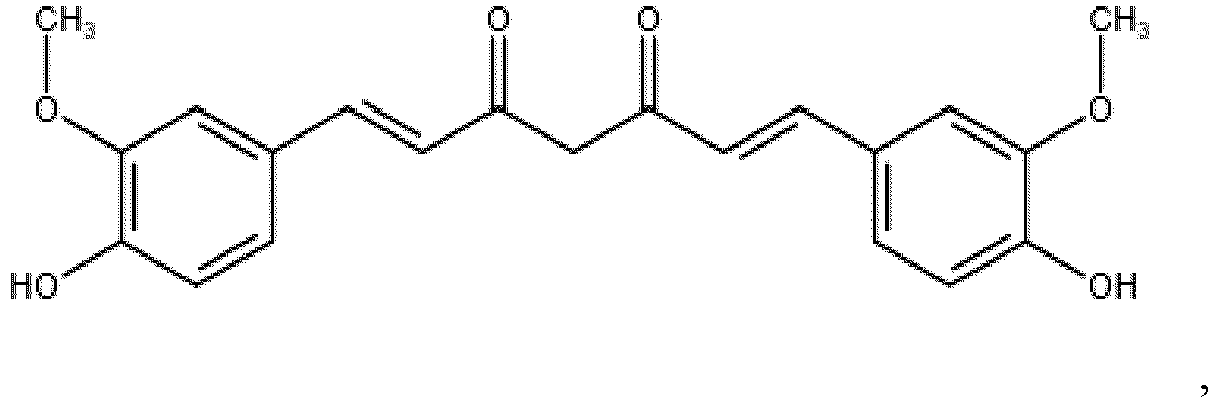
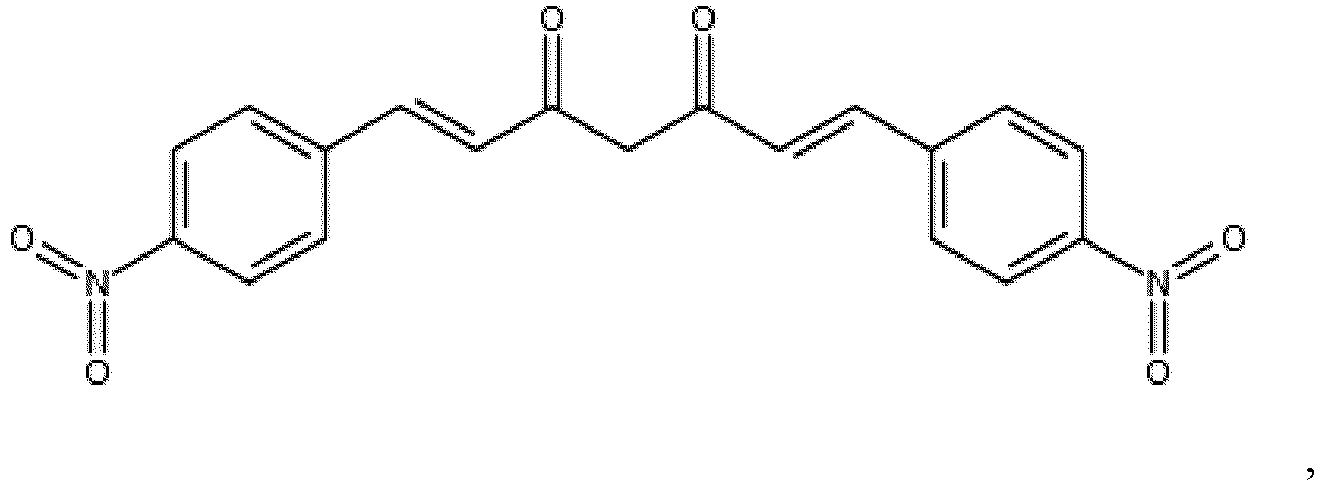
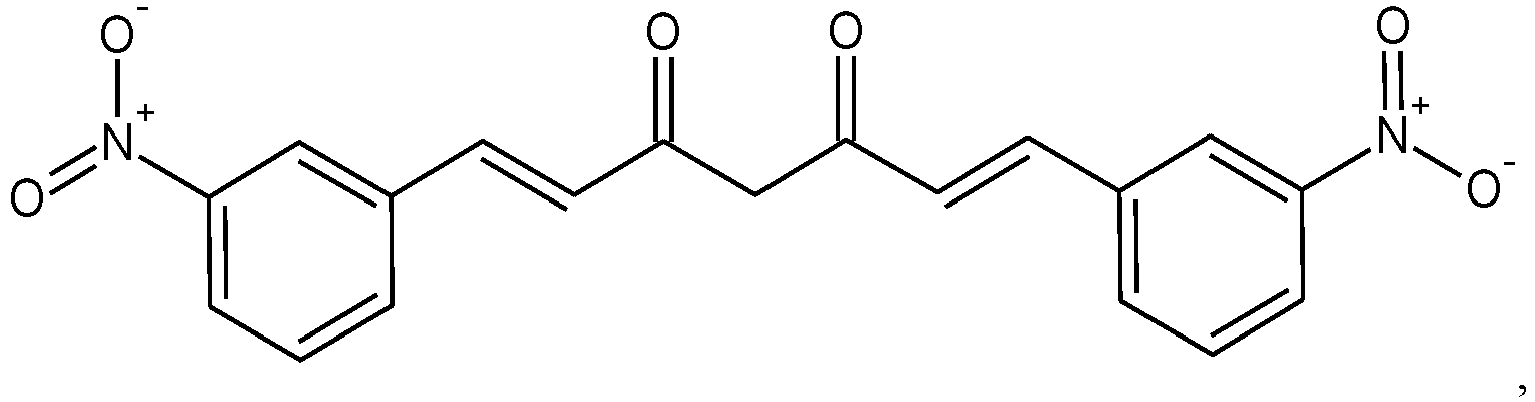
- Representative compounds of this type include but are not limited to, the following compounds, which can be used individually or in any mixture thereof: and
- Useful colored boronic complexes derived from the e) compound capable of forming a colored boronic complex during or after infrared radiation exposure, and having the substructure (III) can comprise one or more occurrences of the following substructure (IIIa) or (IIIb): wherein R a can be one of R 1 , R 2 , R 3 and R 4 as defined above for structure (I) for the d) borate compound or R a can be a -OH group; R b and R c can be a residue from the e) compound capable of forming a colored boronic complex, a hydrogen atom, substituted or unsubstituted alkyl group, or a substituted or unsubstituted aryl group.
- R b and R c can be a residue from the e) compound capable of forming a colored boronic complex and the colored boronic acid complex can have one or more occurrences of the substructure (IIIc).
- Useful e) compounds having substructure (IV) include kermesic acid, Acilan Saphirol SE, Vat Violet 1, C.I. Disperse Red 60, carminic acid, alizarin, purpurine, quinalizarin, alizarin red, and similar hydroxy substituted derivatives of anthraquinone. Such compounds typically have one or more absorption peaks in the visible spectrum. Such visible absorption peaks can shift to a different wavelength upon formation of the colored boronic complex.
- the structure of the formed boronic complexes are similar to those formed by boronic compounds comprised of substructure (III) for example as defined by substructures (IIIa) to (IIIc).
- Representative compounds of this type include but are not limited to: and
- the one or more e) compounds, each capable of forming a colored boronic complex are present in the infrared radiation-sensitive image-recording layer in a dry coverage amount of at least 0.5 weight % and up to and including 20 weight %.
- Such one or more e) compounds can be obtained from various commercial sources or prepared using starting materials and synthetic methods known to one skilled in the art.
- the infrared radiation-sensitive image-recording layer further comprises one or more f) non-free radically polymerizable polymeric materials (or polymeric binders) that does not have any functional groups that, if present, would make the polymeric material capable of free radical polymerization.
- non-free radically polymerizable polymeric materials are different from the one or more a) free radically polymerizable components described above, and they are different materials from all of the b), c), d), and e) components described above.
- Useful f) non-free radically polymerizable polymeric materials generally have a weight average molecular weight (M w ) of at least 2,000, or at least 20,000, and up to and including 300,000 or up to and including 500,000, as determined by Gel Permeation Chromatography (polystyrene standard).
- non-free radically polymerizable polymeric materials can be selected from polymeric binder materials known in the art including polymers comprising recurring units having side chains comprising polyalkylene oxide segments such as those described in for example, U.S. Patent 6,899,994 (Huang et al. ).
- Other useful polymeric binders comprise two or more types of recurring units having different side chains comprising polyalkylene oxide segments as described in for example WO Publication 2015-156065 (Kamiya et al. ).
- Some of such polymeric binders can further comprise recurring units having pendant cyano groups as those described in for example U.S. Patent 7,261,998 (Hayashi et al. ).
- Such one or more f) polymeric non-free radically polymerizable materials also can have a backbone comprising multiple (at least two) urethane moieties as well as pendant groups comprising the polyalkylenes oxide segments.
- Some useful f) non-free radically polymerizable polymeric materials can be present in particulate form, that is, in the form of discrete particles (non-agglomerated particles).
- Such discrete particles can have an average particle size of at least 10 nm and up to and including 1500 nm, or typically of at least 80 nm and up to and including 600 nm, and that are generally distributed uniformly within the infrared radiation-sensitive image-recording layer.
- Some of these materials can be present in particulate form and have an average particle size of at least 50 nm and up to and including 400 nm.
- Average particle size can be determined using various known methods and nanoparticle measuring equipment, including measuring the particles in electron scanning microscope images and averaging a set number of measurements.
- the f) non-free radically polymerizable polymeric material can be present in the form of particles having an average particle size that is less than the average dry thickness (t) of the infrared radiation-sensitive image-recording layer.
- the f) non-free radically polymerizable polymeric material(s) can be present in an amount of at least 10 weight %, or at least 20 weight %, and up to and including 50 weight %, or up to and including 70 weight %, based on the total dry coverage of the infrared radiation-sensitive image-recording layer.
- Useful f) non-free radically polymerizable polymeric materials can be obtained from various commercial sources or they can be prepared using known procedures and starting materials, as described for example in publications described above and as known by skilled polymer chemists.
- the infrared radiation-sensitive image-recording layer can optionally include crosslinked polymer particles, such materials having an average particle size of at least 2 ⁇ m, or of at least 4 ⁇ m, and up to and including 20 ⁇ m as described for example in U.S. Patents 9,366,962 (Hayakawa et al. ), 8,383,319 (Huang et al. ) and 8,105,751 (Endo et al ).
- Such crosslinked polymeric particles can be present only in the infrared radiation-sensitive image-recording layer, only in the hydrophilic protective layer when present (described below), or in both the infrared radiation-sensitive image-recording layer and the hydrophilic protective layer when present.
- While the colored boronic complex formed in the infrared radiation exposed region can provide strong and long lasting printout to the lithographic printing plate precursors of the present invention, additional printout can be provided by combined use with traditional dye precursors that can be transformed into a uniquely colored form in the presence of acid or free radicals.
- Acid radicals and free radicals can be produced from the c) initiator composition, the d) the borate compound represented by structure (I), or both the c) initiator composition and the d) the borate compound.
- Useful dye precursors include those described in U.S. Serial No. 16/572,731 , and the various classes of color forming compounds described according to color forming mechanisms on pages 11 and 12 of United States Patent Application Publication 2018/154,667 .
- dye precursors typically form colored compounds instantly during imaging exposure to infrared radiation precursors.
- Printouts generated from such dye precursors typically fade over time as described in the background section, but are still desirable when the formation of the colored boronic complex according the present invention sometimes is not instantaneous and takes some time to achieve the full potential of its printout capability.
- the infrared radiation-sensitive image-recording layer can also include a variety of other optional addenda including but not limited to, dispersing agents, humectants, biocides, plasticizers, surfactants for coatability or other properties, viscosity builders, pH adjusters, drying agents, defoamers, development aids, rheology modifiers, or combinations thereof, or any other addenda commonly used in the lithographic coating art, in conventional amounts.
- the infrared radiation-sensitive image-recording layer can also include a phosphate (meth)acrylate having a molecular weight generally greater than 250 as described in U.S. Patent 7,429,445 (Munnelly et al. ).
- the infrared radiation-sensitive image-recording layer can optionally comprise one or more suitable co-initiators, chain transfer agents, antioxidants, or stabilizers to prevent or moderate undesired radical reactions.
- suitable antioxidants and inhibitors for this purpose are described, for example in [0144] to [0149] of EP 2,735,903B1 (Werner et al. ) and in Cols. 7-9 of U.S. Patent 7,189,494 (Munnelly et al. ).
- the infrared radiation-sensitive image-recording layer is the outermost layer with no layers disposed thereon, it is possible that the precursors according to this invention can be designed with a hydrophilic protective layer (also known in the art as a hydrophilic overcoat, oxygen-barrier layer, or topcoat) disposed directly on the single infrared radiation-sensitive image-recording layer (with no intermediate layers between these two layers).
- a hydrophilic protective layer also known in the art as a hydrophilic overcoat, oxygen-barrier layer, or topcoat
- this hydrophilic protective layer is generally the outermost layer of the precursor and thus, when multiple precursors are stacked one on top of the other, the hydrophilic protective layer of one precursor can be in contact with the backside of the substrate of the precursor immediately above it, where no interleaving paper is present.
- Such hydrophilic protective layers can comprise one or more film-forming water-soluble polymeric binders in an amount of at least 60 weight % and up to and including 100 weight %, based on the total dry weight of the hydrophilic protective layer.
- film-forming water-soluble (or hydrophilic) polymeric binders can include a modified or unmodified poly(vinyl alcohol) having a saponification degree of at least 30%, or a degree of at least 75%, or a degree of at least 90%, and a degree of up to and including 99.9%.
- one or more acid-modified poly(vinyl alcohol)s can be used as film-forming water-soluble (or hydrophilic) polymeric binders in the hydrophilic protective layer.
- at least one poly(vinyl alcohol) can be modified with an acid group selected from the group consisting of carboxylic acid, sulfonic acid, sulfuric acid ester, phosphonic acid, and phosphoric acid ester groups.
- useful modified poly(vinyl alcohol) materials include but are not limited to, sulfonic acid-modified poly(vinyl alcohol), carboxylic acid-modified poly(vinyl alcohol), and quaternary ammonium salt-modified poly(vinyl alcohol), glycol-modified poly(vinyl alcohol), or combinations thereof.
- the optional hydrophilic overcoat can also include crosslinked polymer particles having an average particle size of at least 2 ⁇ m and as noted above.
- the hydrophilic protective layer is provided as a hydrophilic protective layer formulation and dried to provide a dry coating coverage of at least 0.1 g/m 2 and up to but less than 4 g/m 2 , or typically at a dry coating coverage of at least 0.15 g/m 2 and up to and including 2.5 g/m 2 .
- the dry coating coverage is as low as 0.1 g/m 2 and up to and including 1.5 g/m 2 or at least 0.1 g/m 2 and up to and including 0.9 g/m 2 , such that the hydrophilic protective layer is relatively thin for easy removal during off-press development or on-press development.
- the hydrophilic protective layer can optionally comprise organic wax particles dispersed, generally uniformly, within the one or more film-forming water-soluble (or hydrophilic) polymeric binders as described for example in U.S. Patent Application Publication 2013/0323643 (Balbinot et al. ).
- An infrared radiation-sensitive image-recording layer formulation comprising essential components a), b), c), d), and e), and optional component f) and other optional addenda, described above, can be applied to a hydrophilic surface of a suitable aluminum-containing substrate, usually in the form of a continuous web, as described above, using any suitable equipment and procedure, such as spin coating, knife coating, gravure coating, die coating, slot coating, bar coating, wire rod coating, roller coating, or extrusion hopper coating.
- Such formulation can also be applied by spraying onto a suitable substrate.
- the infrared radiation-sensitive image-recording layer formulation is applied at a suitable wet coverage, it is dried in a suitable manner known in the art to provide a desired dry coverage as noted below, thereby providing an infrared radiation-sensitive continuous web or an infrared radiation-sensitive continuous article.
- the substrate that is, a continuous roll or web
- the substrate can be electrochemically grained and anodized as described above to provide a suitable hydrophilic anodic (aluminum oxide) layer on the outer surface of the aluminum-containing support, and the anodized surface usually can be post-treated with a hydrophilic polymer solution as described above.
- the conditions and results of these operations are well known in the art as described above.
- the manufacturing methods typically include mixing the various components needed for the infrared radiation-sensitive image-recording layer in a suitable organic solvent or mixtures thereof with or without water [such as methyl ethyl ketone (2-butanone), methanol, ethanol, 1-methoxy-2-propanol, 2-methoxypropanol, iso-propyl alcohol, acetone, ⁇ -butyrolactone, n-propanol, tetrahydrofuran, and others readily known in the art, as well as mixtures thereof], applying the resulting infrared radiation-sensitive image-recording layer formulation to a continuous substrate web, and removing the solvent(s) by evaporation under suitable drying conditions.
- a suitable organic solvent or mixtures thereof such as methyl ethyl ketone (2-butanone), methanol, ethanol, 1-methoxy-2-propanol, 2-methoxypropanol, iso-propyl alcohol, acetone, ⁇ -buty
- the dry coverage of the infrared radiation-sensitive image-recording layer on the substrate can be at least 0.1 g/m 2 , or at least 0.4 g/m 2 , and up to and including 2 g/m 2 or up to and including 4 g/m 2 but other dry coverage amounts can be used if desired, to provide a desired dry coverage.
- a suitable aqueous-based hydrophilic protective layer formulation (described above) can be applied to the dried infrared radiation-sensitive image-recording layer using known coating and drying conditions, equipment, and procedures.
- the result of these coating operations is a continuous radiation-sensitive web (or roll) of infrared radiation-sensitive lithographic printing plate precursor material having either only a single infrared radiation-sensitive image-recording layer or both a single infrared radiation-sensitive image-recording layer and a hydrophilic protective layer disposed as the outermost layer.
- Such continuous radiation-sensitive web can be slit or cut into appropriately sized precursors for use.
- an infrared radiation-sensitive lithographic printing plate precursor of this invention can be exposed to a suitable source of infrared radiation depending upon the infrared radiation absorber(s) present in the infrared radiation-sensitive image-recording layer.
- the lithographic printing plate precursors can be imaged with one or more lasers that emit significant infrared radiation within the range of at least 750 nm and up to and including 1400 nm, or of at least 800 nm and up to and including 1250 nm to create exposed regions and non-exposed regions in the infrared radiation-sensitive image-recording layer.
- Such infrared radiation-emitting lasers can be used for such imaging in response to digital information supplied by a computing device or other source of digital information.
- the laser imaging can be digitally controlled in a suitable manner known in the art.
- imaging can be carried out using imaging or exposing infrared radiation from an infrared radiation-generating laser (or array of such lasers). Imaging also can be carried out using imaging radiation at multiple infrared (or near-IR) wavelengths at the same time if desired.
- the laser(s) used to expose the precursor is usually a diode laser(s), because of the reliability and low maintenance of diode laser systems, but other lasers such as gas or solid-state lasers can also be used.
- the combination of power, intensity and exposure time for infrared radiation imaging would be readily apparent to one skilled in the art.
- the infrared imaging apparatus can be configured as a flatbed recorder or as a drum recorder, with the infrared radiation-sensitive lithographic printing plate precursor mounted to the interior or exterior cylindrical surface of the drum.
- An example of useful imaging apparatus is available as models of KODAK ® Trendsetter platesetters (Eastman Kodak Company) and NEC AMZISetter X-series (NEC Corporation, Japan) that contain laser diodes that emit radiation at a wavelength of 830 nm.
- Other suitable imaging apparatus includes the Screen PlateRite 4300 series or 8600 series platesetters (available from Screen USA, Chicago, IL) or thermal CTP platesetters from Panasonic Corporation (Japan) that operates at a wavelength of 810 nm.
- imaging intensities can be at least 30 mJ/cm 2 and up to and including 500 mJ/cm 2 and typically at least 50 mJ/cm 2 and up to and including 300 mJ/cm 2 depending upon the sensitivity of the infrared radiation-sensitive image-recording layer.
- the exposed infrared radiation-sensitive lithographic printing plate precursors having exposed regions and non-exposed regions in the infrared radiation-sensitive image-recording layer can be processed off-press or on-press to remove the non-exposed regions (and any hydrophilic protective layer over such regions).
- the revealed hydrophilic substrate surface repels inks while the remaining exposed regions accept lithographic printing ink.
- Processing can be carried out off-press using any suitable developer in one or more successive applications (treatments or developing steps) of the same or different processing solution (developer). Such one or more successive processing treatments can be carried out for a time sufficient to remove the non-exposed regions of the infrared radiation-sensitive image-recording layer to reveal the outermost hydrophilic surface of the substrate, but not long enough to remove significant amounts of the exposed regions that have been hardened in the same layer.
- the exposed precursors Prior to such off-press processing, the exposed precursors can be subjected to a "pre-heating" process to further harden the exposed regions in the infrared radiation-sensitive image-recording layer.
- pre-heating can be carried out using any known process and equipment generally at a temperature of at least 60°C and up to and including 180°C.
- the exposed precursor can be washed (rinsed) to remove any hydrophilic overcoat that is present.
- washing can be carried out using any suitable aqueous solution (such as water or an aqueous solution of a surfactant) at a suitable temperature and for a suitable time that would be readily apparent to one skilled in the art.
- Useful developers can be ordinary water or formulated aqueous solutions.
- the formulated developers can comprise one or more components selected from surfactants, organic solvents, alkali agents, and surface protective agents.
- useful organic solvents include the reaction products of phenol with ethylene oxide and propylene oxide [such as ethylene glycol phenyl ether (phenoxyethanol)], benzyl alcohol, esters of ethylene glycol and of propylene glycol with acids having 6 or less carbon atoms, and ethers of ethylene glycol, diethylene glycol, and of propylene glycol with alkyl groups having 6 or less carbon atoms, such as 2-ethylethanol and 2-butoxyethanol.
- an aqueous processing solution can be used off-press to both develop the imaged precursor by removing the non-exposed regions and also to provide a protective layer or coating over the entire imaged and developed (processed) precursor printing surface.
- the aqueous solution behaves somewhat like a gum that is capable of protecting (or "gumming") the lithographic image on the lithographic printing plate against contamination or damage (for example, from oxidation, fingerprints, dust, or scratches).
- the resulting lithographic printing plate can be mounted onto a printing press without any contact with additional solutions or liquids. It is optional to further bake the lithographic printing plate with or without blanket or flood-wise exposure to UV or visible radiation.
- Printing can be carried out by applying a lithographic printing ink and fountain solution to the printing surface of the lithographic printing plate in a suitable manner.
- the fountain solution is taken up by the hydrophilic surface of the substrate revealed by the exposing and processing steps, and the lithographic ink is taken up by the remaining (exposed) regions of the infrared radiation-sensitive image-recording layer.
- the lithographic ink is then transferred to a suitable receiving material (such as cloth, paper, metal, glass, or plastic) to provide a desired impression of the image thereon.
- a suitable receiving material such as cloth, paper, metal, glass, or plastic
- an intermediate "blanket” roller can be used to transfer the lithographic ink from the lithographic printing plate to the receiving material (for example, sheets of paper).
- the negative-working lithographic printing plate precursors of the present invention are on-press developable using a lithographic printing ink, a fountain solution, or a combination of a lithographic printing ink and a fountain solution.
- an imaged (exposed) infrared radiation-sensitive lithographic printing plate precursor according to the present invention is mounted onto a printing press and the printing operation is begun.
- the non-exposed regions in the infrared radiation-sensitive image-recording layer are removed by a suitable fountain solution, lithographic printing ink, or a combination of both, when the initial printed impressions are made.
- Typical ingredients of aqueous fountain solutions include pH buffers, desensitizing agents, surfactants and wetting agents, humectants, low boiling solvents, biocides, antifoaming agents, and sequestering agents.
- a representative example of a fountain solution is Varn Litho Etch 142W + Varn PAR (alcohol sub) (available from Varn International, Addison, IL).
- the dampening roller is engaged first and supplies fountain solution to the mounted imaged precursor to swell the exposed infrared radiation-sensitive image-recording layer at least in the non-exposed regions.
- the inking rollers are engaged and they supply lithographic printing ink(s) to cover the entire printing surface of the lithographic printing plates.
- printing sheets are supplied to remove the non-exposed regions of the infrared radiation-sensitive image-recording layer from the lithographic printing plate as well as materials on a blanket cylinder if present, using the formed ink-fountain solution emulsion.
- On-press developability of infrared radiation exposed lithographic printing precursors is particularly useful when the precursor comprises one or more polymeric binder materials (whether free radically polymerizable or not) in an infrared radiation-sensitive image-recording layer, at least one of which polymeric binders is present as particles having an average diameter of at least 50 nm and up to and including 400 nm.
- the present invention provides a lithographic printing plate precursor as defined in the claims.
- the infrared radiation-sensitive image-recording layer further comprises one or more f) non-free radically polymerizable polymeric materials that are different from the a), b), c), d), and e) components defined above, and the one or more f) non-free radically polymerizable polymeric materials are present in particulate form.
- the c) initiator composition comprises at least one onium salt that is capable of generating free radicals, and the onium salt is a diaryliodonium salt.
- the infrared radiation-sensitive image-recording layer is the outermost layer.
- the infrared radiation-sensitive image-recording layer comprises at least two a) free radically polymerizable components.
- the substrate comprises an aluminum-containing substrate comprising an aluminum oxide layer, and a hydrophilic polymer coating that is disposed on the aluminum oxide layer.
- the d) borate compound is a tetraaryl borate or a triarylalkyl borate.
- An aluminum-containing substrate was prepared for the lithographic printing plate precursors in the following manner: A surface of an aluminum alloy sheet (support) was subjected to an electrolytic roughening treatment using hydrochloric acid to provide an average roughness Ra of 0.5 ⁇ m. The resulting grained aluminum sheet was subjected to an anodizing treatment using an aqueous phosphoric acid solution to form an aluminum oxide layer of 2.5 g/m 2 dry coverage, followed by a post-treatment application of a poly(acrylic acid) solution, to provide an aluminum-containing substrate.
- a negative-working, infrared radiation-sensitive image-recording layer was then formed on the aluminum-containing substrate by individually coating an infrared radiation-sensitive composition formulation having the components shown in the following TABLE I using a bar coater, to provide a dry coating weight of 0.9 g/m 2 after drying at 50°C for 60 seconds for each of the inventive and comparative precursors described below.
- the raw materials noted in TABLE I are identified in the following TABLE II. These materials can be obtained from one or more commercial sources of chemicals or prepared using known synthetic methods.
- TABLE III shows the e) compounds capable of forming a colored boronic complex upon exposure to infrared radiation, their amounts, the amount of leuco dye 1, and the borate compounds used in the various inventive and comparative working examples of negative-working lithographic printing plate precursors.
- WinCon Red can be obtained from Connect Chemicals.
- Curcumin and pyrocatechol violet were purchased from Sigma Aldrich.
- On-press developability was evaluated by imagewise exposing each lithographic printing plate precursor at 120 mJ/cm 2 using a Trendsetter 800 III Quantum TH 1.7 (available from Eastman Kodak Company). Each imagewise exposed lithographic printing plate precursor was then mounted onto a MAN Roland Favorite 04 press machine without developing (processing). Fountain solution (Varn Supreme 6038) and lithographic printing ink (Gans Cyan) were supplied, and lithographic printing was performed. On-press development occurred during printing. Acceptable on-press developability was evaluated by counting the number of printed paper sheets needed to receive a clean background and was given one of the following qualitative values based on the number of printed paper sheets to achieve a clean background. + ⁇ 30 printing paper sheets 0 30-100 printed paper sheets - > 100 printed paper sheets
- Each of the lithographic printing plate precursors was imagewise exposed using a Trendsetter 800 III Quantum TH 1.7 (available from Eastman Kodak Company) at 150 mJ/cm 2 to provide exposed regions and non-exposed regions in the negative-working, IR-sensitive imageable layer.
- the color difference between exposed regions and non-exposed regions was measured by determining the ⁇ E value, using a Techkon Spectro Dens spectral densitometer, calculating the Euclidean distance of the measured L*a*b values, and given the following qualitative values immediately after exposure and 1h after exposure (storage in the dark).
- practice of the present invention provides lithographic printing plates having a print-out image on the same level as currently known methods (for example, see Inventive Example 7 vs. Comparative Example 3).
- the generation of print-out image using the present invention proceeds via a parallel mechanism and is therefore applicable in addition to the currently known methods, thus generating a print-out image improvement if used in addition to the already known methods (for examples, Inventive Example 1 vs. Comparative Example 2).
- Inventive Examples 5 and 6 demonstrate that a print-out image can be formed using a variety of boronic compounds. From the data obtained in Inventive Example 7, it is concluded that no iodonium compound is needed for the print-out image formation of colored boronic complexes.
- the data from Inventive Examples 8, 9, and 10 demonstrate that the color forming effect is not significantly influenced by the substitution of the color-forming phenyl rings.
- the data from Comparative Example 4 demonstrate that a combination of curcumin derivative and borate compound is necessary for successful print-out image formation, as the absence of the borate compound according to structure (I) resulted in low printout even in the presence of curcumin.
Landscapes
- Physics & Mathematics (AREA)
- General Physics & Mathematics (AREA)
- Engineering & Computer Science (AREA)
- Architecture (AREA)
- Organic Chemistry (AREA)
- Chemical & Material Sciences (AREA)
- Spectroscopy & Molecular Physics (AREA)
- Structural Engineering (AREA)
- Optics & Photonics (AREA)
- Thermal Sciences (AREA)
- Manufacturing & Machinery (AREA)
- Materials For Photolithography (AREA)
- Printing Plates And Materials Therefor (AREA)
- Photosensitive Polymer And Photoresist Processing (AREA)
Claims (14)
- Ein Lithographiedruckplattenvorläufer, umfassend ein Substrat und eine infrarotstrahlungsempfindliche Bildaufzeichnungsschicht, angeordnet auf dem Substrat, wobei die infrarotstrahlungsempfindliche Bildaufzeichnungsschicht umfasst:a) eine radikalisch polymerisierbare Komponente;b) einen Infrarotstrahlungsabsorber;c) eine Initiatorzusammensetzung, die in der Lage ist, freie Radikale zu erzeugen;d) eine Boratverbindung; unde) eine Verbindung, die in der Lage ist, während oder nach dem Belichten der infrarotstrahlungsempfindlichen Bildaufzeichnungsschicht mit Infrarotstrahlung einen farbigen Boronkomplex zu bilden,wobei die Boratverbindung dargestellt ist durch die nachstehende Struktur (I)
B-(R1)(R2)(R3)(R4) Z+ (I)
wobei R1, R2, R3 und R4 unabhängig ein gegebenenfalls substituiertes Alkyl, Aryl, Alkenyl, Alkinyl, Cycloalkyl oder heterocyclische Gruppen, gebunden an das Boratom des Boratanions, darstellen oder zwei oder mehr von R1, R2, R3 und R4 aneinander gebunden sein können, um einen heterocyclischen Ring mit dem Boratom zu bilden, wobei ein derartiger heterocyclischer Ring bis zu 7 Kohlenstoff-, Stickstoff-, Sauerstoff- oder Schwefelatome aufweist; und Z+ ein Kation zum Ausgleich der elektrischen Ladung des Boratanions ist,
undwobei die e) Verbindung, die in der Lage ist, einen farbigen Boronkomplex zu bilden, in der infrarotstrahlungsempfindlichen Bildaufzeichnungsschicht in einer Trockenbedeckungsmenge von mindestens 0,5 Gew.-% und bis zu und einschließlich 20 Gew.-% vorhanden ist und ein oder mehr Vorkommen einer oder mehrerer der nachstehenden Unterstrukturen (III) und (IV) umfasst: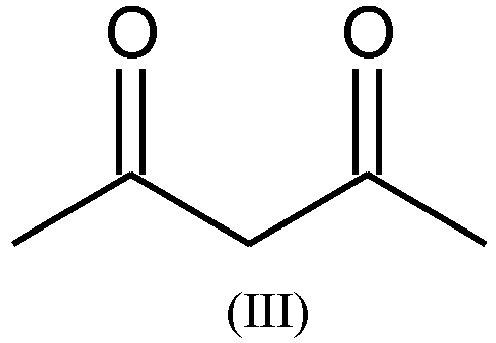

- Der Lithographiedruckplattenvorläufer nach Anspruch 1, wobei die infrarotstrahlungsempfindliche Bildaufzeichnungsschicht ferner ein oder mehrere f) nicht radikalisch polymerisierbare polymere Materialien umfasst, die von den vorstehend definierten Komponenten a), b), c), d) und e) verschieden sind.
- Der Lithographiedruckplattenvorläufer nach Anspruch 1 oder 2, wobei die c) Initiatorzusammensetzung mindestens ein Oniumsalz umfasst, das in der Lage ist, freie Radikale zu erzeugen.
- Der Lithographiedruckplattenvorläufer nach Anspruch 3, wobei die d) Boratverbindung und das mindestens eine Oniumsalz als eine gemeinsame Salzverbindung verwendet werden.
- Der Lithographiedruckplattenvorläufer nach einem der Ansprüche 1 bis 4, wobei nach dem Belichten mit Infrarotstrahlung, die infrarotstrahlungsempfindliche Bildaufzeichnungsschicht auf der Druckmaschine unter Verwendung einer lithographischen Druckfarbe, eines Feuchtmittels oder einer Kombination aus einer lithographischen Druckfarbe und eines Feuchtmittels entwickelbar ist.
- Der Lithographiedruckplattenvorläufer nach einem der Ansprüche 1 bis 5, wobei die d) Boratverbindung in der infrarotstrahlungsempfindlichen Bildaufzeichnungsschicht in einer Trockenbedeckungsmenge von mindestens 0,5 Gew.-% und bis zu und einschließlich 20 Gew.-% vorhanden ist, bezogen auf die Gesamttrockenbedeckungsmenge der infrarotstrahlungsempfindlichen Bildaufzeichnungsschicht.
- Der Lithographiedruckplattenvorläufer nach einem der Ansprüche 1 bis 6, wobei das Molverhältnis der d) Boratverbindung zur e) Verbindung, die in der Lage ist, einen farbigen Boronkomplex zu bilden, mindestens 0,05:1 und bis zu und einschließlich 20:1 beträgt.
- Der Lithographiedruckplattenvorläufer nach Anspruch 1, wobei die e) Verbindung, die in der Lage ist, einen farbigen Boronkomplex zu bilden, ein oder mehrere Vorkommen der Unterstruktur (III) umfasst.
- Der Lithographiedruckplattenvorläufer nach Anspruch 8, wobei die e) Verbindung, die in der Lage ist, einen farbigen Boronkomplex zu bilden, durch die nachstehende Struktur (V) dargestellt ist:

- Der Lithographiedruckplattenvorläufer nach Anspruch 1, wobei die e) Verbindung, die in der Lage ist, einen farbigen Boronkomplex zu bilden, durch die nachstehende Struktur (VI) dargestellt ist:

- Der Lithographiedruckplattenvorläufer nach Anspruch 1, wobei die e) Verbindung, die in der Lage ist, einen farbigen Boronkomplex zu bilden, eine oder mehrere der nachstehenden Verbindungen umfasst:




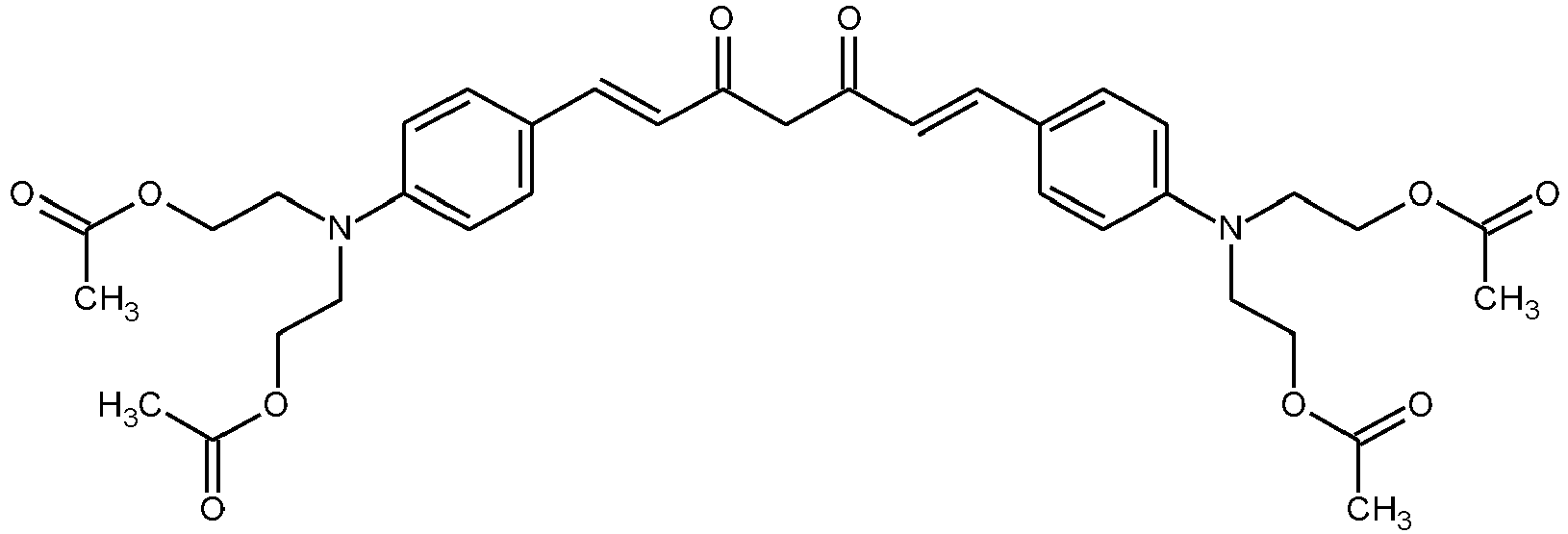

- Der Lithographiedruckplattenvorläufer nach einem der Ansprüche 1 bis 11, wobei die infrarotstrahlungsempfindliche Bildaufzeichnungsschicht ferner einen oder mehrere säureempfindliche Farbstoffvorläufer umfasst.
- Ein Verfahren zur Bereitstellung einer Lithographiedruckplatte, umfassend:A) bildweises Belichten des Lithographiedruckplattenvorläufers gemäß einem der Ansprüche 1 bis 12 mit Infrarotstrahlung, um belichtete Bereiche und nicht belichtete Bereiche in der infrarotstrahlungsempfindlichen Bildaufzeichnungsschicht bereitzustellen, undB) Entfernen der nicht belichteten Bereiche in der infrarotstrahlungsempfindlichen Bildaufzeichnungsschicht von dem Substrat.
- Das Verfahren nach Anspruch 13, umfassend das Entfernen der nicht belichteten Bereiche in der infrarotstrahlungsempfindlichen Bildaufzeichnungsschicht von dem Substrat auf der Druckmaschine unter Verwendung einer lithographischen Druckfarbe, eines Feuchtmittels oder einer Kombination aus einer lithographischen Druckfarbe und eines Feuchtmittels.
Applications Claiming Priority (3)
| Application Number | Priority Date | Filing Date | Title |
|---|---|---|---|
| US202062994366P | 2020-03-25 | 2020-03-25 | |
| US17/097,164 US11714354B2 (en) | 2020-03-25 | 2020-11-13 | Lithographic printing plate precursor and method of use |
| PCT/US2021/021600 WO2021194741A1 (en) | 2020-03-25 | 2021-03-10 | Lithographic printing plate precursor and method of use |
Publications (2)
| Publication Number | Publication Date |
|---|---|
| EP4126548A1 EP4126548A1 (de) | 2023-02-08 |
| EP4126548B1 true EP4126548B1 (de) | 2024-08-14 |
Family
ID=77857455
Family Applications (1)
| Application Number | Title | Priority Date | Filing Date |
|---|---|---|---|
| EP21717612.2A Active EP4126548B1 (de) | 2020-03-25 | 2021-03-10 | Lithographiedruckplattenvorläufer und verfahren zur herstellung einer lithographischen druckplatte |
Country Status (5)
| Country | Link |
|---|---|
| US (1) | US11714354B2 (de) |
| EP (1) | EP4126548B1 (de) |
| JP (1) | JP7605855B2 (de) |
| CN (1) | CN115335234B (de) |
| WO (1) | WO2021194741A1 (de) |
Families Citing this family (4)
| Publication number | Priority date | Publication date | Assignee | Title |
|---|---|---|---|---|
| WO2021256341A1 (ja) * | 2020-06-17 | 2021-12-23 | 富士フイルム株式会社 | 機上現像型平版印刷版原版、平版印刷版の作製方法、及び、平版印刷方法 |
| JPWO2023032681A1 (de) * | 2021-08-31 | 2023-03-09 | ||
| US12429774B2 (en) | 2022-08-04 | 2025-09-30 | Eastman Kodak Company | Lithographic printing plate precursors, methods of using and manufacture |
| EP4621487A1 (de) * | 2022-11-16 | 2025-09-24 | Nissan Chemical Corporation | Einen resistunterschichtfilm bildende zusammensetzung mit einem curcuminderivat |
Family Cites Families (77)
| Publication number | Priority date | Publication date | Assignee | Title |
|---|---|---|---|---|
| DE3312497A1 (de) | 1983-04-07 | 1984-10-11 | Hoechst Ag, 6230 Frankfurt | Zweistufiges verfahren zur herstellung von anodisch oxidierten flaechigen materialien aus aluminium und deren verwendung bei der herstellung von offsetdruckplatten |
| US5008238A (en) | 1988-06-20 | 1991-04-16 | Ricoh Company, Ltd. | Leuco dyes and recording material employing the same |
| GB9004337D0 (en) | 1990-02-27 | 1990-04-25 | Minnesota Mining & Mfg | Preparation and use of dyes |
| US5491045A (en) * | 1994-12-16 | 1996-02-13 | Eastman Kodak Company | Image dye combination for laser ablative recording element |
| US6153356A (en) | 1998-08-17 | 2000-11-28 | Mitsubishi Chemical Corporation | Photopolymerizable composition, photopolymerizable lithographic printing plate and process for forming an image |
| JP3654422B2 (ja) | 2000-01-31 | 2005-06-02 | 三菱製紙株式会社 | 感光性組成物および感光性平版印刷版材料 |
| US6309792B1 (en) | 2000-02-18 | 2001-10-30 | Kodak Polychrome Graphics Llc | IR-sensitive composition and use thereof for the preparation of printing plate precursors |
| EP1182033B1 (de) | 2000-08-21 | 2006-11-22 | Fuji Photo Film Co., Ltd. | Bildaufzeichnungsmaterial |
| JP2002082429A (ja) | 2000-09-08 | 2002-03-22 | Fuji Photo Film Co Ltd | ネガ型画像記録材料 |
| JP4191887B2 (ja) | 2000-09-27 | 2008-12-03 | 富士フイルム株式会社 | 平版印刷版原版 |
| JP4319363B2 (ja) | 2001-01-15 | 2009-08-26 | 富士フイルム株式会社 | ネガ型画像記録材料 |
| US7592128B2 (en) | 2001-04-04 | 2009-09-22 | Eastman Kodak Company | On-press developable negative-working imageable elements |
| US7261998B2 (en) | 2001-04-04 | 2007-08-28 | Eastman Kodak Company | Imageable element with solvent-resistant polymeric binder |
| US6899994B2 (en) | 2001-04-04 | 2005-05-31 | Kodak Polychrome Graphics Llc | On-press developable IR sensitive printing plates using binder resins having polyethylene oxide segments |
| US6893797B2 (en) | 2001-11-09 | 2005-05-17 | Kodak Polychrome Graphics Llc | High speed negative-working thermal printing plates |
| US7770534B2 (en) | 2001-08-10 | 2010-08-10 | Isadore Cooperman | Changed condition indicator |
| US7659046B2 (en) * | 2002-04-10 | 2010-02-09 | Eastman Kodak Company | Water-developable infrared-sensitive printing plate |
| US7368215B2 (en) | 2003-05-12 | 2008-05-06 | Eastman Kodak Company | On-press developable IR sensitive printing plates containing an onium salt initiator system |
| US7018775B2 (en) | 2003-12-15 | 2006-03-28 | Eastman Kodak Company | Infrared absorbing N-alkylsulfate cyanine compounds |
| EP1717024A1 (de) | 2004-01-23 | 2006-11-02 | Fuji Photo Film Co., Ltd. | Flachdruckplattenvorläufer und Flachdruckverfahren. |
| US7189494B2 (en) | 2005-05-26 | 2007-03-13 | Eastman Kodak Company | On-press developable imageable element comprising a tetraarylborate salt |
| JP5170960B2 (ja) | 2005-08-29 | 2013-03-27 | 富士フイルム株式会社 | 平版印刷版原版、及び平版印刷方法 |
| DE102005048193A1 (de) | 2005-10-07 | 2007-04-19 | Kodak Polychrome Graphics Gmbh | Zweischichtige wärmeempfindliche bebilderbare Elemente mit saurem Cellulosederivat in der Deckschicht |
| JP2007277111A (ja) | 2006-04-03 | 2007-10-25 | Stella Chemifa Corp | テトラフルオロホウ酸塩の製造方法 |
| US7955682B2 (en) | 2006-04-25 | 2011-06-07 | Hewlett-Packard Development Company, L.P. | Photochemical and photothermal rearrangements for optical data and image recording |
| EP2018365B1 (de) | 2006-05-17 | 2014-11-19 | American Dye Source, Inc. | Neue materialien für die beschichtung lithographischer platten, lithographische platten und beschichtungen, die diese enthalten, herstellungsverfahren und verwendung |
| US7524614B2 (en) | 2006-05-26 | 2009-04-28 | Eastman Kodak Company | Negative-working radiation-sensitive compositions and imageable materials |
| US8105751B2 (en) | 2006-06-09 | 2012-01-31 | Fujifilm Corporation | Planographic printing plate precursor and pile of planographic printing plate precursors |
| RU2434024C2 (ru) | 2006-08-24 | 2011-11-20 | Америкэн Дай Сорс Инк. | Реакционноспособные полимерные частицы, поглощающие инфракрасное излучение в ближней области, способы их получения и их применение |
| US7429445B1 (en) | 2007-03-07 | 2008-09-30 | Eastman Kodak Company | Negative-working imageable elements and methods of use |
| US7553603B2 (en) | 2007-06-13 | 2009-06-30 | Xerox Corporation | Inkless printing paper and method |
| US20090047599A1 (en) | 2007-08-15 | 2009-02-19 | Geoffrey Horne | Negative-working imageable elements and methods of use |
| US7858292B2 (en) | 2007-12-04 | 2010-12-28 | Eastman Kodak Company | Imageable elements with components having 1H-tetrazole groups |
| EP2098367A1 (de) | 2008-03-05 | 2009-09-09 | Eastman Kodak Company | Sensibilisator/Initiator-Kombination für negativ arbeitende wärmeempfindliche Zusammensetzungen für Lithografieplatten |
| US8383319B2 (en) | 2009-08-25 | 2013-02-26 | Eastman Kodak Company | Lithographic printing plate precursors and stacks |
| US8426104B2 (en) | 2009-10-08 | 2013-04-23 | Eastman Kodak Company | Negative-working imageable elements |
| US8783179B2 (en) | 2009-12-28 | 2014-07-22 | Fujifilm Corporation | Support for planographic printing plate, method for producing support for planographic printing plate, and planographic printing original plate |
| JP5498403B2 (ja) | 2010-01-29 | 2014-05-21 | 富士フイルム株式会社 | 平版印刷版用支持体、平版印刷版用支持体の製造方法、および平版印刷版原版 |
| CN102792129B (zh) | 2010-02-18 | 2016-06-22 | 录象射流技术公司 | 指示湿度的油墨组合物 |
| JP5612531B2 (ja) | 2010-04-30 | 2014-10-22 | 富士フイルム株式会社 | 平版印刷版用支持体、および平版印刷版原版 |
| US8900798B2 (en) * | 2010-10-18 | 2014-12-02 | Eastman Kodak Company | On-press developable lithographic printing plate precursors |
| CN102616049B (zh) | 2011-01-31 | 2015-04-01 | 富士胶片株式会社 | 平版印刷版载体和预制感光版 |
| JP5705584B2 (ja) | 2011-02-24 | 2015-04-22 | 富士フイルム株式会社 | 平版印刷版の製版方法 |
| CN103562794B (zh) | 2011-03-28 | 2016-07-13 | 富士胶片株式会社 | 平版印刷版的制版方法 |
| JP5704720B2 (ja) | 2011-07-27 | 2015-04-22 | 日本化薬株式会社 | エポキシ樹脂混合物、エポキシ樹脂組成物、プリプレグおよびそれらの硬化物 |
| US8703381B2 (en) * | 2011-08-31 | 2014-04-22 | Eastman Kodak Company | Lithographic printing plate precursors for on-press development |
| US8722308B2 (en) | 2011-08-31 | 2014-05-13 | Eastman Kodak Company | Aluminum substrates and lithographic printing plate precursors |
| US8632941B2 (en) * | 2011-09-22 | 2014-01-21 | Eastman Kodak Company | Negative-working lithographic printing plate precursors with IR dyes |
| BR112014007169A2 (pt) | 2011-09-26 | 2017-04-04 | Fujifilm Corp | processo para fazer placa de impressão litográfica |
| WO2013047228A1 (ja) | 2011-09-26 | 2013-04-04 | 富士フイルム株式会社 | 平版印刷版の製版方法 |
| EP2808173A4 (de) | 2012-01-24 | 2015-07-01 | Fujifilm Corp | Träger für eine lithographie-druckplatte, verfahren zur herstellung des trägers für eine lithographie-druckplatte und master für die lithographie-druckplatte |
| CN106183520B (zh) | 2012-03-29 | 2019-05-17 | 富士胶片株式会社 | 平版印刷版原版、及其印刷方法 |
| US8679726B2 (en) | 2012-05-29 | 2014-03-25 | Eastman Kodak Company | Negative-working lithographic printing plate precursors |
| US8889341B2 (en) * | 2012-08-22 | 2014-11-18 | Eastman Kodak Company | Negative-working lithographic printing plate precursors and use |
| JP5988151B2 (ja) | 2012-08-31 | 2016-09-07 | 学校法人関東学院 | 3次元多層構造体の製造方法 |
| EP2735903B1 (de) | 2012-11-22 | 2019-02-27 | Eastman Kodak Company | Negativ arbeitende Lithografiedruckplattenvorläufer mit hochverzweigtem Bindemittelmaterial |
| WO2015046298A1 (ja) | 2013-09-27 | 2015-04-02 | 富士フイルム株式会社 | 平版印刷版原版、及び、平版印刷版の製版方法 |
| JP2015202586A (ja) | 2014-04-11 | 2015-11-16 | イーストマン コダック カンパニー | 平版印刷版原版 |
| WO2016124493A1 (en) | 2015-02-02 | 2016-08-11 | Basf Se | Latent acids and their use |
| US20160259243A1 (en) | 2015-03-03 | 2016-09-08 | Eastman Kodak Company | Negative-working lithographic printing plate precursor |
| US9366962B1 (en) | 2015-03-10 | 2016-06-14 | Eastman Kodak Company | Negative-working lithographic printing plate precursor and use |
| CN107592840B (zh) | 2015-05-19 | 2019-11-05 | 爱克发-格法特公司 | 可激光标记的组合物、制品和文件 |
| US20170021656A1 (en) | 2015-07-24 | 2017-01-26 | Kevin Ray | Lithographic imaging and printing with negative-working photoresponsive printing members |
| US20170217149A1 (en) | 2016-01-28 | 2017-08-03 | Eastman Kodak Company | Negatively-working lithographic printing plate precursor and method |
| WO2017141882A1 (ja) | 2016-02-19 | 2017-08-24 | 富士フイルム株式会社 | 発色組成物、平版印刷版原版、平版印刷版の作製方法、及び発色性化合物 |
| WO2017170715A1 (ja) | 2016-03-30 | 2017-10-05 | 富士フイルム株式会社 | 印刷方法 |
| CN109952536B (zh) * | 2016-11-16 | 2022-07-08 | 富士胶片株式会社 | 辐射感光性组合物、平版印刷版原版及平版印刷版的制版方法 |
| US10662274B2 (en) | 2016-12-02 | 2020-05-26 | Georgia Tech Research Corporation | Self-immolative polymers, articles thereof, and methods of making and using same |
| JP6807531B2 (ja) | 2016-12-20 | 2021-01-06 | 岡本化学工業株式会社 | 光学的立体造形用組成物及びこれを用いた立体造形物の製造方法 |
| EP3566099B1 (de) * | 2017-01-04 | 2021-02-24 | Eastman Kodak Company | Negativ arbeitender lithographie-druckplattenvorläufer und verwendung |
| EP3590975B1 (de) * | 2017-02-28 | 2022-05-04 | FUJIFILM Corporation | Härtbare zusammensetzung, lithografischer druckplattenvorläufer, verfahren zur herstellung einer lithografischen druckplatte und verbindung |
| US10828884B2 (en) | 2017-03-02 | 2020-11-10 | Eastman Kodak Company | Lithographic printing plate precursors and method of use |
| CN110505962B (zh) | 2017-07-13 | 2022-01-04 | 富士胶片株式会社 | 平版印刷版原版和平版印刷版的制作方法 |
| CN107499016A (zh) * | 2017-09-25 | 2017-12-22 | 浙江康尔达新材料股份有限公司 | 一种热敏阴图平版印刷版前体及其制版方法 |
| CN109752921B (zh) | 2017-11-08 | 2023-03-28 | 乐凯华光印刷科技有限公司 | 一种阴图平印版前体及由其制备平印版的方法 |
| CN111867838B (zh) | 2018-03-22 | 2023-03-31 | 爱克发胶印有限公司 | 平版印刷版前体 |
| US20200096865A1 (en) | 2018-09-21 | 2020-03-26 | Eastman Kodak Company | Lithographic printing plate precursor and color-forming composition |
-
2020
- 2020-11-13 US US17/097,164 patent/US11714354B2/en active Active
-
2021
- 2021-03-10 EP EP21717612.2A patent/EP4126548B1/de active Active
- 2021-03-10 JP JP2022556202A patent/JP7605855B2/ja active Active
- 2021-03-10 CN CN202180023860.5A patent/CN115335234B/zh active Active
- 2021-03-10 WO PCT/US2021/021600 patent/WO2021194741A1/en not_active Ceased
Also Published As
| Publication number | Publication date |
|---|---|
| JP2023519202A (ja) | 2023-05-10 |
| EP4126548A1 (de) | 2023-02-08 |
| US11714354B2 (en) | 2023-08-01 |
| CN115335234B (zh) | 2024-07-09 |
| WO2021194741A1 (en) | 2021-09-30 |
| CN115335234A (zh) | 2022-11-11 |
| JP7605855B2 (ja) | 2024-12-24 |
| US20210302834A1 (en) | 2021-09-30 |
Similar Documents
| Publication | Publication Date | Title |
|---|---|---|
| EP4031375B1 (de) | Lithografischer druckplattenvorläufer und verfahren zur verwendung | |
| EP4126548B1 (de) | Lithographiedruckplattenvorläufer und verfahren zur herstellung einer lithographischen druckplatte | |
| EP3408098B1 (de) | Negativ arbeitender lithographiedruckplattenvorläufer und verfahren | |
| EP3853026B1 (de) | Flachdruckplattenvorläufer und farbbildende zusammensetzung | |
| EP3566099B1 (de) | Negativ arbeitender lithographie-druckplattenvorläufer und verwendung | |
| US12222645B2 (en) | Lithographic printing plate precursor and method of use | |
| EP4373674B1 (de) | Lithographiedruckplattenvorläufer und verfahren zur bereitstellung einer lithographiedruckplatte | |
| US12436459B2 (en) | Lithographic printing plate precursor and method of use | |
| US20240069439A1 (en) | Lithographic printing plate precursor and method of use | |
| US20220324220A1 (en) | Lithographic printing plate precursor and method of use | |
| EP4301600A1 (de) | Lithographiedruckplattenvorläufer und verfahren zur verwendung | |
| WO2022212032A1 (en) | Lithographic printing plate precursor and method of use | |
| US20250123560A1 (en) | Lithographic printing plate precursor and method of use | |
| CN117677502A (zh) | 平版印刷版前体及使用方法 |
Legal Events
| Date | Code | Title | Description |
|---|---|---|---|
| STAA | Information on the status of an ep patent application or granted ep patent |
Free format text: STATUS: UNKNOWN |
|
| STAA | Information on the status of an ep patent application or granted ep patent |
Free format text: STATUS: THE INTERNATIONAL PUBLICATION HAS BEEN MADE |
|
| PUAI | Public reference made under article 153(3) epc to a published international application that has entered the european phase |
Free format text: ORIGINAL CODE: 0009012 |
|
| STAA | Information on the status of an ep patent application or granted ep patent |
Free format text: STATUS: REQUEST FOR EXAMINATION WAS MADE |
|
| 17P | Request for examination filed |
Effective date: 20220919 |
|
| AK | Designated contracting states |
Kind code of ref document: A1 Designated state(s): AL AT BE BG CH CY CZ DE DK EE ES FI FR GB GR HR HU IE IS IT LI LT LU LV MC MK MT NL NO PL PT RO RS SE SI SK SM TR |
|
| DAV | Request for validation of the european patent (deleted) | ||
| DAX | Request for extension of the european patent (deleted) | ||
| GRAP | Despatch of communication of intention to grant a patent |
Free format text: ORIGINAL CODE: EPIDOSNIGR1 |
|
| STAA | Information on the status of an ep patent application or granted ep patent |
Free format text: STATUS: GRANT OF PATENT IS INTENDED |
|
| INTG | Intention to grant announced |
Effective date: 20240429 |
|
| GRAS | Grant fee paid |
Free format text: ORIGINAL CODE: EPIDOSNIGR3 |
|
| GRAA | (expected) grant |
Free format text: ORIGINAL CODE: 0009210 |
|
| STAA | Information on the status of an ep patent application or granted ep patent |
Free format text: STATUS: THE PATENT HAS BEEN GRANTED |
|
| P01 | Opt-out of the competence of the unified patent court (upc) registered |
Free format text: CASE NUMBER: APP_39529/2024 Effective date: 20240703 |
|
| AK | Designated contracting states |
Kind code of ref document: B1 Designated state(s): AL AT BE BG CH CY CZ DE DK EE ES FI FR GB GR HR HU IE IS IT LI LT LU LV MC MK MT NL NO PL PT RO RS SE SI SK SM TR |
|
| REG | Reference to a national code |
Ref country code: GB Ref legal event code: FG4D |
|
| REG | Reference to a national code |
Ref country code: CH Ref legal event code: EP |
|
| REG | Reference to a national code |
Ref country code: DE Ref legal event code: R096 Ref document number: 602021017213 Country of ref document: DE |
|
| REG | Reference to a national code |
Ref country code: IE Ref legal event code: FG4D |
|
| REG | Reference to a national code |
Ref country code: LT Ref legal event code: MG9D |
|
| REG | Reference to a national code |
Ref country code: NL Ref legal event code: MP Effective date: 20240814 |
|
| PG25 | Lapsed in a contracting state [announced via postgrant information from national office to epo] |
Ref country code: NO Free format text: LAPSE BECAUSE OF FAILURE TO SUBMIT A TRANSLATION OF THE DESCRIPTION OR TO PAY THE FEE WITHIN THE PRESCRIBED TIME-LIMIT Effective date: 20241114 |
|
| REG | Reference to a national code |
Ref country code: AT Ref legal event code: MK05 Ref document number: 1712938 Country of ref document: AT Kind code of ref document: T Effective date: 20240814 |
|
| PG25 | Lapsed in a contracting state [announced via postgrant information from national office to epo] |
Ref country code: NL Free format text: LAPSE BECAUSE OF FAILURE TO SUBMIT A TRANSLATION OF THE DESCRIPTION OR TO PAY THE FEE WITHIN THE PRESCRIBED TIME-LIMIT Effective date: 20240814 Ref country code: FI Free format text: LAPSE BECAUSE OF FAILURE TO SUBMIT A TRANSLATION OF THE DESCRIPTION OR TO PAY THE FEE WITHIN THE PRESCRIBED TIME-LIMIT Effective date: 20240814 Ref country code: PL Free format text: LAPSE BECAUSE OF FAILURE TO SUBMIT A TRANSLATION OF THE DESCRIPTION OR TO PAY THE FEE WITHIN THE PRESCRIBED TIME-LIMIT Effective date: 20240814 Ref country code: GR Free format text: LAPSE BECAUSE OF FAILURE TO SUBMIT A TRANSLATION OF THE DESCRIPTION OR TO PAY THE FEE WITHIN THE PRESCRIBED TIME-LIMIT Effective date: 20241115 Ref country code: PT Free format text: LAPSE BECAUSE OF FAILURE TO SUBMIT A TRANSLATION OF THE DESCRIPTION OR TO PAY THE FEE WITHIN THE PRESCRIBED TIME-LIMIT Effective date: 20241216 |
|
| PG25 | Lapsed in a contracting state [announced via postgrant information from national office to epo] |
Ref country code: BG Free format text: LAPSE BECAUSE OF FAILURE TO SUBMIT A TRANSLATION OF THE DESCRIPTION OR TO PAY THE FEE WITHIN THE PRESCRIBED TIME-LIMIT Effective date: 20240814 |
|
| PG25 | Lapsed in a contracting state [announced via postgrant information from national office to epo] |
Ref country code: LV Free format text: LAPSE BECAUSE OF FAILURE TO SUBMIT A TRANSLATION OF THE DESCRIPTION OR TO PAY THE FEE WITHIN THE PRESCRIBED TIME-LIMIT Effective date: 20240814 |
|
| PG25 | Lapsed in a contracting state [announced via postgrant information from national office to epo] |
Ref country code: AT Free format text: LAPSE BECAUSE OF FAILURE TO SUBMIT A TRANSLATION OF THE DESCRIPTION OR TO PAY THE FEE WITHIN THE PRESCRIBED TIME-LIMIT Effective date: 20240814 Ref country code: IS Free format text: LAPSE BECAUSE OF FAILURE TO SUBMIT A TRANSLATION OF THE DESCRIPTION OR TO PAY THE FEE WITHIN THE PRESCRIBED TIME-LIMIT Effective date: 20241214 |
|
| PG25 | Lapsed in a contracting state [announced via postgrant information from national office to epo] |
Ref country code: HR Free format text: LAPSE BECAUSE OF FAILURE TO SUBMIT A TRANSLATION OF THE DESCRIPTION OR TO PAY THE FEE WITHIN THE PRESCRIBED TIME-LIMIT Effective date: 20240814 |
|
| PG25 | Lapsed in a contracting state [announced via postgrant information from national office to epo] |
Ref country code: ES Free format text: LAPSE BECAUSE OF FAILURE TO SUBMIT A TRANSLATION OF THE DESCRIPTION OR TO PAY THE FEE WITHIN THE PRESCRIBED TIME-LIMIT Effective date: 20240814 Ref country code: RS Free format text: LAPSE BECAUSE OF FAILURE TO SUBMIT A TRANSLATION OF THE DESCRIPTION OR TO PAY THE FEE WITHIN THE PRESCRIBED TIME-LIMIT Effective date: 20241114 |
|
| PG25 | Lapsed in a contracting state [announced via postgrant information from national office to epo] |
Ref country code: RS Free format text: LAPSE BECAUSE OF FAILURE TO SUBMIT A TRANSLATION OF THE DESCRIPTION OR TO PAY THE FEE WITHIN THE PRESCRIBED TIME-LIMIT Effective date: 20241114 Ref country code: PT Free format text: LAPSE BECAUSE OF FAILURE TO SUBMIT A TRANSLATION OF THE DESCRIPTION OR TO PAY THE FEE WITHIN THE PRESCRIBED TIME-LIMIT Effective date: 20241216 Ref country code: PL Free format text: LAPSE BECAUSE OF FAILURE TO SUBMIT A TRANSLATION OF THE DESCRIPTION OR TO PAY THE FEE WITHIN THE PRESCRIBED TIME-LIMIT Effective date: 20240814 Ref country code: NO Free format text: LAPSE BECAUSE OF FAILURE TO SUBMIT A TRANSLATION OF THE DESCRIPTION OR TO PAY THE FEE WITHIN THE PRESCRIBED TIME-LIMIT Effective date: 20241114 Ref country code: NL Free format text: LAPSE BECAUSE OF FAILURE TO SUBMIT A TRANSLATION OF THE DESCRIPTION OR TO PAY THE FEE WITHIN THE PRESCRIBED TIME-LIMIT Effective date: 20240814 Ref country code: LV Free format text: LAPSE BECAUSE OF FAILURE TO SUBMIT A TRANSLATION OF THE DESCRIPTION OR TO PAY THE FEE WITHIN THE PRESCRIBED TIME-LIMIT Effective date: 20240814 Ref country code: IS Free format text: LAPSE BECAUSE OF FAILURE TO SUBMIT A TRANSLATION OF THE DESCRIPTION OR TO PAY THE FEE WITHIN THE PRESCRIBED TIME-LIMIT Effective date: 20241214 Ref country code: HR Free format text: LAPSE BECAUSE OF FAILURE TO SUBMIT A TRANSLATION OF THE DESCRIPTION OR TO PAY THE FEE WITHIN THE PRESCRIBED TIME-LIMIT Effective date: 20240814 Ref country code: GR Free format text: LAPSE BECAUSE OF FAILURE TO SUBMIT A TRANSLATION OF THE DESCRIPTION OR TO PAY THE FEE WITHIN THE PRESCRIBED TIME-LIMIT Effective date: 20241115 Ref country code: FI Free format text: LAPSE BECAUSE OF FAILURE TO SUBMIT A TRANSLATION OF THE DESCRIPTION OR TO PAY THE FEE WITHIN THE PRESCRIBED TIME-LIMIT Effective date: 20240814 Ref country code: ES Free format text: LAPSE BECAUSE OF FAILURE TO SUBMIT A TRANSLATION OF THE DESCRIPTION OR TO PAY THE FEE WITHIN THE PRESCRIBED TIME-LIMIT Effective date: 20240814 Ref country code: BG Free format text: LAPSE BECAUSE OF FAILURE TO SUBMIT A TRANSLATION OF THE DESCRIPTION OR TO PAY THE FEE WITHIN THE PRESCRIBED TIME-LIMIT Effective date: 20240814 Ref country code: AT Free format text: LAPSE BECAUSE OF FAILURE TO SUBMIT A TRANSLATION OF THE DESCRIPTION OR TO PAY THE FEE WITHIN THE PRESCRIBED TIME-LIMIT Effective date: 20240814 |
|
| PGFP | Annual fee paid to national office [announced via postgrant information from national office to epo] |
Ref country code: DE Payment date: 20250327 Year of fee payment: 5 |
|
| PG25 | Lapsed in a contracting state [announced via postgrant information from national office to epo] |
Ref country code: RO Free format text: LAPSE BECAUSE OF FAILURE TO SUBMIT A TRANSLATION OF THE DESCRIPTION OR TO PAY THE FEE WITHIN THE PRESCRIBED TIME-LIMIT Effective date: 20240814 Ref country code: SM Free format text: LAPSE BECAUSE OF FAILURE TO SUBMIT A TRANSLATION OF THE DESCRIPTION OR TO PAY THE FEE WITHIN THE PRESCRIBED TIME-LIMIT Effective date: 20240814 Ref country code: DK Free format text: LAPSE BECAUSE OF FAILURE TO SUBMIT A TRANSLATION OF THE DESCRIPTION OR TO PAY THE FEE WITHIN THE PRESCRIBED TIME-LIMIT Effective date: 20240814 |
|
| PG25 | Lapsed in a contracting state [announced via postgrant information from national office to epo] |
Ref country code: EE Free format text: LAPSE BECAUSE OF FAILURE TO SUBMIT A TRANSLATION OF THE DESCRIPTION OR TO PAY THE FEE WITHIN THE PRESCRIBED TIME-LIMIT Effective date: 20240814 |
|
| PG25 | Lapsed in a contracting state [announced via postgrant information from national office to epo] |
Ref country code: CZ Free format text: LAPSE BECAUSE OF FAILURE TO SUBMIT A TRANSLATION OF THE DESCRIPTION OR TO PAY THE FEE WITHIN THE PRESCRIBED TIME-LIMIT Effective date: 20240814 |
|
| PG25 | Lapsed in a contracting state [announced via postgrant information from national office to epo] |
Ref country code: SK Free format text: LAPSE BECAUSE OF FAILURE TO SUBMIT A TRANSLATION OF THE DESCRIPTION OR TO PAY THE FEE WITHIN THE PRESCRIBED TIME-LIMIT Effective date: 20240814 Ref country code: IT Free format text: LAPSE BECAUSE OF FAILURE TO SUBMIT A TRANSLATION OF THE DESCRIPTION OR TO PAY THE FEE WITHIN THE PRESCRIBED TIME-LIMIT Effective date: 20240814 |
|
| PGFP | Annual fee paid to national office [announced via postgrant information from national office to epo] |
Ref country code: GB Payment date: 20250327 Year of fee payment: 5 |
|
| REG | Reference to a national code |
Ref country code: DE Ref legal event code: R097 Ref document number: 602021017213 Country of ref document: DE |
|
| PLBE | No opposition filed within time limit |
Free format text: ORIGINAL CODE: 0009261 |
|
| STAA | Information on the status of an ep patent application or granted ep patent |
Free format text: STATUS: NO OPPOSITION FILED WITHIN TIME LIMIT |
|
| 26N | No opposition filed |
Effective date: 20250515 |
|
| PG25 | Lapsed in a contracting state [announced via postgrant information from national office to epo] |
Ref country code: SE Free format text: LAPSE BECAUSE OF FAILURE TO SUBMIT A TRANSLATION OF THE DESCRIPTION OR TO PAY THE FEE WITHIN THE PRESCRIBED TIME-LIMIT Effective date: 20240814 |
|
| PG25 | Lapsed in a contracting state [announced via postgrant information from national office to epo] |
Ref country code: MC Free format text: LAPSE BECAUSE OF FAILURE TO SUBMIT A TRANSLATION OF THE DESCRIPTION OR TO PAY THE FEE WITHIN THE PRESCRIBED TIME-LIMIT Effective date: 20240814 |
|
| REG | Reference to a national code |
Ref country code: CH Ref legal event code: H13 Free format text: ST27 STATUS EVENT CODE: U-0-0-H10-H13 (AS PROVIDED BY THE NATIONAL OFFICE) Effective date: 20251023 |
|
| PG25 | Lapsed in a contracting state [announced via postgrant information from national office to epo] |
Ref country code: LU Free format text: LAPSE BECAUSE OF NON-PAYMENT OF DUE FEES Effective date: 20250310 |
|
| REG | Reference to a national code |
Ref country code: BE Ref legal event code: MM Effective date: 20250331 |
|
| PG25 | Lapsed in a contracting state [announced via postgrant information from national office to epo] |
Ref country code: FR Free format text: LAPSE BECAUSE OF NON-PAYMENT OF DUE FEES Effective date: 20250331 |