EP4122636B1 - Laserschweissvorrichtung - Google Patents
Laserschweissvorrichtung Download PDFInfo
- Publication number
- EP4122636B1 EP4122636B1 EP20926072.8A EP20926072A EP4122636B1 EP 4122636 B1 EP4122636 B1 EP 4122636B1 EP 20926072 A EP20926072 A EP 20926072A EP 4122636 B1 EP4122636 B1 EP 4122636B1
- Authority
- EP
- European Patent Office
- Prior art keywords
- cylindrical lens
- lens
- power density
- density spot
- spot
- Prior art date
- Legal status (The legal status is an assumption and is not a legal conclusion. Google has not performed a legal analysis and makes no representation as to the accuracy of the status listed.)
- Active
Links
Images



Classifications
-
- B—PERFORMING OPERATIONS; TRANSPORTING
- B23—MACHINE TOOLS; METAL-WORKING NOT OTHERWISE PROVIDED FOR
- B23K—SOLDERING OR UNSOLDERING; WELDING; CLADDING OR PLATING BY SOLDERING OR WELDING; CUTTING BY APPLYING HEAT LOCALLY, e.g. FLAME CUTTING; WORKING BY LASER BEAM
- B23K26/00—Working by laser beam, e.g. welding, cutting or boring
- B23K26/02—Positioning or observing the workpiece, e.g. with respect to the point of impact; Aligning, aiming or focusing the laser beam
- B23K26/06—Shaping the laser beam, e.g. by masks or multi-focusing
- B23K26/064—Shaping the laser beam, e.g. by masks or multi-focusing by means of optical elements, e.g. lenses, mirrors or prisms
-
- B—PERFORMING OPERATIONS; TRANSPORTING
- B23—MACHINE TOOLS; METAL-WORKING NOT OTHERWISE PROVIDED FOR
- B23K—SOLDERING OR UNSOLDERING; WELDING; CLADDING OR PLATING BY SOLDERING OR WELDING; CUTTING BY APPLYING HEAT LOCALLY, e.g. FLAME CUTTING; WORKING BY LASER BEAM
- B23K26/00—Working by laser beam, e.g. welding, cutting or boring
- B23K26/02—Positioning or observing the workpiece, e.g. with respect to the point of impact; Aligning, aiming or focusing the laser beam
- B23K26/06—Shaping the laser beam, e.g. by masks or multi-focusing
- B23K26/062—Shaping the laser beam, e.g. by masks or multi-focusing by direct control of the laser beam
- B23K26/0626—Energy control of the laser beam
-
- B—PERFORMING OPERATIONS; TRANSPORTING
- B23—MACHINE TOOLS; METAL-WORKING NOT OTHERWISE PROVIDED FOR
- B23K—SOLDERING OR UNSOLDERING; WELDING; CLADDING OR PLATING BY SOLDERING OR WELDING; CUTTING BY APPLYING HEAT LOCALLY, e.g. FLAME CUTTING; WORKING BY LASER BEAM
- B23K26/00—Working by laser beam, e.g. welding, cutting or boring
- B23K26/02—Positioning or observing the workpiece, e.g. with respect to the point of impact; Aligning, aiming or focusing the laser beam
- B23K26/06—Shaping the laser beam, e.g. by masks or multi-focusing
- B23K26/064—Shaping the laser beam, e.g. by masks or multi-focusing by means of optical elements, e.g. lenses, mirrors or prisms
- B23K26/0648—Shaping the laser beam, e.g. by masks or multi-focusing by means of optical elements, e.g. lenses, mirrors or prisms comprising lenses
-
- B—PERFORMING OPERATIONS; TRANSPORTING
- B23—MACHINE TOOLS; METAL-WORKING NOT OTHERWISE PROVIDED FOR
- B23K—SOLDERING OR UNSOLDERING; WELDING; CLADDING OR PLATING BY SOLDERING OR WELDING; CUTTING BY APPLYING HEAT LOCALLY, e.g. FLAME CUTTING; WORKING BY LASER BEAM
- B23K26/00—Working by laser beam, e.g. welding, cutting or boring
- B23K26/02—Positioning or observing the workpiece, e.g. with respect to the point of impact; Aligning, aiming or focusing the laser beam
- B23K26/06—Shaping the laser beam, e.g. by masks or multi-focusing
- B23K26/073—Shaping the laser spot
-
- B—PERFORMING OPERATIONS; TRANSPORTING
- B23—MACHINE TOOLS; METAL-WORKING NOT OTHERWISE PROVIDED FOR
- B23K—SOLDERING OR UNSOLDERING; WELDING; CLADDING OR PLATING BY SOLDERING OR WELDING; CUTTING BY APPLYING HEAT LOCALLY, e.g. FLAME CUTTING; WORKING BY LASER BEAM
- B23K26/00—Working by laser beam, e.g. welding, cutting or boring
- B23K26/02—Positioning or observing the workpiece, e.g. with respect to the point of impact; Aligning, aiming or focusing the laser beam
- B23K26/06—Shaping the laser beam, e.g. by masks or multi-focusing
- B23K26/073—Shaping the laser spot
- B23K26/0732—Shaping the laser spot into a rectangular shape
-
- B—PERFORMING OPERATIONS; TRANSPORTING
- B23—MACHINE TOOLS; METAL-WORKING NOT OTHERWISE PROVIDED FOR
- B23K—SOLDERING OR UNSOLDERING; WELDING; CLADDING OR PLATING BY SOLDERING OR WELDING; CUTTING BY APPLYING HEAT LOCALLY, e.g. FLAME CUTTING; WORKING BY LASER BEAM
- B23K26/00—Working by laser beam, e.g. welding, cutting or boring
- B23K26/02—Positioning or observing the workpiece, e.g. with respect to the point of impact; Aligning, aiming or focusing the laser beam
- B23K26/06—Shaping the laser beam, e.g. by masks or multi-focusing
- B23K26/073—Shaping the laser spot
- B23K26/0734—Shaping the laser spot into an annular shape
-
- B—PERFORMING OPERATIONS; TRANSPORTING
- B23—MACHINE TOOLS; METAL-WORKING NOT OTHERWISE PROVIDED FOR
- B23K—SOLDERING OR UNSOLDERING; WELDING; CLADDING OR PLATING BY SOLDERING OR WELDING; CUTTING BY APPLYING HEAT LOCALLY, e.g. FLAME CUTTING; WORKING BY LASER BEAM
- B23K26/00—Working by laser beam, e.g. welding, cutting or boring
- B23K26/02—Positioning or observing the workpiece, e.g. with respect to the point of impact; Aligning, aiming or focusing the laser beam
- B23K26/06—Shaping the laser beam, e.g. by masks or multi-focusing
- B23K26/073—Shaping the laser spot
- B23K26/0738—Shaping the laser spot into a linear shape
-
- B—PERFORMING OPERATIONS; TRANSPORTING
- B23—MACHINE TOOLS; METAL-WORKING NOT OTHERWISE PROVIDED FOR
- B23K—SOLDERING OR UNSOLDERING; WELDING; CLADDING OR PLATING BY SOLDERING OR WELDING; CUTTING BY APPLYING HEAT LOCALLY, e.g. FLAME CUTTING; WORKING BY LASER BEAM
- B23K26/00—Working by laser beam, e.g. welding, cutting or boring
- B23K26/20—Bonding
- B23K26/21—Bonding by welding
-
- G—PHYSICS
- G02—OPTICS
- G02B—OPTICAL ELEMENTS, SYSTEMS OR APPARATUS
- G02B13/00—Optical objectives specially designed for the purposes specified below
- G02B13/08—Anamorphotic objectives
- G02B13/12—Anamorphotic objectives with variable magnification
-
- G—PHYSICS
- G02—OPTICS
- G02B—OPTICAL ELEMENTS, SYSTEMS OR APPARATUS
- G02B3/00—Simple or compound lenses
-
- G—PHYSICS
- G02—OPTICS
- G02B—OPTICAL ELEMENTS, SYSTEMS OR APPARATUS
- G02B3/00—Simple or compound lenses
- G02B3/02—Simple or compound lenses with non-spherical faces
- G02B3/06—Simple or compound lenses with non-spherical faces with cylindrical or toric faces
-
- G—PHYSICS
- G02—OPTICS
- G02B—OPTICAL ELEMENTS, SYSTEMS OR APPARATUS
- G02B7/00—Mountings, adjusting means, or light-tight connections, for optical elements
- G02B7/02—Mountings, adjusting means, or light-tight connections, for optical elements for lenses
- G02B7/04—Mountings, adjusting means, or light-tight connections, for optical elements for lenses with mechanism for focusing or varying magnification
- G02B7/10—Mountings, adjusting means, or light-tight connections, for optical elements for lenses with mechanism for focusing or varying magnification by relative axial movement of several lenses, e.g. of varifocal objective lens
-
- H—ELECTRICITY
- H01—ELECTRIC ELEMENTS
- H01S—DEVICES USING THE PROCESS OF LIGHT AMPLIFICATION BY STIMULATED EMISSION OF RADIATION [LASER] TO AMPLIFY OR GENERATE LIGHT; DEVICES USING STIMULATED EMISSION OF ELECTROMAGNETIC RADIATION IN WAVE RANGES OTHER THAN OPTICAL
- H01S3/00—Lasers, i.e. devices using stimulated emission of electromagnetic radiation in the infrared, visible or ultraviolet wave range
- H01S3/005—Optical devices external to the laser cavity, specially adapted for lasers, e.g. for homogenisation of the beam or for manipulating laser pulses, e.g. pulse shaping
Definitions
- the present invention relates to the field of laser machining, and more particularly to a laser welding apparatus according to the preamble of claim 1 (see for example US 2019/389001 A1 ).
- an objective of the present invention is to provide a laser apparatus that is applicable, in a flexible way, to various lasers and is operable with high durability.
- the present invention provides, according to claim 1, for a laser welding head that uses a collimation lens and a condensing lens to form an image with laser light emerging from an optical fiber, a hollowed convex cylindrical lens or a concave cylindrical lens having a longer focal distance to be arranged in front of the collimation lens (or behind the collimation lens or behind the condensing lens).
- the hollowed portion allows a light beam around a center of the optical fiber to pass therethrough to be collimated and condensed by the welding head to form a high power density spot.
- a light beam that distantly deviates from the center of the optical fiber is subjected to change of the location of the focal point by means of the convex cylindrical lens/the concave cylindrical lens having a relatively long focal distance so as to deviate from the focal point of the light beam passing through the hollowed portion to thereby form a circular high power density spot and an elongate strip like lower power density spot overlapping each other on a welding plane.
- the high power density spot is small and may achieve keyhole welding.
- a light beam around a center of the optical fiber passes, without loss, a void or hollowed portion of the cylindrical lens that is arranged in front of or behind the collimation lens or behind the condensing lens to get focused on a workpiece surface, without being subject to any influence, while remaining light beams that transmit through a curved portion of the cylindrical lens changes a beam angle thereof in transmission through the optical axis in individual direction due to the curved surface of the cylindrical lens and after convergence of the light beams, the locations of focal points in the individual direction shift relative to the location of the focal point of the central light beam, either moving frontwards or moving rearwards, and therefore two spots are formed on the surface of the workpiece, one being a high power density spot, and the other being a lower power density spot. This prevents the occurrence of welding cracking and may thus help enhance quality and yield.
- the present invention by changing a distance between an output end of the optical fiber and the cylindrical lens and, a distance between the cylindrical lens and the condensing lens, it is possible to adjust a power ratio between the high power density spot and the lower power density spot.
- the present invention by changing the location of the cylindrical lens to cause the optical axis of the cylindrical lens to deviate from the original optical axis, it is possible to adjust a relative position between the high power density spot and the lower power density spot for finely changing the process condition to further enhance the quality of welding.
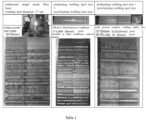
- Table 1 shows results of the embodiments and the prior art.
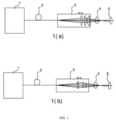
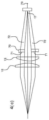
- FIG 1 is an overall structure diagram showing a laser apparatus according to the instant embodiment, wherein 1(a) is a side elevational view and 1(b) is a top view.
- Mixed light 4 produced as coming from a fiber laser 1 and transmitting through a single-core optical fiber 2 to pass through a barrel is applied to conduct welding on a welding object 5.
- the barrel is a mixing emergent barrel 3, which functions for beam shaping and converging of the emergent light coming from the single-core optical fiber, in order to realize a combined/hybrid welding of high power density spot and/or lower power density spot.
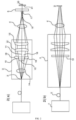
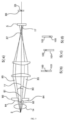
- FIG 2(a) is a side elevational view of the basic structure of the laser apparatus according to the first embodiment.
- the laser apparatus includes a convex cylindrical lens 10 added between the optical fiber 2 and a collimation lens 12.
- the cylindrical lens 10, the collimation lens 12, and a condensing lens 13 are sequentially arranged on the same optical axis 11 as the single-core optical fiber 2.
- laser light 16 that passes through a hollowed portion 15 of the convex cylindrical lens 10 is collimated by the collimation lens 12 and then condensed by the condensing lens 13, and a high-luminance focal point 20 that satisfies keyhole welding can be formed on a condensing point 17.
- an incident angle of the laser light 16 that transmits through a non-hollowed convex lens portion 18 of the convex cylindrical lens 10, after transmitting through the collimation lens 12, is slightly changed, by a plano-convex cylindrical lens, with respect to the condensing lens 13.
- the light beam After transmitting through the collimation lens 12, the light beam is converged at a site 19 that is slightly frontward of the light converging point 17, and then diffused again after the condensation. Due to be out of focusing, a lower power density spot 21, compared to the high power density of the condensing point 17, is formed on a working surface 5.
- the lower power density spot 21 functions for increasing temperature and preheating of a workpiece before keyhole welding, and allowing a cooling rate of the workpiece to slow down after welding, so as to provide an effect of preventing cracking generated after welding.
- Such an intensity distribution can be varied by having the cylindrical lens 10 moved frontward or rearward, so as to better the welding condition.
- FIG 2(b) is a top plan view of the basic structure diagram of the laser apparatus according to the first embodiment.
- the cylindrical lens 10 shows no variation of curvature, and for laser light that pass through the hollowed portion 15 or that transmitting through the non-hollowed portion 18, the incident angle of the laser light does not change, so that no condensing point is formed on the site 19 in this direction, all being converged on the same focal plane as the condensing point 17.
- the cylindrical lens is a mixed spot 21 of the high power density spot and the lower power density spot.
- FIG 2(c) is a side elevational view of a basic structure diagram of the laser apparatus according to the first embodiment that includes a concave cylindrical lens 30.
- the lens is convex or concave, and common arrangements are omitted.
- the laser light 32 that transmits through a curved portion 31 that is not a hollowed portion of the cylindrical lens 30, after transmitting through the collimation lens 12, is incident to the condensing lens 13 and an incident angle of the laser light 32 is slightly expanded, so that location of the focal point relative to the condensing point 17 changes.
- FIG. 17 A top plan view of the basic structure diagram of the laser apparatus of the first embodiment including the concave cylindrical lens 30 is the same as FIG 2(b) , and details will be omitted here.
- FIG 3(a) is a side elevational view of a basic structure diagram of a laser apparatus according to a second embodiment in which a convex cylindrical lens 40 is arranged between the collimation lens 12 and the condensing lens 13.
- the collimation lens 12, the convex cylindrical lens 40, and the condensing lens 13 are sequentially arranged on the same optical axis 11 as the single-core optical fiber 2.
- Laser light 14 emerging from the single-core optical fiber 2 is collimated by the collimation lens 12, and then laser light 42 that passes through a hollowed portion 41 of the cylindrical lens 40 is condensed by the condensing lens 13, so as to form a high-luminance focal point 20 that satisfies keyhole welding on a condensing point 17.
- laser light 44 that transmits through a non-hollowed portion 43 with a curved surface of the convex cylindrical lens 40 is incident to the condensing lens 13 and an incident angle of the laser light 44 is slightly changed, and thus converged at a site 19 that is slightly frontward of the converging point 17 and is then diffused again, and being out of focusing, a lower power density spot 45, compared to the high power density of the condensing point 17, is formed on a working surface 5.
- FIG 3(b) is a top plan view of the basic structure diagram of the laser apparatus according to the second embodiment.
- the convex cylindrical lens 40 shows no variation of curvature, and for laser light that passes through the hollowed portion 41 or that transmitting through the non-hollowed portion 43, the incident angle of the laser light does not change, so that no condensing point is formed on the site 19 in this direction, all being converged on the same focal plane as the condensing point 17.
- the cylindrical lens is a mixed spot 46 of the high power density spot and the lower power density spot.
- FIG 3(c) is a side elevational view of a basic structure diagram of the laser apparatus according to the second embodiment that includes a concave cylindrical lens 50.
- the lens is convex or concave, and common arrangements are omitted.
- the laser light 52 that transmits through a non- hollowed portion 51 with a curved surface of the concave cylindrical lens 50 is incident to the condensing lens 13 and an incident angle of the laser light 52 is slightly expanded, so that the location of the focal point relative to the condensing point 17 changes.
- FIG. 17 A top plan view of the basic structure diagram of the laser apparatus of the second embodiment including the concave cylindrical lens 50 is the same as FIG 3(b) , and details will be omitted here.
- FIG 4(a) is a side elevational view of a basic structure diagram of a laser apparatus according to a third embodiment in which a convex cylindrical lens 60 is arranged after the condensing lens 13.
- the collimation lens 12, the condensing lens 13, and the convex cylindrical lens 60 are sequentially arranged on the same optical axis 11 as the single-core optical fiber 2.
- Laser light 14 emerging from the single-core optical fiber 2 is collimated by the collimation lens 12 and then converged by the focusing lens 13.
- Laser light 62 of a portion of the converged light beam passes through a hollowed portion 61 of the convex cylindrical lens 60 so as to form a high-luminance focal point 20 that satisfies keyhole welding on a condensing point 17.
- an exit angle of laser light 64 that transmits through a non-hollowed portion 63 with a curved surface of the convex cylindrical lens 60 is slightly changed and the laser light 64 exiting from the non-hollowed portion 63 is thus converged at a site 19 that is slightly frontward of the converging point and then diffused again. Due to being out of focusing, a lower power density spot 65, compared to the high power density of the condensing point 17, is formed on a working surface 5.
- Such an intensity distribution can be varied by having the cylindrical lens 60 moved frontward or rearward, so as to better the welding condition.
- FIG 4(b) is a top plan view of the basic structure diagram of the laser apparatus according to the third embodiment.
- the convex cylindrical lens 60 shows no variation of curvature, and for laser light that passes through the hollowed portion 61 or that transmitting through the non-hollowed portion 63, the exit angle of the laser light does not change, so that no condensing point is formed on the site 19 in this direction, all being converged on the same focal plane as the condensing point 17.
- the cylindrical lens is a mixed spot 66 of the high power density spot and the lower power density spot.
- FIG 4(c) is a side elevational view of a basic structure diagram of the laser apparatus according to the third embodiment that includes a concave cylindrical lens 70.
- a difference from FIG 4(a) is that the lens 60 in FIG 4(a) is convex while the lens 70 in FIG 4(c) is concave, and common arrangements are omitted.
- an exit angle of the laser light 72 that transmits through a non-hollowed portion 71 with a curved surface of the concave cylindrical lens 70 is slightly changed so that the location of the focal point relative to the condensing point 17 changes.
- FIG. 7 A top plan view of the basic structure diagram of the laser apparatus of the third embodiment including the concave cylindrical lens 70 is the same as FIG 4(b) , and details will be omitted here.
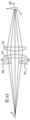
- FIG 5(a) is a side elevational view of a basic structure diagram of a laser apparatus in which the location of a cylindrical lens 80 is varied.
- an optical axis 81 of the cylindrical lens 80 deviates from the optical axis 11 of the single-core optical fiber 2, while the axis of collimation lens 12 and the condensing lens 13 are coincident with the optical axis 11 of the single-core optical fiber 2.
- laser light 83 of a portion thereof passes through a hollowed portion 82 of the cylindrical lens 80 and is collimated by the collimation lens 12 to be then focused by the focusing lens 13, so as to form a high-luminance focal point 20 that satisfies keyhole welding on a condensing point 17.
- an exit angle of laser light 85 that transmits through a non-hollowed portion 84 with a curved surface of the cylindrical lens 80 is slightly changed, and since the optical axis 81 of the cylindrical lens 80 deviates from the main optical axis 11, a condensing point location of the converging point 87 is not just moved frontwards or rearwards and is also deviating from the optical axis in an upward/downward direction. Due to being out of focusing, a lower power density spot 86, compared to the high power density of the condensing point 17, is formed on a working surface 5.
- the fourth embodiment provides a universal way that is applicable to the first, second, and third embodiments, and is also applicable to a flat-top cylindrical lens, a partial flat-top cylindrical lens, a multi-curvature cylindrical lens, and an aspheric cylindrical lens.
- a flat-top cylindrical lens By changing the upward/downward location of the cylindrical lens 80, shifting of a relative position between the high power density spot 20 and the lower power density spot 86 occurs and can greatly change the welding condition.
- FIG 5(b) is a diagram showing a mixed spot of a high power density spot and a lower power density spot in case that an optical axis of a cylindrical lens coincides a main optical axis, wherein the high power density spot 100 is located in a middle portion of the lower power density spot 101.
- 5(c) and 5(d) demonstrate, in case that the optical axis of the cylindrical lens deviates from the main optical axis, the location of the high power density spot 100 does not change, while the lower power density spot 101 is moved upwards/downwards.
- the cylindrical lens can be a convex or concave cylindrical lens, or can also be a flat-top or partly flat-top cylindrical lens, and can also be a multi-curvature or aspheric cylindrical lens.
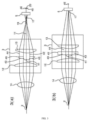
- FIG 6(a) is a side elevational view of a basic structure diagram of a laser apparatus according to a fifth embodiment in which a cylindrical lens 90 is arranged between the single-core optical fiber 2 and the collimation lens 12.
- FIG 6(b) is a top plan view of the cylindrical lens barrel diagram.
- the cylindrical lens 90, the collimation lens 12, and the condensing lens 13 are sequentially arranged on the same optical axis 11 as the single-core optical fiber 2.
- a portion 91 of laser light transmits through a curved surface portion of the cylindrical lens 90 and an angle of incident light is slightly changed, and after transmitting through the collimation lens 12, transmits, in a non-parallel form, through the focusing lens 13 to get focused, so as to get converged at a site 19 that is slightly frontwards of the converging point and then diffused again. Due to being out of focusing, a lower power density spot 92, compared to the high power density of the condensing point 17, is formed on a working surface 5.
- laser light 93 that do not transmit through the cylindrical lens 90 is collimated by the collimation lens 12 and then transmits through the focusing lens 13 to get focused, so as to form a high-luminance focal point 20 that satisfies keyhole welding on a condensing point 17.
- an amount of incident light thereof is adjusted, so as to adjust an intensity ratio between the high power density spot 20 and the lower power density spot 45.
- the cylindrical lens described in Embodiment 5 can be a convex or concave cylindrical lens, or can also be a flat-top or partly flat-top cylindrical lens, and can also be a multi-curvature or aspheric cylindrical lens.
- the cylindrical lens described in Embodiment 5 can be, similar to Embodiment 1, arranged between the optical fiber 2 and the collimation lens 12, or can be, similar to Embodiment 2, arranged between the collimation lens 12 and the condensing lens 13, or can be, similar to Embodiment 3, arranged behind the condensing lens 13.
- the cylindrical lens described in Embodiment 5 can realize an effect of adjusting a relative position between the high power density spot 20 and the lower power density spot 92 by adjusting positions of the optical axis of the cylindrical lens and the main optical axis, similar to Embodiment 4.
- the single-core optical fiber 2 can equally provide a mixed spot of a high power density spot and a lower power density spot in either a single mode or a multiple mode optical fiber.
- a collimation lens in front of a cylindrical lens, it is also possible to form a mixed spot of a high power density spot and a lower power density spot.
- Table 1 shows results of the instant embodiment and the prior art. As shown in Table 1, according to the present invention, it is possible to realize crack-free, high stability, high speed, and high quality laser welding, as compared to the known laser device.
Landscapes
- Physics & Mathematics (AREA)
- Optics & Photonics (AREA)
- Engineering & Computer Science (AREA)
- Plasma & Fusion (AREA)
- Mechanical Engineering (AREA)
- General Physics & Mathematics (AREA)
- Laser Beam Processing (AREA)
- Laser Surgery Devices (AREA)
- Semiconductor Lasers (AREA)
- Glass Compositions (AREA)
Claims (10)
- - Laserschweißvorrichtung, umfassend einen Einzeladerlichtleiter (2) und einen Tubus (3), der zur Strahlformung und zum Konvergieren von aus dem Einzeladerlichtleiter austretendem Licht konfiguriert ist, um kombiniertes Schweißen einer Stelle mit hoher Leistungsdichte (20, 100) und einer Stelle mit niedrigerer Leistungsdichte (21, 33, 45, 53, 92, 101) zu erzielen, wobei die Laserschweißvorrichtung dadurch gekennzeichnet, dass:in einem Inneren des Tubus eine zylindrische Linse (10, 30, 80, 90), eine Kollimationslinse (12), und eine Kondensorlinse (13) nacheinander auf derselben optischen Achse wie der Einzeladerlichtleiter angeordnet sind, wobei die zylindrische Linse im Inneren des Tubus und zwischen einem Ausgang des Lichtwellenleiters und der Kollimationslinse angeordnet ist, wobei die zylindrische Linse eine längere Brennweite als die Kondensorlinse aufweist, wobei ein vertiefter Abschnitt (15, 82) der zylindrischen Linse in einem Lichtstrahl angeordnet ist, der aus dem Lichtwellenleiter austritt; oder wobei in einem Inneren des Tubus eine Kollimationslinse (12), eine zylindrische Linse (40, 50, 80, 90), und eine Kondensorlinse (13) nacheinander auf derselben optischen Achse wie der Einzeladerlichtleiter angeordnet sind, wobei die zylindrische Linse im Inneren des Tubus und zwischen der Kollimationslinse und der Kondensorlinse angeordnet ist, wobei die zylindrische Linse eine längere Brennweite als die Kondensorlinse aufweist, wobei ein vertiefter Abschnitt (41, 82) der zylindrischen Linse in einem kollimierten Lichtstrahl angeordnet ist, der aus der Kollimationslinse austritt; oder wobei in einem Inneren des Tubus eine Kollimationslinse (12), eine Kondensorlinse (13), und eine zylindrische Linse (60, 70, 80, 90) nacheinander auf derselben optischen Achse wie der Einzeladerlichtleiter angeordnet sind, wobei die zylindrische Linse im Inneren des Tubus und hinter der Kondensorlinse angeordnet ist, wobei die zylindrische Linse eine längere Brennweite als die Kondensorlinse aufweist, wobei ein vertiefter Abschnitt (61, 82) der zylindrischen Linse in einem fokussierten Lichtstrahl angeordnet ist, der aus der Kondensorlinse austritt;derart, dass die Stelle mit hoher Leistungsdichte eine kreisförmige Stelle mit einem Durchmesser von 10-200 µm ist und die Stelle mit niedrigerer Leistungsdichte eine Form aufweist, die eines von einer Ellipse, einem Rechteck und einem Streifen ist, und derart, dass die Stelle mit niedrigerer Leistungsdichte eine Länge in einem Bereich von 100-10000 µm und eine Breite in einem Bereich von 10-200 µm aufweist;wobei die Laserschweißvorrichtung dazu konfiguriert ist, zylindrische Linsen (10) mit unterschiedlichen vertieften Abschnitten umzuschalten, um die Größe des vertieften Abschnitts der zylindrischen Linse (10) variieren zu lassen, sodass Intensitätswerte der Stelle mit hoher Leistungsdichte und der Stelle mit niedrigerer Leistungsdichte eingestellt werden können;wobei die Laserschweißvorrichtung ferner eine Einrichtung zum Bewegen der zylindrische Linse nach vorne oder nach hinten umfasst, sodass die Intensitätswerte der Stelle mit hoher Leistungsdichte und der Stelle mit niedrigerer Leistungsdichte geändert werden können.
- - Laservorrichtung nach Anspruch 1, dadurch gekennzeichnet, dass die zylindrische Linse eine von einer planokonvexen zylindrischen Linse, eine planokonkaven zylindrischen Linse, einer zylindrischen Linse mit flacher Oberseite, einer zylindrischen Linse mit nichtflacher Oberseite, einer doppelt konvexen zylindrischen Linse, einer doppelt konkaven zylindrischen Linse und einer asphärischen zylindrischen Linse ist.
- - Laservorrichtung nach Anspruch 2, dadurch gekennzeichnet, dass hinsichtlich der Kondensorlinse die zylindrische Linse an einem Kondensationspunkt der Kondensorlinse außer Fokus ist und eine streifenartige Stelle mit einer Länge von 100-10000 µm und einer Breite von 10-200 µm bereitstellt.
- - Laservorrichtung nach Anspruch 2, dadurch gekennzeichnet, dass in dem Laserlicht, das aus dem Einzeladerlichtwellenleiter austritt, ein Teil des Laserlichts, der durch den vertieften Abschnitt der zylindrischen Linse tritt, zunächst durch die Kollimationslinse kollimiert und dann durch die Kondensorlinse kondensiert wird, sodass er einen Punkt hoher Leuchtdichte erzeugt, der Stichlochschweißen an einem Kondensationspunkt der Kondensorlinse genügt.
- - Laservorrichtung nach Anspruch 1, dadurch gekennzeichnet, dass das Umschalten von zylindrischen Linsen (10) mit unterschiedlichen vertieften Abschnitten im Gebrauch eine Einstellung von Intensitätswerten der Stelle mit niedrigerer Leistungsdichte ermöglicht.
- - Laservorrichtung nach einem der Ansprüche 1 bis 5, dadurch gekennzeichnet, dass ein Einstellbereich des Intensitätswerts der Stelle mit hoher Leistungsdichte 20-100 % beträgt und ein Einstellbereich des Intensitätswerts der Stelle mit niedrigerer Leistungsdichte 0-80 % beträgt.
- - Laservorrichtung nach einem der Ansprüche 1 bis 6, dadurch gekennzeichnet, dass durch die Einrichtung zum Bewegen der zylindrischen Linse (1) eine relative Position der Stelle mit hoher Leistungsdichte und der Stelle mit niedrigerer Leistungsdichte geändert wird.
- - Laservorrichtung nach Anspruch 1, dadurch gekennzeichnet, dass die zylindrische Linse eine konvexe zylindrische Linse ist, die zwischen dem Lichtwellenleiter (2) und der Kollimationslinse (12) liegt, ein Fokuspunkt der Stelle mit hoher Leistungsdichte an einem Lichtkonvergenzpunkt (17) liegt und ein Fokuspunkt der Stelle mit niedrigerer Leistungsdichte vor dem Lichtkonvergenzpunkt (17) liegt.
- - Laservorrichtung nach Anspruch 8, dadurch gekennzeichnet, dass die zylindrische Linse in einer Richtung der Draufsicht keine Variation der Krümmung aufweist, derart, dass die Stelle mit hoher Leistungsdichte eine kreisförmige Stelle mit hoher Leistungsdichte ist und die Stelle mit niedrigerer Leistungsdichte eine längliche streifenartige Stelle mit niedrigerer Leistungsdichte ist.
- - Laservorrichtung nach Anspruch 1, dadurch gekennzeichnet, dass die zylindrische Linse eine konkave zylindrische Linse ist, die zwischen der Kollimationslinse (12) und der Kondensorlinse (13) angeordnet ist, ein Fokuspunkt der Stelle mit hoher Leistungsdichte an einem Lichtkonvergenzpunkt (17) liegt und ein Fokuspunkt der Stelle mit niedrigerer Leistungsdichte hinter dem Lichtkonvergenzpunkt (17) liegt.
Applications Claiming Priority (2)
| Application Number | Priority Date | Filing Date | Title |
|---|---|---|---|
| CN202010187307.2A CN113399825B (zh) | 2020-03-17 | 2020-03-17 | 一种激光装置 |
| PCT/CN2020/089531 WO2021184519A1 (zh) | 2020-03-17 | 2020-05-11 | 一种激光装置 |
Publications (4)
| Publication Number | Publication Date |
|---|---|
| EP4122636A1 EP4122636A1 (de) | 2023-01-25 |
| EP4122636A4 EP4122636A4 (de) | 2023-10-04 |
| EP4122636C0 EP4122636C0 (de) | 2025-01-29 |
| EP4122636B1 true EP4122636B1 (de) | 2025-01-29 |
Family
ID=77677497
Family Applications (1)
| Application Number | Title | Priority Date | Filing Date |
|---|---|---|---|
| EP20926072.8A Active EP4122636B1 (de) | 2020-03-17 | 2020-05-11 | Laserschweissvorrichtung |
Country Status (5)
| Country | Link |
|---|---|
| EP (1) | EP4122636B1 (de) |
| JP (1) | JP2023510398A (de) |
| KR (1) | KR102774780B1 (de) |
| CN (1) | CN113399825B (de) |
| WO (1) | WO2021184519A1 (de) |
Families Citing this family (4)
| Publication number | Priority date | Publication date | Assignee | Title |
|---|---|---|---|---|
| CN113828923B (zh) * | 2021-10-18 | 2022-07-15 | 光惠(上海)激光科技有限公司 | 一种焊接用的手持激光器 |
| JP2023107301A (ja) * | 2022-01-24 | 2023-08-03 | パナソニックIpマネジメント株式会社 | レーザ加工ヘッド |
| CN115121943B (zh) * | 2022-06-13 | 2025-11-21 | 中国人民解放军空军工程大学 | 斜入射激光冲击强化的光斑动态矫形装置、系统及方法 |
| CN116441716A (zh) * | 2023-04-20 | 2023-07-18 | 深圳市华瀚激光科技有限公司 | 一种条形光斑激光焊接头 |
Family Cites Families (22)
| Publication number | Priority date | Publication date | Assignee | Title |
|---|---|---|---|---|
| JPS61160846A (ja) * | 1985-01-09 | 1986-07-21 | Victor Co Of Japan Ltd | 縦横比の大きな断面形状の光点の形成装置 |
| KR970000381U (ko) * | 1995-06-14 | 1997-01-21 | 진공청소기의 흡입구체 | |
| JPH09108879A (ja) * | 1995-10-20 | 1997-04-28 | Hitachi Constr Mach Co Ltd | レーザ加工装置 |
| JPH09189881A (ja) * | 1996-01-11 | 1997-07-22 | Mitsubishi Heavy Ind Ltd | レーザ装置における光学系 |
| JP2000275568A (ja) * | 1999-03-25 | 2000-10-06 | Sumitomo Heavy Ind Ltd | ビームモード変換光学系 |
| JP2003340582A (ja) * | 2002-05-23 | 2003-12-02 | Mitsubishi Heavy Ind Ltd | レーザ溶接装置およびレーザ溶接方法 |
| US6870690B1 (en) * | 2003-09-09 | 2005-03-22 | Cbc-America | Dual-band lens |
| CN100412969C (zh) * | 2005-03-25 | 2008-08-20 | 鸿富锦精密工业(深圳)有限公司 | 光学系统及使用所述光学系统的光学记录/再现装置 |
| CN201000999Y (zh) * | 2006-07-13 | 2008-01-02 | 中国科学院西安光学精密机械研究所 | 激光输出双包层大模场光子晶体光纤激光器 |
| US8334478B2 (en) * | 2007-01-15 | 2012-12-18 | Japan Unix Co., Ltd. | Laser type soldering apparatus |
| JP2009072789A (ja) * | 2007-09-18 | 2009-04-09 | Hamamatsu Photonics Kk | レーザ加工装置 |
| JP2014073526A (ja) * | 2012-10-05 | 2014-04-24 | Mitsubishi Heavy Ind Ltd | 光学系及びレーザ加工装置 |
| CN203541861U (zh) * | 2013-10-19 | 2014-04-16 | 南京中科煜宸激光技术有限公司 | 一种激光电弧复合焊接同轴送丝加工装置 |
| CN103722290B (zh) * | 2014-01-15 | 2016-06-22 | 江苏亚威创科源激光装备有限公司 | 聚焦装置以及具有该聚焦装置的激光切割装置 |
| DE102015202347A1 (de) * | 2015-02-10 | 2016-08-11 | Trumpf Laser- Und Systemtechnik Gmbh | Bestrahlungseinrichtung, Bearbeitungsmaschine und Verfahren zum Herstellen einer Schicht eines dreidimensionalen Bauteils |
| JP6887502B2 (ja) * | 2016-12-08 | 2021-06-16 | コアレイズ オーワイ | レーザ加工装置および方法 |
| CN106624355A (zh) * | 2017-02-23 | 2017-05-10 | 常州特尔玛枪嘴有限公司 | 一种可调节光斑能量密度分布的激光切割头 |
| HUE067775T2 (hu) * | 2017-03-03 | 2024-11-28 | Furukawa Electric Co Ltd | Hegesztõ eljárás és hegesztõ készülék |
| DE102017208979A1 (de) * | 2017-05-29 | 2018-11-29 | Trumpf Laser- Und Systemtechnik Gmbh | Verfahren zum Tiefschweißen eines Werkstücks, mit Verteilung der Laserleistung auf mehrere Foki |
| CN206952364U (zh) * | 2017-07-03 | 2018-02-02 | 大族激光科技产业集团股份有限公司 | 点环形光斑焊接装置 |
| JP2020009851A (ja) | 2018-07-05 | 2020-01-16 | パナソニックIpマネジメント株式会社 | レーザ発振装置およびその制御方法 |
| CN110398842B (zh) * | 2019-07-12 | 2024-04-16 | 南京波长光电科技股份有限公司 | 一种激光线性光斑整形光学系统 |
-
2020
- 2020-03-17 CN CN202010187307.2A patent/CN113399825B/zh active Active
- 2020-05-11 JP JP2022543388A patent/JP2023510398A/ja active Pending
- 2020-05-11 WO PCT/CN2020/089531 patent/WO2021184519A1/zh not_active Ceased
- 2020-05-11 EP EP20926072.8A patent/EP4122636B1/de active Active
- 2020-05-11 KR KR1020227028465A patent/KR102774780B1/ko active Active
Also Published As
| Publication number | Publication date |
|---|---|
| KR102774780B1 (ko) | 2025-02-27 |
| EP4122636C0 (de) | 2025-01-29 |
| WO2021184519A1 (zh) | 2021-09-23 |
| CN113399825A (zh) | 2021-09-17 |
| KR20220121900A (ko) | 2022-09-01 |
| EP4122636A1 (de) | 2023-01-25 |
| EP4122636A4 (de) | 2023-10-04 |
| CN113399825B (zh) | 2022-05-20 |
| JP2023510398A (ja) | 2023-03-13 |
Similar Documents
| Publication | Publication Date | Title |
|---|---|---|
| EP4122636B1 (de) | Laserschweissvorrichtung | |
| EP2716397B1 (de) | Optisches system für eine laserbearbeitungsvorrichtung, laserbearbeitungskopf mit einem solchen system, laserbearbeitungsvorrichtung mit einem solchen kopf, laserbearbeitungsverfahren, und laserfokussierungsverfahren unter verwendung eines solchen verfahren | |
| JP5033693B2 (ja) | ファイバレーザ加工機における集光直径の変換制御方法及びその装置 | |
| JP5267755B1 (ja) | レーザ加工装置及びレーザ加工方法 | |
| US9442272B2 (en) | F-theta objective | |
| US10744597B1 (en) | Multi-focus optics | |
| US5633967A (en) | Waveguide fiber optical coupler | |
| CN100549761C (zh) | 激光光束整形光学镜头 | |
| CN112630984A (zh) | 可改变激光焦点位置光斑大小及形貌的激光扫描装置与扫描方法 | |
| JP2011522769A (ja) | 非平坦材料の罫書き | |
| KR20180125564A (ko) | 레이저 방사 수단에 의해 재료를 가공하는 결상 광학계 및 이 결상 광학계를 갖는 레이저 가공 헤드 | |
| CN111736355A (zh) | 一种基于微透镜组可调能量分布光学系统 | |
| CN118234592A (zh) | 借助在具有不同待焊接材料的焊接区之间的快速切换对工件进行激光焊接的方法 | |
| CN114160965B (zh) | 激光成丝切割装置 | |
| JP2019018233A (ja) | レーザ加工機 | |
| JP2017173371A (ja) | 光ファイバを用いたレーザ加工機用レーザ光伝送装置 | |
| WO2021145358A1 (ja) | レーザ加工装置 | |
| CN216966624U (zh) | 激光成丝切割装置 | |
| JP7186071B2 (ja) | レーザ発振器及びレーザ加工機 | |
| CN215219329U (zh) | 一种多组平行束的激光熔覆光源的整型装置 | |
| JP7592486B2 (ja) | レーザ加工装置の光学系、レーザ加工装置 | |
| JP2003154477A (ja) | レーザ切断方法および装置 | |
| JP2002023100A (ja) | 分割光学素子、光学系及びレーザ加工装置 | |
| JP2001009580A (ja) | レーザ光集光装置 | |
| CN113204123A (zh) | 一种多组平行束的激光熔覆光源的整型装置 |
Legal Events
| Date | Code | Title | Description |
|---|---|---|---|
| STAA | Information on the status of an ep patent application or granted ep patent |
Free format text: STATUS: THE INTERNATIONAL PUBLICATION HAS BEEN MADE |
|
| PUAI | Public reference made under article 153(3) epc to a published international application that has entered the european phase |
Free format text: ORIGINAL CODE: 0009012 |
|
| STAA | Information on the status of an ep patent application or granted ep patent |
Free format text: STATUS: REQUEST FOR EXAMINATION WAS MADE |
|
| 17P | Request for examination filed |
Effective date: 20220908 |
|
| AK | Designated contracting states |
Kind code of ref document: A1 Designated state(s): AL AT BE BG CH CY CZ DE DK EE ES FI FR GB GR HR HU IE IS IT LI LT LU LV MC MK MT NL NO PL PT RO RS SE SI SK SM TR |
|
| DAV | Request for validation of the european patent (deleted) | ||
| DAX | Request for extension of the european patent (deleted) | ||
| REG | Reference to a national code |
Ref country code: DE Ref country code: DE Ref legal event code: R079 Ref document number: 602020045684 Country of ref document: DE Free format text: PREVIOUS MAIN CLASS: B23K0026200000 Ipc: B23K0026210000 |
|
| A4 | Supplementary search report drawn up and despatched |
Effective date: 20230906 |
|
| RIC1 | Information provided on ipc code assigned before grant |
Ipc: H01S 3/00 20060101ALI20230831BHEP Ipc: G02B 13/12 20060101ALI20230831BHEP Ipc: G02B 7/10 20210101ALI20230831BHEP Ipc: G02B 3/06 20060101ALI20230831BHEP Ipc: B23K 26/073 20060101ALI20230831BHEP Ipc: B23K 26/064 20140101ALI20230831BHEP Ipc: B23K 26/06 20140101ALI20230831BHEP Ipc: G02B 3/00 20060101ALI20230831BHEP Ipc: B23K 26/21 20140101AFI20230831BHEP |
|
| GRAP | Despatch of communication of intention to grant a patent |
Free format text: ORIGINAL CODE: EPIDOSNIGR1 |
|
| STAA | Information on the status of an ep patent application or granted ep patent |
Free format text: STATUS: GRANT OF PATENT IS INTENDED |
|
| INTG | Intention to grant announced |
Effective date: 20240828 |
|
| GRAS | Grant fee paid |
Free format text: ORIGINAL CODE: EPIDOSNIGR3 |
|
| GRAA | (expected) grant |
Free format text: ORIGINAL CODE: 0009210 |
|
| STAA | Information on the status of an ep patent application or granted ep patent |
Free format text: STATUS: THE PATENT HAS BEEN GRANTED |
|
| AK | Designated contracting states |
Kind code of ref document: B1 Designated state(s): AL AT BE BG CH CY CZ DE DK EE ES FI FR GB GR HR HU IE IS IT LI LT LU LV MC MK MT NL NO PL PT RO RS SE SI SK SM TR |
|
| REG | Reference to a national code |
Ref country code: GB Ref legal event code: FG4D |
|
| REG | Reference to a national code |
Ref country code: CH Ref legal event code: EP |
|
| REG | Reference to a national code |
Ref country code: DE Ref legal event code: R096 Ref document number: 602020045684 Country of ref document: DE |
|
| REG | Reference to a national code |
Ref country code: IE Ref legal event code: FG4D |
|
| U01 | Request for unitary effect filed |
Effective date: 20250224 |
|
| U07 | Unitary effect registered |
Designated state(s): AT BE BG DE DK EE FI FR IT LT LU LV MT NL PT RO SE SI Effective date: 20250303 |
|
| U20 | Renewal fee for the european patent with unitary effect paid |
Year of fee payment: 6 Effective date: 20250528 |
|
| PG25 | Lapsed in a contracting state [announced via postgrant information from national office to epo] |
Ref country code: RS Free format text: LAPSE BECAUSE OF FAILURE TO SUBMIT A TRANSLATION OF THE DESCRIPTION OR TO PAY THE FEE WITHIN THE PRESCRIBED TIME-LIMIT Effective date: 20250429 |
|
| PG25 | Lapsed in a contracting state [announced via postgrant information from national office to epo] |
Ref country code: PL Free format text: LAPSE BECAUSE OF FAILURE TO SUBMIT A TRANSLATION OF THE DESCRIPTION OR TO PAY THE FEE WITHIN THE PRESCRIBED TIME-LIMIT Effective date: 20250129 |
|
| PG25 | Lapsed in a contracting state [announced via postgrant information from national office to epo] |
Ref country code: ES Free format text: LAPSE BECAUSE OF FAILURE TO SUBMIT A TRANSLATION OF THE DESCRIPTION OR TO PAY THE FEE WITHIN THE PRESCRIBED TIME-LIMIT Effective date: 20250129 |
|
| PG25 | Lapsed in a contracting state [announced via postgrant information from national office to epo] |
Ref country code: NO Free format text: LAPSE BECAUSE OF FAILURE TO SUBMIT A TRANSLATION OF THE DESCRIPTION OR TO PAY THE FEE WITHIN THE PRESCRIBED TIME-LIMIT Effective date: 20250429 Ref country code: IS Free format text: LAPSE BECAUSE OF FAILURE TO SUBMIT A TRANSLATION OF THE DESCRIPTION OR TO PAY THE FEE WITHIN THE PRESCRIBED TIME-LIMIT Effective date: 20250529 |
|
| PG25 | Lapsed in a contracting state [announced via postgrant information from national office to epo] |
Ref country code: HR Free format text: LAPSE BECAUSE OF FAILURE TO SUBMIT A TRANSLATION OF THE DESCRIPTION OR TO PAY THE FEE WITHIN THE PRESCRIBED TIME-LIMIT Effective date: 20250129 |
|
| PG25 | Lapsed in a contracting state [announced via postgrant information from national office to epo] |
Ref country code: GR Free format text: LAPSE BECAUSE OF FAILURE TO SUBMIT A TRANSLATION OF THE DESCRIPTION OR TO PAY THE FEE WITHIN THE PRESCRIBED TIME-LIMIT Effective date: 20250430 |
|
| PG25 | Lapsed in a contracting state [announced via postgrant information from national office to epo] |
Ref country code: SM Free format text: LAPSE BECAUSE OF FAILURE TO SUBMIT A TRANSLATION OF THE DESCRIPTION OR TO PAY THE FEE WITHIN THE PRESCRIBED TIME-LIMIT Effective date: 20250129 |
|
| PG25 | Lapsed in a contracting state [announced via postgrant information from national office to epo] |
Ref country code: CZ Free format text: LAPSE BECAUSE OF FAILURE TO SUBMIT A TRANSLATION OF THE DESCRIPTION OR TO PAY THE FEE WITHIN THE PRESCRIBED TIME-LIMIT Effective date: 20250129 |
|
| PG25 | Lapsed in a contracting state [announced via postgrant information from national office to epo] |
Ref country code: SK Free format text: LAPSE BECAUSE OF FAILURE TO SUBMIT A TRANSLATION OF THE DESCRIPTION OR TO PAY THE FEE WITHIN THE PRESCRIBED TIME-LIMIT Effective date: 20250129 |
|
| PLBE | No opposition filed within time limit |
Free format text: ORIGINAL CODE: 0009261 |
|
| STAA | Information on the status of an ep patent application or granted ep patent |
Free format text: STATUS: NO OPPOSITION FILED WITHIN TIME LIMIT |
|
| REG | Reference to a national code |
Ref country code: CH Ref legal event code: L10 Free format text: ST27 STATUS EVENT CODE: U-0-0-L10-L00 (AS PROVIDED BY THE NATIONAL OFFICE) Effective date: 20251210 |
|
| REG | Reference to a national code |
Ref country code: CH Ref legal event code: H13 Free format text: ST27 STATUS EVENT CODE: U-0-0-H10-H13 (AS PROVIDED BY THE NATIONAL OFFICE) Effective date: 20251223 |
|
| 26N | No opposition filed |
Effective date: 20251030 |
|
| PG25 | Lapsed in a contracting state [announced via postgrant information from national office to epo] |
Ref country code: CH Free format text: LAPSE BECAUSE OF NON-PAYMENT OF DUE FEES Effective date: 20250531 |
|
| GBPC | Gb: european patent ceased through non-payment of renewal fee |
Effective date: 20250511 |
|
| PG25 | Lapsed in a contracting state [announced via postgrant information from national office to epo] |
Ref country code: MC Free format text: LAPSE BECAUSE OF FAILURE TO SUBMIT A TRANSLATION OF THE DESCRIPTION OR TO PAY THE FEE WITHIN THE PRESCRIBED TIME-LIMIT Effective date: 20250129 |