EP4094918B1 - Spritzgegossener gegenstand und schuh - Google Patents
Spritzgegossener gegenstand und schuh Download PDFInfo
- Publication number
- EP4094918B1 EP4094918B1 EP21923175.0A EP21923175A EP4094918B1 EP 4094918 B1 EP4094918 B1 EP 4094918B1 EP 21923175 A EP21923175 A EP 21923175A EP 4094918 B1 EP4094918 B1 EP 4094918B1
- Authority
- EP
- European Patent Office
- Prior art keywords
- styrene
- based thermoplastic
- mass
- thermoplastic elastomer
- elastomer
- Prior art date
- Legal status (The legal status is an assumption and is not a legal conclusion. Google has not performed a legal analysis and makes no representation as to the accuracy of the status listed.)
- Active
Links
Images



Classifications
-
- C—CHEMISTRY; METALLURGY
- C08—ORGANIC MACROMOLECULAR COMPOUNDS; THEIR PREPARATION OR CHEMICAL WORKING-UP; COMPOSITIONS BASED THEREON
- C08L—COMPOSITIONS OF MACROMOLECULAR COMPOUNDS
- C08L53/00—Compositions of block copolymers containing at least one sequence of a polymer obtained by reactions only involving carbon-to-carbon unsaturated bonds; Compositions of derivatives of such polymers
- C08L53/02—Compositions of block copolymers containing at least one sequence of a polymer obtained by reactions only involving carbon-to-carbon unsaturated bonds; Compositions of derivatives of such polymers of vinyl-aromatic monomers and conjugated dienes
-
- B—PERFORMING OPERATIONS; TRANSPORTING
- B29—WORKING OF PLASTICS; WORKING OF SUBSTANCES IN A PLASTIC STATE IN GENERAL
- B29D—PRODUCING PARTICULAR ARTICLES FROM PLASTICS OR FROM SUBSTANCES IN A PLASTIC STATE
- B29D35/00—Producing footwear
- B29D35/0009—Producing footwear by injection moulding; Apparatus therefor
-
- A—HUMAN NECESSITIES
- A43—FOOTWEAR
- A43B—CHARACTERISTIC FEATURES OF FOOTWEAR; PARTS OF FOOTWEAR
- A43B13/00—Soles; Sole-and-heel integral units
- A43B13/02—Soles; Sole-and-heel integral units characterised by the material
- A43B13/04—Plastics, rubber or vulcanised fibre
-
- A—HUMAN NECESSITIES
- A43—FOOTWEAR
- A43B—CHARACTERISTIC FEATURES OF FOOTWEAR; PARTS OF FOOTWEAR
- A43B13/00—Soles; Sole-and-heel integral units
- A43B13/02—Soles; Sole-and-heel integral units characterised by the material
- A43B13/12—Soles with several layers of different materials
-
- A—HUMAN NECESSITIES
- A43—FOOTWEAR
- A43B—CHARACTERISTIC FEATURES OF FOOTWEAR; PARTS OF FOOTWEAR
- A43B7/00—Footwear with health or hygienic arrangements
- A43B7/14—Footwear with health or hygienic arrangements with foot-supporting parts
- A43B7/1405—Footwear with health or hygienic arrangements with foot-supporting parts with pads or holes on one or more locations, or having an anatomical or curved form
- A43B7/1415—Footwear with health or hygienic arrangements with foot-supporting parts with pads or holes on one or more locations, or having an anatomical or curved form characterised by the location under the foot
- A43B7/142—Footwear with health or hygienic arrangements with foot-supporting parts with pads or holes on one or more locations, or having an anatomical or curved form characterised by the location under the foot situated under the medial arch, i.e. under the navicular or cuneiform bones
-
- A—HUMAN NECESSITIES
- A43—FOOTWEAR
- A43B—CHARACTERISTIC FEATURES OF FOOTWEAR; PARTS OF FOOTWEAR
- A43B7/00—Footwear with health or hygienic arrangements
- A43B7/14—Footwear with health or hygienic arrangements with foot-supporting parts
- A43B7/1405—Footwear with health or hygienic arrangements with foot-supporting parts with pads or holes on one or more locations, or having an anatomical or curved form
- A43B7/1415—Footwear with health or hygienic arrangements with foot-supporting parts with pads or holes on one or more locations, or having an anatomical or curved form characterised by the location under the foot
- A43B7/144—Footwear with health or hygienic arrangements with foot-supporting parts with pads or holes on one or more locations, or having an anatomical or curved form characterised by the location under the foot situated under the heel, i.e. the calcaneus bone
-
- A—HUMAN NECESSITIES
- A43—FOOTWEAR
- A43B—CHARACTERISTIC FEATURES OF FOOTWEAR; PARTS OF FOOTWEAR
- A43B7/00—Footwear with health or hygienic arrangements
- A43B7/14—Footwear with health or hygienic arrangements with foot-supporting parts
- A43B7/24—Insertions or other supports preventing the foot canting to one side , preventing supination or pronation
-
- B—PERFORMING OPERATIONS; TRANSPORTING
- B29—WORKING OF PLASTICS; WORKING OF SUBSTANCES IN A PLASTIC STATE IN GENERAL
- B29C—SHAPING OR JOINING OF PLASTICS; SHAPING OF MATERIAL IN A PLASTIC STATE, NOT OTHERWISE PROVIDED FOR; AFTER-TREATMENT OF THE SHAPED PRODUCTS, e.g. REPAIRING
- B29C45/00—Injection moulding, i.e. forcing the required volume of moulding material through a nozzle into a closed mould; Apparatus therefor
- B29C45/0001—Injection moulding, i.e. forcing the required volume of moulding material through a nozzle into a closed mould; Apparatus therefor characterised by the choice of material
-
- B—PERFORMING OPERATIONS; TRANSPORTING
- B29—WORKING OF PLASTICS; WORKING OF SUBSTANCES IN A PLASTIC STATE IN GENERAL
- B29D—PRODUCING PARTICULAR ARTICLES FROM PLASTICS OR FROM SUBSTANCES IN A PLASTIC STATE
- B29D35/00—Producing footwear
- B29D35/12—Producing parts thereof, e.g. soles, heels, uppers, by a moulding technique
- B29D35/122—Soles
-
- C—CHEMISTRY; METALLURGY
- C08—ORGANIC MACROMOLECULAR COMPOUNDS; THEIR PREPARATION OR CHEMICAL WORKING-UP; COMPOSITIONS BASED THEREON
- C08L—COMPOSITIONS OF MACROMOLECULAR COMPOUNDS
- C08L53/00—Compositions of block copolymers containing at least one sequence of a polymer obtained by reactions only involving carbon-to-carbon unsaturated bonds; Compositions of derivatives of such polymers
- C08L53/02—Compositions of block copolymers containing at least one sequence of a polymer obtained by reactions only involving carbon-to-carbon unsaturated bonds; Compositions of derivatives of such polymers of vinyl-aromatic monomers and conjugated dienes
- C08L53/025—Compositions of block copolymers containing at least one sequence of a polymer obtained by reactions only involving carbon-to-carbon unsaturated bonds; Compositions of derivatives of such polymers of vinyl-aromatic monomers and conjugated dienes modified
-
- B—PERFORMING OPERATIONS; TRANSPORTING
- B29—WORKING OF PLASTICS; WORKING OF SUBSTANCES IN A PLASTIC STATE IN GENERAL
- B29K—INDEXING SCHEME ASSOCIATED WITH SUBCLASSES B29B, B29C OR B29D, RELATING TO MOULDING MATERIALS OR TO MATERIALS FOR MOULDS, REINFORCEMENTS, FILLERS OR PREFORMED PARTS, e.g. INSERTS
- B29K2995/00—Properties of moulding materials, reinforcements, fillers, preformed parts or moulds
- B29K2995/0018—Properties of moulding materials, reinforcements, fillers, preformed parts or moulds having particular optical properties, e.g. fluorescent or phosphorescent
- B29K2995/0026—Transparent
-
- B—PERFORMING OPERATIONS; TRANSPORTING
- B29—WORKING OF PLASTICS; WORKING OF SUBSTANCES IN A PLASTIC STATE IN GENERAL
- B29L—INDEXING SCHEME ASSOCIATED WITH SUBCLASS B29C, RELATING TO PARTICULAR ARTICLES
- B29L2031/00—Other particular articles
- B29L2031/48—Wearing apparel
- B29L2031/50—Footwear, e.g. shoes or parts thereof
-
- C—CHEMISTRY; METALLURGY
- C08—ORGANIC MACROMOLECULAR COMPOUNDS; THEIR PREPARATION OR CHEMICAL WORKING-UP; COMPOSITIONS BASED THEREON
- C08L—COMPOSITIONS OF MACROMOLECULAR COMPOUNDS
- C08L2205/00—Polymer mixtures characterised by other features
- C08L2205/02—Polymer mixtures characterised by other features containing two or more polymers of the same C08L -group
-
- C—CHEMISTRY; METALLURGY
- C08—ORGANIC MACROMOLECULAR COMPOUNDS; THEIR PREPARATION OR CHEMICAL WORKING-UP; COMPOSITIONS BASED THEREON
- C08L—COMPOSITIONS OF MACROMOLECULAR COMPOUNDS
- C08L2205/00—Polymer mixtures characterised by other features
- C08L2205/02—Polymer mixtures characterised by other features containing two or more polymers of the same C08L -group
- C08L2205/025—Polymer mixtures characterised by other features containing two or more polymers of the same C08L -group containing two or more polymers of the same hierarchy C08L, and differing only in parameters such as density, comonomer content, molecular weight, structure
-
- C—CHEMISTRY; METALLURGY
- C08—ORGANIC MACROMOLECULAR COMPOUNDS; THEIR PREPARATION OR CHEMICAL WORKING-UP; COMPOSITIONS BASED THEREON
- C08L—COMPOSITIONS OF MACROMOLECULAR COMPOUNDS
- C08L2205/00—Polymer mixtures characterised by other features
- C08L2205/03—Polymer mixtures characterised by other features containing three or more polymers in a blend
Definitions
- the present invention relates to an injection molded article and a shoe.
- Sports products used for various sports competitions each are composed of various parts.
- a shoe is generally composed of, in addition to main parts such as a sole and an upper, a reinforcement part composed of a hard resin composition, a cushioning part composed of a soft elastomer composition, or the like.
- a composition including a plasticizer in addition to an elastomer is known.
- the plasticity of the elastomer composition of this type is adjusted by adjusting the content of the plasticizer.
- Patent Literature 1 discloses that a cushioning part used for a shoe is composed of the elastomer composition. More specifically, Patent Literature 1 below discloses that the cushioning part having excellent transparency and abrasion resistance is formed of the elastomer composition including a styrene-based thermoplastic elastomer.
- Patent Literature 2 discloses a thermoplastic elastomer composition, as materials for the cover 4 for a mouth part stopper body 3 of the liquid medicine container, 1 to 100 parts by mass of polypropylene, 50 to 200 pts.mass of high-density polyethylene, 0.5 to 20 pts.mass of silicone resin are added to mixture 100 parts by mass of one or more kinds of 20 to 80 pts.mass of styrene thermoplastic elastomer selected from among groups comprising a styrene-ethylene-butylene-styrene block copolymer, a styrene-ethylene-propylene-styrene block copolymer, and a styrene-ethylene-ethylene-propylene-styrene block copolymer, and 80 to 20 pts.mass of softening agent.
- Patent Literature 3 discloses an elastomer composition which comprises 100 parts by mass of a hydrogenated compound I of a block copolymer represented by A(-B-A)n (wherein A represents a polymer block consisting mainly of a vinyl aromatic compound and B represents a polymer block consisting mainly of a conjugated diene compound), 5-50 parts by mass of a hydrogenated compound II of a block copolymer represented by A-B-C that comprises the polymer block A and B, and a polymer block C consisting mainly of the conjugated diene compound and/or a hydrogenated compound III of a block copolymer represented by C-B-C that comprises the polymer block C and B, 30-300 parts by mass of a softening agent, 1-200 parts by mass of a polyolefin resin, 0.1-50 parts by mass of polyoctenamer and 0.1-10 parts by mass of an organic peroxide.
- Patent Literature 4 discloses components for articles of footwear and athletic equipment including a foam.
- a variety of foams and foam components and compositions for forming the foams are provided.
- the foams and components having high energy return and improved durability and softness.
- midsoles including the foams are provided for use in an article of footwear.
- Methods of making the compositions and foams are provided, as well as methods of making an article of footwear including one of the foam components.
- the foams and foam components can be made by injection molding or injection molding followed by compression molding.
- parts formed of the elastomer composition used for shoe parts or the like may be produced by injection molding.
- the injection molding products are produced by injecting the elastomer composition in a heated and molten state into a cavity of a forming mold, the cavity having a shape corresponding to the shape of the product, followed by allowing the elastomer composition filled in the cavity to cool and set.
- the injection molded article thus obtained can be used to prepare products even having a complex shape only by being subjected to a simple secondary processing such as deburring. Since shoe parts generally have complex shapes, such an injection molding method is suitable as a method for producing the shoe parts.
- the object of the present invention is to provide an injection molded article composed of an elastomer composition having a good fluidity in the injection molding, and also an injection molded article that can precisely reflect the state of a molding surface of a forming mold. Further, the object of the present invention is to provide a shoe including a shoe part that can be easily produced.
- the present invention provides an injection molded article composed of an elastomer composition including a plurality of styrene-based thermoplastic elastomers and a plasticizer, in which the plurality of styrene-based thermoplastic elastomers includes a first styrene-based thermoplastic elastomer and a second styrene-based thermoplastic elastomer, the first styrene-based thermoplastic elastomer has a mass average molecular weight of 300,000 or more, the first styrene-based thermoplastic elastomer is a block polymer that includes a soft segment and two hard segments with the soft segment aligned between the two hard segments, and the second styrene-based thermoplastic elastomer is a block polymer that includes a polyethylene block exhibiting crystallinity.
- the present invention provides a shoe composed of a plurality of shoe parts, wherein at least one of the plurality of shoe parts is the injection molded article as aforementioned.
- An injection molded article of the present invention can be preferably used as a part of a sports product.
- the present invention will be described by way of embodiments by taking, for example, the case where the injection molded article is used as a shoe part. Further, hereinafter, the description will be given for an embodiment by taking, for example, the case where the shoe part is arranged in a midsole of a shoe.
- the injection molded article does not have a desired appearance because, when the injection molded article is produced using the elastomer composition, the surface of the injection molded article sometimes does not sufficiently reflect the state of the molding surface of the forming mold on the surface of the injection molded article.
- the fluidity of the elastomer composition is not good, it is difficult to obtain the injection molded article precisely reflecting the shape of the molding surface.
- the conventional shoe including the injection molded article as a shoe part as described above to be fabricated with a part excellent in appearance. The same problem can be caused not only in the case where the injection molded article is used as a shoe part, but in other applications.
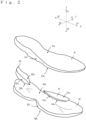
- Fig. 1 shows a shoe formed using a shoe part of this embodiment.
- a direction along a shoe center axis CX connecting a heel center HC and a toe center TC may be referred to as a length direction X.
- a direction X1 directed from the heel to the toe may be referred to as, for example, a forward direction
- a direction X2 directed from the toe to the heel may be referred to as, for example, a rearward direction.
- a direction parallel to a horizontal plane HP may be referred to as a width direction Y.
- a direction Y1 directed to the first toe side may be referred to as, for example, a medial side direction
- a direction Y2 directed to the fifth toe side may be referred to as, for example, a lateral side direction
- a vertical direction Z orthogonal to the horizontal plane HP may be referred to as a thickness direction or a height direction.
- a direction Z1 directed upward in this vertical direction Z may be referred to as an upward direction
- a direction Z2 directed downward may be referred to as a downward direction.
- the shoe 1 of this embodiment includes an upper 2 and a shoe sole.
- the shoe sole is composed of a plurality of shoe parts.
- the shoe 1 includes a midsole 3 and an outsole 4.
- the shoe 1 of this embodiment includes the outsole 4 in its bottommost position.
- the outsole 4 of this embodiment has, for example, a sheet shape, and is arranged in the bottommost position of the shoe 1 so that the thickness direction thereof corresponds to the vertical direction Z.
- the shoe 1 includes the midsole 3 between the outsole 4 and the upper 2 that covers a foot of a wearer from the upper side.
- the midsole 3 of this embodiment is, for example, separated into two upper and lower layers.
- the shoe 1 of this embodiment includes a first midsole 31 that constitutes the upper layer of the two layers, and a second midsole 32 that constitutes the lower layer of the two layers.
- the outline shape of the first midsole 31 as viewed in the vertical direction corresponds to the outline shape of the second midsole 32, and they are vertically layered to have outer peripheral edges conforming to each other.
- the first midsole 31 has an upper surface 31a that is in contact with the upper 2 from below, and a lower surface 31b that is in contact with an upper surface of the second midsole 32.
- the second midsole 32 has a lower surface 32b that is in contact with the outsole 4 from above.
- the shoe 1 of this embodiment includes, as shoe parts, two cushioning parts 5 sandwiched between the first midsole 31 and the second midsole 32.
- Each of the two cushioning parts 5 of this embodiment is an injection molded article, and as described later, is composed of an elastomer composition including a plurality of styrene-based thermoplastic elastomers and a plasticizer.
- each of the cushioning parts 5 as viewed in the vertical direction is smaller than the first midsole 31 and the second midsole 32. Accordingly, certain parts of the lower surface 31b of the first midsole 31 adhere to the cushioning parts 5 and the remaining part of the lower surface 31 adheres to the upper surface 32a of the second midsole 32.
- first cushioning part 51 One of the two cushioning parts 5 (hereinafter also referred to as “first cushioning part 51") is sandwiched between the first midsole 31 and the second midsole 32 in a forefoot portion 11 of the shoe.
- second cushioning part 52 The other one of the two cushioning parts 5 (hereinafter also referred to as “second cushioning part 52”) is sandwiched between the first midsole 31 and the second midsole 32 in a rear foot portion 13 of the shoe. In a midfoot portion 12 of the shoe 1, the cushioning part 5 is not sandwiched between the first midsole 31 and the second midsole 32.
- the first cushioning part 51 and the second cushioning part 52 is arranged on the shoe sole to be partly exposed to the outside, and arranged to constitute a part of an outer peripheral surface of the shoe sole.
- the first cushioning part 51 has a side surface 51c constituting a part of the outer peripheral surface, an upper surface 51a spreading inward (in the direction Y1) from an upper edge of the side surface 51c, and a lower surface 51b spreading inward (in the direction Y1) from a lower edge of the side surface 51c. That is, the first cushioning part 51 has the upper surface 51a that is in contact with the lower surface 31b of the first midsole 31 from below, and the lower surface 51b that is in contact with the upper surface 32a of the second midsole 32 from above.
- the second cushioning part 52 has a side surface 52c constituting the outer peripheral surface, an upper surface 52a spreading inward (in the direction Y1) from an upper edge of the side surface 52c, and a lower surface 52b spreading inward (in the direction Y1) from a lower edge of the side surface 52c. That is, the second cushioning part 52 has the upper surface 52a that is in contact with the lower surface 31b of the first midsole 31 from below, and the lower surface 52b that is in contact with the upper surface 32a of the second midsole 32 from above.
- each of the first cushioning part 51and the second cushioning part 52 has such a shape as to increase the thickness as it advances in the direction Y2 from the medial side to the lateral side.
- each of the first cushioning part 51 and the second cushioning part 52 has such a shape as to increase the thickness as it advances from the center of the shoe sole toward the outer peripheral surface, while decreasing the thickness as it advances from a lateral side surface 1a of the shoe 1 toward the center of the shoe 1.
- Each of the first cushioning part 51 and the second cushioning part 52 of this embodiment is configured not to cross the shoe 1 in the width direction and not to be observed from a medial side surface 1b of the shoe 1.
- the first cushioning part 51 and the second cushioning part 52 of this embodiment are formed of an elastomer composition having excellent transparency.
- the same elastomer composition is used for the cushioning part 51 and the second cushioning part 52 in this embodiment, although there is no need that the elastomer composition for constituting the first cushioning part 51 must be the same as the elastomer composition for constituting the second cushioning part 52.
- Each of the first cushioning part 51 and the second cushioning part 52 of this embodiment has a smooth surface and thus hardly causes irregular reflection of light on the surface.
- Each of the first cushioning part 51 and the second cushioning part 52 is an injection molded article produced by using a forming mold having a smooth molding surface without being subjected to hairline treatment or mat treatment as described later, so that the surface of the produced injection molded article reflects the smooth characteristics of the molding surface.
- the first cushioning part 51 in the shoe 1 of this embodiment is arranged to make it possible to see the inside of the first cushioning part 51 from the lateral side toward the medial side through the side surface 51c, thereby enabling a sense of depth to be perceived.
- the first cushioning part 51 has not only the smooth side surface 51c enabling easy visual observation of its inside, but also the smooth upper surface 51a and the smooth lower surface 51b, which also enable easy visual observation of the state of the lower surface 31b of the first midsole 31 and the state of the upper surface 32a of the second midsole 32 through the side surface 51c.
- the shoe 1 of this embodiment in the case where the lower surface 31b of the first midsole 31 is imparted with a color tone or pattern different from those of the side surface 31c, or the upper surface 32a of the first midsole 31 is imparted with a color tone or pattern different from those of the side surface 32c, those color tones or patterns are allowed to be visible from the outside through the first cushioning part 51 and the second cushioning part 52.
- the elastomer composition is not necessarily colorless and transparent, and may be colored transparent or opaque.
- the elastomer composition preferably has transparency in terms of exhibiting the aforementioned characteristics.
- the transparency of the elastomer composition can be checked using, for example, a plate-shaped sample having a thickness of 4 mm prepared to have a sufficient smooth surface.
- the total light transmittance of the plate-shaped sample is preferably 60% or more.
- the total light transmittance of the plate-shaped sample is more preferably 70% or more, still more preferably 75% or more, particularly preferably 80% or more.
- the haze of the plate-shaped sample (having a thickness of 4mm) produced using the elastomer can be, for example, 40% or less.
- the haze of the plate-shaped sample (having a thickness of 4mm) produced using the elastomer is preferably 30% or less.
- the haze of the plate-shaped sample is more preferably 20% or less, still more preferably 15% or less, particularly preferably 10% or less.
- the total light transmittance can be measured by, for example, a method according to JIS K7361-1 "Plastics-Determination of the total luminous transmittance of transparent materials".
- the haze can be measured by, for example, a method according to JIS K-7136 "Plastics-Determination of haze for transparent materials". More specifically, the total light transmittance and the haze can be measured by an instrument such as a turbidimeter (for example, product name "NDH2000" manufactured by Nippon Denshoku Industries Co., Ltd.).
- the first cushioning part 51 and the second cushioning part 52 preferably exhibit excellent cushioning performance.
- the Asker C hardness (at 23 °C) of the elastomer composition can be, for example, 60 or less, or 50 or less.
- the Asker C hardness (instantaneous value at 23 °C) of the elastomer composition is preferably 40 or less, more preferably 35 or less, still more preferably 30 or less.
- the Asker C hardness of the elastomer composition can be measured using an Asker C hardness meter according to JIS K7312.
- the first cushioning part 51 and the second cushioning part 52 preferably exhibit excellent strength.
- the tensile strength of the elastomer composition is preferably 0.5 MPa or more, more preferably 1 MPa or more, still more preferably 1.5 MPa or more, particularly preferably 2.0 MPa or more.
- the tensile strength of the elastomer is especially preferably 2.5 MPa or more. In general, the tensile strength of the elastomer composition is 5 MPa or less.
- the tensile strength of the elastomer composition can be obtained according to JIS K6251 "Rubber, vulcanized or thermoplastics-Determination of tensile stress-strain properties" and measured using, for example, a No. 2 dumbbell-type specimen stipulated in this standard.
- the tear strength of the elastomer composition is preferably 3 N/mm or more, more preferably 4 N/mm or more.
- the tear strength of the elastomer composition is still more preferably 8 N/mm or more, particularly preferably 10 N/mm or more.
- the tear strength of the elastomer composition is especially preferably 12 N/mm or more. In general, the tear strength of the elastomer composition is 20 N/mm or less.
- the tear strength of the elastomer composition can be obtained according to JIS K6251-1 "Rubber, vulcanized or thermoplastic-Determination of tear strength- Part 1: Trouser, angle and crescent test pieces" and measured using, for example, an angle test piece (no cutout) stipulated in this standard.
- the elastomer composition that exhibits the aforementioned characteristics preferably has a complex viscosity of 10000 Pa ⁇ s or less obtained by dynamic viscoelasticity measurement at a temperature of 200 °C or less, and a loss tangent of 0.4 or more.
- the temperature at which the elastomer composition has the aforementioned complex viscosity is 100 °C or more.
- the elastomer composition of this embodiment satisfies both of (A) and (B) below at any temperature from 100 °C to 200 °C when a complex viscosity and a loss tangent are measured with a frequency changed from 1 Hz to 50Hz while making a temperature constant, and the maximum value of the complex viscosity ( ⁇ max ) and the maximum value of the loss tangent (tan ⁇ max ) at each of the respective temperatures from 100 °C to 200 °C are measured.
- ⁇ max ⁇ 10000 Pa ⁇ s tan ⁇ max ⁇ 0.4
- the right-hand side of inequality (A) above can be 5000 Pa ⁇ s, 4000 Pa ⁇ s, or 3000 Pa ⁇ s.
- the right-hand side of inequality (B) above can be 0.6 or 0.8, and is preferably 1.0. That is, the temperature at which the elastomer composition has a complex viscosity of 10000 Pa ⁇ s or less and a loss tangent of 1 or more is preferably 200 °C or less.
- the right-hand side of inequality (B) above can be 1.2, 1.5, or 2.
- the temperature (T x : °C) satisfying the conditions of both (A) and (B) above can be 100 °C or more, 110 °C or more, or 120 °C or more.
- the temperature (T x : °C) satisfying the conditions of both (A) and (B) above can be 190 °C or less, or 180 °C or less.
- the difference of the temperature ( ⁇ T) can be 40 °C or more, or 50°C or more.
- the maximum value ( ⁇ max ) of the complex viscosity of the elastomer composition in the frequency range of from 1 Hz to 50 Hz is preferably 10000 Pa ⁇ s or less as described above.
- the maximum value ( ⁇ max ) of the complex viscosity in the frequency range of from 1 Hz to 50 Hz is more preferably 5000 Pa ⁇ s or less, still more preferably 4000 Pa ⁇ s or less, particularly preferably 3000 Pa ⁇ s or less.
- the elastomer composition of this embodiment includes a plasticizer.
- the elastomer composition of this embodiment includes an elastomer having a large mass average molecular weight. Accordingly, it is difficult to make the complex viscosity of the elastomer composition excessively small.
- the elastomer composition preferably has a complex viscosity equal to or higher than a certain value.
- the maximum value ( ⁇ max ) of the complex viscosity of the elastomer composition is preferably 5 Pa ⁇ s or more, more preferably 10 Pa ⁇ s or more.
- the complex viscosity at a temperature (Tx) satisfying the conditions of both (A) and (B) above do not greatly vary in the frequency range of from 1 Hz to 50 Hz.
- the complex viscosity of the elastomer composition is preferably such that the ratio ( ⁇ max / ⁇ min ) between the maximum value ( ⁇ max ) and the minimum value ( ⁇ min ) in the frequency range of from 1 Hz to 50 Hz be 10 or less.
- the ratio ( ⁇ max / ⁇ min ) is more preferably 8 or less, still more preferably 6 or less.
- the elastomer composition of this embodiment preferably satisfies all of inequalities (A), (B), and (C) below at any temperature from 100 °C to 200 °C.
- a loss tangent obtained by dynamic viscoelasticity measurement at a temperature of 200 °C or less of the elastomer composition show a certain value.
- the loss tangent is a characteristic value that is also referred to as "tan ⁇ " and obtained by calculating the ratio (G"/G') of a loss elastic modulus (G") to a storage elastic modulus (G').
- the surface of the injection molded article immediately after the injection molding can have, for example, an arithmetic mean roughness (Ra) of 12 ⁇ m or less.
- the arithmetic mean roughness (Ra) of the surface of the injection molded article is preferably 10 ⁇ m or less, more preferably 8 ⁇ m or less.
- the arithmetic mean roughness (Ra) of the surface of the injection molded article can be determined by the non-contact method based on ISO-25178.
- the arithmetic mean roughness (Ra) of the surface of the injection molded article can be determined by the method described in Examples.
- the surface of the injection molded article is enough smooth even if the surface maintains the same surface conditions as those when it was in contact with the molding surface of the forming mold. Therefore, in this embodiment, there is less need to additionally subject the once-produced injection molded article to the surface-smoothing treatment, and thus the first cushioning part 51 and the second cushioning part 52 can be easily produced.
- the maximum value of the loss tangent (tan ⁇ max ) of the elastomer composition in the frequency range of from 1 Hz to 50 Hz can be 0.6 or more, or 0.8 or more, and is preferably 1 or more.
- the maximum value of the loss tangent (tan ⁇ max ) is more preferably 1.2 or more, still more preferably 1.5 or more, particularly preferably 2 or more.
- the maximum value of the loss tangent (tan ⁇ max ) of the elastomer composition is 1,000 or less.
- the range in which the value of the loss tangent exceeds the maximum value extends preferably over 10% or more of the frequency range of from 1 Hz to 50 Hz. That is, the value of the loss tangent is preferably such that the loss tangent exceeds the maximum value over a 5 Hz or more range in the frequency range of from 1 Hz to 50 Hz. The range in which the value of the loss tangent exceeds the maximum value extends more preferably over 5% or more of the frequency range of from 1 Hz to 50 Hz, still more preferably over 50% or more of the frequency range of from 1 Hz to 50 Hz. The loss tangent exceeds the maximum value particularly preferably throughout the frequency range of from 1 Hz to 50 Hz.
- the value of the loss tangent at a temperature (Tx) satisfying the conditions of both (A) and (B) above do not greatly vary in the frequency range of from 1 Hz to 50 Hz.
- the value of the loss tangent of the elastomer composition is preferably such that the ratio (R max /R min ) between the maximum value (R max ) and the minimum value (R min ) in the frequency range of from 1 Hz to 50 Hz be preferably 10 or less.
- the ratio (R max /R min ) is more preferably 8 or less, still more preferably 6 or less.
- the elastomer composition of this embodiment preferably satisfies all of inequalities (A), (B), and (D) below at any temperature from 100 °C to 200 °C.
- the elastomer composition of this embodiment preferably satisfies all of inequalities (A), (B), (C), and (D) below at any temperature from 100 °C to 200 °C.
- the complex viscosity and the loss tangent of the elastomer composition can be obtained based on JIS K 7244-6 "Plastics- Determination of dynamic mechanical properties- Part 6: Shear vibration- Non-resonance method". Specifically, the measurement can be made using a dynamic viscoelasticity measuring instrument (product name "MCR-302" manufactured by Anton Paar GmbH). Measurement can be made with a parallel plate-shaped sample having a diameter of 25 mm under the following measurement conditions.
- the elastomer composition of this embodiment preferably has temperature characteristics to show a peak value between 100 °C and 200 °C when a graph is drawn with a horizontal axis as the temperature and a vertical axis as "tan ⁇ max ". That is, when the value of "tan ⁇ max " is measured at each of the respective temperatures between 100 °C and 200 °C, the elastomer composition preferably has a value of "tan ⁇ max " that decreases from the temperature showing the peak value toward the lower temperature side, and also decreases from the temperature showing the peak value toward the higher temperature side.
- the temperature showing the peak value is preferably 120 °C or more and 180 °C or less, more preferably 130 °C or more and 170 °C or less.
- the elastomer composition of this embodiment includes a plurality of styrene-based thermoplastic elastomers and a plasticizer. That is, the elastomer composition includes two or more styrene-based thermoplastic elastomers.
- the elastomer composition may include only a plasticizer, or may include two or more plasticizers.
- first styrene-based thermoplastic elastomer styrene-based thermoplastic elastomers included in the elastomer composition
- the first styrene-based thermoplastic elastomer preferably has a triblock structure including a soft segment composed of a polyolefin block or the like and a hard segment composed of a polystyrene block or the like, in which the hard segment, the soft segment, and the hard segment are aligned in this order.
- the elastomer composition of this embodiment includes a plurality of styrene-based thermoplastic elastomers as described above.
- thermoplastic elastomers not only the first styrene-based thermoplastic elastomer, but also a second styrene-based thermoplastic elastomer and a third styrene-based thermoplastic elastomer can be further included in the plurality of styrene-based thermoplastic elastomers.
- Examples of the first styrene-based thermoplastic elastomer, the second styrene-based thermoplastic elastomer, and the third styrene-based thermoplastic elastomer of this embodiment include: a random polymer such as hydrogenated rubber (HSBR) of styrene butadiene rubber (SBR); a block polymer having a diblock structure such as styrene-ethylene/butylene copolymer (SEB), or styrene-ethylene/propylene copolymer (SEP); and a block polymer having a triblock structure such as styrenebutadiene-styrene copolymer (SBS), styrene-isoprene-styrene copolymer (SIS), styrene-ethylene/butylene-styrene copolymer (SEBS), styrene-ethylene/butylene-ethylene copolymer (SE
- the styrene-based thermoplastic elastomer having a triblock structure is suitable as the first styrene-based thermoplastic elastomer included in the elastomer composition of this embodiment.
- a block polymer having a mass average molecular weight of 300,000 or more is suitable as the first styrene-based thermoplastic elastomer included in the elastomer composition since the block polymer is appropriate to allow the elastomer composition to exhibit the melting characteristics suitable for the injection molding.
- the first styrene-based thermoplastic elastomer Since the first styrene-based thermoplastic elastomer has a high-molecular weight, it has a soft segment having a long chain length and is excellent in the ability of retaining the plasticizer. Inclusion of the first styrene-based thermoplastic elastomer as aforementioned makes it possible to reduce a likelihood of causing bleeding out of the plasticizer from the first cushioning part 51 and the second cushioning part 52. Accordingly, inclusion of the first styrene-based thermoplastic elastomer in the elastomer composition makes it possible to widen the range of selection of the type, the content, or the like of the plasticizer for the elastomer composition.
- the first styrene-based thermoplastic elastomer having a triblock structure may be a tetrablock polymer having a structure in an alternating hard-soft-hard-soft configuration or a multiblock polymer having five or more of blocks in total with alternating hard segments and soft segments; however, is preferably a triblock polymer having a molecule chain, both terminals of which are hard segments, with only one soft segment sandwiched between the hard segments.
- the second styrene-based thermoplastic elastomer (TPS2) and the third styrene-based thermoplastic elastomer (TPS3) in addition to the first styrene-based thermoplastic elastomer be included in the elastomer composition.
- the second styrene-based thermoplastic elastomer (TPS2) of this embodiment include a polyethylene block exhibiting crystallinity.
- the crystalized polyethylene has a higher elastic modulus than an amorphous polyethylene.
- the elastomer composition include polyethylene in a crystalline state rather than in an amorphous state in order to cause the elastomer composition to exhibit an excellent strength.
- a conventional styrene-based thermoplastic elastomer exhibits fluidity at a temperature of 140 °C to 180 °C when it is heated.
- the crystals of polyethylene have a melting point lower than the aforementioned temperature. Accordingly, the crystals of polyethylene exhibiting fluidity at an early stage can be expected to function like a lubricant when the styrene-based thermoplastic elastomer is heated. Therefore, it is preferable that the second styrene-based thermoplastic elastomer include an appropriate proportion of the crystals of polyethylene.
- the second styrene-based thermoplastic elastomer include 4 mass% or more of the crystals of polyethylene.
- the content of the crystals of polyethylene in the second styrene-based thermoplastic elastomer can be 5 mass% or more, or 6 mass% or more.
- the content of the crystals of polyethylene in the second styrene-based thermoplastic elastomer is preferably 12 mass% or less.
- the content of the crystals of polyethylene in the second styrene-based thermoplastic elastomer can be 11 mass% or less, or 10 mass% or less.
- the elastomer composition In order to cause the elastomer composition to exhibit an excellent fluidity, it is preferable that 1 mass% or more of the second styrene-based thermoplastic elastomer be included in the elastomer composition.
- the content of the second styrene-based thermoplastic elastomer in the elastomer composition can be 2 mass% or more, or 3 mass% or more.
- the content of the second styrene-based thermoplastic elastomer in the elastomer composition is preferably 10 mass% or less.
- the content of the second styrene-based thermoplastic elastomer in the elastomer composition can be 8 mass% or less, or 6 mass% or less.
- the content of the first styrene-based thermoplastic elastomer (TPS1) in the elastomer composition is 100 mass parts
- the content of the second styrene-based thermoplastic elastomer (TPS2) is preferably 25 mass parts or more.
- the content of the second styrene-based thermoplastic elastomer (TPS2) is preferably 250 mass parts or less.
- the content of the second styrene-based thermoplastic elastomer (TPS2) is more preferably 200 mass parts or less, still more preferably 150 mass parts or less, especially preferably 100 mass parts or less.
- the content of the second styrene-based thermoplastic elastomer (TPS2) can be 75 mass parts or less, or 50 mass parts or less. That is, the mass ratio (TPS1:TPS2) of the first styrene-based thermoplastic elastomer (TPS1) and the second styrene-based thermoplastic elastomer (TPS2) is preferably 100:25 to 100:250, more preferably 100:25 to 100:200. The mass ratio is still more preferably 100:25 to 100:150, especially preferably 100:25 to 100:100. The mass ratio can be 100:25 to 100:75, or 100:25 to 100:50.
- the second styrene-based thermoplastic elastomer do not have polystyrene block on both sides of the polyethylene block in terms of causing the polyethylene block to easily exhibit its function.
- the second styrene-based thermoplastic elastomer preferably includes the polystyrene block only on one side of the polyethylene block.
- the second styrene-based thermoplastic elastomer can be a diblock polymer composed of the polyethylene block and the polystyrene block.
- the second styrene-based thermoplastic elastomer is preferably styrene-ethylene/butylene-ethylene copolymer (SEBC).
- SEBC styrene-ethylene/butylene-ethylene copolymer
- SEBC includes a polyethylene block exhibiting crystallinity. Whether the styrene-ethylene/butylene-ethylene copolymer (SEBC) includes the polyethylene block exhibiting crystallinity can be confirmed by a differential scanning calorimeter (DSC). According to the analysis using the DSC, it is also possible to confirm the amount of the crystals of polyethylene.
- DSC differential scanning calorimeter
- Whether the crystals of polyethylene are present in the second styrene-based thermoplastic elastomer can be confirmed by a DSC curve that shows an endothermic peak or a crystallization peak.
- the DSC curve can be obtained by, for example, heating the styrene-ethylene/butylene-ethylene copolymer (SEBC) at a heating rate of 10 °C/min or cooling it at the same rate.
- SEBC styrene-ethylene/butylene-ethylene copolymer
- the endothermic peak and the crystallization peak derived from the crystals of polyethylene can be observed in the DSC curve mostly between 70 °C and 160 °C.
- a quantity of heat of crystal fusion of polyethylene is 293 J/g according to the literature value. Accordingly, how large polyethylene blocks exhibiting crystallinity are included can be confirmed by the endothermic quantity at the endothermic peak and the exothermic quantity at the crystallization peak in the DSC curve.
- the crystalline polymer such as polyethylene exhibits crystallinity since, when it is heated to a temperature higher than the melting point, the enthalpy of melting allows the main chain of the polymer to freely perform molecular motion.
- the amorphous polymer the same phenomenon is found at the glass transition temperature.
- GPPS styrene homopolymer
- the endothermic reaction at the glass transition temperature can also occur in the second styrene-based thermoplastic elastomer.
- the occurrence of the endothermic reaction at the glass transition temperature means that a strong bonding force acts between polystyrene blocks.
- the second styrene-based thermoplastic elastomer having such polystyrene blocks can be expected to generate a strong bonding force between the first styrene-based thermoplastic elastomer and the second styrene-based thermoplastic elastomer.
- the glass transition temperature of the styrene homopolymer is about 100 °C, which is approximate to the melting point of polyethylene.
- the second styrene-based thermoplastic elastomer in which the polystyrene blocks are included in a state of showing the glass transition is advantageous in terms of exerting a strong bonding force to the first styrene-based thermoplastic elastomer, as described above.
- the endothermic quantity of the second styrene-based thermoplastic elastomer can be 1.2 times or more as much as the exothermic quantity at the crystallization peak.
- the endothermic quantity can be 1.3 time or more, or 1.4 times or more as much as the exothermic quantity.
- the endothermic quantity is 2.5 times or less as much as the exothermic quantity.
- the endothermic quantity can be 2.0 times or less, or 1.8 times or less as much as the exothermic quantity.
- the endothermic quantity at the endothermic peak and the exothermic quantity at the crystallization peak in the second styrene-based thermoplastic elastomer can be measured by the DSC.
- the second styrene-based thermoplastic elastomer having a weight of, for example, about 5 mg is used as a sample.
- the sample is first measured to obtain an accurate weight, thereby determining the mass M (mg) of the sample.
- a DSC curve for determining the endothermic quantity and the exothermic quantity is obtained.
- the sample is heated from ordinary temperature to a temperature of about 200 °C (first heating), thereafter cooled to ordinary temperature (first cooling), and heated again to a temperature of about 200 °C (second heating), to obtain the DSC curve.
- Both the heating rate and the cooling rate of the sample can be 10 °C/min.
- alumina having the same mass as that of the sample can be used as a reference.
- nitrogen can be used as a purge gas.
- the purge gas can be used at a flow rate of, for example, 20 ml/min.
- the exothermic quantity at the crystallization peak can be determined by the exothermic peak observed when the sample is cooled (the first cooling).
- the endothermic quantity at a melting peak can be determined by the endothermic peak observed when the sample is heated twice (the second heating).
- Each of the heat quantities can be determined by the area of the region surrounded by the DSC curve and the line segment connecting the point at which the peak separates from the base line on the higher temperature side and the point at which the peak returns to the base line on the lower temperature side.
- the aforementioned line segment can be drawn to connect the points, at each of which the inclination of differential curve obtained from the measurement by the DSC is zero, with each other.
- a commercially available device for example, product name "DSC 200 S3" manufactured by NETZSCH) can be used.
- the exothermic quantity Qexo (mJ/mg) and the endothermic quantity Qendo (mJ/mg) in the second styrene-based thermoplastic elastomer can be the arithmetic mean value of the measured values obtained by performing measurements similar to the above described measurement multiple times (for example, 3 times) .
- the mass m (mg) of the crystals of polyethylene included in the sample can be calculated by the formula below using the exothermic quantity Qexo (mJ/mg) and the quantity of heat of crystal fusion of polyethylene (293 J/g) obtained by the measurements.
- m Qexo / 293
- the content X (mass%) of the crystals of polyethylene in the second styrene-based thermoplastic elastomer can be the arithmetic mean value of the measured values obtained by changing the sample and performing measurements multiple times (for example, 5 times) on the changed sample.
- the melt mass-flow rate (MFR) of the styrene-ethylene/butylene-ethylene copolymer (SEBC) is preferably 1 g/10 min or more.
- the melt mass-flow rate (MFR) of the styrene-ethylene/butylene-ethylene copolymer (SEBC) is more preferably 2 g/10 min or more, still more preferably 3 g/10 min or more.
- the melt mass-flow rate (MFR) of the styrene-ethylene/butylene-ethylene copolymer (SEBC) can be, for example, 30 g/10 min or less.
- melt mass-flow rate (MFR) of the styrene-based thermoplastic elastomer is measured based on the method described in JIS K7210-1 (Method A, 230 °C, 2.16 kg).
- the elastomer compositions in which the styrene-based thermoplastic elastomer including the hard segments and the soft segment is included as the main component have different micro structures from each other at the molecular level depending on the styrene-based thermoplastic elastomer.
- a number of aggregates in which the hard segments aggregate are formed. It is conceivable that, in the styrene-based thermoplastic elastomer having a large molecular weight, each of the aggregates has a larger size than that of the styrene-based thermoplastic elastomer having a small molecular weight, which causes enlargement of gaps between the aggregates.
- the enlargement of the gaps between the aggregates as described above suppresses the separation (i.e., the bleed-out) of the plasticizer.
- the heat energy is converted into a kinematic energy of molecular of the styrene-based thermoplastic elastomer so that the molecules of the styrene-based thermoplastic elastomer can freely move to exhibit fluidity. Therefore, it is conceivable that the elastomer composition when including aggregates having a large size has a difficulty in exhibiting a good fluidity when it is heated.
- the elastomer composition when including only the first styrene-based thermoplastic elastomer has a difficulty in exhibiting a good fluidity when it is heated, while causing less bleed-out of the plasticizer.
- the polyethylene block having crystallinity in the second styrene-based thermoplastic elastomer (TPS2 (SEBC)) appears to have a function to suppress the formation of aggregates of the hard segments. Further, the crystals of polyethylene block fuse at a temperature of around 100 °C. The fused polyethylene block is unlikely to be steric hindrance during the movement of the molecules.
- the elastomer composition of this embodiment includes the second styrene-based thermoplastic elastomer (SEBC) to thereby exhibit a good fluidity.
- the elastomer composition of this embodiment further includes the third styrene-based thermoplastic elastomer (TPS3).
- the third styrene-based thermoplastic elastomer (TPS3) preferably has a mass average molecular weight of 200,000 or less.
- the second styrene-based thermoplastic elastomer (TPS2) also preferably has a mass average molecular weight of 200,000 or less.
- the mass average molecular weight of each of the second styrene-based thermoplastic elastomer (TPS2) and the third styrene-based thermoplastic elastomer (TPS3) can be 150,000 or less, or can be 120,000 or less.
- the third styrene-based thermoplastic elastomer (TPS3) preferably has a triblock structure.
- the mass average molecular weight of the first styrene-based thermoplastic elastomer (TPS1) is more preferably 550,000 or less, still more preferably 500,000 or less, particularly preferably 450,000 or less.
- the mass average molecular weight of each of the second styrene-based thermoplastic elastomer (TPS2) and the third styrene-based thermoplastic elastomer (TPS3) is more preferably 30,000 or more, still more preferably 40,000 or more, particularly preferably 50,000 or more.
- the mass average molecular weight of the styrene-based thermoplastic elastomer other than SEBC can be obtained as follows.
- the mass average molecular weight (Mw) can be obtained as a standard-polystyrene-equivalent molecular weight by gel permeation chromatography (GPC).
- GPC gel permeation chromatography
- the mass average molecular weight of SEBC can be obtained as follows.
- the mass average molecular weight (Mw) can be obtained as a standard-polystyrene-equivalent molecular weight by gel permeation chromatography (GPC).
- GPC gel permeation chromatography
- the first styrene-based thermoplastic elastomer (TPS1) is preferably any one of styrene-ethylene/butylene-styrene copolymer (SEBS), styrene-ethylene/propylene-styrene copolymer (SEPS), and styrene-ethylene/ ethylene/propylene-styrene copolymer (SEEPS).
- SEBS styrene-ethylene/butylene-styrene copolymer
- SEPS styrene-ethylene/propylene-styrene copolymer
- SEEPS styrene-ethylene/ ethylene/propylene-styrene copolymer
- the styrene content of the first styrene-based thermoplastic elastomer (TPS1) is preferably 20 mass% or more, more preferably 25 mass% or more. Meanwhile, the fact that the styrene content is high indicates that the content of the soft segment effective to retain the plasticizer is small. Therefore, the styrene content of the first styrene-based thermoplastic elastomer (TPS1) is preferably 50 mass% or less, more preferably 40 mass% or less.
- the third styrene-based thermoplastic elastomer is preferably any one of styrene-ethylene/butylene-styrene copolymer (SEBS), styrene-ethylene/propylene-styrene copolymer (SEPS), and styrene-ethylene/ethylene/propylene-styrene copolymer (SEEPS).
- SEBS styrene-ethylene/butylene-styrene copolymer
- SEPS styrene-ethylene/propylene-styrene copolymer
- SEEPS styrene-ethylene/ethylene/propylene-styrene copolymer
- Each of the first styrene-based thermoplastic elastomer (TPS1) and the third styrene-based thermoplastic elastomer (TPS3) is preferably styrene-ethylene/ethylene/propylene-styrene copolymer (SEEPS).
- SEEPS styrene-ethylene/ethylene/propylene-styrene copolymer
- the second styrene-based thermoplastic elastomer (TPS2) is preferably styrene-ethylene/butylene-ethylene copolymer (SEBC) as described above.
- the styrene content of the second styrene-based thermoplastic elastomer (TPS2) is preferably 10 mass% or more, more preferably 15 mass% or more.
- the styrene content of the second styrene-based thermoplastic elastomer (TPS2) is preferably 40 mass% or less, more preferably 35 mass% or less, still more preferably 30 mass% or less.
- the styrene content of the third styrene-based thermoplastic elastomer (TPS3) is preferably 20 mass% or more, more preferably 25 mass% or more. Also, the styrene content of the third styrene-based thermoplastic elastomer (TPS3) is preferably 50 mass% or less, more preferably 40 mass% or less.
- the elastomer composition can include three or more styrene-based thermoplastic elastomers.
- the styrene-based thermoplastic elastomer include styrene-based thermoplastic elastomer (TPSx) having a styrene content of 60 mass% or more and 70 mass% or less, amine-modified styrene-based thermoplastic elastomer (TPSy), and maleic anhydride-modified styrene-based thermoplastic elastomer (TPSz).
- TPSx styrene-based thermoplastic elastomer
- TPSz amine-modified styrene-based thermoplastic elastomer
- TPSz maleic anhydride-modified styrene-based thermoplastic elastomer
- Each of the styrene-based thermoplastic elastomers (TPSx to TPSz) preferably has a mass average mo
- the elastomer composition may include, in addition to the aforementioned styrene-based thermoplastic elastomers, a styrene-based resin such as polystyrene, an acrylonitrile styrene resin (AS resin), and an acrylonitrile butadiene styrene resin (ABS resin).
- a styrene-based resin such as polystyrene, an acrylonitrile styrene resin (AS resin), and an acrylonitrile butadiene styrene resin (ABS resin).
- the elastomer composition may include: an olefin-based polymer such as an olefin-based elastomer or an olefin-based resin; an amide-based polymer such as an amide-based elastomer or an amide-based resin; an ester-based polymer such as an ester-based elastomer or an ester-based resin; or a urethane-based elastomer or a urethane-based resin.
- an olefin-based polymer such as an olefin-based elastomer or an olefin-based resin
- an amide-based polymer such as an amide-based elastomer or an amide-based resin
- an ester-based polymer such as an ester-based elastomer or an ester-based resin
- a urethane-based elastomer or a urethane-based resin such as an olefin-based
- olefin-based polymer examples include polyethylene (for example, linear low-density polyethylene (LLDPE) and high density polyethylene (HDPE)), polypropylene, ethylene-propylene copolymer, propylene-1-hexene copolymer, propylene-4-methyl-1-pentene copolymer, propylene-1-butene copolymer, ethylene-1-hexene copolymer, ethylene-4-methyl-pentene copolymer, ethylene-1-butene copolymer, 1-butene-1-hexene copolymer, 1-butene-4-methyl-pentene copolymer, ethylene-methacrylate copolymer, ethylene-methyl methacrylate copolymer, ethylene-ethyl methacrylate copolymer, ethylene-butyl methacrylate copolymer, ethylene-methyl acrylate copolymer, ethylene-ethyl acrylate copolymer, ethylene
- polypropylene effectively acts on the elastomer composition to exhibit high fluidity during the injection molding.
- polypropylenes polypropylene (r-PP) which is a random copolymer of ethylene and propylene is particularly excellent in the aforementioned effect compared with polypropylene (h-PP) which is a homo polymer of propylene or polypropylene (b-PP) which is a block copolymer of ethylene and propylene.
- a small amount of polypropylene (r-PP), which is a random copolymer may be included in the elastomer composition.
- the content of the polypropylene (r-PP) in the elastomer composition is preferably more than 0 mass parts and 5 mass parts or less when the content of the styrene-based elastomer is 100 mass parts.
- the polymer may be, for example, an amide-based polymer such as an amide-based elastomer or an amide-based resin.
- amide-based polymer examples include polyamide 6, polyamide 11, polyamide 12, polyamide 66, and polyamide 610.
- the polymer may be, for example, an ester-based polymer such as an ester-based elastomer or an ester-based resin.
- ester-based polymer examples include polyethylene terephthalate and polybutylene terephthalate.
- urethane-based polymer examples include polyester-based polyurethane and polyether-based polyurethane.
- the characteristics such as mechanical strength can be improved by including a polymer other than the styrene-based thermoplastic elastomers in the elastomer composition.
- inclusion of the other polymer in the elastomer composition may cause deterioration of the characteristics such as mechanical strength, or deterioration of the transparency of the elastomer composition.
- the proportion of the styrene-based thermoplastic elastomers to the total amount of the polymer included in the elastomer composition of this embodiment is preferably 80 mass% or more.
- the proportion is more preferably 85 mass% or more, still more preferably 90 mass% or more, particularly preferably 95 mass% or more. It is the most preferable that the polymers included in the elastomer composition be substantially only the styrene-based thermoplastic elastomers.
- the proportion of the first styrene-based thermoplastic elastomer (TPS1), the second styrene-based thermoplastic elastomer (TPS2), and the third styrene-based thermoplastic elastomer (TPS3) to the total amount of the plurality of styrene-based thermoplastic elastomers included in the elastomer composition is preferably set so that, for example, a mass ratio [(TPS1+TPS3): TPS2] falls within the range of 99:1 to 40:60.
- the proportion of the first styrene-based thermoplastic elastomer (TPS1) to the plurality of styrene-based thermoplastic elastomers is preferably 30 mass% or more, more preferably 40 mass% or more.
- the proportion of the first styrene-based thermoplastic elastomer (TPS1) can be 50 mass% or more. This proportion is preferably 99 mass% or less, more preferably 95 mass% or less, still more preferably 90 mass% or less.
- the proportion of the first styrene-based thermoplastic elastomer (TPS1) to the total amount of the plurality of styrene-based thermoplastic elastomers included in the elastomer composition is preferably 30 mass% or more and 99 mass% or less.
- the proportion of the second styrene-based thermoplastic elastomer (TPS2) to the total amount of the plurality of styrene-based thermoplastic elastomers included in the elastomer composition is preferably 1 mass% or more, more preferably 3 mass% or more, still more preferably 5 mass% or more. This proportion is preferably 60 mass% or less, more preferably 55 mass% or less, still more preferably 50 mass% or less. That is, the proportion of the second styrene-based thermoplastic elastomer (TPS2) to the total amount of the plurality of styrene-based thermoplastic elastomers included in the elastomer composition is preferably 1 mass% or more and 60 mass% or less.
- the third styrene-based thermoplastic elastomer (TPS3) is preferably included as being replaced with a part of the first styrene-based thermoplastic elastomer (TPS1).
- the amount of the third styrene-based thermoplastic elastomer (TPS3) is preferably smaller than the first styrene-based thermoplastic elastomer (TPS1).
- the third styrene-based thermoplastic elastomer (TPS3) is included so that the total amount of the first styrene-based thermoplastic elastomer (TPS1) and the third styrene-based thermoplastic elastomer (TPS3) is preferably 40 mass% or more, more preferably 50 mass% or more.
- the third styrene-based thermoplastic elastomer (TPS3) is included so that the total amount of the first styrene-based thermoplastic elastomer (TPS1) and the third styrene-based thermoplastic elastomer (TPS3) is 99 mass% or less, more preferably 90 mass% or less.
- the proportion of the third styrene-based thermoplastic elastomer (TPS3) only is preferably 1 mass% or more, more preferably 5 mass% or more.
- the proportion of the third styrene-based thermoplastic elastomer (TPS3) only is preferably 40 mass% or less, more preferably 30 mass% or less.
- plasticizer included in the elastomer composition along with the plurality of styrene-based thermoplastic elastomers include: hydrocarbons such as paraffin oil, paraffin wax, naphthene oil, aromatic oil, polybutadiene, or polybutene; epoxidized oils such as epoxidized soy oil or epoxidized flaxseed oil; esters such as carboxylic acid ester, phosphoric acid ester, or sulfonic acid ester; and higher alcohols such as oleyl alcohol or stearyl alcohol.
- the kinetic viscosity at 40 °C of the plasticizer is preferably 50 mm 2 /s or more, more preferably 60 mm 2 /s or more, still more preferably 70 mm 2 /s or more.
- the kinetic viscosity at 40 °C of the plasticizer is preferably 500 mm 2 /s or less, more preferably 450 mm 2 /s or less, still more preferably 420 mm 2 /s or less.
- the kinetic viscosity at 40 °C of the plasticizer is preferably 50 mm 2 /s or more and 500 mm 2 /s or less.
- the elastomer composition includes a plurality of plasticizers
- the plurality of plasticizers is preferably mixed to show the aforementioned kinetic viscosity in a mixture state.
- the kinetic viscosity of the plasticizer can be obtained according to JIS K2283 "Crude petroleum and petroleum products - Determination of kinematic viscosity and calculation of viscosity index from kinematic viscosity".
- the content of the plasticizer in the elastomer composition is preferably 50 mass parts or more, more preferably 75 mass parts or more, still more preferably 100 mass parts or more, particularly preferably 120 mass parts or more.
- the content of the plasticizer is preferably 500 mass parts or less.
- the content of the plasticizer is more preferably 300 mass parts or less, still more preferably 250 mass parts or less, particularly preferably 230 mass parts or less.
- the content of the plasticizer is preferably 50 mass parts or more and 500 mass parts or less, more preferably 60 mass parts or more and 400 mass parts or less, still more preferably 70 mass parts or more and 300 mass parts or less, particularly preferably 100 mass parts or more and 250 mass parts or less.
- the content of the plasticizer can be 120 mass parts or more and 230 mass parts or less.
- the plasticizer is preferably paraffin oil since the elastomer composition exhibits excellent transparency.
- the plasticizer is preferably paraffin oil having a mass average molecular weight of 500 or more and 2,500 or less.
- the mass average molecular weight of the paraffin oil is more preferably 1,000 or more, still more preferably 1,300 or more.
- a first paraffin oil having a mass average molecular weight of 1,300 or more and 2,500 or less and a second paraffin oil having a mass average molecular weight of 500 or more and 1,200 and less be mixed together for use.
- the first paraffin oil (P1) and the second paraffin oil (P2) be included in the elastomer composition so that the mass ratio (P1:P2) is 1:2 to 2:1.
- the mass average molecular weight of the oil can be obtained using GPC in the manner as mentioned below.
- the column "TSKgel, SuperHM-H (6.0 mm ID ⁇ 15 cm manufactured by Tohso Corporation)" is used, and THF (tetrahydrofuran) is used as eluent.
- the measurement is made under the measurement conditions with a sample concentration of 0.02 mass%, a flow rate of 0.6 mL/min, a sample injection amount of 100 ⁇ L, and a measurement temperature at 40 °C, using an IR detector.
- the mass average molecular weight of the oil can be obtained as polystyrene-equivalent value based on the calibration curve obtained by the standard polystyrene.
- a crosslinking agent for crosslinking the elastomer may be included as needed.
- the crosslinking agent for example, an organic peroxide, a maleimide-based crosslinking agent, a sulfur, phenol-based crosslinking agent, oximes, a polyamine, or the like can be employed.
- the elastomer may be crosslinked by irradiation of an electron beam or an X-ray.
- organic peroxide examples include dicumyl peroxide, di-t-butyl peroxide, 2,5-dimethyl-2,5-di-(t-butylperoxy)hexane, 2,5-dimethyl-2,5-di-(t-butylperoxy)hexane-3, 1,3-bis(t-butylperoxyisopropyl)benzene, 1,1-bis(t-butylperoxy)-3,3,5-trimethylcyclohexane, n-butyl-4,4-bis(t-butylperoxy)valerate, benzoyl peroxide, p-chlorobenzoyl peroxide, 2,4-dichlorobenzoyl peroxide, t-butyl peroxybenzoate, t-butylperoxyisopropyl carbonate, diacetyl peroxide, lauroyl peroxide, and t-butylcumyl peroxide.
- an inorganic filler such as clay, talc, or silica may be further included.
- the inorganic filler included in the elastomer composition may be metal foil, glass flakes, pearl mica, or the like having light reflection properties.
- the elastomer composition may include solely a single inorganic filler such as one described above, or may include a plurality of inorganic fillers. Since the smooth surfaces of the first cushioning part 51 and the second cushioning part 52 of this embodiment are less likely to cause irregular reflection of light, the light from the outside can easily reach the inorganic filler and the reflected light on the inorganic filler is easily visible by including the inorganic filler having such light reflection properties. That is, the first cushioning part 51 and the second cushioning part 52 of this embodiment are allowed to exhibit excellent appearance by including the light reflective inorganic filler.
- the elastomer composition may include an organic filler such as cellulose nanofibers and aramid fibers. Further, the first cushioning part 51 and the second cushioning part 52 of this embodiment can include colorful plastic beads as the organic filler.
- a processing aid for example, a weather-proof agent, a flame retardant, a pigment, a mold releasing agent, an electrostatic preventing agent, an antimicrobial agent, and a deodorizer.
- the first cushioning part 51 and the second cushioning part 52 can be produced using forming molds respectively having shapes corresponding to the overall shapes of these cushioning parts.
- a method for forming the elastomer composition into the injection molded article to be served as the first cushioning part 51 or the second cushioning part 52 a general injection molding method can be employed, and a method of injecting a heated and molten elastomer into a cavity of a forming mold can be employed.
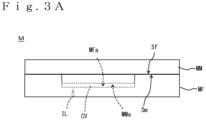
- a forming mold M as shown in, for example, Fig. 3A , Fig. 3B , and Fig. 3C .
- the forming mold M shown in the figures is a forming mold used for producing the second cushioning part 52.
- the forming mold M is composed of a pair of molds respectively having mating surfaces Sf, Sm that contact each other when the mold is closed.
- the forming mold M has a male mold MM and a female mold MF as the pair of molds.
- the forming mold M is configured to be able to form a closed cavity CV inside the forming mold by mating the male mold MM with the female mold MF.
- a molding surface MMa defining the cavity CV is a smooth surface without being subjected to the mat treatment or the hairline treatment. Also in the female mold MF, a molding surface MFa defining the cavity CV is a smooth surface without being subjected to mat treatment or hairline treatment.
- the forming mold M includes an inlet IL for introducing an elastomer composition from an injection molding machine, in which the elastomer composition is molten and kneaded, to the cavity CV.
- the elastomer composition injected from the inlet IL into the cavity CV is filled in the entire cavity CV while being cooled by the molding surfaces (MMa, MFa).
- the injection molded article produced in this embodiment is unlikely to form fine wrinkles on the surface because the elastomer composition has the aforementioned melting characteristics (the complex viscosity and the loss tangent), thereby smoothly flowing along the molding surfaces. Therefore, the surface of the injection molded article produced in this embodiment can faithfully reflect the surface characteristics of the molding surfaces. That is, the injection molded article in this embodiment can be produced to have a smooth surface.
- the faithful reflection of the surface characteristics of the molding surface is also realized in the case where the molding surface is subjected to hairline treatment or mat treatment.
- this embodiment is merely an example.
- This embodiment is described by taking, for example, the shoe provided with a plurality of midsoles including the first midsole and the second midsole layered in the vertical direction, but the midsole provided in the shoe sole of the present invention may be composed of one layer or three or more layers.
- this embodiment is described by taking, for example, the shoe that has the cushioning parts sandwiched between the first midsole and the second midsole, but the cushioning parts may be provided between the midsole and the outsole or between the midsole and the upper.
- the cushioning parts may be arranged to be embedded in recesses formed in the midsole.
- This embodiment is described by taking, for example, the case where the injection molded article is used as the cushioning part, but the injection molded article of this embodiment may be used for a shoe part for other purposes than the cushioning purpose. Further, this embodiment is described by taking, for example, the case where the injection molded article is used as the shoe part, but the intended use of the injection molded article of this embodiment is not limited to the shoe part. That is, the injection molded article and the shoe according to the present invention are not limited to the aforementioned exemplification.
- thermoplastic elastomers having a mass average molecular weight of 300,000 or more were prepared as follows:
- thermoplastic elastomer having a mass average molecular weight of 200,000 or less, the followings were prepared:
- An elastomer composition according to each of Reference Example 1, Examples 1 to 6, and Comparative Examples 1 to 11 was prepared by melting and kneading the aforementioned styrene-based thermoplastic elastomers and plasticizers with blending amounts described later in Table 1.
- a complex viscosity and a loss tangent between 100 °C and 200 °C of each of the elastomer compositions was measured by performing dynamic viscoelasticity measurement. From the obtained results, the maximum value ( ⁇ max ) of the complex viscosity in the frequency range of from 1 Hz to 50 Hz and the maximum value (tan ⁇ max ) of the loss tangent in the frequency range of from 1 Hz to 50 Hz were calculated.
- a forming mold having a flat plate-shaped cavity having a thickness of 4 mm was prepared.
- Each of the heated and molten elastomer compositions was injected into the cavity of the forming mold to produce a plate-shaped injection molded article having a thickness of 4 mm.
- the haze (Haze blank) of each of the injection molded articles was measured.
- the surface roughness of the injection molded article was evaluated according to the non-contact method based on ISO-25178.
- the surface of the injection molded article was observed using a scanning electron microscope with a magnification of 100 times to capture a three dimensional image.
- the visual field at this time was 1,280 ⁇ m ⁇ 960 ⁇ m.
- a profile curve of the surface of the injection molded article was obtained from the three dimensional image, followed by removing swells with a 0.25 mm Gaussian filter, to evaluate the surface roughness (i.e., the arithmetic mean value Ra).
- Five profile curves were collected from five points in the three dimensional image.
- the arithmetic mean value was determined by averaging the obtained five measured values. Also, a standard deviation (SD) of the arithmetic mean value was calculated from the five measured values.
- SD standard deviation
- Example 7 to 12 the evaluation results of the elastomer compositions (Examples 7 to 12) including three styrene-based thermoplastic elastomers are shown below.
- the methods of preparation and evaluation of the elastomer compositions are the same as, for example, in Example 1 described above.
- Examples 7 to 9 are such that part of the first styrene-based thermoplastic elastomer in Comparative Example 5 (i.e., the styrene-based thermoplastic elastomer having a mass average molecular weight of 300,000 or more) is replaced with the second styrene-based thermoplastic elastomer (i.e., the block polymer having a polyethylene block exhibiting crystallinity).
- Examples 10 to 12 are such that the first styrene-based thermoplastic elastomer in Comparative Example 7 (i.e., the styrene-based thermoplastic elastomer having a mass average molecular weight of 300,000 or more) is replaced with the second styrene-based thermoplastic elastomer (i.e., the block polymer having a polyethylene block exhibiting crystallinity).
- Example 8 Example 9, Example 11, and Example 12 among Examples 7 to 12 above is such that part of the first styrene-based thermoplastic elastomer in Examples 1 to 4 (i.e., the styrene-based thermoplastic elastomer having a mass average molecular weight of 300,000 or more) is replaced with the third styrene-based thermoplastic elastomer (i.e., the styrene-based thermoplastic elastomer having a mass average molecular weight of 200,000 or less).
- the third styrene-based thermoplastic elastomer i.e., the styrene-based thermoplastic elastomer having a mass average molecular weight of 200,000 or less.
Landscapes
- Chemical & Material Sciences (AREA)
- Health & Medical Sciences (AREA)
- Engineering & Computer Science (AREA)
- Public Health (AREA)
- Mechanical Engineering (AREA)
- Epidemiology (AREA)
- General Health & Medical Sciences (AREA)
- Chemical Kinetics & Catalysis (AREA)
- Medicinal Chemistry (AREA)
- Polymers & Plastics (AREA)
- Organic Chemistry (AREA)
- Materials Engineering (AREA)
- Manufacturing & Machinery (AREA)
- Compositions Of Macromolecular Compounds (AREA)
- Footwear And Its Accessory, Manufacturing Method And Apparatuses (AREA)
- Injection Moulding Of Plastics Or The Like (AREA)
Claims (10)
- Spritzgussartikel, zusammengesetzt aus einer Elastomerzusammensetzung, die eine Vielzahl von thermoplastischen Elastomeren auf Styrolbasis und einen Weichmacher umfasst, wobeidie Vielzahl der thermoplastischen Elastomere auf Styrolbasis ein erstes thermoplastisches Elastomer auf Styrolbasis und ein zweites thermoplastisches Elastomer auf Styrolbasis umfasst,das erste thermoplastische Elastomer auf Styrolbasis ein massengemitteltes Molekulargewicht von 300.000 oder mehr aufweist,das erste thermoplastische Elastomer auf Styrolbasis ein Blockpolymer ist, das ein weiches Segment und zwei harte Segmente umfasst, wobei das weiche Segment zwischen den beiden harten Segmenten ausgerichtet ist;
wobei der Spritzgussartikel dadurch gekennzeichnet ist, dassdas zweite thermoplastische Elastomer auf Styrolbasis ein Blockpolymer ist, das einen Polyethylenblock umfasst, der Kristallinität vorweist. - Spritzgussartikel nach Anspruch 1, wobei
ein Massenanteil des zweiten thermoplastischen Elastomers auf Styrolbasis in der Elastomerzusammensetzung 1 Masse-% oder mehr und 10 Masse-% oder weniger ist. - Spritzgussartikel nach Anspruch 1 oder 2, wobei
eine Massenverhältnis des ersten thermoplastischen Elastomers auf Styrolbasis zu dem zweiten thermoplastischen Elastomer auf Styrolbasis in der Elastomerzusammensetzung (das erste thermoplastische Elastomer auf Styrolbasis : das zweite thermoplastische Elastomer auf Styrolbasis) 100 : 25 bis 100 : 250 ist. - Spritzgussartikel nach einem der Ansprüche 1 bis 3, wobei
das zweite thermoplastische Elastomer auf Styrolbasis Kristalle von Polyethylen in einem Anteil von 4 Masse-% oder mehr und 12 Masse-% oder weniger umfasst. - Spritzgussartikel nach einem der Ansprüche 1 bis 4, wobei
das zweite thermoplastische Elastomer auf Styrolbasis ein Styrol-Ethylen/Butylen-Ethylen-Copolymer ist. - Spritzgussartikel nach Anspruch 5, wobei
ein Styrolgehalt in dem Styrol-Ethylen/Butylen-Ethylen-Copolymer 10 Masse-% oder mehr und 30 Masse-% oder weniger ist. - Spritzgussartikel nach einem der Ansprüche 1 bis 6, wobei
der Gehalt des Weichmachers in der Elastomerzusammensetzung 100 Masse-% oder mehr und 500 Masse-% oder weniger ist, wenn der Gesamtgehalt der Vielzahl von thermoplastischen Elastomeren auf Styrolbasis 100 Masse-% ist. - Spritzgussartikel nach einem der Ansprüche 1 bis 7, wobeidie Vielzahl von thermoplastischen Elastomere auf Styrolbasis ferner ein drittes thermoplastisches Elastomer auf Styrolbasis umfasst, unddas dritte thermoplastische Elastomer auf Styrolbasis ein massengemitteltes Molekulargewicht von 200.000 oder weniger aufweist.
- Spritzgussartikel nach einem der Ansprüche 1 bis 8, wobei
das erste thermoplastische Elastomer auf Styrolbasis ein Triblock-Polymer ist. - Ein Schuh (1), der aus einer Vielzahl von Schuhteilen zusammengesetzt ist, wobei
mindestens eines der Vielzahl von Schuhteilen der Spritzgussartikel nach einem der Ansprüche 1 bis 9 ist.
Applications Claiming Priority (2)
| Application Number | Priority Date | Filing Date | Title |
|---|---|---|---|
| JP2021012358 | 2021-01-28 | ||
| PCT/JP2021/045774 WO2022163170A1 (ja) | 2021-01-28 | 2021-12-13 | 射出成形品および靴 |
Publications (3)
| Publication Number | Publication Date |
|---|---|
| EP4094918A1 EP4094918A1 (de) | 2022-11-30 |
| EP4094918A4 EP4094918A4 (de) | 2023-09-06 |
| EP4094918B1 true EP4094918B1 (de) | 2025-01-29 |
Family
ID=82653274
Family Applications (1)
| Application Number | Title | Priority Date | Filing Date |
|---|---|---|---|
| EP21923175.0A Active EP4094918B1 (de) | 2021-01-28 | 2021-12-13 | Spritzgegossener gegenstand und schuh |
Country Status (4)
| Country | Link |
|---|---|
| EP (1) | EP4094918B1 (de) |
| JP (1) | JP7128982B1 (de) |
| CN (1) | CN115427503A (de) |
| WO (1) | WO2022163170A1 (de) |
Citations (6)
| Publication number | Priority date | Publication date | Assignee | Title |
|---|---|---|---|---|
| US3877101A (en) * | 1974-07-22 | 1975-04-15 | Bonan Footwear Company Inc | Thermoplastic rubber footwear |
| JPH10298352A (ja) * | 1997-04-24 | 1998-11-10 | Yamaha Motor Co Ltd | 弾性体 |
| JP2005047948A (ja) * | 2003-07-29 | 2005-02-24 | Mitsubishi Chemicals Corp | スチレン系熱可塑性エラストマー組成物 |
| EP3192831A1 (de) * | 2014-09-08 | 2017-07-19 | Mitsui Chemicals, Inc. | Thermoplastische harzzusammensetzung und formartikel daraus |
| US20190343221A1 (en) * | 2018-05-08 | 2019-11-14 | Nike, Inc. | Bonding to polyolefin plates and articles of footwear formed therefrom |
| US11149138B2 (en) * | 2016-03-15 | 2021-10-19 | Nike, Inc. | Foam compositions and uses thereof |
Family Cites Families (17)
| Publication number | Priority date | Publication date | Assignee | Title |
|---|---|---|---|---|
| US4216132A (en) * | 1979-05-04 | 1980-08-05 | Shell Oil Company | HDPE-Containing footwear composition |
| JPH10259281A (ja) * | 1997-03-21 | 1998-09-29 | Toyoda Gosei Co Ltd | 無塗装対応ポリマーアロイ |
| JP2002173574A (ja) * | 2000-12-05 | 2002-06-21 | Aron Kasei Co Ltd | エラストマー組成物 |
| JP4087664B2 (ja) * | 2002-08-27 | 2008-05-21 | アロン化成株式会社 | エラストマー組成物 |
| JP4474515B2 (ja) * | 2002-11-18 | 2010-06-09 | 株式会社朝日ラバー | アーチサポート及びこれを用いたインソール |
| JP2004263161A (ja) * | 2003-03-03 | 2004-09-24 | Masstech:Kk | ポリオレフィン系硬質樹脂の耐衝撃性を向上させる、後添加顔料含有樹脂材料 |
| JP2006083323A (ja) * | 2004-09-17 | 2006-03-30 | Riken Technos Corp | 射出成形用熱可塑性エラストマー組成物 |
| JP2006160777A (ja) * | 2004-12-02 | 2006-06-22 | Nof Corp | 熱可塑性樹脂組成物 |
| JP4995620B2 (ja) * | 2007-04-20 | 2012-08-08 | アロン化成株式会社 | 熱可塑性エラストマー組成物およびそれを用いてなる薬液容器用口部栓体のカバー |
| JP5568327B2 (ja) * | 2010-01-27 | 2014-08-06 | アロン化成株式会社 | 熱可塑性エラストマー組成物 |
| KR101500248B1 (ko) * | 2010-08-23 | 2015-03-06 | 아사히 가세이 케미칼즈 가부시키가이샤 | 발포체 및 발포체용 조성물 |
| CN102604313B (zh) * | 2012-02-22 | 2014-04-16 | 威海洁瑞医用制品有限公司 | Sbs交联弹性体复合材料及其制备方法 |
| JP5966110B1 (ja) | 2015-09-25 | 2016-08-10 | 株式会社タイカ | 履物用緩衝組成物及び履物用緩衝部材 |
| KR101997324B1 (ko) * | 2016-12-29 | 2019-07-05 | 롯데첨단소재(주) | 열가소성 엘라스토머 조성물 및 이로부터 형성된 성형품 |
| CN111655063B (zh) * | 2018-01-31 | 2022-02-25 | 株式会社爱世克私 | 鞋底用构件和鞋 |
| JP7468131B2 (ja) | 2019-07-03 | 2024-04-16 | 株式会社リコー | 画像形成装置、プログラム及び画像形成システム |
| EP3797628B1 (de) * | 2019-08-06 | 2022-04-13 | ASICS Corporation | Spritzgegossener artikel und schuhe |
-
2021
- 2021-12-13 CN CN202180028745.7A patent/CN115427503A/zh active Pending
- 2021-12-13 WO PCT/JP2021/045774 patent/WO2022163170A1/ja not_active Ceased
- 2021-12-13 JP JP2022519596A patent/JP7128982B1/ja active Active
- 2021-12-13 EP EP21923175.0A patent/EP4094918B1/de active Active
Patent Citations (6)
| Publication number | Priority date | Publication date | Assignee | Title |
|---|---|---|---|---|
| US3877101A (en) * | 1974-07-22 | 1975-04-15 | Bonan Footwear Company Inc | Thermoplastic rubber footwear |
| JPH10298352A (ja) * | 1997-04-24 | 1998-11-10 | Yamaha Motor Co Ltd | 弾性体 |
| JP2005047948A (ja) * | 2003-07-29 | 2005-02-24 | Mitsubishi Chemicals Corp | スチレン系熱可塑性エラストマー組成物 |
| EP3192831A1 (de) * | 2014-09-08 | 2017-07-19 | Mitsui Chemicals, Inc. | Thermoplastische harzzusammensetzung und formartikel daraus |
| US11149138B2 (en) * | 2016-03-15 | 2021-10-19 | Nike, Inc. | Foam compositions and uses thereof |
| US20190343221A1 (en) * | 2018-05-08 | 2019-11-14 | Nike, Inc. | Bonding to polyolefin plates and articles of footwear formed therefrom |
Also Published As
| Publication number | Publication date |
|---|---|
| EP4094918A4 (de) | 2023-09-06 |
| JP7128982B1 (ja) | 2022-08-31 |
| US20230093459A1 (en) | 2023-03-23 |
| CN115427503A (zh) | 2022-12-02 |
| WO2022163170A1 (ja) | 2022-08-04 |
| EP4094918A1 (de) | 2022-11-30 |
| JPWO2022163170A1 (de) | 2022-08-04 |
Similar Documents
| Publication | Publication Date | Title |
|---|---|---|
| JP4964952B2 (ja) | アウターソール、及びシューズ | |
| TWI480339B (zh) | A crosslinking composition, a method for producing a crosslinked composition, and a molded product | |
| EP2484723B1 (de) | Dichtungsmaterial zur medizinischen verwendung enthaltend eine thermoplastische elastomerzusammensetzung | |
| CN1312215C (zh) | 聚合物组合物及其应用 | |
| TW201006849A (en) | Two/three component compatible polyolefin compounds | |
| KR20130020898A (ko) | 열가소성 엘라스토머 조성물 및 그 성형품 | |
| CN107922557A (zh) | 氢化嵌段共聚物、聚丙烯树脂组合物和成型体 | |
| EP2942370B1 (de) | Thermoplastische polymerzusammensetzung, folie oder film und mehrschichtiger film | |
| EP3187062B1 (de) | Schuhformungselement und schuh | |
| EP1312640B1 (de) | Polymerzusammensetzung | |
| JP5590907B2 (ja) | ポリプロピレン樹脂組成物とこれからなる成形体 | |
| EP4094918B1 (de) | Spritzgegossener gegenstand und schuh | |
| EP3797628B1 (de) | Spritzgegossener artikel und schuhe | |
| US12552925B2 (en) | Injection molded article and shoe | |
| US12264241B2 (en) | Hydrogenated copolymer, adhesive film, resin composition, and molded article | |
| JP2002317096A (ja) | 長靴用熱可塑性エラストマー組成物及びそれを用いた長靴 | |
| JP5837156B2 (ja) | ポリプロピレン樹脂組成物とこれからなる成形体 | |
| JP4522729B2 (ja) | 熱可塑性エラストマー組成物 | |
| CN117651660A (zh) | 气囊容纳罩及其制造方法、热塑性弹性体组合物、成形体以及复合成形体 | |
| WO2025164773A1 (ja) | 自動車内装部材用熱可塑性エラストマー組成物およびその成形体 | |
| JP2022018570A (ja) | シート部材 | |
| JP2002136586A (ja) | フィルムおよびそれを用いた貼付材 | |
| JPWO2002014423A1 (ja) | 重合体組成物 |
Legal Events
| Date | Code | Title | Description |
|---|---|---|---|
| STAA | Information on the status of an ep patent application or granted ep patent |
Free format text: STATUS: THE INTERNATIONAL PUBLICATION HAS BEEN MADE |
|
| PUAI | Public reference made under article 153(3) epc to a published international application that has entered the european phase |
Free format text: ORIGINAL CODE: 0009012 |
|
| STAA | Information on the status of an ep patent application or granted ep patent |
Free format text: STATUS: REQUEST FOR EXAMINATION WAS MADE |
|
| 17P | Request for examination filed |
Effective date: 20220823 |
|
| AK | Designated contracting states |
Kind code of ref document: A1 Designated state(s): AL AT BE BG CH CY CZ DE DK EE ES FI FR GB GR HR HU IE IS IT LI LT LU LV MC MK MT NL NO PL PT RO RS SE SI SK SM TR |
|
| A4 | Supplementary search report drawn up and despatched |
Effective date: 20230809 |
|
| RIC1 | Information provided on ipc code assigned before grant |
Ipc: A43B 13/12 20060101ALI20230803BHEP Ipc: A43B 13/04 20060101ALI20230803BHEP Ipc: C08L 53/02 20060101ALI20230803BHEP Ipc: C08K 5/01 20060101ALI20230803BHEP Ipc: B29C 45/00 20060101AFI20230803BHEP |
|
| DAV | Request for validation of the european patent (deleted) | ||
| DAX | Request for extension of the european patent (deleted) | ||
| GRAP | Despatch of communication of intention to grant a patent |
Free format text: ORIGINAL CODE: EPIDOSNIGR1 |
|
| STAA | Information on the status of an ep patent application or granted ep patent |
Free format text: STATUS: GRANT OF PATENT IS INTENDED |
|
| RIC1 | Information provided on ipc code assigned before grant |
Ipc: A43B 13/12 20060101ALI20240909BHEP Ipc: A43B 13/04 20060101ALI20240909BHEP Ipc: C08L 53/02 20060101ALI20240909BHEP Ipc: C08K 5/01 20060101ALI20240909BHEP Ipc: B29C 45/00 20060101AFI20240909BHEP |
|
| INTG | Intention to grant announced |
Effective date: 20240918 |
|
| GRAS | Grant fee paid |
Free format text: ORIGINAL CODE: EPIDOSNIGR3 |
|
| GRAA | (expected) grant |
Free format text: ORIGINAL CODE: 0009210 |
|
| STAA | Information on the status of an ep patent application or granted ep patent |
Free format text: STATUS: THE PATENT HAS BEEN GRANTED |
|
| AK | Designated contracting states |
Kind code of ref document: B1 Designated state(s): AL AT BE BG CH CY CZ DE DK EE ES FI FR GB GR HR HU IE IS IT LI LT LU LV MC MK MT NL NO PL PT RO RS SE SI SK SM TR |
|
| REG | Reference to a national code |
Ref country code: GB Ref legal event code: FG4D |
|
| REG | Reference to a national code |
Ref country code: CH Ref legal event code: EP |
|
| REG | Reference to a national code |
Ref country code: DE Ref legal event code: R096 Ref document number: 602021025716 Country of ref document: DE |
|
| REG | Reference to a national code |
Ref country code: IE Ref legal event code: FG4D |
|
| REG | Reference to a national code |
Ref country code: NL Ref legal event code: MP Effective date: 20250129 |
|
| PG25 | Lapsed in a contracting state [announced via postgrant information from national office to epo] |
Ref country code: NL Free format text: LAPSE BECAUSE OF FAILURE TO SUBMIT A TRANSLATION OF THE DESCRIPTION OR TO PAY THE FEE WITHIN THE PRESCRIBED TIME-LIMIT Effective date: 20250129 |
|
| PG25 | Lapsed in a contracting state [announced via postgrant information from national office to epo] |
Ref country code: RS Free format text: LAPSE BECAUSE OF FAILURE TO SUBMIT A TRANSLATION OF THE DESCRIPTION OR TO PAY THE FEE WITHIN THE PRESCRIBED TIME-LIMIT Effective date: 20250429 |
|
| PG25 | Lapsed in a contracting state [announced via postgrant information from national office to epo] |
Ref country code: FI Free format text: LAPSE BECAUSE OF FAILURE TO SUBMIT A TRANSLATION OF THE DESCRIPTION OR TO PAY THE FEE WITHIN THE PRESCRIBED TIME-LIMIT Effective date: 20250129 |
|
| PG25 | Lapsed in a contracting state [announced via postgrant information from national office to epo] |
Ref country code: PL Free format text: LAPSE BECAUSE OF FAILURE TO SUBMIT A TRANSLATION OF THE DESCRIPTION OR TO PAY THE FEE WITHIN THE PRESCRIBED TIME-LIMIT Effective date: 20250129 |
|
| PG25 | Lapsed in a contracting state [announced via postgrant information from national office to epo] |
Ref country code: ES Free format text: LAPSE BECAUSE OF FAILURE TO SUBMIT A TRANSLATION OF THE DESCRIPTION OR TO PAY THE FEE WITHIN THE PRESCRIBED TIME-LIMIT Effective date: 20250129 |
|
| REG | Reference to a national code |
Ref country code: LT Ref legal event code: MG9D |
|
| PG25 | Lapsed in a contracting state [announced via postgrant information from national office to epo] |
Ref country code: IS Free format text: LAPSE BECAUSE OF FAILURE TO SUBMIT A TRANSLATION OF THE DESCRIPTION OR TO PAY THE FEE WITHIN THE PRESCRIBED TIME-LIMIT Effective date: 20250529 Ref country code: NO Free format text: LAPSE BECAUSE OF FAILURE TO SUBMIT A TRANSLATION OF THE DESCRIPTION OR TO PAY THE FEE WITHIN THE PRESCRIBED TIME-LIMIT Effective date: 20250429 |
|
| REG | Reference to a national code |
Ref country code: AT Ref legal event code: MK05 Ref document number: 1763027 Country of ref document: AT Kind code of ref document: T Effective date: 20250129 |
|
| PG25 | Lapsed in a contracting state [announced via postgrant information from national office to epo] |
Ref country code: HR Free format text: LAPSE BECAUSE OF FAILURE TO SUBMIT A TRANSLATION OF THE DESCRIPTION OR TO PAY THE FEE WITHIN THE PRESCRIBED TIME-LIMIT Effective date: 20250129 |
|
| PG25 | Lapsed in a contracting state [announced via postgrant information from national office to epo] |
Ref country code: PT Free format text: LAPSE BECAUSE OF FAILURE TO SUBMIT A TRANSLATION OF THE DESCRIPTION OR TO PAY THE FEE WITHIN THE PRESCRIBED TIME-LIMIT Effective date: 20250529 Ref country code: LV Free format text: LAPSE BECAUSE OF FAILURE TO SUBMIT A TRANSLATION OF THE DESCRIPTION OR TO PAY THE FEE WITHIN THE PRESCRIBED TIME-LIMIT Effective date: 20250129 |
|
| PG25 | Lapsed in a contracting state [announced via postgrant information from national office to epo] |
Ref country code: GR Free format text: LAPSE BECAUSE OF FAILURE TO SUBMIT A TRANSLATION OF THE DESCRIPTION OR TO PAY THE FEE WITHIN THE PRESCRIBED TIME-LIMIT Effective date: 20250430 Ref country code: BG Free format text: LAPSE BECAUSE OF FAILURE TO SUBMIT A TRANSLATION OF THE DESCRIPTION OR TO PAY THE FEE WITHIN THE PRESCRIBED TIME-LIMIT Effective date: 20250129 |
|
| PG25 | Lapsed in a contracting state [announced via postgrant information from national office to epo] |
Ref country code: AT Free format text: LAPSE BECAUSE OF FAILURE TO SUBMIT A TRANSLATION OF THE DESCRIPTION OR TO PAY THE FEE WITHIN THE PRESCRIBED TIME-LIMIT Effective date: 20250129 |
|
| PG25 | Lapsed in a contracting state [announced via postgrant information from national office to epo] |
Ref country code: SE Free format text: LAPSE BECAUSE OF FAILURE TO SUBMIT A TRANSLATION OF THE DESCRIPTION OR TO PAY THE FEE WITHIN THE PRESCRIBED TIME-LIMIT Effective date: 20250129 |
|
| PG25 | Lapsed in a contracting state [announced via postgrant information from national office to epo] |
Ref country code: SM Free format text: LAPSE BECAUSE OF FAILURE TO SUBMIT A TRANSLATION OF THE DESCRIPTION OR TO PAY THE FEE WITHIN THE PRESCRIBED TIME-LIMIT Effective date: 20250129 |
|
| PG25 | Lapsed in a contracting state [announced via postgrant information from national office to epo] |
Ref country code: DK Free format text: LAPSE BECAUSE OF FAILURE TO SUBMIT A TRANSLATION OF THE DESCRIPTION OR TO PAY THE FEE WITHIN THE PRESCRIBED TIME-LIMIT Effective date: 20250129 |
|
| PG25 | Lapsed in a contracting state [announced via postgrant information from national office to epo] |
Ref country code: IT Free format text: LAPSE BECAUSE OF FAILURE TO SUBMIT A TRANSLATION OF THE DESCRIPTION OR TO PAY THE FEE WITHIN THE PRESCRIBED TIME-LIMIT Effective date: 20250129 |
|
| PG25 | Lapsed in a contracting state [announced via postgrant information from national office to epo] |
Ref country code: CZ Free format text: LAPSE BECAUSE OF FAILURE TO SUBMIT A TRANSLATION OF THE DESCRIPTION OR TO PAY THE FEE WITHIN THE PRESCRIBED TIME-LIMIT Effective date: 20250129 Ref country code: EE Free format text: LAPSE BECAUSE OF FAILURE TO SUBMIT A TRANSLATION OF THE DESCRIPTION OR TO PAY THE FEE WITHIN THE PRESCRIBED TIME-LIMIT Effective date: 20250129 |
|
| PG25 | Lapsed in a contracting state [announced via postgrant information from national office to epo] |
Ref country code: RO Free format text: LAPSE BECAUSE OF FAILURE TO SUBMIT A TRANSLATION OF THE DESCRIPTION OR TO PAY THE FEE WITHIN THE PRESCRIBED TIME-LIMIT Effective date: 20250129 |
|
| PG25 | Lapsed in a contracting state [announced via postgrant information from national office to epo] |
Ref country code: SK Free format text: LAPSE BECAUSE OF FAILURE TO SUBMIT A TRANSLATION OF THE DESCRIPTION OR TO PAY THE FEE WITHIN THE PRESCRIBED TIME-LIMIT Effective date: 20250129 |
|
| REG | Reference to a national code |
Ref country code: DE Ref legal event code: R097 Ref document number: 602021025716 Country of ref document: DE |
|
| PLBE | No opposition filed within time limit |
Free format text: ORIGINAL CODE: 0009261 |
|
| STAA | Information on the status of an ep patent application or granted ep patent |
Free format text: STATUS: NO OPPOSITION FILED WITHIN TIME LIMIT |
|
| 26N | No opposition filed |
Effective date: 20251030 |
|
| PGFP | Annual fee paid to national office [announced via postgrant information from national office to epo] |
Ref country code: DE Payment date: 20251028 Year of fee payment: 5 |