EP4079870A2 - Glühseparatorzusammensetzung für kornorientiertes elektrostahlblech, kornorientiertes elektrostahlblech und herstellungsverfahren dafür - Google Patents
Glühseparatorzusammensetzung für kornorientiertes elektrostahlblech, kornorientiertes elektrostahlblech und herstellungsverfahren dafür Download PDFInfo
- Publication number
- EP4079870A2 EP4079870A2 EP20901252.5A EP20901252A EP4079870A2 EP 4079870 A2 EP4079870 A2 EP 4079870A2 EP 20901252 A EP20901252 A EP 20901252A EP 4079870 A2 EP4079870 A2 EP 4079870A2
- Authority
- EP
- European Patent Office
- Prior art keywords
- steel sheet
- grain
- oriented electrical
- electrical steel
- annealing separator
- Prior art date
- Legal status (The legal status is an assumption and is not a legal conclusion. Google has not performed a legal analysis and makes no representation as to the accuracy of the status listed.)
- Pending
Links
Images

Classifications
-
- C—CHEMISTRY; METALLURGY
- C21—METALLURGY OF IRON
- C21D—MODIFYING THE PHYSICAL STRUCTURE OF FERROUS METALS; GENERAL DEVICES FOR HEAT TREATMENT OF FERROUS OR NON-FERROUS METALS OR ALLOYS; MAKING METAL MALLEABLE, e.g. BY DECARBURISATION OR TEMPERING
- C21D8/00—Modifying the physical properties of ferrous metals or ferrous alloys by deformation combined with, or followed by, heat treatment
- C21D8/12—Modifying the physical properties of ferrous metals or ferrous alloys by deformation combined with, or followed by, heat treatment during manufacturing of articles with special electromagnetic properties
- C21D8/1277—Modifying the physical properties of ferrous metals or ferrous alloys by deformation combined with, or followed by, heat treatment during manufacturing of articles with special electromagnetic properties involving a particular surface treatment
- C21D8/1283—Application of a separating or insulating coating
-
- C—CHEMISTRY; METALLURGY
- C01—INORGANIC CHEMISTRY
- C01G—COMPOUNDS CONTAINING METALS NOT COVERED BY SUBCLASSES C01D OR C01F
- C01G53/00—Compounds of nickel
- C01G53/40—Complex oxides containing nickel and at least one other metal element
- C01G53/66—Complex oxides containing nickel and at least one other metal element containing alkaline earth metals, e.g. SrNiO3 or SrNiO2
-
- C—CHEMISTRY; METALLURGY
- C04—CEMENTS; CONCRETE; ARTIFICIAL STONE; CERAMICS; REFRACTORIES
- C04B—LIME, MAGNESIA; SLAG; CEMENTS; COMPOSITIONS THEREOF, e.g. MORTARS, CONCRETE OR LIKE BUILDING MATERIALS; ARTIFICIAL STONE; CERAMICS; REFRACTORIES; TREATMENT OF NATURAL STONE
- C04B35/00—Shaped ceramic products characterised by their composition; Ceramics compositions; Processing powders of inorganic compounds preparatory to the manufacturing of ceramic products
- C04B35/01—Shaped ceramic products characterised by their composition; Ceramics compositions; Processing powders of inorganic compounds preparatory to the manufacturing of ceramic products based on oxide ceramics
-
- C—CHEMISTRY; METALLURGY
- C04—CEMENTS; CONCRETE; ARTIFICIAL STONE; CERAMICS; REFRACTORIES
- C04B—LIME, MAGNESIA; SLAG; CEMENTS; COMPOSITIONS THEREOF, e.g. MORTARS, CONCRETE OR LIKE BUILDING MATERIALS; ARTIFICIAL STONE; CERAMICS; REFRACTORIES; TREATMENT OF NATURAL STONE
- C04B35/00—Shaped ceramic products characterised by their composition; Ceramics compositions; Processing powders of inorganic compounds preparatory to the manufacturing of ceramic products
- C04B35/01—Shaped ceramic products characterised by their composition; Ceramics compositions; Processing powders of inorganic compounds preparatory to the manufacturing of ceramic products based on oxide ceramics
- C04B35/016—Shaped ceramic products characterised by their composition; Ceramics compositions; Processing powders of inorganic compounds preparatory to the manufacturing of ceramic products based on oxide ceramics based on manganites
-
- C—CHEMISTRY; METALLURGY
- C04—CEMENTS; CONCRETE; ARTIFICIAL STONE; CERAMICS; REFRACTORIES
- C04B—LIME, MAGNESIA; SLAG; CEMENTS; COMPOSITIONS THEREOF, e.g. MORTARS, CONCRETE OR LIKE BUILDING MATERIALS; ARTIFICIAL STONE; CERAMICS; REFRACTORIES; TREATMENT OF NATURAL STONE
- C04B35/00—Shaped ceramic products characterised by their composition; Ceramics compositions; Processing powders of inorganic compounds preparatory to the manufacturing of ceramic products
- C04B35/01—Shaped ceramic products characterised by their composition; Ceramics compositions; Processing powders of inorganic compounds preparatory to the manufacturing of ceramic products based on oxide ceramics
- C04B35/16—Shaped ceramic products characterised by their composition; Ceramics compositions; Processing powders of inorganic compounds preparatory to the manufacturing of ceramic products based on oxide ceramics based on silicates other than clay
- C04B35/18—Shaped ceramic products characterised by their composition; Ceramics compositions; Processing powders of inorganic compounds preparatory to the manufacturing of ceramic products based on oxide ceramics based on silicates other than clay rich in aluminium oxide
- C04B35/185—Mullite 3Al2O3-2SiO2
-
- C—CHEMISTRY; METALLURGY
- C21—METALLURGY OF IRON
- C21D—MODIFYING THE PHYSICAL STRUCTURE OF FERROUS METALS; GENERAL DEVICES FOR HEAT TREATMENT OF FERROUS OR NON-FERROUS METALS OR ALLOYS; MAKING METAL MALLEABLE, e.g. BY DECARBURISATION OR TEMPERING
- C21D1/00—General methods or devices for heat treatment, e.g. annealing, hardening, quenching or tempering
- C21D1/68—Temporary coatings or embedding materials applied before or during heat treatment
- C21D1/70—Temporary coatings or embedding materials applied before or during heat treatment while heating or quenching
-
- C—CHEMISTRY; METALLURGY
- C21—METALLURGY OF IRON
- C21D—MODIFYING THE PHYSICAL STRUCTURE OF FERROUS METALS; GENERAL DEVICES FOR HEAT TREATMENT OF FERROUS OR NON-FERROUS METALS OR ALLOYS; MAKING METAL MALLEABLE, e.g. BY DECARBURISATION OR TEMPERING
- C21D1/00—General methods or devices for heat treatment, e.g. annealing, hardening, quenching or tempering
- C21D1/74—Methods of treatment in inert gas, controlled atmosphere, vacuum or pulverulent material
-
- C—CHEMISTRY; METALLURGY
- C21—METALLURGY OF IRON
- C21D—MODIFYING THE PHYSICAL STRUCTURE OF FERROUS METALS; GENERAL DEVICES FOR HEAT TREATMENT OF FERROUS OR NON-FERROUS METALS OR ALLOYS; MAKING METAL MALLEABLE, e.g. BY DECARBURISATION OR TEMPERING
- C21D6/00—Heat treatment of ferrous alloys
- C21D6/008—Heat treatment of ferrous alloys containing Si
-
- C—CHEMISTRY; METALLURGY
- C21—METALLURGY OF IRON
- C21D—MODIFYING THE PHYSICAL STRUCTURE OF FERROUS METALS; GENERAL DEVICES FOR HEAT TREATMENT OF FERROUS OR NON-FERROUS METALS OR ALLOYS; MAKING METAL MALLEABLE, e.g. BY DECARBURISATION OR TEMPERING
- C21D8/00—Modifying the physical properties of ferrous metals or ferrous alloys by deformation combined with, or followed by, heat treatment
- C21D8/12—Modifying the physical properties of ferrous metals or ferrous alloys by deformation combined with, or followed by, heat treatment during manufacturing of articles with special electromagnetic properties
- C21D8/1216—Modifying the physical properties of ferrous metals or ferrous alloys by deformation combined with, or followed by, heat treatment during manufacturing of articles with special electromagnetic properties characterised by the working steps
- C21D8/1222—Hot rolling
-
- C—CHEMISTRY; METALLURGY
- C21—METALLURGY OF IRON
- C21D—MODIFYING THE PHYSICAL STRUCTURE OF FERROUS METALS; GENERAL DEVICES FOR HEAT TREATMENT OF FERROUS OR NON-FERROUS METALS OR ALLOYS; MAKING METAL MALLEABLE, e.g. BY DECARBURISATION OR TEMPERING
- C21D8/00—Modifying the physical properties of ferrous metals or ferrous alloys by deformation combined with, or followed by, heat treatment
- C21D8/12—Modifying the physical properties of ferrous metals or ferrous alloys by deformation combined with, or followed by, heat treatment during manufacturing of articles with special electromagnetic properties
- C21D8/1244—Modifying the physical properties of ferrous metals or ferrous alloys by deformation combined with, or followed by, heat treatment during manufacturing of articles with special electromagnetic properties characterised by the heat treatment
- C21D8/1272—Final recrystallisation annealing
-
- C—CHEMISTRY; METALLURGY
- C21—METALLURGY OF IRON
- C21D—MODIFYING THE PHYSICAL STRUCTURE OF FERROUS METALS; GENERAL DEVICES FOR HEAT TREATMENT OF FERROUS OR NON-FERROUS METALS OR ALLOYS; MAKING METAL MALLEABLE, e.g. BY DECARBURISATION OR TEMPERING
- C21D9/00—Heat treatment, e.g. annealing, hardening, quenching or tempering, adapted for particular articles; Furnaces therefor
- C21D9/46—Heat treatment, e.g. annealing, hardening, quenching or tempering, adapted for particular articles; Furnaces therefor for sheet metals
-
- C—CHEMISTRY; METALLURGY
- C23—COATING METALLIC MATERIAL; COATING MATERIAL WITH METALLIC MATERIAL; CHEMICAL SURFACE TREATMENT; DIFFUSION TREATMENT OF METALLIC MATERIAL; COATING BY VACUUM EVAPORATION, BY SPUTTERING, BY ION IMPLANTATION OR BY CHEMICAL VAPOUR DEPOSITION, IN GENERAL; INHIBITING CORROSION OF METALLIC MATERIAL OR INCRUSTATION IN GENERAL
- C23C—COATING METALLIC MATERIAL; COATING MATERIAL WITH METALLIC MATERIAL; SURFACE TREATMENT OF METALLIC MATERIAL BY DIFFUSION INTO THE SURFACE, BY CHEMICAL CONVERSION OR SUBSTITUTION; COATING BY VACUUM EVAPORATION, BY SPUTTERING, BY ION IMPLANTATION OR BY CHEMICAL VAPOUR DEPOSITION, IN GENERAL
- C23C24/00—Coating starting from inorganic powder
- C23C24/02—Coating starting from inorganic powder by application of pressure only
- C23C24/04—Impact or kinetic deposition of particles
-
- C—CHEMISTRY; METALLURGY
- C23—COATING METALLIC MATERIAL; COATING MATERIAL WITH METALLIC MATERIAL; CHEMICAL SURFACE TREATMENT; DIFFUSION TREATMENT OF METALLIC MATERIAL; COATING BY VACUUM EVAPORATION, BY SPUTTERING, BY ION IMPLANTATION OR BY CHEMICAL VAPOUR DEPOSITION, IN GENERAL; INHIBITING CORROSION OF METALLIC MATERIAL OR INCRUSTATION IN GENERAL
- C23C—COATING METALLIC MATERIAL; COATING MATERIAL WITH METALLIC MATERIAL; SURFACE TREATMENT OF METALLIC MATERIAL BY DIFFUSION INTO THE SURFACE, BY CHEMICAL CONVERSION OR SUBSTITUTION; COATING BY VACUUM EVAPORATION, BY SPUTTERING, BY ION IMPLANTATION OR BY CHEMICAL VAPOUR DEPOSITION, IN GENERAL
- C23C24/00—Coating starting from inorganic powder
- C23C24/08—Coating starting from inorganic powder by application of heat or pressure and heat
-
- C—CHEMISTRY; METALLURGY
- C23—COATING METALLIC MATERIAL; COATING MATERIAL WITH METALLIC MATERIAL; CHEMICAL SURFACE TREATMENT; DIFFUSION TREATMENT OF METALLIC MATERIAL; COATING BY VACUUM EVAPORATION, BY SPUTTERING, BY ION IMPLANTATION OR BY CHEMICAL VAPOUR DEPOSITION, IN GENERAL; INHIBITING CORROSION OF METALLIC MATERIAL OR INCRUSTATION IN GENERAL
- C23C—COATING METALLIC MATERIAL; COATING MATERIAL WITH METALLIC MATERIAL; SURFACE TREATMENT OF METALLIC MATERIAL BY DIFFUSION INTO THE SURFACE, BY CHEMICAL CONVERSION OR SUBSTITUTION; COATING BY VACUUM EVAPORATION, BY SPUTTERING, BY ION IMPLANTATION OR BY CHEMICAL VAPOUR DEPOSITION, IN GENERAL
- C23C4/00—Coating by spraying the coating material in the molten state, e.g. by flame, plasma or electric discharge
- C23C4/02—Pretreatment of the material to be coated, e.g. for coating on selected surface areas
-
- C—CHEMISTRY; METALLURGY
- C23—COATING METALLIC MATERIAL; COATING MATERIAL WITH METALLIC MATERIAL; CHEMICAL SURFACE TREATMENT; DIFFUSION TREATMENT OF METALLIC MATERIAL; COATING BY VACUUM EVAPORATION, BY SPUTTERING, BY ION IMPLANTATION OR BY CHEMICAL VAPOUR DEPOSITION, IN GENERAL; INHIBITING CORROSION OF METALLIC MATERIAL OR INCRUSTATION IN GENERAL
- C23C—COATING METALLIC MATERIAL; COATING MATERIAL WITH METALLIC MATERIAL; SURFACE TREATMENT OF METALLIC MATERIAL BY DIFFUSION INTO THE SURFACE, BY CHEMICAL CONVERSION OR SUBSTITUTION; COATING BY VACUUM EVAPORATION, BY SPUTTERING, BY ION IMPLANTATION OR BY CHEMICAL VAPOUR DEPOSITION, IN GENERAL
- C23C4/00—Coating by spraying the coating material in the molten state, e.g. by flame, plasma or electric discharge
- C23C4/04—Coating by spraying the coating material in the molten state, e.g. by flame, plasma or electric discharge characterised by the coating material
- C23C4/10—Oxides, borides, carbides, nitrides or silicides; Mixtures thereof
-
- C—CHEMISTRY; METALLURGY
- C23—COATING METALLIC MATERIAL; COATING MATERIAL WITH METALLIC MATERIAL; CHEMICAL SURFACE TREATMENT; DIFFUSION TREATMENT OF METALLIC MATERIAL; COATING BY VACUUM EVAPORATION, BY SPUTTERING, BY ION IMPLANTATION OR BY CHEMICAL VAPOUR DEPOSITION, IN GENERAL; INHIBITING CORROSION OF METALLIC MATERIAL OR INCRUSTATION IN GENERAL
- C23C—COATING METALLIC MATERIAL; COATING MATERIAL WITH METALLIC MATERIAL; SURFACE TREATMENT OF METALLIC MATERIAL BY DIFFUSION INTO THE SURFACE, BY CHEMICAL CONVERSION OR SUBSTITUTION; COATING BY VACUUM EVAPORATION, BY SPUTTERING, BY ION IMPLANTATION OR BY CHEMICAL VAPOUR DEPOSITION, IN GENERAL
- C23C4/00—Coating by spraying the coating material in the molten state, e.g. by flame, plasma or electric discharge
- C23C4/12—Coating by spraying the coating material in the molten state, e.g. by flame, plasma or electric discharge characterised by the method of spraying
- C23C4/129—Flame spraying
-
- C—CHEMISTRY; METALLURGY
- C23—COATING METALLIC MATERIAL; COATING MATERIAL WITH METALLIC MATERIAL; CHEMICAL SURFACE TREATMENT; DIFFUSION TREATMENT OF METALLIC MATERIAL; COATING BY VACUUM EVAPORATION, BY SPUTTERING, BY ION IMPLANTATION OR BY CHEMICAL VAPOUR DEPOSITION, IN GENERAL; INHIBITING CORROSION OF METALLIC MATERIAL OR INCRUSTATION IN GENERAL
- C23C—COATING METALLIC MATERIAL; COATING MATERIAL WITH METALLIC MATERIAL; SURFACE TREATMENT OF METALLIC MATERIAL BY DIFFUSION INTO THE SURFACE, BY CHEMICAL CONVERSION OR SUBSTITUTION; COATING BY VACUUM EVAPORATION, BY SPUTTERING, BY ION IMPLANTATION OR BY CHEMICAL VAPOUR DEPOSITION, IN GENERAL
- C23C4/00—Coating by spraying the coating material in the molten state, e.g. by flame, plasma or electric discharge
- C23C4/12—Coating by spraying the coating material in the molten state, e.g. by flame, plasma or electric discharge characterised by the method of spraying
- C23C4/134—Plasma spraying
-
- C—CHEMISTRY; METALLURGY
- C23—COATING METALLIC MATERIAL; COATING MATERIAL WITH METALLIC MATERIAL; CHEMICAL SURFACE TREATMENT; DIFFUSION TREATMENT OF METALLIC MATERIAL; COATING BY VACUUM EVAPORATION, BY SPUTTERING, BY ION IMPLANTATION OR BY CHEMICAL VAPOUR DEPOSITION, IN GENERAL; INHIBITING CORROSION OF METALLIC MATERIAL OR INCRUSTATION IN GENERAL
- C23C—COATING METALLIC MATERIAL; COATING MATERIAL WITH METALLIC MATERIAL; SURFACE TREATMENT OF METALLIC MATERIAL BY DIFFUSION INTO THE SURFACE, BY CHEMICAL CONVERSION OR SUBSTITUTION; COATING BY VACUUM EVAPORATION, BY SPUTTERING, BY ION IMPLANTATION OR BY CHEMICAL VAPOUR DEPOSITION, IN GENERAL
- C23C8/00—Solid state diffusion of only non-metal elements into metallic material surfaces; Chemical surface treatment of metallic material by reaction of the surface with a reactive gas, leaving reaction products of surface material in the coating, e.g. conversion coatings, passivation of metals
- C23C8/02—Pretreatment of the material to be coated
-
- C—CHEMISTRY; METALLURGY
- C23—COATING METALLIC MATERIAL; COATING MATERIAL WITH METALLIC MATERIAL; CHEMICAL SURFACE TREATMENT; DIFFUSION TREATMENT OF METALLIC MATERIAL; COATING BY VACUUM EVAPORATION, BY SPUTTERING, BY ION IMPLANTATION OR BY CHEMICAL VAPOUR DEPOSITION, IN GENERAL; INHIBITING CORROSION OF METALLIC MATERIAL OR INCRUSTATION IN GENERAL
- C23C—COATING METALLIC MATERIAL; COATING MATERIAL WITH METALLIC MATERIAL; SURFACE TREATMENT OF METALLIC MATERIAL BY DIFFUSION INTO THE SURFACE, BY CHEMICAL CONVERSION OR SUBSTITUTION; COATING BY VACUUM EVAPORATION, BY SPUTTERING, BY ION IMPLANTATION OR BY CHEMICAL VAPOUR DEPOSITION, IN GENERAL
- C23C8/00—Solid state diffusion of only non-metal elements into metallic material surfaces; Chemical surface treatment of metallic material by reaction of the surface with a reactive gas, leaving reaction products of surface material in the coating, e.g. conversion coatings, passivation of metals
- C23C8/06—Solid state diffusion of only non-metal elements into metallic material surfaces; Chemical surface treatment of metallic material by reaction of the surface with a reactive gas, leaving reaction products of surface material in the coating, e.g. conversion coatings, passivation of metals using gases
- C23C8/08—Solid state diffusion of only non-metal elements into metallic material surfaces; Chemical surface treatment of metallic material by reaction of the surface with a reactive gas, leaving reaction products of surface material in the coating, e.g. conversion coatings, passivation of metals using gases only one element being applied
- C23C8/10—Oxidising
- C23C8/12—Oxidising using elemental oxygen or ozone
- C23C8/14—Oxidising of ferrous surfaces
-
- C—CHEMISTRY; METALLURGY
- C23—COATING METALLIC MATERIAL; COATING MATERIAL WITH METALLIC MATERIAL; CHEMICAL SURFACE TREATMENT; DIFFUSION TREATMENT OF METALLIC MATERIAL; COATING BY VACUUM EVAPORATION, BY SPUTTERING, BY ION IMPLANTATION OR BY CHEMICAL VAPOUR DEPOSITION, IN GENERAL; INHIBITING CORROSION OF METALLIC MATERIAL OR INCRUSTATION IN GENERAL
- C23C—COATING METALLIC MATERIAL; COATING MATERIAL WITH METALLIC MATERIAL; SURFACE TREATMENT OF METALLIC MATERIAL BY DIFFUSION INTO THE SURFACE, BY CHEMICAL CONVERSION OR SUBSTITUTION; COATING BY VACUUM EVAPORATION, BY SPUTTERING, BY ION IMPLANTATION OR BY CHEMICAL VAPOUR DEPOSITION, IN GENERAL
- C23C8/00—Solid state diffusion of only non-metal elements into metallic material surfaces; Chemical surface treatment of metallic material by reaction of the surface with a reactive gas, leaving reaction products of surface material in the coating, e.g. conversion coatings, passivation of metals
- C23C8/06—Solid state diffusion of only non-metal elements into metallic material surfaces; Chemical surface treatment of metallic material by reaction of the surface with a reactive gas, leaving reaction products of surface material in the coating, e.g. conversion coatings, passivation of metals using gases
- C23C8/08—Solid state diffusion of only non-metal elements into metallic material surfaces; Chemical surface treatment of metallic material by reaction of the surface with a reactive gas, leaving reaction products of surface material in the coating, e.g. conversion coatings, passivation of metals using gases only one element being applied
- C23C8/24—Nitriding
- C23C8/26—Nitriding of ferrous surfaces
-
- C—CHEMISTRY; METALLURGY
- C23—COATING METALLIC MATERIAL; COATING MATERIAL WITH METALLIC MATERIAL; CHEMICAL SURFACE TREATMENT; DIFFUSION TREATMENT OF METALLIC MATERIAL; COATING BY VACUUM EVAPORATION, BY SPUTTERING, BY ION IMPLANTATION OR BY CHEMICAL VAPOUR DEPOSITION, IN GENERAL; INHIBITING CORROSION OF METALLIC MATERIAL OR INCRUSTATION IN GENERAL
- C23C—COATING METALLIC MATERIAL; COATING MATERIAL WITH METALLIC MATERIAL; SURFACE TREATMENT OF METALLIC MATERIAL BY DIFFUSION INTO THE SURFACE, BY CHEMICAL CONVERSION OR SUBSTITUTION; COATING BY VACUUM EVAPORATION, BY SPUTTERING, BY ION IMPLANTATION OR BY CHEMICAL VAPOUR DEPOSITION, IN GENERAL
- C23C8/00—Solid state diffusion of only non-metal elements into metallic material surfaces; Chemical surface treatment of metallic material by reaction of the surface with a reactive gas, leaving reaction products of surface material in the coating, e.g. conversion coatings, passivation of metals
- C23C8/80—After-treatment
-
- C—CHEMISTRY; METALLURGY
- C01—INORGANIC CHEMISTRY
- C01P—INDEXING SCHEME RELATING TO STRUCTURAL AND PHYSICAL ASPECTS OF SOLID INORGANIC COMPOUNDS
- C01P2004/00—Particle morphology
- C01P2004/60—Particles characterised by their size
- C01P2004/64—Nanometer sized, i.e. from 1-100 nanometer
-
- C—CHEMISTRY; METALLURGY
- C01—INORGANIC CHEMISTRY
- C01P—INDEXING SCHEME RELATING TO STRUCTURAL AND PHYSICAL ASPECTS OF SOLID INORGANIC COMPOUNDS
- C01P2006/00—Physical properties of inorganic compounds
- C01P2006/12—Surface area
-
- C—CHEMISTRY; METALLURGY
- C04—CEMENTS; CONCRETE; ARTIFICIAL STONE; CERAMICS; REFRACTORIES
- C04B—LIME, MAGNESIA; SLAG; CEMENTS; COMPOSITIONS THEREOF, e.g. MORTARS, CONCRETE OR LIKE BUILDING MATERIALS; ARTIFICIAL STONE; CERAMICS; REFRACTORIES; TREATMENT OF NATURAL STONE
- C04B2235/00—Aspects relating to ceramic starting mixtures or sintered ceramic products
- C04B2235/02—Composition of constituents of the starting material or of secondary phases of the final product
- C04B2235/30—Constituents and secondary phases not being of a fibrous nature
- C04B2235/32—Metal oxides, mixed metal oxides, or oxide-forming salts thereof, e.g. carbonates, nitrates, (oxy)hydroxides, chlorides
- C04B2235/3205—Alkaline earth oxides or oxide forming salts thereof, e.g. beryllium oxide
- C04B2235/3206—Magnesium oxides or oxide-forming salts thereof
-
- C—CHEMISTRY; METALLURGY
- C04—CEMENTS; CONCRETE; ARTIFICIAL STONE; CERAMICS; REFRACTORIES
- C04B—LIME, MAGNESIA; SLAG; CEMENTS; COMPOSITIONS THEREOF, e.g. MORTARS, CONCRETE OR LIKE BUILDING MATERIALS; ARTIFICIAL STONE; CERAMICS; REFRACTORIES; TREATMENT OF NATURAL STONE
- C04B2235/00—Aspects relating to ceramic starting mixtures or sintered ceramic products
- C04B2235/02—Composition of constituents of the starting material or of secondary phases of the final product
- C04B2235/30—Constituents and secondary phases not being of a fibrous nature
- C04B2235/32—Metal oxides, mixed metal oxides, or oxide-forming salts thereof, e.g. carbonates, nitrates, (oxy)hydroxides, chlorides
- C04B2235/3205—Alkaline earth oxides or oxide forming salts thereof, e.g. beryllium oxide
- C04B2235/3213—Strontium oxides or oxide-forming salts thereof
-
- C—CHEMISTRY; METALLURGY
- C04—CEMENTS; CONCRETE; ARTIFICIAL STONE; CERAMICS; REFRACTORIES
- C04B—LIME, MAGNESIA; SLAG; CEMENTS; COMPOSITIONS THEREOF, e.g. MORTARS, CONCRETE OR LIKE BUILDING MATERIALS; ARTIFICIAL STONE; CERAMICS; REFRACTORIES; TREATMENT OF NATURAL STONE
- C04B2235/00—Aspects relating to ceramic starting mixtures or sintered ceramic products
- C04B2235/02—Composition of constituents of the starting material or of secondary phases of the final product
- C04B2235/30—Constituents and secondary phases not being of a fibrous nature
- C04B2235/32—Metal oxides, mixed metal oxides, or oxide-forming salts thereof, e.g. carbonates, nitrates, (oxy)hydroxides, chlorides
- C04B2235/3217—Aluminum oxide or oxide forming salts thereof, e.g. bauxite, alpha-alumina
-
- C—CHEMISTRY; METALLURGY
- C04—CEMENTS; CONCRETE; ARTIFICIAL STONE; CERAMICS; REFRACTORIES
- C04B—LIME, MAGNESIA; SLAG; CEMENTS; COMPOSITIONS THEREOF, e.g. MORTARS, CONCRETE OR LIKE BUILDING MATERIALS; ARTIFICIAL STONE; CERAMICS; REFRACTORIES; TREATMENT OF NATURAL STONE
- C04B2235/00—Aspects relating to ceramic starting mixtures or sintered ceramic products
- C04B2235/02—Composition of constituents of the starting material or of secondary phases of the final product
- C04B2235/30—Constituents and secondary phases not being of a fibrous nature
- C04B2235/32—Metal oxides, mixed metal oxides, or oxide-forming salts thereof, e.g. carbonates, nitrates, (oxy)hydroxides, chlorides
- C04B2235/3231—Refractory metal oxides, their mixed metal oxides, or oxide-forming salts thereof
- C04B2235/3232—Titanium oxides or titanates, e.g. rutile or anatase
-
- C—CHEMISTRY; METALLURGY
- C04—CEMENTS; CONCRETE; ARTIFICIAL STONE; CERAMICS; REFRACTORIES
- C04B—LIME, MAGNESIA; SLAG; CEMENTS; COMPOSITIONS THEREOF, e.g. MORTARS, CONCRETE OR LIKE BUILDING MATERIALS; ARTIFICIAL STONE; CERAMICS; REFRACTORIES; TREATMENT OF NATURAL STONE
- C04B2235/00—Aspects relating to ceramic starting mixtures or sintered ceramic products
- C04B2235/02—Composition of constituents of the starting material or of secondary phases of the final product
- C04B2235/30—Constituents and secondary phases not being of a fibrous nature
- C04B2235/32—Metal oxides, mixed metal oxides, or oxide-forming salts thereof, e.g. carbonates, nitrates, (oxy)hydroxides, chlorides
- C04B2235/3231—Refractory metal oxides, their mixed metal oxides, or oxide-forming salts thereof
- C04B2235/3244—Zirconium oxides, zirconates, hafnium oxides, hafnates, or oxide-forming salts thereof
-
- C—CHEMISTRY; METALLURGY
- C04—CEMENTS; CONCRETE; ARTIFICIAL STONE; CERAMICS; REFRACTORIES
- C04B—LIME, MAGNESIA; SLAG; CEMENTS; COMPOSITIONS THEREOF, e.g. MORTARS, CONCRETE OR LIKE BUILDING MATERIALS; ARTIFICIAL STONE; CERAMICS; REFRACTORIES; TREATMENT OF NATURAL STONE
- C04B2235/00—Aspects relating to ceramic starting mixtures or sintered ceramic products
- C04B2235/02—Composition of constituents of the starting material or of secondary phases of the final product
- C04B2235/30—Constituents and secondary phases not being of a fibrous nature
- C04B2235/32—Metal oxides, mixed metal oxides, or oxide-forming salts thereof, e.g. carbonates, nitrates, (oxy)hydroxides, chlorides
- C04B2235/3262—Manganese oxides, manganates, rhenium oxides or oxide-forming salts thereof, e.g. MnO
-
- C—CHEMISTRY; METALLURGY
- C04—CEMENTS; CONCRETE; ARTIFICIAL STONE; CERAMICS; REFRACTORIES
- C04B—LIME, MAGNESIA; SLAG; CEMENTS; COMPOSITIONS THEREOF, e.g. MORTARS, CONCRETE OR LIKE BUILDING MATERIALS; ARTIFICIAL STONE; CERAMICS; REFRACTORIES; TREATMENT OF NATURAL STONE
- C04B2235/00—Aspects relating to ceramic starting mixtures or sintered ceramic products
- C04B2235/02—Composition of constituents of the starting material or of secondary phases of the final product
- C04B2235/30—Constituents and secondary phases not being of a fibrous nature
- C04B2235/32—Metal oxides, mixed metal oxides, or oxide-forming salts thereof, e.g. carbonates, nitrates, (oxy)hydroxides, chlorides
- C04B2235/327—Iron group oxides, their mixed metal oxides, or oxide-forming salts thereof
- C04B2235/3272—Iron oxides or oxide forming salts thereof, e.g. hematite, magnetite
-
- C—CHEMISTRY; METALLURGY
- C04—CEMENTS; CONCRETE; ARTIFICIAL STONE; CERAMICS; REFRACTORIES
- C04B—LIME, MAGNESIA; SLAG; CEMENTS; COMPOSITIONS THEREOF, e.g. MORTARS, CONCRETE OR LIKE BUILDING MATERIALS; ARTIFICIAL STONE; CERAMICS; REFRACTORIES; TREATMENT OF NATURAL STONE
- C04B2235/00—Aspects relating to ceramic starting mixtures or sintered ceramic products
- C04B2235/02—Composition of constituents of the starting material or of secondary phases of the final product
- C04B2235/30—Constituents and secondary phases not being of a fibrous nature
- C04B2235/32—Metal oxides, mixed metal oxides, or oxide-forming salts thereof, e.g. carbonates, nitrates, (oxy)hydroxides, chlorides
- C04B2235/327—Iron group oxides, their mixed metal oxides, or oxide-forming salts thereof
- C04B2235/3275—Cobalt oxides, cobaltates or cobaltites or oxide forming salts thereof, e.g. bismuth cobaltate, zinc cobaltite
-
- C—CHEMISTRY; METALLURGY
- C04—CEMENTS; CONCRETE; ARTIFICIAL STONE; CERAMICS; REFRACTORIES
- C04B—LIME, MAGNESIA; SLAG; CEMENTS; COMPOSITIONS THEREOF, e.g. MORTARS, CONCRETE OR LIKE BUILDING MATERIALS; ARTIFICIAL STONE; CERAMICS; REFRACTORIES; TREATMENT OF NATURAL STONE
- C04B2235/00—Aspects relating to ceramic starting mixtures or sintered ceramic products
- C04B2235/02—Composition of constituents of the starting material or of secondary phases of the final product
- C04B2235/30—Constituents and secondary phases not being of a fibrous nature
- C04B2235/32—Metal oxides, mixed metal oxides, or oxide-forming salts thereof, e.g. carbonates, nitrates, (oxy)hydroxides, chlorides
- C04B2235/327—Iron group oxides, their mixed metal oxides, or oxide-forming salts thereof
- C04B2235/3279—Nickel oxides, nickalates, or oxide-forming salts thereof
-
- C—CHEMISTRY; METALLURGY
- C04—CEMENTS; CONCRETE; ARTIFICIAL STONE; CERAMICS; REFRACTORIES
- C04B—LIME, MAGNESIA; SLAG; CEMENTS; COMPOSITIONS THEREOF, e.g. MORTARS, CONCRETE OR LIKE BUILDING MATERIALS; ARTIFICIAL STONE; CERAMICS; REFRACTORIES; TREATMENT OF NATURAL STONE
- C04B2235/00—Aspects relating to ceramic starting mixtures or sintered ceramic products
- C04B2235/02—Composition of constituents of the starting material or of secondary phases of the final product
- C04B2235/30—Constituents and secondary phases not being of a fibrous nature
- C04B2235/32—Metal oxides, mixed metal oxides, or oxide-forming salts thereof, e.g. carbonates, nitrates, (oxy)hydroxides, chlorides
- C04B2235/3281—Copper oxides, cuprates or oxide-forming salts thereof, e.g. CuO or Cu2O
-
- C—CHEMISTRY; METALLURGY
- C04—CEMENTS; CONCRETE; ARTIFICIAL STONE; CERAMICS; REFRACTORIES
- C04B—LIME, MAGNESIA; SLAG; CEMENTS; COMPOSITIONS THEREOF, e.g. MORTARS, CONCRETE OR LIKE BUILDING MATERIALS; ARTIFICIAL STONE; CERAMICS; REFRACTORIES; TREATMENT OF NATURAL STONE
- C04B2235/00—Aspects relating to ceramic starting mixtures or sintered ceramic products
- C04B2235/02—Composition of constituents of the starting material or of secondary phases of the final product
- C04B2235/30—Constituents and secondary phases not being of a fibrous nature
- C04B2235/32—Metal oxides, mixed metal oxides, or oxide-forming salts thereof, e.g. carbonates, nitrates, (oxy)hydroxides, chlorides
- C04B2235/3294—Antimony oxides, antimonates, antimonites or oxide forming salts thereof, indium antimonate
-
- C—CHEMISTRY; METALLURGY
- C04—CEMENTS; CONCRETE; ARTIFICIAL STONE; CERAMICS; REFRACTORIES
- C04B—LIME, MAGNESIA; SLAG; CEMENTS; COMPOSITIONS THEREOF, e.g. MORTARS, CONCRETE OR LIKE BUILDING MATERIALS; ARTIFICIAL STONE; CERAMICS; REFRACTORIES; TREATMENT OF NATURAL STONE
- C04B2235/00—Aspects relating to ceramic starting mixtures or sintered ceramic products
- C04B2235/02—Composition of constituents of the starting material or of secondary phases of the final product
- C04B2235/30—Constituents and secondary phases not being of a fibrous nature
- C04B2235/34—Non-metal oxides, non-metal mixed oxides, or salts thereof that form the non-metal oxides upon heating, e.g. carbonates, nitrates, (oxy)hydroxides, chlorides
- C04B2235/3418—Silicon oxide, silicic acids or oxide forming salts thereof, e.g. silica sol, fused silica, silica fume, cristobalite, quartz or flint
-
- C—CHEMISTRY; METALLURGY
- C04—CEMENTS; CONCRETE; ARTIFICIAL STONE; CERAMICS; REFRACTORIES
- C04B—LIME, MAGNESIA; SLAG; CEMENTS; COMPOSITIONS THEREOF, e.g. MORTARS, CONCRETE OR LIKE BUILDING MATERIALS; ARTIFICIAL STONE; CERAMICS; REFRACTORIES; TREATMENT OF NATURAL STONE
- C04B2235/00—Aspects relating to ceramic starting mixtures or sintered ceramic products
- C04B2235/02—Composition of constituents of the starting material or of secondary phases of the final product
- C04B2235/30—Constituents and secondary phases not being of a fibrous nature
- C04B2235/34—Non-metal oxides, non-metal mixed oxides, or salts thereof that form the non-metal oxides upon heating, e.g. carbonates, nitrates, (oxy)hydroxides, chlorides
- C04B2235/3427—Silicates other than clay, e.g. water glass
- C04B2235/3463—Alumino-silicates other than clay, e.g. mullite
-
- C—CHEMISTRY; METALLURGY
- C04—CEMENTS; CONCRETE; ARTIFICIAL STONE; CERAMICS; REFRACTORIES
- C04B—LIME, MAGNESIA; SLAG; CEMENTS; COMPOSITIONS THEREOF, e.g. MORTARS, CONCRETE OR LIKE BUILDING MATERIALS; ARTIFICIAL STONE; CERAMICS; REFRACTORIES; TREATMENT OF NATURAL STONE
- C04B2235/00—Aspects relating to ceramic starting mixtures or sintered ceramic products
- C04B2235/02—Composition of constituents of the starting material or of secondary phases of the final product
- C04B2235/30—Constituents and secondary phases not being of a fibrous nature
- C04B2235/44—Metal salt constituents or additives chosen for the nature of the anions, e.g. hydrides or acetylacetonate
- C04B2235/448—Sulphates or sulphites
-
- C—CHEMISTRY; METALLURGY
- C04—CEMENTS; CONCRETE; ARTIFICIAL STONE; CERAMICS; REFRACTORIES
- C04B—LIME, MAGNESIA; SLAG; CEMENTS; COMPOSITIONS THEREOF, e.g. MORTARS, CONCRETE OR LIKE BUILDING MATERIALS; ARTIFICIAL STONE; CERAMICS; REFRACTORIES; TREATMENT OF NATURAL STONE
- C04B2235/00—Aspects relating to ceramic starting mixtures or sintered ceramic products
- C04B2235/02—Composition of constituents of the starting material or of secondary phases of the final product
- C04B2235/50—Constituents or additives of the starting mixture chosen for their shape or used because of their shape or their physical appearance
- C04B2235/54—Particle size related information
- C04B2235/5409—Particle size related information expressed by specific surface values
-
- C—CHEMISTRY; METALLURGY
- C04—CEMENTS; CONCRETE; ARTIFICIAL STONE; CERAMICS; REFRACTORIES
- C04B—LIME, MAGNESIA; SLAG; CEMENTS; COMPOSITIONS THEREOF, e.g. MORTARS, CONCRETE OR LIKE BUILDING MATERIALS; ARTIFICIAL STONE; CERAMICS; REFRACTORIES; TREATMENT OF NATURAL STONE
- C04B2235/00—Aspects relating to ceramic starting mixtures or sintered ceramic products
- C04B2235/02—Composition of constituents of the starting material or of secondary phases of the final product
- C04B2235/50—Constituents or additives of the starting mixture chosen for their shape or used because of their shape or their physical appearance
- C04B2235/54—Particle size related information
- C04B2235/5418—Particle size related information expressed by the size of the particles or aggregates thereof
- C04B2235/5454—Particle size related information expressed by the size of the particles or aggregates thereof nanometer sized, i.e. below 100 nm
-
- C—CHEMISTRY; METALLURGY
- C21—METALLURGY OF IRON
- C21D—MODIFYING THE PHYSICAL STRUCTURE OF FERROUS METALS; GENERAL DEVICES FOR HEAT TREATMENT OF FERROUS OR NON-FERROUS METALS OR ALLOYS; MAKING METAL MALLEABLE, e.g. BY DECARBURISATION OR TEMPERING
- C21D2201/00—Treatment for obtaining particular effects
- C21D2201/05—Grain orientation
-
- C—CHEMISTRY; METALLURGY
- C22—METALLURGY; FERROUS OR NON-FERROUS ALLOYS; TREATMENT OF ALLOYS OR NON-FERROUS METALS
- C22C—ALLOYS
- C22C38/00—Ferrous alloys, e.g. steel alloys
- C22C38/001—Ferrous alloys, e.g. steel alloys containing N
-
- C—CHEMISTRY; METALLURGY
- C22—METALLURGY; FERROUS OR NON-FERROUS ALLOYS; TREATMENT OF ALLOYS OR NON-FERROUS METALS
- C22C—ALLOYS
- C22C38/00—Ferrous alloys, e.g. steel alloys
- C22C38/008—Ferrous alloys, e.g. steel alloys containing tin
-
- C—CHEMISTRY; METALLURGY
- C22—METALLURGY; FERROUS OR NON-FERROUS ALLOYS; TREATMENT OF ALLOYS OR NON-FERROUS METALS
- C22C—ALLOYS
- C22C38/00—Ferrous alloys, e.g. steel alloys
- C22C38/02—Ferrous alloys, e.g. steel alloys containing silicon
-
- C—CHEMISTRY; METALLURGY
- C22—METALLURGY; FERROUS OR NON-FERROUS ALLOYS; TREATMENT OF ALLOYS OR NON-FERROUS METALS
- C22C—ALLOYS
- C22C38/00—Ferrous alloys, e.g. steel alloys
- C22C38/04—Ferrous alloys, e.g. steel alloys containing manganese
-
- C—CHEMISTRY; METALLURGY
- C22—METALLURGY; FERROUS OR NON-FERROUS ALLOYS; TREATMENT OF ALLOYS OR NON-FERROUS METALS
- C22C—ALLOYS
- C22C38/00—Ferrous alloys, e.g. steel alloys
- C22C38/06—Ferrous alloys, e.g. steel alloys containing aluminium
-
- C—CHEMISTRY; METALLURGY
- C22—METALLURGY; FERROUS OR NON-FERROUS ALLOYS; TREATMENT OF ALLOYS OR NON-FERROUS METALS
- C22C—ALLOYS
- C22C38/00—Ferrous alloys, e.g. steel alloys
- C22C38/08—Ferrous alloys, e.g. steel alloys containing nickel
Definitions
- the present invention relates to an annealing separator composition for a grain-oriented electrical steel sheet, a grain-oriented electrical steel sheet, and a method for manufacturing the grain-oriented electrical steel sheet. More particularly, the present invention relates to an annealing separator composition for a grain-oriented electrical steel sheet that may improve insulation properties of a base coating layer and magnetic properties of a grain-oriented electrical steel sheet by adding a composite metal oxide, a grain-oriented electrical steel sheet, and a method for manufacturing the grain-oriented electrical steel sheet.
- a grain-oriented electrical steel sheet refers to an electrical steel sheet that contains a Si component in the steel sheet and has extremely excellent magnetic properties in a rolling direction because it has a texture in which an orientation of grains is aligned in a ⁇ 100 ⁇ 001> direction.
- the insulating coating layer In order to minimize a power loss of the grain-oriented electrical steel sheet, it is common to form an insulating coating layer on a surface thereof, and in this case, the insulating coating layer generally needs to have high electrical insulation properties, excellent adhesion to materials, and a uniform color with no defects in appearance.
- studies on a magnetic deformation (magnetostriction) phenomenon are demanded to reduce the noise from the insulating coating layer of the grain-oriented electrical steel sheet. Specifically, when an electric field is applied to an electrical steel sheet used as an iron core of the transformer, a flicker phenomenon is caused by repeated shrinkage and expansion, and vibration and noise are caused in the transformer due to the flicker.
- the present invention has been made in an effort to provide an annealing separator composition for a grain-oriented electrical steel sheet, a grain-oriented electrical steel sheet, and a method for manufacturing the grain-oriented electrical steel sheet.
- the present invention relates to an annealing separator composition for a grain-oriented electrical steel sheet that may improve insulation properties of a base coating layer and magnetic properties of a grain-oriented electrical steel sheet by adding a composite metal oxide, a grain-oriented electrical steel sheet, and a method for manufacturing the grain-oriented electrical steel sheet.
- An exemplary embodiment of the present invention provides an annealing separator composition for a grain-oriented electrical steel sheet containing a composite metal oxide containing Mg and a metal M, wherein the metal M is one or more of Be, Ca, Ba, Sr, Sn, Mn, Fe, Co, Ni, Cu, and Zn, and Mg and M are contained in the composite metal oxide in amounts of 5 to 55 parts by weight and 45 to 95 parts by weight, respectively, with respect to 100 parts by weight of the total amount of Mg and M.
- the composite metal oxide may have a specific surface area of 30 to 500 m 2 /g and an average particle diameter of 1 to 500 nm.
- the composite metal oxide may have a relative dielectric constant value of 1 to 30.
- M may be one or more of Co, Ni, and Mn.
- M may have an ion radius of 30 to 100 pm.
- the annealing separator composition may have an average grain diameter of 10 to 900 nm after being subjected to a heat treatment at 600°C in a non-oxidizing atmosphere.
- Another embodiment of the present invention provides a grain-oriented electrical steel sheet including a coating layer disposed on one or both surfaces of a grain-oriented electrical steel sheet substrate.
- the coating layer may contain 1 to 20 wt% of Mg, 15 to 45% of a metal M, 15 to 50 wt% of Si, 20% or less of Fe, and a balance of O and unavoidable impurities.
- the grain-oriented electrical steel sheet may further include a ceramic layer disposed on the coating layer.
- a thickness of the coating layer may be 0.1 to 10 ⁇ m and a thickness of the ceramic layer may be 0.5 to 5 ⁇ m.
- Yet another embodiment of the present invention provides a method for manufacturing a grain-oriented electrical steel sheet, the method including: preparing a steel slab; heating the steel slab; hot-rolling the heated steel slab to manufacture a hot-rolled sheet; cold-rolling the hot-rolled sheet to manufacture a cold-rolled sheet; performing primary recrystallization-annealing on the cold-rolled sheet; applying an annealing separator onto a surface of the primary recrystallization-annealed steel sheet; and performing secondary recrystallization-annealing on the steel sheet on which the annealing separator is applied, wherein the annealing separator contains a composite metal oxide containing Mg and a metal M, the metal M is one or more of Be, Ca, Ba, Sr, Sn, Mn, Fe, Co, Ni, Cu, and Zn, and Mg and M are contained in the composite metal oxide in amounts of 5 to 55 parts by weight and 45 to 95 parts by weight, respectively, with respect to 100 parts by weight of the total amount of Mg and M.
- Yet another embodiment of the present invention provides an annealing separator composition for a grain-oriented electrical steel sheet containing: a composite metal oxide containing Mg and a metal M; and mullite, wherein the metal M is one or more of Be, Ca, Ba, Sr, Sn, Mn, Fe, Co, Ni, Cu, and Zn.
- the composite metal oxide and the mullite may be contained in amounts of 10 to 90 parts by weight and 10 to 90 parts by weight, respectively, with respect to 100 parts by weight of the total amount of the composite metal oxide and the mullite.
- the composite metal oxide may have a specific surface area of 30 to 500 m 2 /g and an average particle diameter of 1 to 500 nm
- the mullite may have a specific surface area of 5 to 350 m 2 /g and an average particle diameter of 1 to 300 nm.
- M may be one or more of Co, Ni, and Mn.
- Yet another embodiment of the present invention provides a grain-oriented electrical steel sheet including a coating layer containing mullite, the coating layer being disposed on one or both surfaces of a grain-oriented electrical steel sheet substrate.
- the coating layer may contain 1 to 20 wt% of Mg, 0.5 to 10% of Al, 15 to 45% of a metal M, 15 to 50 wt% of Si, 20% or less of Fe, and a balance of O and unavoidable impurities, and may contain the mullite in an amount of 5 to 45 area%.
- the grain-oriented electrical steel sheet may further include a ceramic layer formed on the coating layer.
- a thickness of the coating layer may be 0.1 to 10 ⁇ m and a thickness of the ceramic layer may be 0.5 to 5 ⁇ m.
- Yet another embodiment of the present invention provides a method for manufacturing a grain-oriented electrical steel sheet, the method including: preparing a steel slab; heating the steel slab; hot-rolling the heated steel slab to manufacture a hot-rolled sheet; cold-rolling the hot-rolled sheet to manufacture a cold-rolled sheet; performing primary recrystallization-annealing on the cold-rolled sheet; applying an annealing separator onto a surface of the primary recrystallization-annealed steel sheet; and performing secondary recrystallization-annealing on the steel sheet on which the annealing separator is applied, wherein the annealing separator contains: a composite metal oxide containing Mg and a metal M; and mullite.
- the annealing separator according to an exemplary embodiment of the present invention may improve insulation properties of a base coating layer by adding a composite metal oxide.
- the annealing separator may improve magnetic properties of the grain-oriented electrical steel sheet.
- the annealing separator according to an exemplary embodiment of the present invention may improve the insulation properties of the base coating layer to reduce a thickness of the ceramic layer disposed on the base coating layer, and thus, a space factor of the grain-oriented electrical steel sheet may be improved.
- FIG. 1 is a schematic side cross-sectional view of a grain-oriented electrical steel sheet according to an exemplary embodiment of the present invention.
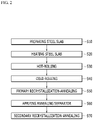
- FIG. 2 is a flowchart of a method for manufacturing a grain-oriented electrical steel sheet according to an exemplary embodiment of the present invention.
- first”, “second”, “third”, and the like are used to describe various parts, components, regions, layers, and/or sections, but are not limited thereto. These terms are only used to differentiate a specific part, component, region, layer, or section from another part, component, region, layer, or section. Accordingly, a first part, component, region, layer, or section which will be described hereinafter may be referred to as a second part, component, region, layer, or section without departing from the scope of the present invention.
- any part When any part is positioned “on” or “above” another part, it means that the part may be directly on or above the other part or another part may be interposed therebetween. In contrast, when any part is positioned "directly on” another part, it means that there is no part interposed therebetween.
- % means wt%, and 1 ppm is 0.0001 wt%.
- the meaning of "further containing an additional element” means that the additional element is substituted for the balance by the amount of additional element added.
- An annealing separator composition for a grain-oriented electrical steel sheet contains a composite metal oxide containing Mg and a metal M, the metal M is one or more of Be, Ca, Ba, Sr, Sn, Mn, Fe, Co, Ni, Cu, and Zn, and Mg and M are contained in the composite metal oxide in amounts of 5 to 55 parts by weight and 45 to 95 parts by weight, respectively, with respect to 100 parts by weight of the total amount of Mg and M.
- the composite metal oxide is an oxide in which Mg and the metal M are chemically bonded to each other. That is, the composite metal oxide is a compound in which a metal M is substituted for and bonded to a position of a Mg element of MgO, and is distinguished from a case where MgO and an oxide of a metal M are separately contained in the annealing separator composition.
- the composite metal compound may be represented by the following Chemical Formula 1: [Chemical Formula 1] Mg 1-X M X O wherein X represents a relative amount of the metal M in the composite metal compound and X is 5 to 95.
- the composite metal oxide is contained, such that a large amount of the metal M may be added in comparison to the case where MgO and an oxide of a metal M are separately contained in the annealing separator composition, which is advantageous in terms of forming a uniform coating layer.
- the amount of M oxide added is limited and non-uniformity of coating layer components is caused, such that it is difficult to impart uniform properties.
- a viscosity is increased rapidly when mixed with water, and solidification occurs over time, such that work is not easily performed, and even when the work may be performed, surface defects occur due to the non-uniformity of the coating layer components caused by the solidification.
- the Mg and M metal components are uniformly distributed in the composite oxide in an atomic unit, there is a small change in viscosity over time when the composite oxide is mixed with water to prepare the annealing separator composition, such that the work may be easily performed and a significantly uniform coating layer may be formed when the annealing separator is applied onto the steel sheet.
- the uniformly formed coating layer may impart the same magnetic properties and surface properties in a width direction and a length direction, and is significantly aesthetic.
- the composite metal oxide may have a specific surface area of 30 to 500 m 2 /g. When the specific surface area is too small, reactivity may be reduced, which may cause formation of a non-uniform coating layer. When the specific surface area is too large, the viscosity is increased rapidly when mixed with water and stirred, such that the work may not be easily performed. More specifically, the composite metal oxide may have a specific surface area of 50 to 300 m 2 /g.
- An average particle diameter of the composite metal oxide may be 1 to 500 nm.
- the annealing separator composition may not be uniformly applied due to aggregation between the composite metal oxides.
- the average particle diameter is too large, a surface roughness of the base coating layer may be rough and surface defects may occur. More specifically, the average particle diameter of the composite metal oxide may be 10 to 300 nm.
- a specific surface area and an average particle diameter may be within the ranges described above when measured by removing the solvent at a temperature of 100°C or lower.
- the composite metal oxide may have a relative dielectric constant value of 1 to 30.
- the relative dielectric constant of the composite metal oxide is too low, a large amount of pores are contained in the composite oxide, which may cause deterioration of adhesion.
- the relative dielectric constant of the composite metal oxide is too high, insulation properties of the base coating layer may be insufficiently improved.
- the relative dielectric constant value may be 5 to 20. In this case, the relative dielectric constant may be measured under a condition of 25°C and 1 MHz.
- Mg serves to supply Mg to the base coating layer.
- the metal M serves to improve magnetic properties and impart insulation properties.
- An element having an atomic radius and an electronegativity similar to those of Mg is suitable as the metal M.
- the metal M may be one or more of Be, Ca, Ba, Sr, Sn, Mn, Fe, Co, Ni, Cu, and Zn. More specifically, the metal M may be one or more of Co, Ni, and Mn.
- Mg and M are contained in the composite metal oxide in amounts of 5 to 55 parts by weight and 45 to 95 parts by weight, respectively, with respect to 100 parts by weight of the total amount of Mg and M.
- the metal M and Mg may be contained in amounts of 60 to 80 parts by weight and 20 to 40 parts by weight, respectively.
- the metal M may have an ion radius of 30 to 100 pm.
- the annealing separator composition may have an average grain diameter of 10 to 900 nm after being subjected to a heat treatment at 600°C in a non-oxidizing atmosphere.
- the average grain diameter is too small, the viscosity is increased rapidly, and thus, the annealing separator composition may not be easily applied to mass production.
- the average grain diameter is too large, it is difficult to form a uniform coating layer.
- the annealing separator composition may have an average grain diameter of 100 to 750 nm after being subjected to a heat treatment at 600°C in a non-oxidizing atmosphere.
- a method for preparing the composite metal oxide is not particularly limited.
- the composite metal oxide may be prepared by adding a catalyst to a solution containing a Mg precursor and a precursor of a metal M and performing a calcination process.
- the composite metal oxide may be prepared by milling a mixed material into a solid state.
- the composite metal oxide may be prepared by reacting a metal alkoxide with water to form a metal-oxygen bond through hydrolysis and a condensation reaction.
- the composite metal oxide may be prepared by formation and recrystallization of metal oxide particles in a solvent by dissolving the solvent containing a metal salt while heating the solvent under a high temperature and a high pressure.
- the annealing separator composition may further contain other components in addition to the composite metal oxide described above.
- the annealing separator composition may further contain MgO.
- MgO since Mg may be supplied through MgO in the composite metal oxide, MgO may be contained in a trace amount. MgO may be contained as an unreacted material during a process of preparing the composite metal oxide described above. Specifically, MgO may be contained in the annealing separator in an amount of 5 wt% or less, and more specifically, in an amount of 1 wt% or less, with respect to 100 wt% of a solid content.
- the annealing separator composition according to an exemplary embodiment of the present invention may further contain a ceramic powder in an amount of 0.5 to 10 wt% with respect to 100 wt% of the solid content.
- the ceramic powder may include one or more selected from MnO, Al 2 O 3 , SiO 2 , TiO 2 , and ZrO 2 .
- insulation properties of a coating layer to be formed may be further improved.
- the annealing separator composition according to an exemplary embodiment of the present invention may further contain Sb 2 (SO 4 ) 3 , SrSO 4 , BaSO 4 , or a combination thereof in an amount of 1 to 10 wt% with respect to 100 wt% of the solid content.
- Sb 2 (SO 4 ) 3 , SrSO 4 , BaSO 4 , or a combination thereof By further containing an appropriate amount of Sb 2 (SO 4 ) 3 , SrSO 4 , BaSO 4 , or a combination thereof, a grain-oriented electrical steel sheet having an excellent surface gloss and a significantly aesthetic roughness may be manufactured.
- the annealing separator composition may further contain a solvent for uniform dispersion and easy application of solids.
- a solvent for uniform dispersion and easy application of solids As the solvent, water, alcohol, or the like may be used and may be contained in an amount of 300 to 1,000 parts by weight with respect to 100 parts by weight of the solid content.
- the annealing separator composition may be a form of a slurry.
- a grain-oriented electrical steel sheet 100 includes a coating layer 20 disposed on one or both surfaces of a grain-oriented electrical steel sheet substrate 10.
- FIG. 1 illustrates a schematic side cross-sectional view of a grain-oriented electrical steel sheet according to an exemplary embodiment of the present invention.
- FIG. 1 illustrates a case where the coating layer 20 is disposed on an upper surface of the grain-oriented electrical steel sheet substrate 10.
- the coating layer 20 contains 1 to 20 wt% of Mg, 15 to 45% of a metal M, 15 to 50 wt% of Si, 20% or less of Fe, and a balance of O and unavoidable impurities. These properties are exhibited by containing the composite metal oxide in the annealing separator composition as described above. In a case where MgO is contained rather than a composite metal oxide, the content of the metal M described above is not satisfied, and a proper improvement of magnetic properties and insulation properties are not exhibited.
- the coating layer may contain 1 to 20 wt% of Mg, 15 to 45% of a metal M, 15 to 50 wt% of Si, 20% or less of Fe, and a balance of O and unavoidable impurities.
- Mg and M are derived from Mg and the metal M in the composite metal oxide.
- the amount of the metal M is too small, the effect of improving the insulation properties of the base coating layer due to the addition of the metal M is not properly obtained.
- the amount of the metal M is too large, a manufacturing cost is increased, and sales competitiveness is lowered.
- the content range described above means the total amount of the two or more elements. More specifically, the amount of the metal M in the coating layer 20 may be 17.5 to 35 wt%.
- Si and Fe may be derived from the substrate.
- O may be derived from the components of the annealing separator or may be incorporated during the heat treatment process.
- the coating layer 20 may further contain impurity components such as carbon (C) and the like.
- a thickness of the coating layer 20 may be 0.1 to 10 ⁇ m.
- a coating layer tension imparting ability may be reduced, which may cause an increase in iron loss.
- the thickness of the coating layer 20 is too thick, a space factor is reduced, which may cause deterioration of characteristics of the transformer. Therefore, the thickness of the coating layer 20 may be adjusted within the range described above. More specifically, the thickness of the coating layer 20 may be 0.8 to 6 ⁇ m.
- the grain-oriented electrical steel sheet 100 may further include a ceramic layer 30 disposed on the coating layer 20.
- FIG. 1 illustrates an example in which the ceramic layer 30 is further formed on the coating layer 20.
- a thickness of the ceramic layer 30 may be 0.5 to 5 ⁇ m. When the thickness of the ceramic layer 30 is too thin, an insulating effect of the ceramic layer 30 may be small. When the thickness of the ceramic layer 30 is too thick, adhesion of the ceramic layer 30 is reduced, and peeling may occur. Therefore, the thickness of the ceramic layer 30 may be adjusted within the range described above. More specifically, the thickness of the ceramic layer 30 may be 0.8 to 3.2 ⁇ m. In an exemplary embodiment of the present invention, since the insulation properties of the coating layer 20 are enhanced, the thickness of the ceramic layer 30 may be relatively thin.
- the ceramic layer 30 may contain a ceramic powder.
- the ceramic powder may be one or more selected from Al 2 O 3 , SiO 2 , TiO 2 , ZrO 2 , Al 2 O 3 ⁇ TiO 2 , Y 2 O 3 , 9Al 2 O 3 ⁇ 2B 2 O 3 , BN, CrN, BaTiO 3 , SiC, and TiC.
- a particle diameter of the ceramic powder may be 2 to 900 nm. When the particle diameter of the ceramic powder is too small, it may be difficult to form the ceramic layer. When the particle diameter of the ceramic powder is too large, the surface roughness may be rough, which may cause surface defects. Therefore, the particle diameter of the ceramic powder may be adjusted within the range described above.
- the ceramic powder may have one or more shapes selected from the group consisting of a spherical shape, a plate shape, and a needle shape.
- the ceramic layer 30 may further contain a metal phosphate.
- the metal phosphate may include one or more selected from Mg, Ca, Ba, Sr, Zn, Al, and Mn. In the case where the metal phosphate is further contained, the insulation properties of the ceramic layer 30 may be further improved.
- the metal phosphate may be composed of a compound obtained by a chemical reaction between a metal hydroxide and phosphoric acid (H 3 PO 4 ).
- the metal phosphate is composed of a compound obtained by a chemical reaction between a metal hydroxide and phosphoric acid (H 3 PO 4 ), and the metal hydroxide may be one or more selected from the group consisting of Ca(OH) 2 , Al(OH) 3 , Mg(OH) 2 , B(OH) 3 , Co(OH) 2 , and Cr(OH) 3 .
- a metal atom of the metal hydroxide may be formed by a substitution reaction with phosphorous of phosphoric acid to form a single bond, a double bond, or a triple bond, and may be composed of a compound in which the amount of unreacted free phosphoric acid (H 3 PO 4 ) is 25 wt% or less.
- the metal phosphate may be composed of a compound obtained by a chemical reaction between a metal hydroxide and phosphoric acid (H 3 PO 4 ), and a weight ratio of the metal hydroxide to the phosphoric acid may be represented by 1:100 to 40:100.
- a range of the amount of the metal hydroxide may be limited as described above.
- the effects of the annealing separator composition and the coating layer 20 are exhibited regardless of the components of the grain-oriented electrical steel sheet substrate 10.
- the components of the grain-oriented electrical steel sheet substrate 10 will be described as follows.
- the grain-oriented electrical steel sheet substrate 10 may contain 2.8 to 4.5 wt% of silicon (Si), 0.020 to 0.040 wt% of aluminum (Al), 0.01 to 0.20 wt% of manganese (Mn), 0.01 to 0.15 wt% of antimony (Sb), tin (Sn), nickel (Ni), or a combination thereof, and a balance of Fe and other unavoidable impurities.
- FIG. 2 schematically illustrates a flowchart of a method for manufacturing a grain-oriented electrical steel sheet according to an exemplary embodiment of the present invention.
- the flowchart of the method for manufacturing a grain-oriented electrical steel sheet of FIG. 2 is merely for illustrating the present invention, and the present invention is not limited thereto. Therefore, the method for manufacturing a grain-oriented electrical steel sheet may be variously modified.
- the method for manufacturing a grain-oriented electrical steel sheet includes: preparing a steel slab (S10); heating the steel slab (S20); hot-rolling the heated steel slab to manufacture a hot-rolled sheet (S30); cold-rolling the hot-rolled sheet to manufacture a cold-rolled sheet (S40); performing primary recrystallization-annealing on the cold-rolled sheet (S50); applying an annealing separator onto a surface of the primary recrystallization-annealed steel sheet (S60); and performing secondary recrystallization-annealing on the steel sheet on which the annealing separator is applied (S70).
- the method for manufacturing a grain-oriented electrical steel sheet may further include other steps.
- a steel slab is prepared. Since components of the steel slab have been specifically described in the components of the grain-oriented electrical steel sheet described above, overlapping descriptions will be omitted.
- the steel slab is heated.
- the heating of the slab may be performed by a low-temperature slab method at 1,200°C or lower.
- the heated steel slab is hot-rolled to manufacture a hot-rolled sheet.
- the manufactured hot-rolled sheet may be hot-rolled annealed.
- the hot-rolled sheet is cold-rolled to manufacture a cold-rolled sheet.
- cold-rolling may be performed once or cold-rolling including intermediate annealing may be performed twice or more.
- the performing of the primary recrystallization-annealing on the cold-rolled sheet may include simultaneously performing decarburization annealing and nitrification annealing on the cold-rolled sheet, or may include performing nitrification annealing on the cold-rolled sheet after decarburization annealing.
- an annealing separator is applied onto a surface of the primary recrystallization-annealed steel sheet. Since the annealing separator has been specifically described, an overlapping description will be omitted.
- the amount of the annealing separator applied may be 1 to 20 g/m 2 .
- the amount of the annealing separator applied is too small, the formation of the coating layer may not be performed smoothly.
- the amount of the annealing separator applied is too large, it may affect the secondary recrystallization. Therefore, the amount of the annealing separator applied may be adjusted within the range described above.
- a primary soaking temperature may be set to 650 to 750°C, and a secondary soaking temperature may be set to 1,100 to 1,250°C.
- the temperature may be controlled under a condition of 15 °C/hr in a temperature section of a temperature rising section.
- the secondary recrystallization-annealing may be performed in a gas atmosphere that is an atmosphere containing 220 to 30 vol% of nitrogen and 70 to 80 vol% of hydrogen until a primary soaking step, and the steel sheet may be subjected to furnace cooling after being maintained in a 100% hydrogen atmosphere for 15 hours in a secondary soaking step.
- the coating layer 20 may be smoothly formed through the conditions described above.
- the method for manufacturing a grain-oriented electrical steel sheet may further include, after S70, forming a ceramic layer 30. Since the ceramic layer 30 has been also specifically described, an overlapping description will be omitted.
- the ceramic layer may be formed by spraying a ceramic powder onto the coating layer 20. Specifically, a method such as plasma spray coating, high velocity oxy fuel spray coating, aerosol deposition coating, or cold spray coating may be applied. More specifically, a plasma spray coating method for forming a ceramic layer by supplying a ceramic powder to a heat source obtained by plasma-generating gas containing Ar, H 2 , N 2 , or He at an output of 20 to 300 kW may be used.
- gas containing Ar, H 2 , N 2 , or He may be supplied in a suspension form of a mixture of a ceramic powder and a solvent to a heat source plasma-generated at an output of 20 to 300 kW to form a ceramic layer 30.
- the solvent may be water or alcohol.
- a method for forming a ceramic layer by applying a composition for forming a ceramic layer that contains a ceramic powder and a metal phosphate may be used.
- magnetic domain refinement may be performed.
- An annealing separator composition for a grain-oriented electrical steel sheet contains: a composite metal oxide containing Mg and a metal M; and mullite, wherein the metal M is one or more of Be, Ca, Ba, Sr, Sn, Mn, Fe, Co, Ni, Cu, and Zn.
- the composite metal oxide is an oxide in which Mg and the metal M are chemically bonded to each other. That is, the composite metal oxide is a compound in which a metal M is substituted for and bonded to a position of a Mg element of MgO, and is distinguished from a case where MgO and an oxide of a metal M are separately contained in the annealing separator composition.
- the composite metal compound may be represented by the following Chemical Formula 1: [Chemical Formula 1] Mg 1-X M X O wherein X represents a relative amount of the metal M in the composite metal compound and X is 45 to 95.
- the composite metal oxide is contained, such that it is advantageous in terms of forming a uniform coating layer in comparison to a case where MgO and an oxide of a metal M are separately contained in the annealing separator composition.
- the amount of M oxide added is limited and non-uniformity of coating layer components is caused, such that it is difficult to impart uniform properties.
- a viscosity is increased rapidly when mixed with water, and solidification occurs over time, such that work is not easily performed, and even when the work may be performed, surface defects occur due to the non-uniformity of the coating layer components caused by the solidification.
- the Mg and M metal components are uniformly distributed in the composite oxide in an atomic unit, there is a small change in viscosity over time when the composite oxide is mixed with water to prepare the annealing separator composition, such that the work may be easily performed and a significantly uniform coating layer may be formed when the annealing separator is applied onto the steel sheet.
- the uniformly formed coating layer may impart the same magnetic properties and surface properties in a width direction and a length direction, and is significantly aesthetic.
- the composite metal oxide may have a specific surface area of 30 to 500 m 2 /g. When the specific surface area is too small, reactivity may be reduced, which may cause formation of a non-uniform coating layer. When the specific surface area is too large, the viscosity is increased rapidly when mixed with water and stirred, such that the work may not be easily performed. More specifically, the composite metal oxide may have a specific surface area of 50 to 300 m 2 /g.
- An average particle diameter of the composite metal oxide may be 1 to 500 nm.
- the annealing separator composition may not be uniformly applied due to aggregation between the composite metal oxides.
- the average particle diameter is too large, a surface roughness of the base coating layer may be rough and surface defects may occur. More specifically, the average particle diameter of the composite metal oxide may be 10 to 300 nm.
- a specific surface area and an average particle diameter may be within the ranges described above when measured by removing the solvent at a temperature of 100°C or lower.
- the composite metal oxide may have a relative dielectric constant value of 1 to 30.
- the relative dielectric constant of the composite metal oxide is too low, a large amount of pores are contained in the composite oxide, which may cause deterioration of adhesion.
- the relative dielectric constant of the composite metal oxide is too high, insulation properties of the base coating layer may be insufficiently improved.
- the relative dielectric constant value may be 5 to 20. In this case, the relative dielectric constant may be measured under a condition of 25°C and 1 MHz.
- Mg serves to supply Mg to the base coating layer.
- the metal M serves to improve the magnetic properties and impart insulation properties.
- An element having an atomic radius and an electronegativity similar to those of Mg is suitable as the metal M.
- the metal M may be one or more of Be, Ca, Ba, Sr, Sn, Mn, Fe, Co, Ni, Cu, and Zn. More specifically, the metal M may be one or more of Co, Ni, and Mn.
- Mg and M may be contained in the composite metal oxide in amounts of 5 to 55 parts by weight and 45 to 95 parts by weight, respectively, with respect to 100 parts by weight of the total amount of Mg and M.
- the insulation properties of the coating layer are reinforced by the mullite, and thus, it is also possible to contain a relatively small amount of the metal M.
- the amount of the metal M contained When the amount of the metal M contained is too small, insulation properties of a desired coating layer may be insufficiently improved. When the amount of the metal M contained is too large, the amount of Mg is relatively small, which may cause deterioration of the adhesion. More specifically, the metal M and Mg may be contained in amounts of 45 to 95 parts by weight and 5 to 55 parts by weight, respectively.
- the metal M may have an ion radius of 30 to 100 pm.
- the annealing separator composition may have an average grain diameter of 10 to 900 nm after being subjected to a heat treatment at 600°C in a non-oxidizing atmosphere.
- the average grain diameter is too small, the viscosity is increased rapidly, and thus, the annealing separator composition may not be easily applied to mass production.
- the average grain diameter is too large, it is difficult to form a uniform coating layer.
- the annealing separator composition may have an average grain diameter of 100 to 750 nm after being subjected to a heat treatment at 600°C in a non-oxidizing atmosphere.
- a method for preparing the composite metal oxide is not particularly limited.
- the composite metal oxide may be prepared by adding a catalyst to a solution containing a Mg precursor and a precursor of a metal M and performing a calcination process.
- the composite metal oxide may be prepared by milling a mixed material into a solid state.
- the composite metal oxide may be prepared by reacting a metal alkoxide with water to form a metal-oxygen bond through hydrolysis and a condensation reaction.
- the composite metal oxide may be prepared by formation and recrystallization of metal oxide particles in a solvent by dissolving the solvent containing a metal salt while heating the solvent under a high temperature and a high pressure.
- the composite metal oxide and the mullite may be contained in amounts of 10 to 90 parts by weight and 10 to 90 parts by weight, respectively, with respect to 100 parts by weight of the total amount of the composite metal oxide and the mullite.
- the amount of the composite metal oxide contained is too small, the amount of Mg of the composite metal oxide is small, which may cause deterioration of the adhesion.
- the amount of the composite metal oxide contained is too large, the amount of the mullite contained is relatively small, such that the insulation properties of the coating layer may be insufficiently improved.
- the composite metal oxide and the mullite may be contained in amounts of 30 to 90 parts by weight and 10 to 70 parts by weight, respectively, with respect to 100 parts by weight of the total amount of the composite metal oxide and the mullite.
- the mullite is the only compound that exists stably between silica and alumina, and has a composition of 3Al 2 O 3 ⁇ 2SiO 2 .
- the mullite is advantageous for reducing an iron loss by applying coating layer tension because it has a small coefficient of thermal expansion (5 x 10 -6 /°C).
- the mullite has excellent thermal shock resistance because it has a relatively low modulus of elasticity.
- the mullite is also advantageous for imparting insulation properties.
- the mullite may have a specific surface area of 5 to 350 m 2 /g and an average particle diameter of 1 to 300 nm.
- the composite metal oxide may have a specific surface area of 50 to 300 m 2 /g.
- the annealing separator composition may not be uniformly applied due to aggregation between the mullites.
- the average particle diameter is too large, a surface roughness of the base coating layer may be rough and surface defects may occur. More specifically, the average particle diameter of the mullite may be 10 to 300 nm.
- a specific surface area and an average particle diameter may be within the ranges described above when measured by removing the solvent at a temperature of 100°C or lower.
- the annealing separator composition may further contain other components in addition to the composite metal oxide and the mullite described above.
- the annealing separator composition may further contain a metal hydroxide.
- the metal hydroxide serves to change surface properties from hydrophobic to hydrophilic through a chemical reaction with a surface of the mullite. Therefore, the metal hydroxide significantly improves dispersibility of the mullite and helps to form a uniform coating layer.
- a melting point of the metal hydroxide is lowered, and a temperature at which a coating layer is formed is lowered in the secondary recrystallization-annealing process, such that excellent quality surface properties may be secured.
- a coating layer formed in a low-temperature region has an effect of suppressing decomposition of an AIN-based inhibitor, which has a decisive effect on the formation of secondary crystallization, such that excellent quality magnetic properties may be secured.
- the annealing separator may further contain a metal hydroxide in an amount of 20 wt% or less with respect to 100 wt% of a solid content in the annealing separator.
- a metal hydroxide in an amount of 20 wt% or less with respect to 100 wt% of a solid content in the annealing separator.
- the metal hydroxide may include one or more selected from Ni(OH) 2 , Co(OH) 2 , Cu(OH) 2 , Sr(OH) 2 , Ba(OH) 2 , Pd(OH) 2 , In(OH) 3 , Bi(OH) 3 , and Sn(OH) 2 .
- the annealing separator may further contain MgO.
- MgO since Mg may be supplied through MgO in the composite metal oxide, MgO may be contained in a trace amount. MgO may be contained as an unreacted material during a process of preparing the composite metal oxide described above. Specifically, MgO may be contained in the annealing separator in an amount of 5 wt% or less, and more specifically, in an amount of 1 wt% or less, with respect to 100 wt% of a solid content.
- the annealing separator composition according to an exemplary embodiment of the present invention may further contain a ceramic powder in an amount of 0.5 to 10 wt% with respect to 100 wt% of the solid content.
- the ceramic powder may include one or more selected from MnO, Al 2 O 3 , SiO 2 , TiO 2 , and ZrO 2 .
- insulation properties of a coating layer to be formed may be further improved.
- the annealing separator composition according to an exemplary embodiment of the present invention may further contain Sb 2 (SO 4 ) 3 , SrSO 4 , BaSO 4 , or a combination thereof in an amount of 1 to 10 wt% with respect to 100 wt% of the solid content.
- Sb 2 (SO 4 ) 3 , SrSO 4 , BaSO 4 , or a combination thereof By further containing an appropriate amount of Sb 2 (SO 4 ) 3 , SrSO 4 , BaSO 4 , or a combination thereof, a grain-oriented electrical steel sheet having an excellent surface gloss and a significantly aesthetic roughness may be manufactured.
- the annealing separator composition may further contain a solvent for uniform dispersion and easy application of solids.
- a solvent for uniform dispersion and easy application of solids As the solvent, water, alcohol, or the like may be used and may be contained in an amount of 300 to 1,000 parts by weight with respect to 100 parts by weight of the solid content.
- the annealing separator composition may be a form of a slurry.
- a grain-oriented electrical steel sheet 100 includes a coating layer 20 disposed on one or both surfaces of a grain-oriented electrical steel sheet substrate 10.
- FIG. 1 illustrates a schematic side cross-sectional view of a grain-oriented electrical steel sheet according to an exemplary embodiment of the present invention.
- FIG. 1 illustrates a case where the coating layer 20 is disposed on an upper surface of the grain-oriented electrical steel sheet substrate 10.
- the coating layer 20 contains 15 to 45 wt% of a metal M.
- a metal M these properties are exhibited by containing the composite metal oxide in the annealing separator composition as described above. In a case where MgO is contained rather than a composite metal oxide, the improvement of magnetic properties and insulation properties are not exhibited. Alternatively, in a case where MgO and an oxide of a metal M are contained in the annealing separator as additional compounds rather than a composite metal oxide, the amount of the metal M added is limited, and thus, the above properties are not exhibited. Alternatively, in a case where the amount of the metal M contained in the composite metal oxide is small, the improvement of magnetic properties and insulation properties are not exhibited.
- the coating layer 20 contains mullite.
- the mullite in the coating layer 20 is derived from the mullite in the annealing separator composition.
- the annealing separator contains an aluminum compound such as Al 2 O 3 rather than mullite, a temperature of the secondary recrystallization-annealing is relatively lower than a temperature at which mullite is formed, and the aluminum compound is bonded to Si in the steel sheet, and thus, mullite may not be formed in the coating layer 20.
- the coating layer may contain 1 to 20 wt% of Mg, 0.5 to 10% or Al, 15 to 45% of a metal M, 15 to 50 wt% of Si, 20% or less of Fe, and a balance of O and unavoidable impurities.
- Mg and M are derived from Mg and the metal M in the composite metal oxide.
- the amount of the metal M is too small, the effect of improving the insulation properties of the base coating layer due to the addition of the metal M is not properly obtained.
- the amount of the metal M is too large, a manufacturing cost is increased, and sales competitiveness is lowered.
- the content range described above means the total amount of the two or more elements. More specifically, the amount of the metal M in the coating layer 20 may be 15 to 30 wt%.
- the coating layer 20 may contain 0.5 to 10 wt% of Al.
- the content of Al in the coating layer 20 is too low, the iron loss of the grain-oriented electrical steel sheet may be increased.
- Al in the coating layer 20 is too high, the corrosion resistance may be deteriorated. Therefore, Al may be contained within the range described above.
- Al may be derived from the annealing separator composition and the grain-oriented electrical steel sheet substrate 10 described above.
- Si and Fe may be derived from the substrate.
- O may be derived from the components of the annealing separator or may be incorporated during the heat treatment process.
- the coating layer 20 may further contain impurity components such as carbon (C) and the like.
- the coating layer 20 may contain 5 to 45 area% of mullite. A part of the mullite in the annealing separator may remain and aggregate without being decomposed during the coating layer formation process. These mullites may occupy a predetermined area. In this case, the area is based on a rolled surface (ND surface). Specifically, the coating layer 20 may contain 5 to 40 area% of mullite.
- a thickness of the coating layer 20 may be 0.1 to 10 ⁇ m.
- a coating layer tension imparting ability may be reduced, which may cause an increase in iron loss.
- the thickness of the coating layer 20 is too thick, a space factor is reduced, which may cause deterioration of characteristics of the transformer. Therefore, the thickness of the coating layer 20 may be adjusted within the range described above. More specifically, the thickness of the coating layer 20 may be 0.8 to 6 ⁇ m.
- the grain-oriented electrical steel sheet 100 may further include a ceramic layer 30 disposed on the coating layer 20.
- FIG. 1 illustrates an example in which the ceramic layer 30 is further formed on the coating layer 20.
- a thickness of the ceramic layer 30 may be 0.5 to 5 ⁇ m. When the thickness of the ceramic layer 30 is too thin, an insulating effect of the ceramic layer 30 may be small. When the thickness of the ceramic layer 30 is too thick, adhesion of the ceramic layer 30 is reduced, and peeling may occur. Therefore, the thickness of the ceramic layer 30 may be adjusted within the range described above. More specifically, the thickness of the ceramic layer 30 may be 0.8 to 3.2 ⁇ m. In an exemplary embodiment of the present invention, since the insulation properties of the coating layer 20 are enhanced, the thickness of the ceramic layer 30 may be relatively thin.
- the ceramic layer 30 may contain a ceramic powder.
- the ceramic powder may be one or more selected from Al 2 O 3 , SiO 2 , TiO 2 , ZrO 2 , Al 2 O 3 ⁇ TiO 2 , Y 2 O 3 , 9Al 2 O 3 ⁇ 2B 2 O 3 , BN, CrN, BaTiO 3 , SiC, and TiC.
- a particle diameter of the ceramic powder may be 2 to 900 nm. When the particle diameter of the ceramic powder is too small, it may be difficult to form the ceramic layer. When the particle diameter of the ceramic powder is too large, the surface roughness may be rough, which may cause surface defects. Therefore, the particle diameter of the ceramic powder may be adjusted within the range described above.
- the ceramic powder may have one or more shapes selected from the group consisting of a spherical shape, a plate shape, and a needle shape.
- the ceramic layer 30 may further contain a metal phosphate.
- the metal phosphate may include one or more selected from Mg, Ca, Ba, Sr, Zn, Al, and Mn. In the case where the metal phosphate is further contained, the insulation properties of the ceramic layer 30 may be further improved.
- the metal phosphate may be composed of a compound obtained by a chemical reaction between a metal hydroxide and phosphoric acid (H 3 PO 4 ).
- the metal phosphate is composed of a compound obtained by a chemical reaction between a metal hydroxide and phosphoric acid (H 3 PO 4 ), and the metal hydroxide may be one or more selected from the group consisting of Ca(OH) 2 , Al(OH) 3 , Mg(OH) 2 , B(OH) 3 , Co(OH) 2 , and Cr(OH) 3 .
- a metal atom of the metal hydroxide may be formed by a substitution reaction with phosphorous of phosphoric acid to form a single bond, a double bond, or a triple bond, and may be composed of a compound in which the amount of unreacted free phosphoric acid (H 3 PO 4 ) is 25 wt% or less.
- the metal phosphate may be composed of a compound obtained by a chemical reaction between a metal hydroxide and phosphoric acid (H 3 PO 4 ), and a weight ratio of the metal hydroxide to the phosphoric acid may be represented by 1:100 to 40:100.
- a range of the amount of the metal hydroxide may be limited as described above.
- the effects of the annealing separator composition and the coating layer 20 are exhibited regardless of the components of the grain-oriented electrical steel sheet substrate 10.
- the components of the grain-oriented electrical steel sheet substrate 10 will be described as follows.
- the grain-oriented electrical steel sheet substrate 10 may contain 2.8 to 4.5 wt% of silicon (Si), 0.020 to 0.040 wt% of aluminum (Al), 0.01 to 0.20 wt% of manganese (Mn), 0.01 to 0.15 wt% of antimony (Sb), tin (Sn), nickel (Ni), or a combination thereof, and a balance of Fe and other unavoidable impurities.
- FIG. 2 schematically illustrates a flowchart of a method for manufacturing a grain-oriented electrical steel sheet according to an exemplary embodiment of the present invention.
- the flowchart of the method for manufacturing a grain-oriented electrical steel sheet of FIG. 2 is merely for illustrating the present invention, and the present invention is not limited thereto. Therefore, the method for manufacturing a grain-oriented electrical steel sheet may be variously modified.
- the method for manufacturing a grain-oriented electrical steel sheet includes: preparing a steel slab (S10); heating the steel slab (S20); hot-rolling the heated steel slab to manufacture a hot-rolled sheet (S30); cold-rolling the hot-rolled sheet to manufacture a cold-rolled sheet (S40); performing primary recrystallization-annealing on the cold-rolled sheet (S50); applying an annealing separator onto a surface of the primary recrystallization-annealed steel sheet (S60); and performing secondary recrystallization-annealing on the steel sheet on which the annealing separator is applied (S70).
- the method for manufacturing a grain-oriented electrical steel sheet may further include other steps.
- a steel slab is prepared. Since components of the steel slab have been specifically described in the components of the grain-oriented electrical steel sheet described above, overlapping descriptions will be omitted.
- the steel slab is heated.
- the heating of the slab may be performed by a low-temperature slab method at 1,200°C or lower.
- the heated steel slab is hot-rolled to manufacture a hot-rolled sheet.
- the manufactured hot-rolled sheet may be hot-rolled annealed.
- the hot-rolled sheet is cold-rolled to manufacture a cold-rolled sheet.
- cold-rolling may be performed once or cold-rolling including intermediate annealing may be performed twice or more.
- the performing of the primary recrystallization-annealing on the cold-rolled sheet may include simultaneously performing decarburization annealing and nitrification annealing on the cold-rolled sheet, or may include performing nitrification annealing on the cold-rolled sheet after decarburization annealing.
- an annealing separator is applied onto a surface of the primary recrystallization-annealed steel sheet. Since the annealing separator has been specifically described, an overlapping description will be omitted.
- the amount of the annealing separator applied may be 1 to 20 g/m 2 .
- the amount of the annealing separator applied is too small, the formation of the coating layer may not be performed smoothly.
- the amount of the annealing separator applied is too large, it may affect the secondary recrystallization. Therefore, the amount of the annealing separator applied may be adjusted within the range described above.
- a primary soaking temperature may be set to 650 to 750°C, and a secondary soaking temperature may be set to 1,100 to 1,250°C.
- the temperature may be controlled under a condition of 15 °C/hr in a temperature section of a temperature rising section.
- the secondary recrystallization-annealing may be performed in a gas atmosphere that is an atmosphere containing 220 to 30 vol% of nitrogen and 70 to 80 vol% of hydrogen until a primary soaking step, and the steel sheet may be subjected to furnace cooling after being maintained in a 100% hydrogen atmosphere for 15 hours in a secondary soaking step.
- the coating layer 20 may be smoothly formed through the conditions described above.
- the method for manufacturing a grain-oriented electrical steel sheet may further include, after S70, forming a ceramic layer 30. Since the ceramic layer 30 has been also specifically described, an overlapping description will be omitted.
- the ceramic layer may be formed by spraying a ceramic powder onto the coating layer 20. Specifically, a method such as plasma spray coating, high velocity oxy fuel spray coating, aerosol deposition coating, or cold spray coating may be applied. More specifically, a plasma spray coating method for forming a ceramic layer by supplying a ceramic powder to a heat source obtained by plasma-generating gas containing Ar, H 2 , N 2 , or He at an output of 20 to 300 kW may be used.
- gas containing Ar, H 2 , N 2 , or He may be supplied in a suspension form of a mixture of a ceramic powder and a solvent to a heat source plasma-generated at an output of 20 to 300 kW to form a ceramic layer 30.
- the solvent may be water or alcohol.
- a method for forming a ceramic layer by applying a composition for forming a ceramic layer that contains a ceramic powder and a metal phosphate may be used.
- magnetic domain refinement may be performed.
- MgCl 2 and NiCl 2 were used as a magnesium precursor and a Ni precursor, respectively, a weight of Mg:Ni in the precursors was measured at 50:50, the precursors were added to deionized (DI) water, 0.5 mol of NaOH as a catalyst was added, and stirring was performed for 2 hours. Thereafter, heating and washing were performed. The obtained powder was filtered and dried. A heat treatment was performed in an Ar atmosphere by changing the temperature to 600 to 1,200°C to prepare a composite metal oxide. The average grain diameter, the specific surface area, and the relative dielectric constant according to the heat treatment temperature condition are shown in Table 1.
- the slab was heated at 1,150°C for 220 minutes and then hot-rolled at a thickness of 2.3 mm to manufacture a hot-rolled sheet.
- the hot-rolled sheet was heated to 1,120°C and then maintained at 920°C for 95 seconds, and then, the hot-rolled sheet was quenched in water and pickled and then cold-rolled at a thickness of 0.23 mm, thereby manufacturing a cold-rolled sheet.
- the cold-rolled sheet was put into a furnace maintained at 850°C, a dew point temperature and an oxidizing ability were controlled, and then, decarburization nitriding and primary recrystallization-annealing were simultaneously performed in a mixed gas atmosphere of hydrogen, nitrogen, and ammonia, thereby manufacturing a decarburized-nitrided and annealed steel sheet.
- An annealing separator composition was prepared in a form of a slurry by mixing the components summarized in Table 2 with distilled water, the slurry was applied onto the decarburized-nitrided and annealed steel sheet using a roll, and then, secondary recrystallization-annealing was performed.
- a primary soaking temperature was set to 700°C
- a secondary soaking temperature was set to 1,200°C
- a temperature was set to 15 °C/hr in a temperature section of a temperature rising section.
- the secondary recrystallization-annealing was performed in a mixed gas atmosphere of 50 vol% of nitrogen and 50 vol% of hydrogen up to a temperature of 1,200°C, after the temperature reached 1,200°C, the steel sheet was maintained in a gas atmosphere of 100 vol% of hydrogen for 20 hours, and the steel sheet was subjected to furnace cooling.
- the coating layer produced through the secondary recrystallization-annealing was subjected to quantitative analysis using an X-ray diffraction (XRD) method. The results thereof are shown in Table 3.
- TiO 2 as a ceramic powder was supplied to a heat source obtained by plasma-generating argon (Ar) gas at an output of 250 kW to form a ceramic layer having a thickness of 0.9 ⁇ m on a surface of a finally annealed sheet.
- W17/50 means a power loss that occurs when a magnetic field with a frequency of 50 Hz is magnetized to 1.7 Tesla with an alternating current.
- Tesla is a unit of a magnetic flux density that means a magnetic flux per unit area.
- B8 represents a density value of a magnetic flux flowing through the electrical steel sheet when a current amount with a magnitude of 800 A/m was applied to a coil wound around the electrical steel sheet.
- the insulation properties were evaluated by measuring the upper portion of the coating using a Franklin measuring instrument according to ASTM A717 international standard.
- the slab was heated at 1,150°C for 220 minutes and then hot-rolled at a thickness of 2.3 mm to manufacture a hot-rolled sheet.
- the hot-rolled sheet was heated to 1,120°C and then maintained at 920°C for 95 seconds, and then, the hot-rolled sheet was quenched in water and pickled and then cold-rolled at a thickness of 0.20 mm, thereby manufacturing a cold-rolled sheet.
- the cold-rolled sheet was put into a furnace maintained at 850°C, a dew point temperature and an oxidizing ability were controlled, and then, decarburization nitriding and primary recrystallization-annealing were simultaneously performed in a mixed gas atmosphere of hydrogen, nitrogen, and ammonia, thereby manufacturing a decarburized-nitrided and annealed steel sheet.
- An annealing separator composition was prepared in a form of a slurry by mixing the components summarized in Table 5 with distilled water, the slurry was applied onto the decarburized-nitrided and annealed steel sheet using a roll, and then, secondary recrystallization-annealing was performed.
- a primary soaking temperature was set to 700°C
- a secondary soaking temperature was set to 1,200°C
- a temperature was set to 15 °C/hr in a temperature section of a temperature rising section.
- the secondary recrystallization-annealing was performed in a mixed gas atmosphere of 50 vol% of nitrogen and 50 vol% of hydrogen up to a temperature of 1,200°C, after the temperature reached 1,200°C, the steel sheet was maintained in a gas atmosphere of 100 vol% of hydrogen for 20 hours, and the steel sheet was subjected to furnace cooling.
- the coating layer produced through the secondary recrystallization-annealing was subjected to quantitative analysis using an X-ray diffraction (XRD) method. The results thereof are shown in Table 6.
- TiO 2 as a ceramic powder was supplied to a heat source obtained by plasma-generating argon (Ar) gas at an output of 250 kW to form a ceramic layer having a thickness of 0.9 ⁇ m on a surface of a finally annealed sheet.
- W17/50 means a power loss that occurs when a magnetic field with a frequency of 50 Hz is magnetized to 1.7 Tesla with an alternating current.
- Tesla is a unit of a magnetic flux density that means a magnetic flux per unit area.
- B8 represents a density value of a magnetic flux flowing through the electrical steel sheet when a current amount with a magnitude of 800 A/m was applied to a coil wound around the electrical steel sheet.
- the insulation properties were evaluated by measuring the upper portion of the coating using a Franklin measuring instrument according to ASTM A717 international standard.
Landscapes
- Chemical & Material Sciences (AREA)
- Engineering & Computer Science (AREA)
- Organic Chemistry (AREA)
- Materials Engineering (AREA)
- Physics & Mathematics (AREA)
- Mechanical Engineering (AREA)
- Metallurgy (AREA)
- Thermal Sciences (AREA)
- Crystallography & Structural Chemistry (AREA)
- Chemical Kinetics & Catalysis (AREA)
- Manufacturing & Machinery (AREA)
- Electromagnetism (AREA)
- Ceramic Engineering (AREA)
- Plasma & Fusion (AREA)
- Structural Engineering (AREA)
- Life Sciences & Earth Sciences (AREA)
- General Life Sciences & Earth Sciences (AREA)
- Geology (AREA)
- Inorganic Chemistry (AREA)
- Manufacturing Of Steel Electrode Plates (AREA)
- Chemical Treatment Of Metals (AREA)
- Soft Magnetic Materials (AREA)
Applications Claiming Priority (2)
| Application Number | Priority Date | Filing Date | Title |
|---|---|---|---|
| KR1020190172474A KR102390830B1 (ko) | 2019-12-20 | 2019-12-20 | 방향성 전기강판용 소둔 분리제 조성물, 방향성 전기강판 및 그의 제조방법 |
| PCT/KR2020/018617 WO2021125863A2 (ko) | 2019-12-20 | 2020-12-17 | 방향성 전기강판용 소둔 분리제 조성물, 방향성 전기강판 및 그의 제조방법 |
Publications (2)
| Publication Number | Publication Date |
|---|---|
| EP4079870A2 true EP4079870A2 (de) | 2022-10-26 |
| EP4079870A4 EP4079870A4 (de) | 2023-07-26 |
Family
ID=76477533
Family Applications (1)
| Application Number | Title | Priority Date | Filing Date |
|---|---|---|---|
| EP20901252.5A Pending EP4079870A4 (de) | 2019-12-20 | 2020-12-17 | Glühseparatorzusammensetzung für kornorientiertes elektrostahlblech, kornorientiertes elektrostahlblech und herstellungsverfahren dafür |
Country Status (6)
| Country | Link |
|---|---|
| US (1) | US20230047863A1 (de) |
| EP (1) | EP4079870A4 (de) |
| JP (1) | JP7453379B2 (de) |
| KR (1) | KR102390830B1 (de) |
| CN (1) | CN115335539B (de) |
| WO (1) | WO2021125863A2 (de) |
Family Cites Families (31)
| Publication number | Priority date | Publication date | Assignee | Title |
|---|---|---|---|---|
| JPS5112450B1 (de) * | 1966-03-18 | 1976-04-20 | ||
| JPS5026496B2 (de) * | 1971-12-03 | 1975-09-01 | ||
| JPS6123771A (ja) * | 1984-07-12 | 1986-02-01 | Nippon Steel Corp | 方向性電磁鋼板のグラス皮膜形成方法 |
| JPH0456781A (ja) * | 1990-06-27 | 1992-02-24 | Kawasaki Steel Corp | 方向性珪素鋼板用焼鈍分離剤 |
| JPH0474871A (ja) * | 1990-07-13 | 1992-03-10 | Kawasaki Steel Corp | 方向性けい素鋼板用焼鈍分離剤 |
| JPH05290626A (ja) * | 1992-04-08 | 1993-11-05 | Nikko Co | 高周波誘電体用焼結体の製造方法 |
| JPH06318426A (ja) * | 1993-04-06 | 1994-11-15 | Hokuriku Toryo Kk | 電子放出層形成用組成物 |
| JP3091088B2 (ja) * | 1994-07-21 | 2000-09-25 | 新日本製鐵株式会社 | 反応性の極めて優れる焼鈍分離剤及びその使用方法 |
| CA2149279C (en) * | 1994-05-13 | 1999-06-01 | Osamu Tanaka | Annealing separator having excellent reactivity for grain-oriented electrical steel sheet and method of use the same |
| JP3059338B2 (ja) * | 1994-05-13 | 2000-07-04 | 新日本製鐵株式会社 | 反応性の極めて優れる方向性電磁鋼板用焼鈍分離剤及びその使用方法 |
| JPH08319514A (ja) * | 1995-05-22 | 1996-12-03 | Nippon Steel Corp | 外観の極めて良好な一次被膜を有する方向性電磁鋼板及びその製造方法 |
| JPH0941153A (ja) * | 1995-08-02 | 1997-02-10 | Nippon Steel Corp | 反応性の優れる焼鈍分離剤及びそれを用いた方向性電磁鋼板の製造方法 |
| JP3356933B2 (ja) * | 1996-08-09 | 2002-12-16 | 新日本製鐵株式会社 | 皮膜形成能に優れる焼鈍分離剤とそれを用いた方向性電磁鋼板の製造方法 |
| JP4188672B2 (ja) * | 2002-05-31 | 2008-11-26 | 篠田プラズマ株式会社 | フォトクロミック体、フォトクロミック材料及びその製造方法 |
| JP4258185B2 (ja) * | 2002-08-22 | 2009-04-30 | Jfeスチール株式会社 | 方向性電磁鋼板およびその製造方法 |
| JP4907942B2 (ja) * | 2005-09-29 | 2012-04-04 | シャープ株式会社 | トランジスタおよび電子デバイス |
| CN102021282A (zh) * | 2009-09-21 | 2011-04-20 | 宝山钢铁股份有限公司 | 一种用于晶粒取向硅钢制备的退火隔离剂及其使用方法 |
| KR101074011B1 (ko) * | 2009-12-29 | 2011-10-17 | 태봉광업(주) | 저 함량 황 성분을 포함하는 성형체, 성형체의 제조방법 및 성형체를 포함하는 노벽보호용 첨가제 |
| KR101165259B1 (ko) * | 2010-07-08 | 2012-08-10 | 포항공과대학교 산학협력단 | MgO피라미드 구조를 갖는 발광소자 및 그 제조방법 |
| CN102952931B (zh) * | 2011-08-30 | 2014-10-29 | 宝山钢铁股份有限公司 | 一种无玻璃膜取向硅钢制造方法及退火隔离剂 |
| CN103014285B (zh) * | 2011-09-28 | 2015-04-01 | 宝山钢铁股份有限公司 | 具有优良磁性能的镜面取向硅钢制造方法及退火隔离剂 |
| JP6146262B2 (ja) * | 2013-10-29 | 2017-06-14 | Jfeスチール株式会社 | 方向性電磁鋼板の製造方法 |
| KR101651431B1 (ko) * | 2014-11-14 | 2016-08-26 | 주식회사 포스코 | 방향성 전기강판의 제조방법 |
| KR101762341B1 (ko) * | 2015-12-18 | 2017-07-27 | 주식회사 포스코 | 방향성 전기강판용 소둔분리제, 방향성 전기강판, 및 방향성 전기강판의 제조 방법 |
| JP6938886B2 (ja) * | 2016-09-30 | 2021-09-22 | 日本製鉄株式会社 | 一方向性電磁鋼板の製造方法 |
| KR101850133B1 (ko) * | 2016-10-26 | 2018-04-19 | 주식회사 포스코 | 방향성 전기강판용 소둔 분리제 조성물, 방향성 전기강판 및 방향성 전기강판의 제조방법 |
| KR101909218B1 (ko) * | 2016-12-21 | 2018-10-17 | 주식회사 포스코 | 방향성 전기강판용 소둔 분리제 조성물, 방향성 전기강판 및 방향성 전기강판의 제조방법 |
| KR101906962B1 (ko) * | 2016-12-22 | 2018-10-11 | 주식회사 포스코 | 방향성 전기강판용 소둔 분리제 조성물, 방향성 전기강판 및 방향성 전기강판의 제조방법 |
| KR102084608B1 (ko) * | 2018-04-25 | 2020-03-04 | 한국과학기술연구원 | 유전막 및 이를 구비하는 반도체 메모리 소자와 이들의 형성 방법 |
| KR101919546B1 (ko) * | 2018-07-12 | 2018-11-16 | 주식회사 포스코 | 방향성 전기강판용 소둔 분리제 조성물, 방향성 전기강판 및 방향성 전기강판의 제조방법 |
| CN109628717B (zh) * | 2018-12-10 | 2020-09-29 | 首钢智新迁安电磁材料有限公司 | 一种底层优良的低温高磁感取向硅钢制造方法 |
-
2019
- 2019-12-20 KR KR1020190172474A patent/KR102390830B1/ko active Active
-
2020
- 2020-12-17 CN CN202080095881.3A patent/CN115335539B/zh active Active
- 2020-12-17 EP EP20901252.5A patent/EP4079870A4/de active Pending
- 2020-12-17 WO PCT/KR2020/018617 patent/WO2021125863A2/ko not_active Ceased
- 2020-12-17 JP JP2022537374A patent/JP7453379B2/ja active Active
- 2020-12-17 US US17/784,514 patent/US20230047863A1/en active Pending
Also Published As
| Publication number | Publication date |
|---|---|
| CN115335539A (zh) | 2022-11-11 |
| KR20210080084A (ko) | 2021-06-30 |
| US20230047863A1 (en) | 2023-02-16 |
| JP7453379B2 (ja) | 2024-03-19 |
| WO2021125863A2 (ko) | 2021-06-24 |
| KR102390830B1 (ko) | 2022-04-25 |
| JP2023508870A (ja) | 2023-03-06 |
| EP4079870A4 (de) | 2023-07-26 |
| WO2021125863A3 (ko) | 2021-08-05 |
| CN115335539B (zh) | 2024-08-06 |
Similar Documents
| Publication | Publication Date | Title |
|---|---|---|
| EP3396022B1 (de) | Kornorientiertes elektrisches stahlblech und verfahren zur herstellung eines kornorientierten elektrischen stahlblechs | |
| EP3533885B1 (de) | Glühseparatorzusammensetzung für orientiertes elektrostahlblech, orientiertes elektrostahlblech und verfahren zur herstellung von orientiertem elektrostahlblech | |
| CN104884646B (zh) | 取向电工钢板及其制造方法 | |
| EP3219825B1 (de) | Orientiertes elektrisches stahlblech mit einer auf seiner oberfläche hergestellten isolationsbeschichtung sowie herstellungsverfahren dafür | |
| EP3561086B1 (de) | Glühseparatorzusammensetzung für kornorientiertes elektrostahlblech, kornorientiertes elektrostahlblech und verfahren zur herstellung eines kornorientierten elektrostahlblechs | |
| KR20170073311A (ko) | 방향성 전기강판용 절연피막 조성물, 방향성 전기강판의 절연피막 형성 방법, 및 절연피막이 형성된 방향성 전기강판 | |
| KR101296131B1 (ko) | 글라스피막 밀착성과 자기적 특성이 우수한 방향성 전기강판 및 그 제조방법 | |
| KR101919546B1 (ko) | 방향성 전기강판용 소둔 분리제 조성물, 방향성 전기강판 및 방향성 전기강판의 제조방법 | |
| US12312651B2 (en) | Oriented electrical steel sheet and manufacturing method therefor | |
| EP4079870A2 (de) | Glühseparatorzusammensetzung für kornorientiertes elektrostahlblech, kornorientiertes elektrostahlblech und herstellungsverfahren dafür | |
| US20210054472A1 (en) | Method for producing oriented electrical steel sheet with ultra-low iron loss | |
| JP4232407B2 (ja) | 方向性電磁鋼板の製造方法 | |
| KR102080165B1 (ko) | 방향성 전기강판용 소둔 분리제 조성물, 방향성 전기강판 및 그의 제조방법 | |
| EP4455315A1 (de) | Glühtrennmittelzusammensetzung für kornorientiertes elektrostahlblech und verfahren zur herstellung eines kornorientierten elektrostahlblechs | |
| EP3913084B1 (de) | Verfahren zur herstellung eines kornorientierten elektrostahlblechs | |
| JP2025500982A (ja) | 電磁鋼板絶縁被膜組成物、電磁鋼板、およびその製造方法 | |
| KR20180041652A (ko) | 방향성 전기강판용 절연피막 조성물, 방향성 전기강판의 절연피막 형성 방법, 및 절연피막이 형성된 방향성 전기강판 |
Legal Events
| Date | Code | Title | Description |
|---|---|---|---|
| STAA | Information on the status of an ep patent application or granted ep patent |
Free format text: STATUS: THE INTERNATIONAL PUBLICATION HAS BEEN MADE |
|
| PUAI | Public reference made under article 153(3) epc to a published international application that has entered the european phase |
Free format text: ORIGINAL CODE: 0009012 |
|
| STAA | Information on the status of an ep patent application or granted ep patent |
Free format text: STATUS: REQUEST FOR EXAMINATION WAS MADE |
|
| 17P | Request for examination filed |
Effective date: 20220720 |
|
| AK | Designated contracting states |
Kind code of ref document: A2 Designated state(s): AL AT BE BG CH CY CZ DE DK EE ES FI FR GB GR HR HU IE IS IT LI LT LU LV MC MK MT NL NO PL PT RO RS SE SI SK SM TR |
|
| RIC1 | Information provided on ipc code assigned before grant |
Ipc: C01G 53/00 19680901ALI20230112BHEP Ipc: C01G 51/00 19680901ALI20230112BHEP Ipc: C01G 45/12 19680901ALI20230112BHEP Ipc: C23C 24/00 19850101ALI20230112BHEP Ipc: C04B 35/185 19950101ALI20230112BHEP Ipc: C04B 35/01 19950101ALI20230112BHEP Ipc: C01F 5/00 19680901ALI20230112BHEP Ipc: C04B 35/04 19680901ALI20230112BHEP Ipc: C23C 4/00 19850101ALI20230112BHEP Ipc: C22C 38/08 19740701ALI20230112BHEP Ipc: C22C 38/06 19740701ALI20230112BHEP Ipc: C22C 38/04 19740701ALI20230112BHEP Ipc: C22C 38/02 19740701ALI20230112BHEP Ipc: C22C 38/00 19740701ALI20230112BHEP Ipc: C21D 6/00 19740701ALI20230112BHEP Ipc: C21D 9/46 19680901ALI20230112BHEP Ipc: C21D 1/70 19680901ALI20230112BHEP Ipc: C21D 8/12 19800101AFI20230112BHEP |
|
| DAV | Request for validation of the european patent (deleted) | ||
| DAX | Request for extension of the european patent (deleted) | ||
| A4 | Supplementary search report drawn up and despatched |
Effective date: 20230623 |
|
| RIC1 | Information provided on ipc code assigned before grant |
Ipc: C23C 4/134 20160101ALI20230620BHEP Ipc: C23C 4/129 20160101ALI20230620BHEP Ipc: C23C 4/10 20160101ALI20230620BHEP Ipc: C01G 53/00 20060101ALI20230620BHEP Ipc: C01G 51/00 20060101ALI20230620BHEP Ipc: C01G 45/12 20060101ALI20230620BHEP Ipc: C23C 24/00 20060101ALI20230620BHEP Ipc: C04B 35/185 20060101ALI20230620BHEP Ipc: C04B 35/01 20060101ALI20230620BHEP Ipc: C01F 5/00 20060101ALI20230620BHEP Ipc: C04B 35/04 20060101ALI20230620BHEP Ipc: C23C 4/00 20160101ALI20230620BHEP Ipc: C22C 38/08 20060101ALI20230620BHEP Ipc: C22C 38/06 20060101ALI20230620BHEP Ipc: C22C 38/04 20060101ALI20230620BHEP Ipc: C22C 38/02 20060101ALI20230620BHEP Ipc: C22C 38/00 20060101ALI20230620BHEP Ipc: C21D 6/00 20060101ALI20230620BHEP Ipc: C21D 9/46 20060101ALI20230620BHEP Ipc: C21D 1/70 20060101ALI20230620BHEP Ipc: C21D 8/12 20060101AFI20230620BHEP |