EP4018030B1 - Waschautomat und/oder trockner - Google Patents
Waschautomat und/oder trockner Download PDFInfo
- Publication number
- EP4018030B1 EP4018030B1 EP20761161.7A EP20761161A EP4018030B1 EP 4018030 B1 EP4018030 B1 EP 4018030B1 EP 20761161 A EP20761161 A EP 20761161A EP 4018030 B1 EP4018030 B1 EP 4018030B1
- Authority
- EP
- European Patent Office
- Prior art keywords
- flap
- tab
- washing machine
- dryer
- housing
- Prior art date
- Legal status (The legal status is an assumption and is not a legal conclusion. Google has not performed a legal analysis and makes no representation as to the accuracy of the status listed.)
- Active
Links
Images

Classifications
-
- D—TEXTILES; PAPER
- D06—TREATMENT OF TEXTILES OR THE LIKE; LAUNDERING; FLEXIBLE MATERIALS NOT OTHERWISE PROVIDED FOR
- D06F—LAUNDERING, DRYING, IRONING, PRESSING OR FOLDING TEXTILE ARTICLES
- D06F39/00—Details of washing machines not specific to a single type of machines covered by groups D06F9/00 - D06F27/00
- D06F39/12—Casings; Tubs
-
- D—TEXTILES; PAPER
- D06—TREATMENT OF TEXTILES OR THE LIKE; LAUNDERING; FLEXIBLE MATERIALS NOT OTHERWISE PROVIDED FOR
- D06F—LAUNDERING, DRYING, IRONING, PRESSING OR FOLDING TEXTILE ARTICLES
- D06F39/00—Details of washing machines not specific to a single type of machines covered by groups D06F9/00 - D06F27/00
- D06F39/12—Casings; Tubs
- D06F39/14—Doors or covers; Securing means therefor
-
- D—TEXTILES; PAPER
- D06—TREATMENT OF TEXTILES OR THE LIKE; LAUNDERING; FLEXIBLE MATERIALS NOT OTHERWISE PROVIDED FOR
- D06F—LAUNDERING, DRYING, IRONING, PRESSING OR FOLDING TEXTILE ARTICLES
- D06F25/00—Washing machines with receptacles, e.g. perforated, having a rotary movement, e.g. oscillatory movement, the receptacle serving both for washing and for centrifugally separating water from the laundry and having further drying means, e.g. using hot air
-
- D—TEXTILES; PAPER
- D06—TREATMENT OF TEXTILES OR THE LIKE; LAUNDERING; FLEXIBLE MATERIALS NOT OTHERWISE PROVIDED FOR
- D06F—LAUNDERING, DRYING, IRONING, PRESSING OR FOLDING TEXTILE ARTICLES
- D06F34/00—Details of control systems for washing machines, washer-dryers or laundry dryers
- D06F34/10—Power supply arrangements, e.g. stand-by circuits
-
- D—TEXTILES; PAPER
- D06—TREATMENT OF TEXTILES OR THE LIKE; LAUNDERING; FLEXIBLE MATERIALS NOT OTHERWISE PROVIDED FOR
- D06F—LAUNDERING, DRYING, IRONING, PRESSING OR FOLDING TEXTILE ARTICLES
- D06F37/00—Details specific to washing machines covered by groups D06F21/00 - D06F25/00
- D06F37/26—Casings; Tubs
-
- D—TEXTILES; PAPER
- D06—TREATMENT OF TEXTILES OR THE LIKE; LAUNDERING; FLEXIBLE MATERIALS NOT OTHERWISE PROVIDED FOR
- D06F—LAUNDERING, DRYING, IRONING, PRESSING OR FOLDING TEXTILE ARTICLES
- D06F37/00—Details specific to washing machines covered by groups D06F21/00 - D06F25/00
- D06F37/42—Safety arrangements, e.g. for stopping rotation of the receptacle upon opening of the casing door
-
- D—TEXTILES; PAPER
- D06—TREATMENT OF TEXTILES OR THE LIKE; LAUNDERING; FLEXIBLE MATERIALS NOT OTHERWISE PROVIDED FOR
- D06F—LAUNDERING, DRYING, IRONING, PRESSING OR FOLDING TEXTILE ARTICLES
- D06F58/00—Domestic laundry dryers
- D06F58/20—General details of domestic laundry dryers
Definitions
- the invention relates to a washing machine and/or dryer.
- the invention relates to a washing machine and/or dryer with a housing and a flap integrated into the housing.
- a combination of washing machine and dryer is also referred to as a washer-dryer.
- the EP 2 843 102 A1 describes a generic device.
- the invention therefore addresses the problem of providing a washing machine and/or dryer with a housing and a flap integrated in the housing, which has an element for opening the flap, which excludes any risk of injury to the user and is easy to integrate.
- the advantages that can be achieved with the invention are, in addition to providing an opening element for opening the flap in the form of the tab, which prevents the risk of injury to the user, that the tab is self-explanatory and no further aid is required to open the flap.
- the tab enables a secure grip to open the flap.
- no opening in the housing and/or in the flap and its sealing is required for the tab. Additional protection against interference is superfluous.
- no expensive tools are required to produce the tab, such as those used in Injection molding is required.
- the tab can also be manufactured in numerous variants and can be easily adapted to washing machines and/or dryer variants.
- the invention relates to a washing machine and/or dryer, comprising a housing, a flap integrated into the housing and a tab made of a soft and/or flexible material, which is arranged on the flap so as to protrude from the housing and the flap, and is designed such that the flap is triggered to fold out of the housing by pulling on the tab.
- a soft material is a material that is not hard or solid. Rather, the material is designed to give way slightly to pressure.
- the soft material is particularly designed in such a way that the shape can be changed easily, i.e. with little effort.
- the term "flexible material” is understood to mean a bendable or elastic material.
- the flap is integrated into the housing so that when closed it closes an opening, for example in the form of a chamber and/or a compartment, which is arranged in the housing.
- the chamber and/or the compartment serves as a storage or supply space for agents that are to be used in the washing machine and/or dryer, such as detergent, cleaning agents or the like.
- the chamber and/or the compartment can alternatively also be part of an automatic dosing system in which containers predetermined for the automatic dosing system are to be arranged.
- the washing machine or washer-dryer has the automatic dosing system, which is accessible to the user by opening the flap so that he can arrange one or more containers containing detergent in the opening.
- Position and direction information refer to the correct installation position of the washing machine and/or dryer.
- the tab is attached to a tab attachment area of the flap that is opposite a hinge area of the flap. This further assists in releasing the flap when the user pulls on the tab.
- the hinge area is an area along the direction of extension of which a hinge for folding the flap is arranged.
- the tab is arranged at an upper area of the flap, relative to a normal operating position of the washing machine and/or dryer. This can prevent the user from having to bend down too far to reach the tab. to be able to pull.
- the tab attachment area is the upper area of the flap, while the hinge area is the lower area of the flap.
- the tab is loop-shaped. This allows the user to easily grasp and/or pull the tab. This is particularly advantageous for users with limited mobility, such as rheumatism patients, because they can insert a finger into a tab opening formed by the loop-shaped design and thus easily pull on the tab.
- the tab is screwed to the flap and/or clamped into it. This ensures that the tab is securely and firmly attached to the flap.
- the tab has at least one light guide.
- the light guide(s) can be used to display text(s) and/or symbols on the tab, which indicate, for example, the contents behind the flap.
- the light guide(s) can be used to communicate information such as "replacement of the automatic dosing system container necessary".
- the light guide can indicate the tab as an opening aid, for example in a darkened room such as a basement.
- the tab has a fabric into which the at least one light guide is woven, braided and/or injected.
- the light guide is well connected to the fabric and cannot detach from it over time.
- one end of the at least one light guide is guided into the hinge area of the flap and is arranged and designed in such a way that it can be supplied with power from a power supply arranged inside the washing machine and/or dryer.
- the light guide does not require its own power supply device, which saves components and costs. Since the energy supply is relatively low, there is no risk of electric shock.
- the tab in particular the fabric, is made of fabric and/or plastic. These materials prevent injury to the user when pulling on the tab.
- the tab is made of plastic. This means that wear and tear on the tab is minimal.
- the washing machine and/or dryer has feet on which it stands in the correct operating position, and the flap is integrated into a lower area of the housing.
- the feet enable the flap to be easily folded without damaging the surface on which the washing machine and/or dryer is installed.
- Fig. 1 shows a perspective view of a washing machine according to the invention with a flap in the closed state.
- the washing machine has a housing 1 which, in the normal operating position, has a front wall 11, side walls 12 and a top wall 13.
- a door 4 is arranged in the front wall 11 to enable the user to fill the washing machine with laundry.
- a flap 2 is also integrated into the housing 1, which in Fig. 1 is closed.
- the washing machine also has a tab 3 made of a soft and/or flexible material, which is designed such that pulling on the tab 3 triggers the flap 2 to fold out of the housing 1.
- Fig. 2 shows another perspective view of the Fig. 1 shown washing machines with the flap partially open, whereby the door is not shown for the sake of clarity.
- the flap 2 is not closed but partially folded, in particular pulled out.
- the tab 3 is attached to an upper area, in particular a tab attachment area (not shown) of the flap 2, which is opposite a lower area, in particular a hinge area (not shown) of the flap 2.
- the tab 3 is screwed to the flap 2 and/or clamped into it.
- the washing machine has feet 5 on which it can be placed.
- Fig. 3 shows a side view of the Fig. 1 shown washing machines.
- the tab 3 is arranged so as to protrude from the housing 1 and the flap 2.
- the housing 1 also has a rear wall 14, which is opposite the front wall 11, and a base wall 15.
- the feet 5, on which the washing machine stands in the correct operating position, are arranged on the base wall 15.
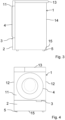
- Fig. 4 shows a top view of the Fig. 1 shown washing machines.
- the tab 3 arranged between the front wall 11 and the flap 2 is clearly visible to the user.
Landscapes
- Engineering & Computer Science (AREA)
- Textile Engineering (AREA)
- Main Body Construction Of Washing Machines And Laundry Dryers (AREA)
- Detail Structures Of Washing Machines And Dryers (AREA)
Description
- Die Erfindung betrifft einen Waschautomaten undloder Trockner. Insbesondere betrifft die Erfindung einen Waschautomaten und/oder Trockner mit einem Gehäuse und einer in das Gehäuse intergierten Klappe. Eine Kombination aus Waschautomat und Trockner wird auch als Waschtrockner bezeichnet.
- Aus einem druckschriftlich nicht belegten Stand der Technik ist bekannt, dass eine solche Klappe an einem Waschautomaten, Waschtrockner oder Trockner mittels eines Schwenkstopfens, der eine Mulde abdeckt, oder einer Taste öffenbar ist, die eine Entriegelung und das Aufspringen der Klappe ermöglicht. Alternative, zum Öffnen der Klappe ausgebildete Elemente sind feststehend, wie z.B. eine Griffleiste oder ein hervorstehender Griff, die aus hartem Material geformt werden. Entweder sind diese Klappenöffnungselemente sehr auffällig oder sehr aufwendig in der Ausführung, da häufig der Bereich hinter der Klappe aus Sicherheitsgründen abgedeckt werden muss. Bei hervorstehenden Elementen besteht zudem die Gefahr der Verletzung für einen Nutzer des Waschautomaten undloder Trockners. Sind die Klappenöffnungselemente sehr klein ausgeführt, kann es zu Schwierigkeiten beim sicheren Greifen kommen.
- Die
EP 2 843 102 A1 beschreibt ein gattungsgemäßes Gerät. - Der Erfindung stellt sich somit das Problem, einen Waschautomaten und/oder Trockner mit einem Gehäuse und einer im Gehäuse integrierten Klappe bereitzustellen, der ein Element zum Öffnen der Klappe aufweist, welches eine Verletzungsgefahr für den Nutzer ausschließt und einfach integrierbar ist.
- Erfindungsgemäß wird dieses Problem durch einen Waschautomaten undloder Trockner mit den Merkmalen des Patentanspruchs 1 gelöst. Vorteilhafte Ausgestaltungen und Weiterbildungen der Erfindung ergeben sich aus den nachfolgenden Unteransprüchen.
- Die mit der Erfindung erreichbaren Vorteile bestehen neben der Bereitstellung eines Öffnungselements zum Öffnen der Klappe in Form der Lasche, die eine Verletzungsgefahr für den Nutzer verhindert, darin, dass die Lasche selbsterklärend ist und kein weiteres Hilfsmittel zum Öffnen der Klappe notwendig ist. Die Lasche ermöglicht ein sicheres Greifen zum Öffnen der Klappe. Zudem wird für die Lasche kein Durchbruch im Gehäuse und/oder in der Klappe und dessen Abdichtung benötigt. Ein zusätzlicher Eingriffsschutz ist überflüssig. Weiterhin werden zur Herstellung der Lasche keine teuren Werkzeuge wie beispielsweise beim Spritzguss benötigt. Auch ist die Lasche in zahlreichen Varianten fertigbar und kann an Waschautomaten- undloder Trocknervarianten leicht angepasst werden.
- Die Erfindung betrifft einen Waschautomat undloder Trockner, aufweisend ein Gehäuse, eine in das Gehäuse integrierte Klappe und eine Lasche aus einem weichen undloder flexiblen Material, die an der Klappe gegenüber dem Gehäuse und der Klappe herausragend angeordnet ist, und derart ausgebildet ist, dass mittels Ziehen an der Lasche ein Klappen der Klappe aus dem Gehäuse ausgelöst wird.
- Im Sinne der Erfindung ist ein weiches Material, ein Material, das nicht hart oder fest ist. Vielmehr ist das Material einem Druck leicht nachgebend ausgebildet. Das weiche Material ist insbesondere so beschaffen, dass ein Verändern der Form leicht, d.h. mit geringem Kraftaufwand möglich ist.
- Im Sinne der Erfindung ist unter dem Ausdruck "flexibles Material" ein biegsames bzw. elastisches Material zu verstehen.
- Die Klappe ist in das Gehäuse integriert, so dass sie im geschlossenen Zustand eine Öffnung beispielsweise in Form einer Kammer undloder eines Fachs verschließt, die im Gehäuse angeordnet ist. Beispielsweise dient die Kammer und/oder das Fach als Aufbewahrungs- bzw. Vorratsraum für Mittel, die beim Waschautomaten undloder Trockner einzusetzen sind wie beispielsweise Waschmittel, Reinigungsmittel oder dgl. Die Kammer und/oder das Fach kann alternativ auch Teil eines automatischen Dosiersystems sein, in dem für das automatische Dosiersystem vorbestimmte Behälter anzuordnen sind. In einer bevorzugten Ausführungsform weist der Waschautomat oder Waschtrockner das automatische Dosiersystem auf, das mittels Öffnens der Klappe für den Nutzer insofern zugänglich ist, dass er eine oder mehrere Waschmittel-haltige Behälter in der Öffnung anordnen kann.
- Die Lasche ist gegenüber dem Gehäuse und der Klappe herausragend angeordnet. Dadurch ist sie für den Nutzer leicht greifbar. Positions- und Richtungsangaben beziehen sich auf eine betriebsgemäße Aufstellposition des Waschautomaten undloder Trockners.
- In einer bevorzugten Ausführungsform ist die Lasche an einem Laschenbefestigungsbereich der Klappe befestigt, der einem Scharnierbereich der Klappe gegenüberliegt. Dadurch wird ein Auslösen der Klappe, wenn der Nutzer an der Lasche zieht, weiterhin unterstützt. Der Scharnierbereich ist ein Bereich, entlang dessen Erstreckungsrichtung ein Scharnier zum Klappen der Klappe angeordnet ist.
- Bevorzugt ist die Lasche an einem oberen Bereich der Klappe angeordnet, bezogen auf eine betriebsgemäße Aufstellposition des Waschautomaten undloder Trockners. Dadurch kann verhindert werden, dass sich der Nutzer zu weit nach unten bücken muss, um an der Lasche ziehen zu können. Der Laschenbefestigungsbereich ist der obere Bereich der Klappe, während der Scharnierbereich der untere Bereich der Klappe ist.
- In einer bevorzugten Ausführungsform ist die Lasche schlaufenförmig ausgebildet. Dadurch lässt sich die Lasche gut von dem Nutzer greifen und/oder ziehen. Dies ist insbesondere für Nutzer mit eingeschränkter Beweglichkeit wie beispielsweise Rheumapatienten vorteilhaft, weil sie einen Finger in eine durch die schlaufenförmige Gestalt gebildete Laschenöffnung einführen und so auf einfache Weise an der Lasche ziehen können.
- Bevorzugt ist die Lasche an der Klappe angeschraubt und/oder in ihr eingeklemmt. Dadurch ist die Lasche sicher und fest an der Klappe befestigt.
- Erfindungsgemäß weist die Lasche mindestens einen Lichtleiter auf. Mittels des oder der Lichtleiter können Text(e) und/oder Symbol(e) auf der Lasche abgebildet werden, die beispielsweise auf den Inhalt hinter der Klappe hinweisen. Mittels des oder der Lichtleiter können so Informationen, wie z.B. "Wechsel der Behälter des automatischen Dosierungssystems notwendig", kommuniziert werden. Zudem kann der Lichtleiter beispielsweise in einem abgedunkelten Raum wie einen Keller auf die Lasche als Öffnungshilfe hinweisen.
- Erfindungsgemäß weist die Lasche ein Gewebe auf, in das der mindestens eine Lichtleiter eingewoben, eingeflochten undloder eingespritzt ist. Dadurch ist der Lichtleiter gut mit dem Gewebe verbunden und kann sich nicht mit der Zeit aus ihm herauslösen.
- In einer bevorzugten Ausführungsform ist ein Ende des mindestens einen Lichtleiters in den Scharnierbereich der Klappe geführt und derart angeordnet und ausgebildet, dass er von einer im Innern des Waschautomaten undloder Trockners angeordneten Energieversorgung mit Strom versorgbar ist. Der Lichtleiter benötigt keine eigene Energieversorgungseinrichtung, wodurch Bauteile und Kosten gespart werden können. Da es sich um eine relativ geringe Energiezufuhr handelt, besteht keine Gefahr eines Stromschlags.
- Bevorzugt ist die Lasche insbesondere das Gewebe aus Stoff undloder Kunststoff ausgebildet. Diese Materialien schließen eine Verletzung beim Nutzer aus, wenn er an der Lasche zieht. Bevorzugter ist die Lasche aus Kunststoff ausgebildet. Dadurch ist ein Verschleiß der Lasche minimal.
- Bevorzugt weist der Waschautomat undloder Trockner Füße auf, auf die er in betriebsgemäßer Aufstellposition steht, und ist die Klappe in einen unteren Bereich des Gehäuses intergiert. Die Füße ermöglichen ein leichtes Klappen der Klappe, ohne einen Untergrund zu beschädigen, auf dem der Waschautomat undloder Trockner aufgestellt ist.
- Ein Ausführungsbeispiel der Erfindung ist in den Zeichnungen rein schematisch dargestellt und wird nachfolgend näher beschrieben. Es zeigt
- Fig. 1
- eine perspektivische Ansicht eines erfindungsgemäßen Waschautomaten mit geschlossenem Zustand einer Klappe;
- Fig. 2
- eine weitere perspektivische Ansicht des in
Fig. 1 gezeigten Waschautomaten mit teilweise geöffnetem Zustand der Klappe; - Fig. 3
- eine Seitenansicht des in
Fig. 1 gezeigten Waschautomaten; und - Fig. 4
- eine Draufsicht auf den in
Fig. 1 gezeigten Waschautomaten. -
Fig. 1 zeigt eine perspektivische Ansicht eines erfindungsgemäßen Waschautomaten mit geschlossenem Zustand einer Klappe. Der Waschautomat weist ein Gehäuse 1 auf, das in betriebsgemäßer Aufstellposition eine Frontwand 11, Seitenwände 12 und eine Oberwand 13 aufweist. In der Frontwand 11 ist eine Tür 4 angeordnet, um dem Nutzer ein Befüllen des Waschautomaten mit Wäsche zu ermöglichen. In das Gehäuse 1 ist ferner eine Klappe 2 integriert, die inFig. 1 geschlossen ist. Der Waschautomat weist ferner eine Lasche 3 aus einem weichen undloder flexiblen Material auf, die derart ausgebildet ist, dass mittels Ziehens an der Lasche 3 ein Klappen der Klappe 2 aus dem Gehäuse 1 ausgelöst wird. -
Fig. 2 zeigt eine weitere perspektivische Ansicht des inFig. 1 gezeigten Waschautomaten mit teilweise geöffnetem Zustand der Klappe, wobei die Tür der Übersichtlichkeit halber nicht gezeigt ist. Die Klappe 2 ist nicht geschlossen ist sondern teilweise geklappt insbesondere herausgezogen. Die Lasche 3 ist an einem oberen Bereich insbesondere einem Laschenbefestigungsbereich (nicht gezeigt) der Klappe 2 befestigt, der einem unteren Bereich insbesondere Scharnierbereich (nicht gezeigt) der Klappe 2 gegenüberliegt. Die Lasche 3 ist an der Klappe 2 angeschraubt undloder in ihr eingeklemmt. Der Waschautomat weist Füße 5 auf, auf die er stellbar ist. -
Fig. 3 zeigt eine Seitenansicht des inFig. 1 gezeigten Waschautomaten. Die Lasche 3 ist gegenüber dem Gehäuse 1 und der Klappe 2 herausragend angeordnet. Das Gehäuse 1 weist ferner eine Rückwand 14, die der Frontwand 11 gegenüberliegt, sowie eine Bodenwand 15 auf. An der Bodenwand 15 sind die Füße 5 angeordnet, auf denen der Waschautomat in betriebsgemäßer Aufstellposition steht. -
Fig. 4 zeigt eine Draufsicht auf den inFig. 1 gezeigten Waschautomaten. Bei Draufsicht auf den Waschautomaten ist die zwischen der Frontwand 11 und der Klappe 2 angeordnete Lasche 3 vom Nutzer unübersehbar sichtbar. -
- 1
- Gehäuse
- 11
- Frontwand
- 12
- Seitenwand
- 13
- Oberwand
- 14
- Rückwand
- 15
- Bodenwand
- 2
- Klappe
- 3
- Lasche
- 4
- Tür
- 5
- Fuß
Claims (7)
- Waschautomat und/oder Trockner, aufweisend ein Gehäuse (1), eine in das Gehäuse (1) integrierte Klappe (2) und eine Lasche (3) aus einem weichen und/oder flexiblen Material, die an der Klappe (2) gegenüber dem Gehäuse (1) und der Klappe (2) herausragend angeordnet ist,
dadurch gekennzeichnet,dass die Lasche derart ausgebildet ist, dass mittels Ziehen an der Lasche (3) ein Klappen der Klappe (2) aus dem Gehäuse (1) ausgelöst wird, unddass die Lasche (3) mindestens einen Lichtleiter aufweist, unddass die Lasche (3) ein Gewebe aufweist, in das der mindestens eine Lichtleiter eingewoben, eingeflochten undloder eingespritzt ist. - Waschautomat undloder Trockner nach Anspruch 1, dadurch gekennzeichnet, dass die Lasche (3) an einem Laschenbefestigungsbereich der Klappe (2) befestigt ist, der einem Scharnierbereich der Klappe (2) gegenüberliegt.
- Waschautomat undloder Trockner nach Anspruch 1 oder 2, dadurch gekennzeichnet, dass die Lasche (3) an einem oberen Bereich der Klappe (2) angeordnet ist, bezogen auf eine betriebsgemäße Aufstellposition des Waschautomaten undloder Trockners.
- Waschautomat und/oder Trockner nach einem der vorangehenden Ansprüche, dadurch gekennzeichnet, dass die Lasche (3) schlaufenförmig ausgebildet ist.
- Waschautomat undloder Trockner nach einem der vorangehenden Ansprüche, dadurch gekennzeichnet, dass die Lasche (3) an der Klappe (2) angeschraubt undloder in ihr eingeklemmt ist.
- Waschautomat undloder Trockner nach Anspruch 1, dadurch gekennzeichnet, dass ein Ende des mindestens einen Lichtleiters in den Scharnierbereich der Klappe (2) geführt ist und derart angeordnet und ausgebildet ist, dass er von einer im Innern des Waschautomaten undloder Trockners angeordneten Energieversorgung mit Strom versorgbar ist.
- Waschautomat undloder Trockner nach einem der vorangehenden Ansprüche, dadurch gekennzeichnet, dass die Lasche (2) aus Kunststoff ausgebildet ist.
Applications Claiming Priority (2)
| Application Number | Priority Date | Filing Date | Title |
|---|---|---|---|
| DE102019122324.5A DE102019122324A1 (de) | 2019-08-20 | 2019-08-20 | Waschautomat und/oder Trockner |
| PCT/EP2020/072734 WO2021032586A1 (de) | 2019-08-20 | 2020-08-13 | Waschautomat und/oder trockner |
Publications (3)
| Publication Number | Publication Date |
|---|---|
| EP4018030A1 EP4018030A1 (de) | 2022-06-29 |
| EP4018030B1 true EP4018030B1 (de) | 2024-10-09 |
| EP4018030C0 EP4018030C0 (de) | 2024-10-09 |
Family
ID=72234809
Family Applications (1)
| Application Number | Title | Priority Date | Filing Date |
|---|---|---|---|
| EP20761161.7A Active EP4018030B1 (de) | 2019-08-20 | 2020-08-13 | Waschautomat und/oder trockner |
Country Status (6)
| Country | Link |
|---|---|
| US (1) | US12325948B2 (de) |
| EP (1) | EP4018030B1 (de) |
| KR (1) | KR20220044751A (de) |
| CN (1) | CN114269980A (de) |
| DE (1) | DE102019122324A1 (de) |
| WO (1) | WO2021032586A1 (de) |
Families Citing this family (4)
| Publication number | Priority date | Publication date | Assignee | Title |
|---|---|---|---|---|
| TWD228648S (zh) * | 2022-09-02 | 2023-11-21 | 大陸商北京石頭世紀科技股份有限公司 | 洗烘一體機 |
| USD1046328S1 (en) * | 2022-10-24 | 2024-10-08 | Haier Us Appliance Solutions, Inc. | Front loading appliance |
| USD1057326S1 (en) * | 2022-10-25 | 2025-01-07 | Samsung Electronics Co., Ltd. | Washing machine |
| BE1031768B1 (de) * | 2023-07-05 | 2025-02-06 | Miele & Cie | Waschautomat und/oder Trockenautomat |
Family Cites Families (14)
| Publication number | Priority date | Publication date | Assignee | Title |
|---|---|---|---|---|
| JPH11278482A (ja) * | 1998-03-25 | 1999-10-12 | Ishida Co Ltd | 開封用把手を有する容器蓋 |
| ITTO20030236A1 (it) * | 2003-03-28 | 2004-09-29 | Merloni Elettrodomestici Spa | Macchina lavabiancheria, in particolare a caricamento |
| FR2858811B1 (fr) * | 2003-08-12 | 2005-10-21 | Participations G | Boite en bois notamment pour le rangement de crochets de couverture |
| JP2007035598A (ja) * | 2005-07-29 | 2007-02-08 | Toshiba Corp | 電子機器 |
| KR101414628B1 (ko) * | 2007-12-03 | 2014-07-03 | 엘지전자 주식회사 | 의류 처리장치 |
| DE102008027727B3 (de) * | 2008-06-11 | 2009-07-30 | BSH Bosch und Siemens Hausgeräte GmbH | Hausgerät mit einer Tür |
| CN201536799U (zh) * | 2009-08-27 | 2010-08-04 | 台州市黄岩恒新日用品有限公司 | 抽屉式收纳布柜 |
| CN202244390U (zh) * | 2011-09-30 | 2012-05-30 | 杨开良 | 抽屉式酒盒 |
| DE102011055090B3 (de) * | 2011-11-07 | 2012-12-27 | Miele & Cie. Kg | Wäschebehandlungsmaschine wie Waschmaschine oder Wäschetrockner |
| WO2014042386A1 (en) * | 2012-09-17 | 2014-03-20 | Lg Electronics Inc. | Laundry treating apparatus with auxiliary detergent supply module |
| EP2843102B1 (de) * | 2013-08-30 | 2016-07-20 | Electrolux Appliances Aktiebolag | Wäschebehandlungsmaschine mit von einem Scharnier gehaltener Abdeckung |
| KR102713773B1 (ko) * | 2016-01-05 | 2024-10-08 | 엘지전자 주식회사 | 세제 투입 도어를 구비하는 의류처리장치 |
| US10060066B2 (en) * | 2016-06-30 | 2018-08-28 | Whirlpool Corporation | Laundry appliance door assembly |
| CN207340115U (zh) * | 2017-07-12 | 2018-05-08 | 深圳市安特信技术有限公司 | 一种拉环与光孔结合的充电插 |
-
2019
- 2019-08-20 DE DE102019122324.5A patent/DE102019122324A1/de not_active Withdrawn
-
2020
- 2020-08-13 KR KR1020227005087A patent/KR20220044751A/ko not_active Ceased
- 2020-08-13 WO PCT/EP2020/072734 patent/WO2021032586A1/de not_active Ceased
- 2020-08-13 CN CN202080058551.7A patent/CN114269980A/zh active Pending
- 2020-08-13 EP EP20761161.7A patent/EP4018030B1/de active Active
- 2020-08-13 US US17/636,596 patent/US12325948B2/en active Active
Also Published As
| Publication number | Publication date |
|---|---|
| DE102019122324A1 (de) | 2021-03-11 |
| US20220298714A1 (en) | 2022-09-22 |
| US12325948B2 (en) | 2025-06-10 |
| EP4018030A1 (de) | 2022-06-29 |
| CN114269980A (zh) | 2022-04-01 |
| WO2021032586A1 (de) | 2021-02-25 |
| EP4018030C0 (de) | 2024-10-09 |
| KR20220044751A (ko) | 2022-04-11 |
Similar Documents
| Publication | Publication Date | Title |
|---|---|---|
| WO2021032586A1 (de) | Waschautomat und/oder trockner | |
| EP1349977B1 (de) | Haushaltmaschine zum waschen oder trocknen von wäsche | |
| DE102006057315A1 (de) | Waschmittelzugabevorrichtung einer Waschmaschine | |
| DE102007041946A1 (de) | Wäschemaschine | |
| DE3301636C2 (de) | ||
| WO2019076636A1 (de) | Haushaltsgerät | |
| DE112007000423T5 (de) | Geschirrspülmaschine | |
| DE69608481T2 (de) | Frontladerwäschewasch- und/oder -trocknermaschine mit Vorrichtungen zum Öffnen der Tür | |
| EP2281938A1 (de) | Wasserführendes Hausgerät mit einer Schale | |
| EP3931647A2 (de) | Bedientafel für eine werkzeugmaschine | |
| DE102008027727B3 (de) | Hausgerät mit einer Tür | |
| DE69206729T2 (de) | Vorrichtung zum Öffnen der Zugangstüre einer Haushaltswaschmaschine | |
| DE102014117849A1 (de) | Hebelvorrichtung für einen Fahrzeug-Türgriff | |
| DE10307364B4 (de) | Vorrichtung zur Kofferraum-Notentriegelung in einem Kraftfahrzeug | |
| DE19843976A1 (de) | Spülmittel-Abgabevorrichtung für eine Geschirrspülmaschine | |
| EP1329187B1 (de) | Geschirrspülmaschine mit einem in der Gerätetür angeordneten Salzbehälter einer Enthärtungseinrichtung | |
| DE102013205766A1 (de) | Manuelle Fahrzeugtür-Sperranordnung | |
| DE10155941B4 (de) | Anordnung eines Hakens für die Aufhängung von Gegenständen in einem Kraftfahrzeug | |
| EP2937458A1 (de) | Wäschebehandlungsmaschine mit einer vorrichtung für die zugabe von flüssigen wasch- und/oder pflegemitteln | |
| DE102007052906A1 (de) | Bodenverankerung | |
| DE102011086388B3 (de) | Absperrbare bistabile Ablage | |
| DE60208947T2 (de) | Verriegelung für eine Kraftfahrzeugtür und Anordnung einer solchen Vorrichtung auf einer Wand dieser Tür | |
| EP2281939B1 (de) | Hausgerät mit einer Schale | |
| DE202004017165U1 (de) | Vario-Nasszelle für ein Fahrzeug, insbesondere Wohnmobil oder Wohnwagen | |
| DE102016209004B4 (de) | Seitenfenster-Beschattungsvorrichtung für ein Kraftfahrzeug |
Legal Events
| Date | Code | Title | Description |
|---|---|---|---|
| STAA | Information on the status of an ep patent application or granted ep patent |
Free format text: STATUS: UNKNOWN |
|
| STAA | Information on the status of an ep patent application or granted ep patent |
Free format text: STATUS: THE INTERNATIONAL PUBLICATION HAS BEEN MADE |
|
| PUAI | Public reference made under article 153(3) epc to a published international application that has entered the european phase |
Free format text: ORIGINAL CODE: 0009012 |
|
| STAA | Information on the status of an ep patent application or granted ep patent |
Free format text: STATUS: REQUEST FOR EXAMINATION WAS MADE |
|
| 17P | Request for examination filed |
Effective date: 20220321 |
|
| AK | Designated contracting states |
Kind code of ref document: A1 Designated state(s): AL AT BE BG CH CY CZ DE DK EE ES FI FR GB GR HR HU IE IS IT LI LT LU LV MC MK MT NL NO PL PT RO RS SE SI SK SM TR |
|
| DAV | Request for validation of the european patent (deleted) | ||
| DAX | Request for extension of the european patent (deleted) | ||
| STAA | Information on the status of an ep patent application or granted ep patent |
Free format text: STATUS: EXAMINATION IS IN PROGRESS |
|
| 17Q | First examination report despatched |
Effective date: 20230707 |
|
| REG | Reference to a national code |
Ref legal event code: R079 Ipc: D06F0025000000 Ref country code: DE Ref legal event code: R079 Ref document number: 502020009452 Country of ref document: DE Free format text: PREVIOUS MAIN CLASS: D06F0039120000 Ipc: D06F0025000000 |
|
| GRAP | Despatch of communication of intention to grant a patent |
Free format text: ORIGINAL CODE: EPIDOSNIGR1 |
|
| STAA | Information on the status of an ep patent application or granted ep patent |
Free format text: STATUS: GRANT OF PATENT IS INTENDED |
|
| RIC1 | Information provided on ipc code assigned before grant |
Ipc: D06F 39/12 20060101ALI20240424BHEP Ipc: D06F 58/20 20060101ALI20240424BHEP Ipc: D06F 25/00 20060101AFI20240424BHEP |
|
| INTG | Intention to grant announced |
Effective date: 20240521 |
|
| GRAS | Grant fee paid |
Free format text: ORIGINAL CODE: EPIDOSNIGR3 |
|
| GRAA | (expected) grant |
Free format text: ORIGINAL CODE: 0009210 |
|
| STAA | Information on the status of an ep patent application or granted ep patent |
Free format text: STATUS: THE PATENT HAS BEEN GRANTED |
|
| AK | Designated contracting states |
Kind code of ref document: B1 Designated state(s): AL AT BE BG CH CY CZ DE DK EE ES FI FR GB GR HR HU IE IS IT LI LT LU LV MC MK MT NL NO PL PT RO RS SE SI SK SM TR |
|
| REG | Reference to a national code |
Ref country code: CH Ref legal event code: EP |
|
| REG | Reference to a national code |
Ref country code: DE Ref legal event code: R096 Ref document number: 502020009452 Country of ref document: DE |
|
| REG | Reference to a national code |
Ref country code: IE Ref legal event code: FG4D Free format text: LANGUAGE OF EP DOCUMENT: GERMAN |
|
| U01 | Request for unitary effect filed |
Effective date: 20241028 |
|
| REG | Reference to a national code |
Ref country code: GB Ref legal event code: 746 Effective date: 20241118 |
|
| U07 | Unitary effect registered |
Designated state(s): AT BE BG DE DK EE FI FR IT LT LU LV MT NL PT RO SE SI Effective date: 20241107 |
|
| PG25 | Lapsed in a contracting state [announced via postgrant information from national office to epo] |
Ref country code: IS Free format text: LAPSE BECAUSE OF FAILURE TO SUBMIT A TRANSLATION OF THE DESCRIPTION OR TO PAY THE FEE WITHIN THE PRESCRIBED TIME-LIMIT Effective date: 20250209 Ref country code: HR Free format text: LAPSE BECAUSE OF FAILURE TO SUBMIT A TRANSLATION OF THE DESCRIPTION OR TO PAY THE FEE WITHIN THE PRESCRIBED TIME-LIMIT Effective date: 20241009 |
|
| PG25 | Lapsed in a contracting state [announced via postgrant information from national office to epo] |
Ref country code: ES Free format text: LAPSE BECAUSE OF FAILURE TO SUBMIT A TRANSLATION OF THE DESCRIPTION OR TO PAY THE FEE WITHIN THE PRESCRIBED TIME-LIMIT Effective date: 20241009 |
|
| PG25 | Lapsed in a contracting state [announced via postgrant information from national office to epo] |
Ref country code: NO Free format text: LAPSE BECAUSE OF FAILURE TO SUBMIT A TRANSLATION OF THE DESCRIPTION OR TO PAY THE FEE WITHIN THE PRESCRIBED TIME-LIMIT Effective date: 20250109 |
|
| PG25 | Lapsed in a contracting state [announced via postgrant information from national office to epo] |
Ref country code: GR Free format text: LAPSE BECAUSE OF FAILURE TO SUBMIT A TRANSLATION OF THE DESCRIPTION OR TO PAY THE FEE WITHIN THE PRESCRIBED TIME-LIMIT Effective date: 20250110 |
|
| PG25 | Lapsed in a contracting state [announced via postgrant information from national office to epo] |
Ref country code: PL Free format text: LAPSE BECAUSE OF FAILURE TO SUBMIT A TRANSLATION OF THE DESCRIPTION OR TO PAY THE FEE WITHIN THE PRESCRIBED TIME-LIMIT Effective date: 20241009 |
|
| PG25 | Lapsed in a contracting state [announced via postgrant information from national office to epo] |
Ref country code: RS Free format text: LAPSE BECAUSE OF FAILURE TO SUBMIT A TRANSLATION OF THE DESCRIPTION OR TO PAY THE FEE WITHIN THE PRESCRIBED TIME-LIMIT Effective date: 20250109 |
|
| PG25 | Lapsed in a contracting state [announced via postgrant information from national office to epo] |
Ref country code: SM Free format text: LAPSE BECAUSE OF FAILURE TO SUBMIT A TRANSLATION OF THE DESCRIPTION OR TO PAY THE FEE WITHIN THE PRESCRIBED TIME-LIMIT Effective date: 20241009 |
|
| PG25 | Lapsed in a contracting state [announced via postgrant information from national office to epo] |
Ref country code: SK Free format text: LAPSE BECAUSE OF FAILURE TO SUBMIT A TRANSLATION OF THE DESCRIPTION OR TO PAY THE FEE WITHIN THE PRESCRIBED TIME-LIMIT Effective date: 20241009 |
|
| PG25 | Lapsed in a contracting state [announced via postgrant information from national office to epo] |
Ref country code: CZ Free format text: LAPSE BECAUSE OF FAILURE TO SUBMIT A TRANSLATION OF THE DESCRIPTION OR TO PAY THE FEE WITHIN THE PRESCRIBED TIME-LIMIT Effective date: 20241009 |
|
| PLBE | No opposition filed within time limit |
Free format text: ORIGINAL CODE: 0009261 |
|
| STAA | Information on the status of an ep patent application or granted ep patent |
Free format text: STATUS: NO OPPOSITION FILED WITHIN TIME LIMIT |
|
| 26N | No opposition filed |
Effective date: 20250710 |
|
| U20 | Renewal fee for the european patent with unitary effect paid |
Year of fee payment: 6 Effective date: 20250901 |
|
| PGFP | Annual fee paid to national office [announced via postgrant information from national office to epo] |
Ref country code: TR Payment date: 20250801 Year of fee payment: 6 |
|
| PGFP | Annual fee paid to national office [announced via postgrant information from national office to epo] |
Ref country code: GB Payment date: 20250826 Year of fee payment: 6 |
|
| REG | Reference to a national code |
Ref country code: CH Ref legal event code: H13 Free format text: ST27 STATUS EVENT CODE: U-0-0-H10-H13 (AS PROVIDED BY THE NATIONAL OFFICE) Effective date: 20260324 |
|
| PG25 | Lapsed in a contracting state [announced via postgrant information from national office to epo] |
Ref country code: MC Free format text: LAPSE BECAUSE OF FAILURE TO SUBMIT A TRANSLATION OF THE DESCRIPTION OR TO PAY THE FEE WITHIN THE PRESCRIBED TIME-LIMIT Effective date: 20241009 |
|
| PG25 | Lapsed in a contracting state [announced via postgrant information from national office to epo] |
Ref country code: CH Free format text: LAPSE BECAUSE OF NON-PAYMENT OF DUE FEES Effective date: 20250831 |
|
| PG25 | Lapsed in a contracting state [announced via postgrant information from national office to epo] |
Ref country code: IE Free format text: LAPSE BECAUSE OF NON-PAYMENT OF DUE FEES Effective date: 20250813 |