EP3926331B1 - Procédé d'inspection de composants électroniques - Google Patents
Procédé d'inspection de composants électroniques Download PDFInfo
- Publication number
- EP3926331B1 EP3926331B1 EP21180064.4A EP21180064A EP3926331B1 EP 3926331 B1 EP3926331 B1 EP 3926331B1 EP 21180064 A EP21180064 A EP 21180064A EP 3926331 B1 EP3926331 B1 EP 3926331B1
- Authority
- EP
- European Patent Office
- Prior art keywords
- electronic component
- image
- image capture
- light
- terminals
- Prior art date
- Legal status (The legal status is an assumption and is not a legal conclusion. Google has not performed a legal analysis and makes no representation as to the accuracy of the status listed.)
- Active
Links
Images





Classifications
-
- G—PHYSICS
- G01—MEASURING; TESTING
- G01B—MEASURING LENGTH, THICKNESS OR SIMILAR LINEAR DIMENSIONS; MEASURING ANGLES; MEASURING AREAS; MEASURING IRREGULARITIES OF SURFACES OR CONTOURS
- G01B11/00—Measuring arrangements characterised by the use of optical techniques
- G01B11/02—Measuring arrangements characterised by the use of optical techniques for measuring length, width or thickness
- G01B11/06—Measuring arrangements characterised by the use of optical techniques for measuring length, width or thickness for measuring thickness ; e.g. of sheet material
- G01B11/0608—Height gauges
-
- G—PHYSICS
- G01—MEASURING; TESTING
- G01N—INVESTIGATING OR ANALYSING MATERIALS BY DETERMINING THEIR CHEMICAL OR PHYSICAL PROPERTIES
- G01N21/00—Investigating or analysing materials by the use of optical means, i.e. using sub-millimetre waves, infrared, visible or ultraviolet light
- G01N21/84—Systems specially adapted for particular applications
- G01N21/88—Investigating the presence of flaws or contamination
- G01N21/95—Investigating the presence of flaws or contamination characterised by the material or shape of the object to be examined
- G01N21/956—Inspecting patterns on the surface of objects
- G01N21/95684—Patterns showing highly reflecting parts, e.g. metallic elements
-
- G—PHYSICS
- G01—MEASURING; TESTING
- G01N—INVESTIGATING OR ANALYSING MATERIALS BY DETERMINING THEIR CHEMICAL OR PHYSICAL PROPERTIES
- G01N21/00—Investigating or analysing materials by the use of optical means, i.e. using sub-millimetre waves, infrared, visible or ultraviolet light
- G01N21/84—Systems specially adapted for particular applications
- G01N21/88—Investigating the presence of flaws or contamination
- G01N21/8806—Specially adapted optical and illumination features
-
- G—PHYSICS
- G02—OPTICS
- G02B—OPTICAL ELEMENTS, SYSTEMS OR APPARATUS
- G02B26/00—Optical devices or arrangements for the control of light using movable or deformable optical elements
- G02B26/08—Optical devices or arrangements for the control of light using movable or deformable optical elements for controlling the direction of light
- G02B26/0816—Optical devices or arrangements for the control of light using movable or deformable optical elements for controlling the direction of light by means of one or more reflecting elements
-
- H—ELECTRICITY
- H04—ELECTRIC COMMUNICATION TECHNIQUE
- H04N—PICTORIAL COMMUNICATION, e.g. TELEVISION
- H04N23/00—Cameras or camera modules comprising electronic image sensors; Control thereof
- H04N23/56—Cameras or camera modules comprising electronic image sensors; Control thereof provided with illuminating means
-
- G—PHYSICS
- G01—MEASURING; TESTING
- G01N—INVESTIGATING OR ANALYSING MATERIALS BY DETERMINING THEIR CHEMICAL OR PHYSICAL PROPERTIES
- G01N2201/00—Features of devices classified in G01N21/00
- G01N2201/06—Illumination; Optics
- G01N2201/063—Illuminating optical parts
- G01N2201/0636—Reflectors
Definitions
- the present disclosure relates to an electronic component inspection method.
- Pre-shipment inspection of manufactured electronic component is a usual practice at manufacturing sites of electronic component.
- Known apparatus for inspecting electronic component is exemplified by an appearance inspection apparatus described in JP-H10-288508A .
- the apparatus described in JP-H10-288508A has an integrated structure of a two-dimensional image lighting unit, a camera for capturing a two-dimensional image illuminated by the two-dimensional image lighting unit, a laser irradiation unit that irradiates laser light on an object, and a laser spot receiving position detector that receives laser light reflected on the object to determine change of height level of the object, thereby enabling acquisition of a two-dimensional image and a three-dimensional height information at a time.
- Document EP 0 425 722 A1 shows an arrangement for detecting the position of connecting pins of electronic components by positioning the electronic components at least approximately on a translucent, light-scattering plate with simultaneous illumination of the connecting pins and evaluation of the shape of the shading generated on the transparent plate through the connecting pins by means of an image recording on the side of the transparent plate opposite the electronic component with connected image processing. At least one light source for sequential Illumination of the connecting pins from two different directions.
- the method comprises illuminating the device edge and leads with backlit diffuse illumination radiating in the directions corresponding to the first and second optical axes, capturing a first backlit image of the device edge and the leads in a direction corresponding to the first optical axis, deflecting a second backlit image of the device edge and leads from a direction corresponding to the second optical axis into a direction corresponding to the first optical axis, and capturing the second deflected backlit image of the device edge and the leads.
- a method for obtaining a machine-vision image of an object comprising blocking a first portion of the object with a first illuminated surface, and imaging a second portion of the object using back light from the first illuminated surface.
- Inspection of electronic component include inspection of mounting failure.
- the mounting failure is judged on the basis of inclination (flatness) of a component body when mounted on a board.
- the flatness of the electronic component is detected by measuring height of a terminal that extends out from the component body of the electronic component, that is, the height of terminal with reference to the component body. The more precisely the height of terminal is measured, the more precisely the mounting failure is detectable.
- the height of terminal is determined on an image of the terminal captured with a camera.
- a possible way to detect the height of terminal may be such as applying the appearance inspection apparatus described in JP-H10-288508A , and obtaining information regarding the height of terminal from the two-dimensional image.
- the present disclosure conceived considering the aforementioned problem, is to provide an inspection method capable of accurately specifying an inspection point on the terminal of the electronic component.
- an electronic component inspection method in accordance with claim 1 is provided.
- Advantageous embodiments of this aspect are defined in dependent claims 2 to 4
- the present disclosure can provide an electronic component inspection method that can accurately specify an inspection point on a terminal of an electronic component.
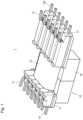
- FIG. 1 is a perspective view illustrating an electronic component 1 to be inspected by using an electronic component inspection apparatus suitable for carrying out the method in accordance with the present embodiments, in which the electronic component 1 is viewed from the side facing to the mounting face.
- the "mounting face” in the context of this patent specification is a virtual plane assumed when the electronic component 1 is mounted.
- Figs. 2A and 2B are drawings illustrating the top face and the bottom face (the bottom face will also be denoted as "terminal face”, hereinafter), wherein Fig. 2A is a bottom view of the electronic component 1, and Fig. 2B is a top view of the electronic component 1.
- the electronic component 1 has a component body 10 and terminals 11, 12. Note that terminals 111, 122 that extend from the component body 10 are entwined terminals, and are not constituents of the mounting terminal.
- the component body 10 has a bobbin (not illustrated) with a wound part (not illustrated) around which a coil 15 is wound on the outer circumference thereof, a base 16 that houses the bobbin, and outside legs 17 that partially house the terminals 11, 12 and partially allow them to expose.
- the terminals 11, 12 are mounting terminals that are electrically connected respectively with the terminals 111, 122 to which coil ends (not illustrated) of the coil 15 are entwined, and are mounted on an unillustrated mounting board. These plurality of terminals 11, 12 are held in parallel to each other by the base 16.
- a face which is directed opposite to the mounting face when the electronic component 1 is mounted will be denoted as a "back face”. That is, the back face in the context of the present embodiments is determined with reference to the mounting face. The back face is identical to the top face of the electronic component 1.
- the terminals 11, 12 are lead terminals that extend from the component body 10 in mutually opposite directions.
- the terminal that extends from the base 16 leftwards in Figs. 2A and 2B is referred to as the terminal 11, and the terminal that extends rightwards is referred to as the terminal 12 for convenience.
- the present embodiments are not limited to inspection of the lead terminals, and instead are also applicable to any types of electronic component in which a part of the component body 10 and parts of the terminals 11, 12 form an overlapping area when viewed from the side of the mounting face.
- the light is irradiated on the electronic component 1 from the side of the back face, to acquire a two-dimensional image of the back face.
- Contour shapes of the terminals 11, 12 are then detected from the thus obtained two-dimensional image, and points (ordinates) on the terminals 11, 12 are detected referring to edges of the terminals 11, 12 determined on the basis of the contour shapes. Processing is then carried out to correlate the thus detected points with predetermined inspection points.
- the first embodiment is devised to insert a reflective plate into an overlapping areas of each of the terminals 11, 12 and the component body 10 when viewed from the side of the mounting face, so as to allow the irradiation light to reflect thereon, to thereby capture an image (referred to as "backlit image”, hereinafter) showing sharp edges of the terminals 11, 12.
- Fig. 3 is a drawing explaining an electronic component inspection apparatus suitable for carrying out the method in accordance with the first embodiment (also simply referred to as "inspection apparatus", hereinafter), and is a top view of an inspection apparatus 100.
- the inspection apparatus 100 has a holder 20 that holds and fixes the electronic component 1.
- Fig. 3 is a drawing of the inspection apparatus 100 viewed from the side of the mounting face of the electronic component 1.
- the inspection apparatus 100 has a pair of reflective plates 21, 22 arranged while placing in between an image capture area A in which the electronic component 1 is shot.
- the image capture area A corresponds to a zone shot by a camera 25 illustrated in Fig. 4 .
- the electronic component 1, when shot, is held and fixed so that the terminal face confronts the camera 25 and falls within the image capture area A.
- the reflective plates 21, 22 are arranged one by one laterally on both sides of the image capture area A, each of which being inserted into an area where the component body 10 overlaps with the terminal 11 or with the terminal 12.
- the reflective plates 21, 22 have the ends thereof slightly declined towards the virtual mounting plane assumed when the electronic component 1 is mounted. Tilt of the reflective plates will be described later referring to Fig. 4 and other drawings.
- the reflective plates 21, 22 have formed therein long holes 102, and are fixed to an unillustrated base with use of bolts 101 inserted in the long holes 102.
- the inspection apparatus 100 further has a transfer unit that transfers the electronic component 1.
- the transfer unit may have any structure not specifically limited, by which the electronic component 1 may be loaded typically with use of a robot arm into the image capture area A from the front of the sheet of Fig. 3 , or may alternatively be transferred in the vertical direction of Fig. 3 typically with use of a belt conveyor, so as to move sequentially into the image capture area A, and then leave the image capture area A after shot.
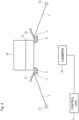
- Fig. 4 is a schematic drawing for explaining the inspection apparatus suitable for carrying out the method in accordance with the first embodiment.
- the inspection apparatus has the holder that holds the electronic component 1 having the terminals 11, 12 at a predetermined position; and a photo-irradiation unit that irradiates reflected light Lr at least onto the terminals 11, 12 of the electronic component 1 held by the holder 20, from the back face.
- the photo-irradiation unit in the first embodiment has light sources 31, 32 and the reflective plates 21, 22. A part of irradiation light L emitted from the light sources 31, 32 is reflected on the reflective plates 21, 22, and irradiated as the reflected light Lr onto the terminals 11, 12 from the back face.
- the structure illustrated in Fig. 4 also has the camera 25, which is an image capture unit that captures an image of the electronic component 1 being irradiated by the irradiation light L and the reflected light Lr with use of the light sources 31, 32 and the reflective plates 21, 22; and a control unit 5 that controls processing related to inspection of the electronic component 1, on the basis of the image of the electronic component 1 captured by the camera 25.
- the reflected light Lr is given as backlight for shooting the terminals 11, 12, when viewed from the camera 25.
- the first embodiment although illustrated in Fig. 4 as an exemplary case having the light sources 31, 32 and the camera 25 arranged below the electronic component 1, is not limited to such structure.
- the first embodiment may alternatively be devised to set the electronic component 1 with the terminal face directed upward, and to arrange the light sources 31, 32 and the camera 25 above the electronic component 1 so as to shoot the terminal face.
- the first embodiment can brighten the terminal face, and can obtain a sharp image of the terminals 11, 12. Such case would, however, make the light scattered on the edges of the terminals, occasionally making the edge contour less discriminable on the image.
- the irradiation light L would be shadowed by the component body 10, so as to make the area where the terminals 11, 12 and the component body 10 overlap less recognizable on the image.
- the present inventors of the present disclosure presupposed that the level of height of the terminals 11, 12 is measured at a plurality of inspection points, so that the aforementioned situation would fail in achieving accuracy sufficient for determining the measuring points of the height level of the terminals 11, 12.
- the first embodiment is devised to compose the photo-irradiation unit by using the light sources 31, 32 that irradiate irradiation light L onto the electronic component; and the reflective plates 21, 22 which serve as a reflector on which the irradiation light L emitted from the light sources 31, 32 is reflect towards the terminals 11, 12, as described above.
- the light sources 31, 32 are freely selectable for example from known types of lamp and light emitting diode (LED).
- the reflective plates 21, 22 are preferably made of a highly reflective material, such as aluminum, stainless steel and other metals. A part of the irradiation light L directed towards the terminals 11, 12 is converted to the reflected light Lr on the reflective plates 21, 22, and then irradiated on the terminals 11, 12 from the back face.
- the reflective plates 21, 22 are inserted so as to respectively aim at kinks between the downwardly protruded sections and the outwardly protruded sections of the terminals 11, 12.
- the reflective plates 21, 22 in this setting are inclined downwards to the mounting face of the electronic component 1.
- the reflective plates 21, 22 are, however, not always necessarily be angled in this way, instead may be nearly in parallel with the mounting face, or may be inclined upwards from the mounting face. Angles of the reflective plates 21, 22 are suitably determined so as to enhance intensity of the reflected light at a desired position, typically depending on distance between the component body 10 and the terminals 11, 12, depth of the overlapping area, and position of the inspection points.
- the contour shape is detectable by any of known techniques of edge detection in image processing.
- the edge detection may rely entirely upon the control unit 5, or may rely partly upon an operator of the inspection apparatus.
- the edge detection in this case may be such that the control unit 5 detects the edges of the terminals 11, 12, and presents them to the operator. The operator then may enter information for adjusting or correcting the edges, detected by the control unit 5, through an unillustrated input device into the control unit 5.
- the inspection points may be set, for example, automatically by the control unit 5 according to predetermined conditions. Such processing may be accomplished typically by, as illustrated in Fig. 5 , determining on the image the inspection point p0 on the edge of the terminal 12, and assuming this point as the origin, by setting pixels that are distant away from the origin by predetermined numbers of pixels in the x-direction and y-direction, as candidates for the inspection points p1 to p8.
- the control unit 5 may alternatively determine, from among the thus determined candidates for the inspection points p1 to p8, at least a part thereof according to a predetermined number or layout of the inspection points.
- a part of the lead terminals 11, 12 and a part of the component body 10 are arranged apart from each other, and so as to form an overlapping area when viewed from the side of the mounting face and the method further comprises: inserting a reflective plate 21, 22 into the overlapping area of the component body 10 and the lead terminal 11, 12 at a level of height between the component body 10 and the lead terminals 11 and 12, irradiating irradiation light L emitted from the light source 31, 32 on the terminal face of the lead terminals 11 and 12, reflecting, from the side of the back face, the irradiation light L on the reflective plate 21, 22 so as to convert the irradiation light L to the reflected light Lr, and irradiating the reflected light Lr on at least the lead terminals 11, 12 from the side of the back face.
- the step of irradiating the irradiation light L and the reflected light Lr is conducted while holding and fixing the electronic component 1.
- Action of making the holder hold the electronic component 1 may be assisted by some device such as robot arm, or may be manually achieved by the operator.
- the irradiation light L may be irradiated, for example, with the aid of the control unit 5, or a device that controls any unillustrated mechanism. Use of the control unit 5 for irradiation of the irradiation light L will, however, facilitate the first embodiment to synchronize irradiation timing of the irradiation light L and acquisition timing of image data.
- the irradiation light L may alternatively be irradiated manually by the operator who switches ON the light sources 31, 32 which are the light sources of laser light.
- the step of capturing an image of the electronic component 1 under of the irradiation light L and the reflected light Lr may be activated, when the control unit 5 outputs a control signal that notifies shooting timing towards the control unit 5. Note, however, that shooting per se may be conducted by the operator through handling of the camera 25.
- the aforementioned processing may be followed by measurement of the distance between the camera 25 and the terminals 11, 12. Height may be measured with use of a 3D camera, typically according to the time-of-flight (TOF) system.
- TOF time-of-flight
- the camera 25 is preferably the 3D camera.
- the thus measured distance is then computed to determine flatness of the electronic component 1 when mounted, making it possible to judge whether the electronic component 1 is acceptable or rejected.
- a backlit image with sharp edges is obtainable since the reflected light Lr is irradiated on the back face of the terminals 11, 12.
- the electronic component inspection apparatus suitable for carrying out the method in accordance with the first embodiment and the electronic component inspection method of the first embodiment can therefore accurately determine the inspection points on the terminals of the electronic component.
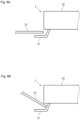
- the angle changer makes change so that the angle of the reflective plates relative to the mounting face, during image capture of the electronic component within the image capture area A (a predetermined tilt angle as illustrated in Fig. 6B ), so as to become larger than the angle of the reflective plates relative to the mounting face, during transfer of the electronic component from the outside to the inside, or from the inside to the outside, of the image capture area A (nearly flat angle as illustrated in 6A).
- the second embodiment now becomes possible to reduce a range occupied heightwise by the reflective plates 21, 22 in the overlapping area between the component body 10 and the terminal 11, upon completion of shooting of the electronic component 1 and exit from the image capture area A, and can prevent the electronic component 1, when transferred, from interfering with the reflective plate 21.
- the reflective plates 21, 22 during shooting are tilted between the component body 10 and the terminal 11. In this way, the light that was emitted from the light sources 31, 32 obliquely towards the component body 10, and was converted into the reflected light Lr after incident on the lower faces of the reflective palates 21, 22 can now illuminate the terminals 11, 12 nearly perpendicularly as illustrated in Fig. 4 , making it possible to efficiently condense the reflected light Lr onto the terminals 11, 12.
- Figs. 7A and 7B are drawings for explaining a variation 1 of the second embodiment.
- the inspection apparatus suitable for carrying out the method in accordance with variation 1 further has a reflective plate shifter that shifts the reflective plates 21, 22 closer to or away from the electronic component 1.
- the reflective plate shifter shifts the reflective plates 21, 22 so that they will become distant from the electronic component 1 outwardly in the direction the terminals 11, 12 extend, more largely during transfer of the electric component 1, than during image capture of the electronic component 1.
- the control unit 5 functions as the reflective plate shifter.
- the control unit 5 shifts the reflective plates 21, 22 so as to make them closer to the electronic component 1 during image capture of the electronic component 1, and to make them more distant from the electronic component 1 after the image capture.
- Fig. 7A illustrates a position of the reflective plate 21 during the image capture
- Fig. 7B illustrates a position of the reflective plate 21 retracted from the electronic component 1 after the image capture.
- This motion of the reflective plates 21, 22 may be enabled by providing an unillustrated drive unit, typically a stepping motor, that brings the reflective plates 21, 22 away from or closer to the electronic component 1, wherein towards a driver of the drive unit, the control unit 5 outputs a control signal that instructs the drive operation.
- the control unit 5 Upon acquisition of image data of a preceding electronic component 1, the control unit 5 outputs a control signal that instructs retraction of the reflective plates 21, 22, from the position illustrated in Fig. 7A to the position illustrated in Fig. 7B , towards the drive unit of the reflective plates 21, 22.
- the drive unit retracts the reflective plate 21 from end point position M0 to position M1 where the reflective plate 21, when viewed from the mounting face, will not overlap the terminals 11, 12.
- reflective plate 21 is consequently retracted by distance ⁇ M from position M0.
- the electronic component 1 is successfully prevented from interfering with the reflective plates 21, 22, when a transfer unit (not illustrated) of the inspection apparatus transfers the electronic component 1 in whichever direction from among the vertical and depth directions of Fig. 7B .
- the structure suitable for carrying out the method in accordance with the second embodiment, aimed to avoid interference of the electric component 1 and the reflective plates 21, 22, is not limited to those relying upon driving of the reflective plates 21, 22.
- Fig. 8 a drawing for explaining the inspection apparatus suitable for carrying out the method in accordance with a variation 2 of the second embodiment.
- the reflective plates 21, 22 as the reflector are fixed in an area that does not overlap the electronic component 1 when viewed from the side of the mounting face.
- an area that overlaps the electronic component is denoted by I, and the area that does not overlap is denoted by O.
- the entire ranges of the reflective plates 21, 22 including the ends are fixed within the area O.
- the reflective plates 21, 22 are arranged with the ends thereof obliquely declined towards the component body 10. In this way, the reflective plates 21, 22, even if being thus fixed, will no longer interfere with the electronic component 1, making it possible to reduce nonconformities such that the apparatus is interrupted during inspection of the electronic component, or such that the terminals 11, 12 of the electronic component 1 are damaged.
Landscapes
- Physics & Mathematics (AREA)
- General Physics & Mathematics (AREA)
- Health & Medical Sciences (AREA)
- Life Sciences & Earth Sciences (AREA)
- Chemical & Material Sciences (AREA)
- Analytical Chemistry (AREA)
- Biochemistry (AREA)
- General Health & Medical Sciences (AREA)
- Immunology (AREA)
- Pathology (AREA)
- Optics & Photonics (AREA)
- Engineering & Computer Science (AREA)
- Multimedia (AREA)
- Signal Processing (AREA)
- Investigating Materials By The Use Of Optical Means Adapted For Particular Applications (AREA)
- Supply And Installment Of Electrical Components (AREA)
Claims (4)
- Procédé d'inspection de composants électroniques, comprenant :l'irradiation d'une lumière réfléchie (Lr) sur au moins une borne de fil (11, 12) d'un composant électronique (1) qui comporte un corps de composant (10) et la borne de fil (11, 12) qui s'étend à partir du corps de composant (10) depuis le côté d'une face arrière opposée à une face de borne qui est une face de montage du composant électronique (1) ;la capture d'une image du composant électronique (1) sous l'irradiation de lumière, depuis le côté de la face de montage ; etle contrôle du traitement lié à l'inspection du composant électronique (1), sur la base de l'image capturée du composant électronique (1),caractérisé en ce queune partie de la borne de fil (11, 12) et une partie du corps de composant (10) sont espacées l'une de l'autre, de manière à former une zone de chevauchement quand elles sont vues du côté de la face de montage,et dans lequel le procédé comprend en outre :l'insertion d'une plaque réfléchissante (21, 22) dans la zone de chevauchement du corps de composant (10) et de la borne de fil (11, 12) à une hauteur comprise entre le corps de composant (10) et la borne de fil (11, 12),l'irradiation d'une lumière d'irradiation (L) émise par une source lumineuse (31, 32) sur la face de borne de la borne de fil (11, 12),la réflexion, depuis le côté de la face arrière, de la lumière d'irradiation (L) sur la plaque réfléchissante (21, 22) de manière à convertir la lumière d'irradiation (L) en lumière réfléchie (Lr), etl'irradiation de la lumière réfléchie (Lr) sur au moins la borne de fil (11, 12) depuis le côté de la face arrière.
- Procédé d'inspection de composants électroniques selon la revendication 1, comprenant en outre :le déplacement du composant électronique (1) dans la zone de capture d'image (A) dans laquelle l'image du composant électronique (1) est capturée et dans laquelle la lumière (Lr) est irradiée,le déplacement du composant électronique (1) pour quitter la zone de capture d'image (A) après avoir capturé l'image du composant électronique (1), etle changement de l'angle selon lequel la plaque réfléchissante (21, 22) est inclinée par rapport à la face de montage, de manière à rendre l'angle plus grand pendant la capture d'image du composant électronique (1) que pendant le déplacement du composant électronique (1) dans la zone de capture d'image (A) et le déplacement du composant électronique (1) pour quitter la zone de capture d'image (A).
- Procédé d'inspection de composants électroniques selon la revendication 1, comprenant en outrele déplacement du composant électronique (1) dans la zone de capture d'image (A) dans laquelle l'image du composant électronique (1) est capturée et dans laquelle la lumière (Lr) est irradiée,le déplacement du composant électronique (1) pour quitter la zone de capture d'image (A) après avoir capturé l'image du composant électronique (1), etla réorientation de la plaque réfléchissante (21, 22) de telle sorte que la plaque réfléchissante (21, 22) soit réorientée de manière plus largement éloignée du composant électronique (1) pendant le déplacement du composant électronique (1) dans la zone de capture d'image (A) et le déplacement du composant électronique (1) pour quitter la zone de capture d'image (A) que pendant la capture d'image du composant électronique (1) .
- Procédé d'inspection de composants électroniques selon l'une quelconque des revendications 1 à 3,
dans lequel le traitement de contrôle détecte au moins une forme de contour de la borne de fil (11, 12) sur la base de l'image du composant électronique (1), et définit un point d'inspection à inspecter sur la base de la forme de contour détectée.
Applications Claiming Priority (1)
| Application Number | Priority Date | Filing Date | Title |
|---|---|---|---|
| JP2020105843A JP7484478B2 (ja) | 2020-06-19 | 2020-06-19 | 電子部品の検査装置及び電子部品の検査方法 |
Publications (2)
| Publication Number | Publication Date |
|---|---|
| EP3926331A1 EP3926331A1 (fr) | 2021-12-22 |
| EP3926331B1 true EP3926331B1 (fr) | 2025-03-26 |
Family
ID=76522785
Family Applications (1)
| Application Number | Title | Priority Date | Filing Date |
|---|---|---|---|
| EP21180064.4A Active EP3926331B1 (fr) | 2020-06-19 | 2021-06-17 | Procédé d'inspection de composants électroniques |
Country Status (4)
| Country | Link |
|---|---|
| US (1) | US11821843B2 (fr) |
| EP (1) | EP3926331B1 (fr) |
| JP (1) | JP7484478B2 (fr) |
| CN (1) | CN113819848B (fr) |
Family Cites Families (20)
| Publication number | Priority date | Publication date | Assignee | Title |
|---|---|---|---|---|
| US4803871A (en) * | 1986-05-20 | 1989-02-14 | Hitachi, Ltd | Inspection device for inspecting projections on the surface of parts |
| EP0425722A1 (fr) | 1989-10-31 | 1991-05-08 | Siemens Aktiengesellschaft | Dispositif de reconnaissance de position de pattes de connexion |
| JPH07151523A (ja) * | 1993-11-30 | 1995-06-16 | Sanyo Electric Co Ltd | 電子部品検査装置 |
| JPH10288508A (ja) | 1997-04-16 | 1998-10-27 | Matsushita Electric Ind Co Ltd | 外観検査装置 |
| KR100364559B1 (ko) * | 1998-09-17 | 2002-12-12 | 주식회사 뷰웰 | 반도체 리드 검사장치 |
| JP2000283732A (ja) * | 1999-03-30 | 2000-10-13 | Nec Corp | 半導体のリード端子検査装置 |
| JP2001004334A (ja) * | 1999-06-17 | 2001-01-12 | Kubo Tex Corp | 半導体パッケージの検査装置 |
| JP3639516B2 (ja) * | 2000-09-28 | 2005-04-20 | 矢崎総業株式会社 | 端子金具の検査装置 |
| US6567161B1 (en) * | 2000-11-28 | 2003-05-20 | Asti Holdings Limited | Three dimensional lead inspection system |
| US6573987B2 (en) * | 2001-01-02 | 2003-06-03 | Robotic Vision Systems, Inc. | LCC device inspection module |
| US6813016B2 (en) * | 2002-03-15 | 2004-11-02 | Ppt Vision, Inc. | Co-planarity and top-down examination method and optical module for electronic leaded components |
| JP2006093248A (ja) | 2004-09-22 | 2006-04-06 | Juki Corp | 電子部品吸着ノズル |
| DE102005000610B3 (de) * | 2005-01-03 | 2006-09-21 | Kamax-Werke Rudolf Kellermann Gmbh & Co. Kg | Verfahren und Vorrichtung zum Bestimmen der Durchbiegung eines Verbindungselements |
| JP2008128865A (ja) * | 2006-11-22 | 2008-06-05 | Matsushita Electric Ind Co Ltd | リード線位置検出方法および装置 |
| JP2008209308A (ja) * | 2007-02-27 | 2008-09-11 | Sharp Corp | リード端子検査方法およびリード端子検査装置 |
| JP5085599B2 (ja) | 2009-03-31 | 2012-11-28 | 株式会社日立ハイテクインスツルメンツ | 部品保持装置、電子部品認識装置及び電子部品装着装置 |
| JP5798047B2 (ja) * | 2012-01-10 | 2015-10-21 | ヤマハ発動機株式会社 | 部品撮像装置、表面実装機および部品検査装置 |
| JP6224727B2 (ja) * | 2013-11-13 | 2017-11-01 | ヤマハ発動機株式会社 | 部品撮像装置及びこれを用いた表面実装機 |
| JP6903270B2 (ja) * | 2017-06-29 | 2021-07-14 | 株式会社Nsテクノロジーズ | 電子部品搬送装置および電子部品検査装置 |
| JP7195138B2 (ja) | 2018-12-28 | 2022-12-23 | 三和シヤッター工業株式会社 | 避難扉 |
-
2020
- 2020-06-19 JP JP2020105843A patent/JP7484478B2/ja active Active
-
2021
- 2021-06-10 US US17/343,879 patent/US11821843B2/en active Active
- 2021-06-17 EP EP21180064.4A patent/EP3926331B1/fr active Active
- 2021-06-18 CN CN202110675685.XA patent/CN113819848B/zh active Active
Also Published As
| Publication number | Publication date |
|---|---|
| JP2022000617A (ja) | 2022-01-04 |
| US20210396682A1 (en) | 2021-12-23 |
| CN113819848A (zh) | 2021-12-21 |
| EP3926331A1 (fr) | 2021-12-22 |
| US11821843B2 (en) | 2023-11-21 |
| JP7484478B2 (ja) | 2024-05-16 |
| CN113819848B (zh) | 2025-12-19 |
Similar Documents
| Publication | Publication Date | Title |
|---|---|---|
| US8681211B2 (en) | High speed optical inspection system with adaptive focusing | |
| EP2685242B1 (fr) | Dispositif d'examen visuel ayant une clarté d'image améliorée | |
| JP6322335B2 (ja) | 外観検査装置 | |
| JPH06168321A (ja) | 二次元画像処理方法および装置 | |
| JP5660810B2 (ja) | 部品実装機の吸着ノズル検査装置 | |
| JP2003503701A (ja) | 照明モジュール | |
| JP2010071844A (ja) | 基板外観検査装置、およびはんだフィレットの高さ計測方法 | |
| KR20160121716A (ko) | 하이브리드 조명 기반 표면 검사 장치 | |
| JP4897573B2 (ja) | 形状測定装置,形状測定方法 | |
| KR101816616B1 (ko) | 외관 검사 장치 및 외관 검사 방법 | |
| JPH10332792A (ja) | 基板検査用カメラの照明装置 | |
| JPH0755442A (ja) | 電子部品認識装置及びこれを用いた電子部品装着装置 | |
| EP3926331B1 (fr) | Procédé d'inspection de composants électroniques | |
| US20020167660A1 (en) | Illumination for integrated circuit board inspection | |
| KR20050085957A (ko) | 영상인식장치 및 영상인식방법 | |
| JP3349069B2 (ja) | 表面検査装置 | |
| WO2011056976A1 (fr) | Système d'inspection optique à vitesse élevée à focalisation adaptative | |
| KR100333222B1 (ko) | 연결 볼들의 존재를 검사하기 위한 방법 | |
| KR20100006829A (ko) | 범퍼 검사장치 및 방법 | |
| JP2014225712A (ja) | 部品実装機の吸着ノズル検査装置 | |
| JP2001124523A (ja) | バンプ頂点検出方法並びにこれを用いたバンプ高さ測定方法及び装置 | |
| KR102350924B1 (ko) | 부품 실장기용 조명광 측정 장치 및 방법 | |
| JP2885443B2 (ja) | フラットパッケージ集積回路のリード検査装置 | |
| JPH10227620A (ja) | 半導体パッケージの端子検査装置 | |
| JP3376054B2 (ja) | 画像処理方法及びその装置 |
Legal Events
| Date | Code | Title | Description |
|---|---|---|---|
| PUAI | Public reference made under article 153(3) epc to a published international application that has entered the european phase |
Free format text: ORIGINAL CODE: 0009012 |
|
| STAA | Information on the status of an ep patent application or granted ep patent |
Free format text: STATUS: THE APPLICATION HAS BEEN PUBLISHED |
|
| AK | Designated contracting states |
Kind code of ref document: A1 Designated state(s): AL AT BE BG CH CY CZ DE DK EE ES FI FR GB GR HR HU IE IS IT LI LT LU LV MC MK MT NL NO PL PT RO RS SE SI SK SM TR |
|
| B565 | Issuance of search results under rule 164(2) epc |
Effective date: 20211112 |
|
| STAA | Information on the status of an ep patent application or granted ep patent |
Free format text: STATUS: REQUEST FOR EXAMINATION WAS MADE |
|
| 17P | Request for examination filed |
Effective date: 20220621 |
|
| RBV | Designated contracting states (corrected) |
Designated state(s): AL AT BE BG CH CY CZ DE DK EE ES FI FR GB GR HR HU IE IS IT LI LT LU LV MC MK MT NL NO PL PT RO RS SE SI SK SM TR |
|
| STAA | Information on the status of an ep patent application or granted ep patent |
Free format text: STATUS: EXAMINATION IS IN PROGRESS |
|
| 17Q | First examination report despatched |
Effective date: 20230306 |
|
| GRAP | Despatch of communication of intention to grant a patent |
Free format text: ORIGINAL CODE: EPIDOSNIGR1 |
|
| STAA | Information on the status of an ep patent application or granted ep patent |
Free format text: STATUS: GRANT OF PATENT IS INTENDED |
|
| INTG | Intention to grant announced |
Effective date: 20241205 |
|
| GRAS | Grant fee paid |
Free format text: ORIGINAL CODE: EPIDOSNIGR3 |
|
| GRAA | (expected) grant |
Free format text: ORIGINAL CODE: 0009210 |
|
| STAA | Information on the status of an ep patent application or granted ep patent |
Free format text: STATUS: THE PATENT HAS BEEN GRANTED |
|
| AK | Designated contracting states |
Kind code of ref document: B1 Designated state(s): AL AT BE BG CH CY CZ DE DK EE ES FI FR GB GR HR HU IE IS IT LI LT LU LV MC MK MT NL NO PL PT RO RS SE SI SK SM TR |
|
| REG | Reference to a national code |
Ref country code: GB Ref legal event code: FG4D |
|
| REG | Reference to a national code |
Ref country code: CH Ref legal event code: EP |
|
| REG | Reference to a national code |
Ref country code: DE Ref legal event code: R096 Ref document number: 602021028026 Country of ref document: DE |
|
| REG | Reference to a national code |
Ref country code: IE Ref legal event code: FG4D |
|
| PG25 | Lapsed in a contracting state [announced via postgrant information from national office to epo] |
Ref country code: RS Free format text: LAPSE BECAUSE OF FAILURE TO SUBMIT A TRANSLATION OF THE DESCRIPTION OR TO PAY THE FEE WITHIN THE PRESCRIBED TIME-LIMIT Effective date: 20250626 |
|
| PG25 | Lapsed in a contracting state [announced via postgrant information from national office to epo] |
Ref country code: FI Free format text: LAPSE BECAUSE OF FAILURE TO SUBMIT A TRANSLATION OF THE DESCRIPTION OR TO PAY THE FEE WITHIN THE PRESCRIBED TIME-LIMIT Effective date: 20250326 |
|
| PGFP | Annual fee paid to national office [announced via postgrant information from national office to epo] |
Ref country code: DE Payment date: 20250618 Year of fee payment: 5 |
|
| PGFP | Annual fee paid to national office [announced via postgrant information from national office to epo] |
Ref country code: GB Payment date: 20250618 Year of fee payment: 5 |
|
| REG | Reference to a national code |
Ref country code: LT Ref legal event code: MG9D |
|
| PG25 | Lapsed in a contracting state [announced via postgrant information from national office to epo] |
Ref country code: NO Free format text: LAPSE BECAUSE OF FAILURE TO SUBMIT A TRANSLATION OF THE DESCRIPTION OR TO PAY THE FEE WITHIN THE PRESCRIBED TIME-LIMIT Effective date: 20250626 |
|
| PG25 | Lapsed in a contracting state [announced via postgrant information from national office to epo] |
Ref country code: HR Free format text: LAPSE BECAUSE OF FAILURE TO SUBMIT A TRANSLATION OF THE DESCRIPTION OR TO PAY THE FEE WITHIN THE PRESCRIBED TIME-LIMIT Effective date: 20250326 |
|
| PG25 | Lapsed in a contracting state [announced via postgrant information from national office to epo] |
Ref country code: LV Free format text: LAPSE BECAUSE OF FAILURE TO SUBMIT A TRANSLATION OF THE DESCRIPTION OR TO PAY THE FEE WITHIN THE PRESCRIBED TIME-LIMIT Effective date: 20250326 |
|
| PGFP | Annual fee paid to national office [announced via postgrant information from national office to epo] |
Ref country code: FR Payment date: 20250627 Year of fee payment: 5 |
|
| PG25 | Lapsed in a contracting state [announced via postgrant information from national office to epo] |
Ref country code: BG Free format text: LAPSE BECAUSE OF FAILURE TO SUBMIT A TRANSLATION OF THE DESCRIPTION OR TO PAY THE FEE WITHIN THE PRESCRIBED TIME-LIMIT Effective date: 20250326 Ref country code: GR Free format text: LAPSE BECAUSE OF FAILURE TO SUBMIT A TRANSLATION OF THE DESCRIPTION OR TO PAY THE FEE WITHIN THE PRESCRIBED TIME-LIMIT Effective date: 20250627 |
|
| PGFP | Annual fee paid to national office [announced via postgrant information from national office to epo] |
Ref country code: AT Payment date: 20250721 Year of fee payment: 5 |
|
| REG | Reference to a national code |
Ref country code: NL Ref legal event code: MP Effective date: 20250326 |
|
| PG25 | Lapsed in a contracting state [announced via postgrant information from national office to epo] |
Ref country code: NL Free format text: LAPSE BECAUSE OF FAILURE TO SUBMIT A TRANSLATION OF THE DESCRIPTION OR TO PAY THE FEE WITHIN THE PRESCRIBED TIME-LIMIT Effective date: 20250326 |
|
| PG25 | Lapsed in a contracting state [announced via postgrant information from national office to epo] |
Ref country code: SE Free format text: LAPSE BECAUSE OF FAILURE TO SUBMIT A TRANSLATION OF THE DESCRIPTION OR TO PAY THE FEE WITHIN THE PRESCRIBED TIME-LIMIT Effective date: 20250326 |
|
| REG | Reference to a national code |
Ref country code: AT Ref legal event code: MK05 Ref document number: 1779405 Country of ref document: AT Kind code of ref document: T Effective date: 20250326 |
|
| PG25 | Lapsed in a contracting state [announced via postgrant information from national office to epo] |
Ref country code: SM Free format text: LAPSE BECAUSE OF FAILURE TO SUBMIT A TRANSLATION OF THE DESCRIPTION OR TO PAY THE FEE WITHIN THE PRESCRIBED TIME-LIMIT Effective date: 20250326 |
|
| PG25 | Lapsed in a contracting state [announced via postgrant information from national office to epo] |
Ref country code: PT Free format text: LAPSE BECAUSE OF FAILURE TO SUBMIT A TRANSLATION OF THE DESCRIPTION OR TO PAY THE FEE WITHIN THE PRESCRIBED TIME-LIMIT Effective date: 20250728 Ref country code: ES Free format text: LAPSE BECAUSE OF FAILURE TO SUBMIT A TRANSLATION OF THE DESCRIPTION OR TO PAY THE FEE WITHIN THE PRESCRIBED TIME-LIMIT Effective date: 20250326 |
|
| PG25 | Lapsed in a contracting state [announced via postgrant information from national office to epo] |
Ref country code: PL Free format text: LAPSE BECAUSE OF FAILURE TO SUBMIT A TRANSLATION OF THE DESCRIPTION OR TO PAY THE FEE WITHIN THE PRESCRIBED TIME-LIMIT Effective date: 20250326 Ref country code: IT Free format text: LAPSE BECAUSE OF FAILURE TO SUBMIT A TRANSLATION OF THE DESCRIPTION OR TO PAY THE FEE WITHIN THE PRESCRIBED TIME-LIMIT Effective date: 20250326 |
|
| PG25 | Lapsed in a contracting state [announced via postgrant information from national office to epo] |
Ref country code: AT Free format text: LAPSE BECAUSE OF FAILURE TO SUBMIT A TRANSLATION OF THE DESCRIPTION OR TO PAY THE FEE WITHIN THE PRESCRIBED TIME-LIMIT Effective date: 20250326 |
|
| PG25 | Lapsed in a contracting state [announced via postgrant information from national office to epo] |
Ref country code: EE Free format text: LAPSE BECAUSE OF FAILURE TO SUBMIT A TRANSLATION OF THE DESCRIPTION OR TO PAY THE FEE WITHIN THE PRESCRIBED TIME-LIMIT Effective date: 20250326 |
|
| PG25 | Lapsed in a contracting state [announced via postgrant information from national office to epo] |
Ref country code: RO Free format text: LAPSE BECAUSE OF FAILURE TO SUBMIT A TRANSLATION OF THE DESCRIPTION OR TO PAY THE FEE WITHIN THE PRESCRIBED TIME-LIMIT Effective date: 20250326 |
|
| PG25 | Lapsed in a contracting state [announced via postgrant information from national office to epo] |
Ref country code: SK Free format text: LAPSE BECAUSE OF FAILURE TO SUBMIT A TRANSLATION OF THE DESCRIPTION OR TO PAY THE FEE WITHIN THE PRESCRIBED TIME-LIMIT Effective date: 20250326 |
|
| PG25 | Lapsed in a contracting state [announced via postgrant information from national office to epo] |
Ref country code: IS Free format text: LAPSE BECAUSE OF FAILURE TO SUBMIT A TRANSLATION OF THE DESCRIPTION OR TO PAY THE FEE WITHIN THE PRESCRIBED TIME-LIMIT Effective date: 20250726 |
|
| REG | Reference to a national code |
Ref country code: DE Ref legal event code: R097 Ref document number: 602021028026 Country of ref document: DE |
|
| PG25 | Lapsed in a contracting state [announced via postgrant information from national office to epo] |
Ref country code: DK Free format text: LAPSE BECAUSE OF FAILURE TO SUBMIT A TRANSLATION OF THE DESCRIPTION OR TO PAY THE FEE WITHIN THE PRESCRIBED TIME-LIMIT Effective date: 20250326 |
|
| PG25 | Lapsed in a contracting state [announced via postgrant information from national office to epo] |
Ref country code: CZ Free format text: LAPSE BECAUSE OF FAILURE TO SUBMIT A TRANSLATION OF THE DESCRIPTION OR TO PAY THE FEE WITHIN THE PRESCRIBED TIME-LIMIT Effective date: 20250326 |
|
| REG | Reference to a national code |
Ref country code: CH Ref legal event code: H13 Free format text: ST27 STATUS EVENT CODE: U-0-0-H10-H13 (AS PROVIDED BY THE NATIONAL OFFICE) Effective date: 20260127 |
|
| PG25 | Lapsed in a contracting state [announced via postgrant information from national office to epo] |
Ref country code: MC Free format text: LAPSE BECAUSE OF FAILURE TO SUBMIT A TRANSLATION OF THE DESCRIPTION OR TO PAY THE FEE WITHIN THE PRESCRIBED TIME-LIMIT Effective date: 20250326 |
|
| PLBE | No opposition filed within time limit |
Free format text: ORIGINAL CODE: 0009261 |
|
| STAA | Information on the status of an ep patent application or granted ep patent |
Free format text: STATUS: NO OPPOSITION FILED WITHIN TIME LIMIT |
|
| REG | Reference to a national code |
Ref country code: CH Ref legal event code: L10 Free format text: ST27 STATUS EVENT CODE: U-0-0-L10-L00 (AS PROVIDED BY THE NATIONAL OFFICE) Effective date: 20260211 |
|
| PG25 | Lapsed in a contracting state [announced via postgrant information from national office to epo] |
Ref country code: LU Free format text: LAPSE BECAUSE OF NON-PAYMENT OF DUE FEES Effective date: 20250617 |
|
| REG | Reference to a national code |
Ref country code: BE Ref legal event code: MM Effective date: 20250630 |
|
| 26N | No opposition filed |
Effective date: 20260105 |
|
| PG25 | Lapsed in a contracting state [announced via postgrant information from national office to epo] |
Ref country code: IE Free format text: LAPSE BECAUSE OF NON-PAYMENT OF DUE FEES Effective date: 20250617 |
|
| PG25 | Lapsed in a contracting state [announced via postgrant information from national office to epo] |
Ref country code: BE Free format text: LAPSE BECAUSE OF NON-PAYMENT OF DUE FEES Effective date: 20250630 |
|
| PG25 | Lapsed in a contracting state [announced via postgrant information from national office to epo] |
Ref country code: CH Free format text: LAPSE BECAUSE OF NON-PAYMENT OF DUE FEES Effective date: 20250630 |