EP3916079B1 - Folie zur befestigung von zellen - Google Patents
Folie zur befestigung von zellen Download PDFInfo
- Publication number
- EP3916079B1 EP3916079B1 EP20745734.2A EP20745734A EP3916079B1 EP 3916079 B1 EP3916079 B1 EP 3916079B1 EP 20745734 A EP20745734 A EP 20745734A EP 3916079 B1 EP3916079 B1 EP 3916079B1
- Authority
- EP
- European Patent Office
- Prior art keywords
- cell adhesion
- formula
- adhesion sheet
- group
- sheet
- Prior art date
- Legal status (The legal status is an assumption and is not a legal conclusion. Google has not performed a legal analysis and makes no representation as to the accuracy of the status listed.)
- Active
Links
Classifications
-
- C—CHEMISTRY; METALLURGY
- C08—ORGANIC MACROMOLECULAR COMPOUNDS; THEIR PREPARATION OR CHEMICAL WORKING-UP; COMPOSITIONS BASED THEREON
- C08G—MACROMOLECULAR COMPOUNDS OBTAINED OTHERWISE THAN BY REACTIONS ONLY INVOLVING UNSATURATED CARBON-TO-CARBON BONDS
- C08G18/00—Polymeric products of isocyanates or isothiocyanates
- C08G18/06—Polymeric products of isocyanates or isothiocyanates with compounds having active hydrogen
- C08G18/70—Polymeric products of isocyanates or isothiocyanates with compounds having active hydrogen characterised by the isocyanates or isothiocyanates used
- C08G18/81—Unsaturated isocyanates or isothiocyanates
-
- C—CHEMISTRY; METALLURGY
- C08—ORGANIC MACROMOLECULAR COMPOUNDS; THEIR PREPARATION OR CHEMICAL WORKING-UP; COMPOSITIONS BASED THEREON
- C08G—MACROMOLECULAR COMPOUNDS OBTAINED OTHERWISE THAN BY REACTIONS ONLY INVOLVING UNSATURATED CARBON-TO-CARBON BONDS
- C08G18/00—Polymeric products of isocyanates or isothiocyanates
- C08G18/06—Polymeric products of isocyanates or isothiocyanates with compounds having active hydrogen
- C08G18/70—Polymeric products of isocyanates or isothiocyanates with compounds having active hydrogen characterised by the isocyanates or isothiocyanates used
- C08G18/81—Unsaturated isocyanates or isothiocyanates
- C08G18/8108—Unsaturated isocyanates or isothiocyanates having only one isocyanate or isothiocyanate group
-
- C—CHEMISTRY; METALLURGY
- C08—ORGANIC MACROMOLECULAR COMPOUNDS; THEIR PREPARATION OR CHEMICAL WORKING-UP; COMPOSITIONS BASED THEREON
- C08F—MACROMOLECULAR COMPOUNDS OBTAINED BY REACTIONS ONLY INVOLVING CARBON-TO-CARBON UNSATURATED BONDS
- C08F2/00—Processes of polymerisation
- C08F2/46—Polymerisation initiated by wave energy or particle radiation
- C08F2/48—Polymerisation initiated by wave energy or particle radiation by ultraviolet or visible light
- C08F2/50—Polymerisation initiated by wave energy or particle radiation by ultraviolet or visible light with sensitising agents
-
- C—CHEMISTRY; METALLURGY
- C08—ORGANIC MACROMOLECULAR COMPOUNDS; THEIR PREPARATION OR CHEMICAL WORKING-UP; COMPOSITIONS BASED THEREON
- C08F—MACROMOLECULAR COMPOUNDS OBTAINED BY REACTIONS ONLY INVOLVING CARBON-TO-CARBON UNSATURATED BONDS
- C08F22/00—Homopolymers and copolymers of compounds having one or more unsaturated aliphatic radicals each having only one carbon-to-carbon double bond, and at least one being terminated by a carboxyl radical and containing at least one other carboxyl radical in the molecule; Salts, anhydrides, esters, amides, imides or nitriles thereof
- C08F22/10—Esters
- C08F22/12—Esters of phenols or saturated alcohols
- C08F22/22—Esters containing nitrogen
-
- C—CHEMISTRY; METALLURGY
- C08—ORGANIC MACROMOLECULAR COMPOUNDS; THEIR PREPARATION OR CHEMICAL WORKING-UP; COMPOSITIONS BASED THEREON
- C08F—MACROMOLECULAR COMPOUNDS OBTAINED BY REACTIONS ONLY INVOLVING CARBON-TO-CARBON UNSATURATED BONDS
- C08F222/00—Copolymers of compounds having one or more unsaturated aliphatic radicals, each having only one carbon-to-carbon double bond, and at least one being terminated by a carboxyl radical and containing at least one other carboxyl radical in the molecule; Salts, anhydrides, esters, amides, imides, or nitriles thereof
- C08F222/10—Esters
- C08F222/1006—Esters of polyhydric alcohols or polyhydric phenols
- C08F222/106—Esters of polycondensation macromers
- C08F222/1065—Esters of polycondensation macromers of alcohol terminated (poly)urethanes, e.g. urethane(meth)acrylates
-
- C—CHEMISTRY; METALLURGY
- C08—ORGANIC MACROMOLECULAR COMPOUNDS; THEIR PREPARATION OR CHEMICAL WORKING-UP; COMPOSITIONS BASED THEREON
- C08G—MACROMOLECULAR COMPOUNDS OBTAINED OTHERWISE THAN BY REACTIONS ONLY INVOLVING UNSATURATED CARBON-TO-CARBON BONDS
- C08G18/00—Polymeric products of isocyanates or isothiocyanates
- C08G18/06—Polymeric products of isocyanates or isothiocyanates with compounds having active hydrogen
- C08G18/28—Polymeric products of isocyanates or isothiocyanates with compounds having active hydrogen characterised by the compounds used containing active hydrogen
- C08G18/30—Low-molecular-weight compounds
- C08G18/32—Polyhydroxy compounds; Polyamines; Hydroxyamines
- C08G18/3271—Hydroxyamines
- C08G18/3275—Hydroxyamines containing two hydroxy groups
-
- C—CHEMISTRY; METALLURGY
- C08—ORGANIC MACROMOLECULAR COMPOUNDS; THEIR PREPARATION OR CHEMICAL WORKING-UP; COMPOSITIONS BASED THEREON
- C08J—WORKING-UP; GENERAL PROCESSES OF COMPOUNDING; AFTER-TREATMENT NOT COVERED BY SUBCLASSES C08B, C08C, C08F, C08G or C08H
- C08J5/00—Manufacture of articles or shaped materials containing macromolecular substances
- C08J5/18—Manufacture of films or sheets
-
- C—CHEMISTRY; METALLURGY
- C08—ORGANIC MACROMOLECULAR COMPOUNDS; THEIR PREPARATION OR CHEMICAL WORKING-UP; COMPOSITIONS BASED THEREON
- C08J—WORKING-UP; GENERAL PROCESSES OF COMPOUNDING; AFTER-TREATMENT NOT COVERED BY SUBCLASSES C08B, C08C, C08F, C08G or C08H
- C08J7/00—Chemical treatment or coating of shaped articles made of macromolecular substances
- C08J7/04—Coating
- C08J7/0427—Coating with only one layer of a composition containing a polymer binder
-
- C—CHEMISTRY; METALLURGY
- C09—DYES; PAINTS; POLISHES; NATURAL RESINS; ADHESIVES; COMPOSITIONS NOT OTHERWISE PROVIDED FOR; APPLICATIONS OF MATERIALS NOT OTHERWISE PROVIDED FOR
- C09D—COATING COMPOSITIONS, e.g. PAINTS, VARNISHES OR LACQUERS; FILLING PASTES; CHEMICAL PAINT OR INK REMOVERS; INKS; CORRECTING FLUIDS; WOODSTAINS; PASTES OR SOLIDS FOR COLOURING OR PRINTING; USE OF MATERIALS THEREFOR
- C09D4/00—Coating compositions, e.g. paints, varnishes or lacquers, based on organic non-macromolecular compounds having at least one polymerisable carbon-to-carbon unsaturated bond ; Coating compositions, based on monomers of macromolecular compounds of groups C09D183/00 - C09D183/16
-
- C—CHEMISTRY; METALLURGY
- C09—DYES; PAINTS; POLISHES; NATURAL RESINS; ADHESIVES; COMPOSITIONS NOT OTHERWISE PROVIDED FOR; APPLICATIONS OF MATERIALS NOT OTHERWISE PROVIDED FOR
- C09J—ADHESIVES; NON-MECHANICAL ASPECTS OF ADHESIVE PROCESSES IN GENERAL; ADHESIVE PROCESSES NOT PROVIDED FOR ELSEWHERE; USE OF MATERIALS AS ADHESIVES
- C09J135/00—Adhesives based on homopolymers or copolymers of compounds having one or more unsaturated aliphatic radicals, each having only one carbon-to-carbon double bond, and at least one being terminated by a carboxyl radical, and containing at least another carboxyl radical in the molecule, or of salts, anhydrides, esters, amides, imides or nitriles thereof; Adhesives based on derivatives of such polymers
- C09J135/02—Homopolymers or copolymers of esters
-
- C—CHEMISTRY; METALLURGY
- C08—ORGANIC MACROMOLECULAR COMPOUNDS; THEIR PREPARATION OR CHEMICAL WORKING-UP; COMPOSITIONS BASED THEREON
- C08J—WORKING-UP; GENERAL PROCESSES OF COMPOUNDING; AFTER-TREATMENT NOT COVERED BY SUBCLASSES C08B, C08C, C08F, C08G or C08H
- C08J2335/00—Characterised by the use of homopolymers or copolymers of compounds having one or more unsaturated aliphatic radicals, each having only one carbon-to-carbon double bond, and at least one being terminated by a carboxyl radical, and containing at least one other carboxyl radical in the molecule, or of salts, anhydrides, esters, amides, imides or nitriles thereof; Derivatives of such polymers
- C08J2335/02—Characterised by the use of homopolymers or copolymers of esters
-
- C—CHEMISTRY; METALLURGY
- C08—ORGANIC MACROMOLECULAR COMPOUNDS; THEIR PREPARATION OR CHEMICAL WORKING-UP; COMPOSITIONS BASED THEREON
- C08J—WORKING-UP; GENERAL PROCESSES OF COMPOUNDING; AFTER-TREATMENT NOT COVERED BY SUBCLASSES C08B, C08C, C08F, C08G or C08H
- C08J2367/00—Characterised by the use of polyesters obtained by reactions forming a carboxylic ester link in the main chain; Derivatives of such polymers
- C08J2367/02—Polyesters derived from dicarboxylic acids and dihydroxy compounds
-
- C—CHEMISTRY; METALLURGY
- C08—ORGANIC MACROMOLECULAR COMPOUNDS; THEIR PREPARATION OR CHEMICAL WORKING-UP; COMPOSITIONS BASED THEREON
- C08J—WORKING-UP; GENERAL PROCESSES OF COMPOUNDING; AFTER-TREATMENT NOT COVERED BY SUBCLASSES C08B, C08C, C08F, C08G or C08H
- C08J2435/00—Characterised by the use of homopolymers or copolymers of compounds having one or more unsaturated aliphatic radicals, each having only one carbon-to-carbon double bond, and at least one being terminated by a carboxyl radical, and containing at least one other carboxyl radical in the molecule, or of salts, anhydrides, esters, amides, imides or nitriles thereof; Derivatives of such polymers
- C08J2435/02—Characterised by the use of homopolymers or copolymers of esters
-
- C—CHEMISTRY; METALLURGY
- C12—BIOCHEMISTRY; BEER; SPIRITS; WINE; VINEGAR; MICROBIOLOGY; ENZYMOLOGY; MUTATION OR GENETIC ENGINEERING
- C12N—MICROORGANISMS OR ENZYMES; COMPOSITIONS THEREOF; PROPAGATING, PRESERVING, OR MAINTAINING MICROORGANISMS; MUTATION OR GENETIC ENGINEERING; CULTURE MEDIA
- C12N11/00—Carrier-bound or immobilised enzymes; Carrier-bound or immobilised microbial cells; Preparation thereof
- C12N11/02—Enzymes or microbial cells immobilised on or in an organic carrier
- C12N11/08—Enzymes or microbial cells immobilised on or in an organic carrier the carrier being a synthetic polymer
- C12N11/089—Enzymes or microbial cells immobilised on or in an organic carrier the carrier being a synthetic polymer obtained otherwise than by reactions only involving carbon-to-carbon unsaturated bonds
- C12N11/093—Polyurethanes
Definitions
- the present invention relates to a cell adhesion sheet.
- Separation/recovery technology such as a method of selectively separating/recovering target substances such as cells, bioactive substances, and proteins from body fluid such as blood, tissue fluid, and lymph, or a method of separating or removing bacteria, viruses, or the like from body tissue fluid has been used in autoimmune diseases, an acquired immunodeficiency syndrome (AIDS), prevention of acute transplant rejection, and the like.
- target substances such as cells, bioactive substances, and proteins from body fluid
- body fluid such as blood, tissue fluid, and lymph
- a method of separating or removing bacteria, viruses, or the like from body tissue fluid has been used in autoimmune diseases, an acquired immunodeficiency syndrome (AIDS), prevention of acute transplant rejection, and the like.
- AIDS acquired immunodeficiency syndrome
- JP2012-105579A discloses "the hydratable composition for cancer cell sorting, in which the amount of intermediate water is 30 wt% or less" (claim 4) as a hydratable composition used in a cell separation method for selectively adsorbing and separating predetermined cells existing in a living body.
- US 2010/0160557 A1 describes reactive urethane compounds having adhesion to substrates.
- JP2017102038A discloses a cancer cell adhesive formed of a polymer comprising structural units having a carboxylate-substituted tetrahydrofurane ring.
- An object of the present invention is to provide a cell adhesion sheet in which the adhesion of platelets is suppressed and the adhesion of cells is excellent.
- the present invention is the following [1] to [8].
- the present invention it is possible to provide a cell adhesion sheet in which the adhesion of platelets is suppressed and the adhesion of cells is excellent.
- the range expressed by using “to” includes both values described before and after “to”.
- the range expressed by "A to B” includes A and B.
- the solid content is intended to be a component which is contained in the composition excluding the solvent component, and the component is calculated as a solid content even in a case of liquid.
- the cell adhesion sheet according to the embodiment of the present invention is a cell adhesion sheet which is formed of a composition (hereinafter, sometimes referred to as a "curable composition according to the embodiment of the present invention") containing a compound represented by Formula (1) (hereinafter, sometimes referred to as a "compound (1)”) described later.
- a composition hereinafter, sometimes referred to as a "curable composition according to the embodiment of the present invention”
- compound (1) a compound represented by Formula (1)
- R 1 and R 2 each independently represent a hydrogen atom or an alkyl group, preferably a hydrogen atom or an alkyl group having 4 or less carbon atoms, more preferably a hydrogen atom, a methyl group, an ethyl group, a propyl group, or a propan-2-yl group, still more preferably a hydrogen atom or a methyl group, and even still more preferably a methyl group.
- R 3 represents an alkyl group, an aryl group, or a group represented by Formula (2), more preferably an alkyl group, a phenyl group, or a group represented by Formula (2), still more preferably an alkyl group, and even still more preferably an alkyl group having 4 or less carbon atoms.
- Examples of an alkyl group having 4 or less carbon atoms include a methyl group, an ethyl group, a propyl group, and a propan-2-yl group, but the present invention is not limited thereto.
- an alkyl group having 4 or less carbon atoms an ethyl group or a methyl group is preferable, and a methyl group is more preferable.
- R 5 represents a hydrogen atom or an alkyl group, preferably a hydrogen atom or an alkyl group having 4 or less carbon atoms, more preferably a hydrogen atom, a methyl group, an ethyl group, a propyl group, or a propan-2-yl group, and still more preferably a hydrogen atom or a methyl group.
- R 1C represents an oxygen atom or -NR 102 -.
- R 102 represents a hydrogen atom or an alkyl group, preferably a hydrogen atom or an alkyl group having 4 or less carbon atoms, more preferably a hydrogen atom, a methyl group, an ethyl group, a propyl group, or a propan-2-yl group, still more preferably a hydrogen atom or a methyl group, and even still more preferably a hydrogen atom.
- R 1C is preferably an oxygen atom (-O-) or -NH-, and more preferably an oxygen atom (-O-).
- L 5 represents an aliphatic hydrocarbon group which contains a urethane bond represented by -NH-COO-*2 and which may contain an ether bond, and is preferably -(CH 2 ) m -NH-COO-(CH 2 ) n -, where m and n each independently are an integer of 1 to 10, preferably 2 or 3, and more preferably 2.
- the urethane bond in the aliphatic hydrocarbon group represented by L 5 is disposed such that *2 is on the X side.
- R 1A and R 1B each independently represent an oxygen atom or -NR 101 -.
- R 101 represents a hydrogen atom or an alkyl group, preferably a hydrogen atom or an alkyl group having 4 or less carbon atoms, more preferably a hydrogen atom, a methyl group, an ethyl group, a propyl group, or a propan-2-yl group, still more preferably a hydrogen atom or a methyl group, and even still more preferably a hydrogen atom.
- R 1A and R 1B each independently are preferably an oxygen atom (-O-) or -NH-, and more preferably an oxygen atom (-O-).
- L 1 and L 3 each independently represent an aliphatic hydrocarbon group which contains a urethane bond represented by -NH-COO-*1 and which may contain an ether bond.
- L 1 is preferably -(CH 2 ) p -[O-(CH 2 ) r ] t -NH-COO-(CH 2 ) v -*2. *2 side is bonded with X.
- p, r, and v each independently are an integer of 1 or more, preferably an integer of 1 to 3, and more preferably 2 or 3.
- t is an integer of 0 or more, preferably an integer of 0 to 3, and more preferably 0 or 1.
- L 2 is preferably *3-(CH 2 ) w -OCO-NH-[(CH 2 ) s -O] u -(CH 2 ) q -. *3 side is bonded with X.
- q, s, and w each independently are an integer of 1 or more, preferably an integer of 1 to 3, and more preferably 2 or 3.
- u is an integer of 0 or more, preferably an integer of 0 to 3, and more preferably 0 or 1.
- the urethane bond in the aliphatic hydrocarbon group represented by L 1 is disposed such that *2 is on the X side. Further, the urethane bond in the aliphatic hydrocarbon group represented by L 3 is disposed such that *1 is on the X side.
- X represents a nitrogen atom or >CR 102 -.
- >CR 102 - is preferable.
- CR 102 - is a group represented by Formula (Y).
- * represents a bonding position.
- the compound represented by Formula (1) corresponds to a compound represented by Formula (1-1), and in a case where X is >CR 102 -, the compound represented by Formula (1) corresponds to a compound represented by Formula (1-2).
- R 102 represents a hydrogen atom or a monovalent substituent, preferably a hydrogen atom, an alkyl group, an aryl group, or a group represented by Formula (2), more preferably a hydrogen atom, an alkyl group, a phenyl group, or a group represented by Formula (2), still more preferably an alkyl group, and even still more preferably an alkyl group having 4 or less carbon atoms.
- Examples of an alkyl group having 4 or less carbon atoms include a methyl group, an ethyl group, a propyl group, and a propan-2-yl group, but the present invention is not limited thereto.
- an alkyl group having 4 or less carbon atoms an ethyl group or a methyl group is preferable, and a methyl group is more preferable.
- the molecular weight of the compound represented by Formula (1) is preferably 200 to 1,000, more preferably 300 to 800, and still more preferably 350 to 550.
- Preferred examples of the compound represented by Formula (1) include a compound represented by Formula (A), (G), (H), or (I), and among them, the compound represented by Formula (A) is particularly preferable.
- Preferred examples of the compound represented by Formula (1) include a compound represented by Formula (J) and a compound represented by Formula (K).
- the content of the compound represented by Formula (1) in the curable composition is not particularly limited, but is preferably 50% by mass or more, more preferably 75% by mass or more, still more preferably 85% by mass or more, and even still more preferably 95% by mass or more, with respect to the total mass of the solid content of the curable composition according to the embodiment of the present invention.
- the upper limit of the content of the compound represented by Formula (1) in the curable composition according to the embodiment of the present invention is not particularly limited, but is usually less than 100% by mass, and preferably 99.9% by mass or less.
- the compound represented by Formula (1) can be easily synthesized by a conventionally known method.
- the curable composition according to the embodiment of the present invention may further contain components other than the compound (1), such as a monomer other than the compound (1), a surfactant, a polymerization initiator, a polymerization inhibitor, and a solvent, in addition to the compound (1) described above, as long as the effects of the present invention are not hindered.
- components other than the compound (1) such as a monomer other than the compound (1), a surfactant, a polymerization initiator, a polymerization inhibitor, and a solvent, in addition to the compound (1) described above, as long as the effects of the present invention are not hindered.
- a commercially available monofunctional monomer and/or polyfunctional monomer may be used in combination with the compound represented by Formula (1), in order to adjust the mechanical properties (tensile strength, abrasion resistance, or the like) of the cured film.
- the content of the monomer other than the compound (1) in the curable composition according to the embodiment of the present invention is not particularly limited, but is preferably more than 0% by mass and 40% by mass or less with respect to the total mass of the solid content of the curable composition according to the embodiment of the present invention. In a case where the content of the monomer other than the compound (1) is 0% by mass, which means that the curable composition according to the embodiment of the present invention does not contain any monomer other than the compound (1).
- a commercially available surfactant may be added to the curable composition according to the embodiment of the present invention in order to adjust the wettability and the levelability of the curable composition to a substrate.
- the content of the surfactant in the curable composition according to the embodiment of the present invention is not particularly limited, but is preferably more than 0% by mass and 3% by mass or less with respect to the total mass of the solid content of the curable composition according to the embodiment of the present invention. In a case where the content of the surfactant is 0% by mass, which means that the curable composition according to the embodiment of the present invention does not contain the surfactant.
- the polymerization initiator is not particularly limited, and examples thereof include photopolymerization initiators such as a photo-radical polymerization initiator, a photo-cationic polymerization initiator, and a photo-anionic polymerization initiator, and thermal polymerization initiators such as a thermal radical polymerization initiator and a thermal cationic polymerization initiator.
- photopolymerization initiators such as a photo-radical polymerization initiator, a photo-cationic polymerization initiator, and a photo-anionic polymerization initiator
- thermal polymerization initiators such as a thermal radical polymerization initiator and a thermal cationic polymerization initiator.
- a commercially available polymerization inhibitor may be added to the curable composition according to the embodiment of the present invention in order to impart storage stability to the compound (1) and the curable composition.
- the content of the polymerization inhibitor in the curable composition according to the embodiment of the present invention is not particularly limited, but is preferably 0.0005% by mass to 1% by mass with respect to the total mass of the solid content of the curable composition according to the embodiment of the present invention.
- a solvent is not particularly limited, but is preferably alcohol, ketone, or a mixed solvent thereof, more preferably alcohol having 3 or less carbon atoms, ketone having 4 or less carbon atoms or a mixed solvent thereof, and still more preferably methanol or acetone.
- the content of the solvent in the curable composition is not particularly limited, but is preferably 10% by mass to 95% by mass, and more preferably 30% by mass to 90% by mass, and still more preferably 50% by mass to 80% by mass, of the curable composition.
- the method of producing the cell adhesion sheet according to the embodiment of the present invention is not particularly limited, but examples thereof include methods described below.
- a composition containing the compound represented by Formula (1) (hereinafter, referred to as a "curable composition”) is prepared.
- the curable composition may contain a polymerization initiator, a solvent, and the like, in addition to the compound represented by Formula (1).
- the curable composition is applied to a substrate to form a curable composition film.
- the substrate is not particularly limited, but examples thereof include a glass substrate, a resin substrate, and a metal substrate.
- the glass substrate examples include a soda-lime glass substrate, a borosilicate glass substrate, and a quartz glass substrate.
- the shape of the glass substrate is not particularly limited, but is preferably plate-shaped.
- the surface of the glass substrate may be coated or may be modified by plasma treatment or the like.
- the resin substrate examples include a polyester-based resin substrate, a polyimide-based resin substrate, an epoxy-based resin substrate, a polyether-based resin substrate, a polysulfone-based resin substrate, and a polystyrene-based resin substrate.
- the shape of the resin substrate is not particularly limited, but is preferably plate-shaped or film-shaped.
- the surface of the resin substrate may be coated or may be modified by plasma treatment or the like.
- the metal substrate examples include substrates made of gold, platinum, palladium, copper, manganese, silicon, molybdenum, zinc, tin, iridium, cobalt, chromium, titanium, or alloys thereof, and alumina, zirconia, hydroxyapatite, ⁇ -tricalcium phosphate ( ⁇ -TCP), calcium hydrogenphosphate dihydrate, octacalcium phosphate, tetracalcium phosphate, or the like.
- the shape of the metal substrate is not particularly limited, but is preferably plate-shaped.
- the surface of the metal substrate may be coated or may be modified by plasma treatment or the like.
- the method of forming the curable composition film on the substrate is not particularly limited, but examples thereof include a method using a bar coater, spin coating, dipping, painting, or the like.
- the curable composition film formed on the substrate is cured to form a cured film.
- the method for curing the curable composition film is not particularly limited, but it is preferable to cure the film by light irradiation or heating, and more preferable to cure the film by light irradiation.
- the film in particular, in a case where the substrate has low heat resistance, it is preferable to cure the film by light irradiation.
- the light irradiation may be appropriately selected from visible light rays, ultraviolet rays, electron rays, gamma rays, and the like.
- the cured film which is obtained by curing the curable composition film is the cell adhesion sheet according to the embodiment of the present invention.
- the cell adhesion sheet according to the embodiment of the present invention may be a sheet which is peeled off from the substrate or a sheet to which the substrate is attached. In a case of distinguishing the latter, the sheet to which the substrate is attached may be referred to as a cell adhesion sheet with a substrate.
- Platelets hardly adhere to the cell adhesion sheet according to the embodiment of the present invention, whereas cells easily adhere to the cell adhesion sheet.
- Examples of the cells include normal cells and cancer cells, and cancer cells are particularly suitable.
- Examples of the normal cells include cells derived from tissues maintaining normal functions in epithelial tissues, connective tissues, muscle tissues, nerve tissues, and the like
- examples of the cancer cells include cells derived from cancerous tissues, such as breast cancer, fibrosarcoma, cervical cancer, prostate cancer, esophageal cancer, gastric cancer, colon cancer, pancreatic cancer, rectal cancer, gallbladder cancer, liver cancer, oropharyngeal cancer, lung cancer, and skin cancer.
- the cell adhesion sheet according to the embodiment of the present invention has selective cell adhesion performance.
- the selective cell adhesion performance of the cell adhesion sheet according to the embodiment of the present invention may be due to intermolecular attractive force acting between a structure derived from the compound represented by Formula (1) in the cured film and a structure present on the cell surface and the protein in the serum (for example, van der Waals force defined as hydrogen bonding force, orientation force, inducing force, dispersion force, and the like), but the details are not clear.
- the intermolecular attractive force can be estimated from the balance between the components constituting the surface free energy of the cell adhesion sheet, that is, the balance between the dispersion force component and the hydrogen bonding force component of the surface free energy calculated by using the Owens-Wendt equation from a contact angle of water or methylene iodide with respect to the cell adhesion sheet.
- the present inventors consider that the change in the balance caused by the structure of the compound according to the embodiment of the present invention leads to the change in the intermolecular attractive force, thereby exhibiting a cell adhesion selectivity.
- the dispersion force component is preferably 22 mNm -1 or more, more preferably more than 25 mNm -1 and less than 40 mNm -1 , and still more preferably 26 mNm -1 to 38 mNm -1 .
- the hydrogen bonding component is preferably 2 mNm -1 or more, more preferably more than 5 mNm -1 and less than 51 mNm -1 , and still more preferably 19 mNm -1 to 45 mNm -1 .
- the surface free energy of the cell adhesion sheet is calculated by using the Owens-Wendt equation from the result obtained by dropping a liquid droplet of pure water or methylene iodide of 1 ⁇ L to the surface using DropMaster DM-500 manufactured by Kyowa Interface Science Co., Ltd. and then measuring a contact angle after 10 seconds from the dropping.
- a cell adhesion sheet (hereinafter, sometimes referred to as a "sheet 1") was produced by the method described below.
- N-methyldiethanolamine (7 g, 58.7 mmol), tetrahydrofuran (100 mL), and 2-isocyanatoethyl methacrylate (19.6 g, 126 mmol) were mixed.
- a solution obtained by diluting Neostann U600 (377 mg; manufactured by NITTO KASEI CO., LTD.) with tetrahydrofuran (5 mL) was added dropwise to the mixed solution while paying attention to heat generation, and the solution thus obtained is stirred at a room temperature for 12 hours.
- the formula for the reaction is as shown below.
- N-methyldiethanolamine (7 g, 58.7 mmol), tetrahydrofuran (100 mL), and 2-isocyanatoethyl methacrylate (19.6 g, 126 mmol) were mixed and stirred at a room temperature for 24 hours.
- curable composition 1 a curable composition (hereinafter, referred to as a "curable composition 1") was prepared.
- the prepared curable composition 1 was applied onto the polyethylene terephthalate (PET) film (Cosmo shine A4300, manufactured by TOYOBO CO., LTD.; double-sided easy-adhesion treated PET film) while adjusting clearance by using a bar coater such that the thickness after drying was 3 ⁇ m, and then dried.
- PET polyethylene terephthalate
- the dried PET film was exposed at the exposure amount of 2 J/cm 2 by using an ultraviolet exposure machine (ECS-401G, manufactured by EYEGRAPHICS Co., Ltd.; light source was a high-pressure mercury lamp), so that a cured film was produced on the PET film.
- ECS-401G manufactured by EYEGRAPHICS Co., Ltd.
- light source was a high-pressure mercury lamp
- a platelet adhesion experiment was conducted by using the produced cell adhesion sheet (sheet 1) and a PET film (DIAFOIL T100E125, manufactured by Mitsubishi Chemical Corporation) as a control sample.
- Sheet 1 the produced cell adhesion sheet
- PET film DIAFOIL T100E125, manufactured by Mitsubishi Chemical Corporation
- Platelet-rich plasma and platelet-poor plasma were recovered by centrifugation from human whole blood anticoagulated with sodium citrate, and platelet-rich plasma was diluted with platelet-poor plasma, thereby adjusting a platelet suspension of 4 ⁇ 10 7 cells/mL.
- each sample surface came into contact with the platelet suspension at 37°C for 60 minutes, and then was rinsed twice with a phosphate buffer solution. Then, the platelets which have adhered to each sample surface were fixed with a 1% glutaraldehyde solution.
- Each sample subjected to fixing treatment was washed by being immersed in a phosphate buffer solution for 10 minutes, a 1:1 mixed solution of a phosphate buffer solution and water for 8 minutes, water for 8 minutes, and water again for 8 minutes, and dried with air at a room temperature. After that, the platelets which have adhered to each sample surface of 1 ⁇ 10 4 ⁇ m 2 were observed with an electron microscope, and the number of platelets which have adhered was measured.
- the relative number of platelets in the sheet 1 was calculated, and the platelet adhesiveness was evaluated according to the following criteria.
- a cancer cell adhesion test was conducted by using, as evaluation substrates, the produced cell adhesion sheet (sheet 1) and a PET film (DIAFOIL T100E125, manufactured by Mitsubishi Chemical Corporation) as a control sample. After the surface of each substrate was washed with phosphate buffered saline, each substrate was immersed at 37°C for 60 minutes in a 1:1 mixed medium of Dulbecco's Modified Eagle's Medium and Ham's F-12 medium (DMEM/F12 medium) prepared by adding fetal bovine serum by 10%, thereby acclimating the substrate.
- DMEM/F12 medium Dulbecco's Modified Eagle's Medium and Ham's F-12 medium
- human fibrosarcoma cells suspended in the above medium were seeded into each sample at a density of 1 ⁇ 10 4 per 1 cm 2 , thereby bringing the suspension and each sample into contact with each other at 37°C for 60 minutes.
- the substrates were rinsed twice with a phosphate buffer solution, and the cells which have adhered to each substrate were fixed with a 4% paraformaldehyde solution.
- the cell nucleus was stained with 4',6-diamidino-2-phenylindole (DAPI) and the actin skeleton was stained with phalloidin antibody, and the number of cells which have adhered was measured using a fluorescence microscope.
- DAPI 4',6-diamidino-2-phenylindole
- the relative number of cancer cells in the sheet 1 was calculated, and the cancer cell adhesiveness was evaluated according to the following criteria.
- a compound represented by Formula (C) (sometimes referred to as a “compound C”) was synthesized, and a curable composition (hereinafter, sometimes referred to as a "curable composition 2”) was prepared with composition shown in Table 1.
- a cell adhesion sheet (hereinafter, sometimes referred to as a "sheet 2”) was produced in the same manner as in Example 1.
- composition 3 Poly(2-methoxyethyl acrylate) (20 mg) was dissolved in a solvent (methanol; 10 mL) to prepare a composition (hereinafter, sometimes referred to as a "composition 3").
- a cell adhesion sheet (hereinafter, sometimes referred to as a "sheet 3") was produced in the same manner as in Example 1.
- the molecular weight of poly(2-methoxyethyl acrylate) was 21,000 and the molecular weight distribution (Mw/Mn) was 2.8, from the results of the molecular weight analysis of GPC.
- a PET film (DIAFOIL T100E125, manufactured by Mitsubishi Chemical Corporation) was used as a cell adhesion sheet (hereinafter, sometimes referred to as a "sheet 4").
- Example Comparative Example 1 1 Compound Compound A 19.40 Compound C 19.63 Polymerization initiator PI-1 0.60 Irg1173 0.37 Solvent Methanol 90.00 Acetone 80.00 Total 100.00 100.00 Parts by mass
- PI-1 in the column of polymerization initiator represents a photopolymerization initiator (a compound represented by the following formula)
- Irg1173 represents a photopolymerization initiator (Omnirad 1173, manufactured by IGM Resins).
- PI-1 a compound obtained by synthesis with reference to the method described in paragraphs [0105] to [0110] of WO2017/018146A was used.
- curable composition 4 a compound represented by Formula (B) (sometimes referred to as a “compound B”) was synthesized, and a curable composition (hereinafter, sometimes referred to as a "curable composition 4”) was prepared with composition shown in Table 3.
- a cell adhesion sheet (hereinafter, sometimes referred to as a "sheet 5") was produced in the same manner as in Example 1.
- a cancer cell adhesion test was conducted by using, as evaluation substrates, the produced cell adhesion sheet (sheet 5) and a PET film (DIAFOIL T100E125, manufactured by Mitsubishi Chemical Corporation) as a control sample. After the surface of each substrate was washed with phosphate buffered saline, each substrate was immersed at 37°C for 60 minutes in a 1:1 mixed medium of Dulbecco's Modified Eagle's Medium and Ham's F-12 medium (DMEM/F12 medium) prepared by adding fetal bovine serum by 10%, thereby acclimating the substrate.
- DMEM/F12 medium Dulbecco's Modified Eagle's Medium and Ham's F-12 medium
- MDA-MB-231 human-derived invasive malignant breast cancer cell line suspended in the above medium was seeded into each sample at a density of 1 ⁇ 10 4 per 1 cm 2 , thereby bringing the suspension and each sample into contact with each other at 37°C for 60 minutes. Subsequently, the substrates were rinsed twice with a phosphate buffer solution, and the cells which have adhered to each substrate were fixed with a 4% paraformaldehyde solution. The cell nucleus was stained with 4',6-diamidino-2-phenylindole (DAPI) and the actin skeleton was stained with phalloidin antibody, and the number of cells which have adhered was measured using a fluorescence microscope.
- DAPI 4',6-diamidino-2-phenylindole
- the relative number of cancer cells in the sheet 1 was calculated, and the cancer cell adhesiveness was evaluated according to the following criteria.
- MDA-MB-231 human-derived invasive malignant breast cancer cell line
- MCF-7 human-derived benign tumor cell line
- DMEM/F12 medium Dulbecco's Modified Eagle's Medium and Ham's F-12 medium
- Each group of cells was mixed into the DMEM/F12 medium at a density of 0.5 ⁇ 10 4 per 1 cm 2 (total 1 ⁇ 10 4 per 1 cm 2 ), and the respective mixtures were seeded into the sheets 1 and 5, thereby bringing the respective mixtures into contact with the sheets 1 and 5 at 37°C for 60 minutes.
- the sheets 1 and 5 were rinsed with a phosphate buffer solution, and cells which have adhered to each of the sheets 1 and 5 were fixed with a 4% paraformaldehyde solution.
- the sheets 1 and 5 after cell fixing were rinsed with a phosphate buffer solution, and then were sealed on the slide glass by using Prolong gold antifade mountant with DAPI. Then, the number of cells which have adhered to each sheet was measured by using a fluorescence microscope.
- MDA-MB-231 human-derived invasive malignant breast cancer cell line
- MCF-7 human-derived benign tumor cell line
- the sheet 1 was evaluated as "B” and the sheet 5 was evaluated as "A”.
- the cell adhesion sheet (sheet 5) formed of a composition containing a compound represented by Formula (1-2) rather than the cell adhesion sheet (sheet 1) formed of a composition containing a compound represented by Formula (1-1) had the cell adhesion selectivity.
- the conventional cell adhesion sheets had no adhesion selectivity between EpCAM-negative cancer cells (MDA-MB-231) and EpCAM-positive cancer cells (MCF-7), but surprisingly, it was confirmed that the sheet 5 had the adhesion selectivity between both the cells.
Landscapes
- Chemical & Material Sciences (AREA)
- Organic Chemistry (AREA)
- Health & Medical Sciences (AREA)
- Chemical Kinetics & Catalysis (AREA)
- Medicinal Chemistry (AREA)
- Polymers & Plastics (AREA)
- Engineering & Computer Science (AREA)
- Manufacturing & Machinery (AREA)
- Materials Engineering (AREA)
- Life Sciences & Earth Sciences (AREA)
- Wood Science & Technology (AREA)
- Addition Polymer Or Copolymer, Post-Treatments, Or Chemical Modifications (AREA)
- Apparatus Associated With Microorganisms And Enzymes (AREA)
- Immobilizing And Processing Of Enzymes And Microorganisms (AREA)
- Micro-Organisms Or Cultivation Processes Thereof (AREA)
Claims (7)
- Zelladhäsionsblatt, das aus einer Zusammensetzung gebildet wird, die eineVerbindung, die durch Formel (1) dargestellt wird, enthält,
 wobei in Formel (1) R1 und R2 jeweils unabhängig voneinander ein Wasserstoffatom oder eine Alkylgruppe darstellen, R3 eine Alkylgruppe, eine Arylgruppe oder eine Gruppe, die durch Formel (2) dargestellt wird, darstellt
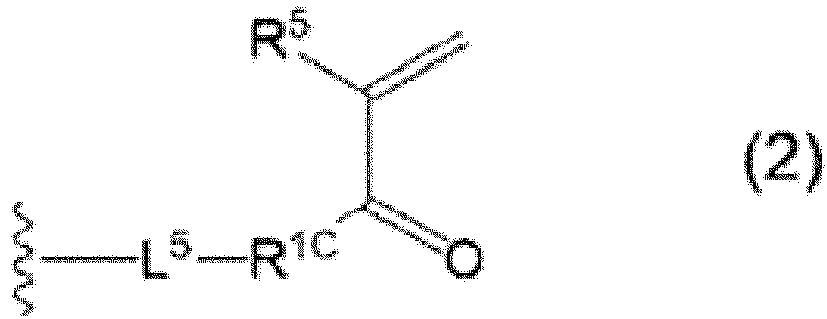 wobei R5 ein Wasserstoffatom oder eine Alkylgruppe darstellt, R1C ein Sauerstoffatom oder -NR102- darstellt, R102 ein Wasserstoffatom oder eine Alkylgruppe darstellt, L5 eine aliphatische Kohlenwasserstoffgruppe darstellt, die eine Urethanbindung, die durch -NH-COO-*2 dargestellt wird, enthält und die eine Etherbindung enthalten kann, wobei die Urethanbindung in der aliphatischen Kohlenwasserstoffgruppe, die durch L5 dargestellt wird, so angeordnet ist, dass *2 auf der X-Seite ist,R1A und R1B jeweils unabhängig voneinander ein Sauerstoffatom oder -NR101-darstellen, wobei R101 ein Wasserstoffatom oder eine Alkylgruppe darstellt, L1 und L3 jeweils unabhängig voneinander eine aliphatische Kohlenwasserstoffgruppe darstellen, die eine Urethanbindung, die durch -NH-COO-* 1 dargestellt wird, enthält und die eine Etherbindung enthalten kann, und X ein Stickstoffatom oder >CR102- darstellt, wobei R102 ein Wasserstoffatom oder einen monovalenten Substituenten darstellt, unddie Urethanbindung in der aliphatischen Kohlenwasserstoffgruppe, die durch L1 dargestellt wird, so angeordnet ist, dass *1 auf einer X-Seite ist, und die Urethanbindung in der aliphatischen Kohlenwasserstoffgruppe, die durch L3 dargestellt wird, so angeordnet ist, dass *1 auf der X-Seite ist.
 - Zelladhäsionsblatt nach Anspruch 1,
wobei X ein Stickstoffatom ist. - Zelladhäsionsblatt nach Anspruch 1,
wobei X >CR102- ist. - Zelladhäsionsblatt nach einem der Ansprüche 1 bis 3,
wobei R3 eine Alkylgruppe mit 4 oder weniger Kohlenstoffatomen ist. - Zelladhäsionsblatt nach einem der Ansprüche 1 bis 4,
wobei R1A und R1B ein Sauerstoffatom sind. - Zelladhäsionsblatt nach einem der Ansprüche 1 bis 5,
wobei die durch Formel (1) dargestellte Verbindung aus der Gruppe, die aus einer Verbindung, die durch Formel (A) dargestellt wird, und einer Verbindung, die durch Formel (J) dargestellt wird, besteht, ausgewählt wird

- Zelladhäsionsblatt nach einem der Ansprüche 1 bis 6, wobei das Zelladhäsionsblatt zur Krebszellenadhäsion dient.
Applications Claiming Priority (3)
| Application Number | Priority Date | Filing Date | Title |
|---|---|---|---|
| JP2019009571 | 2019-01-23 | ||
| JP2020005258 | 2020-01-16 | ||
| PCT/JP2020/001969 WO2020153364A1 (ja) | 2019-01-23 | 2020-01-21 | 細胞付着用シート |
Publications (3)
| Publication Number | Publication Date |
|---|---|
| EP3916079A1 EP3916079A1 (de) | 2021-12-01 |
| EP3916079A4 EP3916079A4 (de) | 2022-03-23 |
| EP3916079B1 true EP3916079B1 (de) | 2025-05-14 |
Family
ID=71735595
Family Applications (1)
| Application Number | Title | Priority Date | Filing Date |
|---|---|---|---|
| EP20745734.2A Active EP3916079B1 (de) | 2019-01-23 | 2020-01-21 | Folie zur befestigung von zellen |
Country Status (4)
| Country | Link |
|---|---|
| US (1) | US12195579B2 (de) |
| EP (1) | EP3916079B1 (de) |
| JP (1) | JP7199065B2 (de) |
| WO (1) | WO2020153364A1 (de) |
Families Citing this family (3)
| Publication number | Priority date | Publication date | Assignee | Title |
|---|---|---|---|---|
| JP7580076B2 (ja) | 2019-01-24 | 2024-11-11 | 住友ゴム工業株式会社 | 細胞培養装置及び細胞培養方法 |
| WO2022019297A1 (ja) * | 2020-07-22 | 2022-01-27 | 富士フイルム株式会社 | 抗血栓性の細胞付着用シート、シート付き医療用器具 |
| WO2025205329A1 (ja) * | 2024-03-27 | 2025-10-02 | セントラル硝子株式会社 | 細胞培養用フィルム基材、包装体、細胞シート付フィルム基材、細胞シート付フィルム基材の凍結物、細胞培養用フィルム基材の製造方法、および細胞シート付フィルム基材の製造方法 |
Family Cites Families (11)
| Publication number | Priority date | Publication date | Assignee | Title |
|---|---|---|---|---|
| JP2003045830A (ja) * | 2001-08-01 | 2003-02-14 | Asahi Kasei Corp | 半導体用研磨パッド及びこれを用いた研磨装置、該装置を用いた半導体デバイスの製造方法 |
| JP2006223106A (ja) | 2005-02-15 | 2006-08-31 | Fuji Photo Film Co Ltd | 細胞培養担体 |
| JP2008079598A (ja) | 2006-08-31 | 2008-04-10 | Kyushu Institute Of Technology | 細胞培養用シートとその製造法並びにそれを用いた3次元培養用ディッシュと培養プレート |
| WO2008031601A1 (en) * | 2006-09-13 | 2008-03-20 | Dsm Ip Assets B.V. | Antimicrobial hydrophilic coating comprising metallic silver particles |
| CN101679555B (zh) * | 2007-05-23 | 2012-05-23 | 昭和电工株式会社 | 具有醚键的反应性氨基甲酸酯化合物、固化性组合物及固化物 |
| GB0904834D0 (en) | 2009-03-20 | 2009-05-06 | Univ Edinburgh | Polymer for growing cells |
| JP6474540B2 (ja) | 2010-11-17 | 2019-02-27 | 国立大学法人山形大学 | 溶液から細胞を分離する細胞分離方法、細胞吸着用水和性組成物、および細胞分離システム |
| WO2012173097A1 (ja) | 2011-06-13 | 2012-12-20 | 日立化成工業株式会社 | 癌細胞接着性向上剤 |
| EP3330303B1 (de) | 2015-07-29 | 2019-01-09 | FUJIFILM Corporation | Härtbare zusammensetzung, beschichtung und laminat |
| JP6601768B2 (ja) * | 2015-12-02 | 2019-11-06 | 国立大学法人山形大学 | 癌細胞接着剤及び癌細胞の検出方法 |
| JP6606013B2 (ja) * | 2016-05-19 | 2019-11-13 | 信越化学工業株式会社 | 伸縮性膜及びその形成方法、配線被覆基板の製造方法、並びに伸縮性配線膜及びその製造方法 |
-
2020
- 2020-01-21 JP JP2020568162A patent/JP7199065B2/ja active Active
- 2020-01-21 WO PCT/JP2020/001969 patent/WO2020153364A1/ja not_active Ceased
- 2020-01-21 EP EP20745734.2A patent/EP3916079B1/de active Active
-
2021
- 2021-07-07 US US17/369,201 patent/US12195579B2/en active Active
Non-Patent Citations (1)
| Title |
|---|
| ALBRECHT BERG ET AL: "Synthesis of Photopolymerizable Hydrophilic Macromers and Evaluation of Their Applicability as Reactive Resin Components for the Fabrication of Three-Dimensionally Structured Hydrogel Matrices by 2-Photon-Polymerization", ADVANCE ENGINEERING MATERIALS, WILEY VCH VERLAG, WEINHEIM, DE, vol. 13, no. 9, 21 January 2011 (2011-01-21), pages B274 - B284, XP072138354, ISSN: 1438-1656, DOI: 10.1002/ADEM.201080092 * |
Also Published As
| Publication number | Publication date |
|---|---|
| US12195579B2 (en) | 2025-01-14 |
| JP7199065B2 (ja) | 2023-01-05 |
| EP3916079A1 (de) | 2021-12-01 |
| WO2020153364A1 (ja) | 2020-07-30 |
| US20210332180A1 (en) | 2021-10-28 |
| JPWO2020153364A1 (ja) | 2021-11-18 |
| EP3916079A4 (de) | 2022-03-23 |
Similar Documents
| Publication | Publication Date | Title |
|---|---|---|
| US12195579B2 (en) | Cell adhesion sheet | |
| EP3495400B1 (de) | Blockcopolymer und oberflächenbehandlungsmittel damit | |
| EP3842519A1 (de) | Verfahren zur herstellung eines polymers für zellkulturbasisfilm und zellkulturgefäss | |
| JP5831666B1 (ja) | 細胞培養用部材 | |
| EP3101116A1 (de) | Temperaturreaktives basismaterial, verfahren zur herstellung davon und verfahren zur beurteilung davon | |
| WO2016159153A1 (ja) | 細胞培養基材、その製造方法、およびそれを用いた細胞培養方法 | |
| EP3561043A1 (de) | Zellkultursubstrat | |
| EP3584318A1 (de) | Polymerwulst | |
| JP2016171778A (ja) | 細胞培養用基材 | |
| JP5388126B2 (ja) | 分岐ポリアルキレングリコール誘導体、感光性組成物、架橋体及び基板 | |
| JPH11349643A (ja) | 感温性高分子化合物およびその製造方法、感温性高分子組成物、細胞培養基材 | |
| KR20230091943A (ko) | 히드록시 또는 술포기를 갖는 폴리로탁산 | |
| US20240026286A1 (en) | Method of producing cancer stem cells | |
| WO2020153270A1 (ja) | 組成物および硬化膜付き医療器具 | |
| JP2755880B2 (ja) | 培養用器具及びその製造方法 | |
| JP2020152874A (ja) | ブロック共重合体、それを含む表面処理剤及び膜、並びに、それを用いた細胞培養用器材及び細胞培養方法 | |
| JP2571966B2 (ja) | スチレン系重合体及び接着性細胞培養用担体 | |
| JP7431423B2 (ja) | 抗血栓性の細胞付着用シート、シート付き医療用器具 | |
| EP3925990A1 (de) | Verfahren zur herstellung von mit biomaterialien kompatiblen polymeren | |
| EP4682250A1 (de) | Herstellungsverfahren für induzierte pluripotente stammzellen | |
| JP7647820B2 (ja) | 細胞シートを転写する方法 | |
| WO2013051479A1 (ja) | 生体物質又は細胞の付着抑制剤 | |
| JP2743479B2 (ja) | 抗血栓性ポリウレタン | |
| JP2019104783A (ja) | 共重合体、基材用表面処理剤および細胞培養基材 | |
| Lee et al. | Preparation of Co-cultured Cell Sheets Using Electroactive Surfaces. |
Legal Events
| Date | Code | Title | Description |
|---|---|---|---|
| STAA | Information on the status of an ep patent application or granted ep patent |
Free format text: STATUS: THE INTERNATIONAL PUBLICATION HAS BEEN MADE |
|
| PUAI | Public reference made under article 153(3) epc to a published international application that has entered the european phase |
Free format text: ORIGINAL CODE: 0009012 |
|
| STAA | Information on the status of an ep patent application or granted ep patent |
Free format text: STATUS: REQUEST FOR EXAMINATION WAS MADE |
|
| 17P | Request for examination filed |
Effective date: 20210716 |
|
| AK | Designated contracting states |
Kind code of ref document: A1 Designated state(s): AL AT BE BG CH CY CZ DE DK EE ES FI FR GB GR HR HU IE IS IT LI LT LU LV MC MK MT NL NO PL PT RO RS SE SI SK SM TR |
|
| A4 | Supplementary search report drawn up and despatched |
Effective date: 20220217 |
|
| RIC1 | Information provided on ipc code assigned before grant |
Ipc: C08G 18/32 20060101ALI20220211BHEP Ipc: C12N 11/08 20200101ALI20220211BHEP Ipc: C08G 18/81 20060101ALI20220211BHEP Ipc: C12N 5/09 20100101ALI20220211BHEP Ipc: C12M 3/00 20060101AFI20220211BHEP |
|
| DAV | Request for validation of the european patent (deleted) | ||
| DAX | Request for extension of the european patent (deleted) | ||
| GRAP | Despatch of communication of intention to grant a patent |
Free format text: ORIGINAL CODE: EPIDOSNIGR1 |
|
| STAA | Information on the status of an ep patent application or granted ep patent |
Free format text: STATUS: GRANT OF PATENT IS INTENDED |
|
| INTG | Intention to grant announced |
Effective date: 20250127 |
|
| GRAS | Grant fee paid |
Free format text: ORIGINAL CODE: EPIDOSNIGR3 |
|
| GRAA | (expected) grant |
Free format text: ORIGINAL CODE: 0009210 |
|
| STAA | Information on the status of an ep patent application or granted ep patent |
Free format text: STATUS: THE PATENT HAS BEEN GRANTED |
|
| AK | Designated contracting states |
Kind code of ref document: B1 Designated state(s): AL AT BE BG CH CY CZ DE DK EE ES FI FR GB GR HR HU IE IS IT LI LT LU LV MC MK MT NL NO PL PT RO RS SE SI SK SM TR |
|
| REG | Reference to a national code |
Ref country code: GB Ref legal event code: FG4D |
|
| REG | Reference to a national code |
Ref country code: CH Ref legal event code: EP |
|
| REG | Reference to a national code |
Ref country code: DE Ref legal event code: R096 Ref document number: 602020051272 Country of ref document: DE |
|
| REG | Reference to a national code |
Ref country code: IE Ref legal event code: FG4D |
|
| REG | Reference to a national code |
Ref country code: NL Ref legal event code: MP Effective date: 20250514 |
|
| PG25 | Lapsed in a contracting state [announced via postgrant information from national office to epo] |
Ref country code: PT Free format text: LAPSE BECAUSE OF FAILURE TO SUBMIT A TRANSLATION OF THE DESCRIPTION OR TO PAY THE FEE WITHIN THE PRESCRIBED TIME-LIMIT Effective date: 20250915 Ref country code: ES Free format text: LAPSE BECAUSE OF FAILURE TO SUBMIT A TRANSLATION OF THE DESCRIPTION OR TO PAY THE FEE WITHIN THE PRESCRIBED TIME-LIMIT Effective date: 20250514 Ref country code: FI Free format text: LAPSE BECAUSE OF FAILURE TO SUBMIT A TRANSLATION OF THE DESCRIPTION OR TO PAY THE FEE WITHIN THE PRESCRIBED TIME-LIMIT Effective date: 20250514 |
|
| REG | Reference to a national code |
Ref country code: LT Ref legal event code: MG9D |
|
| PG25 | Lapsed in a contracting state [announced via postgrant information from national office to epo] |
Ref country code: NO Free format text: LAPSE BECAUSE OF FAILURE TO SUBMIT A TRANSLATION OF THE DESCRIPTION OR TO PAY THE FEE WITHIN THE PRESCRIBED TIME-LIMIT Effective date: 20250814 Ref country code: GR Free format text: LAPSE BECAUSE OF FAILURE TO SUBMIT A TRANSLATION OF THE DESCRIPTION OR TO PAY THE FEE WITHIN THE PRESCRIBED TIME-LIMIT Effective date: 20250815 |
|
| PG25 | Lapsed in a contracting state [announced via postgrant information from national office to epo] |
Ref country code: NL Free format text: LAPSE BECAUSE OF FAILURE TO SUBMIT A TRANSLATION OF THE DESCRIPTION OR TO PAY THE FEE WITHIN THE PRESCRIBED TIME-LIMIT Effective date: 20250514 Ref country code: PL Free format text: LAPSE BECAUSE OF FAILURE TO SUBMIT A TRANSLATION OF THE DESCRIPTION OR TO PAY THE FEE WITHIN THE PRESCRIBED TIME-LIMIT Effective date: 20250514 |
|
| REG | Reference to a national code |
Ref country code: AT Ref legal event code: MK05 Ref document number: 1794813 Country of ref document: AT Kind code of ref document: T Effective date: 20250514 |
|
| PG25 | Lapsed in a contracting state [announced via postgrant information from national office to epo] |
Ref country code: BG Free format text: LAPSE BECAUSE OF FAILURE TO SUBMIT A TRANSLATION OF THE DESCRIPTION OR TO PAY THE FEE WITHIN THE PRESCRIBED TIME-LIMIT Effective date: 20250514 |
|
| PG25 | Lapsed in a contracting state [announced via postgrant information from national office to epo] |
Ref country code: HR Free format text: LAPSE BECAUSE OF FAILURE TO SUBMIT A TRANSLATION OF THE DESCRIPTION OR TO PAY THE FEE WITHIN THE PRESCRIBED TIME-LIMIT Effective date: 20250514 |
|
| PG25 | Lapsed in a contracting state [announced via postgrant information from national office to epo] |
Ref country code: AT Free format text: LAPSE BECAUSE OF FAILURE TO SUBMIT A TRANSLATION OF THE DESCRIPTION OR TO PAY THE FEE WITHIN THE PRESCRIBED TIME-LIMIT Effective date: 20250514 |
|
| PG25 | Lapsed in a contracting state [announced via postgrant information from national office to epo] |
Ref country code: RS Free format text: LAPSE BECAUSE OF FAILURE TO SUBMIT A TRANSLATION OF THE DESCRIPTION OR TO PAY THE FEE WITHIN THE PRESCRIBED TIME-LIMIT Effective date: 20250814 |
|
| PG25 | Lapsed in a contracting state [announced via postgrant information from national office to epo] |
Ref country code: IS Free format text: LAPSE BECAUSE OF FAILURE TO SUBMIT A TRANSLATION OF THE DESCRIPTION OR TO PAY THE FEE WITHIN THE PRESCRIBED TIME-LIMIT Effective date: 20250914 |
|
| PG25 | Lapsed in a contracting state [announced via postgrant information from national office to epo] |
Ref country code: LV Free format text: LAPSE BECAUSE OF FAILURE TO SUBMIT A TRANSLATION OF THE DESCRIPTION OR TO PAY THE FEE WITHIN THE PRESCRIBED TIME-LIMIT Effective date: 20250514 |
|
| PG25 | Lapsed in a contracting state [announced via postgrant information from national office to epo] |
Ref country code: SM Free format text: LAPSE BECAUSE OF FAILURE TO SUBMIT A TRANSLATION OF THE DESCRIPTION OR TO PAY THE FEE WITHIN THE PRESCRIBED TIME-LIMIT Effective date: 20250514 Ref country code: DK Free format text: LAPSE BECAUSE OF FAILURE TO SUBMIT A TRANSLATION OF THE DESCRIPTION OR TO PAY THE FEE WITHIN THE PRESCRIBED TIME-LIMIT Effective date: 20250514 |
|
| PG25 | Lapsed in a contracting state [announced via postgrant information from national office to epo] |
Ref country code: CZ Free format text: LAPSE BECAUSE OF FAILURE TO SUBMIT A TRANSLATION OF THE DESCRIPTION OR TO PAY THE FEE WITHIN THE PRESCRIBED TIME-LIMIT Effective date: 20250514 |
|
| PG25 | Lapsed in a contracting state [announced via postgrant information from national office to epo] |
Ref country code: EE Free format text: LAPSE BECAUSE OF FAILURE TO SUBMIT A TRANSLATION OF THE DESCRIPTION OR TO PAY THE FEE WITHIN THE PRESCRIBED TIME-LIMIT Effective date: 20250514 |
|
| PG25 | Lapsed in a contracting state [announced via postgrant information from national office to epo] |
Ref country code: SK Free format text: LAPSE BECAUSE OF FAILURE TO SUBMIT A TRANSLATION OF THE DESCRIPTION OR TO PAY THE FEE WITHIN THE PRESCRIBED TIME-LIMIT Effective date: 20250514 Ref country code: RO Free format text: LAPSE BECAUSE OF FAILURE TO SUBMIT A TRANSLATION OF THE DESCRIPTION OR TO PAY THE FEE WITHIN THE PRESCRIBED TIME-LIMIT Effective date: 20250514 |
|
| PG25 | Lapsed in a contracting state [announced via postgrant information from national office to epo] |
Ref country code: IT Free format text: LAPSE BECAUSE OF FAILURE TO SUBMIT A TRANSLATION OF THE DESCRIPTION OR TO PAY THE FEE WITHIN THE PRESCRIBED TIME-LIMIT Effective date: 20250514 |