EP3708359A1 - Feuchtigkeitssperrende laminatfolie - Google Patents
Feuchtigkeitssperrende laminatfolie Download PDFInfo
- Publication number
- EP3708359A1 EP3708359A1 EP18875775.1A EP18875775A EP3708359A1 EP 3708359 A1 EP3708359 A1 EP 3708359A1 EP 18875775 A EP18875775 A EP 18875775A EP 3708359 A1 EP3708359 A1 EP 3708359A1
- Authority
- EP
- European Patent Office
- Prior art keywords
- water
- resin
- layer
- isocyanate
- laminated film
- Prior art date
- Legal status (The legal status is an assumption and is not a legal conclusion. Google has not performed a legal analysis and makes no representation as to the accuracy of the status listed.)
- Pending
Links
- 239000005001 laminate film Substances 0.000 title 1
- 239000012948 isocyanate Substances 0.000 claims abstract description 140
- 150000002513 isocyanates Chemical class 0.000 claims abstract description 140
- 238000000576 coating method Methods 0.000 claims abstract description 121
- 239000011248 coating agent Substances 0.000 claims abstract description 116
- 230000004888 barrier function Effects 0.000 claims abstract description 95
- 229920000642 polymer Polymers 0.000 claims abstract description 52
- 239000002985 plastic film Substances 0.000 claims abstract description 27
- 229920006255 plastic film Polymers 0.000 claims abstract description 27
- 238000006243 chemical reaction Methods 0.000 claims abstract description 8
- 229920005989 resin Polymers 0.000 claims description 81
- 239000011347 resin Substances 0.000 claims description 81
- 239000008199 coating composition Substances 0.000 claims description 41
- 239000003795 chemical substances by application Substances 0.000 claims description 40
- 229920006317 cationic polymer Polymers 0.000 claims description 32
- 239000011159 matrix material Substances 0.000 claims description 32
- 239000003230 hygroscopic agent Substances 0.000 claims description 29
- 239000002904 solvent Substances 0.000 claims description 29
- 125000000524 functional group Chemical group 0.000 claims description 26
- JOYRKODLDBILNP-UHFFFAOYSA-N Ethyl urethane Chemical compound CCOC(N)=O JOYRKODLDBILNP-UHFFFAOYSA-N 0.000 claims description 24
- 229920002635 polyurethane Polymers 0.000 claims description 24
- 239000004814 polyurethane Substances 0.000 claims description 24
- 125000003700 epoxy group Chemical group 0.000 claims description 23
- 229920000831 ionic polymer Polymers 0.000 claims description 21
- 230000009477 glass transition Effects 0.000 claims description 17
- 239000005056 polyisocyanate Substances 0.000 claims description 17
- 229920001228 polyisocyanate Polymers 0.000 claims description 17
- IQPQWNKOIGAROB-UHFFFAOYSA-N isocyanate group Chemical group [N-]=C=O IQPQWNKOIGAROB-UHFFFAOYSA-N 0.000 claims description 14
- 229910052751 metal Inorganic materials 0.000 claims description 14
- 239000002184 metal Substances 0.000 claims description 14
- 125000005372 silanol group Chemical group 0.000 claims description 11
- 239000006087 Silane Coupling Agent Substances 0.000 claims description 10
- 229920001225 polyester resin Polymers 0.000 claims description 10
- 239000004645 polyester resin Substances 0.000 claims description 10
- 229920002803 thermoplastic polyurethane Polymers 0.000 claims description 8
- 229920000178 Acrylic resin Polymers 0.000 claims description 7
- 239000004925 Acrylic resin Substances 0.000 claims description 7
- 150000004703 alkoxides Chemical class 0.000 claims description 7
- 239000002245 particle Substances 0.000 claims description 7
- 239000000463 material Substances 0.000 claims description 6
- 229910052698 phosphorus Inorganic materials 0.000 claims description 3
- 239000011574 phosphorus Substances 0.000 claims description 3
- 238000007789 sealing Methods 0.000 claims description 3
- OAICVXFJPJFONN-UHFFFAOYSA-N Phosphorus Chemical compound [P] OAICVXFJPJFONN-UHFFFAOYSA-N 0.000 claims description 2
- 239000010410 layer Substances 0.000 description 247
- 239000000243 solution Substances 0.000 description 89
- 239000010408 film Substances 0.000 description 86
- XLYOFNOQVPJJNP-UHFFFAOYSA-N water Substances O XLYOFNOQVPJJNP-UHFFFAOYSA-N 0.000 description 43
- 239000007787 solid Substances 0.000 description 42
- -1 polypropylene Polymers 0.000 description 38
- ZWEHNKRNPOVVGH-UHFFFAOYSA-N 2-Butanone Chemical compound CCC(C)=O ZWEHNKRNPOVVGH-UHFFFAOYSA-N 0.000 description 30
- 239000000203 mixture Substances 0.000 description 25
- 125000002091 cationic group Chemical group 0.000 description 24
- 239000003431 cross linking reagent Substances 0.000 description 22
- 229920006318 anionic polymer Polymers 0.000 description 21
- 239000000047 product Substances 0.000 description 19
- 238000000034 method Methods 0.000 description 18
- 239000000178 monomer Substances 0.000 description 18
- 150000001875 compounds Chemical class 0.000 description 17
- 238000010438 heat treatment Methods 0.000 description 17
- 150000002009 diols Chemical class 0.000 description 14
- LYCAIKOWRPUZTN-UHFFFAOYSA-N Ethylene glycol Chemical compound OCCO LYCAIKOWRPUZTN-UHFFFAOYSA-N 0.000 description 12
- KFZMGEQAYNKOFK-UHFFFAOYSA-N Isopropanol Chemical compound CC(C)O KFZMGEQAYNKOFK-UHFFFAOYSA-N 0.000 description 12
- 150000002148 esters Chemical class 0.000 description 12
- 239000000853 adhesive Substances 0.000 description 11
- 239000004372 Polyvinyl alcohol Substances 0.000 description 10
- 230000001070 adhesive effect Effects 0.000 description 10
- 229920002451 polyvinyl alcohol Polymers 0.000 description 10
- 235000019422 polyvinyl alcohol Nutrition 0.000 description 10
- 125000002723 alicyclic group Chemical group 0.000 description 9
- 239000012046 mixed solvent Substances 0.000 description 9
- 229920000139 polyethylene terephthalate Polymers 0.000 description 9
- 239000005020 polyethylene terephthalate Substances 0.000 description 9
- BPSIOYPQMFLKFR-UHFFFAOYSA-N trimethoxy-[3-(oxiran-2-ylmethoxy)propyl]silane Chemical compound CO[Si](OC)(OC)CCCOCC1CO1 BPSIOYPQMFLKFR-UHFFFAOYSA-N 0.000 description 9
- VYPSYNLAJGMNEJ-UHFFFAOYSA-N Silicium dioxide Chemical compound O=[Si]=O VYPSYNLAJGMNEJ-UHFFFAOYSA-N 0.000 description 8
- PPBRXRYQALVLMV-UHFFFAOYSA-N Styrene Chemical compound C=CC1=CC=CC=C1 PPBRXRYQALVLMV-UHFFFAOYSA-N 0.000 description 8
- 229920001577 copolymer Polymers 0.000 description 8
- 238000012360 testing method Methods 0.000 description 8
- OKKJLVBELUTLKV-UHFFFAOYSA-N Methanol Chemical compound OC OKKJLVBELUTLKV-UHFFFAOYSA-N 0.000 description 7
- 125000005442 diisocyanate group Chemical group 0.000 description 7
- 238000001035 drying Methods 0.000 description 7
- CSCPPACGZOOCGX-UHFFFAOYSA-N Acetone Chemical compound CC(C)=O CSCPPACGZOOCGX-UHFFFAOYSA-N 0.000 description 6
- HEDRZPFGACZZDS-UHFFFAOYSA-N Chloroform Chemical compound ClC(Cl)Cl HEDRZPFGACZZDS-UHFFFAOYSA-N 0.000 description 6
- LFQSCWFLJHTTHZ-UHFFFAOYSA-N Ethanol Chemical compound CCO LFQSCWFLJHTTHZ-UHFFFAOYSA-N 0.000 description 6
- NBIIXXVUZAFLBC-UHFFFAOYSA-N Phosphoric acid Chemical compound OP(O)(O)=O NBIIXXVUZAFLBC-UHFFFAOYSA-N 0.000 description 6
- HEMHJVSKTPXQMS-UHFFFAOYSA-M Sodium hydroxide Chemical compound [OH-].[Na+] HEMHJVSKTPXQMS-UHFFFAOYSA-M 0.000 description 6
- 239000002253 acid Substances 0.000 description 6
- 125000000217 alkyl group Chemical group 0.000 description 6
- 125000000129 anionic group Chemical group 0.000 description 6
- 239000012298 atmosphere Substances 0.000 description 6
- 239000007789 gas Substances 0.000 description 6
- 229920000083 poly(allylamine) Polymers 0.000 description 6
- 229910000077 silane Inorganic materials 0.000 description 6
- DQZNLOXENNXVAD-UHFFFAOYSA-N trimethoxy-[2-(7-oxabicyclo[4.1.0]heptan-4-yl)ethyl]silane Chemical compound C1C(CC[Si](OC)(OC)OC)CCC2OC21 DQZNLOXENNXVAD-UHFFFAOYSA-N 0.000 description 6
- VGGSQFUCUMXWEO-UHFFFAOYSA-N Ethene Chemical compound C=C VGGSQFUCUMXWEO-UHFFFAOYSA-N 0.000 description 5
- 239000005977 Ethylene Substances 0.000 description 5
- ZMXDDKWLCZADIW-UHFFFAOYSA-N N,N-Dimethylformamide Chemical compound CN(C)C=O ZMXDDKWLCZADIW-UHFFFAOYSA-N 0.000 description 5
- 229920002125 Sokalan® Polymers 0.000 description 5
- BOTDANWDWHJENH-UHFFFAOYSA-N Tetraethyl orthosilicate Chemical compound CCO[Si](OCC)(OCC)OCC BOTDANWDWHJENH-UHFFFAOYSA-N 0.000 description 5
- 238000010521 absorption reaction Methods 0.000 description 5
- 125000004429 atom Chemical group 0.000 description 5
- 230000000052 comparative effect Effects 0.000 description 5
- 150000004985 diamines Chemical class 0.000 description 5
- 239000004584 polyacrylic acid Substances 0.000 description 5
- 230000008961 swelling Effects 0.000 description 5
- 238000007738 vacuum evaporation Methods 0.000 description 5
- WSSSPWUEQFSQQG-UHFFFAOYSA-N 4-methyl-1-pentene Chemical compound CC(C)CC=C WSSSPWUEQFSQQG-UHFFFAOYSA-N 0.000 description 4
- 239000005057 Hexamethylene diisocyanate Substances 0.000 description 4
- 239000004793 Polystyrene Substances 0.000 description 4
- 125000005370 alkoxysilyl group Chemical group 0.000 description 4
- QVGXLLKOCUKJST-UHFFFAOYSA-N atomic oxygen Chemical compound [O] QVGXLLKOCUKJST-UHFFFAOYSA-N 0.000 description 4
- 239000002585 base Substances 0.000 description 4
- 238000005336 cracking Methods 0.000 description 4
- MTHSVFCYNBDYFN-UHFFFAOYSA-N diethylene glycol Chemical compound OCCOCCO MTHSVFCYNBDYFN-UHFFFAOYSA-N 0.000 description 4
- 239000006185 dispersion Substances 0.000 description 4
- 235000019441 ethanol Nutrition 0.000 description 4
- RRAMGCGOFNQTLD-UHFFFAOYSA-N hexamethylene diisocyanate Chemical compound O=C=NCCCCCCN=C=O RRAMGCGOFNQTLD-UHFFFAOYSA-N 0.000 description 4
- 230000007062 hydrolysis Effects 0.000 description 4
- 238000006460 hydrolysis reaction Methods 0.000 description 4
- 125000002496 methyl group Chemical group [H]C([H])([H])* 0.000 description 4
- 125000000962 organic group Chemical group 0.000 description 4
- 239000003960 organic solvent Substances 0.000 description 4
- 239000001301 oxygen Substances 0.000 description 4
- 229910052760 oxygen Inorganic materials 0.000 description 4
- 229920000058 polyacrylate Polymers 0.000 description 4
- 229920002223 polystyrene Polymers 0.000 description 4
- 229920005749 polyurethane resin Polymers 0.000 description 4
- 150000003839 salts Chemical class 0.000 description 4
- 229910052814 silicon oxide Inorganic materials 0.000 description 4
- 239000011734 sodium Substances 0.000 description 4
- 239000000758 substrate Substances 0.000 description 4
- NLVXSWCKKBEXTG-UHFFFAOYSA-N vinylsulfonic acid Chemical class OS(=O)(=O)C=C NLVXSWCKKBEXTG-UHFFFAOYSA-N 0.000 description 4
- UPMLOUAZCHDJJD-UHFFFAOYSA-N 4,4'-Diphenylmethane Diisocyanate Chemical compound C1=CC(N=C=O)=CC=C1CC1=CC=C(N=C=O)C=C1 UPMLOUAZCHDJJD-UHFFFAOYSA-N 0.000 description 3
- UHOVQNZJYSORNB-UHFFFAOYSA-N Benzene Chemical compound C1=CC=CC=C1 UHOVQNZJYSORNB-UHFFFAOYSA-N 0.000 description 3
- OKTJSMMVPCPJKN-UHFFFAOYSA-N Carbon Chemical compound [C] OKTJSMMVPCPJKN-UHFFFAOYSA-N 0.000 description 3
- YXFVVABEGXRONW-UHFFFAOYSA-N Toluene Chemical compound CC1=CC=CC=C1 YXFVVABEGXRONW-UHFFFAOYSA-N 0.000 description 3
- 239000003513 alkali Substances 0.000 description 3
- 230000008901 benefit Effects 0.000 description 3
- IISBACLAFKSPIT-UHFFFAOYSA-N bisphenol A Chemical compound C=1C=C(O)C=CC=1C(C)(C)C1=CC=C(O)C=C1 IISBACLAFKSPIT-UHFFFAOYSA-N 0.000 description 3
- 239000002981 blocking agent Substances 0.000 description 3
- 230000008859 change Effects 0.000 description 3
- 239000007795 chemical reaction product Substances 0.000 description 3
- 238000004132 cross linking Methods 0.000 description 3
- NKSJNEHGWDZZQF-UHFFFAOYSA-N ethenyl(trimethoxy)silane Chemical compound CO[Si](OC)(OC)C=C NKSJNEHGWDZZQF-UHFFFAOYSA-N 0.000 description 3
- RTZKZFJDLAIYFH-UHFFFAOYSA-N ether Substances CCOCC RTZKZFJDLAIYFH-UHFFFAOYSA-N 0.000 description 3
- 230000001747 exhibiting effect Effects 0.000 description 3
- 125000003055 glycidyl group Chemical group C(C1CO1)* 0.000 description 3
- 150000002430 hydrocarbons Chemical group 0.000 description 3
- 239000001257 hydrogen Substances 0.000 description 3
- 229910052739 hydrogen Inorganic materials 0.000 description 3
- 125000002887 hydroxy group Chemical group [H]O* 0.000 description 3
- WGCNASOHLSPBMP-UHFFFAOYSA-N hydroxyacetaldehyde Natural products OCC=O WGCNASOHLSPBMP-UHFFFAOYSA-N 0.000 description 3
- NIMLQBUJDJZYEJ-UHFFFAOYSA-N isophorone diisocyanate Chemical compound CC1(C)CC(N=C=O)CC(C)(CN=C=O)C1 NIMLQBUJDJZYEJ-UHFFFAOYSA-N 0.000 description 3
- 238000006386 neutralization reaction Methods 0.000 description 3
- 229920000620 organic polymer Polymers 0.000 description 3
- 150000003961 organosilicon compounds Chemical class 0.000 description 3
- ABLZXFCXXLZCGV-UHFFFAOYSA-N phosphonic acid group Chemical group P(O)(O)=O ABLZXFCXXLZCGV-UHFFFAOYSA-N 0.000 description 3
- 235000011007 phosphoric acid Nutrition 0.000 description 3
- 238000005268 plasma chemical vapour deposition Methods 0.000 description 3
- 230000000379 polymerizing effect Effects 0.000 description 3
- 238000002360 preparation method Methods 0.000 description 3
- DVKJHBMWWAPEIU-UHFFFAOYSA-N toluene 2,4-diisocyanate Chemical compound CC1=CC=C(N=C=O)C=C1N=C=O DVKJHBMWWAPEIU-UHFFFAOYSA-N 0.000 description 3
- CPUDPFPXCZDNGI-UHFFFAOYSA-N triethoxy(methyl)silane Chemical compound CCO[Si](C)(OCC)OCC CPUDPFPXCZDNGI-UHFFFAOYSA-N 0.000 description 3
- OVBFMUAFNIIQAL-UHFFFAOYSA-N 1,4-diisocyanatobutane Chemical compound O=C=NCCCCN=C=O OVBFMUAFNIIQAL-UHFFFAOYSA-N 0.000 description 2
- DFPJRUKWEPYFJT-UHFFFAOYSA-N 1,5-diisocyanatopentane Chemical compound O=C=NCCCCCN=C=O DFPJRUKWEPYFJT-UHFFFAOYSA-N 0.000 description 2
- VXNZUUAINFGPBY-UHFFFAOYSA-N 1-Butene Chemical compound CCC=C VXNZUUAINFGPBY-UHFFFAOYSA-N 0.000 description 2
- NIXOWILDQLNWCW-UHFFFAOYSA-N 2-Propenoic acid Natural products OC(=O)C=C NIXOWILDQLNWCW-UHFFFAOYSA-N 0.000 description 2
- AGBXYHCHUYARJY-UHFFFAOYSA-N 2-phenylethenesulfonic acid Chemical compound OS(=O)(=O)C=CC1=CC=CC=C1 AGBXYHCHUYARJY-UHFFFAOYSA-N 0.000 description 2
- VVJKKWFAADXIJK-UHFFFAOYSA-N Allylamine Chemical compound NCC=C VVJKKWFAADXIJK-UHFFFAOYSA-N 0.000 description 2
- XKRFYHLGVUSROY-UHFFFAOYSA-N Argon Chemical compound [Ar] XKRFYHLGVUSROY-UHFFFAOYSA-N 0.000 description 2
- LSNNMFCWUKXFEE-UHFFFAOYSA-M Bisulfite Chemical compound OS([O-])=O LSNNMFCWUKXFEE-UHFFFAOYSA-M 0.000 description 2
- 229920002799 BoPET Polymers 0.000 description 2
- KAKZBPTYRLMSJV-UHFFFAOYSA-N Butadiene Chemical compound C=CC=C KAKZBPTYRLMSJV-UHFFFAOYSA-N 0.000 description 2
- OAKJQQAXSVQMHS-UHFFFAOYSA-N Hydrazine Chemical compound NN OAKJQQAXSVQMHS-UHFFFAOYSA-N 0.000 description 2
- QIGBRXMKCJKVMJ-UHFFFAOYSA-N Hydroquinone Chemical compound OC1=CC=C(O)C=C1 QIGBRXMKCJKVMJ-UHFFFAOYSA-N 0.000 description 2
- 239000005058 Isophorone diisocyanate Substances 0.000 description 2
- RRHGJUQNOFWUDK-UHFFFAOYSA-N Isoprene Chemical compound CC(=C)C=C RRHGJUQNOFWUDK-UHFFFAOYSA-N 0.000 description 2
- CSNNHWWHGAXBCP-UHFFFAOYSA-L Magnesium sulfate Chemical compound [Mg+2].[O-][S+2]([O-])([O-])[O-] CSNNHWWHGAXBCP-UHFFFAOYSA-L 0.000 description 2
- CERQOIWHTDAKMF-UHFFFAOYSA-N Methacrylic acid Chemical compound CC(=C)C(O)=O CERQOIWHTDAKMF-UHFFFAOYSA-N 0.000 description 2
- LRHPLDYGYMQRHN-UHFFFAOYSA-N N-Butanol Chemical compound CCCCO LRHPLDYGYMQRHN-UHFFFAOYSA-N 0.000 description 2
- 239000004677 Nylon Substances 0.000 description 2
- 229920002845 Poly(methacrylic acid) Polymers 0.000 description 2
- 239000004721 Polyphenylene oxide Substances 0.000 description 2
- 239000004743 Polypropylene Substances 0.000 description 2
- OFOBLEOULBTSOW-UHFFFAOYSA-N Propanedioic acid Natural products OC(=O)CC(O)=O OFOBLEOULBTSOW-UHFFFAOYSA-N 0.000 description 2
- DNIAPMSPPWPWGF-UHFFFAOYSA-N Propylene glycol Chemical compound CC(O)CO DNIAPMSPPWPWGF-UHFFFAOYSA-N 0.000 description 2
- 229910020175 SiOH Inorganic materials 0.000 description 2
- 229910021536 Zeolite Inorganic materials 0.000 description 2
- YRKCREAYFQTBPV-UHFFFAOYSA-N acetylacetone Chemical compound CC(=O)CC(C)=O YRKCREAYFQTBPV-UHFFFAOYSA-N 0.000 description 2
- 238000007259 addition reaction Methods 0.000 description 2
- 125000001931 aliphatic group Chemical group 0.000 description 2
- 229910052783 alkali metal Inorganic materials 0.000 description 2
- XYLMUPLGERFSHI-UHFFFAOYSA-N alpha-Methylstyrene Chemical compound CC(=C)C1=CC=CC=C1 XYLMUPLGERFSHI-UHFFFAOYSA-N 0.000 description 2
- PNEYBMLMFCGWSK-UHFFFAOYSA-N aluminium oxide Inorganic materials [O-2].[O-2].[O-2].[Al+3].[Al+3] PNEYBMLMFCGWSK-UHFFFAOYSA-N 0.000 description 2
- 229910000147 aluminium phosphate Inorganic materials 0.000 description 2
- 125000003277 amino group Chemical group 0.000 description 2
- 150000003863 ammonium salts Chemical class 0.000 description 2
- VHRGRCVQAFMJIZ-UHFFFAOYSA-N cadaverine Chemical compound NCCCCCN VHRGRCVQAFMJIZ-UHFFFAOYSA-N 0.000 description 2
- BRPQOXSCLDDYGP-UHFFFAOYSA-N calcium oxide Chemical compound [O-2].[Ca+2] BRPQOXSCLDDYGP-UHFFFAOYSA-N 0.000 description 2
- 239000000292 calcium oxide Substances 0.000 description 2
- ODINCKMPIJJUCX-UHFFFAOYSA-N calcium oxide Inorganic materials [Ca]=O ODINCKMPIJJUCX-UHFFFAOYSA-N 0.000 description 2
- 125000003178 carboxy group Chemical group [H]OC(*)=O 0.000 description 2
- 150000001732 carboxylic acid derivatives Chemical class 0.000 description 2
- YCIMNLLNPGFGHC-UHFFFAOYSA-N catechol Chemical compound OC1=CC=CC=C1O YCIMNLLNPGFGHC-UHFFFAOYSA-N 0.000 description 2
- IJOOHPMOJXWVHK-UHFFFAOYSA-N chlorotrimethylsilane Chemical compound C[Si](C)(C)Cl IJOOHPMOJXWVHK-UHFFFAOYSA-N 0.000 description 2
- 238000009833 condensation Methods 0.000 description 2
- 230000005494 condensation Effects 0.000 description 2
- 238000006482 condensation reaction Methods 0.000 description 2
- 125000002993 cycloalkylene group Chemical group 0.000 description 2
- 230000018044 dehydration Effects 0.000 description 2
- 238000006297 dehydration reaction Methods 0.000 description 2
- 239000002274 desiccant Substances 0.000 description 2
- OTARVPUIYXHRRB-UHFFFAOYSA-N diethoxy-methyl-[3-(oxiran-2-ylmethoxy)propyl]silane Chemical compound CCO[Si](C)(OCC)CCCOCC1CO1 OTARVPUIYXHRRB-UHFFFAOYSA-N 0.000 description 2
- 238000000113 differential scanning calorimetry Methods 0.000 description 2
- 238000007865 diluting Methods 0.000 description 2
- HNPSIPDUKPIQMN-UHFFFAOYSA-N dioxosilane;oxo(oxoalumanyloxy)alumane Chemical compound O=[Si]=O.O=[Al]O[Al]=O HNPSIPDUKPIQMN-UHFFFAOYSA-N 0.000 description 2
- GHLKSLMMWAKNBM-UHFFFAOYSA-N dodecane-1,12-diol Chemical compound OCCCCCCCCCCCCO GHLKSLMMWAKNBM-UHFFFAOYSA-N 0.000 description 2
- 230000005684 electric field Effects 0.000 description 2
- 239000003480 eluent Substances 0.000 description 2
- JBKVHLHDHHXQEQ-UHFFFAOYSA-N epsilon-caprolactam Chemical compound O=C1CCCCCN1 JBKVHLHDHHXQEQ-UHFFFAOYSA-N 0.000 description 2
- BNKAXGCRDYRABM-UHFFFAOYSA-N ethenyl dihydrogen phosphate Chemical compound OP(O)(=O)OC=C BNKAXGCRDYRABM-UHFFFAOYSA-N 0.000 description 2
- 125000001495 ethyl group Chemical group [H]C([H])([H])C([H])([H])* 0.000 description 2
- 238000011156 evaluation Methods 0.000 description 2
- 238000001125 extrusion Methods 0.000 description 2
- 239000000706 filtrate Substances 0.000 description 2
- 239000010419 fine particle Substances 0.000 description 2
- FFUAGWLWBBFQJT-UHFFFAOYSA-N hexamethyldisilazane Chemical compound C[Si](C)(C)N[Si](C)(C)C FFUAGWLWBBFQJT-UHFFFAOYSA-N 0.000 description 2
- NAQMVNRVTILPCV-UHFFFAOYSA-N hexane-1,6-diamine Chemical compound NCCCCCCN NAQMVNRVTILPCV-UHFFFAOYSA-N 0.000 description 2
- 238000002347 injection Methods 0.000 description 2
- 239000007924 injection Substances 0.000 description 2
- 125000003010 ionic group Chemical group 0.000 description 2
- 150000002576 ketones Chemical class 0.000 description 2
- AMXOYNBUYSYVKV-UHFFFAOYSA-M lithium bromide Chemical compound [Li+].[Br-] AMXOYNBUYSYVKV-UHFFFAOYSA-M 0.000 description 2
- 238000004519 manufacturing process Methods 0.000 description 2
- BFXIKLCIZHOAAZ-UHFFFAOYSA-N methyltrimethoxysilane Chemical compound CO[Si](C)(OC)OC BFXIKLCIZHOAAZ-UHFFFAOYSA-N 0.000 description 2
- 239000011259 mixed solution Substances 0.000 description 2
- 229920001778 nylon Polymers 0.000 description 2
- TWNQGVIAIRXVLR-UHFFFAOYSA-N oxo(oxoalumanyloxy)alumane Chemical compound O=[Al]O[Al]=O TWNQGVIAIRXVLR-UHFFFAOYSA-N 0.000 description 2
- 230000035699 permeability Effects 0.000 description 2
- ISWSIDIOOBJBQZ-UHFFFAOYSA-N phenol group Chemical group C1(=CC=CC=C1)O ISWSIDIOOBJBQZ-UHFFFAOYSA-N 0.000 description 2
- 238000009832 plasma treatment Methods 0.000 description 2
- 229920003023 plastic Polymers 0.000 description 2
- 239000004033 plastic Substances 0.000 description 2
- 239000004417 polycarbonate Substances 0.000 description 2
- 229920000515 polycarbonate Polymers 0.000 description 2
- 229920000728 polyester Polymers 0.000 description 2
- 238000006116 polymerization reaction Methods 0.000 description 2
- 229920000193 polymethacrylate Polymers 0.000 description 2
- 229920005672 polyolefin resin Polymers 0.000 description 2
- 229920001155 polypropylene Polymers 0.000 description 2
- 229920000915 polyvinyl chloride Polymers 0.000 description 2
- 239000004800 polyvinyl chloride Substances 0.000 description 2
- BDERNNFJNOPAEC-UHFFFAOYSA-N propan-1-ol Chemical compound CCCO BDERNNFJNOPAEC-UHFFFAOYSA-N 0.000 description 2
- KIDHWZJUCRJVML-UHFFFAOYSA-N putrescine Chemical compound NCCCCN KIDHWZJUCRJVML-UHFFFAOYSA-N 0.000 description 2
- 239000012495 reaction gas Substances 0.000 description 2
- 229910002027 silica gel Inorganic materials 0.000 description 2
- 239000000741 silica gel Substances 0.000 description 2
- 150000003440 styrenes Chemical class 0.000 description 2
- 229920001169 thermoplastic Polymers 0.000 description 2
- 229920005992 thermoplastic resin Polymers 0.000 description 2
- 239000004416 thermosoftening plastic Substances 0.000 description 2
- 239000010409 thin film Substances 0.000 description 2
- XFVUECRWXACELC-UHFFFAOYSA-N trimethyl oxiran-2-ylmethyl silicate Chemical compound CO[Si](OC)(OC)OCC1CO1 XFVUECRWXACELC-UHFFFAOYSA-N 0.000 description 2
- XFNJVJPLKCPIBV-UHFFFAOYSA-N trimethylenediamine Chemical compound NCCCN XFNJVJPLKCPIBV-UHFFFAOYSA-N 0.000 description 2
- XSMIOONHPKRREI-UHFFFAOYSA-N undecane-1,11-diol Chemical compound OCCCCCCCCCCCO XSMIOONHPKRREI-UHFFFAOYSA-N 0.000 description 2
- 229920002554 vinyl polymer Polymers 0.000 description 2
- 239000010457 zeolite Substances 0.000 description 2
- KWEKXPWNFQBJAY-UHFFFAOYSA-N (dimethyl-$l^{3}-silanyl)oxy-dimethylsilicon Chemical compound C[Si](C)O[Si](C)C KWEKXPWNFQBJAY-UHFFFAOYSA-N 0.000 description 1
- ZGDSDWSIFQBAJS-UHFFFAOYSA-N 1,2-diisocyanatopropane Chemical compound O=C=NC(C)CN=C=O ZGDSDWSIFQBAJS-UHFFFAOYSA-N 0.000 description 1
- VGHSXKTVMPXHNG-UHFFFAOYSA-N 1,3-diisocyanatobenzene Chemical compound O=C=NC1=CC=CC(N=C=O)=C1 VGHSXKTVMPXHNG-UHFFFAOYSA-N 0.000 description 1
- UFXYYTWJETZVHG-UHFFFAOYSA-N 1,3-diisocyanatobutane Chemical compound O=C=NC(C)CCN=C=O UFXYYTWJETZVHG-UHFFFAOYSA-N 0.000 description 1
- IKYNWXNXXHWHLL-UHFFFAOYSA-N 1,3-diisocyanatopropane Chemical compound O=C=NCCCN=C=O IKYNWXNXXHWHLL-UHFFFAOYSA-N 0.000 description 1
- WZCQRUWWHSTZEM-UHFFFAOYSA-N 1,3-phenylenediamine Chemical compound NC1=CC=CC(N)=C1 WZCQRUWWHSTZEM-UHFFFAOYSA-N 0.000 description 1
- OHLKMGYGBHFODF-UHFFFAOYSA-N 1,4-bis(isocyanatomethyl)benzene Chemical compound O=C=NCC1=CC=C(CN=C=O)C=C1 OHLKMGYGBHFODF-UHFFFAOYSA-N 0.000 description 1
- ALQLPWJFHRMHIU-UHFFFAOYSA-N 1,4-diisocyanatobenzene Chemical compound O=C=NC1=CC=C(N=C=O)C=C1 ALQLPWJFHRMHIU-UHFFFAOYSA-N 0.000 description 1
- CDMDQYCEEKCBGR-UHFFFAOYSA-N 1,4-diisocyanatocyclohexane Chemical compound O=C=NC1CCC(N=C=O)CC1 CDMDQYCEEKCBGR-UHFFFAOYSA-N 0.000 description 1
- CBCKQZAAMUWICA-UHFFFAOYSA-N 1,4-phenylenediamine Chemical compound NC1=CC=C(N)C=C1 CBCKQZAAMUWICA-UHFFFAOYSA-N 0.000 description 1
- SBJCUZQNHOLYMD-UHFFFAOYSA-N 1,5-Naphthalene diisocyanate Chemical compound C1=CC=C2C(N=C=O)=CC=CC2=C1N=C=O SBJCUZQNHOLYMD-UHFFFAOYSA-N 0.000 description 1
- ATOUXIOKEJWULN-UHFFFAOYSA-N 1,6-diisocyanato-2,2,4-trimethylhexane Chemical compound O=C=NCCC(C)CC(C)(C)CN=C=O ATOUXIOKEJWULN-UHFFFAOYSA-N 0.000 description 1
- PWGJDPKCLMLPJW-UHFFFAOYSA-N 1,8-diaminooctane Chemical compound NCCCCCCCCN PWGJDPKCLMLPJW-UHFFFAOYSA-N 0.000 description 1
- ALVZNPYWJMLXKV-UHFFFAOYSA-N 1,9-Nonanediol Chemical compound OCCCCCCCCCO ALVZNPYWJMLXKV-UHFFFAOYSA-N 0.000 description 1
- OSSNTDFYBPYIEC-UHFFFAOYSA-N 1-ethenylimidazole Chemical compound C=CN1C=CN=C1 OSSNTDFYBPYIEC-UHFFFAOYSA-N 0.000 description 1
- ICLCCFKUSALICQ-UHFFFAOYSA-N 1-isocyanato-4-(4-isocyanato-3-methylphenyl)-2-methylbenzene Chemical compound C1=C(N=C=O)C(C)=CC(C=2C=C(C)C(N=C=O)=CC=2)=C1 ICLCCFKUSALICQ-UHFFFAOYSA-N 0.000 description 1
- IXPNQXFRVYWDDI-UHFFFAOYSA-N 1-methyl-2,4-dioxo-1,3-diazinane-5-carboximidamide Chemical compound CN1CC(C(N)=N)C(=O)NC1=O IXPNQXFRVYWDDI-UHFFFAOYSA-N 0.000 description 1
- WAEOXIOXMKNFLQ-UHFFFAOYSA-N 1-methyl-4-prop-2-enylbenzene Chemical group CC1=CC=C(CC=C)C=C1 WAEOXIOXMKNFLQ-UHFFFAOYSA-N 0.000 description 1
- JCUZDQXWVYNXHD-UHFFFAOYSA-N 2,2,4-trimethylhexane-1,6-diamine Chemical compound NCCC(C)CC(C)(C)CN JCUZDQXWVYNXHD-UHFFFAOYSA-N 0.000 description 1
- JCTXKRPTIMZBJT-UHFFFAOYSA-N 2,2,4-trimethylpentane-1,3-diol Chemical compound CC(C)C(O)C(C)(C)CO JCTXKRPTIMZBJT-UHFFFAOYSA-N 0.000 description 1
- LTMRRSWNXVJMBA-UHFFFAOYSA-L 2,2-diethylpropanedioate Chemical compound CCC(CC)(C([O-])=O)C([O-])=O LTMRRSWNXVJMBA-UHFFFAOYSA-L 0.000 description 1
- DPQHRXRAZHNGRU-UHFFFAOYSA-N 2,4,4-trimethylhexane-1,6-diamine Chemical compound NCC(C)CC(C)(C)CCN DPQHRXRAZHNGRU-UHFFFAOYSA-N 0.000 description 1
- GIXFALHDORQSOQ-UHFFFAOYSA-N 2,4,6,8-tetrahydroxy-1,3,5,7,2$l^{5},4$l^{5},6$l^{5},8$l^{5}-tetraoxatetraphosphocane 2,4,6,8-tetraoxide Chemical compound OP1(=O)OP(O)(=O)OP(O)(=O)OP(O)(=O)O1 GIXFALHDORQSOQ-UHFFFAOYSA-N 0.000 description 1
- BEVWMRQFVUOPJT-UHFFFAOYSA-N 2,4-dimethyl-1,3-thiazole-5-carboxamide Chemical compound CC1=NC(C)=C(C(N)=O)S1 BEVWMRQFVUOPJT-UHFFFAOYSA-N 0.000 description 1
- SMZOUWXMTYCWNB-UHFFFAOYSA-N 2-(2-methoxy-5-methylphenyl)ethanamine Chemical compound COC1=CC=C(C)C=C1CCN SMZOUWXMTYCWNB-UHFFFAOYSA-N 0.000 description 1
- JDSQBDGCMUXRBM-UHFFFAOYSA-N 2-[2-(2-butoxypropoxy)propoxy]propan-1-ol Chemical compound CCCCOC(C)COC(C)COC(C)CO JDSQBDGCMUXRBM-UHFFFAOYSA-N 0.000 description 1
- LCZVSXRMYJUNFX-UHFFFAOYSA-N 2-[2-(2-hydroxypropoxy)propoxy]propan-1-ol Chemical compound CC(O)COC(C)COC(C)CO LCZVSXRMYJUNFX-UHFFFAOYSA-N 0.000 description 1
- AQRQHYITOOVBTO-UHFFFAOYSA-N 2-[2-[2-[2-(2-hydroxypropoxy)propoxy]propoxy]propoxy]propan-1-ol Chemical compound CC(O)COC(C)COC(C)COC(C)COC(C)CO AQRQHYITOOVBTO-UHFFFAOYSA-N 0.000 description 1
- UDOJNGPPRYJMKR-UHFFFAOYSA-N 2-[2-[2-[2-[2-(2-hydroxypropoxy)propoxy]propoxy]propoxy]propoxy]propan-1-ol Chemical compound CC(O)COC(C)COC(C)COC(C)COC(C)COC(C)CO UDOJNGPPRYJMKR-UHFFFAOYSA-N 0.000 description 1
- OWRNLGZKEZSHGO-UHFFFAOYSA-N 2-[2-[2-[2-[2-[2-(2-hydroxypropoxy)propoxy]propoxy]propoxy]propoxy]propoxy]propan-1-ol Chemical compound CC(O)COC(C)COC(C)COC(C)COC(C)COC(C)COC(C)CO OWRNLGZKEZSHGO-UHFFFAOYSA-N 0.000 description 1
- WNGZFTDRTBIMQZ-UHFFFAOYSA-N 2-benzyl-n,n-diethylbut-3-en-1-amine Chemical compound CCN(CC)CC(C=C)CC1=CC=CC=C1 WNGZFTDRTBIMQZ-UHFFFAOYSA-N 0.000 description 1
- SBYMUDUGTIKLCR-UHFFFAOYSA-N 2-chloroethenylbenzene Chemical compound ClC=CC1=CC=CC=C1 SBYMUDUGTIKLCR-UHFFFAOYSA-N 0.000 description 1
- GBHCABUWWQUMAJ-UHFFFAOYSA-N 2-hydrazinoethanol Chemical compound NNCCO GBHCABUWWQUMAJ-UHFFFAOYSA-N 0.000 description 1
- 125000003903 2-propenyl group Chemical group [H]C([*])([H])C([H])=C([H])[H] 0.000 description 1
- KGIGUEBEKRSTEW-UHFFFAOYSA-N 2-vinylpyridine Chemical compound C=CC1=CC=CC=N1 KGIGUEBEKRSTEW-UHFFFAOYSA-N 0.000 description 1
- RNLHGQLZWXBQNY-UHFFFAOYSA-N 3-(aminomethyl)-3,5,5-trimethylcyclohexan-1-amine Chemical compound CC1(C)CC(N)CC(C)(CN)C1 RNLHGQLZWXBQNY-UHFFFAOYSA-N 0.000 description 1
- DMZPTAFGSRVFIA-UHFFFAOYSA-N 3-[tris(2-methoxyethoxy)silyl]propyl 2-methylprop-2-enoate Chemical compound COCCO[Si](OCCOC)(OCCOC)CCCOC(=O)C(C)=C DMZPTAFGSRVFIA-UHFFFAOYSA-N 0.000 description 1
- IWTYTFSSTWXZFU-UHFFFAOYSA-N 3-chloroprop-1-enylbenzene Chemical compound ClCC=CC1=CC=CC=C1 IWTYTFSSTWXZFU-UHFFFAOYSA-N 0.000 description 1
- OXYZDRAJMHGSMW-UHFFFAOYSA-N 3-chloropropyl(trimethoxy)silane Chemical compound CO[Si](OC)(OC)CCCCl OXYZDRAJMHGSMW-UHFFFAOYSA-N 0.000 description 1
- KNTKCYKJRSMRMZ-UHFFFAOYSA-N 3-chloropropyl-dimethoxy-methylsilane Chemical compound CO[Si](C)(OC)CCCCl KNTKCYKJRSMRMZ-UHFFFAOYSA-N 0.000 description 1
- XDLMVUHYZWKMMD-UHFFFAOYSA-N 3-trimethoxysilylpropyl 2-methylprop-2-enoate Chemical compound CO[Si](OC)(OC)CCCOC(=O)C(C)=C XDLMVUHYZWKMMD-UHFFFAOYSA-N 0.000 description 1
- IGSBHTZEJMPDSZ-UHFFFAOYSA-N 4-[(4-amino-3-methylcyclohexyl)methyl]-2-methylcyclohexan-1-amine Chemical compound C1CC(N)C(C)CC1CC1CC(C)C(N)CC1 IGSBHTZEJMPDSZ-UHFFFAOYSA-N 0.000 description 1
- DZIHTWJGPDVSGE-UHFFFAOYSA-N 4-[(4-aminocyclohexyl)methyl]cyclohexan-1-amine Chemical compound C1CC(N)CCC1CC1CCC(N)CC1 DZIHTWJGPDVSGE-UHFFFAOYSA-N 0.000 description 1
- NLHHRLWOUZZQLW-UHFFFAOYSA-N Acrylonitrile Chemical compound C=CC#N NLHHRLWOUZZQLW-UHFFFAOYSA-N 0.000 description 1
- NOWKCMXCCJGMRR-UHFFFAOYSA-N Aziridine Chemical compound C1CN1 NOWKCMXCCJGMRR-UHFFFAOYSA-N 0.000 description 1
- 239000004215 Carbon black (E152) Substances 0.000 description 1
- BVKZGUZCCUSVTD-UHFFFAOYSA-L Carbonate Chemical compound [O-]C([O-])=O BVKZGUZCCUSVTD-UHFFFAOYSA-L 0.000 description 1
- 229920002134 Carboxymethyl cellulose Polymers 0.000 description 1
- 239000004970 Chain extender Substances 0.000 description 1
- 229920000089 Cyclic olefin copolymer Polymers 0.000 description 1
- 239000004713 Cyclic olefin copolymer Substances 0.000 description 1
- XDTMQSROBMDMFD-UHFFFAOYSA-N Cyclohexane Chemical compound C1CCCCC1 XDTMQSROBMDMFD-UHFFFAOYSA-N 0.000 description 1
- MYMOFIZGZYHOMD-UHFFFAOYSA-N Dioxygen Chemical compound O=O MYMOFIZGZYHOMD-UHFFFAOYSA-N 0.000 description 1
- PIICEJLVQHRZGT-UHFFFAOYSA-N Ethylenediamine Chemical compound NCCN PIICEJLVQHRZGT-UHFFFAOYSA-N 0.000 description 1
- DGAQECJNVWCQMB-PUAWFVPOSA-M Ilexoside XXIX Chemical compound C[C@@H]1CC[C@@]2(CC[C@@]3(C(=CC[C@H]4[C@]3(CC[C@@H]5[C@@]4(CC[C@@H](C5(C)C)OS(=O)(=O)[O-])C)C)[C@@H]2[C@]1(C)O)C)C(=O)O[C@H]6[C@@H]([C@H]([C@@H]([C@H](O6)CO)O)O)O.[Na+] DGAQECJNVWCQMB-PUAWFVPOSA-M 0.000 description 1
- JHWNWJKBPDFINM-UHFFFAOYSA-N Laurolactam Chemical compound O=C1CCCCCCCCCCCN1 JHWNWJKBPDFINM-UHFFFAOYSA-N 0.000 description 1
- UEZVMMHDMIWARA-UHFFFAOYSA-N Metaphosphoric acid Chemical compound OP(=O)=O UEZVMMHDMIWARA-UHFFFAOYSA-N 0.000 description 1
- WRQNANDWMGAFTP-UHFFFAOYSA-N Methylacetoacetic acid Chemical compound COC(=O)CC(C)=O WRQNANDWMGAFTP-UHFFFAOYSA-N 0.000 description 1
- 229920000571 Nylon 11 Polymers 0.000 description 1
- 229920000299 Nylon 12 Polymers 0.000 description 1
- 229920002292 Nylon 6 Polymers 0.000 description 1
- 229920002302 Nylon 6,6 Polymers 0.000 description 1
- CTQNGGLPUBDAKN-UHFFFAOYSA-N O-Xylene Chemical compound CC1=CC=CC=C1C CTQNGGLPUBDAKN-UHFFFAOYSA-N 0.000 description 1
- 229910019142 PO4 Inorganic materials 0.000 description 1
- QVHMSMOUDQXMRS-UHFFFAOYSA-N PPG n4 Chemical compound CC(O)COC(C)COC(C)COC(C)CO QVHMSMOUDQXMRS-UHFFFAOYSA-N 0.000 description 1
- 229920003171 Poly (ethylene oxide) Polymers 0.000 description 1
- 239000004952 Polyamide Substances 0.000 description 1
- 239000004962 Polyamide-imide Substances 0.000 description 1
- 239000004695 Polyether sulfone Substances 0.000 description 1
- 239000004697 Polyetherimide Substances 0.000 description 1
- 239000004698 Polyethylene Substances 0.000 description 1
- 229920001328 Polyvinylidene chloride Polymers 0.000 description 1
- JUJWROOIHBZHMG-UHFFFAOYSA-N Pyridine Chemical group C1=CC=NC=C1 JUJWROOIHBZHMG-UHFFFAOYSA-N 0.000 description 1
- 229920002472 Starch Polymers 0.000 description 1
- UWHCKJMYHZGTIT-UHFFFAOYSA-N Tetraethylene glycol, Natural products OCCOCCOCCOCCO UWHCKJMYHZGTIT-UHFFFAOYSA-N 0.000 description 1
- BZHJMEDXRYGGRV-UHFFFAOYSA-N Vinyl chloride Chemical compound ClC=C BZHJMEDXRYGGRV-UHFFFAOYSA-N 0.000 description 1
- ORLQHILJRHBSAY-UHFFFAOYSA-N [1-(hydroxymethyl)cyclohexyl]methanol Chemical compound OCC1(CO)CCCCC1 ORLQHILJRHBSAY-UHFFFAOYSA-N 0.000 description 1
- GKXVJHDEWHKBFH-UHFFFAOYSA-N [2-(aminomethyl)phenyl]methanamine Chemical class NCC1=CC=CC=C1CN GKXVJHDEWHKBFH-UHFFFAOYSA-N 0.000 description 1
- ISKQADXMHQSTHK-UHFFFAOYSA-N [4-(aminomethyl)phenyl]methanamine Chemical compound NCC1=CC=C(CN)C=C1 ISKQADXMHQSTHK-UHFFFAOYSA-N 0.000 description 1
- NOZAQBYNLKNDRT-UHFFFAOYSA-N [diacetyloxy(ethenyl)silyl] acetate Chemical compound CC(=O)O[Si](OC(C)=O)(OC(C)=O)C=C NOZAQBYNLKNDRT-UHFFFAOYSA-N 0.000 description 1
- RMKZLFMHXZAGTM-UHFFFAOYSA-N [dimethoxy(propyl)silyl]oxymethyl prop-2-enoate Chemical compound CCC[Si](OC)(OC)OCOC(=O)C=C RMKZLFMHXZAGTM-UHFFFAOYSA-N 0.000 description 1
- 239000006096 absorbing agent Substances 0.000 description 1
- 230000001133 acceleration Effects 0.000 description 1
- PXAJQJMDEXJWFB-UHFFFAOYSA-N acetone oxime Chemical compound CC(C)=NO PXAJQJMDEXJWFB-UHFFFAOYSA-N 0.000 description 1
- 125000003647 acryloyl group Chemical group O=C([*])C([H])=C([H])[H] 0.000 description 1
- 239000012790 adhesive layer Substances 0.000 description 1
- 239000005456 alcohol based solvent Substances 0.000 description 1
- 150000001298 alcohols Chemical class 0.000 description 1
- 150000001338 aliphatic hydrocarbons Chemical class 0.000 description 1
- 150000001336 alkenes Chemical class 0.000 description 1
- 150000001408 amides Chemical class 0.000 description 1
- 150000001412 amines Chemical class 0.000 description 1
- 229920003180 amino resin Polymers 0.000 description 1
- LHIJANUOQQMGNT-UHFFFAOYSA-N aminoethylethanolamine Chemical compound NCCNCCO LHIJANUOQQMGNT-UHFFFAOYSA-N 0.000 description 1
- 239000003963 antioxidant agent Substances 0.000 description 1
- 230000003078 antioxidant effect Effects 0.000 description 1
- 239000002216 antistatic agent Substances 0.000 description 1
- 239000007864 aqueous solution Substances 0.000 description 1
- 229910052786 argon Inorganic materials 0.000 description 1
- 238000000149 argon plasma sintering Methods 0.000 description 1
- 150000004982 aromatic amines Chemical class 0.000 description 1
- 150000004945 aromatic hydrocarbons Chemical class 0.000 description 1
- 229920006167 biodegradable resin Polymers 0.000 description 1
- 239000004305 biphenyl Substances 0.000 description 1
- QPKOBORKPHRBPS-UHFFFAOYSA-N bis(2-hydroxyethyl) terephthalate Chemical compound OCCOC(=O)C1=CC=C(C(=O)OCCO)C=C1 QPKOBORKPHRBPS-UHFFFAOYSA-N 0.000 description 1
- XFUOBHWPTSIEOV-UHFFFAOYSA-N bis(oxiran-2-ylmethyl) cyclohexane-1,2-dicarboxylate Chemical compound C1CCCC(C(=O)OCC2OC2)C1C(=O)OCC1CO1 XFUOBHWPTSIEOV-UHFFFAOYSA-N 0.000 description 1
- 229920001400 block copolymer Polymers 0.000 description 1
- BMRWNKZVCUKKSR-UHFFFAOYSA-N butane-1,2-diol Chemical compound CCC(O)CO BMRWNKZVCUKKSR-UHFFFAOYSA-N 0.000 description 1
- 125000000484 butyl group Chemical group [H]C([*])([H])C([H])([H])C([H])([H])C([H])([H])[H] 0.000 description 1
- 229910052799 carbon Inorganic materials 0.000 description 1
- 125000004432 carbon atom Chemical group C* 0.000 description 1
- 239000001768 carboxy methyl cellulose Substances 0.000 description 1
- 235000010948 carboxy methyl cellulose Nutrition 0.000 description 1
- 125000002843 carboxylic acid group Chemical group 0.000 description 1
- 239000008112 carboxymethyl-cellulose Substances 0.000 description 1
- 239000012159 carrier gas Substances 0.000 description 1
- 239000012461 cellulose resin Substances 0.000 description 1
- 238000005234 chemical deposition Methods 0.000 description 1
- 239000007809 chemical reaction catalyst Substances 0.000 description 1
- 239000002734 clay mineral Substances 0.000 description 1
- 239000011247 coating layer Substances 0.000 description 1
- 238000001246 colloidal dispersion Methods 0.000 description 1
- 239000003086 colorant Substances 0.000 description 1
- 238000007906 compression Methods 0.000 description 1
- 230000006835 compression Effects 0.000 description 1
- 230000008602 contraction Effects 0.000 description 1
- 239000003484 crystal nucleating agent Substances 0.000 description 1
- PDXRQENMIVHKPI-UHFFFAOYSA-N cyclohexane-1,1-diol Chemical compound OC1(O)CCCCC1 PDXRQENMIVHKPI-UHFFFAOYSA-N 0.000 description 1
- LPIQUOYDBNQMRZ-UHFFFAOYSA-N cyclopentenylidene Natural products C1CC=CC1 LPIQUOYDBNQMRZ-UHFFFAOYSA-N 0.000 description 1
- AZSFNUJOCKMOGB-UHFFFAOYSA-N cyclotriphosphoric acid Chemical compound OP1(=O)OP(O)(=O)OP(O)(=O)O1 AZSFNUJOCKMOGB-UHFFFAOYSA-N 0.000 description 1
- FOTKYAAJKYLFFN-UHFFFAOYSA-N decane-1,10-diol Chemical compound OCCCCCCCCCCO FOTKYAAJKYLFFN-UHFFFAOYSA-N 0.000 description 1
- 230000032798 delamination Effects 0.000 description 1
- 238000000151 deposition Methods 0.000 description 1
- 230000002542 deteriorative effect Effects 0.000 description 1
- 230000001627 detrimental effect Effects 0.000 description 1
- GUJOJGAPFQRJSV-UHFFFAOYSA-N dialuminum;dioxosilane;oxygen(2-);hydrate Chemical compound O.[O-2].[O-2].[O-2].[Al+3].[Al+3].O=[Si]=O.O=[Si]=O.O=[Si]=O.O=[Si]=O GUJOJGAPFQRJSV-UHFFFAOYSA-N 0.000 description 1
- KORSJDCBLAPZEQ-UHFFFAOYSA-N dicyclohexylmethane-4,4'-diisocyanate Chemical compound C1CC(N=C=O)CCC1CC1CCC(N=C=O)CC1 KORSJDCBLAPZEQ-UHFFFAOYSA-N 0.000 description 1
- 150000001993 dienes Chemical class 0.000 description 1
- UCXUKTLCVSGCNR-UHFFFAOYSA-N diethylsilane Chemical compound CC[SiH2]CC UCXUKTLCVSGCNR-UHFFFAOYSA-N 0.000 description 1
- 239000000539 dimer Substances 0.000 description 1
- WHGNXNCOTZPEEK-UHFFFAOYSA-N dimethoxy-methyl-[3-(oxiran-2-ylmethoxy)propyl]silane Chemical compound CO[Si](C)(OC)CCCOCC1CO1 WHGNXNCOTZPEEK-UHFFFAOYSA-N 0.000 description 1
- BEPAFCGSDWSTEL-UHFFFAOYSA-N dimethyl malonate Chemical compound COC(=O)CC(=O)OC BEPAFCGSDWSTEL-UHFFFAOYSA-N 0.000 description 1
- LIKFHECYJZWXFJ-UHFFFAOYSA-N dimethyldichlorosilane Chemical compound C[Si](C)(Cl)Cl LIKFHECYJZWXFJ-UHFFFAOYSA-N 0.000 description 1
- UBHZUDXTHNMNLD-UHFFFAOYSA-N dimethylsilane Chemical compound C[SiH2]C UBHZUDXTHNMNLD-UHFFFAOYSA-N 0.000 description 1
- 229910001882 dioxygen Inorganic materials 0.000 description 1
- USIUVYZYUHIAEV-UHFFFAOYSA-N diphenyl ether Natural products C=1C=CC=CC=1OC1=CC=CC=C1 USIUVYZYUHIAEV-UHFFFAOYSA-N 0.000 description 1
- SZXQTJUDPRGNJN-UHFFFAOYSA-N dipropylene glycol Chemical compound OCCCOCCCO SZXQTJUDPRGNJN-UHFFFAOYSA-N 0.000 description 1
- 230000000694 effects Effects 0.000 description 1
- 230000003028 elevating effect Effects 0.000 description 1
- 238000007720 emulsion polymerization reaction Methods 0.000 description 1
- 230000007613 environmental effect Effects 0.000 description 1
- 229920006332 epoxy adhesive Polymers 0.000 description 1
- FWDBOZPQNFPOLF-UHFFFAOYSA-N ethenyl(triethoxy)silane Chemical compound CCO[Si](OCC)(OCC)C=C FWDBOZPQNFPOLF-UHFFFAOYSA-N 0.000 description 1
- GCSJLQSCSDMKTP-UHFFFAOYSA-N ethenyl(trimethyl)silane Chemical compound C[Si](C)(C)C=C GCSJLQSCSDMKTP-UHFFFAOYSA-N 0.000 description 1
- WOXXJEVNDJOOLV-UHFFFAOYSA-N ethenyl-tris(2-methoxyethoxy)silane Chemical compound COCCO[Si](OCCOC)(OCCOC)C=C WOXXJEVNDJOOLV-UHFFFAOYSA-N 0.000 description 1
- XYIBRDXRRQCHLP-UHFFFAOYSA-N ethyl acetoacetate Chemical compound CCOC(=O)CC(C)=O XYIBRDXRRQCHLP-UHFFFAOYSA-N 0.000 description 1
- SBRXLTRZCJVAPH-UHFFFAOYSA-N ethyl(trimethoxy)silane Chemical compound CC[Si](OC)(OC)OC SBRXLTRZCJVAPH-UHFFFAOYSA-N 0.000 description 1
- 239000000945 filler Substances 0.000 description 1
- 238000010304 firing Methods 0.000 description 1
- 238000007756 gravure coating Methods 0.000 description 1
- 239000012760 heat stabilizer Substances 0.000 description 1
- 239000001307 helium Substances 0.000 description 1
- 229910052734 helium Inorganic materials 0.000 description 1
- SWQJXJOGLNCZEY-UHFFFAOYSA-N helium atom Chemical compound [He] SWQJXJOGLNCZEY-UHFFFAOYSA-N 0.000 description 1
- SXCBDZAEHILGLM-UHFFFAOYSA-N heptane-1,7-diol Chemical compound OCCCCCCCO SXCBDZAEHILGLM-UHFFFAOYSA-N 0.000 description 1
- IIRDTKBZINWQAW-UHFFFAOYSA-N hexaethylene glycol Chemical compound OCCOCCOCCOCCOCCOCCO IIRDTKBZINWQAW-UHFFFAOYSA-N 0.000 description 1
- NEXSMEBSBIABKL-UHFFFAOYSA-N hexamethyldisilane Chemical compound C[Si](C)(C)[Si](C)(C)C NEXSMEBSBIABKL-UHFFFAOYSA-N 0.000 description 1
- UQEAIHBTYFGYIE-UHFFFAOYSA-N hexamethyldisiloxane Chemical compound C[Si](C)(C)O[Si](C)(C)C UQEAIHBTYFGYIE-UHFFFAOYSA-N 0.000 description 1
- XXMIOPMDWAUFGU-UHFFFAOYSA-N hexane-1,6-diol Chemical compound OCCCCCCO XXMIOPMDWAUFGU-UHFFFAOYSA-N 0.000 description 1
- FUZZWVXGSFPDMH-UHFFFAOYSA-M hexanoate Chemical compound CCCCCC([O-])=O FUZZWVXGSFPDMH-UHFFFAOYSA-M 0.000 description 1
- 229920001903 high density polyethylene Polymers 0.000 description 1
- 239000004700 high-density polyethylene Substances 0.000 description 1
- 229930195733 hydrocarbon Natural products 0.000 description 1
- 125000002883 imidazolyl group Chemical group 0.000 description 1
- 150000002484 inorganic compounds Chemical class 0.000 description 1
- 229910010272 inorganic material Inorganic materials 0.000 description 1
- 238000007733 ion plating Methods 0.000 description 1
- 125000001449 isopropyl group Chemical group [H]C([H])([H])C([H])(*)C([H])([H])[H] 0.000 description 1
- 239000005453 ketone based solvent Substances 0.000 description 1
- 150000002596 lactones Chemical class 0.000 description 1
- 238000003475 lamination Methods 0.000 description 1
- 229920001684 low density polyethylene Polymers 0.000 description 1
- 239000004702 low-density polyethylene Substances 0.000 description 1
- 239000000314 lubricant Substances 0.000 description 1
- 229910052943 magnesium sulfate Inorganic materials 0.000 description 1
- 235000019341 magnesium sulphate Nutrition 0.000 description 1
- VZCYOOQTPOCHFL-UPHRSURJSA-N maleic acid Chemical compound OC(=O)\C=C/C(O)=O VZCYOOQTPOCHFL-UPHRSURJSA-N 0.000 description 1
- 239000011976 maleic acid Substances 0.000 description 1
- FPYJFEHAWHCUMM-UHFFFAOYSA-N maleic anhydride Chemical compound O=C1OC(=O)C=C1 FPYJFEHAWHCUMM-UHFFFAOYSA-N 0.000 description 1
- 239000012528 membrane Substances 0.000 description 1
- 229910044991 metal oxide Inorganic materials 0.000 description 1
- 150000004706 metal oxides Chemical class 0.000 description 1
- 150000002739 metals Chemical class 0.000 description 1
- 229920000609 methyl cellulose Polymers 0.000 description 1
- 239000005055 methyl trichlorosilane Substances 0.000 description 1
- 239000001923 methylcellulose Substances 0.000 description 1
- 235000010981 methylcellulose Nutrition 0.000 description 1
- 125000001570 methylene group Chemical group [H]C([H])([*:1])[*:2] 0.000 description 1
- UIUXUFNYAYAMOE-UHFFFAOYSA-N methylsilane Chemical compound [SiH3]C UIUXUFNYAYAMOE-UHFFFAOYSA-N 0.000 description 1
- JLUFWMXJHAVVNN-UHFFFAOYSA-N methyltrichlorosilane Chemical compound C[Si](Cl)(Cl)Cl JLUFWMXJHAVVNN-UHFFFAOYSA-N 0.000 description 1
- 238000002156 mixing Methods 0.000 description 1
- 150000005673 monoalkenes Chemical class 0.000 description 1
- 229910052901 montmorillonite Inorganic materials 0.000 description 1
- XCWHOBZHKZPWSB-UHFFFAOYSA-N n,n-dimethyl-1-phenylbut-3-en-2-amine Chemical compound CN(C)C(C=C)CC1=CC=CC=C1 XCWHOBZHKZPWSB-UHFFFAOYSA-N 0.000 description 1
- KBJFYLLAMSZSOG-UHFFFAOYSA-N n-(3-trimethoxysilylpropyl)aniline Chemical compound CO[Si](OC)(OC)CCCNC1=CC=CC=C1 KBJFYLLAMSZSOG-UHFFFAOYSA-N 0.000 description 1
- WHIVNJATOVLWBW-UHFFFAOYSA-N n-butan-2-ylidenehydroxylamine Chemical compound CCC(C)=NO WHIVNJATOVLWBW-UHFFFAOYSA-N 0.000 description 1
- SLCVBVWXLSEKPL-UHFFFAOYSA-N neopentyl glycol Chemical compound OCC(C)(C)CO SLCVBVWXLSEKPL-UHFFFAOYSA-N 0.000 description 1
- 239000012299 nitrogen atmosphere Substances 0.000 description 1
- 230000000269 nucleophilic effect Effects 0.000 description 1
- HMMGMWAXVFQUOA-UHFFFAOYSA-N octamethylcyclotetrasiloxane Chemical compound C[Si]1(C)O[Si](C)(C)O[Si](C)(C)O[Si](C)(C)O1 HMMGMWAXVFQUOA-UHFFFAOYSA-N 0.000 description 1
- OEIJHBUUFURJLI-UHFFFAOYSA-N octane-1,8-diol Chemical compound OCCCCCCCCO OEIJHBUUFURJLI-UHFFFAOYSA-N 0.000 description 1
- JRZJOMJEPLMPRA-UHFFFAOYSA-N olefin Natural products CCCCCCCC=C JRZJOMJEPLMPRA-UHFFFAOYSA-N 0.000 description 1
- 150000001282 organosilanes Chemical class 0.000 description 1
- 125000005375 organosiloxane group Chemical group 0.000 description 1
- 230000001590 oxidative effect Effects 0.000 description 1
- 150000002923 oximes Chemical class 0.000 description 1
- 239000011236 particulate material Substances 0.000 description 1
- JLFNLZLINWHATN-UHFFFAOYSA-N pentaethylene glycol Chemical compound OCCOCCOCCOCCOCCO JLFNLZLINWHATN-UHFFFAOYSA-N 0.000 description 1
- PARWUHTVGZSQPD-UHFFFAOYSA-N phenylsilane Chemical compound [SiH3]C1=CC=CC=C1 PARWUHTVGZSQPD-UHFFFAOYSA-N 0.000 description 1
- 239000010452 phosphate Substances 0.000 description 1
- 150000003017 phosphorus Chemical class 0.000 description 1
- 150000003018 phosphorus compounds Chemical class 0.000 description 1
- 239000004014 plasticizer Substances 0.000 description 1
- 229920005670 poly(ethylene-vinyl chloride) Polymers 0.000 description 1
- 229920000747 poly(lactic acid) Polymers 0.000 description 1
- 229920002492 poly(sulfone) Polymers 0.000 description 1
- 229920002647 polyamide Polymers 0.000 description 1
- 229920002312 polyamide-imide Polymers 0.000 description 1
- 229920000768 polyamine Polymers 0.000 description 1
- 229920001748 polybutylene Polymers 0.000 description 1
- 229920001707 polybutylene terephthalate Polymers 0.000 description 1
- 229920005668 polycarbonate resin Polymers 0.000 description 1
- 239000004431 polycarbonate resin Substances 0.000 description 1
- 229920000570 polyether Polymers 0.000 description 1
- 229920006393 polyether sulfone Polymers 0.000 description 1
- 229920001601 polyetherimide Polymers 0.000 description 1
- 229920000573 polyethylene Polymers 0.000 description 1
- 239000011112 polyethylene naphthalate Substances 0.000 description 1
- 229920001721 polyimide Polymers 0.000 description 1
- 239000009719 polyimide resin Substances 0.000 description 1
- 239000004626 polylactic acid Substances 0.000 description 1
- 229920005862 polyol Polymers 0.000 description 1
- 229920000098 polyolefin Polymers 0.000 description 1
- 150000003077 polyols Chemical class 0.000 description 1
- 229920006380 polyphenylene oxide Polymers 0.000 description 1
- 229920001709 polysilazane Polymers 0.000 description 1
- 239000005033 polyvinylidene chloride Substances 0.000 description 1
- 229920000036 polyvinylpyrrolidone Polymers 0.000 description 1
- 239000001267 polyvinylpyrrolidone Substances 0.000 description 1
- 235000013855 polyvinylpyrrolidone Nutrition 0.000 description 1
- 239000011164 primary particle Substances 0.000 description 1
- HJWLCRVIBGQPNF-UHFFFAOYSA-N prop-2-enylbenzene Chemical compound C=CCC1=CC=CC=C1 HJWLCRVIBGQPNF-UHFFFAOYSA-N 0.000 description 1
- 125000001436 propyl group Chemical group [H]C([*])([H])C([H])([H])C([H])([H])[H] 0.000 description 1
- UIDUKLCLJMXFEO-UHFFFAOYSA-N propylsilane Chemical compound CCC[SiH3] UIDUKLCLJMXFEO-UHFFFAOYSA-N 0.000 description 1
- 125000004076 pyridyl group Chemical group 0.000 description 1
- HNJBEVLQSNELDL-UHFFFAOYSA-N pyrrolidin-2-one Chemical compound O=C1CCCN1 HNJBEVLQSNELDL-UHFFFAOYSA-N 0.000 description 1
- 238000004445 quantitative analysis Methods 0.000 description 1
- 125000001453 quaternary ammonium group Chemical group 0.000 description 1
- 229920005604 random copolymer Polymers 0.000 description 1
- 230000009257 reactivity Effects 0.000 description 1
- 230000002040 relaxant effect Effects 0.000 description 1
- GHMLBKRAJCXXBS-UHFFFAOYSA-N resorcinol Chemical compound OC1=CC=CC(O)=C1 GHMLBKRAJCXXBS-UHFFFAOYSA-N 0.000 description 1
- 229960001755 resorcinol Drugs 0.000 description 1
- 229960001860 salicylate Drugs 0.000 description 1
- 229920006395 saturated elastomer Polymers 0.000 description 1
- 238000000926 separation method Methods 0.000 description 1
- FZHAPNGMFPVSLP-UHFFFAOYSA-N silanamine Chemical compound [SiH3]N FZHAPNGMFPVSLP-UHFFFAOYSA-N 0.000 description 1
- 239000000377 silicon dioxide Substances 0.000 description 1
- 229910052708 sodium Inorganic materials 0.000 description 1
- 239000000661 sodium alginate Substances 0.000 description 1
- 235000010413 sodium alginate Nutrition 0.000 description 1
- 229940005550 sodium alginate Drugs 0.000 description 1
- RPACBEVZENYWOL-XFULWGLBSA-M sodium;(2r)-2-[6-(4-chlorophenoxy)hexyl]oxirane-2-carboxylate Chemical compound [Na+].C=1C=C(Cl)C=CC=1OCCCCCC[C@]1(C(=O)[O-])CO1 RPACBEVZENYWOL-XFULWGLBSA-M 0.000 description 1
- 239000003381 stabilizer Substances 0.000 description 1
- 239000008107 starch Substances 0.000 description 1
- 235000019698 starch Nutrition 0.000 description 1
- 238000003756 stirring Methods 0.000 description 1
- 238000003860 storage Methods 0.000 description 1
- 229920003048 styrene butadiene rubber Polymers 0.000 description 1
- 239000000126 substance Substances 0.000 description 1
- 125000000542 sulfonic acid group Chemical group 0.000 description 1
- 238000010557 suspension polymerization reaction Methods 0.000 description 1
- 125000001302 tertiary amino group Chemical group 0.000 description 1
- LFQCEHFDDXELDD-UHFFFAOYSA-N tetramethyl orthosilicate Chemical compound CO[Si](OC)(OC)OC LFQCEHFDDXELDD-UHFFFAOYSA-N 0.000 description 1
- 125000000383 tetramethylene group Chemical group [H]C([H])([*:1])C([H])([H])C([H])([H])C([H])([H])[*:2] 0.000 description 1
- 229920001187 thermosetting polymer Polymers 0.000 description 1
- 150000003606 tin compounds Chemical class 0.000 description 1
- RUELTTOHQODFPA-UHFFFAOYSA-N toluene 2,6-diisocyanate Chemical compound CC1=C(N=C=O)C=CC=C1N=C=O RUELTTOHQODFPA-UHFFFAOYSA-N 0.000 description 1
- VZCYOOQTPOCHFL-UHFFFAOYSA-N trans-butenedioic acid Natural products OC(=O)C=CC(O)=O VZCYOOQTPOCHFL-UHFFFAOYSA-N 0.000 description 1
- GQIUQDDJKHLHTB-UHFFFAOYSA-N trichloro(ethenyl)silane Chemical compound Cl[Si](Cl)(Cl)C=C GQIUQDDJKHLHTB-UHFFFAOYSA-N 0.000 description 1
- ZIBGPFATKBEMQZ-UHFFFAOYSA-N triethylene glycol Chemical compound OCCOCCOCCO ZIBGPFATKBEMQZ-UHFFFAOYSA-N 0.000 description 1
- 239000013638 trimer Substances 0.000 description 1
- ZNOCGWVLWPVKAO-UHFFFAOYSA-N trimethoxy(phenyl)silane Chemical compound CO[Si](OC)(OC)C1=CC=CC=C1 ZNOCGWVLWPVKAO-UHFFFAOYSA-N 0.000 description 1
- 239000005051 trimethylchlorosilane Substances 0.000 description 1
- PQDJYEQOELDLCP-UHFFFAOYSA-N trimethylsilane Chemical compound C[SiH](C)C PQDJYEQOELDLCP-UHFFFAOYSA-N 0.000 description 1
- XZZNDPSIHUTMOC-UHFFFAOYSA-N triphenyl phosphate Chemical compound C=1C=CC=CC=1OP(OC=1C=CC=CC=1)(=O)OC1=CC=CC=C1 XZZNDPSIHUTMOC-UHFFFAOYSA-N 0.000 description 1
- 125000000391 vinyl group Chemical group [H]C([*])=C([H])[H] 0.000 description 1
- 239000005050 vinyl trichlorosilane Substances 0.000 description 1
- 239000008096 xylene Substances 0.000 description 1
- 239000004711 α-olefin Substances 0.000 description 1
Images
Classifications
-
- B—PERFORMING OPERATIONS; TRANSPORTING
- B32—LAYERED PRODUCTS
- B32B—LAYERED PRODUCTS, i.e. PRODUCTS BUILT-UP OF STRATA OF FLAT OR NON-FLAT, e.g. CELLULAR OR HONEYCOMB, FORM
- B32B27/00—Layered products comprising a layer of synthetic resin
- B32B27/18—Layered products comprising a layer of synthetic resin characterised by the use of special additives
-
- C—CHEMISTRY; METALLURGY
- C08—ORGANIC MACROMOLECULAR COMPOUNDS; THEIR PREPARATION OR CHEMICAL WORKING-UP; COMPOSITIONS BASED THEREON
- C08J—WORKING-UP; GENERAL PROCESSES OF COMPOUNDING; AFTER-TREATMENT NOT COVERED BY SUBCLASSES C08B, C08C, C08F, C08G or C08H
- C08J7/00—Chemical treatment or coating of shaped articles made of macromolecular substances
- C08J7/04—Coating
- C08J7/042—Coating with two or more layers, where at least one layer of a composition contains a polymer binder
- C08J7/0423—Coating with two or more layers, where at least one layer of a composition contains a polymer binder with at least one layer of inorganic material and at least one layer of a composition containing a polymer binder
-
- B—PERFORMING OPERATIONS; TRANSPORTING
- B32—LAYERED PRODUCTS
- B32B—LAYERED PRODUCTS, i.e. PRODUCTS BUILT-UP OF STRATA OF FLAT OR NON-FLAT, e.g. CELLULAR OR HONEYCOMB, FORM
- B32B15/00—Layered products comprising a layer of metal
- B32B15/04—Layered products comprising a layer of metal comprising metal as the main or only constituent of a layer, which is next to another layer of the same or of a different material
- B32B15/08—Layered products comprising a layer of metal comprising metal as the main or only constituent of a layer, which is next to another layer of the same or of a different material of synthetic resin
- B32B15/09—Layered products comprising a layer of metal comprising metal as the main or only constituent of a layer, which is next to another layer of the same or of a different material of synthetic resin comprising polyesters
-
- B—PERFORMING OPERATIONS; TRANSPORTING
- B32—LAYERED PRODUCTS
- B32B—LAYERED PRODUCTS, i.e. PRODUCTS BUILT-UP OF STRATA OF FLAT OR NON-FLAT, e.g. CELLULAR OR HONEYCOMB, FORM
- B32B27/00—Layered products comprising a layer of synthetic resin
- B32B27/30—Layered products comprising a layer of synthetic resin comprising vinyl (co)polymers; comprising acrylic (co)polymers
- B32B27/306—Layered products comprising a layer of synthetic resin comprising vinyl (co)polymers; comprising acrylic (co)polymers comprising vinyl acetate or vinyl alcohol (co)polymers
-
- B—PERFORMING OPERATIONS; TRANSPORTING
- B32—LAYERED PRODUCTS
- B32B—LAYERED PRODUCTS, i.e. PRODUCTS BUILT-UP OF STRATA OF FLAT OR NON-FLAT, e.g. CELLULAR OR HONEYCOMB, FORM
- B32B27/00—Layered products comprising a layer of synthetic resin
- B32B27/36—Layered products comprising a layer of synthetic resin comprising polyesters
-
- B—PERFORMING OPERATIONS; TRANSPORTING
- B32—LAYERED PRODUCTS
- B32B—LAYERED PRODUCTS, i.e. PRODUCTS BUILT-UP OF STRATA OF FLAT OR NON-FLAT, e.g. CELLULAR OR HONEYCOMB, FORM
- B32B7/00—Layered products characterised by the relation between layers; Layered products characterised by the relative orientation of features between layers, or by the relative values of a measurable parameter between layers, i.e. products comprising layers having different physical, chemical or physicochemical properties; Layered products characterised by the interconnection of layers
- B32B7/04—Interconnection of layers
- B32B7/12—Interconnection of layers using interposed adhesives or interposed materials with bonding properties
-
- B—PERFORMING OPERATIONS; TRANSPORTING
- B32—LAYERED PRODUCTS
- B32B—LAYERED PRODUCTS, i.e. PRODUCTS BUILT-UP OF STRATA OF FLAT OR NON-FLAT, e.g. CELLULAR OR HONEYCOMB, FORM
- B32B9/00—Layered products comprising a layer of a particular substance not covered by groups B32B11/00 - B32B29/00
- B32B9/04—Layered products comprising a layer of a particular substance not covered by groups B32B11/00 - B32B29/00 comprising such particular substance as the main or only constituent of a layer, which is next to another layer of the same or of a different material
- B32B9/045—Layered products comprising a layer of a particular substance not covered by groups B32B11/00 - B32B29/00 comprising such particular substance as the main or only constituent of a layer, which is next to another layer of the same or of a different material of synthetic resin
-
- C—CHEMISTRY; METALLURGY
- C08—ORGANIC MACROMOLECULAR COMPOUNDS; THEIR PREPARATION OR CHEMICAL WORKING-UP; COMPOSITIONS BASED THEREON
- C08G—MACROMOLECULAR COMPOUNDS OBTAINED OTHERWISE THAN BY REACTIONS ONLY INVOLVING UNSATURATED CARBON-TO-CARBON BONDS
- C08G18/00—Polymeric products of isocyanates or isothiocyanates
- C08G18/06—Polymeric products of isocyanates or isothiocyanates with compounds having active hydrogen
- C08G18/08—Processes
- C08G18/0838—Manufacture of polymers in the presence of non-reactive compounds
- C08G18/0842—Manufacture of polymers in the presence of non-reactive compounds in the presence of liquid diluents
- C08G18/0861—Manufacture of polymers in the presence of non-reactive compounds in the presence of liquid diluents in the presence of a dispersing phase for the polymers or a phase dispersed in the polymers
- C08G18/0866—Manufacture of polymers in the presence of non-reactive compounds in the presence of liquid diluents in the presence of a dispersing phase for the polymers or a phase dispersed in the polymers the dispersing or dispersed phase being an aqueous medium
-
- C—CHEMISTRY; METALLURGY
- C08—ORGANIC MACROMOLECULAR COMPOUNDS; THEIR PREPARATION OR CHEMICAL WORKING-UP; COMPOSITIONS BASED THEREON
- C08G—MACROMOLECULAR COMPOUNDS OBTAINED OTHERWISE THAN BY REACTIONS ONLY INVOLVING UNSATURATED CARBON-TO-CARBON BONDS
- C08G18/00—Polymeric products of isocyanates or isothiocyanates
- C08G18/06—Polymeric products of isocyanates or isothiocyanates with compounds having active hydrogen
- C08G18/28—Polymeric products of isocyanates or isothiocyanates with compounds having active hydrogen characterised by the compounds used containing active hydrogen
- C08G18/40—High-molecular-weight compounds
- C08G18/42—Polycondensates having carboxylic or carbonic ester groups in the main chain
-
- C—CHEMISTRY; METALLURGY
- C08—ORGANIC MACROMOLECULAR COMPOUNDS; THEIR PREPARATION OR CHEMICAL WORKING-UP; COMPOSITIONS BASED THEREON
- C08G—MACROMOLECULAR COMPOUNDS OBTAINED OTHERWISE THAN BY REACTIONS ONLY INVOLVING UNSATURATED CARBON-TO-CARBON BONDS
- C08G18/00—Polymeric products of isocyanates or isothiocyanates
- C08G18/06—Polymeric products of isocyanates or isothiocyanates with compounds having active hydrogen
- C08G18/70—Polymeric products of isocyanates or isothiocyanates with compounds having active hydrogen characterised by the isocyanates or isothiocyanates used
-
- C—CHEMISTRY; METALLURGY
- C08—ORGANIC MACROMOLECULAR COMPOUNDS; THEIR PREPARATION OR CHEMICAL WORKING-UP; COMPOSITIONS BASED THEREON
- C08G—MACROMOLECULAR COMPOUNDS OBTAINED OTHERWISE THAN BY REACTIONS ONLY INVOLVING UNSATURATED CARBON-TO-CARBON BONDS
- C08G18/00—Polymeric products of isocyanates or isothiocyanates
- C08G18/06—Polymeric products of isocyanates or isothiocyanates with compounds having active hydrogen
- C08G18/70—Polymeric products of isocyanates or isothiocyanates with compounds having active hydrogen characterised by the isocyanates or isothiocyanates used
- C08G18/72—Polyisocyanates or polyisothiocyanates
- C08G18/80—Masked polyisocyanates
-
- C—CHEMISTRY; METALLURGY
- C08—ORGANIC MACROMOLECULAR COMPOUNDS; THEIR PREPARATION OR CHEMICAL WORKING-UP; COMPOSITIONS BASED THEREON
- C08J—WORKING-UP; GENERAL PROCESSES OF COMPOUNDING; AFTER-TREATMENT NOT COVERED BY SUBCLASSES C08B, C08C, C08F, C08G or C08H
- C08J5/00—Manufacture of articles or shaped materials containing macromolecular substances
- C08J5/18—Manufacture of films or sheets
-
- C—CHEMISTRY; METALLURGY
- C08—ORGANIC MACROMOLECULAR COMPOUNDS; THEIR PREPARATION OR CHEMICAL WORKING-UP; COMPOSITIONS BASED THEREON
- C08J—WORKING-UP; GENERAL PROCESSES OF COMPOUNDING; AFTER-TREATMENT NOT COVERED BY SUBCLASSES C08B, C08C, C08F, C08G or C08H
- C08J7/00—Chemical treatment or coating of shaped articles made of macromolecular substances
- C08J7/04—Coating
-
- C—CHEMISTRY; METALLURGY
- C08—ORGANIC MACROMOLECULAR COMPOUNDS; THEIR PREPARATION OR CHEMICAL WORKING-UP; COMPOSITIONS BASED THEREON
- C08J—WORKING-UP; GENERAL PROCESSES OF COMPOUNDING; AFTER-TREATMENT NOT COVERED BY SUBCLASSES C08B, C08C, C08F, C08G or C08H
- C08J7/00—Chemical treatment or coating of shaped articles made of macromolecular substances
- C08J7/04—Coating
- C08J7/043—Improving the adhesiveness of the coatings per se, e.g. forming primers
-
- C—CHEMISTRY; METALLURGY
- C08—ORGANIC MACROMOLECULAR COMPOUNDS; THEIR PREPARATION OR CHEMICAL WORKING-UP; COMPOSITIONS BASED THEREON
- C08J—WORKING-UP; GENERAL PROCESSES OF COMPOUNDING; AFTER-TREATMENT NOT COVERED BY SUBCLASSES C08B, C08C, C08F, C08G or C08H
- C08J7/00—Chemical treatment or coating of shaped articles made of macromolecular substances
- C08J7/04—Coating
- C08J7/048—Forming gas barrier coatings
-
- C—CHEMISTRY; METALLURGY
- C08—ORGANIC MACROMOLECULAR COMPOUNDS; THEIR PREPARATION OR CHEMICAL WORKING-UP; COMPOSITIONS BASED THEREON
- C08J—WORKING-UP; GENERAL PROCESSES OF COMPOUNDING; AFTER-TREATMENT NOT COVERED BY SUBCLASSES C08B, C08C, C08F, C08G or C08H
- C08J7/00—Chemical treatment or coating of shaped articles made of macromolecular substances
- C08J7/04—Coating
- C08J7/056—Forming hydrophilic coatings
-
- C—CHEMISTRY; METALLURGY
- C08—ORGANIC MACROMOLECULAR COMPOUNDS; THEIR PREPARATION OR CHEMICAL WORKING-UP; COMPOSITIONS BASED THEREON
- C08K—Use of inorganic or non-macromolecular organic substances as compounding ingredients
- C08K5/00—Use of organic ingredients
- C08K5/54—Silicon-containing compounds
- C08K5/541—Silicon-containing compounds containing oxygen
- C08K5/5415—Silicon-containing compounds containing oxygen containing at least one Si—O bond
-
- C—CHEMISTRY; METALLURGY
- C08—ORGANIC MACROMOLECULAR COMPOUNDS; THEIR PREPARATION OR CHEMICAL WORKING-UP; COMPOSITIONS BASED THEREON
- C08K—Use of inorganic or non-macromolecular organic substances as compounding ingredients
- C08K5/00—Use of organic ingredients
- C08K5/56—Organo-metallic compounds, i.e. organic compounds containing a metal-to-carbon bond
-
- C—CHEMISTRY; METALLURGY
- C09—DYES; PAINTS; POLISHES; NATURAL RESINS; ADHESIVES; COMPOSITIONS NOT OTHERWISE PROVIDED FOR; APPLICATIONS OF MATERIALS NOT OTHERWISE PROVIDED FOR
- C09D—COATING COMPOSITIONS, e.g. PAINTS, VARNISHES OR LACQUERS; FILLING PASTES; CHEMICAL PAINT OR INK REMOVERS; INKS; CORRECTING FLUIDS; WOODSTAINS; PASTES OR SOLIDS FOR COLOURING OR PRINTING; USE OF MATERIALS THEREFOR
- C09D175/00—Coating compositions based on polyureas or polyurethanes; Coating compositions based on derivatives of such polymers
- C09D175/04—Polyurethanes
-
- C—CHEMISTRY; METALLURGY
- C09—DYES; PAINTS; POLISHES; NATURAL RESINS; ADHESIVES; COMPOSITIONS NOT OTHERWISE PROVIDED FOR; APPLICATIONS OF MATERIALS NOT OTHERWISE PROVIDED FOR
- C09D—COATING COMPOSITIONS, e.g. PAINTS, VARNISHES OR LACQUERS; FILLING PASTES; CHEMICAL PAINT OR INK REMOVERS; INKS; CORRECTING FLUIDS; WOODSTAINS; PASTES OR SOLIDS FOR COLOURING OR PRINTING; USE OF MATERIALS THEREFOR
- C09D175/00—Coating compositions based on polyureas or polyurethanes; Coating compositions based on derivatives of such polymers
- C09D175/04—Polyurethanes
- C09D175/06—Polyurethanes from polyesters
-
- C—CHEMISTRY; METALLURGY
- C09—DYES; PAINTS; POLISHES; NATURAL RESINS; ADHESIVES; COMPOSITIONS NOT OTHERWISE PROVIDED FOR; APPLICATIONS OF MATERIALS NOT OTHERWISE PROVIDED FOR
- C09D—COATING COMPOSITIONS, e.g. PAINTS, VARNISHES OR LACQUERS; FILLING PASTES; CHEMICAL PAINT OR INK REMOVERS; INKS; CORRECTING FLUIDS; WOODSTAINS; PASTES OR SOLIDS FOR COLOURING OR PRINTING; USE OF MATERIALS THEREFOR
- C09D175/00—Coating compositions based on polyureas or polyurethanes; Coating compositions based on derivatives of such polymers
- C09D175/04—Polyurethanes
- C09D175/14—Polyurethanes having carbon-to-carbon unsaturated bonds
-
- C—CHEMISTRY; METALLURGY
- C09—DYES; PAINTS; POLISHES; NATURAL RESINS; ADHESIVES; COMPOSITIONS NOT OTHERWISE PROVIDED FOR; APPLICATIONS OF MATERIALS NOT OTHERWISE PROVIDED FOR
- C09D—COATING COMPOSITIONS, e.g. PAINTS, VARNISHES OR LACQUERS; FILLING PASTES; CHEMICAL PAINT OR INK REMOVERS; INKS; CORRECTING FLUIDS; WOODSTAINS; PASTES OR SOLIDS FOR COLOURING OR PRINTING; USE OF MATERIALS THEREFOR
- C09D183/00—Coating compositions based on macromolecular compounds obtained by reactions forming in the main chain of the macromolecule a linkage containing silicon, with or without sulfur, nitrogen, oxygen, or carbon only; Coating compositions based on derivatives of such polymers
- C09D183/04—Polysiloxanes
- C09D183/06—Polysiloxanes containing silicon bound to oxygen-containing groups
-
- C—CHEMISTRY; METALLURGY
- C09—DYES; PAINTS; POLISHES; NATURAL RESINS; ADHESIVES; COMPOSITIONS NOT OTHERWISE PROVIDED FOR; APPLICATIONS OF MATERIALS NOT OTHERWISE PROVIDED FOR
- C09D—COATING COMPOSITIONS, e.g. PAINTS, VARNISHES OR LACQUERS; FILLING PASTES; CHEMICAL PAINT OR INK REMOVERS; INKS; CORRECTING FLUIDS; WOODSTAINS; PASTES OR SOLIDS FOR COLOURING OR PRINTING; USE OF MATERIALS THEREFOR
- C09D5/00—Coating compositions, e.g. paints, varnishes or lacquers, characterised by their physical nature or the effects produced; Filling pastes
- C09D5/002—Priming paints
-
- B—PERFORMING OPERATIONS; TRANSPORTING
- B32—LAYERED PRODUCTS
- B32B—LAYERED PRODUCTS, i.e. PRODUCTS BUILT-UP OF STRATA OF FLAT OR NON-FLAT, e.g. CELLULAR OR HONEYCOMB, FORM
- B32B2255/00—Coating on the layer surface
- B32B2255/10—Coating on the layer surface on synthetic resin layer or on natural or synthetic rubber layer
-
- B—PERFORMING OPERATIONS; TRANSPORTING
- B32—LAYERED PRODUCTS
- B32B—LAYERED PRODUCTS, i.e. PRODUCTS BUILT-UP OF STRATA OF FLAT OR NON-FLAT, e.g. CELLULAR OR HONEYCOMB, FORM
- B32B2255/00—Coating on the layer surface
- B32B2255/26—Polymeric coating
-
- B—PERFORMING OPERATIONS; TRANSPORTING
- B32—LAYERED PRODUCTS
- B32B—LAYERED PRODUCTS, i.e. PRODUCTS BUILT-UP OF STRATA OF FLAT OR NON-FLAT, e.g. CELLULAR OR HONEYCOMB, FORM
- B32B2307/00—Properties of the layers or laminate
- B32B2307/70—Other properties
- B32B2307/726—Permeability to liquids, absorption
-
- B—PERFORMING OPERATIONS; TRANSPORTING
- B32—LAYERED PRODUCTS
- B32B—LAYERED PRODUCTS, i.e. PRODUCTS BUILT-UP OF STRATA OF FLAT OR NON-FLAT, e.g. CELLULAR OR HONEYCOMB, FORM
- B32B2457/00—Electrical equipment
-
- C—CHEMISTRY; METALLURGY
- C08—ORGANIC MACROMOLECULAR COMPOUNDS; THEIR PREPARATION OR CHEMICAL WORKING-UP; COMPOSITIONS BASED THEREON
- C08J—WORKING-UP; GENERAL PROCESSES OF COMPOUNDING; AFTER-TREATMENT NOT COVERED BY SUBCLASSES C08B, C08C, C08F, C08G or C08H
- C08J2475/00—Characterised by the use of polyureas or polyurethanes; Derivatives of such polymers
- C08J2475/04—Polyurethanes
- C08J2475/06—Polyurethanes from polyesters
-
- C—CHEMISTRY; METALLURGY
- C08—ORGANIC MACROMOLECULAR COMPOUNDS; THEIR PREPARATION OR CHEMICAL WORKING-UP; COMPOSITIONS BASED THEREON
- C08J—WORKING-UP; GENERAL PROCESSES OF COMPOUNDING; AFTER-TREATMENT NOT COVERED BY SUBCLASSES C08B, C08C, C08F, C08G or C08H
- C08J2475/00—Characterised by the use of polyureas or polyurethanes; Derivatives of such polymers
- C08J2475/04—Polyurethanes
- C08J2475/14—Polyurethanes having carbon-to-carbon unsaturated bonds
-
- C—CHEMISTRY; METALLURGY
- C08—ORGANIC MACROMOLECULAR COMPOUNDS; THEIR PREPARATION OR CHEMICAL WORKING-UP; COMPOSITIONS BASED THEREON
- C08J—WORKING-UP; GENERAL PROCESSES OF COMPOUNDING; AFTER-TREATMENT NOT COVERED BY SUBCLASSES C08B, C08C, C08F, C08G or C08H
- C08J2483/00—Characterised by the use of macromolecular compounds obtained by reactions forming in the main chain of the macromolecule a linkage containing silicon with or without sulfur, nitrogen, oxygen, or carbon only; Derivatives of such polymers
- C08J2483/04—Polysiloxanes
- C08J2483/06—Polysiloxanes containing silicon bound to oxygen-containing groups
Definitions
- This invention relates to a water-barrier laminated film having an inorganic barrier layer and a water-trapping layer.
- the invention further, relates to a coating composition used for forming a layer that lies under the water-trapping layer.
- a high degree of water-barrier property is also required for a variety of kinds of electronic devices that have been developed and put into practice in recent years, such as organic electroluminescent (organic EL) devices, solar cells, touch panels, e-papers and the like.
- organic EL organic electroluminescent
- the present applicant has proposed a water-barrier laminate having a water-trapping layer laminated thereon (patent document 2).
- the above-mentioned water-trapping layer is formed by applying a coating composition, which is for forming the water-trapping layer, on an inorganic barrier layer that has been formed by vacuum evaporation or the like on the surface of a plastic film and, thereafter, curing the coating composition.
- the water-trapping layer is formed by applying the coating composition directly on the inorganic barrier layer as described above, however, there remains a problem in that the water-trapping layer itself undergoes the cracking due to the contraction of volume during the heating and drying deteriorating, therefore, the water-barrier property and appearance of the film. Besides, adhesiveness is weak between the inorganic barrier layer and the water-trapping layer inviting, therefore, a problem of easy peeling of film (delamination) caused by the expansion of volume after having absorbed moisture.
- Adhesiveness to the inorganic barrier layer can be improved by, for example, conducting the heating at 100°C for not less than one hour after the water-trapping layer has been formed.
- the heating at a high temperature for an extended period of time is not only very detrimental to the productivity but also causes the plastic film under the inorganic barrier layer to be deformed and, besides, may accelerate the cracking in the water-trapping layer that is formed. It is, therefore, desired to improve the adhesiveness between the water-trapping layer and the inorganic barrier layer without conducting the heating at a high temperature for an extended period of time.
- Patent Documents
- a water-barrier laminated film including a plastic film (A) that has an inorganic barrier layer (A1) on the surface thereof and a water-trapping layer (B), the plastic film (A) and the water-trapping layer (B) being excellently adhered to each other.
- Another object of the present invention is to provide a coating composition for forming a layer that lies under the water-trapping layer.
- a water-barrier laminated film including a plastic film (A) that has an inorganic barrier layer (A1) on the surface thereof and a water-trapping layer (B), characterized in that:
- the water-barrier laminated film of the present invention can be favorably used as a material for sealing electronic devices.
- a coating composition for forming a layer that lies under a water-trapping layer the coating composition being obtained by dissolving or dispersing an urethane type granular resin in a solvent, characterized in that the solvent contains, being dissolved or dispersed therein, a curing agent having at least one kind of functional group selected from the group consisting of an epoxy group, a silanol group and an isocyanate group.
- a coating composition for forming a layer that lies under a water-trapping layer the coating composition being obtained by dissolving or dispersing an isocyanate reactive granular resin in a solvent, characterized in that said solvent contains, being dissolved or dispersed therein, a polyisocyanate as the curing agent.
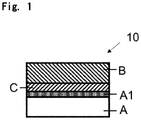
- the water-barrier laminated film of the invention has a basic structure in which the water-trapping layer (B) is provided on the inorganic barrier layer (A1) that is present on the surface of the plastic film (A).
- the isocyanate type coating (C) lies under the water-trapping layer. That is, the isocyanate type coating (C) contains, as the film-forming component (matrix), a polymer (typically, a polyurethane) obtained by the reaction of an isocyanate as the reaction component.
- the water-trapping layer is formed on the isocyanate type coating (C) that is formed as the underlying layer effectively relaxing the stress that builds up in the water-trapping layer at the time of heating and drying. Therefore, the water-trapping layer is effectively prevented from cracking.
- C isocyanate type coating
- the composition of the isocyanate type coating (C) is adjusted to greatly improve the adhesive force to the water-trapping layer (B).
- the adhesive force is about 0.2 N/15 mm when the coating composition for forming the water-trapping layer is directly applied on the surface of the inorganic barrier layer without forming the isocyanate type coating (C) as the underlying layer.
- the isocyanate type coating (C) (e.g., urethane type coating) is formed on the surface of the inorganic barrier layer to lie under the water-trapping layer (B).
- an improved adhesive force is exhibited by the water-trapping layer that is formed by heating under quite the same conditions as those described above .
- the adhesive force greatly improves to a level of about 1 N/15 mm specifically when the crosslinking structure is introduced with a functional group of any one of epoxy group, silanol group or isocyanate group.
- the water-trapping layer (B) having an improved adhesive force as described above can be firmly held on the inorganic barrier layer via the isocyanate type coating (C), and can be effectively prevented from being peeled off.
- the water-trapping layer (B) is effectively prevented from cracking yet exhibiting its properties to a sufficient degree, i.e., showing excellent water-barrier property. Besides, even without executing the heat treatment at temperatures of not lower than 100°C for extended periods of time, the water-trapping layer (B) can be held maintaining a large adhesive force. Accordingly, an improved degree of productivity can be guaranteed offering a very great advantage in an industrial sense.
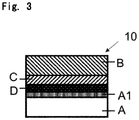
- the water-barrier laminated film of the invention generally designated at 10 has a plastic film (A) as the base material.
- An inorganic barrier layer (A1) is formed on the surface of the plastic film (A).
- a water-trapping layer (B) is formed with an isocyanate type coating (C) as the underlying layer.
- the isocyanate type coating (C) and the water-trapping layer (B) in this order.
- the plastic film (A) may have a protection layer (D) formed on the inorganic barrier layer (A1). That is, the isocyanate type coating (C) may be laminated directly on the inorganic barrier layer (A1) or, as shown in Fig. 3 , may be laminated on the protection layer (D) that is suitably provided on the inorganic barrier layer (A1).
- the film (A) lies under the inorganic barrier layer (A1) and is, usually, formed by using a thermoplastic or thermosetting resin based, depending on the form thereof, on such a method as injection or co-injection forming, extrusion or co-extrusion forming, film- or sheet-forming method, compression forming or cast polymerization.
- the film is, usually, formed by using a thermoplastic resin.
- thermoplastic resin there can be exemplified polyolefins or cyclic olefin copolymers such as random or block copolymers of ⁇ -olefins, like low-density polyethylene, high-density polyethylene, polypropylene, poly 1-butene, poly 4-methyl-1-pentene or ethylene, propylene, 1-butene and 4-methyl-1-pentene; ethylene ⁇ vinyl compound copolymers such as ethylene ⁇ vinyl acetate copolymer, ethylene ⁇ vinyl alcohol copolymer, and ethylene- vinyl chloride copolymer; styrene type resins such as polystyrene, acrylonitrile ⁇ styrene copolymer, ABS, and ⁇ -methylstyrene ⁇ styrene copolymer; polyvinyl compounds such as polyvinyl chloride, polyvinylidene chloride, vinyl chloride ⁇ vinylidene chloride copoly
- the plastic film (A) is preferably made from a gas-barrier resin having excellent oxygen-barrier property, such as ethylene ⁇ vinyl alcohol copolymer, and may, further, have a multilayered structure including a layer formed by using such a gas-barrier resin.
- a gas-barrier resin having excellent oxygen-barrier property such as ethylene ⁇ vinyl alcohol copolymer
- the plastic film (A) is made from a polyester resin as represented by polyethylene terephthalate (PET) or an olefin resin as represented by polyethylene or polypropylene from such standpoints as easy availability, cost, formability, barrier property against oxygen to some extent, and suitability as being formed under the inorganic barrier layer (A1) as will be described later.
- PET polyethylene terephthalate
- olefin resin as represented by polyethylene or polypropylene
- the thickness of the plastic film (A) there is no specific limitation on the thickness of the plastic film (A), and its thickness may be suitably determined depending on the use.
- the inorganic barrier layer (A1) formed on the surface of the plastic film (A) may be the one that has been known per se. as taught in, for example, Japanese Patent Laid-Open No. 2015-96320 .
- the inorganic barrier layer (A1) can be a film that is physically deposited by such means as vacuum evaporation or ion plating, or can be an inorganic film formed by chemical deposition as represented by plasma CVD, i.e., the film formed by depositing metals or metal oxides to secure a high degree of oxygen-barrier property.
- the inorganic barrier layer (A1) is formed on the plastic film (A) that serves as the underlying layer therefor by the plasma CVD from such standpoints that it can be evenly formed even on a rough surface and that it exhibits barrier property against water as well as oxygen.
- the plastic film (A) that serves as the underlying layer for the inorganic barrier layer (A1) is arranged in a plasma treatment chamber in which a predetermined degree of vacuum is maintained. Then a metal for forming the film or a gas (reaction gas) of a compound containing the metal and the oxidizing gas (usually, oxygen gas or NOx gas) are fed together with a suitable carrier gas such as argon or helium through gas feed pipes into the plasma treatment chamber that has been shielded with metal walls and in which the pressure has been reduced to a predetermined degree of vacuum.
- a suitable carrier gas such as argon or helium
- a glow discharge is generated by utilizing a microwave electric field or a high-frequency electric field, a plasma is generated by the electric energy thereof, and a decomposed reaction product of the above-mentioned compound is disposed on the surface of the plastic film A to form a film thereof.
- reaction gas in general, it is desired to use a gas of an organometal compound such as an organoaluminum compound like trialkylaluminum, or an organotitanium compound, organozirconium compound or organosilicon compound from the standpoint of forming, in the interface to the underlying film (A), a film having a flexible region containing carbon and, further, having thereon a region that is highly oxidized and having excellent barrier property.
- organosilicon compound from the standpoint of relatively easily and efficiently forming the inorganic barrier layer (A1) having a high degree of barrier property against oxygen.
- organosilicon compound there can be used organosilane compounds such as hexamethyldisilane, vinyltrimethylsilane, methylsilane, dimethylsilane, trimethylsilane, diethylsilane, propylsilane, phenylsilane, methyltriethoxysilane, vinyltriethoxysilane, vinyltrimethoxysilane, tetramethoxysilane, tetraethoxysilane, phenyltrimethoxysilane, methyltrimethoxysilane and methyltriethoxysilane, as well as organosiloxane compounds such as octamethylcyclotetrasiloxane, 1,1,3,3-tetramethyldisiloxane and hexamethyldisiloxane.
- organosiloxane compounds such as octamethylcyclotetrasiloxane, 1,1,3,3-tetramethyldisi
- organometal compounds can be used alone or in a combination of two or more kinds.
- the thickness of the above inorganic barrier layer (A1) may differ depending on the use of the water-barrier laminated film and the level of the required barrier property. Usually, however, the thickness of the inorganic barrier layer (A1) should be so selected as to secure a water vapor permeability of not more than 10 -1 g/m 2 ⁇ day/atom and, specifically, not more than 10 -2 g/m 2 ⁇ day/atom without impairing properties of the plastic film (A) on which it is deposited. Though it may differ depending on the ratio occupied by the above-mentioned highly oxidized region, the inorganic barrier layer (A1) should have a thickness of, usually, 4 to 500 nm and, specifically, about 30 to about 400 nm.
- the above-mentioned inorganic barrier layer (A1) can also be formed on the plastic film (A) by a coating method or the like method instead of the vacuum evaporation. That is, the inorganic barrier layer (A1) formed by the coating method may have properties such as oxygen-barrier property and the like properties which are lower than those of the inorganic barrier layer formed by the vacuum evaporation. Depending upon the required degree of barrier property against oxygen and the like gases, however, the inorganic barrier layer (A1) may be the one that is formed by the coating method.
- the inorganic barrier layer (A1) can be typically formed by applying, onto a predetermined surface, an organic solvent solution that contains a polysilazane, a silane compound (e.g., alkoxysilane or the like) that can be polycondensed and that is suitably mixed with fine inorganic particulate material such as silica or alumina.
- the organic solvent solution is, thereafter, heated, and the organic solvent is volatilized to thereby form the film.
- the water-trapping layer (B) is to shut off the water component that flows in the direction of thickness of the water-barrier laminated film 10.
- the water-trapping layer (B) may be the layer that has been known per se., e.g., the layer formed by dispersing a physical desiccant such as zeolite or silica gel in a predetermined resin layer, the layer formed by dispersing a chemical desiccant such as calcium oxide in the predetermined resin layer, or the layer formed by using a hygroscopic non-ionic polymer such as polyvinyl alcohol, water-soluble nylon or polyethylene oxide.
- the layer in a structure that uses an ionic polymer disclosed in, for example, the Japanese Patent Laid-Open No. 2015-96320 as the matrix, and a hygroscopic agent is dispersed in the matrix, the hygroscopic agent having an ultimate humidity lower than that of the ionic polymer.
- a hygroscopic agent is dispersed in the matrix, the hygroscopic agent having an ultimate humidity lower than that of the ionic polymer.
- the water-trapping layer traps the water excellently.
- the water can be confined in the hygroscopic agent that is dispersed. This makes it possible to effectively alleviate deformation such as swelling caused as a result of having absorbed the water.
- the ionic polymer used in the invention can be a cationic polymer or an anionic polymer as described below.
- the cationic polymer is a polymer that has in the molecules thereof a cationic group that could become a positive electric charge in water, such as primary to tertiary amino group, quaternary ammonium group, pyridyl group, imidazole group or quaternary pyridinium group.
- the cationic polymer is capable of forming a hygroscopic matrix since the cationic group therein has a strong nucleophilic action and traps water by the hydrogen bonding.
- the amount of the cationic groups in the cationic polymer is, usually, such that the coefficient of water absorption (JIS K-7209-1984) of the hygroscopic matrix that is formed is not less than 5% and, specifically, 30% to 45% in an atmosphere of a humidity of 80%RH and 30°C.
- the cationic polymer there is used the one obtained by polymerizing or copolymerizing at least one kind of a cationic monomer as represented by an amine monomer such as allylamine, ethyleneimine, vinylbenzyltrimethylamine, [4-(4-vinylphenyl)- methyl]-trimethylamine, or vinylbenzyltriethylamine; nitrogen-containing heterocyclic monomer such as vinylpyridine or vinylimidazole; or salts thereof; with other copolymerizable monomers and, further, as required, followed by the partial neutralization by the treatment with an acid.
- an amine monomer such as allylamine, ethyleneimine, vinylbenzyltrimethylamine, [4-(4-vinylphenyl)- methyl]-trimethylamine, or vinylbenzyltriethylamine
- nitrogen-containing heterocyclic monomer such as vinylpyridine or vinylimidazole
- salts thereof such as vinylpyridine or vinylimidazole
- the cationic polymers have been closely described in, for example, the Japanese Patent Laid-Open No. 2015-96320 and are not, therefore, described here in detail. Usually, however, it is desired to use the polyallylamine from the standpoint of forming the film.
- the anionic polymer is a polymer which has in the molecules thereof an anionic functional group that could become a negative electric charge in water, such as carboxylic acid group, sulfonic acid group or phosphonic acid group, or an acid base thereof that is partly neutralized.
- the anionic polymer having such a functional group is capable of forming a hygroscopic matrix since the functional group therein traps water due to the hydrogen bond.
- the amount of the anionic functional groups in the anionic polymer may differ depending on the kind of the functional groups but is, usually, such that the coefficient of water absorption (JIS K-7209-1984) of the hygroscopic matrix that is formed is not less than 5% and is, specifically, 30% to 45% in an atmosphere of a humidity of 80%RH and 30°C.
- anionic polymer having the above functional group there is used the one obtained by polymerizing or copolymerizing, with other monomers copolymerizable therewith, at least one of the anionic monomers as represented by carboxylic acid monomers such as methacrylic acid, acrylic acid and maleic anhydride; sulfonic acid monomers such as ⁇ -halogenated vinylsulfonic acid, styrenesulfonic acid and vinylsulfonic acid; phosphonic acid monomers such as vinylphosphoric acid, etc.; or salts of monomers thereof, followed, as required, by a partial neutralization with an alkali.
- carboxylic acid monomers such as methacrylic acid, acrylic acid and maleic anhydride
- sulfonic acid monomers such as ⁇ -halogenated vinylsulfonic acid, styrenesulfonic acid and vinylsulfonic acid
- phosphonic acid monomers such as vinylphosphoric acid, etc.
- salts of monomers thereof followed, as required,
- anionic polymers have also been closely described in, for example, the Japanese Patent Laid-Open No. 2015-96320 and are not, therefore, described here in detail.
- poly(meth)acrylic acid and a partly neutralized product thereof e.g., the one of which moiety is an Na salt.
- the water-trapping layer (B) is blended with a hygroscopic agent having an ultimate humidity lower than that of the ionic polymer (cationic or anionic polymer) that forms the matrix.
- the water absorbed by the matrix of the ionic polymer can now be readily trapped by the hygroscopic agent and can be effectively confined in the matrix. Therefore, the water-trapping layer (B) effectively exhibits its water-absorbing capability even in an atmosphere of a very low humidity. Furthermore, the water-trapping layer (B) is effectively suppressed from swelling despite it has absorbed the water.
- the hygroscopic agent that highly adsorbs moisture there can be preferably used those that have ultimate humidities of not more than 6% in an environment of a humidity of 80%RH and a temperature of 30°C provided they have ultimate humidities lower than the humidity of the ionic polymer. If the ultimate humidity of the hygroscopic agent is higher than that the ionic polymer, then the water absorbed by the matrix cannot be confined to a sufficient degree but tends to be released, and greatly improved water-barrier property cannot be expected. Further, despite the ultimate humidity is lower than that of the ionic polymer, water in an atmosphere of a low humidity cannot be trapped to a sufficient degree if the ultimate humidity measured under the above condition is higher than the above range. In this case, the water-barrier property cannot often be exhibited to a sufficient degree.
- the above hygroscopic agent usually, has a coefficient of water absorption (JIS K-7209-1984) of not less than 50% in an environment of a humidity of 80%RH and a temperature of 30°C, and is either inorganic or organic.
- inorganic hygroscopic agent there can be exemplified clay minerals such as zeolite, alumina, activated charcoal and montmorillonite, as well as silica gel, calcium oxide and magnesium sulfate.
- the organic hygroscopic agent there can be exemplified an anionic polymer or a crosslinked product of a partly neutralized product thereof.
- the anionic polymer there can be exemplified the one obtained by polymerizing at least one of the anionic monomers represented by carboxylic acid monomers ((meth)acrylic acid, anhydrous maleic acid, etc.), sulfonic acid monomers (halogenated vinylsulfonic acid, styrenesulfonic acid, vinyl sulfonic acid, etc.), phosphonic acid monomers (vinylphosphoric acid, etc.) or salts of monomers thereof, or copolymerizing it with other monomers.
- an organic hygroscopic agent is effectively used.
- fine particles of a crosslinked sodium poly(meth)acrylate can be representatively used as the organic hydroscopic agent.
- a hygroscopic agent having a small particle size e.g., average primary particle size of less than 100 nm and, specifically, less than 80 nm
- the hygroscopic agent of the organic polymer disperses very well in the matrix of the ionic polymer, i.e., disperses homogeneously.
- the hygroscopic agent can be obtained in a fine particulate shape and in a uniform spherical shape.
- the organic fine hygroscopic agent has a very low ultimate humidity as described above, has a high hygroscopic property, and changes the volume very little despite it is swollen since it has been crosslinked. Therefore, the organic fine hygroscopic agent is best suited for bringing the environmental atmosphere to the absolutely dry state or to nearly the absolutely dry state yet suppressing a change in the volume thereof.
- the amount of the hygroscopic agent is determined depending on the kind of the ionic polymer from the standpoint of exhibiting its properties to a sufficient degree, greatly improving the water-barrier property, effectively suppressing a change in the size caused by swelling, and maintaining the water-barrier property higher than the water-barrier property of the inorganic barrier layer (A1) over extended periods of time.
- the water-trapping layer (B) is formed in a thickness (e.g., not less than 1 ⁇ m and, specifically, about 2 to about 20 ⁇ m) that is enough to exhibit such a high barrier property that the water vapor permeability is not more than 10 -5 g/m 2 /day.
- the hygroscopic agent is used in an amount of not less than 50 parts by weight, specifically, in an amount of 100 to 900 parts by weight and, further desirably, in an amount of 200 to 600 parts by weight per 100 parts by weight of the ionic polymer in the water-trapping layer (B).
- the matrix is formed of an anionic polymer
- the hygroscopic agent is used in an amount of not less than 50 parts by weight, specifically, in an amount of 100 to 1300 parts by weight and, further desirably, in an amount of 150 to 1200 parts by weight per 100 parts by weight of the anionic polymer in the water-trapping layer B.
- the ionic polymer has a crosslinked structure introduced therein. That is, when the ionic polymer having the crosslinked structure absorbs the water, the molecules of the cationic polymer are locked by each other through the crosslinking. Therefore, the water-trapping layer (B) suppresses a change in the volume thereof that is caused by swelling (absorption of water), and brings about an increase in the mechanical strength and the dimensional stability.
- the crosslinked structure can be introduced by adding a crosslinking agent to the coating composition that forms the water-trapping layer (B).
- a crosslinking agent to the coating composition that forms the water-trapping layer (B).
- the water is trapped relying only upon the hydrogen bond.
- the crosslinking agent for introducing the crosslinked structure differs to a slight degree depending upon when the crosslinked structure is introduced into the cationic polymer and when the crosslinked structure is introduced into the anionic polymer.
- the crosslinking agent for the cationic polymer there can be used a compound having a functional group (e.g., epoxy group) capable of reacting with the cationic group and a functional group (e.g., alkoxysilyl group) capable of forming a siloxane structure in the crosslinked structure through the hydrolysis and the dehydration/condensation.
- the silane compound has an epoxy group as a functional group and an alkoxysilyl group.
- the epoxy group undergoes the addition reaction with a functional group (e.g., NH 2 group) of the cationic polymer.
- a functional group e.g., NH 2 group
- the alkoxysilyl group grows by forming a silanol group (SiOH group) through the hydrolysis thereof and by forming a siloxane structure through the condensation reaction thereof and, finally, forms the crosslinked structure among the cationic polymer chains. Therefore, the matrix of the cationic polymer has, introduced therein, the crosslinked structure that has the siloxane structure.
- the cationic polymer is alkaline.
- the addition reaction of the cationic group with the epoxy group is quickly accelerated, the dehydration and condensation are also quickly accelerated among the silanol groups, and the crosslinked structure can be easily introduced.
- the organic group X having the epoxy group in the above formula (1) there can be representatively used a ⁇ -glycidoxyalkyl group.
- a ⁇ -glycidoxypropyltrimethoxysilane or a ⁇ -glycidoxypropylmethyldimethoxysilane is preferably used as the crosslinking agent.
- the crosslinking agent there can be also used the one of which the epoxy group in the above formula (1) is an alicyclic epoxy group such as epoxycyclohexyl group.
- the cross linking agent a compound that has an alicyclic epoxy group such as ⁇ -(3,4-epoxycyclohexyl) ethyltrimethoxysilane, there can be introduced an alicyclic structure together with the siloxane structure into the crosslinked structure of the matrix. Introduction of the alicyclic structure makes it possible to more effectively exhibit the function of the matrix which is to form a spatial mesh structure adapted to adsorbing the moisture.
- a representative example of the diglycidyl ester is expressed by the following formula (2-1).
- the diglycidyl ester of the formula (2) has no alkoxysilyl group. However, use of the diglycidyl ester of the formula (2) is effective in forming the spatial mesh structure in the matrix that is adapted to absorbing the moisture since it introduces the alicyclic structure in the crosslinked structure.
- the above-mentioned crosslinking agent is used in an amount of 5 to 60 parts by weight and, specifically, 15 to 50 parts by weight per 100 parts by weight of the cationic polymer.
- at least not less than 70% by weight and, preferably, not less than 80% by weight of the crosslinking agent is the silane compound of the above formula (1) .
- the crosslinking agent for introducing the crosslinked structure into the anionic polymer there can be used a compound having two or more crosslinking functional groups (e.g., epoxy groups) capable of reacting with the ionic groups possessed by the anionic polymer.
- the epoxy group reacts with the anionic group, and the crosslinked structure that contains the alicyclic structure due to the divalent group A is formed in the matrix.
- the crosslinked structure that contains the alicyclic structure works to further suppress the swelling.
- the crosslinking agent for the anionic polymer is used in an amount of, desirably, 150 parts by weight and, specifically, 10 to 40 parts by weight per 100 parts by weight of the anionic polymer.
- the above-mentioned water-trapping layer (B) is formed by using a coating composition obtained by dispersing the hygroscopic agent in a resin that serves as the matrix and, as required, further, dissolving or dispersing the crosslinking agent in a predetermined solvent.
- the coating composition is applied onto the isocyanate type coating (C) formed on the inorganic barrier layer (A1) that will be described later, followed by heating and drying to remove the solvent.
- the heating and drying are, usually, carried out at a temperature of about 100 to about 170°C for such a short period of time of not more than 3 minutes and, specifically, about 0.25 to about one minute. There is thus formed the water-trapping layer (B) that is firmly adhered to the inorganic barrier layer (A1) via the isocyanate type coating (C).
- the solvent if it can be volatilized and removed by heating at a relatively low temperature.
- the solvent there can be used alcohol solvents such as methanol, ethanol, propyl alcohol and butanol; ketone solvents such as acetone and methyl ethyl ketone; mixed solvents of these solvents with water; and aromatic hydrocarbon solvents such as benzene, toluene and xylene.
- a silane compound is used as the crosslinking agent, however, it is desired to use water or a mixed solvent containing water in order to accelerate the hydrolysis of the silane compound.
- an alkali e.g., sodium hydroxide or the like
- the above-mentioned solvent is used in such an amount that the coating composition acquires a viscosity suited for being applied. Moreover, in order to adjust the viscosity of the coating composition or in order to adjust the coefficient of water absorption of the hygroscopic matrix that is formed to lie within a suitable range, there may be added a nonionic polymer in a suitable amount.
- nonionic polymer there can be used saturated aliphatic hydrocarbon polymers such as polyvinyl alcohol, ethylene-propylene copolymer and polybutylene; styrene polymers such as styrene-butadiene copolymer and the like; and polyvinyl chloride.
- nonionic polymers obtained by copolymerizing the above polymers with various kinds of comonomers (e.g., styrene monomers such as vinyl toluene, vinyl xylene, chlorostyrene, chloromethylstyrene, ⁇ -methylstyrene, ⁇ -halogenated styrene, and ⁇ , ⁇ , ⁇ '-trihalogenated styrene; monoolefins such as ethylene and butylene; and conjugated diolefins such as butadiene and isoprene).
- comonomers e.g., styrene monomers such as vinyl toluene, vinyl xylene, chlorostyrene, chloromethylstyrene, ⁇ -methylstyrene, ⁇ -halogenated styrene, and ⁇ , ⁇ , ⁇ '-trihalogenated sty
- the above-mentioned water-trapping layer (B) contains, specifically, a cationic polymer as the matrix (film-forming component) . That is, the water-trapping layer (B) containing the cationic polymer must be heated at a high temperature which is not lower than 100°C and for an extended period of time in order to secure a specifically high degree of adhesiveness. According to the present invention, however, the isocyanate type coating (C) is provided as the underlying layer. This makes it possible to form the water-trapping layer (B) that is firmly adhered without the need of executing the heating at high temperatures and for long periods of time to make the most of the advantage of the invention.
- the isocyanate type coating (C) is provided between the plastic film (A) and the water-trapping layer (B). Namely, the water-trapping layer (B) is formed on the isocyanate type coating (C) that is formed as the underlying layer.
- the isocyanate type coating contains, as the film-forming component, an isocyanate type polymer that is obtained using the isocyanate as the reaction component.
- the isocyanate type polymer is the one that is obtained by curing a polyurethane or an isocyanate reactive resin with a polyisocyanate.
- the isocyanate group present in the coating reacts with an MOH (M is a metal atom such as Si) present on the surface of the inorganic barrier layer or with an ionic group in the ionic polymer.
- M is a metal atom such as Si
- the coating (C) becomes highly adhesive to the water-trapping layer (B) and prevents the water-trapping layer (B) from being delaminated.
- the polyurethane is a polymer having an urethane bond (-NH-COO-) as a recurring unit, and is obtained through the urethanation reaction of the diisocyanate component and the diol component.
- the diisocyanate component includes aromatic diisocyanate, aromatic-aliphatic diisocyanate, alicyclic diisocyanate and aliphatic diisocyanate.
- aromatic diisocyanate there can be exemplified m- or p-phenylene diisocyanate or a mixture thereof; 4,4'-diphenyl diisocyanate, 1,5-naphthalene diisocyanate (NDI), 4,4'-, 2,4'- or 2,2'-diphenylmethane diisocyanate or a mixture thereof (MDI); 2,4- or 2,6-tolylene diisocyanate or a mixture thereof (TDI); 4,4'-toluidine diisocyanate (TODI); and 4,4'-diphenylether diisocyanate.
- NDI 1,5-naphthalene diisocyanate
- MDI 4,4'-, 2,4'- or 2,2'-diphenylmethane diisocyanate or a mixture thereof
- MDI 2,4- or 2,6-tolylene diisocyanate or a mixture thereof
- TODI 4,4'-toluidine diisocyanate
- aromatic-aliphatic diisocyanate there can be exemplified 1,3- or 1,4-xylylene diisocyanate or a mixture thereof (XDI) ; 1, 3- or 1, 4-tetramethylxylylene diisocyanate or a mixture thereof (TMXDI); and ⁇ , ⁇ '-diisocyanate-1,4-diethylbezene.
- 1,3-cyclopentene diisocyanate 1,4-cyclohexane diisocyanate, 1,3-cyclohexane diisocyanate, 3-isocyanatemethyl-3,5,5-trimethylcyclohexyl isocyanate (isophorone diisocyanate; IPDI), 4,4'-, 2,4'- or 2,2'-dicyclohexylmethane diisocyanate or a mixture thereof (hydrogenated MDI), methyl-2,4-cyclohexane diisocyanate, methyl-2,6-cyclohexane diisocyanate, 1,3- or 1,4-bis(isocyanatemethyl) cyclohexane or a mixture thereof (hydrogenated XDI).
- trimethylene diisocyanate there can be exemplified trimethylene diisocyanate, tetramethylene diisocyanate, hexamethylene diisocyanate (HDI), pentamethylene diisocyanate, 1,2-propylene diisocyanate, 1,2-, 2,3- or 1,3-butylene diisocyanate, 2,4,4- or 2,2,4-trimethylhexamethylene diisocyanate, and 2,6-diisocyanatemethyl caproate.
- trimethylene diisocyanate tetramethylene diisocyanate
- HDI hexamethylene diisocyanate
- pentamethylene diisocyanate 1,2-propylene diisocyanate
- 1,2-, 2,3- or 1,3-butylene diisocyanate 2,4,4- or 2,2,4-trimethylhexamethylene diisocyanate
- 2,6-diisocyanatemethyl caproate 2,6-diisocyanatemethyl caproate.
- diisocyanate components can be used alone or in a combination of two or more kinds. As required, it is also allowable to use a trifunctional or a more highly functional polyisocyanate in combination therewith.
- the diol component includes a wide range of diols of from a low molecular diol through up to an oligomer.
- Examples thereof include C 2-12 alkylene glycols (e.g., ethylene glycol, 1,3- or 1,2-propylene glycol, 1,4-, 1,3- or 1,2-butanediol, 1,5-pantanediol, 3-methyl-1,5-pantanediol, 2,4-diethyl-1,5-pantanediol, 2,2,4-trimethylpentane-1,3-diol, 1,6-hexanediol, neopentyl glycol, 1,5- or 1,7-heptanediol, 1,8-octanediol, 1,9-nonanediol, 1,10-decanediol, 1,11-undecanediol, 1,12-dodecanediol, etc
- the diol components can be used alone or in a combination of two or more kinds. As required, it is also allowable to use a trifunctional or a more highly functional polyol in combination therewith.
- the polyurethane there can be further used, as required, a diamine component together with the diol component.
- the diamine is used as a chain extender or a crosslinking agent.
- diamine there can be used, for example, hydrazine; aliphatic diamines (e.g., ethylenediamine, trimethylenediamine, tetramethylenediamine, pentamethylenediamine, hexamethylenediamine, 2,2,4-trimethylhexamethylenediamine, 2,4,4-trimethylhexamethylenediamine, octamethylenediamine, etc.); aromatic amines (e.g., m- or p-phenylenediamine, 1,3- or 1,4-xylylenediamine or a mixture thereof, etc.); alicyclic diamines [e.g., hydrogenated xylylenediamine, bis(4-aminocyclohexyl)methane, isophoronediamine, bis(4-amino-3-methylcyclohexyl)methane, etc.].
- a diamine having a hydroxyl group such as 2-hydrazino
- the diamine components can be used alone or in a combination of two or more kinds. As required, it is also allowable to use a trifunctional or a more highly functional polyamine component in combination therewith.
- the above-mentioned polyurethane for forming the isocyanate type coating (C) is produced by dispersing or dissolving the above-mentioned components in various solvents and subjecting them to the widely known urethanation reaction.
- the thus obtained polyurethane is, desirably, a high-Tg polyurethane having a glass transition point of not lower than 60°C, preferably, not lower than 65°C and, more preferably, not lower than 68°C. That is, the water-trapping layer (B) is formed on the isocyanate type coating (C) by a gravure coating while being heated at, for example, about 60°C. The water-trapping layer (B) is then dried.
- cracks tend to occur due to the shrinkage stress at the time of forming the film or drying the film.
- use of the high-Tg polyurethane is effective in preventing the occurrence of cracks.
- the polyurethane should have a molecular weight which is basically large enough to form the films.
- Mw weight average molecular weight
- the isocyanate type coating (C) formed by using the polyurethane further, has a crosslinked structure introduced therein by at least one kind of functional group selected from the group consisting of an epoxy group, a silanol group and an isocyanate group. This enables the isocyanate type coating (C) to secure excellent adhesiveness to the water-trapping layer (B).
- the crosslinked structure can be introduced relying on the functional group.
- the curing agent having the functional group is added to the coating composition for forming the isocyanate type coating.
- the crosslinked structure can then be made present in the coating (C) as it is formed and cured.
- the isocyanate type polymer a polymerized/cured product that is obtained by reacting an isocyanate reactive resin with the isocyanate. That is, the isocyanate groups are also made present in the polymerized/cured product, and the coating exhibits a high degree of adhesiveness to the water-trapping layer (B) and effectively prevents the water-trapping layer (B) from being delaminated.
- the isocyanate reactive resin there can be exemplified those resins having a functional group capable of reacting with the isocyanate, such as hydroxyl group, carboxyl group or amino group and, specifically, hydroxyl group or carboxyl group.
- a functional group capable of reacting with the isocyanate such as hydroxyl group, carboxyl group or amino group and, specifically, hydroxyl group or carboxyl group.
- ester resin there can be exemplified ester resin, (meth)acrylic resin, polycarbonate resin and polyvinyl alcohol.
- an urethane resin (corresponds to the above-mentioned polyurethane) as the isocyanate reactive resin.
- ester resin there can be specifically preferably used ester resin, (meth) acrylic resin (poly (meth) acrylic acid or poly(meth)acrylic ester), and urethane resin as the isocyanate reactive resins.
- the isocyanate reactive resin is a high-Tg resin having a glass transition point of not lower than 60°C, preferably, not lower than 65°C and, more preferably, not lower than 68°C from the standpoint of effectively preventing the occurrence of cracks at the time of forming the water-trapping layer (B). It is also desired that the isocyanate reactive resin has a weight average molecular weight of not less than 14,000, preferably, not less than 40,000 and, more preferably, not less than 50,000.
- diphenylmethane diisocyanate MDI
- tolylene diisocyanate TDI
- hexamethylene diisocyanate HDI
- metaxylylene diisocyanate tetramethylene diisocyanate
- pentamethylene diisocyanate lizine isocyanate
- IPDI isophorone diisocyanate
- polynuclear condensates of these isocyanates which can be used alone or in a combination of two or more kinds.
- the terminals of the polyisocyanate may be blocked with a blocking agent.
- the blocking agent include alcohols such as methanol, ethanol and lactate ester; phenolic hydroxide group-containing compounds such as phenol and salicylate ester; amides such as ⁇ -caprolactam and 2-pyrrolidone; oximes such as acetone oxime and methyl ethyl ketone oxime; and active methylene compounds such as methyl acetoacetate, ethyl acetoacetate, acetylacetone, dimethyl malonate and diethyl malonate, which may be used in a single kind or in a combination of two or more kinds.
- the isocyanate type coating (C) can be formed by applying, onto the inorganic barrier layer (A1), a coating composition of a solvent in which the above-mentioned polyurethane or isocyanate reactive resin has been dissolved or dispersed and in which, as required, a curing agent having a predetermined functional group has, further, been dispersed, followed by heating and firing at a temperature of not lower than 100°C.
- the coating composition uses the polyurethane or the isocyanate reactive resin in, desirably, a granular form from the standpoint of forming the coating (C) in which the isocyanate groups are homogeneously distributed.
- the granular resin usually, has an integrated particle size (D50) in a range of 0.02 to 3 ⁇ m and, specifically, about 0.03 to about 1 ⁇ m calculated from a volume measured relying on the laser diffraction ⁇ light scattering method.
- the solvent used for forming the coating composition may be the one that can be volatilized without being heated at unnecessarily high temperatures.
- the solvent can be volatilized with being heated at about 100°C.
- the solvent is used in such an amount that the coating composition assumes a viscosity adapted for being applied.
- the coating composition uses a granular polyurethane resin
- a curing agent that has at least one of epoxy group, silanol group or isocyanate group as the functional group, the curing agent being dispersed in the solvent together with the granular polyurethane resin.
- a crosslinked structure is thus introduced into the isocyanate type coating (C) that is formed contributing to further improving the adhesiveness to the water-trapping layer (B) (or the inorganic barrier layer (A1)).
- the curing agent having epoxy group or silanol group as the functional group there can be used, for example, a silane coupling agent.
- silane coupling agent though not limited thereto only, there can be exemplified methyltrimethoxysilane, methyltriethoxysilane, methyltrichlorosilane, dimethyldichlorosilane, trimethylchlorosilane, vinyltrimethoxysilane, vinytriethoxysilane, vinyltrichlorosilane, vinyltriacetoxysilane, vinyltris( ⁇ -methoxyethoxy)silane, ⁇ -methacryloyloxypropyltrimethoxysilane, ⁇ -methacryloyloxypropyltris ( ⁇ -methoxyethoxy) silane, ⁇ -chloropropyltrimethoxysilane, ⁇ -chloropropylmethyldimethoxysilane, ⁇ -glycidoxypropyltrimethoxysilane, ⁇ -glycidoxypropylmethyldiethoxysilane
- silane coupling agent containing the glycidyl group or the epoxy group such as ⁇ -glycidoxypropyltrimethoxysilane, ⁇ -glycidoxypropylmethyldiethoxysilane or ⁇ -(3,4-epoxycyclohexyl)ethyltrimethoxysilane from the standpoint of adhesiveness to the water-trapping layer (B).
- the silane coupling agent is added in an amount of 0.1 to 50 parts by weight, preferably, 1 to 30 parts by weight and, more preferably, 5 to 20 parts by weight per 100 parts by weight of the granular polyurethane resin in the coating composition.
- the curing agent having the isocyanate group as the functional group there can be exemplified the above-mentioned polyisocyanate.
- the polyisocyanate is, usually, used in an amount of 1 to 50 parts by weight, preferably, 5 to 40 parts by weight and, more preferably, 10 to 30 parts by weight per 100 parts by weight of the granular urethane resin in the coating composition.
- the coating composition uses the isocyanate reactive resin and, specifically, the non-urethane type resin such as ester type resin or (meth)acrylic type resin
- the above-mentioned polyisocyanate must be used as the curing agent in order to introduce the isocyanate group.
- the polyisocyanate is used in an amount of 1 to 50 parts by weight, preferably, 5 to 40 parts by weight and, more preferably, 10 to 30 parts by weight per 100 parts by weight of the granular isocyanate reactive resin in the coating composition.
- the above-mentioned silane coupling agent can be also used in combination with the polyisocyanate.
- the coating composition may be blended with a variety kinds of agents so far as they do not impair the adhesiveness between the isocyanate type coating (C) and the water-trapping layer (B) that are formed.
- the blending agents there can be exemplified laminar inorganic compound, stabilizers (antioxidant, heat stabilizer, ultraviolet ray absorber, etc.), plasticizer, antistatic agent, lubricant, anti-blocking agent, coloring agent, filler and crystal nucleating agent. It is allowable, as a matter of course, to add small amounts of resins having no reactivity to the isocyanate, such as olefin type resins so far as they do not impair the adhesiveness.
- the isocyanate type coating (C) is formed on the inorganic barrier layer (A1), and the water-trapping layer (B) is formed on the isocyanate type coating (C).
- the invention is in no way limited to this embodiment only.
- a protection layer (D) is formed on the inorganic barrier layer (A1), and the isocyanate type coating (C) is formed on the protection layer (D).
- the protection layer (D) is to prevent the inorganic barrier layer (A1) after it is formed from being peeled off, scratched or damaged. No special limitation is imposed on the protection layer (D) if it does not deteriorate the barrier property of the barrier film in, for example, an acceleration testing environment (in an environment of 85°C - 85% RH). Usually, the protection layer (D) is formed by using not less than 2 kinds of compounds or a blended of the following components (D1) and (D2).
- the component (D1) is a water-soluble high molecular component such as polyvinyl alcohol, polyvinyl pyrrolidone, starch, methyl cellulose, carboxymethyl cellulose or sodium alginate.
- the polyvinyl alcohol is specifically preferred.
- the component (D2) is at least one compound selected from the group consisting of organoalkoxysilane or a hydrolyzed product thereof, a metal alkoxide or a hydrolyzed product thereof, and a phosphorus type compound.
- the organoalkoxysilane is represented by, for example, the following formula (3): R-Si(OR') 3 (3) wherein R is an organic group, and R' is an alkyl group.
- organic group there can be exemplified alkyl group as well as groups having various kinds of functional groups (e.g., (meth)acryloyl group, vinyl group, amino group, epoxy group, isocyanate group, etc.).
- functional groups e.g., (meth)acryloyl group, vinyl group, amino group, epoxy group, isocyanate group, etc.
- alkyl group represented by R' though there is no specific limitation, there can be, usually, exemplified lower alkyl groups having not more than 4 carbon atoms (e.g., methyl group, ethyl group, propyl group and butyl group).
- organoalkoxysilane there can be exemplified ethyltrimethoxysilane, (meth)acryloxypropyltrimethoxysilane, vinyltrimethoxysilane, glycidoxytrimethoxysilane, glycidoxypropyltrimethoxysilane, epoxycyclohexylethyltrimethoxysilane, isocyanatepropyltrimethoxysilane and hydrolyzed products thereof, which can be used in a single kind or in a combination of two or more kinds.
- organosilanes are not limited to the monomers only but may also be such compounds as dimers or trimers depending on the structures thereof.
- the metal alkoxide is a compound represented by the following formula (4): M(OR')n (4) wherein M is a metal atom, R' is an alkyl group like the case of the above formula (3), and n is an integer representing the valence of the metal atom M.
- metal alkoxide there can be exemplified tetraethoxysilane and tripropoxyaluminum. These metal alkoxides, too, are used in a single kind or in a combination of two or more kinds.
- organoalkoxysilane and metal alkoxide can be each used as the component (D2) even in the form of hydrolyzed products.
- the hydrolyzed products can be obtained by a known method using an acid or an alkali.
- a reaction catalyst such as a tin compound or the like.
- phosphoric acid and salts thereof there can be exemplified phosphoric acid and salts thereof.
- trimetaphosphoric acid, tetrametaphosphoric acid, hexametaphosphoric acid and condensed phosphoric acid such as ultrametaphosphoric acid, as well as alkali metal salts and ammonium salts thereof.
- a phosphate ester such as triphenyl phosphate.
- These phosphorus compounds can be used in a single kind or in a combination of two or more kinds.
- the melted mixture is then applied onto the surface of the inorganic barrier layer (A1) to form the protection layer (D) .
- the thus formed protection layer (D) has a thickness which is, usually, in a range of 0.01 to 50 ⁇ m and, specifically, 0.1 to 2 ⁇ m.
- the inorganic barrier layer (A1) is provided on only one surface of the plastic film (A). It is, however, also allowable to form the inorganic barrier layers (A1) on both surfaces of the film (A), as a matter of course. Moreover, the isocyanate type coatings (C) and the water-trapping layers (B) can also be formed on the inorganic barrier layers (A1) that are formed on both surfaces.
- the water-trapping layer (B) is formed according to the procedure described above. Thereafter, water is released from the water-trapping layer (B), and a drying film is stuck on the surface of the water-trapping layer (B) to store the film in the protected state. To use the water-barrier laminated film, the drying film is removed.
- the water-trapping layer (B) can be dry-laminated on another barrier film or can be laminated on another water-trapping film (B) provided with the barrier film.
- the water-barrier laminated film has the water-trapping layer that is closely adhered thereto without the need of conducting the heat treatment at high temperatures for extended periods of time. This is a very great advantage from the standpoint of productivity.
- the water-trapping layer is effectively prevented from eing cracked or peeled and, therefore, exhibits excellent water-barrier property maintaining stability. Therefore, the water-barrier laminated film can be favorably used as a film for sealing various kinds of electronic devices and electronic circuits such as organic EL devices, solar cells and e-papers.
- a film of the isocyanate reactive resin was provided, and was subjected to the differential scanning calorimetry and the quantitative analysis under the following conditions. Values at the time of the second scanning were recorded.
- Apparatus DSC 6220 manufactured by Seiko Instrument Co. (differential scanning calorimetry) Sample: amount of sample, 5 to 10 mg Measuring conditions: nitrogen atmosphere, measured over a range of -50 to 200°C while elevating the temperature at a rate of 20°C/min.
- the isocyanate reactive resin soluble in the chloroform was measured for its average molecular weight by a method described below.
- the sample water-barrier laminated films of the A4 size were evaluated with the eye for the presence of cracks.
- the samples with cracks developed all over the film surfaces were evaluated to be ⁇ , the samples with some cracks developed along the edges of the films were evaluated to be ⁇ , and the samples with no crack were evaluated to be ⁇ .
- a PET film was dry-laminated on the water-barrier laminated film. To cure the adhesive layer, the laminated film was aged at 50°C for 3 days. Test pieces for T-peel testing were thus prepared.
- test pieces with not less than 1 N/15 mm were evaluated to be ⁇ , whereas the test pieces with less than 1 N/15 mm were evaluated to be ⁇ .
- a polymer solution was obtained by diluting, as the cationic polymer, a polyallylamine (PAA-15C, aqueous solution, 15% of solid content, produced by Nittobo Medical Co.) with the water such that the solid content thereof was 5% by weight.
- PAA-15C polyallylamine
- a solution of the crosslinking agent was prepared by dissolving, as the crosslinking agent, a ⁇ -glycidoxypropyltrimethoxysilane in water so that the amount thereof was 5% by weight.
- the polymer solution and the crosslinking agent solution were mixed together such that the amount of the ⁇ -glycidoxypropyltrimethoxysilane was 20 parts by weight per 100 parts by weight of the polyallylamine.
- a crosslinked product of the Na polyacrylate (TAFTIC HU-820E, aqueous dispersion, 13% of solid content, manufactured by Toyobo Co.) such that the amount thereof was 420 parts by weight relative to the polyallylamine.
- the mixture thereof was further adjusted with water such that the solid component was 5%.
- the mixture was stirred well to prepare a coating solution (B1) for forming the water-trapping layer.
- a polyacrylic acid (AC-10LP manufactured by Nihon Jyunyaku Co.) was dissolved in a mixed solvent of water/acetone (weight ratio of 80/20) such that the solid component was 5% by weight.
- the sodium hydroxide was then added thereto such that the neutralization rate of the polyacrylic acid was 80%, and a polymer solution was thus obtained.
- a diglycidyl 1,2-cyclohexanedicarboxylate in an amount of 20 parts by weight relative to the partly neutralized product of the polyacrylic acid.
- a ⁇ -(3,4-epoxycyclohexyl)ethyltrimethoxysilane was added in an amount of 3 parts by weight relative to the partly neutralized product of the polyacrylic acid.
- a granular hygroscopic agent (TAFTIC HU-820E, aqueous dispersion, 13% of solid content, manufactured by Toyobo Co.) was added in an amount of 431 parts by weight relative to the partly neutralized product of the polyacrylic acid. Moreover, the mixture thereof was adjusted with the water/acetone mixed solvent (weight ratio of 80/20) such that the whole solid content was 5% by weight. The resulting mixture was then stirred well to prepare a coating solution (B2) for forming the water-trapping layer.
- TAFTIC HU-820E aqueous dispersion, 13% of solid content, manufactured by Toyobo Co.
- a polymer solution was obtained by diluting, as the nonionic polymer, a polyvinyl alcohol (PVA 103 produced by Kuraray Co.) with the water so that the solid content thereof was 5% by weight.
- PVA 103 polyvinyl alcohol
- a solution of the crosslinking agent was prepared by dissolving, as the crosslinking agent, a ⁇ -glycidoxypropyltrimethoxysilane in water such that the amount thereof was 5% by weight.
- the polymer solution and the crosslinking agent solution were mixed together such that the amount of the ⁇ -glycidoxypropyltrimethoxysilane was 20 parts by weight per 100 parts by weight of the polyallylamine.
- a crosslinked product of the Na polyacrylate (TAFTIC HU-820E, aqueous dispersion, 13% of solid content, manufactured by Toyobo Co.) such that the amount thereof was 420 parts by weight relative to the polyallylamine.
- the mixture thereof was further adjusted with water such that the solid content was 5%.
- the mixture was stirred well to prepare a coating solution (B3) for forming the water-trapping layer.
- the isocyanate reactive resin solution was blended with a silane coupling agent (3-glycidyloxypropyltrimethoxysilane) as the curing agent in such an amount that the solid content of the curing agent was 5 parts by weight per 100 parts by weight of the solid content of the isocyanate reactive resin solution.
- the blend thereof was then diluted with a mixed solvent of water and 2-propanol to prepare an isocyanate type coating solution containing 20% of the solid content.
- the protection layer (D) comprises a polyvinyl alcohol and a tetraethoxysilane.
- the above isocyanate type coating solution was applied onto the protection layer (D) of the barrier film, and was heat-treated in an electric oven under the conditions of a peak temperature of 100°C and a peak temperature-holding time of one minute to thereby obtain an isocyanate type coating (C) of a thickness of 0.5 ⁇ m.
- the above cationic polymer-containing coating solution (B1) for forming the water-trapping layer was applied onto the isocyanate type coating (C), and was heat-treated under the conditions of a peak temperature of 100°C and a peak temperature-holding time of 40 seconds to form a 4 ⁇ m-thick water-trapping layer (B) to thereby obtain a water-barrier laminated film 10.
- An isocyanate type coating solution was prepared in the same manner as in Example 1 but changing the amount of the solid content of the curing agent into 20 parts by weight per 100 parts by weight of the solid content of the main polymer solution.
- a water-barrier laminated film 10 was obtained by the same method as that of Example 1 but using the above isocyanate type coating solution.
- the isocyanate reactive resin solution provided in Example 1 was used.
- the solution was blended with a blocked isocyanate (XWB-F206MEDG manufactured by Mitsui Kagaku Co.) as the curing agent in such an amount that the solid content of the curing agent was 10 parts by weight per 100 parts by weight of the solid content of the main agent.
- the blend thereof was diluted with the mixed solvent of water and 2-propanol to thereby prepare an isocyanate type coating solution containing 20% of the solid content.
- a water-barrier laminated film 10 was obtained by the same method as that of Example 1 but using the above isocyanate type coating solution.
- An isocyanate type coating solution was prepared in the same manner as in Example 3 but changing the amount of the solid content of the curing agent into 30 parts by weight per 100 parts by weight of the solid content of the isocyanate reactive resin solution.
- a water-barrier laminated film 10 was obtained by the same method as that of Example 1 but using the above isocyanate type coating solution.
- An isocyanate type coating solution was prepared in the same manner as in Example 3 but changing the amount of the solid content of the curing agent into 50 parts by weight per 100 parts by weight of the solid content of the isocyanate reactive resin solution.
- a water-barrier laminated film 10 was obtained by the same method as that of Example 1 but using the above isocyanate type coating solution.
- An isocyanate type coating (C) was formed in a thickness of 0.5 ⁇ m on the protection layer (D) of a commercially available barrier film in the same manner as in Example 3.
- an anionic polymer-containing coating solution (B2) for forming the water-trapping layer was applied onto the above isocyanate type coating (C), and was heat-treated under the conditions of a peak temperature of 100°C and a peak temperature-holding time of 40 seconds to form a 4 ⁇ m-thick water-trapping layer (B) to thereby obtain a water-barrier laminated film 10.
- a water-barrier laminated film 10 was obtained in the same manner as in Example 6 but forming a 4 ⁇ m-thick water-trapping layer (B) by using a nonionic polymer-containing coating solution (B3) as the coating material for forming the water-trapping layer.
- barrier film (Techbarrier LX, substrate: PET 12 ⁇ m, manufactured by Mitsubishi Jushi Co.) having a silicon oxide layer as the inorganic barrier layer but without having the protection layer (D) .
- An isocyanate type coating solution was prepared in the same manner as in Example 3.
- the isocyanate type coating solution was applied onto the inorganic barrier layer of the above barrier film, and was heat-treated in the electric oven under the conditions of a peak temperature of 100°C and a peak temperature-holding time of one minute to form a 0.5 ⁇ m-thick isocyanate type coating (C).
- the cationic polymer-containing coating solution (B1) for forming the water-trapping layer was applied onto the above isocyanate type coating (C), and was heat-treated under the conditions of a peak temperature of 100°C and a peak temperature-holding time of 40 seconds to form a 4 ⁇ m-thick water-trapping layer (B1) to thereby obtain a water-barrier laminated film 10.
- An isocyanate type coating solution was prepared in the same manner as in Example 3.
- an urethane coating (C) was formed on the protection layer (D) of the commercially available barrier film in the same manner as in Example 1, and a water-trapping layer (B) containing the cationic polymer was further formed thereon.
- the above urethane coating solution was applied onto the other surface of the barrier film (surface of the PET film) on which the isocyanate type coating (C) and the water-trapping layer (B) have been formed already as described above.
- the urethane coating solution was then heat-treated in the electric oven under the conditions of a peak temperature of 100°C and a peak temperature-holding time of 3 minutes to form an isocyanate type coating layer (C) of a thickness of 0.5 ⁇ m.
- the cationic polymer-containing coating solution (B1) for forming the water-trapping layer was applied onto the isocyanate type coating (C) that has been formed on the other surface.
- the coating solution (B1) for forming the water-trapping layer was then heat-treated under the conditions of a peak temperature of 100°C and a peak temperature-holding time of 40 seconds to form a water-trapping layer (B) of a thickness of 4 ⁇ m. There was thus obtained a water-barrier laminated film 10 having the water-trapping layers (B) on both surfaces thereof.
- the main polymer solution was blended with a polycyanate (D-110N produced by Mitsui Kagaku Co.) as the curing agent in an amount of 10 parts by weight per 100 parts by weight of the solid content of the main polymer solution.
- the blend thereof was then diluted with the methyl ethyl ketone to prepare an isocyanate type coating solution containing 20% of the solid content.
- the protection layer (D) comprises a polyvinyl alcohol and a tetraethoxysilane.
- the above isocyanate type coating solution was applied onto the protection layer (D) of the barrier film, and was heat-treated in the electric oven under the conditions of a peak temperature of 100°C and a peak temperature-holding time of one minute to obtain an isocyanate type coating (C) of a thickness of 0.5 ⁇ m.
- the cationic polymer-containing coating solution (B1) for forming the water-trapping layer was applied onto the isocyanate type coating (C).
- the coating solution (B1) for forming the water-trapping layer was then heat-treated under the conditions of a peak temperature of 100°C and a peak temperature-holding time of 40 seconds to form a 4 ⁇ m-thick water-trapping layer (B) to thereby form a water-barrier laminated film 10.
- An isocyanate type coating solution was prepared in the same manner as in Example 10 but changing the amount of the solid content of the curing agent into 20 parts by weight per 100 parts by weight of the solid content of the main polymer solution.
- a water-barrier laminated film 10 was obtained by the same method as that of Example 10 but using the above isocyanate type coating solution.
- MEK methyl ethyl ketone
- the main polymer solution was blended with a polyisocyanate (D-110N produced by Mitsui Kagaku Co.) as the curing agent in an amount of 10 parts by weight per 100 parts by weight of the solid content of the main polymer solution.
- the blend was then diluted with the methyl ethyl ketone to prepare an urethane coating solution containing 20% of the solid content.
- a water-barrier laminated film 10 was obtained by the same method as that of Example 10 but using the above isocyanate type coating solution.
- the main polymer solution was blended with a blocked isocyanate (XWB-F206 MEDG produced by Mitsui Kagaku Co.) as the curing agent in such an amount that the solid content of the curing agent was 10 parts by weight per 100 parts by weight of the solid content of the main polymer solution.
- the blend was then diluted with the mixed solvent of water and 2-propanol to thereby prepare an isocyanate type coating solution containing 20% of the solid content.
- the protection layer (D) comprises the polyvinyl alcohol and the tetraethoxysilane.
- the above isocyanate type coating solution was applied onto the protection layer (D) of the barrier film, and was heat-treated in the electric oven under the condition of a peak temperature of 130°C and a peak temperature-holding time of 5 minutes to obtain an isocyanate type coating (C) of a thickness of 0.5 ⁇ m.
- the cationic polymer-containing coating solution (B1) for forming the water-trapping layer was applied onto the isocyanate type coating (C).
- the coating solution (B1) for forming the water-trapping layer was then heat-treated under the conditions of a peak temperature of 100°C and a peak temperature-holding time of 40 seconds to form a 4 ⁇ m-thick water-trapping layer (B) to thereby obtain a water-barrier laminated film 10.
- the main polymer solution was blended with an isocyanate (WD-725 produced by Mitsui Kagaku Co.) as the curing agent in such an amount that the solid content of the curing agent was 10 parts by weight per 100 parts by weight of the solid content of the main polymer solution.
- the blend was then diluted with the mixed solvent of water and 2-propanol to thereby prepare an isocyanate type coating solution containing 20% of the solid content.
- a water-barrier laminated film 10 was obtained by the same method as that of Example 10 but using the above isocyanate type coating solution.
- MEK methyl ethyl ketone
- the main polymer solution provided in Comparative Example 1.
- the main polymer solution was blended with the polyisocyanate (D-110N produced by Mitsui Kagaku Co.) as the curing agent in such an amount that the solid content of the curing agent was 10 parts by weight per 100 parts by weight of the solid content of the main agent.
- the blend was then diluted with the methyl ethyl ketone to prepare an urethane coating solution containing 20% of the solid content.
- a water-barrier laminated film 10 was obtained by the same method as that of Example 10 but using the above urethane coating solution.
- MEK methyl ethyl ketone
- a water-barrier laminated film 10 was obtained by the same method as that of Example 10 but forming the layer that lies under the water-trapping layer (B) by changing the anchor coating solution into the isocyanate type coating solution.
- a water-barrier laminated film 10 was obtained in the same manner as in Example 1 but forming a 4 ⁇ m-thick water-trapping layer (B) by applying the cationic polymer-containing coating solution (B1) for forming the water-trapping layer onto the protection layer (D) of the barrier film without, however, forming the isocyanate type coating (C).
- a water-barrier laminated film 10 was obtained by forming, like in Comparative Example 2, the cationic polymer-containing 4 ⁇ m-thick water-trapping layer (B) on the inorganic barrier layer of the barrier film.
Landscapes
- Chemical & Material Sciences (AREA)
- Organic Chemistry (AREA)
- Chemical Kinetics & Catalysis (AREA)
- Medicinal Chemistry (AREA)
- Polymers & Plastics (AREA)
- Health & Medical Sciences (AREA)
- Engineering & Computer Science (AREA)
- Materials Engineering (AREA)
- Wood Science & Technology (AREA)
- Life Sciences & Earth Sciences (AREA)
- Manufacturing & Machinery (AREA)
- Inorganic Chemistry (AREA)
- Dispersion Chemistry (AREA)
- Ceramic Engineering (AREA)
- Laminated Bodies (AREA)
- Paints Or Removers (AREA)
Applications Claiming Priority (2)
| Application Number | Priority Date | Filing Date | Title |
|---|---|---|---|
| JP2017214425 | 2017-11-07 | ||
| PCT/JP2018/041291 WO2019093357A1 (ja) | 2017-11-07 | 2018-11-07 | 水分バリア性積層フィルム |
Publications (2)
| Publication Number | Publication Date |
|---|---|
| EP3708359A1 true EP3708359A1 (de) | 2020-09-16 |
| EP3708359A4 EP3708359A4 (de) | 2021-08-25 |
Family
ID=66438838
Family Applications (1)
| Application Number | Title | Priority Date | Filing Date |
|---|---|---|---|
| EP18875775.1A Pending EP3708359A4 (de) | 2017-11-07 | 2018-11-07 | Feuchtigkeitssperrende laminatfolie |
Country Status (6)
| Country | Link |
|---|---|
| US (1) | US11981785B2 (de) |
| EP (1) | EP3708359A4 (de) |
| JP (1) | JP7272271B2 (de) |
| KR (1) | KR102381064B1 (de) |
| CN (1) | CN111315570A (de) |
| WO (1) | WO2019093357A1 (de) |
Families Citing this family (4)
| Publication number | Priority date | Publication date | Assignee | Title |
|---|---|---|---|---|
| JP7319947B2 (ja) * | 2020-05-12 | 2023-08-02 | 東洋製罐グループホールディングス株式会社 | アンカーコート剤 |
| JP7468128B2 (ja) * | 2020-05-12 | 2024-04-16 | 東洋製罐グループホールディングス株式会社 | 水分バリア性積層フィルム |
| WO2022049758A1 (ja) * | 2020-09-07 | 2022-03-10 | 東洋製罐グループホールディングス株式会社 | 水分バリア性積層フィルム |
| CN116622288B (zh) * | 2023-05-19 | 2024-04-05 | 广州希森美克新材料科技股份有限公司 | 具有高耐磨、高耐候、超疏水和超疏油性能的纳米涂层及其制备方法与施工方法 |
Family Cites Families (19)
| Publication number | Priority date | Publication date | Assignee | Title |
|---|---|---|---|---|
| JP4158265B2 (ja) | 1999-03-10 | 2008-10-01 | 凸版印刷株式会社 | プラスチック容器の製造方法及び容器 |
| JP2002011824A (ja) * | 2000-06-30 | 2002-01-15 | Toppan Printing Co Ltd | ガスバリアフィルム積層体 |
| US7255926B2 (en) * | 2002-02-01 | 2007-08-14 | Shell Oil Company | Barrier layer made of a curable resin containing polymeric polyol |
| KR100733150B1 (ko) * | 2004-10-04 | 2007-06-27 | 롬 앤드 하아스 컴패니 | 반응성 핫-멜트 접착제 |
| JP4993408B2 (ja) * | 2007-02-22 | 2012-08-08 | 日本ポリウレタン工業株式会社 | 化粧シートのプライマー用ポリウレタン樹脂及びそれを用いた化粧シートのプライマー |
| JP2010179506A (ja) * | 2009-02-04 | 2010-08-19 | Toppan Printing Co Ltd | 積層フィルム |
| JP5577727B2 (ja) * | 2010-02-09 | 2014-08-27 | 大日本印刷株式会社 | 防湿性積層体 |
| JP5790167B2 (ja) | 2011-06-03 | 2015-10-07 | 凸版印刷株式会社 | 透明ガスバリア積層体 |
| CN105102215B (zh) | 2013-02-07 | 2017-10-13 | 东洋制罐集团控股株式会社 | 具有优异的水分阻隔性的阻气性层压体 |
| JP6287288B2 (ja) | 2013-02-07 | 2018-03-07 | 東洋製罐グループホールディングス株式会社 | 水分バリア性に優れたガスバリア性積層体 |
| JP6287289B2 (ja) | 2013-02-07 | 2018-03-07 | 東洋製罐グループホールディングス株式会社 | ガスバリア性積層体 |
| JP6519974B2 (ja) * | 2013-10-10 | 2019-05-29 | 東洋製罐グループホールディングス株式会社 | 水分バリア性の良好なガスバリア性積層体 |
| JP2015178231A (ja) | 2014-03-19 | 2015-10-08 | 東洋製罐グループホールディングス株式会社 | ガスバリア性積層構造体 |
| WO2015133441A1 (ja) | 2014-03-04 | 2015-09-11 | 東洋製罐グループホールディングス株式会社 | ガスバリア性積層体 |
| JP2016000464A (ja) * | 2014-06-11 | 2016-01-07 | 凸版印刷株式会社 | ガスバリア積層フィルム |
| KR101968294B1 (ko) | 2014-08-07 | 2019-04-11 | 도요세이칸 그룹 홀딩스 가부시키가이샤 | 수분 배리어성 적층체 |
| JP2016144873A (ja) * | 2015-02-06 | 2016-08-12 | 凸版印刷株式会社 | ガスバリア性積層体の製造方法 |
| JP6657651B2 (ja) | 2015-08-10 | 2020-03-04 | 東洋製罐グループホールディングス株式会社 | 水分バリア性樹脂積層体 |
| JP6776706B2 (ja) | 2015-08-18 | 2020-10-28 | 東洋製罐グループホールディングス株式会社 | 水分バリア性積層体 |
-
2018
- 2018-11-07 EP EP18875775.1A patent/EP3708359A4/de active Pending
- 2018-11-07 CN CN201880072107.3A patent/CN111315570A/zh active Pending
- 2018-11-07 US US16/761,971 patent/US11981785B2/en active Active
- 2018-11-07 JP JP2019552832A patent/JP7272271B2/ja active Active
- 2018-11-07 WO PCT/JP2018/041291 patent/WO2019093357A1/ja not_active Ceased
- 2018-11-07 KR KR1020207016204A patent/KR102381064B1/ko active Active
Also Published As
| Publication number | Publication date |
|---|---|
| JP7272271B2 (ja) | 2023-05-12 |
| KR102381064B1 (ko) | 2022-04-01 |
| KR20200078632A (ko) | 2020-07-01 |
| EP3708359A4 (de) | 2021-08-25 |
| WO2019093357A1 (ja) | 2019-05-16 |
| CN111315570A (zh) | 2020-06-19 |
| US20200317875A1 (en) | 2020-10-08 |
| JPWO2019093357A1 (ja) | 2020-11-26 |
| US11981785B2 (en) | 2024-05-14 |
Similar Documents
| Publication | Publication Date | Title |
|---|---|---|
| US11981785B2 (en) | Water-barrier laminated film | |
| EP3892463B1 (de) | Gasbarrierenfilm | |
| EP3339019B1 (de) | Laminat mit feuchtigkeitssperreigenschaften | |
| JP6972937B2 (ja) | 水分バリア性に優れた積層フィルム | |
| JP2010017903A (ja) | 透明ガスバリアフィルム、透明包装材料 | |
| JP2024050925A (ja) | 保護フィルム、それを用いたフィルム積層体およびその製造方法 | |
| KR102852989B1 (ko) | 수분 배리어성 적층 필름 | |
| JP5463633B2 (ja) | 透明ガスバリアフィルム、透明包装材料 | |
| EP3932661B1 (de) | Laminat mit feuchtigkeitssperre | |
| JP2020183064A (ja) | 水分バリア性積層フィルム | |
| JP2006130669A (ja) | 加熱処理耐性を有するガスバリア性フィルム積層体 | |
| WO2022049758A1 (ja) | 水分バリア性積層フィルム | |
| JP7319947B2 (ja) | アンカーコート剤 | |
| JP2019034539A (ja) | 水分バリア性多層構造体 | |
| WO2019035326A1 (ja) | 水分バリア性多層構造体 | |
| JP2020163859A (ja) | フィルム積層体およびその製造方法 | |
| KR20240042034A (ko) | 가스 배리어성 다층 필름 | |
| JP2023136728A (ja) | 積層フィルムおよびその製造方法、該積層フィルムを用いたフィルム積層体 | |
| WO2024257753A1 (ja) | 電子デバイス装着用基材 | |
| WO2024176768A1 (ja) | 水分バリア性積層フィルム |
Legal Events
| Date | Code | Title | Description |
|---|---|---|---|
| STAA | Information on the status of an ep patent application or granted ep patent |
Free format text: STATUS: THE INTERNATIONAL PUBLICATION HAS BEEN MADE |
|
| PUAI | Public reference made under article 153(3) epc to a published international application that has entered the european phase |
Free format text: ORIGINAL CODE: 0009012 |
|
| STAA | Information on the status of an ep patent application or granted ep patent |
Free format text: STATUS: REQUEST FOR EXAMINATION WAS MADE |
|
| 17P | Request for examination filed |
Effective date: 20200429 |
|
| AK | Designated contracting states |
Kind code of ref document: A1 Designated state(s): AL AT BE BG CH CY CZ DE DK EE ES FI FR GB GR HR HU IE IS IT LI LT LU LV MC MK MT NL NO PL PT RO RS SE SI SK SM TR |
|
| AX | Request for extension of the european patent |
Extension state: BA ME |
|
| DAV | Request for validation of the european patent (deleted) | ||
| DAX | Request for extension of the european patent (deleted) | ||
| REG | Reference to a national code |
Ref country code: DE Ref legal event code: R079 Free format text: PREVIOUS MAIN CLASS: B32B0009000000 Ipc: C08J0007043000 |
|
| A4 | Supplementary search report drawn up and despatched |
Effective date: 20210722 |
|
| RIC1 | Information provided on ipc code assigned before grant |
Ipc: C08J 7/043 20200101AFI20210716BHEP Ipc: C08J 7/048 20200101ALI20210716BHEP Ipc: C08J 7/056 20200101ALI20210716BHEP Ipc: C09D 175/04 20060101ALI20210716BHEP |
|
| STAA | Information on the status of an ep patent application or granted ep patent |
Free format text: STATUS: EXAMINATION IS IN PROGRESS |
|
| 17Q | First examination report despatched |
Effective date: 20240517 |