EP3701807A1 - Flüssiges konzentrat zum würzen, als gärungsindex verwendbares holzstück zum würzen, bausatz zur herstellung von würzmittel, verfahren zur herstellung von würzmitteln, würzmittel und eingedicktes würzmittel - Google Patents
Flüssiges konzentrat zum würzen, als gärungsindex verwendbares holzstück zum würzen, bausatz zur herstellung von würzmittel, verfahren zur herstellung von würzmitteln, würzmittel und eingedicktes würzmittel Download PDFInfo
- Publication number
- EP3701807A1 EP3701807A1 EP18869834.4A EP18869834A EP3701807A1 EP 3701807 A1 EP3701807 A1 EP 3701807A1 EP 18869834 A EP18869834 A EP 18869834A EP 3701807 A1 EP3701807 A1 EP 3701807A1
- Authority
- EP
- European Patent Office
- Prior art keywords
- seasoning
- soy sauce
- liquid
- content
- wood piece
- Prior art date
- Legal status (The legal status is an assumption and is not a legal conclusion. Google has not performed a legal analysis and makes no representation as to the accuracy of the status listed.)
- Granted
Links
Images




Classifications
-
- A—HUMAN NECESSITIES
- A23—FOODS OR FOODSTUFFS; TREATMENT THEREOF, NOT COVERED BY OTHER CLASSES
- A23L—FOODS, FOODSTUFFS OR NON-ALCOHOLIC BEVERAGES, NOT OTHERWISE PROVIDED FOR; PREPARATION OR TREATMENT THEREOF
- A23L27/00—Spices; Flavouring agents or condiments; Artificial sweetening agents; Table salts; Dietetic salt substitutes; Preparation or treatment thereof
- A23L27/50—Soya sauce
-
- A—HUMAN NECESSITIES
- A23—FOODS OR FOODSTUFFS; TREATMENT THEREOF, NOT COVERED BY OTHER CLASSES
- A23V—INDEXING SCHEME RELATING TO FOODS, FOODSTUFFS OR NON-ALCOHOLIC BEVERAGES AND LACTIC OR PROPIONIC ACID BACTERIA USED IN FOODSTUFFS OR FOOD PREPARATION
- A23V2002/00—Food compositions, function of food ingredients or processes for food or foodstuffs
Definitions
- the present invention relates to a raw liquid for a seasoning useful as a raw liquid for a seasoning such as a soy sauce or a soy sauce-like seasoning.
- the present invention relates to a wood piece to serve as an index for performing yeast fermentation when manufacturing a seasoning.
- the present invention relates to a kit and a manufacturing method for simply manufacturing a seasoning.
- the present invention relates to a seasoning having an excellent aroma.
- the present invention relates to a rich seasoning having umami and an excellent aroma.
- a soy sauce is manufactured by obtaining a soy sauce koji by inoculating a seed koji starter including a koji mold into a mixture of a protein raw material such as soybeans denatured by heating and a starch raw material such as wheat pregelatinized by heating, followed by culturing to make a koji, and subsequently obtaining a soy sauce moromi by putting the obtained soy sauce koji into a saline solution, followed by lactic acid fermentation and aging, and subsequently obtaining an aged moromi by subjecting the obtained soy sauce moromi to yeast fermentation and aging, and subsequently obtaining an unheated soy sauce by subjecting the obtained aged moromi to a pressing treatment or a filtration treatment, and subsequently heating the obtained unheated soy sauce, etc. in the case of a brewing process.
- the process from obtaining a soy sauce koji to obtaining an aged moromi is performed continuously. That is, yeast fermentation or the like is performed by adding a yeast to a soy sauce moromi obtained by lactic acid fermentation or the like from a soy sauce koji, and so on.
- an unheated soy sauce When an unheated soy sauce is obtained from an aged moromi, it is general to simultaneously perform pressing and filtration using a press machine employing a filter cloth, or the like.
- a seasoning liquid with an enhanced aroma obtained by treating an aged moromi soup (unheated soy sauce) obtained by filtering an aged moromi through a nylon filter cloth with an ultrafiltration membrane with a molecular weight cut-off of 100,000 or less, and adding a flavoring substance to the obtained permeated liquid has been known (see Patent Literature 1).
- yeast fermentation is incorporated as a part of the step.
- the yeast fermentation is performed by adding a yeast to a fermentation raw liquid, and leaving the resultant as it is for about several weeks to several months.
- the period of the yeast fermentation is short and the yeast fermentation is not sufficiently performed, production of an alcohol is not sufficiently performed, and there is a problem that a yeast fermented product with a rich aroma cannot be obtained.
- the period of the yeast fermentation becomes too long, a problem that an alcohol content becomes high, an aroma becomes too strong, or the like occurs. Therefore, in order to obtain a yeast fermented product with high palatability, an appropriate fermentation control is required.
- the conventional fermentation control has mainly been performed through an analysis of various components in a fermented product. Therefore, in order to analyze the components in the fermented product, a facility for the analysis and a technical skill of an analyst are required.
- a soy sauce has a soy sauce-like flavor, but lacks a gorgeous aroma.
- Patent Literature 3 describes that by externally adding a methyl fatty acid ethyl ester such as ethyl-2-methylbutanoate to a soy sauce, a soy sauce-like seasoning having a fruity aroma is obtained.
- amino acids in a soy sauce include glutamic acid, glycine, lysine, alanine, aspartic acid, and the like, among which glutamic acid is contained in a large amount.
- Amino acids such as glutamic acid are nitrogen compounds that bring umami to a soy sauce. Therefore, the content of nitrogen compounds, that is, a total nitrogen content is used as an index of the umami of a soy sauce.
- the rebrewed soy sauce is manufactured by performing a koji making step by putting a soy sauce koji into an unheated soy sauce using the unheated soy sauce as brewing water, and thereafter performing fermentation and aging with a yeast.
- the rebrewed soy sauce has a relatively high total nitrogen content.
- a rebrewed soy sauce in the manufacturing of a rebrewed soy sauce, an unheated soy sauce is used in place of a saline solution in the koji making step, and therefore, the growth of the yeast in the soy sauce moromi is poor, and alcohol fermentation of the soy sauce moromi becomes slow, and thus, the obtained rebrewed soy sauce has a different flavor from a regular soy sauce such as a koikuchi (dark-colored) soy sauce, and affects the consumer's palatability.
- a regular soy sauce such as a koikuchi (dark-colored) soy sauce
- Patent Literature 4 describes a method for manufacturing a rich soy sauce characterized by putting a soy sauce koji together with a saline solution, and adding a soy sauce and a soy sauce koji during the process of fermentation and aging and after completion of lactic acid fermentation, followed by further aging.
- Patent Literature 5 describes a method in which a soup obtained by pressing a soy sauce moromi in an initial stage of brewing is used as brewing water, and a soy sauce koji is added and mixed therewith, and thereafter, the resultant is subjected to fermentation and aging by an ordinary method.
- soy sauce brewing kits are known as those capable of enjoying soy sauce brewing easily even at home, all are kits including a soy sauce koji. It is still difficult to obtain a soy sauce with high palatability at home using such a soy sauce brewing kit, and there is a problem that waste such as a residue of a soy sauce moromi is generated, and soy sauce brewing at home has not yet popularized.
- the lactic acid fermented product obtained by subjecting a soy sauce koji to lactic acid fermentation or the like contains a fermented component of "moromi” defined in the "Quality Labeling Standards for Soy Sauce” according to Ministry of Agriculture, Forestry and Fisheries Notification, and therefore can be utilized as a seasoning.
- a fermented component of "moromi” defined in the "Quality Labeling Standards for Soy Sauce” according to Ministry of Agriculture, Forestry and Fisheries Notification
- soy sauce brewing a simple fermentation control method such as fermentation control using a Baume degree has not been known so far.
- a seasoning is obtained as a yeast fermented product by subjecting a raw liquid for a seasoning to yeast fermentation at home, a material that can be used as an index of fermentation control for obtaining a seasoning with a stable flavor has not been known so far.
- the present invention has a first object to be achieved by the present invention to provide a raw liquid for a seasoning which can be utilized for obtaining a seasoning with a mellow aroma and high palatability by simply performing yeast fermentation so as to enable the yeast fermentation even at home, an index of fermentation control, a set of members including the raw liquid and the index, and a method for manufacturing a seasoning.
- the present invention has a second object to be achieved by the present invention to provide a seasoning that has a fruity aroma hardly noticeable in a conventional soy sauce while having a flavor inherent in a soy sauce.
- Patent Literature 4 is a method in which a soy sauce koji and a soy sauce are added during fermentation or aging with a yeast in a method for manufacturing a regular soy sauce, and further aging with a yeast is performed. According to the method described in Patent Literature 4, a rich soy sauce having a total nitrogen content of 2 wt% or more is obtained.
- Patent Literature 4 is a method using a large amount of a soy sauce manufactured by a method for manufacturing a regular soy sauce, and therefore is very uneconomical. Further, according to Example described in Patent Literature 4, the aroma of the inventive product is not much improved as compared with a rebrewed soy sauce used as a control product. Therefore, the rich soy sauce obtained by the method described in Patent Literature 4 is likely to have a poor flavor inherent in a soy sauce.
- the present invention has a third object to be achieved by the present invention to provide a liquid seasoning having an excellent flavor inherent in a soy sauce while being rich in total nitrogen content, and a method for manufacturing the same.
- the present inventors conducted intensive studies and repeated trial and error for a lactic acid fermented product suitable for being subjected to yeast fermentation and an original liquid for yeast fermentation suitable for being subjected to yeast fermentation. Then, they finally found out that a raw liquid for a seasoning in which an insoluble solid content is removed from a lactic acid fermented product, and further, the contents of a reducing sugar and ethanol are adjusted to predetermined amounts enables yeast fermentation at the latter stage to be performed simply.
- a yeast fermented liquid obtained by subjecting the raw liquid for a seasoning to yeast fermentation can be used itself as a seasoning without performing pressing or the like, and therefore can be used as a seasoning even in the middle of the fermentation, and moreover, waste such as a press lees was not generated. That is, by using the above-mentioned raw liquid for a seasoning, a seasoning with high palatability can be simply obtained even at home.
- a seasoning to be obtained by yeast fermentation and the subsequent steps was successfully obtained as a seasoning with a more preferred aroma.
- the raw liquid for a seasoning contains a moromi fermented component by itself or by mixing with another seasoning, and therefore has an excellent flavor as a seasoning.
- the present inventors repeated trial and error for a material to serve as an index of fermentation control as to whether or not appropriate yeast fermentation is performed. Then, finally, they found out that yeast fermentation can be simply controlled by putting a wood piece prepared by a compression processing technique for wood materials, and further molded so as to have a specific volume into a raw liquid for a seasoning, followed by yeast fermentation, and then confirming sinking and floating up of the wood piece. Such a thing can be achieved because the raw liquid for a seasoning is a liquid. Moreover, surprisingly, a seasoning obtained by performing fermentation control in this manner stably had a rich aroma.
- the obtained seasoning was given a favorable aroma derived from the wood piece.
- a wood piece, to which a compression processing technique is applied, and which has a specific volume was successfully created as an index of fermentation control for obtaining a seasoning with a mellow aroma.
- the present inventors successfully created the above-mentioned raw liquid for a seasoning and the above-mentioned wood piece, and also a kit including a set of members such as the above-mentioned raw liquid for a seasoning, the above-mentioned wood piece, a yeast, and a container for placing these members therein.
- the present inventors reexamined the components of a soy sauce, the manufacturing method therefor, and the like, and further intensively studied the aroma components thought to be 1,000 or more types, and repeated trial and error to obtain a soy sauce and a soy sauce-like seasoning with an excellent fruity aroma.
- the obtained seasoning was a seasoning with an especially excellent fruity aroma.
- the obtained seasoning had a reduced 2-ethyl-6-methylpyrazine content as compared with a conventional soy sauce. Nevertheless, the obtained seasoning had an HEMF content equal to or more than that of a conventional soy sauce, and was an excellent seasoning such that it has a fruity aroma while having a flavor inherent in a soy sauce.
- the present inventors conducted intensive studies in order to achieve the above-mentioned third object, and repeated trial and error to obtain a liquid seasoning having an excellent flavor inherent in a soy sauce while being rich in total nitrogen content.
- the present inventors faced a problem that it is difficult to further increase the total nitrogen content when obtaining the above-mentioned soy sauce and soy sauce-like seasoning with a fruity aroma.
- the present inventors finally successfully obtained a rich soy sauce and a rich soy sauce seasoning that are rich in total nitrogen content and have an excellent flavor inherent in a soy sauce by obtaining a first soy sauce moromi soup by removing a solid content and a microorganism from a soy sauce moromi obtained by mixing a soy sauce koji and a saline solution and performing lactic acid fermentation, and subsequently obtaining a second soy sauce moromi soup by removing a solid content from a second soy sauce moromi obtained by mixing the first soy sauce moromi soup and a soy sauce koji and dietary sodium chloride, and subsequently subjecting the second soy sauce moromi soup to yeast fermentation with a soy sauce yeast, and the like.
- the thus obtained rich soy sauce and rich soy sauce seasoning had a high 4-hydroxy-2 (or 5)-ethyl-5 (or 2)-methyl-3(2H)-furanone (homofuraneol; HEMF) content that imparts a flavor inherent in a soy sauce, and had an extremely excellent flavor.
- the rich soy sauce and the rich soy sauce seasoning obtained by the above-mentioned method contained ethyl decanoate and ethyl octanoate and had a fruity aroma.
- the present inventors successfully created a rich soy sauce and a rich soy sauce seasoning that are rich in total nitrogen content and have an excellent flavor inherent in a soy sauce, and a method for manufacturing the same.
- the present invention is an invention that has been completed based on the above-mentioned successful examples or findings.
- yeast fermentation can be simply performed, and therefore, a seasoning can be easily manufactured not only by a manufacturer of the seasoning but also at home.
- yeast fermentation can be simply performed for obtaining a seasoning with a mellow aroma, and therefore, the seasoning can be easily manufactured not only by a manufacturer of the seasoning but also at home. Further, according to the wood piece which is one aspect of the present invention, yeast fermentation can be simply controlled, and therefore, a seasoning such as a soy sauce or a soy sauce-like seasoning can be simply manufactured even at home. Moreover, surprisingly, the seasoning obtained by fermentation in this manner stably had a rich aroma.
- yeast fermentation can be simply performed, and therefore, a seasoning can be easily manufactured not only by a manufacturer of the seasoning but also at home without generating extra waste.
- soy sauce and the soy sauce-like seasoning which are one aspect of the present invention
- a seasoning that has an excellent fruity aroma hardly noticeable in a conventional soy sauce while having a flavor inherent in a soy sauce can be provided.
- the soy sauce and the soy sauce-like seasoning which are one aspect of the present invention can be obtained by yeast fermentation using a soy sauce moromi soup even without continuously manufacturing them from brewing of raw materials unlike a conventional method for manufacturing a soy sauce, and therefore, they can be easily obtained not only by a manufacturer of the seasoning but also at home.
- the rich soy sauce and the rich soy sauce seasoning which are one aspect of the present invention, a liquid seasoning having an especially excellent flavor inherent in a soy sauce while being rich in total nitrogen content can be provided.
- the rich soy sauce and the rich soy sauce seasoning which are one aspect of the present invention can contain HEMF at a higher concentration than a general commercially available soy sauce.
- the rich soy sauce and the rich soy sauce seasoning which are one aspect of the present invention can be obtained by subjecting a soy sauce moromi soup to yeast fermentation, and therefore, they can be given a fruity aroma in addition to a flavor inherent in a soy sauce.
- the rich soy sauce and the rich soy sauce seasoning which are one aspect of the present invention can be obtained by yeast fermentation using a soy sauce moromi soup even without continuously manufacturing them from brewing of raw materials unlike a conventional method for manufacturing a soy sauce, and therefore, they can be easily obtained not only by a manufacturer of the seasoning but also at home.
- a liquid seasoning having an especially excellent flavor inherent in a soy sauce while being rich in total nitrogen content, and further having a fruity aroma can be manufactured.
- a raw liquid for a seasoning, a wood piece, a kit, a soy sauce and a soy sauce-like seasoning (hereinafter collectively referred to as a liquid seasoning) and a method for manufacturing the same
- a rich soy sauce and a rich soy sauce seasoning (hereinafter collectively referred to as a liquid rich seasoning) and a method for manufacturing the same which are one aspect of the present invention will be described in detail, however, the technical scope of the present invention is not limited only to the matters of this item, and the present invention can take various aspects as long as the objects are achieved.
- the term "content” has the same meaning as concentration and means the ratio (for example, wt%) of the amount (for example, mass) of a component with respect to the total amount (for example, mass) of a raw liquid for a seasoning or a seasoning.
- ppm is a unit as the generally known meaning, and specifically, 1 ppm is 1 mg/L (w/v).
- ppb is a unit as the generally known meaning, and specifically, 1 ppb is 1 ⁇ g/L (w/v).
- flavor inherent in a soy sauce means the aroma of an unheated soy sauce manufactured by an ordinary brewing process using soybeans and wheat as raw materials, which comes up from the inside of the mouth to the nose when eating and drinking.
- simple yeast fermentation means yeast fermentation that can be performed without using a large-scale manufacturing device, for example, even at home.
- the number in the "color number” means the number of "Standard Color of Soy Sauce” stated in the "Japanese Agricultural Standards for Soy Sauce” in Ministry of Agriculture, Forestry and Fisheries Notification.
- fruit aroma means a sweet aroma like a white wine produced using grapes as a raw material, which is perceived only by the nose without eating and drinking.
- grapes as a raw material
- aroma it means at least one of an aroma which is perceived only by the nose without eating and drinking or an aroma which comes up from the inside of the mouth to the nose when eating and drinking.
- umami means a taste known as a basic taste along with generally known sweetness, acid taste, salty taste, and bitterness.
- the umami can be, for example, at least any taste of a taste wrapping around the whole tongue so as to spread over the tongue, a taste that lasts unlike an acid taste or a salty taste and affects the aftertaste, a taste that promotes secretion of saliva moistening the inside of the mouth while being viscous, and the like.
- the term "rich” means that the umami and/or the flavor inherent in a soy sauce is excellent as compared with a commercially available unheated soy sauce, for example, an unheated soy sauce having a total nitrogen content less than 1.8 wt% and/or an HEMF content less than 50 ppm.
- the raw liquid for a seasoning of one aspect of the present invention is configured such that the content of a reducing sugar and the content of ethanol are adjusted to predetermined amounts, and therefore can be provided for the use of simple yeast fermentation.
- a seasoning as a yeast fermented product having a stable quality can be obtained.
- the raw liquid for a seasoning of one aspect of the present invention is a liquid material to be used for obtaining a seasoning.
- the seasoning is not particularly limited as long as it is a material to be used for the purpose of adjusting the taste when processing a food material, and examples thereof include a soy sauce, a soy sauce-like seasoning, a cooking sake, a sweet sake, a salted koji, a soup for noodles, a soup for a one-pot dish, a soup stock, a dressing, and a sauce, and it is preferably a soy sauce and a soy sauce-like seasoning.
- the soy sauce (also referred to as shoyu ) is not particularly limited as long as it is a material to be used as a seasoning as generally known, and examples thereof include those stated in the "Quality Labeling Standards for Soy Sauce” or the "Japanese Agricultural Standards for Soy Sauce” in Ministry of Agriculture, Forestry and Fisheries Notification, and specific examples thereof include a koikuchi (dark-colored) soy sauce, an usukuchi (light-colored) soy sauce, a shiro (very light-colored) soy sauce, a tamari (rich) soy sauce, and a rebrewed soy sauce.
- Additional examples thereof include an unheated soy sauce, a dashi (soup stock) soy sauce, a teri soy sauce (a soy sauce for imparting a glaze), a kiage (just pressed) soy sauce, a fast brewed soy sauce, an amino acid-mixed soy sauce, a soy sauce with a reduced sodium chloride content, and a soy sauce with a low sodium chloride content.
- the soy sauce can be one type alone or a combination of two or more types of those exemplified above.
- the soy sauce-like seasoning refers to a seasoning to be used for the same purpose as the "soy sauce” defined in the Japanese Agricultural Standards, and is a concept including a soy sauce, a soy sauce processed product, and a fermented seasoning blend. If it is used for the same purpose as the "soy sauce", a raw material (for example, soybeans or wheat) derived from a soy sauce koji may not be used for the soy sauce-like seasoning.
- the raw liquid for a seasoning is not particularly limited as long as it is a liquid material to be used for obtaining a seasoning, and examples thereof include liquid materials to be used for manufacturing a soy sauce, a soy sauce-like seasoning, a cooking sake, a sweet sake, a salted koji, a soup for noodles, a soup for a one-pot dish, a soup stock, a dressing, a sauce, or the like, and it is preferably a raw liquid for a soy sauce and a raw liquid for a soy sauce-like seasoning.
- the raw liquid for a seasoning is not prevented from being used as a seasoning as it is.
- the content of a reducing sugar in the raw liquid for a seasoning is an amount capable of performing yeast fermentation, and is specifically 4.5 wt% or more, and from the viewpoint that a sufficient amount of ethanol content can be achieved by providing a long fermentation period, it is preferably 5 wt% or more, more preferably 6 wt% or more, and further more preferably 7 wt% or more.
- the upper limit of the content of a reducing sugar in the raw liquid for a seasoning is not particularly limited, but is, for example, such an amount that yeast fermentation is not inhibited, and is approximately 30 wt% or less.
- the reducing sugar means a direct reducing sugar as stated in the "Japanese Agricultural Standards for Soy Sauce" in Ministry of Agriculture, Forestry and Fisheries Notification.
- the content of a reducing sugar in the raw liquid for a seasoning is less than 4.5 wt%, it can be adjusted to 4.5 wt% by adding a reducing sugar component to the raw liquid for a seasoning.
- the reducing sugar component to be added at that time is not particularly limited as long as it can be measured as a direct reducing sugar by the method described in the below-mentioned Example, and examples thereof include glucose, fructose, and maltose, and among these, glucose is preferred.
- the content of ethanol in the raw liquid for a seasoning is an amount capable of performing yeast fermentation, and is specifically 1.5 wt% or less, and from the viewpoint that more stable yeast fermentation can be performed, it is preferably 1.0 wt% or less, and more preferably 0.5 wt% or less.
- the lower limit of the content of ethanol in the raw liquid for a seasoning is not particularly limited, but may be less than the lower detection limit, that is, may be substantially 0 wt%. Further, if the above-mentioned content is achieved, ethanol may be added to the raw liquid for a seasoning, and examples of the ethanol that can be used at that time include food grade alcohols to be used for foods and liquors containing ethanol, and it is not particularly limited.
- the content of linoleic acid in the raw liquid for a seasoning is not particularly limited, but is, for example, less than 0.15 wt%, and from the viewpoint that the aroma of a seasoning obtained by subjecting the raw liquid for a seasoning to yeast fermentation is made favorable, it is preferably 0.10 wt% or less, more preferably 0.05 wt% or less, further more preferably 0.03 wt% or less, and still further more preferably 0.01 wt% or less.
- the lower limit of the content of linoleic acid in the raw liquid for a seasoning is not particularly limited, but may be less than the lower detection limit, that is, may be substantially 0 wt%.
- the contents of a reducing sugar, ethanol, and linoleic acid in the raw liquid for a seasoning can be measured by the method described in the below-mentioned Example. Therefore, the contents of a reducing sugar, ethanol, and linoleic acid described above are values obtained by measurement using the method described in the below-mentioned Example.
- the raw liquid for a seasoning is, for example, placed in a container for yeast fermentation together with a wood piece and a yeast-containing material, and subjected to yeast fermentation.
- the yeast fermentation is controlled by using floating up of the wood piece as an index, and therefore, the raw liquid for a seasoning preferably has a color number so as to be able to visually recognize the wood piece included therein.
- the color number of the raw liquid for a seasoning is, for example, 15 or more, preferably 20 or more, more preferably 30 or more, and further more preferably 35 or more.
- the wood piece is a Japanese cedar wood piece having a volume of 1 cm 3
- the Japanese cedar wood piece included therein can be visually recognized through a transparent container.
- the method for manufacturing a raw liquid for a seasoning is not particularly limited as long as it is a method capable of obtaining a raw liquid for a seasoning in which the content of a reducing sugar and the content of ethanol, and the like are predetermined amounts.
- the raw liquid for a seasoning is a raw liquid for a soy sauce or a raw liquid for a soy sauce-like seasoning
- the raw liquid for a seasoning can be manufactured by a method for manufacturing a soy sauce including steps before a yeast fermentation step, that is, a method for manufacturing a soy sauce moromi.
- a specific example of the raw liquid for a seasoning of one aspect of the present invention is a soy sauce moromi soup obtained by a method for manufacturing a soy sauce using a brewing process, and can be a liquid to serve as a raw material of an aged moromi.
- the method for manufacturing a soy sauce moromi is not particularly limited as long as it is a method including steps until a soy sauce moromi is obtained in a method for manufacturing a soy sauce as generally known.
- a method for manufacturing a soy sauce moromi for example, a method including steps of obtaining a soy sauce koji by inoculating a seed koji starter into a soy sauce raw material that is a mixture of soybeans denatured by steaming, roasted crushed cereal grains, or the like, and performing koji making with aeration at 20 to 40°C for about 2 to 4 days, and subsequently subjecting a material obtained by putting the soy sauce koji into a saline solution having a sodium chloride concentration of 20 to 30 wt% and further arbitrarily adding a soy sauce lactic acid bacterium thereto to lactic acid fermentation and aging at 20 to 40°C for 10 to 200 days while appropriately stirring, thereby obtaining a soy sauce moromi.
- the soy sauce raw material is not particularly limited, but examples thereof include soybeans such as whole soybeans and defatted soybeans, cereal grains such as wheat, barley, naked barley, and Job's tears, cereal grain gluten, rice, and corn.
- the seed koji starter is not particularly limited as long as it is a koji mold that is generally utilized when manufacturing a soy sauce, and examples thereof include Aspergillus oryzae and Aspergillus sojae.
- the soy sauce lactic acid bacterium is not particularly limited as long as it is a soy sauce lactic acid bacterium that is generally utilized when manufacturing a soy sauce, and examples thereof include salt-tolerant lactic acid bacteria such as Tetragenococcus halophilus.
- the amount of the starch raw material such as wheat or rice in the soy sauce raw material is such an amount that a soy sauce moromi in which the content of a reducing sugar is a predetermined amount can be obtained.
- a soy sauce moromi obtained by a regular method for manufacturing a soy sauce moromi
- an insoluble solid content derived from a soy sauce raw material such as soybeans or wheat
- a soup obtained by removing the insoluble solid content from the soy sauce moromi can be the raw liquid for a seasoning of one aspect of the present invention.
- a soy sauce moromi soup a soy sauce or a soy sauce-like seasoning is obtained by simply performing yeast fermentation.
- the amount of the insoluble solid content is such an amount that it does not inhibit sinking and floating up of the wood piece, the raw liquid for a seasoning may contain the insoluble solid content.
- a method for obtaining the soy sauce moromi soup by removing the insoluble solid content from the soy sauce moromi is not particularly limited, but is, for example, a generally known solid-liquid separation method and the like are exemplified, and specifically, a pressing treatment and a filtration treatment that are generally used in a method for manufacturing a soy sauce, and the like are exemplified, and more specifically, a pressing filtration treatment with a press machine using a filter cloth, a membrane filtration treatment using various permeable membranes such as an MF membrane and a UF membrane, and the like are exemplified.
- the soy sauce lactic acid bacterium When the soy sauce lactic acid bacterium is left in a large amount in the soy sauce moromi soup at that time, yeast fermentation may not be appropriately performed. Therefore, when obtaining the soy sauce moromi soup, it is preferred to adopt a method capable of removing most of the soy sauce lactic acid bacterium together with the insoluble solid content.
- the content of the lactic acid bacterium in the soy sauce moromi soup is not particularly limited, but is, for example, preferably 1.0 ⁇ 10 8 bacteria/mL or less, more preferably 1.0 ⁇ 10 7 bacteria/mL or less, and further more preferably 1.0 ⁇ 10 6 bacteria/mL or less. Therefore, the raw liquid for a seasoning of one aspect of the present invention is preferably a soup obtained by removing the insoluble solid content and the microorganism from the soy sauce moromi.
- a seasoning obtained by subjecting the soy sauce moromi soup to yeast fermentation has a soy sauce-like aroma and flavor.
- the content of ethanol in the soy sauce moromi soup is a predetermined amount
- 4-hydroxy-2 (or 5)-ethyl-5 (or 2)-methyl-3(2H)-furanone (homofuraneol; HEMF) can be produced in an amount capable of bringing about a soy sauce-like aroma and flavor by yeast fermentation. Therefore, the raw liquid for a seasoning of one aspect of the present invention is preferably a raw liquid for a seasoning with which HEMF is produced in an amount capable of bringing about a soy sauce-like aroma and flavor by being subjected to yeast fermentation.
- the amount in which HEMF brings about a soy sauce-like aroma and flavor is, for example, 15 ppm (0.0015 wt%) or more, preferably 20 ppm or more, and more preferably 30 ppm or more.
- the content of HEMF can be measured by the method described in the below-mentioned Example.
- the upper limit of the content of HEMF may be set according to a desired soy sauce-like aroma and flavor, and is not particularly limited.
- the yeast fermentation of the soy sauce moromi soup is not particularly limited as long as it is yeast fermentation using a soy sauce yeast when manufacturing a soy sauce as generally known, and for example, yeast fermentation of an ordinary method using a soy sauce yeast under a condition according to the type of the soy sauce yeast, a number of bacteria, or the like is exemplified.
- the soy sauce yeast is not particularly limited as long as it is a yeast that is generally used when manufacturing a soy sauce, and examples thereof include salt-tolerant yeasts such as Zygosaccharomyces rouxii, Zygosaccharomyces bailii ( Z . bailii ), Candida etchellsii, and Candida versatilis ( C. versatilis ).
- the yeast fermentation is not particularly limited, and yeast fermentation of an ordinary method may be performed under a condition according to the type of the yeast, a number of bacteria, or the like, and for example, a period until the production amount of ethanol reaches a maximum amount, or the like is exemplified. More specifically, when Zygosaccharomyces rouxii is used as the soy sauce yeast, it is about 7 to 45 days at room temperature, preferably at 15 to 30°C.
- the content of a reducing sugar, ethanol, or the like may be a predetermined amount, and further, various other components can be contained as long as they do not prevent the object of the present invention from being achieved.
- Such other components are not particularly limited, but examples thereof include seasoning components and food materials, and specific examples thereof include vegetable components (radish, carrot, onion, potato, garlic, etc.), meat (beef, pork, chicken, etc.), fish, yeast extracts, meat extracts (chicken extract, pork extract, beef extract, fish meat extract, etc.), fruit juices (apple juice, etc.), spices (ginger, red pepper, pepper, basil, oregano, etc.), chemical seasonings (monosodium glutamate, disodium inosinate, etc.), and flavors, and among these, one type can be used alone or two or more types can be used in combination.
- the content of such other components can be appropriately set as long as the object of the present invention can be achieved.
- soy sauce moromi soup or the raw liquid for a seasoning obtained above is subjected to a decoloring treatment using an adsorptive resin, a free fatty acid, an amino acid, or the like is adsorbed, and therefore, it is not preferred to subject the soy sauce moromi soup or the raw liquid for a seasoning to a decoloring treatment using an adsorptive resin.
- the raw liquid for a seasoning of one aspect of the present invention can be formed into a container-packed raw liquid in which it is packed and sealed in a container.
- the container is not particularly limited, but examples thereof include packaging containers such as a single-layer or laminate film bag, a retort pouch, a vacuum pack, an aluminum container, a plastic container, a bottle, and a can made of a metal such as aluminum, a paper, a plastic such as PET or PTP, a glass, or the like, and among these, a laminate film, a glass bottle, and a plastic container having experience as a packaging container of foods are preferred.
- the raw liquid for a seasoning of one aspect of the present invention is preferably subjected to a pasteurization treatment by pressurization and/or heating, or the like for avoiding denaturation over time.
- the entire amount of the raw liquid for a seasoning of one aspect of the present invention is subjected to yeast fermentation.
- performing yeast fermentation by placing the raw liquid for a seasoning of one aspect of the present invention and a soy sauce yeast in a soy sauce bottle that is suitable for yeast fermentation and can be used immediately after yeast fermentation from a container in which the raw liquid for a seasoning of one aspect of the present invention is placed, and then leaving the bottle to stand at room temperature, etc. are exemplified.
- a raw liquid for a seasoning of one aspect of the present invention for example, a raw liquid for a seasoning in which the content of a reducing sugar and the content of ethanol are as the following (1-1) and (2-1), respectively, is exemplified.
- a raw liquid for a seasoning of one aspect of the present invention for example, a raw liquid for a seasoning in which the content of a reducing sugar, the content of ethanol, and the content of linoleic acid are as the following (1-2), (2-2), and (3-2), respectively, is exemplified.
- a raw liquid for a seasoning of one aspect of the present invention for example, a raw liquid for a seasoning in which the content of a reducing sugar, the content of ethanol, and the content of linoleic acid are as the following (1-3), (2-3), and (3-3), respectively, is exemplified.
- the raw liquid for a seasoning of one aspect of the present invention is used for obtaining a seasoning by being subjected to yeast fermentation, but the raw liquid itself may be used as a seasoning in expectation of adjusting the taste by the components in the raw liquid for a seasoning.
- the manufacturing method (1) of one aspect of the present invention is a method for manufacturing a seasoning including at least a step of obtaining a seasoning by subjecting the raw liquid for a seasoning of one aspect of the present invention to yeast fermentation.
- a step at the latter stage of the yeast fermentation to be used in a method for manufacturing a regular soy sauce such as pressing, filtration, or heating, or the like may be performed.
- a seasoning obtained by the manufacturing method (1) of one aspect of the present invention may be formed into a container-packed seasoning by being packed in a container such as a bottle.
- the seasoning obtained by the manufacturing method (1) of one aspect of the present invention can be used alone or by mixing with another seasoning component such as a soup stock, an acidulant, an amino acid, a nucleic acid, an organic acid, a protein hydrolysate, a sugar, a sake, a sweet sake, an alcohol, a thickener, an emulsifier, or an inorganic salt in addition to a vegetable component, meat, fish, a yeast extract, a meat extract, a fruit juice, a spice, a chemical seasoning, or a flavor described above for cooking various food materials or for a processing method therefor, and can be used for various foods such as Japanese foods, Western foods, and Chinese foods, and specifically, can be used for deep-fried foods, grilled slices of meat, udon, soba, ramen, Hamburg steak, meatballs, simmered chicken and root vegetables, teriyaki, curry, stew, hashed beef, etc., but it is not limited thereto.
- another seasoning component such as
- the wood piece of one aspect of the present invention is characterized by having been subjected to compression processing, and having a specific volume.
- the wood piece of one aspect of the present invention is configured to be made of a wood material having been subjected to compression processing, and therefore, there is a possibility that a woody tissue is ruptured so that a gas inside the tissue is easily released and a liquid easily penetrates inside, and further, the specific gravity is increased, and therefore, the wood piece can sink in a liquid although it is a wood material.
- the wood piece of one aspect of the present invention is utilized as an index when manufacturing a seasoning. That is, the wood piece of one aspect of the present invention is preferably a wood piece that sinks in the raw liquid for a seasoning before yeast fermentation, and floats up in the vicinity of the liquid surface in the raw liquid for a seasoning after yeast fermentation. More specifically, when the wood piece of one aspect of the present invention is put in the raw liquid for a seasoning and yeast fermentation is performed, the wood piece that has sunk in the raw liquid for a seasoning at the beginning incorporates carbon dioxide generated as yeast fermentation proceeds and floats up in the vicinity of the liquid surface in a short time.
- the generation of carbon dioxide accompanies the production of an alcohol, and based on this, it can be confirmed that yeast fermentation is appropriately performed, and a seasoning with a rich aroma is obtained from the raw liquid for a seasoning.
- a seasoning with a rich aroma can be obtained based on whether or not the wood piece provided for yeast fermentation floats up. Therefore, by using the wood piece of one aspect of the present invention as an index, yeast fermentation can be simply and appropriately controlled, and a seasoning stably having a mellow aroma and high palatability can be manufactured.
- the wood piece of one aspect of the present invention can be said to be a wood piece usable as a fermentation index or a wood piece usable as a yeast fermentation index.
- the degree of compression processing is not particularly limited as long as it is compression processing so that the wood piece of one aspect of the present invention can sink in the raw liquid for a seasoning, and for example, compression processing so that the density of the wood piece is increased is exemplified, and preferably, compression processing so that the density of the wood piece is increased by 1.1 times or more, more preferably 1.25 times or more, and further more preferably 1.4 times or more as compared with the density before the compression processing is exemplified.
- the density of the wood pieces is preferably 2.5 times or less as compared with the density before the compression processing.
- the "compression processing so that the density of the wood piece is increased by 1.4 times or more as compared with the density before the compression processing” means, for example, when the density of a natural wood material before the compression processing is 0.400 g/cm 3 , compression processing so that the density thereof becomes 0.560 g/cm 3 or more.
- the compression processing of a wood material for obtaining the wood piece of one aspect of the present invention can be performed by, for example, the method described in JP-A-2017-19177 .
- the bark is peeled from a cut wood material having an outer peripheral face of a raw wood and a cut face substantially parallel to the axial direction of the raw wood, and then the peeled cut wood material is softened by steaming at 60°C to 150°C for about 30 minutes, or the like, and subsequently, a pressing force is applied to the softened cut wood material from the outer peripheral face side at a compression rate of 10% to 70% while heating, followed by cooling the cut wood material subjected to compression processing so as to fix the compressed shape, whereby a compressed wood material in which the cut wood material is subjected to compression processing can be obtained.
- the compression rate of 70% refers to compression of a cut wood material with a thickness of 10 cm to a thickness of 3 cm. Further, by processing at a compression rate of 70%, the volume is decreased to 30%.
- the wood piece of one aspect of the present invention can be obtained by molding the above-mentioned compressed wood material.
- the volume of the wood piece of one aspect of the present invention is such a volume that the wood piece that has sunk in the raw liquid for a seasoning is made to float up after being subjected to yeast fermentation, and is specifically less than 20 cm 3 , preferably 15 cm 3 or less, and more preferably 10 cm 3 or less.
- the lower limit of the volume of the wood piece of one aspect of the present invention is not particularly limited, but is, for example, such a volume that the wood piece in the raw liquid for a seasoning can be visually recognized, and is specifically about 8.0 mm 3 .
- the density of the wood piece of one aspect of the present invention is not particularly limited as long as it is such a density that the wood piece sinks in the raw liquid for a seasoning, but is, for example, 0.6 g/cm 3 or more, preferably 0.7 g/cm 3 or more, and more preferably 0.75 g/cm 3 or more.
- the upper limit of the density of the wood piece of one aspect of the present invention is not particularly limited, but is, for example, such a density that it is obtained by compressing a wood material before compression processing at a compression rate of 60%. Note that even if a wood material of the same type is subjected to compression processing at the same compression rate, the density can vary due to the density of the wood grain or the like.
- the mass of the wood piece of one aspect of the present invention is determined from the volume and the density of the wood piece, and therefore is not particularly limited, but is, for example, about 0.01 to 20 g, preferably 0.5 to 15 g, and more preferably 5 to 10 g.
- the wood piece of one aspect of the present invention may be one having been subjected to further processing in addition to the compression processing.
- the wood piece of one aspect of the present invention is preferably one from which an internal gas has been removed when it is put in the raw liquid for a seasoning.
- a method for removing the internal gas from the wood piece of one aspect of the present invention is not particularly limited, but for example, a method in which a generally known degassing means utilizing heating, decompression, ultrasonic waves, or the like is adopted, and the like are exemplified, however it is preferably a method of boiling for several minutes to about 10 minutes. At that time, when the boiling time becomes long, the wood piece is denatured, and therefore, it is not preferred.
- the wood piece of one aspect of the present invention is preferably shaped by trimming the corners of the wood piece cut into a rectangular parallelepiped shape. Further, the wood piece of one aspect of the present invention may be provided with a hole portion passing therethrough at the center. By subjecting the wood piece of one aspect of the present invention to processing to increase the surface area such as trimming the corners or providing a hole portion passing therethrough at the center, incorporation of a gas is more facilitated during yeast fermentation, and the wood piece is more likely to float up.
- the wood piece of one aspect of the present invention is not particularly limited as long as it is obtained from a tree to be generally subjected to wood processing, and is preferably derived from a tree of a plant selected from the group consisting of, for example, plants of the family Taxodiaceae, plants of the family Rosaceae, plants of the family Fagaceae, and plants of the family Ulmaceae, and is more preferably derived from a Japanese cedar, a Japanese cypress, a cherry tree, a camphor tree, a zelkova, a red oak, and a white oak, and further more preferably derived from a Japanese cedar, a Japanese cypress, and a cherry tree.
- the shape of the wood piece of one aspect of the present invention can be appropriately set according to the shape of the container in which the raw liquid for a seasoning to be used is placed, the spout thereof, the amount of the raw liquid for a seasoning, or the like, and is not particularly limited, but examples thereof include a rectangular parallelepiped shape, a cubic shape, a spherical shape, and an indefinite shape with irregularities.
- a wood piece having the following characteristics (1-1) to (1-4) is exemplified.
- a wood piece having the following characteristics (2-1) to (2-4) is exemplified.
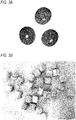
- FIG. 3A a wood piece provided with a hole portion at the center is illustrated in FIG. 3A
- FIG. 3B a wood piece obtained by cutting a wood material into a rectangular parallelepiped shape is illustrated in FIG. 3B .
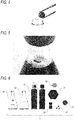
- FIG. 4 a state where the wood piece of one aspect of the present invention held with chopsticks is put in a container in which the raw liquid for a seasoning has been placed is shown.
- FIG. 4 a state where the wood piece of one aspect of the present invention held with chopsticks is put in a container in which the raw liquid for a seasoning has been placed is shown.
- the manufacturing method (2) of one aspect of the present invention is a method for manufacturing a seasoning utilizing the wood piece of one aspect of the present invention.
- the manufacturing method (2) of one aspect of the present invention includes at least a step of putting the wood piece of one aspect of the present invention in the raw liquid for a seasoning, followed by performing yeast fermentation, and obtaining a seasoning using floating up of the wood piece as an index.
- the kit of one aspect of the present invention includes at least a raw liquid for a seasoning to serve as an original liquid for a seasoning, a wood piece to serve as an index of yeast fermentation, a yeast-containing material for yeast fermentation, and a container for yeast fermentation for performing yeast fermentation by putting these therein.
- the raw liquid for a seasoning is a liquid material to be used for obtaining a seasoning.
- a specific example of the raw liquid for a seasoning included in the kit of one aspect of the present invention is the raw liquid for a seasoning of one aspect of the present invention.
- the raw liquid for a seasoning included in the kit of one aspect of the present invention is placed in the container for yeast fermentation together with the wood piece and the yeast-containing material, and is subjected to control of yeast fermentation using floating up of the wood piece as an index, and therefore, the color number of the raw liquid for a seasoning is 15 or more.
- the wood piece is characterized by having been subjected to compression processing, and having a specific volume.
- a specific example of the wood piece included in the kit of one aspect of the present invention is the wood piece of one aspect of the present invention.
- the yeast-containing material is a yeast itself or a material containing a yeast, and is specifically a yeast-containing material to be added so that a number of bacteria becomes 1.0 ⁇ 10 3 bacteria/mL or more as a final concentration.
- the phrase "to be added so that a number of bacteria becomes 1.0 ⁇ 10 3 bacteria/mL or more as a final concentration" means that it is added so that a number of bacteria becomes 1.0 ⁇ 10 3 bacterium or more per volume (1 mL) of a member for yeast fermentation including the yeast-containing material and the raw liquid for a seasoning.
- the yeast is not particularly limited as long as it can be generally used for yeast fermentation, and examples thereof include a soy sauce yeast that is generally used when manufacturing a soy sauce, and specific examples thereof include salt-tolerant yeasts such as Zygosaccharomyces rouxii, Zygosaccharomyces bailii ( Z . bailii ) , Candida etchellsii, and Candida versatilis ( C. versatilis ).
- the yeast-containing material can be dry yeast bacterium, wet yeast bacterium, a solid material containing a yeast, a liquid material in which a yeast is dissolved in a solution, or the like.
- a method for obtaining a solid material of the yeast-containing material is not particularly limited, but for example, a method including formulating only dry yeast bacterium or a mixture of dry yeast bacterium and another component such as an excipient into a tablet, a granule, a powder, or the like is exemplified.
- a method for obtaining a liquid material of the yeast-containing material is not particularly limited, but for example, it is obtained by a method including dissolving dry yeast bacterium or wet yeast bacterium in a solution that does not affect the viability of the yeast such as physiological saline, or the like.
- the yeast-containing material may be a seasoning, which is obtained by yeast fermentation, and in which the yeast is not killed.
- a seasoning can be used, for example, as a "seed soy sauce” when the seasoning is a soy sauce.
- the number of bacteria of the yeast in the yeast-containing material is not particularly limited as long as it is a number of bacteria of the yeast to be added so that the number of bacteria becomes 1.0 ⁇ 10 3 bacteria/mL or more as a final concentration, and for example, when the yeast-containing material is a liquid material, it is a number of bacteria more than 1.0 ⁇ 10 3 bacteria/mL, preferably 5.0 ⁇ 10 3 bacteria/mL or more, more preferably 1.0 ⁇ 10 4 bacteria/mL or more, and further more preferably 5.0 ⁇ 10 4 bacteria/mL or more.
- the final concentration of the yeast cells by adding the yeast-containing material is not particularly limited as long as it is 1.0 ⁇ 10 3 bacteria/mL or more, but is, for example, a number of bacteria more than 1.0 ⁇ 10 3 bacteria/mL, preferably 5.0 ⁇ 10 3 bacteria/mL or more, more preferably 1.0 ⁇ 10 4 bacteria/mL or more, and further more preferably about 1.0 ⁇ 10 5 bacteria/mL to 1.0 ⁇ 10 6 bacteria/mL.
- the container for yeast fermentation is not particularly limited as long as it is a container capable of performing yeast fermentation by placing at least the raw liquid for a seasoning, the wood piece, and the yeast-containing material therein, and also capable of distinguishing sinking and floating up of the wood piece. It is preferred that the container for yeast fermentation has a height, a width, and a depth sufficient for the diameter of the wood piece, and is further transparent or clear so that the wood piece can be visually recognized.
- a soy sauce bottle (tabletop bottle) as generally known, etc. are exemplified, but it is not limited thereto.
- the container for yeast fermentation is preferably provided with a cap. Further, it is preferred that there are two types of caps: a first cap for yeast fermentation; and a second cap including a pouring hole for pouring the seasoning in the container after the yeast fermentation. That is, it is preferred that the container for yeast fermentation is provided with two types of caps separately for during yeast fermentation or thereafter.
- the first cap for yeast fermentation preferably has a hole portion with a diameter of 2 to 5 mm, preferably a diameter of about 3 mm passing therethrough at around the center for preventing excessive supply of oxygen while supplying oxygen into the container from the outside.
- the second cap including a pouring hole can be equivalent to a cap attached to an ordinary soy sauce bottle.
- the kit of one aspect of the present invention preferably includes a container base for placing the container for yeast fermentation.
- the container base is not particularly limited as long as it includes a pedestal portion capable of placing the container for yeast fermentation.
- a container base including, in addition to the pedestal portion, a hole portion provided passing through the pedestal portion so as to generate scattered light by irradiation with light from the bottom face of the container for yeast fermentation placed on the pedestal portion, and a light source housing portion capable of housing a light source for irradiating the bottom face of the container for yeast fermentation from the hole portion, and the like are exemplified.
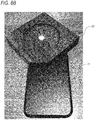
- a container base capable of housing a light source in a lower part as illustrated in FIG. 8A and FIG. 8B is exemplified, but it is not limited thereto.
- the manufacturing method (3) of one aspect of the present invention is a method for manufacturing a seasoning using the kit of one aspect of the present invention. That is, the manufacturing method (3) of one aspect of the present invention includes at least a step of subjecting a container for yeast fermentation, to which a raw liquid for a seasoning to serve as an original liquid for a seasoning, a yeast-containing material for yeast fermentation, and a wood piece to serve as an index of yeast fermentation have been added, to yeast fermentation, and obtaining a seasoning using floating up of the wood piece in the container as an index.
- the order of adding the raw liquid for a seasoning, the wood piece, and the yeast-containing material to the container for yeast fermentation is not particularly limited, but it is preferred that after the raw liquid for a seasoning is added to the container for yeast fermentation, the yeast-containing material is added to the container, and then the wood piece is further added to the solution.
- the container for yeast fermentation to which the raw liquid for a seasoning, the yeast-containing material, and the wood piece have been added is preferably subjected to yeast fermentation in a state of being covered with the first cap for yeast fermentation described above.
- soy sauce is manufactured by the manufacturing method (3) of one aspect of the present invention using a soy sauce moromi soup as the raw liquid for a seasoning and using a seed soy sauce as the yeast-containing material
- yeast fermentation is performed using only a liquid, and therefore, yeast fermentation can be simply performed in a state where the container is left to stand without performing stirring, aeration, or the like in the container.
- the raw liquid for a seasoning is a soy sauce moromi soup in which most or whole of the insoluble solid content has been removed in advance
- a material obtained after yeast fermentation is a yeast fermented liquid having a low solid content, and the material itself can be used as a liquid seasoning (soy sauce).
- the process for manufacturing a seasoning can be simply confirmed using floating up of the wood piece as an index.
- a soy sauce to be obtained has a fresh fruity aroma that cannot be brought about by an ordinary manufacturing method, and is rich in palatability capable of enjoying a mellow aroma as if it were a wine. Therefore, the yeast fermented liquid is preferably used for cooking or in a cooked material as it is without heating or the like.
- the raw liquid for a seasoning that is a soy sauce moromi soup has a color number of around 40 and is light brown, however, when it is used in the manufacturing method (3) of one aspect of the present invention, after 7 to 35 days from yeast fermentation, the color number is changed to around 18, and the color turns into dark brown. Then, although it had no aroma at the beginning, it begins to smell a fruity aroma according to the change in the color number.
- the seasoning having a fruity aroma obtained by the manufacturing method (3) of one aspect of the present invention can be, for example, a seasoning having an ethyl octanoate content of 10 ppb to 20,000 ppb; a seasoning having an ethyl decanoate content of 10 ppb to 5,000 ppb; or a seasoning having an ethyl octanoate content of 5 ppb to 10,000 ppb, and an ethyl decanoate content of 5 ppb to 2,000 ppb.
- a specific example of the seasoning having a fruity aroma obtained by the manufacturing method (3) of one aspect of the present invention is a seasoning having an ethyl octanoate content of 5 ppb to 1,000 ppb, an ethyl decanoate content of 5 ppb to 1,000 ppb, a 2-ethyl-6-methylpyrazine content of 0 ppb to less than 10 ppb, and an HEMF content of 20 ppm to 200 ppm, or the like, but it is not limited thereto.
- a kit 1 shown in FIG. 6 is exemplified.
- the kit 1 includes a first seasoning raw liquid-containing container 11 and a second seasoning raw liquid-containing container 12, each of which contains a raw liquid for a seasoning; a wood piece 21 to serve as an index of yeast fermentation; a seed soy sauce 31 containing a yeast; a first container for yeast fermentation 41 and a second container for yeast fermentation 42 for placing these therein and performing yeast fermentation; a first cap 51 for covering the container for yeast fermentation during yeast fermentation; a second cap 52 for covering the container for yeast fermentation after yeast fermentation; and a first container base for placing the container for yeast fermentation.
- the raw liquid for a seasoning in the first seasoning raw liquid-containing container 11 is poured into the first container for yeast fermentation 41 (see FIG. 7(a) ).
- the second container for yeast fermentation 42 may be used.
- the seed soy sauce 31 and the wood piece 21 are sequentially placed (see FIGS. 7(b) and 7(c) ).
- the first container for yeast fermentation 41 in which the raw liquid for a seasoning, the seed soy sauce 31, and the wood piece 21 have been placed is covered with the first cap and placed on the first container base 61, and then left to stand at room temperature, thereby performing yeast fermentation. It is confirmed that yeast fermentation is appropriately performed, and a seasoning is produced by using floating up of the wood piece 21 as an index (see FIG. 7(d) ) in about 1 week after yeast fermentation. The yeast fermentation is performed for about 1 to 4 weeks, and when the seasoning in the container is used during that period, the seasoning is poured out by replacing the first cap 51 with the second cap 52 on each occasion.
- the color depth of the raw liquid for a seasoning in the first container for yeast fermentation 41 is gradually increased from a light color and the color turns into dark red as the yeast fermentation proceeds. Therefore, the first container for yeast fermentation 41 is placed on a second container base 62 as illustrated in FIG. 8A , a personal digital assistant (smartphone) with a light source or the like is placed in a light source housing portion provided in a lower part of the second container base 62 as illustrated in FIG. 8B , and the entire container is lightened by the light source from the bottom face of the first container for yeast fermentation 41, whereby the entire container aesthetically glitters dark red because an insoluble solid content is low in the raw liquid for a seasoning. Moreover, the dark red color changes day by day with the lapse of yeast fermentation, and therefore, the first container for yeast fermentation 41 during the yeast fermentation can be utilized as a part of interior decoration.
- the raw liquids for a seasoning contained in the first seasoning raw liquid-containing container 11 and the second seasoning raw liquid-containing container 12 may be either the same or different.
- a raw liquid for a seasoning manufactured using soybeans produced in Hokkaido as a raw material is placed in the first seasoning raw liquid-containing container 11
- a raw liquid for a seasoning manufactured using soybeans produced in Niigata as a raw material is placed in the second seasoning raw liquid-containing container 12
- two types of seasonings having different flavors can be obtained in the end.
- the liquid seasoning of one aspect of the present invention is a soy sauce or a soy sauce-like seasoning in which the content of ethyl octanoate, the content of ethyl decanoate, or the content of each of ethyl octanoate and ethyl decanoate is a predetermined amount.
- the liquid seasoning (1-1) of a first aspect of the present invention is a soy sauce or a soy sauce-like seasoning in which the content of ethyl octanoate is a predetermined amount.
- the liquid seasoning (1-2) of a second aspect of the present invention is a soy sauce or a soy sauce-like seasoning in which the content of ethyl decanoate is a predetermined amount.
- the liquid seasoning (1-3) of a third aspect of the present invention is a soy sauce or a soy sauce-like seasoning in which the content of each of ethyl octanoate and ethyl decanoate is a predetermined amount.
- the liquid seasoning of one aspect of the present invention is configured such that the content of ethyl octanoate, the content of ethyl decanoate, or the content of each of ethyl octanoate and ethyl decanoate is a predetermined amount, and therefore can be used for adjusting the taste of foods and drinks as a soy sauce or a soy sauce-like seasoning with a more excellent fruity aroma than a conventional soy sauce while having a flavor inherent in a soy sauce.
- a seasoning or a food or drink having both a soy sauce flavor and a fruity aroma can be obtained.
- the liquid seasoning of one aspect of the present invention is not particularly limited as long as it is a seasoning either of a soy sauce and a soy sauce-like seasoning, and is used for the purpose of adjusting the taste when processing a food material.
- the content of ethyl octanoate in the liquid seasoning of the first aspect of the present invention is such an amount that the liquid seasoning has a fruity aroma.
- the content of ethyl octanoate in the liquid seasoning (1-1) of the first aspect of the present invention is 10 ppb to 20,000 ppb, and from the viewpoint of having a more fruity aroma, it is preferably 20 ppb to 15,000 ppb, and more preferably 50 ppb to 10,000 ppb.
- the upper limit of the content of ethyl octanoate is preferably an amount smaller than 20,000 ppb, that is, less than 20,000 ppb.
- the content of ethyl octanoate in the liquid seasoning (1-3) of the third aspect of the present invention is 5 ppb to 10,000 ppb, and from the viewpoint of having a more fruity aroma, it is preferably 10 ppb to 5,000 ppb, and more preferably 15 ppb to 1,000 ppb.
- the content of ethyl octanoate in the liquid seasoning is a smaller amount than the above-mentioned predetermined amount, it can be adjusted to the predetermined amount by adding ethyl octanoate or an ethyl octanoate-containing material to the liquid seasoning.
- the ethyl octanoate-containing material is not particularly limited as long as it can be measured as ethyl octanoate by the method described in the below-mentioned Example.
- the content of ethyl decanoate in the liquid seasoning of the first aspect of the present invention is such an amount that the liquid seasoning has a fruity aroma.
- the content of ethyl decanoate in the liquid seasoning (1-2) of the second aspect of the present invention is 10 ppb to 5,000 ppb, and from the viewpoint of having a more fruity aroma, it is preferably 20 ppb to 2,000 ppb, and more preferably 50 ppb to 1,000 ppb.
- the upper limit of the content of ethyl decanoate is preferably an amount smaller than 5,000 ppb, that is, less than 5,000 ppb.
- the content of ethyl decanoate in the liquid seasoning (1-3) of the third aspect of the present invention is 5 ppb or more, and from the viewpoint of having a more fruity aroma, it is preferably 10 ppb to 2,000 ppb, more preferably 20 ppb to 1,500 ppb, and further more preferably 30 ppb to 1,000 ppb.
- ethyl decanoate in the liquid seasoning When the content of ethyl decanoate in the liquid seasoning is a smaller amount than the above-mentioned predetermined amount, it can be adjusted to the predetermined amount by adding ethyl decanoate or an ethyl decanoate-containing material to the liquid seasoning.
- the ethyl decanoate-containing material is not particularly limited as long as it can be measured as ethyl decanoate by the method described in the below-mentioned Example.
- the liquid seasoning is configured such that the content of ethyl octanoate and/or ethyl decanoate is the above-mentioned amount, and therefore has a fruity aroma hardly noticeable in a conventional soy sauce.
- the fruity aroma derived from ethyl octanoate and/or ethyl decanoate can be masked by 2-ethyl-6-methylpyrazine intrinsically contained in a conventional soy sauce.
- the content of 2-ethyl-6-methylpyrazine in the liquid seasoning is, for example, such an amount that the fruity aroma derived from ethyl octanoate and/or ethyl decanoate is not suppressed, and is preferably 50 ppb or less, more preferably 20 ppb or less, further more preferably 10 ppb or less, and still further more preferably 5 ppb or less.
- the lower limit of the content of 2-ethyl-6-methylpyrazine in the liquid seasoning is not particularly limited, but may be less than the lower detection limit, that is, may be substantially 0 ppb.
- the liquid seasoning is characterized by having a flavor inherent in a soy sauce due to HEMF or the like by containing a soy sauce component while having a fruity aroma. Therefore, the content of HEMF in the liquid seasoning is preferably 20 ppm or more, more preferably 30 ppm or more, and further more preferably 40 ppm or more.
- the upper limit of the content of HEMF may be appropriately set according to a desired flavor inherent in a soy sauce, and is typically about 200 ppm.
- the contents of ethyl octanoate, ethyl decanoate, 2-ethyl-6-methylpyrazine, and HEMF in the liquid seasoning can be measured by the method described in the below-mentioned Example. Therefore, the contents of ethyl octanoate, ethyl decanoate, 2-ethyl-6-methylpyrazine, and HEMF described above are values obtained by measurement using the method described in the below-mentioned Example. Note that for 2-ethyl-6-methylpyrazine and HEMF, a peak area is determined using the following m/z. 2-ethyl-6-methylpyrazine: m/z: 121 HEMF: m/z: 142
- a method for manufacturing the liquid seasoning of one aspect of the present invention is not particularly limited as long as it is a method capable of obtaining a liquid seasoning in which the content of ethyl octanoate and/or ethyl decanoate is a predetermined amount.
- the liquid seasoning of one aspect of the present invention can be manufactured by, for example, mixing a commercially available soy sauce with ethyl octanoate and/or ethyl decanoate.
- the method for manufacturing the liquid seasoning is not particularly limited as long as it is a method capable of obtaining a liquid seasoning in which the content of ethyl octanoate, the content of ethyl decanoate, or the like is a predetermined amount.
- the liquid seasoning can be manufactured by, for example, a method including subjecting a soy sauce moromi obtained after performing lactic acid fermentation through a method for manufacturing a regular soy sauce to solid-liquid separation, and further treating a liquid part with a UF membrane, thereby obtaining a soy sauce moromi soup, and subsequently subjecting the soy sauce moromi soup to yeast fermentation using a soy sauce yeast, or the like.
- the method includes separating a soy sauce moromi into an insoluble solid part (soy sauce moromi concentrate) and a liquid part (soy sauce moromi soup) before it is subjected to yeast fermentation, and subsequently performing yeast fermentation for the soy sauce moromi soup without continuously subjecting a soy sauce moromi after lactic acid fermentation to yeast fermentation unlike a method for manufacturing a regular soy sauce. Therefore, the method includes at least a step of obtaining a soy sauce moromi, a step of obtaining a soy sauce moromi soup, and a step of performing yeast fermentation.
- the thus obtained liquid seasoning can be, for example, (i) a liquid seasoning in which the content of ethyl octanoate is 10 ppb to 20,000 ppb, (ii) a liquid seasoning in which the content of ethyl decanoate is 10 ppb to 5,000 ppb, or (iii) a liquid seasoning in which the content of ethyl octanoate is 5 ppb to 10,000 ppb and the content of ethyl decanoate is 5 ppb to 2,000 ppb.
- the step of obtaining a soy sauce moromi is not particularly limited as long as it is a step until a soy sauce moromi is obtained in a method for manufacturing a soy sauce as generally known.
- a soy sauce is manufactured by obtaining a soy sauce koji by inoculating a seed koji starter including a koji mold into a mixture of a protein raw material such as soybeans denatured by heating and a starch raw material such as wheat pregelatinized by heating, followed by culturing to make a koji, and subsequently obtaining a soy sauce moromi by putting the obtained soy sauce koji into a saline solution, followed by lactic acid fermentation and aging, and subsequently obtaining an aged moromi by subjecting the obtained soy sauce moromi to yeast fermentation and aging, and subsequently obtaining an unheated soy sauce by subjecting the obtained aged moromi to a pressing treatment or a filtration treatment, and subsequently heating the obtained unheated so
- a step of obtaining a soy sauce moromi for example, a step of obtaining a soy sauce koji by inoculating a seed koji starter into a soy sauce raw material that is soybeans denatured by steaming or a mixture of soybeans denatured by steaming, roasted crushed cereal grains, and the like, and performing koji making with aeration at 20 to 40°C for about 2 to 4 days, and subsequently subjecting a material obtained by putting the soy sauce koji into a saline solution prepared by adding dietary sodium chloride to water so that the sodium chloride concentration is 20 to 30% (w/v), and further arbitrarily adding a soy sauce lactic acid bacterium thereto to lactic acid fermentation and aging at 15 to 40°C for 10 to 200 days, preferably for 15 to 40 days while appropriately stirring, thereby obtaining a soy sauce moromi, or the like is exemplified.
- the soy sauce raw material is not particularly limited, but examples thereof include soybeans such as whole soybeans and defatted soybeans, cereal grains such as wheat, barley, naked barley, and Job's tears, cereal grain gluten, rice, and corn.
- the seed koji starter is not particularly limited as long as it is a koji mold that is generally utilized when manufacturing a soy sauce, and examples thereof include Aspergillus oryzae and Aspergillus sojae.
- the soy sauce lactic acid bacterium is not particularly limited as long as it is a soy sauce lactic acid bacterium that is generally utilized when manufacturing a soy sauce, and examples thereof include salt-tolerant lactic acid bacteria such as Tetragenococcus halophilus.
- the amount of the starch raw material such as wheat or rice in the soy sauce raw material is such an amount that a soy sauce moromi having a high reducing sugar content can be obtained.
- soy sauce moromi having a high reducing sugar content is obtained by adding a reducing sugar component, for example, glucose, fructose, maltose, table sugar, a sweet sake, or the like to a soy sauce moromi. That is, in the soy sauce koji, an adjusted soy sauce koji adjusted by adding a reducing sugar component after obtaining a soy sauce koji having a high total nitrogen content by inoculating a seed koji starter into a protein raw material such as soybeans to make a koji is included.
- a reducing sugar component for example, glucose, fructose, maltose, table sugar, a sweet sake, or the like
- a soy sauce moromi soup is obtained by a solid-liquid separation treatment for removing an insoluble solid content derived from a soy sauce raw material such as soybeans or wheat from a soy sauce moromi (lactic acid fermented product) containing the insoluble solid content and/or a pasteurization treatment for removing a microorganism.
- a method for obtaining a soy sauce moromi soup from a soy sauce moromi is not particularly limited, but for example, a solid-liquid separation method and a pasteurization method that are generally known, and the like are exemplified, and specifically, a pressing treatment and a filtration treatment that are generally used in a method for manufacturing a soy sauce, and the like are exemplified, and more specifically, a pressing filtration treatment with a press machine using a filter cloth, a membrane filtration treatment using a filter medium such as diatomaceous earth or various permeable membranes such as a UF membrane and an MF membrane, a heating treatment of increasing the temperature until a microorganism is killed, and the like are exemplified.
- the content of the lactic acid bacterium in the soy sauce moromi soup is not particularly limited, but is, for example, preferably 1.0 ⁇ 10 8 bacteria/mL or less, more preferably 1.0 ⁇ 10 7 bacteria/mL or less, and further more preferably 1.0 ⁇ 10 6 bacteria/mL or less.
- yeast fermentation of an ordinary method is performed for the soy sauce moromi soup using a soy sauce yeast that is used when manufacturing a soy sauce as generally known under a condition according to the type of the soy sauce yeast, a number of bacteria, or the like.
- the soy sauce yeast is not particularly limited as long as it is a yeast to be generally used when manufacturing a soy sauce, and examples thereof include salt-tolerant yeasts such as Zygosaccharomyces rouxii, Zygosaccharomyces bailii ( Z. bailii ) , Candida etchellsii, and Candida versatilis ( C. versatilis ).
- the period of the yeast fermentation is not particularly limited as long as it is a period in which the content of each of ethyl octanoate, ethyl decanoate, and the like in the fermented liquid becomes a predetermined amount, and for example, when Zygosaccharomyces rouxii is used as the soy sauce yeast, it is about 10 to 100 days, preferably about 14 to 60 days, and more preferably about 45 days at 15 to 30°C. Further, the period of the yeast fermentation is preferably a period in which the production amount of ethanol reaches the maximum.
- the step of performing yeast fermentation can be simply performed by, for example, placing the soy sauce moromi soup and the soy sauce yeast in a soy sauce bottle that is suitable for yeast fermentation and is capable of using the fermented liquid immediately after yeast fermentation, and then leaving the bottle to stand at room temperature, thereby performing yeast fermentation, or the like.
- the soy sauce moromi soup in which the insoluble solid content has been removed in advance is used, and therefore, a material obtained after the yeast fermentation is a yeast fermented liquid having a low solid content, and the yeast fermented liquid itself may be used as a liquid seasoning. Further, for the purpose of removing the yeast or a residue present in the yeast fermented liquid, or the like, the yeast fermented liquid is subjected to a treatment or the like at the latter stage of the yeast fermentation to be used in a method for manufacturing a regular soy sauce such as pressing, filtration, heating, or sediment removal, and the obtained liquid part may be used as the liquid seasoning.
- a regular soy sauce such as pressing, filtration, heating, or sediment removal
- the content of each of ethyl octanoate, ethyl decanoate, and the like may be a predetermined amount, and various other components can be contained as long as they do not prevent the object of the present invention from being achieved.
- the other components are not particularly limited, but examples thereof include seasoning components and food materials, and specific examples thereof include vegetable components (radish, carrot, onion, potato, garlic, etc.), meat (beef, pork, chicken, etc.), fish, yeast extracts, meat extracts (chicken extract, pork extract, beef extract, fish meat extract, etc.), fruit juices (apple juice, etc.), spices (ginger, red pepper, pepper, basil, oregano, etc.), chemical seasonings (monosodium glutamate, disodium inosinate, etc.), and flavors, and among these, one type can be used alone or two or more types can be used in combination.
- the content of such other components can be appropriately set as long as the object of the present invention can be achieved.
- the liquid seasoning of one aspect of the present invention can be formed into a container-packed liquid seasoning in which it is packed and sealed in a container, that is, a container-packed soy sauce or a container-packed soy sauce-like seasoning.
- the container is not particularly limited, but examples thereof include packaging containers such as a single-layer or laminate film bag, a retort pouch, a vacuum pack, an aluminum container, a plastic container, a bottle, and a can made of a metal such as aluminum, a paper, a plastic such as PET or PTP, a glass, or the like.
- the container-packed soy sauce and the container-packed soy sauce-like seasoning can be distributed and sold in the market independently by itself.
- the liquid seasoning of one aspect of the present invention can be used in the same manner as an ordinary liquid seasoning. That is, the liquid seasoning of one aspect of the present invention can be used alone or by mixing or combining with another seasoning component such as a soup stock, an acidulant, an amino acid, a nucleic acid, an organic acid, a protein hydrolysate, a sugar, a sake, a sweet sake, an alcohol, a thickener, an emulsifier, or an inorganic salt in addition to a vegetable component, meat, fish, a yeast extract, a meat extract, a fruit juice, a spice, a chemical seasoning, or a flavor described above for cooking various food materials or for a processing method therefor.
- another seasoning component such as a soup stock, an acidulant, an amino acid, a nucleic acid, an organic acid, a protein hydrolysate, a sugar, a sake, a sweet sake, an alcohol, a thickener, an emulsifier, or an in
- the liquid seasoning of one aspect of the present invention can be used for various foods such as Japanese foods, Western foods, and Chinese foods, and specifically, can be used for deep-fried foods, grilled slices of meat, udon, soba, ramen, Hamburg steak, meatballs, simmered chicken and root vegetables, stewed meat and potatoes, teriyaki, curry, stew, hashed beef, etc., but it is not limited thereto.
- liquid seasoning of one aspect of the present invention for example, a liquid seasoning in which the content of ethyl octanoate is as the following (1-1) is exemplified.
- liquid seasoning of one aspect of the present invention for example, a liquid seasoning in which the content of ethyl decanoate is as the following (2-1) is exemplified.
- liquid seasoning of one aspect of the present invention for example, a liquid seasoning in which the content of ethyl octanoate and the content of ethyl decanoate are as the following (1-2) and (2-2), respectively, is exemplified.
- liquid seasoning of one aspect of the present invention for example, a liquid seasoning in which the content of ethyl octanoate, the content of ethyl decanoate, and the content of 2-ethyl-6-methylpyrazine are as the following (1-3), (2-3), and (3-3), respectively, is exemplified.
- liquid seasoning of one aspect of the present invention for example, a liquid seasoning in which the content of ethyl octanoate, the content of ethyl decanoate, the content of 2-ethyl-6-methylpyrazine, and the content of HEMF are as the following (1-4), (2-4), (3-4), and (4-4), respectively, is exemplified.
- a rich one is referred to as a liquid rich seasoning. That is, a liquid rich seasoning of one aspect of the present invention is configured such that the total nitrogen content and the content of 4-hydroxy-2 (or 5)-ethyl-5 (or 2)-methyl-3(2H)-furanone (homofuraneol; HEMF) are adjusted to predetermined amounts, and therefore has an especially excellent flavor inherent in a soy sauce while having umami. Accordingly, the liquid rich seasonings of one aspect of the present invention can be used for adjusting the taste of foods and drinks as a rich soy sauce and a rich soy sauce seasoning.
- the liquid rich seasoning of one aspect of the present invention is not particularly limited as long as it is a seasoning either of a rich soy sauce and a rich soy sauce seasoning, and is used for the purpose of adjusting the taste when processing a food material.
- the amount of the total nitrogen content in the liquid rich seasoning is such an amount that umami is perceived more in the liquid rich seasoning than in a commercially available unheated soy sauce.
- the amount of the total nitrogen content in the liquid rich seasoning is 1.8 wt% or more, and from the viewpoint that more umami is perceived, it is preferably 1.9 wt% or more, and more preferably 2.0 wt% or more.
- the upper limit of the total nitrogen content may be appropriately set according to a desired flavor inherent in a soy sauce and is not particularly limited, but is typically about 4 wt%.
- the content of HEMF in the liquid rich seasoning is such an amount that a flavor inherent in a soy sauce is perceived more in the liquid rich seasoning than in a commercially available unheated soy sauce.
- the content of HEMF in the liquid rich seasoning is 60 ppm or more, and from the viewpoint that a more flavor inherent in a soy sauce is perceived, it is preferably 70 ppm or more, more preferably 80 ppm or more, and further more preferably 90 ppm or more.
- the upper limit of the content of HEMF may be appropriately set according to a desired flavor inherent in a soy sauce and is not particularly limited, but is typically about 200 ppm.
- HEMF in the liquid rich seasoning is not externally added to a soy sauce manufactured by a brewing process, but is preferably HEMF to be produced in the process for manufacturing a soy sauce by a brewing process. That is, it is preferred that HEMF in the liquid rich seasoning is one that is not added as HEMF in the form of a purified product or an HEMF-containing material.
- the liquid rich seasoning of one aspect of the present invention is not particularly limited as long as the amounts of the total nitrogen content and HEMF are the above-mentioned amounts, but, for example, from the viewpoint that they may affect the taste or aroma of the liquid rich seasoning, it is preferably configured such that the amounts of a reducing sugar, ethyl decanoate, ethyl octanoate, 2-ethyl-6-methylpyrazine, and the like are predetermined amounts.
- the content of a reducing sugar in the liquid rich seasoning is preferably an amount larger than 3.0 wt% that is the amount of a reducing sugar in a commercially available unheated soy sauce, and from the viewpoint that the liquid rich seasoning can be made to have smooth koku attribute and rich sweetness, it is more preferably 4.0 wt% or more, further more preferably 6.0 wt% or more, still further more preferably 7.0 wt% or more, and particularly preferably 8.0 wt% or more.
- the upper limit of the content of a reducing sugar is not particularly limited, but in consideration of the sweetness or energy of the liquid rich seasoning, it is typically about 20 wt%.
- the content of ethyl decanoate in the liquid rich seasoning is preferably such an amount that the liquid rich seasoning has a fruity aroma, and from the viewpoint of having a more fruity aroma, it is more preferably 10 ppb to 2,000 ppb, and further more preferably 50 ppb to 1,000 ppb.
- the content of ethyl decanoate is more than 5,000 ppb, the aroma is too strong and it smells unpleasant like petroleum, and the aroma of the entire liquid rich seasoning tends to become unpleasant.
- the content of ethyl octanoate in the liquid rich seasoning is preferably such an amount that the liquid rich seasoning has a fruity aroma, and from the viewpoint of having a more fruity aroma, it is more preferably 10 ppb to 10,000 ppb, and further more preferably 50 ppb to 10,000 ppb.
- the content of ethyl octanoate is more than 20,000 ppb, the aroma is too strong and it smells unpleasant like petroleum, and the aroma of the entire liquid rich seasoning tends to become unpleasant.
- the amount of the lower limit of each component can be further decreased.
- the contents of ethyl decanoate and ethyl octanoate in the liquid rich seasoning in such a case are preferably 5 ppb to 2,000 ppb and 5 ppb to 10,000 ppb, respectively, and from the viewpoint of having a more fruity aroma, they are more preferably 20 ppb to 1,500 ppb and 10 ppb to 5,000 ppb, respectively, and further more preferably 30 ppb to 1,000 ppb and 15 ppb to 1,000 ppb, respectively.
- the liquid rich seasoning containing ethyl decanoate and ethyl octanoate in amounts within the respective preferred ranges is a preferred one having a fruity aroma, and an unpleasant odor is not perceived. Therefore, as a specific aspect of the liquid rich seasoning, a liquid rich seasoning having an ethyl decanoate content of 2,000 ppb and an ethyl octanoate content of 10,000 ppb is exemplified.
- the liquid rich seasoning contains ethyl decanoate and/or ethyl octanoate, particularly, the content of ethyl decanoate and/or ethyl octanoate is the above-mentioned amount, the liquid rich seasoning has a fruity aroma hardly noticeable in a conventional soy sauce.
- the fruity aroma derived from ethyl decanoate and/or ethyl octanoate can be masked by 2-ethyl-6-methylpyrazine intrinsically contained in a conventional soy sauce.
- the content of 2-ethyl-6-methylpyrazine in the liquid rich seasoning is, for example, such an amount that the fruity aroma derived from ethyl decanoate and/or ethyl octanoate is not suppressed, and is preferably 50 ppb or less, more preferably 20 ppb or less, further more preferably less than 10 ppb, and still further more preferably 5 ppb or less.
- the lower limit of the content of 2-ethyl-6-methylpyrazine in the liquid rich seasoning is not particularly limited, but may be less than the lower detection limit, that is, may be substantially 0 ppb.
- the total nitrogen content, and the contents of HEMF, a reducing sugar, ethyl decanoate, ethyl octanoate, and 2-ethyl-6-methylpyrazine in the liquid rich seasoning can be measured by the method described in the below-mentioned Example. Therefore, the total nitrogen content, and the contents of HEMF, a reducing sugar, ethyl decanoate, ethyl octanoate, and 2-ethyl-6-methylpyrazine described above are values obtained by measurement using the method described in the below-mentioned Example.
- a method for manufacturing a liquid rich seasoning is not particularly limited as long as it is a method capable of obtaining a liquid rich seasoning that can achieve the object of the present invention, specifically, a method capable of obtaining a liquid rich seasoning in which the total nitrogen content and the content of HEMF are predetermined amounts, preferably a liquid rich seasoning in which the total nitrogen content and the content of HEMF are predetermined amounts, and the content of a reducing sugar, ethyl decanoate, ethyl octanoate, and/or 2-ethyl-6-methylpyrazine is a predetermined amount.
- Another aspect of the present invention is a method for manufacturing a liquid rich seasoning, that is, a method for manufacturing a rich soy sauce and a rich soy sauce seasoning.
- a method for manufacturing a liquid rich seasoning of one aspect of the present invention the liquid rich seasoning of one aspect of the present invention can be manufactured.
- the method for manufacturing a liquid rich seasoning of one aspect of the present invention is broadly divided into two according to the steps included.
- the method for manufacturing a liquid rich seasoning of a first aspect of the present invention includes at least a step of obtaining a first soy sauce moromi soup by subjecting a first soy sauce moromi obtained by subjecting a soy sauce koji and a saline solution to a mixing treatment to a solid-liquid separation treatment and a pasteurization treatment, a step of obtaining a second soy sauce moromi by subjecting the first soy sauce moromi soup, a soy sauce koji, and dietary sodium chloride to a mixing treatment, a step of obtaining a second soy sauce moromi soup by subjecting the second soy sauce moromi to a solid-liquid separation treatment or a solid-liquid separation treatment and a pasteurization treatment, and a step of obtaining a rich soy sauce or a rich soy sauce seasoning in which the total nitrogen content and the content of HEMF are predetermined amounts by subjecting the second soy sauce moromi soup to yeast fermentation using a soy sauce yeast.
- a first soy sauce moromi after lactic acid fermentation is not continuously subjected to yeast fermentation unlike a method for manufacturing a regular soy sauce
- the method includes separating a soy sauce moromi into an insoluble solid part (a first soy sauce moromi concentrate) and a liquid part (a first soy sauce moromi soup) so as to remove the microorganism before it is subjected to yeast fermentation, subsequently separating a second soy sauce moromi obtained by promoting an action of a soy sauce koji using the first soy sauce moromi soup as brewing water into an insoluble solid part (a second soy sauce moromi concentrate) and a liquid part (a second soy sauce moromi soup), and performing yeast fermentation of the second soy sauce moromi soup.
- the method includes at least a step of obtaining a first soy sauce moromi soup from a first soy sauce moromi, a step of obtaining a second soy sauce moromi, a step of obtaining a second soy sauce moromi soup, and a step of performing yeast fermentation.
- the thus obtained liquid rich seasoning can be, for example, a liquid rich seasoning in which the total nitrogen content is 1.8 wt% or more and the content of HEMF is 60 ppm or more.
- the step of obtaining a first soy sauce moromi corresponding to the former stage of the step of obtaining a first soy sauce moromi soup from the first soy sauce moromi will be also described.
- the method of the first aspect of the present invention may or may not include the step of obtaining a first soy sauce moromi.
- the step of obtaining a first soy sauce moromi is not particularly limited as long as it is a step until a soy sauce moromi is obtained in a method for manufacturing a soy sauce as generally known.
- a soy sauce is manufactured by obtaining a soy sauce koji by inoculating a seed koji starter including a koji mold into a mixture of a protein raw material such as soybeans denatured by heating and a starch raw material such as wheat pregelatinized by heating, followed by culturing to make a koji, and subsequently obtaining a soy sauce moromi by putting the obtained soy sauce koji into a saline solution, followed by lactic acid fermentation and aging, and subsequently obtaining an aged moromi by subjecting the obtained soy sauce moromi to yeast fermentation and aging, and subsequently obtaining an unheated soy sauce by subjecting the obtained aged moromi to a pressing treatment or a filtration treatment, and subsequently heating the obtained unheated
- the soy sauce raw material is not particularly limited, but examples thereof include soybeans such as whole soybeans and defatted soybeans, cereal grains such as wheat, barley, naked barley, and Job's tears, cereal grain gluten, rice, and corn.
- the koji mold is not particularly limited as long as it is a koji mold that is generally utilized when manufacturing a soy sauce, and examples thereof include Aspergillus oryzae and Aspergillus sojae.
- the soy sauce lactic acid bacterium is not particularly limited as long as it is a soy sauce lactic acid bacterium that is generally utilized when manufacturing a soy sauce, and examples thereof include salt-tolerant lactic acid bacteria such as Tetragenococcus halophilus.
- the amount of the starch raw material such as wheat or rice in the soy sauce raw material is such an amount that a soy sauce moromi having a high reducing sugar content can be obtained.
- soy sauce moromi having a high reducing sugar content is obtained by adding a reducing sugar component, for example, glucose, fructose, maltose, table sugar, a sweet sake, or the like to a soy sauce moromi. That is, in the soy sauce koji, an adjusted soy sauce koji adjusted by adding a reducing sugar component after obtaining a soy sauce koji having a high total nitrogen content by inoculating a seed koji starter into a protein raw material such as soybeans to make a koji is included.
- a reducing sugar component for example, glucose, fructose, maltose, table sugar, a sweet sake, or the like
- a first soy sauce moromi soup is obtained by a solid-liquid separation treatment for removing an insoluble solid content derived from a soy sauce raw material such as soybeans or wheat from a first soy sauce moromi containing the insoluble solid content and a pasteurization treatment for removing a microorganism from the first soy sauce moromi.
- the solid-liquid separation treatment for removing an insoluble solid content from the first soy sauce moromi is not particularly limited, but for example, a generally known solid-liquid separation method, and the like are exemplified, and specifically, a pressing treatment and a filtration treatment that are generally used in a method for manufacturing a soy sauce, and the like are exemplified, and more specifically, a pressing filtration treatment with a press machine using a filter cloth, a membrane filtration treatment using various permeable membranes such as a UF membrane and an MF membrane, and the like are exemplified.
- the solid-liquid separation treatment one type of the above-mentioned treatments or methods can be used alone or two or more types thereof can be used in combination.
- the pasteurization treatment for removing a microorganism from the first soy sauce moromi is not particularly limited, but specifically, a filtration treatment using a filter medium such as diatomaceous earth or various permeable membranes such as a UF membrane to be used when removing a microorganism, a heating treatment of increasing the temperature until a microorganism is killed, and the like are exemplified.
- a filtration treatment using a filter medium such as diatomaceous earth or various permeable membranes such as a UF membrane to be used when removing a microorganism, a heating treatment of increasing the temperature until a microorganism is killed, and the like are exemplified.
- the pasteurization treatment one type of the above-mentioned treatments or methods can be used alone or two or more types thereof can be used in combination.
- the pasteurization treatment can be a treatment for killing a microorganism present in the system without removing it out of the system, in addition to the treatment for removing
- the solid-liquid separation treatment and the pasteurization treatment in the step of obtaining a first soy sauce moromi soup may be performed as individual separate treatments, or may be performed as one integrated treatment. Further, the order of the solid-liquid separation treatment and the pasteurization treatment is not limited and either may be performed first, however, it is preferred that a liquid part obtained after performing the solid-liquid separation treatment is subjected to the pasteurization treatment.
- the amount of the microorganism in the first soy sauce moromi soup is not particularly limited as long as it is such an amount that yeast fermentation does not occur in the step of obtaining a second soy sauce moromi at the latter stage, but for example, the yeast count in the first soy sauce moromi soup is preferably 1.0 ⁇ 10 3 bacteria/mL or less, more preferably 1.0 ⁇ 10 2 bacteria/mL or less, and further more preferably 1.0 ⁇ 10 1 bacteria/mL or less.
- an oil content in addition to an insoluble solid content and a microorganism can be removed from the first soy sauce moromi by subjecting a pressed liquid obtained by subjecting the first soy sauce moromi to a pressing treatment to a filtration treatment using diatomaceous earth once or twice or more.
- the step of obtaining a second soy sauce moromi is performed in the same manner as the step of obtaining a first soy sauce moromi except that the first soy sauce moromi soup is used as brewing water in place of water.
- a soy sauce lactic acid bacterium is not added in the step of obtaining a second soy sauce moromi.
- the step of obtaining a second soy sauce moromi soup is performed in the same manner as the step of obtaining a first soy sauce moromi soup.
- the second soy sauce moromi may be subjected to a solid-liquid separation treatment, and it is not necessary to perform a pasteurization treatment, but it is preferred that the second soy sauce moromi is subjected to a solid-liquid separation treatment and a pasteurization treatment.
- a liquid rich seasoning obtained by performing yeast fermentation at the latter stage may have an unpleasant odor such as a natto odor, and therefore, it is preferred that in the second soy sauce moromi soup, the content of isobutyric acid is 20 ppm or less, the content of isovaleric acid is 20 ppm or less, or the content of each of isobutyric acid and isovaleric acid is 20 ppm or less.
- yeast fermentation of an ordinary method is performed for the second soy sauce moromi soup using a soy sauce yeast to be used when manufacturing a soy sauce as generally known under a condition according to the type of the soy sauce yeast, a number of bacteria, or the like.
- the soy sauce yeast is not particularly limited as long as it is a yeast that is generally used when manufacturing a soy sauce, and examples thereof include salt-tolerant yeasts such as Zygosaccharomyces rouxii, Zygosaccharomyces bailii ( Z . bailii ), Candida etchellsii , and Candida versatilis ( C. versatilis ) .
- the period of the yeast fermentation is not particularly limited as long as it is a period in which HEMP is produced in a sufficient amount in the fermented liquid, preferably a period in which the content of HEMP becomes a predetermined amount and ethyl decanoate and ethyl octanoate are produced, more preferably a period in which the contents of HEMF, ethyl decanoate, and ethyl octanoate become predetermined amounts, and further more preferably a period in which the content of HEMP becomes 60 ppm or more, the content of ethyl decanoate becomes 10 ppb or more, and the content of ethyl octanoate becomes 10 ppb or more, and for example, when Zygosaccharomyces rouxii is used as the soy sauce yeast, it is about 10 to 100 days, and preferably about 14 to 60 days at 15 to 30°C. Further, the period of the yeast fermentation is
- the step of performing yeast fermentation can be simply performed by, for example, placing the second soy sauce moromi soup and the soy sauce yeast in a soy sauce bottle that is suitable for yeast fermentation and is capable of using the fermented liquid immediately after yeast fermentation, and then leaving the bottle to stand at room temperature, thereby performing yeast fermentation, or the like.
- the second soy sauce moromi soup in which the insoluble solid content has been removed in advance is used, and therefore, a material obtained after the yeast fermentation is a yeast fermented liquid having a low solid content, and the yeast fermented liquid itself may be used as a liquid rich seasoning.
- the yeast fermented liquid is subjected to a treatment or the like at the latter stage of the yeast fermentation to be used in a method for manufacturing a regular soy sauce such as pressing, filtration, heating, or sediment removal, and the obtained liquid part may be used as the liquid rich seasoning.
- the method of a second aspect of the present invention includes at least a step of obtaining a soy sauce moromi soup by subjecting a soy sauce moromi obtained by subjecting a soy sauce koji and a saline solution to a mixing treatment to a solid-liquid separation treatment and a pasteurization treatment, a step of obtaining an adjusted soy sauce moromi soup by adjusting the soy sauce moromi soup so that the total nitrogen content and the content of a reducing sugar become predetermined amounts, and a step of obtaining a rich soy sauce or a rich soy sauce seasoning in which the total nitrogen content and the content of HEMP are predetermined amounts by subjecting the adjusted soy sauce moromi soup to yeast fermentation using a soy sauce yeast.
- the method of the second aspect of the present invention includes at least a step of obtaining a soy sauce moromi soup, a step of obtaining an adjusted soy sauce moromi soup, and a step of performing yeast fermentation.
- the thus obtained liquid rich seasoning can be, for example, a liquid rich seasoning in which the total nitrogen content is 1.8 wt% or more and the content of HEMP is 60 ppm or more.
- the step of obtaining a soy sauce moromi soup can be performed in the same manner as the step of obtaining a first soy sauce moromi soup from the first soy sauce moromi in the method of the first aspect of the present invention.
- the soy sauce moromi in the step of obtaining a soy sauce moromi soup may be a tamari (rich) soy sauce.
- the tamari soy sauce is preferably a tamari soy sauce in which the content of isobutyric acid is 20 ppm or less, the content of isovaleric acid is 20 ppm or less, or the content of each of isobutyric acid and isovaleric acid is 20 ppm or less.
- the soy sauce moromi soup is adjusted so that the total nitrogen content and the content of a reducing sugar become predetermined amounts, for example, 1.8 wt% or more and 4.0 wt% or more, respectively, preferably 1.8 wt% or more and 5.0 wt% or more, respectively, more preferably 2.0 wt% or more and 5.0 wt% or more, respectively, and further more preferably 2.2 wt% or more and 7.0 wt% or more, respectively.
- the upper limits of the total nitrogen content and the content of a reducing sugar are not particularly limited, but are typically about 4 wt% and about 20 wt%, respectively.
- the liquid rich seasoning of one aspect of the present invention is preferably one obtained by subjecting the soy sauce moromi soup in which the total nitrogen content and the content of a reducing sugar are the above-mentioned amounts to yeast fermentation, that is, one containing a fermented product of the soy sauce moromi soup or a fermented product of the soy sauce moromi soup.
- a soy sauce moromi soup having a high total nitrogen content is obtained, and when a soy sauce koji manufactured using a starch raw material such as wheat or rice is used in a large amount, a soy sauce moromi soup having a high reducing sugar content is obtained. Therefore, in order to make the total nitrogen content and the content of a reducing sugar predetermined amounts, a reducing sugar component may be added to a soy sauce moromi soup having a high total nitrogen content according to an ordinary method, and a total nitrogen content component may be added to a soy sauce moromi soup having a high reducing sugar content according to an ordinary method.
- both a reducing sugar component and a total nitrogen content component may be added to a soy sauce moromi soup.
- the total nitrogen content component is not particularly limited as long as it is a component that is generally contained as a total nitrogen content of a soy sauce, but is preferably an umami component such as an amino acid or a peptide, for example, glutamic acid, a soybean peptide, or the like.
- the step of performing yeast fermentation can be performed in the same manner as the step of performing yeast fermentation in the method of the first aspect of the present invention using the adjusted soy sauce moromi soup in place of the second soy sauce moromi soup.
- the total nitrogen content and the content of HEMF may be predetermined amounts, and various other components can be contained as long as they do not prevent the object of the present invention from being achieved.
- Such other components are not particularly limited, but examples thereof include seasoning components and food materials, and specific examples thereof include vegetable components (radish, carrot, onion, potato, garlic, etc.), meat (beef, pork, chicken, etc.), fish, yeast extracts, meat extracts (chicken extract, pork extract, beef extract, fish meat extract, etc.), fruit juices (apple juice, etc.), spices (ginger, red pepper, pepper, basil, oregano, etc.), chemical seasonings (monosodium glutamate, disodium inosinate, etc.), and flavors, and among these, one type can be used alone or two or more types can be used in combination.
- the content of such other components can be appropriately set as long as the object of the present invention can be achieved.
- the liquid rich seasoning of one aspect of the present invention can be formed into a container-packed liquid rich seasoning in which it is packed and sealed in a container, that is, a container-packed rich soy sauce or a container-packed rich soy sauce-like seasoning.
- the container is not particularly limited, but examples thereof include packaging containers such as a single-layer or laminate film bag, a retort pouch, a vacuum pack, an aluminum container, a plastic container, a bottle, and a can made of a metal such as aluminum, a paper, a plastic such as PET or PTP, a glass, or the like.
- the container-packed rich soy sauce and the container-packed rich soy sauce-like seasoning can be distributed and sold in the market independently by themselves.
- the liquid rich seasoning of one aspect of the present invention can be used in the same manner as an ordinary liquid seasoning. That is, the liquid rich seasoning of one aspect of the present invention can be used alone or by mixing or combining with another seasoning component such as a soup stock, an acidulant, an amino acid, a nucleic acid, an organic acid, a protein hydrolysate, a sugar, a sake, a sweet sake, an alcohol, a thickener, an emulsifier, or an inorganic salt in addition to a vegetable component, meat, fish, a yeast extract, a meat extract, a fruit juice, a spice, a chemical seasoning, or a flavor described above for cooking various food materials or for a processing method therefor.
- another seasoning component such as a soup stock, an acidulant, an amino acid, a nucleic acid, an organic acid, a protein hydrolysate, a sugar, a sake, a sweet sake, an alcohol, a thickener, an emulsifier, or
- the liquid rich seasoning of one aspect of the present invention can be used for various foods such as Japanese foods, Western foods, and Chinese foods, and specifically, can be used for deep-fried foods, grilled slices of meat, udon, soba, ramen, Hamburg steak, meatballs, simmered chicken and root vegetables, teriyaki, curry, stew, hashed beef, etc., but it is not limited thereto.
- liquid rich seasoning in which the total nitrogen content and the content of HEMP are as follows is exemplified.
- the total nitrogen content 1.8 wt% to 4 wt%
- the content of HEMF 60 ppm to 200 ppm
- liquid rich seasoning of one aspect of the present invention for example, a liquid rich seasoning in which the total nitrogen content and the content of HEMP are as follows is exemplified.
- the total nitrogen content 2.0 wt% to 4 wt%
- the content of HEMF 80 ppm to 200 ppm
- liquid rich seasoning in which the total nitrogen content and the contents of HEMF and a reducing sugar are as follows is exemplified.
- the total nitrogen content 1.9 wt% to 4 wt%
- the content of HEMF 80 ppm to 200 ppm
- a reducing sugar 7.0 wt% to 20 wt%
- liquid rich seasoning in which the total nitrogen content and the contents of HEMF, a reducing sugar, and ethyl decanoate are as follows is exemplified.
- the total nitrogen content 1.9 wt% to 4 wt%
- the content of HEMF 80 ppm to 200 ppm
- a reducing sugar 7.0 wt% to 20 wt%
- ethyl decanoate 10 ppb to 2,000 ppb
- liquid rich seasoning in which the total nitrogen content and the contents of HEMF, a reducing sugar, and ethyl octanoate are as follows is exemplified.
- the total nitrogen content 1.9 wt% to 4 wt%
- the content of HEMF 80 ppm to 200 ppm
- a reducing sugar 7.0 wt% to 20 wt%
- ethyl octanoate 10 ppb to 10,000 ppb
- liquid rich seasoning in which the total nitrogen content and the contents of HEMF, a reducing sugar, ethyl decanoate, and ethyl octanoate are as follows is exemplified.
- the total nitrogen content 1.9 wt% to 4 wt%
- the content of HEMF 80 ppm to 200 ppm
- a reducing sugar 7.0 wt% to 20 wt%
- ethyl decanoate 5 ppb to 2,000 ppb
- ethyl octanoate 5 ppb to 10,000 ppb
- liquid rich seasoning of one aspect of the present invention for example, a liquid rich seasoning in which the total nitrogen content and the contents of HEMF, a reducing sugar, ethyl decanoate, ethyl octanoate, and 2-ethyl-6-methylpyrazine are as follows is exemplified.
- the total nitrogen content 1.9 wt% to 4 wt% the content of HEMF: 80 ppm to 200 ppm a reducing sugar: 7.0 wt% to 20 wt% ethyl decanoate: 5 ppb to 2,000 ppb ethyl octanoate: 5 ppb to 10,000 ppb the content of 2-ethyl-6-methylpyrazine: less than 10 ppb
- the content of a reducing sugar in a raw liquid for a seasoning and a liquid seasoning was measured by the method described in the document "Japanese Agricultural Standards for Soy Sauce” (Ministry of Agriculture, Forestry and Fisheries Notification) directly as the content of a reducing sugar.
- the content of ethanol in a raw liquid for a seasoning and a liquid seasoning was measured by GC-FID under the following conditions according to an ordinary method.
- GC-FID Analysis Conditions Measuring device: GC-2014AF (manufactured by Shimadzu Corporation) Column: porapack q (80-100 mesh) (manufactured by GL Sciences, Inc.) Inlet temperature: 230°C Temperature condition: held at 155°C (7 min) Carrier gas: nitrogen Column flow rate: 20 mL/min Detector temperature: 250°C
- the contents of HEMF and 2-octanone used as an internal standard substance in a raw liquid for a seasoning and a liquid seasoning were measured for an extract solution obtained by an extraction treatment using ethyl acetate by GC-MS according to the following conditions.
- the contents of linoleic acid and heptadecanoic acid used as an internal standard substance in a raw liquid for a seasoning and a liquid seasoning were measured by GC-MS according to the following conditions for a liquid in which a fatty acid was methyl-esterified using a fatty acid methylation kit (manufactured by Nacalai Tesque, Inc.).
- a seed starter of Aspergillus sojae was inoculated into steamed soybeans, followed by koji making for 43 hours by an ordinary method, whereby a soy sauce koji was obtained.
- soy sauce koji 100 parts by mass of the obtained soy sauce koji was put into 120 parts by mass of a saline solution (sodium chloride concentration: 23.5%), and further a soy sauce lactic acid bacterium (Tetragenococcus halophilus) was added thereto, and the resultant was subjected to lactic acid fermentation and aging at 25°C for 120 days while appropriately stirring, and thereafter, subjected to a pressing treatment and a filtration treatment, whereby a soy sauce moromi was obtained.
- a soy sauce lactic acid bacterium Tetragenococcus halophilus
- liquid seasonings 1 to 4 were obtained.
- concentration of ethanol in the liquid seasonings 1 to 4 was measured after 10, 16, 24, 31, 37, and 45 days from the inoculation of the yeast. The results are shown in Table 1 and FIG. 1 .
- the concentration of ethanol in the seasoning is low, the microbial resistance decreases so that the possibility of contamination increases.
- the concentration of a reducing sugar in the raw liquid for a seasoning is desirably 6 wt% or more.
- Raw liquids for a seasoning 5 to 7 were prepared by adding ethanol to the raw liquid for a seasoning 4 so that the content of ethanol became 1.0 wt%, 2.0 wt%, and 3.0 wt%, respectively.
- Yeast fermentation was performed in the same manner as in the above 2-2 using the raw liquids for a seasoning 5 to 7.
- HEMF that is one of the compounds to be produced by yeast fermentation
- a characteristic component of a brewed soy sauce see, for example, Non-Patent Literature " Shin Zoho Shoyu no Kagaku to Gijutsu (New supplement, Science and Technology of Soy Sauce)" written and edited by Tatsurokuro Tochikura, newly supplemented on January 30, 2012, page 286 , or the like.
- JP-A-2014-233292 when the content of HEMP in a soy sauce is less than 15 ppm, the characteristic aroma of the soy sauce tends to decrease.
- the liquid seasoning after yeast fermentation contains HEMF at 15 ppm or more.
- a seed starter of Aspergillus sojae was inoculated into a material obtained by mixing steamed soybeans and crushed roasted wheat in equal amounts, followed by koji making for 43 hours by an ordinary method, whereby a soy sauce koji was obtained.
- soy sauce koji 100 parts by mass of the obtained soy sauce koji was put into 98 parts by mass of a saline solution (sodium chloride concentration: 26%), and further a soy sauce lactic acid bacterium ( Tetragenococcus halophilus ) was added thereto, and the resultant was subjected to lactic acid fermentation at 15 to 25°C for 50 days while appropriately stirring according to an ordinary method, and thereafter, subjected to solid-liquid separation and diatomaceous earth filtration, whereby a lactic acid fermented soup was collected and used as a raw liquid for a seasoning 8.
- the content of linoleic acid in the raw liquid for a seasoning 8 was measured using a fatty acid methylation kit (manufactured by Nacalai Tesque, Inc.) and GC-MS as described in the above 1-4.
- Raw liquids for a seasoning 9 to 12 were prepared by adding a soy sauce oil to the raw liquid for a seasoning 8 so that the content (added concentration) thereof becomes 0.06 wt%, 0.31 wt%, 0.61 wt%, and 3.07 wt%, respectively. Further, the content of linoleic acid in the raw liquids for a seasoning 9 to 12 was measured.
- the concentration of linoleic acid in the raw liquids for a seasoning 8 to 12 is shown in Table 4.
- Liquid seasoning 8 Liquid seasoning 9
- Liquid seasoning 10 Liquid seasoning 11
- Liquid seasoning 12 linoleic acid (wt%) 0 0.03 0.15 0.30 1.48
- Liquid seasoning 8 Liquid seasoning 9
- Liquid seasoning 10 Liquid seasoning 11
- Liquid seasoning 12 fruity aroma 4.1 ⁇ 0.3 3.6 ⁇ 0.3 2.1 ⁇ 0.4* 1.3 ⁇ 0.2* 1.2 ⁇ 0.1* oily odor 1.1 ⁇ 0.1 2.0 ⁇ 0.3* 2.7 ⁇ 0.3* 4.2 ⁇ 0.2* 4.9 ⁇ 0.1* oxidized odor 1.1 ⁇ 0.1 1.7 ⁇ 0.3* 1.8 ⁇ 0.3* 2.4 ⁇ 0.4* 2.9 ⁇ 0.5*
- Steamed soybeans whole soybeans or defatted soybeans
- crushed roasted wheat were mixed at a ratio of 6:4, and a seed starter of Aspergillus sojae was inoculated thereinto, followed by koji making for 43 hours by an ordinary method, whereby a soy sauce koji was obtained.
- soy sauce koji 100 parts by mass of the obtained soy sauce koji was put into 94 parts by mass of a saline solution (sodium chloride concentration: 24% (w/v)), and further a soy sauce lactic acid bacterium ( Tetragenococcus halophilus ) was added thereto, and the resultant was subjected to lactic acid fermentation at 15 to 25°C for 20 days while appropriately stirring according to an ordinary method, and thereafter, a salt-tolerant yeast ( Zygosaccharomyces rouxii ) was added thereto, and the resultant was subjected to fermentation and aging for 100 days while appropriately stirring.
- a salt-tolerant yeast Zygosaccharomyces rouxii
- the obtained aged moromi was subjected to solid-liquid separation, and the obtained supernatant was treated with a disposable membrane filter (pore diameter: 0.45 ⁇ m) (manufactured by ADVANTEC Co., Ltd.), whereby an unheated soy sauce was obtained.
- the unheated soy sauce obtained using whole soybeans as a raw material was used as a liquid seasoning 13
- the unheated soy sauce obtained using defatted soybeans as a raw material was used as a liquid seasoning 14.
- Steamed soybeans whole soybeans or defatted soybeans
- crushed roasted wheat were mixed at a ratio of 6:4, and a seed starter of Aspergillus sojae was inoculated thereinto, followed by koji making for 43 hours by an ordinary method, whereby a soy sauce koji was obtained.
- soy sauce koji 100 parts by mass of the obtained soy sauce koji was put into 94 parts by mass of a saline solution (sodium chloride concentration: 24% (w/v)), and further a soy sauce lactic acid bacterium ( Tetragenococcus halophilus ) was added thereto, and the resultant was subjected to lactic acid fermentation at 15 to 25°C for 20 days while appropriately stirring according to an ordinary method.
- the soy sauce moromi after completion of the lactic acid fermentation was subjected to solid-liquid separation, and further the liquid part was treated with a UF membrane, whereby a lactic acid fermented soup was obtained.
- a salt-tolerant yeast Zygosaccharomyces rouxii
- fermentation was performed at 25°C for 28 days without stirring, followed by centrifugation at 3,000 rpm for 15 minutes, whereby an unheated soy sauce was collected as a supernatant.
- the unheated soy sauce obtained using whole soybeans as a raw material was used as a liquid seasoning 15, and the unheated soy sauce obtained using defatted soybeans as a raw material was used as a liquid seasoning 16.
- the liquid seasonings 15 to 16 obtained by subjecting the lactic acid fermented soup to yeast fermentation have a remarkably high fruity aroma as compared with the liquid seasonings 13 to 14 obtained by a conventional method for manufacturing an unheated soy sauce.
- a liquid seasoning is obtained without particularly performing steps after yeast fermentation, and moreover, the obtained liquid seasoning is a liquid seasoning having a very favorable fruity aroma. Accordingly, by using the raw liquid for a seasoning that is one aspect of the present invention, a seasoning with high palatability can be simply obtained even at home.
- soy sauce koji 100 parts by mass of the obtained soy sauce koji was put into 116 parts by mass of a saline solution (sodium chloride concentration: 25% (w/v)), and further a soy sauce lactic acid bacterium ( Tetragenococcus halophilus ) was added thereto, and the resultant was subjected to lactic acid fermentation at 15 to 25°C for 20 days while appropriately stirring according to an ordinary method.
- the soy sauce moromi after completion of the lactic acid fermentation was subjected to solid-liquid separation, and further the soup was treated with a UF membrane, whereby a raw liquid for a seasoning having a specific gravity (g/mL) of 1.207 was obtained.
- a compressed wood material of a Japanese cedar having been subjected to 50% compression processing, a compressed wood material of a Japanese cypress having been subjected to 40% compression processing, a compressed wood material of a cherry tree having been subjected to 30% compression processing by the method described in JP-A-2017-19177 were obtained from Hida Sangyo Co., Ltd.
- Japanese cedar wood pieces 4 to 6 and Japanese cypress wood pieces 4 to 6 were prepared, respectively, by cutting each of the compressed wood materials into a 1 cm 3 rectangular parallelepiped shape.
- Japanese cedar wood pieces 1 to 3 and Japanese cypress wood pieces 1 to 3 were prepared by cutting each of natural wood materials that are not subjected to compression processing into a 1 cm 3 rectangular parallelepiped shape.
- Each wood piece was put in 800 mL of water placed in a 2000 mL capacity stainless steel cup, and boiled for 10 minutes. Further, the wood piece after boiling was taken out, and put in 150 mL of the raw liquid for a seasoning placed in a 150 mL capacity tabletop bottle, and left to stand for 1 day.
- the sinking property of the wood piece was evaluated by visually confirming whether the wood piece sinks in water after boiling and whether the wood piece sinks within 1 day after it is put in the raw liquid for a seasoning. A case where the wood piece sinks so that it remains on the bottom face of the container was evaluated as "A”, and a case where the wood piece does not sink was evaluated as "B".
- a camphor wood piece 1, a zelkova wood piece 1, a red oak wood piece 1, and a white oak wood piece 1 were prepared by cutting each of wood materials of a camphor tree, a zelkova, a red oak, and a white oak that are not subjected to compression processing while having a density equal to or more than that of a compressed wood material of a Japanese cedar having been subjected to 50% compression processing into a 1 cm 3 rectangular parallelepiped shape.
- a Japanese cedar wood piece 7 and a Japanese cypress wood piece 7 were prepared, respectively, by cutting each of a compressed wood material of a Japanese cedar having been subjected to 50% compression processing and a compressed wood material of a Japanese cypress having been subjected to 40% compression processing into a 1 cm 3 rectangular parallelepiped shape. With respect to these wood pieces, the sinking property of a wood piece was evaluated in the same manner as described above. The results are shown in Table 9.
- Japanese cedar wood pieces 8 to 11, Japanese cypress wood pieces 8 to 11, and cherry wood pieces 7 to 10 were obtained by cutting each of a compressed wood material of a Japanese cedar having been subjected to 50% compression processing, a compressed wood material of a Japanese cypress having been subjected to 40% compression processing, and a compressed wood material of a cherry tree having been subjected to 30% compression processing into 1 cm 3 , 5 cm 3 , 10 cm 3 , and 20 cm 3 rectangular parallelepiped shapes, respectively.
- the Japanese cedar wood pieces 8 to 11, the Japanese cypress wood pieces 8 to 11, and the cherry wood pieces 7 to 10 were put in 800 mL of water placed in a 2000 mL capacity stainless steel cup, and boiled for 10 minutes.
- Each of the Japanese cedar wood pieces 8 to 11, the Japanese cypress wood pieces 8 to 11, and the cherry wood pieces 7 to 10 after boiling was put in 400 mL of the raw liquid for a seasoning placed in a 400 mL capacity Duran bottle, and it was confirmed that the Japanese cedar wood pieces 8 to 11, the Japanese cypress wood pieces 8 to 11, and the cherry wood pieces 7 to 10 sink.
- Zygosaccharomyces rouxii was added at 1.0 ⁇ 10 5 bacteria/mL, and yeast fermentation was performed at room temperature for 30 days without stirring, whereby liquid seasonings were obtained.
- Japanese cedar wood pieces 12 to 15 shown in Table 12 were prepared by cutting a compressed wood material of a Japanese cedar having been subjected to 50% compression processing into a 1 cm 3 rectangular parallelepiped shape in the same manner as in the above 1.
- Each of the Japanese cedar wood pieces 12 to 15 was put in 800 mL of water placed in a 2000 mL capacity stainless steel cup, and boiled for 10 minutes. Further, each wood piece after boiling was taken out, and put in 150 mL of the raw liquid for a seasoning prepared in Example 1 placed in a 150 mL capacity tabletop bottle, and made to sink by being left to stand for 1 day.
- the seasoning in which floating up of the wood piece could be confirmed was a seasoning having a "fruity aroma". Based on this, it was found that a wood piece obtained using a compressed wood material is useful as an index of fermentation control for obtaining a seasoning having a mellow aroma and high palatability.
- Each wood piece was prepared by cutting each of uncompressed wood materials of a Japanese cedar, a Japanese cypress, a cherry tree, a camphor tree, a zelkova, a red oak, and a white oak that are not subjected to compression processing into a 1 cm 3 rectangular parallelepiped shape. Further, each wood piece was prepared by cutting each of a compressed wood material of a Japanese cedar having been subjected to 50% compression processing, a compressed wood material of a Japanese cypress having been subjected to 40% compression processing, and a compressed wood material of a cherry tree having been subjected to 30% compression processing in the same manner. Each wood piece was put in 800 mL of water placed in a 2000 mL capacity stainless steel cup, and boiled for 10 minutes.
- evaluation samples 1 to 7 were prepared.
- the evaluation samples 1 to 7 were subjected to sensory evaluation by six panelists. In the sensory evaluation, it was evaluated "whether the aroma of the wood piece itself is compatible with the seasoning and stimulates the appetite" by giving a score from 1 to 5, and an average score and a standard error were calculated.
- the standards of the scores were defined as follows: (1: quite poor, 2: slightly poor, 3: neither, 4: slightly good, and 5: quite good).
- Table 14 Wood piece Compatibility with seasoning Before compression After compression Japanese cedar wood piece 4.67 ⁇ 0.21 4.83 ⁇ 0.17 Japanese cypress wood piece 3.17 ⁇ 0.31 3.50 ⁇ 0.22 Cherry wood piece 4.17 ⁇ 0.40 4.67 ⁇ 0.21 Camphor wood piece 2.83 ⁇ 0.30 Zelkova wood piece 3.50 ⁇ 0.22 Red oak wood piece 3.67 ⁇ 0.33 White oak wood piece 3.83 ⁇ 0.17
- the liquid seasonings 13 to 16 were subjected to yeast fermentation at 25°C for 14 days without stirring.
- the concentration of ethanol was measured as an index of yeast fermentation.
- the yeast number of bacteria in a liquid seasoning after completion of the fermentation generally becomes about 5.0 ⁇ 10 6 bacteria/mL. Therefore, by adding the liquid seasoning after completion of the yeast fermentation in an amount 1/1000 times or more the amount of the raw liquid for a seasoning, the yeast number of bacteria in the raw liquid for a seasoning becomes about 5.0 ⁇ 10 3 bacteria/mL, and therefore, it is found that appropriate yeast fermentation can be performed.
- soy sauce koji 100 parts by mass of the obtained soy sauce koji was put into 116 parts by mass of a saline solution (sodium chloride concentration: 25% (w/v)), and further a soy sauce lactic acid bacterium ( Tetragenococcus halophilus ) was added thereto, and the resultant was subjected to lactic acid fermentation at 15 to 25°C for 20 days while appropriately stirring according to an ordinary method.
- the soy sauce moromi after completion of the lactic acid fermentation was subjected to solid-liquid separation, and further the soup was treated with a UF membrane, whereby a raw liquid for a seasoning 9 having a specific gravity (g/mL) of 1.207 was obtained.
- the seasoning in which floating up of the wood piece could be confirmed had a "fruity aroma". Based on this, it was found that the wood piece obtained using a compressed wood material is useful as an index of fermentation control for obtaining a seasoning having a mellow aroma and high palatability.
- Collecting agent Tenax TA (manufactured by GERSTEL, Inc.) Volatile component extraction device: MPS2-DHS (manufactured by GERSTEL, Inc.) Preheating: 30°C, 10 min Collection volume: 650 mL Collection speed: 100 mL/min Collection temperature: 30°C Dry purge volume: 500 mL Dry purge rate: 50 mL/min Dry purge temperature: 40°C
- Measuring device 7890B-5975 MSD (manufactured by Agilent Technologies, Inc.)
- Inlet Heating and desorbing unit (manufactured by GERSTEL, Inc.)
- Heating and desorbing condition held at 30°C (0.5 sec) ⁇ raised to 280°C at 720 °C/min ⁇ held for 5 min
- Temperature condition held at 40°C (3 min) ⁇ raised to 160°C at 5 °C/min ⁇ raised to 240°C at 25 °C/min ⁇ held for 6 min
- Carrier high purity helium, constant pressure mode at 392.34 kPa Scan mass range: m/z: 28.7 to 185.0
- Ionization method EI
- Liquid seasonings 1-1 to 1-4 were prepared by adding ethyl octanoate to a commercially available unheated soy sauce ("Shiboritate Nama Shoyu (Extract up soy sauce)"; manufactured by Kikkoman Corporation) so that the final concentration becomes 5, 10, 20, and 50 ppb, respectively. Further, similarly, liquid seasonings 2-1 to 2-4 were prepared by adding ethyl decanoate to the unheated soy sauce so that the final concentration becomes 5, 10, 20, and 50 ppb, respectively.
- Sensory evaluation was performed for the "white wine-like fruity aroma" by six panelists having a discrimination ability by evaluating the intensity at five levels when the commercially available unheated soy sauce (to which ethyl octanoate and ethyl decanoate are not added) was assigned a score of 1, and an average value thereof and a standard error were calculated.
- Liquid seasonings 3-1 to 3-4 were prepared by adding ethyl octanoate and ethyl decanoate to a commercially available unheated soy sauce so that the final concentration of each component becomes 5, 10, and 20 ppb, respectively. Further, the sensory evaluation was performed with respect to the prepared liquid seasonings in the same manner as in the above 2-1.
- soy sauce koji 100 parts by mass of the obtained soy sauce koji was put into 94 parts by mass of a saline solution (sodium chloride concentration: 24% (w/v)), and further a soy sauce lactic acid bacterium ( Tetragenococcus halophilus ) was added thereto, and the resultant was subjected to lactic acid fermentation at 15 to 25°C for 20 days while appropriately stirring according to an ordinary method.
- the soy sauce moromi after completion of the lactic acid fermentation was subjected to solid-liquid separation, and further the soup was treated with a UF membrane, whereby a permeated liquid (lactic acid fermented soup) was obtained.
- a salt-tolerant yeast Zygosaccharomyces rouxii
- yeast fermentation was performed at 25°C for 28 days without stirring.
- the obtained yeast fermented product was centrifuged at 3,000 rpm for 15 minutes, and a liquid seasoning 4-1 was collected as the supernatant.
- the obtained liquid seasoning 4-1 was treated with a disposable membrane filter (pore diameter: 0.45 ⁇ m) (manufactured by ADVANTEC Co., Ltd.), whereby a liquid seasoning 4-2 with reduced ethyl octanoate and ethyl decanoate was obtained.
- Liquid seasonings 5-1 to 5-4 were prepared by adding ethyl octanoate to the liquid seasoning 4-2 so that the final concentration becomes 5, 10, 20, and 50 ppb, respectively. Further, similarly, liquid seasonings 6-1 to 6-4 were prepared by adding ethyl decanoate to the liquid seasoning 4-2 so that the final concentration becomes 5, 10, 20, and 50 ppb, respectively. The sensory evaluation was performed in the same manner as in the above 2-1.
- Liquid seasonings 7-1 to 7-4 were prepared by adding ethyl octanoate and ethyl decanoate to the liquid seasoning 4-2 so that the final concentration of each component becomes 5, 10, and 20 ppb, respectively. Further, the sensory evaluation was performed with respect to the prepared liquid seasonings in the same manner as in the above 2-1.
- Liquid seasonings 8-1 to 8-4 were prepared by adding ethyl octanoate to the liquid seasoning 4-1 described in the above 3-1 so that the final concentration becomes 10,000, 20,000, 50,000 and 100,000 ppb, respectively. Further, liquid seasonings 9-1 to 9-4 were prepared by adding ethyl decanoate to the liquid seasoning 4-1 so that the final concentration becomes 1,000, 2,000, 5,000 and 10,000 ppb, respectively.
- the content of ethyl octanoate in the liquid seasoning is desirably 20,000 ppb or less, and moreover, when the content thereof is 10,000 ppb or less, the liquid seasoning does not have an unpleasant odor, and has a very favorable fruity aroma.
- Liquid seasonings 8-1 to 8-4 were prepared by adding 2-ethyl-6-methylpyrazine to the liquid seasoning 4-1 so that the final concentration becomes 5, 10, 20, and 50 ppb, respectively.
- Sensory evaluation was performed by six panelists having a discrimination ability for the "white wine-like fruity aroma" as the evaluation item at five levels when the liquid seasoning 4-2 having a low ethyl ester content was assigned a score of 1, and an average value thereof and a standard error were calculated.
- the liquid seasoning 4-1 contains HEMP in an amount equal to or more than the commercially available soy sauce, and therefore is a liquid seasoning having a soy sauce-like flavor inherent in a soy sauce while having a white wine-like fruity aroma.
- Liquid seasonings 10-1 to 10-7 were prepared by adding ethyl octanoate and ethyl decanoate to the liquid seasoning 4-1 so that the final concentrations thereof become the values shown in Table 29.
- ppb ethyl octanoate
- ppb ethyl decanoate
- Liquid seasoning 10-1 5,000 1,000 Liquid seasoning 10-2 5,000 2,000 Liquid seasoning 10-3 10,000 1,000 Liquid seasoning 10-4 10,000 2,000 Liquid seasoning 10-5 10,000 5,000 Liquid seasoning 10-6 20,000 1,000 Liquid seasoning 10-7 20,000 2,000
- Liquid seasoning 10-1 5.0 ⁇ 0.0 1.0 ⁇ 0.0 4.7 ⁇ 0.2 Liquid seasoning 10-2 4.5 ⁇ 0.3 1.3 ⁇ 0.2 4.2 ⁇ 0.5 Liquid seasoning 10-3 4.0 ⁇ 0.4 1.7 ⁇ 0.2 3.8 ⁇ 0.4 Liquid seasoning 10-4 3.7 ⁇ 0.3 2.0 ⁇ 0.4 3.7 ⁇ 0.3 Liquid seasoning 10-5 3.2 ⁇ 0.5* 3.0 ⁇ 0.4** 2.7 ⁇ 0.3** Liquid seasoning 10-6 2.0 ⁇ 0.4** 4.3 ⁇ 0.3** 1.5 ⁇ 0.2** Liquid seasoning 10-7 1.7 ⁇ 0.5** 5.0 ⁇ 0.0** 1.2 ⁇ 0.3**
- the liquid seasonings 10-2 to 10-4 were equivalent to the liquid seasoning 10-1 in terms of all the fruity aroma, the unpleasant odor, and the preferability. Therefore, the liquid seasonings in which the content of ethyl octanoate is 10,000 ppb or less and the content of ethyl decanoate is 2,000 ppb or less were excellent in terms of all the fruity aroma, the unpleasant odor, and the preferability.
- a nitrogen content in a liquid seasoning was measured as a total nitrogen content by a combustion method using "Dumatherm” (manufactured by Gerhardt Japan Co., Ltd.) as a total nitrogen measuring device using a combustion method described in the document " Japanese Agricultural Standards for Soy Sauce” (Ministry of Agriculture, Forestry and Fisheries Notification ).
- soy sauce koji 100 parts by mass of the obtained soy sauce koji was put into 94 parts by mass of a saline solution (sodium chloride concentration: 24% (w/v)), and further a soy sauce lactic acid bacterium ( Tetragenococcus halophilus ) was added thereto, and the resultant was treated at 15 to 25°C for 20 days while appropriately stirring according to an ordinary method, whereby a soy sauce moromi was manufactured.
- a soy sauce lactic acid bacterium Tetragenococcus halophilus
- the obtained soy sauce moromi (first soy sauce moromi ) was subjected to solid-liquid separation by pressing, and the obtained pressed liquid was further subjected to a filtration treatment using diatomaceous earth twice, and thereafter subjected to a heating treatment of heating to 80°C, whereby a first soy sauce moromi soup was obtained.
- soy sauce moromi soup 100 parts by mass of the thus obtained soy sauce koji was put into 166 parts by mass of a sodium chloride-added soy sauce moromi soup (sodium chloride concentration: 19% (w/v)) prepared by adding dietary sodium chloride to the first soy sauce moromi soup, and the resultant was treated at 15 to 25°C for 20 days while appropriately stirring according to an ordinary method, whereby a soy sauce moromi was manufactured.
- the obtained soy sauce moromi (second soy sauce moromi ) was subjected to solid-liquid separation by pressing, and the obtained pressed liquid was further subjected to a filtration treatment using diatomaceous earth twice, whereby a second soy sauce moromi soup was obtained.
- a salt-tolerant yeast Zygosaccharomyces rouxii
- yeast fermentation was performed at 20°C for 14 days without stirring.
- the obtained yeast fermented product was centrifuged at 3,000 rpm for 15 minutes, and a liquid seasoning 1 was collected as the supernatant.
- a liquid seasoning 2 was obtained in the same manner as the liquid seasoning 1 except that yeast fermentation was performed using the first soy sauce moromi soup.
- the liquid seasoning 1 With respect to the liquid seasoning 1, the liquid seasoning 2, "Shiboritate Nama Shoyu” (manufactured by Kikkoman Corporation) that is a commercially available unheated soy sauce, and “Nidan-Jukusei Nama Shoyu (two-stage aged soy sauce)” (manufactured by Kikkoman Corporation) that is a commercially available rebrewed soy sauce, the contents of HEMF, ethyl octanoate, ethyl decanoate, a reducing sugar, and the total nitrogen content were measured, and further, evaluation was performed by perceiving the aroma of each test subject only by the nose without eating and drinking. The results are shown in Table 31. [Table 31] Liquid seasoning No.
- the liquid seasoning 1 has a high total nitrogen content and a high reducing sugar content, and therefore had smooth koku attribute while having umami, and further had a fruity and profound sweet aroma due to ethyl octanoate, ethyl decanoate, and a high concentration of HEMF.
- soy sauce koji with less microbial contamination was manufactured by a loose koji (a general soy sauce koji that is used when manufacturing a tamari (rich) soy sauce using a soybean raw material in a large amount, and is not a koji obtained by processing the soybean raw material into a form similar to a miso dama ( miso ball)).
- soy sauce moromi 100 parts by mass of the obtained soy sauce koji was put into 94 parts by mass of a saline solution (sodium chloride concentration: 24% (w/v)), and the resultant was controlled in an aseptic airtight container so as to suppress the growth of a film yeast, whereby a soy sauce moromi was obtained.
- the thus obtained soy sauce moromi in which the content of each of isobutyric acid and isovaleric acid was suppressed to 20 ppm or less was subjected to solid-liquid separation by pressing, and the obtained pressed liquid was further subjected to a filtration treatment using diatomaceous earth twice, whereby a soy sauce moromi soup was obtained.
- soy sauce moromi soup (total nitrogen content: 2.6 wt%) with water, diluted soy sauce moromi soups having a total nitrogen content (TN) of 2.0 wt% and 1.8 wt%, respectively, were obtained. Further, by adding glucose + xylose (1:1) as a sugar source to each of the soy sauce moromi soup and the diluted soy sauce moromi soups so that the content of a reducing sugar (RS) becomes 2.0 wt%, 5.0 wt%, and 8.0 wt%, TN ⁇ RS adjusted soy sauce moromi soups were obtained.
- a reducing sugar RS
- TN ⁇ RS adjusted soy sauce moromi soups having a total nitrogen content of 2.0 wt% and a reducing sugar content of 5.0 wt% were obtained.
- a salt-tolerant yeast Zygosaccharomyces rouxii
- yeast fermentation was performed at 20°C for 14 days without stirring.
- the obtained yeast fermented product was centrifuged at 3,000 rpm for 15 minutes, and liquid seasonings 3 to 14 were obtained as the supernatants.
- soy sauce koji 100 parts by mass of the obtained soy sauce koji was put into 94 parts by mass of a saline solution (sodium chloride concentration: 24% (w/v)), and further a soy sauce lactic acid bacterium ( Tetragenococcus halophilus ) was added thereto, and the resultant was treated at 15 to 25°C for 20 days while appropriately stirring according to an ordinary method, whereby a soy sauce moromi was manufactured.
- the obtained soy sauce moromi first soy sauce moromi
- was subjected to solid-liquid separation by pressing whereby a pressed liquid was obtained.
- 100 parts by mass of the thus obtained soy sauce koji was put into 166 parts by mass of a sodium chloride-added pressed liquid (sodium chloride concentration: 19% (w/v)) prepared by adding dietary sodium chloride to the pressed liquid, and the resultant was treated at 15 to 30°C for 2 months while appropriately stirring according to an ordinary method, whereby a rebrewed moromi in which an alcohol concentration reached 3% was manufactured.
- the obtained rebrewed moromi was subjected to solid-liquid separation by pressing, and the obtained pressed liquid was further subjected to a filtration treatment using diatomaceous earth twice, whereby a rebrewed moromi soup was obtained.
- a salt-tolerant yeast Zygosaccharomyces rouxii
- yeast fermentation was performed at 20°C for 14 days without stirring.
- the obtained yeast fermented product was centrifuged at 3,000 rpm for 15 minutes, and a liquid seasoning 16 was collected as the supernatant.
- the liquid seasoning 16 had low HEMF, ethyl octanoate, and ethyl decanoate contents. This is considered to be because when an unpasteurized pressed liquid is used as brewing water, yeast fermentation occurs, and as a result, ethyl decanoate is transferred to an oil component in the soy sauce moromi, and moreover, in the pressed liquid, an alcohol is contained in a remarkable amount, and therefore, the growth of the yeast is inhibited and ethyl decanoate is not produced.
- HEMF is considered to be produced by yeast fermentation in the moromi.
- Nedan-Jukusei Nama Shoyu (manufactured by Kikkoman Corporation) that is a commercially available rebrewed soy sauce was subjected to a filtration treatment using diatomaceous earth twice, whereby a rebrewed soy sauce soup was obtained.
- a salt-tolerant yeast Zygosaccharomyces rouxii
- yeast fermentation was performed at 20°C for 14 days without stirring.
- the obtained yeast fermented product was centrifuged at 3,000 rpm for 15 minutes, and a liquid seasoning 17 was collected as the supernatant.
- the liquid seasoning 17 had low HEMF, ethyl octanoate, and ethyl decanoate contents. This is considered to be because in the rebrewed soy sauce, an alcohol is contained at 3.0% or more, and therefore, the growth of the yeast is inhibited, and ethyl octanoate and ethyl decanoate are not produced.
- the amount of HEMF was not increased to the amount carried by the rebrewed soy sauce or more.
- the raw liquid for a seasoning and the manufacturing method therefor of one aspect of the present invention, the wood piece and the manufacturing method therefor of one aspect of the present invention, and the kit and the manufacturing method therefor of one aspect of the present invention enable yeast fermentation to be simply performed for obtaining a seasoning with a mellow aroma and high palatability, and therefore can be utilized for easily obtaining the seasoning not only by a manufacturer of the seasoning but also at home.
- the soy sauce and the soy sauce-like seasoning of one aspect of the present invention can be expected to be utilized for imparting a white wine-like fruity aroma in addition to a flavor inherent in a soy sauce by being used in various seasonings or foods and drinks.
- the rich soy sauce and the rich soy sauce-like seasoning of one aspect of the present invention can be expected to be utilized for imparting especially excellent umami and flavor inherent in a soy sauce, and further a white wine-like fruity aroma by being used in various seasonings or foods and drinks.
Landscapes
- Health & Medical Sciences (AREA)
- Nutrition Science (AREA)
- Life Sciences & Earth Sciences (AREA)
- Chemical & Material Sciences (AREA)
- Engineering & Computer Science (AREA)
- Food Science & Technology (AREA)
- Polymers & Plastics (AREA)
- Soy Sauces And Products Related Thereto (AREA)
- Seasonings (AREA)
Applications Claiming Priority (6)
| Application Number | Priority Date | Filing Date | Title |
|---|---|---|---|
| JP2017208412 | 2017-10-27 | ||
| JP2017208411A JP6343710B1 (ja) | 2017-10-27 | 2017-10-27 | 醤油及び醤油様調味料 |
| JP2017208413 | 2017-10-27 | ||
| JP2017208410 | 2017-10-27 | ||
| JP2018112279 | 2018-06-12 | ||
| PCT/JP2018/039991 WO2019083041A1 (ja) | 2017-10-27 | 2018-10-26 | 調味料用原液、調味料発酵指標用木片、調味料製造用キット及び調味料の製造方法並びに調味料及び濃厚調味料 |
Publications (4)
| Publication Number | Publication Date |
|---|---|
| EP3701807A1 true EP3701807A1 (de) | 2020-09-02 |
| EP3701807A4 EP3701807A4 (de) | 2021-08-04 |
| EP3701807C0 EP3701807C0 (de) | 2025-04-16 |
| EP3701807B1 EP3701807B1 (de) | 2025-04-16 |
Family
ID=66247499
Family Applications (1)
| Application Number | Title | Priority Date | Filing Date |
|---|---|---|---|
| EP18869834.4A Active EP3701807B1 (de) | 2017-10-27 | 2018-10-26 | Flüssiges mittel und verfahren zur herstellung von würzmitteln, und würzmittel |
Country Status (10)
| Country | Link |
|---|---|
| US (3) | US20200281240A1 (de) |
| EP (1) | EP3701807B1 (de) |
| JP (1) | JP7124010B2 (de) |
| CN (1) | CN111278299A (de) |
| CA (2) | CA3080106C (de) |
| ES (1) | ES3027958T3 (de) |
| MY (1) | MY202506A (de) |
| RU (1) | RU2746806C1 (de) |
| SG (1) | SG11202003727RA (de) |
| WO (1) | WO2019083041A1 (de) |
Cited By (1)
| Publication number | Priority date | Publication date | Assignee | Title |
|---|---|---|---|---|
| CN116836824A (zh) * | 2023-06-27 | 2023-10-03 | 西南大学 | 一株埃切假丝酵母菌y19及其应用 |
Families Citing this family (6)
| Publication number | Priority date | Publication date | Assignee | Title |
|---|---|---|---|---|
| JP7652603B2 (ja) * | 2021-03-25 | 2025-03-27 | キッコーマン株式会社 | 香りの優れた醤油及び醤油様調味料 |
| CN116963616A (zh) * | 2021-02-19 | 2023-10-27 | 龟甲万株式会社 | 香味优良的酱油和酱油样调味料、以及加热劣化气味的抑制方法、加热劣化气味得到了抑制的容器装组合物和用于抑制加热劣化气味的组合物 |
| US20240138455A1 (en) * | 2021-02-19 | 2024-05-02 | Kikkoman Corporation | Soy sauce and soy sauce-like seasoning with excellent aroma, method for suppressing heat-deteriorated smell, container-packed composition with suppressed heat-deteriorated smell and composition for suppressing heat-deteriorated smell |
| CN112914079A (zh) * | 2021-03-04 | 2021-06-08 | 张兵 | 一种以制茶工艺制作酱油的生产方法 |
| WO2023042821A1 (ja) * | 2021-09-14 | 2023-03-23 | キッコーマン株式会社 | 有機酸に富む醤油 |
| CN116035191A (zh) * | 2023-01-09 | 2023-05-02 | 华南理工大学 | 一种结合酶解和发酵技术制备大豆风味料的方法和用途 |
Family Cites Families (20)
| Publication number | Priority date | Publication date | Assignee | Title |
|---|---|---|---|---|
| JPS5276488A (en) * | 1975-12-23 | 1977-06-27 | Kikkoman Corp | Production of seasoner |
| JPS61137085A (ja) * | 1984-12-07 | 1986-06-24 | Nissan Motor Co Ltd | ロランc受信機 |
| JPH0685703B2 (ja) * | 1986-10-02 | 1994-11-02 | サンビシ株式会社 | 調味液の速醸装置 |
| JPH082264B2 (ja) * | 1987-06-25 | 1996-01-17 | 株式会社テンヨ武田 | 醤油の短期醸造方法 |
| JPH0239868A (ja) | 1988-07-28 | 1990-02-08 | Kikkoman Corp | 調味液の製造法 |
| JPH0716381B2 (ja) * | 1990-04-11 | 1995-03-01 | 佐賀県味噌醤油醸造協同組合 | 醤油様調味液の製造法 |
| DE69618190D1 (de) * | 1996-09-17 | 2002-01-31 | Nestle Sa | Herstellung eines Gewürzes |
| JP2001120293A (ja) * | 1999-10-20 | 2001-05-08 | Japan Science & Technology Corp | 4−ハイドロキシ−2(又は5)−エチル−5(又は2)−メチル−3(2h)−フラノンの製造方法 |
| JP3535092B2 (ja) | 2000-12-26 | 2004-06-07 | 石川県酒造組合連合会 | 酒造用醴及び清酒の製造法 |
| JP4222487B2 (ja) | 2004-02-04 | 2009-02-12 | ヤマサ醤油株式会社 | 濃厚醤油の製造法 |
| WO2012128290A1 (ja) * | 2011-03-23 | 2012-09-27 | キッコーマン株式会社 | 超低食塩醤油及びその製造法 |
| JP2014096989A (ja) * | 2012-10-17 | 2014-05-29 | Ogawa & Co Ltd | 醤油又は醤油香味付与剤の香味改善剤 |
| JP6076037B2 (ja) * | 2012-10-26 | 2017-02-08 | 小川香料株式会社 | 醤油又は醤油香味付与剤の香味改善剤 |
| JP6049015B2 (ja) | 2013-01-30 | 2016-12-21 | ヤマサ醤油株式会社 | Hemf高含有発酵食品の製造法 |
| JP6433670B2 (ja) | 2013-05-31 | 2018-12-05 | ヤマサ醤油株式会社 | 醸造醤油および醸造醤油の製造方法 |
| JP6041368B2 (ja) * | 2014-09-12 | 2016-12-07 | キッコーマン株式会社 | 醤油様調味料の製造方法及び醤油様調味料 |
| JP5836466B1 (ja) * | 2014-10-31 | 2015-12-24 | キッコーマン株式会社 | 醤油様調味液およびその製造方法 |
| JP6563205B2 (ja) | 2015-02-03 | 2019-08-21 | キッコーマン株式会社 | 低分子エステル類を含む醤油様調味料又は醤油の風味改善剤 |
| JP6716210B2 (ja) | 2015-07-10 | 2020-07-01 | 飛騨産業株式会社 | 切削板材の製造方法及び切削板材 |
| JP6343710B1 (ja) * | 2017-10-27 | 2018-06-13 | キッコーマン株式会社 | 醤油及び醤油様調味料 |
-
2018
- 2018-10-26 WO PCT/JP2018/039991 patent/WO2019083041A1/ja not_active Ceased
- 2018-10-26 ES ES18869834T patent/ES3027958T3/es active Active
- 2018-10-26 EP EP18869834.4A patent/EP3701807B1/de active Active
- 2018-10-26 CN CN201880069514.9A patent/CN111278299A/zh active Pending
- 2018-10-26 US US16/759,369 patent/US20200281240A1/en not_active Abandoned
- 2018-10-26 SG SG11202003727RA patent/SG11202003727RA/en unknown
- 2018-10-26 MY MYPI2020002036A patent/MY202506A/en unknown
- 2018-10-26 CA CA3080106A patent/CA3080106C/en active Active
- 2018-10-26 RU RU2020114669A patent/RU2746806C1/ru active
- 2018-10-26 CA CA3133506A patent/CA3133506C/en active Active
-
2020
- 2020-06-16 JP JP2020103423A patent/JP7124010B2/ja active Active
-
2022
- 2022-09-04 US US17/929,701 patent/US20230200418A1/en active Pending
-
2024
- 2024-06-23 US US18/751,259 patent/US20240358053A1/en active Pending
Cited By (1)
| Publication number | Priority date | Publication date | Assignee | Title |
|---|---|---|---|---|
| CN116836824A (zh) * | 2023-06-27 | 2023-10-03 | 西南大学 | 一株埃切假丝酵母菌y19及其应用 |
Also Published As
| Publication number | Publication date |
|---|---|
| RU2021100082A3 (de) | 2021-06-02 |
| RU2746806C1 (ru) | 2021-04-21 |
| US20240358053A1 (en) | 2024-10-31 |
| JP7124010B2 (ja) | 2022-08-23 |
| CN111278299A (zh) | 2020-06-12 |
| ES3027958T3 (en) | 2025-06-17 |
| JP2020137531A (ja) | 2020-09-03 |
| CA3133506A1 (en) | 2019-05-02 |
| RU2021100082A (ru) | 2021-02-02 |
| CA3080106A1 (en) | 2019-05-02 |
| US20200281240A1 (en) | 2020-09-10 |
| MY202506A (en) | 2024-05-01 |
| US20230200418A1 (en) | 2023-06-29 |
| EP3701807C0 (de) | 2025-04-16 |
| EP3701807B1 (de) | 2025-04-16 |
| EP3701807A4 (de) | 2021-08-04 |
| CA3080106C (en) | 2023-06-13 |
| CA3133506C (en) | 2023-11-28 |
| SG11202003727RA (en) | 2020-05-28 |
| WO2019083041A1 (ja) | 2019-05-02 |
Similar Documents
| Publication | Publication Date | Title |
|---|---|---|
| US20230200418A1 (en) | Liquid concentrate for seasoning, wood piece usable as fermentation index for seasoning, kit for manufacturing seasoning, method for manufacturing seasoning, seasoning, and thickened seasoning | |
| JP6343710B1 (ja) | 醤油及び醤油様調味料 | |
| JP2012095596A (ja) | 醤油様調味料 | |
| KR101114888B1 (ko) | 액상 조미료 및 그 제조방법 | |
| JP7260686B2 (ja) | 調味料用原液、調味料発酵指標用木片、調味料製造用キット及び調味料の製造方法並びに調味料及び濃厚調味料 | |
| JP5989301B2 (ja) | 調味料 | |
| JP7652603B2 (ja) | 香りの優れた醤油及び醤油様調味料 | |
| JP3761047B2 (ja) | 調味料 | |
| EP4278903A1 (de) | Sojasosse und sojasosse mit ausgezeichnetem aroma, verfahren zur hemmung von heizgeruch, verpackte zusammensetzung | |
| CN115135170B (zh) | 容器装组合物及改善柑橘类的果汁的香味的方法 | |
| CN115334908B (zh) | 加热灭菌酱油 | |
| KR100451998B1 (ko) | 양념소스의 제조방법 | |
| RU2785019C2 (ru) | Сырьевая жидкость для приправы, древесный элемент, используемый в качестве показателя брожения для приправы, набор для получения приправы, способ получения приправы, приправа и насыщенная приправа | |
| JP7664726B2 (ja) | ペースト調味料及びその製造方法 | |
| JP2002029995A (ja) | 血圧降下作用を有する薬理用組成物 | |
| KR102474151B1 (ko) | 유자 소스의 제조방법 및 이에 의해 제조된 유자 소스 | |
| JP6975436B2 (ja) | 酢酸含有調味液 | |
| de Leon | Tropical foods in the Far East | |
| JP2021158997A (ja) | 味噌及びその製造方法 | |
| HK40036477B (zh) | 密闭容器装的含有食材的液态调味料 |
Legal Events
| Date | Code | Title | Description |
|---|---|---|---|
| STAA | Information on the status of an ep patent application or granted ep patent |
Free format text: STATUS: THE INTERNATIONAL PUBLICATION HAS BEEN MADE |
|
| PUAI | Public reference made under article 153(3) epc to a published international application that has entered the european phase |
Free format text: ORIGINAL CODE: 0009012 |
|
| STAA | Information on the status of an ep patent application or granted ep patent |
Free format text: STATUS: REQUEST FOR EXAMINATION WAS MADE |
|
| 17P | Request for examination filed |
Effective date: 20200508 |
|
| AK | Designated contracting states |
Kind code of ref document: A1 Designated state(s): AL AT BE BG CH CY CZ DE DK EE ES FI FR GB GR HR HU IE IS IT LI LT LU LV MC MK MT NL NO PL PT RO RS SE SI SK SM TR |
|
| AX | Request for extension of the european patent |
Extension state: BA ME |
|
| DAV | Request for validation of the european patent (deleted) | ||
| DAX | Request for extension of the european patent (deleted) | ||
| A4 | Supplementary search report drawn up and despatched |
Effective date: 20210707 |
|
| RIC1 | Information provided on ipc code assigned before grant |
Ipc: A23L 27/50 20160101AFI20210701BHEP Ipc: A23L 27/00 20160101ALI20210701BHEP |
|
| GRAP | Despatch of communication of intention to grant a patent |
Free format text: ORIGINAL CODE: EPIDOSNIGR1 |
|
| STAA | Information on the status of an ep patent application or granted ep patent |
Free format text: STATUS: GRANT OF PATENT IS INTENDED |
|
| INTG | Intention to grant announced |
Effective date: 20240910 |
|
| GRAJ | Information related to disapproval of communication of intention to grant by the applicant or resumption of examination proceedings by the epo deleted |
Free format text: ORIGINAL CODE: EPIDOSDIGR1 |
|
| STAA | Information on the status of an ep patent application or granted ep patent |
Free format text: STATUS: REQUEST FOR EXAMINATION WAS MADE |
|
| INTC | Intention to grant announced (deleted) | ||
| GRAP | Despatch of communication of intention to grant a patent |
Free format text: ORIGINAL CODE: EPIDOSNIGR1 |
|
| STAA | Information on the status of an ep patent application or granted ep patent |
Free format text: STATUS: GRANT OF PATENT IS INTENDED |
|
| INTG | Intention to grant announced |
Effective date: 20250109 |
|
| GRAS | Grant fee paid |
Free format text: ORIGINAL CODE: EPIDOSNIGR3 |
|
| GRAA | (expected) grant |
Free format text: ORIGINAL CODE: 0009210 |
|
| STAA | Information on the status of an ep patent application or granted ep patent |
Free format text: STATUS: THE PATENT HAS BEEN GRANTED |
|
| AK | Designated contracting states |
Kind code of ref document: B1 Designated state(s): AL AT BE BG CH CY CZ DE DK EE ES FI FR GB GR HR HU IE IS IT LI LT LU LV MC MK MT NL NO PL PT RO RS SE SI SK SM TR |
|
| REG | Reference to a national code |
Ref country code: GB Ref legal event code: FG4D |
|
| REG | Reference to a national code |
Ref country code: CH Ref legal event code: EP Ref country code: DE Ref legal event code: R096 Ref document number: 602018081198 Country of ref document: DE |
|
| REG | Reference to a national code |
Ref country code: IE Ref legal event code: FG4D |
|
| REG | Reference to a national code |
Ref country code: ES Ref legal event code: FG2A Ref document number: 3027958 Country of ref document: ES Kind code of ref document: T3 Effective date: 20250617 |
|
| U01 | Request for unitary effect filed |
Effective date: 20250513 |
|
| U07 | Unitary effect registered |
Designated state(s): AT BE BG DE DK EE FI FR IT LT LU LV MT NL PT RO SE SI Effective date: 20250521 |
|
| PG25 | Lapsed in a contracting state [announced via postgrant information from national office to epo] |
Ref country code: NO Free format text: LAPSE BECAUSE OF FAILURE TO SUBMIT A TRANSLATION OF THE DESCRIPTION OR TO PAY THE FEE WITHIN THE PRESCRIBED TIME-LIMIT Effective date: 20250716 Ref country code: GR Free format text: LAPSE BECAUSE OF FAILURE TO SUBMIT A TRANSLATION OF THE DESCRIPTION OR TO PAY THE FEE WITHIN THE PRESCRIBED TIME-LIMIT Effective date: 20250717 |
|
| PG25 | Lapsed in a contracting state [announced via postgrant information from national office to epo] |
Ref country code: PL Free format text: LAPSE BECAUSE OF FAILURE TO SUBMIT A TRANSLATION OF THE DESCRIPTION OR TO PAY THE FEE WITHIN THE PRESCRIBED TIME-LIMIT Effective date: 20250416 |
|
| U20 | Renewal fee for the european patent with unitary effect paid |
Year of fee payment: 8 Effective date: 20250909 |
|
| PGFP | Annual fee paid to national office [announced via postgrant information from national office to epo] |
Ref country code: GB Payment date: 20250904 Year of fee payment: 8 |
|
| PG25 | Lapsed in a contracting state [announced via postgrant information from national office to epo] |
Ref country code: HR Free format text: LAPSE BECAUSE OF FAILURE TO SUBMIT A TRANSLATION OF THE DESCRIPTION OR TO PAY THE FEE WITHIN THE PRESCRIBED TIME-LIMIT Effective date: 20250416 |
|
| PG25 | Lapsed in a contracting state [announced via postgrant information from national office to epo] |
Ref country code: RS Free format text: LAPSE BECAUSE OF FAILURE TO SUBMIT A TRANSLATION OF THE DESCRIPTION OR TO PAY THE FEE WITHIN THE PRESCRIBED TIME-LIMIT Effective date: 20250716 |
|
| PG25 | Lapsed in a contracting state [announced via postgrant information from national office to epo] |
Ref country code: IS Free format text: LAPSE BECAUSE OF FAILURE TO SUBMIT A TRANSLATION OF THE DESCRIPTION OR TO PAY THE FEE WITHIN THE PRESCRIBED TIME-LIMIT Effective date: 20250816 |