EP3613094B1 - Elektoechemische systeme umfassend mxene und max-phasenzusammensetzungen und verfahren selbige verwendend - Google Patents
Elektoechemische systeme umfassend mxene und max-phasenzusammensetzungen und verfahren selbige verwendend Download PDFInfo
- Publication number
- EP3613094B1 EP3613094B1 EP18723229.3A EP18723229A EP3613094B1 EP 3613094 B1 EP3613094 B1 EP 3613094B1 EP 18723229 A EP18723229 A EP 18723229A EP 3613094 B1 EP3613094 B1 EP 3613094B1
- Authority
- EP
- European Patent Office
- Prior art keywords
- alc
- mxene
- group
- alyc
- battery
- Prior art date
- Legal status (The legal status is an assumption and is not a legal conclusion. Google has not performed a legal analysis and makes no representation as to the accuracy of the status listed.)
- Active
Links
Images










Classifications
-
- H—ELECTRICITY
- H01—ELECTRIC ELEMENTS
- H01M—PROCESSES OR MEANS, e.g. BATTERIES, FOR THE DIRECT CONVERSION OF CHEMICAL ENERGY INTO ELECTRICAL ENERGY
- H01M4/00—Electrodes
- H01M4/02—Electrodes composed of, or comprising, active material
- H01M4/36—Selection of substances as active materials, active masses, active liquids
- H01M4/58—Selection of substances as active materials, active masses, active liquids of inorganic compounds other than oxides or hydroxides, e.g. sulfides, selenides, tellurides, halogenides or LiCoFy; of polyanionic structures, e.g. phosphates, silicates or borates
-
- C—CHEMISTRY; METALLURGY
- C01—INORGANIC CHEMISTRY
- C01B—NON-METALLIC ELEMENTS; COMPOUNDS THEREOF; METALLOIDS OR COMPOUNDS THEREOF NOT COVERED BY SUBCLASS C01C
- C01B32/00—Carbon; Compounds thereof
- C01B32/90—Carbides
-
- H—ELECTRICITY
- H01—ELECTRIC ELEMENTS
- H01M—PROCESSES OR MEANS, e.g. BATTERIES, FOR THE DIRECT CONVERSION OF CHEMICAL ENERGY INTO ELECTRICAL ENERGY
- H01M10/00—Secondary cells; Manufacture thereof
- H01M10/05—Accumulators with non-aqueous electrolyte
- H01M10/054—Accumulators with insertion or intercalation of metals other than lithium, e.g. with magnesium or aluminium
-
- H—ELECTRICITY
- H01—ELECTRIC ELEMENTS
- H01M—PROCESSES OR MEANS, e.g. BATTERIES, FOR THE DIRECT CONVERSION OF CHEMICAL ENERGY INTO ELECTRICAL ENERGY
- H01M10/00—Secondary cells; Manufacture thereof
- H01M10/05—Accumulators with non-aqueous electrolyte
- H01M10/056—Accumulators with non-aqueous electrolyte characterised by the materials used as electrolytes, e.g. mixed inorganic/organic electrolytes
- H01M10/0564—Accumulators with non-aqueous electrolyte characterised by the materials used as electrolytes, e.g. mixed inorganic/organic electrolytes the electrolyte being constituted of organic materials only
- H01M10/0566—Liquid materials
- H01M10/0569—Liquid materials characterised by the solvents
-
- H—ELECTRICITY
- H01—ELECTRIC ELEMENTS
- H01M—PROCESSES OR MEANS, e.g. BATTERIES, FOR THE DIRECT CONVERSION OF CHEMICAL ENERGY INTO ELECTRICAL ENERGY
- H01M4/00—Electrodes
- H01M4/02—Electrodes composed of, or comprising, active material
- H01M4/36—Selection of substances as active materials, active masses, active liquids
- H01M4/38—Selection of substances as active materials, active masses, active liquids of elements or alloys
- H01M4/46—Alloys based on magnesium or aluminium
- H01M4/463—Aluminium based
-
- C—CHEMISTRY; METALLURGY
- C01—INORGANIC CHEMISTRY
- C01P—INDEXING SCHEME RELATING TO STRUCTURAL AND PHYSICAL ASPECTS OF SOLID INORGANIC COMPOUNDS
- C01P2006/00—Physical properties of inorganic compounds
- C01P2006/40—Electric properties
-
- H—ELECTRICITY
- H01—ELECTRIC ELEMENTS
- H01M—PROCESSES OR MEANS, e.g. BATTERIES, FOR THE DIRECT CONVERSION OF CHEMICAL ENERGY INTO ELECTRICAL ENERGY
- H01M2300/00—Electrolytes
- H01M2300/0017—Non-aqueous electrolytes
- H01M2300/0025—Organic electrolyte
- H01M2300/0028—Organic electrolyte characterised by the solvent
- H01M2300/0031—Chlorinated solvents
-
- Y—GENERAL TAGGING OF NEW TECHNOLOGICAL DEVELOPMENTS; GENERAL TAGGING OF CROSS-SECTIONAL TECHNOLOGIES SPANNING OVER SEVERAL SECTIONS OF THE IPC; TECHNICAL SUBJECTS COVERED BY FORMER USPC CROSS-REFERENCE ART COLLECTIONS [XRACs] AND DIGESTS
- Y02—TECHNOLOGIES OR APPLICATIONS FOR MITIGATION OR ADAPTATION AGAINST CLIMATE CHANGE
- Y02E—REDUCTION OF GREENHOUSE GAS [GHG] EMISSIONS, RELATED TO ENERGY GENERATION, TRANSMISSION OR DISTRIBUTION
- Y02E60/00—Enabling technologies; Technologies with a potential or indirect contribution to GHG emissions mitigation
- Y02E60/10—Energy storage using batteries
Definitions
- the present technology is directed to methods of making and using MXene compositions. More specifically, the present technology is directed to electrochemical methods of making and using MXene compositions.
- MXenes It has been shown that the immersion and treatment of number of Al-based MAX phases with diluted hydrofluoric acid (HF) results in selective removal of Al from the bulk structure and formation of stacked 2D nanosheets of corresponding MX layers that are called MXenes.
- the aqueous synthesis method of MXenes limits the number of MXenes that can be experimentally synthesized even for removal of Al from some MAX phase structures such as nitride-based MAX phases (i.e., Ti 2 AlN) or other carbide based MAX phases (i.e. Cr 2 AlC) where both M and A elements of MXenes are etched. As a result, new methods of preparing MXenes are necessary.
- Rechargeable batteries are generally defined as devices which can supply electrical energy and undergo many cycles of charge and discharge to a certain load. In such a system, the electrical energy is stored and produced through transfer of ionic species present in the electrolyte between cathode (positive electrode) and anode (negative electrode). Lithium-ion (Li-ion) batteries that operate based on lithium ions as the active ionic specie have been dominating the market of rechargeable batteries for a long time. However, their safety issues caused by the flammability of the electrolyte and air sensitive materials used in them, high cost of lithium and its limited resources, and the ever-growing demand for energy storage devices has motivated development of other type of rechargeable batteries.
- the present technology is directed to electrochemical systems comprising MXene and MAX phase compositions as well as methods of making and using the same.
- the electrochemical cells comprise an electrode.
- the electrode comprises a layered material having a plurality of layers, each of the layers comprising a substantially two-dimensional ordered array of cells having an empirical formula of M n+1 X n .
- M comprises a transition metal selected from the group consisting of a Group IIIB metal, a Group IVB metal, a Group VB metal, a Group VIB metal, and any combination thereof
- an electrolyte wherein the electrolyte comprises a room-temperature ionic liquid or wherein the electrolyte comprises a deep eutectic solvent.
- the electrode is a working electrode and the electrochemical cell further comprises a counter electrode and/or a reference electrode.
- the layered materials in this case may comprise a MAX phase composition having an empirical formula of M n+1 AX n and A comprises an A-group element selected from the group consisting of Al, Si, P, S, Ga, Ge, As, Cd, In, Sn, Tl, Pb, and any combination thereof. Electrochemical cells of this type may be useful in the preparation of MXene compositions by electrochemically etching the A-group element.
- the A-group element may comprise Al and/or the MAX phase composition may comprise a composition having an empirical formula selected from the group consisting of Ti 2 AlC, V 2 AlC, Cr 2 AlC, Nb 2 AlC, Ta 2 AlC, Ti 3 AlC 2 , V 3 AlC 2 , Ta 3 AlC 2 , Ti 4 AlC 3 , V 4 AlC 3 , Nb 4 AlC 3 , Ta 4 AlC 3 , Mo 2 TiAlC 2 , Cr 2 TiAlC 2 , Mo 2 Ti 2 AlC 3 , and any combination thereof
- the electrode is a cathode and the electrochemical cell further comprises an anode.
- the layered materials may comprise a MXene composition having an empirical formula of M n+1 X n . Electrochemical cells of this type may be useful in the preparation of batteries, in particular aluminum batteries.
- the MXene composition comprises a composition having an empirical formula selected from the group consisting of Ti 2 C, V 2 C, Cr 2 C, Nb 2 C, Ta 2 C, Ti 3 C 2 , V 3 C 2 , Ta 3 C 2 , Ti 4 C 3 , V 4 C 3 , Nb 4 C 3 , Ta 4 C 3 , Mo 2 TiC 2 , Cr 2 TiC 2 , Mo 2 Ti 2 C 3 , and any combination thereof, and the MXene composition may be optionally expanded.
- Either of the electrochemical cells described above further comprise an electrolyte.
- the electrolyte comprises a room-temperature ionic liquid (RTIL).
- RTILs may comprise [AlX 4] - , [Al 2 X 7 ] - , or any combination thereof where X is independently selected from Cl or Br.
- the RTIL may also comprise an imidazolium cation, a pyridinium cation, an ammonium cation, a piperidinium cation, a pyrrolidinium cation, an alkali cation, of an any combination thereof.
- the electrolyte is a deep eutectic solvent (DES).
- the DES may comprise [AlX 4 ] - , [Al 2 X 7 ] - , or any combination thereof where X is independently selected from Cl or Br.
- the DES may also further comprise a polar molecule, including for example, urea, dimethylsulfone, an amide, a glyme, or a combination thereof.
- batteries comprising an electrochemical cell as described above.
- the cathodes comprise the layered material as described above and the anode may be suitably matched.
- the battery is an aluminum battery and the anode may optionally comprise Al, an Al alloy, a material capable of intercalating Al, or a material capable of alloying with Al.
- the batteries may also use any of the electrolytes described above.
- the batteries may also be rechargeable.
- Another aspect of the invention comprises methods of using the batteries comprising discharging the batteries and, optionally, charging the batteries.
- Another aspect of the invention comprises methods for preparing an MXene composition.
- the methods comprise electrochemically etching a MAX phase composition to remove substantially all of the A-group elements.
- the method may comprise providing an electrochemical cell as described above, including a working electrode comprising the layered material, a counter electrode, and, optionally, a reference electrode.
- the method may further compris applying a potential to the electrochemical cell for an effective amount of time to prepare a MXene composition having an empirical formula of M n+1 A y X n where y is less than 0.5. In some cases the potential is an anodic potential.
- the method may employ the use of any of the electrolytes described above.
- electrochemical systems comprising MXene and MAX phase compositions.
- the electrochemical systems described herein are useful for the preparation of MXene compositions by the selective electrochemical etching of A-group elements from MAX phase compositions.
- the electrochemical systems described herein are useful to the preparation of rechargeable batteries comprising cathodes made from MXene compositions, including rechargeable aluminum batteries.
- the present invention is defined by the appended claims.
- MXene As used herein, the terms "MXene,” “MXene composition,” or “MXene material” refer to compositions having one or more layers, each layer comprising a substantially two-dimensional array of crystal cells.
- the MXene may comprise one transition metal or two transition metals, which may be referred to as a “single transitional metal MXene” or a “double transition metal MXene”, respectively).
- these compositions comprise a plurality of layers. Other embodiments provide for stacked assemblies of such layers.
- Single transition metal MXenes are known art, and described in, for example, U.S. Patent no. 9,193,595, issued November 25, 2015 .
- these compositions comprise a plurality of layers. Other embodiments provide for stacked assemblies of such layers.
- Double transition metal MXenes are known art, and described in, for example, International Patent Pub. No. WO 2017/011044, published January 19, 2017 .
- MXene MXene compositions
- MXene materials also refer to those compositions derived from MAX phase materials, whether these compositions are present as free-standing 2-dimensional or stacked assemblies.
- these MXene crystalline compositions may be free-standing or be present in stacked compositions.
- the term "free standing” refers to individual layers wherein the adjacent composite crystal layers are not bonded to one another by covalent bonds or connected by metal-lattice bonds, but may be joined by intervening hydrogen (or even weaker) bonding, such that each such layer can be physically manipulated. However, this term does not preclude the deposition of these layers or stacked layers on substrates or within a polymer, a binder, a glass, or other matrix compositions.
- the term "comprising a substantially two-dimensional array of cells” refers to a characteristic of MXene materials.
- the two-dimensional array of crystal cells may be viewed as an array of cells extending in an x-y plane, with the z-axis defining the thickness of the composition. It is preferred that the z-dimension is defined by the dimension of approximately one crystal cell, but it should be appreciated that real compositions may contain portions having more than single crystal cell thicknesses.
- the top and bottom surfaces extending in the x-y play of the array are available for chemical modification.
- compositions may contain C or N atoms, or a mixture thereof, but in any case, these atoms are positioned within an octahedral or pseudo-octahedral array of M atoms, reminiscent of the positioning of the carbon or nitrogen atom within MAX-phase materials.
- M, M', and M" refer to one or more members of the Groups IIIB, IVB, VB, or VIB or (aka) Groups 3-6 of the periodic table, either alone or in combination, said members including Sc, Y, Lu, Ti, Zr, Hf, V, Nb, Ta, Cr, Mo, and W.
- Single transitional metal MXenes having the empirical formula M n+1 X n , wherein X is C, N, or a combination thereof, and n 1, 2, or 3 gives rise to a number of possible compositions.
- Double transition metal MXenes having the empirical formula M' 2 M" n X n+1 wherein X is X, N, or a combination thereof, and n 1 or 2 gives rise to a number of possible compositions.
- MXene surfaces in many cases, are not M-terminated (e.g., Ti-terminated), but primarily covered by chemical species or moieties depending on the method of preparation.
- chemical groups may be present the MXene is prepared from chemical etching with acidic HF solution.
- Ti 3 C 2 e.g., derived from MAX phase Ti 3 AlC 3
- a formula such as Ti 3 C 2 (OH) x O y F z .
- MXene compositions of this sort may be referred to as Ti 3 C 2 (OH) x O y F z , Ti 3 C 2 , or Ti 3 C2T x (where T x refers to "surface terminations"), or more generally M n+1 X n T x , the latter terms being useful to replace the more cumbersome former term, in a manner similar to the use of a general name "graphene oxide” for oxidized graphene, which has a variety of oxygen-containing groups.
- compositions layer are capable of being physically or chemically modified.
- methods of preparation resulting in a MXene comprising a substantially metal-terminated surface allow for the controlled functionalization of the MXene.
- At least one of the surfaces are coated with a coating comprising H, N, O, or S atoms, for example, a hydride, oxide, sub-oxide, nitride, sub-nitride, sulfide, sub-sulfide.
- the coating comprises a hydrated or anhydrous oxide, a sub-oxide, or some combination thereof.
- the terms "sub-oxide,” “sub-nitride,” or “sub-sulfide” is intended to connote a composition containing an amount reflecting a sub-stoichiometric or a mixed oxidation state of the transition metal at the surface of oxide, nitride, or sulfide, respectively.
- the surfaces of the present invention may also contain oxides, nitrides, or sulfides in similar sub-stoichiometric or mixed oxidation state amounts.
- At least one surface is coated with a coating having a pendant moiety which is linked to the surface by an N, O, or S atom (e.g., an M-N, M-O, or M-S bond, respectively).
- a coating having a pendant moiety which is linked to the surface by an N, O, or S atom (e.g., an M-N, M-O, or M-S bond, respectively).
- Such surface coatings then may comprise at least one hydroxide, alkoxide, carboxylate, amine, amide, or thiol.
- These pendants may contain organic moieties, including saturated, unsaturated, and/or aromatic moieties.
- organic moieties may optionally include heteroatoms, be linear or branched, and/or may contain one or more functional groups, for example amines and derivatives therefrom, (thio)carboxylic acids and derivatives therefrom, hydroxy or ether groups, and/or thiol groups.
- the moieties and/or optionally available functional groups may exist in their neutral or ionized state.
- Additional embodiments provide for stacked assemblies of at least two layers wherein each layer comprises a substantially two-dimensional array of crystal cells.
- the number of layers forming the stacked assemblies is not necessarily limited to any particular value, but the stacked assembly comprises between 2 to about 50 layers in some embodiments.
- the assembly has a lower range of at least 2 layers, 3 layers, 4 layers, 5 layers, 10 layers, 15 layers, or 20 layers and an upper range of not more than 50 layers, 45 layers, 40 layers, 35 layers, 30 layers, 25 layers, 20 layers, 15 layers, or 10 layers, including, without limitation, any range between a lower range and an upper range.
- the composite layers characterized as having an average surface area.
- the average surface area of the stacked assemblies is not necessarily limited to any particular value, but the average surface area may be between about 100 nm 2 to about 1 mm 2 (i.e., 10 12 nm 2 ), In certain embodiments, the average surface area has a lower range of at least 100 nm 2 , 1000 nm 2 , 10,000 nm 2 , 100,000 nm 2 , 1 ⁇ m 2 , 10 ⁇ m 2 , 100 ⁇ m 2 , 1000 ⁇ m 2 , or 10,000 ⁇ m 2 and a upper range of not more than 1 mm 2 , 100,000 ⁇ m 2 , 10,000 ⁇ m 2 , 1000 ⁇ m 2 , 10 ⁇ m 2 , or 1 ⁇ m 2 , including, without limitation, any range between a lower range and an upper range.
- the surface of these composite layer may be of any shape, it is convenient to describe such shapes as having a major and minor planar dimension (or x-axis and y-axis dimensions, using the envisioned x-y plane as described above).
- the major and minor dimension is the length and width dimensions.
- the ratio of the lengths of the major and minor axes is in the range of about 1 to about 10 (1:10) to about 10 to about 1 (10:1), about 1 to about 5 (1:5) to about 5 to about 1 (5:1), more preferably about 1 to about 3 (1:3) to about 3 to about 1 (3:1), or about 1 to about 2 (1:2) to about 2 to about 1 (2:1).
- the stacked assembly may be characterized by an average interlayer distance between crystal layers.
- the average interlayer distance by be in the range of about 0.2 nm to about 2 nm.
- the average interlayer distance has a lower range of at least 0.2 nm, 0.3 nm, 0.4 nm, or 0.5 nm and an upper range of 2.0 nm, 1.5 nm, 1.0 nm, 0.9 nm, 0.8 nm, 0.7 nm, or 0.6 nm, including, without limitation, any range between a lower range and an upper range.
- these interlayer distances may be consistent with the atomic radii of the removed elements.
- the atomic diameter of Al is about 0.25 nm and that of Sn about 0.3 nm.
- the stacked assemblies may be capable of intercalating atoms, ions, and/or molecules between at least some of the layers.
- the intercalating atoms and/or ions are metal or metalloid atoms or ions.
- Exemplary atoms or ions include, without limitation, Group IA alkali atoms or ions (e.g., Li, Na, K, Rb, and/or Cs); Group IIA alkaline earth atoms or ions (e.g, Be, Mg, and/or Ca); Groups IIIB, IVB, VB, VIB, VIIB, VIII, IV, or IIB atoms or ions; or Groups IIIA, IVA, VA, or VIA metalloid atoms or ions (e.g., Al, Si, P, S, Ga, Ge, As, Cd, In, Sn, Tl, and/or Pb).
- Group IA alkali atoms or ions e.g., Li, Na, K, Rb, and/or
- the intercalating ions or molecules include organic bases such as ammonium, n-butylamin, choline hydroxide, and/or tetrabutylammonium hydroxide (TBAOH). In some embodiments, these atoms and/or ions are able to move into and out of the stacked assemblies.
- the average interlayer distance may also be expanded by intercalating various molecules or ions between the layers.
- Molecules or ions useful for expanding the interlayer distance include larger organic bases such as tetrabutylammonium hydroxide (TBAOH), choline hydroxide, or n-butylamine.
- TAAOH tetrabutylammonium hydroxide
- choline hydroxide choline hydroxide
- n-butylamine n-butylamine
- the ability to intercalate aluminum atoms and/or ions, together with the electrical properties of the MXene layers described above, provides the opportunities that these stacked assemblies may be used as energy storing devices (e.g., cathodes) comprising these intercalated stacked composition, or the energy storage devices themselves, for example, batteries, comprising these elements.
- energy storing devices e.g., cathodes
- MAX phase compositions are generally recognized as comprising layered, hexagonal carbides and nitrides
- a "MAX-phase" composition comprises a composition having an empirical formula of M n+1 AX n or M' 2 M" n AX n+1 .
- the MAX-phase compositions having an empirical formula of M n+1 AX n or M' 2 M" n AX n+1 allow for the preparation of MXene M n+1 X n or M' 2 M" n X n+1 , respectively.
- A is referred to as an "A-group element.”
- A-group elements include, without limitation, Al, Si, P, S, Ga, Ge, As, Cd, In, Sn, Tl, Pb, or any combination thereof.
- M, M', and M" are transition metals, X is C or N, or a combination thereof, and n may be 1 or 2 or 1, 2, or 3 depending on the MXene to be formed.
- MXenes are produced by selective removal of A-group layer elements from MAX phases.
- HF hydrofluoric acid
- etching of the aluminum from MAX phase structure is carried out in diluted acidic aqueous solutions, the surface of the produced two-dimensional MXenes are functionalized with different oxygen, hydroxyl, and fluorine functional groups. Synthesis of bare-MXenes (i.e. no functional groups on the surface) has yet to be reported.
- the aqueous etching method for MXene synthesis is limited to Al-based MAX phases.
- the aqueous synthesis method of MXenes limits the number of MXenes that can be experimentally synthesized. Even for removal of Al from some MAX phase structures such as nitride-based MAX phases (i.e., Ti 2 AlN) or other carbide based MAX phases (i.e. Cr 2 AlC) where both M and A elements of MXenes are etched.
- This electrochemical synthesis method has unique advantageous over conventional aqueous etching of MAX phases. For instance, through controlled potential limited voltammetry techniques and utilization of electrochemical driven etching it enables removal of A-layer from MAX phases such as Cr 2 AlC that their transition metal is more sensitive to harsh acidic environments.
- This new synthesis method of 2D MXenes utilizes electrochemical driven etching targetin only A-group layers of MAX phases.
- the method comprises removing substantially all of the A-group elements from a MAX-phase composition.
- the term "removing substantially all of the A-group elements" includes embodiments wherein at least 50 atomic % of the A-group elements are removed from a finally recovered sample, relative to the original MAX phase composition.
- At least 60 atomic %, at least 70 atomic %, at least 75 atomic %, at least 80 atomic %, at least 85 atomic %, at least 90 atomic %, at least 91 atomic %, at least 92 atomic %, at least 93 atomic %, at least 94 atomic %, at least 95 atomic %, at least 96 atomic %, at least 97 atomic %, at least 98 atomic %, or at least 99 atomic % of the A-group elements are removed from a finally recovered sample, relative to the original MAX phase composition.
- Removal of the A-group elements is accomplished via electrochemical etching.
- the method comprises providing an electrochemical cell wherein one of the electrodes comprises a MAX phase composition.
- the electrochemical cell also comprises an electrolyte for suitable for the selective removal of the A-group elements.
- the electrochemical cell comprises a counter electrode and, optionally, a reference electrode. By applying a potential across the electrode and counter electrode for an effective amount of time, substantially of the A-group elements.
- an "effective amount of time” is the time needed at the applied potential to remove least 50 atomic % of the A-group elements to prepare an MXene composition having an empirical formula of M n+1 A y X n , where y is less than 0.50.
- y is less than 0.40, 0.30, 0.25, 0.20, 0.15, 0.10, 0.09, 0.08, 0.07, 0.06, 0.05, 0.04, 0.03, 0.02, or 0.01.
- the potential is applied for more than 1 hour, 2 hours, 3, hours, 4 hours, 5 hours, 10 hours, 15, hours, 20 hours, or more than 20 hours.
- the potential is applied for less than 50 hours, 40 hour, 30 hour, or less than 25 hours.
- the potential is applied for between 1 hour, 2 hours, 3, hours, 4 hours, 5 hours, 10 hours, 15, hours, 20 hours, or more than 20 hours and less than 50 hours, 40 hour, 30 hour, or less than 25 hours, including any range between a lower and an upper range.
- the applied potential may be any suitable potential for selectively removing the A-group element.
- the potential should selectively remove the A-group element from the MAX phase composition while at the same time preserving the substantially two-dimensional ordered array of cells having an empirical formula of M n+1 X n and/or minimizing the degradation of the electrolyte.
- the potential is more than 0.80 V, 0.85 V, 0.90 V, 0.95 V, 1.00 V, 1.05 V, 1.10 V, 1.15 V, 1.20 V, 1.25 V, 1.30 V, 1.35 V, 1.40 V, 1.45 V, 1.50 V, 1.55 V, 1.60 V, 1.65 V, 1.70 V, 1.75 V, or 1.80 V.
- the potential is less than 3.00 V, 2.95 V, 2.90 V, 2.85 V, 2.80 V, 2.75 V, 2.70 V, 2.65 V, 2.60 V, 2.55 V, 2.50 V, 2.45 V, 2.40 V, 2.35 V, 2.30 V, 2.25 V, 2.20 V, 2.15 V, 2.10 V, 2.05 V, 2.00 V, 1.95 V, 1.90 V, 1.85 V, 1.80 V, 1.75 V, 1.70 V, 1.65 V, 1.60 V, 1.55 V, 1.50 V, or 1.45 V.
- the potential is between 0.80 V, 0.85 V, 0.90 V, 0.95 V, 1.00 V, 1.05 V, 1.10 V, 1.15 V, 1.20 V, 1.25 V, 1.30 V, 1.35 V, 1.40 V, 1.45 V, 1.50 V, 1.55 V, 1.60 V, 1.65 V, 1.70 V, 1.75 V, or 1.80 V and 3.00 V, 2.95 V, 2.90 V, 2.85 V, 2.80 V, 2.75 V, 2.70 V, 2.65 V, 2.60 V, 2.55 V, 2.50 V, 2.45 V, 2.40 V, 2.35 V, 2.30 V, 2.25 V, 2.20 V, 2.15 V, 2.10 V, 2.05 V, 2.00 V, 1.95 V, 1.90 V, 1.85 V, 1.80 V, 1.75 V, 1.70 V, 1.65 V, 1.60 V, 1.55 V, 1.50 V, or 1.45 V, including any range between a lower and an upper range.
- the MAX phase composition may be any of the MAX phase compositions described above.
- the MAX phase composition comprises Al, including, without limitation, Ti 2 AlC, V 2 AlC, Cr 2 AlC, Nb 2 AlC, Ta 2 AlC, Ti 3 AlC 2 , V 3 AlC 2 , Ta 3 AlC 2 , Ti 4 AlC 3 , V 4 AlC 3 , Nb 4 AlC 3 , Ta 4 AlC 3 , Mo 2 TiAlC 2 , Cr 2 TiAlC 2 , Mo 2 Ti 2 AlC 3 , and any combination thereof.
- Aluminum batteries comprise one or more electrochemical cells.
- the electrochemical cells of the present technology comprise electrodes prepared from layered materials such as MXenes or MAX phase compositions.
- the electrochemical cell further comprises and electrolyte and an anode.
- the MXene or MAXphase composition may be any of the MXenes or MAXphase compositions previously described.
- the MAX phase composition comprises Al, including, without limitation, Ti 2 AlC, V 2 AlC, Cr 2 AlC, Nb 2 AlC, Ta 2 AlC, Ti 3 AlC 2 , V 3 AlC 2 , Ta 3 AlC 2 , Ti 4 AlC 3 , V 4 AlC 3 , Nb 4 AlC 3 , Ta 4 AlC 3 , Mo 2 TiAlC 2 , Cr 2 TiAlC 2 , Mo 2 Ti 2 AlC 3 , and any combination thereof.
- the MXene composition comprises an MXene that may be prepare from a MAXphase composition comprising Al, including, without limitation, Ti 2 C, V 2 C, Cr 2 C, Nb 2 C, Ta 2 C, Ti 3 C 2 , V 3 C 2 , Ta 3 C 2 , Ti 4 C 3 , V 4 C 3 , Nb 4 C 3 , Ta 4 C 3 , Mo 2 TiC 2 , Cr 2 TiC 2 , Mo 2 Ti 2 C 3 , and any combination thereof.
- a MAXphase composition comprising Al, including, without limitation, Ti 2 C, V 2 C, Cr 2 C, Nb 2 C, Ta 2 C, Ti 3 C 2 , V 3 C 2 , Ta 3 C 2 , Ti 4 C 3 , V 4 C 3 , Nb 4 C 3 , Ta 4 C 3 , Mo 2 TiC 2 , Cr 2 TiC 2 , Mo 2 Ti 2 C 3 , and any combination thereof.
- the MXene may comprise an expanded MXene, e.g., MXenese expanded by the intercalation of large organic bases such as tetrabutylammonium hydroxide (TBAOH), choline hydroxide, or n-butylamine.
- MXenese expanded by the intercalation of large organic bases such as tetrabutylammonium hydroxide (TBAOH), choline hydroxide, or n-butylamine.
- the charging/dis-charging of the battery occurs because of the reversible intercalation or dissolution of A-group elements.
- A-group elements Upon discharge of the battery, A-group elements will intercalate between the M n+1 X n layers, resulting in a layered material having an effective formula of M n+1 A y X n .
- A-group elements Upon charging of the battery, A-group elements will dissolve into the electrolyte and reduce the A-group element content.
- the parameter y is usually less than 0.50 over the entirety of one or more charge/dis-charge cycles, but need not be. In some cases, y is less than 0.45, 0.40, 0.35, 0.30, or 0.25 over the entirety of one or more charge/dis-charge cycles.
- the batteries have a specific discharge capacity of at least 100 mAh/g, 150 mAh/g, 200 mAh/g, 250 mAh/g, 300 mAh/g, 350 mAh/g or 400 mAh/g at a current density of 100 mA/g.
- the batteries may also possess large average discharge voltages. In some cases, the average discharge voltages is at least 0.5 V, 0.6 V, 0.7 V, 0.8 V, 0.9 V, 1.0 V, 1.1 V, 1.2 V, 1.3 V, 1.4 V, or 1.5 V.
- the batteries may also be cycled numerous times and maintain at a columbic efficiency of at least 80%. In some embodiments, the batteries maintain a columbic efficiency of at least 80% over, at least 85%, at least 90% over 100 cycles.
- the batteries may also possess any combination of characteristics described herein.
- MXenes have mostly shown capacitor-type behaviors without distinct charge-discharge plateaus when tested as battery electrodes.
- the batteries demonstrated here operate through (de)-intercalation of Al 3+ cations between V 2 CT x layers and show a high average discharge voltage of 1.2 V and a distinct charge plateau at around 1.4 V (V vs Al/Al 3+ ).
- V vs Al/Al 3+ V vs Al/Al 3+
- Electrochemical cells for use in electrochemically synthesizing MXene compositions or for use in batteries each comprise electrodes comprising a layered material having a plurality of layers.
- the layers comprise a substantially two-dimensional ordered array of cells having an empirical formula of M n+1 X n .
- M comprises a transition metal selected from the group consisting of a Group IIIB metal, a Group IVB metal, a Group VB metal, a Group VIB metal, and any combination thereof
- the layered material may alternatively be characterized as having an empirical formula of M n+1 A y X n , wherein M, X, and n is same as described immediately above; A is an A-group element, and y is any number between 0.0 and 1.0.
- the electrode comprising the layered material is a working electrode and electrochemical cell further comprises a counter electrode and, optionally, a reference electrode. Applying a potential across the working and counter electrodes as described above results the removal of A-group elements.
- the counter electrode may suitably be comprised a many different materials provided that it does not undesirably react with the electrolyte or other cell component. In the Examples below, Mo was used but other metals, alloys, or other electrically conducting materials.
- the reference electrode may suitably be comprised a many different materials provided that it does not undesirably react with the electrolyte or other cell component. In the Examples below, Al was used but other metals, alloys, or other electrically conducting materials. Those of skill in the art will be able to select counter electrode or reference electrode materials depending on the particular application.
- the electrode comprising the layered material is a cathode and electrochemical cell further comprises an anode.
- Charging the battery as described above results the removal of A-group elements, while discharging the battery results in the intercalation of A-group elements between the layers.
- the anode may suitably be comprised a many different materials provided that it does not undesirably react with the electrolyte or other cell component.
- the anode is preferably comprised of Al, an Al alloy, a material capably of intercalating Al, or a material capable of alloying with Al.
- the electrolyte within the electrochemical cell will be tailored to the particular application and components within the electrochemical cell.
- the electrolyte is a room-temperature ionic liquid (RTIL).
- RTIL room-temperature ionic liquid
- “Room-temperature ionic liquid” or “RTIL” refers to salts that liquefy below 373 K.
- the interest in these materials stems from their favorable physicochemical properties, such as low-flammability, negligible vapor pressure, relatively high ionic conductivity, and high electrochemical stability.
- RTILs may be prepared from a Lewis Acid and a Lewis base.
- the Lewis acid may be any chemical species capable of accepting an electron pair to from a Lewis base to form a Lewis adduct.
- RTILs may be prepared by the mixing of the Lewis Acid with a salt of a Lewis base.
- the salt's anionic Lewis base can reversibly react with the Lewis acid to form an anionic adduct, resulting the RTIL comprising the anionic adduct and the salt's cation.
- Lewis acids are known in the art, including metal containing Lewis acids capable of forming an RTIL.
- metal containing Lewis acids capable of forming ionic liquids include, without limitation, Group IIIA halometallates or a Group IVA metalhalide.
- Exemplary Group IIIA halometallates include, without limitation, haloaluminates, halogallates, and haloindates such as AlC 3 , AlBr 3 , GaCl 3 , or InCl 3 .
- Exemplary Group IVA metalhalides include, without limitation, silicon halides and germainium halides such as SiCl 4 or GeCl 4 .
- the salt comprising the Lewis base may be any suitable Lewis base that can form an ionic liquid with the selected Lewis acid.
- Lewis bases capable of forming ionic liquids include without limitation, halides such as F, Cl, and Br; fluorous-anions such as PF 6 - , BF 4 - , CF 3 SO 3 - ; or (CF 3 SO 3 ) 2 N - , or non-fluorous anions such as alkylsulfates.
- the salt may also comprise a nitrogen containing organic cation such as an imidazolium, a pyridinium, an ammonium, a pyrrolidinium, or any combination thereof.
- Examples include, without limitation, 1-ethyl-3-methylimidazolium, 1-butyl-3-methylimidazolium, or 1-(1-butyl)pyridinium.
- the salt may comprise an alkali cation such as Li + , Na + , K + , or any combination thereof.
- Exemplary salt include, without limitation, 1-ethyl-3-methylimidazolium chloride, 1-butyl-3-methylimidazolium chloride, or 1-(1-butyl)pyridinium chloride, LiCl, NaCl, or KCl.
- the electrolyte may comprise a deep eutectic solvent (DES).
- DES deep eutectic solvent
- a "deep eutectic solvent” or “DES” is a metallifeorous solution composed of cations and anions vis disproportionation process.
- the DES may be prepared by mixing a Lewis Acid, such as any of the Lewis acids described above, and a polar molecule.
- the polar molecule may be any suitable polar molecule capable of forming a DES, including, without limitation, urea, dimethylsulfone, an amide, a glyme, or any combination thereof.
- the Lewis acid is a haloaluminate AlX 3 , where X is Cl or Br.
- RTILs or DESs may be prepared from the mixing of the haloaluminate with a salt or polar molecule as explained above.
- the haloaluminate should be mixed with a sufficient amount of the salt or polar molecule to prepare a reducible [AlX 4 ] - or [Al 2 X 7 ] - haloalumine.
- Al and Al alloy coatings can be prepared from those containing more than 50 mol% AlCl 3 , i.e., Lewis acidic RTILs in which the reducible [Al 2 Cl 7 ] - ion exists (as shown in eqn 2).
- Lewis acidic RTILs in which the reducible [Al 2 Cl 7 ] - ion exists (as shown in eqn 2).
- the [AlCl 4 ] - ion which is a major constituent of these electrolytes, is in principle reducible to Al
- the organic cation component is typically reduced at more positive potentials than this ion.
- reduction of [AlCl 4 ] - is typically only seen in metal halide-AlC 3 electrolytes.
- the [Al 2 Cl 7 ] - ion to be present.
- the reactivity of the haloaluminates as well as their adjustable Lewis acidity make them well suited for the applications described herein.
- the molar ratio of the Lewis acid to the Lewis base or polar molecule determines the acidity of the electrolyte and the concentration of the ion species.
- the electrolyte is acidic.
- Suitable molar ratios of Lewis acid to Lewis base or polar molecule are typically greater than 1.0. In some embodiments, the molar ratio is between 1.0 and 2.0, including within 1.2 and 1.8 or 1.2 to 1.6.
- Exemplary electrolytes include those described in the following references: Electrochemistry, 82(11):946-948 (2014 ); ACS Appl. Mater. Interfaces 8: 27444-27448 (2016 ); Journal of The Electrochemical Society, 164 (8):H5007-H5017 (2017 ); Proc Natl Acad Sci 114(5):834-839 (2017 ); Angewandte Chemie 130(7):1916-1920 (2017 ); Chem 4(3):586-598 (2018 ); and Chem. Commun., 54:4164-4167 (2018 ).
- the electrodes may further comprise an electrically conducting additive, a binder or both.
- the binder material comprises a polymer selected from the group consisting of: styrene-butadiene rubber (SBR); polyvinylidene fluoride (PVDF); polytetrafluoroethylene (PTFE); copolymer of tetrafluoroethylene, hexafluoropropylene, and vinylidene fluoride; copolymer of hexafluoropropylene and vinylidene fluoride; copolymer of tetrafluoroethylene and perfluorinated vinyl ether; methyl cellulose; carboxymethyl cellulose; hydroxymethyl cellulose; hydroxyethyl cellulose; hydroxypropylcellulose; carboxymethylhydroxyethyl cellulose; nitrocellulose; colloidal silica; and combinations thereof.
- binder material comprises PVDF.
- the electron-conducting additive is a carbon or graphitic material.
- the carbon or graphitic material is selected from the list consisting of: a graphite, a carbon black, a graphene, and a carbon nanotube.
- the carbon or graphitic material is a graphite selected from the group consisting of: graphite worms, exfoliated graphite flakes, and expanded graphite.
- the carbon or graphitic material is chemically-etched or expanded soft carbon, chemically-etched or expanded hard carbon, or exfoliated activated carbon.
- the carbon or graphitic material is a carbon black selected from the group consisting of: acetylene black, channel black, furnace black, lamp black thermal black, chemically-etched or expanded carbon black, and combinations thereof.
- the carbon or graphitic material is a carbon nanotube selected from the group consisting of: chemically-etched multi-walled carbon nanotube, nitrogen-doped carbonnanotube, boron-doped carbon nanotube, chemically-doped carbonnanotube, ion-implanted carbon nanotube, and combinations thereof.
- the electron-conducting additive comprises carbon black.
- the electrode is comprised by comprise between 1-99 wt % of the layered material (e.g., 1 wt %, 2 wt %, 3 wt %, 4 wt %, 5 wt %, 6 wt %, 7 wt %, 8 wt %, 9 wt %, 10 wt %, 11 wt %, 12 wt %, 13 wt %, 14 wt %, 15 wt %, 20 wt %, 25 wt %, 30 wt %, 35 wt %, 40 wt %, 45 wt %, 50 wt %, 55 wt %, 60 wt %, 65 wt %, 70 wt %, 75 wt %, 80 wt %, 85 wt %, 90 wt %, 91 wt %, 92 wt
- the layered material is 50-99 wt %, 60-95 wt%, 70-90 wt%, or 75-85 wt %.
- the binder material is 1-25 wt % (e.g., 1 wt %, 2 wt %, 3 wt %, 4 wt %, 5 wt %, 6 wt %, 7 wt %, 8 wt %, 9 wt %, 10 wt %, 11 wt %, 12 wt %, 13 wt %, 14 wt %, 15 wt %, 20 wt %, 25 wt %, or any ranges therebetween) of the electrode material.
- the binder material is 5-15 wt % of the cathode material.
- the electron-conducting additive is 1-99 wt % (e.g., 1 wt %, 2 wt %, 3 wt %, 4 wt %, 5 wt %, 6 wt %, 7 wt %, 8 wt %, 9 wt %, 10 wt %, 11 wt %, 12 wt %, 13 wt %, 14 wt %, 15 wt %, 20 wt %, 25 wt %, 30 wt %, 35 wt %, 40 wt %, 45 wt %, 50 wt %, 55 wt %, 60 wt %, 65 wt %, 70 wt %, 75 wt %, 80 wt %, 85 wt %, 90
- the electron-conducting additive is 1-50 wt %, 1-40 wt %, 1-30 wt %, 1-25 wt %, or 5-15 wt % of the electrode material.
- the electrode comprises 50-98 wt% layered material, 1-25 wt% binder, and 1-25 wt% of the electron-conducting additive, 60-95 wt% layered material, 1-25 wt% binder, and 1-25 wt% of the electron-conducting additive, 70-90 wt% layered material, 5-15 wt% binder, and 5-15 wt% of the electron-conducting additive.
- the electrode material is disposed on an electrically conducting substrate.
- substrates may be suitable for such purpose such as a metal (including without limitation Mo, Ta, or Pt), an alloy, or an electrically conducting carbon such as the carbon paper used in the Examples below..
- the terms “include” and “including” have the same meaning as the terms “comprise” and “comprising.”
- the terms “comprise” and “comprising” should be interpreted as being “open” transitional terms that permit the inclusion of additional components further to those components recited in the claims.
- the terms “consist” and “consisting of” should be interpreted as being “closed” transitional terms that do not permit the inclusion additional components other than the components recited in the claims.
- the term “consisting essentially of” should be interpreted to be partially closed and allowing the inclusion only of additional components that do not fundamentally alter the nature of the claimed subject matter.
- EXAMPLE 1 Electrochemical etching of MAX phase composition to prepare a MXene
- the present Example demonstrates the electrochemical etching of a MAX phase composition to prepare an MXene.
- This electrochemical reaction can be used for the removal of Al from MAX phases by electrochemical etching of V 2 AlC in an acidic [EMIM]Cl-AlCl 3 electrolyte (ALCl 3 /[EMIM]Cl molar ratio of 1.3).
- Electrodes were made by casting a mixture of V 2 AlC MAX phase, binder and conductive additives on carbon papers.
- the carbon is inert to [EMIM]Cl-ALCl 3 electrolyte at potentials lower than 2.5 V.
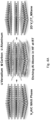
- the electrochemical cell was formed with Mo as the counter electrode an Al foil as the reference electrode. Figs. 1A-1C .
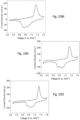
- the cyclic voltammetry studies on a typical electrode showed a distinctive peak at about 1.4 V vs Al/Al 3+ during oxidation corresponding to the dissolution of Al from V 2 AlC and two peaks at about 1.2 V and 0.9 V vs. Al/Al 3+ during reduction, corresponding to the deposition of Al on V 2 AlC electrodes.
- Fig. 2A The CV studies indicated the possibility of removing Al from V 2 AlC by applying an anodic potential of higher than 1.4 V vs. Al/Al 3+ . Therefore, we applied a pulsed anodic potential of 1.8 V vs. Al/Al 3+ to V 2 AlC electrodes for about 20 h to etch Al atoms out of V 2 AlC structure according to the process shown in Figs. 1A-1C .
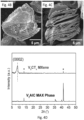
- the X-ray diffraction (XRD) patterns of the electrode before and after etching are compared to the XRD patterns of the precursor V 2 AlC powder and a V 2 CT x MXene sample (synthesized by etching V 2 AlC in a 50 wt.% HF solution for 86 hours) in Figs. 2C-2D .
- the XRD pattern of conventionally synthesized V 2 CT x shows some unreacted V 2 AlC along with a new broad peak at 2 ⁇ of around 8.33°. This peak can be assigned to the (0002) plane of V 2 CT x and translates to a c-lattice parameter (c-LP) of 21.2 ⁇ .
- the comparison of the XRD patterns of V 2 AlC electrodes before and after etching shows the appearance of a similarly small and broad peak at corresponding to (0002) with a peak shift of about 1.08°.
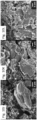
- Fig. 2B shows the SEM image of a V 2 AlC particle separated from the electrochemically etched electrode after sonication in N-Methyl-2-pyrrolidone (NMP) to wash and separate the particles from carbon additives and binder.
- NMP N-Methyl-2-pyrrolidone
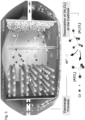
- Figs. 3A shows an SEM images of a Mo counter electrode used in the electrochemical etching of V 2 AlC electrode.
- Figs. 3B-3C show the elemental mapping of same electrode by Energy dispersive X-ray spectroscopy (EDS). These images confirm the deposition of the Al on the counter electrode and indirectly indicate the dissolution of the Al atoms from V 2 AlC working electrode during electrochemical etching. It is worth noting that when we used carbon paper as the working electrode, no Al deposition on the counter electrode was detected. EDS was also used to estimate a V:A1 atomic ratio of 4.25:1 for the electrochemically etched V 2 AlC, confirming a significant decrease of Al after etching. Characterization of samples after electrochemical etching shows that the Al atoms can be removed from V 2 AlC using this method, which confirms that the use of the electrochemical etching to produce MXenes.
- EDS Energy dispersive X-ray spectroscopy
- EXAMPLE 2 Preparation of an aluminum battery comprising a MXene cathode
- Fig. 4A schematically shows the synthesis method of V 2 CT x MXene, where Al atoms are selectively etched from V 2 AlC structure through immersing the MAX phase powder in a concentrated hydrofluoric (HF) acid solution at room temperature.
- Figs. 4B-4C shows scanning electron microscopy (SEM) images of typical V 2 AlC particles before and after etching in HF for 92 h, respectively.
- SEM scanning electron microscopy
- the typical accordion-like multilayered structure observed for the etched MAX phases indicates the successful synthesis of V 2 CT x MXenes. This sample was denoted as multilayered (ML) V 2 CT x .
- the XRD pattern of etched particles showed a peak corresponding to the (0002) plane of V 2 CT x MXene, whereas the intensity of the MAX phase peaks decreased significantly ( Fig. 4D ).
- the presence of small peaks corresponding to V 2 AlC in the XRD pattern of the etched powder indicates the existence of a small amount of unreacted MAX phase in the final product, consistent with previous reports on the synthesis of V 2 CT x .
- the synthesized V 2 CT x powder was cast on porous carbon paper substrate and used as the cathode in an Al battery cell, where high-purity aluminum foil was the anode and AlC13/[EMIm]Cl ionic liquid (with a 1.3:1 AlC13/[EMIm]Cl molar ratio) was used as the electrolyte.
- Fig. 5 schematically shows the components and the operation mechanism of the fabricated aluminum batteries.
- the main anionic species are [AlCl 4 ] - and [Al 2 Cl 7 ] - chloroaluminates, where the concentration of the latter is higher in acidic mixtures (AlCl 3 to [EMIm]Cl ratio of higher than 1), enabling reversible plating and stripping of the aluminum.
- the electrolyte interface (eq I) and Al cations intercalate between the MXene layers (eq II).
- aluminum metal reacts with [AlCl 4 ] - anions to form [Al 2 Cl 7 ] - anions and release three electrons (eq III).
- Fig. 6A shows the charge-discharge profiles of an ML-V2CTx cathode at a current density of 10 mA g -1 .
- a large irreversible capacity of ⁇ 335 mAh g -1 was observed, possibly due to dissociation of chloroaluminate anions and other electrolyte components that may form a solid electrolyte interface.
- the initial discharge capacity dropped to about 178 mAh g -1 in the first cycle (corresponding to V 2 Al 0.26 CT x ).
- the charge and discharge profiles of the cell in the first cycle show broad plateaus that correspond to the observed cathodic and anodic peaks in the cyclic voltammetry (CV) tests.
- the CV curve of the cell ( Fig.
- a V 2 CT x electrode shows up to 4.6 ⁇ increase in its c -LP when intercalated with Na ions.
- Al 3+ cations are the main intercalating species into MXene cathodes. Therefore, intercalation (or co-intercalation) of large [AlCl 4 ] - and [Al 2 Cl 7 ] - chloroaluminate anions ( ⁇ 5.28 and ⁇ 7.02 ⁇ , respectively) or EMI+ cations ( ⁇ 7 ⁇ ), which is observed for some of the other Al-battery cathode materials, may not happen in the case of MXenes.
- the x value was calculated for V 2 C MXene considering the presence of the three different functional groups with formulas of V 2 CF 2 , V 2 CO 2 , and V 2 C(OH) 2 for simplicity.
- the x value in the fully discharged sample increases from 0.11 (for the original sample, due to the presence of some Al in the unreacted MAX particles after etching process) to 0.33. This 0.22 increase in the x value is in good agreement with the calculated values for the three different MXene formulas.
- the small difference can be due to the presence of the residual electrolyte on the surface of the analyzed electrodes.
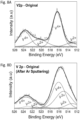
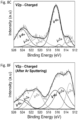
- V 2 CT x X-ray photoelectron spectroscopy
- V 2+ species 39
- the V 2p 3/2 peak develops a shoulder and shows V 3+ species (515.6 eV) along with V 4+ (shifted to 516.7 eV), which demonstrates the reduction of vanadium during discharge.
- vanadium is mostly present in its V 4+ oxidation state (516.3 eV) with some V 3+ remaining in the XPS spectra indicating that charging cannot revert all the V 3+ to V 4+ .
- Diffusion of ions into the structure is usually the rate-limiting step for the intercalation of ions in the host materials.
- the role of particle size on the performance of the electrode is even more pronounced in the case of multivalent-ion batteries due to the generally slower diffusion of multivalent ions in the structure of the host materials.
- the ML-V 2 CT x MXenes studied here have a particle size of about 10-15 ⁇ m, which is very large for battery electrode materials. This large particle size may result in a large energy barrier for the diffusion of Al 3+ ions and reduce the capacity of the electrodes, particularly at high (dis)charge rates.
- Previous studies on the electrochemical performance of MXenes have shown the improvement of rate capability by delamination of multilayered MXenes into single or few-layer sheets. Therefore, we explored improving the electrochemical performance of cathodes by delamination of V 2 CT x MXenes.
- Organic bases may spontaneously intercalate between MXene layers (including V 2 CT x ). This may lead to a large increase in their interlayer spacing.
- organic bases capable of spontaneously intercalating include, tetrabutylammonium hydroxide (TBAOH), choline hydroxide, or n-butylamine.
- TAAOH tetrabutylammonium hydroxide
- choline hydroxide choline hydroxide
- n-butylamine n-butylamine.
- the interlayer-expanded MXenes can be delaminated by dispersion in water followed by rigorous hand-shaking. However, they also found that delaminated V 2 CT x has a strong susceptibility to oxidation when dispersed in water.
- the delaminated sheets may have a large distribution in their size and number of layers (ranging from 4 to 5 layers and few hundred nanometer lateral dimensions to tens of individual layers and a few micron lateral dimensions) and single-layer sheets were not observed.
- the delaminated MXenes were labeled as few layer (FL) V 2 CT x .
- the dispersion of FL-V 2 CT x in NMP was directly used for the electrode fabrication process by adding conductive additives and binder. As shown in Fig.
- FL-V 2 CT x cathode showed a large irreversible initial discharge capacity of 482 mAh g -1 and a first cycle discharge capacity of about 162 mAh g -1 at a high current density of 100 mA g -1 with a Coulombic efficiency of ⁇ 88% (note that ML-V 2 CT x showed a discharge capacity of about 90 mAh g -1 at the same current density).
- the specific capacity of FL-V 2 CT x cathodes declined in the next few cycles but at a comparatively slower rate.
- the measured capacity of the electrode after 100 cycles was about 90 mAh g -1 ( Fig. 9B ).
- FIG. 10A shows a schematic representation of TBAOH intercalation and interlayer expansion of ME-V 2 CT x
- Fig. 10B shows the XRD pattern of the original ML-V 2 CT x and V 2 CT x treated with TBAOH for 4 h.
- the peak corresponding to the (0002) plane of MXenes showed a large downshift after TBAOH treatment, corresponding to a 11.46 ⁇ increase in the c-LP.
- the first cycle shows signs of electrolyte decomposition near the cutoff potentials.
- the measured specific capacities for the following four cycles were about 300 mAh g -1 . To the best of our knowledge, this is the highest specific capacity reported for an intercalation-type cathode material for Al batteries.
- the lower Coulombic efficiency at lower (dis)-charge rates is possibly due to the Al-ion trapping in the electrodes or a slight decomposition of the electrolyte at the surface of the electrode at cutoff potentials.
- CV curves of the FL-V 2 CT x showed bolder cathodic peaks (at around 1.1, 0.95, and 0.8 V) and corresponding anodic peaks (at 0.9, 1.1, and 1.4 V) compared to ML-V 2 CT x or FL-V 2 CT x , suggesting the facilitated access of Al 3+ cations to the intercalation sites between MXene layers.
- the performance of the electrodes can be further improved by optimizing the delamination process and controlling the lateral size and number of layers of V 2 CT x MXenes.
- controlling the surface chemistry of V 2 CT x might result in an improved electrochemical performance.
- the combination of the high specific capacity and the relatively high discharge potential of V 2 CT x renders these materials as one the best cathode materials for rechargeable Al batteries reported thus far ( Fig. 11 ).
- V 2 CT x MXene is a high-capacity intercalation-type cathode material for rechargeable Al batteries. Based on the presented results, we hypothesize that Al 3+ cations are the only intercalating species between the layers of MXene; however, further studies are required to completely understand the intercalation mechanism. Also, the intercalation of Al 3+ cations did not have much effect on the structure of ML-V 2 CT x materials, and only a very small increase in the interlayer spacing of MXene was observed after ion intercalation. We demonstrated that the electrochemical performance of the MXenes can be improved by delamination of ML-V 2 CT x to few-layer sheets.
- MXenes can be a large family of intercalation-type cathode materials for Al batteries, and we aim to explore other MXene compositions in our future studies.
- V 2 CT x MXene V 2 AlC MAX phase was treated with 50% concentrated hydrofluoric acid (ACS grade, BDH) for 92 h at room temperature while stirring with a Teflon-coated magnetic bar at 200 rpm. The etched powder was then washed several times using DI water and centrifuging at 4500 rpm for 5 min until the pH of the supernatant was higher than 4. The MXene powder was then filtered using a Celgard porous membrane, rinsed with DI water and absolute ethanol, and collected and dried under vacuum for 24 h. The obtained MXene powder is referred to as multilayered MXenes.
- ACS grade, BDH 50% concentrated hydrofluoric acid
- the few-layer V 2 CT x (FL-V 2 CT x ) was produced by dispersion of ML-V 2 CT x powder in 1-methyl-2-pyrrolidinone (99+%, Alfa Aesar) and stirring at high speeds (1000-1200 rpm) on a hot plate at 60 °C for 24 h.
- TBAOH intercalation was done by dispersion of the ML-V 2 CT x powder in a 40% w/w aqueous solution of TBAOH (Alfa Aesar) in a ratio of 1 g to 12.5 mL (MXene powder to TBAOH solution) for 4 h at room temperature.
- the intercalated powder was then filtered and rinsed with DI water and absolute ethanol several times to remove the residual TBAOH and dried at room temperature under vacuum overnight.
- the TBAOH-treated powder was stirred ( ⁇ 1000 rpm) in NMP for at least 12 h at 60 °C prior to electrode fabrication.
- the chloroaluminate ionic liquid electrolyte was prepared by mixing 1-ethyl-3-methyl-imidazolium chloride ([EMIm]-Cl, 98+%, Alfa Aesar) and anhydrous high-purity aluminum chloride (AlCl 3 , 99.999+%, Alfa Aesar) at room temperature in an argon-filled glovebox with oxygen and moisture levels below 0.1 ppm. Prior to mixing, the [EMIm]Cl ionic liquid was completely dried under vacuum at 150 °C for at least 24 h. The high-purity AlCl 3 powder was directly used without any purification.
- the AlCl 3 was slowly added to the dried [EMIm] Cl ionic liquid in a 1.3:1 molar ratio to avoid excessive heat generation. The resulting yellowish electrolyte was then stirred for 30 min to dissolve the remaining AlCl 3 powder. Molecular sieves were used to further decrease the water contents in the electrolyte. To further purify the electrolyte, a piece of polished high-purity aluminum foil was placed in the prepared electrolyte and kept for at least 1 week before using the electrolyte. The final electrolyte used in the experiments was light yellow or colorless.
- V 2 CT x MXene powder was mixed with carbon black (Super P, 99+%, Alfa Aesar) and polyvinylidene fluoride (PVDF binder, 99.5%, MTI) in a ratio of 80:10:10 using NMP (99+%, Alfa Aesar) as the solvent and stirring for 24 h to achieve uniform mixture.
- NMP 99+%, Alfa Aesar
- the mass loading of the active material was ⁇ 0.5-2 mg cm -2 .
- High-purity molybdenum foil (99.95%, 3-7 ⁇ m thick, Alfa Aesar) or tantalum foil (99.95%, 0.025 mm thick, Alfa Aesar) was used as the current collector for the cathode side, and high-purity aluminum foil (99.9995%, 0.2 mm thick, Alfa Aesar) was used as both the anode and current collector for the anode side of the cells.
- the aluminum foil electrodes were thoroughly polished and cleaned with absolute ethanol (anhydrous) before use.
- Cyclic voltammetry and galvanic charge-discharge experiments were carried out using BioLogic VMP3 potentiostat.
- the aluminum batteries were tested in a 1.7 V voltage window (0.1-1.8 V vs Al/Al 3+ ).
- the carbon paper used as the cathode substrate was inactive in this potential window. This was demonstrated by performing CV and charge/ discharge experiments on a cell using bare carbon paper as the cathode at a scan rate of 1 mV/s and applied current density of 5 mA g -1 in the same 1.7 V potential window (please see Fig. 12 ). All galvanostatic charge- discharge experiments were carried out between 0.1 and 1.8 V (V vs Al/Al 3+ ) at different current densities (based on the total mass of the active material (MXene) in the electrode).
- the structure and morphology of the synthesized MAX and MXene powders and electrodes were characterized using Bruker X-ray diffractometer with 40 kV and 40 mA Cu K ⁇ radiation in 0.4° 2 ⁇ steps and JEOL JSM-7000F scanning electron microscope equipped with an energy-dispersive spectrometer (EDS detector).
- EDS detector energy-dispersive spectrometer
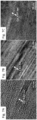
- FEI Helios Nanolab 460F1 was used to prepare the lamellae from V 2 CT x electrodes at different charge states. After thinning, the lamellae were imaged using a Talos F200x transmission electron microscope equipped with a super-X SDD EDXS at 200 kV.
- XPS analysis For XPS analysis, the samples were completely sealed in plastic bags inside the glovebox to avoid any reaction with air and then were transferred out of glovebox, and XPS analysis was performed as soon as samples were received. Photoemission measurements were performed in a Kratos AXIS 165 surface analysis system equipped with a 165 mm hemispherical analyzer (HAS). XPS spectra were recorded in the fixed analyzer transmission mode using a monochromatic aluminum source at 12 mA and 15 kV. The step size was set to 0.05 eV with 500 ms dwell time (700 for V) and two sweeps across each energy range. The chamber was purged with nitrogen.
Landscapes
- Chemical & Material Sciences (AREA)
- Chemical Kinetics & Catalysis (AREA)
- Electrochemistry (AREA)
- General Chemical & Material Sciences (AREA)
- Inorganic Chemistry (AREA)
- Engineering & Computer Science (AREA)
- Organic Chemistry (AREA)
- Manufacturing & Machinery (AREA)
- Materials Engineering (AREA)
- Physics & Mathematics (AREA)
- Condensed Matter Physics & Semiconductors (AREA)
- General Physics & Mathematics (AREA)
- Battery Electrode And Active Subsutance (AREA)
Claims (15)
- Elektrochemische Zelle, die Folgendes umfasst:(a) eine Elektrode, die ein Schichtmaterial mit mehreren Schichten umfasst, wobei jede der Schichten eine im Wesentlichen zweidimensionale geordnete Anordnung von Zellen mit einer empirischen Formel Mn+1Xn umfasst,wobei M ein Übergangsmetall umfasst, das ausgewählt ist aus der Gruppe bestehend aus einem Metall der Gruppe IIIB, einem Metall der Gruppe IVB, einem Metall der Gruppe VB, einem Metall der Gruppe VIB und einer beliebigen Kombination davon,wobei X CxNy ist, wobei x + y = n, undwobei n gleich 1, 2 oder 3 ist, und(b) einen Elektrolyten, wobei der Elektrolyt eine bei Raumtemperatur ionische Flüssigkeit umfasst oder wobei der Elektrolyt ein tiefes eutektisches Lösungsmittel umfasst.
- Elektrochemische Zelle nach Anspruch 1,wobei es sich bei der Elektrode um eine Arbeitselektrode handelt und die elektrochemische Zelle weiterhin eine Gegenelektrode und/oder eine Bezugselektrode umfasst undwobei das Schichtmaterial eine MAX-Phasen-Zusammensetzung mit einer empirischen Formel Mn+1AXn umfasst, wobei A ein Element der Gruppe A umfasst, das ausgewählt ist aus der Gruppe bestehend aus Al, Si, P, S, Ga, Ge, As, Cd, In, Sn, Tl, Pb und einer beliebigen Kombination davon, wobei das Element der Gruppe A gegebenenfalls Al umfasst und wobei die MAX-Phasen-Zusammensetzung weiterhin gegebenenfalls eine Zusammensetzung mit einer empirischen Formel umfasst, die ausgewählt ist aus der Gruppe bestehend aus Ti2AlC, V2AlC, Cr2AlC, Nb2AlC, Ta2AlC, Ti3AlC2, V3AlC2, Ta3AlC2, Ti4AlC3, V4AlC3, Nb4AlC3, Ta4AlC3, Mo2TiAlC2, Cr2TiAlC2, Mo2Ti2AlC3 und einer beliebigen Kombination davon.
- Elektrochemische Zelle nach Anspruch 1,wobei die Elektrode eine Kathode ist und die elektrochemische Zelle weiterhin eine Anode umfasst undwobei das Elektrodenmaterial eine MXen-Zusammensetzung mit einer empirischen Formel Mn+1Xn umfasst und wobei die MXen-Zusammensetzung gegebenenfalls eine Zusammensetzung mit einer empirischen Formel umfasst, die ausgewählt ist aus der Gruppe bestehend aus Ti2C, V2C, Cr2C, Nb2C, Ta2C, Ti3C2, V3C2, Ta3C2, Ti4C3, V4C3, Nb4C3, Ta4C3, Mo2TiC2, Cr2TiC2, Mo2Ti2C3 und einer beliebigen Kombination davon und wobei die MXen-Zusammensetzung weiterhin gegebenenfalls eine expandierte MXen-Zusammensetzung umfasst.
- Elektrochemische Zelle nach einem der Ansprüche 1-3, wobei der Elektrolyt eine bei Raumtemperatur ionische Flüssigkeit umfasst.
- Elektrochemische Zelle nach Anspruch 4, wobei die bei Raumtemperatur ionische Flüssigkeit [AlX4]-, [Al2X7]- oder eine beliebige Kombination davon umfasst und jedes X unabhängig aus Cl oder Br ausgewählt ist.
- Elektrochemische Zelle nach Anspruch 5, wobei die bei Raumtemperatur ionische Flüssigkeit weiterhin ein Kation umfasst, das ein Element der Gruppe umfasst, die aus einem Imidazolium-Kation, einem Pyridinium-Kation, einem Ammonium-Kation, einem Piperidinium-Kation, einem Pyrrolidinium-Kation, einem Alkali-Kation und einer beliebigen Kombination davon besteht, und
wobei das Kation gegebenenfalls l-Ethyl-3-methylimidazolium oder l-Butyl-3-methylimidazolium umfasst oder wobei das Kation Li+, Na+, K+ oder eine Kombination davon umfasst. - Elektrochemische Zelle nach einem der Ansprüche 1-3, wobei der Elektrolyt ein tiefes eutektisches Lösungsmittel umfasst, wobei das tiefe eutektische Lösungsmittel gegebenenfalls [AlX4]-, [Al2X7]- oder eine beliebige Kombination davon umfasst und jedes X unabhängig aus Cl oder Br und/oder einem polaren Molekül ausgewählt ist, das ausgewählt ist aus der Gruppe bestehend aus Harnstoff, Dimethylsulfon, einem Amid, einem Glycolether und einer beliebigen Kombination davon.
- Batterie, welche die elektrochemische Zelle nach einem der Ansprüche 3-7 umfasst.
- Batterie nach Anspruch 8, wobei die Batterie eine Aluminiumbatterie ist und wobei die Anode gegebenenfalls Al, eine Al-Legierung, ein zum Interkalieren von Al fähiges Material oder ein zum Legieren mit Al fähiges Material umfasst.
- Batterie nach einem der Ansprüche 8-9, wobei die Batterie wiederaufladbar ist; wobei die Batterie eine spezifische Entladekapazität von mindestens 200 mAh/g, eine Stromdichte von 100 mA/g aufweist und wobei die Batterie gegebenenfalls eine spezifische Entladekapazität von mindestens 300 mAh/g, eine Stromdichte von 100 mA/g aufweist, wobei die mittlere Entladespannung mindestens 1,0 V gegenüber A/Al3+ beträgt und wobei die mittlere Entladespannung gegebenenfalls mindestens 1,2 V gegenüber A/Al3+ beträgt.
- Verfahren zur Verwendung einer Batterie, wobei das Verfahren das Entladen der Batterie nach einem der Ansprüche 8-10 umfasst und
weiterhin gegebenenfalls das Laden der Batterie umfasst. - Verfahren zur Herstellung einer MXen-Zusammensetzung, welches das elektrochemische Ätzen einer MAX-Phasen-Zusammensetzung umfasst, um ein Element der Gruppe A im Wesentlichen vollständig zu entfernen.
- Verfahren nach Anspruch 12, wobei das elektrochemische Ätzen der MAX-Phasen-Zusammensetzung Folgendes umfasst:das Bereitstellen der elektrochemischen Zelle nach einem der Ansprüche 2 oder 4-7 unddas Anlegen eines Potentials an die elektrochemische Zelle für einen wirksamen Zeitraum zur Herstellung einer MXen-Zusammensetzung mit einer empirischen Formel Mn+1AyXn,wobei y kleiner als 0,5 ist.
- Verfahren nach Anspruch 13, wobei mit dem Verfahren eine MXen-Zusammensetzung mit einer empirischen Formel hergestellt wird, die ausgewählt ist aus der Gruppe bestehend aus Ti2AlyC, V2AlyC, Cr2AlyC, Nb2AlyC, Ta2AlyC, Ti3AlyC2, V3AlyC2, Ta3AlyC2, Ti4AlyC3, V4AlyC3, Nb4AlyC3, Ta4AlyC3, Mo2TiAlyC2, Cr2TiAlyC2, Mo2Ti2AlyC3 und einer beliebigen Kombination davon.
- Verfahren nach einem der Ansprüche 12-14, wobei das Potential ein anodisches Potential ist und wobei
das anodische Potential gegebenenfalls höher als 1,4 V ist.
Applications Claiming Priority (3)
| Application Number | Priority Date | Filing Date | Title |
|---|---|---|---|
| US201762487748P | 2017-04-20 | 2017-04-20 | |
| US201762487738P | 2017-04-20 | 2017-04-20 | |
| PCT/US2018/028646 WO2018195478A1 (en) | 2017-04-20 | 2018-04-20 | Electrochemical systems comprising mxenes and max phase compositions and methods of using the same |
Publications (2)
| Publication Number | Publication Date |
|---|---|
| EP3613094A1 EP3613094A1 (de) | 2020-02-26 |
| EP3613094B1 true EP3613094B1 (de) | 2023-11-01 |
Family
ID=62117074
Family Applications (1)
| Application Number | Title | Priority Date | Filing Date |
|---|---|---|---|
| EP18723229.3A Active EP3613094B1 (de) | 2017-04-20 | 2018-04-20 | Elektoechemische systeme umfassend mxene und max-phasenzusammensetzungen und verfahren selbige verwendend |
Country Status (3)
| Country | Link |
|---|---|
| US (2) | US10756345B2 (de) |
| EP (1) | EP3613094B1 (de) |
| WO (1) | WO2018195478A1 (de) |
Families Citing this family (73)
| Publication number | Priority date | Publication date | Assignee | Title |
|---|---|---|---|---|
| CA3019132A1 (en) | 2016-04-01 | 2017-10-05 | NOHMs Technologies, Inc. | Modified ionic liquids containing phosphorus |
| WO2019018432A1 (en) | 2017-07-17 | 2019-01-24 | NOHMs Technologies, Inc. | ELECTROLYTES CONTAINING PHOSPHORUS |
| US10727487B2 (en) * | 2017-10-04 | 2020-07-28 | Honda Motor Co., Ltd. | Anode for fluoride ion battery |
| US10967363B1 (en) | 2017-10-16 | 2021-04-06 | Iowa State University Research Foundation, Inc. | Two-dimensional metal carbide catalyst |
| US20210396607A1 (en) * | 2018-11-08 | 2021-12-23 | Drexel University | Mxene-based sensor devices |
| CN109599313A (zh) * | 2018-12-06 | 2019-04-09 | 中国科学院兰州化学物理研究所 | 一种Mxene柔性场发射阴极材料的制备方法 |
| CN109692581B (zh) * | 2019-01-15 | 2021-08-13 | 山东理工大学 | 二维层状Ti3C2膜及其制备方法与应用 |
| CN109850899A (zh) * | 2019-01-22 | 2019-06-07 | 河海大学 | 一种二维晶体Nb2CTx纳米材料的制备方法 |
| US11450889B2 (en) * | 2019-01-30 | 2022-09-20 | The Board Of Trustees Of The Leland Stanford Junior University | High-energy density redox-active eutectic liquid |
| CN109796016A (zh) * | 2019-02-26 | 2019-05-24 | 北京化工大学 | 一种调控MXene纳米片层间距的方法 |
| CN109904426B (zh) * | 2019-03-04 | 2021-11-16 | 中国科学院宁波材料技术与工程研究所 | 一种MXene诱导生长的纳米氧化铁复合材料、制备方法及其应用 |
| CN111668559A (zh) * | 2019-03-08 | 2020-09-15 | 南京理工大学 | 一种基于Ti3Al1-xC2正极材料的水系锌离子电池 |
| US12344944B2 (en) * | 2019-06-24 | 2025-07-01 | The Hong Kong Polytechnic University | Method for HF-free facile and rapid synthesis of MXenes related compounds |
| CN110453133A (zh) * | 2019-08-27 | 2019-11-15 | 西安交通大学 | 一种四元MAX相增强NiAl基高温润滑复合材料及其制备方法 |
| CN110510613A (zh) * | 2019-08-29 | 2019-11-29 | 东北大学 | 一种二维金属碳氮化物MXene的制备方法 |
| CN110504440B (zh) * | 2019-09-17 | 2021-02-23 | 肇庆市华师大光电产业研究院 | 一种钠硫电池正极材料的制备方法及其应用 |
| CN110590366B (zh) * | 2019-10-14 | 2022-03-25 | 陕西科技大学 | 一种多孔MXene材料的制备方法 |
| CN110694581B (zh) * | 2019-10-22 | 2022-10-14 | 安庆北化大科技园有限公司 | 一种碳基材料的制备方法、稳定性测试方法及其应用 |
| US12401015B2 (en) * | 2019-10-31 | 2025-08-26 | Research Foundation Of The City University Of New York | Metallic ion intercalated layered structures |
| CN110803702B (zh) * | 2019-11-01 | 2023-03-24 | 河北科技大学 | 用于超级电容器电极材料的MXene复合材料的制备方法及MXene复合材料 |
| US11710825B2 (en) * | 2019-11-18 | 2023-07-25 | The University Of North Carolina At Chapel Hill | Metal carbides and metal nitrides for a fluoride ion battery |
| US11524279B1 (en) | 2019-11-18 | 2022-12-13 | Iowa State University Research Foundation, Inc. | Transition metal carbides for catalytic methane activation |
| CN110890546A (zh) * | 2019-11-30 | 2020-03-17 | 国网新疆电力有限公司电力科学研究院 | 高导电率液态金属包覆耐低温储能材料及其制备方法 |
| WO2021113468A1 (en) * | 2019-12-05 | 2021-06-10 | Drexel University | Selective infrared thermal emission and stealth properties of mxenes |
| CN111003686B (zh) * | 2019-12-06 | 2021-10-29 | 北京航空航天大学 | 一种室温储氢材料及其制备方法 |
| CN111111720A (zh) * | 2020-01-06 | 2020-05-08 | 大连理工大学 | 碱辅助插层在二维半导体Ti3C2O2合成中的应用 |
| CN113113597B (zh) * | 2020-01-13 | 2022-04-29 | 中国科学院宁波材料技术与工程研究所 | 用于锂离子电池阳极的max相材料及其制备方法 |
| US12048132B2 (en) * | 2020-02-20 | 2024-07-23 | Korea Institute Of Science And Technology | Transition metal carbonitride MXene films for EMI shielding |
| CN112830491B (zh) * | 2020-03-16 | 2023-03-24 | 四川大学 | MnAlCn-1相粉末的制备方法 |
| CN111715250B (zh) * | 2020-03-16 | 2021-09-03 | 同济大学 | 负载型过渡金属碳化物类芬顿纳米催化剂制备方法及应用 |
| CN111661848A (zh) * | 2020-04-28 | 2020-09-15 | 深圳瀚光科技有限公司 | 一种电化学制备MXene的方法 |
| CN111634914B (zh) * | 2020-06-12 | 2021-10-22 | 陕西科技大学 | 一种M位掺杂钒系MXene的制备方法 |
| CN111769281A (zh) * | 2020-06-18 | 2020-10-13 | 合肥国轩高科动力能源有限公司 | 一种锂离子电池导电剂及锂离子电池 |
| JP7435322B2 (ja) * | 2020-07-03 | 2024-02-21 | コニカミノルタ株式会社 | 超音波探傷装置、超音波探傷方法、および、プログラム |
| CN112110731B (zh) * | 2020-08-14 | 2022-05-17 | 河南理工大学 | Sc2SC层状材料及其制备方法 |
| CN112010308B (zh) * | 2020-08-26 | 2023-05-16 | 盐城工学院 | 一种表面改性碳硫化钛电池负极材料的制备方法 |
| CN112047341B (zh) * | 2020-08-31 | 2022-03-04 | 山东大学 | 一种Nb2C MXene材料及其制备方法与应用 |
| CN112103504A (zh) * | 2020-09-22 | 2020-12-18 | 广东工业大学 | 一种三元材料负载少层/棒状MXene复合材料及其制备方法 |
| CN114621636B (zh) * | 2020-12-10 | 2022-10-04 | 中国科学院大连化学物理研究所 | 水系MXene基储能电极材料丝网印刷油墨、其制备方法以及应用 |
| CN112853369B (zh) * | 2020-12-31 | 2022-04-15 | 中国科学院上海应用物理研究所 | 迈科烯及其制备方法、锂离子电池、应用 |
| CN114835120A (zh) * | 2021-01-30 | 2022-08-02 | 苏州北科纳米科技有限公司 | 一种元素置换MAX相合成MXene的制备方法 |
| CN113206283A (zh) * | 2021-05-01 | 2021-08-03 | 南开大学 | 一种基于共熔盐电解质的水系锌离子电池电解液 |
| CN115367754B (zh) * | 2021-05-21 | 2023-11-14 | 北京航空航天大学 | 由MXene转化制备MAX相材料的方法及用途 |
| CN113381010A (zh) * | 2021-05-27 | 2021-09-10 | 北京科技大学 | 一种电化学一站式制备铝离子电池用Mxenes正极材料的方法 |
| CN113584524A (zh) * | 2021-08-09 | 2021-11-02 | 辽宁大学 | 一种新型多孔Fe-Ti3C2Clx材料的制备方法及其应用 |
| CN113839017A (zh) * | 2021-08-23 | 2021-12-24 | 上海大学 | 一种银耳状形貌的水系锌离子电池正极材料及其制备方法 |
| CN113745480B (zh) * | 2021-08-28 | 2023-04-21 | 河南海宏科技有限公司 | 一种层状二维材料包覆镍钴锰三元正极材料的制备方法及其应用 |
| CN114351234B (zh) * | 2021-12-03 | 2023-06-16 | 电子科技大学长三角研究院(湖州) | 一种基于配位化学的电化学刻蚀制备二维材料的方法及其检测方法 |
| CN114349002A (zh) * | 2021-12-16 | 2022-04-15 | 西安理工大学 | 纤维素气凝胶-MXene多孔碳电极材料的制备方法 |
| CN114235911B (zh) * | 2021-12-23 | 2024-07-23 | 重庆大学 | 一种用于胆碱检测的电化学传感器及其制备方法 |
| CN114573872B (zh) * | 2022-03-02 | 2024-05-14 | 安徽大学 | 噻吩离子液体改性MXene导热填料的制备方法及导热复合材料 |
| CN114737227B (zh) * | 2022-04-01 | 2024-06-07 | 江苏大学 | 一种基于电化学刻蚀出MXene的方法、MXene悬浊液及其用途 |
| CN114920292B (zh) * | 2022-04-18 | 2024-06-14 | 北京航空航天大学 | 一种过渡金属硫系化合物及其制备方法、用途及储能器件 |
| CN114944489B (zh) * | 2022-06-15 | 2023-08-01 | 北京航空航天大学 | 具有手风琴MXene阵列的薄膜层及其制备方法、集流体、电极和电池 |
| CN115207454B (zh) * | 2022-06-27 | 2025-09-16 | 电子科技大学 | 一种固态离子导体材料及其制备方法 |
| CN115259857A (zh) * | 2022-06-28 | 2022-11-01 | 西北工业大学 | 一种Cr-Ti-Mo基MAX陶瓷材料及制备方法和使用方法 |
| US20240021835A1 (en) * | 2022-07-14 | 2024-01-18 | Massachusetts Institute Of Technology | 3D Electrode Design for a High Specific-capacity Al-graphite Dual-ion Battery |
| CN117638015B (zh) * | 2022-08-17 | 2025-10-03 | 北京航空航天大学 | 二维材料包覆硅复合材料及其制备方法、负极、锂离子电池和电动车 |
| CN117638013B (zh) * | 2022-08-17 | 2025-10-03 | 北京航空航天大学 | 二维材料包覆铅复合材料及其制备方法、铅膏、电极和铅酸电池 |
| CN115246645B (zh) * | 2022-09-05 | 2023-07-18 | 湖北万润新能源科技股份有限公司 | 基于不同层数的V2CTx材料的制备方法及电容器制备方法 |
| CN115504473B (zh) * | 2022-09-22 | 2023-08-04 | 南京大学 | 一种提升锂硫电池隔膜性能的MXene基复合材料及其制备方法 |
| CN115497750B (zh) * | 2022-09-26 | 2024-06-14 | 武汉爱邦高能技术有限公司 | 一种基于凝胶聚合物电解质的超级电容器及其制备方法 |
| CN115821355B (zh) * | 2022-11-22 | 2026-01-09 | 桂林理工大学 | 一种镁合金电极表面MXene膜层改性的方法 |
| CN115772279B (zh) * | 2022-12-13 | 2025-09-16 | 北京林业大学 | 一种用于盐差能转换的MXene/羧甲基木聚糖纳米流控膜的制备方法与应用 |
| WO2024167347A1 (ko) * | 2023-02-10 | 2024-08-15 | 서울대학교산학협력단 | 스트레처블 전극, 이를 포함하는 스트레처블 유기 발광 소자 및 이의 제조방법 |
| PT118685A (pt) | 2023-05-31 | 2024-12-02 | Univ Aveiro | Métodos para obtenção de elétrodos constituídos por compósitos de fase max e seu posterior uso |
| CN117303365B (zh) * | 2023-09-19 | 2025-08-22 | 上海大学 | 一种以CF3SO3-为表面基团的MXene材料及其制备方法和应用 |
| KR102683266B1 (ko) * | 2023-11-06 | 2024-07-09 | 한국지질자원연구원 | 바나듐 탄화물을 사용한 맥스와 맥신 및 이의 제조방법 |
| CN117682522A (zh) * | 2024-02-02 | 2024-03-12 | 河南师范大学 | 一种离子液体刻蚀MAX相制备MXene材料的方法及应用 |
| CN118016817B (zh) * | 2024-02-19 | 2024-09-20 | 临沂大学 | 一种储能用载硫材料MBene的制备方法 |
| CN118221436B (zh) * | 2024-03-22 | 2025-12-19 | 电子科技大学 | 一种高质量钼钛基max相陶瓷的制备方法 |
| CN119875203A (zh) * | 2025-01-10 | 2025-04-25 | 嘉兴大学 | 一种利用固体辐照实现MXene表面改性的方法 |
| CN120511275B (zh) * | 2025-07-22 | 2025-10-03 | 西安建筑科技大学 | 一种H6V4O10/MXene正极材料的制备及其在水系锌离子电池中的应用 |
Family Cites Families (4)
| Publication number | Priority date | Publication date | Assignee | Title |
|---|---|---|---|---|
| US9193595B2 (en) | 2011-06-21 | 2015-11-24 | Drexel University | Compositions comprising free-standing two-dimensional nanocrystals |
| WO2016049109A2 (en) * | 2014-09-25 | 2016-03-31 | Drexel University | Physical forms of mxene materials exhibiting novel electrical and optical characteristics |
| WO2017011044A2 (en) | 2015-04-20 | 2017-01-19 | Drexel University | Two-dimensional, ordered, double transition metals carbides having a nominal unit cell composition m'2m"nxn+1 |
| US9780379B2 (en) * | 2015-05-21 | 2017-10-03 | Nanotek Instruments, Inc. | Alkali metal secondary battery containing a carbon matrix- or carbon matrix composite-based dendrite intercepting layer |
-
2018
- 2018-04-20 US US15/958,888 patent/US10756345B2/en active Active
- 2018-04-20 EP EP18723229.3A patent/EP3613094B1/de active Active
- 2018-04-20 WO PCT/US2018/028646 patent/WO2018195478A1/en not_active Ceased
-
2020
- 2020-08-21 US US17/000,003 patent/US11942639B2/en active Active
Also Published As
| Publication number | Publication date |
|---|---|
| EP3613094A1 (de) | 2020-02-26 |
| US11942639B2 (en) | 2024-03-26 |
| US10756345B2 (en) | 2020-08-25 |
| US20180309125A1 (en) | 2018-10-25 |
| US20200388843A1 (en) | 2020-12-10 |
| WO2018195478A1 (en) | 2018-10-25 |
Similar Documents
| Publication | Publication Date | Title |
|---|---|---|
| US11942639B2 (en) | Electrochemical systems comprising MXenes and MAX phase compositions and methods of using the same | |
| Kundu et al. | Aqueous vs. nonaqueous Zn-ion batteries: consequences of the desolvation penalty at the interface | |
| Zhang et al. | A novel aluminum dual-ion battery | |
| Criado et al. | Effect of chromium doping on Na3V2 (PO4) 2F3@ C as promising positive electrode for sodium-ion batteries | |
| US20200399771A1 (en) | Method for hf-free facile and rapid synthesis of mxenes related compounds | |
| Li et al. | Glucose-assisted synthesis of the hierarchical TiO 2 nanowire@ MoS 2 nanosheet nanocomposite and its synergistic lithium storage performance | |
| Zhuo et al. | Facile synthesis of a Co 3 O 4–carbon nanotube composite and its superior performance as an anode material for Li-ion batteries | |
| US9755236B2 (en) | Dendrite-intercepting layer for alkali metal secondary battery | |
| Yang et al. | [001] preferentially-oriented 2D tungsten disulfide nanosheets as anode materials for superior lithium storage | |
| Zhang et al. | Hierarchical hollow microspheres assembled from N-doped carbon coated Li 4 Ti 5 O 12 nanosheets with enhanced lithium storage properties | |
| Park et al. | Rechargeable Na/Ni batteries based on the Ni (OH) 2/NiOOH redox couple with high energy density and good cycling performance | |
| Saroja et al. | A room temperature multivalent rechargeable iron ion battery with an ether based electrolyte: a new type of post-lithium ion battery | |
| Chen et al. | Improvement of lithium anode deterioration for ameliorating cyclabilities of non-aqueous Li–CO 2 batteries | |
| Yan et al. | Double-shelled NiS/SnS@ N-doped carbon nanoboxes engineered from NiSn (OH) 6 cube templates for advanced sodium-ion battery anodes | |
| CN102106025A (zh) | 贮存氟离子的碳阴极 | |
| Jena et al. | Sandwich architecture of SnSnSb alloy nanoparticles and N-doped reduced graphene oxide sheets as a high rate capability anode for lithium-ion batteries | |
| US20230361309A1 (en) | Conducting coatings for anodes, methods of making and using same, and uses thereof | |
| WO2017060407A1 (en) | DIRECT SYNTHESIS OF CARBON DOPED TiO2-BRONZE NANOSTRUCTURES AS ANODE MATERIALS FOR HIGH PERFORMANCE LITHIUM BATTERIES | |
| Cabello et al. | Nanobelts of beta-sodium vanadate as electrode for magnesium and dual magnesium-sodium batteries | |
| Kim et al. | Additive-free synthesis of Li 4 Ti 5 O 12 nanowire arrays on freestanding ultrathin graphite as a hybrid anode for flexible lithium ion batteries | |
| Niu et al. | Selenium doping induced phase transformation and interlayer expansion boost the zinc storage performance of molybdenum disulfide | |
| US20240339593A1 (en) | Post-graphene nanohybrid composites, methods of making same, and uses thereof | |
| Meija et al. | High-performance Bi 2 Se 3/MXene/SWCNT heterostructures as binder-free anodes in lithium-ion batteries | |
| Ma et al. | Improved cycling stability of MoS 2-coated carbon nanotubes on graphene foam as flexible anodes for lithium-ion batteries | |
| US11177473B2 (en) | Self-standing tin sulfide film for flexible batteries |
Legal Events
| Date | Code | Title | Description |
|---|---|---|---|
| STAA | Information on the status of an ep patent application or granted ep patent |
Free format text: STATUS: UNKNOWN |
|
| STAA | Information on the status of an ep patent application or granted ep patent |
Free format text: STATUS: THE INTERNATIONAL PUBLICATION HAS BEEN MADE |
|
| PUAI | Public reference made under article 153(3) epc to a published international application that has entered the european phase |
Free format text: ORIGINAL CODE: 0009012 |
|
| STAA | Information on the status of an ep patent application or granted ep patent |
Free format text: STATUS: REQUEST FOR EXAMINATION WAS MADE |
|
| 17P | Request for examination filed |
Effective date: 20191118 |
|
| AK | Designated contracting states |
Kind code of ref document: A1 Designated state(s): AL AT BE BG CH CY CZ DE DK EE ES FI FR GB GR HR HU IE IS IT LI LT LU LV MC MK MT NL NO PL PT RO RS SE SI SK SM TR |
|
| AX | Request for extension of the european patent |
Extension state: BA ME |
|
| DAV | Request for validation of the european patent (deleted) | ||
| DAX | Request for extension of the european patent (deleted) | ||
| GRAP | Despatch of communication of intention to grant a patent |
Free format text: ORIGINAL CODE: EPIDOSNIGR1 |
|
| STAA | Information on the status of an ep patent application or granted ep patent |
Free format text: STATUS: GRANT OF PATENT IS INTENDED |
|
| INTG | Intention to grant announced |
Effective date: 20230530 |
|
| GRAS | Grant fee paid |
Free format text: ORIGINAL CODE: EPIDOSNIGR3 |
|
| GRAA | (expected) grant |
Free format text: ORIGINAL CODE: 0009210 |
|
| STAA | Information on the status of an ep patent application or granted ep patent |
Free format text: STATUS: THE PATENT HAS BEEN GRANTED |
|
| AK | Designated contracting states |
Kind code of ref document: B1 Designated state(s): AL AT BE BG CH CY CZ DE DK EE ES FI FR GB GR HR HU IE IS IT LI LT LU LV MC MK MT NL NO PL PT RO RS SE SI SK SM TR |
|
| REG | Reference to a national code |
Ref country code: GB Ref legal event code: FG4D |
|
| REG | Reference to a national code |
Ref country code: CH Ref legal event code: EP |
|
| REG | Reference to a national code |
Ref country code: DE Ref legal event code: R096 Ref document number: 602018060347 Country of ref document: DE |
|
| REG | Reference to a national code |
Ref country code: IE Ref legal event code: FG4D |
|
| REG | Reference to a national code |
Ref country code: LT Ref legal event code: MG9D |
|
| REG | Reference to a national code |
Ref country code: NL Ref legal event code: MP Effective date: 20231101 |
|
| P01 | Opt-out of the competence of the unified patent court (upc) registered |
Effective date: 20240215 |
|
| PG25 | Lapsed in a contracting state [announced via postgrant information from national office to epo] |
Ref country code: GR Free format text: LAPSE BECAUSE OF FAILURE TO SUBMIT A TRANSLATION OF THE DESCRIPTION OR TO PAY THE FEE WITHIN THE PRESCRIBED TIME-LIMIT Effective date: 20240202 |
|
| PG25 | Lapsed in a contracting state [announced via postgrant information from national office to epo] |
Ref country code: IS Free format text: LAPSE BECAUSE OF FAILURE TO SUBMIT A TRANSLATION OF THE DESCRIPTION OR TO PAY THE FEE WITHIN THE PRESCRIBED TIME-LIMIT Effective date: 20240301 |
|
| PG25 | Lapsed in a contracting state [announced via postgrant information from national office to epo] |
Ref country code: LT Free format text: LAPSE BECAUSE OF FAILURE TO SUBMIT A TRANSLATION OF THE DESCRIPTION OR TO PAY THE FEE WITHIN THE PRESCRIBED TIME-LIMIT Effective date: 20231101 |
|
| REG | Reference to a national code |
Ref country code: AT Ref legal event code: MK05 Ref document number: 1628255 Country of ref document: AT Kind code of ref document: T Effective date: 20231101 |
|
| PG25 | Lapsed in a contracting state [announced via postgrant information from national office to epo] |
Ref country code: NL Free format text: LAPSE BECAUSE OF FAILURE TO SUBMIT A TRANSLATION OF THE DESCRIPTION OR TO PAY THE FEE WITHIN THE PRESCRIBED TIME-LIMIT Effective date: 20231101 |
|
| PG25 | Lapsed in a contracting state [announced via postgrant information from national office to epo] |
Ref country code: AT Free format text: LAPSE BECAUSE OF FAILURE TO SUBMIT A TRANSLATION OF THE DESCRIPTION OR TO PAY THE FEE WITHIN THE PRESCRIBED TIME-LIMIT Effective date: 20231101 |
|
| PG25 | Lapsed in a contracting state [announced via postgrant information from national office to epo] |
Ref country code: ES Free format text: LAPSE BECAUSE OF FAILURE TO SUBMIT A TRANSLATION OF THE DESCRIPTION OR TO PAY THE FEE WITHIN THE PRESCRIBED TIME-LIMIT Effective date: 20231101 |
|
| PG25 | Lapsed in a contracting state [announced via postgrant information from national office to epo] |
Ref country code: NL Free format text: LAPSE BECAUSE OF FAILURE TO SUBMIT A TRANSLATION OF THE DESCRIPTION OR TO PAY THE FEE WITHIN THE PRESCRIBED TIME-LIMIT Effective date: 20231101 Ref country code: LT Free format text: LAPSE BECAUSE OF FAILURE TO SUBMIT A TRANSLATION OF THE DESCRIPTION OR TO PAY THE FEE WITHIN THE PRESCRIBED TIME-LIMIT Effective date: 20231101 Ref country code: IS Free format text: LAPSE BECAUSE OF FAILURE TO SUBMIT A TRANSLATION OF THE DESCRIPTION OR TO PAY THE FEE WITHIN THE PRESCRIBED TIME-LIMIT Effective date: 20240301 Ref country code: GR Free format text: LAPSE BECAUSE OF FAILURE TO SUBMIT A TRANSLATION OF THE DESCRIPTION OR TO PAY THE FEE WITHIN THE PRESCRIBED TIME-LIMIT Effective date: 20240202 Ref country code: ES Free format text: LAPSE BECAUSE OF FAILURE TO SUBMIT A TRANSLATION OF THE DESCRIPTION OR TO PAY THE FEE WITHIN THE PRESCRIBED TIME-LIMIT Effective date: 20231101 Ref country code: BG Free format text: LAPSE BECAUSE OF FAILURE TO SUBMIT A TRANSLATION OF THE DESCRIPTION OR TO PAY THE FEE WITHIN THE PRESCRIBED TIME-LIMIT Effective date: 20240201 Ref country code: AT Free format text: LAPSE BECAUSE OF FAILURE TO SUBMIT A TRANSLATION OF THE DESCRIPTION OR TO PAY THE FEE WITHIN THE PRESCRIBED TIME-LIMIT Effective date: 20231101 Ref country code: PT Free format text: LAPSE BECAUSE OF FAILURE TO SUBMIT A TRANSLATION OF THE DESCRIPTION OR TO PAY THE FEE WITHIN THE PRESCRIBED TIME-LIMIT Effective date: 20240301 |
|
| PG25 | Lapsed in a contracting state [announced via postgrant information from national office to epo] |
Ref country code: SE Free format text: LAPSE BECAUSE OF FAILURE TO SUBMIT A TRANSLATION OF THE DESCRIPTION OR TO PAY THE FEE WITHIN THE PRESCRIBED TIME-LIMIT Effective date: 20231101 Ref country code: RS Free format text: LAPSE BECAUSE OF FAILURE TO SUBMIT A TRANSLATION OF THE DESCRIPTION OR TO PAY THE FEE WITHIN THE PRESCRIBED TIME-LIMIT Effective date: 20231101 Ref country code: PL Free format text: LAPSE BECAUSE OF FAILURE TO SUBMIT A TRANSLATION OF THE DESCRIPTION OR TO PAY THE FEE WITHIN THE PRESCRIBED TIME-LIMIT Effective date: 20231101 Ref country code: NO Free format text: LAPSE BECAUSE OF FAILURE TO SUBMIT A TRANSLATION OF THE DESCRIPTION OR TO PAY THE FEE WITHIN THE PRESCRIBED TIME-LIMIT Effective date: 20240201 Ref country code: LV Free format text: LAPSE BECAUSE OF FAILURE TO SUBMIT A TRANSLATION OF THE DESCRIPTION OR TO PAY THE FEE WITHIN THE PRESCRIBED TIME-LIMIT Effective date: 20231101 Ref country code: HR Free format text: LAPSE BECAUSE OF FAILURE TO SUBMIT A TRANSLATION OF THE DESCRIPTION OR TO PAY THE FEE WITHIN THE PRESCRIBED TIME-LIMIT Effective date: 20231101 |
|
| PG25 | Lapsed in a contracting state [announced via postgrant information from national office to epo] |
Ref country code: DK Free format text: LAPSE BECAUSE OF FAILURE TO SUBMIT A TRANSLATION OF THE DESCRIPTION OR TO PAY THE FEE WITHIN THE PRESCRIBED TIME-LIMIT Effective date: 20231101 |
|
| PG25 | Lapsed in a contracting state [announced via postgrant information from national office to epo] |
Ref country code: CZ Free format text: LAPSE BECAUSE OF FAILURE TO SUBMIT A TRANSLATION OF THE DESCRIPTION OR TO PAY THE FEE WITHIN THE PRESCRIBED TIME-LIMIT Effective date: 20231101 |
|
| PG25 | Lapsed in a contracting state [announced via postgrant information from national office to epo] |
Ref country code: SK Free format text: LAPSE BECAUSE OF FAILURE TO SUBMIT A TRANSLATION OF THE DESCRIPTION OR TO PAY THE FEE WITHIN THE PRESCRIBED TIME-LIMIT Effective date: 20231101 |
|
| PG25 | Lapsed in a contracting state [announced via postgrant information from national office to epo] |
Ref country code: SM Free format text: LAPSE BECAUSE OF FAILURE TO SUBMIT A TRANSLATION OF THE DESCRIPTION OR TO PAY THE FEE WITHIN THE PRESCRIBED TIME-LIMIT Effective date: 20231101 Ref country code: SK Free format text: LAPSE BECAUSE OF FAILURE TO SUBMIT A TRANSLATION OF THE DESCRIPTION OR TO PAY THE FEE WITHIN THE PRESCRIBED TIME-LIMIT Effective date: 20231101 Ref country code: IT Free format text: LAPSE BECAUSE OF FAILURE TO SUBMIT A TRANSLATION OF THE DESCRIPTION OR TO PAY THE FEE WITHIN THE PRESCRIBED TIME-LIMIT Effective date: 20231101 Ref country code: EE Free format text: LAPSE BECAUSE OF FAILURE TO SUBMIT A TRANSLATION OF THE DESCRIPTION OR TO PAY THE FEE WITHIN THE PRESCRIBED TIME-LIMIT Effective date: 20231101 Ref country code: DK Free format text: LAPSE BECAUSE OF FAILURE TO SUBMIT A TRANSLATION OF THE DESCRIPTION OR TO PAY THE FEE WITHIN THE PRESCRIBED TIME-LIMIT Effective date: 20231101 Ref country code: CZ Free format text: LAPSE BECAUSE OF FAILURE TO SUBMIT A TRANSLATION OF THE DESCRIPTION OR TO PAY THE FEE WITHIN THE PRESCRIBED TIME-LIMIT Effective date: 20231101 |
|
| REG | Reference to a national code |
Ref country code: DE Ref legal event code: R097 Ref document number: 602018060347 Country of ref document: DE |
|
| PLBE | No opposition filed within time limit |
Free format text: ORIGINAL CODE: 0009261 |
|
| STAA | Information on the status of an ep patent application or granted ep patent |
Free format text: STATUS: NO OPPOSITION FILED WITHIN TIME LIMIT |
|
| 26N | No opposition filed |
Effective date: 20240802 |
|
| PG25 | Lapsed in a contracting state [announced via postgrant information from national office to epo] |
Ref country code: SI Free format text: LAPSE BECAUSE OF FAILURE TO SUBMIT A TRANSLATION OF THE DESCRIPTION OR TO PAY THE FEE WITHIN THE PRESCRIBED TIME-LIMIT Effective date: 20231101 |
|
| PG25 | Lapsed in a contracting state [announced via postgrant information from national office to epo] |
Ref country code: SI Free format text: LAPSE BECAUSE OF FAILURE TO SUBMIT A TRANSLATION OF THE DESCRIPTION OR TO PAY THE FEE WITHIN THE PRESCRIBED TIME-LIMIT Effective date: 20231101 |
|
| PG25 | Lapsed in a contracting state [announced via postgrant information from national office to epo] |
Ref country code: MC Free format text: LAPSE BECAUSE OF FAILURE TO SUBMIT A TRANSLATION OF THE DESCRIPTION OR TO PAY THE FEE WITHIN THE PRESCRIBED TIME-LIMIT Effective date: 20231101 |
|
| PG25 | Lapsed in a contracting state [announced via postgrant information from national office to epo] |
Ref country code: MC Free format text: LAPSE BECAUSE OF FAILURE TO SUBMIT A TRANSLATION OF THE DESCRIPTION OR TO PAY THE FEE WITHIN THE PRESCRIBED TIME-LIMIT Effective date: 20231101 |
|
| REG | Reference to a national code |
Ref country code: CH Ref legal event code: PL |
|
| PG25 | Lapsed in a contracting state [announced via postgrant information from national office to epo] |
Ref country code: LU Free format text: LAPSE BECAUSE OF NON-PAYMENT OF DUE FEES Effective date: 20240420 |
|
| GBPC | Gb: european patent ceased through non-payment of renewal fee |
Effective date: 20240420 |
|
| REG | Reference to a national code |
Ref country code: BE Ref legal event code: MM Effective date: 20240430 |
|
| PG25 | Lapsed in a contracting state [announced via postgrant information from national office to epo] |
Ref country code: LU Free format text: LAPSE BECAUSE OF NON-PAYMENT OF DUE FEES Effective date: 20240420 |
|
| PG25 | Lapsed in a contracting state [announced via postgrant information from national office to epo] |
Ref country code: BE Free format text: LAPSE BECAUSE OF NON-PAYMENT OF DUE FEES Effective date: 20240430 |
|
| PG25 | Lapsed in a contracting state [announced via postgrant information from national office to epo] |
Ref country code: GB Free format text: LAPSE BECAUSE OF NON-PAYMENT OF DUE FEES Effective date: 20240420 |
|
| PG25 | Lapsed in a contracting state [announced via postgrant information from national office to epo] |
Ref country code: GB Free format text: LAPSE BECAUSE OF NON-PAYMENT OF DUE FEES Effective date: 20240420 Ref country code: BE Free format text: LAPSE BECAUSE OF NON-PAYMENT OF DUE FEES Effective date: 20240430 Ref country code: CH Free format text: LAPSE BECAUSE OF NON-PAYMENT OF DUE FEES Effective date: 20240430 |
|
| PG25 | Lapsed in a contracting state [announced via postgrant information from national office to epo] |
Ref country code: IE Free format text: LAPSE BECAUSE OF NON-PAYMENT OF DUE FEES Effective date: 20240420 |
|
| PGFP | Annual fee paid to national office [announced via postgrant information from national office to epo] |
Ref country code: DE Payment date: 20250417 Year of fee payment: 8 |
|
| PGFP | Annual fee paid to national office [announced via postgrant information from national office to epo] |
Ref country code: FR Payment date: 20250422 Year of fee payment: 8 |
|
| PG25 | Lapsed in a contracting state [announced via postgrant information from national office to epo] |
Ref country code: CY Free format text: LAPSE BECAUSE OF FAILURE TO SUBMIT A TRANSLATION OF THE DESCRIPTION OR TO PAY THE FEE WITHIN THE PRESCRIBED TIME-LIMIT; INVALID AB INITIO Effective date: 20180420 |
|
| PG25 | Lapsed in a contracting state [announced via postgrant information from national office to epo] |
Ref country code: RO Free format text: LAPSE BECAUSE OF FAILURE TO SUBMIT A TRANSLATION OF THE DESCRIPTION OR TO PAY THE FEE WITHIN THE PRESCRIBED TIME-LIMIT Effective date: 20231101 |
|
| PG25 | Lapsed in a contracting state [announced via postgrant information from national office to epo] |
Ref country code: HU Free format text: LAPSE BECAUSE OF FAILURE TO SUBMIT A TRANSLATION OF THE DESCRIPTION OR TO PAY THE FEE WITHIN THE PRESCRIBED TIME-LIMIT; INVALID AB INITIO Effective date: 20180420 |
|
| PG25 | Lapsed in a contracting state [announced via postgrant information from national office to epo] |
Ref country code: FI Free format text: LAPSE BECAUSE OF FAILURE TO SUBMIT A TRANSLATION OF THE DESCRIPTION OR TO PAY THE FEE WITHIN THE PRESCRIBED TIME-LIMIT Effective date: 20231101 |