EP3604092B1 - Nutzfahrzeug - Google Patents
Nutzfahrzeug Download PDFInfo
- Publication number
- EP3604092B1 EP3604092B1 EP18777724.8A EP18777724A EP3604092B1 EP 3604092 B1 EP3604092 B1 EP 3604092B1 EP 18777724 A EP18777724 A EP 18777724A EP 3604092 B1 EP3604092 B1 EP 3604092B1
- Authority
- EP
- European Patent Office
- Prior art keywords
- link
- traveling
- vehicle body
- bending
- hydraulic cylinder
- Prior art date
- Legal status (The legal status is an assumption and is not a legal conclusion. Google has not performed a legal analysis and makes no representation as to the accuracy of the status listed.)
- Active
Links
Images




Classifications
-
- B—PERFORMING OPERATIONS; TRANSPORTING
- B60—VEHICLES IN GENERAL
- B60G—VEHICLE SUSPENSION ARRANGEMENTS
- B60G3/00—Resilient suspensions for a single wheel
- B60G3/18—Resilient suspensions for a single wheel with two or more pivoted arms, e.g. parallelogram
- B60G3/20—Resilient suspensions for a single wheel with two or more pivoted arms, e.g. parallelogram all arms being rigid
-
- B—PERFORMING OPERATIONS; TRANSPORTING
- B62—LAND VEHICLES FOR TRAVELLING OTHERWISE THAN ON RAILS
- B62D—MOTOR VEHICLES; TRAILERS
- B62D61/00—Motor vehicles or trailers, characterised by the arrangement or number of wheels, not otherwise provided for, e.g. four wheels in diamond pattern
- B62D61/10—Motor vehicles or trailers, characterised by the arrangement or number of wheels, not otherwise provided for, e.g. four wheels in diamond pattern with more than four wheels
-
- B—PERFORMING OPERATIONS; TRANSPORTING
- B62—LAND VEHICLES FOR TRAVELLING OTHERWISE THAN ON RAILS
- B62D—MOTOR VEHICLES; TRAILERS
- B62D61/00—Motor vehicles or trailers, characterised by the arrangement or number of wheels, not otherwise provided for, e.g. four wheels in diamond pattern
- B62D61/12—Motor vehicles or trailers, characterised by the arrangement or number of wheels, not otherwise provided for, e.g. four wheels in diamond pattern with variable number of ground engaging wheels, e.g. with some wheels arranged higher than others, or with retractable wheels
-
- B—PERFORMING OPERATIONS; TRANSPORTING
- B60—VEHICLES IN GENERAL
- B60G—VEHICLE SUSPENSION ARRANGEMENTS
- B60G2300/00—Indexing codes relating to the type of vehicle
- B60G2300/07—Off-road vehicles
-
- B—PERFORMING OPERATIONS; TRANSPORTING
- B62—LAND VEHICLES FOR TRAVELLING OTHERWISE THAN ON RAILS
- B62D—MOTOR VEHICLES; TRAILERS
- B62D63/00—Motor vehicles or trailers not otherwise provided for
- B62D63/02—Motor vehicles
Definitions
- the present invention relates to a work vehicle suitable for traveling on a road surface having much unevenness.
- the above-described conventional arrangement makes it possible to travel with maintaining the vehicle body under an appropriate posture with flexing of the bending link mechanism even when unevenness exists on the road surface.
- the height (relative height) of each one of the plurality of traveling devices relative to the vehicle body can be changed.
- the traveling is possible with keeping the vehicle body under an appropriate posture as being stably supported on the ground surface by means of the plurality of traveling devices. Further, it also becomes possible to ride over a step or a ridge.
- the intermediate bending portion of the bending link mechanism can sometimes approach the ground surface, such as when the traveling device is caused to ride onto the upper side of the step with flexion of the bending link mechanism or to be moved across the ridge to the far side thereof.
- the intermediate bending portion of the bending link mechanism may approach the ground surface, as the idle wheels supported to the intermediate bending portions come into contact with the ground surface, guiding can be provided with smooth rolling of the idle wheels on the ground surface.
- the bending link mechanism includes a first link having one end portion thereof supported to the vehicle body to be pivotable about a horizontal axis, and a second link having one end portion thereof pivotally connected to the other end portion of the first link to be pivotable about the horizontal axis and having the other end portion thereof supported to the traveling device; and the idle wheel is supported to a pivot connecting portion between the first link and the second link.
- the traveling device can be elevated/lowered relative to the vehicle body. And, since the idle wheel is supported to the pivotal connecting portion between the first link and the second link, even when the pivotal connecting portion between the first link and the second link approaches the ground surface in association with elevating/lowering movement of the traveling device, the idle wheel will come into contact with the ground surface, thus providing smooth guidance. Further, as the pivot shaft for the pivotal connection between the first link and the second link is used also as a pivot shaft for the idle wheel, simplification of the supporting arrangement is made possible.
- the driving mechanism includes a first hydraulic cylinder capable of changing the pivotal posture of the first link relative to the vehicle body, and a second hydraulic cylinder capable of changing the pivotal posture of the second link relative to the first link.
- the bending link mechanism has its posture changed by two hydraulic cylinders.
- a hydraulic cylinder generally has water resistance and dust resistance.
- entrance thereof to the inside can be prevented, so that possibility of e.g. its malfunction due to the adverse influence therefrom is low. Accordingly, even in a work environment where there is the possibility of intrusion of fine dust or water, the posture changing operation can be carried out in a favorable manner.
- a driving mechanism as defined in claim 3 is capable of changing the posture of the bending link mechanism, with maintaining a state of an intermediate bending portion of the link mechanism, with maintaining a state of an intermediate bending portion of the bending link mechanism being bent toward a vehicle body front/rear intermediate side.
- the posture of the bending link mechanism can be changed with maintaining a state of an intermediate bending portion of the bending link mechanism being bent toward a vehicle body front/rear intermediate side.
- the bending link mechanism will not protrude from the vehicle body toward the front/rear outer side, so the vehicle body front/rear length can be formed compact.
- the arrangement is not limited to an arrangement in which the intermediate bending portions of all of the plurality of bending link mechanisms are bent toward the vehicle body front/rear intermediate side, the arrangement being understood to be inclusive of an arrangement in which the intermediate bending portion (s) of any one or more of the bending link mechanisms is/are bent toward the vehicle body front/rear intermediate side.
- the driving mechanism is capable of changing the posture of the bending link mechanism to an extended posture in which the traveling device and the idle wheel respectively is located on more vehicle body front/rear outer side than the vehicle body front/rear direction outer end.
- the traveling device and the idle wheel respectively is located on more vehicle body front/rear outer side than the vehicle body front/rear direction outer end.
- the vehicle body will be placed at a low position relative to the ground surface.
- the ground contacting width of the traveling device too will be increased in the front/rear direction. Consequently, as the gravity center is lowered, the traveling stability is improved. For instance, when the vehicle travels on a sloped land or the like, traveling is possible even in a place having a significant slope.
- the bending link mechanism, the traveling device and the idle wheel respectively are provided one pair on the left and right on the front/rear opposed sides of the vehicle body.
- the ground support can be provided in a stable manner by the total four sets of traveling devices on the left and right on the front and rear opposed sides. Moreover, since each bending link mechanism is provided with an idle wheel, in all of the bending link mechanisms, the risk of damage due to contact with the ground surface is reduced and moreover step can be ridden over smoothly.
- a work vehicle comprising:
- the height (relative height) of each one of the plurality of traveling devices relative to the vehicle body can be changed, so that even when traveling on an uneven ground surface, traveling with maintaining the vehicle body under an appropriate posture is possible with supporting on the ground surface in a stable manner by the plurality of traveling devices.
- any one of the plurality of traveling devices will be set to the traveling state and the other traveling devices will be set to the free moving state, whereby the driving force can be suppressed.
- the vehicle body can be readily moved manually under a stable posture.
- the driving mechanism is switchable between an all traveling state in which all of the plurality of traveling functional portions are set to the traveling state and a partial traveling state in which at least one of the plurality of the traveling functional portions is set to the free moving state.
- the vehicle body in the all traveling state, can be supported in a stable manner. And, in the partial traveling state, traveling drive is possible by at least one traveling functional portion and as the other traveling devices are set to the free moving state, the driving force can be suppressed. In other words, in the case of traveling on a flat traveling surface, there is obtained a further advantage that even with a same driving force, the traveling speed can be improved by concentrating the available power to the traveling functional portion set to the partial traveling state.
- the vehicle body can be supported in a stable manner. And, for instance, by setting the two sets of traveling functional portions located on the front or rear side of the vehicle body to the traveling state and setting the two sets of traveling functional portions located on the opposite side to the free moving state, traveling driving can be effected with the two sets of traveling functional portions only.
- the bending link mechanism is constituted of the first link and the second link connected to each other to be pivotal bout a horizontal axis, and by changing the pivotal posture of the first link relative to the vehicle body and changing the pivotal posture of the second link relative to the first link, the posture of the bending link mechanism is changed.
- the traveling device to ride onto the upper side of the step by extending the bending link mechanism or moving it across the step to the far side thereof.
- the pivotal connecting portion between the first link and the second link approaches the ground surface, the idle wheel will come into contact with the ground surface, so that guiding can be provided with smooth rolling of the idle wheel on the ground surface. Further, there arises no such inconvenience as the link coupling portion coming into contact with the ground surface to get caught thereby, the guiding can be provided for allowing smooth riding over.
- the driving mechanism includes a first hydraulic cylinder capable of changing the pivotal posture of the first link relative to the vehicle body, and a second hydraulic cylinder capable of changing the pivotal posture of the second link relative to the first link.
- the bending link mechanism has its posture changed by two hydraulic cylinders.
- a hydraulic cylinder generally has water resistance and dust resistance.
- entrance thereof to the inside can be prevented, so that possibility of e.g. its malfunction due to the adverse influence therefrom is low. Accordingly, even in a work environment where there is the possibility of intrusion of fine dust or water, the posture changing operation can be carried out in a favorable manner.
- a work vehicle comprising:
- the bending link mechanism has its posture changed by two hydraulic cylinders.
- a hydraulic cylinder generally has water resistance and dust resistance.
- entrance thereof to the inside can be prevented, so that possibility of e.g. its malfunction due to the adverse influence therefrom is low. Accordingly, even in a work environment where there is the possibility of intrusion of fine dust or water, the posture changing operation can be carried out in a favorable manner.
- first hydraulic cylinder and the second hydraulic cylinder are respectively disposed in concentration in the vicinity of the first link, no large space is occupied thereby, so they can be disposed in a compact manner.
- one end side of the first hydraulic cylinder is pivotally connected to one end side of the first link via a second coupling member.
- the first hydraulic cylinder may interfere with the pivotal support shaft of the first link, thus restricting the pivotal movement amount of the first link.
- the one end side of the first hydraulic cylinder is pivotally connected also to a supporting member on the vehicle body side via a first coupling member, thus being restricted in its position by the first coupling member and the second coupling member.
- first coupling member a supporting member on the vehicle body side
- second coupling member a supporting member on the vehicle body side
- Such cylinder operational condition applies also to that of the second hydraulic cylinder having the third coupling member and the fourth coupling member.
- the arrangement allows compact layout of the hydraulic cylinders, the arrangement allows also increase in the amount of pivotal operations of the first link and the second link in response to operations of the hydraulic cylinders, so that the height of the traveling device relative to the vehicle body can be changed largely, so that an appropriate posture can be maintained even in a work land having much surface unevenness.
- the work vehicle further comprises a plurality of turning mechanisms configured to support the plurality of respective bending link mechanisms to the vehicle body, each of the turning mechanisms is capable of changing orientation thereof about a vertical axis in unison with the driving mechanism and traveling device associated therewith.
- each one of the plurality of bending link mechanisms integrally including the driving mechanism and the traveling device can be changed in its orientation about a vertical axis.
- orientation of the bending link mechanism is changed, its relative position relative to the driving mechanism or the traveling device remains unchanged.
- the bending link mechanism can be extended/contracted to change the height of the traveling device.
- the turning mechanism is detachably attached to the vehicle body in unison with the driving mechanism and the traveling device.
- the turning mechanism which integrally includes the driving mechanism and the traveling device can be detached from the vehicle body.
- the vehicle in case the vehicle is mounted on a truck for its transportation, it can be mounted on the truck with its accommodation being facilitated. Further, if a trouble occurs, one driving mechanism alone can be replaced easily.
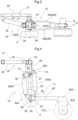
- a work vehicle includes a vehicle body 1 substantially in the form of a rectangular-shaped frame for supporting the entire vehicle, a plurality (specifically four sets) of traveling devices 2, a plurality of idle wheels 3 provided in correspondence with the plurality of traveling devices 2, a plurality of bending link mechanisms 10 (an example of a supporting mechanism, an example of a body support portion), a plurality of hydraulic drive type driving mechanisms 5 capable of variably operating the bending link mechanisms 10, and a plurality of working oil supply devices 6 for supplying working oil to the driving mechanisms 5.
- Each one of the plurality of traveling devices 2 includes a wheel 7 supported to be rotatable about a horizontal axis and a hydraulic motor 9 mounted within a shaft support portion 8 of the wheel 7. In operation, each traveling device 2 is capable of rotatably driving each corresponding wheel 7 by activating the hydraulic motor 9.
- this direction in defining a front/rear direction of the vehicle body, this direction is defined along the traveling direction of the vehicle body.
- this direction In defining a left/right direction of the vehicle body, this direction is defined as seen along the vehicle body traveling (advancing) direction.
- the direction denoted with mark (A) in Fig. 1 is the vehicle body front/rear direction
- the direction denoted with mark (B) in Fig. 2 is the vehicle body left/right direction.
- the driving mechanism 5 is capable of changing the posture of each of the plurality of bending link mechanisms 10 independently.
- the idle wheel 3 is freely rotatably supported to an intermediate bending portion 11 (see Fig. 4 ) of each of the plurality of bending link mechanisms 10.
- one traveling device 2 and one idle wheel 3 corresponding to this traveling device 2 together constitute one set of "traveling functional portion 12".
- the one set of traveling functional portion 12 is supported to be changeable in its posture by one bending link mechanism 10.
- total of four sets of traveling functional portions 12 are mounted on the front and rear opposed sides of the vehicle body 1, one pair each on the left and right sides. Therefore, the bending link mechanism 10, the traveling device 2 and the idle wheel 3 respectively are provided one pair on the left and right sides on the front and rear opposed sides of the vehicle body 1.
- the vehicle body 1 includes a rectangular-shaped frame 13 configured to surround the entire circumference of the vehicle body 1 and to support this vehicle body 1 entirely.
- the working oil supply device 6 is supported as being accommodated in the inside of the vehicle body 1.
- the working oil supply device 6 includes a hydraulic pump driven by an engine mounted on the vehicle for delivering working oil to the driving mechanism 5, a plurality of hydraulic control valves for controlling the working oil delivered from the hydraulic pump to the driving mechanism 5, a working oil tank, etc. and caries out feeding/discharging of the working oil to/from the driving mechanism 5 or adjustment of its flow rate.
- control device 15 for controlling operations of the working oil supply devices 6. Though these control operations by the control device 15 will not be detailed herein, based on control information inputted via an unillustrated manual input device or control information set and stored in advance, the feeding states of the working oil to the driving mechanisms 5 and the hydraulic motors 9 are controlled.
- the plurality (specifically four sets) traveling devices 2 are supported to be elevated/lowered independently relative to the vehicle body 1 via the bending link mechanisms 10.
- Each bending mechanism 10 is supported to the vehicle body to be changeable in its orientation about a vertical axis by a turning mechanism 16.
- the bending link mechanism 10 is supported to the support frame 13 to be pivotable about a vertical axis Y via the turning mechanism 16.
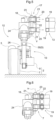
- the turning mechanism 16 includes a vehicle body side support portion 17 (see Fig. 3 and Fig. 4 ) which is connected to the support frame 13 and pivotally supports the bending link mechanism 10, and a turning operation hydraulic cylinder 18 (to be referred to also as a “turning cylinder 18" hereinafter) for turning the bending link mechanism 10.
- the vehicle body side support portion 17 includes: connecting members 20 engageable with a pair of upper and lower angular cylindrical front/rear oriented frame bodies 17 provided at lateral side portions of the support frame 13 for clamping these frame bodies 17 from the lateral outer side and detachably bolt-connected to each other; an outer side pivot bracket 21 disposed at an outer side portion in the vehicle body front/rear direction of the connecting members 20; an inner side pivot bracket 22 disposed at an inner side portion in the vehicle body front/rear direction of the connecting members 20; and a vertically oriented pivot support shaft 23 supported to the outer side pivot bracket 21, whereby the vehicle body side support portion 17 supports the bending link mechanism 10 with allowing its pivotal movement about the axis Y of the pivot support shaft 23.
- the bending link mechanism 10 includes a base end portion 24 supported to the vehicle body side support portion 17 with its vertically position fixed and being pivotable about the vertical axis Y, a first link 25 having one end portion thereof supported to a lower portion of the base end portion 24 to be pivotable about a horizontal axis X1, and a second link 26 having one end portion thereof supported to the other end portion of the first link 25 to be pivotable about a horizontal axis X2 and having the other end portion thereof supported to the traveling device 2.
- the base end portion 24 is provided in the form of a rectangular-shaped frame, and at a position offset to the vehicle body lateral width inner side, the base end portion 24 is supported to the outer side pivot bracket 21 of the vehicle body side support portion 17 to be pivotable about the vertical axis Y via the pivot support shaft 23.
- the turning cylinder 18 has its one end portion pivotally connected to the inner side pivot bracket 22 and has its outer end portion pivotally connected at a laterally offset position to the pivot support shaft 23 of the base end portion 24.
- a support shaft 27 provided on one end side of the first link 25 is pivotally supported, and the first link 25 is connected to a lower portion of the base end portion 24 to be pivotable about the axis of the support shaft 27.
- the first link 25 includes a base end side arm portion 25b and an other end side arm portion 25a. At one end side portion of the first link 25, there is integrally formed the base end side arm portion 25b extending obliquely upper outwards. At the other end side portion of the first link 25, there is integrally formed the other end side arm portion 25a extending obliquely upper outwards.
- the second link 26 is formed bifurcated as seen in the plan view, with a pair of left and right band-plate like plate bodies 26a, 26b.
- the connecting portion of the second link 26 to the first link 25 is separated with a spacing provided by the pair of plate bodies 26a, 26b.
- a connecting support shaft 28 to be connected to the first link 25 is pivotally supported.
- the traveling device 2 is supported. As shown in Fig.
- the driving mechanism 5 For each one of the plurality (four sets) of bending link mechanisms 10, the driving mechanism 5 is provided. As shown in Fig. 1 and Fig. 4 , the driving mechanism 5 includes a first hydraulic cylinder 29 capable of changing the pivotal posture of the first link 25 relative to the vehicle body 1 and a second hydraulic cylinder 30 capable of changing the pivotal posture of the second link 26 relative to the first link 25. The first hydraulic cylinder 29 and the second hydraulic cylinder 30 are disposed in concentration in the vicinity of the first link 25.
- the first link 25, the first hydraulic cylinder 29 and the second hydraulic cylinder 30 are arranged between the pair of plate bodies 26a, 26b of the second link 26.
- the first hydraulic cylinder 29 is located on the vehicle body front/rear direction inner side relative to the first link 25 to extend along the longitudinal direction of the first link 25.
- One end portion of the first hydraulic cylinder 29 is operably connected to a lower portion of the base end portion 24 via an arc-shaped first coupling member 31.
- the one end portion of the first hydraulic cylinder 29 is operably connected to a base end side portion of the first cylinder 25 via another second coupling member 32.
- the first coupling member 31 and the second coupling member 32 respectively have opposed end portions thereof pivotally connected to be pivotable relative to each other.
- the other end portion of the first hydraulic cylinder 29 is operably connected to the other end side arm portion 25a formed integral with the first link 25.
- the second hydraulic cylinder 30 is disposed on the opposite side to the first hydraulic cylinder 29, namely, on the vehicle body front/rear direction outer side relative to the first link 25 and substantially extends along the longitudinal direction of the first link 25.
- One end portion of the second hydraulic cylinder 30 is operably connected to the base end side arm portion 25b formed integral on the base end side of the first link 25.
- the other end portion of the second hydraulic cylinder 30 is operably connected to the arm portion 35 formed integral at the base end side portion of the second link 26 via a third coupling member 34.
- the other end portion of the second hydraulic cylinder 30 is operably connected also to the pivotal movement end side portion of the first link 25 via another fourth coupling member 36.
- the third coupling member 34 and the fourth coupling member 36 respectively have opposed end portions thereof pivotally connected to be pivotable relative to each other.
- the first hydraulic cylinder 29 When the first hydraulic cylinder 29 is extended or contracted with an operation of the second hydraulic cylinder 30 being stopped, the first link 25, the second link 26 and the traveling device 2 will respectively pivot together while maintaining the relative postures thereof, about the horizontal axis X1 where they are pivotally connected to the base end portion 24.
- the second hydraulic cylinder 30 When the second hydraulic cylinder 30 is extended or contracted with an operation of the first hydraulic cylinder 29 being stopped, the second link 26 and the traveling device 2 will pivot, with maintaining the posture of the first link 25 constant, together about the horizontal axis X2 at the connecting portion between the first link 25 and the second link 26.
- the idle wheel 3 is supported.
- the idle wheel 3 is configured as a wheel having an approximately same outside diameter as the wheel 7 of the traveling device 2.
- the connecting support shaft 28 which pivotally connects the first link 25 to the second link 26 is formed to extend to protrude on more vehicle body lateral width direction outer side than the second link 26.
- the idle wheel 3 is supported to be freely rotatable.
- the connecting support shaft 28 which pivotally connects the first link 25 to the second link 26 functions also as a pivot support shaft of the idle wheel 3, thus simplification of the arrangement through co-use of a component being sought for.
- the turning cylinder 18 has one end portion pivotally connected to the inner side pivot bracket 22 and has the other end portion pivotally connected to a position of the base end portion 24 offset laterally relative to the pivot support shaft 23.
- the bending link mechanism 10, the traveling device 2, the idle wheel 3 and the driving mechanism 5 respectively are supported altogether to the outer side pivot bracket 21 to be pivotable about the axis Y of the pivot shaft support 23. And, by extending/contracting the turning cylinder 18, the above members will be pivoted altogether. With this, it is possible to effect a turning operation from a straight traveling state in which the traveling device 2 is oriented along the front/rear direction to a left turning direction or a right turning direction by about 45 degrees, respectively.
- working oil is supplied respectively to the first hydraulic cylinder 29 and the second hydraulic cylinder 30 of each one of the plurality of bending link mechanism 10. Feeding and discharging of the working oil are effected by the hydraulic control valve, so that the first hydraulic cylinder 29 and the second hydraulic cylinder 30 can be extended/contracted.
- This hydraulic control valve is controlled by the control device 15.
- the hydraulic control valve corresponding to the hydraulic motor 9, the rotational speed of the hydraulic motor 9, namely, of the wheel 7 can be changed.
- the hydraulic control valve is controlled by the control device 15 based on e.g. control information inputted by a manual operation or preset and stored control information, etc.
- this work vehicle includes various kinds of sensors.
- the work vehicle includes a first cap-side pressure sensor S1 and a first head-side (counter-cap side) pressure sensor S2 which are provided in the first hydraulic cylinder 29; and a second cap-side pressure sensor S3 and a second head-side (counter-cap side) pressure sensor S4 which are provided in the second hydraulic cylinder 30.
- the firster cap-side pressure sensor S1 detects an oil pressure of a cap-side chamber of the first hydraulic cylinder 29.
- the first head-side pressure sensor S2 detects an oil pressure of a head-side chamber of the first hydraulic cylinder 29.
- the second cap-side pressure sensor S3 detects an oil pressure of a cap-side chamber of the second hydraulic cylinder 30.
- the second head-side pressure sensor S4 detects an oil pressure of a head-side chamber of the second hydraulic cylinder 30. Further, though not shown, the above-described hydraulic cylinders 18, 29, 30 respectively incorporates a stroke sensor capable of detecting an extension/contraction stroke amount, thus feeding back an operational state to the control device 15.
- the attaching positions of the respective pressure sensors S1, S2, S3, S4 are not limited to the positions described above. It suffices for the respective pressure sensors S1, S2, S3, S4 to be capable of detecting (estimating) an oil pressure in the cap-side chamber or the head-side chamber, and so these sensors may be disposed within pipes extending from the valve mechanism to the cap-side chamber or the head-side chamber corresponding thereto.
- a pressure difference between the cap-side chamber and the head-side chamber of the second hydraulic cylinder 30 is obtained and from this pressure difference, a cylinder propelling force for the second hydraulic cylinder 30 will be calculated, similarly for the first hydraulic cylinder 29.
- the vehicle body 1 mounts an acceleration sensor S5 which can be comprised of e.g. a three-axis acceleration sensor. Based on a detection result of this acceleration sensor S5, a front/rear, left/right tilt of the vehicle body 1 is detected and based on the result of this detection, the posture of the vehicle body 1 is controlled. Namely, supplies of the working oil to the respective first hydraulic cylinder 29 and the respective second hydraulic cylinder 30 will be controlled such that the posture of the vehicle body 1 may become a target posture.
- an acceleration sensor S5 which can be comprised of e.g. a three-axis acceleration sensor.
- the traveling device 2 includes a rotation sensor S6 for detecting a rotational speed of the wheel 7. Based on a rotational speed of the wheel 7 calculated by the rotation sensor S6, the supply of the working oil to the hydraulic motor 9 is controlled so that the rotational speed of the wheel 7 may become a target speed.
- the work vehicle of this embodiment is configured such that the traveling device 2 is supported via the bending link mechanism 10 and also that the posture of the bending link mechanism 10 is changed by the hydraulic cylinders 29, 30 as the hydraulic drive type driving mechanism 5 and moreover that the traveling drive is carried out by means of a hydraulic motor. Therefore, the work vehicle is suitable for an agricultural work as being affected little by water or fine dust, etc.
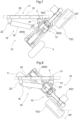
- the traveling mode can be a four-wheel traveling mode in which all of the four traveling devices 2 (specifically the wheels 7) are placed in contact with the ground surface and also all of the four idle wheels 3 are set afloat the ground surface.
- the traveling mode can be a four-wheel traveling mode in which all of the four traveling devices 2 (specifically the wheels 7) are placed in contact with the ground surface and also all of the four idle wheels 3 are set afloat the ground surface.
- the traveling mode can be a four-wheel traveling mode in which all of the four traveling devices 2 (specifically the wheels 7) are placed in contact with the ground surface and also all of the four idle wheels 3 are set afloat the ground surface.
- the traveling mode can be a two-wheel traveling mode in which the traveling device 2 (wheel 7) located on one side in the vehicle body front/rear direction is placed in contact with the ground surface and the idle wheel 3 corresponding to this traveling device 2 (wheel 7) is set afloat the ground surface and also the traveling device 2 (wheel 7) located on the other side in the vehicle body front/rear direction is set afloat the ground surface and the idle wheel 3 corresponding to that traveling device 2 (wheel 7) is placed on contact with the ground surface.
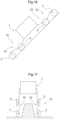
- the two wheel traveling state also can be a state in which the relationship between the traveling device 2 (wheel 7) and the idle wheel 3 is reversed in the vehicle body front/rear direction. That is, as shown in Fig. 11 , it can be a state in which the traveling device 2 (wheel 7) located on one side in the vehicle body front/rear direction is placed in contact with the ground surface and the idle wheel 3 corresponding to this traveling device 2 (wheel 7) is set afloat the ground surface and also the traveling device 2 (wheel 7) located on the other side in the vehicle body front/rear direction is set afloat the ground surface and the idle wheel 3 corresponding to this traveling device 2 is placed in contact with the ground surface.
- the bending link mechanism 10 can be configured in each one of the four sets of traveling functional portions 12 to be switchable between a traveling state in which the traveling device 2 (wheel 7) is placed in contact with the ground surface and the idle wheel 3 corresponding thereto is set afloat the ground surface; and a free moving state in which the idle wheel 3 is placed in contact with the ground surface and the traveling device 2 (wheel 7) corresponding thereto is set afloat the ground surface.
- all of the four sets of traveling functional portions 12 are set to the traveling state.
- two sets of traveling functional portions 12 on one side in the vehicle body front/rear direction are set to the traveling state and two sets of the traveling functional portions 12 on the opposite side are set to the free traveling state.
- the driving mechanism 5 can be switched over between an "all traveling state” in which all of the four traveling functional portions 12 are set to the traveling state and the "partial traveling state” in which at least one of the fourth traveling functional portions 12 is set to the traveling state and the remaining others are set to the free moving state.
- the work vehicle in addition to the above-described traveling on a flat ground surface, the work vehicle can be used in following modes as "special" uses thereof.
- the vehicle body 1 when all of the traveling devices 2 and the idle wheels 3 of the two sets of traveling functional portions 12 on one side in the vehicle body front/rear direction are placed in contact with the ground surface, the vehicle body 1 is greatly tilted to raise the other side thereof with using the bending link mechanisms 10 which support the two sets of traveling functional portions 12 on the other side in the vehicle body front/rear direction. And, when the vehicle body becomes tilted until a gravity center position W of the vehicle body 1 is located within a ground contacting width L defined by the two sets of traveling function portions 12 on the other side, the bending link mechanisms 10 supporting the two sets of traveling functional portions 12 on the other side can be extended largely to place the traveling devices 2 onto a ground surface which is located at a high place.
- the traveling devices 2 of the two sets of traveling functional portions 12 on the other side in the vehicle body front/rear direction an object M as a conveying subject will be clamped and then hoisted. With the object M being clamped, it is possible to travel and move with keeping the posture of the vehicle body by the two sets of traveling functional portions 12 on one side in the vehicle body front/rear direction, so that the object M can be conveyed.
- the postures of the bending link mechanisms 10 will be switched to the extended postures in which the traveling devices 2 and the idle wheels 3 are respectively located on more vehicle body front/rear direction outer side than the vehicle body front/rear direction outer end portions.
- the first links 25 and the second links 26 will be brought as close as possible to the horizontal posture, thereby to lower the height of the vehicle body 1 to a low position.
- the vehicle will travel while climbing up a slope face.
- the ground contacting width along the vehicle body front/rear direction is increased, so that even on a sloped face having a significant inclination, the vehicle can travel in a stable manner without toppling.
- All of the traveling devices 2 and the idle wheels 3 of three sets of traveling functional portions 12 of the total four sets of traveling functional portions 12 will be placed in contact with the ground surface, so as to support the vehicle body 1 on the ground surface in a stable manner.
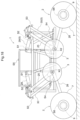
- the bending link mechanism 10 supporting the remaining one traveling function portion 12 will be extended largely to allow each traveling device 2 to ride onto an upper face of a step, so that the vehicle can ride over the step, as shown in Fig. 13 for instance.
- the bending link mechanism 10 of each set of traveling functional portions 12 is extended, each set of traveling functional portions 12 will be moved to ride onto the upper face of a higher step, thereby to ride over the step.
- Fig. 13 illustrates a case of the high step, but the vehicle body 1 can ride over a step if it is low.
- the bending link mechanisms 10 will be extended largely, so as to elevate the vehicle body 1 far above the ground surface.
- a utility work can be carried out with keeping the vehicle body 1 striding across above a ridge.
- a chemical agent spraying a harvesting work from above the produce.
- control device 15 will control operations of the respective hydraulic cylinders 18, 29, 30 and the respective hydraulic motors 9, in a mode corresponding to instructed contents, based on the control information inputted by a manual operation or preset and stored control information, etc.
Landscapes
- Engineering & Computer Science (AREA)
- Mechanical Engineering (AREA)
- Chemical & Material Sciences (AREA)
- Combustion & Propulsion (AREA)
- Transportation (AREA)
- Agricultural Machines (AREA)
Claims (13)
- Nutzfahrzeug, umfassend:eine Fahrzeugkarosserie (1);eine Vielzahl von Fahrvorrichtungen (2) zum Antreiben eines Fahrens;eine Vielzahl von biegenden Gelenkmechanismen (10), die die Vielzahl von Fahrvorrichtungen (2) an der Fahrzeugkarosserie (1) tragen, wobei es ermöglicht ist, die Vielzahl von Fahrvorrichtungen (2) unabhängig voneinander anzuheben/abzusenken;einen Antriebsmechanismus (5), der in der Lage ist, jeweilige Stellungen der Vielzahl von biegenden Gelenkmechanismen (10) unabhängig voneinander zu ändern; undein Freilaufrad (3), das frei drehbar an einem Zwischenbiegeabschnitt (11) von jedem der Vielzahl von biegenden Mechanismen (10) gelagert ist,dadurch gekennzeichnet, dassder biegende Gelenkmechanismus (10) beinhaltend ein erstes Gelenk (25), dessen einer Endabschnitt um eine horizontale Achse (X1, X2) schwenkbar an der Fahrzeugkarosserie (1) gelagert ist, und ein zweites Gelenk (26), dessen einer Endabschnitt schwenkbar mit dem anderen Endabschnitt des ersten Gelenks (25) verbunden ist, um um die horizontale Achse (X1, X2) schwenkbar zu sein, und dessen anderer Endabschnitt gegenüber dem Verbindungsabschnitt des zweiten Gelenks (26) mit dem ersten Gelenk (25) an der Fahrvorrichtung (2) gelagert ist; unddas Freilaufrad (3) durch eine Verbindungstragwelle (28) an einem Schwenkverbindungsabschnitt zwischen dem ersten Gelenk (25) und dem zweiten Gelenk (26) getragen wird, die das erste Gelenk (25) schwenkbar mit dem zweiten Gelenk (26) verbindet.
- Nutzfahrzeug nach Anspruch 1, wobei der Fahrmechanismus (5) einen ersten Hydraulikzylinder (29), der in der Lage ist, die Schwenkstellung des ersten Gelenks (25) in Bezug auf die Fahrzeugkarosserie (1) zu verändern, und einen zweiten Hydraulikzylinder (30), der in der Lage ist, die Schwenkstellung des zweiten Gelenks (26) in Bezug auf das erste Gelenk (25) zu verändern, beinhaltet.
- Nutzfahrzeug, umfassend:eine Fahrzeugkarosserie (1);eine Vielzahl von Fahrvorrichtungen (2) zum Antreiben eines Fahrens;eine Vielzahl von biegenden Gelenkmechanismen (10), die die Vielzahl von Fahrvorrichtungen (2) an der Fahrzeugkarosserie (1) tragen, wobei die Vielzahl von Fahrvorrichtungen (2) unabhängig voneinander angehoben/abgesenkt werden kann;einen Antriebsmechanismus (5), der in der Lage ist, jeweilige Stellungen der Vielzahl von biegenden Gelenkmechanismen (10) unabhängig voneinander zu ändern; undein Freilaufrad (3), das frei drehbar an einem Zwischenbiegeabschnitt (11) von jedem der Vielzahl von biegenden Mechanismen (10) gelagert ist,dadurch gekennzeichnet, dassder Fahrmechanismus (5) in der Lage ist, die Stellung des biegenden Gelenkmechanismus (10) zu ändern, wobei ein Zustand eines Zwischenbiegeabschnitts (11) des biegenden Gelenkmechanismus (10) beibehalten wird, der in Richtung einer vorderen/hinteren Zwischenseite der Fahrzeugkarosserie gebogen ist.
- Nutzfahrzeug nach Anspruch 1 oder 2, wobei der Antriebsmechanismus (5) in der Lage ist, die Stellung des biegenden Gelenkmechanismus (10) in eine ausgefahrene Stellung zu ändern, in der sich die Fahrvorrichtung (2) bzw. das Freilaufrad (3) an der vorderen/hinteren Außenseite des Fahrzeugaufbaus weiter vorne/hinten befindet als am äußeren Ende des Fahrzeugaufbaus in Richtung vorne/hinten.
- Nutzfahrzeug nach einem der Ansprüche 1 bis 4, wobei der biegenden Gelenkmechanismus (10), die Fahreinrichtung (2) und das Freilaufrad (3) jeweils ein Paar links und rechts an den gegenüberliegenden Seiten des Fahrzeugaufbaus bereitgestellt sind.
- Nutzfahrzeug, umfassend: eine Fahrzeugkarosserie (1);eine Vielzahl von Fahrvorrichtungen (2) zum Antreiben eines Fahrens;eine Vielzahl von Leerlaufrädern (3), die in Übereinstimmung mit der jeweiligen Vielzahl von Fahrvorrichtungen (2) bereitgestellt sind;einen Tragmechanismus (10), der konfiguriert ist, um die Vielzahl von Fahrvorrichtungen (2) an der Fahrzeugkarosserie (1) zu tragen, wobei eine Änderung von Positionen der Fahrvorrichtungen (2) unabhängig voneinander ermöglicht ist, wobei der Tragmechanismus (10) konfiguriert ist, um die Vielzahl von Leerlaufrädern (3) an der Fahrzeugkarosserie (1) zu tragen, wobei eine Änderung von Positionen der Leerlaufräder (3) unabhängig voneinander ermöglich ist; undeinen Antriebsmechanismus (5), der den Tragmechanismus (10) variabel betätigen kann;dadurch gekennzeichnet, dassdie Fahrvorrichtung (2) und das Leerlaufrad (3), das der Fahrvorrichtung entspricht, zusammen einen funktionellen Fahrabschnitt (12) darstellen; undder Tragmechanismus (10) in jedem der Vielzahl von funktionellen Fahrabschnitten (12) zwischen einem Fahrzustand, in dem die Fahrvorrichtung (2) auf der Bodenfläche steht, und einem Freifahrtzustand, in dem das Leerlaufrad (3) auf der Bodenfläche steht und die dazugehörige Fahrvorrichtung (2) auf der Bodenfläche schwebt, umschaltbar ist.
- Nutzfahrzeug nach Anspruch 6, wobei der Antriebsmechanismus (5) zwischen einem Vollfahrzustand, in dem alle der mehreren funktionellen Fahrabschnitte (12) in den Fahrzustand versetzt sind, und einem Teilfahrzustand, in dem mindestens einer der Vielzahl von funktionellen Fahrabschnitten (12) in den frei beweglichen Zustand versetzt ist, umschaltbar ist.
- Nutzfahrzeug nach Anspruch 7, wobei:jeweils ein Paar des funktionellen Fahrabschnitts (12) links und rechts auf der vorderen und hinteren gegenüberliegenden Seite der Fahrzeugkarosserie (1) bereitgestellt ist; undwenn der Antriebsmechanismus (5) in dem Teilfahrzustand ist, entweder der funktionelle Fahrabschnitt (12), der sich an der Vorderseite der Fahrzeugkarosserie befindet, oder der funktionelle Fahrabschnitt (12), der sich an der Rückseite der Fahrzeugkarosserie befindet, in den Fahrzustand versetzt wird, und der andere in den Teilfahrzustand versetzt wird.
- Nutzfahrzeug wie definiert in einem der Ansprüche 6-8, wobei:der Tragmechanismus (10) eine Vielzahl von biegenden Gelenkmechanismen beinhaltet, die konfiguriert sind, um die Vielzahl von Fahrvorrichtungen (2) an der Fahrzeugkarosserie (1) zu tragen, wobei ein Anheben und Absenken der Vielzahl von Fahrvorrichtungen (2) unabhängig voneinander ermöglicht ist; undder biegende Gelenkmechanismus beinhaltend ein erstes Gelenk (25), dessen einer Endabschnitt um eine horizontale Achse (X1, X2) schwenkbar an der Fahrzeugkarosserie (1) gelagert ist, und ein zweites Gelenk (26), dessen einer Endabschnitt schwenkbar mit dem anderen Endabschnitt des ersten Gelenks (25) verbunden ist um eine horizontale Achse (X1, X2) schwenkbar zu sein, wobei der andere Endabschnitt des zweiten Gelenks (26) an der Fahrvorrichtung (2) getragen wird; unddas Freilaufrad (3) an einem Schwenkverbindungsabschnitt zwischen dem ersten Gelenk (25) und dem zweiten Gelenk (26) getragen wird.
- Nutzfahrzeug nach Anspruch 9, wobei der Fahrmechanismus (5) einen ersten Hydraulikzylinder (29), der in der Lage ist, die Schwenkstellung des ersten Gelenks (25) in Bezug auf die Fahrzeugkarosserie (1) zu verändern, und einen zweiten Hydraulikzylinder (30), der in der Lage ist, die Schwenkstellung des zweiten Gelenks (26) in Bezug auf das erste Gelenk (25) zu verändern, beinhaltet.
- Nutzfahrzeug, umfassend:eine Fahrzeugkarosserie (1);eine Vielzahl von Fahrvorrichtungen (2) zum Antreiben eines Fahrens;eine Vielzahl von biegenden Gelenkmechanismen (10), die die Vielzahl von Fahrvorrichtungen (2) an der Fahrzeugkarosserie (1) tragen, wobei die Vielzahl von Fahrvorrichtungen (2) unabhängig voneinander angehoben/abgesenkt werden kann; undeinen Antriebsmechanismus (5), der in der Lage ist, jeweilige Stellungen der Vielzahl von biegenden Gelenkmechanismen (10) unabhängig voneinander zu ändern;dadurch gekennzeichnet, dassder biegende Gelenkmechanismus (10) beinhaltend ein erstes Gelenk (25), dessen einer Endabschnitt um eine horizontale Achse (X1, X2) schwenkbar an der Fahrzeugkarosserie (1) gelagert ist, und ein zweites Gelenk (26), dessen einer Endabschnitt schwenkbar mit dem anderen Endabschnitt des ersten Gelenks (25) verbunden ist um eine horizontale Achse (X1, X2) schwenkbar zu sein, wobei der andere Endabschnitt des zweiten Gelenks (26) an der Fahrvorrichtung (2) getragen wird;der Fahrmechanismus (5) einen ersten Hydraulikzylinder (29), der in der Lage ist, die Schwenkstellung des ersten Gelenks (25) in Bezug auf die Fahrzeugkarosserie (1) zu verändern, und einen zweiten Hydraulikzylinder (30), der in der Lage ist, die Schwenkstellung des zweiten Gelenks (26) in Bezug auf das erste Gelenk (25) zu verändern, beinhaltet;der erste Hydraulikzylinder (29) und der zweite Hydraulikzylinder (30) jeweils konzentriert in der Nähe des ersten Gelenks (26) angeordnet sind; undeine Endseite des ersten Hydraulikzylinders (29) über ein erstes Kopplungselement (31) schwenkbar mit einem fahrzeugaufbauseitigen Tragelement und über ein zweites Kopplungselement (32) schwenkbar mit einer Endseite des ersten Gelenks (25) verbunden ist, die andere Endseite des ersten Hydraulikzylinders (29) schwenkbar mit der anderen Endseite des ersten Gelenks (25) verbunden ist, undeine Endseite des zweiten Hydraulikzylinders (30) schwenkbar mit einer Endseite des ersten Gelenks (25) verbunden ist und die andere Endseite des zweiten Hydraulikzylinders (30) über ein drittes Kopplungselement (34) schwenkbar mit einer Endseite des zweiten Gelenks (26) verbunden ist und über ein viertes Kopplungselement (36) schwenkbar mit der anderen Endseite des ersten Gelenks (25) verbunden ist.
- Nutzfahrzeug nach Anspruch 11, ferner umfassend:
eine Vielzahl von Drehmechanismen (16), die konfiguriert sind, um die Vielzahl von jeweiligen biegenden Gelenkmechanismen (10) an der Fahrzeugkarosserie (1) zu tragen, wobei jeder der Drehmechanismen (16) in der Lage ist, seine Ausrichtung um eine vertikale Achse (Y) in Einklang mit dem Antriebsmechanismus (5) und der damit assoziierten Fahrvorrichtung (2) zu ändern. - Nutzfahrzeug nach Anspruch 12, wobei der Drehmechanismus (16) in Einklang mit dem Antriebsmechanismus (5) und der Fahrvorrichtung (2) lösbar an der Karosserie (1) angebracht ist.
Applications Claiming Priority (4)
| Application Number | Priority Date | Filing Date | Title |
|---|---|---|---|
| JP2017066387A JP6701111B2 (ja) | 2017-03-29 | 2017-03-29 | 作業車 |
| JP2017066388A JP6701112B2 (ja) | 2017-03-29 | 2017-03-29 | 作業車 |
| JP2017066386A JP6739387B2 (ja) | 2017-03-29 | 2017-03-29 | 作業車 |
| PCT/JP2018/012710 WO2018181460A1 (ja) | 2017-03-29 | 2018-03-28 | 作業車 |
Publications (3)
| Publication Number | Publication Date |
|---|---|
| EP3604092A1 EP3604092A1 (de) | 2020-02-05 |
| EP3604092A4 EP3604092A4 (de) | 2020-12-23 |
| EP3604092B1 true EP3604092B1 (de) | 2024-08-21 |
Family
ID=63677293
Family Applications (1)
| Application Number | Title | Priority Date | Filing Date |
|---|---|---|---|
| EP18777724.8A Active EP3604092B1 (de) | 2017-03-29 | 2018-03-28 | Nutzfahrzeug |
Country Status (4)
| Country | Link |
|---|---|
| US (1) | US11260922B2 (de) |
| EP (1) | EP3604092B1 (de) |
| CN (1) | CN110494349B (de) |
| WO (1) | WO2018181460A1 (de) |
Families Citing this family (8)
| Publication number | Priority date | Publication date | Assignee | Title |
|---|---|---|---|---|
| EP3560803B1 (de) * | 2016-12-22 | 2023-10-04 | Kubota Corporation | Nutzfahrzeug |
| EP3733488B1 (de) * | 2017-12-25 | 2024-12-18 | Kubota Corporation | Nutzfahrzeug |
| CN112118996A (zh) * | 2018-05-16 | 2020-12-22 | 三菱电机株式会社 | 移动台车 |
| CN210912666U (zh) * | 2019-06-28 | 2020-07-03 | 北京致行慕远科技有限公司 | 机器人及其底盘 |
| EP4116115A4 (de) * | 2020-03-02 | 2024-04-10 | DALU Robotech, Technology (Beijing) Co., Ltd. | Aufhängungsvorrichtung, aufhängungsdämpfer und sechsrädriges bionisches fahrgestell |
| JP7352190B2 (ja) * | 2020-03-13 | 2023-09-28 | トヨタ自動車株式会社 | 三列車輪車両 |
| JP7412323B2 (ja) * | 2020-12-11 | 2024-01-12 | 株式会社クボタ | 作業車 |
| KR20250073953A (ko) * | 2023-11-20 | 2025-05-27 | 현대자동차주식회사 | 바퀴의 링크 구조 |
Citations (1)
| Publication number | Priority date | Publication date | Assignee | Title |
|---|---|---|---|---|
| JP2009096335A (ja) * | 2007-10-17 | 2009-05-07 | Nsk Ltd | 脚型ロボット |
Family Cites Families (13)
| Publication number | Priority date | Publication date | Assignee | Title |
|---|---|---|---|---|
| US3481418A (en) * | 1967-05-15 | 1969-12-02 | Kenneth R Wallan | Articulated vehicles with individual axle reversing drive mechanisms |
| US3642085A (en) * | 1969-09-29 | 1972-02-15 | James M Bird | Vehicle for rough terrain |
| AT375703B (de) * | 1979-12-24 | 1984-09-10 | Kaiser Josef | Bagger |
| US4558758A (en) * | 1983-12-02 | 1985-12-17 | Erwin Littman | Prime mover |
| US4932491A (en) * | 1989-03-21 | 1990-06-12 | The United States Of America As Represented By The Administrator Of The National Aeronautics And Space Administration | Body steered rover |
| JPH09142347A (ja) | 1995-11-24 | 1997-06-03 | Mitsubishi Heavy Ind Ltd | 不整地移動装置 |
| JP4797775B2 (ja) | 2006-04-24 | 2011-10-19 | 株式会社日立製作所 | 2足型移動機構 |
| CN102499827B (zh) * | 2007-02-08 | 2015-11-25 | 英瓦卡尔公司 | 轮椅悬挂装置 |
| CN100572178C (zh) * | 2008-03-25 | 2009-12-23 | 湖南大学 | 具有中间两轮主动摆臂的路面自适应菱形月球车移动系统 |
| JP5490195B2 (ja) * | 2012-09-11 | 2014-05-14 | 株式会社俵屋 | 車輪装置 |
| EP3560803B1 (de) * | 2016-12-22 | 2023-10-04 | Kubota Corporation | Nutzfahrzeug |
| EP3604091B1 (de) * | 2017-03-29 | 2024-08-21 | Kubota Corporation | Nutzfahrzeug |
| CN111247055B (zh) * | 2017-12-25 | 2022-08-23 | 株式会社久保田 | 作业车 |
-
2018
- 2018-03-28 EP EP18777724.8A patent/EP3604092B1/de active Active
- 2018-03-28 CN CN201880023027.9A patent/CN110494349B/zh active Active
- 2018-03-28 WO PCT/JP2018/012710 patent/WO2018181460A1/ja not_active Ceased
- 2018-03-28 US US16/496,151 patent/US11260922B2/en active Active
Patent Citations (1)
| Publication number | Priority date | Publication date | Assignee | Title |
|---|---|---|---|---|
| JP2009096335A (ja) * | 2007-10-17 | 2009-05-07 | Nsk Ltd | 脚型ロボット |
Also Published As
| Publication number | Publication date |
|---|---|
| WO2018181460A1 (ja) | 2018-10-04 |
| EP3604092A4 (de) | 2020-12-23 |
| US11260922B2 (en) | 2022-03-01 |
| EP3604092A1 (de) | 2020-02-05 |
| CN110494349A (zh) | 2019-11-22 |
| US20200062324A1 (en) | 2020-02-27 |
| CN110494349B (zh) | 2022-12-13 |
Similar Documents
| Publication | Publication Date | Title |
|---|---|---|
| EP3604091B1 (de) | Nutzfahrzeug | |
| EP3604092B1 (de) | Nutzfahrzeug | |
| EP3733488B1 (de) | Nutzfahrzeug | |
| US11767071B2 (en) | Work vehicle | |
| CN112119004B (zh) | 作业车 | |
| JP6758278B2 (ja) | 作業車 | |
| JP7117989B2 (ja) | 作業車 | |
| JP2020001443A (ja) | 作業車 | |
| JP6745750B2 (ja) | 作業車 | |
| JP6937725B2 (ja) | 作業車 | |
| WO2019131573A1 (ja) | 作業車 | |
| JP6758277B2 (ja) | 作業車 | |
| JP6745751B2 (ja) | 作業車 | |
| JP6739387B2 (ja) | 作業車 | |
| JP6701112B2 (ja) | 作業車 | |
| JPH027750Y2 (de) | ||
| JP2020001441A (ja) | 作業車 | |
| JP2018167690A (ja) | 作業車 | |
| JP2024077997A (ja) | 作業車 | |
| JPH04278019A (ja) | コンバイン等のクローラ走行装置 |
Legal Events
| Date | Code | Title | Description |
|---|---|---|---|
| STAA | Information on the status of an ep patent application or granted ep patent |
Free format text: STATUS: THE INTERNATIONAL PUBLICATION HAS BEEN MADE |
|
| PUAI | Public reference made under article 153(3) epc to a published international application that has entered the european phase |
Free format text: ORIGINAL CODE: 0009012 |
|
| STAA | Information on the status of an ep patent application or granted ep patent |
Free format text: STATUS: REQUEST FOR EXAMINATION WAS MADE |
|
| 17P | Request for examination filed |
Effective date: 20190930 |
|
| AK | Designated contracting states |
Kind code of ref document: A1 Designated state(s): AL AT BE BG CH CY CZ DE DK EE ES FI FR GB GR HR HU IE IS IT LI LT LU LV MC MK MT NL NO PL PT RO RS SE SI SK SM TR |
|
| AX | Request for extension of the european patent |
Extension state: BA ME |
|
| DAV | Request for validation of the european patent (deleted) | ||
| DAX | Request for extension of the european patent (deleted) | ||
| A4 | Supplementary search report drawn up and despatched |
Effective date: 20201119 |
|
| RIC1 | Information provided on ipc code assigned before grant |
Ipc: B62D 61/12 20060101AFI20201113BHEP Ipc: B62D 61/10 20060101ALI20201113BHEP Ipc: B60G 3/20 20060101ALI20201113BHEP |
|
| REG | Reference to a national code |
Ref legal event code: R079 Ipc: B62D0063020000 Ref country code: DE Ref legal event code: R079 Ref document number: 602018073373 Country of ref document: DE Free format text: PREVIOUS MAIN CLASS: B62D0061120000 Ipc: B62D0063020000 |
|
| RIC1 | Information provided on ipc code assigned before grant |
Ipc: B62D 61/12 20060101ALI20240124BHEP Ipc: B62D 61/10 20060101ALI20240124BHEP Ipc: B60G 3/20 20060101ALI20240124BHEP Ipc: B62D 63/02 20060101AFI20240124BHEP |
|
| GRAP | Despatch of communication of intention to grant a patent |
Free format text: ORIGINAL CODE: EPIDOSNIGR1 |
|
| STAA | Information on the status of an ep patent application or granted ep patent |
Free format text: STATUS: GRANT OF PATENT IS INTENDED |
|
| INTG | Intention to grant announced |
Effective date: 20240318 |
|
| GRAS | Grant fee paid |
Free format text: ORIGINAL CODE: EPIDOSNIGR3 |
|
| GRAA | (expected) grant |
Free format text: ORIGINAL CODE: 0009210 |
|
| STAA | Information on the status of an ep patent application or granted ep patent |
Free format text: STATUS: THE PATENT HAS BEEN GRANTED |
|
| AK | Designated contracting states |
Kind code of ref document: B1 Designated state(s): AL AT BE BG CH CY CZ DE DK EE ES FI FR GB GR HR HU IE IS IT LI LT LU LV MC MK MT NL NO PL PT RO RS SE SI SK SM TR |
|
| REG | Reference to a national code |
Ref country code: GB Ref legal event code: FG4D |
|
| REG | Reference to a national code |
Ref country code: CH Ref legal event code: EP |
|
| REG | Reference to a national code |
Ref country code: DE Ref legal event code: R096 Ref document number: 602018073373 Country of ref document: DE |
|
| REG | Reference to a national code |
Ref country code: IE Ref legal event code: FG4D |
|
| REG | Reference to a national code |
Ref country code: LT Ref legal event code: MG9D |
|
| REG | Reference to a national code |
Ref country code: NL Ref legal event code: MP Effective date: 20240821 |
|
| PG25 | Lapsed in a contracting state [announced via postgrant information from national office to epo] |
Ref country code: NO Free format text: LAPSE BECAUSE OF FAILURE TO SUBMIT A TRANSLATION OF THE DESCRIPTION OR TO PAY THE FEE WITHIN THE PRESCRIBED TIME-LIMIT Effective date: 20241121 |
|
| REG | Reference to a national code |
Ref country code: AT Ref legal event code: MK05 Ref document number: 1715261 Country of ref document: AT Kind code of ref document: T Effective date: 20240821 |
|
| PG25 | Lapsed in a contracting state [announced via postgrant information from national office to epo] |
Ref country code: NL Free format text: LAPSE BECAUSE OF FAILURE TO SUBMIT A TRANSLATION OF THE DESCRIPTION OR TO PAY THE FEE WITHIN THE PRESCRIBED TIME-LIMIT Effective date: 20240821 Ref country code: GR Free format text: LAPSE BECAUSE OF FAILURE TO SUBMIT A TRANSLATION OF THE DESCRIPTION OR TO PAY THE FEE WITHIN THE PRESCRIBED TIME-LIMIT Effective date: 20241122 Ref country code: FI Free format text: LAPSE BECAUSE OF FAILURE TO SUBMIT A TRANSLATION OF THE DESCRIPTION OR TO PAY THE FEE WITHIN THE PRESCRIBED TIME-LIMIT Effective date: 20240821 Ref country code: PT Free format text: LAPSE BECAUSE OF FAILURE TO SUBMIT A TRANSLATION OF THE DESCRIPTION OR TO PAY THE FEE WITHIN THE PRESCRIBED TIME-LIMIT Effective date: 20241223 Ref country code: PL Free format text: LAPSE BECAUSE OF FAILURE TO SUBMIT A TRANSLATION OF THE DESCRIPTION OR TO PAY THE FEE WITHIN THE PRESCRIBED TIME-LIMIT Effective date: 20240821 |
|
| PG25 | Lapsed in a contracting state [announced via postgrant information from national office to epo] |
Ref country code: BG Free format text: LAPSE BECAUSE OF FAILURE TO SUBMIT A TRANSLATION OF THE DESCRIPTION OR TO PAY THE FEE WITHIN THE PRESCRIBED TIME-LIMIT Effective date: 20240821 |
|
| PG25 | Lapsed in a contracting state [announced via postgrant information from national office to epo] |
Ref country code: LV Free format text: LAPSE BECAUSE OF FAILURE TO SUBMIT A TRANSLATION OF THE DESCRIPTION OR TO PAY THE FEE WITHIN THE PRESCRIBED TIME-LIMIT Effective date: 20240821 |
|
| PG25 | Lapsed in a contracting state [announced via postgrant information from national office to epo] |
Ref country code: AT Free format text: LAPSE BECAUSE OF FAILURE TO SUBMIT A TRANSLATION OF THE DESCRIPTION OR TO PAY THE FEE WITHIN THE PRESCRIBED TIME-LIMIT Effective date: 20240821 Ref country code: IS Free format text: LAPSE BECAUSE OF FAILURE TO SUBMIT A TRANSLATION OF THE DESCRIPTION OR TO PAY THE FEE WITHIN THE PRESCRIBED TIME-LIMIT Effective date: 20241221 |
|
| PG25 | Lapsed in a contracting state [announced via postgrant information from national office to epo] |
Ref country code: HR Free format text: LAPSE BECAUSE OF FAILURE TO SUBMIT A TRANSLATION OF THE DESCRIPTION OR TO PAY THE FEE WITHIN THE PRESCRIBED TIME-LIMIT Effective date: 20240821 |
|
| PG25 | Lapsed in a contracting state [announced via postgrant information from national office to epo] |
Ref country code: ES Free format text: LAPSE BECAUSE OF FAILURE TO SUBMIT A TRANSLATION OF THE DESCRIPTION OR TO PAY THE FEE WITHIN THE PRESCRIBED TIME-LIMIT Effective date: 20240821 Ref country code: RS Free format text: LAPSE BECAUSE OF FAILURE TO SUBMIT A TRANSLATION OF THE DESCRIPTION OR TO PAY THE FEE WITHIN THE PRESCRIBED TIME-LIMIT Effective date: 20241121 |
|
| PG25 | Lapsed in a contracting state [announced via postgrant information from national office to epo] |
Ref country code: RS Free format text: LAPSE BECAUSE OF FAILURE TO SUBMIT A TRANSLATION OF THE DESCRIPTION OR TO PAY THE FEE WITHIN THE PRESCRIBED TIME-LIMIT Effective date: 20241121 Ref country code: PT Free format text: LAPSE BECAUSE OF FAILURE TO SUBMIT A TRANSLATION OF THE DESCRIPTION OR TO PAY THE FEE WITHIN THE PRESCRIBED TIME-LIMIT Effective date: 20241223 Ref country code: PL Free format text: LAPSE BECAUSE OF FAILURE TO SUBMIT A TRANSLATION OF THE DESCRIPTION OR TO PAY THE FEE WITHIN THE PRESCRIBED TIME-LIMIT Effective date: 20240821 Ref country code: NO Free format text: LAPSE BECAUSE OF FAILURE TO SUBMIT A TRANSLATION OF THE DESCRIPTION OR TO PAY THE FEE WITHIN THE PRESCRIBED TIME-LIMIT Effective date: 20241121 Ref country code: NL Free format text: LAPSE BECAUSE OF FAILURE TO SUBMIT A TRANSLATION OF THE DESCRIPTION OR TO PAY THE FEE WITHIN THE PRESCRIBED TIME-LIMIT Effective date: 20240821 Ref country code: LV Free format text: LAPSE BECAUSE OF FAILURE TO SUBMIT A TRANSLATION OF THE DESCRIPTION OR TO PAY THE FEE WITHIN THE PRESCRIBED TIME-LIMIT Effective date: 20240821 Ref country code: IS Free format text: LAPSE BECAUSE OF FAILURE TO SUBMIT A TRANSLATION OF THE DESCRIPTION OR TO PAY THE FEE WITHIN THE PRESCRIBED TIME-LIMIT Effective date: 20241221 Ref country code: HR Free format text: LAPSE BECAUSE OF FAILURE TO SUBMIT A TRANSLATION OF THE DESCRIPTION OR TO PAY THE FEE WITHIN THE PRESCRIBED TIME-LIMIT Effective date: 20240821 Ref country code: GR Free format text: LAPSE BECAUSE OF FAILURE TO SUBMIT A TRANSLATION OF THE DESCRIPTION OR TO PAY THE FEE WITHIN THE PRESCRIBED TIME-LIMIT Effective date: 20241122 Ref country code: FI Free format text: LAPSE BECAUSE OF FAILURE TO SUBMIT A TRANSLATION OF THE DESCRIPTION OR TO PAY THE FEE WITHIN THE PRESCRIBED TIME-LIMIT Effective date: 20240821 Ref country code: ES Free format text: LAPSE BECAUSE OF FAILURE TO SUBMIT A TRANSLATION OF THE DESCRIPTION OR TO PAY THE FEE WITHIN THE PRESCRIBED TIME-LIMIT Effective date: 20240821 Ref country code: BG Free format text: LAPSE BECAUSE OF FAILURE TO SUBMIT A TRANSLATION OF THE DESCRIPTION OR TO PAY THE FEE WITHIN THE PRESCRIBED TIME-LIMIT Effective date: 20240821 Ref country code: AT Free format text: LAPSE BECAUSE OF FAILURE TO SUBMIT A TRANSLATION OF THE DESCRIPTION OR TO PAY THE FEE WITHIN THE PRESCRIBED TIME-LIMIT Effective date: 20240821 |
|
| PGFP | Annual fee paid to national office [announced via postgrant information from national office to epo] |
Ref country code: DE Payment date: 20250313 Year of fee payment: 8 |
|
| PG25 | Lapsed in a contracting state [announced via postgrant information from national office to epo] |
Ref country code: SM Free format text: LAPSE BECAUSE OF FAILURE TO SUBMIT A TRANSLATION OF THE DESCRIPTION OR TO PAY THE FEE WITHIN THE PRESCRIBED TIME-LIMIT Effective date: 20240821 Ref country code: DK Free format text: LAPSE BECAUSE OF FAILURE TO SUBMIT A TRANSLATION OF THE DESCRIPTION OR TO PAY THE FEE WITHIN THE PRESCRIBED TIME-LIMIT Effective date: 20240821 Ref country code: RO Free format text: LAPSE BECAUSE OF FAILURE TO SUBMIT A TRANSLATION OF THE DESCRIPTION OR TO PAY THE FEE WITHIN THE PRESCRIBED TIME-LIMIT Effective date: 20240821 |
|
| PG25 | Lapsed in a contracting state [announced via postgrant information from national office to epo] |
Ref country code: EE Free format text: LAPSE BECAUSE OF FAILURE TO SUBMIT A TRANSLATION OF THE DESCRIPTION OR TO PAY THE FEE WITHIN THE PRESCRIBED TIME-LIMIT Effective date: 20240821 |
|
| PG25 | Lapsed in a contracting state [announced via postgrant information from national office to epo] |
Ref country code: CZ Free format text: LAPSE BECAUSE OF FAILURE TO SUBMIT A TRANSLATION OF THE DESCRIPTION OR TO PAY THE FEE WITHIN THE PRESCRIBED TIME-LIMIT Effective date: 20240821 |
|
| PGFP | Annual fee paid to national office [announced via postgrant information from national office to epo] |
Ref country code: FR Payment date: 20250213 Year of fee payment: 8 |
|
| PG25 | Lapsed in a contracting state [announced via postgrant information from national office to epo] |
Ref country code: IT Free format text: LAPSE BECAUSE OF FAILURE TO SUBMIT A TRANSLATION OF THE DESCRIPTION OR TO PAY THE FEE WITHIN THE PRESCRIBED TIME-LIMIT Effective date: 20240821 Ref country code: SK Free format text: LAPSE BECAUSE OF FAILURE TO SUBMIT A TRANSLATION OF THE DESCRIPTION OR TO PAY THE FEE WITHIN THE PRESCRIBED TIME-LIMIT Effective date: 20240821 |
|
| REG | Reference to a national code |
Ref country code: DE Ref legal event code: R097 Ref document number: 602018073373 Country of ref document: DE |
|
| PLBE | No opposition filed within time limit |
Free format text: ORIGINAL CODE: 0009261 |
|
| STAA | Information on the status of an ep patent application or granted ep patent |
Free format text: STATUS: NO OPPOSITION FILED WITHIN TIME LIMIT |
|
| 26N | No opposition filed |
Effective date: 20250522 |
|
| PG25 | Lapsed in a contracting state [announced via postgrant information from national office to epo] |
Ref country code: SE Free format text: LAPSE BECAUSE OF FAILURE TO SUBMIT A TRANSLATION OF THE DESCRIPTION OR TO PAY THE FEE WITHIN THE PRESCRIBED TIME-LIMIT Effective date: 20240821 |
|
| PG25 | Lapsed in a contracting state [announced via postgrant information from national office to epo] |
Ref country code: MC Free format text: LAPSE BECAUSE OF FAILURE TO SUBMIT A TRANSLATION OF THE DESCRIPTION OR TO PAY THE FEE WITHIN THE PRESCRIBED TIME-LIMIT Effective date: 20240821 |
|
| REG | Reference to a national code |
Ref country code: CH Ref legal event code: H13 Free format text: ST27 STATUS EVENT CODE: U-0-0-H10-H13 (AS PROVIDED BY THE NATIONAL OFFICE) Effective date: 20251023 |
|
| PG25 | Lapsed in a contracting state [announced via postgrant information from national office to epo] |
Ref country code: LU Free format text: LAPSE BECAUSE OF NON-PAYMENT OF DUE FEES Effective date: 20250328 |
|
| GBPC | Gb: european patent ceased through non-payment of renewal fee |
Effective date: 20250328 |