EP3592362B1 - Solid forms and combination compositions comprising a beta-lactamase inhibitor and uses thereof - Google Patents
Solid forms and combination compositions comprising a beta-lactamase inhibitor and uses thereof Download PDFInfo
- Publication number
- EP3592362B1 EP3592362B1 EP18763383.9A EP18763383A EP3592362B1 EP 3592362 B1 EP3592362 B1 EP 3592362B1 EP 18763383 A EP18763383 A EP 18763383A EP 3592362 B1 EP3592362 B1 EP 3592362B1
- Authority
- EP
- European Patent Office
- Prior art keywords
- pharmaceutical composition
- compound
- hours
- cefepime
- days
- Prior art date
- Legal status (The legal status is an assumption and is not a legal conclusion. Google has not performed a legal analysis and makes no representation as to the accuracy of the status listed.)
- Active
Links
Images






Classifications
-
- C—CHEMISTRY; METALLURGY
- C07—ORGANIC CHEMISTRY
- C07F—ACYCLIC, CARBOCYCLIC OR HETEROCYCLIC COMPOUNDS CONTAINING ELEMENTS OTHER THAN CARBON, HYDROGEN, HALOGEN, OXYGEN, NITROGEN, SULFUR, SELENIUM OR TELLURIUM
- C07F5/00—Compounds containing elements of Groups 3 or 13 of the Periodic Table
- C07F5/02—Boron compounds
- C07F5/027—Organoboranes and organoborohydrides
-
- A—HUMAN NECESSITIES
- A61—MEDICAL OR VETERINARY SCIENCE; HYGIENE
- A61K—PREPARATIONS FOR MEDICAL, DENTAL OR TOILETRY PURPOSES
- A61K31/00—Medicinal preparations containing organic active ingredients
- A61K31/69—Boron compounds
-
- A—HUMAN NECESSITIES
- A61—MEDICAL OR VETERINARY SCIENCE; HYGIENE
- A61K—PREPARATIONS FOR MEDICAL, DENTAL OR TOILETRY PURPOSES
- A61K47/00—Medicinal preparations characterised by the non-active ingredients used, e.g. carriers or inert additives; Targeting or modifying agents chemically bound to the active ingredient
- A61K47/02—Inorganic compounds
-
- A—HUMAN NECESSITIES
- A61—MEDICAL OR VETERINARY SCIENCE; HYGIENE
- A61K—PREPARATIONS FOR MEDICAL, DENTAL OR TOILETRY PURPOSES
- A61K47/00—Medicinal preparations characterised by the non-active ingredients used, e.g. carriers or inert additives; Targeting or modifying agents chemically bound to the active ingredient
- A61K47/06—Organic compounds, e.g. natural or synthetic hydrocarbons, polyolefins, mineral oil, petrolatum or ozokerite
- A61K47/08—Organic compounds, e.g. natural or synthetic hydrocarbons, polyolefins, mineral oil, petrolatum or ozokerite containing oxygen, e.g. ethers, acetals, ketones, quinones, aldehydes, peroxides
- A61K47/12—Carboxylic acids; Salts or anhydrides thereof
-
- A—HUMAN NECESSITIES
- A61—MEDICAL OR VETERINARY SCIENCE; HYGIENE
- A61K—PREPARATIONS FOR MEDICAL, DENTAL OR TOILETRY PURPOSES
- A61K47/00—Medicinal preparations characterised by the non-active ingredients used, e.g. carriers or inert additives; Targeting or modifying agents chemically bound to the active ingredient
- A61K47/06—Organic compounds, e.g. natural or synthetic hydrocarbons, polyolefins, mineral oil, petrolatum or ozokerite
- A61K47/16—Organic compounds, e.g. natural or synthetic hydrocarbons, polyolefins, mineral oil, petrolatum or ozokerite containing nitrogen, e.g. nitro-, nitroso-, azo-compounds, nitriles, cyanates
- A61K47/18—Amines; Amides; Ureas; Quaternary ammonium compounds; Amino acids; Oligopeptides having up to five amino acids
- A61K47/183—Amino acids, e.g. glycine, EDTA or aspartame
-
- A—HUMAN NECESSITIES
- A61—MEDICAL OR VETERINARY SCIENCE; HYGIENE
- A61K—PREPARATIONS FOR MEDICAL, DENTAL OR TOILETRY PURPOSES
- A61K47/00—Medicinal preparations characterised by the non-active ingredients used, e.g. carriers or inert additives; Targeting or modifying agents chemically bound to the active ingredient
- A61K47/06—Organic compounds, e.g. natural or synthetic hydrocarbons, polyolefins, mineral oil, petrolatum or ozokerite
- A61K47/26—Carbohydrates, e.g. sugar alcohols, amino sugars, nucleic acids, mono-, di- or oligo-saccharides; Derivatives thereof, e.g. polysorbates, sorbitan fatty acid esters or glycyrrhizin
-
- A—HUMAN NECESSITIES
- A61—MEDICAL OR VETERINARY SCIENCE; HYGIENE
- A61K—PREPARATIONS FOR MEDICAL, DENTAL OR TOILETRY PURPOSES
- A61K9/00—Medicinal preparations characterised by special physical form
- A61K9/0087—Galenical forms not covered by A61K9/02 - A61K9/7023
- A61K9/0095—Drinks; Beverages; Syrups; Compositions for reconstitution thereof, e.g. powders or tablets to be dispersed in a glass of water; Veterinary drenches
-
- A—HUMAN NECESSITIES
- A61—MEDICAL OR VETERINARY SCIENCE; HYGIENE
- A61P—SPECIFIC THERAPEUTIC ACTIVITY OF CHEMICAL COMPOUNDS OR MEDICINAL PREPARATIONS
- A61P31/00—Antiinfectives, i.e. antibiotics, antiseptics, chemotherapeutics
- A61P31/04—Antibacterial agents
-
- C—CHEMISTRY; METALLURGY
- C07—ORGANIC CHEMISTRY
- C07F—ACYCLIC, CARBOCYCLIC OR HETEROCYCLIC COMPOUNDS CONTAINING ELEMENTS OTHER THAN CARBON, HYDROGEN, HALOGEN, OXYGEN, NITROGEN, SULFUR, SELENIUM OR TELLURIUM
- C07F5/00—Compounds containing elements of Groups 3 or 13 of the Periodic Table
- C07F5/02—Boron compounds
- C07F5/025—Boronic and borinic acid compounds
-
- A—HUMAN NECESSITIES
- A61—MEDICAL OR VETERINARY SCIENCE; HYGIENE
- A61K—PREPARATIONS FOR MEDICAL, DENTAL OR TOILETRY PURPOSES
- A61K2300/00—Mixtures or combinations of active ingredients, wherein at least one active ingredient is fully defined in groups A61K31/00 - A61K41/00
-
- A—HUMAN NECESSITIES
- A61—MEDICAL OR VETERINARY SCIENCE; HYGIENE
- A61K—PREPARATIONS FOR MEDICAL, DENTAL OR TOILETRY PURPOSES
- A61K31/00—Medicinal preparations containing organic active ingredients
- A61K31/33—Heterocyclic compounds
- A61K31/395—Heterocyclic compounds having nitrogen as a ring hetero atom, e.g. guanethidine or rifamycins
- A61K31/54—Heterocyclic compounds having nitrogen as a ring hetero atom, e.g. guanethidine or rifamycins having six-membered rings with at least one nitrogen and one sulfur as the ring hetero atoms, e.g. sulthiame
- A61K31/542—Heterocyclic compounds having nitrogen as a ring hetero atom, e.g. guanethidine or rifamycins having six-membered rings with at least one nitrogen and one sulfur as the ring hetero atoms, e.g. sulthiame ortho- or peri-condensed with heterocyclic ring systems
- A61K31/545—Compounds containing 5-thia-1-azabicyclo [4.2.0] octane ring systems, i.e. compounds containing a ring system of the formula:, e.g. cephalosporins, cefaclor, or cephalexine
- A61K31/546—Compounds containing 5-thia-1-azabicyclo [4.2.0] octane ring systems, i.e. compounds containing a ring system of the formula:, e.g. cephalosporins, cefaclor, or cephalexine containing further heterocyclic rings, e.g. cephalothin
-
- A—HUMAN NECESSITIES
- A61—MEDICAL OR VETERINARY SCIENCE; HYGIENE
- A61K—PREPARATIONS FOR MEDICAL, DENTAL OR TOILETRY PURPOSES
- A61K9/00—Medicinal preparations characterised by special physical form
- A61K9/0012—Galenical forms characterised by the site of application
- A61K9/0019—Injectable compositions; Intramuscular, intravenous, arterial, subcutaneous administration; Compositions to be administered through the skin in an invasive manner
Definitions
- the present invention relates to pharmaceutical compositions containing boron-containing compounds, polymorphic forms, preparations and their use as inhibitors of beta-lactamase enzymes and as antibacterial agents in combination with a beta-lactam antibiotic.
- Antibiotics are the most effective drugs for treating bacteria-infectious diseases. They are largely used in the clinic because of their good antibacterial effect with limited side effects. Among them, the beta-lactam class of antibiotics (for example, penicillins, cephalosporins, monobactams and carbapenems) are preferred because their effect is bactericidal and their target is absent in eukaryotic cells with consequent low toxicity.
- antibiotics for example, penicillins, cephalosporins, monobactams and carbapenems
- beta-lactamases beta-lactam deactivating enzymes
- These beta-lactamases are categorized as "serine” or "metallo” based, respectively, based on the presence of a key serine or zinc in the enzyme active site.
- the rapid induction, selection and spread of this mechanism of bacterial resistance can severely limit the whole class of beta-lactam treatment options in the hospital and in the community. There is a need for effective and safe therapeutic agents that can treat such resistant infections.
- WO 2014/089365 A1 (Venatorx Pharmaceuticals Inc.; 12 June 2014 ) describes certain compounds and compositions that modulate the activity of beta-lactamases and their use in the treatment of bacterial infections.
- One aspect of the invention is a crystalline form of (R)-3-(2-(trans-4-(2-aminoethylamino)cyclohexyl)acetamido)-2-hydroxy-3,4-dihydro-2H-benzo[e][1,2]oxaborinine-8-carboxylic acid dihydrochloride:
- the crystalline form has an X-Ray powder diffraction (XRPD) pattern substantially the same as shown in FIG. 8 .
- XRPD X-Ray powder diffraction
- the crystalline form has an X-ray powder diffraction (XRPD) pattern comprising characteristic peaks at about 7.3° ⁇ 0. 1° 2 ⁇ , about 14.5° ⁇ 0.1° 2 ⁇ , about 18.0° ⁇ 0.1° 2 ⁇ , about 19.7° ⁇ 0.1° 2 ⁇ , about 24.0° ⁇ 0.1° 2 ⁇ , and about 27.3° ⁇ 0.1° 2 ⁇ .
- XRPD X-ray powder diffraction
- the X-ray powder diffraction (XRPD) pattern further comprises characteristic peaks at about 10.8° ⁇ 0.1° 2 ⁇ , about 16.6° ⁇ 0.1° 2 ⁇ , about 19.6° ⁇ 0.1° 2 ⁇ , about 23.3° ⁇ 0.1° 2 ⁇ , about 24.3° ⁇ 0.1° 2 ⁇ , and about 29.3° ⁇ 0.1° 2 ⁇ .
- Another aspect of the invention is a pharmaceutical composition
- a pharmaceutical composition comprising:
- the pharmaceutical composition is formulated as a homogeneous liquid suitable for injection.
- the pharmaceutical composition further comprises an aqueous carrier.
- the pharmaceutical composition has a pH from about 4 to about 6.
- the pharmaceutical composition is formulated as a powder for reconstitution.
- the pharmaceutical composition is suitable for injection once reconstituted with an aqueous carrier.
- the pharmaceutical composition further comprises a pharmaceutically acceptable excipient.
- the pharmaceutically acceptable excipient is an amino acid or a monosaccharide derivative.
- the pharmaceutically acceptable excipient is L-arginine.
- the pharmaceutically acceptable excipient is meglumine.
- references herein to methods of treatment refer to the compounds, pharmaceutical compositions, and medicaments of the present invention for use in a such methods.
- compositions comprising crystalline forms of (R)-3-(2-(trans-4-(2-aminoethylamino)cyclohexyl)acetamido)-2-hydroxy-3,4-dihydro-2H-benzo[e][1,2]oxaborinine-8-carboxylic acid dihydrochloride.
- (R)-3-(2-(trans-4-(2-aminoethylamino)cyclohexyl)acetamido)-2-hydroxy-3,4-dihydro-2H-benzo[e][1,2]oxaborinine-8-carboxylic acid is as shown in the structure below: (R)-3-(2-(trans-4-(2-aminoethylamino)cyclohexyl)acetamido)-2-hydroxy-3,4-dihydro-2H-benzo[e][1,2]oxaborinine-8-carboxylic acid is also referred to as Compound 1.
- Compound 1 may exist in an equilibrium between the "closed" cyclic form (as shown above) and the "open” acyclic form: Compound 1 may associate into intramolecular dimers, trimers, and any combinations thereof.
- the dihydrochloride salt of Compound 1 can be made into a pure and stable crystalline form (Form 1) under controlled conditions.
- Form 1 is a monohydrate form of the dihydrochloride salt of Compound 1.
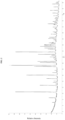
- the X-ray powder diffraction (XRPD) pattern of Form 1 is substantially the same as shown in FIG. 2 , with corresponding tabulated peak data shown in Table 1.
- the X-ray powder diffraction (XRPD) pattern of Form 1 is substantially the same as shown in FIG. 3 .
- the X-ray powder diffraction (XRPD) pattern shown in FIG. 2 is substantially the same as the X-ray powder diffraction (XRPD) pattern shown in FIG. 3 .
- the dihydrochloride salt of Compound 1 can be made into a pure and stable crystalline form (Form 2) under controlled conditions.
- Form 2 is an anhydrous form of the dihydrochloride salt of Compound 1.
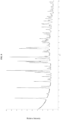
- the X-ray powder diffraction (XRPD) pattern of Form 2 is substantially the same as shown in FIG. 8 , with corresponding tabulated peak data shown in Table 2.
- Form 2 exhibits an X-ray powder diffraction pattern that includes at least three characteristic peaks selected from peaks at about 7.3° ⁇ 0.1° 20, about 10.8° ⁇ 0.1° 20, about 14.5° ⁇ 0.1° 20, about 16.6° ⁇ 0.1° 20, about 18.0° ⁇ 0.1° 20, at about 19.6° ⁇ 0.1° 20, about 19.7° ⁇ 0.1° 20, about 23.3° ⁇ 0.1° 20, about 24.0° ⁇ 0.1° 2 ⁇ ,about 24.3° ⁇ 0.1° 2 ⁇ , about 27.3° ⁇ 0.1° 2 ⁇ , and about 29.3° ⁇ 0.1° 2 ⁇ .
- Form 2 exhibits an X-ray powder diffraction (XRPD) pattern that comprises characteristic peaks at about 7.3° ⁇ 0.1° 20, about 14.5° ⁇ 0.1° 20, about 18.0° ⁇ 0.1° 20, about 19.7° ⁇ 0.1° 20, about 24.0° ⁇ 0.1° 2 ⁇ ,and about 27.3° ⁇ 0.1° 2 ⁇ .
- Form 2 exhibits an X-ray powder diffraction (XRPD) pattern that further comprises characteristic peaks at about 10.8° ⁇ 0.1° 20, about 16.6° ⁇ 0.1° 20, about 19.6° ⁇ 0.1° 20, about 23.3° ⁇ 0.1° 2 ⁇ , about 24.3° ⁇ 0.1° 20, and about 29.3° ⁇ 0.1° 2 ⁇ .
- Form 2 exhibits an X-ray powder diffraction (XRPD) pattern that comprises characteristic peaks at about 7.3° ⁇ 0.1° 20, about 10.8° ⁇ 0.1° 20, about 12.9° ⁇ 0.1° 20, about 15.9° ⁇ 0.1° 20, about 16.3° ⁇ 0.1° 20, about 16.6° ⁇ 0.1° 20, about 19.2° ⁇ 0.1° 20, about 19. 7° ⁇ 0.1° 2 ⁇ , about 20.5° ⁇ 0.1° 2 ⁇ , about 21.1° ⁇ 0.1° 2 ⁇ , about 24.0° ⁇ 0.1° 2 ⁇ , and about 24.3° ⁇ 0.1° 20.
- XRPD X-ray powder diffraction
- Form 2 exhibits an X-ray powder diffraction (XRPD) pattern that comprises characteristic peaks at about 7.3° ⁇ 0.1° 20, about 10.8° ⁇ 0.1° 20, about 11.2° ⁇ 0.1° 20, about 12.9° ⁇ 0.1° 2 ⁇ , about 14.5° ⁇ 0.1° 2 ⁇ , about 15.9° ⁇ 0.1° 2 ⁇ , about 16.3° ⁇ 0.1° 2 ⁇ , about 16.6° ⁇ 0.1° 2 ⁇ , about 19.2° ⁇ 0.1° 2 ⁇ , about 19.7° ⁇ 0.1° 2 ⁇ , about 20.5° ⁇ 0.1° 2 ⁇ , about 21.1° ⁇ 0.1° 20, about 22.8° ⁇ 0.1° 20, about 24.0° ⁇ 0.1° 20, about 24.3° ⁇ 0.1° 20, about 25.9° ⁇ 0.1° 20, about 26.3° ⁇ 0.1° 20, about 26.6° ⁇ 0.1° 2 ⁇ , about 29.3° ⁇ 0.1° 2 ⁇ , and about 32.3° ⁇ 0.1° 2 ⁇ .
- XRPD X-ray powder diffraction
- the dihydrochloride salt of Compound 1 can be made into a new form (Form 3) under controlled conditions.
- the X-ray powder diffraction (XRPD) pattern of Form 3 is substantially the same as shown in FIG. 12 , with corresponding tabulated peak data shown in Table 3.
- Table 3 2 ⁇ [°] d value [ ⁇ ] Intensity [%] 8.68 10.18 100 15.92 5.56 82.5 18.91 4.69 81.8 21.58 4.11 65.7 22.86 3.89 83.7
- the dihydrochloride salt of Compound 1 can be made into a new form (Form 4) under controlled conditions.
- the X-ray powder diffraction (XRPD) pattern of Form 4 is substantially the same as shown in FIG. 13 , with corresponding tabulated peak data shown in Table 4.
- Table 4 2 ⁇ [°] d value [ ⁇ ] Intensity [%] 8.34 10.58 72.7 8.75 10.11 71.0 8.82 10.01 72.0 9.22 9.58 80.9 18.94 4.68 62.2 20.38 4.35 72.0 22.90 3.88 100
- the dihydrochloride salt of Compound 1 can be made into a new form (Form 5) under controlled conditions.
- the X-ray powder diffraction (XRPD) pattern of Form 5 is substantially the same as shown in FIG. 14 , with corresponding tabulated peak data shown in Table 5.
- Table 5 2 ⁇ [°] d value [ ⁇ ] Intensity [%] 7.90 11.18 47.3 10.65 8.29 62.9 15.86 5.57 91.2 18.82 4.71 100
- the dihydrochloride salt of Compound 1 can be made into a crystalline form (Form 6) under controlled conditions.
- the X-ray powder diffraction (XRPD) pattern of Form 6 is substantially the same as shown in FIG. 15 , with corresponding tabulated peak data shown in Table 6.
- Table 6 2 ⁇ [°] d value [ ⁇ ] Intensity [%] 8.74 10.11 100 8.81 10.02 72.2 13.38 6.61 48.8 16.30 5.43 49.1 20.06 4.42 77.6 22.86 3.89 87.7 28.30 3.15 44.7
- a first aspect of the invention is a crystalline form of (R)-3-(2-(trans-4-(2-aminoethylamino)cyclohexyl)acetamido)-2-hydroxy-3,4-dihydro-2H-benzo[e][1,2]oxaborinine-8-carboxylic acid dihydrochloride:
- the crystalline form has at least one of the following properties:
- the X-ray powder diffraction (XRPD) pattern further comprises characteristic peaks at about 10.8° ⁇ 0.1° 20, about 16.6° ⁇ 0.1° 20, about 19.6° ⁇ 0.1° 20, about 23.3° ⁇ 0.1° 20, about 24.3° ⁇ 0.1° 20, and about 29.3° ⁇ 0.1° 2 ⁇ .
- the crystalline form is Form 2.
- a second aspect of the invention is a pharmaceutical composition
- a pharmaceutical composition comprising:
- the pharmaceutical compositions described herein are provided in unit dosage form.
- a "unit dosage form" is a composition containing an amount of compound 1 that is suitable for administration to an animal, preferably mammal, subject in a single dose, according to good medical practice.
- the preparation of a single or unit dosage form does not imply that the dosage form is administered once per day or once per course of therapy.
- Such dosage forms are contemplated to be administered once, twice, thrice or more per day and may be administered as infusion over a period of time (e.g., from about 30 minutes to about 2-6 hours), or administered as a continuous infusion, and may be given more than once during a course of therapy, though a single administration is not specifically excluded.
- Compound 1 and cefepime are formulated in separate containers.
- Compound 1 and cefepime are formulated in a single container.
- administration is via any of the accepted modes of administration for agents that serve similar utilities including, but not limited to, orally, subcutaneously, intravenously, intranasally, topically, transdermally, intraperitoneally, intramuscularly, intrapulmonarilly, vaginally, rectally, or intraocularly.
- the administration is oral administration.
- the administration is intravenous administration.
- the administration is intramuscular administration.
- Standard pharmaceutical formulation techniques are used, such as those disclosed in Remington's The Science and Practice of Pharmacy, 21st Ed., Lippincott Williams & Wilkins (2005 ).
- the pharmaceutical composition comprises a pharmaceutically acceptable excipient.
- pharmaceutically acceptable excipient means one or more compatible solid or encapsulating substances, which are suitable for administration to a mammal.
- compatible means that the components of the composition are capable of being commingled with the subject compound, and with each other, in a manner such that there is no interaction, which would substantially reduce the pharmaceutical efficacy of the composition under ordinary use situations.
- the pharmaceutically acceptable excipient is of sufficiently high purity and sufficiently low toxicity to render them suitable for administration preferably to an animal, preferably mammal, being treated.
- substances which can serve as pharmaceutically acceptable excipients include:
- the pharmaceutical composition is formulated as a homogeneous liquid suitable for injection. In some embodiments, the pharmaceutical composition is formulated for intravenous/intramuscular administration. In some embodiments of a pharmaceutical composition, the composition further comprises a pharmaceutically acceptable excipient. In some embodiments of a pharmaceutical composition, the pharmaceutically acceptable excipient is an amino acid, a monosaccharide, or a monosaccharide derivative. In some embodiments of a pharmaceutical composition, the pharmaceutically acceptable excipient is an amino acid or a monosaccharide derivative. In some embodiments of a pharmaceutical composition, the pharmaceutically acceptable excipient is an amino acid. In some embodiments of a pharmaceutical composition, the pharmaceutically acceptable excipient is arginine.
- the pharmaceutically acceptable excipient is L-arginine. In some embodiments of a pharmaceutical composition, the pharmaceutically acceptable excipient is a monosaccharide or a monosaccharide derivative. In some embodiments of a pharmaceutical composition, the pharmaceutically acceptable excipient is a monosaccharide derivative. In some embodiments of a pharmaceutical composition, the pharmaceutically acceptable excipient is meglumine.
- the pharmaceutical composition for intravenous/intramuscular administration is formulated as a homogeneous liquid suitable for injection.
- the pharmaceutical composition further comprises an aqueous carrier.
- the aqueous carrier is water for injection, 0.9% sodium chloride injection, 5% dextrose injection, 10% dextrose injection, sodium lactate injection, 5% dextrose and 0.9% sodium chloride injection, lactated Ringers and 5% dextrose injection, sodium chloride/sodium acetate/sodium gluconate/potassium chloride/magnesium chloride injection, sodium chloride/potassium acetate/magnesium acetate in 5% dextrose injection, or any combinations thereof.
- the aqueous carrier is water for injection.
- the aqueous carrier is 0.9% sodium chloride injection.
- the pH of the homogeneous liquid is from about 4 to about 9. In some embodiments, the pH of the homogeneous liquid is about 4, about 4.4, about 5, about 5.5, about 6, about 6.5, about 7, about 7.5, about 8, about 8.5, or about 9. In some embodiments, the pH of the homogeneous liquid is from about 4 to about 6.
- the pharmaceutical composition for intravenous/intramuscular administration is formulated as a powder for reconstitution.
- the pharmaceutical composition is suitable for injection once reconstituted with an aqueous carrier.
- the aqueous carrier is water for injection, 0.9% sodium chloride injection, 5% dextrose injection, 10% dextrose injection, sodium lactate injection, 5% dextrose and 0.9% sodium chloride injection, lactated Ringers and 5% dextrose injection, sodium chloride/sodium acetate/sodium gluconate/potassium chloride/magnesium chloride injection, sodium chloride/potassium acetate/magnesium acetate in 5% dextrose injection, or any combinations thereof.
- refrigerated condition is about 2°C, about 2.1°C, about 2.2°C, about 2.3°C, about 2.4°C, about 2.5°C, about 2.6°C, about 2.7°C, about 2.8°C, about 2.9°C, about 3°C, about 3.1°C, about 3.2°C, about 3.3°C, about 3.4°C, about 3.5°C, about 3.6°C, about 3.7°C, about 3.8°C, about 3.9°C, about 4°C, about 4.1°C, about 4.2°C, about 4.3°C, about 4.4°C, about 4.5°C, about 4.6°C, about 4.7°C, about 4.8°C, about 4.9°C, about 5°C, about 5.1°C, about 5.2°C, about 5.3°C, about 5.4°C, about 5.5°C, about 5.6°C, about
- Accelerated conditions include temperature and/or relative humidity (RH) that are at or above ambient levels (e.g. 25°C ⁇ 2°C/60% RH ⁇ 5% RH).
- RH relative humidity
- an accelerated condition is at about 30°C, about 35°C, about 40°C, about 45°C, about 50°C, about 55°C, or about 60°C.
- an accelerated condition is above 55% RH, about 65 % RH, about 70 % RH, about 75 % RH, or about 80 % RH.
- an accelerated condition is about 40°C or 60°C at ambient humidity.
- an accelerated condition is about 40°C ⁇ 2°C/75% RH ⁇ 5% RH.
- an accelerated condition is about 30°C ⁇ 2°C/65% RH ⁇ 5% RH.
- the pharmaceutical composition is stable at about 5°C ⁇ 3°C for at least 12 months. In some embodiments, the pharmaceutical composition is stable at about 25°C ⁇ 2°C/60% RH ⁇ 5% RH for at least 12 months. In some embodiments, the pharmaceutical composition is stable at about 30°C ⁇ 2°C/65% RH ⁇ 5% RH for at least 6 months. In some embodiments, the pharmaceutical composition is stable at about 40°C ⁇ 2°C/75% RH ⁇ 5% RH for at least 6 months.
- a second aspect of the invention is a pharmaceutical composition
- a pharmaceutical composition comprising:
- the pharmaceutical composition is formulated as a homogeneous liquid suitable for injection.
- the pharmaceutical composition further comprises a pharmaceutically acceptable excipient.
- the pharmaceutically acceptable excipient is selected from amino acids.
- the amino acid is L-arginine.
- the pharmaceutical composition further comprises an aqueous carrier.
- the aqueous carrier is selected from water for injection, 0.9% sodium chloride injection, 5% dextrose injection, 10% dextrose injection, sodium lactate injection, 5% dextrose and 0.9% sodium chloride injection, lactated Ringers and 5% dextrose injection, sodium chloride/sodium acetate/sodium gluconate/potassium chloride/magnesium chloride injection, sodium chloride/potassium acetate/magnesium acetate in 5% dextrose injection, and any combinations thereof.
- the pharmaceutical composition has a pH from about 4 to about 9.
- the pharmaceutical composition has a pH from about 4 to about 6.
- the pharmaceutical composition is formulated as a powder for reconstitution.
- the pharmaceutical composition further comprises a pharmaceutically acceptable excipient.
- the pharmaceutically acceptable excipient is selected from amino acids.
- the amino acid is L-arginine.
- the pharmaceutical composition is suitable for injection once reconstituted with an aqueous carrier.
- the aqueous carrier is selected from water for injection, 0.9% sodium chloride injection, 5% dextrose injection, 10% dextrose injection, sodium lactate injection, 5% dextrose and 0.9% sodium chloride injection, lactated Ringers and 5% dextrose injection, sodium chloride/sodium acetate/sodium gluconate/potassium chloride/magnesium chloride injection, sodium chloride/potassium acetate/magnesium acetate in 5% dextrose injection, and any combinations thereof.
- the pharmaceutical composition is stable at about 25°C ⁇ 2°C/60% RH ⁇ 5% RH for at least 12 months.
- the pharmaceutical composition is stable at about 30°C ⁇ 2°C/65% RH ⁇ 5% RH for at least 6 months.
- the pharmaceutical composition is stable at about 40°C ⁇ 2°C/75% RH ⁇ 5% RH for at least 6 months.
- composition comprising:
- the (R)-3-(2-(trans-4-(2-aminoethylamino)cyclohexyl)acetamido)-2-hydroxy-3,4-dihydro-2H-benzo[e][1,2]oxaborinine-8-carboxylic acid dihydrochloride may be formulated in a first container.
- the (R)-3-(2-(trans-4-(2-aminoethylamino)cyclohexyl)acetamido)-2-hydroxy-3,4-dihydro-2H-benzo[e][1,2]oxaborinine-8-carboxylic acid dihydrochloride may be in the form of a first powder for reconstitution.
- the cefepime may be formulated in a second container.
- the cefepime may be in the form of a second powder for reconstitution.
- the method may comprise:
- the method may comprise:
- Each of the aqueous carriers may be independently selected from water for injection, 0.9% sodium chloride for injection, 5% dextrose for injection, 10% dextrose for injection, sodium lactate for injection, 5% dextrose and 0.9% sodium chloride for injection, lactated Ringers and 5% dextrose for injection, sodium chloride/sodium acetate/sodium gluconate/potassium chloride/magnesium chloride for injection, sodium chloride/potassium acetate/magnesium acetate in 5% dextrose for injection, and any combinations thereof.
- the (R)-3-(2-(trans-4-(2-aminoethylamino)cyclohexyl)acetamido)-2-hydroxy-3,4-dihydro-2H-benzo[e][1,2]oxaborinine-8-carboxylic acid dihydrochloride, and the cefepime may be formulated in a single container.
- the (R)-3-(2-(trans-4-(2-aminoethylamino)cyclohexyl)acetamido)-2-hydroxy-3,4-dihydro-2H-benzo[e][1,2]oxaborinine-8-carboxylic acid dihydrochloride may be in the form of a powder for reconstitution.
- the method may comprise:
- the aqueous carrier may be selected from water for injection, 0.9% sodium chloride injection, 5% dextrose injection, 10% dextrose injection, sodium lactate injection, 5% dextrose and 0.9% sodium chloride injection, lactated Ringers and 5% dextrose injection, sodium chloride/sodium acetate/sodium gluconate/potassium chloride/magnesium chloride injection, sodium chloride/potassium acetate/magnesium acetate in 5% dextrose injection, and any combinations thereof.
- the pharmaceutical composition may further comprise a pharmaceutically acceptable excipient.
- the pharmaceutically acceptable excipient may be selected from amino acids.
- the pharmaceutically acceptable excipient may be L-arginine.
- Also described herein is a method of treating a bacterial infection in a subject in need thereof, comprising administering to the subject a pharmaceutical composition as described herein.
- the pharmaceutical composition may comprise about 500 mg of (R)-3-(2-(trans-4-(2-aminoethylamino)cyclohexyl)acetamido)-2-hydroxy-3,4-dihydro-2H-benzo[e][1,2]oxaborinine-8-carboxylic acid.
- the pharmaceutical composition may comprise about 750 mg of (R)-3-(2-(trans-4-(2-aminoethylamino)cyclohexyl)acetamido)-2-hydroxy-3,4-dihydro-2H-benzo[e][1,2]oxaborinine-8-carboxylic acid.
- the pharmaceutical composition may comprise about 2 g of cefepime.
- the pharmaceutical composition may be administered by intravenous (IV) infusion.
- IV intravenous
- a period of infusion of the pharmaceutical composition may be about 2 hours.
- the pharmaceutical composition is administered via intravenous/intramuscular injection.
- the pharmaceutical composition is infused into the patient over a period of time.
- the infusion time ranges from 5 minutes to continuous infusion, from 10 minutes to 8 hours, from 30 minutes to 4 hours, and from 1 hour to 3 hours.
- the pharmaceutical composition is infused over a 30 minute period.
- the pharmaceutical composition is infused over a 1 hour period.
- the pharmaceutical composition is infused over a 1.5 hour period.
- the pharmaceutical composition is infused over a 2 hour period.
- the pharmaceutical composition is infused over a 3 hour period.
- the pharmaceutical composition is infused over a 4 hour period.
- the infusion is repeated at the desired dose interval, which includes, for example, 6 hours, 8 hours, 12 hours, or 24 hours.
- the pharmaceutical composition is administered for a period of one day. In some embodiments, the pharmaceutical composition is administered over a period of two days. In some embodiments, the pharmaceutical composition is administered over a period of three days. In some embodiments, the pharmaceutical composition is administered over a period of four days. In some embodiments, the pharmaceutical composition is administered over a period of five days. In some embodiments, the pharmaceutical composition is administered over a period of six days. In some embodiments, the pharmaceutical composition is administered over a period of seven days. In some embodiments, the pharmaceutical composition is administered over a period of eight days. In some embodiments, the pharmaceutical composition is administered over a period of nine days. In some embodiments, the pharmaceutical composition is administered over a period of ten days.
- the pharmaceutical composition is administered over a period of 11 days. In some embodiments, the pharmaceutical composition is administered over a period of 12 days. In some embodiments, the pharmaceutical composition is administered over a period of 13 days. In some embodiments, the pharmaceutical composition is administered over a period of 14 days. In some embodiments, the pharmaceutical composition is administered over a period of 28 days. In some embodiments, the pharmaceutical composition is administered over a period of 29 days or more.
- the infusion is repeated at the desired dose interval, which includes, for example, 6 hours, 8 hours, 12 hours, or 24 hours for a period of one day. In some embodiments, the infusion is repeated at the desired dose interval, which includes, for example, 6 hours, 8 hours, 12 hours, or 24 hours over a period of two days. In some embodiments, the infusion is repeated at the desired dose interval, which includes, for example, 6 hours, 8 hours, 12 hours, or 24 hours over a period of three days. In some embodiments, the infusion is repeated at the desired dose interval, which includes, for example, 6 hours, 8 hours, 12 hours, or 24 hours over a period of four days.
- the infusion is repeated at the desired dose interval, which includes, for example, 6 hours, 8 hours, 12 hours, or 24 hours over a period of nine days. In some embodiments, the infusion is repeated at the desired dose interval, which includes, for example, 6 hours, 8 hours, 12 hours, or 24 hours over a period of ten days. In some embodiments, the infusion is repeated at the desired dose interval, which includes, for example, 6 hours, 8 hours, 12 hours, or 24 hours over a period of 11 days. In some embodiments, the infusion is repeated at the desired dose interval, which includes, for example, 6 hours, 8 hours, 12 hours, or 24 hours over a period of 12 days.
- the infusion is repeated every 8 hours for a period of one day. In some embodiments, the infusion is repeated every 8 hours over a period of two days. In some embodiments, the infusion is repeated every 8 hours over a period of three days. In some embodiments, the infusion is repeated every 8 hours over a period of four days. In some embodiments, the infusion is repeated every 8 hours over a period of five days. In some embodiments, the infusion is repeated every 8 hours over a period of six days. In some embodiments, the infusion is repeated every 8 hours over a period of seven days. In some embodiments, the infusion is repeated every 8 hours over a period of eight days. In some embodiments, the infusion is repeated every 8 hours over a period of nine days.
- the infusion is repeated every 8 hours over a period of ten days. In some embodiments, the infusion is repeated every 8 hours over a period of 11 days. In some embodiments, the infusion is repeated every 8 hours over a period of 12 days. In some embodiments, the infusion is repeated every 8 hours over a period of 13 days. In some embodiments, the infusion is repeated every 8 hours over a period of 14 days. In some embodiments, the infusion is repeated every 8 hours over a period of 28 days. In some embodiments, the infusion is repeated every 8 hours over a period of 29 days or more. In some embodiments, only one infusion is administered on the last day of the administration period. In some embodiments, the infusion is repeated every 8 hours over a period of 10 days with three doses on days 1-9 and one dose on day 10.
- the infusion is repeated every 12 hours for a period of one day. In some embodiments, the infusion is repeated every 12 hours over a period of two days. In some embodiments, the infusion is repeated every 12 hours over a period of three days. In some embodiments, the infusion is repeated every 12 hours over a period of four days. In some embodiments, the infusion is repeated every 12 hours over a period of five days. In some embodiments, the infusion is repeated every 12 hours over a period of six days. In some embodiments, the infusion is repeated every 12 hours over a period of seven days. In some embodiments, the infusion is repeated every 12 hours over a period of eight days. In some embodiments, the infusion is repeated every 12 hours over a period of nine days.
- the infusion is repeated every 12 hours over a period of ten days. In some embodiments, the infusion is repeated every 12 hours over a period of 11 days. In some embodiments, the infusion is repeated every 12 hours over a period of 12 days. In some embodiments, the infusion is repeated every 12 hours over a period of 13 days. In some embodiments, the infusion is repeated every 12 hours over a period of 14 days. In some embodiments, the infusion is repeated every 12 hours over a period of 28 days. In some embodiments, the infusion is repeated every 12 hours over a period of 29 days or more. In some embodiments, only one infusion is administered on the last day of the administration period.
- the infusion is repeated every 24 hours for a period of one day. In some embodiments, the infusion is repeated every 24 hours over a period of two days. In some embodiments, the infusion is repeated every 24 hours over a period of three days. In some embodiments, the infusion is repeated every 24 hours over a period of four days. In some embodiments, the infusion is repeated every 24 hours over a period of five days. In some embodiments, the infusion is repeated every 24 hours over a period of six days. In some embodiments, the infusion is repeated every 24 hours over a period of seven days. In some embodiments, the infusion is repeated every 24 hours over a period of eight days. In some embodiments, the infusion is repeated every 24 hours over a period of nine days.
- the infusion is repeated every 24 hours over a period of ten days. In some embodiments, the infusion is repeated every 24 hours over a period of 11 days. In some embodiments, the infusion is repeated every 24 hours over a period of 12 days. In some embodiments, the infusion is repeated every 24 hours over a period of 13 days. In some embodiments, the infusion is repeated every 24 hours over a period of 14 days. In some embodiments, the infusion is repeated every 24 hours over a period of 28 days. In some embodiments, the infusion is repeated every 24 hours over a period of 29 days or more.
- the infusion is repeated every 48 hours over a period of two days. In some embodiments, the infusion is repeated every 48 hours over a period of four days. In some embodiments, the infusion is repeated every 48 hours over a period of six days. In some embodiments, the infusion is repeated every 48 hours over a period of eight days. In some embodiments, the infusion is repeated every 48 hours over a period of ten days. In some embodiments, the infusion is repeated every 48 hours over a period of 12 days. In some embodiments, the infusion is repeated every 48 hours over a period of 14 days. In some embodiments, the infusion is repeated every 48 hours over a period of 28 days or more.
- the pharmaceutical composition comprises 100 to 5000 mg of cefepime. In some embodiments, the pharmaceutical composition comprises 250 to 2000 mg of cefepime. In some embodiments, the pharmaceutical composition comprises 250, 300, 350, 400, 450, 500, 550, 600, 650, 700, 750, 800, 850, 900, 950, 1000, 1100, 1200, 1300, 1400, 1500, 1600, 1700, 1800, 1900, or 2000 mg of cefepime. In some embodiments, the pharmaceutical composition comprises 250 mg of cefepime. In some embodiments, the pharmaceutical composition comprises 500 mg of cefepime. In some embodiments, the pharmaceutical composition comprises 750 mg of cefepime.
- the pharmaceutical composition comprises 1000 mg of cefepime. In some embodiments, the pharmaceutical composition comprises 1250 mg of cefepime. In some embodiments, the pharmaceutical composition comprises 1500 mg of cefepime. In some embodiments, the pharmaceutical composition comprises 1750 mg of cefepime. In some embodiments, the pharmaceutical composition comprises 2000 mg of cefepime.
- the daily dose of cefepime is 250 mg to 12 g. In some embodiments, the daily dose of cefepime is 250 mg, 500 mg, 750, mg, 1000, mg, 1250 mg, 1500 mg, 1750 mg, 2000 mg, 2250 mg, 2500 mg, 2750 mg, 3000 mg, 3.5 g, 4 g, 4.5 g, 5 g, 5.5 g, 6 g, 6.5 g, 7 g, 7.5 g, 8 g, 8.5 g, 9 g, 9.5 g, or 10 g. In some embodiments, the daily dose of cefepime is 250 mg. In some embodiments, the daily dose of cefepime is 500 mg.
- the daily dose of cefepime is 1 g. In some embodiments, the daily dose of cefepime is 2 g. In some embodiments, the daily dose of cefepime is 4 g. In some embodiments, the daily dose of cefepime is 6 g. In some embodiments, the daily dose of cefepime is 8g. In some embodiments, the daily dose of cefepime is 10 g. In some embodiments, the daily dose of cefepime is 12 g.
- the pharmaceutical composition comprises 100 to 2000 mg of Compound 1. In some embodiments, the pharmaceutical composition comprises 125 to 1000 mg of Compound 1. In some embodiments, the pharmaceutical composition comprises 125, 187.5, 200, 250, 300, 350, 375, 400, 450, 500, 550, 600, 650, 700, 750, 800, 850, 900, 950, or 1000 mg of Compound 1. In some embodiments, the pharmaceutical composition comprises 100 mg of Compound 1. In some embodiments, the pharmaceutical composition comprises 125 mg of Compound 1. In some embodiments, the pharmaceutical composition comprises 150 mg of Compound 1. In some embodiments, the pharmaceutical composition comprises 187.5 mg of Compound 1. In some embodiments, the pharmaceutical composition comprises 200 mg of Compound 1. In some embodiments, the pharmaceutical composition comprises 250 mg of Compound 1.
- the pharmaceutical composition comprises 300 mg of Compound 1. In some embodiments, the pharmaceutical composition comprises 350 mg of Compound 1. In some embodiments, the pharmaceutical composition comprises 375 mg of Compound 1. In some embodiments, the pharmaceutical composition comprises 400 mg of Compound 1. In some embodiments, the pharmaceutical composition comprises 450 mg of Compound 1. In some embodiments, the pharmaceutical composition comprises 500 mg of Compound 1. In some embodiments, the pharmaceutical composition comprises 550 mg of Compound 1. In some embodiments, the pharmaceutical composition comprises 600 mg of Compound 1. In some embodiments, the pharmaceutical composition comprises 650 mg of Compound 1. In some embodiments, the pharmaceutical composition comprises 750 mg of Compound 1. In some embodiments, the pharmaceutical composition comprises 800 mg of Compound 1. In some embodiments, the pharmaceutical composition comprises 850 mg of Compound 1. In some embodiments, the pharmaceutical composition comprises 900 mg of Compound 1. In some embodiments, the pharmaceutical composition comprises 950 mg of Compound 1. In some embodiments, the pharmaceutical composition comprises 1000 mg of Compound 1.
- the pharmaceutical composition comprises 100 to 2000 mg of Compound 1 and 0.5 to 5 g of cefepime. In certain embodiments, the pharmaceutical composition comprises 125 to 1000 mg of Compound 1 and 0.5 to 2.5 g of cefepime. In some embodiments, the pharmaceutical composition comprises 125, 150, 187.5, 200, 250, 300, 350, 400, 450, 500, 550, 600, 650, 700, 750, 800, 850, 900, 950, or 1000 mg of Compound 1 or 250, 300, 350, 400, 450, 500, 550, 600, 650, 700, 750, 800, 850, 900, 950, or 1000 mg of Compound 1.
- the pharmaceutical composition comprises 250 mg of Compound 1 and 2 g of cefepime. In some embodiments, the pharmaceutical composition comprises 500 mg of Compound 1 and 2 g of cefepime. In certain embodiments, the pharmaceutical composition comprises 750 mg of Compound 1 and 2 g of cefepime. In certain embodiments, the pharmaceutical composition comprises 125 mg of Compound 1 and 1 g of cefepime. In some embodiments, the pharmaceutical composition comprises 250 mg of Compound 1 and 1 g of cefepime. In certain embodiments, the pharmaceutical composition comprises 375 mg of Compound 1 and 1 g of cefepime. In certain embodiments, the pharmaceutical composition comprises 62.5 mg of Compound 1 and 2 g of cefepime. In some embodiments, the pharmaceutical composition comprises 125 mg of Compound 1 and 2 g of cefepime. In certain embodiments, the pharmaceutical composition comprises 187.5 mg of Compound 1 and 2 g of cefepime.
- the daily dose of Compound 1 is about 200 mg to 5 g. In some embodiments, the daily dose of Compound 1 is about 200, 250 mg, 500 mg, 750, mg, 1000, mg, 1250 mg, 1500 mg, 1750 mg, 2000 mg, 2250 mg, 2500 mg, 2750 mg, 3000 mg, 3.5 g, 4 g, 4.5 g, or 5 g. In some embodiments, the daily dose of compound 1 is 250 mg. In some embodiments, the daily dose of compound 1 is 500 mg. In some embodiments, the daily dose of compound 1 is 750 mg. In some embodiments, the daily dose of compound 1 is 1000 mg. In some embodiments, the daily dose of compound 1 is 1250 mg.
- the daily dose of compound 1 is 1500 mg. In some embodiments, the daily dose of compound 1 is 1750 mg. In some embodiments, the daily dose of compound 1 is 2000 mg. In some embodiments, the daily dose of compound 1 is 2250 mg. In some embodiments, the daily dose of compound 1 is 2500 mg. In some embodiments, the daily dose of compound 1 is 2750 mg. In some embodiments, the daily dose of compound 1 is 3000 mg. In some embodiments, the daily dose of compound 1 is 3.5 g. In some embodiments, the daily dose of compound 1 is 4 g. In some embodiments, the daily dose of compound 1 is 4.5 g. In some embodiments, the daily dose of compound 1 is 5 g.
- the pharmaceutical composition is stored in a sterile container.
- Compound 1 dihydrochloride is co-administered with cefepime.
- Compound 1 dihydrochloride and cefepime are provided in separate containers. In some embodiments, Compound 1 dihydrochloride and cefepime are provided in a single container. In some embodiments, the container is an IV bag. In some embodiments, the container is a glass bottle. In some embodiments, the container is an amber glass bottle.
- composition comprising:
- the (R)-3-(2-(trans-4-(2-aminoethylamino)cyclohexyl)acetamido)-2-hydroxy-3,4-dihydro-2H-benzo[e][1,2]oxaborinine-8-carboxylic acid dihydrochloride and the cefepime are formulated in separate containers.
- (R)-3-(2-(trans-4-(2-aminoethylamino)cyclohexyl)acetamido)-2-hydroxy-3,4-dihydro-2H-benzo[e][1,2]oxaborinine-8-carboxylic acid dihydrochloride is in the form of a crystalline form as disclosed herein.
- the (R)-3-(2-(trans-4-(2-aminoethylamino)cyclohexyl)acetamido)-2-hydroxy-3,4-dihydro-2H-benzo[e][1,2]oxaborinine-8-carboxylic acid dihydrochloride is formulated in a first container.
- the (R)-3-(2-(trans-4-(2-aminoethylamino)cyclohexyl)acetamido)-2-hydroxy-3,4-dihydro-2H-benzo[e][1,2]oxaborinine-8-carboxylic acid dihydrochloride is in the form of a first powder for reconstitution.
- the cefepime is formulated in a second container. In some embodiments, the cefepime is in the form of a second powder for reconstitution.
- Also described herein is a method of administering a pharmaceutical composition, wherein the method comprises:
- Also described herein is a method of administering a pharmaceutical composition, wherein the method comprises:
- each of the aqueous carrier is independently water for injection, 0.9% sodium chloride injection, 5% dextrose injection, 10% dextrose injection, sodium lactate injection, 5% dextrose and 0.9% sodium chloride injection, lactated Ringers and 5% dextrose injection, sodium chloride/sodium acetate/sodium gluconate/potassium chloride/magnesium chloride injection, sodium chloride/potassium acetate/magnesium acetate in 5% dextrose injection, or any combinations thereof.
- the composition further comprises a pharmaceutically acceptable excipient.
- the pharmaceutically acceptable excipient is an amino acid or a monosaccharide derivative. In some embodiments of a pharmaceutical composition, the pharmaceutically acceptable excipient is L-arginine. In some embodiments of a pharmaceutical composition, the pharmaceutically acceptable excipient is meglumine.
- composition comprising:
- the (R)-3-(2-(trans-4-(2-aminoethylamino)cyclohexyl)acetamido)-2-hydroxy-3,4-dihydro-2H-benzo[e][1,2]oxaborinine-8-carboxylic acid dihydrochloride and the cefepime are formulated in a single container.
- (R)-3-(2-(trans-4-(2-aminoethylamino)cyclohexyl)acetamido)-2-hydroxy-3,4-dihydro-2H-benzo[e][1,2]oxaborinine-8-carboxylic acid dihydrochloride is in the form of a crystalline form as disclosed herein.
- the (R)-3-(2-(trans-4-(2-aminoethylamino)cyclohexyl)acetamido)-2-hydroxy-3,4-dihydro-2H-benzo[e][1,2]oxaborinine-8-carboxylic acid dihydrochloride and the cefepime are in the form of a powder for reconstitution.
- the method comprises:
- the aqueous carrier is water for injection, 0.9% sodium chloride injection, 5% dextrose injection, 10% dextrose injection, sodium lactate injection, 5% dextrose and 0.9% sodium chloride injection, lactated Ringers and 5% dextrose injection, sodium chloride/sodium acetate/sodium gluconate/potassium chloride/magnesium chloride injection, sodium chloride/potassium acetate/magnesium acetate in 5% dextrose injection, or any combinations thereof.
- the composition further comprises a pharmaceutically acceptable excipient.
- the pharmaceutically acceptable excipient is an amino acid or a monosaccharide derivative. In some embodiments of a pharmaceutical composition, the pharmaceutically acceptable excipient is L-arginine. In some embodiments of a pharmaceutical composition, the pharmaceutically acceptable excipient is meglumine.
- references herein to methods of treatment refer to the compounds, pharmaceutical compositions, and medicaments of the present invention for use in a such methods.
- the bacteria to be inhibited by administration of Compound 1 dihydrochloride may be bacteria that are resistant to beta-lactam antibiotics.
- resistant is well-understood by those of ordinary skill in the art (see, e g Payne et al., Antimicrobial Agents and Chemotherapy 38 767-772 (1994 ), Hanaki et al., Antimicrobial Agents and Chemotherapy 30 1120-1126 (1995 )).
- Compound 1 dihydrochloride may be administered to an experimental cell culture in vitro to prevent the growth of beta-lactam resistant bacteria.
- Compound 1 dihydrochloride may be administered to a mammal, including a human to prevent the growth of beta-lactam resistant bacteria in vivo.
- the method may comprise administering a therapeutically effective amount of Compound 1 dihydrochloride for a therapeutically effective period of time to a mammal, including a human.
- the Compound 1 dihydrochloride is administered in the form of a pharmaceutical composition as described above.
- cefepime is co-administered with the Compound 1 dihydrochloride.
- bacterial infection is an upper or lower respiratory tract infection, a urinary tract infection, an intra-abdominal infection, or a skin infection.
- the infection that is treated or prevented comprises a bacteria that includes Elizabethkingia meningoseptica, Pseudomonas aeruginosa, Pseudomonas fluorescens, Pseudomonas acidovorans, Pseudomonas alcaligenes, Pseudomonas putida, Stenotrophomonas maltophilia, Burkholderia cepacia, Aeromonas hydrophilia, Escherichia coli, Citrobacter freundii, Salmonella typhimurium, Salmonella typhi, Salmonella paratyphi, Salmonella enteritidis, Shigella dysenteriae, Shigella flexneri, Shigella sonnei, Enterobacter cloacae, Enterobacter aerogenes, Klebsiella pneumoniae, Klebsiella oxytoca, Serratia marcescens, Francisella tularensis,
- the infection that is treated or prevented comprises a bacteria that includes Elizabethkingia meningoseptica , Pseudomonas aeruginosa, Pseudomonas fluorescens, Stenotrophomonas maltophilia, Escherichia coli, Citrobacter freundii, Salmonella typhimurium, Salmonella typhi, Salmonella paratyphi, Salmonella enteritidis, Shigella dysenteriae, Shigella flexneri, Shigella sonnei, Enterobacter cloacae, Enterobacter aerogenes, Klebsiella pneumoniae, Klebsiella oxytoca, Serratia marcescens, Acinetobacter calcoaceticus, Acinetobacter haemolyticus, Yersinia enterocolitica, Yersinia pestis, Yersinia pseudotuberculosis, Yersinia intermedia, Hae
- the bacterial infection is complicated intra-abdominal infection, complicated urinary tract infection (including pyelonephritis), pneumonia, uncomplicated urinary tract infections, or uncomplicated skin and skin structure infection.
- the bacterial infection is complicated intra-abdominal infection, or complicated urinary tract infection (including pyelonephritis).
- the bacterial infection is complicated intra-abdominal infection.
- the bacterial infection is complicated urinary tract infection (including pyelonephritis).
- Also described herein is a method of treating febrile neutropenic patients by administration of Compound 1 dihydrochloride in combination with cefepime.
- terapéutica means an agent utilized to treat, combat, ameliorate, prevent or improve an unwanted condition or disease of a patient.
- administering when used in conjunction with a therapeutic means to administer a therapeutic systemically or locally, as directly into or onto a target tissue, or to administer a therapeutic to a patient whereby the therapeutic positively impacts the tissue to which it is targeted.
- administering a pharmaceutical composition may be accomplished by injection, topical administration, and oral administration or by other methods alone or in combination with other known techniques.
- animal as used herein includes, but is not limited to, humans and non-human vertebrates such as wild, domestic and farm animals.
- patient refers to, the terms "patient,” “subject” and “individual” are intended to include living organisms in which certain conditions as described herein can occur. Examples include humans, monkeys, cows, sheep, goats, dogs, cats, mice, rats, and transgenic species thereof.
- the patient is a primate.
- the primate or subject is a human.
- the human is an adult.
- the human is child.
- the human is 12 years of age or younger.
- the human is elderly.
- the human is 60 years of age or older.
- Other examples of subjects include experimental animals such as mice, rats, dogs, cats, goats, sheep, pigs, and cows.
- pharmaceutically acceptable it is meant the carrier, diluent or excipient must be compatible with the other ingredients of the composition and not deleterious to the recipient thereof.
- composition means a composition comprising at least one active ingredient, such as Compound 1, whereby the composition is amenable to investigation for a specified, efficacious outcome in a mammal (for example, without limitation, a human).
- active ingredient such as Compound 1
- a mammal for example, without limitation, a human
- Those of ordinary skill in the art will understand and appreciate the techniques appropriate for determining whether an active ingredient has a desired efficacious outcome based upon the needs of the artisan.
- a “therapeutically effective amount” or “effective amount” as used herein refers to the amount of active compound or pharmaceutical agent that elicits a biological or medicinal response in a tissue, system, animal, individual or human that is being sought by a researcher, veterinarian, medical doctor or other clinician, which includes one or more of the following: (1) preventing the disease; for example, preventing a disease, condition or disorder in an individual that may be predisposed to the disease, condition or disorder but does not yet experience or display the pathology or symptomatology of the disease, (2) inhibiting the disease; for example, inhibiting a disease, condition or disorder in an individual that is experiencing or displaying the pathology or symptomatology of the disease, condition or disorder (i.e., arresting further development of the pathology and/or symptomatology), and (3) ameliorating the disease; for example, ameliorating a disease, condition or disorder in an individual that is experiencing or displaying the pathology or symptomatology of the disease, condition or disorder (i.e., reversing the pathology and/or symptomat
- treat refers to both therapeutic treatment in some embodiments and prophylactic or preventative measures in other embodiments, wherein the object is to prevent or slow (lessen) an undesired physiological condition, disorder or disease, or to obtain beneficial or desired clinical results.
- beneficial or desired clinical results include, but are not limited to, alleviation of symptoms; diminishment of the extent of the condition, disorder or disease; stabilization (i.e., not worsening) of the state of the condition, disorder or disease; delay in onset or slowing of the progression of the condition, disorder or disease; amelioration of the condition, disorder or disease state; and remission (whether partial or total), whether detectable or undetectable, or enhancement or improvement of the condition, disorder or disease.
- Treatment includes eliciting a clinically significant response without excessive levels of side effects. Treatment also includes prolonging survival as compared to expected survival if not receiving treatment.
- a prophylactic benefit of treatment includes prevention of a condition, retarding the progress of a condition, stabilization of a condition, or decreasing the likelihood of occurrence of a condition.
- "treat,” “treated,” “treatment,” or “treating” includes prophylaxis in some embodiments.
- XRPD patterns were obtained using the high-throughput XRPD (HT-XRPD) set-up.
- the plates were mounted on a Bruker GADDS diffractometer equipped with a Hi-Star area detector.
- the XRPD platform was calibrated using Silver Behenate for the long d-spacings and Corundum for the short d-spacings.
- Data collection was carried out at room temperature using monochromatic CuK ⁇ radiation in the 2 ⁇ region between 1.5° and 41.5°, which is the most distinctive part of the XRPD pattern.
- the diffraction pattern of each well was collected in two 2 ⁇ ranges (1.5° ⁇ 20 21.5° for the first frame, and 19.5° ⁇ 2 ⁇ 41.5° for the second) with an exposure time of 90s for each frame. No background subtraction or curve smoothing was applied to the XRPD patterns.
- the carrier material used during XRPD analysis was transparent to X-rays and contributed only slightly to the background.
- the powder data were collected on D8 Advance diffractometer using Cu K ⁇ 1 radiation (1.54016 ⁇ ) with germanium monochromator at Room Temperature.
- the data were collected in 2 ⁇ alone (detector scan) mode from 4 to 45° 2 ⁇ with 0.016° 2 ⁇ steps, 3426.5 s per step on solid state LynxEye detector.
- the sample was measured in 8 mm long glass capillary with 0.5 mm outer diameter.
- VT-XRPD Variable temperature X-ray powder diffraction
- the ANSYCO HT chamber was used, installed within the D8 Advance system diffractometer (Bruker) designed with Brag-Brentano geometry and equipped with LynxEye solid state detector.
- the material was placed on a fixed sample holder that was mounted inside the chamber.
- VT-XRPD The temperature variation rate was 10°C/min.
- the patterns were collected in the range 9 - 24.5 2 ⁇ , with a step of 0.01569 2 ⁇ and measuring time per step of 8 sec.
- the data collection time, per temperature, was 2*60 min.
- DSC Differential scanning calorimetry
- Mass loss due to solvent or water loss from the crystals was determined by TGA/SDTA (TGA: thermogravimetric analysis; SDTA: single differential thermal analysis). Monitoring the sample weight, during heating in a TGA/SDTA851e instrument (Mettler-Toledo GmbH, Switzerland), resulted in a weight vs. temperature curve. The TGA/SDTA851e was calibrated for temperature with indium and aluminum. Samples were weighed into 100 ⁇ l aluminum crucibles and sealed. The seals were pin-holed and the crucibles heated in the TGA from 25 to 300 or 400°C (depending on the experiment) at a heating rate of 10°C min-1. Dry N2 gas was used for purging.
- the gases evolved from the TGA samples were analyzed by a mass spectrometer Omnistar GSD 301 T2 (Pfeiffer Vacuum GmbH, Germany). The latter is a quadrupole mass spectrometer, which analyzes masses in the range of 0-200 amu.
- Moisture uptake Differences in hygroscopicity (moisture uptake) of the various forms of a solid material provided a measure of their relative stability at increasing relative humidity. Moisture sorption isothermal profiles of small samples were obtained using a DVS-1 system from Surface Measurement Systems (London, UK); this instrument is suitable for use with as little as a few milligrams of sample, with an accuracy of 0.1 ⁇ g.
- the following humidity profile was applied: The relative humidity was cycled from 45% to 95% (sorption), back to 0% (desorption) and to 45%, at a constant temperature of 25°C. Steps consisted of 10% RH (between 45% and 75% RH), 5% RH (between 0and 45% RH) and 20% (between 75% and 95% RH). Weight equilibration per step was set with a minimum holding time of 1 hour. At the end of the DVS experiments, the recovered solid material was measured by HT-XRPD.
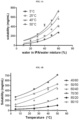
- Example 2A Solubility of Compound 1-dihydrochloride in IPA / water mixtures
- Table 6 Solubility values of Compound 1-dihydrochloride in mg/ml in IPA/water mixtures at four temperatures, 5°C, 25°C, 40°C and 50°C.
- Table 6 Solvent mixture Temperatures 5°C 25°C 40°C 50°C IPA/H2O (40:60) 270.7 429.4 566.7 713.8 IPA/H2O (50:50) 217.3 335.9 453.9 528.4 IPA/H2O (60:40) 128.9 205.4 424.2 439.5 IPA/H2O (70:30) 78.6 100.9 189.2 235.0 IPA/H2O (80:20) 28.0 41.7 81.0 102.5 IPA/H2O (90:10) 4.2 4.2 5.6 7.2
- Table 7 shows the impurity profile of Compound 1-dihydrochloride (Sample A) and crystalline Compound 1-dihydrochloride (Sample B) as assessed by HPLC method described in Table 8.
- Table 7 SAMPLE Comp. 1 RRT _ 0.86 RRT _ 1.06 RRT _ 1.15 RRT _ 1.21 RRT _ 1.26 Sample A 97.5 0.4 0.7 0.18 0.7 0.55 Sample B 99.7 0.16 Below LOQ 0.1 Below LOQ Below LOQ Table 8 Column Details Zorbax SB-C18 Column Length 15 cm Column Internal Diameter 4.6 mm Column Particle Size 5 ⁇ m Mobile Phase A 0.05%v/v TFA in water Mobile Phase B 0.05%v/v TFA in acetonitrile Gradient Time %A %B 0 98 2 15 2 98 20 2 98 20.01 98 2 25 98 2 Dissolving Solvent Ultrapure water Type 1 Flow 1.0 mL/min Column temperature 40°C Wavelength 210
- Crystalline Compound 1-dihydrochloride (from example 2B) was analyzed by HR-XRPD ( FIG. 2 ). Based on the single crystal data available for the monohydrate ( FIG. 3 ) it was concluded that the crystalline form represents the monohydrate of the dihydrochloride salt of Compound 1. It was called Form 1. Table 1 lists the peaks positions and their intensities for Form 1.
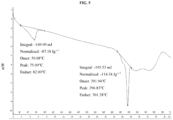
- FIG. 5 shows the DSC trace of Form 1 for a programmed increase in temperature from 0°C to 400°C.
- the DSC trace shows an endothermic event with an onset temperature of approximately 50°C. This event corresponds to the onset of dehydration of the monohydrate. This dehydration process is followed by the decomposition of the compound at about 290°C signaled by a large endothermic event. It is concluded from this experiment that Form 1 is stable to elevated temperature, up to approximately 50°C.
- Compound 1-dihydrochloride monohydrate was analyzed by dynamic vapor sorption ( FIG. 6 ). The material was subjected to an isothermal desorption/sorption profile starting at 45% - 95% - 0% - 45% relative humidity levels (step 5% at low relative humidity (RH)) at 25°C.
- the temperature was maintained constant at approximately 25°C for the duration of the experiment.
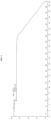
- the curve with the diamond markers shows the change in mass of a sample of Form 1 when exposed to increasing relative humidity level (45% RH to 95%). It can be seen that the mass uptake is rather small and that at high humidity level Compound 1-dihydrochloride remained as Form 1. This is confirmed by the mass stability and the VH-XRPD experiment conducted (see FIG. 7 ).
- the curve with the square markers shows the change in mass of a sample of Form 1 when subjected to a series of decreasing relative humidities from 95%RH to 0%RH. It can be seen that the sample mass does not change significantly between approximately 55%RH to 15%RH. Upon subsequent exposure to humidity values of 10, 5, and 0%RH, the sample loses approximately 4% of its mass which corresponds to the loss of a single molecule of water per Compound 1-dihydrochloride salt. A VH-XRPD experiment confirmed that the loss of water was accompanied by a transformation to the anhydrous form (Form 2) (see FIG. 7 ).
- the curve with the triangle markers shows the change in the mass of Form 2 produced by the dehydration of crystalline Form 1, when exposed to increasing relative humidity (0 %RH to 50 %RH). There is a slight increase in mass up to 25%RH, followed by a sharp increase in mass when Form 2 was exposed to 30%RH.
- a VH-XRPD experiment showed that Form 2 converts to Form 1 at %RH values in the 25-35%RH range (see FIG. 7 ).
- VH-XRPD variable humidity XRPD
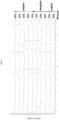
- the stacked diffractograms recorded at different relative humidity levels are shown in FIG. 7 .
- the measured RH level and the kind of ongoing RH variation step (sorption or desorption) is found on the right hand side.
- the material displays a clear change in diffractogram indicating a moisture sorption induced phase transition.
- the material was converted between 20% and 15% relative humidity to Form 2, the anhydrous form.
- Form 2 converted back to Form 1 between 30% and 35% relative humidity.
- DVS analysis showed a significant moisture sorption in the range between 40% and 95% RH.
- the VH-XRPD results did not raise evidence for additional form changes at these values.
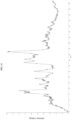
- Form 2 From the variable-humidity X-ray powder diffraction experiments performed on Form 1 a second crystalline form of Compound 1-dihydrochloride was discovered. This form was designated Form 2. For further characterization of Form 2, some material was prepared by vacuum drying Form 1 at 40°C for 18 hours. FIG. 8 shows the XRPD diffractogram of Form 2. Analysis of a solid sample of Form 2 by TGA demonstrated the anhydrous nature of this solid. The thermogravimetric and the thermogram obtained by DSC analysis showed the absence of any thermal events before decomposition at 280°C and the absence of any weight loss on drying ( FIG. 9 ). Table 2 lists the peaks positions and their intensities for Form 2.
- the VH-XRPD and DVS analysis performed on the starting materials suggested that there is a dynamic and reversible relationship between the anhydrous Form 2 and the monohydrate Form 1.
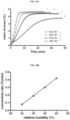
- the conversion rate of Form 2 to Form 1 as a function of the relative humidity value was investigated by a isothermal moisture sorption experiment at fixed relative humidity values.
- a solid sample of Form 2 was prepared by drying Form 1. This sample was placed in the DVS machine and incubated for 1 hour at the indicated humidity level while the weight change was recorded.
- the results are presented in FIG. 10A and FIG. 10B .
- the conversion rate depended on the relative humidity level. The highest rate was achieved at 45% RH whereas the lowest rate was achieved at 30% RH.
- the right panel shows the linear relationship between the applied humidify level and the conversion rate.
- Compound 1-dihydrochloride was physically characterized by X-ray powder diffraction, thermal analysis, and dynamic vapor sorption techniques. Loss-on-drying studies performed by TG/MS analysis demonstrated that the material consisted of the monohydrated crystalline solid form of Compound 1-dihydrochloride. This particular form was designated Form 1. The material showed decomposition at temperatures above 280°C. Characterization by DVS analysis showed a dehydration/hydration pattern between 0% and 40% relative humidity values at 25°C with a clear hysteresis. The presence of the hysteresis suggested a phase change from a monohydrate to an anhydrous crystalline form. This phase transition could be confirmed by a variable X-ray powder diffraction study that showed conversion of Form 1 (monohydrate) to Form 2 (anhydrous).
- Example 3 Aqueous solubility of Compound 1-dihydrochloride monohydrate as a function of pH
- Compound 1 was weighed directly into 5 ml vials and 1 ml of each phosphate buffer was added; the solutions obtained were kept at controlled temperature (25°C) and magnetically stirred up to 24 hours. Aliquots of obtained suspensions or solutions were centrifuged (14000 rpm 10 minutes) and withdrawn at two predefined time points (4 hours and 24 hours) appropriately diluted and analyzed by HPLC-UV using the analytical method parameters summarized in Table 9.
- a physical stability study of Compound 1-dihydrochloride (mixture of Form 1 and Form 2) was conducted.
- a solid sample of Compound 1-dihydrochloride was incubated under four relative humidity and temperature conditions: 5°C/ambient RH, 25°C/60% RH, 30°C/65% RH and 40°C/75% RH.
- the compound was analyzed by HR-XRPD and TGMS.
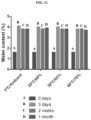
- the initial crystal form of Compound 1-dihydrochloride showed full conversion to Form 1 (monohydrate) at all four conditions tested. No significant changes in the solid form were observed upon incubation for extended period of times (at least up to 1 month).
- the water content of each sample was determined by TGMS analysis and is presented in FIG. 11 . After 3 days exposure, the water content increased from 3.1% to values between 3.8 and 4.1% (corresponding to 1 or 1.1 molecule of water per molecule of Compound 1-dihydrochloride. The water content is in line with the monohydrate nature of Compound 1-dihydrochloride Form 1. The TGMS analyses recorded for the 2 weeks and 1-month incubation is also along the 3.8% of water (1 molecule of water per molecule of API).
- the solutions (derived from methanol/water, 90/10 v/v ratio; dimethylsulfoxide/water, 1/1 v/v ratio; and water) were frozen in liquid nitrogen followed by drying using Crys Alpha 2-4 LO for 24 hours. An extra drying at 50 °C and 5 mbar was applied for 4 hours. The resulting solids were analyzed by HT-XRPD. From one solvent, water, an amorphous solid was obtained. These conditions were scaled-up to produce 1600 mg of amorphous solid for the polymorph screen.
- the design of a comprehensive polymorph screen is characterized by utilizing different crystallization techniques combined with a variety of solvents and solvent mixtures.
- the diversity of a screen will depend on the solubility profile of the API. Certain crystallization modes such as equilibration of suspensions require an intermediate solubility, whereas, anti-solvent crystallization relies on solvents with good solubility and solvents with a close to zero solubility.
- the polymorph screen comprised of the following crystallization modes:
- Form 1 was the most abundant solid form found in this polymorph screen.
- the novel diffractograms were designated Forms 3, 4, 5 and 6. All these forms were found with low frequency and were poorly crystalline. They all were physically unstable as conversion to Form 1 was observed upon exposure to short term stress conditions (2 days at 40°C and 75%RH).
- the HT-XRPD patterns of the new Forms 3, 4, 5 and 6 are shown in FIG. 12 , FIG. 13 , FIG. 14 , and FIG. 15 , respectively.
- Table 11 provides the summary of the experimental conditions under which these forms were obtained. Table 11.
- Crystallization solvents 1 Stable - - 2 (with traces of Form 1) Converted to Form 1 Solvent equilibration 50°C 1,2-Dimethoxyethane, DMF, DMA, DMSO/DCM (5/95), DMSO/MTBE (5/95), DMA/toluene (5/95), DMSO/anisole (75/25), NMP/THF (50/50), THF/water (80/20) Thermocycling NMP/THF (50/50), DMSO/anisole (25/75) Anti-solvent Water (S), THF (AS) 3 Converted to Form 1 Solvent equilibration RT (wet solid) iso-Amyl alcohol 4 Converted to Form 1 Solvent equilibration RT (wet solid) TFE Cooling crystallization TFE Hydrate screen Water/IPA (2.6/97.4) 5 Converted to Form 1 Solvent equilibration RT (dried solid) iso-
- Form 3 was obtained as a pure crystalline phase in a single experiment. No further analysis could be done on this form due to the limited physical stability. This form was found in the solid obtained from iso-amyl alcohol after being dried under ambient condition. Upon drying under vacuum, conversion to Form 1 occurred. Also, upon exposure to short term stress conditions Form 3 transformed into Form 1.
- Form 4 was found in a few crystallization experiments performed in TFE, 1,4-dioxane and IPA/water. The thermal analysis confirmed that Form 4 is a mixed solvated/hydrated form. Based on the different solvent/water contents determined for several Form 4 samples, we assumed that Form 4 is a class of isostructural mixed hydrate/solvates.
- a mixed hydrated/iso-amyl alcohol solvated form was identified from the solvent equilibration experiments performed in iso-amyl alcohol. This new solid form was designated Form 5 which seemed to be physically stable upon drying under vacuum; however, upon exposure to AAC conversion to Form 1 was observed.
- Form 6 was predominately found during the hydrate screen experiments performed in IPA/water mixtures but also it was identified in a few solvent equilibration experiments performed in different solvents, such as 1,2-dimethoxyethane, DMSO/DCM and DMF/anisole. Form 6 was mainly found from the solids dried under vacuum; however, conversion to Form 1 was observed after AAC. The analytical characterization suggested that Form 6 is a mixed hydrated/solvated form. Based on the different solvents that can be incorporated to the structure of Form 6 we assumed that this form is clustering a class of isostructural mixed hydrate/solvates containing different organic solvent molecules.
- Solvent equilibration experiments were performed in several water/organic solvents mixtures to investigate the formation of other hydrated forms.
- Suspensions of amorphous Compound 1-dihydrochloride were prepared in 15 water/solvent mixtures with different water activities. The suspensions were stirred for 7 days at 5°C, 20°C, 35°C and 50°C.
- Form 4 From IPA/water mixtures, Form 4, Form 6 and mixtures of those with Form 1 were identified at low water contents ( ⁇ 5%). At water activity values above 0.5, the monohydrated Form 1 was identified in all cases. Based on the analytical characterization, Form 4 and 6 seemed to be mixed hydrated/solvated forms which upon exposure to short term stress conditions converted to Form 1.
- Example 7A Elizabethkingia meningoseptica
- Elizabethkingia meningoseptica is a Gram negative rod that expresses 2 chromosomal metallo-beta-lactamase (both carbapenemases) and a class A serine cephalosporinase CME (AAC, 2012, 1686-1692).
- Table 13 Compounds Range MIC 50 ( ⁇ g/mL) MIC 90 ( ⁇ g/mL) %S@8 Cefepime 16-32 16 32 0 Cef/Compound 1@4 2-8 4 4 100 Meropenem 16-128 64 128 0 Mero/ Compound 1@4 4-16 8 16 70
- Example 7B Stenotrophomonas maltophilia
- Stenotrophomonas maltophilia is a Gram negative bacillus. It is an opportunistic MDR pathogen. It has been linked to infections with high morbidity and mortality in severely immunocompromised and debilitated individuals.
- the MIC testing results are shown in Table 14.
- Table 14 Compounds Range MIC 50 ( ⁇ g/mL) MIC 90 ( ⁇ g/mL) %S Cefepime 1-128 32 64 20 Cef/Compound 1@4 0.5-16 4 16 80 Meropenem 64-> 128 128 >128 0 Mero/ Compound 1@4 16-> 128 64 >128 0
- Example 7C Pseudomonas aeruginosa
- Example 7D Pseudomonas aeruginosa
- Example 8 A Randomized, Drug-Drug Interaction Study to Assess the Safety and Pharmacokinetics of Compound 1 in Healthy Adult Volunteers
- Example 8 describes four Phase 1 clinical studies designed to evaluate the safety, tolerability and PK of various dose-levels of Compound 1 when administered as single or multiple doses either alone or in combination with cefepime comprising the following components (and outlined in Table 17):
- the f AUC 0-24 /MIC ratios (based on an MIC value of 8 mg/L) for all doses ⁇ 250 mg q8 hr exceed the PK/PD target required to achieve bacterial stasis for the isolates studied to date.
- the f AUC 0-24 /MIC values for doses of approximately 375 mg q8 hr exceed the f AUC 0-24 /MIC ratios required to achieve 1 log of bacterial killing. Based on these data, a dose of 500 mg q8hr provides approximately three times the drug exposure required for PK/PD target attainment for bacterial stasis.
- Compound 1 was provided in glass vials containing 500 mg of a freeze dried solid. Compound 1 was reconstituted at the site with sterile water for injection. The site obtained the following products from a commercial pharmacy or wholesaler:
- Part 1 enrolled 18 subjects into randomized, single dose assessment of five treatments with a sequential 3-period crossover (Part 1A) and 2-period crossover (Part 1B) design. Subjects who had not met any halting rules in Part 1A were eligible for re-randomization into Part 1B.
- Part 2 enrolled 24 subjects into a randomized, double-blind assessment of three treatments in a parallel group design.
- Compound 1 was administered as an intravenous (IV) infusion over 2 hours.
- Example 8B Part 1 of Multiple Dose Study
- the Part 1A treatment descriptions are in Table 19.
- Part 1B includeed two treatments, which were administered according to the treatment sequence specified in the randomization code. Dosing occured on Day 10 and Day 13. Treatments are described in Table 20. Table 20 Treatment Treatment Description D metronidazole 500 mg + Compound 1 750 mg + cefepime 2g E metronidazole 500 mg + 2 g cefepime
- Example 8C Part 2 of Multiple Dose Study
- Treatment was administered every 8 hours (q8h) as 2-hour IV infusion for 10 days. Subjects received a total of 28 doses with a single dose administered on Day 10.
- Subjects with infections at multiple anatomic sites caused by resistant pathogens including lower respiratory tract infections, complicated intra-abdominal infections (cIAI) and complicated urinary tract infections (cUTI), such as Pyelonephritis, are administered a combination of cefepime/ Compound 1 as follows in Table 22.
- Treatments in Table 22 are administered every 8 hours (q8h) as 2-hour IV infusion for 10 days. Subjects will receive a total of 28 doses with a single dose administered on Day 10.
Landscapes
- Health & Medical Sciences (AREA)
- Chemical & Material Sciences (AREA)
- Life Sciences & Earth Sciences (AREA)
- Medicinal Chemistry (AREA)
- Pharmacology & Pharmacy (AREA)
- Animal Behavior & Ethology (AREA)
- General Health & Medical Sciences (AREA)
- Public Health (AREA)
- Veterinary Medicine (AREA)
- Epidemiology (AREA)
- Organic Chemistry (AREA)
- General Chemical & Material Sciences (AREA)
- Chemical Kinetics & Catalysis (AREA)
- Oil, Petroleum & Natural Gas (AREA)
- Engineering & Computer Science (AREA)
- Communicable Diseases (AREA)
- Nuclear Medicine, Radiotherapy & Molecular Imaging (AREA)
- Oncology (AREA)
- Proteomics, Peptides & Aminoacids (AREA)
- Molecular Biology (AREA)
- Biochemistry (AREA)
- Inorganic Chemistry (AREA)
- Dermatology (AREA)
- Pharmaceuticals Containing Other Organic And Inorganic Compounds (AREA)
- Acyclic And Carbocyclic Compounds In Medicinal Compositions (AREA)
- Medicines That Contain Protein Lipid Enzymes And Other Medicines (AREA)
- Medicinal Preparation (AREA)
- Management, Administration, Business Operations System, And Electronic Commerce (AREA)
- Organic Low-Molecular-Weight Compounds And Preparation Thereof (AREA)
Priority Applications (1)
| Application Number | Priority Date | Filing Date | Title |
|---|---|---|---|
| HRP20250459TT HRP20250459T1 (hr) | 2017-03-06 | 2018-03-05 | Čvrsti oblici i kombinacijski pripravci koji sadrže inhibitor beta-laktamaze i njihove uporabe |
Applications Claiming Priority (5)
| Application Number | Priority Date | Filing Date | Title |
|---|---|---|---|
| US201762467750P | 2017-03-06 | 2017-03-06 | |
| US201762467752P | 2017-03-06 | 2017-03-06 | |
| US201762564989P | 2017-09-28 | 2017-09-28 | |
| US201762564990P | 2017-09-28 | 2017-09-28 | |
| PCT/US2018/020968 WO2018165048A1 (en) | 2017-03-06 | 2018-03-05 | Solid forms and combination compositions comprising a beta-lactamase inhibitor and uses thereof |
Publications (4)
| Publication Number | Publication Date |
|---|---|
| EP3592362A1 EP3592362A1 (en) | 2020-01-15 |
| EP3592362A4 EP3592362A4 (en) | 2020-09-02 |
| EP3592362B1 true EP3592362B1 (en) | 2025-02-19 |
| EP3592362C0 EP3592362C0 (en) | 2025-02-19 |
Family
ID=63448038
Family Applications (1)
| Application Number | Title | Priority Date | Filing Date |
|---|---|---|---|
| EP18763383.9A Active EP3592362B1 (en) | 2017-03-06 | 2018-03-05 | Solid forms and combination compositions comprising a beta-lactamase inhibitor and uses thereof |
Country Status (17)
| Country | Link |
|---|---|
| US (4) | US11091505B2 (enExample) |
| EP (1) | EP3592362B1 (enExample) |
| JP (2) | JP7634934B2 (enExample) |
| KR (1) | KR102603489B1 (enExample) |
| CN (2) | CN117398398A (enExample) |
| AU (1) | AU2018230991B2 (enExample) |
| BR (1) | BR112019018447A2 (enExample) |
| CA (1) | CA3055253A1 (enExample) |
| ES (1) | ES3015371T3 (enExample) |
| HR (1) | HRP20250459T1 (enExample) |
| IL (2) | IL268981B2 (enExample) |
| MA (1) | MA47743A (enExample) |
| MY (1) | MY196966A (enExample) |
| PH (1) | PH12019502037B1 (enExample) |
| PL (1) | PL3592362T3 (enExample) |
| SG (1) | SG11201908181XA (enExample) |
| WO (1) | WO2018165048A1 (enExample) |
Families Citing this family (13)
| Publication number | Priority date | Publication date | Assignee | Title |
|---|---|---|---|---|
| CA2893943C (en) | 2012-12-07 | 2021-03-02 | VenatoRx Pharmaceuticals, Inc. | Beta-lactamase inhibitors |
| JP6346904B2 (ja) | 2013-01-10 | 2018-06-20 | ベナトルクス ファーマシューティカルズ,インク. | ベータ−ラクタマーゼ阻害剤 |
| WO2014151958A1 (en) | 2013-03-14 | 2014-09-25 | VenatoRx Pharmaceuticals, Inc. | Beta-lactamase inhibitors |
| EP3882252B1 (en) | 2014-06-11 | 2025-11-19 | Venatorx Pharmaceuticals, Inc. | Beta-lactamase inhibitors |
| US9511142B2 (en) | 2014-06-11 | 2016-12-06 | VenatoRx Pharmaceuticals, Inc. | Beta-lactamase inhibitors |
| WO2017044828A1 (en) | 2015-09-11 | 2017-03-16 | VenatoRx Pharmaceuticals, Inc. | Beta-lactamase inhibitors |
| WO2017100537A1 (en) | 2015-12-10 | 2017-06-15 | VenatoRx Pharmaceuticals, Inc. | Beta-lactamase inhibitors |
| EP3494121B1 (en) | 2016-08-04 | 2021-10-06 | Venatorx Pharmaceuticals, Inc. | Boron-containing compounds |
| PH12019502037B1 (en) | 2017-03-06 | 2024-06-05 | Everest Medicines Singapore Pte Ltd | Solid forms and combination compositions comprising a beta-lactamase inhibitor and uses thereof |
| EP3630783A4 (en) | 2017-05-26 | 2021-03-03 | Venatorx Pharmaceuticals, Inc. | PENICILLIN-BINDING PROTEIN INHIBITORS |
| US11332485B2 (en) | 2017-05-26 | 2022-05-17 | VenatoRx Pharmaceuticals, Inc. | Penicillin-binding protein inhibitors |
| WO2019226931A1 (en) | 2018-05-25 | 2019-11-28 | VenatoRx Pharmaceuticals, Inc. | Penicillin-binding protein inhibitors |
| US20220054513A1 (en) * | 2018-09-12 | 2022-02-24 | VenatoRx Pharmaceuticals, Inc. | Combination compositions comprising a beta-lactamase inhibitor |
Family Cites Families (36)
| Publication number | Priority date | Publication date | Assignee | Title |
|---|---|---|---|---|
| US1021454A (en) | 1911-01-23 | 1912-03-26 | Thomas Ernest Davis | Serving-table. |
| US7271186B1 (en) | 2002-12-09 | 2007-09-18 | Northwestern University | Nanomolar β-lactamase inhibitors |
| IN2012DN03023A (enExample) | 2004-01-26 | 2015-07-31 | Merck Sharp & Dohme | |
| NZ550522A (en) | 2004-03-30 | 2010-08-27 | Millennium Pharm Inc | Synthesis of boronic ester and acid compounds |
| CN1965838A (zh) * | 2005-11-17 | 2007-05-23 | 李海超 | 含头孢匹胺和β-内酰胺酶抑制剂的药物组合物 |
| CN101129382B (zh) | 2006-08-25 | 2013-12-25 | 天津和美生物技术有限公司 | 含β-内酰胺类抗生素和缓冲组分的抗生素复方 |
| BRPI0820532A2 (pt) | 2007-11-13 | 2012-07-10 | Protez Pharmaceuticals Inc | inibidores de beta-lactamase |
| US20100120715A1 (en) | 2007-11-13 | 2010-05-13 | Burns Christopher J | Beta-lactamase inhibitors |
| JP5038509B2 (ja) | 2008-01-18 | 2012-10-03 | メルク・シャープ・エンド・ドーム・コーポレイション | β−ラクタマーゼ阻害剤 |
| US20100292185A1 (en) | 2009-05-12 | 2010-11-18 | Burns Christopher J | Beta-lactamase inhibitors |
| RU2599791C2 (ru) | 2010-08-10 | 2016-10-20 | Ремпекс Фармасьютикэлз, Инч. | Циклические бороновые кислотно-эфирные производные и их использование в терапии |
| AU2011373912B2 (en) * | 2011-07-26 | 2016-09-29 | Wockhardt Limited | Pharmaceutical compositions comprising beta-lactam antibiotic, sulbactam and beta-lactamase inhibitor |
| WO2013053372A1 (en) | 2011-10-13 | 2013-04-18 | Therabor Pharmaceuticals | Boronic acid inhibitors of beta-lactamases |
| KR101288157B1 (ko) | 2011-12-07 | 2013-07-19 | 백병하 | 기존 세파계 항생제 및 베타 락타마제 저해제로 배합된 내성균주에 기인한 감염증의 치료 및 예방을 위한 복합항생제 |
| JP5798495B2 (ja) | 2012-01-13 | 2015-10-21 | 住友理工株式会社 | 配線体接続構造体 |
| EP2814483A2 (en) | 2012-02-15 | 2014-12-24 | Rempex Pharmaceuticals, Inc. | Methods of treating bacterial infections |
| DE102012101680A1 (de) | 2012-02-29 | 2013-08-29 | Aicuris Gmbh & Co. Kg | Pharmazeutische Zubereitung enthaltend ein antiviral wirksames Dihydrochinazolinderivat |
| CA2893943C (en) | 2012-12-07 | 2021-03-02 | VenatoRx Pharmaceuticals, Inc. | Beta-lactamase inhibitors |
| JP6324409B2 (ja) | 2013-01-04 | 2018-05-16 | レンペックス・ファーマシューティカルズ・インコーポレイテッド | ボロン酸誘導体及びその治療的使用 |
| AU2014204045B2 (en) | 2013-01-04 | 2018-10-18 | Rempex Pharmaceuticals, Inc. | Boronic acid derivatives and therapeutic uses thereof |
| JP6346904B2 (ja) | 2013-01-10 | 2018-06-20 | ベナトルクス ファーマシューティカルズ,インク. | ベータ−ラクタマーゼ阻害剤 |
| WO2014151958A1 (en) | 2013-03-14 | 2014-09-25 | VenatoRx Pharmaceuticals, Inc. | Beta-lactamase inhibitors |
| WO2015051101A1 (en) * | 2013-10-02 | 2015-04-09 | Cubist Pharmaceuticals, Inc. | B-lactamase inhibitor picoline salt |
| WO2015157618A1 (en) | 2014-04-11 | 2015-10-15 | The Texas A&M University System | Novel inhibitors of the new delhi metallo beta lactamase (ndm-1) |
| EP3882252B1 (en) | 2014-06-11 | 2025-11-19 | Venatorx Pharmaceuticals, Inc. | Beta-lactamase inhibitors |
| US20150361107A1 (en) | 2014-06-11 | 2015-12-17 | VenatoRx Pharmaceuticals, Inc. | Orally bioavailable beta-lactamase inhibitors |
| EP3189841B1 (en) | 2014-09-04 | 2023-11-22 | Shionogi & Co., Ltd. | Pharmaceutical preparation comprising cephalosporin having catechol groups |
| US10364257B2 (en) | 2014-12-19 | 2019-07-30 | Rempex Pharmaceuticals, Inc. | Apparatus and continuous flow process for production of boronic acid derivatives |
| WO2017044828A1 (en) | 2015-09-11 | 2017-03-16 | VenatoRx Pharmaceuticals, Inc. | Beta-lactamase inhibitors |
| CN105801610B (zh) | 2016-04-19 | 2018-05-18 | 武汉维舜医药科技有限公司 | 新型广谱β-内酰胺酶抑制剂 |
| JP7060245B2 (ja) | 2016-06-30 | 2022-04-26 | キューペックス バイオファーマ, インコーポレイテッド | ボロン酸誘導体およびその治療的使用 |
| EP3494121B1 (en) | 2016-08-04 | 2021-10-06 | Venatorx Pharmaceuticals, Inc. | Boron-containing compounds |
| PH12019502037B1 (en) | 2017-03-06 | 2024-06-05 | Everest Medicines Singapore Pte Ltd | Solid forms and combination compositions comprising a beta-lactamase inhibitor and uses thereof |
| WO2019226931A1 (en) | 2018-05-25 | 2019-11-28 | VenatoRx Pharmaceuticals, Inc. | Penicillin-binding protein inhibitors |
| US20220054513A1 (en) | 2018-09-12 | 2022-02-24 | VenatoRx Pharmaceuticals, Inc. | Combination compositions comprising a beta-lactamase inhibitor |
| AU2019386849B2 (en) | 2018-11-29 | 2025-07-24 | VenatoRx Pharmaceuticals, Inc. | Combination compositions comprising a beta-lactamase inhibitor and uses thereof |
-
2018
- 2018-03-05 PH PH1/2019/502037A patent/PH12019502037B1/en unknown
- 2018-03-05 MY MYPI2019005139A patent/MY196966A/en unknown
- 2018-03-05 WO PCT/US2018/020968 patent/WO2018165048A1/en not_active Ceased
- 2018-03-05 JP JP2019547093A patent/JP7634934B2/ja active Active
- 2018-03-05 HR HRP20250459TT patent/HRP20250459T1/hr unknown
- 2018-03-05 EP EP18763383.9A patent/EP3592362B1/en active Active
- 2018-03-05 CN CN202311312855.3A patent/CN117398398A/zh active Pending
- 2018-03-05 SG SG11201908181X patent/SG11201908181XA/en unknown
- 2018-03-05 PL PL18763383.9T patent/PL3592362T3/pl unknown
- 2018-03-05 CA CA3055253A patent/CA3055253A1/en active Pending
- 2018-03-05 BR BR112019018447-3A patent/BR112019018447A2/pt active IP Right Grant
- 2018-03-05 IL IL268981A patent/IL268981B2/en unknown
- 2018-03-05 US US16/491,116 patent/US11091505B2/en active Active
- 2018-03-05 ES ES18763383T patent/ES3015371T3/es active Active
- 2018-03-05 MA MA047743A patent/MA47743A/fr unknown
- 2018-03-05 CN CN201880030083.5A patent/CN110678186A/zh active Pending
- 2018-03-05 KR KR1020197029086A patent/KR102603489B1/ko active Active
- 2018-03-05 AU AU2018230991A patent/AU2018230991B2/en active Active
-
2021
- 2021-06-21 US US17/353,377 patent/US11820784B2/en active Active
-
2023
- 2023-01-20 JP JP2023007546A patent/JP2023061946A/ja active Pending
- 2023-03-22 IL IL301591A patent/IL301591B1/en unknown
- 2023-09-27 US US18/476,050 patent/US12187752B2/en active Active
-
2024
- 2024-11-25 US US18/959,220 patent/US20250320235A1/en active Pending
Also Published As
Similar Documents
| Publication | Publication Date | Title |
|---|---|---|
| US12187752B2 (en) | Solid forms and combination compositions comprising a beta-lactamase inhibitor and uses thereof | |
| EP3292123B1 (en) | Solid forms of a compound modulating kinases | |
| EP2413924B1 (en) | L-ornithine phenyl acetate and methods of making thereof | |
| CN114126612A (zh) | 遗传性血管性水肿的治疗 | |
| EP3712134A1 (en) | Salts of 2-(tert-butylamino)-4-((1r,3r,4r)-3-hydroxy-4-methycyclohexylamino)-pyrimidine-5-carboxamide | |
| JP2023550428A (ja) | インテグリン阻害剤およびその使用 | |
| US20240000750A1 (en) | Method for preparing crystalline particles of 1-(3-cyano-1-isopropyl-indole-5-yl)pyrazole-4-carboxylic acid, and pharmaceutical composition comprising same | |
| CN113993520A (zh) | 血管性水肿的治疗 | |
| CN102933205B (zh) | 西洛他唑共晶和组合物 | |
| EP1853232B1 (en) | Stable crystalline form of bifeprunox mesylate, dosage forms thereof adn methods for using them | |
| HK40020554B (en) | Solid forms and combination compositions comprising a beta-lactamase inhibitor and uses thereof | |
| HK40020554A (en) | Solid forms and combination compositions comprising a beta-lactamase inhibitor and uses thereof | |
| EA048377B1 (ru) | Твердые формы и комбинированные композиции, содержащие ингибитор бета-лактамазы, и их применения | |
| EA042812B1 (ru) | Твердые формы и комбинированные композиции, содержащие ингибитор бета-лактамазы, и их применения | |
| KR102509190B1 (ko) | 트리메부틴 말레산염의 다형체 및 이의 사용방법 | |
| HK40013654A (en) | Solid forms and combination compositions comprising a beta-lactamase inhibitor and uses thereof | |
| CN107586293A (zh) | 含硫二苯并噻嗪生物碱类化合物及其用途 | |
| CN106749481A (zh) | 甘草次酸类新化合物实体及其用途 | |
| WO2018181820A1 (ja) | 複素環化合物 | |
| EP4021419A1 (en) | Methods of manufacturing anamorelin tablets having improved stability | |
| TW201029981A (en) | Tianeptine sulfate salt forms and methods of making and using the same | |
| HK1248223A1 (en) | Solid forms of a compound modulating kinases | |
| HK1248223B (en) | Solid forms of a compound modulating kinases | |
| NZ759132A (en) | Solid forms of { [5-(3-chlorophenyl)-3-hydroxypyridine-2-carbonyl]amino} acetic acid, compositions, and uses thereof |
Legal Events
| Date | Code | Title | Description |
|---|---|---|---|
| REG | Reference to a national code |
Ref country code: HR Ref legal event code: TUEP Ref document number: P20250459T Country of ref document: HR |
|
| STAA | Information on the status of an ep patent application or granted ep patent |
Free format text: STATUS: THE INTERNATIONAL PUBLICATION HAS BEEN MADE |
|
| PUAI | Public reference made under article 153(3) epc to a published international application that has entered the european phase |
Free format text: ORIGINAL CODE: 0009012 |
|
| STAA | Information on the status of an ep patent application or granted ep patent |
Free format text: STATUS: REQUEST FOR EXAMINATION WAS MADE |
|
| 17P | Request for examination filed |
Effective date: 20190910 |
|
| AK | Designated contracting states |
Kind code of ref document: A1 Designated state(s): AL AT BE BG CH CY CZ DE DK EE ES FI FR GB GR HR HU IE IS IT LI LT LU LV MC MK MT NL NO PL PT RO RS SE SI SK SM TR |
|
| AX | Request for extension of the european patent |
Extension state: BA ME |
|
| REG | Reference to a national code |
Ref country code: DE Ref legal event code: R079 Free format text: PREVIOUS MAIN CLASS: A61K0031690000 Ipc: C07F0005020000 |
|
| A4 | Supplementary search report drawn up and despatched |
Effective date: 20200731 |
|
| RIC1 | Information provided on ipc code assigned before grant |
Ipc: A61K 31/546 20060101ALI20200727BHEP Ipc: A61K 31/69 20060101ALI20200727BHEP Ipc: A61P 31/04 20060101ALI20200727BHEP Ipc: C07F 5/02 20060101AFI20200727BHEP |
|
| REG | Reference to a national code |
Ref country code: HK Ref legal event code: DE Ref document number: 40020554 Country of ref document: HK |
|
| P01 | Opt-out of the competence of the unified patent court (upc) registered |
Effective date: 20230506 |
|
| STAA | Information on the status of an ep patent application or granted ep patent |
Free format text: STATUS: EXAMINATION IS IN PROGRESS |
|
| 17Q | First examination report despatched |
Effective date: 20230919 |
|
| GRAP | Despatch of communication of intention to grant a patent |
Free format text: ORIGINAL CODE: EPIDOSNIGR1 |
|
| STAA | Information on the status of an ep patent application or granted ep patent |
Free format text: STATUS: GRANT OF PATENT IS INTENDED |
|
| INTG | Intention to grant announced |
Effective date: 20240313 |
|
| GRAJ | Information related to disapproval of communication of intention to grant by the applicant or resumption of examination proceedings by the epo deleted |
Free format text: ORIGINAL CODE: EPIDOSDIGR1 |
|
| STAA | Information on the status of an ep patent application or granted ep patent |
Free format text: STATUS: EXAMINATION IS IN PROGRESS |
|
| INTC | Intention to grant announced (deleted) | ||
| GRAP | Despatch of communication of intention to grant a patent |
Free format text: ORIGINAL CODE: EPIDOSNIGR1 |
|
| STAA | Information on the status of an ep patent application or granted ep patent |
Free format text: STATUS: GRANT OF PATENT IS INTENDED |
|
| INTG | Intention to grant announced |
Effective date: 20240916 |
|
| GRAS | Grant fee paid |
Free format text: ORIGINAL CODE: EPIDOSNIGR3 |
|
| GRAA | (expected) grant |
Free format text: ORIGINAL CODE: 0009210 |
|
| STAA | Information on the status of an ep patent application or granted ep patent |
Free format text: STATUS: THE PATENT HAS BEEN GRANTED |
|
| AK | Designated contracting states |
Kind code of ref document: B1 Designated state(s): AL AT BE BG CH CY CZ DE DK EE ES FI FR GB GR HR HU IE IS IT LI LT LU LV MC MK MT NL NO PL PT RO RS SE SI SK SM TR |
|
| REG | Reference to a national code |
Ref country code: GB Ref legal event code: FG4D |
|
| REG | Reference to a national code |
Ref country code: CH Ref legal event code: EP |
|
| REG | Reference to a national code |
Ref country code: IE Ref legal event code: FG4D |
|
| REG | Reference to a national code |
Ref country code: DE Ref legal event code: R096 Ref document number: 602018079320 Country of ref document: DE |
|
| PGFP | Annual fee paid to national office [announced via postgrant information from national office to epo] |
Ref country code: IE Payment date: 20250331 Year of fee payment: 8 |
|
| U01 | Request for unitary effect filed |
Effective date: 20250319 |
|
| U07 | Unitary effect registered |
Designated state(s): AT BE BG DE DK EE FI FR IT LT LU LV MT NL PT RO SE SI Effective date: 20250325 |
|
| PGFP | Annual fee paid to national office [announced via postgrant information from national office to epo] |
Ref country code: GB Payment date: 20250324 Year of fee payment: 8 |
|
| P04 | Withdrawal of opt-out of the competence of the unified patent court (upc) registered |
Free format text: CASE NUMBER: APP_13928/2025 Effective date: 20250321 |
|
| U20 | Renewal fee for the european patent with unitary effect paid |
Year of fee payment: 8 Effective date: 20250331 |
|
| REG | Reference to a national code |
Ref country code: HR Ref legal event code: ODRP Ref document number: P20250459T Country of ref document: HR Payment date: 20250417 Year of fee payment: 8 |
|
| REG | Reference to a national code |
Ref country code: HR Ref legal event code: T1PR Ref document number: P20250459 Country of ref document: HR |
|
| PG25 | Lapsed in a contracting state [announced via postgrant information from national office to epo] |
Ref country code: RS Free format text: LAPSE BECAUSE OF FAILURE TO SUBMIT A TRANSLATION OF THE DESCRIPTION OR TO PAY THE FEE WITHIN THE PRESCRIBED TIME-LIMIT Effective date: 20250519 |
|
| PGFP | Annual fee paid to national office [announced via postgrant information from national office to epo] |
Ref country code: PL Payment date: 20250317 Year of fee payment: 8 |
|
| PGFP | Annual fee paid to national office [announced via postgrant information from national office to epo] |
Ref country code: ES Payment date: 20250401 Year of fee payment: 8 |
|
| PG25 | Lapsed in a contracting state [announced via postgrant information from national office to epo] |
Ref country code: NO Free format text: LAPSE BECAUSE OF FAILURE TO SUBMIT A TRANSLATION OF THE DESCRIPTION OR TO PAY THE FEE WITHIN THE PRESCRIBED TIME-LIMIT Effective date: 20250519 Ref country code: IS Free format text: LAPSE BECAUSE OF FAILURE TO SUBMIT A TRANSLATION OF THE DESCRIPTION OR TO PAY THE FEE WITHIN THE PRESCRIBED TIME-LIMIT Effective date: 20250619 |
|
| PGFP | Annual fee paid to national office [announced via postgrant information from national office to epo] |
Ref country code: HR Payment date: 20250417 Year of fee payment: 8 |
|
| PG25 | Lapsed in a contracting state [announced via postgrant information from national office to epo] |
Ref country code: GR Free format text: LAPSE BECAUSE OF FAILURE TO SUBMIT A TRANSLATION OF THE DESCRIPTION OR TO PAY THE FEE WITHIN THE PRESCRIBED TIME-LIMIT Effective date: 20250520 |
|
| PGFP | Annual fee paid to national office [announced via postgrant information from national office to epo] |
Ref country code: CH Payment date: 20250401 Year of fee payment: 8 |
|
| PGFP | Annual fee paid to national office [announced via postgrant information from national office to epo] |
Ref country code: TR Payment date: 20250509 Year of fee payment: 8 |
|
| PGFP | Annual fee paid to national office [announced via postgrant information from national office to epo] |
Ref country code: CZ Payment date: 20250317 Year of fee payment: 8 |
|
| PG25 | Lapsed in a contracting state [announced via postgrant information from national office to epo] |
Ref country code: SM Free format text: LAPSE BECAUSE OF FAILURE TO SUBMIT A TRANSLATION OF THE DESCRIPTION OR TO PAY THE FEE WITHIN THE PRESCRIBED TIME-LIMIT Effective date: 20250219 |
|
| VS25 | Lapsed in a validation state [announced via postgrant information from nat. office to epo] |
Ref country code: MD Free format text: LAPSE BECAUSE OF FAILURE TO SUBMIT A TRANSLATION OF THE DESCRIPTION OR TO PAY THE FEE WITHIN THE PRESCRIBED TIME-LIMIT Effective date: 20250219 |
|
| PG25 | Lapsed in a contracting state [announced via postgrant information from national office to epo] |
Ref country code: SK Free format text: LAPSE BECAUSE OF FAILURE TO SUBMIT A TRANSLATION OF THE DESCRIPTION OR TO PAY THE FEE WITHIN THE PRESCRIBED TIME-LIMIT Effective date: 20250219 |