EP3563299B1 - Rfid tags with shielding structure for incorporation into microwavable food packaging - Google Patents
Rfid tags with shielding structure for incorporation into microwavable food packaging Download PDFInfo
- Publication number
- EP3563299B1 EP3563299B1 EP17835554.1A EP17835554A EP3563299B1 EP 3563299 B1 EP3563299 B1 EP 3563299B1 EP 17835554 A EP17835554 A EP 17835554A EP 3563299 B1 EP3563299 B1 EP 3563299B1
- Authority
- EP
- European Patent Office
- Prior art keywords
- rfid tag
- antenna
- rfid
- shield
- conductor
- Prior art date
- Legal status (The legal status is an assumption and is not a legal conclusion. Google has not performed a legal analysis and makes no representation as to the accuracy of the status listed.)
- Active
Links
Images


Classifications
-
- G—PHYSICS
- G06—COMPUTING OR CALCULATING; COUNTING
- G06K—GRAPHICAL DATA READING; PRESENTATION OF DATA; RECORD CARRIERS; HANDLING RECORD CARRIERS
- G06K19/00—Record carriers for use with machines and with at least a part designed to carry digital markings
- G06K19/06—Record carriers for use with machines and with at least a part designed to carry digital markings characterised by the kind of the digital marking, e.g. shape, nature, code
- G06K19/067—Record carriers with conductive marks, printed circuits or semiconductor circuit elements, e.g. credit or identity cards also with resonating or responding marks without active components
- G06K19/07—Record carriers with conductive marks, printed circuits or semiconductor circuit elements, e.g. credit or identity cards also with resonating or responding marks without active components with integrated circuit chips
- G06K19/077—Constructional details, e.g. mounting of circuits in the carrier
- G06K19/0772—Physical layout of the record carrier
- G06K19/0773—Physical layout of the record carrier the record carrier comprising means to protect itself against external heat sources
-
- G—PHYSICS
- G06—COMPUTING OR CALCULATING; COUNTING
- G06K—GRAPHICAL DATA READING; PRESENTATION OF DATA; RECORD CARRIERS; HANDLING RECORD CARRIERS
- G06K19/00—Record carriers for use with machines and with at least a part designed to carry digital markings
- G06K19/06—Record carriers for use with machines and with at least a part designed to carry digital markings characterised by the kind of the digital marking, e.g. shape, nature, code
- G06K19/067—Record carriers with conductive marks, printed circuits or semiconductor circuit elements, e.g. credit or identity cards also with resonating or responding marks without active components
- G06K19/07—Record carriers with conductive marks, printed circuits or semiconductor circuit elements, e.g. credit or identity cards also with resonating or responding marks without active components with integrated circuit chips
- G06K19/077—Constructional details, e.g. mounting of circuits in the carrier
- G06K19/07749—Constructional details, e.g. mounting of circuits in the carrier the record carrier being capable of non-contact communication, e.g. constructional details of the antenna of a non-contact smart card
- G06K19/07773—Antenna details
-
- B—PERFORMING OPERATIONS; TRANSPORTING
- B65—CONVEYING; PACKING; STORING; HANDLING THIN OR FILAMENTARY MATERIAL
- B65D—CONTAINERS FOR STORAGE OR TRANSPORT OF ARTICLES OR MATERIALS, e.g. BAGS, BARRELS, BOTTLES, BOXES, CANS, CARTONS, CRATES, DRUMS, JARS, TANKS, HOPPERS, FORWARDING CONTAINERS; ACCESSORIES, CLOSURES, OR FITTINGS THEREFOR; PACKAGING ELEMENTS; PACKAGES
- B65D81/00—Containers, packaging elements, or packages, for contents presenting particular transport or storage problems, or adapted to be used for non-packaging purposes after removal of contents
- B65D81/34—Containers, packaging elements, or packages, for contents presenting particular transport or storage problems, or adapted to be used for non-packaging purposes after removal of contents for packaging foodstuffs or other articles intended to be cooked or heated within the package
- B65D81/3446—Containers, packaging elements, or packages, for contents presenting particular transport or storage problems, or adapted to be used for non-packaging purposes after removal of contents for packaging foodstuffs or other articles intended to be cooked or heated within the package specially adapted to be heated by microwaves
-
- B—PERFORMING OPERATIONS; TRANSPORTING
- B65—CONVEYING; PACKING; STORING; HANDLING THIN OR FILAMENTARY MATERIAL
- B65D—CONTAINERS FOR STORAGE OR TRANSPORT OF ARTICLES OR MATERIALS, e.g. BAGS, BARRELS, BOTTLES, BOXES, CANS, CARTONS, CRATES, DRUMS, JARS, TANKS, HOPPERS, FORWARDING CONTAINERS; ACCESSORIES, CLOSURES, OR FITTINGS THEREFOR; PACKAGING ELEMENTS; PACKAGES
- B65D81/00—Containers, packaging elements, or packages, for contents presenting particular transport or storage problems, or adapted to be used for non-packaging purposes after removal of contents
- B65D81/34—Containers, packaging elements, or packages, for contents presenting particular transport or storage problems, or adapted to be used for non-packaging purposes after removal of contents for packaging foodstuffs or other articles intended to be cooked or heated within the package
- B65D81/3446—Containers, packaging elements, or packages, for contents presenting particular transport or storage problems, or adapted to be used for non-packaging purposes after removal of contents for packaging foodstuffs or other articles intended to be cooked or heated within the package specially adapted to be heated by microwaves
- B65D81/3453—Rigid containers, e.g. trays, bottles, boxes, cups
-
- G—PHYSICS
- G06—COMPUTING OR CALCULATING; COUNTING
- G06K—GRAPHICAL DATA READING; PRESENTATION OF DATA; RECORD CARRIERS; HANDLING RECORD CARRIERS
- G06K19/00—Record carriers for use with machines and with at least a part designed to carry digital markings
- G06K19/06—Record carriers for use with machines and with at least a part designed to carry digital markings characterised by the kind of the digital marking, e.g. shape, nature, code
- G06K19/067—Record carriers with conductive marks, printed circuits or semiconductor circuit elements, e.g. credit or identity cards also with resonating or responding marks without active components
- G06K19/07—Record carriers with conductive marks, printed circuits or semiconductor circuit elements, e.g. credit or identity cards also with resonating or responding marks without active components with integrated circuit chips
- G06K19/0701—Record carriers with conductive marks, printed circuits or semiconductor circuit elements, e.g. credit or identity cards also with resonating or responding marks without active components with integrated circuit chips at least one of the integrated circuit chips comprising an arrangement for power management
- G06K19/0715—Record carriers with conductive marks, printed circuits or semiconductor circuit elements, e.g. credit or identity cards also with resonating or responding marks without active components with integrated circuit chips at least one of the integrated circuit chips comprising an arrangement for power management the arrangement including means to regulate power transfer to the integrated circuit
-
- G—PHYSICS
- G06—COMPUTING OR CALCULATING; COUNTING
- G06K—GRAPHICAL DATA READING; PRESENTATION OF DATA; RECORD CARRIERS; HANDLING RECORD CARRIERS
- G06K19/00—Record carriers for use with machines and with at least a part designed to carry digital markings
- G06K19/06—Record carriers for use with machines and with at least a part designed to carry digital markings characterised by the kind of the digital marking, e.g. shape, nature, code
- G06K19/067—Record carriers with conductive marks, printed circuits or semiconductor circuit elements, e.g. credit or identity cards also with resonating or responding marks without active components
- G06K19/07—Record carriers with conductive marks, printed circuits or semiconductor circuit elements, e.g. credit or identity cards also with resonating or responding marks without active components with integrated circuit chips
- G06K19/0723—Record carriers with conductive marks, printed circuits or semiconductor circuit elements, e.g. credit or identity cards also with resonating or responding marks without active components with integrated circuit chips the record carrier comprising an arrangement for non-contact communication, e.g. wireless communication circuits on transponder cards, non-contact smart cards or RFIDs
-
- G—PHYSICS
- G06—COMPUTING OR CALCULATING; COUNTING
- G06K—GRAPHICAL DATA READING; PRESENTATION OF DATA; RECORD CARRIERS; HANDLING RECORD CARRIERS
- G06K19/00—Record carriers for use with machines and with at least a part designed to carry digital markings
- G06K19/06—Record carriers for use with machines and with at least a part designed to carry digital markings characterised by the kind of the digital marking, e.g. shape, nature, code
- G06K19/067—Record carriers with conductive marks, printed circuits or semiconductor circuit elements, e.g. credit or identity cards also with resonating or responding marks without active components
- G06K19/07—Record carriers with conductive marks, printed circuits or semiconductor circuit elements, e.g. credit or identity cards also with resonating or responding marks without active components with integrated circuit chips
- G06K19/077—Constructional details, e.g. mounting of circuits in the carrier
- G06K19/07749—Constructional details, e.g. mounting of circuits in the carrier the record carrier being capable of non-contact communication, e.g. constructional details of the antenna of a non-contact smart card
- G06K19/0775—Constructional details, e.g. mounting of circuits in the carrier the record carrier being capable of non-contact communication, e.g. constructional details of the antenna of a non-contact smart card arrangements for connecting the integrated circuit to the antenna
- G06K19/07752—Constructional details, e.g. mounting of circuits in the carrier the record carrier being capable of non-contact communication, e.g. constructional details of the antenna of a non-contact smart card arrangements for connecting the integrated circuit to the antenna using an interposer
-
- G—PHYSICS
- G06—COMPUTING OR CALCULATING; COUNTING
- G06K—GRAPHICAL DATA READING; PRESENTATION OF DATA; RECORD CARRIERS; HANDLING RECORD CARRIERS
- G06K19/00—Record carriers for use with machines and with at least a part designed to carry digital markings
- G06K19/06—Record carriers for use with machines and with at least a part designed to carry digital markings characterised by the kind of the digital marking, e.g. shape, nature, code
- G06K19/067—Record carriers with conductive marks, printed circuits or semiconductor circuit elements, e.g. credit or identity cards also with resonating or responding marks without active components
- G06K19/07—Record carriers with conductive marks, printed circuits or semiconductor circuit elements, e.g. credit or identity cards also with resonating or responding marks without active components with integrated circuit chips
- G06K19/077—Constructional details, e.g. mounting of circuits in the carrier
- G06K19/07749—Constructional details, e.g. mounting of circuits in the carrier the record carrier being capable of non-contact communication, e.g. constructional details of the antenna of a non-contact smart card
- G06K19/07771—Constructional details, e.g. mounting of circuits in the carrier the record carrier being capable of non-contact communication, e.g. constructional details of the antenna of a non-contact smart card the record carrier comprising means for minimising adverse effects on the data communication capability of the record carrier, e.g. minimising Eddy currents induced in a proximate metal or otherwise electromagnetically interfering object
-
- G—PHYSICS
- G06—COMPUTING OR CALCULATING; COUNTING
- G06K—GRAPHICAL DATA READING; PRESENTATION OF DATA; RECORD CARRIERS; HANDLING RECORD CARRIERS
- G06K19/00—Record carriers for use with machines and with at least a part designed to carry digital markings
- G06K19/06—Record carriers for use with machines and with at least a part designed to carry digital markings characterised by the kind of the digital marking, e.g. shape, nature, code
- G06K19/067—Record carriers with conductive marks, printed circuits or semiconductor circuit elements, e.g. credit or identity cards also with resonating or responding marks without active components
- G06K19/07—Record carriers with conductive marks, printed circuits or semiconductor circuit elements, e.g. credit or identity cards also with resonating or responding marks without active components with integrated circuit chips
- G06K19/077—Constructional details, e.g. mounting of circuits in the carrier
- G06K19/07749—Constructional details, e.g. mounting of circuits in the carrier the record carrier being capable of non-contact communication, e.g. constructional details of the antenna of a non-contact smart card
- G06K19/07773—Antenna details
- G06K19/07775—Antenna details the antenna being on-chip
-
- G—PHYSICS
- G06—COMPUTING OR CALCULATING; COUNTING
- G06K—GRAPHICAL DATA READING; PRESENTATION OF DATA; RECORD CARRIERS; HANDLING RECORD CARRIERS
- G06K19/00—Record carriers for use with machines and with at least a part designed to carry digital markings
- G06K19/06—Record carriers for use with machines and with at least a part designed to carry digital markings characterised by the kind of the digital marking, e.g. shape, nature, code
- G06K19/067—Record carriers with conductive marks, printed circuits or semiconductor circuit elements, e.g. credit or identity cards also with resonating or responding marks without active components
- G06K19/07—Record carriers with conductive marks, printed circuits or semiconductor circuit elements, e.g. credit or identity cards also with resonating or responding marks without active components with integrated circuit chips
- G06K19/077—Constructional details, e.g. mounting of circuits in the carrier
- G06K19/07749—Constructional details, e.g. mounting of circuits in the carrier the record carrier being capable of non-contact communication, e.g. constructional details of the antenna of a non-contact smart card
- G06K19/07773—Antenna details
- G06K19/07786—Antenna details the antenna being of the HF type, such as a dipole
-
- G—PHYSICS
- G06—COMPUTING OR CALCULATING; COUNTING
- G06K—GRAPHICAL DATA READING; PRESENTATION OF DATA; RECORD CARRIERS; HANDLING RECORD CARRIERS
- G06K19/00—Record carriers for use with machines and with at least a part designed to carry digital markings
- G06K19/06—Record carriers for use with machines and with at least a part designed to carry digital markings characterised by the kind of the digital marking, e.g. shape, nature, code
- G06K19/067—Record carriers with conductive marks, printed circuits or semiconductor circuit elements, e.g. credit or identity cards also with resonating or responding marks without active components
- G06K19/07—Record carriers with conductive marks, printed circuits or semiconductor circuit elements, e.g. credit or identity cards also with resonating or responding marks without active components with integrated circuit chips
- G06K19/077—Constructional details, e.g. mounting of circuits in the carrier
- G06K19/07749—Constructional details, e.g. mounting of circuits in the carrier the record carrier being capable of non-contact communication, e.g. constructional details of the antenna of a non-contact smart card
- G06K19/07798—Constructional details, e.g. mounting of circuits in the carrier the record carrier being capable of non-contact communication, e.g. constructional details of the antenna of a non-contact smart card part of the antenna or the integrated circuit being adapted for rupturing or breaking, e.g. record carriers functioning as sealing devices for detecting not-authenticated opening of containers
-
- B—PERFORMING OPERATIONS; TRANSPORTING
- B65—CONVEYING; PACKING; STORING; HANDLING THIN OR FILAMENTARY MATERIAL
- B65D—CONTAINERS FOR STORAGE OR TRANSPORT OF ARTICLES OR MATERIALS, e.g. BAGS, BARRELS, BOTTLES, BOXES, CANS, CARTONS, CRATES, DRUMS, JARS, TANKS, HOPPERS, FORWARDING CONTAINERS; ACCESSORIES, CLOSURES, OR FITTINGS THEREFOR; PACKAGING ELEMENTS; PACKAGES
- B65D2203/00—Decoration means, markings, information elements, contents indicators
- B65D2203/10—Transponders
Definitions
- the present subject matter relates to packaging for microwavable food items. More particularly, the present subject matter relates to radio frequency identification (“RFID”) tags incorporated into packaging for microwavable food items.
- RFID radio frequency identification
- crisping sleeves are paper items that at least partially surround the food item during microwaving.
- a "crisping sleeve” has a paper substrate, with a susceptor incorporated into the inner surface of the "crisping sleeve,” facing and preferably in contact with the food item.
- the susceptor which may be a metallized film, absorbs microwave energy and converts it into heat, which crisps and/or browns the crust or surface of the food item, thus improving the look and texture of the food item. Due to the absorbing nature of the film used as the susceptor, relatively low levels of energy are reflected by it, such that it does not strike an arc due to generating high differential voltages between adjacent parts of the film, which could otherwise cause the packaging to catch fire.
- US 2011/147467 A1 describes a selectively accessible enhanced radio-frequency identification (RFID) device, that is enhanced performance and security by selectively responsive to predetermined electromagnetic interrogation thereof, that comprises an enhanced component for enabling a user to adjust readable distances and selectively enable or disable interrogatory access to the enhanced RFID device, to protect from unauthorized interrogation thereof.
- RFID radio-frequency identification
- the enhanced RFID device comprises an antenna, a microchip and at least one enhanced component.
- the enhanced component may use "Electromagnetic Induction" to the antenna to increase performance and “Electromagnetic Shield", to cover the antenna.
- EP 1174 667 A1 describes an automatic cold-storage system including a food package provided with a noncontact IC tag, and a refrigerator for storing the food package. Information is read from the noncontact IC tag by a noncontact IC tag reader and is compiled to a database. A managing means controls the refrigerator on the basis of information contained in the database. The managing means makes a display device display a warning on the basis of information read by the noncontact IC tag reader.
- US 2008/143480 A1 describes a radio frequency identification (RFID) tag that can survive exposure to microwave energy.
- RFID radio frequency identification
- WO 2008/084917 A1 describes a cooking appliance, and a system and method for controlling a cooking appliance.
- the system includes a RF tag and a cooking appliance.
- the RF tag stores food information about foods as integrants of a dish and the cooking appliance having a RF reader reads the food information stored in the RF tag.
- US 2006/054710 A1 describes a radio frequency identification (RFID) tag includes an antenna configuration coupled to an RFID chip, such as in an RFID strap.
- the antenna configuration is mounted on one face (major surface) of a dielectric material, and includes compensation elements to compensate at least to some extent for various types of dielectric material upon which the antenna configuration may be mounted.
- JP 2007 089054 A describes a plurality of antennas for receiving a radio wave, an IC portion for signal-processing the received radio wave, and thermal fuses arranged in connection portions between the antenna and the IC portion.
- US 2007/132593 A1 describes a Radio Frequency Identification (RFID) tag including an integrated circuit (IC) chip and an antenna.
- the IC chip is enclosed inside a coating of endothermic material.
- the endothermic material includes silicon resin or ceramic resin or both.
- Fig. 1 shows an RFID tag T according to conventional design, which may be secured to or otherwise associated with an enclosure like that of enclosure 13 of Fig. 1A (typically, a paper or cardboard sleeve or box) of the package 9 for a microwavable food item in respect to Fig. 1A .
- the entirety of the packaging 9 of Fig. 1A is not intended to be microwaved, but rather the food item (and, optionally, a "crisping sleeve” or the like) is removed from the enclosure 13 of Fig. 1A and inserted into the microwave oven for heating/cooking.
- the RFID tag T of Fig. 1 includes an RFID chip C, with an associated dipole antenna A for transmitting information to and/or receiving information from an RFID reader (not illustrated).
- the RFID chip C is electrically coupled to the antenna A across a gap G defined by the antenna A between two conductor pad areas P.
- RFID tags inherently must, at some point, have a gap across which the RFID chip is placed that has a voltage at the intended frequency of operation when in the field of a reader device.
- the power required incident on the RFID chip C may be as low as 10 microwatts, whereas a microwave oven may typically operate at a power level in excess of 800 watts, which can generate very high voltages across the gap G and the associated RFID chip C.
- the antenna A is designed to operate at a first frequency F1, for example in the range of approximately 860 MHz to 930 MHz, with the antenna A taking incident power at the first frequency F1 from an RFID reader and converting it to a voltage across the RFID chip C to allow it to operate.
- the antenna A is not designed to operate at the second frequency F2, as the very high power levels incident at second frequency F2 will generate high voltages on the antenna A. These high voltages can appear at a number of places on the antenna A; however, by methods such as introducing large gaps L between antenna elements and controlled radii (identified generally at R in Fig. 1 ), a voltage across said elements that would generate a high voltage breakdown and, hence, arc can be avoided.
- the gap G bridged by the RFID chip C is necessarily relatively small and, hence, a high voltage arises at the second frequency F2, which high voltage may cause a breakdown and generate an arc.
- the dipole antenna 17 can receive microwave energy (identified in Fig. 1A at M) and reflect the microwave energy (represented in Fig. 1A at R) into the microwave source.
- an arc may be created between adjacent sections of the dipole antenna 17 (which location may be between the two conductive elements of the dipole antenna 17, as identified in Fig. 1A at 19).
- the dipole antenna 17 of the conventional RFID tag 11 is formed of relatively thick, low resistance conductor, which has different properties than the metallic film used to define a typical susceptor.
- common susceptors are made from metal-coated films with optical densities ranging from 0.18 to 0.29, corresponding to a sheet resistance of 100 ohms to 230 ohms, whereas a material of less than 1 ohm per square is commonly used to form the antenna 18 of the RFID tag 11.
- the RFID tag 11 can cause issues if it is not dissociated from the food item prior to microwaving the food item (i.e., if the entire package 9 of Fig. 1A is placed into the microwave oven).
- the RFID tag T and 11 of Fig. 1 and 1A respectively are typically configured to be readily removable or otherwise dissociable from the food item, such as by securing it to the enclosure of the package, which may include instructions to not microwave the enclosure.
- a user failing to take proper care could place the entire package (including the RFID tag T and 11 shown in Fig. 1 and 1A respectively) into the microwave oven with the food item, thereby failing to dissociate the RFID tag T or 11 from the food item.
- an RFID tag in one aspect, includes an antenna defining a gap and configured to operate at a first frequency.
- An RFID chip is electrically coupled to the antenna across the gap.
- a shielding structure is electrically coupled to the antenna across the gap and overlays the RFID chip.
- the shielding structure includes a shield conductor and a shield dielectric at least partially positioned between the shield conductor and the RFID chip.
- the shielding structure is configured to limit the voltage across the gap when the antenna is exposed to a second frequency that is greater than the first frequency.
- the shielding structure is incorporated into an RFID strap along with the RFID chip.
- packaging for a microwavable food item.
- the packaging includes an enclosure and an RFID tag as defined above, wherein the RFID tag is secured to the enclosure.
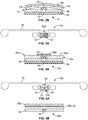
- Figs. 2A and 2B show an RFID tag 10 according to the present disclosure
- Fig. 2B shows the RFID tag, generally designated at 10, secured to the enclosure 12 (e.g., a paper box) of packaging, generally designated at 14, for a microwavable food item.
- the packaging 14 may include other items, such as a "crisping sleeve” configured to be microwaved with the food item.
- the RFID tag 10 may be incorporated into the packaging 14 by any suitable approach and, while the RFID tag 10 is secured to the enclosure 12 in Fig. 2B , the RFID tag 10 may be associated with another portion of the packaging 14 (e.g., a "crisping sleeve" housed within the enclosure 12).
- RFID tags are described herein as being incorporated into the packaging of a microwavable food item, it should be understood that RFID tags according to the present disclosure may be useful in any of a number of possible applications, particularly when it is contemplated that they may be exposed to frequencies (referred to herein as a "second frequency") that are significantly higher than the frequency (referred to herein as a "first frequency”) at which an antenna of the RFID tag is intended to operate.
- a second frequency frequencies
- first frequency the frequency at which an antenna of the RFID tag is intended to operate.
- the RFID tag 10 includes an antenna 16 with an RFID chip 18 electrically coupled thereto.
- the antenna 16 is provided as a dipole antenna, which is formed of a conductor defining a gap 20 between two conductor pad areas 22 ( Fig. 2A ), which is bridged by the RFID chip 18.
- the antenna 16 and RFID chip 18 may be provided generally according to conventional design (e.g., as described above with respect to Fig. 1 ), with the antenna 16 being designed to operate at a first frequency, which may be in the range of approximately 860 MHz to 930 MHz.
- the antenna 16 takes incident power at the first frequency and converts it to a voltage across the RFID chip 18 to allow it to operate.
- the RFID chip 18 may take any of a number of forms (including those of the type commonly referred to as a "chip” or a “strap" by one of ordinary skill in the art), including any of a number of possible components and being configured to perform any of a number of possible functions.
- the RFID chip 18 includes an integrated circuit for controlling RF communication and other functions of the RFID tag 10.
- the RFID tag 10 further includes a shielding structure, generally designated at 24, which is comprised of a shield conductor 26 and a shield dielectric 28.
- the shield conductor 26 is formed of a material having conductive properties and, as will be described in greater detail, may be variously configured without departing from the scope of the present disclosure.
- the shield dielectric 28 is formed of a material having dielectric properties and, as will be described in greater detail, may be variously configured without departing from the scope of the present disclosure.
- the shield conductor 26 and shield dielectric 28 are generally flat or planar, substantially identically shaped, and oriented with the perimeter of the shield conductor 26 coinciding with the perimeter of the shield dielectric 28.
- the shield conductor and shield dielectric may be differently configured and/or oriented at least partially out of alignment (i.e., with a portion of the shield conductor extending beyond the perimeter of the shield dielectric and/or a portion of the shield dielectric extending beyond the perimeter of the shield conductor).
- the shielding structure 24 is electrically coupled to the antenna 16 across the gap 20, being coupled by capacitance to the conductor pad areas 22 on either side of the gap 20 ( Fig. 2A ). As shown in Fig. 2B , the shielding structure 24 overlays the RFID chip 18, with the shield dielectric 28 at least partially positioned between the RFID chip 18 and the shield conductor 26. The shielding structure 24 may overlay or cover all (as in Figs. 2A and 2B ) or only a portion of the gap 20.
- the RFID tag 10 it is possible for the RFID tag 10 to be exposed to signals operating at first or second frequencies.
- the shielding structure 24 forms a partial short circuit across the gap 20.
- the antenna 16 is configured so as to compensate for the presence of the partial short circuit, thereby allowing the RFID tag 10 to operate properly.
- the RFID tag 10 may be placed into a microwave and exposed to the attendant high-frequency signals (which may be on the order of approximately 2,450 MHz) without the risk of ignition, unlike a conventional RFID tag T.
- Figs. 3A and 3B show an RFID tag, generally designated at 10a, (and associated packaging, generally designated at 14a, in Fig. 3B ) in which the shielding structure 24a includes a differently configured shield dielectric 28a ( Fig. 3B ).
- the shield dielectric 28a is incorporated into an over-lamination layer, which overlays the RFID chip 18, at least a portion of the gap 20, and at least a portion of the conductor pad areas 22 of the antenna 16 ( Fig. 3A ).
- the shield conductor 26a may comprise a patterned conductor to provide the desired bridging and shielding effects.
- the shield conductor 26a and shield dielectric 28a may be differently sized and shaped, with the shield conductor 26a being smaller than the over-lamination layer into which the shield dielectric 28a is incorporated.
- Figs. 4A and 4B illustrate an embodiment of an RFID tag according to the invention, generally designated at 10b, according to the present disclosure.
- the shielding structure generally designated at 24b
- the shielding structure 24b is incorporated into an RFID strap comprised of a strap conductor 30 and strap substrate 32 (along with the RFID chip 18), which is electrically coupled to the antenna 16, across the gap 20.
- the shielding structure 24b is comprised of a shield conductor 26b applied to the strap substrate 32, which serves as the shield dielectric 28b.
- the strap substrate 32 (and any of the other shield dielectrics described herein) may be formed of any of a variety of materials, such as polyethylene terephthalate.
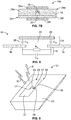
- Fig. 5 illustrates another RFID tag, generally designated at 10c, with a differently configured shielding structure 24c.
- the shield conductor 26c includes an extended area 34, which may increase the size of the shield conductor 26c beyond that of the associated shield dielectric (which is not visible in Fig. 5 ).
- the extended area 34 of the shield conductor 26c is oriented so as not to overlay the gap 20 (or the antenna 16), but rather is positioned laterally of the antenna 16 and the gap 20, extending away from the antenna 16.
- the extended area 34 of the shield conductor 26c may be variously sized and configured without departing from the scope of the present disclosure, being approximately the same size as the shield conductor 26 of Figs. 2A and 2B , arger than the shield conductor 26 of Figs. 2A and 2B , or smaller than the shield conductor 26 of Figs. 2A and 2B .
- the extended area 34 assists in dissipating heat generated across the gap 20. This effect is enhanced by increasing the size of the extended area 34, so it may be advantageous for the extended area 34 to be relatively large for improved heat dissipation.
- the extended area 34 (along with the remainder of the shield conductor 26c, as well as any of the other shield conductors described herein) may be formed of a non-flammable material, such as but not limited to, an aluminum material, heat resistant, flame resistant paper (Flex Dura HR, http://www.flexlinkllc.com/heat-resistant-paper.html), and non-flammable adhesive (Eclectic E6000 Adhesive, http://eclecticproducts.com/products/e6000.html) to provide a barrier to any arc that may be generated across the gap 20 to prevent a fire from spreading.
- a non-flammable material such as but not limited to, an aluminum material, heat resistant, flame resistant paper (Flex Dura HR, http://www.flexlinkllc.com/heat-resistant-paper.html), and non-flammable adhesive (Eclectic E6000 Adhesive, http://eclecticproducts.com/products/e6000.html) to provide a barrier to any arc that may
- Figs. 6A and 6B illustrate yet another RFID tag, generally designated at 10d, (and associated packaging, generally designated at 14d, in Fig. 6B ) with a differently configured shielding structure 24d.
- the shield dielectric 28d is formed of a material which undergoes reversible or non-reversible dielectric breakdown at high voltages of the type induced by a high-power microwave field.
- the shield conductor 26d may be formed by printing a conductive material (which becomes and defines the shield conductor 26d) onto the shield dielectric 28d, such as an over-lamination.
- a single RFID tag may include more than one shielding structure, as shown in Figs. 7A and 7B .
- the RFID tag generally designated at 10e
- a first shielding structure generally designated at 24e
- a second shielding structure is associated with an underside of the antenna 16, with the second shielding structure 24f underlying the RFID chip 18 (i.e., with the shielding structures 24e and 24f electrically coupled to opposing faces of the antenna 16).
- the shield dielectric 28f of the second shielding structure 24f contacts the underside of the antenna 16, while the associated shield conductor 26f is free to be secured or otherwise associated to the enclosure of a package for microwavable food or the like.
- the second shielding structure 24f is substantially identical to the first shielding structure 24e, but it is within the scope of the present disclosure for the shield conductor 26f and/or the shield dielectric 28f of the second shielding structure 24f to be differently configured from the shield conductor 26e and shield dielectric 28e of the first shielding structure 24e. Regardless of the particular configurations of the two shielding structures 24e and 24f, by providing them on both faces of the antenna 16, additional shielding is provided. This additional shielding involves additional "shorting," as there are now two partial short circuits across the gap 20. However, in accordance with the preceding description of Figs. 2A and 2B , the antenna 16 is configured so as to compensate for the presence of the partial short circuits, thereby allowing the RFID tag 10e to operate properly when exposed to the first frequency.
- Fig. 8 is a basic equivalent circuit representing the basic components of an RFID tag 10 according to the present disclosure.
- the gap 20 defined by the antenna 16 is bridged by an RFID chip 18 (represented by a resistor R P and a capacitor C P ) and a shielding structure 24 comprising a shield conductor 26 and a shield dielectric 28 (represented by two identical capacitors C B in series).
- the total capacitance of the shield dielectric 28 is half of the capacitance of the individual capacitors C B used to represent the shield dielectric 28 in Fig. 8 . This is calculated using the standard formula in which the total capacitance of a series of capacitors is the inverse of the sum of all inverse capacitances.
- the impedance of the shield dielectric 28 is equal to the inverse of the product of 2 x ⁇ x F x total capacitance, in which F is the frequency at which the RFID tag 10 is powered.
- F is the frequency at which the RFID tag 10 is powered.
- an arc may be created between adjacent sections namely gap G and associated RFID chip C. This is in part due to adjacent sections being surrounded by a material (i.e. air or other elements) having a dielectric strength lower than that of the electric field achieved by said differential voltages across said adjacent sections. Also an arc may be created and exacerbated in part due to materials surrounding said sections that reach a temperature, due to RF current flowing along/through said adjacent sections gap G and chip C, that lowers dielectric strength of the surrounding material as well as creates flammable/combustible volatiles.
- a material i.e. air or other elements
- This arc can be avoided without the use of a shield by surrounding said sections with a material having the properties such as; a dielectric strength that can withstand the electric field at said sections, along with having heat resistant, flame resistant and non-flammable properties i.e. heat resistant and flame resistant paper and non-flammable adhesive(s).
- a material having the properties such as; a dielectric strength that can withstand the electric field at said sections, along with having heat resistant, flame resistant and non-flammable properties i.e. heat resistant and flame resistant paper and non-flammable adhesive(s).
- the enclosure 23 is associated with the RFID tag 25 includes an RFID chip 27 with an antenna 29 electrically coupled thereto.
- the antenna 29 is formed of a conductor 31 having a resistance that is greater than the resistance of the antenna 18 of a conventional RFID tag 11, which allows the package 21 (including the RFID tag 25) to be safely microwaved.
- the conductor 31 may have a sheet resistance that is comparable to that of the sheet resistance of a susceptor (i.e., in the range of approximately 100 ohms to approximately 230 ohms).
- the conductor 31 may also have an optical density in the range of approximately 0.18 to 0.29, similar to a susceptor.
- the RFID tag 25 when the RFID tag 25 is microwaved, it acts in the way that a susceptor does when being microwaved, by absorbing microwave energy M and heating up and reflecting minimal energy R', rather than reflecting high levels of energy to the microwave source or creating an arc.
- the higher sheet resistance of the conductor 31 may affect the efficiency of the antenna 29 compared to the dipole antenna 17 of a typical RFID tag 11. While the sheet resistance of the material (measured in ohms per square at a given thickness) is a fixed value, the resistance experienced by an RF current flowing through the conductor 31 may be effectively decreased by increasing the area of the conductor 31 (e.g., by increasing its thickness). This is particularly effective in reducing the resistance for an RF current, as skin depth is more of a factor than for a DC current, due to the tendency of an RF current to flow in the outer surface of the conductor 31 (i.e., as conductor thickness is reduced with respect to the skin depth, RF resistance becomes higher than DC resistance would be). Accordingly, it may be advantageous for the antenna 29 to have a relatively large area or thickness to decrease the RF resistance.
- the conductor of a slot-loop hybrid antenna typically has a greater area, such that it may be advantageous for the antenna 29 to be provided as a slot-loop hybrid antenna (sometimes referred to as a "sloop" antenna), as in Fig. 9 .
- a slot-loop hybrid antenna 29 may be formed of a conductor 31 comprising a conductor sheet which is generally rectangular, with a slot 33 defined therein and positioned at an edge or end 35 of the conductor sheet 31.
- the slot 33 may extend between a closed end 37 and an open end 39 associated with the end or edge 35 of the conductor sheet 31. While there are various advantages to the antenna 29 being configured as a slot-loop hybrid antenna, it is within the scope of the present disclosure for the antenna 29 to be variously configured.
- the RFID chip 27 may take any of a number of forms (including those of the type commonly referred to as a "chip” or a “strap” by one of ordinary skill in the art), including any of a number of possible components and configured to perform any of a number of possible functions.
- the RFID chip 27 includes an integrated circuit for controlling RF communication and other functions of the RFID tag 25.
- the two ends or points of the RFID chip 27 are connected to the conductor sheet 31 at opposite sides of the slot 33, adjacent to the open end 39 of the slot 33, which serves to electrically couple the RFID chip 27 to the conductor sheet 31.
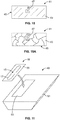
- an RFID tag 41 ( Figs. 10 and 10A ) that is suitable for incorporation into a package for a microwavable food item may be configured to fracture into multiple pieces or otherwise dissociate upon being subjected to heating in a microwave oven. By fracturing, interaction with the microwave field is reduced, thereby avoiding the potential problems of excessive reflected microwave energy and/or the creation of an arc when the RFID tag 41 is heated in a microwave oven.
- Such a configuration allows for the resistance of the conductor 43 of the antenna 45 of the RFID tag 41 to be lower than in Fig. 9 (e.g., a sheet resistance of less than 100 ohms), if desired.
- the RFID tag 41 shown in Fig. 10 is provided in accordance with the foregoing description of the RFID tag 25 of Fig. 9 , with an RFID chip 47 electrically coupled to the conductor sheet 43 of a slot-loop hybrid antenna 45, although the antenna 45 may be differently configured without departing from the scope of the present disclosure.
- its conductor sheet 43 is preferably formed of at least two materials (a base material and a secondary material, which may be provided in a lesser quantity than the base material) having different coefficients of thermal expansion.
- the materials expand at different rates when heated (e.g., in a microwave oven) until the conductor sheet 43 fractures into multiple pieces or otherwise dissociates.
- the magnitude of the difference in the coefficients of thermal expansion of the materials may vary without departing from the scope of the present disclosure, although a relatively large difference may be advantageous to more quickly cause the conductor sheet 43 to fracture or otherwise dissociate upon heating.
- the conductor sheet 43 may be formed of a base material, such as a plastic material, and a second material, such as a metallic material or conductive ink, which have different coefficients of thermal expansion. More particularly, the base material may be polyethylene terephthalate (which has a coefficient of thermal expansion of approximately 60 m/(m K)), while the secondary material is aluminum (which has a coefficient of thermal expansion of approximately 22 m/(m K)). When bonded together and heated, the aluminum will eventually break, thus rendering the RFID tag 41 inoperative or at least causing the RFID tag 41 to operate at a lower level, which reduces the interaction between the RFID tag 41 and the microwave field.
- a base material such as a plastic material
- a second material such as a metallic material or conductive ink
- the base material has a greater coefficient of thermal expansion than the secondary material in this example, it is within the scope of the present disclosure for the secondary material to have a greater coefficient of thermal expansion. Furthermore, this breakage may be promoted by including one or more points or lines of weakness (which are evident in Fig. 10A ), such as scored or thinned areas of decreased thickness, which encourages the conductor sheet 43 to break at that particular location or locations.
- Fig. 11 illustrates a package 49 incorporating an RFID tag 11 according to conventional design (as in Fig. 1A ), although it is also within the scope of the present disclosure for the RFID tag 11 to be configured as in Figs. 9 or 10 .
- the enclosure 51 of the package 49 is provided with a joinder material 53 applied to one or more of its surfaces (illustrated in Fig. 11 as an outer surface).
- the joinder material 53 may be present as a relatively thin layer or sheet of material with a resistance that is higher than the resistance of the antenna 17 of the RFID tag 11 (e.g., a sheet resistance in the range of approximately 100 ohms to approximately 230 ohms).
- the joinder material 53 has a substantially uniform thickness, although it is within the scope of the present disclosure for the joinder material 53 to have a non-uniform thickness.
- joinder material 53 may have an average thickness that is less than the thickness of the antenna 17 of the RFID tag 15 (e.g., the joinder material 53 may have an average thickness of in the range of approximately 10 nm to approximately 100 nm for joinder material 53 comprising an aluminum material).
- the joinder material 53 may comprise a metallic film.
- the joinder material 53 may comprise an ink of a suitable conductivity.
- the joinder material 53 may be differently configured, provided that it has a suitably high resistance (i.e., a resistance that is at least greater than the resistance of the antenna 17 of the associated RFID tag 11 and, more preferably, a sheet resistance in the range of approximately 100 ohms to approximately 230 ohms).
- a substrate 55 of the RFID tag 11 (to which the RFID chip 15 and antenna 17 are mounted) is associated to the enclosure 51 in a manner that sandwiches or interposes the joinder material 53 between the RFID tag 11 and the enclosure 51.
- the joinder material 53 itself may have adhesive qualities to cause the RFID tag 11 to be secured with respect to the enclosure 51 or a separate means may be provided to secure the RFID tag 11 to the joinder material 53 (e.g., an adhesive applied to the underside of the substrate 55). So separating the manufacturing of the enclosure 51 with the joinder material 53 and the RFID tag 11 allows for greater flexibility in manufacturing.
- the joinder material 53 By providing the joinder material 53 with a relatively high resistance, the effective sheet resistance of the RFID tag 11 is increased, thereby increasing the tendency to adsorb RF energy and heat up, rather than creating an arc.
- the joinder material 53 may be variously configured without departing from the scope of the present disclosure.
- the joinder material 53 may have a perimeter that substantially coincides with the perimeter of the substrate 55 of the associated RFID tag 11, a perimeter that extends beyond the entire perimeter of the substrate 55 of the associated RFID tag 11, a perimeter that is entirely contained within the perimeter of the substrate 55 of the associated RFID tag 11, or a perimeter that extends beyond the perimeter of the substrate 55 of the associated RFID tag 11 in at least one location, while being contained within the perimeter of the substrate 55 of the associated RFID tag 11 at another location.
- the perimeter of the joinder material 53 may have the same shape as the perimeter of the substrate 55 of the associated RFID tag 11 or a different shape.
- packaging for a microwavable food item.
- the packaging includes an enclosure and an RFID tag secured to the enclosure.
- the RFID tag includes an antenna defining a gap and configured to operate at a first frequency.
- An RFID chip is electrically coupled to the antenna across the gap.
- a shielding structure is electrically coupled to the antenna across the gap and overlays the RFID chip.
- the shielding structure includes a shield conductor and a shield dielectric at least partially positioned between the shield conductor and the RFID chip.
- the shielding structure is configured to limit the voltage across the gap when the antenna is exposed to a second frequency that is greater than the first frequency.
- the enclosure of the package is provided with the joinder material 53 previously described, applied to one or more of its surfaces (similarly illustrated in Fig. 11 as an outer surface).
- the joinder material 53 may be present as a relatively thin layer or sheet of material with a resistance that is higher than the resistance of the antenna 17 of the RFID tag 11 (e.g., a sheet resistance in the range of approximately 100 ohms to approximately 230 ohms).
- the present disclosure also contemplates, but is not limited to, the following testing method for the microwaveable RFID set forth herein.
- the equipment utilized in one method includes an inverter technology over such as a 12000 Watts Oven.
- a GE® Model JE 2251SJ02 can be utilized.
- a scale and a plurality of plastic containers to hold samples are used.
- frozen, ground beef was used as a sample.
- the steps for the testing method using frozen ground beef are as follows: 1) A sample is prepared. A variety of weights can be utilized. In one instance, a five (5) ounce sample is used. 2) The sample is placed in one half of a container in order to ensure that the sample covers the bottom of the container consistently between different tests.
- the sample is frozen for approximately twelve (12) hours.
- At least one RFID label is adhered to the bottom of the container which holds the sample and the sample is placed on a rotational plate within a microwave oven. The sample is placed in the center of the rotational plate within the microwave oven.
- the sample is microwaved on a full power setting for two (2) minutes.
- the present testing method contemplates that several different power settings and times can be utilized in order to test the sample 6) A determination is made as to whether there was a "spark" or "arc.”.
Landscapes
- Engineering & Computer Science (AREA)
- Microelectronics & Electronic Packaging (AREA)
- Computer Hardware Design (AREA)
- Physics & Mathematics (AREA)
- General Physics & Mathematics (AREA)
- Theoretical Computer Science (AREA)
- Computer Networks & Wireless Communication (AREA)
- Life Sciences & Earth Sciences (AREA)
- Food Science & Technology (AREA)
- Mechanical Engineering (AREA)
- Electromagnetism (AREA)
- Details Of Aerials (AREA)
- Package Specialized In Special Use (AREA)
- Details Of Rigid Or Semi-Rigid Containers (AREA)
- Aerials With Secondary Devices (AREA)
- Wrappers (AREA)
- Electric Ovens (AREA)
- Waveguide Aerials (AREA)
Priority Applications (2)
| Application Number | Priority Date | Filing Date | Title |
|---|---|---|---|
| EP21151807.1A EP3828771B1 (en) | 2016-12-29 | 2017-12-28 | Rfid tags with shielding structure for incorporation into microwavable food packaging |
| EP22189193.0A EP4109340B1 (en) | 2016-12-29 | 2017-12-28 | Rfid tags with shielding structure for incorporation into microwavable food packaging |
Applications Claiming Priority (3)
| Application Number | Priority Date | Filing Date | Title |
|---|---|---|---|
| US201662440108P | 2016-12-29 | 2016-12-29 | |
| US201762539817P | 2017-08-01 | 2017-08-01 | |
| PCT/US2017/068659 WO2018125977A1 (en) | 2016-12-29 | 2017-12-28 | Rfid tags with shielding structure for incorporation into microwavable food packaging |
Related Child Applications (2)
| Application Number | Title | Priority Date | Filing Date |
|---|---|---|---|
| EP21151807.1A Division EP3828771B1 (en) | 2016-12-29 | 2017-12-28 | Rfid tags with shielding structure for incorporation into microwavable food packaging |
| EP22189193.0A Division EP4109340B1 (en) | 2016-12-29 | 2017-12-28 | Rfid tags with shielding structure for incorporation into microwavable food packaging |
Publications (2)
| Publication Number | Publication Date |
|---|---|
| EP3563299A1 EP3563299A1 (en) | 2019-11-06 |
| EP3563299B1 true EP3563299B1 (en) | 2021-01-20 |
Family
ID=61025072
Family Applications (3)
| Application Number | Title | Priority Date | Filing Date |
|---|---|---|---|
| EP17835554.1A Active EP3563299B1 (en) | 2016-12-29 | 2017-12-28 | Rfid tags with shielding structure for incorporation into microwavable food packaging |
| EP21151807.1A Active EP3828771B1 (en) | 2016-12-29 | 2017-12-28 | Rfid tags with shielding structure for incorporation into microwavable food packaging |
| EP22189193.0A Active EP4109340B1 (en) | 2016-12-29 | 2017-12-28 | Rfid tags with shielding structure for incorporation into microwavable food packaging |
Family Applications After (2)
| Application Number | Title | Priority Date | Filing Date |
|---|---|---|---|
| EP21151807.1A Active EP3828771B1 (en) | 2016-12-29 | 2017-12-28 | Rfid tags with shielding structure for incorporation into microwavable food packaging |
| EP22189193.0A Active EP4109340B1 (en) | 2016-12-29 | 2017-12-28 | Rfid tags with shielding structure for incorporation into microwavable food packaging |
Country Status (6)
| Country | Link |
|---|---|
| US (2) | US11308379B2 (enExample) |
| EP (3) | EP3563299B1 (enExample) |
| JP (3) | JP6613293B2 (enExample) |
| CN (2) | CN114781571B (enExample) |
| BR (1) | BR112019012930A8 (enExample) |
| WO (1) | WO2018125977A1 (enExample) |
Families Citing this family (38)
| Publication number | Priority date | Publication date | Assignee | Title |
|---|---|---|---|---|
| CN114781571B (zh) | 2016-12-29 | 2025-11-21 | 艾利丹尼森零售信息服务公司 | 用于结合至可微波食品包装中的具有屏蔽结构的rfid标签 |
| CN112334913B (zh) | 2018-04-20 | 2024-05-17 | 艾利丹尼森零售信息服务公司 | 用于结合到可微波食品包装中的屏蔽rfid标签 |
| BR112020021423A2 (pt) | 2018-04-20 | 2021-01-19 | Avery Dennison Retail Information Services, Llc | Método de uso de correias de rfid blindadas com projetos de etiqueta de rfid |
| WO2019204698A1 (en) | 2018-04-20 | 2019-10-24 | Avery Dennison Retail Information Services, Llc | Rfid straps with a top and bottom conductor |
| CN112639825B (zh) * | 2018-06-27 | 2024-03-19 | 艾利丹尼森零售信息服务公司 | 耐受微波炉的操作于高频带中的rfid标签 |
| DE212019000085U1 (de) * | 2018-07-06 | 2019-12-11 | Murata Manufacturing Co., Ltd. | Drahtloskommunikationsvorrichtung |
| WO2020012725A1 (ja) * | 2018-07-13 | 2020-01-16 | 株式会社村田製作所 | 無線通信デバイス |
| CN213934946U (zh) * | 2018-07-20 | 2021-08-10 | 株式会社村田制作所 | 无线通信设备 |
| DE212019000331U1 (de) | 2018-07-25 | 2021-03-09 | Murata Manufacturing Co., Ltd. | Drahtloskommunikationsvorrichtung |
| EP4266017B1 (en) * | 2018-12-06 | 2025-05-14 | Avery Dennison Retail Information Services LLC | Temperature-sensing rfid device |
| JP7159841B2 (ja) * | 2018-12-13 | 2022-10-25 | 大日本印刷株式会社 | Rfタグラベル |
| JP6737430B1 (ja) | 2018-12-25 | 2020-08-12 | 株式会社村田製作所 | 無線通信デバイス |
| CN110443338B (zh) * | 2019-07-11 | 2023-05-30 | 永道射频技术股份有限公司 | 一种可在微波炉内安全使用的rfid标签 |
| CN110399965B (zh) * | 2019-07-31 | 2023-05-30 | 永道射频技术股份有限公司 | 一种用于微波炉内加热或加工的rfid标签结构 |
| DE102019128088A1 (de) * | 2019-10-17 | 2021-04-22 | Rastal Gmbh & Co. Kg | Verfahren zum Verbinden eines Geschirrteils mit einem Informationsträger und Vorrichtung mit einem Geschirrteil und einem Informationsträger |
| SE543688C2 (en) * | 2019-10-21 | 2021-06-08 | Stora Enso Oyj | Rfid tag with shielding conductor for use in microwaveable food packages |
| SE543687C2 (en) | 2019-10-21 | 2021-06-08 | Stora Enso Oyj | Rfid tag with narrow gap for use in microwaveable food packages |
| DE212020000498U1 (de) * | 2019-11-28 | 2021-08-10 | Murata Manufacturing Co., Ltd. | Drahtloskommunikationsvorrichtung |
| JP7604496B2 (ja) * | 2019-12-28 | 2024-12-23 | エイヴェリー デニソン リテール インフォメーション サービシズ リミテッド ライアビリティ カンパニー | 電子レンジ食品の包装に組み込むための2つの部分からなるrfidタグ |
| JP7624005B2 (ja) | 2019-12-30 | 2025-01-29 | エイヴェリー デニソン リテール インフォメーション サービシズ リミテッド ライアビリティ カンパニー | 金属探知機耐性rfidタグ |
| US20230146326A1 (en) | 2020-02-26 | 2023-05-11 | Avery Dennison Retail Information Services Llc | Rfid security label for packaging |
| USD948366S1 (en) | 2020-02-26 | 2022-04-12 | Avery Dennison Retail Information Services Llc | Label |
| US12380291B2 (en) | 2020-10-23 | 2025-08-05 | Avery Dennison Retail Information Services Llc | Systems containing multiple read zones and methods of use thereof |
| EP4232981A1 (en) | 2020-10-23 | 2023-08-30 | Avery Dennison Retail Information Services LLC | Methods for detecting variable weight-price items in detector-based inventory management and/or shopping systems |
| US20240013014A1 (en) | 2020-11-18 | 2024-01-11 | Avery Dennison Retail Information Services Llc | Methods and systems for determining whether an article is leaving or returning to a merchandising location |
| JP7587979B2 (ja) * | 2020-12-17 | 2024-11-21 | 大王製紙株式会社 | Rfidタグ及びその製造方法 |
| JP7733752B2 (ja) * | 2021-06-24 | 2025-09-03 | エイヴェリー デニソン リテール インフォメーション サービシズ リミテッド ライアビリティ カンパニー | マイクロ波耐性rfidシステム及び構成要素 |
| FR3125149A1 (fr) | 2021-07-10 | 2023-01-13 | Yesitis | Dispositif comprenant une etiquette rfid utilisable au moins dans un four a micro-ondes et recipient ou emballage pourvu d’au moins un tel dispositif |
| EP4120133B1 (de) | 2021-07-13 | 2024-04-24 | etifix GmbH | System bestehend aus einem smart label und einem abschirmelement sowie mikrowellengeeignetes geschirrteil |
| DE102021118103B3 (de) | 2021-07-13 | 2022-10-27 | Etifix Gmbh | Mikrowellentaugliches smart label |
| WO2023178287A1 (en) | 2022-03-16 | 2023-09-21 | Avery Dennison Retail Information Services, Llc | Methods for identifying an event of concern for an item in a supply chain |
| EP4643269A1 (en) | 2023-02-09 | 2025-11-05 | SML Brand Identification Solutions Limited | Radio-frequency identification inlays for use with or incorporated into microwavable food packages |
| EP4521296A1 (de) * | 2023-09-11 | 2025-03-12 | etifix GmbH | Smart label |
| WO2025088350A1 (en) | 2023-10-27 | 2025-05-01 | Linxens Holding | Rfid tag, container with such an rfid tag and use of the container in a microwave oven |
| EP4550207A1 (en) | 2023-11-03 | 2025-05-07 | Linxens Holding | A slot cavity element for rfid tags, an rfid tag with such a slot cavity element, a container with such an rfid tag and use of the container in a microwave oven |
| WO2025108542A1 (en) | 2023-11-22 | 2025-05-30 | Hid Global Corporation | Rfid tag |
| FR3156008A1 (fr) * | 2023-11-29 | 2025-05-30 | Arc France | Dispositif de blindage électromagnétique d’étiquette radio fréquence, ensemble comprenant un dispositif de blindage électromagnétique et une étiquette radio fréquence et procédé de blindage électromagnétique d’étiquette radio fréquence |
| EP4647963A1 (de) * | 2024-05-07 | 2025-11-12 | INO Holding GmbH | Vorrichtung, anordnung und verfahren zur drahtlosen identifikation von in einer vorzugsrichtung stapelfähigen artikeln |
Family Cites Families (108)
| Publication number | Priority date | Publication date | Assignee | Title |
|---|---|---|---|---|
| USD383465S (en) | 1995-11-30 | 1997-09-09 | Hideki Okuchi | Auxiliary antenna for cellular phone |
| DE19654902C2 (de) * | 1996-03-15 | 2000-02-03 | David Finn | Chipkarte |
| US8052061B2 (en) | 2002-08-07 | 2011-11-08 | Vanguard Identification Systems, Inc. | Permanent RFID luggage tag with security features |
| US6892545B2 (en) | 2000-02-28 | 2005-05-17 | Dai Nippon Printing Co., Ltd. | Automatic refrigerator system, refrigerator, automatic cooking system, and microwave oven |
| JP2001317741A (ja) | 2000-02-28 | 2001-11-16 | Dainippon Printing Co Ltd | 食品の自動調理システムと電子レンジ |
| JP2002150248A (ja) | 2000-11-14 | 2002-05-24 | Dainippon Printing Co Ltd | 衝撃感知センサ付きデータキャリア装置 |
| US6859093B1 (en) | 2000-11-28 | 2005-02-22 | Precision Dynamics Corporation | Rectifying charge storage device with bi-stable states |
| WO2002099764A1 (en) | 2001-06-05 | 2002-12-12 | Motorola, Inc. | Capacitively powered data communication system with tag and circuit carrier apparatus for use therein |
| JP2003030612A (ja) | 2001-07-19 | 2003-01-31 | Oji Paper Co Ltd | Icチップ実装体 |
| JP2003087044A (ja) | 2001-09-12 | 2003-03-20 | Mitsubishi Materials Corp | Rfid用アンテナ及び該アンテナを備えたrfidシステム |
| US7214569B2 (en) | 2002-01-23 | 2007-05-08 | Alien Technology Corporation | Apparatus incorporating small-feature-size and large-feature-size components and method for making same |
| AU2003253210A1 (en) | 2002-08-08 | 2004-02-25 | Bnc Ip Switzerland Gmbh | Multi-frequency identification device |
| US7224280B2 (en) | 2002-12-31 | 2007-05-29 | Avery Dennison Corporation | RFID device and method of forming |
| US11334728B2 (en) | 2003-03-03 | 2022-05-17 | Lone Star Scm Systems, Lp | Interrogator and interrogation system employing the same |
| US7652636B2 (en) * | 2003-04-10 | 2010-01-26 | Avery Dennison Corporation | RFID devices having self-compensating antennas and conductive shields |
| US20040234653A1 (en) | 2003-05-22 | 2004-11-25 | Cogley Paul A. | Susceptor tray and mirowavable dough products |
| US20040238534A1 (en) * | 2003-05-29 | 2004-12-02 | Mast Roy Lee | Package for microwave cooking |
| JP2005101987A (ja) | 2003-09-25 | 2005-04-14 | Matsushita Electric Works Ltd | 集積無線idタグ |
| CN1860642A (zh) | 2003-11-06 | 2006-11-08 | 株式会社村田制作所 | 谐振器,滤波器,不可逆电路装置和通信设备 |
| US6999028B2 (en) | 2003-12-23 | 2006-02-14 | 3M Innovative Properties Company | Ultra high frequency radio frequency identification tag |
| JP2005216044A (ja) | 2004-01-30 | 2005-08-11 | Seiko Precision Inc | 非接触icカード及び非接触icカード用ホルダ |
| JP2005252853A (ja) | 2004-03-05 | 2005-09-15 | Fec Inc | Rf−id用アンテナ |
| US20120062367A1 (en) | 2004-04-06 | 2012-03-15 | Vanguard Identification Systems, Inc. | Near field communication enabled permanent rfid luggage tag |
| JP2005323019A (ja) | 2004-05-07 | 2005-11-17 | Pegasus Net Kk | Rfidタグ用ブースターアンテナ |
| US7158033B2 (en) | 2004-09-01 | 2007-01-02 | Avery Dennison Corporation | RFID device with combined reactive coupler |
| WO2006048964A1 (ja) | 2004-11-02 | 2006-05-11 | Matsushita Electric Industrial Co., Ltd. | 加熱装置 |
| JP3960329B2 (ja) | 2004-11-02 | 2007-08-15 | 松下電器産業株式会社 | 加熱調理器およびそのプログラム |
| US7452748B1 (en) | 2004-11-08 | 2008-11-18 | Alien Technology Corporation | Strap assembly comprising functional block deposited therein and method of making same |
| JP4281683B2 (ja) | 2004-12-16 | 2009-06-17 | 株式会社デンソー | Icタグの取付構造 |
| GB2462212B (en) | 2005-02-16 | 2010-05-12 | Illinois Tool Works | Metal detector |
| JP2007026145A (ja) * | 2005-07-19 | 2007-02-01 | Dainippon Printing Co Ltd | 非接触型のデータキャリア装置 |
| JP2007086863A (ja) | 2005-09-20 | 2007-04-05 | Fuji Xerox Co Ltd | 非接触icタグ、非接触icタグを備えた部材のパッケージ及び非接触icタグを備えた部材を用いる装置 |
| KR100717881B1 (ko) | 2005-09-23 | 2007-05-14 | 한국전자통신연구원 | 모바일 rfⅰd 리더 및 그 제어 방법 |
| JP2007089054A (ja) * | 2005-09-26 | 2007-04-05 | Nippon Telegr & Teleph Corp <Ntt> | Rfidタグのアンテナ |
| JP4761952B2 (ja) * | 2005-12-14 | 2011-08-31 | 富士通株式会社 | Rfidタグ |
| USD553124S1 (en) | 2006-01-05 | 2007-10-16 | Novariant Inc. | Roof module |
| US7391325B2 (en) | 2006-01-13 | 2008-06-24 | Honeywell International Inc. | Multifunctional multichip system for wireless sensing |
| US8786510B2 (en) | 2006-01-24 | 2014-07-22 | Avery Dennison Corporation | Radio frequency (RF) antenna containing element and methods of making the same |
| EP1821241A3 (en) | 2006-02-15 | 2008-07-23 | Assa Abloy AB | Hybrid frequency contactless transponder unit, module for and method of manufacturing |
| USD546819S1 (en) | 2006-02-17 | 2007-07-17 | Impinj, Inc. | Radio frequency identification tag antenna assembly |
| US7646304B2 (en) | 2006-04-10 | 2010-01-12 | Checkpoint Systems, Inc. | Transfer tape strap process |
| ES2444222T3 (es) | 2006-07-10 | 2014-02-24 | Goji Limited | Preparación de alimentos |
| KR101478810B1 (ko) | 2006-07-28 | 2015-01-02 | 가부시키가이샤 한도오따이 에네루기 켄큐쇼 | 축전 장치 |
| US9607188B2 (en) | 2014-09-29 | 2017-03-28 | Rfmicron, Inc. | Radio frequency identification (RFID) tag(s) and sensor(s) |
| US20080122631A1 (en) * | 2006-11-29 | 2008-05-29 | Intermec Ip Corp. | Multiple band / wide band radio frequency identification (rfid) tag, such as for use as a metal mount tag |
| US7535366B2 (en) * | 2006-12-13 | 2009-05-19 | 3M Innovative Properties Company | Microwaveable radio frequency identification tags |
| US9012814B2 (en) * | 2007-01-11 | 2015-04-21 | Lg Electronics Inc. | Cooking appliance, controlling system for cooking device and controlling method for cooking device |
| US7965186B2 (en) | 2007-03-09 | 2011-06-21 | Corning Cable Systems, Llc | Passive RFID elements having visual indicators |
| GB2455779A (en) | 2007-12-21 | 2009-06-24 | Novalia Ltd | Reader and electronic tag with conductive tracks having narrow and wide sections |
| WO2009080607A2 (de) | 2007-12-22 | 2009-07-02 | Manroland Ag | Druckprodukt mit rfid-transponder |
| US7744005B2 (en) | 2008-01-16 | 2010-06-29 | Taiwan Name Plate Co., Ltd. | Induction card with a printed antenna |
| USD634738S1 (en) | 2008-01-30 | 2011-03-22 | Yfy Rfid Technologies Company Limited | RFID antenna |
| US8056814B2 (en) | 2008-02-27 | 2011-11-15 | Tagsys Sas | Combined EAS/RFID tag |
| EP2251934B1 (en) | 2008-03-03 | 2018-05-02 | Murata Manufacturing Co. Ltd. | Wireless ic device and wireless communication system |
| JP4518211B2 (ja) | 2008-03-03 | 2010-08-04 | 株式会社村田製作所 | 複合アンテナ |
| US8289165B2 (en) * | 2008-06-11 | 2012-10-16 | Avery Dennison Corporation | RFID device with conductive loop shield |
| EP2306588B1 (en) | 2008-06-26 | 2012-10-17 | Fujitsu Limited | Rfid tag |
| US20100000980A1 (en) | 2008-07-02 | 2010-01-07 | Bogdan Popescu | Induction Heating System with Versatile Inductive Cartridge |
| JP5094630B2 (ja) | 2008-08-11 | 2012-12-12 | 株式会社日立製作所 | Icタグ |
| US8228197B2 (en) | 2008-11-10 | 2012-07-24 | Pouch Pac Innovations, Llc | Flexible pouch with smart tags |
| US8174388B2 (en) | 2008-12-10 | 2012-05-08 | Sensormatic Electronics, LLC | Method and system for deactivation of combination EAS/RFID tags |
| WO2010079830A1 (ja) | 2009-01-09 | 2010-07-15 | 株式会社村田製作所 | 無線icデバイス、無線icモジュール、および無線icモジュールの製造方法 |
| US9277601B2 (en) | 2009-02-26 | 2016-03-01 | International Business Machines Corporation | Operating an appliance based on cooking instructions embedded in an RFID product tag |
| JP5173896B2 (ja) | 2009-03-09 | 2013-04-03 | レンゴー株式会社 | Rfidタグ用ブースタアンテナ |
| US8286887B2 (en) | 2009-03-10 | 2012-10-16 | Wal-Mart Stores, Inc. | RFID tag sensors and methods |
| JP5332803B2 (ja) * | 2009-03-27 | 2013-11-06 | 日油株式会社 | Rfタグおよびその製造方法 |
| JP5204032B2 (ja) | 2009-05-07 | 2013-06-05 | レンゴー株式会社 | Rfidタグ用ブースタアンテナ |
| JP2011100181A (ja) | 2009-11-04 | 2011-05-19 | Toppan Printing Co Ltd | 非接触icラベルとアンテナ内蔵被接着体 |
| US9368580B2 (en) | 2009-12-04 | 2016-06-14 | Sensor Electronic Technology, Inc. | Semiconductor material doping |
| US8833664B2 (en) * | 2009-12-18 | 2014-09-16 | Yu Yung Choi | Enhanced performance and security RFID device |
| JP5464028B2 (ja) | 2010-04-19 | 2014-04-09 | 凸版印刷株式会社 | 偽変造防止用icラベル |
| JP2010231797A (ja) | 2010-05-13 | 2010-10-14 | Dainippon Printing Co Ltd | 非接触データキャリアを付したパッケージ |
| US8511569B1 (en) | 2010-11-02 | 2013-08-20 | Impinj, Inc. | RFID integrated circuit to strap mounting system |
| BR112012032009B8 (pt) | 2010-06-14 | 2023-01-24 | Avery Dennison Corp | Método para produzir um dispositivo de rfid, aparelho para a produção de um dispositivo de rfid, conjunto intermediário de dispositivos de rfid, intermediário e sistema para a produção de dispositivos de rfid |
| WO2012020748A1 (ja) | 2010-08-10 | 2012-02-16 | 株式会社村田製作所 | プリント配線板及び無線通信システム |
| US8646695B2 (en) | 2010-10-01 | 2014-02-11 | Disney Enterprises, Inc. | Combined HF and UHF RFID device |
| US9414442B2 (en) | 2010-11-29 | 2016-08-09 | Goji Limited | System, apparatus, and method for cooking using RF oven |
| WO2013156389A1 (en) | 2012-04-19 | 2013-10-24 | Smartrac Ip B.V. | Integrated loop structure for radio frequency identification |
| US20130313328A1 (en) * | 2012-05-25 | 2013-11-28 | Omni-Id Cayman Limited | Shielded Cavity Backed Slot Decoupled RFID TAGS |
| JP6050961B2 (ja) | 2012-06-18 | 2016-12-21 | トッパン・フォームズ株式会社 | 非接触型データ受送信体 |
| USD697900S1 (en) | 2012-07-18 | 2014-01-21 | Kmw Inc. | Antenna radome |
| BR112015001055A2 (pt) | 2012-07-19 | 2017-06-27 | 3M Innovative Properties Co | rótulo de blindagem eletromagnética |
| CN202694402U (zh) * | 2012-07-26 | 2013-01-23 | 上海朗睿电子科技有限公司 | 一种有机射频识别标签 |
| WO2014210000A1 (en) | 2013-06-24 | 2014-12-31 | Avery Dennison Corporation | Robust washable tags using a large area antenna conductor |
| US9378451B2 (en) | 2013-08-14 | 2016-06-28 | Avery Dennison Corporation | RFID labels with digitally printed indicia for matching merchandise appearance characteristics |
| US9275322B2 (en) | 2013-11-25 | 2016-03-01 | VivaLnk Limited (Cayman Islands) | Stretchable multi-layer wearable tag capable of wireless communications |
| JP2015162187A (ja) * | 2014-02-28 | 2015-09-07 | 株式会社リコー | Rfidタグ、通信システム、及びrfidタグの使用方法 |
| USD716774S1 (en) | 2014-04-04 | 2014-11-04 | Avery Dennison Corporation | RFID inlay |
| US9874603B2 (en) | 2014-07-07 | 2018-01-23 | Avery Dennison Retail Information Services, Llc | System and method for capacitive coupling testing |
| USD763833S1 (en) | 2014-10-01 | 2016-08-16 | Ohio State Innovation Foundation | RFID tag |
| WO2016060938A2 (en) | 2014-10-08 | 2016-04-21 | RF Micron, Inc. | Radio frequency identification (rfid) moisture tag(s) and sensors with extended sensing via capillaries |
| USD880460S1 (en) | 2015-06-12 | 2020-04-07 | Avery Dennison Retail Information Services, Llc | Antenna |
| US10268945B1 (en) * | 2015-06-30 | 2019-04-23 | Amazon Technologies, Inc. | RFID tags |
| US9418262B1 (en) | 2015-07-22 | 2016-08-16 | Vectare, Inc. | Method to differentiate radio frequency identification tags from other metal objects |
| JP6485555B2 (ja) | 2015-12-02 | 2019-03-20 | 株式会社村田製作所 | 水分検出用rfidタグ付き衛生用品 |
| JP6350766B2 (ja) | 2016-01-18 | 2018-07-04 | 株式会社村田製作所 | アンテナ装置および電子機器 |
| USD795228S1 (en) | 2016-03-04 | 2017-08-22 | Airgain Incorporated | Antenna |
| US10311355B1 (en) | 2016-03-31 | 2019-06-04 | Amazon Technologies, Inc. | RFID tags |
| KR102556536B1 (ko) | 2016-09-30 | 2023-07-17 | 삼성전자주식회사 | 조리 기기 및 조리 기기의 제어 방법 |
| USD812045S1 (en) | 2016-10-06 | 2018-03-06 | Avery Dennison Retail Information Services, Llc | Antenna |
| GB2554952A (en) | 2016-10-17 | 2018-04-18 | Parkside Flexibles Europe Ltd | Electronic identifier for packaging |
| CN114781571B (zh) | 2016-12-29 | 2025-11-21 | 艾利丹尼森零售信息服务公司 | 用于结合至可微波食品包装中的具有屏蔽结构的rfid标签 |
| USD837769S1 (en) | 2017-05-22 | 2019-01-08 | Shenzhen Antop Technology Limited | Antenna |
| US10733495B2 (en) | 2017-08-30 | 2020-08-04 | Precision Dynamics Corporation | Wearable RFID device |
| CN112334913B (zh) | 2018-04-20 | 2024-05-17 | 艾利丹尼森零售信息服务公司 | 用于结合到可微波食品包装中的屏蔽rfid标签 |
| US20200005110A1 (en) | 2018-06-27 | 2020-01-02 | Avery Dennison Retail Information Services, Llc | High-field emission tolerant rfid tags attached to products to control cooking process |
| CN109389203A (zh) | 2018-10-11 | 2019-02-26 | 江苏金羿先磁新材料科技有限公司 | 一种抗金属rfid标签频点偏移调整方法 |
| USD855039S1 (en) | 2018-10-26 | 2019-07-30 | Pvc Antenna Inc. | Antenna |
-
2017
- 2017-12-28 CN CN202210433174.1A patent/CN114781571B/zh active Active
- 2017-12-28 WO PCT/US2017/068659 patent/WO2018125977A1/en not_active Ceased
- 2017-12-28 EP EP17835554.1A patent/EP3563299B1/en active Active
- 2017-12-28 BR BR112019012930A patent/BR112019012930A8/pt not_active Application Discontinuation
- 2017-12-28 CN CN201780081477.9A patent/CN110140132B/zh active Active
- 2017-12-28 JP JP2017253316A patent/JP6613293B2/ja active Active
- 2017-12-28 EP EP21151807.1A patent/EP3828771B1/en active Active
- 2017-12-28 EP EP22189193.0A patent/EP4109340B1/en active Active
- 2017-12-28 US US15/856,502 patent/US11308379B2/en active Active
-
2019
- 2019-11-01 JP JP2019199949A patent/JP7285760B2/ja active Active
-
2021
- 2021-12-10 US US17/547,911 patent/US11790205B2/en active Active
-
2023
- 2023-05-23 JP JP2023084488A patent/JP2023120196A/ja not_active Abandoned
Non-Patent Citations (1)
| Title |
|---|
| None * |
Also Published As
| Publication number | Publication date |
|---|---|
| US20180189623A1 (en) | 2018-07-05 |
| EP4109340B1 (en) | 2024-09-04 |
| JP2020042832A (ja) | 2020-03-19 |
| CN110140132A (zh) | 2019-08-16 |
| JP7285760B2 (ja) | 2023-06-02 |
| BR112019012930A2 (pt) | 2019-12-10 |
| US11308379B2 (en) | 2022-04-19 |
| JP2018163643A (ja) | 2018-10-18 |
| US20220101078A1 (en) | 2022-03-31 |
| BR112019012930A8 (pt) | 2023-04-11 |
| EP4109340A1 (en) | 2022-12-28 |
| EP3563299A1 (en) | 2019-11-06 |
| EP3828771B1 (en) | 2022-08-31 |
| EP3828771A1 (en) | 2021-06-02 |
| JP6613293B2 (ja) | 2019-11-27 |
| US11790205B2 (en) | 2023-10-17 |
| JP2023120196A (ja) | 2023-08-29 |
| CN114781571B (zh) | 2025-11-21 |
| CN114781571A (zh) | 2022-07-22 |
| WO2018125977A1 (en) | 2018-07-05 |
| CN110140132B (zh) | 2022-08-02 |
Similar Documents
| Publication | Publication Date | Title |
|---|---|---|
| EP3563299B1 (en) | Rfid tags with shielding structure for incorporation into microwavable food packaging | |
| US11763121B2 (en) | Shielded RFID tags for incorporation into microwavable food packaging | |
| EP0891285B1 (en) | Microwave oven heating element having broken loops | |
| US20230017472A1 (en) | Device comprising an rfid tag which can be used at least in a microwave oven, and receptacle or packaging provided with at least one such device | |
| JP2019126023A (ja) | 無線通信デバイス | |
| US20210111493A1 (en) | Wireless communication device | |
| EP4081463B1 (en) | Two-part rfid tags for incorporation into microwavable food packaging | |
| WO2021079265A1 (en) | Rfid tag with shielding conductor for use in microwaveable food packages | |
| JP6947254B2 (ja) | 無線通信デバイス | |
| EP3070637A1 (en) | Article management system |
Legal Events
| Date | Code | Title | Description |
|---|---|---|---|
| STAA | Information on the status of an ep patent application or granted ep patent |
Free format text: STATUS: UNKNOWN |
|
| STAA | Information on the status of an ep patent application or granted ep patent |
Free format text: STATUS: THE INTERNATIONAL PUBLICATION HAS BEEN MADE |
|
| PUAI | Public reference made under article 153(3) epc to a published international application that has entered the european phase |
Free format text: ORIGINAL CODE: 0009012 |
|
| STAA | Information on the status of an ep patent application or granted ep patent |
Free format text: STATUS: REQUEST FOR EXAMINATION WAS MADE |
|
| 17P | Request for examination filed |
Effective date: 20190619 |
|
| AK | Designated contracting states |
Kind code of ref document: A1 Designated state(s): AL AT BE BG CH CY CZ DE DK EE ES FI FR GB GR HR HU IE IS IT LI LT LU LV MC MK MT NL NO PL PT RO RS SE SI SK SM TR |
|
| AX | Request for extension of the european patent |
Extension state: BA ME |
|
| DAV | Request for validation of the european patent (deleted) | ||
| DAX | Request for extension of the european patent (deleted) | ||
| GRAP | Despatch of communication of intention to grant a patent |
Free format text: ORIGINAL CODE: EPIDOSNIGR1 |
|
| STAA | Information on the status of an ep patent application or granted ep patent |
Free format text: STATUS: GRANT OF PATENT IS INTENDED |
|
| INTG | Intention to grant announced |
Effective date: 20200722 |
|
| GRAS | Grant fee paid |
Free format text: ORIGINAL CODE: EPIDOSNIGR3 |
|
| GRAA | (expected) grant |
Free format text: ORIGINAL CODE: 0009210 |
|
| STAA | Information on the status of an ep patent application or granted ep patent |
Free format text: STATUS: THE PATENT HAS BEEN GRANTED |
|
| AK | Designated contracting states |
Kind code of ref document: B1 Designated state(s): AL AT BE BG CH CY CZ DE DK EE ES FI FR GB GR HR HU IE IS IT LI LT LU LV MC MK MT NL NO PL PT RO RS SE SI SK SM TR |
|
| REG | Reference to a national code |
Ref country code: GB Ref legal event code: FG4D |
|
| REG | Reference to a national code |
Ref country code: CH Ref legal event code: EP |
|
| REG | Reference to a national code |
Ref country code: DE Ref legal event code: R096 Ref document number: 602017031849 Country of ref document: DE |
|
| REG | Reference to a national code |
Ref country code: AT Ref legal event code: REF Ref document number: 1357041 Country of ref document: AT Kind code of ref document: T Effective date: 20210215 |
|
| REG | Reference to a national code |
Ref country code: IE Ref legal event code: FG4D |
|
| REG | Reference to a national code |
Ref country code: NL Ref legal event code: MP Effective date: 20210120 |
|
| REG | Reference to a national code |
Ref country code: LT Ref legal event code: MG9D |
|
| REG | Reference to a national code |
Ref country code: AT Ref legal event code: MK05 Ref document number: 1357041 Country of ref document: AT Kind code of ref document: T Effective date: 20210120 |
|
| PG25 | Lapsed in a contracting state [announced via postgrant information from national office to epo] |
Ref country code: NO Free format text: LAPSE BECAUSE OF FAILURE TO SUBMIT A TRANSLATION OF THE DESCRIPTION OR TO PAY THE FEE WITHIN THE PRESCRIBED TIME-LIMIT Effective date: 20210420 Ref country code: PT Free format text: LAPSE BECAUSE OF FAILURE TO SUBMIT A TRANSLATION OF THE DESCRIPTION OR TO PAY THE FEE WITHIN THE PRESCRIBED TIME-LIMIT Effective date: 20210520 Ref country code: FI Free format text: LAPSE BECAUSE OF FAILURE TO SUBMIT A TRANSLATION OF THE DESCRIPTION OR TO PAY THE FEE WITHIN THE PRESCRIBED TIME-LIMIT Effective date: 20210120 Ref country code: HR Free format text: LAPSE BECAUSE OF FAILURE TO SUBMIT A TRANSLATION OF THE DESCRIPTION OR TO PAY THE FEE WITHIN THE PRESCRIBED TIME-LIMIT Effective date: 20210120 Ref country code: GR Free format text: LAPSE BECAUSE OF FAILURE TO SUBMIT A TRANSLATION OF THE DESCRIPTION OR TO PAY THE FEE WITHIN THE PRESCRIBED TIME-LIMIT Effective date: 20210421 Ref country code: LT Free format text: LAPSE BECAUSE OF FAILURE TO SUBMIT A TRANSLATION OF THE DESCRIPTION OR TO PAY THE FEE WITHIN THE PRESCRIBED TIME-LIMIT Effective date: 20210120 Ref country code: BG Free format text: LAPSE BECAUSE OF FAILURE TO SUBMIT A TRANSLATION OF THE DESCRIPTION OR TO PAY THE FEE WITHIN THE PRESCRIBED TIME-LIMIT Effective date: 20210420 |
|
| PG25 | Lapsed in a contracting state [announced via postgrant information from national office to epo] |
Ref country code: LV Free format text: LAPSE BECAUSE OF FAILURE TO SUBMIT A TRANSLATION OF THE DESCRIPTION OR TO PAY THE FEE WITHIN THE PRESCRIBED TIME-LIMIT Effective date: 20210120 Ref country code: RS Free format text: LAPSE BECAUSE OF FAILURE TO SUBMIT A TRANSLATION OF THE DESCRIPTION OR TO PAY THE FEE WITHIN THE PRESCRIBED TIME-LIMIT Effective date: 20210120 Ref country code: PL Free format text: LAPSE BECAUSE OF FAILURE TO SUBMIT A TRANSLATION OF THE DESCRIPTION OR TO PAY THE FEE WITHIN THE PRESCRIBED TIME-LIMIT Effective date: 20210120 Ref country code: AT Free format text: LAPSE BECAUSE OF FAILURE TO SUBMIT A TRANSLATION OF THE DESCRIPTION OR TO PAY THE FEE WITHIN THE PRESCRIBED TIME-LIMIT Effective date: 20210120 Ref country code: SE Free format text: LAPSE BECAUSE OF FAILURE TO SUBMIT A TRANSLATION OF THE DESCRIPTION OR TO PAY THE FEE WITHIN THE PRESCRIBED TIME-LIMIT Effective date: 20210120 |
|
| PG25 | Lapsed in a contracting state [announced via postgrant information from national office to epo] |
Ref country code: IS Free format text: LAPSE BECAUSE OF FAILURE TO SUBMIT A TRANSLATION OF THE DESCRIPTION OR TO PAY THE FEE WITHIN THE PRESCRIBED TIME-LIMIT Effective date: 20210520 |
|
| REG | Reference to a national code |
Ref country code: DE Ref legal event code: R097 Ref document number: 602017031849 Country of ref document: DE |
|
| PG25 | Lapsed in a contracting state [announced via postgrant information from national office to epo] |
Ref country code: SM Free format text: LAPSE BECAUSE OF FAILURE TO SUBMIT A TRANSLATION OF THE DESCRIPTION OR TO PAY THE FEE WITHIN THE PRESCRIBED TIME-LIMIT Effective date: 20210120 Ref country code: CZ Free format text: LAPSE BECAUSE OF FAILURE TO SUBMIT A TRANSLATION OF THE DESCRIPTION OR TO PAY THE FEE WITHIN THE PRESCRIBED TIME-LIMIT Effective date: 20210120 Ref country code: EE Free format text: LAPSE BECAUSE OF FAILURE TO SUBMIT A TRANSLATION OF THE DESCRIPTION OR TO PAY THE FEE WITHIN THE PRESCRIBED TIME-LIMIT Effective date: 20210120 |
|
| PLBE | No opposition filed within time limit |
Free format text: ORIGINAL CODE: 0009261 |
|
| STAA | Information on the status of an ep patent application or granted ep patent |
Free format text: STATUS: NO OPPOSITION FILED WITHIN TIME LIMIT |
|
| PG25 | Lapsed in a contracting state [announced via postgrant information from national office to epo] |
Ref country code: DK Free format text: LAPSE BECAUSE OF FAILURE TO SUBMIT A TRANSLATION OF THE DESCRIPTION OR TO PAY THE FEE WITHIN THE PRESCRIBED TIME-LIMIT Effective date: 20210120 Ref country code: SK Free format text: LAPSE BECAUSE OF FAILURE TO SUBMIT A TRANSLATION OF THE DESCRIPTION OR TO PAY THE FEE WITHIN THE PRESCRIBED TIME-LIMIT Effective date: 20210120 Ref country code: RO Free format text: LAPSE BECAUSE OF FAILURE TO SUBMIT A TRANSLATION OF THE DESCRIPTION OR TO PAY THE FEE WITHIN THE PRESCRIBED TIME-LIMIT Effective date: 20210120 |
|
| 26N | No opposition filed |
Effective date: 20211021 |
|
| PG25 | Lapsed in a contracting state [announced via postgrant information from national office to epo] |
Ref country code: ES Free format text: LAPSE BECAUSE OF FAILURE TO SUBMIT A TRANSLATION OF THE DESCRIPTION OR TO PAY THE FEE WITHIN THE PRESCRIBED TIME-LIMIT Effective date: 20210120 Ref country code: AL Free format text: LAPSE BECAUSE OF FAILURE TO SUBMIT A TRANSLATION OF THE DESCRIPTION OR TO PAY THE FEE WITHIN THE PRESCRIBED TIME-LIMIT Effective date: 20210120 |
|
| PG25 | Lapsed in a contracting state [announced via postgrant information from national office to epo] |
Ref country code: SI Free format text: LAPSE BECAUSE OF FAILURE TO SUBMIT A TRANSLATION OF THE DESCRIPTION OR TO PAY THE FEE WITHIN THE PRESCRIBED TIME-LIMIT Effective date: 20210120 |
|
| PG25 | Lapsed in a contracting state [announced via postgrant information from national office to epo] |
Ref country code: IT Free format text: LAPSE BECAUSE OF FAILURE TO SUBMIT A TRANSLATION OF THE DESCRIPTION OR TO PAY THE FEE WITHIN THE PRESCRIBED TIME-LIMIT Effective date: 20210120 |
|
| PG25 | Lapsed in a contracting state [announced via postgrant information from national office to epo] |
Ref country code: IS Free format text: LAPSE BECAUSE OF FAILURE TO SUBMIT A TRANSLATION OF THE DESCRIPTION OR TO PAY THE FEE WITHIN THE PRESCRIBED TIME-LIMIT Effective date: 20210520 |
|
| REG | Reference to a national code |
Ref country code: DE Ref legal event code: R081 Ref document number: 602017031849 Country of ref document: DE Owner name: AVERY DENNISON RETAIL INFORMATION SERVICES LLC, US Free format text: FORMER OWNER: AVERY DENNISON RETAIL INFORMATION SERVICES, LLC, MENTOR, OH, US Ref country code: DE Ref legal event code: R081 Ref document number: 602017031849 Country of ref document: DE Owner name: AVERY DENNISON RETAIL INFORMATION SERVICES LLC, US Free format text: FORMER OWNER: AVERY DENNISON RETAIL INFORMATION SERVICES LLC, MENTOR, OH, US |
|
| PG25 | Lapsed in a contracting state [announced via postgrant information from national office to epo] |
Ref country code: MC Free format text: LAPSE BECAUSE OF FAILURE TO SUBMIT A TRANSLATION OF THE DESCRIPTION OR TO PAY THE FEE WITHIN THE PRESCRIBED TIME-LIMIT Effective date: 20210120 |
|
| REG | Reference to a national code |
Ref country code: CH Ref legal event code: PL |
|
| REG | Reference to a national code |
Ref country code: BE Ref legal event code: MM Effective date: 20211231 |
|
| PG25 | Lapsed in a contracting state [announced via postgrant information from national office to epo] |
Ref country code: LU Free format text: LAPSE BECAUSE OF NON-PAYMENT OF DUE FEES Effective date: 20211228 Ref country code: IE Free format text: LAPSE BECAUSE OF NON-PAYMENT OF DUE FEES Effective date: 20211228 |
|
| PG25 | Lapsed in a contracting state [announced via postgrant information from national office to epo] |
Ref country code: BE Free format text: LAPSE BECAUSE OF NON-PAYMENT OF DUE FEES Effective date: 20211231 |
|
| PG25 | Lapsed in a contracting state [announced via postgrant information from national office to epo] |
Ref country code: LI Free format text: LAPSE BECAUSE OF NON-PAYMENT OF DUE FEES Effective date: 20211231 Ref country code: CH Free format text: LAPSE BECAUSE OF NON-PAYMENT OF DUE FEES Effective date: 20211231 |
|
| PG25 | Lapsed in a contracting state [announced via postgrant information from national office to epo] |
Ref country code: NL Free format text: LAPSE BECAUSE OF NON-PAYMENT OF DUE FEES Effective date: 20210120 Ref country code: CY Free format text: LAPSE BECAUSE OF FAILURE TO SUBMIT A TRANSLATION OF THE DESCRIPTION OR TO PAY THE FEE WITHIN THE PRESCRIBED TIME-LIMIT Effective date: 20210120 |
|
| P01 | Opt-out of the competence of the unified patent court (upc) registered |
Effective date: 20230526 |
|
| PG25 | Lapsed in a contracting state [announced via postgrant information from national office to epo] |
Ref country code: HU Free format text: LAPSE BECAUSE OF FAILURE TO SUBMIT A TRANSLATION OF THE DESCRIPTION OR TO PAY THE FEE WITHIN THE PRESCRIBED TIME-LIMIT; INVALID AB INITIO Effective date: 20171228 |
|
| PG25 | Lapsed in a contracting state [announced via postgrant information from national office to epo] |
Ref country code: MK Free format text: LAPSE BECAUSE OF FAILURE TO SUBMIT A TRANSLATION OF THE DESCRIPTION OR TO PAY THE FEE WITHIN THE PRESCRIBED TIME-LIMIT Effective date: 20210120 |
|
| PG25 | Lapsed in a contracting state [announced via postgrant information from national office to epo] |
Ref country code: MT Free format text: LAPSE BECAUSE OF FAILURE TO SUBMIT A TRANSLATION OF THE DESCRIPTION OR TO PAY THE FEE WITHIN THE PRESCRIBED TIME-LIMIT Effective date: 20210120 |
|
| PGFP | Annual fee paid to national office [announced via postgrant information from national office to epo] |
Ref country code: DE Payment date: 20241111 Year of fee payment: 8 |
|
| PGFP | Annual fee paid to national office [announced via postgrant information from national office to epo] |
Ref country code: GB Payment date: 20241114 Year of fee payment: 8 |
|
| PGFP | Annual fee paid to national office [announced via postgrant information from national office to epo] |
Ref country code: FR Payment date: 20241111 Year of fee payment: 8 |