EP3554310B1 - Verpackte hautbehandlungszusammensetzung und -verfahren - Google Patents
Verpackte hautbehandlungszusammensetzung und -verfahren Download PDFInfo
- Publication number
- EP3554310B1 EP3554310B1 EP17880149.4A EP17880149A EP3554310B1 EP 3554310 B1 EP3554310 B1 EP 3554310B1 EP 17880149 A EP17880149 A EP 17880149A EP 3554310 B1 EP3554310 B1 EP 3554310B1
- Authority
- EP
- European Patent Office
- Prior art keywords
- applicator
- treatment composition
- wiper
- receptacle
- package
- Prior art date
- Legal status (The legal status is an assumption and is not a legal conclusion. Google has not performed a legal analysis and makes no representation as to the accuracy of the status listed.)
- Active
Links
Images


Classifications
-
- A—HUMAN NECESSITIES
- A45—HAND OR TRAVELLING ARTICLES
- A45D—HAIRDRESSING OR SHAVING EQUIPMENT; EQUIPMENT FOR COSMETICS OR COSMETIC TREATMENTS, e.g. FOR MANICURING OR PEDICURING
- A45D34/00—Containers or accessories specially adapted for handling liquid toiletry or cosmetic substances, e.g. perfumes
- A45D34/04—Appliances specially adapted for applying liquid, e.g. using roller or ball
-
- A—HUMAN NECESSITIES
- A45—HAND OR TRAVELLING ARTICLES
- A45D—HAIRDRESSING OR SHAVING EQUIPMENT; EQUIPMENT FOR COSMETICS OR COSMETIC TREATMENTS, e.g. FOR MANICURING OR PEDICURING
- A45D34/00—Containers or accessories specially adapted for handling liquid toiletry or cosmetic substances, e.g. perfumes
- A45D34/04—Appliances specially adapted for applying liquid, e.g. using roller or ball
- A45D34/042—Appliances specially adapted for applying liquid, e.g. using roller or ball using a brush or the like
- A45D34/045—Appliances specially adapted for applying liquid, e.g. using roller or ball using a brush or the like connected to the cap of the container
- A45D34/046—Appliances specially adapted for applying liquid, e.g. using roller or ball using a brush or the like connected to the cap of the container comprising a wiper
-
- A—HUMAN NECESSITIES
- A45—HAND OR TRAVELLING ARTICLES
- A45D—HAIRDRESSING OR SHAVING EQUIPMENT; EQUIPMENT FOR COSMETICS OR COSMETIC TREATMENTS, e.g. FOR MANICURING OR PEDICURING
- A45D34/00—Containers or accessories specially adapted for handling liquid toiletry or cosmetic substances, e.g. perfumes
- A45D34/04—Appliances specially adapted for applying liquid, e.g. using roller or ball
- A45D34/042—Appliances specially adapted for applying liquid, e.g. using roller or ball using a brush or the like
- A45D34/045—Appliances specially adapted for applying liquid, e.g. using roller or ball using a brush or the like connected to the cap of the container
-
- A—HUMAN NECESSITIES
- A45—HAND OR TRAVELLING ARTICLES
- A45D—HAIRDRESSING OR SHAVING EQUIPMENT; EQUIPMENT FOR COSMETICS OR COSMETIC TREATMENTS, e.g. FOR MANICURING OR PEDICURING
- A45D40/00—Casings or accessories specially adapted for storing or handling solid or pasty toiletry or cosmetic substances, e.g. shaving soaps or lipsticks
- A45D40/26—Appliances specially adapted for applying pasty paint, e.g. using roller, using a ball
- A45D40/262—Appliances specially adapted for applying pasty paint, e.g. using roller, using a ball using a brush or the like
-
- A—HUMAN NECESSITIES
- A45—HAND OR TRAVELLING ARTICLES
- A45D—HAIRDRESSING OR SHAVING EQUIPMENT; EQUIPMENT FOR COSMETICS OR COSMETIC TREATMENTS, e.g. FOR MANICURING OR PEDICURING
- A45D40/00—Casings or accessories specially adapted for storing or handling solid or pasty toiletry or cosmetic substances, e.g. shaving soaps or lipsticks
- A45D40/26—Appliances specially adapted for applying pasty paint, e.g. using roller, using a ball
- A45D40/262—Appliances specially adapted for applying pasty paint, e.g. using roller, using a ball using a brush or the like
- A45D40/265—Appliances specially adapted for applying pasty paint, e.g. using roller, using a ball using a brush or the like connected to the cap of the container
-
- A—HUMAN NECESSITIES
- A45—HAND OR TRAVELLING ARTICLES
- A45D—HAIRDRESSING OR SHAVING EQUIPMENT; EQUIPMENT FOR COSMETICS OR COSMETIC TREATMENTS, e.g. FOR MANICURING OR PEDICURING
- A45D40/00—Casings or accessories specially adapted for storing or handling solid or pasty toiletry or cosmetic substances, e.g. shaving soaps or lipsticks
- A45D40/26—Appliances specially adapted for applying pasty paint, e.g. using roller, using a ball
- A45D40/262—Appliances specially adapted for applying pasty paint, e.g. using roller, using a ball using a brush or the like
- A45D40/265—Appliances specially adapted for applying pasty paint, e.g. using roller, using a ball using a brush or the like connected to the cap of the container
- A45D40/267—Appliances specially adapted for applying pasty paint, e.g. using roller, using a ball using a brush or the like connected to the cap of the container comprising a wiper
-
- A—HUMAN NECESSITIES
- A61—MEDICAL OR VETERINARY SCIENCE; HYGIENE
- A61K—PREPARATIONS FOR MEDICAL, DENTAL OR TOILETRY PURPOSES
- A61K8/00—Cosmetics or similar toiletry preparations
- A61K8/02—Cosmetics or similar toiletry preparations characterised by special physical form
- A61K8/0204—Specific forms not provided for by any of groups A61K8/0208 - A61K8/14
-
- A—HUMAN NECESSITIES
- A61—MEDICAL OR VETERINARY SCIENCE; HYGIENE
- A61K—PREPARATIONS FOR MEDICAL, DENTAL OR TOILETRY PURPOSES
- A61K8/00—Cosmetics or similar toiletry preparations
- A61K8/02—Cosmetics or similar toiletry preparations characterised by special physical form
- A61K8/0208—Tissues; Wipes; Patches
-
- A—HUMAN NECESSITIES
- A61—MEDICAL OR VETERINARY SCIENCE; HYGIENE
- A61K—PREPARATIONS FOR MEDICAL, DENTAL OR TOILETRY PURPOSES
- A61K8/00—Cosmetics or similar toiletry preparations
- A61K8/02—Cosmetics or similar toiletry preparations characterised by special physical form
- A61K8/0212—Face masks
-
- A—HUMAN NECESSITIES
- A61—MEDICAL OR VETERINARY SCIENCE; HYGIENE
- A61K—PREPARATIONS FOR MEDICAL, DENTAL OR TOILETRY PURPOSES
- A61K8/00—Cosmetics or similar toiletry preparations
- A61K8/02—Cosmetics or similar toiletry preparations characterised by special physical form
- A61K8/0241—Containing particulates characterized by their shape and/or structure
- A61K8/025—Explicitly spheroidal or spherical shape
-
- A—HUMAN NECESSITIES
- A61—MEDICAL OR VETERINARY SCIENCE; HYGIENE
- A61K—PREPARATIONS FOR MEDICAL, DENTAL OR TOILETRY PURPOSES
- A61K8/00—Cosmetics or similar toiletry preparations
- A61K8/18—Cosmetics or similar toiletry preparations characterised by the composition
- A61K8/72—Cosmetics or similar toiletry preparations characterised by the composition containing organic macromolecular compounds
- A61K8/73—Polysaccharides
- A61K8/731—Cellulose; Quaternized cellulose derivatives
-
- A—HUMAN NECESSITIES
- A61—MEDICAL OR VETERINARY SCIENCE; HYGIENE
- A61K—PREPARATIONS FOR MEDICAL, DENTAL OR TOILETRY PURPOSES
- A61K8/00—Cosmetics or similar toiletry preparations
- A61K8/18—Cosmetics or similar toiletry preparations characterised by the composition
- A61K8/72—Cosmetics or similar toiletry preparations characterised by the composition containing organic macromolecular compounds
- A61K8/73—Polysaccharides
- A61K8/733—Alginic acid; Salts thereof
-
- A—HUMAN NECESSITIES
- A61—MEDICAL OR VETERINARY SCIENCE; HYGIENE
- A61K—PREPARATIONS FOR MEDICAL, DENTAL OR TOILETRY PURPOSES
- A61K8/00—Cosmetics or similar toiletry preparations
- A61K8/18—Cosmetics or similar toiletry preparations characterised by the composition
- A61K8/72—Cosmetics or similar toiletry preparations characterised by the composition containing organic macromolecular compounds
- A61K8/73—Polysaccharides
- A61K8/735—Mucopolysaccharides, e.g. hyaluronic acid; Derivatives thereof
-
- A—HUMAN NECESSITIES
- A61—MEDICAL OR VETERINARY SCIENCE; HYGIENE
- A61K—PREPARATIONS FOR MEDICAL, DENTAL OR TOILETRY PURPOSES
- A61K8/00—Cosmetics or similar toiletry preparations
- A61K8/18—Cosmetics or similar toiletry preparations characterised by the composition
- A61K8/72—Cosmetics or similar toiletry preparations characterised by the composition containing organic macromolecular compounds
- A61K8/81—Cosmetics or similar toiletry preparations characterised by the composition containing organic macromolecular compounds obtained by reactions involving only carbon-to-carbon unsaturated bonds
- A61K8/8129—Compositions of homopolymers or copolymers of compounds having one or more unsaturated aliphatic radicals, each having only one carbon-to-carbon double bond, and at least one being terminated by an alcohol, ether, aldehydo, ketonic, acetal or ketal radical; Compositions of hydrolysed polymers or esters of unsaturated alcohols with saturated carboxylic acids; Compositions of derivatives of such polymers, e.g. polyvinylmethylether
-
- A—HUMAN NECESSITIES
- A61—MEDICAL OR VETERINARY SCIENCE; HYGIENE
- A61K—PREPARATIONS FOR MEDICAL, DENTAL OR TOILETRY PURPOSES
- A61K8/00—Cosmetics or similar toiletry preparations
- A61K8/18—Cosmetics or similar toiletry preparations characterised by the composition
- A61K8/72—Cosmetics or similar toiletry preparations characterised by the composition containing organic macromolecular compounds
- A61K8/81—Cosmetics or similar toiletry preparations characterised by the composition containing organic macromolecular compounds obtained by reactions involving only carbon-to-carbon unsaturated bonds
- A61K8/8141—Compositions of homopolymers or copolymers of compounds having one or more unsaturated aliphatic radicals, each having only one carbon-to-carbon double bond, and at least one being terminated by only one carboxyl radical, or of salts, anhydrides, esters, amides, imides or nitriles thereof; Compositions of derivatives of such polymers
- A61K8/8147—Homopolymers or copolymers of acids; Metal or ammonium salts thereof, e.g. crotonic acid, (meth)acrylic acid; Compositions of derivatives of such polymers
-
- A—HUMAN NECESSITIES
- A61—MEDICAL OR VETERINARY SCIENCE; HYGIENE
- A61K—PREPARATIONS FOR MEDICAL, DENTAL OR TOILETRY PURPOSES
- A61K8/00—Cosmetics or similar toiletry preparations
- A61K8/18—Cosmetics or similar toiletry preparations characterised by the composition
- A61K8/72—Cosmetics or similar toiletry preparations characterised by the composition containing organic macromolecular compounds
- A61K8/81—Cosmetics or similar toiletry preparations characterised by the composition containing organic macromolecular compounds obtained by reactions involving only carbon-to-carbon unsaturated bonds
- A61K8/8141—Compositions of homopolymers or copolymers of compounds having one or more unsaturated aliphatic radicals, each having only one carbon-to-carbon double bond, and at least one being terminated by only one carboxyl radical, or of salts, anhydrides, esters, amides, imides or nitriles thereof; Compositions of derivatives of such polymers
- A61K8/8152—Homopolymers or copolymers of esters, e.g. (meth)acrylic acid esters; Compositions of derivatives of such polymers
-
- A—HUMAN NECESSITIES
- A61—MEDICAL OR VETERINARY SCIENCE; HYGIENE
- A61K—PREPARATIONS FOR MEDICAL, DENTAL OR TOILETRY PURPOSES
- A61K8/00—Cosmetics or similar toiletry preparations
- A61K8/18—Cosmetics or similar toiletry preparations characterised by the composition
- A61K8/72—Cosmetics or similar toiletry preparations characterised by the composition containing organic macromolecular compounds
- A61K8/84—Cosmetics or similar toiletry preparations characterised by the composition containing organic macromolecular compounds obtained by reactions otherwise than those involving only carbon-carbon unsaturated bonds
- A61K8/87—Polyurethanes
-
- A—HUMAN NECESSITIES
- A61—MEDICAL OR VETERINARY SCIENCE; HYGIENE
- A61K—PREPARATIONS FOR MEDICAL, DENTAL OR TOILETRY PURPOSES
- A61K8/00—Cosmetics or similar toiletry preparations
- A61K8/18—Cosmetics or similar toiletry preparations characterised by the composition
- A61K8/72—Cosmetics or similar toiletry preparations characterised by the composition containing organic macromolecular compounds
- A61K8/84—Cosmetics or similar toiletry preparations characterised by the composition containing organic macromolecular compounds obtained by reactions otherwise than those involving only carbon-carbon unsaturated bonds
- A61K8/88—Polyamides
-
- A—HUMAN NECESSITIES
- A61—MEDICAL OR VETERINARY SCIENCE; HYGIENE
- A61Q—SPECIFIC USE OF COSMETICS OR SIMILAR TOILETRY PREPARATIONS
- A61Q1/00—Make-up preparations; Body powders; Preparations for removing make-up
- A61Q1/02—Preparations containing skin colorants, e.g. pigments
-
- A—HUMAN NECESSITIES
- A61—MEDICAL OR VETERINARY SCIENCE; HYGIENE
- A61Q—SPECIFIC USE OF COSMETICS OR SIMILAR TOILETRY PREPARATIONS
- A61Q19/00—Preparations for care of the skin
-
- A—HUMAN NECESSITIES
- A61—MEDICAL OR VETERINARY SCIENCE; HYGIENE
- A61Q—SPECIFIC USE OF COSMETICS OR SIMILAR TOILETRY PREPARATIONS
- A61Q19/00—Preparations for care of the skin
- A61Q19/005—Preparations for sensitive skin
-
- A—HUMAN NECESSITIES
- A61—MEDICAL OR VETERINARY SCIENCE; HYGIENE
- A61Q—SPECIFIC USE OF COSMETICS OR SIMILAR TOILETRY PREPARATIONS
- A61Q19/00—Preparations for care of the skin
- A61Q19/08—Anti-ageing preparations
-
- B—PERFORMING OPERATIONS; TRANSPORTING
- B65—CONVEYING; PACKING; STORING; HANDLING THIN OR FILAMENTARY MATERIAL
- B65D—CONTAINERS FOR STORAGE OR TRANSPORT OF ARTICLES OR MATERIALS, e.g. BAGS, BARRELS, BOTTLES, BOXES, CANS, CARTONS, CRATES, DRUMS, JARS, TANKS, HOPPERS, FORWARDING CONTAINERS; ACCESSORIES, CLOSURES, OR FITTINGS THEREFOR; PACKAGING ELEMENTS; PACKAGES
- B65D51/00—Closures not otherwise provided for
- B65D51/24—Closures not otherwise provided for combined or co-operating with auxiliary devices for non-closing purposes
- B65D51/32—Closures not otherwise provided for combined or co-operating with auxiliary devices for non-closing purposes with brushes or rods for applying or stirring contents
-
- A—HUMAN NECESSITIES
- A45—HAND OR TRAVELLING ARTICLES
- A45D—HAIRDRESSING OR SHAVING EQUIPMENT; EQUIPMENT FOR COSMETICS OR COSMETIC TREATMENTS, e.g. FOR MANICURING OR PEDICURING
- A45D34/00—Containers or accessories specially adapted for handling liquid toiletry or cosmetic substances, e.g. perfumes
- A45D2034/002—Accessories
-
- A—HUMAN NECESSITIES
- A45—HAND OR TRAVELLING ARTICLES
- A45D—HAIRDRESSING OR SHAVING EQUIPMENT; EQUIPMENT FOR COSMETICS OR COSMETIC TREATMENTS, e.g. FOR MANICURING OR PEDICURING
- A45D40/00—Casings or accessories specially adapted for storing or handling solid or pasty toiletry or cosmetic substances, e.g. shaving soaps or lipsticks
- A45D2040/0006—Accessories
-
- A—HUMAN NECESSITIES
- A45—HAND OR TRAVELLING ARTICLES
- A45D—HAIRDRESSING OR SHAVING EQUIPMENT; EQUIPMENT FOR COSMETICS OR COSMETIC TREATMENTS, e.g. FOR MANICURING OR PEDICURING
- A45D2200/00—Details not otherwise provided for in A45D
- A45D2200/05—Details of containers
-
- A—HUMAN NECESSITIES
- A61—MEDICAL OR VETERINARY SCIENCE; HYGIENE
- A61K—PREPARATIONS FOR MEDICAL, DENTAL OR TOILETRY PURPOSES
- A61K2800/00—Properties of cosmetic compositions or active ingredients thereof or formulation aids used therein and process related aspects
- A61K2800/40—Chemical, physico-chemical or functional or structural properties of particular ingredients
- A61K2800/41—Particular ingredients further characterized by their size
- A61K2800/412—Microsized, i.e. having sizes between 0.1 and 100 microns
-
- A—HUMAN NECESSITIES
- A61—MEDICAL OR VETERINARY SCIENCE; HYGIENE
- A61K—PREPARATIONS FOR MEDICAL, DENTAL OR TOILETRY PURPOSES
- A61K2800/00—Properties of cosmetic compositions or active ingredients thereof or formulation aids used therein and process related aspects
- A61K2800/40—Chemical, physico-chemical or functional or structural properties of particular ingredients
- A61K2800/59—Mixtures
- A61K2800/592—Mixtures of compounds complementing their respective functions
- A61K2800/5922—At least two compounds being classified in the same subclass of A61K8/18
-
- A—HUMAN NECESSITIES
- A61—MEDICAL OR VETERINARY SCIENCE; HYGIENE
- A61K—PREPARATIONS FOR MEDICAL, DENTAL OR TOILETRY PURPOSES
- A61K2800/00—Properties of cosmetic compositions or active ingredients thereof or formulation aids used therein and process related aspects
- A61K2800/80—Process related aspects concerning the preparation of the cosmetic composition or the storage or application thereof
- A61K2800/87—Application Devices; Containers; Packaging
Definitions
- the invention is in the field of a packaged skin treatment composition where formula, dose, applicator, and application method interact to optimize the end benefit to be achieved.
- the product is designed so that the consumer's intuitive use of the product will naturally correlate with manufacturer instructions for correct use even if those instructions are not read.
- the success of the end result depends on many different factors. While the formula of the treatment composition is important, it is not the only thing that contributes to a successful and consumer perceptible end result. Also important is ensuring that the correct amount of treatment composition is applied to the treatment surface, and that it is applied in a way that optimizes its end benefits. For example, it is known that consumers often do not read directions on products they buy. As a result, the products are applied incorrectly or in improper amounts. The end result is that the product is not as effective as it could be and the consumer may reach the conclusion that it is not effective for its intended purpose. One way to address this problem is to design packaged products so that the consumer's intuitive use of the product is correct and in accordance with product instructions even if the consumer did not read them.
- the invention is directed to packaged skin treatment product comprising a skin treatment composition, a receptacle for storing the composition and an applicator in the form of a cap/rod/applicator assembly, where the amount of product delivered is appropriate and the suggested regimen maximizes the end benefit.
- EP 2798974 A1 discloses a cosmetic application device.
- US 2009/0155371 A1 discloses compositions comprising solid particles entrapped in collapsed polymeric microspheres, and method of making the same.
- US 6375374 B2 disclose a device for packing and applying a substance, in particular a cosmetic.
- US 6010265 discloses a unidirectional cosmetic wiper.
- US 2014/0147189 A1 discloses an applicator.
- the present invention provides a packaged skin treatment composition, as set out in claim 1.
- the present invention provides a method for applying a treatment composition containing microscopic three dimensional spherical structures having membranous outer walls and secluded internal spaces, as claimed in claim 15.
- Micro-mesh means three dimensional spherical structures having membranous outer walls that are interlocked in association to form a network when in concentrate.
- the membranous outer walls of the spherical structure form an internal space within the sphere that is secluded from the surrounding environment and the contents of the interlocked spheres.
- the Micro-mesh may remain in concentrated form or it may be diluted.
- SEM Sccanning Electron Microscope
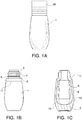
- the receptacle 1 is depicted in FIG. 1 and may be made of glass or plastic.
- the receptacle having a closure 26 thereon is seen in FIG. 1A .
- the receptacle without a closure and showing fill with the treatment composition 11 is seen in FIG. 1B .
- Receptacle has a neck 3 with threads 4 to facilitate engagement with corresponding threads on inner surface of closure 26.
- neck 3 contains a stop 5 in the form of a circumferential bead around the base 6 of the neck 3 to enable securing closure 26 in proper location when the receptacle 1 is closed.
- receptacle 1 is made of glass and, as depicted in FIG.
- the 1C has a base portion 7 that is solid glass of a thickness and diameter sufficient to weight the receptacle 1 to stand upright and resist breakage when dropped. More preferred is where the receptacle 1 is glass and the internal space 8 for storage of the treatment composition is oblong 9 with rounded sides 10. To optimize the delivery of the treatment composition 11, the volume, area, and dimensions of internal space 8 correlates with the applicator (to be discussed later).
- suitable plastics include Bis-phenol A (BPA), polyethylene, polypropylene, or the like.
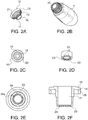
- the receptacle 1 contains a neck 3. Seated within neck 3 is a wiper 12 as best depicted in FIGS. 2 .
- Wiper 12 is made of a pliable thermoplastic material such as low density polyethylene (LDPE) so it has sufficient flexibility to enable fitting into the neck 3 of receptacle 1 and remain in place even when the applicator 35 is removed from the receptacle 1.
- FIG. 2A is a perspective view of wiper 12 showing a collar 13 that creates a circumferential depression 14 that enables wiper 12 to seat onto neck 3 as depicted by numeral 15 in FIG. 2B which shows a top perspective view of the receptacle 1 with wiper 12 seated in neck 3. Also seen in FIG.
- FIG. 2A is the barrel portion 16 of wiper 12 which is formed by downwardly extending circumferential walls 17.
- the orifice 18 of wiper 12 is shown in FIG. 2C which is a top plan view of the wiper 12 showing the top flat edge 19 of collar 13 and circumferential rings 20. If desired, an area of increased thickness or a ridge 21 is found directly beneath collar 13 on wiper 12 to better facilitate seating of wiper 12 in neck.
- FIG. 2D shows a sectional view of sectional walls 17 and the distal portion 22 which has a shelf 23 having holes or serrations 24. Preferably the holes or serrations 24 are evenly spaced around the shelf 23. The purpose of such holes or serrations 24 is to permit the treatment composition 11 to seep into the barrel portion 16 and be stored there.
- FIG. 2E is a bottom plan magnified view of the wiper showing the shelf 23 with holes 24.
- FIG. 2F is a side cutaway view of the wiper showing the collar 13 which has downward projecting arms 25 that form a circumferential depression 14 and downwardly extending walls 17 that terminate in the shelf 23 with holes 24.
- Holes 24 have an external border 24A extending around the circumference of the shelf 23 facing the orifice 18. Holes 24 provide at least two benefits. The first is that holes 24 permit seepage of treatment composition 11 into the barrel portion 16 of wiper.
- holes 24 having external border 24A enable wiper orifice 18 to accommodate applicator 35 enlarged portion 38 to be extracted from the receptacle 1 even when diameter of orifice 18 is smaller than diameter of enlarged portion 38.
- orifice 18 has a cross-sectional diameter of 5.25 to 7.25 millimeters, and is preferably about 6.25 millimeters which is smaller than the cross-sectional diameter of applicator 35 enlarged portion 38, which ranges from 5.6 to 6.6 millimeters with 6.5 millimeters being most preferred. As will be later explained this provides a wiping effect that optimizes placement of the treatment composition 11 load onto the rod 37 and enlarged portion 38.
- the receptacle has a closure 26.
- a perspective view of the closure 26 is seen in FIG. 3A .
- Closure comprises a cap shell 27 that forms the decorative outer surface of the cap that is visible to the consumer.
- Cap shell 27 fits over outer surface 29 of inner cap 28 which is shown in FIG. 3B and 3C .
- Inner cap 28 preferably has circumferential downwardly extending ribs 30 that facilitate holding of cap shell 27 securely on inner cap 28.
- the upper surfaces of ribs 30 terminate in a bead 28A that extends the circumference of the inner cap 28.
- Extending above bead 28A and ribs 30 are a series of upwardly extending panels 31 held in place by struts 32 which connect panels 31 to a central core 33 having side and top walls.
- the underside of central core 33 is hollow and has a downwardly extending wall 34 that permits engagement of the applicator 35 to the inner cap 28.
- FIG. 4A shows the applicator 35 in cross-section.
- FIG. 4B shows a plan view of the applicator 35.
- Proximal end of applicator 35 has a gate 36 and extending upwardly from gate 36 a head and neck 36A. Head and neck 36A mate with downwardly extending walls 34 on underside of central core 33 and hold applicator 35 securely in inner cap 28 and closure 26.
- Applicator is comprised of a rod 37 and a distal enlarged portion 38. If desired, applicator 35 rod 37 contains an enlarged circumferential band 39 which may serve as a stop to prevent the treatment composition 11 from loading too high up on rod 37 and interfering with closure of the receptacle 1.
- Applicator 35 rod 37 has a cross-sectional diameter 41 and distal enlarged portion has a cross-sectional diameter 40.
- the cross-sectional diameter 41 ranges from 4.5 to 5.5 millimeters with 5 millimeters being most preferred; and cross-sectional diameter 40 ranges from 5.6 to 6.6 millimeters with 6.5 millimeters being most preferred.
- Applicator 35 is most preferably made of plastic, in particular, plastics from the polyester family. It is preferred that the plastic be clear or translucent.
- PET polyethylene terephthalate
- PETG polyethylene terephthalate glycol
- the closure 26 is removed from the receptacle.
- the applicator 35 is withdrawn from the receptacle 1 by extracting the applicator 35 through wiper 12.
- Enlarged portion 38 of applicator 35 is extracted through orifice 18 of wiper and because enlarged portion 38 is larger in cross-sectional diameter 40 than orifice 18 the sides 38A of enlarged portion 38 are wiped leaving very little if any treatment composition on the sides of enlarged portion 38.
- due to holes 24 in shelf 23 surrounding orifice 18 treatment composition 11 seeps into the cavity formed by wiper barrel portion 16 and will load onto rod 37.
- rod 37 is much smaller in diameter than orifice, when applicator 35 is extracted from wiper 12 the rod 37 contains a load of treatment composition, while the sides of enlarged portion 38 of applicator 35 are wiped clean, and there is a small dollop 11A of treatment composition 11 left on the distal surface 38B of enlarged portion 38.
- the amount of treatment composition 11 loaded onto the applicator 35 is preferably sufficient for treating the application surface.
- the placement of the treatment composition 11 on the rod 37 and very distal tip 38A of enlarged portion dictates how the consumer will intuitively apply the dose to the treatment surface.
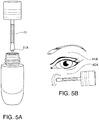
- the rod 37 containing the loaded treatment composition 11 is placed crosswise across the under eye as depicted in FIG. 5B .
- the rod 37 is rolled one or more times to cause the treatment composition 11 to apply to the under eye area 40A.
- the dollop 11A of treatment composition 11 may be used to treat the upper eyelid 41A.
- the enlarged portion 38 is used as a massage tool to massage the treatment composition 11 onto skin of the under eye area 40 and the upper eyelid area 41.
- the massaging application also improves blood flow into the eye area, causing a physical skin plumping and improved penetration of the treatment composition 11.
- the treatment composition may be in the form of an emulsion, aqueous solution or dispersion, gel, or anhydrous composition.
- the treatment composition contains three dimensional spherical structures having membranous outer walls and an internal space within the sphere that is secluded from the surrounding environment.
- the spherical structures are formed when one or more polymers in the formula "ball up" by reacting with other constituent portions on the polymer or other ingredients in the composition to form structures having membranous outer walls protecting an internal space.
- a suitable method for testing whether the polymers to be formulated into the treatment composition will form the desired micromesh structure is simple and can be determined by combining, in water, the polymer and an anionic non-sulfated glycoaminoglycan which is a long unbranched polysaccharides containing repeating disaccharide units.
- the repeating units are amino sugars such as glucosamine or galactosamine and glucuronic acid or galactose.
- Hyaluronic acid is particularly suitable.
- the polymer and the glycosaminoglycan are combined in water.
- One particularly suitable test is to combine from 0.01 to 5% of the polymer with 0.01 to 5% of the glycosaminoglycan, hyaluronic acid in particular, in water and evaluate the formation of the micro-mesh, e.g. the three dimensional spherical structures having membranous outer walls that are interlocked in association to form a network.
- the membranous outer walls of the spherical structures form an internal space within the sphere that is secluded from the surrounding environment.
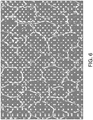
- a desired micro-mesh is microscopically depicted in FIG. 6 which shows the result of combining 0.1% Polyacrylate crosspolymer-6, 0.16% hyaluronic acid, and the remainder water.
- the micro-mesh ingredients are formulated into the treatment composition.
- Polymers that are suitable for micro-mesh formation include, but are not limited to:
- the treatment composition comprises at least one Polymer as further defined herein. Suggested amounts of the Polymer may range from 0.001 to 10 %, preferably 0.01 to 5 % and more preferably 0.05 to 1.0 % by the weight of total composition.
- other suitable polymers that form the desired micro-mesh structure can be identified by combining the test polymer the glycosaminoglycan, most preferably hyaluronic acid (HA).
- the HA may be low molecular weight, high molecular weight, or mixtures of both.
- LMW HA Low molecular weight HA
- LMW HA has a molecular weight ranging from 1 ⁇ 10 3 Dalton to 8 ⁇ 10 5 Dalton, preferably from 5 ⁇ 10 3 Dalton to 1 ⁇ 10 5 Dalton, more preferably from 8 ⁇ 10 3 Dalton to 5 ⁇ 10 4 Dalton.
- the HA may also be high molecular weight (HMW HA), having a 8 ⁇ 10 5 Dalton to 1 ⁇ 10 7 Dalton, preferably from 1 ⁇ 10 6 Dalton to 8 ⁇ 10 6 Dalton, more preferably from 1.2 ⁇ 10 6 Dalton to 3 ⁇ 10 6 Dalton.
- HMW HA high molecular weight
- the HA may be a mixture of LMW HA and HMW HA.
- Reference to the Polymer, LMW HA, HMW HA, and polyamino acid will also include the corresponding alkali metal or alkaline earth metal salts including but not limited to sodium, potassium, and the like.
- Suitable Polymers include:
- One suitable polymer is a water-absorbing polymer as disclosed in U.S. Patent Application Publication No. 2016-0030328 .
- This polymer may be obtained from the polymerization of monomers (A), (B) and (C):
- Component (A) is a phosphate-containing acrylic or methacrylic monomer.
- a monomer has a phosphate group and an acrylic or methacrylic group
- the structure of a linkage for connecting these two groups is not particularly limited.
- Exemplary linkages include alkylene groups such as methylene, ethylene and propylene and oxyalkylene groups such as oxyethylene, oxypropylene, oxybutylene, oxypentamethylene and mixtures thereof. Of these, polyoxyalkylene groups are preferred, with polyoxypropylene being most preferred.
- the monomer is commercially available, for example, under the tradename of Sipomer PAM-200 from Rhodia.
- a salt of a phosphate-containing acrylic or methacrylic monomer which may be formed by adding an alkaline aqueous solution to the phosphate-containing acrylic or methacrylic monomer.
- Component (B) is a monomer having one acrylic or methacrylic group within the molecule other than component (A).
- Suitable monomers include acrylic acid, methacrylic acid, maleic acid, maleic anhydride, fumaric acid, crotonic acid, itaconic acid, 2-(meth)acrylamide-2-methylpropanesulfonic acid, (meth)acryloxyalkanesulfonic acid, N-vinyl-2-pyrrolidone, N-vinylacetamide, (meth)acrylamide, N-isopropyl(meth)acrylate, N,N-dimethyl(meth)acrylamide, 2-hydroxyethyl(meth)acrylate, methoxypolyethylene glycol(meth)acrylate, polyethylene glycol(meth)acrylate, and stearyl acrylate.
- a salt of the monomer may be formed by adding an alkaline aqueous solution to the (meth)acrylic monomer.
- the "salt” includes alkali metal salts such as sodium, potassium and lithium, alkaline earth metal salts such as calcium, magnesium and barium, and ammonium salts such as quaternary ammonium and quaternary alkyl ammonium. Inter alia, sodium salt is the most common and preferred.
- Neutralization treatment is preferably carried out at a temperature of 10 to 100° C., more preferably 20 to 90° C.
- Acrylic acid or polyacrylic acid following polymerization may be neutralized with a base.
- Neutralization prior to polymerization is preferred because it is time consuming to post-neutralize non-neutralized or low-neutralized (specifically a degree of neutralization of less than 30 mol %) polyacrylic acid following polymerization.
- the water-absorbing polymer of the invention preferably has a degree of neutralization of 0.01 to 100%, more preferably 1 to 90%, and even more preferably 20 to 80% based on the moles of acid groups in the polymer.
- Component (C) is an organopolysiloxane having a (meth)acrylic group at both ends, represented by the general formula (1): wherein R 1 is each independently an aliphatic unsaturation-free monovalent hydrocarbon group having 1 to 8 carbon atoms.
- R 2 is a group containing a polyoxyalkylene group having the general formula (2): -R 4 (OC 2 H 4 )x(OC 3 H 6 )yOH (2) wherein R 4 is each independently a divalent organic group having 2 to 15 carbon atoms, x and y each are an integer of 0 to 30, meeting 1 ⁇ x+y ⁇ 50, R 3 is a substituent group having a (meth)acrylic group, a is an integer inclusive of 0 and b is an integer of at least 1.
- Examples of the monovalent hydrocarbon group represented by R 1 include alkyl groups such as methyl, ethyl and butyl, cycloalkyl groups such as cyclopentyl and cyclohexyl, aryl groups such as phenyl and tolyl, and aralkyl groups such as benzyl and phenethyl.
- alkyl groups such as methyl, ethyl and butyl
- cycloalkyl groups such as cyclopentyl and cyclohexyl
- aryl groups such as phenyl and tolyl
- aralkyl groups such as benzyl and phenethyl.
- alkyl groups of 1 to 4 carbon atoms and phenyl are preferred, with methyl being most preferred.
- R 4 is each independently selected from divalent organic groups having 2 to 15 carbon atoms, for example, -(CH 2 ) 2 -, -(CH 2 ) 3 -, -(CH 2 ) 4 -, -CH 2 CH(CH 3 )CH 2 -, -(CH 2 ) 8 -, and -(CH 2 ) 11 -. Inter alia, -(CH 2 ) 2 -, -(CH 2 ) 3 -, and -(CH 2 ) 4 - are preferred.
- Each of x and y is an integer of 0 to 30, meeting 1 ⁇ x+y ⁇ 50.
- each of x and y is an integer of 5 to 25, more preferably 10 to 20, and the sum of x+y is 10 to 45, more preferably 20 to 40.
- a preferred suitable water-absorbing polymer is Sodium Polyacrylate Crosspolymer-1, which is a crosslinked polymer that is obtained by the polymerization of methacrylic acid and methacryloyl PPG-6 phosphate and a silicone copolymer prepared by reacting a methacrylateterminated polydimethylsiloxane polymer containing silicon hydride groups with PEG-18/PPG-17 allyl ether.
- a thickening polymer obtained from the polymerization of partially salified or completely salified 2-methyl 2-[(1-oxo 2-propenyl) amino] 1-propanesulfonic acid, with at least one neutral monomer selected from acrylamide, (2-hydroxy-ethyl) acrylate or N-N-dimethyl acrylamide, and at least one monomer of formula (I): in which R represents a linear or branched alkyl radical having from eight to twenty carbon atoms and n represents a number greater than or equal to one and less than or equal to twenty, selected from tetraethoxylated lauryl methacrylate or eicosaethoxylated stearyl methacrylate in the presence of at one crosslinking agent.
- This polymer is set forth in U.S. Patent Application Publication No. 2012/0172457 also hereby incorporated by reference in its entirety.
- One preferred suitable thickening polymer is a copolymer of ammonium acryloyldialkyltaurate, dialkylacrylamide, lauryl methacrylate and laureth-4 methacrylate, crosslinked with trimethylolpropane triacrylate.
- Polyacrylate crosspolymer-6 is a copolymer of ammonium acryloyldimethyltaurate, dimethylacrylamide, lauryl methacrylate and laureth-4 methacrylate, crosslinked with trimethylolpropane triacrylate.
- acrylate crosslinked silicone copolymers that contain at least one polyether substituted structure unit and at least one epoxy or oxirane structural unit reacted with acrylates to produce crosslinked silicones containing polyether substituted structural networks and acrylate crosslinks.
- Such polymers are disclosed in U.S. Patent Nos. 7,687,574 and 7,833,541 which are hereby incorporated by reference in the entirety.
- the polymer may be the reaction product of:
- a preferred suitable polymer is Polyacrylate Crosspolymer-7, which is a copolymer of methacrylate PPG-6 phosphate and one or more monomers of acrylic acid, methacrylic acid or one of their simple esters, crosslinked with dimethicone PEG/PPG-25/29 acrylate.
- a more preferred suitable natural anionic polysaccharide is sodium alginate.
- the treatment composition should also contain the ingredient used to test the polymer for formation of the micro-mesh structure.
- the glycosaminoglycan was hyaluronic acid (HA)
- HA hyaluronic acid
- the treatment composition may be in a variety of forms including an emulsion, either water in oil or oil in water emulsion. If in the form of an emulsion, the composition may contain from about 1-99%, preferably from about 5-90%, more preferably from about 10-85% water and from about 1-99%, preferably from about 5-90%, more preferably from about 5-75% of oil. If in the form of an aqueous suspension or dispersion, the composition may generally contain from about 1-99.9%, preferably from about 5-95%, more preferably from about 10-90% water, with the remaining ingredients being the active ingredients or other formula ingredients.
- the HAs are a mixture of low and high molecular weights (LMW HA and HMW HA) cosmetic composition comprises at least one LMW HA and at least one HMW HA.
- LMW HA and HMW HA low and high molecular weights
- the weight ratio of LMA HA to HMW HA may range from about 100:1 to 1:100, preferably about 50:1 to 1:50, more preferably about 15:1 to 1:15.
- the HMW HA has a molecular weight ranging from about 8 ⁇ 10 5 Dalton to 1 ⁇ 10 7 Dalton, preferably from 1 ⁇ 10° Dalton to 8 ⁇ 10 6 Dalton, more preferably from 1.2 ⁇ 10 6 Dalton to 3 ⁇ 10 6 Dalton.
- the HMW HA may be synthetic or it may be obtained by biotechnological processing by fermenting yeasts such as saccharomyces in fermentation processes.
- a suitable HMW HA for use in the claimed composition may be purchased from Contipro Biotech s.r.o. under the name Hyaluronic Acid, Sodium Salt which has the INCI name Sodium Hyaluronate.
- HMW HA may range from about 0.001 to 10%, preferably about 0.005 to 5% and more preferably about 0.01 to 1.5% by weight of the total composition.
- the molecular weight of the LMA HA or its salt may range from about 1 ⁇ 10 3 Dalton to 8 ⁇ 10 5 Dalton, preferably from 5 ⁇ 10 3 Dalton to 1 ⁇ 10 5 Dalton, more preferably from 8 ⁇ 10 3 Dalton to 5 ⁇ 10 4 Dalton.
- the LMW HA may also be synthetic or it may be obtained by biotechnological processing by fermenting yeasts such as saccharomyces from fermentation processes.
- a suitable hyaluronic acid for use in the claimed composition may be purchased from Contipro Biotech s.r.o. under the name HyActive powder which has the INCI name Sodium Hyaluronate.
- LMW HA ranges from about 0.001 to 10%, preferably about 0.005 to 5% and more preferably about 0.01 to 1.5% by weight of the total composition.
- the treatment composition may contain other ingredients including but not limited to those set forth herein
- One optional ingredient present in the treatment composition is an autophagy activator, which, if present, may be in amounts ranging from about 0.00001 to 20%, preferably 0.0001-5%, more preferably from about 0.001 to 1%.
- ingredients that are known to stimulate autophagy are yeast extracts including but not limited to those from the genuses such as Lithothamnium, Melilot, Citrus, Candida, Lens, Urtica , Carambola , Momordica, Yarrowia, Plumbago, etc. Further specific examples include Lithothamniumn calcareum, Melilotus officinalis, Citrus limonum, Candida saitoana , Lens culinaria , Urtica dioica , Averrhoa carambola , Momordica charantia , Yarrowia lipolytica, Plumbago zeylanica and so on.
- Another optional ingredient in the treatment composition is a proteasome activator which, if present, may range from about 0.0001 to 5%, preferably from about 0.0005 to 2.0%, more preferably from about 0.001 to 1.5%.
- Suitable proteasome activators are any compounds, molecules, or active ingredients that stimulate proteasome activity in the cells of keratin surfaces.
- proteasome activators include, but are not limited to, algin, alginates, hydrolyzed algin, molasses extract, Trametes extracts, including extracts from Trametes versicolor, olea hydroxol.
- CLOCK or PERI cellular gene activator Another optional ingredient in the treatment composition is a CLOCK or PERI cellular gene activator. Suggested ranges are from about 0.000001 to about 3.0%, preferably from about 0.000005 to 2.5%, more preferably from about 0.00001 to 2%. Suitable CLOCK or PERI activators may be present in the form of botanical extracts, polypeptides, peptides, amino acids, and the like.
- a particularly preferred CLOCK and/or PERI gene activator comprises a peptide of the formula (I): R 1 -(AA) n -X 1 -S-T-P-X 2 -(AA) p -R 2 where (AA) n -X 1 -S-T-P-X 2 -(AA) p is (SEQ ID No. 1), and:
- Cichoric acid may be synthetic or naturally derived. Synthetic cichoric acid may be purchased from a number of commercial manufacturers including Sigma Aldrich. Cichoric acid may also be extracted from botanical sources that are known to contain cichoric acid such as Echinacea, Cichorium, Taraxacum, Ocimum, Melissa, or from algae or sea grasses. More specifically, botanical extracts such as Echinacea purpurea, Cichorium intybus, Taraxacum officinale, Ocimum basilicum, or Melissa officinalis. The term "cichoric acid” when used herein also includes any isomers thereof that are operable to increase PERI gene expression in skin cells.
- a specific example includes a botanical extract from Echinacea purpurea sold by Symrise under the brand name SymfinityTM 1298 which is a water extract of Echinacea purpurea which is standardized during the extraction process to contain about 3% by weight of the total extract composition of cichoric acid.
- Echinacea extracts from different sources will vary in cichoric acid content, and as such will yield variable results in induction of PERI gene expression.
- Ethanolic extract of the roots of Echinacea purpura will provide more cichoric acid than ethanolic extracts of Echineacea angustifolia or Echinacea pallida.
- the content of active ingredients in any extract is also very dependent on the method of extraction. For example, it is known that in many cases enzymatic browning during the extraction process will reduce the phenolic acid content of the resulting extract.
- Another optional ingredient in the treatment composition is a DNA repair enzyme. Suggested ranges are from about 0.00001 to about 5%, preferably from about 0.00005 to about 3%, more preferably from about 0.0001 to about 2.5% of one or more DNA repair enzymes.
- DNA repair enzyme may be purchased from AGI/Dermatics under the trade name Roxisomes®, and has the INCI name Arabidopsis Thaliana extract. It may be present alone or in admixture with lecithin and water. This DNA repair enzyme is known to be effective in repairing 8-oxo-Guanine base damage.
- DNA repair enzyme Another type of DNA repair enzyme that may be used is one that is known to be effective in repairing 06-methyl guanine base damage. It is sold by AGI/Dermatics under the tradename Adasomes®, and has the INCI name Lactobacillus ferment, which may be added to the composition of the invention by itself or in admixture with lecithin and water.
- Ultrasomes® comprises a mixture of Micrococcus lysate (an end product of the controlled lysis of various species of micrococcus), lecithin, and water.
- Photosomes® comprise a mixture of plankton extract (which is the extract of marine biomass which includes one or more of the following organisms: thalassoplankton, green micro-algae, diatoms, greenish-blue and nitrogen-fixing seaweed), water, and lecithin.
- DNA repair enzyme may be a component of various inactivated bacterial lysates such as Bifida lysate or Bifida ferment lysate, the latter a lysate from Bifido bacteria which contains the metabolic products and cytoplasmic fractions when Bifido bacteria are cultured, inactivated and then disintegrated.
- Bifida lysate or Bifida ferment lysate a lysate from Bifido bacteria which contains the metabolic products and cytoplasmic fractions when Bifido bacteria are cultured, inactivated and then disintegrated.
- This material has the INCI name Bifida Ferment Lysate.
- the composition may contain one or more humectants. If present, they may range from about 0.01 to 35%, preferably from about 0.5 to 20%, more preferably from about 0.5 to 15%.
- suitable humectants include glycols, sugars, and the like.
- Suitable glycols are in monomeric or polymeric form and include polyethylene and polypropylene glycols such as PEG 4-10, which are polyethylene glycols having from 4 to 10 repeating ethylene oxide units; as well as C 1-6 alkylene glycols such as propylene glycol, butylene glycol, pentylene glycol, and the like.
- Suitable sugars some of which are also polyhydric alcohols, are also suitable humectants.
- sugars examples include glucose, fructose, honey, hydrogenated honey, inositol, maltose, mannitol, maltitol, sorbitol, sucrose, xylitol, xylose, and so on.
- urea is also suitable.
- the humectants used in the composition of the invention are C 1-6 , preferably C 2-4 alkylene glycols, most particularly butylene glycol.
- the composition may contain one more surfactants, especially if in the emulsion form.
- surfactants may be used if the compositions are solutions, suspensions, or anhydrous also, and will assist in dispersing ingredients that have polarity, for example pigments.
- Such surfactants may be silicone or organic based.
- the surfactants will also aid in the formation of stable emulsions of either the water-in-oil or oil-in-water form. If present, the surfactant may range from about 0.001 to 10%, preferably from about 0.005 to 8%, more preferably from about 0.1 to 5% by weight of the total composition.
- the composition may comprise one or more nonionic organic surfactants.
- Suitable nonionic surfactants include alkoxylated alcohols or ethers, formed by the reaction of an alcohol with an alkylene oxide, usually ethylene or propylene oxide.
- Suitable alcohols include mono-, di-, or polyhydric short chain (CI-6) alcohols; aromatic or aliphatic saturated or unsaturated fatty (C12-40) alcohols, of cholesterol; and so on.
- the alcohol is cholesterol, or an aromatic or aliphatic saturated or unsaturated fatty alcohol which may have from 6 to 40, preferably from about 10 to 30, more preferably from about 12 to 22 carbon atoms.
- examples include oleyl alcohol, cetearyl alcohol, cetyl alcohol, stearyl alcohol, isostearyl alcohol, behenyl alcohol, and the like.
- examples of such ingredients include Oleth 2-100; Steareth 2-100; Beheneth 5-30; Ceteareth 2-100; Ceteth 2-100; Choleth 2-100 wherein the number range means the number of repeating ethylene oxide units, e.g. Ceteth 2-100 means Ceteth where the number of repeating ethylene oxide units ranges from 2 to 100.
- Derivatives of alkoxylated alcohols are also suitable, such as phosphoric acid esters thereof.
- Some preferred organic nonionic surfactants include Oleth-3, Oleth-5, Oleth-3 phosphate, Choleth-24; Ceteth-24; and so on.
- alkoxylated alcohols formed with mono-, di-, or polyhydric short chain alcohols, for example those having from about 1 to 6 carbon atoms.
- alkoxylated alcohols formed with mono-, di-, or polyhydric short chain alcohols, for example those having from about 1 to 6 carbon atoms.
- Examples include glucose, glycerin, or alkylated derivatives thereof.
- Examples include glycereth 2-100; gluceth 2-100; methyl gluceth 2-100 and so on. More preferred are methyl gluceth-20; glycereth-26 and the like.
- alkoxylated alcohols are suitable surfactants, including ethylene oxide polymers having varying numbers of repeating EO groups, generally referred to as PEG 12 to 200. More preferred are PEG-75, which is may be purchased from Dow Chemical under the trade name Carbowax PEG-3350.
- Suitable nonionic surfactants include alkoxylated sorbitan and alkoxylated sorbitan derivatives.
- alkoxylation, in particular ethoxylation of sorbitan provides polyalkoxylated sorbitan derivatives.
- Esterification of polyalkoxylated sorbitan provides sorbitan esters such as the polysorbates.
- the polyalkyoxylated sorbitan can be esterified with C6-30, preferably C12-22 fatty acids. Examples of such ingredients include Polysorbates 20-85, sorbitan oleate, sorbitan sesquioleate, sorbitan palmitate, sorbitan sesquiisostearate, sorbitan stearate, and so on.
- silicone or silane-based surfactants include organosiloxanes substituted with ethylene oxide or propylene oxide groups such as PEG dimethicones which are dimethicones substituted with polyethylene glycols including those having the INCI names PEG-1 dimethicone; PEG-4 dimethicone; PEG-8 dimethicone; PEG-12 dimethicone; PEG-20 dimethicone; and so on.
- organosiloxanes substituted with ethylene oxide or propylene oxide groups such as PEG dimethicones which are dimethicones substituted with polyethylene glycols including those having the INCI names PEG-1 dimethicone; PEG-4 dimethicone; PEG-8 dimethicone; PEG-12 dimethicone; PEG-20 dimethicone; and so on.
- silanes substituted with ethoxy groups or propoxy groups or both such as various types of PEG methyl ether silanes such as bis-PEG-18 methyl ether dimethyl silane; and so on.
- silicone based surfactants include those having the generic names dimethicone copolyol; cetyl dimethicone copolyol; and so on.
- the compositions of the invention are in emulsion form, the composition will comprise an oil phase.
- Oily ingredients are desirable for the skin moisturizing and protective properties.
- Suitable oils include silicones, esters, vegetable oils, synthetic oils, including but not limited to those set forth herein.
- the oils may be volatile or nonvolatile, and are preferably in the form of a pourable liquid at room temperature.
- volatile means that the oil has a measurable vapor pressure, or a vapor pressure of at least about 2 mm. of mercury at 20° C.
- nonvolatile means that the oil has a vapor pressure of less than about 2 mm. of mercury at 20° C. If present, such oils may range from about 0.01 to 85%, preferably from about 0.05 to 80%, more preferably from about 0.1 to 50%.
- the oils may include volatile silicones or volatile paraffinic hydrocarbons, or nonvolatile silicones or organic oils.
- Examples include monoesters including hexyl laurate, butyl isostearate, hexadecyl isostearate, cetyl palmitate, isostearyl neopentanoate, stearyl heptanoate, isostearyl isononanoate, steary lactate, stearyl octanoate, stearyl stearate, isononyl isononanoate, and so on; diesters such as diisotearyl malate, neopentyl glycol dioctanoate, dibutyl sebacate, dicetearyl dimer dilinoleate, dicetyl adipate, diisocetyl adipate, diisononyl adipate, diisostearyl dimer dilinoleate, diisostearyl fumarate, diisostearyl malate, dioctyl malate, and so
- Synthetic or naturally occurring glyceryl esters of fatty acids, or triglycerides are also suitable for use in the compositions. Both vegetable and animal sources may be used. Examples of such oils include castor oil, lanolin oil, C 10-18 triglycerides, caprylic/capric/triglycerides, sweet almond oil, apricot kernel oil, sesame oil, camelina sativa oil, tamanu seed oil, coconut oil, corn oil, cottonseed oil, linseed oil, ink oil, olive oil, palm oil, illipe butter, rapeseed oil, soybean oil, grapeseed oil, sunflower seed oil, walnut oil, and the like.
- oils include castor oil, lanolin oil, C 10-18 triglycerides, caprylic/capric/triglycerides, sweet almond oil, apricot kernel oil, sesame oil, camelina sativa oil, tamanu seed oil, coconut oil, corn oil, cottonseed oil, lin
- glyceryl esters such as fatty acid mono-, di-, and triglycerides which are natural fats or oils that have been modified, for example, mono-, di- or triesters of polyols such as glycerin.
- a fatty (C 12-22 ) carboxylic acid is reacted with one or more repeating glyceryl groups.
- glyceryl stearate diglyceryl diiosostearate, polyglyceryl-3 isostearate, polyglyceryl-4 isostearate, polyglyceryl-6 ricinoleate, glyceryl dioleate, glyceryl diisotearate, glyceryl tetraisostearate, glyceryl trioctanoate, diglyceryl distearate, glyceryl linoleate, glyceryl myristate, glyceryl isostearate, PEG castor oils, PEG glyceryl oleates, PEG glyceryl stearates, PEG glyceryl tallowates, and so on.
- Examples of preferred embodiments for the treatment composition having microscopic three dimensional spherical structures that may be incorporated into the package include one or more of the below: An oil in water emulsion comprising 10-95% water, 0.1 to 5% of the Polymer, from 0.1 to 10% of the glycosaminoglycan, 0.1 to 10% nonionic surfactant, 0.1-5% humectant, and at least one OGG1 DNA repair enzyme.
- An oil in water emulsion comprising 10-95% water, 0.1 to 5% of the Polymer, from 0.1 to 10% of the glycosaminoglycan, 0.1 to 10% nonionic surfactant, 0.1-5% humectant, and from 0.001-5% of an autophagy activator.
- An oil in water emulsion comprising 10-95% water, 0.1 to 5% of the Polymer, from 0.1 to 10% of the glycosaminoglycan, 0.1 to 10% nonionic surfactant, 0.1-5% humectant, and from 0.005-2% of at least one proteasome activator.
- An oil in water emulsion comprising 10-95% water, 0.1 to 5% of the Polymer, from 0.1 to 10% of the glycosaminoglycan, 0.1 to 10% nonionic surfactant, 0.1-5% humectant, and from 0.00001-2% of at least one CLOCK or PERI gene activator.
- An oil in water emulsion comprising 5-99% water, 0.01 to 5% of a polymer selected from the group consisting of Polyacrylate crosspolymer-6, Sodium polyacrylate crosspolymer-1, Polyacrylate crosspolymer-7, alginic acid or the sodium salt; from 0.01 to 15% of hyaluronic acid, and water.
- Micro-mesh compositions were prepared as follows: Ingredient Concentration (Wt%) Trade Name INCI Name Sepimax Zen Polyacrylate Crosspolymer-6 0.1 Hyaluronic Acid, Sodium Salt Sodium Hyaluronate (HMW) 0.11 Hyactive 10 Sodium Hyaluronate (LMW) 0.05 Aquadew SPA-30B Sodium Polyaspartate 0.5 Phenoxyethanol Phenoxyethanol 0.5 Water q.s. 100
- composition was prepared by combining phenoxyethanol and water and mixing well.
- Hyaluronic acid in the form of a mixture of low and high molecular weight hyaluronic acids was added to the mixture until uniform.
- Polyacrylate crosspolymer-6 was then added and mixed well till uniform.
- composition was scanned with a Zeiss SEM.
- SEM images on FIG. 6 were in two different scales for a better view of the micro-mesh structure with the scale bars shown the the bottom left corner of each image.
- Skincare compositions were made as following: Ingredient Concentration (Wt%) Trade Name INCI Name #1 #2 Sepixmax Zen Polyacrylate Crosspolymer-6 0 0.1 Hyaluronic Acid, Sodium Salt Sodium Hyaluronate 0 0.11 Hyactive 10 Sodium Hyaluronate 0 0.05 Aquadew SPA-30B Sodium Polyaspartate 0.5 0.5 Purified Water Water 36.4 36.1 Bifidus Extract Cl Pk Ehg Water ⁇ Aqua ⁇ Eau/Bifida Ferment Lysate/Ethylhexylglycerin 9.4 9.4 Bentone Gel Ihd V Isohexadecane/Disteardimoni um Hectorite/Propylene Carbonate 7.5 7.5 Xiameter Pmx-200 Silicone Fl.
- Formulas 1 and 2 were prepared. Formula 1 is not in the micro-mesh form because it is missing the mesh-forming polymer, Polyacrylate crosspolymer-6. Formula 2 contains the micromesh forming ingredients.
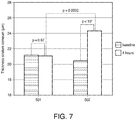
- a clinical study was performed on fifteen panelists to evaluate the efficacy of formulas 1 and 2 on the thickness of the stratum corneum of the under-eye area. The test areas in this study were the left and the right under-eye area.
- a split face study was performed where 300 ⁇ L of the formulas 1 and 2 were applied on the left and right side of the face. Compositions were applied to the subjects in a left/right randomized way. The stratum corneum was evaluated in the under-eye area at baseline and 4 hours after treatment by Reflectance Confocal Microscopy (RCM).
- RCM Reflectance Confocal Microscopy
- the stratum corneum was evaluated with Reflectance Confocal Microscopy (RCM) using the Vivascope 3000. Confocal images were used to determine the thickness of the stratum corneum at baseline and 4 hours after treatment.
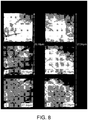
- FIG. 8 shows representative reflectance confocal images of the stratum corneum and the stratum granulosum of the under-eye area of one panelist taken 4 hours after product application.
- the depth of recording (average of 5 'stacks') is given.
- the stratum granulosum (image B) was detected at 20.18 ⁇ m below the top of the stratum corneum (image A).
- the stratum granulosum image F was detected at 27.34 ⁇ m below the top of the stratum corneum (image D). This illustrates the thickening of the stratum corneum on the composition 2 treated site.
Landscapes
- Health & Medical Sciences (AREA)
- Life Sciences & Earth Sciences (AREA)
- Public Health (AREA)
- Veterinary Medicine (AREA)
- Animal Behavior & Ethology (AREA)
- General Health & Medical Sciences (AREA)
- Epidemiology (AREA)
- Birds (AREA)
- Dermatology (AREA)
- Engineering & Computer Science (AREA)
- Biomedical Technology (AREA)
- Gerontology & Geriatric Medicine (AREA)
- Mechanical Engineering (AREA)
- Cosmetics (AREA)
Claims (15)
- Verpackte Hautbehandlungszusammensetzung, die umfasst:(a) ein Behältnis (1) mit einem Hals (3), und das darin eine Behandlungszusammensetzung (11) gelagert aufweist,(b) einen Abstreifer (12), der innerhalb des Halses (3) befestigt ist und einen internen Hülsenabschnitt (16) aufweist,(c) einen Verschluss (26) für das Behältnis (1),(d) einen Applikator (35), der aus einem Stab (37) besteht, wobei ein proximales Ende des Applikators an dem Verschluss (26) befestigt ist, und ein distales Ende des Applikators in einem verbreiterten Abschnitt (38) endet,dadurch gekennzeichnet, dass:die Behandlungszusammensetzung (11) mikroskopische dreidimensionale sphärische Strukturen, die membranartige Außenwände und abgeschlossene Innenräume aufweisen, enthält,der Abstreifer (12) an dem Hals (3) mit einem Bund (13) befestigt ist, der sich nach unten erstreckende Arme (25) aufweist, die eine umfängliche Vertiefung (14) bilden, wobei der Hülsenabschnitt (16) des Abstreifers (12) durch Erstrecken umfänglicher Wände (17) nach unten gebildet ist, die in einem distalen Abschnitt (22) enden, der eine Öffnung (18) ist, die von einem Bord (23), das Bohrungen (24) darin aufweist, umgeben ist,wobei, wenn der Applikator (35) aus dem Behältnis (1) durch den Abstreifer (12) herausgezogen wird, sich die Behandlungszusammensetzung (11) auf den Stab (37) lädt, um das Auftragen der Behandlungszusammensetzung (11), die mikroskopische sphärische Strukturen enthält, auf die Behandlungsoberfläche zu erlauben, undwobei, wenn der Applikator (35) durch den Abstreifer (12) herausgezogen wird, die Seiten des verbreiterten Abschnitts (38) des Applikators von der Behandlungszusammensetzung (11) saubergewischt werden.
- Verpackung nach Anspruch 1, wobei die Behandlungsoberfläche um das Auge liegt, und die Behandlungszusammensetzung (11) eine Augenbehandlungszusammensetzung ist.
- Verpackung nach Anspruch 1 oder 2, wobei das Behältnis (1) Glas ist.
- Verpackung nach einem vorstehenden Anspruch, wobei die Bohrungen (24) einen externen Rand (24A) aufweisen; und
wobei die Bohrungen (24) gleichmäßig entlang des Bords (23) beabstandet sind. - Verpackung nach einem vorstehenden Anspruch, wobei der Stab ein proximales Ende aufweist, das ein Tor aufweist.
- Verpackung nach Anspruch 5, wobei der Stab (37) einen Kopf und einen Hals (36A) aufweist, und sich der Kopf und der Hals von dem Tor aufwärts erstrecken; und/oder
wobei der Stab (37) ein verbreitetes umfängliches Band aufweist; und oder
wobei der Stab (37) einen Querschnittdurchmesser (41) aufweist, der von 4,5 bis 5,5 Millimeter reicht, und der verbreiterte Abschnitt (38) einen Querschnittdurchmesser (40) aufweist, der von 5,6 bis 6,6 Millimeter reicht. - Verpackung nach Anspruch 5 oder 6, wobei der Applikator (35) aus einem durchsichtigen oder durchscheinenden Thermoplastmaterial hergestellt ist, das aus Polyethylenterephthalat oder Polyethylenterephthalatglycol ausgewählt ist.
- Verpackung nach einem vorstehenden Anspruch, wobei die distale Öffnung (18) des Abstreifers (12) einen Durchmesser, der von 5,6 bis 7,6 mm reicht, aufweist.
- Verpackung nach einem vorstehenden Anspruch, wobei der Verschluss (26) eine Kappenschale (27) und eine innere Kappe (28) umfasst, und die Kappenschale (27) über die innere Kappe (28) passt.
- Verpackung nach Anspruch 9, wobei die innere Kappe (28) sich umfänglich nach unten erstreckende Rippen (30) aufweist, die in einem Randwulst (28A) enden, der den Umfang der Kappe am oberen Ende davon erweitert;
wobei die innere Kappe (28) eine Reihe von Paneelen (31) enthält, die sich von dem Randwulst (28A) aufwärts erstrecken; und
wobei die Paneele (31) durch Streben (32) abgestützt sind. - Verpackung nach Anspruch 1:wobei der Abstreifer (12) den internen Hülsenabschnitt (16), der von den sich abwärts erstreckenden Wänden (17), die in der Öffnung (18) enden, die von dem Bord (23) umgeben ist, das Bohrungen (24) darin aufweist, umfasst, wobei die Bohrungen (24) von einem externen Rand (24A) umgeben sind,wobei der Verschluss (26) für das Behältnis (1) eine Kappenschale (27) und eine innere Kappe (28) umfasst, wobei die innere Kappe (28) sich nach unten erstreckende Rippen (30) auf der äußeren Oberfläche davon, sich nach oben erstreckende Paneele (31), Streben (32) und einen zentralen Kern (33) aufweist, und die sich nach unten erstreckenden Rippen (30) eine obere Oberfläche aufweisen, die in einem Randwulst (28A) endet, die entlang des Umfangs der Kappe verläuft, und die sich nach oben erstreckenden Paneele (31) sich oberhalb des Randwulsts (28A) erstrecken und von den Streben (32) an Ort und Stelle gehalten werden, die die Paneele (31) mit dem zentralen Kern (33) verbinden, der obere Wände und Seitenwände und einen hohlen inneren Abschnitt, der eine sich erstreckende Wand aufweist, aufweist, undwobei der Applikator (35) den Stab (37) umfasst, wobei das proximale Ende des Applikators (35) an der sich erstreckenden Wand des hohlen inneren Abschnitts des zentralen Kerns (33) der inneren Kappe (28) befestigt ist, und das distale Ende des Applikators in dem verbreiterten Abschnitt (38) endet, wobei der Querschnittdurchmesser (40) des verbreiterten Abschnitts (38) größer ist als der Querschnittdurchmesser der Öffnung (18) und des Stabes (37).
- Verpackung nach Anspruch 11, wobei, wenn der Applikator (35) aus dem Behältnis (1) extrahiert wird, die Behandlungszusammensetzung (11) auf den Stab (37) und die distale Spitze (38A) des verbreiterten Abschnitts (38) geladen wird, um das Auftragen einer Menge an Behandlungszusammensetzung (11) auf einer Behandlungsoberfläche, die jeweils unter dem Auge und über dem Auge liegt, zu erlauben.
- Verpackung nach einem vorstehenden Anspruch, wobei die Öffnung (18) einen Querschnittdurchmesser von 5,25 bis 7,25 Millimeter aufweist, der kleiner ist als ein Querschnittdurchmesser des verbreiterten Abschnitts (38) des Applikators (35), wobei der Querschnittdurchmesser des verbreiterten Abschnitts (38) 5,6 bis 6,6 Millimeter beträgt.
- Verpackung nach einem vorstehenden Anspruch, wobei es die Bohrungen (24) der Behandlungszusammensetzung (11) erlauben, in den Hülsenabschnitt (16) des Abstreifers (12) zu sickern.
- Verfahren zum Auftragen auf die Haut einer Behandlungszusammensetzung, die mikroskopische dreidimensionale sphärische Strukturen enthält, die membranartige Außenwände und abgeschlossene Innenräume aufweisen, das die Schritte umfasst des:- Lagerns der Behandlungszusammensetzung (11) in einem Behältnis (1) mit einem Hals (3) und einem Abstreifer (12), der innerhalb des Halses (3), der einen internen Hülsenabschnitt (16) aufweist, befestigt ist, einen Verschluss (26) für das Behältnis (1), und einen Applikator (35), der aus einem Stab (37) besteht, wobei ein proximales Ende des Applikators an dem Verschluss (26) befestigt ist, und ein distales Ende des Applikators in einem verbreiterten Abschnitt (38) endet,
wobei der Abstreifer (12) in dem Hals (3) mit einem Bund (13) befestigt ist, der sich nach unten erstreckende Arme (25) aufweist, die eine umfängliche Vertiefung (14) bilden, wobei der Hülsenabschnitt (16) des Abstreifers (12) durch sich nach unten erstreckende Umfangswände (17) gebildet ist, die in einem distalen Abschnitt (22) enden, der eine Öffnung (18) ist, die von einem Bord (23), das Bohrungen (24) darin aufweist, umgeben ist,- Extrahierens des Applikators (35) aus dem Behältnis (1) und des Ladens der Behandlungszusammensetzung (11) darauf,
wobei, wenn der Applikator (35) aus dem Behältnis (1) durch den Abstreifer (12) extrahiert wird, sich die Behandlungszusammensetzung (11) auf den Stab (37) lädt, um das Auftragen der Behandlungszusammensetzung (11), die die mikroskopischen sphärischen Strukturen enthält, auf die Behandlungsoberfläche zu erlauben, und
wobei, wenn der Applikator (35) durch den Abstreifer (12) extrahiert wird, die Seiten des verbreiterten Abschnitts (38) des Applikators von der Behandlungszusammensetzung (11) saubergewischt werden,- Auftragens der Behandlungszusammensetzung (11), die die mikroskopischen dreidimensionalen sphärischen Strukturen enthält, mit dem Applikator (35) auf die Haut.
Applications Claiming Priority (3)
| Application Number | Priority Date | Filing Date | Title |
|---|---|---|---|
| US201662434717P | 2016-12-15 | 2016-12-15 | |
| US15/598,430 US10660419B2 (en) | 2016-12-15 | 2017-05-18 | Packaged skin treatment composition and method |
| PCT/US2017/064764 WO2018111629A1 (en) | 2016-12-15 | 2017-12-05 | Packaged skin treatment composition and method |
Publications (3)
| Publication Number | Publication Date |
|---|---|
| EP3554310A1 EP3554310A1 (de) | 2019-10-23 |
| EP3554310A4 EP3554310A4 (de) | 2019-12-11 |
| EP3554310B1 true EP3554310B1 (de) | 2021-02-24 |
Family
ID=62556477
Family Applications (2)
| Application Number | Title | Priority Date | Filing Date |
|---|---|---|---|
| EP17880149.4A Active EP3554310B1 (de) | 2016-12-15 | 2017-12-05 | Verpackte hautbehandlungszusammensetzung und -verfahren |
| EP17881085.9A Active EP3554470B1 (de) | 2016-12-15 | 2017-12-05 | Kosmetische zusammensetzungen enthaltend hyaluronsäure |
Family Applications After (1)
| Application Number | Title | Priority Date | Filing Date |
|---|---|---|---|
| EP17881085.9A Active EP3554470B1 (de) | 2016-12-15 | 2017-12-05 | Kosmetische zusammensetzungen enthaltend hyaluronsäure |
Country Status (9)
| Country | Link |
|---|---|
| US (3) | US10660419B2 (de) |
| EP (2) | EP3554310B1 (de) |
| JP (2) | JP6982076B2 (de) |
| KR (2) | KR102251562B1 (de) |
| CN (2) | CN110381775B (de) |
| AU (2) | AU2017376508B2 (de) |
| CA (2) | CA3047261C (de) |
| ES (2) | ES2955975T3 (de) |
| WO (2) | WO2018111629A1 (de) |
Families Citing this family (8)
| Publication number | Priority date | Publication date | Assignee | Title |
|---|---|---|---|---|
| NL2022049B1 (en) * | 2018-11-22 | 2020-06-05 | Arion Holding B V | A composition, a wipe for personal care comprising the composition, a method for preparing the wipe for personal care and use of the wipe for personal care |
| GR1009780B (el) * | 2019-02-08 | 2020-07-06 | Κωνσταντινα Δημητριου Καρυδη | Συνθεση καλλυντικων σκευασματων με βαση τα εγκλεισμενα σε σωματιδια ή μη υαλουρονικα οξεα επιλεγμενων μοριακων βαρων |
| EP3991717A1 (de) | 2020-11-03 | 2022-05-04 | SanderStrothmann GmbH | Kosmetische antifaltenzusammensetzung |
| FR3125717B1 (fr) * | 2021-07-30 | 2025-05-02 | Oreal | Composition comprenant au moins 0,5% en poids d’agent antioxydant, un lysat de Bifidobacterium species et un extrait de levure |
| US12246080B2 (en) * | 2022-01-31 | 2025-03-11 | L'oreal | High active content cosmetic serum composition |
| CN116173288A (zh) * | 2022-12-11 | 2023-05-30 | 吉林大学 | 一种负载菊苣酸的水凝胶体系及其制备方法与应用 |
| FR3148720A1 (fr) * | 2023-05-18 | 2024-11-22 | Le Rouge Francais | Composition cosmétique aqueuse contenant un agent probiotique, un composé choisi parmi l'acide hyaluronique et ses dérivés, un colorant particulier et une huile végétale. |
| KR200499713Y1 (ko) * | 2024-06-13 | 2025-10-31 | 주식회사 두성캠테크 | 화장품 용기 |
Family Cites Families (78)
| Publication number | Priority date | Publication date | Assignee | Title |
|---|---|---|---|---|
| US2173959A (en) * | 1939-02-09 | 1939-09-26 | Victor Metal Products Corp | Applicating apparatus and method |
| US2623229A (en) * | 1949-04-23 | 1952-12-30 | Curt H Brinton | Vial and applicator therefor |
| US2681463A (en) * | 1951-03-14 | 1954-06-22 | Gordon David Mayor | Liquid applicator |
| US3439088A (en) | 1964-06-16 | 1969-04-15 | Exxon Research Engineering Co | Cosmetic preparations-wax rouge and foundation make-up |
| US4124720A (en) * | 1970-11-09 | 1978-11-07 | Wenmaekers Georges E J | Therapeutic hydrodispersible emulsion |
| US3867352A (en) | 1971-07-05 | 1975-02-18 | Ajinomoto Kk | Isocyanate-modified polymers of aspartic and glutamic acid and method of preparing the same |
| US3818105A (en) | 1971-08-23 | 1974-06-18 | Exxon Research Engineering Co | Composition and process for lubricating the skin |
| IT1096502B (it) | 1978-06-08 | 1985-08-26 | Acna | Tintura e stampa double face di tessuti di poliestere con coloranti dispersi |
| DE2926258C2 (de) | 1979-06-29 | 1981-08-13 | Festo-Maschinenfabrik Gottlieb Stoll, 7300 Esslingen | Einfach wirkender Stellantrieb |
| JPS5926891Y2 (ja) * | 1980-01-24 | 1984-08-04 | 株式会社小林コ−セ− | 化粧料容器用払拭部材 |
| US5190762A (en) | 1988-07-06 | 1993-03-02 | Applied Genetics, Inc. | Method of administering proteins to living skin cells |
| US5077211A (en) | 1988-07-06 | 1991-12-31 | Applied Genetics, Inc. | Purification and administration of dna repair enzymes |
| US5272079A (en) | 1988-07-06 | 1993-12-21 | Applied Genetics, Inc. | Purification and administration of DNA repair enzymes |
| US4960339A (en) | 1988-07-13 | 1990-10-02 | Yoshino Kogyosho Co., Ltd. | Makeup liquid container with applicator |
| EP0516026A1 (de) | 1991-05-28 | 1992-12-02 | Takeda Chemical Industries, Ltd. | Hydrogel und Verfahren zu seiner Herstellung |
| FR2679113B1 (fr) | 1991-07-19 | 1994-06-17 | Oreal | Ensemble applicateur pour composition liquide, notamment cosmetique. |
| US5190389A (en) | 1991-12-23 | 1993-03-02 | The Bridgeport Metal Goods Manufacturing Co. | Wiper mounting ring |
| US5599125A (en) | 1995-02-01 | 1997-02-04 | The Bridgeport Metal Goods Manufacturing Company | Liquid cosmetics container with thin edge semi-rigid wiper |
| WO1996029905A1 (en) * | 1995-03-29 | 1996-10-03 | Estee Lauder Inc. | Mascara applicator |
| FR2745272B1 (fr) | 1996-02-28 | 1998-04-24 | Oreal | Dispositif de conditionnement et d'application et element de recharge pour un tel dispositif |
| GB2328863A (en) * | 1997-09-08 | 1999-03-10 | Geka Mfg Ltd | Cosmetics applicator:wiper unit |
| FR2774296B1 (fr) | 1998-01-30 | 2000-06-09 | Oreal | Dispositif pour l'application d'une composition filmogene |
| JP3410014B2 (ja) * | 1998-03-02 | 2003-05-26 | 鈴野化成株式会社 | 液状化粧料容器 |
| US6010265A (en) * | 1998-04-23 | 2000-01-04 | Color Access, Inc. | Unidirectional cosmetic wiper |
| FR2780730B1 (fr) | 1998-07-01 | 2000-10-13 | Corneal Ind | Compositions biphasiques injectables, notamment utiles en chirurgies reparatrice et esthetique |
| WO2000023038A1 (en) | 1998-10-21 | 2000-04-27 | Revlon Consumer Products Corporation | Cosmetic compositions containing polysaccharide/protein complexes |
| FR2793218B1 (fr) * | 1999-05-07 | 2001-07-13 | Oreal | Dispositif de conditionnement et d'application d'un produit, notamment un produit cosmetique |
| US7654998B1 (en) | 1999-08-23 | 2010-02-02 | Aeris Therapeutics, Inc. | Tissue volume reduction |
| JP2001097888A (ja) * | 1999-09-28 | 2001-04-10 | Hiroshi Ikeno | 外用組成物 |
| FR2831033B1 (fr) * | 2001-10-23 | 2004-03-12 | Oreal | Dispositif pour le conditionnement et/ou l'application d'un produit sur les cils et/ou les sourcils et procede de maquillage |
| DE10220867A1 (de) | 2002-05-10 | 2003-11-20 | Henkel Kgaa | Kosmetische Zusammensetzungen mit einem Silicon-Elastomer und einem verdickenden Polymerlatex |
| JP4247425B2 (ja) * | 2002-06-12 | 2009-04-02 | 株式会社シュウウエムラ化粧品 | 液状化粧料容器 |
| JP4129204B2 (ja) | 2002-11-14 | 2008-08-06 | 株式会社コーセー | 油中水型乳化化粧料 |
| FR2861734B1 (fr) | 2003-04-10 | 2006-04-14 | Corneal Ind | Reticulation de polysaccharides de faible et forte masse moleculaire; preparation d'hydrogels monophasiques injectables; polysaccharides et hydrogels obtenus |
| US7967519B2 (en) | 2003-05-27 | 2011-06-28 | L'oreal | Device for packaging and applying a substance, the device including a wiper member |
| KR100514943B1 (ko) * | 2003-11-04 | 2005-09-15 | 임흥호 | 화장품 용기 |
| CN100484777C (zh) * | 2004-05-07 | 2009-05-06 | 桑福德有限合伙人公司 | 具有可拆卸连接的双涂覆组件的流体分配器 |
| KR200365060Y1 (ko) * | 2004-07-21 | 2004-10-15 | 주식회사 대일티엔씨 | 마스카라 용기 |
| FR2878130B1 (fr) | 2004-11-25 | 2007-02-09 | Lvmh Rech | Ensemble de conditionnement et d'application d'un mascara, et son utilisation pour le maquillage |
| FR2891120B1 (fr) * | 2005-09-27 | 2007-11-09 | Benson Srl | Distributeur applicateur d'un produit fluide ou pateux, typiquement d'un produit cosmetique tel qu'un mascara. |
| US7833541B2 (en) | 2006-05-01 | 2010-11-16 | Momentive Performance Materials Inc. | Cosmetic compositions utilizing acrylate cross linked silicone copolymer networks |
| US7687574B2 (en) | 2006-05-01 | 2010-03-30 | Momentive Performance Materials Inc. | Acrylate cross linked silicone copolymer networks |
| FR2919586B1 (fr) * | 2007-07-30 | 2012-05-04 | Oreal | Dispositif de conditionnement et d'application comportant un organe d'essorage pourvu d'au moins une fente non radiale. |
| US8193155B2 (en) | 2009-02-09 | 2012-06-05 | Elc Management, Llc | Method and compositions for treating skin |
| FR2920650B1 (fr) * | 2007-09-07 | 2011-02-18 | Alcan Packaging Beauty Serv | Distributeur applicateur de produit cosmetique |
| US20090155371A1 (en) | 2007-12-17 | 2009-06-18 | Sojka Milan F | Compositions Comprising Solid Particles Entrapped In Collapsed Polymeric Microspheres, And Methods Of Making The Same |
| US8132578B2 (en) * | 2008-07-17 | 2012-03-13 | Elc Management Llc | Sifter dish insert for cosmetic package |
| GB0816496D0 (en) | 2008-09-10 | 2008-10-15 | Zhao Xiaobin | Hyaluronic acid cryogel |
| US20110256059A1 (en) | 2008-10-28 | 2011-10-20 | Universidade De Santiago De Compostela | Nanoparticulate systems prepared from anionic polymers |
| DE102008053905B4 (de) | 2008-10-30 | 2015-04-02 | Schwan-Stabilo Cosmetics Gmbh & Co. Kg | Gerät zum Auftragen eines flüssigen, gelartigen, pastösen oder pulverförmigen Produkts |
| FR2939316B1 (fr) | 2008-12-05 | 2012-08-10 | Limousine D Applic Biolog Ditesilab Soc Ind | Utilisation cosmetique d'activateurs de l'autophagie des cellules cutanees. |
| FR2947727B1 (fr) * | 2009-07-07 | 2011-08-05 | Sothys Paris | Composition cosmetique a usage topique, trousse en comportant, procede cosmetique modulable en fonction du vieillissement de la peau la mettant en oeuvre |
| FR2950060B1 (fr) | 2009-09-11 | 2011-10-28 | Soc Dexploitation De Produits Pour Les Industries Chimiques Seppic | Nouveau polymere en poudre, procede pour sa preparation et utilisation comme epaississant |
| AU2010350075B2 (en) | 2010-03-30 | 2016-03-03 | Histocell, S.L. | New biomaterial from Wharton's jelly umbilical cord |
| FR2963250B1 (fr) * | 2010-07-30 | 2013-03-08 | Natura Cosmeticos Sa | Emulsion de type huile dans l'eau sans tensioactif, son procede de preparation et ses utilisations |
| US8721210B2 (en) | 2010-11-18 | 2014-05-13 | Hct Asia Ltd | Cosmetic multi-layered wiper |
| FR2971923B1 (fr) * | 2011-02-28 | 2013-11-08 | Oreal | Dispositif de conditionnement et d'application d'un produit |
| DE202011100183U1 (de) * | 2011-05-03 | 2012-08-06 | Geka Gmbh | Kosmetikeinheit mit blockierbarem Rastverschluss |
| US10202338B2 (en) | 2011-06-21 | 2019-02-12 | Evologie Llc | Topical compositions for the treatment of dermatological disorders |
| PL2744519T3 (pl) | 2011-08-16 | 2019-04-30 | Kate Somerville Skincare Llc | Kompozycje odmładzające do skóry |
| CN102973425B (zh) | 2011-09-05 | 2015-09-16 | 张弘 | 一种美白抗衰老纳米护肤剂 |
| JP6063685B2 (ja) | 2011-12-29 | 2017-01-18 | 花王株式会社 | 化粧料塗布装置 |
| US9387161B2 (en) * | 2012-07-25 | 2016-07-12 | Elc Management, Llc | Method and compositions for reducing pore size, and moisturizing and/or blurring appearance of defects on keratin surfaces |
| KR20150041658A (ko) * | 2012-09-14 | 2015-04-16 | 이엘씨 매니지먼트 엘엘씨 | 케라틴 표면의 세포에서 선택적 카타볼리시스를 개선하는 방법 및 조성물 |
| CH705713B1 (de) | 2012-09-21 | 2013-05-15 | Labo Cosprophar Ag | Dermokosmetische Zusammensetzung zur topischen Anwendung. |
| FR2997406B1 (fr) * | 2012-10-25 | 2015-07-03 | Basf Beauty Care Solutions F | Polymere de hyaluronate et de glucomannane |
| US20140147189A1 (en) * | 2012-11-26 | 2014-05-29 | World Wide Packaging, Inc. | Applicator |
| WO2015075626A1 (en) * | 2013-11-19 | 2015-05-28 | L'oreal | Applicator for cosmetic use |
| US9616253B2 (en) | 2014-08-04 | 2017-04-11 | Elc Management Llc | Water-absorbing (meth) acrylic resin with optical effects, and related compositions |
| FR3027496B1 (fr) | 2014-10-24 | 2016-12-30 | Oreal | Dispositif de conditionnement et d'application |
| FR3028731B1 (fr) | 2014-11-20 | 2018-02-16 | L'oreal | Essoreur en deux pieces detachables |
| CN104473786A (zh) | 2014-12-26 | 2015-04-01 | 广东洁新生物科技有限公司 | 一种护肤霜及其制备方法 |
| CN105233270A (zh) | 2015-11-12 | 2016-01-13 | 上海昊海生物科技股份有限公司 | 用于水光治疗的药物组合物及其应用 |
| CN105250184B (zh) | 2015-11-18 | 2018-08-10 | 江苏五珍堂生物科技有限公司 | 一种美白抗衰老精华液及其制备方法 |
| CN106176688A (zh) | 2016-08-16 | 2016-12-07 | 深圳市华生元基因工程发展有限公司 | 一种伤口修复液及其制备方法 |
| CN106137918A (zh) | 2016-08-17 | 2016-11-23 | 诺斯贝尔化妆品股份有限公司 | 一种瞬间化奶美白霜 |
| FR3065358B3 (fr) * | 2017-04-20 | 2019-12-20 | Libo Cosmetics Co Ltd | Contenant pour produit cosmetique avec structure de raclage d'exces de produit cosmetique |
| EP3935155A4 (de) * | 2019-03-07 | 2022-11-23 | The Regents of The University of California | Crispr-cas-effektorpolypeptide und verfahren zu deren verwendung |
-
2017
- 2017-05-18 US US15/598,430 patent/US10660419B2/en active Active
- 2017-12-05 CN CN201780086605.9A patent/CN110381775B/zh active Active
- 2017-12-05 KR KR1020197020342A patent/KR102251562B1/ko active Active
- 2017-12-05 US US15/832,493 patent/US10660420B2/en active Active
- 2017-12-05 CA CA3047261A patent/CA3047261C/en active Active
- 2017-12-05 WO PCT/US2017/064764 patent/WO2018111629A1/en not_active Ceased
- 2017-12-05 AU AU2017376508A patent/AU2017376508B2/en active Active
- 2017-12-05 ES ES17881085T patent/ES2955975T3/es active Active
- 2017-12-05 JP JP2019532766A patent/JP6982076B2/ja active Active
- 2017-12-05 AU AU2017376678A patent/AU2017376678B2/en active Active
- 2017-12-05 ES ES17880149T patent/ES2857799T3/es active Active
- 2017-12-05 WO PCT/US2017/064757 patent/WO2018111626A2/en not_active Ceased
- 2017-12-05 JP JP2019532777A patent/JP6934942B2/ja active Active
- 2017-12-05 EP EP17880149.4A patent/EP3554310B1/de active Active
- 2017-12-05 CA CA3047265A patent/CA3047265C/en active Active
- 2017-12-05 EP EP17881085.9A patent/EP3554470B1/de active Active
- 2017-12-05 KR KR1020197020341A patent/KR102228302B1/ko active Active
- 2017-12-05 CN CN201780086609.7A patent/CN110381918B/zh active Active
-
2020
- 2020-04-16 US US16/851,077 patent/US11291286B2/en active Active
Non-Patent Citations (1)
| Title |
|---|
| None * |
Also Published As
Similar Documents
| Publication | Publication Date | Title |
|---|---|---|
| US10660419B2 (en) | Packaged skin treatment composition and method | |
| CN101677919B (zh) | 具有乙氧基化氨基甲酸酯的化妆品组合物 | |
| TW201138841A (en) | Cosmetic sheet product | |
| JPWO2020004649A1 (ja) | 被膜形成組成物 | |
| EP3215110B1 (de) | Reinigungszusammensetzungen | |
| CN107441017B (zh) | 一种抗衰老组合物及其制备和用途 | |
| CN114259452B (zh) | 一种化妆品卸妆组合物及其应用 | |
| US20160074309A1 (en) | Cosmetic skin-care agent | |
| JP6865551B2 (ja) | 皮膚外用剤 | |
| HK40016608B (en) | A package for skin treatment composition and method of applying the treatment composition | |
| HK40016608A (en) | A package for skin treatment composition and method of applying the treatment composition | |
| HK40016598A (en) | Cosmetic compositions | |
| HK40016598B (en) | Cosmetic compositions | |
| JP7132708B2 (ja) | 油系クレンジング化粧料 | |
| HK40033284A (en) | Method and compositions for improving selective catabolysis and viability in cells of keratin surfaces | |
| JP2021519317A (ja) | ポリカフェオイルキナ酸をベースとする新規組成物、その化粧的使用、及びそれを含む化粧用組成物 |
Legal Events
| Date | Code | Title | Description |
|---|---|---|---|
| STAA | Information on the status of an ep patent application or granted ep patent |
Free format text: STATUS: THE INTERNATIONAL PUBLICATION HAS BEEN MADE |
|
| PUAI | Public reference made under article 153(3) epc to a published international application that has entered the european phase |
Free format text: ORIGINAL CODE: 0009012 |
|
| STAA | Information on the status of an ep patent application or granted ep patent |
Free format text: STATUS: REQUEST FOR EXAMINATION WAS MADE |
|
| 17P | Request for examination filed |
Effective date: 20190702 |
|
| AK | Designated contracting states |
Kind code of ref document: A1 Designated state(s): AL AT BE BG CH CY CZ DE DK EE ES FI FR GB GR HR HU IE IS IT LI LT LU LV MC MK MT NL NO PL PT RO RS SE SI SK SM TR |
|
| AX | Request for extension of the european patent |
Extension state: BA ME |
|
| A4 | Supplementary search report drawn up and despatched |
Effective date: 20191111 |
|
| RIC1 | Information provided on ipc code assigned before grant |
Ipc: A45D 40/26 20060101ALI20191105BHEP Ipc: B65D 51/32 20060101ALI20191105BHEP Ipc: A45D 40/00 20060101ALI20191105BHEP Ipc: A45D 34/04 20060101AFI20191105BHEP Ipc: A45D 34/00 20060101ALI20191105BHEP |
|
| DAV | Request for validation of the european patent (deleted) | ||
| DAX | Request for extension of the european patent (deleted) | ||
| GRAP | Despatch of communication of intention to grant a patent |
Free format text: ORIGINAL CODE: EPIDOSNIGR1 |
|
| STAA | Information on the status of an ep patent application or granted ep patent |
Free format text: STATUS: GRANT OF PATENT IS INTENDED |
|
| INTG | Intention to grant announced |
Effective date: 20201029 |
|
| GRAS | Grant fee paid |
Free format text: ORIGINAL CODE: EPIDOSNIGR3 |
|
| GRAA | (expected) grant |
Free format text: ORIGINAL CODE: 0009210 |
|
| STAA | Information on the status of an ep patent application or granted ep patent |
Free format text: STATUS: THE PATENT HAS BEEN GRANTED |
|
| AK | Designated contracting states |
Kind code of ref document: B1 Designated state(s): AL AT BE BG CH CY CZ DE DK EE ES FI FR GB GR HR HU IE IS IT LI LT LU LV MC MK MT NL NO PL PT RO RS SE SI SK SM TR |
|
| REG | Reference to a national code |
Ref country code: CH Ref legal event code: EP |
|
| REG | Reference to a national code |
Ref country code: AT Ref legal event code: REF Ref document number: 1363382 Country of ref document: AT Kind code of ref document: T Effective date: 20210315 |
|
| REG | Reference to a national code |
Ref country code: IE Ref legal event code: FG4D |
|
| REG | Reference to a national code |
Ref country code: DE Ref legal event code: R096 Ref document number: 602017033568 Country of ref document: DE |
|
| REG | Reference to a national code |
Ref country code: LT Ref legal event code: MG9D |
|
| REG | Reference to a national code |
Ref country code: NL Ref legal event code: MP Effective date: 20210224 |
|
| PG25 | Lapsed in a contracting state [announced via postgrant information from national office to epo] |
Ref country code: BG Free format text: LAPSE BECAUSE OF FAILURE TO SUBMIT A TRANSLATION OF THE DESCRIPTION OR TO PAY THE FEE WITHIN THE PRESCRIBED TIME-LIMIT Effective date: 20210524 Ref country code: LT Free format text: LAPSE BECAUSE OF FAILURE TO SUBMIT A TRANSLATION OF THE DESCRIPTION OR TO PAY THE FEE WITHIN THE PRESCRIBED TIME-LIMIT Effective date: 20210224 Ref country code: HR Free format text: LAPSE BECAUSE OF FAILURE TO SUBMIT A TRANSLATION OF THE DESCRIPTION OR TO PAY THE FEE WITHIN THE PRESCRIBED TIME-LIMIT Effective date: 20210224 Ref country code: GR Free format text: LAPSE BECAUSE OF FAILURE TO SUBMIT A TRANSLATION OF THE DESCRIPTION OR TO PAY THE FEE WITHIN THE PRESCRIBED TIME-LIMIT Effective date: 20210525 Ref country code: FI Free format text: LAPSE BECAUSE OF FAILURE TO SUBMIT A TRANSLATION OF THE DESCRIPTION OR TO PAY THE FEE WITHIN THE PRESCRIBED TIME-LIMIT Effective date: 20210224 Ref country code: NO Free format text: LAPSE BECAUSE OF FAILURE TO SUBMIT A TRANSLATION OF THE DESCRIPTION OR TO PAY THE FEE WITHIN THE PRESCRIBED TIME-LIMIT Effective date: 20210524 Ref country code: PT Free format text: LAPSE BECAUSE OF FAILURE TO SUBMIT A TRANSLATION OF THE DESCRIPTION OR TO PAY THE FEE WITHIN THE PRESCRIBED TIME-LIMIT Effective date: 20210624 |
|
| REG | Reference to a national code |
Ref country code: AT Ref legal event code: MK05 Ref document number: 1363382 Country of ref document: AT Kind code of ref document: T Effective date: 20210224 |
|
| PG25 | Lapsed in a contracting state [announced via postgrant information from national office to epo] |
Ref country code: SE Free format text: LAPSE BECAUSE OF FAILURE TO SUBMIT A TRANSLATION OF THE DESCRIPTION OR TO PAY THE FEE WITHIN THE PRESCRIBED TIME-LIMIT Effective date: 20210224 Ref country code: PL Free format text: LAPSE BECAUSE OF FAILURE TO SUBMIT A TRANSLATION OF THE DESCRIPTION OR TO PAY THE FEE WITHIN THE PRESCRIBED TIME-LIMIT Effective date: 20210224 Ref country code: RS Free format text: LAPSE BECAUSE OF FAILURE TO SUBMIT A TRANSLATION OF THE DESCRIPTION OR TO PAY THE FEE WITHIN THE PRESCRIBED TIME-LIMIT Effective date: 20210224 Ref country code: LV Free format text: LAPSE BECAUSE OF FAILURE TO SUBMIT A TRANSLATION OF THE DESCRIPTION OR TO PAY THE FEE WITHIN THE PRESCRIBED TIME-LIMIT Effective date: 20210224 Ref country code: NL Free format text: LAPSE BECAUSE OF FAILURE TO SUBMIT A TRANSLATION OF THE DESCRIPTION OR TO PAY THE FEE WITHIN THE PRESCRIBED TIME-LIMIT Effective date: 20210224 |
|
| REG | Reference to a national code |
Ref country code: ES Ref legal event code: FG2A Ref document number: 2857799 Country of ref document: ES Kind code of ref document: T3 Effective date: 20210929 |
|
| PG25 | Lapsed in a contracting state [announced via postgrant information from national office to epo] |
Ref country code: IS Free format text: LAPSE BECAUSE OF FAILURE TO SUBMIT A TRANSLATION OF THE DESCRIPTION OR TO PAY THE FEE WITHIN THE PRESCRIBED TIME-LIMIT Effective date: 20210624 |
|
| PG25 | Lapsed in a contracting state [announced via postgrant information from national office to epo] |
Ref country code: AT Free format text: LAPSE BECAUSE OF FAILURE TO SUBMIT A TRANSLATION OF THE DESCRIPTION OR TO PAY THE FEE WITHIN THE PRESCRIBED TIME-LIMIT Effective date: 20210224 Ref country code: SM Free format text: LAPSE BECAUSE OF FAILURE TO SUBMIT A TRANSLATION OF THE DESCRIPTION OR TO PAY THE FEE WITHIN THE PRESCRIBED TIME-LIMIT Effective date: 20210224 Ref country code: EE Free format text: LAPSE BECAUSE OF FAILURE TO SUBMIT A TRANSLATION OF THE DESCRIPTION OR TO PAY THE FEE WITHIN THE PRESCRIBED TIME-LIMIT Effective date: 20210224 Ref country code: CZ Free format text: LAPSE BECAUSE OF FAILURE TO SUBMIT A TRANSLATION OF THE DESCRIPTION OR TO PAY THE FEE WITHIN THE PRESCRIBED TIME-LIMIT Effective date: 20210224 |
|
| REG | Reference to a national code |
Ref country code: DE Ref legal event code: R097 Ref document number: 602017033568 Country of ref document: DE |
|
| PG25 | Lapsed in a contracting state [announced via postgrant information from national office to epo] |
Ref country code: SK Free format text: LAPSE BECAUSE OF FAILURE TO SUBMIT A TRANSLATION OF THE DESCRIPTION OR TO PAY THE FEE WITHIN THE PRESCRIBED TIME-LIMIT Effective date: 20210224 Ref country code: DK Free format text: LAPSE BECAUSE OF FAILURE TO SUBMIT A TRANSLATION OF THE DESCRIPTION OR TO PAY THE FEE WITHIN THE PRESCRIBED TIME-LIMIT Effective date: 20210224 Ref country code: RO Free format text: LAPSE BECAUSE OF FAILURE TO SUBMIT A TRANSLATION OF THE DESCRIPTION OR TO PAY THE FEE WITHIN THE PRESCRIBED TIME-LIMIT Effective date: 20210224 |
|
| PLBE | No opposition filed within time limit |
Free format text: ORIGINAL CODE: 0009261 |
|
| STAA | Information on the status of an ep patent application or granted ep patent |
Free format text: STATUS: NO OPPOSITION FILED WITHIN TIME LIMIT |
|
| PG25 | Lapsed in a contracting state [announced via postgrant information from national office to epo] |
Ref country code: AL Free format text: LAPSE BECAUSE OF FAILURE TO SUBMIT A TRANSLATION OF THE DESCRIPTION OR TO PAY THE FEE WITHIN THE PRESCRIBED TIME-LIMIT Effective date: 20210224 |
|
| 26N | No opposition filed |
Effective date: 20211125 |
|
| PG25 | Lapsed in a contracting state [announced via postgrant information from national office to epo] |
Ref country code: SI Free format text: LAPSE BECAUSE OF FAILURE TO SUBMIT A TRANSLATION OF THE DESCRIPTION OR TO PAY THE FEE WITHIN THE PRESCRIBED TIME-LIMIT Effective date: 20210224 |
|
| PG25 | Lapsed in a contracting state [announced via postgrant information from national office to epo] |
Ref country code: IS Free format text: LAPSE BECAUSE OF FAILURE TO SUBMIT A TRANSLATION OF THE DESCRIPTION OR TO PAY THE FEE WITHIN THE PRESCRIBED TIME-LIMIT Effective date: 20210624 |
|
| PG25 | Lapsed in a contracting state [announced via postgrant information from national office to epo] |
Ref country code: MC Free format text: LAPSE BECAUSE OF FAILURE TO SUBMIT A TRANSLATION OF THE DESCRIPTION OR TO PAY THE FEE WITHIN THE PRESCRIBED TIME-LIMIT Effective date: 20210224 |
|
| REG | Reference to a national code |
Ref country code: CH Ref legal event code: PL |
|
| REG | Reference to a national code |
Ref country code: BE Ref legal event code: MM Effective date: 20211231 |
|
| PG25 | Lapsed in a contracting state [announced via postgrant information from national office to epo] |
Ref country code: LU Free format text: LAPSE BECAUSE OF NON-PAYMENT OF DUE FEES Effective date: 20211205 Ref country code: IE Free format text: LAPSE BECAUSE OF NON-PAYMENT OF DUE FEES Effective date: 20211205 |
|
| PG25 | Lapsed in a contracting state [announced via postgrant information from national office to epo] |
Ref country code: BE Free format text: LAPSE BECAUSE OF NON-PAYMENT OF DUE FEES Effective date: 20211231 |
|
| PG25 | Lapsed in a contracting state [announced via postgrant information from national office to epo] |
Ref country code: LI Free format text: LAPSE BECAUSE OF NON-PAYMENT OF DUE FEES Effective date: 20211231 Ref country code: CH Free format text: LAPSE BECAUSE OF NON-PAYMENT OF DUE FEES Effective date: 20211231 |
|
| P01 | Opt-out of the competence of the unified patent court (upc) registered |
Effective date: 20230418 |
|
| PG25 | Lapsed in a contracting state [announced via postgrant information from national office to epo] |
Ref country code: CY Free format text: LAPSE BECAUSE OF FAILURE TO SUBMIT A TRANSLATION OF THE DESCRIPTION OR TO PAY THE FEE WITHIN THE PRESCRIBED TIME-LIMIT Effective date: 20210224 |
|
| PG25 | Lapsed in a contracting state [announced via postgrant information from national office to epo] |
Ref country code: HU Free format text: LAPSE BECAUSE OF FAILURE TO SUBMIT A TRANSLATION OF THE DESCRIPTION OR TO PAY THE FEE WITHIN THE PRESCRIBED TIME-LIMIT; INVALID AB INITIO Effective date: 20171205 |
|
| PG25 | Lapsed in a contracting state [announced via postgrant information from national office to epo] |
Ref country code: MK Free format text: LAPSE BECAUSE OF FAILURE TO SUBMIT A TRANSLATION OF THE DESCRIPTION OR TO PAY THE FEE WITHIN THE PRESCRIBED TIME-LIMIT Effective date: 20210224 |
|
| PG25 | Lapsed in a contracting state [announced via postgrant information from national office to epo] |
Ref country code: TR Free format text: LAPSE BECAUSE OF FAILURE TO SUBMIT A TRANSLATION OF THE DESCRIPTION OR TO PAY THE FEE WITHIN THE PRESCRIBED TIME-LIMIT Effective date: 20210224 |
|
| PG25 | Lapsed in a contracting state [announced via postgrant information from national office to epo] |
Ref country code: MT Free format text: LAPSE BECAUSE OF FAILURE TO SUBMIT A TRANSLATION OF THE DESCRIPTION OR TO PAY THE FEE WITHIN THE PRESCRIBED TIME-LIMIT Effective date: 20210224 |
|
| PGFP | Annual fee paid to national office [announced via postgrant information from national office to epo] |
Ref country code: GB Payment date: 20251223 Year of fee payment: 9 |
|
| PGFP | Annual fee paid to national office [announced via postgrant information from national office to epo] |
Ref country code: IT Payment date: 20251218 Year of fee payment: 9 |
|
| PGFP | Annual fee paid to national office [announced via postgrant information from national office to epo] |
Ref country code: FR Payment date: 20251230 Year of fee payment: 9 |
|
| PGFP | Annual fee paid to national office [announced via postgrant information from national office to epo] |
Ref country code: ES Payment date: 20260122 Year of fee payment: 9 |
|
| PGFP | Annual fee paid to national office [announced via postgrant information from national office to epo] |
Ref country code: DE Payment date: 20251229 Year of fee payment: 9 |