EP3552523B1 - Tragetuchvorrichtung für babys oder kleinkinder - Google Patents
Tragetuchvorrichtung für babys oder kleinkinder Download PDFInfo
- Publication number
- EP3552523B1 EP3552523B1 EP18167317.9A EP18167317A EP3552523B1 EP 3552523 B1 EP3552523 B1 EP 3552523B1 EP 18167317 A EP18167317 A EP 18167317A EP 3552523 B1 EP3552523 B1 EP 3552523B1
- Authority
- EP
- European Patent Office
- Prior art keywords
- textile
- shoulder strap
- cushion
- edge
- textile shoulder
- Prior art date
- Legal status (The legal status is an assumption and is not a legal conclusion. Google has not performed a legal analysis and makes no representation as to the accuracy of the status listed.)
- Active
Links
Images



Classifications
-
- A—HUMAN NECESSITIES
- A47—FURNITURE; DOMESTIC ARTICLES OR APPLIANCES; COFFEE MILLS; SPICE MILLS; SUCTION CLEANERS IN GENERAL
- A47D—FURNITURE SPECIALLY ADAPTED FOR CHILDREN
- A47D13/00—Other nursery furniture
- A47D13/02—Baby-carriers; Carry-cots
- A47D13/025—Baby-carriers; Carry-cots for carrying children in seated position
-
- A—HUMAN NECESSITIES
- A47—FURNITURE; DOMESTIC ARTICLES OR APPLIANCES; COFFEE MILLS; SPICE MILLS; SUCTION CLEANERS IN GENERAL
- A47D—FURNITURE SPECIALLY ADAPTED FOR CHILDREN
- A47D13/00—Other nursery furniture
- A47D13/02—Baby-carriers; Carry-cots
-
- A—HUMAN NECESSITIES
- A45—HAND OR TRAVELLING ARTICLES
- A45F—TRAVELLING OR CAMP EQUIPMENT: SACKS OR PACKS CARRIED ON THE BODY
- A45F3/00—Travelling or camp articles; Sacks or packs carried on the body
- A45F3/04—Sacks or packs carried on the body by means of two straps passing over the two shoulders
- A45F2003/045—Sacks or packs carried on the body by means of two straps passing over the two shoulders and one additional strap around the waist
-
- A—HUMAN NECESSITIES
- A45—HAND OR TRAVELLING ARTICLES
- A45F—TRAVELLING OR CAMP EQUIPMENT: SACKS OR PACKS CARRIED ON THE BODY
- A45F3/00—Travelling or camp articles; Sacks or packs carried on the body
- A45F3/04—Sacks or packs carried on the body by means of two straps passing over the two shoulders
-
- A—HUMAN NECESSITIES
- A45—HAND OR TRAVELLING ARTICLES
- A45F—TRAVELLING OR CAMP EQUIPMENT: SACKS OR PACKS CARRIED ON THE BODY
- A45F3/00—Travelling or camp articles; Sacks or packs carried on the body
- A45F3/12—Shoulder-pads
Definitions
- the present invention relates to baby sling devices, in particular belly and back sling devices, for babies or toddlers and a use thereof.
- the DE 20 2007 006 204 U1 relates to a carrying device with a receiving body for receiving a baby or toddler, the receiving body being designed such that at least a region of the back of a baby or toddler can be accommodated and / or supported therein, the receiving body being further designed such that its height is changeable.
- the DE 20 2015 005 357 U1 discloses a carrying aid for babies and toddlers which has a back panel, two shoulder straps at the upper corners of the back panel, a waist belt in the textile tunnel and a headrest, the hip belt in the textile tunnel being able to be fixed upside down, whereby the carrying aid can be worn on both sides.
- the WO 2005 025 383 discloses a child carrier that can be attached to the front or back of a wearer's torso without having to adjust the wearer's harness.
- the carrier comprises a main plate which is generally rectangular in shape. The lower edge of the main plate is connected to the upper edge of a padded waist band and the lower edge of a headrest plate is connected to the upper edge of the main plate.
- Shoulder straps are connected to the main field and are connected by a chest strap that is slidably attached to each shoulder strap.
- Adjustable tether straps are connected to the chest strap and headrest.
- An auxiliary waist belt is provided that extends the length of the waist band considerably to allow the wearer to be worn by a woman during pregnancy.
- the JP 3 145 902 U. discloses a child carrier with a shoulder strap which has a storage pocket for a case.
- the US 2003/00141333 discloses a shoulder bag with a shoulder strap. A pad is attached to the shoulder strap, into which an air-filled bladder can be inserted.
- US2010 / 0072236 A1 discloses a child carrier, wherein shoulder padding is provided.
- US 2007/0062987 A1 discloses a baby sling with a wrapping portion for wrapping a baby or toddler.
- the US 4,986,458 discloses a baby seat with a carry bag for toddlers and a harness with which the carrier can be carried by an adult.
- the harness includes adjustable shoulder straps and an adjustable strap that is arranged to allow the wear shoes to be switched from a frontal support position to a lateral support position while the harness is on a carrier and the child in the bag remains.
- the carrier can also be used to carry an infant on the carrier's back.
- US 2014 263 491 discloses a child carrier with a waist belt, an upper body support, a hammock coupled to the hip belt and the upper body support and a thigh support belt extending to each side of the hammock.
- Each thigh support strap has an inner end portion near the hammock and an outer end portion configured for selective coupling to the upper trunk support in multiple positions.
- the hammock and thigh support straps form a seat to support a child in an ergonomic spread-squat position in inward and outward orientations.
- the AT11673 U1 discloses a baby carrier for babies and toddlers, which consists of a back part made of fabric, a fold-up headrest with two straps, two continuously padded shoulder straps that are sewn into the back part at a certain angle, a chest strap sewn onto the shoulder straps and closable with a buckle, and one by one There is a waist belt with a textile tunnel, with the upper third of the back section fitted, which results in a distribution of the tensile load that is favorable for the child over the entire back area.
- the US 2015 196 133 discloses a baby car seat with a main wall support element, two padded shoulder strap elements, a waist belt, a removable toddler insert and a padded headrest which is convertible between a front, hip and back baby carrier.
- a disadvantage of the prior art is that previous systems do not take sufficient account of the different requirements for babies or infants and toddlers. Rather, systems are often used which should be designed for both babies and toddlers, whereby in both cases this means only a partial optimization. However, small children are usually much larger and heavier, so that baby sling devices are often unsuitable for small children.
- the EP 2 368 462 A1 tries to address this problem by attaching a waist belt at different heights.
- a stretcher for babies and toddlers which has a back part made of fabric with two shoulder straps, which engage at upper corners of the back part, and can be connected to a waist belt, which can optionally be inserted into one of at least two superimposed waist belt textile tunnels.
- the object of the present invention was therefore to provide a sling device which is improved over the prior art and which can be optimally used for carrying both babies and small children on the abdomen and / or back. It is also an object of the present invention to provide a sling device with improved wearing safety.
- a sling device in particular a belly and back sling device for babies or toddlers, comprising a back textile with a back textile inside and a back textile outside, in particular one
- Back textile inner layer with a back textile inner side and a back textile outer layer with a back textile outer side preferably wherein the back textile inner layer is arranged opposite to the back textile outer layer and / or is connected to it by edge seams, and two textile shoulder straps each with a textile shoulder band inner side and opposite textile shoulder band inner layer with an outer side in each case, in particular with an inner band and a textile shoulder strap outer layer with a textile shoulder strap outer side, and further comprising at least two cushion cushions, the two textile shoulder straps being connected to the back textile and each comprising at least one cushion pocket with a pocket opening, the respective cushion pocket of the two textile shoulder straps being designed and furnished, at least one of the two cushion cushions record, with the two upholstery cushions through the respective pocket openings can be inserted into and removed from the cushion pockets.
- the sling device comprises exactly two cushion cushions for the two textile shoulder straps.
- a cushion can be inserted into the cushion pocket of the at least one textile shoulder strap.
- the cushion cushions the weight.
- the use of the cushion is particularly advantageous when carried on the back.
- two states (with and without cushion pads) of the sling device can be produced, which allows optimization to the respective requirements.
- the sling device is an abdominal and back sling device, i.e. the carrier can carry the baby or toddler with the sling device on the belly or back.
- Said sling device comprises the back textile for the back of the baby or toddler.
- a sling device in the sense of the present invention is a carrying aid for babies or toddlers.
- the cushion is a shoulder cushion for the shoulder of the carrier of the baby or toddler.
- the padded bag in the sense of the present invention is a shoulder padded bag for the shoulder of the carrier of the baby or toddler, in particular the shoulder padded bag being objected to by no more than 30 cm, in particular no more than 15 cm, from the connecting section.
- the term textile is a term for textile raw materials (natural fibers, man-made fibers) or leather, which are processed into sheet-like structures (sheet-like structures) and, as a generic term, also covers fabrics and knitted fabrics, in particular knitted fabrics, as special forms.
- the term fabric is a generic term for manually or machine-made weaving products such as cloth, velvet, velor, plush, terry cloth and other textile fabrics with at least two thread systems crossed at right angles or almost at right angles.
- Knitted fabric is a textile fabric in which a loop formed by a thread is looped into another loop.
- Knitted fabric is a sheet made industrially from thread systems by forming stitches on a knitting machine.
- the back textile and / or the textile shoulder straps and / or the pocket wall preferably comprises such a textile, in particular such a woven or knitted fabric, preferably such a woven and / or knitted fabric.
- the at least one textile shoulder strap is preferably partially, in particular predominantly, or completely at least two layers, in particular exactly two layers, the inside of the textile shoulder strap being formed by an inner layer of textile shoulder strap and the outside of the shoulder strap by an outer layer of textile shoulder strap.
- the at least one textile shoulder strap is preferably partially or completely configured in at least two layers, the inner layer of the textile shoulder strap having the inside of the textile shoulder strap and the outer layer of the textile shoulder strap having the outside of the textile shoulder strap. It is particularly preferred if the inner layer of the textile shoulder strap lies opposite the outer layer of the textile shoulder strap and preferably makes contact at least in some areas.
- the inside and outside of the textile shoulder strap can also be opposite sides of a single-layer textile shoulder strap, in particular then no textile shoulder strap inner layer and outer textile shoulder strap layer are provided, but only an overall textile shoulder strap layer.
- the single-layer textile shoulder strap overall layer is preferably designed as described for the textile shoulder strap outer layer.
- the cushion pocket preferably comprises a pocket wall which is sewn onto the overall layer of textile shoulder straps, in particular sewn onto the inside of the textile shoulder strap.
- the back textile is preferably formed at least in two layers, the inside of the back textile being formed by an inside back textile layer and the outside of the back textile being formed by an outside back textile layer. It is particularly preferred if the back textile inner layer lies opposite the back textile outer layer and preferably makes contact at least in some areas, in particular with circumferential edge seams connecting the back textile inner layer with the back textile outer layer.
- the back textile comprises at least one connecting section, in particular two connecting sections, with which the at least one textile shoulder band, in particular the two textile shoulder bands, is connected, in particular sewn, the at least one textile shoulder band in the at least one Reaching the connecting portion and there has at least one Z-shaped fold, which is at least partially arranged, in particular sewn, between the inner backing textile layer and the outer backing textile layer.
- the at least one Z-shaped fold represents an area in which the textile shoulder strap is reinforced.
- the at least one connecting section can be made smaller in terms of area, which reduces the risk that said connecting section cuts into the head of the baby or toddler or presses the carrier of the baby or toddler on the neck.
- the baby's field of vision is less restricted.
- a wide shoulder strap is also advantageous to distribute the load more evenly and to reduce the risk of slipping. Without padding, the baby carrier has also proven to be particularly suitable for a hip wearing style.
- the at least one textile shoulder band has a first band section in which the textile shoulder band is connected to the back textile, the first band section having at least one fold, in particular at least one Z-shaped fold, and / or a first average width, preferably at least two or three Z-shaped folds.
- This can be the same at least one Z-shaped fold, which is at least partially arranged, in particular sewn in, between the back textile inner layer and the back textile outer layer, the at least one Z-shaped fold preferably not only being arranged, in particular sewn, between the back textile inner layer and the back textile outer layer. is, but extends beyond.
- the first band section is preferably partially arranged, in particular sewn, between the back textile inner layer and the outer back textile layer, and extends with the remaining part over the inner back textile layer and the outer textile back layer in addition, in particular wherein the second band section adjoins the first band section.
- the textile shoulder band in the region of the first band section with the at least one Z-shaped folds is preferably narrower than the central second width of the second band section, so that an overall broad textile shoulder band can be used even with a comparatively small connecting section.
- the at least one Z-shaped fold can be combined with the cushion pocket without complicating the introduction of a cushion cushion. It was to be expected that the Z-shaped folds could distort the geometry of the cushion pocket, so that the cushion cushion cannot be inserted. Nevertheless, it has surprisingly been shown that this is not the case, especially when the textile described below is used.
- the at least one textile shoulder band has a second band section in which the textile shoulder band has a constant and / or average second width, preferably with the cushion pocket being present in this second band section.
- the cushion pocket extends entirely within the second area, i.e. especially not up to the first or third area.
- the second band section adjoins the first and / or a third band section, in particular is present between the first and a third band section.
- the textile shoulder band has a constant second width if the width of the textile shoulder band changes only insignificantly in the second band section, in particular the remaining changes in the width are only production-related or are due to the inherent unevenness of the textile.
- the at least one textile shoulder band has a third band section, in particular the third band section described above, preferably in which the textile shoulder band tapers, in particular tapers in the direction of the end of the textile shoulder band.
- the textile shoulder band particularly preferably has a third width at least at one point, which is smaller and / or larger than the mean and / or constant second width of the textile shoulder band in the second band section, in particular at least one first point with a smaller third width and at least a second location with a larger third width than the second width of the second band section.
- the textile shoulder strap has at least one area in the third strap section or represents an area in which the third strap section comprises fewer layers than the second strap section and / or is formed in one layer. Said area is preferably wider than said mean and / or constant second width of the second band section, in particular 50 to 150%, preferably 70% to 100%, wider than the mean and / or constant second width of the second band section.
- the third band section has a separation, in particular a separation seam, in which the textile shoulder band inner layer and / or the textile shoulder band outer layer, preferably in the region of the third band section, is separated, in particular so that a larger mean third width is obtained in the third band section than that constant and / or average second width of the second band section.
- the third band section preferably forms a single-layer textile shoulder band total layer beyond the rip seam, which is integrally connected to the inner layer of textile shoulder band and the outer layer of textile shoulder band. It has been shown that such a band section is more suitable for fanning out under the buttocks of a baby or toddler and for achieving an optimal weight distribution.
- the first band section has a first mean width
- the second band section has a second mean width
- the third band section has a third mean width, the first mean width being smaller than the second and / or third mean width, in particular wherein the second average width of the second band section corresponds to a constant second width of the second band section.
- the inner side of the textile shoulder strap is formed by an inner layer of textile shoulder strap and the outer side of the textile shoulder strap by an outer layer of textile shoulder strap, the padded pocket having at least one wall of the pocket which is formed by the inner layer of the shoulder strap and / or the outer layer of the shoulder strap, in particular with the pocket opening apart from the pocket opening - All or part of the circumferential pocket seams is limited, which connect the inner layer of the textile shoulder strap and the outer layer of the shoulder strap. It has been shown that this enables a particularly good integration of the cushion, particularly where the cushion does not cause injuries to the skin of the wearer.
- the at least one textile shoulder strap is described above and below. These are preferably two textile shoulder straps, each of which has the properties of the at least one textile shoulder strap. It is also preferred if these are constructed in mirror image.
- the sling device preferably comprises at least one textile shoulder band in the form of exactly two textile shoulder bands, in particular wherein these are a left and a right textile shoulder band and a left one and a right connecting section is connected to the back textile, preferably as described above.
- the pocket opening of the at least one textile shoulder strap has a first and a second opening edge, the first opening edge being formed by a folded-over section of the textile shoulder-strap outer layer or the textile shoulder-strap inner layer and the second opening edge being formed by a folded-over section of the textile shoulder-strap outer layer or the textile shoulder-strap inner layer is particularly preferred, wherein the first opening edge is formed by a folded-over section of the outer layer of the textile shoulder strap and the second opening edge is formed by a section of the outer layer of the textile shoulder strap or the inner layer of the textile shoulder strap.
- the pocket opening is formed by a slot with a slot length, preferably with the slot length being defined by, in particular terminal, slot seams, in particular with the slot seams running orthogonally to the slot.
- a slit-shaped pocket opening allows the cushion to be inserted by stretching the slit.
- the slot is wholly or partially formed by a, in particular mono-elastic, textile which has an inherent first extensibility and / or first elasticity in a first direction and an inherent second extensibility and / or second in a second direction Has elasticity, wherein the second extensibility and / or second elasticity is less than the first extensibility and / or first elasticity, preferably wherein the textile forming the slot is oriented so that the slot has a maximum longitudinal extent in the first direction.
- a slit with mono-elastic textile can be expanded in one direction, but also has the necessary strength to remain closed independently.
- bi-elastic textile surfaces can also form slits, these have not proven to be equally dimensionally stable.
- the textile has a maximum first extensibility and / or first elasticity in the first direction and / or the first direction is orthogonal to the second direction.
- the slot does not require a closure system, for example a zipper, snap or eyelet button or Velcro, in order to remain closed.
- the opening of the slot is opened only by stretching the opening edges, in particular there is no mechanical closure in the form of a zipper, push button or eyelet button or Velcro fastener.
- the opening of the Slot independently, particularly preferably by contracting the, preferably mono-elastic, textile in the area of the slot.
- the slot is preferably elastically expandable, but purrs together when the force is removed. Surprisingly, it has been shown that this makes inadvertent removal of the cushion cushion more difficult and at the same time is particularly reliable, without the risk of injury to the toddler or baby through a mechanical lock.
- the pocket opening is formed in the outside of the textile shoulder strap or between the inside of the textile shoulder strap and the outside of the textile shoulder strap, in particular between the inner layer of the textile shoulder strap and the outer layer of the shoulder strap.
- a pocket opening in the inside of the textile shoulder strap is also conceivable according to the invention, but has proven to be uncomfortable.
- a pocket opening on the outside of the textile shoulder strap is preferred, since particularly easy accessibility is ensured here.
- the pressure of the baby or toddler contributes to a closure of the pocket opening, the outer layer of the textile shoulder strap being pressed against the inner layer of the shoulder strap and the slit edges also being brought together.
- the cushion can then not be omitted while it is being carried and the stretcher must be removed to replace the cushion.
- the at least one textile shoulder strap has an inside shoulder strap edge and an outside shoulder strap edge, the inside and the outside of the textile shoulder strap extending between the inside shoulder strap edge and the outside shoulder strap edge, the inside shoulder strap edge being closer when the textile shoulder strap is used in a generic manner is positioned on the neck of the wearer as the outside edge of the shoulder strap, the pocket opening preferably being present on the inside edge of the shoulder strap and / or wherein the inside of the textile shoulder strap is integrally connected to the outside of the shoulder strap, in particular the inside layer of the textile shoulder strap is integrally connected to the outside of the shoulder strap. It has been shown that a pocket opening on the inside shoulder strap edge is less contaminated is affected.
- a one-piece connection between the inner layer of the textile shoulder strap and the outer layer of the shoulder strap has the advantage that rubbing on the neck at the seam is better prevented, it being particularly preferred in this embodiment if the pocket opening is located inside the outer layer of the shoulder strap instead of between the inner layer of the shoulder strap and the outer layer of the shoulder strap. If the pocket opening is between the inner layer of the textile shoulder strap and the outer layer of the shoulder strap, it is particularly preferred if it is also provided on the inside edge of the shoulder strap.
- the width of the shoulder bands or the shoulder band sections is preferably defined by the distance between the inside and outside edge of the shoulder band.
- the upholstery pocket is preferably designed and set up to accommodate the upholstery cushion, the upholstery pocket enclosing the upholstery cushion on all sides and / or in an expanded state the upholstery pocket having internal dimensions which essentially correspond to the dimensions of the upholstery cushion.
- the cushion pocket has a basic shape which corresponds to the basic shape of the cushion, for example a rectangular basic shape. It has proven to be expedient if the upholstery pocket is designed and set up to enclose the upholstery cushion in an all-round manner. This prevents the cushion from slipping in the cushion pocket.
- the textile shoulder strap comprises a textile strip which extends essentially parallel to the cushion pocket and has an average width, in particular fourth width, of at least 2 cm, in particular at least 3 cm, preferably 3.5 to 7 cm said textile strip forming a portion of the outside shoulder band edge.
- the textile strip reduces the risk of the cushion cushion slipping off the shoulder and improves safety.
- The, in particular essentially rectangular, back textile preferably has an average length and / or an average width and / or a first maximum longitudinal extent, in particular wherein the average width is smaller than the average length and these are determined orthogonally to one another.
- the first maximum longitudinal extent can usually be determined from a corner of the back textile to a diagonally opposite corner of the back textile. It is preferred here if the at least one textile shoulder strap has a second maximum longitudinal extent and / or average textile shoulder strap length which is at least twice or at least three times as large as the first maximum longitudinal extent. Often, the second maximum longitudinal extent essentially corresponds to the average length of the textile shoulder strap of the textile shoulder strap.
- the second maximum longitudinal extent is at least 200%, preferably 250 to 600%, particularly preferably 270 to 400%, of the first maximum longitudinal extent.
- the average length of the textile shoulder strap is at least 200%, preferably 250 to 600%, particularly preferably 270 to 400%, of the first maximum longitudinal extent.
- the at least one textile shoulder strap is attached at a first end to a connecting section of the back textile, in particular the connecting section described above, and a second end of the at least one textile shoulder strap is exposed, in particular unconnected.
- the cushion cushion has an essentially rectangular shape with four corners. Cushions of this type have proven to be particularly suitable. Particularly preferably, the cushion pad has a cushion length and a cushion width, the cushion length being greater than the slot length of the slot. In an expedient embodiment it is provided that the cushion cushion has a cushion length and a cushion width, the cushion width being smaller than the cushion length and larger than the slot length of the slot in the pocket opening, in particular wherein the cushion cushion comprises the second cushion seam described below. This particularly effectively prevents accidental removal of the cushion.
- the upholstery cushion and / or the upholstery bag has an essentially rectangular shape with four corners, one or two of the corners being more rounded than the remaining corners, preferably one or two corners of the bag, which are closer to the outside shoulder band edge than are arranged on the inside shoulder band edge.
- the position of the cushion is predefined. This has the advantage that the cushion does not change its position in the cushion pocket, which improves the adaptation of the cushion to the wearer.
- the pocket opening is formed or consists predominantly or exclusively of textile materials, preferably the textiles described at the beginning, of textile materials, in particular apart from the slit seams. This reduces the risk of injury and, surprisingly, mechanical locking means are unnecessary. It is also preferred if the at least one shoulder strap and / or the pocket opening is made essentially entirely of textile and / or deformable materials, in particular where it does not comprise any hard bodies such as zippers or buttons. It has surprisingly been found that the upholstery pocket even without such a closure means securely enclose the cushion if the present construction of the cushion pockets is used. This improves the safety that babies or toddlers can injure themselves on zippers or buttons and that they are also uncomfortable when in contact.
- the pocket opening has a maximum longitudinal extent which extends essentially parallel to the longitudinal extent of the shoulder strap and / or to the inside and / or outside shoulder strap edge. It has been shown that the slot remains better closed when worn. The tensile forces caused by the baby or toddler thus mostly act essentially parallel and not orthogonal to the slot, so that the slot is not widened. This improves the closure of the padded bag while it is being carried.
- the sling device comprises a hip belt.
- the back textile comprises at least one textile tunnel for the hip belt, wherein the textile tunnel is preferably a tube comprising or consisting of textile, through which the hip belt can be passed.
- the hip belt preferably comprises at least one mechanical closure element for connecting the ends.
- the textile tunnel is preferably attached to an end of the back textile, in particular the lower end, which is opposite the at least one connecting section.
- the hip belt can be backed with a hip pad in some areas.
- the sling device can further comprise a headrest for the toddler, which is connected to the back textile, in particular between two connecting sections for two textile shoulder straps.
- the sling device and / or the at least one textile shoulder band is predominantly formed from a textile which consists of more than 65% by weight, in particular at least 85% by weight, preferably at least 98% by weight, of fibers, in particular natural fibers, the fibers being selected from a group consisting of cotton, linen, hemp, animal wool and silk, particularly preferably cotton and / or linen. It is also preferred if the sling device consists predominantly of a textile which has a basis weight of 50 to 400 g / m 2 , in particular 100 to 300 g / m 2 , preferably 150 to 250 g / m 2 . Said basis weight and material have also proven to be particularly suitable for the back textile, the at least one pocket wall and / or the at least one textile shoulder strap of the sling device.
- the cushion cushion comprises a textile cover encasing a cushion material, in particular a cushion material comprising foam, preferably wherein the textile cover is formed at least in sections from the same material as the at least one textile shoulder strap, in particular the pocket wall, and / or the back textile is, especially the textile shoulder strap and the pocket wall.
- the signs of wear are particularly low if the same materials are used for the cushion and textile shoulder strap, in particular the pocket wall. If one textile is finer or rougher than the other textile, this can cause increased wear.
- the pocket wall is formed predominantly or completely from the same material as the back textile and / or the cushion material and / or the remaining textile shoulder band.
- the upholstery cushion comprises a first upholstery side and an opposite second upholstery side, in particular wherein the first and second upholstery sides are connected at a circumferential upholstery edge by a first upholstery seam and / or at least one second upholstery seam connects the first upholstery side and the second upholstery side connects and this second upholstery seam extends from a section or from the direction of a section of the circumferential upholstery edge to the opposite section or in the direction of the opposite section of the circumferential upholstery edge, in particular at a distance from the essentially parallel upholstery edges, preferably wherein the at least one second Upholstery seam pierces the upholstery material, particularly preferably in contrast to the first upholstery seam.
- the at least one second upholstery seam extends essentially parallel and spaced apart from two first upholstery edges and between two second upholstery edges, the first upholstery edges being connected at the ends to the second upholstery edges and the two first upholstery edges each being longer than the two second upholstery edges.
- An advantage of the at least one second upholstery seam is that the upholstery cushion can be folded more easily along said second upholstery seam. This facilitates insertion of the cushion cushion into the pocket opening, particularly preferably where the slot length of the pocket opening is smaller than the cushion width and / or the length of the second cushion edges.
- the cushion pad preferably has an average cushion width, an average cushion length and an average cushion thickness, the average cushion thickness being smaller than the average cushion width and the average cushion width being smaller than the average cushion length.
- the upholstery cushion comprises a second upholstery seam, which compresses the upholstery cushion, in particular the foam in the upholstery cushion, at least in regions, in particular produces a depression in the upholstery surface, which extends along the second upholstery seam. This stabilizes the cushion.
- Two linear elements preferably extend "essentially parallel" to one another in the sense of the present invention if the deviation from an exactly parallel alignment of the two linear elements is less than 15 °, preferably less than 10 °, in particular less than 5 °.
- the invention further relates to the use of the sling device for transporting babies or toddlers, in particular on the back or stomach or on the waist of a wearer.
- carrier stands for a male user of the sling device for carrying babies or small children.
- the invention preferably relates to the use of the sling device for transporting babies or toddlers on the abdomen, the back textile resting on the back and / or buttocks of the baby or toddler and two textile shoulder straps from the direction of the chest of a wearer who is holding the baby or toddler by means of the sling device Belly is carried over the shoulders of the wearer along the back, in particular crosswise, to the belly of the wearer and below the buttocks of the toddler, in particular is knotted there on the wearer's stomach and / or again, particularly preferably crosswise, to the back of the child Carrier is carried and knotted on the back of the wearer.
- the invention relates to the use of the sling device for transporting babies or toddlers on the back, the back textile resting against the back and / or buttocks of the baby or toddler and two textile shoulder straps from the direction of the back of a wearer who is holding the baby or toddler by means of the sling device Carries the back, is led over the shoulders of the wearer, is led back under the armpits of the wearer in the direction of the back and is led below the buttocks of the toddler, crossed over there and led to the wearer's belly and knotted on the wearer's stomach or underneath of the toddler's buttocks is knotted on the back.
- the present invention provides an improved baby wrap device which can be quickly and easily optimized by the wearer for carrying both babies and toddlers on the abdomen, hips or back. It has been shown that interchangeable cushion cushions can be used for this and that they can be integrated safely and reliably without mechanical aids. This enables the sling device to be carried in a particularly safe manner, in which the textile shoulder straps neither chafe nor injure the baby or toddler and at the same time reliably prevents the textile shoulder straps from slipping off. This significantly improves comfort and safety.
- Figure 1 shows an inside view of an embodiment of the sling device 1 for babies or toddlers, comprising a back textile 2 with a back textile inside 9 and two textile shoulder straps 4 each with a textile shoulder strap inner side 10, the two textile shoulder straps 4 being connected to the back textile 2 and each comprising a cushion pocket 3, the cushion pocket 3 being designed and arranged to receive a cushion cushion which is removable.
- the Z-shaped folds are not shown.
- the sling device 1 comprises a waist belt 7, which is partially underlaid with a hip pad 8.
- the back textile 2 comprises at least one connecting section 5, to which the at least one textile shoulder band 4 is connected, in particular in the present case two connecting sections 5, which are each connected to one of the two textile shoulder bands 4.
- the cushion pocket 3 has a pocket wall, which is delimited by partially circumferential pocket seams 15, which connect a textile shoulder strap inner layer and a textile shoulder strap outer layer.
- the two textile shoulder straps 4 taper in the direction of the ends 14 of the textile shoulder straps.
- the sling device 1 comprises a headrest 13 with headrest straps 6 for protection from the sun and for supporting the child's head, in particular when sleeping.
- Figure 2 shows an outside view of an embodiment of the sling device 1 for babies or toddlers, comprising a back textile 2 with a back textile outside 11, and two textile shoulder straps 4 each with a textile shoulder band outside 12, the at least one textile shoulder strap 4 being connected to the back textile 2 via connecting section 5 and one Upholstery bag 3 comprises, the upholstery bag 3 is designed and set up to receive an upholstery cushion, the upholstery cushion being removable.
- the cushion pocket 3 has a pocket wall, which is delimited by partially circumferential pocket seams 15, which connect a textile shoulder strap inner layer and a textile shoulder strap outer layer.
- the sling device 1 comprises a waist belt 7, which is partially underlaid with a hip pad 8.
- the hip belt 7 and the hip pad 8 are guided through a textile tunnel 16 and the ends of the hip belt 7 can be connected with mechanical fasteners 17, 18.
- the sling device 1 comprises a headrest 13 with headrest straps 6 for supporting the child's head and closing loops 21 for the headrest 13.
- a Z-fold 19 is partially visible, a portion of which is covered by the textile of the connecting section 5.
- the two textile shoulder straps 4 each comprise a textile strip 20 which extends essentially parallel to the cushion pocket 3 and has an average width of at least 2 cm.
- the two textile shoulder straps 4 taper in the direction of the ends 14 of the textile shoulder straps.
- Figure 3 shows a section of the scheme Figure 2 .
- the connecting section 5 has connecting section seams 24 which fix an area of the folds 19.
- the second band section 45 has a length L1 which is greater than the length of the cushion pocket (cf. Figure 6 ). In the first band section there is a minimum first width B1, which is smaller than the constant second width B2.
- the textile shoulder band 4 tapers in the direction of the ends in a third band section 50 and has a third width B4 at said end. Halfway between said end and second band section 45, it has a third width B3.
- the textile shoulder strap 4 comprises a textile strip 20 which extends essentially parallel to the cushion pocket 3.
- the sling device 1 comprises a headrest 13 with headrest straps 6 for protection from the sun and for supporting the child's head, in particular when sleeping. It is also provided that the at least one textile shoulder strap 4 has an inside shoulder strap edge 42 and an outside shoulder strap edge 43, the inside and outside of the textile shoulder strap extending between the inside shoulder strap edge 42 and the outside shoulder strap edge 43.
- the padded bag 3 has an essentially rectangular shape with four corners, one of the corners 22 being more rounded than the remaining corners 23, 26, in particular a rounded corner 22 of the padded bag 3, which is closer to the outside shoulder band edge 43 than to the inside shoulder band edge 42 are arranged.
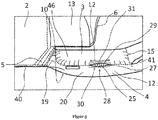
- Figure 4 shows an area of a sling device, comprising a textile shoulder strap 4 with a textile shoulder strap inner side 10 and an opposite textile shoulder strap outer side 12 and at least one cushion cushion 25 in between, the cushion cushion 25 being present in the cushion pocket 3 and the cushion pocket being delimited by at least one pocket wall 46.
- the cushion cushion 25 can be removed from the cushion pocket 3 via the pocket opening 28.
- the textile shoulder strap outer layer 39 comprises the textile shoulder strap outer side 12 and the textile shoulder strap inner layer 38 the textile shoulder strap inner side 10.
- the pocket opening 28 has a first and second opening edge 29, 30, the first opening edge 29 being formed by a folded-over portion of the textile shoulder strap outer layer 39 and the second opening edge 30 by one folded-over section of the textile shoulder strap inner layer 38 is formed.
- the connecting section 5 has connecting section seams 24 which fix an area of the folds 19.
- the cushion pocket 3 has a pocket wall 46, which is delimited by a partially circumferential pocket seam 15, which connect a textile shoulder strap inner layer 38 and a textile shoulder strap outer layer 39. Said pocket seam is only partially visible, since the curved padded pocket largely covers it.
- the textile shoulder strap 4 comprises a textile strip 20 which extends essentially parallel to the cushion pocket 3.
- the pocket opening 28 is formed by a slot, the slot length being defined by slot seams 27 which are orthogonal to the slot.
- An additional edge seam 40 connects the layers of the back textile at the edges.
- the sling device 1 comprises a headrest 13 with headrest straps 6 for protection from the sun and for supporting the child's head, in particular when sleeping.
- the pocket opening 28 is formed between the textile shoulder band inside 10 and the textile shoulder band outside 12, in particular between the textile shoulder band inner layer 38 and the textile shoulder band outer layer 39.
- Figure 5 shows an area of a sling device, comprising a textile shoulder strap 4 with a textile shoulder strap inner side 10 and an opposite textile shoulder strap outer side 12 and at least one cushion cushion 25 in between, the cushion cushion 25 being present in the cushion pocket 3 and the cushion pocket being delimited by at least one pocket wall 46.
- the cushion cushion 25 can be removed from the cushion pocket 3 via the pocket opening 28.
- the textile shoulder strap outer layer comprises the textile shoulder strap outer side 12 and the textile shoulder strap inner layer the textile shoulder strap inner side 10.
- the pocket opening 28 has a first and second opening edge 29, 30, the first opening edge 29 being formed by a folded-over portion of the textile shoulder strap outer layer and the second opening edge 30 likewise by a folded-over portion the outer layer of the textile shoulder strap is formed.
- the connecting section 5 of the back textile 2 is connected to the edge seam 40.
- the cushion pocket 3 has a pocket wall 46, which is delimited by a partially circumferential pocket seam 15, which connect an inner layer of textile shoulder band and an outer layer of textile shoulder band.
- the textile shoulder strap 4 comprises a textile strip 20 which extends essentially parallel to the cushion pocket 3.
- the pocket opening 28 is formed by a slot, the slot length L2 being defined by slot seams 27 which are orthogonal to the slot.
- slot seams 31 are also present, which run essentially parallel to the slot.
- the outer layer of the textile shoulder strap has a separation 41, in particular a separation seam, on, the outer layer of the shoulder strap and the inner layer of the shoulder strap can be unfolded here.
- the sling device 1 comprises a headrest 13 with headrest straps 6 for protection from the sun and for supporting the child's head, in particular when sleeping.
- the pocket opening is formed inside the textile shoulder band outer side 12, particularly preferably in the textile shoulder band outer layer. Folds 19 are also provided.
- Figure 6 shows the cushion cushion 25 with a first cushion side 32 and an opposite second cushion side 33, the first and second cushion sides 32, 33 being connected at a circumferential cushion edge 34 by a first cushion seam.
- at least one second cushion seam 35 connects the first cushion side 32 and the second cushion side 33, this second cushion seam 35 extending from a section or from the direction of a section of the circumferential cushion edge 34 to the opposite section or in the direction of the opposite section of the circumferential cushion edge 34 , in particular wherein the second upholstery seam 35 pierces the upholstery material, preferably in contrast to the first upholstery seam.
- the cushion has a cushion length L3 and a cushion width B5.
- Figure 7 shows a cross section through the connecting section 5 along the in Figure 3 Connection section seam 24 shown.
- the folds between the back textile outer layer 36 and the back textile inner layer 37 can be seen in the region of the connection section.
- the edge seam 40 connects the back textile outer layer 36 with the back textile inner layer 37.
- the connecting section seam 24 stabilizes the Z-shaped fold 19, which is arranged, in particular sewn in, between the back textile inner layer and the back textile outer layer.
- the Z-shaped fold 19 is formed by the textile shoulder band outer layer 39 and the textile shoulder band inner layer 38, which were folded parallel to one another. In the present case there are three Z-shaped folds 19. Only two or even four or more Z-shaped folds have proven to be useful.
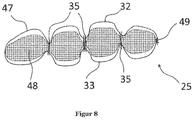
- Figure 8 shows a cross section through a cushion 25 with a textile cover 47. It is not the cushion of the Figure 6 , since this has only two essentially parallel second cushion seams 35 and in Figure 8 three second upholstery seams 35 are provided. However, it can basically be constructed analogously. It is provided here that the second upholstery seams 35 connect the first upholstery side 32 and the second upholstery side 33, the second upholstery seam 35 piercing the upholstery material 48 in contrast to the first upholstery seam 49.
Landscapes
- Purses, Travelling Bags, Baskets, Or Suitcases (AREA)
- Details Of Garments (AREA)
Priority Applications (4)
| Application Number | Priority Date | Filing Date | Title |
|---|---|---|---|
| ES18167317T ES2829377T3 (es) | 2018-04-13 | 2018-04-13 | Dispositivo de fular portabebés para bebés o niños pequeños |
| EP18167317.9A EP3552523B1 (de) | 2018-04-13 | 2018-04-13 | Tragetuchvorrichtung für babys oder kleinkinder |
| US16/383,423 US11116331B2 (en) | 2018-04-13 | 2019-04-12 | Carrier cloth device for babies or young children |
| CN201910293784.4A CN110367749B (zh) | 2018-04-13 | 2019-04-12 | 用于婴儿或幼儿的承载布设备 |
Applications Claiming Priority (1)
| Application Number | Priority Date | Filing Date | Title |
|---|---|---|---|
| EP18167317.9A EP3552523B1 (de) | 2018-04-13 | 2018-04-13 | Tragetuchvorrichtung für babys oder kleinkinder |
Publications (2)
| Publication Number | Publication Date |
|---|---|
| EP3552523A1 EP3552523A1 (de) | 2019-10-16 |
| EP3552523B1 true EP3552523B1 (de) | 2020-08-05 |
Family
ID=62002009
Family Applications (1)
| Application Number | Title | Priority Date | Filing Date |
|---|---|---|---|
| EP18167317.9A Active EP3552523B1 (de) | 2018-04-13 | 2018-04-13 | Tragetuchvorrichtung für babys oder kleinkinder |
Country Status (4)
| Country | Link |
|---|---|
| US (1) | US11116331B2 (es) |
| EP (1) | EP3552523B1 (es) |
| CN (1) | CN110367749B (es) |
| ES (1) | ES2829377T3 (es) |
Families Citing this family (10)
| Publication number | Priority date | Publication date | Assignee | Title |
|---|---|---|---|---|
| USD835902S1 (en) * | 2017-06-26 | 2018-12-18 | Happy Baby, LLC | Baby carrier |
| US10912394B1 (en) * | 2019-07-16 | 2021-02-09 | Mary Elizabeth Young | Baby carrier system having a selectively changeable waist strap |
| AT523397B1 (de) * | 2020-07-23 | 2021-08-15 | Leolin Trading Kg | Vorrichtung zum Tragen von Säuglingen und Kleinkindern |
| JP2023121190A (ja) * | 2022-02-21 | 2023-08-31 | フミオ工業株式会社 | 子守帯および携帯用子守帯 |
| DE202022103619U1 (de) | 2022-06-29 | 2022-07-13 | Jens Kotte | Babytragesystem |
| USD1100485S1 (en) | 2022-08-24 | 2025-11-04 | Wildbird, Llc | Baby carrier |
| USD1069397S1 (en) * | 2023-05-31 | 2025-04-08 | Hongwei Wang | Baby carrier |
| DE102023121872B4 (de) | 2023-08-16 | 2025-05-15 | Charlie Production Gmbh | Babytrage |
| AT527043B1 (de) | 2023-08-16 | 2024-10-15 | Charlie Production Gmbh | Babytrage |
| USD1066903S1 (en) * | 2024-08-26 | 2025-03-18 | Haixia WEI | Baby carrier |
Family Cites Families (41)
| Publication number | Priority date | Publication date | Assignee | Title |
|---|---|---|---|---|
| US3783449A (en) * | 1972-05-08 | 1974-01-08 | R Davis | Bullet-proof protective armor and method of making same |
| US3871562A (en) * | 1974-01-23 | 1975-03-18 | George D Grenier | Infant carrier |
| US4139131A (en) * | 1977-05-31 | 1979-02-13 | Hathaway Sandra J | Child carrier having enveloping structure and suspension strap |
| US4487346A (en) * | 1983-06-06 | 1984-12-11 | Fischer Jr Benhardt B | Infant sling-type carrier |
| US4666207A (en) * | 1985-09-18 | 1987-05-19 | Billie Waters Quartano | Child shopping cart cushion |
| US4986458A (en) | 1988-08-16 | 1991-01-22 | Linday Linda A | Infant carrier |
| US4936495A (en) * | 1989-02-13 | 1990-06-26 | Wenoka Seastyle | Shoulder strap attachment |
| US4998311A (en) * | 1990-04-13 | 1991-03-12 | Ernst Wilbur L | Golf cart cushion |
| US5088747A (en) * | 1990-09-12 | 1992-02-18 | International Marketing And Design Seating System, Inc. | Wheelchair seating system |
| US5155869A (en) * | 1990-11-20 | 1992-10-20 | Ralli Mirianne M | Contoured shoulder pad with closeable pocket for valuables |
| US5346419A (en) * | 1993-05-14 | 1994-09-13 | International Divers Inc. | Buoyancy compensator device with backpack and adjustable harness |
| US5523581A (en) * | 1994-09-23 | 1996-06-04 | Wit, Inc. | Slipcover for radiation shields |
| US5632429A (en) * | 1995-02-28 | 1997-05-27 | American Recreation Products, Inc. | Backpack |
| US6863202B2 (en) * | 1998-05-14 | 2005-03-08 | Airpacks, Inc. | Shoulder carrier with inflatable lumbar support |
| US20040060951A1 (en) * | 2002-09-26 | 2004-04-01 | Charles Kelly | Cushioning shoulder strap |
| US6808099B2 (en) * | 2003-01-29 | 2004-10-26 | Cerf Bros. Bag Co. | Sternum strap attachment |
| US7322498B2 (en) | 2003-09-10 | 2008-01-29 | The Ergo Baby Carrier, Inc. | Baby carrier |
| JP2005131146A (ja) * | 2003-10-31 | 2005-05-26 | Lucky Kogyo Kk | ベビーキャリア |
| US7069624B2 (en) * | 2004-08-06 | 2006-07-04 | Johnson David A | Attachment of a sling |
| WO2007032130A1 (ja) * | 2005-09-16 | 2007-03-22 | T-Rex Co., Ltd. | ベビーキャリア |
| US8225973B1 (en) * | 2006-05-03 | 2012-07-24 | Bellinson Susan G | User-supported multiple pouch device |
| DE202007006204U1 (de) | 2007-04-27 | 2008-09-04 | Schachtner, Petra | Tragevorrichtung |
| JP3145902U (ja) * | 2008-08-14 | 2008-10-23 | 株式会社 礒企画 | 乳幼児用キャリア |
| US20100072236A1 (en) * | 2008-09-19 | 2010-03-25 | Michael A Parness | Multifunctional child carrier |
| AT11673U1 (de) | 2010-02-26 | 2011-03-15 | Fraeulein Huebsch Inh Mag Elisabeth Pohn | Tragehilfe für babys und kleinkinder |
| JP5583441B2 (ja) * | 2010-03-19 | 2014-09-03 | ラッキー工業株式会社 | ベビースリング |
| DE202010004505U1 (de) | 2010-03-26 | 2010-07-29 | Blaum, Wolfgang | Tragehilfe für Babies und Kleinkinder |
| US20110240693A1 (en) * | 2010-03-30 | 2011-10-06 | Parness Michael A | Baby carrier with tie straps |
| US20140084031A1 (en) * | 2012-09-27 | 2014-03-27 | Johna Nicole Bowden | Hybrid Sling Waist On A Baby Carrier |
| JP6227111B2 (ja) | 2013-03-13 | 2017-11-08 | ザ エルゴ ベビー キャリア, インコーポレイテッド | チャイルドキャリア |
| CN104706099A (zh) * | 2013-12-12 | 2015-06-17 | 陈小英 | 儿童背袋 |
| US9848713B2 (en) | 2014-01-10 | 2017-12-26 | Gold, Inc. | Convertible infant carrier |
| CN203885120U (zh) * | 2014-06-10 | 2014-10-22 | 张乐军 | 一种儿童腰凳 |
| CN204181320U (zh) * | 2014-11-10 | 2015-03-04 | 刘杨军 | 一种腰凳 |
| EP3033956B1 (en) * | 2014-12-17 | 2017-01-25 | Honeywell International Inc. | Protective garment with pocket for a cushioning pad |
| EP3325672B1 (en) * | 2015-07-23 | 2020-05-20 | Limastian, Narong | Method of utilizing furnace off-gas for reduction of iron oxide pellets |
| DE202015005357U1 (de) | 2015-08-03 | 2015-09-03 | Anna Sauer | Tragehilfe für Babys und Kleinkinder |
| CN206079849U (zh) * | 2016-08-23 | 2017-04-12 | 晋江市见来成婴儿用品有限公司 | 带收纳功能的婴儿腰凳背带 |
| US11122911B2 (en) * | 2016-12-21 | 2021-09-21 | Audrey Dorfman | Modular sleep solution |
| EP3360432A1 (de) * | 2017-02-13 | 2018-08-15 | Müller, Andreas | Elastisches kissen für ein fussbekleidungsstück, fussbekleidungstück damit |
| CN206836676U (zh) * | 2017-09-22 | 2018-01-05 | 广东吉宝宝儿童用品有限公司 | 一种便携式可折叠多功能桌边椅 |
-
2018
- 2018-04-13 ES ES18167317T patent/ES2829377T3/es active Active
- 2018-04-13 EP EP18167317.9A patent/EP3552523B1/de active Active
-
2019
- 2019-04-12 CN CN201910293784.4A patent/CN110367749B/zh active Active
- 2019-04-12 US US16/383,423 patent/US11116331B2/en active Active
Non-Patent Citations (1)
| Title |
|---|
| None * |
Also Published As
| Publication number | Publication date |
|---|---|
| CN110367749A (zh) | 2019-10-25 |
| ES2829377T3 (es) | 2021-05-31 |
| US11116331B2 (en) | 2021-09-14 |
| EP3552523A1 (de) | 2019-10-16 |
| CN110367749B (zh) | 2025-02-18 |
| US20190313810A1 (en) | 2019-10-17 |
Similar Documents
| Publication | Publication Date | Title |
|---|---|---|
| EP3552523B1 (de) | Tragetuchvorrichtung für babys oder kleinkinder | |
| EP2148594B1 (de) | Tragevorrichtung | |
| EP2907413B1 (de) | Tragevorrichtung für ein Baby oder Kleinkind | |
| DE202022107069U1 (de) | Babytrage | |
| DE202010018485U1 (de) | Tragevorrichtung für ein Baby oder Kleinkind | |
| DE202010011906U1 (de) | Babytrage | |
| EP2744374A1 (de) | Babytrage | |
| DE202008013895U1 (de) | Babytrage | |
| EP3500139B1 (de) | Tragevorrichtung für ein baby oder kleinkind | |
| DE112021005492T5 (de) | Kindertrage | |
| DE102012111052B4 (de) | Babytrage | |
| DE202012006709U1 (de) | Baby- und Kindertrage Smart Carrier | |
| DE202018102033U1 (de) | Tragetuchvorrichtung für Babys oder Kleinkinder | |
| DE102023116917A1 (de) | Babytragesystem zum Tragen eines Babys oder Kleinkinds am Körper | |
| DE102017209447B4 (de) | Sicherheits-Schlafsystem für Säuglinge | |
| DE102023121872B4 (de) | Babytrage | |
| AT508568A1 (de) | Tragevorrichtung | |
| AT523397B1 (de) | Vorrichtung zum Tragen von Säuglingen und Kleinkindern | |
| WO2024067925A1 (de) | Tragevorrichtung für ein baby | |
| DE202016003651U1 (de) | Kindertrageeinrichtung vom Schlingentyp | |
| WO2022229452A1 (de) | Babytragehilfe | |
| DE112023002973T5 (de) | Babytrage | |
| EP3890561A1 (de) | Tragevorrichtung zur aufnahme eines babys oder kleinkindes | |
| DE202015005485U1 (de) | Babytrage mit Zusatzteil zur Bildung einer Babywippe | |
| WO2025233500A2 (de) | Kindertrageeinrichtung |
Legal Events
| Date | Code | Title | Description |
|---|---|---|---|
| STAA | Information on the status of an ep patent application or granted ep patent |
Free format text: STATUS: EXAMINATION IS IN PROGRESS |
|
| PUAI | Public reference made under article 153(3) epc to a published international application that has entered the european phase |
Free format text: ORIGINAL CODE: 0009012 |
|
| 17P | Request for examination filed |
Effective date: 20180927 |
|
| AK | Designated contracting states |
Kind code of ref document: A1 Designated state(s): AL AT BE BG CH CY CZ DE DK EE ES FI FR GB GR HR HU IE IS IT LI LT LU LV MC MK MT NL NO PL PT RO RS SE SI SK SM TR |
|
| AX | Request for extension of the european patent |
Extension state: BA ME |
|
| GRAP | Despatch of communication of intention to grant a patent |
Free format text: ORIGINAL CODE: EPIDOSNIGR1 |
|
| STAA | Information on the status of an ep patent application or granted ep patent |
Free format text: STATUS: GRANT OF PATENT IS INTENDED |
|
| INTG | Intention to grant announced |
Effective date: 20191126 |
|
| GRAS | Grant fee paid |
Free format text: ORIGINAL CODE: EPIDOSNIGR3 |
|
| GRAJ | Information related to disapproval of communication of intention to grant by the applicant or resumption of examination proceedings by the epo deleted |
Free format text: ORIGINAL CODE: EPIDOSDIGR1 |
|
| GRAL | Information related to payment of fee for publishing/printing deleted |
Free format text: ORIGINAL CODE: EPIDOSDIGR3 |
|
| STAA | Information on the status of an ep patent application or granted ep patent |
Free format text: STATUS: EXAMINATION IS IN PROGRESS |
|
| GRAJ | Information related to disapproval of communication of intention to grant by the applicant or resumption of examination proceedings by the epo deleted |
Free format text: ORIGINAL CODE: EPIDOSDIGR1 |
|
| STAA | Information on the status of an ep patent application or granted ep patent |
Free format text: STATUS: GRANT OF PATENT IS INTENDED |
|
| GRAP | Despatch of communication of intention to grant a patent |
Free format text: ORIGINAL CODE: EPIDOSNIGR1 |
|
| STAA | Information on the status of an ep patent application or granted ep patent |
Free format text: STATUS: EXAMINATION IS IN PROGRESS |
|
| GRAJ | Information related to disapproval of communication of intention to grant by the applicant or resumption of examination proceedings by the epo deleted |
Free format text: ORIGINAL CODE: EPIDOSDIGR1 |
|
| GRAP | Despatch of communication of intention to grant a patent |
Free format text: ORIGINAL CODE: EPIDOSNIGR1 |
|
| GRAJ | Information related to disapproval of communication of intention to grant by the applicant or resumption of examination proceedings by the epo deleted |
Free format text: ORIGINAL CODE: EPIDOSDIGR1 |
|
| GRAR | Information related to intention to grant a patent recorded |
Free format text: ORIGINAL CODE: EPIDOSNIGR71 |
|
| STAA | Information on the status of an ep patent application or granted ep patent |
Free format text: STATUS: GRANT OF PATENT IS INTENDED |
|
| INTC | Intention to grant announced (deleted) | ||
| GRAJ | Information related to disapproval of communication of intention to grant by the applicant or resumption of examination proceedings by the epo deleted |
Free format text: ORIGINAL CODE: EPIDOSDIGR1 |
|
| STAA | Information on the status of an ep patent application or granted ep patent |
Free format text: STATUS: EXAMINATION IS IN PROGRESS |
|
| GRAR | Information related to intention to grant a patent recorded |
Free format text: ORIGINAL CODE: EPIDOSNIGR71 |
|
| STAA | Information on the status of an ep patent application or granted ep patent |
Free format text: STATUS: GRANT OF PATENT IS INTENDED |
|
| INTG | Intention to grant announced |
Effective date: 20200428 |
|
| INTC | Intention to grant announced (deleted) | ||
| INTG | Intention to grant announced |
Effective date: 20200508 |
|
| GRAA | (expected) grant |
Free format text: ORIGINAL CODE: 0009210 |
|
| STAA | Information on the status of an ep patent application or granted ep patent |
Free format text: STATUS: THE PATENT HAS BEEN GRANTED |
|
| AK | Designated contracting states |
Kind code of ref document: B1 Designated state(s): AL AT BE BG CH CY CZ DE DK EE ES FI FR GB GR HR HU IE IS IT LI LT LU LV MC MK MT NL NO PL PT RO RS SE SI SK SM TR |
|
| REG | Reference to a national code |
Ref country code: GB Ref legal event code: FG4D Free format text: NOT ENGLISH |
|
| REG | Reference to a national code |
Ref country code: CH Ref legal event code: EP |
|
| REG | Reference to a national code |
Ref country code: AT Ref legal event code: REF Ref document number: 1297503 Country of ref document: AT Kind code of ref document: T Effective date: 20200815 |
|
| REG | Reference to a national code |
Ref country code: DE Ref legal event code: R096 Ref document number: 502018002061 Country of ref document: DE |
|
| REG | Reference to a national code |
Ref country code: IE Ref legal event code: FG4D Free format text: LANGUAGE OF EP DOCUMENT: GERMAN |
|
| REG | Reference to a national code |
Ref country code: CH Ref legal event code: NV Representative=s name: PATENTANWAELTE SCHAAD, BALASS, MENZL AND PARTN, CH |
|
| REG | Reference to a national code |
Ref country code: NL Ref legal event code: FP |
|
| REG | Reference to a national code |
Ref country code: LT Ref legal event code: MG4D |
|
| PG25 | Lapsed in a contracting state [announced via postgrant information from national office to epo] |
Ref country code: LT Free format text: LAPSE BECAUSE OF FAILURE TO SUBMIT A TRANSLATION OF THE DESCRIPTION OR TO PAY THE FEE WITHIN THE PRESCRIBED TIME-LIMIT Effective date: 20200805 Ref country code: SE Free format text: LAPSE BECAUSE OF FAILURE TO SUBMIT A TRANSLATION OF THE DESCRIPTION OR TO PAY THE FEE WITHIN THE PRESCRIBED TIME-LIMIT Effective date: 20200805 Ref country code: BG Free format text: LAPSE BECAUSE OF FAILURE TO SUBMIT A TRANSLATION OF THE DESCRIPTION OR TO PAY THE FEE WITHIN THE PRESCRIBED TIME-LIMIT Effective date: 20201105 Ref country code: GR Free format text: LAPSE BECAUSE OF FAILURE TO SUBMIT A TRANSLATION OF THE DESCRIPTION OR TO PAY THE FEE WITHIN THE PRESCRIBED TIME-LIMIT Effective date: 20201106 Ref country code: NO Free format text: LAPSE BECAUSE OF FAILURE TO SUBMIT A TRANSLATION OF THE DESCRIPTION OR TO PAY THE FEE WITHIN THE PRESCRIBED TIME-LIMIT Effective date: 20201105 Ref country code: FI Free format text: LAPSE BECAUSE OF FAILURE TO SUBMIT A TRANSLATION OF THE DESCRIPTION OR TO PAY THE FEE WITHIN THE PRESCRIBED TIME-LIMIT Effective date: 20200805 Ref country code: HR Free format text: LAPSE BECAUSE OF FAILURE TO SUBMIT A TRANSLATION OF THE DESCRIPTION OR TO PAY THE FEE WITHIN THE PRESCRIBED TIME-LIMIT Effective date: 20200805 Ref country code: PT Free format text: LAPSE BECAUSE OF FAILURE TO SUBMIT A TRANSLATION OF THE DESCRIPTION OR TO PAY THE FEE WITHIN THE PRESCRIBED TIME-LIMIT Effective date: 20201207 |
|
| PG25 | Lapsed in a contracting state [announced via postgrant information from national office to epo] |
Ref country code: PL Free format text: LAPSE BECAUSE OF FAILURE TO SUBMIT A TRANSLATION OF THE DESCRIPTION OR TO PAY THE FEE WITHIN THE PRESCRIBED TIME-LIMIT Effective date: 20200805 Ref country code: RS Free format text: LAPSE BECAUSE OF FAILURE TO SUBMIT A TRANSLATION OF THE DESCRIPTION OR TO PAY THE FEE WITHIN THE PRESCRIBED TIME-LIMIT Effective date: 20200805 Ref country code: LV Free format text: LAPSE BECAUSE OF FAILURE TO SUBMIT A TRANSLATION OF THE DESCRIPTION OR TO PAY THE FEE WITHIN THE PRESCRIBED TIME-LIMIT Effective date: 20200805 Ref country code: IS Free format text: LAPSE BECAUSE OF FAILURE TO SUBMIT A TRANSLATION OF THE DESCRIPTION OR TO PAY THE FEE WITHIN THE PRESCRIBED TIME-LIMIT Effective date: 20201205 |
|
| PG25 | Lapsed in a contracting state [announced via postgrant information from national office to epo] |
Ref country code: SM Free format text: LAPSE BECAUSE OF FAILURE TO SUBMIT A TRANSLATION OF THE DESCRIPTION OR TO PAY THE FEE WITHIN THE PRESCRIBED TIME-LIMIT Effective date: 20200805 Ref country code: EE Free format text: LAPSE BECAUSE OF FAILURE TO SUBMIT A TRANSLATION OF THE DESCRIPTION OR TO PAY THE FEE WITHIN THE PRESCRIBED TIME-LIMIT Effective date: 20200805 Ref country code: RO Free format text: LAPSE BECAUSE OF FAILURE TO SUBMIT A TRANSLATION OF THE DESCRIPTION OR TO PAY THE FEE WITHIN THE PRESCRIBED TIME-LIMIT Effective date: 20200805 Ref country code: DK Free format text: LAPSE BECAUSE OF FAILURE TO SUBMIT A TRANSLATION OF THE DESCRIPTION OR TO PAY THE FEE WITHIN THE PRESCRIBED TIME-LIMIT Effective date: 20200805 Ref country code: CZ Free format text: LAPSE BECAUSE OF FAILURE TO SUBMIT A TRANSLATION OF THE DESCRIPTION OR TO PAY THE FEE WITHIN THE PRESCRIBED TIME-LIMIT Effective date: 20200805 |
|
| REG | Reference to a national code |
Ref country code: DE Ref legal event code: R097 Ref document number: 502018002061 Country of ref document: DE |
|
| PG25 | Lapsed in a contracting state [announced via postgrant information from national office to epo] |
Ref country code: AL Free format text: LAPSE BECAUSE OF FAILURE TO SUBMIT A TRANSLATION OF THE DESCRIPTION OR TO PAY THE FEE WITHIN THE PRESCRIBED TIME-LIMIT Effective date: 20200805 |
|
| REG | Reference to a national code |
Ref country code: ES Ref legal event code: FG2A Ref document number: 2829377 Country of ref document: ES Kind code of ref document: T3 Effective date: 20210531 |
|
| PLBE | No opposition filed within time limit |
Free format text: ORIGINAL CODE: 0009261 |
|
| STAA | Information on the status of an ep patent application or granted ep patent |
Free format text: STATUS: NO OPPOSITION FILED WITHIN TIME LIMIT |
|
| PG25 | Lapsed in a contracting state [announced via postgrant information from national office to epo] |
Ref country code: SK Free format text: LAPSE BECAUSE OF FAILURE TO SUBMIT A TRANSLATION OF THE DESCRIPTION OR TO PAY THE FEE WITHIN THE PRESCRIBED TIME-LIMIT Effective date: 20200805 |
|
| 26N | No opposition filed |
Effective date: 20210507 |
|
| PG25 | Lapsed in a contracting state [announced via postgrant information from national office to epo] |
Ref country code: SI Free format text: LAPSE BECAUSE OF FAILURE TO SUBMIT A TRANSLATION OF THE DESCRIPTION OR TO PAY THE FEE WITHIN THE PRESCRIBED TIME-LIMIT Effective date: 20200805 |
|
| PG25 | Lapsed in a contracting state [announced via postgrant information from national office to epo] |
Ref country code: CY Free format text: LAPSE BECAUSE OF FAILURE TO SUBMIT A TRANSLATION OF THE DESCRIPTION OR TO PAY THE FEE WITHIN THE PRESCRIBED TIME-LIMIT Effective date: 20200805 |
|
| PG25 | Lapsed in a contracting state [announced via postgrant information from national office to epo] |
Ref country code: HU Free format text: LAPSE BECAUSE OF FAILURE TO SUBMIT A TRANSLATION OF THE DESCRIPTION OR TO PAY THE FEE WITHIN THE PRESCRIBED TIME-LIMIT; INVALID AB INITIO Effective date: 20180413 |
|
| PG25 | Lapsed in a contracting state [announced via postgrant information from national office to epo] |
Ref country code: MK Free format text: LAPSE BECAUSE OF FAILURE TO SUBMIT A TRANSLATION OF THE DESCRIPTION OR TO PAY THE FEE WITHIN THE PRESCRIBED TIME-LIMIT Effective date: 20200805 |
|
| PG25 | Lapsed in a contracting state [announced via postgrant information from national office to epo] |
Ref country code: MT Free format text: LAPSE BECAUSE OF FAILURE TO SUBMIT A TRANSLATION OF THE DESCRIPTION OR TO PAY THE FEE WITHIN THE PRESCRIBED TIME-LIMIT Effective date: 20200805 |
|
| PGFP | Annual fee paid to national office [announced via postgrant information from national office to epo] |
Ref country code: MC Payment date: 20250326 Year of fee payment: 8 |
|
| PGFP | Annual fee paid to national office [announced via postgrant information from national office to epo] |
Ref country code: NL Payment date: 20250320 Year of fee payment: 8 |
|
| PGFP | Annual fee paid to national office [announced via postgrant information from national office to epo] |
Ref country code: LU Payment date: 20250318 Year of fee payment: 8 |
|
| PGFP | Annual fee paid to national office [announced via postgrant information from national office to epo] |
Ref country code: IE Payment date: 20250314 Year of fee payment: 8 |
|
| PGFP | Annual fee paid to national office [announced via postgrant information from national office to epo] |
Ref country code: BE Payment date: 20250320 Year of fee payment: 8 |
|
| PGFP | Annual fee paid to national office [announced via postgrant information from national office to epo] |
Ref country code: FR Payment date: 20250318 Year of fee payment: 8 |
|
| PGFP | Annual fee paid to national office [announced via postgrant information from national office to epo] |
Ref country code: IT Payment date: 20250317 Year of fee payment: 8 Ref country code: GB Payment date: 20250318 Year of fee payment: 8 |
|
| PGFP | Annual fee paid to national office [announced via postgrant information from national office to epo] |
Ref country code: DE Payment date: 20250318 Year of fee payment: 8 |
|
| PGFP | Annual fee paid to national office [announced via postgrant information from national office to epo] |
Ref country code: ES Payment date: 20250505 Year of fee payment: 8 |
|
| PGFP | Annual fee paid to national office [announced via postgrant information from national office to epo] |
Ref country code: CH Payment date: 20250501 Year of fee payment: 8 |
|
| PGFP | Annual fee paid to national office [announced via postgrant information from national office to epo] |
Ref country code: AT Payment date: 20250318 Year of fee payment: 8 |
|
| REG | Reference to a national code |
Ref country code: DE Ref legal event code: R081 Ref document number: 502018002061 Country of ref document: DE Owner name: STOKKE GMBH, DE Free format text: FORMER OWNER: LIMAS GMBH, 65451 KELSTERBACH, DE Ref country code: DE Ref legal event code: R082 Ref document number: 502018002061 Country of ref document: DE Representative=s name: LEO SCHMIDT-HOLLBURG WITTE & FRANK RECHTSANWAE, DE Ref country code: DE Ref legal event code: R082 Ref document number: 502018002061 Country of ref document: DE Representative=s name: HEUN, THOMAS, DIPL.-ING. (UNIV.), DE |
|
| REG | Reference to a national code |
Ref country code: DE Ref legal event code: R082 Ref document number: 502018002061 Country of ref document: DE Representative=s name: HEUN, THOMAS, DIPL.-ING. (UNIV.), DE |
|
| PG25 | Lapsed in a contracting state [announced via postgrant information from national office to epo] |
Ref country code: TR Free format text: LAPSE BECAUSE OF FAILURE TO SUBMIT A TRANSLATION OF THE DESCRIPTION OR TO PAY THE FEE WITHIN THE PRESCRIBED TIME-LIMIT Effective date: 20200805 |