EP3547409A1 - Negativelektrodenmaterial und elektrolytbatterie mit verwendung davon - Google Patents
Negativelektrodenmaterial und elektrolytbatterie mit verwendung davon Download PDFInfo
- Publication number
- EP3547409A1 EP3547409A1 EP19157980.4A EP19157980A EP3547409A1 EP 3547409 A1 EP3547409 A1 EP 3547409A1 EP 19157980 A EP19157980 A EP 19157980A EP 3547409 A1 EP3547409 A1 EP 3547409A1
- Authority
- EP
- European Patent Office
- Prior art keywords
- negative electrode
- electrolyte
- electrode active
- active material
- fluorine
- Prior art date
- Legal status (The legal status is an assumption and is not a legal conclusion. Google has not performed a legal analysis and makes no representation as to the accuracy of the status listed.)
- Granted
Links
Images

Classifications
-
- H—ELECTRICITY
- H01—ELECTRIC ELEMENTS
- H01M—PROCESSES OR MEANS, e.g. BATTERIES, FOR THE DIRECT CONVERSION OF CHEMICAL ENERGY INTO ELECTRICAL ENERGY
- H01M4/00—Electrodes
- H01M4/02—Electrodes composed of, or comprising, active material
- H01M4/36—Selection of substances as active materials, active masses, active liquids
- H01M4/58—Selection of substances as active materials, active masses, active liquids of inorganic compounds other than oxides or hydroxides, e.g. sulfides, selenides, tellurides, halogenides or LiCoFy; of polyanionic structures, e.g. phosphates, silicates or borates
- H01M4/583—Carbonaceous material, e.g. graphite-intercalation compounds or CFx
-
- H—ELECTRICITY
- H01—ELECTRIC ELEMENTS
- H01M—PROCESSES OR MEANS, e.g. BATTERIES, FOR THE DIRECT CONVERSION OF CHEMICAL ENERGY INTO ELECTRICAL ENERGY
- H01M10/00—Secondary cells; Manufacture thereof
- H01M10/05—Accumulators with non-aqueous electrolyte
- H01M10/052—Li-accumulators
- H01M10/0525—Rocking-chair batteries, i.e. batteries with lithium insertion or intercalation in both electrodes; Lithium-ion batteries
-
- H—ELECTRICITY
- H01—ELECTRIC ELEMENTS
- H01M—PROCESSES OR MEANS, e.g. BATTERIES, FOR THE DIRECT CONVERSION OF CHEMICAL ENERGY INTO ELECTRICAL ENERGY
- H01M4/00—Electrodes
- H01M4/02—Electrodes composed of, or comprising, active material
- H01M4/04—Processes of manufacture in general
- H01M4/0402—Methods of deposition of the material
-
- H—ELECTRICITY
- H01—ELECTRIC ELEMENTS
- H01M—PROCESSES OR MEANS, e.g. BATTERIES, FOR THE DIRECT CONVERSION OF CHEMICAL ENERGY INTO ELECTRICAL ENERGY
- H01M4/00—Electrodes
- H01M4/02—Electrodes composed of, or comprising, active material
- H01M4/13—Electrodes for accumulators with non-aqueous electrolyte, e.g. for lithium-accumulators; Processes of manufacture thereof
- H01M4/133—Electrodes based on carbonaceous material, e.g. graphite-intercalation compounds or CFx
-
- H—ELECTRICITY
- H01—ELECTRIC ELEMENTS
- H01M—PROCESSES OR MEANS, e.g. BATTERIES, FOR THE DIRECT CONVERSION OF CHEMICAL ENERGY INTO ELECTRICAL ENERGY
- H01M4/00—Electrodes
- H01M4/02—Electrodes composed of, or comprising, active material
- H01M4/36—Selection of substances as active materials, active masses, active liquids
- H01M4/362—Composites
- H01M4/366—Composites as layered products
-
- H—ELECTRICITY
- H01—ELECTRIC ELEMENTS
- H01M—PROCESSES OR MEANS, e.g. BATTERIES, FOR THE DIRECT CONVERSION OF CHEMICAL ENERGY INTO ELECTRICAL ENERGY
- H01M4/00—Electrodes
- H01M4/02—Electrodes composed of, or comprising, active material
- H01M4/36—Selection of substances as active materials, active masses, active liquids
- H01M4/48—Selection of substances as active materials, active masses, active liquids of inorganic oxides or hydroxides
- H01M4/56—Selection of substances as active materials, active masses, active liquids of inorganic oxides or hydroxides of lead
-
- H—ELECTRICITY
- H01—ELECTRIC ELEMENTS
- H01M—PROCESSES OR MEANS, e.g. BATTERIES, FOR THE DIRECT CONVERSION OF CHEMICAL ENERGY INTO ELECTRICAL ENERGY
- H01M4/00—Electrodes
- H01M4/02—Electrodes composed of, or comprising, active material
- H01M4/36—Selection of substances as active materials, active masses, active liquids
- H01M4/58—Selection of substances as active materials, active masses, active liquids of inorganic compounds other than oxides or hydroxides, e.g. sulfides, selenides, tellurides, halogenides or LiCoFy; of polyanionic structures, e.g. phosphates, silicates or borates
- H01M4/582—Halogenides
-
- H—ELECTRICITY
- H01—ELECTRIC ELEMENTS
- H01M—PROCESSES OR MEANS, e.g. BATTERIES, FOR THE DIRECT CONVERSION OF CHEMICAL ENERGY INTO ELECTRICAL ENERGY
- H01M4/00—Electrodes
- H01M4/02—Electrodes composed of, or comprising, active material
- H01M4/36—Selection of substances as active materials, active masses, active liquids
- H01M4/58—Selection of substances as active materials, active masses, active liquids of inorganic compounds other than oxides or hydroxides, e.g. sulfides, selenides, tellurides, halogenides or LiCoFy; of polyanionic structures, e.g. phosphates, silicates or borates
- H01M4/583—Carbonaceous material, e.g. graphite-intercalation compounds or CFx
- H01M4/5835—Comprising fluorine or fluoride salts
-
- H—ELECTRICITY
- H01—ELECTRIC ELEMENTS
- H01M—PROCESSES OR MEANS, e.g. BATTERIES, FOR THE DIRECT CONVERSION OF CHEMICAL ENERGY INTO ELECTRICAL ENERGY
- H01M4/00—Electrodes
- H01M4/02—Electrodes composed of, or comprising, active material
- H01M4/36—Selection of substances as active materials, active masses, active liquids
- H01M4/58—Selection of substances as active materials, active masses, active liquids of inorganic compounds other than oxides or hydroxides, e.g. sulfides, selenides, tellurides, halogenides or LiCoFy; of polyanionic structures, e.g. phosphates, silicates or borates
- H01M4/583—Carbonaceous material, e.g. graphite-intercalation compounds or CFx
- H01M4/587—Carbonaceous material, e.g. graphite-intercalation compounds or CFx for inserting or intercalating light metals
-
- H—ELECTRICITY
- H01—ELECTRIC ELEMENTS
- H01M—PROCESSES OR MEANS, e.g. BATTERIES, FOR THE DIRECT CONVERSION OF CHEMICAL ENERGY INTO ELECTRICAL ENERGY
- H01M4/00—Electrodes
- H01M4/02—Electrodes composed of, or comprising, active material
- H01M4/62—Selection of inactive substances as ingredients for active masses, e.g. binders, fillers
-
- H—ELECTRICITY
- H01—ELECTRIC ELEMENTS
- H01M—PROCESSES OR MEANS, e.g. BATTERIES, FOR THE DIRECT CONVERSION OF CHEMICAL ENERGY INTO ELECTRICAL ENERGY
- H01M10/00—Secondary cells; Manufacture thereof
- H01M10/05—Accumulators with non-aqueous electrolyte
- H01M10/052—Li-accumulators
-
- H—ELECTRICITY
- H01—ELECTRIC ELEMENTS
- H01M—PROCESSES OR MEANS, e.g. BATTERIES, FOR THE DIRECT CONVERSION OF CHEMICAL ENERGY INTO ELECTRICAL ENERGY
- H01M4/00—Electrodes
- H01M4/02—Electrodes composed of, or comprising, active material
- H01M2004/021—Physical characteristics, e.g. porosity, surface area
-
- H—ELECTRICITY
- H01—ELECTRIC ELEMENTS
- H01M—PROCESSES OR MEANS, e.g. BATTERIES, FOR THE DIRECT CONVERSION OF CHEMICAL ENERGY INTO ELECTRICAL ENERGY
- H01M4/00—Electrodes
- H01M4/02—Electrodes composed of, or comprising, active material
- H01M2004/026—Electrodes composed of, or comprising, active material characterised by the polarity
- H01M2004/027—Negative electrodes
-
- H—ELECTRICITY
- H01—ELECTRIC ELEMENTS
- H01M—PROCESSES OR MEANS, e.g. BATTERIES, FOR THE DIRECT CONVERSION OF CHEMICAL ENERGY INTO ELECTRICAL ENERGY
- H01M4/00—Electrodes
- H01M4/02—Electrodes composed of, or comprising, active material
- H01M4/36—Selection of substances as active materials, active masses, active liquids
- H01M4/38—Selection of substances as active materials, active masses, active liquids of elements or alloys
- H01M4/388—Halogens
-
- Y—GENERAL TAGGING OF NEW TECHNOLOGICAL DEVELOPMENTS; GENERAL TAGGING OF CROSS-SECTIONAL TECHNOLOGIES SPANNING OVER SEVERAL SECTIONS OF THE IPC; TECHNICAL SUBJECTS COVERED BY FORMER USPC CROSS-REFERENCE ART COLLECTIONS [XRACs] AND DIGESTS
- Y02—TECHNOLOGIES OR APPLICATIONS FOR MITIGATION OR ADAPTATION AGAINST CLIMATE CHANGE
- Y02E—REDUCTION OF GREENHOUSE GAS [GHG] EMISSIONS, RELATED TO ENERGY GENERATION, TRANSMISSION OR DISTRIBUTION
- Y02E60/00—Enabling technologies; Technologies with a potential or indirect contribution to GHG emissions mitigation
- Y02E60/10—Energy storage using batteries
Definitions
- the present invention relates to a negative electrode material and to an electrolyte battery using the same.
- Japanese Patent Application Laid-open No. 2005-276517 discloses both an electrolyte that includes a fluorinated ketone having a given chemical formula, and a lithium ion battery that uses this electrolyte.
- the fluorine-containing solvents mentioned in Japanese Patent Application Laid-open No. 2005-276517 have higher oxidative decomposition potentials than fluorine-free solvents. That is, they have a high oxidation resistance. Therefore, in electrolyte batteries which contain such a fluorine-containing solvent, the electrolyte does not readily undergo oxidative decomposition when the positive electrode reaches a high potential. However, unlike their high oxidation resistance, such fluorine-containing solvents have a low reduction resistance. According to the findings of the present inventor, in lithium ion batteries which contain such a fluorine-containing solvent, when many lithium ions are positioned near the negative electrode during charging, electrons as counterparts to the lithium ions concentrate at the surface of the negative electrode.
- the invention provides a negative electrode material for an electrolyte battery, which material includes a negative electrode active material and a coating material disposed on a surface of the negative electrode active material.
- the coating material is a fluoride ion conductor that includes the elements lead and fluorine.
- the fluoride ion conductor is provided on a surface of the negative electrode active material. This makes it easier for negative charge to build up at the surface of the negative electrode (specifically, the interface of the negative electrode with the electrolyte) in the state of fluoride ions rather than electrons. As a result, the fluorine-containing solvent is less likely to receive electrons from the negative electrode. In other words, electron transfer from the negative electrode to the fluorine-containing solvent does not readily arise. Therefore, even in cases where the electrolyte includes a fluorine-containing solvent, reductive decomposition of the electrolyte can be suitably suppressed. As a result, an electrolyte battery having excellent cycle characteristics and a high durability can be achieved.
- the fluoride ion conductor includes a solid solution of the following formula (1): Pb (1-x) Sn x F 2+ ⁇ (1) (wherein x satisfies 0 ⁇ x ⁇ 0.6 and ⁇ is a real number that satisfies charge neutrality).
- Pb (1-x) Sn x F 2+ ⁇ (1) (wherein x satisfies 0 ⁇ x ⁇ 0.6 and ⁇ is a real number that satisfies charge neutrality).
- x in formula (1) may satisfy the condition 0 ⁇ x ⁇ 0.2. This enables the fluoride ion conductivity of the coating material to be further increased, making it possible to suppress to an even greater degree decreases in battery capacity after charge-discharge cycling.
- the coating material has an average coating thickness of at least 10 nm and up to 100 nm. This enables the internal resistance of the negative electrode to be reduced to a high degree, enabling excellent input-output characteristics to be achieved. Moreover, the amount of negative electrode active material in the negative electrode can be relatively increased, making it possible to advantageously achieve an electrolyte battery having a high energy density.
- the invention provides an electrolyte battery having a positive electrode, a negative electrode which includes the negative electrode material, and an electrolyte which includes a fluorine-containing solvent.
- This electrolyte battery even when repeatedly charged and discharged, does not readily undergo a decrease in battery capacity and has excellent cycle characteristics.
- FIG. 1 is a schematic view showing the cross-sectional structure of a negative electrode material 1 according to an embodiment of the invention. Although not intended to be particularly limitative, this negative electrode material 1 is used by way of illustration in the following detailed description of the art disclosed herein.
- the negative electrode material 1 is a material that can be used in the negative electrode of an electrolyte battery.
- the negative electrode material 1 is made up of composite particles.
- the negative electrode material 1 includes a negative electrode active material 2 and a coating material 4.
- the negative electrode active material 2 is a portion serving as the core of the negative electrode material 1.
- the coating material 4 is disposed on a surface of the negative electrode active material 2.
- the coating material 4 is disposed on a side that is closer to the electrolyte than to the negative electrode active material 2.
- a plurality of coating materials 4 are arranged discontinuously, such as in the form of dots (islands), on the surface of the negative electrode active material 2.
- a portion of the surface of the negative electrode active material 2 is not covered with the coating material 4 and is in direct contact with the electrolyte.
- the coating material 4 physically and/or chemical adheres to the surface of the negative electrode active material 2.
- the negative electrode material 1 has interfaces where the negative electrode active material 2 and the coating material 4 come into mutual contact.
- the negative electrode active material 2 and the coating material 4 adhere to each other and are integrally united.
- the negative electrode active material 2 should be a material which is capable of reversibly intercalating and deintercalating the charge carrier (in a lithium ion battery, the charge carrier is lithium ions).
- the negative electrode active material 2 is not particularly limited; one or two or more types may be suitably selected and used from among those that have hitherto been used in the art.
- Specific examples of negative electrode active materials 2 include carbon materials such as natural graphite, synthetic graphite, amorphous coated graphite, non-graphitizable carbon (hard carbon) and graphitizable carbon (soft carbon); lithium-transition metal composite oxides such as lithium-titanium composite oxides; and silicon compounds.
- graphitic carbon material refers to a carbon material in which the amount of graphite is generally at least 50 wt%, and typically at least 80 wt%.
- the negative electrode active material 2 is in the form of particles.
- the average particle size of the negative electrode active material 2 although not particularly limited, is generally from 0.5 to 50 ⁇ m, and typically from 1 to 30 ⁇ m. For example, an average particle size of from 10 to 25 ⁇ m is desirable.
- average particle size refers to the particle size at 50% on the cumulative volume curve from the small particle diameter side in the volume-basis particle size distribution measured using a laser diffraction scattering method.
- the negative electrode active material 2 is preferably, although not particularly limited to, approximately spherical with an average aspect ratio (major axis/minor axis ratio) of from about 1 to about 1.5, for example, spherical with an average aspect ratio of from 1 to 1.3. This makes it possible to improve the workability when placing the coating material 4 thereon and improve the handleability of the negative electrode material 1.
- the coating material 4 is a material which exhibits fluoride ion conductivity, i.e., a fluoride ion conductor.
- the fluoride ion conductor has a fluoride ion conductivity at room temperature (25°C), based on the alternating current impedance method, of generally at least 10 -6 S/cm, preferably at least 10 -5 S/cm, more preferably at least 10 -4 S/cm, and especially at least 10 -3 S/cm.
- the fluoride ion conductivity may be at least 10 -2 S/cm.
- the coating material 4 is situated between the negative electrode active material 2 and the electrolyte and has the function of suppressing reductive decomposition of the electrolyte. This is described more fully below while referring to FIGS. 1 and 2 .
- FIG. 2 is a partially enlarged schematic view of the cross-section of the negative electrode material 1 in a lithium ion battery when the battery has been charged.
- the concentration of nearby lithium ions (Li + ) when the concentration of nearby lithium ions (Li + ) is high, the concentration of fluoride ions, as counterparts to the lithium ions, in the coating material 4 becomes high.
- a negative charge builds up in the state of fluoride ions rather than electrons at the surface of the negative electrode material 1.
- electrons have difficulty concentrating at the surface of the negative electrode active material 2.
- the coating material 4 is a fluoride ion conductor, it has a high affinity to fluorine-containing solvents. Hence, the wettability by fluorine-containing solvents increases, making it possible to hold down the interfacial resistance.
- the fluoride ion conductor is not particularly limited; one or two or more types may be suitably selected and used from among known fluoride ion conductors.
- use can be made of one or two or more materials known to be capable of use as solid electrolytes in fluoride ion batteries.
- a specific example of a fluoride ion conductor is PbF 2 , which consists of lead and fluorine.
- Additional examples include metal solid solutions and intermetallic compounds which include lead, one or two or more metal elements other than lead, and fluorine. These are exemplified by PbF 2 -SnF 2 based materials which include lead (Pb), tin (Sn) and fluorine (F).
- PbF 2 -SnF 2 based materials include (Pb, Sn)F 2 -based solid solutions, and intermetallic compounds such as PbSnF 4 , Pb 2 SnF 6 and PbSn 4 F 10 .
- (Pb, Sn)F 2 -based solid solutions have a relatively high fluoride ion conductivity in the room temperature region (e.g., in a 25°C to 60°C environment), and so can be advantageously used.
- Suitable examples of (Pb, Sn)F 2 -based solid solutions include materials of the following formula. Pb (1-x) Sn x F 2+ ⁇ (1)
- x determines the molar ratio of Pb and Sn. x satisfies the condition 0 ⁇ x ⁇ 0.6.
- x may be such that x ⁇ 0.5, such that x ⁇ 0.4, such that x ⁇ 0.3, or such that x ⁇ 0.2.
- x may be such that 0.2 ⁇ x, 0.3 ⁇ x, or 0.4 ⁇ x.
- ⁇ is a real number that satisfies charge neutrality.
- the number ⁇ typically satisfies the condition -2 ⁇ ⁇ ⁇ 2.
- it may satisfy the condition -1 ⁇ ⁇ ⁇ 1, or may even satisfy the condition -0.5 ⁇ ⁇ ⁇ 0.5.
- the PbF 2 -SnF 2 based material may include elements other than Pb, Sn and F, provided that doing so does not greatly lower the advantageous effects of the art disclosed herein.
- metal elements other than Pb and Sn may be included.
- Metal elements other than Pb and Sn that may be included in the PbF 2 -SnF 2 based material are exemplified by transition metal elements having a smaller ionic radius than Pb, and may include a first transition metal element such as titanium (Ti) and a second transition metal element such as zirconium (Zr).
- transition metal elements having a smaller ionic radius than Pb the gaps between the atoms making up the PbF 2 -SnF 2 based material become larger.
- the mobility of charge carrier ions in the coating material 4 can be enhanced. It is therefore possible to further improve, for example, the input-output characteristics of electrolyte batteries.
- the PbF 2 -SnF 2 based material may include zirconium (Zr) and/or tungsten (W).
- Zr zirconium
- W tungsten
- the types and amounts of metal elements making up the coating material 4 can be measured by, for example, high-frequency inductively coupled plasma (ICP) emission spectroscopic analysis.
- the coating material 4 may be arranged so as to cover only a portion of the surface of the negative electrode active material 2, as shown in FIG. 1 .
- the coating material 4 may be arranged so as to cover at least about one-half, and typically at least 80%, such as at least 90%, of the total surface area of the negative electrode active material 2.
- the coating material 4 may be arranged so as to cover the entire surface area of the negative electrode active material 2.
- a particulate coating material 4 is coated as a single layer on the surface of the negative electrode active material 2, but the present invention is not limited in this respect.
- the surface of the negative electrode active material 2 may be coated with a plurality of layers of the particulate coating material 4.
- the coating material 4 may be fused onto the surface of the negative electrode active material 2, although the invention is not limited in this respect. Electrostatic repulsions can be thereby increased compared with cases in which the negative electrode active material 2 and the coating material 4 are merely in surface contact. This enables the advantageous effects of the art disclosed herein to be exhibited to an even higher degree.
- the diffusion resistance of the negative electrode material 1 can be kept low.
- "fusion" refers to the negative electrode active material 2 and the coating material 4 being bonded together at an atomic level or molecular level such that the particles are integrally united with each other and have no boundaries therebetween. Fusion between the particles can be confirmed by, for example, examining the negative electrode material 1 with an electron microscope such as a transmission electron microscope (TEM) and checking that there are no discernible boundary lines between the particles of the negative electrode active material 2 and the coating material 4.
- TEM transmission electron microscope
- the average coating thickness t of the coating material 4 is generally at least 2 nm, preferably at least 4 nm, more preferably at least 6 nm, even more preferably at least 8 nm, and still more preferably at least 10 nm. This enables the advantageous effects of the coating material 4 to be exhibited to a high degree, and reductive decomposition of the electrolyte to be better suppressed. Also, the average coating thickness t of the coating material 4 is generally not more than 1 ⁇ m (1,000 nm), preferably not more than 500 nm, more preferably not more than 200 nm, and even more preferably not more than 100 nm.
- the average coating thickness t of the coating material 4 can be determined from a sectional image of the negative electrode material 1 obtained by cutting the negative electrode material 1 at a random place and examining the cross-section with an electron microscope.
- the average particle size of the negative electrode material 1 is generally from 0.5 to 50 ⁇ m, and typically from 1 to 30 ⁇ m, such as from 10 to 25 ⁇ m.
- the negative electrode material 1 is preferably, although not particularly limited to, approximately spherical with an average aspect ratio of from about 1 to about 1.5, for example, spherical with an average aspect ratio of from 1 to 1.3.
- a negative electrode material 1 such as that described above can be produced by a method which includes the step of depositing the coating material 4 on the surface of the negative electrode active material 2.
- Various known methods such as barrel sputtering, barrel pulsed laser deposition (PLD), chemical vapor deposition (CVD), vacuum deposition, electrostatic atomization, dry mixing (a solid phase process) and wet mixing (a liquid phase process) may be suitably used as the method for depositing the coating material 4 on the surface of the negative electrode active material 2.
- methods that employ a barrel method capable of stably carrying out coating on a powdery negative electrode active material 2 such as barrel sputtering and barrel PLD, are preferred.
- one or two or more of the coating materials 4 described above may be used as the target to deposit a film of the coating material 4 on the surfaces of particles of the negative electrode active material 2 while rotating the particles.
- the coating material 4 can be suitably formed to the desired average coating thickness t by adjusting the deposition time.
- the negative electrode active material 2 and the coating material 4 may be mixed together in a particulate state and heat-treated at a temperature of, for example, about 500°C to about 1,000°C. It is desirable to set the average particle size of the coating material 4 so as to be smaller than the average particle size of the negative electrode active material 2, generally from 1 to 500 nm, and typically from 2 to 200 nm, such as from 5 to 100 nm. Or, in cases where a wet mixing method is used, first a source of Pb, a source of Sn and a source of F are respectively weighed out in the molar ratios of formula (1) and mixed together in a solvent so as to prepare a coating liquid.
- This coating liquid is then mixed together with the negative electrode active material 2 in a given ratio.
- the mixture of the coating liquid and the negative electrode active material 2 is heat-treated at a temperature of, for example, 500°C to 1,000°C. It is possible in this way to produce a negative electrode material 1 like that in FIG. 1 .
- the negative electrode (not shown) of the electrolyte battery typically has a negative electrode current collector and a negative electrode active material layer formed on the negative electrode current collector.
- the negative electrode current collector is exemplified by a copper or other metal foil.
- the negative electrode active material layer includes at least negative electrode material 1.
- the negative electrode active material layer may also include optional ingredients such as a binder, a thickener and a dispersant.
- the negative electrode active material layer preferably does not include any material (e.g., a conductor) having a higher electrical conductivity than the negative electrode active material 2.
- binders include rubbers such as styrene-butadiene rubber (SBR) and halogenated vinyl resins such as polyvinylidene fluoride (PVdF).
- thickeners include celluloses such as carboxymethylcellulose (CMC).
- the negative electrode can be suitably used in building an electrolyte battery.
- electrolyte battery is a term that encompasses all batteries equipped with an electric power-generating element and a liquid electrolyte (i.e., electrolyte in liquid form).
- the electrolyte battery may be a primary battery, or may be a storage battery (secondary battery) or storage cell that can be repeatedly used.
- Examples of electrolyte batteries include lithium ion primary batteries, lithium ion secondary batteries, nickel-hydrogen batteries, lithium ion capacitors and electric double-layer capacitors. However, batteries that use fluoride ions as the charge carrier ions are typically excluded.
- lithium ion battery is a term which refers to all batteries in which lithium ions serve as the charge carrier ions, and encompasses, for example, lithium ion primary battery, lithium ion secondary batteries and lithium ion capacitors.
- the electrolyte battery is equipped with a positive electrode, a negative electrode that includes the negative electrode material 1, and an electrolyte.
- the positive electrode of the electrolyte battery may be similar to positive electrodes used in the prior art and is not particularly limited.
- the positive electrode typically has a positive electrode current collector and a positive electrode active material layer formed on the positive electrode current collector.
- the positive electrode current collector is exemplified by aluminum and other metal foils.
- the positive electrode active material layer includes at least a positive electrode active material.
- the positive electrode active material is exemplified by lithium-transition metal composite oxides such as lithium-nickel containing composite oxides, lithium-cobalt containing composite oxides, lithium-nickel-manganese containing composite oxides, and lithium-nickel-manganese-cobalt containing composite oxides.
- lithium-transition metal composite oxides having an open-circuit voltage versus lithium metal of at least 4.3 V, and preferably at least 4.5 V, are preferred. This allows the working voltage of the positive electrode to be set to a high value, enabling an electrolyte battery having a high energy density to be achieved.
- the positive electrode active material layer may also include optional ingredients such as an electrical conductor, a binder and a dispersant.
- electrical conductors include carbon black, typically acetylene black or ketjen black.
- binder include halogenated vinyl resins such as polyvinylidene fluoride (PVdF), and polyalkylene oxides such as polyethylene oxide (PEO).
- the electrolyte of the electrolyte battery may be similar to electrolytes used in the prior art and is not particularly limited.
- the electrolyte is a liquid electrolyte that exhibits a liquid state at room temperature (25°C).
- the electrolyte is preferably one which always exhibits a liquid state within the temperature range of use (e.g., -20°C to 60°C).
- the electrolyte typically includes a supporting salt and a solvent.
- the supporting salt dissociates within the solvent, forming charge carrier ions.
- the supporting salt typically forms positive charge carrier ions (cations). For example, in a lithium ion battery, the supporting salt forms lithium ions.
- Examples of supporting salts include fluorine-containing lithium salts such as LiPF 6 and LiBF 4 .
- the solvent may be, for example, water or an organic solvent other than water (nonaqueous solvent).
- the solvent may be a protic solvent having a proton-donating structural moiety and may be an aprotic solvent having no proton-donating structural moiety.
- Exemplary solvents include organic solvents such as carbonates, ethers, esters, nitriles, sulfones and lactones, and also water.
- a solvent having a high oxidation resistance i.e., a high oxidative decomposition potential
- high oxidation resistance solvents examples include fluorides of organic solvents (fluorine-containing solvents), as well as ethers and protic solvents.
- fluorides of organic solvents fluorine-containing solvents
- ethers and protic solvents fluorides of organic solvents
- a drawback of high oxidation resistance solvents is that they tend to have a low reduction resistance. Therefore, when using a high oxidation resistance solvent, it is preferable to employ the art disclosed herein (i.e., art for increasing the reduction resistance).
- Fluorine-containing solvents are solvents having a chemical structure in which one or two or more hydrogen atoms on a solvent lacking fluorine as a constituent element are substituted with fluorine atoms.
- fluorine-containing solvents include fluorinated carbonates including fluorinated cyclic carbonates such as monofluoroethylene carbonate (MFEC) and difluoroethylene carbonate (DFEC); and fluorinated acyclic carbonates such as fluoromethylmethyl carbonate, difluoromethylmethyl carbonate and methyl(2,2,2-trifluoroethyl) carbonate (MTFEC).
- fluorous (perfluorinated) solvents in which all hydrogen atoms on a solvent lacking fluorine as a constituent element are substituted with fluorine atoms, are preferred.
- fluorine-containing solvent in which a fluorine-containing solvent in the electrolyte, the wettability by the electrolyte of the negative electrode material 1 increases and the interfacial resistance between the negative electrode and the electrolyte can be kept low. As a result, the input-output characteristics can be improved.
- the volume-based content of the fluorine-containing solvent per 100 vol% of the overall solvent may be generally at least 50 vol%, and preferably at least 80 vol%, such as at least 95 vol%.
- the electrolyte may include optional ingredients, examples of which include film-forming agents such as lithium bis(oxalate) borate (LiBOB) and vinylene carbonate (VC), and gas-forming agents such as biphenyl (BP) and cyclohexylbenzene (CHB).
- the negative electrode material 1 has, on the surface of the negative electrode active material 2, a coating material 4 made up of a fluoride ion conductor.
- the negative charge builds up in the state of fluoride ions (F - ) rather than electrons (e - ) on the surface of the negative electrode.
- F - fluoride ions
- e - electrons
- the negative electrode material 1 includes a coating material 4, the wettability by the fluorine-containing solvent rises, making it possible to keep the resistance of the negative electrode low.
- the art disclosed herein can be advantageously applied to "5 V" class electrolyte batteries in which, typically, the working voltage at the positive electrolyte in the 0% to 100% SOC range, versus lithium metal, is generally at least 4.3 V, preferably at least 4.5 V, and more preferably at least 4.6 V, and is generally not more than 7.0 V, preferably not more than 6.0 V, and more preferably not more than 5.5 V.
- the working voltage at the positive electrode is generally at least 4.3 V, preferably at least 4.5 V, and more preferably at least 4.6 V, and is generally not more than 7.0 V, preferably not more than 6.0 V, and more preferably not more than 5.5 V.
- electrolyte batteries which include the negative electrode material 1 in the negative electrode can be used in a variety of applications, compared with conventional products, the reductive decomposition of the electrolyte is suppressed and the battery durability is excellent.
- the battery moreover possesses both a high durability and also a high energy density.
- the electrolyte battery disclosed herein can be advantageously used as a power source for on-board vehicle motors (power source for vehicle propulsion).
- the types of vehicle typically include, without particular limitation, vehicles such as plug-in hybrid vehicles (PHVs), hybrid vehicles (HVs) and electric vehicles (EVs).
- the electrolyte battery may be used in the form of a battery pack in which a plurality of such batteries are connected in series and/or in parallel.
- Test Example 1 Examination of Average Coating Thickness of Coating Material Production of Negative Electrode Material
- graphitic carbon material having an average particle size of 20 ⁇ m was furnished as the negative electrode active material.
- Pb 0.5 Sn 0.5 F 2 was deposited onto the surface of the graphitic carbon material by barrel PLD.
- the average coating thickness of Pb 0.5 Sn 0.5 F 2 at this time was set to variously 2 nm, 4 nm, 6 nm, 8 nm, 10 nm, 50 nm and 100 nm by adjusting the deposition time.
- the surface of the graphitic carbon material was coated in this way with Pb 0.5 Sn 0.5 F 2 , thereby producing a negative electrode material composed of a graphitic carbon material and a coating material (Pb 0.5 Sn 0.5 F 2 ) placed on the surface thereof.
- a negative electrode material composed of a graphitic carbon material and a coating material (Pb 0.5 Sn 0.5 F 2 ) placed on the surface thereof.
- graphitic carbon material not coated with Pb 0.5 Sn 0.5 F 2 was furnished as well.
- a negative electrode slurry was prepared by mixing together the negative electrode material obtained above, styrene-butadiene rubber as the binder and carboxymethylcellulose as the thickener in deionized water.
- the negative electrode slurry was coated onto the surface of copper foil (negative electrode current collector), dried and then pressed, thereby producing a negative electrode having a negative electrode active material layer on a negative electrode current collector.
- a positive electrode slurry was prepared by mixing together LiNi 1/3 Co 1/3 Mn 1/3 O 2 (average particle size, 5 ⁇ m) as the positive electrode active material, acetylene black as the conductor and polyvinylidene fluoride as the binder in N-methyl-2-pyrrolidone.
- This positive electrode slurry was coated onto the surface of aluminum foil (positive electrode current collector), dried and then pressed, thereby producing a positive electrode having a positive electrode active material layer on a positive electrode current collector.
- the positive electrode and negative electrode thus produced were then placed over one another with a porous separator therebetween, thereby producing an electrode assembly.
- DFEC difluoroethylene carbonate
- DMC dimethylcarbonate
- the cycle characteristics of the lithium ion secondary battery constructed above were evaluated in a 25°C environment. Specifically, the lithium ion secondary battery was subjected to a total of 20 charge-discharge cycles, each consisting of constant-current charging at a rate of 1C up to a battery voltage of 5 V, followed by constant-current discharging at a rate of 1C down to a battery voltage of 3 V.
- “1C” refers to the current value that can charge the battery in one hour to the battery capacity (Ah) predicted from the theoretical capacity of the positive electrode active material.
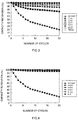
- the cycle capacity retentions (%) are computed as the battery capacities at each cycle divided by the battery capacity at the first cycle. The results are shown in FIG. 3 .
- FIG. 3 is a graph showing the change in capacity retention in Test Example 1.
- the capacity retention markedly decreased with an increasing number of charge-discharge cycles, with the capacity retention after 20 cycles falling to 20% or below. That is, the degradation factor as a manufactured product was too large. The reason is thought to be that, because the battery was charged to a battery voltage of 5 V, the negative electrode entered into an overcharged state, resulting in reductive decomposition of the electrolyte (especially DFEC).
- lithium ion secondary batteries were built using these negative electrode materials and the cycle characteristics of the lithium ion secondary batteries were evaluated. The results are shown in FIGS. 4 and 5 .
- FIG. 4 is a graph shown the change in capacity retention in Test Example 2.
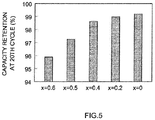
- FIG. 5 is a graph which compares the capacity retention at the 20th cycle in Test Example 2.
- the decrease in capacity retention was kept relatively low compared with when an uncoated graphitic carbon material was used.
- the capacity retention at the 20th cycle was higher. In other words, the cycle durability was excellent.
Landscapes
- Chemical & Material Sciences (AREA)
- Chemical Kinetics & Catalysis (AREA)
- Electrochemistry (AREA)
- General Chemical & Material Sciences (AREA)
- Inorganic Chemistry (AREA)
- Engineering & Computer Science (AREA)
- Composite Materials (AREA)
- Materials Engineering (AREA)
- Manufacturing & Machinery (AREA)
- Battery Electrode And Active Subsutance (AREA)
- Secondary Cells (AREA)
- Carbon And Carbon Compounds (AREA)
Applications Claiming Priority (1)
| Application Number | Priority Date | Filing Date | Title |
|---|---|---|---|
| JP2018058322A JP7054445B2 (ja) | 2018-03-26 | 2018-03-26 | 負極材料とこれを用いた電解液系電池 |
Publications (2)
| Publication Number | Publication Date |
|---|---|
| EP3547409A1 true EP3547409A1 (de) | 2019-10-02 |
| EP3547409B1 EP3547409B1 (de) | 2021-04-21 |
Family
ID=65494018
Family Applications (1)
| Application Number | Title | Priority Date | Filing Date |
|---|---|---|---|
| EP19157980.4A Active EP3547409B1 (de) | 2018-03-26 | 2019-02-19 | Negativelektrodenmaterial und lithiumionen batterie mit verwendung davon |
Country Status (4)
| Country | Link |
|---|---|
| US (1) | US11043672B2 (de) |
| EP (1) | EP3547409B1 (de) |
| JP (1) | JP7054445B2 (de) |
| CN (1) | CN110364698B (de) |
Families Citing this family (5)
| Publication number | Priority date | Publication date | Assignee | Title |
|---|---|---|---|---|
| JP6852653B2 (ja) * | 2017-11-07 | 2021-03-31 | トヨタ自動車株式会社 | 正極活物質およびフッ化物イオン電池 |
| WO2021070298A1 (ja) * | 2019-10-09 | 2021-04-15 | 本田技研工業株式会社 | フッ化物イオン二次電池用負極合材複合体、当該複合体を用いたフッ化物イオン二次電池用負極および二次電池、ならびに当該複合体の製造方法 |
| JPWO2021182488A1 (de) * | 2020-03-11 | 2021-09-16 | ||
| CN111799459B (zh) * | 2020-08-21 | 2021-09-17 | 中南大学 | 一种硫复合正极材料制备方法及全固态锂硫电池 |
| WO2024090132A1 (ja) | 2022-10-26 | 2024-05-02 | ステラケミファ株式会社 | フッ化物粒子の分散液 |
Citations (7)
| Publication number | Priority date | Publication date | Assignee | Title |
|---|---|---|---|---|
| JPH05325973A (ja) * | 1992-05-18 | 1993-12-10 | Matsushita Electric Ind Co Ltd | 正極活物質並びにそれを用いた電池 |
| JP2005276517A (ja) | 2004-03-23 | 2005-10-06 | Three M Innovative Properties Co | 非水性混合溶媒及びそれを含む非水性電解液 |
| EP1873850A1 (de) * | 2005-04-21 | 2008-01-02 | Potanin Institute Limited The | Sekundäres festkörper-speisegerät |
| EP2262042A1 (de) * | 2008-03-24 | 2010-12-15 | Zeon Corporation | Elektrode für bleiakkumulator und ihre verwendung |
| US20170092932A1 (en) * | 2015-09-24 | 2017-03-30 | Samsung Electronics Co., Ltd. | Composite electrode active material, electrode and lithium battery including the composite electrode active material, and method of preparing the composite electrode active material |
| US20170104237A1 (en) * | 2015-10-13 | 2017-04-13 | Panasonic Corporation | Electrolytic solution for electrochemical devices and electrochemical device in which the electrolytic solution is used |
| EP3410518A1 (de) * | 2017-06-01 | 2018-12-05 | Toyota Jidosha Kabushiki Kaisha | Kathodenaktivmaterial und fluorid-ionen-batterie |
Family Cites Families (19)
| Publication number | Priority date | Publication date | Assignee | Title |
|---|---|---|---|---|
| US3989543A (en) * | 1970-05-18 | 1976-11-02 | Mitchell Kurzban | Electrochemical cell having lead fluoride cathode |
| DE3171075D1 (en) * | 1980-12-24 | 1985-07-25 | Union Carbide Corp | Composition for use as solid state electrolyte and solid state cell employing same |
| US4399204A (en) * | 1981-06-30 | 1983-08-16 | Union Carbide Corporation | Solid cathode comprising a lead fluoride/tin fluoride compound |
| EP0931365B1 (de) | 1996-10-03 | 2000-07-19 | National Research Council Of Canada | Elektrolyt mit fluoro-ethylen- und propylenkarbonaten für alkalische metallionensekundärbatterien |
| US7645543B2 (en) * | 2002-10-15 | 2010-01-12 | Polyplus Battery Company | Active metal/aqueous electrochemical cells and systems |
| US8377586B2 (en) * | 2005-10-05 | 2013-02-19 | California Institute Of Technology | Fluoride ion electrochemical cell |
| KR100853327B1 (ko) | 2007-02-16 | 2008-08-21 | 엘에스엠트론 주식회사 | 리튬 전지용 음극 활물질과 그 제조방법 및 이를 이용한리튬 이차 전지 |
| KR20080093242A (ko) * | 2007-04-16 | 2008-10-21 | 엘에스엠트론 주식회사 | 2차 전지용 음극재와 그 제조방법 및 이를 음극으로포함하는 2차 전지 |
| JP2009064732A (ja) | 2007-09-07 | 2009-03-26 | Gunma Univ | 電極活物質およびそれを用いたリチウム二次電池 |
| KR20130033154A (ko) | 2011-09-26 | 2013-04-03 | 전자부품연구원 | 리튬 이차전지용 양극 활물질, 그의 제조방법 및 그를 포함하는 리튬이차전지 |
| JP6285263B2 (ja) * | 2014-04-17 | 2018-02-28 | トヨタ自動車株式会社 | フッ化物イオン電池用電解液およびフッ化物イオン電池 |
| JP6285264B2 (ja) * | 2014-04-17 | 2018-02-28 | トヨタ自動車株式会社 | フッ化物イオン電池用電解液およびフッ化物イオン電池 |
| KR102379564B1 (ko) | 2014-12-31 | 2022-03-29 | 삼성전자주식회사 | 복합 음극 활물질, 상기 복합 음극 활물질을 포함하는 음극 및 상기 음극을 포함하는 리튬 이차전지 |
| KR102368307B1 (ko) | 2015-09-16 | 2022-03-02 | 삼성전자주식회사 | 전극 활물질, 이를 포함하는 전극 및 이차전지, 및 상기 전극 활물질의 제조방법 |
| JP6486814B2 (ja) | 2015-11-04 | 2019-03-20 | 本田技研工業株式会社 | 結晶体の製造方法、結晶体及びフッ化物イオン2次電池用電解質 |
| JP7000011B2 (ja) * | 2016-06-02 | 2022-01-19 | トヨタ自動車株式会社 | フッ化物イオン電池用負極層およびフッ化物イオン電池 |
| JP6680175B2 (ja) | 2016-10-14 | 2020-04-15 | トヨタ自動車株式会社 | フッ化物イオン電池 |
| EP3555940B1 (de) * | 2016-12-15 | 2023-08-30 | Honda Motor Co., Ltd. | Zusammengesetzte elektrodenmaterialien für fluorid-ionen-batteriezellen |
| CN108735986B (zh) * | 2017-04-24 | 2021-10-29 | 丰田自动车株式会社 | 氟化物离子电池 |
-
2018
- 2018-03-26 JP JP2018058322A patent/JP7054445B2/ja active Active
-
2019
- 2019-02-19 EP EP19157980.4A patent/EP3547409B1/de active Active
- 2019-03-14 US US16/353,256 patent/US11043672B2/en active Active
- 2019-03-21 CN CN201910215703.9A patent/CN110364698B/zh active Active
Patent Citations (7)
| Publication number | Priority date | Publication date | Assignee | Title |
|---|---|---|---|---|
| JPH05325973A (ja) * | 1992-05-18 | 1993-12-10 | Matsushita Electric Ind Co Ltd | 正極活物質並びにそれを用いた電池 |
| JP2005276517A (ja) | 2004-03-23 | 2005-10-06 | Three M Innovative Properties Co | 非水性混合溶媒及びそれを含む非水性電解液 |
| EP1873850A1 (de) * | 2005-04-21 | 2008-01-02 | Potanin Institute Limited The | Sekundäres festkörper-speisegerät |
| EP2262042A1 (de) * | 2008-03-24 | 2010-12-15 | Zeon Corporation | Elektrode für bleiakkumulator und ihre verwendung |
| US20170092932A1 (en) * | 2015-09-24 | 2017-03-30 | Samsung Electronics Co., Ltd. | Composite electrode active material, electrode and lithium battery including the composite electrode active material, and method of preparing the composite electrode active material |
| US20170104237A1 (en) * | 2015-10-13 | 2017-04-13 | Panasonic Corporation | Electrolytic solution for electrochemical devices and electrochemical device in which the electrolytic solution is used |
| EP3410518A1 (de) * | 2017-06-01 | 2018-12-05 | Toyota Jidosha Kabushiki Kaisha | Kathodenaktivmaterial und fluorid-ionen-batterie |
Non-Patent Citations (2)
| Title |
|---|
| LORENA L GARZA TOVAR ET AL: "Investigation of lead tin fluorides as possible negative electrodes for Li-ion batteries", JOURNAL OF POWER SOURCES, ELSEVIER SA, CH, vol. 97, 11 December 2000 (2000-12-11), pages 258 - 261, XP028142787, ISSN: 0378-7753, [retrieved on 20110215], DOI: 10.1016/S0378-7753(01)00533-X * |
| MOHAMAD M AHMAD ET AL: "Dielectric relaxation properties of Pb1-xSnxF2 solid solutions prepared by mechanochemical milling; Dielectric relaxation properties of Pb1-xSnxF2 solid solutions", JOURNAL OF PHYSICS D: APPLIED PHYSICS, INSTITUTE OF PHYSICS PUBLISHING LTD, GB, vol. 40, no. 19, 7 October 2007 (2007-10-07), pages 6020 - 6025, XP020111955, ISSN: 0022-3727, DOI: 10.1088/0022-3727/40/19/037 * |
Also Published As
| Publication number | Publication date |
|---|---|
| JP2019169438A (ja) | 2019-10-03 |
| EP3547409B1 (de) | 2021-04-21 |
| US11043672B2 (en) | 2021-06-22 |
| CN110364698A (zh) | 2019-10-22 |
| CN110364698B (zh) | 2022-11-11 |
| US20190296352A1 (en) | 2019-09-26 |
| JP7054445B2 (ja) | 2022-04-14 |
Similar Documents
| Publication | Publication Date | Title |
|---|---|---|
| ES2985194T3 (es) | Material de electrodo positivo para batería secundaria y batería secundaria de litio que comprende el mismo | |
| US20230071080A1 (en) | Electrode compositions | |
| US7507503B2 (en) | Long life lithium batteries with stabilized electrodes | |
| EP2985816B1 (de) | Elektrode mit einer beschichtung zur verhinderung einer reaktion mit einem elektrolyten | |
| EP3547409B1 (de) | Negativelektrodenmaterial und lithiumionen batterie mit verwendung davon | |
| JP6705384B2 (ja) | リチウム二次電池 | |
| US10892480B2 (en) | Positive electrode material and lithium secondary battery using same | |
| EP2822083B1 (de) | Lithiumsekundärbatterie mit verbesserten frequenzeigenschaften | |
| US9385369B2 (en) | Rechargeable lithium battery | |
| KR20160072220A (ko) | 비수 전해액 이차 전지 | |
| JP2011096638A (ja) | 二次電池 | |
| CN113728483B (zh) | 非水电解质溶液添加剂以及包含其的锂二次电池用非水电解质溶液和锂二次电池 | |
| EP2421080B1 (de) | Nichtwässrige Elektrolytbatterie | |
| KR20210007483A (ko) | 리튬 이차 전지용 전해질 및 이를 포함하는 리튬 이차 전지 | |
| KR102112207B1 (ko) | 리튬 이차전지용 비수전해액 및 이를 포함하는 리튬 이차전지 | |
| US20240234701A1 (en) | Anode active material for lithium secondary battery and lithium secondary battery including the same | |
| JP2018514900A (ja) | 電気化学素子用電極、その製造方法、およびこれを含む電気化学素子 | |
| KR20190084561A (ko) | 사이클 수명 특성이 향상된 리튬 이차전지 | |
| CN120435784A (zh) | 锂二次电池用电解质及包括该锂二次电池用电解质的锂二次电池 | |
| JP2022528246A (ja) | リチウム二次電池用非水電解液添加剤、これを含むリチウム二次電池用非水電解液及びリチウム二次電池 | |
| KR20230105406A (ko) | 리튬 이차 전지용 전해액 및 이를 포함하는 리튬 이차 전지 | |
| US10511057B2 (en) | Non-aqueous electrolyte secondary battery and a method for producing the same | |
| EP4485604A1 (de) | Nichtwässriges elektrolyt und lithiumsekundärbatterie damit | |
| JP4078864B2 (ja) | 二次電池用負極および二次電池 | |
| CN117378073A (zh) | 非水电解质和包含该非水电解质的锂二次电池 |
Legal Events
| Date | Code | Title | Description |
|---|---|---|---|
| PUAI | Public reference made under article 153(3) epc to a published international application that has entered the european phase |
Free format text: ORIGINAL CODE: 0009012 |
|
| STAA | Information on the status of an ep patent application or granted ep patent |
Free format text: STATUS: REQUEST FOR EXAMINATION WAS MADE |
|
| 17P | Request for examination filed |
Effective date: 20190219 |
|
| AK | Designated contracting states |
Kind code of ref document: A1 Designated state(s): AL AT BE BG CH CY CZ DE DK EE ES FI FR GB GR HR HU IE IS IT LI LT LU LV MC MK MT NL NO PL PT RO RS SE SI SK SM TR |
|
| AX | Request for extension of the european patent |
Extension state: BA ME |
|
| RAP1 | Party data changed (applicant data changed or rights of an application transferred) |
Owner name: TOYOTA JIDOSHA KABUSHIKI KAISHA |
|
| RIC1 | Information provided on ipc code assigned before grant |
Ipc: H01M 4/583 20100101ALI20200602BHEP Ipc: H01M 4/58 20100101ALI20200602BHEP Ipc: H01M 4/38 20060101ALI20200602BHEP Ipc: H01M 4/133 20100101AFI20200602BHEP Ipc: H01M 4/56 20060101ALI20200602BHEP Ipc: H01M 10/052 20100101ALN20200602BHEP Ipc: H01M 4/36 20060101ALI20200602BHEP Ipc: H01M 4/02 20060101ALI20200602BHEP |
|
| RIC1 | Information provided on ipc code assigned before grant |
Ipc: H01M 4/583 20100101ALI20200605BHEP Ipc: H01M 4/02 20060101ALI20200605BHEP Ipc: H01M 4/56 20060101ALI20200605BHEP Ipc: H01M 4/38 20060101ALI20200605BHEP Ipc: H01M 4/133 20100101AFI20200605BHEP Ipc: H01M 4/58 20100101ALI20200605BHEP Ipc: H01M 10/052 20100101ALN20200605BHEP Ipc: H01M 4/36 20060101ALI20200605BHEP |
|
| GRAP | Despatch of communication of intention to grant a patent |
Free format text: ORIGINAL CODE: EPIDOSNIGR1 |
|
| STAA | Information on the status of an ep patent application or granted ep patent |
Free format text: STATUS: GRANT OF PATENT IS INTENDED |
|
| RIC1 | Information provided on ipc code assigned before grant |
Ipc: H01M 4/56 20060101ALI20200625BHEP Ipc: H01M 4/133 20100101AFI20200625BHEP Ipc: H01M 4/58 20100101ALI20200625BHEP Ipc: H01M 4/38 20060101ALI20200625BHEP Ipc: H01M 4/583 20100101ALI20200625BHEP Ipc: H01M 4/36 20060101ALI20200625BHEP Ipc: H01M 4/02 20060101ALI20200625BHEP Ipc: H01M 10/052 20100101ALN20200625BHEP |
|
| INTG | Intention to grant announced |
Effective date: 20200721 |
|
| GRAJ | Information related to disapproval of communication of intention to grant by the applicant or resumption of examination proceedings by the epo deleted |
Free format text: ORIGINAL CODE: EPIDOSDIGR1 |
|
| STAA | Information on the status of an ep patent application or granted ep patent |
Free format text: STATUS: REQUEST FOR EXAMINATION WAS MADE |
|
| GRAP | Despatch of communication of intention to grant a patent |
Free format text: ORIGINAL CODE: EPIDOSNIGR1 |
|
| STAA | Information on the status of an ep patent application or granted ep patent |
Free format text: STATUS: GRANT OF PATENT IS INTENDED |
|
| INTC | Intention to grant announced (deleted) | ||
| RAP1 | Party data changed (applicant data changed or rights of an application transferred) |
Owner name: TOYOTA JIDOSHA KABUSHIKI KAISHA |
|
| RIC1 | Information provided on ipc code assigned before grant |
Ipc: H01M 4/583 20100101ALI20201022BHEP Ipc: H01M 10/052 20100101ALN20201022BHEP Ipc: H01M 4/02 20060101ALI20201022BHEP Ipc: H01M 4/36 20060101ALI20201022BHEP Ipc: H01M 4/58 20100101ALI20201022BHEP Ipc: H01M 4/56 20060101ALI20201022BHEP Ipc: H01M 4/38 20060101ALI20201022BHEP Ipc: H01M 4/133 20100101AFI20201022BHEP |
|
| INTG | Intention to grant announced |
Effective date: 20201119 |
|
| GRAS | Grant fee paid |
Free format text: ORIGINAL CODE: EPIDOSNIGR3 |
|
| GRAA | (expected) grant |
Free format text: ORIGINAL CODE: 0009210 |
|
| STAA | Information on the status of an ep patent application or granted ep patent |
Free format text: STATUS: THE PATENT HAS BEEN GRANTED |
|
| AK | Designated contracting states |
Kind code of ref document: B1 Designated state(s): AL AT BE BG CH CY CZ DE DK EE ES FI FR GB GR HR HU IE IS IT LI LT LU LV MC MK MT NL NO PL PT RO RS SE SI SK SM TR |
|
| REG | Reference to a national code |
Ref country code: GB Ref legal event code: FG4D |
|
| REG | Reference to a national code |
Ref country code: CH Ref legal event code: EP |
|
| REG | Reference to a national code |
Ref country code: DE Ref legal event code: R096 Ref document number: 602019003956 Country of ref document: DE Ref country code: IE Ref legal event code: FG4D |
|
| REG | Reference to a national code |
Ref country code: AT Ref legal event code: REF Ref document number: 1385583 Country of ref document: AT Kind code of ref document: T Effective date: 20210515 |
|
| REG | Reference to a national code |
Ref country code: LT Ref legal event code: MG9D |
|
| REG | Reference to a national code |
Ref country code: AT Ref legal event code: MK05 Ref document number: 1385583 Country of ref document: AT Kind code of ref document: T Effective date: 20210421 |
|
| REG | Reference to a national code |
Ref country code: NL Ref legal event code: MP Effective date: 20210421 |
|
| PG25 | Lapsed in a contracting state [announced via postgrant information from national office to epo] |
Ref country code: NL Free format text: LAPSE BECAUSE OF FAILURE TO SUBMIT A TRANSLATION OF THE DESCRIPTION OR TO PAY THE FEE WITHIN THE PRESCRIBED TIME-LIMIT Effective date: 20210421 Ref country code: BG Free format text: LAPSE BECAUSE OF FAILURE TO SUBMIT A TRANSLATION OF THE DESCRIPTION OR TO PAY THE FEE WITHIN THE PRESCRIBED TIME-LIMIT Effective date: 20210721 Ref country code: AT Free format text: LAPSE BECAUSE OF FAILURE TO SUBMIT A TRANSLATION OF THE DESCRIPTION OR TO PAY THE FEE WITHIN THE PRESCRIBED TIME-LIMIT Effective date: 20210421 Ref country code: FI Free format text: LAPSE BECAUSE OF FAILURE TO SUBMIT A TRANSLATION OF THE DESCRIPTION OR TO PAY THE FEE WITHIN THE PRESCRIBED TIME-LIMIT Effective date: 20210421 Ref country code: HR Free format text: LAPSE BECAUSE OF FAILURE TO SUBMIT A TRANSLATION OF THE DESCRIPTION OR TO PAY THE FEE WITHIN THE PRESCRIBED TIME-LIMIT Effective date: 20210421 Ref country code: LT Free format text: LAPSE BECAUSE OF FAILURE TO SUBMIT A TRANSLATION OF THE DESCRIPTION OR TO PAY THE FEE WITHIN THE PRESCRIBED TIME-LIMIT Effective date: 20210421 |
|
| PG25 | Lapsed in a contracting state [announced via postgrant information from national office to epo] |
Ref country code: RS Free format text: LAPSE BECAUSE OF FAILURE TO SUBMIT A TRANSLATION OF THE DESCRIPTION OR TO PAY THE FEE WITHIN THE PRESCRIBED TIME-LIMIT Effective date: 20210421 Ref country code: PT Free format text: LAPSE BECAUSE OF FAILURE TO SUBMIT A TRANSLATION OF THE DESCRIPTION OR TO PAY THE FEE WITHIN THE PRESCRIBED TIME-LIMIT Effective date: 20210823 Ref country code: SE Free format text: LAPSE BECAUSE OF FAILURE TO SUBMIT A TRANSLATION OF THE DESCRIPTION OR TO PAY THE FEE WITHIN THE PRESCRIBED TIME-LIMIT Effective date: 20210421 Ref country code: NO Free format text: LAPSE BECAUSE OF FAILURE TO SUBMIT A TRANSLATION OF THE DESCRIPTION OR TO PAY THE FEE WITHIN THE PRESCRIBED TIME-LIMIT Effective date: 20210721 Ref country code: LV Free format text: LAPSE BECAUSE OF FAILURE TO SUBMIT A TRANSLATION OF THE DESCRIPTION OR TO PAY THE FEE WITHIN THE PRESCRIBED TIME-LIMIT Effective date: 20210421 Ref country code: PL Free format text: LAPSE BECAUSE OF FAILURE TO SUBMIT A TRANSLATION OF THE DESCRIPTION OR TO PAY THE FEE WITHIN THE PRESCRIBED TIME-LIMIT Effective date: 20210421 Ref country code: GR Free format text: LAPSE BECAUSE OF FAILURE TO SUBMIT A TRANSLATION OF THE DESCRIPTION OR TO PAY THE FEE WITHIN THE PRESCRIBED TIME-LIMIT Effective date: 20210722 Ref country code: IS Free format text: LAPSE BECAUSE OF FAILURE TO SUBMIT A TRANSLATION OF THE DESCRIPTION OR TO PAY THE FEE WITHIN THE PRESCRIBED TIME-LIMIT Effective date: 20210821 |
|
| REG | Reference to a national code |
Ref country code: DE Ref legal event code: R097 Ref document number: 602019003956 Country of ref document: DE |
|
| PG25 | Lapsed in a contracting state [announced via postgrant information from national office to epo] |
Ref country code: CZ Free format text: LAPSE BECAUSE OF FAILURE TO SUBMIT A TRANSLATION OF THE DESCRIPTION OR TO PAY THE FEE WITHIN THE PRESCRIBED TIME-LIMIT Effective date: 20210421 Ref country code: DK Free format text: LAPSE BECAUSE OF FAILURE TO SUBMIT A TRANSLATION OF THE DESCRIPTION OR TO PAY THE FEE WITHIN THE PRESCRIBED TIME-LIMIT Effective date: 20210421 Ref country code: SM Free format text: LAPSE BECAUSE OF FAILURE TO SUBMIT A TRANSLATION OF THE DESCRIPTION OR TO PAY THE FEE WITHIN THE PRESCRIBED TIME-LIMIT Effective date: 20210421 Ref country code: RO Free format text: LAPSE BECAUSE OF FAILURE TO SUBMIT A TRANSLATION OF THE DESCRIPTION OR TO PAY THE FEE WITHIN THE PRESCRIBED TIME-LIMIT Effective date: 20210421 Ref country code: SK Free format text: LAPSE BECAUSE OF FAILURE TO SUBMIT A TRANSLATION OF THE DESCRIPTION OR TO PAY THE FEE WITHIN THE PRESCRIBED TIME-LIMIT Effective date: 20210421 Ref country code: EE Free format text: LAPSE BECAUSE OF FAILURE TO SUBMIT A TRANSLATION OF THE DESCRIPTION OR TO PAY THE FEE WITHIN THE PRESCRIBED TIME-LIMIT Effective date: 20210421 Ref country code: ES Free format text: LAPSE BECAUSE OF FAILURE TO SUBMIT A TRANSLATION OF THE DESCRIPTION OR TO PAY THE FEE WITHIN THE PRESCRIBED TIME-LIMIT Effective date: 20210421 |
|
| PLBE | No opposition filed within time limit |
Free format text: ORIGINAL CODE: 0009261 |
|
| STAA | Information on the status of an ep patent application or granted ep patent |
Free format text: STATUS: NO OPPOSITION FILED WITHIN TIME LIMIT |
|
| 26N | No opposition filed |
Effective date: 20220124 |
|
| PG25 | Lapsed in a contracting state [announced via postgrant information from national office to epo] |
Ref country code: IS Free format text: LAPSE BECAUSE OF FAILURE TO SUBMIT A TRANSLATION OF THE DESCRIPTION OR TO PAY THE FEE WITHIN THE PRESCRIBED TIME-LIMIT Effective date: 20210821 Ref country code: AL Free format text: LAPSE BECAUSE OF FAILURE TO SUBMIT A TRANSLATION OF THE DESCRIPTION OR TO PAY THE FEE WITHIN THE PRESCRIBED TIME-LIMIT Effective date: 20210421 |
|
| PG25 | Lapsed in a contracting state [announced via postgrant information from national office to epo] |
Ref country code: IT Free format text: LAPSE BECAUSE OF FAILURE TO SUBMIT A TRANSLATION OF THE DESCRIPTION OR TO PAY THE FEE WITHIN THE PRESCRIBED TIME-LIMIT Effective date: 20210421 |
|
| PG25 | Lapsed in a contracting state [announced via postgrant information from national office to epo] |
Ref country code: MC Free format text: LAPSE BECAUSE OF FAILURE TO SUBMIT A TRANSLATION OF THE DESCRIPTION OR TO PAY THE FEE WITHIN THE PRESCRIBED TIME-LIMIT Effective date: 20210421 |
|
| REG | Reference to a national code |
Ref country code: CH Ref legal event code: PL |
|
| REG | Reference to a national code |
Ref country code: BE Ref legal event code: MM Effective date: 20220228 |
|
| PG25 | Lapsed in a contracting state [announced via postgrant information from national office to epo] |
Ref country code: LU Free format text: LAPSE BECAUSE OF NON-PAYMENT OF DUE FEES Effective date: 20220219 |
|
| PG25 | Lapsed in a contracting state [announced via postgrant information from national office to epo] |
Ref country code: LI Free format text: LAPSE BECAUSE OF NON-PAYMENT OF DUE FEES Effective date: 20220228 Ref country code: IE Free format text: LAPSE BECAUSE OF NON-PAYMENT OF DUE FEES Effective date: 20220219 Ref country code: CH Free format text: LAPSE BECAUSE OF NON-PAYMENT OF DUE FEES Effective date: 20220228 |
|
| PG25 | Lapsed in a contracting state [announced via postgrant information from national office to epo] |
Ref country code: BE Free format text: LAPSE BECAUSE OF NON-PAYMENT OF DUE FEES Effective date: 20220228 |
|
| P01 | Opt-out of the competence of the unified patent court (upc) registered |
Effective date: 20230427 |
|
| REG | Reference to a national code |
Ref country code: DE Ref legal event code: R084 Ref document number: 602019003956 Country of ref document: DE |
|
| REG | Reference to a national code |
Ref country code: GB Ref legal event code: 746 Effective date: 20230816 |
|
| PG25 | Lapsed in a contracting state [announced via postgrant information from national office to epo] |
Ref country code: MK Free format text: LAPSE BECAUSE OF FAILURE TO SUBMIT A TRANSLATION OF THE DESCRIPTION OR TO PAY THE FEE WITHIN THE PRESCRIBED TIME-LIMIT Effective date: 20210421 Ref country code: CY Free format text: LAPSE BECAUSE OF FAILURE TO SUBMIT A TRANSLATION OF THE DESCRIPTION OR TO PAY THE FEE WITHIN THE PRESCRIBED TIME-LIMIT Effective date: 20210421 |
|
| PG25 | Lapsed in a contracting state [announced via postgrant information from national office to epo] |
Ref country code: HU Free format text: LAPSE BECAUSE OF FAILURE TO SUBMIT A TRANSLATION OF THE DESCRIPTION OR TO PAY THE FEE WITHIN THE PRESCRIBED TIME-LIMIT; INVALID AB INITIO Effective date: 20190219 |
|
| PG25 | Lapsed in a contracting state [announced via postgrant information from national office to epo] |
Ref country code: MT Free format text: LAPSE BECAUSE OF FAILURE TO SUBMIT A TRANSLATION OF THE DESCRIPTION OR TO PAY THE FEE WITHIN THE PRESCRIBED TIME-LIMIT Effective date: 20210421 |
|
| PG25 | Lapsed in a contracting state [announced via postgrant information from national office to epo] |
Ref country code: TR Free format text: LAPSE BECAUSE OF FAILURE TO SUBMIT A TRANSLATION OF THE DESCRIPTION OR TO PAY THE FEE WITHIN THE PRESCRIBED TIME-LIMIT Effective date: 20210421 |
|
| PGFP | Annual fee paid to national office [announced via postgrant information from national office to epo] |
Ref country code: FR Payment date: 20251231 Year of fee payment: 8 |
|
| PGFP | Annual fee paid to national office [announced via postgrant information from national office to epo] |
Ref country code: GB Payment date: 20260106 Year of fee payment: 8 |
|
| PGFP | Annual fee paid to national office [announced via postgrant information from national office to epo] |
Ref country code: DE Payment date: 20251230 Year of fee payment: 8 |